VOLUME V SLICE VI Celtes, Konrad to Ceramics (continued 8)
Reading edition
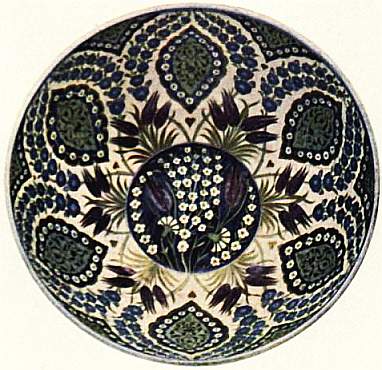
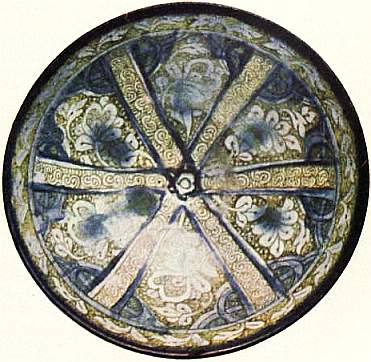
Damascus: 16th century. Persian, lustre and underglaze colour: 13th century.
3. The Glaze.—The white enamel which formed at first both the glaze and the ground for painting upon—bianco, as it was called—was prepared in a complicated way. A clear potash glass (marzacotto) was made by melting together clean siliceous sand (rena) and the potash salt left as the lees of wine (feccia). This corresponds to the alkaline glaze of the Egyptians with the substitution of potash for soda. Such a glaze alone would have been useless to the Italian potter, and accordingly the bianco was made by melting together thirty parts of marzacotto and twelve parts of lead and tin ashes. The white enamel as used was therefore a mixed silicate of lead and potash rendered opaque with oxide of tin.
4. Pigments (colori) were compounded from metallic oxides or earths; the yellow, from antimoniate of lead, which was mixed with oxide of iron to give orange; the green, from oxide of copper (the turquoise tint given to the Egyptian and Syrian glazes by oxide of copper is impossible with a glaze of lead and tin); and the greens were made by mixing oxide of copper with oxide of antimony or oxide of iron; blue, from oxide of cobalt, used in the form of a blue glass (smalto, or zaffara); brownish-purple, from manganese; black, from mixtures of the other colours; and the rare red, or reddish brown, of Faenza and Cafaggiolo was probably the same Armenian bole that was used so magnificently by the makers of the Turkish pottery, but on the white enamel ground this colour was most treacherous and uncertain. It must be remembered that many of these colours owe their tint to the lead used in their composition, or to the grounds containing oxides of lead and tin on which they were painted. Piccolpasso describes the preparation and composition of the various colours used in his day.
5. Coperta, or transparent glaze. In the later majolica a thin coating of soft rich glaze was applied over the fired painting to give a smooth bright surface. This coperta was a soft lead glass consisting of silica (sand), 20 parts; oxide of lead, 17 parts; potash, 12 parts; and common salt, 8 parts; fused together and then finely ground in water.
6. Methods of Glazing and Decorating.—In the mezza-majolica and the early majolica it is probable that the clay vessel was dipped in the white bath to give it an envelope (invetriatura) before it was fired at all; but it must soon have become apparent that it was much better to fire first the shaped vessel until it was about as hard and brittle as a clay tobacco-pipe, and then coat it with the white enamel, by dipping it into a bath or pouring the fluid material upon it. This was the practice described by Piccolpasso. A coating of white enamel, the thickness of glove leather, having been obtained, the piece was carefully taken by the painter, who first etched in the outline on the absorbent powdery ground, and then shaded the figures, landscapes, &c., in blue or in a mixture of blue and yellow, adding the other colours as gradated washes. The vase was then fired a second time to a heat greater than the first, so that the enamel was melted on the vessel and the colours sunk into the enamel at one and the same operation. This method of painting on the unbaked enamel demanded a bold direct treatment—for alteration or retouching was impossible—and much of the vigour of the earlier designs is due to this fact. As the ware became more refined in its treatment it was felt that this method did not yield a sufficiently brilliant surface, and so the painted and fired piece was coated with a film of coperta and fired again at a slightly lower temperature to make it smoother and more glossy. Still pursued by the idea of rivalling the triumphs of pictorial art, the majolist carried his methods a step farther. The white enamel coating was fired before painting, giving a glossy surface on which the painter could draw or wipe out, and so could execute outlining, tinting, or shading of the utmost delicacy. A film of coperta was then washed over the painting, and the piece was fired a third time in the cooler parts of the kiln. In some instances it is not easy even for an experienced potter to decide which method has been pursued, owing to the softening of the colours. Generally we should expect that the later and more pictorial pieces had been painted on a ground of fired white enamel, and we may be absolutely certain when delicate white patterns have been “picked out” in a coloured ground.
Where lustre decoration has been added to a piece of majolica it indicates, as elsewhere, the use of a special process, and a final firing at a lower heat. The lustre pigments were the same as those used on the earlier lustred wares, and these were painted over an otherwise finished piece. To obtain the lustre effect these were placed in a special kiln, so contrived that when the pots were just visibly red the smoke of the burning fuel (rosemary or gorse) was allowed to play upon them long enough to drive the metallic films (silver or copper) into the already-fired glaze.17
Collections.—The Victoria and Albert Museum contains perhaps the most widely representative collection in the world, especially as at the present time the pieces of the Salting and Pierpont Morgan collections are on exhibition there. The British Museum collection is valuable, being rich in “signed” pieces of the first quality. The Wallace collection and the Ashmolean Museum at Oxford (Fortnum collection, &c.) are also valuable and contain some remarkable examples. The Cluny Museum, the Louvre and the museum at Sèvres have fine collections; while noteworthy pieces are to be found in the Ceramic Museum at Limoges. In Germany the museum at Brunswick contains one of the largest collections known, but many inferior and doubtful examples. Berlin, Munich, Vienna and St Petersburg have noteworthy collections. In Italy, the Bargello at Florence and the museums of Venice, Milan, Turin, Faenza, Pesaro, Urbino, Rome and Naples all have collections, whilst interesting examples of local manufactures are to be found in many of the smaller Italian towns. The American museums, especially those in New York, Boston and Philadelphia, have some fine examples.
Literature.—F. Argnani, La Ceramiche et maioliche faentine (Faenza, 1889 and 1903); D. Bonghi, Intorno alle Majoliche di Castelli (Naples, 1856); Professor Douglas, “Siena,” in the Nineteenth Century, September 1900; Hensel, Essai sur la majolique (Paris, 1836); G.I. Montanari, Majoliche dipinte nella collezione del N.S.C. Domenico Mazza (Pesaro, 1836); L. Frati, Di un insigna raccolta di majoliche (Bologna, 1844); also Di un pavimento in majolica (Bologna, 1853); J.C. Robinson, Italian Sculpture of the Middle Ages (London, 1862); E. Darcel, Musée du Louvre: Notice des faïences peintes; Drury E. Fortnum, Contribution to the History of Pottery (London, 1868); Delange, Recueil de faïences italiennes du XV^e au XVII^e siècle (Paris, 1869); M. Meurer, Italienische Maiolika Fliesen (Berlin); E. Molinier, Les Majoliques italiennes en Italie (Paris, 1883), also La Céramique italienne au XV^e siècle (Paris, 1888); C. Piccolpasso, I tre libri dell’ arte del Vasajo, Castel Durante 1548 (original MS.) and translations by C. Popelyn, Paris, 1841 and 1860, also Italian editions of Rome and Milan; V. Lazari, Notizia della raccolta Correr (Venice, 1859); Drury E. Fortnum, A Descriptive Catalogue of the Majolica in the South Kensington Museum (London, 1873); Beckwith, Majolica and Faience (New York, 1877); G. Corona, La Ceramica (Milan, 1878); G. Vanzolini, Istoria delle fabbriche di majoliche metaurensi (Pesaro, 1879); A. Genolini, Majoliche italiane (Milan, 1881); Mely, La Céramique italienne (Paris, 1884); J.E. Jacobsthal, Süd-italienische Fliesen (Berlin, 1886); Bertolotti, Figulini, fonditori, e scultori (Milan, 1890); H. Wallis, Italian Ceramic Art (1897), The Oriental Influence on the Ceramic Art of the Italian Renaissance (1900), The Art of the Precursors (1901), The Majolica Pavements of the Fifteenth Century (1902), Oak-leaf Jars: A Fifteenth Century Italian Ware (1903), The Albarello (1904), also Seventeen Plates by Nicola Fontana (1905), and Italian Ceramic Art: Figure Designs (1905); Tesorone, L’Antico Pavimento delle Logge di Raffaello in Vaticano (Naples, 1891); Columba, Il “Quos Ego” di Raffaello (Palermo, 1895); Drury E. Fortnum, Majolica (London, 1896); also Fortnum Collection in the Oxford Museum (London, 1896); O. von Falke, Majolika (Berlin, 1896); also Sammlung R. Zschille: Katalog der italienischen Majoliken (Leipzig, 1899); Antaldi Santinelli, Museo di Pesaro (Pesaro, 1897); De Mauri, L’Amatore di Majolica (Milan, 1898); E. Hannover, De Spanske-Mauriske, og de forste Italienske Fayence (Copenhagen, 1906).
(R. L. H.; W. B.*)
French Pottery from the 15th to the 19th Century
The pottery of medieval France needs little attention here, for it was, in the main, similar to that which was made generally in Europe—rudely shaped vessels of ordinary clay often decorated with modelled ornament and glazed with yellow or brown lead glaze, or, if coated with white slip, decorated with bright green glazes, and towards the end of the 15th century with greyish blue. The later specimens of this simple ware—pronouncedly Gothic in feeling—were often extremely decorative. Avignon, Beauvais and Savigny are the best-known centres of this truly national manufacture, and, as we might expect in French work, the reliefs are often sharp and well designed. Evidence accumulates that from time to time the princes and great nobles imported Spanish or Italian workmen to make special tiles for the decoration of their palaces or chapels. The duke of Burgundy brought Jehan de Moustiers and Jehan-le-Voleur, “ouvriers en quarrieaux peints et jolis,” in 1391, to paint tiles for his palaces at Hesdin and Arras in the north, and we have already referred to the tile-work in the Spanish fashion made at Poitiers by John of Valencia, the “Saracen,” in 1384 for Duke Jean de Berry.18 Other instances might be multiplied but that this foreign work left little or no traces on contemporary French pottery. Even at a later date, when Francis I. brought Girolamo della Robbia from Italy to decorate his “Petit Château de Madrid” in 1529, or when Masseot Abaquesne, about 1542, manufactured at Rouen the painted tile pavements for the château of Ecouen, the cathedral of Langres, and other places, nothing came of the imported methods; the works were executed and left no traces on the general pottery of the country. During the 16th century, however, two remarkable kinds of pottery were made in France of distinctive quality, and both eminently French—the Henri-Deux ware and the pottery of Bernard Palissy and his imitators.
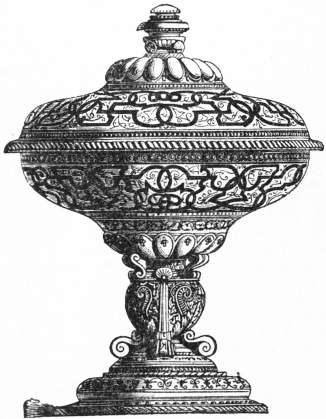
Fig. 48.—Tazza of Oiron pottery. (Louvre.)

Oiron Potter’s mark.
Henri-Deux, Oiron or St Porchaire ware, for all these names have in turn been applied to the enigmatic and wonderful pottery, specimens of which are now valued at more than their weight in gold, was once believed to have been made by the librarian Bernard, and his assistant Charpentier, for their patroness Helène de Hangest about 1529 at her château at Oiron, near Thouars.19 A few years ago this theory was discarded in favour of one which assigned them to some unknown potter of St Porchaire in the same region;20 but even of this theory there is insufficient proof, and we are left in doubt both as to the maker and the place of origin. All we know is that the ware dates from the reign of Henry II., and that it was probably made somewhere near Oiron, as most of the specimens have been found in that district. The work is sui generis, for it had no direct ancestry, neither did it leave any mark on contemporary French pottery. Sixty-five pieces of the ware (see fig. 48) are known to be in museums and private collections; the Louvre and the Victoria and Albert Museum have the best collections of their kinds, but the Rothschilds still hold the greater number of examples. The ware is fashioned in a simple whitish pipeclay, and ornamented with interlacing strap-work patterns, typical of the period, inlaid in yellow, buff or dark-brown clay. The forms are generally graceful, but some examples are over-elaborate and overloaded with modelled ornament. The pieces were designed to serve as candlesticks, salt-cellars, tazzas, ewers, holy-water pots and dishes. After the vessels had been “thrown” and “turned” to a perfect shape, metal tools, such as were used by the bookbinders and casemakers of that day, were pressed into the clay, so as to form sunk cells of ornamental tooling. These cells were carefully filled with finely-prepared slips of other clays, that would burn yellow, buff or dark-brown; and when the whole was dry the piece was carefully smoothed again, and moulded reliefs were attached, or touches of colour were applied. After being fired the ware was glazed, apparently with the ordinary lead glaze of the time carefully prepared and fired again. At a later period the ornament was not inlaid in this elaborate manner, but was simply painted, as indeed it might all have been so far as decorative effect is concerned.
Palissy Ware.—Bernard Palissy was a genius of original talent, but, at the hands of his literary admirers, he has gained a legendary rank as one of the great potters of the world which his pottery does not warrant. He is supposed to have spent sixteen years in the search for the white enamel which was being used all the time in Italy and Spain—probably he was searching for the mystery of Chinese porcelain—and when he settled down to make the “Palissy ware,” he did nothing more than carry to perfection the methods of the village pot-makers of his own district. On a hard-fired red clay he disposed groups of moulded plants, shells, fish and reptiles, painted them with crude green, brown and yellow colours, and glazed the whole with a well-prepared lead glaze. His style soon had numerous imitators, like A. Cléricy and B. de Blémont, who executed works quite as good as those of their master; but their works also vanished and left no permanent impression on the general trend of French pottery.
Meantime Italian, and, it may be, Spanish potters strayed over the French border and attempted to introduce the manufacture of their tin-enamelled wares; for we know of the works of Gambin and Tardessir of Faenza, established at Lyons about 1556; of Sigalon at Nîmes in 1548; of Jehan Ferro at Nantes about 1580, and other sporadic efforts. The needed impetus came, however, when the Mantuan duke, Louis de Gonzague, became duke of Nevers in 1565; and we find Italian majolists, working under princely patronage, planting their decadent art in the centre of France. The first efforts met with little success until, with the appearance of the Conrades from Savona, who were domiciled in Nevers in 1602, we get the genuine ware of Nevers. Naturally the first productions, whether of the Conrades or their predecessors, were in the style of the debased majolica of Savona, but the body and glaze of the ware is harder, the colours are not so rich, and the execution is less spirited. The first departure from Italian traditions is seen in the ware of the so-called “Persian style” of Nevers—probably adopted from contemporary work in Limoges enamels on metal—where conventional and fanciful designs of flowers and foliage, birds, animals or figures were thickly raised in white enamel on a ground of bright, intense cobalt-blue glaze. After the middle of the 17th century the Italian style of design appears to have been entirely replaced by pseudo-oriental patterns painted in blue or in polychrome, but really imitated from the “Delft” copies of Chinese and Japanese porcelain. When Rouen and Moustiers became famous for their distinctive wares Nevers copied their designs also, and on a gradually descending scale the manufacture continued to the end of the 18th century, when France was flooded with the rude Faiences patriotiques from this centre.
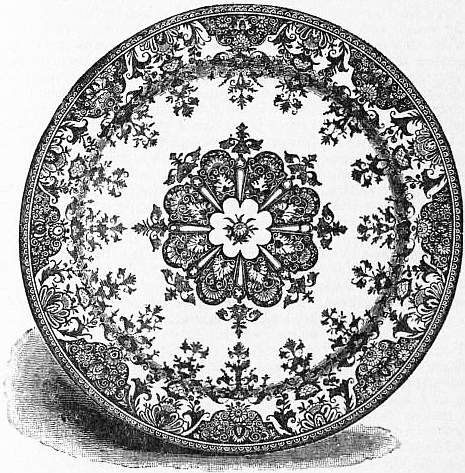
Fig. 49.—Dish of Rouen enamelled pottery, painted in blues and deep red.
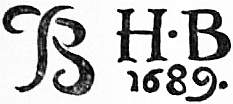
Nevers Potters’ marks.
The genuine French tin-enamelled ware, freed from the traces of Italian influence, first developed itself at Rouen under the famous Poterats in the later part of the 17th century. A new scheme of ornamentation was gradually evolved in the daintily-designed scalloped and radiating patterns adapted from oriental fabrics, lace and needlework, and from the ornamental devices of contemporary printers. These designs, having been skilfully drawn on the pieces, were filled in with bright blue, strong yellow, light green, or a bright bricky-red in palpable relief, applied as flat washes or in fine lines; and the result was a gay and sparkling ware much superior in decorative value to the later Italian majolicas (see fig. 49). So successful was this Rouen ware that rival factories were quickly started at Saint Cloud, Sinceny, Quimper, Lille, and other places in the north. Saint Cloud and Lille made fine pottery of this class at the end of the 17th and in the early 18th century. It was imitated at Nevers, the potters’ marks shown being those of J. Bourdu and H. Borne. In the south of France, Pierre Clérissy established the industry at Moustiers in 1686, and, though the early Moustiers ware bears a strong resemblance to the debased Italian majolica of the time, the Moustiers painters soon left that behind, and on a glaze of inimitable whiteness and softness they deftly pencilled blue patterns based on the engravings of designs after Berain, Marot and Toro. At a later date Olerys, who had been to Alcora to introduce the French faience into Spain, returned to Moustiers and introduced a pale polychrome style very inferior to that of Rouen. These pieces are covered with patterns outlined in blue and filled in with yellow, pale green and light purple. Olerys is also said to have introduced the grotesque style of Moustiers, founded on the caricatures of Callot. Other factories were started from Moustiers, such as those at Apt, Ardus and Montauban, and even at Narbonne, Bordeaux and Clermont-Ferrand; just as the northern factories had sprung from Rouen.
We have already seen at Nevers the introduction of patterns in the Chinese style, and the same course was increasingly followed at all the French factories during the 18th century. At Strassburg a fresh impetus was given in this direction when, about 1721, Charles Hannong introduced the practice of painting his white tin-enamelled ware with the on-glaze colours used by the porcelain painters. This process enabled the French potter to produce many colours unobtainable by his older process, and moreover helped him to make his wares look more like the coveted porcelain, then becoming the rage all over Europe. This new departure marks the end of the best period of French faience, but so successfully did it meet the demands of the time that it gradually displaced the old method of decoration where the colours were painted on the raw glaze and fired along with it. Factories sprang up for the manufacture of this new ware in the first half of the 18th century at Niederviller, Lunéville and Sceaux, and it was quickly adopted by the older factories at Rouen, Sinceny, Marseilles, &c. With its general adoption the old French faience, developed from the Italian stock, departed, to make way for a tin-enamelled imitation of famille-rose porcelain. But this last style was not of long life. The wealthy classes were no longer patrons of pottery but of porcelain, and when, after 1786, the newly perfected English earthenware was thrown upon the French market, the French faience-makers had to give up their works, or adopt the manufacture of this neater and, for domestic purposes, more suitable form of pottery. This change, together with the disturbances of revolutionary times, brought artistic pottery in France to a standstill, and we shall treat of its revival during the last forty or fifty years in a subsequent section.
Collections.—The Victoria and Albert Museum and the British Museum contain typical examples; but not such collections as are to be seen in the Cluny Museum, the Louvre, the museum at Sèvres, or the French provincial museums at Rouen, Limoges, Marseilles, Lille, St Omer, &c.
Literature.—Deck, La Faience (Paris, 1887); Gasnault and Garnier, French Pottery (Victoria and Albert Museum Handbooks, 1884); Le Breton, Le Musée céramique de Rouen (Rouen, 1883); Milet, (?) Historique de la faience et de la porcelaine de Rouen (Rouen, 1898); Pottier, Histoire de la faience de Rouen (Amiens, 1870); L’Abbé H. Requin, Histoire de la faience artistique de Moustiers, tome I^er (Paris, 1903); M.L. Solon, The Old French Faience (London, 1903)—the best survey of the whole subject, with a very full bibliography. The various volumes of the Gazette des beaux-arts contain many valuable original articles.
(W. B.*)
German, Dutch and Scandinavian Pottery
In northern Europe until the time of the Renaissance the making of tiles is the only branch of the potter’s craft of artistic rank. The pavement tiles of Germany of the Gothic period, examples of which have been found in the valley of the Rhine from Constance to Cologne, often bear designs of foliage or grotesque animals full of character and spirit. Their decoration is effected either by impression with a stamp of wood or clay, or by “pressing” the tile in a mould to produce a design in relief. The surface is sometimes protected by a lead glaze—green, brown or yellow—but is generally left unglazed.
Glazed tiles with relief ornament were also made as early as the 14th century for the construction of stoves, such as have continued in use in Germany to the present day. About 1500 a development took place in the combination of glazes of different colours on a single tile. In the middle of the 16th century Renaissance ornament appears in place of Gothic canopies and tracery, and blue and white enamels begin to be used in combination with lead glazes of other colours. Figures in the costume of the period, or shields of arms, in round-arched niches are a favourite motive alike in the stove tiles and in the wares of similar technique known as Hafnergefässe, which have been wrongly attributed to Hirsvogel of Nuremberg. These were made not only in that city but also in Silesia and at Salzburg, Steyr, and elsewhere in Upper Austria; their manufacture continued into the 18th century.
Imitations of Italian majolica with polychrome painting on a white enamelled ground were first made in southern Germany about 1525, and it is with these wares that the name of Hirsvogel should really be associated. The same style survived for more than a century and a half in the stoves and pottery made by the Pfau family at Winterthur in Switzerland, from the end of the 16th century onwards. An interesting development is exhibited by certain rare productions, of Silesian origin, dating from about 1550, with decorations in coloured enamels which are prevented from flowing together by a strong outline incised in the clay.
Stoneware.—The most important feature of the history of German pottery is the development of stoneware along the valley of the Rhine. This ware is of a highly refractory white or grey body of intense hardness, glazed by the introduction of salt into the kiln when the highest temperature was reached. It was exported in large quantities through the markets of Cologne and Aachen (Aix-la-Chapelle) to England, France and other parts of northern Europe. The frequent occurrence in its decoration of the arms of foreign cities and princes shows that the German potters were alive to the requirements of foreign customers.
The oldest centre of this manufacture seems to have been at Siegburg near Coblenz, where the white stoneware peculiar to the neighbourhood, made from local clay, must have been made and exported in considerable quantities at least as early as the 15th century; plain beer-jugs of that date with cylindrical neck and slightly swelling body have been unearthed in London and the eastern counties of England. In the 16th century an artistic development took place, and the potters were formed into an exclusive gild under stringent regulations. The manufacture lasted till the sack of the town by the Swedes in 1632, subsequent attempts to re-establish it being unsuccessful. This ware, of a creamy white colour, generally thinly glazed and only rarely coloured by staining with cobalt blue, is decorated by impression with small stamps or by the application of reliefs pressed from separate moulds. The motives include sacred and classical figure subjects, portraits of contemporary sovereigns, and armorial bearings, with accessory foliage in which a survival of Gothic feeling is often perceptible. Characteristic forms are the high tankard (Schnelle) and the ewer with long spout (Schnabelkrug), but the fancy of the potter also found expression in various quaint or extravagant forms.
At Raeren in the duchy of Limburg this industry attained importance about 1550, and was continued for over seventy years; 1539 is the earliest date known to occur on this ware. The pieces were of two kinds, brown-glazed and grey; the latter usually decorated with blue. The favourite form is a baluster-shaped jug with heraldic designs or a frieze of figures round the middle. The subjects are from Scripture history or contemporary peasant life as interpreted by Hans Sebald Beham and the German and French “Little Masters.” Examples are known bearing dates and names or initials of mould-cutters, among them Ian Emens and Baldem Mennicken; but it must not always be inferred that a piece is as old as the date introduced in its decoration, for the same set of moulds might be used for many years.
Another important centre in the 16th century was at Frechen near Cologne. Round-bellied jugs known as Bartmänner, from the bearded mask applied in front of the neck, covered with a brown glaze, which in later examples is often coagulated into thick spots, were first made here towards the end of the 15th century, and continued to be the staple product well into the 17th. The jugs of this type, known as Greybeards or Bellarmines, which were exported in profusion to England, Scandinavia and the Low Countries, were mostly made here. At Cologne itself there were also factories, probably before the 16th century, the later productions of which resemble those of Frechen.
During the 17th and 18th centuries the busiest stoneware centre was the district surrounding Höhr-Grenzhausen in Nassau known as the Kannebäckerländchen, where artistic ware was being made before 1600. Soon after that date manganese purple was first used in the decoration in addition to cobalt blue, and henceforward colour in combination with impressed and incised ornament tended more and more to supersede decoration in relief. Figure subjects gave place to rosettes, foliage on wavy stems, and geometrical patterns. Vessels of large size and fantastic shape appear beside the standard forms of the earlier factories. In the 18th century the forms of beer-vessels became stereotyped in the globular jug with cylindrical neck and the cylindrical tankard, while tea and coffee pots, inkstands and other vessels, hitherto unknown, began to be made. A stoneware manufacture dating back to the middle ages existed at Creussen in Bavaria. The productions of this district during the 17th and 18th centuries consist of tankards of squat shape, jugs and jars, of a dark red body, covered with a lustrous dark brown glaze, frequently painted after the first firing in brilliant enamel colours with figures of the Apostles, the electors of the Empire, or other oft-repeated motives. Imitations of the wares of Raeren and Grenzhausen were made at Bouffioulx near Charleroi; other minor centres of the manufacture were at Meckenheim near Cologne and Bunzlau in Silesia.
As in England, so in Holland (by Ary de Milde and certain Delft potters) and in Germany, attempts were made with some success, early in the 18th century, to imitate the Chinese red stoneware, known as boccaros. The early efforts of Böttger, the discoverer of the secret of true porcelain, at Meissen, belong to this category. His red ware is of such hardness that it was cut and polished on the lapidary’s wheel. For some time after the manufacture of red ware at Meissen had ceased, a glazed brown ware of less hard body with gilt or silver decoration was made at Bayreuth. The products of other minor factories of this class cannot now be identified.
Mention may be made of the lead-glazed peasant pottery, such as the bowls produced at Marburg with quaint symbolical devices modelled in relief and applied. Slip-covered wares with graffiato decoration, apparently of indigenous growth and not inspired by foreign examples, were made well on into the 19th century near Crefeld and elsewhere in Germany, at Langnau in Switzerland, and by German emigrants in Pennsylvania. In Holland a peculiar green-glazed ware was made in the 18th century with pierced geometrical decoration recalling the Dutch carved woodwork of the period.
Delft.—One of the most remarkable phenomena in the history of pottery is the appearance about 1600, in a highly developed state, of the manufacture of a tin-enamelled earthenware at Delft. It was introduced in that town by Herman Pietersz of Haarlem, but whence he learned his art is unknown. The faience-makers (plateelbackers) were one of the eight crafts of Delft which formed the Gild of St Luke founded in 1611. About 1650 a great development took place, and till the latter years of the 18th century, when its faience was ousted by the more serviceable wares of the English potteries, Delft remained the most important centre of ceramic industry in northern Europe. The ware is of fine buff-coloured clay, dipped after the first firing in a white tin-enamel, which formed the ground for painted decoration; after painting, this was covered with a transparent lead glaze and fired a second time, so that in its technique it belongs to the same class as the painted Italian majolica and the old French faience. At its best it is rightly ranked among the greatest achievements of the potter’s art.
Characteristic of the first period are dishes and plaques in blue monochrome with somewhat overcrowded scenes of popular life in the style of the engravings of Goltzius. Imitations of the oriental porcelain imported by the Dutch East India Company were introduced about 1650 by Aelbregt de Keizer and continued for some time among the finest productions. At the same time the earlier tradition was developed in the finely painted landscapes and portraits of Abraham de Kooge and Frederick van Frytom. Other potters of the best period were Lambartus van Eenhorn and Louwys Fictoor, makers of the large reeded vases with Chinese floral designs in polychrome, Augestyn Reygens, Adriaen Pynacker, and Lucas van Dale; to the last are attributed the pieces with yellow decoration on an olive-green enamel ground. The rare examples with polychrome decoration on a black ground in imitation of Chinese lacquer are the work of Fictoor and Pynacker. With the 18th century came a largely increased demand and a consequent deterioration in artistic quality. The rise of the German porcelain factories had its effect in the introduction of overglaze painting fired in a muffle kiln, typified by the work of the Dextras, father and son. This innovation, by which the Delft potters attempted to compete with European porcelain, contributed to the ruin of their art by eliminating the skilled touch required for painting on the unfired enamel. The ware frequently, but not invariably, bears a mark derived from the sign of the factory (the rose, the peacock, the three bells, &c.), or the name or initials of its proprietor.
A small faience factory was started by Jan van Kerkhoff about 1755 at Arnhem; its productions were of good quality, chiefly in the rococo style, marked with a cock.
The exportation of the Delft ware to Germany occasioned the rise of numerous factories in that country for making faience in imitation of the Dutch. Among these may be named Hanau (founded about 1670), Frankfort and Cassel. Others, such as Kiel and Stralsund, drew their inspiration from the productions of Marseilles and Strassburg (q.v.). At Nuremberg a factory was founded in 1712, which was but little affected by extraneous influences; among its characteristic productions are dishes with sunk decoration in the form of a star, and jugs with long necks and pear-shaped bodies, often spirally fluted. Similar wares were made at Bayreuth. The Dutch and French styles were carried by German potters into Scandinavia; factories were established at Copenhagen in 1722, at Rörstrand and Marieberg near Stockholm in 1728 and 1758, and at Herrebøe in Norway about 1759.
At the close of the 18th century the influence of imported English earthenware was strongly felt. In Holland workshops were established for painting the English cream-coloured ware with subjects suited to the Dutch taste; and in Germany cream-coloured wares and steingut in imitation of Wedgwood’s productions were manufactured at Cassel, Proskau and elsewhere. The “Delft” ware of Holland during the 17th century was a beautiful decorative ware, in which the Dutch painters caught successfully the spirit, and often the very colour value, of Chinese blue and white porcelain. Its fame spread over the whole of Europe, and its styles were readily imitated by the potters of all other countries who made a similar ware. Even the polychrome Delft, though not nearly so beautiful as the “blue and white,” is strongly decorative, and one sees in the polychrome faience of northern France and of Germany more than a trace of its influence. When this ware was supplanted by English earthenware it was a clear instance of a ware that was technically superior displacing a more artistic product.
Plate VI.
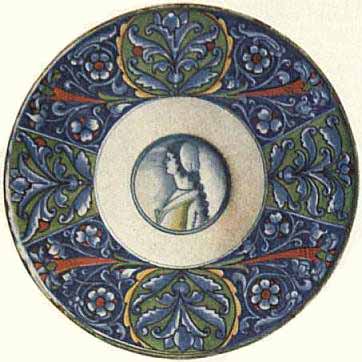
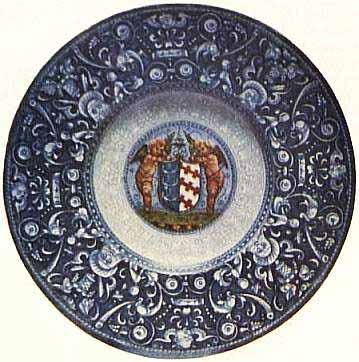
Calaggiolo: 16th century. Faenza. Casa Pirota, 1525.
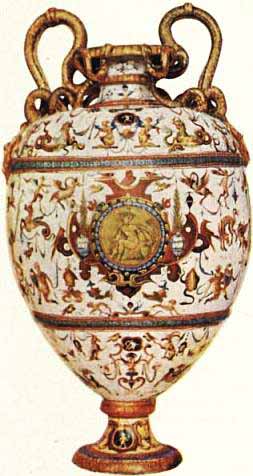
Urbino. Decorated by Orario Fontana.
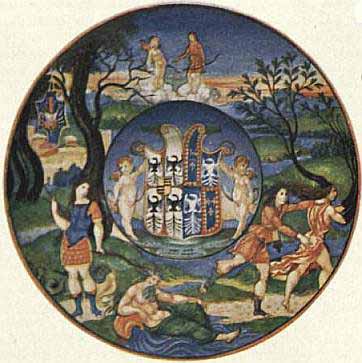
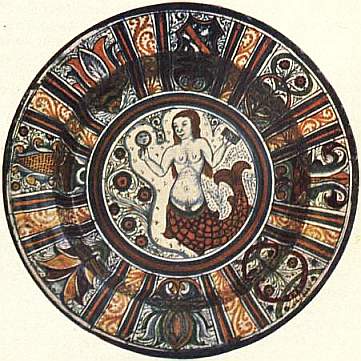
Urbino. 1525 (?). A plate of the famous Gonzaga Este service. Faenza: early 15th century.
Collections.—For German wares the German museums are naturally best. The museums at Munich and Nuremberg contain splendid collections of the tin-enamelled and peasant wares of South Germany. Cologne has a wonderful collection of the Rhenish stoneware, and Berlin and Hamburg have good general collections. Copenhagen and Stockholm are especially good for Scandinavian wares, and Zürich for Swiss. There are also good collections of German stoneware in the Victoria and Albert and the British museums, and in the Cluny Museum, the Louvre, and the museum at Sèvres; but there are no notable collections of the German tin-enamelled wares out of Germany. The wares of Delft may be best studied in the museums at the Hague and Amsterdam. There is an interesting collection at the factory of Thooft and Labouchère in Delft. The principal museums in England, France and Germany all have fair to good collections of this renowned ware.
Literature.—For tiles and peasant pottery, see Forrer, Geschichte der europäischen Fliesen-Keramik (Strassburg, 1900; chapters on the Netherlands and Germany); Walcher von Molthein, Bunte Hafnerkeramik der Renaissance in Österreich ob der Enns und Salzburg (Vienna, 1906); Hafner, Das Hafnerhandwerk und die alten Öfen in Winterthur (Winterthur, 1876-1877); Barber, Tulip-ware of the Pennsylvania German Potters (Philadelphia, 1903). For stoneware, see Solon, The Ancient Art Stoneware of the Low Countries and Germany (London, 1892); Van Bastelaer, Les Grès wallons (Mons, 1885). For Böttger’s red ware, see Berling, Das Meissner Porzellan (Leipzig, 1900), chap. iii. For Dutch faience, see Havard, Histoire de la faïence de Delft (Paris, 1878), and article by same author on “La Faïence d’Arnhem” in Gazette des beaux-arts, 2nd series, vol. xx. (1879). For German faience, see von Falke, Majolika (Berlin, 1896), and articles by Stieda, “Deutsche Fayencefabriken des 18. Jahrhunderts,” in Keramische Monatshefte, vols. ii. and iii. For Scandinavian pottery, see Nyrop, Danske Fajence og Porcellainsmaerker (Copenhagen, 1881); Stråle, Rörstrand et Marieberg (Stockholm, 1872); Grosch, Herrebøe-Fayencer (Christiania, 1901). Excellent accounts of most branches of the subjects are given by Brinckmann, Das hamburgische Museum fur Kunst und Gewerbe (Hamburg, 1894).
(B. Ra.)
Later Wares of Spain and Portugal
We shall only deal at length here with those important kinds of pottery that have exerted real influence on the historical development of the art. Offshoots from the main stem that have developed little or no individuality can only be briefly mentioned. When the characteristic Spanish-Moorish lustre wares ceased to be desired by the wealthy they rapidly sank into insignificance, though as a decorative peasant pottery their manufacture never really ceased and has been revived again in our day. The course of pottery importation was changed and the now fashionable Italian majolica was brought into Spain in the 16th and 17th centuries, as Hispano-Moresque wares had followed the opposite course two centuries earlier. Besides the influence which these imported wares had on the Spanish potters, a number of wandering Italian majolists found their way into Spain, so that we find the use of painted colour, particularly blue, yellow, orange, green and purple, making its appearance at various centres, around Valencia, at Triana near Seville, &c., but the most important manufacture was at Talavera in the centre of the peninsula. The best of this ware recalls the late Italian majolica of Savona, and the influence of Chinese porcelain designs, probably filtered through to the Spanish potters by the then popular enamelled Delft wares, is very apparent. The potteries of Talavera are mentioned as early as 1560, and they continued at work, with varying fortunes, down to the end of the 18th century. Many and varied wares were produced, including tiles as well as pottery; the most common pottery pieces are dishes, bowls, vases, tinajas, holy-water vessels, drug-pots, and hanging flower vases, together with moulded and painted snails, owls, dogs, oranges, almonds, walnuts, and every kind of fruit. Apart from the poorer colour the baroque style of ornament also rendered the ware much inferior to that of Italy or of France. The popular Talavera wares were imitated elsewhere in Spain, and a number of factories existed at Toledo in the 17th century, but their wares are very inferior. In the 18th century, besides debased imitations of this ware, some coarse but striking pottery was made at Puente del Arzobispo near Toledo.
An interesting offshoot from the Talavera potteries is to be found in the tin-enamelled wares made at Puebla, Mexico, from the early 17th century. It is said that Spanish potters were settled at this place by the Dominicans soon after 1600; and the making of a debased form of Spanish majolica continued there for nearly two centuries. See Barber’s “Tin-Enamelled Pottery,” Bulletin of the Philadelphia Museum, 1907. During the 18th century determined efforts were made by King Charles III. and by the famous Count Aranda to improve the Spanish pottery wares, as well as to introduce the manufacture of porcelain. The efforts of the king led to the foundation of the porcelain works at Buen Retiro near Madrid, which will be mentioned later, and considerable success also attended the revival of strong copper lustre, like that of the late Hispano-Moresque wares; but the finest tin-enamelled wares were those made at Alcora in the important factory founded by Count Aranda in 1726, which continued in operation down to the French wars. For his purposes the count brought from Moustiers, then one of the famous French pottery centres (see above), Joseph Olerys, a well-known pot-painter. He went to Alcora as chief draughtsman and designer, having charge of a number of Spanish potters and painters. Olerys introduced the Moustiers style of decoration, and the glaze and body of the Alcora wares of the best period recall the fine quality of Moustiers faience. It is only fair to add that Olerys in his turn learnt the use of various delicate yellow and green colours from the Spaniards, and when he returned to France in 1737, having acquitted himself most honourably, he introduced this new style of delicate polychrome decoration at Moustiers. The mixture of motives and ideas that animated the duke and his potters may be seen by the following list of wares produced about 1750. Vases of different shapes; small teapots; teapots and covers, Chinese fashion; teapots and covers, Dutch fashion; cruets, Chinese style; entrée dishes; salt-cellars, Chinese style; escudillas (bowls) of Constantinople; barquillos (sauce-bowls), Chinese style; cups, plates, and saucers of different kinds with good painted borders in imitation of lace-work, and finally fruit-stands, salad-bowls and dishes, trays and refrigerators. Later in the century the manufacture of porcelain was introduced here, as well as white earthenware made in imitation of the productions of Wedgwood, and the tin-enamelled wares flickered out in Spain as they did elsewhere.
The manufacture of a kind of debased majolica was also practised in Portugal from the 16th century down to our own times; but the ware never attained to any distinction and is little known outside that country. The best-known specimens were made at Rato, near Lisbon, where a factory was founded in 1767 under the patronage of the court.
Mention must be made of the unglazed native pottery of Spain and Portugal, for wine-jars, water-jars and bottles, cooking pots, and other domestic utensils are still made in these countries for ordinary domestic use, in traditional forms and by methods of the most primitive kind. Many of these vessels, especially the tinajas (wine-jars) and water-coolers, are based on ancient, classical or Arab forms, and in every country market-place it is still common to see groups of vessels, in unglazed pottery of fine shape and finish, exposed for sale—a very different state of things from what obtains in France, Germany, and particularly in England, where the primitive methods of the peasant are being imitated by those who ought to know better. From the 16th to the 18th century a special kind of unglazed pottery vessels known as buccaros was extensively made both in Spain and Portugal. The body of the ware is unglazed, whitish, black or red, according to the special kind of clay. The curious point about this ware is that, if we may believe contemporary documents, the vessels were delicately scented, like a ware imported from Mexico; and the soft vessels are said to have been eaten—a custom common enough in certain parts of Central and Southern America. (See M.L. Solon, The Noble Buccaros, 1896.)
(W. B.*)
English Pottery from the 16th to the 18th Century21
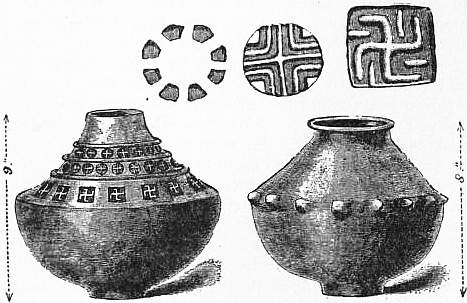
Fig. 50.—Saxon cinerary urns; the stamped patterns are shown.
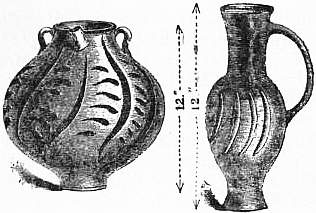
Fig. 51.—Common forms of medieval pottery; the upper part of the slender jug is covered with a green vitreous lead glaze; the other is unglazed with stripes of red ochre.
The course of pottery manufacture in England followed, generally rather in the rear, that of France, Germany and other northern countries. Before the coming of the Romans much pottery of the late Stone age and the Bronze age was made in Britain. The Romans introduced their more advanced technique, and, besides importing Italian and Gaulish pottery, they founded numerous centres of pottery manufacture, as at Upchurch, Castor, Uriconium, &c. With the departure of the Roman legions their simple, yet comparatively advanced, pottery vanished, and Saxon and early Norman times have left us little but wares resembling those of the Germanic and Frankish productions (fig. 50). The early middle ages passed without much improvement, and, though rare specimens—like the ewer in the form of a mounted knight in Salisbury Museum—proved that glazed wares were made in this country, the general run of our medieval pottery vessels never soared above the skill of the travelling brick or tile maker.22 The monastic tile-makers, with their strong, Gothic tile pavements, produced artistic work of a very high order; but the patrons of the common potter remained content with his rudely made and simply glazed pitchers, flagons, dishes and mugs (see fig. 51). Even in the 16th century the excellence of English pewter probably acted as a barrier to the introduction of finer pottery, and it was only the importation of foreign wares—Italian, German, Dutch and French—that stirred up our native clay-workers to the possibilities of their art. In early Tudor times there was some importation of Italian majolica as well as of the Hispano-Moresque pieces, and the religious wars as well as the constant intercourse with the Low Countries brought over to the eastern counties not only the stonewares of the Rhineland and the “Delft” wares of Holland, but also emigrant potters from those countries who tried to practise their native crafts amongst us. The Civil War appears to have been unable to check this new spirit, for we have the evidence of dated examples to show that various immigrants went on quietly practising their trade along the Thames side, in what were then the outskirts of London, and probably in the eastern counties and Kent as well. It seems probable that the earliest influence was an Italian one, but before this was firmly domiciled it was supplanted by that of the Dutch and Germans. The first wares of an improved kind that were made in England are so closely related to the German stonewares and the “Delft” wares that it is often difficult to determine whether actual specimens are of English or foreign origin. The first, and in some senses the greatest, of English potters was John Dwight, an educated man, who had held the office of secretary to three successive bishops of Chester, and who obtained a patent in 1671 for the manufacture of certain improved kinds of pottery. We have no knowledge where Dwight acquired his skill in the potter’s art, for when he obtained his patent he was residing at Wigan (Lancashire), far removed from the districts where foreign potters had settled. About 1672-1673 Dwight set up a factory at Fulham, where he resided till his death in 1703. He was always an eager experimenter, and from his diaries it seems certain that he was searching after the, then, mysterious Chinese porcelain. We have no grounds for believing that he ever attained success in this search, for his known productions may be grouped into two main classes: (1) Hard-fired red stoneware—mostly small vessels, teapots, mugs, &c., in imitation of the Chinese buccaros.23 (2) Whitish, grey, or drab salt-glazed stoneware made in imitation of, and often not to be distinguished from, the wares of the Rhineland. But Dwight produced a considerable number of modelled portrait-busts, statuettes, &c., all in stoneware of various tints, which entitle him to a place in the very first rank of potters. The portrait-bust of Prince Rupert (British Museum), the statuettes of Meleager (British Museum), of Jupiter (Liverpool), &c., are worthy of a sculptor of the Italian Renaissance, while the recumbent effigy of Lydia Dwight (Victoria and Albert Museum) is one of the most beautiful works ever executed by an English potter.
Meantime the manufacture of tin-enamelled pottery, in the style of “Delft,” was prosecuted with increasing industry in London on the south side of the river, and particularly at Lambeth. By the end of the 17th century the same imitation “Delft” wares were made at Bristol and Liverpool, continuing until, in the closing years of the 18th century, tin-enamelled earthenware was abandoned in favour of the perfected English cream-colour. There is a strong family likeness in all this English “Delft,” whether made at Lambeth, Bristol or Liverpool. The body of the ware is harder and denser than in the tin-enamelled wares of the continent, and is not so suitable for its special purpose, as it is generally deficient in lime. The decoration is usually painted in cobalt blue of good tone, though inferior in softness and richness of tint to that of the best Delft pieces; polychrome painting was not so common, and it differs from that of the Dutchmen in the greater prevalence of a pale yellow colour and the general absence of any good red like that found on the polychrome wares of Delft, Rouen, Sic.
German stoneware also received a well-merited share of attention long before the time of Dwight, and it is often impossible to distinguish the grey and brown ale-jugs, greybeards, &c., presumably of English manufacture in the 17th and early 18th centuries, from their German prototypes. Fulham remained an important centre of this manufacture, and a fine brown stoneware was largely made at Nottingham as early as 1700; in each case the manufacture continues in neighbouring districts to this day.
The development of a native English pottery took place in North Staffordshire. A growing community of peasant potters, who manufactured some strongly decorative English wares by very simple means, was established here from the middle of the 17th century. Rudely fashioned dishes, jugs, bottles, &c., were shaped in the local red-burning brick clays, and, while the pieces were still soft, simple but effective decorative patterns were drawn upon them in diluted white clay (slip), trailed on through a quill or from a narrow-spouted vessel. This ancient and world-wide process (for it was used by the Ptolemaic Egyptian, the Roman and the Byzantine potters) has furnished the peasant potters of every European country with characteristic wares, but nowhere was it used with greater skill than in England. The English slip-decorated wares are often spoken of as “Toft ware,” because Thomas Toft, living in what is now Hanley (Staffordshire) boldly signed and dated many of his pieces (1670, &c.); but similar wares were made at Wrotham in Kent, in Derbyshire, Wales and elsewhere. The repute of the Staffordshire district must have spread by the time of the Revolution, for soon after 1690 John Philip Elers, a Dutchman of good family, settled there and began to make a superior pottery to any previously made in the district. Elers is generally described as a great inventor who brought all kinds of knowledge into the district, but the only wares he is known to have made were singularly like those of Dwight, and, quite recently, records of a lawsuit in which Dwight charged Elers and some other Staffordshire potters with suborning his workmen and infringing his patents have been brought to light. It is certain that, from the time of Elers, the Staffordshire potters made great advances in the fabrication of their wares, and during the 18th century they evolved two distinctively English kinds of pottery, (1) the white and drab salt-glaze, (2) English earthenware.
Staffordshire Salt-glaze.—It is uncertain when and how the Staffordshire potters learnt that a highly siliceous pottery could be glazed by throwing common salt into the kiln at the height of the firing, for the practice had originated in the Rhineland more than a century before. Many writers have maintained that the practice was introduced by Elers, but this is uncertain. Early in the 18th century a fine, white, thin, salt-glazed ware was made in Staffordshire, in many quaint and fanciful forms largely influenced by Chinese porcelain—still an object of wonder and mystery. Teapots, coffee-pots, tea-caddies, plates, dishes, bowls, candlesticks, mugs and bottles were made in great variety, and at its best the ware is a dainty and elegant one, so that a brisk trade was developed in the district, and, for the first time, a distinctively English pottery was exported to the continent and to the American colonies.
English Earthenware.—The manufacture of tin-enamelled pottery scarcely obtained a foothold in Staffordshire, but the invention of the white salt-glazed ware paved the way for one of the greatest revolutions in the potter’s art that the world has ever seen. This was nothing less than the abandonment of the ordinary red or buff clays with a coating of white slip or of tin-enamel, and the substitution of a ware white throughout its substance, prepared by mixing selected white-burning clays and finely-ground flint (silica).24 The change has generally been associated with Wedgwood, most famous of English potters, but he really only perfected, along with his contemporaries, the Warburtons, Turners and others, the work of half a century’s experiment and discovery. The ware compared most favourably, from the point of view of serviceableness, neatness and mechanical finish, with all that had gone before it, and as the tin-enamelled wares had almost everywhere in Europe sunk to the position of domestic crockery—for the Chinese, German, French and English porcelains had displaced it with the wealthy—this better-fashioned and more durable English ware gave it its final death-blow. English earthenware in its various forms was to be met with all over Europe, from London to Moscow, and from Cadiz to Stockholm; and, aided by emigrant English potters, the continental nations soon began a similar manufacture for themselves. Everywhere this great change was encouraged by the growing fondness for mechanical perfection, and it is not without a sigh that a lover of pottery can witness the gradual disappearance of the painted tin-enamelled wares—degenerate survivals though they were of Italian majolica, French faience and Dutch “Delft”—before the unconquerable advance of another form of pottery which in its inception was based on technical rather than artistic qualities, especially as nearly a century passed before the new material was turned to artistic account.
By general consent the name of Josiah Wedgwood has been pre-eminently associated with this great change, and with good reason, for though he had many contemporaries who equalled or even excelled him in certain kinds of pottery, no other potter ever approached him in the range of his products and the varied applications to which he turned the exercise of his remarkable talents.25 True, he soon abandoned the simple Staffordshire wares, coloured with mottled glazes or clay-slips, to which the names of Astbury or Whieldon are commonly attached, but the varied productions of his factory united the best work of a district fruitful in new kinds of pottery, with something especial to Wedgwood himself. Thus he adopted and improved the green and yellow glazes which had come down from medieval times (see the cauliflower ware piece, Plate X.), and gave a new direction to their use in his green-glazed dessert services, candlesticks, &c. He carried on the manufacture of hard-fired red-clay teapots, mugs, coffee-pots, cream-jugs, &c., introduced by Elers; and, along with his fellow-potters, he invented drab, grey, brown and other colours in similarly hard-fired unglazed bodies. He neither invented nor alone perfected the Staffordshire cream-coloured earthenware, but he made it so well that his “Queen’s ware” was the best of its class. He undoubtedly invented the Jasper ware, in which on grounds of unglazed blue, green, black, &c., white figures and ornamental motives, adapted from the antique by Flaxman, Webber and other sculptors, were applied; and he even attempted to reproduce the painted vases of the Greek decadence in dry colours painted over a hard black body.
Wedgwood’s “Jasper ware,” his most original production (see Plate X.), differed both in nature and composition from all the species of pottery that had preceded it. In an attempt to obtain the qualities of the finest porcelain biscuit, Wedgwood discovered, after years of experiment, that by mixing together a plastic white clay and “cawk” or barytes he could obtain a “body” which might be “thrown” on the wheel or “pressed” in moulds, and which, while it fired to a white and sub-translucent pottery, was capable of being coloured, by the usual metallic oxides, to various shades of blue, green, yellow, lilac and black. The ware resembled “biscuit” porcelain in that it needed no glaze to render it impervious to water, and it thus marked the culmination of those “dry” or unglazed wares that had been so largely made in China, Japan and Europe, where the quality resides in the fired clay material without any adventitious aid from a glaze. The general practice was to make the body of the vessel of a coloured material and to ornament this with applied figures or ornamental reliefs, in “white” of the same kind, “pressed” from intaglio moulds and then applied by wetting the surface and squeezing—leaving the fire to unite the vessel and its applied ornament into one piece. Sometimes the ornament was in a coloured clay applied on a white body, and we get in the same way black on red, buff on red or black, and red or black on buff and drab bodies. The variety of bodies produced by Wedgwood and his followers in this way is exceedingly great, and is only to be equalled by the diversity of their application, for the pieces made include plaques, vases, plates, dishes, jardinières, bulb-pots, teapots, cups and saucers, inkstands, scent-bottles, buttons, buckles, and, in a word, every kind of thing that could be made in clay. Many of the applied designs, whether of figures or ornament, were very beautiful in a way, being copied or adapted from Greek and Roman gems, vases, &c. At their best they are marvellous for the precision and delicacy of their execution, and it is impossible to imagine that anything better could have been done in this style. So perfectly did they represent the taste of their period that attempts were made at Sèvres, Meissen, Berlin and Buen Retiro to produce something of the same kind in porcelain; but none of these can be compared with the works of Wedgwood, or his great contemporary Turner (see Plate X.), in beauty of colour or perfection of workmanship.
It is obvious nowadays that much of this work was inspired by mistaken motives; that it was founded on an imperfect view of ancient art; and that it was marred by its mechanical ideals; but it must be remembered that it was in perfect harmony with the spirit of the times, and that while it emphasizes for us the pseudo-classic taste of the late 18th century, it marks an advance in the technical skill of the potter, which is simply astounding. The co-ordination of labour, which had gone further with the Greek and the Italian potter than is generally supposed, was now brought to a climax. Mechanical appliances were introduced for the performance of many portions of the potter’s work that had hitherto been indifferently performed by rude and exhausting manual toil; and while the application of mechanism was pushed too far—so that in the first half of the 19th century we find the most inartistic pottery the world has ever seen—we must regard this even more as a cyclic movement of human feeling than as the work of any individual, or group of men. The late 18th century marks the period when pottery was no longer produced, as Italian majolica, the Henri-Deux ware, the Palissy wares, the best faience of Nevers, Rouen, Moustiers, Delft or Nuremberg had been, for the noble or the wealthy, but when it was largely in demand by the poorer classes, anxious in their turn to have a useful ware which should imitate the more costly porcelain used by the great. France, Germany, Sweden, Russia, and later the United States, all followed in the wake of the English potters, and the printing-press was applied in all countries to produce elaborate engraved patterns in blue, brown, green, &c., in order to get an effective-looking ware in harmony with the spirit of the times, and at the same time cheaper in price than the simple painted patterns of the vanquished tin-enamel.
Collections.—The British and the Victoria and Albert Museums naturally contain the most representative collections of English pottery. The museums at Liverpool, Bristol, Burslem, Hanley and Nottingham, also have good collections, while Birmingham, Manchester and Stoke-upon-Trent may be mentioned. The Guildhall Museum, London, is rich in early wares found or made in London and its vicinity. Continental collections of English pottery are meagre in the extreme and badly described, even in the ceramic museums at Sèvres and Limoges. The collection at Dresden is interesting, as it was purchased from the collection made by Enoch Wood, a Staffordshire potter. In America, the Boston Museum of Fine Arts, the Metropolitan Museum of New York, and the Pennsylvania Academy of Fine Arts at Philadelphia, contain interesting examples of wares exported to America in the late 18th and early 19th centuries.
Literature.—The earliest compilations, such as Jewitt’s Ceramic Art in Great Britain (1878), and Life of Josiah Wedgwood (1865); Chaffers, Marks and Monograms (1863; 9th edition revised, 1900); Meteyard’s Life of Wedgwood (1865-1866), and Shaw’s History of the Staffordshire Potteries (1829; reissued London, 1900), must always be of interest as original sources of information; but the later works, such as Church, English Earthenware (1884; new edition, 1906); Josiah Wedgwood (1894, reissue 1903 and 1907); Solon, Art of the Old English Potter (1883; 2nd ed., 1885); Hobson, Catalogue of English Pottery in the British Museum (1903); Burton, English Earthenware and Stoneware (1904), are the best authorities.
(W. B.*)
Chinese Pottery and Porcelain26
In China, as in every other country where pottery-making has been practised for centuries, we find a natural progression from primitive pottery akin in shape, decoration and manufacture to the pottery of other primitive races the world over. We find too the early use of bricks, tiles, &c., as in Egypt and Assyria; and then the usual succession of domestic utensils, funeral vases, and vessels for religious ceremonials. There is nothing to show that the potter’s wheel made its appearance in China earlier than elsewhere, and the Chinese potters have used the simple methods of carving and “pressing” from moulds which preceded the use of the potter’s wheel, even more than other nations. In books of the Chow dynasty (1122-249 b.c.) the difference between the processes of “throwing” and of “pressing” from moulds is clearly described,27 and it is instructive to note that many early as well as late forms of Chinese pottery are remarkably like their works in bronze. In the same way there is no definite date to which we can refer the introduction of glazed pottery. The earliest specimens of glazed ware known are referred by the Chinese to the times of the Han dynasty (206 b.c.-a.d. 220), a date much later than that of the earliest glazed wares of Egypt and Assyria. Remembering the intercourse between China and the West, at times historically remote, it is not impossible that the idea of coating a vessel of clay with a glaze was carried into China from Chaldaea or Assyria. In any case the Chinese developed the potter’s art on their own lines, for we have ample evidence that from very early times they fired their pottery to a much higher temperature than was common in the west of Asia, and so discovered types of glaze and of pottery that remained for centuries a mystery elsewhere. The glazed wares of the Han dynasty already mentioned are quite unlike any contemporary pottery produced in Syria, Egypt or Europe, for the body of the ware is so hard that it can scarcely be scratched by a knife, and the dark-greenish glaze has become iridescent by age as though it contained oxide of lead. The easily-fired friable wares of Assyria, Egypt and Greece seem to have had no attraction for the Chinese, and the glazes on their hard-fired wares were naturally different from those already described. The Chinese appear to have been the first potters in the world to discover that at a sufficiently high temperature pottery can be glazed with powdered felspathic rock mixed with lime. At first these glazes were used on any ordinary refractory clay which might burn red, drab or buff; but in this technique lay the germ of Chinese porcelain, the most advanced form of pottery the world has yet seen. It is necessary to consider the pottery that preceded porcelain, for not only was it the matrix out of which porcelain grew, but in certain districts of China, where the necessary materials for porcelain are not found, similar wares have been manufactured without intermission to the present time. Naturally, in progress of time, the technique of this pottery has been greatly improved, both by developments in the preparation and mixture of the clays, the shaping and modelling of the wares, the introduction of coloured enamels or glazes, and the like. Dr Bushell, who is our great authority on the Chinese arts and handicrafts, rightly seizes on two outstanding types of Chinese pottery other than porcelain which have exercised considerable influence on the doings of European potters.
1: Yi-Hsing-Yao.28—This is the pottery, generally of unglazed fawn, red or brown stoneware, made at Yi-hsing-hsien in the province of Kiang-su. Articles of every kind are made in these fine-coloured clays, but the general forms are dainty and skilfully finished pieces, such as small teapots, cups, saucers, dishes, trays, water-bottles and wine cups. This ware was largely manufactured under the Ming dynasty (a.d. 1368-1643) and later.29 It was imported into Europe by the Portuguese, who applied to it the name boccaro, formerly given only to a scented terra-cotta brought from Mexico and Peru.30 This pottery and Chinese porcelain were wide asunder as the poles in nature as well as origin, but the potters of northern Europe regarded every kind of pottery coming from the Far East as a species of porcelain, and the manufacture of red teapots, mugs, bowls, cups, &c., in imitation of the Yi-Hsing-Yao was widespread during the late 17th and early 18th centuries under the name of red porcelain. Dwight, Elers and Böttger are notable names in this connexion.
2. Kuang-Yao.—The name given by the Chinese to the pottery made in the province of Kwang-tung. There are several centres of manufacture in this extensive province, but for the purposes of this article it is sufficient to state that the best-known of these wares are dense, hard-fired and glazed stonewares, which are always dark-coloured grey, red, brown or blackish. They are usually glazed with thick, variegated or opalescent glazes, grey, blue, green, yellow or red, but flecked, veined and streaked with other tints. The wares are so like the productions of the Sung dynasty (a.d. 960-1279) that modern pieces are often confounded with the more precious productions of that epoch. One of the first lessons to be learnt by the student of Chinese pottery is that, with great reverence for their own antiquities, the Chinese of every period have endeavoured to reproduce the famous wares of their ancestors, and often with such skill as to deceive the most expert. Even when the manufacture of porcelain was at its highest in King-tê-chên, the potters in other parts of China carried on the production of glazed or unglazed pottery in coloured clays, and, further, the directors of the imperial factory from time to time strove to reproduce the most archaic wares that could be found in the Empire.
Plate VII
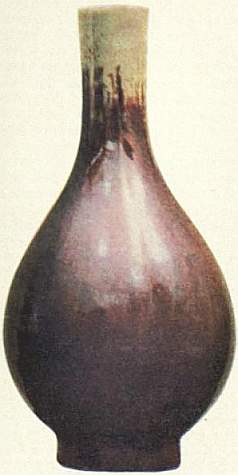
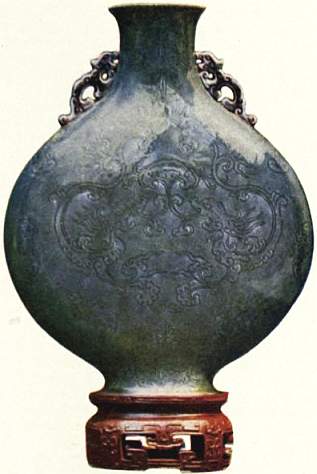
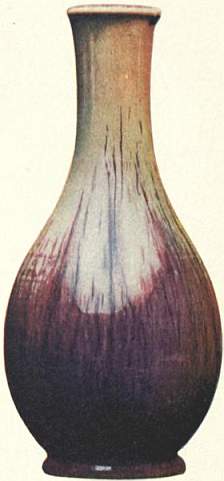
Chinese. Sang de Bœuf. Chinese. Turquoise glaze “crackled.” Chinese. Flambé.
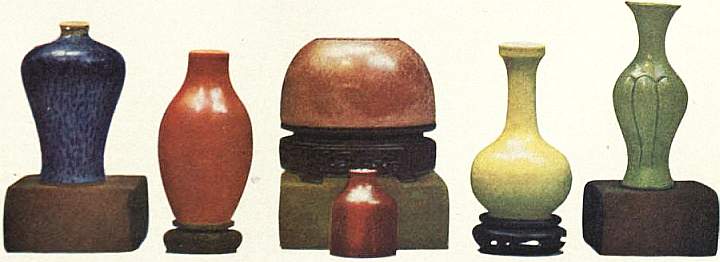
Purple Soufflé. Coral red. Peach blow. Pigeon’s blood. Lemon yellow. Apple green.
Porcelain.—By this word we distinguish broadly all those pieces of pottery in which the body of the ware is vitrified and translucent, and also, broadly speaking, in which the material is white throughout, unless minute quantities of metallic oxides have been definitely added to colour it. It is impossible to draw any hard and fast line between porcelain and stoneware, for both may be thoroughly vitrified and translucent in thin pieces—but generally the stonewares are drab, red or brown in the colour of the fired clay, and they seldom exhibit the precious quality of translucence. If the body of a piece of pottery is not even vitrified, however hard it may be, it is terra-cotta or earthenware. The Chinese, accustomed from a very early period to fire their pottery to a high temperature, produced vitrified stonewares before any other nation. Moreover, they glazed these stonewares with fusible mineral substances, and from that stage the natural refinements of methods must necessarily have produced porcelain. In regions where beds of primary clay were found, the body of the ware would burn whiter than elsewhere, and a mixture of limestone or marble with the felspathic rock would give a glaze of greater purity and brilliance and one that was more readily fusible and Would spread better over the whole piece. How many centuries were needed before a ware white enough and translucent enough to be now classed as porcelain was produced we cannot know; but the process was certainly one of gradual evolution. Some Chinese writers in their zeal for ancient things have ascribed to remote periods the production of wares of this class. Where authentic specimens are not to be found it is necessary to proceed with caution, and literary evidence alone cannot be deemed sufficient to settle such a difficult point. The balance of opinion at the present time is that something worthy of the name of porcelain was made during the Tang dynasty (a.d. 618-907), but we have no pieces earlier than the Sung dynasty (a.d. 960-1259), and the majority of these are perhaps more fitly described as stoneware than as porcelain.
Under the Sung dynasty China enjoyed great material prosperity, and all the arts were cultivated assiduously. Pottery of distinguished merit was made in many districts, and much of it has been classified as porcelain because the body is whitish and vitrified, though it is much inferior in finish and in translucence to the perfect white porcelain of later times. It is necessary to realize, too, that we have no record of any pottery with painted decoration until perhaps the very end of the 13th century; such ornament as was used consists entirely of designs incised or modelled in the clay. But the principal decoration is to be found in the varied coloured glazes with which the wares, whether stoneware or porcelain, were covered. The glaze is never clear and white as at later times; it is generally uneven, imperfectly fused and presents all the marks of an imperfect technique. The nearest approach to white is found in an opalescent grey which shades off to greenish and bluish tints. The glazes of this period which are most highly valued are the céladons, a family of cool bluish or yellowish greens of indescribable depth and softness. Besides the céladons which are the most uniform in tints of the Sung glazes, we get many shades of palish lavender, brownish yellow and brownish black, but these are all subtly or boldly mottled, splashed, clouded or veined with strange tones of red, blue, purple, opalescent grey and black. The most famous of these now very rare Sung wares were the stonewares of Chunchow, remarkable for their rich and varied glazes, the black variegated glazed wares of Fu-kien province, “hare’s fur cups” and “partridge cups” of collectors, and the four principal wares that may be called porcelain, viz.—the Ju-Yao, made at Ju-chow in Honan; the Kuan-Yao (Kuan = “official” or “imperial”), made first at Pien-chow and afterwards at Hang-chow; the Ko-Yao, made at Liu-t’ien; and the Ting-Yao, made at Tung-chow in Chih-li.
This was the period when Chinese porcelain became known beyond its native country, for the first mention of porcelain outside China appears in the writings of a Mahommedan traveller, Sulaiman, who visited China in the 9th century and wrote: “They have in China a very fine clay with which they make vases which are as transparent as glass; water is seen through them”;31 and its first appearance in the west is always given as a.d. 1171 (or 1188), when Saladin sent a present of forty pieces to the sultan of Damascus. From this time onwards an export trade was developed, particularly in the céladon wares of Lung-chüan, a city in the south-west of the province of Chehkiang. This famous ware, the “green porcelain” of the Chinese, probably made as an imitation of jade, exists mostly in the form of thick heavy dishes, bowls and jars, bearing incised or fluted patterns, and coated with a remarkable thick green glaze of indescribable softness of tone. Though the body of the ware is white when it is broken through, any parts not covered by the glaze have a reddish-brown colour due to the unrefined paste, and when the ware was reproduced in later times this reddish-brown tint had to be imitated artificially. The ware was highly prized both in China and Japan, in the islands of the East Indies, and in all Mahommedan countries. In Persia it was largely used, and specimens of it have been recovered during the last century from the east coast of Africa and as far west as Morocco. “Archbishop Warham’s cup” at New College, Oxford, which is the first specimen of Chinese porcelain to reach England that we can now produce, is a céladon bowl with a silver-gilt mount of the time of Henry VIII.32
The Sung dynasty was overthrown by the Tatars under Kublai Khan (grandson of Jenghiz Khan), and the power remained in Tatar hands until 1368, when the great native dynasty of the Mings was established. During this period (Yuan dynasty), roughly a century, one can say little of ceramic progress, for the wares of the period are singularly like those of Sung times. But two important changes took place which had a marked influence on the subsequent development of Chinese porcelain—(1) the concentration of the industry at King-tê-chên, which was consummated in the early years of the Ming dynasty; (2) the introduction of painted decoration under a white transparent glaze, the idea of which (and perhaps the necessary cobalt mineral) was brought from Persia.
King-tê-chên was already a pottery centre when its factories were rebuilt in 1369 by Hung-Wu, the founder of the Ming dynasty, who made it the imperial factory, so that the best porcelain workers were attracted thither, and in the other old centres the industry was abandoned or some earlier manufacture was continued, as in the southern province of Kiang-su. In the province of Fu-kien a distinct kind of porcelain manufacture has also continued. We have already mentioned the black glazed cups, “hare’s fur,” &c., made in this province in Sung times, and, while King-tê-chên was to be the scene of the developments of the coloured and painted porcelains, Te-hwa in Fu-kien perfected the manufacture of the famous and beautiful white porcelain in bowls, dishes, cups and statuettes, best known under its French title of blanc de Chine.
The earliest painted Chinese porcelains, which are referred to the beginning of the Ming period, though some of them may be older, speak strongly of ideas imported from the west of Asia. The pieces are massive both in form and substance, and the ornament, consisting of figures mounted or on foot, animals, bands of diaper or foliage, or pendant necklaces, is strongly silhouetted by a raised outline recalling the decorative methods of the Assyrian brickwork. The technical methods also recall the methods of western Asia, for the ware was fired before it was glazed, and then yellow, turquoise, green or purple glazes, similar in nature to the glazes of Egypt, Syria and Persia, and quite unlike the Chinese Sung glazes, were filled into the outlined spaces and melted at a lower temperature. The Grandidier collection in the Louvre, the Franks collection at the British Museum, the Victoria and Albert Museum, as well as all the great private collections of Chinese porcelain, contain samples of this primitive and archaic-looking ware.
The great stream of porcelain decoration was, however, to take an entirely different direction. The Persian pottery with its brilliant painted decorations in blue, green and purple on a pure white ground, exercised its natural fascination over men as keen in colour-sense as the Chinese potters. With the concentration of the industry at King-tê-chên, and the rapid improvement in technical skill and knowledge that followed, the production of a fine porcelain with a transparent white glaze was perfected. Of all the colours used by the Persian pot-painter the only one that would endure the fierce fire of the Chinese porcelain was the blue obtained by using the ores of cobalt, and with this colour, and a wonderful blood-red obtained from copper, the foundation of Chinese painted porcelain was laid. It would be idle to try and fix any specific date for this important development, which took more than a generation to perfect, but it is reasonably accurate to say that the blue and white painted porcelains were unknown in the 13th century and were fully developed at the beginning of the 15th century. Chinese collectors prize most highly the blue and white of the reign of Suen-tê (a.d. 1426-1435), of Chêng-hwa (1465-1487), and next of Yung-lo (1403-1424). It is interesting to note that the colour used during these reigns is spoken of as “Mahommedan” blue, so that it was evidently brought from some country to the west. This 15th-century blue and white porcelain is admittedly the finest of its class, and though the Chinese never abandon an old method and have continued to make blue and white porcelain, often of very good quality, the later wares, fine as they may be, rarely equal these.
The under-glaze red, an invention of the Chinese, has already been mentioned, and this most difficult of all ceramic colours was largely used during the same period. At first it appears as a general ground colour for the outside of bowls and cups, then vessels were made in special forms (persimmon fruit, &c.) to display its qualities, finally it was used either alone or in conjunction with blue in painted designs under a white glaze of exceptional quality. A Chinese connoisseur of the 15th century describes one of his pieces as being decorated with “three red fishes on a white ground, pure as driven snow; the fish boldly outlined and red as fresh blood, all with colour so brilliant as to dazzle the eye.”
Other characteristic wares which made their appearance in Ming times are the marvellous “eggshell” porcelains, called by the Chinese “bodyless” from their extreme thinness. As early as the reign of Yung-lo (1403-1424) these delicate wares were in high repute, and their manufacture has been continued ever since with varying skill and success. In spite of their extreme thinness the specimens have designs of dragons in the midst of clouds and waves, inscriptions, &c., engraved in the paste before firing. In the fine white specimens the design is so delicate that it is barely visible until the vessel is filled with liquid or held to the light. Others were covered with a coloured glaze which serves to accentuate the design, and the most prized of these are the yellow pieces made during the reign of Hung-Chi (1488-1505) and Chêng-tê (1506-1521).
Another wonderful variety of Chinese porcelains which made its appearance at this period is the well-known perforated ware, commonly spoken of, from the shape of the perforations, as “grain of rice” porcelain, though the Chinese have exhibited consummate skill in the manufacture of perforated pieces of all kinds. Sometimes the perforations are left clear, but in the rice-grain pattern the incisions are generally filled up with the melted glaze so that they become like so many windows in the walls of the piece. We have already seen that the Persian potters used a similar method of decoration in the 16th century, but we are unable to say at present whether the device originated in China or in Persia. Its use in both countries is only an additional proof of the intercourse between eastern and western Asia.
It is only toward the end of the 16th century that we find the first examples of porcelain decorated with colours fired over the glaze. It seems probable that the practice grew out of the use of enamels on metal, which had spread from Byzantium to China, and which the Chinese developed with remarkable skill. It is important to remember that the very nature of the glaze of Chinese porcelain, necessitating such a high temperature to melt it, severely restricted the under-glaze palette to cobalt-blue and the glorious but uncertain copper-red. To obtain the rich polychromatic schemes of the potters of the West some other means must be found, and so the device was adopted of taking a finished piece of blue and white and decorating it further by very fusible colours painted over the fired glaze and then attached to it by refiring at a lower temperature equal only to that used by the enameller on metals. At first the on-glaze or enamel colours were applied as thin washes, as in the Ming (San ts’ ai) three-colour decoration of green, purple, and yellow. Then we get the Ming (Wan-li Wu ts’ ai) five-colour scheme, in which the same three colours are combined with an over-glaze red and all are painted over a skeleton pattern in under-glaze blue. This development, as its name implies, only took place in the reign of Wan-li (1573-1620).
At this time King-tê-chên must have produced a very large quantity of porcelain. The requirements of the court were enormous, for in 1583 one of the supervising censors, remonstrating with the emperor, declared that one year’s demands comprised over 96,000 pieces; and Dr Bushell writes: “The colossal production of the reign of Wan-li is shown by the abundance of porcelain of this time to be found in Pekin at the present day, where a garden of any pretensions must have a large collection of bowls or cisterns for goldfish, and street-hawkers may be seen with sweetmeats upheld by dishes a yard in diameter, or ladling syrup out of large bowls, and there is hardly a butcher’s shop without a cracked Wan-li jar standing on the counter to hold scraps of meat.”
Such profuse orders may be accountable for the fact that the wares of this reign are inferior both in material and workmanship to the wares of the preceding and also of later periods, but the influence of the growing export trade doubtless told in the same direction. For several centuries the native Chinese porcelain had been exported to all the neighbouring countries, and through Persia and Cairo to the West. No long time elapsed before the Chinese adopted forms, colours and decorations for these export wares, not in accordance with Chinese usage, but presumably more suited to the tastes of the foreigner. Hence the Persian and Syrian style of the painted blue decoration of the 15th and 16th century wares found in other Asiatic countries. Now, for the first time, there came a direct European demand, and cargoes of ware were brought to Europe by the Portuguese and afterwards by the Dutch, which were increasingly decorated in fashions foreign to Chinese taste. The production of these export wares slowly modified the taste of the Chinese themselves and paved the way for the new styles of the late 17th and early 18th centuries.
The political troubles which marked the downfall of the Ming dynasty definitely separated the first great period of Chinese porcelain from its second and culminating period. The works at King-tê-chên were destroyed more than once in the 17th century, but in spite of these difficulties the potters must have remained, for the reigns of K’ang-hi (1662-1722), Yung-chêng (1722-1735), and K’ien-lung (1736-1795) covered a century and a half, within which the high-water mark of artistic production was reached and passed. It is only possible here to sketch in broadest outline the course of this Renaissance, which has formed the subject of many learned works.
It is characteristic of the Chinese mind that during this period, when a spirit of eager experiment was abroad, the productions of their ancient kilns should receive no less attention than the new methods of decoration in on-glaze colours, while at the same time many of the discoveries of the later Ming days were carried on to perfection. The first remarkable productions of the reign of K’ang-hi, the famous green and blood-red Lang-yao glazes, were made in the attempt to produce glazes like those of old times. With the more carefully prepared body and glaze the results are strikingly different and, as we think, superior, for it is difficult to believe that any example of the “sacrificial” red of the reign of Suen-tê can have been as glorious as the red Lang-Yao, the crown of all that group of glazes known from their general colour as sang de boeuf (see example, Plate VII.). In the same way the traditional blue and white of the Ming period was continued with the greatest skill, and, if the blue pigment be not so pure as that of the 15th century, the decorative effect of the blue and white of the reign of K’ang-hi (see example, Plate VIII.) has never been equalled in Europe. The subjects of the blue and white pieces of this period are very varied, including religious, ceremonial, battle and hunting subjects, homely scenes such as ladies and children amusing themselves in gardens, or animals, birds, dragons and other fabulous monsters disporting themselves in clouds or waves. The so-called “hawthorn ginger jars” form a class by themselves in the opinion of modern collectors (see the plum-blossom jar, Plate VIII.), a specimen being sold at the Louis Huth sale (1906) for £5900. The fertility of the painters was remarkable, and a collection of the blue and white of this reign offers a fine feast of ceramic colour from the harmonious relation between the tones of the white and the blue, especially when it is seen en masse, as in the famous Dresden collection.33
The practice of painting the ground of a piece in blue so that the pattern was reserved in white (even artfully heightened by the use of slip) dates from Ming times, but the grounds of powder-blue appear to have originated at this time. The cobalt-pigment was not applied by a brush, but was blown on through a tube, one end of which was covered with fine muslin, in a rain of minute drops. This ground was either carried over the whole piece so as to give the effect of a vibrating blue glaze—in which case it was generally covered with conventional designs pencilled in ground-up gold-leaf over the glaze—or panels were reserved in white on which floral designs were afterwards painted in on-glaze colours.
In the same way the decoration in underglaze red was revived or re-introduced, and probably the finest pieces of this ware, as of so many others in our great European collections, date only from the beginning of the 18th century. Eggshell wares and pierced or reticulated pieces were made to great perfection, and the coloured glazes in light green, turquoise, purple and black (see Plate VII.) reached their height. The early glazes of this type appeared in Sung times (see above), but on the finely prepared K’ang-hi wares much more striking and brilliant colour effects were obtained. As in old times, for the production of some of these glazes a departure was made from the general Chinese methods. The vessels were first fired to the “biscuit” state, and then soft alkaline glazes coloured with copper or manganese were fired over them at a much lower temperature so as to give the “peacock-blue,” “kingfisher-green” and “aubergine-purple” glazes. Many varieties of single-coloured glazes were made by covering a white glazed piece with on-glaze colour, and in this way new shades of coloured glaze, such as the coral-reds (Plate VII.), were obtained. The various brown or bronze-coloured grounds, so well known in the so-called “Batavian” porcelain, were obtained by coating the piece with a slip of some ochreous clay under the usual white glaze. Even these methods do not exhaust the fertile resources of the potters of this period, for they carried on concurrently the style of decoration in overglaze colours, first in the schemes characterized by the predominance of a vivid green enamel (famille verte; see Plate VIII.), and finally, in the 18th century, in the schemes in which rose, pink and purple colours predominate (famille rose; see Plate VIII.). It is probable that these latter colours, which owe their tint to gold, were introduced into China from Europe, but the Chinese employed them whole-heartedly, until in fact they largely ousted all the earlier types of colour decoration.
During the reign of Yung-Chêng (1723-1735) the diverse styles seem to have been finally struggling for mastery. Yung-Cheng was an ardent collector of ancient Chinese porcelains, and he sent to King-tê-chên specimens of the most ancient wares, whether of pottery or porcelain, to be reproduced, while at the same time he and his court patronized the wares in foreign styles and colours (Japanese and European.)
The struggle continued practically to the end of the 18th century, but in spite of certain brilliant inventions, such as the “iron-rust” and “tea-dust” glazes of the reign of K’ien-lung in harmony with old Chinese effects, what we must regard as the inferior decorative style triumphed, and we see the gradual disappearance of the ancient methods in favour of (1) wares of a beautiful white body decorated only with on-glaze colours, principally those of the famille rose, and (2) a very large production of inferior wares, made in European shapes and decorated with on-glaze painting and gilding to suit the European taste of the 18th century.
This “armorial” china, so much of which was once foolishly ascribed to Lowestoft, has little to commend it. The material is seldom of the best quality, and the Chinese rendering of European arms and crests, or stiff copies of European engravings surrounded by quasi-oriental borders of diaper, &c., does nothing to recommend it. A great deal of this ware, though manufactured at King-tê-chên, was decorated at Canton, and the school of pottery decorators founded there by reason of this export trade also produced a certain number of pieces in pure Chinese taste, especially some of the ruby-backed plates and dishes and the small cups and saucers decorated with deftly-painted designs of cocks, peonies, &c.
It must be pointed out that the great change implied in the replacement of patterns painted in blue under the glaze by those painted in colours over the glaze profoundly influenced the style of painting. In the earlier wares the treatment is bold and vigorous as becomes true pottery colour, and the softening of the colour by the melting glaze adds to the artistic charm of the result. Painting on a fired glaze is like painting on glass—fine lines, delicate drawing, and skilful stippling or cross-hatching are just as natural in this method as they are impossible or uncertain in the other. Naturalism of rendering takes the place of conventional decorative treatment, and elaborate minuteness of finish supplants the broad freedom of direct brushwork. During the 18th century the same leaven was at work on the porcelains of China and of Europe, the East influenced the West, and the West in its turn bore down the East. If Chinese porcelain remained superior to its European counterfeits, it was because the Chinaman was still the better potter and had a longer tradition of decorative art behind him.
There is little to be said of Chinese porcelain during the 19th century. The European demand was practically killed by the growth of porcelain works at home, and the imperial patronage, so great a factor in the production of artistic wares, was fitful and uncertain. Tao-Kwang (1821-1850) gave some attention to porcelain, and the pieces made for him and marked “Shen-te-t’ang” are valued by collectors. The so-called Peking bowls of his reign (made of course at King-tê-chên) are also of repute. But the political difficulties of China left little leisure for the cultivation of the arts; the successive wars with France and England served only to scatter the splendid wares of the past (see the Musée Chinoise at Fontainebleau), and during the reign of the next emperor Hien-fêng (1851-1861) the T’aipings overran the province of Kiang-si and destroyed King-tê-chên and its factories. Since then the town has been rebuilt and is once again producing Chinese porcelain. Tempted doubtless by the high prices now paid in Europe and America for examples of the Chinese porcelains of the 18th century, modern copies of the single-coloured, sang de boeuf, flambé and other glazes are being made, while the highly prized “hawthorn” jars and black-ground vases are receiving the same undesirable attention.
Materials and, Manufacture of Chinese Porcelain.—For many centuries after its first appearance Chinese porcelain differed from every other known species of pottery both in its material and its manufacture. While the pottery of all other countries was generally made of coloured clays mixed only with sand or broken “shards” and fired at a comparatively low temperature, Chinese porcelain was compounded from the purest white clays, sand and fusible rock; it was glazed with fusible rock, and it was so hard fired that the entire mass became vitrified and translucent. The germ of the manufacture lay in the discovery of large masses of primary clay (kaolin) mixed with finely-ground felspathic rock (petuntse), both of which were carefully washed, levigated and purified. The body of Chinese porcelain varied from time to time within wide limits, but, broadly speaking, it always consists of purified kaolin, petuntse and quartz (sand), mixed in various proportions, sometimes with additional ingredients, according to the quality of ware desired. For the glaze the purest and cleanest portions of the felspathic rock (petuntse) were selected and mixed with lime—all being ground to fine powder. The lime causes the glaze to melt at a lower temperature than would be necessary for petuntse alone. The lime also gives the Chinese glazes their luscious softness of aspect and the faint greenish or bluish tone, while it enabled them to receive the later decorations in piled-up enamels, impossible on the harder European porcelain glazes of the 18th century. The finely-prepared glaze was applied to the clay vessels, before they had been fired, either by dipping, by painting, or by insufflation; and then glaze and body were fired together at a very high temperature. For certain glazes—turquoise, purple, &c.—which were not of the felspathic type, the vessels were first fired to the “biscuit” state, and the glazes were then applied and fired at a much lower temperature—the usual practice of the potters of other countries. When painted wares in blue and red were first introduced, the necessary pigments were painted on the pieces before firing, the glaze was applied over them, and then all was finished at one and the same firing. With the later enamel colours the piece was first fired as above described, and the fusible colours were then painted on the glaze, which was of course like glass. A second firing at a lower temperature fused these on-glaze colours to the ware. For information on Chinese materials and methods the reader is referred to the letters of Père d’Entrecolles in the collection of Jesuit letters known as Lettres édifiantes et curieuses. The English reader will find reliable translations of the essential parts in Bushell’s Oriental Ceramic Art, Dillon’s Porcelain, and Burton’s History of Porcelain. Later information will be found in Brongniart’s Traité des arts céramiques, especially in the 3rd edition, 1877; and in an article by G. Vogt, Bulletin de la Société d’encouragement pour l’industrie nationale, April 1900, pp. 530-612.
Collections.—The Franks collection in the British Museum; the Victoria and Albert Museum, where the famous collection of Mr George Salting has for years been displayed, together with the collections belonging to the museum. Paris, the Grandidier collection at the Louvre; the collection at the Musée Guimet; the Sèvres Museum. Fontainebleau, the Musée Chinoise. Dresden, the Porcelain Collection—the oldest in Europe. Boston, the Museum of Fine Arts. New York, the Metropolitan Museum containing the Garland and other collections. Washington, the Hippisley collection; as well as magnificent private collections, at the head of which is that of the late W.T. Walters of Baltimore.
Literature.—The older European works on Chinese porcelain have been superseded by the later books. The following list contains the best recent books:—S.W. Bushell, Oriental Ceramic Art (New York, 1897; text separately 1899); Chinese Porcelain before the present Dynasty (Pekin, 1886); Chinese Art, vol. ii., Victoria and Albert Museum Handbooks (1906); Brongniart, Traité des arts céramiques (3rd edition, with valuable supplements by Salvétat, 1877); Dillon, Porcelain (1900); Sir A.W. Franks, Catalogue of Oriental Pottery and Porcelain (1878); Grandidier, La Céramique chinoise (1894); Griggs, Examples of Armorial China (1887); Hippisley, Ceramic Arts in China (Smithsonian Institute, Washington, 1890); Hirth, Ancient Chinese Porcelain (Leipzig, 1888); Julien, Histoire et fabrication de la porcelaine chinoise (Paris, 1856); Meyer, Lung-chuan Yao, oder alter Seladon Porzellan (Berlin, 1889); Monkhouse, History of Chinese Porcelain (1901); O. du Sartel, La Porcelaine de Chine (Paris, 1881); Burton, Porcelain (1906); Bushell and Laffan, The Garland Collection in the Metropolitan Museum of New York (1907).