VOLUME V SLICE VI Celtes, Konrad to Ceramics (continued 6)
Reading edition
From the former cause arose the notion that these vases were the product not of Greek but of Etruscan artists, and so the term “Etruscan vase” arose and passed into the languages of Europe, surviving even at this day in popular speech in spite of a century of refutation. Meanwhile, the study of the subjects depicted on the vases passed through the successive stages of allegorical, historical and mystical interpretation, until a century and more of painstaking study led to the more rational principles of modern archaeologists.
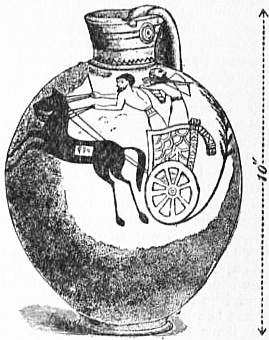
Fig. 12.—Jug from Cyprus of Oriental style, 10 in. high
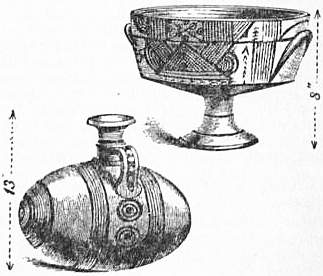
Fig. 13.—Pottery from Cyprus with geometrical ornament.
Sites and Discoveries.—The sites on which Greek vases have been found cover the whole area of the Mediterranean and beyond, from the Crimea to Spain, and from Marseilles to Egypt. By far the great majority, at all events of the finer specimens, have been extracted from the tombs of Vulci and other sites in Etruria; those of the later period or decadence have been found in large numbers on various sites in southern Italy, such as Capua, Curnae and Nola in Campania, Anzi in Lucania, and Ruvo in Apulia. In the western Mediterranean, Sicily has also been a fruitful field for this pottery, early varieties being found at Syracuse, later ones at Gela, Girgenti and elsewhere. Painted vases have also come to light in Sardinia and in North Africa, especially in the Cyrenaica, where the finds mostly belong to the 4th century b.c. In Greece proper the most prolific site has been Athens, where the finds extend from the Dipylon vases of the 8th century b.c. down to the decadent productions of the 4th century; one group, that of the white funeral lekythoi, is almost peculiar to Athens. Next to this city, Corinth has been most productive, especially in pottery of the archaic period and of local manufacture. Large quantities of pottery of all periods have been yielded by Thebes, Tanagra and other sites in Boeotia, and remains of the “Mycenaean” period at Mycenae, Argos and elsewhere. But on the whole painted pottery is rare in other parts of the mainland. Among the western islands of the archipelago, Aegina and Euboea have proved fruitful in vases of all periods; Thera, Melos and others of the Cyclades are remarkable for pottery of the prehistoric period with rudely painted designs; and above all Crete is now famous for the wondrous series of painted and ornamented pottery of pre-Mycenacan date, which can be traced back even to the Neolithic period, and the discovery of which has entirely revolutionized the preconceived theories on the appearance of painted pottery in Greece. This has been found in the recent excavations at Cnossus, Palaeokastro and elsewhere. In Asia Minor there have been some important finds on the mainland, but only along the coast; some of the islands, more especially Samos and Rhodes, have been more fruitful in this respect. At Kertch and elsewhere in the Crimea, large numbers of fine but somewhat florid vases of the 5th and 4th centuries b.c. have come to light. Cyprus has long been known as a rich field for pottery of all periods, from the Mycenaean onwards, the later varieties being marked by strong local quasi-oriental characteristics, with little development from the more primitive types (figs. 12 and 13). The principal sites are Salamis, Amathus, Marion (Poli) and Curium. Lastly, in the Egyptian delta two sites, Naucratis and Daphnae, have yielded results of considerable importance for the history of early Greek vase-painting.
The great majority of these vases have been found in tombs; but some important discoveries have been made on the sites of temples and sanctuaries, as on the Acropolis of Athens, or at Naucratis. In such cases the vases are seldom complete, having been broken up and cast away into rubbish-heaps, where the fragments have remained undisturbed. The tombs vary greatly in form, those of Greece being usually small rock-graves or shafts, those of Italy often fine and elaborate chambers with architectural details, and the manner in which the vases are found in these tombs varies greatly. Plain unornamented pottery is almost universal, and may be considered to have formed the “tomb-furniture” proper—the painted vases being as in daily life merely ornamental adjuncts.
Shapes and Uses of Greek Vases.—The enormous number of painted vases now collected in museums is in itself sufficient evidence of the important part they must have played in the daily life, of the Greeks, and the care which was bestowed on their decoration shows the high estimation in which they were held. It is, however, remarkable that, with the exception of general allusions to pottery and its use in daily life, there are singularly few passages in classical literature which throw light on the purposes for which these vases were used. Where any are described at full length there is always evidence that metal vases are intended. Athenaeus and the lexicographers have indeed put on record a long list of names of shapes, but it is only in a few cases that we can be certain what forms they describe, or whether any of the typical forms of existing vases can be identified with the literary descriptions.
We have then two questions to consider in this section: firstly, the uses to which painted vases were put by the Greeks; secondly, the classical names of the various forms of plain and painted pottery which have come down to us.
As we have seen, the majority of painted vases have been discovered in tombs, which at first sight seems to suggest that they were made principally for sepulchral purposes; but that they also had their uses in daily life as much as plain pottery or earthenware cannot be doubted. They stand, in fact, in the same relation to the commoner wares of their day as china or porcelain does with us, being largely ornamental only, but used by wealthy people or on special occasions for the purposes of daily life, as for instance at banquets or in religious ceremonies.
Vases were used as measures, as in the case of a small one-handled cup in the British Museum (see fig. 15), found at Cerigo (Cythera) and inscribed with the word ἡμικοτύλιον or “half-kotyle,” equivalent to about one-fourth of a pint. Another vase found at Athens is supposed to represent the official χοῖνιξ or quart, having a capacity of 0.96 litre; it is inscribed δημόσιον or “official measure,” and bears the official stamp of the state. Conversely many names of vases, such as the amphora or the kotyle, were adopted to indicate measures of capacity for liquid or dry commodities. Earthenware vessels were used for storing both liquids and food, for the preparation of foods and liquids, and for the various uses of the table and the toilet. That the painted ware was used at banquets or on great occasions we learn from scenes depicted on the vases themselves, in which vases painted with subjects appear in use. In connexion with athletics, they were given as prizes, as in the case of the Panathenaic amphorae, a class of vases given for victories in the games held at Athens at the Panathenaic festivals, where, however, they do not represent prizes so much as marks of honour corresponding to modern racing cups. Vases were also used as toys for children, as is proved by the discovery of many diminutive specimens, chiefly jugs, in the tombs of children at Athens, on which are depicted children playing at various games. They also served a purely decorative use as domestic ornaments, being placed on columns or shelves; or, in the case of flat cups and plaques, suspended on the wall. Many of the later Greek and Italian painted vases are very carelessly decorated on the one side, which was obviously not intended to be seen.
We come now to the use of vases for religious purposes, dedicatory, sacrificial or funerary. Of all these uses, especially the last, there is ample evidence. That vases were often placed in temples or shrines as votive offerings is clear from the frequent mention in literature of the dedication of metal vases, and it can hardly be doubted that painted pottery served the same purpose for those who could only afford the humbler material. Of late years much light has been thrown upon this subject by excavations, notably on the Acropolis of Athens, at Corinth, and at Naucratis in the Egyptian delta, where numerous fragments have been found bearing inscriptions which attest their use for such purposes. It was a well-known Greek custom to clear out the temples from time to time and form rubbish-heaps (favissae) of the disused vases and statuettes, which were broken in pieces as useless, but it is to this very fact that we owe their preservation. At Naucratis many of the fragments bear incised inscriptions, such as Άπόλλωνός εἰμι, “I am Apollo’s” (possibly a memorandum of the priest’s, to mark consecrated property), or ὁ δεῖνά με ἀνέθηκε τῇ Άφροδίτῃ, “So-and-so dedicated me to Aphrodite.” Fig. 14 gives another example with a dedication to Apollo. At Penteskouphia, near Corinth, a large series of painted tablets (πίνακες), dating from 600 to 550 b.c., with representations of Poseidon and dedicatory inscriptions to that deity, were found in 1879. Votive offerings in this latter form were common at all periods, and tablets painted with figures and hung on trees or walls are often depicted on the vases, usually in connexion with scenes representing sacrifices or offerings.
There is no doubt that vases (though not necessarily painted ones) must have played a considerable part in the religious ceremonies of the Greeks. We read of them in connexion with the Athenian festival of the Anthesteria, and that of the gardens of Adonis. They were also used in sacrifices, as shown on an early black-figured cup in the British Museum and on a vase at Naples with a sacrifice to Dionysus. In scenes of libation the use of the jug and bowl (phiale) is invariable.
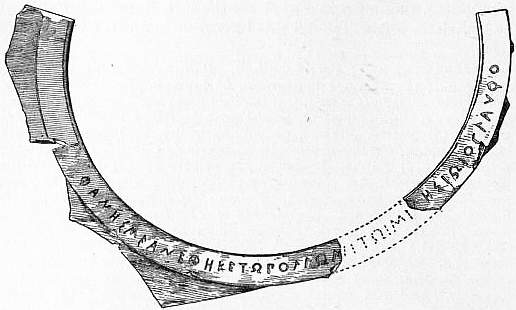
Fig. 14.—Part of vase from Naucratis with dedication to Apollo.
But their most important use, and that to which their preservation is mainly due, was in connexion with funeral ceremonies. They were not only employed at the burial, but were placed both outside the tombs to receive offerings, and inside them either to hold the ashes of the dead or as “tomb-furniture,” in accordance with Greek religious beliefs in regard to the future life. Several classes of vases are marked out by their subjects as exclusively devoted to this purpose, such as the large jars found in the Dipylon cemetery at Athens, which were placed outside the tombs, the white Athenian lekythoi of the 5th and 4th centuries b.c., and the large krateres and other vases of the 4th century b.c. found in the tombs of Apulia and other parts of southern Italy. Their use as cinerary urns was perhaps more restricted, at all events as regards the painted vases, though the custom is well known and is referred to in literature from Homer downwards. In “Mycenaean” times coffers (λάρνακες) of clay were used for this purpose, especially in Crete, where fine painted examples have been found; but of Greek pottery of the best periods there are but isolated instances.
The diagrams in fig. 15 show the principal shapes characteristic of Greek pottery in all but the earliest periods, when the variety of form was as yet too great to permit of more than the vaguest nomenclature; each form has its conventional name appended. These shapes may be classified under the following heads: (1) Vases in which food or liquids were preserved; (2) vases in which liquids were mixed or food cooked; (3) those by means of which liquids were poured out or food distributed; (4) drinking-cups; (5) other vases for the use of the table or toilet. Thus we have the pithos and amphora for storing wine, the krater for mixing it, the psykter for cooling it, the kyathos for ladling it out, and the oinochoe or prochoos for pouring it out; the hydria was used for fetching water from the well. The names and forms of drinking-cups are innumerable, the principal being the kylix, kotyle, kantharos, rhyton (drinking-horn) and phiale (libation bowl). The pyxis was used by women at their toilet, and the lekythos, alabastron and askos for oil and unguents.
Technical Processes.—Though the Greeks succeeded in making pottery of a very high order from the point of view of form and decoration, the technical processes remained throughout of the most elementary—for glaze was not used at all, the colour was of the simplest, and the temperature at which the ware was fired was not high enough to introduce any serious difficulties. As we should expect, it is possible to trace a gradual improvement in the technical processes in the direction of greater precision and refinement, for no vase-painter of the best period could have achieved his decorative triumphs on wares so coarse in substance and so rough in finish as those that satisfied his predecessors. As in every other case technical and artistic refinement went hand in hand. In the earliest times the clay was used with very little preparation; at all events before the introduction of the potter’s wheel the finish is not to be compared with that of the early races in Egypt. As the practice developed no doubt, specially good clays were found in certain districts, and these became centres of manufacture or the clays were carried to other established centres. The primitive wares usually exhibit the natural buff, yellow, grey or brownish colours of other elementary pottery, and the surface is somewhat rough and possesses no gloss. Thenceforward it becomes appreciably warmer in tone as it becomes finer in texture, until it reaches its perfection in the glowing orange, inclining to red, of the best Attic vases of the 5th century b.c. In the vases of the later Italian centres the colour again reverts to a paler hue.
The clay for the potter was doubtless prepared by a system of sedimentation, so as to get rid of all coarse particles. It was mixed with water and decanted into a series of vats so that ultimately fine clay of two or three grades was obtained. Both red and whitish clays were used, and the best potters gradually discovered that mixtures of different clays gave the best results. The clay for the Athenian vases was obtained from Cape Kolias in Attica; and as it did not burn to a very warm tone, ruddle or red ochre (rubrica) was added to it to produce the lovely deep orange glow that distinguishes the best vases. Corinth, Cnidus, Samos and other places were also famous for their clays, and at the first named tablets have been found bearing representations of the digging of clay for pottery.
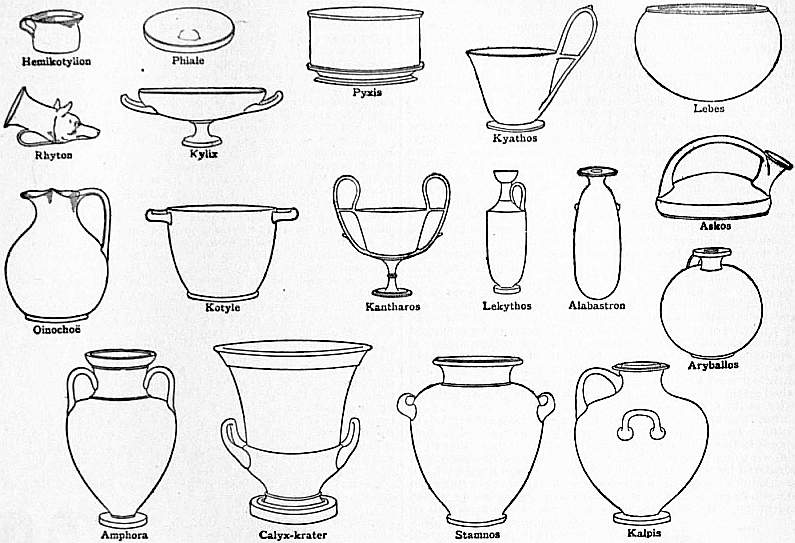
Fig. 15.—Shapes of Greek Vases.
The improved manipulation of the clays, and the increasing knowledge that the colour of a clay could be modified by admixture of other substances such as ruddle and ochre, really paved the way for what is known as the glaze of the Greek painted vases. This delicate gloss, so thin as to defy analysis, has been commonly called glaze, but it cannot be a glaze in the sense of a separate coating of finely-ground glass superimposed upon the clay. In all probability, as the Greek potter used finer and finer clays and so was enabled to perfect his shapes, he found that after a vase had been “thrown” he could get a closer texture on it by dipping it in a slip of still finer clay material and then smoothing it down and polishing it on the wheel when sufficiently dry. But the mixtures he would use for such a purpose—of very siliceous clay and ochre—would, when they were burnt in the Greek kiln, not only fire to a beautifully bright colour, but also to a glossy surface, especially where the flames had freely played about them; and it is more in accordance with our knowledge to believe that the exquisitely thin gloss of the finest Greek red vases was produced in this way, for it seems impossible that it can have been a coating of any special glaze.
In any case we may state broadly that the body of Greek vases is always fine in grain, fired hard enough to give forth a dull metallic sound when it is struck, but seldom fired above a temperature of about 900° C., which a modern potter would consider very low. When broken the inside is generally found to be duller in colour, and is often yellow or grey, even where the external surface is red. The material is exceedingly porous, and allows water to ooze through it (another proof that it was not glazed). Numerous analyses of the material of Greek vases have been published, but they tell us nothing of the secrets of the Greek potter. The results of a great number of these analyses may be summed up as follows: silica, 52-60 parts; alumina, 13-19 parts; lime, 5-10 parts; magnesia, 1-3 parts; oxide of iron, 12-19 parts. Analyses of a thousand ordinary simple red burning clays would give a similar result. It is to the glory of the Greek potter that with such ordinary materials, by the exercise of selection, patience and skill, he achieved the fine artistic results we see. He did as much as can be done with natural clay materials, but the glory of painted colour and glaze, like the later Persian or Chinese, was not for him.
Manufacture of Vases.—The earliest Greek pottery is, like all primitive pottery, hand-made. The introduction of the potter’s wheel into Greece was the subject of various ancient traditions, but we now know that it can be easily traced by a study of the primitive pottery of Crete, Cyprus or Troy. In Cyprus, for instance, the Bronze age tombs of 2500-1500 b.c. contain only hand-made pottery, but in the next period (1500-1000 b.c.) we find hand-made and coarse vases side by side with a more developed kind of painted pottery—the “Mycenaean”—obviously made on the wheel. It seems probable, therefore, that the wheel was introduced into Greece about 1500 b.c.; it was certainly known to Homer, as a familiar allusion shows (Il. xviii. 600). It was still a low circular table turned with the hand, not the foot; representations of its use are seen on several vases of the archaic period (fig. 16), and they further prove that the vase was replaced on the wheel for the subsequent processes of painting, polishing and adding separately modelled parts, as well as for the original shaping or “throwing.”
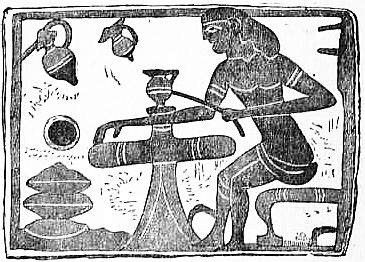
Fig. 16.—Votive tablet from Corinth; a potter applying painted bands while the vessel revolves on the wheel.
The method of shaping the vase on the wheel, which is the same as that still in use, need not be described in detail; the feet, necks, mouths and handles were modelled separately or shaped in moulds, and attached while the clay was moist, as is also indicated on a vase. Large and coarse vases, such as wine casks (πίθοι), were always modelled by hand on a kind of hooped mould (κάνναβος).
Parts of vases were modelled by hand at all periods by way of decoration. Even in the geometrical period we find horses modelled in the round on the covers of vases and later on handles enriched with moulded figures of serpents twining round them. Such embellishments are frequently, if not always, deliberate imitations of metal forms, but the plastic principle is one which obtained in Greek pottery from the very first, as for instance in the primitive pottery of Troy, in which the vases are often modelled in human or animal forms; and the same principle is involved in the common practice of speaking of the “neck,” “shoulder” or “foot” of a vessel. In the best period the practice of adding moulded ornaments or of modelling vases in natural forms took a subsidiary place, but examples occur from time to time, as in the beautiful rhyta or drinking-horns of the red-figure period (Plate II., fig. 58), or in smaller details such as are seen in handles enriched with heads in relief, a favourite practice of the potter Nicosthenes. In the 4th-century vases of southern Italy the handles are often much ornamented in this fashion, as in the large krateres, where they are adorned with masks in relief.
The system of moulding whole vases or ornamenting them with designs in relief taken from moulds really belongs to the decadence of the art, when imitations of metal were superseding the painted pottery. Even then it is rare to find whole vases produced from a mould, except in the case of those in the form of human figures or animals (Plate II., figs. 57 and 58), which almost come under the heading of terra-cotta figures, except for the fact that they are usually painted in the manner of the vases. But in southern Italy the tendency to imitate metal led to the popularity of ornaments made separately from moulds and attached or let in to vases otherwise plain. Vases of this period, with reeded bodies, must also have been made from moulds, as were a series of phialae or libation-bowls associated with Cales in Campania (Plate II., fig. 56), which are known to be direct imitations of metal.
All or nearly all of these vases are covered with a plain black glaze or varnish, and painted decoration is rare except in the case of those moulded in special forms or of a certain class made in Apulia with opaque colouring laid on the varnish. Some of these plain black vases of the 4th century are ornamented with stamped patterns made with a metal punch impressed in the moist clay. This decoration is confined to simple patterns.
After the vases had been made on the wheel they were dried in the sun and lightly baked, after which they were ready for varnishing and painting; it is also probable that the gloss was brought out by a process of polishing, the surface of the clay being smoothed with a piece of wood or hard leather. On a vase in Berlin a boy is seen applying a tool of some kind to an unfinished cup, probably for this purpose; the cup, being shown in red on the vase, has evidently not been varnished. Many vases are varnished black all over the exterior (whether decorated with designs or not) with the exception of the foot and lip.
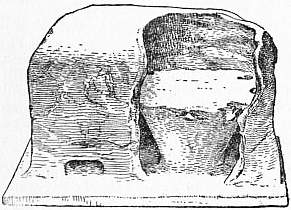
Fig. 17.—Model of Kiln found in Essex.
The process of baking was regarded as one of the most critical in the potter’s art. It was not indeed universal, as we read of sun-dried vessels for utilitarian purposes, but all the vases that have come down to us have been baked. The amount of heat required was regulated by the character of the ware, but was not very high. Many examples exist of discoloured vases which have been subjected to too much or too little heat, the varnish having acquired a greenish or reddish hue. Or again the red gloss is sometimes turned to an ashen-grey colour, the black remaining unimpaired. Other accidents were liable to occur in the baking, such as cracking under too great heat, or the damaging of the shape by vases knocking against one another and so being dented in or crushed. The form of the oven was of the simplest (fig. 17). No furnaces have been found in Greece, and only one or two in Italy, but we have a variety of evidence from vase-paintings. They were fed by fires from beneath, and the vases were inserted with a long shovel. They were heated with charcoal or wood fuel, and there are representations of men poking or raking the fires with long-handled implements. One vase-painting gives a bird’s-eye view, in horizontal section, of the interior of an oven full of jugs of various forms. Others have more complete presentations of potteries, with men engaged in the different processes of vase manufacture, modelling, painting or supplying the kilns with newly-made wares.
The Painting of Vases.—We may distinguish three principal classes of painted pottery, of Which two admit of subdivision.
1. Primitive Greek vases with simple painted ornaments, chiefly linear and geometrical, laid directly on the clay with the brush. The colour employed is usually a yellowish or brownish red passing into black. The execution varies, but is often extremely coarse.
2. Greek vases painted with figures. These may be subdivided as follows:—
(a) Vases with figures in shining black on a red glossy ground.
(b) Vases with figures left in the glossy red on a ground of shining black.
3. Vases with polychrome decoration.
(a) Vases of various dates with designs in outline or washes in various colours on white ground (these range from the 6th to the 4th century b.c.).
(b) Vases of various dates with designs in opaque colour laid over a ground of shining black (ranging from the primitive period to the 3rd century b.c.).
Of these the second group is by far the largest and most important, including the majority of the finest specimens of Greek vase-painting, and the following account will deal mainly with the technical processes by which the most successful results were obtained. In both the classes (a) and (b) the colouring is almost confined to a contrasting of the glossy red ground and shining black.
This black varnish (?) is particularly deep and lustrous, but varies under different circumstances according to differences of locality, of manufacture or accidents of production. It is seen in its greatest perfection in the “Nolan” amphorae of the earlier red-figure period, at its worst in the Etruscan and Italian imitations of Greek vases. The gradations of quality may be partly due to the action of heat, i.e. stoving at a higher or lower temperature. It also varies in thickness. At present no certainty has been attained as to its composition—Brongniart’s oft-quoted analysis cannot be accepted —nor has any acid been found to have an effect upon it, though the chemical action of the earth sometimes causes it to disappear.
The method of its use forms the chief distinction between the black-figured and red-figured vases, but there is a class of the former which approaches near in treatment to the latter, the whole vase being covered with black except a framed panel which is left red to receive the figures. It is obvious that the transition to merely leaving the figures red is but a slight one. But in all black-figured vases the main principle is that the figures are painted in black silhouette on the red ground, the outlines being first roughly indicated by a pointed instrument making a faint line. The surface within these outlines being filled in with black, details of anatomy, dress, &c., were brought out by incising inner lines with a pointed tool. After a second baking or perhaps stoving had taken place, the designs were further enriched by the application of opaque purple and white pigments, which follow certain conventional principles in their respective use. After a third baking at a lower heat still to fix these colours the vase was complete.
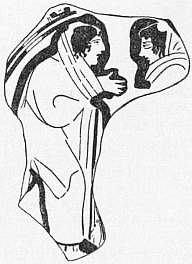
(From a photo supplied by the Director of the Sèvres Museum) Fig. 18.—Fragment of unfinished red-figured vase.
In the red-figured vases the shining black is used as a background. But before it is applied the outlines of the figures are indicated not by incised lines, but by drawing a thick line of black round their contours. Recent researches have attempted to show that the instrument with which this was achieved may have been a feather brush or pen, by which the lines were drawn separately, not concurrently. The other tools used for painting would be an ordinary metal or reed pen and a camel’s-hair brush, or at any rate something analogous. Thus the outlines of the figures were clearly marked, and the process is one of drawing rather than painting, but it was in draughtsmanship that the best vase-painters excelled. The next stage was to mark the inner details by very fine black lines or by masses of black for surfaces such as the hair; white and purple were also employed, but more sparingly than on the earlier vases. The main processes always remain the same down to the termination of vase-painting, though the tendency to polychromy, which came in about the end of the 5th century b.c., effected some modifications. The blacking of the whole exterior surface—a purely mechanical process—took place after the figures had been completed and protected from accidents by the thick black border of which we have spoken.
A fragment of an unfinished vase preserved in the Sèvres Museum gives a very clear idea of the process just described, the figures being completed, but the back ground not yet applied (fig. 18). There is also another vase in existence which gives the interior of a vase-painter’s studio, in which three artists are at work with their brushes, their paint-pots by their side.
In the class of vases (3 (a)), with polychrome figures on a white ground, the essential feature is the white slip or engobe with which the naturally pale clay is covered. In the archaic vases of the 7th and 6th centuries b.c., especially in the Ionian centres, as at Rhodes, Naucratis and Cyrene, this slip is frequently employed, but with this, difference, that the figures are painted in the ordinary black-figure method, the only additional colour being purple laid on the black. We first find polychrome decoration, whether in wash or outline, in a small class of fragments from Naucratis, of the 6th century b.c., which technically are of a very advanced character. The colours used either for outline or wash include purple, brown, yellow, crimson and rose-colour, but some, if not all, of these colours were not fired.
In the 5th century this practice was revived at Athens, chiefly in the class of lekythoi or oil-flasks devoted exclusively to sepulchral uses. Here the vases, after leaving the wheel and being fitted with handles, &c., were covered with a coating of white clay. A second coating of black was applied to the parts not required for decoration, and the white was then finely polished, acquiring a dull gloss, and finally fired at a low temperature. The decoration was achieved as follows: a preliminary sketch was made with fine grey lines, ignoring draperies, &c., and not always followed when the colours were laid on. This was done when the first lines were dry, the colour being applied with a fine brush in monochrome—black, yellow or red—following the lines of the sketch. For the drapery and other details polychrome washes were employed, laid on with a large brush. All varieties of red from rose to brown are found, also violet, yellow, blue, black and green. Hair is treated either in outline or by means of washes.
Finally, we have to deal with the class of vases (3 (b)) in which opaque pigments are laid over the surface of the shining black with which the whole vase is coated. This method is met with at three distinct periods in the history of vase-painting, separated by long distances of time.
We first find it in the earlier Cretan or Kamares ware, where it seems to have been introduced not long after the close of the Neolithic period, about 2500 b.c., and where it holds its own for about a thousand years against the contrasted method of “dark on light” painting, till it was finally ousted by the latter at the height of “Mycenaean” civilization in Crete. The colouring is very varied, orange, brown, pink and white being the principal tints employed.
The process appears again at the end of the 5th century in a small class of Attic vases, which have been regarded as a sort of transition between the black-figured and red-figured. White and orange-red are here employed, sometimes with accessory details in purple and black and incised lines, so that the technique is virtually black-figured, though the appearance of the vases is often red-figured. Lastly, it appears in southern Italy as a final effort of vase-painting to flicker into life again about the end of the 3rd century. Some of these vases were made in Campania, where the method resembles that of the Attic class just described, others in Apulia, probably at Gnathia. The latter have feeble conventional decoration in purple and white with details in yellow, confined to one side of the vases, and are also distinguished by the use of ornaments in relief. They were also occasionally made in Greece proper.
Remarkably few colours were used by the Greek vase painters, especially in the best periods. The deep purple used for accessory details was produced from iron oxide, but the red used for lines on the white lekythoi is an ochre (μίλτος, rubrica). The white also used for accessories is an earth or clay; in the slip coating of the white ground vases it assumes the consistency of pipe-clay. Yellow, where used for details on the later vases, is an ochre, and blue and green are produced from artificial compounds containing copper. A number of the colours, such as blue, rose and green, used by the polychrome painters, are obviously artificial pigments which have not been fired. When gilding was employed it was laid on over a raised ground of clay finely modelled with a small tool or brush, and was attached by varnish, not by fire.
Potters and Inscriptions.—The potters who made these vases were mostly—at least at Athens in the 6th and 5th centuries, b.c.—μἐτοικοι, or resident aliens, as their names in many cases imply. We have an Amasis (an Egyptian name), a Brygus (a Scythian), a Lydus and a Scythes. The dialect of many of the inscriptions on Attic vases seems to show foreign influence, though in other cases peculiarities may be merely due to the use of a vernacular. They formed a gild or fraternity, and in each pottery there was probably more or less division of labour, the more simple processes being the work of slaves. This seems to be implied in the vase-paintings representing the interior of potteries. Others again “specialized” in different shapes, and were known as χυτροπλάθοι, ληκυθοποιοί, and so on.
Over a hundred names of artists are known, found on some five hundred vases. They go back to about 700 b.c., the earliest names being found on Corinthian and Boeotian vases; but the majority of the signatures are found on Attic black- and red-figured wares. Some, such as Andocides, made vases in which the two methods are combined. The best known is Nicosthenes, whose signature occurs eighty times. The ordinary forms of signature are four—(1) ὁ δεῖνα ἐποίησεν ; (2) ὁ δεῖνα ἔγραχεν; (3) ὁ δεῖνα ἔγραχε καὶ ἐποίησεν; (4) A ἔγραψε. B ἐποίησεν. Where ἐποίησε alone occurs (as in a signature of Euxitheus), it probably refers to the master of the pottery who designed the vase and superintended its production; in other cases the share of the actual artist is clearly indicated. Some artists, such as Duris and Makron, sign ἔγραψε alone; in all cases, the form of signature affords us a useful guide to their style.
Space forbids the discussion of other inscriptions found on vases, which include those descriptive of subjects or persons, ejaculations uttered by the figures, convivial exclamations, or the καλός names discussed below; all these are painted on the designs themselves. There is also another class of graffiti inscriptions, which includes those incised by the owners with their names and memoranda scratched under the foot, probably made by the potter or his workmen relating to the number of vases in a batch or “set” and their price.
Vitreous and Lead-glazed Wares.—In Greek tombs a class of pottery is often found which approximates, more in appearance to porcelain, but, though often spoken of by that name, it is not porcelain at all, but is analogous to the Egyptian glazed faience, of which it is in point of fact an imitation. It is distinguished by the white gritty material of which it is made, largely composed of sand, and forming what is sometimes known as “frit” from its semi-vitreous consistency. The surface is covered with a glaze, usually of a pale blue or cream colour, but other colours such as a manganese-purple or brown are sometimes found. Some of the earliest examples of this ware have been found in Mycenaean tombs at Enkomi in Cyprus, in the form of vases moulded in the shape of human or animal heads. These exhibit a remarkably advanced skill in modelling, and are more like Greek work of the 6th century b.c. Apart from the technique they have nothing in common with the Egyptian importations so often found in Mycenaean tombs.
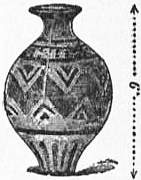
Fig. 19.—Enamelled pottery from tombs in Rhodes, made under Egyptian influence.
In a subsequent period (8th-7th century b.c.) Egyptian objects in faience became a common import into Greek cities, such as those of Rhodes, and to a less degree in Sardinia and southern Italy, through the commercial medium of the Phoenicians. Flasks of faience occur in the Polledrara tomb at Vulci (610-600 b.c.) and similar vases with a pale green glaze at Tharros in Sardinia in tombs of the same date. In Rhodes, small flasks and jars are found ornamented with friezes of men and animals in relief, or imitating in colour and design the glass vessels of the Phoenicians. It also seems probable that the Greeks of Rhodes and other centres attempted the imitation of this ware (see fig. 19), for we find faience aryballi or globular oil-flasks modelled in the form of helmeted heads or animals, which are purely Greek in style.
In the Hellenistic period the fashion was revived at Alexandria, and under the Ptolemies large jugs of blue-enamelled faience with figures in relief and bearing the names of reigning sovereigns were made and exported to the Cyrenaica and to southern Italy. Two of these are in the British Museum (Egyptian department). The same collection includes a very beautiful glazed vase in the form of Eros riding on a duck, found in a tomb at Tanagra, but undoubtedly of Alexandrine make, and a head of a Ptolemaic queen, with a surface of bright blue glaze.
Subsequently in the 1st century b.c., this so-called porcelain ware was replaced by a variety of ware characterized by a brilliantly coloured glaze coating, in which the presence of lead is often indicated. This ware was principally made at three centres; at Tarsus in Asia Minor, at Alexandria and at Lezoux in central Gaul. But it was probably also made in western Asia Minor and in Italy. It is not confined to vases, being also employed for lamps and small figures; the vases are usually of small size, in shapes imitated from metal (Plate II., fig. 59). The colour of the glaze varies from a deep green to bright yellow, and the inside of a vessel is often of a different tint from the exterior. Many of these vases are decorated with figures or designs in relief, others are quite plain. The colours of these glazes are of course due to the addition of oxide of copper and oxide of iron to a lead glaze, and they are strictly analogous to the green and yellow glazes of medieval Europe.7
Historical Account of Greek Vase-painting.—It has been indicated in the section dealing with technical processes that Greek vases may be classified under four headings according to the character of the decoration, and this classification may with a slight modification be adopted as a chronological one, the history of the art falling under four main heads, under which it will be convenient to describe its development from the earliest specimens of painted pottery down to the period when it was finally replaced by other methods of decoration.
These four classes and their main characteristics may be summarized as follows:—
I. Vases of the Primitive Period from about 2500 or 2000 to 600 b.c., including both the Cretan-Mycenaean epoch and the early ages of historical Greece. In the former the pottery is either decorated in polychrome on a shining black ground or conversely in shining black on a buff ground; in the latter, the decoration is in brown or black (usually dull, not shiny) on an unglazed ground varying from white to pale red. In the former again the decoration is marked by its naturalistic treatment of plant and animal forms; in the latter the ornaments are chiefly linear, floral or figures of animals; human figures and mythological scenes being very rare.
II. Black-figured Vases from about 600-500 b.c.; figures painted in shining black on a glossy ground varying from cream colour to bright orange red, with engraved lines and white and purple for details; subjects mainly from mythology and legend.
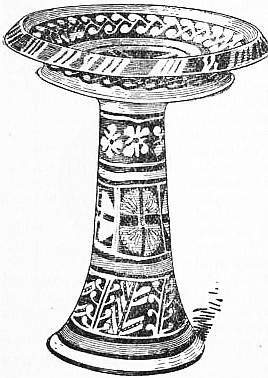
Annual of the British School at Athens. Fig. 20.—Minoan or “Kamares” ware, from Crete.
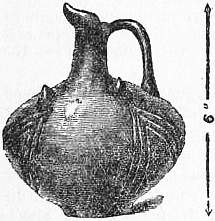
Fig. 21.—Primitive black pottery from the Troad.
III. Red-figured Vases, from 520 to 400 b.c.; figures drawn in outline on red clay and the background wholly filled in with shining black, inner details indicated by painted lines or dashes of purple and white, scenes from daily life or mythology. With these are included the vases with polychrome figures on white ground. In these, which are exclusively made at Athens, the perfection of vase-painting is reached between 480 and 450 b.c.
IV. Vases of the Decadence, from 400 to 200 b.c.; mostly from southern Italy, technique as in Class III., but the drawing is free and often careless, and the general effect gaudy; subjects funereal, theatrical and fanciful. At the end of this period vases are largely replaced by plain shining black pottery modelled in various forms, or with decorations in relief, all these being imitations of the metal vases which began to take the place of painted wares in the estimation of the Hellenistic world.
I. Vases of the Primitive Period.—It has been noted in the introductory section that it is possible to trace the development of pottery in Greece as far back as the Neolithic period, owing chiefly to the light recently thrown on the subject by the excavations in Crete. These have yielded large quantities of painted pottery of high technical merit, usually with decoration in polychrome or white on a dark ground, in what is known as the Kamares ware, covering the period 2500-1500 b.c. (fig. 20). This was gradually superseded by painting in dark shining pigments on a light glossy ground during the later Minoan period (1500-1000 b.c.), forming what is known as the “Mycenaean” style. The subjects, though chiefly confined to floral ornaments or aquatic plants and creatures, are marvellously naturalistic yet decorative in their treatment, often rivalling in this respect the pottery of the Far East. In the latter part of this period this class of pottery was spread all over the Mediterranean, and large quantities have been found in Greece, especially at Mycenae, in Rhodes and other Greek islands, and in Cyprus, where a series of vases with animals, monsters, and even human figures shows what is probably the latest development of the pure Minoan or Mycenaean style.
Outside Crete the earliest Greek pottery has been found in Cyprus and at Troy, with simple incised or painted patterns on a black polished ground, the vases being all hand-made, and often treated in a plastic fashion with rude modelling of human or animal forms (figs. 21, 22); these cover the period 2500-2000 b.c. Early painted pottery, parallel with the Kamares ware, has been found in Thera and in the important cemeteries of Phylakopi in Melos. But until the general spread of Mycenaean civilization and art in the latter half of the second millennium there is no site except Crete where a continuous and successful development can be studied.
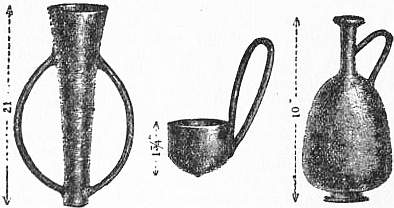
Fig. 22.—Primitive red pottery from the Troad.
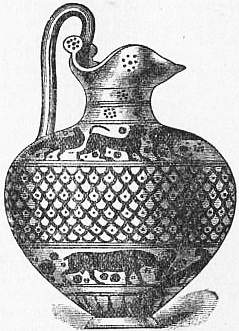
Fig. 23.—Vase with bands of animals, Oriental in style, (British Museum.)
About the time which is represented in Greek tradition by the Dorian invasion (1100 b.c.) the then decadent Mycenaean civilization was replaced by a new one much more backward in development, making pottery of a far simpler and more conventional type, the decoration being largely confined to geometrical patterns to the exclusion of motives derived from plant forms. This is usually known as the geometrical style, and the pottery covers the period from about 1000 to 700 b.c. It is found all over the mainland and islands of Greece, and exhibits a certain development towards a more advanced stage. The patterns include the chevron, the triangle, the key or maeander, and the circle, in various combinations, painted in dull black on a brown ground. In most places the art advanced no further, but in Boeotia, and still more at Athens, we can trace the gradual growth of decorative skill, first in the introduction of animals, and then in the appearance of the human figure. In the Athenian cemetery outside the Dipylon gate a series of colossal vases has come to light, on which are painted such subjects as sea-fights and funeral processions. The human figures are exceedingly rude and conventional, painted almost entirely in silhouette, but there is a distinct striving after artistic effect in the composition and arrangement. In Boeotia the vases do not advance beyond the animal stage, and many exhibit a tendency to decadence in their carelessness, as contrasted with the painstaking helplessness of the Athenian artists.
In Ionia and the islands of the Aegean such as Rhodes, the art of vase-painting from the first carried on the Mycenaean tradition, and was distinguished by its naturalism and originality, and by the bold and diverse effects produced by variety of colour or novelty of subject. The ornamentation is at first elementary, consisting of friezes of animals, especially lions, deer and goats (figs. 23 and 24). These figures stand out sharply in black against the creamy buff ground which is characteristic of nearly all Ionic pottery, and details are brought out by means of engraved lines, patches of purplish iron pigment, or by drawing parts of the figures, especially the heads, in outline on the clay ground. Another feature is the general use of small ornaments such as rosettes and crosses in great variety of form to cover the background and avoid the vacant spaces which the Greek artist abhorred. The system of decoration has been thought to owe much to Assyrian textile fabrics.
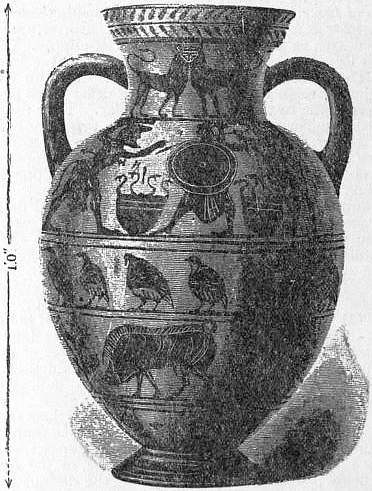
Fig. 24.—Ionic amphora, with contest between Heracles and Hera, and bands of birds and animals; black, with incised lines.
One of the best though most advanced examples of early Ionic pottery is a pinax or plate from Rhodes in the British Museum, on which is represented the combat of Menelaus and Hector over the body of Euphorbus (fig. 25); their names are inscribed over the figures, and this is almost the earliest known instance of a mythological subject, the date of the painting being not later than 600 b.c. To a slightly later date belongs another remarkable group of cups with figures on a white ground, probably made at Cyrene in North Africa. Of these the most famous has a painting in the interior, of Arcesilaus II., king of Cyrene from 580 to 550 b.c., weighing goods for export in a ship. Others have mythological subjects, such as Zeus, Atlas and Prometheus, Cadmus and Pelops.
But these vases, though still retaining the older technique, really belong to the second class, that of black-figured vases, and they belong to a time when in all Ionian centres this method was being superseded by the new technique which Corinth had introduced and Athens perfected, to the consideration of which we must return.
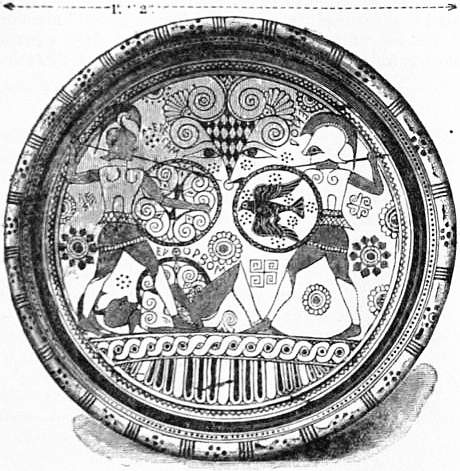
Fig. 25.—Early inscribed pinax from Rhodes, with contest of Menelaus and Hector over the body of Euphorbus.
For some 150 years Corinth almost monopolized the industry of pottery on the west of the Aegean. Large numbers of examples have been found in or near the city itself, many bearing inscriptions in the peculiar local alphabet. They show a continuous progress from the simplest ornamentation to fully-developed black-figured wares. In the earliest (Plate I. fig. 52) oriental influence is very marked, the surface being so covered with the figures and patterns that the background disappears and the designs are at times almost unintelligible. The general effect is thus that of a rich oriental tapestry, and the subjects are largely chosen from the fantastic and monstrous creations of Assyrian art, such as the sphinx and gryphon. The vases are mostly small, the ground varies from cream to yellow, and the figures are painted in black and purple.
Both in Ionia and at Corinth during the early part of the 6th century the same tendencies are seen to be at work, tending to a unification of styles under the growing influence of Athens. In Ionia (see above) figure subjects become more common, and the technique approaches gradually nearer to the black-figure method. Similarly at Corinth the ground ornaments diminish and disappear, the friezes of animals are restricted to the borders of the designs, and human figures are introduced, first singly, then in friezes or groups, and finally engaged in some definite action such as combats or hunting scenes. In the last stages Greek myths and legends are freely employed. A new development, traditionally associated with the painter Eumarus of Athens, was the distinguishing of female figures by the use of white for flesh tints. A somewhat similar development was in progress at Athens, though represented by comparatively few vases. Here the adoption of Corinthian and Ionian technical improvements evolved by the middle of the 6th century the fully developed black-figure style which by degrees supplanted or assimilated all other schools.
II. Black-figured Vases.—At the head of this new development stands the famous Francois vase at Florence, found at Chiusi in 1844 (Plate I. fig. 53). Its shape is that of a krater or mixing-bowl, and it bears the signatures of its maker and decorator in the form “Ergotimos made me, Klitias painted me.” It might be described as a Greek mythology in miniature, with its numerous subjects and groups of figures all from legendary sources such as the stories of Peleus, Theseus and Meleager, or the return of Hephaestus to heaven. All the figures have their names inscribed.
The general technique of the black-figured vases has already been described. It may be noted as a chronological guide that the use of purple for details is much commoner in the earlier vases, white in the later, but towards the end of the century when the new fashion of red figures was gaining ground, both colours were almost entirely dropped. The drawing of the figures is, as might be expected, somewhat stiff and conventional, though it advanced considerably in freedom before the style went out of fashion. Many vases, otherwise carefully and delicately executed, are marred by an excess of mannerism and affectation, as in the works of the artists Amasis and Exekias (Plate I. fig. 54). The treatment of drapery is a good indication of date, ranging from flat masses of colour to oblique flowing lines of angular falling folds.
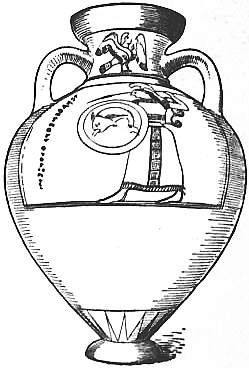
Fig. 26.—Panathenaic amphora.
The shapes most commonly employed by the Athenian potters of this period are the amphora, hydria, kylix, oinochoe and lekythos, the first-named being the most popular. A special class of amphorae is formed by the Panathenaic vases, which were given as prizes in the Athenian games, and were adorned with a figure of the patron goddess Athena on one side and a representation of the contest in which they were won on the other (fig. 26). They usually bear the inscription τῶν Άθηνῆθεν ἄθλων εἰμί “I am (a prize) from the games at Athens.” Some of these can be dated by the names of Athenian archons which they bear, as late as the 4th century, the old method of painting in black figures with a stiff conventional pose for the goddess being retained for religious reasons.
The chief interest of the black-figured vases is really derived from their subjects, which range over every conceivable field, the proportion of myth and legend to scenes from daily life being much greater than in the succeeding period. They include groups of Olympian and other deities, and the various scenes in which they take part, such as the battle of the gods and giants, or the birth of Athena (treated in a very conventional manner, as on a fine amphora in the British Museum); Dionysus and his attendant satyrs and maenads, the labours and exploits of Heracles and other heroes, subjects taken from the tale of Troy and other less familiar legends; and scenes from daily life, battle scenes, athletics, the chase and so on. The same classification of course holds good for the later periods of vase-painting, with some exceptions. The proportion of genre-scenes subsequently becomes greater, and some myths disappear, others rise into prominence, new deities such as Eros (Love), and Nikē (Victory) appear for the first time, and, generally speaking, the later subjects are characterized by a sentimentality or tendency to emotion which is entirely foreign to the conventional stereotyped compositions of the 6th century artist.
A remarkable feature of the subjects on black-figured vases is that a stereotyped form of composition is invariably adopted at least for the principal figures, but minor variations are generally to be found, as, for instance, in the number of bystanders; and it is almost an impossibility to find any two vase-paintings which are exact duplicates. The form of the composition, was partly determined by the field available for the design; when this took the form of a long frieze the space was filled up with a series of spectators or the repetition of typical groups, but when the design is on a framed panel or confined by ornamental borders the method of treatment is adapted from that of a sculptured metope, and the figures limited to two or three. In many cases it is difficult to decide, in the absence of inscriptions, whether or no a scene has mythological signification; the mythological types are over and over again adopted for scenes of ordinary life, even to the divine attributes or poses of certain figures.
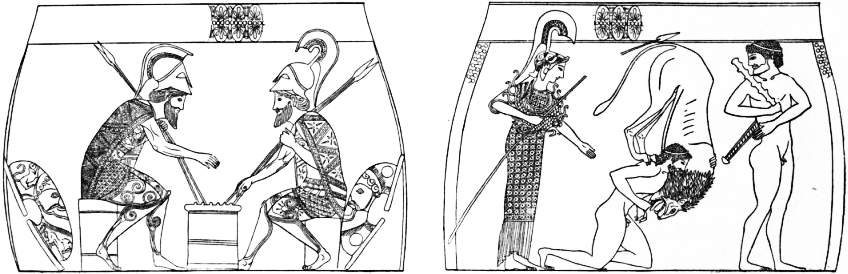
Fig. 27.
Vase by Andocides. Black figures on obverse. Vase by Andocides. Red figures on reverse.
Among the artists of the period who have left their names on the vases, besides those already mentioned, the most conspicuous is Nicosthenes, a potter of some originality, from whose hand we have over seventy examples, a few being in the red-figure method. He is supposed to have introduced at Athens a revival of the Ionic fashion of painting on a cream-coloured ground instead of on red, of which some very effective examples have been preserved. He was always a potter rather than a painter, and most of his vases are remarkable for their forms—introducing plastic imitations of metal vases—rather than for their painted decoration. Most of the artists of this period, as in the succeeding one, have left their signatures on cups (kylikes), but this form did not receive so much attention from the painter as at a later period, and many of these examples bear only inscriptions and no painted decoration.
III. Red-figured Vases.—The sudden reversal of technical method involved in the change from black figures on a red ground to red figures on black is not at first sight easy of explanation. Some artists, like Nicosthenes and Andocides, used both methods, sometimes on the same vase, and there is no doubt that the two went on for some years concurrently. As, however, no intermediate stage is possible, there is no question of development or transition. The new style was in fact a bold and ingenious innovation. It may possibly have been suggested by a small class of vases in which the figures are painted in the black-figure method, but have the converse appearance, that is to say they are painted in a thick red pigment on a ground of shining black. It may therefore have occurred to the artist that he could obtain the same effect merely by leaving the figures unpainted on the red clay and surrounding them with the black. The change, must, however, be closely associated with the career of the artist Andocides, who not only produced vases in each method, but also several in which the two are combined (fig. 27). In two or three cases the subject is actually the same on each side, almost every detail being repeated, except that the colouring is reversed.
The date at which the change took place was formerly placed well on in the 5th century, on account of the great advance in drawing which most of the red-figured vases show, as compared with the black. They were thus regarded as contemporary with the painter Polygnotus, if not with Pheidias. But the excavations on the Acropolis of Athens yielded so many fragments in the advanced red-figured style which must be earlier than 480 b.c., that it has become necessary to find an earlier date for its appearance. This is now usually placed at about 520 b.c., overlapping with the preceding period.
The red-figure period is usually subdivided into four, marking the chief stages of development, and known respectively as the “severe,” “strong,” “fine,” and “late fine” periods. Their principal characteristics and representative painters may be briefly enumerated.
In the severe period there is no marked advance on the black-figured vases as regards style. The figures are still more or less stiff and conventional, and some vases even show signs of an analogous decadence. The real development is partly technical, partly in the introduction of new subjects. Although the change of style probably had its actual origin in the amphora, as treated by Andocides, the new developments are best seen in the kylix, a form of vase which now sprang into popularity and called forth the chief efforts of the principal artists. Its curved surface gave ample scope for skilful effects of drawing and decorative arrangement, and the earlier painters devoted all their attention to perfecting it as a work of decorative art. For other shapes, such as the hydria, and lekythos, the old method was for a time preferred.
The most typical artist of the period was Epictetus, and other famous cup-painters were Pamphaeus, Cachrylion and Phintias. The earliest cups are decorated in a quite simple fashion like those of the black-figure period, often with a single figure each side between two large “symbolical” eyes, and a single figure in a circle in the interior. To the latter the artist at first devoted his chief efforts, though even here his scope was at first limited. But although he had not yet attained to skill in composition, he did discover that the circular space was well adapted for exhibiting his newly-acquired abilities as a draughtsman and for disposing figures in ingeniously conceived attitudes. In all cases the object was to fill the space as far as possible, a characteristic of all the best Greek art. By degrees more attention was paid to the designs on the exterior, and the single figures were replaced by groups, but regular compositions in the form of friezes telling some story were not introduced until quite the end of this period. Epictetus was throughout his career a thoroughly “archaic” artist, but a considerable advance was made by Cachrylion, who stands on the verge of the succeeding stage.
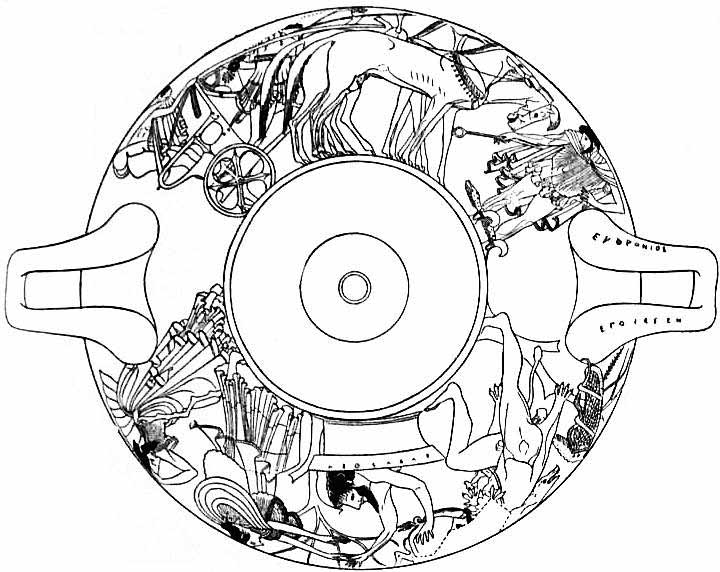
Fig. 28.—Cup by Euphronius.
The strong period centres round the name of Euphronius, the author of a really great artistic movement. His capacity for inventing new subjects or new poses—or otherwise overcoming technical and artistic difficulties—marks a great advance on all previous achievements, and he seems to represent the stage of development traditionally associated with the painter Cimon of Cleonae, the inventor of foreshortening and other novelties. Thus figures were no longer represented exclusively in profile, as in the black-figured vases which had made no advance beyond the conventions of Egyptian art. Ten vases signed by him are in existence (though it is not certain that all were actually painted by him), most of them having mythological subjects (fig. 28).
Of his contemporaries, Duris, Hieron and Brygus take foremost rank, all three being, like Euphronius, essentially cup-painters, though they use other forms at times. For decorative effect and beauty of composition their vases have never been surpassed. As an example we may quote a kotyle or beaker in the British Museum signed by Hieron, with a group of Eleusinian deities. The larger vases of this period are more rarely signed, but many of them rival the cups in execution, though the subjects are characterized by greater simplicity and largeness of style.
In the fine style (460-440 b.c.) breadth of effect and dignity are aimed at, and although cup-painting had passed its zenith, and signed specimens become rarer, yet, considering the red-figured vases as a whole, this period exhibits the perfection of technique and drawing. In many of the larger vases the scenes are of a pictorial character, landscape being introduced, with figures ranged at different levels, and herein we may see a reflection of the style of the painter Polygnotus. One of the finest cups in this style is in the Berlin Museum, it is signed by the artists Erginus and Aristophanes, and the subject is the battle of the gods and giants. To the end of the period belongs a beautiful hydria in the British Museum by the painter Meidias with subjects from Greek legend in two friezes (fig. 29). Generally speaking, there is a reaction in favour of mythological subjects.
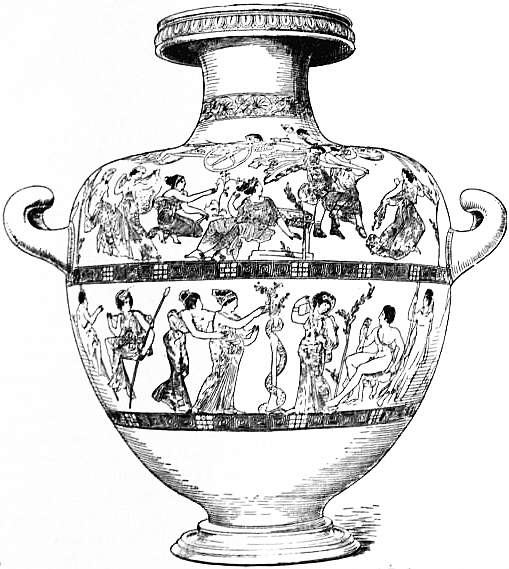
Fig. 29.—Hydria by Meidias in the style of Polygnotus.
In the late fine style, which begins about 440 b.c., the pictorial effect is preserved, but with perfected skill in drawing the compositions deteriorate greatly in merit, and become at once over-refined and careless. The figures are crowded together without meaning or interest. The fashion also arose of enhancing the designs by means of accessory colours—almost unknown in the previous stages—such as white laid on in masses, blue and green, and even with gilding. Athletic and mythological subjects yield place to scenes from the life of women and children or meaningless groups of figures (fig. 30).
A good example of this style is an amphora from Rhodes with the subject of Peleus wooing Thetis, in which polychrome colouring and gilding are introduced. There are also many imposing and elaborate specimens found (and perhaps made) in the colonies of the Crimea and the Cyrenaica; in particular one signed by Xenophantus with the Persian king hunting, and another representing the contest of Athena and Poseidon for the soil of Attica, both from the Crimea.
Contemporary with the red-figure method is one in which the figures are painted on a white slip or engobe resembling pipe-clay, with which the whole surface was covered; the figures are drawn in outline in red or black, and partly filled in with washes of colour, chiefly red, purplish red, or brown, but sometimes also with blue or green. This style seems to have been popular about the middle of the 5th century b.c. and was employed for the funeral lekythoi which came into fashion at Athens about that time. These vases, which form a class by themselves, were made specially for funeral ceremonies and were painted with subjects relating to the tomb, such as the laying-out of the corpse on the bier, the ferrying of the dead over the Styx by Charon, or (most frequently) mourners bringing offerings to the tomb (fig. 31). They continued to be made well on into the 4th century, but the later examples are very degenerate and careless.
Of other forms, especially the kylix and the pyxis (toilet-box), some exceedingly beautiful specimens have come down to us, which show a delicacy of drawing and firmness of touch never surpassed, although the lines were probably only drawn with a brush. The technique of these vases may reflect the methods of the painter Polygnotus and his contemporaries, who used a limited number of colours on a white ground. Among them no finer specimen exists than the cup in the British Museum with Aphrodite riding on a goose; the design is entirely in brown outlines, and the drawing, if slightly archaic, full of grace and refinement.
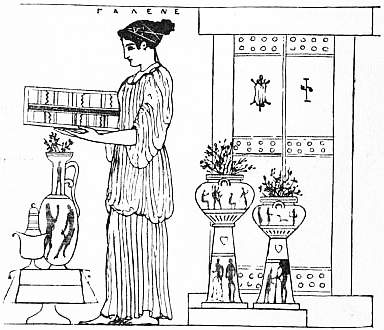
Fig. 30.—Painting from a small toilet-box or pyxis, showing painted vases used to decorate a lady’s room. On the left is a gilt pyxis with a tall lid, and an oenochoe on a low table; on the right two tall vases (lebes) on a plinth. All except the pyxis are decorated with painted figures, and contain flowers.
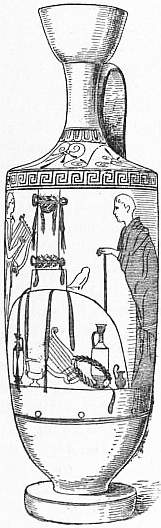
Fig. 31.—Funeral lekythos showing vases placed inside tomb.
In the subjects on red-figured vases we do not find the same variety of choice as on the black-figured, but on the other hand there is infinitely greater freedom of treatment. The stereotyped form of composition is almost entirely discarded, and each painter forms his own conception of his subject. The class of slim amphorae, known as “Nolan” from the place where they were mostly found, are distinguished by having the design limited to one or at most two figures on each side, often on a large scale; these vases are also famous for the marvellous brilliance of their shining black (fig. 32).
Towards the middle of the 5th century the patriotism of the Athenian artist finds expression in the growing importance which he attaches to local legends, especially those of Theseus, the typical Attic hero. He seems to have been regarded as the typical Athenian athlete or ephebus, and his contests as analogous to episodes of the gymnasium. Hence the grouping on some vases of scenes from his labours are like so many groups of athletes (fig. 33), and hence, too, a general tendency of the red-figured vases, especially the cups, to become a sort of glorification of the Attic ephebus, the representations of whom in all sorts of occupations are out of all proportion to other subjects.
We find evidence of this, too, in another form. Many vases, especially the cups of the “severe” and “strong” periods, bear names of persons inscribed on the designs with the word καλός, “fair” or “noble,” attached; sometimes merely, “the boy is fair.” The exact meaning of this practice has been much discussed, but evidence seems to show that the persons celebrated must have been quite young at the time, and were probably youths famous for their beauty or athletic prowess. Some of the names are those of historical characters, such as Hipparchus, Miltiades or Alcibiades, and, though they cannot always be identified with these celebrated personages, enough evidence has been obtained to be of great value for the chronology of the vases, Further, the practice of the vase-painter of adopting his own particular favourite name or set of names has enabled us to increase our knowledge of the characteristics of individual artists by identifying unsigned vases with the work of particular schools.
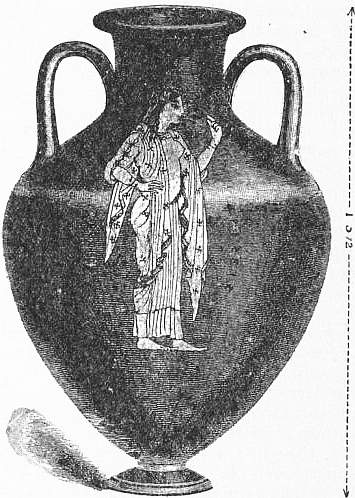
Fig. 32.—“Nolan” amphora by Euxitheus (c. 450 b.c.), figure of Briseis; the other side has Achilles.
IV. Vases of the Decadence.—For all practical purposes the red-figure style at Athens came to an end with the fall of the city in 404 b.c. Painted vases did not then altogether cease to be made, as the Panathenaic prize vases and the funeral lekythoi testify, but at the same time a rapid decadence set in. The whole tendency of the 4th century b.c. in Greece was one of decentralization, and the art of vase-painting was no exception, for we find that there must have been a general migration of craftsmen from Athens, not only to the Crimea and to North Africa, but also to southern Italy, which now becomes the chief centre of vase production. Here there were many rich and flourishing Greek colonies or Grecianized towns, such as Tarentum, Paestum and Capua, ready to welcome the new art as an addition to their many luxuries. In the character of the vases of this period we see their tendencies reflected, especially in their splendid or showy aspect; the only aim being size and gaudy colouring.
The general method of painting remains that of the Athenian red-figure vases, but with entire loss of simplicity or refinement, either in the ornamentation, the choice of colours, or the drawing of the figures. Large masses of white are invariably employed, especially for the flesh of women or of Eros, the universally present god of Love, and for architectural details. Yellow is introduced for details of hair or features, and in attempts at shading, nor is a dull iron-purple uncommon. The reverses of the vases, when they have subjects, are devoid of all accessory colouring, and the figures are drawn with the greatest carelessness, as if not intended to be seen. There is throughout a lavish use of ornamental patterns such as palmettes, wreaths of leaves, or ornaments strewn over the field (a reversion to an old practice).
The drawing, having now become entirely free, errs in the opposite extreme; the forms are soft and the male figures often effeminate. The fanciful and richly-embroidered draperies of the figures and the frequent architectural settings seem to indicate that theatrical representations exercised much influence on the vase-painters. The great painters of the 4th century may also have contributed their share of inspiration, but rather perhaps in the subjects chosen than in regard to style; though the effect of many scenes on the larger vases is decidedly pictorial, they are chiefly remarkable for their emotional and dramatic themes.
The influence of the stage is twofold, for tragedy as well as comedy plays its part. Many subjects are taken directly, others indirectly, from the plays of Euripides, such as the Medea, Hecuba (Plate II. fig. 60), or Hercules Furens, and the arrangement of the scenes is essentially theatrical. The influence of comedy is seen in subjects derived from the phlyakes, a kind of farce or burlesque popular in southern Italy, and here again the setting is adapted from the stage, some vases having parodies of myths, others comic scenes of daily life.
Many vases of this period, especially those of large size, were expressly designed for funeral purposes. Some of these bear representations of the underworld, with groups of figures undergoing punishment. On others shrines or tombs are depicted—sometimes containing effigies of the deceased, at which the relatives make offerings—as on the Athenian lekythoi. But by far the greater portion of the subjects are taken from daily life, many of these being of a purely fanciful and meaningless character like the designs on Sèvres or Meissen china; the commonest type is that of a young man and a woman exchanging presents, the presence of Eros implying that they are scenes of courtship.
The vases of this period are usually grouped in three or four different types, corresponding to the ancient districts of Lucania, Campania and Apulia, each with its special features of technique, drawing and subjects. In Lucanian vases the drawing is bold and restrained, more akin to that of the Attic vases; in Campania a fondness for polychromy is combined with careless execution. In Apulia a tendency to magnificence exemplified in the great funeral and theatrical vases is followed by a period of decadence characterized by small vases of fantastic form with purely decorative subjects. Besides these we have the school of Paestum, represented by two artists who have left their names on their vases, Assteas and Python. A well-known example of the work of the former is a krater in Madrid with Heracles destroying his children, a theatrical and quasi-grotesque composition, and there is a fine example of Python’s work in a krater in the British Museum, with Alkmena, the mother of Heracles, placed on the funeral pyre by her husband Amphitryon, and rain-nymphs quenching the flames (Plate I. fig. 55).
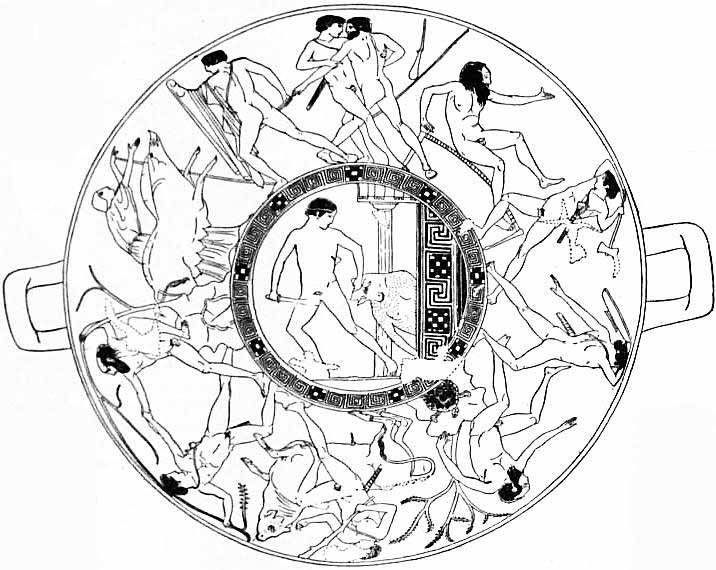
Fig. 33.—Cup with exploits of Theseus.
About the end of the 3rd century b.c. the manufacture of painted vases would seem to have been rapidly dying out in Italy, as had long been the case elsewhere, and their place is taken by unpainted vases modelled in the form of animals and human figures, or ornamented with stamped and moulded reliefs. These in their turn gave way to the Arretine and so-called “Samian” red wares of the Roman period. In all these wares we see a tendency to the imitation of metal vases, which, with the growth of luxury in the Hellenistic age, had entirely replaced painted pottery both for use and ornament; the pottery of the period is reduced to a subordinate and utilitarian position, merely supplying the demands of those in the humbler spheres of life.
Collections.—The majority of the painted vases now in existence are to be found in the various public museums and collections of Europe, of which the largest and most important are the British Museum, the Louvre and the Berlin Museum. Next to these come the collections at Athens, Naples, Munich, Vienna, Rome and St Petersburg; isolated specimens of importance are to be found in other museums, as at Florence, Madrid or the Bibliothèque Nationale at Paris. Most of the great private collections of the two preceding centuries have now been dispersed. In recent years the Boston Museum has raised America to a level with Europe in this respect; and the Metropolitan Museum at New York contains a vast collection of Cypriote pottery.
Literature.—Important original articles are to be found in various archaeological journals such as American Journal of Archaeology (1885, &c); Annual of the British School at Athens (1894, &c.); Athenische Mitteilungen (1876, &c.); Bulletin de correspondance hellénique (1877, &c.); Comptes rendus de la commission impériale archéologique (St Petersburg, 1859-1888); Gazette archéologique (Paris, 1875-1889); Jahrbuch des kaiserlichen deutschen archäologischen Instituts, Berlin (1886, &c.); Journal of Hellenic Studies (1880, &c.); Monumenti antichi (Milan, 1890, &c.); Monuments grecs (Paris, 1872-1898); Monuments Piot (Paris, 1894, &c.); Revue archéologique (Paris, 1844, &c.). The older works have been recently superseded by important publications embodying the latest views such as Hartwig, Die griechischen Meisterschalen des strengen rotfigurigen Stils (1893); Louvre, Catalogue des vases antiques de terre cuite, by E. Pottier (1896, &c.); S. Reinach, Répertoire des vases peints (Paris, 1899-1900); H. B. Walters, History of Ancient Pottery (Greek, Etruscan and Roman), 1905, with an excellent bibliographical list; also art. “Hischylos” in J.H.S. xxix. (1909) p. 103.
Etruscan Pottery.—Parallel with the development of the art of pottery in Greece runs the course of the art in Etruria, though with far inferior results; in its later stages it is actually no more than a feeble imitation of the Greek. The period of time which we must consider extends from the Bronze age (1000 b.c. or earlier) down to the 3rd century b.c., when Etruscan civilization was merged into Roman.
The earliest civilization traced in Italy is not, strictly speaking, Etruscan, but may perhaps be more accurately styled “Umbrian.” It is usually referred to as the “Terramare” period from the remains discovered in that district in the basin of the Po. These people were lake-dwellers, barely removed from the Neolithic stage of culture, and their pottery was of the rudest kind, hand-made and roughly baked. Cups and pots have been found sometimes with simple decoration in the form of knobs or bosses, and many have a crescent-shaped handle serving as a support for the thumb.
The next period, the earliest which can be spoken of as “Etruscan,” is known as the “Villanova” period, from a site of that name near Bologna, or as the period of pit-tombs (a pozzo), from the form of the graves in which the pottery has been found (see Villanova). It begins with the 9th century b.c. and lasts for about two hundred years. The pit-tombs usually contain large cinerary urns or ossuaria (containing the ashes of the dead), fashioned by hand from a badly-levigated volcanic clay known as impasto Italico. These vessels were irregularly baked in an open fire, and the colour of the surface varies from red-brown to greyish black. They appear to have been covered with a polished slip, intended to give the vases a metallic appearance. The shape of the urns is peculiar, but uniform; they have a small handle at the widest part and a cover in the form of an inverted bowl with handle (Plate III. fig. 63). Their ornamentation consists of incised or stamped geometrical ornaments formed in the moist clay in bands round the neck and body; more rarely patterns painted in white are found. Common pottery is also found showing little advance on that of the Terramare period except in variety of decoration. The technique and ornament are the same as in the case of the urns. They correspond in development, though not in date, to the early pottery of Troy and Cyprus, as well as to the primitive pottery of other races, but one marked difference is the general fondness of the Italian potter for vases with handles.
Sometimes the cinerary urns take the form of huts (tuguria), though these are more often found in the neighbourhood of Rome. One of the best examples is in the British Museum; it still contains ashes which were inserted through a little door secured by a cord passing through rings. The ornamentation suggests the rude carpentry of a primitive hut, the cover or roof being vaulted with raised ridges to represent the beams. The surface is polished, and other specimens are occasionally painted with patterns in white.
In the next stage a change is seen in the form of the tombs, the pit being replaced by a trench; this is accordingly known as the “trench-tomb” or a fossa period, and extends from the 8th century b.c. to the beginning of the 6th. Importations of Greek pottery now first make their appearance. The character of the local pottery actually remains for some time the same as that of the preceding period, but it improves in technique. By degrees an improvement in the forms is also noted, and new varieties of ornamentation are introduced; there is, however, no evidence that the wheel was used.
Two entirely new classes of pottery are found at Cervetri (Caere) belonging to the 7th century. One consists of large jars (πίθοι) of red ware, the lower part being moulded in ribs, while the upper has bands of design stamped round it in groups or friezes. These designs were either produced from single stamps or rolled out from cylinders like those used in Babylonia. The subjects are usually quasi-oriental in character, and it is not certain that this ware was made in Etruria, especially as similar vases have been found in Rhodes and Sicily; either it was imported, or it was a local imitation of Greek models.
The other class is similar as regards the shapes and the nature of the clay, but is distinguished by having painted subjects in white outlines on a red glossy ground. The clay, a kind of impasto Italico, was first hardened by baking, and then a mixture of wax, resin and iron oxide was applied and polished; on this the pigments, a mixture of chalk and earth, were laid. The subjects are from Greek mythology or are at least Greek in character, but the technique is purely Etruscan, and the drawing is crude and un-Greek in the extreme.
The fourth period shows a close continuity with the third; but the difference is defined firstly by the appearance of a new type of tomb in the form of a chamber (a camera), secondly, by the all-pervading influence of oriental art, and to a less extent of that of the Greeks. The period extends from about 650 to 550 b.c., and is further marked by the general introduction of the wheel into Etruria and by the appearance of inscriptions in an alphabet derived from western Greece. In the earlier tombs the typical local pottery is of hand-made impasto Italico resembling that of the previous periods; in the later we find what is known as bucchero ware—the national pottery of Etruria—which is made on the wheel and baked in a furnace, and shows a marked tendency to imitate metal.
To this period also belongs the famous Polledrara tomb or Grotto d’lside at Vulci, the contents of which are now in the British Museum and include some remarkable specimens of pottery. It dates from about 620-610 b.c. The most remarkable of the vases is a hydria, of reddish-brown clay covered with a lustrous black slip on which have been painted designs in red, blue and a yellowish white. The colours have unfortunately now almost disappeared, and it is doubtful if they had been fired. The principal subject is from the story of Theseus and Ariadne. This tomb also contained a large wheel-made pithos of red impasto ware with designs painted in polychrome. In the Regulini-Galassi tomb at Cervetri (about 650 b.c.) large cauldrons of red glossy ware were found, with gryphons’ heads projecting all round, to which chains were attached. A similar cauldron from Falerii on a high open-work stand is now in the British Museum.
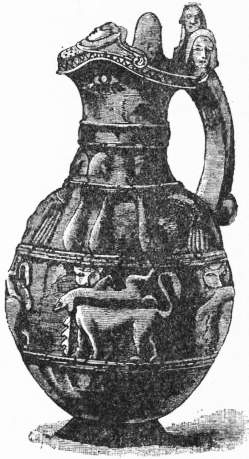
Fig. 34.—Etruscan oinochoe, of black bucchero ware, with figures in relief. (British Museum.)
We now come to the bucchero ware, which is characteristic of the later portion of this period, though the earliest examples go back to the end of the 7th century. Its main feature is the black paste of which it is composed, covered with a more or less shining black slip. Modern experiments seem to indicate that the clay was smoked or fumigated in a closed chamber after baking, becoming thereby blackened throughout, and the surface was then polished with wax and resin. Analyses of the ware have proved that it contains carbon and that it had been lightly fired. The oldest bucchero vases are small and hand-made, sometimes with incised geometrical patterns engraved with a sharp tool like metal-work. Oriental influence then appears in a series of chalice-shaped cups found at Cervetri with friezes of animals. From about 560 b.c. onwards the vases are all wheel-made, with ornaments in relief either stamped from a cylinder or composed of separate medallions attached to the vase. The subjects range from animals or monsters to winged deities or suppliants making offerings (fig. 34); in other cases we find meaningless groups of figures or plant forms. These types are found chiefly in southern Etruria, but at Chiusi (Clusium) a more elaborate variety found favour from about 500 to 300 b.c. The shapes are very varied and the ornament covers the vase from top to bottom, the covers of the vases being also frequently modelled in various forms. The figures are stamped from moulds, incised designs being added to fill up the spaces. The range of subjects is much widened, including scenes from Greek mythology and oriental types combining Egyptian and Assyrian motives, which must have been introduced by the Phoenicians.
Thus the technique of the bucchero wares is purely native, but the decoration is entirely dependent on foreign types whether Greek or oriental, and throughout the whole series the tendency to imitate metal-work is to be observed in every detail, both in the forms and in the methods of decoration. Some are mere counterparts of existing work in bronze.
The last variety of peculiarly Etruscan pottery which calls for notice is the Canopic jar, so called from its resemblance to the κάνωποι in which the Egyptians placed the bowels of their mummies. They are rude representations of the human figure, the head forming the cover, and in the tombs were placed on round chairs of wood, bronze or terra-cotta. An example of such a jar on a bronze-plated chair may be seen in the Etruscan Room of the British Museum (Plate III. fig. 65). Their origin has been traced to the funeral masks found in the earliest Etruscan tombs. From these a gradual transition may be observed from the mask (1) placed on the corpse, (2) on the cinerary urn, (3) the head modelled in the round and combined with the vase, and (4) at last the complete human figure. The earliest of these jars are found in the “pit-tombs” of the 8th century b.c., and the latest and most developed types belong to the 5th century b.c.
The skill shown by the Etruscans in metal-work and gem-engraving never extended to their pottery, which is always purely imitative, especially when they attempted painted vases after the Greek fashion. The kinds already described are all more or less plastic in character and imitative of metal, except in the case of the Cervetri and Polledrara finds, which have little in common with anything Greek, and exhibit a quite undeveloped art. But towards the end of the 6th century b.c., when Greek vases were coming into the country in large numbers, attempts were made to imitate the black-figure style, especially of a particular class of Ionian vases. Imitations of these are to be found in most museums and may be readily recognized as Etruscan from peculiarities of style, drawing and subject, as well as their inferior technique (fig. 35).
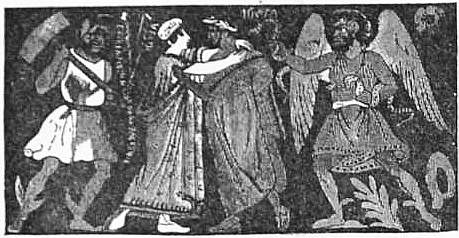
Fig. 35.—Etruscan Amphora imitating Greek style; parting scene of Alcestis and Admetus, with Etruscan inscriptions.
At a later date (4th-3rd century b.c.) they began to copy red-figured vases with similarly unsuccessful results. With the exception of a small class of a somewhat ambitious character made at Falerii (Civita Castellana), of which there is a good example in the British Museum with the subject of the infant Heracles strangling the serpents, they are all marked by their inferior material and finish and their bizarre decoration. The style is often repulsive and disagreeable, as well as ineffective, and the grim Etruscan deities, such as Charun, are generally introduced. Some of these vases have painted inscriptions in the Etruscan alphabet. The latest specimens positively degenerate into barbarism.
Painted vases of native manufacture are also found in the extreme south of Italy and have been attributed to the indigenous races of the Peucetians and Messapians; their decoration is partly geometrical, partly in conventional plant forms, and is the result of natural development rather than of imitation of Greek types. Some of the shapes are characteristic, especially a large four-handled krater. They cover the period 600-450 b.c., after which they were ousted by the Graeco-Italian productions we have already described.
Roman Pottery.—Roman vases are far inferior to Greek; the shapes are less artistic, and the decoration, though sometimes not without merits of its own, owes most of its success to the imitation or adaptation of motives learnt from earlier Grecian, Egyptian or Syrian potters. They required only the skill of the potter for their completion, and, being made by processes largely mechanical, they are altogether on a lower scale of artistic production.
It has been noted that during a certain period—namely, the 3rd and 2nd centuries b.c.—ceramic art had reached the same stage of evolution all round the Mediterranean, painted pottery had been ousted by metal-work, and such vases as continued to be made were practically imitations of metal both in Greece and Italy. These latter we must regard as representing ordinary household pottery, or as supplying to those who could not afford to adorn their houses and temples with costly works in metal, a humble but fairly efficient substitute. There is a terra-cotta bowl of the 2nd century b.c. in the British Museum which is an exact replica of a chased silver bowl with reliefs in the same collection, and may serve as an illustration of this condition of things (Plate II. fig. 56).
These imitations of metal were largely made in southern Italy, a district which enjoyed close artistic relations with Etruria, and we have already seen that the same principle had long been in vogue among the Etruscans. Hence it is not surprising that an important centre of pottery manufacture should have sprung up in Etruria, in the and century b.c., which for many years set the fashion to the whole Roman world. But before discussing such products it may be as well to say something on the technical character, shapes and uses of Roman pottery in general.
Technical Processes.—Roman pottery regarded in its purely technical aspect is in some ways better known to us than the Greek, chiefly owing to extensive discoveries of kilns and potters’ apparatus in western Europe. It may be classified under two heads, of which only the second will concern us for the most part as yielding by far the greater amount of material and interest: (1) the plain, dull earthenware used for domestic purposes, and (2) the fine, red shining wares, usually known to archaeologists as terra sigillata, clay suited to receive stamps (sigilla) or impressions.
For both classes all kinds of clay were used, varying somewhat in different regions, and ranging in colour when fired from black to grey, drab, yellow, brown and red. The clays varied greatly in quality; most of the pottery made in southern Gaul was fashioned from the ferruginous red clay of the Allier district, but at St-Remy-en-Rollat and in that neighbourhood a white clay was used. In Italy we find a carefully levigated red clay in use, great care being devoted to its preparation and admixture. But apart from decoration and style there is a great similarity in the general appearance of the Italian and provincial pottery made under Roman influence, and it is often very difficult to decide whether the vases were manufactured where they had been found or were imported from some famous centre of manufacture. The secret of the glossy red surface seems to have been common property and found its way from Italy to Gaul, Spain and Germany, and perhaps even to Britain.
The manner in which this glossy red surface was produced has been a much-disputed question, some, as for instance Artis, the excavator of the Castor potteries in Northamptonshire, claiming that it was a natural result obtained in the baking, after polishing of the surface, by means of specially contrived kilns. But it is now generally agreed that it was artificial. It is true that the Roman lamps and many of the commoner wares have a gloss produced by polishing only, varying in colour and brightness with the proportion of iron oxide in the clay and the degree of heat at which the pieces were fired. But the surface finish of the finer or terra sigillata wares is something quite distinct, and reaches a high and wonderfully uniform perfection.
It is possible that the technical secret of the potters of the Roman world was only a development from the practice of the Greeks, but it does seem as if the finer Roman wares were coated with a brilliant glossy coating so thin as to defy analysis, yet so persistent as to leave no doubt of its existence as a definite glossy coat. Repeated attempts have been made to determine its nature by analysis, but chemists ought to have known better, for the coating is so thin that it is impossible to remove it without detaching much more body than glaze. Examination shows it to be much more than a surface polish or than the gloss of the finest Greek vases, and we shall have to wait for a final determination of its nature until some one who is at once a chemist and a potter can reconstruct it synthetically. Whatever its nature and method of production, it is certain that the glaze itself was a transparent film which heightened the natural red colour of the clay, until in the finest specimens it has something of the quality of red coral.
In the manufacture of vases the Romans used the same processes as the Greeks. They were all made on the wheel, except those of abnormal size, such as the large casks (dolia), which were built up on a frame. Specimens of potters’ wheels have been found at Arezzo and Nancy, made of terra-cotta, with a pierced centre for the pivot, and bearing small cylinders of lead round the circumference to give a purchase for the hand and to aid the momentum of the wheel. For the ornamental vases with reliefs an additional process was necessary, and the decoration was in nearly all cases produced from moulds. The process in this case was a threefold one: first the stamps had to be made bearing the designs; these were then pressed upon the inside of a clay mould which had been previously made on the wheel to the size and shape required; finally, the clay was impressed in the mould and the vase was thus produced, decoration and all. Handles being of rare occurrence in Roman pottery, the vases were thus practically complete, requiring only the addition of rim and foot. The stamps were made in various materials, and had a handle at the back (Plate III. fig. 64). The moulds were of lighter clay than the vases, and were lightly fired when completed, so as to absorb the moisture from the pressed-in clay. Large numbers of these moulds are in existence (Plate III. fig. 61), and the British Museum possesses a fine series from Arezzo. Those discovered in various parts of Gaul have afforded valuable evidence as to the sites of the various pottery centres, as their presence obviously denoted a place of manufacture, and the value of this evidence is increased when they bear potters’ names.
Remains of kilns for baking Roman pottery8 are very numerous in western Europe, especially in Gaul, where the best examples are at Lezoux near Clermont, at Châtelet in Haute-Marne, and near Agen in Lot-el-Gäronne. In Germany good remains have come to light at Heiligenberg in Baden, al Heddernheim near Frankfort, Rheinzabern near Carlsruhe, and Westerndorf in Bavaria. In England the best kilns are those discovered by Artis in 1821-1827 at Castor in Northamptonshire (see fig. 4).
Shapes.—As is the case with Greek vases, a long list of names of shapes may be collected from Latin literature, and the same difficulties as to identification arise in the majority of cases. They may, however, be classified in the same manner; as vases for storing liquids, for mixing or pouring wine, for use at the table, and so on. In addition Varro and other writers have preserved a number of archaic and obscure names chiefly applied to the vases used in sacrifices.
The principal vases for storing liquid or solid food were:—The dolium, a large cask or barrel of earthenware; the amphora, a jar holding about six gallons; and the cadus, a jar about half as large as the amphora. The dolium had no foot, and was usually buried in the earth; it was also used for purposes of burial. The amphora corresponds to the Greek wine-jar of that name, and had, like its prototype, a pointed base. Many examples were found at Pompeii stamped with the names of consuls (cf. Hor. Od. in. 21. I), or with painted inscriptions relating to their contents. The cadus is mentioned by Horace and Martial.
Of smaller vases for holding liquids, such as jugs, bottles and flasks, the principal were the urceus, answering to the Greek οἰνοχόη, the ampulla, a kind of flask with globular body, and the lagena, a narrow-necked flask or bottle. Of drinking-cups the Romans had almost as large a variety as the Greeks, and the great majority of the ornamented vases preserved to the present day were devoted to this purpose. The generic name for a cup was poculum, but the Romans borrowed many of the Greek names, such as cantharus and scyphus. The calix appears to have answered in popularity, though not in form, to the Greek kylix, and is probably the name by which the ornamented bowls were usually known. The names for a dish are lanx, patina and catinum. Another common form is the olla (Greek χύτρα), which served many purposes, being used for a cooking-pot, for a jar in which money was kept, or for a cinerary urn. The form of vase identified with this name has a spherical or elliptical body with short neck and wide mouth. Of sacrificial vases the principal was the patera or libation-bowl, corresponding to the Greek φιάλη.