VOLUME V SLICE VI Celtes, Konrad to Ceramics (continued 5)
Reading edition
A, First appearance of the eye as a ring-like upgrowth.
B, Ingrowth of the ring-like wall so as to form a sac, the primitive optic vesicle of Loligo.
In the Dibranchiate division of the Cephalopoda the greatest elaboration of the dioptric apparatus of the eye is attained, so that we have in this class the extremes of the two lines of development of the Molluscan eye, those two lines being the punctigerous and the lentigerous. The structure of the Dibranchiate’s eye is shown in section in fig. 14, C, and in fig. 33, and its development in figs. 34 and 37. The open sac which forms the retina of the young Dibranchiate closes up, and constitutes the posterior chamber of the eye, or primitive optic vesicle (fig. 37, A, poc). The lens forms as a structureless growth, secreted by both the internal and external surfaces of the front wall of the optic vesicle (fig. 37, B, l). The integument around the primitive optic vesicle which has sunk below the surface now rises up and forms firstly nearest the axis of the eye the iridian folds (if in B, fig. 37; ik in fig. 33; Ir in fig. 14), and then secondly an outer circular fold grows up like a wall and completely closes over the iridian folds and the axis of the primitive vesicle (fig. 33, C). This covering is transparent, and is the cornea. In the oceanic Decapoda the cornea does not completely close, but leaves a central aperture traversed by the optic axis. These forms are termed Oigopsidae by C. d’Orbigny, whilst the Decapoda with closed cornea are termed Myopsidae. In the Octopoda the cornea is closed, and there is yet another fold thrown over the eye. The skin surrounding the cornea presents a free circular margin, and can be drawn over the surface of the cornea by a sphincter muscle. It thus acts as an adjustable diaphragm, exactly similar in movement to the iris of Vertebrates. Sepia and allied Decapods have a horizontal lower eyelid, that is to say, only one-half of the sphincter-like fold of integument is movable. The statocysts are situated ventrally between the pedal and visceral ganglia, and are entirely enclosed in the cranial cartilage. The cavity of each is continued into a small blind process which is the remnant of the embryonic connexion of the vesicle with the external surface. The sensory epithelium is at the anterior end of the vesicle forming a macula acustica, and in the cavity is a single otolith, partly calcareous and partly organic except in Eledone, in which it is entirely organic. The nerve arises from the cerebral ganglion on each side and passes through the pedal ganglion.
There is no branchial osphradium in the Dibranchiata corresponding to that of Nautilus, but the olfactory organ or rhinophore near the eye is present. In Sepia and the majority of the Dibranchiata it is a simple pit, in some of the Oigopsida it is a projection which may be stalked.
Reproduction and Development.—The modification of one or a pair of the arms in the male for purposes of copulation has already been described. In many genera the sexes differ from one another in other characters also. As a rule the males are more slender or smaller than the females. The maximum degree of sexual dimorphism occurs in Argonauta among the Octopods; in this genus the female may be fifteen times as large as the male, and the peculiar modification of the dorsal arms for the secretion of the shell occurs in the female only, no shell being formed in the male. In most cases the females are much more numerous than the males, but the opposite relation appears to exist in those Octopoda in which the hectocotylus is autotomous, for as many as four hectocotyli have been found in the pallial cavity of a single female. When the hectocotylus is not detached it is usually inserted into the pallial cavity of the female so as to deposit the spermatophores in or near the aperture of the oviduct, but in Sepia and Loligo they are merely deposited on the ventral lobes of the buccal membrane.
The eggs are laid shortly after copulation. In the Octopoda and in Sepia, Sepiola and Rossia, each egg has a separate envelope continued into a long stalk by which it is attached with several others in a cluster. In Argonauta the eggs are carried by the female in the cavity of the shell. In Loligo the eggs are very numerous, and are enclosed in cylindrical transparent gelatinous strings united at one end into a cluster.
The Cephalopoda appear to be the only Invertebrates in which the egg is mesoblastic and telolecithal like that of Vertebrata. This is the result of the large quantity of the yolk, and the position the latter assumes in relation to the blastoderm. In all other Mollusca the segmentation is complete though in some cases very unequal. In the egg of Loligo, which has been chiefly studied (fig. 35), the protoplasmic pole is at the narrower end of the egg, and segmentation is restricted to this end, forming a layer of ectoderm cells. From one part of the periphery of the ectoderm proliferation of cells takes place and gives rise to a layer of scattered nuclei over the whole surface of the yolk. The region of proliferation marks the anal side of the ectoderm, and the layer of nuclei forms the perivitelline membrane. This process must be regarded as equivalent to the first stage of invagination, the yolk being surrounded by hypoblast cells or their nuclei. Later on the same anal edge of the ectoderm forms another cellular layer, the endoderm proper, which forms a continuous sheet below the ectoderm.
The mesoderm also originates at the anal side of the ectoderm and extends in two bands right and left between ectoderm and endoderm. After the mesoderm is thus established, a little vesicle lying upon and open to the yolk is formed from the endoderm, and this vesicle ultimately gives rise to the stomach, the two lobes of the liver and the intestine. The buccal mass and oesophagus arise from a stomodaeal invagination, and the anus is formed later from a short proctodaeal invagination.
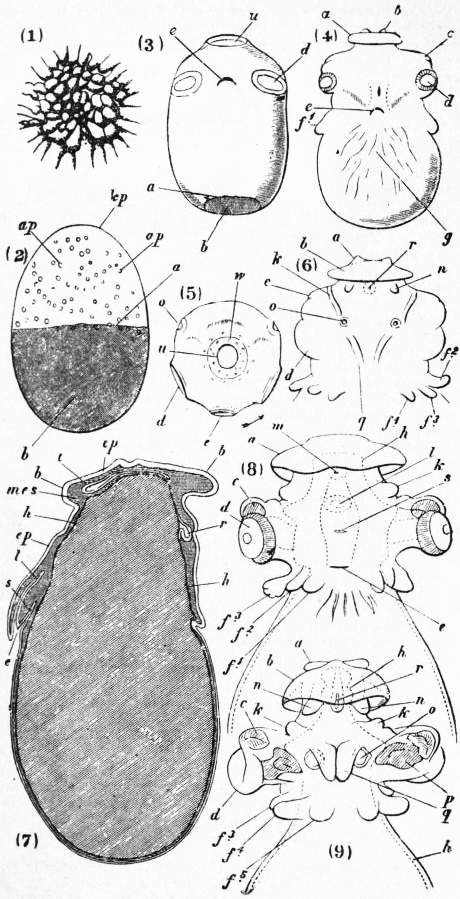
Fig. 35.—Development of Loligo.
1. View of the cleavage of the egg during the first formation of embryonic cells. 2. Lateral view of the egg at a little later stage. a, Limit to which the layer of cleavage-cells has spread over the egg; b, portion of the egg (shaded) as yet uncovered by cleavage-cells; ap, the auto-plasts; kp, cleavage-pole where first cells were formed. 3. Later stage, the limit (a) now extended so as to leave but little of the egg-surface (b) unenclosed. The eyes (d), mouth (e) and mantle-sac (u) have appeared. 4. Later stage, anterior surface, the embryo is becoming nipped off from the yolk-sac (g). 5. View of an embryo similar to (3) from the cleavage-pole or centro-dorsal area. 6. Later stage, posterior surface. 7. Section in a median dorso-ventral and antero-posterior plane of an embryo of the same age as (4). 8. View of the anterior face of an older embryo. 9. View of the posterior face of an embryo of the same age as (8). Letters in (3) to (9):—a, lateral fins of the mantle; b, mantle-skirt; c, supra-ocular invagination to form the “white body”; d, the eye; e, the mouth; f1, f2, f3, f4, f5, the five paired processes of the fore-foot; g, rhythmically contractile area of the yolk-sac, which is itself a hernia-like protrusion of the median portion of the fore-foot; h, dotted line showing internal area occupied by yolk (food-material of the egg); k, first rudiment of the epipodia (paired ridges which unite to form the siphon or funnel); l, sac of the radula or lingual ribbon; m, stomach; n, rudiments of the gills (paired ctenidia); o, the otocysts—a pair of invaginations of the surface of the epipodia; p, the optic ganglion; q, the distal portion of the ridges which form the siphon, k being the basal portion of the same structure; r, the vesicle-like rudiment of the intestine formed independently of the parts connected with the mouth, s, k, m, and without invagination; s, rudiment of the salivary glands; t in (7), the shell-sac at an earlier stage open (see fig. 36), now closed up; u, the open shell-sac formed by an uprising ring-like growth of the centro-dorsal area; w in (5), the mantle-skirt commencing to be raised up around the area of the shell-sac. In (7) mes points to the middle cell-layer of the embryo, ep to the outer layer, and h to the deep layer of fusiform cells which separates everywhere the embryo from the yolk or food-material lying within it.
The external changes of form are as follows:—The mantle is the middle of the embryonic area, and in its centre is the shell-gland, which, however, behaves in a different way from that seen in other Molluscs. Its borders grow inwards and approach each other to form the shell-sac. E. Ray Lankester showed that in Argonauta and other Octopods the shell-sac disappears before it is closed up, but in other forms except Spirula it closes completely and the shell develops within it. The lateral and posterior borders of the embryo form the foot, and these borders grow out into ten or eight lobes which become the arms, and which at first, as seen in fig. 35 (8), are entirely posterior to the mouth. Development actually shows the anterior arms gradually growing round the mouth and uniting in front of it. Between the mantle and the foot are two ridges which form the funnel, and their position shows them to be the epipodia. The otocysts and eyes are formed as invaginations of ectoderm, the former behind the eyes, at the sides of the funnel. All the nerve-centres, cerebral, visceral, pedal and optic, are formed as proliferations of the ectoderm. At the sides of the optic ganglia a pair of ectodermic invaginations are formed, which in the adult become the white bodies of the eyes, surrounding the optic ganglion. These are vestiges of lateral cerebral lobes which degenerate in the course of development.
The coelomic cavity appears as a symmetrical pair of spaces in the mesoderm, right and left of the intestine, and from it grow out the genital ducts and the renal organs. The gonad develops from the wall of the coelom.
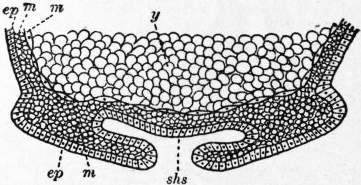
Fig. 36.—Section through aboral end of embryo of Loligo showing shell-sac still open. ep, ectoderm; m, mesoderm; m′, endoderm; shs, shell-sac; y, yolk.
Phylogeny and Classification.—The order is divided into two sub-orders, Decapoda and Octopoda, by the presence or absence of the tentacular arms. The Decapoda are more adapted for swimming than the Octopoda, the body being usually provided with fins. In the former also there is generally an internal shell of considerable size, often calcined, while in the Octopoda only the merest vestiges of a shell remain. There can be no doubt that the Octopoda were derived from the Decapoda, although from the absence of skeletal structures fossil remains of Octopods are almost entirely unknown. Palaeoctopus, however, occurs in the Cretaceous, while shells of Argonauta do not appear before the Pliocene. The Decapoda are abundantly represented in the Secondary formations by the Belemnitidae, whose shell (fig. 19) consists of a straight conical phragmacone covered posteriorly by a very thick rostrum, and produced anteriorly into a thin long proöstracum which is only occasionally preserved. In certain cases remains of the arms provided with hooks, and of the ink-sac, have been recognized. The Belemnitidae appear first in the Upper Trias, attain their maximum development in the Jurassic rocks, and are not continued into the Tertiary period, though represented in the Eocene by a few allied forms.
There is no difficulty in deriving the typical existing Decapoda from Belemnitidae, and many of the extinct forms may have been directly ancestral. Chitinous “pens” like that of Loligo, however, begin to appear in the Jurassic and Cretaceous rocks, so that in this case as in many others the parent form and the modified form existed contemporaneously, and the latter alone has survived. The oldest shells of the Sepia type are from the Eocene, and it is perhaps possible that the Sepiidae arose separately from the Belemnites.
It is a curious fact that no fossil specimens of the genus Spirula have been found, but this may be due to the fact that it occurs only in deep water. At any rate there is no evidence that the shell of Spirula has lost a rostrum and a proöstracum; its characters must be regarded as primitive, not secondary. In the characters of the protoconch and of the commencement of the siphuncle, the shell of Spirula agrees with that of the Ammonoids, and in both its position is ventral, although in most Ammonoids the shell being exogastric the ventral side is the convex or external, while in Spirula the shell is endogastric and the siphuncle internal. The fact that the shell is not completely enclosed by the mantle is also a primitive character.
With regard to the general morphology of the Cephalopoda, it is difficult to reconcile the existence of two pairs of renal tubes as well as a pair of genital ducts in Nautilus with the view that the original Mollusc was unsegmented and had only one pair of coelomoducts. Considering the great specialization, however, and high degree of organization of the Cephalopods, it is evident that the earliest Nautiloid whose remains are known to us must have had a long evolutionary history behind it, and such metamerism as exists may have been developed in the course of its own history. In the other direction the evidence seems to prove that the Dibranchiata with only two renal ducts have been derived from the Tetrabranchiata.
Suborder 1. Decapoda.—Four pairs of ordinary non-retractile arms which are shorter than the body, and one pair of tentacular arms, situated between the third and fourth normal arms on each side and retractile within special pouches. Suckers pedunculated and provided with horny rings, on the tentacular arms confined usually to the distal extremities. Usually a well-developed internal shell, and lateral fins on the edges of the body. Heart in a coelomic cavity; nidamentary glands usually present.
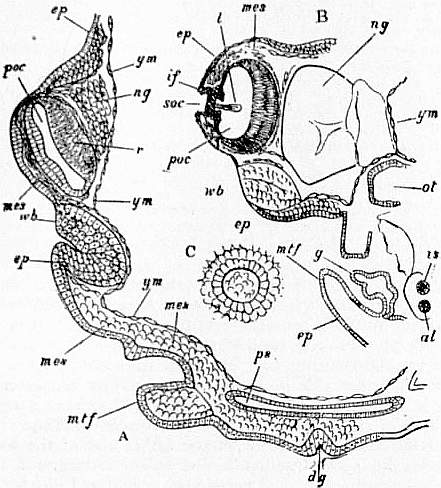
Fig. 37.—Right and left sections through embryos of Loligo. (After Lankester.)
A, Same stage as fig. 35 (4). B, Same stage as fig. 35 (8); only the left side of the sections is drawn, and the food-material which occupies the space internal to the membrane ym is omitted. al, Rectum. is, Ink-sac. ep, Outer cell-layer. mes, Middle cell-layer. ym, Deep cell-layer of fusiform cells (yolk-membrane). ng, Optic nerve-ganglion. ot, Otocyst. wb, The “white body” of the adult ocular capsule forming as an invagination of the outer cell-layer. mtf, Mantle-skirt. g, Gill. ps, Pen-sac or shell-sac, now closed. dg, Dorsal groove. poc. Primitive optic vesicle, now closed (see fig. 34). l, Lens. r, Retina. soc, Second or anterior optic chamber still open. if, Iridean folds. C, The primitive invagination to form one of the otocysts, as seen in fig. 35 (5) and (6).
Tribe 1. Oigopsida.—A wide aperture in the cornea. Two oviducts in the female. In fossil genera and Spirula, shell has a multilocular phragmacone with a siphuncle; initial chamber globular and larger than the second chamber. The most ancient forms characterized by the small size of the rostrum and proöstracum, and large size of the phragmacone. In the living genera, except Spirula, the shell is a chitinous gladius.
Fam. 1. Belemnoteuthidae. Extinct; shell with well-developed phragmacone, and rostrum merely a calcareous envelope; siphuncular necks directed backwards as in Nautiloidea; ten equal arms provided with hooks. Phragmoteuthis, Trias. Belemnoteuthis, Jurassic and Cretaceous. Acanthoteuthis, Jurassic.
Fam. 2. Aulacoceratidae. Extinct; phragmacone with widely separated septa; rostrum well developed and claviform. Aulacoceras, Trias. Atractites, Trias and Jurassic. Xiphoteuthis, Lias.
Fam. 3. Belemnitidae. Extinct; phragmacone short with ventral siphuncle, prolonged dorsally into long proöstracum; rostrum large and cylindrical. Belemnites, 350 species from Jurassic and Cretaceous. Diploconus, Upper Jurassic.
Fam. 4. Belopteridae. Extinct; rostrum and phragmacone well developed, phragmacone often curved; initial chamber small. Beloptera, Eocene. Bayanoteuthis, Eocene. Spirulirostra, Miocene.
Fam. 5. Spirulidae. Dorsal and ventral sides of posterior extremity of shell uncovered by mantle; no rostrum or proöstracum; shell calcareous, coiled endogastrically and sipnunculated; fins posterior. Spirula, three living species known, abyssal.
Fam. 6. Ommatostrephidae. Shell internal and chitinous, ending aborally in a little narrow cone; tentacular arms short and thick; suckers with denticulate rings. Ommatostrephes, fins aboral, simple and rhomboidal, British. Ctenopteryx, fins pectinate, as long as the body; Bathyteuthis, fins terminal, rudimentary; tentacular arms, filiform; abyssal. Rhynchoteuthis, tentacular arms united to form a beak-shaped appendage. Symplectoteuthis. Tracheloteuthis. Doridicus. Architeuthis; this is the largest of Cephalopoda, reaching 60 ft. in length including arms.
Fam. 7. Thysanoteuthidae. Arms enlarged, bearing two rows of suckers and filaments; fins triangular, extending whole length of body. Thysanoteuthis, Mediterranean.
Fam. 8. Onychoteuthidae. Fins terminal; tentacular arms long; suckers with hooks. Onychoteuthis, hook-bearing suckers on tentacular arms only. Enoploteuthis, hook-bearing suckers on all the arms. Veranya, body very short, tentacular arms atrophied in the adult, Mediterranean. Chaunoteuthis, body elongated, tentacular arms atrophied. Pterygioteuthis. Ancistroteuthis. Abralia. Teleoteuthis. Lepidoteuthis.
Fam. 9. Gonatidae. Body elongated; fins terminal; radula with only two lateral teeth. Gonatus.
Fam. 10. Cheiroteuthidae. Tentacular arms long, not retractile; resisting apparatus well developed. Cheiroteuthis, suckers along the whole length of the tentacular arms. Doratopsis, body very long and slender with aboral spine, dorsal arms very short. Histioteuthis, six dorsal arms united by membrane, photogenous organs present. Histiopsis, membrane of dorsal arms only half-way up the arms, photogenous organs present. Calliteuthis, no brachial membrane, photogenous organs present. Grimalditeuthis, two fins on each bide, no tentacular arms.
Fam. 11. Cranchiidae. Eight normal arms, very short; eyes prominent; fins small and terminal. Cranchia, body short, purse-shaped, normal arms short, fins entirely aboral. Loligopsis, body elongated, conical, tentacular arms slender. Leachia, tentacular arms absent, funnel without a valve. Taonius, body elongated, normal arms, rather short, eyes pedunculated.
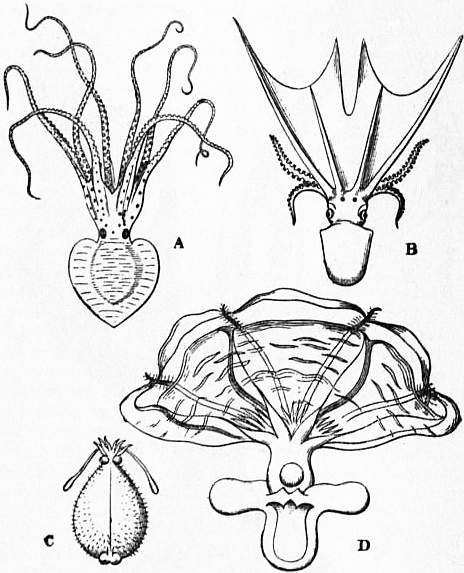
Fig. 38.—Octopodous Cephalopods.
A, Pinnoctopus cordiformis, Quoy and Gain (from New Zealand). B, Tremoctopus violaceus, Ver. (from the Mediterranean). C, Cranchia scabra, Owen (from the Atlantic Ocean; one of the Decapoda). D, Cirrhoteuthis Mulleri, Esch. (from the Greenland coast).
Tribe 2. Myopsida.—No aperture in the cornea. Left oviduct only developed in female. Internal shell without a distinct phragmacone, calcified or simply chitinous.
Fam. 1. Sepiidae. Body wide and flat; fins narrow, extending the whole length of the body; shell calcareous and laminated. Belosepia, a rudiment of rostrum and phragmacone present in shell, Eocene. Sepia, shell with a rostrum, British. Sepiella, shell without a rostrum.
Fam. 2. Sepiolidae. Body short, rounded at the aboral end; fins rounded, inserted in middle of body-length; shell chitinous, small or absent. Sepiola, head united to mantle dorsally, British. Rossia, head not united to mantle, British. Stoloteuthis and Inioteuthis, without shell. Heteroteuthis. Euprymna.
Fam. 3. Idiosepiidae. Body elongated, with rudimentary terminal fins; internal shell almost lost. Idiosepius, 1.5 cm. long, Indian Ocean.
Fam. 4. Sepiadariidae. Body short; mantle united to head dorsally; no shell. Sepiadarium, Pacific Ocean. Sepioloidea, Australian.
Fam. 5. Loliginidae. Body elongated and conical; fins extending forward beyond the middle of body-length; shell chitinous, well developed. Loligo, fins triangular, aboral, British. Sepioteuthis, fins rounded, extending along whole of body-length. Loliolus. Loliguncula. The following fossil genera, known only by their gladius and ink-sac, have been placed near Loligo:—Teuthopsis, Beloteuthis and Geoteuthis, Lias; Phylloteuthis, Cretaceous; Plesioteuthis, Jurassic and Cretaceous.
Suborder 2. Octopoda.—Only four pairs of arms, all similar and longer than the body. Body short and rounded aborally. Suckers sessile. Heart not contained in coelom. No nidamentary glands.
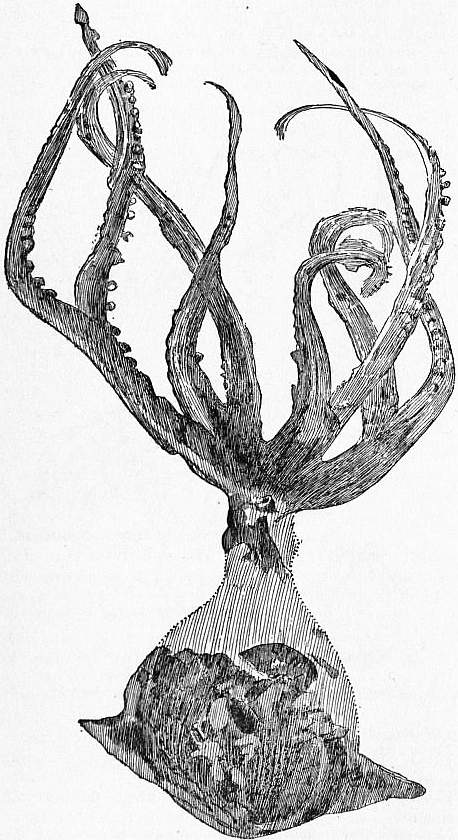
Fig. 39.—Palaeoctopus Newboldi, the oldest Octopod known. From the Cretaceous rocks of Lebanon. (After H. Woodward.)
Tribe I. Leioglossa.—No radula. Arms united by a complete membrane. Fins on sides of body.
Fam. Cirrhoteuthidae. Tentacular filaments on either side of the suckers. Cirrhoteuthis, pallial sac prominent, fins large, pelagic. Opisthoteuthis, body flattened, with small fins, deep-sea. Vampyroteuthis, four fins. Palaeoctopus, fossil, Cretaceous.
Tribe 2. Trachyglossa.—Radula present. No fins.
Fam. 1. Amphitretidae. Arms united by membrane; funnel attached to mantle, dividing the pallial aperture into two. Amphitretus, pelagic.
Fam. 2. Alloposidae. All arms united by membrane; mantle joined to head by dorsal band and two lateral commissures. Alloposus, pelagic.
Fam. 3. Octopodidae. Arms long and equal, without membrane; hectocotylus not autotomous. No cephalic aquiferous pores. Octopus, two rows of suckers on each arm, British. Eledone, single row of suckers on each arm. Scaeurgus. Pinnoctopus. Cistopus. Japetella.
Fam. 4. Philonexidae. Hectocotylus autotomous; arms unequal in size; aquiferous pores on head and funnel. Tremoctopus, two dorsal pairs of arms united by membrane. Ocythoë, without interbrachial membrane.
Fam. 5. Argonautidae. Hectocotylus autotomous; no interbrachial membrane; extremities of dorsal arms in female expanded and secreting a shell; males very small, without shell. Argonauta.
Literature.—Use has been freely made above of the article by E. Ray Lankester, on Mollusca, in the 9th edition of this Encyclopedia. For the chief modern works, see Bashford Dean, “Notes on Living Nautilus,” Amer. Nat. xxxv., 1901; Arthur Willey, “Contribution to the Natural History of the Pearly Nautilus,” A. Willey’s Zoological Results, pt. vi. (1902); Foord, Cat. Fossil Cephalopoda in British Museum; Alpheus Hyatt, “Fossil Cephalopods of the Museum of Comp. Zoology,” Bull. Mus. Comp. Zool. (Cambridge, U.S., 1868); Jalta, “I Cefalopodi viventi nel golfo di Napoli,” Fauna und Flora des Golfes von Neapel, xxiii. (1896); Joubin, “Céphalopodes de l’atlantique nord,” “Céph. de la Princesse Alice,” Camp. sci. Albert Ier de Monaco, ix. (1895), xxii. (1900); Paul Pelseneer, “Mollusca,” in the Treatise on Zoology, edited by E. Ray Lankester.
(J. T. C.)
CEPHEUS, in Greek mythology, the father of Andromeda (q.v.); in astronomy, a constellation of the northern hemisphere, mentioned by Eudoxus (4th century b.c.) and Aratus (3rd century b.c.). Ptolemy catalogued 13 stars in this constellation, Tycho n, and Hevelius 51. The most interesting star in it is δ Cephei, a remarkable double star, the brighter component of which is a short period variable (5.37 days), with a range in magnitude of 3.7 to 4.9; it is also a spectroscopic binary.
CEPHISODOTUS, the name of the father and of the son of Praxiteles, both sculptors like himself. The former must have flourished about 400 b.c. A noted work of his was Peace bearing the infant Wealth, of which a copy exists at Munich. Peace is a Madonna-like figure of a somewhat conservative type; the child Wealth is less successful. Cephisodotus also made, like his son, a figure of Hermes carrying the child Dionysus, unless indeed ancient critics have made two works of one. He made certain statues for the city of Megalopolis, founded in 370 b.c. Of the work of the younger Cephisodotus, his grandson, we have no remains; he was a prolific sculptor of the latter part of the 4th century b.c., especially noted for portraits, of Menander, of the orator Lycurgus, and others (see J. Overbeck, Antike Schriftquellen, p. 255).
CERAM (Sirang), an island of the Dutch East Indies, in the Molucca group, lying about 3° S., and between 127° 45′ and 131° E. Its length is a little over 200 m., its greatest breadth about 50 m., and its area, including neighbouring islets, 6621 sq. m. It consists of two parts, Great Ceram and Little Ceram or Huvamohel, united by the isthmus of Taruno; and, for administrative purposes, is assigned to the residency of Amboyna, being divided into Kairatu or West Ceram, Wahai and Amahai, the northern and the southern parts of Middle Ceram, and Waru or Eastern Ceram. No central chain of mountains stretches west and east through the island, but near the north coast hills, rising 2300 to 2600 ft., slope steeply to the shore. Near the south coast, west of the Bay of Elpaputeh, a complex mass of mountains forms a colossal pyramid, with peaks rising to nearly 5000 ft. The isthmus connecting the two parts of the island is very narrow, and has a height of only 460 to 490 ft. The chief rivers flow north and south into bays, but are navigable only for a few miles during the rainy season. The rainfall is very heavy, amounting to 121 in. (mean annual) on the south coast. On the north coast the bays of Savai and Waru are accessible for small vessels. The geological structure, consisting chiefly of eruptive rocks and crystalline limestone, is similar to that of northern Amboyna. In the eastern section the prevailing rock is crystalline chalk, similar to that of Buru. Several hot springs occur, and earthquakes are not infrequent. About 4000 persons perished in the earthquake of 1899. A large part of the interior is covered with dense forests, and except along the coast the population is scanty. For the naturalist Ceram is without much interest, lacking characteristic species or abundance of specimens. The Bandanese pay occasional visits to shoot bears and deer; there are numbers of wild goats and cattle; and among birds are mentioned cassowaries, cockatoos, birds of paradise, and the swallows that furnish edible nests. A large number of fish are to be found in the various rivers; and as early as 1860 no fewer than 213 species were described. The most valuable timber tree is the iron-wood. Rice, maize, cocoa-nuts, sugar-cane and a variety of fruits are grown; and some tobacco is exported to Europe; but by far the most important production is the sago palm, which grows abundantly in the swampy districts, especially of Eastern Ceram, and furnishes a vast supply of food, not only to Ceram itself, but to other islands to the east. The Dutch have established cocoa and coffee plantations at various points. The coast-villages are inhabited by a mixed Malay population, Buginese, Macassars, Balinese and other races of the archipelago. The interior is occupied by the aborigines, a people of Papuan stock. They are savages and head-hunters. The introduction of Christianity was hampered by the baneful influence of a secret society called the Kakian Union, to which pagans, Mahommedans and Christians indiscriminately attached themselves; and it has several times cost the Dutch authorities considerable efforts to frustrate their machinations (see Tijdschrift van Ned. Ind., fifth year). The total population is estimated at 100,000, including 12,000 Christians and 16,000 Mahommedans. The chief settlements are Savai at the north and Elpaputeh at the south end of the isthmus of Taruno. There was a Dutch fort at Kambello, on the west side of Little Ceram, as early as 1646.
CERAMICS, or Keramics (κἐραμος, earthenware), a general term for the study of the art of pottery. It is adopted for this purpose both in French (céramique) and in German (Keramik), and thus has its convenience in English as representing an international form of description for a study which owes much to the art experts of all nations, though “ceramic” and “ceramics” do not appear in English as technical terms till the middle of the 19th century.
The word “pottery” (Fr. poterie) in its widest sense includes all objects fashioned from clay and then hardened by fire, though there is a growing tendency to restrict the word to the commoner articles of this great class and to apply the word “porcelain” to all the finer varieties. This tendency is to be deprecated, as it is founded on a misconception; the word “porcelain” should only be applied to certain well-marked varieties of pottery. The very existence of pottery is dependent on two important natural properties of that great and widespread group of rocky or earthy substances known as clays, viz. the property of plasticity (the power of being readily kneaded or moulded while moist), and the property of being converted when fired into one of the most indestructible of ordinary things.
The clays form such an important group of mineral substances that the reader must refer to the article Clay for an account of their occurrence, composition and properties. In this article we shall only deal with the various clays as they have affected the problems of the potter throughout the ages. The clays found on or close to the earth’s surface are so varied in composition and properties that we may see in them one of the vital factors that has determined the nature of the pottery of different countries and different peoples. They vary in plasticity, and in the hardness, colour and texture of the fired product, through an astonishingly wide range. To-day the fine, plastic, white-burning clays of the south of England are carried all over Europe and America for the fabrication of modern wares, but that is a state of affairs which has only been attained in recent times. Even down to the 18th century, the potters of every country could only use on an extensive scale the clays of their own immediate district, and the influence of this controlling factor on the pottery of bygone centuries has never yet received the attention it deserves.1
General Evolution of Pottery.—The primitive races of mankind, whether of remote ages or of to-day, took perforce such clay as they found on the surface of the ground, or by some river-bed, and with the rudimentary preparation of spreading it out on a stone slab if necessary and picking out any rocky fragments of appreciable size, then beating it with the hands, with stones or boards, or treading it with the feet to render it fairly uniform in consistency, proceeded to fashion it into such shapes as need or fancy dictated. Fired in an open fire, or in the most rudimentary form of potter’s kiln, such pottery may be buff, drab, brown or red—and these from imperfect firing become smoked, grey or black. How many generations of men, of any race, handed on their painfully acquired bits of knowledge before this earliest stage was passed, we can never know; but here and there, where the circumstances were favourable or the race was quick of observation, we can trace in the work of prehistoric man in many countries a gradually advancing skill based on increased technical knowledge. For ages tools and methods remained of the simplest—the fingers for shaping or building up vessels, a piece of mat or basket-work for giving initial support to a more ambitious vase,—until some original genius of the tribe finds that by starting to build up his pot on the flattened side of a boulder he can turn his support so as to bring every part in succession under his hand, and lo! the potter’s wheel is invented—not brought down from heaven by one of the gods to a favoured race, as the myths of all the older civilizations or barbarisms, Egyptian, Chaldean, Greek, Scythian, and Chinese have fabled, but born from the brain and hand of man struggling to fulfil his allotted task.
Formerly every writer on the history of pottery seemed to imagine that the very rudest pottery must have been the invention of Egyptian, Chinese or some other distinct race from which the knowledge radiated to all the other races of the prehistoric world. No conception could be more erroneous. Since the middle of the 19th century research has established beyond doubt that wherever clay was found men became potters of a sort, just as they became hunters, carpenters, smiths, &c., by sheer force of need and slowly-gathered tradition. The not yet exploded view that Egypt or Assyria was the special cradle of this art, and that the pottery of the Greeks and Romans directly descended from such a parent stock, cannot survive in view of the incontestable evidence that pottery was made by the prehistoric peoples of what we now call Greece, Italy, Spain and other countries, long before they were aware that any other peoples lived on the earth than themselves.
For centuries this simple hand-made pottery was hardened by drying in the sun, so that it would serve for the storage of dried grain, &c., but the increasing use of fire would soon bring out the amazing fact that a baked clay vessel became as hard as stone. Then, too, came the knowledge that even in one district all the clays did not fire to the same colour, and colour decoration arose, in a rude daubing or smearing of some clay or earth (a ruddle or bole perhaps), which was found to give a bright red or buff colour on vessels shaped in a duller-coloured clay—most precious of all were little deposits of white clay which kept their purity unsullied through the fire,—and by these primitive means the races of the dawn made their wares. On this substructure all the pottery of the last four thousand years has been built, for behind all Egyptian, Greek or Chinese pottery we find the same primitive foundations.
We now reach the beginnings of recorded history, and as the great nations of the past emerge from the shadows they each develop the potter’s art in an individual way. The Egyptians evolve schemes of glowing colour—brilliant glazes fired on objects, shaped in sand held together with a little clay, or actually carved from rocks or stones; the Greeks produce their marvels of plastic form, and then, excited by their growing skill in metal work, turn the plastic clay into imitations of metal forms. These nations are overthrown, and the Romans spread some knowledge—only a tincture, it must be confessed—over all the lands they hold in fee; and from the Euphrates to the Atlantic, from Egypt to the Wall of Hadrian, they set alight potters’ fires that have never since been extinguished. The Roman empire falls, and over Europe its pottery is forgotten along with its greater achievements; yet still pottery-making goes on in a very simple way, to be slowly revived and modified once more by the communities of monks, who, in later centuries, replace the Roman legions as the great civilizing influence in Europe. Meantime Egypt and the nearer East continued, in a debased form, the splendours of their glorious past, and glazed and painted pottery was still made by traditional methods. What part the Byzantine civilization and the Persians played during this obscure time, we are only just beginning to realize; but we now know that many interesting kinds of decorated pottery were made at Old Cairo, at Alexandria, at Damascus, in Syria, Anatolia and elsewhere (on which the later Moslem potters founded their glorious works), at a time when all over Europe crocks of simple red or drab clay, covered only with green and yellow lead-glazes, were the sole evidence of the potter’s skill. What the Arab conquests destroyed, and what their breath quickened into life, we can only guess; but the fact is indisputable that with the Mahommedan conquests there came a time when the potter’s art of the Occident reached its highest expression, and when methods and knowledge hitherto confined to Egypt, Syria and Persia were spread from Spain and the south of France to India—even, it may be, into China.
Meantime, in the farther East, the Chinese—the greatest race of potters the world has ever seen—were quietly gathering strength, until from their glazed, hard-fired pottery there emerged the marvellous, white translucent porcelain, one of the wonders of the medieval world.
With the dawn of the 15th century of our era, the state of affairs was practically this:—In European countries proper we find rudely fashioned and decorated wares in which we can trace the slow development of a native craft from the superposition of Roman methods on the primitive work of the peoples. The vessels were mostly intended for use and not for show; were clumsily fashioned of any local clay, and if glazed at all then only with coarse lead-glazes, coloured yellow or green; in no case above the level of workmanship of the travelling brick- or tile-maker. The finest expression of this native style is to be found in the Gothic tile pavements of France, Germany and England, where all the colours are due to the clays and there is no approach to painting. In the Moslem countries—including the greater part of Spain and Sicily, Egypt and the nearer East, probably even to the very centre of Asia—pottery was being made either of whitish clay and sand, or of a light reddish clay coated with a white facing of fine clay or of tin-enamel, on which splendid decorative patterns in vivid pigments or brilliant iridescent lustres were painted.
As early as the 12th century of our era this superior artistic pottery of the Moslem nations had already attracted the notice of Europeans as an article of luxury for the wealthy; and we may well believe the traditional accounts that Saracen potters were brought into Italy, France and Burgundy to introduce the practice of their art, while Italian potters certainly penetrated into the workshops of eastern Spain and elsewhere, and gathered new ideas. In Italy certainly, and in the south of France probably, efforts were continuously in progress to improve the native wares by coating the vessels with a white “slip” and drawing on them rude, painted patterns in green, yellow and purplish black. The increasing intercourse with Spain, in war and peace, also introduced the use of tin-enamel after the fashion of the famous Hispano-Moresque wares, and by the end of the 14th century a knowledge of tin-enamel was widespread in Italy and paved the way to the glorious painted majolica of the 15th and 16th centuries. From Italy and Spain, France and Holland, Germany, and finally, though much later, England learnt this art, and the tin-enamelled pottery of middle and northern Europe, so largely made during the 17th and 18th centuries, was the direct offshoot of this movement of the Italian Renaissance.2
During the 15th and 16th centuries Chinese porcelain also began to find its way into Europe, and by the whiteness of its substance and its marvellous translucence excited the attention of the Italian majolists and alchemists. The first European imitation of this famous oriental porcelain of which we have indubitable record was made at Florence (1575-1585) by alchemists or potters working under the patronage, and, it is said, with the active collaboration of Francesco de’ Medici. This Florentine porcelain was the first of those distinctively European wares, made in avowed imitation of the Chinese, which form a connecting link between pottery and glass, for they may be considered either as pottery rendered translucent or as glass rendered opaque by shaping and firing a mixture containing a large percentage of glass with a very little clay. After the cessation of the Florentine experiments we know of no European porcelain for nearly a century, though the importation of Chinese porcelain had largely increased owing to the activity of the various “India” companies. The next European porcelain, made like the Florentine of glass and clay, was that of Rouen (1673) and St Cloud (1696); and during the 18th century artificial glassy porcelain was made in France and England largely, and in other countries experimentally. German experimenters worked in another direction, and the first porcelain made in Europe from materials similar to the Chinese was produced at Meissen by Böttger (1710-1712). During the 18th century not only was there a very large trade in imported Chinese and Japanese porcelain, but there was a great development of porcelain manufacture in Europe; and in every country factories were established, generally under royal or princely patronage, for the manufacture of artificial porcelain like the French, or genuine porcelain like the German. The English made a departure in the introduction of a porcelain distinct from either, through adding calcined ox-bones to the other ingredients; and this English bone-porcelain—a well-marked species—is now largely made in America, France, Germany and Sweden as well as in England.
By the end of the 18th century the risks and losses attendant on the manufacture of the French glassy porcelain had caused its abandonment, and a porcelain made from natural materials like the Chinese has since been generally made on the continent of Europe.
The older tin-enamelled wares—derived from the Hispano-Moresque and the Italian majolica—so largely made in France, Holland, Germany and elsewhere during the 17th and 18th centuries, met with a fate analogous to that of the French porcelain. Tin-enamelled earthenware is always a brittle substance, soon damaged in regular use; so that, when, in the middle of the 18th century, the English potter first appeared as a serious competitor with a fine white earthenware of superior durability and precision of manufacture, the old painted faience gradually disappeared between the upper millstone of European porcelain and the nether millstone of English earthenware.
The 19th century witnessed a great and steady growth in the output of porcelain and pottery of all kinds in Europe and the United States. Mechanical methods were largely called in to supplement or replace what had hitherto remained almost pure handicraft. The English methods of preparing and mixing the materials of the body and glaze, and the English device of replacing painted decoration by machine printing, to a large extent carried the day, with a great gain to the mechanical aspects of the work and in many cases with an entire extinction of its artistic spirit. Even the hand-work that still remained was largely affected by the growing dominance of machinery; and the painting, gilding and decoration of pottery and porcelain, in the first half of the 19th century, became everywhere mechanical and hackneyed. During the latter half of the 19th century another influence was fortunately at work. Side by side with the increasing mechanical perfection of the great bulk of modern pottery there grew up a school of innovators and experimentalists, who revived many of the older decorative methods that had fallen into oblivion and produced fresh and original work, in certain directions even beyond, the achievements of the past. The 20th century opened with a wider outlook among the potters of Europe and America. In every country men were striving once again to bring back to their world-old craft something of artistic taste and skill.
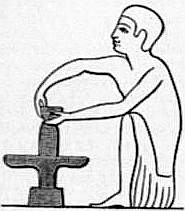
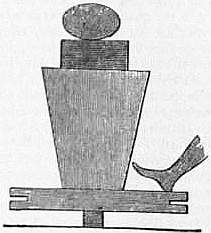
Fig. 1.—Potter moulding a vessel on the wheel (from a painting in a tomb at Thebes about 1800 b.c.). Compare the wheel on the left in fig. 5. Fig. 2.—Potter’s wheel of the time of the Ptolemies, moved by the foot (from a wall-relief at Philae). Compare fig. 5, the wheel on the right.
Technical Methods.—All primitive pottery, whether of ancient or of modern times, has been made by the simplest methods. The clay, dug from the earth’s surface, was or is prepared by beating and kneading with the hands, feet or simple mallets of stone or wood; stones and hard particles were picked out; and the mass, well tempered with water, was used without any addition. From this clay, vessels were shaped by scooping out or cutting a solid lump or ball, by building up piece by piece and smoothing down one layer upon another or by squeezing cakes of clay on to some natural object or prepared mould or form. The potter’s wheel, though very ancient, was a comparatively late invention, arrived at independently by many races of men. In its simplest form it was a heavy disk pivoted on a central point to be set going by the hand, as the workman squatted on the ground; and it may be seen to-day in India, Ceylon, China or Japan, in all its primitive simplicity (see fig. 1). This form of potter’s wheel was the only one known until about the Christian era, and then, in Egypt apparently, the improvement was introduced of lengthening the spindle which carries the throwing-wheel and mounting on it near the base a much larger disk which the potter could rotate with his foot, and so have both hands free for the manipulation of the clay (fig. 2). No further advance seems to have been made before the 17th century, when the wheel was spun by means of a cord working over a pulley; and though a steam-driven wheel was introduced in the middle of the 19th century, this form remains the best for the production of fine pottery.
A prevalent misconception with regard to the potter’s wheel needs correction. For anything beyond very simple shapes it is impossible to carry the work to completion on the wheel at one operation as is generally imagined. All that the potter can do while the clay is soft enough to “throw” on the wheel is to get a rough shape of even thickness. This operation completed, the piece is removed from the wheel and set aside to dry. When it is about leather-hard, it may be re-centred carefully on the wheel (the old practice), or placed in a horizontal lathe (since 16th century) and turned down to the exact shape and polished to an even, smooth surface. The Greek vase-makers were already adepts in what is often reckoned a modern, detestable practice. Many Greek vases have obviously been “thrown” in separate sections, and when these had contracted and hardened sufficiently they were luted together with slip, and the final vase-shape was smoothed and turned down on the wheel, and even polished to as fine a degree of mechanical finish as the modern potter ever attains. So too with the Chinese; many of their forms have been made in two or three portions, subsequently joined together and finished on the outside as one piece. Indeed it is remarkable how the Greeks and Chinese had discovered for themselves many devices of this kind which are generally held up to opprobrium as the debased methods of a mechanical age. Always it should be borne in mind that the shaping of pottery by “pressing” cakes of clay into moulds is much older than the potter’s wheel, and has always been the method of making shapes other than those in the round. The modern method of “casting” pottery by pouring slip, a fluid mixture of clay and water, into absorbent moulds seems to have originated in England about the middle of the 18th century; and this too is a genuine potter’s method which does not merit the disapproval with which it has been generally regarded by writers on the potter’s art.
In all ages the work of the “thrower” or “presser” has been largely supplemented by the modeller, who alters the shape, and applies to it handles, spouts or modelled accessories at will.
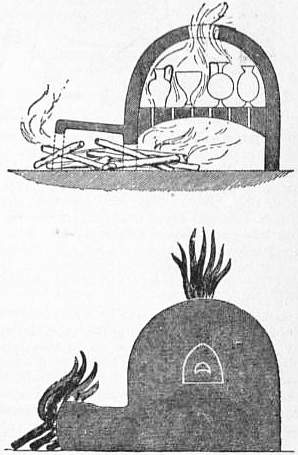
Fig. 3.—Early Greek pottery-kiln, about 700-600 b.c. (from a painted votive tablet found at Corinth, now in the Louvre). The section shows the probable construction of the kiln.
Firing.—The firing of pottery has become in modern times such a specialized branch of the manufacture that the student can only be referred here to the technological works mentioned in the bibliography at the end of this article. It is, however, necessary that we should briefly describe the earlier forms of potters’ kilns used by the nations whose pottery counts among the treasures of the collector and the antiquary. Here again we now know that the primitive types of kiln used by the potters of ancient Egypt or Greece have not vanished from the earth; it is only in the civilized countries of the modern world that they have been replaced by improved and perfected devices. The potters of the North-West Provinces of India use to-day a kiln practically identical with that depicted in severest silhouette on the rock-tombs of Thebes; and the skilful Japanese remain content with a kiln very similar to the one shown in fig. 3. This Greek type of kiln was improved and enlarged by the Romans, and its use seems to have been introduced wherever pottery was made under their sway, for remains of Roman kilns have been found in many countries (see fig. 4). With the end of Roman dominance we have ample evidence that their technical methods fell into disuse, and the northern European potter of the period from the 6th to the 12th century had to build up his methods afresh, and improved kilns were invented. The general type of medieval potter’s kiln is illustrated for us in the manuscript of an Italian potter of the 16th century, now in the library of the Victoria and Albert Museum3 (fig. 5). Kilns of a different type, horizontal reverberatory kilns, were used for making the hard-fired pottery of Europe (Rhenish stoneware, &c.), as well as for Chinese porcelain and the earliest German porcelains. With the organization of pottery as a factory industry in the 18th century, improved kilns were introduced, and the type of kiln now so largely used in civilized countries is practically a vertical reverberatory furnace of circular section, from 10 to 22 ft. in diameter and of similar height, capable, therefore, of containing at one firing a quantity of pottery that would have formed the output of a medieval potter for a year. Every device that can be thought of for the better utilization of heat and its even distribution throughout the kiln or oven has been experimented with; and, though the results have been most successful from the point of view of the potter, even the most recent coal-fired ovens remain very wasteful types of apparatus, the amount of available heat being relatively small to the fuel consumption. Gas-fired kilns and ovens are now being used or experimented with in every country, and their perfection, which cannot be far distant, will improve the most vital of the potter’s processes both in certainty and economy.
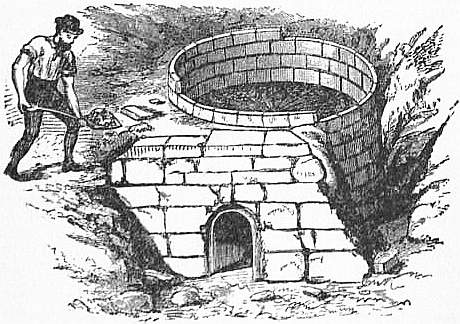
Fig. 4.—Roman kiln found at Castor. The low arch is for the insertion of the fuel; the pots rested on the perforated floor, made of clay slabs; the top of the kiln is missing,—it was probably a dome.
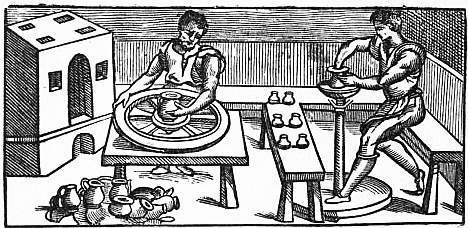
Fig. 5.—Two forms of Italian potter’s wheels, about 1540.
Glazes.—We are never likely to known when glaze (i.e. a coating of fired glass) was first applied to pottery, though the present state of knowledge would incline us to the opinion that the earliest glazed objects we possess are those of ancient Egypt,4 but the practice may have been originated independently wherever a knowledge of the elements of glass-making had spread, as all the early glazes were of the alkaline type, which must first be fused into a glass before they can be applied to pottery.
Many primitive races seem to have burnished their pottery after it was fired, in order to get a glossy surface; and in other cases the surface was rendered shining and waterproof by coating it with waxy or resinous substances which were often coloured. It is possible that the black varnish of Greek vases was obtained by such a method, and though that point is not settled, we have many types of primitive pottery, both modern and ancient, which are coated in this way. Such a coating is only a substitute for glaze in the work of peoples who do not know or have not mastered the technical secrets of true glazes. We can only consider as glazes those definite superficial layers of molten material which have been fired on the clay substance. Glazes are as varied as the various kinds of pottery, and it must never be forgotten that each kind of pottery is at its best with its appropriate glaze. The earliest known glazes (Egyptian and Assyrian) were silicates of soda and lime containing very little alumina and no lead. Such glazes are very uncertain in use, and can only be applied to pottery unusually rich in silica (i.e. deficient in clay). Consequently these alkaline glazes cannot be used on ordinary clay wares, and when they have been used successfully, the clay has always been coated with a surface layer of highly siliceous substance (e.g. the so-called Persian, Rhodian, Syrian and Egyptian pottery of the early middle ages). The fact that glazes containing lead-oxide would adhere to ordinary pottery when alkaline glazes would not was discovered at a very early period; for lead glazes were extensively used in Egypt and the nearer East in Ptolemaic times, and it is significant that, though the Romans made singularly little use of glazes of any kind, the pottery that succeeded theirs, either in western Europe or in the Byzantine empire, was generally covered with glazes rich in lead. Throughout Europe, and over the greater part of the world, leaded glazes have been continuously used and improved for all ordinary pottery, and it is only with certain special hard-fired types of ware that they have yet been successfully replaced. Chinese porcelain and all the European porcelains made by analogous methods are fired at so high a temperature that a glaze by felspar softened by lime and silica is found most suitable for them, and the hard-fired stonewares, rich in silica, are often glazed with a salt glaze, or a melted earth rich in oxide of iron.
Every kind of potter’s clay (the mixture of clay, sand, flint, &c., from which the potter shapes his wares) has its own type of glaze, and from the earliest time down to our own what the potter could produce in form or glaze or colour has been largely decided for him by the clay material at his command. With any good plastic clay which cannot be fired at the highest temperature, lead glazes have always proved the most practicable. A similar clay, to which large quantities of sand are added, may be glazed by the vapours of common salt; and mixtures rich in felspar, like Chinese or European porcelain, can be glazed by melting felspathic materials upon them. Naturally those species of pottery which are the hardest fired are the most durable—the glazes of hard porcelain are more unchangeable than lead glazes, and these in their turn than alkaline glazes.
The most important types of glaze are (1) alkaline glazes (e.g. Egyptian, Syrian, Persian, &c.), the oldest and most uncertain; (2) lead glazes, the most widespread in use and the best for all ordinary purposes; (3) felspathic glazes, the glazes of hard-fired porcelains, generally unsuited to any other material; (4) salt glaze, produced by vapours of common salt, the special glaze of stonewares. Many intermediate glazes have been devised to meet special needs, but these remain the only important groups. Fuller details on this important subject must be sought in the technical works.
Colours.—The primitive potters of ancient and modern times have all striven to decorate their wares with colour. The simplest, and therefore the earliest, colour decoration was carried out in natural earths and clays. The clays are so varied in composition that they fire to every shade of colour from white to grey, cream, buff, red, brown, or even to a bronze which is almost black. One clay daubed or painted upon another formed the primitive palette of the potter, especially before the invention of glaze. When glaze was used these natural clays were changed in tint, and native earths, other than clays, containing iron, manganese and cobalt, were gradually discovered and used. It is also surprising to note that some of the very earliest glazes were coloured glasses containing copper or iron (the green, turquoise and yellow glazes of the ancient Egyptians and Assyrians). Marvellous work was wrought in these few materials, but the era of the finest pottery-colour dawns with the Persian, Syrian and Egyptian work that preceded the Crusades. By this time the art of glazing pottery with a clear soda-lime glaze had been thoroughly learnt. Vases, tiles, &c., shaped in good plastic clay, were covered with a white, highly siliceous coating fit to receive glazes of this type, and giving the best possible ground for the painted colours then known. With this rudimentary technique the potters of the countries south and east of the Mediterranean produced, between the 9th and 16th centuries of our era, a type of pottery that remains ideal from the point of view of colour: for, with nothing more than the greens given by oxide of copper and iron, the turquoise of pure copper, the deep yet vivid blue of cobalt, the beautiful uncertain purple of manganese, and in certain districts the rich red of Armenian bole, they achieved colour schemes that have never been surpassed in their brilliant yet harmonious richness.
When the coating of white siliceous clay was replaced by an opaque tin-enamel as in Spain, Italy, France, Holland, &c., a necessary change in the colour schemes resulted. At first only the copper-greens and cobalt-blues could be used on such a ground; the fine manganese purple turned to brown or black and the rich iron-reds to filthy shades of yellow. We cannot wonder that the Spanish-Arab potters paid more attention to their lustre decoration, for that was the natural thing to do. How strong and fine a palette could be evolved for use on a tin-enamel ground was shown by the Italian majolists of the 15th and 16th centuries; and when the later developments of tin-enamelled pottery took place in France, Holland, Germany, &c., their colour schemes are only echoes of Italian majolica crossed with Chinese porcelain. Delft, Nevers, Moustiers and Rouen may each charm us with its individuality; Nuremberg and other south German towns may show us that they too had mastered the use of tin-enamel; yet our minds always go back to the colour schemes of Italian majolica and of the Persian and Syrian pottery that lie behind and beyond them.
The colours already spoken of were either clay colours or what are known as “under glaze” colours, because they were painted on the pottery before the glaze was fired.
The earliest glazes of the Egyptians appear not to have been white, but were coloured throughout their substance, and this use of coloured glazes as apart from painted colour was developed along with the painted decoration by the later Egyptian, Syrian and Persian potters. Green, yellow and brown glazes were almost the only artistic productions of the medieval European potters’ kilns, and their use everywhere preceded the introduction of painted pottery. The most extensive application of coloured glazes was, however, that made by the Chinese, who developed this type of colour decoration before they used painted patterns in underglaze colour. The earliest Chinese porcelains, and the hard-fired stonewares out of which their porcelain arose, were decorated in this way, and the beauty of many of the early Sung coloured glazes has never been surpassed.
With the exceedingly refractory felspathic glazes of Chinese porcelain very few underglaze colours could be used; and the prevalence of blue and white among the early specimens of Chinese porcelains is due to the fact that cobalt was almost the only substance known to the potters of the Ming dynasty which would endure the high temperature needed to melt their glazes. Consequently the Chinese were driven to invent the method of painting in coloured fusible glasses on the already fired glaze. They adopted for this purpose the coloured enamels used on metal; hence the common term “enamel decoration,” which is so generally applied to painting in those colours which are attached to the already fired glaze by refiring at a lower temperature. With the introduction of this many-coloured Chinese porcelain into Europe the same practice was eagerly followed by our European potters, and a new palette of colours and fresh styles of decoration soon arose amongst us. Painting in on-glaze colours, being executed on the fired glaze, resembles glass painting, and it generally offers a striking contrast both in technique and colour-quality to the painting executed in colours under the glaze. In the former the work can be highly finished and the most mechanical execution is possible, but the colours are neither so rich nor so brilliant as under-glaze colours, nor have they the same softness as is given by the slight spread of the under-glaze colour when the glaze is melted over it.
It must be pointed out that the colour possibilities in any method of pottery decoration are largely dependent on the temperature at which the colour needs to be fired. The clay colours are naturally more limited in range than the under-glaze colours, and these in their turn than the on-glaze colours.
When, about the middle of the 18th century, European pottery took on its modern form, of earthenware made after the English fashion, and porcelain like the French and German, the lead or felspathic glazes used brought about another revolution in the potter’s palette. The growing ideal of mechanical perfection discounted the freedom of the earlier brushwork, and printed patterns, or painting that might almost have been printed, removed the mind still farther from the richness of painted faience or majolica. It is useless to look for the glorious colour of Persian faience, Italian majolica, or Chinese porcelain, in modern wares produced by manufacturing processes where mechanical perfection is demanded to a degree undreamt of before the 19th century. The finest modern pottery colour is only to be sought in the work of those enthusiasts and experimenters who are striving to produce work as rich and free as the best of past times.
Metals.—The noble metals, such as gold, platinum and silver, have, since the early years of the 18th century, been largely used as adjuncts to pottery decoration, especially on the fine white earthen-wares and porcelains of the last two centuries. At first the gold was applied with a kind of japanner’s size and was not fired to the glaze, but for the last 150 years or so the metals have generally been fired to the surface of the glaze like enamel colours, by mixing the metal with a small proportion of flux or fusible ground glass. There can scarcely be a doubt that the ancient lustres of Persia, Syria and Spain were believed to be a form of gilding, though their decorative effect was much more beautiful than gilding has ever been. The early Chinese and Japanese gilding appears, like the European, to have been “sized” or water-gilt, not fired; and it seems probable that the use of “fired” gold was taught to the Oriental by the European in the 18th century. To-day “liquid” gold is exported to China and Japan from Europe for the use of the potter.
Primitive Pottery
We can group together that great and widely-spread class of vessels made by the primitive races of mankind, whether before the dawn of civilization or at the present day, for it is interesting to note that many modern races still make pottery by the same rude method as the Neolithic races of Europe and Asia, and with striking similarity of result. In fact, the knowledge of the methods and practices of the primitive potters of our own time furnishes the best possible guide to the methods of fabrication and ornamentation of the ancient specimens that are dug up from barrows, grave mounds, and tumuli. It is only natural that the materials and methods of such pottery are always of the simplest. The clay is used with very little preparation, and it is no unusual thing to find bits of stone, gravel, &c., embedded in the paste of such wares, though at a later stage of development they would have been removed. It must be remarked, however, that no race of potters practised the art for long without discovering that their vessels were not so liable to crack in drying, or lose their shape in firing, if fine sand or pounded “potsherds” were mixed with the clay; and when we are dealing with the work of races that have passed beyond the Stone Age and have learned the use of metals we find this custom universal.
There are three methods of shaping which seem to be common to almost every primitive race:—
1. The scooping out of a vessel from a ball of clay.
2. The building up of a form, often on a piece of basket-work or matting, gradually raising the walls higher by applying and smoothing down successive layers of clay.
3. Coiling; in which the clay is rolled out into thin ropes, and these are coiled round and round upon each other and smoothed down with the hands and with simple tools of bone, wood or metal.
The use of the potter’s wheel is unknown, while it is remarkable how beautifully true and finely-fashioned much primitive pottery is. The primitive red and black vases discovered by Flinders Petrie in Egypt, and the somewhat similar vessels of prehistoric date from Spain, are remarkable instances of this. Some primitive races leave their pottery without decoration, especially when they have a fine red-burning clay to work in, but, generally speaking, primitive pottery of every race and time is elaborately decorated, but only with the simplest patterns. Such decorations consist of lines, dots or lunette-shaped depressions arranged in crosses, chevrons, zigzags or all-over repeated pattern. All this ornament is scratched or impressed into the clay before it is fired. Simplest of all is, perhaps, the pattern which has so obviously been produced by pressing a twisted thong round the neck or bowl of a vase; though the thong may have been used in the first instance merely to serve as a support while the vessel was dried. At a later stage the ornament is generally obtained by scratching with a tool, by pressing the end of a hollow stick into the clay to form rows of circles, by using a stick cut at the end into the shape of a half-moon, or other equally simple decorative device. In certain tropical countries this rudimentary pottery becomes hard enough for a certain amount of use when merely dried in the sun, but in all northern and temperate countries it must have been fired, probably in the most imperfect way, in an open fire or in such a kiln as could be formed by sinking a hole into the ground and erecting round it a screen of stones. How imperfect the firing was is shown by the ashen-grey colour due to smoke. In those countries where the ware has been more perfectly fired the pieces naturally become buff, drab, brown or red.
The primitive vessels that have been found in the grave-mounds of England and the northern countries generally have received a number of fanciful names for which there is very little warrant except in the case of the cinerary urns. These are generally the largest vessels of this class, and as they were used to contain burnt bones there seems sufficient warrant for the supposition that they were made for this and for no other purpose.
Our knowledge of primitive pottery has been greatly improved during recent years by the labours of a number of American students connected with the United States Geological Survey, who have carefully recorded the present-day practices of those native tribes who make and use pottery in various parts of North America and Mexico; while, in the same way, Peruvian, Brazilian and other South American pottery has been as closely investigated by European observers. It should be noted that no primitive pottery reveals any trace of a knowledge of glaze, though much of it has been highly polished after firing, and in some cases a varnish has been applied which may perhaps be regarded as the earliest kind of “glazing” ever applied to pottery vessels.
Literature.—On primitive pottery the following works may be specially mentioned. W. Greenwell, British Barrows (1877); Boyd-Dawkins, Early Man in Britain (1880); Mortimer, Forty Years’ Researches in British and Saxon Burial-mounds of East Yorkshire (1905); Abercromby, “The Oldest Bronze-age Ceramic Type in Britain,” J. Anth. Inst. vol. xxxii. (1902), 373; Guide to Antiquities of the Bronze Age (British Museum, 1904); Koenen, Gefässkunde der vorrömischen, römischen und fränkischen Zeit in den Rheinländern (1895); Wosinsky, Der inkrustierte Keramik der Stein- und Bronze-zeit (1904); Walters, History of Ancient Pottery (Greek and Roman) (1905); Holmes, Aboriginal Pottery of the Eastern United States (Bureau of Ethnology, Washington, 1899); also Holmes and Cushing in Report of Bureau of Ethnology for 1882; Wiener, Pérou et Bolivie (1880); Von der Steinen, Natur-Völkerei Central Brasiliens (1894); Hartman, Archaeological Researches in Costa Rica (1905); Strebel, on “Mexican Pottery” in Publications of Museum für Völkerkunde (Berlin, vol. 6, 1899); Werner, British Central Africa (1907); Füllborn, Deutsche Ost-Afrika, vol. ix. (1907); Macluer, “Kabyle Pottery,” Journ. Anth. Inst. vol. xxxii. p. 245, and “Upper Egypt,” ibid. xxxv. p. 20; Myres, “Early Pottery Fabrics of Asia Minor,” Journ. Anth. Inst. xxxiii. p. 367; Turveren Museum, Notes analytiques sur les collections ethnographiques du Congo, tome ii. (1907); Cupart, Debuts de l’art de l’ancienne Égypte (1903).
(W. B.*)
Egypt and Western Asia
Egyptian Pottery.—Egypt affords us the most striking instance of the development of the potter’s art. As in other countries pottery was made even in Neolithic times, for the Nile mud forms a fine plastic clay and sand is of course abundant. With these materials various kinds of pottery, often extremely well made and of good form, have been continuously produced for common domestic requirements, but such pottery was never glazed.
The wonderful glazes of the Egyptians were applied to a special preparation which can hardly be called pottery at all, it contained so little clay. Yet as early as the 1st Dynasty the Egyptians had learnt to shape little objects in this tender material and cover them with their wonderful turquoise glazes. We have therefore to study the development of two independent things: (1) the ordinary pottery of common clay left without glaze; (2) the brilliant glazed faience which appears to be special to Egypt, though it may have been the groundwork for the technique of the slip-faced painted and glazed pottery of the nearer East.
We probably do not possess any specimens of the most primitive Neolithic pottery; the oldest type known to us, the black and red ware of Ballas and Nagada (1), dates from the later Neolithic age, when copper was just beginning to be used. This ware is very hard and compact and the face is highly burnished. The red colour was produced by a wash of fine red clay; the black is an oxide of iron obtained by limiting the access of air in the process of baking, which was done, Professor Petrie suggests, by placing the pot’s mouth down in the kiln, and leaving the ashes over the part which was to be burnt black. Both red and black colour go right through in every case. All-red and all-black vases are occasionally found, the red with geometrical decorations in white colour, and the black with incised decoration. The forms are usually very simple, but at the same time graceful, and the grace of form is more remarkable when it is remembered that none of this early pottery was made on the wheel. Pottery of almost similar technique was found in Crete in 1905 during the American excavations at Vasiliki near Hierapetra. The general appearance of the Cretan pottery is much the same as that of the Egyptian, and the duller red and black decoration (which here has a spotted or mottled appearance) was probably obtained in the same way, the black spots being due to the action of separate fragments of the baking material. This discovery is important in view of the probable early connexion of the Cretan and Egyptian culture-centres.
A very similar red and black ware, usually of thinner and harder make, and often with a brighter surface, was introduced into Egypt at a later date (XIIth Dynasty), probably by Nubian tribes who were descended from relatives of the Neolithic Egyptians. From their characteristic graves these people are called the Pan-Grave people, and their pottery is known by the same name.
Perhaps rather later in date than the early red and black wares, but by no means certainly so, the second characteristic type of primeval Egyptian pottery is a ware of buff colour with surface decorations in red. These decorations are varied in character, including ships, birds and human figures; wavy lines and geometrical designs commonly occur. The whole facies of this ware seems very un-Egyptian, and it has been compared with the decorated “Kabyle pottery” of modern times. To call the people who made this ware “Libyans” on the strength of this resemblance of their pottery to that of the modern Kabyles, six thousand years later, seems, however, rash. The prehistoric Egyptians were not Kabyles or Libyans, but Nilotes, and the peculiar decoration of their pottery, which seems so strangely barbaric, is in reality merely the most ancient handiwork of the Egyptian painter, and marks the first stage in the development of pictorial art on the banks of the Nile (2). Other types of pottery (3), in colour chiefly buff or brown, were also in use at this period; the most noticeable form is a cylindrical vase with a wavy or rope band round it just below the lip, which developed out of a necked vase with a wavy handle on either side. This cylindrical type outlived the red and black and the red and buff decorated styles (which are purely Neolithic and predynastic) and continued in use in the early dynastic period, well into the Copper age. The other unglazed pottery of the first three dynasties is not very remarkable for beauty of form or colour, and is indeed of the roughest description (4), but under the IVth Dynasty we find beautiful wheel-made bowls, vases and vase-stands of a fine red polished ware (4). This fine ware continued in use at least as late as the XVIIIth Dynasty, though the forms of course differed from age to age. Under the XIIth Dynasty, and during the Middle Kingdom generally, either this or a coarser unpolished red ware was in use. The forms of this period are very characteristic (5); the vases are usually footless, and have a peculiar globular or drop-like shape—some small ones seem almost spherical. At this period the foreign “Pan-Grave” black and red pottery was also in use (see above).
The art of making a pottery consisting of a siliceous sandy body coated with a vitreous copper glaze seems to have been known unexpectedly early, possibly even as early as the period immediately preceding the Ist Dynasty (4000 b.c.). Under the XIIth Dynasty pottery made of this characteristic Egyptian faience seems to have come into general use, and it continued in use down to the days of the Romans, and is the ancestor of the glazed wares of the Arabs and their modern successors (6). The oldest Egyptian glazed ware is found usually in the shape of beads, plaques, &c.—rarely in the form of pottery vessels. The colour is usually a light blue, which may turn either white or green; but beads of the grey-black manganese colour are found, and on the light blue vases of King Aha (who is probably one of the historical originals of the legendary “Mena” or Menes) in the British Museum (No. 38,010) we have the king’s name traced in the manganese glaze on (or rather in) the blue-white glaze of the vase itself, for the second glaze is inlaid. This style of decoration in manganese black or purple on copper-blue continued till the end of the “New Empire” shortly before the XXVIth (Saite) Dynasty. It was not usual actually to inlay the decoration before the time of the XVIIIth Dynasty. The light blue glaze was used well into the time of the XIIth Dynasty (British Museum, No. 36,346), but was then displaced by a new tint, a brilliant turquoise blue, on which the black decoration shows up in sharper contrast than before. This blue, and a somewhat duller, greyer or greener tint was used at the time for small figures, beads and vases, as well as for the glaze of scarabs, which, however, were usually of stone-schist or steatite —not faience. The characteristically Egyptian technique of glazed stone begins about this period, and not only steatite or schist was employed (on account of its softness), but a remarkably brilliant effect was obtained by glazing hard shining white quartzite with the wonderfully delicate XIIth Dynasty blue. A fragment of a statuette plinth of this beautiful material was obtained during the excavation of the XIth Dynasty temple at Deir el-Bahri in 1904 (British Museum, No. 40,948). Vessels of diorite and other hard stones are also found coated with the blue glaze. A good specimen of the finest XIIth Dynasty blue-glazed faience is the small vase of King Senwosri I. (2400 b.c.) in the Cairo Museum (No. 3666) (6). The blue-glazed hippopotami of this period, with the reeds and water-plants in purplish black upon their bodies to indicate their habitat, are well known. Fine specimens of these are in the collection of the Rev. Wm. MacGregor at Tamworth (8).
The blue glaze of the XIIth Dynasty deepened in colour under the XIIIth, to which the fine blue bowls with designs (in the manganese black) of fish and lotus plants belong (8) (British Museum, Nos. 4790, &c.). The finest specimens of XVIIIth Dynasty blue ware have come from Deir el-Bahri, in the neighbourhood of which place there may have been a factory for the manufacture of votive bowls, cups, beads, &c., of this fine faience, for dedication by pilgrims in the temple of Hathor (good collection in British Museum). Towards the end of this dynasty polychrome glazes came into fashion; white, light and dark blue, violet, purple, red, bright yellow, apple-green and other tints were used, not only for smaller objects of faience, such as rings, scarabs, kohl-pots, &c., but also for vases, e.g. No. 3965 of the Cairo Museum (Amenophis III. wine-bottle), the ground colour of which is white with a decoration of flower wreaths in blue, yellow and red, with an inscription in delicate blue (6). This polychrome faience was also now used for the ushabti figures which were placed in the tombs; hitherto they had been made exclusively of stone or wood, never of glazed stone or pottery; henceforward they were made exclusively of faience, but the polychrome glazes (e.g. British Museum, Nos. 34,180, 34,185) were soon abandoned, and the plain blue and black of the ordinary vases was adopted. The ushabtis of King Seti I. (British Museum, No. 22,818, &c.) (9) are fine specimens of this type. Under the XXth Dynasty the blue paled and became weak in quality, but the priest-king family of the XXIst used for their ushabtis a most brilliant blue glaze, an extraordinary colour which at once distinguishes the faience of this period from that of all others (9). The same brilliant glaze was used for vases of various kinds as well. The polychrome ware had developed into a style of inlaying with glazed faience, which we see at Tel el-Amarna under the XVIIIth Dynasty (1400 b.c.) (10), and at Tel el-Yahūdīya under the XXth (1200 b.c.), used for wall decoration. After this time polychrome ceramic decoration seems to have died out in Egypt, but was retained in Asia (see below).
The technical skill of the New Empire potters is shown by such a remarkable object as the gigantic Uas-sceptre of blue glazed faience, now in the Victoria and Albert Museum (12, 8). This is the largest known piece of Egyptian glazed faience; really large vases of faience are not found. Faience vases were very commonly built up or carved out of a ball of the dried material, perhaps held together by some mucilaginous substance —it seems impossible that such a substance could ever have been fashioned on the wheel. Sometimes even small vases were made of separately moulded pieces united by a glassy material (6). Under the XXIInd Dynasty small glazed vases with figures of deities or animals in relief became common; these were made in moulds (6). In the matter of form the faience pottery of the New Empire follows the lead of the new earthenware types. Forms had altered considerably from those of the XIIth Dynasty. In place of the simple flowing lines of that period, we now find egg-shaped bodies with cylindrical necks, with or without handles, great amphorae with almost pointed bases, sometimes with the handles perched upon the shoulders of the vase; flat-tipped, squat jugs; little handleless vases somewhat resembling the modern kulla, “mit mehrfach eingezogenem Bauch” (V.B.), and the common flat flask-like type known as the “pilgrim bottle” (6, 13, 14, 15).
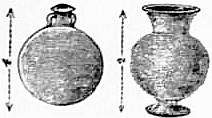
Fig. 6.—Egyptian pottery made of fine blue paste.
Owing to the extended foreign relations of Egypt at this time, imported vases from Greece and Asia, including Mycenaean Bugelkannen and Cypriote black “base ring” jugs, have been found in the tombs and deposits of this age (14). Imitations of foreign forms, especially the Bugelkannen, are found5 chiefly in faience (British Museum, 22,731, is an imitation of a Minoan jug from Crete). The faience forms of the XVIIIth and XXIInd Dynasties include also the kulla shape, the pilgrim bottle, miniature amphorae, &c. (see fig. 6), and miscellaneous forms not found in common pottery, imitating metal and stone vases, e.g. the blue-green ribbed pots of the XXIInd Dynasty, imitating bronze originals, and the alabastron of the XVIIIth; these last go back to the XIIth Dynasty. Very pretty cups in the shape of lotus flowers (see fig. 7) are to be seen in most museums; they are of the XIXth Dynasty, and mostly came from Tuna (6, 8).
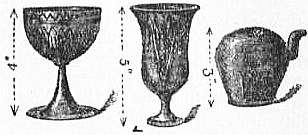
Fig. 7.—Egyptian blue-glazed pottery.
The continuance of the old red polished ware of the IVth Dynasty during the Middle Kingdom to the time of the XVIIIth Dynasty has already been mentioned. Characteristic of the latter period of this ware are long jugs with attenuated body and single handle, which, because they have been found with Mycenaean objects in Cyprus, have been considered to be of foreign, probably of Syrian origin. They may, however, be Egyptian. Vases of the same ware in the shape of men and animals are not uncommon (17). Another ware of this period has a highly polished yellow face, sometimes becoming ruddy, and passing off into a pinkish red; in this ware the pilgrim bottles are common. An unpolished, brittle, and thin yellow ware was also used largely for wine-vases. The rougher, commoner red and brown ware at this period became decorated with designs, chiefly of lily wreaths, &c., in paint of various colours (13). This new development hid the ugly colour of the common pottery and was a cheaply obtained imitation of the expensive, polychrome glazed ware of the period (see fig. 8). This painted pottery continued in use until about the time of the XXIInd Dynasty. From this time onwards, till the Ptolemaic period, the commonest pottery was a red ware, usually covered with a white slip. Under the XXVIth Dynasty a finer homogeneous white ware occurs, usually for vases with a rude representation of the face of the god Bes on their bodies.
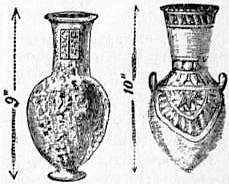
Fig. 8.—Egyptian pottery with painted ornament and sham marbling.
The XXVIth Dynasty marks a new period of development in the history of Egyptian faience. The old deep blue colour had gradually deteriorated into an ugly green (British Museum, No. 8962), which was replaced by the Saite potters with a new light blue of very delicate tint, imitated, in accordance with the archaistic spirit of the time, from the old light blue of the earliest Dynasties. The glaze itself is very thin and “sugary” in texture. The old decoration of the blue with designs and inscriptions in manganese-black is abandoned; on the ushabtis the inscriptions are now incised. Side by side with this light blue glaze was used an unglazed faience, a sort of composition paste with the colour going right through.6 It has more variety of colour than the glazed faience, light green and a dark indigo blue being found as well as the Saite light blue. Sometimes it is of a very soft, almost chalky consistency. It was used for vases, but more generally for small figures and scarabs (6). The commonest vase-form of this period is the pilgrim bottle, now made with the neck in the form of a lily flower, and with inscriptions on the sides wishing good luck in the New Year to the possessor. These flasks appear to have been common New Year’s gifts.
Under the Sebennyte kings of the XXXth Dynasty a further new development of glaze began, of a more radical character than ever before. The colour deepened, and the glaze itself became much more glassy, and was thickly laid on. The new glaze was partly translucent, and differed very greatly from the old opaque glaze. It first appeared on ushabtis at the end of the Saite period. A curious effect was obtained by glazing the head-dress, the inscription &c., of the ushabtis in dark blue, and then covering the whole with translucent light blue glaze. This method was regularly used during the succeeding Ptolemaic and Roman periods, when the new style of glaze came into general use. A yellowish green effect was obtained by glazing parts of the body of the vases in yellow and covering this with the translucent blue glaze. This method was used to touch up the salient portions of the designs in relief, imitated from foreign originals, a style which now became usual on vases. The usual decoration is mixed Egyptian and classical, the latter generally predominating. A large range of colours was employed; purple, dark blue, blue-green, grass-green, and yellow glazes all being found. The glaze is very thickly laid on, and is often “crazed” (6, 8). A remarkable instance of this Romano-Egyptian faience is the head of the god Bes in the British Museum (No. 35,028). A hard, light blue, opaque glaze like that of the XXVIth Dynasty is occasionally, but rarely, met with in the case of vases (British Museum, Nos. 37,407, 37,408).
We know something of the common wares in use during this period from the study of the ostraka, fragments of pottery on which dated tax-receipts, notes, and so forth were written. From the ostraka we see that during the Ptolemaic period the commonest pottery was made of red ware covered with white slip, which has already been mentioned. At the beginning of the Roman period we find at Elephantine a peculiar light pink ware with a brownish pink face, and elsewhere a smooth dark brown ware. About the 3rd century a.d. horizontally ribbed or fluted pots, usually of a coarse brown ware, came into general use. These were often large-sized amphorae, with very attenuated necks and long handles (see fig. 9). During the Byzantine (Coptic) period most of the pottery in use was ribbed, and usually pitched inside to hold water, as the ware was loose in texture and porous.
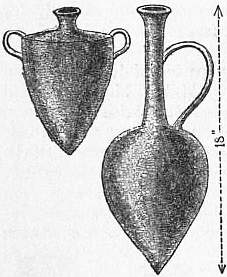
Fig. 9.—Egyptian pottery under the Ptolemies, showing Greek influence in the shapes.
During the Coptic period, a lighter ware was also in use, decorated with designs of various kinds in white, brown or red paint on the dull red or buff body. In Nubia a peculiar development of this ware is characteristic of the later period (Brit. Mus. No. 30,712).
A polished red ware of Roman origin (imitation Arretine or “Samian”) was commonly used as well.
The heavily glazed blue faience continued in use until replaced in the early Arab period by the well-known yellow and brown lead-glazed pottery, of which fragments are found in the mounds of Fostat (Old Cairo).
Western Asia.—Palestine. The most ancient Palestinian pottery is the rough “Amorite” ware from Lachish (Tel el-Hesi) which sometimes has wavy handles like the prehistoric Egyptian (18). Later we find actual Mycenaean pottery in Philistia (19), an interesting testimony to the truth of the legend which brings the Philistines from Crete; the fourth and fifth cities of Lachish (1200-1000 b.c.) show us the first ordinary Phoenician or Israelite pottery—buff or red lamps and bowls, the latter with the handles sometimes painted in bistre, and vases showing strong Egyptian influence; while pottery from Cyprus and elsewhere is found as in Egypt.
The only remarkable later development of Palestinian pottery is the Phoenician imitation of Egyptian faience of the Saite period, of which the characteristics are well known. Some of this may actually have been made in Egypt.
The course of the potter’s art in Mesopotamia and Persia appears to have run on lines of development parallel with the art in Egypt, for the country between the Tigris and the Euphrates is rich in good clays, and, wherever the invention of glass arose, its application to pottery decoration was certainly developed at an early period in Egypt and in Mesopotamia.
Two characteristic uses of clay wares must, however, be pointed out, though they have nothing to do with vase-making.
1. The Babylonian and Assyrian use of clay shaped into tablets, cylinders and prisms, to produce an imperishable record of the literature of the time. The cylinders and prisms were thrown on the potter’s wheel and are consequently hollow; the circular form was then sliced down, and the surface was impressed with cuneiform inscriptions, the prism, tablet or cylinder being subsequently dried and fired.
2. The architectural use of glazed bricks and slabs. While the Egyptians remained content for the most part with the application of their brilliant alkaline glazes to small and delicately-finished objects, the Babylonians and Assyrians developed an architecture decorated with glazed and coloured brickwork. The bricks were of very open texture, and the ornamental pattern or figure subjects were obtained by a strong outline in dark-coloured clay which formed a kind of cloison or boundary, the shallow cells between being filled in with coloured clays—yellow, red or white—or with coloured glazes of turquoise, green or blue, yellow and purplish brown. These glazes are obviously like the Egyptian, but they are more coarsely prepared and are always full of bubbles and consequently more or less opaque. Yet the severe simplicity of the method, the splendid colour effect, strong yet sumptuous, entitles these productions to a very high rank among all the world’s work in clay and glaze. The “Frieze of the Archers” now in the Louvre may be mentioned as one of the finest productions of its kind, and the Louvre and British Museum possess the finest collections of this early architectural use of glazed and coloured clay. (See also Mural Decoration)
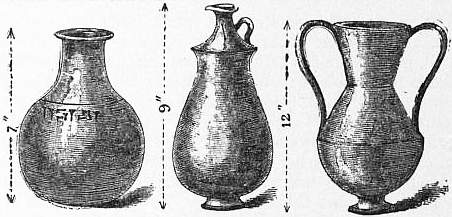
Fig. 10.—Assyrian biscuit pottery.
Coming to ordinary pottery we find that in early times well-formed vases made of good clay, unglazed and unpainted, were made. Small figures of deities made of the same clay are often found. It is practically the same terra-cotta as that of the inscribed tablets. None of the forms are particularly distinctive (see fig. 10). The excavations of the French in Persia have brought to light at Moussian in Susiana an extremely interesting painted ware, which belongs to a very early period. The decoration is usually geometrical. The technique seems to be analogous to the Mycenaean-Greek (Firnismalerei), and the whole effect is very like that of the Greek, Late Mycenaean or Dipylon pottery. The ware is buff in colour and fine in texture, with a polished surface. The decoration is sometimes in polychrome, but usually in the grey-brown iron-glaze (?) alone. This pottery degenerates later and finally disappears (20).
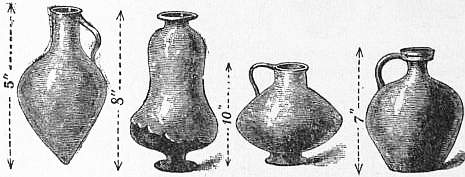
Fig. 11.—Assyrian glazed and enamelled pottery.
During the Sargonide period in Assyria (7th century b.c.) we find a polychrome faience (colours usually white and brown) obviously of Egyptian origin. It was used, not for vases, but architectonically for friezes, ornamental bosses, &c. Its origin may be found in Egypt under the XVIIIth Dynasty, when Egyptian influence extended to the Tigris, and Babylonia had regular diplomatic relations with Egypt In Asia this polychrome decoration in glazes continued to be used long after it had ceased to be made in the country of its origin; the enamelled brick decoration of Persepolis is the descendant of the glazed inlay decorations of Tel el-Amarna, Tel el-Yahudiya and Kuyunjik. In the Sargonide period blue glazed vases occur (see fig. 11) which are probably of Egyptian origin or are Phoenician imitations of Egyptian faience.
Characteristic of the Parthian period is a coarse green glazed pottery of which the slipper-shaped coffins, of the time were made (British Museum, Nos. 1645-1647) (21). This glaze possibly contains a small amount of lead; in appearance it is not unlike the contemporary translucent blue glaze of Egypt. The Egyptian glaze certainly spread into western Asia, and we find the last specimens of it in the tiles from the destroyed city of Rhagae in Persia, which may be as late as the 13th century a.d. The lead glazes, unknown in Egypt till the late Roman period, may be of Asiatic origin, though this important point is by no means clear.
References.—(1) Petrie-Quibell, Ballas and Nagada (date erroneous); (2) Jacques de Morgan, L’ Âge de la pierre et des métaux; (3) Petrie, Diospolis Parva, frontispiece (also for “sequence-dates” of pottery); (4) Garstang, Mahâsna and Bêt Khallâf, pls. xxix.—xxxii.; (5) Petrie, Illahûn, pl. xii. (corr. by V. Bissing in (14)); (6) V. Bissing, Catalogue générale du musée de Caire, “Die Fayencegefässe”; (7) Petrie, Abydos, ii., frontispiece; (8) Henry Wallis, Egyptian Ceramic Art (Macgregor Collection); (9) Guide to Third and Fourth Egyptian Rooms, British Museum, p. 252 ff.; (10) Petrie, Tel-el-Amarna; (11) Guide to Third and Fourth Egyptian Rooms, p. 261; (12) Petrie, Nagâda, pl. xxviii.; (13) Petrie, Illahûn, pls. xx., xxi.; (14) V. Bissing, Strena Helbigiana, p. 20 ff.; (15) Garstang, El Arábah, pls. xviii.-xxi., xxviii., xxix.; (16) Hall, Oldest Civilization of Greece, p. 143 ff. ibid. figs. 29, 30, 69; (17) Guide to Third and Fourth Egyptian Rooms, pl. viii.; (18) Petrie, Tell-el-Hesy, pl. v.; (19) Welch, Ann. Brit. Sch. Ath. vi.; (20) de Morgan, Délégation en Perse, viii. (1905); (21) Brit. Mus.: Guide to Babylonian and Assyrian Room.
(H. R. H.)
Greek, Etruscan and Roman
Greek. Study of Greek Vases.—It is not so many years since an account of Greek pottery would naturally have followed chronologically the history of Egyptian pottery with little overlapping; but recent discoveries have reversed all such ideas, and, while up to the end of the 19th century the earliest remains to be traced on Greek soil could be assigned at the furthest to the period 2500-2000 b.c., it is now possible not only to show that at that period technical processes were highly developed, but even to trace a continuous development of Greek pottery from the Neolithic age. This result has been mainly brought about by Dr Arthur Evans’s researches at Cnossus in Crete, but traces of similar phenomena are not wanting in other parts of Greece. Whether the race which produced this pottery can strictly be called Greek may be open to question, but at all events the ware is the independent product of a people inhabiting in prehistoric times the region afterwards known as Greece; its connexion with the pottery of the historic period can now be clearly traced, and in its advanced technical character and the genuinely artistic appearance of its decoration even this early ware proclaims itself as inspired by a similar genius.
The study of Greek vases has thus received an additional impetus from the light that it throws on the early civilization of the country, and its value for the student of ethnology. But it has always appealed strongly to the archaeologist and in some degree also to the artist or connoisseur, to the former from its importance as a contribution to the history of Greek art, mythology and antiquities, to the latter from its beauty of form and decoration. Attention was first redirected to the painted vases at the end of the 17th century, though for a long time they served as little more than an adjunct to the cabinet of the amateur or a pleasing souvenir for the traveller; but even during the 18th century it dawned on the minds of students that they were of more than merely artistic importance, and attention was devoted to the elucidation of their subjects, and attempts made to arrive at a chronological classification. Two facts must, however, be borne in mind: firstly, that down to the middle of the 19th century the great majority of painted vases had been found only in Italy; secondly, that these vases were mostly of the later and more florid styles, which, if artistically advanced, are now known to represent a decadent phase of Greek art.