VOLUME V SLICE V Cat to Celt (continued 9)
Reading edition
CAVEDONE, JACOPO (1577-1660), Italian painter, born at Sassuolo in the Modenese, was educated in the school of the Caracci, and under them painted in the churches of Bologna. His principal works are the “Adoration of the Magi,” the “Four Doctors,” and the “Last Supper”; and more especially the “Virgin and Child in Glory,” with San Petronio and other saints, painted in 1614, and now in the Bolognese Academy. Cavedone became an assistant to Guido Reni in Rome; his art was generally of a subdued undemonstrative character, with rich Titianesque colouring. In his declining years his energies broke down after his wife had been accused of witchcraft, and after the death of a cherished son. He died in extreme poverty, in a stable at Bologna.
CAVENDISH, GEORGE (1500-1562?), English writer, the biographer of Cardinal Wolsey, was the elder son of Thomas Cavendish, clerk of the pipe in the exchequer, and his wife, Alice Smith of Padbrook Hall. He was probably born at his father’s manor of Cavendish, in Suffolk. Later the family resided in London, in the parish of St Alban’s, Wood Street, where Thomas Cavendish died in 1524. Shortly after this event George married Margery Kemp, of Spains Hall, an heiress, and the niece of Sir Thomas More. About 1527 he entered the service of Cardinal Wolsey as gentleman-usher, and for the next three years he was divided from his wife, children and estates, in the closest personal attendance on the great man. Cavendish was wholly devoted to Wolsey’s interests, and also he saw in this appointment an opportunity to gratify his master-passion, a craving “to see and be acquainted with strangers, in especial with men in honour and authority.” He was faithful to his master in disgrace, and showed the courage of the “loyal servitor.” It is plain that he enjoyed Wolsey’s closest confidence to the end, for after the cardinal’s death George Cavendish was called before the privy council and closely examined as to Wolsey’s latest acts and words. He gave his evidence so clearly and with so much natural dignity, that he won the applause of the hostile council, and the praise of being “a just and diligent servant.” He was not allowed to suffer in pocket by his fidelity to his master, but retired, as it would seem, a wealthy man to his estate of Glemsford, in West Suffolk, in 1530. He was only thirty years of age, but his appetite for being acquainted with strange acts and persons was apparently sated, for we do not hear of his engaging in any more adventures. It is not to be doubted that Cavendish had taken down notes of Wolsey’s conversation and movements, for many years passed before his biography was composed. At length, in 1557, he wrote it out in its final form. It was not, however, possible to publish it in the author’s lifetime, but it was widely circulated in MS. Evidently one of these MSS. fell into Shakespeare’s hands, for that poet made use of it in his King Henry VIII., although it is excessive to say, as Singer has done, that Shakespeare “merely put Cavendish’s language into verse.” The book was first printed in 1641, in a garbled text, and under the title of The Negotiations of Thomas Wolsey. The genuine text, from contemporary MSS., was given to the world in 1810, and more fully in 1815. Until that time it was believed that the book was the composition of George Cavendish’s younger brother William, the founder of Chatsworth, who also was attached to Wolsey. Joseph Hunter proved this to be impossible, and definitely asserted the claim of George. The latter is believed to have died at Glemsford in or about 1562. The intrinsic value of Cavendish’s Life of Cardinal Wolsey has long been perceived, for it is the sole authentic record of a multitude of events highly important in a particularly interesting section of the history of England. Its importance as a product of biographical literature was first emphasized by Bishop Creighton, who insisted over and over again on the claim of Cavendish to be recognized as the earliest of the great English biographers and an individual writer of particular charm and originality. He writes with simplicity and with a certain vivid picturesqueness, rarely yielding to the rhetorical impulses which governed the ordinary prose of his age.
(E. G.)
CAVENDISH, HENRY (1731-1810), English chemist and physicist, elder son of Lord Charles Cavendish, brother of the 3rd duke of Devonshire, and Lady Anne Grey, daughter of the duke of Kent, was born at Nice in October 1731. He was sent to school at Hackney in 1742, and in 1749 entered Peterhouse, Cambridge, which he left in 1753, without taking a degree. Until he was about forty he seems to have enjoyed a very moderate allowance from his father, but in the latter part of his life he was left a fortune which made him one of the richest men of his time. He lived principally at Clapham Common, but he had also a town-house in Bloomsbury, while his library was in a house in Dean Street, Soho; and there he used to attend on appointed days to lend the books to men who were properly vouched for. So methodical was he that he never took down a volume for his own use without entering it in the loan-book. He was a regular attendant at the meetings of the Royal Society, of which he became a fellow in 1760, and he dined every Thursday with the club composed of its members. Otherwise he had little intercourse with society; indeed, his chief object in life seems to have been to avoid the attention of his fellows. With his relatives he had little intercourse, and even Lord George Cavendish, whom he made his principal heir, he saw only for a few minutes once a year. His dinner was ordered daily by a note placed on the hall-table, and his women servants were instructed to keep out of his sight on pain of dismissal. In person he was tall and rather thin; his dress was old-fashioned and singularly uniform, and was inclined to be shabby about the times when the precisely arranged visits of his tailor were due. He had a slight hesitation in his speech, and his air of timidity and reserve was almost ludicrous. He was never married. He died at Clapham on the 24th of February 1810, leaving funded property worth £700,000, and a landed estate of £8000 a year, together with canal and other property, and £50,000 at his bankers.
Cavendish’s scientific work is distinguished for the wideness of its range and for its extraordinary exactness and accuracy. The papers he himself published form an incomplete record of his researches, for many of the results he obtained only became generally known years after his death; yet in spite of the absence of anything approaching self-advertisement he acquired a very high reputation within his own country and abroad, recognized by the Institute of France in 1803 when it chose him as one of its eight foreign associates. Arsenic formed the subject of his first recorded investigation, on which he was engaged at least as early as 1764, and in 1766 he began those communications to the Royal Society on the chemistry of gases, which are among his chief titles to fame. The first (Phil. Trans., 1766) consists of “Three papers containing experiments on Factitious Airs,” dealing mostly with “inflammable air” (hydrogen), which he was the first to recognize as a distinct substance, and “fixed air” (carbon dioxide). He determined the specific gravity of these gases with reference to common air, investigated the extent to which they are absorbed by various liquids, and noted that common air containing one part in nine by volume of fixed air is no longer able to support combustion, and that the air produced by fermentation and putrefaction has properties identical with those of fixed air obtained from marble. In the following year he published a paper on the analysis of one of the London pump-waters (from Rathbone Place, Oxford Street), which is closely connected with the memoirs just mentioned, since it shows that the calcareous matter in that water is held in solution by the “fixed air” present and can be precipitated by lime. Electrical studies seem next to have engaged his attention, and in 1771 and 1772 he read to the Royal Society his “Attempt to explain some of the principal phenomena of electricity by an elastic fluid,” which was followed in 1775 by an “Attempt to imitate the effects of the Torpedo (a fish allied to the ray)” (Phil. Trans., 1776). But these two memoirs contain only a part of the electrical researches he carried out between 1771 and 1781, and many more were found after his death in a number of sealed packets of papers. The contents of these for a long time remained unknown, but ultimately by permission of the duke of Devonshire, to whom they belonged, they were edited by James Clerk Maxwell and published in 1879 by the Cambridge University Press as the Electrical Researches of the Hon. Henry Cavendish. About 1777 or 1778 he resumed his pneumatic inquiries, though he published nothing on the subject till 1783. In that year he described a new eudiometer to the Royal Society and detailed observations he had made to determine whether or not the atmosphere is constant in composition; after testing the air on nearly 60 different days in 1781 he could find in the proportion of oxygen no difference of which he could be sure, nor could he detect any sensible variation at different places. Two papers on “Experiments with Airs,” printed in the Phil. Trans. for 1784 and 1785, contain his great discoveries of the compound nature of water and the composition of nitric acid. Starting from an experiment, narrated by Priestley, in which John Warltire fired a mixture of common air and hydrogen by electricity, with the result that there was a diminution of volume and a deposition of moisture, Cavendish burnt about two parts of hydrogen with five of common air, and noticed that almost all the hydrogen and about one-fifth of the common air lost their elasticity and were condensed into a dew which lined the inside of the vessel employed. This dew he judged to be pure water. In another experiment he fired, by the electric spark, a mixture of hydrogen and oxygen (dephlogisticated air), and found that the resulting water contained nitric acid, which he argued must be due to the nitrogen present as an impurity in the oxygen (“phlogisticated air with which it [the dephlogisticated air] is debased”). In the 1785 paper he proved the correctness of this supposition by showing that when electric sparks are passed through common air there is a shrinkage of volume owing to the nitrogen uniting with the oxygen to form nitric acid. Further, remarking that little was known of the phlogisticated part of our atmosphere, and thinking it might fairly be doubted “whether there are not in reality many different substances confounded together by us under the name of phlogisticated air,” he made an experiment to determine whether the whole of a given portion of nitrogen (phlogisticated air) of the atmosphere could be reduced to nitric acid. He found that a small fraction, not more than 1⁄120 th part, resisted the change, and in this residue he doubtless had a sample of the inert gas argon which was only recognized as a distinct entity more than a hundred years later. His last chemical paper, published in 1788, on the “Conversion of a mixture of dephlogisticated and phlogisticated air into nitrous acid by the electric spark,” describes measures he took to authenticate the truth of the experiment described in the 1785 paper, which had “since been tried by persons of distinguished ability in such pursuits without success.” It may be noted here that, while Cavendish adhered to the phlogistic doctrine, he did not hold it with anything like the tenacity that characterized Priestley; thus, in his 1784 paper on “Experiments on Air,” he remarks that not only the experiments he is describing, but also “most other phenomena of nature seem explicable as well, or nearly as well,” upon the Lavoisierian view as upon the commonly believed principle of phlogiston, and he goes on to give an explanation in terms of the antiphlogistic hypothesis.
Early in his career Cavendish took up the study of heat, and had he promptly published his results he might have anticipated Joseph Black as the discoverer of latent heat and of specific heat. But he made no reference to his work till 1783, when he presented to the Royal Society some “Observations on Mr Hutchins’s experiments for determining the degree of cold at which quicksilver freezes.” This paper, with others published in 1786 and 1788, is concerned with the phenomena attending the freezing of various substances, and is noteworthy because in it he expresses doubt of the supposition that “the heat of bodies is owing to their containing more or less of a substance called the matter of heat,” and inclines to Newton’s opinion that it “consists in the internal motion of the particles of bodies.” His “Account of the Meteorological Apparatus used at the Royal Society’s House” (Phil. Trans., 1776) contains remarks on the precautions necessary in making and using thermometers, a subject which is continued in the following year in a report signed by him and six others.
Cavendish’s last great achievement was his famous series of experiments to determine the density of the earth (Phil. Trans., 1798). The apparatus he employed was devised by the Rev. John Michell, though he had the most important parts reconstructed to his own designs; it depended on measuring the attraction exercised on a horizontal bar, suspended by a vertical wire and bearing a small lead ball at each end, by two large masses of lead. (See Gravitation.) The figure he gives for the specific gravity of the earth is 5.48, water being 1, but in fact the mean of the 29 results he records works out at 5.448. Other publications of his later years dealt with the height of an aurora seen in 1784 (Phil. Trans., 1790), the civil year of the Hindus (Id., 1792), and an improved method of graduating astronomical instruments (Id., 1809). Cavendish also had a taste for geology, and made several tours in England for the purpose of gratifying it.
A life by George Wilson (1818-1859), printed for the Cavendish Society in 1851, contains an account of his writings, both published and unpublished, together with a critical inquiry into the claims of all the alleged discoverers of the composition of water. Some of his instruments are preserved in the Royal Institution, London, and his name is commemorated in the Cavendish Physical Laboratory at Cambridge, which was built by his kinsman the 7th duke of Devonshire.
CAVENDISH [Candish], THOMAS (1555?-1592), the third circumnavigator of the globe, was born at Trimley St Martin, Suffolk. On quitting Corpus Christi College, Cambridge (without a degree), he almost ruined himself by his extravagance as a courtier. To repair his fortune he turned to maritime and colonial enterprise, and in 1585 accompanied Sir Richard Grenville to America. Soon returning to England, he undertook an elaborate imitation of Drake’s great voyage. On the 21st of July 1586, he sailed from Plymouth with 123 men in three vessels, only one of which (the “Desire,” of 140 tons) came home. By way of Sierra Leone, the Cape Verde Islands and C. Frio in Brazil, he coasted down to Patagonia (where he discovered “Port Desire,” his only important contribution to knowledge), and passing through Magellan’s Straits, fell upon the Spanish settlements and shipping on the west coast of South and Central America and of Mexico. Among his prizes were nineteen vessels of worth, and especially the treasure-galleon, the “Great St Anne,” which he captured off Cape St Lucas, the southern extremity of California (November 14, 1587). After this success he struck across the Pacific for home; touched at the Ladrones, Philippines, Moluccas and Java; rounded the Cape of Good Hope; and arrived again at Plymouth (September 9-10, 1588), having circumnavigated the globe in two years and fifty days. It is said that his sailors were clothed in silk, his sails were damask, and his top-mast covered with cloth of gold. Yet by 1591 he was again in difficulties, and planned a fresh American and Pacific venture. John Davis (q.v.) accompanied him, but the voyage (undertaken with five vessels) was an utter failure, much of the fault lying with Cavendish himself, who falsely accused Davis, with his last breath, of deserting him (May 20, 1592). He died and was buried at sea, on the way home, in the summer of 1592.
See Hakluyt’s Principal Navigations, (a) edition of 1589, p. 809 (N.H.’s narrative of the voyage of 1586-1588); (b) edition of 1599-1600, vol. iii. pp. 803-825 (Francis Pretty’s narrative of the same); (c) edition of 1599-1600, vol. iii. pp. 251-253 (on the venture of 1585); (d) edition of 1599-1600, vol. iii. pp. 845-852 (John Lane’s narrative of the last voyage, of 1591-1592); also Stationers’ Registers (Arber), vol. ii. pp. 505-509; the Molyneux Globe of 1592, in the library of the Middle Temple, London, and the Ballads in Biog. Brit., vol. i. p. 1196.
CAVENDISH, SIR WILLIAM (c. 1505-1557), founder of the English noble house of Cavendish, was the younger brother of George Cavendish (q.v.). His father, Thomas, was a descendant of Sir John Cavendish, the judge, who in 1381 was murdered by Jack Straw’s insurgent peasants at Bury St Edmunds. Of William’s education nothing seems known, but in 1530 he was appointed one of the commissioners for visiting monasteries; he worked directly under Thomas Cromwell, whom he calls “master” and to whom many of his extant letters are addressed. In 1541 he was auditor of the court of augmentations, in 1546 treasurer of the king’s chamber, and was knighted and sworn of the privy council. Under Edward VI. and Mary he continued in favour at court; during the latter’s reign he partially conformed, but on the occasion of the war with France he with other Derbyshire gentlemen refused the loan of £100 demanded by the queen. He died in 1557. Cavendish acquired large properties from the spoils of the monasteries, but in accordance with the wish of his third wife Elizabeth he sold them to purchase land in Derbyshire. This wife was the celebrated “building Bess of Hardwick,” daughter of John Hardwicke, of Hardwicke, Derbyshire; she completed the original building of Chatsworth House,—begun in 1553 by her husband,—of which nothing now remains. Her fourth husband was George Talbot, 6th earl of Shrewsbury. By her Cavendish had six children; an elder son who died without issue; William, who in 1618 was created earl of Devonshire; Charles, whose son William became 1st duke of Newcastle; Frances, who married Sir Henry Pierpont, and was the ancestress of the dukes of Kingston; Elizabeth, who married Charles Stuart, earl of Lennox, and was the mother of Arabella Stuart; and Mary, who married Gilbert Talbot, 7th earl of Shrewsbury.
CAVETTO (Ital. diminutive of cavo, hollow), in architecture, the term given to a hollow concave moulding sometimes employed in the place of the cymatium of a cornice, as in that of the Doric order of the theatre of Marcellus. It forms the crowning feature of the Egyptian temples, and took the place of the cymatium in many of the Etruscan temples.
CAVIARE, or Caviar, the roe of various species of Acipenser or sturgeon (q.v.), prepared, in several qualities, as an article of food. The word is common to most European languages and supposed to be of Turk or Tatar origin, but the Turk word khavyah is probably derived from the Ital. caviale; the word does not appear in Russian. The best caviare, which can only be made in winter and is difficult to preserve, is the loosely granulated, almost liquid, kind, known in Russia as ikra. It is prepared by beating the ovaries and straining through a sieve to clear the eggs of the membranes, fibres and fatty matter; it is then salted with from 4-6% of salt. The difficulty of preparation and of transport has made it a table delicacy in western Europe, where it has been known since the 16th century, as is evidenced by Hamlet’s “His play ... pleased not the million, ’twas caviare to the general.” It is eaten either as an hors d’oeuvre, particularly in Russia and northern Europe with kummel or other liqueurs, or as a savoury, or as a flavouring to other dishes. The coarser quality, in Russia known as pájusnaya (from pajus, the adherent skin of the ovaries), is more strongly salted in brine and is pressed into a more solid form than the ikra; it is then packed in small barrels or hermetically-sealed tins. This forms a staple article of food in Russia and eastern Europe. Though the best forms of caviare are still made in Russia, and the greater quantity of the coarser kinds are exported from Astrakhan, the centre of the trade, larger amounts are made each year for export in America and also in Germany, Norway and Sweden. The roe of tunny and mullet, pickled in brine and vinegar, is used, under the name of “Botargo,” along the Mediterranean littoral and in the Levant.
CAVITE, a fortified seaport, the capital of the province of Cavite, Luzon, Philippine Islands, and the seat of the principal Asiatic naval station of the United States, on a forked tongue of land in Manila Bay, 8 m. S. of the city of Manila. Pop. (1903) 4494; with the barrios of San Roque and Caridad (on the main peninsula), which are under the municipal government of Cavite (15,630). Cavite is the terminus of a railway which follows the shore of the bay from Manila. The northern part of the town, Sangley Point (one of the two forks of the main peninsula), is the principal coaling station of the U.S. fleet in Asiatic waters. The naval station proper and the old town of Cavite are on the south fork of the peninsula. Cavite’s buildings are mostly of stone, with upper storeys of wood; its streets are narrow and crooked. It has five churches (one of these is an independent Filipino church), and is the seat of a provincial high school. Cavite has long been the principal naval base of the Philippine Islands, and one of the four Spanish penitentiaries in the Islands was here. During the 19th century Cavite was the centre of political disturbances in the Philippines; in 1896 on the parade ground thirteen political prisoners were executed, and to their memory a monument was erected in 1906 at the head of the isthmus connecting with the main peninsula. The town was nearly destroyed by an earthquake in 1880. It was taken from the Spanish by an American squadron under Commodore George Dewey in May 1898.
CAVOUR, CAMILLO BENSO, Count (1810-1861), Italian statesman, was born at Turin on the 1st of August 1810. The Bensos, who belonged to the old Piedmontese feudal aristocracy, were a very ancient house, said to be descended from a Saxon warrior who settled at Santena in the 12th century and married a Piedmontese heiress; Camillo’s father, the marquis Michele, married a noble Genevese lady, and both he and his wife held offices in the household of Prince Borghese, the governor of Piedmont under Napoleon, and husband of the latter’s sister, Pauline Bonaparte. Being a younger son (his brother Gustavo was the eldest) Cavour was destined for the army, and when ten years old he entered the military academy at Turin. On leaving the college at the age of sixteen he was first of his class, and received a commission in the engineers. He spent the next five years in the army, residing at Ventimiglia, Genoa, and various Alpine fortresses to superintend defence works; but he spent his leisure hours in study, especially of the English language. He soon developed strongly marked Liberal tendencies and an uncompromising dislike for absolutism and clericalism, which, as he had not acquired the art of reticence, made him a suspect in the eyes of the police and of the reactionaries; at the same time he does not seem to have joined any secret society, for he was too loyal to conspire against the king whose uniform he wore, and he did not believe that the time was yet ripe for a revolution. But after the accession to the throne of Charles Albert, whom he always distrusted, he felt that his position in the army was intolerable, and resigned his commission (1831). From that moment we find him in the ranks of the opponents of the government, although his was always a loyal and straightforward opposition which held aloof from conspiracies. During the next few years he devoted himself to the study of political and social problems, to foreign travel, and to acquiring a thorough knowledge of practical agriculture. Cavour’s political ideas were greatly influenced by the July revolution of 1830 in France, which proved that an historic monarchy was not incompatible with Liberal principles, and he became more than ever convinced of the benefits of a constitutional monarchy as opposed both to despotism and to republicanism. But he was not affected by the doctrinaire Liberalism of the time, and his views were strengthened by his studies of the British constitution, of which he was a great admirer; he was even nicknamed “Milord Camillo.” He frequently visited Paris and London, where he plunged into the political and social questions of the day, and contributed among other essays two admirable and prophetic articles, one on the Irish question, in which he strongly defended the Union, and another on the Corn Laws. He applied his knowledge of agriculture to the management of his father’s estate at Leri, which he greatly improved, he founded the Piedmontese Agricultural Society, and took the lead in promoting the introduction of steam navigation, railways and factories into the country.
Thus his mind gradually evolved, and he began to dream dreams of a united Italy free of foreign influence, but owing to the reactionary policy of the Piedmontese government he was unable to take any active part in politics. In 1847, however, the psychological moment seemed to have arrived, for the new pope, Pius IX., showed marked Liberal tendencies and seemed ready to lead all the forces of Italian patriotism against the Austrian domination. The hopes of the Italian Liberals rose high and the so-called neo-Guelph party, represented by such men as Vincenzo Gioberti and Cesare Balbo, believed that an Italian confederation might be formed under the presidency of the pope. Cavour, although he realized that a really Liberal pope was an impossibility, saw the importance of the movement and the necessity of profiting by it. Together with Balbo, P. di Santa Rosa, and M. Castelli, he founded a newspaper at Turin called Il Risorgimento, which advocated the ideas of constitutional reform in Piedmont, with a view to preparing that country for an important role in the upheaval which seemed imminent. In January 1848 the revolution first broke out in Sicily. Cavour, in a speech before a delegation of journalists, declared that the king must take a decided line and grant his people a constitution. Strong pressure was brought to bear on Charles Albert, and after much hesitation he was induced to grant a charter of liberties (February 8, 1848). Cesare Balbo was called upon to form the first constitutional ministry; but Cavour was not offered a seat in it, being suspected by Liberals and Conservatives alike. He continued his journalistic activity, and his articles in the Risorgimento came to exercise great influence both on the king and on public opinion. When the news of the revolt of the Milanese against the Austrians, known as the Five Days, reached Turin on the 19th of March, Cavour felt that the time for Piedmont to act with energy had come, and advocated war against Austria. “After deliberately weighing each word,” he wrote, “we are bound in conscience to declare that only one path is open to the nation, the government, and the king: war, immediate war!” Piedmont was the only part of Italy enjoying a government at once national and independent, and if it did not hasten to the assistance of the Milanese in their desperate struggle, if possible before the Austrians were expelled, the monarchy could not survive. The situation was most critical, and even the British government was not friendly to Piedmont; but Cavour was prepared to face any danger rather than see his country inactive. In an article in the Risorgimento he declared that, while he never believed that material help was to be expected from England, he was convinced that she would not actively help Austria to crush the revolution, but that if she did “she would have against her a coalition not of princes, but of peoples.” Cavour’s article made such an impression that it put an end to the king’s vacillations, and a few days after its appearance war was declared (March 25).
For a few months patriotic and revolutionary enthusiasm carried all before it. In Hungary, in Germany, in Paris, in Vienna itself the revolution was triumphant; constitutions were granted, dynasties tottered and fell, and provisional governments were set up. In all parts of Italy, too, revolts broke out against the established order. But the Piedmontese army, although the troops behaved with gallantry, was no match for Austria’s veteran legions, and except in a few minor engagements, in one of which Cavour’s nephew Gustavo was killed, it was generally unsuccessful, and an armistice was concluded in the summer. In the meanwhile the elections were being held in Piedmont. Cavour himself was not returned until the supplementary elections in June, and he took his seat in parliament on the right as a Conservative. His parliamentary career was not at first very successful; he was not a ready speaker; his habit of talking French made Italian difficult for him, and, although French was at that time allowed in the chamber, he preferred to speak Italian. But he gradually developed a strong argumentative power, his speeches became models of concise reasoning, and he rose at times to the highest level of an eloquence which was never rhetorical. After the dissolution in January 1849, Cavour was not re-elected. The new parliament had to discuss, in the first instance, the all-important question of whether the campaign should be continued now that the armistice was about to expire. The king decided on a last desperate throw, and recommenced hostilities. On the 23rd of March the Piedmontese were totally defeated at Novara, a disaster which was followed immediately by the abdication of Charles Albert in favour of his son Victor Emmanuel II.
Although the new king was obliged to conclude peace with Austria and the Italian revolution was crushed, Cavour nevertheless did not despair; he believed that so long as the constitution was maintained in Piedmont, the Italian cause was safe. There were fresh elections in July, and this time Cavour was returned. He was still in the difficult position of a moderate Liberal at a time when there seemed to be room for none but reactionaries and conspirators, but by his consummate ability he convinced men that his attitude was the right one, and he made it triumph. His speech on the 7th of March 1850, in which he said that, “Piedmont, gathering to itself all the living forces of Italy, would be soon in a position to lead our mother-country to the high destinies to which she is called,” made a deep impression, for it struck the first note of encouragement after the dark days of the preceding year. He supported the ministry of which Massimo d’ Azeglio was president in its work of reform and restoration, and in October of the same year, on the death of Santa Rosa, he himself was appointed minister of agriculture, industry and commerce. In 1851 he also assumed the portfolio of finance, and devoted himself to the task of reorganizing the Piedmontese finances. By far the ablest man in the cabinet, he soon came to dominate it, and, in his anxiety to dominate the chamber as well, he negotiated the union of the Right Centre with the Left Centre (a manoeuvre known as the connubio), and promoted the election of Urbano Rattazzi to the presidency of the chamber. This, which he accomplished without d’ Azeglio’s knowledge, led to a split between that statesman and Cavour, and to the latter’s resignation. Cavour has been blamed for not informing his colleagues of the compact, but for public reasons it was not desirable that the connubio should be discussed before it was consummated. D’ Azeglio indeed bore no malice, and remained Cavour’s friend. Cavour made use of his freedom to visit England and France again, in order to sound public opinion on the Italian question. In London he found the leaders of both parties friendly, and Lord Palmerston told him that if the constitutional experiment in Piedmont succeeded the Italian despots were doomed. At this time Sir James Hudson was appointed British minister at Turin, where he became the intimate friend of Cavour and gave him valuable assistance. In Paris, Cavour had a long interview with Prince Louis Napoleon, then president of the republic, and he already foresaw the great part which that ruler was destined to play in Italian affairs. He also met several Italian exiles in France.
On Cavour’s return he found the country in the throes of a new cabinet crisis, in consequence of which, on d’ Azeglio’s recommendation, he was invited to form a ministry. By the 4th of November he was prime minister, a position which he held with two short interruptions until his death. He devoted the first years of his premiership to developing the economic resources of the country; but in preparing it for greater destinies, he had to meet the heavy expenditure by increased taxation, and some of his measures made him the object of hostile demonstrations, although he soon outlived his unpopularity. Cavour’s first international difficulty was with Austria; after the abortive rising at Milan in February 1853, the Austrian government, in addition to other measures of repression, confiscated the estates of those Lombards who had become naturalized Piedmontese, although they had nothing to do with the outbreak. Cavour took a strong line on this question, and on Austria’s refusal to withdraw the obnoxious decree, he recalled the Piedmontese minister from Vienna, thus by his very audacity winning the sympathy of the Western powers.
Then followed the Crimean War, in which Cavour first showed his extraoidinary political insight and diplomatic genius. The first suggestion of Piedmontese co-operation is usually believed to have come from England, who desired the Italian contingent, not only as material assistance, but also in order to reduce the overwhelming French preponderance. From the Piedmontese point of view there were several reasons why Cavour should desire his country to participate in the campaign. Firstly, it was advisable to use every opportunity of making the Italian question an international one; secondly, by joining the alliance Piedmont would place the Western powers under an obligation; thirdly, Cavour, like Balbo, believed that the Italian question was bound up with the Eastern problem, and as Austria was demanding the permission of the powers to occupy Alessandria, as a guarantee that Piedmont would not profit by the war in the East to create trouble in Italy, Piedmontese participation would in itself prove the best guarantee; and finally, as he always looked to Italy and not merely to Piedmont, he felt that, having proved to Europe that Italians could combine order with liberty, it remained to show that they were capable of fighting as well. But there were serious difficulties in the way. Had Austria joined the allies, as at one time seemed probable, Sardinia’s position fighting by her side would have been an impossible one. On the other hand, Piedmont could not demand definite promises of future aid from the Western powers as some politicians desired, because these would never have been given, lest Austria should be offended and driven into the arms of Russia. Then, both the extreme Conservatives and the extreme Radicals were opposed to expenditure on foreign adventures for which they could see no use. In all these difficulties, however, Cavour was loyally supported by the king, who saw the advantages of Piedmontese participation, even if unattended by definite promises. General Dabormida, the minister of foreign affairs, disapproved of this policy and resigned. The vacant portfolio was offered to d’ Azeglio, who refused it; whereupon Cavour assumed it himself. On the same day (January 10, 1855) the treaty with France and England was signed, and shortly afterwards 15,000 Piedmontese troops under General La Marmora were despatched to the Crimea.
Events at first seemed to justify the fears of Cavour’s opponents. Cholera attacked the Piedmontese soldiers, who for a long time had no occasion to distinguish themselves in action; public opinion became despondent and began to blame Cavour, and even he himself lost heart. Then came the news of the battle of the Tchernaya, fought and won by the Italians, which turned sadness and doubt into jubilation. Joy was felt throughout Italy, especially at Milan, where the victory was the first sign of daylight amid the gloom caused by the return of the Austrians. Everyone realized that the Piedmontese contingent was fighting Italy’s battles. But to Cavour the announcement that Russia had accepted Austrian mediation (January 16, 1856) was a great disappointment. He had always hoped that if the war continued Austria would be forced to side with Russia in return for the aid given by the emperor Nicholas in suppressing the Hungarian revolt in 1849, and the Western powers would then have an opportunity of helping the Italian cause. He sent a memorandum, at Napoleon’s request, to Count Walewski, the French minister of foreign affairs, setting forth a kind of minimum programme of Piedmont’s claims. On the summoning of the congress of Paris at the conclusion of the war, Cavour first proposed that d’ Azeglio should represent Piedmont, and on the latter’s refusal decided to go himself. After much discussion, and in spite of the opposition of Austria, who as mediator occupied a predominant position, behaving “as though she had taken Sevastopol,” Cavour obtained that Piedmont should be treated as one of the great powers. Although he did not expect that the congress would liberate Italy, yet by his marvellous diplomatic skill, far superior to that of his colleagues, he first succeeded in isolating Austria, secondly in indirectly compromising Napoleon in the Italian question, and thirdly in getting the wretched conditions of Italy discussed by the representatives of the great powers, who declared that some remedy to that state of things was necessary, not in the interests of Italy alone, but of all Europe. A scheme of reform proposed by Count Walewski gave Cavour the opportunity to plead the Italian cause, and from that moment it was manifest to all that the liberation of Italy was personified in him, the statesman who came to hold all the strings of European politics in his hands.
Cavour’s chief measure of internal reform during this period was a bill for suppressing all monastic orders unconnected with education, preaching or charity; this aroused strong opposition from the extremists of both parties and also from the king, and led to the minister’s resignation. But he was soon recalled, for the country could not do without him, and the bill was passed (May 29, 1855).
Cavour now saw that war with Austria was merely a question of time, and he began to establish connexions with the revolutionists of all parts of Italy, largely by means of La Farina; but it was necessary that this policy should not be advertised to Europe, and he strongly discountenanced Mazzini’s abortive revolutionary attempts. He continued to strengthen Piedmont’s military resources, and the army soon grew too large for the country and was obviously destined for more than merely defensive purposes. But he well knew that although Piedmont must be made as efficient as possible from the military point of view, it could not defeat Austria single-handed. He would have preferred an alliance with Great Britain, who would never demand territorial compensation; but although British sympathies were wholly Italian, the government was desperately anxious to avoid war. From Napoleon more was to be hoped, for the emperor still preserved some of his revolutionary instincts, while the insecurity of his situation at home made him eager to gain popularity by winning military glory abroad; but he still hesitated, and Cavour devoted the whole of his ability to overcoming his doubts. In the midst of these negotiations came Orsini’s attempt on Napoleon’s life (January 14, 1858), which threatened to alienate his Italian sympathies and cause serious embarrassments to Piedmont. But after some remonstrances to Piedmont for not acting with sufficient energy against the revolutionists, the incident was settled: and Napoleon was, in fact, afraid that if he did not help the Italian cause more such attempts would be made. A month after the Orsini outrage he laid before Cavour a proposal for a Franco-Piedmontese alliance and the marriage of Prince Jerome Bonaparte with Princess Clothilde, the daughter of Victor Emmanuel.
An “accidental” meeting between Napoleon and Cavour was arranged and took place at Plombières in July, and although no one knew what passed, the news of it fell like a bombshell on the diplomatic world. No definite treaty was signed, but the basis of an agreement was laid, whereby France and Piedmont were to declare war against Austria with the object of expelling her from Italy, and a north Italian state was to be formed; in exchange for this help France was to receive Savoy and possibly Nice. But the emperor still hesitated, and refused to decide on war unless Austria attacked Piedmont; the British government, too, in its anxiety to preserve peace, was not very friendly to the Italian cause. Cavour saw that the only way to overcome all these obstacles was to force Austria’s hand. Then there was the danger lest an Italy freed by French arms should be overwhelmed under French predominance; for this reason Cavour was determined to secure the co-operation of volunteers from other parts of Italy, and that the war should be accompanied by a series of risings against Austria and the local despots. It was also necessary that the risings should break out in the various provinces before the Piedmontese and French troops arrived, so that the latter should not appear as invaders and conquerors, but merely as liberators.
The moment war was seen to be imminent, parties of Italians of all classes, especially Lombards, poured into Piedmont to enlist in the army. Cavour also had a secret interview with Garibaldi, with whom he arranged to organize volunteer corps so that the army should be not merely that of Piedmont, but of all Italy. Every day the situation grew more critical, and on the 10th of January 1859 the king in his speech from the throne pronounced the memorable words “that he could not remain deaf to the cry of pain (il grido di dolore) that reached him from all parts of Italy”—words which, although actually suggested by Napoleon, rang like a trumpet-call throughout the land. In the meanwhile the marriage negotiations were concluded, and during the emperor’s visit to Turin a military convention was signed between the two states, and Savoy and Nice were promised to France as a reward for the expulsion of the Austrians from Italy. But the British government was still unfavourable, and Napoleon, ever hesitating, again sought an excuse for backing out of his engagements; he jumped at the Russian proposal to settle the Italian question by means of his own favourite expedient, a congress. To this Austria agreed on condition that Piedmont should disarm and should be excluded from the congress; England supported the scheme, but desired that all the Italian states should be represented. Cavour was in despair at the turn events were taking, and appealed to Napoleon, actually threatening to emigrate to America and publish all his correspondence with the emperor if the latter did not keep his engagements. He decided at last most reluctantly to accept the English proposal, lest Piedmont should be abandoned by all, but clung to the hope that Austria would reject it. On the 19th of April the Austrian emperor, on the advice of the military party, did reject it; and on the 23rd, to Cavour’s inexpressible joy, Austria sent an ultimatum demanding the disarmament of Piedmont. Cavour replied that his government had agreed to the congress proposed by the powers and that it had nothing more to say. On quitting the chamber that day he said to a friend: “I am leaving the last sitting of the last Piedmontese parliament”—the next would represent united Italy. France now allied herself definitely with Piedmont, and England, delighted at Cavour’s acquiescence to her own proposal and enraged by Austria’s ultimatum, became wholly friendly to the Italian cause. A few days later Austria declared war.
As La Marmora now took the chief command of the army, Cavour added the ministry of war to the others he already held. His activity at this time was astounding, for he was virtually dictator and controlled single-handed nearly all the chief offices of the state. The French troops entered Piedmont, where they were received with enthusiasm, and the allies marched into Lombardy; the victory of Magenta, which opened the gates of Milan to them, was shortly followed by that of Solferino. The people rose in arms at Parma, Modena, Florence and Bologna, which had been occupied by Austria for the pope since 1849; the local princes were expelled and provisional governments set up. Cavour sent special commissioners to take charge of the various provinces in Victor Emmanuel’s name. But these events, together with Prussia’s menacing attitude, began to alarm Napoleon, who, although he wished to destroy Austrian influence in Italy, was afraid of a large and powerful Italian state. Consequently, after Solferino, he concluded an armistice with Austria at Villafranca on the 8th of July, without previously informing Cavour. When Cavour heard of it he was thunderstruck; he immediately interviewed the king at Monzambano, and in violent, almost disrespectful language implored him not to make peace until Venice was free. But Victor Emmanuel saw that nothing was to be gained by a refusal, and much against his own inclination, signed the peace preliminaries at Villafranca, adding the phrase, “pour ce qui me concerne,” which meant that he was not responsible for what the people of other parts of Italy might do (July 12). Lombardy was to be ceded to Piedmont, Venetia to remain Austrian, the deposed princes to be reinstated, and the pope made president of an Italian confederation.
The cabinet resigned the next day, but remained in office provisionally, and Cavour privately advised the revolutionists of central Italy to resist the return of the princes, by force if necessary: “for we must now become conspirators ourselves,” he said. His policy was thus continued after he left office, and Palmerston, who had meanwhile succeeded Malmesbury as foreign minister, informed France and Austria that Great Britain would never tolerate their armed intervention in favour of the central Italian despots. The new Piedmontese ministry, of which La Marmora was the president, but Rattazzi the leading spirit, hesitated between annexing central Italy and agreeing to the terms of peace, but on the 10th of November peace was signed at Zürich. Napoleon proposed a new congress, which never met, and on the fall of the Rattazzi-La Marmora cabinet the king, in spite of the quarrel at Monzambano, asked Cavour to take office again. By January he was once more premier, as well as minister for foreign affairs and of the interior. His first act was to invite the people of Italy to declare their own wishes with regard to annexation to Piedmont; but Napoleon still refused to consent to the union of Tuscany with Piedmont, for he contemplated placing one of his own relatives on the throne of the grand-duchy. Cavour now saw that Napoleon might be ready to deal, and, although the bargain of the preceding year had not been exactly fulfilled, as the Austrians were still in Venice, he again brought forward the question of Nice and Savoy. To Cavour no less than to the king the loss of these two provinces was a cruel wrench, but it was a choice between them and central Italy. The plebiscites in the latter region had unanimously declared in favour of union with Piedmont, and Napoleon became more pressing, going so far as to threaten that unless the cession were made, the French troops would leave Lombardy at the mercy of Austria and occupy Bologna and Florence. On the 24th of March the treaty was signed and the emperor’s opposition to the annexation of central Italy withdrawn. On the 2nd of April the parliament representing Piedmont, the duchies of Parma and Modena, Tuscany and Romagna, met, and Cavour had the difficult and ungrateful task of explaining the cession of Nice and Savoy. In spite of some opposition, the agreement was ratified by a large majority.
The situation in the kingdom of Naples was now becoming critical, but there seemed as yet little chance of union with upper Italy, for the Bourbon government was a more or less regular one, and, although risings had broken out, there was no general revolution. Cavour therefore had to follow a somewhat double-faced policy, on the one hand negotiating with the Bourbon king (Francis II.), suggesting a division of Italy between him and Victor Emmanuel, and on the other secretly backing up the revolutionary agitation. Having now learnt that Garibaldi was planning an expedition to Sicily with his volunteers, he decided, after some hesitation, not to oppose its departure; on the 5th of May it sailed from Quarto near Genoa, and Cavour was only deterred from declaring war on Naples by the fear of foreign complications. Garibaldi with his immortal Thousand landed at Marsala, and the whole rotten fabric of the Bourbon government collapsed. At Palermo they were welcomed by the Piedmontese admiral Persano, and soon the whole island was occupied and Garibaldi proclaimed dictator. The general now proposed to cross over to the mainland, and this placed Cavour in a serious dilemma; Russia and Austria protested against the expedition, France and Prussia were unfriendly, Great Britain alone remained warmly pro-Italian. He still hoped for a revolution in Naples, so that King Victor’s authority might be established before Garibaldi’s arrival, but this proved impossible. When Garibaldi crossed the straits of Messina the Neapolitan government fell, and he entered Naples in triumph. But there was still danger that he might be subsequently defeated, for the Neapolitan army was still a force in being, and Cavour feared, moreover, that, although Garibaldi himself had always loyally acted in the king of Italy’s name, the red republicans around him might lead him to commit some imprudence and plunge the country into anarchy. The cession of Nice, Garibaldi’s birthplace, had made an impassable gulf between the two men, and neither quite trusted the other. Cavour also feared that Garibaldi might invade the papal states, which would have led to further international complications. In any case, Rome must not be touched for the present, since Napoleon was pledged to protect the pope; but as the latter had made large armaments, and his forces, consisting largely of brigands and foreigners under the French general Lamoricière, were in a menacing attitude on the frontier, Cavour decided on the momentous step of annexing the papal states with the exception of the Roman province. The Italian army crossed the frontier from Romagna on the 11th of September, whereupon every power, except Great Britain and Sweden, withdrew its minister from Turin. But the troops advanced and were everywhere received with open arms by the people; Ancona was taken, Lamoricière was defeated and captured at the battle of Castelfidardo, and on the 20th King Victor marched into the Neapolitan kingdom. On the 1st of October Garibaldi defeated the Neapolitan troops on the Volturno, and Gaeta alone, where King Francis of Naples had retired, still held out.
New difficulties with Garibaldi arose, for he would not resign his dictatorship of the southern provinces, and wished to march on Rome. Cavour had to use all his tact to restrain him and at the same time not to appear ungrateful. He refused to act despotically, but he summoned parliament to vote on the annexation, which it did on the 11th. Two days later Garibaldi magnanimously gave in to the nation’s will and handed his conquests over to King Victor as a free gift. Gaeta was invested, and after a siege prolonged through the action of Napoleon, who for some reason unknown kept his fleet before the town, preventing any attack by sea until England induced him to withdraw it, the garrison surrendered on the 13th of February, and King Francis retired to Rome. Parliament was dissolved once more; the new chamber showed an overwhelming majority in favour of Cavour, and Victor Emmanuel was proclaimed king of Italy.
The last question with which Cavour had to deal was that of Rome. For some years past the pope had only been able to maintain his authority by the help of foreign troops, and Cavour saw that as long as this state of things lasted there could be no united Italy. In October he declared in parliament that Rome must be the capital of Italy, for no other city was recognized as such by the whole country, and in January 1861 a resolution to that effect was passed. But owing to Napoleon’s attitude he had to proceed warily, and made no attempt for the present to carry out the nation’s Wishes. At the same time he was anxious that the church should preserve the fullest liberty, and he believed in the principle of “a free church in a free state.” His great dream, save for Rome and Venice, was now realized, and Italy was free and united. But the wear and tear of these last years had been almost unbearable, and at last began to tell; the negotiations with Garibaldi were particularly trying, for while the great statesman wished to treat the hero and his volunteers generously, far more so than seemed wise to the Conservatives and the strictly military party, he did not wish the Italian cause to be endangered by their imprudences, and could not permit all the Garibaldian officers to be received into the regular army with the same grades they held in the volunteer forces. This question, together with that of Nice, led to a painful scene in the chamber between the two men, although they were formally reconciled a few days later. For some time past Cavour had been unwell and irritable, and the scene with Garibaldi undoubtedly hastened his end. A fever set in, and after a short illness he passed away on the 6th of June 1861. He was buried at his ancestral castle of Santena.
The death of Cavour was a terrible loss to Italy; there remained many problems to be solved in which his genius and personality were urgently needed. But the great work had been carried to such a point that lesser men might now complete the structure. He is undoubtedly the greatest figure of the Risorgimento, and although other men and other forces co-operated in the movement, it was Cavour who organized it and skilfully conducted the negotiations which overcame all, apparently insuperable, obstacles. “That which in Alfieri and Gioberti was lacking,” wrote T. Artom, his private secretary, “a deep and lively sense of reality, Cavour possessed to a supreme degree. He was not a littérateur; he was never a political dreamer. His views broadened progressively; at each stage he discovered a new horizon, and he followed his path without ever seeking anything save what was real and possible.” He was gifted with pronounced political genius and with an astounding power of foresight. In his ideas he was always a moderate Liberal, and although he disapproved of republicanism, he was an ardent constitutionalist, ever refusing to resort to arbitrary methods, for he felt that, the Italian character being what it is, Italian unity could not last if unsupported by popular feeling. In meeting opposition he could not, like Bismarck, rely on a great military power, for the Piedmontese army was a small one; Austria must first be isolated and then an alliance had to be obtained with some other power. Some of his acts, especially his policy towards the Neapolitan kingdom, have been criticized as politically immoral; but apart from the fact that few revolutions—and Cavour, after all, was a revolutionist—can be conducted without attacking vested rights, it is hard to see that any policy which led to the destruction of a government, rightly described as the “negation of God on earth,” could be deemed immoral. He has been accused of changing his views, but what statesman has not? Moreover, in the extremely complicated and difficult diplomatic situations which he had to face, what was impossible or dangerous one day became possible and desirable the next. This was particularly the case with the Neapolitan question. Cavour’s one absorbing passion was the liberation and regeneration of Italy, and to this he devoted his whole life and talent.
Bibliography.—G. Buzziconi, Bibliografia Cavouriana (Turin, 1898); Countess Evelyn Martinengo Cesaresco, Cavour (London, 1898), an excellent and handy little monograph which brings out the chief points of Cavour’s life in the right light; G. Massari, Il Conte di Cavour (Turin, 1873); W. de la Rive, Le Comte de Cavour (Paris, 1862), interesting and valuable as the work of a contemporary and intimate friend of Cavour; L. Chiala, Lettere edite ed inedite del Conte di Cavour (7 vols., Turin, 1883-1887); D. Zanichelli, Gli Scritti del Conte di Cavour (Bologna, 1892), and Cavour (Florence, 1905); H. von Treitschke, “Cavour,” in his Historische und politische Aufsatze (Leipzig, 1871); E. Dicey, A Memoir of Cavour (London, 1861); Conte C. di Cavour, Discorsi parlamentari (8 vols., Turin, 1863-1872), Opere politico-economiche (Cuneo, 1855); F.X. Krauss, Cavour (Mainz, 1902); E. Artom, L’Opere politica del Senatore T. Artom nel Risorgimento Italano (Bologna, 1906), a biography of Cavour’s devoted private secretary, containing new material.
( L. V.*)
CAVOUR (anc. Caburrum or Forum Vibii), a town of Piedmont, Italy, in the province of Turin, 32 m. S.W. by rail and steam tram (via Pinerolo from the town of Turin). Pop. (1901) town, 2091; commune, 6843. It lies on the north side of a huge isolated mass of granite (the Rocca di Cavour) which rises from the plain. On the summit was the Roman village, which belonged to the province of the Alpes Cottiae. There are some ruins of medieval fortifications. The town gave its name to the Benso family of Chieri, who were raised to the marquisate in 1771, and of which the statesman Cavour was a member.
For the ancient name see Th. Mommsen in Corp. Inscrip. Lat. v. (Berlin, 1877), p. 825.
CAVY, a name commonly applied to several South American rodent animals included in the family Caviidae (see Rodentia), but perhaps properly applicable only to those belonging to the typical genus Cavia, of which the most familiar representative is the domesticated guinea-pig. Cavies in general, the more typical representatives of the Caviidae, are rodents with hoof-like nails, four front and three hind toes, imperfect collar-bones, and the cheek-teeth divided by folds of enamel into transverse plates. The tail is short or rudimentary, the incisors are short, and the outer surface of the lower jaw is marked by a distinct ridge.
True cavies, or couies (Cavia), are best known by the guinea-pig, a domesticated and parti-coloured race derived from one of the wild species, all of which are uniformly coloured. They are comparatively small and stoutly built animals, with short, rounded ears and no tail. In habits they are partly diurnal; and live either in burrows among the crevices of rocks, beneath the leaves of aquatic plants in marshy districts, or underneath the floors of outbuildings. Their cries are faint squeaks and grunts. They feed upon nearly all vegetable substances, but drink little. Generally they associate in small societies, and seldom wander far from home. Although the guinea-pig is a fertile breeder, the wild species only produce one or two young at a birth, and this but once in a year. The young come into the world in a highly developed condition, being able to feed themselves the day following their birth. Cavies are widely distributed in South America, and are represented by several species. Among them may be mentioned the aperea or restless cavy (C. porcellus or C. aperea) of Brazil; the Bolivian C. boliviensis, found at great elevations in the Andes; the Brazilian rock-cavy (C. rupestris), characterized by its short blunt claws; and the Peruvian C. cutleri. The latter was tamed by the Incas, and is the ancestor of the guinea-pig. As to the origin of that name, some writers consider it a corruption of Guiana-pig, but it is more probable that the word “Guinea” merely signifies foreign. The guinea-pig is a singularly inoffensive and defenceless creature, of a restless disposition, and wanting in that intelligence which usually characterizes domestic pets, although said to show some discrimination. It is of no particular service to man, neither its flesh nor its fur being generally put to use, while the statement that its presence is sufficient to drive off rats and mice appears to be without foundation. It is exceedingly prolific, beginning to breed at the age of two months; the number of young varying, according to the age of the parent, from four to twelve. It has been calculated that a single pair of guinea-pigs may prove the parent stock of a thousand individuals in a single year.
A very different animal is the Patagonian cavy, or mara (Dolichotis patachonica), the typical representative of a genus characterized by long limbs, comparatively large ears, and a short tail. The animal is about the size of a hare, to which it approximates in form and habits. It is most abundant in the open districts of Patagonia, but also ranges on to the Argentina Pampas, where it is now scarce. Although occasionally seen in large flocks, the mara is more commonly found in small parties or in pairs, the parties commonly moving in single file. It has a peculiar kind of hopping gait; and is mainly diurnal, in accordance with which habit its eyes are protected by lashes. It lives in a burrow, generally excavated by itself; but when pursued, seeks safety in flight, rather than by a retreat to its hole. From two to five young are produced twice a year. A much smaller species, D. salinicola, without the characteristic black band above the tail, inhabits the salt-plains of Argentina. Maras have been introduced into several British parks. Fossil species of Dolichotis occur in the caverns of Brazil, and also in the superficial deposits of Argentina.
(R. L.*)
CAWDOR, a village and parish of Nairnshire, Scotland. Pop. of parish (1901) 925. The village is situated 5 m. S.S.W. of Nairn and 3 m. from Gollanfield Junction on the Highland railway. The castle was the scene, according to the tradition which Shakespeare has perpetuated, of the murder of King Duncan by Macbeth, thane of Cawdor (or Calder), in 1040. Since the oldest part of the structure dates from 1454, however, and seemingly had no predecessor, the tradition has no foundation in fact. The building stands on the rocky bank of Cawdor Burn, a right-hand tributary of the Nairn. The massive keep with small turrets is the original portion of the castle, and to it were added, in the 17th century, the modern buildings forming two sides of a square.
Kilravock (pronounced Kilrawk) Castle, 1½ m. W. of Cawdor, occupies a commanding site on the left bank of the Nairn. Its keep dates from 1460, and the later buildings belong to the 17th century. It has been continuously tenanted by the Roses, one of the most remarkable families in Scotland. They came over with William the Conqueror and settled at Kilravock in 1293, since which date son has succeeded father without the interposition of a collateral heir, an instance of direct descent unique in Scottish history. Moreover, nearly every Rose has borne the Christian name of Hugh, and only one attained to a higher social rank than that of laird. Queen Mary was received at the castle in 1562, and Prince Charles Edward was entertained four days before the battle of Culloden. The gardens are remarkable for their beauty.
CAWNPORE, or Kanpur, a city and district of British India in the Allahabad division of the United Provinces. The city is situated on the south bank of the Ganges, 40 m. south-west of Lucknow, and formed from early times a frontier outpost of the people of Oudh and Bengal against their northern neighbours. Clive selected it, on account of its commanding position, as the cantonment for the brigade of troops lent him by the nawab of Oudh. In 1801, when the Ceded Provinces were acquired by the East India Company, it became the chief British frontier station. But by the time of the Mutiny the frontier had left it behind, and it was denuded of troops. Now it is chiefly known as the junction of four railways, the East Indian, Oudh & Rohilkand, Rajputana and Indian Midland, and as a great emporium for harness, shoes and other leather-work. In 1901 the population was 197,170, showing an increase of 4% in the decade. In 1903 the city was devastated by an epidemic of plague.
The name of Cawnpore is indelibly connected with the blackest episode in the history of the Indian Mutiny—the massacre here in July 1857 of hundreds of women and children by the Nana Sahib. The full details of the siege and massacre will be found under Indian Mutiny, and here it will suffice to refer to the local memorials of that evil time. The entrenchment, where General Sir H.M. Wheeler with his small band of soldiers and the European and Eurasian residents were exposed for 21 days to the fire of the mutineers, is merely a bare field, containing the well where many women and children were shot while getting water. This well is now surrounded by an enclosure with an inscription upon its cross. About three-quarters of a mile away, on the banks of the river Ganges, is the Massacre Ghat. A grassy road between banks 10 to 12 ft. high leads down to the river, and it was among the trees on these banks that the murderers concealed themselves who shot down the little garrison as soon as they were embarked in the boats which were to take them to safety. On the river bank is a temple to Siva, of hexagonal shape, old and going to ruin. Steps lead from this temple to an enclosed flight of stairs, which in the cold season descend to the water, but in the rains are covered almost to the top. This is the ghat where some 600 helpless people were slain, in spite of a promise of safe-conduct from the Nana. The remaining 200 victims, who had escaped the bullets of the siege and survived the butchery of the river bank, were massacred afterwards and cast down the famous well of Cawnpore, which is now marked by a memorial and surrounded by gardens. The memorial is crowned by the figure of an angel in white marble, and on the wall of the well itself is the following inscription:—
Sacred to the perpetual Memory of a great company of Christian people, chiefly Women and Children, who near this spot were cruelly murdered by the followers of the rebel Nana Dhundu Pant, of Bithur, and cast, the dying with the dead, into the well below, on the xvth day of July, MDCCCLVII.
The District or Cawnpore is situated between the Ganges and Jumna rivers, and is a portion of the well-watered and fertile tract known as the Doab, the total area being 2384 sq. m. The general inclination of the country is from north to south. Besides the two great rivers, the principal streams are the Arand or Rhind, the Kavan or Singar, the Isan and the Pandu. The district is watered by four branches of the Ganges canal, and traversed by two lines of railway. It used to be a great centre of the indigo industry, which has now declined. The population in 1901 was 1,258,868, showing an increase of 4% during the decade.
CAXTON, WILLIAM (c. 1422-1491), the first English printer, was born somewhere in the Weald of Kent, perhaps at Tenterden. The name, which was apparently pronounced Cauxton, is identical with Causton, the name of a manor in the parish of Hadlow, and was a fairly common surname in the 15th century. The date of Caxton’s birth was arbitrarily fixed in 1748 by Oldys as 1412. Blades, however, inferred that in 1438, when he was apprenticed to Robert Large, he would not have been more than sixteen years of age. This would place his birth in 1422-1423. Robert Large was a rich silk mercer who became sheriff in 1430 and lord mayor of London in 1439, and the fact of Caxton’s apprenticeship to him argues that Caxton’s own parents were in a good position. Large died in 1441, leaving a small bequest to Caxton, and his executors would be bound to place the young man where he could finish his term. He was probably sent direct to Bruges, then the central foreign market of the Anglo-Flemish trade, for he presently entered business there on his own account. In 1450 his name appears in the Bruges records as standing joint surety for the sum of £100; and in 1463 he was acting governor of the company of Merchant Adventurers in the Low Countries. This association, sometimes known as the “English Nation,” was dominated by the Mercers’ Company, to the livery of which Caxton had been formally admitted in London in 1453. The first governor, appointed in terms of a charter granted by Edward IV. in 1462, was W. Obray, but Caxton’s position is definitely asserted in 1464. In that year he was appointed, together with Sir Richard Whitehill, to negotiate with Philip, duke of Burgundy, the renewal of a treaty concerning the wool trade, which was about to expire. These attempts failed, but he was again employed, with two other members of the Mercers’ Company, in a similar but successful mission in October 1468 to the new duke, Charles the Bold, who earlier in the year had married Princess Margaret of York, sister of Edward IV. The last mention of Caxton in the capacity of governor of the “English Nation” is on the 13th of August 1469, and it was probably about that time that he entered the household of the duchess Margaret, possibly in the position of commercial adviser. In his diplomatic mission in 1468 he had been associated with Lord Scales, afterwards Earl Rivers and one of his chief patrons, and at the Burgundian court he must have come in touch with Edward IV. during his brief exile in 1470.
He had begun his translation of the popular medieval romance of Troy, The Recuyell of the Historyes of Troye, from the French of Raoul le Fèvre, early in 1469; and, after laying it aside for some time, he resumed it at the wish of the duchess Margaret, to whom the MS. was presented in September 1471. During his thirty-three years’ residence in Bruges Caxton would have access to the rich libraries of the duke of Burgundy and other nobles, and about this time he learned the art of printing. His disciple, Wynkyn de Worde, says that he was taught at Cologne, probably during a visit there in 1471, recorded in the preface to the Recuyell; Blades suggests that he learnt from Colard Mansion, but there is no evidence that Mansion set up his press at Bruges before 1474. He ceased to be a member of the gild of St John (a gild of illuminators) in 1473, and the first dated book he is known to have printed is dated 1476. Mansion and Caxton were partners or associates at Bruges, where Caxton printed his Recuyell in 1474 or 1475. His second book, The Game and Playe of Chesse, from the Liber de ludo scacchorum of Jacobus de Cessolis through the French of Jehan de Vignay, was finished in 1474, and printed soon after; the last book printed by Mansion and Caxton at Bruges was the Quatre derrenieres choses, an anonymous treatise usually known as De quattuor novissimis. Other books in the same type were printed by Mansion at Bruges after Caxton’s departure.
By September 1476 Caxton had established himself in the almonry at Westminster at the sign of the Red Pale. Robert Copland the printer, who was afterwards one of Caxton’s assistants, states that Caxton began by printing small pamphlets. The first dated book printed in England was Lord Rivers’s translation (revised by Caxton) of The Dictes or sayengis of the philosophres (1477). From this time until his death in 1401 Caxton was busy writing and printing. His services to English literature, apart from his work as a printer (see Typography), are very considerable. His most important original work is an eighth book added to the Polychronicon (vol. viii. in the Rolls Series edition) of Ralph Higden. Caxton revised and printed John of Trevisa’s work, and brought down the narrative himself from 1358 to 1460, using as his authorities Fasciculus temporum, a popular work in the 15th century, and an unknown Aureus de universo. In the year before his death he complained in the preface to his Eneydos of the changing state of the English language, a condition of things which he did as much as any man to remedy. He printed Chaucer’s Canterbury Tales (1478? and 1483), Troilus and Creseide (1483?), the House of Fame (1483?), and the translation of Boethius (1478?); Gower’s Confessio Amantis (1483), and many poems of Lydgate. His press was, however, not worked for purely literary ends, but was a commercial speculation. For the many service-books which he printed there was no doubt a sure sale, and he met the taste of the upper classes by the tales of chivalry which issued regularly from his press. He printed Malory’s Morte d’Arthur, and himself translated from the French the Boke of Histories of Jason (1477?), The Historye of Reynart the Foxe (from the Dutch, 1481 and 1489?), Godfrey of Boloyne or The Siege and Conqueste of Jherusalem (1481), The Lyf of Charles the Grete (1485), The Knyght Parys and the Fayr Vyenne (1485), Blanchardyn and Eglantine (1489?), The Foure Sonnes of Aymon (1489?); also the Morale Proverbs (1478), and the Fayttes of Armes and of Chyualrye (1489) of Christine de Pisan. The most ambitious production of his press was perhaps his version of the Golden Legend, the translation of which he finished in November 1483. It is based on the lives of the saints as given in the 13th century Legenda aurea of Jacobus de Voragine, but Caxton chiefly used existing French and English versions for his compilation. The book is illustrated by seventy woodcuts, and Caxton says he was only encouraged to persevere in his laborious and expensive task by the liberality of William, earl of Arundel. The idleness which he so often deprecates in his prefaces was no vice of his, for in addition to his voluminous translations his output as a printer was over 18,000 pages, and he published ninety-six separate works or editions of works, with apparently little skilled assistance, though later printers, Wynkyn de Worde, Robert Copland and possibly Richard Pynson, were trained under him.
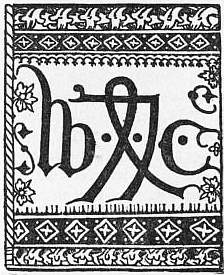
The different founts of type used by Caxton are illustrated by Blades and Duff, and there is an excellent selection of Caxtons in the British Museum, in the University library at Cambridge, besides those in private hands. A record price for a Caxton was reached in 1902 when Mr Bernard Quaritch paid £2225 for The Royal Book (1487?), a translation of the popular Somme des vices et des vertus. His books have no title-pages, and from 1487 onwards are usually adorned with a curious device, consisting of the letters W.C. separated by a trade mark, with an elaborate border above and below. The flourishes on the trade mark have been fancifully interpreted as S.C. for Sancta Colonia, implying that Caxton learnt his art at Cologne, and the whole mark has been read as 74, for 1474, the date of his first printed book. This device was first used in an edition of the Sarum missal, printed for Caxton by George Maynial in Paris, and was subsequently adopted with small alterations by his successor at the Westminster press, Wynkyn de Worde. The first of his books containing woodcut illustrations was his Myrrour of the World (1481), translated from Vincent de Beauvais, which has diagrams and pictures for the assistance of young students. He had used a woodcut initial letter in his broadside Indulgence printed in 1480.
No record of Caxton’s marriage or of the birth of his children has been found, but Gerard Croppe was separated from his wife Elizabeth, daughter of William Caxton, before 1496, when Croppe made certain claims in connexion with his father-in-law’s will.
Authorities.—Earlier biographies of Caxton were superseded by the work of William Blades, whose Life and Typography of William Caxton (2 vols., 1861-1863) remains the standard authority. It contains a bibliography of each of the works issued from Caxton’s press. For later discoveries see George Bullen’s Catalogue of the Caxton celebration loan collection exhibited at South Kensington in 1877; articles by E.J.L. Scott in the Athenaeum (Feb. 10, 1900; May 21 and June 8, 1892); articles in Notes and Queries (April 21, 1900; Feb. 24, 1906), and the publications of the Caxton Club, Chicago, notably William Caxton, by E. Gordon Duff (1905). See also Census of Caxtons, by Seymour de Ricci, No. xv. of the illustrated monographs of the Bibliographical Society, 1909. Many of Caxton’s translations are available in modern reprints; the Golden Legend, the Recuyell and Godeffroy of Boloyne, were printed by William Morris at the Kelmscott Press in 1892-1893; the Boke of Curtesye (1868), the Lyf of Charles the Crete (1880), Alain Chartier’s Curial (1888), Foure Sonnes of Aymon (1884), Eneydos (1890), Blanchardyn and Eglantine (1890), and others, by the Early English Text Society. For modern editions of Reynart see Reynard the Fox. No authentic portrait of Caxton is known, but a MS. at Magdalene College, Cambridge, of the last six books of the Metamorphoses of Ovid, translated by Caxton, is probably in his handwriting.
CAYENNE, a seaport and the capital of French Guiana, on the N.W. extremity of the island of Cayenne, and near the mouth of the river of that name, in 4° 56′ 28″ N., and 52° 20′ 36″ W. Pop. about 12,600. The town forms an almost perfect square, and has clean and well-macadamized streets. The houses, mostly of two storeys, are of wood, strengthened on the first and ground floors by brickwork. In the old town, which contains the government-house and Jesuits’ College, the streets are not so regularly and well built as in the new. The Place d’Armes, a fine quadrangular space, lies between them. To the right of the governor’s house is Mount Cépéron, on which stand Fort St Michel, the marine barracks, the signal station and the lighthouse. Here, too, are the capacious reservoirs for the water-supply of the town, the source of which is a lake to the south of the island. The harbour is shallow at its entrance, and craft drawing more than 14 ft. are obliged to anchor 6 m. from the town. There is no dock for the repair of vessels; but there are two quays at the town. The principal exports of Cayenne are gold, cocoa, phosphates, hides, woods and spices. The imports are French wines, spirits and liqueurs; silk and cotton stuffs, tobacco, hardware, glass, earthenware, clothing, preserved meat, fish, and vegetables, maize, flour, hay, bran, oils and cattle. There is a regular mail service between Cayenne and Martinique once a month. Cayenne is the seat of the government of French Guiana, and was formerly a penal settlement for political offenders. Food as well as clothing is exorbitantly dear, the only cheap articles of consumption being bread and French wines. The temperature of Cayenne is between 76° and 88° Fahr. throughout the year; but the heat is tempered by easterly winds. Between December and March a north wind blows, unfavourable to weak constitutions. Yellow and other fevers often attack the inhabitants of the town, but the climate, though moist, is as a whole healthy. (See Guiana.)
CAYENNE PEPPER (Guinea Pepper, Spanish Pepper, Chilly), a preparation from the dried fruit of various species of Capsicum, a genus of the natural order Solanaceae. The true peppers are members of a totally distinct order, Piperaceae. The fruits of plants of the genus Capsicum have all a strong, pungent flavour. The capsicums bear a greenish-white flower, with a star-shaped corolla and five anthers standing up in the centre of the flower like a tube, through which projects the slender style. The pod-like fruit consists of an envelope at first fleshy and afterwards leathery, within which are the spongy pulp and several seeds. The plants are herbaceous or shrubby; the leaves are entire, and alternate, or in pairs near one another; the flowers are solitary and do not arise in the leaf-axils. There are about thirty species, natives of Central and South America. They are now grown in various parts of the world, both for the sake of the fruit and for ornament. In England the annual sorts are sown from March to the middle of April under a frame. They can be planted out when 2 or 3 in. high, and in June may be transferred to a light rich soil in the open garden. They flower in July or August, and produce pods from August till the end of September. The perennial and shrubby kinds may be wintered in a conservatory. Several species or varieties are used to make cayenne pepper. The annual or common capsicum (C. annuum), the Guinea pepper plant, was brought to Europe by the Spaniards, and was grown in England in 1548. It is indigenous to South America, but is now cultivated in India, Hungary, Italy, Spain and Turkey, with the other species of capsicum. It is a hardy herbaceous plant, which attains a height of 2 or 3 ft. There are numerous cultivated forms, differing in the shape and colour of the pod, which varies from more or less roundish to narrow-conical, with a smooth or wrinkled coat, and white, yellow, red or black in colour. The principal source of cayenne pepper is C. frutescens, the spur or goat pepper, a dwarf shrub, a native of South America, but commonly cultivated in the East Indies. It produces a small, narrow, bright red pod, having very pungent properties. C. tetragonum, or bonnet pepper, is a species much esteemed in Jamaica; it bears very fleshy fruits. Other well-known kinds of capsicum are the cherry pepper (C. cerasiforme), with small berries; bell pepper (C. grossum), which has thick and pulpy fruit, well adapted for pickling; and berry or bird pepper (C. baccatum). The last mentioned has been grown in England since 1731; its fruit is globular, and about the size of a cherry. The West Indian stomachic man-dram is prepared by mashing a few pods of bird pepper and mixing them with sliced cucumber and shallots, to which have been added a little lime-juice and Madeira wine. Chillies, the dried ripe or unripe fruit of capsicums, especially C. annuum and C. frutescens, are used to make chilly-vinegar, as well as for pickles. Cayenne pepper is manufactured from the ripe fruits, which are dried, ground, mixed with wheat flour, and made into cakes with yeast; the cakes are baked till hard like biscuit, and then ground and sifted. The pepper is sometimes prepared by simply drying the pods and pounding them fine in a mortar. Cayenne pepper is occasionally adulterated with red lead, vermilion, ochre, salt, ground-rice and turmeric. The taste of the pepper is impaired by exposure to damp and the heat of the sun. Chillies have been in use from time immemorial; they are eaten in great quantity by the people of Guiana and other warm countries, and in Europe are largely consumed both as a spice and as medicine.
The dried ripe fruit of Capsicum frutescens from Zanzibar, known as pod pepper and Guinea pepper, is official in the British Pharmacopoeia under the name Capsici Fructus. The fruit has a characteristic, pungent odour and an intensely bitter taste. The chief constituents are a crystallizable resin, capsaicin, a volatile alkaloid, capsicine and a volatile oil. The dose is ½-1 grain. The British Pharmacopoeia contains two preparations of capsicum, a tincture (dose 5-15 minims) and an ointment. Externally the drug has the usual action of a volatile oil, being a very powerful counter-irritant. It does not, however, cause pustulation. Its internal action is also that of its class, but its marked contact properties make it specially useful in gastriatony and flatulence, and sometimes in hysteria.
CAYEY, an inland district and mountain town of the department of Guayama, Porto Rico, celebrated for its cool, invigorating climate and the beauty of its scenery. Pop. (1899) of the town, 3763; of the district, 14,442. The town is surrounded by mountain summits, the highest of which, El Torito, rises to an elevation of 2362 ft. above sea-level. It was made a military post by the Spaniards and used as an acclimatizing station. The old Spanish barracks have been enlarged and improved by the American military authorities and, under the name of “Henry Barracks,” are used for the same purpose. The town is a popular summer resort for residents of the coast cities. The surrounding country is wooded and very fertile, being especially noted for its coffee and tobacco. The town has large cigar factories. Cayey is connected with Guayama by an excellent military road.
CAYLEY, ARTHUR (1821-1895), English mathematician, was born at Richmond, in Surrey, on the 16th of August 1821, the second son of Henry Cayley, a Russian merchant, and Maria Antonia Doughty. His father, Henry Cayley, retired from business in 1829 and settled in Blackheath, where Arthur was sent to a private school kept by the Rev. G.B.F. Potticary; at the age of fourteen he was transferred to King’s College school, London. He soon showed that he was a boy of great capacity, and in particular that he was possessed of remarkable mathematical ability. On the advice of the school authorities he was entered at Trinity College, Cambridge, as a pensioner. He was there coached by William Hopkins of Peterhouse, was admitted a scholar of the college in May 1840, and graduated as senior wrangler in 1842, and obtained the first Smith’s Prize at the next examination. In 1842, also, he was elected a fellow of Trinity, and became a major fellow in 1845, the year in which he proceeded to the M.A. degree. He was assistant tutor of Trinity for three years. In 1846, having decided to adopt the law as a profession, he left Cambridge, entered at Lincoln’s Inn, and became a pupil of the conveyancer Mr Christie. He was called to the bar in 1849, and remained at the bar fourteen years, till 1863, when he was elected to the new Sadlerian chair of pure mathematics in the university of Cambridge. He settled at Cambridge in the same year, and married Susan, daughter of Robert Moline of Greenwich. He continued to reside in Cambridge and to hold the professorship till his death, which occurred on the 26th of January 1895. From the time he went first to Cambridge till his death he was constantly engaged in mathematical investigation. The number of his papers and memoirs, some of them of considerable length, exceeds 800; they were published, at the time they were composed, in various scientific journals in Europe and America, and are now embodied, through the enterprise of the syndics of the Cambridge University Press, in thirteen large quarto volumes. These form an enduring monument to his fame. He wrote upon nearly every subject of pure mathematics, and also upon theoretical dynamics and spherical and physical astronomy. He was quite as much a geometrician as he was an analyst. Among his most remarkable works may be mentioned his ten memoirs on quantics, commenced in 1854 and completed in 1878; his creation of the theory of matrices; his researches on the theory of groups; his memoir on abstract geometry, a subject which he created; his introduction into geometry of the “absolute”; his researches on the higher singularities of curves and surfaces; the classification of cubic curves; additions to the theories of rational transformation and correspondence; the theory of the twenty-seven lines that lie on a cubic surface; the theory of elliptic functions; the attraction of ellipsoids; the British Association Reports, 1857 and 1862, on recent progress in general and special theoretical dynamics, and on the secular acceleration of the moon’s mean motion. He is justly regarded as one of the greatest of mathematicians. Competent judges have compared him to Leonhard Euler for his range, analytical power and introduction of new and fertile theories. He was the recipient of nearly every academic distinction that can be conferred upon an eminent man of science. Amongst others may be noted honorary degrees by the universities of Oxford, Dublin, Edinburgh, Göttingen, Heidelberg, Leiden and Bologna. He was fellow or foreign corresponding member of the French Institute, the academies of Berlin, Göttingen, St Petersburg, Milan, Rome, Leiden, Upsala and Hungary; and he was nominated an officer of the Legion of Honour by President Carnot. At various times he was president of the Cambridge Philosophical Society, of the London Mathematical Society and of the Royal Astronomical Society. He was elected a fellow of the Royal Society in 1852, and received from that body a Royal medal in 1859 and the Copley medal in 1882. He also received the De Morgan medal from the London Mathematical Society, and the Huygens medal from Leiden. His nature was noble and generous, and the universal appreciation of this fact gave him great influence in his university. His portrait, by Lowes Dickinson, was placed in the hall of Trinity College in 1874, and his bust, by Henry Wiles, in the library of the same college in 1888.
(P. A. M.)
CAYLUS, ANNE CLAUDE PHILIPPE DE TUBIÈRES DE GRIMOARD DE PESTELS DE LÉVIS, Comte de, Marquis d’Esternay, baron de Bransac (1692-1765), French archaeologist and man of letters, was born at Paris on the 31st of October 1692. He was the eldest son of Lieutenant-General Count de Caylus. His mother, Marthe Marguerite le Valois de Vilette de Murçay, comtesse de Caylus (1673-1729), was a cousin of Mme de Maintenon, who brought her up like her own daughter. She wrote valuable memoirs of the court of Louis XIV. entitled Souvenirs; these were edited by Voltaire (1770), and by many later editors, notably Renouard (1806), Ch. Asselineau (1860), M. de Lescure (1874), M.E. Raunié (1881), J. Soury (1883). While a young man Caylus distinguished himself in the campaigns of the French army, from 1709 to 1714. After the peace of Rastadt he spent some time in travelling in Italy, Greece, the East, England and Germany, and devoted much attention to the study and collection of antiquities. He became an active member of the Academy of Painting and Sculpture and of the Academy of Inscriptions. Among his antiquarian works are Recueil d’antiquités égyptiennes, étrusques, grecques, romaines, et gauloises (6 vols., Paris, 1752-1755), Numismata Aurea Imperatorum Romanorum, and a Mémoire (1755) on the method of encaustic painting with wax mentioned by Pliny, which he claimed to have rediscovered. Diderot, who was no friend to Caylus, maintained that the proper method had been found by J.J. Bachelier. Caylus was an admirable engraver, and copied many of the paintings of the great masters. He caused engravings to be made, at his own expense, of Bartoli’s copies from ancient pictures and published Nouveaux sujets de peinture et de sculpture (1755) and Tableaux tirés de l’Iliade, de l’Odysse, et de l’Enéide (1757). He encouraged artists whose reputations were still in the making, but his patronage was somewhat capricious. Diderot expressed this fact in an epigram in his Salon of 1765: “La mort nous a délivrés du plus cruel des amateurs.” Caylus had quite another side to his character. He had a thorough acquaintance with the gayest and most disreputable sides of Parisian life, and left a number of more or less witty stories dealing with it. These were collected (Amsterdam, 1787) as his Oeuvres badines complètes. The best of them is the Histoire de M. Guillaume, cocher (c. 1730).
The Souvenirs du comte de Caylus, published in 1805, is of very doubtful authenticity. See also A. and J. de Goncourt, Portraits intimes du XVIIIe siècle; Ch. Nisard’s edition of the Correspondance du comte de Caylus avec le père Paciaudi (1877); and a notice by O. Uzanne prefixed to a volume of his Facéties (1879).
CAYMAN ISLANDS, a group of three low-lying islands in the West Indies. They consist of Grand Cayman, Little Cayman and Cayman Brac, and are situated between 79° 44′ and 80° 26′ W. and 19° 44′ and 19° 46′ N., forming a dependency of Jamaica, which lies 178 m. E.S.E. Grand Cayman, a rock-bound island protected by coral reefs, is 17 m. long and varies from 4 m. to 7 m. in breadth. It has two towns, Georgetown and Boddentown. Little Cayman and Cayman Brac are both about 70 m. E.N.E. of Grand Cayman. Excepting near the rocky coast, the islands are fruitful, mahogany and other valuable timbers with some dyewood are grown, and large quantities of coco-nuts are produced by the two smaller islands. Phosphate deposits of considerable value are worked, but the principal occupation of the inhabitants is catching turtles for export to Jamaica. The people are excellent shipwrights and do a considerable trade in schooners built of native wood. The islands are governed by a commissioner, and the laws passed by the local legislative assembly are subject to the assent of the governor of Jamaica. The population of the group is about 5000. The islands were discovered by Columbus, who named them Tortugas from the turtles with which the surrounding sea abounds. They were never occupied by the Spaniards and were colonized from Jamaica by the British.
CAZALÈS, JACQUES ANTOINE MARIE DE (1758-1805), French orator and politician, was born at Grenade in Languedoc, of a family of the lower nobility. Before 1789 he was a cavalry officer, but in that year was returned as deputy to the states general. In the Constituent Assembly he belonged to the section of moderate royalists who sought to set up a constitution on the English model, and his speeches in favour of retaining the right of war and peace in the king’s hands and on the organization of the judiciary gained the applause even of his opponents. Apart from his eloquence, which gave him a place among the finest orators of the Assembly, Cazalès is mainly remembered for a duel fought with Barnave. After the insurrection of the 10th of August 1792, which led to the downfall of royalty, Cazalès emigrated. He fought in the army of the émigrés against revolutionary France, lived in Switzerland and in England, and did not return to France until 1803. He died on the 24th of November 1805. His son, Edmond de Cazalès, wrote philosophical and religious studies.