VOLUME V SLICE V Cat to Celt (continued 7)
Reading edition
From the other side the validity of causation has been attacked in the interests of the naturalism of the mechanical sciences. J.S. Mill argues that, scientifically, the cause of anything is the total assemblage of the conditions that precede its appearance, and that we have no right to give the name of cause to one of them exclusively of the others. The answer to this is that Mill fails to recognize that cause is a conception which we find useful in our dealings with nature, and that whatever conceptions we find useful we are justified in using. Among the conditions of an event there are always one or two that stand in specially close relation to it from our point of view; e.g. the draught of alcoholic liquor is more closely related to the man’s drunkenness than is the attraction of the earth’s gravity, though that also must co-operate in producing the effect. Such closely related conditions we find it convenient to single out by a term which expresses their analogy to the cause of causes, human volition.
These are the questions respecting causation which are matters of present controversy; there are in addition many other points which belong to the controversies of the past. Among the most important are Aristotle’s classification of causes into material, formal, efficient and final, set forth in his Physics and elsewhere, and known as his doctrine of the Four Causes; Geulincx’s Occasional Causes, meant as a solution of certain difficulties in the cosmology of Descartes; Leibnitz’s law of Sufficient Reason; and Kant’s explanation of cause and effect as an a priori category of the understanding, intended as an answer to Hume’s scepticism, but very much less effective than the line of explanation suggested by Locke.
The following is a list of the various technical terms connected with causation which have been distinguished by logicians and psychologists.
The four Aristotelian causes are: (1) Material cause (ὔλη) the material out of which a thing is made; the material cause of a house is the bricks and mortar of which it is composed. (2) Formal cause (εἶδος, λόγος, τὸ τί ἦν εἶναι), the general external appearance, shape, form of a thing; the formal cause of a triangle is its triangularity. (3) Efficient cause (ἀρχὴ τῆς κινήσεως), the alcohol which makes a man drunk, the pistol-bullet which kills. This is the cause as generally understood in modern usage. (4) Final cause (τέλος, τὸ οὖ ἕνεκα), the object for which an action is done or a thing produced; the final cause of a commercial man’s enterprise is to make his livelihood (see Teleology). This last cause was rejected by Bacon, Descartes and Spinoza, and indeed in ordinary usage the cause of an action in relation to its effect is the desire for, and expectation of, that effect on the part of the agent, not the effect itself. The Proximate cause of a phenomenon is the immediate or superficial as opposed to the Remote or Primary cause. Plurality of Causes is the much criticized doctrine of J.S. Mill that a fact may be the uniform consequent of several different antecedents. Causa essendi means the cause whereby a change is what it is, as opposed to the causa cognoscendi, the cause of our knowledge of the event; the two causes evidently need not be the same. An object is called causa immanens when it produces its changes by its own activity; a causa transiens produces changes in some other object. Causa sui is a term applied to God by Spinoza to denote that he is dependent on nothing and has no need of any external thing for his existence. Vera causa is a term used by Newton in his Principia, where he says, “No more causes of natural things are to be admitted than such as are both true and sufficient to explain the phenomena of those things”; verae causae must be such as we have good inductive grounds to believe do exist in nature, and do perform a part in phenomena analogous to those we would render an account of.
CAUSEWAY, a path on a raised dam or mound across marshes or low-lying ground; the word is also used of old paved highways, such as the Roman military roads. “Causey” is still used dialectically in England for a paved or cobbled footpath. The word is properly “causey-way,” from causey, a mound or dam, which is derived, through the Norman-French caucie (cf. modern chaussée), from the late Latin via calciata, a road stamped firm with the feet (calcare, to tread).
CAUSSES (from Lat. calx through local Fr. caous, meaning “lime”), the name given to the table-lands lying to the south of the central plateau of France and sloping westward from the Cévennes. They form parts of the departments of Lozère, Aveyron, Card, Hérault, Lot and Tarn-et-Garonne. They are of limestone formation, dry, sterile and treeless. These characteristics are most marked in the east of the region, where the Causse de Sauveterre, the Causse Méjan, the Causse Noir and the Larzac flank the Cévennes. Here the Causse Méjan, the most deserted and arid of all, reaches an altitude of nearly 4200 ft. Towards the west the lesser causses of Rouergue and Quercy attain respectively 2950 ft. and 1470 ft. Once an uninterrupted table-land, the causses are now isolated from one another by deep rifts through which run the Tarn, the Dourbie, the Jonte and other rivers. The summits are destitute of running water, since the rain as it falls either sinks through the permeable surface soil or runs into the fissures and chasms, some of great depth, which are peculiar to the region. The inhabitants (Caussenards) of the higher causses cultivate hollows in the ground which are protected from the violent winds, and the scanty herbage permits of the raising of sheep, from the milk of which Roquefort cheeses are made. In the west, where the rigours of the weather are less severe, agriculture is more easily carried on.
CAUSSIN DE PERCEVAL, ARMAND-PIERRE (1795-1871), French orientalist, was born in Paris on the 13th of January 1795. His father, Jean Jacques Antoine Caussin de Perceval (1759-1835), was professor of Arabic in the Collège de France. In 1814 he went to Constantinople as a student interpreter, and afterwards travelled in Asiatic Turkey, spending a year with the Maronites in the Lebanon, and finally becoming dragoman at Aleppo. Returning to Paris, he became professor of vulgar Arabic in the school of living Oriental languages in 1821, and also professor of Arabic in the College de France in 1833. In 1849 he was elected to the Academy of Inscriptions. He died at Paris during the siege on the 15th of January 1871.
Caussin de Perceval published (1828) a useful Grammaire arabe vulgaire, which passed through several editions (4th ed., 1858), and edited and enlarged Élie Bocthor’s1 Dictionnaire français-arabe (2 vols., 1828; 3rd ed., 1864); but his great reputation rests almost entirely on one book, the Essai sur l’histoire des Arabes avant l’Islamisme, pendant l’époque de Mahomet (3 vols., 1847-1849), in which the native traditions as to the early history of the Arabs, down to the death of Mahommed and the complete subjection of all the tribes to Islam, are brought together with wonderful industry and set forth with much learning and lucidity. One of the principal MS. sources used is the great Kitáb al-Agháni (Book of Songs) of Abu Faraj, which has since been published (20 vols., Boulak, 1868) in Egypt; but no publication of texts can deprive the Essai, which is now very rare, of its value as a trustworthy guide through a tangled mass of tradition.
CAUSTIC (Gr. καυστικός, burning), that which burns. In surgery, the term is given to substances used to destroy living tissues and so inhibit the action of organic poisons, as in bites, malignant disease and gangrenous processes. Such substances are silver nitrate (lunar caustic), the caustic alkalis (potassium and sodium hydrates), zinc chloride, an acid solution of mercuric nitrate, and pure carbolic acid. In mathematics, the “caustic surfaces” of a given surface are the envelopes of the normals to the surface, or the loci of its centres of principal curvature.
In optics, the term caustic is given to the envelope of luminous rays after reflection or refraction; in the first case the envelope is termed a catacaustic, in the second a diacaustic. Catacaustics are to be observed as bright curves when light is allowed to fall upon a polished riband of steel, such as a watch-spring, placed on a table, and by varying the form of the spring and moving the source of light, a variety of patterns may be obtained. The investigation of caustics, being based on the assumption of the rectilinear propagation of light, and the validity of the experimental laws of reflection and refraction, is essentially of a geometrical nature, and as such it attracted the attention of the mathematicians of the 17th and succeeding centuries, more notably John Bernoulli, G.F. de l’Hôpital, E.W. Tschirnhausen and Louis Carré.
The simplest case of a caustic curve is when the reflecting surface is a circle, and the luminous rays emanate from a point on the circumference. If in fig. 1 AQP be the reflecting circle having C as centre, P the luminous point, and PQ any Caustics by reflection. incident ray, and we join CQ it follows, by the law of the equality of the angles of incidence and reflection, that the reflected ray QR is such that the angles RQC and CQP are equal; to determine the caustic, it is necessary to determine the envelope of this line. This may be readily accomplished geometrically or analytically, and it will be found that the envelope is a cardioid (q.v.), i.e. an epicycloid in which the radii of the fixed and rolling circles are equal. When the rays are parallel, the reflecting surface remaining circular, the question can be similarly treated, and it is found that the caustic is an epicycloid in which the radius of the fixed circle is twice that of the rolling circle (fig. 2). The geometrical method is also applicable when it is required to determine the caustic after any number of reflections at a spherical surface of rays, which are either parallel or diverge from a point on the circumference. In both cases the curves are epicycloids; in the first case the radii of the rolling and the fixed circles are a(2n − 1)/4n and a/2n, and in the second, an/(2n + 1) and a/(2n + 1), where a is the radius of the mirror and n the number of reflections.
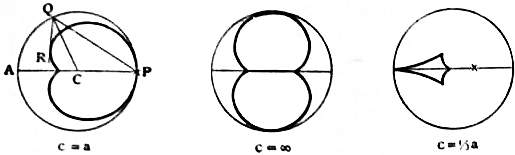
Fig. 1. Fig. 2. Fig. 3.
The Cartesian equation to the caustic produced by reflection at a circle of rays diverging from any point was obtained by Joseph Louis Lagrange; it may be expressed in the form
{ (4c² − a²) (x² + y²) ) − 2a²cx − a²c² }3 = 27a4c²y² (x² + y² − c²)²,
where a is the radius of the reflecting circle, and c the distance of the luminous point from the centre of the circle. The polar form is {(u + p) cos ½θ}2/3 + {(u − p) sin ½θ}2/3 = (2k)2/3, where p and k are the reciprocals of c and a, and u the reciprocal of the radius vector of any point on the caustic. When c = a or = ∞ the curve reduces to the cardioid or the two cusped epicycloid previously discussed. Other forms are shown in figs. 3, 4, 5, 6. These curves were traced by the Rev. Hammet Holditch (Quart. Jour. Math. vol. i.).
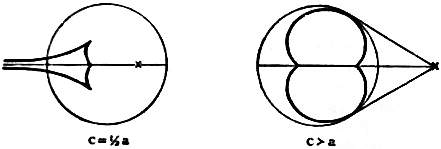
Fig. 4. Fig. 5.
Secondary caustics are orthotomic curves having the reflected or refracted rays as normals, and consequently the proper caustic curve, being the envelope of the normals, is their evolute. It is usually the case that the secondary caustic is easier to determine than the caustic, and hence, when determined, it affords a ready means for deducing the primary caustic. It may be shown by geometrical considerations that the secondary caustic is a curve similar to the first positive pedal of the reflecting curve, of twice the linear dimensions, with respect to the luminous point. For a circle, when the rays emanate from any point, the secondary caustic is a limaçon, and hence the primary caustic is the evolute of this curve.
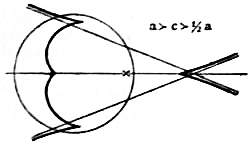
Fig. 6.
The simplest instance of a caustic by refraction (or diacaustic) is when luminous rays issuing from a point are refracted at a straight line. It may be shown geometrically that the secondary caustic, if the second medium be less refractive than the first, is an Caustics by refraction. ellipse having the luminous point for a focus, and its centre at the foot of the perpendicular from the luminous point to the refracting line. The evolute of this ellipse is the caustic required. If the second medium be more highly refractive than the first, the secondary caustic is a hyperbola having the same focus and centre as before, and the caustic is the evolute of this curve. When the refracting curve is a circle and the rays emanate from any point, the locus of the secondary caustic is a Cartesian oval, and the evolute of this curve is the required diacaustic. These curves appear to have been first discussed by Gergonne. For the caustic by refraction of parallel rays at a circle reference should be made to the memoirs by Arthur Cayley.
References.—Arthur Cayley’s “Memoirs on Caustics” in the Phil. Trans. for 1857, vol. 147, and 1867, vol. 157, are especially to be consulted. Reference may also be made to R.S. Heath’s Geometrical Optics and R.A. Herman’s Geometrical Optics (1900).
1 Élie Bocthor (1784-1821) was a French orientalist of Coptic origin. He was the author of a Traité des conjugaisons written in Arabic, and left his Dictionary in MS.
CAUTERETS, a watering-place of south-western France in the department of Hautes-Pyrénées, 20 m. S. by W. of Lourdes by rail. Pop. (1906) 1030. It lies in the beautiful valley of the Gave de Cauterets, and is well known for its copious thermal springs. They are chiefly characterized by the presence of sulphur and silicate of soda, and are used in the treatment of diseases of the respiratory organs, rheumatism, skin diseases and many other maladies. Their temperature varies between 75° and 137° F. The springs number twenty-four, and there are nine bathing establishments. Cauterets is a centre for excursions, the Monné (8935 ft.), the Cabaliros (7655 ft.), the Pic de Chabarrou (9550 ft.), the Vignemale (10,820 ft.), and other summits being in its neighbourhood.
CAUTIN, a province of southern Chile, bounded N. by Arauco, Malleco and Bio-Bio, E. by Argentina, S. by Valdivia, and W. by the Pacific. Its area is officially estimated at 5832 sq. m. Cautin lies within the temperate agricultural and forest region of the south, and produces wheat, cattle, lumber, tan-bark and fruit. The state central railway from Santiago to Puerto Montt crosses the province from north to south, and the Cautin, or Imperial, and Tolten rivers (the latter forming its southern boundary) cross from east to west, both affording excellent transportation facilities. The province once formed part of the territory occupied by the Araucanian Indians, and its present political existence dates from 1887. Its population (1905) was 96,139, of whom a large percentage were European immigrants, principally Germans. The capital is Temuco, on the Rio Cautin; pop. (1895) 7078. The principal towns besides Temuco are Lautaro (3139) and Nueva Imperial (2179), both of historic interest because they were fortified Spanish outposts in the long struggle with the Araucanians.
CAUTLEY, SIR PROBY THOMAS (1802-1871), English engineer and palaeontologist, was born in Suffolk in 1802. After some years’ service in the Bengal artillery, which he joined in 1819, he was engaged on the reconstruction of the Doab canal, of which, after it was opened, he had charge for twelve years (1831-1843). In 1840 he reported on the proposed Ganges canal, for the irrigation of the country between the rivers Ganges, Hindan and Jumna, which was his most important work. This project was sanctioned in 1841, but the work was not begun till 1843, and even then Cautley found himself hampered in its execution by the opposition of Lord Ellenborough. From 1845 to 1848 he was absent in England owing to ill-health, and on his return to India he was appointed director of canals in the North-Western Provinces. After the Ganges canal was opened in 1854 he went back to England, where he was made K.C.B., and from 1858 to 1868 he occupied a seat on the council of India. He died at Sydenham, near London, on the 25th of January 1871. In 1860 he published a full account of the making of the Ganges canal, and he also contributed numerous memoirs, some written in collaboration with Dr Hugh Falconer, to the Proceedings of the Bengal Asiatic Society and the Geological Society of London on the geology and fossil remains of the Sivalik Hills.
CAUVERY, or Kaveri, a river of southern India. Rising in Coorg, high up amid the Western Ghats, in 12° 25′ N. lat. and 75° 34′ E. long., it flows with a general south-eastern direction across the plateau of Mysore, and finally pours itself into the Bay of Bengal through two principal mouths in Tanjore district. Its total length is 472 m., the estimated area of its basin 27,700 sq.m. The course of the river in Coorg is very tortuous. Its bed is generally rocky; its banks are high and covered with luxuriant vegetation. On entering Mysore it passes through a narrow gorge, but presently widens to an average breadth of 300 to 400 yds. Its bed continues rocky, so as to forbid all navigation; but its banks are here bordered with a rich strip of cultivation. In its course through Mysore the channel is interrupted by twelve anicuts or dams for the purpose of irrigation. From the most important of these, known as the Madadkatte, an artificial channel is led to a distance of 72 m., irrigating an area of 10,000 acres, and ultimately bringing a water-supply into the town of Mysore. In Mysore state the Cauvery forms the two islands of Seringapatam and Sivasamudram, which vie in sanctity with the island of Seringam lower down in Trichinopoly district. Around the island of Sivasamudram are the celebrated falls of the Cauvery, unrivalled for romantic beauty. The river here branches into two channels, each of which makes a descent of about 200 m. in a succession of rapids and broken cascades. After entering the Madras presidency, the Cauvery forms the boundary between the Coimbatore and Salem districts, until it strikes into Trichinopoly district. Sweeping past the historic rock of Trichinopoly, it breaks at the island of Seringam into two channels, which enclose between them the delta of Tanjore, the garden of southern India. The northern channel is called the Coleroon (Kolidam); the other preserves the name of Cauvery. On the seaward face of its delta are the open roadsteads of Negapatam and French Karikal. The only navigation on any portion of its course is carried on in boats of basket-work. It is in the delta that the real value of the river for irrigation becomes conspicuous. This is the largest delta system, and the most profitable of all the works in India. The most ancient irrigation work is a massive dam of unhewn stone, 1080 ft. long, and from 40 to 60 ft. broad, across the stream of the Cauvery proper, which is supposed to date back to the 4th century, is still in excellent repair, and has supplied a model to British engineers. The area of the ancient system was 669,000 acres, the modern about 1,000,000 acres. The chief modern work is the anicut across the Coleroon, 2250 ft. long, constructed by Sir Arthur Cotton between 1836 and 1838. The Cauvery Falls have been utilized for an electric installation, which supplies power to the Kolar gold-mines and light to the city of Mysore.
The Cauvery is known to devout Hindus as Dakshini Ganga, or the Ganges of the south, and the whole of its course is holy ground. According to the legend there was once born upon earth a girl named Vishnumaya or Lopamudra, the daughter of Brahma; but her divine father permitted her to be regarded as the child of a mortal, called Kavera-muni. In order to obtain beatitude for her adoptive father, she resolved to become a river whose waters should purify from all sin. Hence it is that even the holy Ganges resorts underground once in the year to the source of the Cauvery, to purge herself from the pollution contracted from the crowd of sinners who have bathed in her waters.
CAVA DEI TIRRENI, a town and episcopal see of Campania, Italy, in the province of Salerno, 6 m. N.W. by rail from the town of Salerno. Pop. (1901) town, 7611; commune, 23,415. It lies fairly high in a richly cultivated valley, surrounded by wooded hills, and is a favourite resort of foreigners in spring and autumn, and of the Neapolitans in summer. A mile to the south-west is the village of Corpo di Cava (1970 ft.), with the Benedictine abbey of La Trinità della Cava, founded in 1025 by St Alferius. The church and the greater part of the buildings were entirely modernized in 1796. The old Gothic cloisters are preserved. The church contains a fine organ and several ancient sarcophagi. The archives, now national property, include documents and MSS. of great value (e.g. the Codex Legum Longobardorum of 1004) and fine incunabula. The abbot is keeper, and also head of a boarding school.
See M. Morcaldi, Codex Diplomaticus Cavensis (Naples and Milan, 1873-1893).
CAVAEDIUM, in architecture, the Latin name for the central hall or court within a Roman house, of which five species are described by Vitruvius. (1) The Tuscanicum responds to the greater number apparently of those at Pompeii, in which the timbers of the roof are framed together, so as to leave an open space in the centre, known as the compluvium; it was through this opening that all the light was received, not only in the hall itself, but in the rooms round. The rain from the roof was collected in gutters round the compluvium, and discharged from thence into a tank or open basin in the floor called the impluvium. (2) In the tetrastylon additional support was required in consequence of the dimensions of the hall; this was given by columns placed at the four angles of the impluvium. (3) Corinthian is the term given to the species where additional columns were required. (4) In the displuviatum the roofs, instead of sloping down towards the compluvium, sloped outwards, the gutters being on the outer walls; there was still an opening in the roof, and an impluvium to catch the rain falling through. This species of roof, Vitruvius states, is constantly in want of repair, as the water does not easily run away, owing to the stoppage in the rain-water pipes. (5) The testudinatum was employed when the hall was small and another floor was built over it; no example of this type has been found at Pompeii, and only one of the cavaedium displuviatum.
CAVAGNARI, SIR PIERRE LOUIS NAPOLEON (1841-1879), British military administrator, the son of a French general by his marriage with an Irish lady, was born at Stenay, in the department of the Meuse, on the 4th of July 1841. He nevertheless obtained naturalization as an Englishman, and entered the military service of the East India Company. After passing through the college at Addiscombe, he served through the Oudh campaign against the mutineers in 1858 and 1859. In 1861 he was appointed an assistant commissioner in the Punjab, and in 1877 became deputy commissioner of Peshawar and took part in several expeditions against the hill tribes. In 1878 he was attached to the staff of the British mission to Kabul, which the Afghans refused to allow to proceed. In May 1879, after the death of the amir Shere Ali, Cavagnari negotiated and signed the treaty of Gandamak with his successor, Yakub Khan. By this the Afghans agreed to admit a British resident at Kabul, and the post was conferred on Cavagnari, who also received the Star of India and was made a K.C.B. He took up his residence in July, and for a time all seemed to go well, but on the 3rd of September Cavagnari and the other European members of the mission were massacred in a sudden rising of mutinous Afghan troops. (See Afghanistan.)
CAVAIGNAC, JEAN BAPTISTE (1762-1829), French politician, was born at Gourdon (Lot). He was sent by his department as deputy to the Convention, where he associated himself with the party of the Mountain and voted for the death of Louis XVI. He was constantly employed on missions in the provinces, and distinguished himself by his rigorous repression of opponents of the revolution in the departments of Landes, Basses-Pyrénées and Gers. With his colleague Jacques Pinet (1754-1844) he established at Bayonne a revolutionary tribunal with authority in the neighbouring towns. Charges of cruelty were preferred against him by a local society before the Convention in 1795, but were dismissed. He had represented the Convention in the armies of Brest and of the Eastern Pyrenees in 1793, and in 1795 he was sent to the armies of the Moselle and the Rhine. He filled various minor administrative offices, and in 1806 became an official at Naples in Murat’s government. During the Hundred Days he was prefect of the Somme. At the restoration he was proscribed as a regicide, and spent the last years of his life at Brussels, where he died on the 24th of March 1829. His second son was General Eugène Cavaignac (q.v.).
The eldest son, Eléonore Louis Godefroi Cavaignac (1801-1845), was, like his father, a republican of the intransigeant type. He was bitterly disappointed at the triumph of the monarchical principle after the revolution of July 1830, in which he had taken part. He took part in the Parisian risings of October 1830, 1832 and 1834. On the third occasion he was imprisoned, but escaped to England in 1835. When he returned to France in 1841 he worked on the staff of La Réforme, and carried on an energetic republican propaganda. In 1843 he became president of the Society of the Rights of Man, of which he had been one of the founders in 1832. He died on the 5th of May 1845. The recumbent statue (1847) of Godefroi Cavaignac on his tomb at Montmartre (Paris) is one of the masterpieces of the sculptor Francois Rude.
Jean Baptiste’s brother, Jacques-Marie, Vicomte Cavaignac (1773-1855), French general, served with distinction in the army under the republic and successive governments. He commanded the cavalry of the XI. corps in the retreat from Moscow, and eventually became Vicomte Cavaignac and inspector-general of cavalry.
CAVAIGNAC, LOUIS EUGÈNE (1802-1857), French general, son of J.B. Cavaignac, was born at Paris on the 15th of October 1802. After going through the usual course of study for the military profession, he entered the army as an engineer officer in 1824, and served in the Morea in 1828, becoming captain in the following year. When the revolution of 1830 broke out he was stationed at Arras, and was the first officer of his regiment to declare for the new order of things. In 1831 he was removed from active duty in consequence of his declared republicanism, but in 1832 he was recalled to the service and sent to Algeria. This continued to be the main sphere of his activity for sixteen years, and he won especial distinction in his fifteen months’ command of the exposed garrison of Tlemçen, a command for which he was selected by Marshal Clausel (1836-1837), and in the defence of Cherchel (1840). Almost every step of his promotion was gained on the field of battle, and in 1844 the duc d’Aumale himself asked for Cavaignac’s promotion to the rank of maréchal de camp. This was made in the same year, and he held various district commands in Algeria up to 1848, when the provisional government appointed him governor-general of the province with the rank of general of division. The post of minister of war was also offered to Cavaignac, but he refused it owing to the unwillingness of the government to quarter troops in Paris, a measure which the general held to be necessary for the stability of the new régime. On his election to the National Assembly, however, Cavaignac returned to Paris. When he arrived on the 17th of May he found the capital in an extremely critical state. Several émeutes had already taken place, and by the 22nd of June 1848 a formidable insurrection had been organized. The only course now open to the National Assembly was to assert its authority by force. Cavaignac, first as minister of war and then as dictator, was called to the task of suppressing the revolt. It was no light task, as the national guard was untrustworthy, regular troops were not at hand in sufficient numbers, and the insurgents had abundant time to prepare themselves. Variously estimated at from 30,000 to 60,000 men, well armed and organized, they had entrenched themselves at every step behind formidable barricades, and were ready to avail themselves of every advantage that ferocity and despair could suggest to them. Cavaignac failed perhaps to appreciate the political exigencies of the moment; as a soldier he would not strike his blow until his plans were matured and his forces sufficiently prepared. When the troops at last advanced in three strong columns, every inch of ground was disputed, and the government troops were frequently repulsed, till, fresh regiments arriving, he forced his way to the Place de la Bastille and crushed the insurrection in its headquarters. The contest, which raged from the 23rd to the morning of the 26th of June, was without doubt the bloodiest and most resolute the streets of Paris have ever seen, and the general did not hesitate to inflict the severest punishment on the rebels.
Cavaignac was censured by some for having, by his delay, allowed the insurrection to gather head; but in the chamber he was declared by a unanimous vote to have deserved well of his country. After laying down his dictatorial powers, he continued to preside over the Executive Committee till the election of a regular president of the republic. It was expected that the suffrages of France would raise Cavaignac to that position. But the mass of the people, and especially the rural population, sick of revolution, and weary even of the moderate republicanism of Cavaignac, were anxious for a stable government. Against the five and a half million votes recorded for Louis Napoleon, Cavaignac received only a million and a half. Not without chagrin at his defeat, he withdrew into the ranks of the opposition. He continued to serve as a representative during the short remainder of the republic. At the coup d’état of the 2nd December 1851 he was arrested along with the other members of the opposition; but after a short imprisonment at Ham he was released, and, with his newly-married wife, lived in retirement till his death, which took place at Ourne (Sarthe) on the 28th of October 1857.
His son, Jacques Marie Eugène Godefroi Cavaignac (1853-1905), French politician, was born in Paris on the 21st of May 1853. He made public profession of his republican principles as a schoolboy at the Lycée Charlemagne by refusing in 1867 to receive a prize at the Sorbonne from the hand of the prince imperial. He received the military medal for service in the Franco-Prussian War, and in 1872 entered the École Polytechnique. He served as a civil engineer in Angoulême until 1881, when he became master of requests in the council of state. In the next year he was elected deputy for the arrondissement of Saint-Calais (Sarthe) in the republican interest. In 1885-1886 he was under-secretary for war in the Henri Brisson ministry, and he served in the cabinet of Émile Loubet (1892) as minister of marine and of the colonies. He had exchanged his moderate republicanism for radical views before he became war minister in the cabinet of Léon Bourgeois (1895-1896). He was again minister of war in the Brisson sabinet in July 1898, when he read in the chamber a document which definitely incriminated Captain Alfred Dreyfus. On the 30th of August, however, he stated that this had been discovered to be a forgery by Colonel Henry, but he refused to concur with his colleagues in a revision of the Dreyfus prosecution, which was the logical outcome of his own exposure of the forgery. Resigning his portfolio, he continued to declare his conviction of Dreyfus’s guilt, and joined the Nationalist group in the chamber, of which he became one of the leaders. He also was an energetic supporter of the Ligue de la Patrie Française. In 1899 Cavaignac was an unsuccessful candidate for the presidency of the republic. He had announced his intention of retiring from political life when he died at his country-seat near Flée (Sarthe) on the 25th of September 1905. He wrote an important book on the Formation de la Prusse contemporaine (2 vols., 1891-1898), dealing with the events of 1806-1813.
CAVAILLON, a town of south-eastern France in the department of Vaucluse, 20 m. S.E. of Avignon by rail. Pop. (1906) town, 5760; commune, 9952. Cavaillon lies at the southern base of Mont St Jacques on the right bank of the Durance above its confluence with the Coulon. It has a hôtel de ville of the 18th century, a church of the 12th century, dedicated to St Véran, and the mutilated remains of a triumphal arch of the Roman period. The town is an important railway junction and the commercial centre of a rich and well-irrigated plain, which produces melons and other fruits, early vegetables (artichokes, tomatoes, celery, potatoes), and other products in profusion. Silk-worms are reared, and silk is an important article of trade. The preparation of preserved vegetables, fruits and other provisions, distilling, and the manufacture of straw hats and leather are carried on. Numerous minor relics of the Roman period have been found to the south of the present town, on the site of the ancient Cabellio, a place of some note in the territory of the Cavares. In medieval and modern history the town has for the most part followed the fortunes of the Comtat Venaissin, in which it was included. Till the time of the Revolution it was the see of a bishop, and had a large number of monastic establishments.
CAVALCANTI, GUIDO (c. 1250-1300), Italian poet and philosopher, was the son of a philosopher whom Dante, in the Inferno, condemns to torment among the Epicureans and Atheists; but he himself was a friend of the great poet. By marriage with Beatrice, daughter of Farinata Uberti, he became head of the Ghibellines; and when the people, weary of continual brawls, aroused themselves, and sought peace by banishing the leaders of the rival parties, he was sent to Sarzana, where he caught a fever, of which he died. Cavalcanti has left a number of love sonnets and canzoni, which were honoured by the praise of Dante. Some are simple and graceful, but many are spoiled by a mixture of metaphysics borrowed from Plato, Aristotle and the Christian Fathers. They are mostly in honour of a French lady, whom he calls Mandetta. His Canzone d’Amore was extremely popular, and was frequently published; and his complete poetical works are contained in Giunti’s collection (Florence, 1527; Venice, 1531-1532). He also wrote in prose on philosophy and oratory.
See D.G. Rossetti, Dante and his Circle (1874).
CAVALIER, JEAN (1681-1740), the famous chief of the Camisards (q.v.), was born at Mas Roux, a small hamlet in the commune of Ribaute near Anduze (Gard), on the 28th of November 1681. His father, an illiterate peasant, had been compelled by persecution to become a Roman Catholic along with his family, but his mother brought him up secretly in the Protestant faith. In his boyhood he became a shepherd, and about his twentieth year he was apprenticed to a baker. Threatened with prosecution for his religious opinions he went to Geneva, where he passed the year 1701; he returned to the Cévennes on the eve of the rebellion of the Camisards, who by the murder of the Abbé du Chayla at Pont-de-Monvert on the night of the 24th of July 1702 raised the standard of revolt. Some months later he became their leader. He showed himself possessed of an extraordinary genius for war, and Marshal Villars paid him the high compliment of saying that he was as courageous in attack as he was prudent in retreat, and that by his extraordinary knowledge of the country he displayed in the management of his troops a skill as great as that of the ablest officers. Within a period of two years he was to hold in check Count Victor Maurice de Broglie and Marshal Montrevel, generals of Louis XIV., and to carry on one of the most terrible partisan wars in French history.
He organized the Camisard forces and maintained the most severe discipline. As an orator he derived his inspiration from the prophets of Israel, and raised the enthusiasm of his rude mountaineers to a pitch so high that they were ready to die with their young leader for the sake of liberty of conscience. Each battle increased the terror of his name. On Christmas day 1702 he dared to hold a religious assembly at the very gates of Alais, and put to flight the local militia which came forth to attack him. At Vagnas, on the 10th of February 1703, he routed the royal troops, but, defeated in his turn, he was compelled to find safety in flight. But he reappeared, was again defeated at Tour de Bellot (April 30), and again recovered himself, recruits flocking to him to fill up the places of the slain. By a long series of successes he raised his reputation to the highest pitch, and gained the full confidence of the people. It was in vain that more rigorous measures were adopted against the Camisards. Cavalier boldly carried the war into the plain, made terrible reprisals, and threatened even Nîmes itself. On the 16th of April 1704 he encountered Marshal Montrevel himself at the bridge of Nages, with 1000 men against 5000, and, though defeated after a desperate conflict, he made a successful retreat with two-thirds of his men. It was at this moment that Marshal Villars, wishing to put an end to the terrible struggle, opened negotiations, and Cavalier was induced to attend a conference at Pont d’Avène near Alais on the 11th of May 1704, and on the 16th of May he made submission at Nîmes. These negotiations, with the proudest monarch in Europe, he carried on, not as a rebel, but as the leader of an army which had waged an honourable war. Louis XIV. gave him a commission as colonel, which Villars presented to him personally, and a pension of 1200 livres. At the same time he authorized the formation of a Camisard regiment for service in Spain under his command.
Before leaving the Cévennes for the last time he went to Alais and to Ribaute, followed by an immense concourse of people. But Cavalier had not been able to obtain liberty of conscience, and his Camisards almost to a man broke forth in wrath against him, reproaching him for what they described as his treacherous desertion. On the 21st of June 1704, with a hundred Camisards who were still faithful to him, he departed from Nîmes and came to Neu-Brisach (Alsace), where he was to be quartered. From Dijon he went on to Paris, where Louis XIV. gave him audience and heard his explanation of the revolt of the Cévennes. Returning to Dijon, fearing to be imprisoned in the fortress of Neu-Brisach, he escaped with his troop near Montbéliard and took refuge at Lausanne. But he was too much of a soldier to abandon the career of arms. He offered his services to the duke of Savoy, and with his Camisards made war in the Val d’Aosta. After the peace he crossed to England, where he formed a regiment of refugees which took part in the Spanish expedition under the earl of Peterborough and Sir Cloudesley Shovel in May 1705. At the battle of Almansa the Camisards found themselves opposed to a French regiment, and without firing the two bodies rushed one upon the other. Cavalier wrote later (July 10, 1707): “The only consolation that remains to me is that the regiment I had the honour to command never looked back, but sold its life dearly on the field of battle. I fought as long as a man stood beside me and until numbers overpowered me, losing also an immense quantity of blood from a dozen wounds which I received.” Marshal Berwick never spoke of this tragic event without visible emotion.
On his return to England a small pension was given him and he settled at Dublin, where he published Memoirs of the Wars of the Cévennes under Col. Cavalier, written in French and translated into English with a dedication to Lord Carteret (1726). Though Cavalier received, no doubt, assistance in the publication of the Memoirs, it is none the less true that he provided the materials, and that his work is the most valuable source for the history of his life. He was made a general on the 27th of October 1735, and on the 25th of May 1738 was appointed lieutenant-governor of Jersey. Writing in the following year (August 26, 1739) he says: “I am overworked and weary; I am going to take the waters in England so as to be in a fit condition for the war against the Spaniards if they reject counsels of prudence.” He was promoted to the rank of major-general on the 2nd of July 1739, and died in the following year. In the parochial register of St Luke’s, Chelsea, there is an entry: “Burial a.d. 1740, May 18, Brigadier John Cavalier.”
There is a story which represents him as the fortunate rival of Voltaire for the hand of Olympe, daughter of Madame Dunoyer, author of the Lettres galantes. During his stay in England he married the daughter of Captain de Ponthieu and Marguerite de la Rochefoucauld, refugees living at Portarlington. Malesherbes, the courageous defender of Louis XVI., bears the following eloquent testimony to this young hero of the Cévennes:—”I confess,” he says, “that this warrior, who, without ever having served, found himself by the mere gift of nature a great general,—this Camisard who was bold to punish a crime in the presence of a fierce troop which maintained itself by little crimes—this coarse peasant who, when admitted at twenty years of age into the society of cultivated people, caught their manners and won their love and esteem, this man who, though accustomed to a stormy life, and having just cause to be proud of his success, had yet enough philosophy in him by nature to enjoy for thirty-five years a tranquil private life—appears to me to be one of the rarest characters to be found in history.”
For a more detailed account see F. Puaux, Vie de Jean Cavalier (1868); David C.A. Agnew, Protestant Exiles from France, ii. 54-66 (Lond., 1871); Charvey, Jean Cavalier: nouveaux documents inédits (1884). Eugène Sue popularized the name of the Camisard chief in Jean Cavalier ou les fanatiques des Cévennes (1840).
(F. Px.)
CAVALIER, a horseman, particularly a horse-soldier or one of gentle birth trained in knightly exercises. The word is taken from one of the French words which derived ultimately from the Late Lat. caballarius, a horseman, from Lat. caballus, properly a pack-horse, which gave the Fr. cheval. a chevalier. This last word is the regular French for “knight,” and is chiefly used in English for a member of certain foreign military or other orders, particularly of the Legion of Honour. Cavalier in English was early applied in a contemptuous sense to an overbearing swashbuckler—a roisterer or swaggering gallant. In Shakespeare (2 Henry IV. v. iii. 62) Shallow calls Bardolph’s companions “cavaleros.” “Cavalier” is chiefly associated with the Royalists, the supporters of Charles I. in the struggle with the Parliament in the Great Rebellion. Here again it first appears as a term of reproach and contempt, applied by the opponents of the king. Charles in the Answer to the Petition (June 13, 1642) speaks of cavaliers as a “word by what mistake soever it seemes much in disfavour.” Further quotations of the use of the word by the Parliamentary party are given in the New English Dictionary. It was soon adopted (as a title of honour) by the king’s party, who in return applied Roundhead to their opponents, and at the Restoration the court party preserved the name, which survived till the rise of the term Tory (see Whig and Tory). The term “cavalier” has been adopted from the French as a term in fortification for a work of great command constructed in the interior of a fort, bastion or other defence, so as to fire over the main parapet without interfering with the fire of the latter. A greater volume of fire can thus be obtained, but the great height of the cavalier makes it an easy target for a besieger’s guns.
CAVALIERE, EMILIO DEL, 16th-century Italian musical composer, was born in Rome about 1550 of a noble family. He held a post at the court of Ferdinand I. of Tuscany from 1588 to 1597, and during his residence at Florence was on terms of intimacy with J. Peri, O. Rinuccini, G. Caccini and the rest of the Bardi circle. In 1597 he returned to Rome, and became connected with the Congregation of the Oratory founded by St Philip Neri. Here in 1600 was performed Cavaliere’s contribution to the musical reformation initiated by his circle of friends in Florence—La Rappresentazione di Anima e di Corpo, a sacred drama, which is regarded as the first example of what is now called oratorio. It is generally supposed that he was no longer living when the work was performed, but some authorities assign 1602 as the date of his death.
Cavaliere’s style is more facile than that of Peri and Caccini, but he is inferior to them in depth of musical expression. He is, however, important as being the first to apply the new monodic style to sacred music, and as the founder of the Roman school of the 17th century which included Mazzocchi, Carissimi and Alessandro Scarlatti.
See also H. Goldschmidt, Studien zur Geschichte der italienischen Oper im 17. Jahrhundert, Band i.
CAVALLI, FRANCESCO (1599?-1676), Italian musical composer, was born at Crema in 1599 or 1600. His real name was Pier Francesco Caletti-Bruni, but he is better known by that of Cavalli, the name of his patron, a Venetian nobleman. He became a singer at St Mark’s in Venice in 1617, second organist in 1639, first organist in 1665, and in 1668 maestro di cappella. He is, however, chiefly important for his operas. He began to write for the stage in 1639 (Le Nozze di Teti e di Peleo), and soon established so great a reputation that he was summoned to Paris in 1660 to produce an opera (Serse) at the Louvre in honour of the marriage of Louis XIV. He visited Paris again in 1662, bringing out his Ercole Amante. His death occurred in Venice on the 14th of January 1676. Twenty-seven operas of Cavalli are still extant, most of them being preserved in the library of St Mark at Venice. Monteverde had found opera a musico-literary experiment, and left it a magnificent dramatic spectacle. Cavalli succeeded in making opera a popular entertainment. He reduced Monteverde’s extravagant orchestra to more practical limits, introduced melodious arias into his music and popular types into his libretti. His operas have all the characteristic exaggerations and absurdities of the 17th century, but they have also a remarkably strong sense of dramatic effect as well as a great musical facility, and a grotesque humour which was characteristic of Italian grand opera down to the death of Alessandro Scarlatti.
CAVALLINI, PIETRO (c. 1259-1344), Italian painter, born in Rome, was an artist of the earliest epoch of the modern Roman school, and was taught painting and mosaic by Giotto while employed at Rome; it is believed that he assisted his master in the mosaic of the Navicella or ship of St Peter, in the porch of the church of that saint. He also studied under the Cosmati. Lanzi describes him as an adept in both arts, and mentions with approbation his grand fresco of a Crucifixion at Assisi, still in tolerable preservation; he was, moreover, versed in architecture and in sculpture. According to George Vertue, it is highly probable that Cavallini executed, in 1279, the mosaics and other ornaments of the tomb of Edward the Confessor in Westminster Abbey. He would thus be the “Petrus Civis Romanus” whose name is inscribed on the shrine; but a comparison of dates invalidates this surmise. He died in 1344, at the age of eighty-five, in the odour of sanctity, having in his later years been a man of eminent piety. He is said to have carved for the Basilica of San Paolo fuori le Mura, close to Rome, a crucifix which spoke in 1370 to a female saint. Some highly important works by Cavallini in the church of Santa Cecilia in Trastevere, Rome, have been recently discovered.
CAVALLO, TIBERIUS (1749-1809), Anglo-Italian electrician and natural philosopher, was born on the 30th of March 1749 at Naples, where his father was a physician. In 1771 he came to England with the intention of pursuing a mercantile career, but he soon turned his attention to scientific work. Although he made several ingenious improvements in scientific instruments, his mind was rather imitative and critical than creative. He published numerous works on different branches of physics, including A Complete Treatise on Electricity (1777), Treatise on the Nature and Properties of Air and other permanently Elastic Fluids (1781), History and Practice of Aerostation (1785), Treatise on Magnetism (1787), Elements of Natural and Experimental Philosophy (1803), Theory and Practice of Medical Electricity (1780), and Medical Properties of Factitious Air (1798). He died in London on the 21st of December 1809.
CAVALLOTTI, FELICE (1842-1898), Italian politician, poet and dramatic author, was born at Milan on the 6th of November 1842. In 1860 and 1866 he fought with the Garibaldian Corps, but first attained notoriety by his anti-monarchical lampoons in the Gazzetta di Milano and in the Gazzettina Rosa between 1866 and 1872. Elected to parliament as deputy for Corteolona in the latter year, he took the oath of allegiance after having publicly impugned its validity. Eloquence and turbulent, combativeness in and out of parliament secured for him the leadership of the extreme Left on the death of Bertani in 1886. During his twelve years’ leadership his party increased in number from twenty to seventy, and at the time of his death his parliamentary influence was greater than ever before. Though ambitious and addicted to defamatory methods of personal attack which sometimes savoured of political blackmail, Cavallotti’s eloquent advocacy of democratic reform, and apparent generosity of sentiment, secured for him a popularity surpassed by that of no contemporary save Crispi. Services rendered in the cholera epidemic of 1885, his numerous lawsuits and thirty-three duels, his bitter campaign against Crispi, and his championship of French interests, combined to enhance his notoriety and to increase his political influence. By skilful alliances with the marquis di Rudini he more than once obtained practical control of the Italian government, and exacted notable concessions to Radical demands. He was killed on the 6th of March 1898 in a duel with Count Macola, editor of the conservative Gazetta di Venezia, whom he had assailed with characteristic intemperance of language. By his death the house of Savoy lost a relentless foe, and the revolutionary elements in Italy a gifted, if not entirely trustworthy, leader.
(H. W. S.)
CAVALRY (Fr. cavalerie, Ger. Kavallerie or Reiterei, derived ultimately from late Lat. caballus, horse), a word which came into use in military literature about the middle of the 16th century as applied to mounted men of all kinds employed for combatant purposes, whether intended primarily for charging in masses, in small bodies, or for dismounted fighting. By degrees, as greater refinement of terminology has become desirable, the idea has been narrowed down until it includes only “horsemen trained to achieve the purpose of their commander by the combined action of man and horse,” and this definition will be found to cover the whole field of cavalry activity, from the tasks entrusted to the cavalry “corps” of 10,000 sabres down to the missions devolving on isolated squadrons and even troops.
History—The evolution of the cavalry arm has never been uniform at any one time over the surface of the globe, but has always been locally modified by the conditions of each community and the stage of intellectual development Early use of mounted warriors. to which at any given moment each had attained. The first condition for the existence of the arm being the existence of the horse itself, its relative scarcity or the reverse and its adaptability to its environment in each particular district have always exercised a preponderating influence on the development of cavalry organization and tactics. The indigenous horses of Europe and Asia being very small, the first application of their capabilities for war purposes seems everywhere to have been as draught animals for chariots, the construction of which implies not only the existence of level surfaces, perhaps of actual roads, but a very considerable degree of mechanical skill in those who designed and employed them. The whole of the classical and Oriental mythologies, together with the earliest monuments of Egypt, Assyria and India, are convincing on this point. Nowhere can we find a trace either of description or delineation of animals physically capable of carrying on their backs the armed men of the period. All the earliest allusions to the use of the horse in war either point directly to the employment as a draught animal, or where not specific, as in the description of the war-horse in Job, they would apply equally well to one harnessed to a chariot as to one ridden under the saddle.
The first trace of change is to be found, according to Prof. Wm. Ridgeway (Origin and Influence of the Thoroughbred Horse, p. 243), in an Egyptian relief showing Nubians mounted on horses of an entirely different breed, taller and more powerful than any which had gone before them. These horses appear to have come from the vicinity of Dongola, and the strain still survives in the Sudan. The breed is traced into Arabia, where only second-rate horses had been reared hitherto, and thence to different parts of Europe, where eventually centres of cavalry activity developed. The first detailed evidence of the existence of organized bodies of mounted men is to be found in Xenophon, whose instructions for the breaking, training and command of a squadron remain almost as a model for modern practice. Their tactical employment, however, seems still to have been relatively insignificant, for the horses were still far too small and too few to deliver a charge with sufficient momentum to break the heavy armed and disciplined hoplites. The strain of ancient battle was of an entirely different order to that of modern fighting. In the absence of projectiles of sufficient range and power to sweep a whole area, the fighting was entirely between the front ranks of the opposing forces. When a front rank fighter fell, his place was immediately taken by his comrade in the rear, who took up the individual combat, excited by his comrade’s fate but relatively fresh in mind and muscle. This process of feeding the fight from the rear could be protracted almost indefinitely. If then, as a consequence of a charge, a few mounted men did penetrate the ranks, they encountered such a crowd of well-protected and fresh swordsmen that they were soon pulled off their ponies and despatched. Now and again great leaders, Alexander, Hannibal and Scipio Africanus, for instance, succeeded in riding down their opponents, but in the main, and as against the Roman infantry in particular, mounted troops proved of very little service on the battlefield.
It was, however, otherwise in the sphere of strategy. There, information was of even greater importance, because harder to obtain, than it is nowadays, and the army which could push out its feelers to the greater distance, surround its enemy and intercept his communications, derived nearly the same advantages as it does at present. Hence both sides provided themselves with horsemen, and when these met, each in the performance of their several duties, charges of masses naturally ensued. This explains the value attaching in the old days to the possession of horse-flesh and the rapid spread of the relatively new Dongola or African strain over the then known world.
The primitive instinct of aboriginal man is to throw stones or other missiles for purposes of defence (apes will throw anything they can find, but they never use sticks); hence, as the Romans penetrated ever farther amongst the barbarian tribes, their horsemen in first line found ever-increasing need for protection against projectiles. But the greater the weight of armour carried, the greater the demands upon the endurance of the horse. Then, as the weight-carrying breed was expensive and, with the decay of the Roman Empire, corruption and peculation spread, a limit was soon placed on the multiplication of charging cavalry, and it became necessary to fall back on the indigenous pony, which could only carry a rider from place to place, not charge. Thus there was a gradual levelling down of the mounted arms, the heavy cavalry becoming too heavy to gallop and the light not good enough for united action. Against such opponents, the lighter and better mounted tribesmen of Asia found their task easy. They cut off the supplies of the marching infantry, filled up or destroyed the wells, &c., and thus demonstrated the strategic necessity of superior mobility.
With the decay of civilization discipline also disappeared, and, as discipline consists essentially in the spirit of self-sacrifice for the good of the community, its opposite, self-preservation, became the guiding principle. This in turn led to the increase of armour carried, and thence to the demand for heavier horses, and this demand working through several centuries led ultimately to the breeding of the great weight-carrying animals on whose existence that of medieval chivalry depended. These horses, however, being very costly and practically useless for general purposes, could only become the property of the wealthy, who were too independent to feel the need of combination, and preferred to live on the spoliation and taxation of the weak. This spoliation eventually impelled the weaker men to combine, and at first their combination took the form of the construction of fortified places, against which mounted men were powerless. On the other hand, expense put a limit to the area which fortifications could enclose, and this again limited the supplies for the garrison. Horsemen sweeping the country for miles around had no difficulty in feeding themselves, and the surrender of all beleaguered places through starvation was ultimately inevitable, unless food could be introduced from allied towns in the vicinity. It was of no use to introduce fighting men only into a place which primarily required food (cf. Lucknow, 1857) to protract its resistance. Hence some means had to be found to surround the supply-convoys with a physically impenetrable shield, and eighteen-foot pikes in the hands of powerful disciplined soldiers met the requirements. Against eight to ten ranks of such men the best cavalry in the world, relying only on their swords, were helpless, and for the time (towards the close of the 15th century) infantry remained masters of the field on the continent of Europe.
England meanwhile had developed on lines of her own. Thanks to her longbowmen and the military genius of her leaders, she might have retained indefinitely the command of the continent had it not been for the invention of gunpowder, which, though readily accepted by the English for sieges in France, proved the ultimate cause of their undoing. It was the French who developed the use of siege artillery most rapidly, and their cavalry were not slow to take the hint; unlike the longbow and the crossbow, the pistol could be used effectively from horseback, and presently the knights and their retainers, having the deepest purses, provided themselves with long pistols in addition to their lances and swords. These weapons sent a bullet through any armour which a foot-soldier could conveniently carry, or his commander afford, and if anything went wrong with their mechanism (which was complicated and uncertain) the speed of his horse soon carried the rider out of danger. A new form of attack against infantry, introduced by the French at Cerisoles, 1544, thus developed itself. A troop or squadron, formed in from twelve to sixteen ranks, trotted up to within pistol shot of the angle of the square to be attacked and halted; then each rank in succession cantered off man by man to the left, discharging his pistol at the square as he passed, and riding back to his place behind the column to reload. This could be prolonged indefinitely, and against such tactics the infantry were powerless. The stakes carried by English archers to check the direct charge of horsemen became useless, as did also chevaux de frise, though the latter (which originated in the 14th century) continued to be employed by the Austrians against the swiftly-charging Turks till the close of the 17th century. Thus it became necessary to devise some new impediment which, whilst remaining mobile, would also give cover and an advantage in the final hand-to-hand shock. The problem was solved in Bohemia, Poland and Moravia (Hussite wars, about 1420), where, distances being great and the country open, greater mobility and capacity in the convoys became essential. Great trains of wagons were placed in charge of an infantry escort, of which a part had become possessed of firearms, and these moved across country in as many as twelve parallel lines drilled to form laagers, as nowadays in South Africa. Again the cavalry proved helpless, and for nearly a century in central Europe the word “Wagenburg” (wagon-fortress) became synonymous with “army.” Then an unfortunate inspiration came to the wagon-men. A large gun was relatively cheaper to manufacture, and more effective than a small one. To keep their assailants at a distance, they mounted wall-pieces of about one-inch bore on their wagons. For a moment the balance inclined in their favour, but the cavalry were quick to see their advantage in this new idea, and they immediately followed suit. They, too, mounted guns on wheels, and, as their mobility gave them choice of position, they were able to concentrate their fire against any side of the laager, and again ultimate surrender was the only way out of the defenders’ dilemma.
The interesting problem thus raised was never finally solved, for the scene of action now shifted to western Europe, to the valley of the Po, and more particularly to the Netherlands, where fortresses were closer together and the clayey nature of the Rhine delta had already made paved roads necessary. Then, the Wagenburg being no longer needed for the short transits between one fortified town and another, the infantry reasserted themselves. Firearms having been much improved in the interval the spearmen (pikemen) had already (about 1515) learnt to protect themselves by musketeers trained to take advantage of cover and ground somewhat in the same fashion as the modern skirmisher. These musketeers kept light guns at a distance from their pikemen, but dared not venture far out, as their fire was altogether inadequate to stop a rush of horsemen; when the latter threatened to intervene, they had to run for safety to the squares of pikemen, whom they assisted in turn by keeping the cavalry beyond pistol range. Hence the horsemen had to fall back upon more powerful guns, and these, being slow and requiring more train, could be most economically protected by infantry (see also Artillery).
Thus about the close of the 16th century western armies differentiated themselves out into the still existing three types—cavalry, artillery and infantry. Moreover, each type was subdivided, the cavalry becoming heavy, medium 17th-century progress. and dragoons. At this period there was nothing to disturb the equilibrium of two contending forces except the characters of their respective leaders. The mercenary element had triumphed everywhere over the feudal levies. The moral qualities of all were on the same indifferent level, and battles in the open followed one recognized course. Neither army being able to outmarch the other, both drew up masses of pikes in parallel lines. The musketeers covered the deployment of the heavy guns on either side, the cavalry drew up on the wings and a strictly parallel fight ensued, for in the absence of a common cause for which men were willing to die, plunder was the ruling motive, and all control and discipline melted in the excitement of the contest.
It is to the growth of Protestantism that cavalry owes its next great forward leap. To sweep the battlefield, it was absolutely essential that men should be ready to subordinate selfish considerations to the triumph of their cause. The Roman Catholicism of the day gave many loopholes for the evasion of clear duty, but from these the reformed faith was free, and it is to the reawakened sense of duty that Gustavus Adolphus appealed. This alone rendered combination amongst his subordinate leaders possible, and on this power of combination all his victories depended. Other cavalry soldiers, once let loose in the charge, could never be trusted to return to the field, the prospective plunder of the enemy’s baggage being too strong a temptation; but the king’s men could be depended on, and once brought back in formed bodies, they rode over the enemy’s skirmishers and captured his batteries. Then the equilibrium of force was destroyed, and all arms combined made short work of the opposing infantry alone (Breitenfeld, 1631). But the Swedish king perished with his work half done, and matters reverted to their former condition until the appearance of Cromwell, another great leader capable of animating his men with the spirit of devotion, again rendered the cavalry arm supreme. The essence of his success lay in this, that his men were ready everywhere and always to lay down their lives for their common cause. Whether scouting 70 m. to the front of their army, or fighting dismounted to delay the enemy at defiles or to storm fortified strongholds, or charging home on the battlefield, their will power, focused on, and in turn dependent on, the personality of their great leader, dominated all human instincts of fear, rapacity or selfishness. It is true that they had not to ride against the modern rifle, but it is equally true that there was no quick-firing artillery to carry terror through the enemy’s army, and it was against masses of spearmen and musketeers, not then subjected to bursting shells or the lash of shrapnel and rifle bullets, that the final charges had always to be ridden home.
Each succeeding decade thereafter has seen a steady diminution in the ultimate power of resistance of the infantry, and a corresponding increase in the power of fire preparation at the disposal of the supreme leader; and the chances of cavalry have fluctuated with the genius of that leader in the employment of the means at his disposal, and the topographical conditions existing within each theatre of war. During the campaigns in Flanders, with its multiplicity of fortresses and clayey soil, cavalry rapidly degenerated into mounted infantry, throwing aside sword and lance-proof armour, and adopting long muskets and heavier ammunition. Presently they abandoned the charge at a gallop and reverted to an approach at the trot, and if (as at Blenheim) their influence proved decisive on the field of battle, this was because the conditions were common to both combatants, and the personal influence of “Corporal John,” as his soldiers called Marlborough, ensured greater steadiness and better co-operation.
When Frederick II. became king of Prussia (1740), he found his cavalry almost at the nadir of efficiency; even his cuirassiers drilled principally on foot. “They can manoeuvre,” on foot, “with the same precision as Frederick II.; reform of the Prussian cavalry. my grenadiers, but unfortunately they are equally slow.” His enemies the Austrians, thanks to their wars against the Turks who always charged at a gallop, had maintained greater dash and mobility, and at Mollwitz the Prussians only escaped disaster by the astounding rapidity of their infantry fire. In disgust the king then wrote, “Die Cavallerie is nicht einmal werth dasz sie der Teufel weck holet,” and he immediately set about their reform with his usual energy and thoroughness. Three years after Mollwitz, the result of his exertions was apparent in the greatly increased importance the arm acquired on the battlefield, and the charge of the Bayreuth dragoons at Hohenfriedberg (June 4, 1745), who with 1500 horses rode over and dispersed 20 Austrian battalions, bringing in 2500 prisoners and 67 colours, will always rank as one of the most brilliant feats in military history.1 The following years of peace (1745-1756) were devoted to the methodical preparation of the cavalry to meet the requirements that Frederick’s methods of war would make upon them, and it is to this period that the student should devote special attention. From the very outbreak of the Seven Years’ War (1756) this training asserted its influence, and Rossbach (1757) and Zorndorf (1758) are the principal examples of what cavalry handled in masses can effect. At Rossbach General v. Seydlitz, at the head of 38 squadrons, practically began and ended the destruction of the French army, and at Zorndorf he saved the day for the Prussians by a series of the most brilliant charges, which successively destroyed the Russian right wing and centre. These battles so conclusively demonstrated the superiority of the Prussian cavalry that their enemies completely altered their tactical procedure. They now utilized their enormous numerical superiority by working in two separate armies, each almost as strong as the whole Prussian force. When the latter moved against either, the one threatened immediately threw up heavy entrenchments, against which cavalry were, of course, ineffective, whilst the other pursued its march. When Frederick, having more or less beaten his immediate opponent, began to threaten the other army it entrenched likewise. Against these methods the Prussian army soon wore itself out, and though from time to time the cavalry locally distinguished itself, no further opportunities for great decisive blows presented themselves.
The increased demands made upon the mobility of the Prussian horsemen naturally resulted in the gradual rejection of everything which was not essential to their striking power. The long muskets and bayonets were laid aside, but the cuirass was retained for the mêlée, and by the close of the great struggle the various branches of the arm had differentiated themselves out into the types still adhered to, heavy cavalry, dragoons, hussars, whose equipment as regards essentials thenceforward hardly varied up to the latter years of the 19th century. The only striking difference lies in the entire rejection of the lance in the armament of the charging squadrons, and the reason is characteristic of the principles of the day. The Prussian cavalry had realized that success was decided, not primarily by actual collision, but by the moral effect of the appearance of an absolutely closed wall of horsemen approaching the adversary at full speed. If the necessary degree of cohesion was attained, the other side was morally beaten before collision took place, and either turned to flight, or met the shock with so little resolution that it was ridden over without difficulty. In the former case any weapon was good enough to kill a flying enemy; in the latter, in the mêlée which then ensued, the crush in the ranks of the victors was still so great that the lance was a hindrance rather than a help.
In the years succeeding the war the efficiency of the Prussian cavalry sank very rapidly, the initial cause being the death of Seydlitz at the early age of fifty-two. His personality had alone dominated the discontent, lethargy and hopelessness created by ruthless financial economies. When he was gone, as always in the absence of a great leader, men adapted their lives to the line of least resistance. In thirty years the wreck was complete, and within the splendid squadrons which had been accustomed to manoeuvre with perfect precision at the highest speed, there were (as F.A. von der Marwitz in his Nachlass clearly shows) not more than seven thoroughly trained men and horses to each, the remainder being trained for little longer and receiving less attention than is the case with modern 2nd line or auxiliary cavalry.
For the generation preceding the outbreak of the French Revolution, Frederick the Great’s army, and especially his cavalry, had become the model for all Europe, but the mainspring of the excellence of his squadrons Cavalry in the revolutionary wars. was everywhere overlooked. Seydlitz had manoeuvred great masses of horsemen, therefore every one else must have great masses also; but no nation grasped the secret, viz. the unconditional obedience of the horse to its rider, on which his success had depended. Neither was it possible under the prevailing social conditions to secure the old stamp of horse, or the former attention to detail on the part of men and officers. In France, owing to the agricultural decay of the country, suitable remounts for charging cavalry were almost unobtainable, and as this particular branch of the army was almost exclusively commanded by the aristocracy it suffered most in the early days of the Revolution. The hussars, being chiefly recruited and officered by Alsatians and Germans from the Rhine provinces, retained their individuality and traditions much longer than the dragoons and cuirassiers, and, to the very close of the great wars, we find them always ready to charge at a gallop; but the unsteadiness and poor horsemanship of the other branches was so great that up to 1812, the year of their destruction, they always charged at a trot only, considering that the advantage of superior cohesion thus gained more than balanced the loss of momentum due to the slower pace.
Generally, the growth of the French cavalry service followed the universal law. The best big horses went to the heavy charging cavalry, viz. the cuirassiers, the best light horses to the hussars, and the dragoons received the remainder, for in principle they were only infantry placed on horseback for convenience of locomotion, and were not primarily intended for combined mounted action. Fortunately for them, their principal adversaries, the Austrians, had altogether failed to grasp the lesson of the Seven Years’ War. Writing in 1780 Colonel Mack, a very capable officer, said, “Even in 1769, the cavalry could not ride, could not manage to control their horses. Not a single squadron could keep its dressing at a gallop, and before they had gone fifty yards at least ten out of forty horses in the first rank would break out to the front,” and though the veteran field marshal Lacy issued new regulations, their spirit seems always to have escaped the executive officers. The British cavalry was almost worse off, for economy had reduced its squadrons to mere skeletons, and the traditional British style of horsemanship, radically different from that in vogue in France, made their training for combined action even more difficult than elsewhere. Hence the history of cavalry during the earlier campaigns of the Revolution is marked by no decisive triumphs, the results are always inadequate when judged by the magnitude of the forces employed, and only the brilliant exploit of the 15th Light Dragoons (now Hussars) at Villers en Couché (April 24, 1794) deserves to be cited as an instance of the extraordinary influence which even a few horsemen can exercise over a demoralized or untrained mob of infantry.
Up to the campaign of Poland (see Napoleonic Campaigns) French victories were won chiefly by the brilliant infantry fighting, cavalry only intervening (as at Jena) to charge a beaten enemy and complete his destruction by pursuit. But after the terrible waste of life in the winter of 1806-7, and the appalling losses in battle, Napoleon introduced a new form of attack. The case-shot preparation of his artillery (see Artillery) sowed confusion and terror in the enemy’s ranks, and the opportunity was used by masses of cavalry. Henceforward this method dominated the Napoleonic tactics and strategy. The essential difference between this system and the Frederician lies in this, that with the artillery available in the former period it was not possible to say in advance at what point the intervention of cavalry would be necessary, hence the need for speed and precision of manoeuvre to ensure their arrival at the right time and place. Napoleon now selected beforehand the point he meant to overwhelm and could bring his cavalry masses within striking distance at leisure. Once placed, it was only necessary to induce them to run away in the required direction to overwhelm everything by sheer weight of men and horses. This method failed at Waterloo because the ground was too heavy, the slope of it against the charge, and the whole condition of the horses too low for the exertion demanded of them.
The British cavalry from 1793 to 1815 suffered from the same causes which at the beginning of the 20th century brought about its breakdown in the South African War. Over-sea transport brought the horses to land in poor condition, and it was rarely possible to afford them sufficient time to recover and become accustomed to the change in forage, the conditions of the particular theatre of operations, &c., before they had to be led against the enemy—hence a heavy casualty roll and the introduction into the ranks of raw unbroken horses which interfered with the precision of manoeuvre of the remainder. Their losses (about 13% per annum) were small as compared with those of South Africa, but this is mainly accounted for by the fact that, operations being generally in the northern hemisphere, the change of climate was never so severe. Tactically, they suffered, like the Austrians and Prussians, from the absence of any conception of the Napoleonic strategy amongst their principal leaders. As it was not known where the great blow was to fall, they were distributed along the whole line, and thus became habituated to the idea of operating in relatively small bodies. This is the worst school for the cavalry soldier, because it is only when working in masses of forty to sixty squadrons that the cumulative consequences of small errors of detail become so apparent as to convince all ranks of the necessity of conforming accurately to established prescriptions. Nevertheless, they still retained the practice of charging at a gallop, and as a whole were by far the most efficient body of horsemen who survived at the close of the great wars.
In the reaction that then ensued all over Europe, cavalry practically ceased to exist. The financial and agricultural exhaustion of all countries, and of Prussia in particular, was so complete that money was nowhere to be found for the great Later 19th century. concentrations and manoeuvre practices which are more essential to the efficiency of the cavalry than to that of the other arms. Hence a whole generation of officers grew up in ignorance of the fundamental principles which govern the employment of their arm. It was not till 1848 that the Prussians began again to unite whole cavalry divisions for drill and manoeuvre, and the soldiers of the older generation had not yet passed away when the campaigns of 1866 and 1870 brought up again the realities of the battle-field. Meanwhile the introduction of long-range artillery and small arms had entirely destroyed the tactical relation of the three arms on which the Napoleonic tactics and strategy had been based, and the idea gained ground that the battle-field would no longer afford the same opportunities to cavalry as before. The experiences gained by the Americans in the Civil War helped to confirm this preconception. If in battles waged between infantries armed only with muzzle-loading rifles, cavalry could find no opportunity to repeat past exploits, it was argued that its chances could not fail to be still further reduced by the breech-loader. But this reasoning ignored the principal factors of former successes. The mounted men in America failed not as a consequence of the armament they encountered, but because the war brought out no Napoleon to create by his skill the opportunity for decisive cavalry action, and to mass his men beforehand in confident anticipation. The same reasoning applies to the European campaigns of 1866 and 1870, and the results obtained by the arm were so small, in proportion to the numbers of squadrons available and to their cost of maintenance as compared with the other arms, that a strong reaction set in everywhere against the existing institutions, and the re-creation of the dragoon, under the new name of mounted rifleman, was advocated in the hope of obtaining a cheap and efficient substitute for the cavalryman.
Later events in South Africa and in Manchuria again brought this question prominently to the front, but the essential difference between the old and new schools of thought has not been generally realized. The “mounted rifle” adherents base their arguments on the greatly increased efficiency of the rifle itself. The “cavalry” school, on the other hand, maintains that, the weapons themselves being everywhere substantially equal in efficiency, the advantage rests with the side which can create the most favourable conditions for their employment, and that, fundamentally, superior mobility will always confer upon its possessor the choice of the circumstances under which he will elect to engage. Where the two sides are nearly equally matched in mobility, neither side can afford the time to dismount, for the other will utilize that time to manoeuvre into a position which gives him a relative superiority for whichever form of attack he may elect to adopt, and this relative superiority will always more than suffice to eliminate any advantage in accuracy of fire that his opponent may have obtained by devoting his principal attention to training his men on the range instead of on the mounted manoeuvre ground.
Finally, the “cavalry” school reasons that in no single campaign since Napoleon’s time have the conditions governing encounters been normal. Either the roadless and barren nature of the country has precluded of itself the rapid marching which forms the basis of all modern strategy, as in America, Turkey, South Africa and Manchuria, or the relative power of the infantry and artillery weapons, as in Bohemia (1866) and in France (1870), has rendered wholly impossible the creation of the great tactical opportunity characteristic of Napoleon’s later method, for there then existed no means of overwhelming the enemy with a sufficient hail of projectiles to render the penetration of the cavalry feasible. The latest improvement in artillery, viz. the perfected shrapnel and the quick-firing guns, have, however, enormously facilitated the attainment of this primary fire superiority, and, moreover, it has simplified the procedure to such a degree that Napoleon is no longer needed to direct. The battles of the future will thus, in civilized countries, revert to the Napoleonic type, and the side which possesses the most highly trained and mobile force of cavalry will enjoy a greater relative superiority over its adversary than at any period since the days of Frederick.
The whole experience of the past thus goes to show that no nation in peace has ever yet succeeded in maintaining a highly trained cavalry sufficiently numerous to meet all the demands of a great war. Hence at the outbreak of hostilities there has always been a demand for some kind of supplementary force which can relieve the regular squadrons of those duties of observation and exploration which wear down the horses most rapidly and thus render the squadrons ineffective for their culminating duty on the battle-field. This demand has been met by the enrolment of men willing to fight and rendered mobile by mounts of an inferior description, and the greater the urgency the greater has been the tendency to give them arms which they can quickly learn to use. To make a man an expert swordsman or lancer has always taken years, but he can be taught to use a musket or rifle sufficiently for his immediate purpose in a very short time. Hence, to begin with, arms of this description have invariably been issued to him. But once these bodies have been formed, and they have come into collision with trained cavalry, the advantages of mobility, combined with the power of shock, have become so apparent to all, that insensibly the “dragoon” has developed into the cavalry soldier, the rate of this evolution being conditioned by the nature of the country in which the fighting took place.
This evolution is best seen in the American Civil War. The men of the mounted forces engaged had been trained to the use of the rifle from childhood, while the vast majority had never seen a sword, hence the formation of “mounted rifles”; and these “mounted rifles” developed precisely in accordance with the nature of their surroundings. In districts of virgin forests and marshland they remained “mounted rifles,” in the open prairie country of the west they became cavalry pure and simple, though for want of time they never rivalled the precision of manoeuvre and endurance of modern Prussian or Austrian horse. In South Africa the same sequence was followed, and had the Boer War lasted longer it is certain that such Boer leaders as de Wet and de la Rey would have reverted to cavalry tactics of shock and cold steel at the earliest possible opportunity.
Therefore when we find, extending over a cycle of ages, the same causes producing the same effects, the natural conclusion is that the evolution of the cavalry arm is subject to a universal law which persists in spite of all changes of armament.
Employment of Cavalry.—It is a fundamental axiom of all military action that the officer commanding the cavalry of any force comprising the three arms of the service is in the strictest sense an executive officer under the officer commanding that particular force as a whole. The latter again is himself responsible to the political power he represents. When intricate political problems are at stake, it may be, and generally is, quite impracticable that any subordinate can share the secret knowledge of the power to which he owes his allegiance.
The essence of the value of the cavalry soldier’s services lies in this, that the demand is never made upon him in its supremest form until the instinct of the real commander realizes that the time has come. Whether it be to cover a retreat, and by the loss of hundreds to save the lives of tens of thousands, or to complete a victory with commensurate results in the opposite direction, the obligation remains the same—to stake the last man and horse in the attainment of the immediate object in view, the defeat of the enemy. This at once places the leader of cavalry in face of his principal problem. It is a matter of experience that the broader the front on which he can deliver a charge, the greater the chances of success. However strong the bonds of discipline may be, the line is ultimately, and at a certain nervous tension, only a number of men on horses, acting and reacting on one another in various ways. When therefore, of two lines, moving to meet one another at speed, one sees itself overlapped to either hand, the men in the line thus overlapped invariably and inevitably tend to open outwards, so as at least to meet their enemy on an equal frontage. Hence every cavalry commander tries to strike at the flank of his enemy, and the latter manoeuvres to meet him, and if both have equal mobility, local collision must ensue on an equal and parallel front. Therefore both strive to put every available man and horse in their first line, and if men and horses were invulnerable such a line would sweep over the ground like a scythe and nothing could withstand it. Since, however, bullets kill at a distance, and inequalities and unforeseen difficulties of the ground may throw hundreds of horses and riders, a working compromise has to be found to meet eventualities, and, other things being equal, victory inclines to the leader who best measures the risks and uncertainties of his undertaking, and keeps in hand a sufficient reserve to meet all chances.
Thus there has arisen a saying, which is sometimes regarded as axiomatic, that in cavalry encounters the last closed reserve always wins. The truth is really that he who has best judged the situation and the men on both sides finds himself in possession of the last reserve at the critical moment. The next point is, how to ensure the presence of this reserve, and what is the critical moment. The battle-field is the critical moment in each phase of every campaign—not the mere chance locality on which a combat takes place, but the decisive arena on which the strategic consequences of all pre-existing conditions of national cohesion, national organization and of civilization are focussed. It is indeed the judgment-seat of nature, on which the right of the race to survive in the struggle for existence is weighed and measured in the most impartial scales.
Before, however, the final decision of the battle-field can be attained, a whole series of subordinate decisions have to be fought out, success in each of which conditions the result of the next series of encounters. Every commanding officer of cavalry thus finds himself successively called on to win a victory locally at any cost, and the question of economy of force does not concern him at all. Hence the same fundamental rules apply to all cavalry combats, of whatever magnitude, and condition the whole of cavalry tactics. Broadly speaking, if two cavalries of approximately equal mobility manoeuvre against each other in open country, neither side can afford the loss of time that dismounting to fight on foot entails. Hence, assuming that at the outset of a campaign each side aims at securing a decisive success, both seek out an open plain and a mounted charge, sword in hand, for the decision. When the speed and skill of the combatants are approximately equal, collision ensues simultaneously along parallel fronts, and the threat of the overlapping line is the principal factor in the decision. The better the individual training of man and horse the less will be the chances of unsteadiness or local failures in execution, and the less the need of reserves; hence the force which feels itself the most perfect in the individual efficiency of both man and horse (on which therefore the whole ultimately depends) can afford to keep fewer men in reserve and can thus increase the width of its first line for the direct collision. Careful preparation in peace is therefore the first guarantee of success in action. This means that cavalry, unlike infantry, cannot be expanded by the absorption of reserve men and horses on the outbreak of hostilities, but must be maintained at war strength in peace, ready to take the field at a moment’s notice, and this is actually the standard of readiness attained on the continent of Europe at the present day.
Further, uniformity of speed is the essential condition for the execution of closed charges, and this obviously cannot be assured if big men on little horses and small men on big horses are indiscriminately mixed up in the same units. Horses and men have therefore been sorted out everywhere into three categories, light, medium and heavy, and in periods when war was practically chronic, suitable duties have been allotted to each. It is clear, on purely mechanical grounds, that the greater the velocity of motion at the moment of collision the greater will be the chances of success, and this greater speed will be on the side of the bigger horses as a consequence of their longer stride. On the other hand, these horses, by reason of their greater weight, are used up much more rapidly than small ones. Hence, to ensure the greater speed at the moment of contact, it is necessary to save them as much as possible to keep them fresh for the shock only, and this has been the practice of all great cavalry leaders all over the world, and has only been departed from under special circumstances, as by the Germans in France in 1870, when their cavalry practically rode everywhere unopposed.
Collisions, however, must be expected by every body of troops large or small; hence each regiment—ultimately each squadron—endeavours to save its horses as far as this is compatible with the attainment of the special object in view, and this has led everywhere and always to a demand for some intermediate arm, less expensive to raise and maintain than cavalry proper, and able to cover the ground with sufficient rapidity and collect the information necessary to ensure the proper direction of the cavalry commands. Originally this intermediate force received the designation of dragoons; but since under pressure of circumstances during long periods of war these invariably improved themselves into cavalry and became permanent units in the army organization, fresh names have had to be invented for them, of which Mounted Infantry and Mounted Rifles are the latest, and every improvement in firearms has led to an increased demand for their services.
It is now relatively easy to trace out the considerations which should govern the employment of his cavalry by the officer commanding a force of the three arms. Assuming for purposes of illustration an army numerically weak in cavalry, what course will best ensure the presence of the greatest number of sabres at the decisive point, i.e. on the battle-field? To push out cavalry screens far to the front will be to court destruction, nor is the information they obtain of much real service unless the means to act upon it at once is at hand. This can only be supplied economically by the use of strong advanced guards of infantry, and such supplementary security and information as these may require will be best supplied by mounted infantry, the sacrifice of whom will disturb least the fighting integrity of the whole army.
Imagine an army of 300,000 men advancing by five parallel roads on a front of 50 m., each column (60,000 men, 2 army corps) being covered by a strong advance guard, coming in contact with a similarly constituted army moving in an opposite direction. A series of engagements will ensue, in each of which the object of the local commander will be to paralyse his opponent’s will-power by a most vigorous attack, so that his superior officer following him on the same road will be free to act as he chooses. The front of the two armies will now be defined by a line of combats localized each about a comparatively small area, and between them will be wide gaps which it will be the chief business of the directing minds on either side to close by other troops as soon as possible. Generally the call will be made upon the artillery for this purpose, since they can cover the required distances far more rapidly than infantry. Now, as artillery is powerless when limbered up and always very vulnerable on the flanks of the long lines, a strong cavalry escort will have to be assigned to them which, trotting forward to screen the march, will either come in contact with the enemy’s cavalry advancing with a similar object, or themselves find an opportunity to catch the enemy’s guns at a disadvantage. These are opportunities for the cavalry, and if necessary it must sacrifice itself to turn them to the best account. The whole course of the battle depends on success or failure in the early formation of great lines of guns, for ultimately the victor in the artillery duel finds himself in command of the necessary balance of guns which are needed to prepare the way for his final decisive infantry attack. If this latter succeeds, then any mounted men who can gallop and shoot will suffice for pursuit. If it fails, no cavalry, however gallant, has any hope of definitely restoring the combat, for against victorious infantry, cavalry, now as in the past, can but gain a little time. This time may indeed be worth the price at which it can be bought, but it will always be more economical to concentrate all efforts to prevent the emergency arising.