VOLUME V SLICE V Cat to Celt (continued 2)
Reading edition
2KClO3 + 2MnO2 = 2KMnO4 + Cl2 + O2 = 2KCl + 2MnO2 + 3O2.
This explanation is supported by the facts that traces of chlorine are present in the gas, and the pink permanganate can be recognized when little dioxide is used. Other oxides bring about the same decomposition at temperatures below that at which the chlorate yields oxygen when heated alone; but since such substances as kaolin, platinum black and some other finely powdered compounds exercise the same effect, it follows that the explanation given above is not quite general. Another example is Deacon’s process for the manufacture of chlorine by passing hydrochloric acid gas mixed with air over heated bricks which had been previously impregnated with a copper sulphate solution. The nitrous gases employed in the ordinary chamber process of manufacturing sulphuric acid also act catalytically. Mention may be made of the part played by water vapour in conditioning many chemical reactions. Thus sodium will not react with dry chlorine or dry oxygen; carbon, sulphur and phosphorus will not burn in perfectly dry oxygen, neither does nitric oxide give red fumes of the peroxide. In organic chemistry many catalytic actions are met with. In the class of reaction known as “condensations,” it may be found that the course of the reaction is largely dependent upon the nature of some substance which acts catalytically. One of the most important is the Friedel and Craft’s reaction, in which an aromatic compound combines with an alkyl haloid in the presence of aluminium, zinc or ferric chloride. It seems in this, as in other cases, that additional compounds are first formed which subsequently react with the re-formation of the catalyst. The formation of benzoin from benzaldehyde in the presence of potassium cyanide is another example; this action has been investigated by G. Bredig and Stern (Zeit. Elektrochem., 1904, 10, p. 582).
The second class of catalytic actions, viz. those occasioned by the presence of a metal or some other substance which undergoes no change, is of especial interest, and has received much attention. The accelerating influence of a clean platinum plate on the rate of combination of hydrogen and oxygen was studied by Faraday. He found that with the pure gases the velocity of reaction increased until the mixture exploded. The presence of minute quantities of carbon monoxide, carbon disulphide, sulphuretted hydrogen and hydrochloric acid inhibited the action; in the case of the first two gases, there is no alteration of the platinum surface, since the plate brings about combination when removed to an atmosphere of pure hydrogen and oxygen; with the last two gases, however, the surface is altered, since the plate will not occasion the combination when placed in the pure gases. M. Bodenstein (Zeit. phys. Chem., 1904, 46, p. 725) showed that combination occurs with measurable velocity at ordinary temperatures in the presence of compact platinum. More energetic combination is observed if the metal be finely divided, as, for instance, by immersing asbestos fibres in a solution of platinum chloride and strongly heating. The “spongy” platinum so formed brings about the combination of ammonia and oxygen to form water and nitric acid, of nitric oxide and hydrogen to form ammonia (see German Patent, 1905, 157,287), and of sulphur dioxide and oxygen to form sulphur trioxide. The last reaction, which receives commercial application in the contact process of sulphuric acid manufacture, was studied by M. Bodenstein and W. Pohl (Zeit. Elektrochem., 1905, 11, p. 373), who found that the equilibrium followed the law of mass-action (see also F. W. Küster, Zeit. anorg. Chem., 1904, 42, p. 453, R. Lucas, Zeit. Elektrochem., 1905, 11, p. 457). Other metals, such as nickel, iron, &c., can also react as catalysts. The use of finely divided nickel (obtained by reducing the oxide in a current of pure hydrogen at a temperature of 350°) has been carefully studied by P. Sabatier and J.B. Senderens; a summary of their results is given in the Ann. Chim. Phys., 1905 (viii.) 4, pp. 319-488. Of special interest is the condensation of acetylene. If this gas mixed with hydrogen be passed over the reduced nickel in the cold, the temperature may rise to as high as 150°, the acetylene disappearing and becoming replaced by a substance like petroleum. If the nickel be maintained at 200°, and the gases circulated for twenty-eight hours, a product, condensible to a yellow liquid having a beautiful fluorescence and boiling at 45°, is obtained. This substance closely resembles ordinary Pennsylvanian petroleum. If acetylene be passed alone over nickel heated to 200°-300°, a mixture, boiling at 60°-70° and having a green colour by diffused and a red by transmitted light, was obtained. This substance closely resembles Caucasian petroleum. The decomposition of carbon monoxide according to the reaction 2CO ⇄ C + CO2 is purely catalytic in the presence of nickel and cobalt, and also in the presence of iron, so long as the amount of carbon dioxide present does not exceed a certain amount (R. Schenck and W. Heller, Ber., 1905, 38, pp. 2132, 2139). It is of interest that finely divided aluminium and magnesium decompose methane, ethane, and ethylene into carbon and hydrogen in the same way as nickel. Charcoal at 350° also reacts catalytically; for example, Senderens found that ethyl alcohol was decomposed by animal charcoal into methane, ethylene, hydrogen, carbon monoxide and a little carbon dioxide, and propyl alcohol gave propylene, ethane, carbon monoxide and hydrogen, while G. Lemoine obtained from ethyl alcohol and wood charcoal a mixture of acetaldehyde and hydrogen.
CATAMARAN (a Tamil word, from catta, to tie, and maram wood), a surf-boat or raft used by the natives of Madras and along the Coromandel Coast in India. It is usually made of three tree trunks lashed together, the centre trunk being the largest and longest, and having one end bent upward to form a kind of prow. Catamarans of a larger size are in use in the West Indies and South America. The name is also given to two boats lashed together. Apparently through an erroneous connexion with cat, the name has been applied to a noisy scolding woman.
CATAMARCA, an Andean province of the Argentine Republic, lying W. of Santiago del Estero and Tucuman and extending to the Chilean frontier, with Los Andes and Salta on the N., Cordoba on the S.E., and Rioja on the S. Pop. (1895) 90,161; (1904, estimate) 103,082; area, 47,531 sq. m. The surface of the province is extremely broken, the Andes forming its western boundary, and the Aconquija, Ancaste, Ambato, Gulampaja and other ranges traversing it from north to south. It is composed very largely of high plateaus with a general slope southward broken by a few fertile valleys. The greater part of the province is arid and barren, being sheltered from the moist, eastern winds by the high mountain barriers of Aconquija and Ancaste. The rivers are small, and some of them are lost in the barren, sandy wastes. Others, especially in the foothills of the high sierras, are utilized to irrigate the fertile valleys. The climate of some of the low, sheltered valleys is extremely hot and unhealthy, but on the open plateaus it is peculiarly dry and bracing and is probably beneficial in the treatment of pulmonary diseases. The mineral resources of the province include gold, silver, copper, lead, nickel, iron, coal and malachite, but of these only copper and silver are mined, and these chiefly in the Andalgalá district. Salt deposits also exist, but are worked only to a limited extent. Cereals, alfalfa and fruit are grown. Large numbers of cattle, fattened in the alfalfa fields of Pucará, Tinogasta and Copacabana, are driven into northern Chile across the San Francisco pass (13,124 ft. above sea level) and mules are bred for the Bolivian market. Wine of an excellent quality is produced and exported. Tanning leather is another industry of the province, some of the trees growing in the Catamarca forests being rich in tannin. Catamarca is traversed by the Northern Central railway between Cordoba and the city of Catamarca, its capital, which passes around the southern extremity of the Sierra de Ancaste and makes a long detour to Chumbicha, near the Rioja frontier. The more important towns, after Catamarca, the capital, are Andalgalá and Tinogasta with populations (estimated, 1904) of 5000 to 6000 each. Belen is the oldest Spanish settlement in the province and was founded in 1550, being called Barco at first. The population is largely mixed with Indian blood.
CATAMARCA (San Fernando de Catamarca), capital of the above province on the Rio del Valle de Catamarca, 230 m. (318 m. by rail) N.N.W. of Cordoba. Pop. (1895) 7397; (1905, estimate) 8000, with a large percentage of mestizos. Catamarca is connected by railways with Rioja and Patquia and with Cordoba. The city stands in a narrow, picturesque valley at the foot of the Sierra de Ambato, 1772 ft. above sea level. The valley is highly fertile, partially wooded, and produces fruit in abundance, wine and some cereals. In the city are flour mills and tanneries, and among its exports are leather, fruit, wine, flour, and a curious embroidery for which the women of Catamarca have long been famous. There is a fine church, 220 by 90 ft., and a national college occupies the old Merced convent. The alameda is one of the prettiest in the Argentine Republic, having a reservoir of two acres surrounded by shrubbery and walks. Catamarca was founded in 1685 by Fernando de Mendoza because the town of Chacra, the former provincial capital, a few miles north of Catamarca, had been found unhealthy and subject to inundations. Previous to the selection of Chacra as the provincial capital, the seat of government was at San Juan de Londres, founded in 1558 and named after the capital of England by order of Philip II. in honour of his marriage with Queen Mary. The arid surroundings of Londres led to its partial abandonment and it is now a mere village. Cholla, a suburb of Catamarca, is inhabited wholly by Calchaqui Indians, a remnant of the original inhabitants of this region.
CATANIA (Gr. Katane, Rom. Catina1), a city and episcopal see of Sicily, the chief town of the province of Catania, on the east coast, 59 m. by rail S. of Messina, and 151 m. by rail S.E. of Palermo (102 m. direct). Pop. (1881) 100,417; (1905) 157,722. The principal buildings are handsome, and the main streets, meeting in the Piazzo del Duomo, are fine. The cathedral of S. Agatha, containing the relics of the saint, retains its three original Norman apses (1091), but is otherwise a large baroque edifice. The monument of Don Ferrando d’Acunea, a Spanish viceroy of Sicily, is a fine early Renaissance work (1494). In the west portion of the town is the huge Benedictine abbey of S. Nicola (now suppressed), the buildings of which occupy an area of about 21 acres and contain the museum, a library, observatory, &c. The church, dating, like the rest of the buildings, from 1693-1735, is the largest in Sicily, and the organ, built in 1760 by Donato del Piano, with 72 stops and 2916 pipes, is very fine. The university, founded in 1444, has regained some of its former importance. To the south near the harbour is the massive Castell’ Ursino, erected in 1232 by Frederick II. Remains of several ancient buildings exist, belonging in the main to the Roman period. The theatre, covered by a stream of lava, and built partly of small rectangular blocks of the same material, though in the main of concrete, has been superimposed upon the Greek building, some foundations of which, in calcareous stone, of which the seats are also made, still exist. It is 106 yds. in diameter, and is estimated to have accommodated 7000 spectators. Close to it are the remains of the so-called Odeum, of similar plan to the theatre but without a stage, and to the north is the church of S. Maria Rotonda, originally a Roman domed structure, perhaps part of a bath. To the north, in the Piazza Stesicoro, is the amphitheatre, a considerable portion of which has been uncovered, including the two corridors which ran round the whole building and gave access to the seats, while a part of the arcades of the exterior has been excavated and left open; the pillars are made of blocks of lava, and the arches of brick. The external diameters of the amphitheatre are 410 and 348 ft., while the corresponding diameters of the arena are 233 and 167 ft. It is thus the third largest Roman amphitheatre known, being surpassed only by that at Verona and the Colosseum. Remains of many other Roman buildings also exist beneath the modern town, among the best preserved of which may be noted the public baths (Thermae Achilleae) under the cathedral, and those under the church of S. Maria dell’ Indirizzo. The number of baths is remarkable, and gives some idea of the luxury of the place in Roman times. Their excellent preservation is accounted for by their burial under the lava. The majority were excavated by Prince Ignazio Biscari (1719-1786), who formed an important private collection of antiquities. Of the ancient city walls no authenticated remains exist.
Catania has a considerable export trade in sulphur, pumice stone, asphalt, oranges and lemons, almonds, filberts, cereals, wine (the total production of wine in the province amounted to 28,600,000 gallons in 1905) and oil. The total value of exports in 1905 was £1,647,075, and of imports £1,326,055, the latter including notably coal, almost entirely from the United Kingdom, and wheat, from Russian ports. The harbour is a good one, and has been considerably enlarged since 1872; £128,000 was voted in 1905 towards the completion of the harbour works by the Italian government. Sulphide of carbon is produced here; and there are large dyeworks, and a factory for making bed-stuffing from seaweed.
The ancient Catina was founded in 729 b.c. by colonists from Naxos, perhaps on the site of an earlier Sicel settlement—the name is entirely un-Greek, and may be derived from κάτινον, which in the Sicel language, as catinum in Latin, meant a basin, and would thus be descriptive of the situation of the town. Charondas, a citizen of Catina, is famous as its lawgiver, but his date and his birthplace are alike uncertain; the fragments preserved of his laws show that they belong to a somewhat primitive period. The poet Stesichorus of Himera died here. Very little is heard of Catina in history until 476 b.c., when Hiero I. removed its inhabitants to Leontini, repeopled it with 5000 Syracusans and 5000 Peloponnesians, and changed its name to Aetna. In 461 b.c., however, with the help of Ducetius and the Syracusans, the former inhabitants recovered possession of their city and revived the old name. Catina was, however, an ally of Athens during the Syracusan expedition (415-413 b.c.), and served as the Athenian base of operations in the early part of the war. In 403 b.c. it was taken by Dionysius of Syracuse, who plundered the city, sold the inhabitants into slavery and replaced them with Campanian mercenaries. In the First Punic War it was one of the first cities of Sicily to be taken by the Romans (263 b.c.). Marcellus constructed a gymnasium here out of the booty of Syracuse. In 123 b.c. there was an eruption of Etna so violent that the tithe on the territory of Catina payable to Rome was remitted for ten years. It appears to have been a flourishing city in the ist century b.c., but to have suffered from the ravages of Sextus Pompeius. It became a Roman colonia under Augustus, and it is from this period that the fertile plain, hitherto called the plain of Leontini, begins to be called the plain of Catina. It seems to have been at this time the most important city in the island, to judge from the language of Strabo and the number of inscriptions found there. In a.d. 251 a lava stream threatened the town and entered the amphitheatre, which in the time of Theodoric had fallen into ruins, as is clear from the fact that he permitted the use of its fallen stones to build the city wall. It was recovered by Belisarius in 535, sacked by the Saracens in 902 and taken by the Normans. The latter founded the cathedral; but the town was almost entirely destroyed by earthquake in 1170, and devastated by Henry VI. in 1197. It became the usual residence of the Aragonese viceroys of the 13th and 14th centuries. In 1669 an eruption of Etna partly filled up the harbour, but spared the town, which was, however, almost entirely destroyed by the earthquake of 1693. Since that catastrophe it has been rebuilt, and has not further suffered from its proximity to Etna.
See A. Holm, Das alte Catania (Lübeck, 1873).
(T. As.)
1 This is the form vouched for by the inscriptions.
CATANZARO, a town and episcopal see of Calabria, Italy, capital of the province of Catanzaro, 1125 ft. above sea-level. Pop. (1901) 22,799 (town); 32,005 (commune). The station for the town (Catanzaro Sala) is situated on a branch line connecting the two main lines along the east and west coasts of Calabria, 6 m. N. by W. of Catanzaro Marina on the east coast, and 20 m. E. of S. Eufemia Biforcazione, on the west coast line. The town enjoys a comparatively cool climate in summer, and commands fine views. Numerous wealthy families reside here, and the town has a trade in olive-oil, silk and velvet. The castle, built by Robert Guiscard, has been modernized, and so has the cathedral. The see was founded in 1121. The provincial museum contains antiquities and especially coins from the ancient cities of Magna Graecia, and a few pictures.
CATAPHYLL (Gr. κατά, down, φύλλον, leaf), a botanical term for the early leaf-forms produced in the lower part of a shoot, such as bud-scales, or scales on underground stems.
CATAPULT (Lat. catapulta, Gr. καταπέλτης) a generic name for warlike engines of the cross-bow type used by the ancients. Although engines of war appear on Assyrian remains, and are mentioned in 2 Chronicles xxvi. 15, it appears that Greek armies, even of the 5th century, did not possess them, and the first record of a large siege train in classical literature is of the year 399 b.c., when Dionysius I. of Syracuse, contemplating an expedition against Carthage, provided himself with engines. From Sicily siege engines found their way some years later into Greece; they were used by Philip of Macedon at the siege of Byzantium in 340, and thereafter, as a natural consequence of the regularizing or professionalizing of armies, artillery, as we may call it, came into prominence and called into existence technical corps to work it.
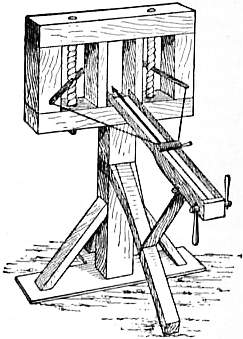
The war engines of the Romans, during the republic and early principate, are of the same type as those of Alexander’s successors in Greece. They are usually classed as (a) catapults and (b) ballistae (λιθοβόλοι). The former were smaller and were used with arrows for what is now called direct fire (i.e. at low angles of elevation); the latter were large siege engines discharging heavy bolts or stones at a high angle of elevation, like the modern howitzer. They were, of course, principally siege engines, but the smaller natures of catapult appear in field warfare from time to time, and eventually, during the early principate, they are found as part of the regulation equipment of infantry units. Both were constructed on the same principle.
The essential parts of the catapult (see illustration) were the frame, the propelling gear, the trough (corresponding to the modern barrel) and the pedestal. The frame consisted of two horizontal beams forming top and bottom sills, and four strong upright bars mortised into them. The three open spaces or compartments, resembling narrow windows, between these four uprights carried the propelling and laying gear. The propelling gear occupied the two outer “windows.” In each a thick skein of cord or sinews was fastened to the top and bottom sills and tightly twisted. Two stiff wooden arms were inserted in the two skeins, and a specially strong bowstring joined the tips of these arms. In the middle compartment was the hinged fore-end of the trough, which was at right angles to the frame and at the back of it. The trough could be laid for elevation by a movable prop, the upper end of which was hinged to the trough, while the lower ran up and down a sort of trail fastened to the pedestal. The whole equipment was laid for “line” by turning the frame, and with it the trough, prop and trail by a pivot in the head of the pedestal. Sliding up and down in the trough was a block, fitted with a trigger mechanism, through which passed the middle of the bowstring. The pedestal was a strong and solid upright resting upon, and strutted to, a framework on the ground; its upper end, as mentioned above, took the pivot of the frame and the head of the trail.
On coming into action the machine was laid for direction and elevation. The block and with it the bowstring was next forced back against the resistance of the twisted skeins to the rear end of the trough, this being effected by a windlass attachment. The trigger being then pressed or struck with a hammer, the bowstring was released from the block, the stiff arms were violently brought back to the frame by the untwisting of the skeins, and the arrow was propelled through the centre “window” with great velocity. A small machine of the type described weighed about 85 ℔, and sent a “three-span” (26-in.) arrow weighing ½ ℔ at an effective man-killing velocity somewhat over 400 yds.
The ballista was considerably larger and more expensive than this. In Scipio’s siege train, at the attack of New Carthage (Livy xxvi. 47. 5), the number of the ballistae was only one-sixth that of the catapults. In the ballista the rear end of the trough (which projected in front of the frame) always rested upon the ground, or rather was fixed to the framework of the pedestal—which was a heavy trestle construction—and the trough was thus restricted to the angle of elevation, giving the maximum range (45°). Even so the range was not appreciably greater than that of a catapult, and in the case of the largest ballistae (ninety-pounder) it was much less. These enormous engines, which, once in position, could not be laid on any fresh target, were used for propelling beams and stones rather than for shooting arrows, that is, more for the destruction of material than for man-killing effect. The skeins that supplied the motive force of all these engines were made of the sinews of animals, twisted raw hide, horsehair rope, and, in at least one celebrated case, of women’s hair. In 146 b.c., the authorities of Carthage having surrendered their engines to the Romans in the vain hope of staying their advance, new ones were hurriedly constructed, and the women and virgins of the city cut off their hair to supply the needed skeins.
The modern implement known as a “catapult” is formed by a forked stick, to the forks of which are attached the ends of a piece of elastic. To the middle of this elastic a pocket is fitted to contain a bullet or small stone. In use the forked stick is held in the left hand and the pocket drawn back with the right. Aim is taken and, the pocket being released, the missile flies through the fork of the stick. Though classed as a toy, this weapon can do considerable execution among birds, &c., when skilfully used. The name of “catapult” has also been given to a bowling machine which is used for cricket practice.
CATARACT (from the Lat. form cataracta of the Gr. καταρράκτης, a floodgate, or waterfall, properly something which rushes down), a downpour of water, a waterfall. The earliest use in English is of a floodgate or portcullis, and this survives in the name of a disease of the eye (see Eye: Eye Diseases), in which the crystalline lens becomes opaque, and forms an apparent grating over the eye. The term is also used of a device to regulate the strokes in certain types of steam-engine.
CATARGIU (or Catargi), LASCAR (1823-1899), Rumanian statesman, was born in Moldavia in November 1823. He belonged to an ancient Walachian family, one of whose members had been banished in the 17th century by Prince Matthew Bassaraba, and had settled in Moldavia. Under Prince Gregory Ghica (1849-1856), Catargiu rose to be prefect of police at Jassy. In 1857 he became a member of the Divan ad hoc of Moldavia, a commission elected in accordance with the treaty of Paris (1856) to vote on the proposed union of Moldavia and Walachia. His strongly conservative views, especially on agrarian reform, induced the Conservatives to support him as a candidate for the throne in 1859. During the reign of Prince Cuza (1859-1866), Catargiu was one of the Opposition leaders, and received much assistance from his kinsman, Barbu Catargiu (b. 1807), a noted journalist and politician, who was assassinated at Bucharest on the 20th of June 1862. On the accession of Prince Charles in May 1866, Lascar Catargiu became president of the council, or prime minister; but, finding himself unable to co-operate with his Liberal colleagues, I.C. Bratianu and C.A. Rosetti, he resigned in July. After eight more ministerial changes, culminating in the anti-dynastic agitation of 1870-1871, Catargiu formed, for the first time in Rumanian history, a stable Conservative cabinet, which lasted until 1876. His policy, which averted revolution and revived the popularity of the crown, was regarded as unpatriotic and reactionary by the Liberals, who resumed office in 1876; and a proposal to impeach the whole Catargiu cabinet was only withdrawn in 1878. Catargiu remained in opposition until 1889, when he formed another cabinet, taking the portfolio of the Interior; but this administration fell after seven months. In the Florescu ministry of March 1891 he occupied the same position, and in December he again became president of the council, retaining office until 1895. During this period he was responsible for several useful reforms, chiefly financial and commercial. He died suddenly at Bucharest on the 11th of April 1899.
CATARRH (from the Gr. καταρρεῖν, to flow down), a term principally employed to describe a state of irritation of the mucous membrane of the respiratory passages, or what is called in popular language a “cold.” It is the result of infection by a micro-organism in one or more of various predisposing conditions, damp, chill, fatigue, &c. The complaint usually begins as a nasal catarrh or coryza (Gr. κόρυς, head), with a feeling of weight about the forehead and some degree of difficulty in breathing through the nose, increased on lying down. Fits of sneezing accompanied with a profuse watery discharge from the nostrils and eyes soon follow, while the sense of smell and to some extent that of taste become considerably impaired. There is usually present some amount of sore throat and of bronchial irritation, causing hoarseness and cough. Sometimes the vocal apparatus becomes so much inflamed (laryngeal catarrh) that temporary loss of voice results. There is always more or less feverishness and discomfort, and frequently an extreme sensitiveness to cold. After two or three days the symptoms begin to abate, the discharge from the nostrils and chest becoming thicker and of purulent character, and producing when dislodged considerable relief to the breathing. On the other hand the catarrh may assume a more severe aspect and pass into some form of pulmonary inflammation (see Bronchitis) or influenza (q.v.).
When the symptoms are first felt it is well to take a good purge, and to encourage free perspiration by a hot bath, some diaphoretic drug, as spirits of nitrous ether, being taken before retiring to bed. Some of the older school of physicians still pin their faith to a dose of Dover’s powder. When the cold manifests itself by aches and pains in back and limbs, aspirin taken three or four times in the first twenty-four hours will often act like magic. Locally a snuff made of menthol 1 part, ammonium chloride 3 parts and boracic acid 2 parts will relieve the discomfort of the nose. Also, remembering the microbic origin of the disease, gargling and nasal syringing should be repeated at intervals. As soon as the attack shows signs of subsiding, a good tonic and, still better, a change of air are very helpful.
The term catarrh is used in medical nomenclature in a wider sense to describe a state of irritation of any mucous surface in the body, which is accompanied with an abnormal discharge of its natural secretion, hence the terms gastric catarrh, intestinal catarrh, &c.
See also Respiratory System: Pathology, and Digestive Organs, Pathology of.
CATARRHINE APE, the term used to describe those apes which have the nostrils approximated, the aperture pointing downward, and the intervening septum narrow; distinguishing features of both the lower “doglike” apes (Cynomorpha) and the higher “manlike” apes (Anthropomorpha). The Catarrhini are restricted entirely to the Old World, and include the gorilla, the chimpanzee and orang-utan.
CATASTROPHE (Gr. καταστροφή, from καταστρέφειν, to overturn), a term of the ancient Greek drama for the change in the plot which leads up to the conclusion. The word is thus used of any sudden change, particularly of a violent or disastrous nature, and in geology of a cataclysm or great convulsion of the earth’s surface.
CATAUXI, a numerous cannibal tribe of South American Indians of the Purus river district, Brazil. They are a fine warlike race, with remarkably clear complexions and handsome features; round wrists and ankles they wear rings of twisted hair. They cultivate mandioc, and make pottery and bark canoes.
CATAWBAS (from the Choctaw for “divided”), a tribe of North American Indians of Siouan stock; formerly the dominant people of South Carolina. Some of their divisions extended into North Carolina. They are now almost extinct, but were at one time able to send nearly 2000 “braves” into battle. In the American War of Independence they furnished a valuable contingent to the South Carolina troops. They then occupied a number of small towns on the Catawba river, but they afterwards leased their land and removed to the territory of the Cherokees, with whom they had been formerly at war. There, however, they did not long remain, but returned to a reservation in their original district. Their affinities have not been very clearly made out, and by Albert Gallatin they were grouped with the Cherokees, Choctaws, Muskogees and Natchez. A vocabulary of sixty of their words was published by Horatio Hale in vol. ii. of the Transactions of the American Ethnological Society in 1848; and a much fuller list—about 300—collected by Oscar M. Lieber, the geologist, in 1856, made its appearance in vol. ii. of Collections of the South Carolina Historical Society, 1858. Of the one hundred Catawbas still said to be surviving, few, if any, can claim to be full-blooded. They are in the Catawba Reservation in York county, South Carolina. The name is familiar in connexion with the white American wine, the praises of which have been sung by Longfellow. The grape from which the wine is obtained was first discovered about 1801, near the banks of the Catawba river, and named by Major Adlum in 1828, but it is now cultivated extensively in Illinois, Ohio and New York, and especially on the shores of Lake Erie.
See also Handbook of American Indians (Washington, 1907).
CATCH THE TEN, sometimes Called Scotch Whist, a game played with a pack of 36 cards, from ace, king, queen to six in each suit, the ace being highest both in play and cutting. In trumps, however, the knave ranks highest. Any number from two to eight may play. If an even number, partners are cut for; if odd, each plays for himself. An odd number of players sit as they like; four players sit as at whist; six playing in two sides sit so that no two partners shall be next each other; six playing three sides sit so that two opponents shall divide each pair; eight are arranged in alternate pairs. After cutting, the cards are dealt according to the number of players. The last card is turned up for the trump. When five or seven play, the six of spades is usually omitted; when eight play, the four sixes are thrown out. The eldest hand leads any card he chooses and all must follow suit if able, the penalty for a revoke being the loss of the game. The tricks are not kept separate but gathered in by one player for his side. At the end of the deal there are six hands of six cards on the table. The players first play out the first two hands, next the second two and finally the last two, the trump card remaining on the table until the first four hands are played out. The game is 41 points, the object of the play being to win the cards which have a special value. These are, with their values: knave of trumps 11, ace of trumps 4, king of trumps 3, queen of trumps 2, ten of trumps 10. All other cards have no counting value. As the ten can be taken by any other honour the object is to “catch the ten.”
CATECHISM (from Gr. κατηχεῖν, teach by word of mouth), a compendium of instruction (particularly of religious instruction) arranged in the form of questions and answers. The custom of catechizing, common to all civilized antiquity, was followed in the schools of Judaism and in the Early Church, where it helped to preserve the Gospel narrative (see Catechumen).
The catechism as we know it is intended primarily for children and uneducated persons. Its aim is to instruct, and it differs from a creed or confession in not being in the first instance an act of worship or a public profession of belief. The first regular catechisms seem to have grown out of the usual oral teaching of catechumens, and to have been compiled in the 8th and 9th centuries. Among them the work of Notker Labeo and of Kero, both monks of St Gall, and that of Ottfried of Weissenburg in Alsace deserve mention. But it is not until the first stirrings of revolt against the hierarchy, which preceded the Reformation, that they became at all widespread or numerous. The Waldenses of Savoy and France, the Brethren (small communities of evangelical dissenters from the medieval faith) of Germany, and the Unitas Fratrum of Bohemia all used the same catechism (one that was first printed in 1498, and which continued to be published till 1530) for the instruction of their children. It was based on St Augustine’s Enchiridion, and considers (a) Faith, i.e. the Creed, (b) Hope, i.e. the Lord’s Prayer, and (c) Love, i.e. the Decalogue.
The age of the Reformation gave a great stimulus to the production of catechisms. This was but natural at a time when the invention of printing had thrown the Bible open to all, and carried the war of religious opinion from the schools into the streets. The adherents of the “old” and the “new” religions alike had to justify their views to the unlearned as well as to the learned, and to give in simple formulas their reasons for the faith that was in them. Moreover, in the universal unrest and oversetting of all authority, Christianity itself was in danger of perishing, not only as the result of the cultured paganism of the Renaissance, but also through the brutish ignorance of the common folk, deprived now of their traditional religious restraints. To the urgency of this peril the reformers were fully alive; and they sought its remedy in education. “Let the people be taught,” said Luther, “let schools be opened for the poor, let the truth reach them in simple words in their own mother tongue, and they will believe.”
Catechisms of the Chief Religious Communions.—(a) Evangelical (Lutheran and Reformed).—It was the ignorance of the peasantry, as revealed by the horrors of the Peasants’ War of 1524-25, and his pastoral visitation of the electorate of Saxony 1525-1527, that drew the above exclamation from Luther, and impelled him to produce his two famous catechisms (1529). In 1520 he had brought out a primer of religion dealing briefly with the Decalogue, the Creed and the Lord’s Prayer; and Justus Jonas, Johannes Agricola and other leaders had done something of the same kind. Now all these efforts were superseded by Luther’s Smaller Catechism meant for the people themselves and especially for children, and by his Larger Catechism intended for clergy and schoolmasters. These works, which did much to mould the character of the German people, were set among the doctrinal standards of the Lutheran Church and powerfully influenced other compilations. The Smaller Catechism, with the Augsburg Confession, was made the Rule of Faith in Denmark in 1537.
In this same year (1537) John Calvin at Geneva published his catechism for children. It was called Instruction and Confession of Faith for the Use of the Church of Geneva (a reprint edited by A. Rilliet and T. Dufour Was published in 1878), and explained the Decalogue, the Apostles’ Creed, the Lord’s Prayer and the Sacraments. Though it was meant, as he said, to give expression to a simple piety rather than to exhibit a profound knowledge of religious truth, it was the work of a man who knew little of the child mind, and, though it served as an admirable and transparent epitome of his famous Institutes, it was too long and too minute for the instruction of children. Calvin came to see this, and in 1542, after his experience in Strassburg, drafted a new one which was much more suitable for teaching purposes, though, judged by modern standards, still far beyond the theological range of childhood. It was used at the Sunday noon instruction of children, on which Calvin laid much stress, and was adopted and similarly used by the Reformed Church of Scotland. The Reformed churches of the Palatinate, on the other hand, used the Heidelberg Catechism (1562-1563), “sweet-spirited, experiential, clear, moderate and happily-phrased,” mainly the work of two of Calvin’s younger disciples, Kaspar Olevianus and Zacharias Ursinus. The Heidelberg Catechism, set forth by order of the elector, is perhaps the most widely accepted symbol of the Calvinistic faith, and is noteworthy for its emphasis on the less controversial aspects of the Genevan theology. As revised by the synod of Dort in 1619, this catechism became the standard of most of the Reformed churches of central Europe, and in time of the Dutch and German Reformed churches of America. Other compilations were those of Oecolampadius (Basel, 1526), Leo Juda (Zürich, 1534), and Bullinger (Zürich, 1555). In France, after Calvin’s day, the Reformed church used besides Calvin’s book the catechisms of Louis Capell (1619), and Charles Drelincourt (1642), and at the present time Bonnefon’s Nouveau Catéchisme élémentaire (14th ed., 1900) seems most in favour. In Scotland both Calvin’s Geneva Catechism and then the Heidelberg Catechism were translated by order of the General Assembly and annotated. In 1592 these were superseded by that of John Craig, for a time the colleague of John Knox at the High Church, Edinburgh.
Since 1648 the standard Presbyterian catechisms have been those compiled by the Westminster Assembly, presented to parliament in 1647, and then authorized by the General Assembly of the Church of Scotland (July 1648) and by the Scottish parliament (January 1649). The Larger Catechism is “for such as have made some proficiency in the knowledge of the Christian religion,” but is too detailed and minute for memorizing, and has never received anything like the reception accorded to the Shorter Catechism, which is “for such as are of weaker capacity.” The work was done by a committee presided over first by Herbert Palmer, master of Queens’, Cambridge, and then by Anthony Tuckney, master of Emmanuel. The scriptural proof texts were added at the request of the English parliament. In his negotiations with the parliament in 1648 Charles I. offered to license the printing of the catechism, but, as the negotiations were broken off, this was not done. The Shorter Catechism, after a brief introduction on the end, rule and essence of religion, is divided into two parts:—I. The doctrines we are to believe (1) concerning the nature of God, (2) concerning the decrees of God and their execution—(a) in creation and providence, (b) in the covenant of works, (c) in the covenant of grace; II. The duties we are to perform (1) in regard to the moral law, (2) in regard to the gospel—(a) inward duties, i.e. faith and repentance, (b) outward duties as to the Word, the sacraments and prayer. It has 107 questions and answers, while that of the Anglican Church has but 24, grouping as it does the ten commandments and also the petitions of the Lord’s Prayer, instead of dealing with them singly. Though the Shorter Catechism, closely associated as this has been from the first with Scottish public elementary education, has had very great influence in forming and training the character of Presbyterians in Scotland, America and the British colonies, it is, like most other catechisms drawn up by dogmatic theologians, more admirable as an epitome of a particular body of divinity than as an instruction for the young and the unlearned. Its use is now generally preceded by something more adapted to the child-mind, and this is true also in other communions and in the case of other catechisms.
(b) Roman Catholic.—There was no universal catechism published by the Latin Church before the council of Trent, but several provincial councils, e.g. in Germany and Scotland (where Archbishop Hamilton’s catechism appeared in 1552 and was ordered to be read in church by the parish priest), moved in self-defence along the lines already adopted by the reformers. The council of Trent in 1563 resolved on an authoritative work which was finally carried through by two small papal commissions, and issued in 1566 by Pius V. (Eng. trans, by Donovan, Dublin, 1829). Being uncatechetical in form and addressed to the clergy rather than to the people, it missed its intention, and was superseded by others of less exalted origin, especially by those of the Jesuit Peter Canisius, whose Summa Doctrinae et Institutionis Christianae (1554) and its shorter form (1556) were already in the field. The catechisms of Bellarmine (1603) and Bossuet (1687) had considerable vogue, and a summary of the former known as Schema de Parvo was sanctioned by the Vatican council of 1870. But the Roman Catholic Church as a whole has never had any one official catechism, each bishop being allowed to settle the matter for his own diocese. In England the Roman Catholic bishops have agreed on the use of what is known as “The Penny Catechism,” which is very lucid and well constructed.
(c) Orthodox Eastern Church.—Peter Mogilas, metropolitan of Kiev, drew up in 1643 the Orthodox Confession of the Catholic and Apostolic Eastern Church. This bulwark against the encroachments of the Jesuits and the Reformed Church was standardized by the synod of Jerusalem in 1672. A smaller catechism was drawn up by order of Peter the Great in 1723. The catechisms of Levshin Platon (1762) and V.D. Philaret (1839), each in his day metropolitan of Moscow, are bulky compilations which cannot be memorized, though there is a short introductory catechism prefaced to Philaret’s volume (Eng. trans, in Blackmore’s Doctrine of the Russian Church, 1845). These works are not to any extent in the hands of the people, but are used by the Russian clergy and schoolmasters as guides in giving instruction. The Coptic and Armenian churches also have what H. Bonar describes as “mere pretences at catechisms.”
(d) Anglican.—The catechism of the Church of England is included in the Book of Common Prayer between the Orders for Baptism and Confirmation. It has two parts: (i.) the baptismal covenant, the Creed, the Decalogue and the Lord’s Prayer, drawn up probably by Cranmer1 and Ridley in the time of Edward VI., and variously modified between then (1549) and 1661; (ii.) the meaning of the two sacraments, written on the suggestion of James I. at the Hampton Court Conference in 1604 by John Overall, then dean of St Paul’s, and afterwards bishop successively of Coventry and Lichfield and of Norwich. This supplement to what had become known as the Shorter Catechism established its use as against the longer one, King Edward VIth’s Catechisme, which had been drawn up in 1553 by John Ponet or Poynet, bishop of Winchester, and then revised and enlarged in 1570 by Alexander Nowell, Overall’s predecessor as dean of St Paul’s. The Anglican catechism with occasional modification, especially in the sacramental section, is used not only in the Church of England but in the Episcopal churches of Ireland, Scotland, the British dominions and the United States of America. By the rubric of the Prayer Book and by the 59th canon of 1603 the clergy are enjoined to teach the catechism in church on Sundays and holidays after the second lesson at Evening Prayer. This custom, long fallen into disuse, has largely been revived during recent years, the children going to church for a special afternoon service of which catechizing is the chief feature. Compared with the thoroughness of most other catechisms this one seems very scanty, but it has a better chance of being memorized, and its very simplicity has given it a firm hold on the inner life and conscience of devout members of the Anglican communion throughout the world.
(e) Other Communions.—Almost every section of the church, e.g. the Wesleyan Methodist, has its catechism or catechisms, but in addition to those already enumerated only a few need be mentioned. The Socinians embodied their tenets in the larger and smaller works drawn up by Fausto Sozzini and Schmalz, and published at Rakow in Poland in 1605;2 modern Unitarians have modern catechisms. The Quakers or Friends possess a kind of catechism said to have been written by George Fox in 1660, in which father and son are respectively questioner and answerer, and an interesting work by Robert Barclay, in which texts of Scripture form the replies. Congregationalists for some time used Isaac Watts’s Catechisms for Children and Youth (1730), since superseded by the manuals of J.H. Stowell, J.H. Riddette and others. In 1898 the National Council of the Evangelical Free Churches in England and Wales published an Evangelical Free Church Catechism, the work of a committee (convened by Rev. Hugh Price Hughes) comprising Congregationalists, Baptists, Methodists (Wesleyan, Primitive and others), and Presbyterians, and thus representing directly or indirectly the beliefs of sixty or seventy millions of avowed Christians in all parts of the world, a striking example of inter-denominational unity. More remarkable still in some respects is The School Catechism, issued in 1907 by a conference of members of the Reformed churches in Scotland, which met on the invitation of the Church of Scotland. In its compilation representatives of the Episcopal Church in Scotland co-operated, and the book though “not designed to supersede the distinctive catechisms officially recognized by the several churches for the instruction of their own children,” certainly “commends itself as suitable for use in schools where children of various churches are taught together.”
Catechisms have a strong family likeness. In the main they are expositions of the Creed, the Lord’s Prayer and the Decalogue, and thus follow a tradition that has come down from the days when Cyril of Jerusalem delivered his catechetical Lectures. Even when (as in the Shorter Westminster Catechism and the School Catechism) the Creed is simply printed as an appendix, or where (as in the Free Church Catechism) it is not mentioned at all, its substance is dealt with. The order in which these three main themes are treated is by no means constant. The Heidelberg and Westminster Catechisms are of a more logical and independent character. The former is based on the Epistle to the Romans, and deals with the religious life as (1) Repentance, (2) Faith, (3) Love. Under these heads it discusses respectively the sin and misery of men, the redemption wrought by Christ (here are included the Creed and the Sacraments), and the grateful service of the new life (the Decalogue).
It may be noted that Sir Oliver Lodge has adopted the catechetical form in his book, The Substance of Faith Allied with Science (1907), which is described as “a catechism for parents and teachers.”
See Ehrenfeuchter, Geschichte des Katechismus (1857); P. Schaff, History of the Creeds of Christendom (3 vols., 1876-1877); Mitchell, Catechisms of the Second Reformation (1887); C. Achelis, Lehrbuch der prakt. Theologie (2 vols., 1898); L. Pullan, History of the Book of Common Prayer, pp. 207-208; E.A. Knox, Pastors and Teachers (1902), chs. iii. and iv.; W. Beveridge, A Short History of the Westminster Assembly (1904), ch. x.
(A. J. G.)
1 Cranmer bad published a separate and larger catechism on the basis of the work of Justus Jonas in 1548; note also Allen’s Catechisme, A Christen Instruccion of the Principall Pointes of Christes Religion (1551).
2 A Latin edition in 1609 was dedicated to James I. of England. The British Houses of Parliament passed a resolution ordering all copies of it to be publicly burned, and again in 1652 when another edition appeared. An English translation, probably by John Bidle, was printed in Amsterdam and widely circulated.
CATECHU, or Cutch (Malay, kachu), an extract obtained from several plants, its chief sources being the wood of two species of acacia (A. catechu and A. suma), both natives of India. This extract is known as black catechu. A similar extract, known in pharmacy as pale catechu (Catechu pallidum), and in general commerce as gambir, or terra japonica, is produced from the leaves of Uncaria gambir and U. acida, cinchonaceous plants growing in the East Indian Archipelago. A third product to which the name catechu is also applied, is obtained from the fruits of the areca or betel palm, Areca catechu.
Ordinary black catechu is usually imported in three different forms. The first and best quality, known as Pegu catechu, is obtained in blocks externally covered with large leaves; the second and less pure variety is in masses, which have been moulded in sand; and the third consists of large cubes packed in coarse bags. The wood of the two species of Acacia yielding catechu is taken for the manufacture when the trees have attained a diameter of about 1 ft. The bark is stripped off and used for tanning, and the trunk is split up into small fragments, which are covered with water and boiled. When the extract has become sufficiently thick it is cast into the forms in which the catechu is found in commerce. Catechu so prepared is a dark brown, or, in mass, almost black, substance, brittle, and having generally a shining lustre. It is astringent, with a sweetish taste. In cold water it disintegrates, and in boiling water, alcohol, acetic acid and strong caustic alkali it is completely dissolved. Chemically it consists of a mixture of a peculiar variety of tannin termed catechu-tannic acid with catechin or catechuic acid, and a brown substance due to the alteration of both these principles. Catechu-tannic acid is an amorphous body soluble in cold water, while catechin occurs in minute, white, silky, needle-shaped crystals, which do not dissolve in cold water. A very minute proportion of quercetin, a principle yielded by quercitron bark, has been obtained from catechu.
Gambir, which is similar in chemical composition to ordinary catechu, occurs in commerce in the form of cubes of about an inch in size, with a pale brown or yellow colour, and an even earthy fracture. For the preparation of this extract the plants above mentioned are stripped of their leaves and young twigs, and these are boiled down in shallow pans. The juice is strained off, evaporated, and when sufficiently concentrated is cast into shallow boxes, where, as it hardens and dries, it is cut into small cubes.
Gambir and catechu are extensively employed in dyeing and tanning. For dyeing they have been in use in India from the most remote period, but it was only during the 19th century that they were placed on the list of European dyeing substances. Catechu is fixed by oxidation of the colouring principle, catechin, on the cloth after dyeing or printing; and treated thus it yields a variety of durable tints of drabs, browns and olives with different mordants (see Dyeing). The principal consumption of catechu occurs in the preparation of fibrous substances exposed to water, such as fishing-lines and nets, and for colouring stout canvas used for covering boxes and portmanteaus under the name of tanned canvas. Black catechu is official in most pharmacopoeias except that of Great Britain, in which pale catechu is the official drug. The actions and uses of the two are similar, but black catechu is the more powerful. The dose is from five to twenty grains. The pulvis catechu compositus contains catechu and kino, and may be given in doses twice as large as those named. The drug has the actions and uses of tannic acid, but owing to the relative insolubility of catechu-tannic acid, it is more valuable than ordinary tannic acid in diarrhoea, dysentery and intestinal haemorrhage.
CATECHUMEN (Lat. catechumenus, Gr. κατηχούμενος, instructed, from κατηχεῖν, to teach orally), an ecclesiastical term applied to those receiving instruction in the principles of the Christian religion with a view to baptism. As soon as Christianity became a missionary religion, it was found necessary to make arrangements for giving instruction to new converts. At the beginning the Apostles themselves seem to have undertaken this duty, and the instruction was apparently given after baptism, for in Acts ii. 41, 42, we are told that “they that gladly received the word were baptized ... and they continued stedfastly in the Apostles’ teaching.” There are two instances in the New Testament where reference is made to individual instruction in this technical sense. Luke (i. 4) in dedicating the third Gospel to Theophilus tells him that his aim in writing the book was “that thou mightest have certainty in the things in which thou has been instructed” (κατηχήθης) and we are told that Apollos was instructed (κατηχημένος) “in the way of the Lord” (Acts xviii. 25).
With the development of Christianity the instruction became more definite and formal. It is probable that the duty of instructing converts was assigned to “the teachers,” who are ranked by Paul immediately after the Apostles and prophets (1 Cor. xii. 28), and occupied an important position in the Christian ministry. In the Didache, or Teaching of the Apostles, we have an excellent illustration of the teaching which was given to candidates for baptism in early times. There can be little doubt that the Didache was used as a manual for catechumens for several centuries. Athanasius (Festal Epistles, 39), for instance, says that “it was appointed by the Fathers to be read by those who are just recently coming to us, and wish to be instructed in the word of godliness” (κατηχεῖσθαι τὸν τῆς εὐσεβείας λόγον). The instruction prescribed by the Didache is very largely ethical, and stands in striking contrast to the more elaborate doctrinal teaching which came into vogue in later days. The Shepherd of Hermas too is another book which seems to have been used for the purpose of catechesis, for Eusebius says that it “was deemed most necessary for those who have need of elementary instruction” (Eccles. Hist. iii. 3-6).
With the rise of theological controversy and the growth of heresy catechetical instruction became of vital importance to the Church, and much greater importance was attached to it. After the middle of the 4th century it was regarded as essential that the candidate for baptism should not only be acquainted with the spiritual truths and ethical demands which form the basis of practical Christianity, but should also be trained in theology and the interpretation of the creeds. Two books have been preserved which throw a striking light upon the transformation which had taken place in the conception of catechesis; (1) the Catechetical Lectures of Cyril of Jerusalem; (2) the De rudibus Catechizandis of Augustine. Cyril’s Lectures may be termed the Pearson on the Creed of the 4th century. He takes each article separately, discusses it clause by clause, explains the meaning of each word, and justifies each statement from Scripture. Augustine’s treatise was written at the request of a catechist, named Deogratias, who had asked him for advice. After replying to the question of Deogratias, and giving sundry counsels as to the best method of interesting catechumens, Augustine concludes by giving a model catechetical lecture, in which he covers the whole of biblical history, beginning from the opening chapters of Genesis, and laying particular stress on the doctrinal parts of Scripture. Cyril and Augustine differ, as we should expect, in the doctrines which they select for emphasis, but they both agree in requiring a knowledge of sound doctrine on the part of the candidates.
In spite of the numerous references to catechumens in Patristic literature, our knowledge of the details of the system is often very deficient, and upon some points there is considerable diversity of opinion amongst experts. The following are the most important questions which come under consideration.
1. The Classification of Catechumens.—Bingham and many of the older writers held that there were four classes of catechumens, representing different stages in the process of instruction: (a) “The inquirers” whose interest in Christianity had been sufficiently aroused to make them desire further information, and who received private and individual instruction from the teachers before they were admitted into the second class, (b) “The hearers” (audientes), who were admitted into the Church for the purpose of listening to sermons and exhortations, (c) The prostrati or genu flectentes, who were allowed also to take part in the prayers, (d) The electi or competentes, who had completed the period of probation and were deemed ready to receive baptism. Modern scholars, however, for the most part, deny that there is sufficient basis to justify this elaborate classification, and think that its advocates have confused the catechumenate with the system of penance. The evidence does not seem to warrant more than two classes, (a) the audientes, who were in the initial stages of their training, (b) the competentes, who were qualified for baptism.
2. The Relation of Catechumens to the Church.—Catechumens were allowed of course to attend church services, but at a certain point were dismissed with the words “Ite catechumeni, missa est.” The moment at which the dismissal took place cannot be exactly determined, and it is not clear whether the catechumens were allowed to remain for a portion of the Communion service, and if so, whether as spectators or as partial participants. A passage in Augustine seems to imply that in some way they shared in the Sacrament, “that which they (the catechumens) receive, though it be not the Body of Christ, is yet an holy thing and more holy than the common food which sustains us, because it is a Sacrament” (De peccatorum meritis, ii. 42). The explanation of these words has occasioned considerable controversy. Many scholars hold (and this certainly seems the most natural interpretation) that consecrated bread was taken from the Eucharist and given to the catechumens. Bingham, however, maintains that the reference is not to the consecrated bread, but to salt, which was given to them as a symbol “that they might learn to purge and cleanse their souls from sin.”
3. The Duration of the Training.—Various statements with regard to the duration of the catechumenical training are found in ecclesiastical authorities. The Apostolical Constitutions, for instance, fix it at three years;1 the synod of Elvira at two.2 The references in the Fathers, however, imply that for practical purposes it was limited to the forty days of Lent. Very probably, however, the forty days of actual instruction were preceded by a period of probation.
4. The Relation between the Catechumenate and Baptism.—Catechetical instruction was designed as a preliminary to baptism. There were two directions, however, in which this purpose was enlarged: (a) We have no reason to suppose that when infant baptism was introduced, those who had been baptized in infancy were excluded from the catechetical training, or that instruction was deemed unnecessary in their case, though as a matter of fact we have no definite reference to their admission. The custom of postponing baptism, which was very general in the 4th and 5th centuries, probably made such cases more rare than is generally supposed, and so accounts for the absence of any allusion to them in connexion with the catechumenate. (b) We have no reason to suppose that the instruction given in the famous catechetical schools of Alexandria and Carthage was restricted to candidates for baptism. There is no doubt that “catechetical” is used in a much wider sense when applied to the lectures of Origen than when used of the addresses of Cyril of Jerusalem. The “instruction” of Origen was given to all classes of Christians, and not merely to those who were in the initial stages.
5. Characteristics of the Catechumenical Training.—Besides instruction there were some other important features connected with the catechumenate. (a) The duty of confession was impressed on the candidates. (b) The ceremony of exorcism was often performed in order to free the catechumen from evil spirits. (c) At a certain point in the training the creed and the doctrine of the Sacraments were delivered to the candidates by the bishop with much impressive ceremonial. This teaching constituted the “holy secret” or “mystery” (disciplina arcani) of Christianity, and could only be imparted to those who were qualified to receive it. The acquisition of this arcanum was regarded as the most essential element in the catechetical discipline, and marked off its possessors from the rest of the world. There can be little doubt that this conception of the “Holy Secret” came into the Church originally from the Greek mysteries, and that much of the ceremonial connected with the catechumenate and baptism was derived from the same source.
Authorities.—Cyril, Catecheses; Gregory of Nyssa, Oratio Catechetica; Chrysostom, Catecheses ad illuminandos; Augustine, De rudibus Catechizandis; Mayer, Geschichte des Katechumenats ... in den ersten sechs Jahrhunderten (1868); S. Cheetham, The Mysteries, Pagan and Christian.
(H. T. A.)
1 Apost. Constit. viii. 2.
2 Canon 42.
CATEGORY (Gr.: κατηγορία, “accusation”), a term used both in ordinary language and in philosophy with the general significance of “class” or “group.” In popular language it is used for any large group of similar things, and still more generally as a mere synonym for the word “class.” The word was introduced into philosophy as a technical term by Aristotle, who, however, several times used it in its original sense of “accusation.” He also used the verb κατηγορεῖν, to accuse, in the specific logical sense, to predicate; τὸ κατηγορούμενον becomes the predicate; and κατηγορικὴ πρότασις may be translated as affirmative proposition. But though the word thus received a new signification from Aristotle, it is not on that account certain that the thing it was taken to signify was equally a novelty in philosophy. In fact we find in the records of Oriental and early Greek thought something corresponding to the Aristotelian classification.
Our knowledge of Hindu philosophy, and of the relations in which it may have stood to Greek speculation, scarcely enables us to give decisive answers to various questions that naturally arise on observation of their many resemblances (see Hindu philosophy. an article by Richard Garbe in Monist, iv. 176-193). Yet the similarity between the two is so striking that, if not historically connected, they must at least be regarded as expressions of similar philosophic needs. The Hindu classification to which we specially refer is that of Kanada, who lays down six categories, or classes of existence, a seventh being generally added by the commentators. The term employed is Padārtha, meaning “signification of a word.” This is in entire harmony with the Aristotelian doctrine, the categories of which may with truth be described as significations of simple terms, τὰ κατὰ μηδεμίαν συηπλοκὴν λεγόμενα. The six categories of Kanada are Substance, Quality, Action, Genus, Individuality, and Concretion or Co-inherence. To these is added Non-Existence, Privation or Negation. Substance is the permanent substance in which Qualities exist. Action, belonging to or inhering in substances, is that which produces change, Genus belongs to substance, qualities and actions; there are higher and lower genera. Individuality, found only in substance, is that by which a thing is self-existent and marked off from others. Concretion or Co-inherence denotes inseparable or necessary connection, such as that between substance and quality. Under these six classes, γένη τοῦ ὄντος, Kanada then proceeds to range the facts of the universe.1
Within Greek philosophy itself there were foreshadowings of the Aristotelian doctrine, but nothing so important as to warrant the conclusion that Aristotle was directly influenced by it. Doubtless the One and Many, Being and Non-Being, of the Greek philosophy Eleatic dialectic, with their subordinate oppositions, may be called categories, but they are not so in the Aristotelian sense, and have little or nothing in common with the later system. Their starting-point and results are wholly diverse. Nor does it appear necessary to do more than mention the Pythagorean table of principles, the number of which is supposed to have given rise to the decuple arrangement adopted by Aristotle. The two classifications have nothing in common; no term in the one list appears in the other; and there is absolutely nothing in the Pythagorean principles which could have led to the theory of the categories.2
One naturally turns to Plato when endeavouring to discover the genesis of any Aristotelian doctrine, and undoubtedly there are in the Platonic writings many detached discussions in which the matter of the categories is touched upon. Special Plato. terms also are anticipated at various times, e.g. ποιότης in the Theaetetus, ποιεῖν and πάσχειν in the Gorgias, and πρός τι in the Sophist.3 But there does not seem to be anything in Plato which one could say gave occasion directly and of itself to the Aristotelian doctrine; and even when we take a more comprehensive view of the Platonic system and inquire what in it corresponds to the widest definition of categories, say as ultimate elements of thought and existence, we receive no very definite answer. The Platonic dialectic never worked out into system, and only in two dialogues do we get anything like a list of ultimate or root-notions. In the Sophist, Being, Rest and Motion (τὸ ὄν αύτὸ καὶ στάσις καὶ κίνησις) are laid down as μέγιστα τῶν γενῶν.4 To these are presently added the Same and the Other (ταὐτὁν καὶ θάτερον), and out of the consideration of all five some light is cast upon the obscure notion of Non-Being (το μὴ ὄν). In the same dialogue (262 seq.) is found the important distinction of ὄνομα and ῥῆμα, noun and verb. The Philebus presents us with a totally distinct classification into four elements—the Infinite, the Finite, the Mixture or Unity of both and the Cause of this unity (τὸ ἄπειρον, τὸ πέρας, ἡ σύμμιξις, ἡ αίτία). It is at once apparent that, however these classifications are related to one another and to the Platonic system, they lie in a different field from that occupied by the Aristotelian categories, and can hardly be said to have anything in common with them.
The Aristotelian doctrine is most distinctly formulated in the short treatise Κατηγορίαι, which generally occupies the first place among the books of the Organon. The authenticity of the treatise was doubted in early times by some of the Aristotle. commentators, and the doubts have been revived by such scholars as L. Spengel and Carl Prantl. On the other hand, C.A. Brandis, H. Bonitz, and Ed. Zeller are of opinion that the tract is substantially Aristotle’s. The matter is hardly one that can be decided either pro or con with anything like certainty; but this is of little moment, for the doctrine of the categories, even of the ten categories, does not stand or fall with only one portion of Aristotle’s works.
It is surprising that there should yet be so much uncertainty as to the real significance of the categories, and that we should be in nearly complete ignorance as to the process of thought by which, Aristotle was led to the doctrine. On both points It is difficult to extract from the matter before us anything approaching a satisfactory solution. The terms employed to denote the categories have been scrutinized with the utmost care, but they give little help. The most important—κ. τοῦ ὄντος or τῆς οὐσίας, γένη τοῦ ὄντος or τῶν ὄντων, γένη simply, τὰ πρῶτα or τὰ κοινὰ πρῶτα, αἱ πτῶσεις, or αἱ διαιρέσεις—only indicate that the categories are general classes into which Being as such may be divided, that they are summa genera. The expressions γένη τῶν κατηγορίων and σχήματα τῶν κ., which are used frequently, seem to lead to another and somewhat different view. κατηγορία being taken to mean that which is predicated, γένη τῶν κ. would signify the most general classes of predicates, the framework into the divisions of which all predicates must come. To this interpretation there are objections. The categories must be carefully distinguished from predicables; in the scholastic phraseology the former refer to first intentions, the latter to second intentions, i.e. the one denote real, the other logical connexion. Further, the categories cannot without careful explanation be defined as predicates; they are this and something more. The most important category, οὐσία, in one of its aspects cannot be predicate at all.
In the Κατηγορίαι Aristotle prefixes to his enumeration a grammatico-logical disquisition on homonyms and synonyms, and on the elements of the proposition, i.e. subject and predicate. He draws attention to the fact that things are spoken of either in the connexion known as the proposition, e.g. “a man runs,” or apart from such connexion, e.g. “man” and “runs.” He then proceeds, “Of things spoken of apart from their connexion in a proposition (τῶν κατὰ μηδεμίαν συμπλοκὴν λεγομένων), each signifies either Substance (οὐσία), or Quantity (ποσόν), or Quality (ποιόν), or Relation (πρός τι,) or Where (i.e. Place, ποῦ), or When (i.e. Time, ποτέ), or Position (κεῖσθαι), or Possession (ἔχειν), or Action (ποιεῖν), or Passion (πάσχειν). οὐσία, the first category, is subdivided into πρώτη οὐσία or primary substance, which is defined to be τόδε τι, the singular thing in which properties inhere, and to which predicates are attached, and δεύτεραι οὐσίαι, genera or species which can be predicated of primary substances, and are therefore οὐσία. only in a secondary sense. Nevertheless, they too, after a certain fashion, signify the singular thing, τόδε τι” (K. p. 3 b 12, 13). It is this doctrine of πρώτη οὐσία that has raised doubts with regard to the authenticity of the Κατηγορίαι But the tenfold classification, which has also been captiously objected to, is given in an acknowledged writing of Aristotle’s (see Topica, i. 9, p. 103 b 20).5 At the same time it is at least remarkable that in two places where the enumeration seems intended to be complete (Met. p. 1017 a 25; An. Pos. i. 22, p. 83 a 21), only eight are mentioned, ἔχειν and κεῖσθαι being omitted. In other passages6 six, five, four, and three are given, frequently with some addition, such as καὶ αἱ ἄλλαι κ. It is also to be observed that, despite of this wavering, distinct intimations are given by Aristotle that he regarded his list as complete, and he uses phrases which would seem to indicate that the division had been exhaustively carried out. He admits certainly that some predicates which come under one category might be referred to another, but he declines to deduce all from one highest class, or to recognize any relation of subordination among the several classes.
The full import of the categories will never be adequately reached from the point of view taken up in the Κατηγορίαι, which bears all the marks of an early and preliminary study. For true understanding we must turn to the Metaphysics, where the doctrine is handled at large. The discussion of Being in that work starts with a distinction that at once gives us a clue. τὸ ὄν is spoken of in many ways; of these four are classified—τὸ ὄν κατὰ συμβεβηκός, τὸ ὄν ὼς ὰληθές, τὸ ὄν δυνάμει καὶ ἑνεργείᾳ, and τὸ ὄν κατὰ τὰ σχήματα τῶν κατηγορίων. It is evident from this that the categories can be regarded neither as purely logical nor as purely metaphysical elements. They indicate the general forms or ways in which Being can be predicated; they are determinations of Being regarded as an object of thought, and consequently as matter of speech. It becomes apparent also why the analysis of the categories starts from the singular thing, for it is the primary form under which all that is becomes object of knowledge, and the other categories modify or qualify this real individual. Πάντα δὲ τὰ γιγνόμενα ὑπό τέ τινος γίγνεται καὶ ἔκ τινος καὶ τὶ. Τὸ δὲ τὶ λέγω καθ᾽ ἑκάστην κατηγορίαν᾽ ἢ γὰρ τόδε ἢ ποσὸν ἢ ποιὸν ἢ ποῦ (Met. p. 1032 a 13-15).... The categories, therefore, are not logical forms, but real predicates; they are the general modes in which Being may be expressed. The definite thing, that which comes forward in the process from potentiality to full actuality, can only appear and be spoken of under forms of individuality, quality, quantity and so on. The nine later categories all denote entity in a certain imperfect fashion.
The categories then are not to be regarded as heads of predicates, the framework into which predicates can be thrown. They are real determinations of Being—allgemeine Bestimmtheiten, as Hegel calls them. They are not summa genera of existences, still less are they to be explained as a classification of namable things in general. The objections Mill has taken to the list are entirely irrelevant, and would only have significance if the categories were really—what they are not—an exhaustive division of concrete existences. Grote’s view (Aristotle, i. 108) that Aristotle drew up his list by examining Various popular propositions, and throwing the different predicates into genera, “according as they stood in different logical relation to the subject,” has no foundation. The relation of the predicate category to the subject is not entirely a logical one; it is a relation of real existence, and wants the essential marks of the prepositional form. The logical relations of τὸ ὂν are provided for otherwise than by the categories.
Aristotle has given no intimation of the course of thought by which he was led to his tenfold arrangement, and it seems hopeless to discover it. Trendelenburg in various essays has worked out the idea that the root of the matter is to be found in grammatical considerations, that the categories originated from investigations into grammatical functions, and that a correspondence will be found to obtain between categories and parts of speech. Thus, Substance corresponds to noun substantive, Quantity and Quality to the adjective, Relation partly to the comparative degree and perhaps to the preposition, When and Where to the adverbs of time and place. Action to the active, Passion to the passive of the verb, Position (κεῖσθαι) to the intransitive verb, ἔχειν to the peculiar Greek perfect. That there should be a very close correspondence between the categories and grammatical elements is by no means surprising; that the one were deduced from the other is both philosophically and historically improbable. Reference to the detailed criticisms of Trendelenburg by Ritter, Bonitz, and Zeller will be sufficient.
Aristotle has also left us in doubt on another point. Why should there be only ten categories? and why should these be the ten? Kant and Hegel, it is well known, signalize as the great defect in the Aristotelian categories the want of a principle, and yet some of Aristotle’s expressions would warrant the inference that he had a principle, and that he thought his arrangement exhaustive. The leading idea of all later attempts at reduction to unity of principle, the division into substance and accident, was undoubtedly not overlooked by Aristotle, and Fr. Brentano7 has collected with great diligence passages which indicate how the complete list might have been deduced from this primary distinction. His tabular arrangements (pp. 175, 177) are particularly deserving of attention. The results, however, are hardly beyond the reach of doubt.
There was no fundamental change in the doctrine of the categories from the time of Aristotle to that of Kant, and only two proposed reclassifications are of such importance as to require notice. The Stoics adopted a fivefold arrangement of Later Greek. highest classes, γενικώτατα. τὸ ὄν or τὶ, Being, or somewhat in general, was subdivided into ὑποκείμενα or subjects, ποιά or qualities in general, which give definiteness to the blank subject, πὼς ἔχοντα, modes which further determine the subject, and πὼς ἔχοντα, definite relative modes. These categories are so related that each involves the existence of one higher than itself, thus there cannot be a πρός τι πὼς ἔχον which does not rest upon or imply a πὼς ἔχον, but πὼς ἔχον is impossible without ποιόν, which only exists in ὑποκείμενον, a form or phase of τὸ ὄν.8
Plotinus, after a lengthy critique of Aristotle’s categories, sets out a twofold list. τὸ ἔν, κίνησις, στάσις, ταὐτότης, ἑτερότης are the primitive categories (πρῶτα γένη) of the intelligible sphere. οὐσία, πρός τι, ποιά, ποσόν, κίνησις are the categories of the sensible world. The return to the Platonic classification will not escape notice.
Modern philosophy, neglecting altogether the dry and tasteless treatment of the Aristotelian doctrine by scholastic writers, gave a new, a wider and deeper meaning to the categories. They now appear as ultimate or root notions, the metaphysical Modern philosophy. or thought elements, which give coherence and consistency to the material of knowledge, the necessary and universal relations which obtain among the particulars of experience. There was thus to some extent a return to Platonism, but in reality, as might easily be shown, the new interpretation was, with due allowance for difference in point of view, in strict harmony with the true doctrine of Aristotle. The modern theory dates in particular from the time of Kant, who may be said to have reintroduced the term into philosophy. Naturally there are some anticipations in earlier thinkers. The Substance, Attribute and Mode of Cartesianism can hardly be classed among the categories; nor does Leibnitz’s chance suggestion of a fivefold arrangement into Substance, Quantity, Quality, Action and Passion, and Relations, demand any particular notice. Locke, too, has a classification into Substances, Modes and Relations, but in it he has manifestly no intention of drawing up a table of categories. What in his system corresponds most nearly to the modern view of these elements is the division of kinds of real predication. In all judgments of knowledge we predicate either (1) Identity or Diversity, (2) Relation, (3) Co-existence, or necessary connexion, or (4) Real existence. From this the transition was easy to Hume’s important classification of philosophical relations into those of Resemblance, Identity, Time and Place, Quantity or Number, Quality, Contrariety, Cause and Effect.
These attempts at an exhaustive distribution of the necessary relations of all objects of knowledge indicate the direction taken by modern thought, before it received its complete expression from Kant.
The doctrine of the categories is the very kernel of the Kantian system, and, through it, of later German philosophy. To explain it fully would be to write the history of that philosophy. The categories are called by Kant Root-notions of the Kant. Understanding (Stammbegriffe des Verstandes), and are briefly the specific forms of the a priori or formal element in rational cognition. It is this distinction of matter and form in knowledge that marks off the Kantian from the Aristotelian doctrine. To Kant knowledge was only possible as the synthesis of the material or a posteriori with the formal or a priori. The material to which a priori forms of the understanding were applied was the sensuous content of the pure intuitions, Time and Space. This content could not be known by sense, but only by intellectual function. But the understanding in the process of knowledge makes use of the universal form of synthesis, the judgment; intellectual function is essentially of the nature of judgment or the reduction of a manifold to unity through a conception. The specific or type forms of such function will, therefore, be expressed in judgments; and a complete classification of the forms of judgments is the key by which one may hope to discover the system of categories. Such a list of judgments Kant thought he found in ordinary logic, and from it he drew up his well-known scheme of the twelve categories. These forms are the determinations of all objects of experience, for it is only through them that the manifold of sense can be reduced to the unity of consciousness, and thereby constituted experience. They are a priori conditions, subjective in one sense, but objective as being universal, necessary and constitutive of experience.
The table of logical judgments with corresponding categories is as follows:—
Judgments. Categories.
Universal Particular Singular I. Of Quantity Unity. Plurality. Totality.
Affirmative Negative Infinite II. Of Quality Reality. Negation. Limitation.
Categorical Hypothetical Disjunctive III. Of Relation Inherence and Subsistence (Substance and Accident). Causality and Dependence (Cause and Effect). Community (Reciprocity).
Problematical Assertoric Apodictic IV. Of Modality Possibility and Impossibility. Existence and Non-Existence. Necessity and Contingency.
Kant, it is well known, criticizes Aristotle severely for having drawn up his categories without a principle, and claims to have disclosed the only possible method by which an exhaustive classification might be obtained. What he criticized in Aristotle is brought against his own procedure by the later German thinkers, particularly Fichte and Hegel. And in point of fact it cannot be denied that Kant has allowed too much completeness to the ordinary logical distribution of propositions; he has given no proof that in these forms are contained all species of synthesis, and in consequence he has failed to show that in the categories, or pure conceptions, are contained all the modes of a priori synthesis. Further, his principle has so far the unity he claimed for it, the unity of a single function, but the specific forms in which such unity manifests itself are not themselves accounted for by this principle. Kant himself hints more than once at the possibility of a completely rational system of the categories, at an evolution from one single movement of thought, and in his Remarks on the Table of the Categories gave a pregnant hint as to the method to be employed. From any complete realization of this suggestion Kant, however, was precluded by one portion of his theory. The categories, although the necessary conditions under which alone an object of experience can be thrown, are merely forms of the mind’s own activity; they apply only to sensuous and consequently subjective material. Outside of and beyond them lies the thing-in-itself, which to Kant represented the ultimately real. This subjectivism was a distinct hiatus in the Kantian system, and against it principally Fichte and Hegel directed criticism. It was manifest that at the root of the whole Fichte. system of categories there lay the synthetizing unity of self-consciousness, and it was upon this unity that Fichte fixed as giving the possibility of a more complete and rigorous deduction of the pure notions of the understanding. Without the act of the Ego, whereby it is self-conscious, there could be no knowledge, and this primitive act or function must be, he saw, the position or affirmation of itself by the Ego. The first principle then must be that the Ego posits itself as the Ego, that Ego = Ego, a principle which is unconditioned both in form and matter, and therefore capable of standing absolutely first, of being the prius in a system. Metaphysically regarded this act of self-position yields the categories of Reality. But, so far as matter is concerned, there cannot be affirmation without negation, omnis determinatio est negatio. The determination of the Ego presupposes or involves the Non-Ego. The form of the proposition in which this second act takes to itself expression, the Ego is not = Not-Ego, is unconditioned, not derivable from the first. It is the absolute antithesis to the primitive thesis. The category of Negation is the result of this second act. From these two propositions, involving absolutely opposed and mutually destructive elements, there results a third which reconciles both in a higher synthesis. The notion in this third is determination or limitation; the Ego and Non-Ego limit, and are opposed to one another. From these three positions Fichte proceeds to evolve the categories by a series of thesis, antithesis and synthesis.
In thus seizing upon the unity of self-consciousness as the origin for systematic development, Fichte has clearly taken a step in advance of, and yet in strict harmony with, the Kantian doctrine. For, after all that can be said as to the demonstrated character of formal logic, Kant’s procedure was empirical, and only after the list of categories had been drawn out, did he bring forward into prominence what gave them coherence and reality. The peculiar method of Fichte, also, was nothing but a consistent application of Kant’s own Remark on the Table of the Categories. Fichte’s doctrine, however, is open to some of the objections advanced against Kant. His method is too abstract and external, and wants the unity of a single principle. The first two of his fundamental propositions stand isolated from one another, not to be resolved into a primitive unity. With him, too, the whole stands yet on the plane of subjectivity. He speaks, indeed, of the universal Ego as distinct from the empirical self-consciousness; but the universal does not rise with him to concrete spirit. Nevertheless the Wissenschaftslehre contains the only real advance in the treatment of the categories from the time of Kant to that of Hegel.9 This, of course, does not imply that there were not certain elements in Schelling, particularly in the Transcendental Idealism, that are of value in the transition to the later system; but on the whole it is only in Hegel that the whole matter of the Kantian categories has been assimilated and carried to a higher stage. The Hegelian philosophy, in brief, is a system of the categories; and, as it is not intended here to expound that philosophy, it is impossible to give more than a few general and quite external observations as to the Hegelian mode of viewing these elements of thought. With Kant, as has been seen, the categories were still subjective, not as being forms of the individual subject, but as having over against them the world of noumena to which they were inapplicable. Self-consciousness, which was, even with Kant, the nodus or kernel whence the categories sprang, was nothing but a logical centre,—the reality was concealed. There was thus a dualism, to overcome which is the first step in the Hegelian system. The principle, if there is to be one, must be universally applicable, all-comprehensive. Self-consciousness is precisely the principle wanted; it is a unity, an identity, containing in itself a multiplicity. The universal in absolute self-consciousness is just pure thinking, which in systematic evolution is the categories; the particular is the natural or multiform, the external as such; the concrete of both is spirit, or self-consciousness come to itself. The same law that obtains among the categories is found adequate to an explanation of the external thing which had so sadly troubled Kant. The categories themselves are moments of the universal of thought, type forms, or definite aspects which thought assumes; determinations, Bestimmungen, as Hegel most frequently calls them. They evolve by the same law that was found to be the essence of ultimate reality—i.e. of self-consciousness. The complete system is pure thought, the Universal par excellence.
After the Hegelian there can hardly be said to have been a philosophical treatment of the categories in Germany which is not more or less a criticism of that system. It does not seem necessary to mention the unimportant modifications introduced by Kuno Fischer, J.E. Erdmann, or others belonging to the school. In the strongly-opposed philosophy of J.F. Herbart the categories can hardly be said to hold a prominent place. They are, with him, the most general notions which are psychologically formed, and he classifies them as follows:—(1) Thing, either as product of thought or as given in experience; (2) Property, either qualitative or quantitative; (3) Relation; (4) The Negated. Along with these he posits as categories of inner process—(1) Sensation, (2) Cognition, (3) Will, (4) Action. Joh. Fr. L. George (1811-1873),10 who in the main follows Schleiermacher, draws out a table of categories which shows, in some points, traces of Herbartian influence. His arrangement by enneads, or series of nine, is fanciful, and wanting in inner principle.
The most imposing of more recent attempts at a reconstruction of the categories is that of F.A. Trendelenburg. To him the first principle, or primitive reality, is Motion, which is both real as external movement, and ideal as inner construction. Trendelenburg. The necessary conditions of Motion are Time and Space, which are both subjective and objective. From this point onwards are developed the mathematical (point, line, &c.) and real (causality, substance, quantity, quality, &c.) categories which appear as involved in the notion of motion. Matter cannot be regarded as a product of motion; it is the condition of motion, we must think something moved. All these categories, “under the presupposition of motion as the first energy of thought, are ideal and subjective relations; as also, under the presupposition of motion as the first energy of Being, real and objective relations.”11 A serious difficulty presents itself in the next category, that of End (Zweck), which can easily be thought for inner activity, but can hardly be reconciled with real motion. Trendelenburg solves the difficulty only empirically, by pointing to the insufficiency of the merely mechanical to account for the organic. The consideration of Modality effects the transition to the forms of logical thought. On the whole, Trendelenburg’s unique fact of motion seems rather a blunder. There is much more involved than he is willing to allow, and motion per se is by no means adequate to self-consciousness. His theory has found little favour.
Hermann Ulrici works out a system of the categories from a psychological or logical point of view. To him the fundamental fact of philosophy is the distinguishing activity (unterscheidende Tätigkeit) of thought. Thought is only possible Ulrici. by distinction, difference. The fixed points in the relations of objects upon which this activity turns are the categories, which may be called the forms or laws of thought. They are the aspects of things, notions under which things must be brought, in order to become objects of thought. They are thus the most general predicates or heads of predicates. The categories cannot be completely gathered from experience, nor can they be evolved a priori; but, by attending to the general relations of thought and its purely indefinite matter, and examining what we must predicate in order to know Being, we may attain to a satisfactory list. Such a list is given in great detail in the System der Logik (1852), and in briefer, preciser form in the Compendium der Logik (2nd ed., 1872); it is in many points well deserving of attention.
The definition of the categories by the able French logician Charles Bernard Renouvier in some respects resembles that of Ulrici. To him the primitive fact is Relation, of which all the categories are but forms. “The categories,” he says, “are the Renouvier, Cousin, Hamilton, Mill. primary and irreducible laws of knowledge, the fundamental relations which determine its form and regulate its movements.” His table and his criticism of the Kantian theory are both of interest.12 The criticism of Kant’s categories by Cousin and his own attempted classification are of no importance. Of little more value is the elaborate table drawn out by Sir W. Hamilton.13 The generalized category of the Conditioned has but little meaning, and the subordinate categories evolve themselves by no principle, but are arranged after a formal and quite arbitrary manner. They are never brought into connexion with thought itself, nor could they be shown to spring from its nature and relations. J.S. Mill presented, “as a substitute for the abortive classification of Existences, termed the categories of Aristotle,” the following as an enumeration of all nameable things:—(1) Feelings, or states of consciousness; (2) The minds which experience these feelings; (3) Bodies, or external objects which excite certain of those feelings; (4) Successions and co-existences, likenesses and unlikenesses, between feelings or states of consciousness.14 This classification proceeds on a quite peculiar view of the categories, and is here presented only for the sake of completeness.
By modern psychologists the subject has been closely investigated. Professor G.F. Stout (Manual of Psychology, vol. ii. pp. 312 foll.) defines categories as “forms of cognitive consciousness, universal principles or relations presupposed either in all Modern psychologists. cognition or in all cognition of a certain kind.” He then treats External (or Physical) Reality, Space, Time, Causality and “Thinghood” from the standpoint of the perceptual consciousness; showing in what sense the categories of causality, substance and the rest exist in the sphere of perception. As contrasted with the ideational, the perceptual consciousness is concerned with practice. Perception tells the child of things as separate entities, not in their ultimate relations as parts of a coherent whole. G.T. Ladd (Psychology Descriptive and Explanatory, ch. xxi., on “Space, Time and Causality”) defines the categories from the psychological standpoint as “those highly abstract conceptions which the mind frames by reflection upon its own most general modes of behaviour. They are our own notions resulting from co-operation of imagination and judgment, concerning the ultimate and unanalyzable forms of our own existence and development.” In other words, the categories are highly abstract, have no content, and are realized as a kind of thinking which has for its object all the other mental processes.
Authorities.—Besides those quoted above, see Eduard v. Hartmann, Kategorienlehre (Leipzig, 1896), and “Begriff der Kategorialfunktion”, in Zeitschr. f. Philos. und phil. Krit. cxv. (1899), pp. 9-19; E. König in the same periodical cxiii. (1889), pp. 232-279, and cxiv. (1899), pp. 78-105; F.A. Trendelenburg, Geschichte der Kategorienlehre (1846); P. Ragnisco Storia critica delle categorie (2 vols., Florence, 1871); W. Windelband Vom System der Kategorien (Tübingen, 1900); R. Eisler, Wörterbuch der philospphischen Begriffe (Berlin, 1899), pp. 400-409; S. Joda, Studio critico su le categorie (Naples, 1881); H. Vaihinger, Die transcendentale Deduktion der Kategorien (Halle, 1902); H.W.B. Joseph, Introduction to Logic (Oxford, 1906), ch. iii.; F.H. Bradley, Principles of Logic (1883); B. Bosanquet’s Knowledge and Reality (1885, 2nd ed. 1892); histories of philosophy. For further authorities see works quoted under Aristotle and Kant, and in J.M. Baldwin’s Dict. Philos. Psych. vol. iii. pt. 2, p. 685.
(R. Ad.; X.)
1 For details of this and other Hindu systems see H. T. Colebrooke, Miscellaneous Essays (1837; new ed., E. B. Cowell, 1873); H. H. Wilson, Essays and Lectures on the Religions of the Hindus (1861-1862); Monier Williams, Indian Wisdom (4th ed., 1893); A. E. Gough’s Vaiseshika-Sutras (Benares, 1873), and Philosophy of the Upanishads (London, 1882, 1891); Max Müller, Sanskrit Literature, and particularly his appendix to Thomson’s Laws of Thought.
2 The supposed origin of that theory in the treatise περὶ τοῦ παντός, ascribed to Archytas (q.v.), has been proved to be an error. The treatise itself dates in all probability from the Neo-Pythagorean schools of the 2nd century a.d.