VOLUME V SLICE V Cat to Celt (continued 3)
Reading edition
3 Prantl, Ges. der Logik, i. 74-75; F.A. Trendelenburg, Kategorienlehre, 209. n.
4 Soph. 254 D.
5 Against this passage even Prantl can raise no objection of any moment; see Ges. der Logik, i. 206. n.
6 See Bonitz, Iridex Aristotelicus, s.v., and Prantl, Ges. der Logik, i. 207.
7 Brentano, Bedeutung des Seienden nach A., pp. 148-178.
8 For detailed examination of the Stoic categories, see Prantl, Ges. d. Logik, i. 428 sqq.; Zeller, Ph. d. Griech. iii. 1, 82, sqq,; Trendelenburg, Kateg. p. 217.
9 It does not seem necessary to do more than refer to the slight alterations made on Kant’s Table of Categories by J.G. von Herder (in the Metakritik), by Solomon Malmon (in the Propadeutik zu einer neuen Theorie des Denkens), by J.F. Fries (in the Neue Kritik der Vernunft), or by Schopenhauer, who desired to reduce all the categories to one—that of Causality. We should require a new philosophical vocabulary even to translate the extraordinary compounds in which K.C.F. Krause expounds his theory of the categories. Notices of the changes introduced by Antonio Rosmini-Serbati, and of Vincenzo Gioberti’s remarkable theory, will be found in Ragnisco’s work referred to below.
10 System der Metaphysik (1844).
11 Logische Untersuchungen, i. 376-377.
12 Essais de critique générale (2nd ed.), La Logique, i. pp. 184, 190, 207-225.
13 Discussions, p. 577.
14 Logic, i. 83; cf. Bain, Ded. Log., App. C.
CATENARY (from Lat. catena, a chain), in mathematics, the curve assumed by a uniform chain or string hanging freely between two supports. It was investigated by Galileo, who erroneously determined it to be a parabola; Jungius detected Galileo’s error, but the true form was not discovered until 1691, when James Bernoulli published it as a problem in the Acta Eruditorum. Bernoulli also considered the cases when (1) the chain was of variable density, (2) extensible, (3) acted upon at each point by a force directed to a fixed centre. These curves attracted much attention and were discussed by John Bernoulli, Leibnitz, Huygens, David Gregory and others.
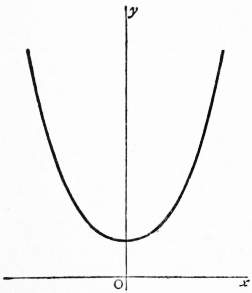
The mechanical properties of the curves are treated in the article Mechanics, where various forms are illustrated. The simple catenary is shown in the figure. The cartesian equation referred to the axis and directrix is y = c cosh (x/c) or y = ½c(ex/c + e−x/c); other forms are s = c sinh (x/c) and y² = c² + s², s being the arc measured from the vertex; the intrinsic equation is s = c tan ψ. The radius of curvature and normal are each equal to c sec² ψ.
The surface formed by revolving the catenary about its directrix is named the alysseide. It is a minimal surface, i.e. the catenary solves the problem: to find a curve joining two given points, which when revolved about a line co-planar with the points traces a surface of minimum area (see Variations, Calculus of).
The involute of the catenary is called the tractory, tractrix or antifriction curve; it has a cusp at the vertex of the catenary, and is asymptotic to the directrix. The cartesian equation is
x = √ (c² − y²) + ½c log [ {c − √ (c² − y²)} / {c + √ (c² + y²)} ],
and the curve has the geometrical property that the length of its tangent is constant. It is named the tractory, since a weight placed on the ground and drawn along by means of a flexible string by a person travelling in a straight line, the weight not being in this line, describes the curve in question. It is named the antifriction curve, since a pivot and step having the form of the surface generated by revolving the curve about its vertical axis wear away equally (see Mechanics: Applied).
CATERAN (from the Gaelic ceathairne, a collective word meaning “peasantry”), the band of fighting men of a Highland clan; hence the term is applied to the Highland, and later to any, marauders or cattle-lifters.
CATERHAM, an urban district in the Wimbledon parliamentary division of Surrey, England, 20 m. S. of London by the South-Eastern & Chatham railway. Pop. (1901) 9486. It lies in a healthy, hilly district, and has grown in modern times from a village into a large residential town. There are large barracks in the neighbourhood, and the Metropolitan lunatic asylum is close to the town.
CATERPILLAR, the popular name of the larva of various insects, particularly of butterflies and moths (see Lepidoptera, Hexapoda, Metamorphosis). The word appears first in the form caterpyl (Promptorium Parvulorum, about the middle of the 15th century). This may be the original form, with the addition of -ar or -er; if so, it represents the O. Fr. chatepelose or chatepeleuse, i.e. “hairy-cat” (chat, cat, and pelouse, hairy, Lat. pilosus), a name applied to the hairy caterpillar, and also according to Cotgrave to a weevil. The use of “cat” in this connexion is paralleled by the Swiss name for a caterpillar, teufelskatz, and the popular English name for the blossom of the willow, “catkin,” somewhat resembling a caterpillar (cf. “palmer”); the modern French is chenille, Latin canicula, a little dog. The termination of the word seems to have been early connected with “piller,” a robber, plunderer from the destructive habits of the larva, cf. Joel i. 4—”That which the palmer-worm hath left, hath the locust eaten.” The spelling “caterpillar,” a 17th century corruption, has been the usual form since Johnson.
CATESBY, ROBERT (1573-1605), English conspirator, son of Sir William Catesby of Lapworth in Warwickshire, a prominent recusant who was a descendant of Sir William Catesby, speaker of the House of Commons in 1484, executed by Henry VII. after the battle of Bosworth, was born in 1573, and entered Gloucester Hall (now Worcester College), Oxford, in 1586. He possessed a considerable estate, and was said to be wild and extravagant in his youth. In 1596 he was one of those arrested on suspicion during an illness of Queen Elizabeth. In 1601 he took part in the rebellion of Essex, was wounded in the fight and imprisoned, but finally pardoned on the payment of an enormous fine, to obtain which he was forced to sell a portion of his property. In 1602 he despatched Thomas Winter and the Jesuit Tesimond alias Greenway to Spain to induce Philip III. to organize an invasion of England, and in 1603, after James’s accession, he was named as an accomplice in the “Bye Plot.” Catesby was a man of great beauty of person, “above 2 yards high,” says Father Gerard, “and though slender, yet as well-proportioned to his height as any man one should see.” He possessed a clear head and unflinching courage, and with a strong determination and fascinating manner mastered the minds of his associates and overpowered all opposition. He was, however, headstrong, wilful and imprudent, fit for action, but incapable of due deliberation, and entirely wanting in foresight. Exasperated by his personal misfortunes and at the repressive measures under which his co-religionists were suffering, and blinded by a religious zeal which amounted to fanaticism, he was now to be the chief instigator of the famous Gunpowder Plot, which must in any event have brought disaster upon the Roman Catholic cause. The idea of some great stroke seems to have first entered his mind in May 1603. About the middle of January 1604 he imparted his scheme of blowing up the Parliament House to his cousin Thomas Winter, subsequently taking in Guy Fawkes and several other conspirators and overcoming all fears and scruples. But it was his determination, from which he would not be shaken, not to allow warning to be given to the Roman Catholic peers that was the actual cause of the failure of the plot. A fatal mistake had been made in imparting the secret to Francis Tresham (q.v.), in order to secure his financial assistance; and there is scarcely any doubt that he was the author of the celebrated letter to his brother-in-law, Lord Monteagle, which betrayed the conspiracy to the government, on the 26th of October. On receiving the news of the letter on the 28th, Catesby exhibited extraordinary coolness and fortitude, and refused to abandon the attempt, hoping that the government might despise the warning and still neglect precautions; and his confidence was strengthened by Fawkes’s report that nothing in the cellar had been touched or tampered with. On the 2nd of November his resolution was shaken by Tresham’s renewed entreaties that he would flee, and his positive assurance that Salisbury knew everything. On the evening of the 3rd, however, he was again, through Percy’s insistence, persuaded to stand firm and hazard the great stroke. The rest of the story is told in the article Gunpowder Plot. Here it need only be said that Catesby, after the discovery of the conspiracy, fled with his fellow-plotters, taking refuge ultimately at Holbeche in Staffordshire, where on the night of the 8th of November he was overtaken and killed. He had married Catherine, daughter of Thomas Leigh of Stoneleigh, Warwickshire, and left one son, Robert, who inherited that part of the family estate which had been settled on Catesby’s mother and was untouched by the attainder, and who is said to have married a daughter of Thomas Percy.
CAT-FISH, the name usually applied to the fishes of the family Siluridae, in allusion to the long barbels or feelers about the mouth, which have been compared to the whiskers of a cat. The Siluridae are a large and varied group, mostly inhabitants of fresh waters; some of them by their singular form and armature are suggestive of the Devonian mailed fishes, and were placed at one time in their vicinity by L. Agassiz. Even such authorities as T.H. Huxley and E.D. Cope were inclined to ascribe ganoid affinities to the Siluridae; but this view has gradually lost ground, and most modern ichthyologists, if not all, have adopted the conclusions of M. Sagemehl, who has placed the Siluridae near the carps and Characinids in the group Ostariophysi. The Silurids and Cyprinids may be regarded as two parallel series derived from some common stock which cannot have been very different from the existing Characinids. In spite of the archaic appearance of some of its members, the family Siluridae does not appear to extend far back in time, its oldest known representative being the Bucklandium diluvii of the Lower Eocene (London Clay) of Sheppey. A great number of forms were placed by Cuvier and his successors in the family Siluridae, which has since been broken up by T. Gill and other American authors into several families, united under the name of Nematognathi. A middle course appears the more reasonable to the present writer, who has divided the Siluridae of Cuvier into three families, with the following definitions:—
Siluridae—ribs attached to strong parapophyses; operculum well developed.
Loricariidae—ribs sessile; parapophyses absent; operculum more or less developed.
Aspredinidae—ribs sessile; strong parapophyses; operculum absent.
These three families may be defined among the Ostariophysi by having the parietal bones fused with the supraoccipital, no symplectic, the body naked or with bony scutes, the mouth usually toothed, with barbels, and usually an adipose dorsal fin.
The Siluridae embrace more than one thousand species, spread over the fresh waters of all parts of the world, but mostly from between the tropics. They are absent from western Europe and north-west Africa, and from North America west of the Rocky Mountains, but this deficiency has been made good by now, the introduction of Amiurus nebulosus and allied species in various parts of continental Europe and California having proved a success. Only a few forms are marine (Plotosus, Arius, Galeichthys).
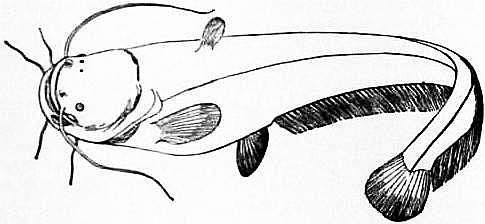
Fig. 1.—The “Wels” (Silurus glanis).
The species which has given the name to the whole family is the “Wels” of the Germans, Silurus glanis, the largest European fresh-water fish, inhabiting the greater part of Europe from the Rhine eastwards and north of the Alps. Its head is large and broad, its mouth wide, furnished with six barbels, of which those of the upper jaw are very long. Both jaws and the palate are armed with broad bands of small closely-set teeth, which give the bones a rasp-like appearance. The eyes are exceedingly small. The short body terminates in a long, compressed, muscular tail, and the whole fish is covered with a smooth, scaleless, slippery skin. Specimens of 4 and 5 ft. in length, and of 50 to 80 ℔ in weight, are of common occurrence, and the fish grows to 10 ft., with a weight of 400 ℔, in the Danube. Its food consists chiefly of other bottom-feeding fishes, and in inland countries it is considered one of the better class of food fishes. Stories about children having been found in the stomach of very large individuals are probably inventions. An allied species (S. aristotelis) is found in Greece.
The Clarias and Heterobranchus of Africa and south-eastern Asia have an elongate, more or less eel-shaped body, with long dorsal and anal fins, and are known to be able to live a long time out of water, being provided with an accessory dendritic breathing organ situated above the gills. Some species live in burrows during the dry season, crawling about at night in search of food. The common Nile species, the “Harmoot” (Clarias lazera), occurs abundantly in the Lake of Galilee and was included in, if not chiefly aimed at, by the Mosaic law which forbade the Jews to eat scaleless fishes, a prohibition which has been extended to eels in spite of the obvious presence of minute scales in the latter.
The Saccobranchus of India and Ceylon, a genus more nearly related to Silurus, have also an accessory organ for breathing atmospheric air. It consists of a long sac behind the gill-cavity, extending far back on each side of the body under the muscles.
In the majority of the Siluridae, called by A. Gunther the Proteropterae, a section extremely numerous in species, and represented throughout the tropics, the dorsal fin consists of a short-rayed and an adipose portion, the former belonging to the abdominal vertebral column; the anal is always much shorter than the tail. The gill-membranes are not confluent with the skin of the isthmus; they have a free posterior margin. When a nasal barbel is present, it belongs to the posterior nostril. This section includes among many others the genus Bagrus, of which the bayad (B. bayad) and docmac (B. docmac) frequently come under the notice of travellers on the Nile; they grow to a length of 5 ft. and are eaten.
Of the “cat-fishes” of North America (Amiurus), locally called “bull-heads” or “horned-pouts,” with eight barbels, some twenty species are known. Some of them are valued as food, especially one which is abundant in the ponds of New England, and capable of easy introduction into other localities (A. nebulosus). Others which inhabit the great lakes (A. nigricans) and the Mississippi (A. ponderosus) often exceed the weight of 100 ℔ Platystoma and Pimelodus people the rivers and lakes of tropical America, and many of them are conspicuous in this fauna by the ornamentation of their body, by long spatulate snouts, and by their great size.
The genus Arius is composed of a great number of species and has the widest distribution of all Silurids, being represented in almost all tropical countries which are drained by large rivers. Most of the species live in salt water. They possess six barbels, and their head is extensively osseous on its upper surface; their dorsal and pectoral spines are generally developed into powerful weapons. Bagarius, one of the largest Silurids of the rivers of India and Java, exceeding a length of 6 ft., differs from Arius in having eight barbels and the head covered with skin.
R. Semon has made observations in Queensland on the habits of Arius australis, which builds nests in the sandy bed of the Burnett river. These nests consist of circular basin-like excavations about 20 in. in diameter, at the bottom of which the eggs are laid and covered over by several layers of large stones. In the marine and estuarine species of Arius, Galcichthys and Osteogeniosus, the male, more rarely the female, carries the eggs in the mouth and pharynx; these eggs, few in number, are remarkably large, measuring as much as 17 or 18 millimetres in diameter in Arius commusonii, a fish 3 or 4 ft. in length.
The common North American Amiurus nebulosus also takes care of its eggs, which are deposited beneath protecting objects at the bottom of the water, failing which both parents join in excavating a sort of nest in the mud. The male watches over the eggs, and later leads the young in great schools near the shore, seemingly caring for them as the hen for her chickens.
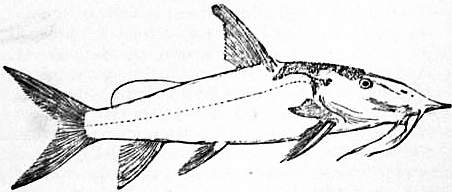
Fig. 2.—Synodonus xiphias.
In the Siluridae Stenobranchiae of Gunther the dorsal fin consists of an adipose portion and a short-rayed fin which belongs to the abdominal vertebral column, and, like the adipose fin, may be sometimes absent. The gill-membranes are confluent with the skin of the isthmus. The Silurids belonging to this section are either South American or African. Among the former we notice specially the genus Doras, which is distinguished by having a series of bony scutes along the middle of the side. The narrowness of their gill-openings appears to have developed in them a habit which has excited the attention of all naturalists who have visited the countries bordering upon the Atlantic rivers of tropical America, viz. the habit of travelling during seasons of drought from a piece of water about to dry up to ponds of greater capacity. These journeys are occasionally of such a length that the fish have to travel all night; they are so numerous that the Indians fill many baskets of them. J. Hancock supposes that the fish carry a small supply of water with them in their gill-cavity, which they can easily retain by closing their branchial apertures. The same naturalist adds that they make regular nests, in which they cover up their eggs with care and defend them—male and female uniting in this parental duty until the eggs are hatched. Synodontis is an African genus and common in the Nile, where the various species are known by the name of “Shal.” They frequently occur among the representations of animals left by the ancient Egyptians. The upper part of their head is protected by strong osseous scutes, and both the dorsal and pectoral fins are armed with powerful spines. Their mouth is small, surrounded by six barbels, which are more or less fringed with a membrane or with branched tentacles.
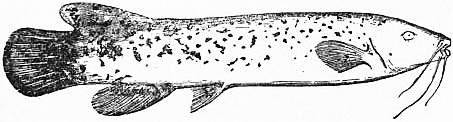
Fig. 3.—-Malopterurus electricus.
The curious fact of some species of Synodontis having the lower parts darker than the upper, some being whitish above and blackish beneath, appears to be connected with their habit of swimming in a reversed position, the Belly turned upwards. This habit, known to the ancient Egyptians, who have frequently represented them in that attitude, has been described by E. Geoffrey, who says they nearly constantly swim on their back, moving quite freely forwards and sidewards; but if alarmed, they revert to the normal position to escape more rapidly.
The electric cat- or sheath-fishes (Malopterurus) have been referred to the same section. Externally they are at once recognized by the absence of a rayed dorsal fin, of which only a rudiment remains as a small interneural spine concealed below the skin. The entire fish is covered with soft, villose skin, an osseous defensive armour having become unnecessary in consequence of the development of a powerful electric apparatus, the strength of which, however, is exceeded by that of the electric eel and the large species of Torpedo.
The electric organ of Malopterurus differs essentially from that of other fishes provided with such batteries, being part of the tegumentary system instead of being derived from the muscles. It consists of rhomboidal cells of a fine gelatinous substance immediately under the skin. It is put into action by a single ganglionic cell at the anterior extremity of the spinal cord. Contrary to what takes place in other electric fishes, the current proceeds from the head to the tail.
The electric cat-fish, which grows to a length of 3 ft. in the Congo, has a wide distribution in Africa, extending from the Nile to the Zambezi and from the Senegal to the Congo. It was well known to the ancient Egyptians, who have depicted it in their mural paintings and elsewhere, and an account of its electric properties was given by an Arab physician of the 12th century; then as now the fish was known under the suggestive name of Raad or Raash, which means “thunder.”
Günther’s Siluridae Branchicolae comprise the smallest and least developed members of the family; they are referred to two genera only from South America, Stegophilus and Vandellia, the smallest of which does not exceed the length of 2 in. Their body is soft, narrow, cylindrical and elongate; the dorsal and anal fins short; the vent far behind the middle of the length of the body; gill-membranes confluent with the skin of the isthmus. Each maxillary is provided with a small barbel; and the gill-covers are armed with short stiff spines. Their small size notwithstanding, these Silurids are well known to the Brazilians, who accuse them of entering and ascending the urethra of persons while bathing, causing inflammation and sometimes death. Some certainly live parasitically in the gill-cavity of large Silurids, and F. Silvestri has observed Stegophilus insidiosus to suck the blood in the gills of Platystoma coruscans, a Silurid growing to a length of 6 ft.
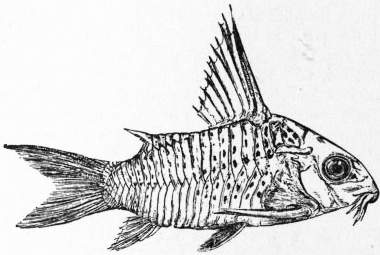
Fig. 4.—Callichthys armatus, from the upper Amazons.
The mailed cat-fish of the South American genus Callichthys builds regular nests of grass on leaves, sometimes placed in a hole scooped out in the bank, in which they cover their eggs and defend them, male and female sharing in this parental duty. In the allied Corydoras a lengthy courtship takes place, followed by an embrace, during which the female receives the seminal fluid in a sort of pouch formed by the folded membranes of her ventral fins; immediately after, five or six eggs are produced and received in the pouch, to be afterwards carefully placed in a secluded spot. This operation is repeated many times, until the total number of eggs, about 250, have been deposited. In accordance with these pairing habits, the pectoral spines of the male, which are used in amplexation, are larger and stronger than those of the female. These fish are monogamous, and both parents remain by the side of the nest, furiously attacking any assailant.
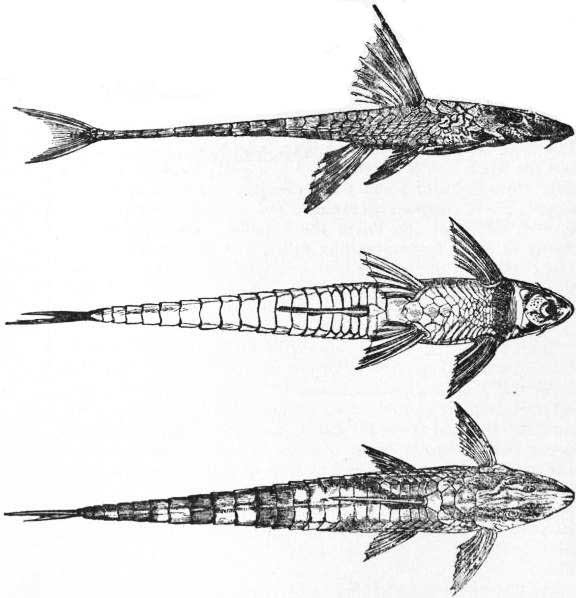
Fig. 5.—Loricaria lanceolata, from the upper Amazons.
The allied family Loricariidae is entirely confined to the fresh waters of Central and South America. C.T. Regan, who has recently published an elaborate monograph of them, recognizes 189 species, referred to 17 genera. Many of them are completely mailed; but all have in common a short-rayed dorsal fin, with the ventrals below or rarely in front of it. Their gill-openings are reduced to a short slit. The first group of this section comprises alpine forms of the Andes, without any armature, and with a very broad and pendent lower lip. They have been referred to several genera (Stygogenes, Arges, Brontes, Astroblepus), but are collectively called “preñadillas” by th natives, who state that they live in subterranean craters within the bowels of the volcanoes of the Andes, and are ejected with streams of mud and water during eruptions. These fishes may, however, be found in surface waters at all times, and their appearance in great quantities in the low country during volcanic eruptions can be accounted for by numbers being killed by the sulphuretted gases which escape during an eruption and by their being swept down with the torrents of water issuing from the volcano. The lowland forms have their body encased in large scutes, either rough, scale-like, and arranged in four or five series (Chaetostomus), or polished, forming broad rings round the slender and depressed tail (Loricaria, fig. 5). They are mostly of small size.
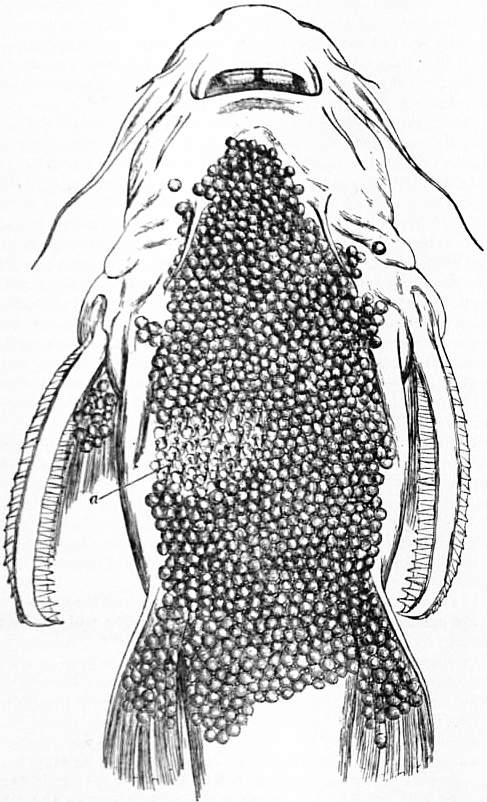
Fig. 6.—Abdomen of Aspredo batrachus, with the ova attached; at a the ova are removed, to show the spongy structure of the skin, and the processes filling the interspaces between the ova.
In certain of the mailed genera the secondary sexual differences may be very pronounced, and have given rise to many nominal species. The shape of the snout may differ according to the sex, and its margin may be beset with tentacles in the male, whilst it frequently happens that the head of the latter is margined with spines or bristles which are either absent or considerably shorter in the female.
The Aspredinidae, which are also closely related to the Siluridae, are represented by four genera and eighteen species from South America. Aspredo batrachus (fig. 6), of the Guianas, the largest form, reaching to about a foot in length, deserves notice from the manner in which the female carries her eggs attached to the belly and paired fins, in a single layer, each egg being connected with the skin by a cup-shaped pedunculate base supplied with blood-vessels and coated with a layer of epithelium, the formation of which is still unexplained.
(G. A. B.)
CATGUT, the name applied to cord of great toughness and tenacity prepared from the intestines of sheep, or occasionally from those of the horse, mule and ass. Those of the cat are not employed, and therefore it is supposed that the word is properly kitgut, kit meaning “fiddle,” and that the present form has arisen through confusion with kit = cat. The substance is used for the strings of harps and violins, as well as other stringed musical instruments, for hanging the weights of clocks, for bow-strings, and for suturing wounds in surgery. To prepare it the intestines are cleaned, freed from fat, and steeped for some time in water, after which their external membrane is scraped off with a blunt knife. They are then steeped for some time in an alkaline ley, smoothed and equalized by drawing out, subjected to the antiseptic action of the fumes of burning sulphur, if necessary dyed, sorted into sizes, and twisted together into cords of various numbers of strands according to their uses. The best strings for musical instruments are imported from Italy (“Roman strings”); and it is found that lean and ill-fed animals yield the toughest gut.
CATHA, the khat of the Arabs, a shrub widely distributed and much cultivated in Arabia and tropical Africa from, Abyssinia to the Cape. The dried leaves are used for the preparation of a kind of tea and also as tobacco. The plant is a member of the natural order Celastraceae, a family of shrubs and trees found in temperate and tropical climates and represented in Britain by the spindle-tree (Euonymus europaeus).
CATHARS (Cathari or Catharists), a widespread heretical sect of the middle ages. They were the débris of an early Christianity, scattered in the 10th to 14th centuries over East and West, having their analogues in the Mahommedan world as well. In the East they were called Bogomils (q.v.) and Paulicians; in the West, Patarenes, Tixerands (i.e. Weavers), Bulgars, Concorricii, Albanenses, Albigeois, &c.; in both, Cathars and Manicheans. This article relates to the Western Cathars, as they appear (1) in the Cathar Ritual written in Provençal and preserved in a 13th-century MS. in Lyons, published by Clédat, Paris, 1888; (2) in Bernard Gui’s Practica inquisitionis haereticae pravitatis, edited by Canon C. Douais, Paris, 1886; and (3) in the procès verbal of the inquisitors’ reports. Some were downright dualists, and believed that there are two gods or principles, one of good and the other of evil, both eternal; but as a rule they subordinated the evil to the good. All were universalists in so far as they believed in the ultimate salvation of all men.1
Their tenets were as follows:—The evil god, Satan, who inspired the malevolent parts of the Old Testament, is god and lord of this world, of the things that are seen and are temporal, and especially of the outward man which is decaying, of the earthen vessel, of the body of death, of the flesh which takes us captive under the law of sin and desire. This world is the only true purgatory and hell, being the antithesis of the world eternal, of the inward man renewed day by day, of Christ’s peace and kingdom which are not of this world. Men are the result of a primal war in heaven, when hosts of angels incited by Satan or Lucifer to revolt were driven out, and were imprisoned in terrestrial bodies created for them by the adversary. But there are also celestial bodies, bodies spiritual and not natural. These the angel souls left behind in heaven, and they are buildings from God, houses not made with hands, tunics eternal. Imprisoned in the garment of flesh, burdened with its sin, souls long to be clothed upon with the habitations they left in heaven. So long as they are at home in the body, they are absent from the Lord. They would fain be at home with the Lord, and absent from the body, for which there is no place in heaven since flesh and blood cannot inherit the kingdom of God, nor corruption inherit incorruption. There is no resurrection of the flesh. The true resurrection is the spiritual baptism bequeathed by Christ to the boni homines. How shall man escape from his prison-house of flesh, and undo the effects of his fall? For mere death brings no liberation, unless a man is become a new creation, a new Adam, as Christ was; unless he has received the gift of the spirit and become a vehicle of the Paraclete. If a man dies unreconciled to God through Christ, he must pass through another cycle of imprisonment in flesh; perhaps in a human, but with equal likelihood in an animal’s body. For when after death the powers of the air throng around and, persecute, the soul flees into the first lodging of clay that it finds.2 Christ was a life-giving spirit, and the boni homines, the “good men,” as the Cathars called themselves, are his ambassadors. They alone have kept the spiritual baptism with fire which Christ instituted, and which has no connexion with the water baptism of John; for the latter was an unregenerate soul, who failed to recognize the Christ, a Jew whose mode of baptism with water belongs to the fleeting outward world and is opposed to the kingdom of God. It would be interesting to trace Bardesanes and the Syriac Hymn of the Soul in all this.
The Cathars fell into two classes, corresponding to the Baptized and the Catechumens of the early church, namely, the Perfect, who had been “consoled,” i.e. had received the gift of the Paraclete; and the credentes or Believers. The Perfect formed the ordained priesthood, were women no less than men, and controlled the church; they received from the Believers unquestioning obedience, and as vessels of election in whom the Holy Spirit already dwelt, they were adored by the faithful, who were taught to prostrate themselves before them whenever they asked for their prayers. For none but the Consoled had received into their hearts the spirit of God’s Son, which cries “Abba, Father.” They alone were become adopted sons, and so able to use the Lord’s Prayer, which begins, “Our Father, which art in heaven.” The Perfect alone knew God and could address him in this prayer, the only one they used in their ceremonies. The mere credens could at best invoke the living saint, and ask him to pray for him.
All adherents of the sect seem to have kept three Lents in the year, as also to have fasted Mondays, Wednesdays and Fridays of each week; in these fasts a diet of bread and water was usual. But a credens under probation for initiation, which lasted at least one and often several years, fasted always. The life of a Perfect was so hard, and, thanks to the inquisitors, so fraught with danger, that most Believers deferred the rite until the death-bed, as in the early centuries many believers deferred baptism. The rule imposed complete chastity. A husband at initiation left his wife, committing her “to God and the gospel”; a wife her husband. A male Perfect could not lay his hand on a woman without incurring penance of a three-days’ fast. All begetting of children is evil, for Adam’s chambering with Eve was the forbidden fruit. It is good for a man not to touch a woman; a man’s relations with his own wife are merely a means of fornication, and marriage and concubinage are indistinguishable as against the kingdom of God, in which there is no marrying or giving in marriage. Those only have been redeemed from earth who were virgins, undefiled with women. The passages of the New Testament which seem to connive at the married relation were interpreted by the Cathars as spoken in regard of Christ and the church. The Perfect must also leave his father and mother, and his children, for a man’s foes are they of his own household. The family must be sacrificed to the divine kinship. He that loveth father or mother more than Christ is not worthy of him, nor he that loveth more his son or daughter. The Perfect takes up his cross and follows after Christ.
Next he must abstain from all flesh diet except fish. He may not even eat cheese or eggs or milk, for they, like meat, are produced per viam generationis seu coitus. Everything that is sexually begotten is impure. Fish were supposed to be born in the water without sexual connexion, and on the basis of this old physiological fallacy the Cathars equally with the Catholic framed their rule of fasting. And there was yet another reason why the Perfect should not eat animals, for a human soul might be doing time in its body. Nor might a Perfect or one in course of probation kill anything, for the Mosaic commandment applies to all life. He might not lie nor take an oath, for the precept “Swear not at all” was, like the rest of the gospel, taken seriously. This was the chief of their “anarchist doctrines.”3
The Cathar rites, which remain to us in a manual of the sect, “recall,” says the Abbé Guiraud, no too favourable a witness, “those of the primitive church with a truth and precision the more striking the nearer we go back to the apostolic age.” The medieval inquisitor saw in them an aping of the rites of the Catholic church as he knew them; but they were really, says the same authority, “archaeological vestiges (i.e. survivals) of the primitive Christian liturgy. In the bosom of medieval society they were the last witness to a state of things that the regular development of Catholic cult had amplified and modified. They resemble the erratic blocks which lost amid alien soils recall, where we find them, the geological conditions of earlier ages. This being so, it is of the deepest interest to study the Cathar cult, since through its rites we can get a glimpse of those of the primitive church, about which want of documents leaves us too often in the dark.”
The central Cathar rite was consolamentum, or baptism with spirit and fire. The spirit received was the Paraclete derived from God and sent by Christ, who said, “The Father is greater than I.” Of a consubstantial Trinity the Cathars naturally had never heard. Infant baptism they rejected because it was unscriptural, and because all baptism with water was an appanage of the Jewish demiurge Jehovah, and as such expressly rejected by Christ.
The consolamentum removes original sin, undoes the sad effects of the primal fall, clothes upon us our habitation which is from heaven, restores to us the lost tunic of immortality. A Consoled is an angel walking in the flesh, whom the thin screen of death alone separates from Christ and the beatific vision. The rite was appointed by Christ, and has been handed down from generation to generation by the boni homines.
The long probation called “abstinence” which led up to it is a survival of the primitive catechumenate with its scrutinies. The prostrations of the credens before the Perfect were in their manner and import identical with the prostrations of the catechumen before the exorcist. We find the same custom in the Celtic church of St Columba. Just as at the third scrutiny the early catechumen passed a last examination in the Gospels, Creed and Lord’s Prayer, so after their year of abstinence the credens receives creed and prayer; the allocution with which the elder “handed on” this prayer is preserved, and of it the Abbé Guiraud remarks that, if it were not in a Cathar ritual, one might believe it to be of Catholic origin. It is so Christian in tone, he quaintly remarks elsewhere, that an inquisitor might have used it quite as well as a heretic. In it the Perfect addresses the postulant, as in the corresponding Armenian rite, by the name of Peter; and explains to him from Scripture the indwelling of the spirit in the Perfect, and his adoption as a son by God. The Lord’s Prayer is then repeated by the postulant after the elder, who explains it clause by clause; the words panis superstantialis being interpreted not of the material but of the spiritual bread, which consists of the Words of Life.
There followed the Renunciation, primitive enough in form, but the postulant solemnly renounced, not Satan and his works and pomp, but the harlot church of the persecutors, whose prayers were more deadly than desirable. He renounced the cross which its priests had signed on him with their chrism, their sham baptisms and other magical rites. Next followed the spiritual baptism itself, consisting of imposition of hands, and holding of the Gospel on the postulant’s head. The elder begins a fresh allocution by citing Matt. xxviii. 19, Mark xvi. 15, 16, John iii. 3 (where the Cathars’ text must originally have omitted in v. 5 the words “of water and,” since their presence contradicts their argument). Acts ix. 17, 18, viii. 14-17, are then cited; also John xx. 21-23, Matt. xvi. 18, 19, Matt. xviii. 18-20, for the Perfect one receives in this rite power to bind and loose. The Perfect’s vocation is then defined: he must not commit adultery nor homicide, nor lie, nor swear any oath, nor pick and steal, nor do unto another that which he would not have done unto himself. He shall pardon his wrongdoers, love his enemies, pray for them that calumniate and accuse him, offer the other cheek to the smiter, give up his mantle to him that takes his tunic, neither judge nor condemn. Asked if he will fulfil each of these, the postulant answers: “I have this will and determination. Pray God for me that he give me his strength.”
The next episode of the rite exactly reproduces the Roman confiteor as it stood in the 2nd century; “the postulant says: ’Parcite nobis. For all the sins I have committed, in word or thought or deed, I come for pardon to God and to the church and to you all.’ And the Christians shall say: ‘By God and by us and by the church may they be pardoned thee, and we pray God that he pardon you them.’”
There follows the act of “consoling.” The elder takes the Gospel off the white cloth, where it has lain all through the ceremony, and places it on the postulant’s head, and the other good men present place their right hands on his head; they shall say the parcias (spare), and thrice the “Let us adore the Father and Son and Holy Spirit,” and then pray thus: “Holy Father, welcome thy servant in thy justice and send upon him thy grace and thy holy spirit.” Then they repeat the “Let us adore,” the Lord’s Prayer, and read the Gospel (John i. 1-17).
This was the vital part of the whole rite. The credens is now a Perfect one. He is girt with the sacred thread round his naked body under the breasts. Where the fear of the persecutor was absent he was also clad in a black gown. The Perfect ones present give him the kiss of peace, and the rite is over. This part of the rite answers partly to the Catholic confirmation of a baptized person, partly to the ordination of a pope of Rome or Alexandria. The latter in being ordained had the Gospel laid on their heads, and the same feature occurs in old Gallican and Coptic rites of ordaining a bishop.
Thus the Cathar ritual, like that of the Armenian dissenters (see Paulicians), reflects an age when priestly ordination was not yet differentiated from confirmation. “Is it not curious,” says the Abbé Guiraud, “to remark that the essential rite of the consolamentum is in effect nothing but the most ancient form of Christian ordination?”
The Cathar Eucharist was equally primitive, and is thus described by a contemporary writer in a 13th-century MS. of the Milan Library:—”The Benediction of bread is thus performed by the Cathars. They all, men and women, go up to a table, and standing up say the ‘Our Father.’4 And he who is prior among them, at the close of the Lord’s Prayer, shall take hold of the bread and say: ‘Thanks be to the God of our Jesus Christ. May the Spirit be with us all.’ And after that he breaks and distributes to all. And such bread is called bread blessed, although no one believes that out of it is made the body of Christ. The Albanenses, however, deny that it can be blessed or sanctified, because it is corporeal” (i.e. material).
As Tertullian relates of his contemporaries in the 2nd century, so the Cathars would reserve part of their bread of blessing and keep it for years, eating of it occasionally though only after saying the Benedicite. The Perfect kept it wrapped up in a bag of pure white cloth, tied round the neck,5 and sent it long distances to regions which through persecution they could not enter. On the death-bed it could even, like the Catholic Viaticum, take the place of the rite of Consolamentum, if this could not be performed. Once a month this solemn rite of breaking bread was held, the credentes assisting. The service was called apparellamentum, because a table was covered with a white cloth and the Gospel laid on it. The Perfect were adored, and the kiss of peace was passed round.
The influence of Catharism on the Catholic church was enormous. To counteract it celibacy was finally imposed on the clergy, and the great mendicant orders evolved; while the constant polemic of the Cathar teachers against the cruelty, rapacity and irascibility of the Jewish tribal god led the church to prohibit the circulation of the Old Testament among laymen. The sacrament of “extreme unction” was also evolved by way of competing with the death-bed consolamentum.
Authorities—J.J.I. Döllinger, Beiträge zur Sektengeschichte (München, 1890); Jean Guiraud, Questions d’histoire (Paris, 1906); F.C. Conybeare, The Key of Truth (Oxford, 1898); Henry C. Lea, History of the Inquisition (New York, 1888); C. Douais, L’Inquisition (Paris, 1906), and his Les Hérétiques du midi au XIIIe siècle (Paris, 1891); Les Albigeois (Paris, 1879); also Practica Inquisitionis (of Bernard Gui or Guidon), (Paris, 1886); L. Clédat, Le Nouveau Testament, traduit au XIIIe siècle en langue provençale, suivi d’un rituel cathare (Paris, 1887); E. Cunitz in Beiträge zu den theol. Wissensch. (1852), vol. iv.; P. van Limborch, Liber Sententiarum Inquis. Tholos. 1307-1323 (Amsterdam, 1692); Hahn, Gesch. der Ketzer im M.A. (Stuttgart, 1845); Ch. Schmidt, Histoire et doctrine de la secte des Cathares (Paris, 1849); A. Lombard, Pauliciens bulgares et Bons-Hommes (Geneva, 1879); Fredericq, Corpus documentorum haer, pravitatis Neerlandicae (Gent, 1889-1896); Felix Tocco, “Nuovi documenti” in Archiv. di studi ital. (1901), and his L’Eresia nel media evo (Florence, 1881); P. Flade, Das romische Inquisitions-verfahren in Deutschland (Leipzig, 1902); Ch. Molinier, “Rapport sur une mission en Italie,” in Archives scientifiques de Paris, tom. 14 (1888); C.H. Haskins, “Robert le Bougre,” in American Hist. Rev. (1902).
(F. C. C.)
1 A certain Peter (Doc. Doat., 22, p. 98) declared that could he but get hold of the false and perfidious God of the Catholics who created a thousand men in order to save a single one and damn all the rest, he would break him to pieces and tear him asunder with his nails and spit in his face.
2 Here we have a doctrine of metempsychosis which seems of Indian origin (see Asceticism). But Julius Caesar (de B.G. vi. 13) attests this belief among the ancient Druids of Gaul.
3 The Abbé Guiraud remarks that in refusing to take oaths the Cathars “contraried the social principles on which the constitutions of all states repose,” and congratulates himself that society is not yet so thoroughly “laicized” as to have given up oaths in the most important acts of social life.
4 Cf. S. Gregorii Ep. ix. 12 (26): “Mos apostolorum fuit ut ad ipsam solummodo orationem oblationis hostiam consecrarent.” (“The custom of the apostles was to use no other prayer but the Lord’s in consecrating the host of the offering.”)
5 Cf. Duchesne, Origines, ed. 1898, p. 177.
CATHAY, the name by which China (q.v.) was known to medieval Europe and is still occasionally referred to in poetry, as in Tennyson’s “Better fifty years of Europe than a cycle of Cathay.” It is derived from Khitāī, or Khitāt, the name which was properly that of the kingdom established by the Khitān conquerors in the northern provinces of China about a.d. 907, which after the fall of this dynasty in 1125 remained attached to their former territory, and was subsequently applied by the nations of Central Asia to the whole of China. Thus “Kitai” is still the Russian name for China. The name penetrated to Europe in the 13th century with the fame of the conquests of Jenghiz Khan. After the discovery of southern China by European navigators Cathay was erroneously believed to be a country to the north of China, and it was the desire to reach it that sent the English adventurers of the 16th century in search of the north-east passage.
CATHCART, SIR GEORGE (1794-1854), English soldier, third son of the 1st Earl Cathcart, was born in London on the 12th of May 1794. He was educated at Eton and Edinburgh University. In 1810 he entered the army, and two years later accompanied his father to Russia as aide-de-camp. With him he joined the Russian headquarters in March 1813; and he was present at all the great battles of that year in Germany, and of the following year in France, and also at the taking of Paris. The fruits of his careful observation and critical study of these operations appeared in the Commentaries on the war in Russia and Germany 1812-1813, a plain soldier-like history, which he published in 1850. After the peace of 1814 he accompanied his father to the congress of Vienna. He was present at Quatre Bras and at Waterloo, as an aide-de-camp to the duke of Wellington, and remained on the staff till the army of occupation quitted France. Reappointed almost immediately, he accompanied the duke to the congresses of Aix-la-Chapelle and Verona, and in 1826 to Prussia. Promoted lieutenant-colonel in 1826, he was placed on half-pay in 1834. He was recalled to active service in 1838, and sent as commander of the King’s Dragoon Guards to Canada, where he played an important part in suppressing the rebellion and pacifying the country. In 1844 he returned to England, and two years later was appointed deputy-lieutenant of the Tower, a post which he held up to the time of his promotion to major-general in 1851. In March 1852 he succeeded Sir Harry Smith as governor and commander-in-chief at the Cape, and brought the Kaffir war, then in progress, to a successful conclusion. He promulgated the first constitution of Cape Colony, and conducted operations against the Basuto. Cathcart was made a K.C.B. and received the thanks of both Houses for his services (1853). In December 1853 he was made adjutant-general of the army, but never entered upon his duties, being sent out to the Crimean War as soon as he arrived in England. He was even given a dormant commission entitling him to the chief command in case of accident to Lord Raglan, and the highest hopes were fixed on him as a scientific and experienced soldier. But these hopes were not to be fulfilled; for he fell at the battle of Inkerman (November 5, 1854). His remains, with those of other officers, were buried on Cathcart’s Hill. Sir George Cathcart married in 1824 Lady Georgiana Greville, who survived him, and by whom he had a family.
See Colburn’s United Service Magazine, January 1855; Correspondence of the Hon. Sir George Cathcart relative to Kaffraria (1856); A.W. Kinglake’s Invasion of the Crimea, vol. v.
CATHCART, WILLIAM SCHAW CATHCART, 1st Earl (1755-1843), English soldier and diplomatist, was born at Petersham on the 17th of September 1755, and educated at Eton. In 1771 he went to St Petersburg, where his father, Charles, 9th Baron Cathcart (1721-1776), a general in the army, was ambassador. From 1773 to 1777 he studied law, but after succeeding to the barony in 1776 he obtained a commission in the cavalry. Proceeding to America in 1777, he had before the close of his first campaign twice won promotion on the field of battle. In 1778 he further distinguished himself in outpost work, and at the battle of Monmouth he commanded an irregular corps, the “British Legion,” with conspicuous success; for a time also he acted as quartermaster-general to the forces in America. He returned home in 1780, and in February 1781 was made captain and lieutenant-colonel in the Coldstream Guards. He was elected a representative peer for Scotland in 1788, and in 1792 he became colonel of the 29th foot. He served with distinction in the campaigns in the Low Countries, 1793-1795, in the course of which he was promoted major-general; and in 1801 he was made a lieutenant-general, having in the meanwhile received the appointments of vice-admiral of Scotland (1795), privy councillor (1798), and colonel of the 2nd Life Guards (1797). From 1803 to 1805 Lord Cathcart was commander-in-chief in Ireland, and in the latter year he was sent by Pitt in command of the British expedition to Hanover (see Napoleonic Campaigns). After the recall of this expedition Cathcart commanded the forces in Scotland until 1807, when he was placed in charge of the expedition to Copenhagen, which surrendered to him on the 6th of September. Four weeks later he was created Viscount Cathcart of Cathcart and Baron Greenock of Greenock in the peerage of the United Kingdom, resuming the Scottish command on his return from the front. On the 1st of January 1812 he was promoted to the full rank of general, and a few months later he proceeded to Russia as ambassador and military commissioner. In the latter capacity he served with the headquarters of the allies throughout the War of Liberation (1812-1814); his success in the delicate and difficult task of maintaining harmony and devotion to the common cause amongst the generals of many nationalities was recognized after the war by his elevation to the earldom (July 1814). He then went to St Petersburg, and continued to hold the post of ambassador until 1820, when he returned to England. He died at his estate near Glasgow on the 16th of June 1843.
His son, Charles Murray Cathcart, 2nd earl (1783-1859), succeeded to the title in 1843. He entered the 2nd Life Guards in 1800, and saw active service under Sir James Craig in the Mediterranean, 1805-1806. In 1807 he became by courtesy Lord Greenock. He took part in the Walcheren expedition of 1809 as a major, and as a lieutenant-colonel served at Barossa, Salamanca and Vittoria. He had already gained staff experience, and he now served under Graham in Holland, 1814, as quartermaster-general. He was present at Waterloo, and for his services received the C.B. and several foreign orders. During the peace he became deeply interested in scientific pursuits, and a new mineral discovered by him in 1841 was named Greenockite. His later military services included the chief command in Canada during a period of grave unrest (1846-1849). He retired from active service in 1850, becoming a full general just before his death. The title passed to his son and grandson as 3rd and 4th earls.
CATHCART, a parish situated partly in Renfrewshire and partly in Lanarkshire, Scotland. The Renfrewshire portion has the larger area (2387 acres), but the smaller population (7375), the area of the Lanarkshire portion being 745 acres and the population (1901) 20,983. The industries include paper-making, dyeing and sandstone quarrying, but limestone and coal have also been worked. The parish includes the town of Cathcart (pop. 4808), and the villages of Old and New Cathcart, but much of it, though outside the city boundaries, is practically continuous with some of the southern suburbs of Glasgow, with which there is communication by electric tram and the Caledonian railway’s circular line. The White Cart flows through the parish. In the 12th century Cathcart became a barony of the Cathcarts, who derived the title of their lordship (1460) and earldom (1814) from it. On the Queen’s Knowe, a hillock near the ruins of Cathcart Castle, a memorial marks the spot where Queen Mary watched the progress of the battle of Langside (1568), the site of which lies within the parish.
CATHEDRAL, more correctly “cathedral church” (ecclesia cathedralis), the church which contains the official “seat” or throne of a bishop—cathedra, one of the Latin names for this, giving us the adjective “cathedral.” The adjective has gradually, for briefness of speech, assumed the character of a substantive, but though an instance of this (strictly incorrect) use of the word as a substantive has been found as far back as 1587, it became common only at the end of the 18th, or first half of the 19th, century. One of the earliest instances of the term ecclesia cathedralis is said to occur in the acts of the council of Tarragona in 516. Another name for a cathedral church is ecclesia mater, indicating that it is the mother church. As being the one important church, it was also known as ecclesia major. This is the formal expression used by Archbishop Walter Gray of York (1216-1255), and it is preserved in modern times by the name of “La Majeure,” by which the old cathedral church of Marseilles is popularly known. Again, as the chief house of God, the cathedral church was the Domus Dei, and from this name the German Domkirche, or Dom, is derived, as also the Swedish Domkyrka, and the Italian Duomo.
History and Organization.—It was early decreed that the cathedra of a bishop was not to be placed in the church of a village, but only in that of a city. There was no difficulty as to this on the continent of Europe, where towns were numerous, and where the cities were the natural centres from which Christianity was diffused among the people who inhabited the surrounding districts. In the British islands, however, the case was different; towns were few, and owing to other causes, instead of exercising jurisdiction over definite areas or districts, many of the bishops were bishops of tribes or peoples, as the bishops of the south Saxons, the west Saxons, the Somersaetas and others. The cathedra of such a bishop was often migratory, and was at times placed in one church, and then another, and sometimes in the church of a village. In 1075 a council was held in London, under the presidency of Archbishop Lanfranc, which, reciting the decrees of the council of Sardica held in 347 and that of Laodicea held in 360 on this matter, ordered the bishop of the south Saxons to remove his see from Selsey to Chichester; the Wilts and Dorset bishop to remove his cathedra from Sherborne to Old Sarum, and the Mercian bishop, whose cathedra was then at Lichfield, to transfer it to Chester. Traces of the tribal and migratory system may still be noted in the designations of the Irish see of Meath (where the result has been that there is now no cathedral church) and Ossory, the cathedral church of which is at Kilkenny. Some of the Scottish sees were also migratory.
By the canon law the bishop is regarded as the pastor of the cathedral church, the parochia of which is his diocese. In view of this, canonists speak of the cathedral church as the one church of the diocese, and all others are deemed chapels in their relation to it.
Occasionally two churches jointly share the distinction of containing the bishop’s cathedra. In such case they are said to be con-cathedral in relation to each other. Instances of this occurred in England before the Reformation in the dioceses of Bath and Wells, and of Coventry and Lichfield. Hence the double titles of those dioceses. In Ireland an example occurs at Dublin, where Christ Church and St Patrick’s are jointly the cathedral churches of that diocese. In France the bishop of Couserans (a see suppressed at the Revolution) had two con-cathedral churches at St Lizier, and the bishop of Sisteron (a see also suppressed) had a second throne in the church of Forcalquier which is still called “La Con-cathédrale.” Other instances might be named. In the case of York the collegiate churches of Beverley, Ripon and Southwell were almost in the same position, but although the archbishop had a stall in each he had no diocesan cathedra in them, and the chapters were not united with that of the metropolitical church in the direct government of the diocese, or the election of the archbishop, nor had they those other rights which were held to denote the cathedral character of a church.
Cathedral churches are reckoned as of different degrees of dignity: (1) the simple cathedral church of a diocesan bishop, (2) the metropolitical church to which the other diocesan cathedral churches of a province are suffragan, (3) the primatial church under which are ranged metropolitical churches and their provinces, (4) patriarchal churches to which primatial, metropolitical, and simple cathedral churches alike owe allegiance. The title of “primate” was occasionally conferred on metropolitans of sees of great dignity or importance, such as Canterbury, York, Rouen, &c., whose cathedral churches remained simply metropolitical. Lyons, where the cathedral church is still known as “La Primatiale,” and Lund in Sweden, may be cited as instances of churches which were really primatial. Lyons had the archbishops of Sens and Paris and their provincial dioceses subject to it till the Revolution, and Lund had the archbishop of Upsala and his province subject to it. As with the title of primate, so also that of “patriarch” has been conferred on sees such as Venice and Lisbon, the cathedral churches of which are patriarchal in name alone. The cathedral church of St John Lateran, the cathedral church of the pope as bishop of Rome and patriarch of the West, alone in western Europe possesses potentially a patriarchal character. Its formal designation is “Patriarchalis Basilica, Sacrosancta Romana Cathedralis Ecclesia Lateranensis.”
The removal of a bishop’s cathedra from a church deprives that church of its cathedral dignity, although often the name clings in common speech, as for example at Antwerp, which was deprived of its bishop at the French Revolution.
The history of the body of clergy attached to the cathedral church is obscure, and as in each case local considerations affected its development, all that can be attempted is to give a general outline of the main features which were more or less common to all. Originally the bishop and cathedral clergy formed a kind of religious community, which, in no true sense a monastery, was nevertheless often called a monasterium. The word had not the restricted meaning which it afterwards acquired. Hence the apparent anomaly that churches like York and Lincoln, which never had any monks attached to them, have inherited the name of minster or monastery. In these early communities the clergy often lived apart in their own dwellings, and were not infrequently married. In the 8th century, however, Chrodegang, bishop of Metz (743-766), compiled a code of rules for the clergy of the cathedral churches, which, though widely accepted in Germany and other parts of the continent, gained little acceptance in England. According to Chrodegang’s rule the cathedral clergy were to live under a common roof, occupy a common dormitory and submit to the authority of a special officer. The rule of Chrodegang was, in fact, a modification of the Benedictine rule. Gisa, a native of Lorraine, who was bishop of Wells from 1061 to 1088, introduced it into England, and imposed its observance on the clergy of his cathedral church, but it was not followed for long there, or elsewhere in England.
During the two centuries, roughly bounded by the years 900 and 1100, the cathedral clergy became more definitely organized, and were also divided into two classes. One was that of a monastic establishment of some recognized order of monks, very often that of the Benedictines, while the other class was that of a college of clergy, living in the world, and bound by no vows, except those of their ordination, but governed by a code of statutes or canons. Hence the name of “canon” given to them. In this way arose the distinction between the monastic and secular cathedral churches. In England the monastic cathedral churches were Bath, Canterbury, Carlisle, Coventry, Durham, Ely, Norwich, Rochester, Winchester and Worcester, all of them Benedictine except Carlisle, which was a church of Augustinians. The secular churches were Chichester, Exeter, Hereford, Lichfield, Lincoln, St Paul’s (London), Salisbury, Wells, York, and the four Welsh cathedral churches. In Ireland all were secular except Christ Church, Dublin (Augustinian), and Down (Benedictine), and none, even in their earliest days, were ever, it is believed, churches of recognized orders of monks, except the two named. In Scotland St Andrew’s was Augustinian, Elgin (or Moray), Glasgow and Aberdeen were always secular, and ordered on the models of Lincoln and Salisbury. Brechin had a community of Culdees till 1372, when a secular chapter was constituted. The cathedral church of Galloway, at Whithorn, of English foundation, was a church of Praemonstratensians. In Germany, as in England, many of the cathedral churches were monastic. In Denmark all seem to have been Benedictine at first, except Borglum, which was Praemonstratensian till the Reformation. The others were changed to churches of secular canons. In Sweden, Upsala was originally Benedictine, but was secularized about 1250, and it was ordered that each of the cathedral churches of Sweden should have a chapter of at least fifteen secular canons. In France monastic chapters were very common, but nearly all the monastic cathedral churches there had been changed to churches of secular canons before the 17th century. One of the latest to be so changed was that of Seez, in Normandy, which was Augustinian till 1547, when Pope Paul III. dispensed the members from their vows, and constituted them a chapter of secular canons. The chapter of Senez was monastic till 1647, and others perhaps even later, but the majority were secularized about the time of the Reformation.
In the case of monastic cathedral churches there were no dignitaries, the internal government was that of the order to which the chapter belonged, and all the members kept perpetual residence. The reverse of this was the case with the secular chapters; the dignities of provost, dean, precentor, chancellor, treasurer, &c., soon came into being, for the regulation and good order of the church and its services, while the non-residence of the canons, rather than their perpetual residence, became the rule, and led to their duties being performed by a body of “vicars,” who officiated for them at the services of the church.
Abroad, the earliest head of a secular church seems to have been the provost (praepositus, Probst, &c.), who was charged, not only with the internal regulation of the church, and oversight of the members of the chapter and control of the services, but was also the steward or seneschal of the lands and possessions of the church. The latter often mainly engaged his attention, to the neglect of his domestic and ecclesiastical duties, and complaints were soon raised that the provost was too much mixed in worldly affairs, and was too frequently absent from his spiritual duties. This led, in many cases, to the institution of a new officer called the “dean,” who had charge of that portion of the provost’s duties which related to the internal discipline of the chapter and the services of the church. In some cases the office of provost was abolished, but in others it was continued, the provost, who was also occasionally archdeacon as well, remaining head of the chapter. This arrangement was most commonly followed in Germany. In England the provost was almost unknown. Bishop Gisa introduced a provost as head of the chapter of Wells, but the office was afterwards subordinated to the other dignities, and the provost became simply the steward of certain of the prebendal lands. The provost of the collegiate church of Beverley was the most notable instance of such an officer in England, but at Beverley he was an external officer with no authority in the government of the church, no stall in the choir and no vote in chapter. The provost of Eton, introduced by Henry VI., occupied a position most nearly approaching that of a foreign cathedral provost. In Germany and in Scandinavia, and in a few of the cathedral churches in the south of France, the provost was the ordinary head of the cathedral chapter, but the office was not common elsewhere. As regards France, of one hundred and thirty-six cathedral churches existing at the Revolution, thirty-eight only, and those either on the borders of Germany or in the extreme south, had a provost as the head of the chapter. In others the provost existed as a subordinate officer. There were two provosts at Autun, and Lyons and Chartres had four each, all as subordinate officers.
The normal constitution of the chapter of a secular cathedral church comprised four dignitaries (there might be more), in addition to the canons. The dean (decanus) seems to have derived his designation from the Benedictine dean who had ten monks under his charge. The dean, as already noted, came into existence to supply the place of the provost in the internal management of the church and chapter. In England the dean was the head of all the secular cathedral churches, and was originally elected by the chapter and confirmed in office by the bishop. He is president of the chapter, and in church has charge of the due performance of the services, taking specified portions of them by statute on the principal festivals. He sits in the chief stall in the choir, which is usually the first on the right hand on entering the choir at the west. Next to the dean (as a rule) is the precentor (primicerius, cantor, &c.), whose special duty is that of regulating the musical portion of the services. He presides in the dean’s absence, and occupies the corresponding stall on the left side, although there are exceptions to this rule, where, as at St Paul’s, the archdeacon of the cathedral city ranks second and occupies what is usually the precentor’s stall. The third dignitary is the chancellor (scholasticus, écolâtre, capiscol, magistral, &c.), who must not be confounded with the chancellor of the diocese. The chancellor of the cathedral church is charged with the oversight of its schools, ought to read divinity lectures, and superintend the lections in the choir and correct slovenly readers. He is often the secretary and librarian of the chapter. In the absence of the dean and precentor he is president of the chapter. The easternmost stall, on the dean’s side of the choir, is usually assigned to him. The fourth dignitary is the treasurer (custos, sacrista, cheficier). He is guardian of the fabric, and of all the furniture and ornaments of the church, and his duty was to provide bread and wine for the eucharist, and candles and incense, and he regulated such matters as the ringing of the bells. The treasurer’s stall is opposite to that of the chancellor. These four dignitaries, occupying the four corner stalls in the choir, are called in many of the statutes the “quatuor majores personae” of the church. In many cathedral churches there were additional dignitaries, as the praelector, subdean, vice-chancellor, succentor-canonicorum, and others, who came into existence to supply the places of the other absent dignitaries, for non-residence was the fatal blot of the secular churches, and in this they contrasted very badly with the monastic churches, where all the members were in continuous residence. Besides the dignitaries there were the ordinary canons, each of whom, as a rule, held a separate prebend or endowment, besides receiving his share of the common funds of the church. For the most part the canons also speedily became non-resident, and this led to the distinction of residentiary and non-residentiary canons, till in most churches the number of resident canons became definitely limited in number, and the non-residentiary canons, who no longer shared in the common funds, became generally known as prebendaries only, although by their non-residence they did not forfeit their position as canons, and retained their votes in chapter like the others. This system of non-residence led also to the institution of vicars choral, each canon having his own vicar, who sat in his stall in his absence, and when the canon was present, in the stall immediately below, on the second form. The vicars had no place or vote in chapter, and, though irremovable except for offences, were the servants of their absent canons whose stalls they occupied, and whose duties they performed. Abroad they were often called demi-prebendaries, and they formed the bas choeur of the French churches. As time went on the vicars were themselves often incorporated as a kind of lesser chapter, or college, under the supervision of the dean and chapter.
There was no distinction between the monastic cathedral chapters and those of the secular canons, in their relation to the bishop or diocese. In both cases the chapter was the bishop’s consilium which he was bound to consult on all important matters and without doing so he could not act. Thus, a judicial decision of a bishop needed the confirmation of the chapter before it could be enforced. He could not change the service books, or “use” of the church or diocese, without capitular consent, and there are many episcopal acts, such as the appointment of a diocesan chancellor, or vicar general, which still need confirmation by the chapter, but the older theory of the chapter as the bishop’s council in ruling the diocese has become a thing of the past, not in England only, but on the continent also. In its corporate capacity the chapter takes charge sede vacante of a diocese. In England, however (except as regards Salisbury and Durham), this custom has never obtained, the two archbishops having, from time immemorial, taken charge of the vacant dioceses in their respective provinces. When, however, either of the sees of Canterbury or York is vacant, the chapters of those churches take charge, not only of the diocese, but of the province as well, and incidentally, therefore, of any of the dioceses of the province which may be vacant at the same time.
All the English monastic cathedral chapters were dissolved by Henry VIII., and, except Bath and Coventry, were refounded by him as churches of secular chapters, with a dean as the head, and a certain number of canons ranging from twelve at Canterbury and Durham to four at Carlisle, and with certain subordinate officers as minor canons, gospellers, epistolers, &c. The precentorship in these churches of the “New Foundation,” as they are called, is not, as in the secular churches of the “Old Foundation,” a dignity, but is merely an office held by one of the minor canons.
English cathedral churches, at the present day, may be classed under four heads: (1) the old secular cathedral churches of the “Old Foundation,” enumerated in the earlier part of this article; (2) the churches of the “New Foundation” of Henry VIII., which are the monastic churches already specified, with the exception of Bath and Coventry; (3) the cathedral churches of bishoprics founded by Henry VIII., viz. Bristol, Chester, Gloucester, Oxford and Peterborough (the constitution of the chapters of which corresponds to those of the New Foundation); (4) modern cathedral churches of sees founded since 1836, viz. (a) Manchester, Ripon and Southwell, formerly collegiate churches of secular canons; (b) St Albans and Southwark, originally monastic churches; (c) Truro, Newcastle and Wakefield, formerly parish churches, (d) Birmingham and Liverpool, originally district churches. The ruined cathedral church of the diocese of Sodor (i.e. the Southern Isles) and Man, at Peel in the latter island, appears never to have had a chapter of clergy attached to it.
Authorities.—Frances, De ecclesiis cathredralibus (Venice, 1698); Bordenave, L’Estat des églises cathédrales (Paris, 1643); Van Espen, Supplement III., cap. 5; Hericourt, Les Loix ecclésiastiques de France (Paris, 1756); La France ecclésiastique (Paris, 1790); Daugaard, Om de Danske Klostre i Middelalderen (Copenhagen, 1830); Hinschius, Das Kirchenrecht der Katholiken u. Protestanten in Deutschland, ii. (Berlin, 1878); Walcott, Cathedralia (London, 1865); Freeman, Cathedral Church of Wells (London, 1870); Benson, The Cathedral (London, 1878); Bradshaw and Wordsworth, Lincoln Cathedral Statutes (Camb., 1894).
(T. M. F.)
Architecture.—From the architectural point of view there is no special treatment as regards dimensions or style for a cathedral other than that required for a church or abbey, as there are cases when the former are comparatively small buildings (like the old cathedral at Athens), and some parish churches and abbeys are larger than many cathedrals. In recent times, indeed, some English abbeys or minsters, such as those of Ripon, Manchester, St Albans and Southwell, partly on account of their dimensions, have been raised to the rank of cathedrals, in consequence of the demand for additional sees; others, such as those of Bristol, Gloucester, Oxford, Chester and Peterborough, became cathedrals only on the dissolution of the monasteries by Henry VIII.
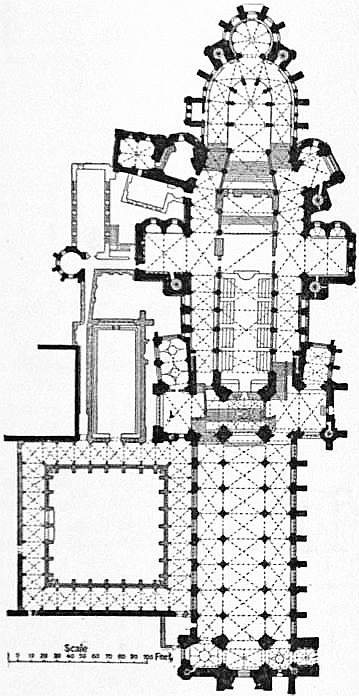
Fig. 1.—Plan of Canterbury Cathedral.
Under the headings Nave, Aisle, Choir, Apse, Chevet, and Lady-chapel, the principal arrangements of the plan of a cathedral are dealt with, and its architectural features, such as Tower and Spire, Porch, Triforium, Clerestory and Vault, are separately defined; while in the article Architecture the evolution of the various styles in England, France, Germany, Italy and Spain, is set forth. It is only necessary here to deal with the development of the eastern end of English and foreign cathedrals, as it was in those that the greatest changes from the middle of the 11th century to the close of the 16th century took place.
The earliest extended development of the eastern end of the cathedral is that which was first set out in Edward the Confessor’s church at Westminster, probably borrowed from the ancient church of St Martin at Tours; in this church, dating probably from the 10th century, two new elements are found, (1) the carrying of the choir aisle round a circular apse so as to provide a processional aisle round the eastern end of the church, and (2) five apsidal chapels, constituting the germ of the chevet, which transformed the eastern terminations of the French cathedrals in the 12th and 13th centuries. It is only within recent times that the foundations of the early church at Tours with its choir aisle and chapels have been traced under the existing church. In Edward the Confessor’s church (1050) there were probably only three chapels and a processional aisle; in the next example at Gloucester (1089) were also three chapels, two of which, on the north and south sides of the aisle, still remain; the same is found in Canterbury (1096-1107) and Norwich (1089-1119), the eastern chapel in all three cases having been taken down to make way for the Lady-chapel in Gloucester and Norwich, and for the Trinity chapel in Canterbury cathedral (fig. 1). The semicircular aisle is said to have existed in the Anglo-Norman cathedral of Winchester, but the eastern end being square, two chapels were arranged filling the north and south ends, and an apsidal chapel projecting beyond the east wall. This semicircular processional aisle with chevet chapels was the favourite type of plan in the Anglo-Norman cathedrals, and was followed up to about the middle of the 12th century, when the English builders in some cases returned to the square east end instead of the semicircular apsidal termination. The earliest example of this exists in Romsey Abbey (c. 1130), where the processional path crosses behind the presbytery, there being eastern apsidal chapels in the axis of the presbytery aisle and a central rectangular chapel beyond. A similar arrangement is found in Hereford cathedral, and exists in Winchester, Salisbury (fig. 2), Durham, St Albans, Exeter, Ely, Wells and Peterborough, except that in all those cases (except Wells) the eastern chapels are square ended; in Wells cathedral the most eastern chapel (the Lady-chapel) has a polygonal termination; in Durham (fig. 3), the eastern chapels are all in one line, constituting the chapel of the nine altars, which was probably borrowed from the eastern end of Fountains Abbey. It should be noted that in some of the above the original design has been transformed in rebuilding; thus in St Albans, Durham, York and Exeter cathedrals, there was no eastern ambulatory but three parallel apses, in some cases rectangular externally. In Southwell, Rochester, Ely and Chester, there was no processional path or ambulatory round the east end; in Carlisle no eastern chapels; and in Oxford only one central apse. In Ely cathedral (fig. 4) the great central tower built by the first Norman abbot (1082-1094) fell down in 1321, carrying with it portions of the adjoining bays of the nave, transept and choir; instead of attempting to rebuild the tower, Alan of Walsingham conceived the idea of obtaining a much larger area in the centre of the cathedral, and instead of rebuilding the piers of the tower he took as the base of his design a central octagonal space, the width of which was equal to that of nave and aisles, with wide arches to nave, transepts and choir, and smaller arches across the octagonal sides; from shafts in the eight pier angles, ribs in wood project forward and carry a smaller octagon on which the lantern rests. Internally the effect of this central octagon is of great beauty and originality, and it is the only instance of such a feature in English Gothic architecture. (See Architecture, Plate VIII., fig. 82.)
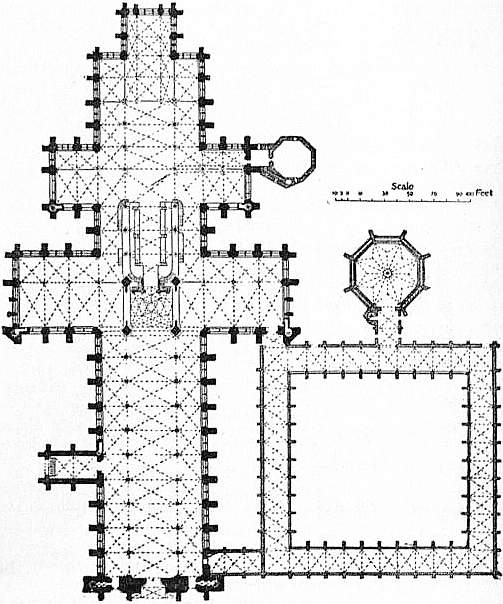
Fig. 2.—Plan of Salisbury Cathedral.
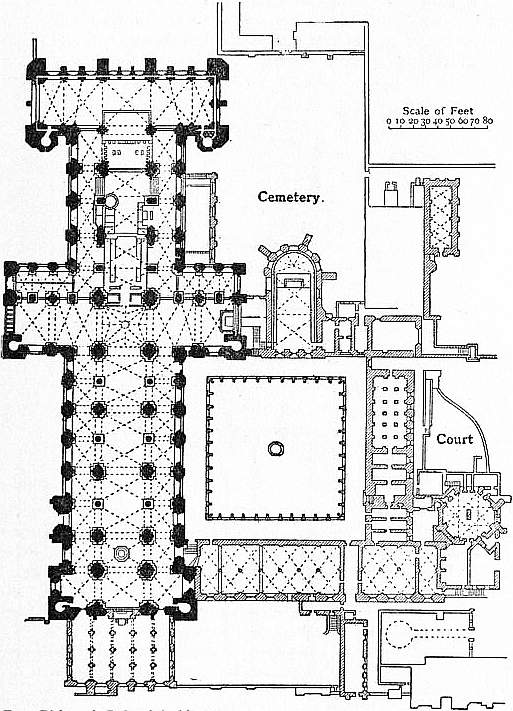
From Rickman’s Styles of Architecture.
Fig. 3.—Plan of Durham Cathedral.
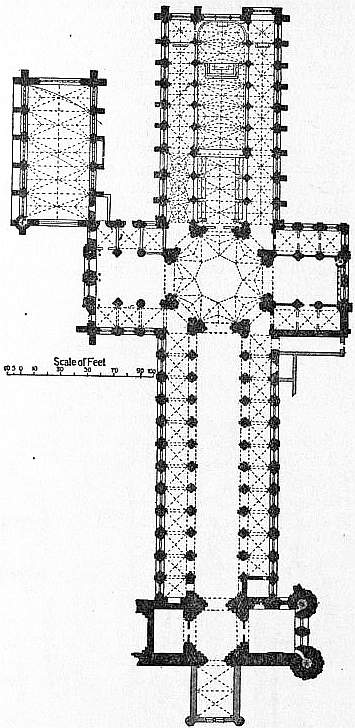
Fig. 4.—Plan of Ely Cathedral.
The earliest example of the chevet is probably to be found in the church of St Martin at Tours; this was followed by others at Tournus, Clermont-Ferrand, Auxerre, Chartres, Le Mans and other churches built during the great church-building period of the 11th century. In the still greater movement in the 12th century, when the episcopacy, supported by the emancipated communes, undertook the erection of cathedrals of greater dimensions and the reconstruction of others, in some cases they utilized the old foundations, as in Chartres (fig. 5), Coutances and Auxerre cathedrals, while in others (as at Le Mans) they extended the eastern termination, much in the same way as in many of the early examples in England, with this important difference, that when the apsidal east end was given up (about the middle of the 12th century) in favour of the square east end in England, the French, on the other hand, developed it by doubling the choir aisles and adding to the number of extra chapels; thus in Canterbury, Norwich and Gloucester, there were only three apsidal chapels in the chevet, whereas in Noyon (1150), Soissons (1190), Reims (1212), Tours, Seez, Bayeux (1230), Clermont (1275), Senlis, Limoges, Albi and Narbonne cathedrals there were five; in Amiens, Le Mans and Beauvais, there were seven apsidal chapels, and in Chartres cathedral nine. Double aisles round the choir, of which there are no examples in England, are found in the cathedrals of Paris, Bourges and Le Mans; the cathedral of Sens (fig. 6) (1144-1168) possesses one feature which is almost unique, viz. the coupled columns of the alternate bays of nave and choir and of the apse; and these were introduced into the chapel of the Trinity in Canterbury cathedral, probably from the designs of William of Sens, by his successor William the Englishman. The square east end found no favour in France—Laon, Poiters and Dol being the only cathedral examples; and of the triapsal arrangement, viz. with apses in the axes of the choir aisle and a central apse, the only example is that of the cathedral of Autun. The immense development given to the eastern limb of the French cathedrals was sometimes obtained at the expense of the nave, so that, notwithstanding the much greater dimensions compared with English examples, in the latter the naves are much longer and consist of more bays than those in France.
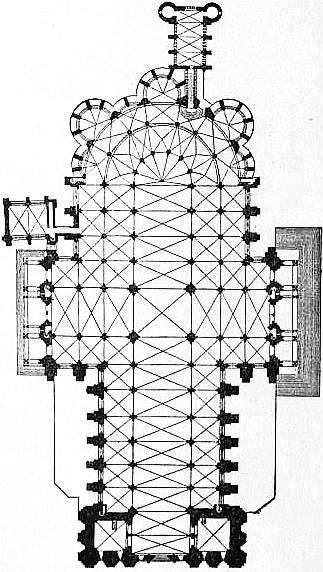
Fig. 5.—Plan of Chartres Cathedral.
In one of the French cathedrals, Bourges, there is no transept; on the other hand there are many examples in which this part of the church is emphasized by having aisles on each side, as at Laon, Soissons, Chartres, Reims, Amiens, Rouen and Clermont cathedrals. Transept aisles in England are found in Ely, York, Wells and Winchester cathedrals, in the last being carried round the south and north ends of the transept; aisles on the east side of the transept only, in some cases probably for additional altars, exist in Durham, Salisbury, Lichfield, Peterborough and Ripon cathedrals; and on the north side only in Hereford cathedral. In Rouen cathedral, east of the transept aisles, there are apsidal chapels, which with the three chapels in the chevet make up the usual number. The cathedral of Poitiers has been referred to as an example of a square east end, but a sort of compromise has been made by the provision of three segmental apses, and there are no windows in the east front; the most remarkable divergence from the usual design is found here in the absence of any triforium or clerestory, owing to the fact that the vault of the aisles is nearly as high as that of the nave, so that it constitutes an example of what in Germany (where there are many) are called Hallen Kirchen; the light being obtained through the aisle windows only gives a gloomy effect to the nave. Another departure from the usual plan is that found in Albi cathedral (1350), in which there are no aisles, their place being taken by chapels between the buttresses which were required to resist the thrust of the nave vault, the widest in France. The cathedral is built in brick and externally has the appearance of a fortress. In the cathedrals of the south-west of France, where the naves are covered with a series of domes—as at Cahors, Angoulême and St Front de Périgueux— the immense piers required to carry them made it necessary to dispense with aisles. The cathedral of Angoulême (fig. 7) consists of a nave covered with three domes, a transept of great length with lofty towers over the north and south ends, and an apsidal choir with four chevet chapels. In St Front de Périgueux (1150), based on St Mark’s at Venice, the plan consists of nave, transept and choir, all of equal dimensions, each of them, as well as the crossing, vaulted over with a dome, while originally there was a simple apsidal choir.
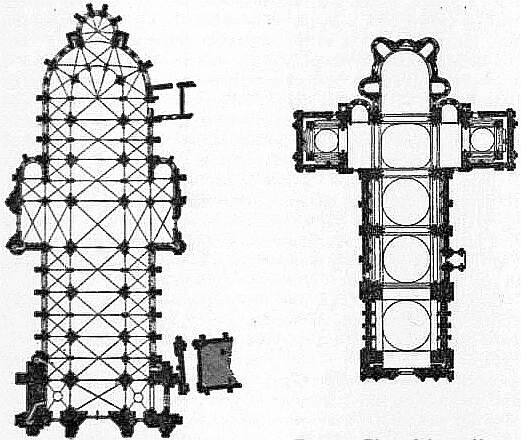
Fig. 6.—Plan of Sens Cathedral. Fig. 7.—Plan of Angoulême Cathedral.
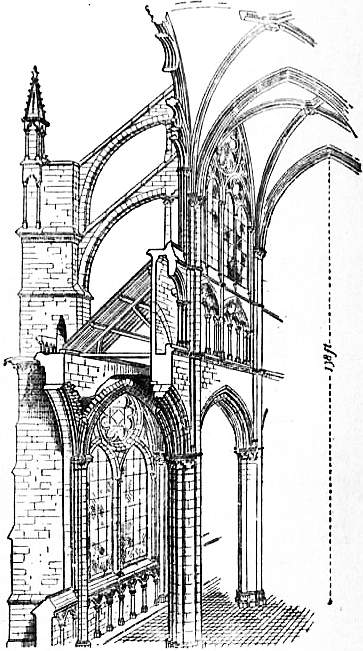
Fig. 8.—Perspective of Amiens Cathedral.
Returning now to the great cathedrals in the north of France, we give an illustration (fig. 8) of Amiens cathedral (from Viollet le Duc’s Dictionnaire raisonné) which shows the disposition of a cathedral, with its nave-arches, triforium, clerestory windows and vault, the flying buttresses which were required to carry the thrust of the vault to the outer buttresses which flanked the aisle walls, and the lofty pinnacles which surmounted them. In this case there was no triforium gallery, owing to the greater height given to the aisles. In Notre Dame at Paris the triforium was nearly as high as the aisles; in large towns this feature gave increased accommodation for the congregation, especially on the occasion of great fêtes, and it is found in Noyon, Laon, Senlis and Soissons cathedrals, built in the latter part of the 12th century; later it was omitted, and a narrow passage in the thickness of the wall only represented the triforium; at a still later period the aisles were covered with a stone pavement of slight fall so as to allow of loftier clerestory windows.
The cathedrals in Spain follow on the same lines as those in France. The cathedral of Santiago de Compostela is virtually a copy of St Sernin at Toulouse, consisting of nave and aisles, transepts and aisles, and a choir with chevet of five chapels; at Leon there is a chevet with five apsidal chapels, and at Toledo an east end with double aisles round the apse with originally seven small apsidal chapels, two of them rebuilt at a very late period. At Leon, Barcelona and Toledo the processional passage round the apse with apsidal chapels recalls the French disposition, there being a double aisle around the latter, but in Leon and Toledo cathedrals the east end is masked externally by other buildings, so that the beauty of the chevet is entirely lost. At Avila and Salamanca (old cathedral) the triapsal arrangement is adopted, and the same is found in the German cathedrals, with one important exception, the cathedral of Cologne, which was based on that of Amiens, the comparative height of the former, however, being so exaggerated that scale has been lost, and externally it has the appearance of an overgrown monster.
Under the headings Vault, Flying Buttress, Pinnacle, Clerestory and Triforium, definitions are given of these chief components of a cathedral or church; but as their design varies materially in almost every example, without a very large number of drawings it would be impossible to treat them more in detail. The perspective view, taken from Viollet le Duc’s dictionary, of the interior of the nave of Amiens cathedral illustrates the principal features, viz. the vault (in this case quadripartite, with flying buttresses and pinnacle), the triforium (in this case limited to a narrow passage in the thickness of the wall), and the nave-arches, with the side aisles, beneath the windows of which is the decorative arcade.
(R. P. S.)
CATHELINEAU, JACQUES (1759-1793), French Vendean chieftain during the Revolution, was born at Tin-en-Manges, in the country now forming the department of Maine-et-Loire. He became well known in the country of Anjou, over which he travelled as a pedlar and dealer in contraband goods. His physical strength and his great piety gave him considerable ascendancy over the peasants, who surnamed him “the saint of Anjou.” In the first years of the Revolution, Cathelineau listened to the exhortations of Catholic priests and royalist émigrés, and joined the insurrection provoked by them against the revolutionary government. Collecting a band of peasants and smugglers, he took the chateau of Gallais, where he captured a cannon, christened by the Vendeans the “Missionary”; he then took the towns of Chemillé, Cholet, Vihiers and Chalonnes (March 1793). His companions committed atrocities which brought upon them terrible reprisals on the part of the Republicans. Meanwhile Cathelineau’s troops increased, and he combined with the other Vendean chiefs, such as N. Stofflet and Gigot d’Elbée, taking the towns of Beaupréau, Fontenay and Saumur. The first successes of the Vendeans were due to the fact that the Republicans had not expected an insurrection. When the resistance to the insurgents became more serious, differences arose among their leaders. To avoid these rivalries, it is thought that Cathelineau was named generalissimo of the rebels, though his authority over the undisciplined troops was not increased by the new office. In 1793 all the Royalist forces tried to capture Nantes. Cathelineau entered the town in spite of the resistance of General J.B.C. Canclaux, but he was killed, and the Vendean army broke up. Numerous relatives of Cathelineau also perished in the war of La Vendée. His grandson, Henri de Cathelineau, figured in the war of 1870 between France and Germany (see also Vendée; Chouans).
See C. Port, Vie de J. Cathelineau (1882); “La Légende de Cathelineau” in the review La Révolution française, vol. xxiv.; Les Origines de la Vendée (Paris, 1888, 2 vols.); Dictionnaire historique de Maine-et-Loire; Cretineau-Joly, Histoire de la Vendée militaire, Th. Muret, Vie populaire de Cathelineau (1845).
(R. A.*)
CATHERINE, SAINT. The Roman hagiology contains the record of six saints of this name. 1. St Catherine of Alexandria, Virgin and Martyr, whose day of commemoration recurs on the 25th of November, and in some places on the 5th of March. 2. St Catherine of Sweden, a daughter of St Bridget, who died abbess of Watzen in March 1381, and is commemorated on the 22nd of that month. 3. St Catherine of Siena, 1347-1380, whose festal day is observed on the 30th of April. 4. St Catherine of Bologna, 1413-1463, a visionary, abbess of the convent of the Poor Clares in Bologna, canonized by Pope Benedict XIII., and commemorated throughout the Franciscan order on the 9th of March. 5. St Catherine of Genoa,1 who belonged to the noble family of Fieschi, was born about 1447, spent her life and her means in succouring and attending on the sick, especially in the time of the plague which ravaged Genoa in 1497 and 1501, died in that city in 1510, was beatified by Clement V. in 1675 and canonized by Clement XII. in 1737; her name was placed in the calendar on the 22nd of July by Benedict XIV. 6. St Catherine de’ Ricci, of Florence, daughter of a wealthy merchant prince, was born in 1522, became a nun in the convent of the Dominicans at Prato in 1536, and died in 1589. She was famous during her life-time for the weekly ecstasy of the Passion, during which in a trance she experienced the sufferings of the Holy Virgin contemplating the Passion of her Son. She was canonized in 1746 by Benedict XIV., who fixed her festal day on the 13th of February. In Celtic and English martyrologies (November 25) there is also commemorated St Catherine Audley (c. 1400), a recluse of Ledbury, Hereford, who was reputed for piety and clairvoyance.
Of two of these saints, St Catherine of Alexandria, the St Catherine par excellence, and St Catherine of Siena, something more must be said. Of the former history has little or nothing to tell. The Maronite scholar, Joseph Simon St Catherine, virgin and martyr. Assemani (1687-1768), first identified her with the royal and wealthy lady of Alexandria (Eusebius, Hist. Eccl. viii. 14) who, for refusing the solicitations of the emperor Maximinus, was deprived of her property and banished. But Rufinus (Hist. Eccl. viii. 17) called this lady Dorothea, and the old Catherine legend, as recorded in the Roman martyrology and by Simeon Metaphrastes, has quite other features. According to it Catherine was the daughter of King Konetos, eighteen years old, beautiful and wise. During the persecution under Maximinus she sought an interview with the emperor, upbraided him for his cruelties, and adjured him to give up the worship of false gods. The angry tyrant, unable to refute her arguments himself, sent for pagan scholars to argue with her, but they were discomfited. Catherine was then scourged and cast into prison, and the empress was sent to reason with her; but the dauntless virgin converted not only the empress but the Roman general and his soldiers who had accompanied her. Maximinus now ordered her to be broken on the wheel; but the wheel was shattered by her touch. The headsman’s axe proved more fatal, and the martyr’s body was borne by angels to Mount Sinai, where Justinian I. built the famous monastery in her honour. Another development of the legend is that in which, having rejected many offers of marriage, she was taken to heaven in vision and betrothed to Christ by the Virgin Mary.
Of all these marvellous incidents very little, by the universal admission of Catholic scholars, has survived the test of modern criticism. That St Catherine actually existed there is, indeed, no evidence to disprove; and it is possible that some of the elements in her legend are due to confusion with the story of Hypatia (q.v.), the neo-platonic philosopher of Alexandria, who was done to death by a Christian mob. To the men of the middle ages, in any case, St Catherine was very real; she was ranked with the fourteen most helpful saints in heaven, and was the constant theme of preachers and of poets. Her festival was celebrated in many places with the utmost splendour, and in certain dioceses in France was a holy day of obligation as late as the beginning of the 17th century. Numberless chapels were dedicated to her, and in nearly all churches her statue was set up, the saint being represented with a wheel, her instrument of torture, and sometimes with a crown and a book. The wheel being her symbol she was the patron saint of wheelwrights and mechanics; as the confounder of heathen sophistry she was invoked by theologians, apologists, preachers and philosophers, and was chosen as the patron saint of the university of Paris; as the most holy and illustrious of Christian virgins she became the tutelary saint of nuns and virgins generally. So late as the 16th century, Bossuet delivered a panegyric upon her, and it was the action of Dom Deforis, the Benedictine editor of his works, in criticizing the accuracy of the data on which this was based, that first discredited the legend. The saint’s feast was removed from the Breviary at Paris about this time, and the devotion to St Catherine has since lost its earlier popularity. See Leon Clugnet’s article in the Catholic Encyclopaedia, vol. iii. (London, 1908).
St Catherine of Siena was the youngest of the twenty-five children of Giacomo di Benincasa, a dyer, and was born, with a twin-sister who did not survive her birth, on the 25th of March 1347. A highly sensitive and imaginative St Catherine of Siena. child, she very early began to practise asceticism and see visions, and at the age of seven solemnly dedicated her virginity to Christ. She was attracted by what she had heard of the desert anchorites, and in 1363-1364, after much struggle, persuaded her parents to allow her to take the habit of the Dominican tertiaries. For a while she led at home the life of a recluse, speaking only to her confessor, and spending all her time in devotion and spiritual ecstasy. Her innate humanity and sound sense, however, led her gradually to return to her place in the family circle, and she began also to seek out and help the poor and the sick. In 1368 her father died, and she assumed the care of her mother Lapa. During the following years she became known to an increasingly wide circle, especially as a peacemaker, and entered into correspondence with many friends. Her peculiarities excited suspicion, and charges seem to have been brought against her by some of the Dominicans to answer which she went to Florence in 1374, soon returning to Siena to tend the plague-stricken. Here first she met the Dominican friar, Raimondo of Capua, her confessor and biographer.