VOLUME V SLICE V Cat to Celt (continued 5)
Reading edition
To Cato the individual life was a continual discipline, and public life was the discipline of the many. He regarded the individual householder as the germ of the family, the family as the germ of the state. By strict economy of time he accomplished an immense amount of work; he exacted similar application from his dependents, and proved himself a hard husband, a strict father, a severe and cruel master. There was little difference apparently, in the esteem in which he held his wife and his slaves; his pride alone induced him to take a warmer interest in his sons. To the Romans themselves there was little in this behaviour which seemed worthy of censure; it was respected rather as a traditional example of the old Roman manners. In the remarkable passage (xxxix. 40) in which Livy describes the character of Cato, there is no word of blame for the rigid discipline of his household.
Cato perhaps deserves even more notice as a literary man than as a statesman or a soldier. He was the first Latin prose writer of any importance, and the first author of a history of Rome in Latin. His treatise on agriculture (De Agricultura, or De Re Rustica) is the only work by him that has been preserved; it is not agreed whether the work we possess is the original or a later revision. It contains a miscellaneous collection of rules of good husbandry, conveying much curious information on the domestic habits of the Romans of his age. His most important work, Origines, in seven books, related the history of Rome from its earliest foundations to his own day. It was so called from the second and third books, which described the rise of the different Italian towns. His speeches, of which as many as 150 were collected, were principally directed against the young free-thinking and loose-principled nobles of the day. He also wrote a set of maxims for the use of his son (Praecepta ad Filium), and some rules for everyday life in verse (Carmen de Moribus). The collection of proverbs in hexameter verse, extant under the name of Cato, probably belongs to the 4th century a.d. (See Cato, Dionysius.)
Authorities.—There are lives of Cato by Cornelius Nepos, Plutarch and Aurelius Victor, and many particulars of his career and character are to be gathered from Livy and Cicero. See also F.D. Gerlach, Marcus Porcius Cato der Censor (Basel, 1869); G. Kurth, Caton l’ancien (Bruges, 1872); J. Cortese, De M. Porcii Catonis vita, operibus, et lingua (Turin, 1883); F. Marcucci, Studio critico sulle Opere di Catone il Maggiore (1902). The best edition of the De Agricultura is by H. Keil (1884-1891), of the fragments of the Origines by H. Peter (1883) in Historicorum Romanorum Fragmenta, of the fragments generally by H. Jordan (1860); see also J. Wordsworth, Fragments and Specimens of Early Latin (1874); M. Schanz, Geschichte der römischen Litteratur (1898); article in Smith’s Dictionary of Greek and Roman Biography, Mommsen, Hist. of Rome (Eng. trans.), bk. iii. ch. xi and xiv.; Warde Fowler, Social Life at Rome (1909).
CATO, MARCUS PORCIUS (95-46 b.c.), Roman philosopher, called Uticensis to distinguish him from his great-grandfather, “the Censor.” On the death of his parents he was brought up in the house of his uncle, M. Livius Drusus. After fighting with distinction in the ranks against Spartacus (72 b.c.), he became a military tribune (67), and served a campaign in Macedonia, but he never had any enthusiasm for the military profession. On his return he became quaestor, and showed so much zeal and integrity in the management of the public accounts that he obtained a provincial appointment in Asia, where he strengthened his reputation. Though filled with disgust at the corruption of the public men with whom he came in contact, he saw much to admire in the discipline which Lucullus had enforced in his own eastern command, and he supported his claims to a triumph, while he opposed the inordinate pretensions of Pompey. When the favour of the nobles gained him the tribuneship, he exerted himself unsuccessfully to convict L. Licinius Murena (2), one of their chief men, of bribery. Cicero, who defended Murena, was glad to have Cato’s aid when he urged the execution of the Catilinarian conspirators. Cato’s vote on this matter drew upon him the bitter resentment of Julius Caesar, who did his utmost to save them.
Cato had now become a great power in the state. Though possessed of little wealth and no family influence, his unflinching resolution in the cause of the ancient free state rendered him a valuable instrument in the hands of the nobles. He vainly opposed Caesar’s candidature for the consulship in 59, and his attempt, in conjunction with Bibulus, to prevent the passing of Caesar’s proposed agrarian law for distributing lands amongst the Asiatic veterans, proved unsuccessful. Nevertheless, although his efforts were ineffectual, he was still an obstacle of sufficient importance for the triumvirs to desire to get rid of him. At the instigation of Caesar he was sent to Cyprus (58) with a mission to depose its king, Ptolemy (brother of Ptolemy Auletes), and annex the island. On his return two years later he continued to struggle against the combined powers of the triumvirs in the city, and became involved in scenes of violence and riot. He succeeded in obtaining the praetorship in 54, and strenuously exerted himself in the hopeless and thankless task of suppressing bribery, in which all parties were equally interested. He failed to attain the consulship, and had made up his mind to retire from the arena of civic ambition when the civil war broke out in 49. Feeling that the sole chance for the free state lay in conceding an actual supremacy to Pompey, whom he had formerly vigorously opposed, he did not scruple to support the unjust measures of the nobles against Caesar. At the outset of the war he was entrusted with the defence of Sicily, but finding it impossible to resist the superior forces of C. Scribonius Curio, who had landed on the island, he joined Pompey at Dyrrhachium. When his chief followed Caesar to Thessaly he was left behind in charge of the camp, and thus was not present at the battle of Pharsalus. After the battle, when Pompey abandoned his party, he separated himself from the main body of the republicans, and conducted a small remnant of their forces into Africa. After his famous march through the Libyan deserts, he shut himself up in Utica, and even after the decisive defeat at Thapsus (46), in spite of the wishes of his followers, he determined to keep the gates closed till he had sent off his adherents by sea. While the embarkation was in progress he continued calm and dignified; when the last of the transports had left the port he cheerfully dismissed his attendants, and soon afterwards stabbed himself.
He had been reading, we are told, in his last moments Plato’s dialogue on the immortality of the soul, but his own philosophy had taught him to act upon a narrow sense of immediate duty without regard to the future. He conceived that he was placed in the world to play an active part, and when disabled from carrying out his principles, to retire gravely from it. He had lived for the free state, and it now seemed his duty to perish with it. In politics he was a typical doctrinaire, abhorring compromise and obstinately blind to the fact that his national ideal was a hopeless anachronism. From the circumstances of his life and of his death, he has come to be regarded as one of the most distinguished of Roman philosophers, but he composed no works, and bequeathed to posterity no other instruction than that of his example. The only composition by him which we possess is a letter to Cicero (Ad Fam. xv. 5), a polite refusal of the orator’s request that he would endeavour to procure him the honour of a triumph. The school of the Stoics, which took a leading part in the history of Rome under the earlier emperors, looked to him as its saint and patron. It continued to wage war against the empire, hardly less openly than Cato himself had done, for two centuries, till at last it became actually seated on the imperial throne in the person of Marcus Aurelius. Immediately after his death Cato’s character became the subject of discussion; Cicero’s panegyric Cato was answered by Caesar in his Anticato. Brutus, dissatisfied with Cicero’s work, produced another on the same subject; in Lucan Cato is represented as a model of virtue and disinterestedness.
See Life by Plutarch, and compare Addison’s tragedy. Modern biographies by H. Wartmann (Zürich, 1859), and F.D. Gerlach (Basel, 1866); C.W. Oman, Seven Roman Statesmen of the Later Republic, Cato ... (1902); Mommsen, Hist. of Rome (Eng. trans.), bk. v. ch. v.; article in Smith’s Dictionary of Classical Biography; Gaston Boissier, Cicero and his Friends (Eng. trans., 1897), esp. pp. 277 foll.; Warde Fowler, Social Life at Rome (1909).
CATO, PUBLIUS VALERIUS, Roman poet and grammarian, was born about 100 b.c. He is of importance as the leader of the “new” school of poetry (poetae novi, νεώτεροι, as Cicero calls them). Its followers rejected the national epic and drama in favour of the artificial mythological epics and elegies of the Alexandrian school, and preferred Euphorion of Chalcis to Ennius. Learning, that is, a knowledge of Greek literature and myths, and strict adherence to metrical rules were regarded by them as indispensable to the poet. The νεώτεροι were also determined opponents of Pompey and Caesar. The great influence of Cato is attested by the lines:—
“Cato grammaticus, Latina Siren, Qui solus legit ac facit poetas.”1
Our information regarding his life is derived from Suetonius (De Grammaticis, 11). He was a native of Cisalpine Gaul, and lost his property during the Sullan disturbances before he had attained his majority. He lived to a great age, and during the latter part of his life was in very reduced circumstances. He was at one time possessed of considerable wealth, and owned a villa at Tusculum which he was obliged to hand over to his creditors. In addition to grammatical treatises, Cato wrote a number of poems, the best-known of which were the Lydia and Diana. In the Indignatio (perhaps a short poem) he defended himself against the accusation that he was of servile birth. It is probable that he is the Cato mentioned as a critic of Lucilius in the lines by an unknown author prefixed to Horace, Satires, i. 10.
Among the minor poems attributed to Virgil is one called Dirae (or rather two, Dirae and Lydia). The Dirae consists of imprecations against the estate of which the writer has been deprived, and where he is obliged to leave his beloved Lydia; in the Lydia, on the other hand, the estate is regarded with envy as the possessor of his charmer. Joseph Justus Scaliger was the first to attribute the poem (divided into two by F. Jacobs) to Valerius Cato, on the ground that he had lost an estate and had written a Lydia. The question has been much discussed; the balance of opinion is in favour of the Dirae being assigned to the beginning of the Augustan age, although so distinguished a critic as O. Ribbeck supports the claims of Cato to the authorship. The best edition of these poems is by A.F. Näke (1847), with exhaustive commentary and excursuses; a clear account of the question will be found in M. Schanz’s Geschichte der römischen Litteratur; for the “new” school of poetry see Mommsen, Hist. of Rome, bk. v. ch. xii.; F. Plessis, Poésie latine (1909), 188.
1 “Cato, the grammarian, the Latin siren, who alone reads aloud the works and makes the reputation of poets.”
CATS, JACOB (1577-1660), Dutch poet and humorist, was born at Brouwershaven in Zeeland on the 10th of November 1577. Having lost his mother at an early age, and being adopted with his three brothers by an uncle, Cats was sent to school at Zierikzee. He then studied law at Leiden and at Orleans, and, returning to Holland, he settled at the Hague, where he began to practise as an advocate. His pleading in defence of a wretched creature accused of witchcraft brought him many clients and some reputation. He had a serious love affair about this time, which was broken off on the very eve of marriage by his catching a tertian fever which defied all attempts at cure for some two years. For medical advice and change of air Cats went to England, where he consulted the highest authorities in vain. He returned to Zeeland to die, but was cured mysteriously by a strolling quack. He married in 1602 a lady of some property, Elisabeth von Valkenburg, and thenceforward lived at Grypskerke in Zeeland, where he devoted himself to farming and poetry. His best works are: Emblemata or Minnebeelden with Maegdenplicht (1618); Spiegel van den ouden en nieuwen Tijt (1632); Houwelijck ... (1625); Selfstrijt (1620); Ouderdom, Buitem leven ... en Hofgedachten op Sorgvliet (1664); and Gedachten op slapelooze nachten (1661). In 1621, on the expiration of the twelve years’ truce with Spain, the breaking of the dykes drove him from his farm. He was made pensionary (stipendiary magistrate) of Middelburg; and two years afterwards of Dort. In 1627 Cats came to England on a mission to Charles I., who made him a knight. In 1636 he was made grand pensionary of Holland, and in 1648 keeper of the great seal; in 1651 he resigned his offices, but in 1657 he was sent a second time to England on what proved to be an unsuccessful mission to Cromwell. In the seclusion of his villa of Sorgvliet (Fly-from-Care), near the Hague, he lived from this time till his death, occupied in the composition of his autobiography (Eighty-two Years of My Life, first printed at Leiden in 1734) and of his poems. He died on the 12th of September 1660, and was buried by torchlight, and with great ceremony, in the Klooster-Kerk at the Hague. He is still spoken of as “Father Cats” by his countrymen.
Cats was contemporary with Hooft and Vondel and other distinguished Dutch writers in the golden age of Dutch literature, but his Orangist and Calvinistic opinions separated him from the liberal school of Amsterdam poets. He was, however, intimate with Constantin Huygens, whose political opinions were more nearly in agreement with his own. For an estimate of his poetry see Dutch Literature. Hardly known outside of Holland, among his own people for nearly two centuries he enjoyed an enormous popularity. His diffuseness and the antiquated character of his matter and diction, have, however, come to be regarded as difficulties in the way of study, and he is more renowned than read. A statue to him was erected at Brouwershaven in 1829.
See Jacob Cats, Complete Works (1790-1800, 19 vols.), later editions by van Vloten (Zwolle, 1858-1866; and at Schiedam, 1869-1870); Pigott, Moral Emblems, with Aphorisms, &c., from Jacob Cats (1860); and P.C. Witsen Gejisbek, Het Leven en de Verdiensten van Jacob Cats (1829). Southey has a very complimentary reference to Cats in his “Epistle to Allan Cunningham.”
CAT’S-EYE, a name given to several distinct minerals, their common characteristic being that when cut with a convex surface they display a luminous band, like that seen by reflection in the eye of a cat. (1) Precious cat’s-eye, oriental cat’s-eye or chrysoberyl cat’s-eye. This, the rarest of all, is a chatoyant variety of chrysoberyl (q.v.), showing in the finest stones a very sharply defined line of light. One of the grandest known specimens was in the Hope collection of precious stones, exhibited for many years at the Victoria and Albert Museum. (2) Quartz cat’s-eye. This is the common form of cat’s-eye, in which the effect is due to the inclusion of parallel fibres of asbestos. Like the chrysoberyl, it is obtained chiefly from Ceylon, but though coming from the East it is often called “occidental cat’s-eye”—a term intended simply to distinguish it from the finer or “oriental” stone. It is readily distinguished by its inferior density, its specific gravity being only 2.65, whilst that of oriental cat’s-eye is as high as 3.7. A greenish fibrous quartz, cut as cat’s-eye, occurs at Hof and some other localities irr Bavaria. (3) Crocidolite cat’s-eye, a beautiful golden brown mineral, with silky fibres, found in Griqualand West, and much used in recent years as an ornamental stone, sometimes under the name of “South African cat’s-eye.” It consists of fibrous quartz, coloured with oxide of iron, and results from the alteration of crocidolite (q.v.). It is often distinguished as “tiger’s-eye” (or more commonly “tiger-eye”), whilst a blue variety, less altered, is known as “hawk’s-eye.” By the action of hydrochloric acid the colour of tiger’s-eye may to a large extent be removed, and a greyish cat’s-eye obtained. (4) Corundum cat’s-eye. In some asteriated corundum (see ASTERIA) the star is imperfect and may be reduced to a luminous zone, producing an indistinct cat’s-eye effect. According to the colour of the corundum the stone is known as sapphire cat’s-eye, ruby cat’s-eye, topaz cat’s-eye, &c.
(F. W. R.*)
CATSKILL, a village and the county-seat of Greene county, New York, U.S.A., on the W. bank of the Hudson river, 33 m. S. of Albany. Pop. (1890) 4920; (1900) 5484; of whom 657 were foreign-born; (1910) 5206. It is served by the West Shore railway, by several lines of river steamboats, and by the Catskill Mountain railway, connecting it with the popular summer resorts in the Catskill mountains. A ferry connects with Catskill station (Greendale) on the east side of the Hudson. The village is in a farming country, and manufactures woollen goods and bricks, but it is best known as a summer resort, and as the principal gateway to the beautiful Catskill Mountain region. The Recorder, a weekly newspaper, was established here in 1792 as the Packet. The first settler on the present site of Catskill was Derrick Teunis van Vechten, who built a house here in 1680. The village was not incorporated until 1806.
See J.D. Pinckney, Reminiscences of Catskill (Catskill, 1868).
CATSKILL (formerly Kaatskil) MOUNTAINS, a group of moderate elevation pertaining to the Alleghany Plateau, and not properly included in the Appalachian system of North America because they lack the internal structures and the general parallelism of topographic features which characterize the Appalachian ranges. The group contains many summits above 3000 ft. elevation and half a dozen approaching 4000, Slide Mountain (4205 ft.), and Hunter Mountain (4025 ft.), being the only ones exceeding that figure. The bottom lands along the creeks which drain the mountains, together with rolling uplands rising to elevations of from 1500 to 2000 ft., are under cultivation, the mountain slopes being forested or devoted to grazing. The pure and cool atmosphere attracts summer visitors, for whose accommodation many hotels have been built, some of which have become celebrated. Stoney Clove and Kaaterskill Clove are picturesque gorges, the former being traversed by a rail way, and the latter containing three cascades having a total fall of about 300 ft. The growing need of New York City for an increased water-supply has driven her engineers to the Catskills, where several great reservoirs have been projected to supplement those of the Croton watershed.
CATTANEO, CARLO (1801-1869), Italian philosopher and patriot. A republican in his convictions, during his youth he had taken part in the Carbonarist movement in Lombardy. He devoted himself to the study of philosophy, hoping to regenerate the Italian people by withdrawing them from romanticism and rhetoric, and turning their attention to the positive sciences. He expounded his ideas in a review founded by him at Milan in 1837, called Il Politecnico. But when the revolution of 1848 broke out he threw himself heart and soul into the fray, and became one of the leading spirits of the insurrection against the Austrians, known as the Five Days of Milan (March 18-22, 1848). Together with Terzaghi, Cernuschi and Clerici he formed a council of war which, having its headquarters at Casa Taverna, directed the operations of the insurgents. He was second to none in self-sacrificing energy and heroic resolution. When on the 18th of March Field Marshal Radetzky, feeling that the position of the Austrian garrison was untenable, sounded the rebels as to their terms, some of the leaders were inclined to agree to an armistice which would give time for the Piedmontese troops to arrive (Piedmont had just declared war), but Cattaneo insisted on the complete evacuation of Lombardy. Again on the 21st, Radetzky tried to obtain an armistice, and Durini and Borromeo were ready to grant it, for it would have enabled them to reorganize the defences and replenish the supplies of food and ammunition, which could only last another day. But Cattaneo replied: “The enemy having furnished us with munitions thus far, will continue to furnish them. Twenty-four hours of victuals and twenty-four hours of hunger will be many more hours than we shall need. This evening, if the plans we have just arranged should succeed, the line of the bastions will be broken. At any rate, even though we should lack bread, it is better to die of hunger than on the gallows.” On the expulsion of the Austrians the question arose as to the future government of Milan and Italy. Cattaneo was an uncompromising republican and a federalist; so violent was his dislike of the Piedmontese monarchy that when he heard that King Charles Albert had been defeated by the Austrians, and that Radetzky was marching back to reoccupy Milan, he exclaimed: “Good news, the Piedmontese have been beaten. Now we shall be our own masters; we shall fight a people’s war, we shall chase the Austrians out of Italy, and set up a Federal Republic.” When the Austrians returned Cattaneo had to flee, and took refuge at Lugano, where he gave lessons, wrote his Storia della Rivoluzione del 1848, the Archivio triennale delle cose d’ Italia (3 vols., 1850-1855), and then early in 1860 he started the Politecnico once more. He bitterly attacked Cavour for his unitarian views, and for the cession of Nice and Savoy. In 1860 Garibaldi summoned him to Naples to take part in the government of the Neapolitan provinces, but he would not agree to the union with Piedmont without local autonomy. After the union of Italy he was frequently asked to stand for parliament, but always refused because he could not conscientiously take the oath of allegiance to the monarchy. In 1868 the pressure of friends overcame his resistance, and he agreed to stand, but at the last moment he drew back, still unable to take the oath, and returned to Lugano, where he died in 1869. As a writer Cattaneo was learned and brilliant, but far too bitter a partisan to be judicious, owing to his narrowly republican views; his ideas on local autonomy were perhaps wise, but, at a moment when unity was the first essential, inopportune.
Bibliography.—A. and J. Mario, Carlo Cattaneo (Florence, 1884); E. Zanoni, Carlo Cattaneo nella vita e nelle opere (Rome, 1898); see also his own Opere edite ed inedite (7 vols., Florence, 1881-1892), Scritti politici ed epistolari (3 vols., Florence, 1892-1901), Scritti storici, letterari (Milan, 1898, &c.).
CATTARO (Serbo-Croatian Kotor), the chief town of an administrative district in Dalmatia, Austria. Pop. (1900) of town, 3021; of commune, 5418. Cattaro occupies a narrow ledge between the Montenegrin Mountains and the Bocche di Cattaro, a winding and beautiful inlet of the Adriatic Sea. This inlet expands into five broad gulfs, united by narrower channels, and forms one of the finest natural harbours in Europe. Teodo, on the outermost gulf, is a small naval port. Cattaro is strongly fortified, and about 3000 troops are stationed in its neighbourhood. On the seaward side, the defensive works include Castelnuovo (Erceg Novi), which guards the main entrance to the Bocche. On the landward side, the long walls running from the town to the castle of San Giovanni, far above, form a striking feature in the landscape; and the heights of the Krivoscie or Crevoscia (Krivošije), a group of barren mountains between Montenegro, Herzegovina and the sea, are crowned by small forts. Cattaro is divided almost equally between the Roman Catholic and Orthodox creeds. It is the seat of a Roman Catholic bishop, with a small cathedral, a collegiate church and several convents. The transit trade with Montenegro is impeded by high tariffs on both sides of the frontier. Foreign visitors to Montenegro usually land at Cattaro, which is connected by steamer with Trieste and by road with Cettigne. The railway from Ragusa terminates at Zelenika, near Castelnuovo.
There are many interesting places on the shores of the Bocche. Castelnuovo is a picturesque town, with a dismantled 14th-century citadel, which has, at various times, been occupied by Bosnians, Turks, Venetians, Spaniards, Russians, French, English and Austrians. The orthodox convent of St Sava, standing amid beautiful gardens, was founded in the 16th century, and contains many fine specimens of 17th-century silversmiths’ work. There is a Benedictine monastery on a small island opposite to Perasto (Perast), 8 m. east of Castelnuovo. Perasto itself was for a time an independent state in the 14th century. Rhizon, the modern hamlet of Risano, close by, was a thriving “Illyrian” city as early as 229 b.c., and gave its name to the Bocche, then known as Rhizonicus Sinus. Rhizon submitted to Rome in 168 b.c., and about the same time Ascrivium, or Ascruvium, the modern Cattaro, is first mentioned as a neighbouring city. Justinian built a fortress above Ascrivium in a.d. 535, after expelling the Goths, and a second town probably grew up on the heights round it, for Constantine Porphyrogenitus, in the 10th century, alludes to “Lower Cattaro” τὸ κάτω Δεκάτερα. The city was plundered by the Saracens in 840, and by the Bulgarians in 1102. In the next year it was ceded to Servia by the Bulgarian tsar Samuel, but revolted, in alliance with Ragusa, and only submitted in 1184, as a protected state, preserving intact its republican institutions, and its right to conclude treaties and engage in war. It was already an episcopal see, and, in the 13th century, Dominican and Franciscan monasteries were established to check the spread of Bogomilism. In the 14th century the commerce of Cattaro rivalled that of Ragusa, and provoked the jealousy of Venice. The downfall of Servia in 1389 left the city without a guardian, and, after being seized and abandoned by Venice and Hungary in turn, it passed under Venetian rule in 1420. It was besieged by the Turks in 1538 and 1657, visited by plague in 1572, and nearly destroyed by earthquakes in 1563 and 1667. By the treaty of Campo-Formio in 1797 it passed to Austria; but in 1805, by the treaty of Pressburg, it was assigned to Italy, and was united in 1810 with the French empire. In 1814 it was restored to Austria by the congress of Vienna. The attempt to enforce compulsory military service, made and abandoned in 1869, but finally successful in 1881, led to two short-lived revolts among the Krivoscians, during which Cattaro was the Austrian headquarters.
See G. Gelcich (Gelčić), Memorie storiche sulle Bocche di Cattaro (Zara, 1880).
CATTEGAT, or Kattegat (Scand. “cat’s-throat”), a strait forming part of the connexion between the Baltic and the North Seas. It lies north and south between Sweden and Denmark, and connects north with the Skagerrack and south through the Sound, the Great Belt and the Little Belt with the Baltic Sea. Its length is about 150 m. and its extreme breadth about 90 m.
CATTERMOLE, GEORGE (1800-1868), English painter, chiefly in water-colours, was born at Dickleburgh, near Diss, Norfolk, in August 1800. At the age of sixteen he began working as an architectural and topographical draughtsman; afterwards he contributed designs to be engraved in the annuals then so popular; thence he progressed into water-colour painting, becoming an associate of the Water-Colour Society in 1822, and a full member in 1833. In 1850 he withdrew from active connexion with this society, and took to painting in oil. His most fertile period was between 1833 and 1850. At the Paris exhibition of 1855 he received one of the five first-class gold medals awarded to British painters. He also enjoyed professional honours in Amsterdam and in Belgium. He died on the 24th of July 1868. Among his leading works are “The Murder of the Bishop of Liége” (15th century), “The Armourer relating the Story of the Sword,” “The Assassination of the Regent Murray by Hamilton of Bothwellhaugh,” and (in oil) “A Terrible Secret.” He was largely employed by publishers, illustrating the Waverley Novels and the Historical Annual of his brother the Rev. Richard Cattermole (his scenes from the wars of Cavaliers and Roundheads in this series are among his best engraved works), and many other volumes besides. Cattermole was a painter of no inconsiderable gifts, and of great facility in picturesque resource; he was defective in solidity of form and texture, and in realism or richness of colour. He excelled in rendering scenes of chivalry, of medievalism, and generally of the romantic aspects of the past.
CATTLE (Norman Fr. catel, from Late Lat. capitate, wealth or property, a word applied in the feudal system to movable property and particularly to live stock, and surviving in its wider meaning as “chattel” or “chattle”), a general term for the cows and oxen of agricultural use. For the zoological account, see Bovidae, and the subordinate articles there referred to; for details concerning dairy-farming, see Dairy.
Oxen appear to have been among the earliest of domesticated animals, as they undoubtedly were among the most important agents in the growth of early civilization. They are mentioned in the oldest written records of the Hebrew and Hindu peoples, and are figured on Egyptian monuments raised over 3000 years b.c.; while remains of domesticated specimens have been found in Swiss lake-dwellings along with the stone implements and other relics of Neolithic man. In infant communities a man’s wealth was measured by the number and size of his herds—Abraham, it is said, was rich in cattle—and oxen for a long period formed, as they still do among many savage or semi-savage tribes, the favourite medium of exchange between individuals and communities. After the introduction of a metal coinage into ancient Greece, this method of exchange was commemorated by stamping the image of an ox on the new money; while the connexion between cattle and coin as symbols of wealth has left its mark on the languages of Europe, as is seen in the Latin word pecunia and the English “pecuniary,” derived from pecus, cattle. The value attached to cattle in ancient times is further shown by the Bull figuring among the signs of the zodiac; in its worship by the ancient Egyptians under the title of Apis; in the veneration which has always been paid to it by the Hindus, according to whose sacred legends it was the first animal created by the three divinities directed by the supreme Deity to furnish the earth with animated beings; and in the important part it played in Greek and Roman mythology. The Hindus were not allowed to shed the blood of the ox, and the Egyptians could only do so in sacrificing to their gods. Both Hindus and Jews were forbidden to muzzle it when treading out the corn; to destroy it wantonly was a crime among the Romans, punishable with exile.
Breeds.—There exist in Britain four interesting remnants of what were at one time numerous enclosed herds of ancient forest cattle,1 with black or red points, in parks at Chillingham, Cadzow, Vaynol (near Bangor, North Wales) and Chartley. A few of the last have been removed to Woburn. Other representatives of old stock are a resuscitated white Welsh breed with black points, derived from white specimens born of black Welsh cows; several herds of a white polled breed with black points; a herd of the ancient Polled Suffolk Dun, an excellent milking breed; a White Belted Galloway and a White Belted Welsh breed; the old Gloucester breed at Badminton, with a white rump, tail and underline, related to the now extinct Glamorgan breed; the Shetland breed; and a few herds of Dutch cattle preserved for their superior milking powers.
The prominent breeds of cattle in the British Isles2 comprise the Shorthorn, Lincolnshire Red Shorthorn, Hereford, Devon, South Devon, Sussex, Welsh, Longhorn, Red Polled, Aberdeen-Angus, Galloway, West Highland, Ayrshire, Jersey, Guernsey, Kerry and Dexter.
The Shorthorn, Lincolnshire Red Shorthorn, Hereford, Devon, South Devon, Sussex, Longhorn and Red Polled breeds are native to England; the Aberdeen-Angus, Galloway, Highland and Ayrshire breeds to Scotland; and the Kerry and Dexter breeds to Ireland. The Jersey and Guernsey breeds—often spoken of as Channel Islands cattle—belong to the respective islands whose names they bear, and great care is taken to keep them isolated from each other. The term Alderney is obsolete, the cattle of Alderney being mainly a type of the Guernsey breed.
Among breeds well known in the United States2 and not mentioned above, the more important are the Holsteins, large black and white cattle highly valued for their abundant milk production, and the Dutch Belted breed, black with a broad white band round the body, also good milkers.
The Shorthorn3 is the most widely distributed of all the breeds of cattle both at home and abroad. No census of breeds has ever been taken in the United Kingdom, but such an enumeration would show the Shorthorn far to exceed in numbers any other breed, whilst the great majority of cross-bred cattle contain Shorthorn blood. During the last quarter of the 18th century the brothers Charles Colling (1751-1836) and Robert Colling (1749-1820), by careful selection and breeding, improved the cattle of the Teeswater district in the county of Durham. If the Shorthorn did not originate thus, it is indisputable that the efforts of the Collings4 had a profound influence upon the fortunes of the breed. It is still termed the Durham breed in most parts of the world except the land of its birth, and the geographical name is far preferable, for the term “shorthorn” is applicable to a number of other breeds. Other skilled breeders turned their attention to the Shorthorns and established famous strains, the descendants of which can still be traced. By Thomas Booth, of Killerby and Warlaby in Yorkshire (1777), the “Booth” strains of Shorthorns were originated; by Thomas Bates, of Kirklevington in Yorkshire, the “Bates” families5 (1800).
The Shorthorn is sometimes spoken of as the ubiquitous breed, its striking characteristic being the ease with which it adapts itself to varying conditions of soil, climate and management. It is also called the “red, white and roan.” The roan colour is very popular, and dark red has its supporters, as in the case of the Lincolnshire Red Shorthorns; white is not in favour, especially abroad. The Shorthorn breed is more noted for its beef-making than for its milk-yielding properties, although the non-pedigree milking Shorthorn of the north of England is an excellent cow with dual-purpose qualifications of the first order. An effort is being made to restore milking qualities to certain strains of pedigree blood.
The culmination of what may be termed the Booth and Bates period was in the year 1875, when the sales took place of Lord Dunmore’s and William Torr’s herds, which realized extraordinary prices. In that black year of farming, 1879, prices were declining, and they continued to do so till within the last few years of the close of the 19th century, when there set in a gradual revival, stimulated largely by the commercial prosperity of the country. The result of extremely high prices when line-bred animals were in fashion was a tendency to breed from all kinds of animals that were of the same tribe, without selection. A deterioration set in, which was aggravated by the overlooking of the milking properties. Shorthorn breeders came to see that change of blood was necessary. Meanwhile, for many years breeders in Aberdeenshire had been holding annual sales of young bulls and heifers from their herds. The late Amos Cruickshank began his annual sales in the ’forties, and the late W.T. Talbot-Crosbie had annual sales from his Shorthorn herd in the south-west of Ireland for a number of years. Many Aberdeen farmers emigrated to Canada, and bought Shorthorn calves in their native county to take with them. The Cruickshanks held their bull sales at that time, and many of their animals were bought by the small breeders in Canada. This continued until 1875, when the Cruickshanks had so much private demand that they discontinued their public sales. Subsequently, when Cruickshank sold his herd privately to James Nelson & Sons for exportation, the animals could not all be shipped, and W. Duthie, of Collynie, Aberdeenshire, bought some of the older cows, whilst J. Deane Willis, of Bapton Monar, Wilts, bought the yearling heifers. Duthie thereupon resumed the sales that the Cruickshanks had relinquished, his averages being £30 in 1892, about £50 in 1893-1894, and £80 in 1895. These prices advanced through English breeders requiring a little change of blood, and also through the increasing tendency to exhibit animals of great substance, or rather to feed animals for show. The success of this movement strengthened the demand, whilst an inquiry for his line of blood arose in the United States and Canada. A faithful contemporary history of the Shorthorn breed is to be found in Thornton’s Circular, published quarterly since 1868; see also J. Sinclair, History of Shorthorn Cattle (1907); R. Bruce, Fifty Years among Shorthorns (1907); A.H. Sanders, Shorthorn Cattle (Chicago, 1901).
The Lincolnshire Red Shorthorns are the best dual-purpose cattle—for milk and meat—that possess a pedigree record, in the United Kingdom, and their uniform cherry red colour has brought them into high favour in tropical countries for crossing with the native breeds.
The Hereford breed is maintained chiefly in Herefordshire and the adjoining counties. Whilst a full red is the general colour of the body, the Herefords are distinguished by their white face, white chest and abdomen, and white mane. The legs up to the knee or hock are also often white. As a protection against the sun in a hot climate dark spots on the eyelids or round the orbits are valuable. The horns are moderately long. Herefords, though they rear their own calves, have acquired but little fame as dairy cattle. They are very hardy, and produce beef of excellent quality. Being docile, they fatten easily and readily, and as graziers’ beasts they are in high favour.
When the Bates’ Shorthorn bubble burst in America about 1877, the Hereford gradually replaced the Shorthorn of the western ranches, and it is now the most numerous ranch animal in the United States and Canada. The bulls beat the bulls of all other breeds in “rustling” capacity.
In America the ranch-bred Herefords have got too small in the bone in recent years, and Shorthorns, chiefly of the Scottish type, are being introduced to increase their size by crossing. In the “feed lot” a well-bred Hereford steer feeds more quickly than either a Shorthorn or an Aberdeen-Angus.
In Queensland, Hereford cattle bred from the “Lord Wilton” strain by Robert Christison of Lammermoor have for years been triumphant as beef-producers in competition with the Shorthorn. When these are quartered in the ordinary butchers’ fashion, the hind-quarters outweigh the fore-quarters, which is a reversal of the prevailing rule.
North Devons.—The “Rubies of the West,” as they are termed from their hue, are reared chiefly in Devon and Somerset. The colour is a whole red, its depth or richness varying with the individual, and in summer becoming mottled with darker spots. The Devons stand somewhat low; they are neat and compact, and possess admirable symmetry. Although a smaller breed than the Shorthorn or the Hereford, they weigh better than either. The horns of the female are somewhat slender, and often curve neatly upwards. Being fine-limbed, active animals, they are well adapted for grazing the poor pastures of their native hills, and they turn their food to the best account, yielding excellent beef. They have not yet attained much celebrity as milch kine, for, though their milk is of first-class quality, with a few notable exceptions, its quantity is small. Latterly, however, the milking qualities have received more attention from breeders, whose object is to qualify the Devon as a dual-purpose breed.
The South Devon or South Hams cattle are almost restricted to that southern part of the county of Devon known as the Hams, whence they are also called “Hammers.” With a somewhat ungainly head, lemon-yellow hair, yellow skin, and large but hardly handsome udder, the South Devon breed more resembles the Guernsey, with which it is supposed to be connected, than the trim-built cattle of the hills of North Devon. The cows are large, heavy milkers, and produce excellent butter. They are rarely seen outside their locality except when they appear in the showyards.
The Sussex breed resembles the North Devon in many respects, but it is bigger, less refined in appearance, less graceful in outline, and of a deeper brown-chestnut colour than the “dainty Devon,” as the latter may well be called when compared with them. As a hardy race, capable of thriving on poor rough pastures, the Sussex are highly valued in their native districts, where they were rapidly improved before the end of the 19th century. They are essentially a beef-producing breed, the cows having little reputation as milkers. By stall-feeding they can be ripened for the butcher at an early age. Sussex cattle are said to “die well,” that is, to yield a large proportion of meat in the best parts of the carcase.
In the Welsh breed of cattle black is the prevailing colour, and the horns are fairly long. They do not mature very rapidly, but some of them grow eventually into great ponderous beasts, and their beef is of prime quality. The cows often possess considerable reputation as milkers. As graziers’ beasts Welsh cattle are well known in the midland counties of England, where, under the name of “Welsh runts,” large herds of bullocks are fattened on the pastures or “topped up” in the yards in winter.
All the remaining strains of Welsh cattle were recognized as one breed in 1904, when the Welsh Black Cattle Society united into one register the Herd Books of North and South Wales.
The Longhorn or “Dishley” breed of cattle is one of the most interesting historically. It was with Longhorns that Robert Bakewell, of Dishley, Leicestershire (1726-1795), showed his remarkable skill as an improver of cattle in the middle of the 18th century.6 At one period Longhorns spread widely over England and Ireland, but, as the Shorthorns extended their domain, the Longhorns made way for them. They are big, rather clumsy animals, with long drooping horns, which are very objectionable in these days of cattle transport by rail and sea. They are slow in coming to maturity, but are very hardy. The bullocks feed up to heavy weights, and the cows are fair milkers. No lover of cattle can view these quaint creatures without a feeling of satisfaction that the efforts made to resuscitate a breed which has many useful qualities to commend it have been successful, and that the extinction which threatened it in the ’eighties of last century is no longer imminent. In 1907 there were twenty-two Longhorn herds containing about four hundred registered cattle located mainly in the English midlands and Man.
The Red Poll breed, though old, has only come into prominence within recent years. They were known as the East Anglian Polls, and later as the Norfolk and Suffolk Polled cattle, being confined chiefly to these two counties. They are symmetrically built, of medium size, and of uniformly red colour. They have a tuft of hair on the poll. As dairy cattle, they are noted for the length of the period during which they continue in milk. Not less are they valued as beef-producers, and, as they are hardy and docile, they fatten readily and mature fairly early. Hence, like the Lincolnshire Red Shorthorn, they may claim to be a dual-purpose breed. As beef cattle they are always seen to advantage at the Norwich Christmas cattle show, held annually in November.
The Aberdeen-Angus, a polled, black breed, the cows of which are often termed “Doddies,” belongs to Aberdeenshire and adjacent parts of Scotland, but many herds are maintained in England and some in Ireland. The steers and heifers fed for the butcher attain great weight, make first-class show beasts, and yield beef of excellent quality. The cross between the Shorthorn and the Aberdeen-Angus is a favourite in the meat markets and at fat-stock competitions.
The Galloways are named from the district, Kirkcudbright and Wigtonshire, in the south-west of Scotland, to which they are native. Like the Aberdeen-Angus cattle, they are hornless, and normally of a black colour. But, with a thicker hide and shaggy hair, suited to a wet climate, they have a coarser appearance than the Aberdeen-Angus, the product of a less humid region, though it approaches the latter in size. Galloways yield superior beef, but mature less rapidly than the Aberdeen-Angus. They make admirable beasts for the grazier, and the cross between the Galloway and the white Shorthorn bull, known as a “Blue Grey,” is much sought after by the grazier and the butcher.
Plate I.
BREEDS OF ENGLISH CATTLE.
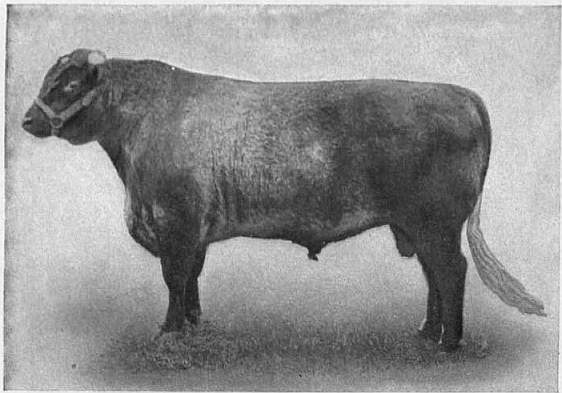
SHORTHORN BULL.
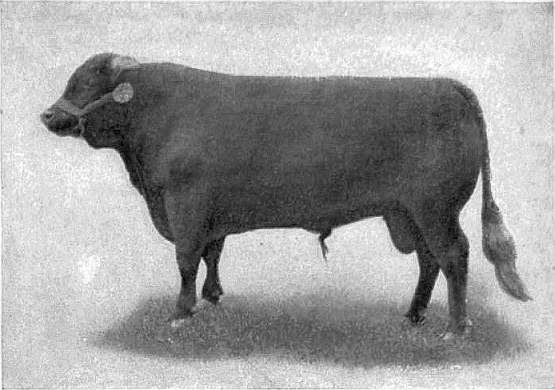
DEVON BULL.
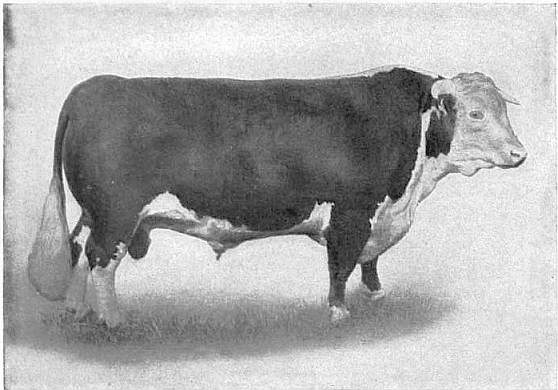
HEREFORD BULL.
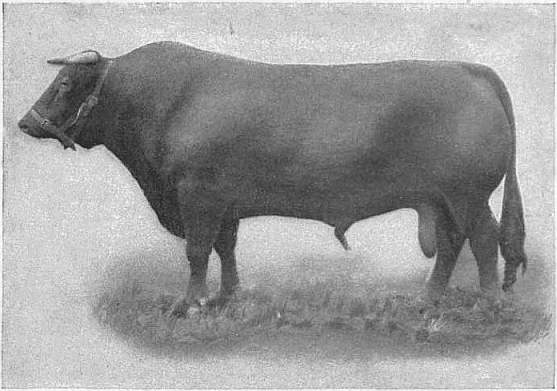
SOUTH DEVON BULL.
Plate II.
BREEDS OF ENGLISH AND WELSH CATTLE. (From photographs by F. Babbage.)
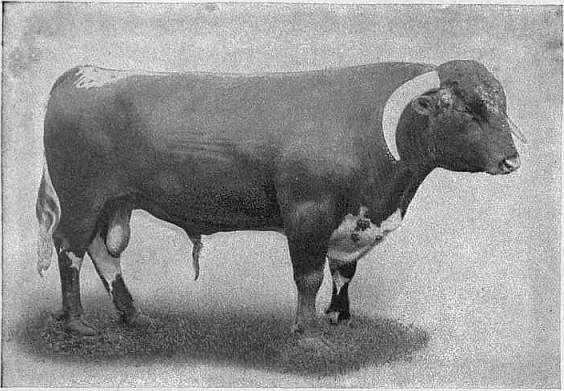
LONGHORN BULL.
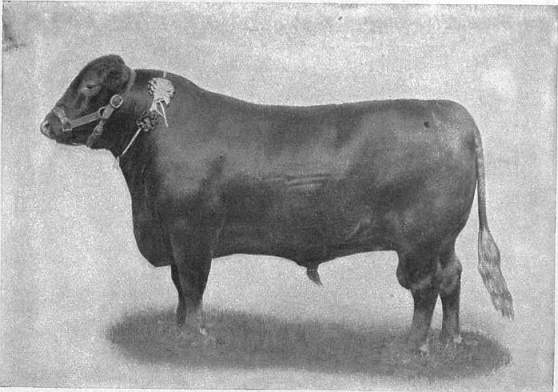
RED POLLED BULL.
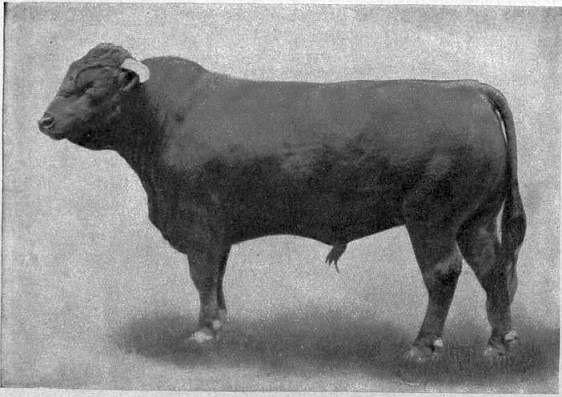
WELSH BULL.
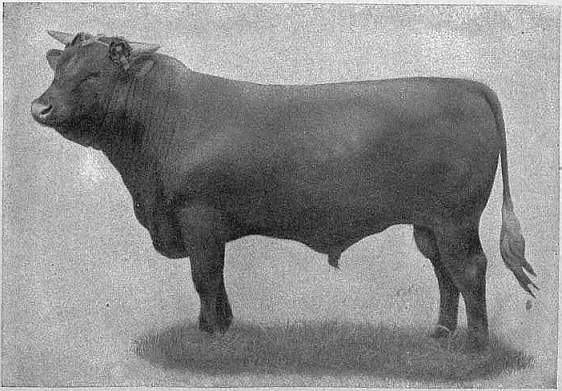
SUSSEX BULL.
Plate III.
BREEDS OF SCOTCH CATTLE.
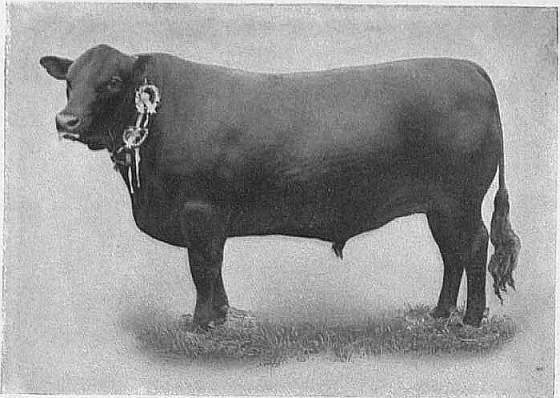
ABERDEEN-ANGUS BULL.
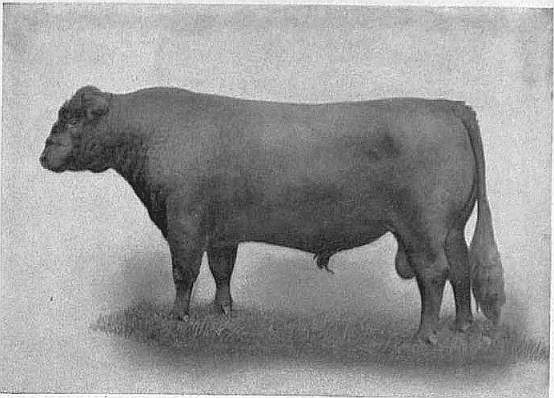
GALLOWAY BULL.
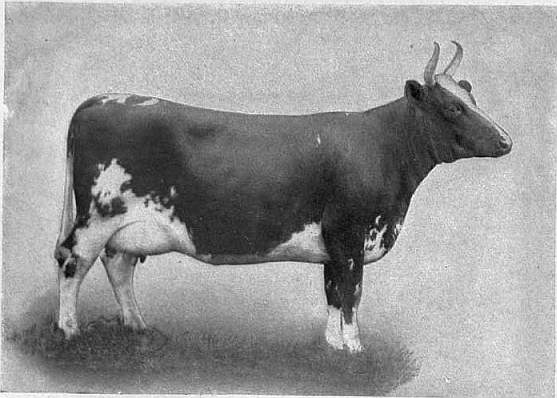
AYRSHIRE COW.
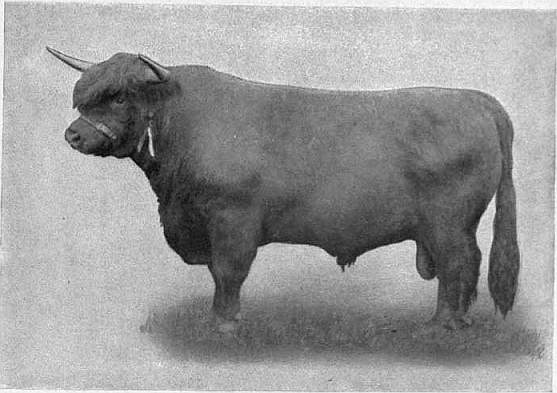
HIGHLAND BULL.
Plate IV.
BREEDS OF IRISH AND CHANNEL ISLANDS CATTLE. (From photographs by F. Babbage.) The comparative sizes of the animals are indicated by the scale of reproduction of the photographs.
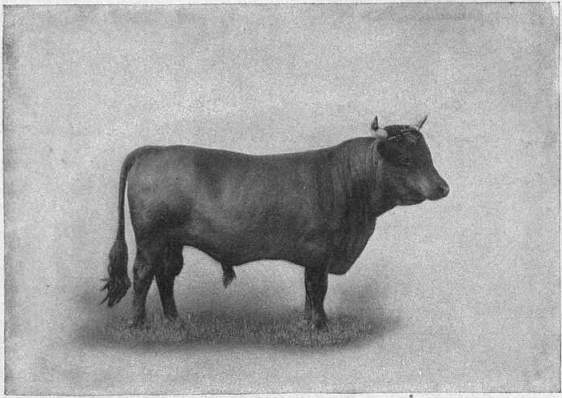
DEXTER BULL.
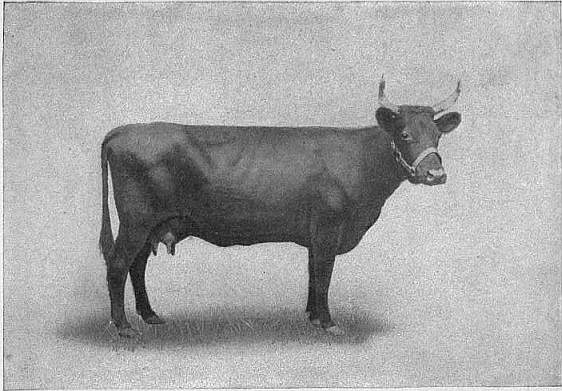
KERRY COW.
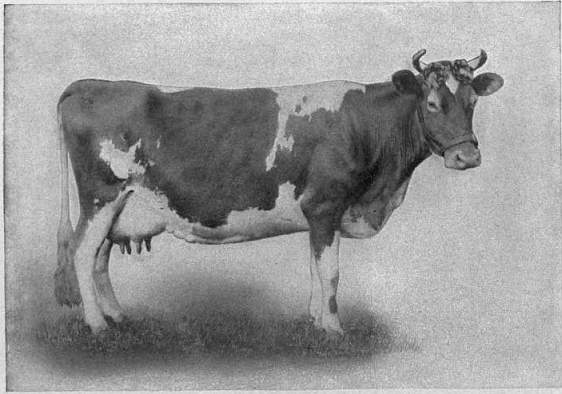
GUERNSEY COW.
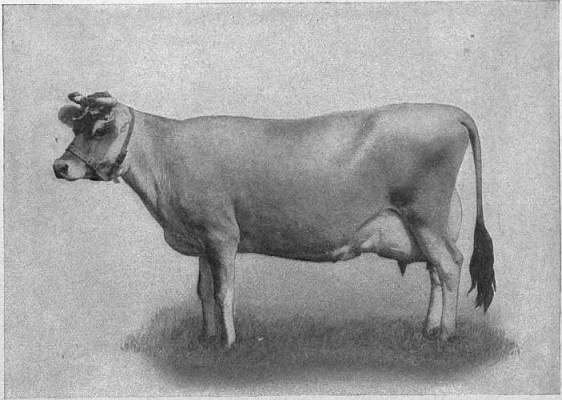
JERSEY COW.
The West Highland or Kyloe breed are perhaps the most hardy and picturesque of British cattle. Their home is amidst the wild romantic scenery of the Highlands and the Western Isles of Scotland, though Highland bullocks with long, spreading curved horns may be seen in English parks. They have not made much progress towards early maturity, but their slowly ripened beef is of the choicest quality. The colour of their thick shaggy hair varies from white and light dun to tawny yellow of many shades, and black.
The Ayrshires are the dairy breed of Scotland, where they have considerably overstepped the limits of the humid western county whence they take their name. They are usually of a white and brown colour, the patches being well defined. The neat, shapely, upstanding horns are characteristic. The Ayrshires are under medium size and move gracefully, and the females display the wedge-shape typical of dairy cows. They are a hardy breed, and, even from poor pastures, give good yields of milk, especially useful for cheese-making purposes. The milking powers of the breed are being improved under a system of milk-testing and records supported by the Highland and Agricultural Society.
The Jerseys are graceful, deer-like cattle, whose home is in the island of Jersey, where, by means of stringent regulations against the importation of cattle, the breed has been kept pure for many generations. As its milk is especially rich in fat (so rich that it requires to be diluted with a little water before it can be safely fed to calves), the Jersey has attained a wide reputation as a butter-producing breed. It is a great favourite in England, where many pure-bred herds exist. The colours most preferred are “whole” fawns of many shades. The light silver-grey, which was in high repute in England in the early ’seventies of the 19th century, is out of favour. Browns and brindles are rarely seen. The grey zone surrounding the black muzzle gives the appearance designated “mealy-mouthed.” The horns are short, and generally artificially curved inwards; the bones are fine. The best milch cows have a yellowish circle round the eye, and the skin at the extremity of the tail is of a deep yellow, almost orange colour. The cows are gentle and docile when reared in close contact with human beings, but the bulls, despite their small size, are often fierce.
Guernsey cattle are native to the islands of Guernsey, Alderney, Sark and Herm. They are kept pure by importation restrictions. Herds of pure-bred Guernseys also exist in the Isle of Wight and in various counties of England and Scotland. They have not the refined and elegant appearance of the Jerseys, which, however, they exceed in size. They are usually of a rich yellowish-brown colour, patched with white, in some cases their colour almost meriting the appellation of “orange and lemon.” The yellow colour inside the ears is a point always looked for by judges. The cows, large-bellied and narrow in front, are truly wedge-shaped, the greatly developed udder adding to the expanse of the hinder part of the body. They yield an abundance of milk, rich in fat, and are excellent butter-producers. The horns are yellow at the base, curved, and not coarse. The nose is flesh-coloured and free from black markings.
The Canadian breed, black with a narrow brown stripe down the back and a light ring round the muzzle, are descended from old Brittany cattle imported into Canada by French settlers three hundred years ago, and are in consequence related to the Channel Islands cattle. They are remarkably hardy and good milkers, and it is claimed they produce butter fat at 2 c. a ℔ less cost than any other breed.
The Kerry is a breed of small black cattle belonging to the south-west of Ireland, whence they have spread into many parts, not only of their native land, but of England as well. Although they are able to subsist on the roughest and scantiest of fare, and are exceedingly hardy, the cows are, nevertheless, excellent milkers, and have acquired celebrity as a dairy breed. The colour is black, but the cows sometimes have a little white on the udder. The horns are white, with black tips, and are turned upwards. The Kerry is active and graceful, long and lithe in body, and light-limbed. On the rich pastures of England it has increased considerably in size.
The Dexter breed is reputed to take its name from one Dexter, agent of Maude, Lord Hawarden, who is credited with having established it by selection and breeding from the best mountain types of the Kerry. Until recently it was called the Dexter-Kerry. It is smaller and more compact than the Kerry, shorter in the leg, and intoed before and behind. Whilst valuable as a beef-making animal, it is equally noted for its milk-producing capacity. Black is the usual colour, but red is also recognized, with, in either case, a little white. When of a red colour, the appearance of the animal has been aptly compared to that of a grand Shorthorn viewed through the wrong end of a telescope. The Kerry and the Dexter are readily distinguishable. The Kerry has a gay, light, deer-like head and horn, light limbs and thin skin. The Dexter has coarser limbs, a square body, flat back, thick shoulder, short neck, and head and horn set on low.
A herd of Dexter-Shorthorns was founded by Major Barton at Straffan, Ireland, in 1860, in which prominent characteristics of the two breeds have been permanently blended so that they breed true to type.
As milk-producers, and therefore as dairy cattle, certain strains of the Shorthorn (registered as well as non-pedigree), the Lincolnshire Red Shorthorn, South Devon, Longhorn, Red Polled, Ayrshire, Jersey, Guernsey, Kerry and Dexter breeds have acquired eminence. Such breeds as the Shorthorn, Lincolnshire Red Shorthorn, South Devon, Welsh, Red Polled and Dexter are claimed as useful beef-makers as well as milk-producers, and are classified as dual-purpose animals. The others belong to the beef-producers. As regards colour, red is characteristic of the Lincolnshire Shorthorn, the Hereford, Devon, Sussex and Red Polled. Black is the dominating colour of the Welsh, Aberdeen-Angus, Galloway, Kerry and Dexter. A yellowish hue is seen in the West Highland, Guernsey and South Devon breeds. Various shades of fawn colour are usual in Jersey cattle and also appear among Highlanders. The Herefords, though with red bodies, have white faces, manes, and dewlaps, whilst white prevails to a greater or less extent in the Shorthorn, Longhorn and Ayrshire breeds. The Shorthorn breed is exceedingly variable in colour; pure-bred specimens may be red, or white, or roan, or may be marked with two or more of these colours, the roan resulting from a blending of the white and red. Black is not seen in a pure-bred Shorthorn. The biggest and heaviest cattle come from the beef-making breeds, and are often cross-bred. Very large or heavy beasts, if pure-bred, usually belong to one or other of the Shorthorn, Hereford, Sussex, Welsh, West Highland, Aberdeen-Angus and Galloway breeds. The Devon, Red Polled and Guernsey are medium-sized cattle; the Ayrshires are smaller, although relatively the bullocks grow larger than bulls or cows. The Jerseys are small, graceful cattle, but the smaller type of Kerries, the Dexters and the Shetlanders furnish the smallest cattle of the British Isles.
See generally the Herd Books of the various breed societies.
(W. Fr.; R. W.)
Rearing and Feeding.7—A calf at birth scales from one-twelfth to one-fourteenth the weight of the dam. A sucking calf of one of the large breeds should gain 3 ℔ per day for the first month, 2.5 ℔ for the second, and 2 ℔ during the later calf period. Colostrum, or first-day milk after calving, contains more than five times the albuminoid compounds found in average cows’ milk. In the course of three or four days it gradually becomes normal in composition, although the peculiar flavour remains a few days longer. Nature has specially prepared it for the young calf with extremely nourishing and also laxative properties, and it is of practically no value for any other purpose. Normal cows’ milk has an albuminoid ratio slightly narrower than 1 : 4—colostrum 1 : .71. [The ratio is arrived at by adding to the percentage of milk-sugar, possessing about the food equivalent of starch, the fat multiplied by 2.268, and dividing by the total albuminoids—all digestible.]
Common nutrient ratios for older animals are stated in the following table of food standards by Dr Emil Wolff:—
Food Consumed per Day.
Dry. Digestible.
Live Weight Organic Matter Albu- minoid Fats Carbo- Hydrates Albuminoid Ratio.
℔ ℔ ℔ ℔ ℔ ℔
Calves, growing, 2 to 3 months 150 3.3 0.6 0.30 2.1 1 : 4.7
Young cattle ” 3 to 6 ” 300 7.0 1.0 0.30 4.1 1 : 5
” ” 6 to 12 ” 500 12.0 1.2 0.30 6.8 1 : 6
” ” 12 to 18 ” 700 16.8 1.4 0.28 9.1 1 : 7
” ” 18 to 24 ” 850 20.4 1.4 0.26 10.3 1 : 8
Oxen in complete rest 1000 27.5 0.7 0.15 8.0 1 : 12
” fattening, 1st period 1000 27.0 2.5 0.50 15.0 1 : 65
” ” 2nd period 1000 26.0 3.0 0.70 14.8 1 : 5.5
” ” 3rd period 1000 25.0 2.7 0.60 14.8 1 : 6
Milch cows 1000 24.0 2.5 0.40 12.5 1 : 5.4
Digestible albuminoid nitrogen is the scarcest and consequently the costliest ingredient in food-stuffs, but, since the introduction of vegetable proteid made by Mitchell’s process from the castor bean, an easy and inexpensive means of balancing cattle food ratios is available. By this means the manurial value of the excrement is increased. The calculations necessary in arriving at a ratio are simplified by the employment of Jeffers’s calculator (Plainsboro, N.J.).
There are three common methods of rearing calves, (1) The calf sucks its mother or foster-mother. This is the natural method and the best for the show-yard and for early fattening purposes; but it is the most expensive, and the calves, if not handled, grow up wild and dangerous. Store stock may be also raised by putting two calves to one cow and weaning at three months old; a second pair in turn yielding place to a single calf. (2) Full milk from the cow at about 90° F. is given alone until the latter part of the milk period; then the calf is trained to eat supplementary foods to preserve the calf-fat after weaning. A large calf at first receives daily three quarts of milk at three meals. The amount is increased to 2 gallons by the end of the fourth week, and to 2½ gallons at 3 months, when gradual weaning begins. Linseed cake meal is specially suitable for such calves. (3) The calf receives full milk from the mother for one to two weeks, or better, for three to four weeks; then it is slowly transferred to fortified separated milk or milk substitutes. Cod-liver oil, 2 oz. daily, is a good substitute for butter fat. In America cotton-seed oil, ½ oz. to the quart of milk, or an equivalent of oleomargarine heated to 110° F. and churned with separated milk, has produced a live-weight-increase of 2 ℔ daily. Linseed simmered to a jelly and added to separated milk gives good results. Moderate amounts are easily digested. Oatmeal or maize meal containing 10% of linseed meal does well, later, at less cost. Milk substitutes and calf meals require close attention in preparation, and would not fetch the prices they do if feeders possessed the technical knowledge necessary to select and mix common foods. Ground cake or linseed meal is, after a time, better given dry than cooked, being then better masticated and not so liable to produce indigestion.
Grass or fine hay in racks is provided when the calf can chew the cud. As cattle get older, live-weight-increase grows less. Smithfield weights8 show that a good bullock up to a year old will increase 2 ℔ daily, a two-year-old 1¾ ℔, and a three-year-old a little over 1½ ℔
Cattle feeding on a farm consume crude produce that is inconvenient to market, and make farmyard manure; but there is frequently no profit left. To secure the balance on the right side the inlaid price per live cwt. requires to be 5s. less than the sale price—say 32s. per cwt. for lean cattle, and 37s. per cwt. for the animal when sold fat and capable of producing 60% of dressed beef. The ordinary animal yields only about 57%. A well-bred fattening bullock begins with 2 ℔ of cake and meal per day, increasing to 8 ℔ at the end of five months (6 ℔ on an average), and receives ¾ cwt. of roots and 12 ℔ of straw; at an average cost of about 4s. 3d. per imperial stone or 50s. per cwt. of dressed carcase. Heifers feed faster than bullocks, and age tells on the rate at which an animal will mature: a three-year-old will develop into prime beef more quickly and easily than a two-year-old. It is difficult to produce “baby beef” at a profit, and it can only be done with picked animals of the best flesh-producing breeds, which cannot be bought at a price per cwt. below the finished sale price, for animals producing baby beef must from start to finish (under two years old) be at all times fit to go to the fat market. It is true that a very young animal can give a better account of food than an older one, but this advantage is counterbalanced by the tendency to grow rather than to fatten. (See also Agriculture.)
In cold and stormy districts cattle thrive best in covered courts, but in a mild climate they do equally well in open yards with shelter-sheds. The more air they get the less liable they are to tuberculosis—example Lincolnshire and the drier south-eastern counties. The ideal method of house-feeding cattle is singly in boxes 10 ft. square, where they are undisturbed, and where the best manure is made because it is not washed by rain.
On the finest British grazing lands two lots of cattle are fed in one season. The first is finished early in July, having, without artificial feeding, laid on eight to nine stones of beef. The second lot requires three or four pounds of undecorticated cotton cake each towards the end of September and in October when grass begins to fail.
(R. W.)
1 Rev. J. Storer, The Wild White Cattle of Great Britain (1879).
2 See Wallace’s Farm Live Stock of Great Britain (1907), Low’s Breeds of the Domestic Animals of the British Isles (1842, illustrated, and 1845), and E.V. Wilcox’s Farm Animals (1907), an American work.
3 Shorthorn Society of Great Britain and Ireland (1822). Sec. E.J. Powell, 12 Hanover Square, London, W.
4 C.J. Bates, “The Brothers Colling,” Jour. Roy. Agric. Soc. (1899).
5 C.J. Bates, Thomas Bates and the Kirklevington Shorthorns: a Contribution to the History of Pure Durham Cattle (Newcastle-upon-Tyne, 1897).
6 Housman, “Robert Bakewell,” Jour. Roy. Agric. Soc. (1894).
7 See E. Wolff, Farm Foods, by H.H. Cousins (1895); A.D. Hall, Rothamsted Experiments (1905); R. Warington, Chemistry of the Farm (15th ed., 1902); W.A. Henry, Feeds and Feeding (1907); H.W. Mumford, Beef Production (1907); H.P. Armsby, Animal Nutrition (2nd ed., 1906); T. Shaw, Animal Breeding (1903); R. Wallace, Farm Live Stock of Great Britain (4th ed., 1907).
8 E. J. Powell, History of the Smithfield Club from 1798 to 1900 (1902).
CATULLUS, GAIUS VALERIUS (?84-54 b.c.), the greatest lyric poet of Rome. As regards his names and the dates of his birth and death, the most important external witness is that of Jerome, in the continuation of the Eusebian Chronicle, under the year 87 b.c., “Gaius Valerius Catullus, scriptor lyricus Veronae nascitur,” and under 57 b.c., “Catullus xxx. aetatis anno Romae moritur.” There is no controversy as to the gentile name, Valerius. Suetonius, in his Life of Julius Caesar (ch. 73), mentions the poet by the names “Valerium Catullum.” Other persons who had the cognomen Catullus belonged to the Valerian gens, e.g. M. Valerius Catullus Messalinus, a delator in the reign of Domitian, mentioned in the fourth satire of Juvenal (l. 113):—
“Et cum mortifero prudens Veiento Catullo.”
Inscriptions show, further, that Valerius was a common name in the native province of Catullus, and belonged to other inhabitants of Verona besides the poet and his family (Schwabe, Quaestiones Catullianae, p. 27). Scholars have been divided in opinion as to whether his praenomen was Gaius or Quintus, and in the best MSS. the volume is called simply Catulli Veronensis liber. For Gaius we have the undoubted testimony, not only of Jerome, which rests on the much earlier authority of Suetonius, but also that of Apuleius. In support of Quintus a passage was quoted from the Natural History of Pliny (xxxvii. 6, 81). But the praenomen Q. is omitted in the best MSS., and in other passages of the same author the poet is spoken of as “Catullus Veronensis.” The mistake may have arisen from confusion with Q. Catulus, the colleague of Marius in the Cimbric War, himself also the author of lyrical poems. Allusions in the poems show that the date of his death given by Jerome (57 b.c.) is wrong, and that Catullus survived the second consulship of Pompey (55 b.c.) (cf. lv. 6, cxiii. 2), and was present in August of the following year at the prosecution of Vatinius by Licinius Calvus (cf. liii.). The allusion in lii. 3—
“Per consulatum peierat Vatinius,”
does not prove that Catullus must have lived to see the consulship bestowed on Vatinius in the end of 47 b.c. but only that Vatinius, after being praetor in 55 b.c., was in the habit of boasting of the certainty of his attaining the consulship, as Cleopatra was in the habit of confirming her most solemn declarations by appealing to her hope of one day administering justice in the Capitol (cf. Haupt, “Quaestiones Catullianae,” Opuscula, vol. i. 1875). There is then nothing to prove that Catullus lived beyond the month of August 54 b.c. Some of the poems (as xxxvii. and lii.) may have been written during his last illness. If he died in 54 b.c. or early in 53 b.c., Catullus must either have been born later than 87 b.c., or have lived to a greater age than thirty. Catullus is described by Ovid as “hedera iuvenalia cinctus Tempora” (Amor. iii. 9. 61),—a description somewhat more suitable to a man who dies in his thirtieth year than to one who dies three or four years later. Further, the age at which a man dies is more likely to be accurately remembered than the particular date either of his death or of his birth, and the common practice of recording the age of the deceased in sepulchral inscriptions must have rendered a mistake about this less likely to occur. It seems, therefore, on the whole, most likely that Jerome’s words “xxx. aetatis anno” are correct, and that Catullus was born in 84 b.c.
The statement that he was born at Verona is confirmed by passages in Ovid and Martial. Pliny the elder, who was born at Como, speaks of Catullus in the preface to his Natural History, as his “countryman” (conterraneus), and the poet speaks of Verona as his home, or at least his temporary residence, in more than one place. His occasional residence in his native place is further attested by the statement of Suetonius (Julius Caesar, 73), that “Julius Caesar accepted the poet’s apology for his scurrilous verses upon him, invited him to dine with him on the same day, and continued his intimacy with his father as before.” As this incident could only have happened during the time that Julius Caesar was pro-consul, the scene of it must have been in the Cisalpine province, and at the house of the poet’s father, in or near Verona. The verses apologized for were those contained in poems xxix. and lvii., the former of which must have been written after Caesar’s invasion of Britain, so that this interview probably took place in the winter of 55-54 b.c. The fact that his father was the host of the great pro-consul, and lived on terms of intimacy with him, justifies the inference, that he was, in wealth and rank, one of the principal men of the province. The only other important statement concerning the poet’s life which rests on external authority is that of Apuleius, that the real name of the Lesbia of the poems was Clodia. Another, which concerns the reputation which he enjoyed after his death, is given in the Life of Atticus by Cornelius Nepos (12. 4). It is to the effect that he regarded Lucretius and Catullus as the two greatest poets of his own time.
The poems of Catullus consist of 116 pieces, varying in length from 2 to 408 lines, the great mass of them being, however, short pieces, written in lyric, iambic or elegiac metre. The arrangement cannot be the poet’s; it is neither chronological nor in accordance with the character of the topics. The shorter poems, lyric or iambic, are placed first, next the longer epithalamia, (most being written in hexameters) amongst which the Attis is inserted and then those written in the elegiac metre. But, though no chronological order is observed, yet internal evidence enables us to determine the occasions on which many of the poems were written, and the order in which they followed one another. They give a very vivid image of various phases of the poet’s life, and of the strong feelings with which persons and things affected him. They throw much light also on the social life of Rome and of the provincial towns of Italy in the years preceding the outbreak of the second civil war. In this respect they may be compared with the letters of Cicero.
The poems extend over a period of seven or eight years, from 61 or 62 till 54 b.c. Among the earliest are those which record the various stages of the author’s passion for Lesbia. It is in connexion with this passion that he is generally mentioned, or alluded to, by the later Roman poets, such as Propertius, Ovid, Juvenal and Martial. Her real name, as we learn from Apuleius, was Clodia. The admiration of Catullus for Sappho, the Lesbian poetess, which is clearly indicated by the imitation of her language in his fifty-first and sixty-second poems, affords an obvious explanation of the Greek name which he gave to his Roman mistress. Clodia was the notorious sister of Publius Clodius Pulcher, and in the year 56 she charged M. Caelius Rufus, after tiring of him, as she had of Catullus, with an attempt to poison her. It was in defence of Rufus that Cicero described the spell she exercised over young men, in language which might have been applied to her previous relations with the youthful poet, as well as those with the youthful orator and politician.
Poems concerning Lesbia occur among both the earliest and the latest of those contained in the series. They record the various stages of passion through which Catullus passed, from absolute devotion and a secure sense of returned affection, through the various conditions of distrust and jealousy, attempts at renunciation, and short-lived “amoris integrationes,” through the “odi et amo” state, and the later state of savage indignation against both Lesbia and his rivals, and especially against Caelius Rufus, till he finally attains, not without much suffering and loss, the last state of scornful indifference. Among the earliest of the poems connected with Lesbia, and among those written in the happiest vein, are ii. and iii., and v. and vii. The 8th, “Miser Catulle, desinas ineptire,” perhaps the most beautiful of them all, expresses the first awakening of the poet to a sense of her unworthiness, before the gentler have given place to the fiercer feelings of his nature. His final renunciation is sent in a poem written after his return from the East, with a union of imaginative and scornful power, to his two butts, Furius and Aurelius (xi., “Furi et Aureli, comites Catulli”), who, to judge by the way Catullus writes of them, appear to have been hangers-on upon him, who repaid the pecuniary and other favours they received by giving him grounds for jealousy, and making imputations on his character (cf. xv., xvi., xviii., xxiii.).
The intrigue of Caelius Rufus with Lesbia began in 59 or 58 b.c. It was probably in the earlier stages of this liaison that the 68th poem was written, from which it appears that Catullus, at the time living at Verona, and grieving for the recent death of his brother in the Troad, had heard of Lesbia’s infidelity, and, in consideration of her previous faithlessness in his favour, was not inclined to resent it very warmly. Two other poems in the series express the grief which Catullus felt for the death of his brother,—one, the 65th, addressed to the orator Hortensius, who is there, as in some of Cicero’s letters, called Hortalus or Ortalus, and sent to him along with the Coma Berenices (lxvi.), a translation of a famous elegy of Callimachus. The other poem referring to this event (ci.) must have been composed some years later, probably in 56 b.c., when Catullus visited his brother’s tomb in the Troad, on his return from Bithynia. Between 59 and 57 b.c. most of the lampoons on Lesbia and her numerous lovers must have been written (e.g. xxxvii., xxxix., &c.). Some, too, of the poems expressive of his more tender feelings to her, such as viii. and lxxvi. belong also to these years; and among the poems written either during this period or perhaps in the early and happier years of his liaison, some of the most charming of his shorter pieces, expressing the affection for his young friends Verannius and Fabullus (ix., xii., xiii.), may be included.
In the year 57 the routine of his life was for a short time broken by his accompanying the propraetor C. Memmius, the friend to whom Lucretius dedicates his great poem, as one of his staff, to the province of Bithynia. His object was probably to better his fortunes by this absence from Rome, as humorous complaints of poverty and debt (xiii., xxvi.) show that his ordinary means were insufficient for his mode of life. He frankly acknowledges the disappointment of these hopes, and still more frankly his disgust with his chief (x., xxviii.). Some of the most charming and perfect among the shorter poems express the delight with which the poet changed the dulness and sultry climate of the province for the freedom and keen enjoyment of his voyage home in his yacht, built for him at Amastris on the Euxine, and for the beauty and peace of his villa on the shores of Lake Benacus, which welcomed him home “wearied with foreign travel.” To this period and to his first return to Rome after his visit to his native district belong the poems xlvi., ci., iv., xxxi. and x., all showing by their freshness of feeling and vivid truth of expression the gain which the poet’s nature derived from his temporary escape from the passions, distractions and animosities of Roman society. Two poems, written in a very genial and joyous spirit, and addressed to his younger friend Licinius Calvus (xiv. and l.), who is ranked as second only to himself among the lyrical poets of the age, and whose youthful promise pointed him out as likely to become one of the greatest of Roman orators, may, indeed, with most probability be assigned to these later years (xiv.). From the expression “Odissem te odio Vatiniano,” in the third line of xiv., it may be inferred that the poem was written not earlier than December (the “Saturnalia”) of the year 56 b.c., as it was early in that year, as we learn from a letter of Cicero to his brother Quintus (ii. 4. 1), that Calvus first announced his intention of prosecuting Vatinius. The short poem numbered liii. would be written in August 54 b.c. The poems which have left the greatest stain on the fame of Catullus—those “referta contumeliis Caesaris,” the licentious abuse of Mamurra, and probably some of those personal scurrilities addressed to women as well as men, or too frank confessions, which posterity would willingly have let die, may well have been written in the last years of his life, under the influence of the bitterness and recklessness induced by his experience. It cannot be determined with certainty whether the longer and more artistic pieces, which occupy the middle of the volume—the Epithalamium in celebration of the marriage of Manlius Torquatus, the 62nd poem, written in imitation of the Epithalamia of Sappho, “Vesper adest: iuvenes, consurgite”; the Attis, and the Epic Idyll representing the marriage festival of Peleus and Thetis—belong to the earlier or the later period of the poet’s career. If the person addressed in the first part of the 68th is the Manlius of the Epithalamium, and the lines from 3 to 8—
“Naufragum ut eiectum ... pervigilat,”
refer to the death of Vinia, it would follow that the first Epithalamium was written some time before that poem, and thus belongs to the earlier time. While the translations of Sappho,—
“Ille mi par esse deo videtur,”
and of Callimachus (lxvi.),—
“Omnia qui magni dispexit lumina mundi,”
belong to the earlier period, the Attis and the Peleus and Thetis; although perhaps suggested by the treatment of the same or similar subjects in Greek authors, are executed with such power and originality as declare them to be products of the most vigorous stage in the development of the poet’s genius. That his genius came soon to maturity is a reason for hesitation in assigning any particular time between 62 and 54 b.c. for the composition of the Attis and of that part of the Epithalamium (“Peliaco quondam prognatae vertice pinus”) which deals with the main subject of the poem. But the criticism of Munro in his edition of Lucretius, which shows similarities of expression that cannot be mere casual coincidences, between the Ariadne-episode in the Epithalamium of Catullus (from line 52 to 266) and the poem of Lucretius, leaves little doubt that that portion at least of the poem was written after the publication of the De rerum natura, in the winter of 55-54 b.c.
No ancient author has left a more vivid impression of himself on his writings than Catullus. Coming to Rome in early youth from a distant province, not at that time included within the limits of Italy, he lived as an equal with the men of his time of most intellectual activity and refinement, as well as of highest social and political eminence. Among those to whom his poems are addressed, or who are mentioned in them, we find the names of Hortensius, Cicero, Cornelius Nepos, Licinius Calvus, Helvius Cinna and Asinius Pollio, then only a youth (xii. 8). Catullus brought into this circle the genius of a great poet, the social vivacity of a vigorous nature, the simplicity and sincerity of an unambitious, and the warmth of an affectionate disposition. He betrays all the sensitiveness of the poetic temperament, but it is never the sensitiveness of vanity, for he is characterized by the modesty rather than the self-confidence which accompanies genius, but the sensitiveness of a heart which gives and expects more sympathy and loyalty in friendship than the world either wants or cares to give in return. He shows also in some of his lighter pieces the fastidiousness of a refined taste, intolerant of all boorishness, pedantry, affectation and sordid ways of life. The passionate intensity of his temperament displays itself with similar strength in the outpourings of his animosity as of his love and affection. It was, unfortunately, the fashion of the time to employ in the expression of these animosities a licence of speech and of imputation which it is difficult for men living under different social conditions to understand, still more difficult to tolerate. Munro has examined the 29th poem—
“Quis hoc potest videre, quis potest pati,”
the longest and most important of the lampoons on Caesar and Mamurra, and shown with much learning and acuteness the motives and intention of Catullus in writing them. Had Julius Caesar really believed, as Suetonius, writing two hundred years afterwards, says he did, that “an eternal stigma had been cast upon him by the verses concerning Mamurra,” we should scarcely apply the word magnanimity to his condonation of the offence. But these verses survive as a memorial not of any scandal affecting Julius Caesar which could possibly have been believed by his contemporaries, but of the licence of speech which was then indulged in, of the jealousy with which the younger members of the Roman aristocracy, who a little later fought on the side of Pompey, at that time regarded the ascendancy both of the “father-in-law and the son-in-law,” and the social elevation of some of their instruments, and also, to a certain extent, of the deterioration which the frank and generous nature of Catullus underwent from the passions which wasted, and the faithlessness which marred his life.
The great age of Latin poetry extends from about the year 60 b.c. till the death of Ovid in 17 a.d. There are three marked divisions in this period, each with a distinct character of its own: the first represented by Lucretius and Catullus, the second by Virgil and Horace, the last by Ovid. Force and sincerity are the great characteristics of the first period, maturity of art of the second, facility of the last. The educating influence of Greek art on the Roman mind was first fully experienced in the Ciceronian age, and none of his contemporaries was so susceptible of that influence as Catullus. With the susceptibility to art he combined a large share of the vigorous and genial qualities of the Italian race. Like most of his younger contemporaries, he studied in the school of the Alexandrine poets, with whom the favourite subjects of art were the passion of love, and stories from the Greek mythology, which admitted of being treated in a spirit similar to that in which they celebrated their own experiences. It was under this influence that Catullus wrote the Coma Berenices, the 68th poem, which, after the manner of the Alexandrines, interweaves the old tale of Protesilaus and Laodamia with the personal experiences of the poet himself, and the Epithalamium of Peleus and Thetis, which combines two pictures from the Greek mythology, one of the secure happiness of marriage, the other of the passionate despair of love betrayed. In this last poem Catullus displays a power of creative pictorial imagination far transcending that displayed in any of the extant poetry of Alexandria. We have no means of determining what suggested the subject of the Attis to Catullus, whether the previous treatment of the subject by some Greek writer, some survival of the myth which he found still existing during his residence among the “Phrygii Campi,” or the growth of various forms of Eastern superstition and fanaticism, at Rome, in the last age of the Republic. Whatever may have been its origin, it is the finest specimen we possess, in either Greek or Latin literature, of that kind of short poem more common in modern than ancient times, in which some situation or passion entirely alien to the writer, and to his own age, is realized with dramatic intensity. But the genius of Catullus is, perhaps, even happier in the direct expression of personal feeling than in artistic creation, or the reproduction of tales and situations from mythology. The warmth, intensity and sincerity of his own nature are the sources of the inspiration in these poems. The most elaborate and one of the finest of them is the Epithalamium in honour of the marriage of a member of the old house of Manlius Torquatus with Vinia Aurunculeia, written in the glyconic in combination with the pherecratean metre. To this metre Catullus imparts a peculiar lightness and grace by making the trochee, instead of the spondee as in Horace’s glyconics and pherecrateans, the first foot in the line. His elegiac metre is constructed with less smoothness and regularity than that of Ovid and Tibullus or even of Propertius, but as employed by him it gives a true echo to the serious and plaintive feelings of some of his poems, while it adapts itself, as it did later in the hands of Martial, to the epigrammatic terseness of his invective. But the perfection of the art of Catullus is seen in his employment of those metres which he adapted to the Latin tongue from the earlier poets of Greece, the pure iambic trimeter, as in iv.—
“Phaselus ille quem videtis hospites,”
the scazon iambic, employed in viii. and xxxi.—
“Paeninsularum, Sirmio, insularumque,”
and the phalecian hendecasyllabic, a slight modification of the Sapphic line, which is his favourite metre for the expression of his more joyful moods, and of his lighter satiric vein. The Latin language never flowed with such ease, freshness and purity as in these poems. Their perfection consists in the entire absence of all appearance of effort or reflection, and in the fulness of life and feeling, which gives a lasting interest and charm to the most trivial incident of the passing hour. In reference to these poems Munro has said with truth and force: “A generation had yet to pass before the heroic attained to its perfection; while he (Catullus) had already produced glyconics, phalecians and iambics, each ‘one entire and perfect chrysolite,’ ‘cunningest patterns’ of excellence, such as Latium never saw before or after,—Alcaeus, Sappho, and the rest then and only then having met their match.”
The work of Catullus has not come down to us intact, as is shown by lacunae and quotations in ancient writers which cannot now be found in his poems. Out of the MSS. only three have claims to intrinsic importance. The oldest and best appears to be the Bodleian (Canon. 30). But little inferior is the Sangermanensis (Par. 14137). Of the third, the Romanus, we shall be better able to judge when its discoverer, Prof. W.G. Hale, has published his collation. None of these MSS. are older than the 14th century. One poem, 62, is, however, preserved in a MS. of the 9th century (the Thuaneus, Par. 8071). Prof. R. Ellis’s discovery of the Bodleian MS. and E. Baehrens’s recognition of its value opened a new chapter in the history of the text. Ellis’s contributions comprise an indispensable commentary (ed. 2, 1889), an elaborate critical edition (ed. 2, 1878) and an English translation (1871) in the metres of the original. The text in the Oxford series, published in 1905, is inferior to those specified below. Baehrens’s edition, 2 volumes (text 1876, the second edition by K.P. Schulze is a misnomer; and Latin commentary 1885) is still of value. Amongst other editions with critical or explanatory notes or both may be mentioned those of A. Riese (1884), L. Schwabe (1886, with index verborum), B. Schmidt (1887), J.P. Postgate (1889, text differing little from that in the new Corpus Poetarunt), E. Benoist and E. Thomas, with French translation by Rostand (2 vols., 1882-1890), S.G. Owen (1893, an édition de luxe), W.T. Merrill (1893, Boston, U.S.A., with succinct English notes), A. Palmer (1896, one of the best of this scholar’s works); M. Haupt’s text of the three poets Catullus, Tibullus and Propertius, edited by J. Vahlen, reached its sixth edition in 1904. Of the numerous contributions to the textual and literary criticism of the poems may be named the papers in M. Haupt’s Opuscula, L. Schwabe’s Quaestiones Catullianae (1862), B. Schmidt’s Prolegomena, H.A.J. Munro’s Criticisms and Elucidations of Catullus (1878; second edition by J.D. Duff, 1905). Translations into English verse by J. Cranstoun (1867), Sir T. Martin (1861, 1876), R. Ellis (above); a recent version in prose with the Latin text by F.W. Cornish (1904). For further information see Teuffel’s History of Roman Literature (tr. by Warre), § 214, or the more recent accounts by M. Schanz, Geschichte der romischen Litteratur, i. §§ 102-106, and Frédéric Plessis, La Poésie latine (1909), pp. 143-173.
(W. Y. S.; X.)
CATULUS, the name of a distinguished family of ancient Rome of the gens Lutatia. The following are its most important members.
1. Gaius Lutatius Catulus, Roman commander during the First Punic War, consul 242 b.c. He was sent with a fleet of 200 ships to Sicilian waters, and almost without opposition occupied the harbours of Lilybaeum and Drepanum. A hurriedly equipped fleet sent out from Carthage under Hanno was intercepted by the praetor Publius Valerius Falto and totally defeated (battle of the Aegates Islands, March 10, 241). Catulus, who had been wounded at Drepanum, took no part in the operations, but on his return to Rome was accorded the honour of a triumph, which against his will he shared with Valerius. (See Punic Wars: First, ad fin.).
2. Quintus Lutatius Catulus, Roman general and consul with Marius in 102 b.c. In the war against the Cimbri and Teutones he was sent to defend the passage of the Alps but found himself compelled to retreat over the Po, his troops having been reduced to a state of panic (see Marius, Gaius). In 101 the Cimbri were defeated on the Raudine plain, near Vercellae, by the united armies of Catulus and Marius. The chief honour being ascribed to Marius, Catulus became his bitter opponent. He sided with Sulla in the civil war, was included in the proscription list of 87, and when Marius declined to pardon him, committed suicide. He was distinguished as an orator, poet and prose writer, and was well versed in Greek literature. He is said to have written the history of his consulship and the Cimbrian War after the manner of Xenophon; two epigrams by him have been preserved, one on Roscius the celebrated actor (Cicero, De Nat. Deorum, i. 28), the other of an erotic character, imitated from Callimachus (Gellius xix. 9). He was a man of great wealth, which he spent in beautifying Rome. Two buildings were known as “Monumenta Catuli”: the temple of Fortuna hujusce diei, to commemorate the day of Vercellae, and the Porticus Catuli, built from the sale of the Cimbrian spoils.
See Plutarch, Marius, Sulla; Appian, B.C. i. 74; Vell. Pat. ii. 21; Florus iii. 21; Val. Max. vi. 3, ix. 13; Cicero, De Oratore, iii, 3. 8, Brutus, 35.
3. Quintus Lutatius Catulus (c. 120-61 b.c.), sometimes called Capitolinus, son of the above, consul in 102. He inherited his father’s hatred of Marius, and was a consistent though moderate supporter of the aristocracy. In 78 he was consul with Marcus Aemilius Lepidus, who after the death of Sulla proposed the overthrow of his constitution, the re-establishment of the distribution of grain, the recall of the banished, and other democratic measures. Catulus vigorously opposed this, and a temporary compromise was effected. But Lepidus, having levied troops in his province of Transalpine Gaul, returned to Rome at the head of an army. Catulus defeated him at the Mulvian bridge and near Cosa in Etruria, and Lepidus made his escape to Sardinia, where he died soon afterwards. In 67 and 66 Catulus unsuccessfully opposed, as prejudicial to constitutional freedom, the Gabinian and Manilian laws, which conferred special powers upon Pompey (q.v.). He consistently opposed Caesar, whom he endeavoured to implicate in the Catilinarian conspiracy. Caesar, in return, accused him of embezzling public money during the reconstruction of the temple on the Capitol, and proposed to obliterate his name from the inscription and deprive him of the office of commissioner for its restoration. Catulus’s supporters rallied round him, and Caesar dropped the charge. Catulus was the last princeps senatus of republican times; he held the office of censor also, but soon resigned, being unable to agree with his colleague Licinius Crassus. Although not a man of great abilities, Catulus exercised considerable influence through his political consistency and his undoubted solicitude for the welfare of the state.
See Sallust, Catilina, 35. 49; Dio Cassius xxxvi. 13; Plutarch, Crassus; Suetonius, Caesar, 15.
CAUB, or Kaub, a town of Germany, in the Prussian province of Hesse-Nassau, on the right bank of the Rhine, 28 m. N.W. from Wiesbaden, on the railway from Frankfort-on-Main to Cologne. Pop. 2200. It has a Roman Catholic and an Evangelical church, and a statue of Blücher. The trade mainly consists of the wines of the district. On a crag above the town stands the imposing ruin of Gutenfels, and facing it, on a rock in the middle of the Rhine, the small castle Pfalz, or Pfalzgrafenstein, where, according to legend, the Palatine countesses awaited their confinement, but which in reality served as a toll-gate for merchandise on the Rhine.
Caub, first mentioned in the year 983, originally belonged to the lords of Falkenstein, passed in 1277 to the Rhenish Palatinate, and attained civic rights in 1324. Here Blücher crossed the Rhine with the Prussian and Russian armies, on New Year’s night 1813-1814, in pursuit of the French.
CAUCA, a large coast department of Colombia, South America, lying between the departments of Bolivar, Antioquia, Caldas and Tolima on the E., and the Pacific Ocean and Panama on the W., and extending from the Caribbean Sea S. to the department of Nariño. Pop. (1905, estimate) 400,000; area 26,930 sq. m. Although Cauca was deprived of extensive territories on the upper Caquetá and Putumayo, and of a large area bordering on Ecuador in the territorial redistribution of 1905, it remained the largest department of the republic. The Western Cordillera, traversing nearly its whole length from south to north, and the Central Cordillera, forming a part of its eastern frontier, give a very mountainous character to the region. It includes, besides, the fertile and healthful valley of the upper Cauca, the hot, low valley of the Atrato, and a long coastal plain on the Pacific. The region is rich in mines and valuable forests, but its inhabitants have made very little progress in agriculture because there are not adequate transportation facilities. The capital of the department is Popayán at its southern extremity, with an estimated population in 1905 of 10,000, other important towns are Cali (16,000), Buga, Cartago and Buenaventura.
CAUCASIA, or Caucasus, a governor-generalship of Russia, occupying the isthmus between the Black Sea and the Sea of Azov on the west and the Caspian Sea on the east, as well as portions of the Armenian highlands. Its northern boundary is the Kuma-Manych depression, a succession of narrow, half-desiccated lakes and river-beds, only temporarily filled with water and connecting the Manych, a tributary of the Don, with the Kuma, which flows into the Caspian. This depression is supposed to be a relic of the former post-Pliocene connexion between the Black Sea and the Caspian, and is accepted by most geographers as the natural frontier between Europe and Asia, while others make the dividing-line coincide with the principal water-parting of the Caucasus mountain system. The southern boundary of Caucasia is in part coincident with the river Aras (Araxes), in part purely conventional and political. It was shifted several times during the 19th century, but now runs from a point on the Black Sea, some 20 m. south of Batum, in a south-easterly and easterly direction to Mt. Ararat, and thence along the Aras to within 30 m. of its confluence with the Kura, where it once more turns south-east, and eventually strikes the Caspian at Astara (30° 35′ N.). This large territory, covering an area of 180,843 sq. m., and having in 1897 9,248,695 inhabitants (51 per sq. m.), may be divided into four natural zones or sections:—(i.) the plains north of the Caucasus mountains, comprising the administrative division of Northern Caucasia; (ii.) the Caucasus range and the highlands of Daghestan; (iii.) the valleys of the Rion and the Kura, between the Caucasus range and the highlands of Armenia; and (iv.) the highlands of Armenia.
(i.) The plains of Northern Caucasia, which include most of the provinces of Kubañ and Terek and of the government of Stavropol, slope gently downwards from the foot of the Caucasus range towards the Kuma-Manych depression. It is only in their centre that they reach altitudes of as much as 2000-2500 ft. e.g. in the Stavropol “plateau,” which stretches northwards, separating the tributaries of the Kubañ from those of the Terek and the Kuma. Towards the foothills of the Caucasus they are clothed with thick forests, while in the west they merge into the steppes of south Russia or end in marshy ground, choked with reeds and rushes, in the delta of the Kubañ. In the north and east they give place, as the Manych and the coasts of the Caspian are approached, to arid, sandy, stony steppes. The soil of these plains is generally very fertile and they support a population of nearly 2,800,000 Russians, composed of Cossacks and peasant immigrants, settled chiefly along the rivers and grouped in large, wealthy villages. They carry on agriculture—wheat-growing on a large scale—with the aid of modern agricultural machines, and breed cattle and horses. Vines are extensively cultivated on the low levels, and a variety of domestic trades are prosecuted in the villages. The higher parts of the plains, which are deeply trenched by the upper tributaries of the rivers, are inhabited by various Caucasian races—Kabardians and Cherkesses (Circassians) in the west, Ossetes in the middle, and several tribal elements from Daghestan, described under the general name of Chechens, in the east; while nomadic Nogai Tatars and Turkomans occupy the steppes.
(ii.) The Caucasus range runs from north-west to south-east from the Strait of Kerch to the Caspian Sea for a length of 900 m., with a varying breadth of 30 to 140 m., and covers a surface of 12,000 sq. m. The orographical characteristics of the Caucasus are described in detail under that heading.