VOLUME V SLICE IV Carnegie to Casus Belli (continued 9)
Reading edition
(T. As.)
CASIRI, MIGUEL (1710-1791), a learned Maronite, was born at Tripoli (Syria) in 1710. He studied at Rome, where he lectured on Arabic, Syriac, Chaldee, philosophy and theology. In 1748 he went to Spain, and was employed in the royal library at Madrid. He was successively appointed a member of the Royal Academy of History, interpreter of oriental languages to the king, and joint-librarian at the Escorial. In 1763 he became principal librarian, a post which he appears to have held till his death in 1791. Casiri published a work entitled Bibliotheca Arabico-Hispana Escurialensis (2 vols., Madrid, 1760-1770). It is a catalogue of above 1800 Arabic MSS., which he found in the library of the Escorial; it also contains a number of quotations from Arabic works on history. The MSS. are classified according to subjects; the second volume gives an account of a large collection of geographical and historical MSS., which contain valuable information regarding the wars between the Moors and the Christians in Spain. Casiri’s work is not yet obsolete, but a more scientific system is adopted in Hartwig Derenbourg’s incomplete treatise, Les Manuscrits arabes de l’Escorial (Paris, 1884).
CASKET, a small box or coffer, commonly used for jewels, money, papers, or other objects of value. The etymology is doubtful. It is possibly a diminutive of “cask,” a barrel for wine or other liquor. The Spanish casco meant also a skull, helmet, or rind of an onion, and is probably connected with cascar, to break open, Latin quassare, French casser, to break, shake. The French casque, casquet, of the same origin is only used of a helmet, and the sense of “small chest” is not found in languages other than English. Skeat suggests that the word is a corruption of French cassette, diminutive of casse, box, Latin capsa, from capere, to hold, contain, cf. English “case.” History and literature are full of references to the often disconcerting contents of these famous receptacles. The “Casket Letters” (q.v.) are one of the mysteries of history. Harpagnon’s casket plays an important part in Molière’s L’Avare; Bluebeard gives his too-curious wife the keys of his caskets filled with precious stones; the contents of Sainte-Croix’s casket brought about the trial and condemnation of the marquise de Brinvilliers, the poisoner. This very ancient piece of furniture was no doubt derived from the chest, which was the original wardrobe. It was often an object of great value, covered with ivory, enamel, or stamped leather, enriched with precious metals, or encrusted with jewels. One which belonged to St Louis and is preserved in the Louvre is covered with enamelled shields of arms and other decorations. In the 16th and 17th centuries secret hiding-places were sometimes in the thickness of the lid or in a false bottom. The word is now little used—the natural result of the desuetude of the object; but auctioneers occasionally announce that they will sell a “casket of jewels,” and undertakers, especially in the United States, frequently use it as a grandiose synonym for “coffin.”
CASKET LETTERS. This is the name generally given to eight letters, and a sequence of irregular sonnets, all described as originally in French, and said to have been addressed by Mary, queen of Scots, to the earl of Bothwell, between January and April 1566-1567. The nature of these documents—authentic, forged, or partly forged, partly genuine—has been the theme of much discussion. If authentic throughout, they afford perfect proof of Mary’s complicity in the murder of her husband, Henry, Lord Darnley. The topic is so perplexing, and possibilities are so delicately balanced, that inquirers may change their views, and modify or reverse their opinions, on the appearance of each fresh document that is brought to light; or even upon a new consideration of existing evidence. Controversy centres round a very long and singular undated epistle called “The Glasgow Letter” or “Letter II.” If Mary wrote all of this, or even wrote some compromising parts of it, she was certainly guilty. But two questions remain to be settled—(1) did her accusers at one time possess another version of this letter which if it existed was beyond doubt a forgery? and (2) is not part of Letter II. a forged interpolation, based on another document, not by Mary?
The whole affair has been obscured and almost inextricably entangled, as we shall see, by the behaviour of Mary’s accusers. Of these Maitland of Lethington was consenting to Darnley’s murder; the earl of Morton had, at least, guilty foreknowledge; the regent Moray (Mary’s natural brother) had “looked through his fingers” at the crime, and for months remained on intimate terms with the criminals. He also perjured himself when putting before Elizabeth’s commission of inquiry at Westminster (December 1568) a copy of the confession of Hepburn of Bowton (Cotton MSS. British Museum. Caligula C.I. fol. 325). This is attested as a “true copy,” but Moray, who had been present when Bowton was examined (December 8, 1567), knew that the copy presented at Westminster (December 1568) had been mutilated because the excised passages were damning to Lethington and the earl of Morton, accomplices in the crime of Darnley’s murder, and accomplices of Moray in his prosecution of his sister. (See in Cambridge University Library, MS. Oo. 47, fol. 5 et seq. Compare the MS. copy of the confession in the British Museum, Cotton MSS. Caligula, C.I. fol. 325, printed in Anderson’s Collections, vol. ii. pp. 183-188.)
If Moray the righteous could act thus, much more might the murderer Morton perjure himself in his averment that there had been no tampering with the Casket Letters in his custody. We cannot, in short, believe Mary’s accusers on their oaths. When they all went, in October-December 1568, to York and London to accuse their queen—and before that, in their proclamations—they contradicted themselves freely and frequently; they put in a list of dates which made Mary’s authorship of Letter II. impossible; and they rang the changes on Scots translations of the alleged French originals, and on the French itself. For example, when Moray, after Mary was in Elizabeth’s power (May 16, 1568), wished Elizabeth to have the matter tried, he in May-June 1568 sent John Wood to England with Scots translations of the letters. Wood was to ask, “if the French originals are found to tally with the Scots translations, will that be reckoned good evidence?” It was as easy to send copies of the French, and thus give no ground for the suspicion that the Scots letters were altered on the basis of information acquired between May and October 1568, and that the French versions were made to fit the new form of the Scots copies. Another source of confusion, now removed, was the later publication in France of the letters in French. This French did not correspond with French copies of some of the originals recently discovered in Cecil’s MSS. and elsewhere. But that is no ground of suspicion, for the published French letters were not copies of the alleged originals, but translations of Latin translations of them, from the Scots (see T.F. Henderson, The Casket Letters, 1890). German historians have not made matters more clear by treating the Letters on the principle of “the higher criticism” of Homer and the Bible. They find that the documents are of composite origin, partly notes from Mary to Darnley, partly a diary of Mary’s, and so on; all combined and edited by some one who played the part of the legendary editorial committee of Peisistratus (see Homer), which compiled the Iliad and Odyssey out of fragmentary lays! From all these causes, and others, arise confusion and suspicion.
So much information unknown to older disputants such as Goodall, the elder Tytler, Chalmers, and Malcolm Laing, and in certain cases unknown even to Froude and Skelton, has accrued, that the question can now best be studied in The Casket Letters, by T.F. Henderson (1889; second issue, 1890, being the more accurate); in The Mystery of Mary Stuart, by Andrew Lang (4th edition, 1904), and in Henderson’s criticism of that book, in his Mary, Queen of Scots (1905) (Appendix A). The conclusion arrived at here is that of Henderson, but it is reached independently.
The history of the letters must be given in summary. Henderson, in The Casket Letters (1889), was the first to publish and use as evidence a document of which the existence was made known in the fifth report of the royal commission on historical manuscripts. It is a sworn statement of the earl of Morton, written in 1568. A silver casket (originally Mary’s property, but then in the possession of Bothwell) was placed in his hands on the 20th of June, and was inspected by several nobles and gentlemen on the 21st of June 1567. Morton denies that the contents, the letters, sonnets, and some other papers, had been in any way tampered with. But if Moray could knowingly submit garbled evidence, Morton’s oath is of no value if uncorroborated.
Mary was, on the 21st of June 1567, a prisoner in Loch Leven Castle. A messenger was at once sent from Edinburgh to London with a letter from Lethington and a verbal message. By the 12th of July, de Silva, the Spanish ambassador, reports on the authority of the French ambassador that du Croc, French envoy to Scotland, avers that Mary’s Scottish enemies have autograph letters of hers proving her guilt, and himself possesses copies. Of these copies no more is heard, and they cannot be found. According to de Silva, Elizabeth said that she did not believe in the Letters, and that Lethington, who wrote to Cecil on the 21st of June, and sent a verbal message by the bearer, “had behaved badly in the matter,”—whether that of the letters, or in general. On what evidence she based that opinion, if she really held it, is unknown. In December 1567 the Scottish parliament was informed that the letters were signed by Mary (they are unsigned), but the phrase is not used in the subsequent act of parliament. The letters were exhibited and apparently were read, probably read aloud. Mary’s party in September 1568 declared that they were garbled, and that the handwriting was not hers. In the end of July 1567 the earl of Moray, Mary’s brother, passing through London from France, told de Silva, as de Silva reported to his government, that there was proof of Mary’s guilt in a letter of three double sheets of paper signed by her.
According to Moray’s version of the letter, Mary was to try to poison Darnley in a house on the way between Glasgow and Edinburgh where he and she were to stop. Clearly Lord Livingstone’s house, Callendar, where they did rest on their journey, is intended. If this failed, Mary would put Darnley “in the house where the explosion was arranged for the night upon which one of the servants was to be married.” No such arrangement had been made, as the confessions of the murderers, at which Moray was present, clearly prove. It may be said that de Silva means “the house in which the explosion was afterwards arranged.” But the earl of Lennox, Darnley’s father, understood Moray to mean that as early as January 21-22, 1567, the house of Kirk o’ Field, where Darnley was slain, had already been mined. Moray’s version of the letter made Mary tell Bothwell to poison or put away his wife. No such matters occur in Letter II.; Moray spoke, he said, on the authority of “a man who had read the letter.” A similar account of this letter is given in a document of Darnley’s father, the earl of Lennox (Cambridge University Library MSS. Oo. 7. 47; f. 17 b.). Can we suppose that “the man who had read the letter” invented much of its contents, and told them to Moray, who told de Silva, and told Darnley’s father, Lennox, then in or near London?
At this point comes in the evidence—unknown to Froude, Skelton, Hosack, and Henderson in his book The Casket Letters—of a number of documents, notes of information, and indictments of Mary, written for or by the earl of Lennox. These MSS are in the University Library of Cambridge, and were transcribed by Father Stevenson. His transcripts were brought to light by Father Pollen, S.J., who lent them, with his own notes on them, to Andrew Lang for use in his book, The Mystery of Mary Stuart (1900-1904).
Not one of the Lennox documents is dated; all but one are endorsed in an English hand of the period. It may be conjectured that they were selected by Lennox from his papers, and lent by him to some one who was writing against Mary. Among them (Cambridge University MSS. Oo. 7. 47. fol. 17 b.) is a long indictment of Mary, in which Lennox describes a wicked letter of hers. As has been said, he closely follows Moray’s version reported by de Silva in July 1567. Lennox also gives several stories of cruel words of Mary spoken to Darnley in the hearing of her servants.
Now, on the 11th of June 1568, Lennox was in the company of John Wood, a creature of Moray’s, and Wood, as we saw, brought copies of the Scots renderings of the Letters into England in May-June 1568. It was argued by Andrew Lang that Wood was likely to show these letters to Lennox; and that as Lennox follows Moray’s version of Mary’s long and murderous letter, and does not follow Letter II., the murderous letter (a forgery) was then part of the dossier of Mary’s accusers. Again, as Lennox’s indictment of Mary (Cambridge Oo. 7. 47. fol. 17 b.) is rife in “reports and sayings of Mary’s servants” about her cruel words to Darnley, and as Lennox had not these reports on the 11th of June 1568, for on that day he wrote to Scotland asking his friends to discover them and send them to him, the indictment (Oo. 7. 47) must have been composed long after the 11th of June. This must be so, for Lennox’s letters of the 11th of June were intercepted by his foes, the Hamiltons, and were found in the Hamilton Muniment Room. Thus answers to his inquiries were delayed. (The letters of Lennox were published in Miscellany of the Maitland Club, vol. iv.)
Henderson, on the other side, believes that Wood “indubitably” showed to Lennox the Scots copies of the Casket Letters about the 11th of June 1568. But Lennox, he says, could not quote Letter II. in his indictment against Mary, and had to rest on Moray’s version of July 1567, because Lennox’s indictment was completed, and even laid before Elizabeth, as early as the 28th of May 1568. Henderson seeks to prove that this is so by quoting from Chalmers’s Mary Queen of Scots (vol. ii. p. 289) the statement that Lennox and his wife on that day presented to Elizabeth a “Bill of Supplication”; and (though he submits that the indictment [Oo. 7. 47] is a draft for the Bill) he strengthens his case by heading the indictment, which he publishes, Bill of Supplication. The document, in fact, is unendorsed, and without a title, and there is not a word of “supplication” in it. It is a self-contradictory history of the relations between Mary and Darnley.
Henderson’s contention therefore seems erroneous. Lennox could not begin to prepare an English indictment against Mary till she was in England and in Elizabeth’s power. He could not hear of this fact—Mary’s arrival in England (May 16, 1568)—before, say, the 19th of May; and between the 19th of May and the 28th of May he could not write for and receive from Scotland “the reports and sayings of her servants.” He did not possess them on the 11th of June, when he asked for them; he did not get them at once, for his letters were intercepted; the indictment (Oo. 7. 47) is rich in them; therefore that paper is not the “Bill of Supplication” of the 28th of May.
Thus the question remains, why, if Wood about the 11th of June showed to Lennox Letter II. in Scots, did Lennox follow Moray’s erroneous version of July 1567? Because in June 1568 that version, forged, was in the Scots collection of the Casket Letters? If so, there was time for Lennox to lend to the accusers certain notes which a retainer of his, Thomas Crawford of Jordan Hill, swore (December 9, 1568) that he had made for Lennox (about January 22, 1567) of secret conversations between Darnley and Mary. Lennox (June 11, 1568) asked Crawford for his reminiscences, not of Darnley’s reports of his talks with Mary, but of Crawford’s own interview with her as she entered Glasgow to visit Darnley, probably on the 21st of January 1567. It follows that Lennox possessed Crawford’s written notes of the Darnley and Mary conversations. If he had not possessed them on the 11th of June 1568, he must have asked Crawford for his reminiscences of these talks. But he did not ask.
Crawford’s evidence was all-important, because it corroborated Mary’s own account of her interviews with Darnley in Letter II. That part of the letter then, it is argued by many, is a forged interpolation based on Crawford’s notes and memories. The force of this contention lies in the close verbal identities between Crawford’s account of the Darnley-Mary interviews (see Crawford’s Declaration of December 9, 1568, in Lang’s Mystery of Mary Stuart, pp. 428-431; from State Papers Scotland, Elizabeth vol. xiii. No. 14. Record Office) and the corresponding passages in Letter II. (Mystery of Mary Stuart, pp. 396-398). The verbal identities can only be explained in one of the following ways. Either Letter II. is here based on Crawford; or Crawford has copied Letter II. by way of corroborating it (a fatal step, if the case came before a modern English court of justice); or Darnley’s memory of his conversation with Mary was so fresh, when he dictated his recollection of it to Crawford on 21st-22nd January 1567, that he reported speeches in almost the very same words as Mary used in writing Letter II. Henderson prefers the hypothesis that Lennox had lost Crawford’s notes; and that the identities are explained by the “remarkably good memories of Crawford and Mary, or by the more likely supposition that Crawford, before preparing his declaration for the conference” (at Westminster, December 1568) “refreshed his memory by the letter.” (Letter II., Mary Queen of Scots, p. 650.)
Mary did not need a particularly good memory; if she wrote, she wrote unchecked her recollections of the day’s talk. But no human memory of a conversation reported on the 22nd of January 1567, could be so nearly “word perfect” as Crawford’s must have been two years later. If Crawford “refreshed his memory by the letter,” he exposed himself, and the entire case, by copying whole passages, often with few verbal changes. If he had access to his original notes of the 21st and 22nd of January 1567, then he was safe—that is, if Darnley’s memory of the conversations tallied so exactly with Mary’s. Whether that could be, Darnley dictating while still hot from the exciting interchange of words which he meant to report, is a question for psychologists. Experiments made by a person who possesses a good memory seem to show that the thing is very possible, especially if Darnley revised Crawford’s notes.
Thus the probabilities are delicately balanced. But if any one compares Crawford’s whole declaration with Letter II. in Scots, he will find that Crawford has sources of information not yielded by Letter II.; while Letter II. abounds in matter spoken by Mary and Darnley which could not be borrowed by the hypothetical forger from Crawford’s Declaration, for it does not contain the facts. These facts, again, in Letter II., are worthless to a forger, because they concern matters never alluded to in any of the records; never employed in any indictment (though Lennox’s are copious in private talk between Darnley and Mary, “reports of her servants “), and totally useless for the purposes of the accusers. Here is one of several examples. Letter II. has, and Crawford has not, the statement that Darnley “showed me, amongst other talk, that he knew well enough that my brother had revealed to me what he (Darnley) had spoken at Stirling. Of this he (Darnley) denies half, and above all that he (the brother?) ever came to his (Darnley’s) chamber.”
Nothing is known about this matter. The Lennox papers are full of reports of bitter words that passed between Darnley and Mary at Stirling (December 1566), where Darnley was sulking apart while the festivities of the baptism of his son (later James VI.) were being held. But nothing is said in the Lennox papers of words spoken by Darnley to Mary’s brother (probably Lord Robert of Holyrood) and revealed by Lord Robert to Mary. Lord Robert was the only friend of Darnley in Mary’s entourage; and he even, according to the accusers, warned him of his danger in Kirk o’ Field, to which they said that a Casket Letter (III.) referred. The reference is only to be seen by willing eyes.
Is it credible that a forger, using Crawford’s Declaration, which is silent as to Mary’s brother at Stirling, should have superfluously added what is not to any purpose? Could he have combined with Crawford’s matter the passage “he (Darnley) showed me almost all that is in name of the Bishop and Sutherland, and yet I have never touched a word of what you (Bothwell) showed me ... and by complaining of the Bishop, I have drawn it all out of him.”
Who but Mary herself could have written about this unknown affair of the Bishop, and what had the supposed forger to gain by inventing and adding these references to affairs unconnected with the case?
There remains what looks like absolute proof that, in essence, Crawford’s Declaration and Letter II. are independent documents. We are not aware that this crucial point has been noticed by the earlier critics of the Letters. In Letter II. (paragraph 7, p. 398, in Lang’s Mystery of Mary Stuart, 1901) Mary writes, “I asked why he (Darnley) would pass away in the English ship. He denies it, and swears thereunto; but he grants that he spoke unto the men.” Here Crawford’s declaration has, “She asked him why he would pass away in the English ship. He answered that he had spoken with the Englishman, but not of mind to go away with him. And, if he had, it had not been without cause, considering how he was used. For he had neither [means] to sustain himself nor his servants, and need not make further rehearsal thereof, seeing she knew it as well as he.” (Mystery of Mary Stuart, p. 429.)
It may seem to the reader doubtful whether these complaints are words of Darnley’s, or an indignant addition by his friend Crawford. But Mary, in Letter II., shows that the complaints and the self-defence are Darnley’s own. It was in paragraph 7 that she wrote about the English ship; she did not then give Darnley’s remonstrances, as Crawford does. But in paragraph 18 (Mystery, p. 406) Mary returns to the subject, and writes, “He (Darnley) spoke very bravely at the beginning, as the bearer will show you, upon the subject of the Englishmen, and of his departing; but in the end he returned to his humility.”
Thus it is certain that Darnley had reported to Crawford his brave words and reproaches of Mary, which Crawford gives in the proper place. But Letter II. omits them in that place (paragraph 7); and only on her second day of writing, in paragraph 18, does Mary’s mind recur to Darnley’s first brave words—“he spoke very bravely at the beginning,” about his wrongs, “but in the end he returned again to his humility.”
Here is proof positive that Crawford does not copy Letter II., but gives Darnley’s words as reported to him by Darnley—words that Darnley was proud of,—while Mary, returning on the second day of writing to the topic, does not quote Darnley’s brave words, but merely contrasts his speaking “very bravely at the beginning” with his pitiful and craven later submission; “he has ever the tear in his eye,” with what follows. (Mystery, paragraph 12, p. 402.)
When we add to these and other proofs the strange lists of memoranda in the middle of the pages of the letter, and the breach in internal chronology which was apparently caused by Mary’s writing, on her second day, on the clean verso of a page on the other side of which she had written some lines during her first night in Glasgow; when we add the dramatic changes of her mood, and the heart-breaking evidence of a remorse not stifled by lawless love, we seem compelled to believe that she wrote the whole of Letter II.; that none of it is forged.
In The Mystery of Mary Stuart the evidence for an early forged letter was presented with confidence; the interpolation of forgeries based on Crawford’s declaration was more dubiously suggested. That position the writer now abandons. It may be asked why, after being with Wood on the 11th of June, did Lennox still rely on Moray’s version of Mary’s letter? The reply may be that the Scots versions were regarded as a great secret; that Lennox was a married man; and that though Lennox in June knew about Mary’s letters, doubtless from Wood, or from common report (Bishop Jewell in a letter of August 1567 mentions that he had heard of them), yet Wood did not show to him the Scots copies. Lennox quotes Letter II. later, in an indictment to be read to the commission sitting at York (October 1568). But, on the other hand, as Lennox after meeting Wood wrote to Crawford for his reminiscences of his own interview with Mary (January 21, 1567), and as these reminiscences were only useful as corroborative of Mary’s account in Letter II., it seems that Wood had either shown Lennox the letters or had spoken of their contents. In that case, when Lennox later quotes Moray’s version, not Letter II. itself, he is only acting with the self-contradictory stupidity which pervades his whole indictment (Oo. 7. 47. fol. 17 b.).
The letters are not known to have been seen by any man—they or the silver casket—after the death of the earl of Gowrie (who possessed them). In May 1584 Bowes, the English ambassador to Holyrood, had endeavoured to procure them for Elizabeth, “for the secrecy and benefit of the cause.” Conceivably the letters fell into the hands of James VI. and were destroyed by his orders.
(A. L.)
CASLON, the name of a famous family of English typefounders. William Caslon (1692-1766), the first of the name, was born at Cradley, Worcestershire, and in 1716 started business in London as an engraver of gun locks and barrels, and as a bookbinder’s tool-cutter. Being thus brought into contact with printers, he was induced to fit up a type foundry, largely through the encouragement of William Bowyer. The distinction and legibility of his type secured him the patronage of the leading printers of the day in England and on the continent. The use of Caslon types, discontinued about the beginning of the 19th century, was revived about 1845 at the suggestion of Sir Henry Cole, and used for printing the Diary of Lady Willoughby (a pseudo-17th-century story) by the Chiswick Press. The headline on this page is “Caslon Old Face.” He died on the 23rd of January 1766. His son, William Caslon (1720-1778), who had been partner with his father for some years, continued the business.
CASPARI, KARL PAUL (1814-1892), German Lutheran theologian and orientalist, was born of Jewish parents at Dessau, Anhalt, on the 8th of February 1814. He studied at Leipzig and Berlin, became a Christian in 1838, and in 1857 was appointed professor of theology at Christiania, having declined invitations to Rostock and Erlangen. He died at Christiania on the 11th of April 1892. Caspari is best known as the author of an Arabic grammar (Grammatica Arabica, 2 vols., 1844-1848; new edition, Arabische Grammatik, edited by A. Müller; 5th ed. 1887). He also wrote commentaries on the prophetical books of the Old Testament, dogmatic and historical works on baptism, and from 1857 helped to edit the Theologisk Tidskrift for den evangelisk-lutherske Kirke i Norge. His writings include: Beiträge zur Einleitung in Jesaja (1848), and Alte und neue Quellen zur Geschichte des Taufsymbols und der Glaubensregel (1879).
CASPIAN SEA (anc. Mare Caspium or Mare Hyrcanium; Russian, Kaspiyskoe More, formerly Hvalynskoe More; Persian, Darya-i-Khyzyr or Gurzem; Tatar, Ak-denghiz; the Sikim and Jurjan of the ancient Eastern geographers), an inland sea between Europe and Asia, extending from 36° 40′ to 47° 20′ N. lat., and from 46° 50′ to 55° 10′ E. long. Its length is 760 m. from N. to S., and its breadth 100 to 280 m., and its area reaches 169,330 sq. m., of which 865 sq. m. belong to its islands. It fills the deepest part of a vast depression, sometimes known as the Aralo-Caspian depression, once an inland sea, the Eurasian Mediterranean or Sarmatian Ocean. At the present time its surface lies 86 ft. below the level of the ocean, or 96.7 ft. according to the Aral-Caspian levelling1 and 242.7 ft. below the level of the Aral.
Hydrography and Shores.—The hydrography of the Caspian Sea has been studied by von Baer, by N. Ivashintsev (1819-1871) in 1862-1870, by O. Grimm, N.I. Andrusov (1895), and by J.B. Spindler (1897), N. von Seidlitz and N. Knipovich (1904) since the last quoted date. Its basin is divided naturally into three sections—(1) A northern, forming in the east the Gulf of Mortvyi Kultuk or Tsarevich Bay. This is the shallowest part, barely reaching a depth of 20 fathoms. It is being gradually silted up by the sedimentary deposits brought down by the rivers Volga, Ural and Terek. The western shore, from the delta of the Volga to the mouth of the Kuma, a distance of 170 m., is gashed by thousands of narrow channels or lagoons, termed limans, from 12 to 30 m. in length, and separated in some cases by chains of hillocks, called bugors, in others by sandbanks. These channels are filled, sometimes with sea-water, sometimes with overflow water from the Volga and the Kuma. The coast-line of the Gulf of Mortvyi Kultuk on the north-east is, on the other hand, formed by a range of low calcareous hills, constituting the rampart of the Ust-Urt plateau, which intervenes between the Caspian and the Sea of Aral. On the south this gulf is backed by the conjoined peninsulas of Busachi and Manghishlak, into which penetrates the long, narrow, curving bay or fjord of Kaidak or Kara-su. (2) South of the line joining the Bay of Kuma with the Manghishlak peninsula, in 44° 10′ N. lat., the western shore is higher and the water deepens considerably, being over one-half of the area 50 fathoms, while the maximum depth (between 41° and 42° N. lat.) reaches 437 fathoms. This, the middle section of the Caspian, which extends as far as the Apsheron peninsula, receives the Terek and several smaller streams (e.g. Sulak, Samur), that drain the northern slopes of the Caucasus. At Derbent, just north of 42° lat., a spur of the Caucasus approaches so close to the sea as to leave room for only a narrow passage, the Caspiae Pylae or Albanae Portae, which has been fortified for centuries. The eastern shore of this section of the sea is also formed by the Ust-Urt plateau, which rises 550 ft. to 750 ft. above the level of the Caspian; but in 42° N. lat. the Ust-Urt recedes from the Caspian and circles round the Gulf of Kara-boghaz or Kara-bugaz (also called Aji-darya and Kuli-darya). This subsidiary basin is separated from the Caspian by a narrow sandbar, pierced by a strait 1¼ m. long and only 115 to 170 yds. wide, through which a current flows continuously into the gulf at the rate of 1½ to 5 m. an hour, the mean velocity at the surface being 3 m. an hour. To this there exists no compensating outflow current at a greater depth, as is usually the case in similar situations. The area of this lateral basin being about 7100 sq. m., and its depth but comparatively slight (3½ to 36 ft.), the evaporation is very appreciable (amounting to 3.2 ft. per annum), and sufficient, according to von Baer, to account for the perpetual inflow from the Caspian. South of the Kara-Boghaz Bay the coast rises again in another peninsula, formed by an extension of the Balkhan Mountains. This marks (40° N. lat.) the southern boundary of the middle section of the Caspian. This basin may be, on the whole, considered as a continuation of the synclinal depression of the Manych, which stretches along the northern foot of the Caucasus from the Sea of Azov. It is separated from (3), the southern and deepest section of the Caspian, by a submarine ridge (30 to 150 fathoms of water), which links the main range of the Caucasus on the west with the Kopet-dagh in the Transcaspian region on the east. This section of the sea washes on the south the base of the Elburz range in Persia, sweeping round from the mouth of the Kura, a little north of the Bay of Kizil-agach, to Astarabad at an average distance of 40 m. from the foot of the mountains. A little east of the Gulf of Enzeli, which resembles the Kara-boghaz, though on a much smaller scale, the Sefid-rud pours into the Caspian the drainage of the western end of the Elburz range, and several smaller streams bring down the precipitation that falls on the northern face of the same range farther to the east. Near its south-east corner the Caspian is entered by the Atrek, which drains the mountain ranges of the Turkoman (N.E.) frontier of Persia. Farther north, on the east coast, opposite to the Bay of Kizil-agach, comes the Balkhan or Krasnovodsk Bay. In the summer of 1894 a subterranean volcano was observed in this basin of the Caspian, in 38° 10′ N. lat. and 52° 37′ E. long. The depth in this section ranges from 300 to 500 fathoms, with a maximum of 602 fathoms.
Drainage Area and Former Extent.—The catchment area from which the Caspian is fed extends to a very much greater distance on the west and north than it does on the south and east. From the former it is entered by the Volga, which is estimated to drain an area of 560,000 sq. m., the Ural 96,000 sq. m., the Terek 59,000 sq. m., the Sulak 7000 sq. m., the Samur 4250 sq. m.; as compared with these, there comes from the south and east the Kura and Aras, draining the south side of the Caucasus over 87,250 sq. m., and the Sefid-rud and the Atrek, both relatively short. Altogether it is estimated (by von Dingelstedt) that the total discharge of all the rivers emptying into the Caspian amounts annually to a volume equal to 174.5 cub. m. Were there no evaporation, this would raise the surface of the sea 5½ ft. annually. In point of fact, however, the entire volume of fresh water poured into the Caspian is only just sufficient to compensate for the loss by evaporation. Indeed in recent times the level appears to have undergone several oscillations. From the researches of Philippov it appears that during the period 1851-1888 the level reached a maximum on three separate occasions, namely in 1868-1869, 1882 and 1885, while in 1853 and 1873 it stood at a minimum; the range of these oscillations did not, however, exceed 3 ft. 6½ in. The Russian expedition which investigated the Kara-boghaz in 1896 concluded that there is no permanent subsidence in the level of the sea. In addition to these periodical fluctuations, there are also seasonal oscillations, the level being lowest in January and highest in the summer.
The level of the Caspian, however, was formerly about the same as the existing level of the Black Sea, although now some 86 ft. below it. This is shown by the evidences of erosion on the face of the rocks which formed the original shore-line of its southern basin, those evidences existing at the height of 65 to 80 ft. above the present level. That a rapid subsidence did take place from the higher level is indicated by the fact that between it and the present level there is an absence of indications of erosive energy. There can be no real doubt that formerly the area of the Caspian was considerably greater than it is at the present time. Nearly one hundred and fifty years ago Pallas had his attention arrested by the existence of the salt lakes and dry saline deposits on the steppes to the east of the Caspian, and at great distances from its shores, and by the presence in the same localities of shells of the same marine fauna as that which now inhabits that sea, and he suggested the obvious explanation that those regions must formerly have been covered by the waters of the sea. And it is indeed the fact that large portions of the vast region comprised between the lower Volga, the Aral-Irtysh water-divide, the Dzungarian Ala-tau, and the outliers of the Tian-shan and Hindu-kush systems are actually covered with Aralo-Caspian deposits, nearly always a yellowish-grey clay, though occasionally they assume the character of a more or less compact sandstone of the same colour. These deposits attain their maximum thickness of 90 ft. east of the Caspian, and have in many parts been excavated and washed away by the rivers (which have frequently changed their beds) or been transported by the winds, which sweep with unmitigated violence across those wide unsheltered expanses. The typical fossils unearthed in these deposits are shells of species now living in both the Caspian and the Aral, though in the shallow parts of both seas only, namely (according to Ivan V. Mushketov [1850-1902]) Cardium edule, Dreissena polymorpha, Neritina liturata, Adacna vitrea, Hydrobia stagnalis, in the Kara-kum desert, and Lithoglyphus caspius, Hydrobia stagnalis, Anodonta ponderosa and the sponge Metchnikovia tuberculata, in the Kizil-kum desert. The exact limits of the ancient Aralo-Caspian sea are not yet settled, except in the north-west, where the Ergeni Hills of Astrakhan constitute an unmistakable barrier. Northwards these marine deposits are known to exist 80 m. away from Lake Aral, though they do not cross the Aral-Irtysh water-divide, so that this sea will not probably have been at that time connected with the Arctic, as some have supposed. The eastern limits of these deposits lie about 100 m. from Lake Aral, though Severtsov maintained that they penetrate into the basin of Lake Balkash. Southwards they have been observed without a break for 160 m. from Lake Aral, namely in the Sary-kamysh depression (the surface of which lies below the level of the Caspian) and up the Uzboi trench for 100 m. from the latter sea. How far they reach up the present courses of the Oxus (Amu-darya) and Jaxartes (Syr-darya) is not known. Hence, it is plain that in late Tertiary, and probably also in Post-Tertiary, times the Aralo-Caspian Sea covered a vast expanse of territory and embraced very large islands (e.g. Ust-Urt), which divided it into an eastern and a western portion, communicating by one or two narrow straits only, such as on the south the Sary-kamysh depression, and on the north the line of the lakes of Chumyshty and Asmantai. More than this, the Caspian was also, it is pretty certain, at the same epoch, and later, in direct communication with the Sea of Azov, no doubt by way of the Manych depression; for in the limans or lagoons of the Black Sea many faunal species exist which are not only identical with species that are found in the Caspian, but also many which, though not exactly identical, are closely allied. As examples of the former may be named—Archaeobdella, Clessinia variabilis, Neritina liturata, Gmelina, Gammarus moeoticus, Pseudocuma pectinata, Paramysis Baeri, Mesomysis Kowalevskyi and M. intermedia, Limnomysis Benedeni and L. Brandti, and species of the ichthyological fauna Gobius, Clupea and Acipenser; while as illustrating the latter class the Black Sea contains Dreissenia bugensis (allied to D. rostriformis and D. Grimmi), Cardium ponticum (to C. caspium), C. coloratum (to Monodacna edentula), Amphicteis antiqua (to A. Kowalevskyi) and Bythotrephes azovicus (to B. socialis).
In the opinion of Russian geologists the separation of the Caspian from the great ocean must have taken place at a comparatively recent geological epoch. During the early Tertiary age it belonged to the Sarmatian Ocean, which reached from the middle Danube eastwards through Rumania, South Russia, and along both flanks of the Caucasus to the Aralo-Caspian region, and westwards had open communication with the great ocean, as indeed the ancient geographers Eratosthenes, Strabo and Pliny believed it still had in their day. This communication began to fail, or close up presumably in the Miocene period; and before the dawn of Pliocene times the Sarmatian Ocean was broken up or divided into sections, one of which was the Aralo-Caspian sea already discussed. During the subsequent Ice Age the Caspian flowed over the steppes that stretch away to the north, and was probably still connected with the Black Sea (itself as yet unconnected with the Mediterranean), while northwards it sent a narrow gulf or inlet far up the Volga valley, for Aralo-Caspian deposits have been observed along the lower Kama in 56° N. lat. Eastwards it penetrated up the Uzboi depression between the Great and Little Balkhan ranges, so that that depression, which is strewn (as mentioned above) with Post-Tertiary marine deposits, was not (as is sometimes supposed) an old bed of the Oxus, but a gulf of the Caspian. After the great ice cap had thawed and a period of general desiccation set in, the Caspian began to shrink in area, and simultaneously its connexions with the Black Sea and the Sea of Aral were severed.
Fauna.—The fauna of this sea has been studied by Eichwald, Kowalevsky, Grimm, Dybowski, Kessler and Sars. At the present time it represents an intermingling of marine and fresh-water forms. To the former belongs the herring (Clupea), and to the latter, species of Cyprinus, Perca and Silurus, also a lobster. Other marine forms are Rhizopoda (Rotalia and Textillaria), the sponge Amorphina, the Amphicteis worm, the molluscs Cardium edule and other Cardidae, and some Amphipods (Cumacea and Mysidae,), but they are forms which either tolerate variations in salinity or are especially characteristic of brackish waters. But there are many species inhabiting the waters of the Caspian which are not found elsewhere. These include Protozoa, three sponges, Vermes, twenty-five Molluscs, numerous Amphipods, fishes of the genera Gobias, Benthophilus and Cobitis, and one mammal (Phoca caspia). This last, together with some of the Mysidae and the species Glyptonotus entomon, exhibits Arctic characteristics, which has suggested the idea of a geologically recent connexion between the Caspian and the Arctic, an idea of which no real proofs have been as yet discovered. The Knipovich expedition in 1904 found no traces of organic life below the depth of 220 fathoms except micro-organisms and a single Oligochaete; but above that level there exist abundant evidences of rich pelagic life, more particularly from the surface down to a depth of 80 fathoms.
Fisheries.—No other inland sea is so richly stocked with fish as the Caspian, especially off the mouths of the large rivers, the Volga, Ural, Terek and Kura. The fish of greatest economic value are sturgeon (four species), which yield great quantities of caviare and isinglass, the herring, the salmon and the lobster. The annual catch of the entire sea is valued at an average of one million sterling. Some 50,000 persons are engaged in this industry off the mouth of the Volga alone. Seals are hunted in Krasnovodsk Bay.
Salinity.—The proportion of salt in the water of the Caspian, though varying in different parts and at different seasons, is generally much less than the proportion in oceanic water, and even less than the proportion in the water of the Black Sea. In fact the salinity of the Caspian is only three-eights of that of the ocean. In the northern section, which receives the copious volumes brought down by the Volga, Ural and Terek, the salinity is so slight (only 0.0075% in the surface layers) that the water is quite drinkable, its specific gravity being not higher than 1.0016. In the middle section the salinity of the surface layers increases to 0.015%, though it is of course greater along the shores. The concentration of the saline ingredients proceeds with the greatest degree of intensity in the large bays on the east side of the sea, and more especially in that of Kara-boghaz, where it reaches 16.3% (Spindler expedition). The bottom of this almost isolated basin is covered for an area of 1300 sq. m. with a deposit of Epsom salts (sulphate of magnesia), 7 ft. thick, amounting to an estimated total of 1,000,000,000 tons. While the proportion of common salt to sulphate of magnesia is as 11 to 1 in the water of the Black Sea and as 2 to 1 in the Caspian water generally, it is as 12.8 to 5.03 in the Kara-boghaz. The salinity of the surface water of the southern section of the Caspian averages 1.5%.
Climate.—The temperature of the air over the Caspian basin is remarkable for its wide range both geographically and seasonally. The January isotherm of 15° F. skirts its northern shore; that of 40° crosses its southern border. But the winter extremes go far below this range: during the prevalence of north-east winds the thermometer drops to -20°, or even lower, on the surrounding steppes, while on the Ust-Urt plateau a temperature of -30° is not uncommon. Again, the July isotherm of 75° crosses the middle section of the Caspian, nearly coinciding with the January isotherm of 25°, while that of 80° skirts the southern shore of the sea, nearly coinciding with the January curve of 40°, so that the mean annual range over the northern section of the sea is 60° and over the southern section 40°. The former section, which is too shallow to store up any large amount of heat during the summer, freezes for three or four months along the shores, effectually stopping navigation on the lower Volga, but out in the middle ice appears only when driven there by northerly winds.
The prevalent winds of the Caspian blow from the south-east, usually between October and March, and from the north and north-west, commonly between July and September. They sometimes continue for days together with great violence, rendering navigation dangerous and driving the sea-water up over the shores. They also, by heaping up the water at the one end of the sea or the other, raise the level temporarily and locally to the extent of 4 to 8 ft. The currents of the Caspian were investigated by the Knipovich expedition; it detected two of special prominence, a south-going current along the west shore and a north-going current along the east shore. As a consequence of this the temperature of the water is higher on the Asiatic than on the European side. The lowest temperature obtained was 35°.24 on the bottom in shallow water, the highest 70°.7 on the surface. But in March the temperature, as also the salinity, was tolerably uniform throughout all the layers of water. Another interesting fact ascertained by the same expedition is that the amount of oxygen contained in the water decreases rapidly with the depth: off Derbent in the middle section of the sea the amount diminished from 5.6 cc. per litre at a depth of 100 metres (330 ft.) to 0.32 cc. per litre at a depth of 700 metres (say 2300 ft.). At the same spot samples of water drawn from the bottom were found to contain 0.3 cc. of sulphuretted hydrogen per litre. In the southern section of the sea the decrease is not so rapid. In this latter section Spindler ascertained in July 1897 that the temperature of the surface water 60 m. from Baku was 72.9°, but that below 10 fathoms it sank rapidly, and at 200 fathoms and below it was constant at 21.2°.
Navigation.—The development of the petroleum industry in the Apeshron peninsula (Baku) and the opening (1886) of the Transcaspian railway have greatly increased the traffic across the Caspian Sea. A considerable quantity of raw cotton is brought from Ferghana by the latter route and shipped at Krasnovodsk for the mills in the south and centre of Russia, as well as for countries farther west. And Russia draws her own supplies of petroleum, both for lighting and for use as liquid fuel, by the sea route from Baku. Other ports in addition to those just mentioned are Astrakhan, on the Volga; Petrovsk, Derbent and Lenkoran, on the west shore; Enzeli or Resht, and Astarabad, on the Persian coast; and Mikhailovsk, on the east coast. The Russians keep a small naval flotilla on the Caspian, all other nations being debarred from doing so by the treaty of Turkmanchai (1828).
At various times and by various persons, but more particularly by Peter the Great, the project has been mooted of cutting a canal between the Volga and the Don, and so establishing unrestricted water communication between the Caspian and the Black Sea; but so far none of these schemes has taken practical shape. In 1900 the Hydrotechnical Congress of Russia discussed the plan of constructing a canal to connect the Caspian more directly with the Black Sea by cutting an artificial waterway about 22 ft. deep and 180 ft. wide from Astrakhan to Taganrog on the Sea of Azov.
See works quoted under Aral; also von Baer, “Kaspische Studien,” in Bull. Sci. St-Pétersbourg (1855-1859), and in Erman’s Archiv russ. (1855-1856); Radde, Fauna und Flora des sudwestlichen Kaspigebietes (1886); J.V. Mushketov, Turkestan (St Petersburg, 1886), with bibliographical references; Ivashintsev, Hydrographic Exploration of the Caspian Sea (in Russian), with atlas (2 vols., 1866); Philippov, Marine Geography of the Caspian Basin (in Russian, 1877); Memoirs of the Aral-Caspian Expedition of 1876-1877 (2 vols, in Russian), edited by the St Petersburg Society of Naturalists; Andrusov, “A Sketch of the Development of the Caspian Sea and its Inhabitants,” in Zapiski of Russ. Geog. Soc.: General Geog. vol. xxiv.; Eichwald, Fauna Caspio-Caucasica (1841); Seidlitz, “Das Karabugas Meerbusen,” in Globus, with map, vol. lxxvi. (1899); Knipovich, “Hydrobiologische Untersuchungert des Kaspischen Meeres,” in Petermanns Mitteilungen, vol. l. (1904); and Spindler, in Izvestia of Russ. Geog. Soc. vol. xxxiv.
(P. A. K.; J. T. Be.)
1 By the triangulation of 1840 its level was found to be 84 ft. below the level of the Black Sea. The Caucasus triangulation of 1860-1870 gave 89 ft.
CASS, LEWIS (1782-1866), American general and statesman, was born at Exeter, New Hampshire, on the 9th of October 1782. He was educated at Phillips Exeter Academy, joined his father at Marietta, Ohio, about 1799, studied law there in the office of Return Jonathan Meigs (1765-1825), and was admitted to the bar at the age of twenty. Four years later he became a member of the Ohio legislature. During the War of 1812 he served under General William Hull, whose surrender at Detroit he strongly condemned, and under General W.H. Harrison, and rose from the rank of colonel of volunteers to be major-general of Ohio militia and finally to be a brigadier-general in the regular United States army. In 1813 he was appointed governor of the territory of Michigan, the area of which was much larger than that of the present state. This position gave him the chief control of Indian affairs for the territory, which was then occupied almost entirely by natives, there being only 6000 white settlers. During the eighteen years in which he held this post he rendered valuable services to the territory and to the nation; he extinguished the Indian title to large tracts of land, instituted surveys, constructed roads, and explored the lakes and sources of the Mississippi river. His relations with the British authorities in Canada after the War of 1812 were at times very trying, as these officials persisted in searching American vessels on the Great Lakes and in arousing the hostility of the Indians of the territory against the American government. To those experiences was largely due the antipathy for Great Britain manifested by him in his later career. Upon the reorganization of President Jackson’s cabinet in 1831 he became secretary of war, and held this office until 1836. It fell to him, therefore, to direct the conduct of the Black Hawk and Seminole wars. He sided with the president in his nullification controversy with South Carolina and in his removal of the Indians from Georgia, but not in his withdrawal of the government deposits from the United States Bank.
In 1836 General Cass was appointed minister to France, and became very popular with the French government and people. In 1842, when the Quintuple Treaty was negotiated by representatives of England, France, Prussia, Russia and Austria for the suppression of the slave trade by the exercise of the right of search, Cass attacked it in a pamphlet entitled “An Examination of the Questions now in Discussion between the American and British Government Concerning the Right of Search,” and presented to the French government a formal memorial which was probably instrumental in preventing the ratification of the treaty by France. In this same year the Webster-Ashburton treaty between Great Britain and the United States was concluded, and, as England did not thereby relinquish her claim of the right to search American vessels, Cass, after having taken such a decided stand in this controversy, felt himself in an awkward position, and resigned his post. His attitude on this question made him very popular in America, and he was a strong, but unsuccessful, candidate for the Democratic nomination for the presidency in 1844. From 1845 to 1848 and from 1849 to 1857 he was a member of the United States Senate, and in 1846 was a leader of those demanding the “re-annexation” of all the Oregon country south of 54° 40′ or war with England, and was one of the fourteen who voted against the ratification of the compromise with England at the 49th parallel. He loyally supported Polk’s administration during the Mexican War, opposed the Wilmot Proviso, and advocated the Compromise Measures of 1850 and the Kansas-Nebraska Bill of 1854. In his famous “Nicholson letter” of December 1847 he made what was probably the earliest enunciation of the doctrine of “popular sovereignty,” namely, that the people of the territories should decide for themselves whether or not they should have slavery.
In 1848 he received the Democratic nomination for the presidency, but owing to the defection of the so-called “Barnburners” (see Free-Soil Party) he did not receive the united support of his party, and was defeated by the Whig candidate, Zachary Taylor. His name was again prominent before the Democratic convention of 1852, which, however, finally nominated Franklin Pierce. On account of his eminently conservative attitude on all questions concerning slavery, General Cass has been accused of pandering to the southern Democrats in order to further his political aspirations. His ideas of popular sovereignty, however, were not inconsistent with the vigorous Democratic spirit of the west, of which he was a typical representative, and it is not clear that he believed that the application of this principle would result in the extension of slavery. As the west became more radically opposed to slavery after the troubles in Kansas, Cass was soon out of sympathy with his section, and when the Republicans secured control of the legislature in 1857 they refused to return him to the Senate. President Buchanan soon afterward made him secretary of state, and in this position he at last had the satisfaction of obtaining from the British government an acknowledgment of the correctness of the American attitude with regard to the right of search (or “visitation,” as Great Britain euphemistically termed it). In December 1860 he retired from the cabinet when the president refused to take a firmer attitude against secession by reinforcing Fort Sumter, and he remained in retirement until his death at Detroit, Michigan, on the 17th of June 1866. He wrote for the North American and the American Quarterly Reviews, and published Inquiries Concerning the History, Traditions and Languages of Indians Living Within the United States (1823), and France: Its King, Court and Government (1840).
See W.T. Young, Life and Public Services of General Lewis Cass (Detroit, 1852); W.L.G. Smith, Life and Times of Lewis Cass (New York, 1856). The best biography is by A.G. McLaughlin, Lewis Cass (revised edition, Boston, 1899), in the “American Statesmen” series.
CASSABA, a town of Asia Minor, in the sanjak of Manisa, 63 m. E. of Smyrna, with which it is connected by rail. Pop. estimated at 23,000, of which two-thirds are Mussulman; but the estimate is probably excessive. It has considerable local trade, and exports the products of the surrounding district. Cotton is the most important article, and there are ginning factories in the town; the silkworm is largely raised and exported; and the “melons of Cassaba” are sent not only to Smyrna but to Constantinople. There are fragments of marbles built into the houses, but the modern town does not seem to occupy any ancient site of importance.
CASSAGNAC, BERNARD ADOLPHE GRANIER DE (1806-1880), French journalist, was born at Avéron-Bergelle in the department of Gers on the 11th of August 1806. In 1832 he began his career as a Parisian journalist, contributing ardent defences of Romanticism and Conservatism to the Revue de Paris, the Journal des Débats, and to La Presse. Then he founded a political journal, L’Époque (1845-1848), in which his violent polemics in support of Guizot brought him notoriety and not a few duels. In 1851, in the Constitutionnel, he declared himself openly an imperialist; and in 1852 was elected as “official candidate” by the department of Gers. As journalist and deputy he actively supported an absolutist policy. He demanded the restoration of religion, opposed the laws in favour of the press, and was a member of the club of the rue de l’Arcade. In March 1868 he accused the Liberal deputies of having received money from the king of Prussia for opposing the emperor, and when called upon for proof, submitted only false or trivial documents. After the proclamation of the republic (4th of September 1870) he fled to Belgium. He returned to France for the elections of 1876, and was elected deputy. He continued to combat all the republican reforms, but with no advantage to his party. He died on the 31st of January 1880. In addition to his journalistic articles he published various historical works, now unimportant.
His son, Paul Adolphe Marie Prosper Granier de Cassagnac (1843-1904), while still young was associated with his father in both politics and journalism. In 1866 he became editor of the Conservative paper Le Pays, and figured in a long series of political duels. On the declaration of war in 1870 he volunteered for service and was taken prisoner at Sédan. On his return from prison in a fortress in Silesia he continued to defend the Bonapartist cause in Le Pays, against both Republicans and Royalists. Elected deputy for the department of Gers in 1876, he adopted in the chamber a policy of obstruction “to discredit the republican régime.” In 1877 he openly encouraged MacMahon to attempt a Bonapartist coup d’état, but the marshal’s refusal and the death of the prince imperial foiled his hopes. He now played but a secondary role in the chamber, and occupied himself mostly with the direction of the journal L’Autorité, which he had founded. He was not re-elected in 1902, and died in November 1904. His sons took over L’Autorité and the belligerent traditions of the family.
CASSANA, NICCOLÒ (1659-1714), often called Nicoletto, Italian painter, was born at Venice, and became a disciple of his father, Giovanni Francesco Cassana, a Genoese, who had been taught the art of painting by Bernardino Strozzi (“il Prete Genovese”). Having painted portraits of the Florentine court, and also of some of the English nobility, Nicoletto was invited to England, and introduced to Queen Anne, who sat to him for her likeness, and conferred on him many marks of favour. He died in London in 1714, having given way to drinking in his later years. Cassana was a man of the most vehement temper, and would wallow on the ground if provoked with his work. One of his principal paintings is the “Conspiracy of Catiline,” now in Florence.
CASSANDER (c. 350-297 b.c.), king of Macedonia, eldest son of Antipater, first appears at the court of Alexander at Babylon, where he defended his father against the accusations of his enemies. Having been passed over by his father in favour of Polyperchon as his successor in the regency of Macedonia, Cassander allied himself with Ptolemy Soter and Antigonus, and declared war against the regent. Most of the Greek states went over to him, and Athens also surrendered. He further effected an alliance with Eurydice, the ambitious wife of King Philip Arrhidaeus of Macedon. Both she and her husband, however, together with Cassander’s brother, Nicanor, were soon after slain by Olympias. Cassander at once marched against Olympias, and, having forced her to surrender in Pydna, put her to death (316). In 310 or 309 he also murdered Roxana and Alexander, the wife and son of Alexander the Great, whose natural son Heracles he bribed Polyperchon to poison. He had already connected himself with the royal family by marriage with Thessalonica, Alexander the Great’s half-sister, and, having formed an alliance with Seleucus, Ptolemy and Lysimachus, against Antigonus, he became, on the defeat and death of Antigonus in 301, undisputed sovereign of Macedonia. He died of dropsy in 297. Cassander was a man of literary taste, but violent and ambitious. He restored Thebes after its destruction by Alexander the Great, transformed Therma into Thessalonica, and built the new city of Cassandreia upon the ruins of Potidaea.
See Diod. Sic. xviii., xix., xx.; Plutarch, Demetrius, 18. 31, Phocion, 31; also Macedonian Empire.
CASSANDER (or Cassant), GEORGE (1513-1566), Flemish theologian, born at Pitthem near Bruges, went at an early age to Louvain and was teaching theology and literature in 1541 at Bruges and shortly afterwards at Ghent. About 1549 he removed to Cologne, where, after a profound study of the points of difference between the Catholic and reformed churches, he devoted himself to the project of reunion, thus anticipating the efforts of Leibnitz. In 1561 he published anonymously De Officiis pii ac publicae tranquillitatis vere amantis viri in hoc dissidio religionis (Basel), in which, while holding that no one, on account of abuses, has a right utterly to subvert the Church, he does not disguise his dislike of those who exaggerated the papal claims. He takes his standpoint on Scripture explained by tradition and the fathers of the first six centuries. At a time when controversy drowned the voice of reason, such a book pleased neither party; but as some of the German princes thought that he could heal the breach, the emperor Ferdinand asked him to publish his Consultatio de Articulis Fidei inter Catholicos et Protestantes Controversis (1565), in which, like Newman at a later date, he tried to put a Catholic interpretation upon Protestant formularies. While never attacking dogma, and even favouring the Roman church on the ground of authority, he criticizes the papal power and makes reflections on practices. The work, attacked violently by the Louvain theologians on one side, and by Calvin and Beza on the other, was put on the Roman Index in 1617. He died at Cologne on the 3rd of February 1566. The collected edition of his works was published in 1616 at Paris.
(E. Tn.)
CASSANDRA, in Greek legend, daughter of Priam and Hecuba. She was beloved of Apollo, who promised to bestow on her the spirit of prophecy if she would comply with his desires. Cassandra accepted the proposal; but no sooner had she obtained the gift than she laughed at the tempter, and refused to her promise. Apollo revenged himself by ordaining that her predictions should be discredited (Apollodorus iii. 12. 5); and hence it was in vain that on the arrival of Helen she prophesied the ruin of Troy. On the capture of that city she was ravished by Ajax, the son of Oïleus, in the temple of Minerva (Strabo vi. p. 264). In the distribution of the booty, Cassandra fell to the lot of Agamemnon; but again her foresight was useless, for he would not believe her prediction that he should perish in his own country. The prophecy was fulfilled, for both were slain through the intrigues of Clytaemnestra (Odyssey, xi. 421 ff.). It is to be noticed that there is no mention in Homer of her prophetic gifts. Together with Apollo, she was worshipped under the name of Alexandra.
CASSANO ALL’ IONIO, a town of Calabria, Italy, in the province of Cosenza; its railway station (6 m. S. of the town) is 37 m. N. by E. from the town of Cosenza, while it is 6 m. W. of Sibari, on the line between Metaponto and Reggio. Pop. 6842. It is very finely situated, 820 ft. above sea-level: the rock above it is crowned by a medieval castle commanding beautiful views: a tower is still pointed out as that from which the stone was thrown which killed Milo, but this rests on an erroneous identification of Cassano with the ancient Compsa (q.v.). There are warm sulphurous springs here which are used for baths.
CASSAVA, the name given to the farinaceous root of two species of Euphorbiaceous plants, the bitter cassava, Manihot utilissima, and the sweet cassava, M. Aipi, both highly important sources of food starches; Manihot is given as the native Brazilian name in Spanish writings of the 16th century. They are herbaceous or semi-shrubby perennials with very large fleshy, cylindrical, tapering roots as much as 3 ft. long and 6 to 9 in. in diameter, and filled with milky juice. The slender stems, 5 to 9 ft. high, bear large spreading long-stalked leaves, with the blade divided nearly to the base into three to seven long narrow segments. The plants are probably natives of South America, but the bitter cassava, which is the more important of the two in an economic sense, has been introduced into most tropical regions, and is extensively cultivated in west tropical Africa and the Malay Archipelago, from which, as well as from Brazil and other South American states, its starch in the form of tapioca is a staple article of export. The sap of the bitter cassava root contains hydrocyanic acid, and the root, being therefore highly poisonous, cannot be eaten in a fresh condition; while on the other hand the sweet cassava is perfectly innocuous, and is employed as a table vegetable. Exposure to heat dissipates the poisonous principle, and the concentrated juice is in that state used as the basis of cassareep and other sauces. From the bitter cassava roots many different food preparations are made in Brazil. The roots are preserved for use by being simply cleaned, sliced and dried; from such dried slices manioc or cassava meal, used for cassava cakes, &c., is prepared by rasping. The starch also is separated and used for food under the name of Brazilian arrowroot; and this, when agglomerated into pellets on hot plates, forms the tapioca (q.v.) of commerce. Cassava starch has a stellate hilum, which readily distinguishes it under the microscope from other starches.
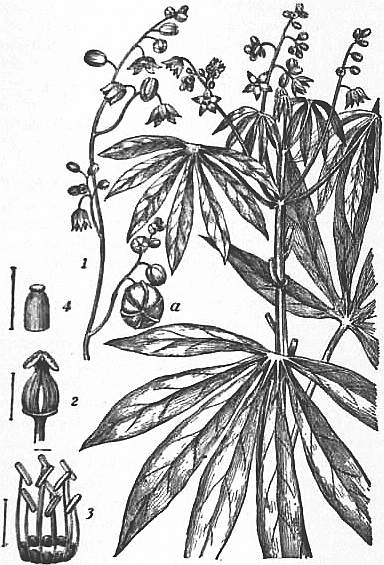
Cassava or Manioc (Manihot utilissima), less than half nat. size.
1, An inflorescence showing at a a fruit which will presently separate into five one-seeded parts, about ½ nat. size. 2, Pistil of female flower. 3, Stamens and fleshy disc of male flower. 4, Seed with its appendage (strophiole or caruncle).
CASSEL, a town of northern France in the department of Nord, 34 m. N.W. of Lille by rail. Pop. (1906) 1844. It stands on an isolated hill (515 ft.) from which portions of France, Belgium and England can be seen, with 32 towns and 100 villages, including St Omer, Dunkirk, Ypres and Ostend. The former hôtel de ville (1634), the hôtel de la Noble Cour, once the seat of the jurisdiction of maritime Flanders, now the town-hall, and the hôtel des ducs d’Halluin are the historic buildings of the town. Cassel has a communal college. Its industrial establishments include tanneries, oil-mills, salt refineries and breweries, and there is trade in cattle and butter.
The town, supposed to occupy the site of Castellum Menapiorum, was a Roman station, as numerous remains of the Gallo-Roman period attest, and an important centre of roads. It is frequently mentioned in the wars of the middle ages, and was the scene of important battles in 1071, when Robert, count of Flanders, vanquished his rival Arnulf; 1328, when Philip of Valois defeated the Flemish; and 1677, when William of Orange was defeated by Philip, duke of Orleans, brother of Louis XIV. General D.R. Vandamme (1770-1830) was born in the town.
CASSEL, or Kassel, a city of Germany, capital of the former electorate of Hesse-Cassel, and, since its annexation by Prussia in 1866, capital of the province of Hesse-Nassau. Pop. (1885) 64,083; (1905) 120,446. It is pleasantly situated, in a hilly and well-wooded country, on both sides of the river Fulda, over which a stone bridge leads to the lower new town, 124 m. by rail N.N.E. from Frankfort-On-Main. The river is navigable for barges, and railways connect the town with all parts of Germany. The streets of the old town are narrow and crooked, and contain many picturesque gabled houses, generally of the 17th century, but those of the upper and lower new town, and the three suburbs, are not surpassed by any in Germany. The principal streets are the Königs-strasse (5100 ft. long and 60 broad), the Schöne Aussicht, and the Stände-platz (180 ft. broad with four rows of linden trees). The large Friedrichs-platz is 1000 by 450 ft. in area. In it stands a marble statue of the landgrave Frederick II. There is a fine view from the open side. The former residence of the electors (Residenzschloss) fronts this square, as well as the Museum Fridericianum, with a façade of Roman-Ionic columns. The museum contains various valuable collections of curiosities, interesting mosaics, coins, casts, a library of 230,000 volumes, and valuable manuscripts. In the cabinet of curiosities there is a complete collection of clocks and watches from the earliest to the present time. Among these is the so-called Egg of Nuremberg, a watch made about 1500 by Peter Henlein. Among other public places and buildings worthy of notice are the Roman Catholic church, with a splendid interior; the Königs-platz, with a remarkable echo; the Karls-platz, with the statue of the landgrave Charles; and the Martins-platz, with a large church—St Martin’s—with twin towers, containing the burial-vaults of the Hessian princes. The gallery of paintings, housed in a handsome building erected in 1880 on the Schöne Aussicht, contains one of the finest small collections in Europe, especially rich in the works of Rembrandt, Frans Hals and Van Dyck.
The town contains numerous educational institutions, including a technical college, a school of painting, a celebrated classical school, which the emperor William II. attended, and a military academy. The descendants of the French refugees who founded the upper new town have a church and hospital of their own. There are three Roman Catholic churches, an English church, and two synagogues. Music is much cultivated, and there is an opera with a first-rate orchestra, of which Ludwig Spohr was at one time conductor. The opera-house or theatre was built by Jerome Napoleon, but in 1906 money was voted for a new building on the Auetor. A new Rathaus (town-hall) has been erected. There are also the Bose Museum, containing collections of pictures and antiquities of Hessian origin, museums of natural history and ethnography, an industrial exhibition hall, and an industrial art school. A handsome Gothic Lutheran church was erected in 1892-1897, a post office (Renaissance) in 1881, and new administrative offices and law courts in 1876-1880. The municipal (or Murhard) library, in the Hanau park, contains 118,000 volumes. The most noticeable of the modern public monuments are those to the emperor William I. (1898), to the musician Spohr (1883), and the Löwenbrunnen (1881). In the Karlsaue, a favourite public promenade lying just below the Schöne Aussicht, are the Orangerie and the marble baths. Cassel is the headquarters of the XI. German army corps, and has a large garrison. It is a favourite residence for foreigners and retired officers and government officials. The industries embrace engine-building, the manufacture of railway carriages and plant, scientific instruments, porcelain, tobacco and cigars, lithography, jute-spinning, iron-founding, brewing and gardening.
On a slope of the Habichtswald Mountains, 3 m. W. of Cassel, and approached by an avenue, is the summer palace of Wilhelmshöhe, erected in 1787-1794. Napoleon III. resided here, as a prisoner of war, after the battle of Sedan. The surrounding gardens are adorned with fountains, cascades, lakes and grottos, the principal fountain sending up a jet of water 180 ft. high and 12 in. in diameter. Here also is an interesting building called the Löwenburg, erected in 1793-1796 in the style of a fortified castle, and containing among other things portraits of Tudors and Stuarts. The principal curiosity is the Karlsburg cascade, which is placed in a broad ravine, thickly wooded on both sides. A staircase of 900 steps leads to the top. On one of the landings is a huge rudely-carved stone figure of the giant Enceladus, and at the top is an octagon building called the Riesenschloss, surmounted by a colossal copper figure of the Farnese Hercules, 31 ft. high, whose club alone is sufficiently capacious to accommodate from eight to ten persons. In different parts of the park, and especially from the Octagon, charming views are obtained. The park was first formed by the landgrave Frederick II., the husband of Mary, daughter of George II. of England, and was finished by his successor the landgrave William, after whom it was named.
The earliest mention of Cassel is in 913, when it is referred to as Cassala. The town passed from the landgraves of Thuringia to the landgraves of Hesse in the 13th century, becoming one of the principal residences of the latter house in the 15th century. The burghers accepted the reformed doctrines in 1527. The fortifications of the town were restored by the landgrave Philip the Magnanimous and his son William IV. during the 16th century, and it was greatly improved by the landgrave Charles (1654-1730), who welcomed many Huguenots who founded the upper new town. In 1762 Cassel was captured by the Germans from the French; after this the fortifications were dismantled and New Cassel was laid out by the landgrave Frederick II. In 1807 it became the capital of the kingdom of Westphalia; in 1813 it was bombarded and captured by the Russian general Chernichev; in 1830, 1831 and 1848 it was the scene of violent commotions; from 1850 to 1851 it was occupied by the Prussians, the Bavarians and the Austrians; in 1866 it was occupied by the Prussians, and in 1867 was made the capital of the newly formed Prussian province of Hesse-Nassau.
See Piderit, Geschichte der Haupt- und Residenzstadt Kassel (Kassel, 1882); Fr. Müller, Kassel seit 70 Jahren (2 vols., 2nd ed., Kassel, 1893); and Hessler, Die Residenzstadt Kassel und ihre Umgebung (Kassel, 1902).
CASSELL, JOHN (1817-1865), British publisher, was born in Manchester on the 23rd of January 1817. His father was the landlord of a public-house, and John was apprenticed to a joiner. He was self-educated, gaining by his own efforts a considerable acquaintance with English literature and a knowledge of French. He came to London in 1836 to work at his trade, but his energies at this time were chiefly centred in the cause of temperance, for which he was an active worker. In 1847 he established himself as a tea and coffee merchant, and soon after started a publishing business with the aim of supplying good literature to the working classes. From the offices of the firm, which became in 1859 Messrs. Cassell, Petter, Galpin & Co., were issued the Popular Educator (1852-1855), the Technical Educator (1870-1872), the Magazine of Art (1878-1903), Cassell’s Magazine (from 1852), and numerous editions of standard works. A special feature of Cassell’s popular books was the illustration. At the time of the Crimean War he procured from Paris the cuts used in L’Illustration, and by printing them in his Family Paper (begun in 1853) secured a large circulation for it. The firm was converted in 1883 into a limited liability company, under the name of Cassell & Company, Limited. John Cassell died in London on the 2nd of April 1865.
CASSIA (Lat. cassia, Gr. κασία), the aromatic bark derived from Cinnamomum cassia. The greater part of the supply coming from China, it is sometimes termed Chinese cinnamon. The bark is much thicker than that of true cinnamon; the taste is more pungent and the flavour less delicate, though somewhat similar to that of cinnamon. The properties of cassia bark depend on the presence of a volatile oil—the oil of cassia, which is imported in a fairly pure state as an article of commerce from Canton. Cassia bark is in much more extensive demand on the continent of Europe than in Great Britain, being preferred to cinnamon by southern nations. The chief use of both the oil and bark is for flavouring liqueurs and chocolate, and in cooking generally. When ground as a spice it is difficult to distinguish cassia from cinnamon (q.v.), and it is a common practice to substitute the cheap common spice for the more valuable article. Cassia Buds, which have a pleasing cinnamon flavour, are believed to be the immature fruits of the tree which yields Chinese cinnamon. They are brought in considerable quantities from Canton, and used as a spice and in confectionery. Cassia pulp, used as a laxative, is obtained from the pods of Cassia fistula, or pudding pipe tree, a native of Africa which is cultivated in both the East and West Indies. Some confusion occasionally arises from the fact that Cassia is the generic name of an extensive genus of leguminous plants, which, in addition to various other medicinal products, is the source of the senna leaves which form an important article of materia medica.
CASSIA, VIA, an ancient high-road of Italy, leading from Rome through Etruria to Florentia (Florence); at the 11th mile the Via Clodia (see Clodia, Via) diverged north-north-west, while the Via Cassia ran to the east of the Lacus Sabatinus and then through the place now called Sette Vene, where a road, probably the Via Annia, branched off to Falerii, through Sutrium (where the Via Ciminia, running along the east edge of the Lacus Ciminius, diverged from it, to rejoin it at Aquae Passeris, north of the modern Viterbo1), Forum Cassii, Volsinii, Clusium and Arretium, its line being closely followed by the modern highroad from Rome to Florence. The date of its construction is uncertain: it cannot have been earlier than 187 b.c.,2 when the consul C. Flaminius constructed a road from Bononia to Arretium (which must have coincided with the portion of the later Via Cassia). It is not, it is true, mentioned by any ancient authorities before the time of Cicero, who in 45 b.c. speaks of the existence of three roads from Rome to Mutina, the Flaminia, the Aurelia and the Cassia. A milestone of a.d. 124 mentions repairs to the road made by Hadrian from the boundary of the territory of Clusium to Florence, a distance of 86 m.
See Ch. Hülsen in Pauly-Wissowa, Realencyclopadie, iii. 1669.
(T. As.)
1 The Via Traiana Nova, or the (viae) tres Traianae, mentioned in inscriptions with the Cassia and Clodia as under the same curator, are not certainly identifiable.
2 Having regard to the military importance of Arretium during the Punic wars, it is difficult to believe that no direct road existed to this point before 187 b.c.
CASSIANUS, JOANNES EREMITA, or Joannes Massiliensis (?360-?435), a celebrated recluse, one of the first founders of monastic institutions in western Europe, was probably born in Provence about 360, but he spent the early part of his life in the monastery of Bethlehem with his friend Germanus, and his affinities were always Eastern rather than Western. In company with Germanus he visited Egypt, and dwelt for several years among the ascetics of the desert near the banks of the Nile. In 403 he repaired to Constantinople, where he received ordination as deacon at the hands of Chrysostom. At Marseilles (after 410) he founded two religious societies—a convent for nuns, and the abbey of St Victor, which during his time is said to have contained 5000 inmates. In later times his regulations enjoyed a high reputation, and were adopted by the monks and nuns of Port Royal. He was eventually canonized; and a festival in his honour long continued to be celebrated at Marseilles on the 25th of July. Cassianus was one of the first and most prominent of the Semi-Pelagians, maintaining that while man is by nature sinful, he yet has some good remaining in him, and that, while the immediate gift of God’s grace is necessary to salvation, conversion may also be begun by the exercise of man’s will. He further asserted that God is always willing to bestow his grace on all who seek it, though, at the same time, it is true that he sometimes bestows it without its being sought. These views have been held by a very large part of the church from his time, and embrace much of the essence of Arminianism. The style of Cassianus is slovenly, and shows no literary polish, but its direct simplicity is far superior to the rhetorical affectations which disfigure most of the writings of that age. At the request of Castor, bishop of Apt, he wrote two monumental and influential treatises on the monastic life. The De Institutione Coenobiorum (twelve books) describes the dress, the food, the devotional exercises, the discipline and the special spiritual dangers of monastic life in the East (gluttony, unchastity, avarice, anger, gloom, apathy, vanity and pride). The Collationes Patrum, a series of dialogues with the pious fathers of Egypt, deal with the way in which these dangers (and others, e.g. demons) may be avoided or overcome. At the desire of Leo (then archdeacon of Rome) he wrote against Nestorius his De Incarnatione Domini in seven books.
Editions.—Douay (1616) by Alardus Gazäus, with excellent notes; Migne’s Patrol. Lat. vols. xlix. and l.; M. Petschenig in the Vienna Corpus Script. Eccles. Lat. (2 vols., 1886-1888). See A. Harnack, History of Dogma, v. 246 ff., 253 ff.; A. Hoch, Die Lehre d. Joh. Cassian von Natur und Gnade (Freiburg, 1895); W. Moeller, History of the Chr. Church, i. 368-370.
CASSINI, the name of an Italian family of astronomers, four generations of whom succeeded each other in official charge of the observatory at Paris.
Giovanni Domenico Cassini (1625-1712), the first of these, was born at Perinaldo near Nice on the 8th of June 1625. Educated by the Jesuits at Genoa, he was nominated in 1650 professor of astronomy in the university of Bologna; he observed and wrote a treatise on the comet of 1652; was employed by the senate of Bologna as hydraulic engineer; and appointed by Pope Alexander VII. inspector of fortifications in 1657, and subsequently director of waterways in the papal states. His determinations of the rotation-periods of Jupiter, Mars and Venus in 1665-1667 enhanced his fame; and Louis XIV. applied for his services in 1669 at the stately observatory then in course of erection at Paris. The pope (Clement IX.) reluctantly assented, on the understanding that the appointment was to be temporary; but it proved to be irrevocable. Cassini was naturalized as a French subject in 1673, having begun work at the observatory in September 1671. Between 1671 and 1684 he discovered four Saturnian satellites, and in 1675 the division in Saturn’s ring (see Saturn); made the earliest sustained observations of the zodiacal light, and published, in Les Éléments de l’astronomie vérifiés (1684), an account of Jean Richer’s (1630-1696) geodetical operations in Cayenne. Certain oval curves which he proposed to substitute for Kepler’s ellipses as the paths of the planets were named after him “Cassinians.” He died at the Paris observatory on the 11th of September 1712.
A partial autobiography left by Giovanni Domenico Cassini was published by his great-grandson, Count Cassini, in his Mémoires pour servir à l’histoire des sciences (1810). See also C. Wolf, Histoire de l’observatoire de Paris (1902); Max. Marie, Histoire des sciences, t. iv. p. 234; R. Wolf, Geschichte der Astronomie, p. 450, &c.
Jacques Cassini (1677-1756), son of Domenico Cassini, was born at the Paris observatory on the 8th of February 1677. Admitted at the age of seventeen to membership of the French Academy of Sciences, he was elected in 1696 a fellow of the Royal Society of London, and became maitre des comptes in 1706. Having succeeded to his father’s position at the observatory in 1712, he measured in 1713 the arc of the meridian from Dunkirk to Perpignan, and published the results in a volume entitled De la grandeur et de la figure de la terre (1720) (see Geodesy). He wrote besides Élémens d’astronomie (1740), and died on the 18th of April 1756 at Thury, near Clermont. The first tables of the satellites of Saturn were supplied by him in 1716.
See C. Wolf, Histoire de l’observatoire de Paris; Max. Marie, Histoire des sciences, vii. 214; R. Wolf, Geschichte der Astronomie, p. 451; J.C. Houzeau, Bibl. astronomique; J. Delambre, Histoire de l’astronomie au XVIII’e siècle, pp. 250-275 (unfairly depreciatory); J.F. Montucla, Hist. des mathématiques, iv. 145, 248.
César François Cassini, or Cassini de Thury (1714-1784), son of Jacques Cassini, was born at the observatory of Paris on the 17th of June 1714. He succeeded to his father’s official employments, continued the hereditary surveying operations, and began in 1744 the construction of a great topographical map of France. The post of director of the Paris observatory was created for his benefit in 1771, when the establishment ceased to be a dependency of the Academy of Sciences. Cassini de Thury died at Thury on the 4th of September 1784. His chief works are:—Méridienne de l’observatoire de Paris (1744), Description géométrique de la terre (1775), and Description géométrique de la France (1784).
See C. Wolf, Histoire de l’observatoire de Paris, p. 287; Max. Marie, Histoire des sciences, viii. 158; J. Delambre, Histoire de I’astronomie au XVIII’e siècle, pp. 275-309; R. Wolf, Geschichte der Astronomie, p. 451; J.J. de Lalande, Bibliographic astronomique.
Jacques Dominique Cassini, Count (1748-1845), son of César François Cassini, was born at the observatory of Paris on the 30th of June 1748. He succeeded in 1784 to the directorate of the observatory; but his plans for its restoration and re-equipment were wrecked in 1793 by the animosity of the National Assembly. His position having become intolerable, he resigned on the 6th of September, and was thrown into prison in 1794, but released after seven months. He then withdrew to Thury, where he died, aged ninety-seven, on the 18th of October 1845. He published in 1770 an account of a voyage to America in 1768, undertaken as the commissary of the Academy of Sciences with a view to testing Pierre Leroy’s watches at sea. A memoir in which he described the operations superintended by him in 1787 for connecting the observatories of Paris and Greenwich by longitude-determinations appeared in 1791. He visited England for the purposes of the work, and saw William Herschel at Slough. He completed his father’s map of France, which was published by the Academy of Sciences in 1793. It served as the basis for the Atlas National (1791), showing France in departments. Count Cassini’s Mémoires pour servir à l’histoire de l’observatoire de Paris (1810) embodied portions of an extensive work, the prospectus of which he had submitted to the Academy of Sciences in 1774. The volume included his Éloges of several academicians, and the autobiography of his great-grandfather, the first Cassini.
See J.F.S. Devic, Histoire de la vie et des travaux de J.D. Cassini (1851); J. Delambre, Histoire de l’astronomie au XVIII’e siècle, pp. 309-313; Phil. Mag. 3rd series, vol. xxviii. p. 412; C. Wolf, Histoire de l’observatoire de Paris (1902), p. 234 et passim.
(A. M. C.)
CASSIODORUS (not Cassiodorius), the name of a Syrian family settled at Scyllacium (Squillace) in Bruttii, where it held an influential position in the 5th century a.d. Its most important member was Flavius Magnus Aurelius Cassiodorus Senator (c. 490-585), historian, statesman, and monk. “Senator” (not a title) is the name used by himself in his official correspondence. His father held the offices of comes privatarum and sacrarum largitionum (controller of the emperor’s private revenue and the public exchequer) under Odoacer, and subsequently attached himself to Theodoric, by whom he was appointed corrector (governor) of Bruttii and Lucania, and praefectus praetorio. The son at an early age became consiliarius (legal assessor) to his father, and (probably in 507) quaestor, an official whose chief duty at that time consisted in acting as the mouthpiece of the ruler, and drafting his despatches. In 514 he was ordinary consul, and at a later date possibly corrector of his native province. At the death of Theodoric (526) he held the office of magister officiorum (chief of the civil service). Under Athalaric he was praefectus praetorio, a post which he retained till about 540, after the triumphal entry of Belisarius into Ravenna, when he retired from public life. With the object of providing for the transmission of divine and human knowledge to later ages, and of securing it against the tide of barbarism which threatened to sweep it away, he founded two monasteries—Vivarium and Castellum—in his ancestral domains at Squillace (others identify the two monasteries). The special duty which he enjoined upon the inmates was the acquisition of knowledge, both sacred and profane, the latter, however, being subordinated to the former. He also collected and emended valuable MSS., which his monks were instructed to copy, and superintended the translation of various Greek works into Latin. He further amused himself with making scientific toys, such as sun-dials and water-clocks. As he is stated to have written one of his treatises at the age of ninety-three, he must have lived till after 580. Whether he belonged to the Benedictine order is uncertain.
The writings of Cassiodorus evince great erudition, ingenuity and labour, but are disfigured by incorrectness and an affected artificiality, and his Latin partakes much of the corruptions of the age. His works are (1) historical and political, (2) theological and grammatical.
1. (a) Variae, the most important of all his writings, in twelve books, published in 537. They contain the decrees of Theodoric and his successors Amalasuntha, Theodahad and Witigis; the regulations of the chief offices of state; the edicts published by Cassiodorus himself when praefectus praetorio. It is the best source of our knowledge of the Ostrogothic kingdom in Italy (ed. T. Mommsen in Monumenta Germaniae Historica: Auctores Antiquissimi, xii., 1894; condensed English translation by T. Hodgkin, 1886).
(b) Chronica, written at the request of Theodoric’s son-in-law Eutharic, during whose consulship (519) it was published. It is a dry and inaccurate compilation from various sources, unduly partial to the Goths (ed. T. Mommsen in Mon. Germ. Hist.: Auct. Ant. xi. pt. i., 1893).
(c) Panegyrics on Gothic kings and queens (fragments ed. L. Traube in Mon. Germ. Hist.: Auct. Ant. xii.).
2. (a) De Anima, a discussion on the nature of the soul, at the conclusion of which the author deplores the quarrel between two such great peoples as the Goths and Romans. It seems to have been published with the last part of the Variae.
(b) Institutiones divinarun et humanarunt litterarum, an encyclopaedia of sacred and profane literature for the monks, and a sketch of the seven liberal arts. It further contains instructions for using the library, and precepts for daily life.
(c) A commentary on the Psalms and short notes (complexiones) on the Pauline epistles, the Acts, and the Apocalypse.
(d) De Orthographia, a compilation made by the author in his ninety-third year from the works of twelve grammarians, ending with his contemporary Priscian (ed. H. Keil, Grammatici Latini, vii.).
The Latin translations of the Antiquities of Josephus and of the ecclesiastical histories of Theodoret, Sozomen and Socrates, under the title of Historia Tripartita (embracing the years 306-439), were carried out under his supervision.
Of his lost works the most important was the Historia Gothorum, written with the object of glorifying the Gothic royal house and proving that the Goths and Romans had long been connected by ties of friendship. It was published during the reign of Athalaric, and appears to have brought the history down to the death of Theodoric. His chief authority for Gothic history and legend was Ablavius (Ablabius). The work is only known to us in the meagre abridgment of Jordanes (ed. T. Mommsen, 1882).
Complete Works.—Editio princeps, by G. Fornerius (Paris, 1579); J. Garet (Rouen, 1679; Venice, 1729), reprinted in J.P. Migne, Patrologia Latina, lxix., lxx. On Cassiodorus generally, see Anecdoton Holderi, excerpts from a treatise of Cassiodorus, edited by H. Usener (Bonn, 1877), which throws light on questions connected with his biography; T. Mommsen, preface to his edition of the Variae; monographs by A. Thorbecke (Heidelberg, 1867) and A. Franz (Breslau, 1872); T. Hodgkin, Italy and her Invaders, iii. p. 280, iv. p. 348; A. Ebert, Allgemeine Geschichte der Litteratur des Mittelalters i.; Teuffel-Schwabe, Hist. of Roman Literature (Eng trans.), § 483; G.A. Simcox, Hist. of Latin Literature (1884); W. Ramsay in Smith’s Dictionary of Greek and Roman Biography J.B. Bury’s edition of Gibbon’s Decline and Fall, iv. 180, 522; R.W. Church in the Church Quarterly Review, x. (1880); J.E. Sandys in Hist. of Classical Scholarship (2nd ed., 1906); A. Olleris, Cassiodore, conservateur des livres de l’antiquité latine (Paris, 1891); G. Minasi, M.A. Cassiodoro ... ricerche storico-critiche (Naples, 1895); and C. Cipolla in Memorie della r. Accademia delle scienze di Torino (2nd ser. xliii. pt. 2, 1893); L.M. Hartmann in Pauly-Wissowa’s Realencyclopadie, iii. pt. 2 (1899), with note on the musical section of Cassiodorus’ Institutions by C. von Jan.
CASSIOPEIA, in Greek mythology, the wife of Cepheus, and mother of Andromeda; in astronomy, a constellation of the northern hemisphere, mentioned by Eudoxus (4th century b.c.) and Aratus (3rd century b.c.). Ptolemy catalogued 13 stars in this constellation, Tycho Brahe 46, and Hevelius 37. Its most interesting stars are:—Nova Cassiopeiae, a “new” star, which burst out with extraordinary brilliancy in 1572, when it was observed by Tycho Brahe, but gradually diminished in brightness, ultimately vanishing in about eighteen months; α-Cassiopeiae and R-Cassiopeiae are variable stars, the former irregular, the latter having a long period; η-Cassiopeiae, a binary star, having components of magnitudes 3½ and 7½; σ-Cassiopeiae, a double star, one being white and of magnitude 5, the other blue and of magnitude 7½.
CASSITERIDES (from the Gr. κασσἰτερος, tin, i.e. “Tin-islands”), in ancient geography the name of islands regarded as being situated somewhere near the west coasts of Europe. Herodotus (430 b.c.) had dimly heard of them. Later writers, Posidonius, Diodorus, Strabo and others, call them smallish islands off (Strabo says, some way off) the north-west coast of Spain, which contained tin mines, or, as Strabo says, tin and lead mines—though a passage in Diodorus derives the name rather from their nearness to the tin districts of north-west Spain. While geographical knowledge of the west was still scanty and the secrets of the tin-trade were still successfully guarded by the seamen of Gades and others who dealt in the metal, the Greeks knew only that tin came to them by sea from the far west, and the idea of tin-producing islands easily arose. Later, when the west was better explored, it was found that tin actually came from two regions, north-west Spain and Cornwall. Neither of these could be called “small islands” or described as off the north-west coast of Spain, and so the Cassiterides were not identified with either by the Greek and Roman geographers. Instead, they became a third, ill-understood source of tin, conceived of as distinct from Spain or Britain. Modern writers have perpetuated the error that the Cassiterides were definite spots, and have made many attempts to identify them. Small islands off the coast of north-west Spain, the headlands of that same coast, the Scillies, Cornwall, the British Isles as a whole, have all in turn been suggested. But none suits the conditions. Neither the Spanish islands nor the Scillies contain tin, at least in serious quantities. Neither Britain nor Spain can be called “small islands off the north-west of Spain.” It seems most probable, therefore, that the name Cassiterides represents the first vague knowledge of the Greeks that tin was found overseas somewhere in or off western Europe.