VOLUME V SLICE IV Carnegie to Casus Belli (continued 10)
Reading edition
Authorities.—Herodotus iii. 115; Diodorus v. 21, 22, 38; Strabo ii. 5, iii. 2, 5, v. 11; Pliny, Nat. Hist, iv. 119, vii. 197, xxxiv. 156-158, are the chief references in ancient literature. T.R. Holmes, Ancient Britain (1907), appendix, identifies the Cassiterides with the British Isles.
(F. J. H.)
CASSITERITE (from the Gr. κασσἰτερος, tin), the mineralogical name for tin-stone, the common ore of tin. It consists of tin dioxide, or stannic oxide (SnO2), and crystallizes in the tetragonal system. The crystals are usually 4-sided or 8-sided prisms, striated vertically, and terminated by pyramids (fig. 1). Twins, with characteristic re-entrant angles, such as figs. 2 and 3, are common. Certain slender prismatic crystals, with an acute 8-sided pyramid, are known in Cornwall as “sparable tin,” in allusion to their resemblance to sparable nails, whilst very slender crystals are termed needle-tin. Occasionally the mineral occurs in fibrous forms, which pass under the name of “wood-tin,” and these, though not unknown in the matrix, are generally found as rolled pebbles. By the disintegration of tin-bearing rocks and vein-stones, the cassiterite passes into the beds of streams as rolled fragments and grains, or even sand, and is then known as stream tin or alluvial tin. This detrital tin-ore was probably used as a source of the metal before the primitive miners had learnt to attack the solid tin-bearing rocks.
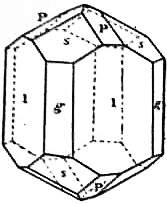
Fig. 1.
Pure cassiterite may be colourless, or white, as seen in certain specimens from the Malay Peninsula; but usually the mineral is brown or even black, the colour being referred to the presence of ferric oxide or other impurity. Occasionally the tin-stone is red. In microscopic sections the colour is often seen to be disposed in zones, following the contour of the crystal. A brown variety, with rather resinous lustre, is termed “rosin tin.” The usual lustre of crystals of cassiterite is remarkably splendent, even adamantine. The mineral has a high refractive index, and strong bi-refringence. Certain transparent yellow and brown specimens, cut as gem-stones, exhibit considerable brilliancy. The hardness of cassiterite is 6.5, so that it cannot be scratched with a knife, and is nearly as hard as quartz. Its specific gravity is about 7; and in consequence of this high density, the tin-stone is readily separated during the process of dressing, from all the associated minerals, except wolframite, which may, however, be removed by magnetic separators.
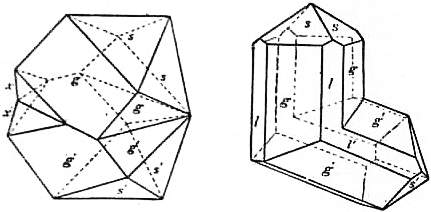
Fig. 2. Fig. 3.
Cassiterite usually occurs as veins or impregnations in granitic rocks, and is especially associated with the quartz-mica rock called greisen. The usual associates of the tin-stone are quartz, tourmaline, apatite, topaz, beryl, fluorite, lithia-mica, wolframite, chalcopyrite, &c. The presence of fluorine in many of these minerals has led to the opinion that the tin has been derived in many cases from an acid or granitic magma by the action of fluorine-bearing vapours, and that cassiterite may have been formed by the interaction of tin fluoride and water vapour. Cassiterite occurs as a pseudomorph after orthoclase felspar in some of the altered granite of Cornwall, and it has occasionally been found as a cementing material in certain brecciated lodes.
Among the localities yielding cassiterite may be mentioned Cornwall, Saxony, Bohemia, Brittany, Galicia in Spain; the Malay peninsula, and the islands of Banca and Billiton; New South Wales, Queensland and Tasmania. Fine examples of wood-tin, occurring with topaz, are found in Durango in Mexico. Deposits of cassiterite under rather exceptional conditions are worked on a large scale in Bolivia; and it is notable that cassiterite is found in Liassic limestone near Campiglia Marittima in Tuscany. Cassiterite has been worked in the York region, Alaska.
(F. W. R.*)
CASSIUS, the name of a distinguished ancient Roman family, originally patrician. Its most important members are the following.
1. Spurius Cassius, surnamed Vecellinus (Vicellinus, Viscellinus), Roman soldier and statesman, three times consul, and author of the first agrarian law. In his first consulate (502 b.c.) he defeated the Sabines; in his second (493) he renewed the league with the Latins, and dedicated the temple of Ceres in the Circus; in his third (486) he made a treaty with the conquered Hernici. The account of his agrarian law is confused and contradictory; it is clear, however, that it was intended to benefit the needy plebeians (see Agrarian Laws). As such it was violently opposed both by the patricians and by the wealthy plebeians. Cassius was condemned by the people as aiming at kingly power, and hurled from the Tarpeian rock. Another account says he was tried by the family council and put to death by his own father, who considered his proposal prejudicial to the patrician interest. According to Livy, his proposal to bestow a share of the land upon the Latins was regarded with great suspicion. According to Mommsen (Römische Forschungen, ii.), the whole story is an invention of a later age, founded upon the proposals of the Gracchi and M. Livius Drusus, to which period belongs the idea of sharing public land with the Latins.
See Livy ii. 33, 41; Dion Halic. v. 49, viii. 69-80; Cicero, Pro Balbo, 23 (53), De Republica, ii. 27 (49), 35 (60); Val. Max. v. 8. 2.
The following Cassii are all plebeians. It is suggested that the sons of Spurius Cassius either were expelled from, or voluntarily left, the patrician order, in consequence of their father’s execution.
2. Gaius Cassius Longinus, consul 73 b.c. With his colleague, Terentius Varro Lucullus, he passed a law (lex Terentia Cassia), the object of which was to give authority for the purchase of corn at the public expense, to be retailed at a fixed price at Rome. It is doubtful whether this Cassius (who is often called by the additional name Varus) is identical with the Varus who was proscribed by the triumvirs, and put to death at Minturnae (43). According to Orosius he was killed at the battle of Mutina.
See Cicero, In Verrem, iii. 70, 75, v. 21; Livy, Epit. 96; Appian, Bell. Civ. iv. 28; Orosius v. 24.
3. Gaius Cassius Longinus, prime mover in the conspiracy against Julius Caesar. Little is known of his early life. In 53 b.c. he served in the Parthian campaign under M. Licinius Crassus, saved the remnants of the army after the defeat at Carrhae, and for two years successfully repelled the enemy. In 49 b.c. he became tribune of the plebs. The outbreak of the civil war saved him from being brought to trial for extortion in Syria. He at first sided with Pompey, and as commander of part of his fleet rendered considerable service in the Mediterranean. After Pharsalus he became reconciled to Caesar, who made him one of his legates. In 44 b.c. he became praetor peregrinus with the promise of the Syrian province for the ensuing year. The appointment of his junior, M. Junius Brutus, as praetor urbanus deeply offended him, and he was one of the busiest conspirators against Caesar, taking an active part in the actual assassination. He then left Italy for Syria, raised a considerable army, and defeated P. Cornelius Dolabella, to whom the province had been assigned by the senate. On the formation of the triumvirate, Brutus and he, with their combined armies, crossed the Hellespont, marched through Thrace, and encamped near Philippi in Macedonia. Their intention was to starve out the enemy, but they were forced into an engagement. Brutus was successful against Octavian, but Cassius, defeated by M. Antonius (Mark Antony), gave up all for lost, and ordered his freedman to slay him. He was lamented by Brutus as “the last of the Romans,” and buried at Thasos. A man of considerable ability, he was a good soldier, and took an interest in literature, but in politics he was actuated by vanity and ambition. His portrait in Shakespeare’s Julius Caesar, though vivid, is scarcely historical.
See Plutarch, Brutus, passim, Crassus, 27, 29, Caesar, 62, 69; Dio Cassius xl. 28, xlii. 13, xliv. 14, xlvii. 20; Vell. Pat. ii. 46, 56, 58, 69, 70, 87; Cicero, Philippics, xi. 13, 14, ad Att. v. 21, xiv. 21, ad Fam. xi. 3, 15, 16; Appian, Bell. Civ. ii. 111, 113, iii. 2, 8, iv. 60-62, 87, 90, 111-113, 132; Caesar, Bell. Civ. iii. 101.
4. Quintus Cassius Longinus, the brother or cousin of the murderer of Caesar, quaestor of Pompey in Further Spain in 54 b.c. In 49, as tribune of the people, he strongly supported the cause of Caesar, by whom he was made governor of Further Spain. He treated the provincials with great cruelty, and his appointment (48) to take the field against Juba, king of Numidia, gave him an excuse for fresh oppression. The result was an unsuccessful insurrection at Corduba. Cassius punished the leaders with merciless severity, and made the lot of the provincials harder than ever. At last some of his troops revolted under the quaestor M. Marcellus, who was proclaimed governor of the province. Cassius was surrounded by Marcellus in Ulia. Bogud, king of Mauretania, and M. Lepidus, proconsul of Hither Spain, to whom Cassius had applied for assistance, negotiated an arrangement with Marcellus whereby Cassius was to be allowed to go free with the legions that remained loyal to him. Cassius sent his troops into winter quarters, hastened on board ship at Malaca with his ill-gotten gains, but was wrecked in a storm at the mouth of the Iberus (Ebro). His tyrannical government of Spain had greatly injured the cause of Caesar.
See Dio Cassius xli. 15, 24, xlii. 15, 16, xliii. 29; Livy, Epit. III; Appian, B.C. ii. 33, 43; Bellum Alexandrinum, 48-64.
5. Gaius Cassius Longinus (1st century a.d.), Roman jurist, consul in 30, proconsul of Asia 40-41, and governor of Syria under Claudius 45-50. On his return to Rome his wealth and high character secured him considerable influence. He was banished by Nero (65) to Sardinia, because among the images of his ancestors he had preserved that of the murderer of Caesar. He was recalled by Vespasian, and died at an advanced age. As he was consul in 30, he must have been born at the latest in the year 3 b.c. Cassius was a pupil of Masurius Sabinus, with whom he founded a legal school, the followers of which were called Cassiani. His chief work was the Libri Juris Civilis in ten books, which was used by the compilers of the Digest of Justinian.
See Tacitus, Annals, xvi. 7-9; Suetonius, Nero, 37; Dio Cassius lix. 29; Teuffel-Schwabe, Hist. of Roman Literature, § 298, 3.
CASSIUS, AVIDIUS (d. a.d. 175), Roman general, a Syrian by birth, lived during the reign of Marcus Aurelius. He especially distinguished himself during the Parthian War (a.d. 162-165), at the conclusion of which he was apparently appointed military governor of Asia, though the actual extent of his jurisdiction is doubtful. In 172 he was sent to Egypt, where he put down a dangerous rising of the Bucolici, the robber herdsmen of the delta of the Nile, after which he returned to Syria. In 175 the emperor Aurelius fell ill, and his wife Faustina, to secure her position in case of his death, offered her hand and the throne to the successful general. A rumour of Aurelius’s death having reached Syria, Cassius, without waiting for confirmation, proclaimed himself emperor; when the report proved false, it was too late for him to draw back, and he accordingly prepared for war. The senate declared him a public enemy, although Aurelius even then expressed the hope that he might have the opportunity of pardoning him. Deploring the necessity for taking up arms against his trusted officer, Aurelius set out for the east. While in Illyria, he received the news that Cassius had been slain by his own officers. The murderers offered his head to Aurelius, who refused to admit them, and ordered its immediate burial.
See Dio Cassius lxxi. 2-4, 17, 22-28, 30, 31; Fronto, Letters, i. 6; Lives of Marcus Aurelius, Verus and Commodus in the Scriptores Historiae Augustae, and the special biography of Avidius Cassius in the same by Vulcacius Gallicanus. The various letters and documents in the last-named are generally considered spurious, and the portions of the narrative founded on them consequently untrustworthy. See also article in Pauly-Wissowa’s Realencyclopädie, ii. pt. 2 (1896).
CASSIUS, GAIUS, Latin poet, general and politician, called Parmensis from his birthplace Parma, was one of the murderers of Julius Caesar, and after his death joined the party of Brutus and his namesake Cassius the conspirator. In 43 b.c. he was in command of the fleet on the coast of Asia, but after the battle of Philippi joined Sextus Pompeius in Sicily. When Pompeius, having been defeated in a naval engagement at Naulochus by the fleet of Octavian under Agrippa, fled to Asia, Cassius went over to Antony, and took part in the battle of Actium (31). He afterwards fled to Athens, where he was soon put to death by Octavian, whom he had offended by writing an abusive letter (Suetonius, Augustus, 4). Cassius is credited with satires, elegies, epigrams and tragedies. Some hexameters with the title Cassii Orpheus are by Antonius Thylesius, an Italian of the 17th century. Horace appears to have thought well of Cassius as a poet, for he asks Tibullus whether he intends to compete with the opuscula (probably the elegies) of Cassius (Epistles, i. 4. 3). The story in the Horace scholia, that L. Varius Rufus published his famous tragedy Thyestes from an MS. which he found amongst the papers of Cassius after his death, is due to a confusion of Cassius’s murderer, Q. Attius Varus, with the tragedian (Appian, B.C. v. 2, 139; Cicero, ad Fam. xii. 13; Veil. Pat. ii. 87; Orosius, vi. 19; see also the diffuse treatise of A. Weichert, De L. Varii et Cassii Parmensis Vita et Carminibus, 1836). Cassius Parmensis must not be confused with Cassius Etruscus (Horace, Satires, i. 10. 60), an improviser, who is said to have used enough paper to furnish his funeral pyre.
CASSIVELAUNUS, or Cassivellaunus, a British chieftain, ruler of the country north of the Thames, who led the native tribes against Julius Caesar on his second expedition (54 b.c.) (see Britain). After several indecisive engagements, Caesar took the camp of Cassivelaunus, who was obliged to make peace on condition of paying tribute and giving hostages. But these promises were not meant to be kept, and it appears certain that the tribute was never paid. According to Bede (Hist. Eccles. i. 2), the remains of Cassivelaunus’s entrenchment were visible seven or eight centuries later.
See Caesar, B.G. v. 11-22; Dio Cassius xl. 2, 3; Orosius vi. 9. 6; Eutropius vi. 17; Polyaenus, Strategemata, viii. 23. For the etymology of the name (which is Celtic in origin, and appears later as Caswallon) see J. Rhys, Celtic Britain, pp. 289-290 (1904); C.I. Elton, Origins of English History (1890); and Stock’s edition of Caesar, De Bella Gallico(1898).
CASSOCK (Fr. casaque, a military cloak), a long-sleeved, close-fitting robe worn by the clergy and others engaged in ecclesiastical functions. The name was originally specially applied to the dress worn by soldiers and horsemen, and later to the long garment worn in civil life by both men and women. As an ecclesiastical term the word “cassock” came into use somewhat late (as a translation of the old names of subtanea, vestis talaris, toga talaris, or tunica talaris), being mentioned in canon 74 of 1604; and it is in this sense alone that it now survives. The origin of the word has been the subject of much speculation. It is derived through the French from the Italian casacca, which Florio (Q. Anna’s New World of Words, 1611) translates as “a frock, a horseman’s cote, a long cote; also a habitation or dwelling,” and it is usually held that this in turn is derived from casa, a house (cf. the derivation of “chasuble,” q.v.). This, however, though possible is uncertain. A Slav origin for the word has been suggested (Hatzfeld and Darmesteter, Dic. gén. de la langue française), and the Cossack horseman may have given to the West both the garment and the name. Or again, it may be derived from casequin (Ital. casecchino), rather than vice versa, and this in turn from an Arabic kazáyand (Pers. kasháyand), a padded jerkin; the word kasagân occurring in Mid. High Ger. for a riding-cloak, and gasygan in O. Fr. for a padded jerkin (Lagarde in Gott. gelehrte Anzeiger, April 15, 1887, p. 238).
The cassock, though part of the canonical costume of the clergy, is not a liturgical vestment. It was originally the out-of-doors and domestic dress of lay-people as well as clergy, and its survival among the latter when the secular fashions had changed is merely the outcome of ecclesiastical conservatism. In mild weather it was the outer garment; in cold weather it was worn under the tabard or chimere (q.v.) sometimes in the middle ages the name “chimere” was given to it as well as to the sleeveless upper robe. In winter the cassock was often lined with furs varying in costliness with the rank of the wearer, and its colour also varied in the middle ages with his ecclesiastical or academic status. In the Roman Catholic Church the subtanea (Fr. soutane, Ital. sottana) must be worn by the clergy whenever they appear, both in ordinary life (except in Protestant countries) and under their vestments in church. It varies in colour with the wearer’s rank: white for the pope, red (or black edged with red) for cardinals, purple for bishops, black for the lesser ranks: members of religious orders, however, whatever their rank, wear the colour of their religious habit. In the Church of England the cassock, which with the gown is prescribed by the above-mentioned canon of 1604 as the canonical dress of the clergy, has been continuously, though not universally, worn by the clergy since the Reformation. It has long ceased, however, to be their every-day walking dress and is now usually only worn in church, at home, or more rarely by clergy within the precincts of their own parishes. The custom of wearing the cassock under the vestments is traceable in England to about the year 1400.
The old form of English cassock was a double-breasted robe fastened at the shoulder and probably girdled. The continental, single-breasted cassock, with a long row of small buttons from neck to hem, is said to have been first introduced into England by Bishop Harris of Llandaff (1729-1738). The shortened form of cassock which survives in the bishop’s “apron” was formerly widely used also by the continental clergy. Its use was forbidden in Roman Catholic countries by Pope Pius IX., but it is still worn by Roman Catholic dignitaries as part of their out-of-door dress in certain Protestant countries.
See the Report of the sub-committee of Convocation on the Ornaments of the Church and its Ministers (London, 1908), and authorities there cited.
CASSONE, in furniture, the Italian name for a marriage coffer. The ancient and once almost universal European custom of providing a bride with a chest or coffer to contain the household linen, which often formed the major part of her dowry, produced in Italy a special type of chest of monumental size and artistic magnificence. The cassoni of the people, although always large in size, were simple as regards ornament; but those of the nobles and the well-to-do mercantile classes were usually imposing as regards size, and adorned with extreme richness. The cassone was almost invariably much longer than the English chest, and even at a relatively early period it assumed an artistic finish such as was never reached by the chests of northern Europe, except in the case of a few of the royal corbeilles de mariage made by such artists as Boulle for members of the house of France. Many of the earlier examples were carved in panels of geometrical tracery, but their characteristic ornament was either intarsia or gesso, or a mixture of the two. Bold and massive feet, usually shaped as claws, lioncels, or other animals are also exceedingly characteristic of cassoni, most of which are of massive and sarcophagus-like proportions with moulded lids, while many of them are adorned at their corners with figures sculptured in high relief. The scroll-work inlay is commonly simple and graceful, consisting of floral or geometrical motives, or arabesques. The examples coated with gilded gesso or blazoned with paintings are, however, the most magnificent. They were often made of chestnut, and decorated with flowers and foliage in a relief which, low at first, became after the Renaissance very high and sharp. The panels of the painted cassoni frequently bore representations of scriptural and mythological subjects, or incidents derived from the legends of chivalry. Nor was heraldry forgotten, the arms of the family for which the chest was made being perhaps emblazoned upon the front. These chests rarely bear dates or initials, but it is often possible to determine their history from their armorial bearings.
CASSOWARY (Casuarius), a genus of struthious birds, only inferior in size to the emeu and ostrich, and, according to Sir R. Owen, approximating more closely than any other living birds to the extinct moas of New Zealand. The species are all characterized by short rudimentary wings, bearing four or five barbless shafts, a few inches long, and apparently useless for purposes of flight, of running, or of defence; and by loosely webbed feathers, short on the neck, but of great length on the rump and back, whence they descend over the body forming a thick hair-like covering. They possess stout limbs, with which they kick in front, and have the inner toe armed with a long powerful claw. The common cassowary (Casuarius galeatus) stands 5 ft. high, and has a horny, helmet-like protuberance on the crown of its head; the front of the neck is naked and provided with two brightly-coloured wattles. It is a native of the Island of Ceram, where it is said to live in pairs, feeding on fruits and herbs, and occasionally on small animals. The mooruk, or Bennett’s cassowary (Casuarius Bennettii), is a shorter and more robust bird, approaching in the thickness of its legs to the moas. It differs further from the preceding species in having its head crowned with a horny plate instead of a helmet. It has only been found in New Britain, where the natives are said to regard it with some degree of veneration. When captured by them shortly after being hatched, and reared by the hand, it soon becomes tame and familiar; all the specimens which have reached Europe alive have been thus domesticated by the natives. The adult bird in the wild state is exceedingly shy and difficult of approach, and, owing to its great fleetness and strength, is rarely if ever caught. It eats voraciously, and, like the ostrich, will swallow whatever comes in its way. (See Emeu.)
CAST (from the verb meaning “to throw”; the word is Scand. in origin, cf. Dan. kaste, and Swed. kasta; “cast” in Middle Eng. took the place of the A.S. weorpan, cf. Ger. werfen), a throw, or that which is thrown, or that into which something is thrown. From these three meanings come the main uses of the word; for the throwing of dice, with the figurative sense of a chance or opportunity, as in “at the last cast”; for the throwing of a fisherman’s line in fly-fishing; for hounds spreading out in search of a lost scent; or, with the further meaning of a twisted throw or turn, for a slight squint in the eye. “Cast” is applied to a measure of herrings or other fish, being the amount taken in two hands to be thrown into a vessel, and similarly to a potter’s measure for a certain quantity of clay; in fishing, to the casting line of gut with fly attached; to the hard refuse thrown out of the crop of a bird of prey, and to the coils of earth thrown up by earth-worms. From the old method, in making calculations, of using counters, which were thus “thrown” up into a heap, is probably derived the meaning of “cast” for the “casting up” of figures in an account. Further, the word is found for a mould for the casting of metals, and more particularly for the copy of an original statue or relief taken from a mould; similarly, of fossils, for the mineral filling of the empty mould left by the organism. Special uses of the word are also found in the theatrical term for the assignment of particular parts to the actors and actresses in a play, and in the many figurative senses of a type or stamp, as of features or characters.
CASTAGNO, ANDREA DEL (1390-1457), Italian painter of the Florentine school, was born in 1390, probably at Castagno, in the district of Mugello, and died in August 1457. He imitated Masaccio and the naturalists of his time in boldness of attitude, but was deficient in grace and colouring. His name was for about four centuries burdened with the heinous charge of murder; it was said that he treacherously assassinated his colleague, Domenico Veneziano, in order to monopolize the then recent secret of oil painting as practised in Flanders by the Van Eycks. This charge has, however, been proved to be an untruth; Domenico died four years after Andrea. The latter is commonly called “Andrea (or Andreino) degl’ Impiccati” (of the Hanged Men); this was in consequence of his being commissioned in 1435 to paint, in the Palazzo del Podestà in Florence, the fallen leaders of the Peruzzi and Albizzi—not (as currently said) the men of the Pazzi conspiracy, an event which did not occur until 1478, long after this painter’s death. One of his principal works now extant (most of them have perished) is the equestrian figure of Nicola di Tolentino, in the cathedral of Florence.
CASTALIA, or Fons Castalius, a celebrated fountain in Greece, now called the Fountain of St John, which rises in a chasm of Mount Parnassus, in the neighbourhood of Delphi. It was sacred to Apollo and the Muses, and its water was used in the religious purifications of the “Pythian Pilgrims.” From its connexion with the Muses it is sometimes referred to by late Greek writers (e.g. Lucian, Jup. Trag. 30) and Latin poets (e.g. Ovid, Am. i. 15. 36) as a source of inspiration, and this has passed into a commonplace of modern literature. According to some authorities the nymph Castalia was the daughter of Achelous; according to others the water of the spring was derived from the Boeotian Cephissus.
CASTANETS (Fr. castagnettes, Ger. Kastagnetten, Span. castañuelas), instruments of percussion, introduced through the Moors by way of Spain into Europe from the East, used for marking the rhythm in dancing. Castanets, always used in pairs, one in each hand, consist of two pear or mussel-shaped bowls of hard wood, hinged together by a silk cord, the loop being passed over the thumb and first finger. The two halves are then struck against each other by the other fingers in single, double or triple beats, giving out series of hollow clicks of indefinite musical pitch. When intended for use in the orchestra the pair of castanets is mounted one at each end of a wooden stick about 8 in. long, which facilitates the playing. Castanets are also sometimes used in military bands and are then specially constructed. The two halves are kept open by a slight spring fixed to a frame attached to the hoop of a side drum, and the instrument is worked by the drummer with an ordinary drum-stick. An instance of the use of castanets in opera occurs in the Habanera in Carmen. A quaint description of castinatts is given in Harleian MS. 2034 (f. 208) at the British Museum (before 1688) with a pencil sketch which tallies very well with the above. The MS. is by Randle Holme and forms part of the Academy of Armoury. Castanets (κρὀταλα) were used by the ancient Greeks, and also by the Romans (Lat. crotalum, crotala) to accompany the dances in the Dionysiac and Bacchanalian rites.
CASTE (through the Fr. from Span, and Port, casta, lineage, Lat. castus, pure). There are not many forms of social organization on a large scale to which the name “caste” has not been applied in a good or in a bad sense. Its Portuguese origin simply suggests the idea of family; but before the word came to be extensively used in modern European languages, it had been for some time identified with the Brahmanic division of Hindu society into classes. The corresponding Hindu word is varna, or colour, and the words gati, kula, gotra, pravara and karana are also used with different shades of meaning. Wherever, therefore, a writer has seen something which reminds him of any part of the extremely indeterminate notion, Indian caste, he has used the word, without regard to any particular age, race, locality or set of social institutions. Thus Palgrave1 maintains that the colleges of operatives, which inscriptions prove to have existed in Britain during the Roman period, were practically castes, because by the Theodosian code the son was compelled to follow the father’s employment, and marriage into a family involved adoption of the family employment. But these collegia opificum seem to be just the forerunners of the voluntary associations for the regulation of industry and trade, the frith-gilds, and craft-gilds of later times, in which, no doubt, sons had great advantages as apprentices, but which admitted qualified strangers, and for which intermarriage was a matter of social feeling. The history of the formation of gilds shows, in fact, that they were really protests against the authoritative regulation of life from without and above. In the Saxon period, at any rate, there was nothing resembling caste in the strict sense. “The ceorl who had thriven so well as to have five hides of land rose to the rank of a thegn; his wergild became 1200 shillings; the value of his oath and the penalty of trespass against him increased in proportion; his descendants in the third generation became gesithcund. Nor was the character of the thriving defined; it might, so far as the terms of the custom went, be either purchase, or inheritance, or the receipt of royal bounty. The successful merchant might also thrive to thegn-right. The thegn himself might also rise to the rank, the estimation and status of an earl.”2 It has been said that early German history is, as regards this matter, in contrast with English, and that true castes are to be found in the military associations (Genossenschaften) which arose from the older class of Dienstmannen, and in which every member—page, squire or knight—must prove his knightly descent; the Bauernstand, or rural non-military population; the Bürgerstand, or merchant-class. The ministry of the Catholic Church in the West, was, however, never restricted by blood relation. There is no doubt that at some time or other professions were in most countries hereditary. Thus Prescott3 tells us that in Peru, notwithstanding the general rule that every man should make himself acquainted with the various arts, “there were certain individuals carefully trained to those occupations which minister to the wants of the more opulent classes. These occupations, like every other calling and office in Peru, always descended from father to son. The division of castes was in this particular as precise as that which existed in Hindustan or Egypt.” Again, Zurita4 says that in Mexico no one could carry on trade except by right of inheritance, or by public permission. The Fiji carpenters form a separate caste, and in the Tonga Islands all the trades, except tattoo-markers, barbers and club-carvers are hereditary,—the separate classes being named matabooles, mooas and tooas. Nothing is more natural than that a father should teach his son his handicraft, especially if there be no organized system of public instruction; it gives the father help at a cheap rate, it is the easiest introduction to life for the son, and the custom or reputation of the father as a craftsman is often the most important legacy he has to leave. The value of transmitted skill in the simple crafts was very great; and what was once universal in communities still survives in outlying portions of communities which have not been brought within the general market of exchange. But so long as this process remains natural, there can be no question of caste, which implies that the adoption of a new profession is not merely unusual, but wrong and punishable. Then, the word caste has been applied to sacred corporations. A family or a tribe is consecrated to the service of a particular altar, or all the altars of a particular god. Or a semi-sacred class, such as the Brehons or the Bards, is formed, and these, and perhaps some specially dignified professions, become hereditary, the others remaining free. Thus in Peru, the priests of the Sun at Cuzco transmitted their office to their sons; so did the Quipu-camayoc, or public registrars, and the amantas and haravecs, the learned men and singers.5 In many countries political considerations, or distinctions of race, have prevented intermarriage between classes. Take, for example, the patricians and the plebeians at Rome, or the Σπαρτιᾶται, Λάκωνες or περίοικοι, and the Εἵλωτες at Sparta. In Guatemala it was the law that if any noble married a plebeian woman he should be degraded to the caste of mazequal, or plebeian, and be subject to the duties and services imposed on that class, and that the bulk of his estate should be sequestered to the king.6 In Madagascar marriage is strictly forbidden between the four classes of Nobles, Hovas, Zarahovas and Andevos,—the lowest of whom, however, are apparently mere slaves. In a sense slavery might be called the lowest of castes, because in most of its forms it does permit some small customary rights to the slave. In a sense, too, the survival in European royalty of the idea of “equality of birth” (Ebenbürtigkeit) is that of a caste conception, and the marriage of one of the members of a European royal family with a person not of royal blood might be described as an infraction of caste rule.
Caste in India is a question of more than historical interest. It is the great obstacle to government in accordance with modern ideas, and to the work of native religious reformers as well as of Christian missionaries. By some writers caste has been regarded as the great safeguard of social tranquillity, and therefore as the indispensable condition of the progress in certain arts and industries which the Hindus have made. Others, such as James Mill, have denounced it as fatal to the principle of free competition and opposed to individual happiness. The latter view assumes a state of facts which was denied by Colebrooke, one of the highest authorities on Indian matters. Writing in 1798 he says,7 after pointing out that any person unable to earn a subsistence by the exercise of his profession may follow the trade of a lower caste or even of a higher: “Daily observation shows even Brahmans exercising the menial profession of a Sudra. We are aware that every caste forms itself into clubs or lodges, consisting of the several individuals of that caste residing within a small distance, and that these clubs or lodges govern themselves by particular rules or customs or by-laws. But though some restrictions and limitations, not founded on religious prejudices, are found among their by-laws, it may be received as a general maxim that the occupation appointed for each tribe is entitled merely to a preference. Every profession, with few exceptions, is open to every description of persons; and the discouragement arising from religious prejudices is not greater than what exists in Great Britain from the effects of municipal and corporation laws. In Bengal the numbers of people actually willing to apply to any particular occupation are sufficient for the unlimited extension of any manufacture.” This was corroborated by Elphinstone,8 who states that, during a long experience of India, he never heard of a single case of degradation from caste; and it is illustrated by the experience of the Indian army, in which men of all castes unite.9
The ordinary notion of modern caste is that it involves certain restrictions on marriage, on profession, and on social intercourse, especially that implied in eating and drinking together. How far intermarriage is permitted, what are the effects of a marriage permitted but looked on as irregular, what are the penalties of a marriage forbidden, whether the rules protecting trades and occupations are in effect more than a kind of unionism grown inveterate through custom, by what means caste is lost, and in what circumstances it may be regained,—these are questions on which very little real or definite knowledge exists. Sir H. Risley regards the absolute prohibition of mixed marriages as now the essential and most prominent characteristic. It is very remarkable that the Vedas, on which the whole structure of Brahmanic faith and morals professes to rest, give no countenance to the later regulations of caste. The only passage bearing on the subject is in the Purusha Sukta, the 90th Hymn of the 10th Book of the Rigveda Samhita. “When they divided man, how many did they make him? What was his mouth? what his arms? what are called his thighs and feet? The Brahmana was his mouth, the Raganya was made his arms, the Vaisya became his thighs, the Sudra was born from his feet.” Martin Haug finds in this a subtle allegory that the Brahmans were teachers, the Kshatriyas the warriors of mankind. But this is opposed to the simple and direct language of the Vedic hymns, and to the fact that in the accounts of creation there the origin of many things besides classes of men is attributed in the same fanciful manner to parts of the divine person. It is in the Puranas and the Laws of Manu, neither of which claims direct inspiration, where they differ from the letter of the Veda, that the texts are to be found on which all that is objectionable in caste has been based. Even in the Vishnu Purana, however, the legend of caste speaks of the four classes as being at first “perfectly inclined to conduct springing from religious faith.” It is not till after the whole human race has fallen into sin that separate social duties are assigned to the classes. The same hymn speaks of the evolution of qualities of Brahma. Sattva, or goodness, sprang from the mouth of Brahma; Rajas, or passion, came from his breast; Tamas, or darkness, from his thighs; others he created from his feet. For each one of these gunas, or primitive differences of quality, a thousand couples, male and female, have been created, to which the distinct heavens, or places of perfection of Prajapati, Indra, Maruts and Gandharvas are assigned. To the gunas are related the yugas, or ages: 1st, the Krita, or glorious age of truth and piety, in which apparently no distinctions, at least no grades of excellence were known; 2nd, the Treta, or period of knowledge; 3rd, the Dvapara, or period of sacrifice; 4th, the Kali, or period of darkness. Bunsen supposes there may be an historical element in the legend that Pururava, a great conqueror of the Treta age, founded caste. The yugas are hardly periods of historical chronology, but there is no doubt that the Vayu Purana assigns the definite origin of caste to the Treta period. “The perfect beings of the first age, some tranquil, some fiery, some active and some distressed, were again born in the Treta, as Brahmans, &c., governed by the good and bad actions performed in former births.” The same hymn proceeds to explain that the first arrangement did not work well, and that a second was made, by which force, criminal justice and war were declared to be the business of the Kshatriyas; officiating at sacrifices, sacred study and the receipt of presents to belong to the Brahmans; traffic, cattle and agriculture to the Vaisyas; the mechanical arts and service to the Sudras. The Ramayana hymn suggests that in the four great periods the castes successively arrive at the state of dharma or righteousness. Thus, a Sudra cannot, even by the most rigorous self-mortification, become righteous in the period proper to the salvation of the Vaisyas. As the hymn speaks in the Dvapara age, it speaks of the salvation of Sudras as future, and not yet possible. Wholly in opposition to the story of a fourfold birth from Brahma is the legend that the castes sprang from Manu himself, who is removed by several generations of gods and demi-gods from Brahma. Then, again, the Santiparvan alleges that the world, at first entirely Brahmanic, was separated into castes merely by the evil works of man. Castehood consists in the exercise of certain virtues or vices. Munis, or persons born indiscriminately, frequently rise to the caste of Brahmans, and the offspring of Brahmans sink to a lower level. The serpent observes: “If a man is regarded by you as being a Brahman only in consequence of his conduct, then birth is vain, until action is shown.” But this change of caste takes place only through a second, birth, and not during the life which is spent in virtue. Another poetical conception of caste birth is expressed in the Harivamsa. The Brahmans were formed from an imperishable element (Akshara), the Kshatriyas from a perishable element (Kshara), the Vaisyas from alteration, and the Sudras from a modification of smoke.
The general result of the foregoing texts is that several contradictory accounts have been given of the origin of caste, and that these are for the most part unintelligible. Caste is described as a late episode in creation, and as born from different parts of different gods, from the mortal Manu, from abstract principles, and from non-entity. It is also described as coeval with creation, as existing in perfection during the Krita period, and subsequently falling into sin. It is also said that only Brahmans existed at first, the others only at later periods. Then the rationalistic theories of the Santiparvan upset the very foundation of caste, viz. hereditary transmission of the caste character.10 It seems clear that when the Vedas were composed, many persons who were not Brahmans acted as priests, and saints, the “preceptors of gods,” by their “austere fervour,” rose from a lower rank to the dignity of Brahmanhood. Originally, indeed, access to the gods by prayer and sacrifice was open to all classes of the community. As the Brahmans grow in political importance, they make religion an exclusive and sacred business. We find them deciding questions of succession to the throne, and enforcing their decisions. While in the earlier literature there are several instances of Brahmans receiving instruction from the hands of Kshatriyas, in the Puranas and Manu death is made to overtake Kshatriyas who are not submissive to the Brahmans; and in one case Visvamitra, the son of Gadhi, actually obtains Brahmanhood as a reward for his submission. It seems certain that many of the ancient myths were expressly manufactured by the Brahmans to show their superiority in birth and in the favour of Heaven to the Kshatriyas—a poetical effect which is sometimes spoiled by their claiming descent from their rivals. This brings us to a consideration of the theories which have been started to account for the appearance of Brahmanic caste, as it is stereotyped in the Laws of Manu. James Mill, who invariably underestimated the influence on history of “previous states of society,” suggested that the original division must have been the work of some inspired individual, a legislator or a social reformer, who perceived the advantages which would result from a systematic division of labour. The subordination of castes he accounts for by the superstitious terror and the designing lust of power which have so frequently been invoked to explain the natural supremacy of the religious class. Because the ravages of war were dreaded most after the calamities sent by heaven, he finds that the military class properly occupy the second place. This arrangement he apparently contemplates as at no time either necessary or wholesome, and as finally destroyed by the selfish jealousies of caste, and by the degradations which the multiplication of trades made inevitable. Heeren11 and Klaproth have contended that the division into castes is founded on an original diversity of race, and that the higher castes are possessed of superior beauty. The clear complexion and regular features of the Brahmans are said to distinguish them as completely from the Sudras as the Spanish Creoles were distinguished from the Peruvians. “The high forehead, stout build, and light copper colour of the Brahmins and other castes allied to them, appear in strong contrast with the somewhat low and wide heads, slight make, and dark bronze of the low castes” (Stevenson, quoted by Max Müller, Chips, ii. p. 327).12 This explanation is, however, generally conjoined with that founded on the tradition of conquest by the higher castes. There is no doubt that the three castes of lighter colour (traivarnika), the white Brahmans, the red Kshatriyas, the yellow Vaisyas, are, at least in the early hymns and Brahmanas, spoken of as the Aryas, the Sanskrit-speaking conquerors, in contradistinction to the dark cloud of the Turanian aborigines Dasyus. In fact ârya, which means noble, is derived from ărya, which means householder, and was the original name of the largest caste, now called Vaisyas. The great Sanskrit scholar, Rudolf von Roth (1821-1895), in his Brahma und die Brahmanan13 held that the Vedic people advanced from their home in the Punjab, drove the aborigines into the hills, and took possession of the country lying between the Ganges, the Jumna and the Vindhya range. “In this stage of complication and disturbance,” he said, “power naturally fell into the hands of those who did not possess any direct authority,” i.e. the domestic priests of the numerous tribal kings. The Sudras he regarded as a conquered race, perhaps a branch of the Aryan stock, which immigrated at an earlier period into India, perhaps an autochthonous Indian tribe. The latter hypothesis is opposed to the fact that, while the Sudra is debarred from sharing three important Vedic sacrifices, the Bhagasata Purana expressly permits him to sacrifice “without mantras,” and imposes on him duties with reference to Brahmans and cows which one would not expect in the case of a nation strange in blood. But unless a previous subordination of castes among the conquering race be supposed, it seems difficult to see why the warrior-class, who having contributed most to the conquest must have been masters of the situation, should have consented to degradation below the class of Brahmans. The position of the Sudra certainly suggests conquest. But are there sound historical reasons for supposing that Brahmans and Sudras belonged to different nations, or that either class was confined to one nation? The hypothesis was held in a somewhat modified form by Meiners,14 who supposed that instead of one conquest there may have been two successive immigrations,—the first immigrants being subdued by the second, and then forming an intermediate class between their conquerors and the aborigines; or, if there were no aborigines, the mixture of the two immigrant races would form an intermediate class. In the same way Talboys Wheeler15 suggested that the Sudra may be the original conquerors of the race now represented by the Pariahs. Most of these explanations seem rather to describe the mode in which the existing institutions of caste might be transplanted from one land to another, from a motherland to its colonies, and altered by its new conditions. Military conquest, though it often introduces servitude, does not naturally lead to the elevation of the priesthood. It is unscientific to assume large historical events, or large ethnological facts, or the existence of some creator of social order.16
As Benjamin Constant17 points out, caste rests on the religious idea of an indelible stain resting on certain men, and the social idea of certain functions being committed to certain classes. The idea of physical purity was largely developed under the Mosaic legislation; in fact the internal regulations of the Essenes (who were divided into four classes) resemble the frivolous prohibitions of Brahmanism. As the daily intercourse of men in trade and industry presents numberless occasions on which the stain of real or fancied impurity might be caught, the power of the religious class who define the rules of purity and the penalties of their violation becomes very great. Moreover, the Hindus are deeply religious, and therefore naturally prepared for Purohiti or priest-rule. They were also passionately attached to their national hymns, some of which had led them to victory, while others were associated with the benign influences of nature. Only the priest could chant or teach these hymns, and it was believed that the smallest mistake in pronunciation would draw down the anger of the gods. But however favourable the conditions of spiritual dominion might be, it seems to have been by no more natural process than hard fighting that the Brahmans finally asserted their supremacy. We are told that Parasurama, the great hero of the Brahmans, “cleared the earth thrice seven times of the Kshatriya caste, and filled with their blood the five large lakes of Samauta.” Wheeler thinks that the substitution of blood-sacrifices for offerings of parched grain, clarified butter and soma wine marks an adaptation by the Brahmans of the great military banquets to the purposes of political supremacy. It is not, therefore, till the Brahmanic period of Indian history, which ends with the coming of Sakya Muni, in 600 b.c., that we find the caste-definitions of Manu realized as facts. These are—“To Brahmans he (i.e. Brahma) assigned the duties of reading the Vedas, of teaching, of sacrificing, of assisting others to sacrifice, of giving alms if they be rich, and if indigent of receiving gifts.”18 The duties of the Kshatriya are “to defend the people, to give alms, to sacrifice, to read the Veda, to shun the allurements of sensual gratification.” The duties of a Vaisya are “to keep herds of cattle, to bestow largesses, to sacrifice, to read the scripture, to carry on trade, to lend at interest, and to cultivate land.” These three castes (the twice born) wear the sacred thread. The one duty of a Sudra is “to serve the before-mentioned classes without depreciating their worth.”19 The Brahman is entitled by primogeniture to the whole universe; he may eat no flesh but that of victims; he has his peculiar clothes. He is bound to help military and commercial men in distress. He may seize the goods of a Sudra, and whatever the latter acquires by labour or succession beyond a certain amount. The Sudra is to serve the twice born; and even when emancipated cannot be anything but a Sudra. He may not learn the Vedas, and in sacrifice he must omit the sacred texts. A Sudra in distress may turn to a handicraft; and in the same circumstances a Vaisya may stoop to service. Whatever crime a Brahman might commit, his person and property were not to be injured; but whoever struck a Brahman with a blade of grass would become an inferior quadruped during twenty-one transmigrations. In the state the Brahman was above all the ministers; he was the raja’s priest, exempt from taxation, the performer of public sacrifices, the expounder of Manu, and at one time the physician of bodies as well as of souls. He is more liable than less holy persons to pollution, and his ablutions are therefore more frequent. A Kshatriya who slandered a Brahman was to be fined 100 panas (a copper weight of 200 grains); a Vaisya was fined 200 panas; a Sudra was to be whipped. A Brahman slandering any of the lower castes pays 50, 25 or 12 panas. In ordinary salutations a Brahman is asked whether his devotion has prospered; a Kshatriya, whether he has suffered from his wounds; a Vaisya whether his health is secure; a Sudra whether he is in good health.20 In administering oaths a Brahman is asked to swear by his veracity; a Kshatriya by his weapons, house or elephant; a Vaisya by his kine, grain or goods; a Sudra by all the most frightful penalties of perjury. The Hindu mind is fertile in oaths; before the caste assembly the Dhurm, or caste custom, is sometimes appealed to, or the feet of Brahma, or some cow or god or sacred river, or the bel (the sacred creeper), or the roots of the turmeric plant. The castes are also distinguished by their modes of marriage. Those peculiar to Brahmans seem to be—1st, Brahma, when a daughter, clothed only with a single robe, is given to a man learned in the Veda whom her father has voluntarily invited and respectfully receives; 2nd, Devas or Daiva, when a daughter, in gay attire is given, when the sacrifice is already begun, to the officiating priest. The primitive marriage forms of Rashasas or Rachasa, when a maiden is seized by force from home, while she weeps and calls for help, is said to be appropriate to Kshatriyas. To the two lower castes the ceremony of Asura is open, in which the bridegroom, having given as much wealth as he can afford to the father and paternal kinsman and to the damsel herself, takes her voluntarily as his bride. A Kshatriya woman on her marriage with a Brahman must hold an arrow in her hand; a Vaisya woman marrying one of the sacerdotal or military classes must hold a whip; a Sudra woman marrying one of the upper castes must hold the skirt of a mantle.
How little the system described by Manu applies to the existing castes of India may be seen in these facts—(1) that there is no artisan caste mentioned by Manu; (2) that eating with another caste, or eating food prepared by another caste, is not said by him to involve loss of caste, though these are now among the most frequent sources of degradation. The system must have been profoundly modified by the teaching of Buddha: “As the four rivers which fall into the Ganges lose their names as soon as they mingle their waters with the holy river, so all who believe in Buddha cease to be Brahmans, Kshatriyas, Vaisyas, and Sudras.” After Buddha, Sudra dynasties ruled in many parts of India, and under the Mogul dynasty the Cayets, a race of Sudras, had almost a monopoly of public offices. But Buddha did not wish to abolish caste. Thus it is related that a Brahman Pundit who had embraced the doctrines of Buddha nevertheless found it necessary, when his king touched him, to wash from head to foot.21 Alexander the Great found no castes in the Punjab, but Megasthenes had left an account of the ryots and tradesmen, the military order and the gymnosophists (including the Buddhist Germanes) whom he found in the country of the Ganges.22 From his use of the word gymnosophist it is probable that Megasthenes confounded the Brahmans with the hermits or fakirs; and this explains his statement that any Hindu might become a Brahman. Megasthenes spent some time at the court of Sandracottus (Chandragupta Maurya), a contemporary of Seleucus Nicator. All the later Greeks23 follow his statement and concur in enumerating seven Indian castes—sophists, agriculturists, herdsmen, artisans, warriors, inspectors, councillors. On the revival of Brahmanism it was found that the second and third castes had disappeared, and that the field was now occupied by the Brahmans, the Sudras, and a host of mixed castes, sprung from the original twelve, Unulum and Prutilum, left-hand and right-hand, which were formed by the crossing of the four original castes. Manu himself gives a list of these impure castes, and the Ain-i-Akbari (1556-1605) makes the positive statement that there were then 500 tribes bearing the name of Kshatriya, while the real caste no longer existed. Most of these subdivisions are really trade-organizations, many of them living in village-communities, which trace descent from a pure caste. Thus in Bengal there are the Vaidya or Baidya, the physicians, who, Manu says, originated in the marriage of a Brahman father and a Vaisya mother.
As Colebrooke said, Brahmans and Sudras enter into all trades, but Brahmans (who are profoundly ignorant even of their own scriptures) have succeeded in maintaining their monopoly of Vedic learning, which really means a superficial acquaintance with the Puranas and Manu. Though they have succeeded in excluding others from sacred employment, only a portion of the caste are actually engaged in religious ceremonies, in sacred study, or even in religious begging. Many are privates in the army, many water-carriers, many domestic servants. And they have, like other castes, many subdivisions which prevent intimate association and intermarriage. The ideal Brahman is gone: the priest “with his hair and beard clipped, his passions subdued, his mantle white, his body pure, golden rings in his ear.” But the hold which caste has on the Hindu minds may, perhaps, be most clearly seen in the history of the Christian missions and in comparatively recent times. The Jesuits Xavier and Fra dei Nobili did everything but become Brahmans in order to convert the south of India—they put on a dress of cavy or yellow colour, they made frequent ablutions, they lived on vegetables and milk, they put on their foreheads the sandalwood paste used by the Brahmans—and Gregory XV. published a bull sanctioning caste regulations in the Christian churches of India. The Danish mission of Tranquebar, the German mission of the heroic Schwarz, whose headquarters were Tanjore, also permitted caste to be retained by their followers. Even the priests of Buddha, whose life was a protest against caste, re-erected the system in the island of Ceylon, where the radis or radias were reduced to much the same state as the Pariahs.24 Protestant missions have made but little progress, even in recent years. The number of native converts to Christianity rose from 1,246,000 in 1872 to 2,664,000 in 1901; these figures, however, are by themselves rather misleading, for Christianity appears to have touched the higher classes in India not at all, only the out-castes.
It is still the general law that to constitute a good marriage the parties must belong to the same caste, but to unconnected families. Undoubtedly, however, the three higher castes were always permitted to intermarry with the caste next below their own, the issue taking the lower caste or sometimes forming a new class. A Sudra need not marry a wife of the same caste or sect as himself. In 1871 it was decided by the judicial committee of the privy council that a marriage between a zemindar (land-owner) of the Malavar class, a subdivision of the Sudra caste, with a woman of the Vellala class of Sudras is lawful. Generally also a woman may not marry beneath her own caste. The feeling is not so strong against a man marrying even in the lowest caste, for Manu permits the son of a Brahman and a Sudra mother to raise his family to the highest caste in the seventh generation. The illegitimacy resulting from an invalid marriage does not render incapable of caste; at least it does not so disqualify the lawful children of the bastard. On a forfeiture of caste by either spouse intercourse ceases between the spouses: if the out-caste be a sonless woman, she is accounted dead, and funeral rites are performed for her; if she have a son, he is bound to maintain her. It is remarkable that the professional concubinage of the dancing-girl does not involve degradation, if it be with a person of the same caste. This suggests that whatever may be the function of caste, it is not a safe guardian of public morality. The rules as to prohibited degrees in marriage used to be very strict, but they are now relaxed. An act of 1856 legalized remarriage by widows in all the castes, with a conditional forfeiture of the deceased husband’s estate, unless the husband has expressly sanctioned the second marriage. The later Indian Marriage Act was directed against the iniquitous child marriages; it requires a minimum age. In many ways the theoretical inferiority of the Sudra absolves him from the restraints which the letter of the law lays on the higher castes. Thus a Sudra may adopt a daughter’s or sister’s son, though this is contrary to the general rule that the adopter should be able to marry the mother of the adopted person. The rule requiring the person adopted to be of the same caste and gotra or family as the adopter is also dispensed with in the case of Sudras. In fact, it is only a married person whom a Sudra may not adopt. As regards inheritance the Sudra does not come off so well in competition with the other castes. “The sons of a Brahamana in the several tribes have four shares or three or two or one; the children of a Kshatriya have three portions or two or one; and those of a Vaisya take two parts or one.” This refers to the case permitted by law, and not unknown in practice, of a Brahman having four wives of different castes, a Kshatriya three, and so on. But all sons of inferior caste are excluded from property coming by gift to the father; and a Sudra son is also excluded from land acquired by purchase. It must be recollected, however, that under an act of 1850, loss of caste no longer affects the capacity to inherit or to be adopted. In cases of succession ab intestato on failure of the preceptor, pupil, and fellow-student (heirs called by the Hindu law after relatives), a priest, or any Brahman, many succeed. Where a Sudra is the only son of a Brahman, the Sapinda, or next of kin, would take two-thirds of the inheritance; where he is the only son of any other twice-born father, the Sapinda would take one-half. Possibly, the rule of equal division among sons of equal caste did not at first apply to Brahmans, who, as the eldest sons of God, would perhaps observe the custom of primogeniture among themselves. On the other hand it was laid down in the judicial committee in 1869, contrary to the collected opinions of the Pundits of the Sudder court, that, in default of lawful children, the illegitimate children of the Sudra caste inherit their putative father’s estate, and, even if there be lawful children, are entitled to maintenance out of the estate. It had previously been decided by Sir Edward Ryan in 1857 that the illegitimate children of a Rajput, or of any other member of a superior caste, have no right of inheritance even under will, but a mere right to maintenance, provided the children are docile. It seems then that the Kshatriya and Vaisya castes, though in one sense non-existent, still control Hindu succession.
With regard to Persia the Zend Avesta speaks of a fourfold division of the ancient inhabitants of Iran into priests, warriors, agriculturists and artificers; and also of a sevenfold division corresponding to the seven amschespands, or servants of Ormuzd. This was no invention of Zoroaster, but a tradition from the golden age of Jemshid or Diemschid. The priestly caste of Magi was divided into Herbeds or disciples, Mobeds or masters, and Destur Mobeds or complete masters. The last-named were alone entitled to read the liturgies of Ormuzd; they alone predicted the future and carried the sacred costi, or girdle, havan, or cup, and barsom, or bunch of twigs. The Zend word baresma is supposed to be connected with Brahma, or sacred element, of which the symbol was a bunch of kusa grass, generally called veda. The Persian and Hindu religions are further connected by the ceremony called Homa in the one and Soma in the other. Haug, in his Tract on the Origin of Brahmanism (quoted by Muir, ubi supra), maintains that the division in the Zend Avesta of the followers of Ahura Mazda into Atharvas, Rathaesvas, and Vastrya was precisely equivalent to the three superior Indian castes. He also asserts that only the sons of priests (Atharvas) could become priests, a rule still in force among the Parsis. The Book of Daniel rather suggests that the Magi were an elective body; and as regards the secular classes there does not seem to be a trace of hereditary employment or religious subordination. There is a legend in the Dabistan of a great conqueror, Mahabad, who divided the Abyssinians into the usual four castes; and Strabo mentions a similar classification of the Iberians into kings, priests, soldiers, husbandmen and menials.
At one time it was the universal opinion that in Egypt there were at least two great castes, priests and warriors, the functions of which were transmitted from father to son, the minor professions grouped under the great castes being also subject to hereditary transmission. This opinion was held by Otfried Müller,25 Meiners of Göttingen, and others. Doubts were first suggested by Rossellini, and after Champollion had deciphered the hieroglyphic inscriptions, J.J. Ampère26 boldly announced that there were in Egypt no castes strictly so called; that in particular the professions of priest, soldier, judge, &c., were not hereditary; and that the division of Egyptian society was merely that which is generally found in certain stages of social growth between the liberal professions and the mechanical arts and trades. No difference of colour, or indeed of any feature, has been observed in the monumental pictures of the different Egyptian castes. From an inspection of numerous tombs, sarcophagi, and funeral stones, which frequently enumerate the names and professions of several kinsfolk of the deceased, Ampère concluded that sacerdotal and military functions were sometimes united in the same person, and might even be combined with civil functions; that intermarriage might certainly take place between the sacred and military orders; and that the members of the same natural family did frequently adopt the different occupations which had been supposed to be the exclusive property of the castes. The tombs of Beni Hassan show in a striking manner the Egyptian tendency to accumulate, rather than to separate, employments. Occasionally families were set apart for the worship of a particular divinity. An interesting “section” of Egyptian society is afforded by a granite monument preserved in the museum at Naples. Nine figures in bas-relief represent the deceased, his father, three brothers, a paternal uncle, and the father and two brothers of his wife. Another side contains the mother, wife, wife’s mother and maternal aunts. The deceased is described as a military officer and superintendent of buildings; his elder brother as a priest and architect; his third brother as a provincial governor, and his father as a priest of Ammon. The family of the wife is exclusively sacerdotal. Egyptian caste, therefore, permitted two brothers to be of different castes, and one person to be of more castes than one, and of different castes from those to which his father or wife belonged. The lower employments, commerce, agriculture, even medicine, are never mentioned on the tombs. The absolute statements about caste in Egypt, circulated by such writers as Reynier and De Goguet, have, no doubt, been founded on passages in Herodotus (ii. 143, 164), who mentions seven classes, and makes war an hereditary profession; in Diodorus Siculus (i. 2-8), who mentions five classes and a hereditary priesthood; and in Plato, who, anxious to illustrate the principle of compulsory division of labour, on which his republic was based, speaks in the Timaeus of a total separation of the six classes—priests, soldiers, husbandmen, artisans, hunters and shepherds. Heeren (ii. 594) does not hesitate to ascribe the formation of Egyptian caste to the meeting of different races. According to the chronology constructed by Bunsen the division into castes began in the period 10,000-9000, and was completed along with the introduction of animal worship and the improvement of writing under the third dynasty in the 6th or 7th century of the Old Empire. The Scholiast of Apollonius Rhodius, on the authority of Dicaearchus, in the Second Book of Hellas, mentions a king, Sesonchosis, who, about 3712 b.c., “enacted that no one should abandon his father’s trade, for this he considered as leading to avarice.” Bunsen conjectures that this may refer to Sesostoris, the lawgiver of Manetho’s third or Memphite dynasty, the eighth from Menes, who introduced writing, building with hewn stone, and medicine; possibly, also, to Sesostris, who, Aristotle says (Polit. vii. 1), introduced caste to Crete. He further observes that in Egypt there was never a conquered indigenous race. There was one nation with one language and one religion; the public panegyrics embraced the whole people; every Egyptian was the child and friend of the gods. The kings were generally warriors, and latterly adopted into the sacerdotal caste. Intermarriage was the rule, except between the swineherds and all other classes. “Every shepherd is an abomination unto the Egyptians” (Gen. xlvi. 34).
The comprehensive essay by Sir H.H. Risley in the introductory volume of the Indian Census Report for 1901 is the best recent account of caste in India. See also, besides the works mentioned in the text, Sir Denzil Ibbetson’s Report on the Punjab Census (1881); W. Cropke, Things Indian (1905) and other books by this author on Indian religion and caste; Senart, Les Castes dans l’Inde (1896); Jogendra Nath Bhattacharya, Hindu Castes and Sects (1896). There is an interesting chapter on the subject in Sidney Low’s Vision of India (1906). See also India, Indian Law, and Hinduism.
1 History of Rise and Progress of the English Constitution, i. 332.
2 Stubbs’ Constitutional History of England, i. p. 162.
3 History of Peru, i. 143.
4 Rapport sur les différentes classes de chefs dans la nouvelle Espagne (1840), p. 223.
5 Something like this is to be found in the Russian notion of chin, or status according to official hierarchy of ranks, as modified by the custom of myestnichestvo, by which no one entering the public service could be placed beneath a person who had been subject to his father’s orders. Hereditary nobility at one time belonged to every servant, military or civil, above a certain rank, and a family remaining out of office for two generations lost its rights of nobility; but in 1854 the privilege was confined to army colonels and state councillors of the 4th class. At one time, therefore, the razryadniya knighi, or special registers, superseded by Peter the Great’s barkhatnaya kniga, or Velvet Book, contained a complete code of social privilege and precedence. Peter’s “tabel o rangakh” contained fourteen classes. The subject is treated of in the 1600 articles of the ninth volume of the Russian Code Svod Zakonov. The Russian Nobility, though deprived of their exemptions from conscription, personal taxation and corporal punishment, still retain many advantages in the public service.
6 Juarros, Hist. of Guatemala, Tr. (London, 1823).
7 Life and Essays of H.T. Colebrooke, i. p. 104.
8 History of India.
9 “The crudities and cruelties of the caste system need not blind us to its other aspects. There is no doubt that it is the main cause of the fundamental stability and contentment by which Indian society has been braced up for centuries against the shocks of politics and the cataclysms of Nature. It provides every man with his place, his career, his occupation, his circle of friends. It makes him, at the outset, a member of a corporate body: it protects him through life from the canker of social jealousy and unfulfilled aspirations; it ensures him companionship and a sense of community with others in like case with himself. The caste organization is to the Hindu his club, his trade union, his benefit society, his philanthropic society. An Indian without caste, as things stand at present, is not quite easy to imagine.” (Sidney Low, Vision of India, 1906, ch. xv. p. 263).
10 Muir’s Sanskrit Texts, vol. i. (1868).
11 Ideen, i. 610.
12 The idea of a conquering white race is strangely repeated in the later history of India. The Rajputs and Brahmans are succeeded by the Mussulmans, the Turks, the Afghans. There was an aristocracy of colour under the Mogul dynasty. But under an Indian climate it could not last many generations. The Brahmans of southern India were as black as the lowest castes; the Chandalas are said to be descended from Brahmans. According to Manu the Chandala must not dwell within town; his sole wealth must be dogs and asses; his clothes must consist of the mantles of deceased persons; his dishes must be broken pots. Surely this vituperative description must apply to an aboriginal race.
13 Zeitschrift der deutschen morgenländischen Gesellschaft, Band i. (quoted by Muir, ubi supra).
14 De Origine Castarum (Göttingen).
15 History of India, vol. i. (1867-1871).
16 For a characteristic appreciation of caste see Comte, Cours de philosophic positive, vi. c. 8. He regards the hereditary transmission of functions under the rule of a sacerdotal class as a necessary and universal stage of social progress, greatly modified by war and colonization. The morality of caste was, he contends, an improvement on what preceded; but its permanence was impossible, because “the political rule of intelligence is hostile to human progress.” The seclusion of women and the preservation of industrial inventions were features of caste; and the higher priests were also magistrates, philosophers, artists, engineers, and physicians.
17 De la religion, ii. 8.
18 The great mass of the Brahmans were in reality mendicants, who lived on the festivals of birth, marriage, and death, and on the fines exacted for infractions of caste rule. Others had establishments called Muths, endowed with Jagir villages. There were two distinct orders of officiating priests—the Purohita, or family priest, who performed all the domestic rites, and probably gave advice in secular matters, and the Guru, who is the head of a religious sect, making tours of superintendence and exaction, and having the power to degrade from caste and to restore. In some cases the Guru is recognized as the Mehitra or officer of the caste assembly, from whom he receives Huks, or salary, and an exemption from house and stamp taxes, and service as begarree (Steele’s Law and Customs of Hindoo Castes within the Dekhan Provinces, 1826; later edition, 1868). Expulsion from caste follows on a number of moral offences (e.g. assault, murder, &c.), as well as ceremonial offences (e.g. eating prohibited food, eating with persons of lower caste, abstaining from funeral rites, having connexion with a low-caste woman). Exclusion means that it is not allowed to eat with or enter the houses of the members of the caste, the offender being in theory not degraded but dead. For some heinous offences, i.e. against the express letter of the Shasters, no readmission is possible. But generally this depends on the ability of the out-caste to pay a fine, and to supply the caste with an expiatory feast of sweetmeats. He has also to go through the Sashtanyam, or prostration of eight members, and to drink the Panchakaryam, i.e. drink of the five products of the cow (Description of People of India, Abbé J.A. Dubois, Missionary in Mysore, Eng. Trans., London, 1817; edition by Pope, Madras, 1862).
19 Manu. x. 88-90.
20 Wheeler ii. 533.
21 Travels of Fah Hian, c. 27.
22 Strabo, Ind. sec. 59.
23 Arrian, Indic. c. 11, 12; Diod. Sic. ii. c. 40, 41; and Strabo xv. 1.
24 Irving, Theory and Practice of Caste (London, 1859).
25 Manual of Archaeology.
26 Revue des deux mondes, 15th September 1848.
CASTEL, LOUIS BERTRAND (1688-1757), French mathematician, was born at Montpellier on the 11th of November 1688, and entered the order of the Jesuits in 1703. Having studied literature, he afterwards devoted himself entirely to mathematics and natural philosophy. He wrote several scientific works, that which attracted most attention at the time being his Optique des couleurs (1740), or treatise on the melody of colours. He endeavoured to illustrate the subject by a clavecin oculaire, or ocular harpsichord; but the treatise and the illustration were quickly forgotten. He also wrote Mathématique universelle (1728) and Traité de physique sur la pesanteur universelle des corps (1724). He also published a critical account of the system of Sir Isaac Newton in French in 1743.
CASTELAR Y RIPOLL, EMILIO (1832-1899), Spanish statesman, was born at Cadiz on the 8th of September 1832. At the age of seven he lost his father, who had taken an active part in the progressist agitations during the reign of Ferdinand VII., and had passed several years as an exile in England. He attended a grammar-school at Sax. In 1848 he began to study law in Madrid, but soon elected to compete for admittance at the school of philosophy and letters, where he took the degree of doctor in 1853. He was an obscure republican student when the Spanish revolutionary movement of 1854 took place, and the young liberals and democrats of that epoch decided to hold a meeting in the largest theatre of the capital. On that occasion Castelar delivered his maiden speech, which at once placed him in the van of the advanced politicians of the reign of Queen Isabella. From that moment he took an active part in politics, radical journalism, literary and historical pursuits. Castelar was compromised in the first rising of June 1866, which was concerted by Marshal Prim, and crushed, after much bloodshed, in the streets by Marshals O’Donnell and Serrano. A court-martial condemned him in contumaciam to death by “garote vil,” and he had to hide in the house of a friend until he escaped to France. There he lived two years until the successful revolution of 1868 allowed him to return and enter the Cortes for the first time—as deputy for Saragossa. At the same time he resumed the professorship of history at the Madrid university. Castelar soon became famous by his rhetorical speeches in the Constituent Cortes of 1869, where he led the republican minority in advocating a federal republic as the logical outcome of the recent revolution. He thus gave much trouble to men like Serrano, Topete and Prim, who had never harboured the idea of drifting into advanced democracy, and who had each his own scheme for re-establishing the monarchy with certain constitutional restrictions. Hence arose Castelar’s constant and vigorous criticisms of the successive plans mooted to place a Hohenzollern, a Portuguese, the duke of Montpensier, Espartero and finally Amadeus of Savoy on the throne. He attacked with relentless vigour the short-lived monarchy of Amadeus, and contributed to its downfall.
The abdication of Amadeus led to the proclamation of the federal republic. The senate and congress, very largely composed of monarchists, permitted themselves to be dragged along into democracy by the republican minority headed by Salmeron, Figueras, Pi y Margall and Castelar. The short-lived federal republic from the 11th of February 1873 to the 3rd of January 1874 was the culminating point of the career of Castelar, and his conduct during those eleven months was much praised by the wiser portion of his fellow-countrymen, though it alienated from him the sympathies of the majority of his quondam friends in the republican ranks.
Before the revolution of 1868, Castelar had begun to dissent from the doctrines of the more advanced republicans, and particularly as to the means to be employed for their success. He abhorred bloodshed, he disliked mob rule, he did not approve of military pronunciamientos. His idea would have been a parliamentary republic on the American lines, with some traits of the Swiss constitution to keep in touch with the regionalist and provincialist inclinations of many parts of the peninsula. He would have placed at the head of his commonwealth a president and Cortes freely elected by the people, ruling the country in a liberal spirit and with due respect for conservative principles, religious traditions and national unity. Such a statesman was sure to clash with the doctrinaires, like Salmeron, who wanted to imitate French methods; with Pi y Margall, who wanted a federal republic after purely Spanish ideas of decentralization; and above all with the intransigent and gloomy fanatics who became the leaders of the cantonal insurrections at Cadiz, Seville, Valencia, Malaga and Cartagena in 1873.
At first Castelar did his best to work with the other republican members of the first government of the federal republic. He accepted the post of minister for foreign affairs. He even went so far as to side with his colleagues, when serious difficulties arose between the new government and the president of the Cortes, Señor Martos, who was backed by a very imposing commission composed of the most influential conservative members of the last parliament of the Savoyard king, which had suspended its sittings shortly after proclaiming the federal republic. A sharp struggle was carried on for weeks between the executive and this commission, at first presided over by Martos, and, when he resigned, by Salmeron. In the background Marshal Serrano and many politicians and military men steadily advocated a coup d’état in order to avert the triumph of the republicans. The adversaries of the executive were prompted by the captain-general of Madrid, Pavia, who promised the co-operation of the garrison of the capital. The president, Salmeron, and Marshal Serrano himself lacked decision at the last moment, and lost time and many opportunities by which the republican ministers profited. The federal republicans became masters of the situation in the last fortnight of April 1873, and turned the tables on their adversaries by making a pacific bloodless pronunciamiento.
The battalions of the militia that had assembled in the bull-ring near Marshal Serrano’s house to assist the anti-democratic movement were disarmed, and their leaders, the politicians and generals, were allowed to escape to France or Portugal. The Cortes were dissolved, and the federal and constituent Cortes of the republic convened, but they only sat during the summer of 1873, long enough to show their absolute incapacity, and to convince the executive that the safest policy was to suspend the session for several months.
This was the darkest period of the annals of the Spanish revolution of 1873-1874. Matters got to such a climax of disorder, disturbance and confusion, from the highest to the lowest strata of Spanish society, that the president of the executive, Figueras, deserted his post and fled the country. Pi y Margall and Salmeron, in successive attempts to govern, found no support in the really important and influential elements of Spanish society. Salmeron had even to appeal to such well-known reactionary generals as Pavia, Sanchez, Bregna and Moriones, to assume the command of the armies in the south and in the north of Spain. Fortunately these officers responded to the call of the executive. In less than five weeks a few thousand men properly handled sufficed to quell the cantonal risings in Cordoba, Sevilla, Cadiz and Malaga, and the whole of the south might have been soon pacified, if the federal republican ministers had not once more given way to the pressure of the majority of the Cortes, composed of “Intransigentes” and radical republicans. The president, Salmeron, after showing much indecision, resigned, but not until he had recalled the general in command in Andalusia, Pavia. This resignation was not an unfortunate event for the country, as the federal Cortes not only made Castelar chief of the executive, though his partisans were in a minority in the Parliament, but they gave him much liberty to act, as they decided to suspend the sittings of the house until 2nd January 1874. This was the turning-point of the Spanish revolution, as from that day the tide set in towards the successive developments that led to the restoration of the Bourbons.
On becoming the ruler of Spain at the beginning of September 1873, Castelar at once devoted his attention to the reorganization of the army, whose numbers had dwindled down to about 70,000 men. This force, though aided by considerable bodies of local militia and volunteers in the northern and western provinces, was insufficient to cope with the 60,000 Carlists in arms, and with the still formidable nucleus of cantonalists around Alcoy and Cartagena. To supply the deficiencies Castelar called out more than 100,000 conscripts, who joined the colours in less than six weeks. He selected his generals without respect of politics, sending Moriones to the Basque provinces and Navarre at the head of 20,000 men, Martinez Campos to Catalonia with several thousand, and Lopez Dominguez, the nephew of Marshal Serrano, to begin the land blockade of the last stronghold of the cantonal insurgents, Cartagena, where the crews of Spain’s only fleet had joined the revolt.
Castelar next turned his attention to the Church. He renewed direct relations with the Vatican, and at last induced Pope Pius IX. to approve his selection of two dignitaries to occupy vacant sees as well as his nominee for the vacant archbishopric of Valencia, a prelate who afterwards became archbishop of Toledo, and remained to the end a close friend of Castelar. He put a stop to all persecutions of the Church and religious orders, and enforced respect of Church property. He attempted to restore some order in the treasury and administration of finance, with a view to obtain ways and means to cover the expense of the three civil wars, Carlist, cantonal and Cuban. The Cuban insurgents gave him much trouble and anxiety, the famous Virginius incident nearly leading to a rupture between Spain and the United States. Castelar sent out to Cuba all the reinforcements he could spare, and a new governor-general, Jovellar, whom he peremptorily instructed to crush the mutinous spirit of the Cuban militia, and not allow them to drag Spain into a conflict with the United States. Acting upon the instructions of Castelar, Jovellar gave up the filibuster vessels, and those of the crew and passengers who had not been summarily shot by General Burriel. Castelar always prided himself on having terminated this incident without too much damage to the prestige of Spain.
At the end of 1873 Castelar had reason to be satisfied with the results of his efforts, with the military operations in the peninsula, with the assistance he was getting from the middle classes and even from many of the political elements of the Spanish revolution that were not republican. On the other hand, on the eve of the meeting of the federal Cortes, he could indulge in no illusions as to what he had to expect from the bulk of the republicans, who openly dissented from his conservative and conciliatory policy, and announced that they would reverse it on the very day the Cortes met. Warnings came in plenty, and no less a personage than the man he had made captain-general of Madrid, General Pavia, suggested that, if a conflict arose between Castelar and the majority of the Cortes, not only the garrison of Madrid and its chief, but all the armies in the field and their generals, were disposed to stand by the president. Castelar knew too well what such offers meant in the classic land of pronunciamientos, and he refused so flatly that Pavia did not renew his advice. The sequel is soon told. The Cortes met on the 2nd of January 1874. The intransigent majority refused to listen to a last eloquent appeal that Castelar made to their patriotism and common sense, and they passed a vote of censure. Castelar resigned. The Cortes went on wrangling for a day and night until, at daybreak on the 3rd of January 1874, General Pavia forcibly ejected the deputies, closed and dissolved the Cortes, and called up Marshal Serrano to form a provisional government.
Castelar kept apart from active politics during the twelve months that Serrano acted as president of the republic. Another pronunciamiento finally put an end to it in the last week of December 1874, when Generals Campos at Sagunto, Jovellar at Valencia, Primo de Rivera at Madrid, and Laserna at Logroño, proclaimed Alphonso XII. king of Spain. Castelar then went into voluntary exile for fifteen months, at the end of which he was elected deputy for Barcelona. He sat in all subsequent parliaments, and just a month before his death he was elected as representative of Murcia. During that period he became even more estranged from the majority of the republicans. Bitter experience had shown him that their federal doctrines and revolutionary methods could lead to nothing in harmony with the aspirations of the majority of Spaniards. He elected, to use his own words, to defend and to seek the realization of the substance of the programme of the Spanish revolution of 1868 by evolution, and legal, pacific means. Hence the contrast between his attitude from 1876 to 1886, during the reign of Alphonso XII., when he stood in the front rank of the Opposition to defend the reforms of that revolution against Señor Canovas, and his attitude from 1886 to 1891. In this latter period Castelar acted as a sort of independent auxiliary of Sagasta and of the Liberal party. As soon as Castelar saw universal suffrage re-established he solemnly declared in the Cortes that his task was accomplished, his political mission at an end, and that he proposed to devote the remainder of his life to those literary, historical, philosophical, and economic studies which he had never neglected even in the busiest days of his political career. Indeed, it was his extraordinary activity and power of assimilation in such directions that allowed him to keep his fellow-countrymen so well informed of what was going on in the outer world. His literary and journalistic labours occupied much of his time, and were his chief means of subsistence. He left unfinished a history of Europe in the 19th century. The most conspicuous of his earlier works were:—A History of Civilization in the First Five Centuries of Christianity, Recollections of Italy, Life of Lord Byron, The History of the Republican Movement in Europe, The Redemption of Slaves, The Religious Revolution, Historical Essays on the Middle Ages, The Eastern Question, Fra Filippo Lippi, History of the Discovery of America, and some historical novels. Castelar died near Murcia on the 25th of May 1899, at the age of 66. His funeral at Madrid was an imposing demonstration of the sympathy and respect of all classes and parties.
(A. E. H.)
CASTELFRANCO NELL’ EMILIA, a town of Emilia, Italy, in the province of Bologna, 16 m. N.W. by rail from the town of Bologna. Pop. (1901) 3163 (town), 13,484 (commune). The churches contain some pictures by later Bolognese artists. Just outside the town is a massive fort erected by Urban VIII. in 1628, on the frontier of the province of Bologna, now used as a prison. Castelfranco either occupies or lies near the site of the ancient Forum Gallorum, a place on the Via Aemilia between Mutina and Bononia, where in 43 b.c. Octavian and Hirtius defeated Mark Antony.
CASTELFRANCO VENETO, a town and episcopal see of Venetia, Italy, in the province of Treviso, 16 m. W. by rail from the town of Treviso. Pop. (1901) 5220 (town), 12,551 (commune). The older part of the town is square, surrounded by medieval walls and towers constructed by the people of Treviso in 1218 (see Cittadella). It was the birthplace of the painter Giorgio Barbarelli (Il Giorgione, 1477-1512), and the cathedral contains one of his finest works, the Madonna with SS. Francis and Liberalis (1504), in the background of which the towers of the old town may be seen.
CASTELL, EDMUND (1606-1685), English orientalist, was born in 1606 at Tadlow, in Cambridgeshire. At the age of fifteen he entered Emmanuel College, Cambridge, but afterwards changed his residence to St John’s, on account of the valuable library there. His great work was the compiling of his Lexicon Heptaglotton Hebraicum, Chaldaicum, Syriacum, Samaritanum, Aethiopicum, Arabicum, et Persicum (1669). Over this book he spent eighteen years, working (if we may accept his own statement) from sixteen to eighteen hours a day; he employed fourteen assistants, and by an expenditure of £12,000 brought himself to poverty, for his lexicon, though full of the most unusual learning, did not find purchasers. He was actually in prison in 1667 because he was unable to discharge his brother’s debts, for which he had made himself liable. A volume of poems dedicated to the king brought him preferment. He was made prebendary of Canterbury and professor of Arabic at Cambridge. Before undertaking the Lexicon Heptaglotton, Castell had helped Dr Brian Walton in the preparation of his Polyglott Bible. His MSS. he bequeathed to the university of Cambridge. He died in 1685 at Higham Gobion, Bedfordshire, where he was rector.
The Syriac section of the Lexicon was issued separately at Göttingen in 1788 by J.D. Michaelis, who offers a tribute to Castell’s learning and industry. Trier published the Hebrew section in 1790-1792.
CASTELLAMMARE DI STABIA (anc. Stabiae), a seaport and episcopal see of Campania, Italy, in the province of Naples, 17 m. S.E. by rail from the town of Naples. Pop. (1901) town, 26,378; commune, 32,589. It lies in the south-east angle of the Bay of Naples, at the beginning of the peninsula of Sorrento, and owing to the sea and mineral water baths (12 different springs) and its attractive situation, with a splendid view of Vesuvius and fine woods on the hills behind, it is a favourite resort of foreigners in spring and autumn and of Neapolitans in summer. The castle from which it takes its name, on the hill to the south of the town, was built by the emperor Frederick II. There are three large churches of the late 18th century. There are a large royal dockyard and a small-arms factory; there are also iron works, cotton, flour and macaroni mills. The value of imports (chiefly coal, wheat, scrap-iron and cheese) for 1904 was £1,239,048, and the value of exports (chiefly macaroni and green fruit) £769,100. There is also a sponge trade, but the former coral trade is depressed. The port was cleared by 420 vessels of 477,713 tonnage in 1905. An electric tramway along the coast road to Sorrento was opened in 1905.
CASTELLESI, ADRIANO (c. 1460?-c. 1521?), known also as Corneto from his birthplace, Italian cardinal and writer, was sent by Innocent VIII. to reconcile James III. of Scotland with his subjects. While in England he was appointed (1503), by Henry VII., to the see of Hereford, and in the following year to the more lucrative diocese of Bath and Wells, but he never resided in either. Returning to Rome, he became secretary to Alexander VI. and was made by him cardinal (May 31, 1503). A man of doubtful reputation, Alexander’s confidant and favourite, he paid the pope a large sum for his elevation. He bought a vigna in the Borgo near the Vatican, and thereon erected a sumptuous palace after designs by Bramante; and it was here, in the summer of 1503, that he entertained the pope and Cesare Borgia at a banquet that went on till nightfall despite the unhealthy season of the year, when ague in its most malignant form was rife. Of the three, Cardinal Adrian was the first to fall ill, the pope succumbing a week after. The story of the poisoning of the pope is to be relegated to the realm of fiction. Soon after the election of Leo X. the cardinal was implicated in the conspiracy of Cardinal Petrucci against the pope, and confessed his guilt; but, pardon being offered only on condition of the payment o£ 25,000 ducats, he fled from Rome and was subsequently deposed from the cardinalate. As early as 1504 he had presented his palace (now the Palazzo Giraud-Torlonia) to Henry VII. as a residence for the English ambassador to the Holy See; and on his flight Henry VIII., who had quarrelled with him, gave it to Cardinal Campeggio. Adrian first fled to Venice. Of his subsequent history nothing is known for certain. It is said that he was murdered by a servant when on his way to the conclave that elected Adrian VI. As a writer, he was one of the first to restore the Latin tongue to its pristine purity; and among his works are De Vera Philosophia ex quatuor doctoribus ecclesiae (Bologna, 1507), De Sermone Latino (Basel, 1513), and a poem, De Venatione (Venice, 1534).