VOLUME V SLICE IV Carnegie to Casus Belli (continued 8)
Reading edition
CARVING. To carve (A.S. ceorfan: connected with Gr. γράφειν) is to cut, whatever the material; but apart from the domestic sense of carving meat, the word is more particularly associated with the art of sculpture. The name of sculptor (see Sculpture) is commonly reserved for the great masters of the art, especially in stone and marble, while that of carver is given to the artists or workmen who execute the subordinate decorations of architecture. The word is also specially applied to sculpture in ivory (q.v.) and its substitutes, and in wood (see Wood-Carving) and other soft materials (see also Gem.)
CARVING AND GILDING, two allied operations which formerly were the most prominent features in the important industry of frame-making. The craftsmen who pursued the occupation were known as “carvers and gilders,” and the terms still continue to be the recognized trade-name of frame-making, although very little of the ornamentation of frame-work is now accomplished by carving, and much of the so-called gilt ornament is produced without the use of gold. The trade has to do primarily with the frames of pictures, engravings and mirrors, but many of the light decorative fittings of houses, finished in “composition” and gilt work, are also entrusted to the carver and gilder. Fashion in picture frames, like all fashions, fluctuates greatly. Mouldings of the prevailing sizes and patterns are generally manufactured in special factories, and supplied in lengths to carvers and gilders ready for use. A large proportion of such mouldings, especially those of a cheaper and inferior quality, are made in Germany. What is distinctively known as a “German” moulding is a cheap imitation of gilt work made by lacquering over the surface of a white metallic foil. German artisans are also very successful in the preparation of imitation of veneers of rosewood, mahogany, walnut and other ornamental woods. The more expensive mouldings are either in wood (such as oak or mahogany), in veneers of any expensive ornamental wood, or real gilt.
A brief outline of the method of making a gilt frame, enriched with composition ornaments, may be taken as a characteristic example of the operations of the frame-maker. The foundation of such a frame is soft pine wood, in which a moulding of the required size and section is roughly run. To prevent warping the moulding is, or ought to be, made from two or more pieces of wood glued together. The moulding is “whitened up,” or prepared for gilding by covering it with repeated coatings of a mixture of finely powdered whiting and size. When a sufficient thickness of the whitening mixture has been applied, the whole surface is carefully smoothed off with pumice-stone and glass-paper, care being taken to keep the angles and curves clear and sharp. Were a plain gilt moulding only desired, it would now be ready for gilding; but when the frame is to be enriched it first receives the composition ornaments. Composition, or “compo,” is a mixture of fine glue, white resin, and linseed oil well boiled together, with as much rolled and sifted whiting added as makes the whole into a doughy mass while hot. This composition is worked in a hot state into moulds of boxwood, and so pressed in as to take up every ornamental detail. On its removal from the mould all superfluous matter is trimmed away, and the ornament, while yet soft and plastic, is laid on the moulding, and fitting into all the curves, &c., is fixed with glue. The ornamental surface so prepared quickly sets and becomes very hard and brittle. When very large bold ornaments are wanted for frames of unusual size they are moulded in papier maché. Two methods of laying on gold—oil-gilding and water-gilding—are practised, the former being used for frames broken up with enrichments. For oil-gilding the moulding is prepared with two coats of fine thin size to fill the pores of the wood, and afterwards it receives a coat of oil gold-size, which consists of a mixture of boiled linseed oil and ochre. When this gold-size is in a “tacky” or “sticky” condition, gold-leaf is laid on and carefully pressed over and into all parts of the surface; and when covered with a coat of finish-size the gilding is complete. Water-gilding is applied to plain mouldings and all considerable unbroken surfaces, and is finished either “matt” or burnished. For these styles of work the mouldings are properly sized, and after the size (which for “matt” is red in colour and for burnish blue) is dry the gold is laid on with water. Matt-work is protected with one or two coats of finish-size; but burnished gold is finished only by polishing with an agate burnisher—no size or water being allowed to touch such surfaces. The mitring up of frames, the mounting and fitting up of paintings, engravings, &c., involve too many minor operations to be noticed here in detail; but these, with the cutting and fitting of glass, cleaning and repairing pictures and prints, and similar operations, all occupy the attention of the carver and gilder.
CARY, ALICE (1820-1871), and PHOEBE (1824-1871), American poets, were born at Mount Healthy, near Cincinnati, Ohio, respectively on the 26th of April 1820 and the 4th of September 1824. Their education was largely self-acquired, and their work in literature was always done in unbroken companionship. Their poems were first collected in a volume entitled Poems of Alice and Phoebe Carey [sic] (1850). In 1850-1851 they removed to New York, where the two sisters, befriended by Rufus W. Griswold (1815-1857), the quasi-dictator of American verse, and Horace Greeley, occupied a prominent position in literary circles. In 1868-1869 Alice Cary served for a short time as the first president of Sorosis, the first woman’s club organized in New York. Alice, who was much the more voluminous writer of the two, wrote prose sketches and novels, now almost forgotten, and various volumes of verse, notably The Lover’s Diary (1868). Her lyrical poem, Pictures of Memory, was much admired by Edgar Allan Poe. Phoebe published two volumes of poems (1854 and 1868), but is best known as the author of the hymn “Nearer Home,” beginning “One sweetly solemn thought,” written in 1852. Alice died in New York City on the 12th of February 1871, and Phoebe in Newport, Rhode Island, on the 31st of July of the same year. The collected Poetical Works of Alice and Phoebe Cary were published in Boston in 1886.
See Mrs Mary Clemmer Ames’s Memorial of Alice and Phoebe Carey (New York, 1873).
CARY, ANNIE LOUISE (1842- ), American singer, was born in Wayne, Maine, on the 22nd of October 1842. She studied in Milan, and made her début as an operatic contralto in Copenhagen in 1868. She had a successful European career for several years, singing in Stockholm, Paris and London, and made her New York first appearance in 1870. She only once returned to Europe for a brilliant Russian tour, and until she retired in 1882, on her marriage to Charles M. Raymond, she was the most popular singer in America.
CARY, HENRY FRANCIS (1772-1844), English author and translator, was born at Gibraltar on the 6th of December 1772, the son of a captain in the army. He was educated at the grammar schools of Rugby, Sutton Coldfield and Birmingham, and at Christ Church, Oxford, which he entered in 1790. He took holy orders, and was presented in 1797 to the vicarage of Abbott’s Bromley in Staffordshire. This benefice he held till his death. In 1800 he was also presented to the vicarage of Kingsbury in Warwickshire. While still at school he had become a regular contributor to the Gentleman’s Magazine, and had published a volume of Sonnets and Odes. At Christ Church he devoted much time to the study of French and Italian literature; and the fruits of these studies appeared in the notes to his classic translation of Dante. The version of the Inferno was published in 1805, together with the original text. Soon afterwards Cary moved to London, where he became reader at Berkeley chapel, and subsequently lecturer at Chiswick and curate of the Savoy. His version of the whole Divina Commedia did not appear till 1814. It was published at Cary’s own expense, as the publisher refused to undertake the risk, owing to the failure incurred over the Inferno. The translation was brought to the notice of Samuel Rogers by Thomas Moore. Rogers made some additions to an article on it by Ugo Foscolo in the Edinburgh Review. This article, and praise bestowed on the work by Coleridge in a lecture at the Royal Institution, led to a general acknowledgment of its merit. Gary’s Dante thus gradually took its place among standard works, passing through four editions in the translator’s lifetime. It has the great merits of accuracy, idiomatic vigour and readableness; it preserves the sincerity and vividness of the original; and, although many rivals have since appeared in the field, it still holds an honourable place. Its blank verse, however, cannot represent the close woven texture and the stately music of the terza rima of the original. In 1824 Cary published a translation of The Birds of Aristophanes, and, about 1834, of the Odes of Pindar. In 1826 he was appointed assistant-librarian in the British Museum, a post which he held for about eleven years. He resigned because the appointment of keeper of the printed books, which should have been his in the ordinary course of promotion, was refused him when it fell vacant. In 1841 a crown pension of £200 a year, obtained through the efforts of Samuel Rogers, was conferred on him. Cary’s Lives of the early French Poets, and Lives of English Poets (from Johnson to Henry Kirke White), intended as a continuation of Johnson’s Lives of the Poets, were published in a collected form in 1846. He died in London on the 14th of August 1844, and was buried in Westminster Abbey.
A memoir was published by his son, Henry Cary, in 1847.
CARYATIDES (Latinized from the Greek; the plural of Caryatis, i.e. a woman of Caryae in Laconia), in architecture, the term given to the draped female figures used for piers or supports, as found in the porticos of the Erechtheum and of the Treasury of Cnidus at Delphi (see Greek Art, fig. 17).
CARYL, JOSEPH (1602-1673), English Nonconformist divine, was born in London in 1602. He graduated at Exeter College, Oxford, and became preacher at Lincoln’s Inn. He frequently preached before the Long Parliament, and was a member of the Westminster Assembly in 1643. By order of the parliament he attended Charles I. in Holmby House, and in 1650 he was sent with John Owen to accompany Cromwell to Scotland. In 1662 he was ejected from his church of St Magnus near London Bridge, but continued to minister to an Independent congregation in London till his death in March 1673, when John Owen succeeded him. His piety and learning are displayed in his ponderous commentary on Job (12 vols., 4to., 1651-1666; 2nd ed., 2 vols., fol. 1676-1677).
CARYOPHYLLACEAE, a botanical order of dicotyledonous plants, containing about 60 genera with 1300 species, and widely distributed, especially in temperate, alpine and arctic regions. The plants are herbs, sometimes becoming shrubby at the base, with opposite, simple, generally uncut leaves and swollen nodes. The main axis ends in a flower (definite inflorescence), and flower-bearing branches are borne one on each side by which the branching is often continued (known technically as a dichasial cyme). The flowers are regular, with four or five sepals which are free or joined to form a tube in their lower portion, the same number of petals, free and springing from below the ovary, twice as many stamens, inserted with the petals, and a pistil of two to five carpels joined to form an ovary containing a large number of ovules on a central placenta and bearing two to five styles; the ovary is one-celled or incompletely partitioned at the base into three to five cells; honey is secreted at the base of the stamens. The fruit is a capsule containing a large number of small seeds and opening by apical teeth; the seed contains a floury endosperm and a curved embryo.
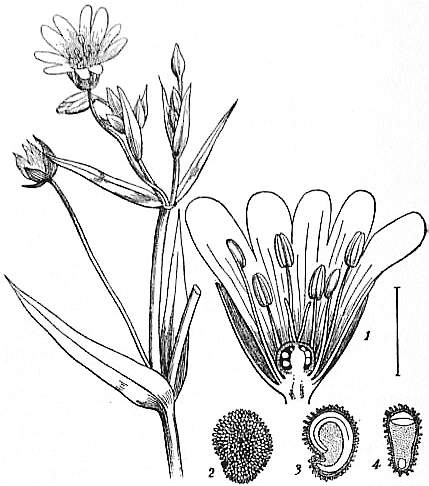
Fig. 1.—Stitchwort (Stellaria Holostea). 1, Flower cut vertically; 2, seed; 3, same cut vertically; 4, same cut horizontally.
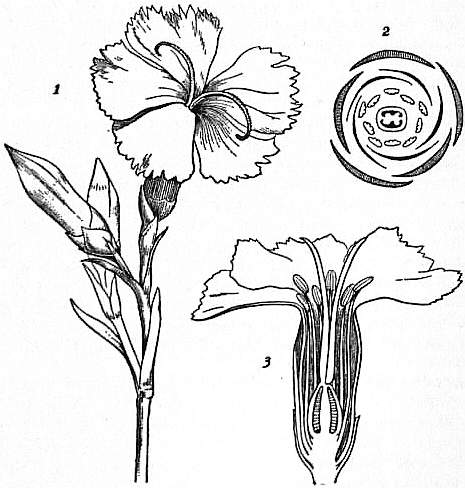
Fig. 2.—1, Flowering shoot of Pink (Dianthus); 2, horizontal plan of flower; 3, flower in vertical section.
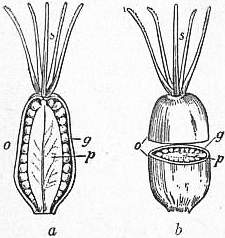
Fig. 3.
a, Pistil of Cerastium hirsutum cut vertically; o, unilocular or monothecal ovary; p, free central placenta; g, ovules; s, styles. b, The same cut horizontally, and the halves separated so as to show the interior of the cavity of the ovary o, with the free central placenta p, covered with ovules g.
The order is divided into two well-defined tribes which are distinguished by the character of the flower and the arrangements for ensuring pollination.
Tribe I. Alsineae: the sepals are free and the flowers are open, with spreading petals, and the honey which is secreted at the base of the stamens is exposed to the visits of short-tongued insects, such as flies and small bees; the petals are white in colour. It includes several British genera, Cerastium (mouse-ear chickweed), Stellaria (fig. 1) (stitchwort and chickweed), Arenaria (sandwort), Sagina (pearlwort), Spergula (spurrey) and Spergularia (sandwort spurrey).
Tribe II. Sileneae: the sepals are joined below to form a narrow tube, in which stand the long claws of the petals and the stamens, partly closing the tube and rendering the honey inaccessible to all but long-tongued insects such as the larger bees and Lepidoptera. The flowers are often red. It includes several British genera:—Dianthus (pink) fig. 2, Silene (catchfly, bladder campion), Lychnis (campion, L. Flos-Cuculi is ragged robin), and Githago or Agrostemma (corn cockle). Several, such as Lychnis vespertina, Silene nutans and others, are night-flowering, opening their flowers and becoming scented in the evening or at night, when they are visited by night-flying moths.
The plants of this order are of little or no economic value, soap-wort, Saponaria officinalis, forming a lather in water was formerly officinal. Dianthus (carnation and pink) Gypsophila, Lychnis and others, are garden plants.
CASABIANCA, RAPHAEL, Comte de (1738-1825), French general, was descended from a noble Corsican family. In 1769 he took the side of France against Genoa, then mistress of the island. In 1793, having entered the service of the revolutionary government, he was appointed lieutenant-general in Corsica in place of Pascale Paoli, who was outlawed for intrigues with England. For his defence of Calvi against the English he was appointed general of division, and he served in Italy from 1794 to 1798. After the 18th of Brumaire he entered the senate and was made count of the empire in 1806. In 1814 he joined the party of Louis XVIII., rejoined Napoleon during the Hundred Days, and in 1819 succeeded again in entering the chamber of peers.
His nephew, Louis de Casabianca (1762-1798), entered the French navy, served in the convoy of the French troops sent to aid the revolted American colonies, and took part in various naval actions off the North American coast. He became captain in 1792, represented Corsica in the Convention, and then received command of the Orient, which at the battle of the Nile bore the flag of Admiral Brueys. When the latter was killed, Casabianca, though badly wounded, fought the burning ship to the end, and perished with most of the crew. His son, Giacomo Jocante, a boy of ten years of age, refused to leave the ship and died in trying to save his father. This heroic act was the subject of several poems, including the well-known ballad by Mrs. Hemans.
CASABLANCA (Dar el Baida, “the white house”), a seaport on the Atlantic coast of Morocco, in 33° 27′ N., 7° 46′ W. It is a wool and grain port for central Morocco, chiefly for the provinces of Tadla and Shawia. Third in importance of the towns on the Moorish coast, unimpeded by bar or serious rocks, the roadstead is exposed to the north-west winds. There is anchorage for steamers in 5 to 6 fathoms. Vessels were loaded and discharged by lighters from the beach. In May 1907 the construction began of harbour works which afford sheltered accommodation for ships at all states of the tide. The value of the foreign trade of the port for the period 1897-1907 was about £750,000 a year. A railway to Ber Reshid, the first section of a line intended to tap the rich agricultural region of which Casablanca is the port, was opened in September 1908, being the first railway built in Morocco. The population, about 20,000, includes numerous foreign merchants, Franciscan and Protestant missions, and a consular corps. Built by the Portuguese upon the site of the once prosperous town of Anfa, which they had destroyed in 1468, Casablanca was held by them for some time, till trouble with the natives compelled them to abandon it. In August 1907, in consequence of the murder of a number of French and Spanish workmen engaged on the harbour works, the town was bombarded and occupied by the French (see Morocco: History).
CASALE MONFERRATO, a town and episcopal see of Piedmont, Italy, in the province of Alessandria, 21 m. N.N.W. by rail from the town of Alessandria. Pop. (1901) 18,874 (town); 31,370 (commune). It lies in the plain on the right bank of the Po, 377 ft. above sea-level, and is a junction for Mortara, Vercelli. Chivasso and Asti; it is also connected by steam tramways with Alessandria, Vercelli and Montemagno. The fine Lombard Romanesque cathedral, originally founded in 742, was rebuilt in the early 12th century and consecrated in 1106; it suffered from restoration in 1706, but has been brought back to its original form. It contains some good pictures. The church of S. Domenico is a good Renaissance edifice, and there are some fine palaces. The church of S. Ilario is said to occupy the site of a pagan temple, but the name of the ancient town (if any) which occupied this site is not known. About 10 m. distant is the Sacro Monte di Crea, with eighteen chapels on its slopes containing terra-cotta groups of statues, resembling those at Varallo. Casale Monferrato was given by Charlemagne to the church of Vercelli, but obtained its liberty from Frederick I. (Barbarossa). It was sacked by the troops of Vercelli, Alessandria and Milan in 1215, but rebuilt and fortified in 1220. It fell under the power of its marquises in 1292, and became the chief town of a small state. In 1536 it passed to the Gonzagas of Mantua, who fortified it very strongly. It has since been of considerable importance as a fortress: it successfully resisted the Austrians in 1849, and was strengthened in 1852. There is a large Portland cement factory here.
CASAMARI, a Cistercian abbey in the province of Rome, 6 m. E.S.E. of Veroli. It marks the site of Cereatae, the birthplace of Marius, afterwards known, as inscriptions attest, as Cereatae Marianae, having been separated perhaps by the triumvirs, from the territory of Arpinum. We find it under the early empire as an independent community. The abbey is a fine example of Burgundian early-Gothic (1203-1217), paralleled in Italy by Fossanuova alone (which is almost contemporary with it), and is very well preserved.
See C. Enlart, “Origines françaises de l’architecture gothique en Italie” (Bibliothèque des écoles françaises d’Athènes et de Rome, fasc. 66), (Paris, 1894).
CASANOVA DE SEINGALT, GIOVANNI JACOPO (1725-1798), Italian adventurer, was born at Venice in 1725. His father belonged to an ancient and even noble family, but alienated his friends by embracing the dramatic profession early in life. He made a runaway marriage with Zanetta Farusi, the beautiful daughter of a Venetian shoemaker; and Giovanni was their eldest child. When he was but a year old, his parents, taking a journey to London, left him in charge of his grandmother, who, perceiving his precocious and lively intellect, had him educated far above her means. At sixteen he passed his examination and entered the seminary of St Cyprian in Venice, from which he was expelled a short time afterwards for some scandalous and immoral conduct, which would have cost him his liberty, had not his mother managed somehow to procure him a situation in the household of the Cardinal Acquaviva. He made but a short stay, however, in that prelate’s establishment, all restraint being irksome to his wayward disposition, and took to travelling. Then began that existence of adventure and intrigue which only ended with his death. He visited Rome, Naples, Corfu and Constantinople. By turns journalist, preacher, abbé, diplomatist, he was nothing very long, except homme à bonnes fortunes, which profession he cultivated till the end of his days. In 1755, having returned to Venice, he was denounced as a spy and imprisoned. On the 1st of November 1756 he succeeded in escaping, and made his way to Paris. Here he was made director of the state lotteries, gained much financial reputation and a considerable fortune, and frequented the society of the most notable French men and women of the day. In 1759 he set out again on his travels. He visited in turn the Netherlands, South Germany, Switzerland—where he made the acquaintance of Voltaire,—Savoy, southern France, Florence—-whence he was expelled,—and Rome, where the pope gave him the order of the Golden Spur. In 1761 he returned to Paris, and for the next four or five years lived partly here, partly in England, South Germany and Italy. In 1764 he was in Berlin, where he refused the offer of a post made him by Frederick II. He then travelled by way of Riga and St Petersburg to Warsaw, where he was favourably received by King Stanislaus Poniatowski. A scandal, followed by a duel, forced him to flee, and he returned by a devious route to Paris, only to find a lettre de cachet awaiting him, which drove him to seek refuge in Spain. Expelled from Madrid in 1769, he went by way of Aix—where he met Cagliostro—to Italy once more. From 1774, with which year his memoirs close, he was a police spy in the service of the Venetian inquisitors of state; but in 1782, in consequence of a satirical libel on one of his patrician patrons, he had once more to go into exile. In 1785 he was appointed by Count Waldstein, an old Paris acquaintance, his librarian at the château of Dux in Bohemia. Here he lived until his death, which probably occurred on the 4th of June 1798.
The main authority for Casanova’s life is his Mémoires (12 vols., Leipzig, 1826-1838; later ed. in 8 vols., Paris, 1885), which were written at Dux. They are clever, well written and, above all, cynical, and interesting as a trustworthy picture of the morals and manners of the times. Among Casanova’s other works may be mentioned Confutazione della storia del governo Veneto d’Amelot de la Houssaye (Amsterdam, 1769), an attempt to ingratiate himself with the Venetian government; and the Histoire of his escape from prison (Leipzig, 1788; reprinted Bordeaux, 1884; Eng. trans, by P. Villars, 1892). Ottmann’s Jacob Casanova (Stuttgart, 1900) contains a bibliography.
CASAS GRANDES (“Great Houses”), a small village of Mexico, in the state of Chihuahua, situated on the Casas Grandes or San Miguel river, about 35 m. S. of Llanos and 150 m. N.W. of the city of Chihuahua. The railway from Ciudad Juarez to Terrazas passes through the town. It is celebrated for the ruins of early aboriginal buildings still extant, about half a mile from its present site. They are built of “sun-dried blocks of mud and gravel, about 22 in. thick, and of irregular length, generally about 3 ft., probably formed and dried in situ.” The walls are in some places about 5 ft. thick, and they seem to have been plastered both inside and outside. The principal edifice extends 800 ft. from north to south, and 250 ft. east to west; its general outline is rectangular, and it appears to have consisted of three separate piles united by galleries or lines of lower buildings. The exact plan of the whole is obscure, but the apartments evidently varied in size from mere closets to extensive courts. The walls still stand at many of the angles with a height of from 40 to 50 ft., and indicate an original elevation of several storeys, perhaps six or seven. At a distance of about 450 ft. from the main building are the substructions of a smaller edifice, consisting of a series of rooms ranged round a square court, so that there are seven to each side besides a larger apartment at each corner. The age of these buildings is unknown, as they were already in ruins at the time of the Spanish Conquest. The whole district of Casas Grandes is further studded with artificial mounds, from which are excavated from time to time large numbers of stone axes, metates or corn-grinders, and earthern vessels of various kinds. These last have a white or reddish ground, with ornamentation in blue, red, brown or black, and are of much better manufacture than the modern pottery of the country. Similar ruins to those of Casas Grandes exist near the Gila, the Salinas, and the Colorado and it is probable that they are all the erections of one people. Bancroft is disposed to assign them to the Moquis.
See vol. iv. of H.H. Bancroft’s The Native Races of the Pacific States of North America, of which the principal authorities are the Noticias del Estado de Chihuahua of Escudero, who visited the ruins in 1819; an article in the first volume of the Album Mexicano, the author of which was at Casas Grandes in 1842; and the Personal Narrative of Explorations and Incidents in Texas, New Mexico, California, Sonora and Chihuahua (1854), by John Russell Bartlett, who explored the locality in 1851.
CASAUBON, FLORENCE ESTIENNE MÉRIC (1599-1671), English classical scholar, son of Isaac Casaubon, was born at Geneva on the 14th of August 1599. At an early age he joined his father in England, and completed his education at Eton and Oxford (B.A. 1618). His defence of his father against the attacks of certain Catholics (Pietas contra maledicos patrii Nominis el Religionis Hostes, 1621), secured him the notice and favour of James I., who conferred upon him a prebendal stall in Canterbury cathedral. He also vindicated his father’s literary reputation against certain impostors who had published, under his name, a work on The Origin of Idolatry (Vindicatio Patris adversus Impostores, 1624). During the Civil War he lived a retired life, and after its conclusion refused to acknowledge the authority of Cromwell, who, notwithstanding, requested him to write an “impartial” history of the events of the period. In spite of the tempting inducements held out, he declined, and also refused the post of inspector of the Swedish universities offered him by Queen Christina. After the Restoration, he was reinstated in his benefice, and devoted the rest of his life to literary work. He died at Canterbury on the 14th of July 1671. Méric Casaubon’s reputation was overshadowed by that of his father; but his editions of numerous classical authors, and especially of the Meditations of Marcus Aurelius (also English translation, new ed. by W.H.D. Rouse, 1900), were highly valued. Among his other works may be mentioned: De Quatuor Linguis Commentatio (1650), Of the Necessity of Reformation (1664), On Credulity and Incredulity in Things natural, civil and divine (1668).
CASAUBON, ISAAC (1550-1614), French (naturalized English) classical scholar, was born at Geneva, on the 18th of February 1559, of French refugee parents. On the publication of the edict of January 1562, the family returned to France and settled at Crest in Dauphiné, where Arnaud Casaubon, Isaac’s father, became minister of a Huguenot congregation. Till he was nineteen, Isaac had no other instruction than what could be given him by his father during the years of civil war. Arnaud was away from home whole years together in the Calvinist camp, or the family were flying to the hills to hide from the fanatical bands of armed Catholics who patrolled the country. Thus it was in a cave in the mountains of Dauphiné, after the massacre of St Bartholomew, that Isaac received his first lesson in Greek, the text-book being Isocrates ad Demonicum.
At nineteen Isaac was sent to the Academy of Geneva, where he read Greek under Francis Portus, a native of Crete. Portus died in 1581, having recommended Casaubon, then only twenty-two, as his successor. At Geneva he remained as professor of Greek till 1596. Here he married twice, his second wife being Florence, daughter of the scholar-printer, Henri Estienne. Here, without the stimulus of example or encouragement, with few books and no assistance, in a city peopled with religious refugees, and struggling for life against the troops of the Catholic dukes of Savoy, Casaubon made himself a consummate Greek scholar and master of ancient learning. His great wants at Geneva were books and the sympathy of learned associates. He spent all he could save out of his small salary in buying books, and in having copies made of such classics as were not then in print. Henri Estienne, Théodore de Beza (rector of the university and professor of theology), and Jacques Lect (Lectius), were indeed men of superior learning. But Henri, in those last years of his life, was no longer the Estienne of the Thesaurus; he was never at home, and would not suffer his son-in-law to enter his library. “He guards his books,” writes Casaubon, “as the griffins in India do their gold!” Beza was engrossed by the cares of administration, and retained, at most, an interest for theological reading, while Lect, a lawyer and diplomatist, had left classics for the active business of the council. The sympathy and help which Casaubon’s native city could not afford him, he endeavoured to supply by cultivating the acquaintance of the learned of other countries. Geneva, as the metropolis of Calvinism, received a constant succession of visitors. The continental tour of the young Englishman of birth was not complete without a visit to Geneva. It was there that Casaubon made the acquaintance of young Henry Wotton, the poet and diplomatist, who lodged in his house and borrowed his money. Of more consequence to Isaac Casaubon was the acquaintance of Richard Thomson (“Dutch” Thomson), fellow of Clare College, Cambridge; for it was through Thomson that the attention of Joseph Scaliger, settled in 1593 at Leiden, was directed to Casaubon. Scaliger and Casaubon first exchanged letters in 1594. Their intercourse, which was wholly by letter, for they never met, passes through the stages of civility, admiration, esteem, regard and culminates in a tone of the tenderest affection and mutual confidence. Influential French men of letters, the Protestant Jacques Bongars, the Catholic Jacques de Thou, and the Catholic convert Philippe Canaye, sieur du Fresne, aided him by presents of books and encouragement, and endeavoured to get him invited, in some capacity, to France.
This was effected in 1596, in which year Casaubon accepted an invitation to the university of Montpellier, with the title of conseiller du roi and professeur stipendié aux langues et bonnes lettres. In Montpellier he never took root. He held the professorship there only three years, with several prolonged absences. The hopes raised by his brilliant reception were disappointed; he was badly treated by the authorities, by whom his salary was only paid very irregularly, and, finally, not at all. He was not, at any time, insensible to the attractions of teaching, and his lectures at Montpellier were followed not only by the students, but by men of mature age and position. But the love of knowledge was gradually growing upon him, and he began to perceive that editing Greek books was an employment more congenial to his peculiar powers than teaching. At Geneva he had first tried his hand on some notes on Diogenes Laërtius, on Theocritus and the New Testament, the last undertaken at his father’s request. His début as an editor had been a complete Strabo (1587), of which he was so ashamed afterwards that he apologized for its crudity to Scaliger, calling it “a miscarriage.” This was followed by the text of Polyaenus, an editio princeps, 1589; a text of Aristotle, 1590; and a few notes contributed to Estienne’s editions of Dionysius of Halicarnassus and Pliny’s Epistolae. It is not till we come to his edition of Theophrastus’s Characteres (1592), that we have a specimen of that peculiar style of illustrative commentary, at once apposite and profuse, which distinguishes Casaubon among annotators. At the time of his removal to Montpellier he was engaged upon what is the capital work of his life, his edition of, and commentary on, Athenaeus.
In 1598 we find Casaubon at Lyons, superintending the passage of his Athenaeus through the press, for which he had been unable to find facilities at Montpellier. Here he lived in the house of Méric de Vicq, surintendant de la justice, a Catholic, but a man of acquirements, whose connexions were with the circle of liberal Catholics in Paris. In the suite of De Vicq Casaubon made a flying visit to Paris, and was presented to Henry IV. The king was very gracious, and said something about employing Casaubon’s services in the “restoration” of the fallen university of Paris. Full of hope he returned to Montpellier. In January 1599, he received a summons to repair to Paris. But the terms of the letter missive were so vague that, though it bore the sign manual, Casaubon hesitated to act upon it. However, he resigned his chair at Montpellier, but instead of hastening to Paris, he lingered more than a year at Lyons, in De Vicq’s house, where he hoped to meet the king, who was expected to visit the south. Nothing more was heard about the professorship, but instead he was summoned by De Vicq, who was then in Paris, to come to him in all haste on an affair of importance. The business proved to be the Fontainebleau Conference. Casaubon allowed himself to be persuaded to sit as one of the referees who were to adjudicate on the challenge sent to Du Plessis Mornay by Cardinal Duperron. By so doing he placed himself in a false position, as Scaliger said: “Non debebat Casaubon interesse colloquio Plessiaeano; erat asinus inter simias, doctus inter imperitos” (Scaligerana 2α). The issue was so contrived that the Protestant party could not but be pronounced to be in the wrong. By concurring in the decision, which was unfavourable to Du Plessis Mornay, Casaubon lent the prestige of his name to a court whose verdict would without him have been worthless, and confirmed the suspicions already current among the Reformed churches that, like his friend and patron, Canaye du Fresne, he was meditating abjuration. From this time forward he became the object of the hopes and fears of the two religious parties; the Catholics lavishing promises, and plying him with arguments; the Reformed ministers insinuating that he was preparing to forsake a losing cause, and only higgling about his price. We now know enough of Casaubon’s mental history to know how erroneous were these computations of his motives. But, at the time, it was not possible for the immediate parties to the bitter controversy to understand the intermediate position between Genevan Calvinism and Ultramontanism to which Casaubon’s reading of the fathers had conducted him.
Meantime the efforts of De Thou and the liberal Catholics to retain him in Paris were successful. The king repeated his invitation to Casaubon to settle in the capital, and assigned him a pension. No more was said about the university. The recent reform of the university of Paris had closed its doors to all but Catholics; and though the chairs of the Collège de France were not governed by the statutes of the university, public opinion ran so violently against heresy, that Henry IV. dared not appoint a Calvinist to a chair, even if he had desired to do so. But it was designed that Casaubon should succeed to the post of sub-librarian of the royal library when it should become vacant, and a patent of the reversion was made out in his favour. In November 1604, Jean Gosselin died in extreme old age; and Casaubon succeeded him as sub-librarian, with a salary of 400 livres in addition to his pension.
In Paris Casaubon remained till 1610. These ten years were the brightest period of his life. He had attained the reputation of being, after Scaliger, the most learned man of the age,—an age in which learning formed the sole standard of literary merit. He was placed above penury, though not in easy circumstances. He had such facilities for religious worship as a Huguenot could have, though he had to go out of the city to Hablon, and afterwards to Charenton, for them. He enjoyed the society of men of learning, or of men who took an interest in learned publications. He had the best opportunities of seeing men of letters from foreign countries as they passed through Paris. Above all, he had ample facilities for using Greek books, both printed and in MS., the want of which he had felt painfully at Geneva and Montpellier, and which no other place but Paris could at that period have supplied.
In spite of all these advantages we find Casaubon restless, and ever framing schemes for leaving Paris, and settling elsewhere. It was known that he was open to offers, and offers came to him from various quarters,—from Nîmes, from Heidelberg, from Sedan. His friends Lect and Giovanni Diodati wished, rather than hoped, to get him back to Geneva. The causes of Casaubon’s discomfort in Paris were various, but the principal source of uneasiness lay in his religion. The life of any Huguenot in Paris was hardly secure at that time, for it was doubtful if the police of the city was strong enough to protect them against any sudden uprising of the fanatical mob, always ready to re-enact the St Bartholomew. But Casaubon was exposed to persecution of another sort. Ever since the Fontainebleau Conference an impression prevailed that he was wavering. It was known that he rejected the outré anti-popery opinions current in the Reformed churches; that he read the fathers, and wished for a church after the pattern of the primitive ages. He was given to understand that he could have a professorship only by recantation. When it was found that he could not be bought, he was plied by controversy. Henry IV., who liked Casaubon personally, made a point of getting him to follow his own example. By the king’s orders Duperron was untiring in his efforts to convert him. Casaubon’s knowledge of the fathers was that of a scholar, Duperron’s that of an adroit polemist; and the scholar was driven to admit that the polemist was often too hard for him. These encounters mostly took place in the king’s library, over which the cardinal, in his capacity of aumonier, exercised some kind of authority; and it was therefore impossible for Casaubon to avoid them. On the other hand, the Huguenot theologians, and especially Pierre du Moulin, chief pastor of the church of Paris, accused him of conceding too much, and of having departed already from the lines of strict Calvinistic orthodoxy.
When the assassination of Henry IV. gave full rein to the Ultramontane party at court, the obsessions of Duperron became more importunate, and even menacing. It was now that Casaubon began to listen to overtures which had been faintly made before, from the bishops and the court of England. In October 1610 he came to England in the suite of the ambassador, Lord Wotton of Marley (brother of Casaubon’s early friend), an official invitation having been sent him by Richard Bancroft, archbishop of Canterbury. He had the most flattering reception from James I., who was perpetually sending for him to discuss theological matters. The English bishops were equally delighted to find that the great French scholar was an Anglican ready made, who had arrived, by independent study of the Fathers, at the very via media between Puritanism and Romanism, which was becoming the fashion in the English Church. Casaubon, though a layman, was collated to a prebendal stall in Canterbury, and a pension of £300 a year was assigned him from the exchequer. Nor were these merely paper figures. When Sir Julius Caesar made a difficulty about payment, James sent a note in his own hand: “Chanceler of my excheker, I will have Mr Casaubon paid before me, my wife, and my barnes.” He still retained his appointments in France, and his office as librarian. He had obtained leave of absence for a visit to England, where his permanent settlement was not contemplated. In order to retain their hold upon him, the government of the queen regent refused to allow his library to be sent over. It required a special request from James himself to get leave for Madame Casaubon to bring him a part of his most necessary books. Casaubon continued to speak of himself as the servant of the regent, and to declare his readiness to return when summoned to do so.
Meanwhile his situation in London gradually developed unforeseen sources of discomfort. Not that he had any reason to complain of his patrons, the king and the bishops. James continued to the last to delight in his company, and to be as liberal as the state of his finances allowed. John Overall had received him and his whole family into the deanery of St Paul’s, and entertained him there for a year. Overall and Lancelot Andrewes, then bishop of Ely, were the most learned men of a generation in which extensive reading was more general among the higher clergy than it has ever been since. These two were attracted to Casaubon by congenial studies and opinions. With the witty and learned bishop of Ely in particular Casaubon was always happy to spend such hours as he had to spare from the labours of the study. Andrewes took him to Cambridge, where he met with a most gratifying reception from the notabilities of the university. They went on together to Downham, where Casaubon spent six weeks of the summer of 1611, in which year he became naturalized. In 1613 he was taken to Oxford by Sir Henry Savile, where, amid the homage and feasting of which he was the object, his principal interest was for the MSS. treasures of the Bodleian. The honorary degree which was offered him he declined.
But these distinctions were far from compensating the serious inconveniences of his position. Having been taken up by the king and the bishops, he had to share in their rising unpopularity. The courtiers looked with a jealous eye on a pensioner who enjoyed frequent opportunities of taking James I. on his weak side—his love of book talk—opportunities which they would have known how to use. Casaubon was especially mortified by Sir Henry Wotton’s persistent avoidance of him, so inconsistent with their former intimacy. His windows were broken by the roughs at night, his children pelted in the streets by day. On one occasion he himself appeared at Theobalds with a black eye, having received a blow from some ruffian’s fist in the street. The historian Hallam thinks that he had “become personally unpopular”; but these outrages from the vulgar seem to have arisen solely from the cockney’s antipathy to the Frenchman. Casaubon, though he could make shift to read an English book, could not speak English, any more than Mme Casaubon. This deficiency not only exposed him to insult and fraud, but restricted his social intercourse. It excluded him altogether from the circle of the “wits”; either this or some other cause prevented him from being acceptable in the circle of the lay learned—the “antiquaries.” William Camden, the antiquary and historian, he saw but once or twice. Casaubon had been imprudent enough to correct Camden’s Greek, and it is possible that the ex-head-master of Westminster kept himself aloof in silent resentment of Casaubon’s superior learning. With Robert Cotton and Henry Spelman he was slightly acquainted. Of John Selden we find no mention. Though Sir Henry Savile ostensibly patronized him, yet Casaubon could not help suspecting that it was Savile who secretly prompted an attempt by Richard Montagu to forestall Casaubon’s book on Baronius. Besides the jealousy of the natives, Casaubon had now to suffer the open attacks of the Jesuit pamphleteers. They had spared him as long as there were hopes of getting him over. The prohibition was taken off, now that he was committed to Anglicanism. Not only Joannes Eudaemon, Heribert Rosweyd and Scioppius (Gaspar Schoppe),1 but a respectable writer, friendly to Casaubon, Andreas Schott of Antwerp, gave currency to the insinuation that Casaubon had sold his conscience for English gold.
But the most serious cause of discomfort in his English residence was that his time was no longer his own. He was perpetually being summoned out of town to one or other of James’s hunting residences that the king might enjoy his talk. He had come over from Paris in search of leisure, and found that a new claim on his time was established. The king and the bishops wanted to employ his pen in their literary warfare against Rome. They compelled him to write first one, then a second, pamphlet on the subject of the day,—the royal supremacy. At last, ashamed of thus misappropriating Casaubon’s stores of learning, they set him upon a refutation of the Annals of Baronius, then in the full tide of its credit and success. Upon this task Casaubon spent his remaining strength and life. He died in great suffering on the 1st of July 1614. His complaint was an organic and congenital malformation of the bladder; but his end was hastened by an unhealthy life of over-study, and latterly by his anxiety to acquit himself creditably in his criticism on Baronius. He was buried in Westminster Abbey. The monument by which his name is there commemorated was erected in 1632 by his friend Thomas Morton when bishop of Durham.
Besides the editions of ancient authors which have been mentioned, Casaubon published with commentaries Persius, Suetonius, the Scriptores Historiae Augustae. The edition of Polybius, on which he had spent vast labour, he left unfinished. His most ambitious work was his revision of the text of the Deipnosophistae of Athenaeus, with commentary. The Theophrastus perhaps exhibits his most characteristic excellences as a commentator. The Exercitationes in Baronium are but a fragment of the massive criticism which he contemplated; it failed in bringing before the reader the uncritical character of Baronius’s history, and had only a moderate success, even among the Protestants. His correspondence (in Latin) was finally collected by Van Almeloveen (Rotterdam, 1709), who prefixed to the letters a careful life of Isaac Casaubon. But this learned Dutch editor was acquainted with Casaubon’s diary only in extract. This diary, Ephemerides, of which the MS. is preserved in the chapter library of Canterbury, was printed in 1850 by the Clarendon Press. It forms the most valuable record we possess of the daily life of a scholar, or man of letters, of the 16th century.
(M. P.)
A few minor changes have been made in the above article, compared with its form in the 9th edition. The most complete account of Casaubon is the full biography by Mark Pattison (1875), of which a second and revised edition, by H. Nettleship, was published in 1892; the most recent work on the subject is Isaac Casaubon, sa vie et son temps, by L.J. Nazelle (1897); there is a monograph on the Fontainebleau conference by J.A. Lalot (1889). Casaubon is the subject of one of St Beuve’s Causeries, the 30th of July 1860 (a notice of the Oxford edition of the Ephemerides). See also the article in E. Haag’s La France Protestante (1882), and J.E. Sandys, Hist. of Class. Schol. vol. ii. (ed. 1908), pp. 204 foll.
1 Eudaemon was a Cretan, Rosweyd a Dutch, Jesuit; Schoppe, a German philologist and critic.
CASCADE MOUNTAINS, a continuation northward of the Sierra Nevada, some 500 m. across the states of Oregon and Washington, U.S.A., into British Columbia. In American territory the range lies from 100 to 150 m. from the coast. The Cascades are separated on the S. from the Sierras by deep valleys near Mt. Shasta in California, while on the N., somewhat below the international boundary of 49° N., they approach the northern Rockies, mingling with these in inextricable confusion, although their name is given also to the much-broken, river-dissected, central mountain plateau that crosses British Columbia from S.E. to N.W. Geologically the Sierras and Cascades are very different, though their exact relations are not yet clearly determined; topographically they are also different. The Cascades are in general a comparatively low, broad mass surmounted by a number of imposing peaks in Oregon and Washington. Especially north of the Columbia river, the range widens out into a plateau. There are no notable elevations in British Columbia. Evidences of volcanic activity in comparatively recent geologic time are abundant throughout the length of the range, and all the highest summits are volcanic cones, covered with snow fields and, in a number of instances, with glaciers. The grandest peaks are Shasta (14,380 ft.) at the southern end, and Rainier (or Tacoma, 14,363 ft.) in Washington, two of the most magnificent mountains of America. Other notable summits are Mt. Pitt (9760), Mt. Scott (9122), Diamond Peak (8807), Mt. Thielsen (9250), Mt. Jefferson (10,200) and Mt. Hood (11,225), in Oregon; and Stuart (9470), St Helens (10,000), Baker (10,827) and Adams (12,470), in Washington. The Fraser river in the far north, the Columbia at the middle, and the Klamath in the south cut athwart the range to the Pacific, and many minor streams descend the range to swell their waters, while some drain directly from the flanks of the mountains into Puget Sound and Gray’s Harbor. The Columbia has cut almost to the sea-level through the great mountain mass, the Dalles being only about 100 ft. above the sea. It is to the Cascades of the tremendous rapids at this point that the mountains owe their name. The slopes of the Cascades, particularly on the west, which has a very much moister climate than the eastern slope, are clothed with magnificent forests, chiefly of coniferous evergreens: firs, pine, tamarack and cedar. The Douglas fir, the “Oregon pine” of commerce, often attaining a height of 250 ft., is one of the most beautiful trees in the world. There are also a variety of deciduous trees, but in the aggregate they are unimportant. In 1910 the mountain forests were largely included in ten national forest reserves, with a total area of nearly 16,000,000 acres, extending from the northern boundary of Washington to the southern boundary of Oregon. The magnificent forest cloak, splendid peaks, great open mountain plateau pastures, and exquisite lakes embosomed in mountain fastnesses and forest gloom, give variety to the scenery, which is often grand, and throughout the range indescribably beautiful, though perhaps not equal to the Sierra Nevada in splended light and colour. Large game—deer, bears, mountain sheep and goats, wolves and panthers—still abound. Two great railway systems, the Great Northern and the Northern Pacific, cross the Cascades through noteworthy tunnels; that on the former line is 2½ m. long, that on the latter a little less than 2 m.
See Oregon and Washington; also G.O. Smith and F.C. Calkins, A Geological Reconnaissance across the Cascade Range near the Forty-Ninth Parallel (Washington, D.C., 1904), being U.S. Geological Survey Bulletin 253.
CASE, JOHN (d. 1600), English Aristotelian scholar and physician, was born at Woodstock. He was educated at Oxford, and elected to a fellowship at St John’s College, which he was obliged to resign in consequence of his Roman Catholic sympathies. He subsequently opened a philosophical school in Oxford, which was largely attended. He enjoyed a great reputation as a logician and dialectician, and was in addition an authority on music and a distinguished physician. He is described as “a man of an innocent, meek, religious and studious life,” an agreeable conversationalist, an enthusiastic teacher, and a great favourite with his pupils. Most of his works were commentaries on various treatises of Aristotle (Organon, Ethics, Politics, Oeconomics, Physics) under curious titles; they enjoyed a large circulation during his time, and were frequently reprinted. He was also the author of The Praise of Musicke (1586), dedicated to Sir Walter Raleigh.
CASE. (1) (From Lat. casus, that which falls or happens; cadere, to fall), a word used in various senses traceable to the derivation. In grammar, the “cases” are the various forms in the declension of a noun, adjective or pronoun, the Latin word being a translation of the Greek πτῶσις, falling, applied by Aristotle to the variations from the simple form of the word, whether noun, verb or adjective (of which the adverb would be a πτῶσις). Later grammarians confined the term to nouns, and included the nominative. In law, “case” is the common term for a cause or suit brought before a court of justice. Certain particular legal usages may also be noted. Action on the case means an action for the recovery of damages for an injury to the person or property, where the act done was not immediately injurious (see Contract; Tort). A case stated is a statement of facts drawn up by one court for the opinion of another on a point of law. A special case is a statement of facts agreed to on behalf of two or more litigant parties, and submitted for the opinion of a court of justice as to the law bearing upon the facts so stated. A leading case is a decision which settles some point of importance. In the legal systems of the United Kingdom and of the United States decided cases are considered authoritative for courts of at least equal jurisdiction with those in which the judgments were given, but on the continent of Europe the rule is, following that of the Roman law, that they are instructive but not authoritative.
(2) (O. Fr. casse, mod. châsse, Lat. capsa, from capere, to hold; cf. “cash”), a box, sheath or covering. The term is applied to the natural protective covering of seed-vessels, and of a pupa or chrysalis. It is also used of a box containing instruments, pistols, swords, &c., and sometimes of the contents. In building, a “case” is the facing where the backing may be of inferior material; the framework in which a window or door is hung; or the wall surrounding a stair, “staircase” properly signifying the whole structure of walls and stairs. In bookbinding, a “case” means the boards and back in which the books are bound; and in typography, the tray, divided into partitions, containing the type ready for the compositor’s use.
CASEMATE (Ital. casa, a house, and matta, dull or dim), an armoured vault or chamber, or in field fortification, a bombproof shelter; in architecture, a hollow moulding, chiefly employed in cornices.
CASEMENT (from a Lat. form casamentum), in architecture, a frame in wood or metal, which holds the glass of a window, and is hung by hinges either at the top, bottom or sides.
CASERTA, a town and episcopal see of Campania, Italy, the capital of the province of Caserta, situated 21 m. N. by E. of Naples by rail via Accerra, and 23 m. via Aversa. Pop. (1901) town, 19,180; commune, 33,373. The modern town (229 ft.) was a mere village belonging to the Caetani family of Sermoneta, who were counts of Caserta, until its purchase from them by Charles IV. of Naples, and the erection of the royal palace, begun by Luigi Vanvitelli (van Wittel) in 1752, but not completed until 1774 for Charles’s son Ferdinand IV. It forms a rectangle, the south front being 830 ft. long and 134 ft. high, with 37 windows in each storey. The interior is richly decorated with marbles, almost all of which, except the white Carrara marble, are Neapolitan or Sicilian. The staircase, the chapel and the theatre are especially sumptuous. The extensive gardens which occupy the hillside behind the palace are adorned with fountains and cascades; the botanical garden contains many trees from northern climates. Two miles north is S. Leucio, a village founded by Ferdinand IV. in 1789, with a royal casino, and large silk factories which are still active. The old town (Caserta Vecchia) lies high (1310 ft.) about 3 m. to the north-east. It was founded in the 9th century by the Lombards of Capua. The cathedral has not suffered from restoration. It was completed in 1153. It is a copy of that of Sessa Aurunca, and preserves the type of the Latin basilica. The campanile, Sicilian in style, was completed in 1234, while the dome, which betrays similar motives, is even later. Its pulpit is decorated with the richest polychrome mosaic that can be found anywhere in Sicily or south Italy, and is quite Moslem in its brilliance. It is indeed remarkable to find these motives in a church so far inland (Bertaux, L’Art dans l’Italie méridionale, Paris, 1904, i. 353, &c.). There are also the ruins of the old walls.
CASE-SHOT, a projectile used in ordnance for fighting at close quarters. It consists of a thin metal case containing a large number of bullets or other small projectiles (see Ammunition). Case-shot was formerly called “canister,” though the term now used occurs as early as 1625.
CASH, (1) (From O. Fr. casse, mod. caisse, a box or chest; cf. “case”), a term which, originally meaning a box in which money is kept, is now commonly applied to ready money or coin. In commercial and banking usage “cash” is sometimes confined to specie; it is also, in opposition to bills, drafts or securities, applied to bank-notes. Hence “to cash” means to convert cheques and other negotiable instruments into coin. In bookkeeping, in such expressions as “petty cash,” “cash-book,” and the like, it has the same significance, and so also in “cash-payment” or ready-money payment as opposed to “credit,” however the payment may be made, by coin, notes or cheque.
The “cash on delivery” or “collect on delivery” system, known as C.O.D., is one whereby a tradesman can, through a delivery agency, send goods to a customer, and have the money due to him collected on the delivery of the same, with a guarantee from the carrier that, if no money be collected, the goods shall be returned. The function of such an agency is performed in the United States of America by the express companies (see Express). In most countries of the continent of Europe the post office acts as such an agent, as in Germany (where the system is known as Post-Nachnahme) and in France (contre remboursement). It is also in use in India, where it is known as “value payable,” and was introduced in 1877 in Australia. The advantages of the system are obvious, from the point of view both of the customer, who can, by post or telegram, order and obtain speedy delivery from large towns, and of the tradesman, whose area of trade is indefinitely extended. The system does away with credit or the delay and inconvenience of paying in advance. The success of the large “catalogue” houses in America has been mainly due to the system as operated by the express companies. At various times, notably in 1904, it has been proposed that the General Post Office of the United Kingdom should adopt the system. The consistent opposition of the retail traders in large urban centres other than the large stores, and of the country shopkeeper generally, has been sufficient to secure the refusal of the postmaster-general to the proposed scheme, but a commencement was made in 1908 for orders not exceeding £20 between the United Kingdom and Egypt, Cyprus and Malta, and certain British post offices in Turkey and Tangier.
(2) (From Tamil kasū, Sinhalese kasi, a small coin, adopted by Portuguese as caixa, a box, and similarly assimilated in English to “cash” above), a name given by English residents in the East to native coins of small value, and particularly to the copper coinage of China, the native name for which is tsien. This, the only coin minted by the government, should bear a fixed ratio of 1000 cash to one tael of silver, but in practice there is no such fixed value. It is the universal medium of exchange throughout China for all retail transactions. The tsien is a round disk of copper alloy, with a square hole punched through the centre for stringing. A “string of cash” amounts to 500 or 1000 cash, strung in divisions of 50 or 100.
CASHEL, a city of Co. Tipperary, Ireland, in the east parliamentary division, 5 m. S.E. of Goold’s Cross and Cashel station on the main line of the Great Southern & Western railway, 96 m. S.W. from Dublin. Pop. of urban district (1901) 2938. The town, which lies at the base of the Rock of Cashel, is of somewhat poor appearance, but contains several public buildings. There are also the cathedral church of St John the Baptist (c. 1780), the deanery house (once the bishop’s palace), and a Roman Catholic church. Cashel gives name to a Roman Catholic archdiocese.
The Rock of Cashel is the object of chief interest in the place. This elevation of limestone formation rises abruptly from the plain to a height of about 300 ft. and is a commanding object for many miles around. Its summit is occupied by one of the most interesting assemblages of ruins in Ireland, consisting of the remains of St Patrick’s cathedral, a round tower, Cormac’s chapel, and an ancient cross. The chapel, which is said to have been erected by King Cormac M‘Carthy in the 12th century, combines the ancient form of high stone roof, having chambers between the pitch and the vault, with the richest Norman decoration; the chancel arch being of especial magnificence. The cathedral, of the 13th century, is cruciform in design, with lancet windows and pointed arches, and contains many interesting sculptures and tombs. In the adjoining cemetery there stands, on a rude pedestal, whereon the kings of Munster were crowned, the “Cross of Cashel,” with an effigy of St Patrick and a portrayal of the Crucifixion sculptured on its sides. The round tower, situated at the north-east angle of the cathedral, is 80 ft. high with a circumference of 50 ft., and unlike the neighbouring ruins is built, not of the limestone of the “Rock,” but of freestone. Of the defences of the Rock a massive guard-tower and portions of the wall remain. At the base of the Rock is Hore Abbey, a Cistercian foundation (1272), exhibiting a similar style of architecture to that of the cathedral on the Rock; and within the town is a Dominican priory (1243), of which the east window is a beautiful example of the style of the period. From the Rock itself an extensive prospect is commanded over the rich Golden Vale backed by the Galtee Mountains, the Devil’s Bit, and other ranges; the clustering roofs of the city providing a picturesque foreground.
The history of Cashel belongs to the early period of Irish chronology. Legend states that the vision of an angel blessing the Rock, seen by two swineherds early in the 5th century, led Core Mac Luighdheach, king of Munster, to establish a stronghold here. It became one of the principal seats of the kings of Munster, but in 1101 it was given over to the church by King Murkertagh O’Brien. It afterwards became noteworthy as the place where Henry II. received the homage of O’Brien, king of Limerick, and still later, where Edward Bruce held his Irish parliament. The cathedral was burnt in 1495 by the earl of Kildare. Cashel was taken by storm during the wars of 1647. It was reduced from an archbishopric to a bishopric in 1839, and was disfranchised, on account of corrupt practice, in 1870, having previously returned one member to parliament.
CASHEW NUT, the fruit of the cashew, cadju or acajou tree, Anacardium occidentale (nat. ord. Anacardiaceae), a native of the West Indian Islands. The fruit is kidney-shaped, about an inch in length, and the kernel is enclosed in two coverings, the outer of which is smooth, grey and leathery. Inside this external rind is a dark-coloured layer, containing an excessively acrid juice. The kernels have a bland, oily, pleasant taste. They are much eaten, both raw and roasted, in the tropical regions in which the tree is cultivated, and they yield a light-coloured, sweet-tasted oil, said to be equal to olive oil for culinary purposes. The fruit-stalk, immediately under the fruit, is swollen and fleshy, and assumes a pear-like shape. This swollen portion of the stalk has a pleasant acid taste, and is eaten under the name of cashew apple. By fermentation it yields an alcoholic beverage, from which a spirit for drinking is distilled in the West Indies and Brazil. The stem of the tree yields a gum analogous to gum arabic.
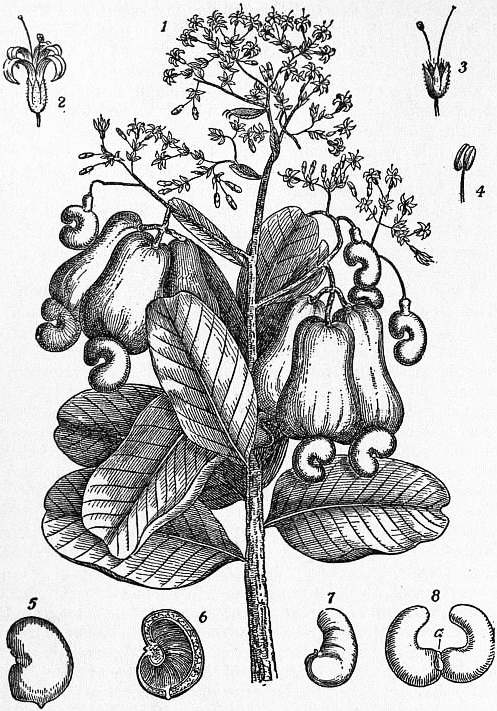
Anacardium occidentale, Cashew Nut plant, belonging to the nat. ord. Anacardiaceae.
1. Branch (reduced), bearing flowers and fruit. The fruit-stalks are enlarged in a pear-like form, bearing the nut (the true fruit) at their apex. 2. Flower expanded. 3. Stamen and pistil, with the calyx; one fertile stamen longer than the others. 4. Stamen separated. 5. Nut constituting the fruit. 6. Nut opened longitudinally. 7. Seed separated from the nut. 8. Cotyledons opened to show the radicle a, and the plumule.
CASHIBO, or Carapache (“bat”), a tribe of South American Indians of Pannoan stock, living in scanty numbers on the west side of the Ucayali, Peru. They are a wild, savage people who have always been foremost in attacks on the Jesuits. They joined Juan Santos in 1744 in the destruction of missions.
CASHIER. (1) (Adapted from the Fr. caissier, one in charge of the caisse, or money-box), one who has charge of the payment or receiving of money in a business house. The “cashier” may be a high executive official of a banking or mercantile house—thus the name of chief cashier of the Bank of England appears on all notes issued during his occupation of the post—or he may be merely a clerk, who receives payment for goods sold, and has the right to give receipts for the same.
(2) (In origin ultimately the same as “quash,” to annul, from Lat. quassare, to dash or break to pieces, a frequentative of quatere, to shake, but also connected in form and meaning with cassare, to make, cassus, empty or void), a military term, meaning originally to disband, and probably adopted from the Dutch in the 16th century. The word in various forms is used in the same sense in most European languages. It is now used in English for the dismissal of a commissioned officer from the army and navy for particularly serious offences, in the words of the Army Act, 1881, s. 16, for “behaving in a scandalous manner unbecoming an officer and a gentleman.” “Cashiering” involves not merely the loss of the commission, but also a permanent disqualification from serving the state in any capacity.
CASH REGISTER, a species of calculating machine adapted for use in connexion with the cash-tills of shops, in order to provide a record of the money received. Such machines are made in great variety and widely used. Sometimes the records are constituted by holes punched in a roll of paper; in other cases they are shown on dials by the aid of adding mechanism. A common form has a number of keys, each representing a particular sum and each attached to a counting mechanism which records how many times it has been used. By pressing appropriate combinations of these keys the amount of any purchase can be registered, and the combined records of all the counting mechanism give the total that has been passed through the machine in any selected period. Each key when pressed also raises an indicator which informs the customer how much he has to pay. In their more elaborate forms these cash registers may have a separate money-drawer for each assistant employed in the shop, thus enabling the proprietor to ascertain how many customers each man has served and how much money he has taken, and also to fix responsibility for mistakes, bad money, &c. The machines are also made to deliver a printed receipt for each purchase, showing the amount, date and assistant concerned, and they may be arranged to keep separate records of credit sales, money received on account, and money paid out.
CASILINUM (mod. Capua), an ancient city of Campania, Italy, 3 m. N.W. of the ancient Capua. Its position at the point of junction of the Via Appia and Via Latina, and at their crossing of the river Volturnus by a three-arched bridge, which still exists, gave it considerable importance under the Roman republic; and while the original pre-Roman town, which was doubtless dependent on the neighbouring Capua, stood entirely on the left (S.) bank, surrounded on three sides by the river, the Roman city extended to the right bank also; remains of it have been found at some 25 ft. below the modern ground-level, the river-bed having risen considerably. In the Second Punic War it was occupied by Fabius Cunctator in 217 b.c., taken by Hannibal after a gallant defence by troops from Praeneste and Perusia in the winter of 216-215, but recaptured in the following year, serving the Romans as their base of operations against Capua. It lost its independence and became a praefectura. Caesar conducted a colony thither in 59 b.c., which was renewed by Antony in 44 b.c. The veterans took Octavian’s side after Caesar’s death, but it seems to have been united with Capua before the time of Vespasian, and it does not occur in the list of independent communities given by Pliny, who indeed (Hist. Nat. iii. 70) speaks of the morientis Casilini reliquiae, and only its position at the junction of the roads redeemed it from utter insignificance.
(T. As.)
CASIMIR III., called “The Great,” king of Poland (1310-1370), the son of Wladislaus Lokietek, king of Poland, and Jadwiga, princess of Kalisch, was born at Kowal in Kujavia in 1310. Casimir belongs to that remarkable group of late medieval sovereigns who may be called the fathers of modern diplomacy, inasmuch as they relegated warfare to its proper place as the instrument of politics, and preferred the council-chamber to the battle-field. He was educated at the court of Charles Robert of Hungary, who had married Casimir’s beautiful sister Elizabeth, and who gave his brother-in-law an excellent education under Italian masters. In his youth Casimir was considered frivolous and licentious; while his sudden flight from the field of Plowce, the scene of his father’s great victory over the Teutonic knights, argued but poorly for his personal courage. When, therefore, he ascended the Polish throne in 1333, the future of his country, which then consisted of little more than the lately reunited provinces of Great and Little Poland, seemed dark indeed; especially as she was still at war with the Teutonic Order and with John of Luxemburg, king of Bohemia, who claimed the crown of Poland also. Fortunately Casimir was a man of penetrating genius. His father had been a hero who trusted entirely to his sword, yet the heroic struggle of a lifetime had barely sufficed to keep at bay the numerous and potent foes with which Poland was environed. Casimir recognized from the first that further fighting against tremendous odds was unprofitable. A careful, calculating dynastic policy, which aimed at the establishment of an equilibrium by means of prudent compromises and defensive alliances, was, he rightly judged, the best guarantee for the future safety and glory of Poland. Casimir began by tying the hands of the Teutonic Order by the truce of Thorn; he induced the king of Bohemia to relinquish his claims to the Polish throne by consenting to leave him a free hand in Silesia (conference of Trencsén, early in 1335); and subsequently he attended the celebrated congress of Visegrád (November 12-December 3, 1335), where Charles Robert entertained him and the king of Bohemia magnificently. At this congress the differences between Casimir and John of Bohemia were finally adjusted; peace was made between the king of Poland and the Teutonic Order on the basis of the cession of Pomerania, Kulm, and Michalow to the knights, who retroceded Kujavia and Dobrzyn; and the kings of Hungary and Poland further agreed to assist each other in the acquisition of the south-eastern border province of Halicz, or Red Russia (very nearly corresponding to the modern Galicia), in case the necessity for intervention should arise. The Holy See, jealous of the growing power of the house of Luxemburg, attempted to set aside the decrees of the congress of Visegrád, by urging Casimir to take up arms against the knights once more; but Casimir prudently refrained from hostilities, and ultimately compensated himself in the south-east for his losses in the north. To guarantee still further the integrity of Poland, Casimir, who had no male issue, concluded a compact with Charles Robert whereby he recognized Louis, Charles Robert’s son, as the successor to the Polish crown; Louis on his part contracting to confirm the privileges of the Polish gentry and clergy, and to rule Poland through natives only.
In 1340 the death of George II. of Halicz, and the ravaging of that fruitful border principality by the Tatars, induced Casimir and Charles Robert to establish their joint influence there, and in 1344 the Red Russian boyar, Demetrius Detko, was appointed starosta, or governor, in the names of the two kings. Nine years later Lubart of Lithuania, who also had claims upon Red Russia, disputed the sway of Poland in that principality. Hungary coming to the assistance of Poland, Lubart was defeated and taken prisoner; but Casimir, anxious to avoid a bloody war with Lithuania’s Tatar allies, came to a compromise with Lubart whereby Poland retained Halicz with Lemberg, while Vladimir, Belz, and Brzesc fell to the share of Lithuania. With the Teutonic knights, still Poland’s most dangerous foe, Casimir preserved peaceful relations throughout his reign. He kept them within due bounds by using the influence of the Luxemburgers against them at the papal court; but the disputes between Poland and the order were ultimately settled by the peace of Kalisz (July 23, 1343), when the knights engaged for the first time to pay tribute to the Polish crown. John of Bohemia was also a constant thorn in the side of Casimir. Silesia, now split up into seventeen principalities, was the bone of contention between them; and when Casimir suddenly invaded that country, took Wschowa, and made Prince Charles of Bohemia a prisoner, war between the two kingdoms actually broke out and Casimir was besieged in Cracow by the Czechs. But his Hungarian allies hastened to his assistance, and the mediation of the Holy See restored peace in 1346. The death of the adventurous John at Crécy, and the election of his son as emperor, still further improved the situation. Charles IV., a cautious sovereign with many cares, was as anxious for the maintenance of peace as Casimir himself. Thus the relations between them were never very seriously disturbed.
Throughout his reign Casimir never neglected the great work of domestic reform, greatly aided by Jaroslaw Skotowicki, archbishop of Gnesen, formerly a professor at Bologna. The first result of their joint labours was the much-needed codification of the laws of Great and Little Poland in 1347. This was followed by the establishment of a supreme court of appeal in 1357. Towards everything like disorder, tyranny, or aristocratic oppression, Casimir was always inexorably severe; all disturbers of the peace were remorselessly put to death as the worst enemies of their country and he enjoyed in consequence the honourable title of “the Peasants’ King.” The lawlessness of the nobility was most noticeable in the province of Great Poland, where outrageous acts of violence were of everyday occurrence. To remedy the evil, Casimir drew up and promulgated the severe statute of Great Poland, which went to the very root of the matter and greatly strengthened the hands of the king’s justices. Casimir also did much for education. Stimulated by the example of Charles IV., who had founded the university of Prague in 1348, Casimir on the 12th of May 1364 established and richly endowed the first university of Cracow, which had five professors of Roman law, three of Canon law, two of physics, and one master of arts. The security of the kingdom was sensibly promoted by the erection of a cordon of fortresses on its north-eastern borders, and a blow was given to foreign interference when Casimir succeeded in gaining dominant influence over the independent Polish principality of Masovia, which had hitherto gravitated between Bohemia and the Teutonic Order.
Casimir’s last political act was the conclusion of a fresh alliance with Louis of Hungary against Charles IV. at Buda in 1369. He died on the 5th of November 1370 from the effects of an injury received while hunting. Though married three times Casimir left no sons; but he had the satisfaction of knowing that his domains would pass into the hands of a nephew every whit as capable and sagacious as himself.
See Jan Leniek, The Congress of Visegrád (Pol.), (Lemberg, 1884); J.K. Kochanowski, Casimir the Great (Pol.), (Warsaw, 1900); Kazimierz J. Gorzycki, The Annexation of Red Russia by Casimir the Great (Pol.), (Lemberg, 1889); Stanislaw Kryzanowski, The Embassy of Casimir the Great to Avignon (Pol.), (Cracow, 1900).
(R. N. B.)
CASIMIR IV., king of Poland (1427-1492), second son of Wladislaus II. Jagiello, was appointed while still a lad grand-duke of Lithuania by his father, and crowned king of Poland at Cracow in June 1447, three years after the death of his elder brother, Wladislaus III., at the battle of Varna. The cause of this long interregnum was the disinclination of the Lithuanians to part with their prince till their outstanding differences with Poland, relating chiefly to the delimitation of the frontiers of the two states, had been settled. Casimir’s reign of forty-five years was epoch-making for Poland. He was without doubt one of the greatest statesmen of his age, concealing beneath a simple exterior and homely habits a profound political sagacity and an unerring common-sense, and possessing in a high degree those useful qualities of patience, moderation, and tenacity, which characterized nearly all the princes of the house of Jagiello. Throughout life he steadily followed two guiding principles—the preservation of the political union between Poland and Lithuania at whatever cost, and the recovery of the lost lands of old Poland. It was due entirely to his steadfast adherence to these principles that Poland in the course of the 15th century rose to the rank of a great power; but by a singular irony of fate, Casimir, in consequence of his unswerving efforts to make his country glorious and prosperous, entirely forfeited the popularity of his Polish subjects, whose true interests he understood far better than they did themselves. Thus his refusal to sacrifice Polish to Lithuanian or Lithuanian to Polish interests caused both Poles and Lithuanians to accuse the far-seeing monarch of partiality and favouritism; while his anti-German policy, on which the future safety of the dual state depended, could only be carried through by the most humiliating concessions to patrician pride and greed. His difficulties were moreover considerably enhanced by the fact that he was not of an essentially martial temperament, and could not therefore appeal to the heroic side of the Polish character.
The great triumph of Casimir’s reign was the final subjugation of the Teutonic Order, a triumph only accomplished after a harassing and desultory thirteen years’ war, during which Casimir’s own subjects gave him more trouble than all his enemies. The pretext of the rupture was the attempt of the knights to crush the Prussian diet, which, bearing as it did most of the burdens, claimed fairly enough a proportionate share in the government of the Prussian provinces. Excommunicated by the pope and placed under the ban of the Empire, the Prussian cities and gentry naturally turned to their nearest neighbour, Poland, for protection. In October 1453 they placed themselves beneath the overlordship of Casimir; on the 4th of February 1454 formally renounced their ancient allegiance to the Order; and some weeks later captured no fewer than fifty-seven towns and castles. On the 6th of March 1454 Casimir issued a manifesto directing the incorporation of the Prussian provinces with Poland, but granting them at the same time freedom from taxation and full autonomy. But except in the border province of Great Poland, the acquisition of this new territory excited little interest and no enthusiasm in Poland generally. The local diets granted subsidies with a niggard hand, and for the conduct of the war the king soon had to depend almost entirely on Hussite mercenaries, who frequently turned against him when their wages were not paid. The Polish gentry on the other hand exhibited far less energy in the field than in the council chamber; they were defeated again and again by the knights, and showed themselves utterly incapable of taking fortresses. No wonder then if in the earlier years of the war the Order recovered its lost ground, and the king, irritated beyond endurance by the suicidal parsimony of the estates, threatened to retire to the forests of Lithuania. But manlier counsels prevailed, the struggle was resumed, and after the bloody victory of Puck (September 17, 1462) the scales of fortune inclined decisively to the side of Poland. Finally the Holy See intervened, and by the second peace of Thorn (October 14, 1466) all West Prussia, as it is now called, was ceded to Poland, while East Prussia was left in the hands of the knights, who held it as a fief of the Polish crown.
The intervention of the Curia, which hitherto had been hostile to Casimir because of his steady and patriotic resistance to papal aggression, was due to the permutations of European politics. The pope was anxious to get rid of the Hussite king of Bohemia, George Poděbrad, as the first step towards the formation of a league against the Turk. Casimir was to be a leading factor in this combination, and he took advantage of it to procure the election of his son Wladislaus as king of Bohemia. But he would not commit himself too far, and his ulterior plans were frustrated by the rivalry of Matthias Corvinus, king of Hungary, who even went so far as to stimulate the Teutonic Order to rise against Casimir. The death of Matthias in 1490 was a great relief to Poland, and Casimir employed the two remaining years of his reign in consolidating his position still further. He expired rather suddenly while hunting at Troki in Lithuania in June 1492.
The feature of Casimir’s character which most impressed his contemporaries was his extraordinary simplicity and sobriety. He, one of the greatest monarchs in Europe, habitually wore plain Cracow cloth, drank nothing but water, and kept the most austere of tables. His one passion was the chase. Yet his liberality to his ministers and servants was proverbial, and his vanquished enemies he always treated with magnificent generosity. Casimir’s married life was singularly happy. His consort, Elizabeth of Austria, “the mother of the Jagiellos,” bore him six sons and seven daughters, and by her affection and good counsel materially relieved the constant anxieties and grievous burdens of his long and arduous reign.
See Jan Dlugosz, Opera (Cracow, 1887); August Sokolowski, Illustrated History of Poland (Pol.), vol. ii. (Vienna, 1904).
(R. N. B.)
CASIMIR-PÉRIER, JEAN PAUL PIERRE (1847-1907), fifth president of the French Republic, was born in Paris on the 8th of November 1847, being the grandson of Casimir Pierre Périer (q.v.) the famous premier of Louis Philippe. He entered public life as secretary to his father, A.V.L.C. Périer, who was minister of the interior under the presidency of Thiers. In 1874 he was elected general councillor of the Aube, and was sent by the same department to the chamber of deputies in the general elections of 1876, and he was always re-elected until his presidency. In spite of the traditions of his family, Casimir-Périer joined the group of Republicans on the Left, and was one of the 363 on the Seize-Mai (1877). If he refused to vote the expulsion of the princes in 1883, and resigned as deputy upon the enactment of the law, it was only owing to personal connexions with the family of Orleans. On the 17th of August 1883 he became under-secretary of state for war, and retained that position until the 7th of January 1885. From 1890 to 1892 he was vice-president of the chamber, then in 1893 president. On the 3rd of December he became prime-minister, holding the department of foreign affairs, resigned in May 1894, and was re-elected president of the chamber. On the 24th of June 1894, after the assassination of President Carnot, he was elected president of the republic by 451 votes against 195 for Henri Brisson and 97 for Charles Dupuy. His presidency lasted only six months. The resignation of the Dupuy ministry on the 14th of January 1895 was followed the next day by that of the president. Casimir-Périer explained his action by the fact that he found himself ignored by the ministers, who did not consult him before taking decisions, and did not keep him informed upon political events, especially in foreign affairs. From that time he definitely and absolutely abandoned politics, and devoted himself to business—especially mining. At the trial of Dreyfus at Rennes, Casimir-Périer’s evidence, as opposed to that of General Mercier, was of great value to the cause of Dreyfus. He died on the 11th of March 1907.
CASINO (diminutive of casa, a house), the Italian name for a pleasure-house in a garden, which has been extended to a place of public amusement at pleasure resorts, in which concerts, theatrical performances and public balls are given, and which usually contains a café-restaurant and gaming saloons. “Casino” as an architectural term is still employed in France, and the subject is given in competitive programmes in the French schools of design. In the 18th century in England many Italian examples were built in the parks of country mansions, and Sir William Chambers in his treatise on civil architecture publishes plates of the casinos he had built at Marino, near Dublin, Wilton near Salisbury, and Birdshall, Yorkshire.
Casino or Cassino is also the name given to a game of cards of obscure origin, played with a full whist-pack. The object is to take as many cards as possible, particularly such as have special value. It may be played by two, three or four persons, partners sitting opposite one another. The player at the dealer’s right is called the pony (pone), the one at his left the eldest hand. The dealer (selected by the cut of the lowest card) deals four cards to each player by twos and also, just before dealing to himself, four to the table, face upwards. The eldest hand begins the game by playing a card in one of three ways. Either he may take one of the exposed cards on the table by matching it with one from his own hand; or he may put one of his cards upon one of the table hand and call the sum of the pips (called building); or thirdly, failing to do either of these things, he must trail, i.e. lay a card face upwards on the table beside the exposed cards, and the player at his left then plays in his turn. When each player has played out all four of his cards the dealer deals four more all round, and the game proceeds until the pack is exhausted. The game either (1) ends at this juncture, the player having secured the most points winning; or (2) the side or player first securing 21 points wins; or (3) the points secured in a given number of deals may determine the winner. The points and their respective values are as follows:—Big (or Great) Casino (ten of diamonds), 2; Little Casino (deuce of spades), 1; Cards (greatest number), 3; Spades (greatest number), 1; Aces, 1 each or 4 together; Sweeps 1 each. Thus, without sweeps, the maximum points in one deal are 11. A sweep is a play that clears the table of all exposed cards. The game then proceeds by the next player placing a card on the table face upwards.
“Building,” referred to above, is done as follows. Should a 3 lie exposed on the table, a player may place a 4 upon it, saying, “I build a 7,” and, if it is not disturbed before his next turn, he may then take the two cards with another 7 from his hand. It follows that no combination may be built unless the builder holds the proper card in his hand. But a build may be increased. Thus, in the case cited above, another player may put a 2 upon the two cards which make 7 and say, “I build 9,” in which case the original builder loses control of the build unless he also holds a 9 in his hand or can himself increase the build again; for instance, adding an ace and calling 10. In the old way of playing the ace counted 1, the deuce 2, and so on as at whist, excepting that all court cards counted 10. But in the popular variation called Royal Casino, now almost universally played, the ace counts either 1 or 14, the king 13, the queen 12 and the knave 11. In this manner the opportunities for simple and increased building are greatly multiplied, resulting in a much livelier game.
If a player has made a build he must take it in on his next play, unless he can take some other card. He cannot have two builds on the table at the same time, nor increase another build if he already has one of his own. Double Builds cannot be increased, e.g. if a player combines a 3 and 4 lying on the table and places a 7 from his hand upon them, saying, “I build sevens,” this build can be taken only with a 7, and cannot be built upon further. Of course in the case cited the builder must still have another 7 in his hand. In playing partners each may take in the other’s builds, or may build to a card that has been declared by his partner; e.g. if his partner has built an 8 that has been captured by an opponent, he may build another 8 with a card from his own hand to the 8 that he knows to be in his partner’s hand, even though he has no 8 himself. In trailing, i.e. laying down a card without matching or building, one usually plays small cards, avoiding aces and (if Big and Little Casino have not yet been played) tens and deuces, as well as any cards one has reason to think will be of service to the enemy. High cards are usually played last, as they are stronger in taking combinations. Such rules are, however, quite general, each situation calling for special treatment. In the last round all cards remaining on the table become the property of the player taking the last trick. A good memory and keen powers of observation are essential in playing this game.
In Twenty-One-Point Casino nothing is scored until the end of the deal. A second or third deal is usually necessary before one side scores the requisite 21. In the final deal each side keeps a mental count of the points made, and as soon as 21 are scored the game is claimed and the points shown. But if, when added to those already scored in previous deals, they make more or less than 21, the claimant loses the game. In counting out cards count first, followed by spades, Big Casino, Little Casino, aces and sweeps, in that order.
Spade Casino is a variation in which the usual 11 points count as in the regular game, and, in addition, each spade counts 1, excepting the knave of spades, which counts 2, making 24 points in all. These are scored on a cribbage-board, each point being marked as it is made. The game is for 61 points, or once round the board and into the game-hole.
CASINUM, an ancient town of Italy, probably of Volscian origin. Varro states that the name was Sabine, and meant forum vetus, and also that the town itself was Samnite, but he is probably wrong. When it came under Roman supremacy is not known, but it probably received the citizenship in 188 b.c. It was the most south-easterly town in Latium adjectum, situated on the Via Latina about 40 m. N.W. of Capua. It appears occasionally in the history of the Hannibalic War. Varro possessed a villa near it, in which later on Mark Antony held his orgies. Towards the end of the republic it was a praefectura, and under the empire it appears as a colony (perhaps founded by the triumvirs), though in two (not local) inscriptions it is called municipium. Strabo speaks of it as an important town; Varro mentions the olive-oil of its district as especially good. The older Volscian Casinum must have stood on the hill (1715 ft.) above the Roman town (148 ft.), where considerable remains of fortifications in Cyclopean masonry, of finely cut blocks of limestone, still exist. The site is now occupied by the Benedictine monastery of Monte Cassino (q.v.) founded by St Benedict himself in 529. A number of Roman inscriptions from Casinum are preserved there. The wall which runs south-west and west starting from the west side of the monastery, for a total length of about 300 yds., is not so clearly traceable on the other side of the hill, though there is one fragment under the east side of the monastery; but it seems to have defended the summit and was perhaps the original acropolis. The Roman town lay at the foot of the mountain, close to the Via Latina. The amphitheatre, erected by Ummidia Quadratilla (whose passion for actors is mentioned by Pliny, Epist. vii. 24, on the occasion of her death at the age of about eighty), is still existing: it is built of opus reticulatum and the five entrances are by arches of larger blocks of stone; it is approximately circular in plan. The external walls are 59 ft. high. The seats in the interior have disappeared. Above it on the hillside is a theatre of opus reticulatum, less well preserved. Close by is a building converted into the Cappella del Crocefisso, originally perhaps a tomb in the Via Latina; it is a chamber in the form of a Greek cross, constructed of large masses of travertine, with a domed roof of the same material. On the opposite bank of the Rapido are the ruins called Monticelli, attributed to the villa of Varro, a part of which was frequently drawn by the architects of the 16th century (T. Ashby in Papers of the British School at Rome, ii. 19). The medieval town of S. Germano, which resumed the name Cassino in 1871, lies a little to the north. The cathedral was founded in the 8th century, but the present building was constructed in the 17th century. The church of S. Maria delle Cinque Torri contains twelve ancient marble columns; above the town is a picturesque medieval castle.