VOLUME V SLICE IV Carnegie to Casus Belli (continued 4)
Reading edition
Not long afterwards Friar Joannes was rewarded with the archbishopric of Antivari in Dalmatia, and was sent as legate to St Louis. The date of his death may be fixed, with the help of the Franciscan Martyrology and other authorities, as the 1st of August 1252; hence it is clear that John did not long survive the hardships of his journey.
He recorded the information that he had collected in a work, variously entitled in the MSS. Historia Mongalorum quos nos Tartaros appellamus, and Liber Tartarorum, or Tatarorum. This treatise is divided into eight ample chapters on the country, climate, manners, religion, character, history, policy and tactics of the Tatars, and on the best way of opposing them, followed by a single (ninth) chapter on the regions passed through. The book thus answers to its title. Like some other famous medieval itineraries it shows an entire absence of a traveller’s or author’s egotism, and contains, even in the last chapter, scarcely any personal narrative. Carpini was not only an old man when he went cheerfully upon this mission, but was, as we know from accidental evidence in the annals of his order, a fat and heavy man (vir gravis et corpulentus), insomuch that during his preachings in Germany he was fain, contrary to Franciscan precedent, to ride a donkey. Yet not a word approaching more nearly to complaint than those which we have quoted above appears in his narrative. His book, both as to personal and geographical detail, is inferior to that written a few years later by a younger brother of the same Order, Louis IX.’s most noteworthy envoy to the Mongols, William of Rubrouck or Rubruquis. But in spite of these defects, due partly to his conception of his task, and in spite of the credulity with which he incorporates the Oriental tales, sometimes of childish absurdity, from which Rubruquis is so free, Friar Joannes’ Historia is in many ways the chief literary memorial of European overland expansion before Marco Polo. It first revealed the Mongol world to Catholic Christendom; its account of Tatar manners, customs and history is perhaps the best treatment of the subject by any Christian writer of the middle ages. We may especially notice, moreover, its four name-lists:—of the nations conquered by the Mongols; of the nations which had up to this time (1245-1247) successfully resisted; of the Mongol princes; and of the witnesses to the truth of his narrative, including various merchants trading in Kiev whom he had met. All these catalogues, unrivalled in Western medieval literature, are of the utmost historical value. To the accuracy of Carpini’s statements upon Mongol life, a modern educated Mongol, Galsang Gomboyev, has borne detailed and interesting testimony (see Mélanges asiat. tirés du Bullet. Hist. Philol. de l’Acad. Imp. de St Pétersbourg, ii. p. 650, 1856).
The book must have been prepared immediately after the return of the traveller, for the Friar Salimbeni, who met him in France in the year of his return (1247), gives us these interesting particulars:—“He was a clever and conversable man, well lettered, a great discourser, and full of a diversity of experience.... He wrote a big book about the Tattars (sic), and about other marvels that he had seen, and whenever he felt weary of telling about the Tattars, he would cause that book of his to be read, as I have often heard and seen” (“Chron. Fr. Salimbeni Parmensis” in Monum. Histor. ad Prov. et Placent. pertinentia, Parma, 1857).
For a long time the work was but partially known, and that chiefly through an abridgment in the vast compilation of Vincent of Beauvais (Speculum Historiale) made in the generation following the traveller’s own, and printed first in 1473. Hakluyt (1598) and Bergeron (1634) published portions of the original work; but the complete and genuine text was not printed till 1838, when it was put forth by the late M. D’Avezac, an editorial masterpiece, embodied (1839) in the 4th volume of the Recueil de voyages et de mémoires of the Geographical Society of Paris.
Joannes’ companion, Benedictus Polonus, also left a brief narrative taken down from his oral relation. This was first published by M. D’Avezac in the work just named.
The following four MSS. may be noticed: (1) “Corpus,” i.e. Corpus Christi College, Cambridge, No. 181; (2) “Petau,” i.e. Leiden University, 77 (formerly 104)—both these are certainly earlier than 1300; (3) “Colbert,” i.e. Paris, National Library, Fonds Lat. 2477, of about 1350; (4) “London-Lumley,” i.e. London, British Museum, MSS. Reg. 13 A xiv., of late 13th century. Three other MSS. certainly exist; yet six more are perhaps to be found, but none of these possesses the value of those given above. Besides the editions referred to in the body of the article, we may also mention (1) P. Girolamo Golubovich, Biblioteca bio-bibliografica della Terra Santa e dell’ Oriente Francescano (1906), vol. i. (1215-1300), pp. 190-213; (2) William of Rubruck ... with ... John of Pian de Carpine, edited by W.W. Rockhill, Hakluyt Society (1900), especially pp. 1-39; (3) C. Raymond Beazley, Dawn of Modern Geography, ii. (1901), 279-317, 375-380; in. 85, 544, 553; and Carpini and Rubruquis, Hakluyt Society (1903), especially pp. vii.-xviii. 43-144, 249-295.
(H. Y.; C. R. B.)
CARPOCRATES, a Gnostic of the 2nd century, about whose life and opinions comparatively little is known. He is said to have been a native of Alexandria and by birth a Jew. His family, however, seem to have been converted to Christianity. With Epiphanes, his son, he was the leader of a philosophic school basing its theories mainly upon Platonism, and striving to amalgamate Plato’s Republic with the Christian ideal of human brotherhood. The image of Jesus was crowned along with those of Pythagoras, Plato and Aristotle. Carpocrates made especial use of the doctrines of reminiscence and pre-existence of souls. He regarded the world as formed by inferior spirits who are out of harmony with the supreme unity, knowledge of which is the true Gnosis. The souls which remember their pre-existing state can attain to this contemplation of unity, and thereby rise superior to all the ordinary doctrines of religion or life. Jesus is but a man in whom this reminiscence is unusually strong, and who has consequently attained to unusual spiritual excellence and power. To the Gnostic the things of the world are worthless; they are to him matters of indifference. From this position it easily followed that actions, being merely external, were morally indifferent, and that the true Gnostic should abandon himself to every lust with perfect indifference. The express declaration of these antinomian principles is said to have been given by Epiphanes. The notorious licentiousness of the sect was the carrying out of their theory into practice.
CARPZOV (Latinized Carpzovius), the name of a family, many of whose members attained distinction in Saxony in the 17th and 18th centuries as jurists, theologians and statesmen. The family traced its origin to Simon Carpzov, who was burgomaster of Brandenburg in the middle of the 16th century, and who left two sons, Joachim (d. 1628), master-general of the ordnance in the service of the king of Denmark, and Benedikt (1565-1624), an eminent jurist.
Benedikt Carpzov was born in Brandenburg on the 22nd of October 1565, and after studying at Frankfort and Wittenberg, and visiting other German universities, was made doctor of laws at Wittenberg in 1590. He was admitted to the faculty of law in 1592, appointed professor of institutions in 1599, and promoted to the chair Digesti infortiati et novi in 1601. In 1602 he was summoned by Sophia, widow of the elector Christian I. of Saxony, to her court at Colditz, as chancellor, and was at the same time appointed councillor of the court of appeal at Dresden. After the death of the electress in 1623 he returned to Wittenberg, and died there on the 26th of November 1624, leaving five sons. He published a collection of writings entitled Disputationes juridicae.
Benedikt Carpzov (1595-1666), second of the name, was the second son of the preceding, and like him was a great lawyer. He was born at Wittenberg on the 27th of May 1595, was at first a professor at Leipzig, obtained an honourable post at Dresden in 1639, became ordinary of the faculty of jurists at Leipzig in 1645, and was named privy councillor at Dresden in 1653. Among his works which had a very extensive influence on the administration of justice, even beyond the limits of Saxony, are Definitiones forenses (1638), Practica nova Imperialis Saxonica rerum criminalium (1635), Opus decisionum illustrium Saxoniae (1646), Processus juris Saxonici (1657), and others. He did much, both by his writings and by his official work, to systematize the body of German jurisprudence which had resulted from the intersection of the common law of Saxony with the Roman and Canon laws. His last years were spent at Leipzig, and his time was entirely devoted to sacred studies. He read the Bible through fifty-three times, studying also the comments of Osiander and Cramer, and making voluminous notes. These have been allowed to remain in manuscript. He died at Leipzig on the 30th of August 1666.
Johann Benedikt Carpzov (1607-1657), fourth son of the first Benedikt, was born at Rochlitz in 1607. He became professor of theology at Leipzig in 1643, made himself chiefly known by his Isagoge in Libros Ecclesiarum Lutheranarum Symbolicos (published in 1665), and died at Leipzig on the 22nd of October 1657, leaving five sons, all of whom attained some literary eminence.
August Carpzov (1612-1683), fifth son of the first Benedikt, distinguished himself as a diplomatist. Born at Colditz on the 4th of June 1612, he studied at the universities of Wittenberg, Leipzig and Jena, and in 1637 was appointed advocate of the court of justice (Hofgericht) at Wittenberg. Entering the service of Frederick William II., duke of Saxe-Altenburg, he took part in the negotiations which led to the peace of Westphalia in 1648, and was appointed chancellor by the duke in 1649. From 1672 to 1680 he was chief minister of Ernest I. and Frederick I., dukes of Saxe-Coburg-Gotha, and died at Coburg on the 19th of November 1683. August, who was a man of earnest piety, wrote Der gekreuzigte Jesus (1679) and some treatises on jurisprudence.
Johann Gottlob Carpzov (1670-1767), grandson of Johann Benedikt, was born at Dresden in 1679. He was educated at Wittenberg, Leipzig and Altdorf, became a learned theologian, and in 1719 was appointed professor of Oriental languages at Leipzig. In 1730 he was made superintendent and first pastor at Lübeck. His most important works were the Introductio in libros canonicos bibliorum Veteris Testamenti (1721), Critica sacra V.T. (1728), and Apparatus Historico-criticus Antiquitatum V. Test. (1748). He died at Lübeck on the 7th of April 1767.
Johann Benedikt Carpzov (1720-1803), great-grandson of the first Johann Benedikt, was born at Leipzig, became professor of philosophy there in 1747, and in the following year removed to Helmstädt as professor of poetry and Greek. In 1749 he was named also professor of theology. He was author of various philological works, wrote a dissertation on Mencius, and published an edition of Musaeus. He died on the 28th of April 1803.
On the family of Carpzov, see Dreyhaupt, Beschreibung des Saalkreises, Beilagen zu Theil 2. S. 26.
CARRANZA, BARTOLOMÉ (1503-1576), Spanish theologian, sometimes called de Miranda or de Carranza y Miranda, younger son of Pedro Carranza, a man of noble family, was born at Miranda d’Arga, Navarre, in 1503. He studied (1515-1520) at Alcalá, where Sancho Carranza, his uncle, was professor; entering (1520) the Dominican order, and then (1521-1525) at Salamanca and at Valladolid, where from 1527 he was teacher of theology. No Spaniard save Melchior Canus rivalled him in learning; students from all parts of Spain flocked to hear him. In 1530 he was denounced to the Inquisition as limiting the papal power and leaning to opinions of Erasmus, but the process failed; he was made professor of philosophy and (1533-1539) regent in theology. In 1539, as representative to the chapter-general of his order he visited Rome; here he was made doctor of theology, and while he mixed with the liberal circle associated with Juan de Valdés, he had also the confidence of Paul III. Returning to Valladolid, he acted as censor (cualificador) of books (including versions of the Bible) for the Inquisition. In 1540 he was nominated to the sees of Canaria and of Cusco, Peru, but declined both. Charles V. chose him as envoy to the council of Trent (1546). He insisted on the imperative duty of bishops and clergy to reside in their benefices, publishing at Venice (1547) his discourse to the council De necessaria residentia personali, which he treated as juris divini. His Lenten sermon to the council, on justification, caused much remark. He was made provincial of his order for Castile. Charles sent him to England (1554) with his son Philip on occasion of the marriage with Mary. He became Mary’s confessor, and laboured earnestly for the re-establishment of the old religion, especially in Oxford. In 1557 Philip appointed him to the archbishopric of Toledo; he accepted with reluctance, and was consecrated at Brussels on the 27th of February 1558. He was at the deathbed of Charles V. (21st of September) and gave him extreme unction; then raised a curious controversy as to whether Charles, in his last moments, had been infected with Lutheranism. The same year he was again denounced to the Inquisition, on the ground of his Comentarios sobre el Catechismo (Antwerp, 1558), which in 1563, however, was approved by a commission of the council of Trent. He had evidently lost favour with Philip, by whose order he was arrested at Tordelaguna (1559) and imprisoned for nearly eight years, and the book was placed on the Index. The process dragged on. Carranza appealed to Rome, was taken thither in December 1566, and confined for ten years in the castle of St Angelo. The final judgment found no proof of heresy, but compelled him to abjure sixteen errors, rather extorted than extracted from his writings, suspended him from his see for five years, and secluded him to the Dominican cloister of Sta Maria sopra Minerva. Seven days after his abjuration he died, on the 2nd of May 1576. He was succeeded in his see by the inquisitor-general, Gaspar Quiroga. Yet the Spanish people honoured him as a saint; Gregory XIII. placed a laudatory inscription on his tomb in the church of Sta Maria. His real crime was not heresy but reform. His Summa Conciliorum et Pontificum (Venice, 1546) has been often reprinted (as late as 1821), and has permanent value.
See P. Salazar de Miranda, Vida (1788); H. Laugwitz, Bartholomaus Carranza (1870); J.A. Llorente, Hist. Inquisition in Spain (English abridgment, 1826); Hefele in I. Goschler’s Dict. encyclopédique de la théol. cath. (1858).
(A. Go.*)
CARRARA, or Carraresi, a powerful family of Longobard origin which ruled Padua in the 14th century. They take their name from the village of Carrara near Padua, and the first recorded member of the house is Gamberto (d. before 970). In the wars between Guelphs and Ghibellines the Carraresi at first took the latter side, but they subsequently went over to the Guelphs. This brought them into conflict with Ezzelino da Romano; Jacopo da Carrara was besieged by Ezzelino in his castle of Agna, and while trying to escape was drowned. Another Jacopo led the Paduans in 1312 against Cangrande della Scala, lord of Verona, and though taken prisoner managed to negotiate a peace in 1318. To put an end to the perpetual civil strife the Paduans elected him their lord, and he seems to have governed well, leaving the city at his death (1324) to his nephew Marsiglio a man famed for his cunning. But Cangrande was bent on acquiring Padua, and Marsiglio, unable to resist, gave it over to him and was appointed its governor. Cangrande died in 1319, being succeeded by his nephew Martino, and Marsiglio soon began to meditate treachery; he negotiated with the Venetians in 1336, and in the following year he secretly introduced Venetian troops into Padua, arrested Alberto della Scala, Martino’s brother, then in charge of the town, and thus regained the lordship. He died in 1338, and was succeeded by his relative Ubertino, a typical medieval tyrant, who earned an unenviable notoriety for his murders and acts of treachery, but was also a patron of the arts; he built the Palazzo dei Principi, the castle of Este, constructed a number of roads and canals, and protected commerce. He died in 1345. His distant kinsman Marsiglietto da Carrara succeeded to him, but was immediately assassinated by Jacopo da Carrara, a prince famed as the friend of Petrarch. In 1350 Jacopo was murdered by Guglielmo da Carrara, and his brother Jacopino succeeded, reigning together with his nephew Francesco.
In 1355 Francesco (il Vecchio) rose against his uncle and imprisoned him. Francesco changed the traditional policy of his house by quarrelling with the Venetians, in the hope of obtaining more advantages from the Visconti of Milan. When the former were at war with Hungary over Dalmatia in 1356 and asked Carrara to help them, he refused. Their resentment was all the more bitter when at the instance of the pope he mediated between them and Hungary and brought about peace on terms unfavourable to the republic. He received Feltre, Belluno and Cividale from the Hungarian king, but in 1369 a frontier dispute led to war between him and Venice. After some defeats, Venice was victorious and dictated peace; Carrara had to pay a huge indemnity and ask the republic’s pardon (1373). In 1378 he joined the league against Venice formed by Genoa, Hungary and the Scala, and took part in the siege of Chioggia. But the Venetians were victorious, and by the peace of Turin Carrara found himself in the status quo ante, but he bought Treviso from Austria, to whom Venice had given it in the day of her trouble. In 1385 the Venetians set the Scala against Carrara, who thereupon allied himself with the treacherous Gian Galeazzo Visconti. The Scala were expelled from Verona, but Carrara and Visconti quarrelled over the division of the spoils. Visconti was determined to capture Padua as well as Verona, and made an alliance with Venice and the house of Este for the purpose. Francesco, seeing that the situation was hopeless, surrendered to Visconti, in whose hands he remained a prisoner until his death in 1392.
Francesco Novello, his son, resisted bravely, but was compelled to surrender owing to dissensions in Padua itself. He was forced to renounce his dominions, and received a castle near Asti, but he escaped to France, and after a series of romantic adventures succeeded in making peace with Venice, who was becoming alarmed at the restless ambition and treachery of Visconti; in 1390 he raised a small armed force and seized Padua, where he was enthusiastically welcomed by the citizens, and for several years reigned there in peace. But in 1399 Visconti recommenced his wars of conquest, which were to have included Padua had not death cut short his schemes in 1402. Carrara then allied himself with Guglielmo Scala, seized Verona, and tried to capture Vicenza. But the Vicentini had always hated the Carraresi, and after a short siege gave themselves over to Venice. This led to a war between that republic and Padua, for now that Visconti was dead the Venetians had no longer any reason to protect Carrara. Padua and Verona were besieged; the latter, defended by Novello’s son Jacopo, was soon captured. Novello himself, besieged in his capital, although repeatedly offered favourable terms, held out for some months hoping for help from Florence and also from certain Venetian nobles with whom he was intriguing. Hunger, plague, the treachery of his captains and internal discontent at last forced him to surrender (November 1405). He and his sons Francesco III. and Jacopo were conveyed to Venice, and at first treated with consideration; but when their intrigues with Venetian traitors for the overthrow of the republic came to light, they were tried, condemned, and strangled in prison (1406). Novello’s other son Marsiglio made a desperate attempt to recover Padua in 1435, but was discovered and killed. With him the house of Carrara ceased from troubling.
Bibliography.—G. Gattaro, “Istoria Padovana,” in Muratori’s Rer. It. Script. xvii., a very full account; P.P. Vergerius, Vitae Carrarensium, ibid. xii., untrustworthy; Verci, Storia della Marca Trivigiana (Venice, 1789); P. Litta, Le Famiglie celebri italiane, vol. iii. (Milan, 1831); W. Lenel, Studien zur Geschichte Paduas und Veronas im XIII. Jahrh. (Strassburg, 1893); G. Cittadella, Storia della Dominazione Carrarese in Padova (Padua, 1842); and Horatio Brown’s brilliant essay on “The Carraresi” in his Studies in Venetian History (London, 1907).
(L. V.*)
CARRARA, a town of Tuscany, Italy, in the province of Massa e Carrara, 390 ft. above sea-level, 3 m. by rail N.N.E. of Avenza, which is 16 m. E.S.E. of Spezia. Pop. (1881) 26,325; (1905) town, 38,100; commune, 48,493. The cathedral (1272-1385) is a fine Gothic building dating from the period of Pisan supremacy; the other churches, and indeed all the principal buildings of the town, are constructed of the local marble, to which the place owes its importance. The Accademia di Belle Arti contains several Roman antiquities found in the quarries, and some modern works by local sculptors. A large theatre was inaugurated in 1892. Some of the quarries were worked in Roman times (see Luna), but were abandoned after the downfall of the western empire, until the growth of Pisan architecture and sculpture in the 12th and 13th centuries created a demand for it. The quarries now extend over almost the whole of the Apuan Alps, and some 600 of them are being worked, of which 345, with 4400 workmen, are at Carrara itself, and 50 (700 men) at Massa. The amount exported in 1899 was 180,000 tons. The quarries are served by a separate railway, with several branch lines.
CARREL, JEAN BAPTISTE NICOLAS ARMAND (1800-1836), French publicist, was born at Rouen on the 8th of May 1800. His father was a merchant in good circumstances, and he received a liberal education at the college of Rouen, afterwards attending the military school at St Cyr. He had an intense admiration for the great generals of Napoleon, and his uncompromising spirit, bold uprightness and independent views marked him as a man to be suspected. Entering the army as sub-lieutenant he took a secret but active part in the unsuccessful conspiracy of Belfort. On the outbreak of war with Spain in 1823, Carrel, whose sympathies were altogether with the liberal cause, sent in his resignation, and succeeded in effecting his escape to Barcelona. He enrolled himself in the foreign legion and fought gallantly against his former comrades. Near Figuières the legion was compelled to surrender, and Carrel became the prisoner of his old general, Damas. There was considerable difficulty about the terms of capitulation, and one council of war condemned Carrel to death. Fortunately some informality prevented the sentence being executed, and he was soon afterwards acquitted and set at liberty. His career as a soldier being then finally closed, Carrel resolved to devote himself to literature. He came to Paris and began as secretary to Augustin Thierry, the historian. His services were found to be of great value, and he not only obtained admirable training in habits of composition, but was led to investigate for himself some of the most interesting portions of English history. His first work of importance (he had already written one or two historical abstracts) was the History of the Counter-Revolution in England, an exceedingly able political study of the events which culminated in the Revolution of 1688. He gradually became known as a skilful writer in various periodicals; but it was not till he formed his connexion with the National that he became a power in France. The National was at first conducted by Thiers, Mignet and Carrel in conjunction; but after the revolution of July, Thiers and Mignet assumed office, and the whole management fell into the hands of Carrel. Under his direction this journal became the first political organ in Paris. His judgment was unusually clear, his principles solid and well founded, his sincerity and honesty beyond question; and to these qualities he united an admirable style, lucid, precise and well balanced. As the defender of democracy he had frequently to face serious dangers. He was once in Ste Pelagie, and several times before the tribunal to answer for his journal. Nor was he in less danger from private enmities. Before his last fatal encounter he was twice engaged in duels with editors of rival papers. The dispute which led to the duel with Émile de Girardin was one of small moment, and might have been amicably arranged had it not been for some slight obstinacy on Carrel’s part. The meeting took place on the morning of the 22nd of July 1836. De Girardin was wounded in the thigh, Carrel in the groin. The wound was at once seen to be dangerous, and Carrel was conveyed to the house of a friend, where he died after two days’ suffering.
His works, with biographical notice by Littré, were published in five volumes (Paris, 1858), A fine estimate of his character will be found in Mill’s Dissertations, vol. i.
CARRERA, JOSÉ MIGUEL (1785-1821), the principal leader in the early fighting for the independence of Chile, was born at Santiago on the 15th of October 1785. Sent to Spain for a military career, he served in the Spanish army in the Napoleonic war, but returned to Chile in July 1811, where his vigorous character and military experience enabled him by means of a series of coup d’etats to place himself at the head of the nationalist government. Though at first he laboured patriotically to establish a stable administration, to promote education, and to organize the Chilean forces, his selfish arrogant spirit produced dissensions between himself and other patriots, and it was his rivalry with Bernardo O’Higgins that led to the defeat of the nationalist forces at Rancagua in 1814. In the expedition of 1817, led by José de San Martin and Bernardo O’Higgins, which resulted in the liberation of Chile, Carrera had no share, owing to his hostility to the leaders, but he attempted to procure in the United States materials for a fresh enterprise of his own. The Argentine government, however, suspicious of his intentions, would not allow him to go to Chile, and Carrera, enraged by this treatment and by the execution of his brothers at Mendoza by the San Martin party, proceeded to organize rebellion in Argentina, but was eventually captured and shot at Mendoza on the 4th of September 1821.
See A. Valdes, Revolucion Chilena y Campañas de la Independencia (Santiago, 1888), which is practically a vindication of Carrera’s career; also P.B. Figueroa, Diccionario biografico de Chile, 1550-1887 (Santiago, 1888), and J.B. Suarez, Rasgos biograficos de hombres notables de Chile (Valparaiso, 1886), both giving biographical sketches of prominent characters in Chilean history.
CARRIAGE, a term which in its widest signification is used, as its derivation permits, for any form of “carrying”; thus, a person’s “carriage” is still spoken of in the sense of the way he bears himself. But it is more specifically the general term for all vehicular structures employed for the purposes of transport of merchandise and movable goods and of human beings. Such vehicles are generally mounted on wheels, but the sledge and the litter are types of the exception to this rule. Within this definition a vast variety of forms is included, ranging from the coster’s barrow and rude farm-cart up to the luxuriously appointed sleeping-cars of railways and the state carriages of royal personages. A narrower application, however, limits the term to such vehicles as are used for the conveyance of persons and are drawn by horses, and it is with carriages in this restricted sense that we are here concerned. Tramcars, railway carriages and motor-cars are dealt with in other articles.
History.—A wheeled carriage appears to have been in very general use in Egypt at an early period, called a car or chariot (q.v.); in the Bible the word is usually translated “chariot.” The bodies of these chariots were small, usually containing only two persons standing upright. They were very light, and could be driven at great speed. They were narrow, and therefore suitable to Eastern cities, in which the streets were very narrow, and to mountainous roads, which were often only 4 ft. wide. From Egypt the use of chariots spread into other countries, and they were used in war in large numbers on the great plains of Asia. We read of the 900 chariots of Jabin, king of Canaan; how David took 700 chariots from the kings of Syria and 1000 from the king of Zobah. Solomon had 1400 chariots, and his merchants supplied northern Syria and the surrounding countries with chariots brought out of Egypt at 600 shekels (about £50) apiece. From the ancient sculptures preserved from Nineveh and Babylon, some of which are in the British Museum, we observe the use of chariots continued for the purpose of hunting as well as for war. Homer describes the chief warriors on both sides at the siege of Troy as going into battle and fighting from their chariots. The Roman nation as it increased in power adopted the car, though chiefly for purposes of show and state. A beautiful marble model of one of these still exists at the Vatican in Rome: a copy of it and the horses drawing it is in the museum at South Kensington. The war chariots used by the Persians were larger; the idea seems to have been to form a sort of turret upon the car, from which several warriors might shoot or throw their spears. These chariots were provided with curved blades projecting from the axle-trees. Alexander the Great, king of Macedon, invading Asia was met upon the banks of the river Indus by King Porus, in whose army were a number of elephants and also several thousand chariots. On Alexander’s return from India towards Persia, he travelled in a chariot drawn by eight horses, followed by an innumerable number of others covered with rich carpets and purple coverlets. After Alexander’s death a funeral car was prepared to convey his body from Babylon to Alexandria in Egypt, and this car has perhaps never been excelled in the annals of coach-building. It was designed by the celebrated architect Hieronymus, and took two years to build. It was 18 ft. long and 12 ft. wide, on four massive wheels, and drawn by sixty-four mules, eight abreast. The car was composed of a platform, with a lofty roof, supported by eighteen columns, and was profusely adorned with drapery, gold and jewels; round the edge of the roof was a row of golden bells; in the centre was a throne, and before it the coffin; around were placed the weapons of war and the armour that Alexander had used.
The Romans established the use of carriages as a private means of conveyance, and with them carriages attained great variety of form as well as richness of ornamentation. In all times the employment of carriages depended greatly on the condition of the roads over which they had to be driven, and the establishment of good roads, such as the Appian Way, constructed 331 b.c., and others, greatly facilitated the development of carriage travelling among the Romans. In Rome itself, and probably also in other large towns, it was necessary to restrict travelling in carriages to a few persons of high rank, owing to the narrowness and crowded state of the streets. For the same reason the transport of goods along the streets was forbidden between sunrise and sunset. For long journeys and to convey large parties the reda and carruca appear to have been mostly used, but what their construction and arrangements were is not known. During the empire the carriage which appears in representations of public ceremonials is the carpentum. It is very slight, with two wheels, sometimes covered, and generally drawn by two horses. If a carriage had four horses they were yoked abreast, among the Greeks and Romans, not in two pairs as now. From the carruca are traced the modern European names,—the English carriage, the French carrosse and the Italian carrozza. The sirpea was a very ancient form of vehicle, the body of which was of osier basket-work. It originated with the Gauls, by whom it was named lenna, and by them it was employed for the conveyance of persons and goods in time of peace, and baggage during war. With its name are connected the modern French banne, banneton, vannerie and panier,—all indicating basket-work.
The ancient Britons used a car for warlike purposes which was evidently new to the Romans. It was open in front, instead of at the back as in their cars; and the pole, which went straight out between the horses, was broad, so that the driver could walk along, and if needful drive from the end. Above all, it possessed a seat, and was called essedum from this peculiarity. For war purposes this car was provided with scythes projecting from the ends of the axle-trees. Cicero, writing to a friend in Britain, remarks “that there appeared to be very little worth bringing away from Britain except the chariots, of which he wished his friend to bring him one as a pattern.”
The Roman vehicles were sometimes very splendidly ornamented with gold and precious stones; and covered carriages seem more and more to have become appendages of Roman pomp and magnificence. Sumptuary laws were enacted on account of the public extravagance, but they were little regarded, and were altogether abrogated by the emperor Alexander Severus. Suetonius states that Nero took with him on his travels no less than a thousand carriages.
On the introduction of the feudal system the use of carriages was for some time prohibited, as tending to render the vassals less fit for military service. Men of all grades and professions rode on horses or mules, and sometimes the monks and women on she-asses. Horseback was the general mode of travelling; and hence the members of the council, who at the diet and on other occasions were employed as ambassadors, were called Rittmeister. In this manner also great lords made their public entry into cities.
Covered carriages (see Coach) were known in the beginning of the 15th century, but their use was confined to ladies of the first rank; and as it was accounted a reproach for men to ride in them, the electors and princes sometimes excused their non-attendance at meetings of the state by the plea that their health would not permit them to ride on horseback. Covered carriages were for a long time forbidden even to women; but about the end of the 15th century they began to be employed by the emperor, kings and princes in journeys, and afterwards on state occasions. In 1474 the emperor Frederick III. visited Frankfort in a close carriage, and again in the following year in a very magnificent covered carriage. Shortly afterwards carriages began to be splendidly decorated; that, for instance, of the electress of Brandenburg at the tournament held at Ruppin in 1509 was gilded all over, and that of the duchess of Mecklenburg was hung with red satin. When Cardinal Dietrichstein made his entrance into Vienna in 1611, forty carriages went to meet him; and in the same year the consort of the emperor Matthias made her public entrance on her marriage in a carriage covered with perfumed leather. The wedding carriage of the first wife of the emperor Leopold, who was a Spanish princess, cost, together with the harness, 38,000 florins. Those of the emperor are thus described: “In the imperial coaches no great magnificence was to be seen; they were covered over with red cloth and black nails. The harness was black, and in the whole work there was no gold. The panels were of glass, and on this account they were called the imperial glass coaches. On festivals the harness was ornamented with red silk fringes. The imperial coaches were distinguished only by their having leather traces; but the ladies in the imperial suite were obliged to be contented with carriages the traces of which were made of ropes.” At the magnificent court of Duke Ernest Augustus at Hanover, in 1681, there were fifty gilt coaches with six horses each. The first time that ambassadors appeared in coaches on a public solemnity was at the imperial commission held at Erfurt in 1613. Soon after this time coaches became common all over Germany, notwithstanding various orders and admonitions to deter vassals from using them. These vehicles appear to have been of very rude construction. Beckmann describes a view he had seen of Bremen, painted by John Landwehr in 1661, in which was represented a long quadrangular carriage, apparently not suspended by straps, and covered with a canopy supported by four pillars, but without curtains. In the side was a small door, and in front a low seat or box; the coachman sat upon the horses; and the dress of the persons within proved them to be burgomasters. At Paris in the 14th, 15th and even 16th centuries, the French monarchs rode commonly on horses, the servants of the court on mules, and the princesses and principal ladies sometimes on asses. Persons even of the highest rank sometimes sat behind their equerry on the same horse. Carriages, however, were used at a very early period in France; for there is still extant an ordinance of Philip the Fair, issued in 1294, by which citizens’ wives are prohibited from using them. It appears, however, that about 1550 there were only three carriages at Paris,—one belonging to the queen, another to Diana of Poitiers, and the third to René de Laval, a very corpulent nobleman who was unable to ride on horseback. The coaches used in the time of Henry IV. were not suspended by straps (an improvement referred to the time of Louis XIV.), though they were provided with a canopy supported by four ornamental pillars, and with curtains of stuff or leather.
Occasional allusion is made to the use of some kinds of vehicles in England during the middle ages. In The Squyr of Low Degree, a poem of a period anterior to Chaucer, a description of a sumptuous carriage occurs:
“To-morrow ye shall on hunting fare And ride, my daughter, in a chare. It shall be cover’d with velvet red, And cloth of fine gold all about your head, With damask white and azure blue Well diaper’d with lilies new.”
Chaucer himself describes a chare as
“With gold wrought and pierrie.”
When Richard II. of England, towards the end of the 14th century, was obliged to fly before his rebellious subjects, he and all his followers were on horseback, while his mother alone used a carriage. The oldest carriages used in England were known as chares, cars, chariots, caroches and whirlicotes; but these became less fashionable when Ann, the wife of Riehard II., showed the English ladies how gracefully she could ride on the side-saddle, Stow, in his Survey of London, remarking, “so was riding in those whirlicotes and chariots forsaken except at coronations and such like spectacles.”
There were curious sumptuary laws enacted during the 16th century in various Italian cities against the excessive use of silk, velvet, embroidery and gilding, on the coverings of coaches and the trappings of horses. In 1564 Pope Pius IV. exhorted the cardinals and bishops not to ride in coaches, according to the fashion of the times, but to leave such things to women, and themselves ride on horseback. The use of coaches in Germany in the 16th century was not less common than in Italy. The current of trade, especially from the East, had for a long time poured into those two countries towards Holland, enriching all the cities in its progress. Macpherson, in his History of Commerce, says that Antwerp possessed 500 coaches in 1560. France and England appear to have been behind the rest of Europe at this period.
The first coach in England was made in 1555 for the earl of Rutland by Walter Rippon, who also made a coach in 1556 for Queen Mary, and in 1564 a state coach for Queen Elizabeth. That one of the carriages used by Queen Elizabeth could be opened and closed at pleasure may be inferred from her causing at Warwick during one of her progresses—“every part and side of her coach to be opened that all her subjects present might behold her, which most gladly they desired.”
Coaches of the type now properly so-called were first known in England about the year 1580, and were introduced, according to Stow, from Germany by Henry Fitzalan, 12th earl of Arundel. By the beginning of the 17th century the use of coaches had become so prevalent in England that in 1601 the attention of parliament was drawn to the subject, and a bill “to restrain the excessive use of coaches” was introduced, which, however, was rejected on the second reading. Their use told severely on the occupation of the Thames watermen, and Taylor the poet and waterman complained bitterly both in prose and verse against the new-fangled practice:—
“Carroaches, coaches, jades, and Flanders mares Doe rob us of our shares, our wares, our fares. Against the ground we stand and knock our heels Whilest all our profit runs away on wheeles.”
The sneers of wits and watermen notwithstanding, coaches became so common, that in the early part of the 17th century they were estimated to number more than 6000 in London and its surrounding country.
We now arrive gradually at the modern conception of carriage-building. No trace of glass windows or complete doors for coaches seems to have existed up to 1650. But plain and rude as was the first coach of Louis XIV., it was in his reign, which lasted till 1715, that the most rapid progress was made. The credit for this is equally due to Germany, Italy, France and England. There is very little mention made by historians of steel springs, but they were first applied to wheel carriages about 1670, prior to which bodies were suspended by long straps from the four corners to pillars erected upon the under carriage. The great advantage of the introduction of springs was speedily recognized as reducing vibration, enabling carriages to be built much lighter and lessening the draught for the horses. In the diary of Samuel Pepys there are many amusing and interesting references to the art of coach-building, which was beginning to attract much attention at that period.
In the French Encyclopédie (1772) by Diderot there are elaborate descriptions of the art of coach-building, the workshops and tools used, and plates of the different carriages in use. The 18th century is remarkable for the rapid development which took place, more especially in the manufacture of state carriages of a sumptuous and ornate character, which were largely in demand by the various courts of Europe. One of the most beautiful of these is that belonging to the imperial family of Vienna, which was built in 1696, and is shaped with all the curves that are familiar to us in cabinets and furniture of the style of Louis XIV. The panels are beautifully painted with nymphs in the style of Rubens. There is an unusual quantity of plate glass in the panels, and on the centre of the roof is a large imperial crown. In 1757 was built the elaborate state coach of the city of London, and in 1761 the royal state coach of England, built for King George III. (see Coach). During the reigns of George II. and George III. all English manufactures had received an immense impulse from the energy of the men of the time, in which they were much encouraged by the action of the Society of Arts in offering money prizes for improvements; and in these coach-builders largely participated.
In the year 1804 Obadiah Elliot patented his plan for hanging vehicles upon elliptical springs, thus dispensing with the heavy wood and iron perch and cross beds, invariably used in four-wheeled carriages up to that time. Elliot was rewarded by the grant of a gold medal by the Society of Arts, and extensive orders for the carriages of a lighter character, which he was thus enabled to produce.
Of carriages much in fashion and characteristic of this period may be mentioned the “curricle,” a cabriolet (see below) on two wheels, driven with a pair of horses, the balance being secured by an ornamental bar across the horses’ backs, connected by a leather brace to a spring under the pole. For lack of perfect safety this was gradually superseded by the “gentleman’s cabriolet,” for one horse, on C springs, fitted with folding leather hood and platform behind, on which stood a youthful trim servant in top-boots, popularly termed a “tiger.” To produce this satisfactorily, the best coach-building talent was required, and to work it a horse of exceptional strength and breeding was needful, but when complete this equipage had a distinction never surpassed. During this period the pair-horse “mail phaeton” was introduced, and has enjoyed a long period of popularity. As a travelling carriage with the needful appointments the “britzska,” having a straight body with ogee curves at front and back, with single folding hood, and hung on C springs, was a distinctive and popular feature among carriages of the period from 1824 until after 1840. Of two-wheeled vehicles the “stanhope” and “tilbury” gigs, the “dog cart” and “tandem cart,” came into use during these years, and have afforded facilities of agreeable locomotion to many thousands of people at a moderate cost. But the greatest improvement of this period was the introduction of the “brougham.” Several attempts had been made to arrive at a light carriage of this description, but it was not until 1839 that a carriage was produced to a design adopted by Lord Brougham, and called after him. The “victoria” was known as a carriage for public hire in continental cities for several years before being adopted as a fashionable carriage by the wealthy classes. In 1869 the prince of Wales brought one from Paris of the cab shape, and Baron Rothschild brought one from Vienna of the square shape, examples speedily followed. In various elegant and artistic forms, either as an elliptic or C spring, it has since become a most popular and convenient carriage.
Public carriages for hire, or hackney (q.v.) coaches, were first established in London in 1625. In 1635 the number was restricted to fifty. Still they increased, notwithstanding the opposition of the court and king, who thought they would break up the roads, till in 1650 there were as many as 300. In Paris they were introduced during the minority of Louis XIV. by Nicholas Sauvage, who lived in the rue St Martin at the sign of St Fiacre, from which circumstance hackney carriages in Paris have since been called fiacres. In 1694 the number in London had increased to 700. Many of these were old private coaches of the nobility and gentry, and it was not until 1790 that coaches on a smaller scale were built specially for hackney purposes (see Coach).
We are told that in 1673 there were stage coaches from London to York, to Chester and to Exeter, having each forty horses on the road, and carrying each six inside-passengers. The coach occupied eight days travelling to Exeter. In 1706 a coach went from London to York every Monday, Wednesday and Friday, performing the journey in four days. In the same year there was a coach from London to Birmingham starting on Monday and arriving on Wednesday. In 1754 a coach was started from Manchester called the flying coach, which was advertised to reach London in four days and a half. In 1784 coaches became universal at the speed of 8 m. an hour.
In the year 1786 the prince of Wales, afterwards George IV., began to erect the pavilion at Brighton, and this led to a great increase of traffic, so that in 1820 no less than 70 coaches daily visited and left Brighton. The number continued to increase, until in 1835 there were as many as 700 mail coaches throughout Great Britain and Ireland. The system of road construction introduced by Mr McAdam during this time was of great value in facilitating this development.
Notwithstanding the competition of the sedan-chair (q.v.), the hackney-coach held its place and grew in importance, till it was supplanted about 1820 by the cabriolet de place, now shortened into “cab” (q.v.), which had previously held a most important place in Paris. In that city the cabriolet came into great public favour about the middle of the 18th century, and in the year 1813 there were 1150 such vehicles plying in the Parisian streets. The original cabriolet was a kind of hooded gig, inside which the driver sat, besides whom there was only room left for a single passenger. For hackney purposes Mr Boulnois introduced a four-wheeled cab to carry two persons, which was followed by one to carry four persons, introduced by Mr Harvey, the prototype of the London “four-wheeler.”
The hansom patent safety cab (1834) owes its invention to J.A. Hansom (q.v.), the architect of the Birmingham town-hall. This has passed through many stages of improvement with which the name of Forder of Wolverhampton is conspicuously associated.
The prototype of the modern “omnibus” first began plying in the streets of Paris on the 18th of March 1662, going at fixed hours, at a stated fare of five sous. Soldiers, lackeys, pages and livery servants were forbidden to enter such conveyances, which were announced to be pour la plus grande commodité et liberté des personnes de mérite. In the time of Charles X. the omnibus system in reality was established; for no exclusion of any class or condition of person who tendered the proper fare was permitted in the vehicles then put on various routes, and the fact of the carriages being thus “at the service of all” gave rise to the present name. The first London omnibus was started in July 1829 by the enterprising Mr Shillibeer. The first omnibuses were drawn by three horses abreast and carried twenty-two passengers, all inside. Though appearing unwieldy they were light of draught and travelled speedily. They were, however, too large for the convenience of street traffic, and were superseded by others carrying twelve passengers inside. In 1849 an outside seat along the centre of the roof was added. The London General Omnibus Company was founded in 1856; since then continual improvements in this system of public conveyance have been introduced.
Modern Private Carriages.—At the accession of Queen Victoria the means of travelling by road and horse-power, in the case of public coaches, had reached in England its utmost limits of speed and convenience, and the travelling-carriages of the nobility and the wealthy were equipped with the completest and most elaborate contrivances to secure personal comfort and safety. More particularly was this the case as regards continental tours, which had become indispensable to all who had at their command the means for this costly educational and pleasurable experience. Concurrently with this development the style and character of court equipages had also reached a consummate degree of splendour and artistic excellence. Not only was this the case in points of decoration, in which livery colour and heraldic devices were effectively employed, but also in the beauty of outline and skilful structural adaptation, in which respect carriages of that period made greater demands upon the capacity of the builder and the skill of the workman than do those of the present day. For this attainment the art of coachmaking was indebted to a very few leading men, whose genius has left its impress upon the art, and is still jealously cherished by those who in early life had experience of their achievements. The early portion of Queen Victoria’s reign was an age of much emulation; the best-equipped carriages of that period, distinctive of noble families and foreign embassies, with their graceful outline and superb appointments, and harnessed to a splendid breed of horses—all harmoniously blended, perfect in symmetry and adaptation—gave to the London season, more especially on drawing-room days, and at other times in Hyde Park, an attractiveness unequalled in any other capital. After the death of the prince consort, the pageantry of that period very much declined and, except as an appendage of royalty, full-dress carriages have since been comparatively few, though there are hopes of a revival in this direction. Meanwhile, owing to the rapid development of railways and the wide extension of commerce, the demand for carriages greatly increased. The larger types gave place to others of a lighter build and more general utility, in which in some cases an infusion of American ideas made its appearance. In accordance with the universal rule of supply meeting the demand, Mr Stenson, an ironmaster of Northampton, was successful in producing a mild forging steel, which proved for some years, until the manufacture ceased, very conducive to the object of securing lightness with strength. In the early ’seventies the eminent mechanician, Sir Joseph Whitworth, in the course of his scientific studies in the perfecting of artillery, succeeded in manufacturing a steel of great purity, perfectly homogeneous and possessing marvellous tenacity and strength, known as “fluid compressed steel.” Incidentally carriage-building was able to participate in the results of this discovery. Two firms well known to Sir Joseph were asked to test its merits as a material applicable to this industry. In this test much difficulty was experienced, the nature of the steel not being favourable to welding, of which so much is required in the making of coach ironwork; but after much perseverance by skilful hands this was at length accomplished, and for some years there existed not a little rivalry in the use of this material, more especially in the case of carriages on the C and under-spring principle, which for lightness, elegance and luxurious riding left nothing to be desired. Many of these carriages may be referred to to-day as rare examples of constructive skill. Unfortunately, the original cost of the material, still more of the labour to be expended upon it, and the difficulty of educating men into the art of working it, were effectual barriers to its general adoption. The idea, however, had taken hold, and attention was given by other firms to the manufacture of the steel now in general use, admitting of easier application, with approximate, if not equal, results.
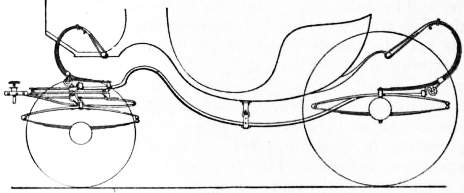
Fig. 1.
From C and under-spring carriages there arose another application of springs which was very prominently before the public during this period, by means of which it was professed that two drawbacks recognized in the C and under-spring carriages were obviated, which were caused by the perch or bar which passes under the body holding the front and hind parts in rigid connexion, and yet making use of a form of spring to which the same terms may be applied. These objections are the weight of the perch, and the limitation which it causes to the facility of turning, which in narrow roads and crowded thoroughfares is an inconvenience. The objection to weight is, however, minimized by the introduction of steel, and as the more advanced builders almost always construct the perch with a forked arch in front, allowing the wheels to pass under, the difficulty of a limited lock is in a great measure overcome (fig. 1). It must be noted, however (and this cannot be too emphatically stated), that the so-called C springs above referred to are not at all the same in action as the C spring proper; they are but an elongation of the ordinary elliptic spring in the form of the letter C (fig. 2), without adding anything to, but rather lessening their elasticity, and entirely ignoring the principle of suspension by leather braces over the C spring proper, by which alone the advantage of superior ease is to be obtained.
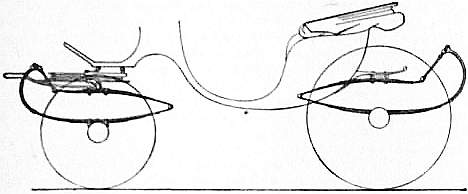
Fig. 2.
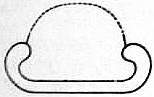
Fig. 3.
Another improvement which stamps the period under review is the introduction of indiarubber for the tires of wheels. To produce a carriage as nearly as possible free from noise and rattle has always been the aim of high-class coachmaking. A structure composed of wood, iron and glass, with axle-trees, doors, windows, lamps and other parts, in use upon the road in all weathers, must from time to time require some attention with this object. To meet this difficulty, the introduction of indiarubber has been received by carriage-users as a great boon. It was about the year 1852 that Mr Reading, who at that time was known as a builder of invalid carriages, conceived the idea of encircling wheels with that material, but his method only admitted of its use on vehicles travelling slowly over good roads. This was improved upon at a later date by Uriah Scott, who, taking advantage of the tempering capacity of indiarubber by the chemical action of sulphur, produced an inner rim of such density as to hold bolts, by which it could be secured through the felloe, forming a base for the outer covering of soft pliable rubber. This system was attended with satisfactory results, and was in favour for some years with persons whose health needed such provision. Another method, originated by Mr Mulliner of Liverpool in the early ’seventies, was to screw on iron flanges to the outer and inner sides of the felloes, having a kind of lip to press into the indiarubber filling the intervening space; but the cost of this—£36 per set—rendered its adoption prohibitive. Meanwhile another invention by Uriah Scott, afterwards improved upon by an American patentee, came into use; this was known as the “rubber-cushioned axle,” cylindrical rings being introduced between the axle-box and hub of the wheel, thus insulating the body of the carriage from the concussion of the road. This, however, necessitated the cutting away of so much of the timber of the hub as to impair its durability, and had, therefore, after a few years’ experience, to be abandoned in favour of an invention by a Parisian builder, who introduced indiarubber bearings between the spring and axle-tree. This was thoroughly practicable, and met with general acceptance, and it is still used in conjunction with iron and steel tires. In 1890 the pneumatic tire was first applied to road carriages. Its bulky appearance is a great drawback, contrasting strongly with the qualities which distinguish a graceful equipage; and in spite of its practical advantages it never became popular in England or America. In Paris and its neighbourhood and many parts of France, pneumatic tires are to be seen in frequent use both on public and private conveyances. In another form the indiarubber tire has become of almost universal application. Owing to an ingenious invention of Mr Carment, what appeared to be an insuperable difficulty in rolling a grooved tire was overcome (fig. 3). This so simplified the application as to bring the cost within practicable limits. The grooved tire is now made in several sections, in some of which the inward projection for securing the rubber is dispensed with, this being kept in position by wires running through the whole length, and electrically welded at the point of contact. Whatever be the method chosen for securing the tire, the best tires, both for durability and ease, are those in which the rubber provided is most resilient in its nature.
For the lifting and lowering of the hoods of victorias and other such carriages, and the opening and closing of landaus, there are now many automatic contrivances, of which the simplest are the most to be preferred. The quarter-light or five-glass landau is a carriage which has been greatly improved. The complicated adjustments of pillars, windows and roof have been replaced by one simple parallel movement. The first public exhibition of a finished carriage on this principle was by an English firm at the Paris Exhibition of 1876 (fig. 4).
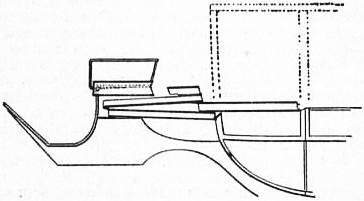
Fig. 4.
In the matter of style certain types of carriages have passed through marked changes. Extreme lightness was at one time considered by many the one desideratum both as to appearance and actual weight, in providing which ease of movement and comfortable seating of the occupants became secondary considerations—though to these extremes builders of repute were always opposed. Still, when at the International Exhibition of Paris 1889, it was seen that the Parisian builders had suddenly gone in the opposite direction, the world of fashion in carriages was taken by surprise. From being built upon easy, flowing, graceful lines, it was seen, with some revulsion of feeling, that these were to be displaced by the deep, full-bodied victoria, brougham and landau. Only by slow degrees did this characteristic find acceptance with English connoisseurs, and then only in a modified form, though eventually in a greater or less degree it is now the prevailing style.
While the better types of English carriages are still preeminent in their constructive qualities, and represent the well-known characteristics of individual firms, some emulation may be excited by the elegant taste and careful workmanship which French builders display in points of finish, both internally and externally. Of the various types of carriages now in vogue, the victoria, in its many varieties of form, is the most popular, accompanied, as of necessity, by the double victoria, sociable, brougham, landaulet and landau. Four-in-hand coaches for private use, as well as the “road” coaches, are built on a smaller scale than formerly; 6 ft. 8 in. may now be taken as the standard height of the roof from the ground. Owing to the encouragement given by the Four-in-hand and Coaching Clubs, the ascendancy of this style of driving is still preserved to Great Britain; and in association with it the char-à-banc, mail phaeton, wagonette, and four-wheel dog-cart retain their popularity. Of two-wheeled vehicles the polo-cart and ralli-cart are most in favour, to which may be added the governess-car, which is found convenient for many purposes not implied by its name. For a few years an effort was made, but with very indifferent success, to bring into fashion the tandem-cart, which may again be considered almost obsolete in England.
America has long held a prominent position in connexion with the carriage industry. In all the chief cities manufactories on a colossal scale are to be found, producing thousands of vehicles annually and equipped with the most perfect labour-saving machinery; and as vehicles of any particular pattern—many of small value—are required, not singly, but in large numbers, much economy is exercised in their manufacture. It is remarkable that, as a contrast to the popular buggy, wagon and rockaway of the United States, which are to be found in infinite variety, carriage establishments of the wealthy are not considered complete unless furnished with some of a European character, selected from the most eminent firms of London or Paris, in addition to others of their own manufacture. In Paris preference is given to an excess of bulk, with elaborate scroll ornamentation and diminutive windows, forming indeed, by reason of its exaggeration, a distinctive class. In respect of workmanship and finish, carriages by the best-known American builders leave nothing to be desired.
The International Exhibition of Paris 1900 brought together examples from various continental countries, in some of which a preference for curvilinear outline was displayed, but the best examples followed very closely the well-known English styles. In the French section it was interesting to find a revival of the once all-prevailing chariot, barouche and britzska, suspended on C and under-springs, with perch, but with ideas of lightness somewhat out of proportion to their general character.
Coach-making, or the carriage-manufacturing industry, is a combination of crafts rarely united in one trade, embracing as it does work in such divers materials as wood, iron, steel, brass, cloth, silk, leather, oils and colours, glass, ivory, hair, indiarubber, &c. Many divisions of labour and numerous highly-skilled artisans are consequently employed in the various stages in the construction of a high-class carriage. The workmen include body-makers, who build up the parts in which persons sit; carriage-makers, who make and fit together all the under parts of the vehicle on which the body rests; wheelwrights, joiners and fitters; several classes of smiths, for special work connected with the strengthening of the body framework by means of long edge plates, the construction of under works, tiring and wheels, manufacture of springs, axle-trees, &c. Painting is an important part of the business, those professing it being divided into body, carriage and heraldry painters. Trimmers are needed who fit up the upholstery of the interior, and budget trimmers who sew on the patent leather covering to dasher wings, &c.
A very great deal in the coach-making industry depends upon the selection of materials. Ash is the kind of wood required in the framework both of body and carriage. The quality best suited for the body is that of full-grown mild and free nature; for the carriage that which is strong and robust; that for carriage-poles should be of younger growth, straight and tough in quality. An important consideration is the seasoning of this timber. Planks of various thicknesses are required, varying from 1½ in. to 6 in., the time required for seasoning being one year for every inch of thickness. After the framework is made, the body is panelled with ¼ in. mild Honduras mahogany, plain and free from grain, every joint and groove carefully coated with ground white lead to exclude water. The roof is covered with ¼ in. wide pine boards, unless when superseded by an American invention, by which, in order to obtain the needful width frequently of 5 ft. or upwards, boards are cut from the circumference of the tree, instead of through its diameter; three thicknesses of very thin wood are then glued together under pressure, the grain of the centre running across the outer plies, the whole forming a solid covering without joints. Birch and elm of 1 in. thickness also enter into the construction in many carriages; for floor and lining boards pine is the material used.
Wheel-making is a very important branch of the business, in which, owing to the increased lightness now required, many modern improvements have been introduced. The timber used in an ordinary carriage wheel is wych elm for the naves, heart of oak for the spokes, and ash for the felloes. American hickory has of late years been also largely used for spokes in exceptionally light wheels, as well as the American method of making the rim in two sections of straight-grained ash or hickory bent to the required circle. This method has much to recommend it, more especially for wheels with indiarubber tires, in which the wood felloes are not required to be nearly so deep as for steel tires. One well-known feature in light wheels is the “Warner nave,” which is a solid iron casting with mortices to receive the spokes, and being of small diameter gives the wheel a light appearance.
For springs the finest quality of steel is made from Swedish ore, but the ordinary English spring steel by the best makers leaves nothing to be desired. To secure the most perfect elasticity it is important that the tapering down of the ends of each plate should be done by hand labour on the anvil, and that the plates should not be more than ¼ in. in thickness. To obtain cheapness wholesale spring-makers adopt the method of squeezing the ends of spring plates between eccentric rollers, and so produce the tapered form, which, however, is too short and gives a lumpy and unsightly appearance to the spring when put together, so that by this they lose much of their pliability.
The iron mounting of coach work requires the skill of experienced smiths, and gives scope for much taste and judgment in shaping the work, and providing strength suited to the relative strain to which it will be subjected. Axle-trees are not made by coach-builders, but by firms who make it their special business. They are of two kinds, the “mail,” which are secured to the wheel by three bolts passing through the nave, and the “collinge” (invented in 1792), the latter made secure by gun-metal cone-shaped collets and nuts. The axle boxes which are wedged into the nave are of three kinds, cast, chilled and wrought iron, in all cases case-hardened, the first being the cheapest and the last the most costly. Many attempts have been made to improve upon the collinge axle-tree, but none of them has got far beyond the experimental stage.
No branch of coach-building contributes more to the elegance of the vehicle than that of painting. To obtain the needful perfection the work has to pass through several stages before reaching the finishing colour, which must be of the finest quality. The varnish used is copal, of which there are two kinds, the one for finishing the body, the other the carriage. In first-class work as many as eighteen or twenty coats will be required to complete the various stages. After a carriage has been in use about twelve months, it is practicable to revive the brilliant gloss on the panels by hand-polishing with the aid of rottenstone and oil, a process which requires a specially trained man to do successfully.
The trimming of the interior of a carriage requires much skill and judgment on the part of the workmen in providing really comfortable, well-fitted seats and neatness of workmanship. In the middle of the 19th century figured tabaret or satin were much used, but for many years past morocco has been almost universally preferred. Silk lutestring spring curtains, Brussels or velvet pile carpet, complete the interior, unless are added neat morocco covered trays with mirror, &c., for ladies’ convenience. Electric light is now frequently used for the interior, and can be applied with much neatness and efficiency. Road lamps, door handles, polished silver or brass furniture, are supplied to the coach-builder by firms whose special business it is to make them. Lever brakes are now a very ordinary requirement. Much judgment is needful to make them efficient, and careful workmanship to prevent rattle. Indiarubber is the best material for blocks applied to steel tires, and cast iron for indiarubber tires. The “Bowden wire” recently introduced is in some cases a convenient and light alternative to the long bar connecting the handle with the hind cross levers, and has the advantage of passing out of sight through the interior of the body.
(J. A. M‘N.)
CARRICKFERGUS, a seaport and watering-place of Co. Antrim, Ireland, in the east parliamentary division; on the northern shore of Belfast Lough, 9½ m. N.E. of Belfast by the Northern Counties (Midland) railway. Pop. of urban district (1901) 4208. It stretches for about 1 m. along the shore of the Lough. The principal building is the castle, originally built by John de Courci towards the close of the 12th century, and subsequently much enlarged. It stands on a projecting rock above the sea, and was formerly a place of much strength. It is still maintained as an arsenal, and mounted with heavy guns. The ancient donjon or keep, 90 ft. in height, is still in good preservation. The town walls, built by Sir Henry Sidney, are still visible on the west and north, and the North Gate remains. The parish church of St Nicholas, an antiquated cruciform structure with curious Elizabethan work in the north transept, and monuments of the Chichester family, was originally a chapel or oratory dependent on a Franciscan monastery. The entrance to a subterranean passage between the two establishments is still visible under the communion-table of the church. The gaol, built on the site of the monastery above mentioned, was formerly the county of Antrim prison. The court-house, which adjoins the gaol, is a modern building. The town has some trade in domestic produce, and in leather and linen manufactures, there being several flax spinning-mills and bleach-works in the immediate neighbourhood. Distilling is carried on. The harbour admits vessels of 500 tons. The fisheries are valuable, especially the oyster fisheries. At Duncrue about 2 m. from the town, rock salt of remarkable purity and in large quantity is found in the Triassic sandstone. The neighbouring country is generally hilly, and Slieve True (1100 ft.) commands a magnificent prospect.
In 1182, John de Courci, to whom Henry II. had granted all the parts of Ulster he could obtain possession of by the sword, fixed a colony in this district. The castle came in the 13th century into possession of the De Lacy family, who, being ejected, invited Edward Bruce to besiege it (1315). After a desperate resistance the garrison surrendered. In 1386, the town was burned by the Scots, and in 1400 was destroyed by the combined Scots and Irish. Subsequently, it suffered much by famine and the occasional assaults of the neighbouring Irish chieftains, whose favour the townsmen were at length forced to secure by the payment of an annual tribute. In the reign of Charles I. many Scottish Covenanters settled in the neighbourhood to avoid the persecution directed against them. In the civil wars, from 1641, Carrickfergus was one of the chief places of refuge for the Protestants of the county of Antrim; and on the 10th of June 1642, the first Presbytery held in Ireland met here. In that year the garrison was commanded by General Robert Munro, who, having afterwards relinquished the cause of the English parliament, was surprised and taken prisoner by Sir Robert Adair in 1648. At a later period Carrickfergus was held by the partisans of James II., but surrendered in 1689 to the forces under King William’s general Schomberg; and in 1690 it was visited by King William, who landed here on his expedition to Ireland. In 1760 it was surprised by a French squadron under Commodore Thurot, who landed with about 1000 men, and, after holding the place for a few days, evacuated it on the approach of the English troops. Eighteen years later Paul Jones, in his ship the “Ranger,” succeeded in capturing the “Drake,” a British sloop-of war, in the neighbouring bay; but he left without molesting the town. In the reign of Queen Elizabeth the town obtained a charter, and this was confirmed by James I., who added the privilege of sending two burgesses to the Irish parliament. The corporation, however, was superseded, under the provisions of the Municipal Reform Act of 1840, by a board of municipal commissioners. Carrickfergus was a parliamentary borough until 1885; and a county of a town till 1898, having previously (till 1850) been the county town of county Antrim. But its importance was sapped by the vicinity of Belfast, and its historical associations are now its chief interest.
CARRICKMACROSS, a market town of Co. Monaghan, Ireland, in the south parliamentary division, 68 m. N.W. of Dublin on a branch of the Great Northern railway. Pop. of urban district (1901) 1874. It has a pleasant, elevated site, a considerable agricultural trade, and a famous manufacture of lace, which is carried on in various conventual establishments. There are some remains of an Elizabethan castle, a seat of the earls of Essex, which was destroyed during the wars of 1641; the ruins of the old church of St Finbar commemorate the same disastrous period.
CARRICK-ON-SHANNON, a market town and the county town of Co. Leitrim, Ireland, in the south parliamentary division, beautifully situated on the left bank of the upper Shannon, between Loughs Allen and Boderg, close to the confluence of the Boyle. Pop. (1901) 1118. It is on the Sligo branch of the Midland Great Western railway, 90 m. W.N.W. of Dublin, the station being across the river in county Roscommon. Though having so small a population it is the largest town in the county, is the seat of the assizes, and has quays and some river trade. The surrounding country, with its waterways, loughs and woods, is of considerable beauty.
CARRICK-ON-SUIR, a market town of Co. Tipperary, Ireland, in the east parliamentary division, on the north (left) bank of the Suir, 14¼ m. W.N.W. from Waterford by the Waterford & Limerick line of the Great Southern & Western railway. Pop. of urban district (1901) 5406. It was formerly a walled town, and contains some ancient buildings, such as the castle, erected in 1309, formerly a seat of the dukes of Ormonde, now belonging to the Butler family, a branch of which takes the title of earl from the town. On the other side of the river, connected by a bridge of the 14th century, and another of modern erection, stands the suburb of Carrickbeg, in county Waterford, where an abbey was founded in 1336. The woollen manufactures for which the town was formerly famous are extinct. A thriving export trade is carried on in agricultural produce, condensed milk is manufactured, and slate is extensively quarried in the neighbourhood, while some coal is exported from the neighbouring fields. Dredging has improved the navigable channel of the river, which is tidal to this point and is lined with quays.
CARRIER, JEAN BAPTISTE (1756-1794), French Revolutionist and Terrorist, was born at Yolet, a village near Aurillac in Upper Auvergne. In 1790 he was a country attorney (counsellor for the bailliage of Aurillac) and in 1792 he was chosen deputy to the National Convention. He was already known as one of the influential members of the Cordeliers club and of that of the Jacobins. After the subjugation of Flanders he was one of the commissioners nominated in the close of 1792 by the Convention, and sent into that country. In the following year he took part in establishing the Revolutionary Tribunal. He voted for the death of Louis XVI., was one of the first to call for the arrest of the duke of Orleans, and took a prominent part in the overthrow of the Girondists (on the 31st of May). After a mission into Normandy, Carrier was sent, early in October 1793, to Nantes, under orders from the Convention to suppress the revolt which was raging there, by the most severe measures. Nothing loth, he established a revolutionary tribunal, and formed a body of desperate men, called the Legion of Marat, for the purpose of destroying in the swiftest way the masses of prisoners heaped in the jails. The form of trial was soon discontinued, and the victims were sent to the guillotine or shot or cut down in the prisons en masse. He also had large numbers of prisoners put on board vessels with trap doors for bottoms, and sunk in the Loire. This atrocious process, known as the Noyades of Nantes, gained for Carrier a reputation for wanton cruelty. Since in his mission to Normandy he had been very moderate, it is possible that, as he was nervous and ill when sent to Nantes, his mind had become unbalanced by the atrocities committed by the Vendean and royalist armies. Naturally, the stories told of him are not all true. He was recalled by the Committee of Public Safety on the 8th of February 1794, took part in the attack on Robespierre on the 9th Thermidor, but was himself brought before the Revolutionary Tribunal on the 11th and guillotined on the 16th of November 1794.
See Comte Fleury, Carrier à Nantes, 1793-1794 (Paris, 1897); Alfred Lallié, J.B. Carrier, représentant du Cantal à la Convention 1756-1794 d’après de nouveaux documents (Paris, 1901). These works, and the others of Lallié, are inspired by strong royalist sympathies and are not altogether to be accepted.
CARRIER, a general term for any person who conveys the goods of another for hire, more specifically applied to the tradesmen, now largely superseded by the railway system, who convey goods in carts or wagons on the public roads. In jurisprudence, however, the term is collectively applied to all conveyers of property, whether by land or water; and in this sense the changes and enlargements of the system of transit throughout the world have given additional importance to the subject. The law by which carriers, both by land and sea, are made responsible for the goods entrusted to them, is founded on the praetorian edict of the civil law, to which the ninth title of the fourth book of the Pandect is devoted. The edict itself is contained in these few words, “nautae, caupones, stabularii, quod cujusque salvum fore receperint, nisi restituent, in eos judicium dabo.” The simplicity of the rule so announced has had a most beneficial influence on the commerce of the world. Throughout the great civilized region which took its law directly from Rome, and through the other less civilized countries which followed the same commercial code, it laid a foundation for the principle that the carrier’s engagement to the public is a contract of indemnity. It bound him in the general case, to deliver what he had been entrusted with, or its value,—thus sweeping away all secondary questions or discussions as to the conditions of mere or less culpability on his part under which loss or damage may have occurred; and it left any limitations of this general responsibility to be separately adjusted by special contract.
The law of England recognizes a distinction between a common and a private carrier. The former is one who holds himself out to the public as ready to carry for hire from place to place the goods of such persons as choose to employ him. The owner of a stagecoach, a railway company, the master of a general ship, a wharfinger carrying goods on his own lighters are common carriers; and it makes no difference that one of the termini of the journey is out of England. It has been held, however, that a person who carries only passengers is not a common carrier; nor of course is a person who merely engages to carry the goods of particular individuals or to carry goods upon any particular occasion. A common carrier is subject at law to peculiar liabilities. He is bound to carry the goods of any person who offers to pay his hire, unless there is a good reason to the contrary, as, for example, when his carriage is full, or the article is not such as he is in the habit of conveying. He ought to carry the goods in the usual course without unnecessary deviation or delay. To make him liable there must be a due delivery of the goods to him in the known course of his business. His charge must be reasonable; and he must not give undue preference to any customer or class of customers. The latter principle, as enforced by statute, has come to be of great importance in the law of railway companies. In respect of goods entrusted to him, the carrier’s liability, unless limited by a special contract, is, as already stated, that of an insurer. There is no question of negligence as in the case of injury to passengers, for the warranty is simply to carry safely and securely. The law, however, excepts losses or injuries occasioned immediately “by the act of God or the king’s enemies”—words which have long had a strict technical signification. It would appear that concealment without fraud, on the part of the customer, will relieve the carrier from his liability for negligence, but not for actual misfeasance. Fraud or deceit by the customer (e.g., in misrepresenting the real value of the goods) will relieve the carrier from his liability. The responsibility of the carrier ceases only with the delivery of the goods to the proper consignee. By the Carriers’ Act 1830 the liability of carriers for gold, silver, &c. (in general “articles of great value in small compass”) is determined. Should the article or parcel exceed £10 in value, the carrier is not to be liable for loss unless such value is declared by the customer and the carrier’s increased charge paid. Where the value is thus declared, the carrier may, by public notice, demand an increased charge, for which he must, if required, sign a receipt. Failing such receipt or notice, the carrier must refund the increased charge and remain liable as at common law. Except as above no mere notice or declaration shall affect a carrier’s liability; but he may make special contracts with his customers. The carriage of goods by sea is subject to special regulations (see Affreightment). The carriage of goods by railway and canal is subject to the law of common carrier, except where varied by particular statutes, as the Railway and Canal Traffic Acts 1854 to 1894 and the Regulation of Railways Acts 1840 to 1893. The effect of these acts is to prevent railway companies as common carriers from limiting by special contract their liability to receive, forward and deliver goods, unless the conditions embodied in the special contract are reasonable, and the contract is in writing and signed by, or on behalf of, the sender. A railway company must provide reasonable facilities for forwarding passengers’ luggage; where luggage is taken into the carriage with a passenger, the company is responsible for it only in so far as loss or damage is due to the passenger’s interference with the company’s exclusive control of it. As carriers of passengers companies are bound, in the absence of any special contract, to exercise due care and diligence, and are responsible for personal injuries only when they have been occasioned by negligence or want of skill. Where there has been contributory negligence on the part of the passenger, i.e. where he might, by the exercise of ordinary care, have avoided the consequences of the defendants’ negligence—he is not entitled to recover. By the act of 1846 (commonly called Lord Campbell’s Act), when a person’s death has been caused by such negligence as would have entitled him to an action had he survived, an action may be maintained against the party responsible for the negligence on behalf of the wife, husband, parent or child of the deceased. Previously such cases had been governed by the maxim actio personalis moritur cum persona.
CARRIÈRE, MORITZ (1817-1895), German philosopher and historian, was born at Griedel in Hesse Darmstadt on the 5th of March 1817. After studying at Giessen, Göttingen and Berlin, he spent a few years in Italy studying the fine arts, and established himself in 1842 at Giessen as a teacher of philosophy. In 1853 he was appointed professor at the university of Munich, where he lectured mainly on aesthetics. He died in Munich on the 19th of January 1895. An avowed enemy of Ultramontanism, he contributed in no small degree to making the idea of German unity more palatable to the South Germans. Carrière identified himself with the school of the younger Fichte as one who held the theistic view of the world which aimed at reconciling the contradictions between deism and pantheism. Although no obstinate adherent of antiquated forms and prejudices, he firmly upheld the fundamental truths of Christianity. His most important works are: Aesthetik (Leipzig, 1859; 3rd ed., 1885), supplemented by Die Kunst im Zusammenhang der Kulturentwicklung und der Ideale der Menschheit (3rd ed., 1877-1886); Die philosophische Weltanschauung der Reformationszeit (Stuttgart, 1847; 2nd ed., Leipzig, 1886), and Die sittliche Weltordnung (Leipzig, 1877; 2nd ed., 1891), in which he recognized both the immutability of the laws of nature and the freedom of the will. He described his view of the world and life as “real-idealism.” His essay on Cromwell (in Lebensskizzen, 1890), which may be considered his political confession of faith, also deserves mention. His complete works were published at Leipzig, 14 vols., in 1886-1894.
See S.P.V. Lind in Zeitschrift f. Philos. (cvi, 1895, pp. 93-101); W. Christ in Allgemeine deutsche Biographie (1903).
CARRINGTON, CHARLES ROBERT WYNN-CARINGTON, 1ST EARL (1843- ), English statesman, son of the 2nd Baron Carrington (d. 1868), was educated at Eton and Trinity, Cambridge, and sat in the House of Commons as a Liberal for High Wycombe from 1865 till he succeeded to the title in 1868. He was governor of New South Wales 1885-1890, lord chamberlain 1892-1895, and became president of the board of agriculture in 1905, having a seat in the cabinet in Sir H. Campbell-Bannerman’s and Mr Asquith’s ministries. He was created Earl Carrington and Viscount Wendover in 1895. The Carrington barony was conferred in 1796 on Robert Smith (1752-1838), M.P. for Nottingham, a member of a famous banking family, the title being suggested by one held from 1643 to 1706 in another family of Smith in no way connected. The 2nd baron married as his second wife one of the two daughters of Lord Willoughby de Eresby, and their son, through her, became in 1879 joint hereditary lord great chamberlain of England. The 2nd Baron took the surname of Carrington, afterwards altered to Carington, instead of Smith.
CARRINGTON, RICHARD CHRISTOPHER (1826-1875), English astronomer, son of a brewer at Brentford, was born in London on the 26th of May 1826. Though intended for the Church, his studies and tastes inclined him to astronomy, and with a view to gaining experience in the routine of an observatory he accepted the post of observer in the university of Durham. Finding, however, that there was little chance of obtaining instruments suitable for the work which he wished to undertake, he resigned that appointment and established in 1853 an observatory of his own at Redhill. Here he devoted three years to a survey of the zone of the heavens within 9 degrees of the North Pole, the results of which are contained in his Redhill Catalogue of 3735 Stars. But his name is chiefly perpetuated through his investigation of the motions of sun-spots, by which he determined the elements of the sun’s rotation and made the important discovery of a systematic drift of the photosphere, causing the rotation-periods of spots to lengthen with increase of solar latitude. He died on the 27th of November 1875.
For further information see Month. Notices Roy. Astr. Society, xiv. 13, xviii. 23, 109, xix. 140, 161, xxxvi. 137; Memoirs Roy. Astr. Soc., xxvii. 139; The Times, Nov. 22 and Dec. 7, 1875; Roy. Society’s Cat. Scient. Papers, vols. i. and vii.; Introductions to Works.
CARROCCIO; a war chariot drawn by oxen, used by the medieval republics of Italy. It was a rectangular platform on which the standard of the city and an altar were erected; priests held services on the altar before the battle, and the trumpeters beside them encouraged the fighters to the fray. In battle the carroccio was surrounded by the bravest warriors in the army and it served both as a rallying-point and as the palladium of the city’s honour; its capture by the enemy was regarded as an irretrievable defeat and humiliation. It was first employed by the Milanese in 1038, and played a great part in the wars of the Lombard league against the emperor Frederick Barbarossa. It was afterwards adopted by other cities, and first appears on a Florentine battlefield in 1228. The Florentine carroccio was usually followed by a smaller car bearing the martinella, a bell to ring out military signals. When war was regarded as likely the martinella was attached to the door of the church of Santa Maria in the Mercato Nuovo in Florence and rung to warn both citizens and enemies. In times of peace the carroccio was in the keeping of some great family which had distinguished itself by signal services to the republic.
Accounts of the carroccio will be found in most histories of the Italian republics; see for instance, M. Villani’s Chronache, vi. 5 (Florence, 1825-1826); P. Villari, The Two First Centuries of Florentine History, vol. i. (Engl. transl., London, 1894); Gino Capponi, Storia della Repubblica di Firenze, vol. i. (Florence, 1875).
CARRODUS, JOHN TIPLADY (1836-1895), English violinist, was born on the 20th of January 1836, at Keighley, in Yorkshire. He made his first appearance as a violinist at the age of nine, and had the advantage of studying between the ages of twelve and eighteen at Stuttgart, with Wilhelm Bernhard Molique. On his return to England in 1853 Costa got him engagements in the leading orchestras. He was a member of the Covent Garden opera orchestra from 1855, made his début as a solo player at a concert given on the 22nd of April 1863 by the Musical Society of London, and succeeded Sainton as leader at Covent Garden in 1869. He died at Hampstead on the 13th of July 1895. For many years he had led the Philharmonic orchestra and those of the great provincial festivals. He published two violin solos and a “Morceau de salon,” and was a very successful teacher.
CARROLL, CHARLES (1737-1832), American political leader, of Irish ancestry, was born at Annapolis, Maryland, on the 19th of September 1737. He was educated abroad in French Jesuit colleges, studied law at Bourges, Paris and London, and in February 1765 returned to Maryland, where an estate known as “Carrollton,” in Frederick county, was settled upon him; he always signed his name as “Charles Carroll of Carrollton.” Before and during the War of Independence, he was a whig or patriot leader, and as such was naturally a member of the various local and provincial extra-legal bodies—committees of correspondence, committees of observation, council of safety, provincial convention (1774-1776) and constitutional convention (1776). From 1777 until 1800 he was a member of the Maryland senate. In April-June 1776 he, with Samuel Chase and Benjamin Franklin, was a member of the commission fruitlessly sent by the continental congress to Canada for the purpose of persuading the Canadians to join the thirteen revolting colonies. From 1776 to 1779 he sat in the continental congress, rendering important services as a member of the board of war, and signing on the 2nd of August 1776 the Declaration of Independence, though he had not been elected until the day on which that document was adopted. He out-lived all of the other signers. He was a member of the United States Senate from 1789 to 1792. From 1801 until his death, at Baltimore, on the 14th of November 1832, he lived in retirement, his last public act being the formal ceremony of starting the construction of the Baltimore and Ohio railway (July 4, 1828). In politics, after the formation of parties, he was a staunch Federalist. Of unusual ability, high character and great wealth, he exercised a powerful influence, particularly among his co-religionists of the Roman Catholic faith, and he used it to secure the independence of the colonies and to establish a stable central government.
See the Life by Kate Mason Rowland (1898).
CARROLL, JOHN (1735-1815), American Roman Catholic prelate, was born at Upper Marlborough, Prince George’s county, Maryland, on the 8th of January 1735, the son of wealthy Catholic parents and a cousin of Charles Carroll “of Carrollton.” He was educated at St Omer’s in Flanders, becoming a novitiate in the Society of Jesus in 1753, and then at the Jesuit college in Liège, being ordained priest in 1769 and becoming professor of philosophy and theology. In 1771 he became a professed father of the Society of Jesus and professor at Bruges. As tutor to the son of Lord Stourton, he travelled through Europe in 1772-1773. After the papal brief of the 21st of July 1773 suppressed the Society of Jesus, he accompanied its English members then in Flanders to England. In 1774 he returned to America, and set to work at a mission at Rock Creek, Montgomery county, Maryland, where his mother lived. He shared the feeling for independence growing among the American colonists, foreseeing that it would mean greater religious freedom. In 1776, at the request of the continental congress, he accompanied Benjamin Franklin, Charles Carroll and Samuel Chase on their mission to secure the aid or neutrality of the French-Canadians, and though unsuccessful it gained for him the friendship of Franklin. In 1783 he took a prominent part in the petition to Rome to take the control of the American church away from London; and on Franklin’s recommendation, Carroll was named prefect apostolic, the American church being recognized as a distinct body in a decree issued by Cardinal Antonelli on the 9th of June 1784. In the summer of 1785 he began his visitations; in 1786 he induced the general chapter to authorize a Catholic seminary (now Georgetown University); and at the same session it was voted that the condition of the church required a bishop, accountable directly to the pope (and not to the Congregation of the Propaganda) and chosen by the American clergy. Consent to this course was given by Antonelli in a letter of the 12th of July 1788. The clergy met at Whitemarsh, Maryland, and Baltimore was adopted as the episcopal seat, Carroll being chosen as bishop; and on the 6th of November 1789 Pius VI. issued a bull to that effect, Carroll being consecrated at Lulworth Castle, England, on the 15th of August 1790.