VOLUME V SLICE IV Carnegie to Casus Belli (continued 2)
Reading edition
Passing on to the more typical members of the badger group, we have first the genus Arctonyx, with the dentition i. 3⁄3, c. 1⁄1, p. 4⁄4, m. 1⁄2; total 38. The incisor line is curved, the outer teeth being placed posteriorly to the others: lower incisors inclined Badger tribe. forwards. First premolars often rudimentary or absent; upper molar much larger than the sectorial, longer in the antero-posterior direction than broad; lower sectorial with a very large, low, tuberculated heel. Skull elongated and depressed; face long, narrow and concave above; bony palate extending as far backwards as the level of the glenoid fossa; and palatal bones dilated. Suborbital foramina very large. Vertebrae: C. 7, D. 16, L. 4, S. 4, Ca. 20. Snout long, naked, mobile and truncated, with large terminal nostrils, much like those of a pig. Eyes small; ears very small and rounded. Body compressed, rather than depressed. Limbs of moderate length, and partially digitigrade in walking. Tail moderate, tapering. A full soft under-fur, with longer bristly hairs interspersed. The longest-known species is A. collaris, the bhalu-soor (bear-pig) or bali-soor (sand-pig) of the natives of the mountains of north-eastern India, Burma and Borneo. It is rather larger than the badger, higher on its legs, and very pig-like in general aspect, of a light grey colour, with flesh-coloured snout and feet; nocturnal and omnivorous. Other species or local varieties have been described from north China and Burma.
In the genus Mydaus the dentition is as the last, but the cusps of the teeth are more acutely pointed. Skull elongated, face narrow and produced. Suborbital foramen small, and the palate, as in all the succeeding genera of this group, produced backwards about midway between the last molar and the glenoid fossa. Vertebrae: C. 7, D. 14-15, L. 6-5, S. 3, Ca. 12. Head pointed in front; snout produced, mobile, obliquely truncated, the nostrils being inferior. Limbs rather short and stout. Tail extremely short, but clothed with rather long bushy hair. Anal glands largely developed, and emitting an odour like that of the skunks. One species, M. meliceps, the teledu, a small burrowing animal from the mountains of Java, at an elevation of 7000 or more ft. above the sea-level; and a second (M. marchei) from the Philippines.
In the true badger of the genus Meles the dentition is i. 3⁄3, c. 1⁄1, p. 4⁄4, m. 1⁄2; total 38. The first premolar in both jaws is extremely minute and often deciduous; while the upper molar is much larger than the sectorial, subquadrate, and as broad as long. Lower sectorial with a broad, low, tuberculated heel, more than half the length of the whole tooth. The postglenoid process of the skull so strongly developed, and the glenoid fossa so deep, that the condyle of the lower jaw is firmly held in place after the soft parts are removed. Vertebrae: C. 7, D. 15, L. 5, S, 3, Ca. 18. Muzzle pointed. Ears very short. Body stout, broad. Limbs short, strong, subplantigrade. Tail short. Typified by the common badger (M. taxus or M. meles) of Europe and northern Asia, still found in many parts of England, where it lives in woods, is nocturnal, burrowing and very omnivorous, feeding on mice, reptiles, insects, fruit, acorns and roots. Other nearly allied species, M. leucurus and M. chinensis, are found in continental Asia, and M. anakuma in Japan.
In the nearly-allied genus Taxidea the dental formula is as in Meles, except that the rudimentary anterior premolars appear to be always wanting in the upper jaw. The upper sectorial is much larger in proportion to the other teeth; and the upper molar about the same size as the sectorial, triangular, with the apex turned backwards. Heel of lower sectorial less than half the length of the tooth. Skull very wide in the occipital region; the lambdoidal crest greatly developed, and the sagittal but slightly, contrary to what obtains in Meles. Vertebrae: C. 7. D. 15. L. 5, S. 3, Ca. (?). Body stoutly built and depressed. Tail short. The animals of this genus are peculiar to North America, where they represent the badgers of the Old World, resembling them much in appearance and habits. T. americana is the common American badger of the United States, T. berlandieri, the Mexican badger, being a local variety.
The third and last subfamily is that of the otters, or Lutrinae, in which the feet (with the exception of the hind pair in the sea-otter) are short and rounded, with the toes webbed, and the claws small, curved and blunt. The head is broad and Otter tribe. much depressed. The upper posterior cheek-teeth are large and quadrate. The kidneys are conglomerate. Habits aquatic.
In the true otter of the genus Lutra the dentition is i. 3⁄3, c. 1⁄1, p. 4⁄3, m. 1⁄2; total 36. Upper sectorial with a trenchant tricusped blade, and a very large inner lobe, hollowed on the free surface, with a raised sharp edge, extending along two-thirds or more of the length of the blade. Upper molar large, with a quadricuspidate crown, broader than long. Skull broad and depressed, contracted immediately behind the orbits; with the facial portion very short and the brain-case large. Vertebrae: C. 7, D. 14-15, L. 6-5, S. 3, Ca. 20-26. Body very long. Ears short and rounded. Limbs short. Feet completely webbed, with well-developed claws on all the toes. Tail long, thick at the base and tapering, rather depressed. Fur short and close.
Otters are more or less aquatic, living on the margins of rivers, lakes, and in some cases the sea; are expert divers and swimmers, and feed chiefly on fish. They have an extensive geographical range, and so much resemble each other in outward appearance, especially in the nearly uniform brown colouring, that in some cases the species are by no means well-defined. The Brazilian otter (L. brasiliensis) is a very large species from Brazil, Demerara and Surinam, with a prominent ridge along each lateral margin of the tail. In two small species the feet are only slightly webbed; claws exceedingly small or altogether wanting on some of the toes; the first upper premolar very small, sometimes wanting; and the molars very broad and massive. The species in question are L. inunguis of South Africa, and L. leptonyx or cinerea of India, Java and Sumatra, and have been separated as a distinct genus, Aonyx.
The sea-otter, Latax (or Enhydra) lutra, with a dentition of i. 3⁄2, c. 1⁄1, p. 3⁄3, m. 1⁄2, total 32, differs from other Carnivora in having but two incisors on each side of the lower jaw, the one corresponding to the first (very small in the true otters) being absent. Though the molar teeth generally resemble those of Lutra in their proportions, they differ in the exceeding roundness and massiveness of their crowns and bluntness of their cusps. Feet webbed; fore-feet short, with five subequal toes, with short compressed claws; hind-feet very large, depressed and fin-like, their phalanges flattened as in seals. The fifth toe the longest and stoutest, the rest gradually diminishing in size to the first, all with moderate claws. Tail moderate, cylindrical (see Otter).
II. Pinnipedia
The second suborder is formed by the seals, walruses and eared seals, which differ from the rest of the Carnivora mainly in the limbs being modified for aquatic progression; the two upper segments being very short and partially enveloped in the general integument of the body, while the third, especially in the hind extremities, is elongated, expanded and webbed. There are always five well-developed digits on each limb. In the hind-limb the two marginal digits (first and fifth) are stouter and generally larger than the others. The teeth also differ from those of the more typical Carnivora. The incisors are always fewer than 3⁄3. The chsek series consists generally of four premolars and one molar of uniform characters, with never more than two roots, and with conical, more or less compressed, pointed crowns, which may have accessory cusps, placed before or behind the principal one, but are never broad and tuberculated. The milk-teeth are small, simple and shed or absorbed at an early age, usually either before or within a few days after birth. The brain is relatively large, the cerebral hemispheres broad in proportion to their length, and with numerous and complex convolutions. There is a very short caecum; the kidneys are divided into numerous distinct lobules. There are no Cowper’s glands. Teats two or four, abdominal. No clavicles. Tail always short. Eyes large and exposed, with flat cornea. The nostrils close by the elasticity of their walls, and are opened at will by muscular action.
The members of this group are aquatic, spending the greater part of their time in the water, swimming and diving with great facility, feeding mainly on fish, crustaceans and other marine animals, and progressing on land with difficulty, but always coming on shore for the purpose of bringing forth their young. They are generally marine, but occasionally ascend large rivers, and some inhabit inland seas and lakes, as the Caspian and Baikal. Though not numerous in species, they are widely distributed over the world, but occur most abundantly on the coasts of lands situated in cold and temperate zones.
As mentioned in the article Creodonta, the true seals (Phocidae), together with the walruses, may be directly descended from the primitive Creodont Carnivora. The eared seals, on the other hand, show signs of affinity with the bears; but as they are of earlier geological age than the latter, they cannot be derived from that group.
The true seals (family Phocidae) are the most completely adapted for aquatic life of all the Pinnipedia. When on land the hind-limbs are extended backwards and take no part in progression, which is effected by a series of jumping movements Seals. produced by the muscles of the trunk, in some species aided by the fore-limbs. The soles of the feet are hairy. There is no pinna to the ear, and no scrotum, the testes being abdominal. The upper incisors have simple, pointed crowns, and vary in number in the different groups. All have well developed canines and 5⁄5 teeth of the cheek series. In those species of which the milk-dentition is known, there are three milk molars, which precede the second, third, and fourth permanent molars; the dentition is therefore p. 4⁄4, m. 1⁄1, the first premolar having as usual no milk predecessor. The skull has no post-orbital process and no alisphenoid canal. The fur is stiff and adpressed, without woolly under-fur.
In the typical group, or subfamily Phocinae, the incisors are 3⁄2. All the feet have five well-developed claws with the toes on the hind-feet subequal, the first and fifth not greatly exceeding the others in length, the interdigital membrane not extending beyond them. In the genus Halichoerus the dentition is i. 3⁄2, c. 1⁄1, p. 4⁄4, m. 1⁄1; total 34. Molars with large, simple, conical, recurved, slightly compressed crowns, having sharp anterior and posterior edges, but without accessory cusps, except sometimes the two hinder ones of the lower jaw. With the exception of the last one or two in the upper jaw and the last in the lower jaw, all are single-rooted. Vertebrae: C. 7, D. 15, L. 5, S. 4, Ca. 14. Includes only one species H. grypus, the grey seal of the coasts or Scandinavia and the British Isles.
In Phoca the dental formula is as in the last, but the teeth are smaller and more pointed. Molars with two roots (except the first in each jaw). Crowns with accessory cusps. Vertebrae: C. 7, D. 14-15, L. 5, S. 4, Ca. 11-14. Head round and short. Fore-feet short with five strong, subcompressed, slightly curved, subequal, rather sharp claws. On the hind-feet the claws much narrower and less curved. The species of this genus are widely distributed throughout the northern hemisphere, and include P. barbata, the bearded seal; P. groenlandica, the Greenland seal; P. vitulina, the common seal; P. hispida, the ringed seal of the north Atlantic; P. caspica, from the Caspian and Aral Seas; and P. sibirica, from Lake Baikal. (See Seal).
The members of the second subfamily, Monachinae, have incisors 2⁄2; and the molars two-rooted, except the first. On the hind-feet the first and fifth toes greatly exceeding the others in length, with nails rudimentary or absent. In the genus Monachus, the dentition is i. 2⁄2, c. 1⁄1, p. 4⁄4, m. 1⁄1; total 32. Crowns of molars strong, conical, compressed, hollowed on the inner side, with a strongly-marked lobed cingulum, especially on the inner side, and slightly developed accessory cusps before and behind. The first and last upper and the first lower molar smaller than the others. Vertebrae: C. 7, D. 15, L. 5, S. 2, Ca. 11. All the nails of both fore and hind feet very small and rudimentary. Represented by M. albiventer, the monk-seal of the Mediterranean and adjacent parts of the Atlantic, and the West Indian M. tropicalis.
The other genera of this section have the same dental formula, but are distinguished by the characters, of the cheek-teeth and the feet. They are all inhabitants of the shores of the southern hemisphere.
In Ogmorhinus all the teeth of the cheek-series have three distinct pointed cusps, deeply separated from each other, of which the middle or principal cusp is largest and slightly recurved; the other two are nearly equal in size, and have their tips directed towards the middle one. Skull much elongated. One species, O. leptonyx, the sea-leopard, widely distributed in the Antarctic and southern temperate seas. In Lobodon the molars have compressed elongated crowns, with a principal recurved cusp, rounded and somewhat bulbous at the apex, and one anterior, and one, two or three posterior distinct accessory cusps. One species, L. carcinophagus, the crab-eating seal. In the third genus, Leptonychotes, represented by L. weddelli, the molars are small, with simple, subcompressed, conical crowns, and a broad cingulum, but no distinct accessory cusps. Finally in the white seal (Ommatophoca rossi) all the teeth are very small, those of the cheek-series with pointed, recurved crowns, and small posterior and still less developed anterior accessory cusps. Orbits very large. Nails rudimentary on front and absent on hind-feet. The skull bears a considerable resemblance to that of the next subfamily.
The presence of two pairs of upper and one pair of lower incisors is characteristic of the members of the subfamily Cystophorinae, in which the teeth of the cheek-series are generally one-rooted. The nose of the males has an appendage capable of being inflated. First and fifth toes of hind-feet greatly exceeding the others in length, with prolonged cutaneous lobes, and rudimentary or no nails. In the typical genus Cystophora the dentition is i. 2⁄1, c. 1⁄1, p. 4⁄4, m. 1⁄1; total 30; the last molar having generally two distinct roots. Beneath the skin over the face of the male, and connected with the nostrils, is a sac capable of inflation, when it forms a kind of hood covering the upper part of the head. Nails present, though small on the hind-feet. Represented by C. cristata, the hooded or bladder-nosed seal of the Polar Seas. In Macrorhinus the dentition is numerically the same as in the last, but the molars are of simpler character and all one-rooted. All the teeth, except the canines, very small relatively to the size of the animal. Hind-feet without nails. Vertebrae: C. 7, D. 15, L. 5, S. 4, Ca. 11. Nose of adult male produced into a short tubular proboscis, ordinarily flaccid, but capable of dilatation and elongation under excitement. One species, M. leoninus, the elephant-seal, or “sea elephant” of the whalers, the largest of the whole family, attaining the length of nearly 20 ft. Formerly abundant in the Antarctic Seas, and also found on the coast of California.
The next family is that of the walruses, or Odobaenidae, the single generic representative of which is in some respects intermediate between the Phocidae and Otariidae, but has a completely aberrant dentition. Walruses have no external ears, as Walrus in the Phocidae; but when on land the hind-feet are turned forwards and used in progression, though less completely than in the Otariidae. The upper canines are developed into immense tusks, which descend a long distance below the lower jaw. All the other teeth, including the lower canines, are much alike, small, simple and one-rooted, the molars with flat crowns. The skull is without post-orbital process, but has an alisphenoid canal. In the young the dentition is i. 3⁄3, c. 1⁄1, p. and m. 5⁄4, but many of these teeth are, however, lost early or remain through life in a rudimentary state, concealed by the gums. The teeth which are usually developed functionally are i. 1⁄0, c. 1⁄1, p. 3⁄3, m. 0⁄0; total 18. Vertebrae: C. 7, D. 14, L. 6, S. 4, Ca. 9. Head round. Eyes rather small. Muzzle short and broad, with a group of long, very stiff, bristly whiskers on each side. The remainder of the hair-covering very short and closely pressed. Tail rudimentary. Fore-feet with subequal toes, carrying five minute flattened nails. Hind-feet with subequal toes, the fifth slightly the largest, with cutaneous lobes projecting beyond the ends as in Otaria; first and fifth with minute flattened nails; second, third and fourth with large, elongated, subcompressed pointed nails. The two species are Odobaenus rosmarus, of the Atlantic, and the closely allied O. obesus, of the Pacific. (See Walrus.)
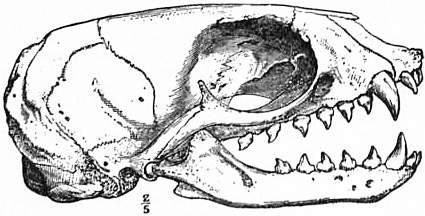
Fig. 7.—Skull and dentition of Australian Sea-Bear (Otaria forsteri).
The third and last family of the Pinnipedia, and thus of existing Carnivora, is the Otariidae, which includes the eared seals, or sea-lions and sea-bears. In all these animals, when on land, the hind-feet are turned forwards under the body, and Sea-lions aid in supporting and moving the trunk as in ordinary quadrupeds. There are small external ears. Testes suspended in a distinct external scrotum. Skull with post-orbital processes and alisphenoid canal. Soles of feet naked. By many naturalists these seals are arranged in a number of generic groups, but as the differences between them are not very great, they may all be included in the typical genus Otaria. The dental formula is i. 3⁄2, c. 1⁄1, p. 4⁄4, m. 1 or 2⁄1; total 34 or 36. The first and second upper incisors are small, with the summits of their crowns divided by deep transverse grooves into an anterior and a posterior cusp of nearly equal height; the third large and canine-like. Canines large, conical, pointed, recurved. Molars and premolars usually 5⁄5, of which the second, third and fourth are preceded by milk-teeth shed a few days after birth; sometimes (as in fig. 7) a sixth upper molar (occasionally developed on one side and not the other); all with similar characters, generally single-rooted; crown moderate, compressed, pointed, with a single principal cusp, and sometimes a cingulum, and more or less developed anterior and posterior accessory cusps. Vertebrae: C. 7, D. 15, L. 5, S. 4, Ca. 9-10. Head rounded. Eyes large; ears small, narrow and pointed. Neck long. Skin of the feet extended far beyond the nails and ends of the digits, with a deeply-lobed margin. The nails small and often quite rudimentary, especially those of the first and fifth toes of both feet; the best-developed and most constant being the three middle claws of the hind-foot, which are elongated, compressed and curved.
Sea-bears and sea-lions are widely distributed, especially in the temperate regions of both hemispheres, though absent from the coasts of the North Atlantic. They spend more of their time on shore, and range inland to greater distances than the true seals, especially at the breeding-time, though they are obliged to return to the water to seek their food. They are gregarious and polygamous, and the males usually much larger than the females. Some possess, in addition to the stiff, close, hairy covering common to the group, a fine, dense, woolly under-fur. The skins of these, when dressed and deprived of the longer harsh outer hairs, constitute the “sealskin” of commerce. The species include O. stelleri, the northern sea-lion, the largest of the genus, from the North Pacific, about 10 ft. in length; O. jubata, the southern sea-lion, from the Falkland Islands and Patagonia; O. californiana, from California; O. ursina, the sea-bear or fur-seal of the North Pacific, the skins of which are imported in immense numbers from the Pribiloff Islands; O. antarctica or pusilla, from the Cape of Good Hope; and O. forsteri, from Australia and various islands in the southern hemisphere. (See Seal-Fisheries.)
Little is known as to the past history of the sea-lions and sea-bears, but a skull has been obtained from the Miocene strata of Oregon, which Mr F.W. True states to be considerably larger than any existing sea-lion skull; its basal length when entire being probably about 20 in. The name Pontoleon magnus has been proposed for this fossil sea-lion, as the character of the skull and teeth do not agree precisely with those of any living member of the group. If, however, all the modern eared seals are included in the genus Otaria, there is apparently no reason to exclude the fossil species.
Extinct Carnivora
Modern Carnivora are undoubtedly the descendants of the Creodonta (q.v.), an extinct early Tertiary suborder. It has been observed that as the Miocene is approached, some of these Carnivora Creodonta, or Primitiva, begin to assume more and more of the characteristics of the Carnivora Vera, till at last it is difficult to determine where the one group ends and the other commences. The creodont genera Stypolophus and Proviverra show some of these modern characters; but it is not till we reach the European Oligocene genus Amphictis, with the dental formula i. 3⁄3, c. 1⁄2, p. 4⁄4, m. 2⁄2, that we meet a type in which the fourth upper premolar and the first lower molar assume the truly sectorial character of the Carnivora Vera, while the teeth behind them are proportionally reduced in size. From the Amphictidae are probably descended the Viverridae, the connecting genus being the African Nandinia, which, as already mentioned, retains the imperfectly ossified bulla of the ancestral forms. In another direction, Amphictis, through the Old World Lower Pliocene genus Ictitherium, has given rise to the Hyaenidae. The Felidae have apparently an ancestral type in the creodont Palaeonictis, which has been regarded as the direct ancestor of the sabre-toothed cats, or Machaerodontinae (see Machaerodus); but it is possible that Palaeonictis may be off the direct line, and that the Felidae are sprung from Amphictis. Be this as it may, from another group of creodonts, represented by Vulpavus (Miacis), Viverravus (Didymictis), and Uintacyon, is probably derived the Oligocene Cynodictis, with a dental formula like that of Canis or Cyon, a perforation to the humerus, and an apparently undivided auditory bulla; and from Cynodictis the transition is easy to the Canidae. It should be mentioned, however, that there is a group of North American Oligocene dog-like animals, such as Daphaenus, Protemnocyon, and Temnocyon, which agree with Cyon in the shortness of the jaws, and with that genus and Speothos in the cutting-heel of the lower sectorial. Possibly these genera may be nearly related to Cyon. Other dog-like North American types are Oligohinis, Enhydrocyon and Hyaenocyon.
By means of the Amphicyonidae, as represented by the Middle Tertiary genera Proamphicyon, Pseudamphicyon, and Amphicyon, in which there were three upper molars, we have a transition from the Cynodictis-type to the bear-group; one of the later intermediate forms being the Lower Pliocene Old World Hyaenarctus, in which the two upper molars are squared and foreshadow those of Ursus itself. In some unknown manner Hyaenarctus appears to be related to Aeluropus. An allied type is found in Arctotherium of the South American Pleistocene.
By the loss of the third lower molar and certain modifications of the other teeth and skull, the Miocene genus Plesictis may be derived from Cynodictis, its dental formula being i. 3⁄3, c. 1⁄1, p. 4⁄4, m. 1 or 2⁄2. Now Plesictis is nothing more than a generalized representative of the Mustelidae. We have thus traced three out of the four modern arctoid families to the Cynodictis-type. The Procyonidae, or fourth family (apart from the Asiatic Aelurus and Aeluropus) are connected with the last-named genus through the North American Oligocene Phlaeocyon, which is stated to be in almost every respect intermediate between Procyon and Cynodictis while the living Bassariscus is stated to show closer signs of affinity with Cynodictis than with Phlaeocyon.
To deal with fossil representatives of living genera, or extinct genera nearly related to groups still existing, would here be impracticable. It may be stated, however, that aberrant groups like the otters are linked up with more normal types by means of extinct forms (in this particular instance by the Miocene Potamotherium), so that the gaps in the phylogeny of the Carnivora are comparatively few.
Literature.—The above article is based on that by Sir W.H. Flower in the 9th edition of this Encyclopaedia. The principal works on Carnivora are the following: W.H. Flower, “On the Value of the Base of the Cranium in the Classification of the Carnivora,” Proc. Zool. Soc. London, 1869; T.H. Huxley, “Cranial and Dental Characters of the Canidae,” Proc. Zool. Soc. London, 1880; St G. Mivart, “On the Classification and Distribution of the Aeluroidea ... and Arctoidea”, Proc. Zool. Soc. London, 1882 and 1885; E.R. Lankester, “On the Affinities of Aeluropus,” Trans. Linn. Soc. London, vol. viii. part iv., 1901; Miss A. Carlsson, “Über die systematische Stellung von Nandinia,” Zool. Jahrb. Syst., vol. xiii., 1900, and “Ist Otocyon die Ausgangsform des Hundegeschlechts oder nicht?” op. cit. vol. xxii., 1905; J.L. Wortman and W.D. Matthew, “The Ancestry of Certain Members of the Canidae, Viverridae, and Procyonidae,” Bull. Amer. Mus., vol. xii., 1899.
(R. L.*)
CARNOT, LAZARE HIPPOLYTE (1801-1888), French statesman, the second son of L.N.M. Carnot (q.v.), was born at Saint-Omer on the 6th of October 1801. Hippolyte Carnot lived at first in exile with his father, returning to France only in 1823. Unable then to enter active political life, he turned to literature and philosophy, publishing in 1828 a collection of Chants helléniques translated from the German of W. Müller, and in 1830 an Exposé de la doctrine Saint-Simonienne, and collaborating in the Saint-Simonian journal Le Producteur. He also paid several visits to England and travelled in other countries of Europe. In March 1839, after the dissolution of the chamber by Louis Philippe, he was elected deputy for Paris (re-elected in 1842 and in 1846), and sat in the group of the Radical Left, being one of the leaders of the party hostile to Louis Philippe. On the 24th of February 1848 he pronounced in favour of the republic. Lamartine chose him as minister of education in the provisional government, Carnot set to work to organize the primary school systems, proposing a law for obligatory and free primary instruction, and another for the secondary education of girls. But he declared himself against purely secular schools, holding that “the minister and the schoolmaster are the two columns on which rests the edifice of the republic.” By this attitude he alienated both the Right and the Republicans of the Extreme Left, and was forced to resign on the 5th of July 1848. He was one of those who protested against the coup d’état of the 2nd of December 1851, but was not proscribed by Louis Napoleon. He refused to sit in the Corps Législatif until 1864, in order not to have to take the oath to the emperor. From 1864 to 1869 he was in the republican opposition, taking a very active part. He was defeated at the election of 1869. On the 8th of February 1871 he was named deputy for the Seine et Oise, and participated in the drawing up of the Constitutional Laws of 1875. On the 16th of December 1875, he was named by the National Assembly senator for life. He died on the 16th of March 1888, three months after the election of his elder son, M.F.S. Carnot (q.v.), to the presidency of the republic. He had published Le Ministère de l’instruction publique et des cultes du 24e février au 5e juillet 1848, (1849), Mémoires sur Lazare Carnot (2 vols., 1861-1864), Mémoires de Barère (with David Angers, 4 vols., 1842-1843). His second son, Marie Adolphe Carnot (b. 1839), became a distinguished mining-engineer and director of the École des Mines (1899), his studies in analytical chemistry placing him in the front rank of French scientists. He was made a member of the Academy of Sciences in 1895.
See Vermorel, Les Hommes de 1848, (3rd ed., 1869); E. Spuller, Histoire parlementaire de la Seconde République (1891); P. de la Gorce, Histoire du Second Empire (1894 et seq.).
CARNOT, LAZARE NICOLAS MARGUERITE (1753-1823), French general, was born at Nolay in Burgundy in 1753. He received his training as an engineer at Mézières, becoming an officer of the Corps de Génie in 1773 and a captain ten years later. He had then just published his first work, an Essai sur les machines en général. In 1784 he wrote an essay on balloons, and his. Éloge of Vauban, read by him publicly, won him the commendation of Prince Henry of Prussia. But as the result of a controversy with Montalembert, Carnot abandoned the official, or Vauban, theories of the art of fortification, and went over to the “perpendicular” school of Montalembert. He was consequently imprisoned, on the pretext of having fought a duel, and only released when selected to accompany Prince Henry of Prussia in a visit to Vauban’s fortifications. In 1791 he married. The Revolution drew him into political life, and he was elected a deputy for the Pas de Calais. In the Assembly he took a prominent part in debates connected with the army. Carnot was a stern and sincere republican, and voted for the execution of the king. In the campaigns of 1792 and 1793 he was continually employed as a commissioner in military matters, his greatest service being in April 1793 on the north-eastern frontier, where the disastrous battle of Neerwinden and the subsequent defection of Dumouriez had thrown everything into confusion. After doing what was possible to infuse energy into the operations of the French forces, he returned to Paris and was made a member of the Committee of Public Safety. He was charged with duties corresponding to those of the modern chief of the general staff and adjutant-general. As a member of the committee he signed its decrees and was thus at least technically responsible for the acts of the Reign of Terror. His energies were, however, directed to the organization, not yet of victory, but of defence. His labours were incessant; practically every military document in the archives of the committee was Carnot’s own work, and he was repeatedly in the field with the armies. His part in Jourdan’s great victory at Wattignies was so important that the credit of the day has often been assigned to Carnot. The winter of 1793-1794 was spent in new preparations, in instituting a severe discipline in the new and ill-trained troops of the republic, and in improvising means and material of war. He continued to visit the armies at the front, and to inspire them with energy. He acquiesced in the fall of Robespierre in 1794, but later defended Barère and others among his colleagues, declaring that he himself had constantly signed papers without reading them, as it was physically impossible to do so in the press of business. When Carnot’s arrest was demanded in May 1795, a deputy cried “Will you dare to lay hands on the man who has organized victory?” Carnot had just accepted promotion to the rank of major in the engineers. Throughout 1793, when he had been the soul of the national defence, and 1794, in which year he had “organized victory” in fourteen armies, he was a simple captain.
Carnot was elected one of the five Directors in November 1795, and continued to direct the war department during the campaign of 1796. Late in 1796 he was made a member (1st class) of the Institute, which he had helped to establish. He was for two periods president of the Directory, but on the coup d’état of the 18th Fructidor (1797) was forced to take refuge abroad. He returned to France after the 18th Brumaire (1799) and was re-elected to the Institute in 1800. Early in 1800 he became minister of war, and he accompanied Moreau in the early part of the Rhine campaign. His chief work was, however, in reducing the expenses of the armies. Contrary to the usual custom he refused to receive presents from contractors, and he effected much-needed reforms in every part of the military administration. He tendered his resignation later in the year, but it was long before the First Consul would accept it. From 1801 he lived in retirement with his family, employing himself chiefly in scientific pursuits. As a senator he consistently opposed the increasing monarchism of Napoleon, who, however, gave him in 1809 a pension and commissioned him to write a work on fortification for the school of Metz. In these years he had published De la corrélation des figures de géométrie (1801), Géométrie de position (1803), and Principes fondamentaux de l’équilibre et du mouvement (1803), all of which were translated into German. His great work on fortification appeared at Paris in 1810 (De la défense de places fortes) and was translated for the use of almost every army in Europe. He took Montalembert as his ground-work. Without sharing Montalembert’s antipathy to the bastioned trace, and his predilection for high masonry caponiers, he followed out the principle of retarding the development of the attack, and provided for the most active defence. To facilitate sorties in great force he did away with a counterscarp wall, providing instead a long gentle slope from the bottom of the ditch to the crest of the glacis. This, he imagined, would compel an assailant to maintain large forces in the advanced trenches, which he proposed to attack by vertical fire from mortars. Along the front of his fortress was built a heavy detached wall, loop-holed for fire, and sufficiently high to be a most formidable obstacle. This “Carnot wall,” and, in general, Carnot’s principle of active defence, played a great part in the rise of modern fortification.
He did not seek employment in the field in the aggressive wars of Napoleon, remaining a sincere republican, but in 1814, when France itself was once more in danger, Carnot at once offered his services. He was made a general of division, and Napoleon sent him to the important fortress of Antwerp as governor. His defence of that place was one of the most brilliant episodes of the campaign of 1814. On his return to Paris he addressed a political memoir to the restored king of France, which aroused much attention both in France and abroad. He joined Napoleon during the Hundred Days and was made minister of the interior, the office carrying with it the dignity of count, and on the 2nd of June he was made a peer of France. On the second Restoration he was proscribed. He lived thenceforward in Magdeburg, occupying himself still with science. But his health rapidly declined, and he died at Magdeburg on the 2nd of August 1823. His remains were solemnly removed to the Panthéon in 1889. Long before this, in 1836, Antwerp had erected a statue to its defender of 1814. In 1837 Arago pronounced his éloge before the Académie des Sciences. The sincerity of his patriotism and his political convictions was proved in 1801-1804 and in 1814. The memory of his military career is preserved in the title, given to him in the Assembly, of “The organizer of victory.” His sons, Sadi and L. Hippolyte, are separately noticed.
Authorities.—Baron de B..., Vie privée, politique, et morale de L.N.M. Carnot (Paris, 1816); Sérieys, Carnot, sa vie politique et privée (Paris, 1816); Mandar, Notice biographique sur le général Carnot, &c. (Paris, 1818); W. Körte, Das Leben L.N.M. Carnots (Leipzig, 1820); P.F. Tissot, Mémoires historiques et militaires sur Carnot (Paris, 1824); Arago, Biographie de Carnot (Paris, 1850); Hippolyte Carnot, Mémoires sur Carnot (Paris, 1863); C. Rémond, Notice biographique sur le grand Carnot (Dijon 1880); A. Picaud, Carnot, l’organisateur de la victoire (Paris, 1885 and 1887); A. Burdeau, Une Famille de patriotes (Paris, 1888); L. Hennet, Lazare Carnot (Paris, 1888); G. Hubbard, Une Famille républicaine (Paris, 1888); M. Dreyfous, Les Trois Carnot (Paris, 1888); M. Bonnal, Carnot, d’après les archives, &c. (Paris, 1888); and memoir by E. Charavaray in La Grande Encyclopédie.
CARNOT, MARIE FRANÇOIS SADI (1837-1894), fourth president of the third French Republic, son of L. Hippolyte Carnot, was born at Limoges on the 11th of August 1837. He was educated as a civil engineer, and after having highly distinguished himself at the École Polytechnique and the École des Ponts et Chaussées, obtained an appointment in the public service. His hereditary republicanism recommended him to the government of national defence, by which he was entrusted in 1870 with the task of organizing resistance in the departments of the Eure, Calvados and Seine Inférieure, and made prefect of the last named in January 1871. In the following month he was elected to the National Assembly by the department Côte d’Or. In August 1878 he was appointed secretary to the minister of public works. In September 1880 he became minister, and again in April 1885, passing almost immediately to the ministry of finance, which he held under both the Ferry and the Freycinet administrations until December 1886. When the Wilson scandals occasioned the downfall of Grévy in December 1887, Carnot’s high character for integrity marked him out as a candidate for the presidency, and he obtained the support of Clémenceau and of all those who objected to the candidatures of men who have been more active in the political arena, so that he was elected by 616 votes out of 827. He assumed office at a critical period, when the republic was all but openly attacked by General Boulanger. President Carnot’s ostensible part during this agitation was mainly confined to augmenting his popularity by well-timed appearances on public occasions, which gained credit for the presidency and the republic. When early in 1889, Boulanger was finally driven into exile, it fell to President Carnot’s lot to appear at the head of the state on two occasions of especial interest, the celebration of the centenary of 1789 and the opening of the Paris Exhibition of that year. The perfect success of both was regarded, not unreasonably, as a popular ratification of the republic, and though continually harassed by the formation and dissolution of ephemeral ministries, by socialist outbreaks, and the beginnings of anti-Semitism, Carnot had but one serious crisis to surmount, the Panama scandals of 1892, which, if they greatly damaged the prestige of the state, increased the respect felt for its head, against whose integrity none could breathe a word. Carnot seemed to be arriving at the zenith of popularity, when on the 24th of June 1894, after delivering at a public banquet at Lyons a speech in which he appeared to imply that he nevertheless would not seek re-election, he was stabbed by an Italian anarchist named Caserio and expired almost immediately. The horror and grief excited by this tragedy were boundless, and the president was honoured with a splendid funeral in the Panthéon, Paris.
His son, François Carnot, was first elected deputy for the Cote d’Or in 1902.
See E. Zevort, Histoire de la Troisième République, tome iv., “La Présidence de Carnot” (Paris, 1901).
CARNOT, SADI NICOLAS LÉONHARD (1796-1832), French physicist, elder son of L.N.M. Carnot, was born at Paris on the 1st of June 1796. He was admitted to the École Polytechnique in 1812, and late in 1814 he left with a commission in the Engineers and with prospects of rapid advancement in his profession. But Waterloo and the Restoration led to a second and final proscription of his father; and though not himself cashiered, Sadi was purposely told off for the merest drudgeries of his service. Disgusted with an employment which afforded him neither leisure for original work nor opportunities for acquiring scientific instruction, he presented himself in 1819 at the examination for admission to the staff corps (état-major) and obtained a lieutenancy. He then devoted himself with astonishing ardour to mathematics, chemistry, natural history, technology and even political economy. He was an enthusiast in music and other fine arts; and he habitually practised as an amusement, while deeply studying in theory, all sorts of athletic sports, including swimming and fencing. He became captain in the Engineers in 1827, but left the service altogether in the following year. His naturally feeble constitution, further weakened by excessive study, broke down finally in 1832. An attack of scarlatina led to brain fever, and he had scarcely recovered when he fell a victim to cholera, of which he died in Paris on the 24th of August 1832. He was one of the most original and profound thinkers who have ever devoted themselves to science. The only work he published was his Réflexions sur la puissance motrice du feu et sur les machines propres à développer cette puissance (Paris, 1824). This contains but a fragment of his scientific discoveries, but it is sufficient to put him in the very foremost rank, though its full value was not recognized until pointed out by Lord Kelvin in 1848 and 1849. Fortunately his manuscripts had been preserved, and extracts were appended to a reprint of his Puissance motrice by his brother, L.H. Carnot, in 1878. These show that he had not only realized for himself the true nature of heat, but had noted down for trial many of the best modern methods of finding its mechanical equivalent, such as those of J.P. Joule with the perforated piston and with the friction of water and mercury. Lord Kelvin’s experiment with a current of gas forced through a porous plug is also given. “Carnot’s principle” is fundamental in the theory of thermodynamics (q.v.).
CARNOUSTIE, a police burgh and watering-place of Forfarshire, Scotland. Pop. (1901) 5204. It lies on the North Sea, 10¾ m. E.N.E. of Dundee by the North British railway. Bathing and golfing are good. Barry Links, a triangular sandy track occupying the south-eastern corner of the shire, are used as a camping and manoeuvring ground for the artillery and infantry forces of the district, and occasionally of Scotland. Its most extreme point is called Buddon Ness, off which are the dangerous shoals locally known as the Roaring Lion, in consequence of the deep boom of the waves. On the Ness two lighthouses have been built at different levels, the lights of which are visible at 13 and 16 m.
CARNUNTUM (Καρνοῦς in Ptolemy), an important Roman fortress, originally belonging to Noricum, but after the 1st century a.d. to Pannonia. It was a Celtic town, the name, which is nearly always found with K on monuments, being derived from Kar, Karn (“rock,” “cairn”). Its extensive ruins may still be seen near Hainburg, between Deutsch-Altenburg and Petronell, in lower Austria. Its name first occurs in history during the reign of Augustus (a.d. 6), when Tiberius made it his base of operations in the campaigns against Maroboduus (Marbod). A few years later it became the centre of the Roman fortifications along the Danube from Vindobona (Vienna) to Brigetio (O-Szöny), and (under Trajan or Hadrian) the permanent quarters of the XIV legion. It was also a very old mart for the amber brought to Italy from the north. It was created a municipium by Hadrian (Aelium Carnuntum). Marcus Aurelius resided there for three years (172-175) during the war against the Marcomanni, and wrote part of his Meditations. Septimius Severus, at the time governor of Pannonia, was proclaimed emperor there by the soldiers (193). In the 4th century it was destroyed by the Germans, and, although partly restored by Valentinian I., it never regained its former importance, and Vindobona became the chief military centre. It was finally destroyed by the Hungarians in the middle ages.
A special society (Carnuntumverein) exists for the exploration of the numerous ruins, the results of which will be found in J.W. Kubitschek and S. Frankfurter, Führer durch Carnuntum (3rd ed., 1894); see also E. von Sacken, “Die römische Stadt Carnuntum,” in Sitzungsberichte der k. Akad. der Wissenschaften, ix. (Vienna, 1852); article by Kubitschek in Pauly-Wissowa’s Realencydopadie, iii. part ii. (1899); Corpus Inscriptionum Latinarum, iii., part i. p. 550.
CARNUTES (Carnuti, Carnutae, Καρνουτῖνοι in Plutarch), a Celtic people of central Gaul, between the Sequana (Seine) and the Liger (Loire). Their territory corresponded to the dioceses of Chartres, Orléans and Blois, that is, the greater part of the modern departments of Eure-et-Loir, Loiret, Loir-et-Cher. It was regarded as the political and religious centre of the Gallic nation. The chief towns were Cenabum (not Genabum; Orléans) and Autricum (Chartres). According to Livy (v. 34) the Carnutes were one of the tribes which accompanied Bellovesus in his invasion of Italy during the reign of Tarquinius Priscus. In the time of Caesar they were dependents of the Remi, who on one occasion interceded for them. In 52 they joined in the rebellion of Vercingetorix. As a punishment for the treacherous murder of some Roman merchants and one of Caesar’s commissariat officers at Cenabum, the town was burnt and the inhabitants put to the sword or sold as slaves. During the war they sent 12,000 men to relieve Alesia, but shared in the defeat of the Gallic army. Having attacked the Bituriges Cubi, who appealed to Caesar for assistance, they were forced to submit. Under Augustus, the Carnutes, as one of the peoples of Lugdunensis, were raised to the rank of civitas socia or foederata, retaining their own institutions, and only bound to render military service to the emperor. Up to the 3rd century Autricum (later Carnutes, whence Chartres) was the capital, but in 275 Aurelian changed Cenabum from a vicus into a civitas and named it Aurelianum or Aurelianensis urbs (whence Orléans).
See Caesar, Bell. Gall. v. 25, 29, vii. 8, 11, 75, viii. 5, 31; Strabo iv. pp. 191-193; R. Boutrays, Urbis gentisque Carnutum historia (1624); A. Desjardins, Géographie historique de la Gaule, ii. (1876-1893); article and bibliography in La Grande Encyclopédie, T.R. Holmes, Caesar’s Conquest of Gaul (1899), p. 402, on Cenabum.
CARO, ANNIBALE (1507-1566), Italian poet, was born at Civita Nuova, in Ancona, in 1507. He became tutor in the family of Lodovico Gaddi, a rich Florentine, and then secretary to his brother Giovanni, by whom he was presented to a valuable ecclesiastical preferment at Rome. At Gaddi’s death, he entered the service of the Farnese family, and became confidential secretary in succession to Pietro Lodovico, duke of Parma, and to his sons, duke Ottavio and cardinals Ranuccio and Alexander. Caro’s most important work was his translation of the Aeneid (Venice, 1581; Paris, 1760). He is also the author of Rime, Canzoni, and sonnets, a comedy named Gli Straccioni, and two clever jeux d’esprit, one in praise of figs, La Ficheide, and another in eulogy of the big nose of Leoni Ancona, president of the Academia della Vertu. Caro’s poetry is distinguished by very considerable ability, and particularly by the freedom and grace of its versification; indeed he may be said to have brought the verso sciolto to the highest development it has reached in Italy. His prose works consist of translations from Aristotle, Cyprian and Gregory Nazianzen; and of letters, written in his own name and in those of the cardinals Farnese, which are remarkable both for the baseness they display and for their euphemistic polish and elegance. His fame has been greatly damaged by the virulence with which he attacked Lodovico Castelvetro in one of his canzoni, and by his meanness in denouncing him to the Holy Office as translator of some of the writings of Melanchthon. He died at Rome about 1566.
CARO, ELME MARIE (1826-1887), French philosopher, was born on the 4th of March 1826 at Poitiers. His father, a professor of philosophy, gave him an excellent education at the Stanislas College and the École Normale, where he graduated in 1848. After being professor of philosophy at several provincial universities, he received the degree of doctor, and came to Paris in 1858 as master of conferences at the École Normale. In 1861 he became inspector of the Academy of Paris, in 1864 professor of philosophy to the Faculty of Letters, and in 1874 a member of the French Academy. He married Pauline Cassin, the authoress of the Péché de Madeleine and other well-known novels. He died in Paris on the 13th of July 1887. In his philosophy he was mainly concerned to defend Christianity against modern Positivism. The philosophy of Cousin influenced him strongly, but his strength lay in exposition and criticism rather than in original thought. Besides important contributions to La France and the Revue des deux mondes, he wrote Le Mysticisme au XVIIIe siècle (1852-1854), L’Idee de Dieu (1864), Le Matérialisme et la science (1868), Le Pessimisme au XIXe siècle (1878), Jours d’épreuves (1872), M. Littré et le positivisme (1883), George Sand (1887), Mélanges et portraits (1888), La Philosophie de Goethe (2nd ed., 1880).
CAROL (O. Fr. carole), a hymn of praise, especially such as is sung at Christmas in the open air. The origin of the word is obscure. Diez suggests that the word is derived from chorus. Others ally it with corolla, a garland, circle or coronet,1 the earliest sense of the word being apparently “a ring” or “circle,” “a ring dance.” Stonehenge, often called the Giants’ Dance, was also frequently known as the Carol; thus Harding, Chron. lxx. x., “Within (the) Giauntes Carole, that so they hight, The (Stone hengles) that nowe so named been.” The Celtic forms, often cited as giving the origin of the word, are derivatives of the English or French. The crib set up in the churches at Christmas was the centre of a dance, and some of the most famous of Latin Christmas hymns were written to dance tunes. These songs were called Wiegenlieder in German, noéls in French, and carols in English. They were originally modelled on the songs written to accompany the choric dance, which were probably the starting-point of the lyric poetry of the Germanic peoples. Strictly speaking, therefore, the word should be applied to lyrics written to dance measures; in common acceptation it is applied to the songs written for the Christmas festival. Carolling, i.e. the combined exercise of dance and song, found its way from pagan ritual into the Christian church, and the clergy, however averse they might be from heathen survivals, had to content themselves in this, as in many other cases, with limiting the practice. The third council of Toledo (589) forbade dancing in the churches on the vigils of saints’ days, and secular dances in church were forbidden by the council of Auxerre in the next year. Even as late as 1209 it was necessary for the council of Avignon to forbid theatrical dances and secular songs in churches. Religious dances persisted longest on Shrove Tuesday, and a castanet dance by the choristers round the lectern is permitted three times a year in the cathedral of Seville. The Christmas festival, which synchronized with and superseded the Latin and Teutonic feasts of the winter solstice, lent itself especially to gaiety. The “crib” of the Saviour was set up in the churches or in private houses, in the traditional setting of the stable, with earthen figures of the Holy Family, the ox and the ass; and carols were sung and danced around it. The “rocking of the cradle” was the occasion of dialogue between Joseph and Mary which was not without elements of comedy, and gave rise to lullabies such as the well-known German Dormi fili. The adoration of the shepherds and the visit of the Magi also provided matter for dramatic and choral representation. The singing of the carol has survived in places where the institution of the “crib,” said to have been originated by St Francis of Assisi to inculcate the doctrine of the incarnation, has been long in disuse, but in the West Riding of Yorkshire the children who go round carol-singing still carry “milly-boxes” (My Lady boxes) containing figures which represent the Virgin and Child.
That carol-singing early became a pretext for the asking of alms is obvious from an Anglo-Norman carol preserved in the British Museum (MS. Reg. 16 E. viii.), Seigneurs ore entendey à nus, which is little more than a drinking song. Carols were an important element in the mystery plays of the Nativity, and one of these, included in the Marguerites de la Marguerite des princesses, très-illustre reine de Navarre (Lyons, 1547), incidentally gives evidence of the connexion of dancing and carol-singing, for the shepherds and shepherdesses open their chorus at the manger with “Dansons, chantons, faisons rage.” There is a long English carol relating the chief incidents of the life of Christ, which is a curious example of the mixture of the sacred and profane common in this species of composition. It begins “To-morrow shall be my dancing day,” and has for refrain—
“Sing, oh! my love, oh! my love, my love, my love; This have I done for my true love.”
There are extant numerous carols dating from the 15th century which have the characteristic features of folksong. The famous Cherry-tree Carol, “Joseph was an old man,” is based on an old legend which is related in the Coventry mystery plays. “I saw three ships come sailing in,” and “The Camel and the Crane,” though of more modern date, preserve curious legends. Numerous entries in the household accounts of the Tudor sovereigns show that carol-singing was popular throughout the 16th century, and the literature of Christmas was enriched in the next century by poems which are often included in collections of carols, though they were probably written to be read rather than sung. Milton, Crashaw, Southwell, Ben Jonson, George Herbert and George Wither all produced Christmas poems, but the richest collection by any one poet is to be found in the poems of Herrick, whose “Come, bring with a noise” is a typical carol of the jovial kind, and may well have been written to a dance tune. Among 18th-century religious carols perhaps the most famous is Charles Wesley’s “Hark, how all the welkin rings,” better known in the variant, “Hark, the herald angels sing.” The artificial modern revival of carol-singing has produced a quantity of new carols, the best of which are perhaps mostly derived from medieval Latin Christmas hymns. Among the many modern Christmas poems one of the most striking is Swinburne’s “Three Damsels in the Queen’s Chamber,” which is, however, a ballad rather than a carol.
The earliest printed collection of carols was issued by Wynkyn de Worde in 1521. It contained the famous Boar’s Head carol, Caput apri defero, Reddens laudes Domino, which in a slightly altered form is sung at Queen’s College, Oxford, on the bringing in of the boar’s head. Modern collections of ancient carols are derived chiefly from three tracts belonging to the collection of Anthony à Wood, preserved in the Bodleian library, from a 15th-century MS. (Sloane 2593), a 16th-century MS. with the music (Add. 5665), and other MSS. in the British Museum, and from oral tradition. In the 15th century T. Bloomer of Birmingham published a number of carols in the form of broad-sides. Among the numerous collections of French carols is Noei Borguignon de Gui Barôzai (1720), giving the words and the music of thirty-four noëls, many of them very free in character. The term noël passed into the English carol as a favourite refrain, “nowell,” and seems to have been in common use in France as an equivalent for vivat.
Among the more important modern collections of Christmas carols are: Songs and Carols (1847), edited by T. Wright for the Percy Society from Sloane MS. 2593; W. Sandys, Christmastide, its History, Festivities and Carols (1852); Christmas with the Poets (edited by V.H., 4th ed., 1872); T. Helmore and J.M. Neale, Carols for Christmastide (1853-1854), with music; R.R. Chope, Carols (new and complete edition, 1894), a tune-book for church use, with an introduction by S. Baring-Gould; H.R. Bramley, Christmas Carols, New and Old, the music by Dr Stainer; A.H. Bullen, Carols and Poems (1885); J.A. Fuller Maitland and W.S. Rockstro, Thirteen Carols of the Fifteenth Century, from a Trinity Coll., Cambridge, MS. (1891). See also Julian’s Dictionary of Hymnology, s.v. “Carol”; E. Cortet, Essai sur les fêtes religieuses (1867).
1 In architecture, the term “carol” (also wrongly spelled “carrel” or “carrol”) is used, in the sense of an enclosure, of a small chapel or oratory enclosed by screens, and also sometimes of the rails of the screens themselves. It is more particularly applied to the separate seats near the windows of a cloister (q.v.), used by the monks for the purposes of study, &c. The term “carol” has, by a mistake, been sometimes used of a scroll bearing an inscription of a text, &c.
CAROLINE (1683-1737), wife of George II., king of Great Britain and Ireland, was a daughter of John Frederick, margrave of Brandenburg-Ansbach (d. 1686). Born at Ansbach on the 1st of March 1683, the princess passed her youth mainly at Dresden and Berlin, where she enjoyed the close friendship of Sophie Charlotte, wife of Frederick I. of Prussia; she married George Augustus, electoral prince of Hanover, in September 1705. The early years of her married life were spent in Hanover. She took a continual interest in the approaching accession of the Hanoverian dynasty to the British throne, was on very friendly terms with the old electress Sophia, and corresponded with Leibnitz, whose acquaintance she had made in Berlin. In October 1714 Caroline followed her husband and her father-in-law, now King George I., to London. As princess of Wales she was accessible and popular, and took the first place at court, filling a difficult position with tact and success. When the quarrel between the prince of Wales and his father was attaining serious proportions, Caroline naturally took the part of her husband, and matters reached a climax in 1717. Driven from court, ostracized by the king, deprived even of the custody of their children, the prince and princess took up their residence in London at Leicester House, and in the country at Richmond. They managed, however, to surround themselves with a distinguished circle; Caroline had a certain taste for literature, and among their attendants and visitors were Lord Chesterfield, Pope, Gay, Lord Hervey and his wife, the beautiful Mary Lepel. A formal reconciliation with George I. took place in 1720. In October 1727 George II. and his queen were crowned. During the rest of her life Queen Caroline’s influence in English politics was very chiefly exercised in support of Sir Robert Walpole; she kept this minister in power, and in control of church patronage. She was exceedingly tolerant, and the bishops appointed by her were remarkable rather for learning than for orthodoxy. During the king’s absences from England she was regent of the kingdom on four occasions. On the whole, Caroline’s relations with her husband, to whom she bore eight children, were satisfactory. A clever and patient woman, she was very complaisant towards the king, flattering his vanity and acknowledging his mistresses, and she retained her influence over him to the end. She died on the 20th of November 1737.
Caroline appears in Scott’s Heart of Midlothian; see also Lord Hervey, Memoirs of the Reign of George II., ed. by J.W. Croker (1884); W.H. Wilkins, Caroline the Illustrious (1904); and A.D. Greenwood, Lives of the Hanoverian Queens of England, vol. i. (1909).
CAROLINE AMELIA AUGUSTA (1768-1821), queen of George IV. of Great Britain, second daughter of Charles William Ferdinand, duke of Brunswick-Wolfenbüttel, was born on the 17th of May 1768. She was brought up with great strictness, and her education did not fit her well for her subsequent station in life. In 1795 she was married to the then prince of Wales (see George IV.), who disliked her and separated from her after the birth of a daughter in January 1796. The princess resided at Blackheath; and as she was thought to have been badly treated by her profligate husband, the sympathies of the people were strongly in her favour. About 1806 reports reflecting on her conduct were circulated so openly that it was deemed necessary for a commission to inquire into the circumstances. The princess was acquitted of any serious fault, but various improprieties in her conduct were pointed out and censured. In 1814 she left England and travelled on the continent, residing principally in Italy. On the accession of George in 1820, orders were given that the English ambassadors should prevent the recognition of the princess as queen at any foreign court. Her name also was formally omitted from the liturgy. These acts stirred up a strong feeling in favour of the princess among the English people generally, and she at once made arrangements for returning to England and claiming her rights. She rejected a proposal that she should receive an annuity of £50,000 a year on condition of renouncing her title and remaining abroad. Further efforts at compromise proved unavailing; Caroline arrived in England on the 6th of June, and one month later a bill to dissolve her marriage with the king on the ground of adultery was brought into the House of Lords. The trial began on the 17th of August 1820, and on the 10th of November the bill, after passing the third reading, was abandoned. The public excitement had been intense, the boldness of the queen’s counsel, Brougham and Denman, unparalleled, and the ministers felt that the smallness of their majority was virtual defeat. The queen was allowed to assume her title, but she was refused admittance to Westminster Hall on the coronation day, July 19, 1821. Mortification at this event seems to have hastened her death, which took place on the 7th of August of the same year.
See A Queen of Indiscretions, the Tragedy of Caroline of Brunswick, Queen of England, translated by F. Chapman from the Italian of Graziano Paolo Clerici (London, 1907), with numerous portraits, &c. Of contemporary authorities the Creevy Papers (1905) throw the most interesting sidelights on the subject.
CAROLINE ISLANDS, a widely-scattered archipelago in the Pacific Ocean, E. of the Philippines and N. of New Guinea, included in Micronesia, between 5° and 10° N., and 135° and 165° E., belonging to Germany. They fall into three main groups, the Western, Central and Eastern Carolines, the central being the most numerous, while the western include the Pelew group. The total land area is about 380 sq. m., and out of this, 307 sq. m. is covered by the four main islands, Ponape and Kusaie in the eastern group, Truk or Hogolu in the central, and Yap in the western. These islands are of considerable elevation (the highest point of Ponape approaches 3000 ft.), but the rest are generally low coral islets. The climate is equable and moist, but healthy; but the islands are subject to heavy storms. The total population is estimated at 36,000. The natives, who are Micronesian hybrids of finer physique than their kinsmen of the Pelew Islands, have a comparatively high mental standard, being careful agriculturists, and peculiarly clever boatbuilders and navigators. The Germans divide the whole archipelago into two administrative districts, eastern and western, having the seats of government at Ponape and Yap respectively. The principal article of export is copra. The islands were discovered (at least in part) by the Portuguese Diego da Rocha in 1527, and called by him the Sequeira Islands. In 1686 Admiral Francesco Lazeano, who made further explorations, renamed them the Carolines in honour of Charles II. of Spain. The islands were subsequently visited by a few travellers; but the natives have only in modern times been reconciled to the presence of foreigners; an early visit of missionaries (1731) resulted in one of several murderous attacks on white men which darken the history of the islands; and it was only in 1875 that Spain, claiming the group, made some attempt to assert her rights. These were contested by Germany, whose flag was hoisted on Yap, and the matter was referred to the arbitration of Pope Leo XIII. in 1885. He decided in favour of Spain, but gave Germany free trading rights; and in 1899 Germany took over the administration of the islands from Spain, paying 25,000,000 pesetas (nearly £1,000,000 sterling).
Ancient Stone Buildings.—In Ponape and Kusaie, massive stone structures, similar to those which occur in several other parts of the Pacific Ocean, have long been known to exist. They have been closely explored by Herr Kubary, Mr F.J. Moss, and later Mr F.W. Christian. None of the colossal structures hitherto described appears to have been erected by the present Melanesian or Polynesian peoples, while their wide diffusion, extending as far as Easter Island, within 400 m. of the New World, points to the occupation of the Pacific lands by a prehistoric race which had made some advance in general culture. The Funafuti borings (1897) show almost beyond doubt that Polynesia is an area of comparatively recent subsidence. Hence the land connexions must have formerly been much easier and far more continuous than at present. The dolmen-builders of the New Stone Age are now known to have long occupied both Korea and Japan, from which advanced Asiatic lands they may have found little difficulty in spreading over the Polynesian world, just as in the extreme west they were able to range over Scandinavia, Great Britain and Ireland. To Neolithic man, still perhaps represented by some of the more light-coloured and more regular-featured Polynesian groups, may therefore not unreasonably be attributed these astonishing remains, which assume so many different forms according to the nature of the locality, but seem generally so out of proportion with the present restricted areas on which they stand. With the gradual subsidence of these areas their culture would necessarily degenerate, although echoes of sublime theogonies and philosophies are still heard in the oral traditions and folklore of many Polynesian groups. In the islet of Lele, close to Kusaie, at the eastern extremity of Micronesia, the ruins present the appearance of a citadel with cyclopean ramparts built of large basaltic blocks. There are also numerous canals, and what look like artificial harbours constructed amid the shallow lagoons.
In Ponape the remains are of a somewhat similar character, but on a much larger scale, and with this difference, that while those of Lele all stand on the land, those of Ponape are built in the water. The whole island is strewn with natural basaltic prisms, some of great size: and of this material, brought by boats or rafts from a distance of 30 m. and put together without any mortar, but sustained by their own weight, are built all the massive walls and other structures on the east side of the island. The walls of the main building near the entrance of Metalanim harbour form a massive quadrangle 200 ft. on all sides, with inner courts, vault and raised platform with walls 20 to 40 ft. high and from 8 to 18 ft. thick. Some of the blocks are 25 ft. long and 8 ft. in circumference, and many of them weigh from 3 to 4 tons. There are also numerous canals from 30 to 100 ft. wide, while a large number of islets, mainly artificial, covering an area of 9 sq. m., have all been built up out of the shallow waters of the lagoon round about the entrance of the harbour, with high sea-walls composed of the same huge basaltic prisms. In, some places the walls of this “Pacific Venice” are now submerged to some depth, as if the land had subsided since the construction of these extensive works. Elsewhere huge breakwaters had been constructed, the fragments of which may still be seen stretching away for a distance of from 2 to 3 m. Most observers, such as Admiral Sir Cyprian Bridge and Mr. Le Hunte, agree that these structures could not possibly be the work of any of the present Polynesian peoples, and attribute them to a now extinct prehistoric race, the men of the New Stone Age from the Asiatic mainland.
Stone Money.—The inhabitants of Yap are noted for possessing the most extraordinary currency, if it can be so called, in the whole world. Besides the ordinary shell money, there is a sort of stone coinage, consisting of huge calcite or limestone discs or wheels from 6 in. to 12 ft. in diameter, and weighing up to nearly 5 tons. These are all quarried in the Pelew Islands, 200 m. to the south, and are now brought to Yap in European vessels. But some were in the island long before the arrival of the whites, and must consequently have been brought by native vessels or on rafts. The stones, which are rather tokens than money, do not circulate, but are piled up round about the chief’s treasure-house, and appear to be regarded as public property, although it is hard to say what particular use they can serve. They appear to be kept rather for show and ornament than for use.
See F.W. Christian, The Caroline Islands (London, 1899); G. Volkens, “Über die Karolinen Insel Yap,” in Verhandlungen Gesellschaft Erdkunde Berlin., xxviii. (1901); J.S. Kubary, Ethnographische Beitrage zur Kentniss des Karolinen-Archipel (Leiden, 1889-1892); De Abrade, Historia del conflicto de las Carolinas, &c. (Madrid, 1886).
CAROLINGIANS, the name of a family (so called from Charlemagne, its most illustrious member) which gained the throne of France a.d. 751. It appeared in history in 613, its origin being traced to Arnulf (Arnoul), bishop of Metz, and Pippin, long called Pippin of Landen, but more correctly Pippin the Old or Pippin I. Albeit of illustrious descent, the genealogies which represent Arnulf as an Aquitanian noble, and his family as connected—by more or less complicated devices—with the saints honoured in Aquitaine, are worthless, dating from the time of Louis the Pious in the 9th century. Arnulf was one of the Austrasian nobles who appealed to Clotaire II., king of Neustria, against Brunhilda, and it was in reward for his services that he received from Clotaire the bishopric of Metz (613). Pippin, also an Austrasian noble, had taken a prominent part in the revolution of 613. These two men Clotaire took as his counsellors; and when he decided in 623 to confer the kingdom of Austrasia upon his son Dagobert, they were appointed mentors to the Austrasian king, Pippin with the title of mayor of the palace. Before receiving his bishopric, Arnulf had had a son Adalgiselus, afterwards called Anchis; Pippin’s daughter, called Begga in later documents, was married to Arnulf’s son, and of this union was born Pippin II. Towards the end of the 7th century Pippin II., called incorrectly Pippin of Heristal, secured a preponderant authority in Austrasia, marched at the head of the Austrasians against Neustria, and gained a decisive victory at Tertry, near St Quentin (687). From that date he may be said to have been sole master of the Frankish kingdom, which he governed till his death (714). In Neustria Pippin gave the mayoralty of the palace to his son Grimoald, and afterwards to Grimoald’s son Theodebald; the mayoralty in Austrasia he gave to his son Drogo, and subsequently to Drogo’s children, Arnulf and Hugh. Charles Martel, however, a son of Pippin by a concubine Chalpaïda, seized the mayoralty in both kingdoms, and he it was who continued the Carolingian dynasty. Charles Martel governed from 714 to 741, and in 751 his son Pippin III. took the title of king. The Carolingian dynasty reigned in France from 751 to 987, when it was ousted by the Capetian dynasty. In Germany descendants of Pippin reigned till the death of Louis the Child in 911; in Italy the Carolingians maintained their position until the deposition of Charles the Fat in 887. Charles, duke of Lower Lorraine, who was thrown into prison by Hugh Capet in 991, left two sons, the last male descendants of the Carolingians, Otto, who was also duke of Lower Lorraine and died without issue, and Louis, who after the year 1000 vanishes from history.
See P.A.F. Gérard and L.A. Warnkönig, Histoire des Carolingiens (Brussels, 1862); H.E. Bonnell, Anfange des Karoling. Hauses (Berlin, 1866); J.F. Böhmer and E. Mühlbacher, Regesten d. Kaiserreichs unter d. Karolingern (Innsbruck, 1889 seq.); E. Mühlbacher, Deutsche Gesch. unter d. Karolingern (Stuttgart, 1896); F. Lot, Les Derniers Carolingiens (Paris, 1891).
(C. Pf.)
CAROLUS-DURAN, the name adopted by the French painter Charles Auguste Emile Durand (1837- ), who was born at Lille on the 4th of July 1837. He studied at the Lille Academy and then went to Paris, and in 1861 to Italy and Spain for further study, especially devoting himself to the pictures of Velasquez. His subject picture “Murdered,” or “The Assassination” (1866), was one of his first successes, and is now in the Lille museum, but he became best known afterwards as a portrait-painter, and as the head of one of the principal ateliers in Paris, where some of the most brilliant artists of a later generation were his pupils. His “Lady with the Glove” (1869), a portrait of his own wife, was bought for the Luxembourg. In 1889 he was made a commander of the Legion of Honour. He became a member of the Académie des Beaux-arts in 1904, and in the next year was appointed director of the French academy at Rome in succession to Eugène Guillaume.
CARORA, an inland town of the state of Lara, Venezuela, on the Carora, a branch of the Tocuyo river, about 54 m. W. by S. of the city of Barquisimeto, and 1128 ft. above sea-level. Pop. (1908 estimate) 6000. The town is comparatively well-built and possesses a fine parish church, and a Franciscan convent and hermitage. It was founded in 1754, and its colonial history shows considerable prosperity, its population at that time numbering 9000 to 10,000. The neighbouring country is devoted principally to raising horses, mules and cattle; and in addition to hides and leather, it exports rubber and other forest products.
CARP, the typical fish of a large family (Cyprimdae) of Ostariophysi, as they have been called by M. Sagemehl, in which the air-bladder is connected with the ear by a chain of small bones (so-called Weberian ossicles). The mouth is usually more or less protractile and always toothless; the lower pharyngeal bones, which are large and falciform, subparallel to the branchial arches, are provided with teeth, often large and highly specialized, in one, two or three series (pharyngeal teeth), usually working against a horny plate attached to a vertical process of the basioccipital bone produced under the anterior vertebrae, mastication being performed in the gullet. These teeth, adapted to various requirements, vary according to the genus, being conical, hooked, spoon-shaped, molariform, &c.
The species are extremely numerous, about 1400 being known, nearly entirely confined to fresh water, and feeding on vegetable substances or small animals. They are dispersed over the whole world with the exception of South America, Madagascar, Papuasia, and Australasia. Remains of several of the existing genera have been found in Oligocene and later beds of Europe, Sumatra and North America. One member of the Cyprinidae is at present known to be viviparous, but no observations have as yet been made on its habits. It is a small barbel discovered in Natal by Max Weber, and described by him under the name Barbus viviparus.
The Cyprinidae1 are divided into four subfamilies:—Catostominae (mostly from North America, with a few species from China and eastern Siberia), in which the maxillary bones take a share in the border of the mouth, and the pharyngeal teeth are very numerous and form a single, comb-like series; Cyprininae, the great bulk of the family, more or less conforming to the type of the carp; Cobitinae, or loaches (Europe, Asia, Abyssinia), which are dealt with in a separate article (see Loach); and the Homalopterinae (China and south-eastern Asia), mountain forms allied to the loaches, with a quite rudimentary air-bladder.
For descriptions of other Cyprinids than the carp, see Goldfish, Barbel, Gudgeon, Rudd, Roach, Chub, Dace, Minnow, Tench, Bream, Bleak, Bitterling, Mahseer.
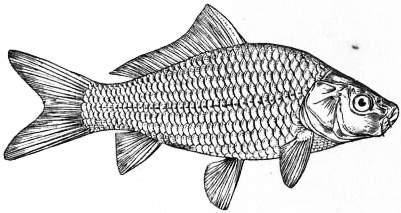
The Common Carp.
The carp itself, Cyprinus carpio, has a very wide distribution, having spread, through the agency of man, over nearly the whole of Europe and a part of North America, where it lives in lakes, ponds, canals, and slow-running rivers with plenty of vegetation. The carp appears to be a native of temperate Asia and perhaps also of south-eastern Europe, and to have been introduced into other parts in the 12th and 13th century; it was first mentioned in England in 1496. The acclimatization of the carp in America has been a great success, especially in the northern waters, where, the growth continuing throughout the entire year, the fish soon attains a remarkable size. The presence of carp in Indo-China and the Malay Archipelago is probably also to be ascribed to human agency. In the British Isles the carp seldom reaches a length of 2½ ft., and a weight of 20 ℔, whilst examples of that size are quite frequent on the continent, and others measuring 4½ ft. and weighing 60 ℔ or more are on record. The fish is characterized by its large scales (34 to 40 in the lateral line), its long dorsal fin, the first ray of which is stiff and serrated, and the presence of two small barbels on each side of the mouth. But it varies much in form and scaling, and some most aberrant varieties have been fixed by artificial selection, the principal being the king-carp or mirror-carp, in which the scales are enlarged and reduced in number, forming more or less regular longitudinal series on the sides, and the leather-carp, in which the scales have all but disappeared, the fish being covered with a thick, leathery skin. Deformed examples are not of rare occurrence.
Although partly feeding on worms and other small forms of animal life, the carp is principally a vegetarian, and the great development of its pharyngeal apparatus renders it particularly adapted to a graminivorous régime. The longevity of the fish has probably been much exaggerated, and the statements of carp of 200 years living in the ponds of Pont-Chartrain and other places in France and elsewhere do not rest on satisfactory evidence.
A close ally of the carp is the Crucian carp, Cyprinus carassius, chiefly distinguished by the absence of barbels. It inhabits Europe and northern and temperate Asia, and is doubtfully indigenous to Great Britain. It is a small fish, rarely exceeding a length of 8 or 9 in. It has many varieties. One of these, remarkable for its very short, thick head and deep body, is the so-called Prussian carp, C. gibelio, often imported into English ponds, whilst the best known is the goldfish (q.v.), C. auralus, first produced in China.
(G. A. B.)
1 The name of the fishes of the genus Cyprinus is derived from the island of Cyprus, the ancient sanctuary of Venus; this name is supposed to have arisen from observations of the fecundity and vivacity of carp during the spawning period.
CARPACCIO, VITTORIO, or Vittore (c. 1465-c. 1522), Italian painter, was born in Venice, cf an old Venetian family. The facts of his life are obscure, but his principal works were executed between 1490 and 1519; and he ranks as one of the finest precursors of the great Venetian masters. The date of his birth is conjectural. He is first mentioned in 1472 in a will of his uncle Fra Ilario, and Dr Ludwig infers from this that he was born c. 1455, on the ground that no one could enter into an inheritance under the age of fifteen; but the inference ignores the possibility of a testator making his will in prospect of the beneficiary attaining his legal age. Consideration of the youthful style of his earliest dated pictures (“St Ursula” series, Venice, 1490) makes it improbable that at that time he had reached so mature an age as thirty-five; and the date of his birth is more probably to be guessed from his being about twenty-five in 1490. What is certain is that he was a pupil (not, as sometimes thought, the master) of Lazzaro Bastiani, who, like the Bellini and Vivarini, was the head of a large atelier in Venice, and whose own work is seen in such pictures as the “S. Veneranda” at Vienna, and the “Doge Mocenigo kneeling before the Virgin” and “Madonna and Child” (formerly attributed to Carpaccio) in the National Gallery, London. In later years Carpaccio appears to have been influenced by Cima da Conegliano (e.g. in the “Death of the Virgin,” 1508, at Ferrara). Apart from the “St Ursula” series, his scattered series of the “Life of the Virgin” and “Life of St Stephen,” and a “Dead Christ” at Berlin, may be specially mentioned.
For an authoritative and detailed account, see the Life and Works of Vittorio Carpaccio, by Pompeo Molmenti and Gustav Ludwig, Eng. trans, by R.H. Cust (1907); and the criticism by Roger Fry, “A Genre Painter and his Critics,” in the Quarterly Review (London, April 1908).
CARPATHIAN MOUNTAINS1 (Lat. Monies Sarmatici; Med. Lat. Montes Nivium), the eastern wing of the great central mountain system of Europe. With the exception of the extreme southern and south-eastern ramifications, which belong to Rumania, the Carpathians lie entirely within Austrian and Hungarian territory. They begin on the Danube near Pressburg, surround Hungary and Transylvania in a large semicircle, the concavity of which is towards the south-west, and end on the Danube near Orsova. The total length of the Carpathians is over 800 m., and their width varies between 7 and 230 m., the greatest width of the Carpathians corresponding with its highest altitude. Thus the system attains its greatest breadth in the Transylvanian plateau, and in the meridian of the Tatra group. It covers an area of 72,600 sq. m., and after the Alps is the most extensive mountain system of Europe. The Carpathians do not form an uninterrupted chain of mountains, but consist of several orographically and geologically distinctive groups; in fact they present as great a structural variety as the Alps; but as regards magnificence of scenery they cannot compare with the Alps. The Carpathians, which only in a few places attain an altitude of over 8000 ft., lack the bold peaks, the extensive snow-fields, the large glaciers, the high waterfalls and the numerous large lakes which are found in the Alps. They are nowhere covered by perpetual snow, and glaciers do not exist, so that the Carpathians, even in their highest altitude, recall the middle region of the Alps, with which, however, they have many points in common as regards appearance, structure and flora. The Danube separates the Carpathians from the Alps, which they meet only in two points, namely, the Leitha Mountains at Pressburg, and the Bakony Mountains at Vacz (Waitzen), while the same river separates them from the Balkan Mountains at Orsova. The valley of the March and Oder separates the Carpathians from the Silesian and Moravian chains, which belong to the middle wing of the great central mountain system of Europe. The Carpathians separate Hungary and Transylvania from Lower Austria, Moravia, Silesia, Galicia, Bukovina and Rumania, while its ramifications fill the whole northern part of Hungary, and form the quadrangular mass of the Transylvanian plateau. Unlike the other wings of the great central system of Europe, the Carpathians, which form the watershed between the northern seas and the Black Sea, are surrounded on all sides by plains, namely the great Hungarian plain on the south-west, the plain of the Lower Danube (Rumania) on the south, and the Galician plain on the north-east.
The Carpathian system can be divided into two groups: the Carpathians proper, and the mountains of Transylvania. The Carpathians proper consist of an outer wall, which forms the frontier between Hungary and the adjacent provinces of Austria, and of an inner wall which fills the whole of Upper Hungary, and forms the central group. The outer wall is a complex, roughly circular mass of about 600 m. extending from Pressburg to the valley of the Visó, and the Golden Bistritza, and is divided by the Poprad into two parts, the western Carpathians and the eastern or wooded Carpathians. Orographically, therefore, the proper Carpathians are divided into: (a) the western Carpathians, (b) the eastern or wooded Carpathians, and (c) the central groups.
(a) The western Carpathians, which begin at the Porta Hungarica on the Danube, just opposite the Leitha Mountains, and extend to the Poprad river, are composed of four principal groups: the Little Carpathians (also called the Pressburg group) Ranges. with the highest peak Bradlo (2670 ft.); the White Carpathians or Miava group, with the highest peak Javornik (3325 ft.), and the Zemerka (3445 ft.); the Beskid proper or western Beskid group, which extends from a little west of the Jablunka pass to the river Poprad, with the highest peaks, Beskid (3115 ft.), Smrk (4395 ft.), Lissa Hora (4350 ft.) and Ossus (5106 ft.); and the Magura or Arva Magura group, which extends to the south of Beskid Mountains, and contains the Babia Gora (5650 ft.), the highest peak in the whole western Carpathians.
(b) The eastern or wooded Carpathians extend from the river Poprad to the sources of the river Visó and the Golden Bistritza, whence the Transylvanian Mountains begin, and form the link between these mountains and the central groups or High Carpathians. They are a monotonous sandstone range, covered with extensive forests, which up to the sources of the rivers Ung and San are also called the eastern Beskids, and are formed of small parallel ranges. The northern two-thirds of this range has a mean altitude of 3250 ft., and only in its southern portion it attains a mean altitude of 5000 ft. The principal peaks are Rusky Put (4264 ft.), Popadjé (5690 ft.), Bistra (5936 ft.), Pop Ivan (6214 ft.), Tomnatik (5035 ft.), Giumaleu (6077 ft.) and Cserna Gora (6505 ft.), the culminating peak of the whole range. To the eastern Carpathians belongs also the range of mountains extending between the Laborcza and the Upper Theiss, called Vihorlat, which attains in the peak of the same name an altitude of 3495 ft. As indicated by its name, which means “burnt,” it is of volcanic origin, and plays an important part in the folklore and in the superstitious legends of the Hungarian people.
(c) The central groups or the High Carpathians extend from the confluence of the rivers Arva and Waag to the river Poprad, and include the highest group of the Carpathian system. They consist of the High Tatra group (see Tatra Mountains), where is found the Gerlsdorfer or Franz Josef peak (Hung. Gerlachfalvi-Csúcs), with an altitude of 8737 ft., the highest peak in the whole Carpathian Mountains. On its west are the Liptauer Magura, with the highest peak the Biela Szkala (6900 ft.), and on its east are the Zipser Magura, which have a mean altitude of 3000 ft. South of the central groups lies a widely extending mountain region, which fills the whole of northern Hungary, and is known as the Hungarian highland. It is composed of several groups, which are intersected by the valleys of numerous rivers, and which descend in sloping terraces towards the Danube and the Hungarian plain. The principal groups are: the Neutra or Galgóc Mountains (4400 ft.), between the rivers Waag and Neutra; the Low or Nizna Tatra, which extends to the south of the High Tatra, and has its highest peaks, the Djumbir (6700 ft.) and the Králova Hola (6400 ft.); this group is continued towards the east up to the confluence of the Göllnitz with the Hernad, by the so-called Carpathian foot-hills, with the highest peak the Zelesznik (2675 ft.). West of the Low Tatra extend the Fatra group, with the highest peak, the Great Fatra (5825 ft.), to the south and east of which lie the Schemnitz group, the Ostrowsky group, and several other groups, all of which are also called the Hungarian Ore Mountains, on account of their richness in valuable ores. South-east of the Low Tatra extend the Zips—Gömör Ore Mountains, while the most eastern group is the Hegyalja Mountains, between the Topla, Tarcza and Hernad rivers, which run southward from Eperjes to Tokaj. In their northern portion, they are also called Sóvár Mountains, and reach in their highest peak, Simonka, an altitude of 3350 ft., while their southern portion, which ends with the renowned Tokaj Hill (1650 ft.), is also called Tokaj Mountains. The smaller groups of the Hungarian highland are: on the south-west the Neograd Mountains (2850), whose offshoots reach the Danube; to the east of them extends the Matra group, with the highest peak the Saskö (3285 ft.). The Matra group is of volcanic origin, rising abruptly in the great Hungarian plain, and constitutes one of the most beautiful groups of the Carpathians; lastly, to its east extend the thickly-wooded Bükk Mountains (3100 ft.).
Throughout the whole of the Carpathian system there are numerous mountain lakes, but they cannot compare with the Alpine lakes Lakes. either in extension or beauty. The largest and most numerous are found in the Tatra Mountains. These lakes are called by the people “eyes of the sea,” through their belief that they are in subterranean communication with the sea.
The western and central Carpathians are much more accessible than the eastern Carpathians and the Transylvanian Mountains. The principal passes in the western Carpathians are: Strany, Hrozinkau, Wlara, Lissa and the Jablunka pass Passes. (1970 ft.), the principal route between Silesia and Hungary, crossed by the Breslau-Budapest railway; and the Jordanow pass. In the central Carpathians are: the road from Neumarkt to Késmárk through the High Tatra, the Telgárt pass over the Králova Hola from the Poprad to the Gran, and the Tylicz pass from Bartfeld to Tarnow. In the eastern Carpathians are: the Dukla pass, the Mezo-Laborcz pass crossed by the railway from Tokaj to Przemysl; the Uszok pass, crossed by the road from Ungvár to Sambor; the Vereczke pass, crossed by the railway from Lemberg to Munkács; the Delatyn or Körösmezö pass (3300 ft.), also called the Magyar route, crossed by the railway from Kolomea to Debreczen; and the Stiol pass in Bukovina.
The Carpathians consist of an outer zone of newer beds and an inner zone of older rocks. Between the two zones lies a row of Klippen, while towards the Hungarian plain the inner zone is bordered by a fringe of volcanic eruptions of Geology. Tertiary age. The outer zone is continuous throughout the whole extent of the chain, and is remarkably uniform both in composition and structure. It is formed almost entirely of a succession of sandstones and shales of Cretaceous and Tertiary age—the so-called Carpathian Sandstone—and these are thrown into a series of isoclinal folds dipping constantly to the south. The folding of this zone took place during the Miocene period. The inner zone is not continuous, and is much more complex in structure. It is visible only in the west and in the east, while in the central Carpathians, between the Hernad and the headwaters of the Theiss, it is lost beneath the modern deposits of the Hungarian plain. In the western Carpathians the inner zone consists of a foundation of Carboniferous and older rocks, which were folded and denuded before the deposition of the succeeding strata. In the outer portion of the zone the Permian and Mesozoic beds are crushed and folded against the core of ancient rocks; in the inner portion of the zone they rest upon the old foundation with but little subsequent disturbance. In the eastern Carpathians also, the Permian and Mesozoic beds are not much folded except near the outer margin of the zone. The Klippen are isolated hills, chiefly of Jurassic limestone, rising up in the midst of the later and softer deposits on the inner border of the sandstone zone. Their relations to the surrounding beds are still obscure. They may be “rootless” masses brought upon the top of the later beds by thrustplanes. They may be the pinched-up summits of sharp anticlinals, which in the process of folding have been forced through the softer rocks which lay upon them. Or, finally, they may have been islands rising above the waters, in which were deposited the later beds which now surround them. The so-called Klippen of the Swiss Alps are now usually supposed to rest upon thrustplanes, but they are not strictly analogous, either in structure or in position, with those of the Carpathians. Of all the peculiar features of the Carpathian chain, perhaps the most remarkable is the fringe of volcanic rocks which lies along its inner margin. The outbursts began in the later part of the Eocene period, and continued into the Pliocene, outlasting the period of folding. They appear to be associated with faulting upon the inner margin of the chain. Trachytes, rhyolites, andesites and basalts occur, and a definite order of succession has been made out in several areas; but this order is not the same throughout the chain.
The Carpathians, like the Alps, form a protective wall to the regions south of them, which enjoy a much milder climate than those situated to the north. The vegetation of these regions is naturally subjected to the different climateric conditions. Climate, Flora, Fauna. The mountains themselves are mostly covered with forests, and their vegetation presents four zones: that of the beech extends to an altitude of 4000 ft.; that of the Scottish fir to 1000 ft. higher. Above this grows a species of pine, which becomes dwarfed and disappears at an altitude of about 6000 ft., beyond which is a zone of lichen and moss covered or almost bare rock. The highest parts in the High Tatra and in the Transylvanian Mountains have a flora similar to that of the Alps, more specially that of the middle region. Remarkable is the sea-shore flora, which is found in the numerous salt-impregnated lakes, ponds and marshes in Transylvania. As regards the fauna, the Carpathians still contain numerous bears, wolves and lynxes, as well as birds of prey. It presents a characteristic feature in its mollusc fauna, which contains many species not found in the neighbouring regions, and only found in the Alpine region. Cattle and sheep are pastured in great numbers on its slopes.
The Carpathian system is richer in metallic ores than any other mountain system of Europe, and contains large quantities of gold, silver, copper, iron, lead, coal, petroleum, salt, zinc, &c., Minerals. besides a great variety of useful mineral. A great number of mineral springs and thermal waters are found in the Carpathians, many of which have become frequented watering-places.
The systematic and scientific exploration of the Carpathians dates only from the beginning of the 19th century. The first ascension of the Lomnitzer peak in the High Tatra was made by one David or Johann Fröhlich in 1615. The first History. account of the Tatra Mountains was written by Georg Buchholz, a resident of Kesmark in 1664. The English naturalist, Robert Townson, explored the Tatra in 1793 and 1794, and was the first to make a few reliable measurements. The results of his exploration appeared in his book, Travels in Hungary, published in 1797. But the first real important work was undertaken by the Swedish naturalist, Georg Wablenberg (1780-1851), who in 1813 explored the central Carpathians as a botanist, but afterwards also made topographical and geological studies of the system. The results of all the former explorations were embodied by A. von Sydow in an extensive work published in 1827. During the 19th century the measurements of the various parts of the Carpathians was undertaken by the ordnance survey of the Austrian army, which published their first map of the central Carpathians in 1870. A great stimulus to the study of this mountain system was given by the foundation of the Hungarian Carpathian Society in 1873, and a great deal of information has been added to our knowledge since. In 1880 two new Carpathian societies were formed: a Galician and a Transylvanian.