VOLUME V SLICE IV Carnegie to Casus Belli (continued 11)
Reading edition
See Polydore Vergil, Anglicae historiae, edited by H. Ellis (London, 1844); and A. Aubéry, Histoire générale des cardinaux (Paris, 1642).
(E. Tn.)
CASTELLI, IGNAZ FRANZ (1781-1862), Austrian dramatist, was born at Vienna on the 6th of March 1781. He studied law at the university, and then entered the government service. During the Napoleonic invasions his patriotism inspired him to write stirring war songs, one of which, Kriegslied für die österreichische Armee, was printed by order of the archduke Charles and distributed in thousands. For this Castelli was proclaimed by Napoleon in the Moniteur, and had to seek refuge in Hungary. In 1815 he accompanied the allies into France as secretary to Count Cavriani, and, after his return to Vienna, resumed his official post in connexion with the estates of Lower Austria. In 1842 he retired to his property at Lilienfeld, where, surrounded by his notable collections of pictures and other art treasures, he for the rest of his life devoted himself to literature. Castelli’s dramatic talent was characteristically Austrian; his plays were well constructed and effective and satirized unsparingly the foibles of the Viennese. But his wit was too local and ephemeral to appeal to any but his own generation, and if he is remembered at all to-day it is by his excellent Gedichte in niederösterreichischer Mundart (1828). He died at Lilienfeld on the 5th of February 1862.
Castelli’s Gesammelte Gedichte appeared in 1835 in 6 vols.; a selection of his Werke in 1843 in 15 vols. (2nd ed., 1848), followed by 6 supplementary volumes in 1858. His autobiography, Memoiren meines Lebens, appeared in 1861-1862 in 4 vols.
CASTELLO, BERNARDO (1557-1629), Genoese portrait and historical painter, born at Albaro near Genoa, was the intimate friend of Tasso, and took upon himself the task of designing the figures of the Gerusalemme Liberata, published in 1592; some of these subjects were engraved by Agostino Caracci. Besides painting a number of works in Genoa, mostly in a rapid and superficial style, Castello was employed in Rome and in the court of the duke of Savoy.
CASTELLO, GIOVANNI BATTISTA (1500?-1569?), Italian historical painter, was born near Bergamo in 1500 or perhaps 1509, and is hence ordinarily termed Il Bergamasco. He belongs, however, to the school of Genoa, but does not appear to have had any family relationship with the other two painters named Castello, also noticed here. He was employed to decorate the Nunziata di Portoria in Genoa, the saloon of the Lanzi Palace at Gorlago, and the Pardo Palace in Spain. His best-known works are the “Martyrdom of St Sebastian,” and the picture of “Christ as Judge of the World” on one of the vaultings of the Annunziata. He was an architect and sculptor as well as painter. In 1567 he was invited to Madrid by Philip II., and there he died, holding the office of architect of the royal palaces. The date of death (as of birth) is differently stated as 1569 or 1579.
CASTELLO, VALERIO (1625-1659), Italian painter, was the youngest son of Bernardo Castello (q.v.). He surpassed his father, and particularly excelled in painting battle-scenes. He painted the “Rape of the Sabines,” now in the Palazzo Brignole, Genoa, and decorated the cupola of the church of the Annunziata in the same city. In these works he is regarded by his admirers as combining the fire of Tintoretto with the general style of Paolo Veronese.
CASTELLO BRANCO, CAMILLO, Visconde de Correia Botelho (1825-1890), Portuguese novelist, was born out of wedlock and lost his parents in infancy. He spent his early years in a village in Traz-os-Montes. He learnt to love poetry from Camoens and Bocage, while Mendes Pinto gave him a lust for adventure, but he dreamed more than he read, and grew up undisciplined and proud. He studied in Oporto and Coimbra with much irregularity, and since his disdain for the intrigues and miseries of politics in Portugal debarred him from the chance of a government post, he entered the career of letters to gain a livelihood. After a spell of journalistic work in Oporto and Lisbon he proceeded to the Episcopal seminary in the former city with a view of studying for the priesthood, and during this period wrote a number of religious works and translated Chateaubriand. He actually took minor orders, but his restless nature prevented him from following one course for long and he soon returned to the world, and henceforth kept up a feverish literary activity to the end. He was created a viscount in 1885 in recognition of his services to letters, and when his health finally broke down and he could no longer use his pen, parliament gave him a pension for life. When, having lost his sight, and suffering from chronic nervous disease, he died by his own hand in 1890, it was generally recognized that Portugal had lost the most national of her modern writers.
Apart from his plays and verses, Castello Branco’s works may be divided into three sections. The first comprises his romances of the imagination, of which Os mysterios de Lisboa, in the style of Victor Hugo, is a fair example. The second includes his novels of manners, a style of which he was the creator and remained the chief exponent until the appearance of O Crime de Padre Amaro of Eça de Queiroz. In these he is partly idealist and partly realist, and describes to perfection the domestic and social life of Portugal in the early part of the 19th century. The third division embraces his writings in the domain of history, biography and literary criticism. Among these may be cited Noites de Lamego, Cousas leves e pesadas, Cavar em ruinas, Memorias do Bispo do Grão Para and Bohemia do Espirito.
In all, his publications number about two hundred and sixty, belonging to many departments of letters, but he owes his great and lasting reputation to his romances. Notwithstanding the fact that his slender means obliged him to produce very rapidly to the order of publishers, who only paid him from £30 to £60 a book, he never lost his individuality under the pressure. Knowing the life of the people by experience and not from books, he was able to fix in his pages a succession of strongly marked and national types, such as the brazileiro, the old fidalgo of the north, and the Minho priest, while his lack of personal acquaintance with foreign countries and his relative ignorance of their literatures preserved him from the temptation, so dangerous to a Portuguese, of imitating the classical writers of the larger nations. Among the most notable of his romances are O Romance de un Homem Rico, his favourite, Retrato de Ricardina, Amor de Perdição, and the magnificent series entitled Novellas do Minho. Many of his novels are autobiographical, like Onde está a felicidade, Memorias do Carcere and Vingança. Castello Branco is an admirable story-teller, largely because he was a brilliant improvisatore, but he does not attempt character study. Nothing can exceed the richness of his vocabulary, and no other Portuguese author has shown so profound a knowledge of the popular language. Though nature had endowed him with the poetic temperament, his verses are mediocre, but his best plays are cast in bold lines and contain really dramatic situations, while his comedies are a triumph of the grotesque, with a mordant vein running through them that recalls Gil Vicente.
The collected works of Camillo Castello Branco are published by the Companhia Editora of Lisbon, and his most esteemed books have had several editions. The Diccionario Bibliographico Portuguez, vol. ix. p. 7 et seq., contains a lengthy but incomplete list of his publications. See Romance do Romancista, by A. Pimentel, a badly put together but informing biography; also a study on the novelist by J. Pereira de Sampaio in A Geração Nova (Oporto, 1886); Dr Theophilo Braga, As Modernas Ideias na litteratura Portugueza (Oporto, 1892); Padre Senna Freitas, Perfil de Camillo Castello Branco (S. Paulo, 1887); and Paulo Osorio, Camillo, a sua vida, o seu genio, a sua obra (Oporto, 1908).
(E. Pr.)
CASTELLO BRANCO, an episcopal city and the capital of an administrative district formerly included in the province of Beira, Portugal; 1560 ft. above the sea, on the Abrantes-Guarda railway. Pop. (1900) 7288. Numerous Roman remains bear witness to the antiquity of Castello Branco, but its original name is unknown. The city is dominated by a ruined castle, and partly enclosed by ancient walls; its chief buildings are the cathedral and episcopal palace. Cloth is manufactured, and there is a flourishing local trade in cork, wine and olive oil. The administrative district of Castello Branco, which comprises the valleys of the Zezere, Ocreza and Ponsul, right-hand tributaries of the Tagus, coincides with the south-eastern part of Beira; pop. (1900) 216,608; area, 2382 sq. m.
CASTELLÓN DE LA PLANA, a maritime province of eastern Spain, formed in 1833 of districts formerly included in Valencia, and bounded on the N. by Teruel and Tarragona, E. by the Mediterranean Sea, S. by Valencia, and W. by Teruel. Pop. (1900) 310,828; area, 2495 sq. m. The surface of the province is almost everywhere mountainous, and flat only near the coast and along some of the river valleys. Even on the coast the Atalayas de Alcalá and the Desierto de las Palmas form two well-defined though not lofty ridges. The Mijares or Millares is the principal river, flowing east-south-east from the highlands of Teruel, between the Sierras of Espina and Espadan towards the south, and the peak called Peña Golosa (5945 ft.) towards the north, until it reaches the sea a little south of the capital, also called Castellón de la Plana. The Monlleo, a left-hand tributary of the Mijares; the Bergantes, which flows inland to join the Guadalope in Teruel; the Cenia, which divides Castellón from Tarragona; and a variety of lesser streams, render the province abundantly fertile. No considerable inlet breaks the regularity of the coast-line, and there is no first-class harbour. The climate is cold and variable in the hilly districts, temperate in winter and very warm in summer in the lowlands. Agriculture, fruit-growing, and especially the cultivation of the vine and olive, employ the majority of the peasantry; stock-farming and sea-fishing are also of importance. Lead, zinc, iron and other ores have been discovered in the province; but in 1903, out of 129 mining concessions registered, only two were worked, and their output, lead and zinc, was quite insignificant. The local industries are mainly connected with fish-curing, paper, porcelain, woollens, cotton, silk, esparto, brandy and oils. Wine, oranges and oil are exported to foreign countries and other parts of Spain. The important Barcelona-Valencia railway skirts the coast, passing through the capital; and the Calatayúd-Sagunto line crosses the southern extremity of the province. Elsewhere the roads, which are generally indifferent, form the sole means of communication. Castellón (29,904), Villarreal (16,068), the port of Burriana (12,962), and Peñiscola (3142), a town of some historical interest, are described in separate articles. The other chief towns are Alcalá de Chisbert (6293), Almazora (7076), Benicarló (7251), Maella (7335), Onda (6595), Segorbe (7045), Vail de Uxó (8643), Villafamés (6708) and Vinaroz (8625).
CASTELLÓN DE LA PLANA, the capital of the province described above, on the Barcelona-Valencia railway, 4 m. from the Mediterranean Sea. Pop. (1900) 29,904. The broad and fertile plain in which Castellón is built is watered artificially by a Moorish aqueduct, largely cut through the solid rock, and supplied by the estuary of the Mijares, 5 m. south-east. The town is partly encircled by ancient walls; and, although most of its public buildings are modern, it contains several convents of early foundation, a curious old bell-tower, 150 ft. high, and a parish church chiefly noteworthy for a painting in the interior by Francisco Ribalta, who was born here in the middle of the 16th century. Castellón has a brisk trade, its manufactures comprising porcelain, leather, silk, linen, brandy and cork goods. Its harbour, El Gráo de Castellón, about 4 m. east, is annually entered by some 200 small vessels. A light railway, which traverses the numerous and profitable orange plantations on the south-west, connects it with the towns of Almazora, Villarreal, Burriana and Onda. Under its Moorish rulers Castellón occupied a hill to the north of its present site; its removal to the plain by James I. of Aragon (1213-1276) gave the town its full name, “Castellón of the Plain.”
CASTELNAU, MICHEL DE, Sieur de la Mauvissière (c. 1520-1592), French soldier and diplomatist, ambassador to Queen Elizabeth, was born in Touraine about 1520. He was one of a large family of children, and his grandfather, Pierre de Castelnau, was equerry to Louis XII. Endowed with a clear and penetrating intellect and remarkable strength of memory, he received a careful education, to complete which he travelled in Italy and made a long stay at Rome. He then spent some time in Malta, afterwards entered the army, and made his first acquaintance with war in the campaigns of the French in Italy. His abilities and his courage won for him the friendship and protection of the cardinal of Lorraine, who took him into his service. In 1557 a command in the navy was given to him, and the cardinal proposed to get him knighted. This, however, he declined, and then rejoined the French army in Picardy. Various delicate missions requiring tact and discretion were entrusted to him by the constable de Montmorency, and these he discharged so satisfactorily that he was sent by the king, Henry II., to Scotland with despatches for Mary Stuart, then betrothed to the dauphin (afterwards Francis II.). From Scotland he passed into England, and treated with Queen Elizabeth respecting her claims on Calais (1559), a settlement of which was effected at the congress of Cateau-Cambrésis. He was next sent as ambassador to the princes of Germany, for the purpose of prevailing upon them to withdraw their favour from the Protestants. This embassy was followed by missions to Margaret of Parma, governess of the Netherlands, to Savoy, and then to Rome, to ascertain the views of Pope Paul IV. with regard to France. Paul having died just before his arrival, Castelnau used his influence in favour of the election of Pius IV. Returning to France, he once more entered the navy, and served under his former patron. It was his good fortune, at Nantes, to discover the earliest symptoms of the conspiracy of Amboise, which he immediately reported to the government.
After the death of Francis II. (December 1560) he accompanied the queen, Mary Stuart, to Scotland, and remained with her a year, during which time he made several journeys into England, and attempted to bring about a reconciliation between Mary and Queen Elizabeth. The wise and moderate counsels which he offered to the former were unheeded. In 1562, in consequence of the civil war in France, he returned there. He was employed against the Protestants in Brittany, was taken prisoner in an engagement with them and sent to Havre, but was soon after exchanged. In the midst of the excited passions of his countrymen, Castelnau, who was a sincere Catholic, maintained a wise self-control and moderation, and by his counsels rendered valuable service to the government. He served at the siege of Rouen, distinguished himself at the battle of Dreux, took Tancarville, and contributed in 1563 to the recapture of Havre from the English.
During the next ten years Castelnau was employed in various important missions:—first to Queen Elizabeth, to negotiate a peace; next to the duke of Alba, the new governor of the Netherlands. On this occasion he discovered the project formed by the prince of Condé and Admiral Coligny to seize and carry off the royal family at Monceaux (1567). After the battle of St Denis he was again sent to Germany to solicit aid against the Protestants; and on his return he was rewarded for his services with the post of governor of Saint-Dizier and a company of orderlies. At the head of his company he took part in the battles of Jarnac and Moncontour. In 1572 he was sent to England by Charles IX. to allay the excitement created by the massacre of St Bartholomew, and the same year he was sent to Germany and Switzerland. Two years later he was reappointed by Henry III. ambassador to Queen Elizabeth, and he remained at her court for ten years. During this period he used his influence to promote the marriage of the queen with the duke of Alençon, with a view especially to strengthen and maintain the alliance of the two countries. But Elizabeth made so many promises only to break them that at last he refused to accept them or communicate them to his government. On his return to France he found that his château of La Mauvissière had been destroyed in the civil war; and as he refused to recognize the authority of the League, the duke of Guise deprived him of the governorship of Saint-Dizier. He was thus brought almost to a state of destitution. But on the accession of Henry IV., the king, who knew his worth, and was confident that although he was a Catholic he might rely on his fidelity, gave him a command in the army, and entrusted him with various confidential missions.
Castelnau died at Joinville in 1592. His Mémoires rank very high among the original authorities for the period they cover, the eleven years between 1559 and 1570. They were written during his last embassy in England for the benefit of his son; and they possess the merits of clearness, veracity and impartiality. They were first printed in 1621; again, with additions by Le Laboureur, in 2 vols. folio, in 1659; and a third time, still further enlarged by Jean Godefroy, 3 vols. folio, in 1731. Castelnau translated into French the Latin work of Ramus, On the Manners and Customs of the Ancient Gauls. Various letters of his are preserved in the Cottonian and Harleian collections in the British Museum.
His grandson, Jacques de Castelnau (1620-1658), distinguished himself in the war against Austria and Spain during the ministries of Richelieu and Mazarin, and died marshal of France.
See Hubault, Ambassade de Castelnau en Angleterre (1856); Relations politiques de la France ... avec l’Écosse au seizième siècle, edited by J.B.A.T. Teulet (1862); and De la Ferrière, Les Projets de mariage d’Elisabeth (1883).
CASTELNAUDARY, a town of south-western France, capital of an arrondissement in the department of Aude, 22 m. W.N.W. of Carcassonne, on the Southern railway between that city and Toulouse. Pop. (1906) 6650. It is finely situated on an elevation in the midst of a fertile and well-cultivated plain; and its commercial facilities are greatly increased by the Canal du Midi, which widens out, as it passes the town, into an extensive basin surrounded with wharves and warehouses for the timber used in the upkeep of the canal. The principal buildings are the law court, the hôtel de ville, and the church of St Michel, dating from the 14th century; none of these offers any feature of unusual interest. There are a number of flour-mills, as well as manufactories of earthenware, tiles and blankets; an extensive trade is maintained in lime, gypsum, timber, grain, fruits, wine, wool, cattle and farm implements, and the building of canal boats forms an important industry. The public institutions include the sub-prefecture, tribunals of first instance and of commerce, a communal college and a farm school.
Castelnaudary probably represents the ancient town of Sostomagus, taken during the 5th century by the Visigoths, who, it is conjectured, rebuilt the town, calling it Castrum Novum Arianorum, whence the present name. Early in the 13th century the town was the scene of several struggles during the war against the Albigenses, between Simon IV., count of Montfort, and Raymond VI., count of Toulouse, and their supporters. In 1229 it was deprived of its ramparts, and after these had been rebuilt, it was captured and burned by the Black Prince in 1355, but again rebuilt in 1366. In 1632 it was the scene of a cavalry engagement in which the rebel Henry II., duke of Montmorency, was defeated and captured by the royal troops.
CASTELSARRASIN, a town of south-western France, capital of an arrondissement in the department of Tarn-et-Garonne, 12 m. W. of Montauban on the Southern railway. Pop. (1906) town, 3189; commune, 7496. Castelsarrasin, situated on the left bank of the lateral canal of the Garonne and about a mile from the right bank of that river, is surrounded by promenades occupying the site of the old fortifications. Its chief building is the brick-built church of St Sauveur, which dates from the 13th century. The administrative buildings are modern. The town has a sub-prefecture, a tribunal of first instance, and a communal college. The principal industrial establishment is the metal-foundry of Sainte-Marguerite, where copper, tin and other metals are worked; there are also flour-mills, saw-mills and dye-works. Trade is in cattle, agricultural produce, wine, baskets and game.
The name Castelsarrasin appears in the 13th century, when the village of Villelongue was replaced by the present bastide. Castrum Cerrucium, Castel-sur-Azine (from the neighbouring stream, Azine) and Castellum Sarracenum are suggested derivations, no one of which can be adopted with certainty.
CASTI, GIOVANNI BATTISTA (1721-1803), Italian poet, was born of humble parents at Montefiascone, in the states of the church, in 1721. He rose to the dignity of canon in the cathedral of his native place, but gave up his chance of church preferment to satisfy his gay and restless spirit by visiting most of the capitals of Europe. In 1782, on the death of Metastasio, he was appointed Poeta Cesario, or poet-laureate of Austria, in which capacity he applied himself with great success to the opera bouffe; but in 1796 he resigned this post, in order that he might not be hampered by political relations; and he spent the close of his life as a private gentleman at Paris, where he died in 1803. Casti is best known as the author of the Novelle galanti, and of Gli Animali parlanti, a poetical allegory, over which he spent eight years (1794-1802), and which, notwithstanding its tedious length, excited so much interest that it was translated into French, German and Spanish, and (very freely and with additions) into English, in W.S. Rose’s Court and Parliament of Beasts (Lond., 1819). Written during the time of the Revolution in France, it was intended to exhibit the feelings and hopes of the people and the defects and absurdities of various political systems. The Novelle Galanti is a series of poetical tales, in the ottava rima—a metre largely used by Italian poets for that class of compositions. The sole merit of these poems consists in the harmony and purity of the style, and the liveliness and sarcastic power of many passages. They are, however, characterized by the grossest licentiousness; and there is no originality of plot—that, according to the custom of Italian novelists, being taken from classical mythology or other ancient legends. Among the other works of Casti is the Poema Tartaro, a mock-heroic satire on the court of Catherine II., with which he was personally acquainted.
CASTIGLIONE, BALDASSARE (1478-1529), Italian diplomatist and man of letters, was born at Casanatico near Mantua, and was educated at Milan under the famous professors Merula and Chalcondyles. In 1496 he entered the service of Lodovico Sforza, duke of Milan, returning to Mantua in 1500 when Lodovico was carried prisoner into France. In 1504 he was attached to the court of Guidobaldo Malatesta, duke of Urbino, and in 1506 he was sent by that prince on a mission to Henry VII. of England, who had before conferred on Federigo Malatesta, “the Good Duke,” the most famous mercenary of his age, the order of the Garter. Guidobaldo dying childless in 1508, the duchy of Urbino was given to Francesco Maria della Rovere, for whom Castiglione, envoy at the court of Leo X. (Medici), obtained the office of generalissimo of the Papal troops. Charged with the arrangement of the dispute between Clement VII. (Medici) and Charles V., Castiglione crossed, in 1524, into Spain, where he was received with highest honours, being afterwards naturalized, and made bishop of Avila. In 1527, however, Rome was seized and sacked by the Imperialists under Bourbon, and in July of the same year the surrender of the castle of Sant’ Angelo placed Clement in their hands. Castiglione had been tricked by the emperor, but there were not wanting accusations of treachery against himself. He had, however, placed fidelity highest among the virtues of his ideal “courtier,” and when he died at Toledo in 1529 it was said that he had died of grief and shame at the imputation. The emperor mourned him as “one of the world’s best cavaliers.” A portrait of him, now at the Louvre, was painted by Raphael, who disdained neither his opinion nor his advice.
Castiglione wrote little, but that little is of rare merit. His verses, in Latin and Italian, are elegant in the extreme; his letters (Padua, 1769-1771) are full of grace and finesse. But the book by which he is best remembered is the famous treatise, Il Cortegiano, written in 1514, published at Venice by Aldus in 1528, and translated into English by Thomas Hoby as early as 1561. This book, called by the Italians Il Libra d’oro, and remarkable for its easy force and undemonstrative elegance of style no less than for the nobility and manliness of its theories (see the edition by V. Cian, Florence, 1894), describes the Italian gentleman of the Renaissance under his brightest and fairest aspect, and gives a charming picture of the court of Guidobaldo da Montefeltre, duke of Urbino, “confessedly the purest and most elevated court in Italy.” In the form of a discussion held in the duchess’s drawing-room—with Elizabetta Gonzaga, Pietro Bembo, Bernardo Bibbiena, Giuliano de’ Medici, Emilia Pia, and Ceretino the Unique among the speakers—the question, What constitutes a perfect courtier? is debated. With but few differences, the type determined on is the ideal gentleman of the present day.
See P.L. Ginguené, Histoire littéraire de l’Italie, vi., vii.; J.A. Symonds, The Renaissance in Italy (London, 1875); C. Hare, Courts and Camps of the Italian Renaissance (1908); Julia Cartwright, B. Castiglione, the Perfect Courtier (1908), with good bibliography.
CASTIGLIONE, CARLO OTTAVIO, Count (1784-1849), Italian philologist, was born at Milan of an ancient family. His principal work was done in connexion with the Arabic and other Oriental languages, but he also performed good service in several other departments. In 1819 he published Monete cufiche del Museo di Milano, and assisted Cardinal Mai in his Ulphilae partium ineditarum in Ambrosianis palimpsestis repertarum editio. A learned Mémoire géographique et numismatique sur la partie orientale de la Barbarie appelée Afrikia par les Arabes appeared in 1826, and established his reputation. In 1829 he published by himself the Gothic version of the second epistle of Paul to the Corinthians; and this was followed by the Gothic version of the epistle to the Romans, the first epistle to the Corinthians, and the epistle to the Ephesians in 1834, by Galatians, Philippians, and 1 Thessalonians in 1835, and by 2 Thessalonians in 1839. He died at Genoa on the 10th of April 1849.
His Life, by Biondelli, appeared at Milan in 1856.
CASTIGLIONE, GIOVANNI BENEDETTO (1616-1670), called in Italy Il Grechetto, and in France Le Benédette, Italian painter of the Genoese school, was born in Genoa, and studied for some time under Vandyck. He painted portraits, historical pieces and landscapes, but chiefly excelled in fairs, markets and rural scenes with animals. Noah and the animals entering the Ark was a favourite subject of his. His paintings are to be found in Rome, Venice, Naples, Florence, and more especially Genoa and Mantua. He also executed a number of etchings, which are spirited, free and full of taste; “Diogenes searching for a Man” is one of the principal of these. The etchings are remarkable for light and shade, and have even earned for Castiglione the name of “a second Rembrandt.” The Presepio (Nativity of Jesus) in the church of San Luca, Genoa, ranks among his most celebrated paintings, and the Louvre contains eight characteristic examples. In his closing years he lived in Mantua, painting for the court; here he received his name of “Grechetto,” from the classic air of his pastorals, and here he died of gout in 1670. His brother Salvatore and his son Francesco excelled in the same subjects; and it is thought that many paintings which are ascribed to Benedetto are only copies after him, or perhaps originals by his son or brother.
CASTIGLIONE DELLE STIVIERE, a town of Lombardy, Italy, in the province of Mantua, 20 m. N.W. of Mantua by road. Pop. (1901) 4122 (town), 5940 (commune). It has an old castle, much altered and restored, especially by the Gonzaga family of Mantua in the 16th century. During the War of the Spanish Succession, the French under the duke of Vendôme occupied it; and during the siege of Mantua in 1796, the Austrians under Würmser were defeated here by the French under Augereau, who was later created by Napoleon duke of Castiglione.
CASTIGLIONE OLONA, a town of Lombardy, Italy, in the province of Como, 27 m. N.E. of Milan by rail. Pop. (1901) 1806. The choir of the collegiate church, erected about 1428 by Cardinal Branda Castiglione, contains fine frescoes by Masolino of Florence: there are other works by the same master in the baptistery. The tomb of the cardinal (1443) is good. The church of S. Sepolcro, in the lower part of the town, has two large stone figures of saints on its façade (of the end of the 13th century) and, within, painted wooden figures and the tomb of Guido Castiglione (d. 1485) with fine sculptures of the school of Amadeo. The palace erected by Cardinal Castiglione has good terra-cotta decorations.
CASTILE, or Castille (Castilla), an ancient kingdom of Spain, occupying the central districts of the Iberian Peninsula; and bounded on the N. by the Bay of Biscay, N.E. by the Basque Provinces and Navarre, E. by Aragon, S.E. by Valencia and Murcia, S. by Andalusia, W. by Estremadura and Leon, and N.W. by Asturias. Pop. (1900) 3,708,713; area, 55,307 sq. m. The name Castile is commonly said to be derived from the numerous frontier forts (castillos) erected in the middle ages as a defence against the Moors. The northern part of the kingdom, which was first freed from Moorish rule, is called Old Castile (Castilla la Vieja); the southern, acquired later, is called New Castile (Castilla la Nueva). These two divisions, with a third known as North Castile, now rank as military districts or captaincies-general; but the term “North Castile,” which covers the northern extremity of Old Castile, is not generally used. In 1833 Old Castile was divided into the provinces of Ávila, Burgos, Logroño, Palencia, Santander, Segovia, Soria and Valladolid; while New Castile was similarly divided into Ciudad Real, Cuenca, Guadalajara, Madrid and Toledo. The modern progress of commerce, communications, &c. in these thirteen provinces is described in the separate articles upon each of them.
Castile extends for about 300 m. from north to south, and 160 m. from east to west. It consists of a vast central plateau, with an average altitude of about 2500 ft. This plateau has a natural frontier of high mountains on all sides, except on the borders of Leon and Murcia; it is also bisected by the Sierra de Guadarrama and Sierra de Grédos, which extend in a south-westerly direction across the central districts, and form the dividing line between Old and New Castile. Geographically it includes also the high plains of Leon, towards the north-west, and of Murcia on the south-east. The existing frontier is marked on the north by the Cantabrian Mountains (q.v.); on the east by the Sierra de la Demanda with its offshoots, and by the Serrania de Cuenca; on the south by the Sierra Morena; and on the west by various minor ranges which link together the three more or less parallel chains of the Sierra de Grédos, Sierra de Guadalupe and Sierra Morena. Three great rivers, the Douro, which traverses Old Castile, with the Tagus and Guadiana, which respectively drain the central and southern regions of New Castile, flow westward into Portugal, and finally reach the Atlantic; while the Ebro, which rises in the north of the kingdom, skirts the north-eastern frontier on its way to the Mediterranean. These rivers are described under their own names.
The climate of Old Castile is healthy, but liable to severe cold and heat. Snow falls early and lies late in the mountains, and there is a heavy rainfall in the north-west. New Castile has a still more rigorous climate, for although the mean annual temperature is about 59° Fahr., the summer heat in the valleys is peculiarly oppressive, and the highlands are swept by scorching or icy gales, laden with dust. The rainfall rarely exceeds 10 in. in a year.
In both the Castiles the central plateau has a naturally fertile soil, for after rain a luxuriant vegetation appears; but drought is common, owing to the insufficient volume of the rivers, and the failure of the Spaniards to extend the fine system of irrigation which the Moors originated. Certain districts, indeed, in which a layer of heavy loam underlies the porous and friable surface, are able to retain the moisture which elsewhere is absorbed. Such land is found in Palencia, and in the Mesa de Ocaña, where it yields abundant crops; and many of the northern mountains are well wooded. But vast tracts of land are useless except as pasture for sheep, and even the sheep are driven by the severe winters to migrate yearly into Estremadura (q.v.). The normal Castilian landscape is an arid and sterile steppe, with scarcely a tree or spring of water; and many even of the villages afford no relief to the eye, for they are built of sunburnt unbaked bricks, which share the dusty brownish-grey tint of the soil. Especially characteristic is the great plain of La Mancha (q.v.).
The transformation of Castile from a small county in the north of what is now Old Castile into an independent monarchy, was one of the decisive events in the reconquest of Spain from the Moors. The successful resistance offered by Asturias to the invaders had been followed by the liberation of Galicia and Leon, when Ferdinand I. of Castile (1035-1065), by his marriage with Sancha, widow of the last king of Leon, was enabled to unite Leon and Castile in a single kingdom, with its capital at Burgos. New territories were annexed on the south, until, after the capture of Toledo in 1085, and the consequent formation of a New Castile, the kingdom comprised the whole of central Spain. Thenceforward its history is inseparable from that of the whole country; and it is therefore described in full, together with the language and literature of Castile, under Spain (q.v.).
Castilian, which is the literary language of Spain, and with certain differences, of Spanish America, is spoken in Old and New Castile, Aragon, Estremadura, and the greater part of Leon; in Andalusia it is subject to various modifications of accent and pronunciation. As there is little, if any, difference of racial origin, character and physical type, among the inhabitants of this region, except in Andalusia, and, to a less extent, in Estremadura, the Castilian is justly regarded as the typical Spaniard. Among the Castilian peasantry, where education and foreign influence have never penetrated deeply, the national character can best be studied. Its intense pride, its fatalistic indolence and ignorance, its honesty and its bigotry, tempered by a keen sense of humour, are well-known characteristics. Apart from the peasant class, Castilians have contributed more to the development of Spanish art and literature than the inhabitants of any other region except, perhaps, Andalusia, which claims to be regarded as supreme in architecture and painting. Of the two great Spanish universities, Alcalá de Henares belonged in all respects to Castile, and Salamanca rose to equality with Paris, Oxford or Bologna, under the purely Castilian influence of Alphonso X. (1252-1284).
For a general description of Castile and its inhabitants, antiquities, commerce, &c., see Castillo la Nueva, three illustrated volumes in the series España, by J.M. Quadrado and V. de la Fuente (Barcelona, 1885-1886), and the Guia del antiguo reino de Castilla, by E. Valverde y Alvarez (Madrid, 1886), which deals with the provinces of Burgos, Santander, Logroño, Soria, Ávila and Segovia. For the history, see in addition to the works cited under Spain (section History), Cronicas de los reyes de Castilla, by C. Rosell (Madrid, 1875-1877, 2 vols.); Coleccion de las cronicas y memorias de los reyes de Castilla (Madrid, 1779-1787, 7 vols.); and Historia de las communidades de Castilla (Madrid, 1897).
CASTILHO, ANTONIO FELICIANO DE (1800-1875), Portuguese man of letters, was born at Lisbon. He lost his sight at the age of six, but the devotion of his brother Augusto, aided by a retentive memory, enabled him to go through his school and university course with success; and he acquired an almost complete mastery of the Latin language and literature. His first work of importance, the Cartas de Echo e Narciso (1821), belongs to the pseudo-classical school in which he had been brought up, but his romantic leanings became apparent in the Primavera (1822) and in Amor e Melancholia (1823), two volumes of honeyed and prolix bucolic poetry. In the poetic legends A noite de Castello (1836) and Cuimes do bardo (1838) Castilho appeared as a full-blown Romanticist. These books exhibit the defects and qualities of all his work, in which lack of ideas and of creative imagination and an atmosphere of artificiality are ill compensated for by a certain emotional charm, great purity of diction and melodious versification. Belonging to the didactic and descriptive school, Castilho saw nature as all sweetness, pleasure and beauty, and he lived in a dreamland of his imagination. A fulsome epic on the succession of King John VI. brought him an office of profit at Coimbra. On his return from a stay in Madeira, he founded the Revista Universal Lisbonense, in imitation of Herculano’s Panorama, and his profound knowledge of the Portuguese classics served him well in the introduction and notes to a very useful publication, the Livraria Classica Portugueza (1845-1847, 25 vols.), while two years later he established the “Society of the Friends of Letters and the Arts.” A study on Camoens and treatises on metrification and mnemonics followed from his pen. His praiseworthy zeal for popular instruction led him to take up the study of pedagogy, and in 1850 he brought out his Leitura Repentina, a method of reading which was named after him, and he became government commissary of the schools which were destined to put it into practice. Going to Brazil in 1854, he there wrote his famous “Letter to the Empress.” Though Castilho’s lack of strong individuality and his over-great respect for authority prevented him from achieving original work of real merit, yet his translations of Anacreon, Ovid and Virgil and the Chave do Enigma, explaining the romantic incidents that led to his first marriage with D. Maria de Baena, a niece of the satirical poet Tolentino, and a descendant of Antonio Ferreira, reveal him as a master of form and a purist in language. His versions of Goethe’s Faust and Shakespeare’s Midsummer Night’s Dream, made without a knowledge of German and English, scarcely added to his reputation. When the Coimbra question arose in 1865, Garrett was dead and Herculano had ceased to write, leaving Castilho supreme, for the moment, in the realm of letters. But the youthful Anthero de Quental withstood his claim to direct the rising generation and attacked his superannuated leadership, and after a fierce war of pamphlets Castilho was dethroned. The rise of João de Deus reduced him to a secondary position in the Portuguese Parnassus, and when he died ten years later much of his former fame had preceded him to the tomb.
See also “Memorias de Castilho” in the Instituto of Coimbra; Innocencio da Silva in Diccionario bibliographico Portuguez, i. 130 and viii. 132: Latino Coelho’s study in the Revista contemporanea de Portugal e Brazil, vols. i. and ii.; Dr Theophilo Braga, Historia do Romantismo (Lisbon, 1880).
(E. Pr.)
CASTILLEJO, CRISTÓBAL DE (1490-1556), Spanish poet, was born at Ciudad Rodrigo in 1490. In 1518 he left Spain with Ferdinand of Austria, afterwards emperor, whose private secretary he eventually became. While residing at Vienna in 1528-1530 he wrote the Historia de Píramo y Tisbe, and dedicated it to Anna von Schaumberg, with whom he had a platonic love-affair. He seems to have visited Venice, to have been neglected by his patron, to have fallen ill in 1540, and to have passed his last years in poverty. He died on the 12th of June 1556, and was buried at Vienna. Castillejo’s poems are interesting, not merely because of their intrinsic excellence, but also as being the most powerful protest against the metrical innovations imported from Italy by Boscán and Garcilaso de la Vega. He adheres to the native quintillas or to the coplas de pie quebrado, and only abandons these traditional forms when he indulges in caustic parody of the new school—as in the lines Contra los que dejan los metros castellanos. He excels by virtue of his charming simplicity and his ingenious wit, always keen, sometimes licentious, never brutal. The urbane gaiety of his occasional poems is delightfully spontaneous, and the cynical humour which informs the Diálogo de las condiciones de las mujeres and the Diálogo de la vida de la corte is impregnated with the Renaissance spirit. Castillejo is the Clément Marot of Spain. His plays are lost; the best text of his verses is that printed at Madrid in 1792.
CASTILLO SOLÓRZANO, ALONSO DE (1584?-1647?), Spanish novelist and playwright, is stated to have been baptized at Tordesillas near Valladolid on 1st October 1584. Nothing is known of his youth, and he is next heard of at Madrid in 1619 as a man of literary tastes. While in the service of the marquis de Villar, he issued his first work, Donaires del Parnaso (1624-1625), two volumes of humorous poems; his Tardes entretenidas (1625) and Jornadas alegres (1626) proved that he was a novelist by vocation. Shortly afterwards he joined the household of the marquis de los Vélez, viceroy of Valencia, and published in quick succession three clever picaresque novels: La Niña de los embustes, Teresa de Manzanares (1634), Las Aventuras del Bachiller Trapaza (1637), and a continuation entitled La Garduña de Sevilla y Anzuelo de las bolsas (1642). To these shrewd cynical stories he owes his reputation. He followed the marquis de los Vélez in his disastrous campaign in Catalonia, and accompanied him to Rome, where the defeated general was sent as ambassador. Castillo Solórzano’s death occurred (probably at Palermo) before 1648, but the exact date is uncertain. His prolonged absence from Madrid prevented him from writing as copiously for the stage as he would otherwise have done; but he was popular as a playwright both at home and abroad. His Marqués del Cigarral and El Mayorazgo figurón are the sources respectively of Scarron’s Don Jophet d’Arménie and L’Héritier ridicule. Among his numerous remaining works may be mentioned Las Harpías en Madrid (1633), Fiestas del Jardín (1634), Los Alivios de Casandra (1640) and the posthumous Quinta de Laurel (1649); the witty observation of these books forms a singular contrast to the prim devotion of his Sagrario de Valencia (1635). His versatility and graceful style deserve the highest praise.
(J. F.-K.)
CASTLE (Lat. castellum, a fort, diminutive of castra, a camp; Fr. château and chátel), a small self-contained fortress, usually of the middle ages, though the term is sometimes used of prehistoric earthworks (e.g. Hollingbury Castle, Maiden Castle), and sometimes of citadels (e.g. the castles of Badajoz and Burgos) and small detached forts d’arrêt in modern times. It is also often applied to the principal mansion of a prince or nobleman, and in France (as château) to any country seat, this use being a relic of the feudal age. Under its twofold aspect of a fortress and a residence, the medieval castle is inseparably connected with the subjects of fortification (see Fortification and Siegecraft) and architecture (q.v.). An account of Roman and pre-Roman castella in Britain will be found under Britain.
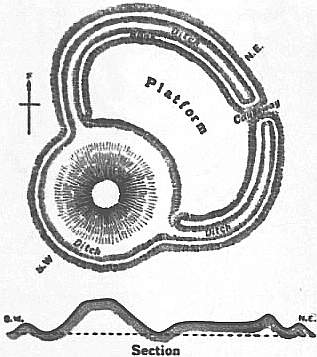
From Clark’s Medieval Military Architecture, by permission of Bernard Quaritch. Fig. 1.—Plan of Laughton en-le-Morthen.
The word “castle” (castel) was introduced into English shortly before the Norman Conquest to denote a type of fortress, then new to the country, brought in by the Norman knights whom Edward the Confessor had sent for to defend Herefordshire against the inroads of the Welsh. Richard’s castle, of which the earthworks remain and which has given its name to a parish, was erected at this period on the border of Herefordshire and Shropshire by Richard Fitz Scrob. The essential feature of this type was a circular mound of earth surrounded by a dry ditch and flattened at the top. Around the crest of its summit was placed a timber palisade. This moated mound was styled in French motte (latinized mota), a word still common in French place-names. It is clearly depicted at the time of the Conquest in the Bayeux tapestry, and was then familiar on the mainland of western Europe. A description of this earlier castle is given in the life of John, bishop of Terouanne (Acta Sanctorum, quoted by G.T. Clark, Medieval Mil. Architecture):—“The rich and the noble of that region being much given to feuds and bloodshed, fortify themselves ... and by these strongholds subdue their equals and oppress their inferiors. They heap up a mound as high as they are able, and dig round it as broad a ditch as they can.... Round the summit of the mound they construct a palisade of timber to act as a wall.... Inside the palisade they erect a house, or rather a citadel, which looks down on the whole neighbourhood.” St John, bishop of Terouanne, died in 1130, and this castle of Merchem, built by “a lord of the town many years before” may be taken as typical of the practice of the 11th century. But in addition to the mound, the citadel of the fortress, there was usually appended to it a bailey or basecourt (and sometimes two) of semilunar or horseshoe shape, so that the mound stood à cheval on the line of the enceinte. The rapidity and ease with which it was possible to construct castles of this type made them characteristic of the Conquest period in England and of the Anglo-Norman settlements in Wales, Ireland and the Scottish lowlands. In later days a stone wall replaced the timber palisade and produced what is known as the shell-keep, the type met with in the extant castles of Berkeley, Alnwick and Windsor.
But the Normans introduced also two other types of castle. The one was adopted where they found a natural rock stronghold which only needed adaptation, as at Clifford, Ludlow, the Peak and Exeter, to produce a citadel; the other was a type wholly distinct, the high rectangular tower of masonry, of which the Tower of London is the best-known example, though that of Colchester was probably constructed in the 11th century also. But the latter type belongs rather to the more settled conditions of the 12th century when haste was not a necessity, and in the first half of which the fine extant keeps of Hedingham and Rochester were erected. These towers were originally surrounded by palisades, usually on earthen ramparts, which were replaced later by stone walls. The whole fortress thus formed was styled a castle, but sometimes more precisely “tower and castle,” the former being the citadel, and the latter the walled enclosure, which preserved more strictly the meaning of the Roman castellum.
Reliance was placed by the engineers of that time simply and solely on the inherent strength of the structure, the walls of which defied the battering-ram, and could only be undermined at the cost of much time and labour, while the narrow apertures were constructed to exclude arrows or flaming brands.
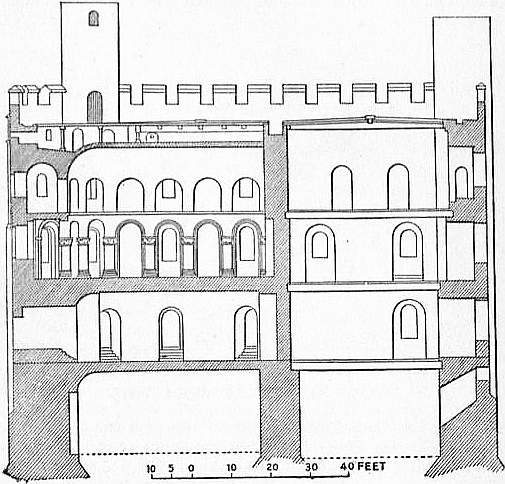
Fig. 2.—Vertical section of rectangular Norman Keep (Tower of London).
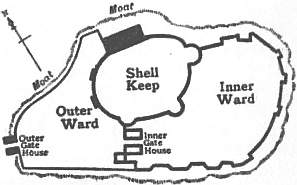
From Oman’s History of the Art of War, by permission of Methuen & Co. Fig. 3.—Berkeley Castle, late Norman Shell-Keep.
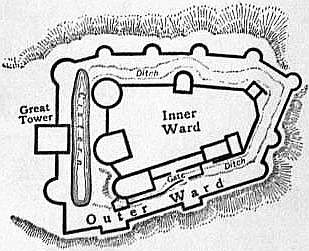
From Oman’s History of the Art of War. Fig. 4.—Krak-des-Chevaliers: Plan.
At this stage the crusades, and the consequent opportunities afforded to western engineers of studying the solid fortresses of the Byzantine empire, revolutionized the art of castle-building, which henceforward follows recognized principles. Many castles were built in the Holy Land by the crusaders of the 12th century, and it has been shown (Oman, Art of War: the Middle Ages, p. 529) that the designers realized, first, that a second line of defences should be built within the main enceinte, and a third line or keep inside the second line; and secondly, that a wall must be flanked by projecting towers. From the Byzantine engineers, through the crusaders, we derive, therefore, the cardinal principle of the mutual defence of all the parts of a fortress. The donjon of western Europe was regarded as the fortress, the outer walls as accessory defences; in the East each envelope was a fortress in itself, and the keep became merely the last refuge of the garrison, used only when all else had been captured. Indeed the keep, in several crusader castles, is no more than a tower, larger than the rest, built into the enceinte and serving with the rest for its flanking defence, while the fortress was made strongest on the most exposed front. The idea of the flanking towers (which were of a type very different from the slight projections of the shell-keep and rectangular tower) soon penetrated to Europe, and Alnwick Castle (1140-1150) shows the influence of the new system. But the finest of all castles of the middle ages was Richard Coeur de Lion’s fortress of Château Gaillard (1197) on the Seine near Les Andelys. Here the innermost ward was protected by an elaborate system of strong appended defences, which included a strong tête-de-pont covering the Seine bridge (see Clark, i. 384, and Oman, p. 533). The castle stood upon high ground and consisted of three distinct enceintes or wards besides the keep, which was in this case merely a strong tower forming part of the innermost ward. The donjon was rarely defended à outrance, and it gradually sank in importance as the outer “wards” grew stronger. Round instead of rectangular towers were now becoming usual, the finest examples of their employment as keeps being at Conisborough in England and at Coucy in France. Against the relatively feeble siege artillery of the 13th century a well-built fortress was almost proof, but the mines and the battering ram of the attack were more formidable, and it was realized that corners in the stonework of the fortress were more vulnerable than a uniform curved surface. Château Gaillard fell to Philip Augustus in 1204 after a strenuous defence, and the success of the assailants was largely due to the wise and skilful employment of mines. An angle of the noble keep of Rochester was undermined and brought down by John in 1215.
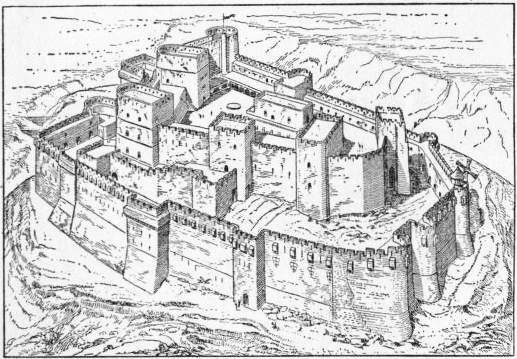
Fig. 5.—Krak-des-Chevaliers: View.
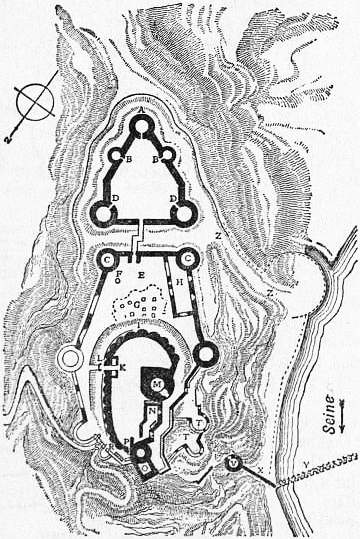
Fig. 6.—Château Gaillard.
A. High Angle Tower B.B. Smaller Side Towers C.C. D.D. Corner Towers E. Outer Enceinte, or Lower Court F. The Well G.H. Buildings in the Lower Court I. The Moat K. Entrance Gate L. The Counterscarp M. The Keep N. The Escarpment O. Postern Tower P. Postern Gate R.R. Parapet Walls S. Gate from the Escarpment T.T. Flanking Towers V. Outer Tower X. Connecting Wall Y. The Stockade in the River Z.Z. The Great Ditches
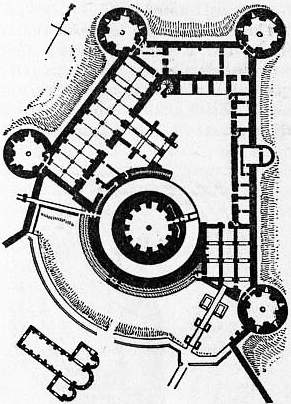
Fig. 7.—Coucy: Plan.
The next development was the extension of the principle of successive lines of defence to form what is called the “concentric” castle, in which each ward was placed wholly within another which enveloped it; places thus built on a flat side (e.g. Caerphilly Castle) became for the first time more formidable than strongholds perched upon rocks and hills such as Château Gaillard, where the more exposed parts indeed possessed many successive lines of defence, but at other points, for want of room, it was impossible to build more than one or, at most, two walls. In these cases, the fall of the inner ward by surprise, escalade, vive force, or even by regular siege (as was sometimes feasible), entailed the fall of the whole castle.
The adoption of the concentric system precluded any such mischance, and thus, even though siege-engines improved during the 13th and 14th centuries, the defence, by the massive strength of the concentric castle in some cases, by natural inaccessibility of position in others, maintained itself superior to the attack during the latter middle ages. Its final fall was due to the introduction of gunpowder as a propellant. “In the 14th century the change begins, in the 15th it is fully developed, in the 16th the feudal fastness has become an anachronism.”
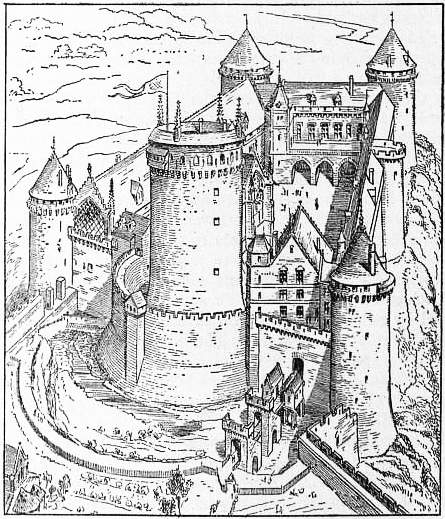
Fig. 8.—Coucy: View.
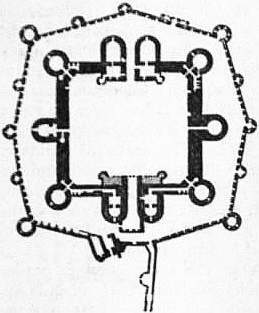
From Clark’s Med. Mil. Arch. Fig. 9.—Beaumaris Castle: Plan.
The general adoption of cannon placed in the hands of the central power a force which ruined the baronial fortifications in a few days of firing. The possessors of cannon were usually private individuals of the middle classes, from whom the prince hired the matériel and the technical workmen. A typical case will be found in the history of Brandenburg and Prussia (Carlyle, Frederick the Great, bk. iii. ch. i.), the impregnable castle of Friesack, held by an intractable feudal noble, Dietrich von Quitzow, being reduced in two days by the elector Frederick. I. with “Heavy Peg” (Faule Grete) and other guns hired and borrowed (February 1414). The beginnings of orderly government in Brandenburg thus depended upon the guns, and the taking of Friesack is, in Carlyle’s phrase, “a fact memorable to every Prussian man.” In England, the earl of Warwick in 1464 reduced the strong fortress of Bamborough in a week, and in Germany, Franz von Sinkingen’s stronghold of Landstuhl, formerly impregnable on its heights, was ruined in one day by the artillery of Philip of Hesse (1523). Very heavy artillery was used for such work, of course, and against lighter natures, some castles and even fortified country-houses or castellated mansions managed to make a stout stand even as late as the Great Rebellion in England.
The castle thus ceases to be the fortress of small and ill-governing local magnates, and its later history is merged in that of modern fortification. But an interesting transitional type between the medieval stronghold and the modern fortress is found in the coast castles erected by Henry VIII., especially those at Deal, Sandown and Walmer (c. 1540), which played some part in the events of the 17th century, and of which Walmer Castle is still the official residence of the lord warden of the Cinque Ports. Viollet-le-Duc, in his Annals of a Fortress (English trans.), gives a full and interesting account of the repeated renovations of the fortress on his imaginary site in the valley of the Doubs, the construction by Charles the Bold of artillery towers at the angles of the castle, the protection of the masonry by earthen outworks, boulevards and demi-boulevards, and, in the 17th century, the final service of the medieval walls and towers as a pure enceinte de sûreté. Here and there we find old castles serving as forts d’arrêt or block-houses in mountain passes and defiles, and in some few cases, as at Dover, they formed the nucleus of purely military places of arms, but normally the castle falls into ruins, becomes a peaceful mansion, or is merged in the fortifications of the town which has grown up around it. In the Annals of a Fortress the site of the feudal castle is occupied by the citadel of the walled town, for once again, with the development of the middle class and of commerce and industry, the art of the engineer came to be displayed chiefly in the fortification of cities. The baronial “castle” assumes pari passu the form of a mansion, retaining indeed for long some capacity for defence, but in the end losing all military characteristics save a few which survived as ornaments. Examples of such castellated mansions are seen in Wingfield Manor, Derbyshire, and Hurstmonceaux, Sussex, erected in the 15th century, and nearly all older castles which survived were continually improved and altered to serve as residences.
(C. F. A.)
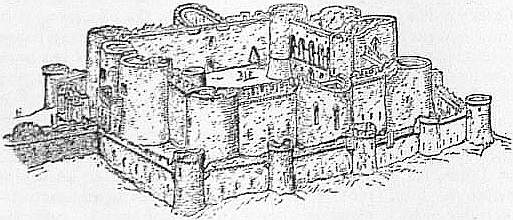
From Clark’s Med. Mil. Arch.
Fig 10.—Beaumaris Castle—View.
Influence of Castles in English History.—Such strongholds as existed in England at the time of the Norman Conquest seem to have offered but little resistance to William the Norman, who, in order effectually to guard against invasions from without as well as to awe his newly-acquired subjects, immediately began to erect castles all over the kingdom, and likewise to repair and augment the old ones. Besides, as he had parcelled out the lands of the English amongst his followers, they, to protect themselves from the resentment of the despoiled natives, built strongholds and castles on their estates, and these were multiplied so rapidly during the troubled reign of King Stephen that the “adulterine” (i.e. unauthorized) castles are said by one writer to have amounted to 1115.
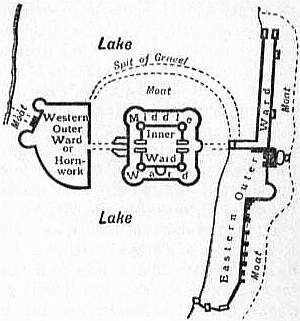
From Oman’s History of the Art of War. Fig. 11.—Caerphilly Castle. Plan.
In the first instance, when the interest of the king and of his barons was identical, the former had only retained in his hands the castles in the chief towns of the shires, which were entrusted to his sheriffs or constables. But the great feudal revolts under the Conqueror and his sons showed how formidable an obstacle to the rule of the king was the existence of such fortresses in private hands, while the people hated them from the first for the oppressions connected with their erection and maintenance. It was, therefore, the settled policy of the crown to strengthen the royal castles and increase their number, while jealously keeping in check those of the barons. But in the struggle between Stephen and the empress Maud for the crown, which became largely a war of sieges, the royal power was relaxed and there was an outburst of castle-building, without permission, by the barons. These in many cases acted as petty sovereigns, and such was their tyranny that the native chronicler describes the castles as “filled with devils and evil men.” These excesses paved the way for the pacification at the close of the reign, when it was provided that all unauthorized castles constructed during its course should be destroyed. Henry II., in spite of his power, was warned by the great revolt against him that he must still rely on castles, and the massive keeps of Newcastle and of Dover date from this period.
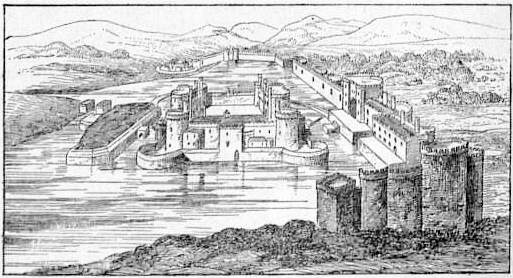
From Clark’s Med. Mil. Arch.
Fig. 12.—Caerphilly Castle. View.
Under his sons the importance of the chief castles was recognized as so great that the struggle for their control was in the forefront of every contest. When Richard made vast grants at his accession to his brother John, he was careful to reserve the possession of certain castles, and when John rose against the king’s minister, Longchamp, in 1191, the custody of castles was the chief point of dispute throughout their negotiations, and Lincoln was besieged on the king’s behalf, as were Tickhill, Windsor and Marlborough subsequently, while the siege of Nottingham had to be completed by Richard himself on his arrival. To John, in turn, as king, the fall of Château Gaillard meant the loss of Rouen and of Normandy with it, and when he endeavoured to repudiate the newly-granted Great Charter, his first step was to prepare the royal castles against attack and make them his centres of resistance. The barons, who had begun their revolt by besieging that of Northampton, now assailed that of Oxford as well and seized that of Rochester. The king recovered Rochester after a severe struggle and captured Tonbridge, but thenceforth there was a war of sieges between John with his mercenaries and Louis of France with his Frenchmen and the barons, which was specially notable for the great defence of Dover Castle by Hubert de Burgh against Louis. On the final triumph of the royal cause, after John’s death, at the battle of Lincoln, the general pacification was accompanied by a fresh issue of the Great Charter in the autumn of 1217, in which the precedent of Stephen’s reign was followed and a special clause inserted that all “adulterine” castles, namely those which had been constructed or rebuilt since the breaking out of war between John and the barons, should be immediately destroyed. And special stress was laid on this in the writs addressed to the sheriffs.
In 1223 Hubert de Burgh, as regent, demanded the surrender to the crown of all royal castles not in official custody, and though he succeeded in this, Falkes de Breauté, John’s mercenary, burst into revolt next year, and it cost a great national effort and a siege of nearly two months to reduce Bedford Castle, which he had held. Towards the close of Henry’s reign castles again asserted, in the Baron’s War, their importance. The Provisions of Oxford included a list of the chief royal castles and of their appointed castellans with the oath that they were to take; but the alien favourites refused to make way for them till they were forcibly ejected. When war broke out it was Rochester Castle that successfully held Simon de Montfort at bay in 1264, and in Pevensey Castle that the fugitives from the rout of Lewes were able to defy his power. Finally, after his fall at Evesham, it was in Kenilworth Castle that the remnant of his followers made their last stand, holding out nearly five months against all the forces of the crown, till their provisions failed them at the close of 1266.
Thus for two centuries after the Norman Conquest castles had proved of primary consequence in English political struggles, revolts and warfare. And, although, when the country was again torn by civil strife, their military importance was of small account, the crown’s historic jealousy of private fortification was still seen in the need to obtain the king’s licence to “crenellate” (i.e. embattle) the country mansion.
Bibliography.—G.T. Clark, Medieval Military Architecture in England (2 vols.), includes a few French castles and is the standard work on the subject, but inaccurate and superseded on some points by recent research; Professor Oman’s Art of War in the Middle Ages is a wide survey of the subject, but follows Clark in some of his errors; Mackenzie, The Castles of England (1897), valuable for illustrations; Deville, Histoire du Château-Gaillard (1829) and Château d’Argues (1839); Viollet-le-Duc’s Essay on the Military Architecture of the Middle Ages was translated by M. Macdermott in 1860. More recent studies will be found in J.H. Round’s Geoffrey de Mandeville (1891); “English Castles” (Quarterly Review, July 1894); and “Castles of the Conquest” (Archeologia, lviii., 1902); St John Hope’s “English Castles of the 10th and 11th Centuries” (Archaeol. Journal, lx., 1902); Mrs Armitage’s “Early Norman Castles of England” (Eng. Hist. Review, xix. 1904), and her papers in Scot. Soc. Ant. Proc. xxxiv., and The Antiquary, July, August, 1906; G. Neilson’s “The Motes in Norman Scotland” (Scottish Review, lxiv., 1898); G.H. Orpen, “Motes and Norman Castles in Ireland” (Eng. Hist. Review, xxi., xxii., 1906-1907).
(J. H. R.)
CASTLEBAR, a market town and the county town of Co. Mayo, Ireland, in the west parliamentary division, on the river and near the lough of the same name, on the Manulla and Westport branch of the Midland Great Western railway. Pop. of urban district (1901) 3585. The county court buildings and other public offices occupy a square, and there is a pleasant mall shaded by fine trees. There are some breweries, and trade in linens and agricultural produce. The castle, which gives its name to the town, was a fortress of the De Burgh family; but the town itself was founded in the reign of James I., and received a charter from him in 1613. In 1641 the castle was held for the parliament by Sir Henry Bingham, but he was forced to surrender to Lord Mayo, and fell a victim, with all his garrison, to the fury and treachery of the besiegers. The massacre was afterwards avenged in 1653 by the execution of Sir Theobald Burke (by that time Lord Mayo), who had been in command along with his father at the siege. In 1798 the town was occupied for some weeks by the French under General J.J. Humbert, who had defeated the English under Luke Hutchison in a conflict which is jocularly styled the “Castlebar Races.” The town returned two members to the Irish parliament until the Union. Four miles N.E. of Castlebar is Turlough, with a round tower 70 ft. high and 57 ft. in circumference, and other remains.
CASTLECONNELL, a village of Co. Limerick, Ireland, on the left bank of the Shannon, 8 m. N.E. of Limerick on the Great Southern & Western railway. It possesses a spa which was once considerably frequented, but is famous as a centre for the salmon fishing on the lower Shannon. Castleconnell is so intimately connected with this sport that it has given its name to a favourite pattern of fly-rod, in which a movable splice takes the place of the usual metal joint. The beautiful rapids of Doonas (avoided by a canal) are in the neighbourhood, and the surrounding scenery is generally attractive. There are remains of a castle from which the town took its name, which was the seat of the kings of Thomond, and was blown up by General Ginkel at the time of the siege of Limerick (1690).
CASTLE DONINGTON, a town in the Loughborough parliamentary division of Leicestershire, England, 123½ m. N.N.W. from London, on the Trent Junction and Western branch of the Midland railway. Pop. (1901) 2514. It lies on the flank of the hills overlooking the Trent and Soar valleys. There are slight remains of the castle. The church of St Luke is a fine building of Early English and later date. Donington Park, a neighbouring mansion, was offered to refugees during the French Revolution in 1830, and Charles X. availed himself of this retreat. Hosiery, silk and baskets are manufactured. Castle Donington is 2½ m. west of Kegworth station on the Midland main line. Kegworth (pop. 2078), on the Soar, has a hosiery and knitting industry.
CASTLE DOUGLAS, a burgh of barony and police burgh of Kirkcudbrightshire, Scotland. Pop. (1901) 3018. It is situated on Carlingwark Loch, 19½ m. S.W. of Dumfries by the Glasgow & South-Western railway. Its auction marts for sheep and cattle sales are the largest in the south-west of Scotland; at an autumn sale as many as 15,000 sheep and 1400 cattle are disposed of in one day. The leading industries comprise the making of agricultural implements and mineral waters, besides tanning. The Macmillan Free Church perpetuates the memory of John Macmillan (d. 1753), the Cameronian, who helped to found the Reformed Presbyterian Church. He had been chaplain to Murray of Broughton, and afterwards became minister of Balmaghie, about 3½ m. N.W. of Castle Douglas. The town is the chief centre of business in East Galloway, and it is also resorted to in midsummer for its beautiful scenery and excellent fishing. Till 1765 it was only a village under the name of Causewayhead, but the discovery of marl in the lake brought it some prosperity, and it was purchased in 1792 by Sir William Douglas and called after him. Since then its progress has been continuous. Carlingwark Loch contains several islets, on one of which is a crannog, or ancient lake dwelling.
CASTLEFORD, an urban district in the Osgoldcross parliamentary division of the West Riding of Yorkshire, England, on the river Aire near its junction with the Calder, 9 m. S.E. of Leeds, on the North-Eastern and Lancashire & Yorkshire railways. Pop. (1901) 17,386. Large glass-bottle and earthenware-jar works, chemical works, and neighbouring collieries employ the inhabitants. Here was the Roman village or fort of Lagecium or Legeolium; and though visible remains are wanting, a number of relics have been discovered.
CASTLE-GUARD, an arrangement under the feudal system, by which the duty of finding knights to guard royal castles was imposed on certain baronies, and divided among their knight’s fees. The greater barons provided for the guard of their castles by exacting a similar duty from their knights. In both cases the obligation was commuted very early for a fixed money payment, which, as “castle-guard rent” lasted on to modern times.
See J.H. Round, “Castle-Guard,” in Archaeological Journal, vol. lix., and “Castle-ward and Coinage,” in The Commune of London.
(J. H. R.)
CASTLEMAINE, a town of Talbot county, Victoria, Australia, 78 m. by rail N.N.W. of Melbourne. Pop. (1901) 5704. The gold-mines here were among the first discovered in the colony, and dredging for gold is carried on in Barker’s and Forrest creeks, at the junction of which the town stands. Slate and flagstone are largely quarried in the district, which also produces wine and much fruit, especially apples. Castlemaine has a reputation as a health resort in cases of pulmonary complaints.
CASTLE RISING, a village of Norfolk, England, 4 m. by road N.E. of King’s Lynn. The Norman castle for which it is famous stands on slightly elevated ground overlooking, to the west, the low marshy coast of the Wash. Its site is enclosed by artificial ramparts of earth and a dyke which is crossed by an ancient bridge. The keep is square and massive, and fairly perfect, and it is not difficult to reconstruct the arrangement of the rooms. In some parts, especially the entrance, the Norman carving is very rich. The foundations of a small chapel with apsidal eastern termination have been discovered outside the castle. The village of Castle Rising is the decayed remnant of a town of no little importance. Its church of St Laurence is late Norman, with much rich ornamentation; it shows traces of considerable alterations in the Early English period, but is an admirable example of the earlier style.
It is a matter of dispute whether Rising was or was not an early Saxon settlement; in Domesday Book the manor is given as having belonged to Archbishop Stigand, from whom it had passed to Odo of Bayeux, whose estates were confiscated in 1088. Granted to William de Albini, whose son built Rising Castle, it passed first to Robert de Montalt, and then by sale to Isabel, queen of England, in 1332, remaining in the possession of the crown until Henry VIII. exchanged it for other lands with the duke of Norfolk. In 1269 an inquisition found that the lord had the return of all writs. In 1275 Robert de Montalt died seised of the manor and vill with the assize of bread and ale. An inquisition of 1379, although it makes no mention of the borough, states that the lord has the rents of assizes, and perquisites of the courts with view of frank-pledge. A mayor is first mentioned in 1343, and a borough existed in the 15th century. A survey of 1589-1590 declared that Castle Rising was an ancient borough by prescription according to the grant made to Hugh de Albini by Henry III. In 1589-1590 the recorder was chosen by the lord of the manor. The mayor, the only member of the corporation, whose sole duty was the holding of the assize of bread and ale, was chosen by the burgesses and presented at the court leet for confirmation. Castle Rising became a parliamentary borough in 1558, but was disfranchised in 1832 and the corporation abolished in 1835, although a mayor was elected for special purposes until 1883. Having no manufactures, the trade of the town depended entirely on its fairs and markets; but these have been long obsolete.
CASTLETON, a village in the High Peak parliamentary division of Derbyshire, England, 17 m. W.S.W. of Sheffield, and 2 m. from Hope station on a branch of the Midland railway. Pop. (1901) 547. Lying itself at an elevation of about 600 ft., it is surrounded on the north, west and south by hills from 1400 to 1700 ft. in height, rising sharply, and in parts precipitously. The village is celebrated for its situation in the midst of the wild Peak country, for the caves and mines in the neighbourhood, and for the Castle of the Peak, the ruins of which are strongly placed on a cliff immediately above the village. The Peak Cavern or Devil’s Hole, penetrating this cliff, is the most magnificent in Derbyshire. For many generations the entrance to this cave has served as a workshop, held free of rent, to families employed in rope and twine making. Speedwell Cavern is not far distant, at the entrance to the fine pass of Winnats, by which Castleton and the Vale of Hope are approached from the west. The beauties of this cavern, in which occurs the so-called bottomless pit, are in part readily accessible by boat, but the approach to the inner or Cliff cavern is so difficult that it has rarely been explored. Among several other caves is that known as the Blue John Mine, from the decorative fluorspar called “Blue John” which is obtained here. The church of St Edmund, Castleton, retains a fine Norman chancel arch, and the vestry contains a valuable library. At Brough near Castleton was a Roman fort, established to hold in check the hillmen of the Peak. It was connected by roads with Buxton, Manchester and Rotherham. The Castle of the Peak, or Peveril Castle, is famous through Sir Walter Scott’s novel Peveril of the Peak. Early earthworks, which, extending from below the castle in a semicircle, enclosed the town, can still in great part be traced. Before the Conquest the site was held by Gernebern and Hundinc, and was granted by the Conqueror to William Peverell, by whom the castle was built. On the forfeiture of William Peverell, grandson of the first holder, it was granted by Henry II. to Prince John who, in 1204, made Hugh Nevill governor of the castle. In 1216 William Ferrers, earl of Derby, took it from the rebellious barons, and was made governor by Henry III., who in 1223 granted a charter for a weekly market at the town. In 1328 the castle was given to John of Gaunt on his marriage with Blanche of Lancaster, and thus became parcel of the duchy of Lancaster. The castle has often been used as a prison, and from its position was almost impregnable.
CASTLETOWN (Manx, Bully Cashtel), a town of the Isle of Man, 10 m. S.W. of Douglas, by the Isle of Man railway. Pop. (1901) 1975. It is picturesquely situated on both sides of a small harbour formed by the outflow of the Silver Burn into Castletown Bay. It was the legal capital of the island until 1862. In the centre of the town stands Castle Rushen, which is said to owe its foundation to the Danish chief, Guthred, in 947-960, though the existing building, which is remarkably well preserved, probably dates from the 14th century. Until the 18th century it was the residence of the lords of Man, and until 1891 served as a prison. The massive keep is square, and is surrounded by an outer wall, with towers and a moat. The council chamber and court-house were built in 1644. In the neighbourhood of the castle is the old House of Keys, where the members of the Manx parliament held their sessions until the removal of the seat of government to Douglas. A lofty Doric column commemorates Cornelius Smelt, lieutenant-governor of the island (d. 1832), near which there is a remarkable sun-dial with thirteen faces, dating from 1720. King William’s College, situated a mile to the north-east of the town, was opened in 1833; but a complete restoration was rendered necessary by fire in 1844, and it was subsequently enlarged. It is the chief educational establishment in the island. At Hango Hill near the town William Christian, receiver-general, who had surrendered the castle, and with it the island, to the parliamentary forces in 1651, was executed in 1663 at the instance of the countess of Derby, who had undertaken to defend it for the king. A small shipping trade is maintained.
CASTOR and POLLUX (Gr. Πολυδεύκης), in Greek and Roman mythology, the twin sons of Leda, and brothers of Helen and Clytaemnestra. They were also known under the name of Dioscuri (Διόσκοροι, later Διόσκουροι, children of Zeus), for, according to later tradition, they were the children of Zeus and Leda, whose love the god had won under the form of a swan. In some versions Leda is represented as having brought forth two eggs, from one of which were born Castor and Pollux, from the other Helen. In another account, Zeus is the father of Pollux and Helen, Tyndareus (king of Sparta) of Castor and Clytaemnestra. In Homer, Castor, Pollux and Clytaemnestra are said to be the children of Tyndareus and Leda, Helen the daughter of Leda by Zeus. The Dioscuri were specially reverenced among people of Dorian race, and were said to have reigned at Sparta, where also they were buried. They were also worshipped, especially in Athens, as lords and protectors (ἄνακες, ἄνακτες). Sailors in a storm prayed to them (Horace, Odes, i. 3) and sacrificed a white lamb, whereupon they were wont to appear in the form of fire at the masthead (probably referring to the phenomenon of St Elmo’s fire), and the storm ceased. Later, they were confounded with the Samothracian Cabeiri. In battle they appeared riding on white horses and gave victory to the side they favoured. They were the patrons of hospitality, and founded the sacred festival called Theoxenia. They presided over public games, Castor especially as the horse-tamer, Pollux as the boxer; but both are represented as riding on horseback or driving in a chariot. In Sparta their ancient symbol was two parallel beams δόκανα connected by cross-bars, which the Spartans took with them into the field (Plutarch, De Fraterno Amore, 1; Herodotus v. 75); later, they were represented by two amphorae with snakes twined round them. Their most important exploits were the invasion of Attica, to rescue their sister Helen from Theseus; their share in the hunting of the Calydonian boar (see Meleager) and the Argonautic expedition, and their battle with the sons of Aphareus, brought about by a quarrel in regard to some cattle, in which Castor, the mortal (as the son of Tyndareus), fell by the hand of Idas. Pollux, finding him dead after the battle, implored Zeus to be allowed to die with him; this being impossible by reason of his immortality, Pollux was permitted to spend alternately one day among the gods, the other in Hades with his brother. According to another fable, the god marked his approval of their love by placing them together in the sky, as the Twins or the morning and evening star (Hyginus, Poet. Astronom. ii. 22). Like the Asvins of the Veda, the bringers of light in the morning sky, with whom they have been identified, the Dioscuri are represented as youthful horsemen, naked or wearing only a light chlamys. Their characteristic attribute is a pointed egg-shaped cap, surmounted by a star.
Though their worship was perhaps most carefully observed among people of Dorian origin, Castor and Pollux were held in no small veneration at Rome. It was the popular belief in that city from an early period that the battle of Lake Regillus had been decided by their interposition (Dion. Halic. vi. 13). They had fought, it was said, armed and mounted, at the head of the legions of the commonwealth, and had afterwards carried the news of the victory with incredible speed to the city. The well in the Forum at which they alighted was pointed out, and near it rose their ancient temple, in which the senate often held its sittings. On the 15th of July, the supposed anniversary of the battle, a great festival with sumptuous sacrifices was celebrated in their honour, and a solemn parade of the Roman knights (transvectio equitum), who looked upon the Dioscuri as their patrons, took place. (Apollodorus iii. 10. 7, 11. 2; Homer, Odyssey, xi. 299; Hyginus, Fab. 77. 155; Pindar, Nem. x. 60, 80 and schol.; Diod. Sic. iv. 43; Plutarch, Theseus, 32, 33; Theocritus, Idyll, xxii.)
See Maurice Albert, Le Culte de Castor et Pollux en Italie (1883), with special descriptions and representations in art, on coins, vases and statues; S. Eitrem, “Die göttlichen Zwillinge bei den Griechen” (treating of the divine beings mentioned in pairs in Greek mythology), in Videnskabs-Selskab Skrifter (Christiania, 1902); W.R. Paton, De Cultu Dioscurorum apud Graecos (Bonn, 1894); L. Myriantheus, Açvins oder arische Dioskuren (Munich, 1876); J.R. Harris, The Dioscuri in the Christian Legends (1903), and The Cult of the Heavenly Twins (1906); W. Helbig, “Die Castores als Schutzgötter des römischen Equitatus,” in Hermes, xl. (1905); C. Jaisle, Die Dioskuren als Retter zur See bei Griechen und Romern, und ihr Fortleben in christlichen Legenden (Tübingen, 1907); L. Preller, Griechische und römische Mythologie; articles by A. Furtwängler in Roscher’s Lexikon der Mythologie, and by M. Albert in Daremberg and Saglio’s Dictionnaire des antiquités.
CASTOR OIL, the fixed oil obtained from the seeds of the castor oil plant or Palma Christi, Ricinus communis, belonging to the natural order Euphorbiaceae. The botanical name is from Lat. ricinus, a tick, from the form and markings of the seed. The plant is a native of tropical Africa, but it has been introduced, and is now cultivated in most tropical and in the warmer temperate countries. In size it varies from a shrubby plant to a tree of from 30 to 40 ft. in height according to the climate in which it grows, being arborescent in tropical latitudes. On account of its very large beautiful palmate-peltate leaves, which sometimes measure as much as 2 ft. in diameter, it is cultivated as an ornamental plant. In the south of England, with the habit of an annual, it ripens its seeds in favourable seasons; and it has been known to come to maturity as far north as Christiania in Norway. Plants are readily grown from seed, which should be sown singly in small pots and placed in heat early in March. The young plants are kept under glass till early in June when they are hardened and put out. The fruit consists of a three-celled capsule, covered externally with soft yielding prickles, and each cell develops a single seed. The seeds of the different cultivated varieties, of which there are a great number, differ much in size and in external markings; but average seeds are of an oval laterally compressed form, with their longest diameter about four lines. They have a shining, marble-grey and brown, thick, leathery outer coat, within which is a thin dark-coloured brittle coat. A large distinct leafy embryo lies in the middle of a dense, oily tissue (endosperm). The seeds contain a toxic substance, which makes them actively poisonous; so much so that three have been known to kill an adult.
The oil is obtained from the seeds by two principal methods—expression and decoction—the latter process being largely used in India, where the oil, on account of its cheapness and abundance is extensively employed for illuminating as well as for other domestic and medicinal purposes. The oil exported from Calcutta to Europe is prepared by shelling and crushing the seeds between rollers. The crushed mass is then placed in hempen cloths and pressed in a screw or hydraulic press. The oil which exudes is mixed with water and heated till the water boils, and the mucilaginous matter in the oil separates as a scum. It is next strained, then bleached in the sunlight, and stored for exportation. A considerable quantity of castor oil of an excellent quality is also made in Italy; and in California the manufacture is conducted on an extensive scale. The following is an outline of the process adopted in a Californian factory. The seeds are submitted to a dry heat in a furnace for an hour or thereby, by which they are softened and prepared to part easily with their oil. They are then pressed in a large powerful screw-press, and the oily matter which flows out is caught, mixed with an equal proportion of water, and boiled to purify it from mucilaginous and albuminous matter. After boiling about an hour, it is allowed to cool, the water is drawn off, and the oil is transferred to zinc tanks or clarifiers capable of holding from 60 to 100 gallons. In these it stands about eight hours, bleaching in the sun, after which it is ready for storing. By this method 100 ℔ of good seeds yield about 5 gallons of pure oil.
Castor oil is a viscid liquid, almost colourless when pure, possessing only a slight odour, and a mild yet highly nauseous and disagreeable taste. Its specific gravity is .96, a little less than that of water, and it dissolves freely in alcohol, ether and glacial acetic acid. It contains palmitic and several other fatty acids, among which there is one—ricinoleic acid—peculiar to itself. This occurs in combination with glycerin, constituting the greater part of the bulk of the oil.
The active principle to which the oil owes its purgative properties has not been isolated. It is, indeed, probable that it is formed in the intestine, as a result of some decomposition as yet unknown. The dose is from a drachm to an ounce. The pharmacopoeial mixture is best avoided, being almost uniquely nauseous. By far the best way to administer the oil is in capsules. It acts in about five hours, affecting the entire length of the bowel, but not increasing the flow of bile except in very large doses. The mode of its action is unknown. The oil will purge when rubbed into the skin or injected per rectum. It is an invaluable drug in temporary constipation and whenever a mild action is essential, as in pregnancy. It is extremely useful for children and the aged, but must not be employed in cases of chronic constipation, which it only aggravates, whilst relieving the symptoms.
CASTRÉN, MATTHIAS ALEXANDER (1813-1853), Finnish ethnologist and philologist, was born at Tervola, in the parish of Kemi in Finland, on the 20th of November (December 2, 1813). His father, Christian Castrén, parish minister at Rovaniemi, died in 1825; and Matthias passed under the protection of his uncle, Mathias Castrén, the kindly and learned incumbent of Kemi. At the age of twelve he was sent to school at Uleåborg, and there he helped to maintain himself by teaching the younger children. On his removal to the Alexander University at Helsingfors in 1830, he first devoted himself to Greek and Hebrew with the intention of entering the church; but his interest was soon excited by the language of his native country, and he even began before his course was completed to lay the foundations of a work on Finnish mythology. The necessity of personal explorations among the still unwritten languages of cognate tribes soon made itself evident; and in 1838 he joined a medical fellow-student, Dr. Ehrstrom, in a journey through Lapland. In the following year he travelled in Russian Karelia at the expense of the Literary Society of Finland; and in 1841 he undertook, in company with Dr Elias Lonnrot, the great Finnish philologist, a third journey, which ultimately extended beyond the Ural as far as Obdorsk, and occupied a period of three years. Before starting on this last expedition he had published a translation into Swedish of the Finnish epic of Kalevala; and on his return he gave to the world his Elementa grammatices Syrjaenae and Elementa grammatices Tscheremissae, 1844. No sooner had he recovered from the illness which his last journey had occasioned than he set out, under the auspices of the Academy of St Petersburg and the Helsingfors University, on an exploration of the whole government of Siberia, which resulted in a vast addition to previous knowledge, but seriously affected the health of the adventurous investigator. The first-fruits of his collections were published at St Petersburg in 1849 in the form of a Versuch einer ostjakischen Sprachlehre. In 1850 he published a treatise De affixis personalibus linguarum Altaicarum, and was appointed professor at Helsingfors of the new chair of Finnish language and literature. The following year saw him raised to the rank of chancellor of the university; and he was busily engaged in what he regarded as his principal work, a Samoyedic grammar, when he died on the 7th of May 1853.
Five volumes of his collected works appeared from 1852 to 1858, containing respectively—(1) Reseminnen från åren 1838-1844; (2) Reseberaitelser och bref åren 1845-1849; (3) Forelasningar i Finsk mythologi; (4) Ethnologiska forelasningar ofver Altaiska folken; and (5) Smarre afhandlingar och akademiska dissertationer. A German translation was published by Anton Schiefner, who was also entrusted by the St Petersburg Academy with the editing of his manuscripts which had been left to the Helsingfors University and which were subsequently published.
CASTRENSIS, PAULUS, an Italian jurist of the 14th century. He studied under Baldus at Perugia, and was a fellow-pupil with Cardinal Zabarella. He was admitted to the degree of doctor of civil law in the university of Avignon, but it is uncertain when he first undertook the duties of a professor. A tradition, which has been handed down by Panzirolus, represents him as having taught law for a period of fifty-seven years. He was professor at Vienna in 1390, at Avignon in 1394, and at Padua in 1429; and, at different periods, at Florence, at Bologna and at Perugia. He was for some time the vicar-general of Cardinal Zabarella at Florence, and his eminence as a teacher of canon law may be inferred from the language of one of his pupils, who styles him “famosissimus juris utriusque monarca.” His most complete treatise is his readings on the Digest, and it appears from a passage in his readings on the Digestum Vetus that he delivered them at a time when he had been actively engaged for forty-five years as a teacher of civil law. His death is generally assigned to 1436, but it appears from an entry in a MS. of the Digestum Vetus, which is extant at Munich, made by the hand of one of his pupils who styles him “praeceptor meus,” that he died on the 20th of July 1441.
CASTRES, a town of south-western France, capital of an arrondissement in the department of Tarn, 29 m. S.S.E. of Albi on a branch line of the Southern railway. Pop. (1906) town, 19,864; commune, 28,272. Castres, the busiest and most populous town of its department, is intersected from north to south by the Agout; the river is fringed by old houses the upper stories of which project over its waters. Wide boulevards traverse the west of the town, which is also rendered attractive by numerous fountains fed by a fine aqueduct hewn in the rock. The church of St Benoît, once a cathedral, and the most important of the churches of Castres, dates only from the 17th and 18th centuries. The hôtel de ville, which contains a museum and the municipal library, occupies the former bishop’s palace, designed by Jules Mansart in the 17th century; the Romanesque tower beside it is the only survival of an old Benedictine abbey. The town possesses some old mansions of which the hôtel de Nayrac, of the Renaissance, is of most interest. Castres has a sub-prefecture, tribunals of first instance and of commerce, a board of trade-arbitrators, a chamber of commerce, a branch of the bank of France and two hospitals. There are also communal colleges for boys and girls, a school of artillery and school of draughtsmanship. The industrial establishments include manufactories of earthenware and porcelain and metal-foundries, and tanning, leather-dressing, turnery, the making of wooden shoes and furniture, the weaving of woollen and other fabrics, dyeing, and the manufacture of machinery, paper and parchment are carried on.
Castres grew up round a Benedictine abbey, which is believed to have been founded in the 7th century. It was a place of considerable importance as early as the 12th century, and ranked as the second town of the Albigenses. During the Albigensian crusade it surrendered of its own accord to Simon de Montfort; and in 1356 it was raised to a countship by King John of France. On the confiscation of the possessions of the D’Armagnac family, to which it had passed, it was bestowed by Louis XI. on Boffilo del Giudice, but the appointment led to so much disagreement that the countship was united to the crown by Francis I. in 1519. In the wars of the latter part of the 16th century the inhabitants sided with the Protestant party, fortified the town, and established an independent republic. They were brought to terms, however, by Louis XIII., and forced to dismantle their fortifications; and the town was made the seat of the chambre de l’édit, or chamber for the investigation of the affairs of the Protestants, afterwards transferred to Castelnaudary (in 1679). The bishopric of Castres, which had been established by Pope John XXII. in 1317, was abolished at the Revolution.
CASTRO, INEZ DE (d. 1355), mistress, and perhaps wife, of Peter I. (Pedro), king of Portugal, called Collo de Garza, i.e. “Heron’s Neck,” was born in Spanish Galicia, in the earlier years of the 14th century. Tradition asserts that her father, Don Pedro Fernandez de Castro, and her mother, Dona Aldonça Soares de Villadares, a noble Portuguese lady, were unmarried, and that Inez and her two brothers were consequently of bastard birth. Educated at the semi-Oriental provincial court of Juan Manuel, duke of Peñafiel, Inez grew up side by side with Costança, the duke’s daughter by a scion of the royal house of Aragon, and her own cousin. After refusing several crowned heads in marriage, Costança was at last persuaded to accept the hand of the infante Dom Pedro, son of Alphonso the Proud, king of Portugal. In 1341 the two girls left Peñafiel; Costança’s marriage was celebrated in the same year, and the young infanta and her cousin went to reside at Lisbon, or at Coimbra, where Dom Pedro conceived that luckless and furious passion for Inez which has immortalized them.
The morality of the age was lax, and more especially so in Spain and Portugal, where the looseness of the marriage tie and the example of the Moors encouraged polygamy. Pedro’s connexion par amours with Inez would of itself have aroused no opposition. He might even have married her, after the death of his wife in childbirth in 1345. According to his own assurance he did marry her in 1354. But by that time the rising power of the Castro family had created the most brutal hatred among their rivals, both in Spain and Portugal. Alvaro Gonzales, Pedro Coelho, and Diogo Lopes Pacheco persuaded the king, Alphonso, that his throne was in danger from an alliance between his son and the Castros, and with all the brutality of the age they urged the king to remove the danger by murdering the poor woman. The old king listened, refused, wavered and ended by yielding. He went in secret to the palace at Coimbra, where Inez and the infante resided, accompanied by his three familiars, and by others who agreed with them. The beauty and tears of Inez disarmed his resolution, and he turned to leave her; but the gentlemen about him had gone too far to recede. Inez was stabbed to death and was buried immediately in the church of Santa Clara.