Front matter (continued 9)
Reading edition
The clinical history of a severe burn can be divided into three periods. The first period lasts from 36 to 48 hours, during which time the patient lies in a condition of profound shock, and consequently feels little or no pain. If death results from shock, coma first supervenes, which deepens steadily until the end comes. The second period begins when the effects of shock pass, and continues until the slough separates, this usually taking from seven to fourteen days. Considerable fever is present, and the tendency to every kind of complication is very great. Bronchitis, pneumonia, pleurisy, meningitis, intestinal catarrh, and even ulceration of the duodenum, have all been recorded. Hence both nursing and medical attendance must be very close during this time. It is probable that these complications are all the result of septic infection and absorption, and since the modern antiseptic treatment of burns they have become much less common. The third period is prolonged until recovery takes place. Death may result from septic absorption, or from the wound becoming infected with some organism, as tetanus, erysipelas, &c. The prognosis depends chiefly on the extent of skin involved, death almost invariably resulting when one-third of the total area of the body is affected, however superficially. Of secondary but still grave importance is the position of the burn, that over a serous cavity making the future more doubtful than one on a limb. Also it must be remembered that children very easily succumb to shock.
In treating a patient the condition of shock must be attended to first, since from it arises the primary danger. The sufferer must be wrapped immediately in hot blankets, and brandy given by the mouth or in an enema, while ether can be injected hypodermically. If the pulse is very bad a saline infusion must be administered. The clothes can then be removed and the burnt surfaces thoroughly cleansed with a very mild antiseptic, a weak solution of lysol acting very well. If there are blisters these must be opened and the contained effusion allowed to escape. Some surgeons leave them at this stage, but others prefer to remove the raised epithelium. When thoroughly cleansed, the wound is irrigated with sterilized saline solution and a dressing subsequently applied. For the more superficial lesions by far the best results are obtained from the application of gauze soaked in picric acid solution and lightly wrung out, being covered with a large antiseptic wool pad and kept in position by a bandage. Picric acid 1½ drams, absolute alcohol 3 oz., and distilled water 40 oz., make a good lotion. All being well, this need only be changed about twice a week. The various kinds of oil once so greatly advocated in treating burns are now largely abandoned since they have no antiseptic properties. The deeper burns can only be attended to by a surgeon, whose aim will be first to bring septic absorption to a minimum, and later to hasten the healing process. Skin grafting has great value after extensive burns, not because it hastens healing, which it probably does not do, but because it has a marked influence in lessening cicatricial contraction. When a limb is hopelessly charred, amputation is the only course.
BURNSIDE, AMBROSE EVERETT (1824-1881), American soldier, was born at Liberty, Indiana, on the 23rd of May 1824, of Scottish pedigree, his American ancestors settling first in South Carolina, and next in the north-west wilderness, where his parents lived in a rude log cabin. He was appointed to the United States military academy through casual favour, and graduated in 1847, when war with Mexico was nearly over. In 1853 he resigned his commission, and from 1853 to 1858 was engaged in the manufacture of firearms at Bristol, R.I. In 1856 he invented a breech-loading rifle. He was employed by the Illinois Central railroad until the Civil War broke out. Then he took command of a Rhode Island regiment of three months militia, on the summons of Governor Sprague, took part in the relief of the national capital, and commanded a brigade in the first battle of Bull Run. On the 6th of August 1861 he was commissioned brigadier-general of volunteers, and placed in charge of the expeditionary force which sailed in January 1862 under sealed orders for the North Carolina coast. The victories of Roanoke Island, Newbern and Fort Macon (February—April) were the chief incidents of a campaign which was favourably contrasted by the people with the work of the main army on the Atlantic coast. He was promoted major-general U.S.V. soon afterwards, and early in July, with his North Carolina troops (IX. army corps), he was transferred to the Virginian theatre of war. Part of his forces fought in the last battles of Pope's campaign in Virginia, and Burnside himself was engaged in the battles of South Mountain and Antietam. At the latter he was in command of McClellan's left wing, but the want of vigour in his attack was unfavourably criticized. His patriotic spirit, modesty and amiable manners, made him highly popular, and upon McClellan's final removal (Nov. 7) from the Army of the Potomac, President Lincoln chose him as successor. The choice was unfortunate. Much as he was liked, no one had ever looked upon him as the equal of McClellan, and it was only with the greatest reluctance that he himself accepted the responsibility, which he had on two previous occasions declined. He sustained a crushing defeat at the battle of Fredericksburg (13 Dec. 1862), and (Jan. 27) gave way to Gen. Hooker, after a tenure of less than three months. Transferred to Cincinnati in March 1863, he caused the arrest and court-martial of Clement L. Vallandigham, lately an opposition member of Congress, for an alleged disloyal speech, and later in the year his measures for the suppression of press criticism aroused much opposition; he helped to crush Morgan's Ohio raid in July; then, moving to relieve the loyalists in East Tennessee, in September entered Knoxville, to which the Confederate general James Longstreet unsuccessfully laid siege. In 1864 Burnside led his old IX. corps under Grant in the Wilderness and Petersburg campaigns. After bearing his part well in the many bloody battles of that time, he was overtaken once more by disaster. The failure of the "Burnside mine" at Petersburg brought about his resignation. A year later he left the service, and in 1866 he became governor of Rhode Island, serving for three terms (1866-1869). From 1875 till his death he was a Republican member of the United States Congress. He was present with the German headquarters at the siege of Paris in 1870-71. He died at Bristol, Rhode Island, on the 13th of September 1881.
See B.P. Poore, Life and Public Services of Ambrose E. Burnside (Providence, 1882); A. Woodbury, Major-General Burnside and the Ninth Army Corps (Providence, 1867).
BURNTISLAND, a royal, municipal and police burgh of Fife, Scotland, on the shore of the Firth of Forth, 5¾ m. S.W. of Kirkcaldy by the North British railway. Pop. (1891) 4993; (1901) 4846. It is protected from the north wind by the Binn (632 ft.), and in consequence of its excellent situation, its links and sandy beach, it enjoys considerable repute as a summer resort. The chief industries are distilling, fisheries, shipbuilding and shipping, especially the export of coal and iron. Until the opening of the Forth bridge, its commodious harbour was the northern station of the ferry across the firth from Granton, 5 m. south. The parish church, dating from 1594, is a plain structure, with a squat tower rising in two tiers from the centre of the roof. The public buildings include two hospitals, a town-hall, music hall, library and reading room and science institute. On the rocks forming the western end of the harbour stands Rossend Castle, where the amorous French poet Chastelard repeated the insult to Queen Mary which led to his execution. In 1667 it was ineffectually bombarded by the Dutch. The burgh was originally called Parva Kinghorn and later Wester Kinghorn. The origin and meaning of the present name of the town have always been a matter of conjecture. There seems reason to believe that it refers to the time when the site, or a portion of it, formed an island, as sea-sand is the subsoil even of the oldest quarters. Another derivation is from Gaelic words meaning "the island beyond the bend." With Dysart, Kinghorn and Kirkcaldy, it unites in returning one member to parliament.
BURR, AARON (1756-1836), American political leader, was born at Newark, New Jersey, on the 6th of February 1756. His father, the Rev. Aaron Burr (1715-1757), was the second president (1748-1757) of the College of New Jersey, now Princeton University; his mother was the daughter of Jonathan Edwards, the well-known Calvinist theologian. The son graduated from the College of New Jersey in 1772, and two years later began the study of law in the celebrated law school conducted by his brother-in-law, Tappan Reeve, at Litchfield, Connecticut. Soon after the outbreak of the War of Independence, in 1775, he joined Washington's army in Cambridge, Mass. He accompanied Arnold's expedition into Canada in 1775, and on arriving before Quebec he disguised himself as a Catholic priest and made a dangerous journey of 120 m. through the British lines to notify Montgomery, at Montreal, of Arnold's arrival. He served for a time on the staffs of Washington and Putnam in 1776-77, and by his vigilance in the retreat from Long Island he saved an entire brigade from capture. On becoming lieutenant-colonel in July 1777, he assumed the command of a regiment, and during the winter at Valley Forge guarded the "Gulf," a pass commanding the approach to the camp, and necessarily the first point that would be attacked. In the engagement at Monmouth, on the 28th of June 1778, he commanded one of the brigades in Lord Stirling's division. In January 1779 Burr was assigned to the command of the "lines" of Westchester county, a region between the British post at Kingsbridge and that of the Americans about 15 m. to the north. In this district there was much turbulence and plundering by the lawless elements of both Whigs and Tories and by bands of ill-disciplined soldiers from both armies. Burr established a thorough patrol system, rigorously enforced martial law, and quickly restored order.
He resigned from the army in March 1779, on account of ill-health, renewed the study of law, was admitted to the bar at Albany in 1782, and began to practise in New York city after its evacuation by the British in the following year. In 1782 he married Theodosia Prevost (d. 1794), the widow of a British army officer who had died in the West Indies during the War of Independence. They had one child, a daughter, Theodosia, born in 1783, who became widely known for her beauty and accomplishments, married Joseph Alston of South Carolina in 1801, and was lost at sea in 1813. Burr was a member of the state assembly (1784-1785), attorney-general of the state (1789-1791), United States senator (1791-1797), and again a member of the assembly (1798-1799 and 1800-1801). As national parties became clearly defined, he associated himself with the Democratic-Republicans. Although he was not the founder of Tammany Hall, he began the construction of the political machine upon which the power of that organization is based. In the election of 1800 he was placed on the Democratic-Republican presidential ticket with Thomas Jefferson, and each received the same number of electoral votes. It was well understood that the party intended that Jefferson should be president and Burr vice-president, but owing to a defect (later remedied) in the Constitution the responsibility for the final choice was thrown upon the House of Representatives. The attempts of a powerful faction among the Federalists to secure the election of Burr failed, partly because of the opposition of Alexander Hamilton and partly, it would seem, because Burr himself would make no efforts to obtain votes in his own favour. On Jefferson's election, Burr of course became vice-president. His fair and judicial manner as president of the Senate, recognized even by his bitterest enemies, helped to foster traditions in regard to that position quite different from those which have become associated with the speakership of the House of Representatives.
Hamilton had opposed Burr's aspirations for the vice-presidency in 1792, and had exerted influence through Washington to prevent his appointment as brigadier-general in 1798, at the time of the threatened war between the United States and France. It was also in a measure his efforts which led to Burr's lack of success in the New York gubernatorial campaign of 1804; moreover the two had long been rivals at the bar. Smarting under defeat and angered by Hamilton's criticisms, Burr sent the challenge which resulted in the famous duel at Weehawken, N.J., on the 11th of July 1804, and the death of Hamilton (q.v.) on the following day. After the expiration of his term as vice-president (March 4, 1805), broken in fortune and virtually an exile from New York, where, as in New Jersey, he had been indicted for murder after the duel with Hamilton, Burr visited the South-west and became involved in the so-called conspiracy which has so puzzled the students of that period. The traditional view that he planned a separation of the West from the Union is now discredited. Apart from the question of political morality he could not, as a shrewd politician, have failed to see that the people of that section were too loyal to sanction such a scheme. The objects of his treasonable correspondence with Merry and Yrujo, the British and Spanish ministers at Washington, were, it would seem, to secure money and to conceal his real designs, which were probably to overthrow Spanish power in the Southwest, and perhaps to found an imperial dynasty in Mexico. He was arrested in 1807 on the charge of treason, was brought to trial before the United States circuit court at Richmond, Virginia, Chief-Justice Marshall presiding, and he was acquitted, in spite of the fact that the political influence of the national administration was thrown against him. Immediately afterward he was tried on a charge of misdemeanour, and on a technicality was again acquitted. He lived abroad from 1808 to 1812, passing most of his time in England, Scotland, Denmark, Sweden and France; trying to secure aid in the prosecution of his filibustering schemes but meeting with numerous rebuffs, being ordered out of England and Napoleon refusing to receive him. In 1812 he returned to New York and spent the remainder of his life in the practice of law. Burr was unscrupulous, insincere and notoriously immoral, but he was pleasing in his manners, generous to a fault, and was intensely devoted to his wife and daughter. In 1833 he married Eliza B. Jumel (1769-1865), a rich New York widow; the two soon separated, however, owing to Burr's having lost much of her fortune in speculation. He died at Port Richmond, Staten Island, New York, on the 14th of September 1836.
The standard biography is James Parton's The Life and Times of Aaron Burr (first edition, 1857; enlarged edition, 2 vols., Boston and New York, 1898). W.F. McCaleb's The Aaron Burr Conspiracy (New York, 1903) is a scholarly defence of the West and incidentally of Burr against the charge of treason, and is the best account of the subject; see also I. Jenkinson, Aaron Burr (Richmond, Ind., 1902). For the traditional view of Burr's conspiracy, see Henry Adams's History of the United States, vol. iii. (New York, 1890).
BURRIANA, a seaport of eastern Spain, in the province of Castellón de la Plana; on the estuary of the river Séco, which flows into the Mediterranean Sea. Pop. (1900) 12,962. The harbour of Burriana on the open sea is annually visited by about three hundred small coasting-vessels. Its exports consist chiefly of oranges grown in the surrounding fertile plain, which is irrigated with water from the river Mijares, on the north, and also produces large quantities of grain, oil, wine and melons. Burriana is connected by a light railway with the neighbouring towns of Onda (6595), Almazóra (7070), Villarreal (16,068) and Castellón de la Plana (29,904). Its nearest station on the Barcelona-Valencia coast railway is Villarreal.
BURRITT, ELIHU (1810-1879), American philanthropist, known as "the learned blacksmith," was born in New Britain, Conn., on the 8th of December 1810. His father (a farmer and shoemaker), and his grandfather, both of the same name, had served in the Revolutionary army. An elder brother, Elijah, who afterwards published The Geography of the Heavens and other text-books, went out into the world while Elihu was still a boy, and after editing a paper in Georgia came back to New Britain and started a school. Elihu, however, had to pick up what knowledge he could get from books at home, where his father's long illness, ending in death, made his services necessary. At sixteen he was apprenticed to a blacksmith, and he made this his trade both there and at Worcester, Mass., where he removed in 1837. He had a passion for reading; from the village library he borrowed book after book, which he studied at his forge or in his spare hours; and he managed to find time for attending his brother's school for a while, and even for pursuing his search for culture among the advantages to be found at New Haven. He mastered Latin, Greek, French, Spanish, Italian and German, and by the age of thirty could read nearly fifty languages. His extraordinary aptitude gradually made him famous. He took to lecturing, and then to an ardent crusade on behalf of universal peace and human brotherhood, which made him travel persistently to various parts of the United States and Europe. In 1848 he organized the Brussels congress of Friends of Peace, which was followed by annual congresses in Paris, Frankfort, London, Manchester and Edinburgh. He wrote and published voluminously, leaflets, pamphlets and volumes, and started the Christian Citizen at Worcester to advocate his humanitarian views. Cheap trans-oceanic postage was an ideal for which he agitated wherever he went. His vigorous philanthropy keeps the name of Elihu Burritt green in the history of the peace movement, apart from the fame of his learning. His countrymen, at universities such as Yale and elsewhere, delighted to do him honour; and he was U.S. consul at Birmingham from 1865 to 1870. He returned to America and died at New Britain on the 9th of March 1879.
See Life, by Charles Northend, in the memorial volume (1879); and an article by Ellen Strong Bartlett in the New England Magazine (June, 1897).
BURROUGHS, GEORGE (c. 1650-1692), American congregational pastor, graduated at Harvard in 1670, and became the minister of Salem Village (now Danvers) in 1680, a charge which he held till 1683. He lived at Falmouth (now Portland, Maine) until the Indians destroyed it in 1690, when he removed to Wells. In May 1692 during the witchcraft delusion, on the accusation of some personal enemies in his former congregation who had sued him for debt, Burroughs was arrested and charged, among other offences, with "extraordinary Lifting and such feats of strength as could not be done without Diabolicall Assistance." Though the jury found no witch-marks on his body he was convicted and executed on Gallows Hill, Salem, on the 19th of August, the only minister who suffered this extreme fate.
BURROUGHS, JOHN (1837- ), American poet and writer on natural history, was born in Roxbury, Delaware county, New York, on the 3rd of April 1837. In his earlier years he engaged in various pursuits, teaching, journalism, farming and fruit-raising, and for nine years was a clerk in the treasury department at Washington. After publishing in 1867 a volume of Notes on Walt Whitman as poet and person (a subject to which he returned in 1896 with his Whitman: a Study), he began in 1871, with Wake-Robin, a series of books on birds, flowers and rural scenes which has made him the successor of Thoreau as a popular essayist en the plants and animals environing human life. His later writings showed a more philosophic mood and a greater disposition towards literary or meditative allusion than their predecessors, but the general theme and method remained the same. His chief books, in addition to Wake-Robin, are Birds and Poets (1877), Locusts and Wild Honey (1879), Signs and Seasons (1886), and Ways of Nature (1905); these are in prose, but he wrote much also in verse, a volume of poems, Bird and Bough, being published in 1906. Winter Sunshine (1875) and Fresh Fields (1884) are sketches of travel in England and France.
A biographical sketch of Burroughs is prefixed to his Year in the Fields (new ed., 1901). A complete uniform edition of his works was issued in 1895, &c. (Riverside edition, Cambridge, Mass.).
BURSAR (Med. Lat. bursarius), literally a keeper of the bursa or purse. The word is now chiefly used of the official, usually one of the fellows, who administers the finances of a college at a university, or of the treasurer of a school or other institution. The term is also applied to the holder of "a bursary," an exhibition at Scottish schools or universities, and also in England a scholarship or exhibition enabling a pupil of an elementary school to continue his education at a secondary school. The term "burse" (Lat. bursa, Gr. βόρσα, bag of skin) is particularly used of the embroidered purse which is one of the insignia of office of the lord high chancellor of England, and of the pouch which in the Roman Church contains the "corporal" in the service of the Mass. The "bursa" is a square case opening at one side only and covered and lined with silk or linen; one side should be of the colour of the vestments of the day.
BURSCHENSCHAFT, an association of students at the German universities. It was formed as a result of the German national sentiment awakened by the War of Liberation, its object being to foster patriotism and Christian conduct, as opposed to the particularism and low moral standard of the old Landsmannschaften. It originated at Jena, under the patronage of the grand-duke of Saxe-Weimar, and rapidly spread, the Allgemeine deutsche Burschenschaft being established in 1818. The loud political idealism of the Burschen excited the fears of the reactionary powers, which culminated after the murder of Kotzebue (q.v.) by Karl Sand in 1819, a crime inspired by a secret society among the Burschen known as the Blacks (Schwarzen). The repressive policy embodied in the Carlsbad Decrees (q.v.) was therefore directed mainly against the Burschenschaft, which none the less survived to take part in the revolutions of 1830. After the émeute at Frankfort in 1833, the association was again suppressed, but it lived on until, in 1848, all laws against it were abrogated. The Burschenschaften are now purely social and non-political societies. The Reformburschenschaften, formed since 1883 on the principle of excluding duelling, are united in the Allgemeiner deutscher Burschenbund.
BURSIAN, CONRAD (1830-1883), German philologist and archaeologist, was born at Mutzschen in Saxony, on the 14th of November 1830. On the removal of his parents to Leipzig, he received his early education at the Thomas school, and entered the university in 1847. Here he studied under Moritz Haupt and Otto Jahn until 1851, spent six months in Berlin (chiefly to attend Böckh's lectures), and completed his university studies at Leipzig (1852). The next three years were devoted to travelling in Belgium, France, Italy and Greece. In 1856 he became a Privat-docent, and in 1858 extraordinary professor at Leipzig; in 1861 professor of philology and archaeology at Tübingen; in 1864 professor of classical antiquities at Zurich; in 1869 at Jena, where he was also director of the archaeological museum; in 1874 at Munich, where he remained until his death on the 21st of September 1883. His most important works are: Geographie von Griechenland (1862-1872); Beiträge zur Geschichte der klassischen Studien im Mittelalter (1873); Geschichte der klassischen Philologie in Deutschland (1883); editions of Julius Firmicus Maternus' De Errore Profanarum Religionum (1856) and of Seneca's Suasoriae (1857). The article on Greek Art in Ersch and Gruber's Encyclopaedia is by him. Probably the work in connexion with which he is best known is the Jahresbericht über die Fortschritte der klassischen Altertumswissenschaft (1873, &c.), of which he was the founder and editor; from 1879 a Biographisches Jahrbuch für Altertumskunde was published by way of supplement, an obituary notice of Bursian, with a complete list of his writings, being in the volume for 1884.
BURSLEM, a market town of Staffordshire, England, in the Potteries district, 150 m. N.W. from London, on the North Staffordshire railway and the Grand Trunk Canal. Pop. (1891) 31,999; (1901) 38,766. In the 17th century the town was already famous for its manufacture of pottery. Here Josiah Wedgwood was born in 1730, his family having practised the manufacture in this locality for several generations, while he himself began work independently at the Ivy House pottery in 1759. He is commemorated by the Wedgwood Institute, founded in 1863. It comprises a school of art, free library, museum, picture-gallery and the free school founded in 1794. The exterior is richly and peculiarly ornamented, to show the progress of fictile art. The neighbouring towns of Stoke, Hanley and Longton are connected with Burslem by tramways. Burslem is mentioned in Domesday. Previously to 1885 it formed part of the parliamentary borough of Stoke, but it is now included in that of Hanley. It was included in the municipal borough of Stoke-on-Trent under an act of 1908.
BURTON, SIR FREDERICK WILLIAM (1816-1900), British painter and art connoisseur, the third son of Samuel Burton of Mungret, Co. Limerick, was born in Ireland in 1816. He was educated in Dublin, where his artistic studies were carried on with marked success under the direction of Mr Brocas, an able teacher, who foretold for the lad a distinguished career. That this estimate was not exaggerated was proved by Burton's immediate success in his profession. He was elected an associate of the Royal Hibernian Academy at the age of twenty-one and an academician two years later; and in 1842 he began to exhibit at the Royal Academy. A visit to Germany and Bavaria in 1851 was the first of a long series of wanderings in various parts of Europe, which gave him a profound and intimate knowledge of the works of the Old Masters, and prepared him admirably for the duties that he undertook in 1874 when he was appointed director of the British National Gallery in succession to Sir W. Boxall, R.A. During the twenty years that he held this post he was responsible for many important purchases, among them Leonardo da Vinci's "Virgin of the Rocks," Raphael's "Ansidei Madonna," Holbein's "Ambassadors," Van Dyck's equestrian portrait of Charles I., and the "Admiral Pulido Pareja," by Velasquez; and he added largely to the noted series of Early Italian pictures in the gallery. The number of acquisitions made to the collection during his period of office amounts to not fewer than 500. His own painting, most of which was in water-colour, had more attraction for experts than for the general public. He was elected an associate of the Royal Society of Painters in Water-Colours in 1855, and a full member in the following year. He resigned in 1870, and was re-elected as an honorary member in 1886. A knighthood was conferred on him in 1884, and the degree of LL.D. of Dublin in 1889. In his youth he had strong sympathy with the "Young Ireland Party," and was a close associate with some of its members. He died in Kensington on the 16th of March 1900.
BURTON, JOHN HILL (1809-1881), Scottish historical writer, the son of an officer in the army, was born at Aberdeen on the 22nd of August 1809. After studying at the university of his native city, he removed to Edinburgh, where he qualified for the Scottish bar and practised as an advocate; but his progress was slow, and he eked out his narrow means by miscellaneous literary work. His Manual of the Law of Scotland (1839) brought him into notice; he joined Sir John Bowring in editing the works of Jeremy Bentham, and for a short time was editor of the Scotsman, which he committed to the cause of free trade. In 1846 he achieved high reputation by his Life of David Hume, based upon extensive and unused MS. material. In 1847 he wrote his biographies of Simon, Lord Lovat, and of Duncan Forbes, and in 1849 prepared for Chambers's Series manuals of political and social economy and of emigration. In the same year he lost his wife, whom he had married in 1844, and never again mixed freely with society, though in 1855 he married again. He devoted himself mainly to literature, contributing largely to the Scotsman and Blackwood, writing Narratives from Criminal Trials in Scotland (1852), Treatise on the Law of Bankruptcy in Scotland (1853), and publishing in the latter year the first volume of his History of Scotland, which was completed in 1870. A new and improved edition of the work appeared in 1873. Some of the more important of his contributions to Blackwood were embodied in two delightful volumes, The Book Hunter (1862) and The Scot Abroad (1864). He had in 1854 been appointed secretary to the prison board, an office which gave him entire pecuniary independence, and the duties of which he discharged most assiduously, notwithstanding his literary pursuits and the pressure of another important task assigned to him after the completion of his history, the editorship of the National Scottish Registers. Two volumes were published under his supervision. His last work, The History of the Reign of Queen Anne (1880), is very inferior to his History of Scotland. He died on the 10th of August 1881. Burton was pre-eminently a jurist and economist, and may be said to have been guided by accident into the path which led him to celebrity. It was his great good fortune to find abundant unused material for his Life of Hume, and to be the first to introduce the principles of historical research into the history of Scotland. All previous attempts had been far below the modern standard in these particulars, and Burton's history will always be memorable as marking an epoch. His chief defects as a historian are want of imagination and an undignified familiarity of style, which, however, at least preserves his history from the dulness by which lack of imagination is usually accompanied. His dryness is associated with a fund of dry humour exceedingly effective in its proper place, as in The Book Hunter. As a man he was loyal, affectionate, philanthropic and entirely estimable.
A memoir of Hill Burton by his wife was prefaced to an edition of The Book Hunter, which like his other works was published at Edinburgh (1882).
(R. G.)
BURTON, SIR RICHARD FRANCIS (1821-1890), British consul, explorer and Orientalist, was born at Barham House, Hertfordshire, on the 19th of March 1821. He came of the Westmorland Burtons of Shap, but his grandfather, the Rev. Edward Burton, settled in Ireland as rector of Tuam, and his father, Lieutenant-Colonel Joseph Netterville Burton, of the 36th Regiment, was an Irishman by birth and character. His mother was descended from the MacGregors, and he was proud of a remote drop of Bourbon blood piously believed to be derived from a morganatic union of the Grand Monarque. There were even those, including some of the Romany themselves, who saw gipsy written in his peculiar eyes as in his character, wild and resentful, essentially vagabond, intolerant of convention and restraint. His irregular education strengthened the inherited bias. A childhood spent in France and Italy, under scarcely any control, fostered the love of untrammelled wandering and a marvellous fluency in continental vernaculars. Such an education so little prepared him for academic proprieties, that when he entered Trinity College, Oxford, in October 1840, a criticism of his military moustache by a fellow-undergraduate was resented by a challenge to a duel, and Burton in various ways distinguished himself by such eccentric behaviour that rustication inevitably ensued. Nor was he much more in his element as a subaltern in the 18th Regiment of Bombay Native Infantry, which he joined at Baroda in October 1842. Discipline of any sort he abhorred, and the one recommendation of the East India Company's service in his eyes was that it offered opportunities for studying Oriental life and languages. He had begun Arabic without a master at Oxford, and worked in London at Hindustani under Forbes before he went out; in India he laboured indefatigably at the vernaculars, and his reward was an astonishingly rapid proficiency in Gujarati, Marathi, Hindustani, as well as Persian and Arabic. His appointment as an assistant in the Sind survey enabled him to mix with the people, and he frequently passed as a native in the bazaars and deceived his own munshi, to say nothing of his colonel and messmates. His wanderings in Sind were the apprenticeship for the pilgrimage to Mecca, and his seven years in India laid the foundations of his unparalleled familiarity with Eastern life and customs, especially among the lower classes. Besides government reports and contributions to the Asiatic Society, his Indian period produced four books, published after his return home: Scinde, or the Unhappy Valley (1851), Sindh and the Races that Inhabit the Valley of the Indus (1851), Goa and the Blue Mountains (1851), and Falconry in the Valley of the Indus (1852). None of these achieved popularity, but the account of Sind is remarkably vivid and faithful.
The pilgrimage to Mecca in 1853 made Burton famous. He had planned it whilst mixing disguised among the Muslims of Sind, and had laboriously prepared for the ordeal by study and practice. No doubt the primary motive was the love of adventure, which was his strongest passion; but along with the wanderer's restlessness marched the zest of exploration, and whilst wandering was in any case a necessity of his existence, he preferred to roam in untrodden ways where mere adventure might be dignified by geographical service. There was a "huge white blot" on the maps of central Arabia where no European had ever been, and Burton's scheme, approved by the Royal Geographical Society, was to extend his pilgrimage to this "empty abode," and remove a discreditable blank from the map. War among the tribes curtailed the design, and his journey went no farther than Medina and Mecca. The exploit of accompanying the Muslim hajj to the holy cities was not unique, nor so dangerous as has been imagined. Several Europeans have accomplished it before and since Burton's visit without serious mishap. Passing himself off as an Indian Pathan covered any peculiarities or defects of speech. The pilgrimage, however, demands an intimate proficiency in a complicated ritual, and a familiarity with the minutiae of Eastern manners and etiquette; and in the case of a stumble, presence of mind and cool courage may be called into request. There are legends that Burton had to defend his life by taking others'; but he carried no arms, and confessed, rather shamefastly, that he had never killed anybody at any time. The actual journey was less remarkable than the book in which it was recorded, The Pilgrimage to Al-Medinah and Meccah (1855). Its vivid descriptions, pungent style, and intensely personal "note" distinguish it from books of its class; its insight into Semitic modes of thought and its picture of Arab manners give it the value of an historical document; its grim humour, keen observation and reckless insobriety of opinion, expressed in peculiar, uncouth but vigorous language make it a curiosity of literature.
Burton's next journey was more hazardous than the pilgrimage, but created no parallel sensation. In 1854 the Indian government accepted his proposal to explore the interior of the Somali country, which formed a subject of official anxiety in its relation to the Red Sea trade. He was assisted by Capt. J.H. Speke and two other young officers, but accomplished the most difficult part of the enterprise alone. This was the journey to Harrar, the Somali capital, which no white man had entered. Burton vanished into the desert, and was not heard of for four months. When he reappeared he had not only been to Harrar, but had talked with the king, stayed ten days there in deadly peril, and ridden back across the desert, almost without food and water, running the gauntlet of the Somali spears all the way. Undeterred by this experience he set out again, but was checked by a skirmish with the tribes, in which one of his young officers was killed, Captain Speke was wounded in eleven places, and Burton himself had a javelin thrust through his jaws. His First Footsteps in East Africa (1856), describing these adventures, is one of his most exciting and most characteristic books, full of learning, observation and humour.
After serving on the staff of Beatson's Bashi-bazouks at the Dardanelles, but never getting to the front in the Crimea, Burton returned to Africa in 1856. The foreign office, moved by the Royal Geographical Society, commissioned him to search for the sources of the Nile, and, again accompanied by Speke, he explored the lake regions of equatorial Africa. They discovered Lake Tanganyika in February 1858, and Speke, pushing on during Burton's illness and acting on indications supplied by him, lighted upon Victoria Nyanza. The separate discovery led to a bitter dispute, but Burton's expedition, with its discovery of the two lakes, was the incentive to the later explorations of Speke and Grant, Baker, Livingstone and Stanley; and his report in volume xxxiii. of the Proceedings of the Royal Geographical Society, and his Lake Regions of Equatorial Africa (1860), are the true parents of the multitudinous literature of "darkest Africa." Burton was the first Englishman to enter Mecca, the first to explore Somaliland, the first to discover the great lakes of Central Africa. His East African pioneering coincides with areas which have since become peculiarly interesting to the British Empire; and three years later he was exploring on the opposite side of Africa, at Dahomey, Benin and the Gold Coast, regions which have also entered among the imperial "questions" of the day. Before middle age Burton had compressed into his life, as Lord Derby said, "more of study, more of hardship, and more of successful enterprise and adventure, than would have sufficed to fill up the existence of half a dozen ordinary men." The City of the Saints (1861) was the fruit of a flying visit to the United States in 1860.
Since 1849 his connexion with the Indian army had been practically severed; in 1861 he definitely entered the service of the foreign office as consul at Fernando Po, whence he was shifted successively to Santos in Brazil (1865), Damascus (1869), and Trieste (1871), holding the last post till his death on the 20th of October 1890. Each of these posts produced its corresponding books: Fernando Po led to the publishing of Wanderings in West Africa (1863), Abeokuta and the Cameroons (1863), A Mission to Gelele, king of Dahomé (1864), and Wit and Wisdom from West Africa (1865). The Highlands of the Brazil (1869) was the result of four years' residence and travelling; and Letters from the Battlefields of Paraguay (1870) relate to a journey across South America to Peru. Damascus suggested Unexplored Syria (1872), and might have led to much better work, since no consulate in either hemisphere was more congenial to Burton's taste and linguistic studies; but he mismanaged his opportunities, got into trouble with the foreign office, and was removed to Trieste, where his Oriental prepossessions and prejudices could do no harm, but where, unfortunately, his Oriental learning was thrown away. He did not, however, abandon his Eastern studies or his Eastern travels. Various fresh journeys or revisitings of familiar scenes are recorded in his later books, such as Zanzibar (1872), Ultima Thule (1875), Etruscan Bologna (1876), Sind Revisited (1877), The Land of Midian (1879) and To the Gold Coast for Gold (1883). None of these had more than a passing interest. Burton had not the charm of style or imagination which gives immortality to a book of travel. He wrote too fast, and took too little pains about the form. His blunt, disconnected sentences and ill-constructed chapters were full of information and learning, and contained not a few thrusts for the benefit of government or other people, but they were not "readable." There was something ponderous about his very humour, and his criticism was personal and savage. By far the most celebrated of all his books is the translation of the "Arabian Nights" (The Thousand Nights and a Night, 16 vols., privately printed, 1885-1888), which occupied the greater part of his leisure at Trieste. As a monument of his Arabic learning and his encyclopaedic knowledge of Eastern life this translation was his greatest achievement. It is open to criticism in many ways; it is not so exact in scholarship, nor so faithful to its avowed text, as might be expected from his reputation; but it reveals a profound acquaintance with the vocabulary and customs of the Muslims, with their classical idiom as well as their vulgarest "Billingsgate," with their philosophy and modes of thought as well as their most secret and most disgusting habits. Burton's "anthropological notes," embracing a wide field of pornography, apart from questions of taste, abound in valuable observations based upon long study of the manners and the writings of the Arabs. The translation itself is often marked by extraordinary resource and felicity in the exact reproduction of the sense of the original; Burton's vocabulary was marvellously extensive, and he had a genius for hitting upon the right word; but his fancy for archaic words and phrases, his habit of coining words, and the harsh and rugged style he affected, detract from the literary quality of the work without in any degree enhancing its fidelity. With grave defects, but sometimes brilliant merits, the translation holds a mirror to its author. He was, as has been well said, an Elizabethan born out of time; in the days of Drake his very faults might have counted to his credit. Of his other works, Vikram and the Vampire, Hindu Tales (1870), and a history of his favourite arm, The Book of the Sword, vol. i. (1884), unfinished, may be mentioned. His translation of The Lusiads of Camoens (1880) was followed (1881) by a sketch of the poet's life. Burton had a fellow-feeling for the poet adventurer, and his translation is an extraordinarily happy reproduction of its original. A manuscript translation of the "Scented Garden," from the Arabic, was burnt by his widow, acting in what she believed to be the interests of her husband's reputation. Burton married Isabel Arundell in 1861, and owed much to her courage, sympathy and passionate devotion. Her romantic and exaggerated biography of her husband, with all its faults, is one of the most pathetic monuments which the unselfish love of a woman has ever raised to the memory of her hero. Another monument is the Arab tent of stone and marble which she built for his tomb at Mortlake.
Besides Lady Burton's Life of Sir Richard F. Burton (2 vols., 1893, 2nd edition, condensed, edited, with a preface, by W.H. Wilkins, 1898), there are A Sketch of the Career of R.F. Burton, by A.B. Richards, Andrew Wilson, and St Clair Baddeley (1886); The True Life of Captain Sir Richard F. Burton, by his niece, G.M. Stisted (1896); and a brief sketch by the present writer prefixed to Bohn's edition of the Pilgrimage to Al-Medinah and Meccah (1898), from which some sentences have here been by permission reproduced. In 1906 appeared the Life of Sir Richard Burton, by Thomas Wright of Olney, in two volumes, an industrious and rather critical work, interesting in particular for the doubts it casts on Burton's originality as an Arabic translator, and emphasizing his indebtedness to Payne's translation (1881) of the Arabian Nights.
(S. L.-P.)
BURTON, ROBERT (1577-1640), English writer, author of The Anatomy of Melancholy, son of a country gentleman, Ralph Burton, was born at Lindley in Leicestershire on the 8th of February 1576-7. He was educated at the free school of Sutton Coldfield and at Nuneaton grammar school; became in 1593 a commoner of Brasenose College, and in 1599 was elected student at Christ Church, where he continued to reside for the rest of his life. The dean and chapter of Christ Church appointed him, in November 1616, vicar of St Thomas in the west suburbs, and about 1630 his patron, Lord Berkeley, presented him to the rectory of Segrave in Leicestershire. He held the two livings "with much ado to his dying day" (says Antony à Wood, the Oxford historian, somewhat mysteriously); and he was buried in the north aisle of Christ Church cathedral, where his elder brother William Burton, author of a History of Leicestershire, raised to his memory a monument, with his bust in colour. The epitaph that he had written for himself was carved beneath the bust: Paucis notus, paucioribus ignotus, hic jacet Democritus Junior, cui vitam dedit et mortem Melancholia. Some years before his death he had predicted, by the calculation of his nativity, that the approach of his climacteric year (sixty-three) would prove fatal; and the prediction came true, for he died on the 25th of January 1639-40 (some gossips surmising that he had "sent up his soul to heaven through a noose about his neck" to avoid the chagrin of seeing his calculations falsified). His portrait in Brasenose College shows the face of a scholar, shrewd, contemplative, humorous.
A Latin comedy, Philosophaster, originally written by Robert Burton in 1606 and acted at Christ Church in 1617, was long supposed to be lost; but in 1862 it was printed for the Roxburghe Club from a manuscript belonging to the Rev. W.E. Buckley, who edited it with elaborate care and appended a collection of the academical exercises that Burton had contributed to various Oxford miscellanies ("Natalia," "Parentalia," &c.). Philosophaster is a vivacious exposure of charlatanism. Desiderius, duke of Osuna, invites learned men from all parts of Europe to repair to the university which he has re-established; and a crowd of shifty adventurers avail themselves of the invitation. There are points of resemblance to Philosophaster in Ben Jonson's Alchemist and Tomkis's Albumazar, but in the prologue Burton is careful to state that his was the earlier play. (Another manuscript of Philosophaster, a presentation copy to William Burton from the author, has since been found in the library of Lord Mostyn.)
In 1621 was issued at Oxford the first edition, a quarto, of The Anatomy of Melancholy ... by Democritus Junior. Later editions, in folio, were published in 1624, 1628, 1632, 1638, 1651, 1652, 1660, 1676. Burton was for ever engaged in revising his treatise. In the third edition (where first appeared the engraved emblematical title-page by C. Le Blond) he declared that he would make no further alterations. But the fourth edition again bore marks of revision; the fifth differed from the fourth; and the sixth edition was posthumously printed from a copy containing his latest corrections.
Not the least interesting part of the Anatomy is the long preface, "Democritus to the Reader," in which Burton sets out his reasons for writing the treatise and for assuming the name of Democritus Junior. He had been elected a student of "the most flourishing college of Europe" and he designed to show his gratitude by writing something that should be worthy of that noble society. He had read much; he was neither rich nor poor; living in studious seclusion, he had been a critically observant spectator of the world's affairs. The philosopher Democritus, who was by nature very melancholy, "averse from company in his latter days and much given to solitariness," spent his closing years in the suburbs of Abdera. There Hippocrates once found him studying in his garden, the subject of his study being the causes and cure of "this atra bilis or melancholy." Burton would not compare himself with so famous a philosopher, but he aimed at carrying out the design which Democritus had planned and Hippocrates had commended. It is stated that he actually set himself to reproduce the old philosopher's reputed eccentricities of conduct. When he was attacked by a fit of melancholy he would go to the bridge foot at Oxford and shake his sides with laughter to hear the bargemen swearing at one another, just as Democritus used to walk down to the haven at Abdera and pick matter for mirth out of the humours of waterside life.
Burton anticipates the objections of captious critics. He allows that he has "collected this cento out of divers authors" and has borrowed from innumerable books, but he claims that "the composition and method is ours only, and shows a scholar." It had been his original intention to write in Latin, but no publisher would take the risk of issuing in Latin so voluminous a treatise. He humorously apologizes for faults of style on the ground that he had to work single-handed (unlike Origen who was allowed by Ambrosius six or seven amanuenses) and digest his notes as best he might. If any object to his choice of subject, urging that he would be better employed in writing on divinity, his defence is that far too many commentaries, expositions, sermons, &c., are already in existence. Besides, divinity and medicine are closely allied; and, melancholy being both a spiritual and bodily infirmity, the divine and the physician must unite to cure it.
The preface is followed by a tabular synopsis of the First Partition with its several Sections, Members and Subsections. After various preliminary digressions Burton sets himself to define what Melancholy is and what are its species and kinds. Then he discusses the Causes, supernatural and natural, of the disorder, and afterwards proceeds to set down the Symptoms (which cannot be briefly summarized, "for the Tower of Babel never yielded such confusion of tongues as the Chaos of Melancholy doth of Symptoms"). The Second Partition is devoted to the Cure of Melancholy. As it is of great importance that we should live in good air, a chapter deals with "Air Rectified. With a Digression of the Air." Burton never travelled, but the study of cosmography had been his constant delight; and over sea and land, north, east, west, south—in this enchanting chapter—he sends his vagrant fancy flying. In the disquisition on "Exercise rectified of body and mind" he dwells gleefully on the pleasures of country life, and on the content that scholars find in the pursuit of their favourite studies. Love-Melancholy is the subject of the first Three Sections of the Third Partition, and many are the merry tales with which these pages are seasoned. The Fourth (and concluding) Section treats, in graver mood, of Religious Melancholy; and to the "Cure of Despair" he devotes his deepest meditations.
The Anatomy, widely read in the 17th century, for a time lapsed into obscurity, though even "the wits of Queen Anne's reign and the beginning of George I. were not a little beholden to Robert Burton" (Archbishop Herring). Dr Johnson deeply admired the work; and Sterne laid it heavily under contribution. But the noble and impassioned devotion of Charles Lamb has been the most powerful help towards keeping alive the memory of the "fantastic great old man." Burton's odd turns and quirks of expression, his whimsical and affectate fancies, his kindly sarcasm, his far-fetched conceits, his deep-lying pathos, descended by inheritance of genius to Lamb. The enthusiasm of Burton's admirers will not be chilled by the disparagement of unsympathetic critics (Macaulay and Hallam among them) who have consulted his pages in vain; but through good and evil report he will remain, their well-loved companion to the end.
The best of the modern editions of Burton was published in 1896, 3 vols. 8vo (Bell and Sons), under the editorship of A.R. Shilleto, who identified a large number of the classical quotations and many passages from post-classical authors. Prof. Bensley, of the university of Adelaide, has since contributed to the ninth and tenth series of Notes and Queries many valuable notes on the Anatomy. Dr Aldis Wright has long been engaged on the preparation of a definitive edition.
(A. H. B.)
BURTON, WILLIAM EVANS (1804-1860), English actor and playwright, born in London in September 1804, was the son of William George Burton (1774-1825), a printer and author of Research into the religions of the Eastern nations as illustrative of the scriptures (1805). He was educated for the Church, but, having entered his father's business, his success as an amateur actor led him to go upon the stage. After several years in the provinces, he made his first London appearance in 1831. In 1834 he went to America, where he appeared in Philadelphia as Dr Ollapod in The Poor Gentleman. He took a prominent place, both as actor and manager, in New York, Philadelphia and Baltimore, the theatre which he leased in New York being renamed Burton's theatre. He had much popular success as Captain Cuttle in John Brougham's dramatization of Dombey and Son, and in other low comedy parts in plays from Dickens's novels. Burton was the author of a large number of plays, one of which, Ellen Wareham (1833), was produced simultaneously at five London theatres. In Philadelphia he established the Gentleman's Magazine, of which Edgar Allan Poe was for some time the editor. He was himself the editor of the Cambridge Quarterly and the Souvenir, and the author of several books, including a Cyclopaedia of Wit and Humour (1857). He collected a library of over 100,000 volumes, especially rich in Shakespeariana, which was dispersed after his death at New York City on the 9th of February 1860.
BURTON-UPON-TRENT, a market town and municipal and county borough in the Burton parliamentary division of Staffordshire and the Southern parliamentary division of Derbyshire, England; lying mainly upon the left bank of the Trent, in Staffordshire. Pop. (1891) 46,047; (1901) 50,386. It is 127 m north-west from London by the London & North-Western and the Midland railways, and is also served by the Great Northern and North Staffordshire railways. The Trent is navigable from a point near the town downward. The neighbouring country is pleasant enough, particularly along the river, but the town itself is purely industrial, and contains no pre-eminent buildings. The church of St Mary and St Modwen is classic in style, of the 18th century, but embodies some remains of an ancient Gothic building. Of a Benedictine abbey dedicated to the same saints there remain a gatehouse and lodge, and a fine doorway. The former abbot's house at Seyney Park is a half-timbered building of the 15th century. The free grammar school was founded in 1525. A fine bridge over the Trent, and the municipal buildings, were provided by Lord Burton. There are pleasant recreation grounds on the Derbyshire side of the river.
Burton is the seat of an enormous brewing trade, representing nearly one-tenth of the total amount of this trade in the United Kingdom. It is divided between some twenty firms. The premises of Bass's brewery extend over 500 acres, while Allsopp's stand next; upwards of 5000 hands are employed in all, and many miles of railways owned by the firms cross the streets in all directions on the level, and connect with the lines of the railway companies. The superiority which is claimed for Burton ales is attributed to the use of well-water impregnated with sulphate of lime derived from the gypseous deposits of the district. Burton is governed by a mayor, 8 aldermen and 24 councillors. Area, 4202 acres.
Burton-upon-Trent (Burhton) is first mentioned towards the close of the 9th century, when St Modwen, an Irish virgin, is said to have established a convent on the Isle of Andressey opposite Burton. In 1002 Wulfric, earl of Mercia, founded here a Benedictine abbey, and by charter of 1004 granted to it the town with other large endowments. Burton was evidently a mesne borough under the abbot, who held the court of the manor and received the profits of the borough according to the charter of Henry I. granting sac and soc and other privileges and right in the town. Later charters were given by Henry II., by John in 1204 (who also granted an annual fair of three days' duration, 29th of October, at the feast of St Modwen, and a weekly market on Thursday), by Henry III. in 1227, by Henry VII. in 1488 (Henry VII. granted a fair at the feast of St Luke, 18th of October), and by Henry VIII. in 1509. At the dissolution Henry VIII. founded on the site of the abbey a collegiate church dissolved before 1545, when its lands, with all the privileges formerly vested in the abbot, were conferred on Sir William Paget, ancestor of the marquess of Anglesey, now holder of the manor. In 1878 it was incorporated under a mayor, 8 aldermen, 24 councillors. Burton was the scene of several engagements in the Civil War, when its large trade in clothing and alabaster was practically ruined. Although the abbey ale was mentioned as early as 1295, the brewing industry is comparatively of recent development, having begun about 1708. Forty years later it had a market at St Petersburg and the Baltic ports, and in 1796 there were nine brewing firms in the town.
See William Molyneux, History of Burton-on-Trent (1869); Victoria County History, Staffordshire.
BURU (Buro, Dutch Boeroe or Boeloe), an island of the Dutch East Indies, one of the Molucca Islands belonging to the residency of Amboyna, between 3° 4′ and 3° 50′ S. and 125° 58′ and 127° 15′ E. Its extreme measurements are 87 m. by 50 m., and its area is 3400 sq. m. Its surface is for the most part mountainous, though the seaboard district is frequently alluvial and marshy from the deposits of the numerous rivers. Of these the largest, the Kajeli, discharging eastward, is in part navigable. The greatest elevations occur in the west, where the mountain Tomahu reaches 8530 ft. In the middle of the western part of the island lies the large lake of Wakolo, at an altitude of 2200 ft., with a circumference of 37 m. and a depth of about 100 ft. It has been considered a crater lake; but this is not the case. It is situated at the junction of the sandstone and slate, where the water, having worn away the former, has accumulated on the latter. The lake has no affluents and only one outlet, the Wai Nibe to the north. The chief geological formations of Buru are crystalline slate near the north coast, and more to the south Mesozoic sandstone and chalk, deposits of rare occurrence in the archipelago. By far the larger part of the country is covered with natural forest and prairie land, but such portions as have been brought into cultivation are highly fertile. Coffee, rice and a variety of fruits, such as the lemon, orange, banana, pine-apple and coco-nut are readily grown, as well as sago, red-pepper, tobacco and cotton. The only important exports, however, are cajeput oil, a sudorific distilled from the leaves of the Melaleuca Cajuputi or white-wood tree; and timber. The native flora is rich, and teak, ebony and canari trees are especially abundant; the fauna, which is similarly varied, includes the babirusa, which occurs in this island only of the Moluccas. The population is about 15,000. The villages on the sea-coast are inhabited by a Malayan population, and the northern and western portions of the island are occupied by a light-coloured Malay folk akin to the natives of the eastern Celebes. In the interior is found a peculiar race which is held by some to be Papuan. They are described, however, as singularly un-Papuan in physique, being only 5 ft. 2 in. in average height, of a yellow-brown colour, of feeble build, and without the characteristic frizzly hair and prominent nose of the true Papuan. They are completely pagan, live in scattered hamlets, and have come very little in contact with any civilization. Among the maritime population a small number of Chinese, Arabs and other races are also found. The island is divided by the Dutch into two districts. The chief settlement is Kajeli on the east coast. A number of Mahommedan natives here are descended from tribes compelled in 1657 to gather together from the different parts of the island, while all the clove-trees were exterminated in an attempt by the Dutch to centralize the clove trade. Before the arrival of the Dutch the islanders were under the dominion of the sultan of Ternate; and it was their rebellion against him that gave the Europeans the opportunity of effecting their subjugation.
BURUJIRD, a province of Persia, bounded W. by Luristan, N. by Nehavend and Malayir, E. by Irak and S. by Isfahan. It is divided into the following administrative divisions:—(1) town of Burujird with villages in immediate neighbourhood; (2) Silakhor (upper and lower); (3) Japalak (with Sarlek and Burbarud); (4) nomad Bakhtiari. It has a population of about 250,000 or 300,000, and pays a yearly revenue of about £16,000. It is very fertile and produces much wheat, barley, rice and opium. With improved means of transport, which would allow the growers to export, the produce of cereals could easily be trebled. The province is sometimes joined with that of Luristan.
The town Burujird, the capital of the province, is situated in the fertile Silakhor plain on the river Tahīj, a tributary of the Dizful river (Ab i Diz), 70 m. by road from Hamadan and 212 m. from Isfahan, in 33° 55′ N. and 48° 55′ E., and at an elevation of 5315 ft. Pop. about 25,000. It manufactures various cotton stuffs (coarse prints, carpet covers) and felts (principally hats and caps for Lurs and Bakhtiaris). It has post and telegraph offices.
BURY, JOHN BAGNELL (1861- ), British historian, was born on the 16th of October 1861, and was educated at Trinity College, Dublin, where he was elected to a fellowship in 1885. A fine Greek scholar, he edited Pindar's Nemean and Isthmian Odes; but he devoted himself chiefly to the study of history, and was chosen professor of modern history at Dublin in 1893, becoming regius professor of Greek in 1898. He resigned both positions in 1902, when he was elected regius professor of modern history in the university of Cambridge. His historical work was mainly concerned with the later Roman empire, and his edition of Gibbon's Decline and Fall, with a masterly introduction and valuable notes (1896-1900), is the standard text of this history. He also wrote a History of Greece to the Death of Alexander the Great (1900); History of the Later Roman Empire, 395-800 (1889); History of the Roman Empire 27 B.C.-180 A.D. (1893); Life of St Patrick and his Place in History (1905), &c. He was elected a fellow of King's College, Cambridge, and received honorary degrees from the universities of Oxford, Edinburgh, Glasgow, Aberdeen and Durham.
BURY, a market-town and municipal, county and parliamentary borough of Lancashire, England, on the river Irwell, 195 m. N.W. by W. from London, and 10½ N. by W. from Manchester, on the Lancashire & Yorkshire railway and the Manchester & Bolton canal. Pop. (1891) 57,212; (1901) 58,029. The church of St Mary is of early foundation, but was rebuilt in 1876. Besides numerous other places of worship, there are a handsome town hall, athenaeum and museum, art gallery and public library, various assembly rooms, and several recreation grounds. Kay's free grammar school was founded in 1726; there are also municipal technical schools. The cotton manufacture is the principal industry; there are also calico printing, dyeing and bleaching works, machinery and iron works, woollen manufactures, and coal mines and quarries in the vicinity. Sir Robert Peel was born at Chamber Hall in the neighbourhood, and his father did much for the prosperity of the town by the establishment of extensive print-works. A monument to the statesman stands in the market-place. The parliamentary borough returns one member (since 1832). The county borough was created in 1888. The corporation consists of a mayor, 10 aldermen and 30 councillors. Area, 5836 acres.
Bury, of which the name is derived from the Anglo-Saxon burhg, birig or byrig (town, castle or fortified place), was the site of a Saxon station, and an old English castle stood in Castle Croft close to the town. It was a member of the Honour of Clitheroe and a fee of the royal manor of Tottington, which soon after the Conquest was held by the Lacys. The local family of Bury held lands here during the 13th century, and at least for a short time the manor itself, but before 1347 it passed by marriage to the Pilkingtons of Pilkington, with whom it remained till 1485, when on the attainder of Sir Thomas Pilkington it was granted to the first earl of Derby, whose descendants have since held it. Under a grant made by Edward IV. to Sir Thomas Pilkington, fairs are still held on March 5, May 3, and September 18, and a market was formerly held under the same grant on Thursday, which has, however, been long replaced by a customary market on Saturday. The woollen trade was established here through the agency of Flemish immigrants in Edward III.'s reign, and in Elizabeth's time this industry was of such importance that an aulneger was appointed to measure and stamp the woollen cloth. But although the woollen manufacture is still carried on, the cotton trade has been gradually superseding it since the early part of the 18th century. The family of the Kays, the inventors, belonged to this place, and Robert Peel's print-works were established here in 1770. The cognate trades of bleaching, dyeing and machine-making have been long carried on. A court-leet and view of frank pledge used to be held half-yearly at Easter and Michaelmas, and a court-baron in May. Until 1846 three constables were chosen annually at the court-leet to govern the place, but in that year the inhabitants obtained authority from parliament to appoint twenty-seven commissioners to undertake the local government. A charter of incorporation was granted in 1876. The well-known Bury Cooperative Society was established in 1856. There was a church here at the time of the Domesday Survey, and the earliest mention of a rector is found in the year 1331-1332. One-half of the town is glebe belonging to the rectory.
BURY ST EDMUNDS, a market town and municipal and parliamentary borough of Suffolk, England, on the Lark, an affluent of the Great Ouse; 87 m. N.E. by N. from London by the Great Eastern railway. Pop. (1901) 16,255. It is pleasantly situated on a gentle eminence, in a fertile and richly cultivated district. The tower or church-gate, one of the finest specimens of early Norman architecture in England, and the western gate, a beautiful structure of rich Decorated work, together with ruined walls of considerable extent, are all that remains of the great abbey. St Mary's church, with a beautifully carved roof, was erected in the earlier part of the 15th century, and contains the tomb of Mary Tudor, queen of Louis XII. of France. St James's church is also a fine Perpendicular building, with a modern chancel, and without a tower. All these splendid structures, fronting one of the main streets in succession, form, even without the abbey church, a remarkable memorial of the wealth of the foundation. Behind them lie picturesque gardens which contain the ruins, the plan of which is difficult to trace, though the outlines of some portions, as the chapter-house, have been made clear by excavation. There is a handsome Roman Catholic church of St Edmund. The so-called Moyses Hall (perhaps a Jew's House, of which there is a parallel example at Lincoln) retains transitional Norman work. The free grammar school, founded by Edward VI., has two scholarships at Cambridge, and six exhibitions to each university, and occupies modern buildings. The Church Schools Company has a school. There are large agricultural implement works, and the agricultural trade is important, cattle and corn markets being held. In the vicinity is Ickworth, the seat of the marquess of Bristol, a great mansion of the end of the 18th century. The parliamentary borough, which returns one member, is coextensive with the municipal borough. The town is governed by a mayor, 6 aldermen and 18 councillors. Area, 2947 acres.
Bury St Edmunds (Beodricesworth, St Edmund's Bury), supposed by some to have been the Villa Faustina of the Romans, was one of the royal towns of the Saxons. Sigebert, king of the East Angles, founded a monastery here about 633, which in 903 became the burial place of King Edmund, who was slain by the Danes about 870, and owed most of its early celebrity to the reputed miracles performed at the shrine of the martyr king. By 925 the fame of St Edmund had spread far and wide, and the name of the town was changed to St Edmund's Bury. Sweyn, in 1020, having destroyed the older monastery and ejected the secular priests, built a Benedictine abbey on its site. In 942 or 945 King Edmund had granted to the abbot and convent jurisdiction over the whole town, free from all secular services, and Canute in 1020 freed it from episcopal control. Edward the Confessor made the abbot lord of the franchise. By various grants from the abbots, the town gradually attained the rank of a borough. Henry III. in 1235 granted to the abbot two annual fairs, one in December (which still survives), the other the great St Matthew's fair, which was abolished by the Fairs Act of 1871. Another fair was granted by Henry IV. in 1405. Elizabeth in 1562 confirmed the charters which former kings had granted to the abbots, and James I. in 1606 granted a charter of incorporation with an annual fair in Easter week and a market. Further charters were granted by him in 1608 and 1614, and by Charles II. in 1668 and 1684. The reversion of the fairs and two markets on Wednesday and Saturday were granted by James I. in fee farm to the corporation. Parliaments were held here in 1272, 1296 and 1446, but the borough was not represented until 1608, when James I. conferred the privilege of sending two members. The Redistribution Act 1885 reduced the representation to one. There was formerly a large woollen trade.
See Richard Yates, Hist. and Antiqs. of the Abbey of St Edmund's Bury (2nd ed., 1843); H.R. Barker, History of Bury St Edmunds.
BUSBECQ, OGIER GHISLAIN DE [Augerius Gislenius] (1522-1592), Flemish writer and traveller, was born at Comines, and educated at the university of Louvain and elsewhere. Having served the emperor Charles V. and his son, Philip II. of Spain, he entered the service of the emperor Ferdinand I., who sent him as ambassador to the sultan Suleiman I. the Magnificent. He returned to Vienna in 1562 to become tutor to the sons of Maximilian II., afterwards emperor, subsequently taking the position of master of the household of Elizabeth, widow of Charles IX., king of France, and daughter of Maximilian. Busbecq was an excellent scholar, a graceful writer and a clever diplomatist. He collected valuable manuscripts, rare coins and curious inscriptions, and introduced various plants into Germany. He died at the castle of Maillot near Rouen on the 28th of October 1592. Busbecq wrote Itinera Constantinopolitanum et Amasianum (Antwerp, 1581), a work showing considerable insight into Turkish politics. This was published in Paris in 1589 as A.G. Busbequii legationis Turcicae epistolae iv., and has been translated into several languages. He was a frequent visitor to France, and wrote Epistolae ad Rudolphum II. Imperatorem e Gallia scriptae (Louvain, 1630), an interesting account of affairs at the French court. His works were published at Leiden in 1633 and at Basel in 1740. An English translation of the Itinera was published in 1744.
See C.T. Forster and F.H.B. Daniel, Life and Letters of Ogier Ghiselin de Busbecq (London, 1881); Viertel, Busbecks Erlebnisse in der Turkei (Gottingen, 1902).
BUSBY, RICHARD (1606-1695), English clergyman, and head master of Westminster school, was born at Lutton in Lincolnshire in 1606. He was educated at the school which he afterwards superintended for so long a period, and first signalized himself by gaining a king's scholarship. From Westminster Busby proceeded to Christ Church, Oxford, where he graduated in 1628. In his thirty-third year he had already become renowned for the obstinate zeal with which he supported the falling dynasty of the Stuarts, and was rewarded for his services with the prebend and rectory of Cudworth, with the chapel of Knowle annexed, in Somersetshire. Next year he became head master of Westminster, where his reputation as a teacher soon became great. He himself once boasted that sixteen of the bishops who then occupied the bench had been birched with his "little rod". No school in England has on the whole produced so many eminent men as Westminster did under the régime of Busby. Among the more illustrious of his pupils may be mentioned South, Dryden, Locke, Prior and Bishop Atterbury. He wrote and edited many works for the use of his scholars. His original treatises (the best of which are his Greek and Latin grammars), as well as those which he edited, have, however, long since fallen into disuse. Busby died in 1695, in his ninetieth year, and was buried in Westminster Abbey, where his effigy is still to be seen.
BUSBY, the English name for a military head-dress of fur. Possibly the original sense of a "busby wig" came from association with Dr Busby of Westminster; but it is also derived from "buzz", in the phrase "buzz wig". In its first Hungarian form the military busby was a cylindrical fur cap, having a "bag" of coloured cloth hanging from the top; the end of this bag was attached to the right shoulder as a defence against sword-cuts. In Great Britain "busbies" are of two kinds: (a) the hussar busby, cylindrical in shape, with a bag; this is worn by hussars and the Royal Horse Artillery; (b) the rifle busby, a folding cap of astrachan, in shape somewhat resembling a "Glengarry" but taller. Both have straight plumes in the front of the headdress. The word "busby" is also used colloquially to denote the tall bear-and-raccoon-skin "caps" worn by foot-guards and fusiliers, and the full dress feather bonnet of Highland infantry. Cylindrical busbies were formerly worn by the artillery engineers and rifles, but these are now obsolete in the regular army, though still worn by some territorial and colonial troops of these arms.
BUSCH, JULIUS HERMANN MORITZ (1821-1899), German publicist, was born at Dresden on the 13th of February 1821. He entered the university of Leipzig in 1841 as a student of theology, but graduated as doctor philosophiae, and from 1847 devoted himself entirely to journalism and literature. In 1851 he went to America, but soon returned disillusioned to Germany, and published an account of his travels. During the next years he travelled extensively in the East and wrote books on Egypt, Greece and Palestine. From 1856 he was employed at Leipzig on the Grenzboten, one of the most influential German periodicals, which, under the editorship of Gustav Freytag, had become the organ of the Nationalist party. In 1864 he became closely connected with the Augustenburg party in Schleswig-Holstein, but after 1866 he transferred his services to the Prussian government, and was employed in a semi-official capacity in the newly conquered province of Hanover. From 1870 onwards he was one of Bismarck's press agents, and was at the chancellor's side in this capacity during the whole of the campaign of 1870-71. In 1878 he published the first of his works on Bismarck—a book entitled Bismarck und seine Leute, während des Krieges mit Frankreich, in which, under the form of extracts from his diary, he gave an account of the chancellor's life during the war. The vividness of the descriptions and the cleverness with which the conversations were reported ensured a success, and the work was translated into several languages. This was followed in 1885 by another book, Unser Reichskanzler, chiefly dealing with the work in the foreign office in Berlin. Immediately after Bismarck's death Busch published the chancellor's famous petition to the emperor William II. dated the 18th of March 1890, requesting to be relieved of office. This was followed by a pamphlet Bismarck und sein Werk; and in 1898 in London and in English, by the famous memoirs entitled Bismarck: some Secret Pages of his History (German by Grunow, under title Tagebuchblätter), in which were reprinted the whole of the earlier works, but which contains in addition a considerable amount of new matter, passages from the earlier works which had been omitted because of the attacks they contained on people in high position, records of later conversations, and some important letters and documents which had been entrusted to him by Bismarck. Many passages were of such a nature that it could not be safely published in Germany; but in 1899 a far better and more complete German edition was published at Leipzig in three volumes and consisting of three sections. Busch died at Leipzig on the 16th of November 1899.
See Ernst Goetz, in Biog. Jahrbuch (1900).
BUSCH, WILHELM (1832-1908), German caricaturist, was born at Wiedensahl in Hanover. After studying at the academies of Düsseldorf, Antwerp and Munich, he joined in 1859 the staff of Fliegende Blätter, the leading German comic paper, and was, together with Oberländer, the founder of modern German caricature. His humorous drawings and caricatures are remarkable for the extreme simplicity and expressiveness of his pen-and-ink line, which record with a few rapid scrawls the most complicated contortions of the body and the most transitory movement. His humorous illustrated poems, such as Max und Moritz, Der heilige Antonius von Padua, Die Fromme Helene, Hans Huckebein and Die Erlebnisse Knopps des Junggesellen, play, in the German nursery, the same part that Edward Lear's nonsense verses do in England. The types created by him have become household words in his country. He invented the series of comic sketches illustrating a story in scenes without words, which have inspired Caran d'Ache and other leading caricaturists.
BÜSCHING, ANTON FRIEDRICH (1724-1793), German theologian and geographer, was born at Stadthagen in Schaumburg-Lippe, on the 27th of September 1724. In 1748 he was appointed tutor in the family of the count de Lynars, who was then going as ambassador to St Petersburg. On this journey he resolved to devote his life to the improvement of geographical science. Leaving the count's family, he went to reside at Copenhagen, and devoted himself entirely to this new pursuit. In 1752 he published his Description of the Counties of Schleswig and Holstein. In 1754 he removed to Göttingen, where in 1757 he was appointed professor of philosophy; but in 1761 he accepted an invitation to the German congregation at St Petersburg. There he organized a school which, under him, soon became one of the most flourishing in the north of Europe, but a disagreement with Marshal Münich led him, in spite of the empress's offers of high advancement, to return to central Europe in 1765. He first went to live at Altona; but next year he was called to superintend the famous "Greyfriars Gymnasium" (Gymnasium zum Grauen Kloster), which had been formed at Berlin by Frederick the Great. He died of dropsy on the 28th of May 1793, having by writing and example given a new impulse to education throughout Prussia. While at Göttingen he married the poetess, Christiana Dilthey.
Büsching's works (on geography, history, education and religion) amount to more than a hundred. The first class comprehends those upon which his fame chiefly rests; for although he did not possess the genius of D'Anville, he may be regarded as the creator of modern Statistical Geography. His magnum opus is the Erdebeschreibung, in seven parts, of which the first four, comprehending Europe, were published in 1754-1761, and have been translated into several languages (e.g. into English with a preface by Murdoch, in six volumes, London, 1762). In 1768 the fifth part was published, being the first volume upon Asia, containing Asiatic Turkey and Arabia. It displays an immense extent of research, and is generally considered as his masterpiece. Büsching was also the editor of a valuable collection entitled Magazin für d. neue Historie und Geographie (23 vols. 4to, 1767-1793); also of Wochentl. Nachrichten von neuen Landkarten (Berlin, 1773-1787). His works on education enjoyed great repute. In biography he wrote a number of articles for the above-mentioned Magazin, and a valuable collection of Beiträge zur Lebensgeschichte merkwürdiger Personen (6 vols., 1783-1789), including an elaborate life of Frederick the Great.
BUSENBAUM (or Busembaum), HERMANN (1600-1668), Jesuit theologian, was born at Nottelen in Westphalia. He attained fame as a master of casuistry, and out of his lectures to students at Cologne grew his celebrated book Medulla theologiae moralis, facili ac perspicua methodo resolvens casus conscientiae (1645). The manual obtained a wide popularity and passed through over two hundred editions before 1776. Pierre Lacroix added considerably to its bulk, and editions in two folio volumes appeared in both Germany (1710-1714) and France (1729). In these sections on murder and especially on regicide were much amplified, and in connexion with Damien's attempt on the life of Louis XV. the book was severely handled by the parlement of Paris. At Toulouse in 1757, though the offending sections were repudiated by the heads of the Jesuit colleges, the Medulla was publicly burned, and the episode undoubtedly led the way to the duc de Choiseul's attack on the society. Busenbaum also wrote a book on the ascetic life, Lilium inter spinas. He became rector of the Jesuit college at Hildesheim and then at Münster, where he died on the 31st of January 1668, being at the time father-confessor to Bishop Bernard of Galen.
BUSH. (1) (A word common to many European languages, meaning "a wood", cf. the Ger. Busch, Fr. bois, Ital. bosco and the med. Lat. boscus), a shrub or group of shrubs, especially of those plants whose branches grow low and thick. Collectively "the bush" is used in British colonies, particularly in Australasia and South Africa, for the tract of country covered with brushwood not yet cleared for cultivation. From the custom of hanging a bush as a sign outside a tavern comes the proverb "Good wine needs no bush." (2) (From a Teutonic word meaning "a box", cf. the Ger. Rad-büchse, a wheel box, and the termination of "blunderbuss" and "arquebus"; the derivation from the Fr. bouche, a mouth, is not correct), a lining frequently inserted in the bearings of machinery. When a shaft and the bearing in which it rotates are made of the same metal, the two surfaces are in certain cases apt to "seize" and abrade each other. To prevent this, bushes of some dissimilar metal are employed; thus a shaft of mild steel or wrought iron may be made to run in hard cast steel, cast iron, bronze or Babbitt metal. The last, having a low melting point, may be cast about the shaft for which it is to form a bearing.
Female Bushbuck.
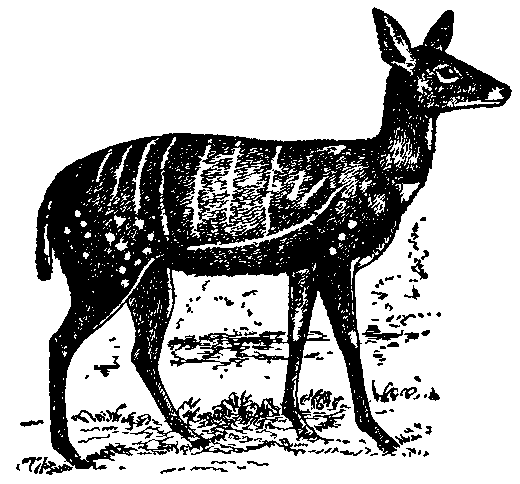
BUSHBUCK (Boschbok,) the South African name of a medium-sized red antelope (q.v.), marked with white lines and spots, belonging to a local race of a widely spread species, Tragelaphus scriptus. The males alone have rather small, spirally twisted horns. There are several allied species, sometimes known as harnessed antelopes, which are of a larger size. Some of these such as the situtunga (T. spekei) have the hoofs elongated for walking on swampy ground, and hence have been separated as Limnotragus.
BUSHEL (from the O. Fr. boissiel, cf. med. L. bustellus, busellus, a little box), a dry measure of capacity, containing 8 gallons or 4 pecks. It has been in use for measuring corn, potatoes, &c., from a very early date; the value varying locally and with the article measured. The "imperial bushel", legally established in Great Britain in 1826, contains 2218.192 cub.in., or 80 lb of distilled water, determined at 62° F., with the barometer at 30 in. Previously, the standard bushel used was known as the "Winchester bushel", so named from the standard being kept in the town hall at Winchester; it contained 2150.42 cub. in. This standard is the basis of the bushel used in the United States and Canada; but other "bushels" for use in connexion with certain commodities have been legalized in different states.
BUSHIDO (Japanese for "military-knight-ways"), the unwritten code of laws governing the lives of the nobles of Japan, equivalent to the European chivalry. Its maxims have been orally handed down, together with a vast accumulation of traditional etiquette, the result of centuries of feudalism. Its inception is associated with the uprise of feudal institutions under Yoritomo, the first of the Shoguns, late in the 12th century, but bushido in an undeveloped form existed before then. The samurai or nobles of Japan entertained the highest respect for truth. "A bushi has no second word" was one of their mottoes. And their sense of honour was so high as to dictate suicide where it was offended.
See Inazo Nitobe, Bushido: The Soul of Japan (1905); also Japan: Army.
BUSHIRE, or Bander Bushire, a town of Persia, on the northern shore of the Persian Gulf, in 28° 59′ N., 50° 49′ E. The name is pronounced Boosheer, and not Bew-shire, or Bus-hire; modern Persians write it Bushehr and, yet more incorrectly, Abushehr, and translate it as "father of the city," but it is most probably a contraction of Bokht-ardashir, the name given to the place by the first Sassanian monarch in the 3rd century. In a similar way Riv-ardashir, a few miles south of Bushire, has become Rishire (Reesheer). In the first half of the 18th century, when Bushire was an unimportant fishing village, it was selected by Nadir Shah as the southern port of Persia and dockyard of the navy which he aspired to create in the Persian Gulf, and the British commercial factory of the East India Company, established at Gombrun, the modern Bander Abbasi, was transferred to it in 1759. At the beginning of the 19th century it had a population of 6000 to 8000, and it is now the most important port in the Persian Gulf, with a population of about 25,000. It used to be under the government of Fars, but is (since about 1892) the seat of the governor of the Persian Gulf ports, who is responsible to the central government, and has under his jurisdiction the principal ports of the Gulf and their dependencies. The town, which is of a triangular form, occupies the northern extremity of a peninsula 11 m. long and 4 broad, and is encircled by the sea on all sides except the south. It is fortified on the land side by a wall with 12 round towers. The houses being mostly built of a white conglomerate stone of shells and coral which forms the peninsula, gives the city when viewed from a distance a clean and handsome appearance, but on closer inspection the streets are found to be very narrow, irregular, ill-paved and filthy. Almost the only decent buildings are the governor's palace, the British residency and the houses of some well-to-do merchants. The sea immediately east of the town has a considerable depth, but its navigation is impeded by sand-banks and a bar north and west of the town, which can be passed only by vessels drawing not more than 9 ft. of water, except at spring tides, when there is a rise of from 8 to 10 ft. Vessels drawing more than 9 ft. must anchor in the roads miles away to the west. The climate is very hot in the summer months and unhealthy. The water is very bad, and that fit for drinking requires to be brought from wells distant 1½ to 3 m. from the city wall.
Bushire carries on a considerable trade, particularly with India, Java and Arabia. Its principal imports are cotton and woollen goods, yarn, metals, sugar, coffee, tea, spices, cashmere shawls, &c., and its principal exports opium, wool, carpets, horses, grain, dyes and gums, tobacco, rosewater, &c. The importance of Bushire has much increased since about 1862. It is now not only the headquarters of the English naval squadron in the Persian Gulf, and the land terminus of the Indo-European telegraph, but it also forms the chief station in the Gulf of the British Indian Steam Navigation Company, which runs its vessels weekly between Bombay and Basra. Consulates of Great Britain, Germany, France, Russia and Turkey and several European mercantile houses are established at Bushire, and notwithstanding the drawbacks of bad roads to the interior, insufficient and precarious means of transport, and want of security, the annual value of the Bushire trade since 1890 averaged about £1,500,000 (one-third being for exports, two-thirds for imports), and over two-thirds of this was British. Of the 278,000 tons of shipping which entered the port in 1905, 244,000 were British.
During the war with Persia (1856-57) Bushire surrendered to a British force and remained in British occupation for some months. At Rishire, some miles south of Bushire and near the summer quarters of the British resident and the British telegraph buildings, there are extensive ruins among which bricks with cuneiform inscriptions have been found, showing that the place was a very old Elamite settlement.
(A. H.-S.)
BUSHMEN, or Bosjesmans, a people of South Africa, so named by the British and Dutch colonists of the Cape. They often call themselves Saan [Sing. Sá], but this appears to be the Hottentot name. If they have a national name it is Khuai, probably "small man," the title of one group. This Khuai has, however, been translated as the Bushman word for tablier égyptien (see below), adopted as the racial name because that malformation is one of their physical characteristics. The Kaffirs call them Abatwa, the Bechuana Masarwa (Maseroa). There is little reason to doubt that they constitute the aboriginal element of the population of South Africa, and indications of their former presence have been found as far north at least as the Nyasa and Tanganyika basins. "It would seem," writes Sir H.H. Johnston (British Central Africa, p. 52), "as if the earliest known race of man inhabiting what is now British Central Africa was akin to the Bushman-Hottentot type of negro. Rounded stones with a hole through the centre, similar to those which are used by the Bushmen in the south for weighting their digging-sticks (the graaf stock of the Boers), have been found at the south end of Lake Tanganyika." The dirty yellow colour of the Bushmen, their slightly slanting eyes and prominent cheek-bones had induced early anthropologists to dwell on their resemblance to the Mongolian races. This similarity has been now recognized as quite superficial. More recently a connexion has been traced between the Bushmen and the Pygmy peoples inhabiting the forests of Central Africa. Though the matter cannot be regarded as definitely settled, the latest researches rather tend to discredit this view. In fact it would appear that the two peoples have little in common save diminutive proportions and a nomadic and predatory form of existence. Owing to the discovery of steatopygous figurines in Egyptian graves, a theory has been advanced that the Egyptians of the early dynasties were of the same primitive pygmy negroid stock as the Bushmen. But this is highly speculative. The physical characteristics of Egyptian skulls have nothing of the Bushman in them. Of the primitive pygmy negroid stock the Hottentots (q.v.), once considered the parent family, are now regarded as an offshoot of mixed Bantu-Bushman blood from the main Bushman race.
It seems probable that the Bushmen must be regarded as having extended considerably to the north of the area occupied by them within the memory of white men. Evidence has been produced of the presence of a belated Hottentot or Hottentot-Bushman group as far north as the district between Kilimanjaro and Victoria Nyanza. They were probably driven south by the Bantu tribes, who eventually outflanked them and confined them to the less fertile tracts of country. Before the arrival of Europeans in South Africa the Bushman race appears to have been, what it so essentially is to-day, a nomadic race living in widely scattered groups. The area in which the Bushmen are now found sporadically may be defined as extending from the inner ranges of the mountains of Cape Colony, through the central Kalahari desert to near Lake Ngami, and thence north-westward to the districts about the Ovambo river north of Damaraland. In short, they have been driven by European and Kaffir encroachments into the most barren regions of South Africa. A few remain in the more inaccessible parts of the Drakensberg range about the sources of the Vaal. Only in one or two districts are they found in large numbers, chiefly in Great Bushman Land towards the Orange river. A regularly planned and wholesale destruction of the Bushmen on the borders of Cape Colony in the earlier years of European occupation reduced their numbers to a great extent; but this cruel hunting of the Bushmen has ceased. In retaliation the Bushmen were long the scourge of the farms on the outer borders of the colony, making raids on the cattle and driving them off in large numbers. On the western side of the deserts they are generally at enmity with the Koranna Hottentots, but on the eastern border of the Kalahari they have to some extent fraternized with the earliest Bechuana migrants. Their language, which exists in several dialects, has in common with Hottentot, but to a greater degree, the peculiar sounds known as "clicks." The Hottentot language is more agglutinative, the Bushman more monosyllabic; the former recognizes a gender in names, the latter does not; the Hottentots form the plural by a suffix, the Bushmen by repetition of the name; the former count up to twenty, the latter can only number two, all above that being "many." F.C.Selous records that Koranna Hottentots were able to converse fluently with the Bushmen of Bechuanaland.
The most striking feature of the Bushman's physique is shortness of stature. Gustav Fritsch in 1863-1866 found the average height of six grown men to be 4 ft. 9 in. Earlier, but less trustworthy, measurements make them still shorter. Among 150 measured by Sir John Barrow during the first British occupation of Cape Colony the tallest man was 4 ft. 9 in., the tallest woman 4 ft. 4 in. The Bushmen living in Bechuanaland measured by Selous in the last quarter of the 19th century were, however, found to be of nearly average height. Few persons were below 5 ft.; 5 ft. 4 in. was common, and individuals of even 6 ft. were not unknown. No great difference in height appears to exist between men and women. Fritsch's average from five Bushman women was one-sixth of an inch more than for the men. The Bushmen, as already stated, are of a dirty yellow colour, and of generally unattractive countenance. The skull is long and low, the cheek-bones large and prominent. The eyes are deeply set and crafty in expression. The nose is small and depressed, the mouth wide with moderately everted lips, and the jaws project. The teeth are not like badly cut ivory, as in Bantu, but regular and of a mother-of-pearl appearance. In general build the Bushman is slim and lean almost to emaciation. Even the children show little of the round outlines of youth. The amount of fat under the skin in both sexes is remarkably small; hence the skin is as dry as leather and falls into strong folds around the stomach and at the joints. The fetor of the skin, so characteristic of the negro, is not found in the Bushman. The hair is weak in growth, in age it becomes grey, but baldness is rare. Bushmen have little body-hair and that of a weak stubbly nature, and none of the fine down usual on most skins. On the face there is usually only a scanty moustache. A hollowed back and protruding stomach are frequent characteristics of their figure, but many of them are well proportioned, all being active and capable of enduring great privations and fatigue. Considerable steatopygy often exists among the women, who share with the Hottentot women the extraordinary prolongation of the nymphae which is often called "the Hottentot apron" or tablier. Northward the Bushmen appear to improve both in general condition and in stature, probably owing to a tinge of Bantu blood. The Bushman's clothing is scanty: a triangular piece of skin, passed between the legs and fastened round the waist with a string, is often all that is worn. Many men, however, and nearly all the women, wear the kaross, a kind of pelisse of skins sewn together, which is used at night as a wrap. The bodies of both sexes are smeared with a native ointment, buchu, which, aided by accretions of dust and dirt, soon forms a coating like a rind. Men and women often wear sandals of hide or plaited bast. They are fond of ornament, and decorate the arms, neck and legs with beads, iron or copper rings, teeth, hoofs, horns and shells, while they stick feathers or hares' tails in the hair. The women sometimes stain their faces with red pigment. They carry tobacco in goats' horns or in the shell of a land tortoise, while boxes of ointment or amulets are hung round neck or waist. A jackal's tail mounted on a stick serves the double purpose of fan and handkerchief. For dwellings in the plains they have low huts formed of reed mats, or occupy a hole in the earth; in the mountain districts they make a shelter among the rocks by hanging mats on the windward side. Of household utensils they have none, except ostrich eggs, in which they carry water, and occasionally rough pots. For cooking his food the Bushman needs nothing but fire, which he obtains by rubbing hard and soft wood together.