BYZANTINE ART (continued 2)
Reading edition
See W.M. Smith, Athletics and Athletic Sports in Scotland (Edinburgh, 1891).
CABET, ÉTIENNE (1788-1856), French communist, was born at Dijon in 1788, the son of a cooper. He chose the profession of advocate, without succeeding in it, but ere long became notable as the persevering apostle of republicanism and communism. He assisted in a secondary way in the revolution of 1830, and obtained the appointment of procureur-général in Corsica under the government of Louis Philippe; but was dismissed for his attack upon the conservatism of the government, in his Histoire de la révolution de 1830. Elected, notwithstanding, to the chamber of deputies, he was prosecuted for his bitter criticism of the government, and obliged to go into exile in England in 1834, where he became an ardent disciple of Robert Owen. On the amnesty of 1839 he returned to France, and attracted some notice by the publication of a badly written and fiercely democratic history of the Revolution of 1789 (4 vols., 1840), and of a social romance, Voyage en Icarie, in which he set forth his peculiar views. These works met with some success among the radical working-men of Paris. Like Owen, he sought to realize his ideas in practice, and, pressed as well by his friends, he made arrangements for an experiment in communism on American soil. By negotiations in England favoured by Owen, he purchased a considerable tract of land on the Red river, Texas, and drew up an elaborate scheme for the intending colony, community of property being the distinctive principle of the society. Accordingly in 1848 an expedition of 1500 "Icarians" sailed to America; but unexpected difficulties arose and the complaints of the disenchanted settlers soon reached Europe. Cabet, who had remained in France, had more than one judicial investigation to undergo in consequence, but was honourably acquitted. In 1849 he went out in person to America, but on his arrival, finding that the Mormons had been expelled from their city Nauvoo (q.v.), in Illinois, he transferred his settlement thither. There, with the exception of a journey to France, where he returned to defend himself successfully before the tribunals, he remained, the dictator of his little society. In 1856, however, he withdrew and died the same year at St Louis.
See Communism. Also Félix Bonnaud, Cabet et son œuvre, appel à tous les socialistes (Paris, 1900); J. Prudhommeaux, Icaria and its Founder, Étienne Cabet (Nîmes, 1907).
CABIN, a small, roughly built hut or shelter; the term is particularly applied to the thatched mud cottages of the negro slaves of the southern states of the Unites States of America, or of the poverty-stricken peasantry of Ireland or the crofter districts of Scotland. In a special sense it is used of the small rooms or compartments on board a vessel used for sleeping, eating or other accommodation. The word in its earlier English forms was cabane or caban, and thus seems to be an adaptation of the French cabane; the French have taken cabine, for the room on board a ship, from the English. In French and other Romanic languages, in which the word occurs, e.g. Spanish cabaña, Portuguese cabana, the origin is usually found in the Medieval Latin capanna. Isidore of Seville (Origines, lib. xiv. 12) says:—Tugurium (hut) parva casula est, quam faciunt sibi custodes vinearum, ad tegimen seu quasi tegurium. Hoc rustici Capannam vocant, quod unum tantum capiat (see Du Cange, Glossarium, s.v. Capanna). Others derive from Greek κάπη, crib, manger. Skeat considers the English word was taken from the Welsh caban, rather than from the French, and that the original source for all the forms was Celtic.
CABINET, a word with various applications which may be traced to two principal meanings, (1) a small private chamber, and (2) an article of furniture containing compartments formed of drawers, shelves, &c. The word is a diminutive of "cabin" and therefore properly means a small hut or shelter. This meaning is now obsolete; the New English Dictionary quotes from Leonard Digges's Stratioticos (published with additions by his son Thomas in 1579), "the Lance Knights encamp always in the field very strongly, two or three to a Cabbonet." From the use both of the article of furniture and of a small chamber for the safe-keeping of a collection of valuable prints, pictures, medals or other objects, the word is frequently applied to such a collection or to objects fit for such safe-keeping. The name of Cabinet du Roi was given to the collection of prints prepared by the best artists of the 17th century by order of Louis XIV. These were intended to commemorate the chief events of his reign, and also to reproduce the paintings and sculptures and other art treasures contained in the royal palaces. It was begun in 1667 and was placed under the superintendence of Nicholas Clement (1647 or 1651-1712), the royal librarian. The collection was published in 1727. The plates are now in the Louvre. A "cabinet" edition of a literary work is one of somewhat small size, and bound in such a way as would suit a tasteful collection. The term is applied also to a size of photograph of a larger size than the carte de visite but smaller than the "panel." The political use of the term is derived from the private chamber of the sovereign or head of a state in which his advisers met.
Cabinet in Furniture.—The artificer who constructs furniture is still called a "cabinet-maker," although the manufacture of cabinets, properly so called, is now a very occasional part of his work. Cabinets can be divided into a very large number of classes according to their shape, style, period and country of origin; but their usual characteristic is that they are supported upon a stand, and that they contain a series of drawers and pigeon-holes. The name is, however, now given to many pieces of furniture for the safe-keeping or exhibition of valuable objects, which really answer very little to the old conception of a cabinet. The cabinet represented an evolution brought about by the necessities of convenience, and it appealed to so many tastes and needs that it rapidly became universal in the houses of the gentle classes, and in great measure took the impress of the peoples who adopted it. It would appear to have originated in Italy, probably at the very beginning of the 16th century. In its rudimentary form it was little more than an oblong box, with or without feet, small enough to stand upon a table or chair, filled with drawers and closed with doors. In this early form its restricted dimensions permitted of its use only for the safeguard of jewels, precious stones and sometimes money. One of the earliest cabinets of which we have mention belonged to Francis I. of France, and is described as covered with gilt leather, tooled with mauresque work. As the Renaissance became general these early forms gave place to larger, more elaborate and more architectural efforts, until the cabinet became one of the most sumptuous of household adornments. It was natural that the countries which were earliest and most deeply touched by the Renaissance should excel in the designing of these noble and costly pieces of furniture. The cabinets of Italy, France and the Netherlands were especially rich and monumental. Those of Italy and Flanders are often of great magnificence and of real artistic skill, though like all other furniture their style was often grievously debased, and their details incongruous and bizarre. Flanders and Burgundy were, indeed, their lands of adoption, and Antwerp added to its renown as a metropolis of art by developing consummate skill in their manufacture and adornment. The cost and importance of the finer types have ensured the preservation of innumerable examples of all but the very earliest periods; and the student never ceases to be impressed by the extraordinary variety of the work of the 16th and 17th centuries, and very often of the 18th also. The basis of the cabinet has always been wood, carved, polished or inlaid; but lavish use has been made of ivory, tortoise-shell, and those cut and polished precious stones which the Italians call pietra dura. In the great Flemish period of the 17th century the doors and drawers of cabinets were often painted with classical or mythological scenes. Many French and Florentine cabinets were also painted. In many classes the drawers and pigeon-holes are enclosed by folding doors, carved or inlaid, and often painted on the inner sides. Perhaps the most favourite type during a great part of the 16th and 17th centuries—a type which grew so common that it became cosmopolitan—was characterized by a conceit which acquired astonishing popularity. When the folding doors are opened there is disclosed in the centre of the cabinet a tiny but palatial interior. Floored with alternate squares of ebony and ivory to imitate a black and white marble pavement, adorned with Corinthian columns or pilasters, and surrounded by mirrors, the effect, if occasionally affected and artificial, is quite as often exquisite. Although cabinets have been produced in England in considerable variety, and sometimes of very elegant and graceful form, the foreign makers on the whole produced the most elaborate and monumental examples. As we have said, Italy and the Netherlands acquired especial distinction in this kind of work. In France, which has always enjoyed a peculiar genius for assimilating modes in furniture, Flemish cabinets were so greatly in demand that Henry IV. determined to establish the industry in his own dominions. He therefore sent French workmen to the Low Countries to acquire the art of making cabinets, and especially those which were largely constructed of ebony and ivory. Among these workmen were Jean Macé and Pierre Boulle, a member of a family which was destined to acquire something approaching immortality. Many of the Flemish cabinets so called, which were in such high favour in France and also in England, were really armoires consisting of two bodies superimposed, whereas the cabinet proper does not reach to the floor. Pillared and fluted, with panelled sides, and front elaborately carved with masks and human figures, these pieces which were most often in oak were exceedingly harmonious and balanced. Long before this, however, France had its own school of makers of cabinets, and some of their carved work was of the most admirable character. At a somewhat later date André Charles Boulle made many pieces to which the name of cabinet has been more or less loosely given. They were usually of massive proportions and of extreme elaboration of marquetry. The North Italian cabinets, and especially those which were made or influenced by the Florentine school, were grandiose and often gloomy. Conceived on a palatial scale, painted or carved, or incrusted with marble and pietra dura, they were intended for the adornment of galleries and lofty bare apartments where they were not felt to be overpowering. These North Italian cabinets were often covered with intarsia or marquetry, which by its subdued gaiety retrieved somewhat their heavy stateliness of form. It is, however, often difficult to ascribe a particular fashion of shape or of workmanship to a given country, since the interchange of ideas and the imports of actual pieces caused a rapid assimilation which destroyed frontiers. The close connexion of centuries between Spain and the Netherlands, for instance, led to the production north and south of work that was not definitely characteristic of either. Spain, however, was more closely influenced than the Low Countries, and contains to this day numbers of cabinets which are not easily to be distinguished from the characteristic ebony, ivory and tortoise-shell work of the craftsmen whose skill was so rapidly acquired by the emissaries of Henry IV. The cabinets of southern Germany were much influenced by the models of northern Italy, but retained to a late date some of the characteristics of domestic Gothic work such as elaborately fashioned wrought-iron handles and polished steel hinges. Often, indeed, 17th-century South Germany work is a curious blend of Flemish and Italian ideas executed in oak and Hungarian ash. Such work, however interesting, necessarily lacks simplicity and repose. A curious little detail of Flemish and Italian, and sometimes of French later 17th-century cabinets, is that the interiors of the drawers are often lined with stamped gold or silver paper, or marbled ones somewhat similar to the "end papers" of old books. The great English cabinet-makers of the 18th century were very various in their cabinets, which did not always answer strictly to their name; but as a rule they will not bear comparison with the native work of the preceding century, which was most commonly executed in richly marked walnut, frequently enriched with excellent marquetry of woods. Mahogany was the dominating timber in English furniture from the accession of George II. almost to the time of the Napoleonic wars; but many cabinets were made in lacquer or in the bright-hued foreign woods which did so much to give lightness and grace to the British style. The glass-fronted cabinet for China or glass was in high favour in the Georgian period, and for pieces of that type, for which massiveness would have been inappropriate, satin and tulip woods, and other timbers with a handsome grain taking a high polish were much used.
(J. P.-B.)
The Political Cabinet.—Among English political institutions, the "Cabinet" is a conventional but not a legal term employed to describe those members of the privy council who fill the highest executive offices in the state, and by their concerted policy direct the government, and are responsible for all the acts of the crown. The cabinet now always includes the persons filling the following offices, who are therefore called "cabinet ministers," viz.:—the first lord of the treasury, the lord chancellor of England, the lord president of the council, the lord privy seal, the five secretaries of state, the chancellor of the exchequer and the first lord of the admiralty. The chancellor of the duchy of Lancaster, the postmaster-general, the first commissioner of works, the president of the board of trade, the chief secretary for Ireland, the lord chancellor of Ireland, the president of the local government board, the president of the board of agriculture, and the president of the board of education, are usually members of the cabinet, but not necessarily so. A modern cabinet contains from sixteen to twenty members. It used to be said that a large cabinet is an evil; and the increase in its numbers in recent years has often been criticized. But the modern widening of the franchise has tended to give the cabinet the character of an executive committee for the party in power, no less than that of the prime-minister's consultative committee, and to make such a committee representative it is necessary to include the holders of all the more important offices in the administration, who are generally selected as the influential politicians of the party rather than for special aptitude in the work of the departments.
The word "cabinet," or "cabinet council," was originally employed as a term of reproach. Thus Lord Bacon says, in his essay Of Counsel (xx.), "The doctrine of Italy and practice of France, in some kings' times, hath introduced cabinet councils—a remedy worse than the disease"; and, again, "As for cabinet councils, it may be their motto Plenus rimarum sum." Lord Clarendon—after stating that, in 1640, when the great Council of Peers was convened by the king at York, the burden of affairs rested principally on Laud, Strafford and Cottington, with five or six others added to them on account of their official position and ability—adds, "These persons made up the committee of state, which was reproachfully after called the Juncto, and enviously then in court the Cabinet Council." And in the Second Remonstrance in January 1642, parliament complained "of the managing of the great affairs of the realm in Cabinet Councils by men unknown and not publicly trusted." But this use of the term, though historically curious, has in truth nothing in common with the modern application of it. It meant, at that time, the employment of a select body of favourites by the king, who were supposed to possess a larger share of his confidence than the privy council at large. Under the Tudors, at least from the later years of Henry VIII. and under the Stuarts, the privy council was the council of state or government. During the Commonwealth it assumed that name.
The Cabinet Council, properly so called, dates from the reign of William III. and from the year 1693, for it was not until some years after the Revolution that the king discovered and adopted the two fundamental principles of a constitutional executive government, namely, that a ministry should consist of statesmen holding the same political principles and identified with each other; and, secondly, that the ministry should stand upon a parliamentary basis, that is, that it must command and retain the majority of votes in the legislature. It was long before these principles were thoroughly worked out and understood, and the perfection to which they have been brought in modern times is the result of time, experience and in part of accident. But the result is that the cabinet council for the time being is the government of Great Britain; that all the powers vested in the sovereign (with one or two exceptions) are practically exercised by the members of this body; that all the members of the cabinet are jointly and severally responsible for all its measures, for if differences of opinion arise their existence is unknown as long as the cabinet lasts—when publicly manifested the cabinet is at an end; and lastly, that the cabinet, being responsible to the sovereign for the conduct of executive business, is also collectively responsible to parliament both for its executive conduct and for its legislative measures, the same men being as members of the cabinet the servants of the crown, and as members of parliament and leaders of the majority responsible to those who support them by their votes and may challenge in debate every one of their actions. In this latter sense the cabinet has sometimes been described as a standing committee of both Houses of Parliament.
One of the consequences of the close connexion of the cabinet with the legislature is that it is desirable to divide the strength of the ministry between the two Houses of Parliament. Pitt's cabinet of 1783 consisted of himself in the House of Commons and seven peers. But so aristocratic a government would now be impracticable. In Gladstone's cabinet of 1868, eight, and afterwards nine, ministers were in the House of Commons and six in the House of Lords. Great efforts were made to strengthen the ministerial bench in the Commons, and a new principle was introduced, that the representatives of what are called the spending departments—that is, the secretary of state for war and the first lord of the admiralty—should, if possible, be members of the House which votes the supplies. Disraeli followed this precedent but it has since been disregarded. In Sir H. Campbell-Bannerman's cabinet formed in 1905, six ministers were in the House of Lords and thirteen in the House of Commons.
Cabinets are usually convoked by a summons addressed to "His Majesty's confidential servants" by the prime minister; and the ordinary place of meeting is either at the official residence of the first lord of the treasury in Downing Street or at the foreign office, but they may be held anywhere. No secretary or other officer is present at the deliberations of this council. No official record is kept of its proceedings, and it is even considered a breach of ministerial confidence to keep a private record of what passed in the cabinet, inasmuch as such memoranda may fall into other hands. But on some important occasions, as is known from the Memoirs of Lord Sidmouth, the Correspondence of Earl Grey with King William IV., and from Sir Robert Peel's Memoirs, published by permission of Queen Victoria, cabinet minutes are drawn up and submitted to the sovereign, as the most formal manner in which the advice of the ministry can be tendered to the crown and placed upon record. (See also Sir Algernon West's Recollections, 1899.) More commonly, it is the duty of the prime minister to lay the collective opinion of his colleagues before the sovereign, and take his pleasure on public measures and appointments. The sovereign never presides at a cabinet; and at the meetings of the privy council, where the sovereign does preside, the business is purely formal. It has been laid down by some writers as a principle of the British constitution that the sovereign is never present at a discussion between the advisers of the crown; and this is, no doubt, an established fact and practice. But like many other political usages of Great Britain it originated in a happy accident.
King William and Queen Anne always presided at weekly cabinet councils. But when the Hanoverian princes ascended the throne, they knew no English, and were barely able to converse at all with their ministers; for George I. or George II. to take part in, or even to listen to, a debate in council was impossible. When George III. mounted the throne the practice of the independent deliberations of the cabinet was well established, and it has never been departed from.
Upon the resignation or dissolution of a ministry, the sovereign exercises the undoubted prerogative of selecting the person who may be thought by him most fit to form a new cabinet. In several instances the statesmen selected by the crown have found themselves unable to accomplish the task confided to them. But in more favourable cases the minister chosen for this supreme office by the crown has the power of distributing all the political offices of the government as may seem best to himself, subject only to the ultimate approval of the sovereign. The prime minister is therefore in reality the author and constructor of the cabinet; he holds it together; and in the event of his retirement, from whatever cause, the cabinet is really dissolved, even though its members are again united under another head.
Authorities.—Sir W. Anson, Law and Custom of the Constitution (1896); W. Bagehot, The English Constitution; M.T. Blauvelt, The Development of Cabinet Government in England (New York, 1902); E. Boutmy, The English Constitution (trans. I.M. Eaden, 1891); A. Lawrence Lowell, The Government of England (1908), part I.; A.V. Dicey, Law of the Constitution (1902); Sir T. Erskine May, Constitutional History of England (1863-1865); H. Hallam, Constitutional History of England; W.E. Hearn, The Government of England (1867); S. Low, The Governance of England (1904); W. Stubbs, Constitutional History of England; Hannis Taylor, Origin and Growth of the English Constitution (Boston, 1889-1900); A. Todd, Parliamentary Government in England (1867-1869); much valuable information will also be found in such works as W.E. Gladstone's Gleanings; the third earl of Malmesbury's Memoirs of an ex-Minister (1884-1885); Greville's Memoirs; Sir A. West's Recollections, 1832-1886 (1889), &c.
CABINET NOIR, the name given in France to the office where the letters of suspected persons were opened and read by public officials before being forwarded to their destination. This practice had been in vogue since the establishment of posts, and was frequently used by the ministers of Louis XIII. and Louis XIV.; but it was not until the reign of Louis XV. that a separate office for this purpose was created. This was called the cabinet du secret des postes, or more popularly the cabinet noir. Although declaimed against at the time of the Revolution, it was used both by the revolutionary leaders and by Napoleon. The cabinet noir has now disappeared, but the right to open letters in cases of emergency appears still to be retained by the French government; and a similar right is occasionally exercised in England under the direction of a secretary of state, and, indeed, in all civilized countries. In England this power was frequently employed during the 18th century and was confirmed by the Post Office Act of 1837; its most notorious use being, perhaps, the opening of Mazzini's letters in 1844.
CABLE, GEORGE WASHINGTON (1844- ) American author, was born in New Orleans, Louisiana, on the 12th of October 1844. At the age of fourteen he entered a mercantile establishment as a clerk; joined the Confederate army (4th Mississippi Cavalry) at the age of nineteen; at the close of the war engaged in civil engineering, and in newspaper work in New Orleans; and first became known in literature by sketches and stories of old French-American life in that city. These were first published in Scribner's Monthly, and were collected in book form in 1879, under the title of Old Creole Days. The characteristics of the series—of which the novelette Madame Delphine (1881) is virtually a part—are neatness of touch, sympathetic accuracy of description of people and places, and a constant combination of gentle pathos with quiet humour. These shorter tales were followed by the novels The Grandissimes (1880), Dr Sevier (1883) and Bonaventure (1888), of which the first dealt with Creole life in Louisiana a hundred years ago, while the second was related to the period of the Civil War of 1861-65. Dr Sevier, on the whole, is to be accounted Cable's masterpiece, its character of Narcisse combining nearly all the qualities which have given him his place in American literature as an artist and a social chronicler. In this, as in nearly all of his stories, he makes much use of the soft French-English dialect of Louisiana. He does not confine himself to New Orleans, laying many of his scenes, as in the short story Belles Demoiselles Plantation, in the marshy lowlands towards the mouth of the Mississippi. Cable was the leader in the noteworthy literary movement which has influenced nearly all southern writers since the war of 1861—a movement of which the chief importance lay in the determination to portray local scenes, characters and historical episodes with accuracy instead of merely imaginative romanticism, and to interest readers by fidelity and sympathy in the portrayal of things well known to the authors. Other writings by Cable have dealt with various problems of race and politics in the southern states during and after the "reconstruction period" following the Civil War; while in The Creoles of Louisiana (1884) he presented a history of that folk from the time of its appearance as a social and military factor. His dispassionate treatment of his theme in this volume and its predecessors gave increasing offence to sensitive Creoles and their sympathizers, and in 1886 Cable removed to Northampton, Massachusetts. At one time he edited a magazine in Northampton, and afterwards conducted the monthly Current Literature, published in New York. His Collected Works were published in a uniform issue in 5 vols. (New York, 1898). Among his later volumes are The Cavalier (1901), Bylow Hill (1902), and Kincaid's Battery (1908).
CABLE (from Late Lat. capulum, a halter, from capere, to take hold of), a large rope or chain, used generally with ships, but often employed for other purposes; the term "cable" is also used by analogy in minor varieties of similar engineering or other attachments, and in the case of "electric cables" for the submarine wires (see Telegraph) by which telegraphic messages are transmitted.[1]
The cable by which a ship rides at her anchor is now made of iron; prior to 1811 only hempen cables were supplied to ships of the British navy, a first-rate's complement on the East Indian station being eleven; the largest was 25 in. (equal to 2¼ in. iron cable) and weighed 6 tons. In 1811, iron cables were supplied to stationary ships; their superiority over hempen ones was manifest, as they were less liable to foul or to be cut by rocks, or to be injured by enemy's shot. Iron cables are also handier and cleaner, an offensive odour being exhaled from dirty hempen cables, when unbent and stowed inboard. The first patent for iron cables was by Phillip White in 1634; twisted links were suggested in 1813 by Captain Brown (who afterwards, in conjunction with Brown, Lenox & Co., planned the Brighton chain pier in 1823); and studs were introduced in 1816. Hempen cables are not now supplied to ships, having been superseded by steel wire hawsers. The length of a hempen cable is 101 fathoms, and a cable's length, as a standard of measurement, usually placed on charts, is assumed to be 100 fathoms or 600 ft. The sizes, number and lengths of cables supplied to ships of the British navy are given in the official publication, the Ship's Establishment; cables for merchant ships are regulated by Lloyds, and are tested according to the Anchors and Chain Cables Act 1899.
In manufacturing chain cables, the bars are cut to the required length of link, at an angle for forming the welds and, after heating, are bent by machinery to the form of a link and welded by smiths, each link being inserted in the previous one before welding. Cables of less than 1¼ in. are welded at the crown, there not being sufficient room for a side weld; experience has shown that the latter method is preferable and it is employed in making larger sized cables. In 1898 steel studs were introduced instead of cast iron ones, the latter having a tendency to work loose, but the practice is not universal. After testing, the licensed tester must place on every five fathoms of cable a distinctive mark which also indicates the testing establishments; the stamp or die employed must be approved by the Board of Trade. The iron used in the construction, also the testing, of mooring chains and cables for the London Trinity House Corporation are subject to more stringent regulations.
Fig. 1.—Stud-link Chain.
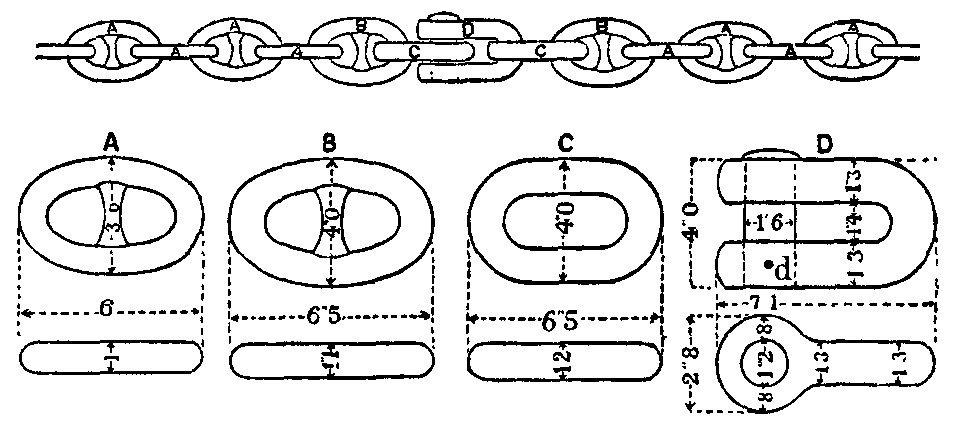
Cables for the British navy and mercantile marine are supplied in 12½ fathom and 15 fathom lengths respectively, connected together by "joining shackles", D (fig. 1). Each length is "marked" by pieces of iron wire being twisted round the studs of the links; the wire is placed on the first studs on each side of the first shackle, on the second studs on each side of the second shackle, and so on; thus the number of lengths of cable out is clearly indicated. For instance, if the wire is on the sixth studs on each side of the shackle, it indicates that six lengths or 75 fathoms of cable are out. In joining the lengths together, the round end of the shackle is placed towards the anchor. The end links of each length (C.C.) are made without studs, in order to take the shackle; but as studs increase the strength of a link, in a studless or open link the iron is of greater diameter. The next links (B.B.) have to be enlarged, in order to take the increased size of the links C.C. In the joining shackle (D), the pin is oval, its greater diameter being in the direction of the strain. The pin of a shackle, which attaches the cable to the anchor (called an "anchor shackle", to distinguish it from a joining shackle) projects and is secured by a forelock; but since any projection in a joining shackle would be liable to be injured when the cable is running out or when passing around a capstan, the pins are made as shown at D, and are secured by a small pin d. This small pin is kept from coming out by being made a little short, and lead pellets are driven in at either end to fill up the holes in the shackle, which are made with a groove, so that as the pellets are driven in they expand or dovetail, keeping the small pin in its place.[2]
Fig. 2.—Mooring Swivel.
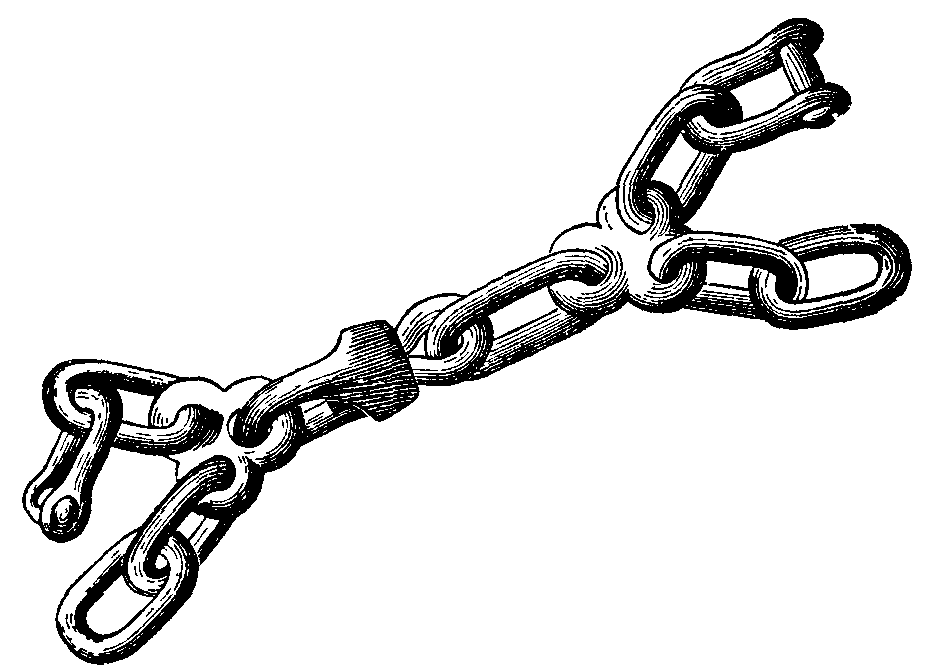
The cables are stowed in chain lockers, the inboard ends being secured by a "slip" (in the mercantile marine the cable is often shackled or lashed to the kelson); the slip prevents the cable's inner end from passing overboard, and also enables the cable to be "slipped", or let go, in case of necessity. In the British navy, swivel pieces are fitted in the first and last lengths of cable, to avoid and, if required, to take out turns in a cable, caused by a ship swinging round when at anchor. With a ship moored with two anchors, the cables are secured to a mooring swivel (fig. 2), which prevents a "foul hawse", i.e. the cables being entwined round each other. When mooring, unmooring, and as may be necessary, cables are temporarily secured by "slips" shackled to eye or ring bolts in the deck (see Anchor). The cable is hove up by either a capstan or windlass (see Capstan) actuated by steam, electricity or manual power. Ships in the British navy usually ride by the compressor, the cable holder being used for checking the cable running out. When a ship has been given the necessary cable, the cable holder is eased up and the compressor "bowsed to"; in a heavy sea, a turn, or if necessary two turns, are taken round the "bitts," a strong iron structure placed between the hawse and navel ("deck") pipes. A single turn of cable is often taken round the bitts when anchoring in deep water. Small vessels of the mercantile marine ride by turns around the windlass; in larger or more modern vessels fitted with a steam windlass, the friction brakes take the strain, aided when required by the bitts, compressor or controller in bad weather.
(J. W. D.)
CABLE MOULDING, in architecture, the term given to a convex moulding carved in imitation of a rope or cord, and used to decorate the mouldings of the Romanesque style in England, France and Spain. The word "cabling" by itself indicates a convex circular moulding sunk in the concave fluting of a classic column, and rising about one-third of the height of the shaft.
CABOCHE, SIMON. Simon Lecoustellier, called "Caboche", a skinner of the Paris Boucherie, played an important part in the Parisian riots of 1413. He had relations with John the Fearless, duke of Burgundy, since 1411, and was prominent in the seditious disturbances which broke out in April and May, following on the États of February 1413. In April he stirred the people to the point of revolt, and was among the first to enter the hôtel of the dauphin. When the butchers had made themselves masters of Paris, Caboche became bailiff (huissier d'armes) and warden of the bridge of Charenton. Upon the publication of the great ordinance of May 26th, he used all his efforts to prevent conciliation between the Burgundians and the Armagnacs. After the fall of the Cabochien party on the 4th of August he fled to Burgundy in order to escape from royal justice. Doubtless he returned to Paris in 1418 with the Burgundians.
See Colville, Les Cabochiens et l'ordonnance de 1413 (Paris, 1888).
CABOT, GEORGE (1751-1823), American political leader, was born in Salem, Massachusetts, on the 16th of December 1751. He studied at Harvard from 1766 to 1768, when he went to sea as a cabin boy. He gradually became a ship-owner and a successful merchant, retiring from business in 1794. Throughout his life he was much interested in politics, and though his temperamental indolence and his aversion for public life often prevented his accepting office, he exercised, as a contributor to the press and through his friendships, a powerful political influence, especially in New England. He was a member of the Massachusetts Constitutional Convention of 1770-1780, of the state senate in 1782-1783, of the convention which in 1788 ratified for Massachusetts the Federal Constitution, and from 1791 to 1796 of the United States Senate, in which, besides serving on various important committees, he became recognized as an authority on economic and commercial matters. Among the bills introduced by him in the Senate was the Fugitive Slave Act of 1793. Upon the establishment of the navy department in 1798, he was appointed and confirmed as its secretary, but he never performed the duties of the office, and was soon replaced by Benjamin Stoddert (1751-1813), actually though not nominally the first secretary of the department. In 1814-1815 Cabot was the president of the Hartford Convention, and as such was then and afterwards acrimoniously attacked by the Republicans throughout the country. He died in Boston on the 18th of April 1823. In politics he was a staunch Federalist, and with Fisher Ames, Timothy Pickering and Theophilus Parsons (all of whom lived in Essex county, Massachusetts) was classed as a member of the "Essex Junto",—a wing of the party and not a formal organization. A fervent advocate of a strong centralized government, he did much to secure the ratification by Massachusetts of the Federal Constitution, and after the overturn of the Federalist by the Republican party, he wrote (1804): "We are democratic altogether, and I hold democracy in its natural operation to be a government of the worst".
See Henry Cabot Lodge's Life and Letters of George Cabot (Boston, 1877).
CABOT, JOHN [Giovanni Caboto] (1450-1498), Italian navigator and discoverer of North America, was born in Genoa, but in 1461 went to live in Venice, of which he became a naturalized citizen in 1476. During one of his trading voyages to the eastern Mediterranean, Cabot paid a visit to Mecca, then the greatest mart in the world for the exchange of the goods of the East for those of the West. On inquiring whence came the spices, perfumes, silks and precious stones bartered there in great quantities, Cabot learned that they were brought by caravan from the north-eastern parts of farther Asia. Being versed in a knowledge of the sphere, it occurred to him that it would be shorter and quicker to bring these goods to Europe straight across the western ocean. First of all, however, a way would have to be found across this ocean from Europe to Asia. Full of this idea, Cabot, about the year 1484, removed with his family to London. His plans were in course of time made known to the leading merchants of Bristol, from which port an extensive trade was carried on already with Iceland. It was decided that an attempt should be made to reach the island of Brazil or that of the Seven Cities, placed on medieval maps to the west of Ireland, and that these should form the first halting-places on the route to Asia by the west.
To find these islands vessels were despatched from Bristol during several years, but all in vain. No land of any sort could be seen. Affairs were in this state when in the summer of 1493 news reached England that another Genoese, Christopher Columbus, had set sail westward from Spain and had reached the Indies. Cabot and his friends at once determined to forgo further search for the islands and to push straight on to Asia. With this end in view application was made to the king for formal letters patent, which were not issued until March 5, 1496. By these Henry VII. granted to his "well-beloved John Cabot, citizen of Venice, to Lewis, Sebastian and Santius,[1] sonnes of the said John, full and free authority, leave and power upon theyr own proper costs and charges, to seeke out, discover and finde whatsoever isles, countries, regions or provinces of the heathen and infidels, which before this time have been unknown to all Christians". Merchandise from the countries visited was to be entered at Bristol free of duty, but one-fifth of the net gains was to go to the king.
Armed with these powers Cabot set sail from Bristol on Tuesday the 2nd of May 1497, on board a ship called the "Mathew" manned by eighteen men. Rounding Ireland they headed first north and then west. During several weeks they were forced by variable winds to keep an irregular course, although steadily towards the west. At length, after being fifty-two days at sea, at five o'clock on Saturday morning, June 24, they reached the northern extremity of Cape Breton Island. The royal banner was unfurled, and in solemn form Cabot took possession of the country in the name of King Henry VII. The soil being found fertile and the climate temperate, Cabot was convinced he had reached the north-eastern coast of Asia, whence came the silks and precious stones he had seen at Mecca. Cape North was named Cape Discovery, and as the day was the festival of St John the Baptist, St Paul Island, which lies opposite, was called the island of St John.
Having taken on board wood and water, preparations were made to return home as quickly as possible. Sailing north, Cabot named Cape Ray, St George's Cape, and christened St Pierre and Miquelon, which then with Langley formed three separate islands, the Trinity group. Hereabout they met great schools of cod, quantities of which were caught by the sailors merely by lowering baskets into the water. Cape Race, the last land seen, was named England's Cape.
The return voyage was made without difficulty, since the prevailing winds in the North Atlantic are westerly, and on Sunday, the 6th of August, the "Mathew" dropped anchor once more in Bristol harbour. Cabot hastened to Court, and on Thursday the 10th of August received from the king £10 for having "found the new isle". Cabot reported that 700 leagues beyond Ireland he had reached the country of the Grand Khan. Although both silk and brazil-wood could be obtained there, he intended on his next voyage to follow the coast southward as far as Cipangu or Japan, then placed near the equator. Once Cipangu had been reached London would become a greater centre for spices than Alexandria. Henry VII. was delighted, and besides granting Cabot a pension of £20 promised him in the spring a fleet of ten ships with which to sail to Cipangu.
On the 3rd of February 1498, fresh letters patent were issued, whereby Cabot was empowered to "take at his pleasure VI. englisshe shippes and theym convey and lede to the londe and iles of late founde by the seid John". Henry VII. himself also advanced considerable sums of money to various members of the expedition. As success seemed assured, it was expected the returns would be high.
In the spring Cabot visited Lisbon and Seville, to secure the services of men who had sailed along the African coast with Cam and Diaz or to the Indies with Columbus. At Lisbon he met a certain João Fernandes, called Llavrador, who about the year 1492 appears to have made his way from Iceland to Greenland. Cabot, on learning from Fernandes that part of Asia, as they supposed Greenland to be, lay so near Iceland, determined to return by way of this country. On reaching Bristol he laid his plans accordingly. Early in May the expedition, which consisted of two ships and 300 men, left Bristol. Several vessels in the habit of trading to Iceland accompanied them. Off Ireland a storm forced one of these to return, but the rest of the fleet proceeded on its way along the parallel of 58°. Each day the ships were carried northward by the Gulf Stream. Early in June Cabot reached the east coast of Greenland, and as Fernandes was the first who had told him of this country he named it the Labrador's Land.
In the hope of finding a passage Cabot proceeded northward along the coast. As he advanced, the cold became more intense and the icebergs thicker and larger. It was also noticed that the land trended eastward. As a result on the 11th of June in latitude 67° 30′ the crews mutinied and refused to proceed farther in that direction. Cabot had no alternative but to put his ships about and look for a passage towards the south. Rounding Cape Farewell he explored the southern coast of Greenland and then made his way a certain distance up the west coast. Here again his progress was checked by icebergs, whereupon a course was set towards the west. Crossing Davis Strait Cabot reached our modern Baffin Land in 66°. Judging this to be the Asiatic mainland, he set off southward in search of Cipangu. South of Hudson Strait a little bartering was done with the Indians, but these could offer nothing in exchange but furs. Our strait of Belle Isle was mistaken for an ordinary bay, and Newfoundland was regarded by Cabot as the main shore itself. Rounding Cape Race he visited once more the region explored in the previous summer, and then proceeded to follow the coast of our Nova Scotia and New England in search of Cipangu. He made his way as far south as the thirty-eighth parallel, when the absence of all signs of eastern civilization and the low state of his stores forced him to abandon all hope of reaching Cipangu on this voyage. Accordingly the ships were put about and a course set for England, where they arrived safely late in the autumn of 1498. Not long after his return John Cabot died.
His son, Sebastian Cabot (1476-1557),[2] is not independently heard of until May 1512, when he was paid twenty shillings "for making a carde of Gascoigne and Guyenne", whither he accompanied the English army sent that year by Henry VIII. to aid his father-in-law Ferdinand of Aragon against the French. Since Ferdinand and his daughter Joanna were contemplating the dispatch of an expedition from Santander to explore Newfoundland, Sebastian was questioned about this coast by the king's councillors. As a result Ferdinand summoned him in September 1512 to Logroño, and on the 30th of October appointed him a captain in the navy at a salary of 50,000 maravedis a year. A letter was also written to the Spanish ambassador in England to help Cabot and his family to return to Spain, with the result that in March 1514 he was again back at Court discussing with Ferdinand the proposed expedition to Newfoundland. Preparations were made for him to set sail in March 1516; but the death of the king in January of that year put an end to the undertaking. His services were retained by Charles V., and on the 5th of February 1518 Cabot was named Pilot Major and official examiner of pilots.
In the winter of 1520-1521 Sebastian Cabot returned to England and while there was offered by Wolsey the command of five vessels which Henry VIII. intended to despatch to Newfoundland. Being reproached by a fellow Venetian with having done nothing for his own country, Cabot refused, and on reaching Spain entered into secret negotiations with the Council of Ten at Venice. It was agreed that as soon as an opportunity offered Cabot should come to Venice and lay his plans before the Signiory. The conference of Badajoz took up his time in 1524, and on the 4th of March 1525 he was appointed commander of an expedition fitted out at Seville "to discover the Moluccas, Tarsis, Ophir, Cipango and Cathay."
The three vessels set sail in April, and by June were off the coast of Brazil and on their way to the Straits of Magellan. Near the La Plata river Cabot found three Spaniards who had formed part of De Solis's expedition of 1515. These men gave such glowing accounts of the riches of the country watered by this river that Cabot was at length induced, partly by their descriptions and in part by the casting away of his flag-ship, to forgo the search for Tarsis and Ophir and to enter the La Plata, which was reached in February 1527. All the way up the Parana Cabot found the Indians friendly, but those on the Paraguay proved so hostile that the attempt to reach the mountains, where the gold and silver were procured, had to be given up. On reaching Seville in August 1530, Cabot was condemned to four years' banishment to Oran in Africa, but in June 1533 he was once more reinstated in his former post of Pilot Major, which he continued to fill until he again removed to England.
As early as 1538 Cabot tried to obtain employment under Henry VIII., and it is possible he was the Sevillian pilot who was brought to London by the king in 1541. Soon after the accession of Edward VI., however, his friends induced the Privy Council to advance money for his removal to England, and on the 5th of January 1549 the king granted him a pension of £166, 13s. 4d. On Charles V. objecting to this proceeding, the Privy Council, on the zist of April 1550, made answer that since "Cabot of himself refused to go either into Spayne or to the emperour, no reason or equitie wolde that he shulde be forced or compelled to go against his will." A fresh application to Queen Mary on the 9th of September 1553 likewise proved of no avail.
On the 26th of June 1550 Cabot received £200 "by waie of the kinges Majesties rewarde," but it is not clear whether this was for his services in putting down the privileges of the German Merchants of the Steelyard or for founding the company of Merchant Adventurers incorporated on the 18th of December 1551. Of this company Cabot was made governor for life. Three ships were sent out in May 1553 to search for a passage to the East by the north-east. Two of the vessels were caught in the ice near Arzina and the crews frozen to death. Chancellor's vessel alone reached the White Sea, whence her captain made his way overland to Moscow. He returned to England in the summer of 1554 and was the means of opening up a very considerable trade with Russia. Vessels were again despatched to Russia in 1555 and 1556. On the departure of the "Searchthrift" in May 1556, "the good old gentleman Master Cabot gave to the poor most liberal alms, wishing them to pray for the good fortune and prosperous success of the 'Searchthrift'; and then, at the sign of the Christopher, he and his friends banqueted and made them that were in the company good cheer; and for very joy that he had to see the towardness of our intended discovery, he entered into the dance himself among the rest of the young and lusty company." On the arrival of King Philip II. in England Cabot's pension was stopped on the 26th of May 1557, but three days later Mary had it renewed. The date of Cabot's death has not been definitely discovered. It is supposed that he died within the year.
See G.P. Winship, Cabot Bibliography, with an Introductory Essay on the Careers of the Cabots (London, 1900); and H.P. Biggar, "The Voyages of the Cabots to North America and Greenland," in the Revue Hispanique, tome x. pp. 485-593 (Paris, 1903).
(H. P. B.)
CABOTAGE, the French term for coasting-trade, a coast-pilotage. It is probably derived from cabot, a small boat, with which the name Cabot may be connected; the conjecture that the word comes from cabo, the Spanish for cape, and means "sailing from cape to cape", has little foundation.
CABRA, a town of southern Spain, in the province of Cordova, 28 m. S.E. by S. of Cordova, on the Jaen-Málaga railway. Pop. (1900) 13,127. Cabra is built in a fertile valley between the Sierra de Cabra and the Sierra de Montilla, which together form the watershed between the rivers Cabra and Guadajoz. The town was for several centuries an episcopal see. Its chief buildings are the cathedral, originally a mosque, and the ruined castle, which is the chief among many interesting relics of Moorish rule. The neighbouring fields of clay afford material for the manufacture of bricks and pottery; coarse cloth is woven in the town; and there is a considerable trade in farm produce. Cabra is the Roman Baebro or Aegabro. It was delivered from the Moors by Ferdinand III. of Castile in 1240, and entrusted to the Order of Calatrava; in 1331 it was recaptured by the Moorish king of Granada; but in the following century it was finally reunited to Christian Spain.
CABRERA, RAMON (1806-1877), Carlist general, was born at Tortosa, province of Tarragona, Spain, on the 27th of December 1806. As his family had in their gift two chaplaincies, young Cabrera was sent to the seminary of Tortosa, where he made himself conspicuous as an unruly pupil, ever mixed up in disturbances and careless in his studies. After he had taken minor orders, the bishop refused to ordain him as a priest, telling him that the Church was not his vocation, and that everything in him showed that he ought to be a soldier. Cabrera followed this advice and took part in Carlist conspiracies on the death of Ferdinand VII. The authorities exiled him and he absconded to Morella to join the forces of the pretender Don Carlos. In a very short time he rose by sheer daring, fanaticism and ferocity to the front rank among the Carlist chiefs who led the bands of Don Carlos in Catalonia, Aragon and Valencia. As a raider he was often successful, and he was many times wounded in the brilliant fights in which he again and again defeated the generals of Queen Isabella. He sullied his victories by acts of cruelty, shooting prisoners of war whose lives he had promised to spare and not respecting the lives and property of non-combatants. The queen's generals seized his mother as a hostage, whereupon Cabrera shot several mayors and officers. General Nogueras unfortunately caused the mother of Cabrera to be shot, and the Carlist leader then started upon a policy of reprisals so merciless that the people nicknamed him "The Tiger of the Maeztrazgo". It will suffice to say that he shot 1110 prisoners of war, 100 officers and many civilians, including the wives of four leading Isabellinos, to avenge his mother. When Marshal Espartero induced the Carlists of the north-western provinces, with Maroto at their head, to submit in accordance with the Convention of Vergara, which secured the recognition of the rank and titles of 1000 Carlist officers, Cabrera held out in Central Spain for nearly a year. Marshals Espartero and O'Donnell, with the bulk of the Isabellino armies, had to conduct a long and bloody campaign against Cabrera before they succeeded in driving him into French territory in July 1840. The government of Louis Philippe kept him in a fortress for some months and then allowed him to go to England, where he quarrelled with the pretender, disapproving of his abdication in favour of the count of Montemolin. In 1848 Cabrera reappeared in the mountains of Catalonia at the head of Carlist bands. These were soon dispersed and he again fled to France. After this last effort he did not take a very active part in the propaganda and subsequent risings of the Carlists, who, however, continued to consult him. He took offence when new men, not a few of them quondam regular officers, became the advisers and lieutenants of Don Carlos in the war which lasted more or less from 1870-1876. Indeed, his long residence in England, his marriage with Miss Richards, and his prolonged absence from Spain had much shaken his devotion to his old cause and belief in its success. In March 1875 Cabrera sprang upon Don Carlos a manifesto in which he called upon the adherents of the pretender to follow his own example and submit to the restored monarchy of Alphonso XII., the son of Queen Isabella, who recognized the rank of captain-general and the title of count of Morella conferred on Cabrera by the first pretender. Only a very few insignificant Carlists followed Cabrera's example, and Don Carlos issued a proclamation declaring him a traitor and depriving him of all his honours and titles. Cabrera, who was ever afterwards regarded with contempt and execration by the Carlists, died in London on the 24th of May 1877. He did not receive much attention from the majority of his fellow-countrymen, who commonly said that his disloyalty to his old cause had proved more harmful to him than beneficial to the new state of things. A pension which had been granted to his widow was renounced by her in 1899 in aid of the Spanish treasury after the loss of the colonies.
(A. E. H.)
CACCINI, GIULIO (1558-1615?), Italian musical composer, also known as Giulio Romano, but to be distinguished from the painter of that name, was born at Rome about 1558, and in 1578 entered the service of the grand duke of Tuscany at Florence. He collaborated with J. Peri in the early attempts at musical drama which were the ancestors of modern opera (Dafne, 1594, and Euridice, 1600), produced at Florence by the circle of musicians and amateurs which met at the houses of G. Bardi and Corsi. He also published in 1601 Le nuove musiche, a collection of songs which is of great importance in the history of singing as well as in that of the transition period of musical composition. He was a lyric composer rather than a dramatist like Peri, and the genuine beauty of his works makes them acceptable even at the present day.
CÁCERES, a province of western Spain, formed in 1833 of districts taken from Estremadura, and bounded on the N. by Salamanca and Ávila, E. by Toledo, S. by Badajoz, and W. by Portugal. Pop. (1900) 362,164; area, 7667 sq. m. Cáceres is the largest of Spanish provinces, after Badajoz, and one of the most thinly peopled, although the number of its inhabitants steadily increases. Except for the mountainous north, where the Sierra de Gata and the Sierra de Grédos mark respectively the boundaries of Salamanca and Ávila, and in the south-east, where there are several lower ranges, almost the entire surface is flat or undulating, with wide tracts of moorland and thin pasture. There is little forest and many districts suffer from drought. The whole province, except the extreme south, belongs to the basin of the river Tagus, which flows from east to west through the central districts, and is joined by several tributaries, notably the Alagon and Tietar, from the north, and the Salor and Almonte from the south. The climate is temperate except in summer, when hot east winds prevail. Fair quantities of grain and olives are raised, but as a stock-breeding province Cáceres ranks second only to Badajoz. In 1900 its flocks and herds numbered more than 1,000,000 head. It is famed for its sheep and pigs, and exports wool, hams and the red sausages called embutidos. Its mineral resources are comparatively insignificant. The total number of mines at work in 1903 was only nine; their output consisted of phosphates, with a small amount of zinc and tin. Brandy, leather and cork goods, and coarse woollen stuffs are manufactured in many of the towns, but the backwardness of education, the lack of good roads, and the general poverty retard the development of commerce. The more northerly of the two Madrid-Lisbon railways enters the province on the east; passes south of Plasencia, where it is joined by the railway from Salamanca, on the north; and reaches the Portuguese frontier at Valencia de Alcántara. This line is supplemented by a branch from Arroyo to the city of Cáceres, and thence southwards to Mérida in Badajoz. Here it meets the railways from Seville and Cordova. The principal towns of Cáceres are Cáceres (pop. 1900, 16,933); Alcántara (3248), famous for its Roman bridge; Plasencia (8208); Trujillo (12,512), and Valencia de Alcántara (9417). These are described in separate articles. Arroyo, or Arroyo del Puerco (7094), is an important agricultural market. (See also Estremadura.)
CÁCERES, the capital of the Spanish province of Cáceres, about 20 m. S. of the river Tagus, on the Cáceres-Mérida railway, and on a branch line which meets the more northerly of the two Madrid-Lisbon railways at Arroyo, 10 m. W. Pop. (1900) 16,933. Cáceres occupies a conspicuous eminence on a low ridge running east and west. At the highest point rises the lofty tower of San Mateo, a fine Gothic church, which overlooks the old town, with its ancient palaces and massive walls, gateways and towers. Many of the palaces, notably those of the provincial legislature, the dukes of Abrantes, and the counts of la Torre, are good examples of medieval domestic architecture. The monastery and college of the Jesuits, formerly one of the finest in Spain, has been secularized and converted into a hospital. In the modern town, built on lower ground beyond the walls, are the law courts, town-hall, schools and the palace of the bishops of Cória (pop. 3124), a town on the river Alagon. The industries of Cáceres include the manufacture of cork and leather goods, pottery and cloth. There is also a large trade in grain, oil, live-stock and phosphates from the neighbouring mines. The name of Cáceres is probably an adaptation of Los Alcázares, from the Moorish Alcázar, a tower or castle; but it is frequently connected with the neighbouring Castra Caecilia and Castra Servilia, two Roman camps on the Mérida-Salamanca road. The town is of Roman origin and probably stands on the site of Norba Caesarina. Several Roman inscriptions, statues and other remains have been discovered.
CACHAR, or Kachar, a district of British India, in the province of Eastern Bengal and Assam. It occupies the upper basin of the Surma or Barak river, and is bounded on three sides by lofty hills. Its area is 3769 sq. m. It is divided naturally between the plain and hills. The scenery is beautiful, the hills rising generally steeply and being clothed with forests, while the plain is relieved of monotony by small isolated undulations and by its rich vegetation. The Surma is the chief river, and its principal tributaries from the north are the Jiri and Jatinga, and from the south the Sonai and Daleswari. The climate is extremely moist. Several extensive fens, notably that of Chatla, which becomes lakes in time of flood, are characteristic of the plain. This is alluvial and bears heavy crops of rice, next to which in importance is tea. The industry connected with the latter crop employs large numbers of the population; manufacturing industries are otherwise slight. The Assam-Bengal railway serves the district, including the capital town of Silchar. The population of the district in 1901 was 455,593, and showed a large increase, owing in great part to immigration from the adjacent district of Sylhet. The plain is the most thickly populated part of the district; in the North Cachar Hills the population is sparse. About 66% of the population are Hindus and 29% Mahommedans. There are three administrative subdivisions of the district: Silchar, Hailakandi and North Cachar. The district takes name from its former rulers of the Kachari tribe, of whom the first to settle here did so early in the 18th century, after being driven out of the Assam valley in 1536, and from the North Cachar Hills in 1706, by the Ahoms. About the close of the 18th century the Burmans threatened to expel the Kachari raja and annex his territory; the British, however, intervened to prevent this, and on the death of the last raja without heir in 1830 they obtained the territory under treaty. A separate principality which had been established in the North Cachar Hills earlier in the century by a servant of the raja, and had been subsequently recognized as such, was taken over by the British in 1854 owing to the misconduct of its rulers. The southern part of the district was raided several times in the 19th century by the turbulent tribe of Lushais.
CACHOEIRA, an important inland town of Bahia, Brazil, on the Paraguassu river, about 48 m. from São Salvador, with which it is connected by river-boats. Pop. (1890) of the city, 12,607; of the municipality, 48,352. The Bahia Central railway starts from this point and extends S. of W. to Machado Portella, 161 m., and N. to Feira de Santa Anna, 28 m. Although badly situated on the lower levels of the river (52 ft. above sea-level) and subject to destructive floods, Cachoeira is one of the most thriving commercial and industrial centres in the state. It exports sugar and tobacco and is noted for its cigar and cotton factories.
CACTUS. This word, applied in the form of Κάκτος by the ancient Greeks to some prickly plant, was adopted by Linnaeus as the name of a group of curious succulent or fleshy-stemmed plants, most of them prickly and leafless, some of which produce beautiful flowers, and are now so popular in our gardens that the name has become familiar. As applied by Linnaeus, the name Cactus is almost conterminous with what is now regarded as the natural order Cactaceae, which embraces several modern genera. It is one of the few Linnaean generic terms which have been entirely set aside by the names adopted for the modern divisions of the group.
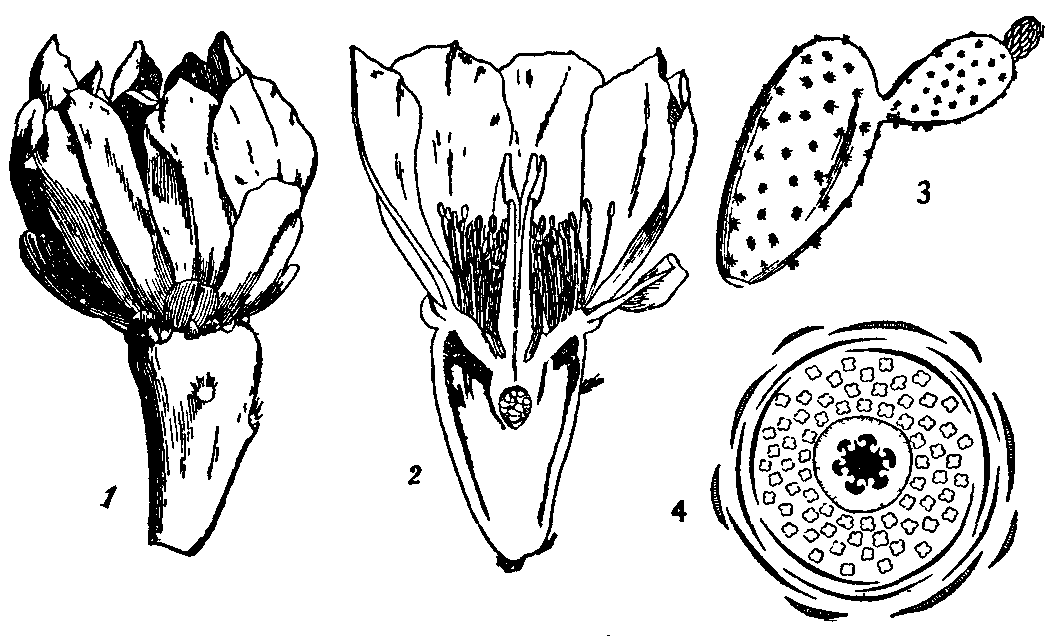
Fig. 1.—Prickly Pear (Opuntia vulgaris). 1, Flower reduced; 2, Same in vertical section; 3, Flattened branch much reduced; 4, Horizontal plan of arrangement of flower.
The Cacti may be described in general terms as plants having a woody axis, overlaid with thick masses of cellular tissue forming the fleshy stems. These are extremely various in character and form, being globose, cylindrical, columnar or flattened into leafy expansions or thick joint-like divisions, the surface being either ribbed like a melon, or developed into nipple-like protuberances, or variously angular, but in the greater number of the species furnished copiously with tufts of horny spines, some of which are exceedingly keen and powerful. These tufts show the position of buds, of which, however, comparatively few are developed. The stems are in most cases leafless, using the term in a popular sense; the leaves, if present at all, being generally reduced to minute scales. In one genus, however, Peireskia, the stems are less succulent, and the leaves, though rather fleshy, are developed in the usual form. The flowers are frequently large and showy, and are generally attractive from their high colouring. In one group, represented by Cereus, they consist of a tube, more or less elongated, on the outer surface of which, towards the base, are developed small and at first inconspicuous scales, which gradually increase in size upwards, and at length become crowded, numerous and petaloid, forming a funnel-shaped blossom, the beauty of which is much enhanced by the multitude of conspicuous stamens which with the pistil occupy the centre. In another group, represented by Opuntia (fig. 1), the flowers are rotate, that is to say, the long tube is replaced by a very short one. At the base of the tube, in both groups, the ovary becomes developed into a fleshy (often edible) fruit, that produced by the Opuntia being known as the prickly pear or Indian fig.
The principal modern genera are grouped by the differences in the flower-tube just explained. Those with long-tubed flowers comprise the genera Melocactus, Mammillaria, Echinocactus, Cereus, Pilocereus, Echinopsis, Phyllocactus, Epiphyllum, &c.; while those with short-tubed flowers are Rhipsalis, Opuntia, Peireskia, and one or two of minor importance. Cactaceae belong almost entirely to the New World; but some of the Opuntias have been so long distributed over certain parts of Europe, especially on the shores of the Mediterranean and the volcanic soil of Italy, that they appear in some places to have taken possession of the soil, and to be distinguished with difficulty from the aboriginal vegetation. The habitats which they affect are the hot, dry regions of tropical America, the aridity of which they are enabled to withstand in consequence of the thickness of their skin and the paucity of evaporating pores or stomata with which they are furnished,—these conditions not permitting the moisture they contain to be carried off too rapidly; the thick fleshy stems and branches contain a store of water. The succulent fruits are not only edible but agreeable, and in fevers are freely administered as a cooling drink. The Spanish Americans plant the Opuntias around their houses, where they serve as impenetrable fences.
Melocactus, the genus of melon-thistle or Turk's-cap cactuses, contains, according to a recent estimate, about 90 species, which inhabit chiefly the West Indies, Mexico and Brazil, a few extending into New Granada. The typical species, M. communis, forms a succulent mass of roundish or ovate form, from 1 ft. to 2 ft. high, the surface divided into numerous furrows like the ribs of a melon, with projecting angles, which are set with a regular series of stellated spines—each bundle consisting of about five larger spines, accompanied by smaller but sharp bristles—and the tip of the plant being surmounted by a cylindrical crown 3 to 5 in. high, composed of reddish-brown, needle-like bristles, closely packed with cottony wool. At the summit of this crown the small rosy-pink flowers are produced, half protruding from the mass of wool, and these are succeeded by small red berries. These strange plants usually grow in rocky places with little or no earth to support them; and it is said that in times of drought the cattle resort to them to allay their thirst, first ripping them up with their horns and tearing off the outer skin, and then devouring the moist succulent parts. The fruit, which has an agreeably acid flavour, is frequently eaten in the West Indies. The Melocacti are distinguished by the distinct cephalium or crown which bears the flowers.
Mammillaria.—This genus, which comprises nearly 300 species, mostly Mexican, with a few Brazilian and West Indian, is called nipple cactus, and consists of globular or cylindrical succulent plants, whose surface instead of being cut up into ridges with alternate furrows, as in Melocactus, is broken up into teat-like cylindrical or angular tubercles, spirally arranged, and terminating in a radiating tuft of spines which spring from a little woolly cushion. The flowers issue from between the mammillae, towards the upper part of the stem, often disposed in a zone just below the apex, and are either purple, rose-pink, white or yellow, and of moderate size. The spines are variously coloured, white and yellow tints predominating, and from the symmetrical arrangement of the areolae or tufts of spines they are very pretty objects, and are hence frequently kept in drawing-room plant cases. They grow freely in a cool greenhouse.
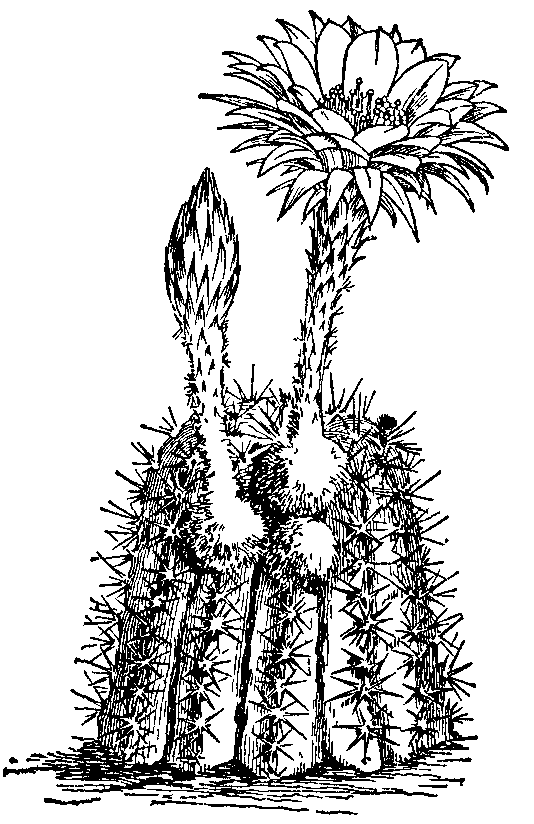
Fig. 2.—Echinocactus much reduced; the flowers are several inches in diameter.
Echinocactus (fig. 2) is the name given to the genus bearing the popular name of hedgehog cactus. It comprises some 200 species, distributed from the south-west United States to Brazil and Chile. They have the fleshy stems characteristic of the order, these being either globose, oblong or cylindrical, and either ribbed as in Melocactus, or broken up into distinct tubercles, and most of them armed with stiff sharp pines, set in little woolly cushions occupying the place of the buds. The flowers, produced near the apex of the plant, are generally large and showy, yellow and rose being the prevailing colours. They are succeeded by succulent fruits, which are exserted, and frequently scaly or spiny, in which respects this genus differs both from Melocactus and Mamrmllaria, which have the fruits immersed and smooth. One of the most interesting species is the E. ingens, of which some very large plants have been from time to time imported. These large plants have from 40 to 50 ridges, on which the buds and clusters of spines are sunk at intervals, the aggregate number of the spines having been in some cases computed at upwards of 50,000 on a single plant. These spines are used by the Mexicans as toothpicks. The plants are slow growers and must have plenty of sun heat; they require sandy loam with a mixture of sand and bricks finely broken and must be kept dry in winter.
Cereus.—This group bears the common name of torch thistle. It comprises about 100 species, largely Mexican but scattered through South America and the West Indies. The stems are columnar or elongated, some of the latter creeping on the ground or climbing up the trunks of trees, rooting as they grow. C. giganteus, the largest and most striking species of the genus, is a native of hot, arid, desert regions of New Mexico, growing there in rocky valleys and on mountain sides, where the tall stems with their erect branches have the appearance of telegraph poles. The stems grow to a height of from 50 ft. to 60 ft., and have a diameter of from 1 ft. to 2 ft., often unbranched, but sometimes furnished with branches which grow out at right angles from the main stem, and then curve upwards and continue their growth parallel to it; these stems have from twelve to twenty ribs, on which at intervals of about an inch are the buds with their thick yellow cushions, from which issue five or six large and numerous smaller spines. The fruits of this plant, which are green oval bodies from 2 to 3 in. long, contain a crimson pulp from which the Pimos and Papagos Indians prepare an excellent preserve; and they also use the ripe fruit as an article of food, gathering it by means of a forked stick attached to a long pole. The Cereuses include some of our most interesting and beautiful hothouse plants. In the allied genus Echinocereus, with 25 to 30 species in North and South America, the stems are short, branched or simple, divided into few or many ridges all armed with sharp, formidable spines. E. pectinatus produces a purplish fruit resembling a gooseberry, which is very good eating; and the fleshy part of the stem itself, which is called cabeza del viego by the Mexicans, is eaten by them as a vegetable after removing the spines.
Pilocereus, the old man cactus, forms a small genus with tallish erect, fleshy, angulate stems, on which, with the tufts of spines, are developed hair-like bodies, which, though rather coarse, bear some resemblance to the hoary locks of an old man. The plants are nearly allied to Cereus, differing chiefly in the floriferous portion developing these longer and more attenuated hair-like spines, which surround the base of the flowers and form a dense woolly head or cephalium. The most familiar species is P. senilis, a Mexican plant, which though seldom seen more than a foot or two in height in greenhouses, reaches from 20 ft. to 30 ft. in its native country.
Echinopsis is another small group of species, separated by some authors from Cereus. They are dwarf, ribbed, globose or cylindrical plants; and the flowers, which are produced from the side instead of the apex of the stem, are large, and in some cases very beautiful, being remarkable for the length of the tube, which is more or less covered with bristly hairs. They are natives of Brazil, Bolivia and Chile.
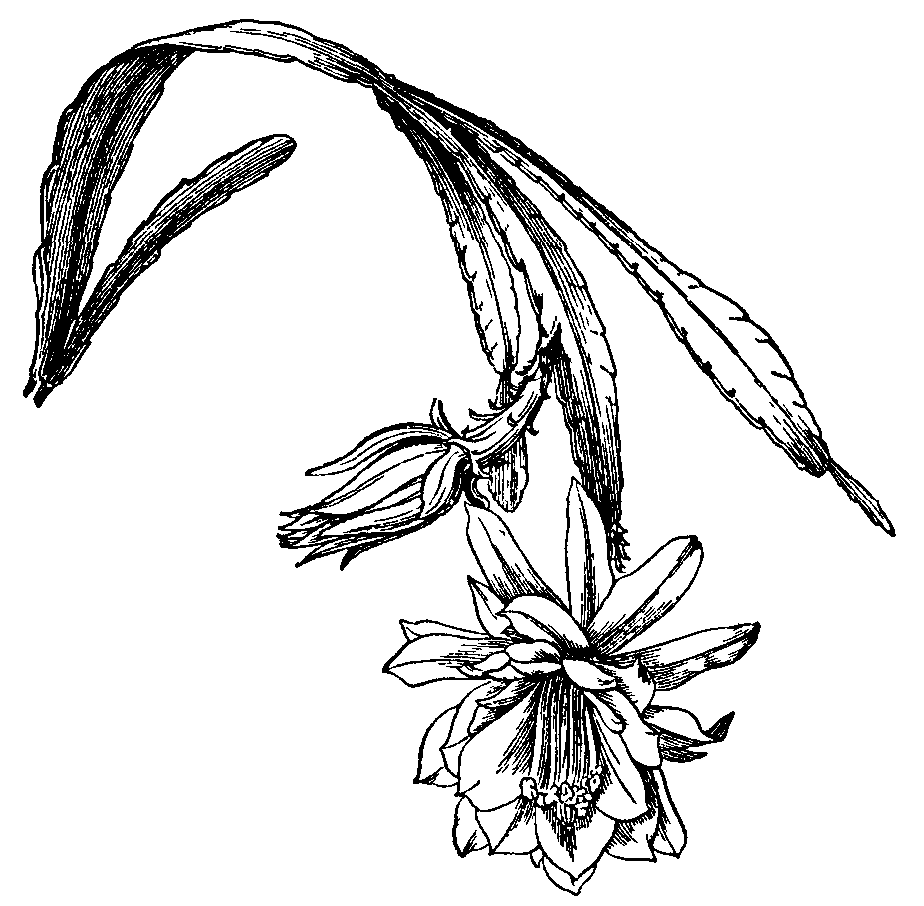
Fig. 3.—Branch of Phyllocactus much reduced; the flowers are 6 in. or more in diameter.
Phyllocactus (fig. 3), the Leaf Cactus family, consists of about a dozen species, found in Central and tropical South America. They differ from all the forms already noticed in being shrubby and epiphytal in habit, and in having the branches compressed and dilated so as to resemble thick fleshy leaves, with a strong median axis and rounded woody base. The margins of these leaf-like branches are more or less crenately notched, the notches representing buds, as do the spine-clusters in the spiny genera; and from these crenatures the large showy flowers are produced. As garden plants the Phyllocacti are amongst the most ornamental of the whole family, being of easy culture, free blooming and remarkably showy, the colour of the flowers ranging from rich crimson, through rose-pink to creamy white. Cuttings strike readily in spring before growth has commenced; they should be potted in 3-in. or 4-in. pots, well drained, in loamy soil made very porous by the admixture of finely broken crocks and sand, and placed in a temperature of 60°; when these pots are filled with roots they are to be shifted into larger ones, but overpotting must be avoided. During the summer they need considerable heat, all the light possible and plenty of air; in winter a temperature of 45° or 50° will be sufficient, and they must be kept tolerably dry at the root. By the spring they may have larger pots if required and should be kept in a hot and fairly moistened atmosphere; and by the end of June, when they have made new growth, they may be turned out under a south wall in the full sun, water being given only as required. In autumn they are to be returned to a cool house and wintered in a dry stove. The turning of them outdoors to ripen their growth is the surest way to obtain flowers, but they do not take on a free blooming habit until they have attained some age. They are often called Epiphyllum, which name is, however, properly restricted to the group next to be mentioned.
Epiphyllum.—This name is now restricted to two or three dwarf branching Brazilian epiphytal plants of extreme beauty, which agree with Phyllocactus in having the branches dilated into the form of fleshy leaves, but differ in haying them divided into short truncate leaf-like portions, which are articulated, that is to say, provided with a joint by which they separate spontaneously; the margins are crenate or dentate, and the flowers, which are large and showy, magenta or crimson, appear at the apex of the terminal joints. In E. truncatum the flowers have a very different aspect from that of other Cacti, from the mouth of the tube being oblique and the segments all reflexed at the tip. The short separate pieces of which these plants are made up grow out of each other, so that the branches may be said to resemble leaves joined together endwise.
Rhipsalis, a genus of about 50 tropical species, mainly in Central and South America, but a few in tropical Africa and Madagascar. It is a very heterogeneous group, being fleshy-stemmed with a woody axis, the branches being angular, winged, flattened or cylindrical, and the flowers small, short-tubed, succeeded by small, round, pea-shaped berries. Rhipsalis Cassytha, when seen laden with its white berries, bears some resemblance to a branch of mistletoe. All the species are epiphytal in habit.
Opuntia, the prickly pear, or Indian fig cactus, is a large typical group, comprising some 150 species, found in North America, the West Indies, and warmer parts of South America, extending as far as Chile. In aspect they are very distinct from any of the other groups. They are fleshy shrubs, with rounded, woody stems, and numerous succulent branches, composed in most of the species of separate joints or parts, which are much compressed, often elliptic or suborbicular, dotted over in spiral lines with small, fleshy, caducous leaves, in the axils of which are placed the areoles or tufts of barbed or hooked spines of two forms. The flowers are mostly yellow or reddish-yellow, and are succeeded by pear-shaped or egg-shaped fruits, having a broad scar at the top, furnished on their soft, fleshy rind with tufts of small spines. The sweet, juicy fruits of O. vulgaris and O. Tuna are much eaten under the name of prickly pears, and are greatly esteemed for their cooling properties. Both these species are extensively cultivated for their fruit in Southern Europe, the Canaries and northern Africa; and the fruits are not unfrequently to be seen in Covent Garden Market and in the shops of the leading fruiterers of the metropolis. O. vulgaris is hardy in the south of England.
The cochineal insect is nurtured on a species of Opuntia (O. coccinellifera), separated by some authors under the name of Nopalea, and sometimes also on O. Tuna. Plantations of the nopal and the tuna, which are called nopaleries, are established for the purpose of rearing this insect, the Coccus Cacti, and these often contain as many as 50,000 plants. The females are placed on the plants about August, and in four months the first crop of cochineal is gathered, two more being produced in the course of the year. The native country of the insect is Mexico, and it is there more or less cultivated; but the greater part of our supply comes from Colombia and the Canary Islands.
Peireskia aculeata, or Barbadoes gooseberry, the Cactus peireskia of Linnaeus, differs from the rest in having woody stems and leaf-bearing branches, the leaves being somewhat fleshy, but otherwise of the ordinary laminate character. The flowers are subpaniculate, white or yellowish. This species is frequently used as a stock on which to graft other Cacti. There are about a dozen species known of this genus, mainly Mexican.
CADALSO VAZQUEZ, JOSÉ (1741-1782), Spanish author, was born at Cadiz on the 8th of October 1741. Before completing his twentieth year he had travelled through Italy, Germany, England, France and Portugal, and had studied the literatures of these countries. On his return to Spain he entered the army and rose to the rank of colonel. He was killed at the siege of Gibraltar, on the 27th of February 1782. His first published work was a rhymed tragedy, Don Sancho Garcia, Conde de Castilla (1771). In the following year he published his Eruditos á la Violeta, a prose satire on superficial knowledge, which was very successful. In 1773 appeared a volume of miscellaneous poems, Ocios de mi juventud, and after his death there was found among his MSS. a series of fictitious letters in the style of the Lettres Persanes; these were issued in 1793 under the title of Cartas marruecas. A good edition of his works appeared at Madrid, in 3 vols., 1823. This is supplemented by the Obras inéditas (Paris, 1894) published by R. Foulché-Delbosc.
CADAMOSTO (or Ca Da Mosto), ALVISE (1432-1477), a Venetian explorer, navigator and writer, celebrated for his voyages in the Portuguese service to West Africa. In 1454 he sailed from Venice for Flanders, and, being detained by contrary winds off Cape St Vincent, was enlisted by Prince Henry the Navigator among his explorers, and given command of an expedition which sailed (22nd of March 1455) for the south. Visiting the Madeira group and the Canary Islands (of both which he gives an elaborate account, especially concerned with European colonization and native customs), and coasting the West Sahara (whose tribes, trade and trade-routes he likewise describes in detail), he arrived at the Senegal, whose lower course had already, as he tells us, been explored by the Portuguese 60 m. up. The negro lands and tribes south of the Senegal, and especially the country and people of Budomel, a friendly chief reigning about 50 m. beyond the river, are next treated with equal wealth of interesting detail, and Cadamosto thence proceeded towards the Gambia, which he ascended some distance (here also examining races, manners and customs with minute attention), but found the natives extremely hostile, and so returned direct to Portugal. Cadamosto expressly refers to the chart he kept of this voyage. At the mouth of the Gambia he records an observation of the "Southern Chariot" (Southern Cross). Next year (1456) he went out again under the patronage of Prince Henry. Doubling Cape Blanco he was driven out to sea by contrary winds, and thus made the first known discovery of the Cape Verde Islands. Having explored Boavista and Santiago, and found them uninhabited, he returned to the African mainland, and pushed on to the Gambia, Rio Grande and Geba. Returning thence to Portugal, he seems to have remained there till 1463, when he reappeared at Venice. He died in 1477.
Besides the accounts of his two voyages, Cadamosto left a narrative of Pedro de Cintra's explorations in 1461 (or 1462) to Sierre Leone and beyond Cape Mesurado to El Mina and the Gold Coast; all these relations first appeared in the 1507 Vicenza Collection of Voyages and Travels (the Paesi novamente retrovati et novo mondo da Alberico Vesputio Florentino); they have frequently since been reprinted and translated (e.g. Ital. text in 1508, 1512, 1519, 1521, 1550 (Ramusio), &c.; Lat. version, Itinerarium Portugallensium, &c.,1508, 1532 (Grynaeus), &c.; Fr. Sensuyt le nouveau monde, &c., 1516, 1521; German, Newe unbekante Landte, &c., 1508). See also C. Schefer, Relation des voyages ... de Ca' da Mosto (1895); R.H. Major, Henry the Navigator (1868), pp. 246-287; C.R. Beazley, Henry the Navigator (1895), pp. 261-288; Yule Oldham, Discovery of the Cape Verde Islands (1892), esp. pp. 4-15.
It may be noted that Antonio Uso di Mare (Antoniotto Ususmaris), the Genoese, wrote his famous letter of the 12th of December 1455 (purporting to record a meeting with the last surviving descendant of the Genoese-Indian expedition of 1291, at or near the Gambia), after accompanying Cadamosto to West Africa; see Beazley, Dawn of Modern Geography (1892), iii. 416-418.
CADASTRE (a French word from the Late Lat. capitastrum, a register of the poll-tax), a register of the real property of a country, with details of the area, the owners and the value. A "cadastral survey" is properly, therefore, one which gives such information as the Domesday Book, but the term is sometimes used loosely of the Ordnance Survey of the United Kingdom (1=2500), which is on sufficiently large a scale to give the area of every field or piece of ground.
CADDIS-FLY and CADDIS-WORM, the name given to insects with a superficial resemblance to moths, sometimes referred to the Neuroptera, sometimes to a special order, the Trichoptera, in allusion to the hairy clothing of the body and wings. Apart from this feature the Trichoptera also differ from the typical Neuroptera in the relatively simple, mostly longitudinal neuration of the wings, the absence or obsolescence of the mandibles and the semi-haustellate nature of the rest of the mouth-parts. Although caddis-flies are sometimes referred to several families, the differences between the groups are of no great importance. Hence the insects may more conveniently be regarded as constituting the single family Phryganeidae. The larvae known as caddis-worms are aquatic. The mature females lay their eggs in the water, and the newly-hatched larvae provide themselves with cases made of various particles such as grains of sand, pieces of wood or leaves stuck together with silk secreted from the salivary glands of the insect. These cases differ greatly in structure and shape. Those of Phyrganea consist of bits of twigs or leaves cut to a suitable length and laid side by side in a long spirally-coiled band, forming the wall of a subcylindrical cavity. The cavity of the tube of Helicopsyche, composed of grains of sand, is itself spirally coiled, so that the case exactly resembles a small snail-shell in shape. One species of Limnophilus uses small but entire leaves; another, the shells of the pond-snail Planorbis; another, pieces of stick arranged transversely with reference to the long axis of the tube. To admit of the free inflow and outflow of currents of water necessary for respiration, which is effected by means of filamentous abdominal tracheal gills, the two ends of the tube are open. Sometimes the cases are fixed, but more often portable. In the latter case the larva crawls about the bottom of the water or up the stems of plants, with its thickly-chitinized head and legs protruding from the larger orifice, while it maintains a secure hold of the silk lining of the tube by means of a pair of strong hooks at the posterior end of its soft defenceless abdomen. Their food appears for the most part to be of a vegetable nature. Some species, however, are alleged to be carnivorous, and a North American form of the genus Hydropsyche is said to spin around the mouth of its burrow a silken net for the capture of small animal organisms living in the water. Before passing into the pupal stage, the larva partially closes the orifice of the tube with silk or pieces of stone loosely spun together and pervious to water. Through this temporary protection the active pupa, which closely resembles the mature insect, subsequently bites a way by means of its strong mandibles, and rising to the surface of the water casts the pupal integument and becomes sexually adult.
The above sketch may be regarded as descriptive of the life-history of a great majority of species of caddis-flies. It is only necessary here to mention one anomalous form, Enoicyla pusilla, in which the mature female is wingless and the larva is terrestrial, living in moss or decayed leaves.
Caddis-flies are universally distributed. Geologically they are known to date back to the Oligocene period, and wings believed to be referable to them have been found in Liassic and Jurassic beds.
(R. I. P.)
CADDO, a confederacy of North American Indian tribes which gave its name to the Caddoan stock, represented in the south by the Caddos, Wichita and Kichai, and in the north by the Pawnee and Arikara tribes. The Caddos, now reduced to some 500, settled in western Oklahoma, formerly ranged over the Red River (Louisiana) country, in what is now Arkansas, northern Texas and Oklahoma. The native name of the confederacy is Hasinai, corrupted by the French into Asinais and Cenis. The Caddoan tribes were mostly agricultural and sedentary, and to-day they are distinguished by their industry and intelligence.
See Handbook of American Indians (Washington, 1907).
CADE, JOHN (d. 1450), commonly called Jack Cade, English rebel and leader of the rising of 1450, was probably an Irishman by birth, but the details of his early life are very scanty. He seems to have resided for a time in Sussex, to have fled from the country after committing a murder, and to have served in the French wars. Returning to England, he settled in Kent under the name of Aylmer and married a lady of good position. When the men of Kent rose in rebellion in May 1450, they were led by a man who took the name of Mortimer, and who has generally been regarded as identical with Cade. Mr James Gairdner, however, considers it probable that Cade did not take command of the rebels until after the skirmish at Sevenoaks on the 18th of June. At all events, it was Cade who led the insurgents from Blackheath to Southwark, and under him they made their way into London on the 3rd of July. A part of the populace was doubtless favourable to the rebels, but the opposing party gained strength when Cade and his men began to plunder. Having secured the execution of James Fiennes, Baron Say and Sele, and of William Crowmer, sheriff of Kent, Cade and his followers retired to Southwark, and on the 5th of July, after a fierce struggle on London Bridge, the citizens prevented them from re-entering the city. Cade then met the chancellor, John Kemp, archbishop of York, and William of Wayneflete, bishop of Winchester, and terms of peace were arranged. Pardons were drawn up, that for the leaders being in the name of Mortimer. Cade, however, retained some of his men, and at this time, or a day or two earlier, broke open the prisons in Southwark and released the prisoners, many of whom joined his band. Having collected some booty, he went to Rochester, made a futile attempt to capture Queenborough castle, and then quarrelled with his followers over some plunder. On the 10th of July a proclamation was issued against him in the name of Cade, and a reward was offered for his apprehension. Escaping into Sussex he was captured at Heathfield on the 12th. During the scuffle he had been severely wounded, and on the day of his capture he died in the cart which was conveying him to London. The body was afterwards beheaded and quartered, and in 1451 Cade was attainted.
See Robert Fabyan, The New Chronicles of England and France, edited by H. Ellis (London, 1811); William of Worcester, Annales rerum Anglicarum, edited by J. Stevenson, (London, 1864); An English Chronicle of the Reigns of Richard II., Henry IV., Henry V. and Henry VI., edited by J.S. Davies (London, 1856); Historical Collections of a Citizen of London, edited by J. Gairdner (London, 1876); Three Fifteenth Century Chronicles, edited by J. Gairdner (London, 1880); J. Gairdner, Introduction to the Paston Letters (London, 1904); G. Kriehn, The English Rising of 1450 (Strassburg, 1892.)
CADENABBIA, a village of Lombardy, Italy, in the province of Como, about 15 m. N.N.E. by steamer from the town of Como. It is situated on the W. shore of the lake of Como, and owing to the great beauty of the scenery and of the vegetation, and its sheltered situation, is a favourite spring and autumn resort. The most famous of its villas is the Villa Carlotta, now the property of the duke of Saxe-Meiningen, which contains marble reliefs by Thorwaldsen, representing the triumph of Alexander, and statues by Canova.
CADENCE (through the Fr. from the Lat. cadentia, from cadere, to fall), a falling or sinking, especially as applied to rhythmical or musical sounds, as in the "fall" of the voice in speaking, the rhythm or measure of verses, song or dance. In music, the word is used of the closing chords of a musical phrase, which succeed one another in such a way as to produce, first an expectation or suspense, and then an impression of finality, indicating also the key strongly. "Cadenza," the Italian form of the same word, is used of a free flourish in a vocal or instrumental composition, introduced immediately before the close of a movement or at the end of the piece. The object is to display the performer's technique, or to prevent too abrupt a contrast between two movements. Cadenzas are usually left to the improvisation of the performer, but are sometimes written in full by the composer, or by some famous executant, as in the cadenza in Brahms's Violin Concerto, written by Joseph Joachim.
CADER IDRIS ("the Seat of Idris"), the second most imposing mountain in North Wales, standing in Merionethshire to the S. of Dolgelly, between the broad estuaries of the Mawddach and the Dovey. It is so called in memory of Idris Gawr, celebrated in the Triads as one of the three "Gwyn Serenyddion," or "Happy Astronomers," of Wales, who is traditionally supposed to have made his observations on this peak. Its loftiest point, known as Pen-y-gader, rises to the height of 2914 ft., and in clear weather commands a magnificent panorama of immense extent. The mountain is everywhere steep and rocky, especially on its southern side, which falls abruptly towards the Lake of Tal-y-llyn. Mention of Cader Idris and its legends is frequent in Welsh literature, old and modern.
CADET (through the Fr. from the Late Lat. capitettum, a diminutive of caput, head, through the Provençal form capdet), the head of an inferior branch of a family, a younger son; particularly a military term for an accepted candidate for a commission in the army or navy, who is undergoing training to become an officer. This latter use of the term arose in France, where it was applied to the younger sons of the noblesse who gained commissioned rank, not by serving in the ranks or by entering the écoles militaires, but by becoming attached to corps without pay but with certain privileges. "Cadet Corps," in the British service, are bodies of boys or youths organized, armed and trained on volunteer military lines. Derived from "cadet," through the Scots form "cadee," comes "caddie," a messenger-boy, and particularly one who carries clubs at golf, and also the slang word "cad," a vulgar, ill-bred person.
CADGER (a word of obscure origin possibly connected with "catch"), a hawker or pedlar, a carrier of farm produce to market. The word in this sense has fallen into disuse, and now is used for a beggar or loafer, one who gets his living in more or less questionable ways.