Front matter (continued 7)
Reading edition
The temperature varies almost as much as the rainfall. It is highest in the central zone, the mean of the maximum readings in such districts as Magwe, Myingyan, Kyauksè, Mandalay and Shwebo in the month of May being close on 100° F., while in the littoral and sub-montane districts it is nearly ten degrees less. The mean of the minimum readings in December in the central zone districts is a few degrees under 60° F. and in the littoral districts a few degrees over that figure. In the hilly district of Mogôk (Ruby Mines) the December mean minimum is 36.8° and the mean maximum 79°. The climate of the Chin and Kachin hills and also of the Shan States is temperate. In the shade and off the ground the thermometer rarely rises above 80° F. or falls below 25° F. In the hot season and in the sun as much as 150° F. is registered, and on the grass in the cold weather ten degrees of frost are not uncommon. Snow is seldom seen either in the Chin or Shan hills, but there are snow-clad ranges in the extreme north of the Kachin country. In the narrow valleys of the Shan hills, and especially in the Salween valley, the shade maximum reaches 100° F. regularly for several weeks in April. The rainfall in the hills varies very considerably, but seems to range from about 60 in. in the broader valleys to about 300 in. on the higher forest-clad ranges.
Geology.—Geologically, British Burma consists of two divisions, an eastern and a western. The dividing line runs from the mouth of the Sittang river along the railway to Mandalay, and thence continues northward, with the same general direction but curving slightly towards the east. West of this line the rocks are chiefly Tertiary and Quaternary; east of it they are mostly Palaeozoic or gneissic. In the western mountain ranges the beds are thrown into a series of folds which form a gentle curve running from south to north with its convexity facing westward. There is an axial zone of Cretaceous and Lower Eocene, and this is flanked on each side by the Upper Eocene and the Miocene, while the valley of the Irrawaddy is occupied chiefly by the Pliocene. Along the southern part of the Arakan coast the sea spreads over the western Miocene zone. The Cretaceous beds have not yet been separated from the overlying Eocene, and the identification of the system rests on the discovery of a single Cenomanian ammonite. The Eocene beds are marine and contain nummulites. The Miocene beds are also marine and are characterized by an abundant molluscan fauna. The Pliocene, on the other hand, is of freshwater origin, and contains silicified wood and numerous remains of Mammalia. Flint chips, which appear to have been fashioned by hand, are said to have been found in the Miocene beds, but to prove the existence of man at so early a period would require stronger evidence than has yet been brought forward.
The older rocks of eastern Burma are very imperfectly known. Gneiss and granite occur; Ordovician fossils have been found in the Upper Shan States, and Carboniferous fossils in Tenasserim and near Moulmein. Volcanic rocks are not common in any part of Burma, but about 50 m. north-north-east of Yenangyaung the extinct volcano of Popa rises to a height of 3000 ft. above the surrounding Pliocene plain. Intrusions of a serpentine-like rock break through the Miocene strata north of Bhamo, and similar intrusions occur in the western ranges. Whether the mud "volcanoes" of the Irrawaddy valley have any connexion with volcanic activity may be doubted. The petroleum of Burma occurs in the Miocene beds, one of the best-known fields being that of Yenangyaung. Coal is found in the Tertiary deposits in the valley of the Irrawaddy and in Tenasserim. Tin is abundant in Tenasserim, and lead and silver have been worked extensively in the Shan States. The famous ruby mines of Upper Burma are in metamorphic rock, while the jadeite of the Bhamo neighbourhood is associated with the Tertiary intrusions of serpentine-like rock already noticed.[1]
Population.—The total population of Burma in 1901 was 10,490,624 as against 7,722,053 in 1891; but a considerable portion of this large increase was due to the inclusion of the Shan States and the Chin hills in the census area. Even in Burma proper, however, there was an increase during the decade of 1,530,822, or 19.8%. The density of population per square mile is 44 as compared with 167 for the whole of India and 552 for the Bengal Delta. England and Wales have a population more than twelve times as dense as that of Burma, so there is still room for expansion. The chief races of Burma are Burmese (6,508,682), Arakanese (405,143), Karens (717,859), Shans (787,087), Chins (179,292), Kachins (64,405) and Talaings (321,898); but these totals do not include the Shan States and Chin hills. The Burmese in person have the Mongoloid characteristics common to the Indo-Chinese races, the Tibetans and tribes of the Eastern Himalaya. They may be generally described as of a stout, active, well-proportioned form; of a brown but never of an intensely dark complexion, with black, coarse, lank and abundant hair, and a little more beard than is possessed by the Siamese. Owing to their gay and lively disposition the Burmese have been called "the Irish of the East," and like the Irish they are somewhat inclined to laziness. Since the advent of the British power, the immigration of Hindus with a lower standard of comfort and of Chinamen with a keener business instinct has threatened the economic independence of the Burmese in their own country. As compared with the Hindu, the Burmese wear silk instead of cotton, and eat rice instead of the cheaper grains; they are of an altogether freer and less servile, but also of a less practical character. The Burmese women have a keener business instinct than the men, and serve in some degree to redress the balance. The Burmese children are adored by their parents, and are said to be the happiest and merriest children in the world.
Language and Literature.—The Burmese are supposed by modern philologists to have come, as joint members of a vast Indo-Chinese immigration swarm, from western China to the head waters of the Irrawaddy and then separated, some to people Tibet and Assam, the others to press southwards into the plains of Burma. The indigenous tongues of Burma are divided into the following groups:—
A. Indo-Chinese family (1) Tibet-Burman sub-family (a) The Burmese group. (b) The Kachin group. (c) The Kuki-Chin group.
(2) Siamese-Chinese sub-family (d) The Tai group. (e) The Karen group.
(3) Môn-Annam sub-family (f) The Upper Middle Mekong or Wa Palaung group. (g) The North Cambodian group.
B. Malay family (h) The Selung language.
Burmese, which was spoken by 7,006,495 people in the province in 1901, is a monosyllabic language, with, according to some authorities, three different tones; so that any given syllable may have three entirely different meanings only distinguishable by the intonation when spoken, or by accents or diacritical marks when written. There are, however, very many weighty authorities who deny the existence of tones in the language. The Burmese alphabet is borrowed from the Aryan Sanskrit through the Pāli of Upper India. The language is written from left to right in what appears to be an unbroken line. Thus Burma possesses two kinds of literature, Pāli and Burmese. The Pāli is by far the more ancient, including as it does the Buddhist scriptures that originally found their way to Burma from Ceylon and southern India. The Burmese literature is for the most part metrical, and consists of religious romances, chronological histories and songs. The Maha Yazawin or "Royal Chronicle," forms the great historical work of Burma. This is an authorized history, in which everything unflattering to the Burmese monarchs was rigidly suppressed. After the Second Burmese War no record was ever made in the Yazawin that Pegu had been torn away from Burma by the British. The folk songs are the truest and most interesting national literature. The Burmese are fond of stage-plays in which great licence of language is permitted, and great liberty to "gag" is left to the wit or intelligence of the actors.
Government.—The province as a division of the Indian empire is administered by a lieutenant-governor, first appointed 1st May 1897, with a legislative council of nine members, five of whom are officials. There are, besides, a chief secretary, revenue secretary, secretary and two under-secretaries, a public works department secretary with two assistants. The revenue administration of the province is superintended by a financial commissioner, assisted by two secretaries, and a director of land records and agriculture, with a land records departmental staff. There is a chief court for the province with a chief justice and three justices, established in May 1900. Other purely judicial officers are the judicial commissioner for Upper Burma, and the civil judges of Mandalay and Moulmein. There are four commissioners of revenue and circuit, and nineteen deputy commissioners in Lower Burma, and four commissioners and seventeen deputy commissioners in Upper Burma. There are two superintendents of the Shan States, one for the northern and one for the southern Shan States, and an assistant superintendent in the latter; a superintendent of the Arakan hill tracts and of the Chin hills, and a Chinese political adviser taken from the Chinese consular service. The police are under the control of an inspector-general, with deputy inspector-general for civil and military police, and for supply and clothing. The education department is under a director of public instruction, and there are three circles—eastern, western and Upper Burma, each under an inspector of schools.
The Burma forests are divided into three circles each under a conservator, with twenty-one deputy conservators. There are also a deputy postmaster-general, chief superintendent and four superintendents of telegraphs, a chief collector of customs, three collectors and four port officers, and an inspector-general of jails. At the principal towns benches of honorary magistrates, exercising powers of various degrees, have been constituted. There are forty-one municipal towns, fourteen of which are in Upper Burma. The commissioners of division are ex officio sessions judges in their several divisions, and also have civil powers, and powers as revenue officers. They are responsible to the lieutenant-governor, each in his own division, for the working of every department of the public service, except the military department, and the branches of the administration directly under the control of the supreme government. The deputy commissioners perform the functions of district magistrates, district judges, collectors and registrars, besides the miscellaneous duties which fall to the principal district officer as representative of government. Subordinate to the deputy commissioners are assistant commissioners, extra-assistant commissioners and myoôks, who are invested with various magisterial, civil and revenue powers, and hold charge of the townships, as the units of regular civil and revenue jurisdiction are called, and the sub-divisions of districts, into which most of these townships are grouped. Among the salaried staff of officials, the townships officers are the ultimate representatives of government who come into most direct contact with the people. Finally, there are the village headmen, assisted in Upper Burma by elders, variously designated according to old custom. Similarly in the towns, there are headmen of wards and elders of blocks. In Upper Burma these headmen have always been revenue collectors. The system under which in towns headmen of wards and elders of blocks are appointed is of comparatively recent origin, and is modelled on the village system.
The Shan States were declared to be a part of British India by notification in 1886. The Shan States Act of 1888 vests the civil, The Shan States. criminal and revenue administration in the chief of the state, subject to the restrictions specified in the sanad or patent granted to him. The law to be administered in each state is the customary law of the state, so far as it is in accordance with the justice, equity and good conscience, and not opposed to the spirit of the law in the rest of British India. The superintendents exercise general control over the administration of criminal justice, and have power to call for cases, and to exercise wide revisionary powers. Criminal jurisdiction in cases in which either the complainant or the defendant is a European, or American, or a government servant, or a British subject not a native of a Shan State, is withdrawn from the chiefs and vested in the superintendents and assistant superintendents. Neither the superintendents nor the assistant superintendents have power to try civil suits, whether the parties are Shans or not. In the Myelat division of the southern Shan States, however, the criminal law is practically the same as the in force in Upper Burma, and the ngwegunhmus, or petty chiefs, have been appointed magistrates of the second class. The chiefs of the Shan States are of three classes:—(1) sawbwas; (2) myosas; (3) ngwegunhmus. The last are found only in the Myelat, or border country between the southern Shan States and Burma. There are fifteen sawbwas, sixteen myosas and thirteen ngwegunhmus in the Shan States proper. Two sawbwas are under the supervision of the commissioner of the Mandalay division, and two under the commissioner of the Sagaing division. The states vary enormously in size, from the 12,000 sq. m. of the Trans-Salween State of Kêng Tung, to the 3.95 sq. m. of Nam Hkôm in the Myelat. The latter contained only 41 houses with 210 inhabitants in 1897 and has since been merged in the adjoining state. There are five states, all sawbwaships, under the supervision of the superintendent of the northern Shan States, besides an indeterminate number of Wa States and communities of other races beyond the Salween river. The superintendent of the southern Shan States supervises thirty-nine, of which ten are sawbwaships. The headquarters of the northern Shan States are at Lashio, of the southern Shan States at Taung-gyi.
The states included in eastern and western Karen-ni are not part of British India, and are not subject to any of the laws in force in the Shan States, but they are under the supervision of the superintendent of the southern Shan States.
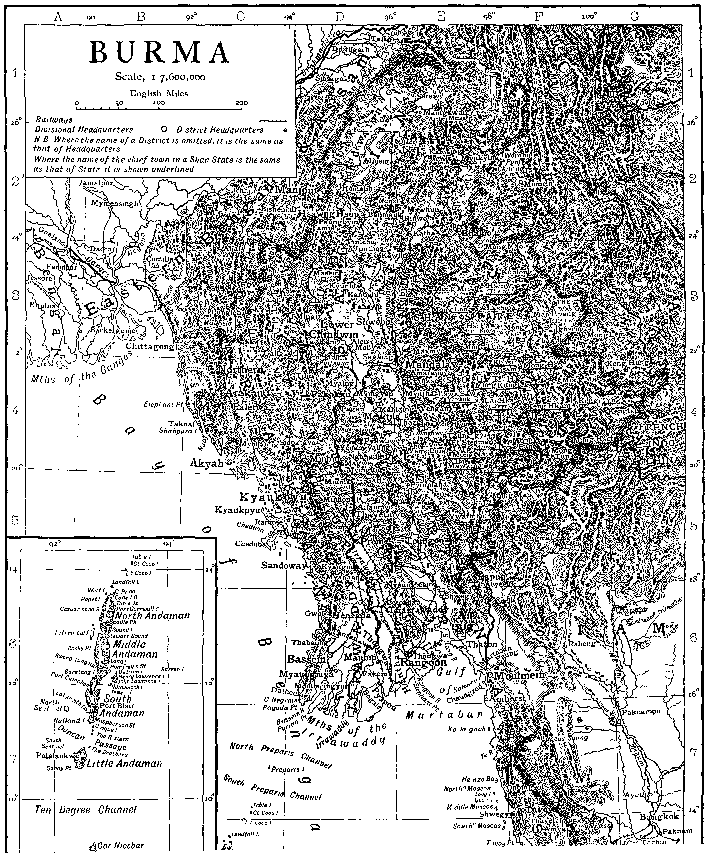
The northern portion of the Karen hills is at present dealt with on the principle of political as distinguished from administrative control. The tribes are not interfered with as long as they keep the peace. What is specifically known as the Kachin hills, the country taken under administration in the Bhamo and Myitkyina districts, is divided into forty tracts. Beyond these tracts there are many Kachins in Katha, Möng-Mit, and the northern Shan States, but though they are often the preponderating, they are not the exclusive population. The country within the forty tracts may be considered the Kachin hills proper, and it lies between 23° 30′ and 26° 30′ N. lat. and 96° and 98° E. long. Within this area the petty chiefs have appointment orders, the people are disarmed, and the rate of tribute per household is fixed in each case. Government is regulated by the Kachin hills regulation. Since 1894 the country has been practically undisturbed, and large numbers of Kachins are enlisted, and ready to enlist in the military police, and seem likely to form as good troops as the Gurkhas of Nepal.
The Chin hills were not declared an integral part of Burma until 1895, but they now form a scheduled district. The chiefs, however, are allowed to administer their own affairs, as far as may be, in accordance with their own customs, subject to the supervision of the superintendent of the Chin hills.
Religion.—Buddhists make up more than 88.6%; Mussulmans 3.28; spirit-worshippers 3.85; Hindus 2.76, and Christians 1.42 of the total population of the province. The large nominal proportion of Buddhists is deceptive. The Burmese are really as devoted to demonolatry as the hill-tribes who are labelled plain spirit-worshippers. The actual figures of the various religions, according to the census of 1901, are as follows:—
Buddhists 9,184,121
Spirit-worshippers 399,390
Hindus 285,484
Mussulmans 339,446
Christians 147,525
Sikhs 6,596
Jews 685
Parsees 245
Others 28
The chief religious principle of the Burmese is to acquire merit for their next incarnation by good works done in this life. The bestowal of alms, offerings of rice to priests, the founding of a monastery, erection of pagodas, with which the country is crowded, the building of a bridge or rest-house for the convenience of travellers are all works of religious merit, prompted, not by love of one's fellow-creatures, but simply and solely for one's own future advantage.
An analysis shows that not quite two in every thousand Burmese profess Christianity, and there are about the same number of Mahommedans among them. It is admitted by the missionaries themselves that Christianity has progressed very slowly among the Burmese in comparison with the rapid progress made amongst the Karens. It is amongst the Sgaw Karens that the greatest progress in Christianity has been made, and the number of spirit-worshippers among them is very much smaller. The number of Burmese Christians is considerably increased by the inclusion among them of the Christian descendants of the Portuguese settlers of Syriam deported to the old Burmese Tabayin, a village now included in the Ye-u subdivision of Shwebo. These Christians returned themselves as Burmese. The forms of Christianity which make most converts in Burma are the Baptist and Roman Catholic faiths. Of recent years many conversions to Christianity have been made by the American Baptist missionaries amongst the Lahu or Muhsö hill tribesmen.
Education.—Compared with other Indian provinces, and even with some of the countries of Europe, Burma takes a very high place in the returns of those able to both read and write. Taking the sexes apart, though women fall far behind men in the matter of education, still women are better educated in Burma than in the rest of India. The average number of each sex in Burma per thousand is:—literates, male 378; female, 45; illiterates, male, 622; female, 955. The number of literates per thousand in Bengal is:—male, 104; female, 5. The proportion was greatly reduced in the 1901 census by the inclusion of the Shan States and the Chin hills, which mostly consist of illiterates.
The fact that in Upper Burma the proportion of literates is nearly as high as, and the proportion of those under instruction even higher than, that of the corresponding classes in Lower Burma, is a clear proof that in primary education, at least, the credit for the superiority of the Burman over the native of India is due to indigenous schools. In almost every village in the province there is a monastery, where the most regular occupation of one or more of the resident pongyis, or Buddhist monks, is the instruction free of charge of the children of the village. The standard of instruction, however, is very low, consisting only of reading and writing, though this is gradually being improved in very many monasteries. The absence of all prejudice in favour of the seclusion of women also is one of the main reasons why in this province the proportion who can read and write is higher than in any other part of India, Cochin alone excepted. It was not till 1890 that the education department took action in Upper Burma. It was then ascertained that there were 684 public schools with 14,133 pupils, and 1664 private schools with 8685 pupils. It is worthy of remark that of these schools 29 were Mahommedan, and that there were 176 schools for girls in which upwards of 2000 pupils were taught. There are three circles—Eastern, Central and Upper Burma. For the special supervision and encouragement of indigenous primary education in monastic and in lay schools, each circle of inspection is divided into sub-circles corresponding with one or more of the civil districts, and each sub-circle is placed under a deputy-inspector or a sub-inspector of schools. There are nine standards of instruction, and the classes in schools correspond with these standards. In Upper Burma all educational grants are paid from imperial funds; there is no cess as in Lower Burma. Grants-in-aid are given according to results. There is only one college, at Rangoon, which is affiliated to the Calcutta University. There are missionary schools amongst the Chins, Kachins and Shans, and a school for the sons of Shan chiefs at Taung-gyi in the southern Shan States. A Patamabyan examination for marks in the Pāli language was first instituted in 1896 and is held annually.
Finance.—The gross revenue of Lower Burma from all sources in 1871-1872 was Rs.1,36,34,520, of which Rs.1,21,70,530 was from imperial taxation, Rs.3,73,200 from provincial services, and Rs.10,90,790 from local funds. The land revenue of the province was Rs.34,45,230. In Burma the cultivators themselves continue to hold the land from government, and the extent of their holdings averages about five acres. The land tax is supplemented by a poll tax on the male population from 18 to 60 years of age, with the exception of immigrants during the first five years of their residence, religious teachers, schoolmasters, government servants and those unable to obtain their own livelihood. In 1890-1891 the revenue of Lower Burma has risen to Rs.2,08,38,872 from imperial taxation, Rs.1,55,51,897 for provincial services, and Rs.12,14,596 from incorporated local funds. The expenditure on the administration of Lower Burma in 1870-1871 was Rs.49,70,020. In 1890-1891 it was Rs.1,58,48,041. In Upper Burma the chief source of revenue is the thathameda, a tithe or income tax which was instituted by King Mindon, and was adopted by the British very much as they found it. For the purpose of the assessment every district and town is classified according to its general wealth and prosperity. As a rule the basis of calculation was 100 rupees from every ten houses, with a 10% deduction for those exempted by custom. When the total amount payable by the village was thus determined, the village itself settled the amount to be paid by each individual householder. This was done by thamadis, assessors, usually appointed by the villagers themselves. Other important sources of revenue are the rents from state lands, forests, and miscellaneous items such as fishery, revenue and irrigation taxes. In 1886-1887, the year after the annexation, the amount collected in Upper Burma from all sources was twenty-two lakhs of rupees. In the following year it had risen to fifty lakhs. Much of Upper Burma, however, remained disturbed until 1890. The figures for 1890-1891, therefore, show the first really regular collection. The amount then collected was Rs.87,47,020.
The total revenue of Burma in the year ending March 31, 1900 was Rs.7,04,36,240 and in 1905, Rs.9,65,62,298. The total expenditure in the same years respectively was Rs.4,30,81,000 and Rs.5,66,60,047. The principal items of revenue in the budget are the land revenue, railways, customs, forests and excise.
Defence.—Burma is garrisoned by a division of the Indian army, consisting of two brigades, under a lieutenant-general. Of the native regiments seven battalions are Burma regiments specially raised for permanent service in Burma by transformation from military police. These regiments, consisting of Gurkhas, Sikhs and Pathans, are distributed throughout the Shan States and the northern part of Burma. In addition to these there are about 13,500 civil police and 15,000 military police. The military police are in reality a regular military force with only two European officers in command of each battalion; and they are recruited entirely from among the warlike races of northern India. A small battalion of Karens enlisted as sappers and miners proved a failure and had to be disbanded. Experiments have also been made with the Kachin hillmen and with the Shans; but the Burmese character is so averse to discipline and control in petty matters that it is impossible to get really suitable men to enlist even in the civil police. The volunteer forces consist of the Rangoon Port Defence Volunteers, comprising artillery, naval, and engineer corps, the Moulmein artillery, the Moulmein, Rangoon, Railway and Upper Burma rifles.
Minerals and Mining.—In its three chief mineral products, earth-oil, coal and gold, Burma offers a fair field for enterprise and nothing more. Without yielding fortunes for speculators, like South Africa or Australia, it returns a fair percentage upon genuine hard work. Coal is found in the Thayetmyo, Upper Chindwin and Shwebo districts, and in the Shan States; it also occurs in Mergui, but the deposits which have been so far discovered have been either of inferior quality or too far from their market to be worked to advantage. The tin mines in Lower Burma are worked by natives, but a company at one time worked mines in the Maliwun township of Mergui by European methods. The chief mines and minerals are in Upper Burma. The jade mines of Upper Burma are now practically the only source of supply of that mineral, which is in great demand over all China. The mines are situated beyond Kamaing, north of Mogaung in the Myitkyina district. The miners are all Kachins, and the right to collect the jade duty of 33⅓ is farmed out by government to a lessee, who has hitherto always been a Chinaman. The amount obtained has varied considerably. In 1887-1888 the rent was Rs.50,000. This dwindled to Rs.36,000 in 1892-1893, but the system was then adopted of letting for a term of three years and a higher rent was obtained. The value varies enormously according to colour, which should be a particular shade of dark green. Semi-transparency, brilliancy and hardness are, however, also essentials. The old river mines produced the best quality. The quarry mines on the top of the hill near Tawmaw produce enormous quantities, but the quality is not so good.
The most important ruby-bearing area is the Mogôk stone tract, in the hills about 60 m. east of the Irrawaddy and 90 m. north-north-west of Mandalay. The right to mine for rubies by European methods and to levy royalties from persons working by native methods was leased to the Burma Ruby Mines Company, Limited, in 1889, and the lease was renewed in 1896 for 14 years at a rent of Rs.3,15,000 a year plus a share of the profits. The rent was reduced permanently in 1898 to Rs.2,00,000 a year, but the share of the profits taken by government was increased from 20 to 30%. There are other ruby mines at Nanyaseik in the Myitkyina district and at Sagyin in the Mandalay district, where the mining is by native methods under licence-fees of Rs.5 and Rs.10 a month. They are, however, only moderately successful. Gold is found in most of the rivers in Upper Burma, but the gold-washing industry is for the most part spasmodic in the intervals of agriculture. There is a gold mine at Kyaukpazat in the Mawnaing circle of the Kathra district, where the quartz is crushed by machinery and treated by chemical processes. Work was begun in 1895, and the yield of gold in that year was 274 oz., which increased to 893 oz. in 1896-1897. This, however, proved to be merely a pocket, and the mine is now shut down. Dredging for gold, however, seems likely to prove very profitable and gold dust is found in practically every river in the hills.
The principal seats of the petroleum industry are Yenangyaung in the Magwe, and Yenangyat in the Pakôkku districts. The wells have been worked for a little over a century by the natives of the country. The Burma Oil Company since 1889 has worked by drilled wells on the American or cable system, and the amount produced is yearly becoming more and more important.
Amber is extracted by Kachins in the Hukawng valley beyond the administrative border, but the quality of the fossil resin is not very good. The amount exported varies considerably. Tourmaline or rubellite is found on the borders of the Ruby Mines district and in the Shan State of Möng Löng. Steatite is extracted from the Arakan hill quarries. Salt is manufactured at various places in Upper Burma, notably in the lower Chindwin, Sagaing, Shwebo, Myingyan and Yamethin districts, as well as at Mawhkio in the Shan State of Thibaw. Iron is found in many parts of the hills, and is worked by inhabitants of the country. A good deal is extracted and manufactured into native implements at Pang Lông in the Lēgya (Laihka) Shan State. Lead is extracted by a Chinese lessee from the mines at Bawzaing (Maw-sōn) in the Myelat, southern Shan States. The ore is rich in silver as well as in lead.
Agriculture.—The cultivation of the land is by far the most important industry in Burma. Only 9.4% of the people were classed as urban in the census of 1901, and a considerable proportion of this number were natives of India and not Burmese. Nearly two-thirds of the total population are directly or indirectly engaged in agriculture and kindred occupations. Throughout most of the villages in the rural tracts men, women and children all take part in the agricultural operations, although in riverine villages whole families often support themselves from the sale of petty commodities and eatables. The food of the people consists as a rule of boiled rice with salted fresh or dried fish, salt, sessamum-oil, chillies, onions, turmeric, boiled vegetables, and occasionally meat of some sort from elephant flesh down to smaller animals, fowls and almost everything except snakes, by way of condiment.
The staple crop of the province in both Upper and Lower Burma is rice. In Lower Burma it is overwhelmingly the largest crop; in Upper Burma it is grown wherever practicable. Throughout the whole of the moister parts of the province the agricultural season is the wet period of the south-west monsoon, lasting from the middle of May until November. In some parts of Lower Burma and in the dry districts of Upper Burma a hot season crop is also grown with the assistance of irrigation during the spring months. Oxen are used for ploughing the higher lands with light soil, and the heavier and stronger buffaloes for ploughing wet tracts and marshy lands. As rice has to be transplanted as well as sown and irrigated, it needs a considerable amount of labour expended on it; and the Burman has the reputation of being a somewhat indolent cultivator. The Karens and Shans who settle in the plains expend much more care in ploughing and weeding their crops. Other crops which are grown in the province, especially in Upper Burma, comprise maize, tilseed, sugar-cane, cotton, tobacco, wheat, millet, other food grains including pulse, condiments and spices, tea, barley, sago, linseed and other oil-seeds, various fibres, indigo and other dye crops, besides orchards and garden produce. At the time of the British annexation of Burma there were some old irrigation systems in the Kyauksè and Minbu districts, which had been allowed to fall into disrepair, and these have now been renewed and extended. In addition to this the Mandalay Canal, 40 m. in length, with fourteen distributaries was opened in 1902; the Shwebo canal, 27 m. long, was opened in 1906, and a beginning had been made of two branches 29 and 20 m. in length, and of the Môn canal, begun in 1904, 53 m. in length. In all upwards of 300,000 acres are subject to irrigation under these schemes. On the whole the people of Burma are prosperous and contented. Taxes and land revenue are light; markets for the disposal of produce are constant and prices good; while fresh land is still available in most districts. Compared with the congested districts in the other provinces of India, with the exception of Assam, the lot of the Burman is decidedly enviable.
Forests.—-The forests of Burma are the finest in British India and one of the chief assets of the wealth of the country; it is from Burma that the world draws its main supply of teak for shipbuilding, and indeed it was the demand for teak that largely led to the annexation of Burma. At the close of the First Burmese War in 1826 Tenasserim was annexed because it was supposed to contain large supplies of this valuable timber; and it was trouble with a British forest company that directly led to the Third Burmese War of 1885. Since the introduction of iron ships teak has supplanted oak, because it contains an essential oil which preserves iron and steel, instead of corroding them like the tannic acid contained in oak. The forests of Burma, therefore, are now strictly preserved by the government, and there is a regular forest department for the conservation and cutting of timber, the planting of young trees for future generations, the prevention of forest fires, and for generally supervising their treatment by the natives. In the reserves the trees of commercial value can only be cut under a licence returning a revenue to the state, while unreserved trees can be cut by the natives for home consumption. There are naturally very many trees in these forests besides the teak. In Lower Burma alone the enumeration of the trees made by Sulpiz Kurz in his Forest Flora of British Burma (1877) includes some 1500 species, and the unknown species of Upper Burma and the Shan States would probably increase this total very considerably. In addition to teak, which provides the bulk of the revenue, the most valuable woods are sha or cutch, india rubber, pyingado, or ironwood for railway sleepers, and padauk. Outside these reserves enormous tracts of forest and jungle still remain for clearance and cultivation, reservation being mostly confined to forest land unsuitable for crops. In 1870-1871 the state reserved forests covered only 133 sq.m., in all the Rangoon division. The total receipts from the forests then amounted to Rs.7,72,400. In 1889-1890 the total area of reserved forests in Lower Burma was 5574 sq.m., and the gross revenue was Rs.31,34,720, and the expenditure was Rs.13,31,930. The work of the forest department did not begin in Upper Burma till 1891. At the end of 1892 the reserved forests in Upper Burma amounted to 1059 sq.m. On 30th June 1896 the reserved area amounted to 5438 sq.m. At the close of 1899 the area of the reserved forests in the whole province amounted to 15,669 sq.m., and in 1903-1904 to 20,038 sq.m. with a revenue of Rs.85,19,404 and expenditure amounting to Rs.35,00,311. In 1905-1906 there were 20,545 sq.m. of reserved forest, and it is probable that when the work of reservation is complete there will be 25,000 sq.m. of preserves or 12% of the total area.
Fisheries.—Fisheries and fish-curing exist both along the sea-coast of Burma and in inland tracts, and afforded employment to 126,651 persons in 1907. The chief seat of the industry is in the Thongwa and Bassein districts, where the income from the leased fisheries on individual streams sometimes amounts to between £6000 and £7000 a year. Net fisheries, worked by licence-holders in the principal rivers and along the sea-shore, are not nearly so profitable as the closed fisheries—called In—which are from time to time sold by auction for fixed periods of years. Salted fish forms, along with boiled rice, one of the chief articles of food among the Burmese; and as the price of salted fish is gradually rising along with the prosperity and purchasing power of the population, this industry is on a very sound basis. There are in addition some pearling grounds in the Mergui Archipelago, which have a very recent history; they were practically unknown before 1890; in the early 'nineties they were worked by Australian adventurers, most of whom have since departed; and now they are leased in blocks to a syndicate of Chinamen, who grant sub-leases to individual adventurers at the rate of £25 a pump for the pearling year. The chief harvest is of mother of pearl, which suffices to pay the working expenses; and there is over and above the chance of finding a pearl of price. Some pearls worth £1000 and upwards have recently been discovered.
Manufactures and Art.—The staple industry of Burma is agriculture, but many cultivators are also artisans in the by-season. In addition to rice-growing and the felling and extraction of timber, and the fisheries, the chief occupations are rice-husking, silk-weaving and dyeing. The introduction of cheap cottons and silk fabrics has dealt a blow to hand-weaving, while aniline dyes are driving out the native vegetable product; but both industries still linger in the rural tracts. The best silk-weavers are to be found at Amarapura. There large numbers of people follow this occupation as their sole means of livelihood, whereas silk and cotton weaving throughout the province generally is carried on by girls and women while unoccupied by other domestic duties. The Burmese are fond of bright colours, and pink and yellow harmonize well with their dark olive complexion, but even here the influence of western civilization is being felt, and in the towns the tendency now is towards maroon, brown, olive and dark green for the women's skirts. The total number of persons engaged in the production of textile fabrics in Burma according to the census of 1901 was 419,007. The chief dye-product of Burma is cutch, a brown dye obtained from the wood of the sha tree. Cutch-boiling forms the chief means of livelihood of a large number of the poorer classes in the Prome and Thayetmyo districts of Lower Burma, and a subsidiary means of subsistence elsewhere. Cheroot making and smoking is universal among both sexes. The chief arts of Burma are wood-carving and silver work. The floral wood-carving is remarkable for its freedom and spontaneity. The carving is done in teak wood when it is meant for fixtures, but teak has a coarse grain, and otherwise yamane clogwood, said to be a species of gmelina, is preferred. The tools employed are chisel, gouge and mallet. The design is traced on the wood with charcoal, gouged out in the rough, and finished with sharp fine tools, using the mallet for every stroke. The great bulk of the silver work is in the form of bowls of different sizes, in shape something like the lower half of a barrel, only more convex, of betel boxes, cups and small boxes for lime. Both in the wood-carving and silver work the Burmese character displays itself, giving boldness, breadth and freedom of design, but a general want of careful finish. Unfortunately the national art is losing its distinctive type through contact with western civilization.
Commerce.—The chief articles of export from Burma are rice and timber. In 1805 the quantity of rice exported in the foreign and coastal trade amounted to 1,419,173 tons valued at Rs.9,77,66,132, and in 1905 the figures were 2,187,764 tons, value Rs.15,67,28,288. England takes by far the greatest share of Burma's rice, though large quantities are also consumed in Germany, while France, Italy, Belgium and Holland also consume a considerable amount. The regular course of trade is apt to be deflected by famines in India or Japan. In 1900 over one million tons of rice were shipped to India during the famine there. The rice-mills, almost all situated at the various seaports, secure the harvest from the cultivator through middlemen. The value of teak exported in 1895 was Rs.1,34,64,303, and in 1905, Rs.1,31,03,401. Subordinate products for exports include cutch dye, caoutchouc or india-rubber, cotton, petroleum and jade. By far the largest of the imports are cotton, silk and woollen piece-goods, while subordinate imports include hardware, gunny bags, sugar, tobacco and liquors.
The following table shows the progressive value of the trade of Burma since 1871-1872:—
Year. Imports. Exports. Total.
Rs. Rs. Rs.
1871-1872 3,15,79,860 3,78,02,170 6,93,82,030
1881-1882 6,38,49,840 8,05,71,410 14,44,21,250
1801-1892 10,50,06,247 12,67,21,878 23,17,28,125
1901-1902 12,78,46,636 18,74,47,200 31,52,93,836
1904-1905 17,06,20,796 23,94,69,114 41,00,89,910
Internal Communications.—In 1871-1872 there were 814 m. of road in Lower Burma, but the chief means of internal communication was by water. Steamers plied on the Irrawaddy as far as Thayetmyo. The vessels of the Irrawaddy Flotilla Company now ply to Bassein and to all points on the Irrawaddy as far north as Bhamo, and in the dry weather to Myitkyina, and also on the Chindwin as far north as Kindat, and to Homalin during the rains. The Arakan Flotilla Company has also helped to open up the Arakan division. The length of roads has not greatly increased in Lower Burma, but there has been a great deal of road construction in Upper Burma. At the end of the year 1904-1905 there were in the whole province 7486 m. of road, 1516 m. of which were metalled and 3170 unmetalled, with 2799 m. of other tracks. But the chief advance in communications has been in railway construction. The first railway from Rangoon to Prome, 161 m., was opened in 1877, and that from Rangoon to Toungoo, 166 m., was opened in 1884. Since the annexation of Upper Burma this has been extended to Mandalay, and the Mu Valley railway has been constructed from Sagaing to Myitkyina, a distance of 752 m. from Rangoon. The Mandalay-Lashio railway has been completed, and trains run from Mandalay to Lashio, a distance of 178 m. The Sagaing-Mônywa-Alôn branch and the Meiktila-Myingyan branch were opened to traffic during 1900. In 1902 a railway from Henzada to Bassein was formed and a connecting link with the Prome line from Henzada to Letpadan was opened in 1903. Railways were also constructed from Pegu to Martaban, 121 m. in length, and from Henzada to Kyang-in, 66 m. in length; and construction was contemplated of a railway from Thazi towards Taung-gyi, the headquarters of the southern Shan States. The total length of lines open in 1904-1905 was 1340 m., but railway communication in Burma is still very incomplete. Five of the eight commissionerships and Lashio, the capital of the northern Shan States, have communication with each other by railway, but Taung-gyi and the southern Shan States can still only be reached by a hill-road through difficult country for cart traffic, and the headquarters of three commissionerships, Moulmein, Akyab and Minbu, have no railway communication with Rangoon. Arakan is in the worst position of all, for it is connected with Burma by neither railway nor river, nor even by a metalled road, and the only way to reach Akyab from Rangoon is once a week by sea.
Law.—The British government has administered the law in Burma on principles identical with those which have been adopted elsewhere in the British dominions in India. That portion of the law which is usually described as Anglo-Indian law (see Indian Law) is generally applicable to Burma, though there are certain districts inhabited by tribes in a backward state of civilization which are excepted from its operation. Acts of the British parliament relating to India generally would be applicable to Burma, whether passed before or after its annexation, these acts being considered applicable to all the dominions of the crown in India. As regards the acts of the governor-general in council passed for India generally—they, too, were from the first applicable to Lower Burma; and they have all been declared applicable to Upper Burma also by the Burma Laws Act of 1898. That portion of the English law which has been introduced into India without legislation, and all the rules of law resting upon the authority of the courts, are made applicable to Burma by the same act. But consistently with the practice which has always prevailed in India, there is a large field of law in Burma which the British government has not attempted to disturb. It is expressly directed by the act of 1898 above referred to, that in regard to succession, inheritance, marriage, caste or any religious usage or institution, the law to be administered in Burma is (a) the Buddhist law in cases where the parties are Buddhists, (b) the Mahommedan law in cases where the parties are Mahommedans, (c) the Hindu law in cases where the parties are Hindus, except so far as the same may have been modified by the legislature. The reservation thus made in favour of the native laws is precisely analogous to the similar reservation made in India (see Indian Law, where the Hindu law and the Mahommedan Law are described). The Buddhist law is contained in certain sacred books called Dhammathats. The laws themselves are derived from one of the collections which Hindus attribute to Manu, but in some respects they now widely differ from the ancient Hindu law so far as it is known to us. There is no certainty as to the date or method of their introduction. The whole of the law administered now in Burma rests ultimately upon statutory authority; and all the Indian acts relating to Burma, whether of the governor-general or the lieutenant-governor of Burma in council, will be found in the Burma Code (Calcutta, 1899), and in the supplements to that volume which are published from time to time at Rangoon. There is no complete translation of the Dhammathats, but a good many of them have been translated. An account of these translations will be found in The Principles of Buddhist Law by Chan Toon (Rangoon, 1894), which is the first attempt to present those principles in something approaching to a systematic form.
History.—It is probable that Burma is the Chryse Regio of Ptolemy, a name parallel in meaning to Sonaparanta, the classic Pāli title assigned to the country round the capital in Burmese documents. The royal history traces the lineage of the kings to the ancient Buddhist monarchs of India. This no doubt is fabulous, but it is hard to say how early communication with Gangetic India began. From the 11th to the 13th century the old Burman empire was at the height of its power, and to this period belong the splendid remains of architecture at Pagan. The city and the dynasty were destroyed by a Chinese (or rather Mongol) invasion (1284 A.D.) in the reign of Kublai Khan. After that the empire fell to a low ebb, and Central Burma was often subject to Shan dynasties. In the early part of the 16th century the Burmese princes of Toungoo, in the north-east of Pegu, began to rise to power, and established a dynasty which at one time held possession of Pegu, Ava and Arakan. They made their capital at Pegu, and to this dynasty belong the gorgeous descriptions of some of the travellers of the 16th century. Their wars exhausted the country, and before the end of the century it was in the greatest decay. A new dynasty arose in Ava, which subdued Pegu, and maintained their supremacy throughout the 17th and during the first forty years of the 18th century. The Peguans or Talaings then revolted, and having taken the capital Ava, and made the king prisoner, reduced the whole country to submission. Alompra, left by the conqueror in charge of the village of Môtshobo, planned the deliverance of his country. He attacked the Peguans at first with small detachments; but when his forces increased, he suddenly advanced, and took possession of the capital in the autumn of 1753.
In 1754 the Peguans sent an armament of war-boats against Ava, but they were totally defeated by Alompra; while in the districts of Prome, Donubyu, &c., the Burmans revolted, and expelled all the Pegu garrisons in their towns. In 1754 Prome was besieged by the king of Pegu, who was again defeated by Alompra, and the war was transferred from the upper provinces to the mouths of the navigable rivers, and the numerous creeks and canals which intersect the lower country. In 1755 the yuva raja, the king of Pegu's brother, was equally unsuccessful, after which the Peguans were driven from Bassein and the adjacent country, and were forced to withdraw to the fortress of Syriam, distant 12 m. from Rangoon. Here they enjoyed a brief repose, Alompra being called away to quell an insurrection of his own subjects, and to repel an invasion of the Siamese; but returning victorious, he laid siege to the fortress of Syriam and took it by surprise. In these wars the French sided with the Peguans, the English with the Burmans. Dupleix, the governor of Pondicherry, had sent two ships to the aid of the former; but the master of the first was decoyed up the river by Alompra, where he was massacred along with his whole crew. The other escaped to Pondicherry. Alompra was now master of all the navigable rivers; and the Peguans, shut out from foreign aid, were finally subdued. In 1757 the conqueror laid siege to the city of Pegu, which capitulated, on condition that their own king should govern the country, but that he should do homage for his kingdom, and should also surrender his daughter to the victorious monarch. Alompra never contemplated the fulfilment of the condition; and having obtained possession of the town, abandoned it to the fury of his soldiers. In the following year the Peguans vainly endeavoured to throw off the yoke. Alompra afterwards reduced the town and district of Tavoy, and finally undertook the conquest of the Siamese. His army advanced to Mergui and Tenasserim, both of which towns were taken; and he was besieging the capital of Siam when he was taken ill. He immediately ordered his army to retreat, in hopes of reaching his capital alive; but he expired on the way, in 1760, in the fiftieth year of his age, after he had reigned eight years. In the previous year he had massacred the English of the establishment of Negrais, whom he suspected of assisting the Peguans. He was succeeded by his eldest son Noungdaugyi, whose reign was disturbed by the rebellion of his brother Sin-byu-shin, and afterwards by one of his father's generals. He died in little more than three years, leaving one son in his infancy; and on his decease the throne was seized by his brother Sin-byu-shin. The new king was intent, like his predecessors, on the conquest of the adjacent states, and accordingly made war in 1765 on the Manipur kingdom, and also on the Siamese, with partial success. In the following year he defeated the Siamese, and, after a long blockade, obtained possession of their capital. But while the Burmans were extending their conquests in this quarter, they were invaded by a Chinese army of 50,000 men from the province of Yunnan. This army was hemmed in by the skill of the Burmans; and, being reduced by the want of provisions, it was afterwards attacked and totally destroyed, with the exception of 2500 men, who were sent in fetters to work in the Burmese capital at their several trades. In the meantime the Siamese revolted, and while the Burman army was marching against them, the Peguan soldiers who had been incorporated in it rose against their companions, and commencing an indiscriminate massacre, pursued the Burman army to the gates of Rangoon, which they besieged, but were unable to capture. In 1774 Sin-byu-shin was engaged in reducing the marauding tribes. He took the district and fort of Martaban from the revolted Peguans; and in the following year he sailed down the Irrawaddy with an army of 50,000 men, and, arriving at Rangoon, put to death the aged monarch of Pegu, along with many of his nobles, who had shared with him in the offence of rebellion. He died in 1776, after a reign of twelve years, during which he had extended the Burmese dominions on every side. He was succeeded by his son, a youth of eighteen, called Singumin (Chenguza of Symes), who proved himself a bloodthirsty despot, and was put to death by his uncle, Bodawpaya or Mentaragyi, in 1781, who ascended the vacant throne. In 1783 the new king effected the conquest of Arakan. In the same year he removed his residence from Ava, which, with brief interruptions, had been the capital for four centuries, to the new city of Amarapura, "the City of the Immortals."
The Siamese who had revolted in 1771 were never afterwards subdued by the Burmans; but the latter retained their dominion over the sea-coast as far as Mergui. In the year 1785 they attacked the island of Junkseylon with a fleet of boats and an army, but were ultimately driven back with loss; and a second attempt by the Burman monarch, who in 1786 invaded Siam with an army of 30,000 men, was attended with no better success. In 1793 peace was concluded between these two powers, the Siamese yielding to the Burmans the entire possession of the coast of Tenasserim on the Indian Ocean, and the two important seaports of Mergui and Tavoy.
In 1795 the Burmese were involved in a dispute with the British in India, in consequence of their troops, to the amount of 5000 men, entering the district of Chittagong in pursuit of three robbers who had fled from justice across the frontier. Explanations being made and terms of accommodation offered by General Erskine, the commanding officer, the Burmese commander retired from the British territories, when the fugitives were restored, and all differences for the time amicably arranged.
But it was evident that the gradual extension of the British and Burmese territories would in time bring the two powers into close contact along a more extended line of frontier, and in all probability lead to a war between them. It happened, accordingly, that the Burmese, carrying their arms into Assam and Manipur, penetrated to the British border near Sylhet, on the north-east frontier of Bengal, beyond which were the possessions of the chiefs of Cachar, under the protection of the British government. The Burmese leaders, arrested in their career of conquest, were impatient to measure their strength with their new neighbours. It appears from the evidence of Europeans who resided in Ava, that they were entirely unacquainted with the discipline and resources of the Europeans. They imagined that, like other nations, they would fall before their superior tactics and valour; and their cupidity was inflamed by the prospect of marching to Calcutta and plundering the country. At length their chiefs ventured on the open violation of the British territories. They attacked a party of sepoys within the frontier, and seized and carried off British subjects, while at all points their troops, moving in large bodies, assumed the most menacing positions. In the south encroachments were made upon the British frontier of Chittagong. The island of Shahpura, at the mouth of the Naaf river, had been occupied by a small guard of British troops. These were attacked on the 23rd of September 1823 by the Burmese, and driven from their post with the loss of several lives; and to the repeated demands of the British for redress no answer was returned. Other outrages ensued; and at length, on March 5th, 1824, war was declared by the British government. The military operations, which will be found described under Burmese Wars, ended in the treaty of Yandaboo on the 24th of February 1826, which conceded the British terms and enabled their army to be withdrawn.
For some years the relations of peace continued undisturbed. Probably the feeling of amity on the part of the Burmese government was not very strong; but so long as the prince by whom the treaty was concluded continued in power, no attempt was made to depart from its main stipulations. That monarch, Ba-ggi-daw, however, was obliged in 1837 to yield the throne to a usurper who appeared in the person of his brother, Tharrawaddi (Tharawadi). The latter, at an early period, manifested not only that hatred of British connexion which was almost universal at the Burmese court, but also the extremest contempt. For several years it had become apparent that the period was approaching when war between the British and the Burmese governments would again become inevitable. The British resident, Major Burney, who had been appointed in 1830, finding his presence at Ava agreeable neither to the king nor to himself, removed in 1837 to Rangoon, and shortly afterwards retired from the country. Ultimately it became necessary to forego even the pretence of maintaining relations of friendship, and the British functionary at that time, Captain Macleod, was withdrawn in 1840 altogether from a country where his continuance would have been but a mockery. The state of sullen dislike which followed was after a while succeeded by more active evidences of hostility. Acts of violence were committed on British ships and British seamen. Remonstrance was consequently made by the British government, and its envoys were supported by a small naval force. The officers on whom devolved the duty of representing the wrongs of their fellow-countrymen and demanding redress, proceeded to Rangoon, the governor of which place had been a chief actor in the outrages complained of; but so far were they from meeting with any signs of regret, that they were treated with indignity and contempt, and compelled to retire without accomplishing anything beyond blockading the ports. A series of negotiations followed; nothing was demanded of the Burmese beyond a very moderate compensation for the injuries inflicted on the masters of two British vessels, an apology for the insults offered by the governor of Rangoon to the representatives of the British government, and the re-establishment of at least the appearance of friendly relations by the reception of a British agent by the Burmese government. But the obduracy of King Pagan, who had succeeded his father in 1846, led to the refusal alike of atonement for past wrongs, of any expression of regret for the display of gratuitous insolence, and of any indication of a desire to maintain friendship for the future. Another Burmese war was the result, the first shot being fired in January 1852. As in the former, though success was varying, the British finally triumphed, and the chief towns in the lower part of the Burmese kingdom fell to them in succession. The city of Pegu, the capital of that portion which, after having been captured, had again passed into the hands of the enemy, was recaptured and retained, and the whole province of Pegu was, by proclamation of the governor-general, Lord Dalhousie, declared to be annexed to the British dominions on the 20th of December 1852. No treaty was obtained or insisted upon,—the British government being content with the tacit acquiescence of the king of Burma without such documents; but its resolution was declared, that any active demonstration of hostility by him would be followed by retribution.
About the same time a revolution broke out which resulted in King Pagan's dethronement. His tyrannical and barbarous conduct had made him obnoxious at home as well as abroad, and indeed many of his actions recall the worst passages of the history of the later Roman emperors. The Mindôn prince, who had become apprehensive for his own safety, made him prisoner in February 1853, and was himself crowned king of Burma towards the end of the year. The new monarch, known as King Mindôn, showed himself sufficiently arrogant in his dealings with the European powers, but was wise enough to keep free from any approach towards hostility. The loss of Pegu was long a matter of bitter regret, and he absolutely refused to acknowledge it by a formal treaty. In the beginning of 1855 he sent a mission of compliment to Lord Dalhousie, the governor-general; and in the summer of the same year Major (afterwards Sir Arthur) Phayre, de facto governor of the new province of Pegu, was appointed envoy to the Burmese court. He was accompanied by Captain (afterwards Sir Henry) Yule as secretary, and Mr Oldham as geologist, and his mission added largely to our knowledge of the state of the country; but in its main object of obtaining a treaty it was unsuccessful. It was not till 1862 that the king at length yielded, and his relations with Britain were placed on a definite diplomatic basis.
In that year the province of British Burma, the present Lower Burma, was formed, with Sir Arthur Phayre as chief commissioner. In 1867 a treaty was concluded at Mandalay providing for the free intercourse of trade and the establishment of regular diplomatic relations. King Mindôn died in 1878, and was succeeded by his son King Thibaw. Early in 1879 he excited much horror by executing a number of the members of the Burmese royal family, and relations became much strained. The British resident was withdrawn in October 1879. The government of the country rapidly became bad. Control over many of the outlying districts was lost, and the elements of disorder on the British frontier were a standing menace to the peace of the country. The Burmese court, in contravention of the express terms of the treaty of 1869, created monopolies to the detriment of the trade of both England and Burma; and while the Indian government was unrepresented at Mandalay, representatives of Italy and France were welcomed, and two separate embassies were sent to Europe for the purpose of contracting new and, if possible, close alliances with sundry European powers. Matters were brought to a crisis towards the close of 1885, when the Burmese government imposed a fine of £230,000 on the Bombay-Burma Trading Corporation, and refused to comply with a suggestion of the Indian government that the cause of complaint should be investigated by an impartial arbitrator. An ultimatum was therefore despatched on the 22nd of October 1885. On the 9th of November a reply was received in Rangoon amounting to an unconditional refusal. The king on the 7th of November issued a proclamation calling upon his subjects to drive the British into the sea. On the 14th of November 1885 the British field force crossed the frontier, and advanced to Mandalay without incurring any serious resistance (see Burmese Wars). It reached Ava on the 26th of November, and an envoy from the king signified his submission. On the 28th of November the British occupied Mandalay, and next day King Thibaw was sent down the river to Rangoon, whence he was afterwards transferred to Ratnagiri on the Bombay coast. Upper Burma was formally annexed on the 1st of January 1886, and the work of restoring the country to order and introducing settled government commenced. This was a more serious task than the overthrow of the Burmese government, and occupied four years. This was in part due to the character of the country, which was characterized as one vast military obstacle, and in part to the disorganization which had been steadily growing during the six years of King Thibaw's reign. By the close of 1889 all the larger bands of marauders were broken up, and since 1890 the country has enjoyed greater freedom from violent crime than the province formerly known as British Burma. By the Upper Burma Village Regulations and the Lower Burma Village Act, the villagers themselves were made responsible for maintaining order in every village, and the system has worked with the greatest success. During the decade 1891-1901 the population increased by 19.8% and cultivation by 53%. With good harvests and good markets the standard of living in Burma has much improved. Large areas of cultivable waste have been brought under cultivation, and the general result has been a contented people. The boundary with Siam was demarcated in 1893, and that with China was completed in 1900.
Authorities.—Official: Col. Horace Spearman, British Burma Gazetteer (2 vols., Rangoon, 1879); Sir J. George Scott, Upper Burma Gazetteer (5 vols., Rangoon, 1900-1901). Non-official: Right Rev. Bishop Bigandet, Life or Legend of Gautama (3rd ed., London, 1881); G.W. Bird, Wanderings in Burma (London, 1897); E.D. Cuming, In the Shadow of the Pagoda (London, 1893), With the Jungle Folk (Condon, 1897); Max and Bertha Ferrars, Burma (London, 1900); H. Fielding, The Soul of a People (Buddhism in Burma) (London, 1898), Thibaw's Queen (London, 1899), A People at School (1906); Capt. C.J. Forbes, F.S., Burma (London, 1878), Comparative Grammar of the Languages of Farther India (London, 1881), Legendary History of Burma and Arakan (Rangoon, 1882); J. Gordon, Burma and its Inhabitants (London, 1876); Mrs E. Hart, Picturesque Burma (London, 1897); Gen. R. Macmahon, Far Cathay and Farther India (London, 1892); Rev. F. Mason, D.D., Burma (Rangoon, 1860); E.H. Parker, Burma (Rangoon, 1892); Sir Arthur Phayre, History of Burma (London, 1883); G.C. Rigby, History of the Operations in Northern Arakan and the Yawdwin Chin Hills (Rangoon, 1897), Sir J. George Scott, Burma, As it is, As it was, and As it will be (London, 1886); Shway Yoe, The Burman, His Life and Notions (2nd ed., London, 1896); D.M. Smeaton, The Karens of Burma (London, 1887); Sir Henry Yule, A Mission to Ava (London, 1858); J. Nisbet, Burma under British Rule and Before (London, 1901); V.D. Scott O'Connor, The Silken East (London, 1904); Talbot Kelly, Burma (London, 1905); an exhaustive account of the administration is contained in Dr Alleyne Ireland's The Province of Burma, Report prepared on behalf of the university of Chicago (Boston, U.S.A., 2 vols., 1907).
(J. G. Sc.)
BURMANN, PIETER (1668-1741), Dutch classical scholar, known as "the Elder," to distinguish him from his nephew, was born at Utrecht. At the age of thirteen he entered the university where he studied under Graevius and Gronovius. He devoted himself particularly to the study of the classical languages, and became unusually proficient in Latin composition. As he was intended for the legal profession, he spent some years in attendance on the law classes. For about a year he studied at Leiden, paying special attention to philosophy and Greek. On his return to Utrecht he took the degree of doctor of laws (March 1688), and after travelling through Switzerland and part of Germany, settled down to the practice of law, without, however, abandoning his classical studies. In December 1691 he was appointed receiver of the tithes which were originally paid to the bishop of Utrecht, and five years later was nominated to the professorship of eloquence and history. To this chair was soon added that of Greek and politics. In 1714 he paid a short visit to Paris and ransacked the libraries. In the following year he was appointed successor to the celebrated Perizonius, who had held the chair of history, Greek language and eloquence at Leiden. He was subsequently appointed professor of history for the United Provinces and chief librarian. His numerous editorial and critical works spread his fame as a scholar throughout Europe, and engaged him in many of the stormy disputes which were then so common among men of letters. Burmann was rather a compiler than a critic; his commentaries show immense learning and accuracy, but are wanting in taste and judgment. He died on the 31st of March 1741.
Burmann edited the following classical authors:—Phaedrus (1698); Horace (1699); Valerius Flaccus (1702); Petronius Arbiter (1709); Velleius Paterculus (1719); Quintilian (1720); Justin (1722); Ovid (1727); Poetae Latini minores (1731); Suetonius (1736); Lucan (1740). He also published an edition of Buchanan's works, continued Graevius's great work, Thesaurus Antiquitatum et Historiarum Italiae, and wrote a treatise De Vectigalibus populi Romani (1694) and a short manual of Roman antiquities, Antiquitatum Romanarum Brevis Descriptio (1711). His Sylloge epistolarum a viris illustribus scriptarum (1725) is of importance for the history of learned men. The list of his works occupies five pages in Saxe's Onomasticon. His poems and orations were published after his death. There is an account of his life in the Gentleman's Magazine for April (1742) by Dr Samuel Johnson.
BURMANN, PIETER (1714-1778), called by himself "the Younger" (Secundus), Dutch philologist, nephew of the above, was born at Amsterdam on the 13th of October 1714. He was brought up by his uncle in Leiden, and afterwards studied law and philology under C.A. Duker and Arnold von Drakenborch at Utrecht. In 1735 he was appointed professor of eloquence and history at Franeker, with which the chair of poetry was combined in 1741. In the following year he left Franeker for Amsterdam to become professor of history and philology at the Athenaeum. He was subsequently professor of poetry (1744), general librarian (1752), and inspector of the gymnasium (1753). In 1777 he retired, and died on the 24th of June 1778 at Sandhorst, near Amsterdam. He resembled his more famous uncle in the manner and direction of his studies, and in his violent disposition, which involved him in quarrels with contemporaries, notably Saxe and Klotz. He was a man of extensive learning, and had a great talent for Latin poetry. His most valuable works are: Anthologia Veterum Latinorum Epigrammatum et Poematum (1759-1773); Aristophanis Comoediae Novem (1760); Rhetorica ad Herennium (1761). He completed the editions of Virgil (1746) and Claudian (1760), which had been left unfinished by his uncle, and commenced an edition of Propertius, one of his best works, which was only half printed at the time of his death. It was completed by L. van Santen and published in 1780.
BURMESE WARS. Three wars were fought between Burma and the British during the 19th century (see Burma: History), which resulted in the gradual extinction of Burmese independence.
First Burmese War, 1823-26.—On the 23rd of September 1823 an armed party of Burmese attacked a British guard on Shapura, an island close to the Chittagong side, killing and wounding six of the guard. Two Burmese armies, one from Manipur and another from Assam, also entered Cachar, which was under British protection, in January 1824. War with Burma was formally declared on the 5th of March 1824. On the 17th of May a Burmese force invaded Chittagong and drove a mixed sepoy and police detachment from its position at Ramu, but did not follow up its success. The British rulers in India, however, had resolved to carry the war into the enemy's country; an armament, under Commodore Charles Grant and Sir Archibald Campbell, entered the Rangoon river, and anchored off the town on the 10th of May 1824. After a feeble resistance the place, then little more than a large stockaded village, was surrendered, and the troops were landed. The place was entirely deserted by its inhabitants, the provisions were carried off or destroyed, and the invading force took possession of a complete solitude. On the 28th of May Sir A. Campbell ordered an attack on some of the nearest posts, which were all carried after a steadily weakening defence. Another attack was made on the 10th of June on the stockades at the village of Kemmendine. Some of these were battered by artillery from the war vessels in the river, and the shot and shells had such effect on the Burmese that they evacuated them, after a very unequal resistance. It soon, however, became apparent that the expedition had been undertaken with very imperfect knowledge of the country, and without adequate provision. The devastation of the country, which was part of the defensive system of the Burmese, was carried out with unrelenting rigour, and the invaders were soon reduced to great difficulties. The health of the men declined, and their ranks were fearfully thinned. The monarch of Ava sent large reinforcements to his dispirited and beaten army; and early in June an attack was commenced on the British line, but proved unsuccessful. On the 8th the British assaulted. The enemy were beaten at all points; and their strongest stockaded works, battered to pieces by a powerful artillery, were in general abandoned. With the exception of an attack by the prince of Tharrawaddy in the end of August, the enemy allowed the British to remain unmolested during the months of July and August. This interval was employed by Sir A. Campbell in subduing the Burmese provinces of Tavoy and Mergui, and the whole coast of Tenasserim. This was an important conquest, as the country was salubrious and afforded convalescent stations to the sick, who were now so numerous in the British army that there were scarcely 3000 soldiers fit for duty. An expedition was about this time sent against the old Portuguese fort and factory of Syriam, at the mouth of the Pegu river, which was taken; and in October the province of Martaban was reduced under the authority of the British.
The rainy season terminated about the end of October; and the court of Ava, alarmed by the discomfiture of its armies, recalled the veteran legions which were employed in Arakan, under their renowned leader Maha Bandula. Bandula hastened by forced marches to the defence of his country; and by the end of November an army of 60,000 men had surrounded the British position at Rangoon and Kemmendine, for the defence of which Sir Archibald Campbell had only 5000 efficient troops. The enemy in great force made repeated attacks on Kemmendine without success, and on the 7th of December Bandula was defeated in a counter attack made by Sir A. Campbell. The fugitives retired to a strong position on the river, which they again entrenched; and here they were attacked by the British on the 15th, and driven in complete confusion from the field.
Sir Archibald Campbell now resolved to advance on Prome, about 100 m. higher up the Irrawaddy river. He moved with his force on the 13th of February 1825 in two divisions, one proceeding by land, and the other, under General Willoughby Cotton, destined for the reduction of Danubyu, being embarked on the flotilla. Taking the command of the land force, he continued his advance till the 11th of March, when intelligence reached him of the failure of the attack upon Danubyu. He instantly commenced a retrograde march; on the 27th he effected a junction with General Cotton's force, and on the 2nd of April entered the entrenchments at Danubyu without resistance, Bandula having been killed by the explosion of a bomb. The English general entered Prome on the 25th, and remained there during the rainy season. On the 17th of September an armistice was concluded for one month. In the course of the summer General Joseph Morrison had conquered the province of Arakan; in the north the Burmese were expelled from Assam; and the British had made some progress in Cachar, though their advance was finally impeded by the thick forests and jungle.
The armistice having expired on the 3rd of November, the army of Ava, amounting to 60,000 men, advanced in three divisions against the British position at Prome, which was defended by 3000 Europeans and 2000 native troops. But the British still triumphed, and after several actions, in which the Burmese were the assailants and were partially successful, Sir A. Campbell, on the 1st of December, attacked the different divisions of their army, and successively drove them from all their positions, and dispersed them in every direction. The Burmese retired on Malun, along the course of the Irrawaddy, where they occupied, with 10,000 or 12,000 men, a series of strongly fortified heights and a formidable stockade. On the 26th they sent a flag of truce to the British camp; and negotiations having commenced, peace was proposed to them on the following conditions:—(1) The cession of Arakan, together with the provinces of Mergui, Tavoy and Ye; (2) the renunciation by the Burmese sovereign of all claims upon Assam and the contiguous petty states; (3) the Company to be paid a crore of rupees as an indemnification for the expenses of the war; (4) residents from each court to be allowed, with an escort of fifty men; while it was also stipulated that British ships should no longer be obliged to unship their rudders and land their guns as formerly in the Burmese ports. This treaty was agreed to and signed, but the ratification of the king was still wanting; and it was soon apparent that the Burmese had no intention to sign it, but were preparing to renew the contest. On the 19th of January, accordingly, Sir A. Campbell attacked and carried the enemy's position at Malun. Another offer of peace was here made by the Burmese, but it was found to be insincere; and the fugitive army made at the ancient city of Pagan a final stand in defence of the capital. They were attacked and overthrown on the 9th of February 1826; and the invading force being now within four days' march of Ava, Dr Price, an American missionary, who with other Europeans had been thrown into prison when the war commenced, was sent to the British camp with the treaty (known as the treaty of Yandaboo) ratified, the prisoners of war released, and an instalment of 25 lakhs of rupees. The war was thus brought to a successful termination, and the British army evacuated the country.
Second Burmese War, 1852.—On the 15th of March 1852 Lord Dalhousie sent an ultimatum to King Pagan, announcing that hostile operations would be commenced if all his demands were not agreed to by the ist of April. Meanwhile a force consisting of 8100 troops had been despatched to Rangoon under the command of General H.T. Godwin, C.B., while Commodore Lambert commanded the naval contingent. No reply being given to this letter, the first blow of the Second Burmese War was struck by the British on the 5th of April 1852, when Martaban was taken. Rangoon town was occupied on the 12th, and the Shwe Dagôn pagoda on the 14th, after heavy fighting, when the Burmese army retired northwards. Bassein was seized on the 19th of May, and Pegu was taken on the 3rd of June, after some sharp fighting round the Shwe-maw-daw pagoda. During the rainy season the approval of the East India Company's court of directors and of the British government was obtained to the annexation of the lower portion of the Irrawaddy Valley, including Prome. Lord Dalhousie visited Rangoon in July and August, and discussed the whole situation with the civil, military and naval authorities. In consequence General Godwin occupied Prome on the 9th of October after but slight resistance. Early in December Lord Dalhousie informed King Pagan that the province of Pegu would henceforth form part of the British dominions, and that if his troops resisted the measure his whole kingdom would be destroyed. The proclamation of annexation was issued on the 20th of January 1853, and thus the Second Burmese War was brought to an end without any treaty being signed.
Third Burmese War, 1885-86.—The imposition of an impossible fine on the Bombay-Burma Trading Company, coupled with the threat of confiscation of all their rights and property in case of non-payment, led to the British ultimatum of the 22nd of October 1885; and by the 9th of November a practical refusal of the terms having been received at Rangoon, the occupation of Mandalay and the dethronement of King Thibaw were determined upon. At this time, beyond the fact that the country was one of dense jungle, and therefore most unfavourable for military operations, little was known of the interior of Upper Burma; but British steamers had for years been running on the great river highway of the Irrawaddy, from Rangoon to Mandalay, and it was obvious that the quickest and most satisfactory method of carrying out the British campaign was an advance by water direct on the capital. Fortunately a large number of light-draught river steamers and barges (or "flats"), belonging to the Irrawaddy Flotilla Company, were available at Rangoon, and the local knowledge of the company's officers of the difficult river navigation was at the disposal of the government. Major-General, afterwards Sir, H.N.D. Prendergast, V.C., K.C.B., R.E., was placed in command of the expedition. As was only to be expected in an enterprise of this description, the navy as well as the army was called in requisition; and as usual the services rendered by the seamen and guns were most important. The total effective of the force was 9034 fighting men, 2810 native followers and 67 guns, and for river service, 24 machine guns. The river fleet which conveyed the troops and stores was composed of a total of no less than 55 steamers, barges, launches, &c.
Thayetmyo was the British post on the river nearest to the frontier, and here, by 14th November, five days after Thibaw's answer had been received, practically the whole expedition was assembled. On the same day General Prendergast received instructions to commence operations. The Burmese king and his country were taken completely by surprise by the unexampled rapidity of the advance. There had been no time for them to collect and organize the stubborn resistance of which the river and its defences were capable. They had not even been able to block the river by sinking steamers, &c., across it, for, on the very day of the receipt of orders to advance, the armed steamers, the "Irrawaddy" and "Kathleen," engaged the nearest Burmese batteries, and brought out from under their guns the king's steamer and some barges which were lying in readiness for this very purpose. On the 16th the batteries themselves on both banks were taken by a land attack, the enemy being evidently unprepared and making no resistance. On the 17th of November, however, at Minhla, on the right bank of the river, the Burmans in considerable force held successively a barricade, a pagoda and the redoubt of Minhla. The attack was pressed home by a brigade of native infantry on shore, covered by a bombardment from the river, and the enemy were defeated with a loss of 170 killed and 276 prisoners, besides many more drowned in the attempt to escape by the river. The advance was continued next day and the following days, the naval brigade and heavy artillery leading and silencing in succession the enemy's river defences at Nyaungu, Pakôkku and Myingyan. On the 26th of November, when the flotilla was approaching the ancient capital of Ava, envoys from King Thibaw met General Prendergast with offers of surrender; and on the 27th, when the ships were lying off that city and ready to commence hostilities, the order of the king to his troops to lay down their arms was received. There were three strong forts here, full at that moment with thousands of armed Burmans, and though a large number of these filed past and laid down their arms by the king's command, still many more were allowed to disperse with their weapons; and these, in the time that followed, broke up into dacoit or guerrilla bands, which became the scourge of the country and prolonged the war for years. Meanwhile, however, the surrender of the king of Burma was complete; and on the 28th of November, in less than a fortnight from the declaration of war, Mandalay had fallen, and the king himself was a prisoner, while every strong fort and town on the river, and all the king's ordnance (1861 pieces), and thousands of rifles, muskets and arms had been taken. Much valuable and curious "loot" and property was found in the palace and city of Mandalay, which, when sold, realized about 9 lakhs of rupees (£60,000).
From Mandalay, General Prendergast seized Bhamo on the 28th of December. This was a very important move, as it forestalled the Chinese, who were preparing to claim the place. But unfortunately, although the king was dethroned and deported, and the capital and the whole of the river in the hands of the British, the bands of armed soldiery, unaccustomed to conditions other than those of anarchy, rapine and murder, took advantage of the impenetrable cover of their jungles to continue a desultory armed resistance. Reinforcements had to be poured into the country, and it was in this phase of the campaign, lasting several years, that the most difficult and most arduous work fell to the lot of the troops. It was in this jungle warfare that the losses from battle, sickness and privation steadily mounted up; and the troops, both British and native, proved once again their fortitude and courage.
Various expeditions followed one another in rapid succession, penetrating to the remotest corners of the land, and bringing peace and protection to the inhabitants, who, it must be mentioned, suffered at least as much from the dacoits as did the troops. The final, and now completely successful, pacification of the country, under the direction of Sir Frederick (afterwards Earl) Roberts, was only brought about by an extensive system of small protective posts scattered all over the country, and small lightly equipped columns moving out to disperse the enemy whenever a gathering came to a head, or a pretended prince or king appeared.
No account of the Third Burmese War would be complete without a reference to the first, and perhaps for this reason most notable, land advance into the enemy's country. This was carried out in November 1885 from Toungoo, the British frontier post in the east of the country, by a small column of all arms under Colonel W.P. Dicken, 3rd Madras Light Infantry, the first objective being Ningyan. The operations were completely successful, in spite of a good deal of scattered resistance, and the force afterwards moved forward to Yamethin and Hlaingdet. As inland operations developed, the want of mounted troops was badly felt, and several regiments of cavalry were brought over from India, while mounted infantry was raised locally. It was found that without these most useful arms it was generally impossible to follow up and punish the active enemy.
BURN, RICHARD (1700-1785), English legal writer, was born at Winton, Westmorland, in 1709. Educated at Queen's College, Oxford, he entered the Church, and in 1736 became vicar of Orton in Westmorland. He was a justice of the peace for the counties of Westmorland and Cumberland, and devoted himself to the study of law. He was appointed chancellor of the diocese of Carlisle in 1765, an office which he held till his death at Orton on the 12th of November 1785. Burn's Justice of the Peace and Parish Officer, first published in 1755, was for many years the standard authority on the law relating to justices of the peace. It has passed through innumerable editions. His Ecclesiastical Law (1760), a work of much research, was the foundation upon which were built many modern commentaries on ecclesiastical law. The best edition is that by R. Phillimore (4 vols., 1842). Burn also wrote Digest of the Militia Laws (1760), and A New Law Dictionary (2 vols., 1792).
BURNABY, FREDERICK GUSTAVUS (1842-1885), English traveller and soldier, was born on the 3rd of March 1842, at Bedford, the son of a clergyman. Educated at Harrow and in Germany, he entered the Royal Horse Guards in 1859. Finding no chance for active service, his spirit of adventure sought outlets in balloon-ascents and in travels through Spain and Russia. In the summer of 1874 he accompanied the Carlist forces as correspondent of The Times, but before the end of the war he was transferred to Africa to report on Gordon's expedition to the Sudan. This took Burnaby as far as Khartum. Returning to England in March 1875, he matured his plans for a journey on horseback to Khiva through Russian Asia, which had just been closed to travellers. His accomplishment of this task, in the winter of 1875-1876, described in his book A Ride to Khiva, brought him immediate fame. His next leave of absence was spent in another adventurous journey on horseback, through Asia Minor, from Scutari to Erzerum, with the object of observing the Russian frontier, an account of which he afterwards published. In the Russo-Turkish War of 1877, Burnaby (who soon afterwards became lieut.-colonel) acted as travelling agent to the Stafford House (Red Cross) Committee, but had to return to England before the campaign was over. At this point began his active interest in politics, and in 1880 he unsuccessfully contested a seat at Birmingham in the Tory-Democrat interest. In 1882 he crossed the Channel in a balloon. Having been disappointed in his hope of seeing active service in the Egyptian campaign of 1882, he participated in the Suakin campaign of 1884 without official leave, and was wounded at El Teb when acting as an intelligence officer under General Valentine Baker. This did not deter him from a similar course when a fresh expedition started up the Nile. He was given a post by Lord Wolseley, and met his death in the hand-to-hand fighting of the battle of Abu Klea (17th January 1885).
BURNAND, SIR FRANCIS COWLEY (1836- ), English humorist, was born in London on the 29th of November 1836. His father was a London stockbroker, of French-Swiss origin; his mother Emma Cowley, a direct descendant of Hannah Cowley (1743-1809), the English poet and dramatist. He was educated at Eton and Cambridge, and originally studied first for the Anglican, then for the Roman Catholic Church; but eventually took to the law and was called to the bar. From his earliest days, however, the stage had attracted him—he founded the Amateur Dramatic Club at Cambridge,—and finally he abandoned the church and the law, first for the stage and subsequently for dramatic authorship. His first great dramatic success was made with the burlesque Black-Eyed Susan, and he wrote a large number of other burlesques, comedies and farces. One of his early burlesques came under the favourable notice of Mark Lemon, then editor of Punch, and Burnand, who was already writing for the comic paper Fun, became in 1862 a regular contributor to Punch. In 1880 he was appointed editor of Punch, and only retired from that position in 1906. In 1902 he was knighted. His literary reputation as a humorist depends, apart from his long association with Punch, on his well-known book Happy Thoughts, originally published in Punch in 1863-1864 and frequently reprinted.
See Recollections and Reminiscences, by Sir F.C. Burnand (London, 1904).
BURNE-JONES, SIR EDWARD BURNE, Bart. (1833-1898), English painter and designer, was born on the 28th of August 1833 at Birmingham. His father was a Welsh descent, and the idealism of his nature and art has been attributed to this Celtic strain. An only son, he was educated at King Edward's school, Birmingham, and destined for the Church. He retained through life an interest in classical studies, but it was the mythology of the classics which fascinated him. He went into residence as a scholar at Exeter College, Oxford, in January 1853. On the same day William Morris entered the same college, having also the intention of taking orders. The two were thrown together, and grew close friends. Their similar tastes and enthusiasms were mutually stimulated. Burne-Jones resumed his early love of drawing and designing. With Morris he read Modern Painters and the Morte d'Arthur. He studied the Italian pictures in the University galleries, and Dürer's engravings; but his keenest enthusiasm was kindled by the sight of two works by a living man, Rossetti. One of these was a woodcut in Allingham's poems, "The Maids of Elfinmere"; the other was the water-colour "Dante drawing an Angel," then belonging to Mr Coombe, of the Clarendon Press, and now in the University collection. Having found his true vocation, Burne-Jones, like his friend Morris, determined to relinquish his thoughts of the Church and to become an artist. Rossetti, although not yet seen by him, was his chosen master; and early in 1856 he had the happiness, in London, of meeting him. At Easter he left college without taking a degree. This was his own decision, not due (as often stated) to Rossetti's persuasion; but on settling in London, where Morris soon joined him at 17 Red Lion Square, he began to work under Rossetti's friendly instruction and encouraging guidance.
As Burne-Jones once said, he "found himself at five-and-twenty what he ought to have been at fifteen." He had had no regular training as a draughtsman, and lacked the confidence of science. But his extraordinary faculty of invention as a designer was already ripening; his mind, rich in knowledge of classical story and medieval romance, teemed with pictorial subjects; and he set himself to complete his equipment by resolute labour, witnessed by innumerable drawings. The works of this first period are all more or less tinged by the influence of Rossetti; but they are already differentiated from the elder master's style by their more facile though less intensely felt elaboration of imaginative detail. Many are pen-and-ink drawings on vellum, exquisitely finished, of which the "Waxen Image" is one of the earliest and best examples; it is dated 1856. Although subject, medium and manner derive from Rossetti's inspiration, it is not the hand of a pupil merely, but of a potential master. This was recognized by Rossetti himself, who before long avowed that he had nothing more to teach him. Burne-Jones's first sketch in oils dates from this same year, 1856; and during 1857 he made for Bradfield College the first of what was to be an immense series of cartoons for stained glass. In 1858 he decorated a cabinet with the "Prioress's Tale" from Chaucer, his first direct illustration of the work of a poet whom he especially loved and who inspired him with endless subjects. Thus early, therefore, we see the artist busy in all the various fields in which he was to labour.
In the autumn of 1857 Burne-Jones joined in Rossetti's ill-fated scheme to decorate theh walls of the Oxford Union. None of the painters had mastered the technique of fresco, and their pictures had begun to peel from the walls before they were completed. In 1859 Burne-Jones made his first journey to Italy. He saw Florence, Pisa, Siena, Venice and other places, and appears to have found the gentle and romantic Sienese more attractive than any other school. Rossetti's influence still persisted; and its impress is visible, more strongly perhaps than ever before, in the two water-colours "Sidonia von Bork" and "Clara von Bork," painted in 1860. These little masterpieces have a directness of execution rare with the artist. In powerful characterization, combined with a decorative motive, they rival Rossetti at his best. In June of this year Burne-Jones was married to Miss Georgiana Macdonald, two of whose sisters were the wives of Sir E. Poynter and Mr J.L. Kipling, and they settled in Bloomsbury. Five years later he moved to Kensington Square, and shortly afterwards to the Grange, Fulham, an old house with a garden, where he resided till his death. In 1862 the artist and his wife accompanied Ruskin to Italy, visiting Milan and Venice.
In 1864 he was elected an associate of the Society of Painters in Water-Colours, and exhibited, among other works, "The Merciful Knight," the first picture which fully revealed his ripened personality as an artist. The next six years saw a series of fine water-colours at the same gallery; but in 1870, owing to a misunderstanding, Burne-Jones resigned his membership of the society. He was re-elected in 1886. During the next seven years, 1870-1877, only two works of the painter's were exhibited. These were two water-colours, shown at the Dudley Gallery in 1873, one of them being the beautiful "Love among the Ruins," destroyed twenty years later by a cleaner who supposed it to be an oil painting, but afterwards reproduced in oils by the painter. This silent period was, however, one of unremitting production. Hitherto Burne-Jones had worked almost entirely in water-colours. He now began a number of large pictures in oils, working at them in turn, and having always several on hand. The "Briar Rose" series, "Laus Veneris," the "Golden Stairs," the "Pygmalion" series, and "The Mirror of Venus" are among the works planned and completed, or carried far towards completion, during these years. At last, in May 1877, the day of recognition came, with the opening of the first exhibition of the Grosvenor Gallery, when the "Days of Creation," the "Beguiling of Merlin," and the "Mirror of Venus" were all shown. Burne-Jones followed up the signal success of these pictures with "Laus Veneris," the "Chant d'Amour," "Pan and Psyche," and other works, exhibited in 1878. Most of these pictures are painted in gay and brilliant colours. A change is noticeable next year, 1879, in the "Annunciation" and in the four pictures called "Pygmalion and the Image"; the former of these, one of the simplest and most perfect of the artist's works, is subdued and sober; in the latter a scheme of soft and delicate tints was attempted, not with entire success. A similar temperance of colours marks the "Golden Stairs," first exhibited in 1880. In 1884, following the almost sombre "Wheel of Fortune" of the preceding year, appeared "King Cophetua and the Beggar Maid," in which Burne-Jones once more indulged his love of gorgeous colour, refined by the period of self-restraint. This masterpiece is now in the National collection. He next turned to two important sets of pictures, "The Briar Rose" and "The Story of Perseus," though these were not completed for some years to come. In 1886, having been elected A.R.A. the previous year, he exhibited (for the only time) at the Royal Academy "The Depths of the Sea," a mermaid carrying down with her a youth whom she has unconsciously drowned in the impetuosity of her love. This picture adds to the habitual haunting charm a tragic irony of conception and a felicity of execution which give it a place apart among Burne-Jones's works. He resigned his Associateship in 1893. One of the "Perseus" series was exhibited in 1887, two more in 1888, with "The Brazen Tower," inspired by the same legend. In 1890 the four pictures of "The Briar Rose" were exhibited by themselves, and won the widest admiration. The huge tempera picture, "The Star of Bethlehem," painted for the corporation of Birmingham, was exhibited in 1891. A long illness for some time checked the painter's activity, which, when resumed, was much occupied with decorative schemes. An exhibition of his work was held at the New Gallery in the winter of 1892-1893. To this period belong several of his comparatively few portraits. In 1894 Burne-Jones was made a baronet. Ill-health again interrupted the progress of his works, chief among which was the vast "Arthur in Avalon." In 1898 he had an attack of influenza, and had apparently recovered, when he was again taken suddenly ill, and died on the 17th of June. In the following winter a second exhibition of his works was held at the New Gallery, and an exhibition of his drawings (including some of the charmingly humorous sketches made for children) at the Burlington Fine Arts Club.