Front matter (continued 2)
Reading edition
Declaration of Independence.—During the thirty years of its existence the principality had made rapid and striking progress. Its inhabitants, among whom a strong sense of nationality had grown up, were naturally anxious to escape from the restrictions imposed by the treaty of Berlin. That Servia should be an independent state, while Bulgaria, with its greater economic and military resources, remained tributary to the Sultan, was an anomaly which all classes resented; and although the Ottoman suzerainty was little more than a constitutional fiction, and the tribute imposed in 1878 was never paid, the Bulgarians were almost unanimous in their desire to end a system which made their country the vassal of a Moslem state notorious for its maladministration and corruption. This desire was strengthened by the favourable reception accorded to Prince Ferdinand when he visited Vienna in February 1908, and by the so-called "Geshoff incident," i.e. the exclusion of M. Geshoff, the Bulgarian agent, from a dinner given by Tewfik Pasha, the Ottoman minister for foreign affairs, to the ministers of all the sovereign states represented at Constantinople (12th of September 1908). This was interpreted as an insult to the Bulgarian nation, and as the explanation offered by the grand vizier was unsatisfactory, M. Geshoff was recalled to Sofia. At this time the bloodless revolution in Turkey seemed likely to bring about a fundamental change in the settled policy of Bulgaria. For many years past Bulgarians had hoped that their own orderly and progressive government, which had contrasted so strongly with the evils of Turkish rule, would entitle them to consideration, and perhaps to an accession of territory, when the time arrived for a definite settlement of the Macedonian Question. Now, however, the reforms introduced or foreshadowed by the Young Turkish party threatened to deprive Bulgaria of any pretext for future intervention; there was nothing to be gained by further acquiescence in the conditions laid down at Berlin. An opportunity for effective action occurred within a fortnight of M. Geshoff's recall, when a strike broke out on those sections of the Eastern Rumelian railways which were owned by Turkey and leased to the Oriental Railways Company. The Bulgarians alleged that during the strike Turkish troops were able to travel on the lines which were closed to all other traffic, and that this fact constituted a danger to their own autonomy. The government therefore seized the railway, in defiance of European opinion, and in spite of the protests of the suzerain power and the Oriental Railways Company. The bulk of the Turkish army was then in Asia, and the new régime was not yet firmly established, while the Bulgarian government were probably aware that Russia would not intervene, and that Austria-Hungary intended to annex Bosnia and Herzegovina, and thus incidentally to divert attention from their own violation of the treaty of Berlin. On the 5th of October Prince Ferdinand publicly proclaimed Bulgaria, united since the 6th of September 1885 (i.e. including Eastern Rumelia), an independent kingdom. This declaration was read aloud by the king in the church of the Forty Martyrs at Trnovo, the ancient capital of the Bulgarian tsars. The Porte immediately protested to the powers, but agreed to accept an indemnity. In February 1909 the Russian government proposed to advance to Bulgaria the difference between the £4,800,000 claimed by Turkey and the £1,520,000 which Bulgaria undertook to pay. A preliminary Russo-Turkish protocol was signed on the 16th of March, and in April, after the final agreement had been concluded, the independence of Bulgaria was recognized by the powers. Of the indemnity, £1,680,000 was paid on account of the Eastern Rumelian railways; the allocation of this sum between Turkey and the Oriental railways was submitted to arbitration. (See Turkey: History.)
Language and Literature
Language.—The Bulgarian is at once the most ancient and the most modern of the languages which constitute the Slavonic group. In its groundwork it presents the nearest approach to the old ecclesiastical Slavonic, the liturgical language common to all the Orthodox Slavs, but it has undergone more important modifications than any of the sister dialects in the simplification of its grammatical forms; and the analytical character of its development may be compared with that of the neo-Latin and Germanic languages. The introduction of the definite article, which appears in the form of a suffix, and the almost total disappearance of the ancient declensions, for which the use of prepositions has been substituted, distinguish the Bulgarian from all the other members of the Slavonic family. Notwithstanding these changes, which give the language an essentially modern aspect, its close affinity with the ecclesiastical Slavonic, the oldest written dialect, is regarded as established by several eminent scholars, such as Šafařik, Schleicher, Leskien and Brugman, and by many Russian philologists. These authorities agree in describing the liturgical language as "Old Bulgarian." A different view, however, is maintained by Miklosich, Kopitar and some others, who regard it as "Old Slovene." According to the more generally accepted theory, the dialect spoken by the Bulgarian population in the neighbourhood of Salonica, the birthplace of SS. Cyril and Methodius, was employed by the Slavonic apostles in their translations from the Greek, which formed the model for subsequent ecclesiastical literature. This view receives support from the fact that the two nasal vowels of the Church-Slavonic (the greater and lesser ûs), which have been modified in all the cognate languages except Polish, retain their original pronunciation locally in the neighbourhood of Salonica and Castoria; in modern literary Bulgarian the rhinesmus has disappeared, but the old nasal vowels preserve a peculiar pronunciation, the greater ûs changing to ŭ, as in English "but," the lesser to ĕ, as in "bet," while in Servian, Russian and Slovene the greater ûs becomes ū or ō, the lesser e or ya. The remnants of the declensions still existing in Bulgarian (mainly in pronominal and adverbial forms) show a close analogy to those of the old ecclesiastical language.
The Slavonic apostles wrote in the 9th century (St Cyril died in 869, St Methodius in 885), but the original manuscripts have not been preserved. The oldest existing copies, which date from the 10th century, already betray the influence of the contemporary vernacular speech, but as the alterations introduced by the copyists are neither constant nor regular, it is possible to reconstruct the original language with tolerable certainty. The "Old Bulgarian," or archaic Slavonic, was an inflexional language of the synthetic type, containing few foreign elements in its vocabulary. The Christian terminology was, of course, mainly Greek; the Latin or German words which occasionally occur were derived from Moravia and Pannonia, where the two saints pursued their missionary labours. In course of time it underwent considerable modifications, both phonetic and structural, in the various Slavonic countries in which it became the liturgical language, and the various MSS. are consequently classified as "Servian-Slavonic," "Croatian-Slavonic," "Russian-Slavonic," &c., according to the different recensions. The "Russian-Slavonic" is the liturgical language now in general use among the Orthodox Slavs of the Balkan Peninsula owing to the great number of ecclesiastical books introduced from Russia in the 17th and 18th centuries; until comparatively recent times it was believed to be the genuine language of the Slavonic apostles. Among the Bulgarians the spoken language of the 9th century underwent important changes during the next three hundred years. The influence of these changes gradually asserts itself in the written language; in the period extending from the 12th to the 15th century the writers still endeavoured to follow the archaic model, but it is evident that the vernacular had already become widely different from the speech of SS. Cyril and Methodius. The language of the MSS. of this period is known as the "Middle Bulgarian"; it stands midway between the old ecclesiastical Slavonic and the modern speech.
In the first half of the 16th century the characteristic features of the modern language became apparent in the literary monuments. These features undoubtedly displayed themselves at a much earlier period in the oral speech; but the progress of their development has not yet been completely investigated. Much light may be thrown on this subject by the examination of many hitherto little-known manuscripts and by the scientific study of the folk-songs. In addition to the employment of the article, the loss of the noun-declensions, and the modification of the nasal vowels above alluded to, the disappearance in pronunciation of the final vowels yer-golêm and yer-malúk, the loss of the infinitive, and the increased variety of the conjugations, distinguish the modern from the ancient language. The suffix-article, which is derived from the demonstrative pronoun, is a feature peculiar to the Bulgarian among Slavonic and to the Rumanian among Latin languages. This and other points of resemblance between these remotely related members of the Indo-European group are shared by the Albanian, probably the representative of the old Illyrian language, and have consequently been attributed to the influence of the aboriginal speech of the Peninsula. A demonstrative suffix, however, is sometimes found in Russian and Polish, and traces of the article in an embryonic state occur in the "Old Bulgarian" MSS. of the 10th and 11th centuries. In some Bulgarian dialects it assumes different forms according to the proximity or remoteness of the object mentioned. Thus zhena-ta is "the woman"; zhena-va or zhena-sa, "the woman close by"; zhena-na, "the woman yonder." In the borderland between the Servian and Bulgarian nationalities the local use of the article supplies the means of drawing an ethnological frontier; it is nowhere more marked than in the immediate neighbourhood of the Servian population, as, for instance, at Dibra and Prilep. The modern Bulgarian has admitted many foreign elements. It contains about 2000 Turkish and 1000 Greek words dispersed in the various dialects; some Persian and Arabic words have entered through the Turkish medium, and a few Rumanian and Albanian words are found. Most of these are rejected by the purism of the literary language, which, however, has been compelled to borrow the phraseology of modern civilization from the Russian, French and other European languages. The dialects spoken in the kingdom may be classed in two groups—the eastern and the western. The main point of difference is the pronunciation of the letter yedvoïno, which in the eastern has frequently the sound of ya, in the western invariably that of e in "pet." The literary language began in the western dialect under the twofold influence of Servian literature and the Church Slavonic. In a short time, however, the eastern dialect prevailed, and the influence of Russian literature became predominant. An anti-Russian reaction was initiated by Borgoroff (1818-1892), and has been maintained by numerous writers educated in the German and Austrian universities. Since the foundation of the university of Sofia the literary language has taken a middle course between the ultra-Russian models of the past generation and the dialectic Bulgarian. Little uniformity, however, has yet been attained in regard to diction, orthography or pronunciation.
The Bulgarians of pagan times are stated by the monk Khrabr, a contemporary of Tsar Simeon, to have employed a peculiar writing, of which inscriptions recently found near Kaspitchan may possibly be specimens. The earliest manuscripts of the "Old Bulgarian" are written in one or other of the two alphabets known as the glagolitic and Cyrillic (see Slavs). The former was used by Bulgarian writers concurrently with the Cyrillic down to the 12th century. Among the orthodox Slavs the Cyrillic finally superseded the glagolitic; as modified by Peter the Great it became the Russian alphabet, which, with the revival of literature, was introduced into Servia and Bulgaria. Some Russian letters which are superfluous in Bulgarian have been abandoned by the native writers, and a few characters have been restored from the ancient alphabet.
Literature.—The ancient Bulgarian literature, originating in the works of SS. Cyril and Methodius and their disciples, consisted for the most part of theological works translated from the Greek. From the conversion of Boris down to the Turkish conquest the religious character predominates, and the influence of Byzantine literature is supreme. Translations of the gospels and epistles, lives of the saints, collections of sermons, exegetic religious works, translations of Greek chronicles, and miscellanies such as the Sbornik of St Sviatoslav, formed the staple of the national literature. In the time of Tsar Simeon, himself an author, considerable literary activity prevailed; among the more remarkable works of this period was the Shestodnev, or Hexameron, of John the exarch, an account of the creation. A little later the heresy of the Bogomils gave an impulse to controversial writing. The principal champions of orthodoxy were St Kosmâs and the monk Athanas of Jerusalem; among the Bogomils the Questions of St Ivan Bogosloff, a work containing a description of the beginning and the end of the world, was held in high esteem. Contemporaneously with the spread of this sect a number of apocryphal works, based on the Scripture narrative, but embellished with Oriental legends of a highly imaginative character, obtained great popularity. Together with these religious writings works of fiction, also of Oriental origin, made their appearance, such as the life of Alexander the Great, the story of Troy, the tales of Stephanit and Ichnilat and Barlaam and Josaphat, the latter founded on the biography of Buddha. These were for the most part reproductions or variations of the fantastical romances which circulated through Europe in the middle ages, and many of them have left traces in the national legends and folk-songs. In the 13th century, under the Asên dynasty, numerous historical works or chronicles (lêtopisi) were composed. State records appear to have existed, but none of them have been preserved. With the Ottoman conquest literature disappeared; the manuscripts became the food of moths and worms, or fell a prey to the fanaticism of the Phanariot clergy. The library of the patriarchs of Trnovo was committed to the flames by the Greek metropolitan Hilarion in 1825.
The monk Païsii (born about 1720) and Bishop Sofronii (1739-1815) have already been mentioned as the precursors of the literary revival. The Istoria Slaveno-Bolgarska (1762) of Païsii, written in the solitude of Mount Athos, was a work of little historical value, but its influence upon the Bulgarian race was immense. An ardent patriot, Païsii recalls the glories of the Bulgarian tsars and saints, rebukes his fellow-countrymen for allowing themselves to be called Greeks, and denounces the arbitrary proceedings of the Phanariot prelates. The Life and Sufferings of sinful Sofronii (1804) describes in simple and touching language the condition of Bulgaria at the beginning of the 19th century. Both works were written in a modified form of the church Slavonic. The first printed work in the vernacular appears to have been the Kyriakodromion, a translation of sermons, also by Sofronii, published in 1806. The Servian and Greek insurrections quickened the patriotic sentiments of the Bulgarian refugees and merchants in Rumania, Bessarabia and southern Russia, and Bucharest became the centre of their political and literary activity. A modest bukvar, or primer, published at Kronstadt by Berovitch in 1824, was the first product of the new movement. Translations of the Gospels, school reading-books, short histories and various elementary treatises now appeared. With the multiplication of books came the movement for establishing Bulgarian schools, in which the monk Neophyt Rilski (1793-1881) played a leading part. He was the author of the first Bulgarian grammar (1835) and other educational works, and translated the New Testament into the modern language. Among the writers of the literary renaissance were George Rakovski (1818-1867), a fantastic writer of the patriotic type, whose works did much to stimulate the national zeal, Liuben Karaveloff (1837-1879), journalist and novelist, Christo Boteff (1847-1876), lyric poet, whose ode on the death of his friend Haji Dimitr, an insurgent leader, is one of the best in the language, and Petko Slaveikoff (died 1895), whose poems, patriotic, satirical and erotic, moulded the modern poetical language and exercised a great influence over the people. Gavril Krstovitch, formerly governor-general of eastern Rumelia, and Marin Drinoff, a Slavist of high repute, have written historical works. Stamboloff, the statesman, was the author of revolutionary and satirical ballads; his friend Zacharia Stoyanoff (d. 1889), who began life as a shepherd, has left some interesting memoirs. The most distinguished Bulgarian man of letters is Ivan Vazoff (b. 1850), whose epic and lyric poems and prose works form the best specimens of the modern literary language. His novel Pod Igoto (Under the Yoke) has been translated into several European languages. The best dramatic work is Ivanko, a historical play by Archbishop Clement, who also wrote some novels. With the exception of Zlatarski's and Boncheff's geological treatises and contributions by Georgieff, Petkoff, Tosheff and Urumoff to Velnovski's Flora Bulgarica, no original works on natural science have as yet been produced; a like dearth is apparent in the fields of philosophy, criticism and fine art, but it must be remembered that the literature is still in its infancy. The ancient folk-songs have been preserved in several valuable collections; though inferior to the Servian in poetic merit, they deserve scientific attention. Several periodicals and reviews have been founded in modern times. Of these the most important are the Perioditchesko Spisanie, issued since 1869 by the Bulgarian Literary Society, and the Sbornik, a literary and scientific miscellany, formerly edited by Dr Shishmanoff, latterly by the Literary Society, and published by the government at irregular intervals.
Authorities.—C.J. Jireček, Das Furstenthum Bulgarien (Prague, 1891), and Cesty po Bulharsku (Travels in Bulgaria), (Prague, 1888), both works of the first importance; Léon Lamouche, La Bulgarie dans le passé et le présent (Paris, 1892); Prince Francis Joseph of Battenberg, Die Volkswirthschaftliche Entwicklung Bulgarians (Leipzig, 1891); F. Kanitz, Donau-Bulgarien und der Balkan (Leipzig, 1882); A.G. Drander, Événements politiques en Bulgarie (Paris, 1896); and Le Prince Alexandre de Battenberg (Paris, 1884); A. Strausz, Die Bulgaren (Leipzig, 1898); A. Tuma, Die östliche Balkanhalbinsel (Vienna, 1886); A. de Gubernatis, La Bulgarie et les Bulgares (Florence, 1899); E. Blech, Consular Report on Bulgaria in 1889 (London, 1890); La Bulgarie contemporaine (issued by the Bulgarian Ministry of Commerce and Agriculture), (Brussels, 1905). Geology: F. Toula, Reisen und geologische Untersuchungen in Bulgarien (Vienna, 1890); J. Cvijić, "Die Tektonik der Balkanhalbinsel," in C.R. IX. Cong. géol. intern. de Vienne, pp. 348-370, with map, 1904. History: C.J. Jireček, Geschichte der Bulgaren (Prague, 1876); (a summary in The Balkans, by William Miller, London, 1896); Sokolov, Iz drevneì istorii Bolgar (Petersburg, 1879); Uspenski, Obrazovanïe vtorago Bolgarskago tsarstva (Odessa, 1879); Acta Bulgariae ecclesiastica, published by the South Slavonic Academy (Agram, 1887). Language: F. Miklosich, Vergleichende Grammatik (Vienna, 1879); and Geschichte d. Lautbezeichnung im Bulgarischen (Vienna, 1883); A. Leskien, Handbuch d. altbulgarischen Sprache (with a glossary), (Wiemar, 1886); L. Miletich, Staroblgarska Gramatika (Sofia, 1896); Das Ostbulgarische (Vienna, 1903); Labrov, Obzor zvulkovikh i formalnikh osobenostei Bolgarskago yezika (Moscow, 1893); W.R. Morfill, A Short Grammar of the Bulgarian Language (London, 1897); F. Vymazal, Die Kunst die bulgarische Sprache leicht und schnell zu erlernen (Vienna, 1888). Literature: L.A.H. Dozon, Chansons populaires bulgares inédites (with French translations), (Paris, 1875); A. Strausz, Bulgarische Volksdichtungen (translations with a preface and notes), (Vienna and Leipzig, 1895); Lydia Shishmanov, Légendes religieuses bulgares (Paris, 1896); Pypin and Spasovich, History of the Slavonic Literature (in Russian, St Petersburg, 1879), (French translation, Paris, 1881); Vazov and Velitchkov, Bulgarian Chrestomathy (Philippopolis, 1884); Teodorov, Blgarska Literatura (Philippopolis, 1896); Collections of folk-songs, proverbs, &c., by the brothers Miladinov (Agram, 1861), Bezsonov (Moscow, 1855), Kachanovskiy (Petersburg, 1882), Shapkarev (Philippopolis, 1885), Iliev (Sofia, 1889), P. Slaveïkov (Sofia, 1899). See also The Shade of the Balkans, by Pencho Slaveïkov, H. Bernard and E.J. Dillon (London, 1904).
(J. D. B.)
BULGARIA, EASTERN, formerly a powerful kingdom which existed from the 5th to the 15th century on the middle Volga, in the present territory of the provinces of Samara, Simbirsk, Saratov and N. Astrakhan, perhaps extending also into Perm. The village Bolgari near Kanzañ, surrounded by numerous graves in which most interesting archaeological finds have been made, occupies the site of one of the cities—perhaps the capital—of that extinct kingdom. The history, Tarikh Bulgar, said to have been written in the 12th century by an Arabian cadi of the city Bolgari, has not yet been discovered; but the Arabian historians, Ibn Foslan, Ibn Haukal, Abul Hamid Andalusi, Abu Abdallah Harnati, and several others, who had visited the kingdom, beginning with the 10th century, have left descriptions of it. The Bulgars of the Volga were of Turkish origin, but may have assimilated Finnish and, later, Slavonian elements. In the 5th century they attacked the Russians in the Black Sea prairies, and afterwards made raids upon the Greeks. In 922, when they were converted to Islam, Ibn Foslan found them not quite nomadic, and already having some permanent settlements and houses in wood. Stone houses were built soon after that by Arabian architects. Ibn Dasta found amongst them agriculture besides cattle breeding. Trade with Persia and India, as also with the Khazars and the Russians, and undoubtedly with Biarmia (Urals), was, however, their chief occupation, their main riches being furs, leather, wool, nuts, wax and so on. After their conversion to Islam they began building forts, several of which are mentioned in Russian annals. Their chief town, Bolgari or Velikij Gorod (Great Town) of the Russian annals, was often raided by the Russians. In the 13th century it was conquered by the Mongols, and became for a time the seat of the khans of the Golden Horde. In the second half of the 15th century Bolgari became part of the Kazañ kingdom, lost its commercial and political importance, and was annexed to Russia after the fall of Kazañ.
(P. A. K.)
BULGARUS, an Italian jurist of the 12th century, born at Bologna, sometimes erroneously called Bulgarinus, which was properly the name of a jurist of the 15th century. He was the most celebrated of the famous "Four Doctors" of the law school of that university, and was regarded as the Chrysostom of the Gloss-writers, being frequently designated by the title of the "Golden Mouth" (os aureum). He died in 1166 A.D., at a very advanced age. Popular tradition represents all the Four Doctors (Bulgarus, Martinus Gosia, Hugo de Porta Ravennate and Jacobus de Boragine) as pupils of Irnerius (q.v.), but while there is no insuperable difficulty in point of time in accepting this tradition as far as regards Bulgarus, Savigny considers the general tradition inadmissible as regards the others. Martinus Gosia and Bulgarus were the chiefs of two opposite schools at Bologna, corresponding in many respects to the Proculians and Sabinians of Imperial Rome, Martinus being at the head of a school which accommodated the law to what his opponents styled the equity of "the purse" (aequitas bursalis), whilst Bulgarus adhered more closely to the letter of the law. The school of Bulgarus ultimately prevailed, and it numbered amongst its adherents Joannes Bassianus, Azo and Accursius, each of whom in his turn exercised a commanding influence over the course of legal studies at Bologna. Bulgarus took the leading part amongst the Four Doctors at the diet of Roncaglia in 1158, and was one of the most trusted advisers of the emperor Frederick I. His most celebrated work is his commentary De Regulis Juris, which was at one time printed amongst the writings of Placentius, but has been properly reassigned to its true author by Cujacius, upon the internal evidence contained in the additions annexed to it, which are undoubtedly from the pen of Placentinus. This Commentary, which is the earliest extant work of its kind emanating from the school of the Gloss-writers, is, according to Savigny, a model specimen of the excellence of the method introduced by Irnerius, and a striking example of the brilliant results which had been obtained in a short space of time by a constant and exclusive study of the sources of law.
BULL, GEORGE (1634-1710), English divine, was born at Wells on the 25th of March 1634, and educated at Tiverton school, Devonshire. He entered Exeter College, Oxford, in 1647, but had to leave in 1649 in consequence of his refusal to take the oath of allegiance to the Commonwealth. He was ordained privately by Bishop Skinner in 1655. His first benefice held was that of St George's near Bristol, from which he rose successively to be rector of Suddington in Gloucestershire (1658), prebendary of Gloucester (1678), archdeacon of Llandaff (1686), and in 1705 bishop of St David's. He died on the 17th of February 1710. During the time of the Commonwealth he adhered to the forms of the Church of England, and under James II. preached strenuously against Roman Catholicism. His works display great erudition and powerful thinking. The Harmonia Apostolica (1670) is an attempt to show the fundamental agreement between the doctrines of Paul and James with regard to justification. The Defensio Fidei Nicenae (1685), his greatest work, tries to show that the doctrine of the Trinity was held by the ante-Nicene fathers of the church, and retains its value as a thorough-going examination of all the pertinent passages in early church literature. The Judicium Ecclesiae Catholicae (1694) and Primitiva et Apostolica Traditio (1710) won high praise from Bossuet and other French divines. Following on Bossuet's criticisms of the Judicium, Bull wrote a treatise on The Corruptions of the Church of Rome, which became very popular.
The best edition of Bull's works is that in 7 vols., published at Oxford by the Clarendon Press, under the superintendence of E. Burton, in 1827. This edition contains the Life by Robert Nelson. The Harmonia, Defensio and Judicium are translated in the Library of Anglo-Catholic Theology (Oxford, 1842-1855).
BULL, JOHN (c. 1562-1628), English composer and organist, was born in Somersetshire about 1562. After being organist in Hereford cathedral, he joined the Chapel Royal in 1585, and in the next year became a Mus. Bac. of Oxford. In 1591 he was appointed organist in Queen Elizabeth's chapel in succession to Blitheman, from whom he had received his musical education. In 1592 he received the degree of doctor of music at Cambridge University; and in 1596 he was made music professor at Gresham College, London. As he was unable to lecture in Latin according to the foundation-rules of that college, the executors of Sir Thomas Gresham made a dispensation in his favour by permitting him to lecture in English. He gave his first lecture on the 6th of October 1597. In 1601 Bull went abroad. He visited France and Germany, and was everywhere received with the respect due to his talents. Anthony Wood tells an impossible story of how at St Omer Dr Bull performed the feat of adding, within a few hours, forty parts to a composition already written in forty parts. Honourable employments were offered to him by various continental princes; but he declined them, and returned to England, where he was given the freedom of the Merchant Taylors' Company in 1606. He played upon a small pair of organs before King James I. on the 16th of July 1607, in the hall of the Company, and he seems to have been appointed one of the king's organists in that year. In the same year he resigned his Gresham professorship and married Elizabeth Walter. In 1613 he again went to the continent on account of his health, obtaining a post as one of the organists in the arch-duke's chapel at Brussels. In 1617 he was appointed organist to the cathedral of Notre Dame at Antwerp, and he died in that city on the 12th or 13th of March 1628. Little of his music has been published, and the opinions of critics differ much as to its merits (see Dr Willibald Nagel's Geschichte der Musik in England, ii. (1897), p. 155, &c.; and Dr Seiffert's Geschichte der Klaviermusik (1899), p. 54, &c.). Contemporary writers speak in the highest terms of Bull's skill as a performer on the organ and the virginals, and there is no doubt that he contributed much to the development of harpsichord music. Jan Swielinck (1562-1621), the great organist of Amsterdam, did not regard his work on composition as complete without placing in it a canon by John Bull, and the latter wrote a fantasia upon a fugue of Swielinck. For the ascription to Bull of the composition of the British national anthem, see National Anthems. Good modern reprints, e.g. of the Fitzwilliam Virginal-Book, "The King's Hunting Jig," and one or two other pieces, are in the repertories of modern pianists from Rubinstein onwards.
BULL, OLE BORNEMANN (1810-1880), Norwegian violinist, was born in Bergen, Norway, on the 5th of February 1810. At first a pupil of the violinist Paulsen, and subsequently self-taught, he was intended for the church, but failed in his examinations in 1828 and became a musician, directing the philharmonic and dramatic societies at Bergen. In 1829 he went to Cassel, on a visit to Spohr, who gave him no encouragement. He now began to study law, but on going to Paris he came under the influence of Paganini, and definitely adopted the career of a violin virtuoso. He made his first appearance in company with Ernst and Chopin at a concert of his own in Paris in 1832. Successful tours in Italy and England followed soon afterwards, and he was not long in obtaining European celebrity by his brilliant playing of his own pieces and arrangements. His first visit to the United States lasted from 1843 to 1845, and on his return to Norway he formed a scheme for the establishment of a Norse theatre in Bergen; this became an accomplished fact in 1850; but in consequence of harassing business complications he went again to America. During this visit (1852-1857) he bought 125,000 acres in Potter county, Pennsylvania, for a Norwegian colony, which was to have been called Oleana after his name; but his title turned out to be fraudulent, and the troubles he went through in connexion with the undertaking were enough to affect his health very seriously, though not to hinder him for long from the exercise of his profession. Another attempt to found an academy of music in Christiania had no permanent result. In 1836 he had married Alexandrine Félicie Villeminot, the grand-daughter of a lady to whom he owed much at the beginning of his musical career in Paris; she died in 1862. In 1870 he married Sara C. Thorpe of Wisconsin; henceforth he confined himself to the career of a violinist. He died at Lysö, near Bergen, on the 17th of August 1880. Ole Bull's "polacca guerriera" and many of his other violin pieces, among them two concertos, are interesting to the virtuoso, and his fame rests upon his prodigious technique. The memoir published by his widow in 1886 contains many illustrations of a career that was exceptionally brilliant; it gives a picture of a strong individuality, which often found expression in a somewhat boisterous form of practical humour.
There is a fountain and portrait statue to his memory in the Ole Bulls Plads in Bergen.
BULL, (1) The male of animals belonging to the section Bovina of the family Bovidae (q.v.), particularly the uncastrated male of the domestic ox (Bos taurus). (See Cattle.) The word, which is found in M.E. as bole, bolle (cf. Ger. Bulle, and Dutch bul or bol), is also used of the males of other animals of large size, e.g. the elephant, whale, &c. The O.E. diminutive form bulluc, meaning originally a young bull, or bull calf, survives in bullock, now confined to a young castrated male ox kept for slaughter for beef.
On the London and New York stock exchanges "bull" and "bear" are correlative technical slang terms. A "bull" is one who "buys for a rise," i.e. he buys stocks or securities, grain or other commodities (which, however, he never intends to take up), in the hope that before the date on which he must take delivery he will be able to sell the stocks, &c., at a higher price, taking as a profit the difference between the buying and selling price. A "bear" is the reverse of a "bull." He is one who "sells for a fall," i.e. he sells stock, &c., which he does not actually possess, in the hope of buying it at a lower price before the time at which he has contracted to deliver (see Account; Stock Exchange). The word "bull," according to the New English Dictionary, was used in this sense as early as the beginning of the 18th century. The origin of the use is not known, though it is tempting to connect it with the fable of the frog and the bull.
The term "bull's eye" is applied to many circular objects, and particularly to the boss or protuberance left in the centre of a sheet of blown glass. This when cut off was formerly used for windows in small leaded panes. The French term œil de bœuf is used of a circular window. Other circular objects to which the word is applied are the centre of a target or a shot that hits the central division of the target, a plano-convex lens in a microscope, a lantern with a convex glass in it, a thick circular piece of glass let into the deck or side of a ship, &c., for lighting the interior, a ring-shaped block grooved round the outer edge, and with a hole through the centre through which a rope can be passed, and also a small lurid cloud which in certain latitudes presages a hurricane.
(2) The use of the word "bull," for a verbal blunder, involving a contradiction in terms, is of doubtful origin. In this sense it is used with a possible punning reference to papal bulls in Milton's True Religion, "and whereas the Papist boasts himself to be a Roman Catholick, it is a mere contradiction, one of the Pope's Bulls, as if he should say a universal particular, a Catholick schismatick." Probably this use may be traced to a M.E. word bul, first found in the Cursor Mundi, c. 1300, in the sense of falsehood, trickery, deceit; the New English Dictionary compares an O.Fr. boul, boule or bole, in the same sense. Although modern associations connect this type of blunder with the Irish, possibly owing to the many famous "bulls" attributed to Sir Boyle Roche (q.v.), the early quotations show that in the 17th century, when the meaning now attached to the word begins, no special country was credited with them.
(3) Bulla (Lat for "bubble"), which gives us another "bull" in English, was the term used by the Romans for any boss or stud, such as those on doors, sword-belts, shields and boxes. It was applied, however, more particularly to an ornament, generally of gold, a round or heart-shaped box containing an amulet, worn suspended from the neck by children of noble birth until they assumed the toga virilis, when it was hung up and dedicated to the household gods. The custom of wearing the bulla, which was regarded as a charm against sickness and the evil eye, was of Etruscan origin. After the Second Punic War all children of free birth were permitted to wear it; but those who did not belong to a noble or wealthy family were satisfied with a bulla of leather. Its use was only permitted to grown-up men in the case of generals who celebrated a triumph. Young girls (probably till the time of their marriage), and even favourite animals, also wore it (see Ficoroni, La Bolla d' Oro, 1732; Yates, Archaeological Journal, vi., 1849; viii., 1851). In ecclesiastical and medieval Latin, bulla denotes the seal of oval or circular form, bearing the name and generally the image of its owner, which was attached to official documents. A metal was used instead of wax in the warm countries of southern Europe. The best-known instances are the papal bullae, which have given their name to the documents (bulls) to which they are attached. (See Diplomatic; Seals; Curia Romana; Golden Bull.)
BULLER, CHARLES (1806-1848), English politician, son of Charles Buller (d. 1848), a member of a well-known Cornish family (see below), was born in Calcutta on the 6th of August 1806; his mother, a daughter of General William Kirkpatrick, was an exceptionally talented woman. He was educated at Harrow, then privately in Edinburgh by Thomas Carlyle, and afterwards at Trinity College, Cambridge, becoming a barrister in 1831. Before this date, however, he had succeeded his father as member of parliament for West Looe; after the passing of the Reform Bill of 1832 and the consequent disenfranchisement of this borough, he was returned to parliament by the voters of Liskeard. He retained this seat until he died in London on the 29th of November 1848, leaving behind him, so Charles Greville says, "a memory cherished for his delightful social qualities and a vast credit for undeveloped powers." An eager reformer and a friend of John Stuart Mill, Buller voted for the great Reform Bill, favoured other progressive measures, and presided over the committee on the state of the records and the one appointed to inquire into the state of election law in Ireland in 1836. In 1838 he went to Canada with Lord Durham as private secretary, and after rendering conspicuous service to his chief, returned with him to England in the same year. After practising as a barrister, Buller was made judge-advocate-general in 1846, and became chief commissioner of the poor law about a year before his death. For a long time it was believed that Buller wrote Lord Durham's famous "Report on the affairs of British North America." However, this is now denied by several authorities, among them being Durham's biographer, Stuart J. Reid, who mentions that Buller described this statement as a "groundless assertion" in an article which he wrote for the Edinburgh Review. Nevertheless it is quite possible that the "Report" was largely drafted by Buller, and it almost certainly bears traces of his influence. Buller was a very talented man, witty, popular and generous, and is described by Carlyle as "the genialest radical I have ever met." Among his intimate friends were Grote, Thackeray, Monckton Milnes and Lady Ashburton. A bust of Buller is in Westminster Abbey, and another was unveiled at Liskeard in 1905. He wrote "A Sketch of Lord Durham's mission to Canada," which has not been printed.
See T. Carlyle, Reminiscences (1881); and S.J. Reid, Life and Letters of the 1st earl of Durham (1906).
BULLER, SIR REDVERS HENRY (1839-1908), British general, son of James Wentworth Buller, M.P., of Crediton, Devonshire, and the descendant of an old Cornish family, long established in Devonshire, tracing its ancestry in the female line to Edward I., was born in 1839, and educated at Eton. He entered the army in 1858, and served with the 60th (King's Royal Rifles) in the China campaign of 1860. In 1870 he became captain, and went on the Red River expedition, where he was first associated with Colonel (afterwards Lord) Wolseley. In 1873-74 he accompanied the latter in the Ashantee campaign as head of the Intelligence Department, and was slightly wounded at the battle of Ordabai; he was mentioned in despatches, made a C.B., and raised to the rank of major. In 1874 he inherited the family estates. In the Kaffir War of 1878-79 and the Zulu War of 1879 he was conspicuous as an intrepid and popular leader, and acquired a reputation for courage and dogged determination. In particular his conduct of the retreat at Inhlobane (March 28, 1879) drew attention to these qualities, and on that occasion he earned the V.C.; he was also created C.M.G. and made lieutenant-colonel and A.D.C. to the queen. In the Boer War of 1881 he was Sir Evelyn Wood's chief of staff; and thus added to his experience of South African conditions of warfare. In 1882 he was head of the field intelligence department in the Egyptian campaign, and was knighted for his services. Two years later he commanded an infantry brigade in the Sudan under Sir Gerald Graham, and was at the battles of El Teb and Tamai, being promoted major-general for distinguished service. In the Sudan campaign of 1884-85 he was Lord Wolseley's chief of staff, and he was given command of the desert column when Sir Herbert Stewart was wounded. He distinguished himself by his conduct of the retreat from Gubat to Gakdul, and by his victory at Abu Klea (February 16-17), and he was created K.C.B. In 1886 he was sent to Ireland to inquire into the "moonlighting" outrages, and for a short time he acted as under-secretary for Ireland; but in 1887 he was appointed quartermaster-general at the war office. From 1890 to 1897 he held the office of adjutant-general, attaining the rank of lieutenant-general in 1891. At the war office his energy and ability inspired the belief that he was fitted for the highest command, and in 1895, when the duke of Cambridge was about to retire, it was well known that Lord Rosebery's cabinet intended to appoint Sir Redvers as chief of the staff under a scheme of reorganization recommended by Lord Hartington's commission. On the eve of this change, however, the government was defeated, and its successors appointed Lord Wolseley to the command under the old title of commander-in-chief. In 1896 he was made a full general.
In 1898 he took command of the troops at Aldershot, and when the Boer War broke out in 1899 he was selected to command the South African Field Force (see Transvaal), and landed at Cape Town on the 31st of October. Owing to the Boer investment of Ladysmith and the consequent gravity of the military situation in Natal, he unexpectedly hurried thither in order to supervise personally the operations, but on the 15th of December his first attempt to cross the Tugela at Colenso (see Ladysmith) was repulsed. The government, alarmed at the situation and the pessimistic tone of Buller's messages, sent out Lord Roberts to supersede him in the chief command, Sir Redvers being left in subordinate command of the Natal force. His second attempt to relieve Ladysmith (January 10-27) proved another failure, the result of the operations at Spion Kop (January 24) causing consternation in England. A third attempt (Vaalkrantz, February 5-7) was unsuccessful, but the Natal army finally accomplished its task in the series of actions which culminated in the victory of Pieter's Hill and the relief of Ladysmith on the 27th of February. Sir Redvers Buller remained in command of the Natal army till October 1900, when he returned to England (being created G.C.M.G.), having in the meanwhile slowly done a great deal of hard work in driving the Boers from the Biggarsberg (May 15), forcing Lang's Nek (June 12), and occupying Lydenburg (September 6). But though these latter operations had done much to re-establish his reputation for dogged determination, and he had never lost the confidence of his own men, his capacity for an important command in delicate and difficult operations was now seriously questioned. The continuance, therefore, in 1901 of his appointment to the important Aldershot command met with a vigorous press criticism, in which the detailed objections taken to his conduct of the operations before Ladysmith (and particularly to a message to Sir George White in which he seriously contemplated and provided for the contingency of surrender) were given new prominence. On the 10th of October 1901, at a luncheon in London, Sir Redvers Buller made a speech in answer to these criticisms in terms which were held to be a breach of discipline, and he was placed on half-pay a few days later. For the remaining years of his life he played an active part as a country gentleman, accepting in dignified silence the prolonged attacks on his failures in South Africa; among the public generally, and particularly in his own county, he never lost his popularity. He died on the 2nd of June 1908. He had married in 1882 Lady Audrey, daughter of the 4th Marquess Townshend, who survived him with one daughter.
A Memoir, by Lewis Butler, was published in 1909.
BULLET (Fr. boulet, diminutive of boule, ball). The original meaning (a "small ball") has, since the end of the 16th century, been narrowed down to the special case of the projectile used with small arms of all kinds, irrespective of its size or shape. (For details see Ammunition; Gun; Rifle, &c.)
BULL-FIGHTING, the national Spanish sport. The Spanish name is tauromaquia (Gr. ταῦρος, bull, and μαχή, combat). Combats with bulls were common in ancient Thessaly as well as in the amphitheatres of imperial Rome, but probably partook more of the nature of worrying than fighting, like the bull-baiting formerly common in England. The Moors of Africa also possessed a sport of this kind, and it is probable that they introduced it into Andalusia when they conquered that province. It is certain that they held bull-fights in the half-ruined Roman amphitheatres of Merida, Cordova, Tarragona, Toledo and other places, and that these constituted the favourite sport of the Moorish chieftains. Although patriotic tradition names the great Cid himself as the original Spanish bull-fighter, it is probable that the first Spaniard to kill a bull in the arena was Don Rodrigo Diaz de Vivar, who about 1040, employing the lance, which remained for centuries the chief weapon used in the sport, proved himself superior to the flower of the Moorish knights. A spirited rivalry in the art between the Christian and Moorish warriors resulted, in which even the kings of Castile and other Spanish princes took an ardent interest. After the Moors were driven from Spain by Ferdinand II., bull-fighting continued to be the favourite sport of the aristocracy, the method of fighting being on horseback with the lance. At the time of the accession of the house of Austria it had become an indispensable accessory of every court function, and Charles V. ensured his popularity with the people by killing a bull with his own lance on the birthday of his son, Philip II. Philip IV. is also known to have taken a personal part in bull-fights. During this period the lance was discarded in favour of the short spear (rejoncillo), and the leg armour still worn by the picadores was introduced. The accession of the house of Bourbon witnessed a radical transformation in the character of the bullfight, which the aristocracy began gradually to neglect, admitting to the combats professional subordinates who, by the end of the 17th century, had become the only active participants in the bull-ring. The first great professional espada (i.e. swordsman, the chief bull-fighter, who actually kills the bull) was Francisco Romero, of Ronda in Andalusia (about 1700), who introduced the estoque, the sword still used to kill the bull, and the muleta, the red flag carried by the espada (see below), the spear falling into complete disuse.
For the past two centuries the art of bull-fighting has developed gradually into the spectacle of to-day. Imitations of the Spanish bull-fights have been repeatedly introduced into France and Italy, but the cruelty of the sport has prevented its taking firm root. In Portugal a kind of bull-baiting is practised, in which neither man nor beast is much hurt, the bulls having their horns truncated and padded and never being killed. In Spain many vain attempts have been made to abolish the sport, by Ferdinand II. himself, instigated by his wife Isabella, by Charles III., by Ferdinand VI., and by Charles IV.; and several popes placed its devotees under the ban of excommunication with no perceptible effect upon its popularity. Before the introduction of railways there were comparatively few bull-rings (plazas de toros) in Spain, but these have largely multiplied in recent years, in both Spain and Spanish America. At the present day nearly every larger town and city in Spain has its plaza de toros (about 225 altogether), built in the form of the Roman circuses with an oval open arena covered with sand, surrounded by a stout fence about 6 ft. high. Between this and the seats of the spectators is a narrow passage-way, where those bull-fighters who are not at the moment engaged take their stations. The plazas de toros are of all sizes, from that of Madrid, which holds more than 12,000 spectators, down to those seating only two or three thousand. Every bull-ring has its hospital for the wounded, and its chapel where the toreros (bull-fighters) receive the Holy Eucharist.
The bulls used for fighting are invariably of well-known lineage and are reared in special establishments (vacádas), the most celebrated of which is now that of the duke of Veragua in Andalusia. When quite young they are branded with the emblems of their owners, and later are put to a test of their courage, only those that show a fighting spirit being trained further. When full grown, the health, colour, weight, character of horns, and action in attack are all objects of the keenest observation and study. The best bulls are worth from £40 to £60. About 1300 bulls are killed annually in Spain. Bull-fighters proper, most of whom are Andalusians, consist of espadas (or matadores), banderilleros and picadores, in addition to whom there are numbers of assistants (chulos), drivers and other servants. For each bull-fight two or three espadas are engaged, each providing his own quadrille (cuadrilla), composed of several banderilleros and picadores. Six bulls are usually killed during one corrida (bull-fight), the espadas engaged taking them in turn. The espada must have passed through a trying novitiate in the art at the royal school of bull-fighting, after which he is given his alternativa, or licence.
The bull-fight begins with a grand entry of all the bull-fighters with alguaciles, municipal officers in ancient costume, at the head, followed, in three rows, by the espadas, banderilleros, picadores, chulos and the richly caparisoned triple mule-team used to drag from the arena the carcasses of the slain bulls and horses. The greatest possible brilliance of costume and accoutrements is aimed at, and the picture presented is one of dazzling colour. The espadas and banderilleros wear short jackets and small-clothes of satin richly embroidered in gold and silver, with light silk stockings and heelless shoes; the picadores (pikemen on horseback) usually wear yellow, and their legs are enclosed in steel armour covered with leather as a protection against the horns of the bull.
The fight is divided into three divisions (suertes). When the opening procession has passed round the arena the president of the corrida, usually some person of rank, throws down to one of the alguaciles the key to the toril, or bull-cells. As soon as the supernumeraries have left the ring, and the picadores, mounted upon blindfolded horses in wretched condition, have taken their places against the barrier, the door of the toril is opened, and the bull, which has been goaded into fury by the affixing to his shoulder of an iron pin with streamers of the colours of his breeder attached, enters the ring. Then begins the suerte de picar, or division of lancing. The bull at once attacks the mounted picadores, ripping up and wounding the horses, often to the point of complete disembowelment. As the bull attacks the horse, the picador, who is armed with a short-pointed, stout pike (garrocha), thrusts this into the bull's back with all his force, with the usual result that the bull turns its attention to another picador. Not infrequently, however, the rush of the bull and the blow dealt to the horse is of such force as to overthrow both animal and rider, but the latter is usually rescued from danger by the chulos and banderilleros, who, by means of their red cloaks (capas), divert the bull from the fallen picador, who either escapes from the ring or mounts a fresh horse. The number of horses killed in this manner is one of the chief features of the fight, a bull's prowess being reckoned accordingly. About 6000 horses are killed every year in Spain. At the sound of a trumpet the picadores retire from the ring, the dead horses are dragged out, and the second division of the fight, the suerte de banderillear, or planting the darts, begins. The banderillas are barbed darts about 18 in. long, ornamented with coloured paper, one being held in each hand of the bull-fighter, who, standing 20 or 30 yds. from the bull, draws its attention to him by means of violent gestures. As the bull charges, the banderillero steps towards him, dexterously plants both darts in the beast's neck, and draws aside in the nick of time to avoid its horns. Four pairs of banderillas are planted in this way, rendering the bull mad with rage and pain. Should the animal prove of a cowardly nature and refuse to attack repeatedly, banderillas de fuego (fire) are used. These are furnished with fulminating crackers, which explode with terrific noise as the bull careers about the ring. During this division numerous manœuvres are sometimes indulged in for the purpose of tiring the bull out, such as leaping between his horns, vaulting over his back with the garrocha as he charges, and inviting his rushes by means of elaborate flauntings of the cloak (floréos, flourishes).
Another trumpet-call gives the signal for the final division of the fight, the suerte de matár (killing). This is carried out by the espada, alone, his assistants being present only in the case of emergency or to get the bull back to the proper part of the ring, should he bolt to a distance. The espada, taking his stand before the box of the president, holds aloft in his left hand sword and muleta and in his right his hat, and in set phrases formally dedicates (brinde) the death of the bull to the president or some other personage of rank, finishing by tossing his hat behind his back and proceeding bareheaded to the work of killing the bull. This is a process accompanied by much formality. The espada, armed with the estoque, a sword with a heavy flat blade, brings the bull into the proper position by means of passes with the muleta, a small red silk flag mounted on a short staff, and then essays to kill him with a single thrust, delivered through the back of the neck close to the head and downward into the heart. This stroke is a most difficult one, requiring long practice as well as great natural dexterity, and very frequently fails of its object, the killing of the bull often requiring repeated thrusts. The stroke (estocada) is usually given á volapié (half running), the espada delivering the thrust while stepping forward, the bull usually standing still. Another method is recibiéndo (receiving), the espada receiving the onset of the bull upon the point of his sword. Should the bull need a coup de grâce, it is given by a chulo, called puntilléro, with a dagger which pierces the spinal marrow. The dead beast is then dragged out of the ring by the triple mule-team, while the espada makes a tour of honour, being acclaimed, in the case of a favourite, with the most extravagant enthusiasm. The ring is then raked over, a second bull is introduced, and the spectacle begins anew. Upon great occasions, such as a coronation, a corrida in the ancient style is given by amateurs, who are clad in gala costumes without armour of any kind, and mounted upon steeds of good breed and condition. They are armed with sharp lances, with which they essay to kill the bull while protecting themselves and their steeds from his horns. As the bulls in these encounters have not been weakened by many wounds and tired out by much running, the performances of the gentlemen fighters are remarkable for pluck and dexterity.
See Moratin, Origen y Progeso de las Fiestas de Toros; Bedoya's Historia del Toreo; J.S. Lozano, Manual de Tauromaquia (Seville, 1882); A. Chapman and W.T. Buck, Wild Spain (London, 1893).
BULLFINCH (Pyrrhula vulgaris), the ancient English name given to a bird belonging to the family Fringillidae (see Finch), of a bluish-grey and black colour above, and generally of a bright tile-red beneath, the female differing chiefly in having its under-parts chocolate-brown. It is a shy bird, not associating with other species, and frequents well-wooded districts, being very rarely seen on moors or other waste lands. It builds a shallow nest composed of twigs lined with fibrous roots, on low trees or thick underwood, only a few feet from the ground, and lays four or five eggs of a bluish-white colour speckled and streaked with purple. The young remain with their parents during autumn and winter, and pair in spring, not building their nests, however, till May. In spring and summer they feed on the buds of trees and bushes, choosing, it is said, such only as contain the incipient blossom, and thus doing immense injury to orchards and gardens. In autumn and winter they feed principally on wild fruits and on seeds. The note of the bullfinch, in the wild state, is soft and pleasant, but so low as scarcely to be audible; it possesses, however, great powers of imitation, and considerable memory, and can thus be taught to whistle a variety of tunes. Bullfinches are very abundant in the forests of Germany, and it is there that most of the piping bullfinches are trained. They are taught continuously for nine months, and the lesson is repeated throughout the first moulting, as during that change the young birds are apt to forget all that they have previously acquired. The bullfinch is a native of the northern countries of Europe, occurring in Italy and other southern parts only as a winter visitor. White and black varieties are occasionally met with; the latter are often produced by feeding the bullfinch exclusively on hempseed, when its plumage gradually changes to black. It rarely breeds in confinement, and hybrids between it and the canary have been produced on but few occasions.
BULLI, a town of Camden county, New South Wales, Australia, 59 m. by rail S. of Sydney. Pop. (1901) 2500. It is the headquarters of the Bulli Mining Company, whose coal-mine on the flank of the Illawarra Mountains is worked by a tunnel, 2 m. long, driven into the heart of the mountain. From this tunnel the coal is conveyed by rail for 1½ m. to a pier, whence it is shipped to Sydney, Melbourne and Brisbane by a fleet of steam colliers. The beautiful Bulli Pass, 1000 ft. above the sea, over the Illawarra range, is one of the most attractive tourist resorts in Australia.
BULLINGER, HEINRICH (1504-1575), Swiss reformer, son of Dean Heinrich Bullinger by his wife Anna (Wiederkehr), was born at Bremgarten, Aargau, on the 18th of July 1504. He studied at Emmerich and Cologne, where the teaching of Peter Lombard led him, through Augustine and Chrysostom, to first-hand study of the Bible. Next the writings of Luther and Melanchthon appealed to him. Appointed teacher (1522) in the cloister school of Cappel, he lectured on Melanchthon's Loci Communes (1521). He heard Zwingli at Zürich in 1527, and next year accompanied him to the disputation at Berne. He was made pastor of Bremgarten in 1529, and married Anna Adlischweiler, a nun, by whom he had eleven children. After the battle of Cappel (11th of October 1531), in which Zwingli fell, he left Bremgarten. On the 9th of December 1531 he was chosen to succeed Zwingli as chief pastor of Zürich. A strong writer and thinker, his spirit was essentially unifying and sympathetic, in an age when these qualities won little sympathy. His controversies on the Lord's Supper with Luther, and his correspondence with Lelio Sozini (see Socinus), exhibit, in different connexions, his admirable mixture of dignity and tenderness. With Calvin he concluded (1549) the Consensus Tigurinus on the Lord's Supper. The (second) Helvetic Confession (1566) adopted in Switzerland, Hungary, Bohemia and elsewhere, was his work. The volumes of the Zurich Letters, published by the Parker Society, testify to his influence on the English reformation in later stages. Many of his sermons were translated into English (reprinted, 4 vols., 1849). His works, mainly expository and polemical, have not been collected. He died at Zürich on the 17th of September 1575.
See Carl Pestalozzi, Leben (1858); Raget Christoffel, H. Bullinger (1875); Justus Heer, in Hauck's Realencyklopadie (1897).
(A. Go.*)
BULLION, a term applied to the gold and silver of the mines brought to a standard of purity. The word appears in an English act of 1336 in the French form "puissent sauvement porter à les exchanges ou bullion ... argent en plate, vessel d'argent, &c."; and apparently it is connected with bouillon, the sense of "boiling" being transferred in English to the melting of metal, so that bullion in the passage quoted meant "melting-house" or "mint." The first recorded instance of the use of the word for precious metal as such in the mass is in an act of 1451. From the use of gold and silver as a medium of exchange, it followed that they should approximate in all nations to a common degree of fineness; and though this is not uniform even in coins, yet the proportion of alloy in silver, and of carats alloy to carats fine in gold, has been reduced to infinitesimal differences in the bullion of commerce, and is a prime element of value even in gold and silver plate, jewelry, and other articles of manufacture. Bullion, whether in the form of coins, or of bars and ingots stamped, is subject, as a general rule of the London market, not only to weight but to assay, and receives a corresponding value.
BULLOCK, WILLIAM (c. 1657-c. 1740), English actor, "of great glee and much comic vivacity," was the original Clincher in Farquhar's Constant Couple (1699), Boniface in The Beaux' Stratagem (1707), and Sir Francis Courtall in Pavener's Artful Wife (1717). He played at all the London theatres of his time, and in the summer at a booth at Bartholomew Fair. He had three sons, all actors, of whom the eldest was Christopher Bullock (c. 1690-1724), who at Drury Lane, the Haymarket and Lincoln's Inn Fields displayed "a considerable versatility of talent." Christopher created a few original parts in comedies and farces of which he was the author or adapter:—A Woman's Revenge (1715); Slip; Adventures of Half an Hour (1716); The Cobbler of Preston; Woman's a Riddle; The Perjurer (1717); and The Traitor (1718).
BULLROARER, the English name for an instrument made of a small flat slip of wood, through a hole in one end of which a string is passed; swung round rapidly it makes a booming, humming noise. Though treated as a toy by Europeans, the bullroarer has had the highest mystic significance and sanctity among primitive people. This is notably the case in Australia, where it figures in the initiation ceremonies and is regarded with the utmost awe by the "blackfellows." Their bullroarers, or sacred "tunduns," are of two types, the "grandfather" or "man tundun," distinguished by its deep tone, and the "woman tundun," which, being smaller, gives forth a weaker, shriller note. Women or girls, and boys before initiation, are never allowed to see the tundun. At the Bora, or initiation ceremonies, the bullroarer's hum is believed to be the voice of the "Great Spirit," and on hearing it the women hide in terror. A Maori bullroarer is preserved in the British Museum, and travellers in Africa state that it is known and held sacred there. Thus among the Egba tribe of the Yoruba race the supposed "Voice of Oro," their god of vengeance, is produced by a bullroarer, which is actually worshipped as the god himself. The sanctity of the bullroarer has been shown to be very widespread. There is no doubt that the rhombus ῥόμβος which was whirled at the Greek mysteries was one. Among North American Indians it was common. At certain Moqui ceremonies the procession of dancers was led by a priest who whirled a bullroarer. The instrument has been traced among the Tusayan, Apache and Navaho Indians (J.G. Bourke, Ninth Annual Report of Bureau of Amer. Ethnol., 1892), among the Koskimo of British Columbia (Fr. Boas, "Social Organization, &c., of the Kwakiutl Indians," Report of the U.S. National Museum for 1895), and in Central Brazil. In New Guinea, in some of the islands of the Torres Straits (where it is swung as a fishing-charm), in Ceylon (where it is used as a toy and figures as a sacred instrument at Buddhist festivals), and in Sumatra (where it is used to induce the demons to carry off the soul of a woman, and so drive her mad), the bullroarer is also found. Sometimes, as among the Minangkabos of Sumatra, it is made of the frontal bone of a man renowned for his bravery.
See A. Lang, Custom and Myth (1884); J.D.E. Schmeltz, Das Schwirrholz (Hamburg, 1896); A.C. Haddon, The Study of Man, and in the Journ. Anthrop. Instit. xix., 1890; G.M.C. Theal, Kaffir Folk-Lore; A.B. Ellis, Yoruba-Speaking Peoples (1894); R.C. Codrington, The Melanesians (1891).
BULL RUN, a small stream of Virginia, U.S.A., which gave the name to two famous battles in the American Civil War.
(1) The first battle of Bull Run (called by the Confederates Manassas) was fought on the 21st of July 1861 between the Union forces under Brigadier-General Irvin McDowell and the Confederates under General Joseph E. Johnston. Both armies were newly raised and almost untrained. After a slight action on the 18th at Blackburn's Ford, the two armies prepared for a battle. The Confederates were posted along Bull Run, guarding all the passages from the Stone Bridge down to the railway bridge. McDowell's forces rendezvoused around Centreville, and both commanders, sensible of the temper of their troops, planned a battle for the 21st. On his part McDowell ordered one of his four divisions to attack the Stone Bridge, two to make a turning movement via Sudley Springs, the remaining division (partly composed of regular troops) was to be in reserve and to watch the lower fords. The local Confederate commander, Brigadier-General P.G.T. Beauregard, had also intended to advance, and General Johnston, who arrived by rail on the evening of the 20th with the greater part of a fresh army, and now assumed command of the whole force, approved an offensive movement against Centreville for the 21st; but orders miscarried, and the Federal attack opened before the movement had begun. Johnston and Beauregard then decided to fight a defensive battle, and hurried up troops to support the single brigade of Evans which held the Stone Bridge. Thus there was no serious fighting at the lower fords of Bull Run throughout the day.
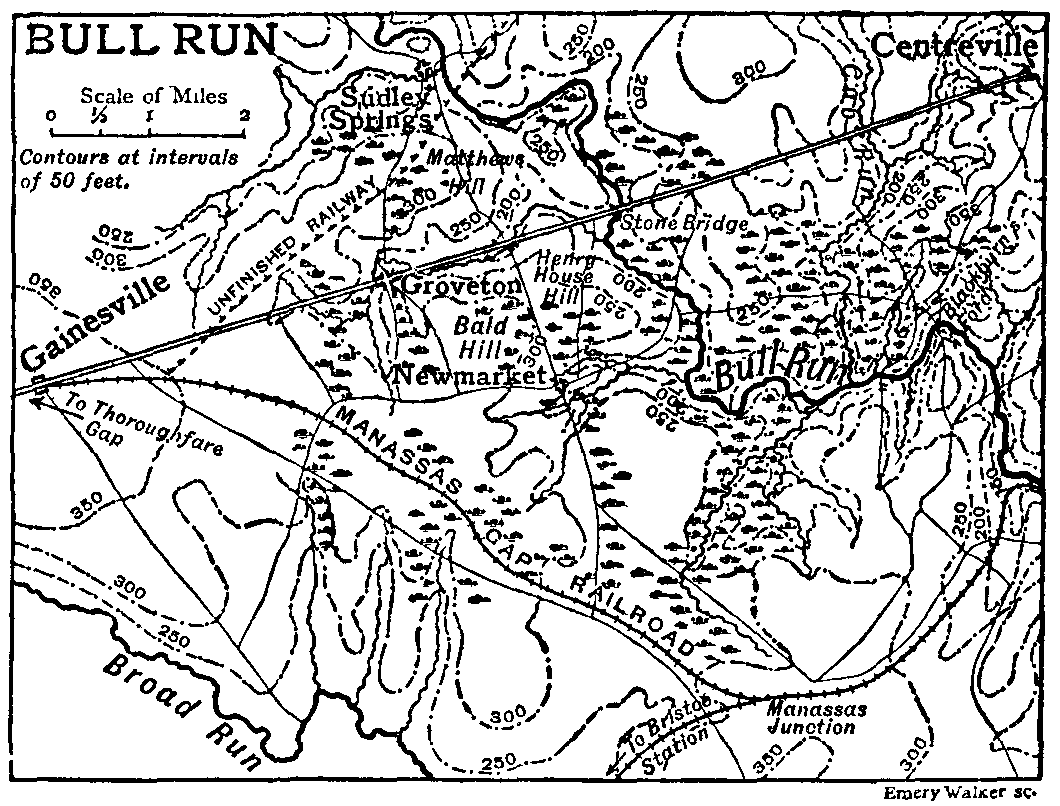
The Federal staff was equally inexperienced, and the divisions engaged in the turning movement met with many unnecessary checks. At 6 A.M., when the troops told off for the frontal attack appeared before the Stone Bridge, the turning movement was by no means well advanced. Evans had time to change position so as to command both the Stone Bridge and Sudley Springs, and he was promptly supported by the brigades of Bee, Bartow and T.J. Jackson. About 9.30 the leading Federal brigade from Sudley Springs came into action, and two hours later Evans, Bee and Bartow had been driven off the Matthews hill in considerable confusion. But on the Henry House hill Jackson's brigade stood, as General Bee said to his men, "like a stone wall," and the defenders rallied, though the Federals were continually reinforced. The fighting on the Henry House hill was very severe, but McDowell, who dared not halt to re-form his enthusiastic volunteers, continued to attack. About 1.30 P.M. he brought up two regular batteries to the fighting line; but a Confederate regiment, being mistaken for friendly troops and allowed to approach, silenced the guns by close rifle fire, and from that time, though the hill was taken and retaken several times, the Federal attack made no further headway. At 2.45 more of Beauregard's troops had come up; Jackson's brigade charged with the bayonet, and at the same time the Federals were assailed in flank by the last brigades of Johnston's army, which arrived at the critical moment from the railway. They gave way at once, tired out, and conscious that the day was lost, and after one rally melted away slowly to the rear, the handful of regulars alone keeping their order. But when, at the defile of the Cub Run, they came under shell fire the retreat became a panic flight to the Potomac. The victors were too much exhausted to pursue, and the U.S. regulars of the reserve division formed a strong and steady rearguard. The losses were—Federals, 2896 men out of about 18,500 engaged; Confederates, 1982 men out of 18,000.
(2) The operations of the last days of August 1862, which include the second battle of Bull Run (second Manassas), are amongst the most complicated of the war. At the outset the Confederate general Lee's army (Longstreet's and Jackson's corps) lay on the Rappahannock, faced by the Federal Army of Virginia under Major-General John Pope, which was to be reinforced by troops from McClellan's army to a total strength of 150,000 men as against Lee's 60,000. Want of supplies soon forced Lee to move, though not to retreat, and his plan for attacking Pope was one of the most daring in all military history. Jackson with half the army was despatched on a wide turning movement which was to bring him via Salem and Thoroughfare Gap to Manassas Junction in Pope's rear; when Jackson's task was accomplished Lee and Longstreet were to follow him by the same route. Early on the 25th of August Jackson began his march round the right of Pope's army; on the 26th the column passed Thoroughfare Gap, and Bristoe Station, directly in Pope's rear, was reached on the same evening, while a detachment drove a Federal post from Manassas Junction. On the 27th the immense magazines at the Junction were destroyed. On his side Pope had soon discovered Jackson's departure, and had arranged for an immediate attack on Longstreet. When, however, the direction of Jackson's march on Thoroughfare Gap became clear, Pope fell back in order to engage him, at the same time ordering his army to concentrate on Warrenton, Greenwich and Gainesville. He was now largely reinforced. On the evening of the 27th one of his divisions, marching to its point of concentration, met a division of Jackson's corps, near Bristoe Station; after a sharp fight the Confederate general, Ewell, retired on Manassas. Pope now realized that he had Jackson's corps in front of him at the Junction, and at once took steps to attack Manassas with all his forces. He drew off even the corps at Gainesville for his intended battle of the 28th; McDowell, however, its commander, on his own responsibility, left Ricketts's division at Thoroughfare Gap. But Pope's blow was struck in the air. When he arrived at Manassas on the 28th he found nothing but the ruins of his magazines, and one of McDowell's divisions (King's) marching from Gainesville on Manassas Junction met Jackson's infantry near Groveton. The situation had again changed completely. Jackson had no intention of awaiting Pope at Manassas, and after several feints made with a view to misleading the Federal scouts he finally withdrew to a hidden position between Groveton and Sudley Springs, to await the arrival of Longstreet, who, taking the same route as Jackson had done, arrived on the 28th at Thoroughfare Gap and, engaging Ricketts's division, finally drove it back to Gainesville. On the evening of this day Jackson's corps held the line Sudley Springs-Groveton, his right wing near Groveton opposing King's division; and Longstreet held Thoroughfare Gap, facing Ricketts at Gainesville. On Ricketts's right was King near Groveton, and the line was continued thence by McDowell's remaining division and by Sigel's corps to the Stone Bridge. At Centreville, 7 m. away, was Pope with three divisions, a fourth was north-east of Manassas Junction, and Porter's corps at Bristoe Station. Thus, while Ricketts continued at Gainesville to mask Longstreet, Pope could concentrate a superior force against Jackson, whom he now believed to be meditating a retreat to the Gap. But a series of misunderstandings resulted in the withdrawal of Ricketts and King, so that nothing now intervened between Longstreet and Jackson; while Sigel and McDowell's other division alone remained to face Jackson until such time as Pope could bring up the rest of his scattered forces. Jackson now closed on his left and prepared for battle, and on the morning of the 29th the Confederates, posted behind a high railway embankment, repelled two sharp attacks made by Sigel. Pope arrived at noon with the divisions from Centreville, which, led by the general himself and by Reno and Hooker, two of the bravest officers in the Union army, made a third and most desperate attack on Jackson's line. The latter, repulsing it with difficulty, carried its counter-stroke too far and was in turn repulsed by Grover's brigade of Hooker's division. Grover then made a fourth assault, but was driven back with terrible loss. The last assault, gallantly delivered by two divisions under Kearny and Stevens, drove the Confederate left out of its position; but a Confederate counter-attack, led by the brave Jubal Early, dislodged the assailants with the bayonet.
In the meanwhile events had taken place near Groveton which were, for twenty years after the war, the subject of controversy and recrimination (see Porter, Fitz-John). When Porter's and part of McDowell's corps, acting on various orders sent by Pope, approached Gainesville from the south-east, Longstreet had already reached that place, and the Federals thus encountered a force of unknown strength at the moment when Sigel's guns to the northward showed him to be closely engaged with Jackson. The two generals consulted, and McDowell marched off to join Sigel, while Porter remained to hold the new enemy in check. In this he succeeded; Longstreet, though far superior in numbers, made no forward move, and his advanced guard alone came into action. On the night of the 29th Lee reunited the wings of his army on the field of battle. He had forced Pope back many miles from the Rappahannock, and expecting that the Federals would retire to the line of Bull Run before giving battle, he now decided to wait for the last divisions of Longstreet's corps, which were still distant. But Pope, still sanguine, ordered a "general pursuit" of Jackson for the 30th. There was some ground for his suppositions, for Jackson had retired a short distance and Longstreet's advanced guard had also fallen back. McDowell, however, who was in general charge of the Federal right on the 30th, soon saw that Jackson was not retreating and stopped the "pursuit," and the attack on Jackson's right, which Pope had ordered Porter to make, was repulsed by Longstreet's overwhelming forces. Then Lee's whole line, 4 m. long, made its grand counter-stroke (4 P.M.). There was now no hesitation in Longstreet's attack; the Federal left was driven successively from every position it took up, and Longstreet finally captured Bald Hill. Jackson, though opposed by the greater part of Pope's forces, advanced to the Matthews hill, and his artillery threatened the Stone Bridge. The Federals, driven back to the banks of Bull Run, were only saved by the gallant defence of the Henry House hill by the Pennsylvanian division of Reynolds and the regulars under Sykes. Pope withdrew under cover of night to Centreville. Here he received fresh reinforcements, but Jackson was already marching round his new right, and after the action of Chantilly (1st of September) the whole Federal army fell back to Washington. The Union forces present on the field on the 29th and 30th numbered about 63,000, the strength of Lee's army being on the same dates about 54,000. Besides their killed and wounded the Federals lost very heavily in prisoners.
BULLY (of uncertain origin, but possibly connected with a Teutonic word seen in many compounds, as the Low Ger. bullerjaan, meaning "noisy"; the word has also, with less probability, been derived from the Dutch boel, and Ger. Buhle, a lover), originally a fine, swaggering fellow, as in "Bully Bottom" in A Midsummer Night's Dream, later an overbearing ruffian, especially a coward who abuses his strength by ill-treating the weak; more technically a souteneur, a man who lives on the earnings of a prostitute. The term in its early use of "fine" or "splendid" survives in American slang.
BÜLOW, BERNHARD ERNST VON (1815-1879), Danish and German statesman, was the son of Adolf von Bülow, a Danish official, and was born at Cismar in Holstein on the 2nd of August 1815. He studied law at the universities of Berlin, Göttingen and Kiel, and began his political career in the service of Denmark, in the chancery of Schleswig-Holstein-Lauenburg at Copenhagen, and afterwards in the foreign office. In 1842 he became councillor of legation, and in 1847 Danish chargé d'affaires in the Hanse towns, where his intercourse with the merchant princes led to his marriage in 1848 with a wealthy heiress, Louise Victorine Rücker. When the insurrection broke out in the Elbe duchies (1848) he left the Danish service, and offered his services to the provisional government of Kiel, an offer that was not accepted. In 1849, accordingly, he re-entered the service of Denmark, was appointed a royal chamberlain and in 1850 sent to represent the duchies of Schleswig and Holstein at the restored federal diet of Frankfort. Here he came into intimate touch with Bismarck, who admired his statesmanlike handling of the growing complications of the Schleswig-Holstein Question. With the radical "Eider-Dane" party he was utterly out of sympathy; and when, in 1862, this party gained the upper hand, he was recalled from Frankfort. He now entered the service of the grand-duke of Mecklenburg-Strelitz, and remained at the head of the grand-ducal government until 1867, when he became plenipotentiary for the two Mecklenburg duchies in the council of the German Confederation (Bundesrat), where he distinguished himself by his successful defence of the medieval constitution of the duchies against Liberal attacks. In 1873 Bismarck, who was in thorough sympathy with his views, persuaded him to enter the service of Prussia as secretary of state for foreign affairs, and from this time till his death he was the chancellor's most faithful henchman. In 1875 he was appointed Prussian plenipotentiary in the Bundesrat; in 1877 he became Bismarck's lieutenant in the secretaryship for foreign affairs of the Empire; and in 1878 he was, with Bismarck and Hohenlohe, Prussian plenipotentiary at the congress of Berlin. He died at Frankfort on the 20th of October 1879, his end being hastened by his exertions in connexion with the political crisis of that year. Of his six sons the eldest, Bernhard Heinrich Karl (see below), became chancellor of the Empire.
See the biography of H. von Petersdorff in Allgemeine deutsche Biographie, Band 47, p. 350.
BÜLOW, BERNHARD HEINRICH KARL MARTIN, Prince von (1849- ), German statesman, was born on the 3rd of May 1849, at Klein-Flottbeck, in Holstein. The Bülow family is one very widely extended in north Germany, and many members have attained distinction in the civil and military service of Prussia, Denmark and Mecklenburg. Prince Bülow's great-uncle, Heinrich von Bülow, who was distinguished for his admiration of England and English institutions, was Prussian ambassador in England from 1827 to 1840, and married a daughter of Wilhelm von Humboldt (see the letters of Gabrielle von Bülow). His father, Bernhard Ernst von Bülow, is separately noticed above.
Prince Bülow must not be confused with his contemporary Otto v. Bülow (1827-1901), an official in the Prussian foreign office, who in 1882 was appointed German envoy at Bern, from 1892 to 1898 was Prussian envoy to the Vatican, and died at Rome on the 22nd of November 1901.
Bernhard von Bülow, after serving in the Franco-Prussian War, entered the Prussian civil service, and was then transferred to the diplomatic service. In 1876 he was appointed attaché to the German embassy in Paris, and after returning for a while to the foreign office at Berlin, became second secretary to the embassy in Paris in 1880. From 1884 he was first secretary to the embassy at St Petersburg, and acted as chargé d'affaires; in 1888 he was appointed envoy at Bucharest, and in 1893 to the post of German ambassador at Rome. In 1897, on the retirement of Baron Marshall von Bieberstein, he was appointed secretary of state for foreign affairs (the same office which his father had held) under Prince Hohenlohe, with a seat in the Prussian ministry. The appointment caused much surprise at the time, as Bülow was little known outside diplomatic circles. The explanations suggested were that he had made himself very popular at Rome and that his appointment was therefore calculated to strengthen the loosening bonds of the Triple Alliance, and also that his early close association with Bismarck would ensure the maintenance of the Bismarckian tradition. As foreign secretary Herr von Bülow was chiefly responsible for carrying out the policy of colonial expansion with which the emperor had identified himself, and in 1899, on bringing to a successful conclusion the negotiations by which the Caroline Islands were acquired by Germany, he was raised to the rank of count. On the resignation of Hohenlohe in 1900 he was chosen to succeed him as chancellor of the empire and president of the Prussian ministry.
The Berliner Neueste Nachrichten, commenting on this appointment, very aptly characterized the relations of the new chancellor to the emperor, in contrast to the position occupied by Bismarck. "The Germany of William II.," it said, "does not admit a Titan in the position of the highest official of the Empire. A cautious and versatile diplomatist like Bernhard von Bülow appears to be best adapted to the personal and political necessities of the present situation." Count Bülow, indeed, though, like Bismarck, a "realist," utilitarian and opportunist in his policy, made no effort to emulate the masterful independence of the great chancellor. He was accused, indeed, of being little more than the complacent executor of the emperor's will, and defended himself in the Reichstag against the charge. The substance of the relations between the emperor and himself, he declared, rested on mutual good-will, and added: "I must lay it down most emphatically that the prerogative of the emperor's personal initiative must not be curtailed, and will not be curtailed, by any chancellor.... As regards the chancellor, however, I say that no imperial chancellor worthy of the name ... would take up any position which in his conscience he did not regard as justifiable." It is clear that the position of a chancellor holding these views in relation to a ruler so masterful and so impulsive as the emperor William II. could be no easy one; and Bülow's long continuance in office is the best proof of his genius. His first conspicuous act as chancellor was a masterly defence in the Reichstag of German action in China, a defence which was, indeed, rendered easier by the fact that Prince Hohenlohe had—to use his own words—"dug a canal" for the flood of imperial ambition of which warning had been given in the famous "mailed fist" speech. Such incidents as this, however, though they served to exhibit consummate tact and diplomatic skill, give little index to the fundamental character of his work as chancellor. Of this it may be said, in general, that it carried on the best traditions of the Prussian service in whole-hearted devotion to the interests of the state. The accusation that he was an "agrarian" he thought it necessary to rebut in a speech delivered on the 18th of February 1906 to the German Handelstag. He was an agrarian, he declared, in so far as he came of a land-owning family, and was interested in the prosperity of agriculture; but as chancellor, whose function it is to watch over the welfare of all classes, he was equally concerned with the interests of commerce and industry (Kölnische Zeitung, Feb. 20, 1906). Some credit for the immense material expansion of Germany under his chancellorship is certainly due to his zeal and self-devotion. This was generously recognized by the emperor in a letter publicly addressed to the chancellor on the 21st of May 1906, immediately after the passage of the Finance Bill. "I am fully conscious," it ran, "of the conspicuous share in the initiation and realization of this work of reform... which must be ascribed to the statesmanlike skill and self-sacrificing devotion with which you have conducted and promoted those arduous labours." Rumours had from time to time been rife of a "chancellor crisis" and Bülow's dismissal; in the Berliner Tageblatt this letter was compared to the "Never!" with which the emperor William I. had replied to Bismarck's proffered resignation.
On the 6th of June 1905 Count Bülow was raised to the rank of prince (Fürst), on the occasion of the marriage of the crown prince. The coincidence of this date with the fall of M. Delcassé, the French minister for foreign affairs—a triumph for Germany and a humiliation for France—was much commented on at the time (see The Times, June 7, 1905); and the elevation of Bismarck to the rank of prince in the Hall of Mirrors at Versailles was recalled. Whatever element of truth there may have been in this, however, the significance of the incident was much exaggerated.
On the 5th of April 1906, while attending a debate in the Reichstag, Prince Bülow was seized with illness, the result of overwork and an attack of influenza, and was carried unconscious from the hall. At first it was thought that the attack would be fatal, and Lord Fitzmaurice in the House of Lords compared the incident with that of the death of Chatham, a compliment much appreciated in Germany. The illness, however, quickly took a favourable turn, and after a month's rest the chancellor was able to resume his duties. In 1907 Prince Bülow was made the subject of a disgraceful libel, which received more attention than it deserved because it coincided with the Harden-Moltke scandals; his character was, however, completely vindicated, and the libeller, a journalist named Brand, received a term of imprisonment.
The parliamentary skill of Prince Bülow in holding together the heterogeneous elements of which the government majority in the Reichstag was composed, no less than the diplomatic tact with which he from time to time "interpreted" the imperial indiscretions to the world, was put to a rude test by the famous "interview" with the German emperor, published in the London Daily Telegraph of the 28th of October 1908 (see William II., German emperor), which aroused universal reprobation in Germany. Prince Bülow assumed the official responsibility, and tendered his resignation to the emperor, which was not accepted; but the chancellor's explanation in the Reichstag on the 10th of November showed how keenly he felt his position. He declared his conviction that the disastrous results of the interview would "induce the emperor in future to observe that strict reserve, even in private conversations, which is equally indispensable in the interest of a uniform policy and for the authority of the crown," adding that, in the contrary case, neither he nor any successor of his could assume the responsibility (The Times, Nov. 11, 1908, p. 9). The attitude of the emperor showed that he had taken the lesson to heart. It was not the imperial indiscretions, but the effect of his budget proposals in breaking up the Liberal-Conservative bloc, on whose support he depended in the Reichstag, that eventually drove Prince Bülow from office (see Germany: History). At the emperor's request he remained to pilot the mutilated budget through the House; but on the 14th of July 1909 the acceptance of his resignation was announced.
Prince Bülow married, on the 9th of January 1886, Maria Anna Zoe Rosalia Beccadelli di Bologna, Princess Camporeale, whose first marriage with Count Karl von Dönhoff had been dissolved and declared null by the Holy See in 1884. The princess, an accomplished pianist and pupil of Liszt, was a step-daughter of the Italian statesman Minghetti.
See J. Penzler, Graf Bülows Reden nebst urkundlichen Beiträgen zu seiner Politik (Leipzig, 1903).
BÜLOW, DIETRICH HEINRICH, Freiherr von (1757-1807), Prussian soldier and military writer, and brother of General Count F.W. Bülow, entered the Prussian army in 1773. Routine work proved distasteful to him, and he read with avidity the works of the chevalier Folard and other theoretical writers on war, and of Rousseau. After sixteen years' service he left Prussia, and endeavoured without success to obtain a commission in the Austrian army. He then returned to Prussia, and for some time managed a theatrical company. The failure of this undertaking involved Bülow in heavy losses, and soon afterwards he went to America, where he seems to have been converted to, and to have preached, Swedenborgianism. On his return to Europe he persuaded his brother to engage in a speculation for exporting glass to the United States, which proved a complete failure. After this for some years he made a precarious living in Berlin by literary work, but his debts accumulated, and it was under great disadvantages that he produced his Geist des Neueren Kriegssystems (Hamburg, 1799) and Der Feldzug 1800 (Berlin, 1801). His hopes of military employment were again disappointed, and his brother, the future field marshal, who had stood by him in all his troubles, finally left him. After wandering in France and the smaller German states, he reappeared at Berlin in 1804, where he wrote a revised edition of his Geist des Neueren Kriegssystems (Hamburg, 1805), Lehrsätze des Neueren Kriegs (Berlin, 1805), Geschichte des Prinzen Heinrich von Preussen (Berlin, 1805), Neue Taktik der Neuern wie sie sein sollte (Leipzig, 1805), and Der Feldzug 1805 (Leipzig, 1806). He also edited, with G.H. von Behrenhorst (1733-1814) and others, Annalen des Krieges (Berlin, 1806). These brilliant but unorthodox works, distinguished by an open contempt of the Prussian system, cosmopolitanism hardly to be distinguished from high treason, and the mordant sarcasm of a disappointed man, brought upon Bülow the enmity of the official classes and of the government. He was arrested as insane, but medical examination proved him sane and he was then lodged as a prisoner in Colberg, where he was harshly treated, though Gneisenau obtained some mitigation of his condition. Thence he passed into Russian hands and died in prison at Riga in 1807, probably as a result of ill-treatment.
In Bülow's writings there is evident a distinct contrast between the spirit of his strategical and that of his tactical ideas. As a strategist (he claimed to be the first of strategists) he reduces to mathematical rules the practice of the great generals of the 18th century, ignoring "friction," and manœuvring his armies in vacuo. At the same time he professes that his system provides working rules for the armies of his own day, which in point of fact were "armed nations," infinitely more affected by "friction" than the small dynastic and professional armies of the preceding age. Bülow may therefore be considered as anything but a reformer in the domain of strategy. With more justice he has been styled the "father of modern tactics." He was the first to recognize that the conditions of swift and decisive war brought about by the French Revolution involved wholly new tactics, and much of his teaching had a profound influence on European warfare of the 19th century. His early training had shown him merely the pedantic minutiae of Frederick's methods, and, in the absence of any troops capable of illustrating the real linear tactics, he became an enthusiastic supporter of the methods, which (more of necessity than from judgment) the French revolutionary generals had adopted, of fighting in small columns covered by skirmishers. Battles, he maintained, were won by skirmishers. "We must organize disorder," he said; indeed, every argument of writers of the modern "extended order" school is to be found mutatis mutandis in Bülow, whose system acquired great prominence in view of the mechanical improvements in armament. But his tactics, like his strategy, were vitiated by the absence of "friction," and their dependence on the realization of an unattainable standard of bravery.
See von Voss, H. von Bülow (Köln, 1806); P. von Bülow, Familienbuch der v. Bülow (Berlin, 1859); Ed. von Bülow, Aus dem Leben Dietrichs v. Bülow, also Vermischte Schriften aus dem Nachlass von Behrenhorst (1845); Ed. von Bülow and von Rüstow, Militärische und vermischte Schriften von Heinrich Dietrich v. Bülow (Leipzig, 1853); Memoirs by Freiherr v. Meerheimb in Allgemeine deutsche Biographie, vol. 3 (Leipzig, 1876), and "Behrenhorst und Bülow" (Historische Zeitschrift, 1861, vi.); Max Jähns, Geschichte der Kriegswissenschaften, vol. iii. pp. 2133-2145 (Munich, 1891); General von Cämmerer (transl. von Donat), Development of Strategical Science (London, 1905), ch. i.
BÜLOW, FRIEDRICH WILHELM, Freiherr von, count of Dennewitz (1755-1816), Prussian general, was born on the 16th of February 1755, at Falkenberg in the Altmark; he was the elder brother of the foregoing. He received an excellent education, and entered the Prussian army in 1768, becoming ensign in 1772, and second lieutenant in 1775. He took part in the "Potato War" of 1778, and subsequently devoted himself to the study of his profession and of the sciences and arts. He was throughout his life devoted to music, his great musical ability bringing him to the notice of Frederick William II., and about 1790 he was conspicuous in the most fashionable circles of Berlin. He did not, however, neglect his military studies, and in 1792 he was made military instructor to the young prince Louis Ferdinand, becoming at the same time full captain. He took part in the campaigns of 1792-93-94 on the Rhine, and received for signal courage during the siege of Mainz the order pour le mérite and promotion to the rank of major. After this he went to garrison duty at Soldau. In 1802 he married the daughter of Colonel v. Auer, and in the following year he became lieutenant-colonel, remaining at Soldau with his corps. The vagaries and misfortunes of his brother Dietrich affected his happiness as well as his fortune. The loss of two of his children was followed in 1806 by the death of his wife, and a further source of disappointment was the exclusion of his regiment from the field army sent against Napoleon in 1806. The disasters of the campaign aroused his energies. He did excellent service under Lestocq's command in the latter part of the war, was wounded in action, and finally designated for a brigade command in Blücher's force. In 1808 he married the sister of his first wife, a girl of eighteen. He was made a major-general in the same year, and henceforward he devoted himself wholly to the regeneration of Prussia. The intensity of his patriotism threw him into conflict even with Blücher and led to his temporary retirement; in 1811, however, he was again employed. In the critical days preceding the War of Liberation he kept his troops in hand without committing himself to any irrevocable step until the decision was made. On the 14th of March 1813 he was made a lieutenant-general. He fought against Oudinot in defence of Berlin (see Napoleonic Campaigns), and in the summer came under the command of Bernadotte, crown prince of Sweden. At the head of an army corps Bülow distinguished himself very greatly in the battle of Gross Beeren, a victory which was attributed almost entirely to his leadership. A little later he won the great victory of Dennewitz, which for the third time checked Napoleon's advance on Berlin. This inspired the greatest enthusiasm in Prussia, as being won by purely Prussian forces, and rendered Bülow's popularity almost equal to that of Blücher. Bülow's corps played a conspicuous part in the final overthrow of Napoleon at Leipzig, and he was then entrusted with the task of evicting the French from Holland and Belgium. In an almost uniformly successful campaign he won a signal victory at Hoogstraaten, and in the campaign of 1814 he invaded France from the north-west, joined Blücher, and took part in the brilliant victory of Laon in March. He was now made general of infantry and received the title of Count Bülow von Dennewitz. In the short peace of 1814-1815 he was at Konigsberg as commander-in-chief in Prussia proper. He was soon called to the field again, and in the Waterloo campaign commanded the IV. corps of Blücher's army. He was not present at Ligny, but his corps headed the flank attack upon Napoleon at Waterloo, and bore the heaviest part in the fighting of the Prussian troops. He took part in the invasion of France, but died suddenly on the 25th of February 1816, a month after his return to the Königsberg command.