BYZANTINE ART (continued 5)
Reading edition
For a criticism of Dr Caird's theology, see A.W. Benn, English Rationalism in the 19th Century (London, 1906).
CAIRD, JOHN (1820-1898), Scottish divine and philosopher, was born at Greenock on the 15th of December 1820. In his sixteenth year he entered the office of his father, who was partner and manager of a firm of engineers. Two years later, however, he obtained leave to continue his studies at Glasgow University. After a year of academic life he tried business again, but in 1840 he gave it up finally and returned to college. In 1845 he entered the ministry of the Church of Scotland, and after holding several livings accepted the chair of divinity at Glasgow in 1862. During these years he won a foremost place among the preachers of Scotland. In theology he was a Broad Churchman, seeking always to emphasize the permanent elements in religion, and ignoring technicalities. In 1873 he was appointed vice-chancellor and principal of Glasgow University. He delivered the Gifford Lectures in 1892-1893 and in 1895-1896. His Introduction to the Philosophy of Religion (1880) is an attempt to show the essential rationality of religion. It is idealistic in character, being in fact a reproduction of Hegelian teaching in clear and melodious language. His argument for the Being of God is based on the hypothesis that thought—not individual but universal—is the reality of all things, the existence of this Infinite Thought being demonstrated by the limitations of finite thought. Again his Gifford Lectures are devoted to the proof of the truth of Christianity on grounds of right reason alone. Caird wrote also an excellent study of Spinoza, in which he showed the latent Hegelianism of the great Jewish philosopher. He died on the 30th of July 1898.
CAIRN (in Gaelic and Welsh, Carn), a heap of stones piled up in a conical form. In modern times cairns are often erected as landmarks. In ancient times they were erected as sepulchral monuments. The Duan Eireanach, an ancient Irish poem, describes the erection of a family cairn; and the Senchus Mor, a collection of ancient Irish laws, prescribes a fine of three three-year-old heifers for "not erecting the tomb of thy chief." Meetings of the tribes were held at them, and the inauguration of a new chief took place on the cairn of one of his predecessors. It is mentioned in the Annals of the Four Masters that, in 1225, the O'Connor was inaugurated on the cairn of Fraech, the son of Fiodhach of the red hair. In medieval times cairns are often referred to as boundary marks, though probably not originally raised for that purpose. In a charter by King Alexander II. (1221), granting the lands of Burgyn to the monks of Kinloss, the boundary is described as passing "from the great oak in Malevin as far as the Rune Pictorum," which is explained as "the Carne of the Pecht's fieldis." In Highland districts small cairns used to be erected, even in recent times, at places where the coffin of a distinguished person was "rested" on its way to the churchyard. Memorial cairns are still occasionally erected, as, for instance, the cairn raised in memory of the prince consort at Balmoral, and "Maule's Cairn," in Glenesk, erected by the earl of Dalhousie in 1866, in memory of himself and certain friends specified by name in the inscription placed upon it. (See Barrow.)
CAIRNES, JOHN ELLIOTT (1823-1875), British political economist, was born at Castle Bellingham, Ireland, in 1823. After leaving school he spent some years in the counting-house of his father, a brewer. His tastes, however, lay altogether in the direction of study, and he was permitted to enter Trinity College, Dublin, where he took the degree of B.A. in 1848, and six years later that of M.A. After passing through the curriculum of arts he engaged in the study of law and was called to the Irish bar. But he felt no very strong inclination for the legal profession, and during some years he occupied himself to a large extent with contributions to the daily press, treating of the social and economical questions that affected Ireland. He devoted most attention to political economy, which he studied with great thoroughness and care. While residing in Dublin he made the acquaintance of Archbishop Whately, who conceived a very high respect for his character and abilities. In 1856 a vacancy occurred in the chair of political economy at Dublin founded by Whately, and Cairnes received the appointment. In accordance with the regulations of the foundation, the lectures of his first year's course were published. The book appeared in 1857 with the title Character and Logical Method of Political Economy. It follows up and expands J.S. Mill's treatment in the Essays on some Unsettled Questions in Political Economy, and forms an admirable introduction to the study of economics as a science. In it the author's peculiar powers of thought and expression are displayed to the best advantage. Logical exactness, precision of language, and firm grasp of the true nature of economic facts, are the qualities characteristic of this as of all his other works. If the book had done nothing more, it would still have conferred inestimable benefit on political economists by its clear exposition of the true nature and meaning of the ambiguous term "law." To the view of the province and method of political economy expounded in this early work the author always remained true, and several of his later essays, such as those on Political Economy and Land, Political Economy and Laissez-Faire, are but reiterations of the same doctrine. His next contribution to economical science was a series of articles on the gold question, published partly in Fraser's Magazine, in which the probable consequences of the increased supply of gold attendant on the Australian and Californian gold discoveries were analysed with great skill and ability. And a critical article on M. Chevalier's work On the Probable Fall in the Value of Gold appeared in the Edinburgh Review for July 1860.
In 1861 Cairnes was appointed to the professorship of political economy and jurisprudence in Queen's College, Galway, and in the following year he published his admirable work The Slave Power, one of the finest specimens of applied economical philosophy. The inherent disadvantages of the employment of slave labour were exposed with great fulness and ability, and the conclusions arrived at have taken their place among the recognized doctrines of political economy. The opinions expressed by Cairnes as to the probable issue of the war in America were largely verified by the actual course of events, and the appearance of the book had a marked influence on the attitude taken by serious political thinkers in England towards the southern states.
During the remainder of his residence at Galway Professor Cairnes published nothing beyond some fragments and pamphlets mainly upon Irish questions. The most valuable of these papers are the series devoted to the consideration of university education. His health, at no time very good, was still further weakened in 1865 by a fall from his horse. He was ever afterwards incapacitated from active exertion and was constantly liable to have his work interfered with by attacks of illness. In 1866 he was appointed professor of political economy in University College, London. He was compelled to spend the session 1868-1869 in Italy but on his return continued to lecture till 1872. During his last session he conducted a mixed class, ladies being admitted to his lectures. His health soon rendered it impossible for him to discharge his public duties; he resigned his post in 1872, and retired with the honorary title of emeritus professor of political economy. In 1873 his own university conferred on him the degree of LL.D. He died at Blackheath, near London, on the 8th of July 1875.
The last years of his life were spent in the collection and publication of some scattered papers contributed to various reviews and magazines, and in the preparation of his most extensive and important work. The Political Essays, published in 1873, comprise all his papers relating to Ireland and its university system, together with some other articles of a somewhat similar nature. The Essays in Political Economy, Theoretical and Applied, which appeared in the same year, contain the essays towards a solution of the gold question, brought up to date and tested by comparison with statistics of prices. Among the other articles in the volume the more important are the criticisms on Bastiat and Comte, and the essays on Political Economy and Land, and on Political Economy and Laissez-Faire, which have been referred to above. In 1874 appeared his largest work, Some Leading Principles of Political Economy, newly Expounded, which is beyond doubt a worthy successor to the great treatises of Smith, Malthus, Ricardo and Mill. It does not expound a completed system of political economy; many important doctrines are left untouched; and in general the treatment of problems is not such as would be suited for a systematic manual. The work is essentially a commentary on some of the principal doctrines of the English school of economists, such as value, cost of production, wages, labour and capital, and international values, and is replete with keen criticism and lucid illustration. While in fundamental harmony with Mill, especially as regards the general conception of the science, Cairnes differs from him to a greater or less extent on nearly all the cardinal doctrines, subjects his opinions to a searching examination, and generally succeeds in giving to the truth that is common to both a firmer basis and a more precise statement. The last labour to which he devoted himself was a republication of his first work on the Logical Method of Political Economy.
Taken as a whole the works of Cairnes formed the most important contribution to economical science made by the English school since the publication of J.S. Mill's Principles. It is not possible to indicate more than generally the special advances in economic doctrine effected by him, but the following points may be noted as establishing for him a claim to a place beside Ricardo and Mill: (1) His exposition of the province and method of political economy. He never suffers it to be forgotten that political economy is a science, and consequently that its results are entirely neutral with respect to social facts or systems. It has simply to trace the necessary connexions among the phenomena of wealth and dictates no rules for practice. Further, he is distinctly opposed both to those who would treat political economy as an integral part of social philosophy, and to those who have attempted to express economic facts in quantitative formulae and to make economy a branch of applied mathematics. According to him political economy is a mixed science, its field being partly mental, partly physical. It may be called a positive science, because its premises are facts, but it is hypothetical in so far as the laws it lays down are only approximately true, i.e. are only valid in the absence of counteracting agencies. From this view of the nature of the science, it follows at once that the method to be pursued must be that called by Mill the physical or concrete deductive, which starts from certain known causes, investigates their consequences and verifies or tests the result by comparison with facts of experience. It may, perhaps, be thought that Cairnes gives too little attention to the effects of the organism of society on economic facts, and that he is disposed to overlook what Bagehot called the postulates of political economy. (2) His analysis of cost of production in its relation to value. According to Mill, the universal elements in cost of production are the wages of labour and the profits of capital. To this theory Cairnes objects that wages, being remuneration, can in no sense be considered as cost, and could only have come to be regarded as cost in consequence of the whole problem being treated from the point of view of the capitalist, to whom, no doubt, the wages paid represent cost. The real elements of cost of production he looks upon as labour, abstinence and risk, the second of these falling mainly, though not necessarily, upon the capitalist. In this analysis he to a considerable extent follows and improves upon Senior, who had previously defined cost of production as the sum of the labour and abstinence necessary to production. (3) His exposition of the natural or social limit to free competition, and of its bearing on the theory of value. He points out that in any organized society there can hardly be the ready transference of capital from one employment to another, which is the indispensable condition of free competition; while class distinctions render it impossible for labour to transfer itself readily to new occupations. Society may thus be regarded as consisting of a series of non-competing industrial groups, with free competition among the members of any one group or class. Now the only condition under which cost of production will regulate value is perfect competition. It follows that the normal value of commodities—the value which gives to the producers the average and usual remuneration—will depend upon cost of production only when the exchange is confined to the members of one class, among whom there is free competition. In exchange between classes or non-competing industrial groups, the normal value is simply a case of international value, and depends upon reciprocal demand, that is to say, is such as will satisfy the equation of demand. This theory is a substantial contribution to economical science and throws great light upon the general problem of value. At the same time, it may be thought that Cairnes overlooked a point brought forward prominently by Senior, who also had called attention to the bearing of competition on the relation between cost of production and value. The cost to the producer fixes the limit below which the price cannot fall without the supply being affected; but it is the desire of the consumer—i.e. what he is willing to give up rather than be compelled to produce the commodity for himself—that fixes the maximum value of the article. To treat the whole problem of natural or normal value from the point of view of the producer is to give but a one-sided theory of the facts. (4) His defence of the wages fund doctrine. This doctrine, expounded by Mill in his Principles, had been relinquished by him, but Cairnes still undertook to defend it. He certainly succeeded in removing from the theory much that had tended to obscure its real meaning and in placing it in its very best aspect. He also showed the sense in which, when treating the problem of wages, we must refer to some fund devoted to the payment of wages, and pointed out the conditions under which the wages fund may increase or decrease. It may be added that his Leading Principles contain admirable discussions on trade unions and protection, together with a clear analysis of the difficult theory of international trade and value, in which there is much that is both novel and valuable. The Logical Method contains about the best exposition and defence of Ricardo's theory of rent; and the Essays contain a very clear and formidable criticism of Bastiat's economic doctrines.
Professor Cairnes's son, Captain W.E. Cairnes (1862-1906), was an able writer on military subjects, being author of An Absent-minded War (1900), The Coming Waterloo (1905), &c.
CAIRNGORM, a yellow or brown variety of quartz, named from Cairngorm or Cairngorum, one of the peaks of the Grampian Mountains in Banffshire, Scotland. According to Mr E.H. Cunningham-Craig, the mineral occurs in crystals lining cavities in highly-inclined veins of a fine-grained granite running through the coarser granite of the main mass: Shallow pits were formerly dug in the kaolinized granite for sake of the cairngorm and the mineral was also found as pebbles in the bed of the river Avon. Cairngorm is a favourite ornamental stone in Scotland, being set in the lids of snuff-mulls, in the handles of dirks and in brooches for Highland costume. A rich sherry-yellow colour is much esteemed. Quartz of yellow and brown colour is often known in trade as "false topaz," or simply "topaz." Such quartz is found at many localities in Brazil, Russia and Spain. Much of the yellow quartz used in jewellery is said to be "burnt amethyst"; that is, it was originally amethystine quartz, the colour of which has been modified by heat (see Amethyst). Yellow quartz is sometimes known as citrine; when the quartz presents a pale brown tint it is called "smoky quartz"; and when the brown is so deep that the stone appears almost black it is termed morion. The brown colour has been referred to the presence of titanium.
CAIRNS, HUGH MCCALMONT CAIRNS, 1st Earl (1819-1885), Irish statesman, and lord chancellor of England, was born at Cultra, Co. Down, Ireland, on the 27th of December 1819. His father, William Cairns, formerly a captain in the 47th regiment, came of a family[1] of Scottish origin, which migrated to Ireland in the time of James I. Hugh Cairns was his second son, and was educated at Belfast academy and at Trinity College, Dublin, graduating with a senior moderatorship in classics in 1838. In 1844 he was called to the bar at the Middle Temple, to which he had migrated from Lincoln's Inn. During his first years at the chancery bar, Cairns showed little promise of the eloquence which afterwards distinguished him. Never a rapid speaker, he was then so slow and diffident, that he feared that this defect might interfere with his legal career. Fortunately he was soon able to rid himself of the idea that he was only fit for practice as a conveyancer. In 1852 he entered parliament as member for Belfast, and his Inn, on his becoming a Q.C. in 1856, made him a bencher.
In 1858 Cairns was appointed solicitor-general, and was knighted, and in May of that year made two of his most brilliant and best-remembered speeches in the House of Commons. In the first, he defended the action of Lord Ellenborough, who, as president of the board of control, had not only censured Lord Canning for a proclamation issued by him as governor-general of India but had made public the despatch in which the censure was conveyed. On the other occasion referred to, Sir Hugh Cairns spoke in opposition to Lord John Russell's amendment to the motion for the second reading of the government Reform Bill, winning the most cordial commendation of Disraeli. Disraeli's appreciation found an opportunity for displaying itself some years later, when in 1868 he invited him to be lord chancellor in the brief Conservative administration which followed Lord Derby's resignation of the leadership of his party. Meanwhile, Cairns had maintained his reputation in many other debates, both when his party was in power and when it was in opposition. In 1866 Lord Derby, returning to office, had made him attorney-general, and in the same year he had availed himself of a vacancy to seek the comparative rest of the court of appeal. While a lord justice he had been offered a peerage, and though at first unable to accept it, he had finally done so on a relative, a member of the wealthy family of McCalmont, providing the means necessary for the endowment of a title.
The appointment of Baron Cairns of Garmoyle as lord chancellor in 1868 involved the superseding of Lord Chelmsford, an act which apparently was carried out by Disraeli with less tact than might have been expected of him. Lord Chelmsford bitterly declared that he had been sent away with less courtesy than if he had been a butler, but the testimony of Lord Malmesbury is strong that the affair was the result of an understanding arrived at when Lord Chelmsford took office. Disraeli held office on this occasion for a few months only, and when Lord Derby died in 1869, Lord Cairns became the leader of the Conservative opposition in the House of Lords. He had distinguished himself in the Commons by his resistance to the Roman Catholics' Oath Bill brought in in 1865; in the Lords, his efforts on behalf of the Irish Church were equally strenuous. His speech on Gladstone's Suspensory Bill was afterwards published as a pamphlet, but the attitude which he and the peers who followed him had taken up, in insisting on their amendments to the preamble of the bill, was one difficult to maintain, and Lord Cairns made terms with Lord Granville in circumstances which precluded his consulting his party first. He issued a circular to explain his action in taking a course for which many blamed him. Viewed dispassionately, the incident appears to have exhibited his statesmanlike qualities in a marked degree, for he secured concessions which would have been irretrievably lost by continued opposition. Not long after this, Lord Cairns resigned the leadership of his party in the upper house, but he had to resume it in 1870 and took a strong part in opposing the Irish Land Bill in that year. On the Conservatives coming into power in 1874, he again became lord chancellor; in 1878 he was made Viscount Garmoyle and Earl Cairns; and in 1880 his party went out of office. In opposition he did not take as prominent a part as previously, but when Lord Beaconsfield died in 1881, there were some Conservatives who considered that his title to lead the party was better than that of Lord Salisbury. His health, however, never robust, had for many years shown intermittent signs of failing. He had periodically made enforced retirements to the Riviera, and for many years had had a house at Bournemouth, and it was here that he died on the 2nd of April 1885.
Cairns was a great lawyer, with an immense grasp of first principles and the power to express them; his judgments taking the form of luminous expositions or treatises upon the law governing the case before him, rather than of controversial discussions of the arguments adduced by counsel or of analysis of his own reasons. Lucidity and logic were the leading characteristics of his speeches in his professional capacity and in the political arena. In an eloquent tribute to his memory in the House of Lords, Lord Chief Justice Coleridge expressed the high opinion of the legal profession upon his merits and upon the severe integrity and single-minded desire to do his duty, which animated him in his selections for the bench. His piety was reflected by that of his great opponent, rival and friend, Lord Selborne. Like Lord Selborne and Lord Hatherley, Cairns found leisure at his busiest for teaching in the Sunday-school, but it is not recorded of them (as of him) that they refused to undertake work at the bar on Saturdays, in order to devote that day to hunting. He used to say that his great incentive to hard work at his profession in early days was his desire to keep hunters, and he retained his keenness as a sportsman as long as he was able to indulge it. Of his personal characteristics, it may be said that he was a spare man, with a Scottish, not an Irish, cast of countenance. He was scrupulously neat in his personal appearance, faultless in bands and necktie, and fond of wearing a flower in his button-hole. His chilly manner, coupled with his somewhat austere religious principles, had no doubt much to do with the fact that he was never a popular man. His friends claimed for him a keen sense of humour, but it was not to be detected by those whose knowledge of him was professional rather than personal. Probably he thought the exhibition of humour incompatible with the dignity of high judicial position. Of his legal attainments there can be no doubt. His influence upon the legislation of the day was largely felt where questions affecting religion and the Church were involved and in matters peculiarly affecting his own profession. His power was felt, as has been said, both when he was in office and when his party was in opposition. He had been chairman of the committee on judicature reform, and although he was not in office when the Judicature Act was passed, all the reforms in the legal procedure of his day owed much to him. He took part, when out of office, in the passing of the Married Women's Property Act, and was directly responsible for the Conveyancing Acts of 1881-1882, and for the Settled Land Act. Many other statutes in which he was largely concerned might be quoted. His judgments are to be found in the Law Reports and those who wish to consider his oratory should read the speeches above referred to, or that delivered in the House of Lords on the Compensation for Disturbance Bill in 1880, and his memorable criticism of Mr Gladstone's policy in the Transvaal, after Majuba Hill. (See Hansard and The Times, 1st of April 1881.) His style of delivery was, as a rule, cold to a marked degree. The term "frozen oratory" has been applied to his speeches, and it has been said of them that they flowed "like water from a glacier.... The several stages of his speech are like steps cut out in ice, as sharply defined, as smooth and as cold." Lord Caims married in 1856 Mary Harriet, eldest daughter of John McNeill, of Parkmount, Co. Antrim, by whom he had issue five sons and two daughters. He was succeeded in the earldom by his second but eldest surviving son, Arthur William (1861-1890), who left one daughter, and from whom the title passed to his two next younger brothers in succession, Herbert John, third earl (1863-1905), and Wilfrid Dallas, fourth earl (b. 1865).
Authorities.—See The Times, 3rd and 14th of April 1885; Law Journal, Law Times, Solicitors' Journal, 11th of April 1885; the Law Magazine, vol. xi. p. 133; the Law Quarterly, vol. i. p. 365; Earl Russell's Recollections; Memoirs of Lord Malmesbury; Sir Theodore Martin, The Life of the Prince Consort; E. Manson, Builders of our Law; J.B. Atlay, Victorian Chancellors, vol. ii.
CAIRNS, JOHN (1818-1892), Scottish Presbyterian divine, was born at Ayton Hill, Berwickshire, on the 23rd of August 1818, the son of a shepherd. He went to school at Ayton and Oldcambus, Berwickshire, and was then for three years a herd boy, but kept up his education. In 1834 he entered Edinburgh University, but during 1836 and 1837, owing to financial straits, taught in a school at Ayton. In November 1837 he returned to Edinburgh, where he became the most distinguished student of his time, graduating M.A. in 1841, first in classics and philosophy and bracketed first in mathematics. While at Edinburgh he organized the Metaphysical Society along with A. Campbell Fraser and David Masson. He entered the Presbyterian Secession Hall in 1840, and in 1843 wrote an article in the Secession Magazine on the Free Church movement, which aroused the interest of Thomas Chalmers. The years 1843-1844 he spent at Berlin studying German philosophy and theology. He was licensed as preacher on the 3rd of February 1845, and on the 6th of August ordained as minister of Golden Square Church, Berwick-on-Tweed. There his preaching was distinguished by its impressiveness and by a broad and unaffected humanity. He had many "calls" to other churches, but chose to remain at Berwick. In 1857 he was one of the representatives at the meeting of the Evangelical Alliance in Berlin, and in 1858 Edinburgh University conferred on him an honorary D.D. In the following year he declined an invitation to become principal of Edinburgh University. In 1872 he was elected moderator of the United Presbyterian Synod and represented his church in Paris at the first meeting of the Reformed Synod of France. In May 1876, he was appointed joint professor of systematic theology and apologetics with James Harper, principal of the United Presbyterian Theological College, whom he succeeded as principal in 1879. He was an indefatigable worker and speaker, and in order to facilitate his efforts in other countries and other literatures he learnt Arabic, Norse, Danish and Dutch. In 1890 he visited Berlin and Amsterdam to acquaint himself with the ways of younger theologians, especially with the Ritschlians, whose work he appreciated but did not accept as final. On his return he wrote a long article on "Recent Scottish Theology" for the Presbyterian and Reformed Review, for which he read over every theological work of note published in Scotland during the preceding half-century. He died on the 12th of March, 1892, at Edinburgh. Among his principal publications are An Examination of Ferrier's "Knowing and Being," and the Scottish Philosophy—(a work which gave him the reputation of being an independent Hamiltonian in philosophy); Memoir of John Brown, D.D. (1860); Romanism and Rationalism (1863); Outlines of Apologetical Theology (1867); The Doctrine of the Presbyterian Church (1876); Unbelief in the 18th Century (1881); Doctrinal Principles of the United Presbyterian Church (Dr Blair's Manual, 1888).
See MacEwen's Life and Letters of John Cairns (1895).
(D. Mn.)
CAIRNS, a seaport of Nares county, Queensland, Australia, 890 m. direct N.N.W. of Brisbane. Pop. (1901) 3557. The town lies parallel with the sea, on the western shore of Trinity Bay, with an excellent harbour, and a long beach, finely timbered. Cairns is the natural outlet for the gold-fields, tin-mines and silver-fields of the district and for the rich copper district of Chillagoe. A government railway, 48 m. long, runs to Mareeba, whence a private company's line continues to Mungana, 100 m. W. There is also a line belonging to a private company connecting Chillagoe with Mareeba. In the vicinity of Cairns are extensive sugar plantations, with sugar mills and refineries; the culture of coffee and tobacco has rapidly extended; bananas, pine-apples and other fruits are exported in considerable quantities and there is a large industry in cedar. The Barron Falls, among the finest in Australia, are near Kuranda, 19 m. from Cairns. Cairns became a municipality in 1885.
CAIRO (Arabic Misr-al-Kahira, or simply Misr), the capital of modern Egypt and the most populous city in Africa, on the Nile, 12 m. S. of the apex of the Delta, in 30° 3′ N. and 31° 21′ E. It is 130 m. S.E. of Alexandria, and 148 E. of Suez by rail, though only 84 m. from the last-named port by the overland route across the desert, in use before the opening of the Suez Canal. Cairo occupies a length of 5 m. on the east bank of the Nile, stretching north from the old Roman fortress of Babylon, and covers an area of about 8 sq. m. It is built partly on the alluvial plain of the Nile valley and partly on the rocky slopes of the Mokattam hills, which rise 550 ft. above the town.
The citadel, which is built on a spur of the Mokattam hills, occupies the S.E. angle of the city. The prospect from the ramparts of this fortress is one of striking picturesqueness and beauty. Below lies the city with its ancient walls and lofty towers, its gardens and squares, its palaces and its mosques, with their delicately-carved domes and minarets covered with fantastic tracery, the port of Bulak, the gardens and palace of Shubra, the broad river studded with islands, the valley of the Nile dotted with groups of trees, with the pyramids on the north horizon, and on the east the barren cliffs, backed by a waste of sand. Since the middle of the 19th century the city has more than doubled in size and population. The newer quarters, situated near the river, are laid out in the fashion of French cities, but the eastern parts of the town retain, almost unimpaired, their Oriental aspect, and in scores of narrow, tortuous streets, and busy bazaars it is easy to forget that there has been any change from the Cairo of medieval times. Here the line of fortifications still marks the eastern limits of the city, though on the north large districts have grown up beyond the walls. Neither on the south nor towards the river are there any fortifications left.
Principal Quarters and Modern Buildings.—From the citadel a straight road, the Sharia Mehemet Ali, runs N. to the Ezbekia (Ezbekiyeh) Gardens, which cover over 20 acres, and form the central point of the foreign colony. North and west of the Ezbekia runs the Ismailia canal, and on the W. side of the canal, about half a mile N. of the Gardens, is the Central railway station, approached by a broad road, the Sharia Clot Bey. The Arab city and the quarters of the Copts and Jews lie E. of the two streets named. West of the Ismailia canal lies the Bulak quarter, the port or riverside district. At Bulak are the arsenal, foundry and railway works, a paper manufactory and the government printing press, founded by Mehemet Ali. A little distance S.E. of the Ezbekia is the Place Atabeh, the chief point of intersection of the electric tramways which serve the newer parts of the town. From the Place Atabeh a narrow street, the Muski, leads E. into the heart of the Arab city. Another street leads S.W. to the Nile, at the point where the Kasr en Nil or Great Nile bridge spans the river, leading to Gezira Bulak, an island whereon is a palace, now turned into a hotel, polo, cricket and tennis grounds, and a racecourse. The districts between the bridge, the Ezbekia and the Ismailia canal, are known as the Ismailia and Tewfikia quarters, after the khedives in whose reigns they were laid out. The district immediately south of the bridge is called the Kasr el-Dubara quarter. Abdin Square, which occupies a central position, is connected with Ezbekia Gardens by a straight road. The narrow canal, El Khalig, which branched from the Nile at Old Cairo and traversed the city from S.W. to N.E., was filled up in 1897, and an electric tramway runs along the road thus made. With the filling up of the channel the ancient festival of the cutting of the canal came to an end.
The government offices and other modern public buildings are nearly all in the western half of the city. On the south side of the Ezbekia are the post office, the courts of the International Tribunals, and the opera house. On the east side are the bourse and the Crédit Lyonnais, on the north the buildings of the American mission. On or near the west side of the gardens are most of the large and luxurious hotels which the city contains for the accommodation of Europeans. Facing the river immediately north of the Great Nile bridge are the large barracks, called Kasr-en-Nil, and the new museum of Egyptian antiquities (opened in 1902). South of the bridge are the Ismailia palace (a khedivial residence), the British consulate general, the palace of the khedive's mother, the medical school and the government hospital. Farther removed from the river are the offices of the ministries of public works and of war—a large building surrounded by gardens—and of justice and finance. On the east side of Abdin Square is Abdin palace, an unpretentious building used for official receptions. Adjoining the palace are barracks. N.E. of Abdin Square, in the Sharia Mehemet Ali, is the Arab museum and khedivial library. Near this building are the new courts of the native tribunals. Private houses in these western districts consist chiefly of residential flats, though in the Kasr el-Dubara quarter are many detached residences.
The Oriental City.—The eastern half of Cairo is divided into many quarters. These quarters were formerly closed at night by massive gates. A few of these gates remain. In addition to the Mahommedan quarters, usually called after the trade of the inhabitants or some notable building, there are the Copt or Christian quarter, the Jews' quarter and the old "Frank" quarter. The last is the Muski district where, since the days of Saladin, "Frank" merchants have been permitted to live and trade. Some of the principal European shops are still to be found in this street. The Copt and Jewish quarters lie north of the Muski. The Coptic cathedral, dedicated to St Mark, is a modern building in the basilica style. The oldest Coptic church in Cairo is, probably, the Keniset-el-Adra, or Church of the Virgin, which is stated to preserve the original type of Coptic basilica. The Coptic churches in the city are not, however, of so much interest as those in Old Cairo (see below). In the Copt quarter are also Armenian, Syrian, Maronite, Greek and Roman Catholic churches. In the Copt and Jewish quarters the streets, as in the Arab quarters, are winding and narrow. In them the projecting upper stories of the houses nearly meet. Sebils or public fountains are numerous. These fountains are generally two-storeyed, the lower chamber enclosing a well, the upper room being often used for scholastic purposes. Many of the fountains are fine specimens of Arab architecture. While the houses of the poorer classes are mean and too often dirty, in marked contrast are the houses of the wealthier citizens, built generally in a style of elaborate arabesque, the windows shaded with projecting cornices of graceful woodwork (mushrebiya) and ornamented with stained glass. A winding passage leads through the ornamental doorway into the court, in the centre of which is a fountain shaded with palm-trees. The principal apartment is generally paved with marble; in the centre a decorated lantern is suspended over a fountain, while round the sides are richly inlaid cabinets and windows of stained glass; and in a recess is the divan, a low, narrow, cushioned seat. The basement storey is generally built of the soft calcareous stone of the neighbouring hills, and the upper storey, which contains the harem, of painted brick. The shops of the merchants are small and open to the street. The greater part of the trade is done, however, in the bazaars or markets, which are held in large khans or storehouses, of two storeys and of considerable size. Access to them is gained from the narrow lanes which usually surround them. The khans often possess fine gateways. The principal bazaar, the Khan-el-Khalil, marks the site of the tombs of the Fatimite caliphs.
The Citadel and the Mosques.—Besides the citadel, the principal edifices in the Arab quarters are the mosques and the ancient gates. The citadel or El-Kala was built by Saladin about 1166, but it has since undergone frequent alteration, and now contains a palace erected by Mehemet Ali, and a mosque of Oriental alabaster (based on the model of the mosques at Constantinople) founded by the same pasha on the site of "Joseph's Hall," so named after the prenomen of Saladin. The dome and the two slender minarets of this mosque form one of the most picturesque features of Cairo, and are visible from a great distance. In the centre is a well called Joseph's Well, sunk in the solid rock to the level of the Nile. There are four other mosques within the citadel walls, the chief being that of Ibn Kalaun, built in A.D. 1317 by Sultan Nasir ibn Kalaun. The dome has fallen in. After having been used as a prison, and, later, as a military storehouse, it has been cleared and its fine colonnades are again visible. The upper parts of the minarets are covered with green tiles. They are furnished with bulbous cupolas. The most magnificent of the city mosques is that of Sultan Hasan, standing in the immediate vicinity of the citadel. It dates from A.D. 1357, and is celebrated for the grandeur of its porch and cornice and the delicate stalactite vaulting which adorns them. The restoration of parts of the mosque which had fallen into decay was begun in 1904. Besides it there is the mosque of Tulun (c. A.D. 879) exhibiting very ancient specimens of the pointed arch; the mosque of Sultan El Hakim (A.D. 1003), the mosque el Azhar (the splendid), which dates from about A.D. 970, and is the seat of a Mahommedan university; and the mosque of Sultan Kalaun, which is attached to the hospital or madhouse (muristan) begun by Kalaun in A.D. 1285. The whole forms a large group of buildings, now partially in ruins, in a style resembling the contemporaneous medieval work in Europe, with pointed arches in several orders. Besides the mosque proper there is a second mosque containing the fine mausoleum of Kalaun. Adjacent to the muristan on the north is the tomb mosque of al Nasir, completed 1303, with a fine portal. East of the Khan-el-Khalil is the mosque of El Hasanēn, which is invested with peculiar sanctity as containing relics of Hosain and Hasan, grandsons of the Prophet. This mosque was rebuilt in the 19th century and is of no architectural importance. In all Cairo contains over 260 mosques, and nearly as many zawias or chapels. Of the gates the finest are the Bab-en-Nasr, in the north wall of the city, and the Bab-ez-Zuwēla, the only surviving part of the southern fortifications.
Tombs of the Caliphs and Mamelukes.—Beyond the eastern wall of the city are the splendid mausolea erroneously known to Europeans as the tombs of the caliphs; they really are tombs of the Circassian or Burji Mamelukes, a race extinguished by Mehemet Ali. Their lofty gilt domes and fanciful network or arabesque tracery are partly in ruins, and the mosques attached to them are also partly ruined. The chief tomb mosques are those of Sultan Barkuk, with two domes and two minarets, completed AD. 1410, and that of Kait Bey (c. 1470), with a slender minaret 135 ft. high. This mosque was carefully restored in 1898. South of the citadel is another group of tomb-mosques known as the tombs of the Mamelukes. They are architecturally of less interest than those of the "caliphs". Southwest of the Mameluke tombs is the much-venerated tomb-mosque of the Imam esh-Shafih or Shaf'i, founder of one of the four orthodox sects of Islam. Near the imam's mosque is a family burial-place built by Mehemet Ali.
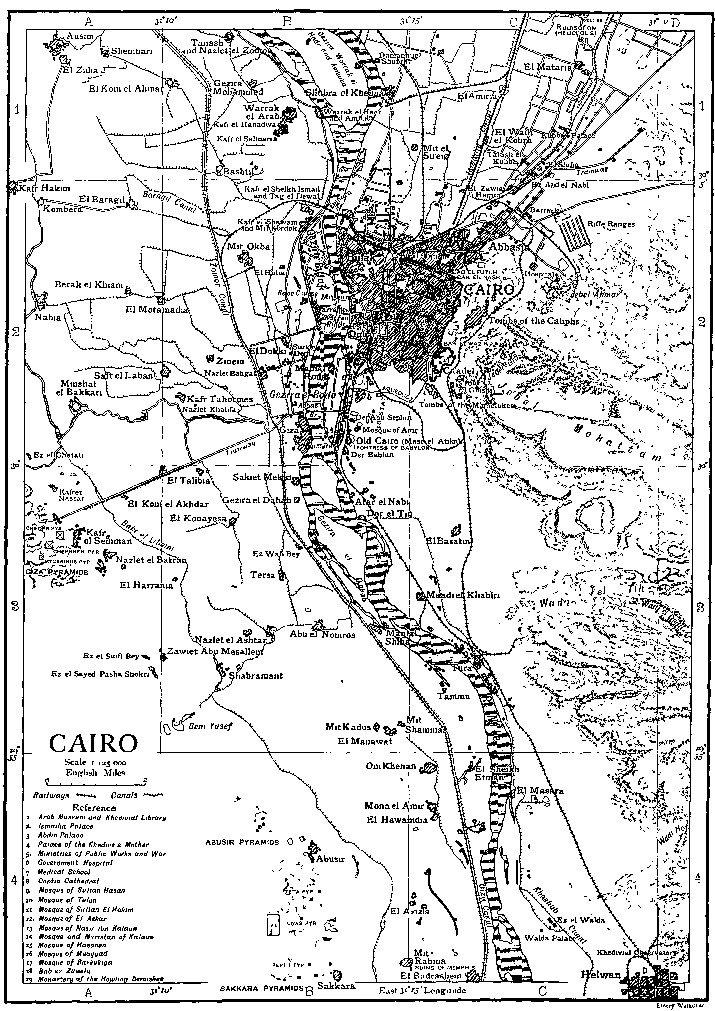
Old Cairo: the Fortress of Babylon and the Nilometer.—About a mile south of the city is Masr-el-Atika, called by Europeans Old Cairo. Between Old Cairo and the newer city are large mounds of débris marking the site of Fostat (see below, History). The road to Old Cairo by the river leads past the monastery of the "Howling" Dervishes, and the head of the aqueduct which formerly supplied the citadel with water. Farther to the east is the mosque of Amr, a much-altered building dating from A.D. 643 and containing the tomb of the Arab conqueror of Egypt. Most important of the quarters of Masr-el-Atika is that of Kasr-esh-Shama (Castle of the Candle), built within the outer walls of the Roman fortress of Babylon. Several towers of this fortress remain, and in the south wall is a massive gateway, uncovered in 1901. In the quarter are five Coptic churches, a Greek convent and two churches, and a synagogue. The principal Coptic church is that of Abu Serga (St Sergius). The crypt dates from about the 6th century and is dedicated to Sitt Miriam (the Lady Mary), from a tradition that in the flight into Egypt the Virgin and Child rested at this spot. The upper church is basilican in form, the nave being, as customary in Coptic churches, divided into three sections by wooden screens, which are adorned by carvings in ivory and wood. The wall above the high altar is faced with beautiful mosaics of marbles, blue glass and mother-of-pearl. Of the other churches in Kasr-esh-Shama the most noteworthy is that of El Adra (the Virgin), also called El Moallaka, or The Suspended, being built in one of the towers of the Roman gateway. It contains fine wooden and ivory screens. The pulpit is supported on fifteen columns, which rest on a slab of white marble. The patriarch of the Copts was formerly consecrated in this church. The other buildings in Old Cairo, or among the mounds of rubbish which adjoin it, include several fort-like ders or convents. One, south of the Kasr-esh-Shama, is called Der Bablun, thus preserving the name of the ancient fortress. In the Der Abu Sephin, to the north of Babylon, is a Coptic church of the 10th century, possessing magnificent carved screens, a pulpit with fine mosaics and a semi-circle of marble steps.
Opposite Old Cairo lies the island of Roda, where, according to Arab tradition, Pharaoh's daughter found Moses in the bulrushes. Two bridges, opened in 1908, connect Old Cairo with Roda, and a third bridge joins Roda to Giza on the west bank of the river. Roda Island contains a mosque built by Kait Bey, and at its southern extremity is the Nilometer, by which the Cairenes have for over a thousand years measured the rise of the river. It is a square well with an octagonal pillar marked in cubits in the centre.
Northern and Western Suburbs.—Two miles N.E. of Cairo and on the edge of the desert is the suburb of Abbasia (named after the viceroy Abbas), connected with the city by a continuous line of houses. Abbasia is now largely a military colony, the cavalry barracks being the old palace of Abbas Pasha. In these barracks Arabi Pasha surrendered to the British on the 14th of September 1882, the day after the battle of Tel el-Kebir. Mataria, a village 3 m. farther to the N.E., is the site of the defeat of the Mamelukes by the Turks in 1517, and of the defeat of the Turks by the French under General Kleber in 1800. At Mataria was a sycamore-tree, the successor of a tree which decayed in 1665, venerated as being that beneath which the Holy Family, rested on their flight into Egypt. This tree was blown down in July 1906 and its place taken by a cutting made from the tree some years previously. Less than a mile N.E. of Mataria are the scanty remains of the ancient city of On or Heliopolis. The chief monument is an obelisk, about 66 ft. high, erected by Usertesen I. of the XIIth dynasty. A residential suburb, named Heliopolis, containing many fine buildings, was laid out between Mataria and Abbasia during 1905-10.
On the west bank of the Nile, opposite the southern end of Roda Island, is the small town of Giza or Gizeh, a fortified place of considerable importance in the times of the Mamelukes. In the viceregal palace here the museum of Egyptian antiquities was housed for several years (1889-1902). The grounds of this palace have been converted into zoological gardens. A broad, tree-bordered, macadamized road, along which run electric trams, leads S.S.W. across the plain to the Pyramids of Giza, 5 m. distant, built on the edge of the desert.
Helwan.—Fourteen miles S. of Cairo and connected with it by railway is the town of Helwan, built in the desert 3 m. E. of the Nile, and much frequented by invalids on account of its sulphur baths, which are owned by the Egyptian government. A khedivial astronomical observatory was built here in 1903-1904, to take the place of that at Abbasia, that site being no longer suitable in consequence of the northward extension of the city. The ruins of Memphis are on the E. bank of the Nile opposite Helwan.
Inhabitants.—The inhabitants are of many diverse races, the various nationalities being frequently distinguishable by differences in dress as well as in physiognomy and colour. In the oriental quarters of the city the curious shops, the markets of different trades (the shops of each trade being generally congregated in one street or district), the easy merchant sitting before his shop, the musical and quaint street-cries of the picturesque vendors of fruit, sherbet, water, &c., with the ever-changing and many-coloured throng of passengers, all render the streets a delightful study for the lover of Arab life, nowhere else to be seen in such perfection, or with so fine a background of magnificent buildings. The Cairenes, or native citizens, differ from the fellahin in having a much larger mixture of Arab blood, and are at once keener witted and more conservative than the peasantry. The Arabic spoken by the middle and higher classes is generally inferior in grammatical correctness and pronunciation to that of the Bedouins of Arabia, but is purer than that of Syria or the dialect spoken by the Western Arabs. Besides the Cairenes proper, who are largely engaged in trade or handicrafts, the inhabitants include Arabs, numbers of Nubians and Negroes—mostly labourers or domestics in nominal slavery—and many Levantines, there being considerable colonies of Syrians and Armenians. The higher classes of native society are largely of Turkish or semi-Turkish descent. Of other races the most numerous are Greeks, Italians, British, French and Jews. Bedouins from the desert frequent the bazaars.
At the beginning of the 19th century the population was estimated at about 200,000, made up of 120,000 Moslems, 60,000 Copts, 4000 Jews and 16,000 Greeks, Armenians and "Franks." In 1882 the population had risen to 374,000, in 1897 to 570,062, and in 1907, including Helwan and Mataria, the total population was 654,476, of whom 46,507 were Europeans.
Climate and Health.—In consequence of its insanitary condition, Cairo used to have a heavy death-rate. Since the British occupation in 1882 much has been done to better this state of things, notably by a good water-supply and a proper system of drainage. The death-rate of the native population is about 35 per 1000. The climate of the city is generally healthy, with a mean temperature of about 68° F. Though rain seldom falls, exhalations from the river, especially when the flood has begun to subside, render the districts near the Nile damp during September, October and November, and in winter early morning fogs are not uncommon. The prevalent north wind and the rise of the water tend to keep the air cool in summer.
Commerce.—The commerce of Cairo, of considerable extent and variety, consists mainly in the transit of goods. Gum, ivory, hides, and ostrich feathers from the Sudan, cotton and sugar from Upper Egypt, indigo and shawls from India and Persia, sheep and tobacco from Asiatic Turkey, and European manufactures, such as machinery, hardware, cutlery, glass, and cotton and woollen goods, are the more important articles. The traffic in slaves ceased in 1877. In Bulak are several factories founded by Mehemet Ali for spinning, weaving and printing cotton, and a paper-mill established by the khedive Ismail in 1870. Various kinds of paper are manufactured, and especially a fine quality for use in the government offices. In the Island of Roda there is a sugar-refinery of considerable extent, founded in 1859, and principally managed by Englishmen. Silk goods, saltpetre, gunpowder, leather, &c., are also manufactured. An octroi duty of 9% ad valorem formerly levied on all food stuffs entering the city was abolished in 1903. It used to produce about £150,000 per annum.
Mahommedan Architecture.—Architecturally considered Cairo is still the most remarkable and characteristic of Arab cities. The edifices raised by the Moorish kings of Spain and the Moslem rulers of India may have been more splendid in their materials, and more elaborate in their details; the houses of the great men of Damascus may be more costly than were those of the Mameluke beys; but for purity of taste and elegance of design both are far excelled by many of the mosques and houses of Cairo. These mosques have suffered much in the beauty of their appearance from the effects of time and neglect; but their colour has been often thus softened, and their outlines rendered the more picturesque. What is most to be admired in their style of architecture is its extraordinary freedom from restraint, shown in the wonderful variety of its forms, and the skill in design which has made the most intricate details to harmonize with grand outlines. Here the student may best learn the history of Arab art. Like its contemporary Gothic, it has three great periods, those of growth, maturity and decline. Of the first, the mosque of Ahmed Ibn-Tulun in the southern part of Cairo, and the three great gates of the city, the Bab-en-Nasr, Bab-el-Futuh and Bab-Zuwela, are splendid examples. The design of these entrance gateways is extremely simple and massive, depending for their effect on the fine ashlar masonry in which they are built, the decoration being more or less confined to ornamental disks. The mosque of Tulun was built entirely in brick, and is the earliest instance of the employment of the pointed arch in Egypt. The curve of the arch turns in slightly below the springing, giving a horse-shoe shape. Built in brick, it was found necessary to give a more monumental appearance to the walls by a casing of stucco, which remains in fair preservation to the present day. This led to the enrichment of the archivolts and imposts with that peculiar type of conventional foliage which characterizes Mahommedan work, and which in this case was carried out by Coptic craftsmen. The attached angle-shafts of piers are found here for the first time, and their capitals are enriched, as also the frieze surmounting the walls, with other conventional patterns. The second period passes from the highest point to which this art attained to a luxuriance promising decay. The mosque of sultan Hasan, below the citadel, those of Muayyad and Kalaun, with the Barkukiya and the mosque of Barkuk in the cemetery of Kait Bey, are instances of the second and more matured style of the period. The simple plain ashlar masonry still predominates, but the wall surface is broken up with sunk panels, sometimes with geometrical patterns in them. The principal characteristics of this second period are the magnificent portals, rising sometimes, as in the mosque of sultan Hasan, to 80 or 90 ft., with elaborate stalactite vaulting at the top, and the deep stalactite cornices which crown the summit of the building. The decoration of the interior consists of the casing of the walls with marble with enriched borders, and (about 20 ft. above the ground) friezes 3 to 5 ft. in height in which the precepts of the Koran are carved in relief, with a background of conventional foliage. Of the last style of this period the Ghuriya and the mosque of Kait Bey in his cemetery are beautiful specimens. They show an elongation of forms and an excess of decoration in which the florid qualities predominate. Of the age of decline the finest monument is the mosque of Mahommad Bey Abu-Dahab. The forms are now poor, though not lacking in grandeur, and the details are not as well adjusted as before, with a want of mastery of the most suitable decoration. The usual plan of a congregational mosque is a large, square, open court, surrounded by arcades of which the chief, often several bays deep, and known as the Manksura, or prayer-chamber, faces Mecca (eastward), and has inside its outer wall a decorated niche to mark the direction of prayer. In the centre of the court is a fountain for ablutions, often surmounted by a dome, and in the prayer-chamber a pulpit and a desk for readers. When a mosque is also the founder's tomb, it has a richly ornamented sepulchral chamber always covered by a dome (see further Mosque, which contains plans of the mosques of Amr and sultan Hasan, and of the tomb mosque of Kait Bey).
After centuries of neglect efforts are now made to preserve the monuments of Arabic art, a commission with that object having been appointed in 1881. To this commission the government makes an annual grant of £4000. The careful and syste-matic work accomplished by this commission has preserved much of interest and beauty which would otherwise have gone utterly to ruin. Arrangements were made in 1902 for the systematic repair and preservation of Coptic monuments.
Museums and Library.—The museum of Egyptian antiquities was founded at Bulak in 1863, being then housed in a mosque, by the French savant Auguste Mariette. In 1889 the collection was transferred to the Giza (Ghezireh) palace, and in 1902 was removed to its present quarters, erected at a cost of over £250,000. A statue of Mariette was unveiled in 1904. The museum is entirely devoted to antiquities of Pharaonic times, and, except in historical papyri, in which it is excelled by the British Museum, is the most valuable collection of such antiquities in existence.
The Arab museum and khedivial library are housed in a building erected for the purpose, at a cost of £66,000, and opened in 1903. In the museum are preserved treasures of Saracenic art, including many objects removed from the mosques for their better security. The khedivial library contains some 64,000 volumes, over two-thirds being books and MSS. in Arabic, Persian, Turkish, Amharic and Syriac. The Arabic section includes a unique collection of 2677 korans. The Persian section is rich in illuminated MSS. The numismatic collection, as regards the period of the caliphs and later dynasties, is one of the richest in the world.
History.—Before the Arab conquest of Egypt the site of Cairo appears to have been open country. Memphis was some 12 m. higher up on the opposite side of the Nile, and Heliopolis was 5 or 6 m. distant on the N.E. The most ancient known settlement in the immediate neighbourhood of the present city was the town called Babylon. From its situation it may have been a north suburb of Memphis, which was still inhabited in the 7th century A.D. Babylon is said by Strabo to have been founded by emigrants from the ancient city of the same name in 525 B.C., i.e. at the time of the Persian conquest of Egypt. Here the Romans built a fortress and made it the headquarters of one of the three legions which garrisoned the country. The church of Babylon mentioned in 1 Peter v. 13 has been thought by some writers to refer to this town—an improbable supposition. Amr, the conqueror of Egypt for the caliph Omar, after taking the town besieged the fortress for the greater part of a year, the garrison surrendering in April A.D. 641. The town of Babylon disappeared, but the strong walls of the fortress in part remain, and the name survived, "Babylon of Egypt," or "Babylon" simply, being frequently used in medieval writings as synonymous with Cairo or as denoting the successive Mahommedan dynasties of Egypt.
Cairo itself is the fourth Moslem capital of Egypt; the site of one of those that had preceded it is, for the most part, included within its walls, while the other two were a little to the south. Amr founded El-Fostat, the oldest of these, close to the fortress which he had besieged. Fostat signifies "the tent," the town being built where Amr had pitched his tent. The new town speedily became a place of importance, and was the residence of the náibs, or lieutenants, appointed by the orthodox and Omayyad caliphs. It received the name of Masr, properly Misr, which was also applied by the Arabs to Memphis and to Cairo, and is to-day, with the Roman town which preceded it, represented by Masr el-Atika, or "Old Cairo." Shortly after the overthrow of the Omayyad dynasty, and the establishment of the Abbasids, the city of El-'Askar was founded (A.D. 750) by Suleiman, the general who subjugated the country, and became the capital and the residence of the successive lieutenants of the Abbasid caliphs. El-'Askar was a small town N.E. of and adjacent to El-Fostat, of which it was a kind of suburb. Its site is now entirely desolate. The third capital, El-Katai, was founded about A.D. 873 by Ahmed Ibn Tulun, as his capital. It continued the royal residence of his successors; but was sacked not long after the fall of the dynasty and rapidly decayed. A part of the present Cairo occupies its site and contains its great mosque, that of Ahmed Ibn Tulun.
Jauhar (Gohar) el-Kaid, the conqueror of Egypt for the Fatimite caliph El-Moizz, founded a new capital, A.D. 968, which was named El-Kāhira, that is, "the Victorious," a name corrupted into Cairo. The new city, like that founded by Amr, was originally the camp of the conqueror. This town occupied about a fourth part, the north-eastern, of the present metropolis. By degrees it became greater than El-Fostāt, and took from it the name of Misr, or Masr, which is applied to it by the modern Egyptians. With its rise Fostāt, which had been little affected by the establishment of Askar and Katai, declined. It continually increased so as to include the site of El-Katai to the south. In A.D. 1176 Cairo was unsuccessfully attacked by the Crusaders; shortly afterwards Saladin built the citadel on the lowest point of the mountains to the east, which immediately overlooked El-Katai, and he partly walled round the towns and large gardens within the space now called Cairo. Under the prosperous rule of the Mameluke sultans this great tract was filled with habitations; a large suburb to the north, the Hoseynia, was added; and the town of Bulak was founded. After the Turkish conquest (A.D. 1517) the metropolis decayed, but its limits were the same. In 1798 the city was captured by the French, who were driven out in 1801 by the Turkish and English forces, the city being handed over to the Turks. Mehemet Ali, originally the Turkish viceroy, by his massacre of the Mamelukes in 1811, in a narrow street leading to the citadel, made himself master of the country, and Cairo again became the capital of a virtually independent kingdom. Under Mehemet and his successors all the western part of the city has grown up. The khedive Ismail, in making the straight road from the citadel to the Ezbekia gardens, destroyed many of the finest houses of the old town. In 1882 Cairo was occupied by the British, and British troops continue to garrison the citadel.
Bibliography.—S.L. Poole, The Story of Cairo (London, 1902), a historical and architectural survey of the Moslem city; E. Reynolds-Ball, Cairo: the City of the Caliphs (Boston, U.S.A., 1897); Prisse d'Avennes, L'Art arabe d'après les monuments du Caire (Paris, 1847); P. Ravaisse, L'Histoire et la topographie du Caire d'après Makrizi (Paris, 1887); E.W. Lane, Cairo Fifty Years Ago (London, 1896), presents a picture of the city as it was before the era of European "improvements," and gives extracts from the Khitat of Maqrizi, written in 1417, the chief original authority on the antiquities of Cairo; Murray's and Baedeker's Guides, and A. and C. Black's Cairo of To-day (1905), contain much useful and accurate information about Cairo. For the fortress of Babylon and its churches consult A.J. Butler, Ancient Coptic Churches in Egypt (Oxford, 1884).
CAIRO, a city and the county-seat of Alexander county, Illinois, U.S.A., in the S. part of the state, at the confluence of the Ohio and Mississippi rivers, 365 m. S. of Chicago. Pop. (1890) 10,324; (1900) 12,566, of whom 5000 were negroes; (1910 census) 14,548. Cairo is served by the Illinois Central, the Mobile & Ohio, the Cleveland, Cincinnati, Chicago & St Louis, the St Louis, Iron Mountain & Southern, and the St Louis South-Western railways, and by river steamboat lines. The city, said to be the "Eden" of Charles Dickens's Martin Chuzzlewit, is built on a tongue of land between the rivers, and has suffered many times from inundations, notably in 1858. It is now protected by great levees. A fine railway bridge (1888) spans the Ohio. The city has a large government building, a U.S. marine hospital (1884), and the A.B. Safford memorial library (1882), and is the seat of St Joseph's Loretto Academy (Roman Catholic, 1864). In one of the squares there is a bronze statue, "The Hewer," by G.G. Barnard. In the N. part of the city is St Mary's park (30 acres). At Mound City (pop. in 1910, 2837), 5 m. N. of Cairo, there is a national cemetery. Lumber and flour are Cairo's principal manufactured products, and the city is an important hardwood and cotton-wood market; the Singer Manufacturing Co. has veneer mills here, and there are large box factories. In 1905 the value of the city's factory products was $4,381,465, an increase of 40.6% since 1900. Cairo is a shipping-point for the surrounding agricultural country. The city owes its origin to a series of commercial experiments. In 1818 a charter was secured from the legislature of the territory of Illinois incorporating the city and bank of Cairo. The charter was soon forfeited, and the land secured by it reverted to the government. In 1835 a new charter was granted to a second company, and in 1837 the Cairo City & Canal Co. was formed. By 1842, however, the place was practically abandoned. A successful settlement was made in 1851-1854 under the auspices of the New York Trust Co.; the Illinois Central railway was opened in 1856; and Cairo was chartered as a city in 1857. During the Civil War Cairo was an important strategic point, and was a military centre and depot of supplies of considerable importance for the Federal armies in the west. In 1862 Admiral Andrew H. Foote established at Mound City a naval depot, which was the basis of his operations on the Mississippi.
CAIROLI, BENEDETTO (1825-1889), Italian statesman, was born at Pavia on the 28th of January 1825. From 1848 until the completion of Italian unity in 1870, his whole activity was devoted to the Risorgimento, as Garibaldian officer, political refugee, anti-Austrian conspirator and deputy to parliament. He commanded a volunteer company under Garibaldi in 1859 and 1860, being wounded slightly at Calatafimi and severely at Palermo in the latter year. In 1866, with the rank of colonel, he assisted Garibaldi in Tirol, in 1867 fought at Mentana, and in 1870 conducted the negotiations with Bismarck, during which the German chancellor is alleged to have promised Italy possession of Rome and of her natural frontiers if the Democratic party could prevent an alliance between Victor Emmanuel and Napoleon. The prestige personally acquired by Benedetto Cairoli was augmented by that of his four brothers, who fell during the wars of Risorgimento, and by the heroic conduct of their mother. His refusal of all compensation or distinction further endeared him to the Italian people. When in 1876 the Left came into power, Cairoli, then a deputy of sixteen years' standing, became parliamentary leader of his party, and, after the fall of Depretis, Nicotera and Crispi, formed his first cabinet in March 1878 with a Francophil and Irredentist policy. After his marriage with the countess Elena Sizzo of Trent, he permitted the Irredentist agitation to carry the country to the verge of a war with Austria. General irritation was caused by his and Count Corti's policy of "clean hands" at the Berlin Congress, where Italy obtained nothing, while Austria-Hungary secured a European mandate to occupy Bosnia and the Herzegovina. A few months later the attempt of Passanante to assassinate King Humbert at Naples (12th of December 1878) caused his downfall, in spite of the courage displayed and the severe wound received by him in protecting the king's person on that occasion. On the 3rd of July 1879 Cairoli returned to power, and in the following November formed with Depretis a coalition ministry, in which he retained the premiership and the foreign office. Confidence in French assurances, and belief that Great Britain would never permit the extension of French influence in North Africa, prevented him from foreseeing the French occupation of Tunis (11th of May 1881). In view of popular indignation he resigned in order to avoid making inopportune declarations to the chamber. Thenceforward he practically disappeared from political life. In 1887 he received the knighthood of the Annunziata, the highest Italian decoration, and on the 8th of August 1889 died while a guest of King Humbert in the royal palace of Capodimonte near Naples. Cairoli was one of the most conspicuous representatives of that type of Italian public men who, having conspired and fought for a generation in the cause of national unity, were despite their valour little fitted for the responsible parliamentary and official positions they subsequently attained; and who by their ignorance of foreign affairs and of internal administration unwittingly impeded the political development of their country.
CAISSON (from the Fr. caisse, the variant form "cassoon" being adapted from the Ital. casone), a chest or case. When employed as a military term, it denotes an ammunition wagon or chest; in architecture it is the term used for a sunk panel or coffer in a ceiling, or in the soffit of an arch or a vault.
In civil engineering, however, the word has attained a far wider signification, and has been adopted in connexion with a considerable variety of hydraulic works. A caisson in this sense implies a case or enclosure of wood or iron, generally employed for keeping out water during the execution of foundations and other works in water-bearing strata, at the side of or under rivers, and also in the sea. There are two distinct forms of this type of caisson:—(1) A caisson open at the top, whose sides, when it is sunk in position, emerge above the water-level, and which is either provided with a water-tight bottom or is carried down, by being weighted at the top and having a cutting edge round the bottom, into a water-tight stratum, aided frequently by excavation inside; (2) A bottomless caisson, serving as a sort of diving-bell, in which men can work when compressed air is introduced to keep out the water in proportion to the depth below the water-level, which is gradually carried down to an adequately firm foundation by excavating at the bottom of the caisson, and building up a quay-wall or pier out of water on the top of its roof as it descends. An example of a caisson with a water-tight bottom is furnished by the quays erected alongside the Seine at Rouen, where open-timber caissons were sunk on to bearing-piles down to a depth of 9¾ ft. below low-water, the brick and concrete lower portions of the quay-wall being built inside them out of water (see Dock). At Bilbao, Zeebrugge and Scheveningen harbours, large open metal caissons, built inland, ballasted with concrete, floated out into position, and then sunk and filled with concrete, have been employed for forming very large foundation blocks for the breakwaters (see Breakwater). Open iron caissons are frequently employed for enclosing the site of river piers for bridges, where a water-tight stratum can be reached at a moderate depth, into which the caisson can be taken down, so that the water can be pumped out of the enclosure and the foundations laid and the pier carried up in the open air. Thus the two large river piers carrying the high towers, bascules, and machinery of the Tower Bridge, London, were each founded and built within a group of twelve plate-iron caissons open at the top; whilst four of the piers on which the cantilevers of the Forth Bridge rest, were each erected within an open plate-iron caisson fitted at the bottom to the sloping rock, where ordinary cofferdams could not have been adopted.
Where foundations have to be carried down to a considerable depth in water-bearing strata, or through the alluvial bed of a river, to reach a hard stratum, bottomless caissons sunk by excavating under compressed air are employed. The caisson at the bottom, forming the working chamber, is usually provided with a strong roof, round the top of which, when the caisson is floated into a river, plate-iron sides are erected forming an upper open caisson, inside which the pier or quay-wall is built up out of water, on the top of the roof, as the sinking proceeds. Shafts through the roof up to the open air provide access for men and materials to the working chamber, through an air-lock consisting of a small chamber with an air-tight door at each end, enabling locking into and out of the compressed-air portion to be readily effected, on the same principle as a water-lock on a canal. When a sufficiently reliable stratum has been reached, the men leave the working chamber; and it is filled with concrete through the shafts, the bottomless caisson remaining embedded in the work. The foundations for the two river piers of the Brooklyn Suspension Bridge, carried down to the solid rock, 78 and 45 ft. respectively below high-water, by means of bottomless timber caissons with compressed air, were an early instance of this method of carrying out subaqueous foundations; whilst the Antwerp quay-walls, commenced many years ago in the river Scheldt at some distance out from the right bank, and the foundations of six of the piers supporting the cantilevers of the Forth Bridge, carried down to rock between 64 and 89 ft. below high-water, are notable examples of works founded under water within wrought iron bottomless caissons by the aid of compressed air. The foundations of the two piers of the Eiffel Tower adjoining the Seine were carried down through soft water-bearing strata to a depth of 33 ft. by means of wrought iron bottomless caissons sunk by the help of compressed air; and the deep foundations under the sills of the new large Florida lock at Havre (see Dock) were laid underneath the water logged alluvial strata close to the Seine estuary by similar means. Workmen, after emerging from such caissons, sometimes exhibit symptoms of illness which is known as caisson disease (q.v.).
As in the above system, significantly termed by French engineers par caisson perdu, the materials of the bottomless caisson have to be left in the work, a more economical system has been adapted for carrying out similar foundations, at moderate depths, by using movable caissons, which, after the lowest portions of the foundations have been laid, are raised by screw-jacks for constructing the next portions. In this way, instead of building the pier or wall on the roof of the caisson, the work is carried out under water in successive stages, by raising the bottomless caisson as the work proceeds; and by this arrangement, the caisson, having completed the subaqueous portion of the structure, is available for work elsewhere. This movable system has been used with advantage for the foundations for some piers of river bridges, some breakwater foundations, and, at the Florida lock, Havre, for founding portions of the side walls.
Closed iron caissons, termed ship-caissons, and sliding or rolling caissons, are generally employed for closing graving-docks, especially the former (so called from their resemblance in shape to a vessel) on account of their simplicity, being readily floated into and out of position; whilst sliding caissons are sometimes used instead of lock-gates at docks, but require a chamber at the side to receive them when drawn back. They possess the advantage, particularly for naval dockyards where heavy weights are transported, of providing in addition a strong movable bridge, thereby dispensing with a swing-bridge across the opening.
The term caisson is sometimes applied to flat air-tight constructions used for raising vessels out of water for cleaning or repairs, by being sunk under them and then floated; but these floating caissons are more commonly known as pontoons, or, when air-chambers are added at the sides, as floating dry-docks.
(L. F. V.-H.)
CAISSON DISEASE. In order to exclude the water, the air pressure within a caisson used for subaqueous works must be kept in excess of the pressure due to the superincumbent water; that is, it must be increased by one atmosphere, or 15 lb per sq. in. for every 33½ ft. that the caisson is submerged below the surface. Hence at a depth of 100 ft. a worker in a caisson, or a diver in a diving-dress, must be subjected to a pressure of four atmospheres or 60 lb per sq. in. Exposure to such pressures is apt to be followed by disagreeable and even dangerous physiological effects, which are commonly referred to as caisson disease or compressed air illness. The symptoms are of a very varied character, including pains in the muscles and joints (the "bends"), deafness, embarrassed breathing, vomiting, paralysis ("divers' palsy"), fainting and sometimes even sudden death. At the St Louis bridge, where a pressure was employed equal to 4¼ atmospheres, out of 600 workmen, 119 were affected and 14 died. At one time the symptoms were attributed to congestion produced by the mechanical effects of the pressure on the internal organs of the body, but this explanation is seen to be untenable when it is remembered that the pressure is immediately transmitted by the fluids of the body equally to all parts. They do not appear during the time that the pressure is being raised nor so long as it is continued, but only after it has been removed; and the view now generally accepted is that they are due to the rapid effervescence of the gases which are absorbed in the body-fluids during exposure to pressure. Experiment has proved that in animals exposed to compressed air nitrogen is dissolved in the fluids in accordance with Dalton's law, to the extent of roughly 1% for each atmosphere of pressure, and also that when the pressure is suddenly relieved the gas is liberated in bubbles within the body. It is these bubbles that do the mischief. Set free in the spinal cord, for instance, they may give rise to partial paralysis, in the labyrinth of the ear to auditory vertigo, or in the heart to stoppage of the circulation; on the other hand, they may be liberated in positions where they do no harm. But if the pressure is relieved gradually they are not formed, because the gas comes out of solution slowly and is got rid of by the heart and lungs. Paul Bert exposed 24 dogs to pressure of 7-9½ atmospheres and "decompressed" them rapidly in 1-4 minutes. The result was that 21 died, while only one showed no symptoms. In one of his cases, in which the apparatus burst while at a pressure of 9½ atmospheres, death was instantaneous and the body was enormously distended, with the right heart full of gas. But he also found that dogs exposed, for moderate periods, to similar pressures suffered no ill effects provided that the pressure was relieved gradually, in 1-1½ hours; and his results have been confirmed by subsequent investigators. To prevent caisson disease, therefore, the decompression should be slow; Leonard Hill suggests it should be at a rate of not less than 20 minutes for each atmosphere of pressure. Good ventilation of the caisson is also of great importance (though experiment does not entirely confirm the view that the presence of carbonic acid to an amount exceeding 1 or 1¼ parts per thousand exercises a specific influence on the production of compressed air illness), and long shifts should be avoided, because by fatigue the circulatory and respiratory organs are rendered less able to eliminate the absorbed gas. Another reason against long shifts, especially at high pressures, is that a high partial pressure of oxygen acts as a general protoplasmic poison. This circumstance also sets a limit to the pressures that can possibly be used in caissons and therefore to the depths at which they can be worked, though there is reason to think that the maximum pressure (4¾ atmospheres) so far used in caisson work might be considerably exceeded with safety, provided that proper precautions were observed in regard to slow decompression, the physique of the workmen, and the hours of labour. As to the remedy for the symptoms after they have appeared, satisfactory results have been obtained by replacing the sufferers in a compressed air chamber ("recompression"), when the gas is again dissolved by the body fluids, and then slowly "decompressing" them.
See Paul Bert, La Pression barométrique (1878); and Leonard Hill, Recent Advances in Physiology and Biochemistry (1906), (both these works contain bibliographies); also a lecture by Leonard Hill delivered at the Royal Institution of Great Britain on the 25th of May 1906; "Diving and Caisson Disease," a summary of recent investigations, by Surgeon Howard Mummery, British Medical Journal, June 27th, 1908; Diseases of Occupation, by T. Oliver (1908); Diseases of Workmen, by T. Luson and R. Hyde (1908).
CAITHNESS, a county occupying the extreme north-east of Scotland, bounded W. and S. by Sutherlandshire, E. by the North Sea, and N. by the Pentland Firth. Its area is 446,017 acres, or nearly 697 sq. m. The surface generally is flat and tame, consisting for the most part of barren moors, almost destitute of trees. It presents a gradual slope from the north and east up to the heights in the south and west, where the chief mountains are Morven (2313 ft.), Scaraben (2054 ft.) and Maiden Pap (1587 ft.). The principal rivers are the Thurso ("Thor's River"), which, rising in Cnoc Crom Uillt (1199 ft.) near the Sutherlandshire border, pursues a winding course till it reaches the sea in Thurso Bay; the Forss, which, emerging from Loch Shurrery, follows a generally northward direction and enters the sea at Crosskirk, a fine cascade about a mile from its mouth giving the river its name (fors, Scandinavian, "waterfall;" in English the form is force); and Wick Water, which, draining Loch Watten, flows into the sea at Wick. There are many other smaller streams well stocked with fish. Indeed, the county offers fine sport for rod and gun. The lochs are numerous, the largest being Loch Watten, 2¾ m. by ¾ m., and Loch Calder, 2¼ by 1 m., and Lochs Colam, Hempriggs, Heilen, Ruard, Scarmclate, St John's, Toftingale and Wester. So much of the land is low-lying and boggy that there are no glens, except in the mountainous south-west, although towards the centre of the county are Strathmore and Strathbeg (the great and little valleys). Most of the coast-line is precipitous and inhospitable, particularly at the headlands of the Ord, Noss, Skirsa, Duncansbay, St John's Point, Dunnet Head (346 ft.), the most northerly point of Scotland, Holburn and Brims Ness. From Berriedale at frequent intervals round the coast occur superb "stacks," or detached pillars of red sandstone, which add much to the grandeur of the cliff scenery.
Caithness is separated from the Orkneys by the Pentland Firth, a strait about 14 miles long and from 6 to 8 miles broad. Owing to the rush of the tide, navigation is difficult, and, in rough weather, dangerous. The tidal wave races at a speed which varies from 6 to 12 m. an hour. At the meeting of the western and eastern currents the waves at times rise into the air like a waterspout, but the current does not always nor everywhere flow at a uniform rate, being broken up at places into eddies as perilous as itself. The breakers caused by the sunken reefs off Duncansbay Head create the Bores of Duncansbay, and eddies off St John's Point are the origin of the Merry Men of Mey, while off the island of Stroma occurs the whirlpool of the Swalchie, and off the Orcadian Swona is the vortex of the Wells of Swona. Nevertheless, as the most direct road from Scandinavian ports to the Atlantic the Firth is used by at least 5000 vessels every year. In the eastern entrance to the Firth lies the group of islands known as the Pentland Skerries. They are four in number—Muckle Skerry, Little Skerry, Clettack Skerry and Louther Skerry—and the nearest is 4½ m. from the mainland. On Muckle Skerry, the largest (½ m. by ⅓ m.), stands a lighthouse with twin towers, 100 ft. apart. The island of Stroma, 1½ m. from the mainland (pop. 375), belongs to Caithness and is situated in the parish of Canisbay. It is 2¼ m. long by 1¼ m. broad. In 1862 a remarkable tide climbed the cliffs (200 ft.) and swept across the island.
Geology.—Along the western margin of the county from Reay on the north coast to the Scaraben Hills there is a narrow belt of country which is occupied by metamorphic rocks of the types found in the east of Sutherland. They consist chiefly of granulitic quartzose schists and felspathic gneisses, permeated in places by strings and veins of pegmatite. On the Scaraben Hills there is a prominent development of quartz-schists the age of which is still uncertain. These rocks are traversed by a mass of granite sometimes foliated, trending north and south, which is traceable from Reay southwards by Aultnabreac station to Kinbrace and Strath Helmsdale in Sutherland. Excellent sections of this rock, showing segregation veins, are exposed in the railway cuttings between Aultnabreac and Forsinard. A rock of special interest described by Professor Judd occurs on Achvarasdale Moor, near Loch Scye, and hence named Scyelite. It forms a small isolated boss, its relations to the surrounding rocks not being apparent. Under the microscope, the rock consists of biotite, hornblende, serpentinous pseudo-morphs after olivine and possibly after enstatite and magnetite, and may be described as a mica-hornblende-picrite. The remainder of the county is occupied by strata of Old Red Sandstone age, the greater portion being grouped with the Middle or Orcadian division of that system, and a small area on the promontory of Dunnet Head being provisionally placed in the upper division. By means of the fossil fishes, Dr Traquair has arranged the Caithness flagstone series in three groups, the Achanarras beds at the base, the Thurso flagstones in the middle, and the John o' Groats beds at the top. In the extreme south of the county certain minor subdivisions appear which probably underlie the lowest fossiliferous beds containing the Achanarras fauna. These comprise (1) the coarse basement conglomerate, (2) dull chocolate-red sandstones, shales and clays around Braemore in the Berriedale Water, (3) the brecciated conglomerate largely composed of granite detritus seen at Badbea, (4) red sandstones, shales and conglomeratic bands found in the Berriedale Water and further northwards in the direction of Strathmore. Morven, the highest hill in Caithness, is formed of gently inclined sandstones and conglomerates resting on an eroded platform of quartz-schists and quartz-mica-granulites. The flagstones yielding the fishes of the lowest division of the Orcadian series appear on Achanarras Hill about three miles south of Halkirk. The members of the overlying Thurso group have a wide distribution as they extend along the shore on either side of Thurso and spread across the county by Castletown and Halkirk to Sinclairs Bay and Wick. They are thrown into folds which are traversed by faults some of which run in a north and south direction. They consist of dark grey and cream-coloured flagstones, sometimes thick-bedded with grey and blue shales and thin limestones and occasional intercalations of sandstone. In the north-west of the county the members of the Thurso group appear to overlap the Achanarras beds and to rest directly on the platform of crystalline schists. In the extreme north-east there is a passage upwards into the John o' Groats group with its characteristic fishes, the strata consisting of sandstones, flagstones with thin impure limestones. The rocks of Dunnet Head, which are provisionally classed with the upper Old Red Sandstone, are composed of red and yellow sandstones, marls and mudstones. Hitherto no fossils have been obtained from these beds save some obscure plant-like markings, but they are evidently a continuation southwards of the sandstones of Hoy, which there rest unconformably on the flagstone series of Orkney. This patch of Upper Old Red strata is faulted against the Caithness flagstones to the south. For many years the flagstones have been extensively quarried for pavement purposes, as for instance near Thurso, at Castletown and Achanarras. Two instances of volcanic necks occur in Caithness, one piercing the red sandstones at the Ness of Duncansbay and the other the sandstones of Dunnet Head north of Brough. They point to volcanic activity subsequent to the deposition of the John o' Groats beds and of the Dunnet sandstones. The materials filling these vents consist of agglomerate charged with blocks of diabase, sandstone, flagstone and limestone.
An interesting feature connected with the geology of Caithness is the deposit of shelly boulder clay which is distributed over the low ground, being deepest in the valleys and in the cliffs surrounding the bays on the east coast. Apart from the shell fragments, many of which are striated, the deposit contains blocks foreign to the county, as for instance chalk and chalk-flints, fragments of Jurassic rocks with fossils and pieces of jet. The transport of local boulders shows that the ice must have moved from the south-east towards the north-west, which coincides with the direction indicated by the striae. The Jurassic blocks may have been derived from the strip of rocks of that age on the east coast of Sutherland. The shell fragments, many of which are striated, include arctic, boreal and southern forms, only a small number being characteristic of the littoral zone.
Climate and Agriculture.—The climate is variable, and though the winter storms fall with great severity on the coast, yet owing to proximity to a vast expanse of sea the cold is not intense and snow seldom lies many days continuously. In winter and spring the northern shore is subject to frequent and disastrous gales from the N. and N.W. Only about two-fifths of the arable land is good. In spite of this and the cold, wet and windy climate, progressive landlords and tenants keep a considerable part of the acreage of large farms successfully tilled. In 1824 James Traill of Ratter, near Dunnet, recognizing that it was impossible to expect tenants to reclaim and improve the land on a system of short leases, advocated large holdings on long terms, so that farmers might enjoy a substantial return on their capital and labour. Thanks to this policy and the farmers' skill and enterprise, the county has acquired a remarkable reputation for its produce; notably oats and barley, turnips, potatoes and beans. Sheep—chiefly Leicester and Cheviots—of which the wool is in especial request in consequence of its fine quality, cattle, horses and pigs are raised for southern markets.
Other Industries.—The great source of profit to the inhabitants is to be found in the fisheries of cod, ling, lobster and herring. The last is the most important, beginning about the end of July and lasting for six weeks, the centre of operations being at Wick. Besides those more immediately engaged in manning the boats, the fisheries give employment to a large number of coopers, curers, packers and helpers. The salmon fisheries on the coast and at the mouths of rivers are let at high prices. The Thurso is one of the best salmon streams in the north. The flagstone quarries, mostly situated in the Thurso, Olrig and Halkirk districts, are another important source of revenue. Of manufactures there is little beyond tweeds, ropes, agricultural implements and whisky, and the principal imports consist of coal, wood, manure, flour and lime.
The only railway in the county is the Highland railway, which, from a point some four miles to the south-west of Aultnabreac station, crosses the shire in a rough semicircle, via Halkirk, to Wick, with a branch from Georgemas Junction to Thurso. There is also, however, frequent communication by steamer between Wick and Thurso and the Orkneys and Shetlands, Aberdeen, Leith and other ports. The deficiency of railway accommodation is partly made good by coach services between different places.
Population and Government.—The population of Caithness in 1891 was 33,177, and in 1901, 33,870, of whom twenty-four persons spoke Gaelic only, and 2876 Gaelic and English. The chief towns are Wick (pop. in 1901, 7911) and Thurso (3723). The county returns one member to parliament. Wick is the only royal burgh and one of the northern group of parliamentary burghs which includes Cromarty, Dingwall, Dornoch, Kirkwall and Tain. Caithness unites with Orkney and Shetland to form a sheriffdom, and there is a resident sheriff-substitute at Wick, who sits also at Thurso and Lybster. The county is under school-board jurisdiction, and there are academies at Wick and Thurso. The county council subsidizes elementary schools and cookery classes and provides apparatus for technical classes.
History.—The early history of Caithness may, to some extent, be traced in the character of its remains and its local nomenclature. Picts' houses, still fairly numerous, Norwegian names and Danish mounds attest that these peoples displaced each other in turn, and the number and strength of the fortified keeps show that its annals include the usual feuds, assaults and reprisals. Circles of standing stones, as at Stemster Loch and Bower, and the ruins of Roman Catholic chapels and places of pilgrimage in almost every district, illustrate the changes which have come over its ecclesiastical condition. The most important remains are those of Bucholie Castle, Girnigo Castle, and the tower of Keiss; and, on the S.E. coast, the castles of Clyth, Swiney, Forse, Laveron, Knockinnon, Berriedale, Achastle and Dunbeath, the last of which is romantically situated on a detached stack of sandstone rock. About six miles from Thurso stand the ruins of Braal Castle, the residence of the ancient bishops of Caithness. On the coast of the Pentland Firth, 1½ miles west of Dunscansbay Head, is the site of John o' Groat's house.
See S. Laing, Prehistoric Remains of Caithness (London and Edinburgh, 1866); James T. Calder, History of Caithness (2nd edition, Wick); John Home, In and About Wick (Wick); Thomas Sinclair, Caithness Events (Wick, 1899); History of the Clan Gunn (Wick, 1890); J. Henderson, Caithness Family History (Edinburgh, 1884); Harvie-Brown, Fauna of Caithness (Edinburgh, 1887); Principal Miller, Our Scandinavian Forefathers (Thurso, 1872); Smiles, Robert Dick, Botanist and Geologist (London, 1878); H. Morrison, Guide to Sutherland and Caithness (Wick, 1883); A. Auld, Ministers and Men in the Far North (Edinburgh, 1891).
CAIUS or Gaius, pope from 283 to 296, was the son of Gaius, or of Concordius, a relative of the emperor Diocletian, and became pope on the 17th of December 283. His tomb, with the original epitaph, was discovered in the cemetery of Calixtus and in it the ring with which he used to seal his letters (see Arringhi, Roma subterr., l. iv. c. xlviii. p. 426). He died in 296.
CAIUS [Anglice Kees, Keys, etc.], JOHN (1510-1573), English physician, and second founder of the present Gonville and Caius College, Cambridge, was born at Norwich on the 6th of October 1510. He was admitted a student at what was then Gonville Hall, Cambridge, where he seems to have mainly studied divinity. After graduating in 1533, he visited Italy, where he studied under the celebrated Montanus and Vesalius at Padua; and in 1541 he took his degree in physic at Padua. In 1543 he visited several parts of Italy, Germany and France; and returned to England. He was a physician in London in 1547, and was admitted fellow of the College of Physicians, of which he was for many years president. In 1557, being then physician to Queen Mary, he enlarged the foundation of his old college, changed the name from "Gonville Hall" to "Gonville and Caius College," and endowed it with several considerable estates, adding an entire new court at the expense of £1834. Of this college he accepted the mastership (24th of January 1558/9) on the death of Dr Bacon, and held it till about a month before his death. He was physician to Edward VI., Queen Mary and Queen Elizabeth. He returned to Cambridge from London for a few days in June 1573, about a month before his death, and resigned the mastership to Dr Legge, a tutor at Jesus College. He died at his London House, in St Bartholomew's, on the 29th of July, 1573, but his body was brought to Cambridge, and buried in the chapel under the well-known monument which he had designed. Dr Caius was a learned, active and benevolent man. In 1557 he erected a monument in St Paul's to the memory of Linacre. In 1564 he obtained a grant for Gonville and Caius College to take the bodies of two malefactors annually for dissection; he was thus an important pioneer in advancing the science of anatomy. He probably devised, and certainly presented, the silver caduceus now in the possession of Caius College as part of its insignia; he first gave it to the College of Physicians, and afterwards presented the London College with another.