Front matter (continued 4)
Reading edition
(M.)
The above article has been slightly corrected as to facts, as compared with its form in the 9th edition. Bunyan's works were first partially collected in a folio volume (1692) by his friend Charles Doe. A larger edition (2 vols., 1736-1737) was edited by Samuel Wilson of the Barbican. In 1853 a good edition (3 vols., Glasgow) was produced by George Offer. Southey's edition (1830) of the Pilgrim's Progress contained his Life of Bunyan. Since then various editions of the Pilgrim's Progress, many illustrated (by Cruikshank, Byam Shaw, W. Strang and others), have appeared. An interesting life by "the author of Mark Rutherford" (W. Hale White) was published in 1904. Other lives are by J.A. Froude (1880) in the "English Men of Letters" series, and E. Venables (1888); but the standard work on the subject is John Bunyan; his Life, Times and Work (1885), by the Rev. J. Brown of Bedford. A bronze statue, by Boehm, was presented to the town by the duke of Bedford in 1874.
BUNZLAU, a town of Germany, in Prussian Silesia, on the right bank of the Bober, 27 m. from Liegnitz on the Berlin-Breslau railway, which crosses the river by a great viaduct. Pop. (1900) 14,590. It has a handsome market square, an Evangelical and a Roman Catholic church, and monuments to the Russian field marshal Kutusov, who died here, and to the poet Martin Opitz von Boberfeld. The Bunzlau pottery is famous; woollen and linen cloth are manufactured, and there is a considerable trade in grain and cattle. Bunzlau (Boleslavia) received its name in the 12th century from Duke Boleslav, who separated it from the duchy of Glogau. Its importance was increased by numerous privileges and the possession of extensive mining works. It was frequently captured and recaptured in the wars of the 17th century, and in 1739 was completely destroyed by fire. On the 30th of August 1813 the French were here defeated on the retreat from the Katzbach by the Silesian army of the allies.
BUONAFEDE, APPIANO (1716-1793), Italian philosopher, was born at Comachio, in Ferrara, and died in Rome. He became professor of theology at Naples in 1740, and, entering the religious body of the Celestines, rose to be general of the order. His principal works, generally published under the assumed name of "Agatopisto Cromazione," are on the history of philosophy:—Della Istoria e delle Indole di ogni Filosofia, 7 vols., 1772 seq.; and Della Restaurazione di ogni Filosofia ne' Secoli, xvi., xvii., xviii., 3 vols., 1789 (German trans. by C. Heydenreich). The latter gives a valuable account of 16th-century Italian philosophy. His other works are Istoria critica e filosofica del suicidio (1761); Delle conquiste celebri esaminate col naturale diritto delle genti (1763); Storia critica del moderno diritto di natura e delle genti (1789); and a few poems and philosophic comedies.
BUOY (15th century "boye"; through O.Fr. or Dutch, from Lat. boia, fetter; the word is now usually pronounced as "boy," and it has been spelt in that form; but Hakluyt's Voyages spells it "bwoy," and this seems to indicate a different pronunciation, which is also given in some modern dictionaries), a floating body employed to mark the navigable limits of channels, their fairways, sunken dangers or isolated rocks, mined or torpedo grounds, telegraph cables, or the position of a ship's anchor after letting go; buoys are also used for securing a ship to instead of anchoring. They vary in size and construction from a log of wood to steel mooring buoys for battleships or a steel gas buoy.
In 1882 a conference was held upon a proposal to establish a uniform system of buoyage. It was under the presidency of the then duke of Edinburgh, and consisted of representatives from the various bodies interested. The questions of colour, visibility, shape and size were considered, and any modifications necessary owing to locality. The committee proposed the following uniform system of buoyage, and it is now adopted by the general lighthouse authorities of the United Kingdom:—
Fig. 3.
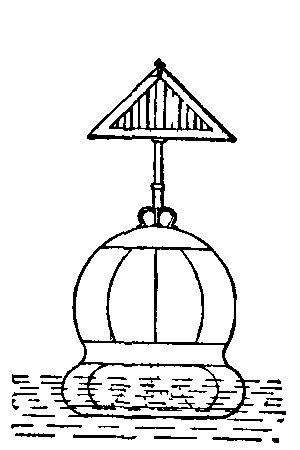
Fig. 2.
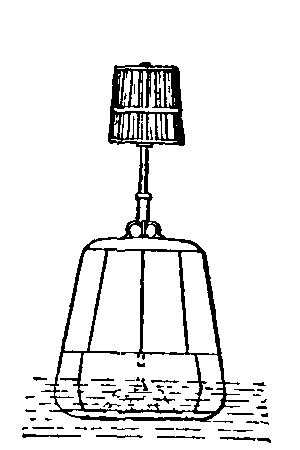
Fig. 1.
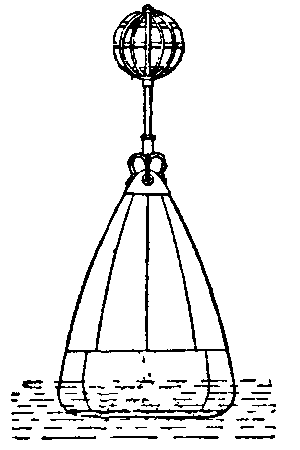
(1) The mariner when approaching the coast must determine his position on the chart, and note the direction of flood tide. (2) The term "starboard-hand" shall denote that side which would be on the right hand of the mariner either going with the main stream of the flood, or entering a harbour, river or estuary from seaward; the term "port-hand" shall denote the left hand of the mariner in the same circumstances. (3)[1] Buoys showing the pointed top of a cone above water shall be called conical (fig. 1) and shall always be starboard-hand buoys, as above defined. (4)[1] Buoys showing a flat top above water shall be called can (fig. 2) and shall always be port-hand buoys, as above defined. (5) Buoys showing a domed top above water shall be called spherical (fig. 3) and shall mark the ends of middle grounds. (6) Buoys having a tall central structure on a broad face shall be called pillar buoys (fig. 4), and like all other special buoys, such as bell buoys, gas buoys, and automatic sounding buoys, shall be placed to mark special positions either on the coast or in the approaches to harbours. (7) Buoys showing only a mast above water shall be called spar-buoys (fig. 5).[2] (8) Starboard-hand buoys shall always be painted in one colour only. (9) Port-hand buoys shall be painted of another characteristic colour, either single or parti-colour. (10) Spherical buoys (fig. 3) at the ends of middle grounds shall always be distinguished by horizontal stripes of white colour, (11) Surmounting beacons, such as staff and globe and others,[3] shall always be painted of one dark colour. (12) Staff and globe (fig. 1) shall only be used on starboard-hand buoys, staff and cage (fig. 2) on port hand; diamonds (fig. 7) at the outer ends of middle grounds; and triangles (fig. 3) at the inner ends. (13) Buoys on the same side of a channel, estuary or tideway may be distinguished from each other by names, numbers or letters, and where necessary by a staff surmounted with the appropriate beacon. (14) Buoys intended for moorings (fig. 6) may be of shape and colour according to the discretion of the authority within whose jurisdiction they are laid, but for marking submarine telegraph cables the colour shall be green with the word "Telegraph" painted thereon in white letters.
Fig. 7.
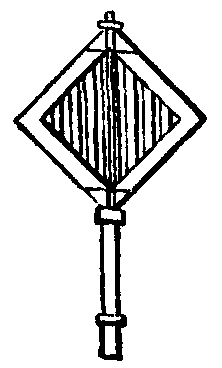
Fig. 6.
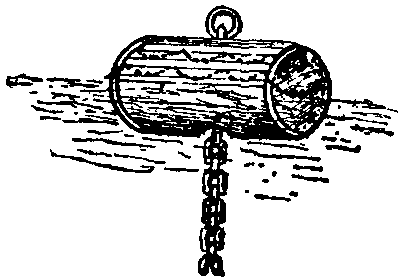
Fig. 5.

Fig. 4.

Buoying and Marking of Wrecks.—(15) Wreck buoys in the open sea, or in the approaches to a harbour or estuary, shall be coloured green, with the word "Wreck" painted in white letters on them. (16) When possible, the buoy should be laid near to the side of the wreck next to mid-channel. (17) When a wreck-marking vessel is used, it shall, if possible, have its top sides coloured green, with the word "Wreck" in white letters thereon, and shall exhibit by day, three balls on a yard 20 ft. above the sea, two placed vertically at one end and one at the other, the single ball being on the side nearer to the wreck; in fog a gong or bell is rung in quick succession at intervals not exceeding one minute (wherever practicable); by night, three white fixed lights are similarly arranged as the balls in daytime, but the ordinary riding lights are not shown. (18) In narrow waters or in rivers and harbours under the jurisdiction of local authorities, the same rules may be adopted, or at discretion, varied as follows:—When a wreck-marking vessel is used she shall carry a cross-yard on a mast with two balls by day, placed horizontally not less than 6 nor more than 12 ft. apart, and by night two lights similarly placed. When a barge or open boat only is used, a flag or ball may be shown in the daytime. (19) The position in which the marking vessel is placed with reference to the wreck shall be at the discretion of the local authority having jurisdiction. A uniform system by shape has been adopted by the Mersey Dock and Harbour Board, to assist a mariner by night, and, in addition, where practicable, a uniform colour; the fairway buoys are specially marked by letter, shape and colour.
Fig. 11.

Fig. 10.
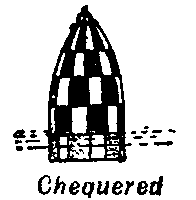
Fig. 9.

Fig. 8.

British India has practically adopted the British system, United States and Canada have the same uniform system; in the majority of European maritime countries and China various uniform systems have been adopted. In Norway and Russia the compass system is used, the shape, colour and surmountings of the buoys indicating the compass bearing of the danger from the buoy; this method is followed in the open sea by Sweden. An international uniform system of buoyage, although desirable, appears impracticable. Germany employs yellow buoys to mark boundaries of quarantine stations. The question of shape versus colour, irrespective of size, is a disputed one; the shape is a better guide at night and colour in the daytime. All markings (figs. 8, 9, 10 and 11) should be subordinate to the main colour of the buoy; the varying backgrounds and atmospheric conditions render the question a complex one.
Fig. 14.
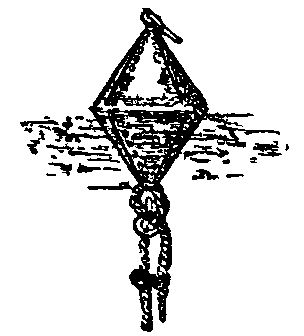
Fig. 13.
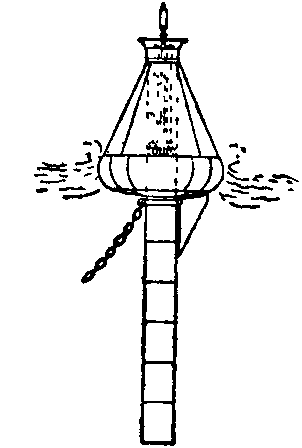
Fig. 12.
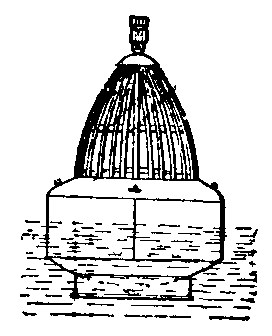
London Trinity House buoys are divided into five classes, their use depending on whether the spot to be marked is in the open sea or otherwise exposed position, or in a sheltered harbour, or according to the depth of water and weight of moorings, or the importance of the danger. Buoys are moored with specially tested cables; the eye at the base of the buoy is of wrought iron to prevent it becoming "reedy" and the cable is secured to blocks (see Anchor) or mushroom anchors according to the nature of the ground. London Trinity House buoys are built of steel, with bulkheads to lessen the risk of their sinking by collision, and, with the exception of bell buoys, do not contain water ballast. In 1878 gas buoys, with fixed and occulting lights of 10-candle power, were introduced. In 1896 Mr T. Matthews, engineer-in-chief in the London Trinity Corporation, developed the present design (fig. 12). It is of steel, the lower plates being 5/8 in. and the upper 7/16 in. in thickness, thus adding to the stability. The buoy holds 380 cub. ft. of gas, and exhibits an occulting light for 2533 hours. This light is placed 10 ft. above the sea, and, with an intensity of 50 candles, is visible 8 m. It occults every ten seconds, and there is seven seconds' visibility, with three seconds' obscuration. The occultations are actuated by a double valve arrangement. In the body of the apparatus there is a gas chamber having sufficient capacity, in the case of an occulting light, for maintaining the flame in action for seven seconds, and by means of a by-pass a jet remains alight in the centre of the burner. During the period of three seconds' darkness the gas chamber is re-charged, and at the end of that period is again opened to the main burner by a tripping arrangement of the valve, and remains in action seven seconds. The gas chamber of the buoy, charged to five atmospheres, is replenished from a steamer fitted with a pump and transport receivers carrying indicating valves, the receivers being charged to ten atmospheres. Practically no inconvenience has resulted from saline or other deposits, the glazing (glass) of the lantern being thoroughly cleaned when re-charging the buoy. Acetylene, generated from calcium carbide inside the buoy, is also used. Electric light is exhibited from some buoys in the United States. In England an automatic electric buoy has been suggested, worked by the motion of the waves, which cause a stream of water to act on a turbine connected with a dynamo generating electricity. Boat-shaped buoys are also used (river Humber) for carrying a light and bell. The Courtenay whistling buoy (fig. 13) is actuated by the undulating movement of the waves. A hollow cylinder extends from the lower part of the buoy to still water below the movement of the waves, ensuring that the water inside keeps at mean level, whilst the buoy follows the movements of the waves. By a special apparatus the compressed air is forced through the whistle at the top of the buoy, and the air is replenished by two tubes at the upper part of the buoy. It is fitted with a rudder and secured in the usual manner. Automatic buoys cannot be relied on in calm days with a smooth sea. The nun buoy (fig. 14) for indicating the position of an anchor after letting go, is secured to the crown of the anchor by a buoy rope. It is usually made of galvanized iron, and consists of two cones joined together at the base. It is painted red for the port anchor and green for the starboard.
Mooring buoys (fig. 6) for battleships are built of steel in four watertight compartments, and have sufficient buoyancy to keep afloat should a compartment be pierced; they are 13 ft. long with a diameter of 6½ ft. The mooring cable (bridle) passes through a watertight 16-in. trunk pipe, built vertically in the centre of the buoy, and is secured to a "rocking shackle" on the upper surface of the buoy. Large mooring buoys are usually protected by horizontal wooden battens and are fitted with life chains.
(J. W. D.)
BUPALUS AND ATHENIS, sons of Archermus, and members of the celebrated school of sculpture in marble which flourished in Chios in the 6th century B.C. They were contemporaries of the poet Hipponax (about 540 B.C.), whom they were said to have caricatured. Their works consisted almost entirely of draped female figures, Artemis, Fortune, the Graces, whence the Chian school has been well called a school of Madonnas. Augustus brought many of the works of Bupalus and Athenis to Rome, and placed them on the gable of the temple of Apollo Palatinus.
BUPHONIA, in Greek antiquities, a sacrificial ceremony, forming part of the Diipolia, a religious festival held on the 14th of the month Skirophorion (June-July) at Athens, when a labouring ox was sacrificed to Zeus Polieus as protector of the city in accordance with a very ancient custom. The ox was driven forward to the altar, on which grain was spread, by members of the family of the Kentriadae (from κέντρον, a goad), on whom this duty devolved hereditarily. When it began to eat, one of the family of the Thaulonidae advanced with an axe, slew the ox, then immediately threw away the axe and fled. The axe, as being polluted by murder, was now carried before the court of the Prytaneum (which tried inanimate objects for homicide) and there charged with having caused the death of the ox, for which it was thrown into the sea. Apparently this is an early instance analogous to deodand (q.v.). Although the slaughter of a labouring ox was forbidden, it was considered excusable in the exceptional circumstances; none the less it was regarded as a murder.
Porphyrius, De Abstinentia, ii. 29; Aelian, Var. Hist. viii. 3; Schol. Aristoph. Nubes, 485; Pausanias, i. 24, 28; see also Band, De Diipoliorum Sacro Atheniensium (1873).
BUR, or Burr (apparently the same word as Danish borre, burdock, cf. Swed. kard-boore), a prickly fruit or head of fruits, as of the burdock. In the sense of a woody outgrowth on the trunk of a tree, or "gnaur," the effect of a crowded bud-development, the word is probably adapted from the Fr. bourre, a vine-bud.
BURANO, a town of Venetia, in the province of Venice, on an island in the lagoons, 6 m. N.E. of Venice by sea. Pop. (1901) 8169. It is a fishing town, with a large royal school of lace-making employing some 500 girls. It was founded, like all the towns in the lagoons, by fugitives from the mainland cities at the time of the barbarian invasions. Torcello is a part of the commune of Burano.
BURAUEN, a town of the province of Leyte, island of Leyte, Philippine Islands, on the Dagitan river, 21 m. S. by W. of Tacloban, the capital. Pop. (1903) 18,197. Burauen is situated in a rich hemp-growing region, and hemp is its only important product. The language is Visayan.
BURBAGE, JAMES (d. 1597), English actor, is said to have been born at Stratford-on-Avon. He was a member of the earl of Leicester's players, probably for several years before he is first mentioned (1574) as being at the head of the company. In 1576, having secured the lease of land at Shoreditch, Burbage erected there the successful house which was known for twenty years as The Theatre from the fact that it was the first ever erected in London. He seems also to have been concerned in the erection of a second theatre in the same locality, the Curtain, and later, in spite of all difficulties and a great deal of local opposition, he started what became the most celebrated home of the rising drama,—the Blackfriars theatre, built in 1596 near the old Dominican friary.
His son Richard Burbage (c. 1567-1619), more celebrated than his father, was the Garrick of the Elizabethan stage, and acted all the great parts in Shakespeare's plays. He, too, is said to have been born at Stratford-on-Avon, and made his first appearance at an early age at one of his father's theatres. He had established a reputation by the time he was twenty, and in the next dozen years was the most popular English actor, the "Roscius" of his day. At the time of his father's death, a lawsuit was in progress against the lessor from whom James Burbage held the land on which The Theatre stood. This suit was continued by Richard and his brother Cuthbert, and in 1569 they pulled down the Shoreditch house and used the materials to erect the Globe theatre, famous for its connexion with Shakespeare. They occupied it as a summer playhouse, retaining the Blackfriars, which was roofed in, for winter performances. In this venture Richard Burbage had Shakespeare and others as his partners, and it was in one or the other of these houses that he gained his greatest triumphs, taking the leading part in almost every new play. He was specially famous for his impersonation of Richard III. and other Shakespearian characters, and it was in tragedy that he especially excelled. Every playwright of his day endeavoured to secure his services. He died on the 13th of March 1619. Richard Burbage was a painter as well as an actor. The Felton portrait of Shakespeare is attributed to him, and there is a portrait of a woman, undoubtedly by him, preserved at Dulwich College.
BURBOT, or Eel-Pout (Lota vulgaris), a fish of the family Gadidae, which differs from the ling in the dorsal and anal fins reaching the caudal, and in the small size of all the teeth. It exceeds a length of 3 ft. and is a freshwater fish, although examples are exceptionally taken in British estuaries and in the Baltic; some specimens are handsomely marbled with dark brown, with black blotches on the back and dorsal fins. It is very locally distributed in central and northern Europe, and an uncommon fish in England. Its flesh is excellent. The American burbot (Lota maculosa) is coarser, and not favoured for the table.
BURCKHARDT, JAKOB (1818-1897), Swiss writer on art, was born at Basel on the 25th of May 1818; he was educated there and at Neuchâtel, and till 1839 was intended to be a pastor. In 1838 he made his first journey to Italy, and also published his first important articles Bemerkungen über schweizerische Kathedralen. In 1839 he went to the university of Berlin, where he studied till 1843, spending part of 1841 at Bonn, where he was a pupil of Franz Kugler, the art historian, to whom his first book, Die Kunstwerke D. belgischen Städte (1842), was dedicated. He was professor of history at the university of Basel (1845-1847, 1849-1855 and 1858-1893) and at the federal polytechnic school at Zurich (1855-1858). In 1847 he brought out new editions of Kugler's two great works, Geschichte der Malerei and Kunstgeschichte, and in 1853 published his own work, Die Zeit Constantins des Grossen. He spent the greater part of the years 1853-1854 in Italy, where he collected the materials for one of his most famous works, Der Cicerone: eine Anleitung sum Genuss der Kunstwerke Italiens, which was dedicated to Kugler and appeared in 1855 (7th German edition, 1899; English translation of the sections relating to paintings, by Mrs A.H. Clough, London, 1873). This work, which includes sculpture and architecture, as well as painting, has become indispensable to the art traveller in Italy. About half of the original edition was devoted to the art of the Renaissance, so that Burckhardt was naturally led on to the preparation of his two other celebrated works, Die Cultur der Renaissance in Italien (1860, 5th German edition 1896, and English translation, by S.G.C. Middlemore, in 2 vols., London, 1878), and the Geschichte der Renaissance in Italien (1867, 3rd German edition 1891). In 1867 he refused a professorship at Tübingen, and in 1872 another (that left vacant by Ranke) at Berlin, remaining faithful to Basel. He died in 1897.
See Life by Hans Trog in the Basler Jahrbuch for 1898, pp. 1-172.
(W. A. B. C.)
BURCKHARDT, JOHN LEWIS [Johann Ludwig] (1784-1817), Swiss traveller and orientalist, was born at Lausanne on the 24th of November 1784. After studying at Leipzig and Göttingen he visited England in the summer of 1806, carrying a letter of introduction from the naturalist Blumenbach to Sir Joseph Banks, who, with the other members of the African Association, accepted his offer to explore the interior of Africa. After studying in London and Cambridge, and inuring himself to all kinds of hardships and privations, Burckhardt left England in March 1809 for Malta, whence he proceeded, in the following autumn, to Aleppo. In order to obtain a better knowledge of oriental life he disguised himself as a Mussulman, and took the name of Sheikh Ibrahim Ibn Abdallah. After two years passed in the Levant he had thoroughly mastered Arabic, and had acquired such accurate knowledge of the Koran, and of the commentaries upon its religion and laws, that after a critical examination the most learned Mussulmans entertained no doubt of his being really what he professed to be, a learned doctor of their law. During his residence in Syria he visited Palmyra, Damascus, Lebanon and thence journeyed via Petra to Cairo with the intention of joining a caravan to Fezzan, and of exploring from there the sources of the Niger. In 1812, whilst waiting for the departure of the caravan, he travelled up the Nile as far as Dar Mahass; and then, finding it impossible to penetrate westward, he made a journey through the Nubian desert in the character of a poor Syrian merchant, passing by Berber and Shendi to Suakin, on the Red Sea, whence he performed the pilgrimage to Mecca by way of Jidda. At Mecca he stayed three months and afterwards visited Medina. After enduring privations and sufferings of the severest kind, he returned to Cairo in June 1815 in a state of great exhaustion; but in the spring of 1816 he travelled to Mount Sinai, whence he returned to Cairo in June, and there again made preparations for his intended journey to Fezzan. Several hindrances prevented his prosecuting this intention, and finally, in April 1817, when the long-expected caravan prepared to depart, he was seized with illness and died on the 15th of October. He had from time to time carefully transmitted to England his journals and notes, and a very copious series of letters, so that nothing which appeared to him to be interesting in the various journeys he made has been lost. He bequeathed his collection of 800 vols. of oriental MSS. to the library of Cambridge University.
His works were published by the African Association in the following order:—Travels in Nubia (to which is prefixed a biographical memoir) (1819); Travels in Syria and the Holy Land (1822); Travels in Arabia (1829); Arabic Proverbs, or the Manners and Customs of the Modern Egyptians (1830); Notes on the Bedouins and Wahabys (1831).
BURDEAU, AUGUSTE LAURENT (1851-1894), French politician, was the son of a labourer at Lyons. Forced from childhood to earn his own living, he was enabled to secure an education by bursarships at the Lycée at Lyons and at the Lycée Louis Le Grand in Paris. In 1870 he was at the École Normale Supérieure in Paris, but enlisted in the army, and was wounded and made prisoner in 1871. In 1874 he became professor of philosophy, and translated several works of Herbert Spencer and of Schopenhauer into French. His extraordinary aptitude for work secured for him the position of chef de cabinet under Paul Bert, the minister of education, in 1881. In 1885 he was elected deputy for the department of the Rhone, and distinguished himself in financial questions. He was several times minister, and became minister of finance in the cabinet of Casimir-Périer (from the 3rd of November 1893 to the 22nd of May 1894). On the 5th of July 1894 he was elected president of the chamber of deputies. He died on the 12th of December 1894, worn out with overwork.
BURDEN, or Burthen, (1) (A.S. byrthen, from beran, to bear), a load, both literally and figuratively; especially the carrying capacity of a ship; in mining and smelting, the tops or heads of stream-work which lie over the stream of tin, and the proportion of ore and flux to fuel in the charge of a blast-furnace. In Scots and English law the term is applied to an encumbrance on real or personal property. (2) (From the Fr. bourdon, a droning, humming sound) an accompaniment to a song, or the refrain of a song; hence a chief or recurrent topic, as "the burden of a speech."
BURDER, GEORGE (1752-1832), English Nonconformist divine, was born in London on the 5th of June 1752. In early manhood he was an engraver, but in 1776 he began preaching, and was minister of the Independent church at Lancaster from 1778 to 1783. Subsequently he held charges at Coventry (1784-1803) and at Fetter Lane, London (1803-1832). He was one of the founders of the British and Foreign Bible Society, the Religious Tract Society, and the London Missionary Society, and was secretary to the last-named for several years. As editor of the Evangelical Magazine and author of Village Sermons, he commanded a wide influence. He died on the 29th of May 1832, and a Life (by H. Burder) appeared in 1833.
BURDETT, SIR FRANCIS (1770-1844), English politician, was the son of Francis Burdett by his wife Eleanor, daughter of William Jones of Ramsbury manor, Wiltshire, and grandson of Sir Robert Burdett, Bart. Born on the 25th of January 1770, he was educated at Westminster school and Oxford, and afterwards travelled in France and Switzerland. He was in Paris during the earlier days of the French Revolution, a visit which doubtless influenced his political opinions. Returning to England he married in 1793 Sophia, daughter of Thomas Coutts the banker, and this lady brought him a large fortune. In 1796 he became member of parliament for Boroughbridge, having purchased this seat from the representatives of the 4th duke of Newcastle, and in 1797 succeeded his grandfather as fifth baronet. In parliament he soon became prominent as an opponent of Pitt, and as an advocate of popular rights. He denounced the war with France, the suspension of the Habeas Corpus Act, the proposed exclusion of John Horne Tooke from parliament, and quickly became the idol of the people. He was instrumental in securing an inquiry into the condition of Coldbath Fields prison, but as a result of this step he was for a time prevented by the government from visiting any prison in the kingdom. In 1797 he made the acquaintance of Horne Tooke, whose pupil he became, not only in politics, but also in philology. At the general election of 1802 Burdett was a candidate for the county of Middlesex, but his return was declared void in 1804, and in the subsequent contest he was defeated. In 1805 this return was amended in his favour, but as this was again quickly reversed, Burdett, who had spent an immense sum of money over the affair, declared he would not stand for parliament again.
At the general election of 1806 Burdett was a leading supporter of James Paull, the reform candidate for the city of Westminster; but in the following year a misunderstanding led to a duel between Burdett and Paull in which both combatants were wounded. At the general election in 1807 Burdett, in spite of his reluctance, was nominated for Westminster, and amid great enthusiasm was returned at the top of the poll. He took up again the congenial work of attacking abuses and agitating for reform, and in 1810 came sharply into collision with the House of Commons. A radical named John Gale Jones had been committed to prison by the House, a proceeding which was denounced by Burdett, who questioned the power of the House to take this step, and vainly attempted to secure the release of Jones. He then issued a revised edition of his speech on this occasion, and it was published by William Cobbett in the Weekly Register. The House voted this action a breach of privilege, and the speaker issued a warrant for Burdett's arrest. Barring himself in his house, he defied the authorities, while the mob gathered in his defence. At length his house was entered, and under an escort of soldiers he was conveyed to the Tower. Released when parliament was prorogued, he caused his supporters much disappointment by returning to Westminster by water, and so avoiding a demonstration in his honour. He then brought actions against the speaker and the serjeant-at-arms, but the courts upheld the action of the House. In parliament Burdett denounced corporal punishment in the army, and supported all attempts to check corruption, but his principal efforts were directed towards procuring a reform of parliament, and the removal of Roman Catholic disabilities. In 1809 he had proposed a scheme of parliamentary reform, and returning to the subject in 1817 and 1818 he anticipated the Chartist movement by suggesting universal male suffrage, equal electoral districts, vote by ballot, and annual parliaments; but his motions met with very little support. He succeeded, however, in carrying a resolution in 1825 that the House should consider the laws concerning Roman Catholics. This was followed by a bill embodying his proposals, which passed the Commons but was rejected by the Lords. In 1827 and 1828 he again proposed resolutions on this subject, and saw his proposals become law in 1829. In 1820 Burdett had again come into serious conflict with the government. Having severely censured its action with reference to the "Manchester massacre," he was prosecuted at Leicester assizes, fined £1000, and committed to prison for three months. After the passing of the Reform Bill in 1832 the ardour of the veteran reformer was somewhat abated, and a number of his constituents soon took umbrage at his changed attitude. Consequently he resigned his seat early in 1837, but was re-elected. However, at the general election in the same year he forsook Westminster and was elected member for North Wiltshire, which seat he retained, acting in general with the Conservatives, until his death on the 23rd of January 1844. He left a son, Robert, who succeeded to the baronetcy, and five daughters, the youngest of whom became the celebrated Baroness Burdett-Coutts. Impetuous and illogical, Burdett did good work as an advocate of free speech, and an enemy of corruption. He was exceedingly generous, and spent money lavishly in furthering projects of reform.
See A. Stephens, Life of Horne Tooke (London, 1813); Spencer Walpole, History of England (London, 1878-1886); C. Abbot, Baron Colchester, Diary and Correspondence (London, 1861).
(A. W. H.*)
BURDETT-COUTTS, ANGELA GEORGINA BURDETT-COUTTS, Baroness (1814-1906), English philanthropist, youngest daughter of Sir Francis Burdett, was born on the 21st of April 1814. When she was three-and-twenty, she inherited practically the whole of the immense wealth of her grandfather Thomas Coutts (approaching two millions sterling, a fabulous sum in those days), by the will of the duchess of St Albans, who, as the actress Henrietta Mellon, had been his second wife and had been left it on his death in 1821. Miss Burdett then took the name of Coutts in addition to her own. "The faymale heiress, Miss Anjaley Coutts," as the author of the Ingoldsby Legends called her in his ballad on the queen's coronation in that year (1837), at once became a notable subject of public curiosity and private cupidity; she received numerous offers of marriage, but remained resolutely single, devoting herself and her riches to philanthropic work, which made her famous for well-applied generosity. In May 1871 she was created a peeress, as Baroness Burdett-Coutts of Highgate and Brookfield, Middlesex. On the 18th of July 1872 she was presented at the Guildhall with the freedom of the city of London, the first case of a woman being admitted to that fellowship. It was not till 1881 that, when sixty-seven years old, she married William Lehman Ashmead-Bartlett, an American by birth, and brother of Sir E.A. Ashmead-Bartlett, the Conservative member of parliament; and he then took his wife's name, entering the House of Commons as member for Westminster, 1885. Full of good works, and of social interest and influence, the baroness lived to the great age of ninety-two, dying at her house in Stratton Street, Piccadilly, on the 30th of December 1906, of bronchitis. She was buried in Westminster Abbey.
The extent of her benefactions during her long and active life can only be briefly indicated; but the baroness must remain a striking figure in the social history of Victorian England, for the thoughtful and conscientious care with which she "held her wealth in trust" for innumerable good objects. It was her aim to benefit the working-classes in ways involving no loss of independence or self-respect. She carefully avoided taking any side in party politics, but she was actively interested in phases of Imperial extension which were calculated to improve the condition of the black races, as in Africa, or the education and relief of the poor or suffering in any part of the world. Though she made no special distinction of creed in her charities, she was a notable benefactor of the Church of England, building and endowing churches and church schools, endowing the bishoprics of Cape Town and of Adelaide (1847), and founding the bishopric of British Columbia (1857). Among her many educational endowments may be specified the St Stephen's Institute in Vincent Square, Westminster (1846); she started sewing schools in Spitalfields when the silk trade began to fail; helped to found the shoe-black brigade; and placed hundreds of destitute boys in training-ships for the navy and merchant service. She established Columbia fish market (1869) in Bethnal Green, and presented it to the city, but owing to commercial difficulties this effort, which cost her over £200,000, proved abortive. She supported various schemes of emigration to the colonies; and in Ireland helped to promote the fishing industry by starting schools, and providing boats, besides advancing £250,000 in 1880 for supplying seed to the impoverished tenants. She was devoted to the protection of animals and prevention of cruelty, and took up with characteristic zeal the cause of the costermongers' donkeys, building stables for them on her Columbia market estate, and giving prizes for the best-kept animals. She helped to inaugurate the society for the prevention of cruelty to children, and was a keen supporter of the ragged school union. Missionary efforts of all sorts; hospitals and nursing; industrial homes and refuges; relief funds, &c., found in her a generous supporter. She was associated with Louisa Twining and Florence Nightingale; and in 1877-1878 raised the Turkish compassionate fund for the starving peasantry and fugitives in the Russo-Turkish War (for which she obtained the order of the Medjidieh, a solitary case of its conference on a woman). She relieved the distressed in far-off lands as well as at home, her helping hand being stretched out to the Dyaks of Borneo and the aborigines of Australia. She was a liberal patroness of the stage, literature and the arts, and delighted in knowing all the cultured people of the day. In short, her position in England for half a century may well be summed up in words attributed to King Edward VII., "after my mother (Queen Victoria) the most remarkable woman in the kingdom."
BURDON-SANDERSON, SIR JOHN SCOTT, Bart. (1828-1905), English physiologist, was born at West Jesmand, near Newcastle, on the 21st of December 1828. A member of a well-known Northumbrian family, he received his medical education at the university of Edinburgh and at Paris. Settling in London, he became medical officer of health for Paddington in 1856 and four years later physician to the Middlesex and the Brompton Consumption hospitals. When diphtheria appeared in England in 1858 he was sent to investigate the disease at the different points of outbreak, and in subsequent years he carried out a number of similar inquiries, e.g. into the cattle plague and into cholera in 1866. He became first principal of the Brown Institution at Lambeth in 1871, and in 1874 was appointed Jodrell professor of physiology at University College, London, retaining that post till 1882. When the Waynflete chair of physiology was established at Oxford in 1882, he was chosen to be its first occupant, and immediately found himself the object of a furious anti-vivisectionist agitation. The proposal that the university should spend £10,000 in providing him with a suitable laboratory, lecture-rooms, &c., in which to carry on his work, was strongly opposed, by some on grounds of economy, but largely because he was an upholder of the usefulness and necessity of experiments upon animals. It was, however, eventually carried by a small majority (88 to 85), and in the same year the Royal Society awarded him a royal medal in recognition of his researches into the electrical phenomena exhibited by plants and the relations of minute organisms to disease, and of the services he had rendered to physiology and pathology. In 1885 the university of Oxford was asked to vote £500 a year for three years for the purposes of the laboratory, then approaching completion. This proposal was fought with the utmost bitterness by Sanderson's opponents, the anti-vivisectionists including E.A. Freeman, John Ruskin and Bishop Mackarness of Oxford. Ultimately the money was granted by 412 to 244 votes. In 1895 Sanderson was appointed regius professor of medicine at Oxford, resigning the post in 1904; in 1899 he was created a baronet. His attainments, both in biology and medicine, brought him many honours. He was Croonian lecturer to the Royal Society in 1867 and 1877 and to the Royal College of Physicians in 1891; gave the Harveian oration before the College of Physicians in 1878; acted as president of the British Association at Nottingham in 1893; and served on three royal commissions—Hospitals (1883), Tuberculosis, Meat and Milk (1890), and University for London (1892). He died at Oxford on the 23rd of November 1905.
BURDWAN, or Bardwan, a town of British India, in Bengal, which gives its name to a district and to a division. It has a station on the East Indian railway, 67 m. N.W. from Calcutta. Pop. (1901) 35,022. The town consists really of numerous villages scattered over an area of 9 sq. m., and is entirely rural in character. It contains several interesting ancient tombs, and at Nawab Hat, some 2 m. distant, is a group of 108 Siva lingam temples built in 1788. The place was formerly very unhealthy, but this has been to a large extent remedied by the establishment of water-works, a good supply of water being derived from the river Banka. Within the town, the principal objects of interest are the palaces and gardens of the maharaja. The chief educational institution is the Burdwan Raj college, which is entirely supported out of the maharaja's estate.
The town owes its importance entirely to being the headquarters of the maharaja of Burdwan, the premier nobleman of lower Bengal, whose rent-roll is upwards of £300,000. The raj was founded in 1657 by Abu Ra Kapur, of the Kapur Khatri family of Kotli in Lahore, Punjab, whose descendants served in turn the Mogul emperors and the British government. The great prosperity of the raj was due to the excellent management of Maharaja Mahtab Chand (d. 1879), whose loyalty to the government—especially during the Santal rebellion of 1855 and the mutiny of 1857—was rewarded with the grant of a coat of arms in 1868 and the right to a personal salute of 13 guns in 1877. Maharaja Bijai Chand Mahtab (b. 1881), who succeeded his adoptive father in 1888, earned great distinction by the courage with which he risked his life to save that of Sir Andrew Fraser, the lieutenant-governor of Bengal, on the occasion of the attempt to assassinate him made by Bengali malcontents on the 7th of November 1908.
The District of Burdwan lies along the right bank of the river Bhagirathi or Hugli. It has an area of 2689 sq. m. It is a flat plain, and its scenery is uninteresting. Chief rivers are the Bhagirathi, Damodar, Ajai, Banka, Kunur and Khari, of which only the Bhagirathi is navigable by country cargo boats throughout the year. The district was acquired by the East India Company under the treaty with Nawab Mir Kasim in 1760, and confirmed by the emperor Shah Alam in 1765. The land revenue was fixed in perpetuity with the zemindar in 1793. In 1901 the population was 1,532,475, showing an increase of 10% in the decade. There are several indigo factories. The district suffered from drought in 1896-1897. The Eden Canal, 20 m. long, has been constructed for irrigation. The weaving of silk is the chief native industry. As regards European industries, Burdwan takes the first place in Bengal. It contains the great coal-field of Raniganj, first opened in 1874, with an output of more than three million tons. The Barrakur ironworks produce pig-iron, which is reported to be as good as that of Middlesbrough. Apart from Burdwan town and Raniganj, the chief places are the river-marts of Katwa and Kalna. The East Indian railway has several lines running through the district.
The Division of Burdwan comprises the six districts of Burdwan, Birbhum, Bankura, Midnapore, Hugli and Howrah, with a total area of 13,949 sq. m., and a population in 1901 of 8,240,076.
BUREAU (a Fr. word from burel or bureau, a coarse cloth used for coverings), a writing-table or desk (q.v.), also in America a low chest of drawers. From the meaning of "desk," the word is applied to an office or place of business, and particularly a government department; in the United States the term is used of certain subdivisions of the executive departments, as the bureau of statistics, a division of the treasury department. The term "bureaucracy" is often employed to signify the concentration of administrative power in bureaux or departments, and the undue interference by officials not only in the details of government, but in matters outside the scope of state interference. The word is also frequently used in the sense of "red-tapism."
BURFORD, a market town in the Woodstock parliamentary division of Oxfordshire, England, 18 m. W.N.W. of Oxford. Pop. (1901) 1146. It is pleasantly situated in the valley of the Windrush, the broad, picturesque main street sloping upward from the stream, beside which stands the fine church, to the summit of the ridge flanking the valley on the south, along which runs the high road from Oxford. The church of St John the Baptist has a nave and aisles, mainly Perpendicular in appearance owing to alterations in that period, but actually of earlier construction, the south aisle flanked by two beautiful chapels and an ornate porch; transepts and a central tower, and choir with flanking chapels. The massive Norman tower contrasts strongly with the delicate Perpendicular spire rising upon it. The church contains many interesting memorials, and, in the nave, a Perpendicular shrine dedicated to St Peter. Near the church is the half-ruined priory house, built in the 17th century, and containing much fine plaster ornament characteristic of the period; a curious chapel adjoins it. William Lenthall, speaker of the Long Parliament, was granted this mansion, died here in 1662, and is buried in the church. In the High Street nearly every house is of some antiquity. The Tolsey or old town hall is noteworthy among them; and under one of the houses is an Early English crypt. Burford is mentioned as the scene of a synod in 705; in 752 Cuthred, king of the West Saxons, fighting for independence, here defeated Æthelbald, king of Mercia; and in 1649 the town and district were the scene of victorious operations by Cromwell.
BURG, a town of Germany, in Prussian Saxony, on the river Ihle, and the railway from Berlin to Magdeburg, 14 m. N.E. of the latter. Pop. (1900) 22,432. It is noted for its cloth manufactures and boot-making, which afford employment to a great part of its population. The town belonged originally to the lordship of Querfurt, passed with this into the possession of the archbishops of Magdeburg in 1496, and was ceded in 1635 with other portions of the Magdeburg territories to Saxony; in 1687 it was ceded to Brandenburg. It owes its prosperity to the large influx of industrious French, Palatinate and Walloon refugees, which took place about the end of the 17th century.
BURGAGE (from Lat. burgus, a borough), a form of tenure, both in England and Scotland, applicable to the property connected with the old municipal corporations and their privileges. In England, it was a tenure whereby houses or tenements in an ancient borough were held of the king or other person as lord at a certain rent. The term is of less practical importance in the English than in the Scottish system, where it held an important place in the practice of conveyancing, real property having been generally divided into feudal-holding and burgage-holding. Since the Conveyancing (Scotland) Act 1874, there is, however, not much distinction between burgage tenure and free holding. It is usual to speak of the English burgage-tenure as a relic of Saxon freedom resisting the shock of the Norman conquest and its feudalism, but it is perhaps more correct to consider it a local feature of that general exemption from feudality enjoyed by the municipia as a relic of their ancient Roman constitution. The reason for the system preserving for so long its specifically distinct form in Scottish conveyancing was because burgage-holding was an exception to the system of subinfeudation which remained prevalent in Scotland when it was suppressed in England. While other vassals might hold of a graduated hierarchy of overlords up to the crown, the burgess always held directly of the sovereign. It is curious that while in England the burgage-tenure was deemed a species of socage, to distinguish it from the military holdings, in Scotland it was strictly a military holding, by the service of watching and warding for the defence of the burgh. In England the franchises enjoyed by burgesses, freemen and other consuetudinary constituencies in burghs, were dependent on the character of the burgage-tenure. Tenure by burgage was subject to a variety of customs, the principal of which was Borough-English (q.v.).
See Pollock and Maitland, History of English Law (1898).
BURGAS (sometimes written Burghaz, Bourgas or Borgas, and, in the middle ages, Pyrgos), a seaport, and capital of the department of Burgas, in Bulgaria (Eastern Rumelia), on the gulf of Burgas, an inlet of the Black Sea, in 42° 27′ N. and 27° 35′ E. Pop. (1906) 12,846. Burgas is built on a low foreland, between the lagoons of Ludzha, on the north, and Kara-Yunus, on the west; it faces towards the open sea on the east, and towards its own harbour on the south. The principal approach is a broad isthmus on the north-west, along which runs the railway to Philippopolis and Adrianople. Despite its small population and the rivalry of Varna and the Turkish port of Dedeagatch, Burgas has a considerable transit trade. Its fine harbour, formally opened in 1904, has an average depth of five fathoms; large vessels can load at the quays, and the outer waters of the gulf are well lit by lighthouses on the islets of Hagios Anastasios and Megalo-Nisi. In 1904, the port accommodated over 1400 ships, of about 700,000 tons. These included upwards of 800 Bulgarian and Turkish sailing-vessels, engaged in the coasting trade. Fuel, machinery and miscellaneous goods are imported, chiefly from Austria-Hungary, Belgium, Germany and the United Kingdom; the exports include grain, wool, tallow, cheese, butter, attar of roses, &c. Pottery and pipes are manufactured from clay obtained in the neighbourhood.
BURGDORF (Fr. Berthoud), an industrial town in the Swiss canton of Bern. It is built on the left bank of the Emme and is 14 m. by rail N.E. of Bern. The lower (or modern) town is connected by a curious spiral street with the upper (or old) town. The latter is picturesquely perched on a hill, at a height of 1942 ft. above sea-level (or 167 ft. above the river); it is crowned by the ancient castle and by the 15th-century parish church, in the former of which Pestalozzi set up his educational establishment between 1798 and 1804. A large trade is carried on at Burgdorf in the cheese of the Emmenthal, while among the industrial establishments are railway works, and factories of cloth, white lead and tinfoil. In 1900 the population was 8404, practically all Protestants and German-speaking. A fine view of the Bernese Alps is obtained from the castle, while a still finer one may be enjoyed from the Lueg hill (2917 ft.), north-east of the town. The castle dates from the days of the dukes of Zäringen (11th-12th centuries), the last of whom (Berchtold V.) built walls round the town at its foot, and granted it a charter of liberties. On the extinction (1218) of that dynasty both castle and town passed to the counts of Kyburg, and from them, with the rest of their possessions, in 1272 by marriage to the cadet line of the Habsburgs. By that line they were sold in 1384, with Thun, to the town of Bern, whose bailiffs ruled in the castle till 1798.
(W. A. B. C.)
BURGEE (of unknown origin), a small three-cornered or swallow-tailed flag or pennant used by yachts or merchant vessels; also a kind of small coal burnt in engine furnaces.
BÜRGER, GOTTFRIED AUGUST (1748-1794), German poet, was born on the 1st of January 1748 at Molmerswende near Halberstadt, of which village his father was the Lutheran pastor. He was a backward child, and at the age of twelve was practically adopted by his maternal grandfather, Bauer, at Aschersleben, who sent him to the Pädagogium at Halle. Hence in 1764 he passed to the university, as a student of theology, which, however, he soon abandoned for the study of jurisprudence. Here he fell under the influence of C.A. Klotz (1738-1771), who directed Bürger's attention to literature, but encouraged rather than discouraged his natural disposition to a wild and unregulated life. In consequence of his dissipated habits, he was in 1767 recalled by his grandfather, but on promising to reform was in 1768 allowed to enter the university of Göttingen as a law student. As he continued his wild career, however, his grandfather withdrew his support and he was left to his own devices. Meanwhile he had made fair progress with his legal studies, and had the good fortune to form a close friendship with a number of young men of literary tastes. In the Göttingen Musenalmanach, edited by H. Boie and F.W. Gotter, Bürger's first poems were published, and by 1771 he had already become widely known as a poet. In 1772, through Boie's influence, Bürger obtained the post of "Amtmann" or district magistrate at Altengleichen near Göttingen. His grandfather was now reconciled to him, paid his debts and established him in his new sphere of activity. Meanwhile he kept in touch with his Göttingen friends, and when the "Göttinger Bund" or "Hain" was formed, Bürger, though not himself a member, kept in close touch with it. In 1773 the ballad Lenore was published in the Musenalmanach. This poem, which in dramatic force and in its vivid realization of the weird and supernatural remains without a rival, made his name a household word in Germany. In 1774 Bürger married Dorette Leonhart, the daughter of a Hanoverian official; but his passion for his wife's younger sister Auguste (the "Molly" of his poems and elegies) rendered the union unhappy and unsettled his life. In 1778 Bürger became editor of the Musenalmanach, and in the same year published the first collection of his poems. In 1780 he took a farm at Appenrode, but in three years lost so much money that he had to abandon the venture. Pecuniary troubles oppressed him, and being accused of neglecting his official duties, and feeling his honour attacked, he gave up his official position and removed in 1784 to Göttingen, where he established himself as Privat-docent. Shortly before his removal thither his wife died (30th of July 1784), and on the 29th of June in the next year he married his sister-in-law "Molly." Her death on the 9th of January 1786 affected him deeply. He appeared to lose at once all courage and all bodily and mental vigour. He still continued to teach in Göttingen; at the jubilee of the foundation of the university in 1787 he was made an honorary doctor of philosophy, and in 1789 was appointed extraordinary professor in that faculty, though without a stipend. In the following year he married a third time, his wife being a certain Elise Hahn, who, enchanted with his poems, had offered him her heart and hand. Only a few weeks of married life with his "Schwabenmädchen" sufficed to prove his mistake, and after two and a half years he divorced her. Deeply wounded by Schiller's criticism, in the 14th and 15th part of the Allgemeine Literaturzeitung of 1791, of the 2nd edition of his poems, disappointed, wrecked in fortune and health, Bürger eked out a precarious existence as a teacher in Göttingen until his death there on the 8th of June 1794.
Bürger's character, in spite of his utter want of moral balance, was not lacking in noble and lovable qualities. He was honest in purpose, generous to a fault, tender-hearted and modest. His talent for popular poetry was very considerable, and his ballads are among the finest in the German language. Besides Lenore, Das Lied vom braven Manne, Die Kuh, Der Kaiser und der Abt and Der wilde Jäger are famous. Among his purely lyrical poems, but few have earned a lasting reputation; but mention may be made of Das Blümchen Wunderhold, Lied an den lieben Mond, and a few love songs. His sonnets, particularly the elegies, are of great beauty.
Editions of Bürger's Samtliche Schriften appeared at Göttingen, 1817 (incomplete); 1829-1833 (8 vols.), and 1835 (one vol.); also a selection by E. Grisebach (5th ed., 1894). The Gedichte have been published in innumerable editions, the best being that by A. Sauer (2 vols., 1884). Briefe von und an Burger were edited by A. Strodtmann in 4 vols. (1874). On Bürger's life see the biography by H. Prohle (1856), the introduction to Sauer's edition of the poems, and W. von Wurzbach, G.A. Burger (1900).
BURGERS, THOMAS FRANÇOIS (1834-1881), president of the Transvaal Republic, was born in Cape Colony on the 15th of April 1834, and was educated at Utrecht, Holland, where he took the degree of doctor of theology. On his return to South Africa he was ordained minister of the Dutch Reformed Church, and stationed at Hanover in Cape Colony, where he exercised his ministrations for eight years. In 1862 his preaching attracted attention, and two years later an ecclesiastical tribunal suspended him for heretical opinions. He appealed, however, to the colonial government, which had appointed him, and obtained judgment in his favour, which was confirmed by the privy council of England on appeal in 1865. On the resignation of M.W. Pretorius and the refusal of President Brand of the Orange Free State to accept the office, Burgers was elected president of the Transvaal, taking the oath on the 1st of July 1872. In 1873 he endeavoured to persuade Montsioa to agree to an alteration in the boundary of the Barolong territory as fixed by the Keate award, but failed (see Bechuanaland). In 1875 Burgers, leaving the Transvaal in charge of Acting-President Joubert, went to Europe mainly to promote a scheme for linking the Transvaal to the coast by a railway from Delagoa Bay, which was that year definitely assigned to Portugal by the MacMahon award. With the Portuguese Burgers concluded a treaty, December 1875, providing for the construction of the railway. After meeting with refusals of financial help in London, Burgers managed to raise £90,000 in Holland, and bought a quantity of railway plant, which on its arrival at Delagoa Bay was mortgaged to pay freight, and this, so far as Burgers was concerned, was the end of the matter. In June 1876 he induced the raad to declare war against Sikukuni (Secocoeni), a powerful native chief in the eastern Transvaal. The campaign was unsuccessful, and with its failure the republic fell into a condition of lawlessness and insolvency, while a Zulu host threatened invasion. Burgers in an address to the raad (3rd of March 1877) declared "I would rather be a policeman under a strong government than the president of such a state. It is you—-you members of the raad and the Boers—who have lost the country, who have sold your independence for a drink." Sir Theophilus Shepstone, who had been sent to investigate the condition of affairs in the Transvaal, issued on the 12th of April a proclamation annexing the Transvaal to Great Britain. Burgers fully acquiesced in the necessity for annexation. He accepted a pension from the British government, and settled down to farming in Hanover, Cape Colony. He died at Richmond in that colony on the 9th of December 1881, and in the following year a volume of short stories, Tooneelen uit ons dorp, originally written by him for the Cape Volksblad, was published at the Hague for the benefit of his family. A patriot, a fluent speaker both in Dutch and in English, and possessed of unbounded energy, the failure of Burgers was due to his fondness for large visionary plans, which he attempted to carry out with insufficient means (see Transvaal: History).
For the annexation period see John Martineau, The Life of Sir Bartle Frere, vol. ii. chap, xviii. (London, 1895).
BURGERSDYK, or Burgersdicius, FRANCIS (1590-1629), Dutch logician, was born at Lier, near Delft, and died at Leiden. After a brilliant career at the university of Leiden, he studied theology at Saumur, where while still very young he became professor of philosophy. After five years he returned to Leiden, where he accepted the chair of logic and moral philosophy, and afterwards that of natural philosophy. His Logic was at one time widely used, and is still valuable. He wrote also Idea Philosophiae Moralis (1644).
BURGES, GEORGE (1786-1864), English classical scholar, was born in India. He was educated at Charterhouse school and Trinity College, Cambridge, taking his degree in 1807, and obtaining one of the members' prizes both in 1808 and 1809. He stayed up at Cambridge and became a most successful "coach." He had a great reputation as a Greek scholar, and was a somewhat acrimonious critic of rival scholars, especially Bishop Blomfield. Subsequently he fell into embarrassed circumstances through injudicious speculation, and in 1841 a civil list pension of £100 per annum was bestowed upon him. He died at Ramsgate, on the 11th of January 1864. Burges was a man of great learning and industry, but too fond of introducing arbitrary emendations into the text of classical authors. His chief works are: Euripides' Troades (1807) and Phoenissae (1809); Aeschylus' Supplices (1821), Eumenides (1822) and Prometheus (1831); Sophocles' Philoctetes (1833); E.F. Poppo's Prolegomena to Thucydides (1837), an abridged translation with critical remarks; Hermesianactis Fragmenta (1839). He also edited some of the dialogues of Plato with English notes, and translated nearly the whole of that author and the Greek anthology for Bohn's Classical library. He was a frequent contributor to the Classical Journal and other periodicals, and dedicated to Byron a play called The Son of Erin, or, The Cause of the Greeks (1823).
BURGESS, DANIEL (1645-1713), English Presbyterian divine, was born at Staines, in Middlesex, where his father was minister. He was educated under Busby at Westminster school, and in 1660 was sent to Magdalen Hall, Oxford, but not being able conscientiously to subscribe the necessary formulae he quitted the university without taking his degree. In 1667, after taking orders, he was appointed by Roger Boyle, first Lord Orrery, to the headmastership of a school recently established by that nobleman at Charleville, Co. Cork, and soon after he became private chaplain to Lady Mervin, near Dublin. There he was ordained by the local presbytery, and on returning to England was imprisoned for preaching at Marlborough. He soon regained his liberty, and went to London, where he speedily gathered a large and influential congregation, as much by the somewhat excessive fervour of his piety as by the vivacious illustrations which he frequently employed in his sermons. He was a master of epigram, and theologically inclined to Calvinism. The Sacheverell mob gutted his chapel in 1710, but the government repaired the building. Besides preaching, he gave instruction to private pupils, of whom the most distinguished was Henry St John, afterwards Lord Bolingbroke. His son, Daniel Burgess (d. 1747), was secretary to the princess of Wales, and in 1723 obtained a regium donum or government grant of £500 half-yearly for dissenting ministers.
BURGESS, THOMAS (1756-1837), English divine, was born at Odiham, in Hampshire. He was educated at Winchester, and at Corpus Christi College, Oxford. Before graduating, he edited a reprint of John Burton's Pentalogia. In 1781 he brought out an annotated edition of Richard Dawes's Miscellanea Critica (reprinted, Leipzig, 1800). In 1783 he became a fellow of his college, and in 1785 was appointed chaplain to Shute Barrington, bishop of Salisbury, through whose influence he obtained a prebendal stall, which he held till 1803. In 1788 he published his Considerations on the Abolition of Slavery, in which he advocated the principle of gradual emancipation. In 1791 he accompanied Barrington to Durham, where he did evangelistic work among the poorer classes. In 1803 he was appointed to the vacant bishopric of St David's, which he held for twenty years with great success. He founded the Society for Promoting Christian Knowledge in the diocese, and also St David's College at Lampeter, which he liberally endowed. In 1820 he was appointed first president of the recently founded Royal Society of Literature; and three years later he was promoted to the see of Salisbury, over which he presided for twelve years, prosecuting his benevolent designs with unwearied industry. As at St David's, so at Salisbury, he founded a Church Union Society for the assistance of infirm and distressed clergymen. He strenuously opposed both Unitarianism and Catholic emancipation. He died on the 19th of February 1837.
A list of his works, which are very numerous, will be found in his biography by J.S. Harford (2nd ed., 1841). In addition to those already referred to may be mentioned his Essay on the Study of Antiquities, The First Principles of Christian Knowledge; Reflections on the Controversial Writings of Dr Priestley, Emendationes in Suidam et Hesychium et alios Lexicographos Graecos; The Bible, and nothing but the Bible, the Religion of the Church of England.
BURGESS (Med. Lat. burgensis, from burgus, a borough, a town), a term, in its earliest sense, meaning an inhabitant of a borough, one who occupied a tenement therein, but now applied solely to a registered parliamentary, or more strictly, municipal voter. An early use of the word was to denote a member elected to parliament by his fellow citizens in a borough. In some of the American colonies (e.g. Virginia), a "burgess" was a member of the legislative body, which was termed the "House of Burgesses." Previously to the Municipal Reform Act 1835, burgess was an official title in some English boroughs, and in this sense is still used in some of the states of the United States, as in Connecticut, New Jersey, Pennsylvania. The Burgess-roll is the register or official list of burgesses in a borough.
BURGH [Bourke, Burke], the name of an historic Irish house, associated with Connaught for more than seven centuries. It was founded by William de Burgh, brother of Hubert de Burgh (q.v.). Before the death of Henry II. (1189) he received a grant of lands from John as lord of Ireland. At John's accession (1199) he was installed in Thomond and was governor of Limerick. In 1199-1201 he was supporting in turn Cathal Carrach and Cathal Crovderg for the native throne, but he was expelled from Limerick in 1203, and, losing his Connaught, though not his Munster estates, died in 1205. His son Richard, in 1227, received the land of "Connok" [Connaught], as forfeited by its king, whom he helped to fight. From 1228 to 1232 he held the high office of justiciar of Ireland. In 1234 he sided with the crown against Richard, earl marshal, who fell in battle against him. Dying in 1243, he was succeeded as lord of Connaught by his son Richard, and then (1248) by his younger son Walter, who carried on the family warfare against the native chieftains, and added greatly to his vast domains by obtaining (c. 1255) from Prince Edward a grant of "the county of Ulster," in consequence of which he was styled later earl of Ulster. At his death in 1271, he was succeeded by his son Richard as 2nd earl. In 1286 Richard ravaged and subdued Connaught, and deposed Bryan O'Neill as chief native king, substituting a nominee of his own. The native king of Connaught was also attacked by him, in favour of that branch of the O'Conors whom his own family supported. He led his forces from Ireland to support Edward I. in his Scottish campaigns, and on Edward Bruce's invasion of Ulster in 1315 Richard marched against him, but he had given his daughter Elizabeth in marriage to Robert Bruce, afterwards king of Scotland, about 1304. Occasionally summoned to English parliaments, he spent most of his forty years of activity in Ireland, where he was the greatest noble of his day, usually fighting the natives or his Anglo-Norman rivals. The patent roll of 1290 shows that in addition to his lands in Ulster, Connaught and Munster, he had held the Isle of Man, but had surrendered it to the king.
His grandson and successor William, the 3rd earl (1326-1333), was the son of John de Burgh by Elizabeth, lady of Clare, sister and co-heir of the last Clare earl of Hertford (d. 1314). He married a daughter of Henry, earl of Lancaster, and was appointed lieutenant of Ireland in 1331, but was murdered in his 21st year, leaving a daughter, the sole heiress, not only of the de Burgh possessions, but of vast Clare estates. She was married in childhood to Lionel, son of Edward III., who was recognized in her right as earl of Ulster, and their direct representative, the duke of York, ascended the throne in 1461 as Edward IV., since when the earldom of Ulster has been only held by members of the royal family.
On the murder of the 3rd earl (1333), his male kinsmen, who had a better right, by native Irish ideas, to the succession than his daughter, adopted Irish names and customs, and becoming virtually native chieftains succeeded in holding the bulk of the de Burgh territories. Their two main branches were those of "MacWilliam Eighter" in southern Connaught, and "MacWilliam Oughter" to the north of them, in what is now Mayo. The former held the territory of Clanricarde, lying in the neighbourhood of Galway, and in 1543 their chief, as Ulick "Bourck, alias Makwilliam," surrendered it to Henry VIII., receiving it back to hold, by English custom, as earl of Clanricarde and Lord Dunkellin. The 4th earl (1601-1635) distinguished himself on the English side in O'Neill's rebellion and afterwards, and obtained the English earldom of St Albans in 1628, his son Ulick receiving further the Irish marquessate of Clanricarde (1646). His cousin and heir, the 6th earl (1657-1666) was uncle of the 8th and 9th earls (1687-1722), both of whom fought for James II. and paid the penalty for doing so in 1691, but the 9th earl was restored in 1702, and his great-grandson, the 12th earl, was created marquess of Clanricarde in 1789. He left no son, but the marquessate was again revived in 1825, for his nephew the 14th earl, whose heir is the present marquess. The family, which changed its name from Bourke to de Burgh in 1752, and added that of Canning in 1862, still own a vast estate in County Galway.
In 1603 "the MacWilliam Oughter," Theobald Bourke, similarly resigned his territory in Mayo, and received it back to hold by English tenure. In 1627 he was created Viscount Mayo. The 2nd and 3rd viscounts (1629-1663) suffered at Cromwell's hands, but the 4th was restored to his estates (some 50,000 acres) in 1666. The peerage became extinct or dormant on the death of the 8th viscount in 1767. In 1781 John Bourke, a Mayo man, believed to be descended from the line of "MacWilliam Oughter," was created Viscount Mayo, and four years later earl of Mayo, a peerage still extant. In 1872 the 6th earl was murdered in the Andaman Islands when viceroy of India.
The baronies of Bourke of Connell (1580) and Bourke of Brittas (1618), both forfeited in 1691, were bestowed on branches of the family which has also still representatives in the baronetage and landed gentry of Ireland.
The lords Burgh or Borough of Gainsborough (1487-1599) were a Lincolnshire family believed to be descended from a younger son of Hubert de Burgh. The 5th baron was lord deputy of Ireland in 1597, and his younger brother, Sir John (d. 1594), a distinguished soldier and sailor.
(J. H. R.)
BURGH, HUBERT DE (d. 1243), chief justiciar of England in the reign of John and Henry III., entered the royal service in the reign of Richard I. He traced his descent from Robert of Mortain, half brother of the Conqueror and first earl of Cornwall; he married about 1200 the daughter of William de Vernon, earl of Devon; and thus, from the beginning of his career, he stood within the circle of the great ruling families. But he owed his high advancement to exceptional ability as an administrator and a soldier. Already in 1201 he was chamberlain to King John, the sheriff of three shires, the constable of Dover and Windsor castles, the warden of the Cinque Ports and of the Welsh Marches. He served with John in the continental wars which led up to the loss of Normandy. It was to his keeping that the king first entrusted the captive Arthur of Brittany. Coggeshall is our authority for the tale, which Shakespeare has immortalized, of Hubert's refusal to permit the mutilation of his prisoner; but Hubert's loyalty was not shaken by the crime to which Arthur subsequently fell a victim. In 1204 Hubert distinguished himself by a long and obstinate defence of Chinon, at a time when nearly the whole of Poitou had passed into French hands. In 1213 he was appointed seneschal of Poitou, with a view to the invasion of France which ended disastrously for John in the next year.
Both before and after the issue of the Great Charter Hubert adhered loyally to the king; he was rewarded, in June 1215, with the office of chief justiciar. This office he retained after the death of John and the election of William, the earl marshal, as regent. But, until the expulsion of the French from England, Hubert was entirely engaged with military affairs. He held Dover successfully through the darkest hour of John's fortunes; he brought back Kent to the allegiance of Henry III.; he completed the discomfiture of the French and their allies by the naval victory which he gained over Eustace the Monk, the noted privateer and admiral of Louis, in the Straits of Dover (Aug. 1217). The inferiority of the English fleet has been much exaggerated, for the greater part of the French vessels were transports carrying reinforcements and supplies. But Hubert owed his success to the skill with which he manœuvred for the weather-gage, and his victory was not less brilliant than momentous. It compelled Louis to accept the treaty of Lambeth, under which he renounced his claims to the crown and evacuated England. As the saviour of the national cause the justiciar naturally assumed after the death of William Marshal (1219) the leadership of the English loyalists. He was opposed by the legate Pandulf (1218-1221), who claimed the guardianship of the kingdom for the Holy See; by the Poitevin Peter des Roches, bishop of Winchester, who was the young king's tutor; by the foreign mercenaries of John, among whom Falkes de Bréauté took the lead; and by the feudal party under the earls of Chester and Albemarle. On Pandulf's departure the pope was induced to promise that no other legate should be appointed in the lifetime of Archbishop Stephen Langton. Other opponents were weakened by the audacious stroke of 1223, when the justiciar suddenly announced the resumption of all the castles, sheriffdoms and other grants which had been made since the king's accession. A plausible excuse was found in the next year for issuing a sentence of confiscation and banishment against Falkes de Bréauté. Finally in 1227, Hubert having proclaimed the king of age, dismissed the bishop of Winchester from his tutorship.
Hubert now stood at the height of his power. His possessions had been enlarged by four successive marriages, particularly by that which he contracted in 1221 with Margaret, the sister of Alexander II. of Scotland; in 1227 he received the earldom of Kent, which had been dormant since the disgrace of Odo of Bayeux. But the favour of Henry III. was a precarious foundation on which to build. The king chafed against the objections with which his minister opposed wild plans of foreign conquest and inconsiderate concessions to the papacy. They quarrelled violently in 1229, at Portsmouth, when the king was with difficulty prevented from stabbing Hubert, because a sufficient supply of ships was not forthcoming for an expedition to France. In 1231 Henry lent an ear to those who asserted that the justiciar had secretly encouraged armed attacks upon the aliens to whom the pope had given English benefices. Hubert was suddenly disgraced and required to render an account of his long administration. The blow fell suddenly, a few weeks after his appointment as justiciar of Ireland. It was precipitated by one of those fits of passion to which the king was prone; but the influence of Hubert had been for some time waning before that of Peter des Roches and his nephew Peter des Rievaux. Some colour was given to their attacks by Hubert's injudicious plea that he held a charter from King John which exempted him from any liability to produce accounts. But the other charges, far less plausible than that of embezzlement, which were heaped upon the head of the fallen favourite, are evidence of an intention to crush him at all costs. He was dragged from the sanctuary at Bury St Edmunds, in which he had taken refuge, and was kept in strait confinement until Richard of Cornwall, the king's brother, and three other earls offered to be his sureties. Under their protection he remained in honourable detention at Devizes Castle. On the outbreak of Richard Marshal's rebellion (1233), he was carried off by the rebels to the Marshal stronghold of Striguil, in the hope that his name would add popularity to their cause. In 1234 he was admitted, along with the other supporters of the fallen Marshal, to the benefit of a full pardon. He regained his earldom and held it till his death, although he was once in serious danger from the avarice of the king (1239), who was tempted by Hubert's enormous wealth to revive the charge of treason.
In his lifetime Hubert was a popular hero; Matthew Paris relates how, at the time of his disgrace, a common smith refused with an oath to put fetters on the man "who restored England to the English." Hubert's ambition of founding a great family was not realized. His earldom died with him, though he left two sons. In constitutional history he is remembered as the last of the great justiciars. The office, as having become too great for a subject, was now shorn of its most important powers and became politically insignificant.
See Roger of Wendover's Flores Historiarum, edited for the English Historical Society by H.O. Coxe (4 vols., 1841-1844); the Chronica Majora of Matthew Paris, edited by H.R. Luard for the Rolls Series (7 vols., 1872-1883); the Histoire des ducs de Normandie, edited by F. Michel for the Soc. de l'Hist. de France (Paris, 1840); the Histoire de Guillaume le Marechal, edited by Paul Meyer for the same society (3 vols., Paris, 1891, &c.); J.E. Doyle's Official Baronage of England, ii. pp. 271-274; R. Pauli's Geschichte von England, vol. iii.; W. Stubbs's Constitutional History of England, vol. ii.
(H. W. C. D.)
BURGHERSH, HENRY (1292-1340), English bishop and chancellor, was a younger son of Robert, Baron Burghersh (d. 1305), and a nephew of Bartholomew, Lord Badlesmere, and was educated in France. In 1320 owing to Badlesmere's influence Pope John XXII. appointed him bishop of Lincoln in spite of the fact that the chapter had already made an election to the vacant bishopric, and he secured the position without delay. After the execution of Badlesmere in 1322 Burghersh's lands were seized by Edward II., and the pope was urged to deprive him; about 1326, however, his possessions were restored, a proceeding which did not prevent him from joining Edward's queen, Isabella, and taking part in the movement which led to the deposition and murder of the king. Enjoying the favour of the new king, Edward III., the bishop became chancellor of England in 1328; but he failed to secure the archbishopric of Canterbury which became vacant about the same time, and was deprived of his office of chancellor and imprisoned when Isabella lost her power in 1330. But he was soon released and again in a position of influence. He was treasurer of England from 1334 to 1337, and high in the favour and often in the company of Edward III.; he was sent on several important errands, and entrusted with important commissions. He died at Ghent on the 4th of December 1340.
The bishop's brother, Bartholomew Burghersh (d. 1355), became Baron Burghersh on the death of his brother Stephen in 1310. He acted as assistant to Badlesmere until the execution of the latter; and then, trusted by Edward III., was constable of Dover Castle and warden of the Cinque Ports. He filled other important positions, served Edward III. both as a diplomatist and a soldier, being present at the battle of Crecy in 1346; and retaining to the last the royal confidence, died in August 1355. His son and successor, Bartholomew (d. 1369), was one of the first knights of the order of the Garter, and earned a great reputation as a soldier, specially distinguishing himself at the battle of Poitiers in 1356.
BURGHLEY, WILLIAM CECIL, Baron (1521-1508), was born, according to his own statement, on the 13th of September 1521 at the house of his mother's father at Bourne, Lincolnshire. Pedigrees, elaborated by Cecil himself with the help of Camden, the antiquary, associated him with the Cecils or Sitsyllts of Altyrennes in Herefordshire, and traced his descent from an Owen of the time of King Harold and a Sitsyllt of the reign of Rufus. The connexion with the Herefordshire family is not so impossible as the descent from Sitsyllt; but the earliest authentic ancestor of the lord treasurer is his grandfather, David, who, according to Burghley's enemies, "kept the best inn" in Stamford. David somehow secured the favour of Henry VII., to whom he seems to have been yeoman of the guard. He was serjeant-at-arms to Henry VIII. in 1526, sheriff of Northamptonshire in 1532, and a justice of the peace for Rutland. His eldest son, Richard, yeoman of the wardrobe (d. 1554), married Jane, daughter of William Heckington of Bourne, and was father of three daughters and Lord Burghley.
William, the only son, was put to school first at Grantham and then at Stamford. In May 1535, at the age of fourteen, he went up to St John's College, Cambridge, where he was brought into contact with the foremost educationists of the time, Roger Ascham and John Cheke, and acquired an unusual knowledge of Greek. He also acquired the affections of Cheke's sister, Mary, and was in 1541 removed by his father to Gray's Inn, without, after six years' residence at Cambridge, having taken a degree. The precaution proved useless, and four months later Cecil committed one of the rare rash acts of his life in marrying Mary Cheke. The only child of this marriage, Thomas, the future earl of Exeter, was born in May 1542, and in February 1543 Cecil's first wife died. Three years later he married (21st of December 1546) Mildred, daughter of Sir Anthony Cooke, who was ranked by Ascham with Lady Jane Grey as one of the two most learned ladies in the kingdom, and whose sister, Anne, became the wife of Sir Nicholas, and the mother of Sir Francis, Bacon.
Cecil, meanwhile, had obtained the reversion to the office of custos rotulorum brevium, and, according to his autobiographical notes, sat in parliament in 1543; but his name does not occur in the imperfect parliamentary returns until 1547, when he was elected for the family borough of Stamford. Earlier in that year he had accompanied Protector Somerset on his Pinkie campaign, being one of the two "judges of the Marshalsea," i.e. in the courts-martial. The other was William Patten, who states that both he and Cecil began to write independent accounts of the campaign, and that Cecil generously communicated his notes for Patten's narrative, which has been reprinted more than once.
In 1548 he is described as the protector's master of requests, which apparently means that he was clerk or registrar of the court of requests which the protector, possibly at Latimer's instigation, illegally set up in Somerset House "to hear poor men's complaints." He also seems to have acted as private secretary to the protector, and was in some danger at the time of the protector's fall (October 1549). The lords opposed to Somerset ordered his detention on the 10th of October, and in November he was in the Tower. On the 25th of January 1550 he was bound over in recognizances to the value of a thousand marks. However, he soon ingratiated himself with Warwick, and on the 15th of September 1550 he was sworn one of the king's two secretaries. He was knighted on the 11th of October 1551, on the eve of Somerset's second fall, and was congratulated on his success in escaping his benefactor's fate. In April he became chancellor of the order of the Garter. But service under Northumberland was no bed of roses, and in his diary Cecil recorded his release in the phrase ex misero aulico factus liber et mei juris. His responsibility for Edward's illegal "devise" of the crown has been studiously minimized by Cecil himself and by his biographers. Years afterwards, he pretended that he had only signed the "devise" as a witness, but in his apology to Queen Mary he did not venture to allege so flimsy an excuse; he preferred to lay stress on the extent to which he succeeded in shifting the responsibility on to the shoulders of his brother-in-law, Sir John Cheke, and other friends, and on his intrigues to frustrate the queen to whom he had sworn allegiance. There is no doubt that he saw which way the wind was blowing, and disliked Northumberland's scheme; but he had not the courage to resist the duke to his face. As soon, however, as the duke had set out to meet Mary, Cecil became the most active intriguer against him, and to these efforts, of which he laid a full account before Queen Mary, he mainly owed his immunity. He had, moreover, had no part in the divorce of Catherine or in the humiliation of Mary in Henry's reign, and he made no scruple about conforming to the religious reaction. He went to mass, confessed, and out of sheer zeal and in no official capacity went to meet Cardinal Pole on his pious mission to England in December 1554, again accompanying him to Calais in May 1555. It was rumoured in December 1554 that Cecil would succeed Sir William Petre as secretary, an office which, with his chancellorship of the Garter, he had lost on Mary's accession. Probably the queen had more to do with the falsification of this rumour than Cecil, though he is said to have opposed in the parliament of 1555—in which he represented Lincolnshire—a bill for the confiscation of the estates of the Protestant refugees. But the story, even as told by his biographer (Peck, Desiderata Curiosa, i. 11), does not represent Cecil's conduct as having been very courageous; and it is more to his credit that he found no seat in the parliament of 1558, for which Mary had directed the return of "discreet and good Catholic members."
By that time Cecil had begun to trim his sails to a different breeze. He was in secret communication with Elizabeth before Mary died, and from the first the new queen relied on Cecil as she relied on no one else. Her confidence was not misplaced; Cecil was exactly the kind of minister England then required. Personal experience had ripened his rare natural gift for avoiding dangers. It was no time for brilliant initiative or adventurous politics; the need was to avoid Scylla and Charybdis, and a via media had to be found in church and state, at home and abroad. Cecil was not a political genius; no great ideas emanated from his brain. But he was eminently a safe man, not an original thinker, but a counsellor of unrivalled wisdom. Caution was his supreme characteristic; he saw that above all things England required time. Like Fabius, he restored the fortunes of his country by deliberation. He averted open rupture until England was strong enough to stand the shock. There was nothing heroic about Cecil or his policy; it involved a callous attitude towards struggling Protestants abroad. Huguenots and Dutch Were aided just enough to keep them going in the struggles which warded danger off from England's shores. But Cecil never developed that passionate aversion from decided measures which became a second nature to his mistress. His intervention in Scotland in 1559-1560 showed that he could strike on occasion; and his action over the execution of Mary, queen of Scots, proved that he was willing to take responsibility from which Elizabeth shrank. Generally he was in favour of more decided intervention on behalf of continental Protestants than Elizabeth would admit, but it is not always easy to ascertain the advice he gave. He has left endless memoranda lucidly setting forth the pros and cons of every course of action; but there are few indications of the line which he actually recommended when it came to a decision. How far he was personally responsible for the Anglican Settlement, the Poor Laws, and the foreign policy of the reign, how far he was thwarted by the baleful influence of Leicester and the caprices of the queen, remains to a large extent a matter of conjecture. His share in the settlement of 1559 was considerable, and it coincided fairly with his own somewhat indeterminate religious views. Like the mass of the nation, he grew more Protestant as time wore on; he was readier to persecute Papists than Puritans; he had no love for ecclesiastical jurisdiction, and he warmly remonstrated with Whitgift over his persecuting Articles of 1583. The finest encomium was passed on him by the queen herself, when she said, "This judgment I have of you, that you will not be corrupted with any manner of gifts, and that you will be faithful to the state."
From 1558 for forty years the biography of Cecil is almost indistinguishable from that of Elizabeth and from the history of England. Of personal incident, apart from his mission to Scotland in 1560, there is little. He represented Lincolnshire in the parliament of 1559, and Northamptonshire in that of 1563, and he took an active part in the proceedings of the House of Commons until his elevation to the peerage; but there seems no good evidence for the story that he was proposed as speaker in 1563. In January 1561 he was given the lucrative office of master of the court of wards in succession to Sir Thomas Parry, and he did something to reform that instrument of tyranny and abuse. In February 1559 he was elected chancellor of Cambridge University in succession to Cardinal Pole; he was created M.A. of that university on the occasion of Elizabeth's visit in 1564, and M.A. of Oxford on a similar occasion in 1566. On the 25th of February 1571 he was raised to the peerage as Baron Burghley of Burghley[1] (or Burleigh); the fact that he continued to act as secretary after his elevation illustrates the growing importance of that office, which under his son became a secretaryship of state. In 1572, however, the marquess of Winchester, who had been lord high treasurer under Edward, Mary and Elizabeth, died, and Burghley succeeded to his post. It was a signal triumph over Leicester; and, although Burghley had still to reckon with cabals in the council and at court, his hold over the queen strengthened with the lapse of years. Before he died, Robert, his only surviving son by his second wife, was ready to step into his shoes as the queen's principal adviser. Having survived all his rivals, and all his children except Robert and the worthless Thomas, Burghley died at his London house on the 4th of August 1598, and was buried in St Martin's, Stamford.
Burghley's private life was singularly virtuous; he was a faithful husband, a careful father and a considerate master. A book-lover and antiquary, he made a special hobby of heraldry and genealogy. It was the conscious and unconscious aim of the age to reconstruct a new landed aristocracy on the ruins of the old, and Burghley was a great builder and planter. All the arts of architecture and horticulture were lavished on Burghley House and Theobalds, which his son exchanged for Hatfield. His public conduct does not present itself in quite so amiable a light. As the marquess of Winchester said of himself, he was sprung from the willow rather than the oak, and he was not the man to suffer for convictions. The interest of the state was the supreme consideration, and to it he had no hesitation in sacrificing individual consciences. He frankly disbelieved in toleration; "that state," he said, "could never be in safety where there was a toleration of two religions. For there is no enmity so great as that for religion; and therefore they that differ in the service of their God can never agree in the service of their country." With a maxim such as this, it was easy for him to maintain that Elizabeth's coercive measures were political and not religious. To say that he was Machiavellian is meaningless, for every statesman is so more or less; especially in the 16th century men preferred efficiency to principle. On the other hand, principles are valueless without law and order; and Burghley's craft and subtlety prepared a security in which principles might find some scope.
The sources and authorities for Burghley's life are endless. The most important collection of documents is at Hatfield, where there are some ten thousand papers covering the period down to Burghley's death; these have been calendared in 8 volumes by the Hist. MSS. Comm. At least as many others are in the Record Office and British Museum, the Lansdowne MSS. especially containing a vast mass of his correspondence; see the catalogues of Cotton, Harleian, Royal, Sloane, Egerton and Additional MSS. in the British Museum, and the Calendars of Domestic, Foreign, Spanish, Venetian, Scottish and Irish State Papers.
Other official sources are the Acts of the Privy Council (vols. i.-xxix.); Lords' and Commons' Journals, D'Ewes' Journals, Off. Ret. M.P.'s; Rymer's Foedera; Collins's Sydney State Papers; Nichols's Progresses of Elizabeth. See also Strype's Works (26 vols.), Parker, Soc. Publ. (56 vols.); Camden's Annales; Holinshed, Stow and Speed's Chron.; Hayward's Annals; Machyn's Diary, Leycester Corr., Egerton Papers (Camden Soc.). For Burghley's early life, see Cooper's Athenae Cantab.; Baker's St John's Coll., Camb., ed. Mayor; Letters and. Papers of Henry VIII.; Tytler's Edward VI.; Nichols's Lit. Remains of Edward VI.; Leadam's Court of Requests, Chron. of Queen Jane (Camden Soc.) and throughout Froude's Hist. No satisfactory life of Burghley has yet appeared; some valuable anonymous notes, probably by Burghley's servant Francis Alford, were printed in Peck's Desiderata Curiosa (1732), i. 1-66; other notes are in Naunton's Fragmenta Regalia. Lives by Collins (1732), Charlton and Melvil (1738), were followed by Nares's biography in three of the most ponderous volumes (1828-1831) in the language; this provoked Macaulay's brilliant but misleading essay. M.A.S. Hume's Great Lord Burghley (1898) is largely a piecing together of the references to Burghley in the same author's Calendar of Simancas MSS. The life by Dr Jessopp (1904) is an expansion of his article in the Dict. Nat. Biog.; it is still only a sketch, though the volume contains a mass of genealogical and other incidental information by other hands.
(A. F. P.)
BURGKMAIR, HANS or John (1473-? 1531), German painter and engraver on wood, believed to have been a pupil of Albrecht Dürer, was born at Augsburg. Professor Christ ascribes to him about 700 woodcuts, most of them distinguished by that spirit and freedom which we admire in the works of his supposed master. His principal work is the series of 135 prints representing the triumphs of the emperor Maximilian I. They are of large size, executed in chiaroscuro, from two blocks, and convey a high idea of his powers. Burgkmair was also an excellent painter in fresco and in distemper, specimens of which are in the galleries of Munich and Vienna, carefully and solidly finished in the style of the old German school.
BURGLARY (burgi latrocinium; in ancient English law, hamesucken[1]), at common law, the offence of breaking and entering the dwelling-house of another with intent to commit a felony. The offence and its punishment are regulated in England by the Larceny Act 1861. The four important points to be considered in connexion with the offence of burglary are (1) the time, (2) the place, (3) the manner and (4) the intent. The time, which is now the essence of the offence, was not considered originally to have been very material, the gravity of the crime lying principally in the invasion of the sanctity of a man's domicile. But at some period before the reign of Edward VI. it had become settled that time was essential to the offence, and it was not adjudged burglary unless committed by night. The day was then accounted as beginning at sunrise, and ending immediately after sunset, but it was afterwards decided that if there were left sufficient daylight or twilight to discern the countenance of a person, it was no burglary. This, again, was superseded by the Larceny Act 1861, for the purpose of which night is deemed to commence at nine o'clock in the evening of each day, and to conclude at six o'clock in the morning of the next succeeding day.