VOLUME IV SLICE II Bohemia to Borgia, Francis (continued 4)
Reading edition
See Gallus, Chronicon, ed. Finkal (Cracow, 1899); Maksymilian Gumplowicz, Zur Geschichte Polens im Mittelalter (Innsbruck, 1898).
BOLETUS, a well-marked genus of fungi (order Polyporeae), characterized by the central stem, the cap or pileus, the soft, fleshy tissue, and the vertical, closely-packed tubes or pores which cover the under surface of the pileus and are easily detachable. The species all grow on the ground, in woods or under trees, in the early autumn. They are brown, red or yellow in colour; the pores also vary in colour from pure white to brown, red, yellow or green, and are from one or two lines to nearly an inch long. A few are poisonous; several are good for eating. One of the greatest favourites for the table is Boletus edulis, recognized by its brown cap and white pores which become green when old. It is the ceps of the continental European markets. There are forty-nine British species of Boletus.
BOLEYN (or Bullen), ANNE (c. 1507-1536), queen of Henry VIII. of England, daughter of Sir Thomas Boleyn, afterwards earl of Wiltshire and Ormonde, and of Elizabeth, daughter of Thomas Howard, earl of Surrey, afterwards duke of Norfolk, was born, according to Camden, in 1507, but her birth has been ascribed, though not conclusively, to an earlier date (to 1502 or 1501) by some later writers.1 In 1514 she accompanied Mary Tudor to France on the marriage of the princess to Louis XII., remained there after the king’s death, and became one of the women in waiting to Queen Claude, wife of Francis I. She returned in 1521 or 1522 to England, where she had many admirers and suitors. Among the former was the poet Sir Thomas Wyatt,2 and among the latter, Henry Percy, heir of the earl of Northumberland, a marriage with whom, however, was stopped by the king and another match provided for her in the person of Sir James Butler. Anne Boleyn, however, remained unmarried, and a series of grants and favours bestowed by Henry on her father between 1522 and 1525 have been taken, though very doubtfully, as a symptom of the king’s affections. Unlike her sister Mary, who had fallen a victim to Henry’s solicitations,3 Anne had no intention of being the king’s mistress; she meant to be his queen, and her conduct seems to have been governed entirely by motives of ambition. The exact period of the beginning of Anne’s relations with Henry is not known. They have been surmised as originating as early as 1523; but there is nothing to prove that Henry’s passion was anterior to the proceedings taken for the divorce in May 1527, the celebrated love letters being undated. Her name is first openly connected with the king’s as a possible wife in the event of Catherine’s divorce, in a letter of Mendoza, the imperial ambassador, to Charles V. of the 16th of August 1527,4 during the absence in France of Wolsey, who, not blinded by passion like Henry, naturally opposed the undesirable alliance, and was negotiating a marriage with Renée, daughter of Louis XII. Henry meanwhile, however, had sent William Knight, his secretary, on a separate mission to Rome to obtain facilities for his marriage with Anne; and on the cardinal’s return in August he found her installed as the king’s companion and proposed successor to Catherine of Aragon. After the king’s final separation from his wife in July 1531, Anne’s position was still more marked, and in 1532 she accompanied Henry on the visit to Francis I., while Catherine was left at home neglected and practically a prisoner. Soon after their return Anne was found to be pregnant, and in consequence Henry married her about the 25th of January 15335 (the exact date is unknown), their union not being made public till the following Easter. Subsequently, on the 23rd of May, their marriage was declared valid and that with Catherine null, and in June Anne was crowned with great state in Westminster Abbey. Anne Boleyn had now reached the zenith of her hopes. A weak, giddy woman of no stability of character, her success turned her head and caused her to behave with insolence and impropriety, in strong contrast with Catherine’s quiet dignity under her misfortunes. She, and not the king, probably was the author of the petty persecutions inflicted upon Catherine and upon the princess Mary, and her jealousy of the latter showed itself in spiteful malice. Mary was to be forced into the position of a humble attendant upon Anne’s infant, and her ears were to be boxed if she proved recalcitrant. She urged that both should be brought to trial under the new statute of succession passed in 1534, which declared her own children the lawful heirs to the throne. She was reported as saying that when the king gave opportunity by leaving England, she would put Mary to death even if she were burnt or flayed alive for it.6 She incurred the remonstrances of the privy council and alienated her own friends and relations. Her uncle, the duke of Norfolk, whom she was reported to have treated “worse than a dog,” reviled her, calling her a “grande putaine.” But her day of triumph was destined to be even shorter than that of her predecessor. There were soon signs that Henry’s affection, which had before been a genuine passion, had cooled or ceased. He resented her arrogance, and a few months after the marriage he gave her cause for jealousy, and disputes arose. A strange and mysterious fate had prepared for Anne the same domestic griefs that had vexed and ruined Catherine and caused her abandonment. In September 1533 the birth of a daughter, afterwards Queen Elizabeth, instead of the long-hoped-for son, was a heavy disappointment; next year there was a miscarriage, and on the 29th of January 1536, the day of Catherine’s funeral, she gave birth to a dead male child.
On the 1st of May following the king suddenly broke up a tournament at Greenwich, leaving the company in bewilderment and consternation. The cause was soon known. Inquiries had been made on reports of the queen’s ill-conduct, and several of her reputed lovers had been arrested. On the 2nd Anne herself was committed to the Tower on a charge of adultery with various persons, including her own brother, Lord Rochford. On the 12th Sir Francis Weston, Henry Norris, William Brereton and Mark Smeaton were declared guilty of high treason, while Anne herself and Lord Rochford were condemned unanimously by an assembly of twenty-six peers on the 15th. Her uncle, the duke of Norfolk, presided as lord steward, and gave sentence, weeping, that his niece was to be burned or beheaded as pleased the king. Her former lover, the earl of Northumberland, left the court seized with sudden illness. Her father, who was excused attendance, had, however, been present at the trial of the other offenders, and had there declared his conviction of his daughter’s guilt. On the 16th, hoping probably to save herself by these means, she informed Cranmer of a certain supposed impediment to her marriage with the king—according to some accounts a previous marriage with Northumberland, though the latter solemnly and positively denied it—which was never disclosed, but which, having been considered by the archbishop and a committee of ecclesiastical lawyers, was pronounced, on the 17th, sufficient to invalidate her marriage. The same day all her reputed lovers were executed; and on the 19th she herself suffered death on Tower Green, her head being struck off with a sword by the executioner of Calais brought to England for the purpose.7 She had regarded the prospect of death with courage and almost with levity, laughing heartily as she put her hands about her “little neck” and recalled the skill of the executioner. “I have seen many men” (wrote Sir William Kingston, governor of the Tower) “and also women executed, and all they have been in great sorrow, and to my knowledge this lady has much joy and pleasure in death.” On the following day Henry was betrothed to Jane Seymour.
Amidst the vituperations of the adherents of the papacy and the later Elizabethan eulogies, and in the absence of the records on which her sentence was pronounced, Anne Boleyn’s guilt remains unproved. To Sir William Kingston she protested her entire innocence, and on the scaffold while expressing her submission she made no confession.8 Smeaton alone of her supposed lovers made a full confession, and it is possible that his statement was drawn from him by threats of torture or hopes of pardon. Norris, according to one account,9 also confessed, but subsequently declared that he had been betrayed into making his statement. The others were all said to have “confessed in a manner” on the scaffold, but much weight cannot be placed on these general confessions, which were, according to the custom of the time, a declaration of submission to the king’s will and of general repentance rather than acknowledgment of the special crime. “I pray God save the king,” Anne herself is reported to have said on the scaffold, “and send him long to reign over you, for a gentler nor a more merciful prince was there never; and to me he was ever a good, a gentle and sovereign lord.” A principal witness for the charge of incest was Rochford’s own wife, a woman of infamous character, afterwards executed for complicity in the intrigues of Catherine Howard. The discovery of Anne’s misdeeds coincided in an extraordinary manner with Henry’s disappointment in not obtaining by her a male heir, while the king’s despotic power and the universal unpopularity of Anne both tended to hinder the administration of pure justice. Nevertheless, though unproved, Anne’s guilt is more than probable. It is almost incredible that two grand juries, a petty jury, and a tribunal consisting of nearly all the lay peers of England, with the evidence before them which we do not now possess, should have all unanimously passed a sentence of guilt contrary to the facts and their convictions, and that such a sentence should have been supported by Anne’s own father and uncle. Every year since her marriage Anne had given birth to a child, and Henry had no reason to despair of more; while, if Henry’s state of health was such as was reported, the desire for children, which Anne shared with him, may be urged as an argument for her guilt. Sir Francis Weston in a letter to his family almost acknowledges his guilt in praying for pardon, especially for offences against his wife;10 Anne’s own conduct and character almost prepare us for some catastrophe. Whether innocent or guilty, however, her fate caused no regrets and her misfortunes did not raise a single champion or defender. The sordid incidents of her rise, and the insolence with which she used her triumph, had alienated all hearts from the unhappy woman. Among the people she had always been intensely disliked; the love of justice, and the fear of trade losses imminent upon a breach with Charles V., combined to render her unpopular. She appealed to the king’s less refined instincts, and Henry’s deterioration of character may be dated from his connexion with her. She is described as “not one of the handsomest women in the world; she is of a middling stature, swarthy complexion, long neck, wide mouth, bosom not much raised, and in fact has nothing but the English king’s great appetite, and her eyes which are black and beautiful, and take great effect.”11 Cranmer admired her—“sitting in her hair” (i.e. with her hair falling over her shoulders, which seems to have been her custom on great occasions), “upon a horse litter, richly apparelled,” at her coronation.12
Bibliography.—Art. in the Dict. of Nat. Biographyand authorities cited; Henry VIII. by A.F. Pollard (1905); Anne Boleyn, by P. Friedman (1884); The Early Life of Anne Boleyn, by J.H. Round (1886); The Divorce of Catherine of Aragon, by J.A. Froude (1891); “Der Ursprung der Ehescheidung König Heinrichs VIII.” and “Der Sturz des Cardinals Wolsey,” by W. Busch (Historisches Taschenbuch, vi. Folge viii. 273 and ix. 41, 1889 and 1890); Lives, by Miss E.O. Benger (1821); and Miss A. Strickland, Lives of the Queens of England (1851), vol. ii.; Notices of Historic Persons Buried in the Tower of London, by D.C. Bell (1877); The Wives of Henry VIII. by M.A.S. Hume (1905); Excerpta Historica, by N.H. Nicolas (1831), p. 260; Spanish Chronicle of Henry VIII. tr. by M.A.S. Hume (1889); Records of the Reformation, by N. Pocock (1870); Harleian Miscellany (1808), iii. 47 (the love letters); Archaeologia, xxiii. 64 (memorial of G. Constantyne); Eng. Hist. Rev. v. 544, viii. 53, 299, x. 104; State Trials, i. 410; History of Henry VIII. by Lord Herbert of Cherbury; E. Hall’s Chronicle: Original Letters, ed. by Sir H. Ellis, i. ser., ii. 37, 53 et seq., ii. ser., ii. 10; Extracts from the Life of Queen Anne Boleigne, by G. Wyat (1817); The Negotiations of Thomas Wolsey, by Sir W. Cavendish (1641, rep. Harleian Misc. 1810 v.); C. Wriothesley’s Chronicle (Camden Soc., 1875-1877); Notes and Queries, 8 ser., viii. 141, 189, 313, 350; Il Successo de la Morte de la Regina de Inghilterra (1536); The Maner of the Tryumphe of Caleys and Bullen, and the Noble Tryumphaunt Coronacyon of Queen Anne (1533, rep. 1884); State Papers Henry VIII.; Letters and Papers of Henry VIII., by Brewer and Gardiner, esp. the prefaces; Cal. of State Pap. England and Spain, Venetian and Foreign (1558-1559), p. 525 (an account full of obvious errors); Colton MSS. (Brit. Mus.), Otho C. 10; “Baga de secretis” in Rep. iii., App. ii. of Dep. Keeper of Public Records, p. 242; “Römische Dokumente,” v., M.S. Ehses (Gorres-gesellschaft, Bd. ii., 1893). See also articles on Catherine of Aragon and Henry VIII.
(P. C. Y.)
1 See Anne Boleyn, by P. Friedman; The Early Life of Anne Boleyn, by J.H. Round; and J. Gairdner in Eng. Hist. Review, viii. 53, 299, and x. 104.
2 According to the Chronicle of King Henry VIII., tr. by M.A.S. Hume, p. 68, she was his mistress.
3 Of this there is no direct proof, but the statement rests upon contemporary belief and chiefly upon the extraordinary terms of the dispensation granted to Henry to marry Anne Boleyn, which included the suspension of all canons relating to impediments created by “affinity rising ex illicito coitu in any degree even in the first.” Froude rejects the whole story, Divorce of Catherine of Aragon, p. 54; and see Friedman’s Anne Boleyn, ii. 323.
4 Cat. of St. Pap. England and Spain, iii. pt. ii. p. 327.
5 According to Cranmer, Letters and Papers of Henry VIII. vi. p. 300, the only authority; and Cranmer himself only knew of it a fortnight after. The marriage was commonly antedated to the 14th of November 1532.
6 Cat. of St. Pap. England and Spain, v. 198.
7 Letters and Papers of Henry VIII., x. pp. 374, 381, 385.
8 According to the most trustworthy accounts, but see Letters and Papers, x. p. 382. The well-known letter to Henry VIII. attributed to her is now recognized as an Elizabethan forgery.
9 Archaeologia, xxiii. 64.
10 Letters and Papers, x. 358.
11 “Sanuto Diaries,” October 31, 1532, in Cal. of St. Pap. Venetian, iv. p. 365.
12 Original Letters, ed. by Sir H. Ellis, 1 ser. ii. 37, and Cal. of St. Pap. Venetian, iv. 351, 418.
BOLGARI, or Bolgary, a ruined town of Russia, in the government of Kazan, 4 m. from the left bank of the Volga, in 55°N. lat. It is generally considered to have been the capital of the Bulgarians when they were established in that part of Europe (5th to 15th century). Ruins of the old walls and towers still survive, as well as numerous kurgans or burial-mounds, with inscriptions, some in Arabic (1222-1341), others in Armenian (years 557, 984 and 986), and yet others in Turkic. Upon being opened these tombs were found to contain weapons, implements, utensils, and silver and copper coins, bearing inscriptions, some in ordinary Arabic, others in Kufic (a kind of epigraphic Arabic). These and other antiquities collected here (1722) are preserved in museums at Kazan, Moscow and St Petersburg. The ruins, which were practically discovered in the reign of Peter the Great, were visited and described by Pallas, Humboldt and others. The city of Bolgari was destroyed by the Mongols in 1238, and again by Tamerlane early in the following century, after which it served as the capital of the Khans (sovereign princes) of the Golden Horde of Mongols, and finally, in the second half of the 15th century it became a part of the principality of Kazan, and so eventually of Russia. The Arab geographer Ibn Haukal states that in his time, near the end of the 10th century, it was a place of 10,000 inhabitants.
See Ibn Fadhlan, Nachrichten über die Wolga Bulgaren (Ger. trans. by Frähn, St Petersburg, 1832).
BOLI, the chief town of a sanjak of the Kastamuni vilayet in Asia Minor, altitude 2500 ft., situated in a rich plain watered by the Boli Su, a tributary of the Filiyas Chai (Billaeus). Pop. (1894) 10,796 (Moslems, 9642; Greeks, 758; Armenians, 396). Cotton and leather are manufactured; the country around is fertile, and in the neighbourhood are large forests of oak, beech, elm, chestnut and pine, the timber of which is partly used locally and partly exported to Constantinople. Three miles east of Boli, at Eskihissar, are the ruins of Bithynium, the birthplace of Antinous, also called Antinoopolis, and in Byzantine times Claudiopolis. In and around Boli are numerous marbles with Greek inscriptions, chiefly sepulchral, and architectural fragments. At Ilija, south of the town, are warm springs much prized for their medicinal properties.
BOLINGBROKE, HENRY ST JOHN, Viscount (1678-1751), English statesman and writer, son of Sir Henry St John, Bart. (afterwards 1st Viscount St John, a member of a younger branch of the family of the earls of Bolingbroke and barons St John of Bletso), and of Lady Mary Rich, daughter of the 2nd earl of Warwick, was baptized on the 10th of October 1678, and was educated at Eton. He travelled abroad during 1698 and 1699 and acquired an exceptional knowledge of French. The dissipation and extravagance of his youth exceeded all limits and surprised his contemporaries. He spent weeks in riotous orgies and outdrank the most experienced drunkards. An informant of Goldsmith saw him once “run naked through the park in a state of intoxication.” Throughout his career he desired, says Swift, his intimate friend, to be thought the Alcibiades or Petronius of his age, and to mix licentious orgies with the highest political responsibilities.1 In 1700 he married Frances, daughter of Sir Henry Winchcombe, Bart., of Bucklebury, Berkshire, but matrimony while improving his fortune did not redeem his morals.
He was returned to parliament in 1701 for the family borough of Wootton Bassett in Wiltshire. He declared himself a Tory, attached himself to Harley (afterwards Lord Oxford), then speaker, whom he now addressed as “dear master,” and distinguished himself by his eloquence in debate, eclipsing his schoolfellow, Walpole, and gaining an extraordinary ascendancy over the House of Commons. In May he had charge of the bill for securing the Protestant succession; he took part in the impeachment of the Whig lords for their conduct concerning the Partition treaties, and opposed the oath abjuring the Pretender. In March 1702 he was chosen commissioner for taking the public accounts. After Anne’s accession he supported the bills in 1702 and 1704 against occasional conformity, and took a leading part in the disputes which arose between the two Houses. In 1704 St John took office with Harley as secretary at war, thus being brought into intimate relations with Marlborough, by whom he was treated with paternal partiality. In 1708 he quitted office with Harley on the failure of the latter’s intrigue, and retired to the country till 1710, when he became a privy councillor and secretary of state in Harley’s new ministry, representing Berkshire in parliament. He supported the bill for requiring a real property qualification for a seat in parliament. In 1711 he founded the Brothers’ Club, a society of Tory politicians and men of letters, and the same year witnessed the failure of the two expeditions to the West Indies and to Canada promoted by him. In 1712 he was the author of the bill taxing newspapers. But the great business of the new government was the making of the peace with France. The refusal of the Whigs to grant terms in 1706, and again in 1709 when Louis XIV. offered to yield every point for which the allies professed to be fighting, showed that the war was not being continued for English national interests, and the ministry were supported by the queen, the parliament and the people in their design to terminate hostilities. But various obstacles arose from the diversity of aims among the allies; and St John was induced, contrary to the most solemn obligations, to enter into separate and secret negotiations with France for the security of English interests. In May 1712 St John ordered the duke of Ormonde, who had succeeded Marlborough in the command, to refrain from any further engagement. These instructions were communicated to the French, though not to the allies, Louis putting Dunkirk as security into possession of England, and the shameful spectacle was witnessed of the desertion by the English troops of their allies almost on the battlefield. Subsequently St John received the congratulations of the French minister, Torcy, on the occasion of the French victory over Prince Eugene at Denain.
In August St John, who had on the 7th of July been created Viscount Bolingbroke and Baron St John of Lydiard Tregoze, went to France to conduct negotiations, and signed an armistice between England and France for four months on the 19th. Finally the treaty of Utrecht was signed on the 31st of March 1713 by all the allies except the emperor. The first production of Addison’s Cato was made by the Whigs the occasion of a great demonstration of indignation against the peace, and by Bolingbroke for presenting the actor Booth with a purse of fifty guineas for “defending the cause of liberty against a perpetual dictator” (Marlborough). In the terms granted to England there was perhaps little to criticize. But the manner of the peacemaking, which had been carried on by a series of underhand conspiracies with the enemy instead of by open conferences with the allies, and was characterized throughout by a violation of the most solemn international assurances, left a deep and lasting stain upon the national honour and credit; and not less dishonourable was the abandonment of the Catalans by the treaty. For all this Bolingbroke must be held primarily responsible. In June his commercial treaty with France, establishing free trade with that country, was rejected. Meanwhile the friendship between Bolingbroke and Harley, which formed the basis of the whole Tory administration, had been gradually dissolved. In March 1711, by Guiscard’s attempt on his life, Harley got the wound which had been intended for St John, with all the credit. In May Harley obtained the earldom of Oxford and was made lord treasurer, while in July St John was greatly disappointed at receiving only his viscountcy instead of the earldom lately extinct in his family, and at being passed over for the Garter. In September 1713 Swift came to London, and made a last but vain attempt to reconcile his two friends. But now a further cause of difference had arisen. The queen’s health was visibly breaking, and the Tory ministers could only look forward to their own downfall on the accession of the elector of Hanover. Both Oxford2 and Bolingbroke had maintained for some time secret communications with James, and promised their help in restoring him at the queen’s death. The aims of the former, prudent, procrastinating and vacillating by nature, never extended probably beyond the propitiation of his Tory followers; and it is difficult to imagine that Bolingbroke could have really advocated the Pretender’s recall, whose divine right he repudiated and whose religion and principles he despised. Nevertheless, whatever his chief motive may have been, whether to displace Oxford as leader of the party, to strengthen his position and that of the faction in order to dictate terms to the future king, or to reinstate James, Bolingbroke, yielding to his more impetuous and adventurous disposition, went much further than Oxford. It is possible to suppose a connexion between his zeal for making peace with France and a desire to forward the Pretender’s interests or win support from the Jacobites.3 During his diplomatic mission to France he had incurred blame for remaining at the opera while the Pretender was present,4 and according to the Mackintosh transcripts he had several secret interviews with him. Regular communications were kept up subsequently. In March 1714 Herville, the French envoy in London, sent to Torcy, the French foreign minister in Paris, the substance of two long conversations with Bolingbroke in which the latter advised patience till after the accession of George, when a great reaction was to be expected in favour of the Pretender. At the same time he spoke of the treachery of Marlborough and Berwick, and of one other, presumably Oxford, whom he refused to name, all of whom were in communication with Hanover.5 Both Oxford and Bolingbroke warned James that he could have little chance of success unless he changed his religion, but the latter’s refusal (March 13) does not appear to have stopped the communications. Bolingbroke gradually superseded Oxford in the leadership. Lady Masham, the queen’s favourite, quarrelled with Oxford and identified herself with Bolingbroke’s interests. The harsh treatment of the Hanoverian demands was inspired by him, and won favour with the queen, while Oxford’s influence declined; and by his support of the Schism Bill in May 1714, a violent Tory measure forbidding all education by dissenters by making an episcopal licence obligatory for schoolmasters, he probably intended to compel Oxford to give up the game. Finally, a charge of corruption brought by Oxford in July against Bolingbroke and Lady Masham, in connexion with the commercial treaty with Spain, failed, and the lord treasurer was dismissed or retired on the 27th of July.
Bolingbroke was now supreme, and everything appeared tending inevitably to a Jacobite restoration. The Jacobite Sir William Windham had been made chancellor of the exchequer, important military posts were placed in the hands of the faction, and a new ministry of Jacobites was projected. But now the queen’s sudden death on the 1st of August, and the appointment of Shrewsbury to the lord treasurership, instantly changed the whole scene and ruined Bolingbroke. “The earl of Oxford was removed on Tuesday,” he wrote to Swift on the 3rd of August, “the queen died on Sunday! What a world is this and how does fortune banter us!” According to Herville, the French envoy, Bolingbroke declared to him that in six weeks he could have secured everything. Nevertheless the exact nature of his projects remains obscure. It is probable that his statement in his letter to Windham that “none of us had any very settled resolution” is true, though his declaration in the Patriot King that “there were no designs on foot ... to place the crown on the head of the Pretender” is a palpable falsehood. His great object was doubtless to gain supreme power and to keep it by any means, and by any betrayal that the circumstances demanded; and it is not without significance perhaps that on the very day of Oxford’s dismissal he gave a dinner to the Whig leaders, and on the day preceding the queen’s death ordered overtures to be made to the elector.6
On the accession of George I. the illuminations and bonfire at Lord Bolingbroke’s house in Golden Square were “particularly fine and remarkable,”7 but he was immediately dismissed from office. He retired to Bucklebury and is said to have now written the answer to the Secret History of the White Staff accusing him of Jacobitism. In March 1715 he in vain attempted to defend the late ministry in the new parliament; and on the announcement of Walpole’s intended attack upon the authors of the treaty of Utrecht he fled in disguise (March 28, 1715) to Paris, where he was well received, after having addressed a letter to Lord Lansdowne from Dover protesting his innocence and challenging “the most inveterate of his enemies to produce any instance of his criminal correspondence.” Bolingbroke in July entirely identified himself with the interests of the Pretender, whose secretary he became, and on the 10th of September he was attainted. But his counsel was neglected for that of ignorant refugees and Irish priests. The expedition of 1715 was resolved upon against his advice. He drew up James’s declaration, but the assurances he had inserted concerning the security of the Church of England were cancelled by the priests. He remained at Paris, and endeavoured to establish relations with the regent. On the return of James, as the result of petty intrigues and jealousies, Bolingbroke was dismissed from his office. He now renounced all further efforts on the Pretender’s behalf.8 Replying to Mary of Modena, who had sent a message deprecating his ill-will, he wished his arm might rot off if he ever used pen or sword in their service again!9
He now turned to the English government in hopes of pardon. In March 1716 he declared his final abandonment of the Pretender and promised to use his influence to secure the withdrawal of his friends; but he refused to betray any secrets or any individuals. He wrote his Reflexions upon Exile, and in 1717 his letter to Sir W. Windham in explanation of his position, generally considered one of his finest compositions, but not published till 1753 after his death. The same year he formed a liaison with Marie Claire Deschamps de Marcilly, widow of the marquis de Villette, whom he married in 1720 after the death in 1718 of Lady Bolingbroke, whom he had treated with cruel neglect. He bought and resided at the estate of La Source near Orleans, studied philosophy, criticized the chronology of the Bible, and was visited amongst others by Voltaire, who expressed unbounded admiration for his learning and politeness. In 1723, through the medium of the king’s mistress, the duchess of Kendal, he at last received his pardon, returned to London in June or July, and placed his services at the disposal of Walpole, by whom, however, his offers to procure the accession of several Tories to the administration were received very coldly. During the following winter he made himself useful in France in gaining information for the government. In 1725 an act was passed enabling him to hold real estate but without power of alienating it.10 But this had been effected in consequence of a peremptory order of the king, against Walpole’s wishes, who succeeded in maintaining his exclusion from the House of Lords. He now bought an estate at Dawley, near Uxbridge, where he renewed his intimacy with Pope, Swift and Voltaire, took part in Pope’s literary squabbles, and wrote the philosophy for the Essay on Man. On the first occasion which offered itself, that of Pulteney’s rupture with Walpole in 1726, he endeavoured to organize an opposition in conjunction with the former and Windham; and in 1727 began his celebrated series of letters to the Craftsman, attacking the Walpoles, signed an “Occasional Writer.” He gained over the duchess of Kendal with a bribe of £11,000 from his wife’s estates, and with Walpole’s approval obtained an audience with George. His success was imminent, and it was thought his appointment as chief minister was assured. In Walpole’s own words, “as St John had the duchess entirely on his side I need not add what must or might in time have been the consequence,” and he prepared for his dismissal. But once more Bolingbroke’s “fortune turned rotten at the very moment it grew ripe,”11 and his projects and hopes were ruined by the king’s death in June.12 Further papers from his pen signed “John Trot” appeared in the Craftsman in 1728, and in 1730 followed Remarks on the History of England by Humphrey Oldcastle, attacking the Walpoles’ policy. The assault on the government prompted by Bolingbroke was continued in the House of Commons by Windham, and great efforts were made to establish the alliance between the Tories and the Opposition Whigs. The Excise Bill in 1733 and the Septennial Bill in the following year offered opportunities for further attacks on the government, which Bolingbroke supported by a new series of papers in the Craftsman styled “A Dissertation on Parties”; but the whole movement collapsed after the new elections, which returned Walpole to power in 1735 with a large majority.
Bolingbroke retired baffled and disappointed from the fray to France in June, residing principally at the château of Argeville near Fontainebleau. He now wrote his Letters on the Study of History (printed privately before his death and published in 1752), and the True Use of Retirement. In 1738 he visited England, became one of the leading friends and advisers of Frederick, prince of Wales, who now headed the opposition, and wrote for the occasion The Patriot King, which together with a previous essay, The Spirit of Patriotism, and The State of Parties at the Accession of George I., were entrusted to Pope and not published. Having failed, however, to obtain any share in politics, he returned to France in 1739, and subsequently sold Dawley. In 1742 and 1743 he again visited England and quarrelled with Warburton. In 1744 he settled finally at Battersea with his friend Hugh Hume, 3rd earl of Marchmont, and was present at Pope’s death in May. The discovery that the poet had printed secretly 1500 copies of The Patriot King caused him to publish a correct version in 1749, and stirred up a further altercation with Warburton, who defended his friend against Bolingbroke’s bitter aspersions, the latter, whose conduct was generally reprehended, publishing a Familiar Epistle to the most Impudent Man Living. In 1744 he had been very busy assisting in the negotiations for the establishment of the new “broad bottom” administration, and showed no sympathy for the Jacobite expedition in 1745. He recommended the tutor for Prince George, afterwards George III. About 1749 he wrote the Present State of the Nation, an unfinished pamphlet. Lord Chesterfield records the last words heard from him: “God who placed me here will do what He pleases with me hereafter and He knows best what to do.” He died on the 12th of December 1751, his wife having predeceased him in 1750. They were both buried in the parish church at Battersea, where a monument with medallions and inscriptions composed by Bolingbroke was erected to their memory.
The writings and career of Bolingbroke make a far weaker impression upon posterity than they made on contemporaries. His genius and character were superficial; his abilities were exercised upon ephemeral objects, and not inspired by lasting or universal ideas. Bute and George III. indeed derived their political ideas from The Patriot King, but the influence which he is said to have exercised upon Voltaire, Gibbon and Burke is very problematical. Burke wrote his Vindication of Natural Society in imitation of Bolingbroke’s style, but in refutation of his principles; and in the Reflections on the French Revolution he exclaims, “Who now reads Bolingbroke, who ever read him through?” Burke denies that Bolingbroke’s words left “any permanent impression on his mind.” Bolingbroke’s conversation, described by Lord Chesterfield as “such a flowing happiness of expression that even his most familiar conversations if taken down in writing would have borne the press without the least correction,” his delightful companionship, his wit, good looks, and social qualities which charmed during his lifetime and made firm friendships with men of the most opposite character, can now only be faintly imagined. His most brilliant gift was his eloquence, which according to Swift was acknowledged by men of all factions to be unrivalled. None of his great orations has survived, a loss regretted by Pitt more than that of the missing books of Livy and Tacitus, and no art perishes more completely with its possessor than that of oratory. His political works, in which the expression is often splendidly eloquent, spirited and dignified, are for the most part exceedingly rhetorical in style, while his philosophical essays were undertaken with the chief object of displaying his eloquence, and no characteristic renders writings less readable for posterity. They are both deficient in solidity and in permanent interest. The first deals with mere party questions without sincerity and without depth; and the second, composed as an amusement in retirement without any serious preparation, in their attacks on metaphysics and theology and in their feeble deism present no originality and carry no conviction. Both kinds reflect in their Voltairian superficiality Bolingbroke’s manner of life, which was throughout uninspired by any great ideas or principles and thoroughly false and superficial. Though a libertine and a free-thinker, he had championed the most bigoted and tyrannical high-church measures. His diplomacy had been subordinated to party necessities. He had supported by turns and simultaneously Jacobite and Hanoverian interests. He had only conceived the idea of The Patriot King in the person of the worthless Frederick in order to stir up sedition, while his eulogies on retirement and study were pronounced from an enforced exile. He only attacked party government because he was excluded from it, and only railed at corruption because it was the corruption of his antagonists and not his own. His public life presents none of those acts of devotion and self-sacrifice which often redeem a career characterized by errors, follies and even crimes.
One may deplore his unfortunate history and wasted genius, but it is impossible to regret his exclusion from the government of England. He was succeeded in the title as 2nd Viscount Bolingbroke, according to the special remainder, by his nephew Frederick, 3rd Viscount St John (a title granted to Bolingbroke’s father in 1716), from whom the title has descended.
Bibliography.—Bolingbroke’s collected works, including his chief political writings already mentioned and his philosophical essays Concerning the Nature, Extent and Reality of Human Knowledge, On the Folly and Presumption of Philosophers, On the Rise and Progress of Monotheism, and On Authority in Matters of Religion, were first published in Mallet’s faulty edition in 1754,—according to Johnson’s well-known denunciation, “the blunderbuss charged against religion and morality,”—and subsequently in 1778, 1809 and 1841. A Collection of Political Tracts by Bolingbroke was published in 1748. His Letters were published by G. Parke in 1798, and by Grimoard, Lettres historiques, politiques, philosophiques, &c., in 1808; for others see Pope’s and Swift’s Correspondence; W. Coxe’s Walpole; Phillimore’s Life of Lyttelton; Hardwick State Papers, vol. ii.; Marchmont Papers, ed. by Sir G.H. Rose (1831); Letters to Lord Chancellor Hardwicke in Add. MSS. Brit. Museum (see Index, 1894-1899), mostly transcribed by W. Sichel; Hist. MSS. Comm., MSS. of Marquis of Bath, Duke of Portland at Welbeck; while a further collection of his letters relating to the treaty of Utrecht is in the British Museum. For his attempts at verse see Walpole’s Royal and Noble Authors (1806), iv. 209 et seq. See also bibliography of his works in Sichel, ii. 456, 249.
A life of Bolingbroke appeared in his lifetime about 1740, entitled Authentic Memoirs (in the Grenville Library, Brit. Mus.), which recounted his escapades; other contemporary accounts were published in 1752 and 1754, and a life by Goldsmith in 1770. Of the more modern biographies may be noted that in the Dict. of Nat. Biog. by Sir Leslie Stephen, 1897; by C. de Remusat in L’Angleterre au 18me siècle (1856), vol. i.; by T. Macknight (1863); by J. Churton Collins (1886); by A. Hassall (1889); and by Walter Sichel (1901-1902), elaborate and brilliant, but unduly eulogistic.
(P. C. Y.)
1 Swift’s Inquiry into the Behaviour of the Queen’s Last Ministry; Mrs Delaney’s Correspondence, 2 ser., iii. 168.
2 Berwick’s Mem. (Petitot), vol. lxvi. 219.
3 Hist. MSS. Comm., Portland MSS. v. 235.
4 Stuart MSS. (Roxburghe Club), ii. 383.
5 Hist. MSS. Comm., MSS. of H.M. the King, Stuart Papers, i. p. xlviii.
6 Sichel’s Bolingbroke, i. 340; Lockhart Papers, i. 460; Macpherson, ii. 529.
7 Wentworth Papers, 408.
8 Hist. MSS. Comm., Stuart Papers, i. 500; Berwick’s Mem. (Petitot), vol. lxvi. 262.
9 Coxe’s Walpole, i. 200; Stuart Papers, ii. 511, and also 446, 460.
10 Hist. MSS. Comm., Onslow MSS. 515.
11 Bolingbroke to Swift, June 24th, 1727. He adds, “to hanker after a court is below either you or me.”
12 Sichel’s Bolingbroke, ii. 267; Stanhope, ii. 163; Hist. MSS. Comm., Onslow MSS. 516, 8th Rep. Pt. III. App. p. 3. This remarkable incident is discredited by H. Walpole in Letters (ed. 1903), iii. 269; but he was not always well informed concerning his father’s career.
BOLIVAR, SIMON (1783-1830), the hero of South American independence, was born in the city of Caracas, Venezuela, on the 24th of July 1783. His father was Juan Vicente Bolivar y Ponte, and his mother Maria Concepcion Palacios y Sojo, both descended from noble families in Venezuela. Bolivar was sent to Europe to prosecute his studies, and resided at Madrid for several years. Having completed his education, he spent some time in travelling, chiefly in the south of Europe, and visited Paris, where he was an eye-witness of some of the last scenes of the Revolution. Returning to Madrid, he married, in 1801, the daughter of Don N. Toro, uncle of the marquis of Toro in Caracas, and embarked with her for Venezuela, intending, it is said, to devote himself to the improvement of his large estate. But the premature death of his young wife, who fell a victim to yellow fever, drove him again to Europe. Returning home in 1809 he passed through the United States, where, for the first time, he had an opportunity of observing the working of free institutions; and soon after his arrival in Venezuela he appears to have identified himself with the cause of independence which had already agitated the Spanish colonies for some years. Being one of the promoters of the insurrection at Caracas in April 1810, he received a colonel’s commission from the revolutionary junta, and was associated with Louis Lopez Mendez in a mission to the court of Great Britain. Venezuela declared its independence on the 5th of July 1811, and in the following year the war commenced in earnest by the advance of Monteverde with the Spanish troops. Bolivar was entrusted with the command of the important post of Puerto Cabello, but not being supported he had to evacuate the place; and owing to the inaction of Miranda the Spaniards recovered their hold over the country.
Like others of the revolutionists Bolivar took to flight, and succeeded in reaching Curaçao in safety. He did not, however, remain long in retirement, but in September 1812, hearing of important movements in New Granada, repaired to Cartagena, where he received a commission to operate against the Spanish troops on the Magdalena river. In this expedition he proved eminently successful, driving the Spaniards from post to post, until arriving at the confines of Venezuela he boldly determined to enter that province and try conclusions with General Monteverde himself. His troops did not number more than 500 men; but, in spite of many discouragements, he forced his way to Merida and Truxillo, towns of some importance in the west of Venezuela, and succeeded in raising the population to his support. Forming his increased forces into two divisions, he committed the charge of one to his colleague Rivas, and pushing on for Caracas the capital, issued his decree of “war to the death.” A decisive battle ensued at Lastoguanes, where the Spanish troops under Monteverde sustained a crushing defeat. Caracas was entered in triumph on the 4th of August 1813, and Monteverde took refuge in Puerto Cabello. General Mariño effected the liberation of the eastern district of Venezuela, and the patriots obtained entire possession of the country in January 1814. This success was, however, of very brief duration. The royalists, effectually roused by the reverses they had sustained, concentrated all their means, and a number of sanguinary encounters ensued. Bolivar was eventually defeated by Boves near Cura, in the plains of La Puerta, and compelled to embark for Cumana with the shattered remains of his forces. Caracas was retaken by the Spaniards in July; and before the end of the year 1814 the royalists were again the undisputed masters of Venezuela. From Cumana Bolivar repaired to Cartagena, and thence to Tunja, where the revolutionary congress of New Granada was sitting. Here, notwithstanding his misfortunes and the efforts of his personal enemies, he was received and treated with great consideration. The congress appointed him to conduct an expedition against Santa Fé de Bogota, where Don Cundinamarca had refused to acknowledge the new coalition of the provinces. In December 1814 he appeared before Bogota with a force of 2000 men, and obliged the recalcitrant leaders to capitulate,—a service for which he received the thanks of congress. In the meanwhile Santa Martha had fallen into the hands of the royalists, and Bolivar was ordered to the relief of the place. In this, however, he was not successful, General Morillo having landed an overwhelming Spanish force. Hopeless of the attempt he resigned his commission and embarked for Kingston, Jamaica, in May 1814. While residing there an attempt was made upon his life by a hired assassin, who, in mistake, murdered his secretary.
From Kingston Bolivar went to Aux Cayes in Haiti, where he was furnished with a small force by President Petion. An expedition was organized, and landed on the mainland in May 1816, but proved a failure. Nothing daunted, however, he obtained reinforcements at Aux Cayes, and in December landed first in Margarita, and then at Barcelona. Here a provisional government was formed, and troops were assembled to resist Morillo, who was then advancing at the head of a strong division. The hostile forces encountered each other on the 16th of February 1817, when a desperate conflict ensued, which lasted during that and the two following days, and ended in the defeat of the royalists. Morillo retired in disorder, and being met on his retreat by J.A. Paez with his llaneros, suffered an additional and more complete overthrow. Being now recognized as commander-in-chief, Bolivar proceeded in his career of victory, and before the close of the year had fixed his headquarters at Angostura on the Orinoco. At the opening of the congress which assembled in that city on the 15th February 1819 he submitted an elaborate exposition of his views on government, and concluded by surrendering his authority into the hands of congress. Being, however, required to resume his power, and retain it until the independence of the country had been completely established, he reorganized his troops, and set out from Angostura, in order to cross the Cordilleras, effect a junction with General Santander, who commanded the republican force in New Granada, and bring their united forces into action against the common enemy. This bold and original design was crowned with complete success. In July 1819 he entered Tunja, after a sharp action on the adjoining heights; and on the 7th of August he gained the victory of Boyaca, which gave him immediate possession of Bogota and all New Granada.
His return to Angostura was a sort of national festival. He was hailed as the deliverer and father of his country, and all manner of distinctions and congratulations were heaped upon him. Availing himself of the favourable moment, he obtained the enactment of the fundamental law of the 17th of December 1819, by which the republics of Venezuela and New Granada were henceforth to be united in a single state, under his presidency, by the title of the Republic of Colombia. The seat of government was also transferred provisionally to Rosario de Cucuta, on the frontier of the two provinces, and Bolivar again took the field. Being now at the head of the most numerous and best appointed army the republicans had yet assembled, he gained important advantages over the Spaniards under Morillo, and on the 25th of November 1820 concluded at Truxillo an armistice of six months, probably in the hope that the Spaniards would come to terms, and that the further effusion of blood might be spared. If such were his views, however, they were disappointed. Morillo was recalled, and General Torre assumed the command. The armistice was allowed to expire, and a renewal of the contest became inevitable. Bolivar therefore resolved, if possible, to strike a decisive blow; and this accordingly he did at Carabobo, where, encountering Torre, he so completely routed the Spaniards that the shattered remains of their army were forced to take refuge in Puerto Cabello, where two years after they surrendered to Paez. The battle of Carabobo may be considered as having put an end to the war in Venezuela. On the 29th of June 1821 Bolivar entered Caracas, and by the close of the year the Spaniards were driven from every part of the province except Puerto Cabello. The next step was to secure, by permanent political institutions, the independence which had been so dearly purchased; and, accordingly, on the 30th of August 1821 the constitution of Colombia was adopted with general approbation, Bolivar himself being president, and Santander vice-president.
There was, however, more work for him to do. The Spaniards, though expelled from Colombia, still held possession of the neighbouring provinces of Ecuador and Peru; and Bolivar determined to complete the liberation of the whole country. Placing himself at the head of the army, he marched on Quito in Ecuador. A severe battle was fought at Pichincha, where, by the prowess of his colleague Sucre, the Spaniards were routed, and Quito was entered by the republicans in June 1822. Bolivar then marched upon Lima, which the royalists evacuated at his approach; and entering the capital in triumph, he was invested with absolute power as dictator, and authorized to call into action all the resources of the country. Owing, however, to the intrigues of the republican factions in Peru he was forced to withdraw to Truxillo, leaving the capital to the mercy of the Spaniards under Canterac, by whom it was immediately occupied. But this misfortune proved only temporary. By June 1824 the liberating army was completely organized; and taking the field soon after, it routed the vanguard of the enemy. Improving his advantage, Bolivar pressed forward, and on the 6th of August defeated Canterac on the plains of Junin, after which he returned to Lima, leaving Sucre to follow the royalists in their retreat to Upper Peru—an exploit which the latter executed with equal ability and success, gaining a decisive victory at Ayacucho, and thus completing the dispersion of the Spanish force. The possessions of the Spaniards in Peru were now confined to the castles of Callao, which Rodil maintained for upwards of a year, in spite of all the means that could be employed for their reduction. In June 1825 Bolivar visited Upper Peru, which, having detached itself from the government of Buenos Aires, was formed into a separate state, called Bolivia, in honour of the liberator. The first congress of the new republic assembled in August 1825, when Bolivar was declared perpetual protector, and requested to prepare for it a constitution of government.
His care was now directed to the administration of the affairs of the freed provinces. His endeavours to satisfy his countrymen in this respect did not always meet with encouragement, and sometimes exposed him to slander. In December 1824 Bolivar convoked a constituent congress for the February following; but this body, taking into consideration the unsettled state of the country, thought it proper to invest him with dictatorial power for another year. His project of a constitution for Bolivia was presented to the congress of that state on the 25th of May 1826, accompanied with an address, in which he embodied his opinions respecting the form of government which he conceived most expedient for the newly established republics. This code, however, did not give satisfaction. Its most extraordinary feature consisted in the provision for lodging the executive authority in the hands of a president for life, without responsibility and with power to nominate his successor, a proposal which alarmed the friends of liberty, and excited lively apprehensions amongst the republicans of Buenos Aires and Chile; whilst in Peru, Bolivar was accused of a design to unite into one state Colombia, Peru and Bolivia, and to render himself perpetual dictator of the confederacy.
In the meanwhile the affairs of Colombia had taken a turn which demanded the presence of Bolivar in his own country. During his absence Santander had administered the government of the state ably and uprightly, and its independence had been recognized by other countries. But Paez, who commanded in Venezuela, having been accused of arbitrary conduct in the enrolment of the citizens of Caracas in the militia, refused obedience to the summons of the senate, and placed himself in a state of open rebellion against the government, being encouraged by a disaffected party in the northern departments who desired separation from the rest of the republic.
Accordingly, having entrusted the government to a council nominated by himself, with Santa Cruz at its head, Bolivar set out from Lima in September 1826, and hastening to Bogota, arrived there on the 14th of November. He immediately assumed the extraordinary powers which by the constitution the president was authorized to exercise in case of rebellion. After a short stay in the capital he pressed forward to stop the effusion of blood in Venezuela, where matters had gone much farther than he could have contemplated. On the 31st of December he reached Puerto Cabello, and the following day he issued a decree offering a general amnesty. He had then a friendly meeting with Paez and soon after entered Caracas, where he fixed his headquarters, in order to check the northern departments, which had been the principal theatre of the disturbances. In the meanwhile Bolivar and Santander were re-elected to the respective offices of president and vice-president, and by law they should have qualified as such in January 1827. In February, however, Bolivar formally resigned the presidency of the republic, at the same time expressing a determination to refute the imputations of ambition which had been so freely cast upon him, by retiring into private life, and spending the remainder of his days on his patrimonial estate. Santander combated this proposal, urging him to resume his station as constitutional president, and declaring his own conviction that the troubles and agitations of the country could only be appeased by the authority and personal influence of the liberator himself. This view being confirmed by a resolution of congress, although it was not a unanimous one, Bolivar decided to resume his functions, and he repaired to Bogota to take the oaths. Before his arrival, however, he issued simultaneously three separate decrees—one granting a general amnesty, another convoking a national convention at Ocaña, and a third for establishing constitutional order throughout Colombia. His arrival was accelerated by the occurrence of events in Peru and the southern departments which struck at the very foundation of his power. Not long after his departure from Lima, the Bolivian code had been adopted as the constitution of Peru, and Bolivar had been declared president for life on the 9th of December 1826, the anniversary of the battle of Ayacucho. At this time the Colombian auxiliary army was cantoned in Peru, and the third division, stationed at Lima, consisting of veteran troops under Lara and Sands, became distrustful of Bolivar’s designs on the freedom of the republic. Accordingly, in about six weeks after the adoption of Bolivar’s new constitution, a counter-revolution in the government of Peru was effected by this body of dissatisfied veterans, and the Peruvians, availing themselves of the opportunity, abjured the Bolivian code, deposed the council appointed by the liberator, and proceeded to organize a provisional government for themselves. After this bloodless revolution the third division embarked at Callao on the 17th of March 1827, and landed in the southern department of Colombia in the following month. Intelligence of these events reached Bolivar while in the north of Colombia, and he lost no time in preparing to march against the refractory troops, who formerly had placed such implicit confidence in him. But he was spared the necessity of coming to blows, for the leaders, finding the government in the hands of the national executive, had peaceably submitted to General Ovando. In the meanwhile Bolivar had accepted the presidency, and resumed the functions belonging to his official position. But although Colombia was, to all external appearance, restored to tranquillity, the nation was divided into two parties. Bolivar had, no doubt, regained the personal confidence of the officers and soldiers of the third division; but the republican party, with Santander at their head, continued to regard with undisguised apprehension his ascendancy over the army, suspecting him of a desire to imitate the career of Napoleon. In the meanwhile all parties looked anxiously to the convention of Ocaña, which was to assemble in March 1828, for a decided expression of the national will. The republicans hoped that the issue of its deliberations would be favourable to their views; whilst the military, on the other hand, did not conceal their conviction that a stronger and more permanent form of government was essential to the public welfare. The latter view seems to have prevailed. In virtue of a decree, dated Bogota, the 27th of August 1828, Bolivar assumed the supreme power in Colombia, and continued to exercise it until his death, which took place at San Pedro, near Santa Marta, on the 17th of December 1830.
Bolivar spent nine-tenths of a splendid patrimony in the service of his country; and although he had for a considerable period unlimited control over the revenues of three countries—Colombia, Peru and Bolivia—he died without a shilling of public money in his possession. He achieved the independence of three states, and called forth a new spirit in the southern portion of the New World. He purified the administration of justice; he encouraged the arts and sciences; he fostered national interests, and he induced other countries to recognize that independence which was in a great measure the fruit of his own exertions. His remains were removed in 1842 to Caracas, where a monument was erected to his memory; a statue was put up in Bogota in 1846; in 1858 the Peruvians followed the example by erecting an equestrian statue of the liberator in Lima; and in 1884 a statue was erected in Central Park, New York.
Twenty-two volumes of official documents bearing on Bolivar’s career were officially published at Caracas in 1826-1833. There are lives by Larrazabal (New York, 1866); Rojas (Madrid, 1883); and Ducoudray-Holstein (Paris, 1831). Two volumes of his correspondence were published in New York in 1866.
BOLÍVAR, till 1908 a department of Colombia, bounded N. and W. by the Caribbean Sea, E. by the departments of Magdalena and Santander, S. by Antioquia and S.W. by Cauca. It has an area of 27,028 sq. m., composed in great part of low, alluvial plains, densely wooded, but slightly cultivated and unsuited for north European labour. The population, estimated at 323,097 in 1899, is composed largely of mixed races; in some localities the inhabitants of mixed race are estimated to constitute four-fifths of the population. The capital, Cartagena on the Caribbean coast, was once the principal commercial entrepôt of Colombia. Other important towns are Barranquilla and Mompox (8000), on the Magdalena river, and Corozal (9000) and Lorica (10,596 in 1902), near the western coast.
BOLÍVAR, an inland state of Venezuela, lying S. of the Orinoco and Apure, with the Yuruari territory on the E., the Caroni river forming the boundary, and the Amazonas territory and Brazil on the S. Frequent political changes in Venezuela have led to various modifications in the size and outlines of this state, which comprises large areas of uninhabited territory. It is a country of extensive plains (llanos) covered in the rainy season with nutritious grass which disappears completely in the dry season, and of great forests and numerous rivers. Its population was given in 1894 as 135,232, but its area has been largely reduced since then. The capital is Ciudad Bolívar, formerly called Angostura, which is situated on the right bank of the Orinoco about 240 m. above its mouth; pop. 11,686. Vessels of light draught easily ascend the Orinoco to this point, and a considerable trade is carried on, the exports being cocoa, sugar, cotton, hides, jerked beef and various forest products.
BOLIVIA, an inland republic of South America, once a part of the Spanish vice-royalty of Peru and known as the province of Charcas, or Upper Peru. It is the third largest political division of the continent, and extends, approximately, from 9° 44′ to 22° 50′ S. lat., and from 58° to 70° W. long. It is bounded N. and E. by Brazil, S. by Paraguay and Argentina, and W. by Chile and Peru. Estimates of area vary widely and have been considerably confused by repeated losses of territory in boundary disputes with neighbouring states, and no figures can be given which may not be changed to some extent by further revisions. Official estimates are 640,226 and 703,633 sq. m., but Supan (Die Bevolkerung der Erde, 1904) places it at 515,156 sq. m.
Boundaries.—The boundary line between Bolivia and Brazil has its origin in the limits between the Spanish and Portuguese colonies determined by the treaties of Madrid and San Ildefonso (1750 and 1777), which were modified by the treaties of 1867 and 1903. Beginning at the outlet of Bahia Negra into the Paraguay river, lat. 28° 08′ 35″ S., the line ascends the latter to a point on the west bank 9 kilometres below Fort Coimbra, thence inland 4 kilometres to a point in lat. 19° 45′ 36″ S. and long. 58° 04′ 12.7″ W., whence it follows an irregular course N. and E. of N. to Lakes Mandioré, Gaiba or Gahiba, and Uberaba, then up the San Matias river and N. along the Sierra Ricardo Franco to the headwaters of the Rio Verde, a tributary of the Guaporé. This part of the boundary was turned inland from the Paraguay to include, within Brazilian jurisdiction, Fort Coimbra, Corumbá and other settlements on the west bank, and was modified in 1903 by the recession of about 1158 sq. m. to Bolivia to provide better commercial facilities on the Paraguay. The line follows the Verde, Guaporé, Mamoré and Madeira rivers down to the mouth of the Abuna, in about lat. 9° 44′ S., as determined by the treaty of 1903. This is a part of the original colonial frontier, which extended down the Madeira to a point midway between the Beni and the Amazon, and then ran due W. to the Javary. The treaty of 1867 changed this starting-point to the mouth of the Beni, in lat. 10° 20′ S., and designated a straight line to the source of the Javary as the frontier, which gave to Brazil a large area of territory; but when the valuable rubber forests of the upper Purús became known the Brazilians invaded them and demanded another modification of the boundary line. This was finally settled in 1903 by the treaty of Petropolis, which provided that the line should ascend the Abuna river to lat. 10° 20′ S., thence along that parallel W. to the Rapirran river which is followed to its principal source, thence due W. to the Ituxy river which is followed W. to its source, thence to the source of Bahia Creek which is followed to the Acré or Aquiry river, thence up the latter to its source, whence if east of the 69th meridian it runs direct to the 11th parallel which will form the boundary line to the Peruvian frontier. This frontier gave about 60,000 sq. m. of territory to Brazil, for which the latter gave an indemnity of £2,000,000 and about 1158 sq. m. of territory on the Matto Grosso frontier. The boundary with Paraguay is unsettled, but an unratified treaty of the 23rd of November 1894 provides that the line shall start from a point on the Paraguay river 3 m. north of Fort Olimpo and run south-west in a straight line to an intersection with the Pilcomayo in long. 61° 28′ W., where it unites with the Argentine boundary. The boundary with Chile was greatly modified by the results of the war of 1879-83, as determined by the treaties of 1884, 1886 and 1895, Bolivia losing her department of the littoral on the Pacific and all access to the coast except by the grace of the conqueror. Provisions were made in 1895 for the cession of the port of Mejillones del Norte and a right of way across the province of Tarapacá, but Peru protested, and negotiations followed for the cession of Cobija, in the province of Antofagasta. These negotiations proved fruitless, and in 1904 Bolivia accepted a pecuniary indemnity in lieu of territory. The new boundary line starts from the summit of the Sapaleri (or Zapalegui), where the Argentine, Bolivian and Chilean boundaries converge, and runs west to Licancaur, thence north to the most southern source of Lake Ascotán which it follows to and across this lake in the direction of the Oyahua volcano, and thence in a straight line to the Tua volcano, on the frontier of the province of Tarapacá. From this point the line follows the summits of the Cordillera Silillica north to the Cerro Paquiza, on the Tacna frontier, and to the Nevado Pomarape, near the frontier of Peru. Thence it continues north to an intersection with the Desaguadero, in about 16° 45′ S. lat., follows that river to the Winamarca lagoon and Lake Titicaca, and crosses the latter diagonally to Huaicho on the north shore. From this point the line crosses the Cordillera Real through the valley of the San Juan del Oro to Suches Lake, follows the Cololo and Apolobamba ranges to the headwaters of the Sina river, and thence down that stream to the Inambari. Thence the line either follows the latter to its confluence with the Madre de Dios, or the water-parting between that river and the Tambopata or Pando, to the valley of the Madre de Dios, from which point it runs due north to 12° 40′ S. lat., and north-west to the new Brazilian frontier. The N.W. angle on the map represents the Bolivian claim until the settlement of 1909, which gave the territory to Peru.
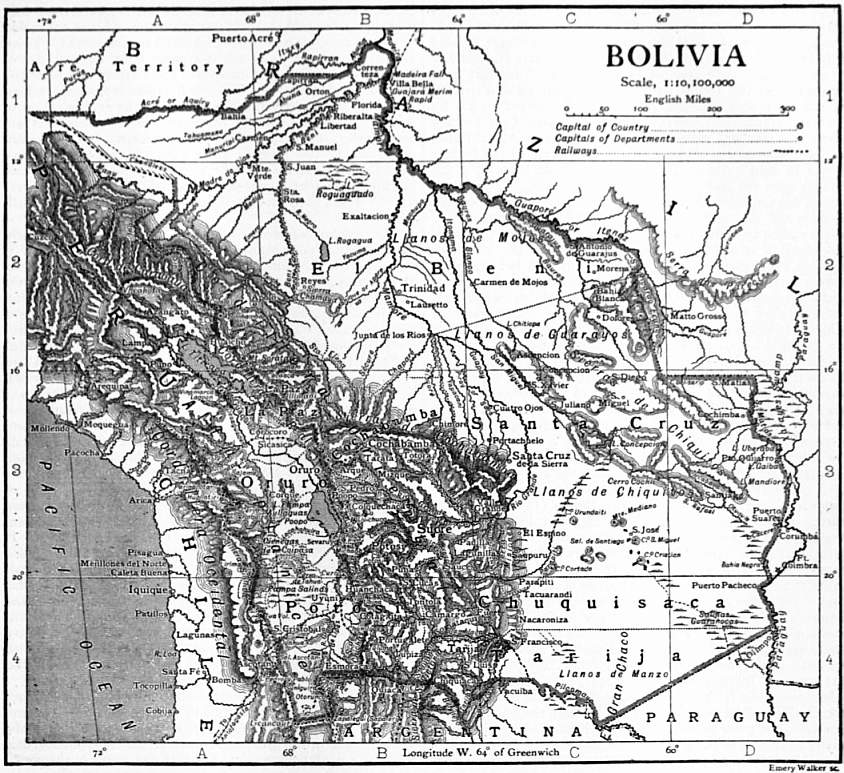
Physiography.—Roughly calculated, two-fifths of the total area of Bolivia is comprised within the Andean cordilleras which cross its south-west corner and project east toward the Brazilian highlands in the form of a great obtuse angle. The Cordilleras, divided into two great parallel chains, with flanking ranges and spurs to the east, reach their greatest breadth at this point and form the massif of the Andean system. It is made up of a number of parallel ranges enclosing great elevated plateaus broken by transverse ranges and deep ravines. North-east of Lake Titicaca there is a confused mass or knot (the Nudo de Apolobamba) of lofty intersecting ridges which include some of the highest peaks in South America. Below this mountainous area the ranges open out and enclose extensive plateaus. The western range, the Cordillera Occidental, a part of the boundary between Bolivia and the northern provinces of Chile, closely follows the coast outline and forms the western rampart of the great Bolivian tableland or alta-planicie, which extends from the Vilcanota knot in Peru, south to the Serrania de Lipez on the Argentine frontier, is 500 m. long, and about 80 m. broad, and contains about 40,000 sq. m. The northern part of this plateau is commonly called the puna; the southern part, the “desert of Lipez,” in character and appearance is part of the great Puna de Atacama. This plateau has an average elevation of about 12,650 ft. near Lake Titicaca, but descends about 1000 ft. toward its southern extremity. It is a great lacustrine basin where once existed an inland sea having an outlet to the east through the La Paz gorge. The plateau is bleak and inhospitable in the north, barren and arid toward the south, containing great saline depressions covered with water in the rainy season, and broken by ridges and peaks, the highest being the Cerro de Tahua, 17,454 ft. Overlooking the plateau from the west are the snow-clad peaks of Pomarape (20,505 ft.), Parinacota (20,918 ft.), Sajama (21,047), Huallatiri (21,654), Lirima (19,128), and the three volcanic peaks, Oyahua (19,226), San Pedro y Pablo (19,423) and Licancaur (19,685). The eastern rampart of this great plateau is formed by the Cordillera Oriental, which extends north-west into Peru under the name of Carabaya, and south to the frontier in broken ranges, one of which trends south-east in the vicinity of Sucré. The main part of this great range, known as the Cordillera Real, and one of the most imposing mountain masses of the world, extends from the Peruvian border south-east to the 18th parallel and exhibits a series of snow-crowned peaks, notably the triple-crested Illampu or Sorata (21,490 ft.), Illimani (Conway, 21,204), Cacaaca (20,571) and Chachacomani (21,434). Of the ranges extending south from the Cordillera Real and branching out between the 18th and 19th parallels, the more prominent are the Frailes which forms the eastern rampart of the great central plateau and which is celebrated for its mineral deposits, the Chichas which runs south from the vicinity of Potosi to the Argentine frontier, and the Livichuco which turns south-east and forms the watershed between the Cachimayo and Pilcomayo. The more prominent peaks in and between these ranges are the Asanaque (16,857), Michaga (17,389), Cuzco (17,930), Potosi (15,381), Chorolque (18,480) and Tuluma (15,584). At the southern extremity of the great plateau is the transverse Serrania de Lipez, the culminating crest of which stands 16,404 ft. above sea-level. The eastern rampart of the Bolivian highlands comprises two distinct chains—the Sierra de Cochabamba on the north-east and the Sierra de Misiones on the east. Between these and the Cordillera Oriental is an apparently confused mass of broken, intersecting ranges, which on closer examination are found to conform more or less closely to the two outside ranges. These have been deeply cut by rivers, especially on the north-east, where the rainfall is heavier. The region enclosed by these ranges is extremely rugged in character, but it is esteemed highly for its fertile valleys and its fine climate, and is called the “Bolivian Switzerland.” Lying wholly within the tropics, these mountain masses form one of the most interesting as well as one of the most imposing and difficult regions of the world. At their feet and in their lower valleys the heat is intense and the vegetation is tropical. Above these are cool, temperate slopes and valleys, and high above these, bleak, wind-swept passes and snow-clad peaks. West of the Cordillera Oriental, where special conditions prevail, a great desert plateau stretches entirely across one corner of the republic. Apart from the Andean system there is a group of low, broken, gneiss ranges stretching along the east side of Bolivia among the upper affluents of the Mamoré and Guaporé, which appear to belong to the older Brazilian orographic system, from which they have been separated by the erosive action of water. They are known as the Sierras de Chiquitos, and are geologically interesting because of their proximity to the eastern projection of the Andes. Their culminating point is Cerro Cochii, 3894 ft. above sea-level, but for the most part they are but little more than ranges of low wooded hills, having in general a north-west and south-east direction between the 15th and 19th parallels.
The popular conception of Bolivia is that of an extremely rugged mountainous country, although fully three-fifths of it, including the Chiquitos region, is composed of low alluvial plains, great swamps and flooded bottomlands, and gently undulating forest regions. In the extreme south are the Bolivian Chaco and the llanos (open grassy plains) of Manzo, while above these in eastern Chuquisaca and southern Santa Cruz are extensive swamps and low-lying plains, subject to periodical inundations and of little value for agricultural and pastoral purposes. There are considerable areas in this part of Bolivia, however, which lie above the floods and afford rich grazing lands. The great drawback to this region is defective drainage; the streams have too sluggish a current to carry off the water in the rainy season. Between the Chiquitos sierras and the Andes are the Llanos de Chiquitos, which have a higher general elevation and a more diversified surface. North of this elevation, which formed the southern shore of the ancient Mojos Lake, are the llanos of Guarayos and Mojos, occupying an extensive region traversed by the Guaporé, San Miguel, Guapay, Mamoré, Yacuma, Beni and Madre de Dios rivers and their numerous tributaries. It was once covered by the great Mojos Lake, and still contains large undrained areas, like that of Lake Rojoagua (or Roguaguado). It contains rich agricultural districts and extensive open plains where cattle-raising has been successfully followed since the days of the Jesuit missions in that region. The lower slopes of the Andes, especially toward the north-west, where the country is traversed by the Beni and Madre de Dios, are covered with heavy forests. This is one of the richest districts of Bolivia and is capable of sustaining a large population.
The river-systems of Bolivia fall naturally into three distinct regions—the Amazon, La Plata and Central Plateau. The first includes the rivers flowing directly and indirectly into the Madeira, one of the great tributaries of the Amazon, together with some small tributaries of the Acré and Purús in the north, all of which form a drainage basin covering more than one-half of the republic. The two principal rivers of this system are the Mamoré and Beni, which unite in lat. 10° 20′ S. to form the Madeira. The Mamoré, the upper part of which is called the Chimoré, rises on the north-east slopes of the Sierra de Cochabamba a little south of the 17th parallel, and follows a northerly serpentine course to its confluence with the Beni, the greater part of which course is between the 65th and 66th meridians. The river has a length of about 600 m., fully three-fourths of which, from Chimoré (925 ft. above sea level) to the rapids near its mouth, passes across a level plain and is navigable. The principal Bolivian tributary of the Mamoré, the Guapay or Grande, which is larger and longer than the former above their confluence and should be considered the main stream, rises in the Cordillera Oriental east of Lake Pampa Aullaguas, and flows east to the north extremity of the Sierra de Misiones, where it emerges upon the Bolivian lowlands. Turning to the north in a magnificent curve, it passes around the south-east extremity of the Sierra de Cochabamba, skirts the Llanos de Chiquitos, and, turning to the north-west, unites with the Mamoré at Junta de los Rios in about 15° 20′ S. lat. and 64° 40′ W. long. It has a tortuous course of over 700 m., which is described as not navigable. The principal tributaries of the Guapay are the Mizque, Piray or Sará and Yapacani, the last rising on the east slopes of the Cordillera Real, flowing east by Cochabamba to the sierras of that name where it breaks through with a great bend to the north. The other large Bolivian tributaries of the Mamoré, all rising on the north-east flanks of the Andes, are the Chaparé, Sécure, Manique or Aperé and Yacuma, the last draining a region of lakes and swamps north of the Sierra Chamaya. The Beni and its great affluent, the Madre de Dios, though of smaller volume and extent than the Mamoré, are of much greater economic importance, owing to their navigability, the fertility of the region they drain, and the great forests along their banks. North of the Beni, the Abuna flows into the Madeira. Several of its south tributaries belong to Bolivia. The Guaporé, or Itenez, an affluent of the Mamoré, is the third large river of this Bolivian drainage basin, but it rises in Brazil, on the south slopes of the Sierra dos Parecis, where it flows in a great bend to the south and then west of north to the Bolivian frontier in 14° S. lat. From this point to its junction with the Mamoré, a little north of the 12th parallel, it flows in a northwesterly direction and forms the boundary line between the two republics. Its Brazilian tributaries are comparatively unimportant, but from Bolivia it receives the Baures and the San Miguel, both rising in the Sierras de Chiquitos and flowing north-west across the llanos to the Guaporé. The Baures has one large tributary, the Blanco, and the Itonama (San Miguel) has its origin in Lake Conception, lying among the west ranges of the Chiquitos mountains 952 ft. above sea-level.
The south-east drainage basin, which is smaller and economically less important than that of the Madeira, discharges into the Paraguay and extends from the Sierras de Chiquitos south to the Argentine frontier, and from the Cordillera Oriental east to the Paraguay. It possesses only one large river in Bolivia, the Pilcomayo, which rises on the east slopes of the Cordillera Oriental opposite the south end of Lake Pampa Aullaguas and flows east and south-east through the sierra region to the Bolivian Chaco. It flows through a nearly level country with so sluggish a current that its channels are greatly obstructed. Nothing definite is known of its tributaries in the Chaco, but in the sierra region it possesses a number of small tributaries, the largest of which are the Cachimayo, Mataca and Pílaya or Camblaya, the latter formed by the Cotagaita and San Juan. The Bermejo, which is an Argentine river, receives one large tributary from the Bolivian uplands, the Tarija or Rio Grande, which drains a small district south-east of the Santa Victoria sierra. The Bolivian tributaries of the upper Paraguay are small and unimportant. The Otuquis, the most southern of the group, is formed by the San Rafael and Tucabaca, which drain both slopes of the Cerro Cochii range; but is lost in some great marshes 50 m. from the Paraguay. Another considerable stream of this region, which is lost in the great marshy districts of the Bolivian plain, is the Parapiti, which rises on the eastern slopes of the Sierra de Misiones and flows north-east through a low plain for about 150 m. until lost.
The third drainage basin is that of the great central plateau, or alta-planicie. This is one of the most elevated lacustrine basins in the world, and though it once drained eastward, now has no surface outlet. Lake Titicaca receives the waters of several short streams from the neighbouring heights and discharges through the Desaguadero, a sluggish river flowing south for 184 m. with a gradually diminishing depth to Lake Pampa Aullaguas or Poopo. The Desaguadero is navigable for small craft, and has two or three small tributaries from the west. Two small streams empty into Lake Pampa Aullaguas, which has a small outlet in the Lacahahuira flowing west for 60 m. to the Cienegas de (salt-swamps of) Coipasa. The drainage of this extensive district seems to be wholly absorbed by the dry soil of the desert and by evaporation. In the extreme south the Rio Grande de Lipez is absorbed in the same way.
Few of the Bolivian lakes are at all well known. The great lacustrine basin between the Beni and the Mamoré contains several lakes and lagoons, two of them of large size. These are Lake Rogagua whose waters find their way into the Beni through Rio Negro, and the Roguaguado lagoon and marshes which cover a large area of territory near the Mamoré. The latter has an elevation little, if any, above the level of the Mamoré, which apparently drains this region, and its area has been estimated at about 580 sq. m. Lake Conceptión, in the Chiquitos mountains, belongs to this same hydrographic area. In the south-east there are several large shallow lakes whose character and size change with the season. They fill slight depressions and are caused by defective drainage. Near the Paraguay there are several of these lakes, partly caused by obstructed outlets, such as Bahia Negra, Cáceres, Mandioré, Gaiba and Uberaba, some of them of sufficient depth to be navigable by small craft. Above the latter are the great Xarayes swamps, sometimes described as a lake. This region, like that of the north, is subject to periodical inundations in the summer months (November-March or even May), when extensive areas of level country are flooded and traffic is possible only by the use of boats. The two principal lakes of the plateau region are Titicaca and Pampa Aullaguas or Poopo. The former lies near the north end of the great Bolivian alta-planicie, 12,644 ft. above sea-level, being one of the most elevated lakes of the world. It is indented with numerous bays and coves; its greatest length is 138 m., and its greatest breadth 69 m. According to a survey made by Dr M. Neveau-Lemaire (La Geographie, ix. p. 409, Paris, 1904), its water surface, excluding islands and peninsulas, is 1969 sq. m., and its greatest depth is 892 ft. The level of the lake rises about 5 in. in summer; the loss in winter is even greater. The lake belongs to both Bolivia and Peru, and is navigated by steamers running between Bolivian ports and the Peruvian railway port of Puno. The outlet of the lake is through the Desaguadero river. It has several islands, the largest of which bears the same name and contains highly interesting archaeological monuments of a prehistoric civilization usually attributed to the Incas. Lake Pampa Aullaguas or Poopo is about 180 m. south-east of Titicaca, and is fed principally by its outflow. It lies 505 ft. below the level of Titicaca, which gives an average fall for the Desaguadero of very nearly 2¾ ft. per mile. The Pampa Aullaguas has an estimated area of 386 sq. m., and has one large inhabited island. The lake is shallow and the district about it is sparsely populated. Its outlet is through the Lacahahuira river into the Coipasa swamp, and it is estimated that the outflow is much less than the inflow, showing a considerable loss by evaporation and earth absorption.
Having no sea-coast, Bolivia has no seaport except what may be granted in usufruct by Chile.
Geology.—The eastern ranges of ihe Bolivian Andes are formed of Palaeozoic rocks with granitic and other intrusions; the Western Cordillera consists chiefly of Jurassic and Cretaceous beds, together with the lavas and ashes of the great volcanoes; while the intervening plateau is covered by freshwater and terrestrial deposits through which rise ridges of Palaeozoic rock and of a series of red sandstones and gypsiferous marls of somewhat uncertain age (probably, in part at least, Cretaceous). The Palaeozoic beds have yielded fossils of Cambrian, Ordovician, Devonian and Carboniferous age. In southern Bolivia Cambrian and Ordovician beds form the greater part of the eastern Andes, but farther north the Devonian and Carboniferous are extensively developed, especially in the north-eastern ranges. The hills, known as the Chiquitos, which rise from the plains of eastern Bolivia, are composed of ancient sedimentary rocks of unknown age. The Palaeozoic beds are directly overlaid by a series of red sandstones and gypsiferous marls, similar to the formacion petrolifera of Argentina and Brazil. At the base there is frequently a conglomerate or tuff of porphyritic rocks. Marine fossils found by Gustav Steinmann in the middle of the series are said to indicate an age not earlier than the Jurassic, and Steinmann refers them to the Lower Cretaceous. It is, however, not improbable that the series may represent more than one geological system. No later marine deposits have been found either in the eastern Andes or in the plains of Bolivia, but freshwater beds of Tertiary and later date occupy a wide area. The recent deposits, which cover so large a part of the depression between the Eastern and the Western Cordillera, appear to be partly of torrential origin, like the talus-fans at the foot of mountain ranges in other dry regions; but Lakes Titicaca and Pampa Aullaguas (Poopo) were undoubtedly at one time rather more extensive than they are to-day. The volcanoes of Bolivia lie almost entirely in the Western Cordillera—the great summits of the eastern range, such as Illimani and Sorata, being formed of Palaeozoic rocks with granitic and other intrusions. The gold, silver and tin of Bolivia occur chiefly in the Palaeozoic rocks of the eastern ranges. The copper belongs mostly to the red sandstone series.
Climate.—Bolivia lies wholly within the torrid zone, and variations in temperature are therefore due to elevation, mountain barriers and prevailing winds. The country possesses every gradation of temperature, from that of the tropical lowlands to the Arctic cold of the snow-capped peaks directly above. This vertical arrangement of climatic zones is modified to some extent (less than in Argentina) by varying rainfall conditions, which are governed by the high mountain ranges crossing one corner of the republic, and also by the prevailing winds. The trade winds give to S. Bolivia a wet and dry season similar to that of N. Argentina. Farther north, and east of the Cordillera Oriental, rains fall throughout the year, though the summer months (November-March) are usually described as the rainy season. On the west side of the Cordillera, which extracts the moisture from the prevailing easterly winds, the elevated plateaus have a limited rainfall in the north, which diminishes toward the south until the surface becomes absolutely barren. Brief and furious rain-storms sometimes sweep the northern plateau, but these are not frequent and occur during a short season only. Electrical wind storms are frequent in these high altitudes.
Bolivia has a wide range of temperature between places of the same latitude. The natives designate the Bolivian climatic zones as yungas, valle or medio yungas, cabezera de valle, puna and puna brava. The yungas comprises all the lowlands and the mountain valleys up to an elevation of 5000 ft. The temperature is tropical, winter is unknown and the atmosphere is exceedingly humid. The mean temperature, according to official estimates, is 70° F., but this probably represents the average between the higher elevations and the low country. The valle zone includes the deep valleys from 5000 to 9500 ft., has a warm climate with moderate variations in temperature and no cold weather, is sub-tropical in character and productions, and is sometimes described as a region of perpetual summer. The cabezera de valle, as the name indicates, includes the heads of the deep valleys above the valle zone, with elevations ranging from 9500 to 11,000 ft.; its climate is temperate, is divided into regular seasons, and is favourable to the production of cereals and vegetables. The puna, which lies between 11,000 and 12,500 ft., includes the great central plateau of Bolivia. It has but two seasons, a cold summer or autumn and winter. The air is cold and dry, and the warmer season is too short for the production of anything but potatoes and barley. The mean temperature is officially estimated as 54° F. The puna brava extends from 12,500 ft. up to the snow limit (about 17,500 ft.), and covers a bleak, inhospitable territory, inhabited only by shepherds and miners. Above this is the region of eternal snow, an Arctic zone within the tropics. In general, the sub-tropical (valle) and temperate (cabezera de valle) regions of Bolivia are healthy and agreeable, have a plentiful rainfall, moderate temperature in the shade, and varied and abundant products. There is a high rate of mortality among the natives, due to unsanitary habits and diet, and not to the climate. In the tropical yungas the ground is covered with decaying vegetation, and malaria and fevers are common. There are localities in the open country and on exposed elevations where healthy conditions prevail, but the greater part of this region is considered unhealthy. The prevailing winds are easterly, bringing moisture across Brazil from the Atlantic, but eastern Bolivia is also exposed to hot, oppressive winds from the north, and to violent cold winds (surazos) from the Argentine plains, which have been known to cause a fall of temperature of 36° within a few hours. According to the Sinópsis Estadistica y Geográfica de la República de Bolivia (La Paz, 1903), the average mean temperature and the annual rainfall in eastern Bolivia are as follows: 10° S. lat., 90.8° F. and 31.5 in. rainfall; 15° S. lat., 86° F. and 30.7 in. rainfall; 20° S. lat., 81° F. and 30 in. rainfall; and 25° S. lat., 76.8° F. and 29.3 in. rainfall.
Fauna.—The indigenous fauna of Bolivia corresponds closely to that of the neighbouring districts of Argentina, Brazil and Peru. Numerous species of monkeys inhabit the forests of the tropical region, together with the puma, jaguar, wildcat, coati, tapir or anta, sloth, ant-bear, paca (Coelogenys paca) and capybara. A rare species of bear, the Ursus ornatus (spectacled bear) is found among the wooded Andean foothills. The chinchilla (C. laniger), also found in northern Argentina and Chile, inhabits the colder plateau regions and is prized for its fur. The plateau species of the viscacha (Lagidium cuvieri) and the widely distributed South American otter (Lutra paranensis) are also hunted for their skins. The peccary, which prefers a partially open country, ranges from the Chaco to the densely wooded districts of the north. There are two or three species of deer, the most common being the large marsh deer of the Chaco; but the deer are not numerous. The armadillo, opossum, ferret and skunk are widely distributed. The amphibia are well represented throughout the lower tropical districts. Alligators are found in the tributaries of the Paraguay and their lagoons, lizards and turtles are numerous, and the batrachians are represented by several species. Snakes are also numerous, including rattlesnakes and the great boa-constrictors of the Amazon region.
The most interesting of all the Bolivian animals, however, are the guanaco (Auchenia huanaco) and its congeners, the llama (A. llama), alpaca (A. pacos) and vicuña (A. vicugna), belonging to the Camelidae, with the structure and habits of the African camel, but smaller, having no hump, and inhabiting a mountainous and not a level sandy region. They are able to go without food and drink for long periods, and inhabit the arid and semi-arid plateaus of the Andes and the steppes of Patagonia. The guanaco is supposed to be the original type, is the largest of the four, and has the greatest range from Peru to Tierra del Fuego. The llama and alpaca were domesticated long before the discovery of America, but the guanaco and vicuña are found in a wild state only. The llama is used as a pack animal in Bolivia and Peru, and its coarse wool is used in the making of garments for the natives. The alpaca is highly prized for its fine wool, which is a staple export from Bolivia, but the animal is reared with difficulty and the product cannot be largely increased. The vicuña also is celebrated for its wool, which the natives weave into beautiful and costly ponchos (blanket cloaks) and other wearing apparel. The guanaco is hunted for its skin, which, when dressed, makes an attractive rug or robe. The slaughter of the guanaco and vicuña is rapidly diminishing their number. The rearing of llamas and alpacas is a recognized industry in the Bolivian highlands and is wholly in the hands of the Indians, who alone seem to understand the habits and peculiarities of these interesting animals.
Of birds and insects the genera and species are very numerous and interesting. The high sierras are frequented by condors and eagles of the largest size, and the whole country by the common vulture, while the American ostrich (Rhea americanus) and a species of large stork (the bata or jaburú, Mycteria americana; maximum height, 8 ft.; spread of wings, 8 ft. 6 in.) inhabit the tropical plains and valleys. Waterfowl are numerous and the forests of the warm valleys are filled with song-birds and birds of beautiful plumage. Many species of humming-birds are found even far up in the mountains, and great numbers of parrots, araras and toucans, beautiful of feather but harsh of voice, enliven the forests of the lowlands.
Like other South American states, Bolivia benefited greatly from the introduction of European animals. Horses, cattle, sheep, goats, swine and poultry were introduced, and are now sources of food and wealth to a large part of the population. Mules are used to a large extent as pack animals, but they are imported from Argentina. Silkworms have been bred with success in some departments, and the cochineal insect is found wherever the conditions are favourable for the cactus.
Flora.—Owing to the diversities in altitude the flora of Bolivia represents every climatic zone, from the scanty Arctic vegetation of the lofty Cordilleras to the luxuriant tropical forests of the Amazon basin. Between these extremes the diversity in vegetable life is as great as that of climate and soil. The flora of Bolivia has been studied less than the flora of the neighbouring republics, however, because of the inaccessibility of these inland regions. Among the more important productions, the potato, oca (Oxalis tuberosa), quinoa (Chenopodium quinoa) and some coarse grasses characterize the puna region, while barley, an exotic, is widely grown for fodder. Indian corn was cultivated in the temperate and warm regions long before the advent of Europeans, who introduced wheat, rye, oats, beans, pease and the fruits and vegetables of the Old World, for each of which a favourable soil and climate was easily found. In the sub-tropical and tropical zones the indigenous plants are the sweet potato, cassava (Manihot utilissima and M. aipi), peanuts, pineapple, guava, chirimoya (Anona cherimolia), pawpaw (Carica papaya), ipecacuanha (Cephaelis), sarsaparilla, vanilla, false jalap (Mirabilis jalapa), copaiba, tolu (Myroxylon toluiferum), rubber-producing trees, dyewoods, cotton and a great number of beautiful hardwoods, such as jacarandá, mahogany, rosewood, quebracho, colo, cedar, walnut, &c. Among the fruits many of the most common are exotics, as the orange, lemon, lime, fig, date, grape, &c., while others, as the banana, cajū or cashew (Anacardium occidentale) and aguacate avocado or alligator pear, have a disputed origin. Coca, one of the most important plants of the country, is cultivated on the eastern slopes of the Andes at an altitude of 5000 to 6000 ft., where the temperature is uniform and frosts are unknown. Quina or calisaya is a natural product of the eastern Andes, and is found at an altitude of 3000 to 9000 ft. above sea-level. The calisaya trees of Bolivia rank among the best, and their bark forms an important item in her foreign trade. The destructive methods of collecting the bark are steadily diminishing the natural sources of supply, and experiments in cinchona cultivation were undertaken during the last quarter of the 19th century, with fair prospects of success. The most important of the indigenous forest products, however, is rubber, derived principally from the Hevea guayanensis (var. brasiliensis), growing along the river courses in the yungas regions of the north, though Maniçoba rubber is also obtained from Manihot Glaziovii on the drier uplands. Among the exotics, sugar-cane, rice and tobacco are cultivated in the warm districts.
Population.—The population of Bolivia is composed of Indians, Caucasians of European origin, and a mixture of the two races, generally described as mestizos. There is also a very small percentage of Africans, descendants of the negro slaves introduced in colonial times. A roughly-taken census of 1900 gives the total population as 1,816,271, including the Litoral department, now belonging to Chile (49,820), and estimates the number of wild Indians of the forest regions at 91,000. Of this total, 50.7% were classed as Indians, 12.8% as whites, 26.8% as mestizos, 0.3% as negroes, and 9.4% as unknown. In 1904 an official estimate made the population 2,181,415, also including the Litoral (59,784), but of course all census returns and estimates in such a country are subject to many allowances. The Indian population (920,860) is largely composed of the so-called civilized tribes of the Andes, which once formed part of the nationality ruled by the Incas, and of those of the Mojos and Chiquitos regions, which were organized into industrial communities by the Jesuits in the l7th century. The former, which are chiefly Aymarás south of the latitude of Lake Titicaca, attained a considerable degree of civilization before the discovery of America and have been in closer contact with Europeans than the other tribes of Bolivia. It is doubtful, however, whether their condition has been improved under these influences. The Mojos and Chiquitos tribes, also, have been less prosperous since the expulsion of the Jesuits, but they have remained together in organized communities, and have followed the industries and preserved the religion taught them as well as circumstances permitted. Both these groups of Indians are peaceable and industrious, and form an important labouring element. They are addicted to the excessive use of chica (a native beer made from Indian corn), and have little or no ambition to improve their condition, but this may be attributed in part to their profound ignorance and to the state of peonage in which they are held. Inhabiting the southern part of the Bolivian plain are the Chiriguanos, a detached tribe of the Guarani race which drifted westward to the vicinity of the Andes long ago. They are of a superior physical and mental type, and have made noteworthy progress toward civilization. They are agriculturists and stock-raisers and have the reputation of being peaceable and industrious. The remaining native tribes under the supervision of the state have made little progress, and their number is said to be decreasing (notwithstanding the favourable climatic conditions under which most of them live) because of unsanitary and intemperate habits, and for other causes not well understood, one being the custom noticed by early travellers among some of the tribes of the La Plata region of avoiding the rearing of children. (See Southey’s History of Brazil, iii. pp. 402, 673.) Of the wild Indians very little is known in regard to either numbers or customs.