VOLUME IV SLICE II Bohemia to Borgia, Francis (continued 11)
Reading edition
After a brief sojourn in Germany, Bopp came to London, where he made the acquaintance of Sir Charles Wilkins and H.T. Colebrooke, and became the friend of Wilhelm von Humboldt, then Prussian ambassador at the court of St James’s, to whom he gave instruction in Sanskrit. He brought out, in the Annals of Oriental Literature (London, 1820), an essay entitled, “Analytical Comparison of the Sanskrit, Greek, Latin and Teutonic Languages,” in which he extended to all parts of the grammar what he had done in his first book for the verb alone. He had previously published a critical edition, with a Latin translation and notes, of the story of Nala and Damayantī (London, 1819), the most beautiful episode of the Mahābhārata. Other episodes of the Mahābhārata—Indralokāgamanam, and three others (Berlin, 1824); Diluvium, and three others (Berlin, 1829); and a new edition of Nala (Berlin, 1832)—followed in due course, all of which, with A.W. Schlegel’s edition of the Bhagavadgītā (1823), proved excellent aids in initiating the early student into the reading of Sanskrit texts. On the publication, in Calcutta, of the whole Mahābhārata, Bopp discontinued editing Sanskrit texts, and confined himself thenceforth exclusively to grammatical investigations.
After a short residence at Göttingen, Bopp was, on the recommendation of Humboldt, appointed to the chair of Sanskrit and comparative grammar at Berlin in 1821, and was elected member of the Royal Prussian Academy in the following year. He brought out, in 1827, his Ausführliches Lehrgebäude der Sanskrita-Sprache, on which he had been engaged since 1821. A new edition, in Latin, was commenced in the following year, and completed in 1832; and a shorter grammar appeared in 1834. At the same time he compiled a Sanskrit and Latin glossary (1830) in which, more especially in the second and third editions (1847 and 1867), account was also taken of the cognate languages. His chief activity, however, centred on the elaboration of his Comparative Grammar, which appeared in six parts at considerable intervals (Berlin, 1833, 1835, 1842, 1847, 1849, 1852), under the title Vergleichende Grammatik des Sanskrit, Zend, Griechischen, Lateinischen, Litthauischen, Altslavischen, Gothischen, und Deutschen. How carefully this work was matured may be gathered from the series of monographs printed in the Transactions of the Berlin Academy (1824 to 1831), by which it was preceded. They bear the general title, Vergleichende Zergliederung des Sanskrits und der mit ihm verwandten Sprachen. Two other essays (on the “Numerals,” 1835) followed the publication of the first part of the Comparative Grammar. The Old-Slavonian began to take its stand among the languages compared from the second part onwards. The work was translated into English by E.B. Eastwick in 1845. A second German edition, thoroughly revised (1856-1861), comprised also the Old-Armenian. From this edition an excellent French translation was made by Professor Michel Bréal in 1866. The task which Bopp endeavoured to carry out in his Comparative Grammar was threefold,—to give a description of the original grammatical structure of the languages as deduced from their intercomparison, to trace their phonetic laws, and to investigate the origin of their grammatical forms. The first and second points were subservient to the third. As Bopp’s researches were based on the best available sources, and incorporated every new item of information that came to light, so they continued to widen and deepen in their progress. Witness his monographs on the vowel system in the Teutonic languages (1836), on the Celtic languages (1839), on the Old-Prussian (1853) and Albanian languages (1854), on the accent in Sanskrit and Greek (1854), on the relationship of the Malayo-Polynesian with the Indo-European languages (1840), and on the Caucasian languages (1846). In the two last mentioned the impetus of his genius led him on a wrong track. Bopp has been charged with neglecting the study of the native Sanskrit grammars, but in those early days of Sanskrit studies the requisite materials were not accessible in the great libraries of Europe; and if they had been, they would have absorbed his exclusive attention for years, while such grammars as those of Wilkins and Colebrooke, from which his grammatical knowledge was derived, were all based on native grammars. The further charge that Bopp, in his Comparative Grammar, gave undue prominence to Sanskrit may be disproved by his own words; for, as early as the year 1820, he gave it as his opinion that frequently the cognate languages serve to elucidate grammatical forms lost in Sanskrit (Annals of Or. Lit. i. 3),—an opinion which he further developed in all his subsequent writings.
Bopp’s researches, carried with wonderful penetration into the most minute and almost microscopical details of linguistic phenomena, have led to the opening up of a wide and distant view into the original seats, the closer or more distant affinity, and the tenets, practices and domestic usages of the ancient Indo-European nations, and the science of comparative grammar may truly be said to date from his earliest publication. In grateful recognition of that fact, on the fiftieth anniversary (May 16, 1866) of the date of Windischmann’s preface to that work, a fund called Die Bopp-Stiftung, for the promotion of the study of Sanskrit and comparative grammar, was established at Berlin, to which liberal contributions were made by his numerous pupils and admirers in all parts of the globe. Bopp lived to see the results of his labours everywhere accepted, and his name justly celebrated. But he died, on the 23rd of October 1867, a poor man,—though his genuine kindliness and unselfishness, his devotion to his family and friends, and his rare modesty, endeared him to all who knew him.
See M. Bréal’s translation of Bopp’s Vergl. Gramm. (1866) introduction; Th. Benfey, Gesch. der Sprachwissenschaft (1869); A. Kuhn in Unsere Zeit, Neue Folge, iv. i (1868); Lefmann, Franz Bopp (Berlin, 1891-1897).
BOPPARD, a town of Germany, in the Prussian Rhine province, on the left bank of the Rhine, 12 m. S. of Coblenz on the mainline to Cologne. Pop. (1900) 5806. It is an old town still partly surrounded by medieval walls, and its most noteworthy buildings are the Roman Catholic parish church (12th and 13th centuries); the Carmelite church (1318), the former castle, now used for administrative offices; the Evangelical church (1851, enlarged in 1887); and the former Benedictine motnastery of the Marienberg, founded 1123 and since 1839 a hydropathic establishment, crowning a hill 100 ft. above the Rhine. Boppard is a favourite tourist centre, and being less pent in by hills than many other places in this part of the picturesque gorge of the Rhine, has in modern times become a residential town. It has some comparatively insignificant industries, such as tanning and tobacco manufacture; its direct trade is in wine and fruit.
Boppard (Baudobriga) was founded by the Romans; under the Merovingian dynasty it became a royal residence. During the middle ages it was a considerable centre of commerce and shipping, and under the Hohenstaufen emperors was raised to the rank of a free imperial city. In 1312, however, the emperor Henry VII. pledged the town to his brother Baldwin, archbishop-elector of Trier, and it remained in the possession of the electors until it was absorbed by France during the Revolutionary epoch. It was assigned by the congress of Vienna in 1815 to Prussia.
BORA, an Italian name for a violent cold northerly and northeasterly wind, common in the Adriatic, especially on the Istrian and Dalmatian coasts. There is always a northern tendency in the winds on the north Mediterranean shores in winter owing to the cold air of the mountains sliding down to the sea where the pressure is less. When, therefore, a cyclone is formed over the Mediterranean, the currents in its north-western area draw the air from the cold northern regions, and during the passage of the cyclone the bora prevails. The bora also occurs at Novorossiysk on the Black Sea. It is precisely similar in character to the mistral which prevails in Provence and along the French Mediterranean littoral.
BORACITE, a mineral of special interest on account of its optical anomalies. Small crystals bounded on all sides by sharply defined faces are found in considerable numbers embedded in gypsum and anhydrite in the salt deposits at Lüneburg in Hanover, where it was first observed in 1787. In external form these crystals are cubic with inclined hemihedrism, the symmetry being the same as in blende and tetrahedrite. Their habit varies according to whether the tetrahedron (fig. 1), the cube (fig. 2). or the rhombic dodecahedron (fig. 3) predominates. Penetration twins with a tetrahedron face as twin-plane are sometimes observed. The crystals vary from translucent to transparent, are possessed of a vitreous lustre, and are colourless or white, though often tinged with grey, yellow or green. The hardness is as high as 7 on Mohs’ scale; specific gravity 3.0. As first observed by R.J. Haüy in 1791, the crystals are markedly pyroelectric; a cube when heated becomes positively electrified on four of its corners and negatively on the four opposite corners. In a crystal such as represented in fig. 3, the smaller and dull tetrahedral faces s are situated at the analogous poles (which become positively electrified when the crystal is heated), and the larger and bright tetrahedral faces s’ at the antilogous poles.
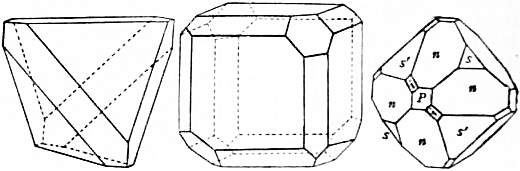
Fig. 1. Fig. 2. Fig. 3.
Crystals of Boracite.
The characters so far enumerated are strictly in accordance with cubic symmetry, but when a crystal is examined in polarized light, it will be seen to be doubly refracting, as was first observed by Sir David Brewster in 1821. Thin sections show twin-lamellae, and a division into definite areas which are optically biaxial. By cutting sections in suitable directions, it may be proved that a rhombic dodecahedral crystal is really built up of twelve orthorhombic pyramids, the apices of which meet in the centre and the bases coincide with the dodecahedral faces of the compound (pseudo-cubic) crystal. Crystals of other forms show other types of internal structure. When the crystals are heated these optical characters change, and at a temperature of 265° the crystals suddenly become optically isotropic; on cooling, however, the complexity of internal structure reappears. Various explanations have been offered to account for these “optical anomalies” of boracite. Some observers have attributed them to alteration, others to internal strains in the crystals, which originally grew as truly cubic at a temperature above 265°. It would, however, appear that there are really two crystalline modifications of the boracite substance, a cubic modification stable above 265° and an orthorhombic (or monoclinic) one stable at a lower temperature. This is strictly analogous to the case of silver iodide, of which cubic and rhombohedral modifications exist at different temperatures; but whereas rhombohedral as well as pseudo-cubic crystals of silver iodide (iodyrite) are known in nature, only pseudo-cubic crystals of boracite have as yet been met with.
Chemically, boracite is a magnesium borate and chloride with the formula Mg7Cl2B16O30—A small amount of iron is sometimes present, and an iron-boracite with half the magnesium replaced by ferrous iron has been called huyssenite. The mineral is insoluble in water, but soluble in hydrochloric acid. On exposure it is liable to slow alteration, owing to the absorption of water by the magnesium chloride: an altered form is known as parasite.
In addition to embedded crystals, a massive variety, known as stassfurtite, occurs as nodules in the salt deposits at Stassfurt in Prussia: that from the carnallite layer is compact, resembling fine-grained marble, and white or greenish in colour, whilst that from the kainite layer is soft and earthy, and yellowish or reddish in colour.
(L. J. S.)
BORAGE (pronounced like “courage”; possibly from Lat. borra, rough hair), a herb (Borago officinalis) with bright blue flowers and hairy leaves and stem, considered to have some virtue as a cordial and a febrifuge; used as an ingredient in salads or in making claret-cup, &c.
BORAGINACEAE, an order of plants belonging to the sympetalous section of dicotyledons, and a member of the series Tubiflorae. It is represented in Britain by bugloss (Echium) (fig. 1), comfrey (Symphytum), Myosotis, hounds-tongue (Cynoglossum) (fig. 2), and other genera, while borage (Borago officinalis) (fig. 3) occurs as a garden escape in waste ground. The plants are rough-haired annual or perennial herbs, more rarely shrubby or arborescent, as in Cordia and Ehretia, which are tropical or sub-tropical. The leaves, which are generally alternate, are usually entire and narrow: the radical leaves in some genera, as Pulmonaria (lungwort) and Cynoglossum, differ in form from the stem-leaves, being generally broader and sometimes heart-shaped. A characteristic feature is the one-sided (dorsiventral) inflorescence, well illustrated in forget-me-not and other species of Myosotis; the cyme is at first closely coiled, becoming uncoiled as the flowers open. At the same time there is often a change in colour in the flowers, which are red in bud, becoming blue as they expand, as in Myosotis, Echium, Symphytum and others. The flowers are generally regular; the form of the corolla varies widely. Thus in borage it is rotate, tubular in comfrey, funnel-shaped in hounds-tongue, and salver-shaped in alkanet (Anchusa); the throat is often closed by scale-like outgrowths from the corolla, forming the so-called corona. A departure from the usual regular corolla occurs in Echium and a few allied genera, where it is oblique; in Lycopsis it is also bent.
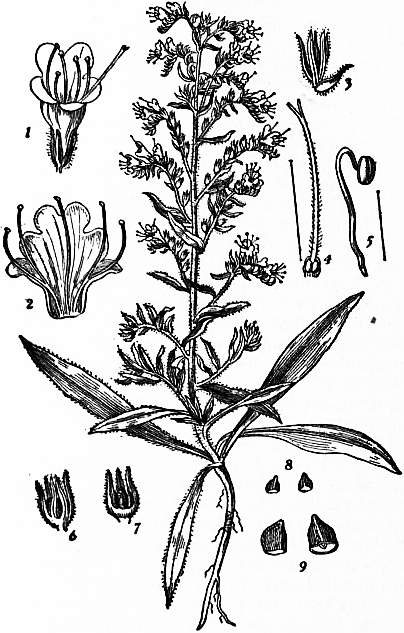
Fig. 1.—Viper’s Bugloss (Echium vulgare), about ¼ nat. size.
1. Single flower, about nat. size. 2. Corolla split open. 3. Calyx. 4. Pistil. 5. One stamen. 6. Calyx surrounding nutlets. 7. Same part of calyx cut away. 8. Two nutlets. 9. Same enlarged.
The five stamens alternate in position with the lobes of the corolla. The ovary, of two carpels, is seated on a ring-like disk which secretes honey. Each carpel becomes divided by a median constriction in four portions, each containing one ovule; the style springs from the centre of the group of four divisions.
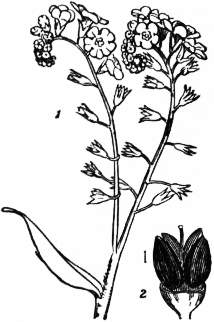
Fig. 2.—(1) Inflorescence of Forget-me-not; (2) ripe fruits.
The flowers show well-marked adaptation to insect-visits. Their colour and tendency to arrangement on one surface, with the presence of honey, serve to attract insects. The scales around the throat of the corolla protect the pollen and honey from wet or undesirable visitors, and by their difference in colour from the corolla-lobes, as in the yellow eye of forget-me-not, may serve to indicate the position of the honey. In most genera the fruit consists of one-seeded nutlets, generally four, but one or more may be undeveloped. The shape of the nutlet and the character of its coat are very varied. Thus in Lithospermum the nutlets are hard like a stone, in Myosotis usually polished, in Cynoglossum covered with bristles, &c.
The order is widely spread in temperate and tropical regions, and contains 85 genera with about 1200 species. Its chief centre is the Mediterranean region, whence it extends over central Europe and Asia, becoming less frequent northwards. A smaller centre occurs on the Pacific side of North America. The order is less developed in the south temperate zone.
The order is of little economic value. Several genera, such as borage and Pulmonaria, were formerly used in medicine, and the roots yield purple or brown dyes, as in Alkanna tinctoria (alkanet). Heliotrope or cherry-pie (Heliotropium peruvianum) is a well-known garden plant.
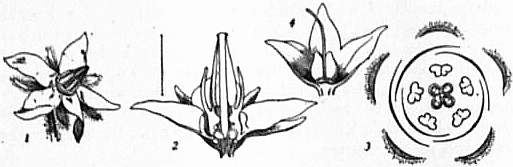
Fig. 3.—(1) Flower of Borage; (2) same in vertical section enlarged; (3) horizontal plan of flower; (4) flower of Comfrey after removal of corolla, showing unripe fruit.
BORÅS, a town of Sweden, in the district (län) of Elfsborg, 45 m. E. of Gothenburg by rail, on the river Viske. Pop. (1880) 4723; (1900) 15,837. It ranks among the first twelve towns in Sweden both in population and in the value of its manufacturing industries. These are principally textile, as there are numerous cotton spinning and weaving mills, together with a technical weaving school. The town was founded in 1632 by King Gustavus Adolphus.
BORAX (sodium pyroborate or sodium biborate), Na2B4O7, a substance which appears in commerce under two forms, namely “common” or prismatic borax, Na2B4O7·10H2O, and “jewellers’” or octahedral borax, Na2B4O7·5H2O. It is to be noted that the term “borax” was used by the alchemists in a very vague manner, and is therefore not to be taken as meaning the substance now specifically known by the name. Prismatic borax is found widely distributed as a natural product (see below, Mineralogy) in Tibet, and in Canada, Peru and Transylvania, while the bed of Borax Lake, near Clear Lake in California, is occupied by a large mass of crystallized borax, which is fit for use by the assayer without undergoing any preliminary purification. The supply of borax is, however, mainly derived from the boric acid of Tuscany, which is fused in a reverberatory furnace with half its weight of sodium carbonate, and the mass after cooling is extracted with warm water. An alternative method is to dissolve sodium carbonate in lead-lined steam-heated pans, and add the boric acid gradually; the solution then being concentrated until the borax crystallizes. Borax is also prepared from the naturally occurring calcium borate, which is mixed in a finely divided condition with the requisite quantity of soda ash; the mixture is fused, extracted with water and concentrated until the solution commences to crystallize.
From a supersaturated aqueous solution of borax, the pentahydrate, Na2B4O7·5H2O, is deposited when evaporation takes place at somewhat high temperatures. The same hydrate can be prepared by dissolving borax in water until the solution has a specific gravity of 1.246 and then allowing the solution to cool. The pentahydrate is deposited between 79° C. and 56° C.; below this temperature the decahydrate or ordinary borax, Na2B4O7·10H2O, is deposited. Crystals of ordinary borax swell up to a very great extent on heating, losing their water of crystallization and melting to a clear white glass. The crystals of octahedral borax fuse more easily than those of the prismatic form and are less liable to split when heated, so that they are preferable for soldering or fluxing. Fused borax dissolves many metallic oxides, forming complex borates which in many cases show characteristic colours. Its use in soldering depends on the fact that solder only adheres to the surface of an untarnished metal, and consequently a little borax is placed on the surface of the metal and heated by the soldering iron in order to remove any superficial film of oxide. It is also used for glazing pottery, in glass-making and the glazing of linen.
Boric acid (q.v.) being only a weak acid, its salts readily undergo hydrolytic dissociation in aqueous solution, and this property can be readily shown with a concentrated aqueous solution of borax, for by adding litmus and then just sufficient acetic acid to turn the litmus red, the addition of a large volume of water to the solution changes the colour back to blue again. The boric acid being scarcely ionized gives only a very small quantity of hydrogen ions, whilst the base (sodium hydroxide) produced by the hydrolysis occasioned by the dilution of the solution, being a “strong base,” is highly ionized and gives a comparatively large amount of hydroxyl ions. In the solution, therefore, there is now an excess of hydroxyl ions; consequently it has an alkaline reaction and the litmus turns blue.
Mineralogy.—The Tibetan mineral deposits have been known since very early times, and formerly the crude material was exported to Europe, under the name of tincal, for the preparation of pure borax and other boron salts. The most westerly of the Tibetan deposits are in the lake-plain of Pugha on the Rulangchu, a tributary of the Indus, at an elevation of 15,000 ft.: here the impure borax (sohaga) occurs over an area of about 2 sq. m., and is covered by a saline efflorescence; successive crops are obtained by the action of rain and snow and subsequent evaporation. Deposits of purer material (chú tsalé or water borax) occur at the lakes of Rudok, situated to the east of the Pugha district; also still farther to the east at the great lakes Tengri Nor, north of Lhasa, and several other places. More recently, the extensive deposits of borates (chiefly, however, of calcium; see Colemanite) in the Mohave desert on the borders of California and Nevada, and in the Atacama desert in South America, have been the chief commercial sources of boron compounds. The boron contained in solution in the salt lakes has very probably been supplied by hot springs and solfataras of volcanic origin, such as those which at the present day charge the waters of the lagoons in Tuscany with boric acid. The deposits formed by evaporation from these lakes and marshes or salines, are mixtures of borates, various alkaline salts (sodium carbonate, sulphate, chloride), gypsum, &c. In the mud of the lakes and in the surrounding marshy soil fine isolated crystals of borax are frequently found. For example, crystals up to 7 in. in length and weighing a pound each have been found in large numbers at Borax Lake in Lake county, and at Borax Lake in San Bernardino county, both in California.
Borax crystallizes with ten molecules of water, the composition of the crystals being Na2B4O7 + 10H2O. The crystals belong to the monoclinic system, and it is a curious fact that in habit and angles they closely resemble pyroxene (a silicate of calcium, magnesium and iron). There is a perfect cleavage parallel to the orthopinacoid and less perfect cleavages parallel to the faces of the prism. The mineral is transparent to opaque and white, sometimes greyish, bluish or greenish in colour. Hardness 2-2½; sp. gr. 1.69-1.72.
The optical characters are interesting, because of the striking crossed dispersion of the optic axes, of which phenomenon borax affords the best example. The optic figure seen in convergent polarized light through a section cut parallel to the plane of symmetry of a borax crystal is symmetrical only with respect to the central point. The plane of the optic axes for red light is inclined at 2° to that for blue light, and the angle between the optic axes themselves is 3° greater for red than for blue light.
BORDA, JEAN CHARLES (1733-1799), French mathematician and nautical astronomer, was born at Dax on the 4th of May 1733. He studied at La Flèche, and at an early age obtained a commission in the cavalry. In 1756 he presented a Mémoire sur le mouvement des projectiles to the Academy of Sciences, who elected him a member. He was present at the battle of Hastembeck, and soon afterwards joined the naval service. He visited the Azores and the Canary Islands, of which he constructed an admirable map. In 1782 his frigate was taken by a British squadron; he himself was carried to England, but was almost immediately released on parole and returned to France. He died at Paris on the 20th of February 1799. Borda contributed a long series of valuable memoirs to the Academy of Sciences. His researches in hydrodynamics were highly useful for marine engineering, while the reflecting and repeating circles, as improved by him, were of great service in nautical astronomy. He was associated with J.B.J. Delambre and P.F.A. Méchain in the attempt to determine an arc of the meridian, and the greater number of the instruments employed in the task were invented by him.
See J.B. Biot, “Notice sur Borda” in the Mém. de l’Acad. des Sciences, iv.
BORDAGE. (i) A nautical term (from Fr. bord, side) for the planking on a ship’s side. (2) A feudal term (from Lat. borda, a cottage) for the tenure by which a certain class of villein held their cottages; also the services due from these villeins or “bordars.” A “bordar” (Med. Lat. bardarius) was a villein who obtained a cottage from his lord in return for menial services (see Villenage).
BORDEAUX, a city of south-western France, capital of the department of Gironde, 359 m. S.S.W. of Paris by a main line of the Orléans railway and 159 m. N.W. of Toulouse on the main line of the Southern railway. Pop. (1906) 237,707. Bordeaux, one of the finest and most extensive cities in France, is situated on the left or west bank of the Garonne about 60 m. from the sea, in a plain which comprises the wine-growing district of Médoc. The Garonne at this point describes a semicircle, separating the city proper on the left bank from the important suburb of La Bastide on the right bank. The river is crossed by the Pont de Bordeaux, a fine stone structure of the early 19th century, measuring 1534 ft. in length, and by a railway bridge connecting the station of the Orléans railway company in La Bastide with that of the Southern company on the left bank. Looking west from the Pont de Bordeaux, the view embraces a crescent of wide and busy quays with a background of lofty warehouses, factories and mansions, behind which rise towers and steeples. Almost at the centre of the line of quays is the Place des Quinconces, round which lie the narrow, winding streets in which the life of the city is concentrated. Outside this quarter, which contains most of the important buildings, the streets are narrow and quiet and bordered by the low white houses which at Bordeaux take the place of the high tenements characteristic of other large French towns. The whole city is surrounded by a semicircle of boulevards, beyond which lie the suburbs of Le Bouscat, Caudéran, Mérignac, Talence and Bégles. The principal promenades are situated close together near the centre of the city. They comprise the beautiful public garden, the allées de Tourny and the Place des Quinconces. The latter is planted with plane trees, among which stand two huge statues of Montaigne and Montesquieu, and terminates upon the quays with two rostral columns which serve as lighthouses. On its west side there is a monument to the Girondin deputies proscribed under the convention in 1793. At its south-west corner the Place des Quinconces opens into the Place de la Comédie, which contains the Grand Théâtre (18th century), the masterpiece of the architect Victor Louis. The Place de la Comédie, the centre of business in Bordeaux, is traversed by a street which, under the names of Cours du Chapeau-Rouge, rue de l’Intendance and rue Judaïque, runs from the Place de la Bourse and the quai de la Douane on the east to the outer boulevards on the west. Another important thoroughfare, the rue Sainte Cathérine, runs at right angles to the rue de l’Intendance and enters the Place de la Comédie on the south. The Pont de Bordeaux is continued by the Cours Victor Hugo, a curved street crossing the rue Sainte Cathérine and leading to the cathedral of St André. This church, dating from the 11th to the 14th centuries, is a building in the Gothic style with certain Romanesque features, chief among which are the arches in the nave. It consists of a large nave without aisles, a transept at the extremities of which are the main entrances, and a choir, flanked by double aisles and chapels and containing many works of art. Both the north and south façades are richly decorated with sculpture and statuary. Of the four towers flanking the principal portals, only those to the north are surmounted by spires. Near the choir stands an isolated tower. It contains the great bell of the cathedral and is known as the Clocher Pey-Berland, after the archbishop of Bordeaux who erected it in the 15th century. Of the numerous other churches of Bordeaux the most notable are St Seurin (11th to the 15th centuries), with a finely sculptured southern portal; Ste Croix (12th and 13th centuries), remarkable for its Romanesque façade; and St Michel, a fine Gothic building of the 15th and 16th centuries. The bell tower of St Michel, which has the highest spire (354 ft.) in the south of France, dates from the end of the 15th century, and, like that of the cathedral, stands apart from its church. The palace of the Faculties of Science and of Letters (1881-1886) contains the tomb of Michel de Montaigne. The prefecture, the hôtel de ville, the bourse and the custom-house belong to the 15th century. The law-courts and the hospital of St André (the foundation of which dates from 1390) belong to the first half of the 19th century. Of greater antiquarian interest is the Palais Gallien, situated near the public garden, consisting of remains of lofty arcades, vaulting and fragments of wall, which once formed part of a Roman amphitheatre. Bordeaux lost its fortifications in the 18th century, but four of the old gateways or triumphal arches belonging to that period still remain. Still older are the Porte de Cailhau, once the entrance to the Palais de l’Ombrière, which before its destruction was the residence of the duke of Aquitaine, and the Porte de l’Hôtel de Ville, the former of the 15th, the latter of the 13th and 16th centuries.
Bordeaux is the seat of an archbishop, the headquarters of the XVIII. army corps, the centre of an académie (educational division) and the seat of a court of appeal. A court of assizes is held there, and there are tribunals of first instance and of commerce, a council of trade-arbitrators, a chamber of commerce and a branch of the Bank of France. Its educational institutions include faculties of law, of science, of letters and of medicine and pharmacy, a faculty of Catholic theology, lycées, training colleges, a higher school of commerce, a chair of agriculture, a school of fine art and a naval school of medicine. There are several museums, including one with a large collection of pictures and sculptures, a library with over 200,000 volumes and numerous learned societies.
The trade of Bordeaux, the fourth port in France, is chiefly carried on by sea. Its port, 5½ m. long and on the average 550 yds. wide, is formed by the basin of the Garonne and is divided into two portions by the Pont de Bordeaux. That to the south is used only by small craft; that to the north is accessible to vessels drawing from 21 to 26 ft. according to the state of the tide. From 1000 to 1200 vessels can be accommodated in the harbour, which is lined on both sides by quays and sloping wharves served by railway lines. At the northen extremity of the harbour, on the left bank, there is a floating basin of 25 acres in extent, capable of receiving the largest vessels; it has over 1900 yds. of quays and is furnished with a repairing dock and with elaborate machinery for the loading and unloading of goods. In 1907 the construction of new docks behind this basin was begun. The city maintains commercial relations with nearly all countries, but chiefly with Great Britain, Spain, Argentina, Portugal and the United States. The most important line of steamers using the port is the South American service of the Messageries Maritimes. The total value of the exports and imports of Bordeaux averages between 25 and 26 millions sterling yearly. Of this amount exports make up 13½ millions, of which the sales of wine bring in about one quarter. The city is the centre of the trade in “Bordeaux” wines, and the wine-cellars of the quays are one of its principal sights. Other principal exports are brandy, hides and skins, sugar, rice, woollen and cotton goods, salt-fish, chemicals, oil-cake, pitwood, fruit, potatoes and other vegetables. The chief imports are wool, fish, timber, rice, wine, rubber, coal, oil-grains, hardware, agricultural and other machinery and chemicals. A large fleet is annually despatched to the cod-fisheries of Newfoundland and Iceland. The most important industry is ship-building and refitting. Ironclads and torpedo-boats as well as merchant vessels are constructed. Railway carriages are also built. The industries subsidiary to the wine-trade, such as wine-mixing, cooperage and the making of bottles, corks, capsules, straw envelopes and wooden cases, occupy many hands. There are also flour-mills, sugar-refineries, breweries, distilleries, oil-works, cod-drying works, manufactories of canned and preserved fruits, vegetables and meat, and of chocolate. Chemicals, leather, iron-ware, machinery and pottery are manufactured, and a tobacco factory employs 1500 hands.
Bordeaux (Burdigala) was originally the chief town of the Bituriges Vivisci. Under the Roman empire it became a flourishing commercial city, and in the 4th century it was made the capital of Aquitania Secunda. Ausonius, a writer of the 4th century, who was a native of the place, describes it as four-square and surrounded with walls and lofty towers, and celebrates its importance as one of the greatest educational centres of Gaul. In the evils that resulted from the disintegration of the empire Bordeaux had its full share, and did not recover its prosperity till the beginning of the 10th century. Along with Guienne it belonged to the English kings for nearly three hundred years (1154-1453), and was for a time the seat of the brilliant court of Edward the Black Prince, whose son Richard was born in the city. An extensive commerce was gradually developed between the Bordeaux merchants and their fellow-subjects in England,—London, Hull, Exeter, Dartmouth, Bristol and Chester being the principal ports with which they traded. The English administration was favourable to the liberties as well as to the trade of the city. In 1235 it received the right of electing its mayors, who were assisted in the administration by a “jurade” or municipal council. The influence of Bordeaux was still further increased when several important towns of the region, among them St Emilion and Libourne, united in a federation under its leadership. The defeat of the English at the battle of Castillon in 1453 was followed, after a siege of three months, by the submission of Bordeaux to Charles VII. The privileges of the city were at once curtailed, and were only partially restored under Louis XI., who established there the parlement of Guienne. In 1548 the inhabitants resisted the imposition of the salt-tax by force of arms, a rebellion for which they were punished by the constable Anne de Montmorency with merciless severity.
The reformed religion found numerous adherents at Bordeaux, and after the massacre of St Bartholomew nearly three hundred of its inhabitants lost their lives. The 17th century was a period of disturbance. The city was for a time the chief support of the Fronde, and on two occasions, in 1653 and 1675, troops were sent to repress insurrections against royal measures. In the middle of the 18th century, a period of commercial and architectural activity for Bordeaux, the marquis de Tourny, intendant of Guienne, did much to improve the city by widening the streets and laying out public squares. It was the headquarters of the Girondists at the Revolution, and during the Reign of Terror suffered almost as severely as Lyons and Marseilles. Its commerce was greatly reduced under Napoleon I. In 1814 it declared for the house of Bourbon; and Louis XVIII. afterwards gave the title of duc de Bordeaux to his grand-nephew, better known as the comte de Chambord. In 1870 the French government was transferred to Bordeaux from Tours on the approach of the Germans to the latter city.
See Camille Jullian, Hist. de Bordeaux, depuis les origines jusqu’en 1895 (Bordeaux, 1895); T. Malvezin, Hist. du commerce de Bordeaux (Bordeaux, 1892); Bordeaux, aperçu historique, sol, population, industrie, commerce, administration (Bordeaux, 1892).
BORDEN, SIR FREDERICK WILLIAM (1847- ), Canadian statesman, was born at Cornwallis, Nova Scotia, on the 14th of May 1847. He was educated at King’s College, Windsor, and at Harvard University, and for some years practised medicine at Canning, Nova Scotia. In 1874 he was elected to the Canadian parliament as Liberal member for King’s county. In 1896 he became minister of militia and defence in the Liberal ministry.
BORDEN, ROBERT LAIRD (1854- ), Canadian statesman, was born at Grand Pré, Nova Scotia, on the 26th of June 1854. In 1878 he was called to the bar, and became a leading lawyer in his native province. In 1896 he was elected to the Canadian parliament for the city of Halifax, but later lost his seat there and was elected for Carlton. In February 1901, on the resignation of Sir Charles Tupper, he became leader of the Conservative opposition. At the general election of 1908 he was returned again for Halifax.
BORDENTOWN, a city of Burlington county, New Jersey, U.S.A., on the E. bank of the Delaware river, 6 m. S. of Trenton and 28 m. N.E. of Philadelphia. Pop. (1890) 4232; (1900) 4110; (1905) 4073; (1910) 4250. It is served by the Pennsylvania railway, the Camden & Trenton railway (an electric line, forming part of the line between Philadelphia and New York) and by freight and passenger steamboat lines on the Delaware. Bordentown is attractively situated on a broad, level plain, 65 ft. above the river, with wide, beautifully shaded streets. The city is the seat of the Bordentown Military Institute (with the Woodward memorial library), of the state manual training and industrial school for coloured youth, of the St Joseph’s convent and mother-house of the Sisters of Mercy, and of St Joseph’s academy for girls. There are ship-yards, iron foundries and forges, machine shops, shirt factories, a pottery for the manufacture of sanitary earthenware, a woollen mill and canning factories. The first settlers on the site of the city were several Quaker families who came in the 18th century. Bordentown was laid out by Joseph Borden, in whose honour it was named; was incorporated as a borough in 1825; was re-incorporated in 1849, and was chartered as a city in 1867. It was the home for some years of Francis Hopkinson and of his son Joseph Hopkinson (whose residences are still standing), and from 1817 to 1832 and in 1837-1839 was the home of Joseph Bonaparte, ex-king of Spain, who lived on a handsome estate known as “Bonaparte’s Park,” which he laid out with considerable magnificence. Here he entertained many distinguished visitors, including Lafayette. The legislature of New Jersey passed a special law, enabling him, as an alien, to own real property, and it is said to have been in reference to this that the state received its nickname “Spain.” Prince Napoleon Lucien Charles Murat, the second son of Joachim Murat, also lived here for many years; and the estate known as “Ironsides” was long the home of Rear-Admiral Charles Stewart. The Camden & Amboy railway, begun in 1831 and completed from Bordentown to South Amboy (34 m.) in 1832, was one of the first railways in the United States; in September 1831 the famous engine “Johnny Bull,” built in England and imported for this railway, had its first trial at Bordentown, and a monument now marks the site where the first rails were laid.
See E.M. Woodward, Bonaparte’s Park and the Murats (Trenton, 1879).
BORDERS, THE, a name applied to the territory on both sides of the boundary line between England and Scotland. The term has also a literary and historical as well as a geographical sense, and is most frequently employed of the Scottish side. The line begins on the coast of Berwickshire at a spot 3 m. N. by W. of Berwick, and, after running a short distance W. and S., reaches the Tweed near the village of Paxton, whence it keeps to the river to a point just beyond Carham. There it strikes off S.S.E. to the Cheviot Hills, the watershed of which for 35 m. constitutes the boundary, which is thereafter formed by a series of streams—Bells Burn, the Kershope, Liddel and Esk. After following the last named for 1 m. it cuts across country due west to the Sark, which it follows to the river’s mouth at the head of the Solway Firth. The length of the boundary thus described is 108 m., but in a direct line from the Solway to the North Sea the distance is only 70 m. At the extreme east end a small district of 8 sq. m., consisting of the tract north of the Tweed which is not included in Scotland, forms the “bounds” or “liberties” of Berwick, or the country of the borough and town of Berwick-on-Tweed. At the extreme west between the Sark and Esk as far up the latter as its junction with the Liddel, there was a strip of country, a “No man’s land,” for generations the haunt of outlaws and brigands. This was called the Debatable Land, because the possession of it was a constant source of contention between England and Scotland until its boundaries were finally adjusted in 1552. The English Border counties are Northumberland and Cumberland, the Scottish Berwick, Roxburgh and Dumfries; though historically, and still by usage, the Scottish shires of Selkirk and Peebles have always been classed as Border shires. On the English side the region is watered by the Till, Bowmont, Coquet, Rede and North Tyne; on the Scottish by the Tweed, Whiteadder, Leet, Kale, Jed, Kershope, Liddel, Esk and Sark. Physically there is a marked difference between the country on each side. On the southern it mostly consists of lofty, bleak moorland, affording subsistence for sheep and cattle, and rugged glens and ravines, while on the northern there are many stretches of fertile soil, especially in the valleys and dales, and the landscape is often romantic and beautiful. Railway communication is supplied by the east coast route to Berwick, the Waverley route through Liddesdale, the London & North-Western by Carlisle, the North British branch from Berwick to St Boswells, and the North Eastern lines from Berwick to Kelso, Alnwick to Coldstream, and Newcastle to Carlisle.
At frequent intervals during a period of 1500 years the region was the scene of strife and lawlessness. The Roman road of Watling Street crossed the Cheviots at Brownhartlaw (1664 ft.), close to the camp of Ad Fines, by means of which the warlike Brigantes on the south and the Gadeni and Otadeni on the north were held in check, while another Roman road, the Wheel Causeway, passed into Scotland near the headwaters of the North Tyne and Liddel. (For early history see Lothian; Northumbria; Strathclyde.) In the 12th century were founded the abbeys of Hexham and Alnwick, the priory church of Lindisfarne and the cathedral of Carlisle on the English side, and on the Scottish the abbeys of Jedburgh, Kelso, Melrose and Dryburgh. The deaths of Alexander III. (1286) and Margaret the Maid of Norway (1290), whose right to the throne had been acknowledged, plunged the country into the wars of the succession and independence, and until the union of the crowns in 1603 the borders were frequently disturbed. Berwick and Carlisle were repeatedly assailed, and battles took place at Halidon Hill (1333), Otterburn (1388), Nisbet (1402), Homildon (1402), Piperden (1435), Hedgeley Moor (1464), Flodden (1513), Solway Moss (1542), and Ancrum Moor (1544), in addition to many fights arising out of family feuds and raids fomented by the Armstrongs, Eliots, Grahams, Johnstones, Maxwells and other families, of which the most serious were the encounters at Arkenholme (Langholm) in 1455, the Raid of Reidswire (1575), and the bloody combat at Dryfe Sands (1593). The English expeditions of 1544 and 1545 were exceptionally disastrous, since they involved the destruction of the four Scottish border abbeys, the sack of many towns, and the obliteration of Roxburgh. The only other important conflict belongs to the Covenanters’ time, when the marquess of Montrose was defeated at Philiphaugh in 1645. Partly for the defence of the kingdoms and partly to overawe the freebooters and mosstroopers who were a perpetual menace to the peace until they were suppressed in the 17th century, castles were erected at various points on both sides of the border.
Even during the period when relations between England and Scotland were strained, the sovereigns of both countries recognized it to be their duty to protect property and regulate the lawlessness of the borders. The frontier was divided into the East, Middle and West Marches, each under the control of an English and a Scots warden. The posts were generally filled by eminent and capable men who had to keep the peace, enforce punishment for breach of the law, and take care that neither country encroached on the boundary of the other. The wardens usually conferred once a year on matters of common interest, and as a rule their meetings were conducted in a friendly spirit, though in 1575 a display of temper led to the affair of the Raid of Reidswire. The appointment was not only one of the most important in this quarter of the kingdom, but lucrative as well, part of the fines and forfeits falling to the warden, who was also entitled to ration and forage for his retinue. On the occasion of his first public progress to London, James I. of England attended service in Berwick church (March 27, 1603) “to return thanks for his peaceful entry into his new dominions.” Anxious to blot out all memory of the bitter past, he forbade the use of the word “Borders,” hoping that the designation “Middle Shires” might take its place. Frontier fortresses were also to be dismantled and their garrisons reduced to nominal strength. In course of time this policy had the desired effect, though the expression “Borders” proved too convenient geographically to be dropped, the king’s proposed amendment being in point of fact merely sentimental and, in the relative positions then and now of England and Scotland, meaningless. Some English strongholds, such as Alnwick, Chillingham, Ford and Naworth, have been modernized; others, like Norham, Wark and Warkworth, are picturesque ruins; but most of the Scottish fortresses have been demolished and their sites built over, or are now represented by grass-grown mounds. Another familiar feature in the landscape is the chain of peel towers crossing the country from coast to coast. Many were homes of marauding chiefs, and nearly all were used as beacon-stations to give alarm of foray or invasion. Early in the 18th century the Scottish gipsies found a congenial home on the Roxburghshire side of the Cheviots; and at a later period the Scottish border became notorious for a hundred years as offering hospitality to runaway couples who were clandestinely married at Gretna Green, Coldstream or Lamberton. The toll-house of Lamberton displayed the following intimation—“Ginger-beer sold here and marriages performed on the most reasonable terms.”
Border ballads occupy a distinctive place in English literature. Many of them were rescued from oblivion by Sir Walter Scott, who ransacked the district for materials for his Minstrelsy of the Scottish Border, which appeared in 1802 and 1803. Border traditions and folklore, and the picturesque, pathetic and stirring incidents of which the country was so often the scene, appealed strongly to James Hogg (“the Ettrick Shepherd”), John Wilson (“Christopher North”), and John Mackay Wilson (1804-1835), whose Tales of the Borders, published in 1835, long enjoyed popular favour.
Besides the works just mentioned see Sir Herbert Maxwell, History of Dumfries and Galloway (1896); George Ridpath, Border History of England and Scotland (1776); Professor John Veitch, History and Poetry of the Scottish Border (1877); Sir George Douglas, History of the Border Counties (Scots), (1890): W.S. Crockett, The Scott Country (1902).
BORDIGHERA, a town of Liguria, Italy, in the province of Porto Maurizio, 91 m. S.W. of Genoa by rail, and 3 m. E.N.E. of Ventimiglia. Pop. (1901) 4673. It is a favourite winter resort, especially for visitors from England, and is situated in beautiful coast scenery. It has fine gardens, and its flowers and palms are especially famous: the former are largely exported, while the latter serve for the supply of palm branches for St Peter’s at Rome and other churches on Palm Sunday. The new museum contains a unique collection of the flora of the Riviera. From 1682 until the Napoleonic period, Bordighera was the capital of a small republic of the villages of the neighbouring valleys.
BORDONE, PARIS (1495-1570), Venetian painter, was born at Treviso, and entered the bottega of Titian in 1509. Vasari, to whom we are indebted for nearly all the facts of Bordone’s life—later research has not added much to our knowledge—holds that he did not spend many years with Titian and set himself to imitate the manner of Giorgione to the utmost of his power. As a matter of fact, the Giorgionesque traits in Bordone’s earlier works are derived entirely from Titian, whom he imitated so closely that to this day some of his paintings pass under Titian’s name. Crowe and Cavalcaselle and Dr Bode ascribe to Bordone the “Baptism of Christ” in the Capitoline gallery, but Morelli sees in it an early work of Titian. Paris Bordone subsequently executed many important mural paintings in Venice, Treviso and Vicenza, all of which have perished. In 1538 he was invited to France by Francis I., at whose court he painted many portraits, though no trace of them is to be found in French collections, the two portraits at the Louvre being later acquisitions. On his return journey he undertook works of great importance for the Fugger palace at Augsburg, which again have been lost sight of. Bordone’s pictures are of very unequal merit. They have a certain nobility of style, and that golden harmony of colour which he derived from Titian, together with the realistic conception of the human figure and the dignified character of his portraiture. On the other hand, his nudes are a little coarse in form, and the action of his figures is frequently unnatural and affected. A true child of the Renaissance, he also painted a number of religious pictures, numerous mythological scenes, allegories, nymphs, cupids and subjects from Ovid’s fables, but he excelled as a portraitist. His principal surviving work is the “Fisherman and Doge” at the Venice Academy. The National Gallery, London, has a “Daphnis and Chloe” and a portrait of a lady, whilst a “Holy Family” from his brush is at Bridgwater House. Other important works of his are the “Madonna” in the Tadini collection at Lovere, the paintings in the Duomo of Treviso, two mythological pictures at the Villa Borghese and the Doria palace in Rome, the “Chess Players” in Berlin, a very little-known portrait of superb quality in the possession of the landgrave of Hesse at Kronberg, and a “Baptism of Christ” in Philadelphia. Besides these, there are examples of his art in Bergamo, Milan, Genoa, Padua, Siena, Venice, Florence, Munich, Dresden and Vienna.
Beyond some references in general works on Italian painting, very little has been written on Paris Bordone since the days of Vasari. In 1900 the committee of the fourth centenary of Paris Bordone, Treviso, published L. Barlo and G. Biscaro’s Della Vita e delle Opere di Paris Bordone; and the Nuova Antologia (November 16, 1900) contains a sixteen-page paper on Paris Bordone by P.G. Molmenti.
(P. G. K.)
BORE, a high tidal wave rushing up a narrow estuary or tidal river. The bore of the Severn is produced by a tide that rises 18 ft. in an hour and a half. This body of water becomes compressed in the narrowing funnel-shaped estuary, and heaped up into an advancing wave extending from bank to bank. The phenomenon is also particularly well illustrated in the Bay of Fundy. The origin of this word is doubtful, but it is usually referred to a Scandinavian word bāra, a wave, billow. The other name by which the phenomenon is known, “eagre,” is also of unknown origin. There is, of course, no connexion with “bore,” to make a hole by piercing or drilling, which is a common Teutonic word, cf. Ger. bohren, the Indo-European root being seen in Lat. forare, to pierce, Gr. φάρος, plough. For the making of deep holes for shafts, wells, &c., see Boring. The substantival use of this word is generally confined to the circular cavity of objects of tubular shape, particularly of a gun, hence the internal diameter of a gun, its “calibre” (see Gun). A “bore” is also a tiresome, wearying person, particularly one who persistently harps on one subject, in or out of season, whatever interest his audience may take in it. This has generally been taken to be merely a metaphorical use of “bore,” to pierce. The earliest sense, however, in which it is found in English (1766, in certain letters printed in Jesse’s Life of George Selwyn) is that of ennui, and a French origin is suggested. The New English Dictionary conjectures a possible source in Fr. bourrer, to stuff, satiate.
BOREAS, in Greek mythology, a personification of the north wind. He was described as the son of Astraeus and Eos, brother of Hesperus, Notus and Zephyrus. His dwelling-place was on Mount Haemus in Thrace, or at Salmydessus, near the country of the Hyperboreans. He was said to have carried off the beautiful Oreithyia, a daughter of Erechtheus, king of Athens, when he found her leading the dance at a festival, or gathering flowers on the banks of the Ilissus or some other spot in the neighbourhood of Athens. He had before wooed her in vain, and now carried her off to Mount Haemus, where they lived as king and queen of the winds, and had two sons, Zetes and Calaïs, and two daughters, Cleopatra and Chione (Apollodorus iii. 15; Ovid, Metam. vi. 677). For the loss of Oreithyia the Athenians in after times counted on Boreas’s friendliness, and were assured of it when he sent storms which wrecked the Persian fleet at Athos and at Sepias (Herodotus vii. 189). For this they erected to him a sanctuary or altar near the Ilissus, and held a festival (Boreasmos) in his honour. Thurii also, which was a colony of Athens, offered sacrifice to him as Euergetes every year, because he had destroyed the hostile fleet of Dionysius the elder (Aelian, Var. Hist. xii. 61). In works of art Boreas was represented as bearded, powerful, draped against cold, and winged. On the Tower of the Winds at Athens he is figured holding a shell, such as is blown by Tritons. Boreas carrying off Oreithyia is the subject of a beautiful bronze relief in the British Museum, found in the island of Calymna. The same subject occurs frequently on painted Greek vases.
BOREL, PETRUS, whose full name was Pierre Joseph Borel d’Hauterive (1809-1859), French writer, was born at Lyons on the 26th of June 1809. His father had been ruined by taking part in the resistance offered by the Lyonnese royalists against the Convention, and Petrus Borel was educated in Paris to be an architect. He soon abandoned his profession to become one of the most violent partisans of the Romantic movement. His extravagant sentiments were illustrated in various volumes: Rhapsodies (1832), poems; Champavert, contes immoraux (1833); Madame Putiphar (1839), &c. His works did not rescue him from poverty, but through the kindness of Théophile Gautier and Mme de Girardin he obtained a small place in the civil service. He died at Mostaganem in Algeria on the 14th of July 1859.
See Jules Clarétie, Petrus Borel, le Lycanthrope (1865); and Ch. Asselineau, Bibliographie romantique (1872).
BORELLI, GIOVANNI ALFONSO (1608-1679), Italian physiologist and physicist, was born at Naples on the 28th of January 1608. He was appointed professor of mathematics at Messina in 1649 and at Pisa in 1656. In 1667 he returned to Messina, but in 1674 was obliged to retire to Rome, where he lived under the protection of Christina, queen of Sweden, and died on the 31st of December 1679. His best-known work is De motu animalium (Rome, 1680-1681), in which he sought to explain the movements of the animal body on mechanical principles; he thus ranks as the founder of the iatrophysical school. In a letter, Del movimento della cometa apparsa il mese di decembre 1664, published in 1665 under the pseudonym Pier Maria Mutoli, he was the first to suggest the idea of a parabolic path; and another of his astronomical works was Theorica mediceorum planetarum ex causis physicis deducta (Florence, 1666), in which he considered the influence of attraction on the satellites of Jupiter. He also wrote: Della Causa delle Febbri maligni (Pisa, 1658); De Renum usu Judicium (Strassburg, 1664); Euclides Restitutus (Pisa, 1658); Apollonii Pergaei Conicorum libri v., vi. et vii. (Florence, 1661); De vi percussionis (Bologna, 1667); Meteorologia Aetnea (Reggio, 1669); and De motionibus naturalibus a gravitate pendentibus (Bologna, 1670).
BORGÅ (Finnish Porvoo), a seaport in the province of Nyland, grand duchy of Finland, situated at the entrance of the river Borgå into the Gulf of Finland, about 33 m. by rail N.W. of Helsingfors. Pop. (1810) 1693; (1870) 3478; (1904) 5255. It is the seat of a Lutheran bishopric which extends over the provinces of Viborg and St Michel with portions of Tavastehus and Nyland; it possesses a beautiful cathedral, and a high school (where the well-known Finnish poet Runeberg lectured for many years), and is the seat of a court of appeal. The weaving of sail-cloth and the manufacture of tobacco are the principal industries, and the chief articles of trade are wood, butter and furs. Borgå was once a city of great dignity and importance, but the rapid growth of Helsingfors has somewhat eclipsed it. In 1809, when the estates of Finland were summoned to a special diet to decide the future of the country, Borgå was the place of meeting, and it was in the cathedral that the emperor Alexander I. pledged himself as grand duke of Finland to maintain the constitution and liberties of the grand duchy.
BORGHESE, a noble Italian family of Sienese origin, first mentioned in 1238, a member of which, Marcantonio Borghese, settled in Rome and was the father of Camillo Borghese (1550-1620), elected pope under the title of Paul V. (1605). Paul created his nephew prince of Vivero on the 17th of November 1609, and Philip III. of Spain conferred the title of prince of Sulmona on him in 1610. The family took its place among the higher Roman nobility by the marriage of the prince’s son Paolo with Olimpia, heiress of the Aldobrandini family, in 1614. In 1803 Camillo Filippo Ludovico, Prince Borghese (b. 1775), married Pauline, sister of the emperor Napoleon, and widow of General Leclerc. In 1806 he was made duke of Guastalla, and for some years acted as governor of the Piedmontese and Genoese provinces. After the fall of Napoleon he fixed his residence at Florence, where he died in 1832. The Borghese palace at Rome is one of the most magnificent buildings in the city, and contained a splendid gallery of pictures, most of which have been transferred to the Villa Borghese outside the Porto del Popolo, now Villa Umberto I., the property of the Italian government.
See A. von Reumont, Geschichte der Stadt Rom, iii. 605, 609 617, &c.; Almanach de Gotha (Gotha, 1902); J.H. Douglas, The Principal Noble Families of Rome (Rome, 1905).
BORGHESI, BARTOLOMMEO (1781-1860), Italian antiquarian, was born at Savignano, near Rimini, on the 11th of July 1781. He studied at Bologna and Rome. Having weakened his eyesight by the study of documents of the middle ages, he turned his attention to epigraphy and numismatics. At Rome he arranged and catalogued several collections of coins, amongst them those of the Vatican, a task which he undertook for Pius VII. In consequence of the disturbances of 1821, Borghesi retired to San Marino, where he died on the 16th of April 1860. Although mainly an enthusiastic student, he was for some time podestà of the little republic. His monumental work, Nuovi Frammenti dei Fasti Consolari Capitolini (1818-1820), attracted the attention of the learned world as furnishing positive bases for the chronology of Roman history, while his contributions to Italian archaeological journals established his reputation as a numismatist and antiquarian. Before his death, Borghesi conceived the design of publishing a collection of all the Latin inscriptions of the Roman world. The work was taken up by the Academy of Berlin under the auspices of Mommsen, and the result was the Corpus Inscriptionum Latinarum. Napoleon III. ordered the publication of a complete edition of the works of Borghesi. This edition, in ten volumes, of which the first appeared in 1862, was not completed until 1897.
BORGIA, CESARE, duke of Valentinois and Romagna (1476-1507) was the son of Pope Alexander VI. by Vanozza dei Cattanei. He was born at Rome while his father was cardinal, and on the latter’s elevation to the papacy (1492) he was created archbishop of Valencia, and a year later cardinal. Cesare was Alexander’s favourite son, and it was for him that the pope’s notorious nepotism was most extensively practised. In the early years of his father’s pontificate he led a profligate life at the Vatican. When Charles VIII. left Rome for the conquest of Naples (January 25, 1495), Cesare accompanied him as a hostage for the pope’s good behaviour, but he escaped at Velletri and returned to Rome. He soon began to give proofs of the violence for which he afterwards became notorious; when in 1497 his brother Giovanni, duke of Gandia, was murdered, the deed was attributed, in all probability with reason, to Cesare. It was suggested that the motive of the murder was the brothers’ rivalry in the affection of Donna Sancha, wife of Giuffrè, the pope’s youngest son, while there were yet darker hints at incestuous relations of Cesare and the duke with their sister Lucrezia. But it is more probable that Cesare, who contemplated exchanging his ecclesiastical dignities for a secular career, regarded his brother’s splendid position with envy, and was determined to enjoy the whole of his father’s favours.
In July 1497 Cesare went to Naples as papal legate and crowned Frederick of Aragon king. Now that the duke of Gandia was dead, the pope needed Cesare to carry out his political schemes, and tried to arrange a wealthy marriage for him. Cesare wished to marry Carlotta, the daughter of the king of Naples, but both she and her father resolutely refused an alliance with “a priest, the bastard of a priest.” In August 1498, Cesare in the consistory asked for the permission of the cardinals and the pope to renounce the priesthood, and the latter granted it “for the good of his soul.” On the 1st of October he set forth for France with a magnificent retinue as papal legate to Louis XII., to bring him the pope’s bull annulling his marriage with Jeanne of France (Louis wished to marry Anne of Brittany). In exchange he received the duchy of Valentinois, as well as military assistance for his own enterprises. He found Carlotta of Naples in France, and having again tried to win her over in vain, he had to content himself with Charlotte d’Albret, sister of the king of Navarre (May 1499). Alexander now contemplated sending Cesare to Romagna to subdue the turbulent local despots, and with the help of the French king carve a principality for himself out of those territories owing nominal allegiance to the pope. Cesare made Cesena his headquarters, and with an army consisting of 300 French lances, 4000 Gascons and Swiss, besides Italian troops, he attacked Imola, which surrendered at once, and then besieged Forli, held by Caterina Sforza (q.v.), the widow of Girolamo Riario. She held out gallantly, but was at last forced to surrender on the 22nd of January 1500; Cesare treated her with consideration, and she ended her days in a convent. The Sforzas having expelled the French from Milan, Cesare returned to Rome in February, his schemes checked for the moment; his father rewarded him for his successes by making him gonfaloniere of the church and conferring many honours on him; he remained in Rome and took part in bull fights and other carnival festivities. In July occurred the murder of the duke of Bisceglie, Lucrezia Borgia’s third husband. He was attacked by assassins on the steps of St Peter’s and badly wounded; attendants carried him to a cardinal’s house, and, fearing poison, he was nursed only by his wife and Sancha, his sister-in-law. Again Cesare was suspected as the instigator of the deed, and in fact he almost admitted it himself. Bisceglie was related to the Neapolitan dynasty, with whose enemies the pope was allied, and he had had a quarrel with Cesare. When it appeared that he was recovering from his wounds, Cesare had him murdered, but not apparently without provocation, for, according to the Venetian ambassador Cappello, the duke had tried to murder Cesare first.
In October 1500 Cesare again set out for the Romagna, on the strength of Venetian friendship, with an army of 10,000 men. Pandolfo Malatesta of Rimini and Giovanni Sforza of Pesaro fled, and those cities opened their gates to Cesare. Faenza held out, for the people were devoted to their lord, Astorre Manfredi, a handsome and virtuous youth of eighteen. Manfredi surrendered in April 1501, on the promise that his life should be spared; but Cesare broke his word, and sent him a prisoner to Rome, where he was afterwards foully outraged and put to death. After taking Castel Bolognese he returned to Rome in June, to take part in the Franco-Spanish intrigues for the partition of Naples. He was now lord of an extensive territory, and the pope created him duke of Romagna. His cruelty, his utter want of scruple, and his good fortune made him a terror to all Italy. His avidity was insatiable and he could brook no opposition; but, unlike his father, he was morose, silent and unsympathetic. His next conquests were Camerino and Urbino, but his power was now greatly shaken by the conspiracy of La Magione (a castle near Perugia where the plotters met). Several of the princes deposed by him, the Orsinis, and some of his own captains, such as Vitellozzo Vitelli (q.v.), Oliverotto da Fermo, and G.P. Baglioni, who had been given estates but feared to lose them, joined forces to conspire against the Borgias. Risings broke out at Urbino and in Romagna, and the papal troops were defeated; Cesare could find no allies, and it seemed as though all Italy was about to turn against the hated family, when the French king promised help, and this was enough to frighten the confederates into coming to terms. Most of them had shown very little political or military skill, and several were ready to betray each other. But Cesare, while trusting no one, proved a match for them all. During his operations in northern Romagna, Vitelli, Oliverotto, Paolo Orsini, and the duke of Gravina, to show their repentance, seized Senigallia, which still held for the duke of Urbino, in his name. Cesare arrived at that town, decoyed the unsuspecting condottieri into his house, had them all arrested, and two of them, Vitelli and Oliverotto, strangled (December 31, 1502).
He was back in Rome early in 1503, and took part in reducing the last rebel Orsinis. He was gathering troops for a new expedition in central Italy in the summer, when both he and his father were simultaneously seized with fever. The pope died on the 18th of August, while Cesare was still incapacitated, and this unfortunate coincidence proved his ruin; it was the one contingency for which he had not provided. On all sides his enemies rose up against him; in Romagna the deposed princes prepared to regain their own, and the Orsinis raised their heads once more in Rome. Cesare’s position was greatly shaken, and when he tried to browbeat the cardinals by means of Don Michelotto and his bravos, they refused to be intimidated; he had to leave Rome in September, trusting that the Spanish cardinals would elect a candidate friendly to his house. At the conclave Francesco Todeschini-Piccolomini was elected as Pius III., and he showed every disposition to be peaceful and respectable, but he was old and in bad health. Cesare’s dominion at once began to fall to pieces; Guidobaldo, duke of Urbino, returned to his duchy with Venetian help; and the lords of Piombino, Rimini and Pesaro soon regained their own; Cesena, defended by a governor faithful to Cesare, alone held out. Pius III. died on the 18th of October 1503, and a new conclave was held. Cesare, who could still count on the Spanish cardinals, wished to prevent the election of Giuliano della Rovere, the enemy of his house, but the latter’s chances were so greatly improved that it was necessary to come to terms with him. On the 1st of November he was elected, and assumed the name of Julius II. He showed no ill-will towards Cesare, but declared that the latter’s territories must be restored to the church, for “we desire the honour of recovering what our predecessors have wrongfully alienated.” Venice hoped to intervene in Romagna and establish her protectorate over the principalities, but this Julius was determined to prevent, and after trying in vain to use Cesare as a means of keeping out the Venetians, he had him arrested. Borgia’s power was now at an end, and he was obliged to surrender all his castles in Romagna save Cesena, Forli and Bettinoro, whose governors refused to accept an order of surrender from a master who was a prisoner. Finally, it was agreed that if Cesare were set at liberty he would surrender the castles; this having been accomplished, he departed for Naples, where the Spaniards were in possession. The Spanish governor, Gonzalo de Cordova, had given him a safe-conduct, and he was meditating fresh plans, when Gonzalo arrested him by the order of Ferdinand of Spain as a disturber of the peace of Italy (May 1504). In August he was sent to Spain, where he remained a prisoner for two years; in November 1506 he made his escape, and fled to the court of his brother-in-law, the king of Navarre, under whom he took service. While besieging the castle of Viana, held by the rebellious count of Lerin, he was killed (March 12, 1507).
Cesare Borgia was a type of the adventurers with which the Italy of the Renaissance swarmed, but he was cleverer and more unscrupulous than his rivals. His methods of conquest were ferocious and treacherous; but once the conquest was made he governed his subjects with firmness and justice, so that his rule was preferred to the anarchy of factions and local despots. But he was certainly not a man of genius, as has long been imagined, and his success was chiefly due to the support of the papacy; once his father was dead his career was at an end, and he could no longer play a prominent part in Italian affairs. His fall proved on how unsound a basis his system had been built up.
The chief authorities for the life of Cesare Borgia are the same as those of Alexander VI., especially M. Creighton’s History of the Papacy, vol. v. (London, 1897); F. Gregorovius’s Geschichte der Stadt Rom, vol. vii. (Stuttgart, 1881); and P. Villari’s Machiavelli (London 1892); also C. Yriarte, César Borgia (Paris, 1889), an admirable piece of writing; Schubert-Soldern, Die Borgia und ihre Zeit (Dresden, 1902), which contains the latest discoveries on the subject; and E. Alvisi, Cesare Borgia, Duca di Romagna (Imola, 1878).
(L. V.*)
BORGIA, FRANCIS (1510-1572), Roman Catholic saint, duke of Gandia, and general of the order of Jesuits, was born at Gandia (Valencia) on the 10th of October 1510, and from boyhood was remarkable for his piety. Educated from his twelfth year at Saragossa under the charge of his uncle the archbishop, he had begun to show a strong inclination towards the monastic life, when his father sent him in 1528 to the court of Charles V. Here he distinguished himself, and on his marriage with Eleanor de Castro, a Portuguese lady of high rank, he was created marquis of Lombay, and was appointed master of the horse to the empress. He accompanied Charles on his African expedition in 1535, and also into Provence in 1536; and on the death of the empress in 1539 he was deputed to convoy the body to the burial-place in Granada. This sad duty confirmed his determination to leave the court, and also, should he survive his consort, to embrace the monastic life. On his return to Toledo, however, new honours were thrust upon him, much against his will; he was made viceroy of Catalonia and commander of the order of St James. At Barcelona, the seat of his government, he lived a life of great austerity, but discharged his official duties with energy and efficiency until 1543, when, having succeeded his father in the dukedom, he at length obtained permission to resign his viceroyalty and to retire to a more congenial mode of life at Gandia. Having already held some correspondence with Ignatius Loyola, he now powerfully encouraged the recently founded order of Jesus. One of his first cares at Gandia was to build a Jesuit college; and on the death of Eleanor in 1546, he resolved to become himself a member of the society. The difficulties arising from political and family circumstances were removed by a papal dispensation, which allowed him, in the interests of his young children, to retain his dignities and worldly possessions for four years after taking the vows. In 1550 he visited Rome, where he was received with every mark of distinction, and where he furnished the means for building the Collegium Romanum. Returning to Spain in the following year, he formally resigned his rank and estate in favour of his eldest son, assumed the Jesuit habit, was ordained priest, and entered upon a life of penance and prayer. At his own earnest request, seconded by Loyola, a proposal that he should be created a cardinal by Julius III. was departed from; and at the command of his superior he employed himself in the work of itinerant preaching. In 1554 he was appointed commissary-general of the order in Spain, Portugal and the Indies, in which capacity he showed great activity, and was successful in founding many new and thriving colleges. In 1556, shortly after Charles V. retired, Borgia had an interview with him, but would not yield to his inducements to transfer his allegiance to the older order of Hieronymites. Some time afterwards Borgia was employed by Charles to conduct negotiations with reference to a project which was to secure for Don Carlos of Spain the Portuguese succession in the event of the death of his cousin Don Sebastian. On the death of Lainez in 1565, Francis Borgia was chosen to succeed him as third general of the Jesuits. In this capacity he showed great zeal and administrative skill; and so great was the progress of the society under his government that he has sometimes been called “its second founder,” The peculiarities which are most characteristic of the order were, however, derived from Loyola and Lainez, rather than from Borgia, whose ideal was a simple monasticism rather than a life of manifold and influential contact with the world. He died at Rome on the 30th of September 1572. He was beatified by Urban VIII. in 1624, and canonized by Clement X. in 1671, his festival being afterwards (1683) fixed by Innocent XI. for the 10th of October.
Several works by St Francis Borgia have been published, the principal of these being a series of Exercises similar to the Exercitia Spiritualia of Loyola, and a treatise Rhetorica Concionandi. The Opera Omnia were published at Brussels in 1675. His life was written by his confessor Pedro de Ribadeneira. See also A. Butler’s Lives of the Saints, and the Breviarium Romanum (second nocturn for October 10).