VOLUME IV SLICE II Bohemia to Borgia, Francis (continued 10)
Reading edition
Dr. Trading Account for the Year ended 31st December 1906 Cr.
To Stock on hand, 1st Jan. 1906 £4,078 16 4 By Sales £48,732 4 9
” Purchases 44,731 2 10 ” Stock on hand 31st Dec.
” Gross Profit, transferred 1906 5,751 3 10
to Profit and Loss account 5,673 9 5
£54,483 8 7 £54,483 8 7
Dr. Profit and Loss Account for the Year ended 31st December 1906 Cr.
To Rent, rates and taxes £1,242 13 8 By Gross Profit as per
” Salaries and wages 1,865 12 0 Trading Account £5,673 9 5
” General expenses 1,087 8 0 ” Discount received 1,117 17 8
£4,195 13 8
” Discounts allowed 975 3 3
” Bad debts 71 4 2
” Deprecation 141 0 5
” Net Profit for the year trans-
ferred to Capital account 1,408 5 7
£6,791 7 1 £6,791 7 1
Dr. Balance Sheet as at 31st December 1906 Cr.
To A.B., Capital account £14,918 7 2 By Fixtures, furniture, &c. £1,269 4 3
” Trade creditors 4,961 10 0 ” Stock on hand 5,751 3 10
” Bills payable 2,620 18 4 ” Trade debtors 3,842 7 9
” Bills receivable 7,468 14 3
” Cash at bank 4,169 5 5
£22,500 15 6 £22,500 15 6
Dr. A.B., Capital Account Cr.
1906.
1906. To Drawings account £1,500 0 0 Jan. 1 By balance from last account £15,010 1 7
Dec 31 ” Balance carried down 14,918 7 2 Dec. 31 ” Profit and Loss account,
being net profit for the
year ended this date 1,408 5 7
£16,418 7 2 £16,418 7 2
1907.
Jan. 1 By Balance brought down £14,918 7 2
In the foregoing example the customary method has been followed of deducting withdrawals of capital from the capital account and of adding profits thereto. Sometimes, however, the balance of the capital account remains constant, and the drawings and net profits are transferred to a separate account called current account. This plan is but rarely observed in the case of undertakings owned by individuals, or private firms, but is invariably adopted in connexion with joint-stock companies, although in such cases the name appropriation of profit account is generally employed.
Although it is now usual to employ several books of first-entry, in the case of comparatively small businesses one such book is sufficient for all purposes, in that it is practicable for one person to record all the transactions that take Journal. place as and when they occur. A book of this description is called the journal, and for many years represented the only book of first-entry employed in book-keeping. An example of the journal is given below. The entries appearing therein are such as would be necessary to prepare the trading and profit and loss accounts from the trial balance shown above, and to bring the capital account up to date.
In modern times, however, with the growth of business, it was soon found impracticable to keep one book of first-entry for all transactions, and accordingly it became necessary either to treat the journal as an intermediate book, in which the transactions might be brought together and focused as a preliminary to being recorded in the ledger, or else to split up the journal into numerous books of first-entry, each of which might in that case be employed for the record of a particular class of transaction. The first method has been generally adopted in the continental countries of Europe, as will be shown later on, whereas in Great Britain and in North America the latter method more generally obtains; that is, instead of having one journal in which all classes of transactions are recorded in the first instance, it is usual to employ several journals, as follows:—a sales journal, sales book or day book, to record particulars of goods sold; a bought journal, invoice book or purchases book, to record particulars of goods purchased; a returns inwards book, to record particulars of goods sold but subsequently returned by customers; a returns outwards book, to record the like particulars with regard to goods purchased and subsequently returned; a bills receivable book, to record particulars of bills of exchange received from debtors; and a bills payable book, to record particulars of bills of exchange given to creditors.
Journal 1906
Dr. Cr.
Dec. 31 Trading account 110 £48,809 19 2
To Stock account 44 £4,078 16 4
” Purchases account 97 44,731 2 10
” Sales account 100 48,732 4 9
Stock account 44 5,751 3 10
To Trading account 110 54,483 8 7
” Trading account 110 5,673 9 5
To Profit and Loss account 120 5,673 9 5
” Profit and Loss account 120 5,383 1 6
To Rent, rates and taxes 78 1,242 13 8
” Salaries and wages 65 1,865 12 0
” General expenses 82 1,087 8 0
” Discounts allowed 50 975 3 3
” Bad debts 40 71 4 2
” Depreciation 75 141 0 5
” Discounts received 60 1,117 17 8
To Profit and Lossaccount 120 1,117 17 8
” Profit and Loss account 120 1,408 5 7
To A.B., Capital account 1 1,408 5 7
A.B., Captial account 1 1,500 0 0
To Drawings account 5 1,500 0 0
£118,376 1 11 £118,376 1 11
Day Book 1906
471 Forward £3761 7 8
27th December.
A. Brown,
492 New Street, Walworth—
2 doz. V.C. port 31/- £3 2 0
1 ” A.C. pale brandy 49/- 2 9 0
216 28th December. 5 11 0
Fredk. Newton,
Farleigh House, Epsom—
1 gall. E. Pale sherry 13/6 £0 13 6
2 doz. O.B. Heidsieck 1892 160/- 16 0 0
2 gall. P. Scotch 21/- 2 2 0
408 18 15 6
Robert French,
214 High Road, Sutton—
6 doz. F.D. Pommard, 1899 30/- £9 0 0
1 ” M.F. Margaux, 1893 66/- 3 6 0
2 ” A. Niersteiner 24/- 2 8 0
14 14 0
£3800 8 2
100
With a view still further to split up the work, thus enabling a large staff to be simultaneously engaged, the ledger itself is now generally kept in sections. Thus the cash account and the bank account are frequently bound together in one separate book called the cash book, showing in parallel columns the movements of office cash and of cash at the bank, and by the addition of a third column for discounts the necessity of keeping an additional book of first entry as a discount journal may also be avoided. Of late years, however, most businesses pay all moneys received into their bankers without deduction, and pay all accounts by cheque; the necessity of an account for office cash thus no longer exists, save in connexion with petty payments, which are recorded in a separate book called the petty cash book. With regard to the remaining ledger accounts, personal accounts—which are the most numerous—are frequently separated from the real and nominal accounts, and are further subdivided so that customers’ accounts are kept separate from the accounts of trade creditors. The customers’ accounts are kept in a ledger (or, if need be, in several ledgers) called sales ledgers, or sold ledgers; while the accounts of trade creditors are similarly kept in purchases ledgers or bought ledgers. The nominal and real accounts, if together, are kept in what is called the general ledger; but this may be further subdivided into a nominal ledger and a private ledger. This last subdivision is, however, rarely made upon a scientific basis, for such accounts as the profit and loss account and trading account are generally kept in the private ledger although strictly speaking nominal accounts; while the bills receivable account and the bills payable account are generally kept in the nominal ledger, so as to reduce to a minimum the amount of clerical work in connexion with the private ledger, which is kept either by the principal himself or by his confidential employee. By the employment of adjustment accounts, which complete the double-entry record in each ledger, these various ledgers may readily be made self-balancing, thus enabling clerical errors to be localized and responsibility enforced.
Of recent years considerable attention has been devoted to further modifications of book-keeping methods with a view to reducing clerical work, increasing the speed with which results are available, and enabling them to be handled more quickly Tabular book-keeping. and with greater certainty. Tabular book-keeping is a device to achieve one or more of these ends by the substitution of books ruled with numerous columns for the more usual form. The system may be applied either to books of first entry or to ledgers. As applied to books of first-entry it enables the same book to deal conveniently with more than one class of transaction; thus if the trading of a business is divided into several departments, by providing a separate column for the sales of each department it is possible readily to arrive at separate totals for the aggregate sales of each, thus simplifying the preparation of departmental trading accounts. As applied to ledgers, the application of the system may be best described by the aid of the above example (the proceedings of the columns being given only), which shows how a very large number of personal accounts may be recorded upon a single opening of a ledger provided the number of entries to be made against each individual be few.
Reference No. Name of Debtor. Amount due on 1st Oct. 1906 Charges for Current Quarter. Total Debit. Date received. Amount Received. Discounts. Allowances. Bad Debts. Amount due on 31st Dec. 1906 Remarks.
£ s. d. £ s. d. £ s. d. £ s. d. £ s. d. £ s. d. £ s. d. £ s. d.
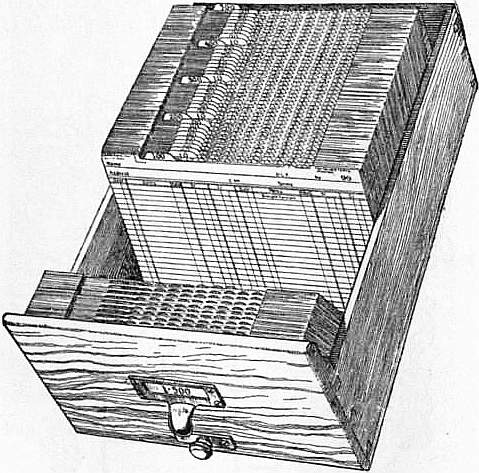
Fig. 1.—Card-Ledger Tray (Librry Bureau System).
Another important application of modern methods consists of what may be described as the slip system, which is in many respects a reversion to the method of keeping records upon movable slabs or tablets, as in the Babylonian accounts Slip system. referred to at the beginning of this article. This system may be applied to books of first-entry, or to ledgers, or to both. As applied to books of first-entry it aims at so modifying the original record of the transaction—whether it represents an invoice for goods sold or an acknowledgment given for money received—that a facsimile duplicate may be taken of the original entry by the aid of a carbon sheet, which instead of being immovably bound up in a book is capable of being handled separately and placed in any desired order or position, and thus more readily recorded in the ledger. Postings are thus made direct from the original slips, which have been first sorted out into an order convenient for that purpose, and afterwards resorted so that the total sales of each department may be readily computed; after which they are filed away in a form convenient for reference. Sometimes the process is carried a step further, and the original slips, filed away with suitable guide-cards indicating the nature of the account, themselves constitute the ledger record—which in such cases is to be found scattered over a number of sheets, one for each transaction, instead of, as in the case of the ordinary book ledger, a considerable number of transactions being recorded upon a single page. This adaptation of the slip system is impracticable except in cases where the transactions with each individual are few in number, and is not worth adoption unless the exceedingly large number of personal accounts makes it important as far as possible to avoid all duplication of clerical work. The more usual adaptation of the slip system to ledgers is to be found in the employment of card ledgers or loose-leaf ledgers. With card ledgers (fig. 1) each ledger account is upon an independent sheet of cardboard suitably arranged in drawers or cabinets. The system is advantageous as allowing all dead matter to be eliminated from the record continuously in use, and as permitting the order in which the accounts stand to be varied from time to time as convenience dictates, thus (if necessary) enabling the accounts to be always kept in alphabetical order in spite of the addition of new accounts and the dropping out of old ones. An especial convenience of the card system is that in times of pressure any desired number of book-keepers may be simultaneously employed, whereas the maximum number that can be usefully employed upon any bound book is two. The loose-leaf ledger (fig. 2) may be described as midway between card and bound ledgers. It consists of a number of sheets in book form, so bound as to be capable of being readily separated when desired. The loose-leaf ledger thus embraces most of the advantages of the card ledger, while remaining sufficiently like the more old-fashioned book ledger as to enable it to be readily handled by those whose previous experience has been confined to the latter. Both the card and loose-leaf systems will be frequently found of value for records in connexion with cost and stores accounts, quite irrespective of their advantages in connexion with the book-keeping records pure and simple of certain businesses.
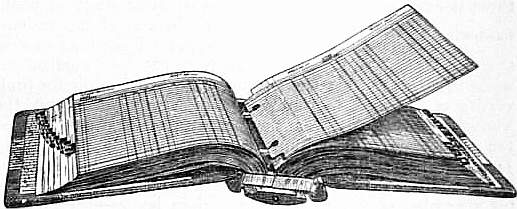
Fig. 2.—Loose-Leaf Ledger (Library Bureau System.)
All book-keeping methods rest upon the same fundamental principles, but their development in practice in different countries is to some extent influenced by the manner in which business is there conducted, and by the legislative Legislative Requirements. requirements imposed by the several states. In France traders are required by the Code of Commerce to keep three books—a journal, an inventory and a letter book, somewhat elaborate provisions being made to identify these books, and to prevent substitution. The compulsory journal makes the employment of numerous books of first-entry impossible without an undesirable amount of duplication, and wherever this provision obtains the book-keeping methods are in an accordingly comparatively backward state. The inventory book comprises periodical lists of ledger balances and the balance sheet, records which are invariably kept under every adequate system, although not always in a book specially set aside for that purpose. In Germany the statutory requirements are similar to those in France, save that the journal is not compulsory; but there is an additional provision that the accounts are to be kept in bound books with the pages numbered consecutively—a requirement which makes the introduction of card or loose-leaf ledgers of doubtful legality. A balance sheet must be drawn up every year; but where a stock-in-trade is from its nature or its size difficult to take, it is sufficient for an inventory to be taken every two years. In Belgium the law requires every merchant to keep a journal recording his transactions from day to day, which (with the balance book) must be initialled by a prescribed officer. All letters and telegrams received, and copies of all such sent, must be preserved for ten years. The Commercial Code of Spain requires an inventory, journal, ledger, letter book and invoice book to be kept; while that of Portugal prescribes the use of a balance book, journal, ledger and copy-letter book. The law of Holland requires business men to keep books in which are correctly recorded their commercial transactions, letters received and copies of letters sent. It also provides for the preparation of an annual balance sheet. The law of Rumania makes the employment of journal, inventory book and ledger compulsory, a small tax per page being charged on the two first named. There are no special provisions as to book-keeping contained in the Russian law, nor in the United States law, but in Russia public companies have to supply the government with copies of their annual accounts, which are published in a state newspaper, and in the United States certain classes of companies have to submit their accounts to an official audit. In general terms it may be stated that at the present time the employment of card and loose-leaf ledger systems is more general in the United States than in Great Britain.
Apart from the organizations of professional accountants, there is none of note devoted to the scientific study of book-keeping other than purely educational institutions. Among the universities those in the United States were Education. the first to include accounting as part of their curriculum; while in Great Britain the London School of Economics (university of London), the university of Birmingham, and the Victoria University of Manchester have, so far, alone treated the subject seriously and upon adequate lines. Quite recently Japan has been making a movement in the same direction, and other countries will doubtless follow suit. In England there have for a number of years past been various bodies—such for instance as the Society of Arts, the London Chamber of Commerce and Owens College, Manchester—which hold examinations in book-keeping and grant diplomas to successful candidates, while most of the polytechnics and technical schools give instruction in book-keeping; these latter, however, for the most part regard it as a “craft” merely.
Authorities.—Those interested in the bibliography of book-keeping are referred to the catalogue of the library of the Institute of Chartered Accountants in England and Wales, which probably contains the most complete collection in existence of ancient and modern works on accounting, both British and foreign. The following short list comprises those most likely to be found of general interest: G. van de Linde, Book-keeping (1898); L.R. Dicksee, Book-keeping (5th ed., 1906) and Advanced Accounting (2nd ed., 1905); Encyclopaedia of Accounting, ed. by G. Lisle (1903); Accountants’ Library, ed. by the editor of The Accountant (1901); J.W. Heaps, The Antiquity of Book-keeping (1898); History of Accounting and Accountants, ed. by R. Brown (1905).
(L. R. D.)
BOOK-PLATES. The book-plate, or ex-libris, a printed label intended to indicate ownership in individual volumes, is nearly as old as the printed book itself. It bears very much the same relation to the hand-painted armorial or otherwise symbolical personal device found in medieval manuscripts that the printed page does to the scribe’s work. The earliest known examples of book-plates are German. According to Friedrich Warnecke, of Berlin (one of the best authorities on the subject), the oldest movable ex-libris are certain woodcuts representing a shield of arms supported by an angel (fig. 1), which were pasted in books presented to the Carthusian monastery of Buxheim by Brother Hildebrand Brandenburg of Biberach, about the year 1480—the date being fixed by that of the recorded gift. The woodcut, in imitation of similar devices in old MSS., is hand-painted. In France the most ancient ex-libris as yet discovered is that of one Jean Bertaud de la Tour-Blanche, the date of which is 1529; and in England that of Sir Nicholas Bacon, a gift-plate for the books he presented to the university of Cambridge (fig. 2). Holland comes next with the plate of a certain Anna van der Aa, in 1597; then Italy with one attributed to the year 1622. The earliest known American example is the plain printed label of one John Williams, 1679.
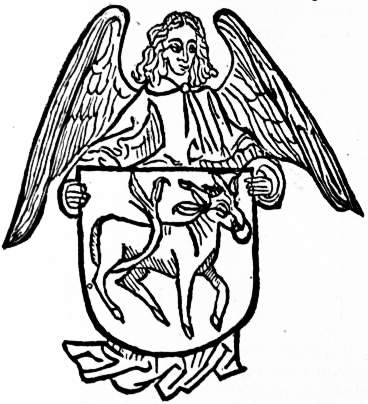
Fig. 1.—Gift-plate of Hildebrand Brandenburg of Biberach to the Monastery of Buxheim (c. 1480).
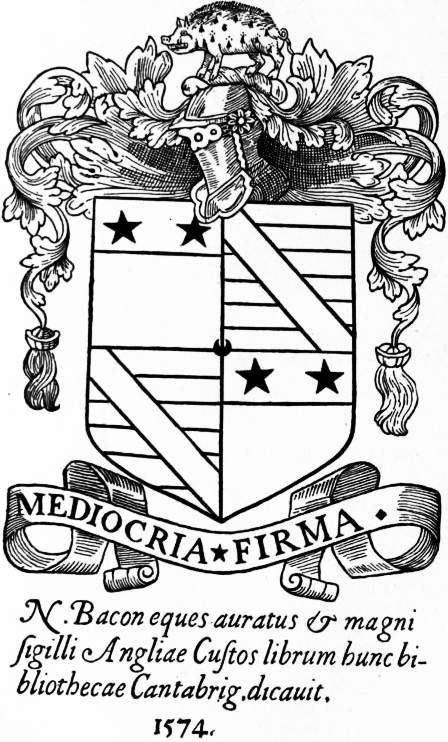
Fig. 2.—Book-plate of Sir Nicholas Bacon (slightly reduced).
A sketch of the history of the book-plate, either as a minor work of symbolical and decorative art, or as an accessory to the binding of books, must obviously begin in Germany, not only because the earliest examples known are German, but also because they are found in great numbers long before the fashion spread to other countries, and are often of the highest artistic interest. Albrecht Dürer is known to have actually engraved at least six plates (some of very important size) between 1503 and 1516 (fig. 3), and to have supplied designs for many others. Several notable plates are ascribed to Lucas Cranach and to Hans Holbein, and to that bevy of so-called Little Masters, the Behams, Virgil Solis, Matthias Zundt, Jost Amman, Saldörfer, Georg Hüpschmann and others. The influence of these draughtsmen over the decorative styles of Germany has been felt through subsequent centuries down to the present day, notwithstanding the invasion of successive Italian and French fashions during the 17th and 18th centuries, and the marked effort at originality of composition observable among modern designers. The heavy, over-elaborated German style never seems to have affected neighbouring countries; but since it was undoubtedly from Germany that was spread the fashion of ornamental book-plates as marks of possession, the history of German ex-libris remains on that account one of high interest to all those who are curious in the matter.
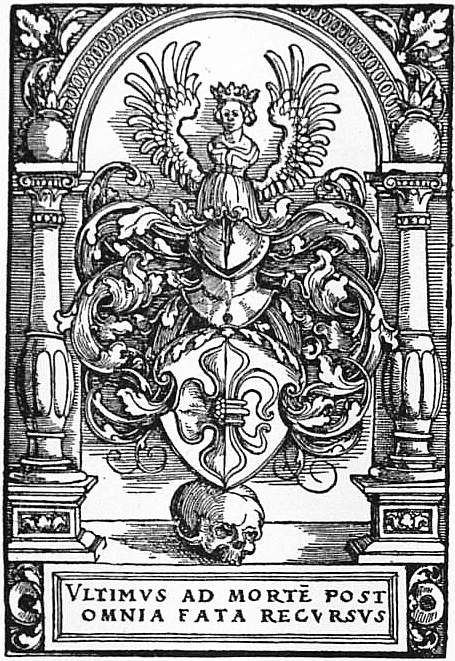
Fig. 3.—Book-plate of Lazarus Spengler, by Albrecht Dürer, 1515 (reduced).
It was not before the 17th century that the movable ex-libris became tolerably common in France. Up to that time the more luxurious habit of stamping the cover with a personal device had been in such general favour with book-owners as to render the use of labels superfluous. From the middle of the century, however, the ex-libris proper became quite naturalized; examples of that period are very numerous, and, as a rule, are very handsome. It may be here pointed out that the expression ex-libris, used as a substantive, which is now the recognized term for book-plate everywhere on the continent, found its origin in France. The words only occur in the personal tokens of other nationalities long after they had become a recognized inscription on French labels.
In many ways the consideration of the English book-plate, in its numerous styles, from the late Elizabethan to the late Victorian period, is peculiarly interesting. In all its varieties it reflects with great fidelity the prevailing taste in decorative art at different epochs. Of English examples, none thus far seems to have been discovered of older date than the gift-plate of Sir Nicholas Bacon; for the celebrated, gorgeous, hand-painted armorial device attached to a folio that once belonged to Henry VIII., and now reposes in the King’s library, British Museum, does not come under the head of book-plate in its modern sense. The next is that of Sir Thomas Tresham, dated 1585. Until the last quarter of the 17th century the number of authentic English plates is very limited. Their composition is always remarkably simple, and displays nothing of the German elaborateness. They are as a rule very plainly armorial, and the decoration is usually limited to a symmetrical arrangement of mantling, with an occasional display of palms or wreaths. Soon after the Restoration, however, a book-plate seems to have suddenly become an established accessory to most well-ordered libraries. Book-plates of that period offer very distinctive characteristics. In the simplicity of their heraldic arrangements they recall those of the previous age; but their physiognomy is totally different. In the first place, they invariably display the tincture lines and dots, after the method originally devised in the middle of the century by Petra Sancta, the author of Tesserae Gentilitiae, which by this time had become adopted throughout Europe. In the second, the mantling assumes a much more elaborate appearance—one that irresistibly recalls that of the periwig of the period—surrounding the face of the shield. This style was undoubtedly imported from France, but it assumed a character of its own in England. As a matter of fact, thenceforth until the dawn of the French Revolution, English modes of decoration in book-plates, as in most other chattels, follow at some years’ distance the ruling French taste. The main characteristics of the style which prevailed during the Queen Anne and early Georgian periods are:—ornamental frames suggestive of carved oak, a frequent use of fish-scales, trellis or diapered patterns, for the decoration of plain surfaces; and, in the armorial display, a marked reduction in the importance of the mantling. The introduction of the scallop-shell as an almost constant element of ornamentation gives already a foretaste of the Rocaille-Coquille, the so-called Chippendale fashions of the next reign. As a matter of fact, during the middle third of the century this rococo style (of which the Convers plate [fig. 4] gives a tolerably typical sample) affects the book-plate as universally as all other decorative objects. Its chief element is a fanciful arrangement of scroll and shell work with curveting acanthus-like sprays—an arrangement which in the examples of the best period is generally made asymmetrical in order to give freer scope for a variety of countercurves. Straight or concentric lines and all appearances of flat surface are studiously avoided; the helmet and its symmetrical mantling tends to disappear, and is replaced by the plain crest on a fillet. The earlier examples of this manner are tolerably ponderous and simple. Later, however, the composition becomes exceedingly light and complicated; every conceivable and often incongruous element of decoration is introduced, from cupids to dragons, from flowerets to Chinese pagodas. During the early part of George III.’s reign there is a return to greater sobriety of ornamentation, and a style more truly national, which may be called the urn style, makes its appearance. Book-plates of this period have invariably a physiognomy which at once recalls the decorative manner made popular by architects and designers such as Chambers, the Adams, Josiah Wedgwood, Hepplewhite and Sheraton. The shield shows a plain spade-like outline, manifestly based upon that of the pseudo-classic urn then so much to the fore. The ornamental accessories are symmetrical palms and sprays, wreaths and ribands. The architectural boss is also an important factor. In many plates, indeed, the shield of arms takes quite a subsidiary position by the side of the predominantly architectural urn. From the beginning of the 19th century, until comparatively recent days, no special style of decoration seems to have established itself. The immense majority of examples display a plain shield of arms with motto on a scroll below, and crest on a fillet above. Of late years, however, a rapid impetus appears to have been given to the designing of ex-libris; a new era, in fact, has begun for the book-plate, one of great interest.
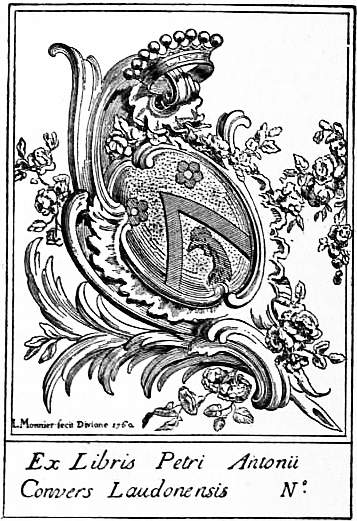
Fig. 4.—Book-plate of P.A. Convers, 1762.
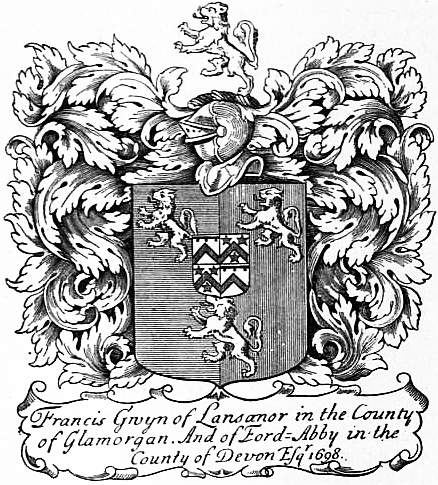
Fig. 5.—Book-plate of Francis Gwyn of Lansanor, 1698.
The main styles of decoration (and these, other data being absent, must always in the case of old examples remain the criteria of date) have already been noticed. It is, however, necessary to point out that certain styles of composition were also prevalent at certain periods. Many of the older plates (like the majority of the most modern ones) were essentially pictorial. Of this kind the best-defined English genus may be recalled: the library interior—a term which explains itself—and book-piles, exemplified by the ex-libris (fig. 6) of W. Hewer, Samuel Pepys’s secretary. We have also many portrait-plates, of which, perhaps, the most notable are those of Samuel Pepys himself and of John Gibbs, the architect; allegories, such as were engraved by Hogarth, Bartolozzi, John Pine and George Vertue; landscape-plates, by wood engravers of the Bewick school (see Plate), &c. In most of these the armorial element plays but a secondary part.
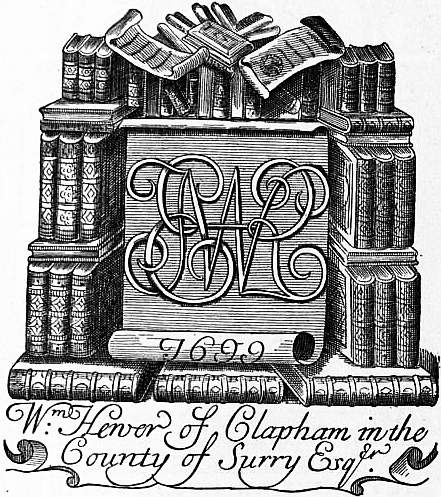
Fig. 6.—Book-plate of William Hewer, 1699.
The value attached to book-plates, otherwise than as an object of purely personal interest, is comparatively modern. The study of and the taste for collecting these private tokens of book-ownership hardly date farther back than the year 1875. The first real impetus was given by the appearance of the Guide to the Study of Book-Plates, by Lord de Tabley (then the Hon. Leicester Warren) in 1880. This work, highly interesting from many points of view, established what is now accepted as the general classification of styles: early armorial (i.e. previous to Restoration, exemplified by the Nicholas Bacon plate); Jacobean, a somewhat misleading term, but distinctly understood to include the heavy decorative manner of the Restoration, Queen Anne and early Georgian days (the Lansanor plate, fig. 5, is typically Jacobean); Chippendale (the style above described as rococo, tolerably well represented by the French plate of Convers); wreath and ribbon, belonging to the period described as that of the urn, &c. Since then the literature on the subject has grown considerably. Societies of collectors have been founded, first in England, then in Germany and France, and in the United States, most of them issuing a journal or archives: The Journal of the Ex-libris Society (London), the Archives de la société française de collectionneurs d’ex-libris (Paris), both of these monthlies; the Ex-libris Zeitschrift (Berlin), a quarterly.
Much has been written for and against book-plate collecting. If, on the one hand, the more enthusiastic ex-librists (for such a word has actually been coined) have made the somewhat ridiculous claim of science for “ex-librisme,” the bitter animadversion, on the other, of a certain class of intolerant bibliophiles upon the vandalism of removing book-plates from old books has at times been rather extravagant. Book-plates are undoubtedly very often of high interest (and of a value often far greater than the odd volume in which they are found affixed), either as specimens of bygone decorative fashion or as personal relics of well-known personages. There can be no question, for instance, that engravings or designs by artists such as Holbein and Dürer and the Little Masters of Germany, by Charles Eisen, Hubert François Bourguignon, dit Gravelot, D.N. Chodowiecki or Simon Gribelin; by W. Marshall, W. Faithorne, David Loggan, Sir Robert Strange, Francesco Piranesi; by Hogarth, Cipriani, Bartolozzi, John Keyse Sherwin, William Henshaw, Hewitt or Bewick and his imitators; or, to come to modern times, that the occasional examples traced to the handicraft of Thomas Stothard, Thackeray, Millais, Maclise, Bell Scott, T.G. Jackson, Walter Crane, Caldecott, Stacy Marks, Edwin Abbey, Kate Greenaway, Gordon Browne, Herbert Railton, Aubrey Beardsley, Alfred Parsons, D.Y. Cameron, Paul Avril—are worth collecting.
Plate.
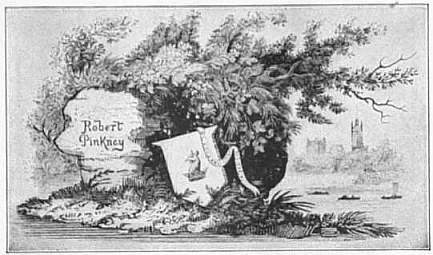
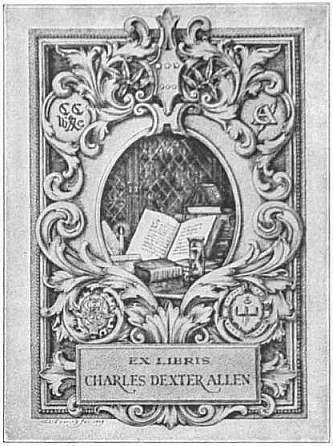
BOOK-PLATE OF ROBERT PINKNEY. By Thoma Bewick. BOOK-PLATE OF FREIHERR V. LIPPERHEIDE. By Karl Rickelt.
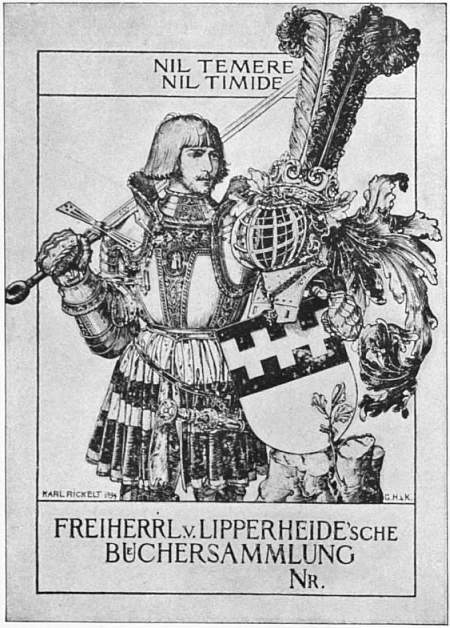
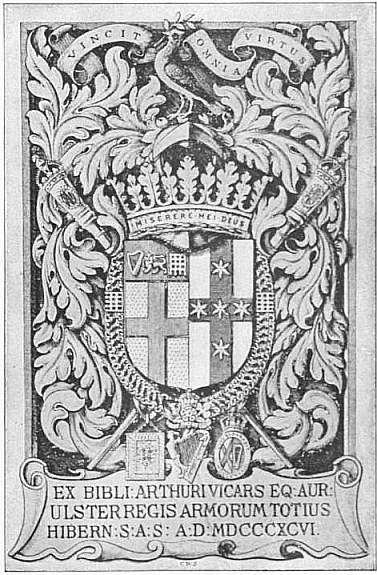
BOOK-PLATE OF CHARLES DEXTER ALLEN. By E.D. French. BOOK-PLATE OF SIR ARTHUR VICARS. By C.W. Sherborn.
Until the advent of the new taste the devising of book-plates was almost invariably left to the routine skill of the heraldic stationer. Of late years the composition of personal book-tokens has become recognized as a minor branch of a higher art, and there has come into fashion an entirely new class of designs which, for all their wonderful variety, bear as unmistakable a character as that of the most definite styles of bygone days. Broadly speaking, it may be said that the purely heraldic element tends to become subsidiary and the allegorical or symbolic to assert itself more strongly. Among modern English artists who have more specially paid attention to the devising of book-plates, and have produced admirable designs, may be mentioned C.W. Sherborn, G.W. Eve, Robert Anning Bell, J.D. Batten, Erat Harrison, J. Forbes Nixon, Charles Ricketts, John Vinycomb, John Leighton and Warrington Hogg. The development in various directions of process work, by facilitating and cheapening the reproduction of beautiful and elaborate designs, has no doubt helped much to popularize the book-plate—a thing which in older days was almost invariably restricted to ancestral libraries or to collections otherwise important. Thus the great majority of modern plates are reproduced by process. There are, however, a few artists left who devote to book-plates their skill with the graver. Some of the work they produce challenges comparison with the finest productions of bygone engravers. Of these the best-known are C.W. Sherborn (see Plate) and G.W. Eve in England, and in America J.W. Spenceley of Boston, Mass., K.W.F. Hopson of New Haven, Conn., and E.D. French of New York City (see Plate).
Authorities.—The curious in the matter of book-plate composition will find it treated in the various volumes of the Ex-libris Series (London). See also A. Poulet-Malassis, Les Ex-libris français (1875); Hon. J. Leicester Warren (Lord de Tabley), A Guide to the Study of Book-plates (1880); Sir A.W. Franks, Notes on Book-plates, 1574-1800 (private, 1887); Friedrich Warnecke, Die deutschen Bücherzeichen (1890); Henri Bouchot, Les Ex-libris et les marques de possession du livre (1891); Egerton Castle, English Book-plates (1892); Walter Hamilton, French Book-plates (1892), Dated Book-plates (1895); H.W. Fincham, Artists and Engravers of British and American Book-plates (1897); German Book-plates, by Count K.E. zu Leiningen-Westerburg, translated by G.R. Denis (1901).
(E. Ca.)
BOOK-SCORPION, or False Scorpion, minute arachnids superficially resembling tailless scorpions and belonging to the order Pseudoscorpiones of the class Arachnida. Occurring in all temperate and tropical countries, book-scorpions live for the most part under stones, beneath the bark of trees or in vegetable detritus. A few species, however, like the common British forms Chelifer cancroides and Chiridium museorum, frequent human dwellings and are found in books, old chests, furniture, &c; others like Ganypus littoralis and allied species may be found under stones or pieces of coral between tide-marks; while others, which are for the most part blind, live permanently in dark caves. Their food consists of minute insects or mites. It is possibly for the purpose of feeding on parasitic mites that book-scorpions lodge themselves beneath the wing-cases of large tropical beetles; and the same explanation, in default of a better, may be extended to their well-known and oft-recorded habit of seizing hold of the legs of horse-flies or other two-winged insects. For safety during hibernation and moulting, book-scorpions spin a small spherical cocoon. They are oviparous; and the eggs after being laid are carried about by the mother, attached to the lower surface of her body, the young remaining with their parent until they have acquired their definite form and are able to shift for themselves.
(R. I. P.)
BOOKSELLING. The trade in books is of a very ancient date. The early poets and orators recited their effusions in public to induce their hearers to possess written copies of their poems or orations. Frequently they were taken down viva voce, and transcripts sold to such as were wealthy enough to purchase. In the book of Jeremiah the prophet is represented as dictating to Baruch the scribe, who, when questioned, described the mode in which his book was written. These scribes were, in fact, the earliest booksellers, and supplied copies as they were demanded. Aristotle, we are told, possessed a somewhat extensive library; and Plato is recorded to have paid the large sum of one hundred minae for three small treatises of Philolaus the Pythagorean. When the Alexandrian library was founded about 300 B.C., various expedients were resorted to for the purpose of procuring books, and this appears to have stimulated the energies of the Athenian booksellers, who were termed βιβλὶων κάπηλοι. In Rome, towards the end of the republic, it became the fashion to have a library as part of the household furniture; and the booksellers, librarii (Cic. D. Leg. iii. 20) or bibliopolae (Martial iv. 71, xiii. 3), carried on a flourishing trade. Their shops (taberna librarii, Cicero, Phil. ii. 9) were chiefly in the Argiletum, and in the Vicus Sandalarius. On the door, or on the side posts, was a list of the books on sale; and Martial (i. 118), who mentions this also, says that a copy of his First Book of Epigrams might be purchased for five denarii. In the time of Augustus the great booksellers were the Sosii. According to Justinian (ii. I. 33), a law was passed securing to the scribes the property in the materials used; and in this may, perhaps, be traced the first germ of the modern law of copyright.
The spread of Christianity naturally created a great demand for copies of the Gospels and other sacred books, and later on for missals and other devotional volumes for church and private use. Benedict Biscop, the founder of the abbey at Wearmouth in England, brought home with him from France (671) a whole cargo of books, part of which he had “bought,” but from whom is not mentioned. Passing by the intermediate ages we find that previous to the Reformation, the text writers or stationers (stacyoneres), who sold copies of the books then in use—the ABC, the Paternoster, Creed, Ave Maria and other MS. copies of prayers, in the neighbourhood of St Paul’s, London,—were, in 1403, formed into a gild. Some of these “stacyoneres” had stalls or stations built against the very walls of the cathedral itself, in the same manner as they are still to be found in some of the older continental cities. In Henry Anstey’s Munimenta Academica, published under the direction of the master of the rolls, we catch a glimpse of the “sworn” university bookseller or stationer, John More of Oxford, who apparently first supplied pupils with their books, and then acted the part of a pawnbroker. Anstey says (p. 77), “The fact is that they (the students) mostly could not afford to buy books, and had they been able, would not have found the advantage so considerable as might be supposed, the instruction given being almost wholly oral. The chief source of supplying books was by purchase from the university sworn stationers, who had to a great extent a monopoly. Of such books there were plainly very large numbers constantly changing hands.” Besides the sworn stationers there were many booksellers in Oxford who were not sworn; for one of the statutes, passed in the year 1373, expressly recites that, in consequence of their presence, “books of great value are sold and carried away from Oxford, the owners of them are cheated, and the sworn stationers are deprived of their lawful business.” It was, therefore, enacted that no bookseller except two sworn stationers or their deputies, should sell any book being either his own property or that of another, exceeding half a mark in value, under a pain of imprisonment, or, if the offence was repeated, of abjuring his trade within the university.
“The trade in bookselling seems,” says Hallam, “to have been established at Paris and Bologna in the 12th century; the lawyers and universities called it into life. It is very improbable that it existed in what we properly call the dark ages. Peter of Blois mentions a book which he had bought of a public dealer (a quodam publico mangone librorum); but we do not find many distinct accounts of them till the next age. These dealers were denominated stationarii, perhaps from the open stalls at which they carried on their business, though statio is a general word for a shop in low Latin. They appear, by the old statutes of the university of Paris, and by those of Bologna, to have sold books upon commission, and are sometimes, though not uniformly, distinguished from the librarii, a word which, having originally been confined to the copyists of books, was afterwards applied to those who traded in them. They sold parchment and other materials of writing, which have retained the name of stationery, and they naturally exercised the kindred occupations of binding and decorating. They probably employed transcribers; we find at least that there was a profession of copyists in the universities and in large cities.”
The modern system of bookselling dates from soon after the introduction of printing. The earliest printers were also editors and booksellers; but being unable to sell every copy of the works they printed, they had agents at most of the seats of learning. Antony Koburger, who introduced the art of printing into Nuremberg in 1470, although a printer, was more of a bookseller; for, besides his own sixteen shops, we are informed by his biographers that he had agents for the sale of his books in every city of Christendom. Wynkyn de Worde, who succeeded to Caxton’s press in Westminster, had a shop in Fleet Street.
The religious dissensions of the continent, and the Reformation in England under Henry VIII. and Edward VI., created a great demand for books; but in England neither Tudor nor Stuart could tolerate a free press, and various efforts were made to curb it. The first patent for the office of king’s printer was granted to Thomas Berthelet by Henry VIII. in 1529, but only such books as were first licensed were to be printed. At that time even the purchase or possession of an unlicensed book was a punishable offence. In 1556 the Company of Stationers was incorporated, and very extensive powers were granted in order that obnoxious books might be repressed. In the following reigns the Star Chamber exercised a pretty effectual censorship; but, in spite of all precaution, such was the demand for books of a polemical nature, that many were printed abroad and surreptitiously introduced into England. Queen Elizabeth interfered but little with books except when they emanated from Roman Catholics, or touched upon her royal prerogatives; and towards the end of her reign, and during that of her pedantic successor, James, bookselling flourished. Archbishop Laud, who was no friend to booksellers, introduced many arbitrary restrictions; but they were all, or nearly all, removed during the time of the Commonwealth. So much had bookselling increased during the Protectorate that, in 1658, was published A Catalogue of the most Vendible Books in England, digested under the heads of Divinity, History, Physic, &c., with School Books, Hebrew, Greek and Latin, and an Introduction, for the use of Schools, by W. London. A bad time immediately followed. The Restoration also restored the office of Licenser of the Press, which continued till 1694.
In the first English Copyright Act (1709), which specially relates to booksellers, it is enacted that, if any person shall think the published price of a book unreasonably high, he may thereupon make complaint to the archbishop of Canterbury, and to certain other persons named, who shall thereupon examine into his complaint, and if well founded reduce the price; and any bookseller charging more than the price so fixed shall be fined £5 for every copy sold. Apparently this enactment remained a dead letter.
For later times it is necessary to make a gradual distinction between booksellers, whose trade consists in selling books, either by retail or wholesale, and publishers, whose business involves the production of the books from the author’s manuscripts, and who are the intermediaries between author and bookseller, just as the booksellers (in the restricted sense) are intermediaries between the author and publisher and the public. The article on Publishing (q.v.) deals more particularly with this second class, who, though originally booksellers, gradually took a higher rank in the book-trade, and whose influence upon the history of literature has often been very great. The convenience of this distinction is not impaired by the fact either that a publisher is also a wholesale bookseller, or that a still more recent development in publishing (as in the instance of the direct sale in 1902, by the London Times, of the supplementary volumes to the 9th edition of the Encyclopaedia Britannica, which were also “published” by The Times) started a reaction to some extent in the way of amalgamating the two functions. The scheme of The Times Book Club (started in 1905) was, again, a combination of a subscription library with the business of bookselling (see NEWSPAPERS); and it brought the organization of a newspaper, with all its means of achieving publicity, into the work of pushing the sale of books, in a way which practically introduced a new factor into the bookselling business.
During the 19th century it remains the fact that the distinction between publisher and bookseller—literary promoter and shopkeeper—became fundamental. The booksellers, as such, were engaged either in wholesale bookselling, or in the retail, the old or second-hand, and the periodical trades.
Coming between the publisher and the retail bookseller is the important distributing agency of the wholesale bookseller. It is to him that the retailer looks for his miscellaneous supplies, as it is simply impossible for him to stock one-half of the books published. In Paternoster Row, London, which has for over a hundred years been the centre of this industry, may be seen the collectors from the shops of the retail booksellers, busily engaged in obtaining the books ordered by the book-buying public. It is also through these agencies that the country bookseller obtains his miscellaneous supplies. At the leading house in this department of bookselling almost any book can be found, or information obtained concerning it. At one of these establishments over 1,000,000 books are constantly kept in stock. It is here that the publisher calls first on showing or “subscribing” a new book, a critical process, for by the number thus subscribed the fate of a book is sometimes determined.
What may be termed the third partner in publishing and its ramification is the retail bookseller; and to protect his interests there was established in 1890 a London booksellers’ society, which had for its object the restriction of discounts to 25%, and also to arrange prices generally and control all details connected with the trade. The society a few years afterwards widened its field of operations so as to include the whole of the United Kingdom, and its designation then became “The Associated Booksellers of Great Britain and Ireland.”
The trade in old or (as they are sometimes called) second-hand books is in a sense, no doubt, a higher class of business, requiring a knowledge of bibliography, while the transactions are with individual books rather than with numbers of copies. Occasionally dealers in this class of books replenish their stocks by purchasing remainders of books, which, having ceased from one cause or another to sell with the publisher, they offer to the public as bargains. The periodical trade grew up during the 19th century, and was in its infancy when the Penny Magazine, Chambers’s Journal, and similar publications first appeared. The growth of this important part of the business was greatly promoted by the abolition of the newspaper stamp and of the duty upon paper, the introduction of attractive illustrations, and the facilities offered for purchasing books by instalments.
The history of bookselling in America has a special interest. The Spanish settlements drew away from the old country much of its enterprise and best talent, and the presses of Mexico and other cities teemed with publications mostly of a religious character, but many others, especially linguistic and historical, were also published. Bookselling in the United States was of a somewhat later growth, although printing was introduced into Boston as early as 1676, Philadelphia in 1685, and New York in 1693. Franklin had served to make the trade illustrious, yet few persons were engaged in it at the commencement of the 19th century. Books chiefly for scholars and libraries were imported from Europe; but after the second war printing-presses multiplied rapidly, and with the spread of newspapers and education there also arose a demand for books, and publishers set to work to secure the advantages offered by the wide field of English literature, the whole of which they had the liberty of reaping free of all cost beyond that of production. The works of Scott, Byron, Moore, Southey, Wordsworth, and indeed of every author of note, were reprinted without the smallest payment to author or proprietor. Half the names of the authors in the so-called “American” catalogue of books printed between 1820 and 1852 are British. By this means the works of the best authors were brought to the doors of all classes in the cheapest variety of forms. In consequence of the Civil War, the high price of labour, and the restrictive duties laid on in order to protect native industry, coupled with the frequent intercourse with England, a great change took place, and American publishers and booksellers, while there was still no international copyright, made liberal offers for early sheets of new publications. Boston, New York and Philadelphia still retained their old supremacy as bookselling centres. Meanwhile, the distinct publishing business also grew, till gradually the conditions of business became assimilated to those of Europe.
In the course of the 16th and 17th centuries the Low Countries for a time became the chief centre of the bookselling world, and many of the finest folios and quartos in our libraries bear the names of Jansen, Blauw or Plantin, with the imprint of Amsterdam, Utrecht, Leiden or Antwerp, while the Elzevirs besides other works produced their charming little pocket classics. The southern towns of Douai and St Omer at the same time furnished polemical works in English.
Under Publishing are noticed various further developments of this subject. Much interesting information on the history of the book trade will be found in Charles Knight’s Biography of William Caxton, and in the same author’s Shadows of the Old Booksellers (1865). See also Henry Curwen, History of Booksellers (1873); and Heinrich Lempertz, Bilder-Hefte zur Geschichte des Bücherhandels (Cologne, 1854).
BOOLE, GEORGE (1815-1864), English logician and mathematician, was born in Lincoln on the 2nd of November 1815. His father was a tradesman of limited means, but of studious character and active mind. Being especially interested in mathematical science, the father gave his son his first lessons; but the extraordinary mathematical powers of George Boole did not manifest themselves in early life. At first his favourite subject was classics. Not until the age of seventeen did he attack the higher mathematics, and his progress was much retarded by the want of efficient help. When about sixteen years of age he became assistant-master in a private school at Doncaster, and he maintained himself to the end of his life in one grade or other of the scholastic profession. Few distinguished men, indeed, have had a less eventful life. Almost the only changes which can be called events are his successful establishment of a school at Lincoln, its removal to Waddington, his appointment in 1849 as professor of mathematics in the Queen’s College at Cork, and his marriage in 1855 to Miss Mary Everest, who, as Mrs Boole, afterwards wrote several useful educational works on her husband’s principles.
To the public Boole was known only as the author of numerous abstruse papers on mathematical topics, and of three or four distinct publications which have become standard works. His earliest published paper was one upon the “Theory of Analytical Transformations,” printed in the Cambridge Mathematical Journal for 1839, and it led to a friendship between Boole and D.F. Gregory, the editor of the journal, which lasted until the premature death of the latter in 1844. A long list of Boole’s memoirs and detached papers, both on logical and mathematical topics, will be found in the Catalogue of Scientific Memoirs published by the Royal Society, and in the supplementary volume on Differential Equations, edited by Isaac Todhunter. To the Cambridge Mathematical Journal and its successor, the Cambridge and Dublin Mathematical Journal, Boole contributed in all twenty-two articles. In the third and fourth series of the Philosophical Magazine will be found sixteen papers. The Royal Society printed six important memoirs in the Philosophical Transactions, and a few other memoirs are to be found in the Transactions of the Royal Society of Edinburgh and of the Royal Irish Academy, in the Bulletin de l’Académie de St-Pétersbourg for 1862 (under the name G. Boldt, vol. iv. pp. 198-215), and in Crelle’s Journal. To these lists should be added a paper on the mathematical basis of logic, published in the Mechanic’s Magazine for 1848. The works of Boole are thus contained in about fifty scattered articles and a few separate publications.
Only two systematic treatises on mathematical subjects were completed by Boole during his lifetime. The well-known Treatise on Differential Equations appeared in 1859, and was followed, the next year, by a Treatise on the Calculus of Finite Differences, designed to serve as a sequel to the former work. These treatises are valuable contributions to the important branches of mathematics in question, and Boole, in composing them, seems to have combined elementary exposition with the profound investigation of the philosophy of the subject in a manner hardly admitting of improvement. To a certain extent these works embody the more important discoveries of their author. In the 16th and 17th chapters of the Differential Equations we find, for instance, a lucid account of the general symbolic method, the bold and skilful employment of which led to Boole’s chief discoveries, and of a general method in analysis, originally described in his famous memoir printed in the Philosophical Transactions for 1844. Boole was one of the most eminent of those who perceived that the symbols of operation could be separated from those of quantity and treated as distinct objects of calculation. His principal characteristic was perfect confidence in any result obtained by the treatment of symbols in accordance with their primary laws and conditions, and an almost unrivalled skill and power in tracing out these results.
During the last few years of his life Boole was constantly engaged in extending his researches with the object of producing a second edition of his Differential Equations much more complete than the first edition; and part of his last vacation was spent in the libraries of the Royal Society and the British Museum. But this new edition was never completed. Even the manuscripts left at his death were so incomplete that Todhunter, into whose hands they were put, found it impossible to use them in the publication of a second edition of the original treatise, and wisely printed them, in 1865, in a supplementary volume.
With the exception of Augustus de Morgan, Boole was probably the first English mathematician since the time of John Wallis who had also written upon logic. His novel views of logical method were due to the same profound confidence in symbolic reasoning to which he had successfully trusted in mathematical investigation. Speculations concerning a calculus of reasoning had at different times occupied Boole’s thoughts, but it was not till the spring of 1847 that he put his ideas into the pamphlet called Mathematical Analysis of Logic. Boole afterwards regarded this as a hasty and imperfect exposition of his logical system, and he desired that his much larger work, An Investigation of the Laws of Thought, on which are founded the Mathematical Theories of Logic and Probabilities (1854), should alone be considered as containing a mature statement of his views. Nevertheless, there is a charm of originality about his earlier logical work which no competent reader can fail to appreciate. He did not regard logic as a branch of mathematics, as the title of his earlier pamphlet might be taken to imply, but he pointed out such a deep analogy between the symbols of algebra and those which can be made, in his opinion, to represent logical forms and syllogisms, that we can hardly help saying that logic is mathematics restricted to the two quantities, 0 and 1. By unity Boole denoted the universe of thinkable objects; literal symbols, such as x, y, z, v, u, &c., were used with the elective meaning attaching to common adjectives and substantives. Thus, if x = horned and y = sheep, then the successive acts of election represented by x and y, if performed on unity, give the whole of the class horned sheep. Boole showed that elective symbols of this kind obey the same primary laws of combination as algebraical symbols, whence it followed that they could be added, subtracted, multiplied and even divided, almost exactly in the same manner as numbers. Thus, 1 − x would represent the operation of selecting all things in the world except horned things, that is, all not horned things, and (1 − x)(1 − y) would give us all things neither horned nor sheep. By the use of such symbols propositions could be reduced to the form of equations, and the syllogistic conclusion from two premises was obtained by eliminating the middle term according to ordinary algebraic rules.
Still more original and remarkable, however, was that part of his system, fully stated in his Laws of Thought, which formed a general symbolic method of logical inference. Given any propositions involving any number of terms, Boole showed how, by the purely symbolic treatment of the premises, to draw any conclusion logically contained in those premises. The second part of the Laws of Thought contained a corresponding attempt to discover a general method in probabilities, which should enable us from the given probabilities of any system of events to determine the consequent probability of any other event logically connected with the given events.
Though Boole published little except his mathematical and logical works, his acquaintance with general literature was wide and deep. Dante was his favourite poet, and he preferred the Paradiso to the Inferno. The metaphysics of Aristotle, the ethics of Spinoza, the philosophical works of Cicero, and many kindred works, were also frequent subjects of study. His reflections upon scientific, philosophical and religious questions are contained in four addresses upon The Genius of Sir Isaac Newton, The Right Use of Leisure, The Claims of Science and The Social Aspect of Intellectual Culture, which he delivered and printed at different times.
The personal character of Boole inspired all his friends with the deepest esteem. He was marked by the modesty of true genius, and his life was given to the single-minded pursuit of truth. Though he received a medal from the Royal Society for his memoir of 1844, and the honorary degree of LL.D. from the university of Dublin, he neither sought nor received the ordinary rewards to which his discoveries would entitle him. On the 8th of December 1864, in the full vigour of his intellectual powers, he died of an attack of fever, ending in suffusion on the lungs.
An excellent sketch of his life and works, by the Rev. R. Harley, F.R.S., is to be found in the British Quarterly Review for July 1866, No. 87.
(W. S. J.)
BOOM, a word of Teutonic origin (cf. the Ger. Baum, tree, and the Eng. beam) for a pole, bar or barrier, used especially as a nautical term, for a long spar, used to extend a sail at the foot (main-boom, jib-boom, &c.). The “boom” of a cannon (note of a bell, cry of the bittern) is distinct from this, being onomatopoeic. In the sense of a barrier, a boom is generally formed of timber lashed together, or of chains, built across the mouth of a river or harbour as a means of defence. Possibly from the metaphor of a breaking boom, and the accompanying rush and roar, or from the rush of rising waters (mingled with the onomatopoeic use), “boom” began in America to be used of a sudden “spurt” or access of industrial activity, as in the phrase “a boom in cotton.” Hence the verb “to boom,” meaning to advertise or push into public favour.
BOOMERANG, a missile weapon of the Australian aborigines and other peoples. The word is taken from the native name used by a single tribe in New South Wales, and was mentioned in 1827 by Captain King as “the Port Jackson term” (Nav. Surv. Coasts Austral. i. 355) It has been erroneously connected with the womera or spear-thrower, and equally erroneously regarded as onomatopoeic—for it does not “boom” but whistles in the air. Two main types may be distinguished: (a) the return boomerang; (b) the non-return or war boomerang. Both types are found in most parts of Australia; the return form was, according to General Pitt-Rivers, used in ancient Egypt; and a weapon which has a close resemblance to the boomerang survives to the present day in North-East Africa, whence it has spread in allied forms made of metal (throwing knives). Among the Dravidians of South India is found a boomerang-shaped instrument which can be made to return. It is, however, still uncertain whether the so-called boomerangs of Egypt and India have any real resemblance to the Australian return boomerang. The Hopis (Moquis) of Arizona use a non-return form. The general form of both weapons is the same. They are sickle-shaped, and made of wood (in India of ivory or steel), so modelled that the thickness is about 1⁄6th of the breadth, which again is 1⁄12th of the length, the last varying from 6 in. to 3 or 4 ft. The return boomerang, which may have two straight arms at an angle of from 70° to 120°, but in Australia is always curved at an angle of 90° or more, is usually 2 to 3 ft. in length and weighs some 8 oz.; the arms have a skew, being twisted 2° or 3° from the plane running through the centre of the weapon, so that B and D (fig. 1) are above it, A and E below it; the ends AB and DE are also to some extent raised above the plane of the weapon at C; the cross section is asymmetrical, the upper side in the figure being convex, the lower flat or nearly so; this must be thrown with the right hand. The non-return boomerang has a skew in the opposite direction but is otherwise similar.
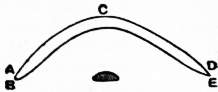
Fig. 1.
The peculiarity of the boomerang’s flight depends mainly on its skew. The return boomerang is held vertically, the concave side forward, and thrown in a plane parallel to the surface of the ground, as much rotation as possible being imparted to it. It travels straight for 30 yds. or more, with nearly vertical rotation; then it inclines to the left, lying over on the flat side and rising in the air; after describing a circle of 50 or more yards in diameter it returns to the thrower. Some observers state that it returns after striking the object; it is certainly possible to strike the ground without affecting the return. Throws of 100 yds. or more, before the leftward curve begins, can be accomplished by Australian natives, the weapon rising as much as 150 ft. in the air and circling five times before returning. The non-return type may also be made to return in a nearly straight line by throwing it at an angle of 45°, but normally it is thrown like the return type, and will then travel an immense distance. No accurate measurements of Australian throws are available, but an English throw of 180 yds. has been recorded, compared with the same thrower’s 70 yds. with the cricket ball.
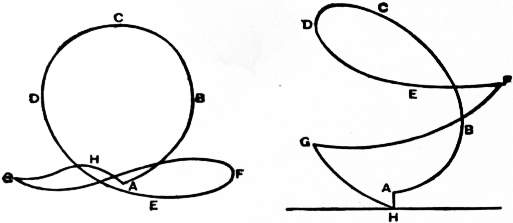
Fig. 2.—Flight in Horizontal Plane. Fig. 3.—Flight in Vertical Plane.
The war boomerang in an expert’s hand is a deadly weapon, and the lighter hunting boomerang is also effective. The return boomerang is chiefly used as a plaything or for killing birds, and is often as dangerous to the thrower as to the object at which it is aimed.
See Pitt-Rivers (Lane Fox) in Anthropological and Archaeological Fragments, “Primitive Warfare”; also in Journ. Royal United Service Inst. xii. No. 51; British Ass. Report (1872); Catalogue of Bethnal Green Collection, p. 28; Buchner in Globus, lxxxviii. 39, 63; G.T. Walker in Phil. Trans. cxc. 23; Wide World Mag. ii. 626; Nature, xiv. 248, lxiv. 338; Brough Smyth, Aborigines of Victoria, i. 310-329; Roth, Ethnological Studies.
(N. W. T.)
BOONE, DANIEL (1734-1820), American pioneer and backwoodsman, of English descent, was born near the present city of Reading, Pennsylvania, on the 2nd of November (N.S.) 1734. About 1751 his father, Squire Boone, with his family settled in the Yadkin Valley in what is now Davie county, North Carolina, then on the frontier. Daniel worked on his father’s farm, and spent much of his time hunting and trapping. In 1755 he served as a wagoner and blacksmith in Braddock’s disastrous expedition against the Indians. In 1765 he visited Florida, and in 1767 he first visited the Kentucky region. With several companions, including John Finley, who had been there as early as 1752, he spent two years, 1769-1771, roaming about what is now Kentucky, meeting with numberless adventures, coming in conflict with roving bands of Indians, and collecting bear, beaver and deer skins. He served in Lord Dunmore’s War (1774), and in 1775 led to Kentucky the party of settlers who founded Boonesborough, long an important settlement. On the 7th of February 1778 he, and the party he led, were captured by a band of Shawnees. He was adopted into the Shawnee tribe, was taken to Detroit, and on the return from that place escaped, reaching Boonesborough, after a perilous journey of 160 m., within four days, in time to give warning of a formidable attack by his captors. In repelling this attack, which lasted from the 8th to the 17th of September, he bore a conspicuous part. He also took part in the sanguinary “Battle of Blue Licks” in 1782. For a time he represented the settlers in the Virginia legislature (Kentucky then being a part of Virginia), and he also served as deputy surveyor, sheriff and county lieutenant of Fayette county, one of the three counties into which Kentucky was then divided. Having lost all his land through his carelessness in regard to titles, he removed in 1788 to Point Pleasant, Virginia (now W. Va.), whence about 1799 he removed to a place in what is now Missouri, about 45 m. west of St Louis, in territory then owned by Spain. He received a grant of 1000 arpents (about 845 acres) of land, and was appointed syndic of the district. After the United States gained possession of “Louisiana” in 1803, Boone’s title was found to be defective, and he was again dispossessed. He died on the 22nd of September 1820, and in 1845 his remains were removed to Frankfort, Kentucky, where a monument has been erected to his memory. Boone was a typical American pioneer and backwoodsman, a great hunter and trapper, highly skilled in all the arts of woodcraft, familiar with the Indians and their methods of warfare, a famous Indian fighter, restless, resourceful and fearless. His services, however, have been greatly over-estimated, and he was not, as is popularly believed, either the first to explore or the first to settle the Kentucky region.
The best biography is that by Reuben G. Thwaites, Daniel Boone (New York, 1902).
BOONE, a city and the county-seat of Boone county, Iowa, U.S.A., a short distance from the Des Moines river and near the centre of the state. Pop. (1890) 6520; (1900) 8880; (1905, state census) 9500 (1334 foreign-born); (1910) 10,347. It is served by the Chicago & North-Western (which has construction and repair shops here), the Chicago, Milwaukee & St Paul railways, and by the Fort Dodge, Des Moines & Southern (inter-urban) railway, which connects with Des Moines, Ames, &c. Boone is an important coal centre; bricks and tiles are manufactured from the clay obtained near by; there is a packing plant for the manufacture of beef and pork products; and from the rich farming section by which the city is surrounded come large quantities of grain, some of which is milled here, and live-stock. Boone was laid out in 1865, was incorporated as a town in 1866, and was chartered as a city in 1868.
BOONVILLE, a city and the county-seat of Cooper county, Missouri, U.S.A., on the right bank of the Missouri river, about 210 m. W. by N. of St Louis. Pop. (1890) 4141; (1900) 4377, including 1111 negroes; (1910) 4252. It is served by the Missouri Pacific, and the Missouri, Kansas & Texas railways. The city lies along a bluff about 100 ft. above the river. It is the seat of the Missouri training school for boys (1889), and of the Kemper military school (1844). Among its manufactures are earthenware, tobacco, vinegar, flour, farm-gates (iron), sash and doors, marble and granite monuments, carriages and bricks. Iron, zinc and lead are found in the vicinity, and some coal is mined. Boonville, named in honour of Daniel Boone, was settled in 1810, was laid out in 1817, incorporated as a village in 1839, and chartered as a city of the third class in 1896. Here on the 17th of June 1861, Captain (Major-General) Nathaniel Lyon, commanding about 2000 Union troops, defeated a slightly larger, but undisciplined Confederate force under Brigadier-General John S. Marmaduke. David Barton (d. 1837), one of the first two United States senators from Missouri, was buried here.
BOORDE (or Borde), ANDREW (1490?-1549), English physician and author, was born at Boord’s Hill, Holms Dale, Sussex. He was educated at Oxford, and was admitted a member of the Carthusian order while under age. In 1521 he was “dispensed from religion” in order that he might act as suffragan bishop of Chichester, though he never actually filled the office, and in 1529 he was freed from his monastic vows, not being able to endure, as he said, the “rugorosite off your relygyon.” He then went abroad to study medicine, and on his return was summoned to attend the duke of Norfolk. He subsequently visited the universities of Orleans, Poitiers, Toulouse, Montpellier and Wittenberg, saw the practice of surgery at Rome, and went on pilgrimage with others of his nation to Compostella in Navarre. In 1534 Boorde was again in London at the Charterhouse, and in 1536 wrote to Thomas Cromwell, complaining that he was in “thraldom” there. Cromwell set him at liberty, and after entertaining him at his house at Bishops Waltham in Hampshire, seems to have entrusted him with a mission to find out the state of public feeling abroad with regard to the English king. He writes to Cromwell from various places, and from Catalonia he sends him the seeds of rhubarb, two hundred years before that plant was generally cultivated in England. Two letters in 1535 and 1536 to the prior of the Charterhouse anxiously argue for his complete release from monastic vows. In 1536 he was studying medicine at Glasgow and gathering his observations about the Scots and the “devellyshe dysposicion of a Scottysh man, not to love nor favour an Englishe man.” About 1538 Boorde set out on his most extensive journey, visiting nearly all the countries of Europe except Russia and Turkey, and making his way to Jerusalem. Of these travels he wrote a full itinerary, lost unfortunately by Cromwell, to whom it was sent. He finally settled at Montpellier and before 1542 had completed his Fyrst Boke of the Introduction of Knowledge, which ranks as the earliest continental guide book, his Dietary and his Brevyary. He probably returned to England in 1542, and lived at Winchester and perhaps at Pevensey. John Ponet, bishop of Winchester, in an Apology against Bishop Gardiner, relates as matter of common knowledge that in 1547 Doctor Boord, a physician and a holy man, who still kept the Carthusian rules of fasting and wearing a hair shirt, was convicted in Winchester of keeping in his house three loose women. For this offence, apparently, he was imprisoned in the Fleet, where he made his will on the 9th of April 1549. It was proved on the 25th of the same month. Thomas Hearne (Benedictus Abbas, i, p. 52) says that he went round like a quack doctor to country fairs, and therefore rashly supposed him to have been the original merry-andrew.
Andrew Boorde was no doubt a learned physician, and he has left two amusing and often sensible works on domestic hygiene and medicine, but his most entertaining book is The Fyrst Boke of the Introduction of Knowledge. The whyche dothe teache a man to speake parte of all maner of languages, and to know the usage and fashion of all maner of countreys. And for to know the moste parte of all maner of coynes of money, the whych is currant in every region. Made by Andrew Borde, of Physycke Doctor. Dedycated to the right honourable, and gracious lady Mary daughter of our soverayne Lorde Kyng Henry the eyght (c. 1547). The Englishman describes himself and his foibles—his fickleness, his fondness for new fashions and his obstinacy—in lively verse. Then follows a geographical description of the country, followed by a model dialogue in the Cornish language. Each country in turn is dealt with on similar lines. His other authentic works are: Here foloweth a Compendyous Regimente or Dyetary of health, made in Mountpyllor (Thomas Colwell, 1562), of which there are undated and doubtless earlier editions; The Brevyary of Health (1547?); The Princyples of Astronamy (1547?); “The Peregrination of Doctor Board,” printed by Thomas Hearne in Benedictus Abbas Petroburgensis, vol. ii. (1735); A Pronostycacyon or an Almanacke for the yere of our lorde MCCCCCXLV. made by Andrew Boorde. His Itinerary of Europe and Treatyse upon Berdes are lost. Several jest-books are attributed to him without authority—The Merie Tales of the Mad Men of Gotam (earliest extant edition, 1630), Scogin’s Jests (1626), A mery jest of the Mylner of Abyngton, with his wyfe, and his daughter, and of two poore scholers of Cambridge (printed by Wynkyn de Worde), and a Latin poem, Nos Vagabunduli.
See Dr F.J. Furnivall’s reprint of the Introduction and some other selections for the Early English Text Society (new series, 1870).
BOOS, MARTIN (1762-1825), German Roman Catholic theologian, was born at Huttenried in Bavaria on the 25th of December 1762. Orphaned at the age of four, he was reared by an uncle at Augsburg, who finally sent him to the university of Dillingen. There he laid the foundation of the modest piety by which his whole life was distinguished. After serving as priest in several Bavarian towns, he made his way in 1799 to Linz in Austria, where he was welcomed by Bishop Gall, and set to work first at Leonding and then at Waldneukirchen, becoming in 1806 pastor at Gallneukirchen. His pietistic movement won considerable way among the Catholic laity, and even attracted some fifty or sixty priests. The death of Gall and other powerful friends, however, exposed him to bitter enmity and persecution from about 1812, and he had to answer endless accusations in the consistorial courts. His enemies followed him when he returned to Bavaria, but in 1817 the Prussian government appointed him to a professorship at Düsseldorf, and in 1819 gave him the pastorate at Sayn near Neuwied. He died on the 29th of August 1825.
See Life by J. Gossner (1831).
BOOT, (1) (From the O. Eng. bót, a word common to Teutonic languages, e.g. Goth, bóta, “good, advantage,” O.H.G. Buoza, Mod. Ger. Busse, “penance, fine”; cf. “better,” the comparative of “good”), profit or advantage. The word survives in “bootless,” i.e. useless or unavailing, and in such expressions, chiefly archaistic, as “what boots it?” “Bote,” an old form, survives in some old compound legal words, such as “house-bote,” “fire-bote,” “hedge-bote,” &c., for particular rights of “estover,” the Norman French word corresponding to the Saxon “bote” (see Estovers and Commons). The same form survives also in such expressions as “thief-bote” for the Old English customary compensation paid for injuries.
(2) (A word of uncertain origin, which came into English through the O. Fr. bote, modern botte; Med. Lat. botta or bota), a covering for the foot. Properly a boot covers the whole lower part of the leg, sometimes reaching to or above the knee, but in common usage it is applied to one which reaches only above the ankle, and is thus distinguished from “shoe” (see Costume and Shoe).
The “boot” of a coach has the same derivation. It was originally applied to the fixed outside step, the French botte, then to the uncovered spaces on or beside the step on which the attendants sat facing sideways. Both senses are now obsolete, the term now being applied to the covered receptacles under the seats of the guard and coachman.
The Boot, Boots or Bootikin was an instrument of torture formerly in use to extort confessions from suspected persons, or obtain evidence from unwilling witnesses. It originated in Scotland, but the date of its first use is unknown. It was certainly frequently employed there in the latter years of the 16th century. In a case of forgery in 1579 two witnesses, a clergyman and an attorney, were so tortured. In a letter dated 1583 at the Record Office in London, Walsingham instructs the English ambassador at Edinburgh to have Father Holt, an English Jesuit, “put to the boots.” It seems to have fallen into disuse after 1630, but was revived in 1666 on the occasion of the Covenanters’ rebellion, and was employed during the reigns of Charles II. and James II. Upon the accession of William III. the Scottish convention denounced “the use of torture, without evidence and in ordinary crimes, as contrary to law.” However, a year or so later, one Neville Payne, an Englishman suspected of treasonable motives for visiting Scotland, was put to the torture under the authority of a warrant signed by the king. This is the last recorded case of its use, torture being finally abolished in Scotland in 1709. It was not used in England after 1640. The boot was made of iron or wood and iron fastened on the leg, between which and the boot wedges were driven by blows from a mallet. After each blow a question was put to the victim, and the ordeal was continued until he gave the information or fainted. The wedges were usually placed against the calf of the leg, but Bishop Burnet says that they were sometimes put against the shin-bone. A similar instrument, called “Spanish boots,” was used in Germany. There were also iron boots which were heated on the victim’s foot. A less cruel form was a boot or buskin made wet and drawn upon the legs and then dried with fire.
BOÖTES (Gr. βοώτης, a ploughman, from βοῦς, an ox), a constellation of the northern hemisphere, mentioned by Eudoxus (4th century B.C.) and Aratus (3rd century B.C.), and perhaps alluded to in the book of Job (see Arcturus), and by Homer and Hesiod. The ancient Greeks symbolized it as a man walking, with his right hand grasping a club, and his left extending upwards and holding the leash of two dogs, which are apparently barking at the Great Bear. Ptolemy catalogues twenty-three stars, Tycho Brahe twenty-eight, Hevelius fifty-two. In addition to Arcturus, the brightest in the group, the most interesting stars of this constellation are: ε Boötis, a beautiful double star composed of a yellow star of magnitude 3, and a blue star of magnitude 6½; ξ Boötis, a double star composed of a yellow star, magnitude 4½, and a purple star, magnitude 6½; and W. Boötis, an irregularly variable star. This constellation has been known by many other names—Arcas, Arctophylax, Arcturus minor, Bubuleus, Bubulus, Canis latrans, Clamator, Icarus, Lycaon, Philometus, Plaustri custos, Plorans, Thegnis, Vociferator; the Arabs termed it Aramech or Archamech; Hesychius named it Orion; Jules Schiller, St Sylvester; Schickard, Nimrod; and Weigelius, the Three Swedish Crowns.
BOOTH, BARTON (1681-1733), English actor, who came of a good Lancashire family, was educated at Westminster school, where his success in the Latin play Andria gave him an inclination for the stage. He was intended for the church; but in 1698 he ran away from Trinity College, Cambridge, and obtained employment in a theatrical company in Dublin, where he made his first appearance as Oroonoko. After two seasons in Ireland he returned to London, where Betterton, who on an earlier application had withheld his active aid, probably out of regard for Booth’s family, now gave him all the assistance in his power. At Lincoln’s Inn Fields (1700-1704) he first appeared as Maximus in Valentinian, and his success was immediate. He was at the Haymarket with Betterton from 1705 to 1708, and for the next twenty years at Drury Lane. Booth died on the 10th of May 1733, and was buried in Westminster Abbey. His greatest parts, after the title-part of Addison’s Cato, which established his reputation as a tragedian, were probably Hotspur and Brutus. His Lear was deemed worthy of comparison with Garrick’s. As the ghost in Hamlet he is said never to have had a superior. Among his other Shakespearian rôles were Mark Antony, Timon of Athens and Othello. He also played to perfection the gay Lothario in Rowe’s Fair Penitent. Booth was twice married; his second wife, Hester Santlow, an actress of some merit, survived him.
See Cibber, Lives and Characters of the most eminent Actors and Actresses (1753); Victor, Memoirs of the Life of Barton Booth (1733).
BOOTH, CHARLES (1840- ), English sociologist, was born at Liverpool on the 30th of March 1840. In 1862 he became a partner in Alfred Booth & Company, a Liverpool firm engaged in the Brazil trade, and subsequently chairman of the Booth Steamship Company. He devoted much time, and no inconsiderable sums of money, to inquiries into the statistical aspects of social questions. The results of these are chiefly embodied in a work entitled Life and Labour of the People in London (1891-1903), of which the earlier portion appeared under the title of Life and Labour in 1889. The book is designed to show “the numerical relation which poverty, misery and depravity bear to regular earnings and comparative comfort, and to describe the general conditions under which each class lives.” It contains a most striking series of maps, in which the varying degrees of poverty are represented street by street, by shades of colour. The data for the work were derived in part from the detailed records kept by school-board “visitors,” partly from systematic inquiries directed by Mr Booth himself, supplemented by information derived from relieving officers and the Charity Organization Society. Mr Booth also paid much attention to a kindred subject—the lot of the aged poor. In 1894 he published a volume of statistics on the subject, and, in 1891 and 1899, works on Old-age pensions, his scheme for the latter depending on a general provision of pensions of five shillings a week to all aged persons, irrespective of the cost to the state. He married, in 1871, the daughter of Charles Zachary Macaulay. In 1904 he was made a privy councillor.
BOOTH, EDWIN [THOMAS] (1833-1893), American actor, was the second son of the actor Junius Brutus Booth, and was born in Belair, Maryland, on the 13th of November 1833. His father (1796-1852) was born in London on the 1st of May 1796, and, after trying printing, law, painting and the sea, made his first appearance on the stage in 1813, and appeared in London at Covent Garden in 1815. He became almost at once a great favourite, and a rival of Kean, whom he was thought to resemble. To Kean’s Othello nevertheless he played Iago on several occasions. Richard III., Hamlet, King Lear, Shylock and Sir Giles Overreach were his best parts, and in America, whither he removed in 1821, they brought him great popularity. His eccentricities sometimes bordered on insanity, and his excited and furious fencing as Richard III. and as Hamlet frequently compelled the Richmond and Laertes to fight for their lives in deadly earnest.
Edwin Booth’s first regular appearance was at the Boston Museum on the 10th of September 1849, as Tressel to his father’s Richard, in Colley Cibber’s version of Richard III. He was lithe and graceful in figure, buoyant in spirits; his dark hair fell in waving curls across his brow, and his eyes were soft, luminous and most expressive. His father watched him with great interest, but with evident disappointment, and the members of the theatrical profession, who held the acting of the elder Booth in great reverence, seemed to agree that the genius of the father had not descended to the son. Edwin Booth’s first appearance in New York was in the character of Wilford in The Iron Chest, which he played at the National theatre in Chatham Street, on the 27th of September 1850. A year later, on the illness of the father, the son took his place in the character of Richard III. It was not until after his parent’s death that the son conquered for himself an unassailable position on the stage. Between 1852 and 1856 he played in California, Australia and the Sandwich Islands, and those who had known him in the east were surprised when the news came that he had captivated his audiences with his brilliant acting. From this time forward his dramatic triumphs were warmly acknowledged. His Hamlet, Richard and Richelieu were pronounced to be superior to the performances of Edwin Forrest; his success as Sir Giles Overreach in A New Way to Pay Old Debts surpassed his father’s. In 1862 he became manager of the Winter Garden theatre, New York, where he gave a series of Shakespearian productions of then unexampled magnificence (1864-1867), including Hamlet, Othello and The Merchant of Venice. The splendour of this period in his career was dashed for many months when in 1865 his brother, John Wilkes Booth, assassinated President Lincoln (see Lincoln, Abraham). The three Booth brothers, Junius Brutus (1821-1853), Edwin and John Wilkes (1839-1865), had played together in Julius Caesar in the autumn of the previous year—the performance being memorable both for its own excellence, and for the tragic situation into which two of the principal performers were subsequently hurled by the crime of the third. Edwin Booth did not reappear on the stage until the 3rd of January 1866, when he played Hamlet at the Winter Garden theatre, the audience showing by unstinted applause their conviction that the glory of the one brother would never be imperilled by the infamy of the other.
In 1868-1869 Edwin Booth built a theatre of his own—Booth’s theatre, at the corner of 23rd Street and 6th Avenue, New York—and organized an excellent stock company, which produced Romeo and Juliet, The Winter’s Tale, Julius Caesar, Macbeth, Much Ado about Nothing, The Merchant of Venice and other plays. In all cases Booth used the true text of Shakespeare, thus antedating by many years a similar reform in England. Almost invariably his ventures were successful, but he was of a generous and confiding nature, and his management was not economical. In 1874 the grand dramatic structure he had raised was taken from him, and with it went his entire fortune. By arduous toil, however, he again accumulated wealth, in the use of which his generous nature was shown. He converted his spacious residence in Gramercy Park, New York, into a club—The Players’—for the elect of his profession, and for such members of other professions as they might choose. The house, with all his books and works of art, and many invaluable mementos of the stage, became the property of the club. A single apartment he kept for himself. In this he died on the 7th of June 1893. Among his parts were Macbeth, Lear, Othello, Iago, Shylock, Wolsey, Richard II., Richard III., Benedick, Petruccio, Richelieu, Sir Giles Overreach, Brutus (Payne’s), Bertuccio (in Tom Taylor’s The Fool’s Revenge), Ruy Blas, Don Cesar de Bazan, and many more. His most famous part was Hamlet, for which his extraordinary grace and beauty and his eloquent sensibility peculiarly fitted him. He probably played the part oftener than any other actor before or since. He visited London in 1851, and again in 1880 and in 1882, playing at the Haymarket theatre with brilliant success. In the last year he also visited Germany, where his acting was received with the highest enthusiasm. His last appearance was in Brooklyn as Hamlet in 1891. Booth was twice married: in 1860 to Mary Devlin (d. 1863), and in 1869 to Mary F. McVicker (d. 1881). He left by his first wife one daughter, Edwina Booth Grossman, who published Edwin Booth: Recollections (New York, 1894).
Edwin Booth’s prompt-books were edited by William Winter (1878). In a series of volumes, Actors and Actresses of Great Britain and America, edited by Lawrence Hutton and Brander Matthews, Edwin Booth contributed recollections of his father, which contain much valuable autobiographic material. For the same series Lawrence Barrett contributed an article on Edwin Booth. See also William Winter, Life and Art of Edwin Booth (1893); Lawrence Hutton, Edwin Booth (1893); Henry A. Clapp, Reminiscences of a Dramatic Critic (Boston, 1902); A.B. Clarke. The Elder and the Younger Booth (Boston, 1882).
(J. J.*)
BOOTH, WILLIAM (1829- ), founder and “general” of the Salvation Army (q.v.), was born at Nottingham on the 10th of April 1829. At the age of fifteen his mind took a strongly religious turn, under the influence of the Wesleyan Methodists, in which body he became a local preacher. In 1849 he came to London, where, according to his own account, his passion for open-air preaching caused his severance from the Wesleyans. Joining the Methodist New Connexion, he was ordained a minister, but, not being employed as he wished in active “travelling evangelization,” left that body also in 1861. Meanwhile he had (1855) married Miss Catherine Mumford, and had a family of four children. Both he and his wife occupied themselves with preaching, first in Cornwall and then in Cardiff and Walsall. At the last-named place was first organized a “Hallelujah band” of converted criminals and others, who testified in public of their conversion. In 1864 Booth went to London and continued his services in tents and in the open air, and founded a body which was successively known as the East London Revival Society, the East London Christian Mission, the Christian Mission and (in 1878) the Salvation Army. The Army operates (1) by outdoor meetings and processions; (2) by visiting public-houses, prisons, private houses; (3) by holding meetings in theatres, factories and other unusual buildings; (4) by using the most popular song-tunes and the language of everyday life, &c.; (5) by making every convert a daily witness for Christ, both in public and private. The army is a quasi-military organization, and Booth modelled its “Orders and Regulations” on those of the British army. Its early “campaigns” excited violent opposition, a “Skeleton Army” being organized to break up the meetings, and for many years Booth’s followers were subjected to fine and imprisonment as breakers of the peace. Since 1889, however, these disorders have been little heard of. The operations of the army were extended in 1880 to the United States, in 1881 to Australia, and spread to the European continent, to India, Ceylon and elsewhere, “General” Booth himself being an indefatigable traveller, organizer and speaker. His wife (b. 1829) died in 1890. By her preaching at Gateshead, where her husband was circuit minister, in 1860, she began the women’s ministry which is so prominent a feature of the army’s work. A biography of her by Mr Booth Tucker appeared in 1892.
In 1890 “General” Booth attracted further public attention by the publication of a work entitled In Darkest England, and the Way Out, in which he proposed to remedy pauperism and vice by a series of ten expedients: (1) the city colony; (2) the farm colony; (3) the over-sea colony; (4) the household salvage brigade; (5) the rescue homes for fallen women; (6) deliverance for the drunkard; (7) the prison-gate brigade; (8) the poor man’s bank; (9) the poor man’s lawyer; (10) Whitechapel-by-the-Sea. Money was liberally subscribed and a large part of the scheme was carried out. The opposition and ridicule with which Booth’s work was for many years received gave way, towards the end of the 19th century, to very widespread sympathy as his genius and its results were more fully realized.
The active encouragement of King Edward VII., at whose instance in 1902 he was invited officially to be present at the coronation ceremony, marked the completeness of the change; and when, in 1905, the “general” went on a progress through England, he was received in state by the mayors and corporations of many towns. In the United States also, and elsewhere, his work was cordially encouraged by the authorities.
See T.F. Coates, The Life Story of General Booth (2nd ed., London, 1906), and bibliography under Salvation Army.
BOOTH (connected with a Teutonic root meaning to dwell, whence also “bower”), primarily a temporary dwelling of boughs or other slight materials. Later the word gained the special meaning of a market stall or any non-permanent erection, such as a tent at a fair, where goods were on sale. Later still it was applied to the temporary structure where votes were registered, viz. polling-booth. Temporary booths erected for the weekly markets naturally tended to become permanent shops. Thus Stow states that the houses in Old Fish Street, London, “were at first but movable boards set out on market days to show their fish there to be sold; but procuring licence to set up sheds, they grew to shops, and by little and little, to tall houses.” As bothy or bothie, in Scotland, meaning generally a hut or cottage, the word was specially applied to a barrack-like room on large farms where the unmarried labourers were lodged. This, known as the Bothy system, was formerly common in Aberdeenshire and other parts of northern Scotland.
BOOTHIA (Boothia Felix), a peninsula of British North America, belonging to Franklin district, and having an area of 13,100 sq. m., between 69° 30′ and 71° 50′ N. and 91° 30′ and 97° W. Its northernmost promontory, Murchison Point, is also the northernmost point of the American mainland. It was discovered by Captain (afterwards Sir James) Ross, during his expedition of 1829-1833, and was named after Sir Felix Booth, who had been chiefly instrumental in fitting out the expedition. Boothia forms the western side of Boothia Gulf. From the main mass of the continent the peninsula is almost separated by lakes and inlets; and a narrow channel known as Bellot Strait intervenes between it and North Somerset Island, which was discovered by Sir E. Parry in 1819. The peninsula is not only interesting for its connexion with the Franklin expedition and the Franklin search, but is of scientific importance from the north magnetic pole having been first distinctly localized here by Ross, on the western side, in 70° 5′ N., 96° 47′ W.
Boothia Gulf separates the north-western portion of Baffin Land and Melville Peninsula from Boothia Peninsula. It is connected with Barrow Strait and Lancaster Sound by Prince Regent Inlet, with Franklin Strait by Bellot Strait, and with Fox Channel by Fury and Hecla Strait. The principal bays are Committee and Pelly in the southern portion, and Lord Mayor in the western.
BOOTLE, a municipal and county borough in the Bootle parliamentary division of Lancashire, England; at the mouth of the Mersey, forming a northern suburb of Liverpool. Pop. (1901) 58,566; an increase by nearly nine times in forty years. The great docks on this, the east bank of the Mersey, extend into the borough, but are considered as a whole under Liverpool (q.v.). Such features, moreover, as communications, water-supply, &c., may be considered as part of the greater systems of the same city. The chief buildings and institutions are a handsome town hall, a museum, free libraries, technical schools, and several public pleasure grounds. Bootle was incorporated in 1868 and was created a county borough in 1888; the corporation consists of a mayor, 10 aldermen and 30 councillors. A proposal to include it within the city of Liverpool was rejected in parliament in July 1903. Area, 1576 acres.
BOOTY (apparently influenced by “boot,” 0. Eng. bot, advantage or profit, through an adaptation from an earlier form cognate with Ger. Beute and Fr. butin), plunder or gain. The phrase “to play booty,” dating from the 16th century, means to play into a confederate’s hands, or to play intentionally badly at first in order to deceive an opponent.
BOPP, FRANZ (1791-1867), German philologist, was born at Mainz on the 14th of September 1791. In consequence of the political troubles of that time, his parents removed to Aschaffenburg, in Bavaria, where he received a liberal education at the Lyceum. It was here that his attention was drawn to the languages and literature of the East by the eloquent lectures of Karl J. Windischmann, who, with G.F. Creuzer, J.J. Görres, and the brothers Schlegel, was full of enthusiasm for Indian wisdom and philosophy. And further, Fr. Schlegel’s book, Über die Sprache und Weisheit der Indier (Heidelberg, 1808), which was just then exerting a powerful influence on the minds of German philosophers and historians, could not fail to stimulate also Bopp’s interest in the sacred language of the Hindus. In 1812 he went to Paris at the expense of the Bavarian government, with a view to devote himself vigorously to the study of Sanskrit. There he enjoyed the society of such eminent men as A.L. Chézy, S. de Sacy, L.M. Langlès, and, above all, of Alexander Hamilton (1762-1824), who had acquired, when in India, an acquaintance with Sanskrit, and had brought out, conjointly with Langlès, a descriptive catalogue of the Sanskrit manuscripts of the Imperial library. At that library Bopp had access not only to the rich collection of Sanskrit manuscripts, most of which had been brought from India by Father Pons early in the 18th century, but also to the Sanskrit books which had up to that time issued from the Calcutta and Serampore presses. The first fruit of his four years’ study in Paris appeared at Frankfort-On-Main in 1816, under the title Über das Conjugationssystem der Sanskritsprache in Vergleichung mit jenem der griechischen, lateinischen, persischen und germanischen Sprache, and it was accompanied with a preface from the pen of Windischmann. In this first book Bopp entered at once on the path on which the philological researches of his whole subsequent life were concentrated. It was not that he wished to prove the common parentage of Sanskrit with Persian, Greek, Latin and German, for that had long been established; but his object was to trace the common origin of their grammatical forms, of their inflections from composition,—a task which had never been attempted. By a historical analysis of those forms, as applied to the verb, he furnished the first trustworthy materials for a history of the languages compared.