VOLUME IV SLICE II Bohemia to Borgia, Francis (continued 3)
Reading edition
The “Dürr” boiler, in use in several vessels in the German navy, and in a few vessels of the British navy, in some respects resembles the “Niclausse.” The separate headers of the latter, however, are replaced by one large water-chamber Dürr. formed of steel plates with welded joints, and instead of the tubes being secured by “lanternes” to two plates they are secured to the inner plate only by conical joints, the holes in the outer plate being closed by small round doors fitted from the inside. In fixing the tubes each is separately forced into its position by means of a small portable hydraulic jack. The lower ends of the caps are closed by cap-nuts made of a special heat-resisting alloy of copper and manganese. Circulation is provided for by a diaphragm in the water-chamber and by inner tubes as in the Niclausse boiler. Baffle plates are fitted amongst the tubes to ensure a circulation of the furnace gases amongst them. Above the main set of tubes is a smaller set arranged horizontally, and connected directly to the steam receiver. These are fitted with internal tubes, and an internal diaphragm is provided so that steam from the chest circulates through these tubes on its way to the stop-valves. This supplementary set of tubes is intended to serve as a superheater, but the amount of surface is not sufficient to obtain more than a very small amount of superheat.
The Yarrow boiler (fig. 16) is largely in use in the British and also in several other navies. It consists of a large cylindrical steam chest and two lower water-chambers, Yarrow. connected by numerous straight tubes. In the boilers for large vessels all the tubes are of 1¾ in. external diameter, but in the large express boilers the two rows nearest to the fire on each side are of 1¼ in. and the remainder of 1 in. diameter. They are arranged with their centres forming equilateral triangles, and are spaced so that they can be cleaned externally both from the front of the boiler and also cross-ways in two directions. In some boilers the lower part of the steam-chest is connected with the water-chambers by large pipes outside the casings with the view of improving the circulation.
The largest size of single-ended large tube boiler in use has a steam drum 4 ft. 2 in. diameter, a grate area of 73.5 sq. ft. and 3750 sq. ft. of heating surface, but much larger double-ended boilers have been made, these being fired from both ends.
In most of the boilers made, access to the inside is obtained by manholes in the steam-chest and water-chamber ends, but in the smaller sizes fitted in torpedo boats the water-chambers are too small for this, and they are each arranged in two parts connected by a bolted joint, which makes all the tube ends accessible.
The Babcock & Wilcox marine boiler (fig. 17) is much used in the American and British navies, and it has also been used in several yachts and merchant steamers. It consists of a horizontal cylindrical steam-chest placed transversely over a group of elements, beneath which is the fire, the whole being enclosed in an iron casing lined with firebrick. Each element consists of a front and back header connected by numerous water-tubes which have a considerable inclination to facilitate the circulation. The upper ends of the front headers are situated immediately under the steam-chest and are connected to it by short nipples; by a similar means they are connected at the bottom to a pipe of square section which extends across the width of the boiler. Additional connexions are made by nearly vertical tubes between this cross-pipe and the bottom of the steam-chest. The back headers are each connected at their upper ends by means of two long horizontal tubes with the steam-chest, the bottom ends of the headers being closed. The headers are made of wrought steel, and except the outer pairs, which are flat on the outer portions, they are sinuous on both sides, the sinuosities fitting into one another. The tubes are of two sizes, the two lower rows and the return tubes between the back headers and steam-chest being 315⁄16 in. outside diameter, and the remaining tubes 113⁄16 in. The small tubes are arranged in groups of two or four to nearly all of the sinuosities of the headers, the purpose of this arrangement being to give opportunities for the furnace gases to become well mixed together, and to ensure their contact with the heating surfaces. Access for securing the tubes in the headers is provided by a hole formed on the other side of the header opposite each of the tubes, where they are grouped in fours, and by one larger hole opposite each group of two tubes. The larger holes are oval, and are closed by fittings similar to those used in the land boiler (fig. 18). The smaller holes are conical, with the larger diameter on the inside, and are closed by special conical fittings: the conical portion and bolt are one forging, and the nut is close-ended. In case of the breakage of the bolt, the fitting would be retained in place by the steam-pressure. A set of firebrick baffles is placed so as to cover rather more than half of the spaces between the upper of the two bottom rows of large tubes, and another set of baffles covers about two-thirds of the spaces between the upper small tubes. Vertical baffles are also built between the smaller tubes, as shown in the longitudinal section. These baffles compel the products of combustion to circulate among the tubes in the direction shown by the arrows. Experience has shown that this arrangement gives a better evaporative efficiency than where the furnace gases are allowed to pass unbaffled straight up between the tubes. The boilers are usually fitted in pairs placed back to back, and one side of each is always made accessible. On this side the casing is provided with numerous small doors, through any of which a steam jet can be inserted for the purpose of sweeping the tubes.
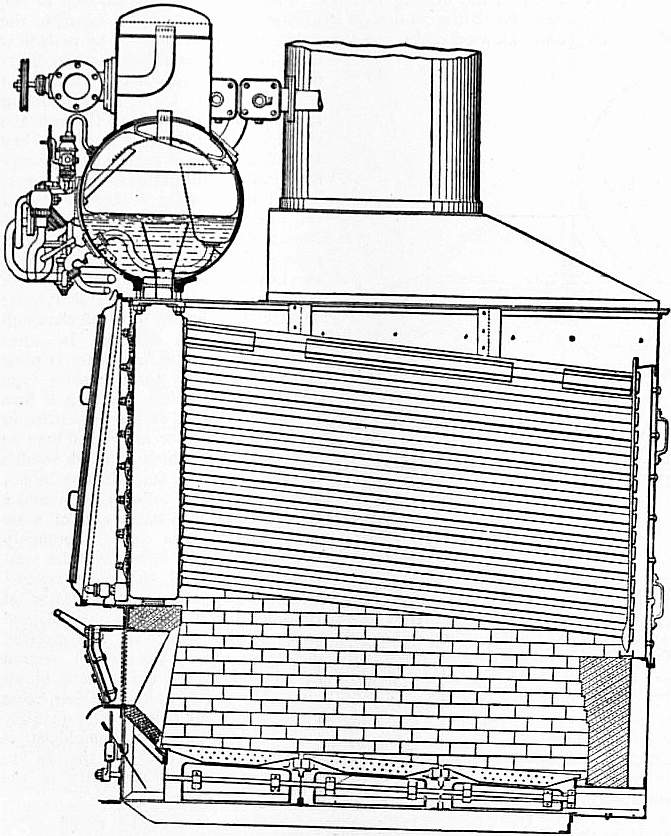
Fig. 15.—Niclausse Boiler—transverse section.
A class of water-tube boilers largely in use in torpedo-boat destroyers and cruisers, where the maximum of power is required in proportion to the total weight of the installation, is generally known as express boilers. In these the tubes Express boilers. are made of smaller diameter than those used in the boilers already described, and the boilers are designed to admit of a high rate of combustion of fuel obtained by a high degree of “forced draught.” Of these express boilers the Yarrow is of similar construction to the large tube Yarrow boiler already described with the exception that the tubes are smaller in diameter and much more closely arranged.
In the Normand boiler (fig. 19) there are three chambers as in the Yarrow, connected together by a large number of bent tubes which form the heating surface, and also connected at each end by large outside circulating tubes. The two outer rows Normand. of heating tubes on each side are arranged to touch one another to nearly their whole length so as to form a “water-wall” for the protection of the outer casing. They enter the steam-chest at about the water-level. The two inner rows of tubes, which are bent to the form shown in the figure, also form a water-wall for the larger portion of the length of the boiler, and thus compel the products of combustion to pass in a definite course amongst all the tubes. In the Blechynden and White-Foster boilers there are also three chambers connected by bent tubes, the curvature being so arranged that in the former boiler any of the tubes can be taken out of the boiler through small doors provided in the upper part of the steam-chest, and in the White-Foster boiler they can be taken out through the manhole in the end of the steam-chest.
In the Reed boiler the tubes are longer and more curved than in the Normand boiler, and there are no “water-walls,” the products of combustion passing from the fire-grate amongst all the tubes direct to the chimney. The special feature of Reed. the boiler is that each tube, instead of being expanded into the tube plate, is fitted at each end with specially designed screw and nut connexions to enable them to be quickly taken out and replaced if necessary. At their lower ends the tubes are reduced in diameter to enable smaller chambers to be used than would otherwise be necessary. Provision is made for access to the lower tube ends by means of numerous doors in the water-chambers. Access to the top ends is obtained in the steam-chest.
Messrs John I. Thornycroft & Co. make two forms of express boiler. One called the Thornycroft boiler consists of three chambers connected by tubes which are straight for the major portion of their length but bent at each end to enable Thornycroft. them to enter the steam- and water-chambers normally. The outer rows of tubes form “water-walls” at their lower parts, but permit the passage of the gases between them at their upper ends. Similarly the inner rows form “water-walls” at their upper parts, but are open at the lower ends. The products of combustion are thus compelled to pass over the whole of the heating surfaces. The fire-rows of tubes in this boiler are made 13⁄8 in. outside diameter and the remainder are made 11⁄8 in. diameter. Large outside circulating pipes are provided at the front end of the boiler.
In the other type of boiler, known as the Thornycroft-Schulz boiler (fig. 20), there are four chambers, and the fire-grate is arranged in two separate portions. The two outermost rows of tubes on each side are arranged to form water-walls at Thornycroft-Schulz. their lower part, and permit the gases to pass between them at the upper part. The rows nearest the fires are arranged similarly to those in the Thornycroft boiler. Circulation in the outer sets of tubes is arranged for by outer circulating pipes of large diameter connecting the steam- and water-chambers. For the middle water-chamber several nearly vertical down-comers are provided in the centre of the boiler. Boilers of this type are extensively used in the British and German navies.
Material of Boilers.—In ordinary land boilers and in marine boilers of all types the plates and stays are almost invariably made of mild steel. For the shell plates and for long stays, a quality having a tensile strength ranging from 28 to 32 tons per sq. in. is usually employed, and for furnaces and flues, for plates which have to be flanged, and for short-screwed stays, a somewhat softer steel with a strength ranging from 26 to 30 tons per sq. in. is used. The tubes of ordinary land and marine boilers are usually made of lap-welded wrought iron. In water-tube boilers for naval purposes seamless steel tubes are invariably used. In locomotive boilers the shells are generally of mild steel, the fire-box plates of copper (in America of steel), the fire-box side stays of copper or special bronze, and other stays of steel. The tubes are usually of brass with a composition either of two parts by weight of copper to one of zinc or 70% copper, 30% zinc; sometimes, however, copper tubes and occasionally steel tubes are used. Where water tubes are used they are made of seamless steel.
Boiler Accessories.—All boilers must be provided with certain mountings and accessories. The water-level in them must be kept above the highest part of the heating surfaces. In some land boilers, and in some of the water-tube boilers used on shipboard, the feeding is automatically regulated by mechanism actuated by a float, but in these cases means of regulating the feed-supply by hand are also provided. In most boilers hand regulation only is relied upon. The actual level of water in the boiler is ascertained by a glass water-gauge, which consists of a glass tube and three cocks, two communicating directly with the boiler, one above and one below the desired water-level, and the third acting as a blow-out for cleaning the gauge and for testing its working. Three small try-cocks are also fitted, one just at, one above, and one below the proper water-level. The feeding of the boiler is sometimes performed by a pump driven from the main engine, sometimes by an independent steam-pump, and sometimes by means of an injector. The feed-water is admitted by a “check-valve,” the lift of which is regulated by a screw and hand-wheel, and which when the feed-pump is not working is kept on its seating by the boiler pressure.
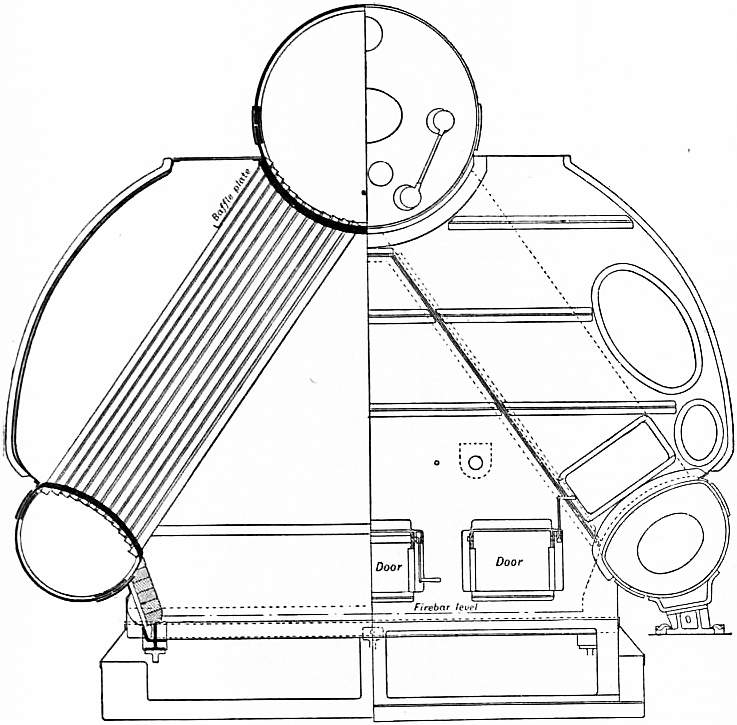
Fig. 16.—Yarrow Water-tube Boiler.
Every boiler is in addition supplied with a steam-gauge to indicate the steam-pressure, with a stop-valve for regulating the admission of steam to the steam-pipes, and with one or two safety-valves. These last in stationary boilers usually consist of valves kept in their seats against the steam-pressure in the boiler by levers carrying weights, but in marine and locomotive boilers the valves are kept closed by means of steel springs. One at least of the safety-valves is fitted with easing gear by which it can be lifted at any time for blowing off the steam. Blow-out cocks are fitted for emptying the boiler.
Openings must always be made in boilers for access for cleaning and examination. When these are large enough to allow a man to enter the boiler they are termed man-holes. They are usually made oval, as this shape permits the doors by which they are closed to be placed on the inside so that the pressure upon them tends to keep them shut. The doors are held in place by one or two bolts, secured to cross-bars or “dogs” outside the boiler. It is important in making these doors that they should fit the holes so accurately that the jointing material cannot be forced out of its proper position. In the few cases where doors are fitted outside a boiler, so that the steam-pressure tends to open them, they are always secured by several bolts so that the breakage of one bolt will not allow the door to be forced off.
Water-softening.—Seeing that the impurities contained in the feed-water are not evaporated in the steam they become concentrated in the boiler water. Most of them become precipitated in the boiler either in the form of mud or else as scale which forms on the heating surfaces. Some of the mud and such of the impurities as remain soluble may be removed by means of the blow-off cocks, but the scale can only be removed by periodical cleaning. Incrustations on the heating surface not only lessen the efficiency of the boiler by obstructing the transmission of heat through the plates and tubes, but if excessive they become a source of considerable danger by permitting the plates to become overheated and thereby weakened. When the feed-water is very impure, therefore, the boilers used are those which permit of very easy cleaning, such as the Lancashire, Galloway and Cornish types, to the exclusion of multitubular or water-tube boilers in which thorough cleaning is more difficult. In other cases, however, the feed-water is purified by passing it through some type of “softener” before pumping it into the boiler. Most of the impurities in ordinary feed-water are either lime or magnesia salts, which although soluble in cold water are much less so in hot water. In the “softener” measured quantities of feed-water and of some chemical reagents are thoroughly mixed and at the same time the temperature is raised either by exhaust steam or by other means. Most of the impurity is thus precipitated, and some of the remainder is converted into more soluble salts which remain in solution in the boiler until blown out. The water is filtered before being pumped into the boiler. The quantity and kind of chemical employed is determined according to the nature and amount of the impurity in the “hard” feed-water.
Thermal Storage.—In some cases where the work required is very intermittent, “thermal storage” is employed. Above the boiler a large cylindrical storage vessel is placed, having sufficient capacity to contain enough feed-water to supply the boiler throughout the periods when the maximum output is required. The upper part of this storage vessel is always in free communication with the steam space of the boiler, and from the lower part of it the feed-water may be run into the boiler when required. The feed-water is delivered into the upper part of the vessel, and arrangements are made by which before it falls to the bottom of the chamber it runs over very extended surfaces exposed to the steam, its temperature being thus raised to that of the steam. At times when less than the normal supply of steam is required for the engine more than the average quantity of feed-water is pumped into the chamber, and the excess accumulates with its temperature raised to the evaporation point. When an extra supply of steam is required, the feed-pump is stopped and the boiler is fed with the hot water stored in the chamber. Besides the “storage” effect, it is found that many of the impurities of the feed become deposited in the chamber, where they are comparatively harmless and from which they are readily removable.
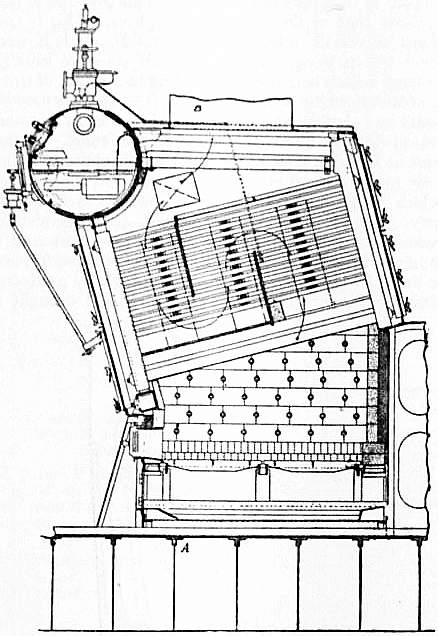
Longitudinal section.
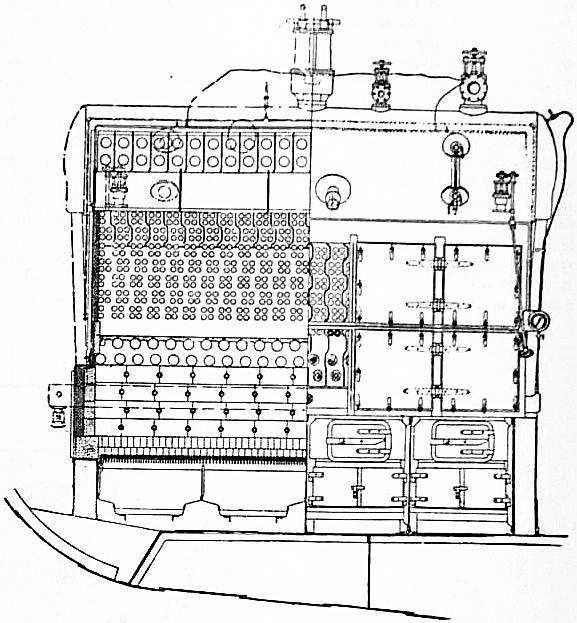
Section at AB—Front elevation.
Fig. 17.—Bobcock & Wilcox Water-tube Boiler (marine type).
Oil Separators.—When the steam from the engines is condensed and used as feed-water, as is the case with marine boilers, much difficulty is often experienced with the oil which passes over with the steam. Feed-filters are employed to stop the coarser particles of the oil, but some of the oil becomes “emulsified” or suspended in the water in such extremely minute particles that they pass through the finest filtering materials. On the evaporation of the water in the boiler, this oil is left as a thin film upon the heating surfaces, and by preventing the actual contact of water with the plates has been the cause of serious trouble. An attempt has been made to overcome the emulsion difficulty by uniformly mixing with the water a small quantity of solution of lime. On the water being raised in temperature the lime is precipitated, and the minute particles separated apparently attract the small globules of oil and become aggregated in sufficient size to deposit themselves in quiet parts of the boiler, whence they can be occasionally removed either by blowing out or by cleaning. Much, however, still remains to be done before the oil difficulty will be thoroughly removed.
Corrosion.—When chemicals of any kind are used to soften or purify feed-water it is essential that neither they nor the products they form should have a corrosive effect upon the boiler-plates, &c. Much of the corrosion which occasionally occurs has been traced to the action of the oxygen of the air which enters the boiler in solution in the feed-water, and the best practice now provides for the delivery of the feed into the boiler at such positions that the air evolved from it as it becomes heated passes direct to the steam space without having an opportunity of becoming disengaged upon the under-water surfaces of the boiler.
Where corrosion is feared it is usual to fit zinc slabs in the water spaces of the boiler. Experience shows that it is better to make them of rolled rather than of cast zinc, and to secure them on studs which can be kept bright, so as to ensure a direct metallic contact between the zinc and the boiler-plate. The function of the zinc is to set up galvanic action; it plays the part of the negative metal, and is dissolved while the metal of the shell is kept electro-positive. Care must always be taken that the fragments which break off the zinc as it wastes away cannot fall upon the heating surfaces of the boiler.
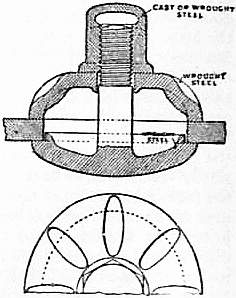
Fig. 18.—Handhole Fittings.
Evaporators.—In marine boilers the waste of water which occurs from leakages in the cycle of the evaporation in the boiler, use in the engine, condensation in the condenser and return to the boiler as feed-water, is made up by fresh water distilled from sea-water in “evaporators.” Of these there are many forms with different provisions for cleaning the coils, but they are all identical in principle. They are fed with sea-water, and means are provided for blowing out the brine produced in them when some of the water is evaporated. The heat required for the evaporation is obtained from live steam from the boilers, which is admitted into coils of copper pipe. The water condensed in these coils is returned direct to the feed-water, and the steam evaporated from the sea-water is led either into the low-pressure receiver of the steam-engine or into the condenser.
Efficiency of Boilers.—The useful work obtained from any boiler depends upon many considerations. For a high efficiency, that is, a large amount of steam produced in proportion to the amount of fuel consumed, different conditions have to be fulfilled from those required where a large output of steam from a given plant is of more importance than economy of fuel. For a high efficiency, completeness of combustion of fuel must be combined with sufficient heating surface to absorb so much of the heat produced as will reduce the temperature of the funnel gases to nearly that of steam. Completeness of combustion can only be obtained by admitting considerably more air to the fire than is theoretically necessary fully to oxidize the combustible portions of the fuel, and by providing sufficient time and opportunity for a thorough mixture of the air and furnace gases to take place before the temperature is lowered to that critical point below which combustion will not take place. It is generally considered that the amount of excess air required is nearly equal to that theoretically necessary; experience, however, tends to show that much less than this is really required if proper means are provided for ensuring an early complete mixture of the gases. Different means are needed to effect this with different kinds of coal, those necessary for properly burning Welsh coal being altogether unsuitable for use with North Country or Scottish coal. As all the excess air has to be raised to the same temperature as that of the really burnt gases, it follows that an excess of air passing through the fire lowers the temperature in the fire and flues, and therefore lessens the heat transmission; and as it leaves the boiler at a high temperature it carries off some of the heat produced. A reduction of the amount of air, therefore, may, by increasing the fire temperature and lessening the chimney waste, actually increase the efficiency even if at the same time it is accompanied by a slight incompleteness of combustion.
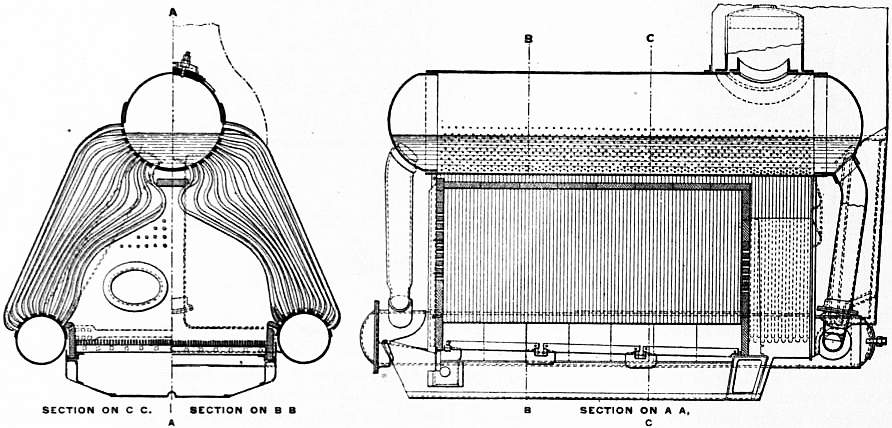
Fig. 19.—Normand Boiler.
Mechanical Stoking.—Most boilers are hand-fired, a system involving much labour and frequent openings of the furnace doors, whereby large quantities of cold air are admitted above the fires. Many systems of mechanical stoking have been tried, but none has been found free from objections. That most usually employed is known as the “chain-grate” stoker. In this system, which is illustrated in fig. 13 (Woodeson boiler), the grate consists of a wide endless chain formed of short cast-iron bars; this passes over suitable drums at the front and back of the boiler, by the slow rotation of which the grate travels very slowly from front to back. The coal, which is broken small, is fed from a hopper over the whole width of the grate, the thickness of the fire being regulated by a door which can be raised or lowered as desired. Thus the volatile portions of the coal are distilled at the front of the fire, and pass over the incandescent fuel at the back end. The speed of travel is so regulated that by the time the remaining parts of the fuel reach the back end the combustion is nearly complete. It will be seen that the fire becomes thinner towards the back, and too much air is prevented from entering the thin portion by means of vanes actuated from the front of the boiler.
Draught.—In most boilers the draught necessary for combustion is “natural,” i.e. produced by a chimney. For marine purposes, although “natural” draught is the more common, many boiler installations are fitted with “forced” draught arrangements. Two distinct systems are used. In that known as the “closed stokehold” the stokehold compartment of the vessel is so closed that the only exit for air from it is through the fires. Air is driven into the stokehold by means of fans which are made so that they can maintain an air pressure in the stokehold above that of the outside atmosphere. This is the system almost universally adopted in war vessels, and it is used also in some fast passenger ships. The air pressure usually adopted in large vessels is that corresponding to a height of from 1 to 1½ in. of water, whilst so much as 4 in. is sometimes used in torpedo-boats and similar craft. This is, of course, in addition to the chimney-draught due to the height of the funnel. In the closed ashpit or Howden system, the stokehold is open, and fans drive the air round a number of tubes, situated in the uptake, through which the products of combustion pass on their way to the chimney. The air thus becomes heated, and part of it is then delivered into the ashpit below the fire and part into a casing round the furnace front from which it enters the furnace above the fire. In locomotive boilers the draught is produced by the blast or the exhaust steam. With natural draught a combustion of about 15 to 20 ℔ of coal per sq. ft. of grate area per hour can be obtained. With forced draught much greater rates can be maintained, ranging from 20 ℔ to 35 ℔ in the larger vessels with a moderate air pressure, to as much as 70 and even 80 ℔ per sq. ft. in the express types of boiler used in torpedo boats and similar craft.
Performance of Boilers.—The makers of several types of boilers have published particulars regarding the efficiency of the boilers they construct, but naturally these results have been obtained under the most favourable circumstances which may not always represent the conditions of ordinary working. The following table of actual results of marine boiler trials, made at the instance of the British admiralty, is particularly useful because the trials were made with great care under working conditions, the whole of the coal being weighed and the feed-water measured throughout the trials by skilled observers. The various trials can be compared amongst themselves as South Welsh coal of excellent quality was used in all cases.
In experimental tests such as those above referred to, many conditions have to be taken into account, the principal being the duration of the trial. It is essential that the condition of the boiler at the conclusion of the test should be precisely the same as at the commencement, both as regards the quantity of unconsumed coals on the fire-grate and the quantity of water and the steam-pressure in the boiler. The longer the period over which the observations are taken the less is the influence of errors in the estimation of these particulars. Further, in order properly to represent working conditions, the rate of combustion of the fuel throughout the trial must be the same as that intended to be used in ordinary working, and the duration of the test must be sufficient to include proportionately as much cleaning of fires as would occur under the normal working conditions. The tests should always be made with the kind of coal intended to be generally used, and the records should include a test of the calorific value of a sample of the fuel carefully selected so as fairly to represent the bulk of the coal used during the trial. The periodic records taken are the weights of the fuel used and of the ashes, &c., produced, the temperature and quantity of the feed-water, the steam pressure maintained, and the wetness of the steam produced. This last should be ascertained from samples taken from the steam pipe at a position where the full pressure is maintained. In order to reduce to a common standard observations taken under different conditions of feed temperatures and steam pressures, the results are calculated to an equivalent evaporation at the atmospheric pressure from a feed temperature of 212° F.
(J. T. Mi.)
Trials of Various Types of Marine Boilers
Description of Boiler. Grate Area sq. ft. Heating Surface sq. ft. Duration of Trial Hours. Coal burned Per sq. ft. of Grate per Hour. Air Pressure in Stoke- hold— Inches of Water. Chimney Draught— Inches of Water Water Evaporated per ℔ of Coal. Water Evapor- ated per sq. ft. of Heating Surface. Thermal Units per ℔ of coal. Effic- iency of Boiler %.
Actual From and at 212° F.
℔ ℔ ℔
Ordinary cylindrical single- ended; 3 furnaces; 155 ℔ working pressure; closed stokehold system.* 81 2308 25 14.2 Nil 0.36 8.56 10.26 4.26 14,267 69.7
” ” 24 13.9 ” 0.50 8.84 10.33 4.32 14,697 68.0
” ” 9 30.3 0.81 0.39 7.93 9.27 8.46 14,686 61.4
” ” 8½ 29.1 0.65 0.32 8.84 10.34 9.05 14,612 68.4
Ordinary cylindrical single- ended; 3 furnaces; 210 ℔ working pressure; closed ashpit, Howden system.** 63.2 2876 in boiler, 766 in air heaters 13 20.6 In Ash- pit 1.53 0.58 11.30 12.33 5.14 14,475 82.3
Niclausse water-tube; 160 ℔ working pressure. 46 1322 8 12.8 Nil 0.20 8.41 10.15 3.75 14,680 66.9
” ” 8 21.9 ” 0.20 8.01 9.40 6.11 14,760 62.1
” ” 37 20.2 ” 0.29 7.62 9.00 5.44 14,600 60.5
Niclausse water-tube; 250 ℔ working pressure. 34 990 9 14.0 0.10 0.23 8.77 10.50 4.17 14,640 69.8
” ” 9 22.0 0.27 0.23 7.68 9.06 5.74 14,640 60.4
” ” 90 15.4 Nil Not asce- rtained 7.61 9.08 4.00 14,630 59.9
Babcock water-tube; 33⁄16 in. tubes; 260 ℔ working pressure. 36 1010 9 13.0 ” 0.26 9.31 11.02 4.30 14,590 73.2
” ” 9 20.0 0.18 0.20 8.58 10.11 6.13 14,590 67.0
” ” 90 14.5 Nil Not asce- rtained 8.09 9.53 4.18 · · 63.1
Babcock water-tube; 113⁄16 in. tubes; 270 ℔ working pressure.*** 62 2167 28 18.4 ” 0.45 8.94 10.61 4.61 14,520 70.7
” ” 24 19.2 ” 0.47 8.93 10.59 4.82 14,390 71.1
” ” 12 20.5 ” 0.42 9.42 11.04 5.41 14,080 75.8
” ” 7 28.9 0.50 Not asce- rtained 8.54 9.88 6.91 14,390 66.3
” ” 30 19.9 Nil 0.38 10.11 12.00 6.01 14,530 79.9
” ” 29 27.1 0.66 0.23 9.96 11.67 8.05 14,630 77.1
Belleville water-tube with economizers; 320 ℔ working pressure. 44 910 in boiler; 24½ 15.8 Nil 0.36 9.65 11.46 4.94 14,697 77.2
” 447 in econo- 24 17.4 ” 0.39 9.33 11.00 5.30 14,805 71.8
” mizer; 11 19.8 ” 0.43 9.39 11.03 6.38 14,578 73.3
” 1357 total. 8 27.2 ” 0.39 8.28 9.79 7.78 14,611 65.0
Yarrow water tube; 1¾ in. tubes; 250 ℔ working pressure. 56 2896 26 16.9 Nil 0.31 9.57 11.45 3.12 14,750 75.0
” ” 26 18.2 ” 0.31 9.37 11.33 3.30 14,500 75.7
” ” 25 21.3 ” 0.31 8.83 10.45 3.63 13,500 75.2
” ” 30 35.4 0.53 0.26 8.82 10.59 6.04 14,430 70.9
” ” 8 41.9 0.86 0.31 8.24 9.94 6.69 14,500 66.3
” ” 8 33.7 0.31 0.30 8.39 9.93 5.47 14,680 65.4
” ” 8 39.8 0.82 0.24 8.85 10.43 6.81 14,530 69.5
Dürr water-tube; 250 ℔ working pressure. 71 2671 in boiler, 140 in super- heater; 2811 total. 26 16.1 Nil 0.39 7.95 9.50 3.24 14,500 63.8
” 26 17.7 ” 0.30 7.06 9.28 3.43 14,620 61.7
” 25 21.1 ” 0.31 7.62 9.08 4.05 14,650 60.3
” 7 33.8 0.70 0.36 7.72 9.29 6.59 14,570 62.7
” 8 26.7 0.33 0.35 7.86 9.26 5.30 14,320 63.1
” 8 34.6 1.11 0.20 8.02 9.53 7.02 14,230 64.8
” 22 34.8 0.73 0.16 6.84 8.06 6.02 14,430 54.0
” 24 29.9 0.35 0.12 7.62 9.00 5.75 14,240 61.2
” 20 19.9 Nil 0.21 7.30 8.33 3.66 14,240 8.6
* In the first three trials no retarders were used in the tubes. In the last trial retarders were used.
** In this trial retarders were used in the tubes.
*** The first four trials were made with horizontal baffles above the tubes; the last two trials with the baffling described in the text.
Boiler Making
The practice of the boiler, bridge and girder shops may here be conveniently treated together, because similar materials and methods are employed in each, notwithstanding that many points of divergence in practice generally relegate them to separate departments. The materials used are chiefly iron and steel. The methods mostly adopted are those involved in the working of plates and rolled sections, which vastly predominate over the bars and rods used chiefly in the smithy. But there are numerous differences in methods of construction. Flanging occupies a large place in boilermaking, for end-plates, tube-plates, furnace flues, &c., but is scarcely represented in bridge and girder work. Plates are bent to cylindrical shapes in boilermaking, for shells and furnaces, but not in girder work. Welding is much more common in the first than in the second, furnace flues being always welded and stand pipes frequently. In boiler work holes are generally drilled through the seams of adjacent plates. In bridge work each plate or bar is usually drilled or punched apart from its fellows. Boilers, again, being subject to high temperatures and pressures, must be constructed with provisions to ensure some elasticity and freedom of movement under varying temperatures to prevent fractures or grooving, and must be made of materials that combine high ductility with strength when heated to furnace temperatures. Flanging of certain parts, judicious staying, limitation of the length of the tubes, the forms of which are inherently weak, provide for the first; the selection of steel or iron of high percentage elongation, and the imposition of temper, or bending tests, both hot and cold, provide for the second.
The following are the leading features of present-day methods.
It might be hastily supposed that, because plates, angles, tees, channels and joist sections are rolled ready for use, little work could be left for the plater and boilermaker. But actually so much is involved that subdivisions of tasks are numerous; the operations of templet-making, rolling, planing, punching and shearing, bending, welding and forging, flanging, drilling, riveting, caulking, and tubing require the labours of several groups of machine attendants, and of gangs of unskilled labourers or helpers. Some operations also have to be done at a red or white heat, others cold. To the first belong flanging and welding, to the latter generally all the other operations. Heating is necessary for the rolling of tubes of small diameter; bending is done cold or hot according to circumstances.
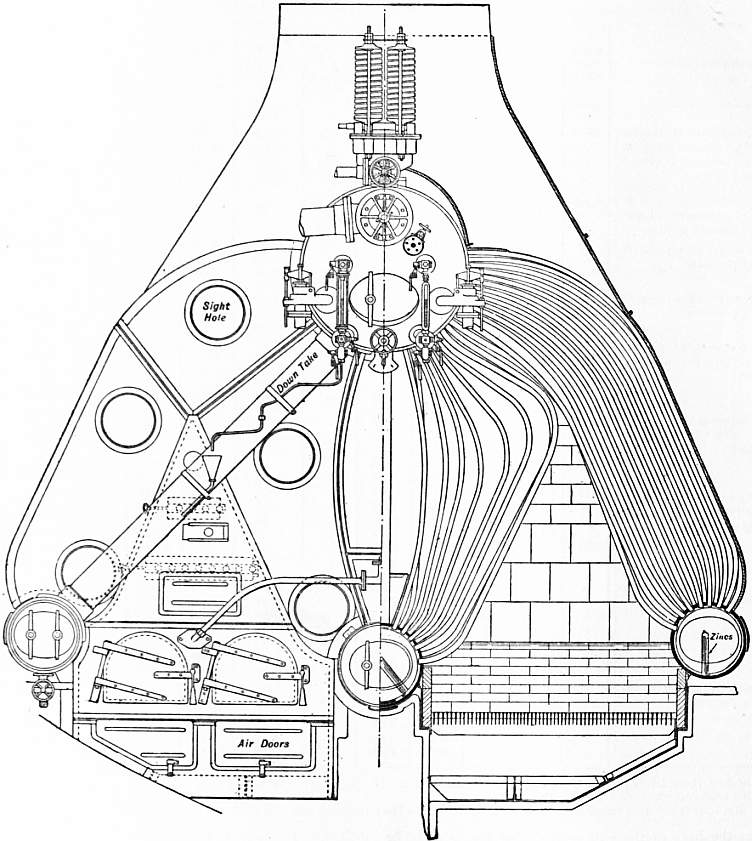
Fig. 20.—Thornycroft-Schulz Water-tube Boiler.
The fact that some kinds of treatment, as shearing and punching, flanging and bending, are of a very violent character explains why practice has changed radically in regard to the method of performing these operations in cases where safety is a cardinal matter. Shearing and punching are both severely detrusive operations performed on cold metal; both leave jagged edges and, as experience has proved, very minute cracks, the tendency of which is to extend under subsequent stress, with liability to produce fracture. But it has been found that, when a shorn edge is planed and a punched hole enlarged by reamering, no harm results, provided not less than about 1⁄16 in. is removed. A great advance was therefore made when specifications first insisted on the removal of the rough edges before the parts were united.
In the work of riveting another evil long existed. When holes are punched it is practically impossible to ensure the exact coincidence of holes in different plates which have to be brought together for the purpose of riveting. From this followed the use of the drift,—a tapered rod driven forcibly by hammer blows through corresponding holes in adjacent plates, by which violent treatment the holes were forcibly drawn into alignment. This drifting stressed the plates, setting up permanent strains and enlarging incipient cracks, and many boiler explosions have been clearly traceable to the abuse of this tool. Then, next, specifications insisted that all holes should be enlarged by reamering after the plates were in place. But even that did not prove a safeguard, because it often happened that the metal reamered was nearly all removed from one side of a hole, so leaving the other side just as the punch had torn it. Ultimately came the era of drilling rivet-holes, to which there is no exception now in high-class boiler work. For average girder and bridge work the practice of punching and reamering is still in use, because the conditions of service are not so severe as are those in steam boilers.
Flanging signifies the turning or bending over of the edges of a plate to afford a means of union to other plates. Examples occur in the back end-plates of Lancashire and Cornish boilers, the front and back plates of marine boilers, the fire-boxes of locomotive boilers, the crowns of vertical boilers, the ends of conical cross-tubes, and the Adamson seams of furnace flues. This practice has superseded the older system of effecting union by means of rings forming two sides of a rectangular section (angle iron rings). These were a fruitful source of grooving and explosions in steam boilers, because their sharp angular form lacked elasticity; hence the reason for the substitution of a flange turned with a large radius, which afforded the elasticity necessary to counteract the effects of changes in temperature. In girder work where such conditions do not exist, the method of union with angles is of course retained. In the early days of flanging the process was performed in detail by a skilled workman (the angle ironsmith), and it is still so done in small establishments. A length of edge of about 10 in. or a foot is heated, and bent by hammering around the edge of a block of iron of suitable shape. Then another “heat” is taken and flanged, and another, until the work is complete. But in modern boiler shops little hand work is ever done; instead, plates 4 ft., 6 ft., or 8 ft. in diameter, and fire-box plates for locomotive boilers, have their entire flanges bent at a single squeeze between massive dies in a hydraulic press. In the case of the ends of marine boilers which are too large for such treatment, a special form of press bends the edges over in successive heats. The flanges of Adamson seams are rolled over in a special machine. A length of flue is rotated on a table, while the flange is turned over within a minute between revolving rollers. There is another advantage in the adoption of machine-flanging, besides the enormous saving of time, namely, that the material suffers far less injury than it does in hand-flanging.
These differences in practice would not have assumed such magnitude but for the introduction of mild steel in place of malleable iron. Iron suffers less from overheating and irregular heating than does steel. Steel possesses higher ductility, but it is also more liable to develop cracks if subjected to improper treatment. All this and much more is writ large in the early testing of steel, and is reflected in present-day practice.
A feature peculiar to the boiler and plating shops is the enormous number of rivet holes which have to be made, and of rivets to be inserted. These requirements are reflected in machine design. To punch or drill holes singly is too slow a process in the best practice, and so machines are made for producing many holes simultaneously. Besides this, the different sections of boilers are drilled in machines of different types, some for shells, some for furnaces, some peculiar to the shells or furnaces of one type of boilers, others to those of another type only. And generally now these machines not only drill, but can also be adjusted to drill to exact pitch, the necessity thus being avoided of marking out the holes as guides to the drills.
Hand-riveting has mostly been displaced by hydraulic and pneumatic machines, with resulting great saving in cost, and the advantage of more trustworthy and uniform results. For boiler work, machines are mostly of fixed type; for bridge and girder work they are portable, being slung from chains and provided with pressure water or compressed air by systems of flexible pipes.
Welding fills a large place in boiler work, but it is that of the edges of plates chiefly, predominating over that of the bars and rods of the smithy. The edges to be united are thin and long, so that short lengths have to be done in succession at successive “heats.” Much of this is hand work, and “gluts” or insertion pieces are generally preferred to overlapping joints. But in large shops, steam-driven power hammers are used for closing the welds. Parts that are commonly welded are the furnace flues, the conical cross-tubes and angle rings.
Another aspect of the work of these departments is the immense proportions of the modern machine tools used. This development is due in great degree to the substitution of steel for iron. The steel shell-plates of the largest boilers are 1½ in. thick, and these have to be bent into cylindrical forms. In the old days of iron boilers the capacity of rolls never exceeded about ¾ in. plate. Often, alternatively to rolling, these thick plates are bent by squeezing them in successive sections between huge blocks operated by hydraulic pressure acting on toggle levers. And other machines besides the rolls are made more massive than formerly to deal with the immense plates of modern marine boilers.
The boiler and plating shops have been affected by the general tendency to specialize manufactures. Firms have fallen into the practice of restricting their range of product, with increase in volume. The time has gone past when a single shop could turn out several classes of boilers, and undertake any bridge and girder work as well. One reason is to be found in the diminution of hand work and the growth of the machine tool. Almost every distinct operation on every section of a boiler or bridge may now be accomplished by one of several highly specialized machines. Repetitive operations are provided for thus, and by a system of templeting. If twenty or fifty similar boilers are made in a year, each plate, hole, flange or stay will be exactly like every similar one in the set. Dimensions of plates will be marked from a sample or templet plate, and holes will be marked similarly; or in many cases they are not marked at all, but pitched and drilled at once by self-acting mechanism embodied in drilling machines specially designed for one set of operations on one kind of plate. Hundreds of bracing bars for bridges and girders will be cut off all alike, and drilled or punched from a templet bar, so that they are ready to take their place in bridge or girder without any adjustments or fitting.
(J. G. H.)
BOILING TO DEATH, a punishment once common both in England and on the continent. The only extant legislative notice of it in England occurs in an act passed in 1531 during the reign of Henry VIII., providing that convicted poisoners should be boiled to death; it is, however, frequently mentioned earlier as a punishment for coining. The Chronicles of the Grey Friars (published by the Camden Society, 1852) have an account of boiling for poisoning at Smithfield in the year 1522, the man being fastened to a chain and lowered into boiling water several times until he died. The preamble of the statute of Henry VIII. (which made poisoning treason) in 1531 recites that one Richard Roose (or Coke), a cook, by putting poison in some food intended for the household of the bishop of Rochester and for the poor of the parish of Lambeth, killed a man and woman. He was found guilty of treason and sentenced to be boiled to death without benefit of clergy. He was publicly boiled at Smithfield. In the same year a maid-servant for poisoning her mistress was boiled at King’s Lynn. In 1542 Margaret Davy, a servant, for poisoning her employer, was boiled at Smithfield. In the reign of Edward VI., in 1547, the act was repealed.
See also W. Andrews, Old Time Punishments (Hull, 1890); Notes and Queries, vol. i. (1862), vol. ix. (1867); Du Cange (s.v. Caldariis decoquere).
BOIS BRÛLÉS, or Brulés (a French translation of their Indian name Sichangu), a sub-tribe of North American Dakota Indians (Teton river division). The name is most frequently associated with the half-breeds in Manitoba, who in 1869 came into temporary prominence in connexion with Riel’s Rebellion (see Red River); at that time they had lost all tribal purity, and were alternatively called Metis (half-castes), the majority being descendants of French-Canadians.
BOISÉ, a city and the county-seat of Ada county, Idaho, U.S.A., and the capital of the state, situated on the N. side of the Boisé river, in the S.W. part of the state, at an altitude of about 2700 ft. Pop. (1890) 2311; (1900) 5957; (1910) 17,358. It is served by the Oregon Short Line railway, being the terminus of a branch connecting with the main line at Nampa, about 20 m. W.; and by electric lines connecting with Caldwell and Nampa. The principal buildings are the state capitol, the United States assay office, a Carnegie library, a natatorium, and the Federal building, containing the post office, the United States circuit and district court rooms, and a U.S. land office. Boisé is the seat of the state school for the deaf and blind (1906), and just outside the city limits are the state soldiers’ home and the state penitentiary. About 2 m. from the city are Federal barracks. Hot water (175° F.) from artesian wells near the city is utilized for the natatorium and to heat many residences and public buildings. The Boisé valley is an excellent country for raising apples, prunes and other fruits. The manufactured products of the city are such as are demanded by a mining country, principally lumber, flour and machine-shop products. Boisé is the trade centre of the surrounding fruit-growing, agricultural and mining country, and is an important wool market. The oldest settlement in the vicinity was made by the Hudson’s Bay Fur Company on the west side of the Boisé river, before 1860; the present city, chartered in 1864, dates from 1863. After 1900 the city grew very rapidly, principally owing to the great irrigation schemes in southern Idaho; the water for the immense Boisé-Payette irrigation system is taken from the Boisé, 8 m. above the city. (See Idaho.)
BOISGOBEY, FORTUNÉ DU (1824-1891), French writer of fiction, whose real surname was Castille, was born at Granville (Manche) on the 11th of September 1824. He served in the army pay department in Algeria from 1844 to 1848, and extended his travels to the East. He made his literary debut in the Petit journal with a story entitled Deux comédiens (1868). With Le Forçat colonel (1872) he became one of the most popular feuilleton writers. His police stories, though not so convincing as those of Émile Gaboriau, with whom his name is generally associated, had a great circulation, and many of them have been translated into English. Among his stories may be mentioned: Les Mystères du nouveau Paris (1876), Le Demi-Monde sous la Terreur (1877), Les Nuits de Constantinople (1882), Le Cri du sang (1885), La Main froide (1889). Boisgobey died on the 26th of February 1891.
BOISGUILBERT, PIERRE LE PESANT, Sieur de (1676-1714), French economist, was born at Rouen of an ancient noble family of Normandy, allied to that of Corneille. He received his classical education in Rouen, entered the magistracy and became judge at Montivilliers, near Havre. In 1690 he became president of the bailliage of Rouen, a post which he retained almost until his death, leaving it to his son. In these two situations he made a close study of local economic conditions, personally supervising the cultivation of his lands, and entering into relations with the principal merchants of Rouen. He was thus led to consider the misery of the people under the burden of taxation. In 1695 he published his principal work, Le Détail de la France; la cause de la diminution de ses biens, et la facilité du remède.... In it he drew a picture of the general ruin of all classes of Frenchmen, caused by the bad economic régime. In opposition to Colbert’s views he held that the wealth of a country consists, not in the abundance of money which it possesses but in what it produces and exchanges. The remedy for the evils of the time was not so much the reduction as the equalization of the imposts, which would allow the poor to consume more, raise the production and add to the general wealth. He demanded the reform of the taille, the suppression of internal customs duties and greater freedom of trade. In his Factum de la France, published in 1705 or 1706, he gave a more concise résumé of his ideas. But his proposal to substitute for all aides and customs duties a single capitation tax of a tenth of the revenue of all property was naturally opposed by the farmers of taxes and found little support. Indeed his work, written in a diffuse and inelegant style, passed almost unnoticed. Saint Simon relates that he once asked a hearing of the comte de Pontchartrain, saying that he would at first believe him mad, then become interested, and then see he was right. Pontchartrain bluntly told him that he did think him mad, and turned his back on him. With Michel de Chamillart, whom he had known as intendant of Rouen (1689-1690), he had no better success. Upon the disgrace of Vauban, whose Dîme royale had much in common with Boisguilbert’s plan, Boisguilbert violently attacked the controller in a pamphlet, Supplément au détail de la France. The book was seized and condemned, and its author exiled to Auvergne, though soon allowed to return. At last in 1710 the controller-general, Nicolas Desmarets, established a new impost, the “tenth” (dixième), which had some analogy with the project of Boisguilbert. Instead of replacing the former imposts, however, Desmarets simply added his dixième to them; the experiment was naturally disastrous, and the idea was abandoned.
In 1712 appeared a Testament politique de M. de Vauban, which is simply Boisguilbert’s Détail de la France. Vauban’s Dîme royale was formerly wrongly attributed to him. Boisguilbert’s works were collected by Daire in the first volume of the Collection des grands économistes. His letters are in the Correspondance des contrôleurs généraux, vol. i., published by M. de Boislisle.
BOISROBERT, FRANÇOIS LE METEL DE (1592-1662), French poet, was born at Caen in 1592. He was trained for the law, and practised for some time at the bar at Rouen. About 1622 he went to Paris, and by the next year had established a footing at court, for he had a share in the ballet of the Bacchanales performed at the Louvre in February. He accompanied an embassy to England in 1625, and in 1630 visited Rome, where he won the favour of Urban VIII. by his wit. He took orders, and was made a canon of Rouen. He had been introduced to Richelieu in 1623, and by his humour and his talent as a raconteur soon made himself indispensable to the cardinal. Boisrobert became one of the five poets who carried out Richelieu’s dramatic ideas. He had a passion for play, and was a friend of Ninon de l’Enclos; and his enemies found ready weapons against him in the undisguised looseness of his life. He was more than once disgraced, but never for long, although in his later years he was compelled to give more attention to his duties as a priest. It was Boisrobert who suggested to Richelieu the plan of the Academy, and he was one of its earliest and most active members. Rich as he was through the benefices conferred on him by his patron, he was liberal to men of letters. After the death of Richelieu, he attached himself to Mazarin, whom he served faithfully throughout the Fronde. He died on the 30th of March 1662. He wrote a number of comedies, to one of which, La Belle Plaideuse, Molière’s L’Avare is said to owe something; and also some volumes of verse. The licentious Contes, published under the name of his brother D’Ouville, are often attributed to him.
BOISSARD, JEAN JACQUES (1528-1602), French antiquary and Latin poet, was born at Besançon. He studied at Louvain; but, disgusted by the severity of his master, he secretly left that seminary, and after traversing a great part of Germany reached Italy, where he remained several years and was often reduced to great straits. His residence in Italy developed in his mind a taste for antiquities, and he soon formed a collection of the most curious monuments from Rome and its vicinity. He then visited the islands of the Archipelago, with the intention of travelling through Greece, but a severe illness obliged him to return to Rome. Here he resumed his favourite pursuits with great ardour, and having completed his collection, returned to his native country; but not being permitted to profess publicly the Protestant religion, which he had embraced some time before, he withdrew to Metz, where he died on the 30th of October 1602. His most important works are: Poemata (1574); Emblemata (1584); Icones Virorum Illustrium (1597); Vitae et Icones Sultanorum Turcicorum, &c. (1597); Theatrum Vitae Humanae (1596); Romanae Urbis Topographia (1597-1602), now very rare; De Divinatione et Magicis Praestigiis (1605); Habitus Variarum Orbis Gentium (1581), ornamented with seventy illuminated figures.
BOISSIER, MARIE LOUIS ANTOINE GASTON (1823-1908), French classical scholar, and secretary of the French Academy, was born at Nimes on the 15th of August 1823. The Roman monuments of his native town very early attracted Gaston Boissier to the study of ancient history. He made epigraphy his particular theme, and at the age of twenty-three became a professor of rhetoric at Angoulême, where he lived and worked for ten years without further ambition. A travelling inspector of the university, however, happened to hear him lecture, and Boissier was called to Paris to be professor at the Lycée Charlemagne. He began his literary career by a thesis on the poet Attius (1857) and a study on the life and work of M. Terentius Varro (1861). In 1861 he was made professor of Latin oratory at the Collège de France, and he became an active contributor to the Revue des deux mondes. In 1865 he published Cicéron et ses amis (Eng. trans, by A.D. Jones, 1897), which has enjoyed a success such as rarely falls to the lot of a work of erudition. In studying the manners of ancient Rome, Boissier had learned to re-create its society and to reproduce its characteristics with exquisite vivacity. In 1874 he published La Religion romaine d’Auguste aux Antonins (2 vols.), in which he analysed the great religious movement of antiquity that preceded the acceptance of Christianity. In L’Opposition sous les Césars (1875) he drew a remarkable picture of the political decadence of Rome under the early successors of Augustus. By this time Boissier had drawn to himself the universal respect of scholars and men of letters, and on the death of H.J.G. Patin, the author of Études sur les tragiques grecs, in 1876, he was elected a member of the French Academy, of which he was appointed perpetual secretary in 1895.
His later works include Promenades archéologiques: Rome et Pompéi (1880; second series, 1886); L’Afrique romaine, promenades archéologiques (1901); La Fin du paganisme (2 vols., 1891); Le Conjuration de Catilina (1905); Tacite (1903, Eng. trans, by W.G. Hutchison, 1906). He was a representative example of the French talent for lucidity and elegance applied with entire seriousness to weighty matters of literature. Though he devoted himself mainly to his great theme, the reconstruction of the elements of Roman society, he also wrote monographs on Madame de Sévigné (1887) and Saint-Simon (1892). He died in June 1908.
BOISSONADE DE FONTARABIE, JEAN FRANÇOIS (1774-1857), French classical scholar, was born at Paris on the 12th of August 1774. In 1792 he entered the public service during the administration of General Dumouriez. Driven from it in 1795, he was restored by Lucien Bonaparte, during whose time of office he served as secretary to the prefecture of the Upper Marne. He then definitely resigned public employment and devoted himself to the study of Greek. In 1809 he was appointed deputy professor of Greek at the faculty of letters at Paris, and titular professor in 1813 on the death of P.H. Larcher. In 1828 he succeeded J.B. Gail in the chair of Greek at the Collège de France. He also held the offices of librarian of the Bibliothèque du Roi, and of perpetual secretary of the Académie des Inscriptions. He died on the 8th of September 1857. Boissonade chiefly devoted his attention to later Greek literature: Philostratus, Heroica (1806) and Epistolae (1842); Marinus, Vita procli (1814); Tiberius Rhetor, De Figuris (1815); Nicetas Eugenianus, Drosilla et Charicles (1819); Herodian, Partitiones (1819); Aristaenetus, Epistolae (1822); Eunapius, Vitae Sophistarum (1822); Babrius, Fables (1844); Tzetzes, Allegoriae Iliados (1851); and a Collection of Greek Poets in 24 vols. The Anecdota Graeca (1829-1833) and Anecdota Nova (1844) are important for Byzantine history and the Greek grammarians.
A selection of his papers was published by F. Colincamp, Critique littéraire sous le premier Empire (1863), vol. i. of which contains a complete list of his works, and a “Notice Historique sur Monsieur B.,” by Naudet.
BOISSY D’ANGLAS, FRANÇOIS ANTOINE DE (1756-1828), French statesman, received a careful education and busied himself at first with literature. He had been a member of several provincial academies before coming to Paris, where he purchased a position as advocate to the parlement. In 1789 he was elected by the third estate of the sénéchaussée of Annonay as deputy to the states-general. He was one of those who induced the states-general to proclaim itself a National Assembly on the 17th of June 1789; approved, in several speeches, of the capture of the Bastille and of the taking of the royal family to Paris (October 1789); demanded that strict measures be taken against the royalists who were intriguing in the south of France, and published some pamphlets on finance. During the Legislative Assembly he was procureur-syndic for the directory of the department of Ardeche. Elected to the Convention, he sat in the centre, “le Marais,” voting in the trial of Louis XVI. for his detention until deportation should be judged expedient for the state. He was then sent on a mission to Lyons to investigate the frauds in connexion with the supplies of the army of the Alps. During the Terror he was one of those deputies of the centre who supported Robespierre; but he was gained over by the members of the Mountain hostile to Robespierre, and his support, along with that of some other leaders of the Marais, made possible the 9th Thermidor. He was then elected a member of the Committee of Public Safety and charged with the superintendence of the provisioning of Paris. He presented the report supporting the decree of the 3rd Ventose of the year III. which established liberty of worship. In the critical days of Germinal and of Prairial of the year III. he showed great courage. On the 12th Germinal he was in the tribune, reading a report on the food supplies, when the hall of the Convention was invaded by the rioters, and when they withdrew he quietly continued where he had been interrupted. On the 1st Prairial he presided over the Convention, and remained unmoved by the insults and menaces of the insurgents. When the head of the deputy, Jean Féraud, was presented to him on the end of a pike, he saluted it impassively. He was reporter of the committee which drew up the constitution of the year III., and his report shows keen apprehension of a return of the Reign of Terror, and presents reactionary measures as precautions against the re-establishment of “tyranny and anarchy.” This report, the proposal that he made (August 27, 1795) to lessen the severity of the revolutionary laws, and the eulogies he received from several Paris sections suspected of disloyalty to the republic, resulted in his being obliged to justify himself (October 15, 1795). As a member of the Council of the Five Hundred he became more and more suspected of royalism. He presented a measure in favour of full liberty for the press, which at that time was almost unanimously reactionary, protested against the outlawry of returned émigrés, spoke in favour of the deported priests and attacked the Directory. Accordingly he was proscribed on the 18th Fructidor, and lived in England until the Consulate. In 1801 he was made a member of the Tribunate, and in 1805 a senator. In 1814 he voted for Napoleon’s abdication, which won for him a seat in the chamber of peers; but during the Hundred Days he served Napoleon, and in consequence, on the second Restoration, was for a short while excluded. In the chamber he still sought to obtain liberty for the press—a theme upon which he published a volume of his speeches (Paris, 1817). He was a member of the Institute from its foundation, and in 1816, at the reorganization, became a member of the Académie des Inscriptions et Belles-Lettres. He published in 1819-1821 a two-volume Essai sur la vie et les opinions de M. de Malesherbes.
See F.A. Aulard, Les Orateurs de la Révolution (2nd ed., 1906); L. Sciout, Le Directoire (4 vols., 1895); and the “Notice sur la vie et les œuvres de M. Boissy d’Anglas” in the Mémoires de l’Académie des Inscriptions, ix.
(R. A.*)
BOITO, ARRIGO (1842- ), Italian poet and musical composer, was born at Padua on the 24th of February 1842. He studied music at the Milan Conservatoire, but even in those early days he devoted as much of his time to literature as to music, forecasting the divided allegiance which was to be the chief characteristic of his life’s history. While at the Conservatoire he wrote and composed, in collaboration with Franco Faccio, a cantata, Le Sorelle d’Italia, which was performed with success. On completing his studies Boito travelled for some years, and after his return to Italy settled down in Milan, dividing his time between journalism and music. In 1866 he fought under Garibaldi, and in 1868 conducted the first performance of his opera Mefistofele at the Scala theatre, Milan. The work failed completely, and was withdrawn after a second performance. It was revived in 1875 at Bologna in a much altered and abbreviated form, when its success was beyond question. It was performed in London in 1880 with success, but in spite of frequent revivals has never succeeded in firmly establishing itself in popular favour. Boito treated the Faust legend in a spirit far more nearly akin to the conception of Goethe than is found in Gounod’s Faust, but, in spite of many isolated beauties, his opera lacks cohesion and dramatic interest. His energies were afterwards chiefly devoted to the composition of libretti, of which the principal are Otello and Falstaff, set to music by Verdi; La Gioconda, set by Ponchielli; Amleto, set by Faccio; and Ero e Leandre, set by Bottesini and Mancinelli. These works display a rare knowledge of the requirements of dramatic poetry, together with uncommon literary value. Boito also published a book of poems and a novel, L’Alfier Meno. The degree of doctor of music was conferred upon him in 1893 by the university of Cambridge.
BOIVIN, FRANÇOIS DE, Baron de Villars (d. 1618), French chronicler, entered the service of Charles, Marshal Brissac, as secretary, and accompanied him to Piedmont in 1550 when the marshal went to take command of the French troops in the war with Spain. Remaining in this service he was sent after the defeat of the French at St Quentin in 1557 to assure the French king Henry II. of the support of Brissac. He took part in the negotiations which led to the treaty of Cateau-Cambrésis in April 1559, but was unable to prevent Henry II. from ceding the conquests made by Brissac. Boivin wrote Mémoires sur les guerres démêlées tant dans le Piémont qu’au Montferrat et duche de Milan par Charles de Cossé, comte de Brissac (Paris, 1607), which, in spite of some drawbacks, is valuable as the testimony of an eye-witness of the war. An edition, carefully revised, appears in the Mémoires relatifs à l’histoire de France, tome x., edited by J.F. Michaud and J.J.F. Poujoulat (Paris, 1850). He also wrote Instruction sur les affaires d’état (Lyons, 1610).
See J. Lelong, Bibliothèque historique de la France (Paris, 1768-1778).
BOKENAM, OSBERN (1393?-1447?), English author, was born, by his own account, on the 6th of October 1393. Dr Horstmann suggests that he may have been a native of Bokeham, now Bookham, in Surrey, and derived his name from the place. In a concluding note to his Lives of the Saints he is described as “a Suffolke man, frere Austyn of Stoke Clare.” He travelled in Italy on at least two occasions, and in 1445 was a pilgrim to Santiago de Compostela. He wrote a series of thirteen legends of holy maidens and women. These are written chiefly in seven- and eight-lined stanzas, and nine of them are preceded by prologues. Bokenam was a follower of Chaucer and Lydgate, and doubtless had in mind Chaucer’s Legend of Good Women. His chief, but by no means his only, source was the Legenda Aurea of Jacobus de Voragine, archbishop of Genoa, whom he cites as “Januence.” The first of the legends, Vita Scae Margaretae, virginis et martiris, was written for his friend, Thomas Burgh, a Cambridge monk; others are dedicated to pious ladies who desired the history of their name-saints. The Arundel MS. 327 (British Museum) is a unique copy of Bokenam’s work; it was finished, according to the concluding note, in 1447, and presented by the scribe, Thomas Burgh, to a convent unnamed “that the nuns may remember him and his sister, Dame Betrice Burgh.” The poems were edited (1835) for the Roxburghe Club with the title Lyvys of Seyntys ..., and by Dr Carl Horstmann as Osbern Bokenams Legenden (Heilbronn, 1883), in E. Kölbing’s Altengl. Bibliothek, vol. i. Both editions include a dialogue written in Latin and English taken from Dugdale’s Monasticon Anglicanum (ed. 1846, vol. vi. p. 1600); “this dialogue betwixt a Secular asking and a Frere answerynge at the grave of Dame Johan of Acres shewith the lyneal descent of the lordis of the honoure of Clare fro ... MCCXLVIII to ... MCCCLVI”. Bokenam wrote, as he tells us, plainly, in the Suffolk speech. He explains his lack of decoration on the plea that the finest flowers had been already plucked by Chaucer, Gower and Lydgate.
BOKHARA, or Bukhara (the common central Asian pronunciation is Bukhara), a state of central Asia, under the protection of Russia. It lies on the right bank of the middle Oxus, between 37° and 41° N., and between 62° and 72° E., and is bounded by the Russian governments of Syr-darya, Samarkand and Ferghana on the N., the Pamirs on the E., Afghanistan on the S., and the Transcaspian territory and Khiva on the W. Its south-eastern frontier on the Pamirs is undetermined except where it touches the Russian dominions. Including the khanates of Karateghin and Darvaz the area is about 85,000 sq. m. The western portion of the state is a plain watered by the Zarafshan and by countless irrigation canals drawn from it. It has in the east the Karnap-chul steppe, covered with grass in early summer, and in the north an intrusion of the Kara-kum sand desert. Land suitable for cultivation is found only in oases, where it is watered by irrigation canals, but these oases are very fertile. The middle portion of the state is occupied by high plateaus, about 4000 ft. in altitude, sloping from the Tian-shan, and intersected by numerous rivers, flowing towards the Oxus. This region, very fertile in the valleys and enjoying a cooler and damper climate than the lower plains, is densely populated, and agriculture and cattle-breeding are carried on extensively. Here are the towns of Karshi, Kitab, Shaar, Chirakchi and Guzar or Huzar. The Hissar range, a westward continuation of the Alai Mountains, separates the Zarafshan from the tributaries of the Oxus—the Surkhan, Kafirnihan and Vakhsh. Its length is about 200 m., and its passes, 1000 to 3000 ft. below the surrounding peaks, reach altitudes of 12,000 to 14,000 ft. and are extremely difficult. Numbers of rivers pierce or flow in wild gorges between its spurs. Its southern foot-hills, covered with loess, make the fertile valleys of Hissar and the Vakhsh. The climate is so dry, and the rains are so scarce, that an absence of forests and Alpine meadows is characteristic of the ridge; but when heavy rain falls simultaneously with the melting of the snows in the mountains, the watercourses become filled with furious torrents, which create great havoc. The main glaciers (12) are on the north slope, but none creeps below 10,000 to 12,000 ft. The Peter the Great range, or Periokh-tau, in Karateghin, south of the valley of the Vakhsh, runs west-south-west to east-north-east for about 130 m., and is higher than the Hissar range. From the meridian of Garm or Harm it rises above the snowline, attaining at least 18,000 ft. in the Sary-kaudal peak, and 20,000 ft. farther east where it joins the snow-clad Darvaz range, and where the group Sandal, adorned with several glaciers, rises to 24,000 or 25,000 ft. Only three passes, very difficult, are known across it.
Darvaz, a small vassal state of Bokhara, is situated on the Panj, where it makes its sharp bend westwards, and is emphatically a mountainous region, agriculture being possible only in the lower parts of the valleys. The population, about 35,000, consists chiefly of Moslem Tajiks, and the closely-related Galchas, and its chief town is Kala-i-khumb on the Panj, at an altitude of 4370 ft.
The chief river of Bokhara is the Oxus or Amu-darya, which separates it from Afghanistan on the south, and then flows along its south-west border. It is navigated from the mouth of the Surkhan, and steamboats ply on it up to Karki near the Afghan frontier. The next largest river, the Zarafshan, 660 m. long, the water of which is largely utilized for irrigation, is lost in the sands 20 m. before reaching the Oxus. The Kashka-darya, which flows westwards out of the glaciers of Hazret-sultan (west of the Hissar range), supplies the Shahri-sabs (properly Shaar-sabiz) oasis with water, but is lost in the desert to the west of Karshi.
The climate of Bokhara is extreme. In the lowlands a very hot summer is followed by a short but cold winter, during which a frost of -20° Fahr. may set in, and the Oxus may freeze for a fortnight. In the highlands this hot and dry summer is followed by four months of winter; and, finally, in the regions above 8000 ft. there is a great development of snowfields and glaciers, the passes are buried under snow, and the short summer is rainy. The lowlands are sometimes visited by terrible sand-storms from the west, which exhaust men and kill the cotton trees. Malaria is widely prevalent, and in some years, after a wet spring, assumes a malignant character.
The population is estimated at 1,250,000. The dominant race is the Uzbegs, who are fanatical Moslem Sunnites, scorn work, despise their Iranian subjects, and maintain their old division into tribes or clans. The nomad Turkomans and the nomad Kirghiz are also of Turkish origin; while the Sarts, who constitute the bulk of the population in the towns, are a mixture of Turks with Iranians. The great bulk of the population in the country is composed of Iranian Tajiks, who differ but very little from Sarts. Besides these there are Afghans, Persians, Jews, Arabs and Armenians. Much of the trade is in the hands of a colony of Hindus from Shikarpur. Nearly 20% of the population are nomads and about 15% semi-nomads.
On the irrigated lowlands rice, wheat and other cereals are cultivated, and exported to the highlands. Cotton is widely grown and exported. Silk is largely produced, and tobacco, wine, flax, hemp and fruits are cultivated. Cattle-breeding is vigorously prosecuted in Hissar and the highlands generally. Cotton, silks, woollen cloth, and felt are manufactured, also boots, saddles, cutlery and weapons, pottery and various oils. Salt, as also some iron and copper, and small quantities of gold are extracted. Trade has been greatly promoted by the building of the Transcaspian railway across the country (from Charjui on the Oxus to Kati-kurgan) in 1886-1888. The exports to Russia consist of raw cotton and silk, lamb-skins, fruits and carpets, and the imports of manufactured goods and sugar. The imports from India are cottons, tea, shawls and indigo. There are very few roads; goods are transported on camels, or on horses and donkeys in the hilly tracts.
Bokhara has for ages been looked upon as the centre of Mussulman erudition in central Asia. About one-fourth of the population is said to be able to read and write. The primary schools are numerous in the capital, as well as in the other cities, and even exist in villages, and madrasas or theological seminaries for higher courses of study are comparatively plentiful. The mullahs or priests enjoy very great influence, but the people are very superstitious, believing in witchcraft, omens, spirits and the evil eye. Women occupy a low position in the social scale, though slavery has been abolished at the instance of Russia. The emir of Bokhara is an autocratic ruler, his power being limited only by the traditional custom (sheriat) of the Mussulmans. He maintains an army of some 11,000 men, but is subject to Russian control, being in fact a vassal of that empire.
History.—Bokhara was known to the ancients under the name of Sogdiana. It was too far removed to the east ever to be brought under the dominion of Rome, but it has shared deeply in all the various and bloody revolutions of Asia. The foundation of the capital is ascribed to Efrasiab, the great Persian hero. After the conquests of Alexander the Great Sogdiana formed part of the empire of the Seleucidae, and shared the fortunes of the rather better-known Bactria. Somewhat later the nomad Yue-chi began to move into the valley of the Oxus from the east, and gradually became a settled territorial power in Bactria and Sogdiana, and the dominions of their king, Kadphises I. (who is believed to have come to the throne about A.D. 45), extended from Bokhara to the Indus. The district, however, was reconquered by Persia under the Sassanian dynasty, and we hear of Nestorian Christians at Samarkand, at any rate in the 6th century. Islam was introduced shortly after the Arab conquest of Persia (640-642) and speedily became the dominant faith. In the early centuries of Mahommedan rule Sogdiana was one of the most celebrated and flourishing districts of central Asia. It was called Sughd, and contained the two great cities of Samarkand and Bokhara, of which the former was generally the seat of government, while the latter had a high reputation as a seat of religion and learning. During the early middle ages this legion was also known as Ma wara ’l Nahr or Ma-vera-un-nahr, the meaning of which is given in the alternative classical title of Transoxiana. Malik Shah, third of the Seljuk dynasty of Persia, passed the Oxus about the end of the 11th century, and subdued the whole country watered by that river and the Jaxartes. In 1216 Bokhara was again subdued by Mahommed Shah Khwarizm, but his conquest was wrested from him by Jenghiz Khan in 1220. The country was wasted by the fury of this savage conqueror, but recovered something of its former prosperity under Ogdai Khan, his son, whose disposition was humane and benevolent. His posterity kept possession till 1369, when Timur or Tamerlane bore down everything before him, and established his capital at Samarkand, which with Bokhara regained for a time its former splendour. Babar, the fifth in descent from Timur, was originally prince of Ferghana, but conquered Samarkand and northern India, where he founded the Mogul (Mughal) empire. His descendants ruled in the country until about 1500, when it was overrun by the Uzbeg Tatars, under Abulkhair or Ebulkheir Khan, the founder of the Shaibani dynasty, with which the history of Bokhara properly commences. The most remarkable representative of this family was Abdullah Khan (1556-1598), who greatly extended the limits of his kingdom by the conquest of Badakshan, Herat and Meshhed, and increased its prosperity by the public works which he authorized. Before the close of the century, however, the dynasty was extinct, and Bokhara was at once desolated by a Kirghiz invasion and distracted by a disputed succession. At length, in 1598, Baki Mehemet Khan, of the Astrakhan branch of the Timur family, mounted the throne, and thus introduced the dynasty of the Ashtarkhanides. The principal event of his reign was the defeat he inflicted on Shah Abbas of Persia in the neighbourhood of Balkh. His brother Vali Mehemet, who succeeded in 1605, soon alienated his subjects, and was supplanted by his nephew Imamkuli. After a highly prosperous reign this prince resigned in favour of his brother, Nazr Mehemet, under whom the country was greatly troubled by the rebellion of his sons, who continued to quarrel with each other after their father’s death. Meanwhile the district of Khiva, previously subject to Bokhara, was made an independent khanate by Abdul-Gazi Bahadur Khan; and in the reign of Subhankuli, who ascended the throne in 1680, the political power of Bokhara was still further lessened, though it continued to enjoy the unbounded respect of the Sunnite Mahommedans. Subhankuli died in 1702, and a war of succession broke out between his two sons, who were supported by the rivalry of two Uzbeg tribes. After five years the contest terminated in favour of Obeidullah, who was little better than a puppet in the hands of Rehim Bi Atalik, his vizier. The invasion of Nadir Shah of Persia came to complete the degradation of the land; and in 1740 the feeble king, Abu ’l-Faiz, paid homage to the conqueror, and was soon after murdered and supplanted by his vizier. The time of the Ashtarkhanides had been for the most part a time of dissolution and decay; fanaticism and imbecility went hand in hand. On its fall (1785) the throne was seized by the Manghit family in the person of Mir Ma’sum, who pretended to the most extravagant sanctity, and proved by his military career that he had no small amount of ability. He turned his attention to the encroachments of the Afghans, and in 1781 reconquered the greater part of what had been lost to the south of the Oxus. Dying in 1802 he was succeeded by Saïd, who in bigotry and fanaticism was a true son of his father. In 1826 Nasrullah mounted the throne, and began with the murder of his brother a reign of continued oppression and cruelty. Meanwhile Bokhara became an object of rivalry to Russia and England, and envoys were sent by both nations to cultivate the favour of the emir, who treated the Russians with arrogance and the English with contempt. Two emissaries of the British government, Colonel C. Stoddart and Captain A. Conolly, were thrown by Nasrullah into prison, where they were put to death in 1842. In 1862-1864 Arminius Vambéry made in the disguise of a dervish a memorable journey through this fanatical state. At this time the Russian armies were gradually advancing, and at last they appeared in Khokand; but the new emir, Mozaffer-eddin, instead of attempting to expiate the insults of his predecessor, sent a letter to General M.G. Chernayev summoning him to evacuate the country, and threatening to raise all the faithful against him. In 1866 the Russians invaded the territory of Bokhara proper, and a decisive battle was fought on the 20th of May at Irdjar on the left bank of the Jaxartes. The Bokharians were defeated; but after a period of reluctant peace they forced the emir to renew the war. In 1868 the Russians entered Samarkand (May 14), and the emir was constrained to submit to the terms of the conqueror, becoming henceforward only a Russian puppet.
See Khanikov’s Bokhara, translated by De Bode (1845); Vambéry, Travels in Central Asia (1864), Sketches of Central Asia (1868), and History of Bokhara (1873); Fedchenko’s “Sketch of the Zarafshan Valley” in Journ. R. Geogr. Soc. (1870); Hellwald, Die Russen in Central Asien (1873); Lipsky, Upper Bukhara, in Russian (1902); Skrine and Ross, The Heart of Asia (1899); Lord Ronaldshay, Outskirts of Empire in Asia (1904); and Le Strange, The Lands of the Eastern Caliphate (1905).
(P. A. K.; C. El.)
BOKHARA (Bokkara-i-Sherif), capital of the state of Bokhara, on the left bank of the Zarafshan, and on the irrigation canal of Shahri-rud, situated in a fertile plain. It is 8 m. from the Bokhara station of the Transcaspian railway, 162 m. by rail W. of Samarkand, in 39° 47′ N. lat. and 64° 27′ E. long. The city is surrounded by a stone wall 28 ft. high and 8 m. long, with semicircular towers and eleven gates of little value as a defence. The present city was begun in A.D. 830 on the site of an older city, was destroyed by Jenghiz Khan in 1220, and rebuilt subsequently. The water-supply is very unhealthy. The city has no less than 360 mosques. Nearly 10,000 pupils are said to receive their education in its 140 madrasas or theological colleges; primary schools are kept at most mosques. Some of these buildings exhibit very fine architecture. The most notable of the mosques is the Mir-Arab, built in the 16th century, with its beautiful lecture halls; the chief mosque of the emir is the Mejid-kalyan, or Kok-humbez, close by which stands a brick minaret, 203 ft. high, from the top of which state criminals used to be thrown until 1871. Of the numerous squares the Raghistan is the principal. It has on one side the citadel, erected on an artificially made eminence 45 ft. high, surrounded by a wall 1 m. long, and containing the palace of the emir, the houses of the chief functionaries, the prison and the water-cisterns. The houses are mostly one-storeyed, built of unburned bricks, and have flat roofs.
Bokhara has for ages been a centre of learning and religious life. The mysticism which took hold on Persia in the middle ages spread also to Bokhara, and later, when the Mongol invasions of the 13th century laid waste Samarkand and other Moslem cities, Bokhara, remaining independent, continued to be a chief seat of Islamitic learning. The madrasa libraries, some of which were very rich, have been scattered and lost, or confiscated by the emirs, or have perished in conflagrations. But there are still treasures of literature concealed in private libraries, and Afghan, Persian, Armenian and Turkish bibliophiles still repair to Bokhara to buy rare books. Bokhara is, in fact, the principal book-market of central Asia. The population is supposed by Russian travellers not to exceed 50,000 or 60,000, but is otherwise estimated at 75,000 to 100,000. Amongst them is a large and ancient colony of Jews. Bokhara is the most important trading town in central Asia. In the city bazaars are made or sold silk stuffs, metal (especially copper) wares, Kara-kul (i.e. astrakhan) lamb-skins and carpets.
New Bokhara, or Kagan, a Russian town near the railway station, 8 m. from Bokhara itself, is rapidly growing, on a territory ceded by the emir. Pop. 2000.
(P. A. K.)
BOKSBURG, a town of the Transvaal; 14 m. E. of Johannesburg by rail. Pop. of the municipality (1904) 14,757, of whom 4175 were whites. It is the headquarters of the Witwatersrand coal mining industry. The collieries extend from Boksburg eastward to Springs, 11 m. distant. Brakpan, the largest colliery in South Africa, lies midway between the places named.
BOLAN PASS, an important pass on the Baluch frontier, connecting Jacobabad and Sibi with Quetta, which has always occupied an important place in the history of British campaigns in Afghanistan. Since the treaty of Gandamak, which was signed at the close of the first phase of the Afghan War in 1879, the Bolan route has been brought directly under British control, and it was selected for the first alignment of the Sind-Pishin railway from the plains to the plateau. From Sibi the line runs south-west, skirting the hills to Rindli, and originally followed the course of the Bolan stream to its head on the plateau. The destructive action of floods, however, led to the abandonment of this alignment, and the railway now follows the Mashkaf valley (which debouches into the plains close to Sibi), and is carried from near the head of the Mashkaf to a junction with the Bolan at Mach. An alternative route from Sibi to Quetta was found in the Harnai valley to the N.E. of Sibi, the line starting in exactly the opposite direction to that of the Bolan and entering the hills at Nari. The Harnai route, although longer, is the one adopted for all ordinary traffic, the Bolan loop being reserved for emergencies. At the Khundilani gorge of the Bolan route conglomerate cliffs enclose the valley rising to a height of 800 ft., and at Sir-i-Bolan the passage between the limestone rocks hardly admits of three persons riding abreast. The temperature of the pass in summer is very high, whereas in winter, near its head, the cold is extreme, and the ice-cold wind rushing down the narrow outlet becomes destructive to life. Since 1877, when the Quetta agency was founded, the freedom of the pass from plundering bands of Baluch marauders (chiefly Marris) has been secured, and it is now as safe as any pass in Scotland.
(T. H. H.*)
BOLAS (plural of Span, bola, ball), a South American Indian weapon of war and the chase, consisting of balls of stone attached to the ends of a rope of twisted or braided hide or hemp. Charles Darwin thus describes them in his Voyage of the Beagle: “The bolas, or balls, are of two kinds: the simplest, which is used chiefly for catching ostriches, consists of two round stones, covered with leather, and united by a thin, plaited thong, about 8 ft. long. The other kind differs only in having three balls united by thongs to a common centre. The Gaucho (native of Spanish descent) holds the smallest of the three in his hand, and whirls the other two around his head; then, taking aim, sends them like chain shot revolving through the air. The balls no sooner strike any object, than, winding round it, they cross each other and become firmly hitched.” Bolas have been used for centuries in the South American pampas and even the forest regions of the Rio Grande. F. Ratzel (History of Mankind) supposes them to be a form of lasso. The Eskimos use a somewhat similar weapon to kill birds. Bolas perdidas (i.e. lost) are stones attached to a very short thong, or, in some cases, having none at all.
BOLBEC, a town of northern France, in the department of Seine-Inférieure, on the Bolbec, 19 m. E.N.E. of Havre by rail. Pop. (1906) 10,959. Bolbec is important for its cotton spinning and weaving, and carries on the dyeing and printing of the fabric, and the manufacture of sugar. There are a chamber of commerce and a board of trade-arbitration. The town was enthusiastic in the cause of the Reformed Religion in the 16th century, and still contains many Protestants. It was burned almost to the ground in 1765.
BOLE (Gr. βῶλος, “a clod of earth”), a clay-like substance of red, brown or yellow colour, consisting essentially of hydrous aluminium silicate, with more or less iron. Most bole differs from ordinary clay in not being plastic, but in dropping to pieces when placed in water, thus behaving rather like fuller’s-earth. Bole was formerly in great repute medicinally, the most famous kind being the Lemnian Earth (γῆ Λήμνια), from the Isle of Lemnos in the Greek Archipelago. The earth was dug with much ceremony only once a year, and having been mixed with goats’ blood was made into little cakes or balls, which were stamped by the priests, whence they became known as Terra sigillata (“sealed earth”). Large quantities of bole occur as red partings between the successive lava flows of the Tertiary volcanic series in the north of Ireland and the west of Scotland. Here it seems to have resulted from the decomposition of the basalt and kindred rocks by meteoric agencies, during periods of volcanic repose. In Antrim the bole is associated with lithomarge, bauxite and pisolitic iron-ore. Bole occurs in like manner between the great sheets of the Deccan traps in India; and a similar substance is also found interbedded with some of the doleritic lavas of Etna.
In the sense of stem or trunk of a tree, “bole” is from the O. Norwegian bolr, of. Ger. Bohle, plank. It is probably connected with the large number of words, such as “boll,” “ball,” “bowl,” &c., which stand for a round object.
BOLESLAUS I., called “The Great,” king of Poland (d. 1025), was the son of Mieszko, first Christian prince of Poland, and the Bohemian princess Dobrawa, or Bona, whose chaplain, Jordan, converted the court from paganism to Catholicism. He succeeded his father in 992. A born warrior, he speedily raised the little struggling Polish principality on the Vistula to the rank of a great power. In 996 he gained a seaboard by seizing Pomerania, and subsequently took advantage of the troubles in Bohemia to occupy Cracow, previously a Czech city. Like his contemporaries, Stephen of Hungary and Canute of Denmark, Boleslaus recognized from the first the essential superiority of Christianity over every other form of religion, and he deserves with them the name of “Great” because he deliberately associated himself with the new faith. Thus despite an inordinate love of adventure, which makes him appear rather a wandering chieftain than an established ruler, he was essentially a man of insight and progress. He showed great sagacity in receiving the fugitive Adalbert, bishop of Prague, and when the saint suffered martyrdom at the hands of the pagan Slavs (April 23, 997), Boleslaus purchased his relics and solemnly laid them in the church of Gnesen, founded by his father, which now became the metropolitan see of Poland. It was at Gnesen that Boleslaus in the year 1000 entertained Otto III. so magnificently that the emperor, declaring such a man too worthy to be merely princeps, conferred upon him the royal crown, though twenty-five years later, in the last year of his life, Boleslaus thought it necessary to crown himself king a second time. On the death of Otto, Boleslaus invaded Germany, penetrated to the Elbe, occupying Stralsund and Meissen on his way, and extended his dominions to the Elster and the Saale. He also occupied Bohemia, till driven out by the emperor Henry IV. in 1004. The German war was terminated in 1018 by the peace of Bautzen, greatly to the advantage of Boleslaus, who retained Lusatia. He then turned his arms against Jaroslav, grand duke of Kiev, whom he routed on the banks of the Bug, then the boundary between Russia and Poland. For ten months Boleslaus remained at Kiev, whence he addressed triumphant letters to the emperors of the East and West. At his death in 1025 he left Poland one of the mightiest states of Europe, extending from the Bug to the Elbe, and from the Baltic to the Danube, and possessing besides the overlordship of Russia. But his greatest achievement was the establishment in Poland of a native church, the first step towards political independence.
See J.N. Pawlowski, St Adalbert (Danzig, 1860); Chronica Nestoris (Vienna, 1860); Heinrich R. von Zeissberg, Die Kriege Kaiser Heinrichs II. mit Herzog Boleslaw I. (Vienna, 1868).
BOLESLAUS II., called “The Bold,” king of Poland (1039-1081), eldest son of Casimir I., succeeded his father in 1058. The domestic order and tranquillity of the kingdom had been restored by his painstaking father, but Poland had shrunk territorially since the age of his grandfather Boleslaus I., and it was the aim of Boleslaus II. to restore her dignity and importance. The nearest enemy was Bohemia, to whom Poland had lately been compelled to pay tribute for her oldest possession, Silesia. But Boleslaus’s first Bohemian war proved unsuccessful, and was terminated by the marriage of his sister Swatawa with the Czech king Wratyslaus II. On the other hand Boleslaus’s ally, the fugitive Magyar prince Bela, succeeded with Polish assistance in winning the crown of Hungary. In the East Boleslaus was more successful. In 1069 he succeeded in placing Izaslaus on the throne of Kiev, thereby confirming Poland’s overlordship over Russia and enabling Boleslaus to chastise his other enemies, Bohemia among them, with the co-operation of his Russian auxiliaries. But Wratyslaus of Bohemia speedily appealed to the emperor for help, and a war between Poland and the Empire was only prevented by the sudden rupture of Henry IV. with the Holy See and the momentous events which led to the humiliating surrender of the emperor at Canossa. There is nothing to show that Boleslaus took any part in this struggle, though at this time he was on the best of terms with Gregory VII. and there was some talk of sending papal legates to restore order in the Polish Church. On the 26th of December 1076 Boleslaus encircled his own brows with the royal diadem, a striking proof that the Polish kings did not even yet consider their title quite secure. A second successful expedition to Kiev to reinstate his protégé Izaslaus, is Boleslaus’s last recorded exploit. Almost immediately afterwards (1079) we find him an exile in Hungary, where he died about 1081. The cause of this sudden eclipse was the cruel vengeance he took on the milites, or noble order, who, emulating the example of their brethren in Bohemia, were already attempting to curb the royal power. The churchmen headed by Stanislaus Szczepanowski, bishop of Cracow, took the side of the nobles, whose grievances seem to have been real. Boleslaus in his fury slew the saintly bishop, but so general was the popular indignation that he had to fly his kingdom.
See M. Maksymilian Gumplowicz, Zur Geschichte Polens im Mittelalter (Innsbruck, 1898); W.P. Augerstein, Der Konflikt des polnischen Königs Boleslaw II. mit dem Bischof Stanislaus (Thorn, 1895).
BOLESLAUS III., king of Poland (1086-1139), the son of Wladislaus I. and Judith of Bohemia, was born on the 23rd of December 1086 and succeeded his father in 1102. His earlier years were troubled continually by the intrigues of his natural half-brother Zbigniew, who till he was imprisoned and blinded involved Boleslaus in frequent contests with Bohemia and the emperor Henry V. The first of the German wars began in 1109, when Henry, materially assisted by the Bohemians, invaded Silesia. It was mainly a war of sieges, Henry sitting down before Lubusz, Glogau and Breslau, all of which he failed to take. The Poles avoided an encounter in the open field, but harried the Germans so successfully around Breslau that the plain was covered with corpses, which Henry had to leave to the dogs on his disastrous retreat; hence the scene of the action was known as “the field of dogs.” The chief political result of this disaster was the complete independence of Poland for the next quarter of a century. It was during this respite that Boleslaus devoted himself to the main business of his life—the subjugation of Pomerania (i.e. the maritime province) with the view of gaining access to the sea. Pomerania, protected on the south by virgin forests and almost impenetrable morasses, was in those days inhabited by a valiant and savage Slavonic race akin to the Wends, who clung to paganism with unconquerable obstinacy. The possession of a seaboard enabled them to maintain fleets and build relatively large towns such as Stettin and Kolberg, whilst they ravaged at will the territories of their southern neighbours the Poles. In self-defence Boleslaus was obliged to subdue them. The struggle began in 1109, when Boleslaus inflicted a terrible defeat on the Pomeranians at Nackel which compelled their temporary submission. In 1120-1124 the rebellion of his vassal Prince Warceslaus of Stettin again brought Boleslaus into the country, but the resistance was as stout as ever, and only after 18,000 of his followers had fallen and 8000 more had been expatriated did Warceslaus submit to his conqueror. The obstinacy of the resistance convinced Boleslaus that Pomerania must be christianized before it could be completely subdued; and this important work was partially accomplished by St Otto, bishop of Bamberg, an old friend of Boleslaus’s father, who knew the Slavonic languages. In 1124 the southern portions of the land were converted by St Otto, but it was only under the threat of extermination if they persisted in their evil ways that the people of Stettin accepted the faith in the following year. In 1128, at the council of Usedom, St Otto appointed his disciple Boniface bishop of Julin, the first Pomeranian diocese, and the foundation of a better order of things was laid. In his later years Boleslaus waged an unsuccessful war with Hungary and Bohemia, and was forced to claim the mediation of the emperor Lothair, to whom he did homage for Pomerania and Rügen at the diet of Merseburg in 1135. He died in 1139.