VOLUME IV SLICE II Bohemia to Borgia, Francis (continued 2)
Reading edition
See generally Count Lützow, Bohemia, a Historical Sketch (London, 1896). The valuable collection of historical documents entitled Fontes Rerum Bohemicarum, published at Prague in the latter part of the 19th century, has superseded earlier ones such as Freherus (Marquard Freher), Rerum Bohemicarum Antiqui Scriptores. Similarly, the earlier historical works of Pubitschka, Pelzl and De Florgy are superseded by Frantisek Palacký’s Geschichte von Bohmen (Prague, 1844-1867), which, however, ends with the year 1526. Rezek, Gindely and others have dealt with the history of Bohemia posterior to the year 1526. Professor Adolf Bachmann published (vol. i. in 1899, vol. ii. 1905) a Geschichte Bohmens up to 1526, which has a strongly marked German tendency. Of French works Professor Ernest Denis’s Jean Hus, et la guerre des Hussites (Paris, 1878), Fin de l’independance bohème (2 vols., 1890), and La Bohême depuis la Montagne Blanche (2 vols., 1903), give a continuous account of Bohemian history from the beginning of the 15th century.
(L.)
Literature
The earliest records of the Bohemian or Čzech language are very ancient, though the so-called MSS. of Zelena Hora (Grüneberg) and Kralodvur (Königinhof) are almost certainly forgeries of the early part of the 19th century. The earliest genuine documents of the Bohemian language comprise several hymns and legends; of the latter the legend of St Catherine and that of St Dorothy have the greatest value. Several ancient epic fragments have also been preserved, such as the Alexandreis and Tandarias a Floribella. These and other early Bohemian writings have been printed since the revival of Bohemian literature in the 19th century. Of considerable historical value is the rhymed chronicle generally though wrongly known as the chronicle of Dalimil. The author, who probably lived during the reign of King John (1310-1346), records the events of Bohemian history from the earliest period to the reign of King Henry of Carinthia, the immediate predecessor of John. A strong feeling of racial antipathy to the Germans pervades the chronicle.
It is undoubtedly to be attributed to the high intellectual level which Bohemia attained in the 14th century that at that period we already find writers on religious and philosophical subjects who used the national language. Old Czech literature. Of these the most important is Thomas of Štitný (c. 1331-1401). Of his works, which contain many ideas similar to those of his contemporary Wycliffe, those entitled O obecnych vecech Krestanskych (on general Christian matters) and Besedni reči (in a rough translation “learned entertainments”) have most value. Štitný and some of his contemporaries whose Bohemian writings have perished are known as the forerunners of Huss. Huss, like many of his contemporaries in Bohemia, wrote both in Bohemian and in Latin. Of the Bohemian writings of Huss, who contributed greatly to the development of his native language, the most important is his Výklad viry, desatera Boziho prikazani, a patere (exposition of the creed, the ten commandments and the Lord’s Prayer) written in 1412. Of his numerous other Bohemian works we may mention the Postilla (collection of sermons), the treatises O poznani cesty prave k spaseni (the true road to salvation) and O svatokupectvi (on simony), and a large collection of letters; those written in prison are very touching.
The years that followed the death of Huss formed in Bohemia a period of incessant theological strife. The anti-Roman or Hussite movement was largely a democratic one, and it is therefore natural that the national language rather than Latin should have been used in the writings that belong to this period. Unfortunately in consequence of the systematic destruction of all Bohemian writings which took place through the agency of the Jesuits, after the battle of the White Hill (1620), a large part of this controversial literature has perished. Thus the writings of the members of the extreme Hussite party, the so-called Taborites, have been entirely destroyed. Of the writings of the more moderate Hussites, known as the Calixtines or Utraquists, some have been preserved. Such are the books entitled Of the Great Torment of the Holy Church and the Lives of the Priests of Tabor, written in a sense violently hostile to that community. A Bohemian work by Archbishop John of Rokycan has also been preserved; it is entitled Postilla and is similar though inferior to the work of Huss that bears the same name.
A quite independent religious writer who belongs to the period of the Hussite wars is Peter Chelcicky (born in the last years of the 14th century, died 1460), who may be called the Tolstoy of the 15th. His dominant ideas were horror of bloodshed and the determination to accept unresistingly all, even unjust, decrees of the worldly authorities. Though a strenuous enemy of the Church of Rome, Chelcicky joined none of the Hussite parties. His masterpiece is the Sít viry (the net of faith). Among his other works his Postilla and polemical writings in the form of letters to Archbishop John of Rokycan and Bishop Nicolas of Pelhrimov deserve mention.
The Hussite period is rather poor in historical works written in the language of the country. We should, however, mention some chroniclers who were contemporaries and sometimes eye-witnesses of the events of the Hussite wars. Their writings have been collected and published by Frantisek Palacký under the title of Stare česke letopisy.
In the 16th century when Bohemia was in a state of comparative tranquillity, the native literature was largely developed. Besides the writers of the community of the Bohemian Brethren, we meet at this period with three historians of merit. Of these far the best-known is Wenceslas Hajek of Libočan. The year of his birth is uncertain, but we read of him as a priest in 1524; he died in 1553. His great work Kronika česka was dedicated to the emperor Ferdinand I., king of Bohemia, and appeared under the auspices of government officials. It has therefore a strong dynastic and Romanist tendency, and its circulation was permitted even at the time when most Bohemian books were prohibited and many totally destroyed. Hajek’s book was translated into several languages and frequently quoted. We find such second-hand quotations even in the works of many writers who had probably never heard of Hajek. His book is, however, inaccurate and grossly partial. Very little known on the other hand are the works of Bartoš, surnamed “pisár” (the writer), as he was for many years employed as secretary by the city of Prague, and those of Sixt of Ottersdorf. The work of Bartoš (or Bartholomew) entitled the Chronicle of Prague has great historical value. He describes the troubles that befell Prague and Bohemia generally during the reign of the weak and absentee sovereign King Louis. The year of the birth of Bartos is uncertain, but it is known that he died in 1539. The somewhat later work of Sixt of Ottersdorf (1500-1583) deals with a short but very important episode in the history of Bohemia. It is entitled Memorials of the Troubled Years 1546 and 1547. The book describes the unsuccessful rising of the Bohemians against Ferdinand I. of Austria. Sixt took a considerable part in this movement, a fact that greatly enhances the value of his book.
Though the life of Chelĉicky, who has already been mentioned, was an isolated one, he is undoubtedly the indirect founder of the community of the “Bohemian Brethren,” who greatly influenced Bohemian literature. Almost all their historical and theological works were written in the national language, which through their influence became far more refined and polished. Before referring to some of the writings of members of the community we should mention the famed translation of the Scriptures known as the Bible of Kralice. It was the joint work of several divines of the brotherhood, and was first printed at Kralice in Moravia in 1593. Brother Gregory, surnamed the patriarch of the brotherhood, has left a large number of writings dealing mainly with theological matters. Most important are the Letters to Archbishop Rokycan and the book On good and evil priests. After the death of Brother Gregory in 1480 discord broke out in the community, and it resulted in very great literary activity. Brothers Lucas, Blahoslav and Jaffet, as well as Augusta, a bishop of the community, have left us numerous controversial works. Very interesting is the account of the captivity of Bishop Augusta, written by his companion the young priest Jan Bilek. We have evidence that numerous historical works written by members of the brotherhood existed, but most of them perished in the 17th century when nearly all anti-Roman books written in Bohemia were destroyed. Thus only fragments of Blahoslav’s History of the Unity (i.e. the brotherhood) have been preserved. One of the historians of the brotherhood, Wenceslas Brezan, wrote a History of the House of Rosenberg, of which only the biographies of William and Peter of Rosenberg have been preserved. The greatest writer of the brotherhood is John Amos Komensky or Comenius (1592-1670). Of his many works written in his native language the most important is his Labyrinth of the World, an allegorical tale which is perhaps the most famous work written in Bohemian.4 Many of the numerous devotional and educational writings of Comenius,—his works number 142,—are also written in his native tongue.
The year 1620, which witnessed the downfall of Bohemian independence, also marks the beginning of a period of decline of the national tongue, which indeed later, in the 18th century, was almost extinct as a written language. Yet we must notice besides Comenius two other writers, both historians, whose works belong to a date later than 1620. Of these one was an adherent of the nationalist, the other of the imperialist party. Paul Skála ze Zhoře (1582-c. 1640) was an official in the service of the “winter king” Frederick of the Palatinate. He for a time followed his sovereign into exile, and spent the last years of his life at Freiberg in Saxony. It was at this period of his life, after his political activity had ceased, that he wrote his historical works. His first work was a short book which is a mere series of chronological tables. Somewhat later he undertook a vast work entitled Histoire cirkevni (history of the church). In spite of its title the book, which consists of ten enormous MS. volumes, deals as much with political as with ecclesiastical matters. The most valuable part, that dealing with events of 1602 to 1623, of which Skála writes as a contemporary and often as an eye-witness, has been edited and published by Prof. Tieftrunk. A contemporary and a political opponent of Skála was William Count Slavata (1572-1652). He was a faithful servant of the house of Habsburg, and one of the government officials who were thrown from the windows of the Hradĉany palace in 1618, at the beginning of the Bohemian uprising. In 1637 Slavata published his Pamety (memoirs) which deal exclusively with the events of the years 1618 and 1619, in which he had played so great a part. During the leisure of the last years of his long life Slavata composed a vast work entitled Historické Spisovani (historical works). It consists of fourteen large MS. volumes, two of which contain the previously-written memoirs. These two volumes have recently been edited and published by Dr Jos. Jirěcek.
After the deaths of Skála, Slavata and Comenius, no works of any importance were written in the Bohemian language for a considerable period, and the new Austrian government endeavoured in every way to discourage the 19th-century revival. use of that language. A change took place when the romantic movement started at the beginning of the 19th century. The early revival of the Bohemian language was very modest, and at first almost exclusively translations from foreign languages were published. The first writer who again drew attention to the then almost forgotten Bohemian language was Joseph Dobrovský (1753-1829). His works, which include a grammar of the Bohemian language and a history of Bohemian literature, were mostly written in German or Latin, and his only Bohemian works are some essays which he contributed to the early numbers of the Časopis Musea Království CČeského (Journal of the Bohemian Museum) and a collection of letters.
It is, however, to four men belonging to a time somewhat subsequent to that of Dobrovský that the revival of the language and literature of Bohemia is mainly due. They are Jungmann, Kolar, Šafařik and Palacký. Joseph Jungmann (1773-1847) published early in life numerous Bohemian translations of German and English writers. His most important works are his Dejepes literatury česka (history of Bohemian literature), and his monumental German and Bohemian dictionary, which largely contributed to the development of the Bohemian language. John Kolar (1793-1852) was the greatest poet of the Bohemian revival, and it is only in quite recent days that Bohemian poetry has risen to a higher level. Kolar’s principal poem is the Slavy dcera (daughter of Slavia), a personification of the Slavic race. Its principal importance at the present time consists rather in the part it played in the revival of Bohemian literature than in its artistic value. Kolar’s other works are mostly philological studies. Paul Joseph Šafařik (1795-1861) was a very fruitful writer. His Starožitnosti Slovanské (Slavic antiquities), an attempt to record the then almost unknown history and literature of the early Slavs, has still considerable value. Francis Palacký (1798-1876) is undoubtedly the greatest of Bohemian historians. Among his many works his history of Bohemia from the earliest period to the year 1526 is the most important.
Other Bohemian writers whose work belongs mainly to the earlier part of the 19th century are the poets Francis Ladislav Čelakovský, author of the Růže stolistova (the hundred-leaved rose), Erben, Macha, Tyl, to mention but a few of the most famous writers. The talented writer Karel Havlicek, the founder of Bohemian journalism, deserves special notice.
During the latter part of the 19th century, and particularly after the foundation of the national university in 1882, Bohemian literature has developed to an extent that few perhaps foresaw. Of older writers Božena Němceva, whose Babička has been translated into many languages, and Benes Trebizky, author of many historical novels, should be named. John Neruda (1834-1891) was a very fruitful and talented writer both of poetry and of prose. Perhaps the most valuable of his many works is his philosophical epic entitled Kosmicke basne (cosmic poems). Julius Zeyer (1841-1901) also wrote much both in prose and in verse. His epic poem entitled Vysehrad, which celebrates the ancient glory of the acropolis of Prague, has great value, and of his many novels Jan Maria Plojhar has had the greatest success. Of later Bohemian poets the best are Adolf Heyduk, Svatopluk Čech and Jaroslav Vrchlický (b. 1853). Of Svatopluk Cech’s many poems, which are all inspired by national enthusiasm, Václav z Michalovic, Lesetinsky Kovar (the smith of Lesetin) and Basne otroka (the songs of a slave) are the most notable. While Vrchlický (pseudonym of Emil Frida) has no less strong patriotic feelings, he has been more catholic in the choice of the subjects of his many works, both in poetry and in prose. Of his many collections of lyric poems Rok na jihu (a year in the south), Poute k Eldoradu (pilgrimages to Eldorado) and Sonety Samotare (sonnets of a recluse) have particular value. Vrchlický is also a very brilliant dramatist. Bohemian novelists have become very numerous. Mention should be made of Alois Jirásek, also a distinguished dramatic author; Jacob Arbes, whose Romanetta have great merit; and Václav Hladík, whose Evzen Voldan is a very striking representation of the life of modern Prague. Like so many Bohemian authors, Hladík also is a copious dramatic author.
Bohemia has been very fruitful in historic writers. Wenceslas Tomek (1818-1905) left many historical works, of which his Dějepis miěsta Prahy (history of the town of Prague) is the most important. Jaroslav Goll (b. 1846) is the author of many historical works, especially on the community of the Bohemian Brethren. Professor Joseph Kalousek has written much on the early history of Bohemia, and is also the author of a very valuable study of the ancient constitution (Statni pravo) of Bohemia. Dr Anton Rezek is the author of important historical studies, many of which appeared in the Journal of the Bohemian Museum and in the Česky Časopis Historický (Bohemian Historical Review), which he founded in 1895 jointly with Professor Jaroslav Goll. More recently Dr Václav Flajshans has published some excellent studies on the life and writings of John Huss, and Professors Pic and Niederle have published learned archaeological studies on the earliest period of Bohemian history.
See Count Lützow, A History of Bohemian Literature (London, 1899); W.R. Morfill, Slavonic Literature (1883); A.N. Pypin and V.D. Spasovič, History of Slavonic Literature (written in Russian, translated into German by Trangott Pech, Gesch. der slav. Literaturen, 2 vols., Leipzig, 1880-1884). There are modern histories of Bohemian literature written in the national language by Dr Karel Tieftrunk, Dr Václav Flajšhans and Mr Jaroslav Vlaek.
(L.)
1 As a guide to the English-speaking reader, the following notes on the pronunciation of Bohemian names are appended. The Czech (Čech) alphabet is the same as the English, with the omission of the letters q, w and x. Certain letters, however, vary in pronunciation, and are distinguished by diacritical marks, a device orginated by John Huss. The vowels a, e, i, (y), o, u, are pronounced as in Italian; but ě = Eng. yě in “yet,” and ů = Eng. oo.
The consonants, b, d, f, k, l, m, n, p, r, v, z, are as in English; g = Eng. g in “gone”; s = Eng. initial s. But ň = Span. ñ (in cañon); ř = rsh; š = sh; ž = zh (i.e. the French j); k before d = g; v before k, p, s, t = f. Of the other consonants c = Eng. ts; č = ch; ch = Germ. ch; j = Eng. y, but is not pronounced before d, m, s. Accents on vowels lengthen them; on d and t they are softening marks. H is always pronounced in Czech. At the end of words and before k and t it = Germ, ch; in other places, as in bahno (morass) its pronunciation is somewhat softer.
2 Protestatio Bohemorum, frequently printed in English and German, as well as in the Latin original.
3 Laurence of Brezova’s (contemporary) Kronika Husitská.
4 This work has been translated into English by Count Lützow for the “Temple Classics.”
BOHEMUND, the name of a series of princes of Antioch, afterwards counts of Tripoli. Their connexion is shown in the following table:—
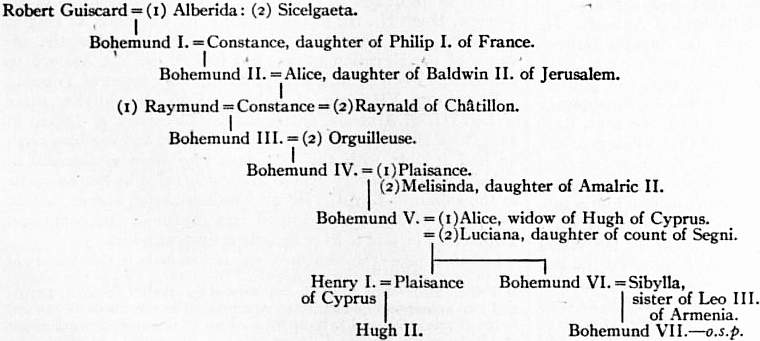
Bohemund I. (c. A.D. 1058-1111), prince of Otranto and afterwards of Antioch, whose first name was Marc, was the eldest son of Robert Guiscard, dux Apuliae et Calabriae, by an early marriage contracted before 1059. He served under his father in the great attack on the East Roman empire (1080-1085), and commanded the Normans during Guiscard’s absence (1082-1084), penetrating into Thessaly as far as Larissa, but being repulsed by Alexius Comnenus. This early hostility to Alexius had a great influence in determining the course of his future career, and thereby helped to determine the history of the First Crusade, of which Bohemund may be regarded as the leader. On the death of Guiscard in 1085, his younger son Roger, born “in the purple” of a Lombard princess Sicelgaeta, succeeded to the duchy of Apulia and Calabria, and a war arose between Bohemund (whom his father had destined for the throne of Constantinople) and Duke Roger. The war was finally composed by the mediation of Urban II. and the award of Otranto and other possessions to Bohemund. In 1096 Bohemund, along with his uncle the great count of Sicily, was attacking Amalfi, which had revolted against Duke Roger, when bands of crusaders began to pass, on their way through Italy to Constantinople. The zeal of the crusader came upon Bohemund: it is possible, too, that he saw in the First Crusade a chance of realizing his father’s policy (which was also an old Norse instinct) of the Drang nach Osten, and hoped from the first to carve for himself an eastern principality. He gathered a fine Norman army (perhaps the finest division in the crusading host), at the head of which he crossed the Adriatic, and penetrated to Constantinople along the route he had tried to follow in 1082-1084. He was careful to observe a “correct” attitude towards Alexius, and when he arrived at Constantinople in April 1097 he did homage to the emperor. He may have negotiated with Alexius about a principality at Antioch; if he did so, he had little encouragement. From Constantinople to Antioch Bohemund was the real leader of the First Crusade; and it says much for his leading that the First Crusade succeeded in crossing Asia Minor, which the Crusades of 1101, 1147 and 1189 failed to accomplish. A politique, Bohemund was resolved to engineer the enthusiasm of the crusaders to his own ends; and when his nephew Tancred left the main army at Heraclea, and attempted to establish a footing in Cilicia, the movement may have been already intended as a preparation for Bohemund’s eastern principality. Bohemund was the first to get into position before Antioch (October 1097), and he took a great part in the siege, beating off the Mahommedan attempts at relief from the east, and connecting the besiegers on the west with the port of St Simeon and the Italian ships which lay there. The capture of Antioch was due to his connexion with Firuz, one of the commanders in the city; but he would not bring matters to an issue until the possession of the city was assured him (May 1098), under the terror of the approach of Kerbogha with a great army of relief, and with a reservation in favour of Alexius, if Alexius should fulfil his promise to aid the crusaders. But Bohemund was not secure in the possession of Antioch, even after its surrender and the defeat of Kerbogha; he had to make good his claims against Raymund of Toulouse, who championed the rights of Alexius. He obtained full possession in January 1099, and stayed in the neighbourhood of Antioch to secure his position, while the other crusaders moved southward to the capture of Jerusalem. He came to Jerusalem at Christmas 1099, and had Dagobert of Pisa elected as patriarch, perhaps in order to check the growth of a strong Lotharingian power in the city. It might seem in 1100 that Bohemund was destined to found a great principality in Antioch, which would dwarf Jerusalem; he had a fine territory, a good strategical position and a strong army. But he had to face two great forces—the East Roman empire, which claimed the whole of his territories and was supported in its claim by Raymund of Toulouse, and the strong Mahommedan principalities in the north-east of Syria. Against these two forces he failed. In 1100 he was captured by Danishmend of Sivas, and he languished in prison till 1103. Tancred took his place; but meanwhile Raymund established himself with the aid of Alexius in Tripoli, and was able to check the expansion of Antioch to the south. Ransomed in 1103 by the generosity of an Armenian prince, Bohemund made it his first object to attack the neighbouring Mahommedan powers in order to gain supplies. But in heading an attack on Harran, in 1104, he was severely defeated at Balich, near Rakka on the Euphrates. The defeat was decisive; it made impossible the great eastern principality which Bohemund had contemplated. It was followed by a Greek attack on Cilicia; and despairing of his own resources, Bohemund returned to Europe for reinforcements in order to defend his position. His attractive personality won him the hand of Constance, the daughter of the French king, Philip I., and he collected a large army. Dazzled by his success, he resolved to use his army not to defend Antioch against the Greeks, but to attack Alexius. He did so; but Alexius, aided by the Venetians, proved too strong, and Bohemund had to submit to a humiliating peace (1108), by which he became the vassal of Alexius, consented to receive his pay, with the title of Sebastos, and promised to cede disputed territories and to admit a Greek patriarch into Antioch. Henceforth Bohemund was a broken man. He died without returning to the East, and was buried at Canossa in Apulia, in 1111.
Literature.—The anonymous Gesta Francorum (edited by H. Hagenmeyer) is written by one of Bohemund’s followers; and the Alexiad of Anna Comnena is a primary authority for the whole of his life. His career is discussed by B. von Kügler, Bohemund und Tancred (Tübingen, 1862); while L. von Heinemann, Geschichte der Normannen in Sicilien und Unteritalien (Leipzig, 1894), and R. Röhricht, Geschichte des ersten Kreuzzuges (Innsbruck, 1901), and Geschichte des Königreichs Jerusalem (Innsbruck, 1898), may also be consulted for his history.
Bohemund II. (1108-1131), son of the great Bohemund by his marriage with Constance of France, was born in 1108, the year of his father’s defeat at Durazzo. In 1126 he came from Apulia to Antioch (which, since the fall of Roger, the successor of Tancred, in 1119, had been under the regency of Baldwin II.); and in 1127 he married Alice, the younger daughter of Baldwin. After some trouble with Joscelin of Edessa, and after joining with Baldwin II. in an attack on Damascus (1127), he was defeated and slain on his northern frontier by a Mahommedan army from Aleppo (1131). He had shown that he had his father’s courage: if time had sufficed, he might have shown that he had the other qualities of the first Bohemund.
Bohemund III. was the son of Constance, daughter of Bohemund II., by her first husband, Raymund of Antioch. He succeeded his mother in the principality of Antioch in 1163, and first appears prominently in 1164, as regent of the kingdom of Jerusalem during the expedition of Amalric I. to Egypt. During the absence of Amalric, he was defeated and captured by Nureddin (August 1164) at Harenc, to the east of Antioch. He was at once ransomed by his brother-in-law, the emperor Manuel, and went to Constantinople, whence he returned with a Greek patriarch. In 1180 he deserted his second wife, the princess Orguilleuse, for a certain Sibylla, and he was in consequence excommunicated. By Orguilleuse he had had two sons, Raymund and Bohemund (the future Bohemund IV.), whose relations and actions determined the rest of his life. Raymund married Alice, a daughter of the Armenian prince Rhupen (Rupin), brother of Leo of Armenia, and died in 1197, leaving behind him a son, Raymund Rhupen. Bohemund, the younger brother of Raymund, had succeeded the last count of Tripoli in the possession of that county, 1187; and the problem which occupied the last years of Bohemund III. was to determine whether his grandson, Raymund Rhupen, or his younger son, Bohemund, should succeed him in Antioch. Leo of Armenia was naturally the champion of his great-nephew, Raymund Rhupen; indeed he had already claimed Antioch in his own right, before the marriage of his niece to Raymund, in 1194, when he had captured Bohemund III. at Gastin, and attempted without success to force him to cede Antioch.1 Bohemund the younger, however, prosecuted his claim with vigour, and even evicted his father from Antioch about 1199: but he was ousted by Leo (now king of Armenia by the grace of the emperor, Henry VI.), and Bohemund III. died in possession of his principality (1201).
Bohemund IV., younger son of Bohemund III. by his second wife Orguilleuse, became count of Tripoli in 1187, and succeeded his father in the principality of Antioch, to the exclusion of Raymund Rhupen, in 1201. But the dispute lasted for many years (Leo of Armenia continuing to champion the cause of his great-nephew), and long occupied the attention of Innocent III. Bohemund IV. enjoyed the support of the Templars (who, like the Knights of St John, had estates in Tripoli) and of the Greek inhabitants of Antioch, to whom he granted their own patriarch in 1207, while Leo appealed (1210-1211) both to Innocent III. and the emperor Otto IV., and was supported by the Hospitallers. In 1216 Leo captured Antioch, and established Raymund Rhupen as its prince; but he lost it again in less than four years, and it was once more in the possession of Bohemund IV. when Leo died in 1220. Raymund Rhupen died in 1221; and after the event Bohemund reigned in Antioch and Tripoli till his death, proving himself a determined enemy of the Hospitallers, and thereby incurring excommunication in 1230. He first joined, and then deserted, the emperor Frederick II., during the crusade of 1228-29; and he was excluded from the operation of the treaty of 1229. When he died in 1233, he had just concluded peace with the Hospitallers, and Gregory IX. had released him from the excommunication of 1230.
Bohemund V., son of Bohemund IV. by his wife Plaisance (daughter of Hugh of Gibelet), succeeded his father in 1233. He was prince of Antioch and count of Tripoli, like his father; and like him he enjoyed the alliance of the Templars and experienced the hostility of Armenia, which was not appeased till 1251, when the mediation of St Louis, and the marriage of the future Bohemund VI. to the sister of the Armenian king, finally brought peace. By his first marriage in 1225 with Alice, the widow of Hugh I. of Cyprus, Bohemund V. connected the history of Antioch for a time with that of Cyprus. He died in 1251. He had resided chiefly at Tripoli, and under him Antioch was left to be governed by its bailiff and commune.
Bohemund VI. was the son of Bohemund V. by Luciana, a daughter of the count of Segni, nephew of Innocent III. Born in 1237, Bohemund VI. succeeded his father in 1251, and was knighted by St Louis in 1252. His sister Plaisance had married in 1250 Henry I. of Cyprus, the son of Hugh I.; and the Cypriot connexion of Antioch, originally formed by the marriage of Bohemund V. and Alice, the widow of Hugh I., was thus maintained. In 1252 Bohemund VI. established himself in Antioch, leaving Tripoli to itself, and in 1257 he procured the recognition of his nephew, Hugh II., the son of Henry I. by Plaisance, as king of Jerusalem. He allied himself to the Mongols against the advance of the Egyptian sultan; but in 1268 he lost Antioch to Bibars, and when he died in 1275 he was only count of Tripoli.
Bohemund VII., son of Bohemund VI. by Sibylla, sister of Leo III. of Armenia, succeeded to the county of Tripoli in 1275, with his mother as regent. In his short and troubled reign he had trouble with the Templars who were established in Tripoli; and in the very year of his death (1287) he lost Laodicea to the sultan of Egypt. He died without issue; and as, within two years of his death, Tripoli was captured, the county of Tripoli may be said to have become extinct with him.
Literature.—The history of the Bohemunds is the history of the principality of Antioch, and, after Bohemund IV., of the county of Tripoli also. For Antioch, we possess its Assises (Venice, 1876); and two articles on its history have appeared in the Revue de l’Orient Latin (Paris, 1893, fol.), both by E. Rey (“Resumé chronologique de l’histpire des princes d’Antioche,” vol. iv., and “Les dignitaires de la principauté d’Antioche,” vol. viii.). R. Röhricht, Geschichte des Königreichs Jerusalem (Innsbruck, 1898), gives practically all that is known about the history of Antioch and Tripoli.
(E. Br.)
1 During the captivity of Bohemund III. the patriarch of Antioch helped to found a commune, which persisted, with its mayor and jurats, during the 13th century.
BÖHMER, JOHANN FRIEDRICH (1795-1863), German historian, son of Karl Ludwig Böhmer (d. 1817), was born at Frankfort-on-Main on the 22nd of April 1795. Educated at the universities of Heidelberg and Göttingen, he showed an interest in art and visited Italy; but returning to Frankfort he turned his attention to the study of history, and became secretary of the Gesellschaft für ältere deutsche Geschichtskunde. He was also archivist and then librarian of the city of Frankfort. Böhmer had a great dislike of Prussia and the Protestant faith, and a corresponding affection for Austria and the Roman Catholic Church, to which, however, he did not belong. His critical sense was, perhaps, somewhat warped; but his researches are of great value to students. He died unmarried, at Frankfort, on the 22nd of October 1863. Böhmer’s historical work was chiefly concerned with collecting and tabulating charters and other imperial documents of the middle ages. First appeared an abstract, the Regesta chronologico-diplomatica regum atque imperatorum Romanorum 911-1313 (Frankfort, 1831), which was followed by the Regesta chronologico-diplomatica Karolorum. Die Urkunden sämtlicher Karolinger in kurzen Auszügen (Frankfort, 1833), and a series of Regesta imperii. For the period 1314-1347 (Frankfort, 1839) the Regesta was followed by three, and for the period 1246-1313 (Frankfort, 1844) by two supplementary volumes. The remaining period of the Regesta, as edited by Böhmer, is 1198-1254 (Stuttgart, 1849). These collections contain introductions and explanatory passages by the author. Very valuable also is the Fontes rerum Germanicarum (Stuttgart, 1843-1868), a collection of original authorities for German history during the 13th and 14th centuries. The fourth and last volume of this work was edited by A. Huber after the author’s death. Other collections edited by Böhmer are: Die Reichsgesetze 900-1400 (Frankfort, 1832); Wittelsbachische Regesten von der Erwerbung des Herzogtums Bayern bis zu 1340 (Stuttgart, 1854); and Codex diplomaticus Moeno-Francofurtanus. Urkundenbuch der Reichsstadt Frankfurt (Frankfort, 1836; new edition by F. Law, 1901). Other volumes and editions of the Regesta imperii, edited by J. Ficker, E. Mühlbacher, E. Winkelmann and others, are largely based on Böhmer’s work. Böhmer left a great amount of unpublished material, and after his death two other works were published from his papers: Acta imperii selecta, edited by J. Ficker (Innsbruck, 1870); and Regesta archiepiscoporum Maguntinensium, edited by C. Will (Innsbruck, 1877-1886).
See J. Janssen, J.F. Böhmers Leben, Briefe und kleinere Schriften (Freiburg, 1868).
BOHN, HENRY GEORGE (1796-1884), British publisher, son of a German bookbinder settled in England, was born in London on the 4th of January 1796. In 1831 he started as a dealer in rare books and “remainders.” In 1841 he issued his “Guinea” Catalogue of books, a monumental work containing 23,208 items. Bohn was noted for his book auction sales: one held in 1848 lasted four days, the catalogue comprising twenty folio pages. Printed on this catalogue was the information: “Dinner at 2 o’clock, dessert at 4, tea at 5, and supper at 10.” The name of Bohn is principally remembered by the important Libraries which he inaugurated: these were begun in 1846 and comprised editions of standard works and translations, dealing with history, science, classics, theology and archaeology, consisting in all of 766 volumes. One of Bohn’s most useful and laborious undertakings was his revision (6 vols. 1864) of The Bibliographer’s Manual of English Literature (1834) of W.T. Lowndes. The plan includes bibliographical and critical notices, particulars of prices, &c., and a considerable addition to the original work. It had been one of Bohn’s ambitions to found a great publishing house, but, finding that his sons had no taste for the trade, he sold the Libraries in 1864 to Messrs. Bell and Daldy, afterwards G. Bell & Sons. Bohn was a man of wide culture and many interests. He himself made considerable contributions to his Libraries: he collected pictures, china and ivories, and was a famous rose-grower. He died at Twickenham on the 22nd of August 1884.
BÖHTLINGK, OTTO VON (1815-1004) German Sanskrit scholar, was born on the 30th of May (11th of June O.S.) 1815 at St Petersburg. Having studied (1833-1835) Oriental languages, particularly Arabic, Persian and Sanskrit, at the university of St Petersburg, he continued his studies in Germany, first in Berlin and then (1839-1842) in Bonn. Returning to St Petersburg in 1842, he was attached to the Royal Academy of Sciences, and was elected an ordinary member of that society in 1855. In 1860 he was made “Russian state councillor,” and later “privy councillor” with a title of nobility. In 1868 he settled at Jena, and in 1885 removed to Leipzig, where he resided until his death there on the 1st of April 1904. Böhtlingk was one of the most distinguished scholars of the 19th century, and his works are of pre-eminent value in the field of Indian and comparative philology. His first great work was an edition of Panini’s Acht Bücher grammatischer Regeln (Bonn, 1839-1840), which was in reality a criticism of Franz Bopp’s philological methods. This book Böhtlingk again took up forty-seven years later, when he republished it with a complete translation under the title Paninis Grammatik mit Übersetzung (Leipzig, 1887). The earlier edition was followed by Vopadevas Grammatik (St Petersburg, 1847); Über die Sprache der Jakuten (St Petersburg, 1851); Indische Spruche (2nd ed. in 3 parts, St Petersburg, 1870-1873, to which an index was published by Blau, Leipzig, 1893); a critical examination and translation of Chhandogya-upanishad (St Petersburg, 1889) and a translation of Brihadaranyaka-upanishad (St Petersburg, 1889). In addition to these he published several smaller treatises, notably one on the Sanskrit accents, Über den Accent im Sanskrit (1843). But his magnum opus is his great Sanskrit dictionary, Sanskrit-Wörterbuch (7 vols., St Petersburg, 1853-1875; new ed. 7 vols., St Petersburg, 1879-1889), which with the assistance of his two friends, Rudolf Roth (1821-1895) and Albrecht Weber (b. 1825), was completed in twenty-three years.
BOHUN, the name of a family which plays an important part in English history during the 13th and 14th centuries; it was taken from a village situated in the Cotentin between Coutances and the estuary of the Vire. The Bohuns came into England at, or shortly after, the Norman Conquest; but their early history there is obscure. The founder of their greatness was Humphrey III., who in the latter years of Henry I., makes his appearance as a dapifer, or steward, in the royal household. He married the daughter of Milo of Gloucester, and played an ambiguous part in Stephen’s reign, siding at first with the king and afterwards with the empress. Humphrey III. lived until 1187, but his history is uneventful. He remained loyal to Henry II. through all changes, and fought in 1173 at Farnham against the rebels of East Anglia. Outliving his eldest son, Humphrey IV., he was succeeded in the family estates by his grandson Henry. Henry was connected with the royal house of Scotland through his mother Margaret, a sister of William the Lion; an alliance which no doubt assisted him to obtain the earldom of Hereford from John (1199). The lands of the family lay chiefly on the Welsh Marches, and from this date the Bohuns take a foremost place among the Marcher barons. Henry de Bohun figures with the earls of Clare and Gloucester among the twenty-five barons who were elected by their fellows to enforce the terms of the Great Charter. In the subsequent civil war he fought on the side of Louis, and was captured at the battle of Lincoln (1217). He took the cross in the same year and died on his pilgrimage (June 1, 1220). Humphrey V., his son and heir, returned to the path of loyalty, and was permitted, some time before 1239, to inherit the earldom of Essex from his maternal uncle, William de Mandeville. But in 1258 this Humphrey fell away, like his father, from the royal to the baronial cause. He served as a nominee of the opposition on the committee of twenty-four which was appointed, in the Oxford parliament of that year, to reform the administration. It was only the alliance of Montfort with Llewelyn of North Wales that brought the earl of Hereford back to his allegiance. Humphrey V. headed the first secession of the Welsh Marchers from the party of the opposition (1263), and was amongst the captives whom the Montfortians took at Lewes. The earl’s son and namesake was on the victorious side, and shared in the defeat of Evesham, which he did not long survive. Humphrey V. was, therefore, naturally selected as one of the twelve arbitrators to draw up the ban of Kenilworth (1266), by which the disinherited rebels were allowed to make their peace. Dying in 1275, he was succeeded by his grandson Humphrey VII. This Bohun lives in history as one of the recalcitrant barons of the year 1297, who extorted from Edward I. the Confirmatio Cartarum. The motives of the earl’s defiance were not altogether disinterested. He had suffered twice from the chicanery of Edward’s lawyers; in 1284 when a dispute between himself and the royal favourite, John Giffard, was decided in the latter’s favour; and again in 1292 when he was punished with temporary imprisonment and sequestration for a technical, and apparently unwitting, contempt of the king’s court. In company, therefore, with the earl of Norfolk he refused to render foreign service in Gascony, on the plea that they were only bound to serve with the king, who was himself bound for Flanders. Their attitude brought to a head the general discontent which Edward had excited by his arbitrary taxation; and Edward was obliged to make a surrender on all the subjects of complaint. At Falkirk (1298) Humphrey VII. redeemed his character for loyalty. His son, Humphrey VIII., who succeeded him in the same year, was allowed to marry one of the king’s daughters, Eleanor, the widowed countess of Holland (1302). This close connexion with the royal house did not prevent him, as it did not prevent Earl Thomas of Lancaster, from joining the opposition to the feeble Edward II. In 1310 Humphrey VIII. figured among the Lords Ordainers; though, with more patriotism than some of his fellow-commissioners, he afterwards followed the king to Bannockburn. He was taken captive in the battle, but exchanged for the wife of Robert Bruce. Subsequently he returned to the cause of his order, and fell on the side of Earl Thomas at the field of Boroughbridge (1322). With him, as with his father, the politics of the Marches had been the main consideration; his final change of side was due to jealousy of the younger Despenser, whose lordship of Glamorgan was too great for the comfort of the Bohuns in Brecon. With the death of Humphrey VIII. the fortunes of the family enter on a more peaceful stage. Earl John (d. 1335) was inconspicuous; Humphrey IX. (d. 1361) merely distinguished himself as a captain in the Breton campaigns of the Hundred Years’ War, winning the victories of Morlaix (1342) and La Roche Derrien (1347). His nephew and heir, Humphrey X., who inherited the earldom of Northampton from his father, was territorially the most important representative of the Bohuns. But the male line was extinguished by his death (1373). The three earldoms and the broad lands of the Bohuns were divided between two co-heiresses. Both married members of the royal house. The elder, Eleanor, was given in 1374 to Thomas of Woodstock, seventh son of Edward III.; the younger, Mary, to Henry, earl of Derby, son of John of Gaunt and afterwards Henry IV., in 1380 or 1381. From these two marriages sprang the houses of Lancaster and Stafford.
See J.E. Doyle’s Official Baronage of England (1886), the Complete Peerage of G. E. C(okayne), (1867-1898); T.F. Tout’s “Wales and the March during the Barons’ War,” in Owens College Historical Essays, pp. 87-136 (1902); J.E. Morris’ Welsh Wars of King Edward I., chs. vi., viii. (1901).
(H. W. C. D.)
BOIARDO, MATTEO MARIA, Count (1434-1404), Italian poet, who came of a noble and illustrious house established at Ferrara, but originally from Reggio, was born at Scandiano, one of the seignorial estates of his family, near Reggio di Modena, about the year 1434, according to Tiraboschi, or 1420 according to Mazzuchelli. At an early age he entered the university of Ferrara, where he acquired a good knowledge of Greek and Latin, and even of the Oriental languages, and was in due time admitted doctor in philosophy and in law. At the court of Ferrara, where he enjoyed the favour of Duke Borso d’Este and his successor Hercules, he was entrusted with several honourable employments, and in particular was named governor of Reggio, an appointment which he held in the year 1478. Three years afterwards he was elected captain of Modena, and reappointed governor of the town and citadel of Reggio, where he died in the year 1494, though in what month is uncertain.
Almost all Boiardo’s works, and especially his great poem of the Orlando Inamorato, were composed for the amusement of Duke Hercules and his court, though not written within its precincts. His practice, it is said, was to retire to Scandiano or some other of his estates, and there to devote himself to composition; and Castelvetro, Vallisnieri, Mazzuchelli and Tiraboschi all unite in stating that he took care to insert in the descriptions of his poem those of the agreeable environs of his chateau, and that the greater part of the names of his heroes, as Mandricardo, Gradasse, Sacripant, Agramant and others, were merely the names of some of his peasants, which, from their uncouthness, appeared to him proper to be given to Saracen warriors. Be this as it may, the Orlando Inamorato deserves to be considered as one of the most important poems in Italian literature, since it forms the first example of the romantic epic worthy to serve as a model, and, as such, undoubtedly produced Ariosto’s Orlando Furioso. Gravina and Mazzuchell have said, and succeeding writers have repeated on their authority, that Boiardo proposed to himself as his model the Iliad of Homer; that Paris is besieged like the city of Troy; that Angelica holds the place of Helen; and that, in short, the one poem is a sort of reflex image of the other. In point of fact, however, the subject-matter of the poem is derived from the Fabulous Chronicle of the pseudo-Turpin; though, with the exception of the names of Charlemagne, Roland, Oliver, and some other principal warriors, who necessarily figure as important characters in the various scenes, there is little resemblance between the detailed plot of the one and that of the other. The poem, which Boiardo did not live to finish, was printed at Scandiano the year after his death, under the superintendence of his son Count Camillo. The title of the book is without date; but a Latin letter from Antonia Caraffa di Reggio, prefixed to the poem, is dated the kalends of June 1495. A second edition, also without date, but which must have been printed before the year 1500, appeared at Venice; and the poem was twice reprinted there during the first twenty years of the 16th century. These editions are the more curious and valuable since they contain nothing but the text of the author, which is comprised in three books, divided into cantos, the third book being incomplete. But Niccolo degli Agostini, an indifferent poet, had the courage to continue the work commenced by Boiardo, adding to it three books, which were printed at Venice in 1526-1531, in 4to; and since that time no edition of the Orlando has been printed without the continuation of Agostini, wretched as it unquestionably is. Boiardo’s poem suffers from the incurable defect of a laboured and heavy style. His story is skilfully constructed, the characters are well drawn and sustained throughout; many of the incidents show a power and fertility of imagination not inferior to that of Ariosto, but the perfect workmanship indispensable for a great work of art is wanting. The poem in its original shape was not popular, and has been completely superseded by the Rifacimento of Francesco Berni (q.v.).
The other works of Boiardo are—(1) Il Timone, a comedy, Scandiano, 1500, 4to; (2) Sonnetti e Canzoni, Reggio, 1499, 4to; (3) Carmen Bucolicon, Reggio, 1500, 4to; (4) Cinque Capitoli in terza rima, Venice, 1523 or 1533; (5) Apulejo dell’ Asino d’Oro, Venice, 1516, 1518; (6) Asino d’Oro de Luciano tradolto in volgare, Venice, 1523, 8vo; (7) Erodoto Alicarnasseo istorico, tradotto di Greco in Lingua Italiana, Venice, 1533 and 1538, 8vo; (8) Rerum Italicarum Scriptores.
See Panizzi’s Boiardo (9 vols., 1830-1831).
BOIE, HEINRICH CHRISTIAN (1744-1806), German author, was born at Meldorf in the then Danish province of Schleswig-Holstein on the 19th of July 1744. After studying law at Jena, he went in 1769 to Göttingen, where he became one of the leading spirits in the Göttingen “Dichterbund” or “Hain.” Boie’s poetical talent was not great, but his thorough knowledge of literature, his excellent taste and sound judgment, made him an ideal person to awake the poetical genius of others. Together with F.W. Gotter (q.v.) he founded in 1770 the Göttingen Musenalmanach, which he directed and edited until 1775, when, in conjunction with C.W. von Dohm (1751-1820), he brought out Das deutsche Museum, which became one of the best literary periodicals of the day. In 1776 Boie became secretary to the commander-in-chief at Hanover, and in 1781 was appointed administrator of the province of Süderditmarschen in Holstein. He died at Meldorf on the 3rd of March 1806.
See K. Weinhold, Heinrich Christian Boie (Halle, 1868).
BOIELDIEU, FRANÇOIS ADRIEN (1775-1834), French composer of comic opera, was born at Rouen on the 15th of December 1775. He received his first musical education from M. Broche, the cathedral organist, who appears to have treated him very harshly. He began composing songs and chamber music at a very early age-his first opera, La Fille coupable (the libretto by his father), and his second opera, Rosalie et Myrza, being produced on the stage of Rouen in 1795. Not satisfied with his local success he went to Paris in 1795. His scores were submitted to Cherubini, Méhul and others, but met with little approbation. Grand opera was the order of the day. Boieldieu had to fall back on his talent as a pianoforte-player for a livelihood. Success came at last from an unexpected source. P.J. Garat, a fashionable singer of the period, admired Boieldleu’s touch on the piano, and made him his accompanist. In the drawing-rooms of the Directoire Garat sang the charming songs and ballads with which the young composer supplied him. Thus Boieldieu’s reputation gradually extended to wider circles. In 1796 Les Deux lettres was produced, and in 1797 La Famille suisse appeared for the first time on a Paris stage, and was well received. Several other operas followed in rapid succession, of which only Le Calife de Bagdad (1800) has escaped oblivion. After the enormous success of this work, Boieldieu felt the want of a thorough musical training and took lessons from Cherubini, the influence of that great master being clearly discernible in the higher artistic finish of his pupil’s later compositions. In 1802 Boieldieu, to escape the domestic troubles caused by his marriage with Clotilde Aug. Mafleuroy, a celebrated ballet-dancer of the Paris opera, took flight and went to Russia, where he was received with open arms by the emperor Alexander. During his prolonged stay at St Petersburg he composed a number of operas. He also set to music the choruses of Racine’s Athalie, one of his few attempts at the tragic style of dramatic writing. In 1811 he returned to his own country, where the following year witnessed the production of one of his finest works, Jean de Paris, in which he depicted with much felicity the charming coquetry of the queen of Navarre, the chivalrous verve of the king, the officious pedantry of the seneschal, and the amorous tenderness of the page. He succeeded Méhul as professor of composition at the Conservatoire in 1817. Le Chapeau rouge was produced with great success in 1818. Boieldieu’s second and greatest masterpiece was his Dame blanche (1825). The libretto, written by Scribe, was partly suggested by Walter Scott’s Monastery, and several original Scottish tunes cleverly introduced by the composer add to the melodious charm and local colour of the work. On the death of his wife in 1825, Boieldieu married a singer. His own death was due to a violent attack of pulmonary disease. He vainly tried to escape the rapid progress of the illness by travel in Italy and the south of France, but returned to Paris only to die on the 8th of October 1834.
Lives of Boieldieu have been written by Pougin (Paris, 1875), J.A. Refeuvaille (Rouen, 1836), Hequet (Paris, 1864), Emile Duval (Geneva, 1883). See also Adolphe Charles Adam, Derniers souvenirs d’un musicien.
BOIGNE, BENOÎT DE, Count (1751-1830), the first of the French military adventurers in India, was born at Chambéry in Savoy on the 8th of March 1751, being the son of a fur merchant. He joined the Irish Brigade in France in 1768, and subsequently he entered the Russian service and was captured by the Turks. Hearing of the wealth of India, he made his way to that country, and after serving for a short time in the East India Company, he resigned and joined Mahadji Sindhia in 1784 for the purpose of training his troops in the European methods of war. In the battles of Lalsot and Chaksana Boigne and his two battalions proved their worth by holding the field when the rest of the Mahratta army was defeated by the Rajputs. In the battle of Agra (1788) he restored the Mahratta fortunes, and made Mahadji Sindhia undisputed master of Hindostan. This success led to his being given the command of a brigade of ten battalions of infantry, with which he won the victories of Patan and Merta in 1790. In consequence Boigne was allowed to raise two further brigades of disciplined infantry, and made commander-in-chief of Sindhia’s army. In the battle of Lakhairi (1793) he defeated Holkar’s army. On the death of Mahadji Sindhia in 1794, Boigne could have made himself master of Hindostan had he wished it, but he remained loyal to Daulat Rao Sindhia. In 1795 his health began to fail, and he resigned his command, and in the following year returned to Europe with a fortune of £400,000. He lived in retirement during the lifetime of Napoleon, but was greatly honoured by Louis XVIII. He died on the 21st of June 1830.
See H. Compton, European Military Adventurers of Hindustan (1892).
BOII (perhaps = “the terrible”), a Celtic people, whose original home was Gallia Transalpina. They were known to the Romans, at least by name, in the time of Plautus, as is shown by the contemptuous reference in the Captivi (888). At an early date they split up into two main groups, one of which made its way into Italy, the other into Germany. Some, however, appear to have stayed behind, since, during the Second Punic War, Magalus, a Boian prince, offered to show Hannibal the way into Italy after he had crossed the Pyrenees (Livy xxi. 29). The first group of immigrants is said to have crossed the Pennine Alps (Great St Bernard) into the valley of the Po. Finding the district already occupied, they proceeded over the river, drove out the Etruscans and Umbrians, and established themselves as far as the Apennines in the modern Romagna. According to Cato (in Pliny, Nat. Hist. iii. 116) they comprised as many as 112 different tribes, and from the remains discovered in the tombs at Hallstatt, La Tène and other places, they appear to have been fairly civilized. Several wars took place between them and the Romans. In 283 they were defeated, together with the Etruscans, at the Vadimonian lake; in 224, after the battle of Telamon in Etruria, they were forced to submit. But they still cherished a hatred of the Romans, and during the Second Punic War (218), irritated by the foundation of the Roman colonies of Cremona and Placentia, they rendered valuable assistance to Hannibal. They continued the struggle against Rome from 201 to 191, when they were finally subdued by P. Cornelius Scipio Nasica, and deprived of nearly half their territory. According to Strabo (v. p. 213) the Boii were driven back across the Alps and settled on the land of their kinsmen, the Taurisci, on the Danube, adjoining Vindelicia and Raetia. Most authorities, however, assume that there had been a settlement of the Boii on the Danube from very early times, in part of the modern Bohemia (anc. Boiohemum, “land of the Boii”). About 60 B.C. some of the Boii migrated to Noricum and Pannonia, when 32,000 of them joined the expedition of the Helvetians into Gaul, and shared their defeat near Bibracte (58). They were subsequently allowed by Caesar to settle in the territory of the Aedui between the Loire and the Allier. Their chief town was Gorgobina (site uncertain). Those who remained on the Danube were exterminated by the Dacian king, Boerebista, and the district they had occupied was afterwards called the “desert of the Boii” (Strabo vii. p. 292). In A.D. 69 a Boian named Mariccus stirred up a fanatical revolt, but was soon defeated and put to death. Some remnants of the Boii are mentioned as dwelling near Bordeaux; but Mommsen inclines to the opinion that the three groups (in Bordeaux, Bohemia and the Po districts) were not really scattered branches of one and the same stock, but that they are instances of a mere similarity of name.
The Boii, as we know them, belonged almost certainly to the Early Iron age. They probably used long iron swords for dealing cutting blows, and from the size of the handles they must have been a race of large men (cf. Polybius ii. 30). For their ethnological affinities and especially their possible connexion with the Homeric Achaeans see W. Ridgeway’s Early Age of Greece (vol. i., 1901).
See L. Contzen, Die Wanderungen der Kelten (Leipzig, 1861); A. Desjardins, Géographie historique de la Gaule romaine, ii. (1876-1893); T.R. Holmes, Caesar’s Conquest of Gaul (1899), pp. 426-428; T. Mommsen, Hist. of Rome, ii. (Eng. trans. 5 vols., 1894), p. 373 note; M. Ihm in Pauly-Wissowa’s Realencyclopadie, iii. pt. 1 (1897); A. Holder, Alt-celtischer Sprachschatz.
BOIL, in medicine, a progressive local inflammation of the skin, taking the form of a hard suppurating tumour, with a core of dead tissue, resulting from infection by a microbe, Staphylococcus pyogenes, and commonly occurring in young persons whose blood is disordered, or as a complication in certain diseases. Treatment proceeds on the lines of bringing the mischief out, assisting the evacuation of the boil by the lancet, and clearing the system. In the English Bible, and also in popular medical terminology, “boil” is used of various forms of ulcerous affection. The boils which were one of the plagues in Egypt were apparently the bubonic plague. The terms Aleppo boil (or button), Delhi boil, Oriental boil, Biskra button, &c., have been given to a tropical epidemic, characterized by ulcers on the face, due to a diplococcus parasite.
BOILEAU-DESPRÉAUX, NICOLAS (1636-1711), French poet and critic, was born on the 1st of November 1636 in the rue de Jérusalem, Paris. The same Despréaux was derived from a small property at Crosne near Villeneuve Saint-Georges. He was the fifteenth child of Gilles Boileau, a clerk in the parlement. Two of his brothers attained some distinction: Gilles Boileau (1631-1669), the author of a translation of Epictetus; and Jacques Boileau, who became a canon of the Sainte-Chapelle, and made valuable contributions to church history. His mother died when he was two years old; and Nicolas Boileau, who had a delicate constitution, seems to have suffered something from want of care. Sainte-Beuve puts down his somewhat hard and unsympathetic outlook quite as much to the uninspiring circumstances of these days as to the general character of his time. He cannot be said to have been early disenchanted, for he never seems to have had any illusions; he grew up with a single passion, “the hatred of stupid books.” He was educated at the Collège de Beauvais, and was then sent to study theology at the Sorbonne. He exchanged theology for law, however, and was called to the bar on the 4th of December 1656. From the profession of law, after a short trial, he recoiled in disgust, complaining bitterly of the amount of chicanery which passed under the name of law and justice. His father died in 1657, leaving him a small fortune, and thenceforward he devoted himself to letters.
Such of his early poems as have been preserved hardly contain the promise of what he ultimately became. The first piece in which his peculiar powers were displayed was the first satire (1660), in imitation of the third satire of Juvenal; it embodied the farewell of a poet to the city of Paris. This was quickly followed by eight others, and the number was at a later period increased to twelve. A twofold interest attaches to the satires. In the first place the author skilfully parodies and attacks writers who at the time were placed in the very first rank, such as Jean Chapelain, the abbé Charles Cotin, Philippe Quinault and Georges de Scudéry; he openly raised the standard of revolt against the older poets. But in the second place he showed both by precept and practice what were the poetical capabilities of the French language. Prose in the hands of such writers as Descartes and Pascal had proved itself a flexible and powerful instrument of expression, with a distinct mechanism and form. But except with Malherbe, there had been no attempt to fashion French versification according to rule or method. In Boileau for the first time appeared terseness and vigour of expression, with perfect regularity of verse structure. His admiration for Molière found expression in the stanzas addressed to him (1663), and in the second satire (1664). In 1664 he composed his prose Dialogue des héros de roman, a satire on the elaborate romances of the time, which may be said to have once for all abolished the lucubrations of La Calprenède, Mlle de Scudéry and their fellows. Though fairly widely read in manuscript, the book was not published till 1713, out of regard, it is said, for Mlle de Scudéry. To these early days belong the reunions at the Moulon Blanc and the Pomme du Pin, where Boileau, Molière, Racine, Chapelle and Antoine Furetière met to discuss literary questions. To Molière and Racine he proved a constant friend, and supported their interests on many occasions.
In 1666, prompted by the publication of two unauthorized editions, he published Satires du Sieur D...., containing seven satires and the Discours au roi. From 1669 onwards appeared his epistles, graver in tone than the satires, maturer in thought, more exquisite and polished in style. The Épitres gained for him the favour of Louis XIV., who desired his presence at court. The king asked him which he thought his best verses. Whereupon Boileau diplomatically selected as his “least bad” some still unprinted lines in honour of the grand monarch and proceeded to recite them. He received forthwith a pension of 2000 livres. In 1674 his two masterpieces, L’Art poétique and Le Lutrin, were published with some earlier works as the Œuvres diverses du sieur D.... The first, in imitation of the Ars Poetica of Horace, lays down the code for all future French verse, and may be said to fill in French literature a parallel place to that held by its prototype in Latin. On English literature the maxims of Boileau, through the translation revised by Dryden, and through the magnificent imitation of them in Pope’s Essay on Criticism, have exercised no slight influence. Boileau does not merely lay down rules for the language of poetry, but analyses carefully the various kinds of verse composition, and enunciates the principles peculiar to each. Of the four books of L’Art poétique, the first and last consist of general precepts, inculcating mainly the great rule of bon sens; the second treats of the pastoral, the elegy, the ode, the epigram and satire; and the third of tragic and epic poetry. Though the rules laid down are of value, their tendency is rather to hamper and render too mechanical the efforts of poetry. Boileau himself, a great, though by no means infallible critic in verse, cannot be considered a great poet. He rendered the utmost service in destroying the exaggerated reputations of the mediocrities of his time, but his judgment was sometimes at fault. The Lutrin, a mock heroic poem, of which four cantos appeared in 1674, furnished Alexander Pope with a model for the Rape of the Lock, but the English poem is superior in richness of imagination and subtlety of invention. The fifth and sixth cantos, afterwards added by Boileau, rather detract from the beauty of the poem; the last canto in particular is quite unworthy of his genius. In 1674 appeared also his translation of Longinus On the Sublime, to which were added in 1693 certain critical reflections, chiefly directed against the theory of the superiority of the moderns over the ancients as advanced by Charles Perrault.
Boileau was made historiographer to the king in 1677. From this time the amount of his production diminished. To this period of his life belong the satire, Sur les femmes, the ode, Sur la prise de Namur, the epistles, À mes vers and Sur l’amour de Dieu, and the satire Sur l’homme. The satires had raised up a crowd of enemies against Boileau. The 10th satire, on women, provoked an Apologie des femmes from Charles Perrault. Antoine Arnauld in the year of his death wrote a letter in defence of Boileau, but when at the desire of his friends he submitted his reply to Bossuet, the bishop pronounced all satire to be incompatible with the spirit of Christianity, and the 10th satire to be subversive of morality. The friends of Arnauld had declared that it was inconsistent with the dignity of a churchman to write on any subject so trivial as poetry. The epistle, Sur l’amour de Dieu, was a triumphant vindication on the part of Boileau of the dignity of his art. It was not until the 15th of April 1684 that he was admitted to the Academy, and then only by the king’s wish. In 1687 he retired to a country-house he had bought at Auteuil, which Racine, because of the numerous guests, calls his hôtellerie d’Auteuil. In 1705 he sold his house and returned to Paris, where he lived with his confessor in the cloisters of Notre Dame. In the 12th satire, Sur l’équivoque, he attacked the Jesuits in verses which Sainte-Beuve called a recapitulation of the Lettres provinciales of Pascal. This was written about 1705. He then gave his attention to the arrangement of a complete and definitive edition of his works. But the Jesuit fathers obtained from Louis XIV. the withdrawal of the privilege already granted for the publication, and demanded the suppression of the 12th satire. These annoyances are said to have hastened his death, which took place on the 13th of March 1711.
Boileau was a man of warm and kindly feelings, honest, outspoken and benevolent. Many anecdotes are told of his frankness of speech at court, and of his generous actions. He holds a well-defined place in French literature, as the first who reduced its versification to rule, and taught the value of workmanship for its own sake. His influence on English literature, through Pope and his contemporaries, was not less strong, though less durable. After much undue depreciation Boileau’s critical work has been rehabilitated by recent writers, perhaps to the extent of some exaggeration in the other direction. It has been shown that in spite of undue harshness in individual cases most of his criticisms have been substantially adopted by his successors.
Numerous editions of Boileau’s works were published during his lifetime. The last of these, Œuvres diverses (1701), known as the “favourite” edition of the poet, was reprinted with variants and notes by Alphonse Pauly (2 vols., 1894). The critical text of his works was established by Berriat Saint-Prix, Œuvres de Boileau (4 vols., 1830-1837), who made use of some 350 editions. This text, edited with notes by Paul Chéron, with the Boloeana of 1740, and an essay by Sainte-Beuve, was reprinted by Garnier frères (1860).
See also Sainte-Beuve, Causeries du lundi, vol. vi.; F. Brunetière, “L’Esthétique de Boileau” (Revue des Deux Mondes, June 1889), and an exhaustive article by the same critic in La Grande encyclopédie; G. Lanson, Boileau (1892), in the series of Grands écrivains français.
BOILER, a vessel in which water or other liquid is heated to the boiling point; specifically, the apparatus by which steam is produced from water, as one step in the process whereby the potential energy of coal or other fuel is converted into mechanical work by means of the steam-engine. Boilers of the latter kind must all possess certain essential features, whilst of other qualities that are desirable some may not be altogether compatible with the special conditions under which the boilers are to be worked. Amongst the essentials are a receptacle capable of containing the water and the steam produced by its evaporation, and strong enough continuously to withstand with safety the highest pressure of steam for which the boiler is intended. Another essential is a furnace for burning the fuel, and a further one is the provision of a sufficiency of heating surface for the transmission of the heat produced by the combustion of the fuel to the water which is required to be evaporated. Desirable qualities are that the arrangements of the furnaces should be such that a reasonably perfect combustion of the fuel should be possible, and that the heating surfaces should be capable of transmitting a large proportion of the heat produced to the water so as to obtain a high evaporative efficiency. Further, the design generally should be compact, not too heavy or costly, and such that the cleaning necessary to maintain the evaporative efficiency can be easily effected. It should also be such that the cost of upkeep will be small, and that only an average amount of skill and attention will be required under working conditions. It is for providing these qualities in different degrees according to the special requirements of various circumstances that the very different designs of the various types of boilers have been evolved.
Classes of Boilers.—Boilers generally may be divided into two distinct classes, one comprising those which are generally called “tank” boilers, containing relatively large quantities of water, and the other those which are generally called “water-tube” boilers, in which the water is mainly contained in numerous comparatively small tubes. There are, however, some types of boiler which combine to some extent the properties of both these classes. Each class has its representatives amongst both land and marine boilers. In “tank” boilers the outer shell is wholly or partially cylindrical, this form being one in which the necessary strength can be obtained without the use of a large number of stays. The boilers are generally internally fired, the furnace plates being surrounded with water and forming the most efficient portion of the heating surfaces. On leaving the furnace the products of combustion are led into a chamber and thence through flues or through numerous small tubes which serve to transmit some of the heat of combustion to the water contained in the boiler. In “water-tube” boilers the fire is usually placed under a collection of tubes containing water and forming the major portion of the heating surface of the boiler. Both the fire and the tubes are enclosed in an outer casing of brickwork or other fire-resisting substance. In some forms of water-tube boiler the fire is entirely surrounded by water-tubes and the casing is in no part exposed to the direct action of the fire. In “tank” boilers generally no difficulty is experienced in keeping all the heating surfaces in close contact with water, but in “water-tube” boilers special provision has to be made in the design for maintaining the circulation of water through the tubes. (For “flash” boilers see Motor Vehicles, and for domestic hot-water boilers Heating.)
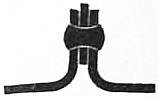
Fig. 1.—Adamson Joint.
Tank Boilers.—Of large stationary boilers the forms most commonly used are those known as the “Lancashire” boiler, and its modification the “Galloway” boiler. These boilers are made from 26 to 30 ft. long, with diameters from 6½ to Lancashire. 8 ft., and have two cylindrical furnace flues which in the “Lancashire” boiler extend for its whole length (see fig. 3). The working pressure is about 60 ℔ per sq. in. in the older boilers, from 100 ℔ to 120 ℔ per sq. in. in those supplying steam to compound engines, and from 150 to 170 ℔ where triple expansion engines are used. In some cases they have been constructed for a pressure of 200 ℔ per sq. in. The furnace flues are usually made in sections from 3 to 3½ ft. long. Each section consists of one plate bent into a cylindrical form, the longitudinal joint being welded, and is flanged at both ends, the various pieces being joined together by an “Adamson” joint (fig. 1.). It will be seen that these joints do not expose either rivets or double thickness of plate to the action of the fire; they further serve as stiffening rings to prevent collapse of the flue. In most of these boilers the heating surface is increased by fitting in the furnace flues a number of “Galloway” tubes. These are conical tubes, made with a flange at each end, by means of which they are connected to the furnace plate. They are so proportioned that the diameter of the large end of the tube is slightly greater than that of the flange of the small end; this enables them to be readily removed and replaced if necessary. These tubes not only add to the heating surface, but they stiffen the flue, promote circulation of the water in the boiler, and by mixing up the flue gases improve the evaporative efficiency.
In the “Galloway” boiler the two furnaces extend only for about 9 or 10 ft. into the boiler, and lead into a large chamber or flue in which a number of “Galloway” tubes are fitted, and which extends from the furnace end to the end of the boiler. A cross section of this flue showing the distribution of the Galloway tubes is shown in fig. 2. When boilers less than about 6½ ft. in diameter are needed, a somewhat similar type to the Lancashire boiler is used containing only one furnace. This is called a “Cornish” boiler.
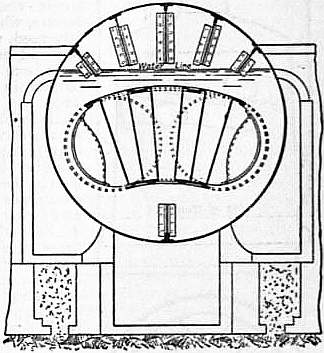
Fig. 2.—Galloway Boiler: Section beyond the Bridge.
In all three types of boiler the brickwork is constructed to form one central flue passing along the bottom of the boiler and two side flues extending up the side nearly to the water-level. A cross section of the brickwork is shown in fig. 2. The usual arrangement is for the flue gases to be divided as they leave the internal flue; one-half returns along each side flue to the front of the boiler, and the whole then passes downwards into the central flue, travelling under the bottom of the boiler until the gases again reach the back end, where they pass into the chimney. In a few cases the arrangement is reversed, the gases first passing along the bottom flue and returning along the side flues. This latter arrangement, whilst promoting a more rapid circulation of water, has the disadvantage of requiring two dampers, and it is not suitable for those cases in which heavy deposits form on the bottoms of the boilers.
Where floor space is limited and also for small installations, other forms of cylindrical boilers are used, most of them being of the vertical type. That most commonly used is the simple vertical boiler, with a plain vertical fire-box, and an internal Vertical. smoke stack traversing the steam space. The fire-box is made slightly tapering in diameter, the space between it and the shell being filled with water. In all but the small sizes cross tubes are generally fitted. These are made about 9 in. in diameter of 3⁄8-in. plate flanged at each end to enable them to be riveted to the fire-box plates. They are usually fitted with a slight inclination to facilitate water circulation. and a hand-hole closed by a suitable door is provided in the outer shell opposite to each tube for cleaning purposes. A boiler of this kind is illustrated in fig. 4. This form is often used on board ship for auxiliary purposes. Where more heating surface is required than can be obtained in the cross-tube boiler other types of vertical boiler are employed. For instance, in the “Tyne” boiler (fig. 5) the furnace is hemispherical, and the products of combustion are led into an upper combustion chamber traversed by four or more inclined water-tubes of about 9 in. diameter and by several vertical water-tubes of less diameter. In the “Victoria” boiler made by Messrs Clarke, Chapman & Co., and illustrated in fig. 6, the furnace is hemispherical; the furnace gases are led to an internal combustion chamber, and thence through numerous horizontal smoke-tubes to a smoke-box placed on the side of the boiler. In the somewhat similar boiler known as the “Cochran,” the combustion chamber is made with a “dry” back. Instead of a water space at the back of the chamber, doors lined with firebrick are fitted. These give easy access to the tube ends.
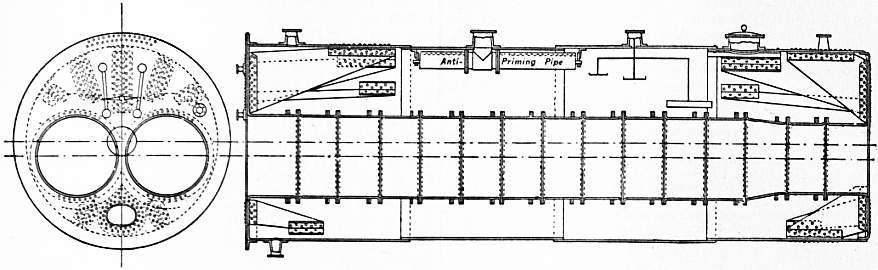
Fig. 3.—Lancashire Boiler (Messrs Tinker, Ltd.).
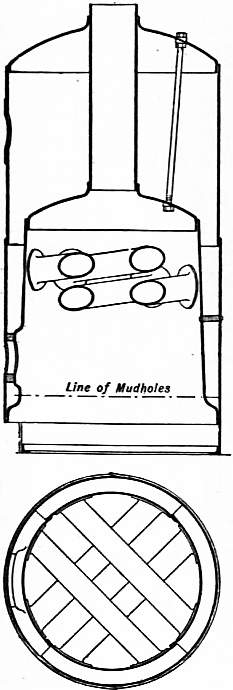
Fig. 4.—Simple Vertical Boiler.
The cylindrical multitubular return tube boiler is in almost universal use in merchant steamers. It is made in various sizes ranging up to 17 ft. in diameter, the usual working pressure being from 160 to 200 ℔ Marine. per sq. in., although in some few cases pressures of 265 ℔ per sq. in. are in use. These boilers are of two types, double- and single-ended. In single-ended boilers, which are those most generally used, the furnaces are fitted at one end only and vary in number from one in the smallest boiler to four in the largest. Three furnaces are the most usual practice. Each furnace generally has its own separate combustion chamber. In four furnace boilers, however, one chamber is sometimes made common to the two middle furnaces, and sometimes one chamber is fitted to each pair of side furnaces. In double-ended boilers furnaces are fitted at each end. In some cases each furnace has a separate combustion chamber, but more usually one chamber is made to serve for two furnaces, one at each end of the boiler. The two types of boilers are shown in figs. 7 and 8, which illustrate boilers made by Messrs D. Rowan & Co. of Glasgow, and which may be taken as representing good modern practice. The furnaces used in the smaller sizes are often of the plain cylindrical type, the thickness of plate varying from 3⁄8 in. up to ¾ in. according to the diameter of the furnace and the working pressure. Occasionally furnaces with “Adamson” joints similar to those used in Lancashire boilers are employed, but for large furnaces and for high pressures corrugated or ribbed furnaces are usually adopted. Sketches of the sections of these are shown in fig. 9. The sections of the Morison, Fox and Deighton types are made from plates originally rolled of a uniform thickness, made into a cylindrical form with a welded longitudinal joint and then corrugated, the only difference between them being in the shapes of the corrugations. In the other three types the plates from which the furnaces are made are rolled with ribs or thickened portions at distances of 9 in. These furnaces are stronger to resist collapse than plain furnaces of the same thickness, and accommodate themselves more readily to changes of temperature.
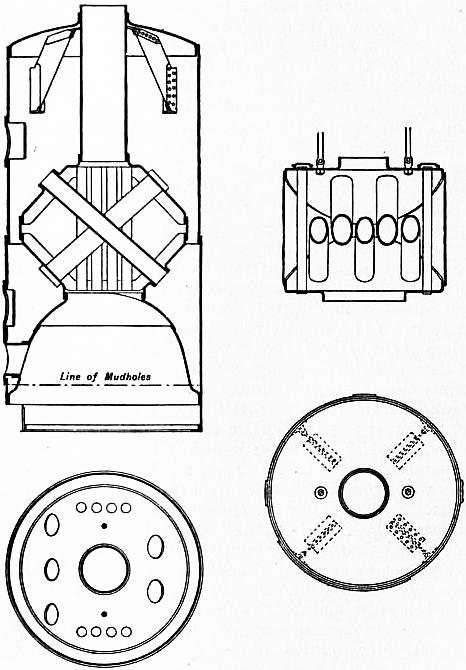
Fig. 5.—Vertical Boiler with Water-tubes (the “Tyne,” by Messrs Clarke, Chapman & Co.).
There are two distinct types of connexion between the furnaces and the combustion chambers. In one, shown in fig. 8, the furnace is flanged at the crown portion for riveting to the tube plate, and the lower part of the furnace is riveted to the “wrapper” or side plate of the combustion chamber. In the other type, shown in fig. 7, and known generally as the “Gourlay back end,” the end of the furnace is contracted into an oval conical form, and is then flanged outwards round the whole of its circumference. The tube plate is made to extend to the bottom of the combustion chamber, and the furnace is riveted to the tube plate. The advantage of the Gourlay back end is that in case of accident to the furnace it can be removed from the boiler and be replaced by one of the same design without disturbing the end plates, which is not possible with the other design. The Gourlay back end, however, is not so stiff as the other, and more longitudinal stays are required in the boiler.
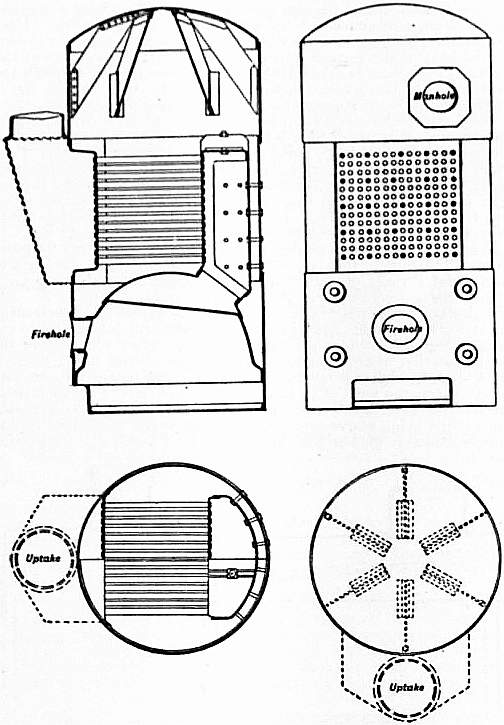
Fig. 6.—Vertical Boiler with internal combustion chamber (the “Victoria,” by Messrs Clarke, Chapman & Co.).
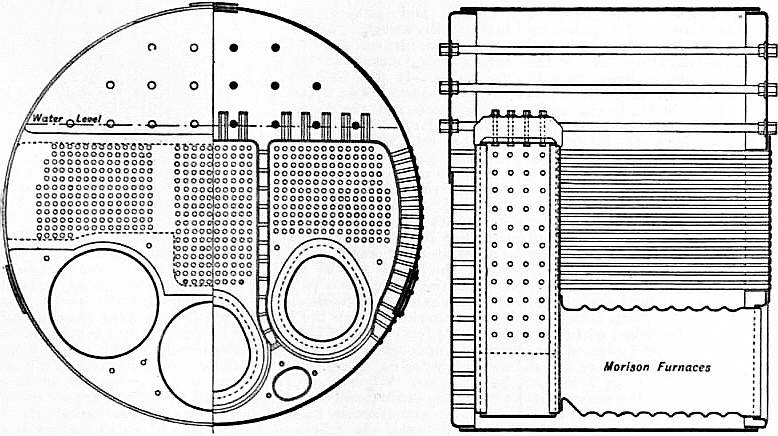
Fig. 7.—Single-ended Marine Boiler.
The flat sides and backs of the combustion chambers are stayed either to one another or to the shell of the boiler by numerous screw stays which are screwed through the two plates they connect, and which are nearly always fitted with nuts inside the combustion chambers. The tops of the chambers are usually stayed by strong girders resting upon the tube plates and chamber back plates. In a few cases, however, they are stayed by vertical stays attached to T bars riveted to the boiler shell. A few boilers are made in which the chamber tops are strengthened by heavy transverse girder plates. The end plates of the boiler in the steam space and below the combustion chambers are stayed by longitudinal stays passing through the whole length of the boiler and secured by double nuts at each end. The tube plates are strengthened by stay tubes screwed into them.
Where natural or chimney draught is used the tubes are generally made 3 or 3¼ in. outside diameter and are rarely more than 7 ft. long, but where “forced” draught is employed they are usually made 2½ in. diameter and 8 to 8½ ft. long. A clear space of 1¼ in. between the tubes is almost always arranged for, irrespective of size of tubes.
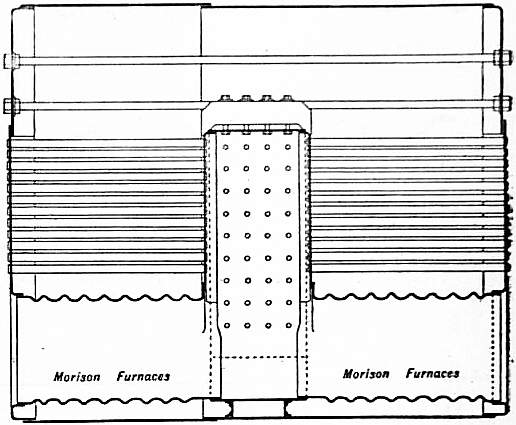
Fig. 8.—Double-ended Marine Boiler.
Stay tubes are screwed at both ends, the threads of the two ends being continuous so that they can be screwed into both tube plates; occasionally nuts are fitted to the front ends. The stay tubes are expanded into the plates and then beaded over.
The locomotive boiler consists of a cylindrical barrel attached to a portion containing the fire-box, which is nearly rectangular both in horizontal and vertical section. The fire-box sides are stayed to the fire-box shell by numerous stays about Locomotive. 1 in. in diameter, usually pitched 4 in. apart both vertically and horizontally. The top of the fire-box in small boilers is stayed by means of girder stays running longitudinally and supported at the ends upon the tube plate and the opposite fire-box plate. In some boilers the girders are partly supported by slings from the crown of the boiler. In larger boilers the crown of the boiler above the fire-box is made flat and the fire-box crown is supported by vertical stays connecting it with the shell crown. Provision is generally made for the expansion of the tube plate, which is of copper, by allowing the two or three cross rows of stays nearest the tube plate to have freedom of motion upwards but not downwards. The ordinary tubes are usually 1¾ in. diameter. The fire-bars are generally, though not always, made to slope downwards away from the fire door, and just below the lowest tubes a fire-bridge or baffle is fitted, extending about half-way from the tube plate to the fire-door side of the fire-box. In some cases water-tubes are fitted, extending right across the fire-box. In a boiler for the London & South-Western Railway Co., having a grate area of 31.5 sq. ft. and a total heating surface of 2727 sq. ft., there are 112 water-tubes each 2¾ in. diameter. These are arranged in two clusters, each containing 56, one set being placed above the fire-bridge, and the other set nearer the fire-door end of the boiler. The water-tubes are of seamless steel, and are expanded into the fire-box side plates. In way of these tubes the outer shell side plates are supported by stay bars passing right through the water-tubes. The usual pressure of locomotive boilers is about 175 ℔ to 200 ℔ per sq. in.
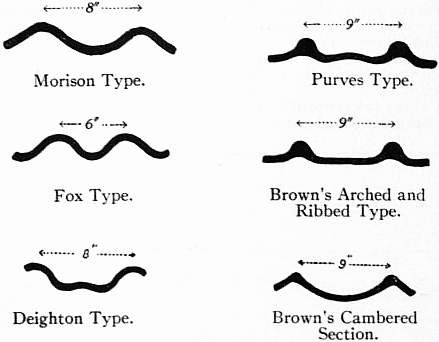
Fig. 9.
A good example of an express locomotive boiler is shown in fig. 10. In this case the grate area is 30.9 sq. ft. and the heating surface 2500 sq. ft. The barrel is 5 ft. 6 in. diameter, 16 ft. long between tube plates. The fire-box crown is stayed by vertical stays extending to the shell crown, except for the three rows of stays nearest the tube plates. These are supported by cross girders resting upon brackets secured to the outer shell.
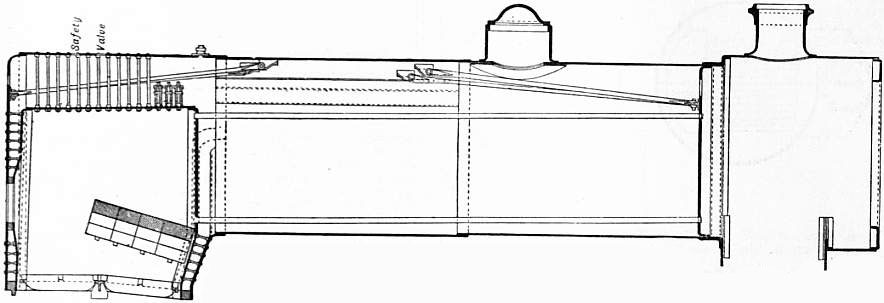
Fig. 10.—Express Locomotive Boiler, with widened fire-box (Great Northern Railway, England).
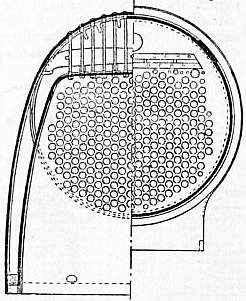
Water-Tube Boilers.—The “Babcock & Wilcox” boiler, as fitted for land purposes, and illustrated in fig. 11, consists of a horizontal cylinder forming a steam chest, having dished ends and two specially constructed cross-boxes riveted to the Babcock and Wilcox stationary. bottom. Under the cylinder is placed a sloping nest of tubes, under the upper end of which is the fire. The sides and back of the boiler are enclosed in brickwork up to the height of the centre of the horizontal cylinder and the front is fitted with an iron casing lined with brick at the lower part. Suitable brickwork baffles are arranged between the tubes themselves, and between the nests of tubes and the cylinder, to ensure a proper circulation of the products of combustion, which are made to pass between the tubes three times. The nest of tubes consists of several separate elements, each formed by a front and back header made of wrought steel of sinuous form connected by a number of tubes. The upper ends of the front headers are connected by short tubes to the front cross-box of the horizontal cylinder, the lower ends being closed. The upper ends of the back headers are connected by longer pipes to the back cross-box, and their lower ends by short pipes to a horizontal mud drum to which a blow-off cock and pipe are attached. The headers are furnished with holes on two opposite sides; those on one side form the means of connexion between the headers and tubes, and the others allow access for fixing the tubes in position and cleaning. The outer holes are oval, and closed by special fittings shown in fig. 18, the watertightness of the joints being secured by the outer cover plates. The holes being oval, the inside fitting can be placed in position from outside, and it is so made as to cover the opening and prevent any great outrush of steam or water should the bolt break. Any desired working pressure can be provided for in these boilers; in some special cases it rises as high as 500 ℔ per sq. in., but a more usual pressure is 180 ℔ Like all water-tube boilers, they require to be frequently cleaned if impure feed-water is used, but the straightness of their tubes enables their condition to be ascertained at any time when the boiler is out of use, and any accumulation of scale to be removed. The superheaters, which are frequently fitted, consist of two cross-boxes or headers placed transversely under the cylindrical drum and connected by numerous C-shaped tubes. They are situated between the tubes and the steam-chest, and are exposed to the heat of the furnace gases after their first passage across the tubes. The steam is taken by an internal pipe passing through the bottom of the drum into the upper cross-box, then through the C tubes into the lower box, and thence to the steam pipe. When steam is being raised, the superheater is flooded with water, which is drained out through a blow-off pipe before communication is opened with the steam-pipe. In large boilers of this type, two steam-chests are placed side by side connected together by two cross steam pipes and by the mud drum. Each, however, has its own separate feed supply. The largest boiler made has two steam chests 4½ ft. diameter by 25½ ft. long, a grate surface of 85 sq. ft., and a total heating surface of 6182 sq. ft.
Another type of water-tube boiler in use for stationary purposes is the “Stirling” (fig. 12). This boiler consists of four or five horizontal drums, of which the three upper form the steam-space, and the one or two lower contain water. Stirling. The lower drums, where two are fitted, are connected to each other at about the middle of their height by horizontal tubes, and to the upper drums by numerous nearly vertical tubes which form the major portion of the heating surfaces. The central upper drum is at a slightly higher level than the others, and communicates with that nearest the back of the boiler by a set of curved tubes entirely above the water-level, and with the front drum by two sets—the upper one being above and the lower below the water-level. The whole boiler is enclosed in brickwork, into which the supporting columns and girders are built. Brickwork baffles compel the furnace gases to take specified courses among the tubes. It will be seen that the space between the boiler front and the tubes form a large combustion chamber into which all the furnace gases must pass before they enter the spaces between the tubes; in this chamber a baffle-bridge is sometimes built. Another chamber is formed between the first and second sets of tubes. The feed-water enters the back upper drum, and must pass down the third set of tubes into the lower drum before it reaches the other parts of the boiler. Thus the coldest water is always where the temperature of the furnace gases is lowest; and as the current through the lower drum is slight, the solid matters separated from the feed-water while its temperature is being raised have an opportunity of settling to the bottom of this drum, where the heating is not great and where therefore their presence will not be injurious. When superheaters are required, they are made of two drums connected by numerous small tubes, and are somewhat similar in construction to the boiler proper. The superheater is placed between the first and second sets of tubes, where it is exposed to the furnace gases before too much heat has been taken from them. Arrangements are provided for flooding the superheater while steam is being raised, and for draining it before the steam is passed through it.
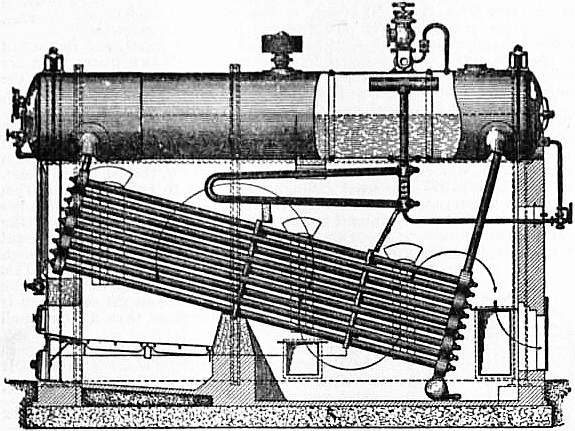
Fig. 11.—Babcock & Wilcox Water-tube Boiler fitted with Superheaters.
A somewhat similar boiler is made by Messrs. Clarke, Chapman & Co., and is known as the “Woodeson” boiler (fig. 13). It consists of three upper drums placed side by side connected together by numerous short tubes, some above and some Woodeson. below the water-level, and of three smaller lower drums also connected by short cross tubes. The upper and lower drums are connected by numerous nearly vertical straight tubes. The whole is enclosed in firebrick casing. The design permits of the insides of all the tubes being readily inspected, and also of any tube being taken out and renewed without displacing any other part of the boiler.
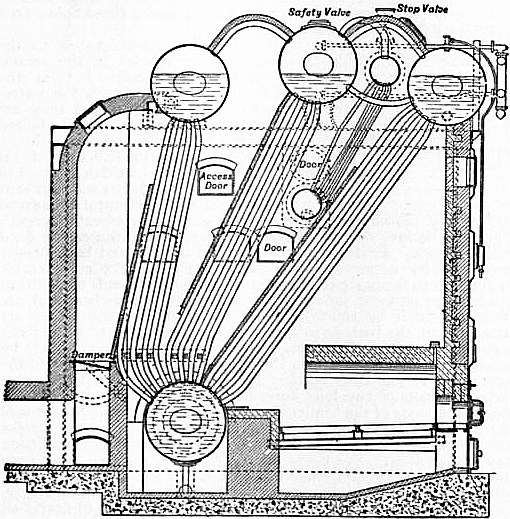
Fig. 12.—Stirling Water-tube Boiler.
The earliest form of water-tube boiler which came into general use in the British navy is the Belleville. Two views of this boiler are shown in fig. 14. It is composed of two parts, the boiler proper and the “economizer.” Each of these consists of Belleville. several sets of elements placed side by side; those of the boiler proper are situated immediately over the fire, and those of the economizer in the uptake above the boiler, the intervening space being designed to act as a combustion chamber. Each element is constructed of a number of straight tubes connected at their ends by means of screwed joints to junction-boxes which are made of malleable cast iron. These are arranged vertically over one another, and except in the case of the upper and lower ones at the front of the boiler, each connects the upper end of one tube with the lower end of the next tube of the element. The boxes at the back of the boiler are all close-ended, but those at the front are provided with a small oval hole, opposite to each tube end, closed by an internal door with bolt and cross-bar; the purpose of these openings is to permit the inside of the tubes to be examined and cleaned. The lower front box of each element of the boiler proper is connected to a horizontal cross-tube of square section, called a “feed-collector,” which extends the whole width of the boiler. When the boiler is not in use, any element can be readily disconnected and a spare one inserted. The lower part of the steam-chest is connected to the feed-collector by vertical pipes at each end of the boiler, and prolongations of these pipes below the level of the feed-collector form closed pockets for the collection of sediment. The tubes are made of seamless steel. They are generally about 4½ in. in external diameter: the two lower rows are 3⁄8 in. thick, the next two rows 5⁄16 and the remainder about 1⁄5 in. The construction of the economizer is similar to that of the boiler proper, but the tubes are shorter and smaller, being generally about 2¾ in. in diameter. The lower boxes of the economizer elements are connected to a horizontal feed pipe which is kept supplied with water by a feed-pumping engine, and the upper boxes are connected to another horizontal pipe from which the heated feed-water is taken into the steam-chest. Both the boiler proper and the economizer are enclosed in a casing which is formed of two thicknesses of thin iron separated by non-conducting material and lined with firebrick at the part between the fire-bar level and the lower rows of tubes. Along the front of the boiler, above the level of the firing-doors, there is a small tube having several nozzles directed across the fire-grate, and supplied with compressed air at a pressure of about 10 ℔ per sq. in. In this way not only is additional air supplied, but the gases issuing from the fire are stirred up and mixed, their combustion being thereby facilitated before they pass into the spaces between the tubes. A similar air-tube is provided for the space between the boiler proper and the economizer. Any water suspended in the steam is separated in a special separator fitted in the main steam-pipe, and the steam is further dried by passing through a reducing-valve, which ensures a steady pressure on the engine side of the valve, notwithstanding fluctuations of pressure in the boiler. The boiler pressure is usually maintained at about 50 ℔ per sq. in. in excess of that at which the engines are working, the excess forming a reservoir of energy to provide for irregular firing or feeding.
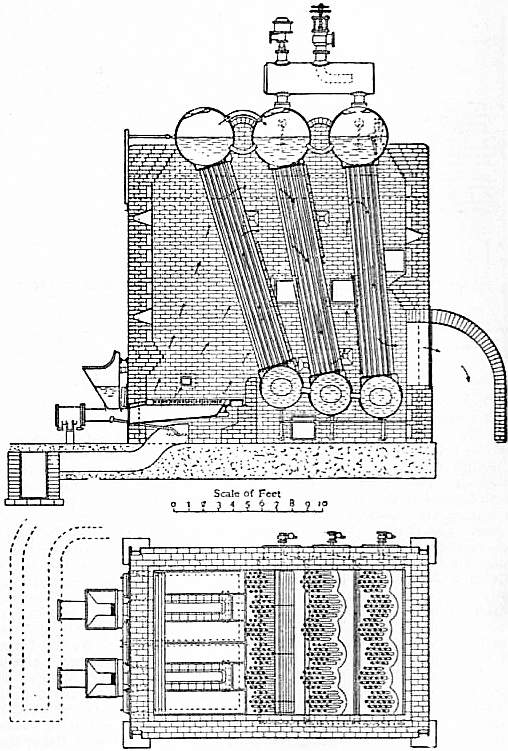
Fig. 13.—Woodeson Boiler (Messrs Clarke, Chapman & Co.).
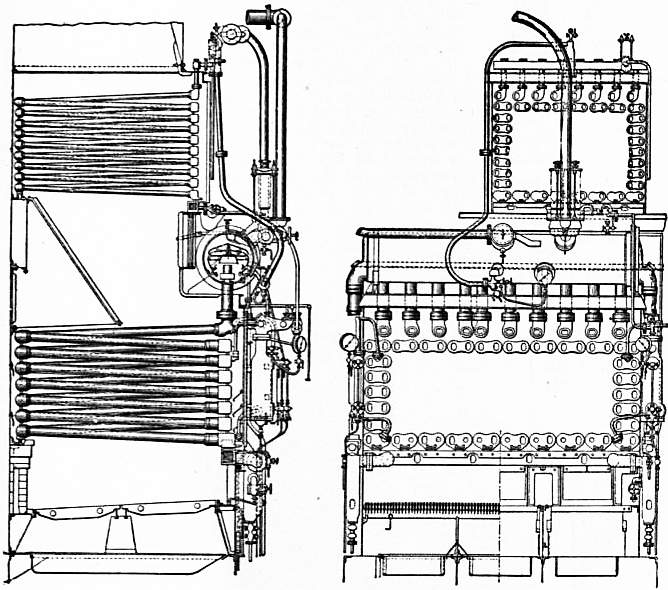
Fig. 14.—Belleville Boiler.
Another type of large-tube boiler which has been used in the British and in other navies is the “Niclausse,” shown in fig. 15. It is also in use on land in several electric-light installations. It consists of a horizontal steam-chest under Niclausse. which is placed a number of elements arranged side by side over the fire, the whole being enclosed in an iron casing lined with firebrick where it is exposed to the direct action of the fire. Each element consists of a header of rectangular cross-section, fitted with two rows of inclined close-ended tubes, which slope downwards towards the back of the boiler with an inclination of 6° to the horizontal. The headers are usually of malleable cast iron with diaphragms cast in them, but sometimes steel has been employed, the bottoms being closed by a riveted steel plate, and the diaphragms being made of the same material. The headers are bolted to socket-pieces which are riveted to the bottom of the steam-chest, so that any element may be easily removed. The tube-holes are accurately bored, at an angle to suit the inclination of the tubes, through both the front and back of the headers and through the diaphragm, those in the header walls being slightly conical. The tubes themselves, which are made of seamless steel, are of peculiar construction. The lower or back ends are reduced in diameter and screwed and fitted with cap-nuts which entirely close them. The front ends are thickened by being upset, and the parts where they fit into the header walls and in the diaphragm are carefully turned to gauge. The upper and lower parts of the tubes between these fitting portions are then cut away, the side portions only being retained, and the end is termed a “lanterne.” A small water-circulating tube of thin sheet steel, fitted inside each generating tube, is open at the lower end, and at the other is secured to a smaller “lanterne,” which, however, only extends from the front of the header to the diaphragm. This smaller “lanterne” closes the front end of the generating tube. The whole arrangement is such that when the tubes are in place only the small inner circulating tubes communicate with the space between the front of the header and the diaphragm, while the annular spaces in the generating tubes around the water-circulating tubes communicate only with the space between the diaphragm and the back of the header. The steam formed in the tubes escapes from them into this back space, through which it rises into the steam-chest, whilst the space in the front of the header always contains a down-current of water supplying the inner circulating tubes. The tubes are maintained in position by cross-bars, each secured by one stud-bolt screwed into the header front wall, and each serving to fix two tubes. The products of combustion ascend directly from the fire amongst the tubes, and the combustion is rendered more complete by the introduction of jets of high-pressure air immediately over the fire, as in the “Belleville” boiler.