Volume 3 — [E-Text Edition of Volume III - Part 1 of 2, Slice 2 of 3 - BACONTHORPE to BANKRUPTCY] (continued 9)
Reading edition
See J. C. Dent, Canadian Portrait Gallery (1880). His life, by the Hon. Geo. W. Ross, is included in The Makers of Canada series (Toronto).
BALE, JOHN (1495-1563), bishop of Ossory, English author, was born at Cove, near Dunwich in Suffolk, on the 21st of November 1495. At the age of twelve he entered the Carmelite monastery at Norwich, removing later to the house of "Holme," probably the abbey of the Whitefriars at Hulne near Alnwick. Later he entered Jesus College, Cambridge, and took his degree of B.D. in 1529. At Cambridge he came under the influence of Cranmer and of Thomas Wentworth, 1st Baron Wentworth, and became an ardent partisan of the Reformers. He laid aside his monastic habit, and, as he himself puts it with characteristically brutal violence, "that I might never more serve so execrable a beast, I took to wife the faithful Dorothy." He obtained the living of Thornden, Suffolk, but in 1534 was summoned before the archbishop of York for a sermon against the invocation of saints preached at Doncaster, and afterwards before Stokesley, bishop of London, but he escaped through the powerful protection of Thomas Cromwell, whose notice he is said to have attracted by his miracle plays. He was an unscrupulous controversialist, and in these plays he allows no considerations of decency to stand in the way of his denunciations of the monastic system and its supporters. The prayer of Infidelitas which opens the second act of his Thre Laws (quoted by T. Warton, Hist. Eng. Poetry, sect. 41) is an example of the lengths to which he went in profane parody. These coarse and violent productions were well calculated to impress popular feeling, and no doubt Cromwell found in him an invaluable instrument. But on his patron's fall in 1540 Bale fled with his wife and children to Germany. He returned on the accession of Edward VI. He received the living of Bishopstoke, Hampshire, being promoted in 1552 to the Irish see of Ossory. He refused to be consecrated by the Roman rite, which still obtained in the Irish church, and won his point, though the dean of Dublin entered a protest against the revised office during the ceremony (see his Vocacyon of John Bale to the Bishopperycke of Ossorie, Harl. Misc. vol. vi.). He pushed his Protestant propaganda in Ireland with no regard to expediency, and when the accession of Mary inaugurated a reaction in matters of religion, it was with difficulty that he was got safely out of the country. He tried to escape to Scotland, but on the voyage was captured by a Dutch man-of-war, which was driven by stress of weather to St. Ives in Cornwall. Bale was arrested on suspicion of treason, but soon released. At Dover he had another narrow escape, but he eventually made his way to Holland and thence to Frankfort and Basel. During his exile he devoted himself to writing. After his return, on the accession of Elizabeth, he received (1560) a prebendal stall at Canterbury. He died in November 1563 and was buried in the cathedral.
The scurrility and vehemence with which "foul-mouthed Bale," as Wood calls him, attacked his enemies does not destroy the value of his contributions to literature, though his strong bias against Roman Catholic writers does detract from the critical value of his works. Of his mysteries and miracle plays only five have been preserved, but the titles of the others, quoted by himself in his Catalogus, show that they were animated by the same political and religious aims. The Thre Laws of Nature, Moses and Christ, corrupted by the Sodomytes, Pharisees and Papystes most wicked (pr. 1538 and again in 1562) was a morality play. The direction for the dressing of the parts is instructive: "Let Idolatry be decked like an old witch, Sodomy like a monk of all sects, Ambition like a bishop, Covetousness like a Pharisee or spiritual lawyer, False Doctrine like a popish doctor, and Hypocrisy like a gray friar." A Tragedye; or enterlude manyfesting the chief promyses of God unto Man ... (1538, printed in Dodsley's Old Plays, vol. 1), The Temptacyon of our Lorde (ed. A. B. Grosart in Miscellanies of the Fuller Worthies Library, vol. i., 1870), and A brefe Comedy or Enterlude of Johan Baptystes preachynge in the Wyldernesse, &c. (Harl. Misc. vol. i.) were all written in 1538. His plays are doggerel, but he is a figure of some dramatic importance as the author of Kynge Johan (c. 1548), which marks the transition between the old morality play and the English historical drama. It does not appear to have directly influenced the creators of the chronicle histories. To the authors of the Troublesome Raigne of King John (1591) it was apparently unknown, but it is noteworthy that an attempt, however feeble, at historical drama was made fourteen years before the production of Gorboduc. Kynge Johan (ed. J. P. Collier, Camden Soc. 1838) is itself a polemic against the Roman Catholic Church. King John is represented as the champion of English rites against the Roman see:—
"This noble Kynge Johan, as a faythfull Moses Withstode proude Pharao for his poore Israel."
But the English people remained in the bondage of Rome,—
"Tyll that duke Josue, whych was our late Kynge Henrye, Clerely brought us out in to the lande of mylke and honye."
Elsewhere John is called a Lollard and accused of "heretycall langage," and he is finally poisoned by a monk of Swinestead. Allegorical characters are mixed with the real persons. Ynglonde vidua, represents the nation, and the jocular element is provided by Sedwyson (sedition), who would have been the Vice in a pure morality play. One actor was obviously intended to play many parts, for stage directions such as "Go out Ynglond, and dress for Clargy" are by no means uncommon. The MS. of Kynge Johan was discovered between 1831 and 1838 among the corporation papers at Ipswich, where it was probably performed, for there are references to charitable foundations by King John in the town and neighbourhood. It is described at the end of the MS. as two plays, but there is no obvious division, the end of the first act alone being noted. The first part is corrected by Bale and the latter half is in his handwriting, but his name nowhere occurs. In the list of his works, however, he gives a play De Joanne Anglorum Rege, written in idiomate materno.
But Bale's most important work is Illustrium majoris Britanniae scriptorum, hoc est, Angliae, Cambriae, ac Scotiae Summarium ... (Ipswich and Wesel, for John Overton, 1548, 1549). This contained five centuries, but another edition, almost entirely rewritten and containing fourteen centuries, was printed at Basel with the title Scriptorum illustrium majoris Britanniae ... Catalogus (1557-1559). The chronological catalogue of British authors and their works was partly founded on the Collectanea and Commentarii of John Leland, but Bale was an indefatigable collector and worker, and himself examined many of the valuable libraries of the Augustinian and Carmelite houses before their dissolution. In his notebook he records as an instance of the wholesale destruction in progress: "I have bene also at Norwyche, our second citye of name, and there all the library monuments are turned to the use of their grossers, candelmakers, sopesellers, and other worldly occupiers ... As much have I saved there and in certen other places in Northfolke and Southfolke concerning the authors names and titles of their workes, as I could, and as much wold I have done through out the whole realm, yf I had been able to have borne the charges, as I am not." His work is therefore invaluable, in spite of the inaccuracies and the abuse lavished on Catholic writers, for it contains much information that would otherwise have been hopelessly lost.
A list of Bale's works is to be found in Athenae Cantabrigienses (vol. i. pp. 227 et seq.). Beside the reprints already mentioned, The Examinations of Lord Cobham, William Thorpe and Anne Askewe, &c. were edited by the Rev. H. Christmas for the Parker Society in 1849. Bale's autograph note-book is preserved in the Selden Collection of the Bodleian Library, Oxford. It contains the materials he collected for his two published catalogues arranged alphabetically, with no attempt at ornament of any kind, and without the personalities which deface his completed work. He also gives in most cases the sources from which his information was derived. This book was prepared for publication with notes by Dr R. Lane Poole, with the help of Miss Mary Bateson, as Index Britanniae Scriptorum quos ... collegit Ioannes Baleus (Clarendon Press, 1902), forming part ix. of Anecdota Oxoniensia.
John Pits or Pitseus (1560-1616), an English Catholic exile, founded on Bale's work his Relationum historicarum de rebus anglicis tomus primus (Paris, 1619), better known by its running title of De illustribus Angliae scriptoribus. This is really the fourth book of a more extensive work. He omits the Wycliffite and Protestant divines mentioned by Bale, and the most valuable section is the lives of the Catholic exiles resident in Douai and other French towns. He does not scruple to assert (Nota de Joanne Bale) that Bale's Catalogus was a misrepresentation of Leland's matter, though there is every reason to believe that he was only acquainted with Leland's work at second-hand, through Bale.
BALE. (1) (A word common to Teutonic languages, in O. Eng. balu, cf. Icelandic böl), evil, suffering, a word obsolete except in poetry, and more common in the adjectival form "baleful." In early alliterative poetry it is especially used antithetically with "bliss." (2) (O. Eng. bael, a blazing fire, a funeral pyre), a bonfire, a northern English use more common in the tautological "bale-fire," with sometimes a confused reference from (1) to evil. (3) (A word of doubtful origin, possibly connected with "ball "), a bundle of merchandise, especially of cotton, wool or hay, packed with a cover, or fastened with bands of metal, &c. for transportation; the weight and capacity varies with the goods. (4) (Properly "bail," from Fr. baille, possibly connected with Lat. bacula, a tub), to empty water out of a boat by means of a bail or bucket.
BALEARIC ISLANDS (Baleáres), an archipelago of four large and eleven small islands in the Mediterranean Sea, off the east coast of Spain, of which country it forms a province. Pop. (1900) 311,649; area, 1935 sq. m. The archipelago, which lies between 38° 40′ and 40° 5′ N., and between 1° and 5° E., comprises two distinct groups. The eastern and larger group, corresponding with the ancient Insulae Baleares, comprises the two principal members of the archipelago, Majorca (Spanish, Mallorca) and Minorca (Spanish, Menorca), with seven islets:—Aire, Aucanada, Botafoch, Cabrera, Dragonera, Pinto and El Rey. The western group, corresponding with the ancient Pityusae or Pine Islands, also comprises two relatively large islands, Iviza (Spanish, Ibiza or, formerly, Ivica) and Formentera, with the islets of Ahorcados, Conejera, Pou and Espalmador. Majorca, Minorca and Iviza are described in separate articles. Formentera is described with Iviza. The total population of the eleven islets only amounted to 171 in 1900, but all were inhabited. None of them is of any importance except Cabrera, which is full of caverns, and was formerly used as a place of banishment. In 1808 a large body of Frenchmen were landed here by their Spanish captors, and allowed almost to perish of starvation.
The origin of the name Baleáres is a mere matter of conjecture; it is obvious, however, that the modern Majorca and Minorca are obtained from the Latin Major and Minor, through the Byzantine forms Μαιορικά and Μινορικά; while Iviza is plainly the older Ebusus, a name probably of Carthaginian origin. The Ophiusa of the Greeks (Colubraria of the Romans) is now known as Formentera.
Geology.—The strata which form the Balearic Isles fall naturally into two divisions. There is an older series, ranging from the Devonian to the Cretaceous, which is folded and faulted and forms all the higher hills, and there is a newer series of Tertiary age, which lies nearly horizontal and rests unconformably upon the older beds. The direction of the folds in the older series is in Iviza nearly west to east, in Majorca south-west to north-east, and in Minorca south to north, thus forming an arc convex towards the south-east. The Devonian is visible only in Minorca, the Trias being the oldest system represented in the other islands. The higher part of the Cretaceous is absent, and it appears to have been during this period that the principal folding of the older beds took place. The Eocene beds are nummulitic. There is a lacustrine group which has usually been placed in the Lower Eocene, but the discovery of Anthracotherium magnum in the interbedded lignites proves it to be Oligocene, in part at least. The Miocene included a limestone with Clypeaster. Pliocene beds also occur.
Climate, Fauna, Flora.—The climate of the archipelago, though generally mild, healthy and favourable to plant life, is by no means uniform, owing to the differences of altitude and shelter from wind in different islands. The fauna and flora resemble those of the Mediterranean coasts of Spain or France.
Inhabitants.—The islanders are a Spanish race, very closely akin to the Catalans; but the long period of Moorish rule has left its mark on their physical type and customs. In character they are industrious and hospitable, and pique themselves on their loyalty and orthodoxy. Crime is rare. There are higher schools in the principal towns, and the standard of primary education is well up to the average of Spain. Vaccination is common except in the cities,—the women often performing the operation themselves when medical assistance cannot be got. Castilian is spoken by the upper and commercial classes; the lower and agricultural employ a dialect resembling that of the Catalans.
Commerce.—Fruit, grain, wine and oil are produced in the islands, and there is an active trade with Barcelona in fresh fish, including large quantities of lobsters. Shoemaking is one of the most prosperous industries. There is not a very active trade direct with foreign countries, as the principal imports—cotton, leather, petroleum, sugar, coal and timber—are introduced through Barcelona. The export trade is chiefly with the Peninsula, France, Italy, Algeria and with Cuba and Porto Rico. Most of the agricultural products are sent to the Peninsula; wine, figs, marble, almonds, lemons and rice to Europe and Africa.
Administration.—The administration of the Balearic Islands differs in no respect from that of the other Spanish provinces on the mainland. There are five judicial districts (partidos judiciales), named after their chief towns—Inca, Iviza, Manacor, Palma and Port Mahon.
History.—Of the origin of the early inhabitants of the Balearic Islands nothing is certainly known, though Greek and Roman writers refer to the Boeotian and Rhodian settlements. There are numerous sepulchral and other monuments, which are generally believed to be of prehistoric origin. According to general tradition the natives, from whatever quarter derived, were a strange and savage people till they received some tincture of civilization from the Carthaginians, who early took possession of the islands and built themselves cities on their coasts. Of these cities, Port Mahon, the most important, still retains the name which is derived from the family of Mago. About twenty-three years after the destruction of Carthage the Romans accused the islanders of piracy, and sent against them Q. Caecilius Metellus, who soon reduced them to obedience, settled amongst them 3000 Roman and Spanish colonists, founded the cities of Palma and Pollentia (Pollensa), and introduced the cultivation of the olive. Besides valuable contingents of the celebrated Balearic slingers, the Romans derived from their new conquest mules (from Minorca), edible snails, sinope and pitch. Of their occupation numerous traces still exist,—the most remarkable being the aqueduct at Pollensa. In A.D. 423 the islands were seized by the Vandals and in 798 by the Moors. They became a separate Moorish kingdom in 1009, which, becoming extremely obnoxious for piracy, was the object of a crusade directed against it by Pope Paschal II., in which the Catalans took the lead. This expedition was frustrated at the time, but was resumed by James I. of Aragon, and the Moors were expelled in 1232. During their occupation the island was populous and productive, and an active commerce was carried on with Spain and Africa. King James conferred the sovereignty of the isles on his third son, under whom and his successor they formed an independent kingdom up to 1349, from which time their history merges in that of Spain. In 1521 an insurrection of the peasantry against the nobility, whom they massacred, took place in Majorca, and was not suppressed without much bloodshed. In the War of the Spanish Succession all the islands declared for Charles; the duke of Anjou had no footing anywhere save in the citadel of Mahon. Minorca was reduced by Count Villars in 1707; but it was not till June 1715 that Majorca was subjugated, and meanwhile Port Mahon was captured by the English under General Stanhope in 1708. In 1713 the island was secured to them by the peace of Utrecht; but in 1756 it was invaded by a force of 12,000 French, who, after defeating the British under Admiral Byng, captured Port Mahon. Restored to England in 1763, the island remained in possession of the British till 1782, when it was retaken by the Spaniards. Again seized by the British in 1798, it was finally ceded to Spain by the peace of Amiens in 1803. When the French invaded Spain in 1808, the Mallorquins did not remain indifferent; the governor, D. Juan Miguel de Vives, announced, amid universal acclamation, his resolution to support Ferdinand VII. At first the Junta would take no active part in the war, retaining the corps of volunteers that was formed for the defence of the island; but finding it quite secure, they transferred a succession of them to the Peninsula to reinforce the allies. Such was the animosity excited against the French when their excesses were known to the Mallorquins, that some of the French prisoners, conducted thither in 1810, had to be transferred with all speed to the island of Cabrera, a transference which was not effected before some of them had been killed.
Bibliography.—For a general account of the islands, the most valuable books are Die Balearen geschildert in Wort und Bild, by the archduke Ludwig Salvator of Austria (Leipzig, 1896); Les Îles oubliées, by G. Vuillier (Paris, 1904), the first edition of which has been translated under the title of The Forgotten Isles (London, 1896)—and Islas Baleáres, an illustrated volume of 1423 pages, by P. Pifferrer, in the series "España" (Barcelona, 1888). An article by George Sand in the Revue des deux mondes (1841) also deserves notice. The following are monographs on special subjects:—The Story of Majorca and Minorca, by Sir C. R. Markham (London, 1908); Illustrationes florae insularum Balearium, by M. Willkomm (Stuttgart, 1881-1892); Monuments primitifs des îles baléares, by E. Cartailhac (Mission scientifique du ministère de l'instruction publique, Toulouse, 1892). The British Foreign Office Reports for the Consular District of Barcelona give some account of the movement of commerce (London, annual). Much of the material available for a scientific history will be found in La Historia general del regno baleárico, by J. Dameto and V. Mut (Majorca, 1632-1650). For the period of Moorish rule, see Bosquejo histórico de la dominacion islamita en las islas Baleáres, by A. Campaner y Fuertes (Palma, 1888). See also the elaborate treatise Les Relations de la France avec le royaume de Majorque, by A. Lecoy de la Marche (Paris, 1892).
BALES [Balesius], PETER (1547-1610?), English calligraphist, one of the inventors of shorthand writing, was born in London in 1547, and is described by Anthony Wood as a "most dexterous person in his profession, to the great wonder of scholars and others." We are also informed that "he spent several years in sciences among Oxonians, particularly, as it seems, in Gloucester Hall; but that study, which he used for a diversion only, proved at length an employment of profit." He is mentioned for his skill in micrography in Holinshed's Chronicle. "Hadrian Junius," says Evelyn, "speaking as a miracle of somebody who wrote the Apostles' Creed and the beginning of St John's Gospel within the compass of a farthing: what would he have said of our famous Peter Bales, who, in the year 1575, wrote the Lord's Prayer, the Creed, Decalogue, with two short prayers in Latin, his own name, motto, day of the month, year of the Lord, and reign of the queen, to whom he presented it at Hampton Court, all of it written within the circle of a single penny, inchased in a ring and borders of gold, and covered with a crystal, so accurately wrought as to be very plainly legible; to the great admiration of her majesty, the whole privy council, and several ambassadors then at court?" Bales was likewise very dexterous in imitating handwritings, and between 1576 and 1590 was employed by Secretary Walsingham in certain political manœuvres. We find him at the head of a school near the Old Bailey, London, in 1590, in which year he published his Writing Schoolemaster, in three Parts. This book included an Arte of Brachygraphie, which is one of the earliest attempts to construct a system of shorthand. In 1595 he had a great trial of skill with one Daniel Johnson, for a golden pen of £20 value, and won it; and a contemporary author further relates that he had also the arms of calligraphy given him, which are azure, a pen or. Bales died about the year 1610.
BALFE, MICHAEL WILLIAM (1808-1870), Irish musical composer, was born on the 15th of May 1808, at Dublin. His musical gifts became apparent at an early age. The only instruction he received was from his father, who was a dancing master, and from a musician, C. E. Horn (1786-1849). Between 1814 and 1815 he played the violin for his father's dancing-classes, and at the age of seven composed a polacca. In 1817 he appeared as a violinist in public, and in this year composed a ballad, first called "Young Fanny" and afterwards, when sung in Paul Pry by Madame Vestris, "The Lovers' Mistake." On the death of his father in 1823 he was engaged in the orchestra of Drury Lane, and being in possession of a small but pleasant baritone voice, he chose the career of an operatic singer. An unsuccessful début was made at Norwich in Der Freischütz. In 1825 he was taken to Rome by Count Mazzara, being introduced to Cherubini on the way. In Italy he wrote his first dramatic work, a ballet, La Pérouse. At the close of 1827 he appeared as Figaro in Rossini's Barbière, at the Italian opera in Paris. Balfe soon returned to Italy, where, during the next nine years, he remained, singing at various theatres and composing a number of operas. During this time he married Mdlle Luisa Roser, a Hungarian singer whom he had met at Bergamo. Fétis says that the public indignation roused by an attempt at "improving" Meyerbeer's opera Il Crociato by interpolated music of his own compelled Balfe to throw up his engagement at the theatre La Fenice in Venice. By this time he had produced his first complete opera, I Rivali di se stessi, at Palermo in the carnival season of 1829-1830; the opera Un Avvertimento ai gelosi at Pavia; and Enrico Quarto at Milan, where he had been engaged to sing with Malibran at the Scala. He returned to England in the spring of 1833, and on the 29th of October 1835 his Siege of Rochelle was produced and rapturously received at Drury Lane. Encouraged by his success, he produced The Maid of Artois on the 27th of May 1836—the success of the opera being confirmed by the exquisite singing of Malibran. Balfe was a prolific composer, as may be seen from the following imperfect list of his English operas alone:—Siege of Rochelle (1835); The Maid of Artois (1836); Catherine Grey (1837); Joan of Arc (1837); Falstaff (1838, Lablache in title-rôle); Amelia, or the Love Test (1838); Keolanthe (1841); The Bohemian Girl, his best known work (1844); The Daughter of St. Mark (1844); The Enchantress (1845); The Bondman (1846); The Devil's in it (1847); The Maid of Honour (1847); The Sicilian Bride (1852); The Rose of Castile (1857); Satanella (1858); Bianca (1860); The Puritan's Daughter (1861); The Armourer of Nantes (1863); Blanche de Nevers (1863). Balfe also wrote several operas for the Opéra Comique and Grand Opéra in Paris, where MM. Scribe and St George provided him with the libretti for his Le Puits d'amour (1843) and his Les Quatre Fils Aymon (1844). His L'Étoile de Seville was written in 1845 for the Académie Royale. The fact that Balfe was an Irishman, who produced operas in English, French and Italian with conspicuous success, is in itself interesting. When to this we add the record of his operatic impersonations on the stage, the European success of his Bohemian Girl, his picturesque retirement into Hertfordshire in 1864 as a gentleman farmer, and above all the undeniable gift for creating such pure melodies as his songs "When other Hearts" and "I dreamt that I dwelt in marble halls," it is idle to refuse him a prominent place in the history of music. He wrote much that was trivial, but also much that was enduring. He died on the 20th of October 1870, and was buried at Kensal Green. In 1882 a medallion portrait of him was unveiled in Westminster Abbey.
BALFOUR, ARTHUR JAMES (1848- ), British statesman, eldest son of James Maitland Balfour of Whittingehame, Haddingtonshire, and of Lady Blanche Gascoyne Cecil, a sister of the third marquess of Salisbury, was born on the 25th of July 1848. He was educated at Eton and Trinity College, Cambridge. In 1874 he became M.P. in the Conservative interest for Hertford, and represented that constituency until 1885. When, in the spring of 1878, Lord Salisbury became foreign minister on the resignation of the fifteenth Lord Derby, Mr Balfour became his private secretary. In that capacity he accompanied his uncle to the Berlin congress, and gained his first experience of international politics in connexion with the settlement of the Russo-Turkish conflict. It was at this time also that he became known in the world of letters, the intellectual subtlety and literary capacity of his Defence of Philosophic Doubt (1879) suggesting that he might make a reputation as a speculative thinker. Belonging, however, to a class in which the responsibilities of government are a traditional duty, Mr Balfour divided his time between the political arena and the study. Being released from his duties as private secretary by the general election of 1880, he began to take a rather more active part in parliamentary affairs. He was for a time politically associated with Lord Randolph Churchill, Sir Henry Drummond Wolff and Sir John (then Mr) Gorst, the quartette becoming known as the "Fourth Party," and gaining notoriety by the freedom of the criticisms directed by its leader, Lord Randolph Churchill, against Sir Stafford Northcote, Lord Cross and other prominent members of the "old gang." In these sallies, however, Mr Balfour had no direct share. He was thought to be merely amusing himself with politics. It was regarded as doubtful whether his health could withstand the severity of English winters, and the delicacy of his physique and the languor of his manner helped to create the impression that, however great his intellectual powers might be, he had neither the bodily strength nor the energy of character requisite for a political career. He was the "odd man" of the Fourth Party, apparently content to fetch and carry for his colleagues, and was believed to have no definite ambitions of his own. His reputation in the parliament of 1880-1886 was that of a dilettante, who allied himself with the three politicians already named from a feeling of irresponsibility rather than of earnest purpose; he was regarded as one who, on the rare occasions when he spoke, was more desirous to impart an academic quality to his speeches than to make any solid contribution to public questions. The House, indeed, did not take him quite seriously. Members did not suspect the reserve of strength and ability beneath what seemed to them to be the pose of a parliamentary flâneur; they looked upon him merely as a young member of the governing classes who remained in the House because it was the proper thing for a man of family to do. As a member of the coterie known as the "Souls" he was, so to speak, caviare to the general. Indolence was supposed to be the keynote of his character—a refined indolence, not, however, without cleverness of a somewhat cynical and superior order.
That these views were not shared by Lord Salisbury was sufficiently shown by the fact that in his first administration (June 1885-January 1886) he made Mr Balfour president of the Local Government Board, and in forming his second administration (July 1886) secretary for Scotland with a seat in the cabinet. These offices gave few opportunities for distinction, and may be regarded merely as Mr Balfour's apprenticeship to departmental responsibilities. The accidents of political life suddenly opened out to him a career which made him, next to Lord Salisbury, the most prominent, the most admired and the most attacked Conservative politician of the day. Sir Michael Hicks-Beach, who was chief secretary for Ireland, suffered from an affection of the eyes and found it desirable to resign, and Lord Salisbury appointed his nephew in his stead. The selection took the political world by surprise, and was much criticized. By the Irish Nationalists it was received with contemptuous ridicule, for none suspected Mr Balfour's immense strength of will, his debating power, his ability in attack and his still greater capacity to disregard criticism. The debates on the Crimes Bill and the Irish Land Bill quickly undeceived them, and the steady and even remorseless vigour with which the government of Ireland was conducted speedily convinced the House of Commons and the country that Mr. Balfour was in his right place as chief secretary. His policy was that of "coercion"—the fearless administration of the Crimes Act,—coupled with remedial legislation; and he enforced the one while he proceeded with the other, regardless of the risk of outrage outside the House and of insult within. Mr Balfour's work in this office covered one of the most turbulent and most exciting periods in modern parliamentary history and Irish administration. With a courage that never faltered he broke down the Plan of Campaign in Ireland, and in parliament he not only withstood the assaults of the Irish Nationalists, but waged successful warfare with the entire Home Rule party. He combined an obstinacy of will with a mastery of facts unsurpassed by any of his predecessors in the secretaryship. Events, it is true, were in his favour. The disclosures before the Parnell Commission, the O'Shea divorce proceedings, the downfall of Mr Parnell and the disruption of the Irish party, assisted him in his task; but the fact remains that by persistent courage and undeviating thoroughness he reduced crime in Ireland to a vanishing point. His work was also constructive, for he broadened the basis of material prosperity and social progress by creating the Congested Districts Board in 1890. During this period, from 1886-1892, moreover, he developed gifts of oratory which made him one of the most effective of public speakers. Impressive in matter rather than in manner of delivery, and seldom rising to the level of eloquence in the sense in which that quality was understood in a House which had listened to Bright and Gladstone, his speeches were logical and convincing, and their attractive literary form delighted a wider audience than that which listens to the mere politician.
In 1888 Mr Balfour served on the Gold and Silver Commission, currency problems from the standpoint of bimetallism being among the more academic subjects which had engaged his attention. On the death of Mr W. H. Smith in 1891 he became first lord of the treasury and leader of the House of Commons, and in that capacity introduced in 1892 a Local Government Bill for Ireland. The Conservative government was then at the end of its tether, and the project fell through. For the next three years Mr Balfour led the opposition with great skill and address. On the return of the Unionists to power in 1895 he resumed the leadership of the House, but not at first with the success expected of him, his management of the abortive education proposals of '96 being thought, even by his own supporters, to show a disinclination for the continuous drudgery of parliamentary management under modern conditions. But after the opening session matters proceeded more smoothly, and Mr Balfour regained his old position in the estimation of the House and the country. He had the satisfaction of seeing a bill pass for providing Ireland with an improved system of local government, and took an active share in the debates on the various foreign and domestic questions that came before parliament during 1895-1900. His championship of the voluntary schools, his adroit parliamentary handling of the problems opened up by the so-called "crisis in the Church" caused by the Protestant movement against ritualistic practices, and his pronouncement in favour of a Roman Catholic university for Ireland—for which he outlined a scheme that met with much adverse criticism both from his colleagues and his party,—were the most important aspects of Mr Balfour's activity during these years. His speeches and work throughout this period took a wider range than before his accession to the leadership of the Commons. During the illness of Lord Salisbury in 1898, and again in Lord Salisbury's absence abroad, he was in charge of the foreign office, and it fell to his lot to conduct the very critical negotiations with Russia on the question of railways in North China. To his firmness, and at the same time to the conciliatory readiness with which he accepted and elaborated the principles of a modus vivendi, the two powers owed the avoidance of what threatened to be a dangerous quarrel. As a member of the cabinet responsible for the Transvaal negotiations in 1899 he bore his full share of controversy, and when the war opened so disastrously he was the first to realize the necessity for putting the full military strength of the country into the field. At the general election of 1900 he was returned for East Manchester (which he had represented since 1885) by a majority of 2453, and continued in office as first lord of the treasury. His leadership of the House of Commons in the first session of the new parliament was marked by considerable firmness in the suppression of obstruction, but there was a slight revival of the criticisms which had been current in 1896. Mr Balfour's inability to get the maximum amount of work out of the House was largely due to the situation in South Africa, which absorbed the intellectual energies of the House and of the country and impeded the progress of legislation.
The principal achievements of the long session of 1902 (which extended to the autumn) were the passing of the Education Act,—entirely reorganizing the system of primary education, abolishing the school boards and making the county councils the local authority; new rules of procedure; and the creation of the Metropolitan Water Board; and on all these questions, and particularly the two first, Mr Balfour's powers as a debater were brilliantly exhibited.
On Lord Salisbury's resignation on the 11th of July 1902, Mr Balfour succeeded him as prime minister, with the cordial approval of all sections of the Unionist party. For the next three and a half years his premiership involves the political history of England, at a peculiarly interesting period both for foreign and domestic affairs. Within a few weeks Mr Balfour had reconstituted the cabinet. He himself became first lord of the treasury and lord privy seal, with the duke of Devonshire (remaining lord president of the council) as leader of the House of Lords; Lord Lansdowne remained foreign secretary, Mr (afterwards Lord) Ritchie took the place of Sir Michael Hicks-Beach (afterwards Lord St Aldwyn) as chancellor of the exchequer, Mr J. Chamberlain remained colonial secretary, his son Austen being postmaster-general with a seat in the cabinet. Mr G. Wyndham as chief secretary for Ireland was included in the cabinet; Lord Selborne remained at the admiralty, Mr St John Brodrick (afterwards Lord Midleton) war minister, Lord George Hamilton secretary for India, and Mr Akers-Douglas, who had been first commissioner of works, became home secretary; Lord Balfour of Burleigh remained secretary for Scotland, Lord Dudley succeeded Lord Cadogan as lord lieutenant of Ireland, and Lord Londonderry became president of the Board of Education (with Sir William Anson as parliamentary secretary in the House of Commons). Mr Balfour's brother Gerald (b. 1853), who had entered public life as his private secretary when at the Local Government Board, and had been chief secretary for Ireland from 1895-1900, retained his position (since 1900) as president of the Board of Trade.
The new prime minister came into power practically at the same moment as the king's coronation (see Edward VII.) and the end of the South African War (see Transvaal). The task of clearing up after the war, both in South Africa and at home, lay before him; but his cordial relations with Mr Chamberlain (q.v.), and the enthusiastic support of a large parliamentary majority, made the prospects fair. For a while no cloud appeared on the horizon: and the Liberal party were still disorganized (see Campbell-Bannerman and Rosebery) over their attitude towards the Boers. Mr Chamberlain went to South Africa in the late autumn, with the hope that his personality would influence the settlement there; and the session of 1903 opened in February with no hint of troubles to come. A difficulty with Venezuela, resulting in British and German co-operation to coerce that refractory republic, caused an explosion of anti-German feeling in England and some restlessness in the United States, but the government brought the crisis to an end by tactful handling and by an ultimate recourse to arbitration. The two chief items of the ministerial parliamentary programme were the extension of the new Education Act to London and Mr Wyndham's Irish Land Purchase Act, by which the British exchequer should advance the capital for enabling the tenants in Ireland to buy out the landlords. Moreover, the budget was certain to show a surplus and taxation could be remitted. As events proved, it was the budget which was to provide a cause of dissension, bringing a new political movement into being, and an issue overriding all the legislative interest of the session. Mr Ritchie's remission of the shilling import-duty on corn led to Mr Chamberlain's crusade in favour of tariff reform and colonial preference, and as the session proceeded the rift grew in the Unionist ranks.
In the separate article on Mr Chamberlain the progress of this movement is sufficiently narrated. From this moment it is only necessary here to realize Mr Balfour's position. He had always admitted the onesidedness of the English free-trade system, and had supported the desirability of retaliating against unfair competition and "dumping" by foreign countries. But Mr Chamberlain's new programme for a general tariff, with new taxes on food arranged so as to give a preference to colonial products, involved a radical alteration of the established fiscal system, and such out-and-out Unionist free-traders in the cabinet as Mr Ritchie and Lord George Hamilton, and outside it, like Lord Hugh Cecil and Mr Arthur Elliot (secretary to the treasury), were entirely opposed to this. Mr Balfour was anxious to avoid a rupture, doubtful of the feeling of the country, uncertain of the details by which Mr Chamberlain's scheme could be worked out. As leader of the party and responsible for the maintenance of so great a political engine, he was anxious not to be precipitate. He was neither for nor against the new movement, and professed to hold "no settled convictions" on the subject. Mr Chamberlain rested his case largely on the alleged diminution in British trade, and the statistics therefore required investigation before the government could adopt any such programme. From the middle of May, when Mr Chamberlain began to press the matter, Mr Balfour had a difficult hand to play, so long as it was uncertain how the party would follow the new lead. The Board of Trade was asked to supply full figures, and while its report was awaited the uncertainty of attitude on the part of the government afforded grateful opportunity for opposition mischief-making, since the Liberal party had now the chance of acting as the conservative champions of orthodox economics. Another opportunity for making political capital was provided by the publication of the report of the royal commission on the Boer War under Lord Elgin's chairmanship, which horrified the country by its disclosures (August 26th) as to the political and military muddling which had gone on, and the want of any efficient system of organization.
The session ended in August without any definite action on the fiscal question, but in the cabinet the discussions continued. On the 16th of September Mr Balfour published a pamphlet on "Insular Free Trade," and on the 18th it was announced that Lord George Hamilton and Mr Ritchie had resigned, Lord Balfour of Burleigh and Mr Arthur Elliot following a day or two later. These were the strait free-traders, but at the same time Mr Chamberlain resigned also. The correspondence between Mr Chamberlain and Mr Balfour (September 9th and 16th) was published, and presented the latter in the light of a sympathizer with some form of fiscal union with the colonies, if practicable, and in favour of retaliatory duties, but unable to believe that the country was yet ready to agree to the taxation of food required for a preferential tariff, and therefore unwilling to support that scheme; at the same time he encouraged Mr Chamberlain to test the feeling of the public and to convert them by his missionary efforts outside the government. Mr Chamberlain on his side emphasized his own parliamentary loyalty to Mr Balfour. In his pamphlet on "Insular Free Trade" the prime minister reviewed the economic history since Cobden's time, pointed to the falsification of the promises of the early free-traders, and to the fact that England was still the only free-importing country, and insisted that he was "in harmony with the true spirit of free-trade" when he pleaded for "freedom to negotiate that freedom of exchange may be increased." This manifesto was at first taken, not only as the platform of the government, but also as that from which its resigning free-trade members had dissented; and the country was puzzled by a statement from Lord George Hamilton that Mr Balfour had circulated among his colleagues a second and different document, in fuller agreement with Mr Chamberlain. The situation was confused by personal suspicion and distrust as well as by economic difficulties. But the public noted that the duke of Devonshire, whose orthodoxy was considered typical, remained in the cabinet.
The crisis, however, soon developed further, owing to explanations between the free-trade Unionists. On October 1st Mr Balfour spoke at Sheffield, reiterating his views as to free-trade and retaliation, insisting that he "intended to lead," and declaring that he was prepared at all events to reverse the traditional fiscal policy by doing away with the axiom that import duties should only be levied for revenue purposes. The speech was enthusiastically received by the National Union of Conservative Associations, who had year by year flirted with protectionist resolutions, and who were known to be predominantly in sympathy with Mr Chamberlain. But the free-traders did not like Mr Balfour's formula as to reversing the traditional fiscal policy of import taxes for revenue only. Next day the duke of Devonshire resigned, a step somewhat bitterly resented by Mr Balfour, who clearly thought that his sacrifices in order to conciliate the duke had now been made in vain. During this critical fortnight the duke had apparently acquiesced in Mr Balfour's compromise, and had co-operated in reconstituting the ministry; his nephew and heir had been made financial secretary to the treasury, while Mr Alfred Lyttelton was appointed colonial secretary, Mr Austen Chamberlain chancellor of the exchequer, Mr Brodrick secretary for India, Mr H. O. Arnold-Forster war minister, Lord Stanley postmaster-general and Mr Graham Murray secretary for Scotland. Lord Londonderry now became president of the council, Lord Lansdowne leader of the House of Lords, and Lord Salisbury, son of the late premier, who as Lord Cranborne had for three years been under-secretary for foreign affairs, was included in the cabinet as lord privy seal.
During the remainder of 1903 the struggle within the Unionist party continued. Mr Chamberlain spoke all over the country, advocating a definite scheme for reorganizing the budget, so as to have more taxes on imports, including food, but proposing to adjust the taxation so as to improve the position of the working-classes and to stimulate employment. The free-trade Unionists, with the duke of Devonshire, Lord Goschen, Lord James and Lord Hugh Cecil, as their chief representatives, started a Free Food league in opposition to Mr Chamberlain's Tariff Reform league; and at a great meeting at Queen's Hall, London, on the 24th of November their attitude was made plain. They rejected Mr Chamberlain's food-taxes, discredited his statistics, and, while admitting the theoretical orthodoxy of retaliation, criticized Mr Balfour's attitude and repudiated his assumption that retaliation would be desirable. Finally in December came the appointment of Mr Chamberlain's Tariff Commission. There was no doubt about the obstinacy and persistency of both sections, and both were fighting, not only to persuade the public, but for the capture of the party and of its prime minister. Both sides were inclined to claim him; neither could do so without qualification. His dialectical dexterity in evading the necessity of expressing his fiscal opinions further than he had already done became a daily subject for contemptuous criticism in the Liberal press; but he insisted that in any case no definite action could be taken till the next parliament; and while he declined to go the "whole hog"—as the phrase went—with Mr Chamberlain, he did nothing to discourage Mr Chamberlain's campaign. Whether he would eventually follow in the same direction, or would come back to the straiter free-trade side, continued to be the political conundrum for month after month. Minor changes were made in the ministry in 1903, Mr Brodrick going to the India office and Mr Arnold-Forster becoming minister for war, but Mr Balfour's personal influence remained potent, the government held together, and in 1904 the Licensing Bill was successfully carried. Though a few Unionists transferred their allegiance, notably Mr. Winston Churchill, and by-elections went badly, Mr Balfour still commanded a considerable though a dwindling majority, and the various contrivances of the opposition for combining all free-traders against the government were obstructed by the fact that anything tantamount to a vote of censure would not be supported by the "wobblers" in the ministerial party, while the government could always manage to draft some "safe" amendment acceptable to most of them. This was notably shown in the debate on Mr Black's motion on the 18th of May. On the 3rd of October Mr Balfour spoke at Edinburgh on the fiscal question. The more aggressive protectionists among Mr Chamberlain's supporters had lately become very confident, and Mr Balfour plainly repudiated "protection" in so far as it meant a policy aiming at supporting or creating home industries by raising home prices; but he introduced a new point by declaring that an Imperial Conference would be called to discuss with the colonies the question of preferential tariffs if the Unionist government obtained a majority at the next general election. The Edinburgh speech was again received with conflicting interpretations, and much discussion prevailed as to the conditions of the proposed conference, and as to whether it was or was not an advance, as the Chamberlainites claimed, towards Mr Chamberlain. Meanwhile the party was getting more and more disorganized, and the public were getting tired of the apparent mystification. The opposition used the situation to make capital in the country, and loudly called for a dissolution.
It was plain indeed that the fiscal question itself was ripe for the polls; Board of Trade statistics had been issued in profusion, and the whole case was before the country. But, though Mr Chamberlain declared his desire for an early appeal to the electors, he maintained his parliamentary loyalty to Mr Balfour. There were, moreover, public reasons why a change of government was undesirable. From 1903 onwards the question of army reform had been under discussion, and the government was anxious to get this settled, though in fact Mr Brodrick's and Mr Arnold-Forster's schemes for reorganization failed to obtain any general support. And while foreign affairs were being admirably conducted by Lord Lansdowne, they were critical enough to make it dangerous to contemplate a "swopping of horses." The Russo-Japanese War might at any moment lead to complications. The exercise by Russian warships of the right of search over British ships was causing great irritation in English commercial circles during 1904; after several incidents had occurred, the stopping of the P. & O. steamer "Malacca" on July 13th in the Red Sea by the Russian volunteer cruiser "Peterburg" led to a storm of indignation, and the sinking of the "Knight Commander" (July 24th) by the Vladivostok squadron intensified the feeling. On the 23rd of October the outrageous firing by the Russian Baltic fleet on the English fishing-fleet off the Dogger Bank in the North Sea was within an ace of causing war. It was not till the 28th that Mr Balfour, speaking at Southampton, was able to announce that the Russian government had expressed regret, and that an international commission would inquire into the facts with a view to the responsible persons being punished. Apart from the importance of seeing the Russo-Japanese War through, there were important negotiations on foot for a renewal or revision of the treaty with Japan; and it was felt that on these grounds it would be a mistake for the government to allow itself to be driven into a premature dissolution, unless it found itself unable to maintain a majority in parliament. At the same time the government's tenure of office was obviously drawing to its close; the usual interpretation of the Septennial Act involved a dissolution either in 1905 or 1906, and the government whips found increased difficulty in keeping a majority at Westminster, since neither the pronounced Chamberlainites nor the convinced free-trade Unionists showed any zeal, and a large number of the uncertain Unionists did not intend to stand again for parliament.
The events of the session of 1905 soon foreshadowed the end. The opposition were determined to raise debates in the House of Commons on the fiscal question, and Mr Balfour was no less determined not to be caught in their trap. These tactics of avoidance reached their culminating point when on one occasion Mr Balfour and his supporters left the House and allowed a motion hostile to tariff reform to be passed nem. con. Though the Scottish Churches Bill, the Unemployed Bill and the Aliens Bill were passed, a complete fiasco occurred over the redistribution proposals, which pleased nobody and had to be withdrawn owing to a blunder as to procedure; and though on the 17th of July a meeting of the party at the foreign office resulted in verbal assurances of loyalty, only two days later the government was caught in a minority of four on the estimates for the Irish Land Commission. For a few days it was uncertain whether they would resign or dissolve, but it was decided to hold on.
The real causes, however, which kept the government in office, were gradually losing their validity. The Russo-Japanese War came to an end; the new offensive and defensive alliance with Japan was signed on the 12th of August; the successful Anglo-French agreement, concluded in April 1904, had brought out a vigorous expression of cordiality between England and France, shown in an enthusiastic exchange of naval visits; and the danger, which threatened in the early summer, of complications with France and Germany over Morocco, was in a fair way of being dispelled by the support given to France by Great Britain. The Liberal leaders had given public pledges of their adhesion to Lord Lansdowne's foreign policy, and the fear of their being unable to carry it on was no longer a factor in the public mind. The end came in November 1905, precipitated by a speech made by Mr Balfour at Newcastle on the 14th, appealing for unity in the party and the sinking of differences, an appeal plainly addressed to Mr Chamberlain, whose supporters—the vast majority of the Unionists—were clamouring for a fighting policy. But Mr Chamberlain was no longer prepared to wait. On the 21st of November at Bristol he insisted on his programme being adopted, and Mr Balfour was compelled to abandon the position he had held with so much tactical dexterity for two years past. Amid Liberal protests in favour of immediate dissolution, he resigned on the 4th of December; and Sir Henry Campbell-Bannerman, being entrusted by the king with the formation of a government, filled his cabinet with a view to a general election in January. The Unionists went to the polls with divided counsels, and sustained a crushing defeat, remarkable nevertheless for the comparative success of the tariff reformers. While Mr Chamberlain had a signal personal triumph in all the divisions of Birmingham, Mr Balfour himself was defeated by a large majority in Manchester.
Being in a miserable minority in parliament (157 Unionists against 379 Liberals, 51 Labour members, and 83 Nationalists), some form of consolidation among the Unionists was immediately necessary, and negotiations took place between Mr Balfour and Mr Chamberlain which resulted in the patching up of an agreement (expressed in a correspondence dated February 14th), and its confirmation at a meeting of the party at Lansdowne House a few days later. The new compact was indicated in Mr Balfour's letter, in which he declared that "fiscal reform is, and must remain, the first constructive work of the Unionist party; its objects are to secure more equal terms of competition for British trade and closer commercial union with the colonies; and while it is at present unnecessary to prescribe the exact methods by which these objects are to be attained, and inexpedient to permit differences of opinion as to these methods to divide the party, though other means are possible, the establishment of a moderate general tariff on manufactured goods, not imposed for the purpose of raising prices, or giving artificial protection against legitimate competition, and the imposition of a small duty on foreign corn, are not in principle objectionable, and should be adopted if shown to be necessary for the attainment of the ends in view or for purposes of revenue." Mr Balfour's leadership of the whole party was now confirmed; and a seat was found for him in the City of London by the retirement of Mr Gibbs.
The downfall of Mr Balfour's administration, and the necessity of reorganizing the Unionist forces on the basis of the common platform now adopted, naturally represented a fresh departure under his leadership, the conditions of which to some extent depended on the opportunities given to the new opposition by the proceedings of the Radical government (see Campbell-Bannerman, Sir H.; and Asquith, H. H.). His own administration had been wrecked, through no initiative of his, by the dissensions over the fiscal question. But his wide range of knowledge and interests, his intellectual finesse, his personal hold over his supporters, his statesmanlike grasp upon imperial problems and his oratorical ability, had been proved to a remarkable degree; and in foreign affairs his tenure of power had been conspicuously successful. He left his country indeed in a position of strength abroad, which it had not held since the Crimean War. His institution of the permanent Committee of Imperial Defence, and of the new Army Council (1904), were reforms of the highest importance, resulting from the report of a "triumvirate" consisting of Lord Esher, Sir John Fisher and Sir George Clarke, appointed in November 1903. The Unionist regime as a whole, however, had collapsed. Its ministers had become "stale." The heavy taxation of the war years was still retained, to the disgust especially of the income-tax payers; and new issues arose over the Education Act, labour questions, and the introduction of Chinese labour into South Africa (in 1904), which were successfully used against the government in the constituencies. The result was an electoral defeat which indicated, no doubt, a pronounced weakening of Mr Balfour's position in public confidence. This verdict, however, was one based mainly on temporary reasons, which were soon to be overshadowed by the new issues involved in the change of ministry. As a matter of fact, a year of opposition had not passed before his power in the House of Commons, even with so small a party behind him, was once more realized. The immense Radical majority started with a feeling of contempt for the leader who had been rejected at Manchester, but by 1907 he had completely reasserted his individual pre-eminence among parliamentarians. Mr Balfour had never spoken more brilliantly, nor shone more as a debater, than in these years when he had to confront a House of Commons three-fourths of which was hostile. His speech at Birmingham (November 14, 1907), fully accepting the principles of Mr Chamberlain's fiscal policy, proved epoch-making in consolidating the Unionist party—except for a small number of free-traders, like Lord Robert Cecil, who continued to hold out—in favour of tariff reform; and during 1908 the process of recuperation went on, the by-elections showing to a marked degree the increased popular support given to the Unionist candidates. This recovery was due also to the forcible-feeble character of the Radical campaign against the House of Lords, the unpopularity of the Licensing Bill, the failure of the government to arrive at an education settlement, the incapacity of its Irish administration, its apparent domination by the "little navy" section, and its dallying with Socialism in the budget of 1909. The rejection of this budget in December by the House of Lords led to a desperate struggle at the polls in January 1910, but the confident hopes of the Unionists were doomed to disappointment. They won back over a hundred seats, returning 273 strong, but were still in a minority, the Liberals numbering 275, Labour members 40, and Irish Nationalists 82. Mr Balfour himself was elected for the City of London by an enormous majority.
Mr Balfour's other publications, not yet mentioned, include Essays and Addresses (1893) and The Foundations of Belief, being Notes introductory to the Study of Theology (1895). He was made LL.D. of Edinburgh University in 1881; of St Andrews University in 1885; of Cambridge University in 1888; of Dublin and Glasgow Universities in 1891; lord rector of St Andrews University in 1886; of Glasgow University in 1890; chancellor of Edinburgh University in 1891; member of the senate London University in 1888; and D.C.L. of Oxford University in 1891. He was president of the British Association in 1904, and became a fellow of the Royal Society in 1888. He was known from early life as a cultured musician, and became an enthusiastic golf player, having been captain of the Royal and Antient Golf Club of St Andrews in 1894-1895.
(H. Ch.)
BALFOUR, FRANCIS MAITLAND (1851-1882), British biologist, younger brother of Arthur James Balfour, was born at Edinburgh on the 10th of November 1851. At Harrow school he showed but little interest in the ordinary routine, but in one of the masters, Mr George Griffith, he fortunately found a man who encouraged and aided him in the pursuit of natural science, a taste for which, and especially for geology, had been cultivated in him by his mother from an early age. Going into residence at Trinity College, Cambridge, in 1870, he was elected a natural science scholar of his college in the following year, and although his reading was not ordered on the lines usual for the Schools, he obtained the second place in the Natural Science Tripos of December 1873. A course of lectures on embryology, delivered by Sir Michael Foster in 1871, definitely turned his attention to animal morphology, and, after his tripos, he was selected to occupy one of the two seats allocated to the university of Cambridge at the Naples zoological station. The research work which he began there contributed in an important degree to his election as a fellow of Trinity in 1874, and also afforded him material for a series of papers (published as a monograph in 1878) on the Elasmobranch fishes, which threw new light on the development of several organs in the Vertebrates, in particular of the uro-genital and nervous systems. His next work was to write a large treatise, Comparative Embryology, in two volumes; the first, published in 1880, dealing with the Invertebrates, and the second (1881) with the Vertebrates. This book displayed a vigorous scientific imagination, always controlled by a logical sense that rigidly distinguished between proved fact and mere hypothesis, and it at once won wide recognition, not only as an admirable digest of the numberless observations made with regard to the development of animals during the quarter of a century preceding its publication, but also on account of the large amount of original research incorporated in its pages. Balfour's reputation was now such that other universities became anxious to secure his services, and he was invited to succeed Professor George Rolleston at Oxford and Sir Wyville Thomson at Edinburgh. But although he was only a college lecturer, holding no official post in his university, he declined to leave Cambridge, and in the spring of 1882 the university recognized his merits by instituting a special professorship of animal morphology for his benefit. Unhappily he did not deliver a single professorial lecture. During the first term after his appointment he was incapacitated from work by an attack of typhoid fever. Going to the Alps to recruit his health, he perished, probably on the 19th of July 1882, in attempting the ascent of the Aiguille Blanche, Mont Blanc, at that time unscaled. Besides being a brilliant morphologist, Balfour was an accomplished naturalist, and had he lived would probably have taken a high place among British taxonomists.
BALFOUR, SIR JAMES, Bart. (of Denmylne and Kinnaird) (c. 1600-1657), Scottish annalist and antiquary. He was well acquainted with Sir William Segar and with Dugdale, to whose Monasticon he contributed. He was knighted by Charles I. in 1630, was made Lyon king-at-arms in the same year, and in 1633 baronet of Kinnaird. He was removed from his office of king-at-arms by Cromwell and died in 1657. Some of his numerous works are preserved in the Advocates' library at Edinburgh, together with his correspondence—from which rich collection Haig published Balfour's Annales of Scotland in 4 vols. 8vo (1824-1825).
See Sibbald, Memoria Balfouriana (1699).
BALFOUR, SIR JAMES (of Pittendreich) (d. 1583 or 1584), Scottish judge and politician, son of Sir Michael Balfour of Montquhanny, was educated for the legal branch of the church of Scotland. In June 1547, together with Knox and others taken at St Andrews, he was condemned to the French galleys, but was released in 1549, abjured the reformers, entered the service of Mary of Guise, and was rewarded with some considerable legal appointments. Subsequently he went over to the lords of the congregation and then betrayed their plans. After Mary's arrival in Scotland he became one of her secretaries, in 1565 being reported as her greatest favourite after Rizzio.[1] He obtained the parsonage of Flisk in Fife in 1561, was nominated a lord of session, and in 1563 one of the commissaries of the court which now took the place of the former ecclesiastical tribunal; in 1565 he was made a privy-councillor, and in 1566 lord-clerk-register, and was knighted. According to Mary his murder was intended together with Rizzio's in 1566. An adherent of Bothwell, he was deeply implicated in Darnley's murder, though not present at the commission of the crime. By his means Darnley was lodged at Kirk o' Field, his brothers' house. He was supposed to have drawn up the bond at Craigmillar for the murder; he signed it, was made under Bothwell deputy-governor of Edinburgh Castle, and is said to have drawn up the marriage-contract between Bothwell and Mary. When, however, the fall of Bothwell was seen to be impending he rapidly changed sides and surrendered the castle to Murray, stipulating for his pardon for Darnley's murder, the retention of the priory of Pittenweem, and pecuniary rewards. He was appointed president of the court of session on resigning the office of lord-clerk-register. He was present at the battle of Langside with the regent in 1568, and was accused of having advised Mary to leave Dunbar to her ruin, and of having betrayed to her enemies the casket letters. The same year, however, in consequence of renewed intrigues with Mary's faction, he was dismissed, and next year was imprisoned on the charge of complicity in Darnley's murder. He succeeded in effecting his escape by means of bribery, the expenses of which he is said to have paid by intercepting the money sent from France to Mary's aid. In August 1571, during the regency of Lennox, an act of forfeiture was passed against him, but next year he was again playing traitor and discovering the secrets of his party to Morton, and he obtained a pardon from the latter in 1573 and negotiated the pacification of Perth the same year. Distrusted by all parties, he fled to France, where he seems to have remained till 1580. In 1579 his forfeiture was renewed by act of parliament. In January 1580 he wrote to Mary offering her his services, and in June protested his desire to be useful to Elizabeth, lamented the influence of the Jesuits, and intended a journey to Dieppe to hear some good Protestant preaching.[2] On the 27th of December of the same year he returned to Scotland and effected the downfall and execution of Morton by producing a bond, probably that in defence of Bothwell and to promote his marriage with Mary, and giving evidence of the latter's knowledge of Bothwell's intention to murder Darnley. In July 1581 his cause was reheard; he was acquitted of murder by assize, and shortly afterwards in 1581 or 1582 he was restored to his estates and received at court. His career, one of the blackest in the annals of political perfidy and crime, closed shortly before the 24th of January 1584. He was the greatest lawyer of his day, and part-author at least of Balfour's Practicks, the earliest text-book of Scottish law, not published, however, till 1754. He married Margaret, daughter and heir of Michael Balfour of Burleigh, by whom, besides three daughters, he had six sons, the eldest of whom was created Baron Balfour of Burleigh in 1607.[3]
Bibliography.—See article in the Dict. of Nat. Biog. and authorities there quoted; Balfour's Practicks (1754) and introductory preface; A. Lang's Hist. of Scotland, vol. ii. and authorities (1902); Sir J. Melville's Memoirs (Bannatyne Club, 1827); Cal. of State Papers—Register of Privy Council of Scotland, i.-iii.; Scottish Series (Thorpe), i. and ii. (Bain), ii.-iv.; The Border Papers, i.; Hamilton Papers, ii. (Foreign).
(P. C. Y.)
BALFOUR, ROBERT (known also as Balforeus) (1550?-1625?), Scottish philosopher, was educated at St Andrews and the university of Paris. He was for many years principal of the Guienne College at Bordeaux. His great work is his Commentarii in Organum Logicum Aristotelis (Bordeaux, 1618); the copy in the British Museum contains a number of highly-eulogistic poems in honour of Balfour, who is described as Graium aemulus acer. Balfour was one of the scholars who contributed to spread over Europe the fame of the praefervidum ingenium Scotorum. His contemporary, Dempster, called him the "phoenix of his age, a philosopher profoundly skilled in the Greek and Latin languages, and a mathematician worthy of being compared with the ancients." His Cleomedis meteora, with notes and Latin translation, was reprinted at Leiden as late as 1820.
See Dempster, Historia Ecclesiastica Gent. Scotorum; Irving's Lives of the Scottish Writers; Anderson's Scottish Nation, i. 217.
BALGUY, JOHN (1686-1748), English divine and philosopher, was born at Sheffield on the 12th of August 1686. He was educated at the Sheffield grammar school and at St John's College, Cambridge, graduated B.A. in 1706, was ordained in 1710, and in 1711 obtained the small living of Lamesley and Tanfield in Durham. He married in 1715. It was the year in which Bishop Hoadley preached the famous sermon on "The Kingdom of Christ," which gave rise to the "Bangorian controversy"; and Balguy, under the nom de plume of Silvius, began his career of authorship by taking the side of Hoadley in this controversy against some of his High Church opponents. In 1726 he published A letter to a Deist concerning the Beauty and Excellency of Moral Virtue, and the Support and Improvement which it receives from the Christian Religion, chiefly designed to show that, while a love of virtue for its own sake is the highest principle of morality, religious rewards and punishments are most valuable, and in some cases absolutely indispensable, as sanctions of conduct. In 1727 he was made a prebendary of Salisbury by his friend Hoadley. He published in the same year the first part of a tractate entitled The Foundation of Moral Goodness, and in the following year a second part, Illustrating and enforcing the Principles contained in the former. The aim of the work is two-fold—to refute the theory of Hutcheson regarding the basis of rectitude, and to establish the theory of Cudworth and Clarke, that virtue is conformity to reason—the acting according to fitnesses which arise out of the eternal and immutable relations of agents to objects. In 1729 he became vicar of Northallerton, in the county of York. His next work was an essay on Divine Rectitude: or, a Brief Inquiry concerning the Moral Perfections of the Deity, particularly in respect of Creation and Providence. It is an attempt to show that the same moral principle which ought to direct human life may be perceived to underlie the works and ways of God: goodness in the Deity not being a mere disposition to benevolence, but a regard to an order, beauty and harmony, which are not merely relative to our faculties and capacities, but real and absolute; claiming for their own sakes the reverence of all intelligent beings, and alone answering to the perfection of the divine ideas. Balguy wrote several other terse and readable tracts of the same nature, which he collected and published in a single volume in 1734. In 1741 he published an Essay on Redemption, containing somewhat advanced views. Redemption as taught in Scripture means, according to him, "the deliverance or release of mankind from the power and punishment of sin, by the meritorious sufferings of Jesus Christ," but involves no translation of guilt, substitution of persons or vicarious punishment. Freed from these ideas, which have arisen from interpreting literally expressions which are properly figurative, the doctrine, he argues, satisfies deep and urgent human wants, and is in perfect consistence and agreement with reason and rectitude. His last publication was a volume of sermons, pervaded by good sense and good feeling, and clear, natural and direct in style. He died at Harrogate on the 21st of September 1748. A second volume of sermons appeared in 1750 (3rd ed. in 2 vols., 1760).
BALI, an island of the East Indies, E. of Java, from which it is separated by Bali Strait, which is shallow, and scarcely over a mile in width at its narrowest point. Bali is 93 m. in length, and its greatest breadth is 50 m. The area is 2095 sq. m. In 1882, for administrative purposes, Bali was separated from Java and combined with the island of Lombok to form the Dutch residency of Lombok and Bali. Politically its divisions are two:—(1) the two districts, Buleleng and Jembrana, on Dutch territory; and (2) the autonomous states of Klung Lung, Bangli, Mengui, Badung and Tabanan. Buleleng, on the north-west, is the chief town. The population on Dutch territory in the whole residency in the year 1905 was 523,535. Bali belongs physically to Java; the climate and soil are the same and it has mountains of proportionate height. There are several lakes of great depth and streams well fitted for the purposes of irrigation, of which full advantage is taken by the natives. The geological formation includes (like that of Java) three regions—the central volcanic, the southern peninsula of Tertiary limestone, and alluvial plains between the older formations. The highest volcanoes, Tabanan, Batur and Gunung Agung (Bali Beak), have respectively heights of 7545 ft., 7383 ft., and 10,497 ft., the central chain having an average altitude of 3282 ft. As regards flora and fauna Bali is associated with Java. The deep strait which separates it on the east from Lombok was taken by A. R. Wallace (q.v.) as representing the so-called Wallace's Line, whereby he demarcated the Asiatic from the Australian fauna.
The natives of Bali, though of the same stock as the Javanese, and resembling them in general appearance, exceed them in stature and muscular power, as well as in activity and enterprise. They are skilful agriculturists and artisans, especially in textile fabrics and the manufacture of arms. Though native rule is tyrannical and arbitrary, especially in the principalities of Badung and Tabanan, trade and industry could not flourish if insecurity of persons and property existed to any great extent. The natives have also a remedy against the aggression of their rulers in their own hands; it is called Metilas, consists in a general rising and renunciation of allegiance, and proves mostly successful. Justice is administered from a written civil and criminal code. Slavery is abolished. Hinduism, which was once the religion of Java, but has been extinct there for four centuries, is still in vogue in the islands of Bali and Lombok, where the cruel custom of widow-burning (suttee) is still practised, and the Hindu system of the four castes, with a fifth or Pariah caste (called Chandala), adhered to. It appears partly blended with Buddhism, partly overgrown with a belief in Kalas, or evil spirits. To appease these, offerings are made to them either direct or through the mediation of the Devas (domestic or agrarian deities); and if these avail not, the Menyepi or Great Sacrifice is resorted to. In the course of this ceremony, after the sacrifice, men rush in all directions carrying torches; the women also carry fire-brands, or knock on the houses with rice-crushers and other heavy implements, and thus the evil spirits are considered to be driven away. The Mahommedan religion occurs among the coastal population. The Balinese language belongs to the same group of the Malayan class as the Javanese, Sundanese, Madurese, &c., but is as distinct from each of these as French is from Italian. It is most nearly akin to the Sasak language spoken in Lombok and on the east coast of Bali. The literary language has embodied many of its ingredients from the Old Javanese, as spoken in Java at the time of the fall of Majapahit (15th century), while the vulgar dialect has kept free from such admixture. Javanese influence is also traceable in the use of three varieties of speech, as in the Javanese language, according to the rank of the people addressed. The alphabet is with some modifications the same as the Javanese, but more complicated. The material universally used for writing on is the prepared leaf of the lontar palm. The sacred literature of the Balinese is written in the ancient Javanese or Kawi language, which appears to be better understood here than it is in Java. A general decline in culture is manifest in the Balinese. Of the early history of their island the Balinese know nothing. The oldest tradition they possess refers to a time shortly after the overthrow of the Majapahit dynasty in Java, about the middle of the 15th century; but it has been supposed that there must have been Indian settlers here before the middle of the 1st century, by whom the present name, probably cognate with the Sanskrit balin, strong, was in all likelihood imposed. It was not till 1633 that the Dutch attempted to enter into alliance with the native princes, and their earliest permanent settlement at Port Badung only dates from 1845. Their influence was extended by the results of the war which they waged with the natives about 1847-49.
The only roadstead safe all the year round is Temukus on the north coast. The rivers are not navigable. Agriculture is the chief means of subsistence; rice being a crop of particular importance. Other crops grown for export are coffee, tobacco, cocoa and indigo. Gold-working, the making of arms and musical instruments, wood-carving, cotton, silk and gold thread weaving are of importance. There are numerous Arab and Chinese traders.
See R. Van Eck, Schetsen van het eiland Bali, Tijdsch. van Nederl. Indie (1878-1879); J. Jacobs, Eeenigen tijd onder de Baliers (Batavia, 1883); H. Tonkes, Volkskunde von Bali (Halle, 1888); Liefrinck, De rijst cultuur op Bali, Indische Gids. (1886).
BALIKISRI (Balukiser), a town of Asia Minor, capital of the Karasi sanjak in the vilayet of Brusa, altitude 575 ft., situated on rising ground above a fertile plain which drains to the Sea of Marmora. Pop. 20,000 (Moslems, 15,000; Christians, 5000). It is a centre of trade in opium, silk and cereals, communicating by carriage roads with Panderma. The sanjak is rich in mineral wealth; silver mines are worked at Balia and boracite mines at Susurlu. At or near Balikisri was the Roman town of Hadrianutherae, founded, as its name commemorates, by the emperor Hadrian.
BALIOL, the name of a family which played an important part in the history of Scotland. The founder of the family in England was a Norman baron, Guy or Guido de Baliol, who held the fiefs of Bailleul, Dampierre, Harcourt and Vinoy in Normandy. Coming to England with William the Conqueror, he received lands in the north of England from William II., and his son, or grandson, Bernard or Barnard de Baliol, built a fortress in Durham called Castle Barnard, around which the town of Barnard Castle grew. The first burgesses probably obtained their privileges from him. Bernard fought for King Stephen during the civil war, was present at the battle of the Standard in August 1138, and was taken prisoner at the battle of Lincoln in February 1141. The date of his death is uncertain. Dugdale only believes in the existence of one Bernard de Baliol, but it seems more probable that the Bernard de Baliol referred to after 1167 was a son of the elder Bernard, and not the same individual. If so the younger Bernard was one of the northern barons who raised the siege of Alnwick, and took William the Lion, king of Scotland, prisoner in July 1174. He also confirmed the privileges granted by his father to the burgesses of Barnard Castle, and was succeeded by his son Eustace. Practically nothing is known of Eustace, or of his son Hugh who succeeded about 1215. Hugh's son and successor, John de Baliol, who increased his wealth and position by a marriage with Dervorguila (d. 1290), daughter of Alan, earl of Galloway, is said to have possessed thirty knights' fees in England and one half of the lands in Galloway. He was one of the regents of Scotland during the minority of Alexander III., but in 1255 was deprived of this office and his lands forfeited for treason. He then appeared in England fighting for Henry III. against Simon de Montfort, and was taken prisoner at the battle of Lewes in 1264. About 1263 he established several scholarships at Oxford, and after his death in 1269 his widow founded the college which bears the name of the family. He left four sons, three of whom died without issue, and in 1278 his lands came to his son, John de Baliol (q.v.), who was king of Scotland from 1292 to 1296, and who died in Normandy in 1315. John's eldest son by his marriage with Isabel, daughter of John de Warenne, earl of Surrey, was Edward de Baliol who shared his father's captivity in England in 1296. Subsequently crossing over to France, he appears to have lived mainly on his lands in Normandy until 1324, when he was invited to England by King Edward II., who hoped to bring him forward as a candidate for the Scottish crown. A favourable opportunity, however, did not arise until after the death of King Robert the Bruce in 1329, when Edward III. had succeeded his father on the English throne. Although Edward did not give Baliol any active assistance, the claimant placed himself at the head of some disinherited Scottish nobles, raised a small army and sailed from Ravenspur. Landing at Kinghorn in Fifeshire in August 1332, he gained a complete victory over the Scots under Donald, earl of Mar, at Dupplin Moor, took Perth, and on the 24th of September was crowned king of Scotland at Scone. He then acknowledged Edward III. as his superior, but soon afterwards was defeated at Annan (where his brother, Henry de Baliol, was slain) and compelled to fly to England. Regaining his kingdom after the defeat of the Scots at Halidon Hill in July 1333, Baliol surrendered the whole of the district formerly known as Lothian to Edward, and did homage for Scotland to the English king. His party, however, was weakened by disunion, and he won no serious support in Scotland. Entirely dependent on Edward, he again sought refuge in England, and took a very slight part in the war waged on his behalf. He returned to Scotland after the defeat of King David II. at Neville's Cross in 1346. After making an absolute surrender of Scotland to Edward III. in 1356 at Roxburgh in return for a pension, Edward de Baliol died at Wheatley near Doncaster in 1367.
A cadet branch of the Baliol family was descended from Ingelram, or Engelram, a son of the younger Bernard de Baliol. Ingelram's wife was the daughter and heiress of William de Berkeley, lord of Reidcastle in Forfarshire, and chamberlain of Scotland, and by her he had a son Henry, who became chamberlain about 1223. Henry married Lora or Lauretta, a daughter of Philip de Valoines (Valsques), lord of Panmure, and in 1234 inherited part of the rich English fiefs of the Valoines family. He sided with the English barons against John in 1215, and accompanied Henry III. to France in 1242. He died in 1246. It is probable but not certain that Henry's son was Alexander de Baliol, lord of Cavers in Teviotdale, and chamberlain of Scotland. Alexander took a leading part in Scottish affairs during the latter part of the 13th century, and is first mentioned as chamberlain in 1287. He shared in the negotiations between the Scottish nobles and Edward I. of England which culminated in the treaty of Salisbury in 1289, and the treaty of Brigham in 1290. Probably deprived of his office as chamberlain about 1296 he may have shared the imprisonment of his kinsman, John de Baliol the king. He then fought in Scotland for Edward, and was summoned to several English parliaments. His wife was Isabella de Chilham, through whom he obtained lands in Kent. He died about 1309, leaving a son, Alexander, whose son, Thomas, sold the estate of Cavers to William, earl of Douglas, in 1368. Thomas is the last of the Baliols mentioned in the Scottish records.
A late and dubious tradition asserts that the family name became so discredited owing to the pusillanimous conduct of John and Edward Baliol that it was abandoned by its owners in favour of the form Baillie.
See John of Fordun, Chronica gentis Scotorum, edited by W. F. Skene (Edinburgh, 1871-1872); Andrew of Wyntoun, The Orygynale Cronykil of Scotland, edited by David Laing (Edinburgh, 1872-1879); Gesta Edwardi de Carnarvan, by a canon of Bridlington, edited by W. Stubbs (London, 1883); W. Dugdale, The Baronage of England (London, 1675-1676); R. Surtees, The History of Durham (London, 1816-1840); Documents and Records illustrating the History of Scotland, edited by F. T. Palgrave (London, 1837); Documents illustrative of the History of Scotland (1286-1306), edited by J. Stevenson (Edinburgh, 1870); Calendar of Documents relating to Scotland, edited by J. Bain (Edinburgh, 1881-1888).
BALIOL, JOHN DE (1249-1315), king of Scotland, was a son of John de Baliol (d. 1269) of Barnard Castle, Durham, by his wife Dervorguila, daughter of Alan, earl of Galloway, and became head of the Baliol family (see above) and lord of extensive lands in England, France and Scotland on his elder brother's death in 1278. Little else, however, is known of his early life. He came into prominence when the Scottish throne became vacant in 1290 owing to the death of Margaret, the "maid of Norway," a granddaughter of King Alexander III., and was one of the three candidates for the crown whose pretensions were seriously considered. Claiming through his maternal grandmother, Margaret, the eldest daughter of David, earl of Huntingdon (d. 1219), who was a grandson of King David I., Baliol's principal rival was Robert Bruce, earl of Annandale, and the dispute was the somewhat familiar one of the eldest by descent against the nearest of kin. Meanwhile the English king, Edward I., was closely watching the trend of affairs in Scotland and was invited to settle this dispute. It is doubtful what rights, if any, the English kings had over Scotland, but when Edward met the Scottish nobles at Norham in May 1291, he demanded a formal recognition of his position as overlord of Scotland. After some delay this was tacitly admitted by the nobles, and acknowledged by Baliol and the other competitors, who all agreed to abide by his decision. A court of eighty Scotsmen and twenty-four Englishmen was then appointed to try the question. Traversing the statements made in favour of Bruce, Baliol claimed by the principles of feudal law for an indivisible inheritance, and on the advice of the court Edward decided in his favour. Having sworn fealty to the English king, Baliol was crowned king of Scotland at Scone on the 30th of November 1292; in his new capacity he did homage to Edward at Newcastle, and in January 1293 released the English king from all promises and obligations made while the kingdom of Scotland was in his hands. These amicable relations were soon disturbed. A Scottish vassal carried his case to Edward as Baliol's overlord, and Baliol himself was soon summoned to the English court to answer a suit brought against him. After a short struggle he admitted Edward's right, and in May 1294 attended a parliament in London. He soon quarrelled with his overlord, the exact point at issue being doubtful, and returned to Scotland. Consequent on the dispute which had broken out between England and France, a council of twelve was appointed to assist him, and it was decided to defy Edward. Englishmen were dismissed from the Scottish court, their fiefs were confiscated, and an alliance was concluded with Philip IV., king of France. War broke out, but Baliol did not take the field in person. Invading Scotland, Edward met with a feeble resistance, and at Brechin in July 1296 Baliol surrendered his kingdom to Antony Bek, bishop of Durham, as the representative of the English king. About the same time he appeared before Edward at Montrose, and delivered to him a white rod, the feudal token of resignation. With his son, Edward, he was taken a prisoner to England, remaining in captivity until July 1299, when he was released at the request of Pope Boniface VIII. He lived for some time under the pope's supervision, and seems to have passed his remaining days quietly on his French estates. He died in Normandy early in 1315, leaving several children by his wife, Isabel, a daughter of John de Warenne, earl of Surrey (d. 1304).
See Documents and Records illustrating the History of Scotland, edited by F. T. Palgrave (London, 1837); Documents illustrative of the History of Scotland, 1286-1306, edited by J. Stevenson (Edinburgh, 1870), J. H. Burton, History of Scotland, vol. ii. (Edinburgh, 1905); A. Lang, History of Scotland, vol. i. (Edinburgh, 1904); Sir H. Maxwell, Robert the Bruce (London, 1897); Calendar of Documents relating to Scotland, edited by J. Bain (Edinburgh, 1881-1888). Also Scotland: History.
BALIUAG, a town of the province of Bulacán, Luzon, Philippine Islands, on the Quingua river, 29 m. (by rail) N.N.W. of Manila. Pop. (1903) 21,008, including the population (7072) of Bustos, which was annexed to Baliuag in that year after the census was taken. Baliuag is served by an extension of the railway between Manila and Dagupan. It is the trade centre of a fertile agricultural district, and manufactures bamboo hats, silk and native fibre goods.
BALKAN PENINSULA, the most easterly of the three large peninsulas which form the southern extremities of the European continent. Its area, 184,779 sq. m., is about 35,000 sq. m. less than that of the Iberian Peninsula, but more than twice that of the Italian. Its northern boundary stretches from the Kilia mouth of the Danube to the Adriatic Sea near Fiume, and is generally regarded as marked by the courses of the rivers Danube, Save and Kulpa. On the E. it is bounded by the Black Sea, the Sea of Marmora, and the Aegean; on the S. by the Mediterranean; on the W. by the Ionian Sea and the Adriatic. With the exception of the Black Sea coast and the Albanian littoral, its shores are considerably indented and flanked by groups of islands. The Peninsula in its general contour resembles an inverted pyramid or triangle, terminating at its apex in a subsidiary peninsula, the Peloponnesus or Morea. Its surface is almost entirely mountainous, the only extensive plains being those formed by the valleys of the Danube and Maritza, and the basin of Thessaly drained by the Salambria (ancient Peneus). The Danubian plain, lying, for the most part, outside the Peninsula, is enclosed, on the north, by the Carpathians; and on the south by the Balkans, from which the Peninsula derives its name. These ranges form together the great semicircular mountain-chain, known as the anti-Dacian system, through which the Danube finds a passage at the Iron Gates. The other mountain-systems display great complexity of formation; beginning with the Dinaric Alps and the parallel ranges of Bosnia, they run, as a rule, from north-west to south-east; the great chain of Rhodope traverses the centre of the Peninsula, throwing out spurs towards the Black Sea and the Aegean; farther west are the lofty Shar Dagh and the mountains of Montenegro and Albania, continued by the Pindus range and the heights of Acarnania and Aetolia. The principal summits are Olympus (9794 ft.), overlooking the Gulf of Salonica; Musallá (9631) and Popova Shapka (8855), both in the Rhodope system; Liubotrn in the Shar Dagh (8989); Elin, in the Perin Planina (8794); Belmeken in southern Bulgaria (chain of Dospat, 8562); Smolika in the Pindus range (8445); Dormitor in northern Montenegro (8294); Kaimakchalan in central Macedonia (8255); and Kiona in Aetolia (8235). Owing to the distribution of the mountain-chains, the principal rivers flow in an easterly or south-easterly direction; the Danube falls into the Black Sea, the Maritza, Mesta, Struma (Strymon), Vardar and Salambria into the Aegean. The only considerable rivers flowing into the Adriatic are the Narenta, Drin and Viossa. The principal lakes are those of Ochrida, Prespa, Scutari and Iannina. The climate is more severe than that of the sister peninsulas, and the temperature is liable to sudden changes. The winter, though short, is often intensely cold, especially in the Danubian plain and in Thrace, the rigorous climate of which is frequently alluded to by the Latin poets. Bitter north-easterly winds prevail in the spring, and snow is not uncommon even in the low-lying districts of Greece. The autumn weather is generally fine and clear.
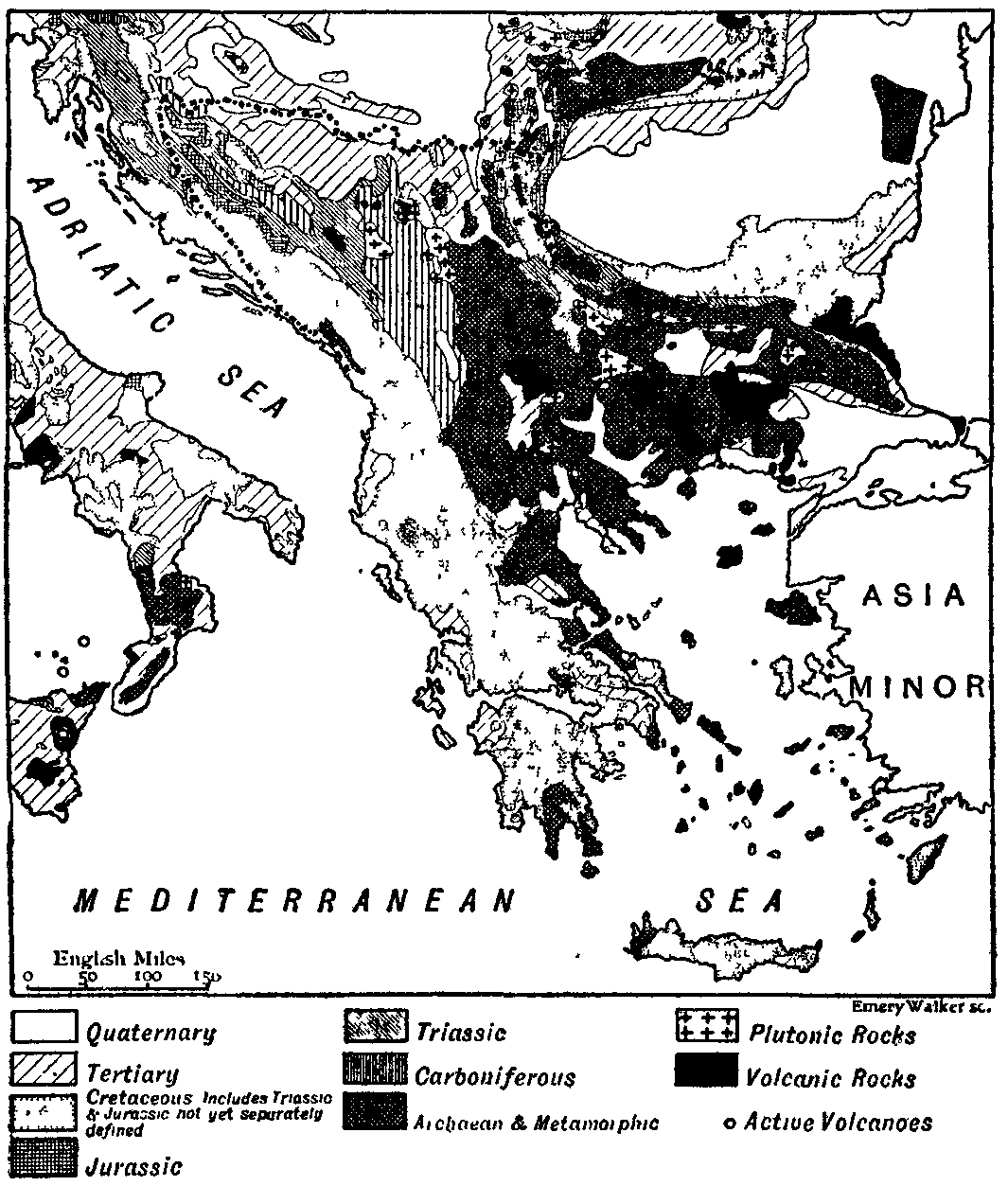
Geology.—Broadly speaking, the Balkan Peninsula may be divided into four areas which geologically are distinct. There is a central region, roughly triangular in shape, with its base resting upon the Aegean Sea and its apex in Servia. On two sides this area is bordered by belts of folded beds which form on the west the mountain ranges of the Adriatic and Ionian coasts, and on the north the chain of the Balkans. Finally, beyond the Balkans lies the great Rumanian depression, occupied chiefly by undisturbed Cretaceous and Tertiary strata. The central region, although wedged in between two belts of folding, is not affected by the folds of either, excepting near its margins. It consists largely of crystalline and schistose rocks. The core is formed by the mountain masses of Rhodope, Belasitza, Perin and Rila; and here Palaeozoic and Mesozoic beds are absent, and the earliest sedimentary deposits belong to the Tertiary period and lie flat upon the crystalline rocks. Upon the margins, however, Cretaceous beds are found. The eastern parts of Greece are composed almost entirely of Cretaceous beds, but nevertheless they must be considered to belong to the central area, for the folds which affect them are nearly at right angles to those of the western chains. In general, however, the central area is one of faulting rather than of folding, and the sedimentary beds sometimes lie in troughs formed by faults. Extensive volcanic outbursts occurred in this region during the Tertiary period. In the western folded belt the strike of the folds is N.W.-S.E., or N.N.W.-S.S.E. There are many local irregularities, but the general direction is maintained as far as the southern extremity of Greece, where the folds show a tendency to curve towards Crete. In the north, Carboniferous beds are present, and the Trias and the Jura take a considerable part in the formation of the chain. The Sarmatian beds are also involved in the folds, indicating that the folding was not completed till Pliocene times. In the south, the older beds disappear and the whole chain is formed chiefly of Cretaceous beds, though Eocene and probably Jurassic rocks are present. The Eocene beds are folded, but the marginal Pliocene beds are not, and the final folding seems to have taken place during the Miocene period. (For the Balkans, see Bulgaria.)
Area and Population.—The following figures show the area and population of the various political divisions of the Balkan Peninsula in 1909; see also the articles on the separate countries.
Political Divisions Area in sq. m. Pop. in 1909 Pop. per sq. m.
Croatia-Slavonia (south of the Save and Kulpa) (about) 8,200 (about) 1,200,000 146.3
Servia 18,782 2,493,770 132.2
Bulgaria (with Eastern Rumelia) 37,240 4,028,239 88.
The Dobrudja (Rumania) 5,896 258,242 43.9
Dalmatia (Austria) 4,923 591,597 120.1
Montenegro 3,255 311,564 94
Bosnia and Herzegovina (Austria-Hungary) 19,696 1,568,092 70.9
Sanjak of Novibazar (Turkish) 2,840 153,000 53.5
Albania, Macedonia and other Turkish possessions 62,744 5,812,300 92.6
Greece 24,400 2,631,952 107.8
187,976 19,048,756 101.3
For full details as to the physical features, natural products, population, customs, trade, finance, government, religion, education, language, literature, antiquities, history, politics, &c., of the Balkan lands, see Albania, Bosnia and Herzegovina, Bulgaria, Croatia-Slavonia, Dalmatia, Dobrudja, Greece, Illyria, Macedonia, Montenegro, Novibazar, Servia and Turkey.
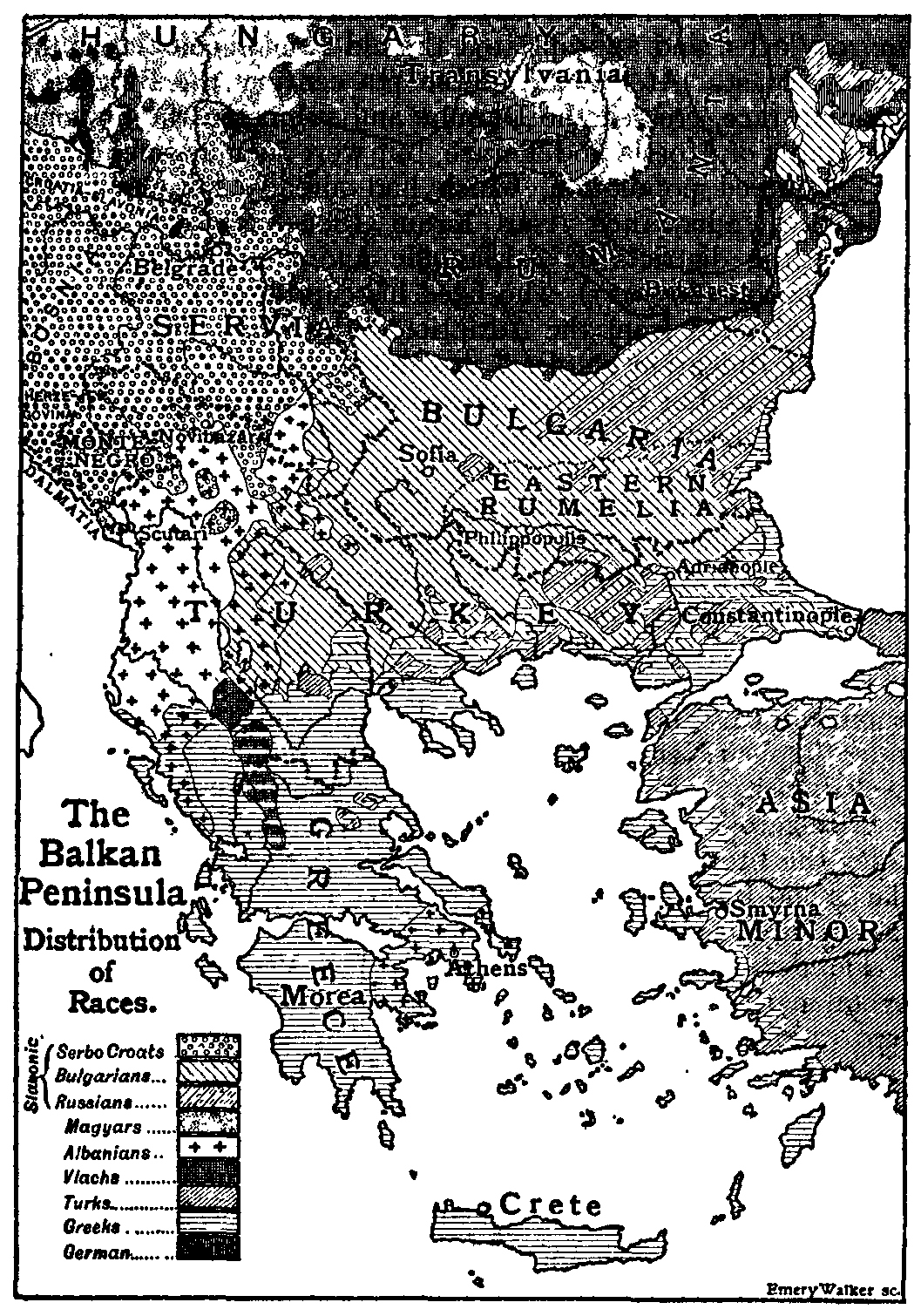
Races.—The Peninsula is inhabited by a great variety of races, whose ethnological limits are far from corresponding with the existing political boundaries. The Turkish population, descended in part from the Ottoman invaders of the 14th and 15th centuries, in part from colonists introduced at various epochs from Asia by the Turkish government, declined considerably during the 19th century, especially in the countries withdrawn from the sultan's authority. It is diminishing in Thessaly; it has entirely disappeared in the rest of Greece, almost entirely in Servia; and it continues to decrease in Bulgaria notwithstanding the efforts of the authorities to check emigration. It is nowhere found in compact masses except in north-eastern Bulgaria and the region between Adrianople, the Black Sea and the Sea of Marmora. Elsewhere it appears in separate villages and isolated districts, or in the larger towns and their immediate neighbourhood. The total Turkish population of the Peninsula scarcely exceeds 1,800,000. The Slavonic population, including the Serbo-Croats and Bulgars, is by far the most numerous; its total aggregate exceeds 10,000,000. The majority of the Serbo-Croats left their homes among the Carpathians and settled in the Balkan Peninsula in the 7th century. The distinction between the Serbs of the more central region and the Croats of the north-west, was first drawn by the early Byzantine chroniclers, and was well established by the 12th century. It does not correspond with any valid linguistic or racial difference; but in the course of time a strong religious difference arose. Along the Croatian and Dalmatian coast there existed a well-developed Latin civilization, which was sustained by constant intercourse with Italy; and, under its influence, the Serbo-Croatian immigrants were converted to the Roman Catholic Church. In the wild and mountainous interior, however, the Byzantine Church had few or no rivals and the Orthodox creed prevailed. The Orthodox Serbs inhabit the kingdom of Servia, Old Servia (or Novibazar and north-western Macedonia), Montenegro, Herzegovina and parts of Bosnia. The Roman Catholic Croats predominate in Dalmatia, north-western Bosnia and Croatia-Slavonia. Montenegro, like the other mountainous regions, adhered to the Greek Church; it received a number of Orthodox Servian refugees at the beginning of the 15th century, when the Turks occupied Servia. The numbers of the Serbo-Croats may be estimated at about 5,600,000. The Bulgars, who descend from a fusion of the Slavonic element with a later Ugro-Finnish immigration, inhabit the kingdom of Bulgaria (including Eastern Rumelia), parts of the Dobrudja and the greater part of Macedonia, except Old Servia and the Aegean littoral. Apart from their colonies in Bessarabia and elsewhere, they may be reckoned at 4,400,000. Only a portion of the widely-spread Ruman or Vlach race, which extends over a great part of Transylvania, south Hungary and Bessarabia, as well as the Rumanian kingdom, falls within the limits of the Peninsula. It is found in numerous detached settlements in Macedonia, Albania and northern Greece, and in colonies of recent date in Servia and Bulgaria. The nomad Vlachs or Tzintzars of these countries call themselves Arumani or "Romans"; they are a remnant of the native Latinized population which received an increase from the immigration of Daco-Roman refugees, who fled southwards during the 3rd century, after the abandonment of Dacia by Aurelian. (See Vlachs.) The entire Ruman population of the Balkan countries may be set down approximately at 600,000. The Albanians, who call themselves Shküpetar or Arber, are the representatives of the primitive Illyrian population; they inhabit the Adriatic littoral from the southern frontier of Montenegro to the northern boundary of Greece, in which country they are found in considerable numbers. They have shown a tendency to advance in a north-easterly direction towards the Servian frontier, and the movement has been encouraged for political reasons by the Turkish government. The whole Albanian nation possibly numbers from 1,500,000 to 1,600,000. The Greeks, whose immigration from Asia Minor took place in pre-historic times, are, next to the Albanians, the oldest race in the Peninsula. Their maritime and commercial instincts have led them from the earliest times to found settlements on the sea-coast and the islands. They inhabit the Black Sea littoral from Varna to the Bosporus, the shores of the Sea of Marmora and the Aegean, the Aegean archipelago, the mainland of Greece, Epirus and the western islands as far north as Corfu. In Constantinople they probably exceed 300,000. They are seldom found in large numbers at any great distance from the sea, and usually congregate in the principal towns and commercial centres, such as Adrianople, Constantza, Varna and Philippopolis; there are also detached colonies at Melnik, Stanimaka, Kavakly, Niegush and elsewhere. The Greek inhabitants of the Peninsula and adjacent islands probably number 4,500,000. The remainder of the population is for the most part composed of Armenians, Jews and gipsies. The Armenians, like the Greeks, congregate in the principal centres of trade, especially at Constantinople; their numbers were greatly reduced by the massacres of 1896. The Jews are most numerous at Salonica where they form half the population. The gipsies are scattered widely throughout the Peninsula; they are found not only in wandering troops, as elsewhere in Europe, but in settlements or cantonments in the neighbourhood of towns and villages.