Volume 3 — [E-Text Edition of Volume III - Part 1 of 2, Slice 2 of 3 - BACONTHORPE to BANKRUPTCY] (continued 13)
Reading edition
The Baluch character is influenced by its environment as much as by its origin, so that it is impossible to select any one section of the general community as affording a satisfactory sample of popular Baluch idiosyncrasies. They are not a homogeneous race. Peoples of Arab extraction intermixed with people of Dravidian and Persian stock are all lumped together under the name of Baluch. The Marri and Bugti tribes, who occupy the most southern buttresses of the Suliman Mountains, are Rind Baluchis, almost certainly of Arab extraction. They came to Sind either with the Arab conquerors or after them, and remained there mixed up with the original Hindu inhabitants. The Arab type of Baluch extends through the whole country at intervals, and includes all the finest and best of Baluch humanity. Taking the Rind Baluch as the type opposed to the Afridi Pathan, the Baluch is easier to deal with and to control than the Pathan, owing to his tribal organization and his freedom from bigoted fanaticism or blind allegiance to his priest. The Baluch is less turbulent, less treacherous, less bloodthirsty and less fanatical than the Pathan. His frame is shorter and more spare and wiry than that of his neighbour to the north, though generations have given to him too a bold and manly bearing. It would be difficult to match the stately dignity and imposing presence of a Baluch chief of the Marri or Bugti clans. His Semitic features are those of the Bedouin and he carries himself as straight and as loftily as any Arab gentleman. Frank and open in his manners, fairly truthful, faithful to his word, temperate and enduring, and looking upon courage as the highest virtue, the true Baluch of the Derajat is a pleasant man to have dealings with. As a revenue payer he is not so satisfactory, his want of industry and the pride which looks upon manual labour as degrading making him but a poor husbandman. He is an expert rider; horse-racing is his national amusement, and the Baluch breed of horses is celebrated throughout northern India. Like the Pathan he is a bandit by tradition and descent and makes a first-rate fighting man, but he rarely enlists in the Indian army. He is nominally a Mahommedan, but is neglectful of the practices of his religion. The relations of the modern Baluch with the government of India were entirely transformed by the life work of Sir Robert Sandeman. (q.v.).
The strategical position of Great Britain in Baluchistan is a Strategic interest. very important factor in the problem of maintaining order and good administration in the country. The ever-restless Pathan tribes of the Suliman hills are held in check by the occupation of the Zhob valley; whilst the central dominant position at Quetta safeguards the peace and security of Kalat, and of the wildest of the Baluch hills occupied by the Marris and Bugtis, no less than it bars the way to an advance upon India by way of Kandahar. Nominally all the provinces and districts of Baluchistan, with the exception of the ceded territory which we call British Baluchistan, are under the khan of Kalat, and all chiefs acknowledge him as their suzerain. But it may be doubted if this suzerainty was ever complete, or could be maintained at all but for the assistance of the British government. The Baluch is still essentially a robber and a raider (a trait which is common to all tribes), and the history of Baluchistan is nothing but a story of successful robberies, of lawless rapine and bloodshed, for which plunder and devastation were accounted a worthy and honourable return.
Extensive changes have taken place in the climatic condition of Climate. the country—changes which are some of them so recent as to be noted by surveyors who have found the remains of forests in districts now entirely desiccated. Possibly the ordinary processes of denudation and erosion, acting on those recent deposits which overlie the harder beds of the older series, may have much to say to these climatic changes, and the wanton destruction of forests may have assisted the efforts of nature; but it is difficult to understand the widespread desiccation of large areas of the Baluch highlands, where evidences of Arab irrigation works and of cultivation still attest to a once flourishing agricultural condition, without appealing to more rapidly destructive principles for the change. There is ample proof throughout the country of alterations of level within recent geologic periods; and there have even been compressions, resulting in a relative rise of the ground, over the crests of anticlinal folds, within historic record. "Proof that this compression is still going on was given on 20th December 1892, when a severe earthquake resulted from the sudden yielding of the earth's crust along what appears to be an old line of fault, west of the Kawaja Amran range, whereby an adjustment took place indicated by a shortening of some 2½ ft. on the railway line which crossed the fault." Nor should the evidences of active volcanic agency afforded by the mud volcanoes of the coast be overlooked. It is probably to climatic changes (whatever their origin may have been), rather than to the effects of tribal disturbances, that the Arab's disappearance from the field of trade and agriculture must be attributed.
The total area of Baluchistan is 132,315 sq. m. and its population Population. in 1901 was 914,551. The population is largely nomadic. The fact that so many as 15,000 camels have been counted in the Bolan Pass during one month of the annual Brahui migration indicates the dimensions which the movement assumes. The religion of the country is so overwhelmingly Mahommedan that out of every 100,000 inhabitants 94,403 are Mussulman, and only 4706 Hindus, while the balance is made up by Christians, Sikhs and other denominations. Out of the total number 280 in the thousand are literates. The chief languages spoken are vernaculars of Baluchistan, Pushtu, Panjabi, Urdu and Sindhi, The Baluchi language belongs to the Iranian branch of the Aryan subfamily of the Indo-European family. It is divided into two main dialects which are so different that speakers of the one are almost unintelligible to speakers of the other. These two dialects are separated by the belt of Brahui and Sindhi speakers who occupy the Sarawan and Jalawan hills, and Las Bela. Owing probably to the fact that Makran was for many generations under the rule of the Persian kings, the Baluchi spoken on the west of the province, which is also called Makrani, is more largely impregnated with Persian words and expressions than the Eastern dialect. In the latter the words in use for common objects and acts are nearly all pure Baluchi, the remainder of the language being borrowed from Persian, Sindhi and Panjabi. There is no indigenous literature, but many specimens of poetry exist in which heroes and brave deeds are commemorated, and a good many of these have been collected from time to time. The philological classification of the Brahui dialect has been much disputed, but the latest enquiries, conducted by Dr G. A. Grierson, have resulted in his placing it among the Dravidian languages. It is remarkable to find in Baluchistan a Dravidian tongue, surrounded on all sides by Aryan languages, and with the next nearest branch of the same family located so far away as the Gond hills of central India. Brahui has no literature of its own, and such knowledge as we possess of it is due to European scholars, such as Bellew, Trumpp and Caldwell. Numerically the Brahuis are the strongest race in Baluchistan. They number nearly 300,000 souls. Next to them and numbering nearly 200,000 are Pathans. After this there is a drop to 80,000 mixed Baluchis and less than 40,000 Lasis (Lumris) of Las Bela. There are thirteen indigenous tribes of Pathan origin, of which the Kakars (q.v.) are by far the most important, numbering more than 100,000 souls. They are to be found in the largest numbers in Zhob, Quetta, Pishin and Thal-Chotiali, but there are a few of them in Kalat and Chagai also. The most important Baluch tribes are the Marris, the Bughtis, the Boledis, the Domkis, the Magassis and the Rinds. Owing partly to the tribal system, and partly to the levelling effect of Islam, nothing similar to the Brahmanical system of social precedent is to be found in Baluchistan.
History.—Of the early history of this portion of the Asiatic continent little or nothing is known. The poverty and natural strength of the country, combined with the ferocious habits of the natives, seem to have equally repelled the friendly visits of inquisitive strangers and the hostile incursions of invading armies. The first distinct account which we have is from Arrian, who, with his usual brevity and severe veracity, narrates the march of Alexander through this region, which he calls the country of the Oreitae and Gadrosii.[2] He gives a very accurate account of this forlorn tract, its general aridity and the necessity of obtaining water by digging in the beds of torrents; describes the food of the inhabitants as dates and fish; and adverts to the occasional occurrence of fertile spots, the abundance of aromatic and thorny shrubs and fragrant plants, and the violence of the monsoon in the western part of Makran. He notices also the impossibility of supporting a large army, and the consequent destruction of the greater part of the men and beasts which accompanied the expedition of Alexander. In the 8th century this country was traversed by an army of the Caliphate.
The precise period at which the Brahuis gained the mastery cannot be accurately ascertained; but it was probably about two and a half centuries ago. The last raja of the Hindu dynasty found himself compelled to call for the assistance of the mountain shepherds, with their leader, Kambar, in order to check the encroachments of a horde of depredators, headed by an Afghan chief, who infested the country and even threatened to attack the seat of government. Kambar successfully performed the service for which he had been engaged; but having in a few years quelled the robbers against whom he had been called in, and finding himself at the head of the only military tribe in the country, he formally deposed the raja and assumed the government.
The history of the country after the accession of Kambar is as obscure as during the Hindu dynasty. It would appear, however, that the sceptre was quietly transmitted to Abdulla Khan, the fourth in descent from Kambar, who, being an intrepid and ambitious soldier, turned his thoughts towards the conquest of Kach Gandava, then held by different petty chiefs under the authority of the nawabs of Sind.
After various success, the Kambaranis at length possessed themselves of the sovereignty of a considerable portion of that fruitful plain, including the chief town, Gandava. It was during this contest that the famous Nadir Shah advanced from Persia to the invasion of Hindustan; and while at Kandahar he despatched several detachments into Baluchistan and established his authority in that province. Abdulla Khan, however, was continued in the government of the country by Nadir's orders; but he was soon after killed in a battle with the forces of the nawabs of Sind. He was succeeded by his eldest son, Haji Mahommed Khan, who abandoned himself to the most tyrannical and licentious way of life and alienated his subjects by oppressive taxation. In these circumstances Nasir Khan, the second son of Abdulla Khan, who had accompanied the victorious Nadir to Delhi, and acquired the favour and confidence of that monarch, returned to Kalat and was hailed by the whole population as their deliverer. Finding that expostulation had no effect upon his brother, he one day entered his apartment and stabbed him to the heart. As soon as the tyrant was dead, Nasir Khan mounted the musnud amidst the universal joy of his subjects; and immediately transmitted a report of the events which had taken place to Nadir Shah, who was then encamped near Kandahar. The shah received the intelligence with satisfaction, and despatched a firman, by return of the messenger, appointing Nasir Khan beglar begi (prince of princes) of all Baluchistan. This event took place in the year 1739.
Nasir Khan proved an active, politic and warlike prince. He took great pains to re-establish the internal government of all the provinces in his dominions, and improved and fortified the city of Kalat. On the death of Nadir Shah in 1747, he acknowledged the title of the king of Kabul, Ahmad Shah (Durani). In 1758 he declared himself entirely independent; upon which Ahmad Shah despatched a force against him under one of his ministers. The khan, however, raised an army and totally routed the Afghan army. On receiving intelligence of this discomfiture, the king himself marched with strong reinforcements, and a pitched battle was fought in which Nasir Khan was worsted. He retired in good order to Kalat, whither he was followed by the victor, who invested the place with his whole army. The khan made a vigorous defence; and, after the royal troops had been foiled in their attempts to take the city by storm or surprise, a negotiation was proposed by the king which terminated in a treaty of peace. By this treaty it was stipulated that the king was to receive the cousin of Nasir Khan in marriage; and that the khan was to pay no tribute, but only, when called upon, to furnish troops to assist the armies, for which he was to receive an allowance in cash equal to half their pay. The khan frequently distinguished himself in the subsequent wars of Kabul; and, as a reward for his services, the king bestowed upon him several districts in perpetual and entire sovereignty. Having succeeded in quelling a dangerous rebellion headed by his cousin Behram Khan, this able prince at length died in extreme old age in the month of June 1795, leaving three sons and five daughters. He was succeeded by his eldest son, Mahmud Khan, then a boy of about fourteen years. During the reign of this prince, who has been described as a very humane and indolent man, the country was distracted by sanguinary broils; the governors of several provinces and districts withdrew their allegiance; and the dominions of the khans of Kalat gradually so diminished that they now comprehend only a small portion of the provinces formerly subject to Nasir Khan.
In 1839, when the British army advanced through the Bolan Pass towards Afghanistan, the conduct of Mehrab Khan, the ruler of Baluchistan, was considered so treacherous and dangerous as to require "the exaction of retribution from that chieftain," and "the execution of such arrangements as would establish future security in that quarter." General Willshire was accordingly detached from the army of the Indus with 1050 men to assault Kalat. A gate was knocked in by the field-pieces, and the town and citadel were stormed in a few minutes. Above 400 Baluches were slain, among them Mehrab Khan himself; and 2000 prisoners were taken. Subsequent inquiries have, however, proved that the treachery towards the British was not on the part of Mehrab Khan, but on that of his vizier, Mahommed Hussein, and certain chiefs with whom he was in league, and at whose instigation the British convoys were plundered in their passage through Kach Gandava and in the Bolan Pass. The treacherous vizier, however, made our too credulous political officers believe that Mehrab Khan was to blame; his object being to bring his master to ruin and to obtain for himself all power in the state, knowing that Mehrab's successor was only a child. How far he succeeded in his object history has shown. In the following year Kalat changed hands, the governor established by the British, together with a feeble garrison, being overpowered. At the close of the same year it was reoccupied by the British under General Nott. In 1841 Nasir Khan II., the youthful son of the slain Mehrab Khan, was recognized by the British, who soon after evacuated the country.
From the conquest of Sind by the British troops under the command of General Sir Charles Napier in 1843 up to 1854 no diplomatic intercourse occurred worthy of note between the British and Baluch states. In the latter year, however, under the governor-generalship of the marquess of Dalhousie, General John Jacob, C.B., at the time political superintendent and commandant on the Sind frontier, was deputed to arrange and conclude a treaty between the Kalat state, then under the chieftainship of Nasir Khan and the British government. This treaty was executed on the 14th of May 1854 and was to the following effect:—
"That the former offensive and defensive treaty, concluded in 1841 by Major Outram between the British government and Nasir Khan II., chief of Kalat, was to be annulled.
"That Nasir Khan II., his heirs and successors, bound themselves to oppose to the utmost all the enemies of the British government, and in all cases to act in subordinate co-operation with that government, and to enter into no negotiations with other states without its consent.
"That should it be deemed necessary to station British troops in any part of the territory of Kalat, they shall occupy such positions as may be thought advisable by the British authorities.
"That the Baluch chief was to prevent all plundering on the part of his subjects within or in the neighbourhood of British territory.
"That he was further to protect all merchants passing through his territory, and only to exact from them a transit duty, fixed by schedule attached to the treaty; and that, on condition of a faithful performance of these duties, he was to receive from the British government an annual subsidy of Rs.50,000 (£5000)."
The provisions of the above treaty were most loyally performed by Nasir Khan up to the time of his death in 1856. He was succeeded by his brother, Mir Khodadud Khan, when a youth of twelve years of age, who, however, did not obtain his position before he had put down by force a rebellion on the part of his turbulent chiefs, who had first elected him, but, not receiving what they considered an adequate reward from his treasury, sought to depose him in favour of his cousin Sher dil Khan. In the latter part of 1857, the Indian rebellion being at its height and the city of Delhi still in the hands of the rebels, a British officer (Major Henry Green) was deputed, on the part of the British government, to reside as political agent with the Khan at Kalat and to assist him by his advice in maintaining control over his turbulent tribes. This duty was successfully performed until 1863, when, during the temporary absence of Major Malcolm Green, the then political agent, Khodadad Khan was, at the instigation of some of his principal chiefs, attacked while out riding by his cousin, Sher dil Khan, and severely wounded. Khodadad fled in safety to a residence close to the British border, and Sher dil Khan was elected and proclaimed Khan. His rule was, however, a short one, for early in 1864, when proceeding to Kalat, he was murdered in the Gandava Pass; and Khodadad was again elected chief by the very men who had only the previous year caused his overthrow, and who had lately been accomplices to the murder of his cousin. After the above events Khodadad maintained his precarious position with great difficulty; but owing to his inability to govern his unruly subjects without material assistance from the British government, which they were not disposed to give, his country gradually fell into the greatest anarchy; and, consequently, some of the provisions of the treaty of 1854 having been broken, diplomatic relations were discontinued with the Kalat state after the end of 1874.
After this the chiefs of Las and Wad, the Marris and Bugtis, Kej and Makran all threw off their allegiance, and anarchy became so widespread that the British government again interfered. The treaty of 1854 was renewed in 1876 by Lord Lytton (under Sandeman's advice), and the khan received substantial aid from the government in the form of an annual subsidy of a lakh of rupees, instead of the Rs.50,000 previously assigned to him. The treaty of 1854 was a treaty of alliance offensive and defensive. The treaty of 1876 renewed these terms, but utterly changed the policy of non-intervention which was maintained by the former, by the recognition of the sirdars as well as the khan, and by the appointment of the British government as referee in cases of dispute between them. British troops were to be located in the khan's country; Quetta was founded; telegraphs and railways were projected; roads were made; and the reign of law and order established. The nebulous claims of Afghanistan to Sibi and Pishin were disposed of by the treaty of Gandamak in the spring of 1879, and the final consolidation of the existing form of Kalat administration was effected by Sandeman's expedition to Kharan in 1883, and the reconciliation of Azad Khan, the great Naushirwani chief, with the khan of Kalat. British Baluchistan was incorporated with British India by the resolution of 1st November 1887, and divided into two districts—Quetta-Pishin and Thai Chotiali—to be administered by a deputy-commissioner and a regular staff.
In 1890 and 1891 were carried out that series of politico-military expeditions which resulted in the occupation of the Zhob valley, the foundation of the central cantonment of Fort Sandeman, and the extension of a line of outposts which, commencing at Quetta, may be said to rest on Wana north of the Gomal. The effect of these expeditions, and of this extension of military occupation, has been to reduce the independent Pathan tribes of the Suliman mountains to effective order, and to put a stop to border raiding on the Indus plains south of the Gomal. In 1893 serious differences arose between the khan of Kalat and Sir James Browne, who succeeded Sir Robert Sandeman as agent to the governor-general in Baluchistan, arising out of Mir Khodadad Khan's outrageous conduct in the management of his own court, and the treatment of his officials. Finally, the khan was deposed, and his son Mir Mahmud Khan succeeded in November 1893. Since then the most important change in Baluch administration has been the perpetual lease and transfer of management to British agency of the Nushki district and Niabat, with all rights, jurisdiction and administrative power, in lieu of a perpetual rent of Rs.9000 per annum. This was effected in July 1899. This secures the direct control of the great highway to Seistan which has been opened to khafila and railway traffic.
The revenues of the khan of Kalat consist partly of subsidies and partly of agricultural revenue, the total value being about Rs.500,000 per annum. Since 1882 he has received Rs.25,000 as government rent for the Quetta district, besides Rs.30,000 in lieu of transit duties in the Boian; this has been increased lately by Rs.9000 as already stated. In 1899 the total imports of Kalat were valued at Rs.700,000, and the exports at Rs.505,000.
Authorities.—The Seistan Boundary Report of 1873 by Sir F. Goldsmid; Floyer, Unexplored Baluchistan (London, 1882); T. Thornton, Life of Sandeman (London, 1896); G. P. Tate, Kalat, a Memoir (Calcutta, 1896); Sir T. Holdich, "Ethnographic and Historical Notes on Makran," Calcutta, 1892 (Survey Report); "Antiquities, Ethnography, &c., of Las Bela and Makran," Calcutta, 1894 (Survey Report); "Ancient and Medieval Makran," vol. vii. R.G.S. Journal (1896); "Perso-Baluch Boundary," vol. ix. R.G.S. Journal (1897); McMahon, "The Southern Borderland of Afghanistan," vol. x. Journal R.G.S. (1897). Notes on Sir R. Sandeman's tours in Baluchistan will be found in vols. v., xii., xiii. and xiv. of the R.G.S. Proceedings; Popular Poetry of the Baloches, by M. Longworth-Dames (2 vols., Roy. As. Soc. 1907).
(T. H. H.*)
BALUCHISTAN, a province of Persia consisting of the western part of Baluchistan (q.v.) in a wider sense. Persian Baluchistan has an area of about 60,000 sq. m., and lying along the northern shore of the Arabian Sea, is bounded E. by British and independent Baluchistan, N. by Seistan and the central Persian desert, and W. by Kerman. The country has little water and only a small part of it is under cultivation, the remainder being composed of arid, waterless plains, deserts—some stony, others with moving sands—barren hills and mountains. The principal rivers are the Mashkid and that of Bampur which flow away from the sea and are lost in depressions called hamuns. The rivers which flow into the sea are unimportant and dry during the greater part of the year. Persian Baluchistan forms an administrative division of the province of Kerman and is subdivided into the following twenty districts:—(1) Bampur; (2) Serhad; (3) Dizek; (4) Jalk; (5) Sib; (6) Irafshan; (7) Magas; (8) Serbaz; (9) Lashar; (10) Champ; (11) Fannuj; (12) Bazman; (13) Aptar; (14) Daman; (15) Aprandagan; (16) Asfehgeh; (17) Surmij; (18) Meskutan; (19) Pushteh; (20) Makran, the country of the Ichthyophagi, with the subdistricts Kasrkand, Geh, Bint, Dasht, Kucheh and Bahu. The total population of Baluchistan is under 200,000. The province was practically independent until the occupation of Bampur by Persian troops in 1849, and over some of the extreme eastern districts Persian supremacy was not recognized until 1872.
BALUE, JEAN (c. 1421-1491), French cardinal and minister of Louis XI., was born of very humble parentage at Angle in Poitou, and was first patronized by the bishop of Poitiers. In 1461 he became vicar-general of the bishop of Angers. His activity, cunning and mastery of intrigue gained him the appreciation of Louis XI., who made him his almoner. In a short time Balue became a considerable personage. In 1465 he received the bishopric of Évreux; the king made him le premier du grant conseil, and, in spite of his dissolute life, obtained for him a cardinalate (1468). But in that year Balue was compromised in the king's humiliation by Charles the Bold at Péronne and excluded from the council. He then intrigued with Charles against his master: their secret correspondence was intercepted, and on the 23rd of April 1469 Balue was thrown into prison, where he remained eleven years, but not, as has been alleged, in an iron cage. In 1480, through the intervention of Pope Sixtus IV., he was set at liberty, and from that time lived in high favour at the court of Rome. He received the bishopric of Albano and afterwards that of Palestrina. In 1484 he was even sent to France as legate a latere. He died at Ancona in 1491.
See Henri Forgeot, "Jean Balue, cardinal d'Angers" (1895), in the Bibliothèque de l'école des hautes études.
BALUSTER (through the Fr. from the Ital. balaustro, so-called from a supposed likeness to the flower of the βαλαύστιον, or wild pomegranate; the word has been corrupted in English into "banister"), a small moulded shaft, square or circular, in stone or wood and sometimes in metal, supporting the coping of a parapet or the rail of a staircase, an assemblage of them being known as a balustrade. The earliest examples are those shown in the bas-reliefs representing the Assyrian palaces, where they were employed as window balustrades and apparently had Ionic capitals. They do not seem to have been known to either the Greeks or the Romans, but early examples are found in the balconies in the palaces at Venice and Verona. In the hands of the Italian revivalists they became features of the greatest importance, and were largely employed for window balconies and roof parapets.
The term "baluster shaft" is given to the shaft dividing a window in Saxon architecture. In the south transept of the abbey at St Albans, England, are some of these shafts, supposed to have been taken from the old Saxon church. Norman bases and capitals have been added, together with plain cylindrical Norman shafts.
BALUSTRADE, a parapet or low screen consisting of a coping or rail supported on balusters (q.v.). Sometimes it is employed purely as a decorative feature beneath the sill of a window which was not carried down to the ground. Sometimes flowing foliage takes the place of the parapet, and sometimes so-called balustrades are formed of vertical slabs of stone, pierced as in the Ca' d'oro at Venice and the balconies of the minarets at Cairo.
BALUZE, ÉTIENNE (1630-1718), French scholar, was born at Tulle on the 24th of November 1630. He was educated at his native town and took minor orders. As secretary to Pierre de Marca, archbishop of Toulouse, he won the appreciation of that learned prelate to such a degree that at his death Marca left him all his papers. Thus it came about that Baluze produced the first complete edition of Marca's treatise De libertatibus Ecclesiae Gallicanae (1663), and brought out his Marca hispanica (1688 f.). About 1667 Baluze entered Colbert's service, and until 1700 was in charge of the invaluable library belonging to that minister and to his son the marquis de Seignelai. He enriched it prodigiously (see the history of the Colbertine library in the Cabinet des Manuscrits by M. Léopold Delisle, vol. i.), and Colbert rewarded him by obtaining various benefices for him, and the post of king's almoner (1679). Subsequently Baluze was appointed professor of Canon law at the Collège de France on the 31st of December 1689, and directed that great institution from 1707 to 1710.
The works which place him in the first rank of the scholars of his time are the Capitularia Regum Francorum (1674; new edition enlarged and corrected in 1780); the Nova Collectio Conciliorum (4 vols., 1677); the Miscellanea (7 vols., 1678-1715; new edition revised by Mansi, 4 vols. f., 1761-1764); the Letters of Pope Innocent III. (1682); and, finally, the Vitae Paparum Avenionensium, 1305-1394 (1693). But he was unfortunate enough to take up the history of Auvergne just at the time when the cardinal de Bouillon, inheritor of the rights, and above all of the ambitious pretensions of the La Tour family, was endeavouring to prove the descent of that house in the direct line from the ancient hereditary counts of Auvergne of the 9th century.
As authentic documents in support of these pretensions could not be found, false ones were fabricated. The production of spurious genealogies had already been begun in the Histoire de la maison d'Auvergne published by Christophe Justel in 1645; and Chorier, the historian of Dauphiny, had included in the second volume of his history (1672) a forged deed which connected the La Tours of Dauphiny with the La Tours of Auvergne. Next a regular manufactory of forged documents was organized by a certain Jean de Bar, an intimate companion of the cardinal. These rogues were skilful enough, for they succeeded in duping the most illustrious scholars; Dom Jean Mabillon, the founder of Diplomatics, Dom Thierry Ruinart and Baluze himself, called as experts, made a unanimously favourable report on the 23rd of July 1695. But cardinal de Bouillon had many enemies, and a war of pamphlets began. In March 1698 Baluze in reply wrote a Letter which proved nothing. Two years later, in 1700, Jean de Bar and his accomplices were arrested, and after a long and searching inquiry were declared guilty in 1704. Baluze, nevertheless, was obstinate in his opinion. He was convinced that the incriminated documents were genuine and proposed to do Justel's work anew. Encouraged and financially supported by the cardinal de Bouillon, he first produced a Table généalogique in 1705, and then in 1709 a Histoire généalogique de la maison d'Auvergne, with "Proofs," among which, unfortunately, we find all the deeds which had been pronounced spurious. In the following year he was suddenly engulfed in the disgrace which overtook his intriguing patron: deprived of his appointments, pensions and benefices, he was exiled far from Paris. None the less he continued to work, and in 1717 published a history of his native town, Historiae Tutelensis libri tres. Before his death he succeeded in returning to Paris, where he died unconvinced of his errors on the 28th of July 1718. Was he dupe or accomplice? The study of his correspondence with the cardinal gives the impression that he was the victim of clever cheats.
The history of the forgeries committed in the interests of the house of Bouillon forms a curious and instructive episode in the history of French scholarship in the time of Louis XIV. It is to be found in the Manuel de diplomatique by A. Giry; and above all in a note to the Œuvres de Saint-Simon by M. de Boislisle (vol. xiv. pp. 533-558). The bibliography of Baluze's researches has been made by M. René Fage (1882, 1884) and his Life told by M. Émile Fage (1899). To these we must add an amusing book by G. Clément-Simon, La Gaieté de Baluze; documents biographiques et littéraires (1888). Baluze's will has been published by M. Léopold Delisle (Bibliothèque de l'École de Chartes, 1872); his papers are now in the Bibliothèque Nationale in Paris, and in the Bibliothèque de l'Arsenal (Revue historique, t. xcviii. p. 309). See also the article by Arthur de Boislisle in the Revue des questions historiques for October 1908.
(C. B.*)
BALZAC, HONORÉ DE (1799-1850), French novelist, was born at Tours on the 20th of May 1799. His father, Bernard François, never called himself de Balzac and Honoré only assumed the particle after 1830. But the father had equally little right to the name of Balzac at all, for his birth-certificate has been recently discovered. The true name was "Balssa," and this in various forms ("Balsa," "Balsas") has been traced for more than a century before the novelist's birth as that of a family of day-labourers or very small peasant proprietors in the parish of Canezac, department of the Tarn. It is probable that the novelist himself was not aware of this, and his father appears to have practised some mystification as to his own professional career. In and after the Revolution, however, he actually attained positions of some importance in the commissariat and hospital departments of the army, and he married in 1797 Anne Charlotte Laure Sallambier, who was a beauty, an heiress, and a woman of considerable faculty. She survived her son; the father died in 1829. There were two sisters (the elder, Laure, afterwards Madame Surville, was her brother's favourite and later his biographer), and a younger brother, Henri, of whom we hear little and that little not very favourable.
Honoré was put out to nurse till he was four years old, and in 1806, when he was seven, was sent to the collège (grammar school) of Vendôme, where he remained till April 1813 as a strict boarder without any holidays. From this he passed as a day-boy to the collège of Tours. His father's official work was transferred to Paris the year after, and Balzac came under the teaching of a royalist private schoolmaster, M. Lepitre, and others. He left school altogether in 1816, being then between seventeen and eighteen. His experiences at Vendôme served as base for much of Louis Lambert, and he seems to have been frequently in disgrace. Later, his teachers appear to have found him remarkable neither for good nor for evil. He was indeed never a scholar; but he must have read a good deal, and as he certainly had no time for it later, much of this reading must have been done early.
The profession which Balzac's father chose for him was the law; and he not only passed through the schools thereof, and duly obtained his licence, but had three years' practical experience in the offices of a notary and a solicitor (avoué), for the latter of whom, M. Guillonnet-Merville, he seems to have had a sincere respect. But though no man of letters has ever had, in some ways, such a fancy for business, no man of business could ever come out of such a born man of letters. And when in 1820 (the licence having been obtained and M. Balzac, senior, having had some losses) the father wished the son to become a practising lawyer in one or another branch, Honoré revolted. His family had left Paris, and they tried to starve him into submission by establishing him in a garret with a very small allowance. Here he began to write tragedies, corresponded (in letters which have fortunately been preserved) with his sister Laure, and, most important of all, attempted something in prose fiction. The tragedy Cromwell was actually completed and read to friends if not to others; nay more, the manuscript exists in the hands of M. Spoelberch de Lovenjoul, the great authority on Balzac's life and bibliography; but it has never been published. The novels, Cocqsigrue and Stella, proved abortions, but were only the first of many attempts at his true way until he found it. Drama he never abandoned; but for him it was always an error.
The garret-period from 1820 to 1822 was succeeded by another of equal length at home, but before it had finished (1821) he found his way into print with the first of the singular productions which (and that not entirely or finally) have taken a sort of outside place in his works under the title of Œuvres de jeunesse. The incunabula of Balzac were Les Deux Hector, ou Les Deux Families bretonnes, and Charles Pointel, ou Mon Cousin de la main gauche. They were followed next year by six others:—L'Héritière de Birague; Jean Louis, ou La Fille trouvée; Clotilde de Lusignan, ou Le Beau Juif; Le Centenaire, ou Les Deux Beringheld; Le Vicaire des Ardennes; Le Tartare, ou Le Retour de l'exilé. And these were again followed up in 1823 by three more: La Dernière Fée, ou La Nouvelle Lampe merveilleuse; Michel et Christine et la suite; L'Anonyme, ou Ni père ni mère. In 1824 came Annette et le criminel, a continuation of the Vicaire; in 1825, Wann-Chlore, which afterwards took the less extravagant title of Jane la pâle. These novels, which filled some two score volumes originally, were published under divers pseudonyms ("Lord R'hoone," an anagram of "Honoré," "Horace de Saint Aubin," &c.), and in actual collaboration with two or three other writers. But though there is not yet in them anything more than the faintest dawn of the true Balzac, though no one of them is good as a whole, and very few parts deserve that word except with much qualification, they deserve far more study than they have usually received, and it is difficult to apprehend the true Balzac until they have been studied. They ceased for a time, not because of the author's conviction of their badness (though he entertained no serious delusions on this subject), nor because they failed of a certain success in actual money return, but because he had taken to the earliest, the most prolonged, and the most disastrous of his dabblings in business—this time as a publisher to some extent and still more as a printer and type-founder. Not very much was known about his experiences in this way (except their general failure, and the result in hampering him with a load of debt directly for some ten years and indirectly for the whole of his life) till in 1903 MM. Hanotaux and Vicaire published the results of their inquiries into the actual accounts of the concern. There seems to have been no reason why it should not have succeeded, and there has been claimed for it first, that it provided Balzac with a great amount of actual detail which he utilized directly in the novels, and secondly, that it gave him at whatever cost a still more valuable experience of practical life—the experience which has so often been wanting to men of letters. Anyhow, from 1825 to 1828, the future author of the Comédie humaine was a publisher, printer and type-founder; and in the last year he had to abscond, or something like it, under pressure of debts which were never fully settled till 1838, and then by a further obligation of ninety thousand francs, chiefly furnished by his mother and never repaid to her.
It was Balzac's habit throughout his life to relieve the double pressure of debt and of work by frequent excursions into the country and abroad. On this occasion he fled to Brittany with an introduction to a M. and Mme. de Pommereul, who received him hospitably in their château near Fougères. Here he obtained some of the direct material, and most of the scenery and atmosphere, for what he himself recognized as his first serious attempt in novel-writing, Les Chouans, or, as it was at first called, Le Dernier Chouan. This book (obviously written in direct following of Scott, of whom Balzac was a lifelong admirer) has been very variously judged—those who lay most stress on his realism thinking little of it, while those who maintain that he was always a romantic "with a difference" place it higher. It has at any rate brilliant colouring, some very vivid scenes, and almost more passion as well as "curtain" at its ending than any other of his books. Though not without a touch of melodrama it differs utterly from the confused and tedious imitations of Mrs Radcliffe, M. G. Lewis and C. R. Maturin which fill most of the Œuvres de jeunesse. At the same time Balzac was engaged on a very different work, the analytic-satirical sketches which compose the Physiologie du mariage, and which illustrate his other and non-romantic side, again with some crudity, but again also with a vast advance on his earlier productions. Both were published in the year 1829, from which his real literary career unquestionably starts. It had exactly twenty-one years to run.
The history of these twenty-one years, though (in consequence mainly of the diligence and luck as a collector of the above-named M. de Lovenjoul) the materials for it are large and constantly accumulating, has never been arranged in a really standard biography, and there seems to be an increasing habit of concentrating the attention on parts of it. It divides itself under three heads mainly, the history of Balzac's business affairs, that of his loves and friendships and that of his actual work. The first has some small resemblance to Scott's similar experiences, though in Balzac's case there was no great crash but a lifelong pressure; on the other hand, his debts were brought upon him by a long course not so much of extravagance in actual expenditure (though there was something of this) as of financial irregularities of almost every description,—anticipations of earnings, costly methods of production (he practically wrote his novels on a succession of printed revises), speculations, travel, and lastly the collection of curiosities. As regards the second, although his fashion of life made him by turns a hermit and a vagrant, he was on good terms with most of the famous men of letters of his day from Hugo downwards, and seems never to have quarrelled with any man, except with some of his editors and publishers, by his own fault. Balzac was indeed, in no belittling sense of the word, one of the most good-natured of men of genius. But his friendships with the other sex are of much more importance, and not in the least matters of mere gossip. His sister Laure, as has been said, and a school-friend of hers, Mme Zulma Carraud, played important and not questionable parts as his correspondents. But at least three ladies, all of a rank higher than his own, figure as his "Egerias" to such an extent that it is hardly extravagant to say that Balzac would not have been Balzac without them. These are Madame de Berny, a lady connected with the court of the ancien régime, much older than himself and the mother of nine children, to whom he was introduced in 1821, who became to him La dilecta, who was the original of Mme de Mortsauf in Le Lys dans la vallée, and who seems to have exercised an excellent influence on him in matters of taste till her death in 1836; the marquise de Castries, who took him up for a time and dropped him, and who has been supposed to have been his model for his less impeccable ladies of fashion; and lastly, the Polish-Russian countess Evelina Hanska, who after addressing, as l'Étrangère, a letter to him as early as 1832, became his idol, rarely seen but constantly corresponded with, for the last eighteen years, and his wife for the last few months of his life. Some of his letters to her have long been known, but the bulk of them constituted the greatest recent addition to our knowledge of him as given in the two volumes of Lettres à l'étrangère. Of hers we have practically none and it is exceedingly hard to form any clear idea of her, but his devotion is absolutely beyond question.
Business, friendship and love, however, much more other things, were in Balzac's case always connected with and on the whole quite secondary to work. He would even sometimes resist the commands by which at long intervals Mme. Hanska would summon him to see her, and abstract the greater part of his actual visits to her in order to serve this still more absorbing mistress. He had, as we have seen, worked pretty hard, even before 1829, and his work had partly taken forms not yet mentioned—political pamphlets and miscellaneous articles which are now accessible in the Édition définitive of his works, and hardly one of which is irrelevant to a just conception of him. Nor did he by any means abandon these by-works after 1829; indeed, he at one time started and almost entirely wrote, a periodical called the Revue parisienne. He wrote some dramas and planned many more, though the few which reached the stage left it again promptly. Balzac's dramas, as they appear in his works, consist of Vautrin, Les Ressources de Quinola, Paméla Giraud (arranged for the stage by others), La Marâtre and Mercadet le faiseur, the last of which has, since his death, been not unsuccessful. But on the whole he did devote himself to his true vocation, with a furious energy beside which even Scott's, except in his sadder and later days, becomes leisurely. Balzac generally wrote (dining early and lightly, and sleeping for some hours immediately after dinner) from midnight till any hour in the following day—stretches of sixteen hours being not unknown, and the process being often continued for days and weeks. Besides his habit of correcting a small printed original into a long novel on the proofs, he was always altering and re-shaping his work, even before, in 1842, he carried out the idea of building it all into one huge structure—the Comédie humaine with its subdivisions of Scènes de la vie parisienne, Études philosophiques, &c. Much pains have been spent upon this title and Balzac's intentions in selecting it. But the "Human Comedy," as a description for mere studies of life as his, will explain itself at once or else can never be explained.
Of its constituents, however, some account must be given, and this can be best done through an exact and complete list of the whole work by years, with such abbreviated notes on the chief constituents as may lead up to a general critical summary. Of the two capital works of 1829, we have spoken. 1830, the epoch year, saw part (it was not fully published till the next) of La Peau de chagrin, one of the crudest, but according to some estimates, one of the greatest of the works, full of romantic extravagance and surplusage, but with an engrossing central idea—the Nemesis of accomplished desire—powerfully worked out; La Maison du chat qui pelote, a triumph of observation and nature, together with a crowd of things less in bulk but sometimes of the first excellence—El Verdugo, Étude de femme, La Paix du ménage, Le Bal de sceaux, La Vendetta, Gobseck, Une Double Famille, Les Deux Rêves, Adieu, L'Élixir de longue vie, Sarrazine, Une Passion dans le désert and Un Épisode sous la Terreur. In 1831, La Peau de chagrin appeared complete, accompanied by Le Réquisitionnaire, Les Proscrits, Le Chef-d'œuvre inconnu (a masterpiece fortunately not unrecognized), Jésus Christ en Flandre and Maître Cornélius. 1832 gave Madame Firmiani, Le Message, Le Colonel Chabert and Le Curé de Tours (two stories of contrasted but extraordinary excellence), La Bourse, La Femme abandonnée, Louis Lambert (autobiographical and philosophic), La Grenadière and Les Marana (a great favourite with the author). In 1833 appeared Ferragus, chef des dévorants, the first part of L'Histoire des treize (a collection in the more extravagant romantic manner, very popular at the time, and since a favourite with some, but few, good judges), Le Médecin de campagne (another pet of the author's, and a kind of intended document of his ability to support the cause of virtue, but, despite certain great things, especially a wonderful popular "legend of Napoleon," a little heavy as a whole), the universally admitted masterpiece of Eugénie Grandet, and L'Illustre Gaudissart (very amusing). 1833 also saw the beginning of a remarkable and never finished work-out of his usual scope but exceedingly powerful in parts—the Contes drolatiques, a series of tales of Old France in Old (or at least Rabelaisian) French, which were to have been a hundred in number but never got beyond the third batch of ten. They often borrow the licence of their 15th and 16th century models; but in La Succube and others there is undoubted genius and not a little art. 1834 continued the Treize with La Duchesse de Langeais and added La Recherche de l'absolu (one of Balzac's great studies of monomania, and thought by some to be the greatest, though others prefer Le Chef-d'œuvre inconnu), La Femme de trente ans (the chief example of the author's caprice for re-handling, and very differently judged as a whole), with yet another of the acknowledged triumphs, Le Père Goriot. On the whole, this year's work, though not the author's largest, is perhaps his most unique. Next year (1835) followed Melmoth réconcilié (a tribute to the great influence which Maturin exercised, not over Balzac only, at this time in France), Un Drame au bord de la mer, the brilliant, if questionable, conclusion of Les Treize, La Fille aux yeux d'or, Le Contrat de mariage and Séraphita. This last, a Swedenborgian rhapsody of great beauty in parts, has divided critics almost more than anything else of its writer's, some seeing in it (with excuse) nothing but the short description given above in three words, the others (with justice) reckoning it his greatest triumph of style and his nearest attempt to reach poetry through prose. 1836 furnished La Messe de l'athée, Interdiction, Facino Cane, Le Lys dans la vallée (already referred to and of a somewhat sickly sweetness), L'Enfant maudit, La Vieille Fille and Le Secret des Ruggieri (connected with the earlier Les deux Rêves under the general title, Sur Cathérine de Médicis, and said to have been turned out by Balzac in a single night, which is hardly possible). In 1837 were published Les Deux Poètes, destined to form part of Illusions perdues, Les Employés, Gambara and another capital work, Histoire de la grandeur et de la décadence de César Birotteau, where Balzac's own unlucky experiences in trade are made thoroughly matter of art. 1838 was less fruitful, contributing only Le Cabinet des antiques, which had made an earlier partial appearance, La Maison Nucingen and Une Fille d'Ève. But 1839 made amends with the second part of Illusions perdues, Un Grand Homme de province à Paris (one of Balzac's minor diploma-pieces), Le Curé de village (a very considerable thing), and two smaller stories, Les Secrets de la princesse de Cadignan and Massimilla Doni. Pierrette, Z. Marcas, Un Prince de la Bohème and Pierre Grassou followed in 1840, and in 1841 Une Ténébreuse Affaire (one of his most remarkable workings-up of the minor facts of actual history), Le Martyr Calviniste (the conclusion of Sur Cathérine de Médicis), Ursule Mirouet (an admirable story), La Fausse Maîtresse and Mémoires de deux jeunes mariées, on which again there have been very different opinions. 1842 supplied Albert Savarus (autobiographical largely), Un Début dans la vie, the very variously named and often rehandled Rabouilleuse (which, since Taine's exaltation of it, has often been taken as a Balzacian quintessence), and Autre étude de femme, yet another rehandling of earlier work. In 1843 came the introduction of the completed Sur Cathérine de Médicis, Honorine and La Muse du département (almost as often reconstructed as La Femme de trente ans), with Comment aiment les jeunes filles (a similar rehandling intended to start the collected Splendeurs et misères des courtisanes), and a further instalment of Illusions perdues, Les Souffrances d'un inventeur. Three out of the next four years were astonishingly fruitful. 1844 gave Modeste Mignon (a book with a place to itself, and said to be founded on a story actually written by Madame Hanska), Gaudissart II., A combien l'amour revient aux vieillards (a second part of the Splendeurs), Béatrix (one of the most powerful if not of the most agreeable), and the first and very promising part of Les Paysans. Only Un Homme d'affaires came out in 1845, but this was made up in 1846 by Les Comédiens sans le savoir (sketched earlier), another part of the Splendeurs, Où mènent les mauvais chemins, the first part of Les Parents pauvres, La Cousine Bette (sometimes considered the topmost achievement of Balzac's genius), and the final form of a work first issued fifteen years earlier and often retouched, Petites misères de la vie conjugale. 1847 was even richer, with Le Cousin Pons (the second part of Les Parents pauvres, and again a masterpiece), the conclusion of the Splendeurs, La Dernière Incarnation de Vautrin, L'Envers de l'histoire contemporaine (which had been on and off the stocks for five years), and the unfinished Député d'Arcis. This was the last scene of the comedy that appeared in the life of its author. The conclusion of the Député d'Arcis, published in 1853, and those of Les Paysans and Les Petits Bourgeois which appeared, the first in this year, the second wholly in 1855, are believed or known to be by Balzac's friend, Charles Rabou (1803-1871).
This immense and varied total stands to its author in a somewhat different relation from that of any other work to any other writer. It has been well said that the whole of Balzac's production was always in his head together; and this is the main justification for his syllabus of it as the "Comedy." Some part never came out of his head into print; we have numerous titles of work (sometimes spoken of in his letters as more or less finished) of which no trace remains, or only fragmentary MS. sketches. One apparently considerable book, La Bataille, which was to be devoted to the battle of Essling, and for which he actually visited the ground, is frequently referred to as in progress from the time of his early letters to Madame Hanska onwards; but it has never been found. Another result of this relation was the constant altering, re-shaping, re-connecting of the different parts. That if Balzac had lived as long as Hugo, and had preserved his faculties as well, he could never have finished the Comédie, is of course obvious: the life of Methuselah, with the powers of Shakespeare, would not suffice for that. But that he never would—even if by some impossibility he could—is almost equally certain. Whether there is any mark of decline in his latest work has been disputed, but there could hardly have been farther advance, and the character of the whole, not easy to define, is much less hard to comprehend, if prejudice be kept out of the way. That character was put early, but finally, by Victor Hugo in his funeral discourse on Balzac, whose work he declared, with unusual terseness, among other phrases of more or less gorgeous rhetoric, to be "observation and imagination." It may be doubted whether all the volumes written on Balzac (a reasoned catalogue of the best of which will be found below) have ever said more than these three words, or have ever said it more truly if the due stress be laid upon the "and." On the other side, most of the mistakes about him have arisen from laying undue stress on one of the two qualities, or from considering them separately rather than as inextricably mixed and blended. It is this blending which gives him his unique position. He is an observer of the most exact, the most minute, the most elaborate; but he suffuses this observation with so strange and constant an imaginative quality that he is, to some careful and experienced critics, never quite "real"—or almost always something more than real. He seems accustomed to create in a fashion which is not so much of the actual world as of some other, possible but not actual—no matter whether he deals with money or with love, with Paris or with the provinces, with old times or with new. A further puzzle has arisen from the fact that though Balzac has virtuous characters, he sees humanity on the whole "in black": and that, whether he actually prefers the delineation of vice, misfortune, failure, or not, he produces as a rule in his readers the sensation familiarly described as "uncomfortable." His morality has been fiercely attacked and valiantly defended, but it is absolutely certain that he wrote with no immoral intention, and with no indifference to morality. In the same way there has been much discussion of his style, which seldom achieves beauty, and sometimes falls short of correctness, but which still more seldom lacks force and adequacy to his own purpose. On the whole, to write with the shorthand necessary here, it is idle to claim for Balzac an absolute supremacy in the novel, while it may be questioned whether any single book of his, or any scene of a book, or even any single character or situation, is among the very greatest books, scenes, characters, situations in literature. But no novelist has created on the same scale, with the same range; none has such a cosmos of his own, pervaded with such a sense of the originality and power of its creator.
Balzac's life during these twenty years of strenuous production has, as regards the production itself, been already outlined, but its outward events, its distractions or avocations—apart from that almost weekly process of "raising the wind," of settling old debts by contracting new ones, which seems to have taken up no small part of it—must now be shortly dealt with. Besides constant visits to the Margonne family at Sache in Touraine, and to the Carrauds at Frapesle in Berry, he travelled frequently in France. He went in 1833 to Neuchatel for his first meeting with Madame Hanska, to Geneva later for his second, and to Vienna in 1835 for his third. He took at least two flights to Italy, in more or less curious circumstances. In 1838, he went on a journey to Sardinia to make his fortune by melting the silver out of the slag-heaps of Roman mines—a project, it seems, actually feasible and actually accomplished, but in which he was anticipated. The year before, tired of Paris apartments, he had bought ground at Ville d'Avray, and there constructed, certainly at great, though perhaps exaggerated expense, his villa of Les Jardies, which figures largely in the Balzacian legend. His rash and complicated literary engagements, and (it must be added) his disregard of them when the whim took him, brought him into frequent legal difficulties, the most serious of which was a law-suit with the Revue de Paris in 1836. In 1831, and again in 1834, he had thought of standing for election as Deputy, and in the latter year he actually did so both at Cambrai and Angoulême; but it is not certain that he received any votes. He also more than once took steps to become a candidate for the Academy, but retired on several occasions before the voting, and when at last, in 1849, he actually stood, he only obtained two votes.
As early as the Genevan meeting of 1833, Madame Hanska had formally promised to marry Balzac in the case of her husband's death, and this occurred at the end of 1841. She would not, however, allow him even to visit her till the next year had expired, and then, though he travelled to St Petersburg and the engagement was renewed after a fashion, its fulfilment was indefinitely postponed. For some years Balzac met his beloved at Baden, Wiesbaden, Brussels, Paris, Rome and elsewhere. Only in September 1847 was he invited on the definite footing of her future husband to her estate of Wierzschovnia in the Ukraine; and even then the visit, interrupted by one excursion to Paris and back, was prolonged for more than two years before (on the 14th of March 1850) the wedding actually took place. But Balzac's own Peau de chagrin was now reduced to its last morsel. His health, weakened by his enormous labours, had been ruined by the Russian cold and his journeyings across Europe. The pair reached the house at Paris in the rue Fortunée, which Balzac had bought for his wife and filled with his collections, at the end of May. On Sunday, the 17th of August, Victor Hugo found Balzac dying, attended by his mother, but not by his wife. He actually died at half-past eleven that night and was buried on the 20th, the pall-bearers being Hugo himself, Dumas, Sainte-Beuve (an enemy, but in this case a generous one) and the statesman Baroche, in Père La Chaise, where Hugo delivered the speech cited above.
Bibliography.—The extraordinarily complicated bibliography of Balzac will be found all but complete in the Histoire des œuvres (1875 and later), attached by M. Spoelberch de Lovenjoul to the Édition définitive, and supplemented by him in numerous smaller works, Autour de Balzac, Une Page perdue de Balzac, &c. Summaries of it will be found appended to the introductory critical notices of each volume of the English translation edited by Saintsbury (London, 1895-1898), which also contains a short Memoir and general criticism. Before the Édition définitive (1869 onwards), the works had been issued during the author's life in various forms and instalments, the earliest Comédie humaine being of 1842 to 1846 in sixteen volumes. For many years, however, the edition best known was that referred to in Browning as "all Balzac's novels fifty volumes long," really fifty-five small and closely printed 24mos kept stereotyped with varying dates by Michel (Calmann) Lévy, which did not contain the miscellaneous works and was not arranged according to the author's last disposition, but did include the Œuvres de jeunesse. These were not reprinted in the Édition définitive, but this gives the miscellaneous works in four volumes, an invaluable volume of correspondence, and the Histoire des œuvres as cited. To this was added, in 1893, another volume, Répertoire des œuvres de Balzac, in which the history of the various personages of the Comédie is tracked throughout and ranged under separate articles by MM. Cerfbeer and Christophe with extraordinary pains, and with a result of usefulness which should have protected it from some critical sneers. In 1899 appeared, as the first volume of Œuvres posthumes, an instalment of the Lettres à l'étrangère, and in 1906 a second (up to 1844) with a portrait of Madame Hanska, and other illustrations.
Works on Balzac are very numerous, and some of them are of much importance. Sainte-Beuve and Balzac fell out, and a furious diatribe by the novelist on the critic is preserved; but the latter's postmortem examination in Causeries du lundi, vol. ii., is not unfair, though it could hardly be cordial. Gautier, who was a very intimate and trusty friend of Balzac, has left an excellent study, mainly personal, reprinted in his Portraits contemporains. Lamartine produced a volume, not of much value, on Balzac in 1866; and minor contemporaries—Gozlan, Lemer, Champfleury—supplied something. But the series of important studies of Balzac, based on the whole of his work and not biased by friendship or enmity, begins with Taine's Essay of 1858, reprinted in volume form, 1865. Even then the Œuvres diverses were accessible only by immense labour in the scattered originals, and the invaluable Correspondance not at all. It was not till the reunion of all in the Édition définitive was completed, that full study of man and work was possible. To this edition itself was attached a sort of official critical introduction, L'Œuvre de Balzac, by M. Marcel Barrière (1890). But this is largely occupied by elaborate analyses of the different books, and the purely critical part is small, and not of the first value. Better are M. Paul Flat's Essais sur Balzac (2 vols., 1893-1894), which busy themselves especially with tracing types of character. Important and new biographical details (including the proper spelling of the name) were given in M. Edmond Biré's Honoré de Balzac (1897). The Balzac ignoré of A. Cabanes (1899) is chiefly remarkable for its investigations of Balzac's fancy for occult studies, and the first part (Balzac imprimeur) of MM. Hanotaux and Vicaire's La Jeunesse de Balzac (1903) mentioned above, for its dealing with the printing business and the intimacy with Madame de Berny. Two most important studies of Balzac in French, are those of M. A. Le Breton, Balzac, l'homme et l'œuvre (1905), a somewhat severe, but critical and very well-informed examination, and M. Ferdinand Brunetière's Honoré de Balzac (1906), a brilliant but rather one-sided panegyric on the subject as the evolver of the modern novel proper, and a realist and observer par excellence. In English, translations of separate books are innumerable; of the whole, besides that mentioned above, but containing a few things there omitted, an American version by Miss Wormeley and others may be mentioned. The most elaborate monograph in English, till recently, was F. Wedmore's Balzac (1887), with a useful bibliography up to the time. The recent additions to our knowledge are utilized in Miss Mary F. Sandars' Balzac (1904), a rather popular, but full and readable summary, chiefly of the life, from all but the latest documents, and W. H. Helm's Aspects of Balzac (1905), which is critical as well as anecdotic. The present writer, besides the critical and biographical essays referred to above, prefixed a shorter one to a translation of Les Chouans executed by himself in 1890.
(G. Sa.)
BALZAC, JEAN LOUIS GUEZ DE (1594-1654), French author, was born at Angoulême in 1594. At the age of eighteen he travelled in Holland with Théophile de Viaud, with whom he later exchanged bitter recriminations. He was early befriended by the duc d'Épernon and his son Louis, Cardinal de la Valette, who took him to Rome. His letters written to his acquaintances and to many who held a high position at the French court gained for him a great reputation. Compliments were showered upon him, he became an habitué of the Hôtel de Rambouillet, and his head appears to have been turned a little by his success. Richelieu was lavish of praise and promises, but never offered Balzac the preferment he expected. In 1624 a collection of his Lettres was published, and was received with great favour. From the château of Balzac, whither he had retired, he continued to correspond with Jean Chapelain, Valentin Conrart and others. In 1634 he was elected to the Academy. He died at Angoulême on the 18th of February 1654. His fame rests chiefly upon the Lettres, a second collection of which appeared in 1636. Recueil de nouvelles lettres was printed in the next year. His letters, though empty and affected in matter, show a real mastery of style, introducing a new clearness and precision into French prose and encouraging the development of the language on national lines by emphasizing its most idiomatic elements. Balzac has thus the credit of executing in French prose a reform parallel to Malherbe's in verse. In 1631 he published an eulogy of Louis XIII. entitled Le Prince; in 1652 the Socrate chrétien, the best of his longer works; Aristippe ou de la Cour in 1658; and several dissertations on style.
His Œuvres were collected (2 vols.) in 1665 by Valentine Conrart. There are numerous English translations from Balzac, dating from the 17th century.
BAM, a town of Persia in the province of Kerman, situated 115 m. S.E. of the city of Kerman at an elevation of 3600 ft. on both banks of the river Bam. Pop. about 13,000. It is the capital of the Bam-Narmashir district and has extensive groves of date-palms and gardens. Outside the town stands the famous citadel with walls 40 ft. in height. This citadel was, even as late as the beginning of the 19th century, the strongest fortified place in Persia, and owed its strength to the Afghans who took Bam in 1719 and were not finally expelled until 1801. Post and telegraph offices have been established there since 1903.
BAMBERG, a town and archiepiscopal see of Germany, in the kingdom of Bavaria. Pop. (1885) 31,521; (1905) 45,308. It lies on an open plain on the river Regnitz, 2 m. above its junction with the Main, and 39 m. north of Nuremberg by railway. The upper town is built on seven hills, each crowned by a church, while the lower, still partially surrounded by walls and ditches, is divided by the river and Ludwigskanal into three districts. The cathedral is a noble late Romanesque building with four imposing towers. It was founded in 1004 by the emperor Henry II., finished in 1012, afterwards partially burnt, and rebuilt in the 13th century. Of its many works of art may be mentioned the magnificent marble tomb of the founder and his wife, the empress Cunigunde, carved by Tilman Riemenschneider between 1499 and 1513, and an equestrian statue of the emperor Conrad III. Other noteworthy churches are the Jakobskirche, an 11th-century Romanesque basilica; the St Martinskirche; the Marienkirche or Obere Pfarrkirche (1320-1387), which has now been restored to its original pure Gothic style. The Michaelskirche, 12th-century Romanesque (restored), on the Michaelsberg, was formerly the church of a Benedictine monastery secularized in 1803, which now contains the Bürgerspital, or alms-house, and the museum and municipal art collections. Of the bridges connecting the sections of the lower town the most interesting is the Obere Brücke, completed in 1455. Halfway across this, on an artificial island, is the Rathaus (rebuilt 1744-1756). The royal lyceum, formerly a Jesuit college, contains notable collections and the royal library of over 300,000 volumes. The picturesque Old Palace (Alte Residenz) was built in 1591 on the site of an old residence of the counts of Babenberg. The New Palace (1698-1704) was formerly occupied by the prince-bishops, and from 1864 to 1867 by the deposed King Otto of Greece. Noteworthy among the monuments of the town is the Maximilian fountain (1880), with statues of Maximilian I. of Bavaria, the emperor Henry II. and his wife, Conrad III. and St Otto, bishop of Bamberg. At a short distance from the town is the Altenburg (1266 ft.), a castle occupied from 1251 onwards by the bishops of Bamberg. It was destroyed in 1553 by Albert, margrave of Brandenburg, but has been partly restored. The schools include the lyceum for philosophy and Catholic theology (a survival of the university suppressed in 1803), a seminary, two gymnasia, a Realschule, and several technical schools, including one for porcelain-painting. The industries of the town include cotton spinning and weaving, silk spinning, the manufacture of tobacco, ropes, metal-ware, furniture, &c. The market gardens of the neighbourhood are famous, and there is a considerable shipping trade by the river and the Ludwigskanal.
Bamberg, first mentioned in 902, grew up by the castle (Babenberch) which gave its name to the Babenberg family (q.v.). On their extinction it passed to the Saxon house, and in 1007 the emperor Henry II. founded the see. From the middle of the 13th century onward the bishops were princes of the Empire. The see was secularized in 1802 and in 1803 assigned to Bavaria.
A brief history of the bishopric is given in the Catholic Encyclopaedia (London and New York, 1909), with bibliography. For general and special works on the town see Ulysse Chevalier, Topobibliographie (Montbéliard, 1894-1899), s.v.
BAMBERGER, LUDWIG (1823-1899), German economist and politician, was born of Jewish parents on the 22nd of July 1823 at Mainz. After studying at Giessen, Heidelberg and Göttingen, he entered on the practice of the law. When the revolution of 1848 broke out he took an active part as one of the leaders of the republican party in his native city, both as popular orator and as editor of one of the local papers. In 1849 he took part in the republican rising in the Palatinate and Baden; on the restoration of order he was condemned to death, but he had escaped to Switzerland. The next years he spent in exile, at first in London, then in Holland; in 1852 he went to Paris, where, by means of private connexions, he received an appointment in the bank of Bischoffheim & Goldschmidt, of which he became managing director, a post which he held till 1866. During these years he saved a competence and gained a thorough acquaintance with the theory and practice of finance. This he put to account when the amnesty of 1866 enabled him to return to Germany. He was elected a member of the Reichstag, where he joined the National Liberal party, for like many other exiles he was willing to accept the results of Bismarck's work. In 1868 he published a short life of Bismarck in French, with the object of producing a better understanding of German affairs, and in 1870, owing to his intimate acquaintance with France and with finance, he was summoned by Bismarck to Versailles to help in the discussion of terms of peace. In the German Reichstag he was the leading authority on matters of finance and economics, as well as a clear and persuasive speaker, and it was chiefly owing to him that a gold currency was adopted and that the German Imperial Bank took its present form; in his later years he wrote and spoke strongly against bimetallism. He was the leader of the free traders, and after 1878 refused to follow Bismarck in his new policy of protection, state socialism and colonial development; in a celebrated speech he declared that the day on which it was introduced was a dies nefastus for Germany. True to his free trade principles he and a number of followers left the National Liberal party and formed the so-called "Secession" in 1880. He was one of the few prominent politicians who consistently maintained the struggle against state socialism on the one hand and democratic socialism on the other. In 1892 be retired from political life and died in 1899. Bamberger was a clear and attractive writer and was a frequent contributor on political and economic questions to the Nation and other periodicals. His most important works are those on the currency, on the French war-indemnity, his criticism of socialism and his apology for the Secession.
An edition of his collected works (including the French life of Bismarck) was published in 1894 in five volumes. After his death in 1899 appeared a volume of reminiscences, which, though it does not extend beyond 1866, gives an interesting picture of his share in the revolution of 1848, and of his life in Paris.
(J. W. He.)
BAMBINO, IL (Ital. for "the Babe"), the name given in art to the image of the infant Jesus in swaddling clothes common in Roman Catholic churches. The most famous is the miracle-working Santissimo Bambino in the church of Ara Coeli at Rome, the festival of which is celebrated on the feast of the Epiphany (January 6).
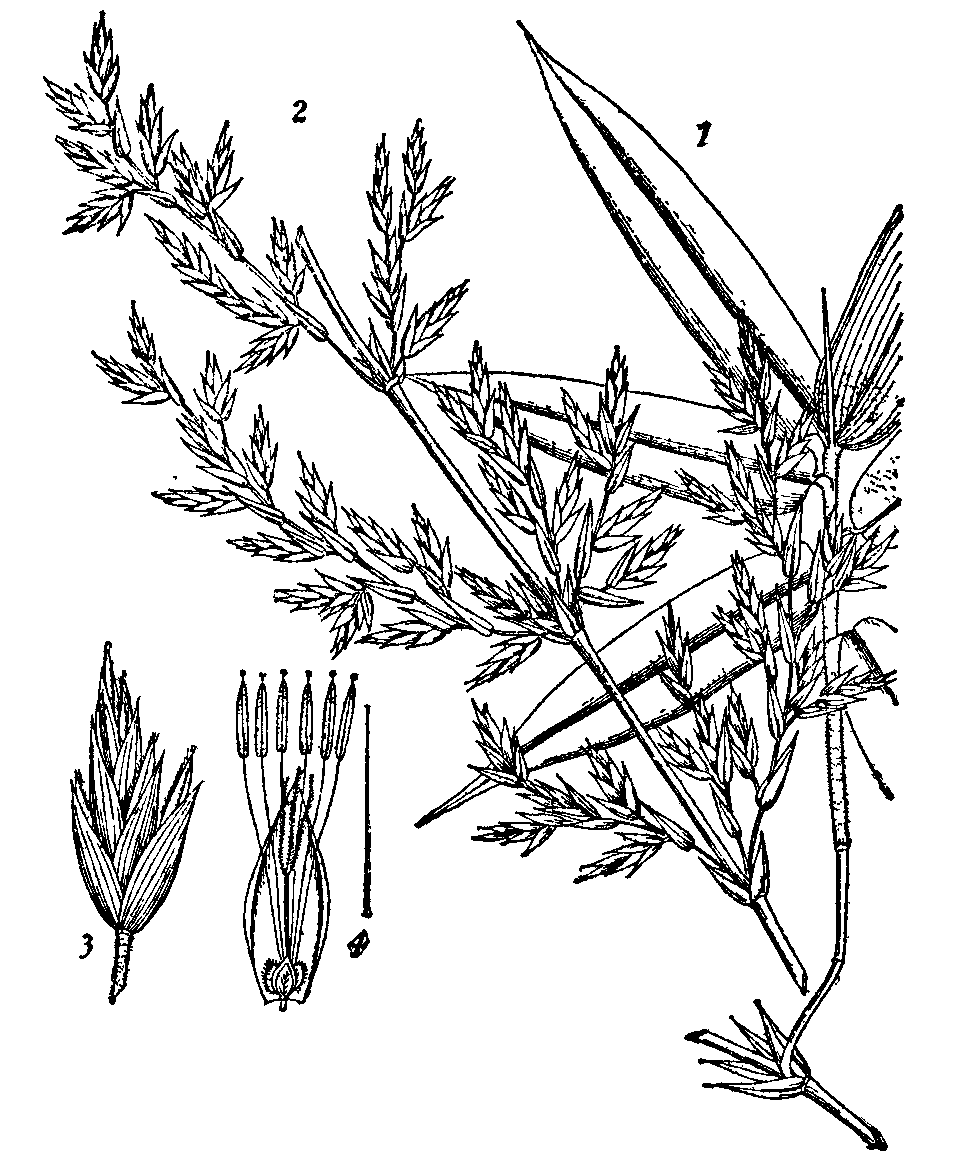
Fig. 1.—Bambusa arundinacea, an Indian bamboo. 1, Leafy shoot. 2, Branch of inflorescence. 3, Spikelet. 4, Flower.
BAMBOO, the popular name for a tribe of grasses, Bambuseae, which are large, often tree-like, with woody stems. The stems spring from an underground root-stock and are often crowded to form dense clumps; the largest species reach 120 ft. in height. The slender stem is hollow, and, as generally in grasses, has well-marked joints or nodes, at which the cavity is closed by a strong diaphragm. The branches are numerous and in some species spiny; the narrow, often short, leaf-blade is usually jointed at the base and has a short stalk, by which it is attached to the long sheath. The spikelets are usually many-flowered and variously arranged in racemes or panicles. The flower differs from that of the majority of grasses in having usually three lodicules and six stamens. Many species bloom annually, but others only at intervals sometimes of many years, when the individuals of one and the same species are found in bloom over large areas. Thus on the west coast of India the simultaneous blooming of Bambusa arundinacea (fig. 1), one of the largest species, has been observed at intervals of thirty-two years. After ripening of the seed, the leafless flowering culms always die down.
The Bambuseae contain twenty-three genera and occur throughout the tropical zone, but very unevenly distributed; they also extend into the sub-tropical and even into the temperate zone. Tropical Asia is richest in species; in Africa there are very few. In Asia they extend into Japan and to 10,000 ft. or more on the Himalayas; and in the Andes of South America they reach the snow-line.
The fruit in Bambusa, Arundinaria and other genera resembles the grain generally characteristic of grasses, but in Dendrocalamus and others it is a nut, while rarely, as in Melocanna, it is fleshy and suggests an apple in size and appearance. The uses to which all the parts and products of the bamboo are applied in Oriental countries are almost endless. The soft and succulent shoots, when just beginning to spring, are cut off and served up at table like asparagus. Like that vegetable, also, they are earthed over to keep them longer fit for consumption; and they afford a continuous supply during the whole year, though it is more abundant in autumn. They are also salted and eaten with rice, prepared in the form of pickles or candied and preserved in sugar. As the plant grows older, a species of fluid is secreted in the hollow joints, in which a concrete substance once highly valued in the East for its medicinal qualities, called tabaxir or tabascheer, is gradually developed. This substance, which has been found to be a purely siliceous concretion, is possessed of peculiar optical properties. As a medicinal agent the bamboo is entirely inert, and it has never been received into the European materia medica.

Fig. 2.—Bamboo (Bambusa vulgaris), very much reduced. Grows 20 to 50 ft high.
The grains of the bamboo are available for food, and the Chinese have a proverb that it produces seed more abundantly in years when the rice crop fails, which means, probably, that in times of dearth the natives look more after such a source of food. The Hindus eat it mixed with honey as a delicacy, equal quantities being put into a hollow joint, coated externally with clay, and thus roasted over a fire. The fleshly fruit of Melocanna is baked and eaten. The plant is a native of India, but is sometimes cultivated as in Mauritius. It is, however, the stem of the bamboo which is applied to the greatest variety of uses. Joints of sufficient size form water buckets; smaller ones are used as bottles, and among the Dyaks of Borneo they are employed as cooking vessels. Bamboo is extensively used as a timber wood, and houses are frequently made entirely out of the products of the plant; complete sections of the stem form posts or columns; split up, it serves for floors or rafters; and, interwoven in lattice-work, it is employed for the sides of rooms, admitting light and air. The roof is sometimes of bamboo solely, and when split, which is accomplished with the greatest ease, it can be formed into laths or planks. It is employed in shipping of all kinds; some of the strongest plants are selected for masts of boats of moderate size, and the masts of larger vessels are sometimes formed by the union of several bamboos built up and joined together.
The bamboo is employed in the construction of all kinds of agricultural and domestic implements and in the materials and implements required in fishery. Bows are made of it by the union of two pieces with many bands; and, the septa being bored out and the lengths joined together, it is employed, as we use leaden pipes, in transmitting water to reservoirs or gardens. From the light and slender stalks shafts for arrows are obtained; and in the south-west of Asia there is a certain species of equally slender growth, from which writing-pens or reeds are made. A joint forms a holder for papers or pens, and it was in a joint of bamboo that silk-worm eggs were carried from China to Constantinople during the reign of Justinian. The outer cuticle of Oriental species is so hard that it forms a sharp and durable cutting edge, and it is so siliceous that it can be used as a whetstone. This outer cuticle, cut into thin strips, is one of the most durable and beautiful materials for basket-making, and both in China and Japan it is largely so employed. Strips are also woven into cages, chairs, beds and other articles of furniture, Oriental wicker-work in bamboo being unequalled for beauty and neatness of workmanship. In China the interior portions of the stem are beaten into a pulp and used for the manufacture of the finer varieties of paper. Bamboos are imported to a considerable extent into Europe for the use of basket-makers, and for umbrella and walking-sticks. In short, the purposes to which the bamboo is applicable are almost endless, and well justify the opinion that "it is one of the most wonderful and most beautiful productions of the tropics, and one of Nature's most valuable gifts to uncivilized man" (A. R. Wallace, The Malay Archipelago).
A number of species of bamboo are hardy under cultivation in the British Isles. A useful and interesting account of these and their cultivation will be found in the Bamboo Garden, by A. B. Freeman-Mitford. They are mostly natives of China and Japan and belong to the genera Arundinaria, Bambusa and Phyllostachys; but include a few Himalayan species of Arundinaria. They may be propagated by seed (though owing to the rare occurrence of fruit, this method is seldom applicable), by division and by cuttings. They are described as hungry plants which well repay generous treatment, and will flourish in a rich, not too stiff loam, and for the first year or two should be well mulched. They should be sheltered from winds and well watered during the growing period. When being transplanted the roots must be disturbed as little as possible. The following may be mentioned; Arundinaria simoni, a fine plant which in the bamboo garden at Kew has reached 18 ft. in height, and not infrequently flowers and fruits in Britain; A. japonica, a tall and handsome plant generally grown in gardens under the name Bambusa métaké; A. nitida, "by far the daintiest and most attractive of all its genus, and remarkably hardy"; Bambusa palmata, with leaves a foot or more long and three inches broad; B. tesselata; B. quadrangularis, remarkable for its square stems; Phyllostachys mitis, growing to 60 ft. high in its native home, China and Japan; and P. nigra, so called from the black stem, a handsome species.
BAMBURGH, or Bamborough, a village in the Berwick-upon-Tweed parliamentary division of Northumberland, England, on the sea-coast, 2½ m. E. of Belford station on the North Eastern railway, and 54 m. N. of Newcastle. It was a royal borough previous to the Norman Conquest and returned two members to parliament in the reign of Edward I. Its ancient castle occupies a magnificent position close to the sea on an almost perpendicular rock, 150 ft. in height, accessible only on the south-east side.
The first erection is ascribed by the Saxon chronicles to King Ida of Northumberland. The castle buildings are of various dates from the Norman period and are of great strength and dignity. They include a massive keep and the remains of an apsidal chapel dedicated to St Peter. In the village, the church is dedicated to St Aidan, who was bishop of Lindisfarne or Holy Island, which lies off the coast to the north, about 634. It is a fine cruciform building, mainly of Early English date, with a crypt beneath the chancel. In the churchyard is a monument to Grace Darling (1815-1842), the brave rescuer of some of the crew of the ship "Forfarshire" in 1838. The Longstone Lighthouse, where her father was keeper, stands on an outer rock of the Farne Islands, which stretch north-eastward for 6 m. from the coast at Bamburgh.
The town of Bamburgh (Bebbanburgh) sprang up round the ancient castle. During the struggle for the crown between William Rufus and Robert of Normandy, Bamburgh was besieged by William, who, finding the defence too strong, erected and garrisoned a new castle before Bamburgh called "Malveisin" or "Evil neighbour." Earl Robert of Northumberland, who was in command of Bamburgh, having been defeated in a sally, the castle surrendered to William in November 1095. The first mention of Bamburgh as a borough does not occur until 1169, when the men paid 2½ marks to an aid. Henry III. by charter of 1254-1255 granted the burgesses their town at an annual fee farm rent of 26 marks, of which they were acquitted in 1318 and 1327 "on account of the robberies and fires inflicted on them by the Scots." Edward III. in 1332 confirmed the charter of Henry III., and granted further that the town should be a free borough governed by four bailiffs, that it should be enclosed by a wall and that the burgesses should have a gild merchant. He also altered the market-day from Sunday to Wednesday, and gave licence for the fairs, which had been held "from time immemorial" on the feasts of SS. Oswald and Aidan, to continue for three extra days. During the Scottish wars of the reign of Henry V., Bamburgh again suffered severely, so much so that in 1439 the burgesses had decreased in number from 120 to 13. These again petitioned for a remission of their farm, which in 1446 was reduced to £10 yearly. Bamburgh was twice taken by the Yorkists in the Wars of the Roses and twice recovered by Queen Margaret. In 1463, after it had been recovered a second time by the queen, Henry VI. stayed there for a year, but after the battle of Hexham it was again taken by the Yorkists, and the castle and town were then so much injured that from that time there is no mention of the burgesses or their privileges. Bamburgh returned two members to parliament in 1295 and again in Edward III.'s reign, but since then has never been represented. In 1384 Lord Neville received licence to dig for sea-coal in Bamburgh, and mines of coal and lead existed there as late as 1681.
BAMBUTE (sometimes incorrectly called Batwa), a race of pygmies of the Semliki Forest, on the western borders of the Uganda Protectorate between Albert Nyanza and Albert Edward Nyanza. They probably form merely a branch of the pygmy race of Equatorial Africa, represented farther west by H. von Wissmann's Batwa (q.v.). Their complexion varies from reddish-yellow to brownish-black, with head-hair often of a russet-brown, and body-hair, black and bristly on upper lip, chin, chest, axillae and pubes, yellowish and fleecy on cheeks, back and limbs. Their average height is 4 ft. 9 in. Even when forced to keep clean, their skins give out a rancid odour, something (Sir H. H. Johnston says) between the smell of a monkey and a negro. Their faces are remarkable for the long upper lip, and the bridgeless nose with enormous alae (the cartilage of the nose above the nostrils). Like the Batwa they are nomad hunters, building only huts of sticks and leaves, and living in the forest, where they hunt the largest game with no weapon but a tiny bow from which they shoot poisoned arrows. Sir H. H. Johnston states that the Bambute have a good idea of drawing, and with a sharpened stick can sketch in sand or mud the beasts and birds known to them. The Bambute do not tattoo or scar, nor have they any love of ornament, wearing no ear-rings, necklets, anklets, &c. The upper incisors and canines are sharpened to a point. In the forests they go quite naked. They speak a corrupted form of the dialects of their negro neighbours. They have a peculiar way of singing their words. Their voices are low and musical and the pronunciation is singularly staccato, every syllable being separately uttered. They show no trace of spirit or ancestor worship, but have some idea that thunder, lightning and rain are manifestations of an Evil Power, and that the dead are reincarnated in the red bush-pig. They have no tribal government, accepting as temporary lawgiver some adept hunter. Marriage is by purchase; polygamy seems to exist, but the domestic affections are strong. The dead are buried in dug graves, and food, tobacco and weapons are often placed with the corpse. The Bambute are very musical, though they are uninventive as regards instruments. They have many songs which they sing well and they dance with spirit.
See A. de Quatrefages, The Pygmies (Eng. edit. 1895); Sir H. H. Johnston, Uganda Protectorate (1902).
BAMFORD, SAMUEL (1788-1872), English labour politician, was born at Miston, near Middleton, Lancashire, on the 28th of February 1788. Himself a stalwart weaver, he was opposed to physical force movements and did all he could to restrain the violent resistance to trade oppression which was so common; yet through attending and speaking at the meeting (1819) at Peterloo, Manchester (q.v.), which was intended to be a peaceful gathering to petition for Parliamentary reform and a repeal of the Corn Law but ended in a massacre, he was arrested for a breach of the law, convicted and sentenced to twelve months' imprisonment. He was the author of several widely popular poems (principally in the Lancashire dialect) showing sympathy with the conditions of his class, and his Passages in the Life of a Radical (1840-1844) is an authoritative history of the condition of the working classes in the years succeeding the battle of Waterloo. He died at Harpurhey on the 13th of April 1872, and was accorded a public funeral, attended by thousands.
BAMIAN, a once renowned city of Afghanistan, situated about 80 m. N.W. of Kabul. Its remains lie in a valley of the Hazara country, on the chief road from Kabul towards Turkestan, and immediately at the northern foot of that prolongation of the Indian Caucasus now called Koh-i-Baba. The passes on the Kabul side are not less than 11,000 and 12,000 ft. in absolute height, and those immediately to the north but little inferior. The height of the valley was fixed at about 8500 ft., and the surrounding country carefully surveyed by Major Pelham J. Maitland and the Hon. M. G. Talbot, during the progress of the Russo-Afghan Boundary Commission in November 1885. The river draining the valley is one of the chief sources of the Sarkhab (Surkhab) or Aksarai, an important tributary of the Upper Oxus. The prominences of the cliffs which line the valley are crowned by the remains of numerous massive towers, whilst their precipitous faces are for 6 or 7 m. pierced by an infinity of ancient cave-dwellings, some of which are still occupied. The actual site of the old city is marked by mounds and remains of walls, and on an isolated rock in the middle of the valley are considerable ruins of what appears to have been the acropolis, now known to the people as Ghulgulah. But the most famous remains at Bamian are two colossal standing idols, carved in the cliffs on the north side of the valley. They are 173 ft. and 120 ft. high respectively. These images, which have been much injured, apparently by cannon-shot, are cut in niches in the rock, and both images and niches have been coated with stucco. There is an inscription, not yet interpreted, over the greater idol, and on each side of its niche are staircases leading to a chamber near the head, which shows traces of elaborate ornamentation in azure and gilding. These chambers are used by the amir as store-houses for grain. The surface of the niches also has been painted with figures. In one of the branch valleys is a similar colossus, somewhat inferior in size to the second of these two; and there are indications of other niches and idols. Chahilburj, 28 m. from Zari, on the road to Balkh by the Balkhab, at the east end of the Sokhtagi valley; Shahr-i-Babar, about 45 m. above Chahilburj; and Gawargin, 6 m. above Shahr-i-Babar, are all fortified sites of about the same age as the relics at Bamian. At Haibak there is a very perfect excavation called the Takht-i-Rustam (a general name for all incomprehensible constructions amongst the modern inhabitants of Afghan Turkestan), which consists of an annular ditch enclosing a platform, with a small house about 21 ft. square above it, all cut out of the solid rock. There are hundreds of caves in this neighbourhood, all pointing to a line of Buddhist occupation connecting Balkh with Kabul. As seen from the rock of Ghulgulah, Bamian, with its ruined towers, its colossi, its innumerable grottos, and with the singular red colour of its barren soil, presents an impressive aspect of desolation and mystery.
That the idols of Bamian, about which so many conjectures have been uttered, were Buddhist figures, is ascertained from the narrative of the Chinese pilgrim, Hsüan-Tsang, who saw them in their splendour in A.D. 630, and was verified by the officers above named, who discovered other Buddhist caves and excavations in the valleys of the Balkhab and Sarikol.
Still vaster than these was a recumbent figure, 2 m. east of Bamian, representing Sakya Buddha entering Nirvāna, i.e. in act of death. This was "about 1000 ft. in length." No traces of this are alluded to by modern travellers, but in all likelihood it was only formed of rubble plastered (as is the case still with such Nirvāna figures in Indo-China) and of no durability. For a city so notable Bamian has a very obscure history. It does not seem possible to identify it with any city in classical geography; Alexandria ad Caucasum it certainly was not. The first known mention of it seems to be that by Hsuan-Tsang, at a time when apparently it had already passed its meridian, and was the head of one of the small states into which the empire of the White Huns had broken up. At a later period Bamian was for half a century, ending A.D. 1214, the seat of a branch of the Ghori dynasty, ruling over Tokharistan, or the basin of the Upper Oxus. The place was long besieged, and finally annihilated (1222) by Jenghiz Khan, whose wrath was exasperated at the death of a favourite grandson by an arrow from its walls. There appears to be no further record of Bamian as a city; but the character of ruins at Ghulgulah agrees with traditions on the spot in indicating that the city must have been rebuilt after the time of the Mongols and again perished. In 1840, during the British occupation of Kabul, Bamian was the scene of an action in which Colonel William H. Dennie with a small force routed Dost Mahommed Khan, accompanied by a number of Uzbeg chiefs.