Volume 3 — [E-Text Edition of Volume III - Part 1 of 2, Slice 2 of 3 - BACONTHORPE to BANKRUPTCY] (continued 8)
Reading edition
(R. Gn.)
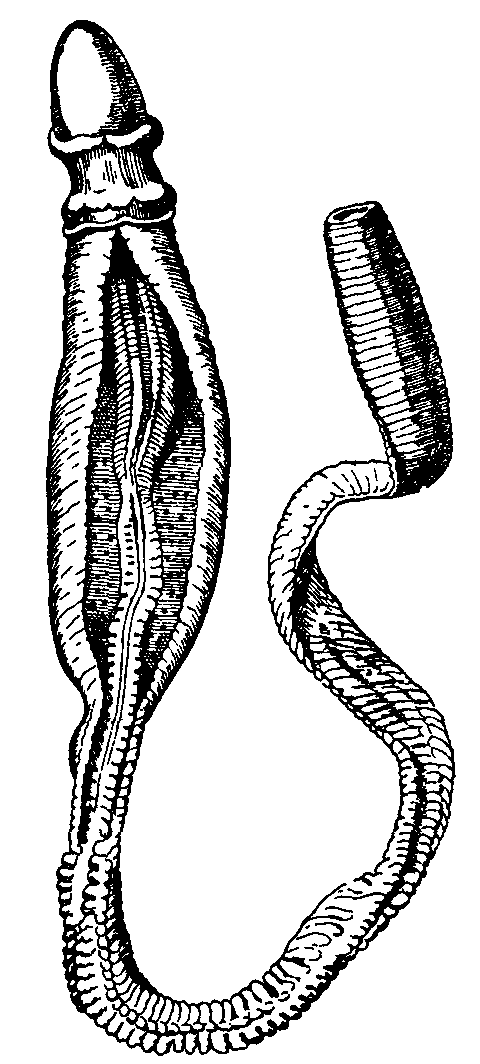
Fig. 1.—Ptychodera flava (New Caledonia), from above; about life size.
BALANOGLOSSUS, the general name given to certain peculiar, opaque, worm-like animals which live an obscure life under stones, and burrow in the sand from between tide-marks down to the abyssal regions of the sea. Their colour is usually some tone of yellow with dashes of red, brown and green, and they frequently emit a pungent odour. The name has reference to the tongue-shaped muscular proboscis by which the animal works its way through the sand. The proboscis is not the only organ of locomotion, being assisted by the succeeding segment of the body, the buccal segment or collar. By the waves of contraction executed by the proboscis accompanied by inflation of the collar, progression is effected, sometimes with marvellous rapidity. The third body region or trunk may attain a great length, one or two feet, or even more, and is also muscular, but the truncal muscles are of subordinate importance in locomotion, serving principally to promote the peristaltic contractions of the body by which the food is carried through the gut. The function of alimentation is closely associated with that of locomotion, somewhat as in the burrowing earthworm; in the excavation of its burrows the sand is passed through the body, and any nutrient matter that may adhere to it is extracted during its passage through the intestine, the exhausted sand being finally ejected through the vent at the orifice of the burrow and appearing at low tide as a worm casting. In accordance with this manner of feeding, the mouth is kept permanently open and prevented from collapsing by a pair of skeletal cornua belonging to a sustentacular apparatus (the nuchal skeleton), the body of which lies within the narrow neck of the proboscis; the latter is inserted into the collar and surrounded by the anterior free flap of this segment of the body.
When first discovered by J. F. Eschscholtz at the Marshall Islands in 1825, Balanoglossus was described as a worm-like animal belonging to the Echinoderm order of Holothurians or sea-cucumbers. In 1865 Kowalevsky discovered that the organs of respiration consist of numerous pairs of gill-slits leading from the digestive canal through the thickness of the body-wall to the exterior. On this account the animal was subsequently placed by Gegenbaur in a special class of Vermes, the Enteropneusta. In 1883-1886 Bateson showed by his embryological researches that the Enteropneusta exhibit chordate (vertebrate) affinities in respect of the coelomic, skeletal and nervous systems as well as in regard to the respiratory system, and, further, that the gill-slits are formed upon a plan similar to that of the gill-slits of Amphioxus, being subdivided by tongue-bars which depend from the dorsal borders of the slits.
Coelom and Pore-canals.—In correspondence with the tri-regional differentiation of the body in its external configuration, the coelom (body-cavity, perivisceral cavity) is divided into three portions completely separated from one another by septa:—(1) proboscis-coelom, or first body-cavity; (2) the collar-coelom, or second body-cavity; (3) truncal coelom, or third body-cavity. Of these divisions of the coelom the first two communicate with the exterior by means of a pair of ciliated pore-canals placed at the posterior end of their respective segments. The proboscis-pores are highly variable, and frequently only one is present, that on the left side; sometimes the pore-canals of the proboscis unite to open by a common median orifice, and sometimes their communication with the proboscis-coelom appears to be occluded, and finally the pore-canals may be quite vestigial. The collar-pores are remarkable for their constancy; this is probably owing co the fact that they have become adapted to a special function, the inhalation of water to render the collar turgid during progression. There are reasons for supposing that the truncal coelom was at one time provided with pore-canals, but supposed vestiges of these structures have only been described for one genus, Spengelia, in which they lie near the anterior end of the truncal coelom.
Enteron.—Not only is the coelom thus subdivided, but the enteron (gut, alimentary canal, digestive tube) itself shows indications of three main subsections in continuity with one another:—(1) proboscis-gut (Eicheldarm, stomochord, vide infra); (2) collar-gut (buccal cavity, throat); (3) truncal gut extending from the collar to the vent.
Stomochord.—The proboscis-gut occurs as an outgrowth from the anterior dorsal wall of the collar-gut, and extends forward into the basal (posterior) region of the proboscis, through the neck into the proboscis-coelom, ending blindly in front. Although an integral portion of the gut, it has ceased to assist in alimentation, its epithelium undergoes vacuolar differentiation and hypertrophy, and its lumen becomes more or less vestigial. It has, in fact, become metamorphosed into a resistant supporting structure resembling in some respects the notochord of the true Chordata, but probably not directly comparable with the latter structure, being related to it solely by way of substitution. On account of the presence and mode of origin (from the gut-wall) of this organ Bateson introduced the term hemichorda as a phyletic name for the class Enteropneusta. As the proboscis-gut appears to have undoubtedly skeletal properties, and as it also has topographical relations with the mouth, it has been designated in English by the non-committal term stomochord. It is not a simple diverticulum of the collar-gut, but a complex structure possessing paired lateral pouches and a ventral convexity (ventral caecum) which rests in a concavity at the front end of the body of the nuchal skeleton (fig. 3). In some species (Spengelidae) there is a long capillary vermiform extension of the stomochord in front. The nuchal skeleton is a non-cellular laminated thickening of basement-membrane underlying that portion of the stomochord which lies between the above-mentioned pouches and the orifice into the throat. At the point where the stomochord opens into the buccal cavity the nuchal skeleton bifurcates, and the two cornua thus produced pass obliquely backwards and downwards embedded in the wall of the throat, often giving rise to projecting ridges that bound a dorsal groove of the collar-gut which is in continuity with the wall of the stomochord (fig. 3).
Nervous System.—At the base of the epidermis (which is in general ciliated) there is over the entire surface of the body a layer of nerve-fibres, occurring immediately outside the basement-membrane which separates the epidermis from the subjacent musculature. The nervous system is thus essentially epidermal in position and diffuse in distribution; but an interesting concentration of nerve-cells and fibres has taken place in the collar-region, where a medullary tube, closed in from the outside, opens in front and behind by anterior and posterior neuropores. This is the collar nerve-tube. Sometimes the central canal is wide and uninterrupted between the two neuropores; in other cases it becomes broken up into a large number of small closed medullary cavities, and in others again it is obsolete. In one family, the Ptychoderidae, the medullary tube of the collar is connected at intermediate points with the epidermis by means of a variable number of unpaired outgrowths from its dorsal wall, generally containing an axial lumen derived from and in continuity with the central canal. These hollow roots terminate blindly in the dorsal epidermis of the collar, and place the nervous layer of the latter in direct connexion with the fibres of the nerve-tube. The exact significance of these roots is a matter for speculation, but it seems possible that they are epiphysial structures remotely comparable with the epiphysial (pineal) complex of the craniate vertebrates. In accordance with this view there would be also some probability in favour of regarding the collar nerve-tube of the Enteropneusta as the equivalent of the cerebral vesicle only of Amphioxus and the Ascidian tadpole, and also of the primary fore-brain of vertebrates.
Special thickenings of the diffuse nervous layer of the epidermis occur in certain regions and along certain lines. In the neck of the proboscis the fibrous layer is greatly thickened, and other intensifications of this layer occur in the dorsal and ventral middle lines of the trunk extending to the posterior end of the body. The dorsal epidermal nerve-tract is continued in front into the ventral wall of the collar nerve-tube, and at the point of junction there is a circular commissural thickening following the posterior rim of the collar and affording a special connexion between the dorsal and ventral nerve-tracts. From the ventral surface of the collar nerve-tube numerous motor fibres may be seen passing to the subjacent musculature. These fibres are not aggregated into roots.
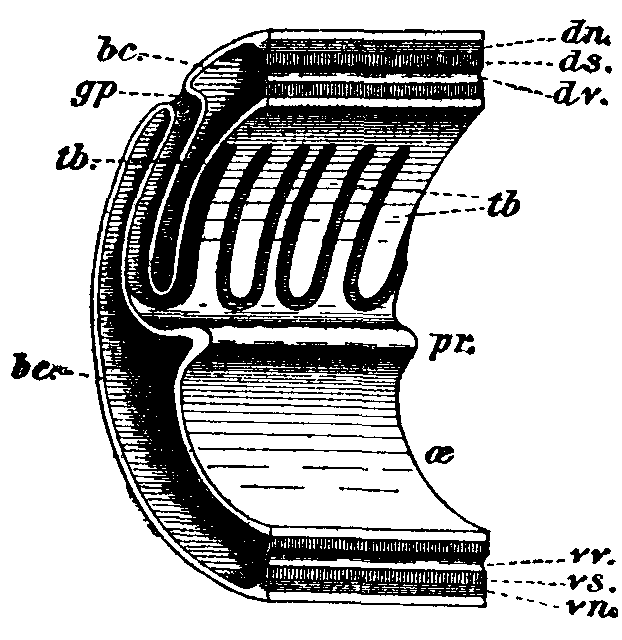
Fig. 2.—Structure of branchial region.
bc, coelom. tb, tongue-bars. ds, mesentery. pr, ridge. vv, vessel. gp, gill-pore. dn, dorsal nerve. dv, vessel. œ, oesophagus. vs, mesentery. vn, ventral nerve.
Gill-slits.—The possession of gill-slits is as interesting a feature in the organization of Balanoglossus as is the presence of tracheae in Peripatus. These gill-slits occupy a variable extent of the anterior portion of the trunk, commencing immediately behind the collar-trunk septum. The branchial bars which constitute the borders of the clefts are of two kinds:—(1) Septal bars between two contiguous clefts, corresponding to the primary bars in Amphioxus; (2) Tongue-bars. The chief resemblances between Balanoglossus and Amphioxus in respect of the gill-slits may be stated briefly as follows:—(α) the presence of two kinds of branchial bars in all species and also of small crossbars (synapticula) in many species; (β) numerous gill-slits, from forty to more than a hundred pairs; (γ) the addition of new gill-slits by fresh perforation at the posterior end of the pharynx throughout life. The chief differences are, that (a) the tongue-bar is the essential organ of the gill-slit in Balanoglossus, and exceeds the septal bars in bulk, while in Amphioxus the reverse is the case; (b) the tongue-bar contains a large coelomic space in Balanoglossus, but is solid in Amphioxus; (c) the skeletal rods in the tongue-bars of Balanoglossus are double; (d) the tongue-bar in Balanoglossus does not fuse with the ventral border of the cleft, but ends freely below, thus producing a continuous U-shaped cleft. The meaning of this singular contrast between the two animals may be that we have here an instance of an interesting gradation in evolution. From serving primitively as the essential organ of the cleft the tongue-bar may have undergone reduction and modification, becoming a secondary bar in Amphioxus, subordinate to the primary bars in size, vascularity and development; finally, in the craniate vertebrates it would then have completed its involution, the suggestion having been made that the tongue-bars are represented by the thymus-primordia.
Gill-pouches and Gill-pores.—Only rarely do the gill-slits open freely and directly to the exterior (fig. 1). In most species of Balanoglossus each gill-slit may be said to open into its own atrial chamber or gill-pouch; this in its turn opens to the exterior by a minute gill-pore. There are, therefore, as many gill-pouches as there are gill-slits and as many gill-pores as pouches. The gill-pores occur on each side of the dorsal aspect of the worm in a longitudinal series at the base of a shallow groove, the branchial groove. The respiratory current of water is therefore conducted to the exterior by different means from that adopted by Amphioxus, and this difference is so great that the theory which seeks to explain it has to postulate radical changes of structure, function and topography.
Excretory and Vascular Systems.—It seems likely that the coelomic pore-canals were originally excretory organs, but in the existing Enteropneusta the pore-canals (especially the collar canals) have, as we have seen, acquired new functions or become vestigial, and the function of excretion is now mainly accomplished by a structure peculiar to the Enteropneusta called the glomerulus, a vascular complex placed on either side of the anterior portion of the stomochord, projecting into the proboscis-coelom. The vascular system itself is quite peculiar, consisting of lacunae and channels destitute of endothelium, situated within the thickness of the basement-membrane of the body-wall, of the gut-wall and of the mesenteries. The blood, which is a non-corpuscular fluid, is propelled forwards by the contractile dorsal vessel and collected into the central blood-sinus; this lies over the stomochord, and is surrounded on three sides by a closed vesicle, with contractile walls, called the pericardium (Herzblase). By the pulsation of the pericardial vesicle (best observed in the larva) the blood is driven into the glomerulus, from which it issues by efferent vessels which effect a junction with the ventral (sub-intestinal) vessel in the trunk. The vascular system does not readily lend itself to morphological comparison between such widely different animals as Balanoglossus and Amphioxus, and the reader is therefore referred to the memoirs cited at the end of this article for further details.
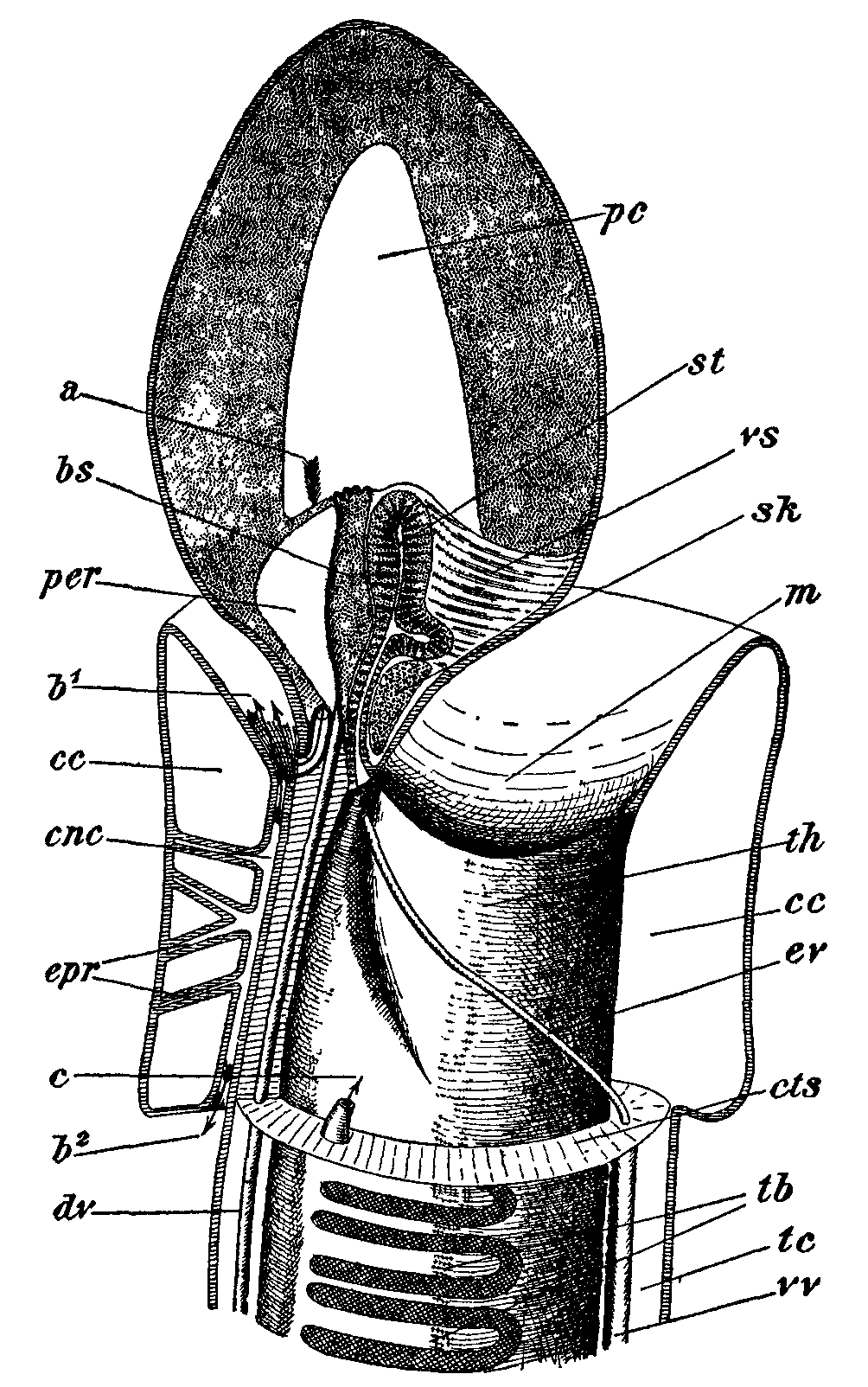
Fig.
3.—Structure of anterior end.
a, Arrow from proboscis-cavity (pc) passing to left of pericardium (per) and out through proboscis pore-canal. b1, arrow from central canal of neurochord (cnc) passed out through anterior neuropore. b2, ditto; through posterior neuropore. c, arrow intended to pass from 1st gill-pouch through collar pore-canal into collar-coelom (cc). cts, posterior limit of collar. dv, dorsal vessel passing into central sinus (bs). ev, efferent vessel passing into ventral vessel (vv). epr, epiphysial tubes. st, stomochord. vs, ventral septum of proboscis. sk, body of nuchal skeleton. m, mouth. th, throat. tb, tongue-bars. tc, trunk coelom.
Reproductive System.—The sexes are separate, and when mature are sometimes distinguished by small differences of colour in the genital region. Both male and female gonads consist of more or less lobulated hollow sacs connected with the epidermis by short ducts. In their disposition they are either uniserial, biserial or multiserial. They occur in the branchial region, and also extend to a variable distance behind it. In exceptional cases they are either confined to the branchial region or excluded from it. When they are arranged in uniserial or biserial rows the genital ducts open into or near the branchial grooves in the region of the pharynx and in a corresponding position in the post-branchial region. An important feature is the occurrence in some species (Ptychoderidae) of paired longitudinal pleural or lateral folds of the body which are mobile, and can be approximated at their free edges so as to close in the dorsal surface, embracing both the median dorsal nerve-tract and the branchial grooves with the gill-pores, so as to form a temporary peri-branchial and medullary tube, open behind where the folds cease. On the other hand, they can be spread out horizontally so as to expose their own upper side as well as the dorsal surface of the body (fig. 1). These folds are called the genital pleurae because they contain the bulk of the gonads. Correlated with the presence of the genital pleurae there is a pair of vascular folds of the basement membrane proceeding from the dorsal wall of the gut in the post-branchial portion of the branchio-genital region, and from the dorsal angles made by the pleural folds with the body-wall in the pharyngeal region; they pass, in their most fully developed condition, to the free border of the genital pleurae. These vascular membranes are called the lateral septa. Since there are many species which do not possess these genital pleurae, the question arises as to whether their presence or their absence is the more primitive condition. Without attempting to answer this question categorically, it may be pointed out that within the limits of the family (Ptychoderidae) which is especially characterized by their presence there are some species in which the genital pleurae are quite obsolete, and yet lateral septa occur (e.g. Ptychodera ruficollis), seeming to indicate that the pleural folds have in such cases been secondarily suppressed.
Development.—The development of Balanoglossus takes place according to two different schemes, known as direct and indirect, correlated with the occurrence in the group of two kinds of ova, large and small. Direct development, in which the adult form is achieved without striking metamorphosis by a gradual succession of stages, seems to be confined to the family Balanoglossidae. The remaining two families of Enteropneusta, Ptychoderidae and Spengelidae, contain species of which probably all pursue an indirect course of development, culminating in a metamorphosis by which the adult form is attained. In these cases the larva, called Tornaria, is pelagic and transparent, and possesses a complicated ciliated seam, the longitudinal ciliated band, often drawn out into convoluted bays and lappets. In addition to this ciliated band the form of the Tornaria is quite characteristic and unlike the adult. The Tornaria larva offers a certain similarity to larvae of Echinoderms (sea-urchins, star-fishes, and sea-cucumbers), and when first discovered was so described. It is within the bounds of possibility that Tornaria actually does indicate a remote affinity on the part of the Enteropneusta to the Echinoderms, not only on account of its external form, but also by reason of the possession of a dorsal water-pore communicating with the anterior body-cavity. In the direct development Bateson showed that the three divisions of the coelom arise as pouches constricted off from the archenteron or primitive gut, thus resembling the development of the mesoblastic somites of Amphioxus. It would appear that while the direct development throws light upon the special plan of organization of the Enteropneusta, the indirect development affords a clue to their possible derivation. However this may be, it is sufficiently remarkable that a small and circumscribed group like the Enteropneusta, which presents such a comparatively uniform plan of composition and of external form, should follow two such diverse methods of development.
Distribution.—Some thirty species of Balanoglossus are known, distributed among all the principal marine provinces from Greenland to New Zealand. The species which occurs in the English Channel is Ptychodera sarniensis. The Ptychoderidae and Spengelidae are predominantly tropical and subtropical, while the Balanoglossidae are predominantly arctic and temperate in their distribution. One of the most singular facts concerning the geographical distribution of Enteropneusta has recently been brought to light by Benham, who found a species of Balanoglossus, sensu stricto, on the coast of New Zealand hardly distinguishable from one occurring off Japan. Finally, Glandiceps abyssicola (Spengelidae) was dredged during the "Challenger" expedition in the Atlantic Ocean off the coast of Africa at a depth of 2500 fathoms.
Authorities.—W. Bateson, "Memoirs on the Direct Development of Balanoglossus," Quart. Journ. Micr. Sci. (vols. xxiv.-xxvi., 1884-1886); W. B. Benham, "Balanoglossus otagoensis, n. sp," Q. J. M. S. (vol. xlii. p. 497, 1899); Yves Delage and Éd. Hérouard, Traité de zoologie concrète (t. viii.), "Les Procordés" (1898); S. F. Harmer, "Note on the Name Balanoglossus," Proc. Camb. Phil. Soc. (x. p. 190, 1900); T. H. Morgan, "Memoirs on the Indirect Development of Balanoglossus," Journ. Morph. (vol. v., 1891, and vol. ix., 1894); W. E. Ritter, "Harrimania maculosa, a new Genus and Species of Enteropneusta from Alaska," Papers from the Harriman Alaska Exhibition (ii.), Proc. Washington Ac. (ii. p. 111, 1900); J. W. Spengel, "Die Enteropneusten," Eighteenth Monograph on the Fauna und Flora des Golfes von Neapel (1893); A. Willey, "Enteropneusta from the South Pacific, with Notes on the West Indian Species," Zool. Results (Willey), part iii., 1899; see also Q. J. M. S. (vol. xlii. p. 223, 1899); J. P. Hill, "The Enteropneusta of Funafuti," Mem. Austral. Mus. (iii., 1897-1898); M. Caullery and F. Mesnil, "Balanoglossus Kochleri, n. sp. English Channel," C. R. Soc. Biol. lii. p. 256 (1900).
(A. W.*)
BALARD, ANTOINE JERÔME (1802-1876), French chemist, was born at Montpellier on the 30th of September 1802. He started as an apothecary, but taking up teaching he acted as chemical assistant at the faculty of sciences of his native town, and then became professor of chemistry at the royal college and school of pharmacy and at the faculty of sciences. In 1826 he discovered in sea-water a substance which he recognized as a previously unknown element and named bromine. The reputation brought him by this achievement secured his election as successor to L. J. Thénard in the chair of chemistry at the faculty of sciences in Paris, and in 1851 he was appointed professor of chemistry at the Collège de France, where he had M. P. E. Berthelot first as pupil, then as assistant and finally as colleague. He died in Paris on the 30th of April 1876. While the discovery of bromine and the preparation of many of its compounds was his most conspicuous piece of work, Balard was an industrious chemist on both the pure and applied sides. In his researches on the bleaching compounds of chlorine he was the first to advance the view that bleaching-powder is a double compound of calcium chloride and hypochlorite; and he devoted much time to the problem of economically obtaining soda and potash from sea-water, though here his efforts were nullified by the discovery of the much richer sources of supply afforded by the Stassfurt deposits. In organic chemistry he published papers on the decomposition of ammonium oxalate, with formation of oxamic acid, on amyl alcohol, on the cyanides, and on the difference in constitution between nitric and sulphuric ether.
BALA SERIES, in geology, a series of dark slates and sandstones with beds of limestone which occurs in the neighbourhood of Bala, Merionethshire, North Wales. It was first described by A. Sedgwick, who considered it to be the upper part of his Cambrian System. The series is now placed at the top of the Ordovician System, above the Llandeilo beds. The Bala limestone is from 20 to 40 ft. thick, and is recognizable over most of North Wales; it is regarded as the equivalent of the Coniston limestone of the Lake District. The series in the type area consists of the Hirnant limestone, a thin inconstant bed, which is separated by 1400 ft. of slates from the Bala limestone, below this are more slates and volcanic rocks. The latter are represented by large contemporaneous deposits of tuff and felsitic lava which in the Snowdon District are several thousand feet thick. In South Wales the Bala Series contains the following beds in descending order:—the Trinucleus seticornis beds (Slade beds, Redhill shales and Sholeshook limestone), the Robeston Wathen beds, and the Dicranograptus shales. The typical graptolites are, in the upper part, Dicellograptus anceps and D. complanatus; in the lower part, Pleurograptus linearis and Dicranograptus Clingani. In Shropshire this series is represented by the Caradoc and Chirbury Series; in southern Scotland by the Hartfell and Ardmillan Series, and by similar rocks in Ireland. See Caradoc Series and Ordovician System.
BALASH (in the Greek authors, Balas; the later form of the name Vologaeses), Sassanian king in A.D. 484-488, was the brother and successor of Pērōz, who had died in a battle against the Hephthalites (White Huns) who invaded Persia from the east. He put down the rebellion of his brother Zareh, and is praised as a mild and generous monarch, who made concessions to the Christians. But as he did nothing against his enemies, he was, after a reign of four years, deposed and blinded, and his nephew, Kavadh I., raised to the throne.
(Ed. M.)
BALASORE, a town and district of British India, in the Orissa division of Bengal. The town is the principal one and the administrative headquarters of the district, and is situated on the right bank of the river Burabalang, about 7 m. from the sea-coast as the crow flies and 16 m. by the river. There is a station on the East Coast railway. The English settlement of Balasore, formed in 1642, and that of Pippli in its neighbourhood seven years earlier, became the basis of the future greatness of the British in India. The servants of the East India Company here fortified themselves in a strong position, and carried on a brisk investment in country goods, chiefly cottons and muslins. They flourished in spite of the oppressions of the Mahommedan governors, and when needful asserted their claims to respect by arms. In 1688, affairs having come to a crisis, Captain William Heath, commander of the company's ships, bombarded the town. In the 18th century Balasore rapidly declined in importance, on account of a dangerous bar which formed across the mouth of the river. At present the bar has 12 to 15 ft. of water at spring-tides, but not more than 2 or 3 ft. at low water in the dry season. Large ships have to anchor outside in the open roadstead. The town still possesses a large maritime trade, despite the silting-up of the river mouth. Pop. (1901) 20,880.
The district forms a strip of alluvial land between the hills and the sea, varying from about 9 to 34 m. in breadth; area, 2085 sq. m. The hill country rises from the western boundary line. The district naturally divides itself into three well-defined tracts—(1) The salt tract, along the coast; (2) The arable tract, or rice country; and (3) The submontane tract, or jungle lands. The salt tract runs the whole way down the coast, and forms a desolate strip a few miles broad. Towards the beach it rises into sandy ridges, from 50 to 80 ft. high, sloping inland and covered with a vegetation of low scrub jungle. Sluggish brackish streams creep along between banks of fetid black mud. The sandhills on the verge of the ocean are carpeted with creepers and the wild convolvulus. Inland, it spreads out into prairies of coarse long grass and scrub jungle, which harbour wild animals in plenty; but throughout this vast region there is scarcely a hamlet, and only patches of rice cultivation at long intervals. From any part of the salt tract one may see the boundary of the inner arable part of the district fringed with long lines of trees, from which every morning the villagers drive their cattle out into the saliferous plains to graze. The salt tract is purely alluvial, and appears to be of recent date. Towards the coast the soil has a distinctly saline taste.
Salt used to be largely manufactured in the district by evaporation, but the industry is now extinct. The arable tract lies beyond the salt lands, and embraces the chief part of the district. It is a long dead-level of rich fields, with a soil lighter in colour than that of Bengal or Behar; much more friable, and apt to split up into small cubes with a rectangular cleavage. A peculiar feature of the arable tract is the Pāts (literally cups) or depressed lands near the river-banks. They were probably marshes that have partially silted up by the yearly overflow of the streams. These pāts bear the finest crops. As a whole, the arable tract is a treeless region, except around the villages, which are encircled by fine mango, pipal, banyan and tamarind trees, and intersected with green shady lanes of bamboo. A few palmyras, date-palms and screw-pines (a sort of aloe, whose leaves are armed with formidable triple rows of hook-shaped thorns) dot the expanse or run in straight lines between the fields. The submontane tract is an undulating country with a red soil, much broken up into ravines along the foot of the hills. Masses of laterite, buried in hard ferruginous clay, crop up as rocks or slabs. At Kopari, in Kila Ambohata, about 2 sq. m. are almost paved with such slabs, dark-red in colour, perfectly flat and polished like plates of iron. A thousand mountain torrents have scooped out for themselves picturesque ravines, clothed with an ever-fresh verdure of prickly thorns, stunted gnarled shrubs, and here and there a noble forest tree. Large tracts are covered with sal jungle, which nowhere, however, attains to any great height.
Balasore district is watered by six distinct river systems: those of the Subanrekha, the Burabalang, the Jamka, the Kansbans and the Dhamra.
The climate greatly varies according to the seasons of the year. The hot season lasts from March to June, but is tempered by cool sea-breezes; from June to September the weather is close and oppressive; and from October to February the cold season brings the north-easterly winds, with cool mornings and evenings.
Almost the only crop grown is rice, which is largely exported by sea. The country is exposed to destructive floods from the hill-rivers and also from cyclonic storm-waves. The district is traversed throughout its entire length by the navigable Orissa coast canal, and also by the East Coast railway from Calcutta to Madras. The seaports of Balasore, Chandbali and Dhamra conduct a very large coasting trade. The exports are almost confined to rice, which is sent to Ceylon, the Maldives and Mauritius. The imports consist of cotton twist and piece goods, mineral oils, metals, betel-nuts and salt. In 1901 the population was 1,071,197, an increase of 9% in the decade.
BALASSA, BÁLINT, Baron of Kékkö and Gyarmat (1551-1594), Magyar lyric poet, was born at Kékkö, and educated by the reformer, Péter Bornemissza, and by his mother, the highly gifted Protestant zealot, Anna Sulyok. His first work was a translation of Michael Bock's Würtzgertlein für die krancken Seelen, to comfort his father while in prison (1570-1572) for some political offence. On his father's release, Bálint accompanied him to court, and was also present at the coronation diet of Pressburg in 1572. He then joined the army and led a merry life at the fortress of Eger. Here he fell violently in love with Anna Losonczi, the daughter of the hero of Temesvár, and evidently, from his verses, his love was not unrequited. But a new mistress speedily dragged the ever mercurial youth away from her, and deeply wounded, she gave her hand to Krisztóf Ungnad. Naturally Balassa only began to realize how much he loved Anna when he had lost her. He pursued her with gifts and verses, but she remained true to her pique and to her marriage vows, and he could only enshrine her memory in immortal verse. In 1574 Bálint was sent to the camp of Gáspár Békesy to assist him against Stephen Báthory; but his troops were encountered and scattered on the way thither, and he himself was severly wounded and taken prisoner. His not very rigorous captivity lasted for two years, and he then disappears from sight. We next hear of him in 1584 as the wooer and winner of Christina Dobo, the daughter of the valiant commandant of Eger. What led him to this step we know not, but it was the cause of all his subsequent misfortunes. His wife's greedy relatives nearly ruined him by legal processes, and when in 1586 he turned Catholic to escape their persecutions they declared that he and his son had become Turks. His simultaneous desertion of his wife led to his expulsion from Hungary, and from 1589 to 1594 he led a vagabond life in Poland, sweetened by innumerable amours with damsels of every degree from cithara players to princesses. The Turkish war of 1594 recalled him to Hungary, and he died of his wounds at the siege of Esztergom the same year. Balassa's poems fall into four divisions: religious hymns, patriotic and martial songs, original love poems, and adaptations from the Latin and German. They are all most original, exceedingly objective and so excellent in point of style that it is difficult even to imagine him a contemporary of Sebastian Tinodi and Peter Ilosvay. But his erotics are his best productions. They circulated in MS. for generations and were never printed till 1874, when Farkas Deák discovered a perfect copy of them in the Radvanyi library. For beauty, feeling and transporting passion there is nothing like them in Magyar literature till we come to the age of Michael Csokonai and Alexander Petöfi. Balassa was also the inventor of the strophe which goes by his name. It consists of nine lines—a a b c c b d d b, or three rhyming pairs alternating with the rhyming third, sixth and ninth lines.
See Áron Szilády, Bálint Balassa's Poems (Hung.) Budapest, 1879.
(R. N. B.)
BALATON (Plattensee), the largest lake of middle Europe, in the south-west of Hungary, situated between the counties of Veszprém, Zala and Somogy. Its length is 48 m., average breadth 3½ to 4½ m., greatest breadth 7½ m., least breadth a little less than 1 m. It covers 266 sq. m. and has an extreme depth of 149 ft. Its northern shores are bordered by the beautiful basaltic cones of the Bakony mountains, the volcanic soil of which produces grapes yielding excellent wine; the southern consist partly of a marshy plain, partly of downs. The most beautiful point of the lake is that where the peninsula of Tihany projects in the waters. An ancient church of the Benedictines is here situated on the top of a hill. In a tomb therein is buried Andrew I. (d. 1061), a king of the Hungarian Arpadian dynasty. The temperature of the lake varies greatly, in a manner resembling that of the sea, and many connect its origin with a sea of the Miocene period, the waters of which are said to have covered the Hungarian plain. About fifty streams flow into the lake, which drains into the Danube and is well stocked with fish. It often freezes in winter. Lake Balaton is of growing importance as a bathing resort.
BALAYAN, a town and port of entry of the province of Batangas, Luzon, Philippine Islands, at the head of the Gulf of Balayan, about 55 m. S. by W. of Manila. Pop. (1903) 8493. Subsequently in October 1903, Calatagan (pop. 2654) and Tuy (pop. 2430) were annexed. Balayan has a healthful climate, and is in the midst of a fertile district (with a volcanic soil), which produces rice, cane-sugar, cacao, coffee, pepper, cotton, Indian corn, fruit (oranges, bananas, mangoes, &c.) and native dyes. Horses and cattle are raised for market in considerable numbers. The fisheries are important. The native language is Tagalog.
BALBI, ADRIAN (1782-1848), Italian geographer, was born at Venice on the 25th of April 1782. The publication of his Prospetto politico-geografico dello stato attuale del globo (Venice, 1808) obtained his election to the chair of professor of geography at the college of San Michele at Murano; in 1811-1813 he was professor of physics at the Lyceum of Fermo, and afterwards became attached to the customs office at his native city. In 1820 he visited Portugal, and there collected materials for his Essai statistique sur le royaume de Portugal et d'Algarve, published in 1822 at Paris, where the author resided from 1821 until 1832. This was followed by Variétés politiques et statistiques de la monarchie portugaise, which contains some curious observations respecting that country under the Roman sway. In 1826 he published the first volume of his Atlas ethnographique du globe, ou classification des peuples anciens et modernes d'après leurs langues, a work of great erudition. In 1832 appeared the Abrégé de Géographie, which, in an enlarged form, was translated into the principal languages of Europe. Balbi retired to Padua and there died on the 14th of March 1848. His son, Eugenio Balbi (1812-1884), followed a similar career, being professor of geography at Pavia, and publishing his father's Scritti Geografici (Turin, 1841), and original works in Gea, ossia la terra (Trieste, 1854-1867) and Saggio di geografia (Milan, 1868).
BALBO, CESARE, Count (1789-1853), Italian writer and statesman, was born at Turin on the 21st of November 1789. His father, Prospero Balbo, who belonged to a noble Piedmontese family, held a high position in the Sardinian court, and at the time of Cesare's birth was mayor of the capital. His mother, a member of the Azeglio family, died when he was three years old; and he was brought up in the house of his great-grandmother, the countess of Bugino. In 1798 he joined his father at Paris. From 1808 to 1814 Balbo served in various capacities under the Napoleonic empire at Florence, Rome, Paris and in Illyria. On the fall of Napoleon he entered the service of his native country. While his father was appointed minister of the interior, he entered the army, and undertook political missions to Paris and London. On the outbreak of the revolution of 1821, of which he disapproved, although he was suspected of sympathizing with it, he was forced into exile; and though not long after he was allowed to return to Piedmont, all public service was denied him. Reluctantly, and with frequent endeavours to obtain some appointment, he gave himself up to literature as the only means left him to influence the destinies of his country. This accounts for the fitfulness and incompleteness of so much of his literary work, and for the practical, and in many cases temporary, element which runs through even his most elaborate productions. The great object of his labours was to help in securing the independence of Italy from foreign control. Of true Italian unity he had no expectation and no desire, but he was devoted to the house of Savoy, which he foresaw was destined to change the fate of Italy. A confederation of separate states under the supremacy of the pope was the genuine ideal of Balbo, as it was the ostensible one of Gioberti. But Gioberti, in his Primato, seemed to him to neglect the first essential of independence, which he accordingly inculcated in his Speranze or Hopes of Italy, in which he suggests that Austria should seek compensation in the Balkans for the inevitable loss of her Italian provinces. Preparation, both military and moral, alertness and patience were his constant theme. He did not desire revolution, but reform; and thus he became the leader of a moderate party, and the steady opponent not only of despotism but of democracy. At last in 1848 his hopes were to some extent satisfied by the constitution granted by the king. He was appointed a member of the commission on the electoral law, and became first constitutional prime-minister of Piedmont, but only held office a few months. With the ministry of d'Azeglio, which soon after got into power, he was on friendly terms, and his pen continued the active defence of his political principles till his death on the 3rd of June 1853. The most important of his writings are historico-political, and derive at once their majesty and their weakness from his theocratic theory of Christianity. His style is clear and vigorous, and not unfrequently terse and epigrammatic. He published Quattro Novelle in 1829; Storia d'Italia sotto i Barbari in 1830; Vita di Dante, 1839; Meditazioni Storiche, 1842-1845; Le Speranze d'Italia, 1844; Pensieri sulla Storia d'Italia, 1858; Della Monarchia rappresentativa in Italia (Florence, 1857).
See E. Ricotti, Della Vita e degli Scritti di Cesare Balbo (1856); A. Vismara, Bibliografia di Cesare Balbo (Milan, 1882).
BALBOA, VASCO NUÑEZ DE (c. 1475-1517), the discoverer of the Pacific, a leading figure among the Spanish explorers and conquerors of America, was born at Jerez de los Caballeros, in Estremadura, about 1475. Though poor, he was by birth a gentleman (hidalgo). Little is known of his life till 1501, when he followed Rodrigo de Bastidas in his voyage of discovery to the western seas. He appears to have settled in Hispaniola, and took to cultivating land in the neighbourhood of Salvatierra, but with no great success, as his debts soon became oppressive. In 1509 the famous Ojeda (Hojeda) sailed from San Domingo with an expedition and founded the settlement of San Sebastian. He had left orders with Enciso, an adventurous lawyer of the town, to fit out two ships and convey provisions to the new settlement. Enciso set sail in 1510, and Balboa, whose debts made the town unpleasant to him, managed to accompany him by concealing himself, it is said, in a cask of "victuals for the voyage," which was conveyed from his farm to the ship. The expedition reached San Sebastian to find Ojeda gone and the settlement in ruins. While Enciso was undecided how to act, Balboa proposed that they should sail for Darien, on the Gulf of Uraba, where he had touched when with Bastidas. His proposal was accepted and a new town was founded, named Sta Maria de la Antigua del Darien; but quarrels soon broke out among the adventurers, and Enciso was deposed, thrown into prison and finally sent off to Spain with Balboa's ally, the alcalde Zamudio. Being thus left in authority, Balboa began to conquer the surrounding country, and by his bravery, courtesy, kindness of heart and just dealing gained the friendship of several native chiefs. On one of these excursions he heard for the first time, from the cacique Comogre, of the ocean on the other side of the mountains and of the gold of Peru. Soon after his return to Darien he received letters from Zamudio, informing him that Enciso had complained to the king, and had obtained a sentence condemning Balboa and summoning him to Spain. In his despair at this message Vasco Nuñez resolved to attempt some great enterprise, the success of which he trusted would conciliate his sovereign. On the 1st of September 1513 he set out with one hundred and ninety Spaniards (Francisco Pizarro among them) and one thousand natives; on the 25th or 26th of September he reached the summit of the range, and sighted the Pacific. Pizarro and two others were sent on to reconnoitre; one of these scouts, Alonzo Martin, was the first European actually to embark upon the new-found ocean, in St Michael's Gulf. On the 29th of September Balboa himself arrived upon the shore, and formally took possession of the "Great South Sea" in the name of the Spanish monarch. He remained on the coast for some time, heard again of Peru, visited the Pearl Islands, and thence returned to Darien, which he entered in triumph with a great booty on the 18th of January 1514. He at once sent messengers to Spain bearing presents, to give an account of his discoveries; and the king, Ferdinand the Catholic, partly reconciled to his daring subject, named him Adelantado of the South Sea, or admiral of the Pacific, and governor of Panama and Coyba. None the less an expedition sailed from Spain under Don Pedro Arias de Ávila (generally called Pedrarias Dávila) to replace Balboa in the government of the Darien colony itself. Meanwhile the latter had crossed the isthmus and revisited the Pacific several (some say more than twenty) times; plans of the conquest of Peru and of the exploration of the western ocean began to shape themselves in his mind; and with a view to these projects, materials for shipbuilding were gathered together upon the Pacific coast, and two light brigantines were built, launched and armed. With these Vasco Nuñez now took possession of the Pearl Islands, and, had it not been for the weather, would have reached the coast of Peru. But his career was stopped by the jealousy of Pedrarias, who pretended that Balboa proposed to throw off his allegiance, and enticed him to Acla, near Darien, by a crafty message. As soon as he had him in his power, he threw him into prison, had him tried for treason, and forced the judge to condemn him to death. The sentence was carried into execution on the public square of Acla in 1517. From a reckless adventurer, Balboa had developed into an able general, an excellent colonial administrator, and a statesman of mature judgment and brilliant foresight.
See G. F. de Oviedo, Historia general ... de las Indias (1526, bk. xxxix. chs. 2, 3); D. M. T. Quintana, Vidas de Españoles celebres; M. F. de Navarrete, Coleccion de los Viajes y Descubrimientos (1825-1837); J. Acosta, Compendio historico de la Nueva Granada (1848); O. Peschel, Geschichte der Erdkunde (1865, p. 237), and Zeitalter der Entdeckungen, pp. 442-3 &c.; Washington Irving's Voyages and Discoveries of the Companions of Columbus (1831), and Varela's notes on the same in Biblioteca del Comercio del Plata (Monte Video); Ferdinand Denis, art. "Vasco Nuñez de Balboa," in Nouv. Biog. Gén.
BALBRIGGAN, a market-town and seaport of Co. Dublin, Ireland, in the north parliamentary division, 21¾ m. N.N.E. of Dublin by the Great Northern railway. Pop. (1901) 2236. The harbour, though dry at low tides, has a depth of 14 ft. at high-water springs, and affords a good refuge from the east or southeast gales. There are two piers, and a railway viaduct of eleven arches crosses the harbour. The town has considerable manufactures of cottons and hosiery, "Balbriggan hose" being well known. The industry was founded by Baron Hamilton in 1761. There is some coast trade in grain, &c., and sea-fishery is prosecuted. Balbriggan is much frequented as a watering-place in summer.
BALBUS, literally "stammerer," the name of several Roman families. Of the Acilii Balbi, one Manius Acilius Balbus was consul in 150 B.C., another in 114. To another family belonged T. Ampius Balbus, a supporter of Pompey, but afterwards pardoned by Julius Caesar (cf. Cic. ad Fam. vi. 12 and xiii. 70). We know also of Q. Antonius Balbus, praetor in Sicily in 82 B.C., and Marcus Atius Balbus, who married Julia, a sister of Caesar, and had a daughter Atia, mother of Augustus. The most important of the name were the two Cornelii Balbi, natives of Gades (Cadiz).
1. Lucius Cornelius Balbus (called Major to distinguish him from his nephew) was born early in the last century B.C. He is generally considered to have been of Phoenician origin. For his services against Sertorius in Spain, the Roman citizenship was conferred upon him and his family by Pompey. Becoming friendly with all parties, he had much to do with the formation of the First Triumvirate, and was one of the chief financiers in Rome. He was careful to ingratiate himself with Caesar, whom he accompanied when propraetor to Spain (61), and to Gaul (58) as chief engineer (praefectus fabrum). His position as a naturalized foreigner, his influence and his wealth naturally made Balbus many enemies, who in 56 put up a native of Gades to prosecute him for illegally assuming the rights of a Roman citizen, a charge directed against the triumvirs equally with himself. Cicero, Pompey and Crassus all spoke on his behalf, and he was acquitted. During the civil war he endeavoured to get Cicero to mediate between Caesar and Pompey, with the object of preventing him from definitely siding with the latter; and Cicero admits that he was dissuaded from doing so, against his better judgment. Subsequently, Balbus became Caesar's private secretary, and Cicero was obliged to ask for his good offices with Caesar. After Caesar's murder, Balbus seems to have attached himself to Octavian; in 43 or 42 he was praetor, and in 40 consul—an honour then for the first time conferred on an alien. The year of his death is not known. Balbus kept a diary of the chief events in his own and Caesar's life (Suetonius, Caesar, 81). The 8th book of the Bell. Gall., which was probably written by his friend Hirtius at his instigation, was dedicated to him.
Cicero, Letters (ed. Tyrrell and Purser, iv. introd. p. 62) and Pro Balbo; see also E. Jullien, De L. Cornelia Balbo Maiore (1886).
2. Lucius Cornelius Balbus (called Minor), nephew of the above, received the Roman citizenship at the same time as his uncle. During the civil war, he served under Caesar, by whom he was entrusted with several important missions. He also took part in the Alexandrian and Spanish wars. He was rewarded for his services by being admitted into the college of pontiffs. In 43 he was quaestor in Further Spain, where he amassed a large fortune by plundering the inhabitants. In the same year he crossed over to Bogud, king of Mauretania, and is not heard of again until 21, when he appears as proconsul of Africa. Mommsen thinks that he had incurred the displeasure of Augustus by his conduct as praetor, and that his African appointment after so many years was due to his exceptional fitness for the post. In 19 Balbus defeated the Garamantes, and on the 27th of March in that year received the honour of a triumph, which was then for the first time granted to one who was not a Roman citizen by birth, and for the last time to a private individual. He built a theatre in the capital, which was dedicated on the return of Augustus from Gaul in 13 (Dio Cassius liv. 25; Pliny, Nat. Hist. xxxvi. 12, 60). Balbus appears to have given some attention to literature. He wrote a play of which the subject was his visit to Lentulus in the camp of Pompey at Dyrrhachium, and, according to Macrobius (Saturnalia, iii. 6), was the author of a work called Ἐξηγητικά, dealing with the gods and their worship.
See Velleius Paterculus ii. 51; Cicero, ad Att. viii. 9; and on both the above the exhaustive articles in Pauly-Wissowa, Realencyclopadie, iv. pt. i. (1900).
BALCONY (Ital. balcōne from balco, scaffold; cf. O. H. Ger. balcho, beam, Mod. Ger. Balken, Eng. balk), a kind of platform projecting from the wall of a building, supported by columns or console brackets, and enclosed with a balustrade. Sometimes balconies are adapted for ceremonial purposes, e.g. that of St Peter's at Rome, whence the newly elected pope gives his blessing urbi et orbi. Inside churches balconies are sometimes provided for the singers, and in banqueting halls and the like for the musicians. In theatres the "balcony" was formerly a stage-box, but the name is now usually confined to the part of the auditorium above the dress circle and below the gallery.
BALDE, JAKOB (1604-1668), German Latinist, was born at Ensisheim in Alsace on the 4th of January 1604. Driven from Alsace by the marauding bands of Count Mansfeld, he fled to Ingolstadt where he began to study law. A love disappointment, however, turned his thoughts to the church, and in 1624 he entered the Society of Jesus. Continuing his study of the humanities, he became in 1628 professor of rhetoric at Innsbruck, and in 1635 at Ingolstadt, whither he had been transferred by his superiors in order to study theology. In 1633 he was ordained priest. His lectures and poems had now made him famous, and he was summoned to Munich where, in 1638, he became court chaplain to the elector Maximilian I. He remained in Munich till 1650, when he went to live at Landshut and afterwards at Amberg. In 1654 he was transferred to Neuberg on the Danube, as court preacher and confessor to the count palatine. In the opinion of his contemporaries, Balde revived the glories of the Augustan age, and Pope Alexander VII. and the scholars of the Netherlands combined to do him honour; even Herder regarded him as a greater poet than Horace. While such judgments are naturally exaggerated, there is no doubt that he takes a very high place among modern Latin poets. He died at Neuberg on the 9th of August 1668.
A collected edition of Balde's works in 4 vols. was published at Cologne in 1650; a more complete edition in 8 vols. at Munich, 1729; also a good selection by L. Spach (Paris and Strassburg, 1871). An edition of his Latin lyrics appeared at Regensburg in 1884. There are translations into German of his finer odes, by J. Schrott and M. Schleich (Munich, 1870). See G. Westermayer, Jacobus Balde, sein Leben und seine Werke (1868); J. Bach, Jakob Balde (Freiburg, 1904).
BALDER, a Scandinavian god, the son of Odin or Othin. The story of his death is given in two widely different forms, by Saxo in his Gesta Danorum (ed. Holder, pp. 69 ff.) and in the prose Edda (Gylfaginning, cap. 49).
See F. Kauffmann, Balder: Mythus und Sage (Strassburg, 1902). For other works, see Teutonic Peoples, § 7.
BALDERIC, the name given to the author of a chronicle of the bishops of Cambrai, written in the 11th century. This Gesta episcoporum Cambracensium was for some time attributed to Balderic, archbishop of Noyon, but it now seems tolerably certain that the author was an anonymous canon of Cambrai. The work is of considerable importance for the history of the north of France during the 11th century, and was first published in 1615. The best edition is in the Monumenta Germaniae historica. Scriptores, Bd. vii. (Hanover and Berlin, 1826-1892), which contains an introduction by L. C. Bethmann.
See Histoire littéraire de la France, tome viii. (Paris, 1865-1869).
BALDI, BERNARDINO (1533-1617), Italian mathematician and miscellaneous writer, was descended of a noble family at Urbino, in which city he was born on the 6th of June 1533. He pursued his studies at Padua with extraordinary zeal and success, and is said to have acquired, during the course of his life, no fewer than sixteen languages, though according to Tiraboschi the inscription on his tomb limits the number to twelve. The appearance of the plague at Padua obliged him to retire to his native city, whence he was, shortly afterwards, called to act as tutor to Ferrante (Ferdinand) Gonzaga, from whom he received the rich abbey of Guastalla. He held office as abbot for twenty-five years, and then retired to his native town. In 1612 he was employed by the duke as his envoy to Venice, where he distinguished himself by the congratulatory oration he delivered before the Venetian senate on the election of the new doge, Andrea Memmo. Baldi died at Urbino on the 12th of October 1617. He was, perhaps, the most universal genius of his age, and is said to have written upwards of a hundred different works, the chief part of which have remained unpublished. His various works give satisfactory evidence of his abilities as a theologian, mathematician, geographer, antiquary, historian and poet. The Cronica dei Matematici (published at Urbino in 1707) is an abridgment of a larger work, on which he had bestowed twelve years of labour, and which was intended to contain the lives of more than two hundred mathematicians. His life has been written by Affò, Mazzuchelli and others.
BALDINGER, ERNST GOTTFRIED (1738-1804), German physician, was born near Erfurt on the 13th of May 1738. He studied medicine at Erfurt, Halle and Jena, and in 1761 was entrusted with the superintendence of the military hospitals connected with the Prussian encampment near Torgau. He published in 1765 a treatise De Militum Morbis, which met with a favourable reception. In 1768 he became professor of medicine at Jena, whence he removed in 1773 to Göttingen, and in 1785 to Marburg, where he died of apoplexy on the 21st of January 1804. Among his pupils were S. T. Sömmerring and J. F. Blumenbach. Some eighty-four separate treatises are mentioned as having proceeded from his pen, in addition to numerous papers scattered through various collections and journals.
BALDINUCCI, FILIPPO (1624-1696), Italian writer on the history of the arts, was born at Florence. His chief work is entitled Notizie de' Professori del Disegno da Cimabue ... (dal 1260 sino al 1670), and was first published in six vols. 4to, 1681-1728. The capital defect of this work is the attempt to derive all Italian art from the schools of Florence. A good edition is that by Ranalli (5 vols. 8vo, Florence, 1845-1847). Baldinucci's whole works were published in fourteen vols. at Milan, 1808-1812.
BALDNESS[1] (technically alopecia, from ἀλώπεξ, a fox, foxes often having bald patches on their coats), the result of loss of hair, particularly on the human scalp. So far as remediable alopecia is concerned, two forms may be distinguished: one the premature baldness so commonly seen in young men, due to alopecia seborrhoica, the other alopecia areata, now regarded as an epidemic disease.
Alopecia seborrhoica is that premature baldness so constantly seen, in which the condition steadily advances from the forehead backwards, until only a fringe of hair is left on the head. It is always due to the underlying disease seborrhoea, and though it progresses steadily if neglected, is yet very amenable to treatment. The two drugs of greatest value in this trouble are sulphur and salicylic acid, some eighteen grains of each added to an ounce of vaseline making a good application. This should be rubbed well into the scalp daily for a prolonged period. Where the greasiness is objected to, the following salicylic lotion may be substituted, though the vaseline application has probably the greater value: ℞ Ac. salicyl. ʒ i-iv; Ol. ricini ʒ ii-iv; Ol. ros. geran. ℳ x; Spt. vini ad ℥ vi. The head must be frequently cleansed, and in very mild cases a daily washing with soap spirit will at times effect a cure unaided.
Alopecia areata is characterized by the development of round patches more or less completely denuded of hair. It is most commonly observed on the scalp, though it may occur on any part of the body where hair is naturally present. The patches are rounded, smooth and somewhat depressed owing to the loss of a large proportion of the follicles. At the margin of the patches short broken hairs are usually to be seen. Clinical evidence is steadily accumulating to show that this disease may be transmitted. Organisms are invariably present, in some cases few in number, but in others very abundant and forming a continuous sheath round the hair. They were first described by Dr George Thin, who gave them the name of Bacterium decalvens. The disease must be distinguished from ringworm—especially the bald variety; but though this is at times somewhat difficult clinically, the use of the microscope leaves no room for doubt. It must be remembered that for patients under forty years of age, time alone will generally bring about the desired end, though treatment undoubtedly hastens recovery. After forty every year added to the patient's age makes the prognosis less good. The general hygiene and mode of life of the sufferer must be very carefully attended to, and any weakness suitably treated. The following lotion should be applied daily to the affected parts, at first cautiously, later more vigorously, and in stronger solution:—℞ Acidi lactici ʒ i-℥ i; Ol. ricini ʒ ii; Spt. vini ad ℥ iv.
The loss of hair following acute fevers must be treated by keeping the hair short, applying stimulating lotions to the scalp, and attending to the general hygiene of the patient.
BALDOVINETTI, ALESSIO (1427-1499), Florentine painter, was born on the 14th of October 1427, and died on the 29th of August 1499. He was a follower of the group of scientific realists and naturalists in art which included Andrea del Castagno, Paolo Uccello and Domenico Veneziano, the influence of the last-named master being particularly manifest in his work. Tradition, probable in itself though not attested by contemporary records, says that he assisted in the decorations of the chapel of S. Egidio in Santa Maria Nuova, carried out during the years 1441-1451 by Domenico Veneziano and in conjunction with Andrea del Castagno. That he was commissioned to complete the series at a later date (1460) is certain. In 1462 Alessio was employed to paint the great fresco of the Annunciation in the cloister of the Annunziata, which still exists in ruined condition. The remains as we see them give evidence of the artist's power both of imitating natural detail with minute fidelity and of spacing his figures in a landscape with a large sense of air and distance; and they amply verify two separate statements of Vasari concerning him: that "he delighted in drawing landscapes from nature exactly as they are, whence we see in his paintings rivers, bridges, rocks, plants, fruits, roads, fields, cities, exercise-grounds, and an infinity of other such things," and that he was an inveterate experimentalist in technical matters. His favourite method in wall-painting was to lay in his compositions in fresco and finish them a secco with a mixture of yolk of egg and liquid varnish. This, says Vasari, was with the view of protecting the painting from damp; but in course of time the parts executed with this vehicle scaled away, so that the great secret he hoped to have discovered turned out a failure. In 1463 he furnished a cartoon of the Nativity, which was executed in tarsia by Giuliano de Maiano in the sacristy of the cathedral and still exists. From 1466 date the groups of four Evangelists and four Fathers of the Church in fresco, together with the Annunciation on an oblong panel, which still decorate the Portuguese chapel in the church of S. Miniato, and are given in error by Vasari to Pietro Pollaiuolo. A fresco of the risen Christ between angels inside a Holy Sepulchre in the chapel of the Rucellai family, also still existing, belongs to 1467. In 1471 Alessio undertook important works for the church of Sta Trinità on the commission of Bongianni Gianfigliazzi. First, to paint an altar-piece of the Virgin and Child with six saints; this was finished in 1472 and is now in the Academy at Florence: next, a series of frescoes from the Old Testament which was to be completed according to contract within five years, but actually remained on hand for fully sixteen. In 1497 the finished series, which contained many portraits of leading Florentine citizens, was valued at a thousand gold florins by a committee consisting of Cosimo Rosselli, Benozzo Gozzoli, Perugino and Filippino Lippi; only some defaced fragments of it now remain. Meanwhile Alessio had been much occupied with other technical pursuits and researches apart from painting. He was regarded by his contemporaries as the one craftsman who had rediscovered and fully understood the long disused art of mosaic, and was employed accordingly between 1481 and 1483 to repair the mosaics over the door of the church of S. Miniato, as well as several of those both within and without the baptistery of the cathedral.
These are the recorded and datable works of the master; others attributed to him on good and sufficient internal evidences are as follows:—A small panel in the Florence Academy, with the three subjects of the Baptism, the Marriage of Cana and the Transfiguration; this was long attributed to Fra Angelico, but is to all appearance early work of Baldovinetti: an Annunciation in the Uffizi, formerly in the church of S. Giorgio; unmistakably by the master's hand though given by Vasari to Peselino: several Madonnas of peculiarly fine and characteristic quality; one in the collection of Madame André at Paris acquired direct from the descendants of the painter, a second, formerly in the Duchâtel collection and now in the Louvre, a third in the possession of Mr Berenson at Florence. All these are executed with the determined patience and precision characteristic of Baldovinetti; two, those at the Louvre and in the André collection, are distinguished by beautiful landscape backgrounds; and all, but especially the example in the Louvre, add a peculiar and delicate charm to the quality of grave majesty which Alessio's works share with those of Piero della Francesca and others of Domenico Veneziano's following. They probably belong to the years 1460-1465. In the later of his preserved works, while there is no abatement of precise and laborious finish, we find beginning to prevail a certain harshness and commonness of type, and a lack of care for beauty in composition, the technical and scientific searcher seeming more and more to predominate over the artist.
See also Vasari, ed. Milanesi, vol. ii.; Crowe-Cavalcaselle, Hist. of Painting in Italy, vol. ii.; Bernhard Berenson, Study and Criticism of Italian Art, 2nd series.
(S. C.)
BALDRIC (from O. Fr. baudrei, O. Ger. balderich, of doubtful origin; cognate with English "belt"), a belt worn over one shoulder, passing diagonally across the body and under the other arm, either as an ornament or a support for a sword, bugle, &c.
BALDUINUS, JACOBUS, Italian jurist of the 13th century, was by birth a Bolognese, and is reputed to have been of a noble family. He was a pupil of Azo, and the master of Odofredus, of Hostiensis, and of Jacobus de Ravanis, the last of whom has the reputation of having first applied dialectical forms to legal science. His great fame as a professor of civil law at the university of Bologna caused Balduinus to be elected podestà of the city of Genoa, where he was entrusted with the reforms of the law of the republic. He died at Bologna in 1225, and has left behind him some treatises on procedure, the earliest of their kind.
BALDUS DE UBALDIS, PETRUS (1327-1406), Italian jurist, a member of the noble family of the Ubaldi (Baldeschi), was born at Perugia in 1327, and studied civil law there under Bartolus, being admitted to the degree of doctor of civil law at the early age of seventeen. Federicus Petrucius of Siena is said to have been the master under whom he studied canon law. Upon his promotion to the doctorate he at once proceeded to Bologna, where he taught law for three years; after which he was advanced to a professorship at Perugia, where he remained for thirty-three years. He taught law subsequently at Pisa, at Florence, at Padua and at Pavia, at a time when the schools of law in those universities disputed the palm with the school of Bologna. He died at Pavia on the 28th of April 1406. The extant works of Baldus hardly bear out the great reputation which he acquired amongst his contemporaries, due partly to the active part he took in public affairs, and partly to the fame he acquired by his consultations, of which five volumes have been published (Frankfort, 1589). Baldus was the master of Pierre Roger de Beaufort, who became pope under the title of Gregory XI., and whose immediate successor, Urban VI., summoned Baldus to Rome to assist him by his consultations in 1380 against the anti-pope Clement VII. Cardinal de Zabarella and Paulus Castrensis were also amongst his pupils. His Commentary on the Liber Feudorum, is considered to be one of the best of his works, which were unfortunately left by him for the most part in an incomplete state. His brothers Angelus (1328-1407) and Petrus (1335-1400) were of almost equal eminence with himself as jurists.
BALDWIN I. (d. 1205), emperor of Romania, count of Flanders and Hainaut, was one of the most prominent leaders of the fourth crusade, which resulted in the capture of Constantinople, the conquest of the greater part of the East Roman empire, and the foundation of the Latin empire of Romania. The imperial crown was offered to, and refused by, Henry Dandolo, doge of Venice. The choice then lay between Baldwin and Boniface of Montferrat. Baldwin was elected (9th of May 1204), and crowned a week later. He was young, gallant, pious and virtuous, one of the few who interpreted and observed his crusading vows strictly; the most popular leader in the host. The empire of Romania was organized on feudal principles; the emperor was feudal superior of the princes who received portions of the conquered territory. His own special portion consisted of Constantinople, the adjacent regions both on the European and the Asiatic side, along with some outlying districts, and several islands including Lemnos, Lesbos, Chios and Tenos. The territories had still to be conquered; and first of all it was necessary to break the resistance of the Greeks in Thrace and secure Thessalonica. In this enterprise (summer of 1204) Baldwin came into collision with Boniface of Montferrat, the rival candidate for the empire, who was to receive a large territory in Macedonia with the title of king of Saloniki. He hoped to make himself quite independent of the empire, to do no homage for his kingdom, and he opposed Baldwin's proposal to march to Thessalonica. The antagonism between Flemings and Lombards aggravated the quarrel. Baldwin insisted on going to Thessalonica; Boniface laid siege to Hadrianople, where Baldwin had established a governor; civil war seemed inevitable. An agreement was effected by the efforts of Dandolo and the count of Blois. Boniface received Thessalonica as a fief from the emperor, and was appointed commander of the forces which were to march to the conquest of Greece.
During the following winter (1204-1205) the Franks prosecuted conquests in Bithynia, in which Henry, Baldwin's brother, took part. But in February the Greeks revolted in Thrace, relying on the assistance of John (Kaloyan), king of Bulgaria, whose overtures of alliance had been unwisely rejected by the emperor. The garrison of Hadrianople was expelled. Baldwin along with Dandolo, the count of Blois, and Marshal Villehardouin, the historian, marched to besiege that city. The Bulgarian king led to its relief an army which far outnumbered that of the crusaders. The Frank knights fought desperately, but were utterly defeated (14th of April 1205); the count of Blois was slain, and the emperor captured. For some time his fate was uncertain, and in the meanwhile Henry, his brother, assumed the regency. Not till the middle of July was it definitely ascertained that he was dead. It seems that he was at first treated well as a valuable hostage, but was sacrificed by the Bulgarian monarch in a sudden outburst of rage, perhaps in consequence of the revolt of Philippopolis, which passed into the hands of the Franks. One contemporary writer says that his hands and feet were cut off, and he was thrown into a valley where he died on the third day; but the manner of his death is obscure. King John himself wrote to Pope Innocent III. that he died in prison. His brother Henry was crowned emperor in August.
Authorities.—Villehardouin, La Conquête de Constantinople (ed. De Wailly, Paris, 1872; ed. Bouchet, 2 vols., Paris, 1891); Robert de Clari, La Prise de Constantinople (in Hopf's Chroniques gréco-romaines); Ernoul, Chronique (ed. Mas Latrie, Paris, 1871); Nicetas (ed. Bonn, 1835); George Acropolites, vol. i. (ed. Heisenberg, Leipzig, 1903); Documents in Tafel and Thomas, Urkunden zur älteren Handels- und Staatsgeschichte der Republik Venedig (Vienna, 1856).
Modern Works.—Ducange, Histoire de l'empire de Constantinople sous les empereurs français (Paris, 1657); Gibbon, Decline and Fall, vol. vi. (ed. Bury, 1898); G. Finlay, History of Greece, vol. iv. (Oxford, 1877); Pears, The Fall of Constantinople (London, 1885); Hopf, "Griechische Geschichte," in Ersch and Gruber's Encyklopädie, vol. lxxxv. (Leipzig, 1870); Gerland, Geschichte des lateinischen Kaiserreiches von Konstantinopel, part i. (Homburg v. d. Höhe, 1905).
(J. B. B.)
BALDWIN II. (1217-1273), emperor of Romania, was a younger son of Yolande, sister of Baldwin I. Her husband, Peter of Courtenay, was third emperor of Romania, and had been followed by his son Robert, on whose death in 1228 the succession passed to Baldwin, a boy of eleven years old. The barons chose John of Brienne (titular king of Jerusalem) as emperor-regent for life; Baldwin was to rule the Asiatic possessions of the empire when he reached the age of twenty, was to marry John's daughter Mary, and on John's death to enjoy the full imperial sovereignty. The marriage contract was carried out in 1234. Since the death of the emperor Henry in 1216, the Latin empire had declined and the Greek power advanced; and the hopes that John of Brienne might restore it were disappointed. He died in 1237. The realm which Baldwin governed was little more than Constantinople. His financial situation was desperate, and his life was chiefly occupied in begging at European courts. He went to the West in 1236, visited Rome, France and Flanders, trying to raise money and men to recover the lost territory of his realm. His efforts met with success, and in 1240 he returned to Constantinople (through Germany and Hungary) at the head of a considerable army. Circumstances hindered him from accomplishing anything with this help, and in 1245 he travelled again to the West, first to Italy and then to France, where he spent two years. The empress Maria and Philip of Toucy governed during his absence. He was happy to be able to get money from King Louis IX. in exchange for relics. In 1249 he was with King Louis at Damietta. The extremity of his financial straits reduced him soon afterwards to handing over his only son Philip to merchants as a pledge for loans of money. Louis IX. redeemed the hostage. The rest of his inglorious reign was spent by Baldwin in mendicant tours in western Europe. In 1261 Constantinople was captured by Michael Palaeologus, and Baldwin's rule came to an end. He escaped in a Venetian galley to Negropont, and then proceeded to Athens, thence to Apulia, finally to France. As titular emperor, his rôle was still the same, to beg help from the western powers. In 1267 he went to Italy; his hopes were centred in Charles of Anjou. Charles seriously entertained the idea of conquering Constantinople, though various complications hindered him from realizing it. He made a definite treaty with Baldwin to this intent (May 1267). During the next year Baldwin and his son Philip lived on pensions from Charles. In October 1273 Philip married Beatrice, daughter of Charles, at Foggia. A few days later Baldwin died.
See authorities for Baldwin I. above; also Norden, Das Papsttum und Byzanz (Berlin 1903).
(J. B. B.)
BALDWIN I., prince of Edessa (1098-1100), and first king of Jerusalem (1100-1118), was the brother of Godfrey of Bouillon (q.v.). He was originally a clerk in orders, and held several prebends; but in 1096 he joined the first crusade, and accompanied his brother Godfrey as far as Heraclea in Asia Minor. When Tancred left the main body of the crusaders at Heraclea, and marched into Cilicia, Baldwin followed, partly in jealousy, partly from the same political motives which animated Tancred. He wrested Tarsus from Tancred's grip (September 1097), and left there a garrison of his own. After rejoining the main army at Marash, he received an invitation from an Armenian named Pakrad, and moved eastwards towards the Euphrates, where he occupied Tell-bashir. Another invitation followed from Thoros of Edessa; and to Edessa Baldwin came, first as protector, and then, when Thoros was assassinated, as his successor (March 1098). For two years he ruled in Edessa (1098-1100), marrying an Armenian wife, and acting generally as the intermediary between the crusaders and the Armenians. During these two years he was successful in maintaining his ground, both against the Mahommedan powers by which he was surrounded, and from which he won Samosata and Seruj (Sarorgia), and against a conspiracy of his own subjects in 1098. At the end of 1099 he visited Jerusalem along with Bohemund I.; but he returned to Edessa in January 1100. On the death of Godfrey he was summoned by a party in Jerusalem to succeed to his brother. A lay reaction against the theocratic pretensions of Dagobert, who was counting on Norman support, was responsible for the summons; and in the strength of that reaction Baldwin was able to become the first king of Jerusalem. He was crowned on Christmas Day, 1100, by the patriarch himself; but the struggle of church and state was not yet over, and in the spring of 1101 Baldwin had Dagobert suspended by a papal legate, while later in the year the two disagreed on the question of the contribution to be made by the patriarch towards the defence of the Holy Land. The struggle ended in the deposition of Dagobert and the triumph of Baldwin (1102).
As Baldwin had secured the supremacy of the lay power in Jerusalem, so he extended into a compact kingdom the poor and straggling territories to which he had succeeded. This he did by an alliance with the Italian trading towns, especially Genoa, which supplied in return for the concession of a quarter in the conquered towns, the instruments and the skill for a war of sieges, in which the coast towns of Palestine were successively reduced. Arsuf and Caesarea were captured in 1101; Acre in 1104; Beirut and Sidon in 1110 (the latter with the aid of the Venetians and Norwegians). Meanwhile Baldwin repelled in successive years the attacks of the Egyptians (1102, 1103, 1105), and in the latter years of his reign (1115-1118) he even pushed southward at the expense of Egypt, penetrating as far as the Red Sea, and planting an outpost at Monreal. In the north he had to compose the dissensions of the Christian princes in Tripoli, Antioch and Edessa (1109-1110), and to help them to maintain their ground against the Mahommedan princes of N.E. Syria, especially Maudud and Aksunk-ur, amirs of Mosul. In this way Baldwin was able to make himself into practical suzerain of the three Christian principalities of the north, though the suzerainty was, and always continued to be, somewhat nominal. In 1118 he died, after an expedition to Egypt, during which he captured Farama, and, as old Fuller says, "caught many fish, and his death in eating them."
Baldwin was one of the "adventurer princes" of the first crusade, and as such he stands alongside of Bohemund, Tancred and Raymund. On the whole he was the most successful of his class. By his defence of the lay power against a nascent theocracy, and by his alliance with the Italian towns, he was the real founder of the Latin kingdom of Jerusalem. Events worked for him: he might never have come to the throne, unless Bohemund had fallen into the hands of Danishmend; and the dissensions among the Mahommedans alone made possible the subsequent consolidation of his kingdom. But he had virtù as well as fortuna; and on his tombstone it was written that he was "a second Judas Maccabaeus, whom Kedar and Egypt, Dan and Damascus dreaded." As king, he still retained something of the clerk in the habit of his dress; but he was at the same time a warrior so impetuous, as to be sometimes foolhardy, and his policy was on the whole anti-clerical. He may be accused of greed: his life was not chaste; and the two defects met in his rejection of his Armenian wife and his marriage to the rich Sicilian widow Adelaide (1113). But "on the holiest soil of history, he gave his people a fatherland"; and Fulcher of Chartres, his chaplain, who paints at the beginning of Baldwin's reign the terrors of the lonely band of Christians in the midst of their foes, can celebrate at the end the formation of a new nation in the East (qui fuimus occidentales, nunc facti sumus orientales)—an achievement which, so far as it was the work of any one man, was the work of Baldwin I.
Literature.—The Historia Hierosolymitana of Fulcher, who had accompanied Baldwin as chaplain to Edessa, and had lived in Jerusalem during his reign, is the primary authority for Baldwin's career. There is a monograph on Baldwin by Wolff (König Baldwin I. von Jerusalem), and his reign is sketched in R. Röhricht's Geschichte des Königreichs Jerusalem (Innsbruck, 1898) C. i.-iv.
(E. Br.)
BALDWIN II., count of Edessa (1100-1118), king of Jerusalem (1118-1131), originally known as Baldwin de Burg, was a son of Count Hugh of Rethel, and a nephew of Godfrey of Bouillon and Baldwin I. He appears on the first crusade at Constantinople as one of Godfrey's men; and he helped Tancred to occupy Bethlehem in June 1099. After the capture of Jerusalem he served for a time with Bohemund at Antioch; but when Baldwin of Edessa became king of Jerusalem, he summoned Baldwin de Burg, and left him as count in Edessa. From Edessa Baldwin conducted continual forays against the Mahommedan princes; and in the great foray of 1104, in which he was joined by Bohemund, he was defeated and captured at Balich. Tancred became guardian of Edessa during Baldwin's captivity, and did not trouble himself greatly to procure his release. Baldwin, however, recovered his liberty at the beginning of 1108, and at once entered upon a struggle with Tancred for the recovery of Edessa. In September 1108 he regained his principality; but the struggle with Tancred continued, until it was composed by Baldwin in 1109. For the next ten years Baldwin ruled his principality with success, if not without severity. Planted in the farthest Christian outpost in northern Syria, he had to meet many attacks, especially from Mardin and Mosul, in revenge for the provocation offered by his own forays and those of the restless Tancred. In 1110 he was besieged in Edessa, and relieved by Baldwin I.; in 1114 he repelled an attack by Aksunkur of Mosul; in 1115 he helped to defeat Aksunkur at Danith. At the same time, if Matthew of Edessa may be trusted, he also carried his arms against the Armenians, and plundered in his avarice every Armenian of wealth and position. In 1118 he was on his way to spend Easter at Jerusalem, when he received the news of the death of Baldwin I.; and when he arrived at Jerusalem, he was made king, chiefly by the influence of the patriarch Arnulf. In a reign of thirteen years, Baldwin II. extended the kingdom of Jerusalem to its widest limits. His reign is marked by almost incessant fighting in northern Syria. In 1119, after the defeat and death of Roger of Antioch, he defeated the amirs of Mardin and Damascus at Danith; in subsequent years he extended his sway to the very gates of Aleppo. In 1123 he was captured by Balak of Mardin, and confined in Kharput with Joscelin, his successor in the county of Edessa, who had been captured in the previous year. During his captivity Eustace Graverius became regent of Jerusalem, and succeeded, with the aid of the Venetians, in repelling an Egyptian attack, and even in capturing Tyre, 1124. In 1124 Baldwin II. succeeded in securing his liberty, under conditions which he instantly broke; and he at once embarked on strenuous and not unsuccessful hostilities against Aleppo and Damascus (1124-1127), exacting tribute from both. During his reign he twice acted as regent in Antioch (1119, 1130), and in 1126 he married his daughter Alice to Bohemund II. In 1128 he offered the hand of his eldest daughter, Melisinda, to Fulk of Anjou, who had been recommended to him by Honorius II. In 1129 Fulk came and married Melisinda, and in 1131, on the death of Baldwin, he succeeded to the crown.
Baldwin II. had much of the churchmanship of Godfrey and Baldwin I.; but he appears most decidedly as an incessant warrior, under whom the Latin domination in the East stretched, as Ibn al-Athir writes, in a long line from Mardin in the North to el-Arish on the Red Sea—a line only broken by the Mahommedan powers of Aleppo, Hamah, Homs and Damascus. The Franks controlled the great routes of trade, and took tolls of the traders; and in 1130 their power may be regarded as having reached its height.
Literature.—Fulcher of Chartres narrates the reign of Baldwin II. down to 1127; for the rest of the reign the authority is William of Tyre. R. Röhricht, Geschichte des Königreichs Jerusalem (Innsbruck, 1898), C. vii.-x., is the chief modern authority.
(E. Br.)
BALDWIN III., king of Jerusalem (1143-1162), was the eldest son of Fulk of Jerusalem by his wife Melisinda. He was born in 1130, and became king in 1143, under the regency of his mother, which lasted till 1152. He came to the throne at a time when the attacks of the Greeks in Cilicia, and of Zengi on Edessa, were fatally weakening the position of the Franks in northern Syria; and from the beginning of his reign the power of the Latin kingdom of Jerusalem may be said to be slowly declining, though as yet there is little outward trace of its decay to be seen. Edessa was lost, however, in the year after Baldwin's accession, and the conquest by Zengi of this farthest and most important outpost in northern Syria was already a serious blow to the kingdom. Upon it in 1147 there followed the second crusade; and in that crusade Baldwin III., now some eighteen years of age, played his part by the side of Conrad III. and Louis VII. He received them in Jerusalem in 1148; with them he planned the attack on Damascus and with them he signally failed in the attack. In 1149, after the failure of the crusade, Baldwin III. appeared in Antioch, where the fall of Raymund, the husband of the princess Constance, made his presence necessary. He regulated affairs in Antioch, and tried to strengthen the north of Palestine generally against the arm of Zengi's successor, Nureddin, by renewing the old and politic alliance with Damascus interrupted since 1147, and by ceding Tellbashir, the one remnant of the county of Edessa, to Manuel of Constantinople. In 1152 came the inevitable struggle between the young king and his mother, who had ruled with wisdom and vigour during the regency and was unwilling to lay down the reins of power. Baldwin originally planned a solemn coronation, as the signal of his emancipation. Dissuaded from that course, he nevertheless wore his crown publicly in the church of the Sepulchre. A struggle followed: in the issue, Baldwin agreed to leave his mother in possession of Jerusalem and Nablus, while he retained Acre and Tyre for himself. But he repented of the bargain; and a new struggle began, in which Baldwin recovered, after some fighting, the possession of his capital. From these internal dissensions Baldwin was now summoned to the north, to regulate anew the affairs of Antioch and also those of Tripoli, where the death of Count Raymund had thrown on his shoulders the cares of a second regency. On his return to Jerusalem he was successful in repelling an attack by an army of Turcomans; and his success encouraged him to attempt the siege of Ascalon in the spring of 1153. He was successful: the "bride of Syria," which had all but become the property of the crusaders in 1099, but had since defied the arms of the Franks for half a century, became part of the kingdom of Jerusalem. From 1156 to 1158 Baldwin was occupied in hostilities with Nureddin. In 1156 he had to submit to a treaty which cut short his territories; in the winter of 1157-1158 he besieged and captured Harim, in the territory once belonging to Antioch: in 1158 he defeated Nureddin himself. In the same year Baldwin married Theodora, a near relative of the East Roman emperor Manuel; while in 1159 he received a visit from Manuel himself at Antioch. The Latin king rode behind the Greek emperor, without any of the insignia of his dignity, at the entry into Antioch; but their relations were of the friendliest, and Manuel—as great a physician as he was a hunter—personally attended to Baldwin when the king was thrown from his horse in attempting to equal the emperor's feats of horsemanship. In the same year Baldwin had to undertake the regency in Antioch once more, Raynald of Chatillon, the second husband of Constance, being captured in battle. Three years later he died (1162), without male issue, and was succeeded by his brother Amalric I.
Baldwin III. was the first of the kings of Jerusalem who was a native of the soil of Palestine. His three predecessors had all been emigrants from the West. His reign also marks a new departure from another point of view. His predecessors had been men of a type half military, half clerical—at once hard fighters and sound churchmen. Baldwin was a man of a subtler type—a man capable of dealing with the intrigues of a court and with problems of law, and, as such, suited for guiding the middle age of the kingdom, which the different qualities of his predecessors had been equally suited to found. Like his brother, Amalric I., he was a clerkly and studious king versed in law, and ready to discuss points of dogma. In an excellent sketch of Baldwin's character (xvi. cii.), William of Tyre tells us that he spent his spare time in reading and had a particular affection for history; that he was well skilled in the jus consuetudinarium of the kingdom (afterwards recorded by lawyers like John of Ibelin and Philip of Novara as "the assizes of Jerusalem"); and that he had the royal faculty for remembering faces, and could generally be trusted to address by name anybody whom he had once met, so that he was more popular with high and low than any of his predecessors. He had, William also reports, a gift of impromptu eloquence, and a faculty both for saying witty things pleasantly at other people's expense and for listening placidly to witticisms directed against himself; while he was generous to excess without needing to make exactions in order to support his generosity, and always respected the Church. If in his youth he had been prone to gambling, and before his marriage with Theodora had been somewhat lax in his morals, when he became a man he put away childish things; his married life was a shining example to his people and he was abstemious both in food and drink, holding that "excess in either was an incentive to the worst of crimes." Even his enemy, Nureddin, said of him, when he died—"the Franks have lost such a prince that the world has not now his like."
Literature.—William of Tyre is the great primary authority for his reign; Cinnamus and Ibn-al-athir (see Bibliography to the article Crusades) give the Byzantine and Mahommedan point of view. His reign is described by R. Röhricht, Geschichte des Königreichs Jerusalem (Innsbruck, 1898), C. xiii.-xvi.
(E. Br.)
BALDWIN IV., the son of Amalric I. by his first wife Agnes, ruled in Jerusalem from 1174 to 1183, when he had his nephew Baldwin crowned in his stead. Educated by William of Tyre, Baldwin IV. came to the throne at the early age of thirteen; and thus the kingdom came under the regency of Raymund II. of Tripoli. Happily for the kingdom whose king was a child and a leper, the attention of Saladin was distracted for several years by an attempt to wrest from the sons of Nureddin the inheritance of their father—an attempt partially successful in 1174, but only finally realized in 1183. The problems of the reign of Baldwin IV. may be said to have been two—his sister Sibylla and the fiery Raynald of Chatillon, once prince of Antioch through marriage to Constance (1153-1159), then a captive for many years in the hand of the Mahommedans, and since 1176 lord of Krak (Kerak), to the east of the Dead Sea. Sibylla was the heiress of the kingdom; the problem of her marriage was important. Married first to William of Montferrat, to whom she bore a son, Baldwin, she was again married in 1180 to Guy of Lusignan; and dissensions between Sibylla and her husband on the one side, and Baldwin IV. on the other, troubled the latter years of his reign. Meanwhile Raynald of Krak took advantage of the position of his fortress, which lay on the great route of trade from Damascus and Egypt, to plunder the caravans (1182), and thus helped to precipitate the inevitable attack by Saladin. When the attack came, Guy of Lusignan was made regent by Baldwin IV., but he declined battle and he was consequently deposed both from his regency and from his right of succession, while Sibylla's son by her first husband was crowned king as Baldwin V. in 1183. For a time Baldwin IV. still continued to be active; but in 1184 he handed over the regency to Raymund of Tripoli, and in 1185 he died.
Literature.—The narrative of William of Tyre concludes with Baldwin IV.'s transfer of the regency to Raymund of Tripoli. R. Röhricht describes the reign of Baldwin IV., Geschichte des Königreichs Jerusalem (Innsbruck, 1898), C. xix.-xxi.
(E. Br.)
BALDWIN V., the son of Sibylla (daughter of Amalric I.) by her first husband, William of Montferrat, was the nominal king of Jerusalem from 1183 to 1186, under the regency of Raymund of Tripoli. His reign is marked by the advance of Saladin and by dissensions between the government and Guy of Lusignan.
BALDWIN, JAMES MARK (1861- ), American philosopher, was born at Columbia, S.C., and educated at Princeton and several German universities. He was professor of philosophy in the university of Toronto (1889), of psychology at Princeton (1893), and subsequently (1903) of philosophy and psychology in Johns Hopkins University. Prominent among experimental psychologists, he was one of the founders of the Psychological Review. In 1892 he was vice-president of the International Congress of Psychology held in London, and in 1897-1898 president of the American Psychological Association; he received a gold medal from the Royal Academy of Arts and Sciences of Denmark (1897), was honorary president of the International Congress of Criminal Anthropology held in Geneva in 1896, and was made an honorary D.Sc. of Oxford University. Apart from articles in the Psychological Review, he has written:—Handbook of Psychology (1890); translation of Ribot's German Psychology of To-day (1886); Elements of Psychology (1893); Social and Ethical Interpretations in Mental Development (1898); Story of the Mind (1898); Mental Development in the Child and the Race (1896); Thought and Things (London and New York, vol. i., 1906). He also contributed largely to the Dictionary of Philosophy and Psychology (1901-1905), of which he was editor-in-chief.
BALDWIN, ROBERT (1804-1858), Canadian statesman, was born at York (now Toronto) on the 12th of May 1804. His father, William Warren Baldwin (d. 1844), went to Canada from Ireland in 1798; though a man of wealth and good family and a devoted member of the Church of England, he opposed the religious and political oligarchy which was then at the head of Canadian affairs, and brought up his son in the same principles. Robert Baldwin was called to the Bar in 1825, and entered into partnership with his father. In 1829 he was elected a member of the parliament of Upper Canada for the town of York, but was defeated in the following year and retired for a time into private life. During the next six years, he so constantly advocated a responsible executive as the one cure for the political and economic evils of the time that he was known as "the man of one idea." In 1836 he was called by Sir Francis Bond Head (1793-1875), the lieutenant-governor, to the executive council, but finding himself without influence, and compelled to countenance measures to which he was opposed, he resigned within a month. Though a reformer, he strongly disapproved of the rebellion of 1837-1838. On the union of the two Canadas he became (1841) a member of the executive council under Lord Sydenham, but soon resigned on the question of responsible government. In 1842 he formed the first Liberal administration, in connexion with Mr (afterwards Sir) L. H. Lafontaine, but resigned the next year, after a quarrel with the governor-general, Sir Charles Metcalfe, on a question of patronage, in which he felt that of responsible government to be involved. At the general election which followed, the governor-general was sustained by a narrow majority, but in 1848 the Liberals were again returned to power, and he and Mr Lafontaine formed their second administration under Lord Elgin and carried numerous important reforms, including the freeing from sectarian control of the Provincial University and the introduction into Upper Canada of an important municipal system.
Internal dissensions soon began to appear in the Liberal party, and in 1851 Mr Baldwin resigned. The special struggle leading to his resignation was an attempt to abolish the court of chancery of Upper Canada, whose constitution was due to a measure introduced by Baldwin in 1849. The attempt, though defeated, had been supported by a majority of the representatives from Upper Canada, and Baldwin's fastidious conscience took it as a vote of want of confidence. A deeper reason was his inability to approve of the advanced views of the Radicals, or "Clear Grits," as they came to be called. On seeking re-election in York, he declined to give any pledge on the burning question of the Clergy Reserves and was defeated. In 1858 the Liberal-Conservative party, formed in 1854 by a coalition, attempted to bring him out as a candidate for the upper house, which was at this date elective, but though he had broken with the advanced reformers, he could not approve of the tactics of their opponents, and refused to stand. He died on the 9th of December 1858. Even those who most bitterly attacked his measures admitted the purity and unselfishness of his motives. After the concession of responsible government, he devoted himself to bringing about a good understanding between the English and French-speaking inhabitants of Canada, and his memory is held as dear among the French Canadians as in his native province of Ontario.