Volume 3 — [E-Text Edition of Volume III - Part 1 of 2, Slice 2 of 3 - BACONTHORPE to BANKRUPTCY] (continued 11)
Reading edition
BALLINASLOE, a market town of county Galway, Ireland, in the east parliamentary division, 91 m. W. of Dublin, on the Midland Great Western main line. Pop. of urban district (1901) 4904. The river Suck, an affluent of the Shannon, divides it into two parts, of which the eastern was in county Roscommon until 1898. The town contains remains of a castle of Elizabethan date. Industries include brewing, flour-milling, tanning, hat-making and carriage-building. Trade is assisted by water-communication through the Grand canal to the Shannon. The town is widely celebrated for its great annual cattle-fair held in October, at which vast numbers of cattle and sheep are offered or sale. Adjoining the town is Garbally Castle, the seat of the earl of Clancarty, into the demesne of which the great fair extends from the town.
BALLISTICS (from the Gr. βάλλειν, to throw), the science of throwing warlike missiles or projectiles. It is now divided into two parts:—Exterior Ballistics, in which the motion of the projectile is considered after it has received its initial impulse, when the projectile is moving freely under the influence of gravity and the resistance of the air, and it is required to determine the circumstances so as to hit a certain object, with a view to its destruction or perforation; and Interior Ballistics, in which the pressure of the powder-gas is analysed in the bore of the gun, and the investigation is carried out of the requisite charge of powder to secure the initial velocity of the projectile without straining the gun unduly. The calculation of the stress in the various parts of the gun due to the powder pressure is dealt with in the article Ordnance.
I. Exterior Ballistics.
In the ancient theory due to Galileo, the resistance of the air is ignored, and, as shown in the article on Mechanics (§ 13), the trajectory is now a parabola. But this theory is very far from being of practical value for most purposes of gunnery; so that a first requirement is an accurate experimental knowledge of the resistance of the air to the projectiles employed, at all velocities useful in artillery. The theoretical assumptions of Newton and Euler (hypotheses magis mathematicae quam naturales) of a resistance varying as some simple power of the velocity, for instance, as the square or cube of the velocity (the quadratic or cubic law), lead to results of great analytical complexity, and are useful only for provisional extrapolation at high or low velocity, pending further experiment.
The foundation of our knowledge of the resistance of the air, as employed in the construction of ballistic tables, is the series of experiments carried out between 1864 and 1880 by the Rev. F. Bashforth, B.D. (Report on the Experiments made with the Bashforth Chronograph, &c., 1865-1870; Final Report, &c., 1878-1880; The Bashforth Chronograph, Cambridge, 1890). According to these experiments, the resistance of the air can be represented by no simple algebraical law over a large range of velocity. Abandoning therefore all a priori theoretical assumption, Bashforth set to work to measure experimentally the velocity of shot and the resistance of the air by means of equidistant electric screens furnished with vertical threads or wire, and by a chronograph which measured the instants of time at which the screens were cut by a shot flying nearly horizontally. Formulae of the calculus of finite differences enable us from the chronograph records to infer the velocity and retardation of the shot, and thence the resistance of the air.
As a first result of experiment it was found that the resistance of similar shot was proportional, at the same velocity, to the surface or cross section, or square of the diameter. The resistance R can thus be divided into two factors, one of which is d2, where d denotes the diameter of the shot in inches, and the other factor is denoted by p, where p is the resistance in pounds at the same velocity to a similar 1-in. projectile; thus R = d2p, and the value of p, for velocity ranging from 1600 to 2150 ft. per second (f/s) is given in the second column of the extract from the abridged ballistic table below.
These values of p refer to a standard density of the air, of 534.22 grains per cubic foot, which is the density of dry air at sea-level in the latitude of Greenwich, at a temperature of 62° F. and a barometric height of 30 in.
But in consequence of the humidity of the climate of England it is better to suppose the air to be (on the average) two-thirds saturated with aqueous vapour, and then the standard temperature will be reduced to 60° F., so as to secure the same standard density; the density of the air being reduced perceptibly by the presence of the aqueous vapour.
It is further assumed, as the result of experiment, that the resistance is proportional to the density of the air; so that if the standard density changes from unity to any other relative density denoted by τ, then R = τd2p, and τ is called the coefficient of tenuity.
The factor τ becomes of importance in long range high angle fire, where the shot reaches the higher attenuated strata of the atmosphere; on the other hand, we must take τ about 800 in a calculation of shooting under water.
The resistance of the air is reduced considerably in modern projectiles by giving them a greater length and a sharper point, and by the omission of projecting studs, a factor κ, called the coefficient of shape, being introduced to allow for this change.
For a projectile in which the ogival head is struck with a radius of 2 diameters, Bashforth puts κ = 0.975; on the other hand, for a flat-headed projectile, as required at proof-butts, κ = 1.8, say 2 on the average.
For spherical shot κ is not constant, and a separate ballistic table must be constructed; but κ may be taken as 1.7 on the average.
Lastly, to allow for the superior centering of the shot obtainable with the breech-loading system, Bashforth introduces a factor σ, called the coefficient of steadiness.
This steadiness may vary during the flight of the projectile, as the shot may be unsteady for some distance after leaving the muzzle, afterwards steadying down, like a spinning-top. Again, σ may increase as the gun wears out, after firing a number of rounds.
Collecting all the coefficients, τ, κ, σ, into one, we put
(1) R = nd2p = nd2f(v), where (2) n = κ σ τ,
and n is called the coefficient of reduction.
By means of a well-chosen value of n, determined by a few experiments, it is possible, pending further experiment, with the most recent design, to utilize Bashforth's experimental results carried out with old-fashioned projectiles fired from muzzle-loading guns. For instance, n = 0.8 or even less is considered a good average for the modern rifle bullet.
Starting with the experimental values of p, for a standard projectile, fired under standard conditions in air of standard density, we proceed to the construction of the ballistic table. We first determine the time t in seconds required for the velocity of a shot, d inches in diameter and weighing w lb, to fall from any initial velocity V(f/s) to any final velocity v(f/s). The shot is supposed to move horizontally, and the curving effect of gravity is ignored.
If Δt seconds is the time during which the resistance of the air, R lb, causes the velocity of the shot to fall Δv (f/s), so that the velocity drops from v+½Δv to v-½Δv in passing through the mean velocity v, then
(3) RΔt = loss of momentum in second-pounds, = w(v+½Δv)/g - w(v-½Δv)/g = wΔv/g
so that with the value of R in (1),
(4) Δt = wΔv/nd2pg.
We put
(5) w/nd2 = C,
and call C the ballistic coefficient (driving power) of the shot, so that
(6) Δt = CΔT, where (7) ΔT = Δv/gp,
and ΔT is the time in seconds for the velocity to drop Δv of the standard shot for which C=1, and for which the ballistic table is calculated.
Since p is determined experimentally and tabulated as a function of v, the velocity is taken as the argument of the ballistic table; and taking Δv = 10, the average value of p in the interval is used to determine ΔT.
Denoting the value of T at any velocity v by T(v), then
(8) T(v) = sum of all the preceding values of ΔT plus an arbitrary constant, expressed by the notation (9) T(v) = ∑(Δv)/gp + a constant, or ∫dv/gp + a constant, in which p is supposed known as a function of v.
The constant may be any arbitrary number, as in using the table the difference only is required of two tabular values for an initial velocity V and final velocity v and thus
(10) T(V) - T(v) = ∑vVΔv/gp or ∫vVdv/gp;
and for a shot whose ballistic coefficient is C
(11) t = C[T(V) - T(v)].
To save the trouble of proportional parts the value of T(v) for unit increment of v is interpolated in a full-length extended ballistic table for T.
Next, if the shot advances a distance Δs ft. in the time Δt, during which the velocity falls from v+½Δv to v-½Δv, we have
(12) RΔs = loss of kinetic energy in foot-pounds =w(v+½Δv)2/g - w(v-½Δv)2/g = wvΔv/g, so that (13) Δs = wvΔv/nd2pg = CΔS, where (14) ΔS = vΔv/gp = vΔT,
and ΔS is the advance in feet of a shot for which C=1, while the velocity falls Δv in passing through the average velocity v.
Denoting by S(v) the sum of all the values of ΔS up to any assigned velocity v,
(15) S(v) = ∑(ΔS) + a constant, by which S(v) is calculated from ΔS, and then between two assigned velocities V and v,
(16) S(V) - S(v) = ∑V vΔT = ∑vΔv or ∫V vvdv,
gpgp
and if s feet is the advance of a shot whose ballistic coefficient is C,
(17) s = C[S(V) - S(v)].
In an extended table of S, the value is interpolated for unit increment of velocity.
A third table, due to Sir W. D. Niven, F.R.S., called the degree table, determines the change of direction of motion of the shot while the velocity changes from V to v, the shot flying nearly horizontally.
To explain the theory of this table, suppose the tangent at the point of the trajectory, where the velocity is v, to make an angle i radians with the horizon.
Resolving normally in the trajectory, and supposing the resistance of the air to act tangentially,
(18) v(di/dt) = g cos i,
where di denotes the infinitesimal decrement of i in the infinitesimal increment of time dt.
In a problem of direct fire, where the trajectory is flat enough for cos i to be undistinguishable from unity, equation (16) becomes
(19) v(di/dt) = g, or di/dt = g/v;
so that we can put
(20) Δi/Δt = g/v
if v denotes the mean velocity during the small finite interval of time Δt, during which the direction of motion of the shot changes through Δi radians.
If the inclination or change of inclination in degrees is denoted by δ or Δδ,
(21) δ/180 = i/π, so that
(22) Δδ = 180Δi = 180gΔt;
ππv
and if δ and i change to D and I for the standard projectile,
(23) ΔI = gΔT=Δv, ΔD =180gΔT, and
vvpπv
(24) I(V) - I(v) = ∑V vΔv or ∫V vdv, D(V) - D(v) =180[I(V) - I(v)].
vpvpπ
The differences ΔD and ΔI are thus calculated, while the values of D(v) and I(v) are obtained by summation with the arithmometer, and entered in their respective columns.
For some purposes it is preferable to retain the circular measure, i radians, as being undistinguishable from sin i and tan i when i is small as in direct fire.
The last function A, called the altitude function, will be explained when high angle fire is considered.
These functions, T, S, D, I, A, are shown numerically in the following extract from an abridged ballistic table, in which the velocity is taken as the argument and proceeds by an increment of 10 f/s; the column for p is the one determined by experiment, and the remaining columns follow by calculation in the manner explained above. The initial values of T, S, D, I, A must be accepted as belonging to the anterior portion of the table.
In any region of velocity where it is possible to represent p with sufficient accuracy by an empirical formula composed of a single power of v, say vm, the integration can be effected which replaces the summation in (10), (16), and (24); and from an analysis of the Krupp experiments Colonel Zabudski found the most appropriate index m in a region of velocity as given in the following table, and the corresponding value of gp, denoted by f(v) or vm/k or its equivalent Cr, where r is the retardation.
Abridged Ballistic Table.
v. p. ΔT. T. ΔS. S. ΔD. D. ΔI. I. ΔA. A.
f/s
1600 11.416 .0271 27.5457 43.47 18587.00 .0311 49.7729 .000543 .868675 37.77 8470.36
1610 11.540 .0268 27.5728 43.27 18630.47 .0306 49.8040 .000534 .869218 37.63 8508.13
1620 11.662 .0265 27.5996 43.08 18673.74 .0301 49.8346 .000525 .869752 37.48 8545.76
1630 11.784 .0262 27.6261 42.90 18716.82 .0296 49.8647 .000517 .870277 37.35 8583.24
1640 11.909 .0260 27.6523 42.72 18759.72 .0291 49.8943 .000508 .870794 37.21 8620.59
1650 12.030 .0257 27.6783 42.55 18802.44 .0287 49.9234 .000500 .871302 37.09 8657.80
1660 12.150 .0255 27.7040 42.39 18844.99 .0282 49.9521 .000492 .871802 36.96 8694.89
1670 12.268 .0252 27.7295 42.18 18887.38 .0277 49.9803 .000484 .872294 36.80 8731.85
1680 12.404 .0249 27.7547 41.98 18929.56 .0273 50.0080 .000476 .872778 36.65 8768.65
1690 12.536 .0247 27.7796 41.78 18971.54 .0268 50.0353 .000468 .873254 36.50 8805.30
1700 12.666 .0244 27.8043 41.60 19013.32 .0264 50.0621 .000461 .873722 36.35 8841.80
1710 12.801 .0242 27.8287 41.41 19054.92 .0260 50.0885 .000453 .874183 36.21 8878.15
1720 12.900 .0239 27.8529 41.23 19096.33 .0256 50.1145 .000446 .874636 36.07 8914.36
1730 13.059 .0237 27.8768 41.06 19137.56 .0252 50.1401 .000439 .875082 35.94 8950.43
1740 13.191 .0234 27.9005 40.90 19178.62 .0248 50.1653 .000432 .875521 35.81 8986.37
1750 13.318 .0232 27.9239 40.69 19219.52 .0244 50.1901 .000425 .875953 35.65 9022.18
1760 13.466 .0230 27.9471 40.53 19260.21 .0240 50.2145 .000419 .876378 35.53 9057.83
1770 13.591 .0227 27.9701 40.33 19300.74 .0236 50.2385 .000412 .876797 35.37 9093.36
1780 13.733 .0225 27.9928 40.19 19341.07 .0233 50.2621 .000406 .877209 35.26 9128.73
1790 13.862 .0223 28.0153 40.00 19381.26 .0229 50.2854 .000400 .877615 35.11 9163.99
1800 14.002 .0221 28.0376 39.81 19421.26 .0225 50.3083 .000393 .878015 34.96 9199.10
1810 14.149 .0219 28.0597 39.68 19461.07 .0222 50.3308 .000388 .878408 34.86 9234.06
1820 14.269 .0217 28.0816 39.51 19500.75 .0219 50.3530 .000382 .878796 34.73 9268.92
1830 14.414 .0214 28.1033 39.34 19540.26 .0216 50.3749 .000376 .879178 34.59 9303.65
1840 14.552 .0212 28.1247 39.17 19579.60 .0212 50.3965 .000370 .879554 34.46 9338.24
1850 14.696 .0210 28.1459 39.01 19618.77 .0209 50.4177 .000365 .879924 34.33 9372.70
1860 14.832 .0209 28.1669 38.90 19657.78 .0206 50.4386 .000360 .880289 34.25 9407.03
1870 14.949 .0207 28.1878 38.75 19696.68 .0203 50.4592 .000355 .880649 34.14 9441.28
1880 15.090 .0205 28.2085 38.61 19735.43 .0200 50.4795 .000350 .881004 34.02 9475.42
1890 15.224 .0203 28.2290 38.46 19774.04 .0198 50.4995 .000345 .881354 33.91 9509.44
1900 15.364 .0201 28.2493 38.32 19812.50 .0195 50.5193 .000340 .881699 33.80 9543.35
1910 15.496 .0199 28.2694 38.19 19850.82 .0192 50.5388 .000335 .882039 33.69 9577.15
1920 15.656 .0197 28.2893 38.01 19889.01 .0189 50.5580 .000330 .882374 33.55 9610.84
1930 15.809 .0196 28.3090 37.83 19927.02 .0186 50.5769 .000325 .882704 33.40 9644.39
1940 15.968 .0194 28.3286 37.66 19964.85 .0184 50.5955 .000320 .883029 33.26 9677.79
1950 16.127 .0192 28.3480 37.48 20002.51 .0181 50.6139 .000316 .883349 33.12 9711.05
1960 16.302 .0190 28.3672 37.26 20039.99 .0178 50.6320 .000311 .883665 32.94 9744.17
1970 16.484 .0187 28.3862 36.99 20077.25 .0175 50.6498 .000305 .883976 32.71 9777.11
1980 16.689 .0185 28.4049 36.73 20114.24 .0172 50.6673 .000300 .884281 32.48 9809.82
1990 16.888 .0183 28.4234 36.47 20150.97 .0169 50.6845 .000295 .884581 32.26 9842.30
2000 17.096 .0181 28.4417 36.21 20187.44 .0166 50.7014 .000290 .884876 32.05 9874.56
2010 17.305 .0178 28.4598 35.95 20223.65 .0163 50.7180 .000285 .885166 31.83 9906.61
2020 17.515 .0176 28.4776 35.65 20259.60 .0160 50.7343 .000280 .885451 31.57 9938.44
2030 17.752 .0174 28.4952 35.35 20295.25 .0158 50.7503 .000275 .885731 31.32 9970.01
2040 17.990 .0171 28.5126 35.06 20330.60 .0155 50.7661 .000270 .886006 31.07 10001.33
2050 18.229 .0169 28.5297 34.77 20365.66 .0152 50.7816 .000265 .886276 30.82 10032.40
2060 18.463 .0167 28.5466 34.49 20400.43 .0149 50.7968 .000260 .886541 30.58 10063.33
2070 18.706 .0165 28.5633 34.21 20434.92 .0147 50.8117 .000256 .886801 30.34 10093.80
2080 18.978 .0163 28.5798 33.93 20469.13 .0144 50.8264 .000251 .887057 30.10 10124.14
2090 19.227 .0160 28.5961 33.60 20503.06 .0141 50.8408 .000247 .887308 29.82 10154.24
2100 19.504 .0158 28.6121 33.34 20536.66 .0139 50.8549 .000242 .887555 29.59 10184.06
2110 19.755 .0156 28.6279 33.02 20570.00 .0136 50.8688 .000238 .887797 29.32 10213.65
2120 20.010 .0154 28.6435 32.76 20603.02 .0134 50.8824 .000234 .888035 29.10 10242.97
2130 20.294 .0152 28.6589 32.50 20635.78 .0132 50.8958 .000230 .888269 28.88 10272.07
2140 20.551 .0150 28.6741 32.25 20688.28 .0129 50.9090 .000226 .888499 28.66 10300.95
2150 20.811 .0149 28.6891 32.00 20700.53 .0127 50.9219 .000222 .888725 28.44 10329.61
v. m. log k. Cr = gp = f(v) = vm/k.
3600 1.55 2.3909520 v1.55 × log-1 3.6090480
2600 1.7 2.9038022 v1.7 × log-1 3.0961978
1800 2 3.8807404 v2 × log-1 4.1192596
1370 3 7.0190977 v3 × log-1 8.9809023
1230 5 13.1981288 v5 × log-1 14.8018712
970 3 7.2265570 v3 × log-1 8.7734430
790 2 4.3301086 v2 × log-1 5.6698914
The numbers have been changed from kilogramme-metre to pound-foot units by Colonel Ingalls, and employed by him in the calculation of an extended ballistic table, which can be compared with the result of the abridged table. The calculation can be carried out in each region of velocity from the formulae:—
(25) T(V) - T(v) = k ∫vV v-m dv, S(V) - S(v) = k ∫vV vm+1 dv, I(V) - I(v) = gk ∫vV v-m-1 dv,
and the corresponding integration.
The following exercises will show the application of the ballistic table. A slide rule should be used for the arithmetical operations, as it works to the accuracy obtainable in practice.
Example 1.—Determine the time t sec. and distance s ft. in which the velocity falls from 2150 to 1600 f/s.
(a) of a 6-in. shot weighing 100lb, taking n = 0.96, (b) of a rifle bullet, 0.303-in. calibre, weighing half an ounce, taking n = 0.8.
V. v. T(V). T(v). t/C. S(V) S(v) s/C.
2150 1600 28.6891 27.5457 1.1434 20700.53 18587.00 2113.53
d. w. C. t/C. t. s/C. s.
(a) 6 100 2.894 1.1434 3.307 2113.53 6114 (2038 yds.)
(b) 0.303 1/32 0.426 1.1434 0.486 2113.53 900 (300 yds.)
Example 2.—Determine the remaining velocity v and time of flight t over a range of 1000 yds. of the same two shot, fired with the same muzzle velocity V = 2150 f/s.
S. s/C. S(V). S(v). v. T(V). T(v). t/C. t.
(a) 3000 1037 20700.53 19663.53 1861 28.6891 28.1690 0.5201 1.505
(b) 3000 7050 20700.53 13650.53 920* 28.6891 23.0803 5.6088 2.387
* These numbers are taken from a part omitted here of the abridged ballistic table.
In the calculation of range tables for direct fire, defined officially as "fire from guns with full charge at elevation not exceeding 15°," the vertical component of the resistance of the air may be ignored as insensible, and the actual velocity and its horizontal component, or component parallel to the line of sight, are undistinguishable.
Fig. 1.
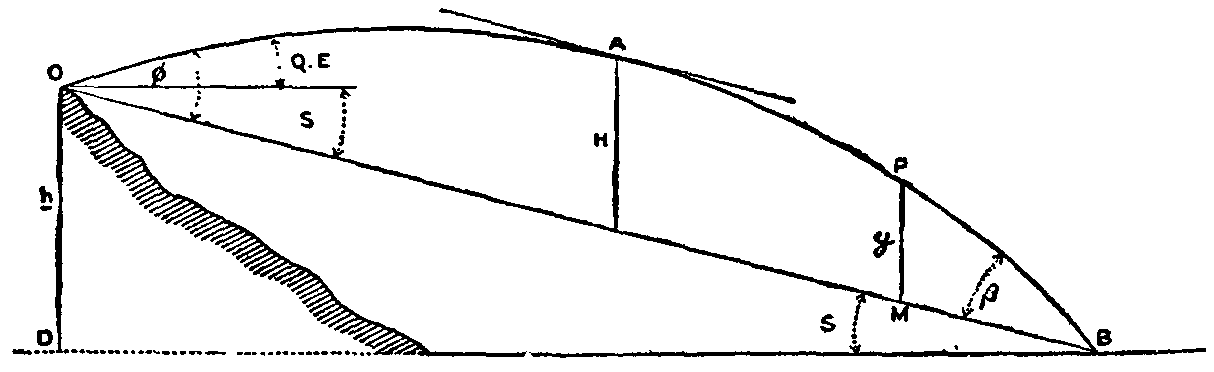
The equations of motion are now, the co-ordinates x and y being measured in feet,
(26) d2x= -r =-gp,
dt2C
(27) d2y= -g.
dt2
The first equation leads, as before, to
(28) t = C{T(V) - T(v)}, (29) x = C{S(V) - S(v)}.
The integration of (24) gives
(30) dy= constant - gt = g(½T - t),
dt
if T denotes the whole time of flight from O to the point B (fig. 1), where the trajectory cuts the line of sight; so that ½T is the time to the vertex A, where the shot is flying parallel to OB.
Integrating (27) again,
(31) y = g(½Tt - ½t2) = ½gt(T - t);
and denoting T - t by t′, and taking g = 32f/s2,
(32) y = 16tt′,
which is Colonel Sladen's formula, employed in plotting ordinates of a trajectory.
At the vertex A, where y = H, we have t = t′ = ½T, so that
(33) H = ⅛gT2,
which for practical purposes, taking g = 32, is replaced by
(34) H = 4T2, or (2T)2.
Thus, if the time of flight of a shell is 5 sec., the height of the vertex of the trajectory is about 100 ft.; and if the fuse is set to burst the shell one-tenth of a second short of its impact at B, the height of the burst is 7.84, say 8 ft.
The line of sight Ox, considered horizontal in range table results, may be inclined slightly to the horizon, as in shooting up or down a moderate slope, without appreciable modification of (28) and (29), and y or PM is still drawn vertically to meet OB in M.
Given the ballistic coefficient C, the initial velocity V, and a range of R yds. or X = 3R ft., the final velocity v is first calculated from (29) by
(35) S(v) = S(V) - X/C,
and then the time of flight T by
(36) T = C{T(V) - T(v)}.
Denoting the angle of departure and descent, measured in degrees and from the line of sight OB by φ and β, the total deviation in the range OB is (fig. 1)
(37) δ = φ + β = C{D(V) - D(v)}.
To share the δ between φ and β, the vertex A is taken as the point of half-time (and therefore beyond half-range, because of the continual diminution of the velocity), and the velocity v0 at A is calculated from the formula
(38) T(v0) = T(V) -½T= ½{T(V) + T(v)};
C
and now the degree table for D(v) gives
(39) φ = C{D(V) - D(v0)}, (40) β = C{D(v0) - D(v)}.
This value of φ is the tangent elevation (T.E.); the quadrant elevation (Q.E.) is φ - S, where S is the angular depression of the line of sight OB; and if O is h ft. vertical above B, the angle S at a range of R yds. is given by
(41) sin S = h/3R,
or, for a small angle, expressed in minutes, taking the radian as 3438′,
(42) S = 1146h/R.
So also the angle β must be increased by S to obtain the angle at which the shot strikes a horizontal plane—the water, for instance.
A systematic exercise is given here of the compilation of a range table by calculation with the ballistic table; and it is to be compared with the published official range table which follows.
A discrepancy between a calculated and tabulated result will serve to show the influence of a slight change in the coefficient of reduction n, and the muzzle velocity V.
Example 3.—Determine by calculation with the abridged ballistic table the remaining velocity v, the time of flight t, angle of elevation φ, and descent β of this 6-in. gun at ranges 500, 1000, 1500, 2000 yds., taking the muzzle velocity V = 2150 f/s, and a coefficient of reduction n = 0.96. [For Table see p. 274.]
An important problem is to determine the alteration of elevation for firing up and down a slope. It is found that the alteration of the tangent elevation is almost insensible, but the quadrant elevation requires the addition or subtraction of the angle of sight.
Example.—Find the alteration of elevation required at a range of 3000 yds. in the exchange of fire between a ship and a fort 1200 ft. high, a 12-in. gun being employed on each side, firing a shot weighing 850 lb with velocity 2150 f/s. The complete ballistic table, and the method of high angle fire (see below) must be employed.
Range. s. s/C. S(v). v. T(v). t/C. t. T(v0). v0. D(v0). φ/C. φ. β/C. β.
0 0 0 20700.53 2150 28.6891 0.0000 0.000 28.6891 2150 50.9219 0.0000 0.000 0.0000 0.000
500 1500 518 20182.53 1999 28.4399 0.2492 0.720 28.5645 2071 50.8132 0.1087 0.315 0.1135 0.328
1000 3000 1036 19664.53 1862 28.1711 0.5180 1.497 28.4301 1994 50.6913 0.2306 0.666 0.2486 0.718
1500 4500 1554 19146.53 1732 27.8815 0.8076 2.330 28.2853 1918 50.5542 0.3677 1.062 0.4085 1.181
2000 6000 2072 18628.53 1610 27.5728 1.1163 3.225 28.1310 1843 50.4029 0.5190 1.500 0.5989 1.734
Range Table For 6-inch Gun.
Charge { weight, 13 lb 4 oz. Projectile { Palliser shot, Shrapnel shell. Muzzle velocity, 2154 f/s.
gravimetric density, 55.01/0.504. Weight, 100lb. Nature of mounting, pedestal.
nature, cordite, size 30 Jump, nil.
Remaining Velocity. To strike an object 10 ft. high range must be known to Slope of Descent. 5′ elevation or depression alters point of impact. Elevation. Range. Fuse scale for T. and P. middle No. 54 Marks I., II., or III. 50% of rounds should fall in: Time of Flight. Penetration into Wrought Iron.
Range. Laterally or Vertically Length. Breadth. Height.
f/s. yds. 1 in yds. yds. ° ′ yds. yds yds yds secs. in.
2154 .. .. .. 0.00 0 0 0 .. .. .. .. 0.00 13.6
2122 1145 687 125 0.14 0 4 100 ¼ .. 0.4 .. 0.16 13.4
2091 635 381 125 0.29 0 9 200 ¾ .. 0.4 .. 0.31 13.2
2061 408 245 125 0.43 0 13 300 1 .. 0.4 .. 0.47 13.0
2032 316 190 125 0.58 0 17 400 1¼ .. 0.4 .. 0.62 12.8
2003 260 156 125 0.72 0 21 500 1¾ .. 0.5 0.2 0.78 12.6
1974 211 127 125 0.87 0 26 600 2 .. 0.5 0.2 0.95 12.4
1946 183 110 125 1.01 0 30 700 2¼ .. 0.5 0.2 1.11 12.2
1909 163 98 125 1.16 0 34 800 2¾ .. 0.5 0.2 1.28 12.0
1883 143 85 125 1.31 0 39 900 3 .. 0.6 0.3 1.44 11.8
1857 130 78 125 1.45 0 43 1000 3¼ .. 0.6 0.3 1.61 11.6
1830 118 71 125 1.60 0 47 1100 3¾ .. 0.6 0.3 1.78 11.4
1803 110 66 125 1.74 0 51 1200 4 .. 0.6 0.3 1.95 11.2
1776 101 61 125 1.89 0 55 1300 4½ .. 0.7 0.4 2.12 11.0
1749 93 56 125 2.03 0 59 1400 4¾ .. 0.7 0.4 2.30 10.8
1722 86 52 125 2.18 1 3 1500 5 .. 0.7 0.4 2.47 10.6
1695 80 48 125 2.32 1 7 1600 5½ 25 0.8 0.5 2.65 10.5
1669 71 43 125 2.47 1 11 1700 5¾ 25 0.9 0.5 2.84 10.3
1642 67 40 100 2.61 1 16 1800 6¼ 25 1.0 0.5 3.03 10.1
1616 61 37 100 2.76 1 22 1900 6½ 25 1.1 0.6 3.23 9.9
1591 57 34 100 2.91 1 27 2000 7 25 1.2 0.6 3.41 9.7
The last column in the Range Table giving the inches of penetration into wrought iron is calculated from the remaining velocity by an empirical formula, as explained in the article ARMOUR PLATES.
High Angle and Curved Fire.—"High angle fire," as defined officially, "is fire at elevations greater than 15°," and "curved fire is fire from howitzers at all angles of elevation not exceeding 15°." In these cases the curvature of the trajectory becomes considerable, and the formulae employed in direct fire must be modified; the method generally employed is due to Colonel Siacci of the Italian artillery.
Starting with the exact equations of motion in a resisting medium,
(43) d2x= -r cos i = -rdx,
dt2ds
(44) d2y= -r sin i - g = -rdy- g,
dt2ds
and eliminating r,
(45) dxd2y-dyd2x= -gdx;
dtdt2dtdt2dt
and this, in conjunction with
(46) tan i =dy=dy/dx,
dxdtdt
(47) sec2 idi=(dxd2y-dyd2x)/(dx)2 ,
dtdtdt2dtdt2dt
reduces to
(48) di=-gcos i, or d tan i=-g,
dtvdtv cos i
the equation obtained, as in (18), by resolving normally in the trajectory, but di now denoting the increment of i in the increment of time dt.
Denoting dx/dt, the horizontal component of the velocity, by q, so that
(49) v cos i = q,
equation (43) becomes
(50) dq/dt = -r cos i,
and therefore by (48)
(51) dq=dqdt=rv.
didtdig
It is convenient to express r as a function of v in the previous notation
(52) Cr = f(v),
and now
(53) dq=vf(v),
diCg
an equation connecting q and i.
Now, since v = g sec i
(54) dt= -Csec i,
dqf(q sec i)
and multiplying by dx/dt or q,
(55) dx= -C q sec i,
dqf(q sec i)
and multiplying by dy/dx or tan i,
(56) dy= -C q sec i tan i;
dqf(q sec i)
also
(57) di=Cg,
dqq sec i . f(q sec i)
(58) d tan i=C g sec i,
dqq . f(q sec i)
from which the values of t, x, y, i, and tan i are given by integration with respect to q, when sec i is given as a function of q by means of (51).
Now these integrations are quite intractable, even for a very simple mathematical assumption of the function f(v), say the quadratic or cubic law, f(v) = v2/k or v3/k.
But, as originally pointed out by Euler, the difficulty can be turned if we notice that in the ordinary trajectory of practice the quantities i, cos i, and sec i vary so slowly that they may be replaced by their mean values, η, cos η, and sec η, especially if the trajectory, when considerable, is divided up in the calculation into arcs of small curvature, the curvature of an arc being defined as the angle between the tangents or normals at the ends of the arc.
Replacing then the angle i on the right-hand side of equations (54) - (56) by some mean value η, we introduce Siacci's pseudo-velocity u defined by
(59) u = q sec η,
so that u is a quasi-component parallel to the mean direction of the tangent, say the direction of the chord of the arc.
Integrating from any initial pseudo-velocity U,
(60) t = C∫U udu,
f(u)
(61) x = C cos η∫u du,
f(u)
(62) y = C sin η∫u du;
f(u)
and supposing the inclination i to change from φ to θ radians over the arc,
(63) φ - θ = Cg cos η∫du,
u f(u)
(64) tan φ - tan θ = Cg sec η∫du.
u f(u)
But according to the definition of the functions T, S, I and D of the ballistic table, employed for direct fire, with u written for v,
(65) ∫U udu=∫du= T(U) - T(u),
f(u)gp
(66) ∫u du= S(U) - S(u),
f(u)
(67) ∫g du= I(U) - I(u);
u f(u)
and therefore
(68) t = C[T(U) - T(u)], (69) x = C cos η [S(U) - S(u)], (70) y = C sin η [S(U) - S(u)], (71) φ - θ = C cos η [I(U) - I(u)], (72) tan φ - tan θ = C sec η [I(U) - I(u)],
while, expressed in degrees,
(73) φ° - θ° = C cos η [D(U) - D(u)],
The equations (66)-(71) are Siacci's, slightly modified by General Mayevski; and now in the numerical applications to high angle fire we can still employ the ballistic table for direct fire.
It will be noticed that η cannot be exactly the same mean angle in all these equations; but if η is the same in (69) and (70),
(74) y/x = tan η.
so that η is the inclination of the chord of the arc of the trajectory, as in Niven's method of calculating trajectories (Proc. R.S., 1877): but this method requires η to be known with accuracy, as 1% variation in η causes more than 1% variation in tan η.
The difficulty is avoided by the use of Siacci's altitude-function A or A(u), by which y/x can be calculated without introducing sin η or tan η, but in which η occurs only in the form cos η or sec η, which varies very slowly for moderate values of η, so that η need not be calculated with any great regard for accuracy, the arithmetic mean ½(φ + θ) of φ and θ being near enough for η over any arc φ - θ of moderate extent.
Now taking equation (72), and replacing tan θ, as a variable final tangent of an angle, by tan i or dy/dx,
(75) tan φ -dy= C sec η [I(U) - I(u)],
dx
and integrating with respect to x over the arc considered,
(76) x tan φ - y = C sec η [xI(U) -∫x 0I(u)dx],
But
(77) ∫x 0I(u)dx=∫u UI(u)dxdu
du
= C cos η∫U xI(u)u du
g f(u)
= C cos η [A(U) - A(u)]
in Siacci's notation; so that the altitude-function A must be calculated by summation from the finite difference ΔA, where
(78) ΔA = I(u)uΔu= I(u)ΔS,
gp
or else by an integration when it is legitimate to assume that f(v)=vm/k in an interval of velocity in which m may be supposed constant.
Dividing again by x, as given in (76),
(79) tan φ -y= C sec η[I(U) - A(U) - A(u)]
xS(U) - S(u)
from which y/x can be calculated, and thence y.
In the application of Siacci's method to the calculation of a trajectory in high angle fire by successive arcs of small curvature, starting at the beginning of an arc at an angle φ with velocity vφ, the curvature of the arc φ - θ is first settled upon, and now
(80) η = ½(φ + θ)
is a good first approximation for η.
Now calculate the pseudo-velocity uφ from
(81) uφ = vφ cos φ sec η,
and then, from the given values of φ and θ, calculate uθ from either of the formulae of (72) or (73):—
(82) I(uθ) = I(uφ) -tan φ - tan θ,
C sec η
(83) D(uθ) = D(uφ) -φ° - θ°.
C cos η
Then with the suffix notation to denote the beginning and end of the arc φ - θ,
(84) φtθ = C[T(uφ) - T(uθ)], (85) φxθ = C cos η [S(uφ) - S(uθ)],
(86) φ(y) θ= tan φ - C sec η [I(uφ) - ΔA];
xΔS
Δ now denoting any finite tabular difference of the function between the initial and final (pseudo-) velocity.
Fig. 2.
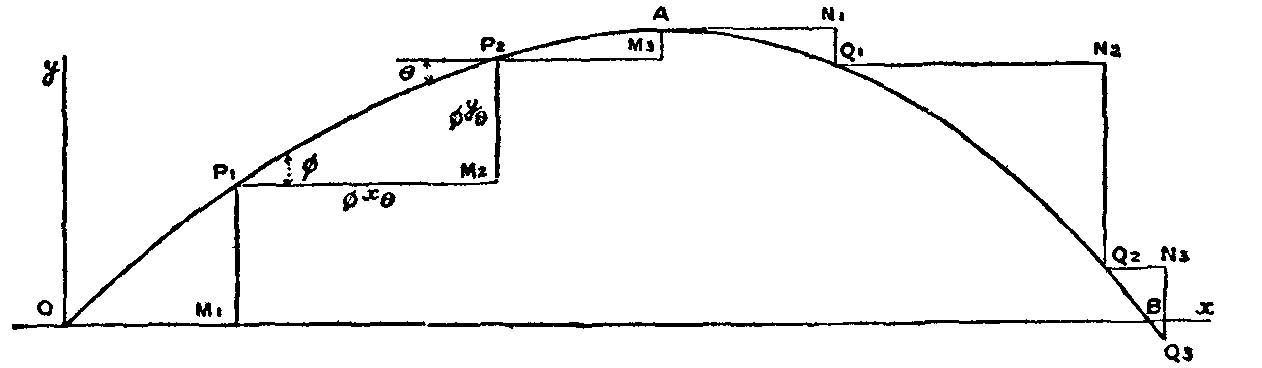
Also the velocity vθ at the end of the arc is given by
(87) vθ = uθ sec θ cos η.
Treating this final velocity vθ and angle θ as the initial velocity vφ and angle φ of the next arc, the calculation proceeds as before (fig. 2).
In the long range high angle fire the shot ascends to such a height that the correction for the tenuity of the air becomes important, and the curvature φ - θ of an arc should be so chosen that φyθ the height ascended, should be limited to about 1000 ft., equivalent to a fall of 1 inch in the barometer or 3% diminution in the tenuity factor τ.
A convenient rule has been given by Captain James M. Ingalls, U.S.A., for approximating to a high angle trajectory in a single arc, which assumes that the mean density of the air may be taken as the density at two-thirds of the estimated height of the vertex; the rule is founded on the fact that in an unresisted parabolic trajectory the average height of the shot is two-thirds the height of the vertex, as illustrated in a jet of water, or in a stream of bullets from a Maxim gun.
The longest recorded range is that given in 1888 by the 9.2-in. gun to a shot weighing 380 lb fired with velocity 2375 f/s at elevation 40°; the range was about 12 m., with a time for flight of about 64 sec., shown in fig. 2.
A calculation of this trajectory is given by Lieutenant A. H. Wolley-Dod, R.A., in the Proceedings R.A. Institution, 1888, employing Siacci's method and about twenty arcs; and Captain Ingalls, by assuming a mean tenuity-factor τ=0.68, corresponding to a height of about 2 m., on the estimate that the shot would reach a height of 3 m., was able to obtain a very accurate result, working in two arcs over the whole trajectory, up to the vertex and down again (Ingalls, Handbook of Ballistic Problems).
Siacci's altitude-function is useful in direct fire, for giving immediately the angle of elevation φ required for a given range of R yds. or X ft., between limits V and v of the velocity, and also the angle of descent β.
In direct fire the pseudo-velocities U and u, and the real velocities V and v, are undistinguishable, and sec η may be replaced by unity so that, putting y = 0 in (79),
(88) tan φ = C[I(V) - ΔA].
ΔS
Also
(89) tan φ - tan β = C [I(V) - L(v)]
so that
(90) tan β = C[ΔA- I(v)],
ΔS
or, as (88) and (90) may be written for small angles,
(91) sin 2φ = 2C [I(V) - ΔA],
ΔS
(92) sin 2β = 2C [ΔA - I(v)].
ΔS
To simplify the work, so as to look out the value of sin 2φ without the intermediate calculation of the remaining velocity v, a double-entry table has been devised by Captain Braccialini Scipione (Problemi del Tiro, Roma, 1883), and adapted to yd., ft., in. and lb units by A. G. Hadcock, late R.A., and published in the Proc. R.A. Institution, 1898, and in Gunnery Tables, 1898.
In this table
(93) sin 2φ = Ca,
where a is a function tabulated for the two arguments, V the initial velocity, and R/C the reduced range in yards.
The table is too long for insertion here. The results for φ and β, as calculated for the range tables above, are also given there for comparison.
Drift.—An elongated shot fired from a rifled gun does not move in a vertical plane, but as if the mean plane of the trajectory was inclined to the true vertical at a small angle, 2° or 3°; so that the shot will hit the mark aimed at if the back sight is tilted to the vertical at this angle δ, called the permanent angle of deflection (see Sights).
This effect is called drift and the reason of it is not yet understood very clearly.
It is evidently a gyroscopic effect, being reversed in direction by a change from a right to a left-handed twist of rifling, and being increased by an increase of rotation of the shot.
The axis of an elongated shot would move parallel to itself only if fired in a vacuum; but in air the couple due to a sidelong motion tends to place the axis at right angles to the tangent of the trajectory, and acting on a rotating body causes the axis to precess about the tangent. At the same time the frictional drag damps the nutation and causes the axis of the shot to follow the tangent of the trajectory very closely, the point of the shot being seen to be slightly above and to the right of the tangent, with a right-handed twist. The effect is as if there was a mean sidelong thrust w tan δ on the shot from left to right in order to deflect the plane of the trajectory at angle δ to the vertical. But no formula has yet been invented, derived on theoretical principles from the physical data, which will assign by calculation a definite magnitude to δ.
An effect similar to drift is observable at tennis, golf, base-ball and cricket; but this effect is explainable by the inequality of pressure due to a vortex of air carried along by the rotating ball, and the deviation is in the opposite direction of the drift observed in artillery practice, so artillerists are still awaiting theory and crucial experiment.
After all care has been taken in laying and pointing, in accordance with the rules of theory and practice, absolute certainty of hitting the same spot every time is unattainable, as causes of error exist which cannot be eliminated, such as variations in the air and in the muzzle-velocity, and also in the steadiness of the shot in flight.
To obtain an estimate of the accuracy of a gun, as much actual practice as is available must be utilized for the calculation in accordance with the laws of probability of the 50% zones shown in the range table (see Probability.)
II. Interior Ballistics
The investigation of the relations connecting the pressure, volume and temperature of the powder-gas inside the bore of the gun, of the work realized by the expansion of the powder, of the dynamics of the movement of the shot up the bore, and of the stress set up in the material of the gun, constitutes the branch of interior ballistics.
Fig. 3.
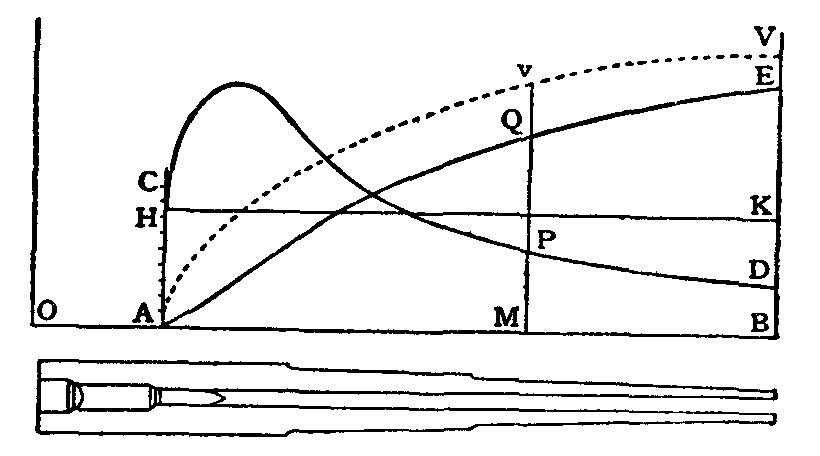
A gun may be considered a simple thermo-dynamic machine or heat-engine which does its work in a single stroke, and does not act in a series of periodic cycles as an ordinary steam or gas-engine.
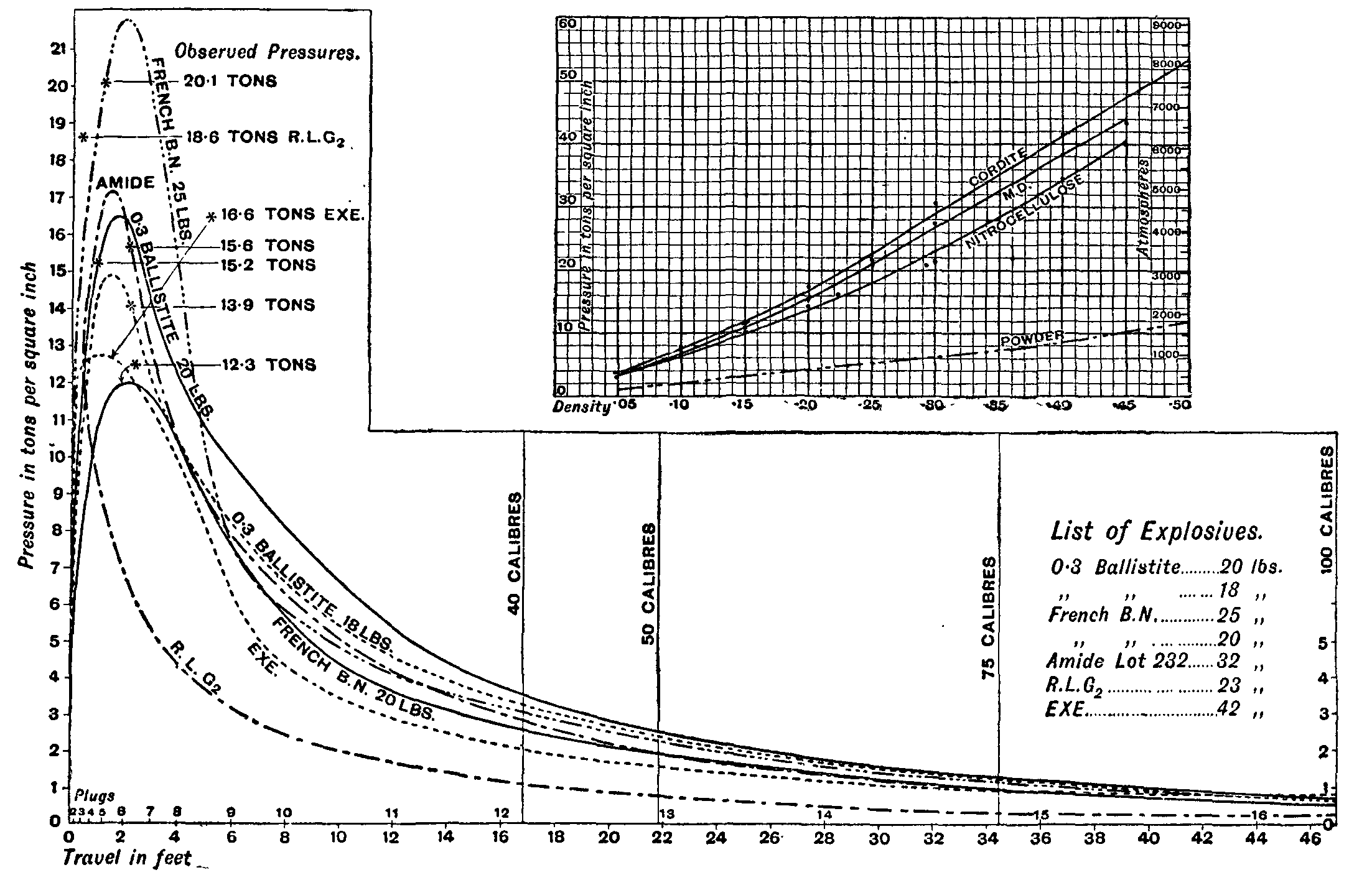
Fig. 4. Pressure Curves, from Chronoscope Experiments in 6 inch gun of 100 calibres, with various Explosives.
An indicator diagram can be drawn for a gun (fig. 3) as for a steam-engine, representing graphically by a curve CPD the relation between the volume and pressure of the powder-gas; and in addition the curves AQE of energy e, AvV of velocity v, and AtT of time t can be plotted or derived, the velocity and energy at the muzzle B being denoted by V and E.
After a certain discount for friction and the recoil of the gun, the net work realized by the powder-gas as the shot advances AM is represented by the area ACPM, and this is equated to the kinetic energy e of the shot, in foot-tons,
(1) e = w(1 + 4k2 tan2 δ)v2,
2240d22g
in which the factor 4(k2/d2)tan2δ represents the fraction due to the rotation of the shot, of diameter d and axial radius of gyration k, and δ represents the angle of the rifling; this factor may be ignored in the subsequent calculations as small, less than 1%.
The mean effective pressure (M.E.P.) in tons per sq. in. is represented in fig. 3 by the height AH, such that the rectangle AHKB is equal to the area APDB; and the M.E.P. multiplied by ¼πd2, the cross-section of the bore in square inches, gives in tons the mean effective thrust of the powder on the base of the shot; and multiplied again by l, the length in inches of the travel AB of the shot up the bore, gives the work realized in inch-tons; which work is thus equal to the M.E.P. multiplied by ¼πd2l = B - C, the volume in cubic inches of the rifled part AB of the bore, the difference between B the total volume of the bore and C the volume of the powder-chamber.
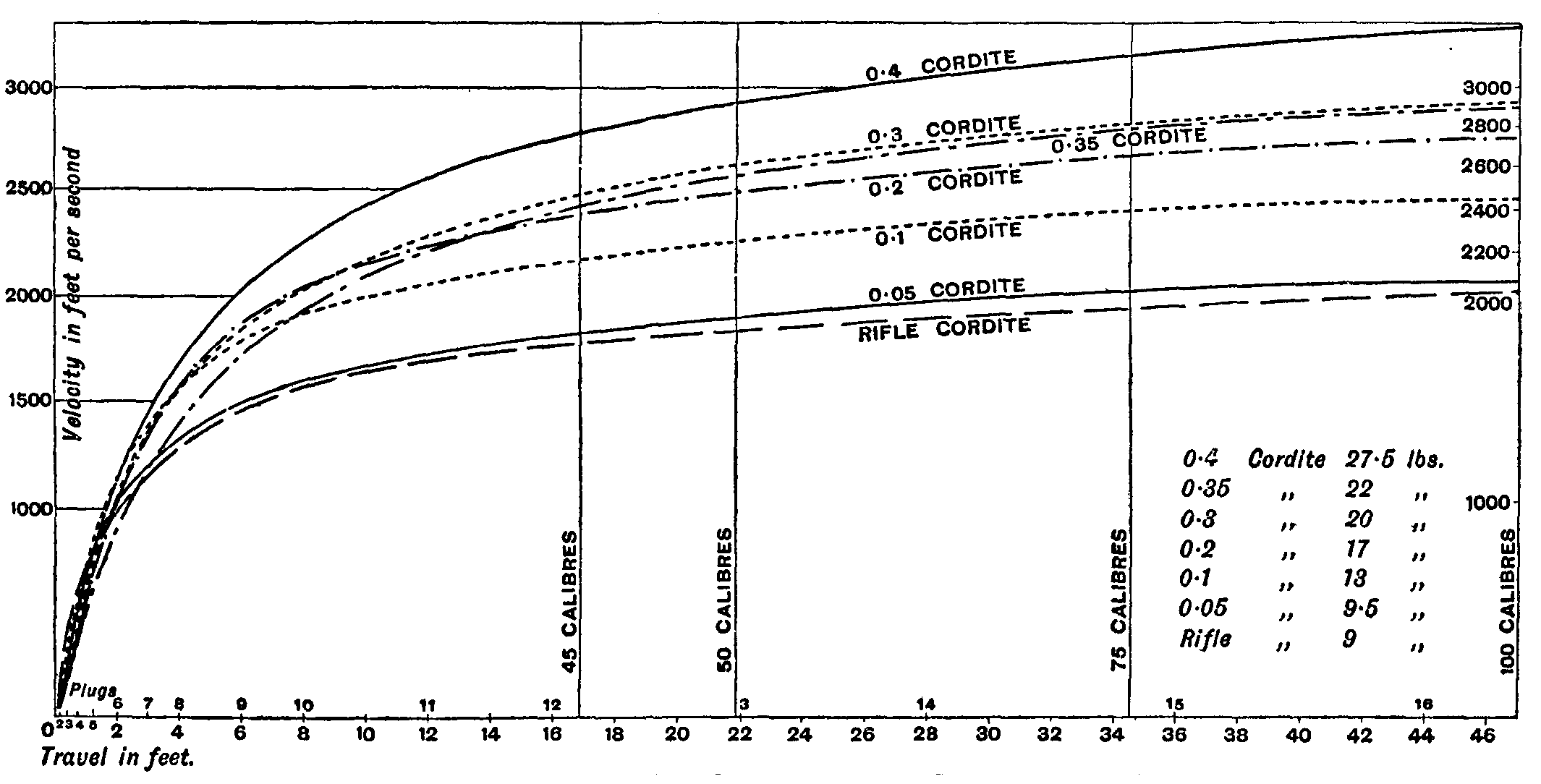
Fig. 5. Velocity Curves, from Chronoscope experiments in 6 inch gun of 100 calibres, with Cordite.
Equating the muzzle-energy and the work in foot-tons
(2) E = wV2 = B - C × M.E.P.
22402g12
(3) M.E.P. = wV212.
22402gB - C
Working this out for the 6-in. gun of the range table, taking L = 216 in., we find B - C = 6100 cub. in., and the M.E.P. is about 6.4 tons per sq. in.
But the maximum pressure may exceed the mean in the ratio of 2 or 3 to 1, as shown in fig. 4, representing graphically the result of Sir Andrew Noble's experiments with a 6-in. gun, capable of being lengthened to 100 calibres or 50 ft. (Proc. R.S., June 1894).
On the assumption of uniform pressure up the bore, practically realizable in a Zalinski pneumatic dynamite gun, the pressure-curve would be the straight line HK of fig. 3 parallel to AM; the energy-curve AQE would be another straight line through A; the velocity-curve AvV, of which the ordinate v is as the square root of the energy, would be a parabola; and the acceleration of the shot being constant, the time-curve AtT will also be a similar parabola.
If the pressure falls off uniformly, so that the pressure-curve is a straight line PDF sloping downwards and cutting AM in F, then the energy-curve will be a parabola curving downwards, and the velocity-curve can be represented by an ellipse, or circle with centre F and radius FA; while the time-curve will be a sinusoid.
But if the pressure-curve is a straight line F′CP sloping upwards, cutting AM behind A in F′, the energy-curve will be a parabola curving upwards, and the velocity-curve a hyperbola with center at F′.
These theorems may prove useful in preliminary calculations where the pressure-curve is nearly straight; but, in the absence of any observable law, the area of the pressure-curve must be read off by a planimeter, or calculated by Simpson's rule, as an indicator diagram.
To measure the pressure experimentally in the bore of a gun, the crusher-gauge is used as shown in fig. 6, nearly full size; it records the maximum pressure by the compression of a copper cylinder in its interior; it may be placed in the powder-chamber, or fastened in the base of the shot.
In Sir Andrew Noble's researches a number of plugs were inserted in the side of the experimental gun, reaching to the bore and carrying crusher-gauges, and also chronographic appliances which registered the passage of the shot in the same manner as the electric screens in Bashforth's experiments; thence the velocity and energy of the shot was inferred, to serve as an independent control of the crusher-gauge records (figs. 4 and 5).
As a preliminary step to the determination of the pressure in the bore of a gun, it is desirable to measure the pressure obtained by exploding a charge of powder in a closed vessel, varying the weight of the charge and thereby the density of the powder-gas.
The earliest experiments of this nature are due to Benjamin Robins in 1743 and Count Rumford in 1792; and their method has been revived by Dr Kellner, War Department chemist, who employed the steel spheres of bicycle ball-bearings as safety-valves, loaded to register the pressure at which the powder-gas will blow off, and thereby check the indications of the crusher-gauge (Proc. R.S., March 1895).
Chevalier d'Arcy, 1760. also experimented on the pressure of powder and the velocity of the bullet in a musket barrel; this he accomplished by shortening the barrel successively, and measuring the velocity obtained by the ballistic pendulum; thus reversing Noble's procedure of gradually lengthening the gun.
But the most modern results employed with gunpowder are based on the experiments of Noble and Abel (Phil. Trans., 1875-1880-1892-1894 and following years).
Fig. 6.
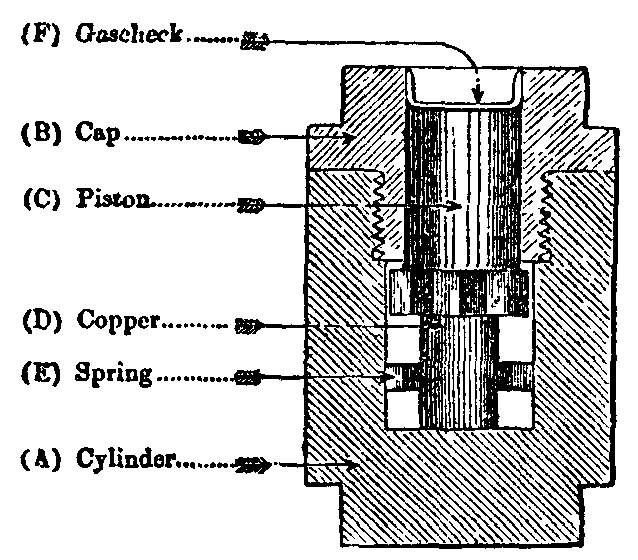
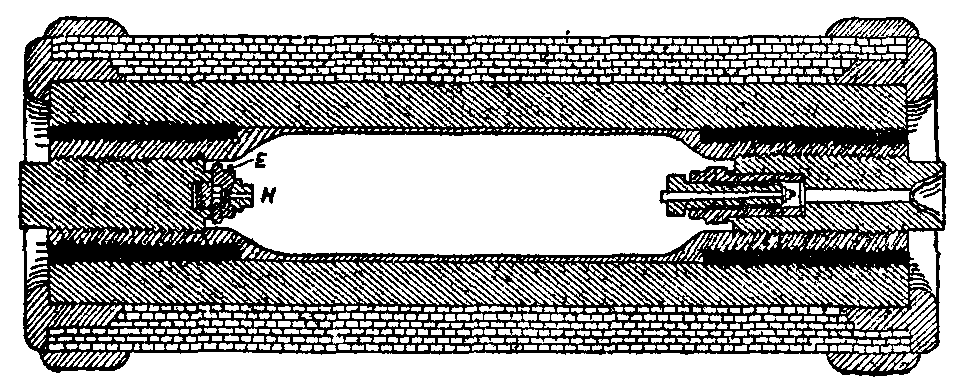
A charge of powder, or other explosive, of varying weight P lb, is fired in an explosion-chamber (fig. 7, scale about 1/5) of which the volume C, cub. in., is known accurately, and the pressure p, tons per sq. in., was recorded by a crusher-gauge (fig. 6).
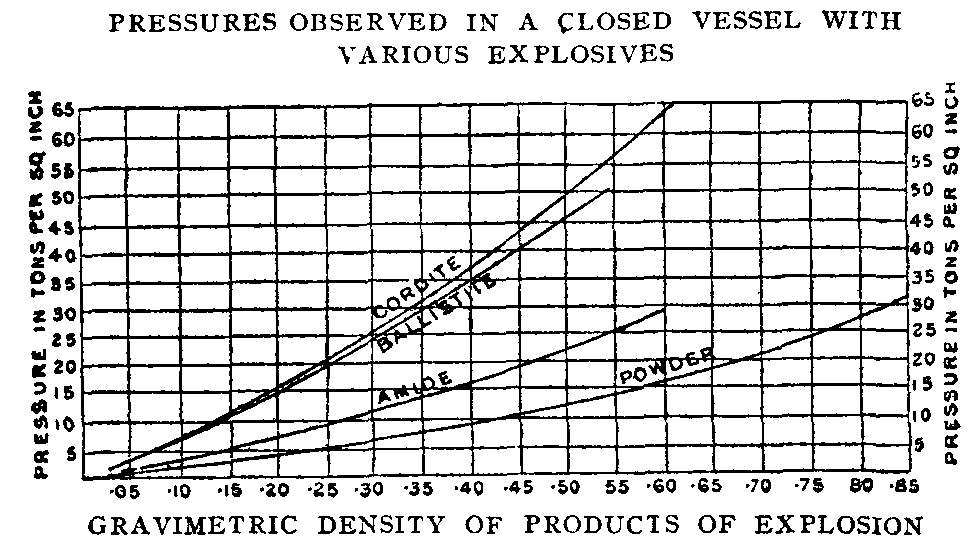
The result is plotted in figs. 8 and 9, in a curve showing the relation between p and D the gravimetric density, which is the specific gravity of the P lb of powder when filling the volume C, cub. in., in a state of gas; or between p and v, the reciprocal of D, which may be called the gravimetric volume (G.V.), being the ratio of the volume of the gas to the volume of an equal weight of water.
Fig. 7. Explosion Vessel.
The results are also embodied in the following Table;—
Table 1.
G.D. G.V. Pressure in Tons per sq. in.
Pebble Powder. Cordite.
0.05 20.00 0.855 3.00
6 16.66 1.00 3.80
8 12.50 1.36 5.40
0.10 10.00 1.76 7.10
12 8.33 2.06 8.70
14 7.14 2.53 10.50
15 6.66 2.73 11.36
16 6.25 2.96 12.30
18 5.55 3.33 14.20
20 5.00 3.77 16.00
22 4.54 4.26 17.90
24 4.17 4.66 19.80
25 4.00 4.88 20.63
26 3.84 5.10 21.75
30 3.33 6.07 26.00
35 2.85 7.35 31.00
40 2.50 8.73 36.53
45 2.22 10.23 42.20
50 2.00 11.25 48.66
55 1.81 13.62 55.86
60 1.66 15.55 63.33
The term gravimetric density (G.D.) is peculiar to artillerists; it is required to distinguish between the specific gravity (S.G.) of the powder filling a given volume in a state of gas, and the specific gravity of the separate solid grain or cord of powder.
Thus, for instance, a lump of solid lead of given S.G., when formed into a charge of lead shot composed of equal spherules closely packed, will have a G.D. such that
(4) G.D. of charge of lead shot= 1 π√2 = 0.7403;
S.G. of lump of solid lead6
while in the case of a bundle of cylindrical sticks of cordite,
(5) G.D. of charge of cordite = 1 π√3 = 0.9067.
S.G. of stick of cordite6
At the standard temperature of 62° F. the volume of the gallon of 10 lb of water is 277.3 cub. in.; or otherwise, 1 cub. ft. or 1728 cub. in. of water at this temperature weighs 62.35 lb, and therefore 1 lb of water bulks 1728 ÷ 62.35 = 27.73 cub. in.
Fig. 8.
Thus if a charge of P lb of powder is placed in a chamber of volume C cub. in., the
(6) G.D.= 27.73P/C, G.V. = C/27.73 P.
Sometimes the factor 27.68 is employed, corresponding to a density of water of about 62.4 lb per cub. ft., and a temperature 12° C., or 54° F.
With metric units, measuring P in kg., and C in litres, the G.D. = P/C, G.V. = C/P, no factor being required.
From the Table I., or by quadrature of the curve in fig. 9, the work E in foot-tons realized by the expansion of 1 lb of the powder from one gravimetric volume to another is inferred; for if the average pressure is p tons per sq. in., while the gravimetric volume changes from v - ½Δv to v + ½Δv, a change of volume of 27.73Δv cub. in., the work done is 27.73pΔv inch-tons, or
(7) ΔE = 2.31 pΔv foot-tons;
and the differences ΔE being calculated from the observed values of p, a summation, as in the ballistic tables, would give E in a tabular form, and conversely from a table of E in terms of v, we can infer the value of p.
On drawing off a little of the gas from the explosion vessel it was found that a gramme of cordite-gas at 0° C. and standard atmospheric pressure occupied 700 ccs., while the same gas compressed into 5 ccs. at the temperature of explosion had a pressure of 16 tons per sq. in., or 16 × 2240 / 14.7 = 2440 atmospheres, of 14.7 lb per sq. in.; one ton per sq. in. being in round numbers 150 atmospheres.
The absolute centigrade temperature T is thence inferred from the gas equation
(8) R = pv / T = p0v0/273,
which, with p = 2440, v = 5, p0 = 1, v0 = 700, makes T = 4758, a temperature of 4485° C. or 8105° F.
Fig. 9.
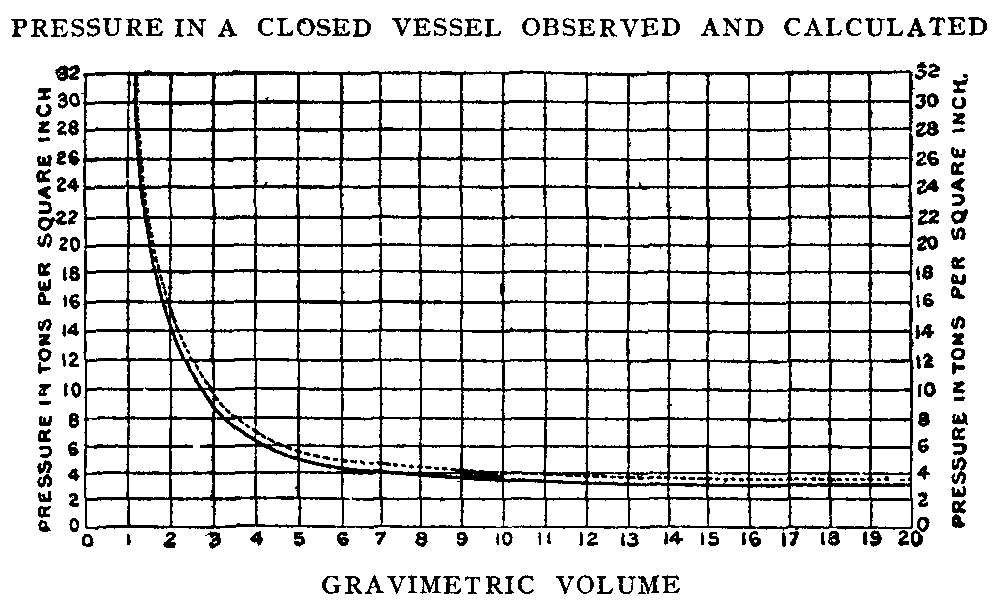
In the heading of the 6-in. range table we find the description of the charge.
Charge: weight 13 lb 4 oz.; gravimetric density 55.01/0.504; nature, cordite, size 30.
So that P = 13.25, the G.D. = 0.504, the upper figure 55.01 denoting the specific volume of the charge measured in cubic inches per lb, filling the chamber in a state of gas, the product of the two numbers 55.01 and 0.504 being 27.73; and the chamber capacity C = 13.25 × 55.01 = 730 cub. in., equivalent to 25.8 in. or 2.15 ft. length of bore, now called the equivalent length of the chamber (E.L.C.).
If the shot was not free to move, the closed chamber pressure due to the explosion of the charge at this G.D. (= 0.5) would be nearly 49 tons per sq. in., much too great to be safe.
But the shot advances during the combustion of the cordite, and the chief problem in interior ballistics is to adjust the G.D. of the charge to the weight of the shot so that the advance of the shot during the combustion of the charge should prevent the maximum pressure from exceeding a safe limit, as shown by the maximum ordinate of the pressure curve CPD in fig. 3.
Suppose this limit is fixed at 16 tons per sq. in., corresponding in Table 1. to a G.D., 0.2; the powder-gas will now occupy a volume b = 3/2 × C = 1825 cub. in., corresponding to an advance of the shot 3/2 × 2.15 = 3.225 ft.
Assuming an average pressure of 8 tons per sq. in., the shot will have acquired energy 8 × ¼πd2 × 3.225 = 730 foot-tons, and a velocity about v = 1020 f/s, so that the time over the 3.225 ft. at an average velocity 510 f/s is about 0.0063 sec.
Comparing this time with the experimental value of the time occupied by the cordite in burning, a start is made for a fresh estimate and a closer approximation.
Assuming, however, that the agreement is close enough for practical requirement, the combustion of the cordite may be considered complete at this stage P, and in the subsequent expansion it is assumed that the gas obeys an adiabatic law in which the pressure varies inversely as some mth power of the volume.
The work done in expanding to infinity from p tons per sq. in. at volume b cub. in. is then pb/(m - 1) inch-tons, or to any volume B cub. in. is
(9) pb[1 - (b)m-1 ].
m - 1B
It is found experimentally that m = 1.2 is a good average value to take for cordite; so now supposing the combustion of the charge of the 6-in. is complete in 0.0063 sec., when p = 16 tons per sq. in., b = 1825 cub. in., and that the gas expands adiabatically up to the muzzle, where
(10) B = 216 + 25.8 = 3.75
b2.5 × 25.8
we find the work realized by expansion is 2826 foot-tons, sufficient to increase the velocity from 1020 to 2250 f/s at the muzzle.
This muzzle velocity is about 5% greater than the 2150 f/s of the range table, so on these considerations we may suppose about 10% of work is lost by friction in the bore: this is expressed by saying that the factor of effect is f = 0.9.
The experimental determination of the time of burning under the influence of the varying pressure and density, and the size of the grain, is thus of great practical importance, as thereby it is possible to estimate close limits to the maximum pressure that will be reached in the bore of a gun, and to design the chamber so that the G.D. of the charge may be suitable for the weight and acceleration of the shot. Empirical formulas based on practical experience are employed for an approximation to the result.
A great change has come over interior ballistics in recent years, as the old black gunpowder has been abandoned in artillery after holding the field for six hundred years. It is replaced by modern explosives such as those indicated on fig. 4, capable of giving off a very much larger volume of gas at a greater temperature and pressure, more than threefold as seen on fig. 8, so that the charge may be reduced in proportion, and possessing the military advantage of being nearly smokeless. (See Explosives.)
The explosive cordite is adopted in the British service; it derives the name from its appearance as cord in short lengths, the composition being squeezed in a viscous state through the hole in a die, and the cordite is designated in size by the number of hundredths of an inch in the diameter of the hole. Thus the cordite, size 30, of the range table has been squeezed through a hole 0.30 in. diameter.
The thermochemical properties of the constituents of an explosive will assign an upper limit to the volume, temperature and pressure of the gas produced by the combustion; but much experiment is required in addition. Sir Andrew Noble has published some of his results in the Phil. Trans., 1905-1906 and following years.
Authorities.—Tartaglia, Nova Scientia (1537); Galileo (1638); Robins, New Principles of Gunnery (1743); Euler (trans. by Hugh Brown), The True Principles of Gunnery (1777); Didion, Hélie, Hugoniot, Vallier, Baills, &c., Balistique (French); Siacci, Balistica (Italian); Mayevski, Zabudski, Balistique (Russian); La Llave, Ollero, Mata, &c., Balistica (Spanish); Bashforth, The Motion of Projectiles (1872); The Bashforth Chronograph (1890); Ingalls, Exterior and Interior Ballistics, Handbook of Problems in Direct and Indirect Fire; Bruff, Ordnance and Gunnery; Cranz, Compendium der Ballistik (1898); The Official Text-Book of Gunnery (1902); Charbonnier, Balistique (1905); Lissak, Ordnance and Gunnery (1907).
(A. G. G.)
BALLOON, a globular bag of varnished silk or other material impermeable to air, which, when inflated with gas lighter than common air, can be used in aeronautics, or, according to its size, &c., for any purpose for which its ability to rise and float in the atmosphere adapts such a mechanism. "Balloon" in this sense was first used in 1783 in connexion with the invention of the brothers Montgolfier, but the word was in earlier use (derived from Ital. ballone, a large ball) as meaning an actual ball or ball-game, a primitive explosive bomb or firework, a form of chemical retort or receiver, and an ornamental globe in architecture; and from the appearance and shape of an air balloon the word is also given by analogy to other things, such as a "balloon skirt" in dress, "balloon training" in horticulture. (See Aeronautics, and Flight and Flying).
BALLOT (from Ital. ballotta, dim. of balla, a ball), the modern method of secret-voting employed in political, legislative and judicial assemblies, and also in the proceedings of private clubs and corporations. The name comes from the use of a little ball dropped according to choice into the right receptacle; but nowadays it is used for any system of secret-voting, even though no such ball is employed. In ancient Athens, the dicasts, in giving their verdict, generally used balls of stone (psephi) or of metal (sponduli). Those pierced in the centre, or black in colour, signified condemnation; those unpierced, or white, signified acquittal. The boxes were variously arranged; but generally a brass box received both classes of votes, and a wooden box received the unused balls. In the assembly, cases of privilegia, such as ostracism, the naturalization of foreigners or the release of state-debtors, were decided by secret-voting. The petalism, or voting by words on olive-leaves, practised at Syracuse, may also be mentioned. At Rome the ballot was introduced to the comitia by the Leges Tabellariae, of which the Lex Gabiana (139 B.C.) relates to the election of magistrates, the Lex Cassia (137 B.C.) to judicia populi, and the Lex Papiria (131 B.C.) to the enactment and repeal of laws. The wooden tabellae, placed in the cista or wicker box, were marked U. R. (uti rogas) and A. (antiquo) in the case of a proposed law; L. (libero) and D. (damno) in the case of a public trial; in the case of an election, puncta were made opposite the names or initials of the candidates. Tabellae were also used by the Roman judices, who expressed their verdict or judgment by the letters A. (absolvo), C. (condemno), and N. L. (non liquet). In modern times voting by ballot is usually by some form of writing, but the use of the ball still persists (especially in clubs), and a "black ball" is the regular term for a hostile vote.
Great Britain.—In Great Britain the ballot was suggested for use in parliament by a political tract of the time of Charles II. It was actually used by the Scots parliament of 1662 in proceeding on the Billeting Act, a measure proposed by Middleton to secure the ostracism of Lauderdale and other political opponents who were by secret-vote declared incapable of public office. The plan followed was this: each member of parliament wrote, in a disguised hand, on a piece of paper, the names of twelve suspected persons; the billets were put in a bag held by the registrar; the bag was then sealed, and was afterwards opened and its contents ascertained in the exchequer chamber, where the billets were immediately burned and the names of the ostracised concealed on oath. The Billeting Act was repudiated by the king, and the ballot was not again heard of till 1705, when Fletcher of Saltoun, in his measure for a provisional government of Scotland by annual parliaments in the event of Queen Anne's death, proposed secret-voting to protect members from court influence. The gradual emancipation of the British parliament from the power of the crown, and the adoption of a strictly representative system of election, not only destroyed whatever reason may once have existed for the ballot in deliberative voting, but rendered it essential that such voting should be open. It was in the agitations for parliamentary reform at the beginning of the 19th century that the demand for the ballot in parliamentary elections was first seriously made. The Benthamites advocated the system in 1817. At the so-called Peterloo Massacre (1819) several banners were inscribed with the ballot. O'Connell introduced a bill on the subject in 1830; and the original draft of Lord John Russell's Reform Bill, probably on the suggestion of Lords Durham and Duncannon, provided for its introduction. Later on the historian Grote became its chief supporter in the House of Commons; and from 1833 to 1839, in spite of the ridicule cast by Sydney Smith on the "mouse-trap," and on Grote's "dagger-box, in which you stab the card of your favourite candidate with a dagger,"[1] the minority for the ballot increased from 106 to 217. In 1838 the ballot was the fourth point of the People's Charter. In the same year the abolition of the land qualification introduced rich commercial candidates to the constituencies. Lord Melbourne's cabinet declared the question open. The cause, upheld by Macaulay, Ward, Hume (in his resolutions, 1848) and Berkeley, was strengthened by the report of Lord Hartington's Select Committee (15th March 1870), to the effect that corruption, treating and intimidation by priests and landlords took place to a large extent at both parliamentary and municipal elections in England and Ireland; and that the ballot, if adopted, would probably not only promote tranquillity at elections, but protect voters from undue influence, and introduce greater freedom and purity in voting, provided secrecy was made inviolable except in cases where a voter was found guilty of bribery, or where an invalid vote had been given.
Meanwhile in Australia the ballot had been introduced by the Constitution Act of South Australia (1856), and in other colonies at the same date. In South Australia (Electoral Act of 1858) the returning-officer put his initials on the voting-card, which the voter was directed, under pain of nullity, to fold so that the officer might not see the vote which was indicated by a cross. In Victoria, under the Electoral Act of 1865, the officer added to his initials a number corresponding to the voter's number on the register. In Tasmania the chief peculiarity was that (as in South Australia) the card was not put directly by the voter into the box, but handed to the officer, who put it there (this being thought a security against double-voting or voting with a non-official card, and also against the voter carrying away his card). In 1869, at Manchester and Stafford in England, test-ballots were taken on the Australian system as practised in Victoria—the voting-card containing the names of all the candidates, printed in different colours (for the benefit of illiterate voters), and the voter being directed to score out the names of those he did not support, and then to place the card (covered by an official envelope) in the box. It was found at Manchester that the voting was considerably more rapid, and therefore less expensive, than under the old system; that only 80 cards out of 11,475 were rejected as informal; and that, the representatives of candidates being present to check false statements of identity, and the public outside being debarred from receiving information what voters had voted, the ballot rather decreased the risk of personation. At Manchester the cards were not numbered consecutively, as in Victoria, so that (assuming the officials to be free from corruption) no scrutiny could have detected by whom particular votes were given. At Stafford the returning-officer stamped each card before giving it to the voter, the die of the stamp having been finished only on the morning of the election. By this means the possibility was excluded of what was known as "the Tasmanian Dodge," by which a corrupt voter gave to the returning-officer, or placed in the box, a blank non-official ticket, and carried out from the booth his official card, which a corrupt agent then marked for his candidate, and gave so marked to corrupt voter No. 2 (before he entered the booth) on condition that he also would bring out his official card, and so on ad libitum; the agent thus obtaining a security for his bribe, unless the corrupt voter chose to disfranchise himself by making further marks on the card. At the close of 1870 the ballot was employed in the election of members for the London School Board under the Education Act of that year.
In 1872 W. E. Forster's Ballot Act introduced the ballot in all parliamentary and municipal elections, except parliamentary elections for universities; and the code of procedure prescribed by the act was adopted by the Scottish Education Board in the first School Board election (1873) under the Education (Scotland) Act 1872. The Ballot Act not only abolished public nominations of candidates, but dealt with the offence of personation and the expenses of elections.
As practised in the United Kingdom, a white paper is used on which the names of the candidates are printed in alphabetical order, the voter filling up with a X the blank on the right-hand opposite the name he votes for. The paper, before being given out, is marked by the presiding-officer on both sides with an official stamp, which is kept secret, and cannot be used for a second election within seven years. The paper is marked on the back with the same number as the counterfoil of the paper which remains with the officer. This counterfoil is also marked with the voter's number on the register, so that the vote may be identified on a scrutiny; and a mark on the register shows that the voter has received a ballot-paper. The voter folds up the paper so as to conceal his mark, but to show the stamp to the officer, and deposits it in the box, which is locked and sealed, and so constructed that papers cannot be withdrawn without unlocking it. Papers inadvertently spoiled by the voters may be exchanged, the officer preserving separately the spoiled papers. If a voter is incapacitated from blindness, or other physical cause, or makes before the officer a declaration of inability to read, or when the poll is on a Saturday declares himself a Jew, the officer causes the paper to be marked as the voter directs, and keeps a record of the transaction. A voter who claims to vote after another has voted in respect of the same qualification, obtains a (green) paper which is not placed in the box, but preserved apart as a "tendered" paper. He must, however, declare his identity and that he has not already voted. The presiding-officer at the close of the poll has to account to the returning-officer for the papers entrusted to him, the number being made up by—(1) papers in the box, (2) spoiled papers, (3) unused papers and (4) tendered papers. During the voting (for which schoolrooms and other public rooms are available, and for which a separate compartment must be provided for every 150 electors entitled to vote at a station) agents of candidates are allowed to be present in the polling-station, but they, as well as the officials, are sworn to secrecy as regards who have voted, and for whom; and they are prohibited from interfering with the voter, inducing him to show his vote, or attempting to ascertain the number on the back of the paper. These agents are also present with the returning-officer when he counts the papers and the votes, rejecting those papers—(1) which want the official mark on the back; (2) on which votes are given for more candidates than the voter is entitled to vote for; (3) on which anything except the number on the back is marked or written by which the voter can be identified; (4) which are unmarked, or so marked that it is uncertain for whom the vote is given. The counted and rejected papers, and also the "tendered" papers, counterfoils and marked register (which have not been opened), are, in parliamentary elections, transmitted by the returning officer to the clerk of the crown in chancery in England, or the sheriff-clerk in Scotland, who destroys them at the end of one year, unless otherwise directed by an order of the House of Commons, or of some court having jurisdiction in election petitions. Such petitions either simply dispute the accuracy of the return on the ground of miscounting, or wrongous rejection or wrongous admission of papers, in which case the court examines the counted and rejected papers; or make allegations of corruption, &c. on which it may be necessary to refer to the marked counterfoils and ascertain how bribed voters have voted. Since the elections of 1874 much discontent has been expressed, because judges have rejected papers with trifling (perhaps accidental) marks other than the X upon them, and because elections have been lost through the failure of the officer to stamp the papers. For this purpose the use has been suggested of a perforating instead of an embossing stamp, while a dark-ground paper with white voting-spaces would make misplaced votes impossible.
The Ballot Act introduced several new offences, such as forging of papers or fraudulently defacing or destroying a paper or the official mark; supplying a paper without due authority; fraudulently putting into the box a non-official paper; fraudulently taking a paper out of the station without due authority; destroying, taking, opening or otherwise interfering with a box or packet of papers then in use for election purposes. These offences and attempts to commit them are punishable in the case of officers and clerks with imprisonment for two years, with or without hard labour. In other cases the term of imprisonment is six months.
The ballot was long criticized as leading to universal hypocrisy and deception; and Sydney Smith spoke of "voters, in dominos, going to the poll in sedan-chairs with closely-drawn curtains." The observed effect of a secret ballot has been, however, gradually to exterminate undue influence. The alarm of "the confessional" seems to be unfounded, as a Catholic penitent is not bound to confess his vote, and if he did so, it would be a crime in the confessor to divulge it.
Continental Europe.—The ballot is largely employed in European countries. In France, where from 1840 to 1845 the ballot, or scrutin, had been used for deliberative voting in the chamber of deputies, its use in elections to the Corps Législatif was carefully regulated at the beginning of the Second Empire by the Organic Decree of the 2nd of February 1852. Under this law the voting was superintended by a bureau consisting of the deputy returning-officer (called president of the section), four unpaid assessors selected from the constituency and a secretary. Each voter presents a polling-card, with his designation, date of birth and signature (to secure identity), which he had previously got at the Mairie. This the president mutilates, and the vote is then recorded by a "bulletin," which is not official, but is generally printed with a candidate's name, and given to the voter by an agent outside, the only conditions being that the bulletin shall be "sur papier blanc, sans signes extérieurs, et préparé en dehors de l'assemblée." The total number of votes given (there being only one member in each electoral district) is checked by reference to "la feuille d'appel et inscription des votants," the law still supposing that each voter is publicly called on to vote. If the voter, when challenged, cannot sign his polling-card, he may call a witness to sign for him. The following classes of bulletins are rejected:—"illisibles, blancs, ne contenant pas une désignation suffisante; sur lesquels les votants se sont fait connaître; contenant le nom d'une personne n'ayant pas prêté le serment prescrit" (i.e. of a person not nominated). Only the votes pronounced bad by the bureau in presence of representative scrutineers are preserved, in case these should be called for during the "Session pour vérification des Pouvoirs." Practically the French ballot did not afford secrecy, for you might observe what bulletin the voter took from the agent, and follow him up the queue into the polling-place; but the determined voter might conceal his vote even from the undue influence of government by scratching out the printed matter and writing his vote. This was always a good vote and scrutiny of good votes was impossible. The ballot is still used in the elections to the National Assembly, but in the Assembly itself only in special cases, as e.g. in the election of a "rapporteur." Under the law of 10th August 1871 the conseils généraux (departmental councils) are elected by ballot.
In Piedmont the ballot formed part of the free constitutional government introduced by Charles Albert in March 1848; it was extended to Italy in 1861. Voting for the Italian chamber of deputies takes place under the law of 20th November 1859, and in public halls (not booths), to which admission is gained by showing a certificate of inscription, issued by the mayor to each qualified voter. A stamped blue official paper, with a memorandum of the law printed on the back (bolletino spiegato), is then issued to the elector; on this he writes the name of a candidate (there being equal electoral colleges) or, in certain exceptional cases, gets a confidential friend to do so, and hands the paper folded-up to the president of the bureau, who puts it in the box (urna), and who afterwards presides at the public "squittinio dei suffragi." Greece is the only European country in which the ball-ballot is used. The voting takes place in the churches, each candidate has a box on which his name is inscribed, one half (white) being also marked "yes," the other half (black) "no." The voter, his citizenship or right to vote in the eparchy being verified, receives one ball or leaden bullet for each candidate from a wooden bowl, which a clerk carries from box to box. The voter stretches his arm down a funnel, and drops the ball into the "yes" or "no" division. The vote is secret, but there is apparently no check on "yes" votes being given for all the candidates, and the ball or bullet is imitable.
The earlier history of the ballot in Hungary is remarkable. Before 1848 secret voting was unknown there. The electoral law of that year left the regulation of parliamentary elections to the county and town councils, very few of which adopted the ballot. The mode of voting was perhaps the most primitive on record. Each candidate had a large box with his name superscribed and painted in a distinguishing colour. On entering the room alone the voter received a rod from 4 to 6 feet in length (to prevent concealment of non-official rods on the voter's person), which he placed in the box through a slit in the lid. By the electoral law of 1874 the ballot in parliamentary elections in Hungary was abolished, but was made obligatory in the elections of town and county councils, the voting being for several persons at once.
In Prussia, Stein, by his Städteordnung, or municipal corporation act of 1808, introduced the ballot in the election of the municipal assembly (Stadtverordnetenversammlung). Under the German constitution of 1867, and the new constitution of the 1st of January 1871, the elections of the Reichstag were to be conducted by universal suffrage under the ballot in conformity with the electoral law of the 31st of May 1869.
America.—At the first elections in America voting was viva voce; but several of the colonies early provided for the use of written or printed ballots. By 1775 ballots were used in the New England states, in Pennsylvania, Delaware, North Carolina and South Carolina; they were introduced in New Jersey in 1776, and in New York in 1778, so that, at the time the constitution of the United States was adopted, viva voce voting prevailed at public elections only in Maryland, Virginia and Georgia. Of the new states which later entered the Union, only Illinois, Kentucky, Missouri and Arkansas did not have a ballot system when they became states. During the first half of the 19th century, Maryland, Georgia, Arkansas (1846) and Illinois (1848) adopted the ballot. In Missouri ballot-voting was introduced to some localities in 1845, but not until 1863 was it generally adopted in that state. Virginia did not provide for voting by ballot until 1869, and in Kentucky viva voce voting continued until 1819, but while the use of ballots was thus required in voting, and most of the states had laws prescribing the form of ballots and providing for the count of the vote, there was no provision making it the duty of any one to print and distribute the ballots at the polling-places on election day. In the primitive town meetings ballots had been written by the voters, or, if printed, were furnished by the candidates. With the development of elections, the task of preparing and distributing ballots fell to political committees for the various parties. The ballot-tickets were thus prepared for party-lists of candidates, and it was not easy for any one to vote a mixed ticket, while, as the voter received the ballot within a few feet of the polls, secrecy was almost impossible, and intimidation and bribery became both easy and frequent.
Soon after the adoption of the Australian ballot in Great Britain, it was introduced in Canada, but no serious agitation was begun for a similar system in the United States until 1885. In 1887 bills for the Australian ballot were actively urged in the legislatures of New York and Michigan, although neither became law. A Wisconsin law of that year, regulating elections in cities of over 50,000 population, incorporated some features of the Australian system, but the first complete law was enacted by Massachusetts in 1888. This Massachusetts statute provided for the printing and distribution of ballots by the state to contain the names of all candidates arranged alphabetically for each office, the electors to vote by marking the name of each candidate for whom they wished to vote. At the presidential election of 1888 it was freely alleged that large sums of money had been raised on an unprecedented scale for the purchase of votes, and this situation created a feeling of deep alarm which gave a powerful impetus to the movement for ballot reform. In 1889 new ballot laws were enacted in nine states: two states bordering on Massachusetts, Connecticut and Rhode Island; four states in the middle-west, Indiana, Michigan, Wisconsin and Minnesota; two southern states, Tennessee and Missouri; and Montana, in the far west. The Connecticut law, however, marked but little improvement over former conditions, since it provided only for official envelopes in which the unofficial party ballots should be voted. The Indiana law provided for a single or "blanket" ballot, but with the names of candidates arranged in party-groups, and a method of voting for all of the candidates in a party-group by a single mark. Michigan and Missouri also adopted the party-group system. The other states followed the Massachusetts law providing for a blanket ballot with the candidates arranged by offices.
The new ballot system had its first practical demonstration at the Massachusetts election of 1889, and its success led to its rapid adoption in many other states. In 1890 ballot laws were passed in seven states: Vermont, Mississippi, Wyoming and Washington provided for the Massachusetts plan, although Vermont afterwards adopted the system of party-groups, which Maryland used from the first. The New York and New Jersey laws of 1890, however, only provided for official ballots for each party, and allowed ballots obtained outside of the polling-booths to be used. In 1891 seventeen additional states and two territories adopted the Australian ballot system. All of these provided for a blanket ballot; but while the Massachusetts arrangement was adopted in Arkansas, Nebraska, New Hampshire, North and South Dakota, Kentucky, Texas and Oregon, the system of party groups was followed in Colorado, Delaware, Illinois, Maine, Ohio, Pennsylvania and West Virginia. California had the Massachusetts arrangement of names, but added on the ballot a list of party names, by marking one of which a voter would cast his vote for all of the candidates of that party. Pennsylvania placed all the candidates not in a party-group in alphabetical order.
Iowa adopted the Australian ballot system in 1892; Alabama and Kansas in 1893; Virginia in 1894; Florida in 1895; and Louisiana and Utah in 1896. In 1895, too, New York adopted the blanket ballot in place of separate party ballots, but arranged the names of candidates in party columns. The only state to abandon the blanket ballot after once adopting it was Missouri which in 1897 returned to the system of separate ballots, with no provision for booths where the ballot might be marked in secret. (See the article, "Present Status of the Ballot Laws," by Arthur Ludington in Amer. Pol. Science Rev. for May 1909.)
Owing to the large number of officials chosen at one time in American elections, the form and appearance of the ballot used is very different from that in Great Britain. At the quadrennial presidential election in New York state, for example, the officers to be voted for by each elector are thirty-six presidential electors, one congressman, state-governor, lieutenant-governor and five other state officers, a member for each house of the state legislature, several judges, a sheriff, county-clerk and other county officers. The column with the list of the candidates of each party for all of these offices is 2 to 3 ft. in length; and as there are often eight to ten party-tickets in the field, the ballot-paper is usually from 18 to 20 in. in width. Each voter receives one of these "blanket" ballots on entering the polling-place, and retires to a booth to mark either a party column or the individual candidates in different columns for whom he wishes to vote. Where, as in Massachusetts, the names of candidates are arranged by offices instead of in party-lists, every voter must mark the name of each individual candidate for whom he wishes to vote. Connecticut, New Jersey, Missouri, North and South Carolina, Georgia and New Mexico use the system of separate party ballots. (See also Voting, Voting Machines, Election, Representation.)
BALLOU, HOSEA (1771-1852), American Universalist clergyman, was born in Richmond, New Hampshire, on the 30th of April 1771. He was a son of Maturin Ballou, a Baptist minister, was self-educated, early devoted himself to the ministry, became a convert to Universalism in 1789, and in 1794 became a pastor of a congregation at Dana, Massachusetts. He preached at Barnard, Vermont, and the surrounding towns in 1801-1807; at Portsmouth, New Hampshire, in 1807-1815; at Salem, Massachusetts, in 1815-1817; and as pastor of the Second Universalist Church in Boston from December 1817 until his death there on the 7th of June 1852. He founded and edited The Universalist Magazine (1819; later called The Trumpet) and The Universalist Expositor (1831; later The Universalist Quarterly Review); wrote about 10,000 sermons, many hymns, essays and polemic theological works; and is best known for Notes on the Parables (1804), A Treatise on Atonement (1805) and Examination of the Doctrine of a Future Retribution (1834); in these, especially the second, he showed himself the principal American expositor of Universalism. His great contribution to his Church was the body of denominational literature he left. From the theology of John Murray, who like Ballou has been called "the father of American Universalism," he differed in that he divested Universalism of every trace of Calvinism and opposed legalism and trinitarian views.
Consult the biography by Thomas Whittemore (4 vols., Boston, 1854-1855) and that by Oscar F. Safford (Boston, 1889); and J. C. Adams, Hosea Ballou and the Gospel Renaissance (Boston, 1904).
His grand-nephew, Hosea Ballou (1796-1861), born in Halifax, Vermont, on the 18th of October 1796, preached to Universalists in Stafford, Connecticut (1815-1821); and in Massachusetts, in Roxbury (1821-1838) and in Medford (1838-1853); and in 1853 was elected first president of Tufts College at Medford, serving in that office until shortly before his death, which took place at Somerville, Massachusetts, on the 27th of May 1861. He was the first (1847) to urge the necessity of a Universalist denominational college, and this did much towards the establishment of Tufts. He was associated with the elder Hosea Ballou in editing The Universalist Quarterly Review; edited an edition of Sismondi's History of the Crusades (1833); and wrote the Ancient History of Universalism, down to A.D. 553 (1829; 2nd ed., 1842).
Maturin Murray Ballou (1820-1895), son of the first Hosea, was a pioneer in American illustrated journalism, edited Gleason's Pictorial and Ballou's Monthly and many collections of quotations, and in 1872 became editor-in-chief of the Boston Daily Globe, of which he was one of the founders. He wrote a life of his father (1860), and a History of Cuba (1854).
BALLSTON SPA, a village and the county-seat of Saratoga county, New York, U.S.A., about 7 m. S. of Saratoga Springs. Pop. (1890) 3527; (1900) 3923; (1910 U.S. Census) 4138. It is served by the Delaware & Hudson railway, and is connected with Saratoga Springs, Albany, and Schenectady by electric lines. There are several manufacturing establishments, among which are one of the largest manufactories of paper-bags in the United States and a large tannery. It is, however, as a popular summer resort that Ballston Spa is best known. Many fine chalybeate and other springs rising through solid rock from a depth of about 650 ft. furnish a highly effervescent water of considerable medicinal and commercial value. The village has the Ballston Spa public library, the Saratoga county law library and the Saratoga county court house. Ballston Spa, which was named in honour of the Rev. Eliphalet Ball, an early settler, was settled about 1787 by the grandfather of Stephen A. Douglas, and was incorporated in 1855.
See E. F. Prose, Centennial Hist. of Ballston Spa, 1908.
BALLYCASTLE, a seaport and watering-place on the north coast of Co. Antrim, Ireland, in the north parliamentary division, situated on a bay of the same name opposite Rathlin Island. Pop. (1901) 1481. It is connected with the Northern Counties (Midland) railway at Ballymoney by the Ballycastle light railway. The town consists of two divisions, about a quarter of a mile apart and connected by a fine avenue. Towards the close of the 18th century Mr Hugh Boyd, obtaining the estate, devoted himself to the extension and improvement of the town, establishing manufactures, endowing charities and building churches; and succeeded in producing a temporary vitality. Upwards of £150,000, including a large government grant, is said to have been expended upon the pier and harbour; but the violence of the sea overthrew the one and the other became filled with sand. To the east of the town are the remains of Bonamargy Abbey, the burial-place of many of the MacDonnell family. The Carey brook, by the side of which the abbey stands, was formerly called the Margy, and on its waters according to tradition dwelt the four children of Lir, changed to swans by their step-mother until St Columba released them from enchantment. (See P. W. Joyce, Old Celtic Romances.) With this well-known romance is connected the wide-spread belief in Ireland of ill-fortune following the killing of a swan. Coal-seams, formerly extensively worked, and from an unknown period of antiquity, appear in the cliffs towards Fair Head, and the fisheries are important. The coast-scenery and the view from the hill of Knocklayd are notable.
BALLYMENA, a town of Co. Antrim, Ireland, in the mid parliamentary division, on the Braid, an affluent of the Maine, 2 m. above their junction. Pop. of urban district (1901) 10,886. It is 33 m. N.N.W. of Belfast on the Northern Counties (Midland) railway. Branch lines run to Larne and to Parkmore on the east coast. The town owes its prosperity chiefly to its linen trade, introduced in 1733, which gives employment to the greater part of the inhabitants. Brown linen is a specialty. Iron ore is raised in the neighbourhood. Antiquities in the neighbourhood are few and the present buildings of Ballymena Castle and Galgorm Castle are modern. Gracehill, however, a Moravian settlement, was founded in 1746.
BALLYMONEY, a market town of Co. Antrim, Ireland, in the north parliamentary division, 53 m. N.N.W. from Belfast by the Northern Counties (Midland) railway. Pop. of urban district (1901) 2952. The Ballycastle railway joins the main line here. The trade of the town is prosperous, brewing, distilling and tanning being carried on, besides the linen manufacture common to the whole county. Soap, candles and tobacco are also manufactured, and the town is a centre for local agricultural trade. Near the neighbouring village of Dervock (4½ m. N.) is a cottage shown by an inscription to have been the home of the ancestors of William McKinley, president of the United States.
BALLYMOTE, a market town of Co. Sligo, Ireland, in the south parliamentary division, 14 m. S. of Sligo by the Midland Great Western railway. Pop. (1901) 997. It is a centre for some agricultural trade and has carriage-building works. There are remains of a strong castle, built by the powerful earl of Ulster, Richard de Burgh, in 1300, and the scene of hostilities in 1641 and 1652. Ruins are also seen of a Franciscan foundation attributed to the 13th century; it was a celebrated seat of learning and an extant memorial of the work of its monks is the Book of Ballymote (c. 1391) in the possession of the Royal Irish Academy, a miscellaneous collection in prose and verse of historical, genealogical and romantic writings. There are also, near the town, ruins of a house of the Knights of St John (1303).
BALLYSHANNON, a seaport and market-town of Co. Donegal, Ireland, in the south parliamentary division, at the mouth of the Erne; on the Bundoran branch of the Great Northern railway. Pop. (1901) 2359. The river is here crossed by a bridge of twelve arches, which connects the town with the suburb of The Port. Below the bridge the river forms a beautiful cascade, 150 yds. wide, with a fall at low water of 16 ft. Here is the salmon leap, where the fish are trapped in large numbers, but also assisted to mount the fall by salmon-ladders. The fisheries are of great value, and there is an export trade to England in salmon, which are despatched in ice. The harbour is a small exposed creek of Donegal Bay, and is only accessible to small vessels owing to a bar. Previous to the Union Ballyshannon returned two members to the Irish parliament and it was incorporated by James I. There are slight remains of a castle of the O'Donnells, earls of Tyrconnell, where the English, on attempting to besiege it, were defeated and lost heavily in their retreat across the river, in 1597. There are numerous raths or encampments in the vicinity and other remains. Coolmore, 3 m. N.W., is a bathing-resort.
BALM, a fragrant herb, Melissa officinalis, of the Deadnettle order (Labiatae) with opposite, ovate, crenulated leaves, which are wrinkled above, and small white or rose-spotted flowers. It is a native of central and southern Europe; it is often grown in gardens and has become naturalized in the south of England and grows apparently wild as a garden escape in North America. The name is from the Greek μέλισσα, the plant being visited by bees. Bastard Balm is an allied plant, Melittis Melissophyllum, a southern European species, found in the south and south-west of England.
BALMACEDA, JOSÉ MANUEL (1838-1891), president of the republic of Chile, was born in Santiago in 1838. His parents were wealthy, and in his early days he was chiefly concerned in industrial and agricultural enterprise. In 1865 he was one of the representatives of the Chilean government at the general South American congress at Lima, and after his return obtained great distinction as an orator in the national assembly. After discharging some diplomatic missions abroad, he became successively minister of foreign affairs and of the interior under the presidency of Señor Santa Maria, and in the latter capacity carried compulsory civil marriage and several other laws highly obnoxious to the clergy. In 1886 he was elected president; but, in spite of his great capacity, his imperious temper little fitted him for the post. He was soon irreconcilably at variance with the majority of the national representatives, and on the 1st of January 1891 he sought to terminate an intolerable situation by refusing to convoke the assembly and ordering the continued collection of the taxes on his own authority. This led to the Chilean Civil War of 1891, which ended in the overthrow of Balmaceda, who committed suicide on the 18th of September, the anniversary of his elevation to the presidency.
BALMAIN, a town of Cumberland county, N.S.W., Australia, on the western shore of Darling Harbour, Port Jackson, 2 m. by water from Sydney and suburban to it. Pop. (1901) 30,881. It is the home of great numbers of the working classes of Sydney and some of the largest factories and most important docks are situated here. Saw-mills, iron foundries, chemicals, glass and soap works, shipbuilding yards and a cocoanut-oil factory in connexion with the soap-manufacture at Port Sunlight, England, are among the chief industrial establishments. Balmain became a municipality in 1860.
BALMERINO, JAMES ELPHINSTONE, 1st Baron (c. 1553-1612), Scottish politician, was the third son of Robert, 3rd Lord Elphinstone (d. 1602). Rising to power under James VI. he became a judge and a royal secretary; he accompanied the king to London in 1603 and was made Lord Balmerino, or Balmerinoch, in 1604. In 1605 he became president of the court of session, but his ardour for the Roman Catholic religion brought about his overthrow. In 1599 on the king's behalf, but without the king's knowledge, he had sent a letter to Clement VIII. in which he addressed the pope in very cordial terms. A copy of this letter having been seen by Elizabeth, the English queen asked James for an explanation, whereupon both the king and the secretary declared it was a forgery. There the matter rested until 1608, when the existence of the letter was again referred to during some controversy between James and Cardinal Bellarmine. Interrogated afresh Balmerino admitted that he had written the compromising letter, that he had surreptitiously obtained the king's signature, and that afterwards he had added the full titles of the pope. In March 1609 he was tried, attainted and sentenced to death, but after a brief imprisonment he was released and he died at Balmerino in July 1612.