Volume 3 — [E-Text Edition of Volume III - Part 1 of 2, Slice 2 of 3 - BACONTHORPE to BANKRUPTCY] (continued 15)
Reading edition
The climate of Bangkok has without doubt recently changed. It has become hotter and less humid. Though a minimum temperature below 60° F. is still recorded in January and December, a maximum of over 100° is reached during the hot weather months and at the beginning of the rains, whereas up to the year 1900 a maximum of 93° was considered unusually high. The cause of this change is not known, but it is attributed to extensive drainage and removal of vegetation in the immediate neighbourhood of the town. The annual rainfall amounts to rather over 50 in.
A four-mile reach of the Me Nam, immediately below the city proper, forms the port of Bangkok. From 250 to 400 yds. broad and of good depth right up to the banks, the river offers every convenience for the berthing and loading of ships, though a bar at its mouth, which prevents the passage of vessels drawing more than 12 ft., necessitates in the case of large ships a partial loading and unloading from lighters outside. The banks of the port are closely lined with the offices, warehouses and wharves of commercial houses, with timber yards and innumerable rice-mills, while the custom house, the harbour master's office and many of the foreign legations and consulates are also situated here. Of the 750 steamships which cleared the port in 1904, three out of every seven were German, two were Norwegian and one was British, but in 1905 two new companies, one British and the other Japanese, arranged for regular services to Bangkok, thereby altering these proportions. It is notable that the heavy trade with Singapore shows a tendency to decrease in favour of direct trade with Europe. A fleet of small steamers, schooners and junks, carries on trade with the towns and districts on the east and west coasts of the Gulf of Siam. The trade of Bangkok is almost entirely in the hands of Europeans and Chinese. The principal exports are rice and teak, and the principal imports, cotton and silk goods and gold-leaf. The value of trade, which more than doubled between the years 1900 and 1907, amounted in the latter year to £5,600,000 imports and £7,100,000 exports. Of the total trade, 75% is with the British empire. Many of the best known mercantile firms and banks of the Far East have branches in Bangkok. The unit of currency is the tical (see Siam).
The government of Bangkok is entrusted to the minister of the capital, a member of the cabinet. Under this minister are the police, sanitary, harbour master's and revenue offices. The police force is an efficient and well-organized body of 3000 men headed by a European commissioner of police. The sanitary department consists of a board of health, a bacteriological laboratory and an engineer's office, all managed with expert European assistance. Under the act of 1905, the want of which was long felt, the port and the city water-ways are controlled by the harbour master. Local revenues are collected by the revenue office. The ordinary law courts are under the control of the ministry of justice, but in accordance with the extra-territorial rights enjoyed by foreign powers in Siam, each consulate has attached to it a court, having jurisdiction in all cases in which a subject of the power represented by such consulate is defendant.
The population, which is estimated at 450,000, is mixed. Mingling with Siamese and Chinese, who form the major part, may be seen persons of almost every race to be found between Bombay and Japan, while Europeans of different nationalities number over 1000. The death-rate is high, especially among children, owing to the prevalence of cholera, smallpox and fevers during the dry weather. Sanitation, however, is improving and much good has resulted from the boring of numerous artesian wells which yield good water.
Before 1769 Bangkok was nothing but an agricultural village with a fort on the river bank. In that year, however, it was seized by the warrior, Paya Tak, as a convenient point from which to attack the Burmese army then in occupation of Siam, and upon his becoming king it was chosen as the capital of the country. (See Siam.)
(W. A. G.)
BANGOR, a seaport and market-town of Co. Down, Ireland, in the north parliamentary division, on the south side of Belfast Lough, 12m. E.N.E. of Belfast, on a branch of the Belfast & County Down railway. Pop. of urban district (1901) 5903. It carries on a considerable trade in cotton and linen and embroidered muslin. It is greatly frequented as a watering-place, especially by the people of Belfast, and there are golf links and important regattas held by the Royal Ulster Yacht Club. Slight remains are to be seen of an abbey of Canons Regular, founded in the middle of the 6th century by St Comgall, and rebuilt, on a scale of magnificence which astonished the Irish, by St Malachy O'Morgair in the first half of the 12th century. Bangor was incorporated by James I. and returned two members to the Irish parliament.
BANGOR, a city, port of entry, and the county-seat of Penobscot county, Maine, U.S.A., at the confluence of the Kenduskeag stream with the Penobscot river, and at the head of navigation on the Penobscot, about 60 m. from the ocean, and about 75 m. N.E. of Augusta. Pop. (1890) 19,103; (1900) 21,850, of whom 3726 were foreign-born and 176 were negroes; (1910, census) 24,803. A bridge (about 1300 ft. long) across the Penobscot connects Bangor with Brewer (pop. in 1910, 5667). Bangor is served directly by the Maine Central railway, several important branches radiating from the city, and by the Eastern Steamship line; the Maine Central connects near the city with the Bangor & Aroostook railway (whose general offices are here) and with the Washington County railway. The business portion of the city lies on both sides of the Kenduskeag and for about 3 m. along the W. bank of the Penobscot, which is here quite low, while many fine residences are on the hillsides farther back. Bangor is the seat of three state institutions—the Eastern Maine general hospital, the Eastern Maine insane hospital and the law school of the University of Maine—and of the Bangor Theological Seminary (Congregational), incorporated in 1814, opened at Hampden in 1816, removed to Bangor in 1819, and empowered in 1905 to confer degrees in divinity. The city has several public parks, a public library and various charitable institutions, among which are a children's home, a home for aged men, a home for aged women and a deaconesses' home. Among the principal buildings are the county court house, the Federal building, the city hall and the opera house. The Eastern Maine Music Festival is held in Bangor in October of each year. The rise of the tide here to a height of 17 ft. makes the Penobscot navigable for large vessels; the Kenduskeag furnishes good water-power; and the city is the trade centre for an extensive agricultural district. The Eastern Maine State Fair is held here annually. Bangor is one of the largest lumber depots in the United States, and also ships considerable quantities of ice. The city's foreign trade is of some importance; in 1907 the imports were valued at $2,720,594, and the exports at $1,272,247. Bangor has various manufactures, the most important of which (other than those dependent upon lumber) are boots and shoes (including moccasins); among others are trunks, valises, saws, stoves, ranges and furnaces, edge tools and cant dogs, saw-mill machinery, brick, clothing, cigars, flour and dairy products. In 1905 the city's factory products were valued at $3,408,355. The municipality owns and operates the water-works (the water-supply being drawn from the Penobscot by the Holly system) and an electric-lighting plant; there is also a large electric plant for generation of electricity for power and for commercial lighting, and in Bangor and the vicinity there were in 1908 about 60 m. of electric street-railway.
Bangor has been identified by some antiquarians as the site of the mythical city of Norumbega, and it was reported in 1656 that Fort Norombega, built by the French, was standing here; but the authentic history of Bangor begins in 1769 when the first settlers came. The settlement was at first called Conduskeag and for a short time was locally known as Sunbury. In 1791 the town was incorporated, and through the influence of the Rev. Seth Noble, the first pastor, the name was changed to Bangor, the name of one of his favourite hymn-tunes. During the war of 1812 a British force occupied Bangor for several days (in September 1814), destroying vessels and cargoes. Bangor was chartered as a city in 1834. In 1836 a railway from Bangor to Old Town was completed; this was the first railway in the state; Bangor had, also, the first electric street-railway in Maine (1889), and one of the first iron steamships built in America ran to this port and was named "Bangor."
BANGOR (formerly Bangor Fawr, as distinguished from several other towns of this name in Wales, Ireland, Brittany, &c.), a city, municipal (1883) and contributory parliamentary borough (Carnarvon district), seaport and market-town of Carnarvonshire, N. Wales, 240 m. N.W. of London by the London & North Western railway. Pop. (1901) 11,269. It consists of Upper and Lower, the Lower practically one street. Lying near the northern entrance of the Menai Straits, it attracts many visitors. Buildings include the small cathedral, disused bishop's palace, deanery, small Roman Catholic church and other churches, the University College of N. Wales (1883), with female students' hall, Independent, Baptist, Normal and N. Wales Training Colleges. The cruciform cathedral, with a low pinnacled tower, stands on the site of a church which the English destroyed in 1071 (dedicated to, and perhaps founded, about 525, by St Deiniol). Sir G. Scott restored the present cathedral, 1866-1875, after it had been burned in the time of Owen Glendower, destroyed in 1211, and, in 1102 and 1212, severely handled. Bishop Dean (temp. Henry VII.) rebuilt the choir, Bishop Skevyngton (1532) added tower and nave. Lord Penrhyn's slate-quarries, at Bethesda, 6 m. off, supply the staple export from Port Penrhyn, at the mouth of the stream Cegid.
The Myvyrian Archaeology (408-484) gives the three principal bangor (college) institutions as follows:—the bangor of Illtud Farchawg at Caer Worgorn (Wroxeter); that of Emrys (Ambrosius) at Caer Caradawg; bangor wydrin (glass) in the glass isle, Afallach; bangor Illtud, or Llanilltud, or Llantwit major (by corruption), being a fourth. In each of the first three were 420 saints, succeeding each other (by hundreds), day and night, in their pious offices.
BANGORIAN CONTROVERSY, a theological dispute in the early 18th century which originated in 1716 with the posthumous publication of George Hickes's (bishop of Thetford) Constitution of the Christian Church, and the Nature and Consequences of Schism, in which he excommunicated all but the non-juring churchmen. Benjamin Hoadly (q.v.), the newly-appointed bishop of Bangor, scented the opportunity and wrote a speedy and able reply, Preservative against the Principles and Practices of Non-Jurors, in which his own Erastian position was recommended and sincerity proposed as the only test of truth. This was followed by his famous sermon, preached before George I. on the 31st of March 1717, on The Nature of the Kingdom or Church of Christ. In this discourse "he impugned the idea of the existence of any visible church at all, ridiculed the value of any tests of orthodoxy, and poured contempt upon the claims of the church to govern itself by means of the state." He identified the church with the kingdom of Heaven—it was therefore "not of this world," and Christ had not delegated His authority to any representatives. Both book and sermon were reported on by a committee appointed by the Lower House of Convocation in May, and steps would have been taken by the archbishop and bishops had not the government stepped in (Hoadly denied that this was at his request) and prorogued Convocation till November. Hoadly himself wrote A Reply to the Representations of Convocation and also answered his principal critics, among whom were Thomas Sherlock (q.v.), then dean of Chichester, Andrew Snape, provost of Eton, and Francis Hare, then dean of Worcester. These three men, and another opponent, Robert Moss, dean of Ely, were deprived of their royal chaplaincies. Hoadly was shrewd enough not to answer the most brilliant, though comparatively unknown, of his antagonists, William Law. Though the controversy went on, its most important result had already been achieved in the silencing of Convocation, for that body, though it had just "seemed to be settling down to its proper work in dealing with the real exigencies of the church" when the Hoadly dispute arose, did not meet again for the despatch of business for nearly a century and a half. (See Convocation.)
BANGWEULU, a shallow lake of British Central Africa, formed by the head streams of the Congo. It lies between 10° 38′ and 11° 31′ S. and is cut by 30° E. Bangweulu occupies the north-west part of a central basin in an extensive plateau, and is about 3700 ft. above the sea. The land slopes gently to the depression from the south, east and north, and into it drain a considerable number of streams, turning the greater part into a morass of reeds and papyrus. The term Bangweulu is sometimes applied to the whole depression, but is properly confined to the area of clear water. Only on its south-west and western sides are the banks of the lake clearly defined. The greatest extent of open water is about 60 m. N. to S. and 40 m. E. to W. Long narrow sandbanks almost separate Chifunawuli, the western pan of the lake, from the main body of water, while the water surface is further diminished by a number of islands. The largest of these islands, Kirui (Chiru), lies on the east side of the lake close to the swamp. Kisi (Chishi) is a small island occupying a central position just south of 11° S., and Mbawali, 20 m. long by 3 broad, lies south of Kisi. South of Bangweulu the swamp extends to 12° 10′ S. Into this swamp on its east side flows the Chambezi, the most remote head stream of the Congo. Without entering the lake the Chambezi mingles its waters in the swamp with those of the Luapula. The Luapula, which leaves Bangweulu at its most southern point, is about a mile wide at the outflow, but soon narrows to 300 or so yds. West of the Luapulu and near its outflow lies Lake Kampolombo, 20 m. long and 8 broad at its southern end. A sandy track separates Bangweulu from Kampolombo, and a narrow forest-clad tongue of land called Kapata intervenes between the Luapula and Kampolombo. Various channels lead, however, from the river to the lake. The Luapula flows south through the swamp some 50 m. and then turns west and afterwards north (see Congo). The flood waters of the Chambezi and other streams, which deposit large quantities of alluvium, are gradually solidifying the swamp, while the Luapula is believed to be, though very slowly, draining Bangweulu. The waters of the lake do not appear to be anywhere more than 15 ft. deep.
Though heard of by the Portuguese traveller, Francisco de Lacerda, in 1798, Bangweulu was first reached in 1868 by David Livingstone, who died six years later among the swamps to the south. It was partially surveyed in 1883 by the French traveller, Victor Giraud, and first circumnavigated by Poulett Weatherley in 1896.
See P. Weatherley in Geog. Journ. vol. xii. (1898) and vol. xiv. p. 561 (1899); L. A. Wallace in Geog. Journ. vol. xxix. (1907), with map by O. L. Beringer. Giraud's Les Lacs de l'Afrique équatoriale (Paris, 1890) and Livingstone's Last Journals (1874) may also be consulted.
BANIM, JOHN (1798-1842), Irish novelist, sometimes called the "Scott of Ireland," was born at Kilkenny on the 3rd of April 1798. In his thirteenth year he entered Kilkenny College and devoted himself specially to drawing and painting. He pursued his artistic education for two years in the schools connected with the Royal Society at Dublin, and afterwards taught drawing in Kilkenny, where he fell in love with one of his pupils. His affection was returned, but the parents of the young lady interfered and removed her from Kilkenny. She pined away and died in two months. Her death made a deep impression on Banim, whose health suffered severely and permanently. In 1820 he went to Dublin and settled finally to the work of literature. He published a poem, The Celts' Paradise, and his Damon and Pythias was performed at Covent Garden in 1821. During a short visit to Kilkenny he married, and in 1822 planned in conjunction with his elder brother Michael (1796-1874), a series of tales illustrative of Irish life, which should be for Ireland what the Waverley Novels were for Scotland. He then set out for London, and supported himself by writing for magazines and for the stage. A volume of miscellaneous essays was published anonymously in 1824, called Revelations of the Dead Alive. In April 1825 appeared the first series of Tales of the O'Hara Family, which achieved immediate and decided success. One of the most powerful of them, Crohoore of the Bill Hook, was by Michael Banim. In 1826 a second series was published, containing that excellent Irish novel, The Nowlans. John's health had given way, and the next effort of the "O'Hara family" was almost entirely the production of his brother Michael. The Croppy, a Tale of 1798 (1828) is hardly equal to the earlier tales, though it contains some wonderfully vigorous passages. The Denounced, The Mayor of Windgap, The Ghost Hunter (by Michael Banim), and The Smuggler followed in quick succession, and were received with considerable favour. John Banim, meanwhile, had become much straitened in circumstances. In 1829 he went to France, and while he was abroad a movement to relieve his wants was set on foot by the English press, headed by John Sterling in The Times. A sufficient sum was obtained to remove him from any danger of actual want, and to this government added in 1836 a pension of £150. He returned to Ireland in 1835, and settled in Windgap Cottage, a short distance from Kilkenny; and there, a complete invalid, he passed the remainder of his life, dying on the 13th of August 1842. Michael Banim had acquired a considerable fortune which he lost in 1840 through the bankruptcy of a firm with which he had business relations. After this disaster he wrote Father Connell (1842), Clough Fionn (1852), The Town of the Cascades (1862). Michael Banim died at Booterstown on the 30th of August 1874.
The true place of the Banims in literature is to be estimated from the merits of the O'Hara Tales; their later works, though of considerable ability, are sometimes prolix and are marked by too evident an imitation of the Waverley Novels. The Tales, however, are masterpieces of faithful delineation. The strong passions, the lights and shadows of Irish peasant character, have rarely been so ably and truly depicted. The incidents are striking, sometimes even horrible, and the authors have been accused of straining after melodramatic effect. The lighter, more joyous side of Irish character, which appears so strongly in Samuel Lover, receives little attention from the Banims.
See P. J. Murray, Life of John Banim (1857).
BANJALUKA (sometimes written Banialuka, or Bainaluka), the capital of a district bearing the same name, in Bosnia. Pop. (1895) 13,666, of whom about 7000 were Moslems. Banjaluka lies on the river Vrbas, and at the terminus of a military railway which meets the Hungarian state line at Jasenovac, 30 m. N.N.W. Banjaluka is the seat of Roman Catholic and Orthodox bishops, a district court, and an Austrian garrison. It is at the head of a narrow defile, shut in by steep hills on the east and west but expanding on the north to meet the valley of the Save. A small stream called the Crkvina enters the Vrbas from the north-east and in the angle thus formed stand the citadel and barracks, with the 16th-century Ferhadiya Jamia, largest and most beautiful of more than 40 mosques in the city. The celebrated Roman baths are all in ruins, except one massive, domed building, dating from the 6th century and still in use, although modern baths are also open, for the development of the hot springs. Other noteworthy buildings are the Franciscan and Trappist monasteries, a girls' school, belonging to the Sisterhood of the Sacred Blood of Nazareth, a real-school and a Turkish bazaar. Coal, iron, silver and other minerals are found in the adjoining hills; and the city possesses a government tobacco factory, a brewery, cloth-mills, gunpowder-mills, a model farm and many corn-mills, worked by the two rapid rivers.
Banjaluka is probably the Roman fort, marked, in the Tabula Peutingeriana, as Castra, on the river Urbanus and the road from Salona on the Adriatic to Servitium in Pannonia. The origin of its later name, meaning the "Baths of St Luke," is uncertain. In the 15th century, the fall of Jajce, a rival stronghold 22 m. S., led to the rapid rise of Banjaluka, which was thenceforward the scene of many encounters between Austrians and Turks; notably in 1527, 1688 and 1737. No Bosnian city had greater prosperity or importance in the last half of the 18th century. In 1831, Hussein Aga Borberli, called the "Dragon of Bosnia," or Zmaj Bosanski, set forth from Banjaluka on his holy war against the sultan Mahmud II. (See Bosnia.)
BANJERMASIN (Dutch Bandjermasin), the chief town in the Dutch portion of the island of Borneo, East Indies, on the river Martapura, near its junction with the Barito, 24 m. from the mouth of the Barito in a bay of the south coast. The town is the seat of the Dutch resident of South and East Borneo. Its buildings stand on either bank of the river, but many of the inhabitants (who number nearly 50,000) occupy houses either floating on, or built on piles in the river. As large vessels can sail up to the town, it is a trade centre for the products of the districts along the banks of the Barito and Martapura, such as benzoin, rattans, wax, gold, diamonds, iron and weapons. In 1700 the East Indian Company established a factory here; but the place was found to be unhealthy, and the Company's servants were finally attacked by the natives, whom they repulsed with great difficulty. The settlement was abandoned. The English again seized Banjermasin in 1811, but restored it in 1817. Of the commercial community the Chinese are a very important portion, and there is also a considerable number of Arabs. The district of Banjermasin was incorporated by the Dutch in consequence of the war of 1860, in regard to the succession in the sultanate, which had been under their protection since 1787. The town of Martapura was the seat of the sultan from 1771. The inland portion of the district is covered with forest, while the flat and swampy seaboard is largely occupied by rice-fields. The inhabitants are mostly Dyaks.
BANJO, a musical instrument with strings plucked by fingers or plectrum, popular among the American negroes and introduced by them into Europe. The word is either a corruption of "bandore" or "pandura" (q.v.), an instrument of the guitar type, or is derived from "bania," the name of a similar primitive Senegambian instrument.
The banjo consists of a body composed of a single piece of vellum stretched like a drum-head over a wooden or metal hoop to ensure the requisite degree of resonance; the parchment may be tightened or slackened by means of a series of screws disposed round the circumference of the hoop. Attached to the body, which has no back, is a long neck, terminating in a flat head acting as a peg-box and bent back slightly at an obtuse angle from the neck. There are five, six or nine strings to the banjo; they are fastened to a tail-piece as in the violin, pass over a low bridge, on the body, and are strained over the nut or ridge at the end of the neck, where they are threaded through holes and wound round the tuning-pegs fixed in the back of the head in Oriental fashion, as in the lute (q.v.). The strings are stopped by the pressure of the fingers against the finger-board which lies over the front of the neck; the correct positions for the formation of the intervals of the scale are indicated in some banjos by frets consisting of metal or wooden bands inlaid in the finger-board. The vibrating length of the strings from bridge to nut is 24 in. for all except the highest in pitch, known as the "chanterelle," "melody" or "thumb string," which is only 16 in. long; its tuning peg is inserted half-way up the neck. The chanterelle is not, as in other stringed instruments, in its position as the highest in pitch, but is placed next the lowest string for convenience in playing it with the thumb. In the tables of accordance here given, the chanterelle is indicated by a X. The five-stringed banjo is tuned either
or
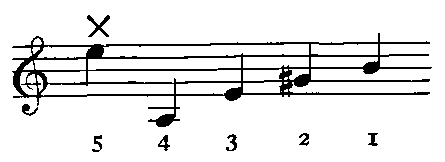
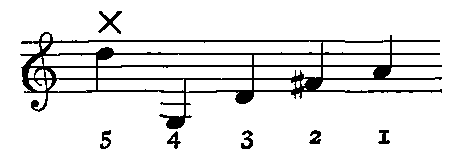
The six-stringed is tuned
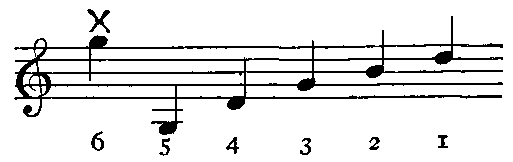
The nine-stringed banjo has three thumb strings thus
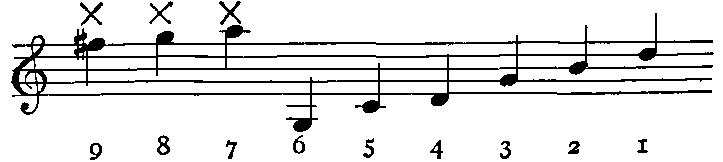
The G clef is used in notation, but the notes sound an octave lower than they are written. The banjo is usually a transposing instrument in the sense that, when playing with other instruments, the A corresponds to the C of the piano or violin; the key of A major is therefore the first to be mastered. The chanterelle does not lie over the finger-board and is always played open by the thumb.
The banjo is held so that the neck is even with the left shoulder and the body rests on the right thigh; the front of the instrument is held inclined at an angle, allowing the performer to see all the strings. When played as a solo instrument, a plectrum may be used with good effect to produce rapid scale and arpeggio passages, or to produce the tremolo or sustained notes as on the mandoline (q.v.). The best results are obtained by means of a tortoise-shell plectrum about the size of a shilling,[1] having the contact-edges highly polished, bevelled and terminating in a point. The tone of the banjo is louder and harder than that of the guitar. Chords of two, three and four notes can be played on it.
The banjo or bania of the African negro having grass strings is still in use on the coast of Guinea. The banjo was made known in England through companies of coloured minstrels from the United States, one of which came over to London as early as 1846.
(K. S.)
BANK,[1] known also as "Polish Bank" and "Russian Bank" a card-game. An ordinary pack is used. Five or six players is a convenient number. Each contributes an arranged stake to the pool. The dealer gives three cards to each player and turns up another; if this is not lower than an eight (ace is lowest) he goes on till such a card is exposed. The player on the dealer's left, without touching or looking at his cards, can bet the amount of the pool, or any part of it, that among his cards is one that is higher (of the same suit) than the turn-up. If he wins, he takes the amount from the pool; if he loses, he pays it to the pool. Each player does the same in turn, the dealer last. Whenever the pool is exhausted, a fresh stake is put into the pool. After a round is over the deal passes. No player may touch his cards until he has made his bet; the penalty is a fine to the pool of twice the stake, and the loss of his right to bet during that round.
BANKA (Banca, Bangka), an island of the Dutch East Indies, off the east coast of Sumatra, from which it is separated by Banka Strait, which is about 9 m. wide at its narrowest point. On the east, the broader, island-studded Gaspar Strait separates Banka from Billiton. Banka is 138 m. in length; its extreme breadth is 62 m., and its area, including a few small adjacent islands, 4460 sq. m. The soil is generally dry and stony, and the greater part of the surface is covered with forests, in which the logwood tree especially abounds. The hills, of which Maras in the north is the highest (2760 ft.), are covered with vegetation to their summits. Geologically, Banka resembles the Malay Peninsula, its formations being mainly granite, Silurian and Devonian slate, frequently covered with sandstone, laterite (red ironstone clay) of small fertility, and alluvium. The granite extends from W.N.W. to S.S.E., forming the short, irregular hill-chains. As these lie generally near the east coast, it follows that the rivers of the west coast are the longer. There are no volcanoes. The chief rivers (Jering, Kotta and Waringin) are navigable for some 19 m. from their mouths and are used for the transport of tin. Banka is principally noted for the production of this mineral, which was discovered here in 1710 and is a government monopoly. It occurs in lodes and as stream-tin, and is worked by Chinese in large numbers who inhabit villages of their own. The island is divided into nine mining districts, including about 120 mines, under government control, with 12,000 workmen, which have produced as much as 12,000 tons of tin in a year. From May to August, the period of the south-east monsoon, the climate of Banka is dry and hot; but the mean annual rainfall reaches 120 in. annually, rain occurring on an average on 168 days each year. The wet, cool season proper is from November to February, accompanying the north-west monsoon. The heavy rainfall is of great importance to the tin-streaming industry. The total population of the island (1905) is 115,189, including 40,000 Chinese and 70,000 natives. These last are mainly composed of immigrant Malayan peoples. The aborigines are represented by a few rude hill-tribes, who resemble in physique the Battas of Sumatra. Rice, pepper, gambier, coffee and palms are cultivated, and fishing and the collection of forest produce are further industries, but none of these is of importance. The chief town is Muntok at the north end of Banka Strait.
See H. Zondervan, Banka en Zijne bewoners (Amsterdam, 1895), with bibliography; T. Posewitz, Die Zinn-inseln im Indischen Ocean. For geology and the tin-mines, Jaarboek vor het Mijnwezen in Ned. Ind. (Amsterdam, 1877-1884).
BANKER-MARKS, or Masons' Marks. The "banker" is the stone bed or bench upon which a mason works, hence the term (so well known to the trade) of banker-marks, which, as Mr Whitley has pointed out, is more appropriate than that of masons' marks, since the setters, who are usually selected from amongst the best workmen, make no marks upon the stone (Leamington Spa Courier, 11th of August 1888). These must not be confused with other marks sometimes cut on stones as directions to the setters, and so used and employed to the present time. Banker-marks are met with throughout the civilized world, and in fact are to be found on all old buildings of consequence, ecclesiastical or otherwise. Professor T. Hayter Lewis well observed, "Go where you will, in England, France, Sicily, Palestine, you will find all through the buildings of the 12th century the same carefully worked masonry, the same masons' tool-marks, the same way of making them." Such masons' marks are to be traced graved on all the chief stones of what is known as Norman work. Norman tooling, so far as Hayter Lewis could discover, came from the north and west of Europe. Since then we get marks made with a "toothed chisel," but however or wherever chiselled the intention was the same. The system followed provided an infallible means of connecting the individual craftsman with his work, an evidence of identity that could not be gainsaid.
Naturally, because of their simplicity, certain designs were followed much more frequently than others, while occasionally some of a very elaborate character are to be detected. Undoubtedly not a few were suggestive of the initials of the names of the masons, and others were reminiscent of certain animals, objects, &c., but no proof has yet been offered of their being alphabetical in design, or arranged so as to distinguish the members of different lodges or companies; the journeymen selected any design they cared to adopt.
Singular to state, marks were chosen by gentlemen and others who joined the operative masonic lodges of the 16th and later centuries, and they were as carefully registered in the mark-books as those selected by operatives for trade purposes. The same marks are to be seen in the registers used by fathers and sons, and not always with a slight difference, as some have stated, to secure identification. What should be noted also is that other trades used precisely similar marks and for a like object, so that the idea of their having a mystical meaning, or being utilized for any other object but the one named, seems groundless.
The late George Godwin, F.R.S., F.S.A., &c., drew attention to the subject of "masons' marks in various countries" in a communication to the Society of Antiquaries in 1841, and also at a little later period (vide Archaeologia, vol. xxx. p. 113). To him is the credit due of first drawing attention to "these signs" in England. It is noteworthy how little such marks are noticed, even in buildings which are visited by archaeologists quite frequently, until a few are pointed out, and then they meet the eye to an astonishing number. In the Sessional Papers, 1868-1869, of the Royal Institute of British Architects, No. 9, may be found numerous samples of the marks from various parts of Europe in illustration of the paper by Godwin.
No better plan has been followed in modern times to connect the work done with the worker in stone, and it is probable that a second mark, observable on some blocks, may serve to indicate the overseer. There are even three or more sometimes.
The same system was adopted at the building of Truro cathedral, only the marks were inserted on the bed of each stone instead of at the side as usual, the result being that they ceased to be seen after being placed in situ. Mr Hughan obtained copies of these marks from Mr James Bubb, the first clerk of the works, and from his successor, Mr Robert Swain, and had them published in the Freemason, 13th of November 1886. He remarked at the same time that "many of these designs will be familiar to students of ancient ecclesiastical and other buildings at home and abroad." Some are interesting specimens.
A Historical Treatise on Early Builders' Marks (Philadelphia, U.S.A., 1885) by Mr G. F. Fort, and Masons' Marks from Buildings in the Counties of Lancaster and Chester, with Notes on the General History of Masons' Marks (Historic Society of Lancashire and Cheshire, vol. vii. N.S.), by W. Harry Rylands, F.S.A., may be consulted with advantage. The latter declares that "the Runic theory is as unlikely and as untenable as that which places the origin of these marks in the absurd alphabets given by Cornelius Agrippa, who died early in the 16th century." Victor Didron copied some 4000 during a tour in France in 1836 and pointed out their value (Ann. Arch., 1845).
(W. J. H.*)
BANKET, a South African mining term, applied to the beds of auriferous conglomerate, chiefly occurring in the Witwatersrand gold-fields (see Gold). The name was given to these beds from their resemblance to a sweetmeat, known in Dutch as "banket," resembling almond hard-bake. The word is the same as "banquet," and is derived ultimately from "bank" or "bench," meaning table-feast, hence applied to any delicacy or to various kinds of confectionery, a use now obsolete in English.
BANK HOLIDAYS, in the United Kingdom, those days which by the Bank Holidays Act 1871 are kept as close holidays in all banks in England and Ireland and Scotland respectively. Before the year 1834, the Bank of England was closed on certain saints' days and anniversaries, about thirty-three days in all. In 1834 these were reduced to four—Good Friday, 1st of May, 1st of November and Christmas Day. By the act of 1871, carried through the House of Commons by Sir J. Lubbock (afterwards Lord Avebury), the following were constituted bank holidays in England and Ireland—Easter Monday, the Monday in Whitsun week, the first Monday of August, the 26th of December if a week-day; and by the Bank Holiday (Ireland) Act 1903, March 17th as a special bank holiday for Ireland (see Feasts and Festivals). In Scotland—New Year's Day, Christmas Day, Good Friday, the 1st Monday of May, the 1st Monday of August. If Christmas Day and New Year's Day fall on a Sunday, the next Monday following is the bank holiday. No person is compelled to make any payment or to do any act upon a bank holiday which he would not be compelled to do or make on Christmas Day or Good Friday, and the making of a payment or the doing of an act on the following day is equivalent to doing it on the holiday. By the same act it was made lawful for the sovereign from time to time, as it should seem fit, to appoint by proclamation, in the same manner as public fasts or days of public thanksgiving, any day to be observed as a bank holiday throughout the United Kingdom or any part of it, or to substitute another day when in any special case it appears inexpedient to the sovereign in council to keep the usual bank holiday. (See further Holiday.)
BANKIPUR, an ancient village on the Hugli river in the Bengal Presidency, near the modern Palta above Barrackpore. It has disappeared from the map, but is famous as the principal settlement of the ill-fated Ostend Company, the one great effort made by Germany to secure a foothold in India. The Ostend Company was formed in 1722-1723, and with a capital of less than a million sterling founded two settlements, one at Coblom (Covelong) on the Madras coast between the English Madras and the Dutch Sadras, and the other on the Hugli between the English Calcutta and the Dutch Chinsura. Both English and Dutch were offended and in 1727, in order to obtain the European guarantee for the Pragmatic Sanction, the court of Vienna resolved to sacrifice the Company and suspended its charter. It became bankrupt in 1784 and ceased to exist in 1793. But in the meantime in 1733 the English and Dutch stirred up the Mahommedan general at Hugli to pick a quarrel. He attacked Bankipur and the garrison of only fourteen persons set sail for Europe. Thus German interests disappeared from India.
BANK-NOTES. For our present purpose we include in this description all paper substitutes for metallic currency whether issued by banks, governments or other financial institutes.
Early bank-notes were simply printed forms in which the amounts were written by hand. They were usually for large amounts (£40 and upwards) and were printed upon water-marked paper; and, although no precautions were taken in the engraving to prevent fraudulent imitation, forgeries were comparatively rare. But, when at the end of the 18th century small notes for £1 and £2 were put in circulation, forgery became rife, as many as 352 persons being convicted of this crime in England in a single year; and from that time to the present a constant trial of skill has been going on between the makers of bank-notes and the counterfeiters. Engine-turned ornaments and emblematical figures or views introduced in the engraving, in conjunction with special water-marks in the paper, held the forgers somewhat in check until the discovery of photography put into the hands of the counterfeiter a most dangerous weapon, by the aid of which complicated patterns and vignettes could be perfectly reproduced. To prevent such reproduction Henry Bradbury in 1856 introduced anti-photographic bank-note printing, in which the essential portions of the note were printed in one colour and over this another protective colour was placed. A photograph of a note printed in this way presented a confused mingling of the two colours; but with the advance of photographic knowledge means were found of obtaining a photograph of either colour separate from the other, and it consequently became necessary to introduce a third colour and to secure a special photographic relation between the three colours to prevent their separation.
Photography, however, although the most dangerous weapon of the counterfeiter, is not the only means of imitation available, a fact which is sometimes overlooked. A note may be perfectly secure against photographic reproduction, but from the absence of other necessary features may be easily copied by an engraver of ordinary skill. There are two systems of engraving employed in bank-notes:—(1) line-engraving in which the lines are cut into the steel or copper plates; and (2) relief-engraving in which the lines stand up above the plate as in wood-engraving. In the former, adapted to the process called plate-printing, the ink is delivered from the lines in the plate to the paper pressed upon it; in the latter, adapted to surface-printing, the ink is spread upon the face of the lines and printed as in typography. Plate-printing gives by far the finer and sharper impression, but as there is a perceptible body of ink transferred to the paper from the cut lines, it has been supposed that an impression from plate would be more easily photographed than one from surface where only a film of ink is spread upon the top of the raised lines. But surface-printing being much less sharp and distinct than plate-printing, imperfect copies of notes for which that process is used are the more likely to escape detection. The plates upon which the early notes were engraved being of copper quickly wore out and had to be constantly replaced. The result was great difference in the appearance of the notes, those printed from new plates being sharp and clear, while others, printed from old plates, were pale and blurred. These differences were a great assistance to the forger, as the public, being accustomed to variations of appearance between different genuine notes, were less apt to remark the difference between these and counterfeits.
In the early part of the 19th century, Jacob Perkins (1766-1849) introduced into England from America what is known as the transfer-process, in which the original engraving on steel is hardened and an impression taken from it on a soft steel cylinder, which in its turn is hardened and pressed into a soft printing-plate. By this means as many absolutely identical plates can be produced as may be required, and being hardened they will yield a very large number of prints without any appreciable deterioration. Another method of securing uniformity is the multiplication of plates by electro-deposition, the surface of the copper-electrotype plates being protected by the deposit of a film of steel which effectually prevents the wearing of the copper and can be renewed at will.
The water-mark of the paper, on which formerly reliance was placed almost exclusively, puts a difficulty in the way of the counterfeiter, but experience has shown that in ordinary circumstances it does not in itself afford adequate protection. The means by which it can be imitated are well known, and, since a distinct water-mark is incompatible with strong paper, the life of a water-marked note is much shorter than that of one printed upon plain paper. The best bank-note paper is made from pure linen rags and was formerly made by hand. Machine-made paper is however now largely used, as it possesses all the strength of hand-made and is much more uniform in thickness and texture.
In documents which pass current as money it is obviously the duty of the bank or government issuing them to take all reasonable means to prevent the public from being defrauded by the substitution of counterfeits; and a bank whose circulation depends upon the confidence of the public must do so in its own interests to insure the acceptance of its notes. This principle is now recognized by all issuing institutions, but in practice there is room for improvement in the issues of many important establishments, partly because of the disinclination of the directors of a bank to change the form of an issue to which the public is accustomed, partly because of the difficulty of deciding what is really a secure note, and in certain cases because, owing to exceptional circumstances, an issue may be practically immune from forgery although the notes themselves present little or no difficulty in imitation. The features essential to the security of an issue are (1) absolute identity in appearance of all notes of the issue; (2) adequate protection by properly-selected colours against photographic reproduction; and (3) high-class engraving comprising geometric lathe work and well-executed vignettes. In addition it is important that the design of the note should be striking and pleasing to the eye, and the inscription legible.
The notes of the Bank of England are printed in the bank from surface-plates in black without colour or special protection except the water-mark in the paper. They are never reissued after being once returned to the bank, and their average life is very short, about six weeks, so that a dirty or worn Bank of England note is practically never seen. This arrangement, coupled with the difficulty of negotiating forged notes in England, the lowest denomination being £5, accounts for the comparative immunity from forgery of the bank's issues.
BANK RATE, a term used in financial circles to designate the rate of discount charged in the chief monetary centres by the state or leading bank, as opposed to the open-market rate. (See Market: Money market.)
BANKRUPTCY (from Lat. bancus or Fr. banque, table or Definition. counter, and Lat. ruptus, broken), the status of a debtor who has been declared by judicial process to be unable to pay his debts. Although the terms "bankruptcy" and "insolvency" are sometimes used indiscriminately, they have in legal and commercial usage distinct significations. When a person's financial liabilities are greater than his means of meeting them, he is said to be "insolvent"; but he may nevertheless be able to carry on his business affairs by means of credit, paying old debts by incurring new ones, and he may even, if fortunate, regain a position of solvency without his creditors ever being aware of his true condition. And even when his insolvency becomes public and default occurs, a debtor may still avert bankruptcy if he is able to effect a voluntary arrangement with his creditors. A debtor may thus be insolvent without becoming bankrupt, but he cannot be a bankrupt without being insolvent, for bankruptcy is a legal declaration of his insolvency and operates as a statutory system for the administration of his property, which is thereby taken out of his personal control.
In primitive communities bankruptcy systems were unknown. Early methods. Individual creditors were left to pursue their remedies by such means as the law or practice of the community might sanction, and these were generally of a very drastic character. Under the Roman law of the Twelve Tables, the creditors might, as a last resort, cut the debtor's body into pieces, each of them taking his proportionate share; and although Blackstone in quoting this law appears to cast some doubt upon its too literal interpretation, there can be no doubt that the power of selling the debtor and his family into slavery was one which was habitually exercised in Greece, Rome, and generally among the nations of antiquity. Even among the Jews, whose legislation was of a comparatively humane character, this practice is illustrated by the Old Testament story of the woman who sought the help of Elisha, saying, "Thy servant my husband is dead ... and the creditor is come to take unto him my two children to be bondmen." The savage severity of these earlier laws was, however, found to be inconsistent with the development of more humane ideas and the growth of popular rights; and tended, as in the case of Greece and Rome, to create serious disturbance in political relations between the patricians, who generally composed the wealthier or creditor class, and the plebeians, in whose ranks the majority of debtors were to be found. Later legislation consequently substituted imprisonment in a public prison for the right of selling the person of the debtor. Under the feudal systems of Europe the state generally insisted on its subjects being left free for military service, and debts could not therefore be enforced against the person of the debtor; but as trade began to develop it was found necessary to provide some means of bringing personal pressure to bear upon debtors for the purpose of compelling them to meet their obligations, and under the practice of the English courts of law the right of a creditor to enforce his claims by the imprisonment of his debtor was gradually evolved (although no express legal enactment to that effect appears at any time to have existed), and this practice continued until comparatively recent times.
Without some system of enforcing payment of debts it would Commercial objects. have been impossible for the commerce of the world to have attained its present proportions; for modern commerce is necessarily founded largely on credit, and credit could not have existed without the power of enforcing the fulfilment of financial contracts. On the other hand remedies against a debtor's person, and still more against the persons of his family, are not only inconsistent with the growth of opinion among civilized communities, but are in themselves worse than futile, inasmuch as they strike at the root of all personal effort on the part of a debtor to retrieve his position and render a return to solvency impossible. Hence the necessity of devising some system which is just to creditors while not unduly harsh upon debtors, which discriminates between involuntary inability to meet obligations and wilful refusal or neglect, and which secures to creditors as between themselves an equitable share of such of the debtor's assets as may be available for the payment of his liabilites. These are the objects which the bankruptcy laws have primarily in view. Another object, which has not always been so fully recognized as it might appear to deserve, has marked the most recent legislation, namely, the fostering of a higher tone of commercial morality and the protection of the trading community at large from the evils arising through the reckless abuse of credit and the unnatural trade competition thereby engendered. It must be admitted that these objects are of a somewhat conflicting character, and wherever the state has interfered with the view of securing an efficient system of bankruptcy legislation the task has been found to be extremely difficult. Not only have the conflicting interests of the debtor and his creditors to be taken into account, but the method to be adopted in dealing with his property has also given rise to much conflict of opinion, and to a lack of uniformity and consistency in the legislation which dealt with it. The debtor's property was naturally regarded as belonging to the creditors, but it could not be distributed among them until it was realized, and until their respective right and interests were determined by competent authority. In some cases claims to rank as creditors are of doubtful validity. In others the creditor holds securities, the value of which requires investigation, or he claims a preference to which he may or may not be legally entitled. Creditors have thus conflicting interests as between themselves, and are therefore incapable of acting together as a homogeneous body. Hence the necessity for calling in the aid of professional assignees or trustees, solicitors and other agents, who made it their special business to deal with such matters, exercising both administrative and quasi-judicial functions, in return for the remuneration which they receive out of the property for their services. Professional interests, which are not always identical with the interests of the debtor or the creditors, are thus called into existence, and these interests have from time to time exercised a powerful influence in shaping the course of legislation.
While the law of bankruptcy has therefore been largely the product of commercial development, it has necessarily been of slow and gradual growth, tentative in its character, and subject to oscillation between the extremes of conflicting interests according to the temporary and varying predominance of each of these interests from time to time. No intelligible grasp of the principles which underlie the history of bankruptcy legislation in England, and no satisfactory explanation of the fluctuating tendencies which have marked its progress, are possible without bearing these considerations in view.
Bankruptcy in England.
The subject was originally dealt with in the sole interest of History. creditors; it was considered fraudulent for a debtor to procure his own bankruptcy. Thus the earliest English statute on the subject, 34 & 35 Henry VIII. c. 4 (A.D. 1542), was directed against fraudulent debtors, and gave power to the lord chancellor and other high officers to seize their estates and divide them among the creditors, but afforded no relief to the debtor from his liabilities. Subsequent legislation modified this attitude and introduced the principle of granting relief to the bankrupt with or without the consent of the creditors, where he conformed to the provisions of the bankruptcy law, and under the act of 1825 the debtor was allowed himself to initiate proceedings. Since 1542 about forty acts of parliament have been passed, dealing with the many aspects of the subject, and slowly expanding, modifying and building up the highly complex system of administration which now exists.
The courts exercising jurisdiction originally, consisted of Court of 1831. commissioners appointed by the lord chancellor. But in 1831 a special court of bankruptcy was established, consisting of six commissioners with four judges as a court of review, and official assignees attached to the court for the purpose of getting in the distributing the bankrupt's assets. Non-traders were originally excluded from the bankruptcy court, and a special court called the "court for relief of insolvent debtors" was instituted for their benefit, in which relief from the liability to imprisonment could be obtained on surrender of their property, but they were not discharged from their debts, subsequently-acquired property remaining liable. Both of these courts were subsequently abolished, non-traders were permitted to obtain the benefit of the bankruptcy laws, including a discharge, and in 1869 the system of official assignees was swept away, and a new court of bankruptcy created with one of the vice-chancellors at its head as chief judge, and a number of subordinate registrars or inferior judges under him. This court has also now been abolished, and the business is administered by a judge of the high court specially appointed for the purpose by the lord chancellor, with registrars of the high court, who deal with the ordinary judicial routine of bankruptcy procedure in the London district, while similar duties are performed by the county-court judges throughout the country.
But the questions which have proved the most difficult to Rights of creditors. deal with, and which more than any others have been the cause of fluctuating and inconsistent legislation, have undoubtedly been those relating to the share which the creditors ought to have in the administration of the proceedings, and to special arrangements effected between a debtor and his creditors under conditions more or less beyond the control of the court. These two questions are largely intermixed, and the history of English legislation on these points and its results throw much light on the causes of the failure of the many attempts which have been made by the most eminent legal authorities to bring the law into a satisfactory condition. The right of creditors to exercise some control in bankruptcy over the realization of the debtor's property through an assignee chosen by themselves was recognized at an early date, but this right was exercised subject to the supervision of the court which investigated the claims of creditors and determined who were entitled to take part in the proceedings. Provision was also made for the interim protection of the debtor's property by official assignees attached to the court, who took possession until the creditors could be consulted, and under the supervision of the court audited the accounts of the creditor's assignee. So long as this system continued substantial justice was generally secured; the claims of creditors were strictly investigated and only those who clearly proved their right before a competent court were entitled to take part in the proceedings. The bankrupt was released from his obligations, but only after strict inquiries into his conduct and under the exercise of judicial discretion. The accounts of assignees were also strictly investigated, and the costs of solicitors and other agents were taxed by officers of the court. But the system was found to be cumbrous, to lead to delay and too often to the absorption of a large part of the estate in costs, over the incurring of which there was a very ineffective control. Hence arose a demand for larger powers on the part of creditors, and the introduction into the bankruptcy procedure of the system of "arrangements" between the debtor and his creditors, either for the payment of a composition, or for the liquidation of the estate free from the control of the court. Acts of 1825, 1831, 1842, 1849. At first these arrangements were carefully guarded. Under the act of 1825 a proposal for payment of a composition might be adopted only after the debtor had passed his examination in court, and with the consent of nine-tenths in number and value of his creditors assembled at a meeting. Upon such adoption the bankruptcy proceedings were superseded. Dissenting creditors, however, were not bound by the resolution, but could still take action against the debtor's subsequently-acquired property. These powers were not found to be sufficiently elastic and the act failed to give public satisfaction. Attempts were made by the acts of 1831 and 1842 to remedy the defects complained of by a reconstitution of the bankruptcy court and its official system. But these measures also failed because they were based on the assumption that judicial bodies could exercise effective control over administrative action, a control for which they are naturally unsuited, and which they could only carry out by cumbrous and expensive methods of procedure. Under the act of 1849 a totally new principle was introduced by the provision that a deed of arrangement executed by six-sevenths in number and value of the creditors for £10 and upwards should be binding upon all the creditors without any proceedings in or supervision by the court. But the determination of the question who were or were not creditors was practically left to the debtor himself, without any opportunity for testing by independent investigation the claims of those who signed the deed to control the administration of the estate. It is not difficult to see, in the light of subsequent experience, how likely this provision was to encourage fraudulent arrangements, and to introduce laxity in the administration of debtors' estates. A modification of the too stringent conditions of the act of 1825, which would have enabled a bankrupt to pay a composition on his debts, with the consent of a large proportion of his bona-fide creditors, and subject to the approval of the court, after hearing the objections of dissenting creditors, would doubtless have proved a beneficial reform, but the act of 1849 proceeded on a very different principle. Instead of reforming, it practically abolished judicial control. By avoiding Scylla it fell into Charybdis. To give any majority of creditors the power to release a debtor from his obligations to non-assenting creditors without full disclosure of his affairs, and without any exercise of judicial discretion or any investigation into the causes of the failure, or the conduct of the debtor, would in any circumstances have been to introduce a new and mischievous principle into legislation, for it would necessarily destroy the essential feature of such arrangements, that they are voluntary contracts, the responsibility for which lies solely with the parties entering into them. But to give such a power to creditors whose claims were subject to no independent investigation was to invite inevitable confusion and failure.
Yet this was the dominating principle of English bankruptcy 1861. legislation for nearly thirty-five years. Its effect under the act of 1849 was, however, to some extent modified by subsequent decisions of the courts that to make a composition arrangement binding it must be accompanied by a complete cessio bonorum; but this qualification was removed by the act of 1861 which made such arrangements binding without a cessio and reduced the majority required to make a deed of arrangement binding on all the creditors, to a majority in number and three-fourths in value of those whose claims amounted to £10 and upwards. The result was an enormous increase in fraudulent arrangements. The then attorney-general, Sir Robert Collier, in introducing an amending act in 1869, described the abuses which had grown up under the 1849 and 1861 acts, as having the effect of enabling a bankrupt to "defraud those to whom he was indebted and to set them at defiance"; while Lord Cairns, the lord chancellor, in the House of Lords expressed the opinion that the large increase which had taken place in the annual insolvency of the country during the preceding years could not "be attributed to depression of trade but must be traced to the enormous facilities which are given to debtors who wish to be released from their debts on easy terms." And yet in the legislation which ensued these facts were entirely ignored or lost sight of.
It is indeed a curious illustration of the difficulties which have 1869. attended bankruptcy legislation in England that the very measure (the act of 1869) which was introduced to remedy this deplorable condition of affairs, was twelve years afterwards denounced in parliament by the president of the Board of Trade (Mr Joseph Chamberlain) as "the most unsatisfactory and most unfortunate of the many attempts which had been made to deal with the subject" and as "the object of the almost unanimous condemnation of all classes." How was this? Under the act of 1869, the procedure under a bankruptcy petition was certainly rendered effective. Meetings of creditors were presided over and creditors' claims were, for voting purposes, adjudicated upon by the registrar of the court; the bankrupt had to pass a public examination in court, which although chiefly left to the trustee appointed by the creditors, afforded some opportunity for investigation; and the bankrupt could not obtain his discharge without the approval of the court and in certain circumstances the consent of the creditors. An independent official, the comptroller in bankruptcy, was appointed, whose duty it was to examine the accounts of trustees, call them to account for any misfeasance, neglect or omission, and refer the matter to the court for the exercise of disciplinary powers where necessary. These provisions were well calculated to promote sound administration, but they were, unfortunately, rendered nugatory by provisions relating to what were practically private arrangements on similar lines to those which had rendered previous legislation ineffective. In some respects the evil was aggravated. Deeds of arrangements were nominally abolished, but under sections 125 and 126 of the act a debtor was empowered to present a petition to the court for liquidation of his affairs by "arrangement," or for payment of a composition, whereupon a meeting of creditors was summoned from a list furnished by the debtor, and without any judicial investigation of claims, a majority in number and three-fourths in value of those who lodged proofs of debt, and who were present in person or by proxy at the meeting, might by resolution agree to liquidation by arrangement or to the acceptance of the composition. Such resolution thereupon became binding upon all the creditors, without any act of approval by the court, any judicial examination of the debtor, or any official supervision over the trustee's accounts. The debtor was not permitted to present a bankruptcy petition against himself, and consequently his only method of procedure was that which thus removed the matter from the supervision and control of the court, and as about nine-tenths of all the proceedings under the act of 1869 were initiated by debtors, it followed that only about one-tenth was submitted to proper investigation. It is true that the creditors might refuse to assent to the debtor's proposal, and that any creditor for £50 or upwards could present a petition in bankruptcy, but even where this course was adopted, the proceedings under the petition were, as a rule, stayed by the court if the debtor subsequently presented a proposal for liquidation or composition, and the creditor was left to pay the expenses of his petition if the requisite majority voted for the debtor's proposal. So far, therefore, as the act was concerned, every inducement was held out to the adoption of a course which took the examination of the debtor, the conditions of his discharge and the audit of the trustee's accounts, out of the control of the court.
The establishment of a bankruptcy court, with its searching Causes of failures of Acts. powers of investigation and its power of enforcing penalties on misconduct, can only be defended on the ground that the administration of justice is a matter affecting the interests of the community at large. But apart from the injury done to these interests by reducing the administration of justice to a question of barter and arrangement between the individuals immediately concerned, one of the chief reasons why the acts of 1849, 1861 and 1869 proved failures, lies in the obvious fact that the creditors of a particular estate are not, as appears to have been assumed, a homogeneous or organized body capable of acting together in the administration of a bankrupt estate. In the case of a few special and highly organized trades it may be otherwise, but in the great majority of cases the creditors have but little knowledge of each other or means of organized action, while they have neither the time nor the inclination to investigate the complicated questions which frequently arise, and which are therefore left in the hands of professional trustees or legal agents. But the appointment of trustees under these acts, instead of being the spontaneous act of the creditors, was frequently due to touting on the part of such agents themselves, or to individual creditors whose interests were not always identical with those of the general body. According to G. Y. Robson, the author of a standard work on the subject, the arbitrary powers conferred by the act of 1861 "led to great abuses, and in many cases creditors were forced to accept a composition, the approval of which had been obtained by a secret understanding between the debtor and favoured creditors, and not unfrequently by the creation of fictitious debts." These evils were greatly aggravated by the decisions of the court relating to proofs on bills of exchange, under which it was held that the holder of a current bill could prove on the bankrupt estate of an indorser, although the bill was not yet due, and the acceptor was perfectly solvent and able to meet it at maturity. Thus in large mercantile failures, bankers and other holders of first-class bills could prove and vote on the estates of their customers, for whom the bills had been discounted, and thus control the entire proceedings, although they had no ultimate interest in the estate. But probably the greatest source of the abuses which arose under the act of 1869 was the proxy system established by the act and by the rules which were subsequently made to carry it out. The introduction of proxies was no doubt intended to give absent creditors an opportunity of expressing their opinions upon any question which might arise. But the system was too often used for the purpose of stifling the views of those who took an independent part in the proceedings. The form of proxy prescribed by the rules contained no limitation of the powers of the proxy-holder and no impression of the opinion of the creditor. It simply appointed the person named in it as "my proxy," and these magic words gave the holder power to act in the creditor's name on all questions that might be raised at any time during the bankruptcy. Hence arose a practice of canvassing for proxies, which were readily given under the influence of plausible representations, such as the holding out of the prospect of a large composition, but which, when once obtained, could be used for any purpose whatsoever except the receipt of a dividend. Thus it frequently happened that the entire proceedings were controlled by professional proxy-holders, in whose hands these documents acquired a marketable value. They were not only used to vote for liquidation by arrangement instead of bankruptcy proceedings, but not infrequently the matter took the form of a bargain between an accountant and a solicitor, under which the former became trustee and the latter the solicitor in the liquidation, without any provision for control over expenditure or for any audit of the accounts. Even where a committee of inspection was appointed to exercise functions of control and audit, they too were often appointed by the proxy-holders, and not infrequently shared in the benefits. On the other hand, where the amount of debts represented by the proxy-holder was insufficient to carry the appointment of a trustee and committee, the votes could be sold to swell the chances of some other candidate. Hence ensued a system of trafficking in these instruments, the cost of which had in the long run to come out of the estate. The result was that undesirable persons were too frequently appointed, whose main object was to extract from the estate as much as possible in the shape of costs of administration. The debtor was practically powerless to prevent this result. If he attempted to do so he sometimes became a target for the exercise of revenge. His discharge, which under liquidation by arrangement was entirely a matter for the creditors, might be refused indefinitely; and so largely and harshly was this power exercised under the proxy system, especially where it was supposed that the debtor had friends who could be induced to come to his aid, that a special act of parliament was passed in 1887, authorizing the court to deal with cases where, under the act of 1869, a debtor had not been able to obtain a release from his creditors. On the other hand, the complaisant debtor, although he had incurred large obligations in the most reckless manner, often succeeded in stifling investigation and obtaining his release without difficulty as a return for his aid in carrying out the arrangement.
The result of such a system could not be other than a failure. After the act of 1869 had been in operation for ten years, the comptroller in bankruptcy reported that out of 13,000 annual failures in England and Wales, there were only 1000 cases (or about 8%) "to which the more important provisions of the act for preventing abuses by insolvent debtors and professional agents applied; the other 12,000 cases (or 92%) escaping the provisions which refer to the examination and discharge of bankrupts, and to the accounts, charges and conduct of the agents employed." It is not to be supposed that all the cases in the latter class were marked by the abuses which have been here described. In a large number the proceedings were conducted by agents of high character and standing, and with a due regard to the interests of the creditors. But the facilities for fraudulent and collusive arrangements afforded by the act, and the want of effective control over administration, inevitably tended to lower the morale of the latter, and to throw it into the hands of the less scrupulous members of the profession. The demand for reform, therefore, came from all classes of the business community. No fewer than thirteen bills dealing with the subject were introduced into the House of Commons during the ten years succeeding 1869. At length in 1879 a memorial, which was authoritatively described as "one of the most influential memorials ever presented to any government," was forwarded to the prime minister by a large body of bankers and merchants in the city of London. The matter was then referred to the president of the Board of Trade (Mr Chamberlain), who made exhaustive inquiries, and in 1881 introduced a measure which, with some amendments, finally became law under the title of the Bankruptcy Act 1883.
Hitherto the question had been dealt with as one of legal Act of 1883. procedure; it was now treated as an act of commercial legislation, the main object of which, while providing by carefully framed regulations for the equitable distribution of a debtor's assets, was to promote and enforce the principles of commercial morality in the general interests of the trading community. One of the chief features of the act of 1883 is the separation which it has effected between the judicial and the administrative functions which had previously been exercised by the court, and the transfer of the latter to the Board of Trade as a public department of the state directly responsible to parliament. Under the powers conferred by the act a new department was subsequently created under the title of the bankruptcy department of the Board of Trade, with an officer at its head called the inspector-general in bankruptcy. This department exercises, under the direction of the Board of Trade, a general supervision over all the administrative work arising under the act. It has extensive powers of control over the appointment of trustees, and conducts an audit of their accounts; and it may, subject to appeal to the court, remove them from office for misconduct, neglect or unfitness. A report upon the proceedings under the act is annually presented to parliament by the Board of Trade, and although the department is practically self-supporting, a nominal vote is each year placed upon the public estimates, thus bringing the administration under direct parliamentary criticism and control. The act also provides for the appointment and removal by the Board of Trade of a body of officers entitled official receivers, with certain prescribed duties having relation both to the conduct of bankrupts and to administration of their estates, including the interim management of the latter until the creditors can be consulted. These officers act in their respective districts under the general authority and directions of the Board of Trade, being also clothed with the status of officers of the courts to which they are attached. While effecting this supervision and control by a public department directly responsible to parliament, the main objects of the measure were to secure—(1) An independent and public investigation of the debtor's conduct; (2) The punishment of commercial misconduct and fraud in the interests of public morality; (3) The summary and inexpensive administration of small estates where the assets do not exceed £300 by the official receiver, unless a majority in number and three-fourths in value of the creditors voting resolve to appoint a trustee; (4) Full control in other cases by a majority in value, over the appointment of a trustee and a committee of inspection; (5) Strict investigation of proofs of debt, with regulations as to proxies and votes of creditors; (6) An independent audit and general supervision of the proceedings and control of the funds in all cases. Besides amending and consolidating previous bankruptcy legislation, the measure also contains special provisions for the administration under bankruptcy law of the estates of persons dying insolvent (§ 125); and for enabling county courts to make administration orders for payment by instalments in lieu of immediate committal to prison, in the case of judgment debtors whose total indebtedness does not exceed £50 (§ 122). It also provides for the getting in and administration by the Board of Trade of unclaimed dividends and undistributed balances on estates wound up under previous bankruptcy acts (§ 162). Lastly, it amends the procedure under the Debtors Act of 1869, dealing with criminal offences committed by bankrupts (which, prior to 1869, had been treated as part of the bankruptcy law), by enacting that when the court orders a prosecution of any person for an offence under that act, it shall be the duty of the director of public prosecutions to institute and carry on the prosecution.
An amending act, under the title of the Bankruptcy Act Act of 1890. 1890 was passed in that year, mainly with the view of supplementing and strengthening some of the provisions of the act of 1883, more particularly with regard to the conditions under which a bankrupt should be discharged or schemes of arrangement or composition be approved by the court. It also dealt with a variety of matters of detail which experience had shown to require amendment, with the view of more fully carrying out the intentions of the legislature as embodied in the principal act. These two acts are to be construed as one and may be cited collectively as the Bankruptcy Acts 1883 and 1890. They are further supplemented by a large body of general rules made by the lord chancellor with the concurrence of the president of the Board of Trade, which may be added to, revoked or altered from time to time by the same authority. These rules are laid before parliament and have the force of law.
Besides these general acts, various measures dealing with Special Acts. special interests connected with bankruptcy procedure have from time to time been passed since 1883, the chief of which are as follows, viz., the Bankruptcy Appeals (County Courts) Act 1884; the Preferential Payments in Bankruptcy Act 1888, regulating the priority of the claims of workmen and clerks, &c. for wages and salaries; and the Bankruptcy (Discharge and Closure) Act 1887, dealing with unclosed bankruptcies under previous acts.
It would be out of place in this article to attempt to answer Inquiry of 1906. the question how far later legislation has solved the difficult problems which prior to 1883 were found so intractable, but it may be mentioned that in 1906 the Board of Trade appointed a committee to inquire into and report upon the effect of the provisions of the laws in force at the time in the United Kingdom in relation to bankruptcy, deeds of arrangement and composition by insolvent debtors with their creditors, and the prevention and punishment of frauds by debtors on their creditors, and any points and matters upon which the existing laws seemed to require amendment. The committee received a vast amount of evidence as well as documents and memoranda from chambers of commerce, trade protection societies and influential public bodies. The scope of the inquiry was not limited to English law and procedure, but also embraced that of Germany, France, Australia, Scotland and Ireland. The report of the committee was issued in 1908 (Cd. 4068), and reference may be made to it for much valuable information. The committee reported that the result of their inquiry did not disclose any dissatisfaction on the part of the commercial community with the main features of the existing law and procedure. But there were certain special incidents of the law and branches of its administration upon which the committee made recommendations. One was the prosecution and punishment of debtors who had committed fraud on their creditors or caused loss to them by improper and reckless trading. The existing procedure was complained of as being dilatory, cumbersome and expensive, and the committee were of an opinion that where a debtor had committed an offence for which he could and ought to be prosecuted, prosecution and conviction, with adequate punishment, ought to follow speedily and decisively, and the chief recommendation of the committee was that, while the existing procedure should be left untouched, offences ought also to be punishable on summary conviction before magistrates and justices, and the provisions of the Summary Jurisdiction Acts applied to them, and that where an order for a prosecution is made on an application by the official receiver of a bankruptcy court and based on his report, that court should have power to order the official receiver to conduct the prosecution before the court of summary jurisdiction. The committee also reported that numerous delinquencies by insolvent debtors in the conduct of their affairs, or which had contributed to the losses sustained by their creditors, were not punishable or even cognizable by courts having bankruptcy jurisdiction unless or until a debtor who had a receiving order against him, or became a bankrupt, applied for an order sanctioning a composition or scheme of arrangement with his creditors, or for an order discharging him from his debts. The most prominent of these delinquencies which were brought to the notice of the committee were—failure by a debtor to keep any books or any proper or adequate books of account in his business; trading with knowledge of insolvency; gambling and speculation leading to, or contributing to, the debtor's insolvency or bankruptcy; failure properly to account for any substantial deficiency of assets. The committee received a large body of evidence in favour of making delinquencies such as have been described punishable by imprisonment. Evidence was also given as to the laws in force in Germany, France and Scotland, from which it appeared that such delinquencies, especially that of keeping no books of account, can be severely dealt with as criminal offences.
After carefully weighing the evidence on both sides the committee recommended that the failure or omission by a debtor who becomes bankrupt to have kept any books of account, or proper books of account, within two years next preceding his bankruptcy, in a trade or business carried on by him, if without excuse, should be made by law an offence punishable on summary conviction by imprisonment, subject to four important limitations, namely, that the law should define what books of account a person carrying on a trade or business must keep, following in this respect the law in force in France and Germany; that failure or omission by a debtor to have kept the required books should only be punishable in the event of a debtor becoming bankrupt and of the liquidated debts proved in the bankruptcy exceeding £200 in amount; that no prosecution of a debtor for failure or omission to keep books of account should take place before the lapse of two years from the passing of the law; that a debtor should not be punished if he could show that his failure or omission to keep proper books was honest and excusable and did not contribute to his insolvency, and that no prosecution should be instituted for the offence except by order of the bankruptcy court. The committee made recommendations of much the same character with regard to punishing some of the other delinquencies mentioned above. There were also recommendations by the committee as to trading by undischarged bankrupts, as to the realization of estate on bankruptcy, as to the operation of the law of relation back of a bankruptcy trustee's title, as to the law relating to the after-acquired property of an undischarged bankrupt, and dealings with such property, and with respect to married women and their liabilities under bankruptcy law. The committee also reported on the law and practice relating to voluntary deeds of arrangement between a debtor and his creditors and on the compulsory regulation of assignments of book debts, and of agreements for the hire and purchase of chattels.
In addition to this report the annual reports of the Board of Results of legislation. Trade, which are accompanied by elaborate tables of statistics, and by copious illustrations both of the working of the system and of the characteristic features and causes of current insolvency, are published as parliamentary papers, and may be usefully consulted by those interested in the subject. It appears from these reports that the total number of insolvencies dealt with under the bankruptcy acts during the ten years ending 31st December 1905, was 43,141, involving estimated liabilities amounting to £61,685,678, and estimated assets amounting to £26,001,417. It may also be pointed out that according to the official figures, the cost of bankruptcy administration under the present system has very considerably decreased as compared with that under the act of 1869. Estates are also closed at much shorter intervals, and, what is more important from a public point of view, it appears that while the estimated liabilities of bankrupt estates during the ten years ending 1883 amounted on an average to £22,380,000 per annum, the estimated liabilities during the ten years ending 1905 only averaged £6,168,567 per annum. But during the latter period there was an annual average of 3426 private arrangements involving a further estimated annual liability of £4,166,354 entered into outside of the Bankruptcy Acts by insolvent debtors. There are no means of ascertaining the corresponding amount of liabilities on private arrangements outside of the Bankruptcy Acts prior to 1883, and therefore a complete comparison is impossible; but it is evident that on any method of computation there has been a very great diminution in the trading insolvency of England and Wales, while it is also clear as a matter of general knowledge in commercial circles, that a great decrease in the proportion of fraudulent trade and reckless speculation has been a marked feature of private trading during the period in question.
The cost of bankruptcy administration is provided for: (1) by fees charged to bankrupt estates, (2) by interest on balances at the credit of such estates with the bankruptcy estates account, and (3) by interest on unclaimed funds at the credit of estates under former Bankruptcy Acts.
Out of this are paid the salaries of all the officers of the department, including the official receivers; the remuneration due in respect of bankruptcy services to the county court registrars; pensions, &c., payable to retired officers under the present and previous Bankruptcy Acts; cost of bankruptcy prosecutions; and rents, stationery, travelling and other incidental expenses. The system is self-supporting and involves no charge upon the tax-payers of the country. It has been objected that inasmuch as the act professes to be based on the principle of enforcing commercial morality in the interests of the general community, the cost of administering it should not be charged entirely to the bankruptcy estates concerned. But when it is considered that a large part of the revenue of the department is derived from funds to which estates administered under the present act have contributed nothing, this objection does not appear to be well founded.
For the convenience of readers who may require more detailed Summary of procedure. information, the accompanying summary of some of the more important provisions of the law relating to bankruptcy procedure is submitted. It must be borne in mind, however, that the subject is in some of its branches extremely intricate, and that both the law and the procedure are being constantly affected by a considerable body of judicial interpretation, while the acts also contain detailed provisions with regard to many questions incident to the administration of bankruptcy. A reference to the latest textbooks or competent professional advice will always be advisable for those who have the misfortune to be practically interested either as debtors or as creditors in bankruptcy proceedings.
The Deeds of Arrangement Act 1887, although not falling Deeds of arrangement. strictly within the scope of the bankruptcy law, may also, in consequence of its important bearing upon the question of insolvency in England and Wales, be here noticed. It has been pointed out that, under the Bankruptcy Acts of 1849 and 1861, non-official arrangements by deed between a debtor and the general body of his creditors were not only officially recognized, but were in certain circumstances made binding on all the creditors, including those who refused to assent to them. Under the act of 1869, although such deeds were no longer recognized or made binding on non-assenting creditors, the proceedings under the "liquidation by arrangement" and "composition" clauses were practically private arrangements by resolution instead of deed, and were proved by experience to be open to the same abuses. It has also been shown that under the act of 1883 no arrangements either by deed or by resolution have any force against dissenting creditors, unless confirmed after full investigation and approval of the bankruptcy courts. Private arrangements, therefore, cease to form any part of the bankruptcy system. But they are, nevertheless, binding as voluntary contracts between the debtor and such creditors as assent to them. Being, however, in the nature of assignments of the debtor's property, they are either deemed fraudulent if the benefit of the assignment is limited to a portion of the creditors, or, if it is extended to all they become acts of bankruptcy, and, like any other voluntary assignment, are liable to be invalidated if made within three months prior to the petition on which a receiving order is made against the debtor. Treated as voluntary assignments, which are not binding on those who do not assent to them, such arrangements, where honestly entered into and carried out by capable administration, in many cases form a useful and expeditious method of liquidating a debtor's affairs, and where the debtor's insolvency has been brought about without any gross misconduct they will probably always be largely resorted to. The danger attending them is that even in cases where the debtor has been guilty of misconduct, a private arrangement may be used to screen his conduct from investigation, while in many cases it may be made the medium for the concealment of fraudulent preferences. The absence of any independent audit of the trustees' accounts may also encourage or conceal irregularities in administration. Previous to 1887, however, much inconvenience arose from the fact that the execution of these private arrangements was frequently kept secret, and fresh credit was obtained by the debtor without any opportunity being afforded for the new creditors becoming acquainted with the fact that they were dealing with an insolvent person, and that in many cases they were simply supplying the means for meeting past obligations in respect of which the debtor had already committed default. The Deeds of Arrangement Act 1887 was therefore passed to compel the disclosure of such arrangements, by declaring them void unless registered within seven days after the first execution by the debtor or by any creditor. Registration is effected by lodging with the registrar of bills of sale at the central office of the Supreme Court a true copy of the deed and of every inventory and schedule attached thereto, together with an affidavit by the debtor, stating the total estimated amount of property and liabilities, the total amount of composition, if any, and the names and addresses of the creditors. Where the debtor's residence or place of business is outside the London bankruptcy district, the registrar is required to forward a copy of the deed to the registrar of the county court of the district where the debtor's residence or place of business is situated. Both the central and the local registers are open to public inspection on payment of a small fee and general publicity is secured by the action of various trade agencies, which make a practice of extracting and publishing the information for the benefit of those interested. By section 25 of the Bankruptcy Act 1890, every trustee under a deed of arrangement is required to transmit to the Board of Trade within thirty days of the 1st of January in each year an account of his receipts and payments and such accounts are open to the inspection of any creditor on payment of a small fee. They are not, however, subject to any kind of audit or control by the department. The registrar is also required to make periodical returns of the deeds thus registered to the Board of Trade, in order that a report of proceedings under the Deeds of Arrangement Act may be included in the annual report which the department is required to make on proceedings under the Bankruptcy Acts. Full statistics of such proceedings are accordingly included in these reports, from which it appears that during the ten years ended 31st December 1905 the total number of registered deeds of arrangement was 34,273, with estimated liabilities amounting to £41,663,541, and estimated assets to £23,020,483.
Summary of Bankruptcy Procedure.—Subject to certain special provisions in the case of what are termed "small bankruptcies" (see below), the following summary sets forth some of the more important provisions of the various acts and rules relating to bankruptcy administration grouped under convenient heads to facilitate reference. In some cases the effect of legal decisions has been embodied in the summary.
Preliminary Proceedings.
Petition and Receiving Order.—Any court exercising bankruptcy jurisdiction in the district in which he resides or carries on business in England or Wales may make a receiving order against a debtor, whether a trader or not, either on his own petition or on that of a creditor or creditors whose claims aggregate not less than £50. In the case of a creditor's petition proof must be given of the debt, and of the commission of an act of bankruptcy within three months preceding the date of the petition. An act of bankruptcy is committed if the debtor fails to satisfy the creditor's claim upon a bankruptcy notice; if he makes an assignment for the benefit of his creditors generally; if he absconds or keeps house; if he gives notice of suspension of payments; if his goods are sold or seized under execution; if he files in court a declaration of inability to pay his debts; or if he grants a fraudulent preference or conveyance. These acts are here enumerated in the order in which they most frequently occur in practice.
Object and Effect of Receiving Order.—The object of the order is to protect the debtor's property until the first meeting of creditors, and to bring the debtor and his affairs within the jurisdiction of the court. Its effect is to stay all separate action against the debtor, and to constitute the official receiver attached to the court receiver of the debtor's property, although the legal title still remains in the debtor. Where there is an estate or business to be managed the official receiver may appoint a special manager, who receives such remuneration as the creditors, or failing them the Board of Trade, may determine. As a consequence of the order the following obligations are imposed upon the debtor:—He must make out and submit to the official receiver within a prescribed period a statement of his affairs, containing the names and addresses of his creditors, the amount of their claims and the securities held by them, and the nature and value of his assets; and accounting for his deficiency. Any material omission or false statement of his losses or expenses is a misdemeanour under the Debtors Act, unless he can prove that he had no intention to defraud. The statement is open to the inspection of creditors. He must also in every case submit to a public examination in court, in which the official receiver, the trustee and any creditor who has proved his debt may take part. His evidence may be used against him. He may further be specially examined by the court at any time with reference to his dealings or property. He must attend the first meeting of creditors, wait upon the official receiver, trustee and special manager, and give all necessary information, and generally do all acts which may reasonably be required of him with the view of securing a full investigation of his affairs. He may be arrested if there is reasonable ground for believing that he is about to abscond, destroy papers or remove goods, or if he fails without good cause to attend any examination ordered by the court. The court may also for a period of three months order his letters to be re-addressed by the post-office to the official receiver or trustee. With regard to persons other than the debtor, any person capable of giving information respecting the debtor, his dealings or property, may be examined by the court, and a summary order may be made against such person for delivery of any property belonging to the debtor.