Third Chapter The Trip to Berlin Can Start
May Massee translation
Emil took off his cap and said, “How do you do? Maybe there’s an empty seat here?” Of course there was an empty seat. And a fat woman who had taken off her left shoe because it pinched said to her neighbor, a man who puffed frightfully at every breath, “Such polite children are rare nowadays. When I think back on my childhood, my goodness, what a different spirit there was then.” And she wiggled her pinched toes in her left stocking in time with her talking. Emil looked on with interest. And the man could hardly nod for his puffing.
Emil had known for a long time that there are always people who say, “Ah, well, things used to be much better.” So he paid no attention when anyone announced that formerly the air was much more healthful or that the oxen had bigger heads. Because usually what they said wasn’t true, and they belonged to the sort who refuse to be satisfied with things as they are for fear of becoming contented.
Emil felt of his right breast pocket and was relieved when he heard the envelope crackle. His traveling companions all looked like trustworthy people and not like robbers or murderers. Next to the man who puffed so sat a woman who was crocheting a shawl. And by the window near Emil a man in a stiff hat was reading the newspaper.
Suddenly he laid the paper aside, took from his pocket a bar of chocolate, held it out to the boy, and said, “Well, young man, want some?”
“Thank you very much,” answered Emil and took the chocolate. Then he hastily took off his cap, as an afterthought, made a little bow, and said, “Emil Tischbein is my name.”
The passengers laughed. The man, for his part, solemnly lifted his hat and said, “Very pleased, my name’s Grundeis!”
Then the fat woman who had taken off her left shoe asked him, “Does the shopkeeper Kurzhals still live in Neustadt?”
“Yes indeed, Herr Kurzhals still lives there,” Emil informed her. “Do you know him? He has bought the lot where his store is.”
“Well, well, tell him Frau Jakob from Gross-Grünau wanted to be remembered to him.”
“But I’m going to Berlin.”
“It will be time enough when you get back,” said Frau Jakob. She wiggled her toes again and laughed until her hat fell over her face.
“So you’re going to Berlin?” asked Herr Grundeis.
“Yes, and my grandmother is waiting at the flower stand in the Friedrich Strasse Station,” answered Emil, and felt of his breast pocket. Thank goodness, the envelope crackled again as before.
“Have you ever been to Berlin?”
“No.”
“Well, it will astonish you! In Berlin nowadays there are houses a hundred stories high, and they have to fasten the roofs to the sky so they won’t blow away. And if a man is in a great hurry to go to another part of the city they clap him into a chest at the post office, pop it into a tube, and shoot it like a pneumatic letter to the post office of the section where he wants to go.
“And if you haven’t any money you go to a bank and leave your brains as a pledge, and you get a thousand marks. Naturally, you can’t buy them back from the bank unless you pay them twelve hundred marks. And now some wonderful medical appliances have been invented and——”
“It’s plain to see that you have left your brains at the bank,” said the man who puffed so horribly to the man with the stiff hat. “Quit your nonsense.”
The toes of the fat woman stood still in awe, and the woman who was crocheting held her breath.
Emil laughed uncertainly. And a long argument started between the men. Emil thought, “I should worry,” and got out his sandwiches, even though he had just eaten his dinner. As he was eating his third sandwich the train stopped at a station. Emil could not see the sign, and he didn’t understand what the guard shouted at the window. Most of the passengers got out—the puffing man, the crocheting woman, and also Frau Jakob. She was almost too late because she couldn’t get her shoe on.
“Well, remember me to Herr Kurzhals,” she said again, and Emil nodded.
And then he and the man with the stiff hat were left alone. Emil was not very well pleased at that. A man who divides his chocolate with you and tells you crazy stories is pretty queer. Emil wanted to feel of his envelope again for a change. But he didn’t dare. Instead he went into the toilet as the train started on, took the envelope out of his pocket, and counted the money. It was all there, and then he did not know what to do. Finally he had an idea. He took a pin that he found in his lapel, stuck it first through the three notes, next through the envelope, and finally through the lining of his jacket. You might say that he nailed the money tight. “There,” he thought, “now nothing can happen.” And then he went back into the compartment.
Herr Grundeis had made himself snug in a corner and slept. Emil was glad he didn’t have to talk and looked out of the window. Trees, windmills, fields, factories, herds of cows, and waving peasants all went by. And it was nice to see how they all whirled around just as if they were on a phonograph record. But you can’t stare out of a window forever.
Herr Grundeis slept on and on and snored a bit. Emil wanted to walk up and down, but if he did he might wake the man, and he didn’t care to do that at all. So he leaned back in the opposite corner of the compartment and watched the sleeping man. Why did he always keep his hat on? And he had a rather long face, and a tiny black mustache, and a hundred wrinkles around his mouth, and his ears were very thin and stuck out from his head.
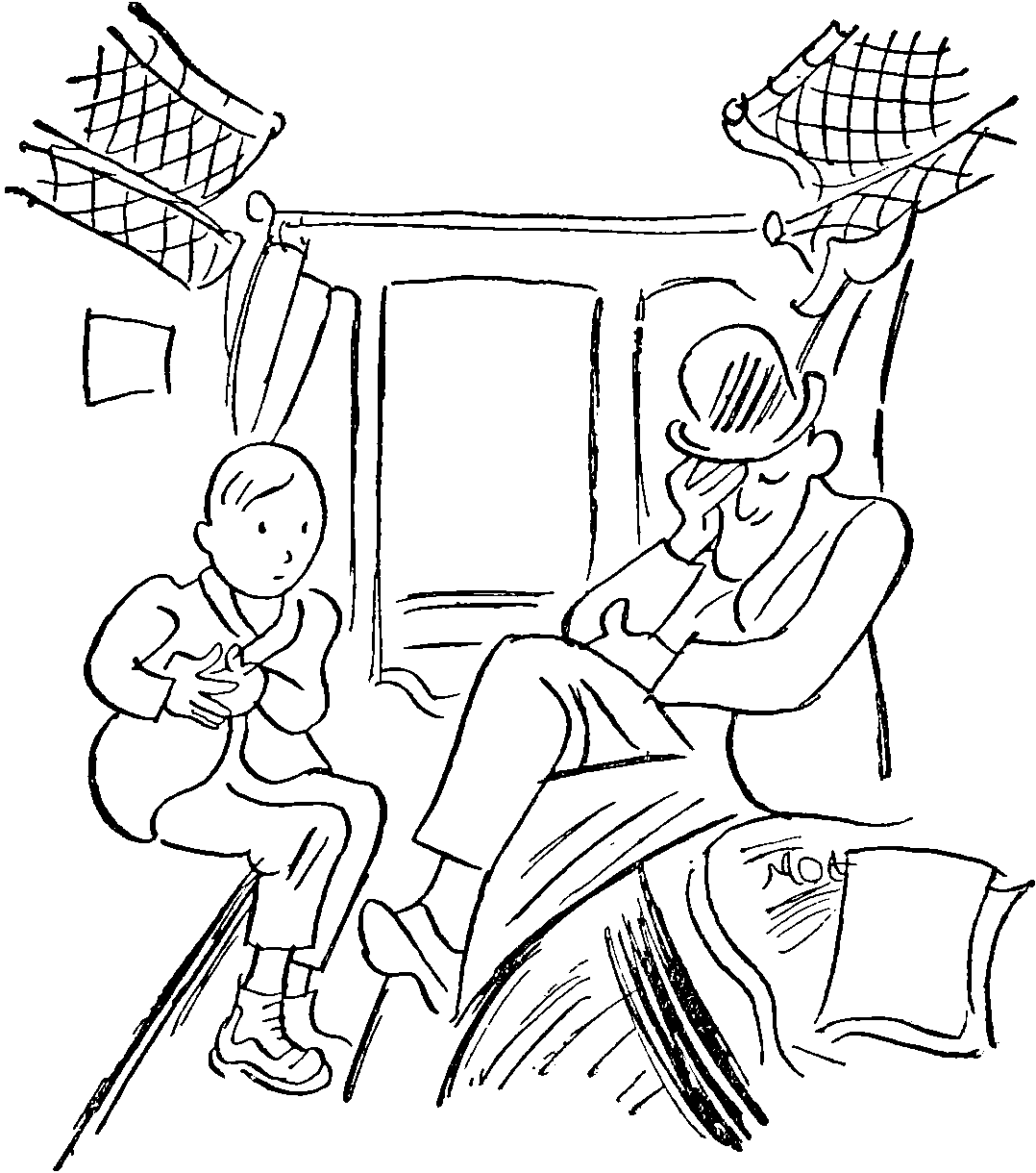
Herr Grundeis slept and snored a bit.
Whoop! Emil shook himself and was terrified. He had almost fallen asleep. He didn’t dare do that under any circumstances. If only even one other person would get on. The train stopped several times, but no one came. It was only four o’clock, and Emil still had more than two hours to ride. He pinched his legs. That always helped in school when Herr Bremser gave the history lesson.
It worked for a while. Emil wondered how Pony Hütchen looked now. But he couldn’t remember her face. He only knew that on her last visit, when she and Grandmother and Aunt Martha were in Neustadt, Pony had wanted to box with him. Naturally, he had refused, because she was a lightweight and he was at least a welterweight. It would have been unfair, he said. And if he were to give her an uppercut they would have to peel her down from the wall. But she wouldn’t let him alone until Aunt Martha interfered.
Zowie! He almost fell off the seat. Asleep again? He pinched and pinched his legs. He must have black and blue spots all over already. And still it didn’t do any good.
He tried counting buttons. He counted down and then up again. Counting down there were twenty-three buttons, and counting up there were twenty-four. Emil leaned back and pondered over how that could be.
And he fell sound asleep.