Seventeenth Chapter Frau Tischbein Is All Excited
May Massee translation
The next morning Frau Wirth rang the door bell of Frau Tischbein’s home in Neustadt.
“Morning, Frau Tischbein,” she said. “How are you?”
“Good-morning, Frau Wirth. I’m so worried. My boy hasn’t sent me a word. Every time the bell rings I think it is the postman. Shall I do your hair?”
“No, I only came over to bring you some news.”
“Please....”
“Greetings from Emil and—”
“For heaven’s sake, what happened to him? Where is he? What do you know?” cried Frau Tischbein. She was frightfully excited and held up both her hands in anxiety.
“But he’s all right, my dear, very much all right. He has caught a thief. Think of that! And the police have presented him with a reward of a thousand marks. What do you say to that? Hm? And now you must take the noon train for Berlin.”
“But how do you know all that?”
“Your sister Frau Heimbold just called me up from Berlin in the store. Emil said a few words too. And you must go right up there. As long as you have so much money that is the thing to do.”
“Yes, yes, of course,” murmured Frau Tischbein distractedly. “Thousand marks? Because he caught a thief? How did he ever get that idea? He makes nothing but blunders!”
“But this one rewarded him. A thousand marks is a lot of money!”
“Oh, go on with your thousand marks!”
“Oh, well, it might be worse. So you are going?”
“Naturally, I won’t have a minute’s peace until I’ve seen that boy.”
“Good luck to you, then, and a pleasant journey!”
“Thank you, Frau Wirth,” said the hairdresser, shaking her head, as she closed the door.
But when that afternoon she was seated in the train for Berlin she had another and a greater surprise. Opposite her a man was reading the paper.
Frau Tischbein’s gaze flickered restlessly from one corner to the other. She counted the telegraph posts that marched past the window and would have liked to run behind the train to help push it. Time dragged so.
While she was shifting around, turning her head this way and that, she happened to glance at the paper across from her.
“Good heavens!” she cried, and snatched the paper from the man who was reading it. He thought the woman had suddenly gone mad, and was almost frightened.
“There, there!” she stammered. “That—that is my boy!” And she pointed with her finger at a photograph on the front page of the paper.
“You don’t mean it?” said the man cheerfully. “You are the mother of Emil Tischbein? That’s a great youngster. Hats off to you, Frau Tischbein!”
“Yes, yes,” said the hairdresser. “Just keep your hat on, sir!” And then she began to read the article. Over it in giant letters was the caption:
A SMALL BOY AS DETECTIVE HUNDREDS OF BERLIN CHILDREN CHASE A CRIMINAL
And following that came a fully detailed story of Emil’s experiences from the Neustadt railway station to police headquarters in Berlin. Frau Tischbein was pale with excitement. And the paper rustled as if the wind were blowing, yet the windows were all shut tight The man hardly could wait for her to finish the article. But it was very long—it filled almost the whole front page. And in the midst of it was Emil’s picture.
Finally she laid the paper aside, looked over at the man, and said, “Such performances, the minute he’s left to himself! And I warned him so carefully to look after that hundred and forty marks. How could he have been so careless? As if he didn’t know that we had no money to be stolen.”
“Probably he was tired out. Perhaps, even, the thief hypnotized him. That is supposed to happen,” the man suggested. “But don’t you think it wonderful the way the youngsters carried on the affair? That was pure genius. It was simply remarkable—simply remarkable!”
“Yes, I suppose so,” answered Frau Tischbein, some, what mollified. “He is a clever boy, my son. Always the best in his class, and always industrious. But imagine if anything had happened to him! My hair is standing on end, even though it’s all over. No, I never can let him travel alone again. I’d die of worry.”
“Does he look like his picture?” asked the man.
Frau Tischbein examined the picture again and said, “Yes, it’s a good picture. Do you think he’s nice-looking?”
“Indeed, yes!” cried the man. “Such an upstanding boy, you can expect great things from him later on.”
“He should have held himself up a little straighter,” fretted his mother. “His coat is full of wrinkles. He is always supposed to unbutton it before he sits down. But he never listens!”
“Well, if he has no bigger faults than that ...” laughed the man.
“No, he hasn’t any faults, really, my Emil,” said his mother, as she blew her nose in an excess of emotion.
Then the man got off. She must keep his paper, and she read Emil’s experiences again and again to Friedrich Strasse in Berlin. Eleven times altogether.
When they arrived in Berlin, there was Emil on the platform. In honor of his mother he had put on his best suit, and as he threw his arms around her neck he asked, “Now, what do you say to me?”
“Don’t be so conceited, you monkey!”
“Well, Frau Tischbein,” he said as he hooked himself on to her arm, “I certainly am tremendously glad you came.”
“I see your suit hasn’t been improved by your thief chasing,” observed his mother, but she didn’t sound very cross.
“If you want me to, I can get a new suit.”
“From whom, then?”
“Oh, a clothing store wants to give me and the Professor and Gustav new suits. And then they’ll announce in the paper that we detectives buy our clothes only from them. That is advertising, you understand!”
“Yes, I understand!”
“But we are probably going to refuse,” Emil continued taking big steps, “although we can each get a new football, instead. You know, we think the fuss they are making over us is good and silly. The grown-ups can do that sort of thing, as far as we are concerned. They are funny and can’t help it. But children ought to cut it out.”
“Bravo!” said his mother.
“Uncle Heimbold locked up the money. A thousand marks! Isn’t that great? First of all, we’ll buy you an electric hair-drying machine. And then a winter coat lined with fur. And for me? I must think it over. Perhaps a new football, after all. Or maybe a camera. I’ll see.”
“I thought we’d better save the money and put it in the bank. Later on you can tell better what to do with it.”
“No, you get the drying machine and the warm coat. What’s left over we can put away, if you want to.”
“We’ll talk it over again,” said his mother, and squeezed his arm.
“Do you know that my picture’s been in all the papers? And long stories about me?”
“I read one of them in the train. At first I was worried about you. Are you sure nothing happened to you?”
“Not a thing. It was wonderful. I’ll tell you all about it. But first you must meet my friends.”
“Where are they, then?”
“In Schumann Street. At Aunt Martha’s. She made applecake yesterday. And then we invited the whole crowd. They’re up at the house now, making a racket.”
Sure enough, there were great goings on at the Heimbolds’. They were all there: Gustav, the Professor, Krummbiegel, the Mittenzwey brothers, Gerold, Friedrich the First, Traugott, the little Dienstag, and all the others. There were hardly enough chairs to go around.
Pony Hütchen ran from one to the next, pouring out hot chocolate from a huge pot. And Aunt Martha’s applecake was a poem. Grandmother sat on the sofa, laughing and seeming ten years younger.
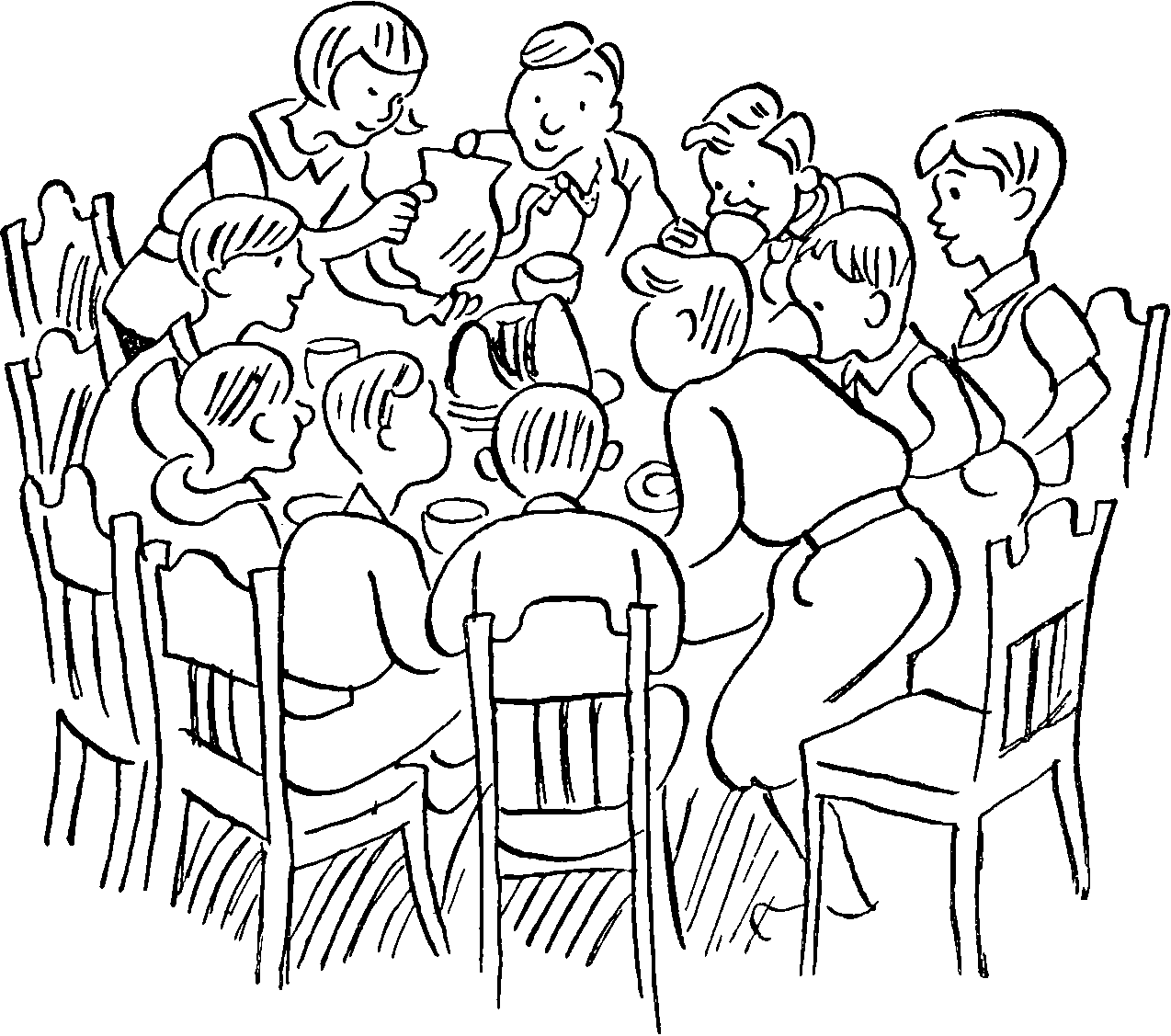
Pony Hütchen ran from one to the other pouring chocolate.
When Emil came in with his mother there was a great welcome. Every boy shook hands with her. And she thanked them all for helping her Emil so much.
“And now,” interrupted Emil, “the new suits and the footballs, we won’t take them. We won’t lend ourselves to any advertising scheme. Are we agreed?”
“Agreed,” shouted Gustav, and honked his horn so that Aunt Martha’s flowerpots rattled.
Then Grandmother rapped with her spoon on her gold cup, stood up, and announced, “Now, you all listen to me, you young scouts. I’m going to make a speech. But don’t begin to imagine things. I am not going to praise you. The others have just about made you silly. I’m not going to do that too. I’m not going to do that too.”
The boys had all become very still and did not even dare to keep on chewing.
“Chasing after a thief,” went on the grandmother, “and surrounding him with a hundred children—no, that isn’t a great performance. No offense meant, my friends. But there is one among you who would have liked to tiptoe after Herr Grundeis. He would have loved to spy around as the green bell boy in the hotel. But he stayed at home because he had agreed to—because he had agreed to.”
Everybody looked at little Dienstag. He was blushing beet red and was very much embarrassed.
“Quite right. I mean little Dienstag. Quite right,” said the grandmother. “He sat there for two days at the telephone. He knew where his duty lay. And he did it, even though he didn’t like it. That was very fine, you understand? That was very fine. You can all take an example from him. And now we’ll stand up and cheer: ‘Hurrah for little Dienstag!’”
The boys all jumped up. Pony Hütchen held her hands like a trumpet before her mouth. Aunt Martha and Emil’s mother came in from the kitchen. And they all shouted, “Three cheers for little Dienstag!”
Then they all sat down again. And little Dienstag took a deep breath and gulped. “Thank you very much. But that’s too much. You would have done it too. Any boy does what he has to. Enough! That’s all.”
Pony Hütchen held up the big chocolate pot and cried, “Who wants anything more to drink, you fellows? Now we’ll drink to Emil!”