Fourth Chapter A Dream in Which There Is Much Running
May Massee translation
Suddenly it seemed to Emil that the train was going around in a circle, just as the toy trains do that children play with. He looked out of the window and found it most curious. The circle was getting smaller and smaller. The engine was coming nearer and nearer to the last car. And it seemed as if it were doing that on purpose. The train turned around on itself just like a dog that tries to bite his own tail. And inside that black racing circle were trees and a glass windmill and a great house with two hundred stories.
Emil wanted to know what time it was and started to pull his watch out of his pocket. He pulled and pulled, and finally it was the big grandfather’s clock out of his mother’s room. He looked at the face, and there it said, “185 miles an hour. It is forbidden on penalty of your life to spit on the floor!” He looked out of the window again. The engine was coming nearer and nearer to the last car. And he was terribly worried. Because if the engine struck the last car naturally there would be a train wreck. That was clear. Emil did not want to wait for that on any account. He opened the door and ran along the outside steps. Perhaps the engineer had gone to sleep? Emil looked through the windows of the compartments as he worked his way along. There was no one sitting anywhere. The train was empty. Emil saw only one man, who had on a stiff hat made of chocolate. The man broke off a big piece from his hat brim and gulped it down. Emil rapped on the windowpane and pointed at the engine. But the man only laughed, broke himself another big piece of chocolate, and patted himself on the stomach because it tasted so good.
Finally Emil got to the coal car. Then he clambered up to the engineer’s cabin. The engineer was hunched up on a coachman’s seat, whirling his whip and holding the reins as if there were horses hitched in front of the train. And that’s just what there were! Six pair of horses dragged the train. They had silver roller skates on their hoofs, and they flew along over the rails singing, “Must I go, must I go to that city so far?”
Emil shook the coachman and shouted, “Pull up your horses or you’ll have an accident.” Then he saw that the coachman was none other than Officer Jeschke.
He gave Emil a piercing glance and shouted, “Who were the other youngsters? Who painted up the Grand Duke Karl?”
“Me,” said Emil.
“Who else?”
“That I won’t tell!”
“Then we’ll keep right on going in a circle!”
And Officer Jeschke whipped up his steeds so that they reared up and flew faster than ever toward the last car. And in the last car sat Frau Jakob, brandishing the shoes in her hand and frightened to death because the horses were already snapping at her toes.
“I’ll give you twenty marks, Officer,” shouted Emil.
“Please stop such nonsense!” shrieked Jeschke and plied his whip on the horses as if he were possessed.
Emil couldn’t bear it any longer, he jumped off the train. He turned twenty somersaults on the way down, but it didn’t hurt him. He stood up and looked back at the train. It was standing still, and the twelve horses turned their heads toward Emil. Officer Jeschke had sprung up and was whipping his horses and bellowing, “Up there and after him!” And then the twelve horses sprang off the tracks and sprinted after Emil, and the cars hopped about like rubber balls.
Emil wasted no time but ran away as fast as he could. Over a meadow, past many trees, through a brook, toward the skyscraper. Every now and then he looked behind him. The train thundered on with no let-up. It knocked the trees right and left and split them to pieces. Only one old oak was left standing, and on its topmost branch sat fat Frau Jakob, swaying in the wind and weeping because she couldn’t get her shoe on. Emil ran on.
In the house that was two hundred stories high there was a great black door. He ran in, through the house and out the other side. The train followed after. Emil would much rather have sat himself down in a corner to sleep, for he was fearfully tired and trembling in every limb. But he dared not go to sleep. The train was already rattling through the house.
Emil saw an iron ladder. It went up the house way to the roof. He began to climb. Luckily he was good at gym work. While he climbed he counted the stories. At the 50th floor he risked turning around. The trees had grown very small, and the glass windmill was hardly recognizable. But, oh, horrors! the train was running right up, up the side of the house. Emil climbed higher and higher. And the train snorted and clumped up the ladder rungs just as if they were tracks.
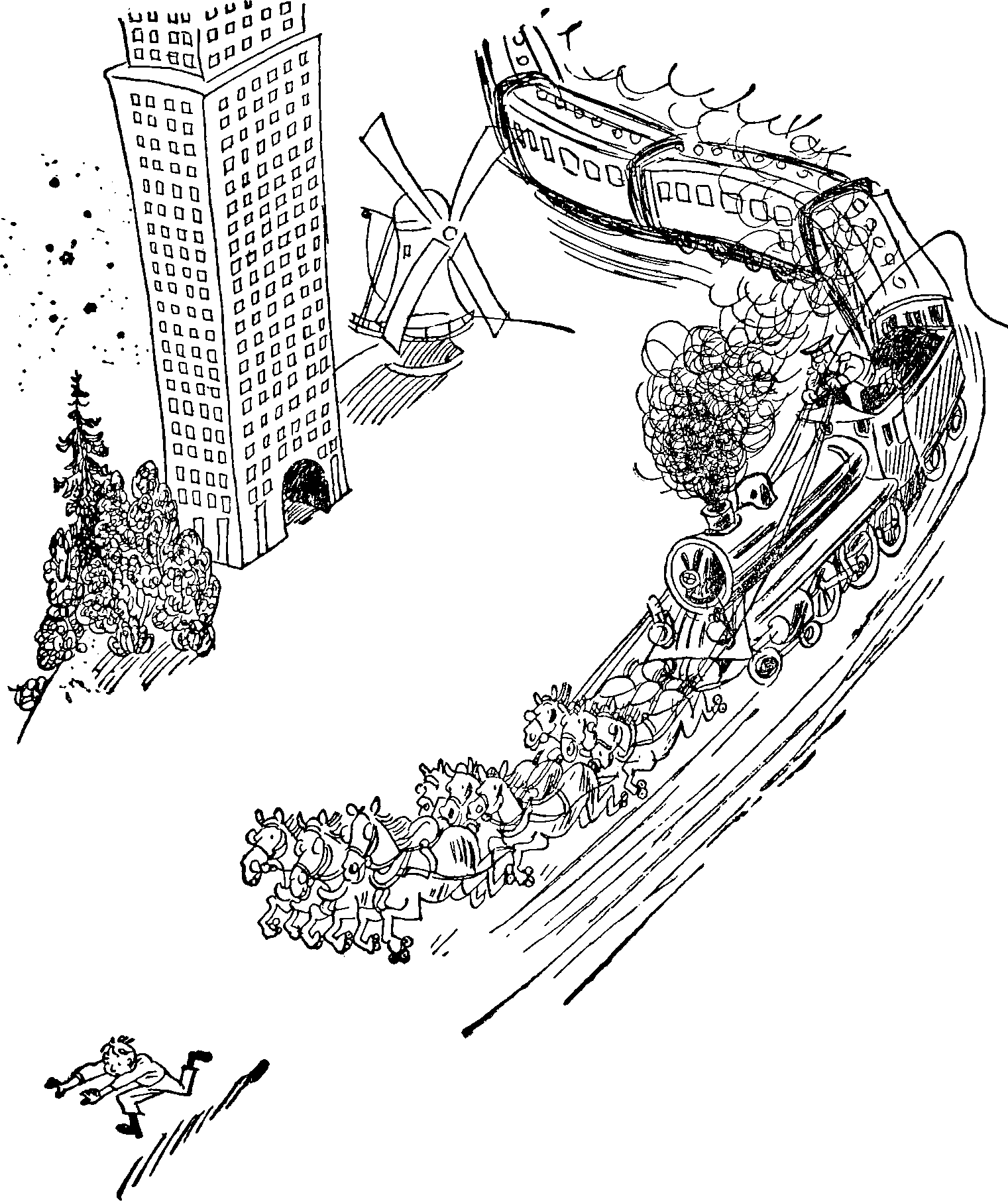
Emil ran away as fast as he could.
The 100th floor, 120th, 140th, 160th, 180th, 190th, 200th floor. Emil stood on the roof and had no idea what to do next. He could hear the neighing of the horses. Then the boy ran to the other end of the roof, took his handkerchief out of his pocket, and spread it out. And as the sweating horses came creeping over the edge of the roof with the train after them Emil stretched his handkerchief high above his head and sprang off into space. He could hear the train behind him knocking the chimneys over. Then for a little while he could neither hear nor see anything.
And then, crash! He plumped down into a meadow. At first he lay there exhausted with his eyes closed, and would have liked to dream a beautiful dream. But because he didn’t feel quite safe yet he looked up at the house, and there he saw the twelve horses on the roof, opening umbrellas. And Officer Jeschke had an umbrella too and was driving the horses on with it. They sat back on their haunches, gave themselves a jerk, and sprang off into the depths. And then the train sailed down toward the meadow, growing bigger by the minute.
Emil jumped up again and ran across the meadow toward the glass mill. It was transparent, and he saw his mother in there washing Frau Augustin’s hair. “Thank goodness!” he thought and ran through the back door into the mill.
“Mummy,” he called, “whatever can I do?”
“What’s the matter, my child?” asked his mother, and scrubbed away busily.
“Look through the wall!”
Frau Tischbein looked out just in time to see the train and the horses land in the meadow and come tearing across to the mill.
“Why, that is Officer Jeschke,” said his mother, and shook her head in astonishment.
“He has been chasing after me the whole time like mad.”
“Well, what in the world?”
“A while ago I painted a red nose and a mustache on the Grand Duke Karl Crooked Face in the market place.”
“Yes, and where else should you paint mustaches?” asked Frau Augustin, and sneezed violently.
“Nowhere else, Frau Augustin. But that isn’t the worst. He wants to know who else was there. And that I can’t tell him. That’s a question of honor.”
“Emil is right about that,” agreed his mother, “but what shall we do?”
“Put on the motor, dear Frau Tischbein,” said Frau Augustin.
Emil’s mother pushed down a lever that was underneath the table. The windmill sails began to turn, and as they were made of glass and the sun was shining on them, they shimmered and shone so that one could hardly bear to look at them.
And the twelve horses running with their train became so frightened that they shied and reared up and refused to take another step. Officer Jeschke swore so they could hear him through the glass walls. But the horses didn’t stir from the spot.
“There, now we can wash my scalp in peace,” said Frau Augustin. “Nothing more can happen to your boy.”
Frau Tischbein accordingly went on with her work. Emil sat down on a chair that was also made of glass and whistled to himself. Then he laughed out loud and said, “This is marvelous. If I had known before that you were here I’d never have climbed up that blamed house.”
“I hope you didn’t tear your suit,” said his mother. Then she asked, “Did you take good care of the money?”
At that Emil gave a great jump. And with a crash he fell off the glass chair.
And woke up.