Fifteenth Chapter Emil Visits Police Headquarters
May Massee translation
The procession marched to the nearest police station. The policeman informed a captain what had happened. Emil filled in the report. Then he had to tell them when and where he was born, who he was, and where he lived. And the captain wrote it all down. In ink.
“And what is your name?” he asked the thief.
“Herbert Kiessling,” answered the rascal.
That made the boys—Emil, Gustav, and the Professor—laugh out loud. And the bank clerk, who had given over the hundred and forty marks to the captain, joined in with them.
“Man, what a turnip!” cried Gustav. “First he is Grundeis. Then he is Müller. Now he is Kiessling. Now I am just crazy to know who he really is!”
“Silence!” growled the captain. “We’ll find that out too.”
Herr Grundeis, Müller, Kiessling, gave his temporary address as the Hôtel Kreid. Then he gave the date of his birth and his home. Identification papers he had none.
“And where were you until yesterday?” questioned the captain.
“In Gross-Grünau,” declared the thief.
“That is certainly lying again,” called the Professor.
“Silence!” growled the captain. “We’ll find that out too.”
The bank clerk wondered whether he might leave. Then information about him was noted down. He patted Emil kindly on the shoulder and departed.
“Did you yesterday afternoon steal a hundred and forty marks from the schoolboy, Emil Tischbein, on the train coming from Neustadt to Berlin, Kiessling?” questioned the captain.
“Yes,” said the thief gloomily. “I don’t know how—it happened very suddenly. The boy was sleeping in the corner. And then the envelope fell out. And then I picked it up and just wanted to look to see what was inside. And as I had absolutely no money at the time—”
“What a swindler,” cried Emil. “I had the money pinned tight in my jacket pocket. It could not have fallen out.”
“And he wasn’t in such great need of it either, or he wouldn’t have had Emil’s money untouched in his pocket. Meanwhile he had to pay for taxi, boiled eggs, and beer,” remarked the Professor.
“Silence!” growled the captain. “We’ll find that out too.”
And he wrote down everything that was told.
“Could you let me go now, officer?” asked the thief, and squinted out of very politeness. “I’ve admitted the theft. And you know where I live. I have business in Berlin and would like to ’tend to a few errands.”
“Don’t make me laugh,” said the captain sternly, and called the police headquarters to have them send the patrol over, because a railway thief had been arrested in his district.
“When do I get my money?” inquired Emil anxiously.
“At police headquarters,” said the captain. “You will go right there, and there everything will be arranged.”
“Emil, man!” whispered Gustav, “now you’ll have to go to ‘Alex’2 in the Black Maria.”
“Stuff and nonsense,” said the captain. “Have you any money, Tischbein?”
“Yes, indeed,” answered Emil. “The boys took up a collection yesterday. And the porter of Hôtel Kreid lent me ten marks.”
“Genuine detectives! Confounded rascals!” scowled the captain. But the scolding sounded very good-natured. “Well, then, Tischbein, you take the subway to Alexander Place and announce yourself to Criminal Sergeant Lurje. Anything further you will soon find out. And you’ll get your money back there.”
“Could I first take the ten marks back to the porter?” Emil wanted to know.
“Of course.”
In a few minutes the police van came. And Herr Grundeis Müller Kiessling had to climb in. The captain gave the policeman seated inside the written report and the hundred and forty marks. Also the pin. And then the Black Maria rumbled off. The boys who stood in the street jeered at the thief. But he paid no attention. Probably because he was too proud of having the privilege of riding in a private car.
Emil shook hands with the captain and thanked him.
Then the Professor informed the children who had waited before the station that Emil would get his money at “Alex,” and the chase was over. The children streamed off home in great crowds. Only the intimate friends took Emil to the hotel and to the Nollendorf subway station. And he told them to telephone little Dienstag at noon. So he would know how everything had come out. And he hoped very much to see them again before he went back to Neustadt. And he thanked them all from the bottom of his heart for their help. And they’d get their money back too.
“If you dare to give our money back you’ll get it in the neck, man!” cried Gustav. “And, besides, we have to fight—on account of your funny suit.”
“Oh, man!” said Emil, and grabbed Gustav and the Professor by the hand. “I feel so good. We’d better let the fight go. It would break my heart to knock you down for the count.”
“You wouldn’t succeed in that, even if you were in a bad humor, you fathead!” cried Gustav.
And then the three went to Alexander Place to police headquarters, and they had to go through many corridors and past countless rooms. And at last they found Criminal Sergeant Lurje. He was just eating breakfast. Emil introduced himself.
“Aha,” said Herr Lurje and chewed busily. “Emil Stuhlbein, our youthful amateur detective. Already announced by telephone. The commissioner awaits you. He wants to talk to you. Come with me now.”
“Tischbein is my name,” corrected Emil.
“Six of one and half a dozen of the other,” said Herr Lurje, and took another bite of roll.
“We’ll wait here for you,” the Professor decided. And Gustav called after Emil, “Make it snappy. When I see anybody chewing I always get hungry myself.”
Herr Lurje walked through more halls, left, right, left again. Then he knocked on a door. A voice called, “Come in!” Lurje opened the door a crack and said, chewing, “The little detective is here, Commissioner, Emil Fischbein. You know.”
“Tischbein is my name,” Emil explained emphatically.
“Fine name too,” said Herr Lurje, and gave Emil a shove so that he tumbled into the room.
The commissioner was a very nice man. Emil had to be seated in a comfortable armchair and tell the whole story, every bit, from the beginning. At the end the commissioner said solemnly, “So, and now you’ll get your money back.”
“Praises be!” Emil took a long breath and put his money away. And most carefully.
“But don’t let it be stolen again!”
“No! Impossible! I’ll take it right to Grandmother.”
“Right! I had almost forgotten. You must give me your Berlin address. Are you staying a few days?”
“I’d like to,” said Emil. “I live at 15 Schumann Street with the Heimbolds. That’s my uncle’s name. My aunt’s, too.”
“It’s wonderful how you children did it,” commented the commissioner as he stuck a big cigar into his mouth.
“The fellows worked wonderfully, that’s true,” cried Emil excitedly. “This Gustav with his horn, and the Professor, and little Dienstag, and Krummbiegel, and the Mittenzwey brothers—all of them, in fact. It was a pleasure to work with them. Especially the Professor. He is an ace!”
“Well, yes, you yourself are not exactly made of mush,” remarked the man as he puffed out a cloud.
“What I’d like to ask, Herr Commissioner, what will they do to Grundeis, or whatever my thief is called?”
“We have taken him to the Identification Bureau. There he will be photographed. And his fingerprints taken. And after that we will compare the picture and the fingerprints with the photographs in our Rogues’ Gallery.”
“What is that?”
“There we have pictures of all the convicted criminals. And there we have the fingerprints, footprints, and such of the criminals that we haven’t caught yet but that we are hunting. It might be possible that the man who stole from you had committed other thefts and burglaries before he helped himself to your money. Isn’t that true?”
“That’s so. I hadn’t thought of that at all!”
“Just a moment,” said the nice commissioner as the telephone rang. “Yes, indeed ... something interesting for you ... come right up to my room,” he spoke into the transmitter. Then he hung up and said, “Now a few men from the papers will be along to interview you.”
“What is that?” asked Emil.
“Interviewing means asking questions.”
“It can’t be!” cried Emil. “Will I be in the paper, then?”
“Apparently,” said the commissioner. “When a schoolboy catches a thief he becomes famous.”
There came a knock, and four men walked into the room. The commissioner shook hands with them and told them briefly about Emil’s experience. The four men busily wrote it down.
“Wonderful,” said one of the reporters at the end. “The country boy as detective.”
“Perhaps you’ll engage him for a plain-clothes man,” advised another laughing.
“Why didn’t you go right to a policeman and tell him all about it?” asked a third.
Emil was embarrassed. He thought of Policeman Jeschke in Neustadt and of his dream. And his throat felt very dry.
“Well?” queried the commissioner.
Emil shrugged his shoulders and said, “Well, all right! Because in Neustadt I had painted a red nose and a big mustache on the monument of the Grand Duke Karl. Please, arrest me, Herr Commissioner!”
Then the five men laughed instead of drawing long faces. And the commissioner cried, “But, Emil, we couldn’t afford to put our best detective in jail.”
“No? Truly? Oh, I am glad of that,” said the boy, much relieved. Then he turned to one of the reporters and asked, “Don’t you know me?”
“No,” said the man.
“You paid for my ticket yesterday on Line 177 because I didn’t have any money.”
“Sure enough,” exclaimed the man. “Now I remember. You wanted to know my address so that you could send back my groschen.”
“Will you take it now?” asked Emil, and took ten pfennigs out of his trousers pocket.
“But, nonsense,” answered the man. “You had even introduced yourself.”
“Surely, I often do,” explained the boy. “Emil Tischbein is my name.”
“My name is Kästner,” said the journalist, and they shook hands.
“Splendid,” cried the commissioner. “Old acquaintances.”
“And now, Emil,” said Herr Kästner, “will you come with me for a bit to the editor’s office? First we’ll go somewhere and have cake with whipped cream.”
“Couldn’t I invite you?” asked Emil.
“What a proud rascal!” The men were very much amused.
“No, you must let me pay,” said Herr Kästner.
“I’d like to,” answered Emil, “but the Professor and Gustav are waiting outside for me.”
“Of course, we’ll take them with us,” declared Herr Kästner.
The other journalists still had all kinds of questions to ask. Emil gave them an exact statement. And they took notes again.
“Is the thief really a new one?” asked one of the men.
“I think not,” answered the commissioner. “Perhaps we are due for a great surprise. Call me up anyway in an hour, gentlemen, all of you.”
Then they all departed. And Emil went with Herr Kästner back to Criminal Sergeant Lurje. He was still chewing and said, “Aha, the little Überbein!”
“Tischbein,” said Emil.
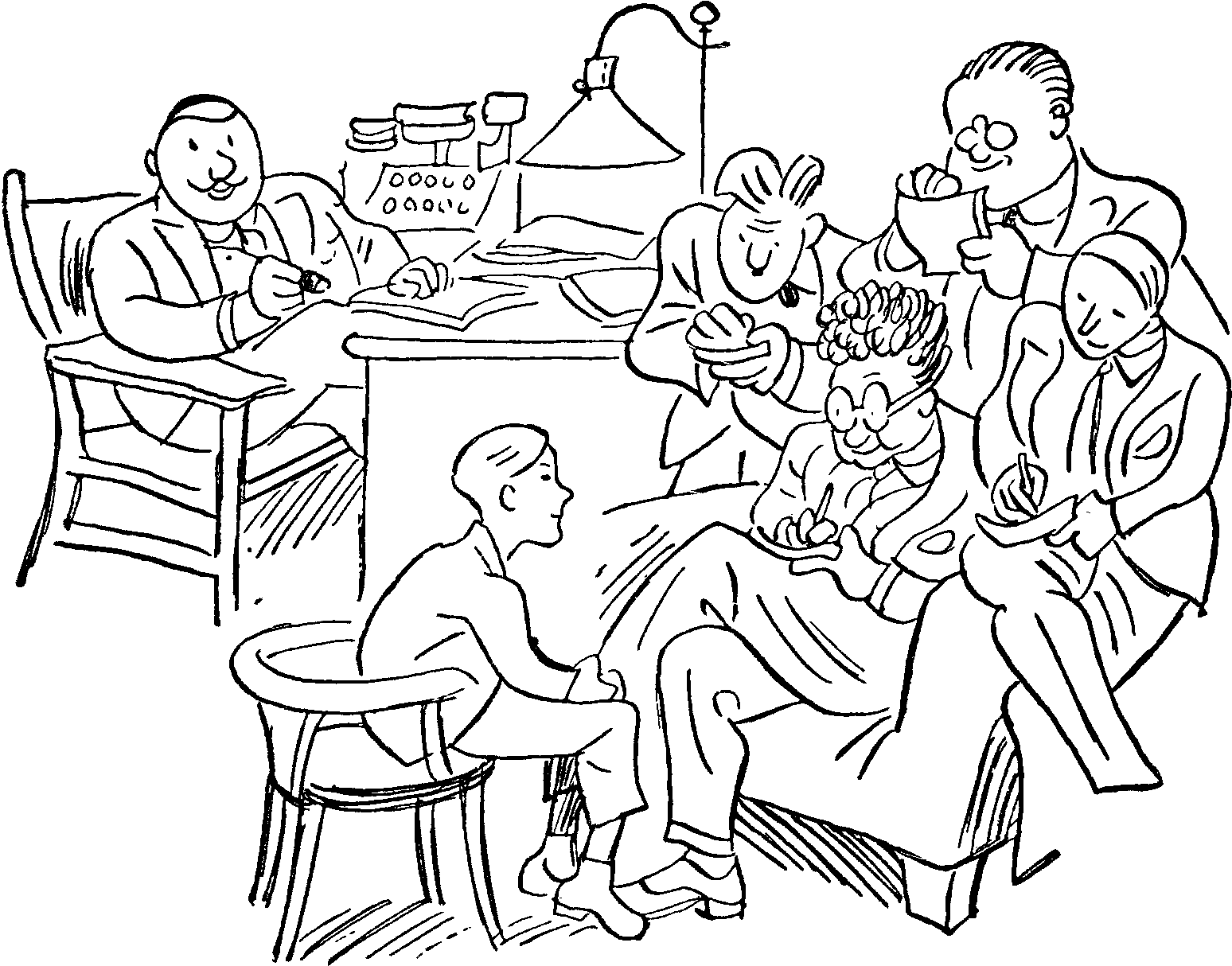
“The reporters had many questions to ask.
Then Herr Kästner took a taxi for Emil, Gustav, and the Professor, and they went first to a pastry shop. On the way Gustav honked. And they were delighted when Herr Kästner jumped. In the pastry shop the boys were very jolly. They ate cherry tart with much whipped cream and told whatever occurred to them.
They told about the council of war in Nikolsburger Place, about the taxi chase, about the night in the hotel, about Gustav as the bell boy, about the excitement in the bank. And at the end Herr Kästner said, “You are certainly three wonderful boys.”
At that they were very proud of themselves, and each ate another piece of cake.
After that Gustav and the Professor climbed into a motor bus. Emil reminded them to call up little Dienstag in the afternoon, and then he went with Herr Kästner to the newspaper office.
The newspaper building was huge. It was almost as big as the police headquarters at Alexander Place. And in the corridors there was such a rushing and bustling that you might think there was an obstacle race going on.
They came to a room in which a pretty blonde lady was sitting. And Herr Kästner walked up and down and dictated to the lady for her typewriter everything that Emil had told him. Every once in a while he would stop and ask Emil, “Is that right?” And when Emil nodded Herr Kästner would start dictating again.
Then he called up the police commissioner.
“What’s that you say?” cried Kästner. “Well, if that isn’t absurd.... I mustn’t tell him anything about it yet? Soooo, that too? Well, I am glad.... Thank you very much! That will be a real scoop.”
He hung up, looked at the boy as if he had never seen him before, and said, “Emil, come with me quick! We must have your picture taken.”
“Good gracious!” said Emil, astonished. However, he submitted to everything, went up three stories higher with Herr Kästner, and entered a very bright room with many windows. First he combed his hair, and then he had his picture taken.
Finally Herr Kästner took him into the composing room—there was a clatter, like that of a thousand typewriters—Herr Kästner gave a man the sheets that the lovely blonde lady had typed and said that he’d be right back up because the stuff was very important, but first he had to send the youngster back to his grandmother.
Then they took the elevator to the ground floor and walked out to the entrance. Herr Kästner beckoned to a taxi, seated Emil, gave money to the chauffeur, although the boy did not want him to, and said, “Take my young friend to Number 15 Schumann Street.”
They shook hands heartily. And Herr Kästner added, “My compliments to your mother when you get home. She must be a very dear woman.”
“Indeed she is,” said Emil.
“One thing more,” called Herr Kästner as the car started off, “read the paper this afternoon. You’ll be surprised, young man.”
Emil turned and waved. And Herr Kästner waved back.
And then the taxi swung round a corner.