PART FIRST. OF INFLAMMATION. (continued 2)
Reading edition
When gangrene follows the tight application of a ligature, the death of the part seems to depend more on obstruction to the circulation of the blood, than on any diminution of the nervous energy, for we do not observe that paralytic limbs are peculiarly liable to gangrene. The surgeon frequently takes advantage of the fact that a part soon dies when its supply of blood is cut off, or its return in the veins interrupted; and has recourse to ligature for removal of parts, When he considers it inexpedient to employ cutting instruments.
Mortification may be produced by the above-mentioned causes, either immediately or consecutively; and it will occur in some constitutions, or states of constitution, at some periods of life, in some structures, and in some parts of the body, more readily than in others.
Inflammatory action is seldom so intense as to terminate in death of the part, unless the power of that part has been diminished by previous local or constitutional disease, or by injury; and the inflammation preceding gangrene is all along attended by symptoms of so well-marked debility, both local and general, that it is frequently designated the Inflammatio Debilis. Of inflammatory affections, the erysipelatous most frequently terminates in gangrene; in other words, the power of resisting incited action is not so great in the cellular tissue and skin as in other parts of the body.
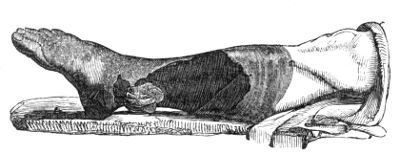
The period at which the symptoms of gangrene appear after an accident varies, in general, according to the severity of the injury. As was already observed, the part may be immediately deprived of its vitality—if not, symptoms of gangrene sometimes appear within a few hours after reaction has taken place; while in other cases, tension, pain, and heat occur, and may continue for a longer or shorter time, according to the degree of power remaining in the part. Tension often exists to a great extent after severe injuries, from extravasation of blood or serum; the functions of the vessels are thereby interrupted, and gangrene is inevitable. As the action proceeds, the pain and heat often subside—the parts become flaccid—dark-coloured serum is effused beneath the cuticle, forming what are termed Phlyctenæ—the skin becomes dull and livid—dark streaks extend along the limb, perhaps from the colouring matter of the blood transuding, as in commencing putrefaction in the dead body—air is effused into the subcutaneous cellular tissue, causing a sense of crepitation when pressed by the finger—sloughs form, either black or of an ash colour—and the gangrene involves a greater or less extent of the limb. The mortification is here represented as attacking a limb that had suffered from compound fracture. The dark part around and above the protruded bone was in a state of sphacelus. The dorsum of the foot and the integument towards the knee were only gangrenous. The patient was advanced in life, and the state of the constitution such as to induce a belief that there was a predisposition to mortification. The removal of the limb was, under the circumstances, reckoned inexpedient. In some instances, the mortification is most towards the surface; in others, it is chiefly amongst the deeply seated parts. Sudden cessation of pain is generally regarded as an unequivocal sign of the occurrence of gangrene, especially in the internal viscera; but it not unfrequently happens that the painful sensations suddenly cease, whilst no gangrene supervenes, and that a part mortifies, whilst the pain continues but little abated.
In compound fractures, dislocations, or severe bruises of the soft parts, dark-coloured, prominent points occasionally appear, in consequence of the effusion of bloody serum beneath the cuticle; in these, however, the fluid is speedily absorbed, and the surface resumes its natural aspect, the cuticle exfoliating and being reproduced; and it is of consequence to know their real nature, for, if mistaken for the gangrenous phlyctenæ, the inexperienced practitioner may be alarmed, and, consequently, have recourse to very injudicious practice.
When the process of gangrene is checked, the skin immediately beyond the mortified part becomes of a brighter hue, and is affected by a more healthy species of inflammation, which ultimately terminates in ulceration, with purulent discharge, and thereby forms what is called the line of demarcation between the dead and the living parts; the process, commencing in the integuments, gradually extends to the deeply seated parts, so that the mortified portion is ultimately attached to the living merely through the medium of bone or ligament. Arteries appear more than any other texture to resist sloughing; and those leading to a mortified part are found contracted and filled with coagulated blood, so that the spontaneous separation of the sloughs, and even incisions for their removal, made in sound parts, are followed by little or no bleeding. This salutary change in the arteries may be accounted for by supposing, that the inflammatory action which leads to the separation of the dead substance from the living affects the arteries at that point as well as the other structures, causing adhesion of their internal surface, and obliteration of their cavities; and the natural result is, that the calibre of the artery above the obliterated point gradually diminishes in size, and the blood coagulates up to the nearest collateral branch: but in consequence of extension of the inflammatory action, the collateral branches may also be obliterated to a considerable extent upwards, and thus the contraction and coagulation in the larger trunk will also extend in proportion. Besides, before the line of separation has commenced, arteries cannot transmit their contents into the sphacelated part, any more than into an extraneous body; so that the circulation of the blood in them is as effectually obstructed as if a ligature were tightly applied; in this way, also, the contraction and coagulation may be accounted for.
Mortification is accompanied with great anxiety; coldness and clamminess of the face and extremities; weak, irregular, and hurried circulation; quick, short breathing; a cadaverous expression of countenance; hiccup (which, however, often occurs in very slight sloughing, or when no sloughing has taken place, in external or internal inflammations, extravasations, &c.); by diarrhœa, vomiting, and in hopeless cases, more especially of traumatic gangrene, by delirium and coma; in fact, almost all the symptoms of severe constitutional irritation are more or less fully developed. In some cases, the patients are restless and unmanageable; in others, low and dejected. The disease often proceeds with fearful rapidity to a fatal termination, the patient becoming comatose from effusion within the cranium; but in other instances, in which the vigour of the constitution is greater, and the extent of mischief less, the system bears up under the affection, and a separation is effected between the dead and living parts. The danger is in general to be estimated by a consideration of the size and importance of the part, and of the age and constitution. The destructive consequences of sphacelus arise both from a local and general cause; for the mere application of putrid animal substance to a part still alive—the infiltration, for instance, of dark serosity into the cellular tissue in the course of a limb—causes a sort of inflammation attended with symptoms of diminished power, and followed by constitutional disturbance; whilst the ultimate extinction of life may be imputed to the effect produced on the system by the part previously to its becoming sphacelated, and to the sympathy between the system and the parts which are left in a weak and moribund condition, and which seem endowed with a disposition to extend the disease.
In the treatment of mortification, no one would think of using any means, local or general, so long as the cause remained; and it therefore must in the first place be removed, otherwise the mischief may speedily become irreparable; thus, a stricture must be divided, irritating fluids evacuated, foreign bodies extracted, &c.
In chronic gangrene the cause is constitutional, and the means employed must be directed accordingly. In general, the power of the constitution requires support, though, in cases where much fever is present, it may often be necessary to keep the patient on low diet: exhibit salines and mild purgatives in the first instance. The effects of food should be attentively watched, and its quantity increased or diminished accordingly. On the subsidence of the fever, and when sphacelus has occurred, wine and animal food must be given abundantly. Stimulants, strictly so called, are not admissible until the line of separation be formed, and their exhibition must then be regulated by the circumstances of the case. Opium and other anodynes are found necessary during the progress of the disease, to allay irritation and produce sleep; opium has been recommended on very high authority, that of Mr. Pott, in mortification of the lower limbs. The bowels must be attended to. Peruvian bark was at one time supposed to be a specific in this disease, but experience has not born out the opinion; it seldom agrees in substance, and the decoction, with or without the compound tincture or sulphate of quina, will be found much more useful in supporting the power and tone of the digestive organs. After the line of separation has been formed, and not till then, the surgeon may interfere, and assist nature in her work, dividing the exposed bones or ligaments by which the dead parts still adhere to the living; or he may perform amputation immediately below the line of demarcation. Amputation in the sound parts cannot be recommended: for vitality is impaired throughout the system, and more particularly near and above the line of demarcation, where, though the structure seems entire, yet the incisions are made in parts really diseased, and which would almost certainly and speedily mortify. In fact, amputation above the line of separation, in whatever way performed, is seldom if ever productive of advantage in spontaneous gangrene.
In order to prevent the occurrence of gangrene after exposure to intense cold, the frigid part must be cautiously and slowly restored to its natural temperature; first by being either placed in very cold water, or rubbed with snow; afterwards, by the degree of warmth in the applications, and surrounding atmosphere, being gradually increased.
In acute gangrene, and in robust constitutions, when the affection arises from over-action, abstraction of blood is had recourse to with marked advantage. In some cases it may be employed, but with due caution, even after sphacelus to a slight extent has occurred. In gangrene, purging and bleeding must not be had recourse to but with the greatest circumspection; for it ought always to be remembered, that however strongly they may be indicated, the time is not far distant when they will be totally inadmissible, and when the weakening effects of depletion will prove highly prejudicial, particularly in cases where the mischief is proceeding rapidly.
The loss of blood is frequently beneficial in sloughing phagedena, as is exemplified on the occurrence of spontaneous hemorrhage in such cases.
When a portion of a limb, throughout the greater part of its substance, is so injured that it evidently cannot recover, it ought to be removed instantly, and before the constitution has suffered.
When gangrene follows inflammatory action, this is first to be moderated, and then the strength by all possible means supported.
When only a portion of the soft parts of a limb is destroyed by mortification, and it is likely that the member may be saved and prove useful to the patient, measures should be adopted to hasten separation of the dead parts, and reparation of the breach in the living.
After the separation of sloughs has commenced, the attention of the surgeon is chiefly to be directed towards the constitution; it must be supported and strengthened by nourishing food, wine, and tonics, or by stimulants, if necessary. Bark in substance, acids, and other supposed antiseptics, are of but little use.
The local applications which have been employed are numerous; poultices of all kinds, charcoal, carrot, and effervescing; various lotions to the surrounding parts, spirituous applications, such as several of the tinctures, liniment of turpentine, balsams, &c., with the view of correcting the fetor. But it is evident that such applications to a dead part can be productive of no effect; the only beneficial result that can be expected from such means is removal of the fetid smell, which can be effected, if need be, by sprinkling a solution of the chloride of soda on the body-linens and bed-clothes. Scarifications are sometimes used; when these are made merely into the sphacelated part, they can be productive of good only by allowing the escape of matter; when they extend more deeply, they are injurious. This practice, however, as will be hereafter noticed, is adopted with the best effects when mortification is threatened.7
When the sloughs become loose, they must be removed bit by bit with scissors; and when the sphacelated part has separated entirely, the healing of the breach is to be promoted by judicious dressing, bandaging, and by proper position.
In mortification of an extremity, in consequence of injury, removal of the part by incision in the sound substance was formerly as much dreaded as in chronic cases before the separation had commenced; but such fears have now subsided, and the practice of delay has been in a great measure relinquished,—amputation being performed in the sound part, at a considerable distance from the mortified or even gangrenous tissues, and during the progress of the disease, occasionally with a favourable result. If the surgeon defer the operation until a line of separation have begun to form, he will soon discover the danger of his delay; the constitution will, in the majority of cases, rapidly sink under the malady before the progress of the disease is in any measure checked, or any attempt is made to throw off the mortified parts. Two cases which lately occurred in my hospital practice, are here introduced from the “Lancet,” to show how different the progress is, and how opposite the practice ought to be. Both the patients made excellent and rapid recoveries.
“Sarah Arnold, æt. 75, was admitted on the 26th of January. She has been a person of great mental and bodily activity, and has enjoyed excellent health from her infancy, until her present illness, although necessarily exposed, from the nature of her occupation, a gatherer and hawker of watercresses, to all varieties of weather. About six weeks ago, without being more than usually exposed to cold, she was seized with severe rigors. Two days afterwards she began to complain of slight pain, with clinching of the fingers, which at the same time became discoloured at the tips, and were partially deprived of sensation. This at first did not give rise to much uneasiness, and no treatment was employed; and it was not until a week after the commencement of the disease, when the discoloration had passed the wrist, and the hand had become dry and shrivelled, and motion and sensation in it were completely lost, that a medical man was called in. Both internal and local remedies were then employed, but without in the least retarding the progress of the disease, which in about a fortnight from her seizure had extended a little way above the middle of the humerus, beyond which it did not pass. At present there is a well-marked line of separation between the living and the gangrenous parts, but there are two livid spots beyond it, on the outer side of the arm; on the inner side, where the disease has extended a little higher up than the outer, suppuration has already commenced. The integuments in the immediate neighbourhood of the diseased parts are slightly reddened and tumefied, and it is there only that she complains of some slight pain. The hand and wrist are dry and shrivelled, but above this the parts are soft and flaccid. Below the line of demarcation, the extremity is of a dark colour, resembling the skin of a negro, and completely deprived of the power of motion and sensation; but she complains of a disagreeable tingling, referred to the fingers. The discoloured parts are quite cold, and the pulse cannot be felt, even in the axilla. Though she complains much of debility, the system seems to be but little affected. The appetite is very good; the skin is moderately warm; the pulse is 98, and of good strength; the tongue is moist and clean. She sleeps little. ℞. Haust. c. Sol. M. Morph. gtt. xxv. M. Vini Rub. ℥iv. Water-dressing to the arm at the line of separation.
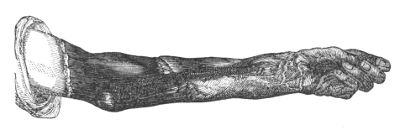
“27. She continues much the same as yesterday; slept little, bowels moved twice; tongue clean and moist; appetite very good; pulse as before; heat of skin natural; intellect clear; no expression of anxiety in the countenance. ℞. Haust. Con. Vin. Full diet.
“28. The suppuration on the inner side of the arm is more copious, and the discharge is more fetid. The livid spots on the outer side of the arm have not extended, and there is some slight redness around them. Pulse 104, of good strength; tongue clean and moist; heat of skin still natural; appetite good; bowels moved once since the last report. Continue. A little Sol. Chlor. Calcis to be added to the dressing.
“29. The dry and shrivelled state of the extremity has extended as high as the middle of the forearm. The discharge is much the same as before in quantity, but is more fetid. The separation between the gangrenous and the sound parts, which had begun on the outer side of the arm when she was admitted, is extending a little, both towards the inner and the outer side. Pulse 90, of moderate strength; skin natural; tongue clean and moist; bowels open; appetite excellent.
“30. Much the same as yesterday; sleeps a little better.
“31. The suppuration is more copious; the discharge extremely fetid. The dead parts on the inner side of the humerus are gradually becoming more detached. No change in the appearance of the livid spots beyond the line of separation; pulse 102, of pretty good strength; bowels continue regular, and the appetite is good. Cont. vinum et haust.
“Feb. 2. The separation of the gangrenous parts on the inner side of the arm has advanced a little more since last referred to. The livid spots have disappeared, with the exception of the largest, where a small superficial slough has formed. The diseased parts were removed to-day, the line of separation being fairly established, and suppuration having taken place in a great part of its extent. The soft parts were divided by means of a pair of scissors, cutting as near to the living parts as could be done with safety; the bone was then denuded as high up as possible, by passing a bistoury round it, and it was then divided by the saw. There was no bleeding from the soft parts, and only slight oozing from the bone, which was found to be alive where it was divided. Cont. vinum et haust.
“3. Continues in much the same state as yesterday; pulse 104, of good strength; tongue clean and moist; bowels moved once; skin natural; appetite good; suppuration very free. Cont.
“5. Suppuration copious; a portion of the dead parts left have separated, and left a healthy florid granulating surface. Continues much the same.
“6. Discharge copious, and much less fetid; bowels regular; pulse 100, of good strength; tongue clean; appetite good; wishes for more food. To have an additional chop. Cont. alia.
“8. The greater part of the sloughs have separated, and have left a healthy florid granulating surface; no change in the general symptoms. Continue.
“9. The stump looks well, and the posterior part of the cut end of the bone is covered by healthy granulations.
“In some notes of this case, kindly furnished me by the late Professor Fergus of King’s College, who had an opportunity of watching the appearances for some time before the admission of the patient here, it is mentioned that the flow of blood in the veins was exceedingly slow, and that hard knotty tumours could be felt in the parts before they became sphacelated. These swellings all along preceded the mortification. It is mentioned, besides, that the patient had a sort of fit, but that it could not exactly be ascertained whether or not she lost consciousness. Her left arm is said to have been motionless from and after that time. There is considerable discrepancy in the accounts of the mode of invasion, and of the duration of the disease, before the line of separation became apparent. A period of six weeks is stated in our case-book to have elapsed from the attack to the admission of the patient into this hospital. It would appear, however, from the other history, that not more than three weeks had passed over. The old lady is not very distinct in her account; at one time she makes a statement with great minuteness, and very soon after contradicts herself on almost every point. When pressed on the subject, she states that she got disgusted with her condition, became despondent and careless about everything, and that her recollection is not now very good.”
“S.W., aged 16, was admitted March 12, under the care of Mr. LISTON. She is a servant girl, of sanguine temperament and good constitution. On Friday, March 9, she was cleaning the outside of a parlour window, and stood on the sill. The window-sash, upon which she was depending for support, being suddenly drawn down by a person inside, she was precipitated into an area, a distance of fifteen feet. She was immediately picked up, and conveyed to the hospital. The house-surgeon detected a compound fracture of the ulna, and a fracture of the radius, both fractures being a little above the wrist-joint of the right arm. The fracture was adjusted, and the wound, which was inferiorly to, and behind, the wrist, dressed in the usual manner. A dose of house-medicine was administered; suitable directions were given in case of the occurrence of pain or swelling; she was sent home, and desired to remain quiet. The following morning (Saturday) she was visited by the house-surgeon, who found her comfortable, but she had passed a sleepless night. On Sunday morning the affected part became so intolerably painful that she tore off the splints and bandages, which one of the dressers of the hospital had a short time before readjusted; in the evening she was in great pain, and the arm was much swollen.
“12. To-day (Monday) she was admitted into the hospital; water-dressing was applied to the wound. The bandages were reapplied, and an anodyne administered in the evening, with the effect of producing some rest.
“13. The pain and swelling were so great during the night that the house-surgeon was called up to see her, and ordered the application of fomentations; this morning she is much more comfortable.
“14. On removing the whole of the apparatus this morning early, mortification was found to have taken place in the limb; at the time of Mr. Liston’s visit in the middle of the day, the limb was very swollen, the fingers were of a black colour, the forearm livid, there were vesications near the elbow with fetid discharge. There was a good deal of fever with slight delirium; pulse irregular, quick. Mr. Liston considered the only chance the patient had was the immediate amputation of the limb at the shoulder. The patient’s consent having been readily obtained, Mr. Liston proceeded at once to the
“Operation.—He first introduced a long double-pointed knife under the acromion, and brought the point out at the lower and posterior border of the axilla, by this means the joint was laid open; the flap thus formed of a portion of the deltoid was raised, and the head of the bone separated from its attachments. The other flap was formed from the integuments and muscles in front. The axillary, and one other vessel, required ligature. The edges of the wound were drawn together by three points of suture, and cold water-dressing applied. One grain of muriate of morphia was given. In the evening, several strips of isinglass plaster were applied, and the edges approximated. The delirium ceased after a short but refreshing sleep.
“15. Passed a good night; has had little pain; feels very comfortable this morning; she is cheerful, and has little fever; pulse 86, regular. The wound looks healthy.
“April 2. Since the above date, the patient has been gradually improving in her health and strength, and she is now able to walk about the ward.”
In gangrene occurring after exposure to cold, amputation should not be had recourse to till after the line of separation has formed; and in this case the constitutional symptoms are much less urgent, and the object of the operation might be frustrated by its being performed in parts, which would speedily become sphacelated. The amputation may be performed either at the line of separation by cutting the ligaments or bones, as was done in the case from which the accompanying sketch was taken, and when the line of separation is well declared; or, if by these means a good covering is not likely to be had for the exposed surface, the incisions may, in these cases, be with safety and propriety made in the living tissues, at the most convenient point.
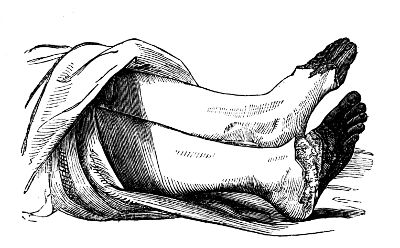
In gangrene arising from obstruction or injury of blood vessels, in healthy constitutions, amputation must be performed early—for thus the chance of ultimate success is increased, while the danger of delay is the same as in cases of gangrene caused by severe injury.
OF ERYSIPELAS.
Erysipelas is an inflammation of the external surface, accompanied with peculiar symptoms and appearances, the morbid action being modified by the texture in which it occurs. According to the various circumstances attending the disease, it has been divided into several species: phlegmonous, bilious, œdematous, gangrenous, acute, malignant, &c. The term Erythema is applied to cases of rash or efflorescence, unaccompanied with fever, swelling, or vesication.
Inflammation of the skin only, is marked by bright redness, not circumscribed, and disappearing when pressed. By pressure, the bloodvessels are emptied for a time, the part sinks and becomes pale; but, on removing the pressure, it soon regains its former colour and relative situation; when these circumstances concur, the part is said to pit. There is no tension,—the pain is not throbbing, but of a burning or itching kind, and there is often a degree of œdematous swelling. Swelling does not occur to any great extent, however, during the existence of the inflammation in the skin and rete mucosum; but the parts sometimes become much swollen after subsidence of the inflammatory action, the vessels having relieved themselves by effusion of serum; and afterwards the œdematous surface often assumes a yellowish hue. In some cases, the serous effusion is from the first, more extensive than in others, and hence the term œdematous erysipelas, or inflammatory œdema. Upon the decline of inflammation, a serous fluid is often effused also in great quantity under the cuticle, giving rise to vesications, resembling the blisters produced by the application of boiling water to the skin; and from this circumstance, erysipelas has been classed amongst cutaneous affections in the order bullæ. The erysipelatous redness does not terminate abruptly, and is not defined by a distinct boundary, as some have asserted, but becomes gradually lost in the surrounding parts. It frequently involves the contiguous parts one after another, and extends with great rapidity. It often leaves one part suddenly, and attacks another, either in the neighbourhood, or situated at a considerable distance; in other words, metastasis takes place. The disease takes on this erratic character without our being able to assign any good reason for it; and this form of the disease is frequently attended by symptoms of typhoid fever. When it disappears suddenly, or is repelled by cold applications, affections of the internal organs sometimes supervene, as of the bowels, lungs, or brain; the diseased action leaving the external surface, and attacking the deeply-seated organs; thus, in a case of erysipelas of the ankle and foot, the external symptoms disappeared suddenly, and an affection of the lungs supervened, under which the patient sunk; and in erysipelas of the face and scalp, the sudden disappearance of the redness is frequently followed by delirium and coma. Again, in acute disease of an internal part, the symptoms are much meliorated, and often entirely removed, by inflammation of the skin being induced artificially, or occurring spontaneously.
The integuments of the face and head are frequently attacked by erysipelas, in consequence of wounds and bruises of the face or scalp, even though very slight, and it often takes place here spontaneously, as in other parts of the body.
Erysipelas commonly arises from constitutional derangement, as is shown by the symptoms which precede it, and also by the efficacy of internal remedies in checking its progress; in such instances, external applications, unaccompanied with constitutional treatment, produce little or no effect. It is often produced around a wound by the employment of improper dressing, rancid ointments, or irritating plasters, by a too free use of the part, or by the friction and irritation of the patient’s clothes. It occurs most readily in those who live freely, indulging in the imprudent use of spirituous liquors, and whose constitutional powers are thereby considerably weakened. It is also said to be sometimes caused by violent passions, as anger or grief; and by exposure to cold, or to heat,—the former acting only as a remote, the latter as an immediate cause. As an example of its occurring in consequence of heat, it is a common remark, that cooks, who are necessarily much exposed to the fire, are frequently the subjects of erysipelas of the face; but in the majority of such cases, there may be other causes in operation,—the abuse of ardent spirits, and habitual overcharging of the system with stimulating food. It is more commonly met with in summer than in winter. And in certain states of the atmosphere, even in healthy situations, a degree of erysipelas is apt to occur after wounds by operation or accident.
It is often periodical, especially in females who have ceased to menstruate, always recurring at regular intervals; it attacks parts of the body, most generally the face, and in some cases monthly, in some once in the year, and in others once every two years. It sometimes appears to occur as a natural means of relief from impending affections of more serious nature, as of the system or of internal organs. Those who have once been afflicted with the disease become more liable to its attacks.
Erysipelas is generally preceded and accompanied with more or less disturbance of the digestive organs. In Bilious Erysipelas, the portion of skin affected is said to present a more yellow colour than in the phlegmonous, the derangement of the digestive organs is greater, and hence the origin of the distinctive term; fits of shivering occur, the patient complains of a bitter taste in his mouth, and the tongue is furred and of a brown colour.
In the Phlegmonous, in which other textures than the skin are often affected, viz., the subcutaneous and intermuscular cellular tissue and the fasciæ, the pain is more intense, and of a throbbing kind; the swelling is hard, more deeply seated, and more extensive; there is considerable tension; and the redness is of a darker hue. Nausea and a bitter taste in the mouth do not precede the erysipelatous appearance, but the skin and tongue are dry, and there is great thirst. When the disease begins to subside, then the foul tongue supervenes, with the bitter taste and nausea.
Erysipelas, of a contagious and violent character, frequently occurs, and is apt to spread extensively, in badly aired situations, where a number of patients with sores are crowded together, without due attention being paid to cleanliness and proper dressing.
Hospital Erysipelas, as this species is termed, is nearly allied to that dreadful disease, Hospital Gangrene, and the two affections are often blended. It comes on after operations, or in patients who have sustained an external injury by accident. In unhealthy hospitals it not unfrequently appears in previously sound parts, and without any assignable cause; and, from its following the slightest wound, recourse cannot be had with safety even to venesection, cupping or leeching. It is a dreadful scourge in many hospitals, more especially during particular seasons of the year—during hot, damp weather, and in spring and autumn, attacking the patients indiscriminately.
Of late years Erysipelas appeared in the Royal Infirmary of Edinburgh, during the wet and changeable summers which prevailed; some of the cases were very severe, and a few terminated fatally. It was very satisfactory, however, to observe that it did not spread as it used to do formerly, that patients occupying the beds immediately around those affected, though afflicted with sores and in indifferent health, remained exempt from the disease; and that many of the most severe cases did not originate in the house, but were brought from the crowded and unhealthy parts of the city. The same may be said of the disease as it has shown itself in the North London Hospital since it was opened for the reception of patients up to the present time.
Hospital Erysipelas is for the most part preceded by violent constitutional symptoms, derangement of the chylopoietic viscera, shivering, brown tongue, and a bitter taste in the mouth; if there is a sore on the body, it assumes a sloughy aspect; the surrounding skin becomes of a dark red colour, and there is a feeling of tension, accompanied with a burning pain. The erysipelas extends rapidly, and generally terminates in suppuration and sloughing of the cellular substance, or, if inertly treated, in immediate gangrene of the parts. The concomitant fever is generally low, and though, in the first instance, the circulation may be vigorous, symptoms of debility will speedily appear. It will be more fully dwelt upon, along with Hospital Gangrene.
In all cases of erysipelas there is more or less concomitant fever, modified by the extent of the local affection—by the age of the patient—by the previous habits and state of health—by the constitution—and by other circumstances. The pulse is accelerated, and is either of a sthenic or asthenic character, according to the state of the system and type of the prevailing fever. There is headache, languor, thirst, restlessness, and even delirium, especially when the face or scalp is the seat of the disease.
Erysipelas may terminate in resolution. If this takes place in the first stage of the disease, the redness gradually declines, along with the swelling, the cuticle exfoliates, and the part regains its usual appearance, the skin remaining loose and shrivelled. If it occurs after vesications have formed, the effused fluid is absorbed, a scab forms, and desquamates along with portions of the cuticle.
It may terminate in suppuration, when the inflammation has extended to the cellular substance. This termination is most frequent when the disease is situated in an extremity, seldom when in the face, though small purulent collections occasionally form in the eyelids. Circumscribed collections of pus often present themselves after the disappearance of the erysipelatous inflammation; but the purulent matter is generally diffused through the filamentous tissue, and is of a thin, unhealthy appearance, and mixed with sloughs of the cellular substance. By the infiltration of matter, the integuments, fasciæ, and muscles are extensively separated from each other, in consequence of which the parts frequently die, their nutritive supply being cut off.
Acrid sanious matter is often infiltrated extensively into the subcutaneous cellular tissue round a wound or sore. The superimposed integuments are of a dark brown colour, and the part is boggy. Sloughing of the cellular membrane here takes place in consequence of the infiltration, and not from inflammatory action having been established. The affection has been termed Diffuse Cellular Inflammation, but a more proper appellation is Diffuse Cellular Infiltration; the cellular tissue, even where treatment is adopted at an early period, can scarcely be prevented from perishing.
Erysipelas, if properly treated from its commencement, will seldom terminate in gangrene of the skin. This termination is occasionally observed, however, in patients whose constitutions have been extremely debilitated.
In mild cases of erysipelas, attention to the state of the bowels, and regulation of diet, will often be sufficient to remove the disease. When there is much disorder of the digestive organs, and particularly of the biliary secretions, emetics may be given at the commencement; these are productive of but little good in the more advanced stage, and their place is advantageously supplied by nauseating doses of antimony, combined or not with purgatives. One-eighth of a grain of tartarised antimony may be given in solution every hour, with or without a due quantity of the tart. potassæ and sodæ, or Rochelle salt. The hydrargyrum cum creta is often given with great benefit when the tongue is dry and covered with a brown crust: it may be combined sometimes advantageously with the compound powder of ipecacuanha. With the same view calomel with antimonial powder may be exhibited. The exhibition of saline purges is attended with great good in some severe cases. Such medicines tend to subdue any arterial excitement that may exist, evacuate the bowels, promote perspiration, remove the superabundant bilious matter, and serve to restore the healthy functions of the liver. In severe cases, more especially of phlegmonous erysipelas, in which there is acceleration of the pulse, and a degree of febrile excitement, general bleeding may be had recourse to; but it must be employed with caution, for the symptoms of increased vascular action may arise from constitutional irritation, and not be meliorated by the depletion. The practice is superseded by the timeous and free local bleeding from incisions, as will be noticed by and by. The exhibition of the extract of aconite in this and other inflammatory affections, is often followed by great abatement of vascular excitement, so that the necessity for abstraction of blood is done away with. The medicine may be given in doses of half a grain in substance, or dissolved in pure water, and repeated every third or fourth hour. The sensible effect is relaxation of the surface, and frequently profuse perspiration; the arterial pulsations are diminished in frequency and force. The extract of belladonna, in doses of one-sixteenth of a grain, may then be substituted with great advantage, and often with the most extraordinary effect upon the disease. In very many cases, the strength is from the first to be supported by all possible means, by nourishing diet, by the exhibition of wine, quinine, and other tonics; more particularly in old people—in constitutions debilitated by disease—in unhealthy situations, and when the fever is of a typhoid kind. Bleeding by leeches is not admissible, for the leech-bites prove a source of irritation, and are liable to suppurate; erysipelas has often been produced by leeching.
In erythema, the mere outer surface of the skin only being slightly affected, and not to any very great extent, advantage sometimes results from the application of nitrate of silver. A strong solution may be pencilled upon the part, or, after being wetted, the affected surface may be gently rubbed over with the solid caustic. The pain and uneasy sensations in the part being thereby diminished or removed, and extension of the disease seeming to be arrested. Discoloration caused by such practice is of little consequence, as desquamation must follow. It is questionable how far it may be safe to apply lunar caustic to any extensively inflamed surface, more especially of the head and face, lest metastasis should occur. The inflammatory action in the skin is subdued by the application, whilst it may advance, in the cellular tissue, to suppuration and sloughing, if other means are not adopted; and from the hard and blackened state of the cuticle, the condition of the subjacent parts is not readily perceived. The remedy is only applicable to erythema, and most advantageously as a means of bounding it. The line should be drawn at some distance from the affected tissues; and if so, it is seldom that the disease oversteps it.
Local abstraction of blood, by puncture or incision, proves exceedingly beneficial in cases of erysipelas, whatever its degree. It must be borne in mind by the practitioner, when called to treat the disease, that the state of parts is very various, and this may depend upon the original nature of the disease, upon its site or duration. The surface of the skin only may be affected—that and the subjacent cellular tissue may be involved, gorged with serous, lymphatic, or purulent infiltration—there may exist great tension of the parts, with a sloughy state of the cellular tissue, established in addition to suppuration—and again, there may be infiltration of the subfascial and intermuscular tissues, leading ultimately to exposure and exfoliation of bones or disease of articulations.
From inattention to these circumstances, the treatment being often directed to the name of the disease, great discrepancy of opinion, as to the most proper local management, has arisen; there has accordingly been a controversy as to whether the blood should be drawn from mere punctures from limited incisions, or from long gashes extending from one joint to another.
In cases not very severe or extensive, when the skin only is affected, the constitutional treatment already mentioned is first to be employed, and then the affected part must be freely punctured with a fine lancet, at numerous points, as recommended by Sir R. Dobson. These punctures should reach the vascular layer, but not go deeper: the serous effusion, if there be any, is thereby evacuated—the over-distended vessels are relieved of a considerable portion of their contents—and the œdematous swelling, with the formation of phlyctenæ, is prevented. The part is afterwards to be fomented for half an hour, or an hour, with bags containing chamomile flowers or hops; the fomentation, repeated at intervals, proves highly grateful to the feelings of the patient, allays any irritation which the making of the punctures may have produced, and keeps the skin perspirable. Under this treatment, every vestige of erysipelas will generally disappear in the course of a few days. In more severe cases, especially in the extremities, the parts must be freely incised. The incisions ought to extend through the integuments and cellular substance, and their length and number must be proportioned to the extent and severity of the affection. One or two pretty free incisions, if made in the proper place, where the greatest degree of boggishness, marking the disorganised state of the tissues, is discovered, will generally suffice—the vast good and the relief afforded depends partly upon the abatement of the tension, in consequence of the evacuation of the effused fluids—upon the unloading of the over-distended bloodvessels of the part, and upon the acceleration of the suppurative process, which is often critical. The constitution is, probably, relieved by the suppuration of the wounds, and the consequent drain of the offending particles.
Some surgeons have disapproved of long incisions, alleging that they are tedious in healing, and prefer making numerous small ones; but it is difficult to understand how the cure should be more tedious in the one case than in the other, when the actual extent of divided surface is the same. According to my experience, several free incisions are made with less pain than a number of trifling scratches, and heal as soon, whilst by the former the purpose of the practitioner is much better fulfilled: the same good effects result from them as from punctures in the more slight cases, if they are made at the commencement of the disease; and if the affection is in its advanced stage, the effused fluid, and the sloughs, are discharged, and the infiltration of pus, and destruction of parts in consequence of the matter being confined, are prevented by its being allowed a free exit as soon as it is formed. Incisions then are made both in the early stage of the disease, and after effusion has occurred: in the former case, they are justifiable, because they arrest its progress; in the latter, they are absolutely necessary, to prevent its injurious effects. The parts are to be fomented, and afterwards covered with a common poultice, containing no oil or grease, or with soft lint saturated with tepid water, and covered with oiled silk, to prevent evaporation.
When the erysipelas has gone off, the incisions are treated as common wounds, by dressing and bandage. After punctures, or incisions, more or less blood is allowed to flow, according to circumstances. It often escapes from the vessels of the part in great profusion; this, in many cases, may be prejudicial or excessively dangerous. In the extremities the flow can readily be arrested by elevation of the part, or by pressure, for a short period. In erysipelas of the face, punctures are preferable to incisions, as by the employment of the former the countenance is no way disfigured; if, however, in erysipelas of the scalp, the integuments become swollen, and present a puffy feeling, whilst at the same time cerebral symptoms supervene, free incision or incisions, through the whole thickness of the covering, and in the direction of the fibres, must be made. If erysipelas be thus actively treated, it may be safely affirmed that the disease will not often, unless accompanied with symptoms of putrid fever, terminate fatally; if these means are employed early, the constitutional disturbance will be modified or prevented, and no derangement of the cerebral functions will ensue.
Powders, such as flour, chalk, and camphor, &c., have been applied to the erysipelatous surface, but are of little use, and, by their irritation, frequently prove injurious on the bursting of the vesicles. They are applied, according to some, with the view of cooling the surface, and after all the part may be seen enveloped in folds of flannel. Cold application, such as the spirituous and evaporating lotions, containing vinegar and spirits, liquor acet. ammoniæ, Goulard’s extract, &c., may, in many cases, afford temporary relief, but their use is fraught with the utmost danger; for their direct tendency is to produce metastasis, and if that be to an internal organ of importance, the result is too generally fatal. Or if the erysipelas, on leaving the part originally affected, attack another also superficial, the local treatment has to be commenced anew. If these lotions are to be employed at all in this disease, they must be made tepid.
In case of the translation of erysipelas to any important part, blisters may be applied to the surface which it has left, or to any other in the neighbourhood, with the view of recalling the disease to its original and less dangerous situation:8 the actual cautery has even been recommended. In the great majority of cases, however, such means are unavailing.
In Hospital Erysipelas, purging cannot be carried to any great extent with safety, and general bleeding is seldom if ever admissible unless the patients previously robust and in good health, in whom the disease has occurred in consequence of their being conveyed to a distance and during hot weather, after an accident or wound, and in whom the fever is of a violent inflammatory nature. In civil hospitals, the patients are generally in a weak state before the accession of this disease; and in their case, after the stomach and bowels are regulated, stimulants are more requisite. Great attention must be paid to cleanliness, the sores must be frequently dressed, and the same sponges must not be used for different individuals: in order to prevent contamination by the promiscuous use of sponges, it is better to clean the parts around sores with lint or tow, and to destroy immediately such dressings as have been used. The apartments must be well ventilated, and those who are affected with the disease should be separated from the rest of the patients. The local applications will vary according to the particular circumstances of each case. Strong escharotics may be required to clean the surface of the sores, and put a stop to the sloughing. The nitric acid will answer the purpose well, and is less objectionable than some remedies that have been used; such as the arsenical solution, or the red hot iron.
OF FURUNCULUS AND ANTHRAX.
Furunculi, or Boils, most generally occur in unhealthy constitutions, particularly in those individuals who are habitually addicted to the use of ardent liquors: they seem to arise from, at least they follow, disorder of the digestive organs. Their seat is in the skin and subjacent cellular tissue.
They generally occur in those parts which are possessed of little vitality, as in the back, buttocks, shoulders, the posterior part of the neck, &c. They are seldom single, are often numerous, and vary in size from a pea to a pigeon’s egg.
A boil is of a conical form, elevated above the surface of the body; its base is hard and firm, whilst its apex is acute, soft, of a white colour, and exceedingly painful; the pain experienced in the tumour is severe and burning. From the comparatively trifling nature of the affection, the assistance of the surgeon is seldom required, and hence the apex of the tumour generally gives way either spontaneously, or in consequence of being scratched by the patient, or rubbed by the clothes; the purulent matter, which is generally small in quantity, and mixed with blood, is thus discharged. This, however, is attended with but little relief in bad forms of the affection; for at the lower part of the cone is situated a considerable quantity of mortified cellular tissue, which must be evacuated before the cavity can heal.
In this unhealthy species of inflammation, resolution cannot be expected; on the contrary, suppuration is the natural termination of the disease, and must be hastened by poultices and fomentations. A simple or crucial opening, according to circumstances, must afterwards be made in the apex of the tumour, so that the sloughs of the cellular tissue may be permitted to escape readily. In the advanced stage, the sloughs are the irritating cause by which the inflammatory action is prolonged, and on their removal the cavity contracts speedily.
If there is much derangement of the digestive organ, it may frequently be found necessary to administer an emetic. If the bowels are slow and the liver torpid, calomel and antimony are highly useful, or other mercurial preparations may be given, in combination with active purgatives; if the state of the secretions is more natural, these medicines may be administered in alterative doses. The mineral acids are often usefully administered, with the view of removing the disposition to the formation of boils. Twenty minims of the aromatic sulphuric acid may be given twice or thrice a day in any convenient vehicle. Anodynes are occasionally required.
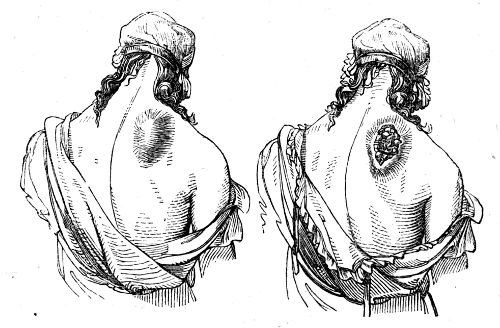
Anthrax or Carbuncle maybe considered as a severe form of boils. It occurs in the plague, and is a characteristic symptom. It appears in the same parts, and apparently from the same causes, as the boil. The tumour is of a more flattened form, slightly elevated above the surface, and frequently of great extent; the base is deeply-seated, hard, and unyielding. The integuments are at first of a bright colour, but afterwards assume a dark-red or reddish-brown hue. The pain is violent and burning. The process of suppuration is very tedious, and the matter that is formed is small in quantity. If the tumour is not interfered with, ulceration occurs in its surface, producing various apertures, through which the matter is evacuated, the discharge is thin and unhealthy, excoriating the neighbouring surface; and the mortified cellular tissue, remaining at the base of the swelling, keeps up the irritation. The extent of a carbuncle is frequently great, both as to width and depth; on the back, or buttocks, it not unfrequently attains an immense size. In one instance, the whole posterior part of the neck was involved; the cellular tissue, muscles, and tendons, sloughed; and the vertebræ were ultimately exposed. In another case, the whole occiput, the posterior and lateral parts of the neck, and the space betwixt the shoulders, exhibited one continuous mass of carbuncle. By making free incisions, procuring early separation of the sloughing parts, and supporting the strength of their constitutions, both patients recovered, though considerably advanced in life.
It seldom occurs in the face or head, and when it does, it generally proves fatal. In a male patient in the Edinburgh Royal Infirmary, aged forty-eight, a carbuncle of the size of a very large orange was situated in the centre of the forehead; by active local and constitutional treatment, he soon got well.
The affection is sometimes attended with typhoid symptoms, rigors, profuse perspiration, nausea, vomiting, disordered bowels, loss of appetite, anxiety, restlessness, difficult respiration, palpitations, faintings, pale-white tongue, low pulse, pale or turbid urine, headache, giddiness, drowsiness, and, in severe cases, with delirium. In old or exhausted patients, the prognosis is unfavourable.
An early and free incision must be made into the tumour; if the swelling is large or extensive, the preferable form of incision is the crucial; the ill-formed matter is thus evacuated, the slough exposed, and more readily allowed to escape. If the mortification of the cellular tissue be extensive, and the sloughs prove firmly adherent, the free employment of the caustic potass will be found of much service, the half-dead cellular substance being thereby completely destroyed, and the surrounding parts stimulated to a new and superior degree of action, necessary for the removal of the mortified parts, and reparation of the breach of surface. Poultices and fomentations may afterwards be employed, followed by the warm-water dressing, medicated or not. The stomach and bowels must be put into proper order by the exhibition of suitable medicines; and the vis vitæ may be still farther supported by the administration of tonics and stimulants. If, after the separation of the sloughs, the exposed surface shall assume an indolent or debilitated action, stimulating dressings, such as turpentine liniment, or elemi ointment may be employed.
Such practice will be found sufficient to procure a speedy and favourable termination of the disease, in this country, where we have not to combat any of those malignant diseases with which carbuncle is accompanied in other climates.
OF INFLAMMATION OF THE MUCOUS MEMBRANES.
Mucous Membranes and the skin are analogous in structure, somewhat similar in function, and sympathise closely with each other in health and in disease. Both are endowed with that peculiar degree of sensibility which enables them to bear with impunity the impressions of foreign bodies; and both are protected from the influence of these bodies by an inorganic covering; the cutis and rete mucosum by the epidermis; the corium of mucous membranes by a laminated epithelium. They are the seat of all excretions, and by them all substances are introduced from without into the system. The capillary portion of the vascular system appears to have somewhat the same arrangement in both; the distribution of blood to the mucous membranes being, however, more copious. At the commencement and extremity of the alimentary canal, they insensibly pass into each other by means of an intermediate structure, of which the prolabium may serve as an example. In particular circumstances, they change into each other, both in appearance and in function. Thus, in prolapsus of the gut or of the vagina, the discharge from the protruded mucous surface after a time subsides, the rugæ disappears, the membrane becomes thickened and indurated, and gradually assumes an appearance exactly resembling that of the skin. In natural paraphymosis, the delicate membrane which, in the healthy state of parts, lines the internal surface of the prepuce, becomes converted into a cuticular covering. In neglected and long-continued excoriation of the nates, the raw surface, which was at first tender and irritable, and discharged a serous fluid, becomes villous, less sensible, and discharges a fluid similar to a mucous secretion. In sinuses also of long duration, the secreting surface becomes changed, so as to resemble a mucous membrane, and the discharge, from being purulent or gleety, becomes mucous, or at least resembles a mucous fluid,
A mucous surface, when inflamed, has for a short time, perhaps, at first, its functions suspended; it then furnishes a secretion, increased in quantity, and but little changed in appearance from the healthy fluid; afterwards the discharge resembles purulent matter, and is termed muco-purulent. When, however, the inflammation is violent, the discharge becomes bloody, or is altogether suppressed, and the membrane is thickened. Inflammation of a mucous membrane is very apt to spread with great rapidity, in this respect resembling the corresponding affection of the skin. It is attended with a sense of itching, and a burning pain. This pain is much increased by the muscles surrounding the parts being thrown into action, as in expelling their contents, more especially if these be of an acrid quality. The membrane is thickened, and of a spongy appearance; its surface is red, and sometimes covered with flakes of lymph; occasionally it is much softened, and coated with a viscid adherent mucus; and it would appear, in many instances, that, in acute inflammation, the membrane is generally softened, whilst it becomes indurated from chronic inflammatory action. When the inflammation is violent, and consequently rapid, considerable quantities of lymph are effused either on the surface of the membrane, or into the submucous tissue: and the lymph subsequently becoming organised, the membrane is much thickened, and a contraction is the consequence. The functions of a part lined with mucous membrane are more or less deranged, in consequence of the vitiation of the secreted fluid.
In inflammation of this tissue, metastasis is also apt to occur, from one part of the membrane to another, and from the membrane to the external surface. Cynanche, for instance, often follows upon erysipelas of the face and scalp, and vice versâ.
The passages, the internal surfaces of which are invested by a mucous membrane, are those subservient to respiration, nutrition, generation, and the urinary secretions; in other words, the mucous surfaces are the Pneumogastric and the Genito-urinary. Their particular diseases will be treated of hereafter.
OF INFLAMMATION OF THE SEROUS MEMBRANES.
On such an extensive subject it is unnecessary to enter fully; not that the inquiry is uninteresting, or that a knowledge of the diseases of the internal cavities, and the mode of treating them, is not required of the surgical practitioner before he can enter into practice, with safety to his patients and comfort and satisfaction to himself, but we have a very important class of diseases to bring under review in a limited space, and it is properly the province of others to treat of internal disorders, and to describe the best mode of alleviating or curing them. It is, however, the duty of the surgeon to treat the inflammatory affections of some of the serous membranes, and the consequences of inflammatory action in most of them; and it is therefore highly necessary that he understand the symptoms, progress, and consequences of such actions. The affections of the serous membranes are principally under the management of the physician; but they not unfrequently follow wounds and surgical operations, and the diseases of several of them are purely surgical. Inflammation of a serous membrane is attended with heat and pain, aggravated by motion of the parts and by pressure; the natural secretion is increased in quantity, the process of exhalation being incited, and that of absorption weakened; the serous fluid accumulates. The secretion becomes altered in quality, and assumes a milky appearance; lymph is effused, generally mixed with purulent matter, and floats in the fluid, or adheres to the surface of the membrane, which is rough and flocculent. The adherent lymph becomes organised, being penetrated by numerous bloodvessels; and thus the original membrane is, in many instances, much thickened, chiefly from the addition of new matter, though also from enlargement of its bloodvessels and opening out of the primitive tissues, principally the subserous cellular. When inflamed serous surfaces, which have been altered, both in texture and function, in consequence of inflammatory action, remain for a short time in contact with each other, lymph is effused and penetrated by bloodvessels from each surface; thus the new deposit is organised, and forms a medium of connection. By this process the parts are intimately united to each other, and consolidated into one mass; or are merely approximated, and joined, at one or more points, by portions of lymph, in some cases thin and narrow, in others extensive and of considerable thickness; the adhering bands either extend in a straight direction, from one surface to another, or interlace, forming a sort of network. After adhesions of various kinds have been formed, they are often lengthened and attenuated in consequence of the motion of the parts, as is particularly the case with adhesions between the pleura costalis and pulmonalis. When they have been of considerable duration, they often resemble the original membrane from which they were deposited, becoming thin and transparent, smooth on their external surface, and furnishing a serous secretion. Not unfrequently, inflammatory action in this tissue terminates in suppuration; and the pus, secreted by the membrane, accumulates in the most dependent part of the cavity. By collections of matter, whether serous, sero-purulent, or purulent, within a serous cavity, the functions of the contained viscera are deranged, much impeded, and in many instances morbid actions are excited in them. The inflammation, whether it terminates in resolution, or proceeds to serous effusion, adhesion, or purulent secretion, is attended with constitutional disturbance, and the symptoms are proportioned to the original intensity of the action, and the extent and kind of its termination. The effusion of lymph, and consequent adhesion, is, however, in many circumstances, a highly salutary process, as in wounds and injuries of the hollow viscera: effusion of their contents being thereby prevented, and the patient being saved from the danger attending violent inflammation of those cavities and their coverings, caused by the escape of a greater or less quantity of irritating extraneous matter. Purulent collections also, in the solid internal viscera, are thus allowed to discharge themselves externally. The nature, symptoms, and consequences of inflammation of serous membrane, will be more fully considered under the diseases of particular parts.
OF INFLAMMATION OF TISSUES COMPOSING THE ARTICULATIONS.
Inflammation of the synovial surface occurs in consequence of wounds, bruises, or sprains, and often from exposure to cold; from the latter cause, the knee and elbow joints most frequently suffer, as they are generally more exposed to its influence, and not so well covered with muscular substance as the others. Constitutional diseases, such as certain fevers, are followed sometimes by effusion of serous fluid into joints. Purulent matter is also deposited in joints during certain forms of suppurative fever; and this is attended by rapid change of structure.
There is heat, throbbing, pain, and swelling of the part, sometimes redness of the surface, and great constitutional disturbance; the symptoms and appearances, however, vary much, according to the extent of the joint which is involved. When part of the capsule is affected, the inflammation spreads rapidly over all the surface; the synovial membranes resembling the serous in this respect, as well as in healthy structure and function. Like the serous, too, they are shut sacs, are smooth on their surface, and furnish a secretion, the synovial, for facilitating the motion between opposing surfaces; it is, however, somewhat more glairy than the serous. Neither, in their healthy state, are possessed of much sensibility, nor are ligaments, tendons, tendinous sheaths, and bursæ, which two latter textures resemble in every respect the synovial; when inflamed, they become most exquisitely sensible. The incited action of the bloodvessels is followed by increased discharge, which is less glairy and albuminous, partaking more of the serous character. When the incited action soon terminates, and the activity of the absorbents is diminished, the fluid accumulates within the joint, producing Hydrops Articuli. This accumulation of fluid in joints may take place without being preceded by any apparent inflammation, and may remain a long time without any visible change of structure in the membrane. The knee is more frequently the seat of dropsy than any other joint.
When the action is more violent, and is not actively opposed, lymph is effused on the inner surface of the membrane, or is deposited amongst the ligamentous and cellular tissues external to the joint, in consequence of which, the membrane and external ligaments become thickened, and of an almost cartilaginous consistence. Serum is effused into the more superficial cellular tissue, filling up the hollows around the joint, concealing the protuberances of the bones, and producing a globular swelling. The articulating surfaces become ulcerated, and matter forms within the capsular ligament; or the pus is deposited exteriorly to the joint, and gradually approaches the surface. But although ulceration is so prone to occur in the cartilages, the synovial membranes do not readily take on this action, unless from the progress of matter, formed within the joint, towards the surface. The synovial lining of the bursæ and sheaths of the tendons are extremely indisposed to ulcerate; and it may be remarked, that, while suppuration without ulceration is common in the synovial membranes, the cartilages, on the other hand, afford frequent instances of ulceration without suppuration, of which more particular mention will be made in the sequel. The cartilage is occasionally swelled and softened where the disease has long existed.
Along with ulceration of the cartilage, a portion of it may become dead, or either state may occur separately; and in many cases, the substance of the bone also becomes affected, of which two classes of cases may occur, viz., great inflammation on the articular surface of the bone, with separation of the cartilage by the ulcerative process in this situation; and inflammation of the medullary web, leading to atrophy of the cancelli, collections of pus therein, or even death of a portion of the spongy texture of the bone, as will be more particularly treated of in the chapter on diseases of the osseous tissue. These changes often compose the primary disease, and to them the affections of the synovial membrane and other parts succeed.
Such occurrences are attended with alarming disturbance of the constitution, with fever, and even with the most threatening and dangerous symptoms, such as delirium and coma. If the patient survive, and the matter be evacuated from the joints by openings into its cavity, hectic fever is almost certain to supervene.
An opinion has been broached lately by Mr. Key, that the ulceration of cartilage was consequent upon the increased vascularity and thickening of the synovial membrane, that the cartilage, in fact, was removed by the action of the vessels ramifying in the membrane, and the prolongations or fringes from it in its diseased condition. Occasionally these fringes correspond, in a remarkable manner, to the breach of surface in the cartilage; but again, ulceration is frequently met with far removed from the membrane. It is also seen, in cases where an opportunity is afforded of making the examination in the earlier stage of disease, that ulceration exists to some extent whilst the synovial membrane is unaffected. And certain cases, in which the cartilage is affected with hypertrophy, and the common form of atrophy of this part in old people, are altogether adverse to Mr. Key’s views. When ulceration takes place at a point removed from the attachments of the synovial membrane, it appears to proceed more frequently from the attached than from the free surface of the cartilage; then the adventitious membrane occupying the rugged spaces, and which under the microscope appears highly vascular, is connected apparently with the medullary web.
In acute inflammation of the synovial membrane, and in cases where the cartilage is ulcerated, the pain is very intense, and the spasms of the limb most distressing. This happens when the surface is ulcerated, and perhaps to no great extent. We know that in the horse an ulcerated hollow in the cartilaginous covering of the navicular bone, not so large as to contain a grain of barley, will cause such lameness and suffering as to render the animal so affected perfectly useless. If he is not destroyed at this stage, as many valuable animals have been, the mischief extends, and terminates in extensive disease of that and the neighbouring bones and articulations. It is different if the disease commence, as it sometimes does, in the human subject, in the cancelli of the bone, and on the attached surface of the cartilage, the free surface remaining some time entire and smooth. When the synovial membrane is primarily affected by chronic disease, the pain is in general trifling, often not complained of, and swelling of the part, from effusion, into the joint or neighbouring bursæ, first attracts attention, after it has existed, perhaps, in a slight degree, for a considerable time. The joint is stiff, and pain is experienced from extensive motion; on this account the patient is disinclined to use it, and it is soon tired by the slightest exertion. The swelling becomes more solid, though still remaining elastic, and the feeling of fluctuation diminishes. Effusion of lymph follows that of serum, the latter having been absorbed; the motion of the joint is still further impeded, and the articulation is distorted; the patient keeps the limb in the most easy position, generally that of partial flexion, in which it becomes almost immovably fixed. The cause of the flexed position, which is almost pathognomonic of knee disease, being preserved, seems to be that the limb is insensibly brought into it in order to take the pressure off the interarticular apparatus, the ligamenta mucosa and alaria,—these swell—the muscles of the hamstrings get contracted from habit, and a difficulty, even after the disease is completely subdued, is often enough experienced in procuring complete extension. The muscles, from disuse, shrink, the adipose substance is absorbed, the shafts of the bones also are diminished in size, get into an atrophied state, as the phrase is, and thus the whole limb is rendered slender and wasted, so as to make the swelling of the diseased articulation still more conspicuous. The bones are softened, and the muscles are of a white colour, as in the limbs of the paralytic or bedridden, and resemble more cellular than muscular tissue. The wasting of the muscles and loss of power often precede the appearance of disease; this is frequently observed in the shoulder-joint, the deltoid shrinking, and almost disappearing, before any disease in the articulation is suspected by the patient. Not unfrequently, also, this wasting occurs without obvious cause, or any affection of the joint. When the disease is advancing, the patient may feel no acute pain, but merely a reluctance to use the limb; and from this, if long continued, the muscles, and afterwards the bones, become wasted. Wasting of the limbs in children, often of one of the lower, frequently arises from disorder of the bowels, and the irritation and debility attendant on teething. This must be distinguished from the wasting accompanying diseased joint. The history of the case, the period at which the weakness of the limb was observed, and its appearance, will lead to a correct diagnosis.
The swelling is often irregular, being more protuberant at one part than another, from the fluid or the addition of solid matter being accumulated where the least resistance is afforded; but the slighter inequalities are generally filled up by œdema of the cellular texture. As the disease proceeds, matter forms in the joint, and is often attended with great pain and fever; or the pus is effused into the bursæ, into the surrounding cellular tissue, or into the filamentous tissue amongst the tendinous sheaths of the muscles in the neighbourhood; being allowed to remain without an outlet, it at length communicates with the cavity of the joint. Portions of the cartilages are absorbed, though this, as already noticed, may occur at the very commencement of the disease; the subjacent bone becomes affected by ulceration, or perhaps its vitality is partially destroyed. When matter has accumulated, a portion of the capsular ligament generally ulcerates, the pus escapes, and is ultimately discharged externally.
When the disease begins with swelling, which is of a chronic character, and produces but little inconvenience, and when the more urgent symptoms supervene after the swelling has continued for a considerable time, there is every reason to suppose that the disease has originated in the synovial membrane, or perhaps in the osseous cancelli, and this is generally met with in poorly fed and strumous subjects. But when the first symptoms have been pain and stiffness of the joint, without change of its appearance, and when the swelling has occurred after these symptoms have been of some duration, then it is probable that the cartilages are the primary seat of mischief. For the most part, however, the symptoms have a general resemblance in most chronic affections of the joints, and all the apparatus is sooner or later involved. When the cartilage has been extensively absorbed, a grating sensation is felt in moving the articular surfaces of the bones upon each other. In consequence, also, of the softening and disorganisation of the lateral and other ligaments, the affected articulation at length becomes unnaturally loose, which is owing in some measure, also, to the muscles being wasted and paralysed from pain and disuse. At an earlier stage of the disease, the joint may be rigid from deposition of lymph into the contiguous cellular tissue, and contraction of the muscles.
Purulent matter not unfrequently collects in the substance of the bones, which in all cases ultimately become softened in a remarkable manner. In many subjects, without actual disease of the osseous tissue, the heads of the bones are so altered in consistence, are so deficient of earthy matter, as to be easily cut with a knife. It has been a matter of dispute, whether, in this affection, the articulating extremities of the bones are enlarged or not; and the supposition that they are always more or less increased in size, or hypertrophied, has arisen from the extensive effusion and indurated state of the soft parts being mistaken for this enlargement. In the first stages of the disease, they are seldom, if ever, enlarged; but when ulceration of the bone has occurred, new osseous matter is deposited to a greater or less degree in the neighbourhood of the ulcer,—an attempt by nature towards a cure, but too often an ineffectual one. The bones, in strumous subjects, are often much enlarged, from collection of purulent matter in their substance giving rise to a sort of spina ventosa. I removed the upper extremity of a boy lately on account of extensive disease about the elbow. The ulna to near the wrist was swollen enormously by purulent collections in its medullary canal. In cases when the whole of the articulating extremity of the bone is not enlarged, still that portion which is more immediately concerned in the articulation is often considerably expanded.
Frequently when the knee is the seat of the disease, the lymphatic glands in the groin are enlarged; and when the elbow or wrist joints are affected, there is often a similar enlargement of the glands in the axilla: such glandular tumours have not rarely been confounded with those accompanying malignant disease, and measures which were absolutely necessary for the salvation of the patient, have thus been delayed or neglected.
When the disease is extensive, and has endured for a considerable period, hectic fever supervenes, and is aggravated after the abscesses give way. The patient becomes much weakened and emaciated, and loses his appetite; the pulse is rapid, with night sweats, diarrhœa, &c.; and from a continuation of the hectic cause, the life is endangered. In some cases, however, the health is restored, and the disease abates spontaneously; in others, the disease is arrested, and a complete cure accomplished, by the careful employment of such means as will be afterwards mentioned.
The appearances produced by inflammation and consequent disease of the synovial membrane, are the following. In the first stage, the internal surface of the capsular ligament, and the rest of the synovial membrane, is found of a red hue, its formerly colourless vessels being now made apparent, from enlargement and consequent injection with a greater quantity of red blood; and the serum within the cavity of the joint is more abundant than in the natural state. When the disease has been of longer continuance, the membrane is found considerably thickened, its usual smooth glossy surface is destroyed, it is irregularly flocculent, and frequently of a light yellow colour.
The interarticular adipose tissue also seems to be increased in volume, from being infiltrated with a serous fluid, by the discharge of which the diseased bloodvessels may have attempted to relieve themselves. When the inflammation has been intense, or of long duration, lymph is secreted, and deposited on the external surface of the membrane, forming an intimate union between it and the ligaments, and producing thickening of the external apparatus. Or the lymph is also effused on the inner surface of the membrane, to which it adheres and becomes organised; this is generally accompanied by the formation of purulent matter; the organised effusion is often so extensive as to conceal almost the whole of the synovial membrane, excepting portions of its delicate reflexions which invest the articulating cartilages. By the lymphatic deposit, to a less degree, the folds also of the synovial membrane adhere to each other, whereby the motion is still farther impeded, and the pain, when attempted, increased. Occasionally the synovial membrane is found enormously thickened, much softened in texture, and of a brown hue, when the disease has been of a very chronic character. Along with these appearances, serum is generally found effused, in a greater or less quantity, into the cellular tissue exterior to the ligamentous covering. In cases in which the matter has formed and remained long within the cavity of the articulation, the synovial membrane and the ligaments become blended into one soft mass, the internal surface of which is lined with a thick coating of lymph, as in the case of common abscess. If purulent matter is effused externally, and communicate with the joint, the capsular ligament will be found to have ulcerated and given way at certain points, forming apertures, usually of small size, and with ragged margins.
All these appearances may exist without disease of the cartilages or extremities of the bones; but generally they are also affected at the same time. At first the surface of the cartilage is slightly irregular and rough, and the change is not observed, unless on minute inspection. Afterwards the surface is marked with small depressions, which may be numerous, and are surrounded with irregular and somewhat serrated margins. They gradually increase in depth and extent, and the subjacent bone is ultimately exposed at one or more points, as here shown. Often the greater part of the cartilage is removed by absorption; the bone is exposed, opened out in its texture, softened, of an irregular surface, and in some places excavated, containing a thin ichorous fluid; the process of ulceration has also extended to the osseous tissue. Sometimes scales of cartilage of considerable size are either completely detached, having become dead, and been thrown off by the natural process, and are found lying loose in the cavity of the articulation; or they are all but separated, adhering by one or more very slender attachments.
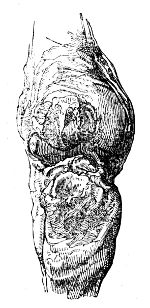
The incipient stage of such disease may exist without the synovial membrane being much, if at all, affected; but when the ulceration has made farther progress, all the articulating apparatus is more or less diseased. It may be here remarked, that the synovial membrane may be affected for a long period, thickened portions may extend over the cartilages, and these may have lymph upon them and yet remain intact.
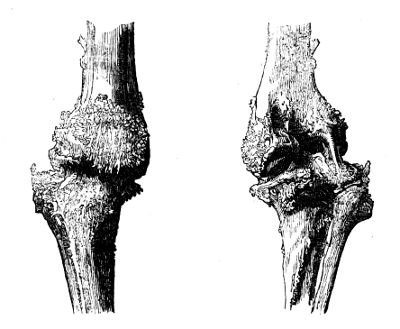
The cure, resorted to by nature, and in which she may be much assisted by the surgeon, is Anchylosis, ligamentous or osseous. New bone is deposited in the neighbourhood of the disease, and the ulcers become, as it were, cicatrised; the articulating extremities of the bones are joined to each other by a firm osseous matter, either universally disposed or consisting of processes extended between the bones at various points: or again, in consequence of the effusion of lymph into the cellular tissue, and the consequent thickening and induration of that and of the fibrous tissue exterior to the joint, this connecting medium is so strengthened and concentrated as to retain the articulating surfaces in exact apposition; from one, and usually from both, of these changes, the joint is securely fixed and rendered immovable, or nearly so. In complete anchylosis, the cancellous texture of the two bones, after some time, becomes perfectly continuous, so that they in fact constitute but one bone, as seen in cut, p. 84. A very perfect specimen of anchylosed knee joint is also delineated in the cut above. But even after this happens, the disease is still apt to recur from slight causes, the bony or ligamentous union being disturbed or destroyed, and the original disease attacking the parts with fresh activity; abscesses form,—may be extensive both in size and number,—and thereby the health is again undermined. So that the patient, after undergoing much suffering and risk, preserves, perhaps only for a few years, a limb which is almost useless to him, and which must be removed at last. In other cases, the union is permanent, the disease does not return; by care and time the limb is brought into the most convenient position, and proves of considerable service.
The joints are often affected by rheumatic and gouty inflammation; and there are three species of disease, tolerably distinct in their pathological characters, generally attributed to these causes. In one there is a deposit of chalky-looking matter, composed chiefly of super-lithate of soda, on the articular surfaces of the synovial membrane and cartilage, but most abundantly in the cellular tissue outside the joint, an affection in which the cartilage is seldom known to ulcerate. In the second, the cartilages are atrophied, as if worn away by attrition, the articular surfaces of the bone being much modified in shape, more or less denuded of cartilage, and remarkably polished and hard, so as to have been compared to porcelain, as will be described in another section. In the third, the fibrous tissue in the neighbourhood of a joint is primarily affected, the synovial membrane and cartilages not becoming involved till the disease is much advanced. It is not uncommon in the elbow of middle-aged persons who have been much exposed to the atmospherical vicissitudes, and is sometimes attributed to the effect of mercury or syphilis. The periosteum around the articular ends of the bones becomes swelled and painful; the affection is very slow in its progress; abundant deposition of adventitious bone takes place, often in short spiculæ, gradually encroaching around the joint, which ultimately becomes involved. A good specimen is here given. The disease was of twelve months’ duration, and was attributable to rheumatic inflammation supervening upon sprain. The affection involves extensively all the bones composing the articulation.
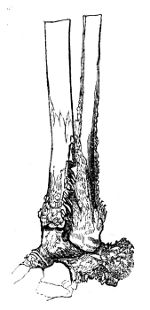
Although wounds penetrating the larger joints are attended with danger, the synovial membranes are possessed of considerable powers of reparation, and often heal readily after severe injuries. An occasional result of inflammation is adhesion between the layers of the membrane, but this is by no means so frequent as in the serous tissues. The reparative power of cartilage is so low that the best termination that can be expected from the ordinary forms of ulceration, is union between the abraded surfaces. In experiments which have been made on the lower animals, portions of cartilage which had been removed from their joints were never reproduced, but the functions of the part were soon restored by the cut surface becoming smooth. In like manner there is occasionally to be seen in museums a circumscribed indentation in human articular cartilage, as if it had been destroyed by a small ulcer in this situation, which had cicatrized without any reproduction of the destroyed tissue.
ON HYPERTROPHY AND ATROPHY OF THE ARTICULAR CARTILAGES, WITH EBURNATION OF THE SURFACES OF THE BONES.
It has been already observed (at page 68), that the cartilages are occasionally swelled and softened in cases of chronic inflammation; and it now remains to notice instances in which they become hypertrophied or atrophied, apparently without inflammatory action. Although these affections are not likely to come often under the treatment of the surgeon in civil life, yet they are of much importance to the naval or military practitioner, since an accurate knowledge of them will lead him to institute a careful inquiry when a man complains of inability to sustain the fatigue of marching with the burden of a heavy knapsack; and they are of considerable interest in a physiological point of view, because they tend to show the inherent vitality of cartilage, and that it is liable to serious organic changes quite independently of diseased action in the surrounding tissues.
Some examples of hypertrophy of cartilage, principally affecting that of the patella, have been described by Mr. Gulliver, and figured in the third fasciculus of drawings from the Army Anatomical Museum. In these the cartilage is swelled so as to form a ridge across the articular surface of the bone, the hypertrophied part being perfectly smooth, except where its continuity is interrupted by irregular fissures, as if the perpendicular cartilaginous fibres were split into bundles of variable size and shape. These cases occurred in young and middle-aged men who died of pulmonary consumption; and it is probable that the disease would be more frequently found, if it were more frequently looked for, since it does not seem to have been accompanied by any change in the surrounding parts, and would perhaps only be indicated by weakness of a joint rendering it unfit for severe work.
The atrophy, or absorption of cartilage, is so frequently seen in the joints of old subjects, that some authors have been disposed to regard it rather as a physiological than a pathological condition. It is, however, unquestionably a disease; and in the drawings above mentioned, are some specimens of it from a soldier under the middle age. The cartilage seems in the first instance to be opened out in its texture, and numerous little villous processes appear on its surface, often as if its fibres were enlarged after absorption of the substance which connected them. The thinning sometimes takes place in patches, occasionally in grooves, corresponding to the motions of the articular surfaces; the subjacent bone becomes at length completely denuded, and soon presents a polished porcelain-like surface, which is so remarkable that it is commonly known under the name of porcellaneous deposit. It is obvious that, when the disease has proceeded thus far, the joint must become more or less deformed, and its motions considerably impeded. Accordingly, old men are often seen at work with much rigidity of the joints, particularly of the knee, which is frequently projected inwards, from absorption of the cartilage from the outer condyle of the femur and corresponding part of the tibia, with a thinning and degeneration of the inner-articular cartilage into a tissue resembling the cellular.
The hard, polished, and ivory-like appearance of the articular surface, would lead us to suppose that it contained an unusual quantity of earthy matter, yet an analysis by Dr. Davy, here given, shows the contrary.
Composition of the Shaft.Composition of the polished Articular Surface.
Phosphate of lime, &c.58·8Phosphate of lime54·2
Animal matter41·2Animal matter45·8
—— ——
100·0 100·0
In many instances where the disease is of long standing, a deposit of adventitious bone takes place around the articular surfaces, and this may occur to such an extent as to produce anchylosis of the joint, the articular extremities of the bone often presenting several irregular depressions, and becoming variously altered in shapes, as shown in the cuts, p. 86.
It is curious that the atrophy of cartilage is generally seen in its early stage to attack the joints in pairs, and to occur also in corresponding parts of the articular surfaces; a fact which coincides with the disposition of caries to appear simultaneously or successively in corresponding molar teeth.
Of the causes of the disease but little is known, although it is generally attributed, like some other obscure affections, to the effect of rheumatism. It often follows in old people upon long disuse and confinement of a limb to one position, as during the cure of fractures. A very valuable specimen was presented to me lately by my friend Mr. Busk, of the Dreadnought hospital ship. The elbow had been apparently subjected to great injury. The radius and ulna had been fractured: the former had united, whilst a false joint had been formed betwixt the portions of the ulna. There is profuse deposit of bone around the elbow-joint, which must have been quite stiff, or nearly so, as regarded flexion and extension; but the end of the radius and corresponding articulation of the humerus are beautifully polished. This polish is not unfrequently seen also upon disunited fractures, as in the neck of the femur. Atrophy of the cartilages has been seen where no rheumatism was ever known to have troubled the patients; and they are more generally disposed to ascribe it to the effect of incessant hard work. At all events it is comparatively rare among women, and in the upper ranks of society; and the wasting often presents very much the appearance which would result from the effects of attrition, as if the wear of the cartilage had not been supplied by a corresponding reproduction. It is probable, therefore, that the affection is attributable to defective nutrition, somewhat allied to certain changes in the cornea, which are known to proceed from this cause, and which are also unattended by inflammation or the formation of pus.
The symptoms of the disease are generally obvious enough in the more advanced stages by the crackling which may be heard when the joint is moved; and in the early stage a grating may be felt by a careful manipulation.
SCROFULOUS DISEASE OF JOINTS.
Affections of the membranes, ligaments, and bones, often occur in persons of weak constitutions, and proceed very gradually. They have been all classed under the general term of white swelling. They most frequently present themselves without any assignable cause, or are attributed to the slightest injuries. The disease generally commences in the cancellated texture of the bones: these are soft and light, and contain in their cells a quantity of caseous or tubercular matter. The softness is attributable to an interstitial atrophy of the bony tissue, as well as to an alteration in the proportion of its constituents; the animal matter being in excess, with a corresponding deficiency of the phosphate of lime. There is an increased vascularity of the medullary membrane, and the cancellated texture contains thin brownish-looking fluid instead of marrow. In cases of disease which has commenced in the cancellated texture, there is hardly any pain at first, and the progress of the disease is remarkably insidious. When the lower extremity is affected, the child is observed to limp; the limb wastes; it appears to be longer, partly from atrophy of the muscles, partly from relaxation of the ligaments and effusion into the joint.
The term white-swelling, which ought to be discarded from surgery, was at one time made to include all the different affections to which joints are liable in weak constitutions—thickening of the parts, with an external colourless swelling—collections of matter about articulations, with or without an external aperture—effusion of fluids into the cavities of joints, or into the bursæ—destruction of cartilage by ulceration, or in consequence of portions becoming dead—absorption, ulceration, caries, or intractable ulceration of the bone adjoining the articulation.
Those under twenty years of age are most liable to chronic affections of the joints, and they occur very frequently in children. Great anxiety is often shown by friends of patients to account for chronic disease of a joint, so as to save their whole generation from the imputation of being tainted with scrofula. It is attributed, sometimes correctly enough, to some injury perhaps trifling; to a sprain, or twist, or squeeze from a tight shoe, or to a bruise from falling; and it is no doubt true, that young or old people of the most healthy constitutions, if thrown out of health from one cause, will present all the appearances of scrofula, and become affected with chronic diseases of the mucous membranes, glands, joints, or bones, from very slight existing causes.
Such affections advance slowly; all the articulations are liable to them; but those which are most subject to the disease are the hip, knee, ankle, and elbow. Of these, the knee-joint is most frequently affected, probably from the greater extent of cancellated and articulating surface. In young persons of unhealthy constitutions, the joints not unfrequently become affected one after another, and superficial abscesses form, terminating in open sores. I was obliged to amputate the upper extremity of a young lady a few days ago, in which a metacarpal bone and its articulation, the entire chain of carpal bones, the wrist and elbow joints, were all thoroughly involved in disease.
NEURALGIC AFFECTIONS OF JOINTS.
The joints, like other parts of the body, are very often the seat of painful affections, without organic disease existing. These neuralgic affections are often connected with, or followed by, hysterical symptoms. They frequently also depend upon derangement of the digestive organs,—upon the lodgement of irritating matters, sordes, or worms in the intestinal tube; and when we reflect upon the extent of the lining membrane, the expansion of nervous filaments, and upon the sympathy which they hold with the whole system, we cannot be astonished at the circumstance. Many cases of supposed hip-disease in children, with the symptoms and some of the signs of it, have come under my notice, which have yielded at once to the expulsion of offending matters or worms. Some affections of joints seem to depend upon gouty diathesis; others are intermittent: at one time the joint complained of is hot, and somewhat swollen; at another cold, and bluish on the surface. In these affections of joints the pain, indeed, is seldom constant: the patient’s rest is not broken; there are none of the violent spasms during sleep, which attend upon certain alterations of structure. The pain is equally complained of when the part is touched with the utmost gentleness, or when a thorough and searching examination is made, when the joint is freely moved, and the articulating surfaces of the bones are forcibly squeezed against each other. The pinching of the skin causes pain. There is seldom throbbing, or heat, or swelling; though, after long continuance of the diseased state, these may supervene to a slight extent. The pain complained of is seldom referred to one point, but to a large extent of the limb; and if the attention is diverted, the examination may be carried to any extent, without complaint being made.
Sir B. Brodie, who has done a great service to the profession by directing attention to these nervous affections in his excellent work, and in his lectures, notices that the knee, when the seat of pain, is generally kept in the extended position, and this is very different from what has been stated to be the position of one affected by organic disease. The tumefaction following upon local treatment, and especially when leeching and counter-irritants have been employed, is sometimes, as he remarks, very perplexing.
This class of diseases generally affects females of delicate organisation about the age of puberty, and in whom the menstruation is irregular. Males in delicate health are also subject to similar affections.