9 PYGMIES, AUSTRALOIDS, AND NEGROIDS—BEFORE INDIANS?
Reading edition
Let us have all the skeletons out of the closet. —EARNEST A. HOOTON
The Mythical Indian Race
Science has found a great many artifacts and a few skulls that seem to have belonged to early man. Was he an Indian? Was he a Paleo-Indian—whatever that may imply? Was he a Mongoloid with an admixture of Australoid, Negroid, and White? Was he Mongoloid at all?
Among the most blatant misnomers of popular science is “Indian race.” Even in North America it is an absurdity. Throw in Middle America and South America, and the attempt to fit the people of the New World into this or any one racial pigeonhole becomes laughable. Living Indians of “pure” breed show an immense variety in all physical features except their eyes, their hair, their cheekbones, and their upper front teeth. Some of their skulls and some of the skulls of their dead—particularly those that belonged to early man—show marked differences from those of the Mongoloid race of which the Indians are all commonly supposed to be a part. The differences are so marked that some of our physical anthropologists believe that other races than the Mongoloid contributed to the discovery and settlement of the Americas. They see at least one and possibly three such contributions. If we discount transpacific 208 migration, we must accept the fact that all the peoples of northern Asia did not always belong to the now ubiquitous Mongoloid races. Of this, more at the end of the chapter.
The Mongoloid racial stock has five physical traits that occur with high frequency, which means that in any mixture with another race, five traits seem likely to be transmitted to immediate descendants. One trait is the peculiar shovel shape of the upper incisor, or front, teeth. The second is brown eyes. The third is straight black hair. The fourth is prominent cheekbones, or malars. A fifth is the so-called Mongoloid spot, a purplish discoloration appearing at the base of the spine shortly after birth. It persists for a few years, gradually becoming indistinct before adolescence. Of course, there are minor irregularities. Not all the millions of incisors of our Indians are shovel-shaped. The wavy hair of the Lacandon Indians of southern Mexico may have a reddish tinge. But the great majority of New World Indians share these traits, including prominent cheekbones, and, by so much, they share also a very considerable amount of Mongoloid ancestry.
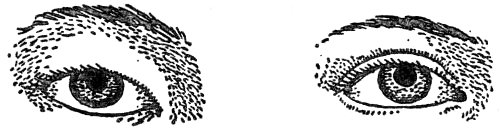
The eye of a Chinese with the Mongoloid fold, contrasted with the eye of a white man. (After Hooton, 1931.)
In addition, there are many traits typical of Asiatic Mongoloids which appear very irregularly in the Americas. The “Mongoloid fold”—an overhanging fold of skin on the upper eyelid—is found in some tribes and not in others, and in certain individuals of a tribe and not in others. The bony structure of the face varies greatly. Some tribes have strong chins; some, weak 209 ones. The nose of the typical Plains Indian is hawklike—a violent departure from the Mongoloid’s rather flat nasal equipment. The “Semitic” nose of the Maya is Japanese but not at all Chinese. “The Indian type,” says Nelson, “is distinguishable in one way or another from its nearest Mongoloid relations, and at the same time is separable according to some authorities into about ten more or less distinct varieties.”[1]
Looked at in terms of resemblances to Old World peoples, the American Indian becomes a very crazy quilt of races. Hooton sees “an almost pre-Dravidian look” about the Lacandons which vaguely reminds him of the Veddas of India. He finds that many Indians of the Northwest coast resemble Alpine Europeans, and that eastern Indians have a “European look,” and are “by no means as Mongoloid as the Plains and Southwestern Indians”:
For years I have been troubled by the types depicted in the splendid series of oil portraits of Indians in the Peabody Museum. The most of these represent Indians of the eastern and southeastern United States, and, although the portraits are the work of an excellent painter, his subjects look very European. The features of most are very un-Mongoloid, with prominent noses and oval faces ... some Plains Indians are included in the series, and these seem to be accurate representations of types familiar today. I am, therefore, disposed to think that the European-like types are not the result of an artistic convention, but actually did exist.[2]
Racial Definition—the Field of the Physical Anthropologist
Physical anthropology has its difficulties and uncertainties when it tries to reach back deep into time. But the tests by which it distinguishes races seem as sound and dependable as those of any of the disciplines that deal with early man. Some of the results are certainly striking.
210
There are problems, of course, as to the order in which the various races developed and spread throughout the Old World. In the opinion of some authorities, the Pygmy, or Negrito, came first. The Pygmy, although resembling the Negro in most respects, has in general one of the roundest heads of all mankind, while the Negro’s is pre-eminently long and narrow. Many anthropologists pick the Australoid as the second race to leave an unknown homeland and spread far abroad. The White, or Caucasoid, racial stock is divided into certain groups by one authority, and into other groups by another. Hooton puts the beginnings of the White race far back by calling the Australoid “an archaic form of modern White man.”[3]
But, in spite of conflicts of opinion, the physical anthropologist has fairly firm ground to stand on. He can bring to bear on the skull or the fleshed bone of man certain tests, certain measurements, which enable him to discriminate with some accuracy between the various racial types. The most important of the measurements have to do with the shape of the head and certain of its features.
The Cephalic Index—and Others
A hundred years ago a Swedish scientist, Anders Retzius, set up a measurement called the cephalic index, which indicates whether a head is dolichocephalic or brachycephalic—long-headed or round-headed, narrow or broad. The width of the skull, divided by its length, and multiplied by 100, gives the cephalic index—as 15.0 cm. ÷ 17.6 cm. × 100 = 85.23. The long-headed, or dolichocephalic, skull, lies below 75; the round-headed, or brachycephalic, at or above 80. Between lies the intermediate ground of the mesocephalic. (It is rather easy to keep “dolichocephalic” and “brachycephalic” straight if you note that the longer word applies to the long-headed skulls.)
211
The Pygmy aside, we find long-headedness common to early peoples and then gradually giving way to round-headedness. Round-headedness is a progressively modern tendency; there seem to be more round heads than there used to be. (Round-headedness seems to have increased sharply with the advent of agriculture. Are the two related? Does a vegetable diet have a functional effect upon head shape?) Among modern peoples, the Australian, the Negro, the Nordic, and the Mediterranean are long-headed. The Pygmy, the Alpine of Central Europe, and the Chinese are generally round-headed. Most Indians, being heavily Mongoloid, are likewise round-headed. The cephalic index alone is not too good a means of determining races today, but it has definite value in dealing with early man in the Americas. Here, as in the Old World, he seems to have been, with two exceptions, as long-headed as the modern Australian.
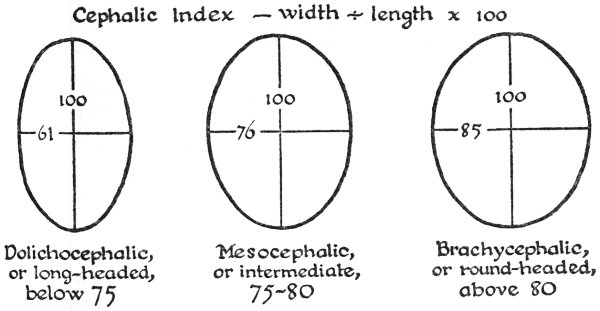
In this diagrammatic description of one of the most important measurements of the head, the length is given as 100, instead of 18 centimeters, or some other actual measurement, in order to make the matter simpler to comprehend.
Cephalic Index—width ÷ length × 100
Dolichocephalic, or long-headed, below 75
Mesocephalic, or intermediate, 75-80
Brachycephalic, or round-headed, above 80
212
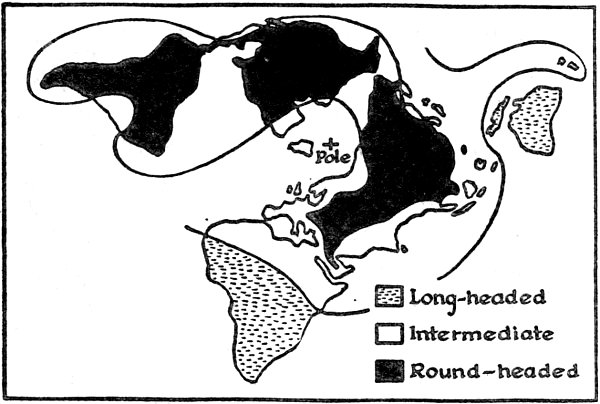
A map showing the centrifugal dispersal, first of long-headed Negroes and Australoids, then intermediate to long-headed Mediterraneans, and finally round-headed Mongoloids and Alpines, from an Asiatic homeland. The maker of this map prefers “narrow-headed” for “long-headed,” “broad-headed” for “round-headed.” (After Taylor, 1937, with some modifications.)
There are other important measurements, which we shall not describe at such length. The facial index tells us whether the face is relatively broad or narrow, the breadth is measured from cheekbone to cheekbone, and the length from the root, or topmost point, of the nose between the eyes to the bottom of the chin. This facial index is not so useful as the cephalic in determining race, because some of the bones involved are affected by age and sex. The nasal index tells us whether the nose—or, in a skull, the nasal aperture—is broad or narrow, adapted to a warm, moist climate or to a dry, cold one. Then there is the matter of prognathism, with a receding chin. Heavy brow ridges, which usually go with a retreating forehead, and the shape of the vault may be important indications of race. No one of these measurements or observations 213 can definitely denote race, but a number of them taken together are rather reliable.
There is a certain difficulty, however, in applying the detective methods of physical anthropology to the skulls of early man in the New World. It is only a matter of terminology, but sometimes this affects our understanding of what scientists are talking about when they describe early American skulls as Australoid, Melanesian, Papuan, Caucasoid, or Negroid. The difficulty stems back to the southwest Pacific. The Australians—a race as primitive as the Neanderthal and perhaps more primitive—are spoken of as Australoid. They are also described by some writers as Caucasoid on the theory that they are a blend of an archaic white race with Negroid elements. The dark-skinned people, who inhabit large parts of New Guinea and nearby islands, are called Melanesian. Some of the men of this area used to be called Papuan—which is really only a word for a language. When the characteristics of their skulls turn up in the Americas, these craniums may be called Papuan by an older writer or Australoid, Melanesian, Caucasoid, or Negroid. Recently, physical anthropologists have determined that no full-sized Negro has existed east of, roughly, Arabia until recent times. Accordingly, this Negroid element in the western Pacific must be related to the Pygmy. We will refer to him as Oceanic Negrito.
What do the tests of the physical anthropologist tell you about skulls which come from the southwest Pacific or resemble specimens from that area? If you find a skull that has protruding jaws, a low or depressed nose root, and straight sides, you may say with some assurance that it belonged to an Oceanic Negrito, an aboriginal Australian, an Australoid-Melanesian, or—if the owner has been dead many thousands of years—an Australoid. If the skull also has a heavy, continuous brow ridge, a retreating forehead, and a low, keeled vault, you can forget the Negrito. The man was an Australoid-Melanesian, or an Australoid.
214
THREE TYPES OF SKULLS
Generalized impressions of the cranial traits of three races that may be presumed to have contributed to the peopling of the Americas. Certain Mongoloid tribes, represented by the Eskimo and peoples of northern Asia, differ from the race in general in having long, narrow skulls with keeled vaults and flat sides. (The Australoid, after Leakey, 1935; the Negroid, after Leakey, 1935, and Martin, 1928; the Mongoloid, after Stibbe, 1938, and Hooton, 1931.)
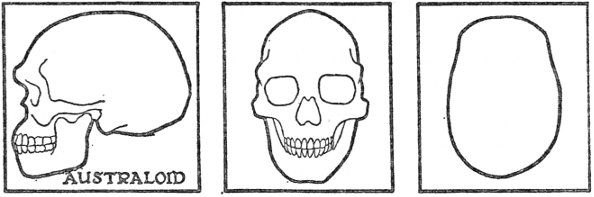
AUSTRALOID
Forehead: low, receding
Brow ridges: heavy
Face and jaws: protruding
Rear: protruding
Forehead: narrow
Vault: keeled
Sides: flat
Sockets: low, oblong
Dolichocephalic (very long and narrow head)
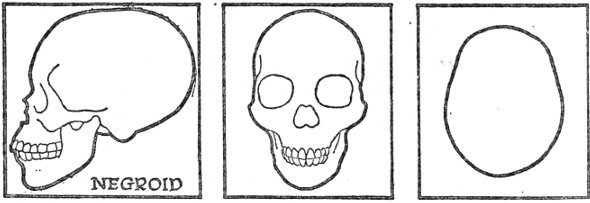
NEGROID
Forehead: low, rounded
Brow ridges: slight or absent
Face and jaws: rotruding
Rear: bulging
Forehead: narrow
Vault: curved
Sides: flat to slightly convex
Dolichocephalic (narrow head, medium to long)
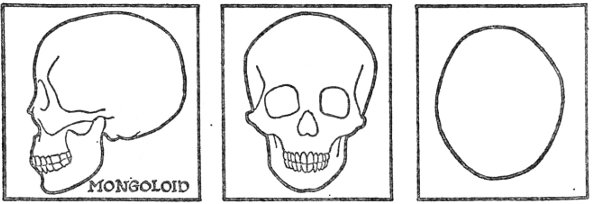
MONGOLOID
Forehead: somewhat high
Brow ridges: absent
Face: flat
Rear: flat
Forehead: broad
Vault: broad, globular
Sides: convex to bulging
Brachycephalic (round)
215
What Skull Measurements Tell Us About Early Man
These peculiarities of southwest Pacific skulls are important if you are looking for early man in the Americas. As we have said, a skull found along with the bones of extinct mammals or in a geological formation that suggests great age is almost always long-headed, or dolichocephalic. The typical, round-headed Mongoloid Indian is conspicuous by his antique absence. (The only early skulls that are not long-headed fall in the intermediate division, the mesocephalic.) Further, the early skull has most, if not all, of the following features: a heavy, almost continuous brow ridge; a receding chin; a low nose root; straight sides; a retreating forehead, and a keeled vault.
On the score of long-headedness, there can be no question about all but two of the early skulls mentioned in Chapter 6 or illustrated on page 216. The Confins has a cephalic index of 69.1, which is hyper-dolichocephalic, or extra long; the female skulls of the Pericú in Lower California average 68.50 and the male 66.15, while sixteen skulls from the Texas coast show an average of 65.37. Except for the skulls of Tepexpan man and the Minnesota girl, all the other skulls we have referred to have the same long-headed character. If those from Texas and the Pacific Coast are not so ancient as the rest, at least they seem to represent the descendants of an old strain forced off into marginal areas by the invasion of newer peoples. To be sure, we have now—and have had—Indians with long skulls, particularly in the eastern part of the United States and to some extent on the Great Plains. But their number is not large, and can never have been large, compared with the great bulk of round-headed Indians of the two Americas.
216
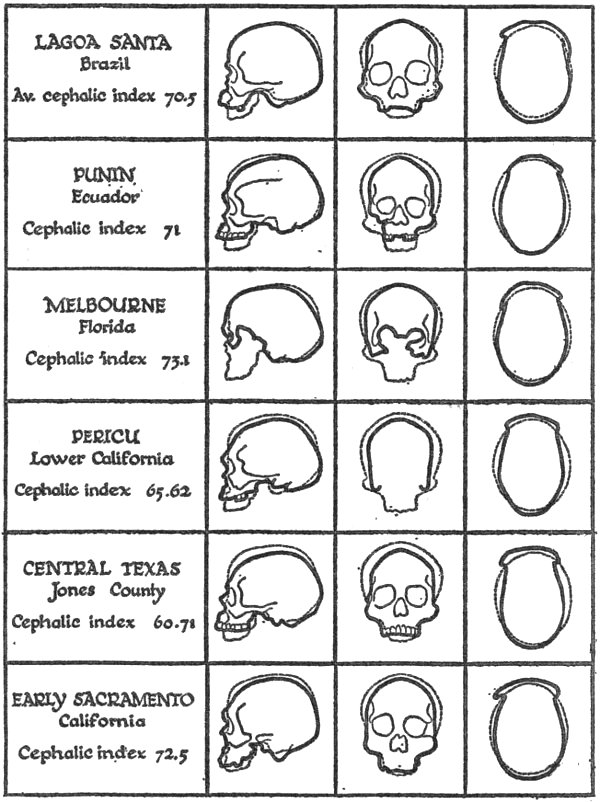
EARLY MAN VS. THE MONGOLOID
In this comparison, the Mongoloid skull—indicated by dotted lines—and the skulls of early man are not drawn to true scale, because the former is an abstraction, and the measurements of all the latter are not available. For comparison, the nose root and the back of the skull are made to agree in the profiles, and the other views are drawn from this relationship. (The Mongoloid skull, after Stibbe, 1938, and Hooton, 1931; the Early Sacramento, courtesy Robert F. Heizer; the Pericú, after ten Kate, 1884, and Woodbury, 1935; the Punin, after Sullivan and Hellman, 1925; the Lagoa Santa, after Hrdlička, 1912; the Central Texas, after Hooton, 1933.)
LAGOA SANTA
Brazil
Av. cephalic index 70.5
PUNIN
Ecuador
Cephalic index 71
MELBOURNE
Florida
Cephalic index 73.1
PERICU
Lower California
Cephalic index 65.62
CENTRAL TEXAS
Jones County
Cephalic Index 60.71
EARLY SACRAMENTO
California
Cephalic Index 72.5
217
Apart from long-headedness, our early skulls share a number of other peculiarities of the Australoid-Melanesian: the quite heavy brow ridges, the keeled vault, the straight sides, the retreating forehead, the low nose root, and the receding chin. Some have the round vault and the fuller forehead of White and Mongoloid peoples, but these are also a feature of the Negrito strain that united with the Australoid in Melanesia.
In one respect only do the skulls of early American man follow a Mongoloid pattern: almost all have prominent cheekbones. We must remember, however, that prominent cheekbones are found in other races—though not so commonly—and we must recognize that they cannot weigh too heavily against those un-Mongoloid peculiarities we have dwelt on.
The peculiarities of our early skulls must make us think twice about the Indian as the only pre-Columbian inhabitant of the Americas south of the Eskimo. They bear witness to another invader from the Old World. Such skulls—even if they were only a thousand years old—would tell us that the typical Mongoloid Indian was not the only arrival from Asia who left descendants. Since many of the skulls are definitely the 218 oldest that have been found in the New World, we must recognize that early man bore some relationship to other peoples than the forebears of the noble red man.
Europe Recognizes the Australoid in America
The earliest recognition of non-Indian traits in the Americas came from scientists of the Old World—Mochi, Biasutti, Hansen, Quatrefages, ten Kate (who found the Pericú skulls in Lower California), Rivet, Gusinde, Lebzelter, Mendes Correâ, Hultkrantz. The first American and British students to accept the idea were Roland B. Dixon in 1923, A. C. Haddon in 1925, and Sir Arthur Keith and Earnest A. Hooton in 1930; the last two were physical anthropologists, and naturally knew more than archaeologists about the meaning of bones. Toward the end, even Hrdlička was diluting the Mongolism of the Indian with some Aurignacian and Magdalenian ancestry, though the Australoid and the Melanesian were too much for him.
In the English-speaking world the case for the Mongoloid Indian as the only type of early man was definitely and finally thrown out of court in 1930 by statements from two men eminent in their field—Keith and Hooton.
Keith’s statement was simple and short, but his position as a sound and skillful anatomist gave it considerable weight. He confirmed the judgment of Louis R. Sullivan and Milo Hellman that the Punin skull from Ecuador resembled the skulls of native women of Australia. The points of resemblance, he wrote, “were too numerous to permit us to suppose that the skull could be a sport produced by an American Indian parentage.” Here follows Keith’s decisive dictum: “This discovery at Punin does compel us to look into the possibility of a Pleistocene Glacial invasion of America by an Australoid people.”[4]
219
Hooton and Dixon on Early Invaders
Hooton’s pronouncement in 1930 against the pretensions of the Mongoloid Indian resulted from a study of a number of old skulls found at Pecos Pueblo in New Mexico. In terms of early man they were not so very aged; in fact, they were slightly younger than the Basket Makers of the first Christian centuries. But in these skulls Hooton found traces of seven types of men. They included, as one might expect, the Basket Makers, the Plains Indian, and a “large hybrid” type which was thoroughly Indian. In addition he listed a “Pseudo-Australoid,” a “Pseudo-Negroid,” a “Long-faced European,” and a “Pseudo-Alpine” type. From this analysis of skulls little more than a thousand years old, Hooton went on boldly to picture the kind of men that first discovered and invaded the Americas:
Briefly, then, my present opinion as to the peopling of the American continent is as follows: At a rather remote period, probably soon after the last glacial retreat, there straggled into the New World from Asia by way of the Bering Strait groups of dolichocephals in which were blended at least three strains: one very closely allied to the fundamental brunet European and African long-headed stock called “Mediterranean”; another, a more primitive form with heavy brow-ridges, low broad face and wide nose, which is probably to be identified with an archaic type represented today very strongly (although mixed with other elements) in the native Australians, and less strongly in the so-called “Pre-Dravidians” such as the Veddahs, and also in the Ainu; thirdly, an element certainly Negroid (not Negro). These people, already racially mixed, spread over the New World carrying with them a primitive fishing and hunting culture. Their coming must have preceded the occupation of eastern Asia by the present predominantly Mongoloid peoples, since the purer 220 types of these dolichocephals do not show the characteristic Mongoloid features.
At a somewhat later period there began to arrive in the New World groups of Mongoloids coming by the same route as their predecessors. Many of these were probably purely Mongoloid in race, but others were mixed with some other racial element notable because of its high-bridged and often convex nose. This may have been either Armenoid or Proto-Nordic (or neither one). These later invaders were capable of higher cultural development than the early pioneers and were responsible for the development of agriculture and for the notable achievements of the New World civilization. In some places they may have driven out and supplanted the early long-heads, but often they seem to have interbred with them producing the multiple and varied types of the present American Indians—types which are Mongoloid to a varying extent, but never purely Mongoloid. Last of all came the Eskimo, a culturally primitive Mongoloid group, already mixed with some non-Mongoloid strain before their arrival in North America.[5]
In 1947 Hooton stated this in simpler terms: “I am fairly sure that the earliest arrivals here were non-Mongoloids carrying archaic White strains (‘Australoids,’ if you like) probably mixed with Negritic elements and with whatever else was kicking around in Asia before they crossed Bering Strait.”[6]
Dixon’s position, which he took in 1923, is in some ways a more radical one than Hooton’s. He introduces “Proto-Australoid,” “Proto-Negroid,” and Mediterranean elements, and also Caspian and Alpine; but, where Hooton recognizes a general stock in which Australoid, Negroid, and Mediterranean were blended before their arrival, Dixon brings in his races separate and pure, and he assigns them definite areas in the New World.
Dixon’s Proto-Australoid originated in tropical southeast 221 Asia. It spread westward “through India and the Arabian coasts to Africa, and by way of the Mediterranean passed into western Europe, where it appeared in early Paleolithic times.... Another branch spread southeast into Australia, where its early presence is proved by the Talgai skull,” perhaps 150,000 years old. “A third branch drifted slowly northward up the eastern Asiatic littoral, and, crossing into America, spread thinly through the continents, and perhaps mainly along the western shores.... On the Pacific Coast in California and Lower California it appears to constitute the oldest stratum, characterizing as it does the crania from the lower layers of the shell-heaps, from the islands of Santa Catalina and San Clemente off the Coast, and from the extinct Pericue [now Pericú] isolated on the southern tip of the peninsula of Lower California.” Dixon places some of his Proto-Australoids among the ancestors of the Iroquois and the southern Algonquin tribes of the East. He puts most of his Proto-Negroids in that same eastern area and with the same tribes. He finds them generally east of the Rockies, but also among the Basket Makers in the Southwest and the peoples of the Coahuila Caves of northern Mexico, in the Lagoa Santa area in Brazil, and in Patagonia.[7]
Two of the White types—the Caspian and the Mediterranean—seem rather scattered and rather early. Dixon thinks that a Caspian strain may have appeared as soon as the Proto-Australoid, perhaps sooner. It crops up among the Eskimo and at spots in British Columbia, and widely in South America. The Mediterranean influence, Dixon says, is found also among the Eskimo and among Shoshonean and Siouan tribes.
Dixon does not think much of the Mongoloids. Believing they were a very old people that drifted into Europe in early paleolithic times, he says they “contributed little of value either to the sum of human achievements or the blood of existing races.” He gives 222 them only scant space in North America. Instead he introduces two other round-headed peoples. They are first the Paleo-Alpines, and later the Alpines. These, who seem to take on the role played by the Mongoloids of Hooton and others, spread through to South America and “displayed striking ability.... To them seems to be attributable most of the higher achievements of the aboriginal American peoples.”[8]
Some theories are doubtless much too simple; also, they depend too much on other theories, such as the idea that all the races originated in southwestern Asia. R. Ruggles Gates, who writes of “American Neanderthaloids” and “pseudo-Australoids,” believes that the craniums of the men of Lagoa Santa and Punin—“the earliest wave of interglacial Americans”—“represent a parallel stage in skull development of a widely different race” from the one that began as the Neanderthal or the one that ended as the Australian.[9]
A Potpourri of Races
The theories of Dixon and Hooton and others conflict in many places; but they present, on the whole, an arresting and convincing case for early man as a predecessor of the Mongoloids and as quite a different sort of creature. There are many side issues to the general theory, and they increase as we begin to deal with living peoples. Hooton finds close resemblances to Egyptian skulls among the Arizona Basket Makers and in the Coahuila Caves of northern Mexico,[10] and Dixon identifies ancient Egyptian skulls with skulls from California and skulls of the Iroquois. W. W. Howells sees similarities between “many forest tribes of South America and certain Indonesian groups in Borneo and the Philippines,” and believes the non-Mongoloid features of the Indians point, “not to the Australoids or the Negroes, but towards the White group.”[11] Hooton finds Indians of the Northwest coast who “resemble Alpine Europeans.” 223 He says that certain Plains Indians seem to be basically White with Mongoloid added, and he points out that although the Eskimo are the most Mongoloid of all the inhabitants of the Americas, they are long-headed, which is a most un-Monogoloid trait.[12] On the basis of skulls from Chancelade, France, and certain late-paleolithic traits, Sollas saw the ancestors of the Eskimo living in Europe in Magdalenian times.[13] M. R. Harrington also picks a Magdalenian forebear for the Eskimo.[14] Authorities differ as to whether the Botocudo tribe of Brazil is descended from the people that left their skulls in the Lagoa Santa caves, but on the basis of R. N. Wegners description of a Bolivian tribe, the Qurunga, Griffith Taylor believes these people may be living representatives of an early Australoid migration.[15] Hooton puts forward the picturesque and amusing theory that the Maya, with their large, curved noses and their mania for flattening their heads between boards, picked up both the nose and the mania from the Armenoids of the Iranian plateau. The Mongoloids provided the characteristic skin, hair, and eyelids.[16]
The backwardness of certain living American tribes suggests to Sauer that they came to the New World a very long time ago. Their lack of a number of useful skills argues that they branched off from the men of the Old Stone Age when the Australoid ancestors of the abysmal Blackfellows of Australia looked like an up-and-coming people. These early men had the enterprise to reach the New World, but they stuck to old and limited habits of life. They would not learn from new invading peoples, and so they were forced into refuge areas as remote as Newfoundland, Lower California, Amazonia, and Tierra del Fuego. As an example of cultural backwardness and of an inability to learn which recalls the Australians, Sauer cites a people in the Brazilian interior who get along without boiling any 224 of their food. He believes that this tribe acquired its cultural habits in the days before man began to put heated stones into water in pitch-sealed baskets. The primitive resistance of these “Indians” to borrowing new cooking skills like boiling comes out in other directions. “Long in contact with pottery-making peoples, they make casual or no use of pots, but restrict their cooking to roasting and baking, with gourds, a late acquisition, used for carrying water.”[17]
Griffith Taylor once wrote to Earl W. Count that, because certain of the now extinct mammals inhabited both sides of Bering Strait in the days of the glaciers, “it is almost impossible that the Australoids (who preyed on them) did not cross into America in Pre-Würm times.” Count supports Taylor with the suggestion that the most primitive of the many stocks that invaded the Americas came “at a time, say, when Talgai man and Wadjak man were en route to their cul de sac in Australia.”[18]
Radical as these last two suggestions are in point of time, they are conservative compared with theories held by A. A. Mendes Correâ and Paul Rivet. Like many another student, Mendes Correâ saw Australian, Caucasoid, Polynesian, Melanesian, and Asiatic affinities among the American Indians; but he struck into a new field of theory in 1926 by transporting the Australians to South America over a now-vanished land-bridge to the south. Using Wegener’s hypothesis of the drift of continents, he found his bridge in a severed and displaced Antarctica. He conceded that this was only a conjecture, but thought it “very probable.”[19] That same year Rivet—approving migrations of Australian, Malayan-Polynesian, Asiatic, and Ural elements—suggested that glaciation in the southern hemisphere might have aided the Australians in passing from island to island until they reached the mainland of South America.[20] He dated their journey at only 6,000 225 years ago,[21] so that glacial assistance beyond the present extent of Antarctica seems just a little unlikely. Rivet, following many a student from Leibnitz to Thomas Jefferson, proposed to trace the origin of the American peoples through comparing their languages with those of the Old World. In 1925 he came up with something more than the usual random identities between words.[22] Indeed, the parallels which he drew between the present speech of the Tshon of Patagonia and the Australians seemed to Dixon to be impossibly close after centuries upon centuries of separation from one another and of contact with other peoples.[23] Only sheer coincidence could account for such identity.
There remain two champions of multiform and multitudinous migrations—José Imbelloni of Argentina and Harold S. Gladwin. They go further than any of their predecessors in peopling the New World with varied races, and further in advancing transpacific migrations as an important factor in the history of the Americas.
Pygmies Before Australoids in the New World?
Both Imbelloni and Gladwin begin with a suggestion that Pygmies deserve consideration. These primordial migrants trod their tiny paces from some unknown fatherland to the forests of the Congo and the jungles of New Guinea, to islands like the Andamans and possibly to Tasmania. The presence of five-foot Yahgan in Tierra del Fuego suggests to both Imbelloni and Gladwin that Pygmies may have preceded the Australoids to the New World. The advent of Pygmies in Tierra del Fuego as well as in Tasmania may be open to question; for in both places the natives, though short, exceeded the average of Pygmy height by a few inches, and their heads, instead of being round like those of the Pygmies, are recorded as of medium cephalic index.
After the Tasmanian strain, Imbelloni carries over by 226 land a Melanesian type to lay their skulls in Lagoa Santa, Punin, Texas, and Lower California. Next came tall people, “comparable partly to the Australian type,” who seem to be the Indians of plains and pampas. These were the last of the land-borne migrants until the present era. Hereafter they came by sea. The fourth element was a Proto-Indonesian people that settled exclusively in South America and mainly in Amazonia. With the fifth group Imbelloni presents the first frank Mongoloids, round-headed and inclined to agriculture; they settled in the Southwest, in Middle America, and along the Andean coast. An almost identical people—whom Imbelloni calls the Isthmid—spread through the center of the same area shortly after the birth of Christ and brought to fruition the civilizations which Cortez and Pizarro found in the New World. To top off his list, Imbelloni brings over the Eskimo and men for the American Northwest—but by no longer a sea voyage than Bering Strait.[24]
Gladwin’s theories appeared first in the second volume of Excavations at Snaketown, and were presented in altered and amplified form through his rather antic book Men Out of Asia. They are completely heretical, completely fascinating, and in some respects uncommonly plausible. They are certainly a tonic.
Gladwin begins with what might be called a Pygmoid visitation. He does not dignify it with the word “migration.” He is careful to say that there are only “rather vague indications.” There is “just enough to make one wonder if there may not have been a few Pygmy groups who strayed over here long, long ago and were pushed off to the edges and the ends when the Australoid tide flowed in.”[25]
If a scientific study is ever made in the Guayana highlands of Venezuela, some support may be given to the theory of an early Pygmy migration. Carl Sauer on a visit to Venezuela in 1946 saw photographs of a 227 Pygmy-like people taken by a Venezuelan army officer who had paddled and packed the Guayana River for some years. This tribe, which does not interbreed with other tribes, appears to be Pygmoid in stature and type. Further, it lacks “clothing, weaving, netting, baskets, boats, and fishing skills, and also houses.”[26]
Australoids, Negroids, and Men from Europe
Gladwin is definite about the Australoids. They came over Bering Strait somewhere around 25,000 years ago, and drifted down the west coast. They spread out in the southwestern part of the United States below a line from San Francisco to the Texas coast, and flowed on down into Mexico and South America. For evidence he has more than the Australoid-Melanesian skulls of Lower California, Texas, Punin, Paltacalo, and Lagoa Santa. He cites a number of things used and made by the Australians of recent times and also found in the area between southern California and eastern Texas. They include an Aurignacian flint industry, bunt points for darts, bull-roarers, string made by spinning human hair, twisted rabbit fur, curved throwing sticks with parallel grooves, sand paintings, amputation of finger joints as shown in pictographs, and similarities in spear-throwers and darts with foreshafts (see illustration, page 228).[27] We should like to find them nearer Lagoa Santa.
Gladwin’s next migration, the Proto-Negroid of Dixon, leans upon the Pseudo-Negroid traits of Hooton. It comes in about 17,000 years ago, also over Bering Strait, but down through the corridor between the retreating ice fields of western Canada. Having seen Aurignacian qualities in the Australoids, Gladwin sees Solutrean ones in the Negroid invaders. They bring—or, rather, make—the Folsom point. Unlike the Australoids, who were mostly food gatherers, the Negroids—or Folsom men—are primarily hunters. Although they come trickling in for many, many years, they are few; for, in spite of their hunting prowess and their fine flint knives and spear points, they never invade the Australoid territory that is staked out south from the Mexican border.[28]
228
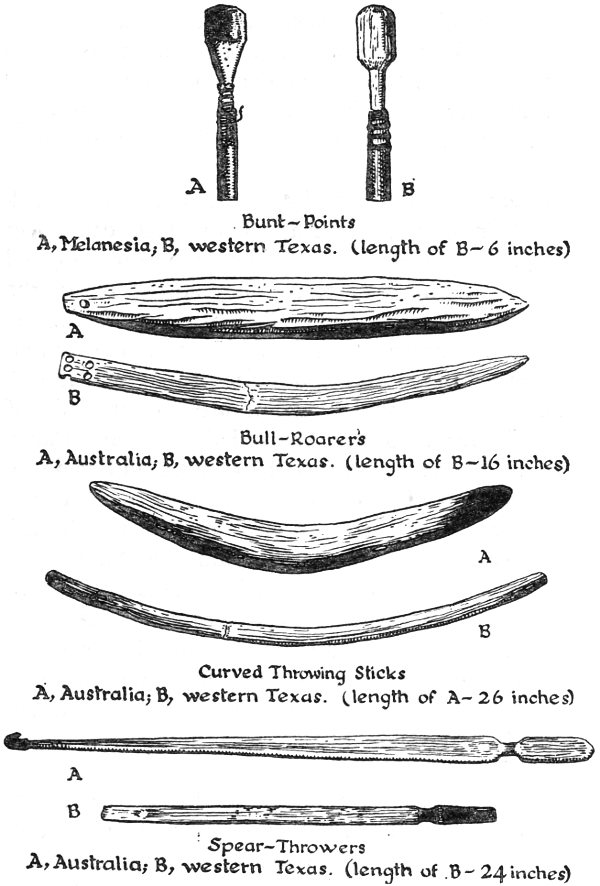
FROM THE OLD WORLD AND THE NEW
Implements from Australoid areas of the eastern hemisphere resembling implements from western Texas. (After Gladwin, 1937.)
Bunt-Points
A, Melanesia; B, western Texas. (length of B—6 inches)
Bull-Roarers
A, Australia; B, western Texas. (length of B—16 inches)
Curved Throwing Sticks
A, Australia; B, western Texas. (length of A—26 inches)
Spear-Throwers
A, Australia; B, western Texas, (length of B—24 inches)
229
The next migration is the Algonquin. It reaches North America somewhere between 1000 and 500 B.C. These people bring in the cord-marked pottery of the Woodland culture of the eastern United States—unpolished and unpainted, its only ornament impressed in the clay. Such pottery has now been traced to western Canada, up into Alaska, across to Siberia, west through Russia to the beakerwares of Europe, and finally down into Africa about 3000 B.C. The Algonquins are such a mixture as the long trip of their pottery might indicate. They are generally long-headed, and they are not today wholly Mongoloid.[29]
No Mongoloids till 300 B.C.
The first Mongoloids, as Gladwin sees it, were the Eskimos. They came to the northern edge of North America about 500 B.C. But, because they clung to that edge, we must look elsewhere and later for a Mongoloid invasion of the cultural areas of the New World.
Gladwin believes that these second Mongoloids were thrust out of northern China and on into the New World by the ferment of the Huns. They reached Alaska about 300 B.C. Ultimately, supplemented by the Uto-Aztecans, they supplied the man power on which the Mexican and Maya civilizations were built; and some reached the west coast of South America.[30] Without a good many of them it seems to us difficult to account for such Andean peoples as the speakers of the Quechua and Aymara languages, who were the working population of the Chimu, Nasca, Tiahuanaco, and Inca cultures. By Gladwin’s dating, the Mongoloids had only a little more than a thousand years to 230 stamp their hair and eyes and teeth upon five million to fifty million men and women in both Americas.
By the time of the Algonquin—let alone the Eskimo and the Aztec—we are far out of the era of early man. But we are not yet through with the theories of Gladwin as to the peopling of the Americas; for, not content with the stimulating activities of the Huns in northern China, he rediscovers the sailors and the Asiatic fleet of the late, great conqueror Alexander of Macedon, and leads them on expeditions through the East Indies and Oceania even to the Gulf of Darien.[31]
However heretical Gladwin’s suggestions may be, they deserve serious attention if only because they bear heavily upon an old quarrel of the archaeologists, and because this old quarrel bears upon the antiquity of man in the Americas. To be sure, it has to do with the Indians who made the civilizations of Middle America and Peru two thousand years ago, and not with the earlier men who did no more than hunt or gather, and who made nothing more remarkable than Folsom and Eden points or milling stones. But by studying certain aspects of those civilizations we may recognize that the Indians had been in the Americas 3,000 to 5,000 years before Columbus. By so much we may reenforce the theory that their forerunners or their forebears came to the New World at least 15,000 years ago and probably 25,000 or more years ago.
Siberian Caucasoids
Since 1950, Joseph Birdsell and Carleton Coon have done something to clear a little of the mist that has obscured the physical origins of man in the New World. They agree, more or less, that the first migrants were of Caucasoid stock from the basin of the Amur River, in northeast Siberia.[32]
Birdsell, a close student of the Australian aborigines, finds three strains in these peoples, one of which is traceable to the “white” Ainus, of northern Japan, and 231 finally to what he calls the Amurians of the aforementioned river basin. In Australia their descendants are rather short and stocky, with a “rough-hewn Caucasoid cast of features.” Their craniums are long and low, with large brow ridges—general traits of Pleistocene man as well as some of our possibly early, and certainly problematical, Americans. Coon supposes that natural selection among the Amurians—trapped by the advance of the fourth glaciation or one of its substages—produced certain Mongoloid features that they later carried into the New World. Birdsell sees among the early migrants no Negritos, no full-sized Negroids, no so-called Melanesians, no Mediterranean type of Caucasoids. He suggests that a much-mixed strain of Caucasoid Amurians and the newly evolved Mongoloid race accounts for earliest man in the Americas. These “present the only discernible elements available at the proper time and place to have contributed importantly to the New World populations.... One may speculate that if human populations reached the New World in the third interglacial they could be expected to be purely Caucasoid, that is Amurian, and to show no Mongoloid characteristics.” Birdsell suggests that migrants coming after the last glaciation would carry some Mongoloid features through hybridization. Guardedly, Birdsell insists that, though this is a satisfying and stimulating hypothesis, we have as yet no means of judging accurately racial affiliations from a single cranium or entire populations. He concludes—somewhat sadly, we surmise—that methods utilized as recently as 1949 (the date of his proposal) offer no promise of unraveling in detail the enigma of the origins of our earliest Americans.
233