1 THIS SUDDEN NEW WORLD
Reading edition
Of all animals, we men are the only ones who wonder where we came from and where we will go. —W. W. HOWELLS
A Secret Laboratory of Culture
By the end of World War II, Timbuctoo was surprisingly close to Keokuk. Boys from Brooklyn stared up at Roman columns in the African desert, and Marines swapped a package of cigarettes for the spear of a stone-age man in New Guinea. Physically ours was indeed one world.
In a different sense it was one world before Columbus sailed, but a very limited world. Europe, North Africa, and portions of Asia made up all that Columbus knew and all that he expected to know. He intended to find a new road to the Indies; that was all. It would be a road across his own one world.
Then suddenly this world of his was two worlds. A new hemisphere appeared like a comet from outer space. It was a land and a people utterly unknown, utterly different. It had lived and grown for thousands upon thousands of years, sealed off to itself, unique. We search for some fit comparison, and find nothing adequate to describe the discovery of this secret laboratory of experiment in human culture.
Perhaps we should not have said that the New World had been “sealed off to itself.” We might better 2 have said “sealed off from Europe.” The culture which the Spanish Conquistadores found in the Americas owed nothing to that world from which they had come. What the Americas owed to Asia is another matter—in fact, the matter of this book.
One thing is clear. The Americas were indebted to Asia for man himself. Man—even one type of man—did not originate here. A small primate, the extinct Notharctus, left his bones—but no descendants—in our Southwest. The New World has no great apes; there are no indications that it ever had any. Its monkeys are quite out of the running. They have four too many teeth, their nose is flat, and they are cursed with a prehensile tail.
The New World owed something more to Asia, of course; but how much, is uncertain. Most anthropologists believe that man crossed Bering Strait with a very meager kit of material culture. He brought, at various times, the spear-thrower, the bow and arrow, the dog, the boat, the strike-a-light, some kind of clothing, but not a great deal more. Many other things—pottery, weaving, agriculture, masonry, metallurgy—he had to invent for himself in the New World; at least, that is the general opinion. A few anthropologists say that men out of Asia brought quite an array of culture traits; but these migrants were late comers, and some of them crossed the Pacific by boat.
Only a few students now deny that men had been crossing over from Asia through twenty or more millenniums before the birth of Christ. Some of them were what we call Indians—most of them, no doubt; but, before the Indians came, there seem to have been other immigrants. It is the purpose of this book to tell you what is known or believed or hazarded about these earliest men of the New World.
There are two chief problems: When did these men come? and What were they like?
3
It is a curious fact that, if we look at the rich variety of men and languages and cultures which was spread from end to end of two whole continents when the European came, we get some vague idea of how long man had been in the western hemisphere but no idea at all of what he was like when he anticipated Columbus by discovering the New World. Through the haze of time, we can see the general outline of Indian civilization, and many details. Much of this is clear and concrete, most of it is natural and understandable in terms of our Americas, and all of it is striking and extraordinary. But, for our present purposes, the best it does is to tell us that many millenniums of time must have been required for its development. It tells us nothing about the men who preceded the Indian, the primitive savages who discovered the New World. These men who first journeyed from Bering Strait to Cape Horn were not the men who made the Maya civilization, and they came long, long before. But by studying both the Indian and his predecessors we may gain some hint of how long ago this was.
Time-Tests by Travel, Tongues, and Physiques
Somehow or other, by this route or that, the migrants from Asia drifted across to the Americas, down the two continents, and out to their uttermost limits. Of the many possible tests of man’s age in the New World—some good, some not so good—one of the least accurate is a guess at how long it would take men and women, encumbered with children, to walk—and to eat their way—from Bering Strait to Cape Horn. It has been estimated that they might have covered the 4,000 miles from Harbin, Manchuria, to Vancouver Island in from 20 to 1,000 years; the time involved really depends on how fast and in what direction those wild animals moved upon which early man depended for food. As the country widened out, then narrowed in Central America, and widened out once more, there is no knowing how long the trip to Cape Horn may have taken. Our migrants would have had to camp and hunt as they went, and at first they would have moved only as the pursuit of game spurred them on. There would have had to be time, too, for increase in numbers—among themselves as well as among later invaders—to create pressure of population, and force the earlier men to the peripheries of northeastern America, Florida, and Lower California, and push them across jungled Panama and Amazonia and toward the bleaker and less desirable parts of South America. The various invaders multiplied as they moved, and it is anybody’s guess how many people were crowded into America by 1492; one authority says 8,400,000, another 50,000,000 to 75,000,000.[1] It took much time, of course—many millenniums—to breed so many men and cover so wide a space.
4
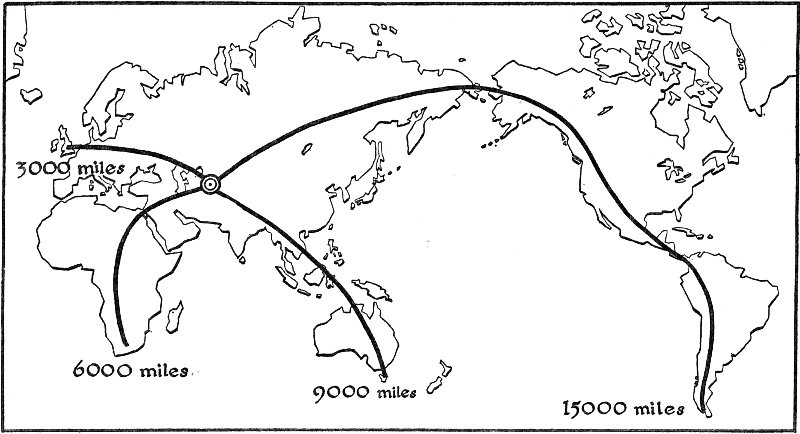
THE TREKS OF EARLY MAN
This map shows how far man would have had to walk from southern Africa to a spot just east of the Caspian Sea, where it used to be supposed that man originated, and it also shows the distance from that area to England, Australia, and Tierra del Fuego. The journey of early man from Bering Strait to the tip of Cape Horn was a matter of 10,000 miles.
5
Other things suggest a long sojourn for the Indian in the New World. Consider the matter of language—“the archives of history.” The Indian, writes N. C. Nelson, “had been at home in the New World long enough to have evolved about 160 linguistic stocks or language families, with 1,200 or more dialectic subdivisions.”[2] Alfred L. Kroeber says that North and South America “contain more native language families than all the remainder of the world.”[3] Some of this diversity could be due to migrations from different linguistic areas of 6 the Old World. It might also be accounted for by the theory of Franz Boas that among early primitive peoples there was great diversity of language, and that single tongues began to spread widely only when conquering and proselyting groups won a certain amount of power and dominion.[4] John Harrington, an American linguistic authority, believes that the diversity of Indian speech argues a very long residence in the New World—“at least 20,000 years, perhaps three times that.”[5] Edgar B. Howard states: “Considering that the languages of the New World lack evidence, outside of Eskimo, of any identification with Old World languages, the conclusion appears to be that human contact between the two continents was very remote.”[6] If there is no such identification, then even the last migrants came at a very early date indeed, or else all the tribal relatives who were left behind in the Old World perished without linguistic trace. It is possible, of course, that resemblances have merely not been recognized.
In addition to differentiation of language, there is differentiation of physique. When we in the United States think of the Indian, we think of a tall man with high cheekbones, a hawk-nose, and a bronze-red skin. Actually the American Indian is probably more varied in height, face, and color than the whole White racial stock.[7] More than that, his somatic constitution—the inner man in a physical sense—varies greatly. By 1492 the Indian had adapted himself to eight different climates from arctic to tropic, from arid to humid, from sea level to the 14,000-foot heights of Peru. This would take time, much time. Albrecht Penck, the great European glacialist, thinks 25,000 years hardly long enough.[8]
The civilizations which the Indian developed in the Americas—the Maya, Aztec, and Inca cultures—provide another test of how long man had been in the 7 New World before Columbus came. This test is no more exact than those we have already mentioned, but it suggests quite a long sojourn.
From the Old Stone Age to the New
While the physical man was adapting himself to all manner of climates, the mental man dragged himself up from the hunting life of the Old Stone Age to the invention of writing and the perfecting of an accurate calendar. On the way—and as slow, necessary steps in his progress—he developed agriculture, and invented or perfected the arts and crafts of pottery, weaving, dyeing, metallurgy, sculpture, poetry, painting, architecture, city planning. In his agriculture he utilized irrigation, discovered fertilizers, and developed a great many exclusively American plants which now supply more than half of the world’s provender. He was probably the first to write numbers effectively through the use of zero and numerical position. He practiced trepanning—the removal of a piece of skull bone to relieve pressure on the brain—and he discovered how to use certain medicines and narcotics. In his textiles he employed all the weaves known to us today. He contrived efficient methods of government. He proliferated into 368 major tribal groups, and developed fifteen culture centers of distinct individuality.[9] In the United States he left 100,000 mounds as the product of one of his cultures; in Middle America, 4,000 ceremonial cities of stone. He practiced most types of religion except atheism. Certain things that he made resemble things of the Old World; most are peculiar to him and his life. Of Indian culture traits Clark Wissler remarks that “the range in variety and individuality seems even greater in aboriginal America than in the primitive Old World.”[10]
Progress is slow in the stone age. It seems to have been particularly slow in the Old Stone Age, or paleolithic period, when man spent half a million to a million 8 years learning to chip stone and hunt and gather food efficiently. Things went much faster in the New Stone Age, or neolithic period, when he was learning to cultivate plants and make pottery and polish stone tools. To move from the beginnings of agriculture to the beginnings of metallurgy, which superseded the neolithic, may have taken as little as 700 years in the Old World and certainly not much more than 4,000 or 5,000.
Progress was slower in the New World. The Indian reached the neolithic stage later, and he may have stayed in it longer than man did in the Old World. This can probably be blamed on the peculiar fauna of the western hemisphere. In all of the Americas there were no suitable animals to domesticate except the dog—which the Indian probably brought with him—and those dubious objects of husbandry, the turkey, the bee, the Muscovy duck, the llama, the alpaca, the vicuña, and the guinea pig. Because there were no sheep or cattle, the Indian had no pastoral life and no milk and butter. He had no beasts of burden except the dog and the llama; he invented no wheeled cart. It was not entirely his own fault that he remained essentially a man of the stone age even though, toward the last, he had perfected a metallurgy of copper, silver, gold, platinum, and bronze.
The story of the Indian’s spread through the Americas, his variation in language and physique, and his building of the civilizations of Peru, Central America, and Mexico argues that he came to the New World many millenniums before the birth of Christ. You may point out that the argument is too general, too inexact in outcome, but you must remember that behind the Indian lies an earlier migrant. We are on somewhat firmer ground when we turn to the evidence we have of this migrant’s tools, his hearths, and his bones. For sometimes they are related to the fossils of extinct 9 mammals and—more important—to certain kinds of earth, charcoal and rock that can be dated.
From Tools and Bones, Fossils and Rocks
The tools and the hearths and the fossils are plentiful, and some years ago this proof of man’s antiquity seemed to be enough. The great and spectacular mammals whose remains were associated with early man in the Americas, as well as in Europe, were thought to have vanished with the glaciers of the Great Ice Age. Therefore, early man in the Americas must also have lived in that period. Now, however, a number of scientists believe that the American mastodon, along with a number of other animals that are now extinct in the New World, survived the Great Ice Age here. This would still leave us with an American whose antiquity is quite respectable.
The best proof of the age of early man was for a long time geological. Archaeologists dated man by the earth and rocks in which they found his tools or his bones. Unfortunately, they had not too much geological evidence in the Americas. In the past ten years, however, radiocarbon (of which you will learn more later) has made it possible to know much about when man reached the New World and where he lived.
11