2 THE ROAD OF EARLY MAN
Reading edition
I have been a stranger in a strange land. —EXODUS 2:22
How New Was the New World?
We moderns were not the first to ask the question: Just how new was the New World on October 12, 1492? Or how old?
For a time, it was a very ancient world to the Spaniards. It was the Indies of the East, and they thought they had discovered nothing more than a new way of getting at them. Some years passed before they awoke to the fact that they had found a new continent. There may, of course, have been suspicions from the first. Certainly the tropical trees and plants were new; the animals, too, all except man. Man was an Indian—that is, an East Indian. Balboa may have had a “wild surmise,” but it remained for later Spaniards, as well as the Portuguese, to find in South America a land that could not be Asia. Columbus discovered the New World and thought it was India; the Italian Amerigo Vespucci did not discover the continent named for him, but at least he knew it was not India and gave it a name of its own—Mundus Novus.
Then, indeed, our world became a new world, and a world freighted with a problem. The problem was how to put its inhabitants into a proper theological—and 12 ethnological—pigeonhole. As a new and unknown being, the Indian presented a serious issue to the Catholic Church and its clerical and imperial pioneers. Here was a people of whom the Bible made no mention. Shem, Ham, and Japheth had filled three continents very handily, but they had somehow neglected this one. Established authority had no explanation for these new men. Were they, indeed, beings without souls? “While the New World with its gold and other riches was accepted as reality,” observes N. C. Nelson, “the truly human nature of its inhabitants was temporarily held in doubt.”[1]
Soon, however, the church found an explanation. The Bible mentioned no separate creation in an American Garden of Eden; therefore the forebears of the red man must have come from the Old World. As early as 1512 Pope Julius II declared officially that the Indians were descended from Adam and Eve. For many years thereafter they were considered as children of Babel driven back into the stone age because of their sins.
A Passage from Asia to North America
In 1590—not quite a hundred years after Columbus’s discovery—a Spanish cleric, José de Acosta, put on paper an ingenious theory for the populating of the Americas. In an English translation of 1604, it reads:
It is not likely that there was another Noes Arke, by the which men might be transported into the Indies, and much lesse any Angell to carie the first man to this new world, holding him by the haire of the head, like to the Prophet Abacuc.... I conclude then, that it is likely the first that came to the Indies was by ship-wracke and tempest of wether.[2]
But Acosta felt the need of a land route to take care of the animals. Noah had let them out of the Ark in western Asia, and they could hardly be expected to sail or even to swim to America. And so Acosta ventured 13 the opinion that somewhere in the north explorers would ultimately find a portion of America that joined with some corner of the Old World, or at any rate was “not altogether severed and disjoined” from it. In this way the animals—and man—had come to the New World.
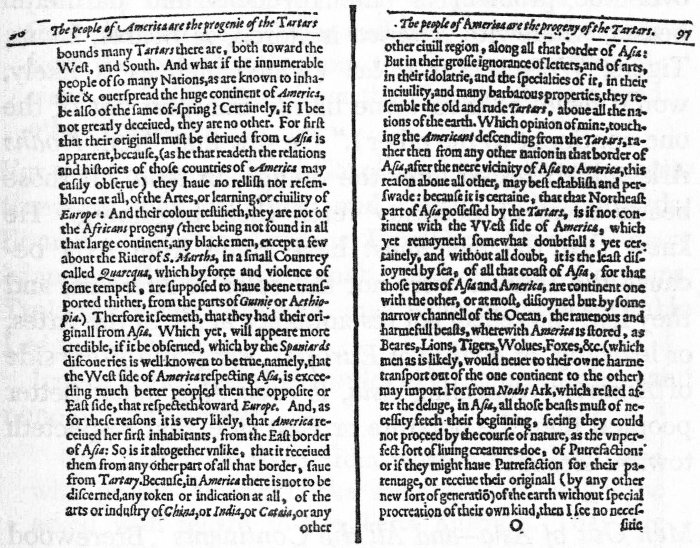
OUT OF NOAH’S ARK AND OVER BERING STRAIT
Two pages from Brerewood’s seventeenth-century book Enquiries Touching the Diversity of Languages, and Religions, Through the Chief Parts of the World, in which he pictures bears and Tartars crossing to the New World at a point where Asia and America “are continent one with the other, or at most, disioyned but by some narrow channell of the Ocean.” (Courtesy of the University of California, Los Angeles, Library.)
God-fearing Protestants from England joined clerics of the Roman church in bringing the American aborigine over from Asia. Long before any white man had stared across Bering Strait from the eastern tip of Asia and discovered Alaska, sixteenth and seventeenth century 14 men were envisioning the neighborliness of the two continents and an easy crossing. It had to be. There was no escaping this solution. Men from Eden could be trusted to force their way across the widest and wildest of oceans, but not animals from Ararat. In 1614 Edward Brerewood worried, like Father de Acosta, over the problem of “the ravenous and harmefull beasts, wherewith America is stored, as Beares, Lions, Tigers, Wolves, Foxes, &c. (which men as is likely, would never to their owne harme transport out of the one continent to the other).” He saw that “from Noahs Ark, which rested after the deluge, in Asia, all those beasts must of necessity fetch their beginning.” He knew that the men must have come from Asia because the Indians were not the color of Africans, and they had “no rellish nor resemblance at all, of the Artes, or learning, or civility of Europe.” Also, “the West side of America respecting Asia, is exceeding much better peopled then the opposite or East side, that respecteth toward Europe.”
Men Out of Asia—and All the Continents
Brerewood moved on from the questions of how and whence to who. With considerable hardihood, this learned Englishman picked a single Asiatic race to supply the Indian with a forebear. Looking askance at the inhabitants of America, he wrote: “In their grosse ignorance of letters, and of arts, in their idolatrie, and the specialties of it, in their incivility, and many barbarous properties, they resemble the old and rude Tartars, above all the nations of the earth.”[3]
Brerewood’s reasoning was logic itself and his conclusion inescapable compared with much of the theorizing of his day and much more that went on for three hundred years after the discovery of America. In 1607 15 Fray Gregorio Garcia published a book, The Origin of the Indians of the New World, in which appeared these words:
The Indians proceed neither from one nation or people, nor have they come from one part alone of the Old World, or by the same road, or at the same time, in the same way, or for the same reasons; some have probably descended from the Carthaginians, others from the Ten Lost Tribes and other Israelites, others from the lost Atlantis, from the Greeks, and Phoenicians, and still others from the Chinese, Tartars, and other groups.[4]
For good measure, Fray García and his fellow theorists threw in men of Ophir and Tarsus, old Spaniards, Romans, Japanese, Koreans, Egyptians, Moors, Canary Islanders, Ethiopians, French, English, Irish, Germans, Trojans, Danes, Frisians, and Norsemen—a veritable League of Nations.
Iconoclastic Voltaire would have none of this—and none of Eden, either:
Can it still be asked from whence came the men who people America? The same question might be asked with regard to the Terra Australis. They are much farther distant from the port which Columbus set out from, than the Antilles. Men and beasts have been found in all parts of the earth that are inhabitable. Who placed them there? We have already answered He that caused the grass to grow in the fields; and it is no more surprising to find men in America, than it is to find flies there.[5]
The more or less scientific minds of the nineteenth and twentieth centuries were no less prodigal in theory than the clerics and the philosophers of the seventeenth and eighteenth. Sometime in the 1820’s Lord Kingsborough, son of an Irish peer of great wealth, got it into his head that the Lost Tribes of Israel were the ancestors of the Maya and the Aztecs—the same idea that animated Joseph Smith and The Book of Mormon; and 16 in 1830—the very year that Smith’s American supplement to the Bible appeared—Kingsborough began the publication of the nine monumental and handsomely illustrated volumes, Antiquities of Mexico, which cost him £25,000 and ultimately—like Smith—his life. Quite as eccentric theories followed. The otherwise sound and observant George Catlin thought the Mandan Indians the descendants of the Welsh. The “lost continent” of Mu—the Atlantis of the Pacific—reared its ugly head. Elliot Smith left the teaching of anatomy, and W. J. Perry cultural anthropology and comparative religions, to bring from Egypt all the culture of America—together with most of Eurasia’s and Africa’s—on the backs of those indefatigable travelers of their invention, the Children of the Sun.
In the face of such wild theorizing it is comforting to recall that the great Humboldt recognized as early as 1811 a “striking analogy between the Americans and the Mongol race.” We must pardon him for clinging to some vague notion of a primordial American race and declaring that the Indians were “a mixture of Asiatic tribes and the aborigines of this vast continent.”[6]
Today science does not have all the answers to the anthropological problem which arose when Balboa discovered the Pacific and Magellan crossed it, thus dropping the world’s largest ocean in between the Americas and the Garden of Eden. So far as early man is concerned, we know a good deal about how he came, and whence, and a little about when.
Except for the passionate protagonists of Atlantis and of its “opposite number,” the mythical land of Mu lost in the depths of the Pacific, most students agree that early man came across what is now Bering Strait—not by way of the Aleutians, for their inhospitable western tip is separated from Asia by 225 miles of sea with one small island midway between. For a long time, the Bering Strait route was supported only by 17 a priori reasoning, but of late years the weapons of early man have been found either alone or with the fossils of extinct mammals in parts of Alaska and north-west Canada.
Bering Strait—Freeway to the New World
Though early man from northern Asia certainly crossed in one area and in one area only, he may have made the crossing by any one of three methods. That depends on when he came.
If he came rather late—say around 10,000 years ago—he had to negotiate Bering Strait, open water in summer, iced over in winter. If the migrants were a boating and fishing people voyaging north along the Asiatic shore, the 56-mile gap of Bering Strait, broken by the Diomede Islands, was a negligible barrier, since the greatest stretch of open water was only 23 miles across. If they found the strait frozen over, they would have followed the southern edge of the ice. Men of a more inland type, men less given to water travel, could have crossed to Alaska—as some do now—on the ice of winter.
If early man first came to the New World in the Great Ice Age or in the time when the glaciers were beginning to melt, he could have crossed dry-shod on a land-bridge. Geologists have calculated that the water withdrawn from the ocean to form the glaciers—which were half a mile to two miles thick over much of Canada and the northern portion of the United States—would have lowered the water level in the Bering Strait region by as much as 200 to 300 feet toward the end of the Great Ice Age.[7] In addition, the ocean floor of the strait—relieved of so much weight of water—would doubtless have risen to some extent. Since, at present, portions of the strait reaching from shore to shore are not more than 120 feet deep, a land-bridge is a perfectly plausible hypothesis. Of course the bridge 18 would have disappeared with the end of the glaciers, which means that, if man had to come over dry-shod in the summer, he must have invaded America while the glaciers were still fairly extensive.
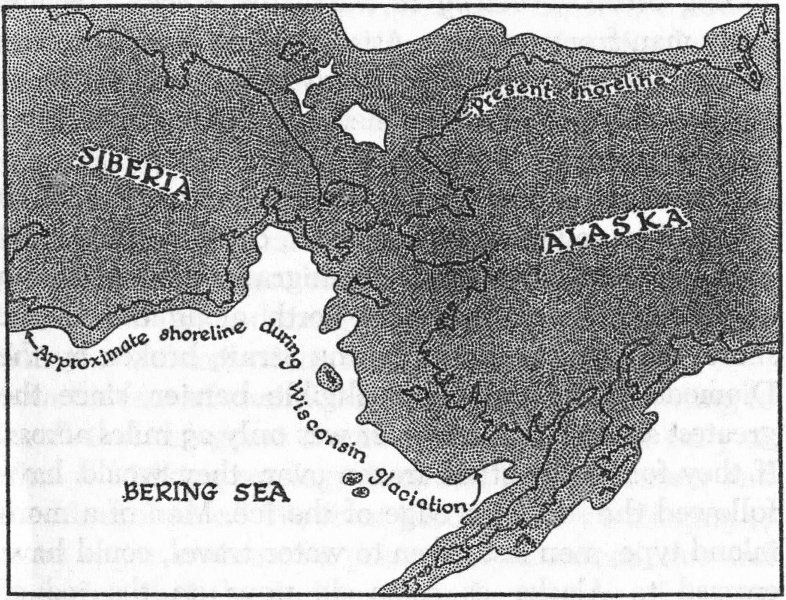
THE LAND-BRIDGE TO THE NEW WORLD
A conservative map of shorelines during the last glaciation, based on a drop in sea level of 180 feet. Geologists believe that the ice impounded in the great glaciers and ice fields of the world lowered the ocean 200 to 300 feet. The southern shore of Alaska during the last glaciation may have been much nearer its present position. (After Johnston, 1933.)
19
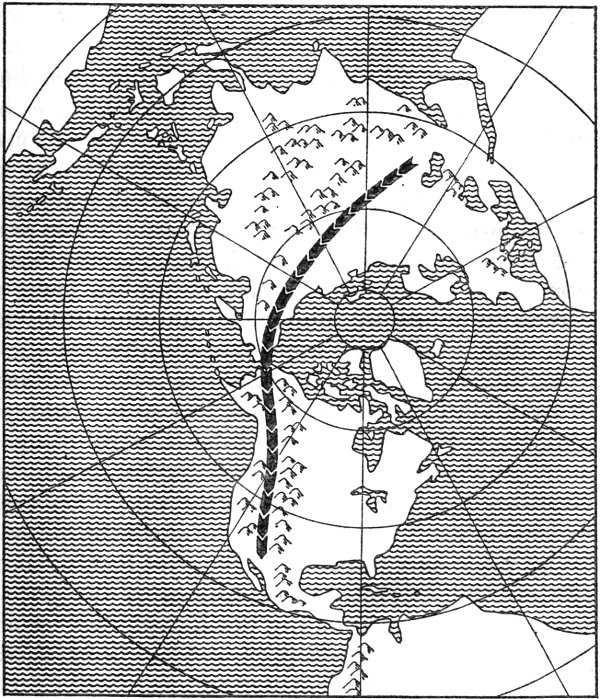
A GREAT-CIRCLE ROUTE TO NORTH AMERICA
On the flat, distorted map of Mercator, on page 4, the path of early man across Asia to the New World seems a roundabout curve. On a globe, it is very nearly a great circle. This is indicated on a map such as this, projected from a point above the North Pole. From above Bering Strait, the route would appear still straighter.
Aleš Hrdlička has said that not many men would have frequented northeastern Siberia because of its inhospitable climate, and so only a few would have “trickled over.”[8] The opposite seems to have been true in the time of the glaciers. Then northeastern Asia was an excellent jumping-off place for the Old World migrant. In the first place, there was not much glaciation in this area, certainly nothing to interfere with the passage of people along the coast. The last glaciation was “far less extensive than its predecessor,” say R. F. Flint and H. G. Dorsey, “and was confined to the higher parts of the higher mountain ranges.”[9] Secondly, the land-bridge, which made crossing easy, also altered the 20 climate of Siberia south of the bridge.[10] It cut off the arctic currents and therefore to some extent the arctic damp which now makes the Asiatic coast inhospitable. Hrdlička—one of the first and most violent opponents of early man in America—said that the land-bridge was not essential. Even if it had existed, “man would not have used it, but would have followed the much easier route over the water.”[11]
Three Roads to the South—with One Detour
Once in Alaska, man—early or not so early—had a number of routes to choose from. If he was of maritime habits, and crossed by water, he would have tended to stick to his boats, and sail or paddle southward and southeastward down the coast and on through the inland passages of lower Alaska and Canada which protect boats from ocean storms. When Frank C. Hibben found a certain early kind of spear point in a curio shop in Ketchikan, Alaska, and on the far-away shore of Cook Inlet, he called attention to a route—whether overland or by sea—which hardly anyone had stressed except Hrdlička.[12] Hrdlička stressed it because he brought man over after the glaciers and in boats. But even in the Great Ice Age this route was not impossible for men without boats. Migrants who had crossed by a land-bridge might have turned south along the Pacific shore, climbing and crossing the ice barriers of the glacial rivers that still slide slowly down from the inland mountains. Philip S. Smith points out that “ice surfaces allow fully as easy travel by sled and on foot as do the ordinary land surfaces.”[13] But was there game, as well as fish, along the coast to lure the migrant on and to sustain him upon the journey?
Other men seem to have chosen to tramp and hunt eastward and northeastward from the strait. In this direction there were two main routes open to men and game. One route led up the narrow lowlands of the 21 northwest coast to the mouth of the Mackenzie River and then south up its long valley. The other, and much more likely path for early man, was up the ice-free Yukon and its tributaries. These would have taken him eastward to the Mackenzie or southward through the plateau between the northern Rockies and the Coastal Range. Hrdlička thought the Yukon valley a most unpromising route because of the turbulent rivers and the noxious insects; but most students disagree with him and stress the abundance of fish and game. There can be no question that some parts of this route were used by early man—and extinct mammals, too. His ancient spear points have been found in the muck beds of Fairbanks mingled with the fossilized bones of elephant, bison, camel, horse, and an extinct jaguar once called the Alaskan lion.[14] Other early points have been discovered in western Canada in the area of the mountain plateau. In 1944 Frederick Johnson located fifteen camp sites in early soil levels along the route of the plateau corridor and found many varieties of artifacts. Among these were a few points, most of them fragmentary, the butts of which resembled those of an early type.[15] Following Johnson in 1945, Douglas Leechman found other sites and artifacts along this route in soils formed perhaps 9,000 years ago.[16]
The Yukon valley rivers could have taken early man to the Mackenzie and to the northern edge of the plateau; but during a large part of the Great Ice Age he still faced the gigantic fields of snow and ice that covered half of North America. Although ice journeys may not be so very difficult, and early man had learned to live in the chill of northern Siberia (the Eskimo of today proves that human existence is possible in a land of little sun and much cold), we cannot believe that he attempted to cross the icy wastes. A journey on foot across a thousand or two thousand miles of ice becomes a sheer impossibility if there is no provender to be found along the way. There was certainly no food for musk ox or mammoth, and therefore no food for man. Without game to hunt, he would not have felt the impulse to invade the ice fields.
22
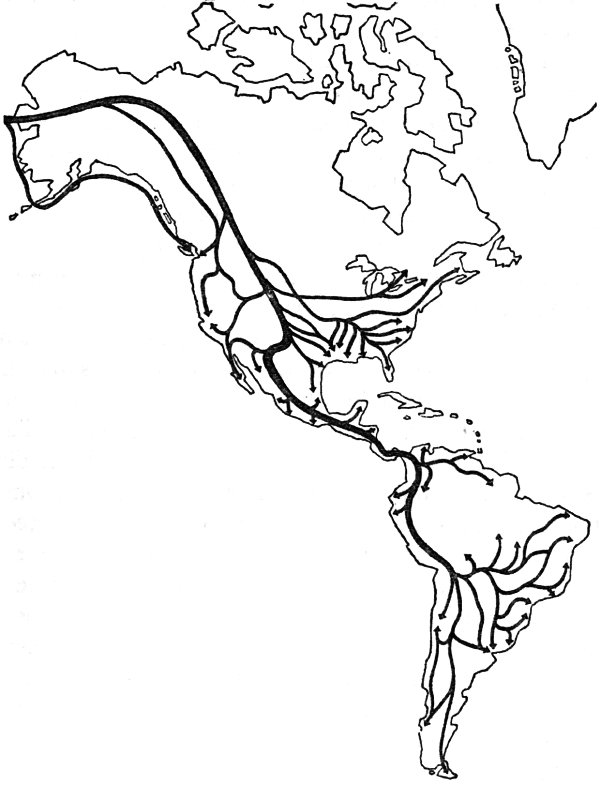
MIGRATION ROUTES
The pathways available to early man, as mapped by Carl Sauer—to which have been added a problematical route by sea along the southern coast of Alaska and another down the corridor between the eastern Rockies in Canada and the coastal range. (After Sauer, 1944.)
23
Too many authorities have written as if early man made a free choice of routes through Alaska and Canada. Actually, the animals he hunted chose his route for him—doubtless many routes. Unless he had learned to spear and net fish, the first invader probably pursued a herd of mammoth or musk ox across the land-bridge or over the frozen ice of later winters. You in your armchair are likely to suggest that, once man was in Alaska, he turned south of his own free will and intelligence in order to avoid the cold. The first trouble with that line of thought is that man had gone north in Asia. The second is that primitive man had no conception of where south lay or of the possibility of greater comfort there. At this point, you will probably say that, though he had no ideas about the nature of the south, he had brains enough to follow the sun. Unfortunately this would have spun him round like a slow-motion teetotum; for he entered North America in the neighborhood of the Arctic Circle where the summer sun moves in a great low circle, and sinks out of sight when winter sets in.
If you want to understand early man, and guess with some accuracy at why he came to the New World and how he happened to drift southward and eastward until he filled it, you must think of him as a wanderer looking for food. Game lured him on at random, and vegetation lured both beast and man. Man might eat his way through caribou country, and come upon the bison of another area. As he killed and wandered, he might go south or he might go east. But the animal—and the man who ate berries and roots and wild grains as well as meat—would move as the climate moved. The world has known many changes of climate and 24 shifts of rain belts. Some of these have been extreme—in the Great Ice Age, for example—and some have been less marked. But they have moved the forests and the grasslands, and animals and man have moved with the vegetation.
During the past 100,000 years, glacialists believe that there were three periods when the inland ice melted sufficiently to allow the southward passage of both animals and man. The first was more than 75,000 years ago in the Sangamon Interglacial period before the time when the last, or Wisconsin, glaciation had covered the plains of Canada (see pages 26 and 27). During the Wisconsin, a corridor probably opened about 50,000 years ago along the eastern foothills of the Rockies, and another, perhaps a little later, down the plateau between the northern Rockies and the Coast Range. The third opportunity for man to penetrate from the north came around 11,000 years ago, when the final retreat of the ice sheets began in those same regions.[17] Perhaps the land-bridge was still usable up to 10,000 years ago, but certainly later migrants had to cross Bering Strait by water or winter ice.
Bering Strait and the great glaciers were not the only obstacles to the peopling of the Americas. The Isthmus of Panama must have presented quite a problem to the pioneers who were to fill Amazonia and the Andean Highlands and to reach Cape Horn. Today nobody sets off blithely by foot through the jungle that separates Costa Rica from Colombia. The beach is the best pathway at low tide; but it is an intermittent one. It is better to hope that the shifts of climate which were involved with the glaciers made Panama a drier country than it is today.
Of course it was not only early man and his prey that used the routes from Siberia across Bering Strait and through Alaska and Canada. The later migrants—ancestors 25 of the Algonquins, the Athapascans, and others—undoubtedly came in the same way.
Problematical Roads to the New World
Other routes from other lands may have brought other migrants. These routes are not so fanciful as the paths from Atlantis and Mu, but they have had few advocates. M. R. Harrington has mentioned the possibility that Magdalenian man of Glacial or Postglacial Europe may have crossed from Europe to Canada by way of Iceland and Greenland and various ice- and land-bridges to father the Eskimo.[18] Ellsworth Huntington adds to the land-bridge over Bering Strait “wind-bridges” across the middle Atlantic.[19] Like Father de Acosta, he believes that storms may have blown occasional vessels to the New World. To suggest that unwilling mariners from the Mediterranean may thus have made oneway trips, he cites from Stansbury Hagar[20] striking resemblances between the zodiacs of Europeans and of the Mayas, Aztecs, and even Peruvians. Whether this matter of the zodiacs is fact or fancy, Huntington’s unwilling voyagers could not have come much earlier than the birth of Christ. More fantastic were the claims voiced some years ago that the men who left skulls of Australoid or Melanesian type in the caves of South America reached that continent by a southern route across an Antarctic bridge of land and ice. Of much more serious importance is the possibility that the long-voyaging Polynesians, having negotiated the 5,000 or 6,000 miles that lay between their home on the edge of Asia and the Marquesas or Easter Island, would have tried occasionally to continue their eastward course. If they had done so, they could scarcely have missed South America. But this was in our own era, not in the time of early man.
Ware Dogma!
26
GLACIERS AND ICE FIELDS AS BARRIERS TO EARLY MAN
These maps follow the outlines of the continent today, and so do not show the land-bridge from Alaska to Siberia that existed in varying extent throughout the entire Wisconsin period. The maps indicate tentatively how the great white ice fields may have appeared to different areas at different times, producing an effect of shifting from west to east and then back across the continent. Drawn in 1936, the first three maps probably show too little ice in arctic Canada and in the Gulf of St. Lawrence and Newfoundland region. (After Antevs; the first three in Gladwin, 1937, the fourth from data furnished by Antevs.)
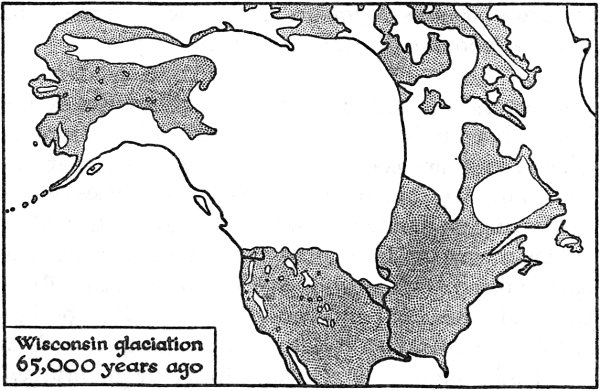
Wisconsin glaciation 65,000 years ago
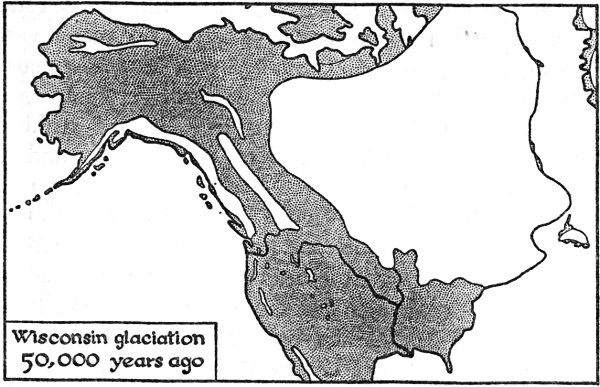
Wisconsin glaciation 50,000 years ago
27
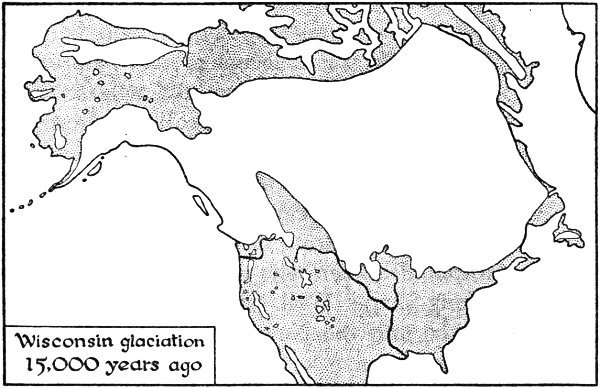
Wisconsin glaciation 15,000 years ago
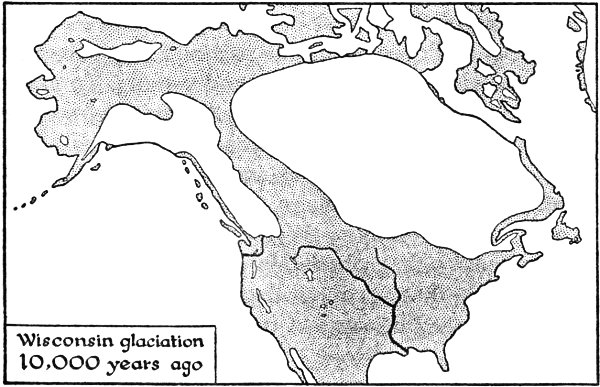
Wisconsin glaciation 10,000 years ago
28
Today we have a few facts about early man and many guesses. Not so long ago there were a few reputable anthropologists who believed that the New World was innocent of man before 1000 B.C. Now most of them grant a foothold at least 10,000 years ago to an enterprising savage—called Folsom man—whose taste for travel was as great as his talent for making an exceptionally fine and original type of stone spear point. Some say he came to the New World 25,000 years ago. A few daring students find traces of an earlier Australoid human who may have seen the last glaciers taking shape. Well informed opinion places man’s entrance into the New World between 10,000 and 25,000 years ago.
Of course we must not expect early dates to be precise. Many of them must be intelligent guesses as we go deeper and deeper into the past and reach the time when the glaciers were waxing and waning. To gain a perspective upon such toying with time—as well as upon early man in the Americas—we must next consider the story of early man in the Old World. Incidentally, its contradictions and uncertainties—prefaced by a few in New World prehistory—may help you to look with a charitable as well as critical eye upon certain theories about the peopling of the Americas which may be suspect today yet respectable tomorrow.
29