5 EARLY MAN IN THE OLD WORLD
Reading edition
Bone of our bone, and flesh of our flesh, are these half-brutish prehistoric brothers. —WILLIAM JAMES
Archaeology, a New Science
Archaeology—digging up the ancient past—is a fairly young science. It is not so young, of course, as electronics or aerodynamics or radiology. It is not so old as astronomy or mathematics or metallurgy. Excavation began in 1748 with the uncovering of Pompeii; but it was hardly scientific, and it reached only a short distance into the past. The deciphering of the Egyptian hieroglyphics in 1819 and of cuneiform writing in 1837 pushed back history two or three thousand years. But deep explorations of man’s prehistoric past won no serious status until the middle of the nineteenth century. “In 1859 prehistoric archaeology,” says Gordon Childe, referring to the acceptance of finds at Abbeville, in France, “may be deemed to have become a science.”[1]
There were discoveries before that, but they were neglected and misinterpreted or despised and disputed. As early as 1690 a man named Conyers discovered “opposite Black Mary’s, near Gray’s Inn Lane,” London, a fossilized tooth which, we now know, belonged to an extinct elephant, and a crude hand ax of stone which, we now recognize, was made by man fairly early in the Great Ice Age; but it was long before 62 they won an honored place in the British Museum. A friend of Conyers named Bagford thought that the elephant belonged to the Roman army of the Emperor Claudius, and that the flint was a weapon used by a Briton to slay it (see illustration below).
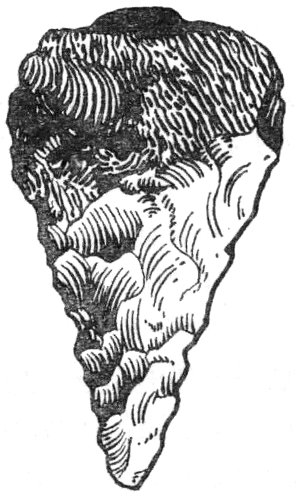
The first hand ax found and recognized, probably an Acheulean implement, discovered in London in 1690 together with the tooth of an extinct elephant. The tool is about six inches in length. Like almost all hand axes, it is thinner than it looks from this angle. (After Sottas, 1911.)
In 1797 John Frere reported to the Society of Antiquaries on the finding near Hoxne in Suffolk of “weapons of war ... in great numbers” together with “some extraordinary bones, particularly a jawbone of enormous size.” His discovery has been called as important, in its way, as the geographical discovery of a New World; by emphasizing “the situation in which these weapons were found,” he became the first man to apply modern archaeological methods to a prehistoric find. Frere boldly declared that the hand axes belonged to a “very remote period indeed; even beyond that of the present world.”[2] (See illustration, page 71.)
Frere’s reasoning had little effect, however, on a certain type of mind. When in 1823 William Buckland, 63 a teacher of geology who was to become Dean of Westminster, dug out of a cave near Paviland a female skeleton which was painted with red ocher—a peculiar habit of early man and of man not so early—and which lay beside some ivory rods and bracelets and the skull of a mammoth, Protestant prejudice got the better of science. Buckland wrote that the skeleton was “clearly not coeval with the antediluvian bones of the extinct species” with which it had been found. Like Bagford, he turned to the time of the Roman invasion. His “Red Lady of Paviland” became a camp follower, and thus he missed his chance to recognize the first Cro-Magnon skeleton of man from the last glaciation.[3] Yet religious dogma—which held back Victorian science for so many years—did not prevent Father John MacEnery from seeing the true significance of a flint tool and the tooth of a rhinoceros which he found under a layer of stalagmite in Kent’s Cavern, England, in 1825. Around 1830 Toumal, a French scientist, and Schmerling, a Belgian, saw the truth as clearly, and published their discoveries of man-made flints with the fossils of extinct animals.
The most important find, and the one that ultimately established Glacial man as a reality, was announced in 1838 at a meeting of the Société d’Emulation of Abbeville in northern France; but twenty years passed before it received scientific sanction. The discoverer was an inconspicuous tax collector, Jacques Boucher de Crèvecœur de Perthes, who matched his diversified name by writing tragedies, novels, and books on travel, economics, and philanthropy. He had explored caves as early as 1805 and had found fossils and man-made tools of flint, but no hand axes. The hand axes that he found in the river terraces were hardly as important as his theory that these terraces dated the tools, and that the terraces were formed far in the past when the rivers were swollen with water. His only mistake was 64 that he went to the biblical flood to find the water instead of to the great glaciers. In 1849, after making other finds, Boucher published De l’Industrie primitive, ou Les Arts et leurs origines, dated 1847; more finds and other books followed. His hand axes and other discoveries were almost completely ignored until 1858 when the English geologist Hugh Falconer “happened to be passing through Abbeville and saw the collection.”[4] He brought British colleagues back to Abbeville, and in 1859 Falconer, Sir Joseph Prestwich, and Sir John Evans declared officially for the reality of glacial man. The finds of Boucher, they asserted, proved that human beings had existed at the same time as Pleistocene mammals now extinct. Significantly, it was the same year that Darwin published On the Origin of Species by Means of Natural Selection.
Mortillet’s Cramping Classification
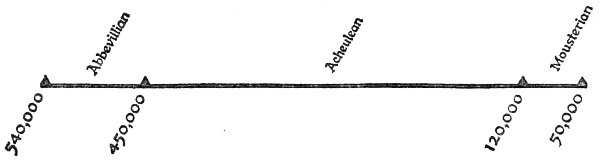
Progress thereafter was rapid, perhaps too rapid. Notable finds were soon followed by attempts to freeze knowledge into chronologic classifications. R. Rigollot, Gabriel de Mortillet, Edouard Lartet, Milne-Edwards, and Henry Christy found in the river terraces and the caves of France innumerable and varied evidences of man’s activity in the Great Ice Age. Mortillet named various cultures from the places where stone tools were found, and then, in 1869, he set them up in a chronological series.[5] Modified by later discoveries, the series ran as follows, beginning with the oldest: Chellean, Acheulean, Mousterian, Aurignacian, Solutrean, and Magdalenian. (Most prehistorians now use the word Abbevillian instead of Chellean because later research proved that the tools found originally at Chelles were Acheulean in type, while those found at Abbeville were earlier.) In the light of present knowledge, the list is much too simplified. It is based only on European finds, yet it is supposed to fit the world picture. For 65 more than fifty years it has served as a scientific straitjacket, patched with new material here and there, but still gaping at the seams as the husky young giant of archaeological science grows in stature.
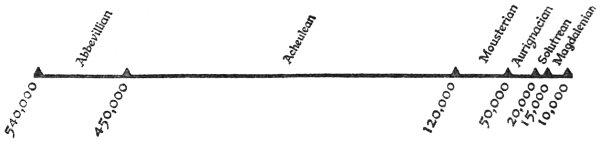
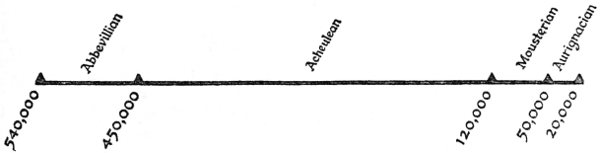
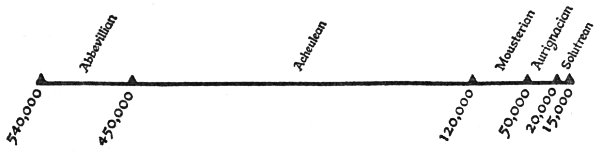
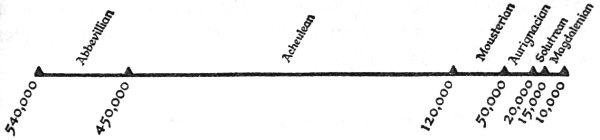
Time scale of early man in a limited area of Europe, as estimated by Robert J. Braidwood.
Enter the Eolith
One of the early difficulties that Mortillet’s list of cultures encountered was the discovery of implements that preceded his first culture, the Chellean—or Abbevillian—in time and type. Cruder axes from older levels had to be called Pre-Chellean (see illustration, page 71). In England scrapers and other crude tools cropped up in formations that go back more than 500,000 years.
Then eoliths—“dawn stones”—appeared. They were irregular-shaped pieces of flint with chips knocked off here and there. Often the chipping looked purposeful; the flakes made an edge or a point that could be used to scrape or drill.
These rudely shaped flints were first championed by Abbé Louis Bourgeois in 1863; but his finds were in strata far too old to win scientific recognition. This was not the case with Benjamin Harrison, who recognized eoliths in later formations almost one hundred years ago. Harrison was one of that variegated and comradely group of country “antiquaries”—noblemen and shopkeepers, vicars and village laborers—who founded and developed the study of the prehistory of England. Harrison left his old-fashioned general store and its cakes, fruits, and draperies, to walk the High Downs of Suffolk, searching with utter conviction for traces of early man in the glacial gravels. He began as a youth, when Boucher de Crèvecœur de Perthes had only just won his battle, and in 1865 he recognized his first eoliths. In 1889 the distinguished scientist Sir Joseph Prestwich gave them his backing. It took twenty more years, however, for the eolith to win anything like respectable recognition, and some still deny that these flints were worked by men.
66
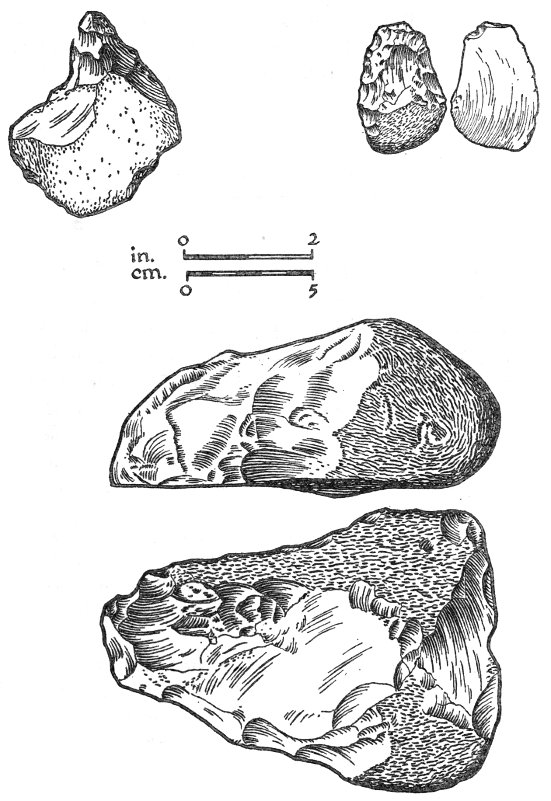
THE “DAWN STONES” OF EARLY MAN
Upper left, a borer. Right, two sides of a scraper. Below, side view and bottom of a rostrocarinate. (After Peake and Fleure, 1927; Moir, 1927; and Lankester, 1912.)
67
The fact that some eoliths were found in geological formations much older than man—so far as we know his history—was an argument against all of them, because the older and the more recent looked so much alike. Another cogent objection was that eoliths could have been made by natural forces, such as a landslide, the pressure of heavy strata, or one stone knocking against another. A heavy cart can make an eolith when it rolls over a smooth flint. But in spite of arguments and antagonisms, which still persist, there were two things that seemed to establish the eolith as the work of man.
To begin with, some kind of tool, some form of experiment, had to lie behind even the crudest hand ax. At first man must have picked up a natural eolith and used its cutting edge. A little later he must have improved the edge. In any case he threw the stone away when he had finished the job, and later looked for and improved another one. Gradually he developed his dawn-stone technique and made tools that he would use until he lost them.
The second argument for the dawn stone was impressive. In 1910, after years of search, J. Reid Moir found eoliths near Ipswich, England, under unusual conditions. They came in two layers, which seemed to indicate that early man had camped twice in this neighborhood at different times. They were bedded in soft sand and therefore could not have been chipped by geologic pressure. The sand dated from the Pliocene 68 Period which preceded the Great Ice Age. Later, in the same district, he found eoliths in a layer of delicate shells—again a sign that the eoliths had not been chipped by natural forces.[6] Moreover, many of Moir’s eoliths had a new and peculiar shape; they were keeled like an upturned boat or beaked like an eagle. Sir Ray Lankester called them rostrocarinates. In 1900 Mortillet had to admit man—or pre-man—to an Eolithic Age.
Flake vs. Core Industries
More difficulties beset Mortillet and his system of names and cultures as time passed and as fellow scientists dug new caves and terraces, and turned up stone tools of other patterns and other periods. Implements appeared that did not fit into the Frenchman’s classic system. A supplementary scheme had to be devised, and soon it, too, failed to fit the facts.
The new system divided all paleolithic tools into two types—which was sound enough—and assigned each type to certain peoples and to those peoples only—which proved not so sound. The division lay between cores and flakes. It lay between tools that had been made out of the heart of a lump of flint, and tools that had been made from chips flaked off the lump. The fact that there were core tools and flake tools was plain enough, but the fondness of scientists for strict classification led the prehistorians into theories that time disproved.
First of all, they had to set up a time sequence. They decided, not unnaturally, that man must have begun by hammering things with a handy rock until his rude tool began to chip away into something approaching an edge and eventually a point. Thus the hand ax, or coup de poing, came into being (see illustration, page 71). In the course of time man began to notice the chips, and to use the larger ones to cut and scrape with. 69 Soon—that is, after a couple of hundred thousand years—he was deliberately knocking flakes off a stone core, and using them for spear points as well as scrapers. The prehistorians called hand axes the products of a “core industry,” and chips the products of a “flake industry.” They believed that one industry had preceded the other by hundreds of thousands of years, and that the Abbevillian and Acheulean had stuck to cores and left flakes to the Mousterian. Thus they believed that certain cultures had devoted themselves exclusively to the core, and certain others to the flake.
The theory that the early stone workers had a core industry and the later ones worked flakes was rudely upset by the discovery of flaked tools—called Cromerian—in an English stratum as old as the French sources of the first hand axes, and possibly older. Some say they lie at the beginning of the Great Ice Age or at the end of the earlier period, the Pliocene. This demonstration of a very early flake industry was reenforced by the discovery of a special type of flaked tool—the Clactonian—which runs from late Abbevillian into Acheulean times. Another type—the Levalloisian—laps over from the Acheulean into the Mousterian.
The core industries and the flake industries simply would not stay nicely separated. The first excavators had found only hand axes because these tools were so much more interesting than scrapers; later students found flake tools in the same ancient levels. No hand axes turned up in Clactonian culture-sites, but they appeared at the end of the Levallois, and the flake-loving Mousterians made them for a time. “Flake and core run parallel to one another in time,” says W. B. Wright, “and even intermix.”[7]
70
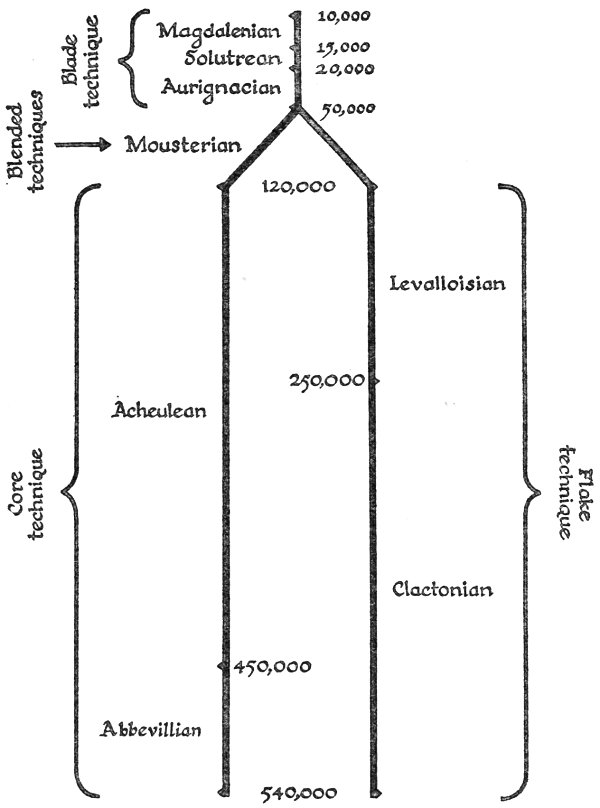
PALEOLITHIC TYPES AND INDUSTRIES
A chart of the core-, flake-, and blade-making traditions and industries, devised and dated by Robert J. Braidwood.[8] The dates indicate the approximate beginning and end of the various types of artifacts. Usually the same group of men made different kinds of tools within one industry. The Solutrean was distinguished for double-faced, leaf-shaped projectile points, rather than blades.
71
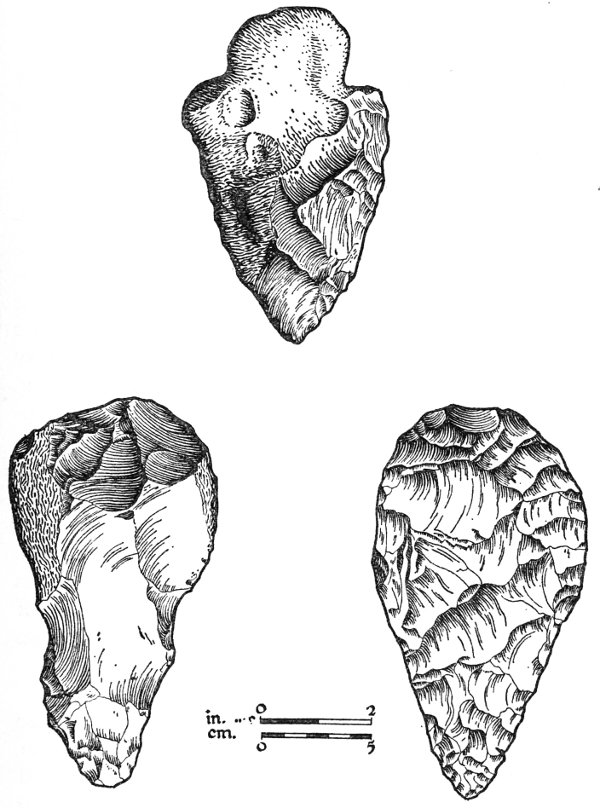
MAN’S FIRST PERFECTED TOOL
Three European hand axes that may bridge 300,000 years. They are, top, Pre-Abbevillian; left, Abbevillian; and right, Acheulean. The last is one of the tools found by John Frere at Hoxne in 1715. Most hand axes are not so well formed. Somewhat similar tools have been found in American Indian cultures hafted at the top of a wooden handle or in the middle, as a sort of spokeshave. (After Osborn, 1915; Leakey, 1935; and Burkitt, 1933.)
72
If we do not try to apply the core-versus-flake theory too broadly and too strictly, it suggests a fascinating picture of two kinds of men and two kinds of life through the first two-thirds of the Great Ice Age. One kind dominated during the cold of the glaciations; the other, during the warmth of the interglacials. For the flake tools of the Clactonian and Levalloisian peoples are found mainly with the fossils of cold-loving animals in the north and east of Europe, and the core tools of the Abbevillian and Acheulean peoples with warmer-blooded animals in the west and south.
Science accepted Mortillet’s system of orderly cultures and the theory of successive core and flake industries, and for fifty years tried to apply it to new discoveries both in Europe and elsewhere. Though the system has had to be modified in parts, and in parts abandoned, its terms are still used, and used in a way that is confusing because the terms are no longer exact. In Africa the various types of tools resemble only approximately those of Europe, and they do not seem to correspond in time. The hand ax may have spread from Spain into almost all Africa, or, more probably, from Africa into Spain, as well as southern India, but there are plenty of flaked tools, too, in these regions. Central and northern Asia seem to be devoted to the flake, and to eschew the hand ax in favor of a kind of chopping tool made out of a core. Asia, like Africa, has tools made out of large, smooth pebbles.
Dating Early Man in Europe
One good thing can be said for Mortillet’s modified sequence of Abbevillian, Acheulean, Mousterian, Aurignacian, Solutrean, and Magdalenian. It may not be complete enough, and it may not apply too well to the world outside Europe; but it is chronologically sound locally. It is a succession of cultures along a time scale. If an archaeologist finds two or more varieties of paleolithic tools in a new site, he finds, for example, Acheulean beneath Mousterian, or Mousterian beneath Aurignacian. Similarly, when he comes upon Abbevillian and Acheulean in separate terraces of the same river, he always finds the Abbevillian 73 in a higher terrace than the Acheulean, and, as we have explained on pages 51 and 52, the higher terrace is always the older.
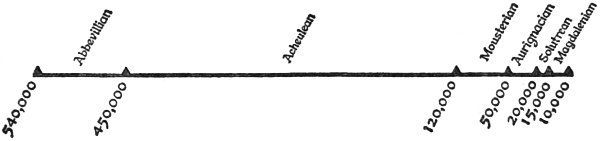
Dating these cultures in terms of our years is another matter. The first step is fairly simple. If the tools are found with the fossils of a warmth-loving animal like the hippopotamus, they belong to an interglacial period; if they are found with the fossils of an animal like the hairy mammoth, which could survive a harsh climate, they belong to a glacial time. The species of animal may determine which glacial or which interglacial. If the tools are found in the gravel of a certain river terrace, then they belong to the geological period when the material of the terrace was being laid down. The terraces often contain fossils, and this may cross-date the terrace materials with cave deposits. But scientists are often faced with the problem of picking the right glacial or interglacial period on scanty evidence, and the still more difficult problem of setting the period in the terms of our years. There is room here for much disagreement. Glaciologists do not agree as to the age or the length of the various glacials and interglacials (see illustration, page 55). Some prehistorians accept and use the dates of one glacialist; some choose another’s. They do not all concur as to which culture came in which glacial period.
True Tools—Deceptive Skulls
Men who practiced Abbevillian culture had some flaked tools—which they may have used for scraping—but their best-recognized output was a crude hand ax. It was not too well formed. Undoubtedly they also used wood and bone, but we have no sure evidence of this. Some assign Abbevillian culture to the first interglacial period, about 500,000 years ago. Some move it up 200,000 years, into the second interglacial. Some even place it in the third. Perhaps it lasted through all three. At any rate, the men who made it liked a fairly warm climate. As neither they nor their Acheulean successors made fire or controlled it effectively, the early Europeans probably retreated to Africa during the glaciations.
74
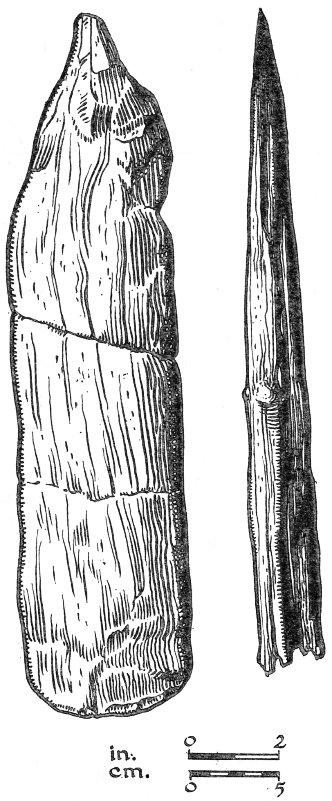
Ancient implements of bone and wood. Left, part of the thigh bone of a mammoth, found at Piltdown, England, in the same deposit as the now infamous skull; it, too, is a forgery. Right, part of a wooden spear, its point hardened by fire, found at Clacton-on-Sea, England, and probably made by Acheulean or Mousterian man. (Left, after Dawson and Woodward, 1917; right, after Crawford, 1921.)
75
The Acheulean hand ax was thinner and better, and it is found with various kinds of scrapers and cleavers. Probably it was this culture that left us part of a very crude wooden spear at Clacton-on-Sea, in England, though some date it a little later. The earliest association of human remains with tools in Europe is that of the Swanscombe skull and Acheulean tools in Pleistocene gravels of the Thames in Kent.
We are not too sure about the physical appearance of the men of Abbevillian and Acheulean times. For the Abbevillian there is possibly a fragment of jaw, a most interesting one, to be sure, but not actually found with any kind of artifact. For Acheulean times there are no dependable skeletons to help us, and not even complete skulls. In fact, there are not as many candidates for the position as we thought we had a decade or so ago.
Galley Hill man turned out to be a case of mistaken identity. He has a thick skull and a few other primitive traits—a fossil type of modern man, perhaps, but not nearly as old as we once thought. His bones lacked 76 a fluorine mineral content typical of other fossils that belonged in the interglacial deposits where the Galley Hill skull reposed, eight feet below the surface.
The same fluorine test—which fortunately applies to such fossilated things as bone, antler, and ivory—exposed an even more notorious impostor, expelling him from the select corps of early men. This was Piltdown man, alias Homo eoanthropus dawsoni, alias Eoanthropus, alias Dawson’s Dawn Man. It was demonstrated to be a fake and a forgery that led its discoverer to try to match a reasonably human skull to the jaw of an ape. The jaw and its teeth had been modified by the faker—not Dawson—to make it appear less apelike. Both jaw and skull had been artfully treated with chemicals to appear as antiquated as the unusual assortment of fossils with which they were salted into early interglacial deposits. Many of the fossils, while authentic in their own right, also were chemically stained and planted. And tools were added to complete the assemblage. The latter included a bone pick thoughtfully carved from the femur of an elephant, but it was carved with a modern steel knife, as careful scrutiny under a powerful lens disclosed, and not with the stone flakes of prehistoric man. (See illustration, page 74.)
The British scientists Kenneth Oakley, J. S. Wiener, and Sir Wilfrid Le Gros Clark exposed the forgery in a most conclusive manner.[9] In laying the ghost of Piltdown, these authorities resolved four decades of controversy as to his place in human evolution. Although Piltdown’s contribution to human evolution now is known to have been nil, his contribution to physical anthropology has been considerable. As the academic dust settled on this issue, the anthropologists returned to their laboratories with greater confidence in their science and with somewhat sharper tools in 77 their research kits. It is unlikely that any new hoax will ever acquire the same importance as Piltdown.
Ancestors from Heidelberg and Swanscombe?
We still have at least four authentically early human fossils from which European men may have descended. Each has its own interesting story.[10]
The fragment of jaw found under 80 feet of sand at Mauer, Germany, we call Heidelberg man, although he is the least human of the lot. He seems also to be the most ancient, perhaps belonging to the first interglacial period. At least the bones of horses, elephants, bears, and other animals found at the same level in the sand pit derive from the early stages of the Ice Age. Heidelberg man clearly lacks a chin, and his molar teeth are reminiscent in some ways of cattle rather than men or even monkeys, for that matter. This is an important clue, for the same thing, “taurodontism,” occurs much later among some of the Neanderthals.
Heidelberg was not found with or near any stone tools. He seems to belong to that part of the Pleistocene in which the Abbevillian tools were made. Although he shares a few physical traits with Neanderthal man, who lived much later and made excellent tools, some specialists point out that the Heidelberg jaw bears an even closer resemblance to the early man-apes of South Africa, who had no toolmaking tradition.
For the long, cool, and somewhat arid second interglacial period, we have two good prospects, both probably females. One of these is from Swanscombe. In 1936, A. T. Marston found there among the undisturbed Middle Gravels a fragment of fossil skull. Except for its unusual thickness, it was not unlike an equivalent portion in the skull of modern man. Marston’s discovery was all the more exciting since this fragment fitted very well with another, obviously from 78 the same skull, which he had found in place the previous year, only a few paces away. The two pieces, from the left side and back of the skull, provided the earliest undisputed evidence for a very early form of modern man. Twenty years later, in 1955, Mr. J. Wymer recovered a third fragment, from the right side of the same skull. The spots from which the three fragments of the Swanscombe skull were recovered mark a triangle, the sides of which measure 24, 49, and 51 feet. Near the Swanscombe bones and at the same level were found more than two hundred stone flakes as well as four small hand axes of Acheulean type, a stone knife, and fragments of other tools. As we have mentioned, the gravels appear to be an undisturbed deposit. Accordingly, they are now adequately protected and the object of a most intensive and careful excavation. From them may come yet more information about this ancient ancestor.[11]
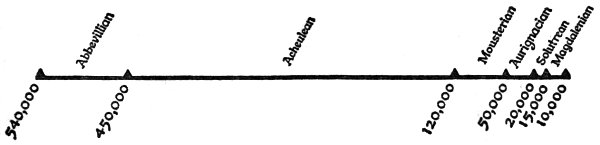
This is early man, indeed. Swanscombe, from all the evidence now available, is very close physically to modern man, closer than many fossil men from the third interglacial period. And judging from the accompanying stone tools, we may say that Swanscombe was culturally as well as physically human.
Until additional remains of Swanscombe are recovered, we cannot with certainty assign these remains to a precise place among man’s ancestors. There are a few who suspect that the facial bones, should these be recovered, would place Swanscombe closer to Neanderthal than to modern man. However profitless such a conjecture may seem, it is at least suggested by our third early European fossil, the Steinheim skull.
79
Twenty-three feet beneath the surface in a gravel quarry at Steinheim, Germany, this now famous skull was found. First reported in 1933 by Curator Fritz K. H. Berckheimer, of the nearby Stuttgart Natural History Museum, this skull was well within a layer of gravels which now are believed to be of second interglacial age. Steinheim is now considered more or less a contemporary of Swanscombe, perhaps just slightly less ancient. In the Steinheim skull there is a strong resemblance to the Swanscombe skull and to that of modern man. But most of the right side of the Steinheim face is intact, along with a few molar teeth, and in these there is little likeness to Homo sapiens.
Given the Swanscombe bones alone, probably no anatomist would dream of constructing for it a Neanderthal-like face. But in the Steinheim skull there can be no mistake. Here we find a skull of reasonably modern shape but equipped with enormous bony ridges over the eye sockets, a markedly broad nose, and a somewhat projecting mouth—all suggestive of Neanderthal. In the main, even these features may be somewhat closer to an early type of modern man. It has been asked: Could Steinheim be an ancestor to both Neanderthal and modern man?
Putting the Neanderthal in His Place
Neanderthal man was a latecomer. We will mention him here but wait until farther along to take a closer look at him. He came to Europe late in the third interglacial period. His culture was advanced and his remains are diverse, numerous, and well studied. His bones differ so distinctly from those of modern man that at most he can be considered a distant cousin, only marginally ancestral. But his remains immediately precede those of modern man in Europe, and the stone tools of his Mousterian culture are found directly under those of modern types of early Europeans.
80
It was, therefore, with something akin to relief that anthropologists received the findings of Mlle. Henri-Martin at Fontechevade. This was in 1947, some 90 years after Neanderthal had been academically accepted for what he was, an effectively extinct kind of non-sapiens man. At Fontechevade, in Charente, west central France, is a cave in which the litter of millenniums discloses a cultural record ranging from that of recent Frenchmen back through the Old Stone Age, which includes the tools and debris of the Neanderthals’ Mousterian culture. The Mousterian materials were bottommost, resting upon what seemed to be the cave floor. Mlle. Henri-Martin noted that this “floor” was in fact a thick layer of stalagmite deposit, and she began excavating. Upon breaking through this culturally sterile layer, the archaeologist came to more than 20 feet of additional deposits above the actual floor. In these lower levels, the cultural debris represented quite a different tool-manufacturing tradition, the Tayacian. This featured crude flake tools, rather than worked cores. With the flake tools there were fragments of fossil mammals, dating the deposit as third interglacial. There also was a human skullcap and a fragment of a second skull. Not much to go on, but it was sufficient to show that these were the remains not of Neanderthal man but of something closer to modern man in most respects, and perhaps to Swanscombe. Here, for the first time, was clear and unmistakable proof that a more modern form of man definitely preceded the brutish Neanderthal. Fontechevade man resembled Homo sapiens more than Neanderthal—the first evidence that the latter was not our direct ancestor.
These four early men—Heidelberg, Swanscombe, Steinheim, and Fontechevade—are of unquestionable antiquity. There are many other fossil men from Europe, equally interesting but less reliably dated. In addition there are hosts of Africans and Asians who, 81 perhaps, are really of greater consequence in human evolution. None of these is dated as well as the early Europeans, whose bones and stone tools can be assigned to rather specific periods within the sequence of glacial and interglacial phases of the Ice Age.
Ancient Man in Java and China
In the 1880’s a Dutch Army surgeon named Eugène Dubois decided to go to Java to find a kind of ape-man that the great German scientist Ernst Haeckel had envisioned fifteen years before. In 1891, beneath ancient deposits of the Solo River, Dubois discovered what he was looking for—or perhaps a slight improvement on it. What he found was the skull top, two molar teeth, and a thigh bone of a thing which was much more man than ape, but which received the name Pithecanthropus erectus (erect ape-man). For some years the skullcap of this Java man—a handier name—stood alone as the only fossil of really ancient man. Now it has been joined by portions of two other adults from the same geological level and the cranium of a child and portions of a rugged, robust male skull from a still older level, the discoveries of G. H. R. von Koenigswald. Reconstructions of Java man give us a fellow with a low sloping forehead, no chin, not much room for brains, and a very prominent ridge of bone above his eyes. This human of 300,000 or more years ago probably looked a good deal like the most primitive of modern men, the native Australians, who seem to have miraculously and uniquely survived without much change from the beginnings of Homo. Java man left no tools with his bones, but the massive Patjitanian stone choppers and crude flakes found in southern Java are thought to be of about the proper age.
82
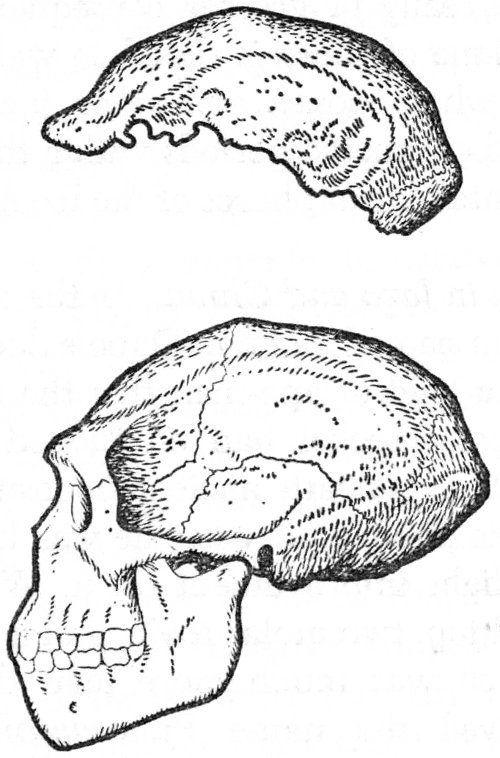
JAVA MAN—Pithecanthropus erectus
Except for two molars and a thigh bone, the skullcap above was all that Dubois first found of Java man. The reconstruction, actually the right side of the skull, has been reversed for comparison. (The skullcap after Osborn, 1915; the reconstruction after Weinert, 1928.)
Java man has a slightly younger relative in Peking man, also beetle-browed. The first finds were made in 1929, about forty miles southwest of Peking in the Choukoutien Cave, on Dragon Bone Hill. Since then parts of about forty men and women have been dug out. We now have four skulls that are more complete than those of Java man. We also have 148 teeth and thirteen jaws, and some odd pieces of other skulls. We have fire hearths and a large number of implements, ranging from eoliths to hammerstones and crude choppers and scrapers. We also have some fossil bones of monkey, baboon, ostrich, rhinoceros, and mammoth, besides animals common to China today. The most interesting bones, of course, are those of man himself, and our concern with them is increased by the odd and disturbing fact that the thigh bones had been cracked for their marrow as only a man could crack them, and 83 the skulls had suffered violence. If Peking man was not a cannibal, he had a neighbor who was. And that is probably true for the Abbevillian and Acheulean times of Europe. But at least Peking man, like Java man, stood erect.
“Giant Ape”—a Mythical Ancestor?
Behind Java and Peking man, it was once supposed, a giant ancestor lurked. Ideas of giants occur in the myths and folklore of most peoples, but here the germ was planted by reputable scientists. It began between 1935 and 1939, when von Koenigswald discovered in a Hong Kong apothecary’s shop three molars that had six times the volume of our teeth and were greater than the equivalent teeth in any other man or ape, living or fossil. Their owner obviously was related to man, but how closely we cannot guess. He was promptly dubbed “giant ape,” Gigantopithecus. Then, in Java in 1941, von Koenigswald recovered part of a massive jaw with a few huge teeth intact. Their great size again prompted a fanciful name, “the giant man of ancient Java,” or Meganthropus palaeojavanicus.
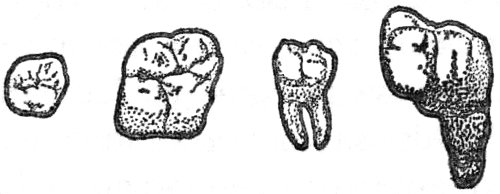
Gigantopithecus—giant ancestor of man? A normal human molar contrasted with one of a number of teeth found in a Hong Kong store. (After Koenigswald, 1947.)
Professor Franz Weidenreich speculated that the Hong Kong teeth would require a beast twice the bulk of a gorilla, while the jaw and teeth of the Java “giant” indicated an ancient man half again as large as a gorilla. Gorillas stand, quite uncomfortably, five and a half feet or so; some weigh more than 600 pounds. 84 Further evidence appeared in 1957, when Pei Wenchung reported the discovery in Kwangsi Province, China, of a jaw bone with teeth, which he claimed to be Gigantopithecus. Pei added that it was closer to man than any other ape yet discovered, and he must have been 12 feet tall.[12]
The logic of including giants among our ancestors stems in part from the fact that many Pleistocene mammals were larger than their modern descendants. What these great teeth and jaws mean, we do not yet know. In the complete absence of such clues to stature as thigh and other bones, there are few who would now speculate that the huge teeth mean more than a fossil ape of otherwise moderate proportions. There is not always an exact correlation between size of teeth and stature, as comparisons among modern man, Peking and Java man, and South African man-apes indicate. The smallest teeth occur among some of the tallest humans; the largest teeth are found among some of the smaller man-apes.
“Java” Men in Africa and Europe?
Halfway around the world, at Ternifine, near Oran, in Algeria, Professor Camille Arambourg recovered a portion of a youthful skull and three jaws in 1954-55. He called these Atlanthropus.[13] This was not a valid new genus, however, for there are strong resemblances between these jaws and those of Peking and Java man. Here is an African cousin of Pithecanthropus. (There are others. A fragment of jaw found near Rabat, in Morocco, also is thought to resemble Java man.) The Ternifine jaws seem to belong to the second interglacial period. At the bottom of an ancient spring from which Arambourg recovered his fossils, he also found a number of stone tools, including fist axes of the Acheulean type. This perhaps is the earliest association of Acheulean artifacts with human bones. You will recall that Acheulean 85 fist axes also were found with Swanscombe. Have we, then, a single type of culture for two quite different kinds of men? Our accumulating evidence is beginning to make it clear that some half-brained form of man closely related to our Java “ape-man” was widely distributed across the inhabitable regions of the Old World during the long second interglacial period.
Man-Apes or Ape-Men in Africa
While Sunday supplements and scientists alike were occupied with Dubois’s “missing link” and his Peking cousin, primate fossils of even greater consequence were being recovered in southern Africa by Professor Raymond Dart and the late Dr. Robert Broom. In 1925, Dart named them Australopithecines or “southern apes.”[14] Arousing little scientific curiosity at first, they were considered by some as a parallel, perhaps profitless, line of evolution. By 1950, such fossils were becoming impressively abundant. A bewildering array of names was assigned to them, without scientific justification. The first had been called Australopithecus africanus; later, another species, prometheus, was added. Others were labeled as distinct genera, taking note of their near-human features—Telanthropus, Plesianthropus, and Paranthropus (with two species, robustus and crassidens). In 1959, a new and important form was added, Zinjanthropus boisei. Zinj is the Arab name for East Africa. Expert opinion now inclines toward lumping these all together, possibly under our own genus, Homo, or at most, within a single genus, Australopithecus. Their status of “ape” is being reassessed: man-apes, some still maintain; ape-men, say others; a few believe they included the earliest true men.
The dividing line between ape and man is drawn partly upon physical grounds, but the greatest difference is a cultural one. Men possess and transmit culture, a process ordinarily regarded as involving language. 86 Men make tools; apes do not. The smallest, crudest, and perhaps earliest of the Australopithecines have long been championed by Dart, who argues most persuasively that they were at least tool users, if not toolmakers. With their remains were those of other animals, a source of bones for picks and clubs, teeth for cutting and scraping, and so on. Perceiving crude, ready-made tools of bone, tooth, and horn, Dart coined the term “osteodontokeratic” for this pre-Stone Age assemblage.[15] This nomenclature was criticized by physical and cultural anthropologists alike. Whether this “culture” of the Australopithecines is real or—as many believe—imagined, there is no doubt about the equipment of Zinjanthropus. Associated with his bones are stone tools of the Oldowan culture, an Abbevillian-level, “Pre-Chelles-Acheul” industry of worked stone flakes. In the words of his discoverer, Dr. L. S. B. Leakey, here was the oldest maker of stone tools so far known. By 1960, the skull of Zinjanthropus had not been fully studied. In certain of its features, it favors Paranthropus, Australopithecus, or Homo. On first glance it seems as nearly human as Java man, which Leakey says it predates.[16]
There are two main difficulties in placing the Australopithecines on the line of human evolution. Although they might be said to resemble man more than the apes, they actually resemble neither, for their features are so specialized that it is difficult to conceive of them as ancestral to either. It is difficult, too, to place them in geologic time. Except for Zinjanthropus, who clearly belongs to the upper part of the Lower Pleistocene, most of the Australopithecines have been recovered from caves, fissures, or other places where there is no stratification. They are all much too old to be placed in time by some of our more precise dating techniques, such as the radiocarbon method. Non-primate bones found with them are typical of animals that in Europe 87 ranged all the way from the Mid-Pliocene to the Mid-Pleistocene. South Africa is a cul-de-sac, relatively untouched by the Ice Age. The abundance and variety of animals surviving today in most of Africa south of the Sahara are reminiscent of the Pleistocene elsewhere. The index fossils of other lands are not much use when it comes to dating Australopithecus.
Once suspected of being Middle Pleistocene at the earliest, the Australopithecines’ apparent lack of culture, their crude development, and relatively small brain capacity indicated to some authorities that they were too little and too late to have been ancestral to man. But given a greater time span-back, say, to the Late Pliocene—they could be regarded seriously as mans ancestors. Somewhat cautiously, Sir Wilfrid E. Le Gros Clark seems to agree with Dart that, as a whole, the Australopithecines may well include the stock from which our own genus was derived.[17]
Back of the Australopithecines are yet other fossils of great interest, forms intermediate between man and apes in various ways. These all are utterly lacking in culture, in our sense of the word. One of the more interesting fossils is Oreopithecus bambolii, quantities of which have been recovered from a lignite mine at Baccinello, Italy.[18] These fossils seem to date from about the Early Pliocene. More than ape or monkey, their teeth are definitely manlike—hominid rather than merely hominoid—and the size of their brains is about that of the larger chimpanzees or the smaller Australopithecines. Future studies surely will indicate if, and perhaps how, Oreopithecus is related to the South African man-apes, and to man.
The Progressive Neanderthal
Let us get back to Europe and the next culture in Mortillet’s scale. This is the Mousterian; we know it better by the name of the place in Germany—Neanderthal—where, in 1856, the 88 first skeleton of the Mousterian Age was found. It took thirty years for this skeleton to win scientific recognition, but now we have about a hundred admitted specimens.
The Neanderthal was not a pretty spectacle. He had the low forehead and heavy brow ridges of Java and Peking man, and the same lack of chin. And yet he was the cleverest fellow by far that had ever lived, and the most sensitive, which may seem rather odd, since some of the earlier skulls found in England, Africa, Java, and Australia come nearer the modern type of what we call thinking man, Homo sapiens.
On the evidence we have, the Neanderthal seems to have been the inventor of religion. In his caves we find burials for the first time, and burials accompanied by tools for the dead man to use in the other world. We also find shrines made of the skulls of cave bears.
As a chipper of flint, he was much more skillful than those that had gone before. He soon gave up making tools which, like the hand ax, would serve a number of purposes, but none very well. He invented the stone spear point. There is still considerable argument about his flint work, or at least about the technique which he may or may not have developed.
89
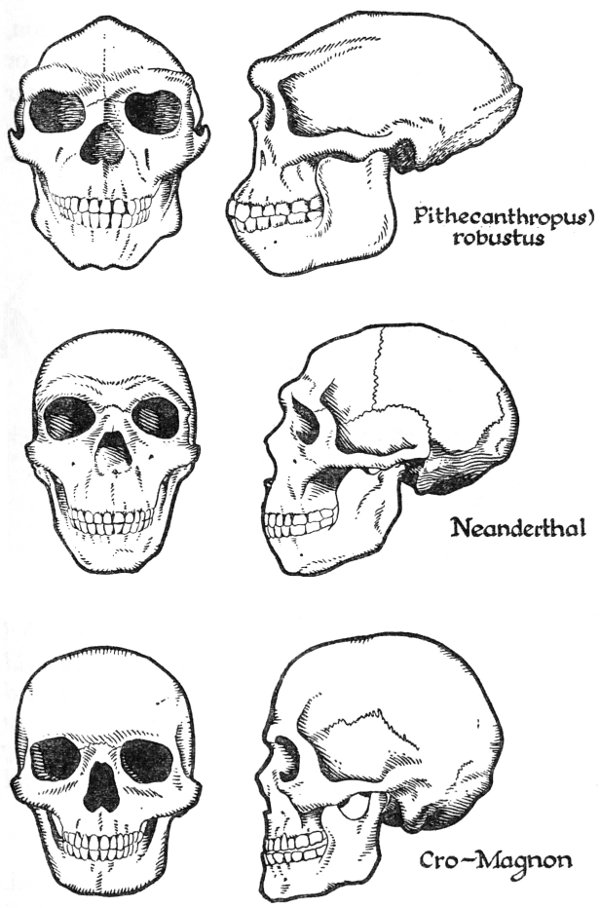
THREE TYPES OF OLD WORLD MAN
Note the progressive lessening of brow ridge and receding chin and the increase in the height of forehead and vault. Pithecanthropus robustus was found in the same general area as Pithecanthropus erectus, or Java man. (Robustus, after Weidenreich, 1946; Neanderthal, after McGregor, 1926; Cro-Magnon, after Verneau, 1906.)
90
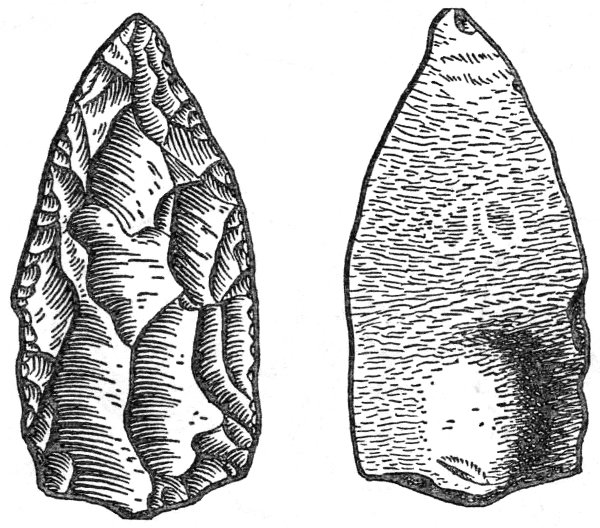
MAN’S FIRST SPEAR POINTS
Two views of a flake of flint that has been chipped on one face and retouched along the edges by a Neanderthal man. To remove the tiny lateral chips, he probably held it with the smoother side against a chunk of wood, and struck small and careful blows with a hammerstone (as shown at the bottom of page 91). Acheulean man may have used this technique in making the best of his hand axes. (After Mortillet, 1881.)
When man began to make tools he pounded one rock with another. He hoped he would knock off just the right chip in the right spot. This is called the percussion method of flaking (see illustration, page 91). Some say the Neanderthal was not content with this. They think that he must have discovered how to place a piece of bone or very hard wood against a flint at the point where he wanted to knock off a flake, and then strike it with a hammerstone (see illustration, page 92). This might account for the small chips, or “retouches,” taken off the edge of some of his spear points as in the illustration below. Even the Acheuleans are occasionally credited with this invention because many of their hand axes are so symmetrical. There are those who say that the Neanderthal had progressed so far in flint work that he knew the art of pressure flaking—the third step in flint knapping—which involved the pressing off of small chips with the bit of wood or bone held in the hand (see illustration, page 93). It seems more likely that Neanderthals and men of Acheulean times used the anvil method of percussion flaking (lower drawing, page 91), not an inaccurate way of knocking off small chips.
91
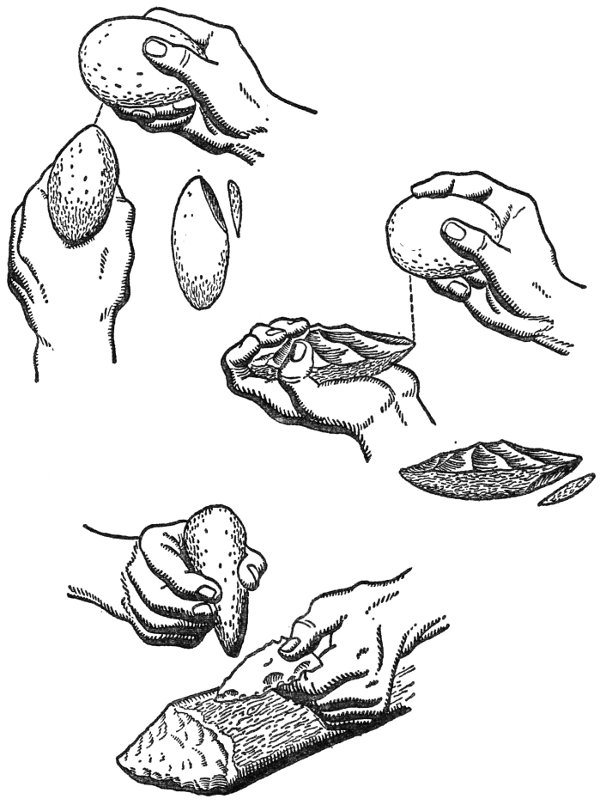
PERCUSSION FLAKING
The first method by which early man shaped his tools. (After Holmes, 1919.)
92
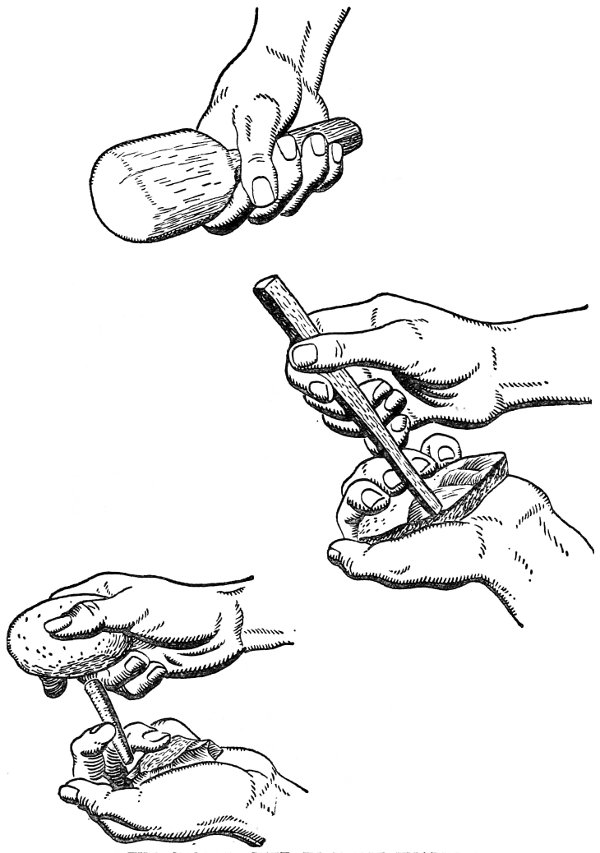
THE SECOND STEP IN FLINT KNAPPING
For more accurate work, early man applied a small stick of hardwood or a piece of bone at the proper spot and hit the interposed tool with a mallet of heavy wood or a rock. No one knows who invented this technique—Acheulean, Neanderthal, or later man. (After Holmes, 1919.)
93
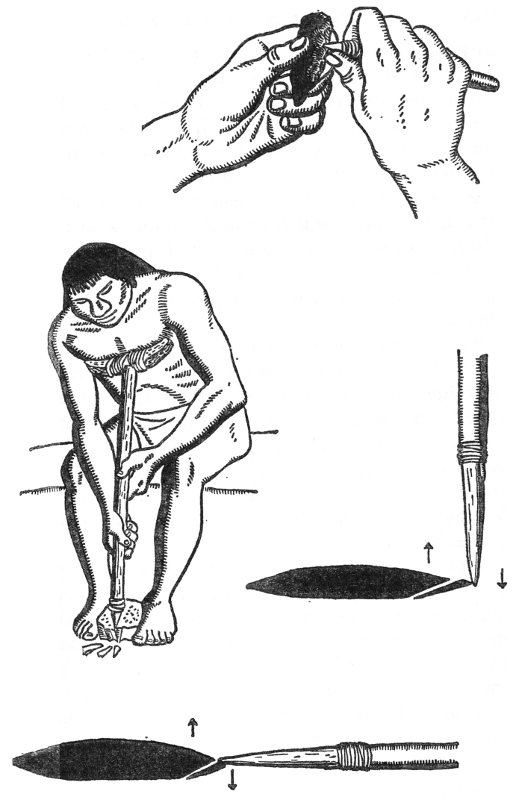
THE THIRD STEP—PRESSURE FLAKING
The discovery that gave early man complete control over the shaping of flints was that a slow and continued pressure would dislodge just the flake he desired. Above, we see how he worked on a small point, and below, to the left, how he chipped thin slivers from a core. (After Holmes, 1919.)
94
The Neanderthal—with his Mousterian culture—seems to have invaded Europe from Asia toward the end of the third and last interglacial, anywhere from 80,000 to 125,000 years ago, and to have left from 15,000 to 100,000 years ago, depending on what authority you choose, and how that authority dates the last interglacial. Unlike his predecessors, the Neanderthal lived in caves; but that was probably because he was the first man in Europe to survive a glacial winter—tens of thousands of them.
The Neanderthal seems to have disappeared quite suddenly from Europe, taking his Australoid features with him. There are traces of him in Africa, and also in Palestine where he is thought to have produced a hybrid among the Mount Carmel people. Sir Arthur Keith said, in 1915, that the Neanderthal never left Europe, but was merely absorbed into the next peoples. We can see the Neanderthal profile on an occasional passer-by.
Most anthropologists are rather cool to the Neanderthal. They cast him quite outside the sacred ranks of our ancestors. They say he was not Homo sapiens—merely Homo neanderthalensis. This means that he was a sort of dead end, a blind alley, up which one sort of ape-man ran, while another was taking a turn that ended in his being master of the atom but not of the atomic bomb. Other anthropologists do not agree. Like Keith, they take the Neanderthal into the sacred circle—at least at stud.
Radiocarbon Dates for the Mousterian
However early the Mousterian culture may have begun, the later stages fall within the range of one of the archaeologist’s most interesting and precise techniques for dating. This is the radiocarbon, or Carbon 14, 95 method.[19] Much simplified, it depends upon the following phenomena: Most plants are radioactive, and so are all animals that depend directly or indirectly upon these plants for food. This radioactivity is found in a rare form of carbon called radiocarbon, or Carbon 14. While a plant or an animal is alive, it contains a constant proportion of this radioactive material. Radiocarbon is always breaking down and disappearing, but while a tree or a bird or another animal lives, this material is being renewed. When this same tree or animal dies, it stops acquiring new radiocarbon, and therefore its radioactivity decreases. Heartwood from a 4,000-year-old sequoia tree is appreciably less radioactive than the living outer layer. Antlers shed by a buck in the last spring are more radioactive than any reindeer antlers left in a cave in France by Old Stone Age hunters 17,000 years ago.
After death, radiocarbon disappears at a rate of speed that can be measured. This rate may seem strange to most laymen. It is based on what physicists call “half-lives.” The half-life of radiocarbon is 5,568 years, give or take a few. This means that after 5,568 years, half the radiocarbon is gone. If the material weighed a pound at the death of the plant or animal, only half a pound would be left. After another half-life of the same length, only a quarter of a pound would remain. And so on and so on. With highly refined techniques, what is left of this radioactive substance can be detected in matter 60,000 to 70,000 years old,[20] and it can be measured and its age determined, with a few percentage points of error, up to at least 50,000 years ago. The scientist must be sure, however, that the material—such as wood, charcoal, peat, antler, shell, bone, or hair—has not been exposed to contamination that would add radiocarbon.
This method of dating, developed by Willard F. Libby in the late forties, supplied archaeologists with 96 fairly close estimates of the age of sites containing wood, charcoal, shell, or bone.
Neanderthal is the first of our early men to have lived within the range of radiocarbon dating. To be more precise, his Mousterian culture has left traces that can be measured. We have several radiocarbon measurements that tell us how recently Neanderthal was around; his oldest cultural materials are beyond the present range of radiocarbon measurement. At Godarville, Belgium, Mousterian artifacts were found underlying an accumulation of peat that dated from more than 36,000 years ago. Since the stone tools were deposited before the peat, they must be at least as old. Charcoal from an ancient hearth in a Libyan cave at Haua Fteah, associated with Levalloiso-Mousterian materials and about three feet or so above a Neanderthaloid jaw, was dated at 34,000 years, or possibly older. The archaeology of this cave suggests that the Neanderthal survived in North Africa until about 30,000 years ago. In Israel, south of Haifa in the Mount Carmel range, at a site called Mugharet-el-Kebara, a very small sample of charcoal, thought to correlate with a nearby Levalloiso-Mousterian deposit, furnished a date of more than 30,000 years.
In the Near East, archaeological excavation directed by Dr. Ralph S. Solecki, of the Smithsonian Institution, turned up yet more material that helps us date the Neanderthal. In the Zagros Mountains of northern Iraq, at Shanidar Cave, in Shanidar Valley, there is a remarkable deposit of both the tools and the bones of early man. The cave contained a dozen feet or so of Upper Paleolithic remains overlying a deep Mousterian deposit. The bottom level of the Upper Paleolithic materials has been dated at over 34,000 years. How much older the Mousterian layers may be we cannot yet be sure. From depths of 14½ and 23 feet below the surface and within the Mousterian deposit, adult skeletons 97 have been recovered. These seem to be Neanderthaloid, as does the skeleton of a child, recovered at a depth of 26 feet. The estimate is that the shallower of the skeletons may be about 45,000 years old, the lower adult perhaps 60,000.[21]
Homo sapiens—New or Old?
The relationship of all these forms of early man is much disputed. For many, many years they were all supposed to be barren offshoots of our ancestral tree. Nobody could find the particular breed of ape-man from which we were descended. Now science is inclined to lump most of them together in one way or another. There are many theories and many genealogies. Swanscombe man plays grandfather to Homo sapiens. Java man and Peking man become the forebears of the Mongoloid. Other men from Java father the Australian, and even the Neanderthal. The Neanderthals breed out their crudeness in some sort of union with Homo sapiens. Or all of them are admitted to the ranks of Homo, with Neanderthal a degenerate offshoot without issue.
The earlier picture was simpler and more dramatic. From Pithecanthropus erectus to Homo neanderthalensis—Java man to the Neanderthal—these creatures bore no relation to our own happy breed. Then, quite suddenly, came Homo sapiens in the person of the Cro-Magnon. He was the kind of tall fellow with a well domed, narrow Nordic head whom Hitler identified with the better class of human beings. Except for the “Red Lady of Paviland,” the first specimens were found at Aurignac, France, in 1852, though nobody recognized the outstanding quality of the skulls until the find at Cro-Magnon, France, in 1868 (see illustration, page 89).
98
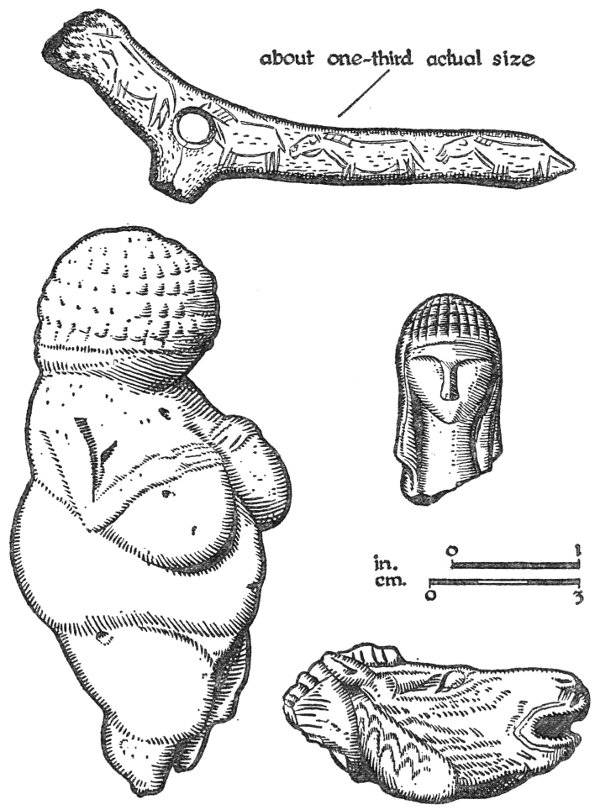
SCULPTURE OF THE OLD STONE AGE
Above, one of the carved and perforated reindeer antlers of the Magdalenians, which are sometimes described as bâtons de commandement; the Eskimos used a somewhat similar tool for straightening their arrows. Left, the Venus of Willendorf, an Aurignacian carving in stone, found near Spitz, Austria. The woman’s head from the Grotte du Pape, Brassempouy, France, may be either Aurignacian or Magdalenian. The horse’s head, made of reindeer antlers, from Mas d’Azil, France, is Magdalenian. (After Osborn, 1915.)
99
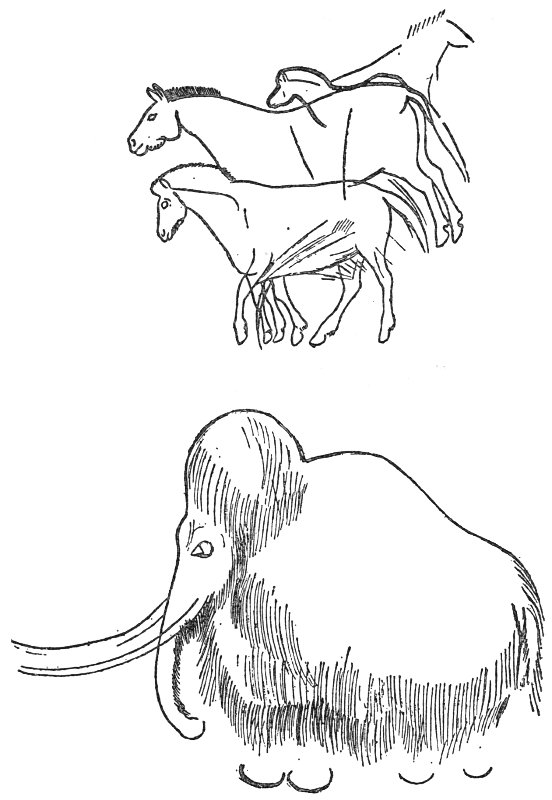
For many years the French clung to what Hooton calls the rather chauvinistic myth that here, in the waning years of the Great Ice Age, we find a superior kind of man that was predominantly a product of the French area. Certainly he was a remarkable person in many ways. For one thing, he discovered art. He painted on the walls of his caves and carved on pieces of bone and elephant ivory pictures of mammoths, bison, and boars, and he made sculptures of fat women in stone. Also, he began to fish in the swift streams that ran off from the glaciers. He hunted reindeer and made use of their antlers as tools. For quite a time he was supposed to represent the peak of achievement by early man.
Before long, however, the Cro-Magnon became only a factor in a broader culture, described as the Aurignacian, and soon the Aurignacian suffered from scientific fission. Through this whole period and, indeed, until the end of the Old Stone Age, new tools in the form of blades, chisellike burins, and implements of reindeer bone make their appearance; but they vary in shape and in the time of their emergence. Some of these tools divide what was formerly called the Aurignacian into three parts: the Châtelperron, the Middle Aurignacian, and the Gravettian. The Châtelperron people developed a narrow, curved blade out of a tool vaguely Mousterian. The Middle Aurignacians appeared as invaders with thin blades and scrapers notched or narrowed halfway along each side. Finally, a people who had hunted mammoths in southern Russia—the Gravettians—turned 100 up in France as the inventors of a thin, narrow, and straight blade made by carefully detaching sliver after sliver from a well shaped core of flint. Sometimes one edge was blunted to make it handier to use; occasionally the point of a blade or other tool was chipped off diagonally to produce a chisellike engraving tool. Another type of tool, the Font Robert point with a stem, also appeared (see illustration, page 101).
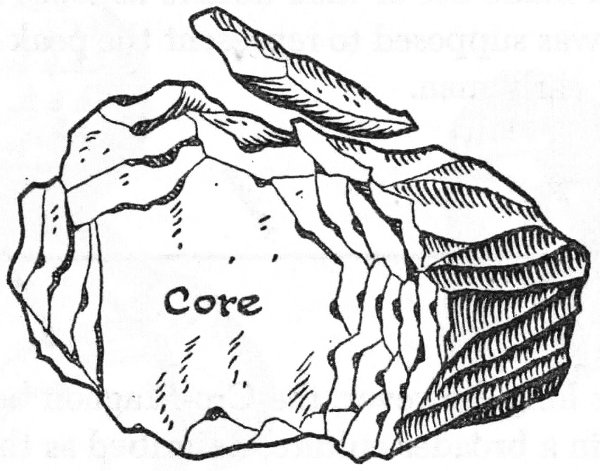
How blades were split off a core. The technique was perfected by the Gravettians, an Aurignacian people, and was practiced by the Aztecs of Mexico. (After Evans, 1872.)
Henry Fairfield Osborn once dated the European advent of the Aurignacians at about 27,000 years ago, Nelson at 20,000, Mather at 15,000.[22] Zeuner, however, believes they flourished from about 100,000 until 75,000 years ago.[23] Dating the last of the glaciers was the key to this dispute. Radiocarbon dates now suggest that the Aurignacian period survived in Europe and the Near East until 18,000 to 34,000 years ago.[24] Its beginnings may well extend beyond the range of this method.
101
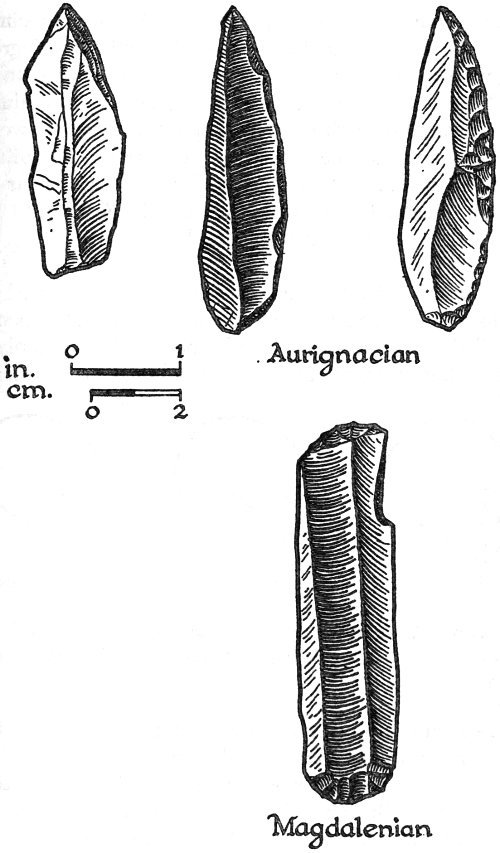
Upper Paleolithic tools from long flakes taken off cores after the manner shown on page 100. The burin, or graver, at the upper left is probably Upper Aurignacian, though commoner in the Magdalenian culture. The others are usually called blades. (The burin, after Burkitt, 1933; the blades, after MacCurdy, 1924.)
102
The Aurignacians are a variegated lot, which argues further for subdividing them. One specimen, the tall, high-domed Cro-Magnon, is variously credited with producing the modern European man, the Eskimo, and even the Indian of America. Another specimen, the Grimaldi from the Riviera, is distinctly Negroid. Another—from hints in several places—seems to be Mongoloid. Apparently, the Aurignacians were almost variegated enough to have peopled the modern world. But almost as much could be said for the inhabitants of an upper level in the Choukoutien Cave near Peking. There, in one spot, they divide nicely into Negroid, Eskimoid, and Melanesoid.
Solutrean Flint Workers Invade Europe
Toward the close of Aurignacian times comes a remarkable people called the Solutreans. They appear quite suddenly as invading hunters, and they disappear as suddenly. Their culture does not evolve out of the Aurignacian, and it does not evolve into the next culture, the Magdalenian. The Solutreans stayed a relatively short time in Europe; Braidwood once gave them 10,000 years, but Mather and Peake and Fleure only 500.[25] Guesses as to when they arrived vary as widely. Peake and Fleure think it was about 12,000 years ago, while Zeuner puts them back to 67,000 years before our time.[26] Radiocarbon dates indicate only 18,000 years ago.
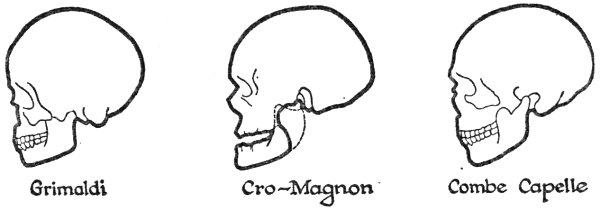
Three Aurignacian types that suggest the Negroid, the Caucasoid, and the Mongoloid. (After Peake and Fleure, 1927.)
103
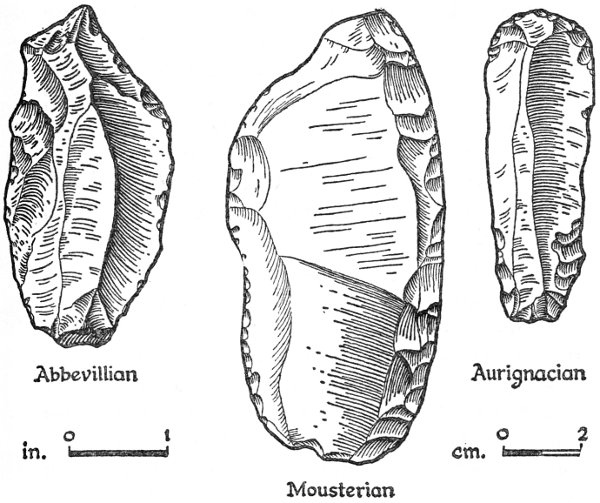
THE MEANING OF SCRAPERS
“A primitive thing called a scraper is crude and not at all eloquent until you realize that it points to much else. It means not only a scraper, but a thing to be scraped, most likely a hide; therefore it means a growing ability to kill, to take off the hide and cure it. That is just the beginning, for a scraper also shows a knowledge of how to scrape, and a desire for scraping, and enough leisure (beyond the struggle to get food) to allow time for scraping. All this means self-restraint and thought for the future, and it implies a certain confidence in the ways of life, because no one would be liable to go to all the trouble of scraping if he did not have reasonable hope of enjoying the results of the work.”—George R. Stewart, in Man: An Autobiography. (Left and center, after MacCurdy, 1924; right, after Leakey, 1935.)
104
Where the Solutreans came from is another of the unsolved riddles of archaeology. Until recently, they were generally supposed to have come out of western Asia, because the most primitive of their remarkable tools were found plentifully in Hungary and sparsely in western Europe. For sixty years Solutrean points were found no farther south than northern and eastern Spain. Now, however, points of Solutrean type have begun to appear in North Africa, Egypt, and Kenya Colony. Here they are jumbled together in the same strata with Mousterian points and the tanged points of the Aterians, a purely African people. Hence certain archaeologists are inclined to believe that the Solutreans may have originated in Africa as an offshoot of the Mousterians (see illustration, page 105).
In spite of their fondness for the chase, the Solutreans of Europe continued the interest that the Aurignacians had shown in art—or so at least certain authorities who admire the relief carvings of Le Roc in France tell us. But their chief distinction is that they knew the craft of pressure flaking typical of Folsom and Eden cultures in the New World. The Solutreans are represented mainly by thin, willow- or laurel-shaped tools. By pressing—not pounding—a piece of bone or wood against the surface of the flint they flaked off slivers across the tool in a way that no one equaled in the Old World until the Egyptians had entered the neolithic and agricultural age many thousands of years later. The Solutreans also made small points with a tang at one side (see illustrations, pages 105 and 165). This was for the purpose of fastening the flint to a shaft; but whether it was used with a bow or a spear-thrower is not clear. (Incidentally, points of somewhat this shape appear in the New World.) At about the same time, the Aterians of North Africa used a very crude tanged arrowhead; and in the late Aurignacian the Font Robert point with its rude tang appeared. The superior spear point of the Solutreans seems the natural product of a people who were particularly active and energetic in the chase. In a single camping place they left 35,000 tools of flint.
105
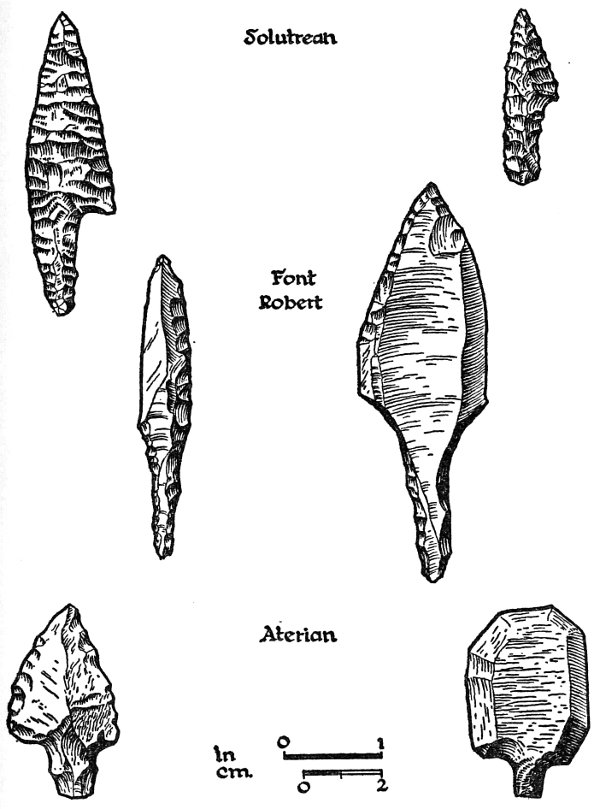
THE TANGED POINT
It was only in the late years of the Old Stone Age that man learned to put a tang on a point and so make it easier to fasten to a shaft. This advance may have been made in connection with the spear-thrower, but it seems more likely that the arrow brought forth this technological refinement. Only Solutrean man and the American Paleo-Indian made truly efficient points. (The Solutrean, after Burkitt, 1933; the Font Robert at right, after Burkitt, 1933—at left, after MacCurdy, 1924; the Aterian, after Plant, 1942.)
106
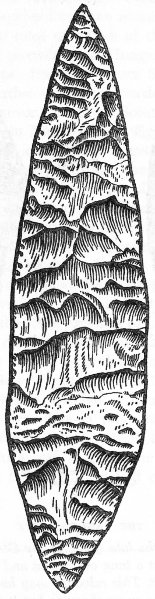
A laurel-leaf Solutrean point from France, ½ natural size. (After MacCurdy, 1924.)
107
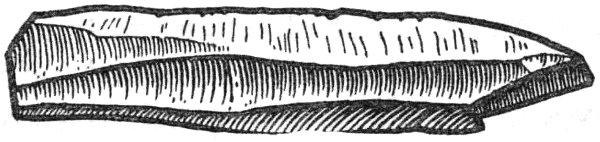
A tool to make a tool. Such burins, with a transverse edge at the top, rather like that of a chisel, were used by the Magdalenians to shape bone implements and engrave designs upon them. (After Wilson, 1898.)
Following these Asiatics, a people whose culture was very similar to that of the Aurignacians appeared in Europe. They were the Magdalenians, and they carried on the general traits of the men of Aurignac and added to them (see illustration, page 101). They made better blades and burins. (Long, slim blades of the Aurignacian-Magdalenian type have been found in Mexico, and there are burins in Alaska and northern Asia.) The burins helped the Magdalenians to make new implements of bone such as needles, fishhooks, harpoons, and spear-throwers. Besides all this, they brought to perfection the arts of painting and sculpture which used to be too much credited to the Aurignacians (see illustrations, pages 110 and 114). The magnificent 108 polychromes of the Magdalenians in the Lascaux and Font-de-Gaume Caves in France and the Altamira Cave in Spain testify to the genius of this people. The customary dispute exists about their time of activity. One authority puts it from 11,500 to 8,500 years ago, and another from 70,000 to 25,000.[27] Radiocarbon indicates a probable range of 17,000 to 10,000 years ago.

Magdalenian harpoon head, 4¾ inches long, made from an antler and discovered in the rock shelter of La Madeleine, where engraved art of early man—a picture of a mammoth—was first found, by Lartet, in 1864. (After Lartet and Christy, 1875.)
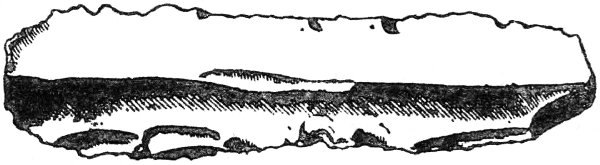
The first illustration of a blade, probably Magdalenian. (After Mercati, 1717.)
Weapons and Tools—from Hand Ax to Arrowhead
One of the many mysteries of prehistory is who invented the bow and arrow. The smaller Solutrean points argue that their makers used a bow and invented this primitive but effective machine. But since the bow was made of wood, it has not been preserved in the caves and terraces that spared the bone spear-throwers of the Magdalenians and the flint projectiles; so for evidence we must fall back on the paintings of primitive man. We find the spear-thrower portrayed in South Africa but not in Europe. The newer weapon, the bow, is on the walls of rock shelters in southern and eastern Spain. At first these paintings were thought to be neolithic. Later they were credited to the Magdalenians, in spite of the fact that the use of the human form and the bizarre and almost humorous caricature contrast with the subjects and the style of Magdalenian art. Now they are generally credited to the Capsians, a people from northern Africa. The paintings resemble prehistoric work from Rhodesia and the Tassili Mountains of southern Algeria, and also the historic and protohistoric designs of the Bushmen (see illustrations, pages 111 and 112).
109
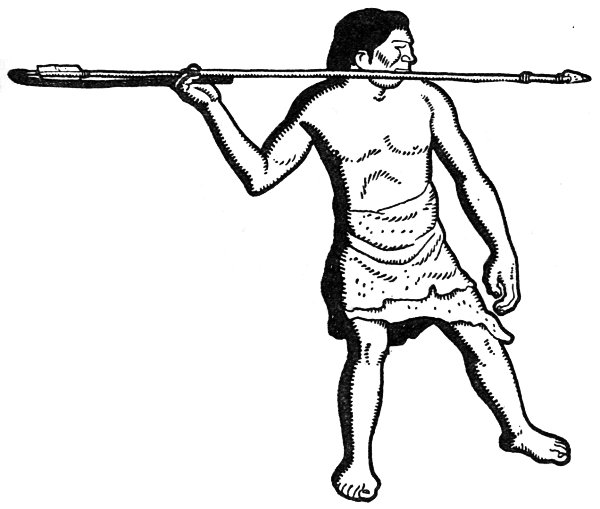
Our first machine, the spear-thrower, as used by early man and certain later peoples in the New World as well as the Old. An invention difficult to conceive and effect, it marked an important step forward in man’s use of his brain and his body. In effect, it extended the length of the human arm by at least two feet and therefore its power by perhaps 50 per cent. (After Harrington, 1933.)
110
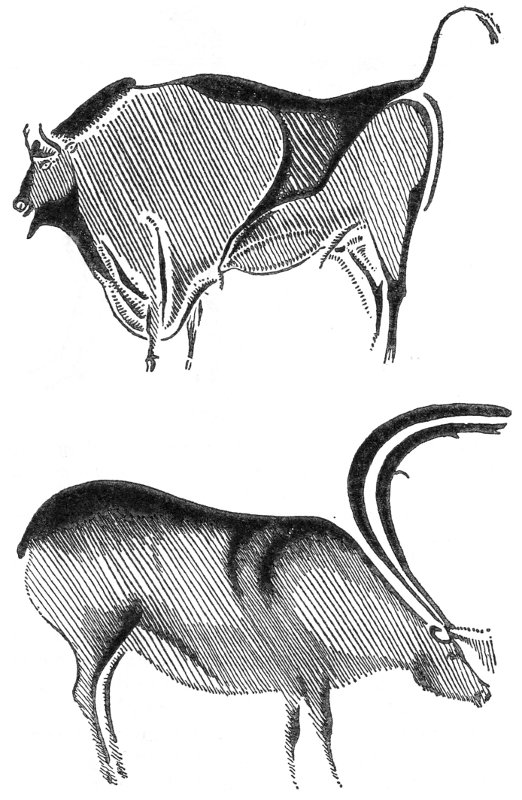
THE FIRST PAINTINGS
Although prehistoric engravings of animal figures on bone had been discovered in European caves as early as about 1840, and engravings on cave walls in the sixties, it was not till 1878 that paintings were found. The discoverer was a child. While Marcelino de Sautuola was searching among the debris on the floor of the cave of Altamira, near Santander, in Spain, he heard his little daughter cry “Toros! Toros!” and saw her point to polychrome paintings of bison and other animals on the roof of the cave. One of them appears at the top of this page. The other painting shown is from the French cave of Font-de-Gaume. These two caverns contain the finest lineal art of early man, chiefly Magdalenian. (The bison after Cartailhac and Breuil, 1906; the deer after Capitan, Breuil, and Peyroni, 1910.)
111
The history of even the simplest of man’s tools from the hand ax to the arrowhead is long, interesting, and puzzling. It is hard to say what many of the tools were used for, or indeed what they were not used for. The hand ax would obviously be best for grubbing out roots and tubers, yet, like most of the implements of early man, it must have served a variety of other purposes also. Until the Mousterians began to make spear points, 90,000 to 150,000 years ago, all man’s implements—even what we call his scrapers—were pretty generalized. Later, with the Aurignacians and the Magdalenians, came artifacts that were obviously blades or knives or chisels or harpoons. The tool to make other tools appeared, and this we must add to the list of man’s prehistoric achievements: speech, fire making, stone chipping, pressure flaking, and carving and painting.
The attempt of science to record and interpret the story of early man in the Old World has been an extraordinary triumph over the obstacles of half a million years of prehistoric darkness. Hundreds of men and women, laboring long and ingeniously, have won to an almost miraculous success, and the end is not yet in sight.
The work has suffered, of course, from many a human limitation. Not the least of these has been the desire to interpret knowledge too quickly, to freeze it 112 into forms and classifications, and to stand doggedly by those forms and classifications when they have become weakened by new knowledge. The student and the intelligent layman have been confused by all this. They have been particularly confused—as we think we can show—when it comes to early man in the New World.
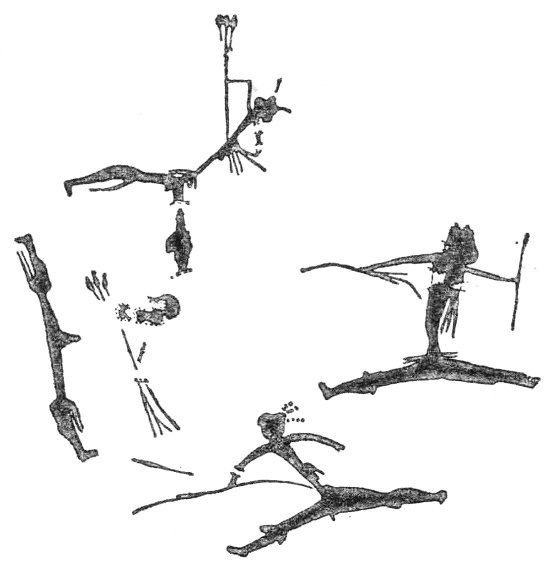
Aurignacian and Magdalenian men of France drew and painted animals, almost never the human form. The artists who worked in the caves and rock shelters of eastern Spain drew figures of hunters and women, as well as of animals. These artists may have been Capsians who lived in North Africa in the Aurignacian period and spread into Europe at some time between then and the Neolithic. The style resembles that of the African Bushmen. The two archers on the left are from the cave of Saltadora; the two at the right, from the Cueva del Mas d’en Josep. (After Obermaier and Weinert, 1919.)
The Danger in Universal Time-Scales
When we apply to the paleolithic cultures of the rest of the world the names of the European culture sequence—Abbevillian, Acheulean, Mousterian, Aurignacian, Solutrean, 113 Magdalenian—we produce acrimonious argument and not much more. These terms are of no use in the rest of the world except as a description of types of tools. In parts of Africa, for example, Mousterian and Aurignacian objects are found together; in other parts, Mousterian and Solutrean. In the first case, the Aurignacian includes primitive pottery; in the second, Aurignacian is missing altogether.
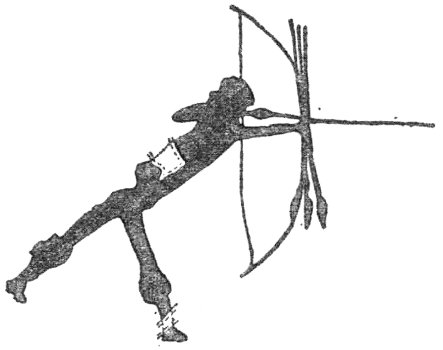
An archer drawn in the cave of Saltadora, Spain. (After Obermaier and Weinert, 1919.)
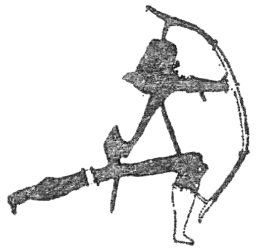
An archer from Alpera, Spain. (After Obermaier and Weinert, 1919.)
Tied in with the mistake of setting up prehistory in Europe as a frame for prehistory elsewhere, lies the worse mistake of trying to read general time in terms of things and ideas which are purely local. The Paleolithic, Neolithic, Bronze, and Stone Ages mean less than nothing as a dating machine for more than a single locality. “The Stone Age,” says Childe, “ended before 3500 B.C. in Mesopotamia, about 1600 B.C. in Denmark, and A.D. 1800 in New Zealand.”[28] Postglacial means one thing in Germany and another in Sweden, one thing in Buffalo and another in Winnipeg.
114
MAGDALENIAN ENGRAVINGS
These extraordinary drawings of horses and a mammoth are a transcript of the art of primitive man found upon the walls of the cave of Font-de-Gaume. (After Capitan, Breuil, and Peyroni, 1910.)
115
The impossibility of measuring time and space together should be clear enough if you consider merely the matter of how the invention of writing in the Near East is related to written records in other parts of the world. Again we quote Childe: “In England they take us back to A.D. 40, in France to 60 B.C., in Italy a little beyond 500 B.C., in Greece before 700, but nowhere in our continent before 1000. In China written records are available as early as 1400 B.C., in Asia Minor to 1800, only in Egypt and Mesopotamia to 3000 B.C.”[29] Thus the use of writing would give us no time scale for the Old World. Fortunately, we have never tried to date the history of nations in terms of an Illiterate Age, a Writing Age, and a Printing Age.
There is similar difficulty over the fossils of extinct mammals which help to date man in Europe. They do fairly well as an index to whether a tool was used in a glacial or an interglacial period. But they sometimes create scientific disagreements when they are used to place the tool in one glacial period or another. And when we reach the crucial time of the end of the last glaciation, and the extinction of the last great beasts, we are in most serious trouble. Here we are dealing with tens of thousands of years instead of hundreds of thousands, and the evidence is simply not that sharp. We do not know when Magdalenian man saw and painted his last mammoth. The mammoths died by inches—or by miles, geographically speaking. They were still alive in one area when they had died out in another. And when we reach the New World, we have still less basis for setting our watches by the fossils—as will be seen in a later chapter.
116
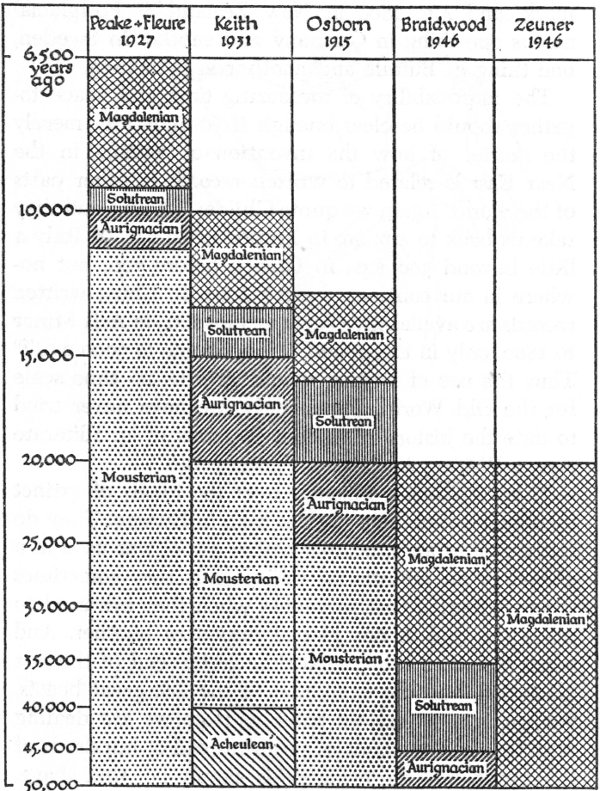
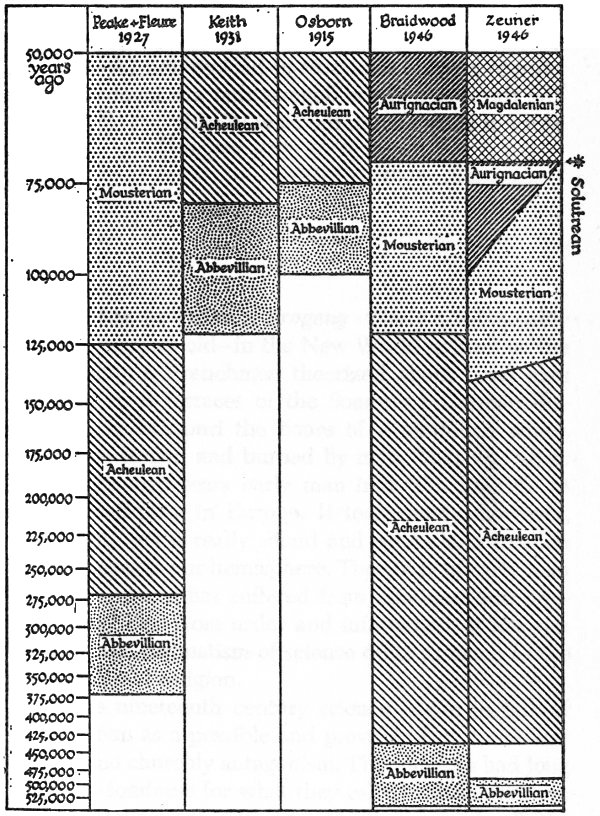
A CHART OF OLD STONE AGE CULTURES
The first section covers 50,000 years, the next page almost 500,000. Both are based on a logarithmic time scale in which the years nearest the present are exaggerated in length.
117
118
Our knowledge of early man in the Old World is still shifting and developing. There has never been too much agreement—as the charts on pages 116 and 117 demonstrate in the area of time—and there probably never will be. We have risked this somewhat oversimplified sketch of a much disputed and complex subject only to provide some sort of background for the facts, the theories, and the dogmas that are involved in the story of early man in the New World.
119