8 EARLY MAN AND THE GREAT EXTINCTION
Reading edition
And prate about an Elephant Not one of them has seen! —J. G. SAXE
A Twofold Problem
A mammoth in Colorado ... a giant sloth near Hoover Dam ... spear points of early man involved with both. Those two remote and spectacular animals roaming our own United States set our minds far back on the trail of time. The weapons, crude as they were and pitifully small, carry us forward again tens of thousands of years. We are describing the reaction of the layman who first learns of these things, but the opinions of science veer almost as widely when it tries to date the traffic of man and mammoth in the New World. The range is from 100,000 years ago to 2500 B.C.
The dating of the life of early man by the death of mammals now extinct is one of the major tasks that face the American prehistorian. It is doubly difficult because, in the first place, evidence of when these animals died off is only now becoming available, and, secondly, because we must also know how long man hunted them before they became extinct. We know that a few skulls have been found in strata containing the fossils of these animals, and we know that all but one of the skulls are longheaded and beetle-browed like those of the Australians and the Melanesians, instead of roundheaded like those of most Mongoloids. We know that Sandia, Clovis, or Folsom points have been found with the fossils of extinct elephants, horses, camels, and bison. If we knew when such mammals became extinct, we should know the latest possible date of most of the archaic skulls and of Sandia and Folsom man. But we should still not know just how much earlier some of these humans lived, or when they or their predecessors discovered America.
190
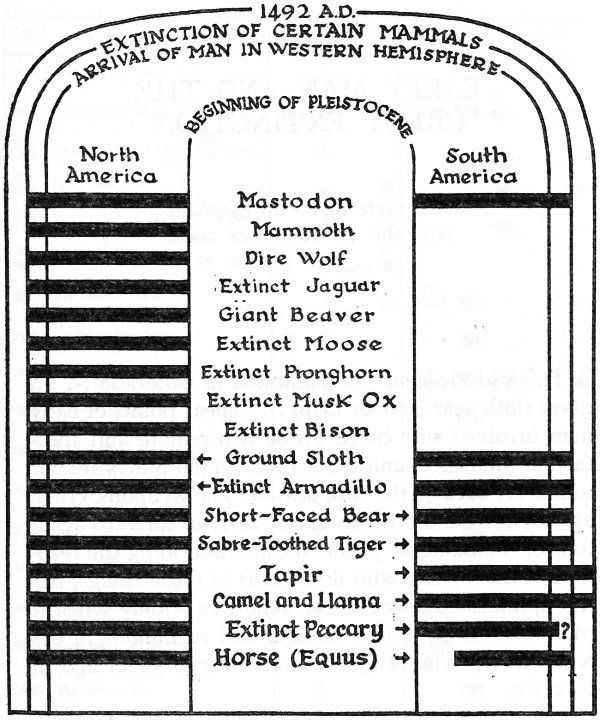
MAMMALS OF THE ICE AGE IN NORTH AND SOUTH AMERICA
A chart of the chief animals that became extinct after the arrival of man. The “extinct armadillo” is more correctly known as Dasypodidae. (After Colbert, 1942, with some rearrangement.)
191
Myths and Mammoths
The subject has been thoroughly confused by too many guesses and too little evidence. Besides a great variety of geologic theories and some amazingly stubborn conservatism, we have had some extraordinary Indian myths as well as the dreams of innocents and eccentrics.
If the Spanish churchmen were a bit upset at finding in the Indies both a new world and a race unaccounted for in the Bible, later explorers and settlers of the mainland were quite as astonished over the discovery of huge bones in swamps and creeks, prairies and badlands. Laymen and divines sought explanations, and of course they found dozens, most of them as absurd as Cotton Mather’s dictum of 1712 that the bones were those of the giants of Holy Writ. By 1782 Thomas Jefferson knew they belonged to a kind of elephant, but on “the traditional testimony of the Indians” he was inclined to believe “that this animal still exists in the northern and western parts of America.... He may as well exist there now as he did formerly where we find his bones.”[1]
The bridge from sacred fiction to profane fact, from giants to mammoths and mastodons, seems to have been the work, oddly enough, of Negro slaves. Mark Catesby wrote in 1743:
192
At a place in Carolina called Stono was dug out of the Earth three or four Teeth of a large animal, which by the concurring Opinion of all the Negroes, native Africans, that saw them, were the Grinders of an Elephant, and in my Opinion that could be no other; I having seen some of the like that are brought from Africa.[2]
On the basis of this statement Loren C. Eiseley—who has written much on the problem of the extinction of American mammals—believes that the Negro slaves told the Indian as well as the white man about the animal that had such gigantic bones, and described its shape and habits.
The eighteenth-century white man—eager for knowledge of zoology and many other things—pumped the Indian, and doubtless with leading questions. The Indians, “involved in their own vast animal mythology,” as Eiseley puts it, were likely to respond “to these myriads of questions with elaboration and a desire to please.”[3] Thus, when our ancestors asked where the elephants had gone, the Indians answered, “Across the lakes.” Soon the belief that the mammoth still lived in the remoter portions of northeastern Canada grew so strong in white men that early maps indicated his home in western Labrador. By the time that the ethnologists of the last half-century began collecting Indian myths there were numerous traditions of the elephant in the native folklore. In a summary of the material Duncan Strong lists more than a dozen instances.[4] An Algonquin tribe told of a great animal “with an arm coming out of its shoulder,” and of another that left “large round tracks in the snow” and “struck its enemies with its long nose.” Penobscot Indians had a myth in which a culture hero saw “moving hills without vegetation,” which proved to be “great animals with long teeth, animals so huge that when they lay down they could not get up.” There were 193 stories of “a great moose with a fifth leg.” Elephant myths turned up among the Alabama Indians in the South. The Chitimacha said: “A long time ago a being with a long nose came out of the ocean and began to kill people. It would root up trees with its nose to get at people who sought refuge in the branches.” The Eskimos of Alaska joined their Siberian brothers in tales of a behemoth that burrowed underground and died if he breathed air—a tale derived, no doubt, from the carcasses of mammoths found frozen under the snow. “These stories,” writes Eiseley, “show a suspicious growth in numbers just at the time when White interest and enthusiasm were keenest.”[5]
Whatever germ of truth may lie in some of the Indian traditions, certain theorists of the last century and a half were quite as absurd as Cotton Mather in their conclusions. In 1806 an Englishman named Thomas Ashe wrote of “incognita, nondescript animals” of the Middle West, and suggested that “as the immense volume of the creature would unfit him for coursing after his prey through thickets and woods,” nature had “furnished him with the power of taking a mighty leap.”[6] Then there was John Ranking, who published in 1827 Historical Researches on the Conquest of Peru, Mexico, Bogota, Natchez, and Talomeco, in the Thirteenth Century, by the Mongols, Accompanied with Elephants. Perhaps he was religious enough to believe, like Jefferson, that “no instance can be produced, of her [nature] having permitted any one race of her animals to become extinct.”[7] At any rate, Ranking remembered the “divine wind” that balked Kubla Khan’s invasion of Japan, and he allowed it to blow some of Kubla’s vessels to the New World. A son of the Khan became the first Inca, another Mongol noble founded Montezuma’s line, and the Khan’s elephants of war spread all up and down the two continents—a notion reported in 1778 by Johann R. Forster.[8]
194
In 1880, worried over how the Mound Builders could have transported so much earth, Frederick Larkin suggested that the Indians must have domesticated the mammoth: “We can imagine that tremendous teams have been driven to and fro in the vicinity of their great works.” As evidence he offered a “copper relic” with an elephant engraved on it “in harness.”[9]
Archaeological Evidence of Recent Man and the Mastodon
The American archaeologist has found no evidence of the mammoth as a living factor in the life of the American Indian since the time of Christ. He looks askance at two elephant pipes of doubtful provenience which turned up near Davenport, Iowa, around the eighties. He is not impressed by a carved head, which might be either elephant or macaw, on a stone stela in Copan, Honduras. But he must give more respectful attention to certain evidence concerning the mastodon—that early form of elephant which alone of all the order penetrated to South America and was unknown in much of the Old World during the Great Ice Age. Its bones have been found in peat bogs of the Great Lakes area which formed after the glaciers began to melt, and a skeleton has been unearthed near Quito, Ecuador, cheek by jowl with broken pottery.
The South American mastodon was found twelve miles from Quito in a district where the bones of the horse, the extinct sloth, and an extinct relative of the armadillo have also been discovered. Franz Spillman of the University of Quito made the find, and Max Uhle cooperated in the excavation. Uhle states that the scientific facts recorded are beyond question. The animal lay on his left side, apparently mired in what is now a yellow clay which lies upon a thick layer of blue clay. A small landslide had covered the skeleton and the clay. There were a number of evidences of man. The ribs of the right side had been cut away. There were 195 remains of fire which had been lighted in the belly and around the feet and tail, and which had baked some of the clay touching the animal. Spillman and Uhle found parts of flint artifacts, a shaped bone tool, and some lengths of wood beside an erect block of stone, which suggested levers and a fulcrum used in an attempt to lift portions of the mastodon. They also found—and this is the important point so far as dating is concerned—more than 150 pieces of broken pottery.[10]
Eiseley maintains that the site’s “archaeological neglect has been scandalous. If this site had been claimed to be ‘Pleistocene’ many experts would undoubtedly have journeyed even to this out-of-the-way location.” Because of the claim that the find was “recent,” it has not received the thorough study that a Folsom find would unquestionably have received in North America. If the mastodon actually survived until the time of pottery in South America, says Eiseley, this does not demonstrate that the animal lingered as late in North America.[11] But it plays hob with the antiquity of a South American skull from Punin.
There are two curious factors in this discovery. The first is that coal was found in the remnants of the fire. Did the Indians of Ecuador use that fuel before the Spaniards came? Was there a deposit nearer than that in Peru? The second questionable factor has to do with the pottery. Although there were no fewer than 152 broken pieces, they could not be fitted into even one restored pot. Why? Further, 140 of the sherds were from a primitive type of pottery, imperfectly fired, while 12 pieces were from an advanced and decorated type which, in other locations, is supposed to show Maya influence. Why should two varieties of pottery—so widely separated in technique and, presumably, age—appear at this one time?
196
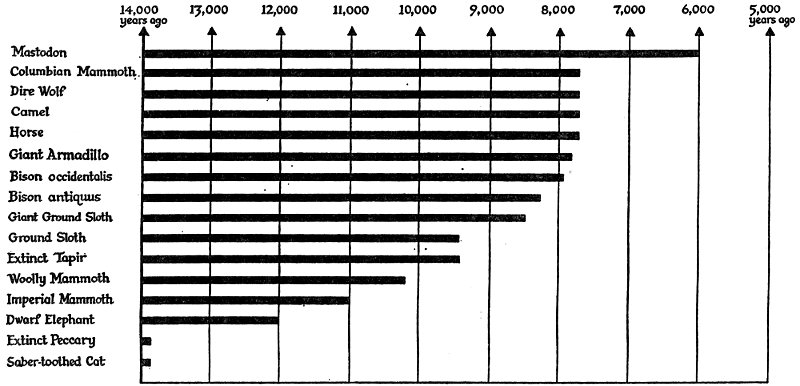
EIGHT THOUSAND YEARS OF THE GREAT EXTINCTION
More than half of these sixteen mammals seem to have died out between 10,000 and 8,000 years ago, when the last glaciers were retreating and early man hunted with Sandia and fluted points. These latest acceptable dates of survival in North America are drawn from Jim Hester’s “Late Pleistocene Extinction and Radiocarbon Dating,” in American Antiquity for July, 1960. The dates vary in precision from 150 to ± 500. There may come later finds.
197
If the Quito mastodon and pots were indeed neighbors in time, then they provide the only evidence—ex post facto, at that—for the remarkable statement of the geologist William B. Scott in 1913: “Many Pleistocene mammals were in existence only a few centuries ago, in what is called ‘historic time’ in the Old World. Several skeletons of the American Mastodon have been found in bogs, covered by only a few inches of peat, with more or less of the hair and recognizable contents of the stomach preserved.”[12] Eiseley has questioned the evidence that the mastodon had hair, and he has pointed out that a peat bog is an ideal place for the preservation of vegetable matter such as that animal lived upon.[13] The bogs and their fossils lie to the south of the Great Lakes, which formed as the ice fields began to retreat into Canada. Since the retreat began between 10,000 and 12,000 years ago, it is obvious that bogs could have formed and mastodons been trapped in them far longer ago than a few centuries—whether “few” means five, ten, or even fifteen.
A hundred years ago Charles Lyell commented on the profusion of mastodon bones in North American bogs compared with the paucity of such fossils in the bogs of Europe; and argued for the late survival of these animals in the New World.[14] Answering him, Eiseley points out first of all that for many centuries such skeletons were hunted out and salvaged by Europeans in search of ivory or the materia medica of the unicorn’s horn. Further, the mastodon, which was a 198 forest lover and fell a natural victim to bogs, was almost unknown to Europe, while the mammoth kept mainly to dry, open steppes. We know that bogs both in our Great Lakes area and in northern Europe were postglacial, “and that is all. There exists no evidence, at present, which seems to demand in the New World a lingering extinction of the American elephants in a way much different from the course of events in Europe.”[15]
Sloth and Camel in Dry Caves
When we turn from the mastodon preserved in wet peat bogs, we come upon the camel and the sloth in dry caves. There, buried in dust, are skin, hair, and ligaments, as well as bone. Not a great deal of such remains exist, however, and only in a few caves—and this time “few” means less than five. It happens that dry and dust-filled caves are almost as good embalmers as the bogs of the Great Lakes or the ice of Siberia and the Alaska muck beds. “In a perfectly dry limestone cave,” says Howard, “covered by three to ten feet of dust, there seems to be no reason why the hair and tissue of the sloth, camel, horse, or bison could not have been preserved for several thousands of years.”[16]
The Folsom Bison Not Extinct?
Neither elephant nor sloth, neither horse nor camel, is such a common companion of the points of Folsom man as is an extinct form of bison. It was larger than the historic animal, and had longer and straighter horns. Though it is known variously as Bison taylori, Bison antiquus antiquus, and Bison antiquus figgensi, it was probably of a single type, the last named. Now one of the significant things about Folsom is that the point never turns up with the modern variety of buffalo which goes by the interesting name of Bison bison,[17] or even Bison bison bison—unless, of course, lack of skull material has 199 led scientists astray. Therefore, if we seek the latest date of Folsom, it would seem as if we must seek the death day of the extinct bison.
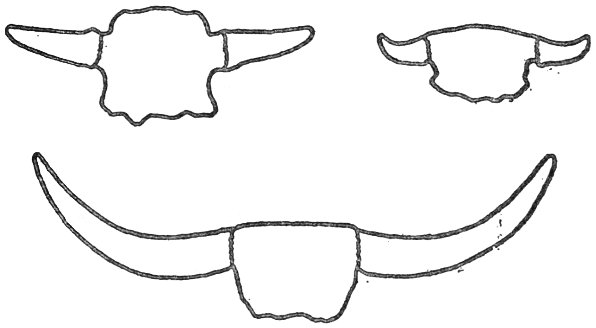
Prehistoric and modern bison. Above, at the left, is an outline of typical horn cones of Bison antiquus antiquus, whose bones have been found with Folsom points. Its horns were longer and straighter than those of the buffalo of today, Bison bison, shown at the right. Below is a still larger and more ancient type, Bison latifrons, with an eighty-inch span.
Protagonists of early man have argued that Folsom must date far, far back, or there would not be time for the evolution of the modern bison of the High Plains. Lately, however, Eiseley has developed a theory which does away with the long period of evolution from Bison antiquus into Bison bison, and yet pins down Folsom to the end of the glaciers. There is some evidence that the kind of bison Folsom man hunted migrated up into Canada when the glaciers melted, and that the “modern” variety, which we call “buffalo,” came up from the south and took over the High Plains. As the temperature moderated over the whole northern hemisphere the plains of Canada began to resemble the plains of the United States, where the prey of Folsom 200 man had flourished. The climate and the vegetation of the High Plains, moving north behind the ice, took Bison antiquus along. The same northward movement of climate and vegetation occurred from Mexico to the High Plains, and it carried to their historic habitat the buffalo that have left their bones in old soils south of the border. The only place where we meet the two varieties of bison together is a peat bog in Minnesota.[18]
The evidence that Bison antiquus moved to Canada is not complete, but it is suggestive. There are accounts of bison horns from Athabasca “nearly twice the length of the Plains’ ones and much straighter.”[19] Ernest Thompson Seton provides the same kind of evidence.[20] The Canadian bison and the Folsom variety seem “suspiciously similar,” says Eiseley. Unfortunately, in 1925, before the bison of Athabasca—the second surviving race, Bison bison athabascæ—had been properly measured and observed, Bison bison from the High Plains were brought north to breed with the Canadian variety. Eiseley feels it is a possibility that the Athabascan animals “represented, at least in a mixed form, the last of the Ice Age bison which early man had hunted in the western plains.”[21] If this is true, it means that Folsom man was fully developed in the period before the melting of the glaciers drove his favorite game north to Canada. It means, further, that he or his immediate forebears may have entered the plains 50,000 years ago when a corridor opened through the western ice fields. (See illustration, page 26.)
The Folsom bison may also have gone northeast to the edge of New England. Grasslands extend from the High Plains of the classic Folsom point northeast to Illinois and Indiana, and ancient steppes once ran through Ohio to New York State and probably to New Jersey and southern New England.[22] Antevs suggests that late bands of Folsom men pursued their bison across this area. Certainly they left their cruder form 201 of point in this part of the Middle West and the East.[23] But where, in this area, are the fossils of the extinct bison?
The Mystery of Extinction
A hundred years ago the French scientist Cuvier, who gave much time to the study of the fossils of extinct mammals, presented the “cataclysmal” explanation of their end. They were destroyed by sudden great geologic changes. To us, perhaps, these changes seem to have ignored certain other animals in a most disquieting way. Cuvier was at a disadvantage, of course, for he was working in a Bible-ridden world which had to accept the Book of Genesis as fact. Even as late as 1887, Henry H. Howorth wrote in The Mammoth and the Flood:
These facts ... prove in the first place that a great catastrophe or cataclysm occurred at the close of the Mammoth period, by which that animal, with its companions, were overwhelmed over a very large part of the earth’s surface. Secondly, this cataclysm involved a very wide-spread flood of water, which not only killed the animals but also buried them under continuous beds of loam or gravel. Thirdly, that the same catastrophe was accompanied by a very great and sudden change of climate in Siberia, by which the animals which had previously lived in fairly temperate conditions were frozen in their flesh underground and have remained frozen ever since.[24]
In the hundred years since Koch found a mammoth and a spear point in Missouri we have learned little that is definite about the reasons for the extinction of mammoth, mastodon, camel, horse, sloth, and the rest. We merely know that they died out as the glaciers began to melt. The most natural guess for either scientist or amateur is that change of climate was the lethal factor. Yet we know that many of them had already survived drastic changes of climate and lived through 202 interglacials as well as glacials in the Great Ice Age. Further, how do we account for the survival of deer, antelope, fox, rabbit, moose, beaver, bear, and so many other animals? How could climate be so selective? If the dire wolf died, why not the timber wolf? If the short-faced bear, why not the grizzly? If one form of rabbit and three forms of antelope, why not all rabbits and all antelopes? If disease instead of climate was the great eliminator—as some have suggested—we face the same dilemma.
The mysteries of extinction are so many and so baffling that it is small wonder no book in English has been written on the subject. Since 1906, when Henry Fairfield Osborn summed the matter up in his paper of fifty-odd pages, “The Causes of Extinction of Mammalia,” Eiseley credits only two theories with contributing anything new to the discussion.
One is the hypothesis of Sewall Wright and his co-workers that when an animal was greatly reduced in numbers it would suffer fatally from inbreeding.[25] This, however, leaves us still searching for what reduced its numbers so radically.
The other theory is Sauer’s: Man, the hunter, destroyed the larger, clumsier, and more gregarious animals largely by means of fire drives, and these fires made the grasslands.[26] Or, at least, the fire drives “broke the back” of mammalian resistance.[27] Eiseley objects on a number of grounds. It was not alone the large, clumsy, and gregarious animals that disappeared. Certain mollusks, a variety of toad, a subfamily of rabbits, the dire wolf, the saber-toothed tiger, three forms of antelope, the short-faced bear, and a small horse also disappeared. More damaging still to Sauer’s theory is the fact that a number of birds became extinct. Eiseley asks, “Why, if this method was so deadly, did the living bison and the living antelope roam the plains in countless numbers?” He points out that, while 203 there is abundant evidence of extinct bison caught and killed in fire drives, there is no proof of mass kills of mammoth, horse, camel, and antelope.[28] He also mentions the mastodon, the giant beaver, and the sloth, which frequented eastern forests or northern bogs and died in them. “Though man was on the scene at the final perishing, his was not ... the appetite nor the capacity for such gigantic slaughter.”[29] Though Sauer believes that the numbers of hunting man in the New World were comparatively large when he killed Bison antiquus, most authorities disagree. Alfred S. Romer believes that if man had been numerous enough and deadly enough to play a major part in the killing, we should find more evidences of his association with the extinct mammals.[30]
Romer and Edwin H. Colbert have put forward another explanation for the extinction of the mammals. They suggest that the advent of man in the New World may have upset a nicely balanced state of nature.[31] But man had been living with just such animals in the Old World for hundreds of thousands of years before they became extinct. What, then, destroyed the mammoth in Europe?
The most pulling of all the fossils of extinct animals are those in the deep Alaska muck beds. Their numbers are appalling. They lie frozen in tangled masses, interspersed with uprooted trees. They seem to have been torn apart and dismembered and then consolidated under catastrophic conditions. Eden and Plainview spear points and perhaps one Clovis have been found in these chill beds. Skin, ligament, hair, flesh, can still be seen.[32] If scientists can solve this mystery before the high-pressure water stream of the miner disperses the evidence, perhaps we shall be nearer solving one of the greatest and most tantalizing problems involved in the story of early man—the date of the extinction of the great mammals.
204
This problem of when the mammoth died should have puzzled the Old World as well as the New and caused us to question the dating of Neanderthal and Cro-Magnon quite as much as Folsom man. Oddly enough, it did nothing of the kind. In Europe the mammoth was accepted as diagnostic of the glacial period. The fact that a Magdalenian man of southern France sketched a mammoth on the wall of a cave proved that the man existed in the Great Ice Age. But in America, if a spear point turned up with the bones of a mammoth, too many anthropologists accepted it as proof that the animal died after the ice fields had melted. The mammoth proved the antiquity of man in Europe; man proved the modernity of the mammoth in America. The only shred of evidence to support such reasoning was the questionable pottery and coal that lay beside the mastodon bones in Ecuador. We should have had more and better proof, and we are beginning to get it.
More Radiocarbon Dates for Extinct Mammals
Working together, archaeologists, paleontologists, and physicists are providing more and more facts about the great extinction. Archaeologists are supplying artifacts for cultural associations, and animal bones that the paleontologists identify. In radiocarbon laboratories, the physicists are dating the bones and sometimes charcoal from man-made fires. Through the evergrowing list of dates, many early theories are being replaced with factual knowledge. Some of the dates, however, must be taken with a grain of sodium chloride. A single date from a single sample in only one locality is not too trustworthy. The hazards are obvious, yet nevertheless we have a fairly large body of facts. From these, a general impression of the great extinction is beginning to take shape. As anticipated, man and climate are involved in the disappearance of the animals.
205
As for climate, a period of much warmer temperatures followed the end of the last glaciation. This lasted from about 10,000 to 2,600 years ago. Antevs isolates the time of highest heat—the Altithermal—as about 7,000 to 4,000 years ago.[33] This matches fairly closely the last dates for our extinct mammals. Heat and aridity may have driven the larger animals to the more and more limited watercourses where man himself would concentrate. Paul S. Martin has noted that the first large mammals to disappear were those in Alaska and Mexico, and that they were followed by the animals of the Plains toward what must have been the beginning of the hot and dry Altithermal period. Martin believes that the grazing and browsing mammals found refuge in the savannas of Florida.[34]
Working with more than 100 radiocarbon dates concerned with the great extinction, Jim Hester (no relation of the junior writer) has brought together results published through 1959.[35] He provides the first reasonably clear picture of the sequence and magnitude of lethal events. We see the ancient forms of horse, camel, and bison, as well as the dire wolf and Columbian mammoth, beginning to disappear 8,000 years ago. Bison antiquus lingers later, though Clovis mammoth hunters may have been active in the Southwest at the same time that Folsom bison hunters were busy on the Plains. Hester’s summary shows how concerned man was in the final death of the great mammals. He lists the last dates for 27 of them. Nine—one-third—were found in archaeological sites of early man; some others were dated by charcoal that may have come from fires where he cooked the meat of the great beasts.
207