Front matter
Reading edition
Transcriber's Note
The following index is provided to facilitate the search for the birds by linking to the Order pages of the three major divisions of the text.
ORDERS OF NORTH AMERICAN BIRDS
Links to Synopsis, Color Images, and Systematic Listing
Order Synopsis Color Systematic
I. PYGOPODES. Grebes, Loons, and Auks. 9 42 285
II. LONGIPENNES. Gulls, Terns, Jaegers, Etc. 10 49 258
III. TUBINARES. Albatrosses, Shearwaters, Petrels, Etc. 12 61 260
IV. STEGANOPODES. Cormorants, Pelicans, Gannets, Man-o'war Birds, and Tropic-Birds. 13 67 261
V. ANSERES. Ducks, Geese, and Swans. 15 74 263
VI. ODONTOGLOSSÆ. Flamingoes. 16 87 263
VII. HERODIONES Herons, Bitterns, Ibises, and Spoonbills. 17 87 264
VIII. PALUDICOLÆ. Cranes, Rails, Coots, Gallinules, Etc. 19 95 64
IX. LIMICOLÆ. Snipes, Sandpipers, Curlews, Plovers, Etc. 21 100 265
X. GALLINÆ. Grouse, Partridges, Bob-Whites, Etc. 25 113 268
XI. COLUMBÆ. Pigeons and Doves. 27 123 269
XII. RAPTORES. Vultures, Hawks, and Owls. 28 127 270
XIII. PSITTACI. Paroquets and Parrots. 30 144 30
XIV. COCCYGES. Cuckoos, Trogons, Kingfishers, Etc. 31 144 273
XV. PICI. Woodpeckers. 32 148 273
XVI. MACROCHIRES. Goatsuckers, Swifts, and, Hummingbirds. 33 155 275
XVII. PASSERES. Flycatchers, Jays, Blackbirds, Finches, Swallows, Warblers, Thrushes, and Other Perching Birds. 34 162 276
COLOR KEY TO
NORTH AMERICAN BIRDS
By FRANK M. CHAPMAN
Curator of Ornithology in the American Museum of Natural History
HANDBOOK OF BIRDS OF EASTERN NORTH AMERICA
Third edition. With introductory chapters on the study of Ornithology; how to identify birds and how to collect and preserve birds, their nests and eggs. 20 full-page plates and 150 cuts in the text. 12mo. Library edition. Pocket edition.
BIRD-LIFE
A guide to the study of our common birds. With 75 full-page colored plates and numerous text drawings by Ernest Thompson Seton. Containing an Appendix, especially designed for teachers. 12mo. Cloth.
BIRD STUDIES WITH A CAMERA
A fascinating account of the habits of common birds, with descriptions of the largest bird colonies existing in eastern North America. The author's phenomenal success in photographing birds in Nature not only lends to the illustrations the charm of realism, but makes the book a record of surprising achievements with the camera. 12mo. Cloth.
WARBLERS OF NORTH AMERICA
A full description of our "most beautiful, most abundant, and least known birds." Illustrated with colored plates of every species and photographs of nests and eggs. Imp. 8vo. Illustrated.
CAMPS AND CRUISES OF AN ORNITHOLOGIST
The story of eight years' experience in travel, in which the author covered over 60,000 miles in his search for material with which to prepare a series of groups of American birds, to exceed in beauty and scientific value anything which had heretofore been attempted in this line. The illustrations, over 250 in number, are from Dr. Chapman's photographs, and beyond question form a remarkable series of pictures of bird-life. 8vo.
COLOR KEY TO NORTH AMERICAN BIRDS
This work may be described as an illustrated dictionary of North American birds. It is the most complete publication of its kind, and makes an admirable introduction to the study of birds and the literature of Ornithology and at the same time is an authoritative work of reference. Over 800 pictures.
OUR WINTER BIRDS
An introduction to the study of birds. The author believes that the study of Ornithology should begin with the winter birds as they are fewer in number and easier to approach. Divided into convenient groups such as field birds, forest birds, home birds, etc. Illustrated. 12mo.
THE TRAVELS OF BIRDS
A series of chapters on bird migration, describing birds as travelers, why they travel, dangers by the way, night flyers and day flyers, etc. Many illustrations from drawings. Illustrated.
WHAT BIRD IS THAT?
A bird book for beginners with 301 birds in color.
D. APPLETON AND COMPANY, NEW YORK
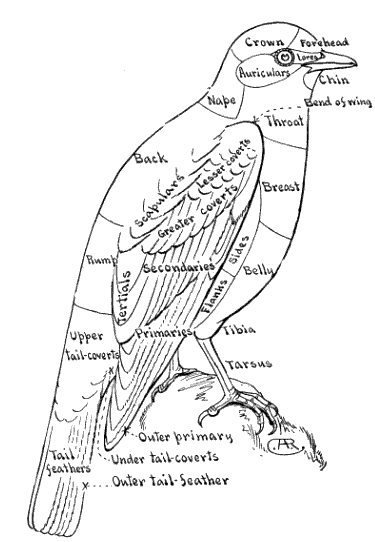
TOPOGRAPHY OF A BIRD Bluebird
(natural size)
COLOR KEY TO
NORTH AMERICAN BIRDS
With Bibliographical Appendix
BY
FRANK M. CHAPMAN
CURATOR OF ORNITHOLOGY
IN THE AMERICAN MUSEUM OF NATURAL HISTORY
Author of "Handbook of Birds of Eastern North America,"
"Bird-Life," Etc.
With Upward of 800 Drawings
BY
CHESTER A REED, B. S.
Revised Edition
NEW YORK
D. APPLETON & COMPANY
1912
COPYRIGHT, DOUBLEDAY, PAGE & CO. 1903 COPYRIGHT, D. APPLETON & CO. 1912 Published November 1912 Printed in the United States
PREFACE.

To learn to call a bird by its right name is the first step in the study of ornithology. We may propose to investigate the structure, food, and habits of the birds of the world, or desire merely a superficial knowledge of the species found in our garden, but in either case we are at once confronted by this question of identification.
From the scientific point of view there is but one satisfactory way to identify a bird. A specimen of it should be in hand in order that its form, color, and size may be accurately determined, when, with the aid of analytical keys, with which most text-books are provided, it is a simple matter to ascertain the bird's name.
Wide experience has shown the writer, however, that where one dead bird is identified, hundreds of attempts are made to name the living bird in nature. This is to be expected. It is the natural outcome of the recent remarkable interest in the study of birds which, fostered by Audubon Societies and nature study teachers, has assumed an ethical and educational importance of the first magnitude.
We cannot place a gun in the hands of these thousands of bird-lovers whom we are yearly developing; indeed most of them would refuse to use it. Specimens, therefore, are rarely available to them and we should make some special effort to meet their peculiar wants. The present volume has been prepared with this end in view. Identification of the bird in the bush is its sole end; an end, however, which we trust will prove but the beginning of a new and potent interest in nature.
Frank M. Chapman
American Museum of Natural History,
New York City, 1903.
PREFACE TO REVISED EDITION.
In the present edition of the Color Key the body of the book, aside from the correction of typographical errors, remains as it was in the preceding edition. The Systematic Table has been reset and brought up to July, 1912, the date of the publication of the latest supplement to the third edition of the American Ornithologists' Union's 'Check-List of North American Birds.' Two Appendixes are added. The first includes all the changes in nomenclature and descriptions of new birds which have been accepted by the A. O. U. Committee on Classification and Nomenclature since the publication of the Color Key in 1903; the second contains a list of faunal ornithological papers which it is hoped will add greatly to the reference value of the book.
F. M. C.
American Museum of Natural History,
New York City, October, 1912.
CONTENTS.
Introduction 1
How to Learn a Bird's Name 1
How Birds Are Named 4
Synopsis of Orders and Families of North American Birds 9
Color Key to North American Birds 41
Systematic Table of North American Birds 257
Appendix I. Additions, Subtractions, Emendations 298
Appendix II. Bibliography 305
Index 333
ILLUSTRATIONS
The illustrations in this volume are designed to aid the student in identifying birds in their haunts by giving, in color, those markings which most quickly catch the eye. They do not pretend to be perfect reproductions of every shade and tint of the plumage of the species they figure, but aim to present a bird's characteristic colors as they appear when seen at a distance. It was impracticable to draw all the birds to the same scale but all those on the same page are so figured. Reference should always be made, however, to the measurements given at the beginning at each description. The figures are based on the male bird.
LIST OF ABBREVIATIONS.
♂. The sign of Mars, signifying male.
♀. The sign of Venus, signifying female.
Ad. Adult, a bird in fully mature plumage.
Yng. Young, a fully grown bird which has not yet acquired the plumage of the adult.
L. Length, the distance from the tip of the bill to the end of the tail. This measurement is made from dead birds, birds in life appear somewhat shorter.
W. Wing, the distance from the 'bend' of the wing to the end of the longest feather.
T. Tail, the distance from the insertion of the tail-feathers to the end of the longest one.
Tar. Tarsus, the distance from the heel to the insertion of the toes, or of the so-called 'leg.'
B. Bill, the distance from the feathers at the base of the bill above to its tip.
Note. All measurements are in inches and tenths, and a variation of about ten per cent. from the figures given may be expected. The number before the name of each species is that of the American Ornithologists' Union's 'Check-List of North American Birds.'
INTRODUCTION
HOW TO LEARN A BIRD'S NAME
"How can I learn to know the birds?" is the first question of the seeker after bird-lore. The scientist's reply, "By shooting them and studying their structure and markings in detail," may do for the few who, like himself, desire to know the birds scientifically; but it is emphatically not the answer to give the ninety and nine who, while they desire to secure an intimate, accurate knowledge of birds, will not gain it at the sacrifice of bird-life.
In the present volume, therefore, an attempt has been made so to group, figure, and describe our birds that any species may be named which has been definitely seen. The birds are kept in their systematic Orders, a natural arrangement, readily comprehended, but, further than this, accepted classifications have been abandoned and the birds have been grouped according to color and markings.
A key to the Orders gives the more prominent characters on which they are based; telling for example, the external differences between a Duck and a Grebe. In comparatively few instances, however, will the beginner have much difficulty in deciding to what Order a bird belongs. Probably eight times, out of ten the unknown bird will belong to the Order Passeres, or Perching Birds, when one has only to select the color section in which it should be placed, choose from among the colored figures the bird whose identity is sought, and verify one's selection by reading the description of the bird's characteristics and the outline of its range.
In the case of closely related species, and particularly subspecies, the subjects of range and season are of the utmost importance. Most subspecies resemble their nearest allies too closely to be identified in life by color alone, and in such cases a bird's name is to be learned by its color in connection with its distribution and the season in which it is seen.
During the breeding period, unless one chance to be in a region where two races intergrade, subspecific names may be applied to the bird in nature with some certainty, for it is a law that only one subspecies of a species can nest in the same area; but during migrations and in the winter, when several subspecies of one species may be found associated, it is frequently impossible to name them with accuracy.
For example, during the summer one need have no hesitancy in calling the Robins of the lowlands of South Carolina the Southern Robin (Planesticus migratorius achrusterus) but later, when the Northern Robins (Planesticus migratorius migratorius) begin to appear, it would be difficult, if not impossible, to distinguish them in life from the resident birds.
If it were possible to impress the student, who proposes to name the bird in the bush, with the absolute necessity for careful, definite observation he would be saved many disappointing and discouraging experiences.
It is not possible to examine your bird too thoroughly. Never be satisfied with a superficial view and a general impression. Look at your bird, if you can, from several points of view; study its appearance in detail, its size, bill, crown, back, tail, wings, throat, breast, etc., and AT ONCE enter what you see in a note-book kept for that purpose. In this way, and this way alone, can you expect to compete with those who use the gun.
It does not follow, however, that because one does not collect specimens of birds one cannot study them scientifically. While the student may not be interested in the classification of birds purely from the standpoint of the systematist, he is strongly urged to acquaint himself with at least the arrangement of the Orders and Families of our birds and their leading structural characters.
To the student who desires to prepare himself for his work afield such a study may well come before he attempts to name the birds. But where the chief end in view is to learn a bird's name, the more technical side of the subject may be deferred. In any event, it should not be neglected. This orderly arrangement of knowledge will not only be practical benefit in one's future labors but it will bring with it that sense of satisfaction which accompanies the assurance that we know what we know.
As one learns to recognize bird after bird it is an admirable plan to classify systematically one's list of bird acquaintances under their proper Orders and Families. These may be learned at once from the systematic table at the end of the book, where the numbers which precede each species are arranged serially, and hence systematically.
In some instances, as an aid to identification in the field, descriptions of birds' notes have been included. It is not supposed that these descriptions will convey an adequate idea of a bird's song to a person who has never heard it, but it is hoped that they may occasionally lead to the recognition of calls or songs when they are heard.
An adequate method of transcribing bird's notes has as yet to be devised and the author realizes only too well how unsatisfactory the data here presented will appear to the student. It is hoped, however, that they may sometimes prove of assistance in naming birds in life.
As has been said before, the aim of this volume is to help students to learn the names of our birds in their haunts. But we should be doing scant justice to the possibilities of bird study if, even by silence, we should imply that they ended with the learning to know the bird. This is only the beginning of the quest which may bring us into close intimacy with the secrets of nature. The birds' haunts and food, their seasons and times of coming and going; their songs and habits during courtship, their nest-building, egg-laying, incubating and care of their young, these and a hundred other subjects connected with their lives may claim our attention and by increasing our knowledge of bird-life, add to our love of birds.
HOW BIRDS ARE NAMED
Birds have two kinds of names. One is a common, vernacular, or popular name; the other is a technical or scientific name. The first is usually given to the living bird by the people of the country it inhabits. The second is applied to specimens of birds by ornithologists who classify them.
Common names in their origin and use know no law. Technical names are bestowed under the system of nomenclature established by Linnæus and their formation and application are governed by certain definite, generally accepted rules. The Linnæan system, as it is now employed by most American ornithologists, provides that a bird, in addition to being grouped in a certain Class, Order, Family, etc., shall have a generic and specific name which, together, shall not be applied to any other animal.
Our Robin, therefore, is classified and named as follows:
CLASS AVES, Birds.
ORDER PASSERES, Perching Birds.
Suborder Oscines, Singing Perching Birds.
Family Turdidæ Thrushes.
Subfamily Turdinæ Thrushes.
Genus, Planesticus, Thrushes.
Species, migratorius American Robin.
The Robin's distinctive scientific name, therefore, which it alone possesses, is Planesticus migratorius. There are numerous other members of the genus Planesticus, but not one of them is called migratorius and this combination of names, therefore, applied to only one bird.
The questions Why use all these Latin terms? Why not call the bird "Robin" and be done with it? are easily answered. Widely distributed birds frequently have different names in different parts of their range. The Flicker (Colaptes auratus), for instance, has over one hundred common or vernacular names. Again, the same name is often applied to wholly different birds. Our Robin (Planesticus migratorius) is not even a member of the same family as the European Robin (Erithacus rubecola.) If, therefore, we should write of birds or attempt to classify them only by their common names, we should be dealing with such unfixed quantities that the result would be inaccurate and misleading. But by using one name in a language known to educated people of all countries, a writer may indicate, without danger of being misunderstood, the particular animal to which he refers. Among people speaking the same tongue, where a definite list of vernacular names of animals has been established, they can of course be used instead of the scientific names.
Such a list of North American birds has been prepared by the American Ornithologists' Union. It furnishes a common as well as scientific name for each of our birds, and is the recognized standard of nomenclature among American ornithologists. The names and numbers of birds employed in this Color Key are those of the American Ornithologists' Union's 'Check-List of North American Birds.'
It will be observed that in this 'Check-List,' and consequently in the following pages, many birds have three scientific names, a generic, specific, and subspecific. The Western Robin, for example, appears as Planesticus migratorius propinquus. What is the significance of this third name?
In the days of Linnæus, and for many years after, it was supposed that a species was a distinct creation whose characters never varied. But in comparatively recent years, as specimens have been gathered from throughout the country inhabited by a species, comparison frequently shows that specimens from one part of its range differ from those taken in another part of its range. At intervening localities, however, intermediate specimens will be found connecting the extremes.
Generally, these geographical variations, as they are called, are the result of climatic conditions. For instance, in regions of heavy rainfall a bird's colors are usually much darker than they are where the rainfall is light. Song Sparrows, for example, are palest in the desert region of Arizona, where the annual rainfall may not reach eight inches, and darkest on the coast of British Columbia and Alaska, where the annual rainfall may be over one hundred inches. In going from one region, however, to the other the gradual changes in climate are accompanied by gradual changes in the colors of the Song Sparrows, and the wide differences between Arizona and Alaska Song Sparrows are therefore bridged by a series of intermediates.
Variations of this kind are spoken of as geographic, racial, or subspecific and the birds exhibiting them are termed subspecies. In naming them a third name, or trinomial is employed, and the possession of such a name indicates at once that a bird is a geographic or racial representative of a species, with one or more representatives of which it intergrades.
Returning now to the Robin. Our eastern Robins always have the outer pair of tail-feathers tipped with white and, in adults, the back is blotched with black; while Robins from the Rocky Mountains and westward have little or no white on the outer tail-feathers, and the back is dark gray, without black blotches. These extremes are connected by intermediate specimens sharing the characters; of both eastern and western birds. We do not, therefore, treat the latter as a species, but as a subspecies, and consequently, apply to it a subspecific name or trinomial, Planesticus migratorius propinquus, (propinquus, meaning nearly related.)
A further study of our eastern Robin shows that in the southern parts of its breeding range (the Carolinas and Georgia), it varies from the northern type in being smaller in size and much paler and duller in color; and to this second geographical variety is applied the name Planesticus migratorius achrusterus, (achrusterus, meaning less highly colored).
After the recognition of western and southern races of the Robin under three names (trinomial) it would obviously be inconsistent to apply only two names (binomial) to our eastern bird, the former being no more subspecies of the latter than the latter is of the former. In other words, to continue to apply only generic and specific names to the Eastern Robin would imply that it was a full species, while the use of a trinomial for the Western or the Southern Robin shows them to be subspecies. As a matter of fact we know that there is but one species of true Robin in the United States, consequently in accordance with the logical and now generally accepted method, we apply to that species the name Planesticus migratorius, and this is equally applicable to Robins from east, south or west. When, however, we learn that the Eastern Robin is not a species but a subspecies, we repeat the specific name by which it was made known and call it Planesticus migratorius migratorius.
It may be asked, Why give names to these geographical races? Why not call Eastern, Western and Southern Robins by one name, Planesticus migratorius, without regard to their climatic variations?
In reply, two excellent reasons may be given for the recognition of subspecies by name; first, because in some cases they differ from one another far more than do many species, when it would clearly be inadvisable to apply the same name to what are obviously different creatures. For example, it has lately been discovered by Mr. E. W. Nelson that the small, black-throated, brown-breasted, Quails or Bob-whites of southern Mexico, through a long series of intermediates inhabiting the intervening region, intergrade with the large, white-throated, black-and-white breasted, Bob-white of our northern states. It would be absurd to call such wholly unlike birds by the same name, nor could we give a full specific name to the Mexican Bob-white since at no place can we draw a line definitely separating it from the northern Bob-white. Furthermore, the use of only two names would conceal the remarkable fact of the intergradation of two such strikingly different birds; a fact of the first importance to students of the evolution of species.
For much the same reason we should name those birds which show less pronounced variations, such as are exhibited by the Robin. Here we have a species in the making, and in tracing the relation between cause and effect, we learn something of the influences which create species. Thus, climate has been definitely proven so to alter a species, both in size and color that, as we have seen in the case of the Song Sparrows, marked climate changes are accompanied by correspondingly marked changes in the appearance of certain animals. In naming these animals we are, in effect, giving a 'handle to the fact' of their evolution by environment.
Since it is evident that a bird may vary much or little, according to the governing conditions and its tendency to respond to them, no fixed rule can be laid down which shall decide just what degree of difference are deserving a name. It follows, therefore, that in some cases ornithologists do not agree upon a bird's claim to subspecific rank.
In North America, however, questions of this kind are referred to a committee of seven experts of the American Ornithologists' Union, and their decision establishes a nomenclature, which is accepted as the standard by other American ornithologists and which has been adopted in this volume.
Foreign birds of wholly accidental occurrence, most of which have been found in North America but once or twice, are included in the systematic list of North American birds, but are not described or figured in the body of the book, where their presence would tend to convey an erroneous impression of their North American status. Furthermore, records of the presence of birds so rare as these can be properly based on only the capture of specimens.
In the preparation of the following pages both author and artist have had full access to the collections of the American Museum of Natural History, and they are also glad to acknowledge their indebtedness to William Brewster of Cambridge, Massachusetts, to Robert Ridgway, Curator of Birds in the United States National Museum, and to C. Hart Merriam, Chief of the Biologic Survey, for the loan of specimens for description and illustration.
SYNOPSIS OF ORDERS AND FAMILIES OF NORTH AMERICAN BIRDS.
The figures are all life-size, except as stated.
WATER BIRDS.
Order I. Grebes, Loons, and Auks. PYGOPODES.
(3 families, 32 species, 3 subspecies.)
Duck-like birds with the bill usually pointed, never wider than high, and without flutings, 'gutters,' or serrations on its side; wings short, never with a bright colored patch or 'speculum'; tail rudimentary, not noticeable; toes webbed or lobed. Color usually blackish above, white below; the throat often dark. The Grebes and Loons, when pursued, dive rather than fly; the Auks usually take wing.
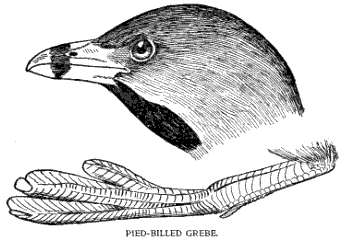
Family 1. GREBES. PODICIPIDÆ.
Toes four with lobate webs; tipped with a broad nail; tail wanting.
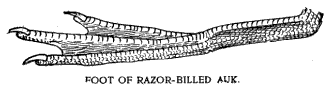
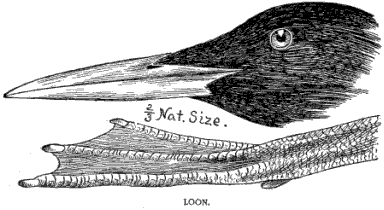
Family 2. LOONS. GAVIIDÆ.
Toes four, webbed; toe-nails not broad and flat; tail present.
Family 3. AUKS, MURRES, AND PUFFINS. ALCIDÆ.
Toes three, webbed; toe-nails sharp; tail present.
Order II. Gulls, Terns, Jaegers, Etc. LONGIPENNES.
(3 families, 42 species, 1 subspecies.)
Birds generally seen on the wing, as a rule, over water. Bill strong, thick; hooked in the Gulls and Jaegers; sharply pointed in the Terns; often colored in part yellow or red; wings very long, the outer feathers much the longest; tail usually short and square in the Gulls, long and forked in the Terns; toes webbed. Color usually pearly gray above, white below in adult Gull and Terns; Jaegers and many young Gulls are dark.
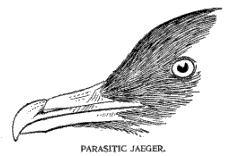
Family 4. SKUAS AND JAEGERS. Stercorariidæ.
Toes four; three front ones webbed; bill with swollen, hooked tip, its base with a scaly shield.
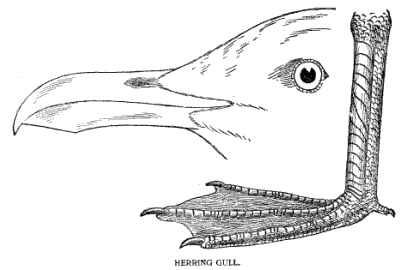
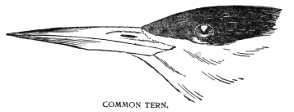
Family 5. GULLS AND TERNS. Laridæ.
Toes usually four, three front ones webbed; upper mandible curved and hooked; tail usually square (Gulls, subfamily Larinæ). Bill straight and pointed; tail often forked (Terns, subfamily Sterninæ).
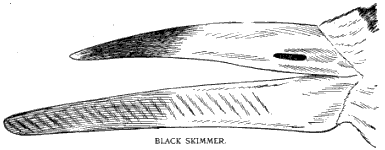
Family 6. SKIMMERS. Rynchopidæ.
Toes four, three front ones webbed; bill thin and blade like, the maxilla longer than the mandible; tail slightly forked.
Order III. Albatrosses, Shearwaters, Petrels, Etc. TUBINARES.
(2 families, 30 species, 1 subspecies.)
Sea-birds keeping, as a rule, well off shore, and flying low, near the water, often skimming over the waves. Bill, with upper mandible hooked; nostrils opening through tubes; wings long and pointed; tail short; feet webbed; hind-toe rudimentary or absent. Color usually gray or black and white; no bright markings.
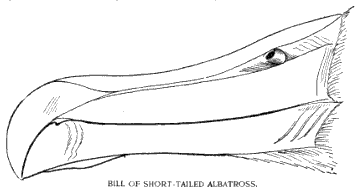
Family 7. ALBATROSSES. DIOMEDEIDÆ.
Nostrils opening through tubes, separated and on either side of the bill.
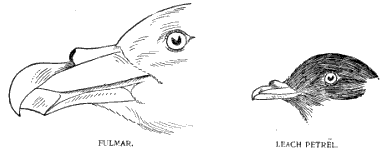
Family 8. FULMARS, PETRELS AND SHEARWATERS. Procellariidæ.
Nostrils joined and situated on top of the bill.
Order IV. Cormorants, Pelicans, Gannets, Man-o'war Birds, and Tropic-Birds. STEGANOPODES.
(6 families, 19 species, 5 subspecies.)
Large birds, two feet or more in length, varying widely in appearance and habits; in external structure agreeing only in having all four toes joined by webs.
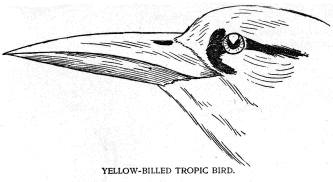
Family 9. TROPIC BIRDS. Phaëthontidæ.
Bill pointed, somewhat tern-like; central tail feathers much elongated; chin feathered.
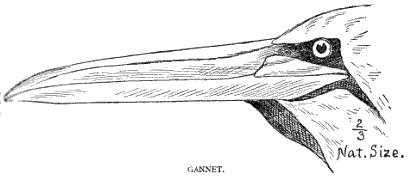
Family 10. GANNETS. Sulidæ.
Bill stout, its tip not hooked; chin and eye space bare; tail pointed, its feathers not 'fluted.'
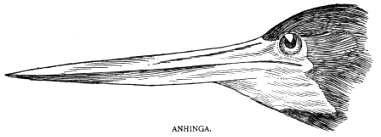
Family 11. ANHINGAS; SNAKE-BIRDS. Anhingidæ.
Bill straight and slender; chin and eye space bare; tail rounded; its middle feathers fluted.
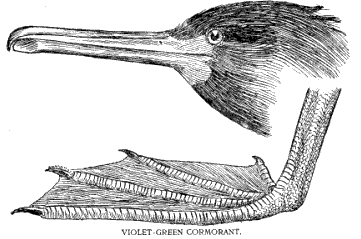
Family 12. CORMORANTS. Phalacrocoracidæ.
Bill with a hooked tip; a small pouch at its base; plumage usually black or blackish.
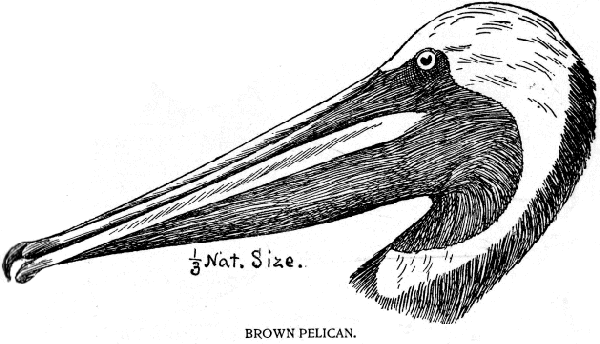
Family 13. PELICANS. Pelecanidæ.
Bill hooked at tip, with a large pouch; tail short, square; eye space bare.
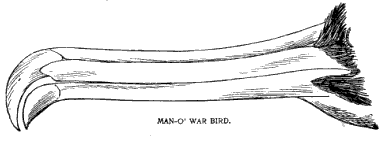
Family 14. MAN-O' WAR BIRDS. Fregatidæ.
Bill hooked; pouch small; tail long and forked; eye space feathered.
Order V. Ducks, Geese, and Swans. ANSERES.
(1 family, 49 species, 6 subspecies.)
Birds of familiar form; bill, except in Mergansers or Saw-billed Ducks, broad and with rows of 'strainers' or 'gutters' on either side; wings short, in the Ducks usually with a bright colored patch or speculum; tail generally short; legs short; feet webbed. Most species, unlike the Grebes, take wing rather than dive when pursued.
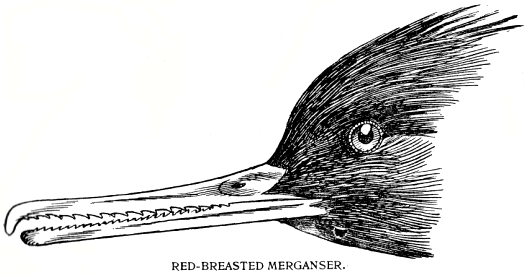
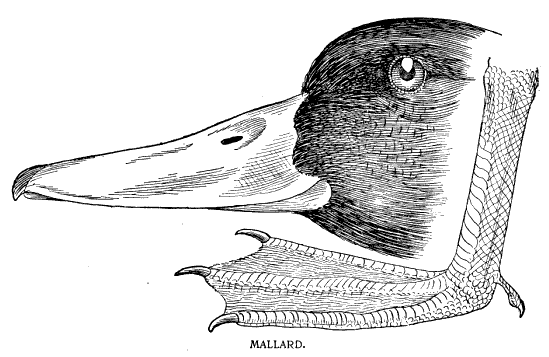
Family 15. DUCKS, GEESE, AND SWANS. Anatidæ.
Bill long, narrow, and rounded with tooth-like projections along its sides. (Mergansers. Subfamily Merginæ.)
Bill broad, flattened, typically duck-like; tarsus or leg with transverse scales; hind toe without a lobe. (River Ducks. Subfamily Anatinæ.)
Bill and tarsus as in preceding, but hind toe with a broad lobe or flap. (Sea and Bay Ducks. Subfamily Fuligulinæ.)
Bill proportionately narrower than in the River or Bay Ducks; gutters on its sides less developed; scales on front of tarsus rounded. (Geese. Subfamily Anserinæ.)
Large, usually white birds, with bare eye space. (Swans. Subfamily Cygninæ.)
Order VI. Flamingoes. ODONTOGLOSSÆ.
(1 family, 1 species.)
Bright red or pink and white birds, standing four feet or more in height; side of the bill with gutters, its end bent downward; wings rather short; legs long; feet webbed.
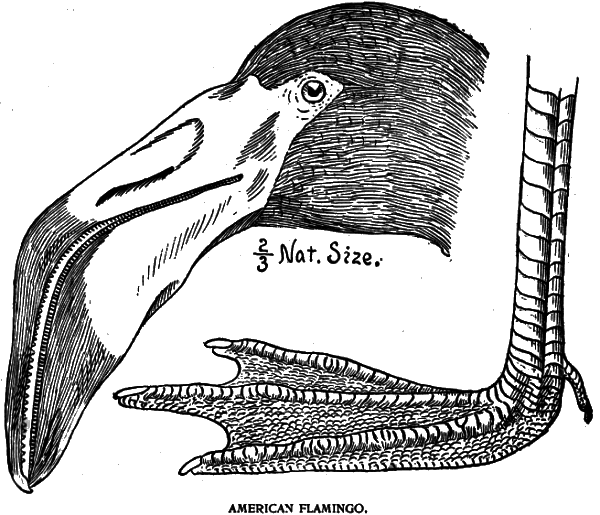
Family 16. FLAMINGOES. Phoenicopteridæ.
Characters of the Family similar to those of the Order.
Order VII. Herons, Bitterns, Ibises, and Spoonbills.
HERODIONES.
(4 families, 19 species, 3 subspecies.)
Long-legged wading birds, generally found along shores or on muddy flats; bill variable; in the Herons straight and sharply pointed; in the Ibises, slender, rounded, and curved downward; in the Spoonbill, flattened: wings rounded; tail short; legs long; toes all on same level, long, slender, without webs. Herons and Bitterns fly with a fold in the neck, the head being drawn in; Ibises and Spoonbills fly with the neck straight, the head being extended.
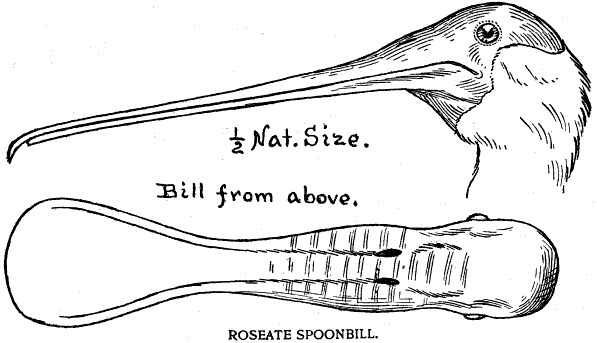
Family 17. SPOONBILLS. Plataleidæ.
Bill flattened and much broadened at the end; crown and face bare in adults; toes partly webbed.
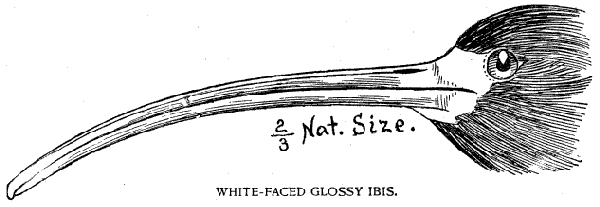
Family 18. IBISES. Ibididæ.
Bill long and curved down; its side with grooves; toes partly webbed.
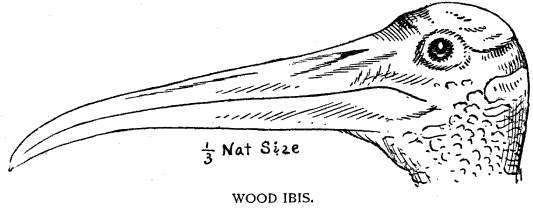
Family 19. STORKS AND WOOD IBISES. CICONIIDÆ.
Bill stout, without grooves; tarsus reticulate.
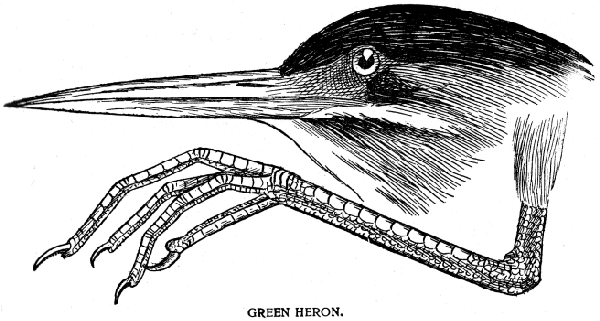
Family 20. HERONS, EGRETS, AND BITTERNS. Ardeidæ.
Bill usually straight and sharply pointed; lores naked; head feathered; tarsus with transverse scales; middle toe-nail pectinate or with a comblike edge.
Order VIII. Cranes, Rails, Coots, Gallinules, Etc. PALUDICOLÆ.
(3 families, 16 species, 3 subspecies.)
Birds varying greatly in size and appearance, but all agreeing (and differing from Herodiones) in having the hind-toe elevated, that is, leaving the foot at a higher level than the front toes; tail short; legs usually long. All fly with the neck extended, a fact by which Cranes in flight may be known from Herons. Rails are short-winged skulkers in grassy marshes; Gallinules frequent reedy shores; Coots, which alone of the Order have webbed (lobate) toes, are as aquatic as Ducks, from which they may be known by their pointed, white bill, nodding motion of the head when swimming, and habit of pattering over the water when alarmed.
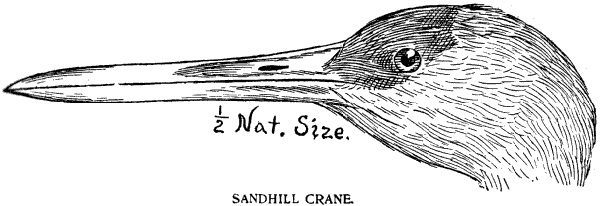
Family 21. CRANES. Gruidæ.
Large birds over three feet in length; head partly bare in adults.
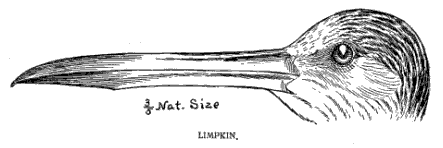
Family 22. COURLANS. Aramidæ.
Bill long and slender; head wholly feathered; toes not webbed.
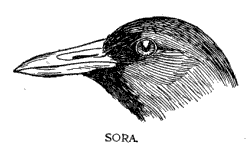
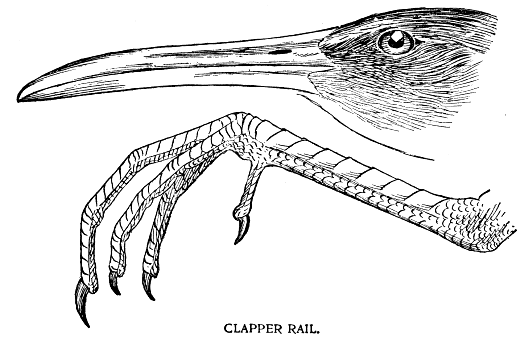
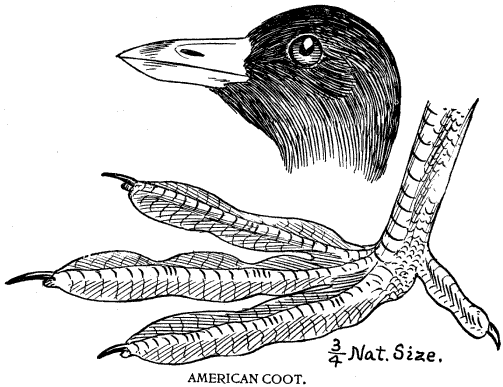
Family 23. RAILS, COOTS, AND GALLINULES. Rallidæ.
Bill variable; toes always long, webbed (lobed) in only one species; wings short and rounded; tail short.
Order IX. Snipes, Sandpipers, Curlews, Plovers, Etc. LIMICOLÆ.
(7 families, 55 species, 4 subspecies.)
Generally long-legged, slender-billed birds of shores and mud flats, and sometimes fields. Most of them are under a foot in length; none are so large as the Ibises; wings long and pointed; tail short; toes long and slender, usually without webs; color generally brown or blackish above, mottled and streaked with whitish and buff. Many species utter characteristic piping whistles as they fly or when they take wing.
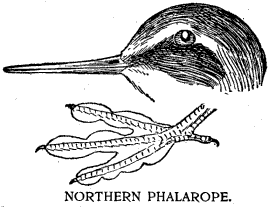
Family 24. PHALAROPES. Phalaropodidæ.
Front toes with lobes or webs; tarsus flattened; plumage thick; swimming Snipe.
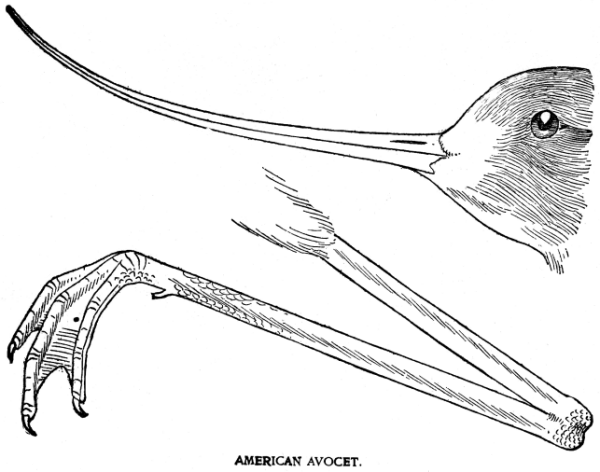
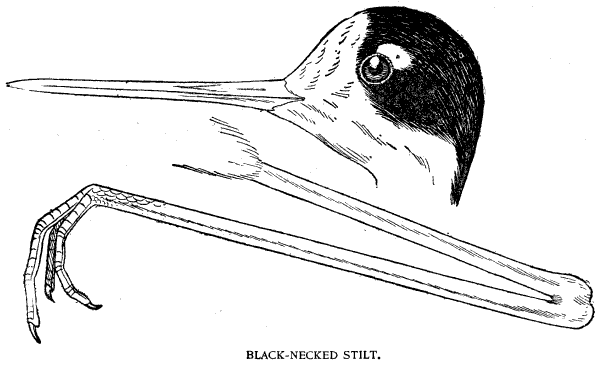
Family 25. AVOCETS AND STILTS. Recurvirostridæ.
Long legged, wading Snipe; in Avocets toes four, front three webbed; bill recurved; in Stilts toes three, almost unwebbed; bill straight.
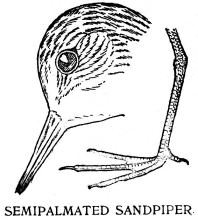
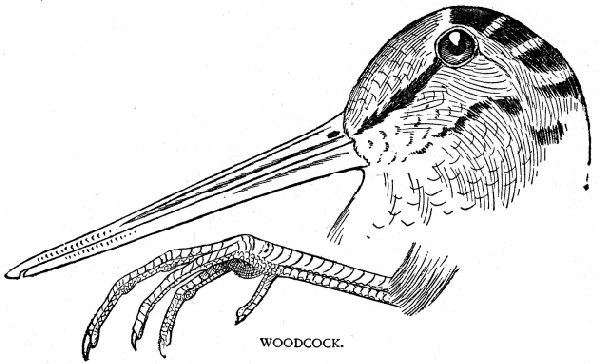
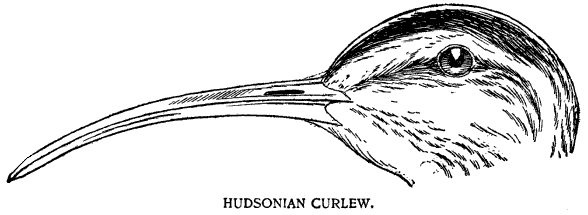
Family 26. SNIPES, SANDPIPERS, CURLEWS, ETC. Scolopacidæ.
Toes usually four; tarsus with transverse scales; bill generally long, slender, and soft, used as a probe.
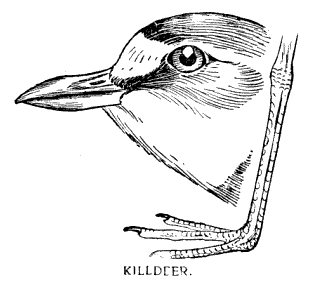
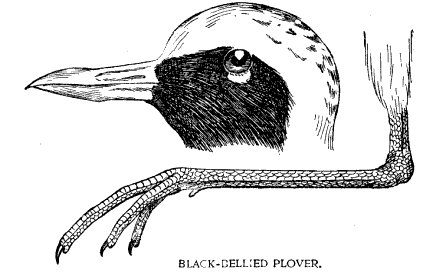
Family 27. PLOVERS. Charadriidæ.
Toes usually three, or when four, the fourth rudimentary; tarsus with rounded scales, bill, as compared with that of Snipe, short and stout.
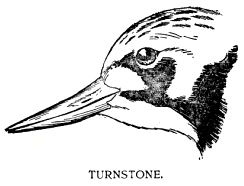
Family 28. SURF BIRDS AND TURNSTONES. Aphrizidæ.
Toes four, tarsus with transverse scales; bill short, rather hard.
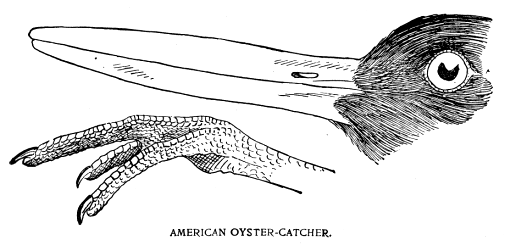
Family 29. OYSTER-CATCHERS. Hæmatopodidæ.
Toes three, webbed at base; tarsus stout, with rounded scales; bill heavy, compressed, and said to be used for opening shells.
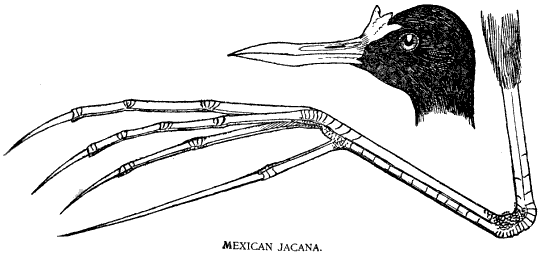
Family 30. JACANAS. Jacanidæ.
Toes four, with their nails greatly elongated to support the bird while walking on aquatic vegetation; wing, with a sharp spur; bill with fleshy lobes at base and, in some species, on its sides.
LAND BIRDS.
Order X. Grouse, Partridges, Bob-Whites, Etc. GALLINÆ.
(3 families, 24 species, 25 subspecies.)
Ground-inhabiting birds of chicken-like form; bill stout, hen-like; wings short and rounded; tail variable; feet strong; hind-toe elevated. Color usually mixed brown, black, and buff, or bluish gray.
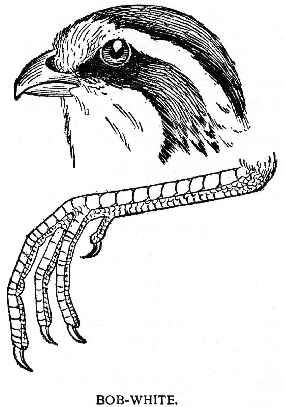
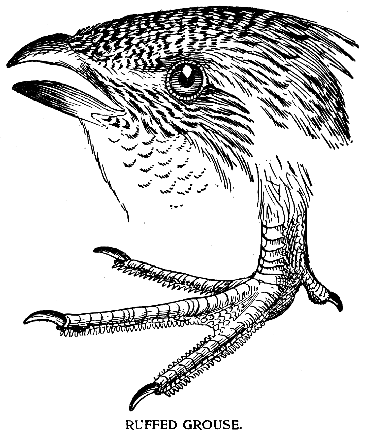
Family 31. GROUSE, PARTRIDGES, ETC. Tetraonidæ.
Characters the same as those of the Order; tarsus naked in Partridges and Quails; more or less feathered in Grouse and Ptarmigan.
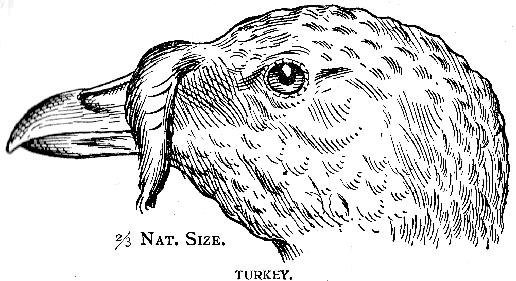
Family 32. TURKEYS, PHEASANTS, AND CHICKENS. Phasianidæ.
Tarsus naked, often spurred, tail remarkably variable (for example, Turkey, Peacock); head often with a comb, wattles, or other excrescences.
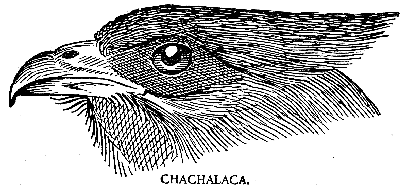
Family 33. CURASSOWS AND GUANS. Cracidæ.
Large tree-haunting, pheasant-like birds; toes four, all on same level.
Order XI. Pigeons and Doves. COLUMBÆ.
(1 family, 13 species, 3 subspecies.)
Walking birds, feeding both on the ground and in trees; bill slender, grooved, nostrils opening in a fleshy membrane; tail variable, short and square, or long and pointed; feet stout, often reddish. Color usually grayish brown. Call-notes a characteristic cooing.
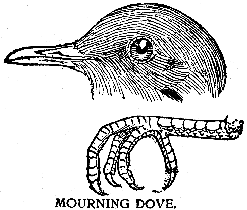
Family 34. PIGEONS AND DOVES. Columbidæ.
Characters those of the Order.
Order XII. Vultures, Hawks, and Owls. RAPTORES.
(4 families, 56 species, 33 subspecies.)
Generally large birds with hooked bill; strong, heavy feet, and long, curved nails; wings large; tail rather long, usually square.
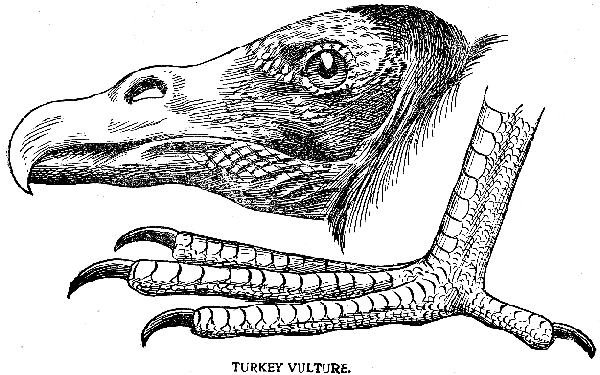
Family 35. AMERICAN VULTURES. Cathartidæ.
Bill not strongly hooked; toe-nails comparatively weak; nostrils large, piercing the bill; head and more or less of neck, bare.
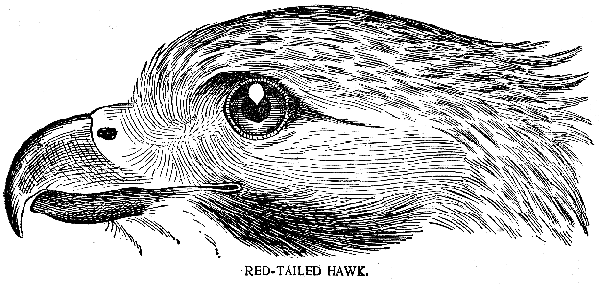
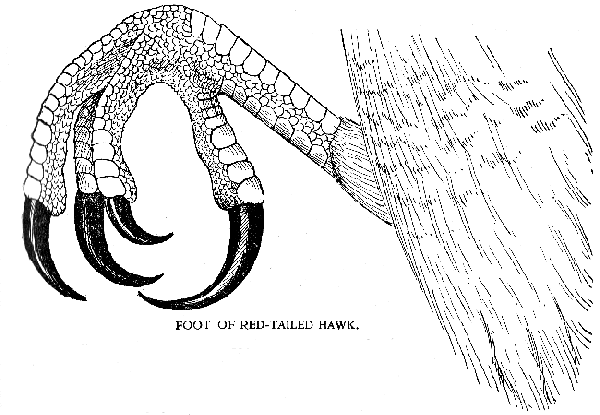
Family 36. FALCONS, HAWKS, EAGLES, ETC. Falconidæ.
Nostrils opening in a cere at the base of the bill; hook of bill and claws well developed; plumage firm and close; tarsus usually largely bare.
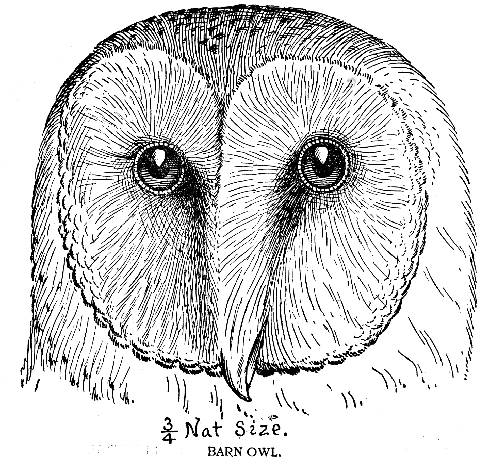
Family 37. BARN OWLS. Strigidæ.
Eyes black, set in a somewhat triangular facial disc; bill more or less concealed by feathers; nostril opening at the edge of a fleshy cere; inner edge of middle toe-nail serrate; no 'ears'; tarsus feathered.
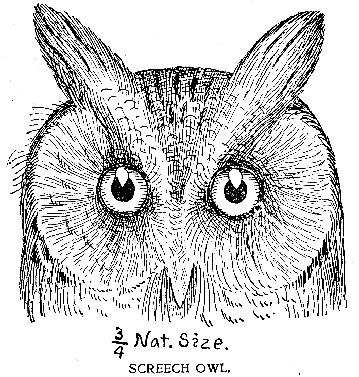
Family 38. HORNED OWLS, ETC. Bubonidæ.
Eyes yellow or black, set in a circular facial disc; bill more or less concealed by feathers; nostrils opening at the edge of a fleshy cere; tarsus feathered.
Order XIII. Paroquets and Parrots. PSITTACI.
(1 family, 2 species.)
Usually bright green birds with, a heavy hooked bill, broad scoop-shaped lower mandible; long, pointed wings; tail, in Parrots, generally square; in Paroquets, pointed; feet heavy, two toes in front and two behind.
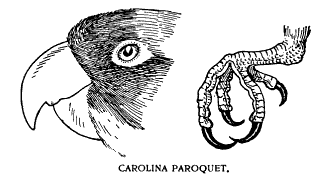
Family 39. PARROTS AND PAROQUETS. Psittacidæ.
Characters the same as those of Order.
Order XIV. Cuckoos, Trogons, Kingfishers, Etc. COCCYGES.
(3 families, 8 species, 2 subspecies.)
A composite Order of several groups of birds bearing no close relation to each other. Cuckoos have slightly curved bills, long tails, and two toes in front and two behind. Trogons have short, rather broad, stout bills, and soft, loose plumage, often green above, red below; moderately long tails; small feet with two toes in front, two behind. Kingfishers have long, rather stout, pointed bills; wings, long; tail, medium; three toes in front and one behind; middle and outer toes joined for half their length.
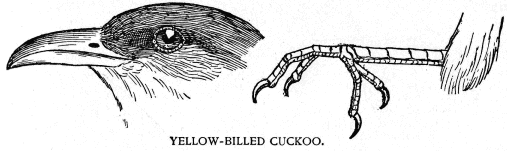
Family 40. CUCKOOS, ANIS. ETC. Cuculidæ.
Toes two in front, two behind; bill, usually, more or less decurved; tail, long and rounded, the outer feathers being, generally, much shorter than the middle pair.
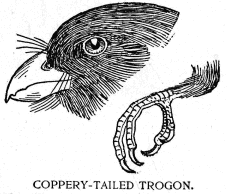
Family 41. TROGONS. Trogonidæ.
Toes two in front, two behind; bill, short; upper mandible decurved and dentate; tail square; plumage, soft, loose, and generally shining green above.
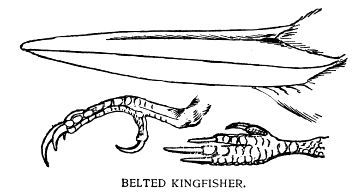
Family 42. KINGFISHERS. Alcedinidæ.
Legs short; feet small; toes, three in front, one behind; third and fourth toes joined; bill, stout and long.
Order XV. Woodpeckers. PICI.
(1 family, 24 species, 22 subspecies.)
Climbing birds with stout, pointed bills, bristly nostrils, pointed, stiffened tail feathers, strong feet and nails; two toes in front and two behind, except in Picoides, which has two in front and one behind. Prevailing colors, black and white, the males usually with red on the crown.
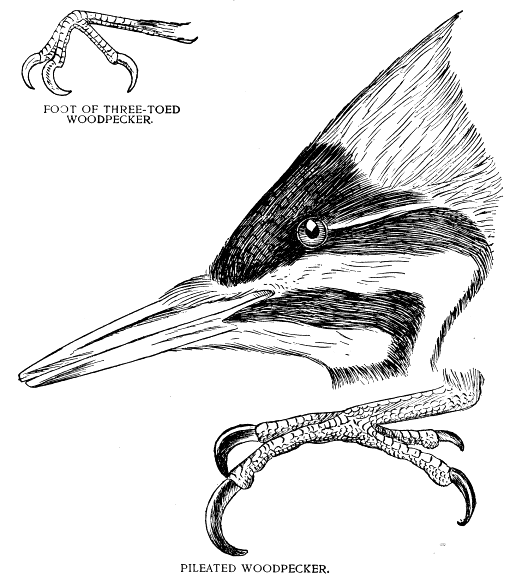
Family 43. WOODPECKERS. Picidæ.
Characters the same as those of the Order.
Order XVI. Goatsuckers, Swifts, and Hummingbirds. MACROCHIRES.
(3 families, 27 species, 6 subspecies.)
Bill, in the Goatsuckers and Swifts, small; mouth large; in the Hummingbirds, bill long, slender, needle-like; wings and tail variable; feet, in all three groups, small and weak. Color, in Goatsuckers, mixed brown, buff and black; in Swifts, black and white; in Hummingbirds, usually shining green above with resplendent throat-patches of varied hues.
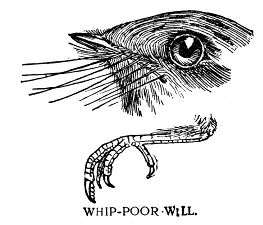
Family 44. GOATSUCKERS, ETC. Caprimulgidæ.
Feet usually small and weak; toes, three in front, one behind; middle toe-nail pectinate or combed; bill small; mouth very large and usually beset by long bristles.
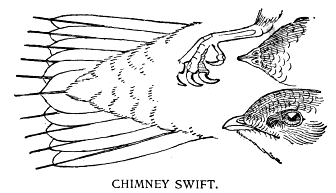
Family 45. SWIFTS. Micropodidæ.
Bill small, triangular when seen from above; mouth large, no bristles; tail variable, in Chætura with projecting spines; wings long and narrow; feet small and toes short; plumage usually dark.
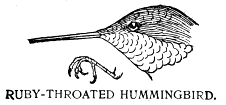
Family 46. HUMMINGBIRDS. Trochilidæ.
Bill long and slender; feet slender; wings large and pointed; tail exceedingly variable, often assuming the most striking shapes.
Order XVII. Flycatchers, Jays, Blackbirds, Finches, Swallows, Warblers, Thrushes, and Other Perching Birds. PASSERES.
(18 families, about 325 species and 226 subspecies.)
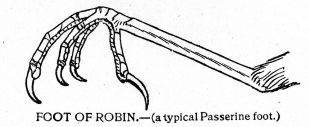
Bill, wings, and tail variable; feet with four toes not connected, the hind-toe as long as the middle one; its nail generally longer than that of the middle toe. This Order contains more species than the remaining sixteen Orders put together. In it will be found over 80 per cent. of the birds commonly seen by field students. It is difficult of definition, but almost any small perching bird may, with more or less certainty, be referred to the Passeres.
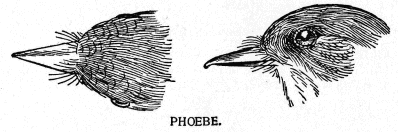
Family 48. FLYCATCHERS. Tyrannidæ.
Bill broad, flat, hooked at tip, its base with bristles; wings rather pointed, the second to fourth primaries longest; tarsus rounded behind as well as in front; feathers of crown generally somewhat lengthened, forming when erected, a small crest; pose, when perching, erect; food of insects usually captured on the wing; voice generally unmusical.
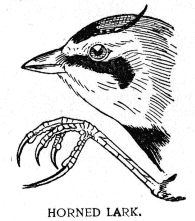
Family 49. LARKS. Alaudidæ.
Hind toe-nail much lengthened; bill rounded, straight; tarsus rounded behind as well as in front; our species with a tuft of feathers on either side of the head; outer primary short or rudimentary; walking birds, singing while on the wing.
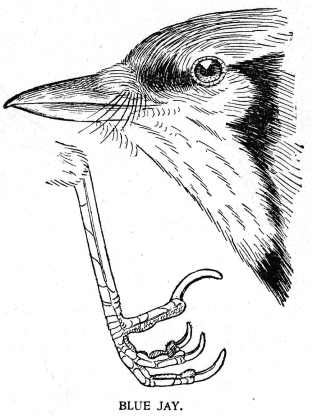
Family 50. CROWS AND JAYS. Corvidæ.
Large perching birds, usually twelve inches or more in length; bill stout; nostrils covered by projecting bristles; feet heavy; outer tail-feathers usually shortest; fourth to fifth primary longest, first about half as long.
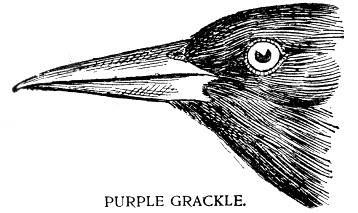
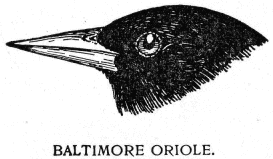
Family 52. BLACKBIRDS, ORIOLES, ETC. Icteridæ.
Base of bill, between nostrils, extending back and dividing feathers on forehead; nostrils not concealed by bristles; first three primaries of equal length.
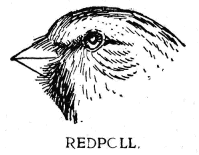
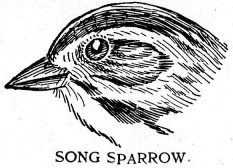
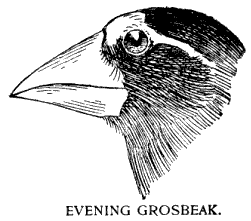
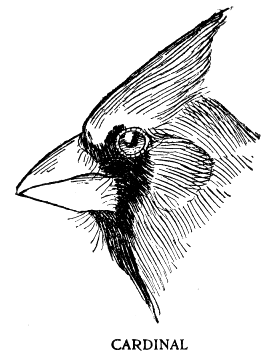
Family 53. FINCHES, SPARROWS, ETC. Fringillidæ.
Bill short, stout, conical; third or fourth primaries longest; first about half an inch shorter; the majority are small birds and but few are over eight inches in length.
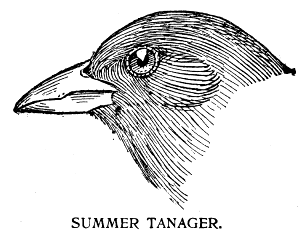
Family 54. TANAGERS. Tanagridæ.
Bill somewhat finch-like but more swollen in outline; the upper mandible, in typical forms, toothed or dentate.
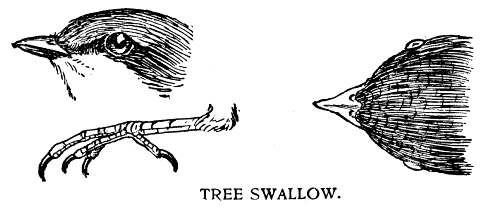
Family 55. SWALLOWS. Hirundinidæ.
Bill short, broad and flat; feet small and weak; wings long and narrow; tail notched and sometimes forked; birds of the air, feeding while on the wing.
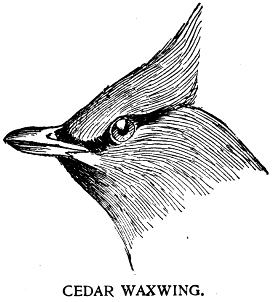
Family 56. WAXWINGS. Ampelidæ.
Bill short, stout, and rounded, its tip notched; wings rather long; head crested.
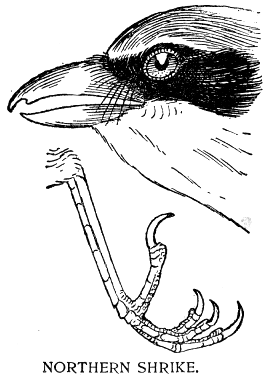
Family 57. SHRIKES. Laniidæ.
Bill stout, its mandible hooked and hawk-like; feet truly Passerine; pose, in perching, erect; solitary grayish birds.
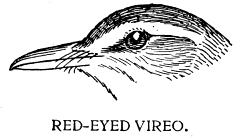
Family 58. VIREOS. Vireonidæ.
Bill small, but distinctly hooked; outer primary usually very small and sometimes apparently wanting; olive-green gleaners among the leaves.
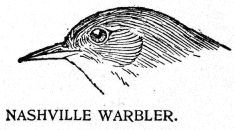
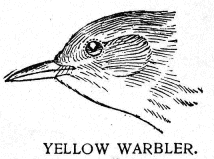
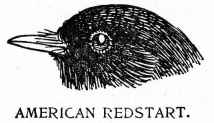
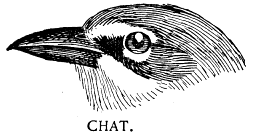
Family 60. WARBLERS. Mniotiltidæ.
Bill, in most of the species, slender, sharply pointed, and without a notch or hook at the tip; in the genera Wilsonia and Setophaga, flat and flycatcher-like; in Icteria stout; back of tarsus compressed into a thin ridge; three outer primaries of nearly equal length.
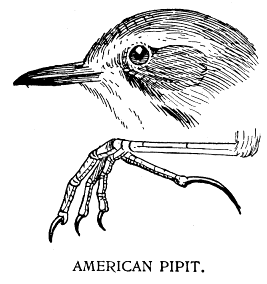
Family 61. WAGTAILS. Motacillidæ.
Hind toe-nail much lengthened; bill slender, nostril not covered with bristles, as in true Larks; back of tarsus thin, not rounded; terrestrial, walking with a wagging motion of the tail.
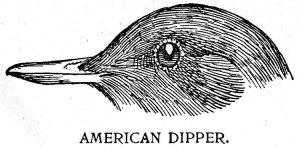
Family 62. DIPPERS. Cinclidæ.
Thick-set birds with short wings and tail; plumage thick and water-proof; tarsus scaled; semi-aquatic in habit, haunting mountain streams.
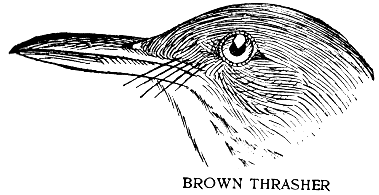
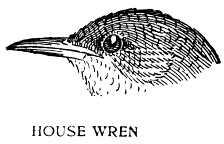
Family 63. WRENS, THRASHERS, ETC. Troglodytidæ.
Tarsus scaled; tail rounded, the outer feathers being shortest; third to fourth primary longest, the outer half as long; bill in Thrashers often decurved, its base with bristles; In Wrens, bill without bristles; brown or grayish inhabitants of lower growth.
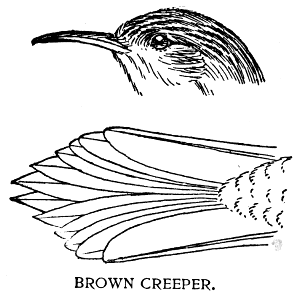
Family 64. CREEPERS. Certhiidæ.
Bill slender and much decurved; tail usually pointed and stiffened.
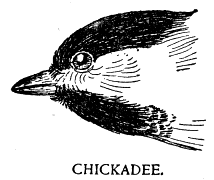
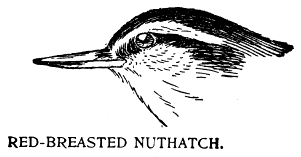
Family 65. NUTHATCHES AND TITS. Paridæ.
Fourth or fifth primary longest; first an inch or less in length. Chickadees (subfamily Parinæ) have a short, stout bill, the nostrils covered with bristles; the tail is rather long and rounded. Nuthatches (subfamily Sittinæ) have a long, slender bill, short, square tail, and large feet.
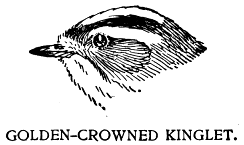
Family 66. KINGLETS, GNATCATCHERS, ETC. Sylviidæ.
Bill slender and Warbler-like, but first primary only one-third as long as the fourth.
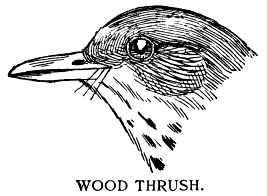
Family 67. THRUSHES, BLUEBIRDS, ETC. Turdidæ.
Tarsus 'booted', without scales, (see foot of Robin under Synopsis of Order Passeres); tail square; mandible notched and slightly hooked; outer primary an inch or less in length; second to fourth of about equal length.
COLOR KEY TO
NORTH AMERICAN BIRDS
Order I. DIVING BIRDS.
PYGOPODES.
Family 1. GREBES. Podicipidæ. 6 species.
Family 2. LOONS. Gaviidæ. 5 species.
Family 3. AUKS, MURRES, and PUFFINS. Alcidæ. 21 species, 3 subspecies.
Grebes are at home in reed-grown ponds or sloughs where their nests are made on rafts or islets of water-soaked vegetation. Their eggs number from four to eight, are dull white in color, and are usually covered by the bird with a portion of the nesting material when it leaves its home. Grebes occasionally rest on the shore, but are rarely found far from the water. When on land they may lie flat on their breasts or sit erect on their tails and entire foot, or tarsus. Their progress on land, as a rule, is awkward and they may use their wings as fore feet to assist them. In diving, Grebes sometimes spring partly from the water and then plunge downward head first, or they may quietly sink with scarce a ripple to mark the place of their disappearance.
Loons generally pass the summer on some large lake, and in the winter many of them live at sea. They nest, as a rule, on the shore, but so near the water that the parent bird may slide off its two dark brown, mottled eggs into its favorite element. Like the Grebes, Loons are expert divers, and birds of both families so often seek safety under the water rather than in the air that it is frequently difficult to make them fly. The young of both Grebes and Loons are born covered with feathers and take to the water shortly after birth, often using the back of the parent bird as an ever present island on which they may rest at will.
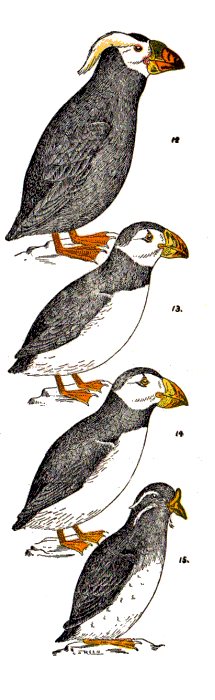
The Auks, Murres, and Puffins are sea birds which nest usually in large colonies on isolated islets or rocky, inaccessible shores of the northern part of the northern hemisphere. They lay one or two eggs, sometimes in an exposed position among the rocks with no attempt at nest-building, sometimes at the end of a burrow excavated by the birds. In the latter case, the young are reared in the nest; in the former, they sometimes enter the water at an early age.
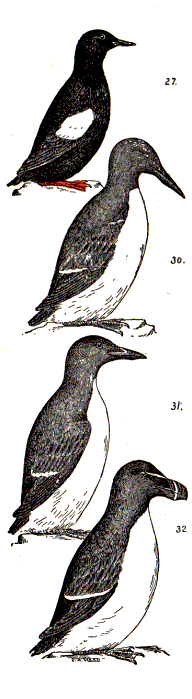
The one egg laid by Murres is remarkable both in color and in shape. In color it varies from bluish green to buff, and is usually heavily scrawled with black. In outline it is pyriform or pear-shaped. When moved it does not roll away as would a hen's egg but revolves about its own tip. In this manner it retains its place on the narrow ledges often chosen by Murres for nesting-sites.
Grebes and Loons
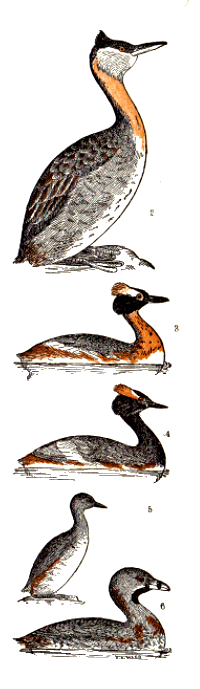
2. Holbœll Grebe (Colymbus holbœlli). L. 19. Ads. Crown and hindneck glossy black; back blackish; throat, cheeks, and underparts white; foreneck and sides rufous. Winter. Above blackish brown; throat and underparts white; foreneck pale rufous. Yng. Similar but no rufous. Notes. "An explosive kup" and "An exceedingly loud harsh voice not unlike that of an angry Crow, but of much greater volume. The calls were also given more slowly and indeed with singular deliberation, car, car, three or four times, sometimes lengthened to caar, and again, broken and quavering like ca-a-a-r or ca-a-a-a-r." (Brewster.) Range.—North America, eastern Siberia, and Japan; breeds locally in the interior from about Lat. 50° northward; winters from Maine and British Columbia southward to South Carolina, Nebraska and Southern California, chiefly on the coasts. 3. Horned Grebe (Colymbus auritus). L. 13.5. Ads., summer. Crown, hindneck, and throat glossy black; plumes behind eye deep buff; back and wings blackish; foreneck, breast, sides, and lores chestnut; abdomen white. Winter. Above grayish black; below white. Range.—Northern Hemisphere; breeds largely in the interior from eastern Quebec, northern Illinois, St. Clair Flats, North Dakota, and British Columbia northward; winters from Maine and British Columbia south to Gulf States and southern California. 4. American Eared Grebe (Colymbus nigricollis californicus). L. 13. Ads. Above, neck all around, and upper breast brownish black; cheek tufts yellowish brown; flanks chestnut; belly white. Winter. Grayish brown above; white below. Range.—Western North America east to Kansas; breeds locally from Texas and middle California north to Manitoba and British Columbia; winters from British Columbia, on the Pacific coast, and Texas southward. 5. Least Grebe (Colymbus dominicus brachypterus). L. 10. Ads. Throat black; cheeks slaty, above blackish; below grayish. Winter. Similar but no black or slate on throat or cheeks. Smallest of our Grebes. Range.—Lower Rio Grande Valley in Texas and southern Lower California south to northern South America. 6. Pied-billed Grebe (Podilymbus podiceps). L. 13.5. Ads., summer. Above brownish black; throat and band on bill black; foreneck, breast, and sides brownish; belly white. Winter. The same, but throat white, breast more rusty, bill without black band. Notes. A loud, sonorous, "cow-cow-cow-cow-cow-cow-cow-cow-cow-uh, cow-uh, cow-uh, cow-uh." Range.—Argentine Republic; north through Mexico and West Indies to Lat. of Hudson Bay; breeds locally throughout its range, but chiefly northward; winters from New Jersey, Illinois, and southern California southward.
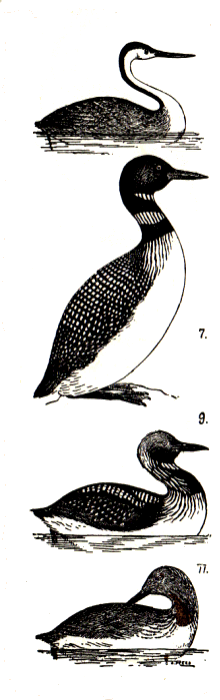
1. Western Grebe; Swan Grebe (Æchmophorus occidentalis). L. 26. Ads., summer. Crown and hindneck black; back grayish brown; sides of head and under parts white. Winter. Crown and hindneck like back. Notes. A loud, rattling, grating whistle. Range.—Western North America; In summer eastward to Shoal Lake, Manitoba; northward to southern Alaska; breeds locally from northern California and North Dakota northward; winters from British Columbia to central Mexico. 7. Loon (Gavia imber). L. 32. Ads., summer. Above, including whole neck, glossy black; throat and neck with white streaks; back and wings with white spots or bars; belly white. Winter. Above blackish margined with grayish; no white spots; below white. Notes. A loud, maniacal laugh. Range.—Northern hemisphere; in North America, breeds from Maine, northern Illinois, Minnesota, and northern California north to Greenland and Alaska; winters from about southern limit of breeding range south to Gulf of Mexico, chiefly on coasts. 8. Yellow-billed Loon (Gavia adamsii). L. 36. Similar to No. 7, but larger and bill yellowish or whitish. Notes. Similar to those of No. 7, but harsher. (Murdoch.) Range.—"Arctic America west of Hudson Bay, and northern Asia; casual in northern Europe." (A. O. U.) 9. Black-throated Loon (Gavia arctica). L. 27; W. 12. Ads., summer. Foreneck and back bluish black; throat, neck, and back streaked or barred with white; crown and nape gray; belly white. Winter. Similar to No. 7, but smaller. Notes. A dismal "too-too-e-e." (Turner.) Range—Northern part of northern hemisphere; in America breeds from Hudson Bay north to Arctic coast; winters south to British Columbia, the Great Lakes and, casually, to Long Island. 10. Pacific Loon (Gavia pacifica). Similar to No. 9, but foreneck in summer reflecting deep blue or green; hindneck paler; smaller, W. 11. Notes. A harsh "kok, kok, kok." (Murdoch.) Range.—Western North America; breeds at Point Barrow, Alaska, and eastward; winters south along Pacific Coast to Mexico. 11. Red-throated Loon (Gavia lumme). L. 25. Ads., summer. Foreneck chestnut, head and neck ashy. Winter. Similar to No. 7, in winter, but back spotted with white. Notes. A harsh "gr-r ga, gr-r, gr-r-ga, gr-r." (Nelson.) Range.—Northern part of northern hemisphere; in North America breeds from New Brunswick to Greenland and Hudson Bay, and northwest to Alaska; winters south to South Carolina and southern California.
Auks, Murres and Puffins
12. Tufted Puffin (Lunda cirrhata). L. 15. Ads., summer. Cheeks white; a pair of long straw color plumes from behind eyes; rest of plumage sooty. Winter. Cheeks sooty, plumes usually absent. Yng. Similar to winter adult, but breast and belly whitish. Range.—Northern Pacific; resident locally from Santa Barbara Islands north to Alaska. Accidental in Maine. 13. Puffin (Fratercula arctica). L. 13; W. 6; B. 1.8. Ads. Above, and foreneck blackish; cheeks and under parts white; bill in summer touched with bright red. Notes. A hoarse croak. Range.—North Atlantic; breeds from Bay of Fundy north to Greenland; winters south to Long Island. 13a. Large-billed Puffin (F. a. glacialis). W. 7; B. 2.1. Similar to No. 13, but larger. Range.—Arctic Ocean from Spitzenbergen to northern Greenland. 14. Horned Puffin (Fratercula corniculata). Similar to No. 13, but in summer with the throat blackish. Notes. "A hoarse snuffling, rattling note" (Nelson.) Range.—"Northern Pacific from Kuril Islands to British Columbia." (A. O. U.) 15. Rhinoceros Auklet (Cerorhinca monocerata). L. 15.5. Ads., summer. A horn on base of bill; two pairs of white tufts; above blackish; throat and breast grayish; belly white. Winter. Similar, but no horn. Yng. Similar to winter ad. but no tufts. Range.—"North Pacific: breeding south (formerly) to the Farallones; in winter south to Lower California and Japan." (A. O. U.)
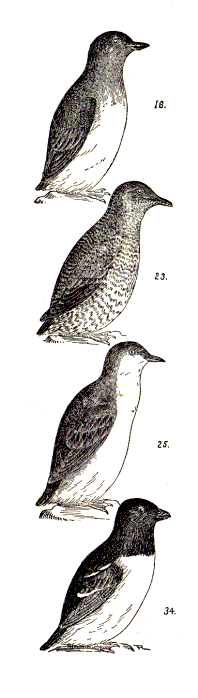
16. Cassin Auklet. (Ptycoramphus aleuticus). L. 9. Ads. A white spot above eye; above blackish; throat and breast grayish; belly white. Notes. A shrill, squealing "Come bear-r-r, come bear-r-r." Range.—"Pacific Coast of North America from Aleutian Islands to Lower California; breeding south to San Geronimo Island (Lat. 30°)." (A. O. U.) 23. Marbled Murrelet (Brachyramphus marmoratus). L. 9.7. Ads., summer. No crest; above dark brown, finely mixed with rusty; below white, all feathers edged with brown. Winter. Wholly different; above gray; head dark; below white; a nearly complete white nuchal collar. Yng. Similar to winter ad. but blacker above; sprinkled with blackish below. Range.—North Pacific; breeds from Vancouver north to Aleutian Islands; winters south to southern California. 24. Kittlitz Murrelet (Brachyramphus brevirostris). L. 9.5; B., from feathers on top, .4. Ads., summer. Above gray, mottled with buff; breast and sides mottled with buff and black; belly white. Winter. Sides of head, to above eye, and lower parts white; above gray; outer tail-feathers white. Range.—Northern Japan, Kamchatka and Aleutian Islands, east to Unalaska. (A. O. U.) 25. Xantus Murrelet (Brachyramphus hypoleucus). L. 10. Bill slender. Ads. Above slaty black; under surface of wing white; inner webs of outer primaries white. Range.—Pacific Coast from Monterey south to Cape St. Lucas; breeding as far north as Santa Barbara Island. 26. Craveri Murrelet (Brachyramphus craveri). L. 10. Bill slender. Ads. Above slaty or brownish black; sides slaty; under surface of wings dusky, sometimes mixed with white. Range,—Coasts of Lower California, from Cape St. Lucas north to Espiritu Santo Island in the Gulf of California, and to Natividad Island (lat. 28°) on the Pacific side. (A. O. U.) 34. Dovekie (Alle alle). L. 8. Ads., summer. Above blackish; inner wing feathers tipped with white; throat and breast blackish brown. Winter. Similar, but throat and breast white or mixed grayish. Range—North Atlantic and East Arctic; in America breeds from Lat. 68° northward; winters south to Long Island, rarely to Virginia. Accidental in Michigan.
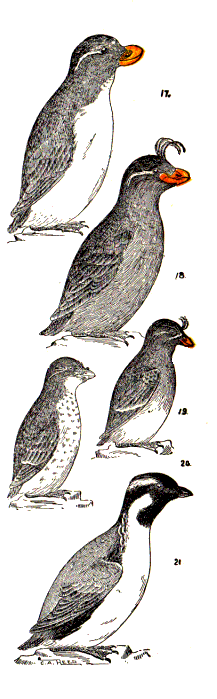
17. Paroquet Auklet (Cyclorrhynchus psittaculus). L. 10. Ads., summer. No crest; a white plume from behind eye; above blackish; throat grayer, rest of under parts white. Winter. Throat white. Notes. "A low, sonorous, vibrating whistle." (Nelson.) Range.—"North Pacific, from Sitka and the Kuril Islands northward." (A. O. U.) Five records for coast off San Francisco in winter. 18. Crested Auklet (Simorhynchus cristatellus). L. 10. Ads., summer. Bill red; a crest of slender recurved feathers; a pair of white tufts from behind eye; above sooty black; below grayer. Yng. Similar but bill brown; no crest or tufts. Notes. "A chirping note," (Nelson.) Range.—North Pacific from Kadiak and Japan northward." (A. O. U.) 19. Whiskered Auklet (Simorhynchus pygmæus). L. 7.5. Ads., summer. White feathers at base of sides of bill and, much lengthened, from above and below eye; a crest of slender recurved feathers; above, and throat dark slate fading into white belly. Yng. Similar but no crest; little or no white on head. Notes. "A low chattering note." (Nelson.) Range—"North Pacific, from Unalaska through the Aleutian chain to Kamchatka." (A. O. U.) 20. Least Auklet (Simorhynchus pusillus). L. 6.5. Ads., summer. No crest; sides of head with white feathers; above blackish; chin sooty; throat white; under parts white, marked irregularly with sooty. Winter. Little or no sooty on breast. Yng. Similar to winter ad., but no white plumes. Range.—"North Pacific, from Sitka and Japan north to Bering Strait." (A. O. U.) 21. Ancient Murrelet (Synthliboramphus antiquus). L. 10.5. Ads., summer. No crest; head and throat black; broad white stripes behind eye; back gray; breast and belly white. Winter. Similar but throat white; no white head stripes. Notes. "A low plaintive whistle." (Nelson.) Range.—North Pacific, from southern Vancouver Island and Japan northward; south in winter to Monterey, California; accidental in Wisconsin.
27. Black Guillemot (Cepphus grylle). L. 13. Ads., summer. Black; greater wing-coverts white, black at base; under surface of wings white. Winter. Above gray or black tipped with white; below white. Range.—Coasts of northern Europe and North Atlantic; in America breeds from Knox Co., Maine north to southern Greenland; winters south to Quebec and Massachusetts; rarely to Toronto, Connecticut, and Long Island. 28. Mandt Guillemot (Cepphus mandtii). Similar to No. 27, but bases of greater wing-coverts white. Range.—Arctic regions; breeds from Labrador and Hudson Bay north to northern Greenland and northern Alaska; in winter migrates but little southward; no satisfactory United States record. 29. Pigeon Guillemot (Cepphus columba). Similar to No. 27, but inner surface of wings sooty gray. Notes. A squealing, vibrant whistle. Range.—North Pacific; breeds from Santa Catalina Island north to Bering Strait, west through Aleutian Islands to Kamchatka and northern Japan; winters in same region. 30. Murre (Uria troile). L. 16; B. 1.7. Ads., summer. Above and neck sooty brown; under parts and tips of secondaries white; sides with blackish streaks. Winter. Similar, but throat white washed with sooty. Notes. A hoarse murre and squawking a-r-r-r-r-r-rh. Range.—North Atlantic; breeds in North America from Bird Rock, Magdalen Islands, north to southern Greenland; winters south to Maine and, rarely, Ontario. 30a. California Murre (U. t. californica). Similar to No. 30 but larger, W. 8.2; B. 1.9. Range.—North Pacific; breeds from Pribilof Islands south to Farallones; winters south to southern California. 31. Brunnich Murre (Uria lomvia). Similar to No. 30, but bill shorter, 1.2. In summer, head and throat browner, lower mandible swollen at sides and grayish at base. Range.—North Atlantic and eastern Arctic; breeds in North America from Bird Rock, Magdalen Islands, north to Greenland; winters south to New Jersey and along St. Lawrence to Lakes Champlain and Ontario, rarely to Lake Michigan. 31a. Pallas Murre (U. l. arra). Similar to No. 31, but larger; W. 8.6; B. 1.5. Notes. "A peculiar growling or hoarse chattering note." (Nelson.) Range.—North Pacific; south to Kadiak and Kamchatka. 32. Razor-billed Auk (Alca torda). L. 16.5. Ads., summer. Above sooty black, foreneck browner; tips of secondaries, line from bill to eye, and under parts, white. Winter. Similar, but foreneck white. Yng. Similar to winter ad. but without eye line. Notes. A hoarse grunt or groan. Range.—North Atlantic; breeds from Bird Rock, Magdalen Islands, north to Greenland; winters south to Long Island and, rarely, to Ontario and North Carolina. 33. Great Auk (Plautus impennis). L. 29; W. 5.7. Ads. Above blackish; a large white spot before the eye; secondaries tipped with white; sides of neck and the throat seal brown; belly, white. Resembling No. 32 in general appearance but body much larger; wing, however, shorter. Range.—Formerly, the coasts and islands of North Atlantic, south on American side to Florida (in winter?); now extinct.
Order II. LONG-WINGED SWIMMERS.
LONGIPENNES.
Family 1. SKUAS and JAEGERS. Stercorariidæ. 4 species.
Family 2. GULLS and TERNS. Laridæ. 37 species, 1 subspecies.
Family 3. SKIMMERS. Rynchopidæ. 1 species.
Skuas and Jaegers are pirates among the birds of the high seas. Bold and dashing, they pursue the swift flying Terns or much larger Gulls with equal success, forcing them to drop the fish they have captured and catching it ere it reaches the water.
Gulls (Subfamily Larinæ) are usually considered so characteristic of the sea that 'Sea Gull' is the name popularly applied to all members of the subfamily to which they belong. Several species, however, are equally at home, both in the winter and when nesting, on the larger bodies of water in the interior, and one species is rarely or never found on our sea coasts.
Gulls nest on the ground, on drifts of marsh-grass, on cliffs, and one species, at least, among American Gulls (the Herring Gull) has as a result of persecution, acquired the habit of nesting in trees.
Gulls feed from the surface of the water, picking up their food with their strongly curved bills in passing or while hovering, not by plunging into the water, as do the Terns. They are, in fact, the scavengers of the water, and perform a service of great value to mankind by devouring the bodies of various forms of aquatic animals which, in dying, come to the surface and, if cast ashore, might, in decaying, prove a source of disease.
For this reason it was especially unfortunate that the plumage of these birds became fashionable for millinery purposes, with the result that thousands of them were destroyed for their wings and breasts. In this country, however, through the efforts of the American Ornithologists' Union and the Audubon Societies, laws have been passed prohibiting the killing of these beautiful and useful birds, and wardens have been placed on their nesting grounds to protect them.
Gulls often rest in great flocks on the water, sitting high up and riding the waves buoyantly, but the Terns (Subfamily Sterninæ), after they have acquired the power of flight, are rarely seen on the water. They are lighter, more active birds than the Gulls, with longer wings and tails, and sharper, more pointed bills. They feed largely on small fish (the species called silversides being a favorite) of no value to man, which they secure by darting from the air with great speed and directness. When looking for food, Terns usually fly with the bill downward, a habit which will aid in distinguishing them from the Gulls, whose bill is carried in a line with the body.
Terns usually nest in large colonies on the beach of some isolated islet either on our sea coasts or in the interior. The nest is generally composed of a few wisps of sea-weed or grass, or the two or three eggs are not infrequently laid in a slight hollow in the sand or among the shells and pebbles.
Like the Gulls, Terns have been slaughtered in enormous numbers for millinery purposes; but in this country, at least, effective efforts are now being made to preserve them.
Skimmers nest in numbers on our Atlantic Coast from Virginia southward, laying their four eggs in a slight depression in the sand. In feeding, their mouth is held open and the longer, thin, lower mandible is dropped beneath the surface of the water, when, flying rapidly, they readily pick up food.
In young Skimmers, however, the two mandibles are of equal length and the lower mandible does not become appreciably longer than the upper one until the birds begin to fly. During the flightless period of the bird's life, the bill may be used to pick up food along the shore, but when the power of flight is acquired and with it ability to feed in the characteristic Skimmer manner, then the peculiar bill of these birds becomes fully developed.
The young of all the Gulls and Terns are born covered with down and can leave the nest a few hours after birth. The Noddy, however, is said to be several weeks in its stick nest, which, unlike other members of its group, it often builds in bushes.
The young are colored to harmonize with their usual surroundings. Young Skimmers are pale, sandy brown, of the same color as the sand in which they are hatched. Young Terns are darker, and young Laughing Gulls born in nests of reeds or meadow grasses, are the darkest of the three.
All young Gulls and Terns have the habit of squatting low near the ground in the presence of danger and remaining motionless until actually touched when they seem to realize that they have been seen and trust to their legs for safety.
Skua and Jaegers
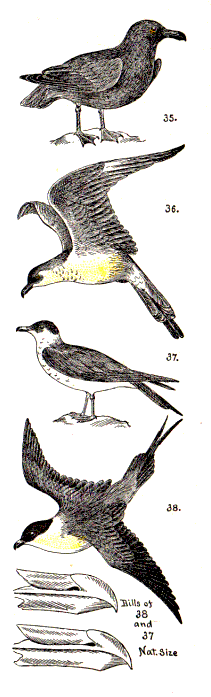
35. Skua (Megalestris skua). L. 22. Ads. Above dark, dirty brown; below paler. Yng. Similar, but more distinctly streaked with yellowish, especially on head and neck. Range.—North Atlantic, chiefly eastern; breeds from Shetland Islands northward; winters south to Gibraltar, and rarely Long Island. One specimen from California coast. 36. Pomarine Jaeger (Stercorarius pomarinus). L. 20; B. 1.5. Middle tail feathers rounded. Ads. light phase. Cap black; throat, breast, and neck, all around, white tinged with straw; back, lower belly, upper and under tail coverts brownish slate. Ads. dark phase. Dark brown, paler below. Yng. Above blackish brown margined with rusty; below white margined with dusky and buffy. Notes. "A low, hoarse, chattering cry." (Nelson.) Range.—Northern hemisphere; breeds north of Lat. 70°; winters, mainly at sea, south to South America, southern Africa and Australia. 37. Parasitic Jaeger (Stercorarius parasiticus). L. 17; B. 1.1; its scaly shield longer than distance from end of shield to tip of bill. Ads. Both phases similar in color to No. 36, but central tail feathers pointed, 8.6 long. Yng. Similar in color to No. 36 but smaller, bill shorter, middle tail feathers more pointed. Notes. "Loud wailing cries, interspersed with harsh shrieks." (Nelson.) Range.—Northern hemisphere; breeds in Arctic regions; winters mainly at sea, from California, Great Lakes, and Massachusetts south to South America. 38. Long-tailed Jaeger (Stercorarius longicaudus). L. 21; B. 1, its scaly shield shorter than the distance from its end to the tip of bill. Ads. In both phases resembling No. 36 but central tail feathers pointed and 12 in. long. Yng. Like No. 36 and No. 37, but to be distinguished by differences in bill measurements. Notes. "A hoarse qua, a shrill phĕū-phĕū-phĕū-pheo, when flying; or a rattling kr-r-r-r-, kr-r-r-r, kr-r-r, krē-krē-, krē-krē, the latter syllables shrill and querulous." (Nelson.) Range.—Northern hemisphere; breeds in Arctic regions; winters mainly at sea, south to Gibraltar and Gulf of Mexico; one California record.
Gulls
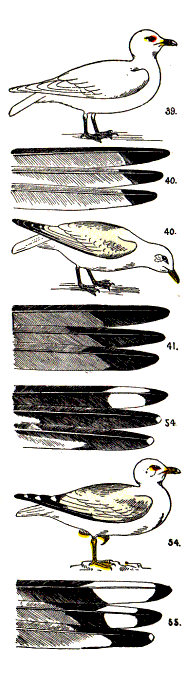
39. Ivory Gull (Pagophila alba). L. 17. Ads. Pure white; bill yellow; feet black. Yng. Similar, but wings and tail tipped with blackish; throat dusky. Range.—Breeds in Arctic regions; winters south to Great Lakes and British Columbia; rarely to Massachusetts. 40. Kittiwake (Rissa tridactyla). L. 16. Hind toe a knob. Ads. Head, neck all around, underparts, and tail white; 3 in. or less, of tips of primaries black. Yng. Tip of tail, ear-coverts, nape, and wing-coverts with black; bill black; inner web of primaries with white. Notes. A rapidly uttered 'kit-a-wake, 'kit-a-wake. Range.—North Atlantic and eastern Arctic regions; breeds in America, from Gulf of St. Lawrence to Greenland; winters south to Great Lakes, Long Island and, rarely, Virginia. 40a. Pacific Kittiwake (Rissa tridactyla pollicaris). Similar to No. 40, but hind toe more developed; black tips to 3 outer primaries, 3 in. or more in length. Notes. "A shrill, harsh cry when disturbed and a low whistle when communicating with each other." (Nelson.) Range.—"North Pacific and Bering Sea; south in winter, casually to southern California." (A. O. U.) 41. Red-legged Kittiwake (Rissa brevirostris). Ads. Similar to Ad. of No. 40, but legs red, back and inner web of primaries darker; bill shorter, 1.2. Yng. Similar to No. 40, but no black on tail or wings. "Range.—Coasts and Islands of Bering Sea." (A. O. U.) 54. Ring-billed Gull (Larus delawarensis). L. 18. Ads., summer. Rill greenish yellow, a black band across tip; ends of primaries black, a white spot near tip of outer one. Ads. Winter. Similar, but head and neck streaked with grayish. Yng. Tail grayish with a broad black band; primaries black; back brownish gray and whitish; belly white; end half of bill black. Range.—North America, coast and interior; breeds from Newfoundland, southern Minnesota, and British Columbia northward; winters from Nova Scotia and British Columbia south to Cuba and Lower California. 55. Short-billed Gull (Larus brachyrhynchus). L. 17; B. 1.50 Ads., summer. Head, neck, tail, and underparts white. Two outer primaries tipped with black, their white spaces followed by black; remaining primaries tipped with white. Yng. Grayish brown; basal half of tail pearl. Notes. "A sharp querulous kwew-kwew," (Nelson.) Range.—North Pacific; breeds in Alaska and interior of northern British Columbia; winters on coast from British Columbia to southern California.
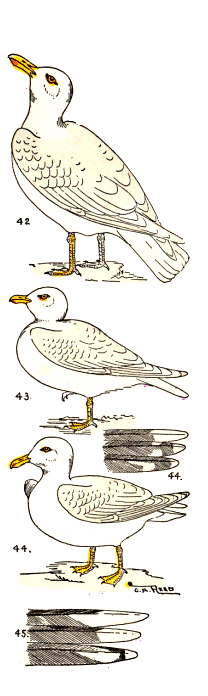
42. Glaucous Gull (Larus glaucus). L. 28; W. 17.1; B. 2.35. No black in plumage. Ads. Primaries white tinted with pearl; bill with red spot at end of lower mandible. Yng. Dirty white or gray, mottled with dusky and buffy, chiefly above; primaries white; outer webs brownish. Range.—Northern hemisphere; breeds in America, from Labrador northward; winters south to middle California, Great Lakes and Long Island. 42.1. Point Barrow Gull (Larus barrovianus). Similar to No. 42, but bill through angle not so deep, (.8 as compared with .9 in glaucus); primaries more distinctly tipped with white. Notes. "kû-kû-kû, kû-kû-kû, kû-lēē-ōō, kû-lēē-ōō, kû-lēē-ōō, kû-kû-kû, kû-kû-kû, the kû-kû hoarse, the rest a shrill screaming." (Nelson.) Range.—"Bering Sea and contiguous waters; northeast to Point Barrow, southwest to Japan." (A. O. U.) 43. Iceland Gull (Larus leucopterus). L. 25; W. 16; B. 1.75. Similar in color to Nos. 42 and 42.1, but smaller. Range.—Atlantic; breeds in Greenland; winters south in America to Great Lakes, and rarely, Long Island. 44. Glaucous-winged Gull (Larus glaucescens). L. 27. Ads., summer. Head, tail, and underparts white; back pearl; primaries pearl, tipped with white. Ads., winter. Head and neck streaked with brownish. Yng. Brownish gray, more or less mixed with white, including wings and tail. Range.—North Pacific; breeds from British Columbia to Bering Straits; winters south to southern California. 45. Kumlien Gull (Larus kumlieni). W. 16.2; B. 1.75. Similar to No. 43, but primaries with well defined ashy gray spaces; outer primary tipped with white, with ashy gray on outer web and shaft part of inner web; second primary ashy gray on only shaft part of outer web. Range.—"North Atlantic coast of North America, breeding in Cumberland Gulf; south in winter to the coast of the Middle States." (A. O. U.) 46. Nelson Gull (Larus nelsoni). "Wing 18.25, culmen 2.35. Ads. In plumage exactly like L. kumlieni; depth of bill through angle .80; tarsus 3.05; middle toe (without claw) 2.40." (Ridgway.) Range.—"Coast of Norton Sound, Alaska." (A. O. U.)
47. Great Black-backed Gull (Larus marinus). L. 29. Ads., summer. Back and wings slaty black; wing feathers tipped with white. Ads., winter. Similar, but head and neck streaked with dusky. Yng. Back grayish brown margined with buffy white; rump whiter; primaries black; below white more or less marked with dusky. Notes. "A braying ha-ha-ha, a deep keow, keow, a short barking note, and a long-drawn groan, very loud and decidedly impressive." (Brewster.) Range.—North Atlantic and northern Europe; breeds in North America from Nova Scotia to Greenland; winters south to Great Lakes and South Carolina. 48. Slaty-backed Gull (Larus schistisagus). L. 26. Ads., summer. General appearance of No. 47; back lighter; primaries as figured. Ads., winter. Head and neck streaked. Yng. Above brown margined with buff and white; primaries brown; tail brown with little or no mottling; below brown. Range.—"North Pacific, chiefly on the Asiatic side; Herald Island, Arctic Ocean, and Alaskan coast of Bering Sea." (A. O. U.) 49. Western Gull (Larus occidentalis). L. 24. Ads., summer. Head, neck, tail, and underparts white; back slaty gray; outer primaries black, a large white spot near tip of first one. Ads., winter. Crown and hind neck streaked with brownish. Yng. Grayish brown mixed with white; wings and tail fuscous. Notes. Ooēēk, ooēēk, ooēēk; ca-ca-ca, and other calls. Range.—Pacific coast; breeds and winters from Lower California to British Columbia. 57. Heermann Gull (Larus heermanni). L. 17. Ads., summer. Bill red; head and throat white, shading into slate above and below; tail blackish, tipped with white; primaries black. Ads., winter. Head and neck streaked with grayish brown. Yng. Uniform grayish brown. Range.—Pacific coast of North America; breeds from Mazatlan, Mexico, north to Lower California; occurs regularly north to Vancouver Island; winters south to Panama.
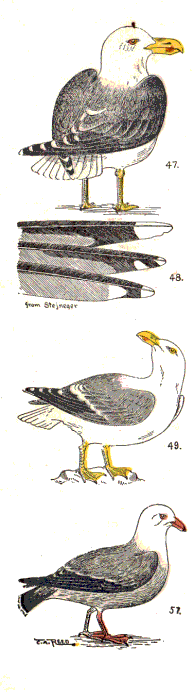
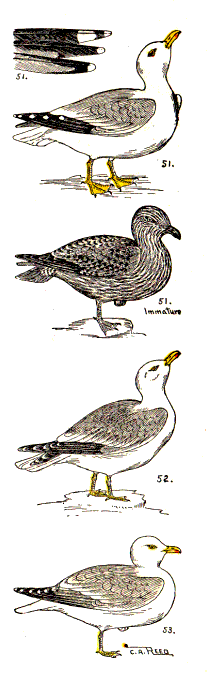
51. Herring Gull (Larus argentatus). L. 24. Ads., summer. White spaces at end of outer primaries sometimes joined. Ads., winter. Similar, but head and neck, streaked with grayish. Yng. Above ashy brown, margined and marked with buffy; wings brownish black; tail the same; sometimes margined with buffy; below ashy brown, sometimes lightly barred or streaked with dusky. Notes. Cack-cack-cack; hah, hah, hah, and other notes. Range.—Northern hemisphere; breeds in America from Maine, Great Lakes, Minnesota, and British Columbia northward; winters south to Cuba and Lower California. 52. Vega Gull (Larus vegæ). Similar to No. 51, but back said to be darker; feet yellow. Range.—"Bering Sea and adjacent waters; south in winter to California and Japan." (A. O. U.) 53. California Gull (Larus californicus). L. 20. Ads. Similar to No. 54 but larger; a red spot near tip of lower mandible; white spot on outer primary, larger and nearer end. Yng. Similar to No. 54 but darker; tail nearly uniform fuscous. Range.—Western North America; breeds chiefly in interior, from Utah to Lat. 68°, 30'; winters from British Columbia to Mexico.
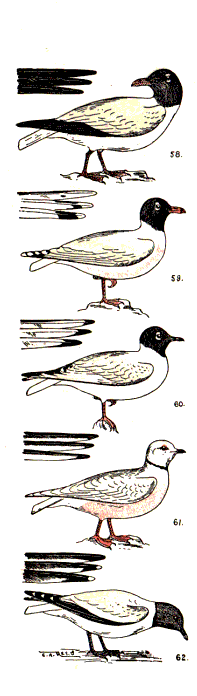
58. Laughing Gull (Larus atricilla). L. 16. Ads., summer. Head dark slate; tail white; bill with reddish. Ads., winter. Similar, but head and throat white with grayish on nape and behind eyes. Yng. Tail grayish with a broad black band; nape and back ashy brown; forehead and under parts white. Notes. A nasal cow-ow, also cuk-cuk-cuk, and a high, long-drawn laugh. Range.—Eastern North America; breeds from Texas and Florida to Maine and Nova Scotia; rare in interior; winters from South Carolina to northern South America. 59. Franklin Gull (Larus franklini). L. 15. Ads., summer. Breast with a rosy tinge; outer primaries with wide black spaces near ends, bordered at base and tip with white. Ads., winter. "Head mainly white, with [its] sides and back grayish dusky." Yng. "Top and sides of head and back grayish brown; quills dusky, tipped with white; tail with subterminal band of dusky; rest of tail, under parts, forehead, and eyelids white." (Bailey.) Range.—Interior of North America; breeds from Iowa and Minnesota northward to Great Bear Lake; winters from west Gulf States to South America. 60. Bonaparte Gull (Larus philadelphia). L. 14. Ads., summer. Outer web of outer primaries and tip black; inner web and shaft white; bill black. Ads., winter. Similar, but throat and head white, its back grayish. Yng. Tail white, tipped with black; outer primary black, inner two-thirds of inner web and space near tip white; rest of plumage much as in young of No. 58. Range.—North America; breeds in interior from Hudson Bay and Manitoba west to the Yukon; winters from British Columbia and Maine to Lower California and Gulf of Mexico. 61. Ross Gull (Rhodostethia rosea) L. 13.5. Bill small, .7; middle tail feathers longest. Ads., summer. White areas tinged with pink; a black collar. Ads., winter. No collar; a black spot before eye. Yng. Lesser coverts black, margined with whitish; tail white, central feathers tipped with black; back pearl; ear spot and space about eye dusky; crown white, washed with pearl. Range.—"Arctic regions; south in autumn and winter to Kamchatka, Point Barrow, Alaska and Disco Bay, Greenland." (A. O. U.) 62. Sabine Gull (Xema sabinii). L. 14. Tail slightly forked. Ads., summer. Head and throat slaty black, margined behind with black; bill black, tipped with yellow; outer primaries black, small tip and inner half of inner web white. Ads., winter. Similar, but head and throat white; nape region dusky. Yng. Tail white, tipped with black; crown and back ashy brown; forehead and underparts white. Notes. "A single harsh grating note." (Nelson.) Range.—Arctic regions: breeds in America from St. Michaels, Alaska and Melville Bay, Greenland, northward; winters south on Atlantic coast, rarely to New York; casually to Texas, and on Pacific coast to Peru.
Terns
64. Caspian Tern (Sterna caspia). L. 21. T. 6., forked 1.5. Largest of our Terns. Ads., breeding. Bill red; cap black; above pearl; below-white; primaries frosty black. After breeding, crown streaked black and white; bill more orange. Yng. Similar to last but wings and tail with blackish. Notes. A loud, harsh "kay-awk" or "key-rak." Range.—Cosmopolitan; breeds in North America, locally from Texas to Newfoundland and Great Slave Lake; winters mostly south of United States; three California winter records. 65. Royal Tern (Sterna maxima). L. 19; T. 7, forked 3.5; B. 2.5. Ads., summer. Primaries frosty black, white on inner two-thirds of inner web except at tip, where frosty; bill orange red; crown black; above pearl; below white. Ads., winter. The same, but head white with black streaks. Yng. Similar to winter ad. but wings and tail with grayish. Range.—Middle America; breeds from southern Brazil and Peru to Gulf States, Virginia, and California; wanders north to Great Lakes and Massachusetts; winters from Gulf States and California southward. 66. Elegant Tern (Sterna elegans). L. 16.5; B. 2.7. Similar to No. 65, but smaller; bill longer and more slender. Ads. Tinged with shell pink below. Range.—"Pacific coast of America from California to Chili." (A. O. U.) 67. Cabot Tern (Sterna sandvicensis acuflavida). L. 16; T. 5.5, forked 2.7. Ads., breeding. Bill black, the tip yellow; crown black; above pearl; below white; primaries much as in No. 65. After breeding, head white; nape with black streaks. Yng. Similar to last but with back and tail with blackish; tip of bill less yellow. Range.—Tropical America; breeds on east side of Mexico north along Gulf Coast to Florida, and Atlantic coast to South Carolina; wanders to Massachusetts; winters south of United States to West Indies and Central America.
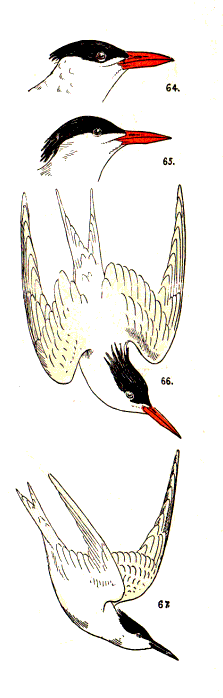
63. Gull-billed Tern (Gelochelidon nilotica). L. 14.5; T. 5.5. Ads., summer. Bill thick, short, black; tail short, forked only 1.5; crown black; above pearl; below white. Ads., winter. Head white, with black patch before and behind eye. Yng. Similar, but above edged with buffy; head and neck streaked with grayish. Notes. A high, thin, somewhat reedy tee-tee-tee, sometimes suggesting a weak-voiced katydid. Range.—Cosmopolitan; breeds in North America from Mexico to Florida and north to Virginia; wanders north rarely to New Brunswick; winters from southern Texas southward. 73. Aleutian Tern (Sterna aleutica). L. 14. T. 6.7, forked 3. Ads., summer. Above and below pearl gray, browner below; throat white; crown black; forehead white; line from bill to eye black. Ads., winter. "With rather more white on forehead." (Cat. B. M.) Notes. "A thin, clear, trilling whistle." (Nelson.) Range.—Alaska from Kadiak to Bering Strait, southwest to Japan. 74. Least Tern (Sterna antillarum). L. 9; T. 3.5, forked 1.7. Ads., summer. Bill yellow, black at tip; forehead white; a black line from bill to eye; crown black; above pearl; below white. Ads., winter. Crown white; nape black; bill dark; tail shorter. Yng. Similar to last, but above with buffy or brownish. Notes. "A sharp squeak much like the cry of a very young pig following its mother." Range.—Western hemisphere; breeds locally from northern South America northward to Massachusetts, Dakota, and southern California; winters south of United States. 76. Bridled Tern (Sterna anæthetus). L. 15. Ads. Forehead and line over eye white; lores and crown black; nape whitish; back sooty gray or sooty brown; outer tail feathers white, except at tip; inner ones grayish brown. Notes. A soft qua. Range.—Tropical regions; north in Atlantic to the Bahamas; casual in Florida.
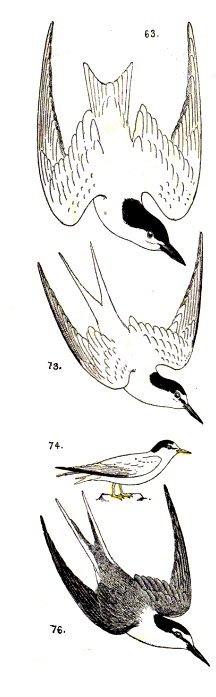
69. Forster Tern (Sterna forsteri). L. 15; T. 7, forked. 4. Ads., summer. Inner web of outer tail feather dusky; below pure white; bill orange, blackish at end; crown black; back pearl. Ads., winter. Crown white or grayish; a large black spot about eyes; bill black. Yng. Similar to winter ad. but above with brownish. Notes. A long drawn, deep, reedy cack and tweet-tweet-tweet-tweet. Range.—North America; breeds locally north to California, and from Texas along coast to Virginia and in interior to Manitoba; wanders to Massachusetts; winters from southern California and Texas south to Brazil. 70. Common Tern (Sterna hirundo). L. 15; T. 5.5, forked, 3.2 Ads., summer. Outer web of outer tail feather dusky; below white, washed with dusky; bill red, blackish at end; crown black; back pearl. Ads., winter. Forehead and underparts white; bill black. Yng. Similar to last, but above with brownish; tail shorter. Notes. A vibrant, purring, tearrr, and other calls. Range.—Northern hemisphere; in America, chiefly east of Plains; breeds locally on coast and in interior from Gulf States to Barren Grounds and Greenland; winters south of United States to Brazil. 71. Arctic Tern (Sterna paradisæa). L. 15.5; T. 7.2 forked 4.5. Similar to No. 70, but summer ad. with bill wholly bright red; tail longer; tarsus shorter, .6 instead of .7. Notes. Like tearr of No. 70, but shriller, ending in rising inflection, like squeal of a pig. (Brewster.) Range.—Northern hemisphere; breeds from Massachusetts north to Greenland and northwest to Aleutian Islands and Alaska; winters south to California and Virginia. 72. Roseate Tern (Sterna dougalli). L. 15.5; T. 7.5, forked, 5.2. Ads., summer. Bill black, reddish only at the base; below white tinged with shell pink; tail wholly white; crown black; back pearl. Ads., winter. Forehead with white; no pink below. Notes. A reedy cack. Range.—Temperate and tropical regions; breeds in North America on east coast only, from Florida north to Nova Scotia; rare north of Virginia; winters south of United States to Venezuela.
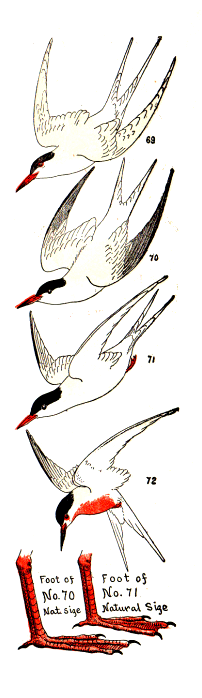
Terns and Skimmer
75. Sooty Tern (Sterna fuliginosa). L. 17. Ads., summer. Above blackish, forehead and underparts white; tail black, except outer feathers which are mostly white. Yng. Sooty slate; linings of wings white; scapulars, upper tail coverts, and tail feathers tipped with white. Notes. A squeaky quack, a nasal ker-wacky-wak, and other calls. Range.—"Tropical and subtropical coasts of the globe. In America from Chili to western Mexico and the Carolinas, and casually to New England." (A. O. U.) 77. Black Tern (Hydrochelidon nigra surinamensis). L. 10. Ads., summer. Head and underparts black; back, wings, and tail slate. Ads., winter. Forehead, nape, and underparts white; head gray. Yng. Similar to last, but above with brownish margins. Notes. A sharp peek. Range.—Temperate and tropical America; breeds in interior from California, Kansas, and Illinois to Alaska; irregular migrant on Atlantic coast from New Brunswick southward; winters south of United States to Chili. 79. Noddy (Anous stolidus). L. 15. Ads. Crown silvery white; rest of plumage sooty brown. Yng. Similar, but all sooty brown except white line from bill to eye. Notes. A low reedy cack increasing to a hoarse, guttural k-r-r-r-r-r-r-r. Range.—"Tropical and subtropical regions; in America from Brazil and Chili north to the Gulf and South Atlantic States." (A. O. U.) 80. Black Skimmer (Rynchops nigra). L. 18. Ads. Lower mandible longer than upper; forehead, underparts, part of secondaries, and tail white; rest of plumage black. Yng. Plumage widely margined with buffy. Notes. Varied, nasal, penny-trumpet-like; also ca-you, ca-you, like a hound's voice. Range.—North America, chiefly eastern; breeds from southern New Jersey southward; wanders rarely to Nova Scotia; winters from Gulf States to northern South America.
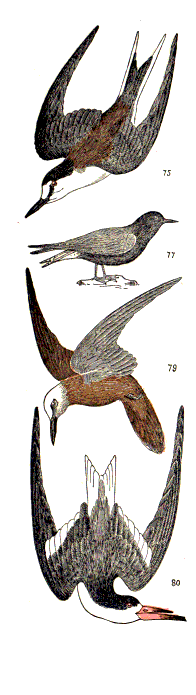
Order III. TUBE-NOSED SWIMMERS.
TUBINARES.
Family 1. ALBATROSSES. Diomedeidæ. 4 species.
Family 2. FULMARS, SHEARWATERS, and PETRELS. Procellariidæ. 26 species, 1 subspecies.
The Albatrosses, of which about ten species are known, are birds of far southern seas, where they nest on isolated islands. After the young are reared, several species migrate northward and are found off our Pacific coast. The largest known species, the Wandering Albatross, which has been made famous by Coleridge's "Rime of the Ancient Mariner," measures from twelve to fourteen feet in expanse of wing, and, like other members of this family, is a tireless ocean wanderer.
In the museum of Brown University, there is a mounted Wandering Albatross, killed off the coast of Chili by Capt. Hiram Luther, December 20, 1847. When captured, a small bottle was found tied around the bird's neck, containing a slip of paper from which it was learned that the bottle had been attached to the bird December 12, 1847, by Capt. Edwards of the New Bedford Whaler, "Euphrates," when about 800 miles off the coast of New Zealand, or about 3,400 miles from the point at which, eight days later, the bird was secured.
The Fulmars, (genus Fulmarus), are northern birds and nest in immense numbers on isolated islets, somewhat like certain Gulls.
Comparatively little is known of the nesting places of our Shearwaters, but it is believed that most of them breed on the islands of the South Atlantic and South Pacific, and pass their winter, (our summer) off our coasts.
One of the Petrels, (Wilson Petrel), is known to have this habit. It has been found nesting on Kerguelen Island, in S. Lat. 49° 54', in February, and in May it appears off our coasts for the summer.
Petrels nest in holes in the ground, laying one white egg. They are never seen near their homes during the day, the bird then on the nest waiting until night to feed, when the one which has been at sea returns to assume its share of the task of incubation. Those birds are therefore both diurnal and nocturnal.
Albatrosses
81. Black-footed Albatross (Diomedea nigripes). L. 32. Ads. Sooty brown, lighter below; region about base of bill whitish; upper mandible broad and rounded at its base. Notes. A whining groan, uttered when contesting for food. (Turner). Range.—North Pacific; north to Lat. 52°; south at least to Lower California. 82. Short-tailed Albatross (Diomedea albatrus). L. 36. Ads. White; the head straw; tail and primaries gray brown; upper mandible broad and rounded at base. Range.—North Pacific, north to Bering Strait; south, at least, to Lower California. 82.1. Laysan Albatross (Diomedea immutabilis). L. 32. Ads. Head, neck, rump, upper tail coverts, and whole under surface white; lores next to the eye sooty black; back, wings, and end of the tail dark sooty brown; interscapular region paler; base of the tail whitish. (Cat. B. M.) Range.—Laysan Island, Pacific Ocean; casual off the coast of Lower California. 83. Yellow-nosed Albatross (Thalassogeron culminatus). L. 36. Ads. Above slate brown, grayer on head; rump white; below white; neck sometimes grayish; tail gray. Range.—"Indian and southern Pacific Oceans; casual off the coast of Oregon; accidental in the Gulf of St. Lawrence." (A. O. U.) 84. Sooty Albatross (Phœbetria fuliginosa). L. 35. Ads. Sides of lower mandible conspicuously grooved; entire plumage sooty brown, except a white eye-ring. Range.—"Oceans of southern hemisphere, north to the coast of Oregon." (A. O. U.)
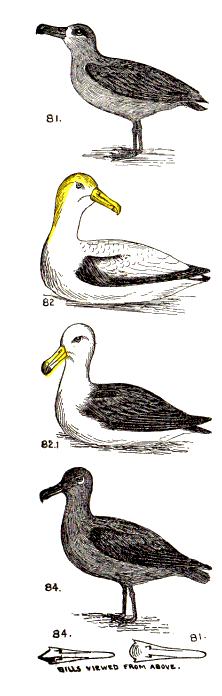
Fulmars and Shearwaters
86. Fulmar (Fulmarus glacialis). L. 19; W. 13; B. 1.5. Ads. Light phase. Head, neck, and under parts white; back, wings, and tail slaty gray. Dark phase. Uniform dark slaty gray. Notes. Silent. Range.—North Atlantic, breeds from Lat. 69° northward; winters south to Lat. of Massachusetts, and rarely to Virginia. 86b. Pacific Fulmar (F. g. glupischa). Similar to No. 86, but nasal tubes light. Range.—North Pacific; breeds from Bering Sea north; winters south to Mexico. 86.1. Rodger Fulmar (Fulmarus rodgersii). Similar to light phase of No. 86, but back with white feathers; no dark phase. Range.—"Bering Sea and adjacent parts of North Pacific." (A. O. U.) 87. Slender-billed Fulmar (Priocella glacialoides). L. 18.5. Ads. Head and underparts white; back and tail pearl; primaries black, white on inner web. Range.—Southern Seas; north on Pacific coast to Washington. 94. Sooty Shearwater (Puffinus fuliginosus). L. 17. Ads. Sooty gray, lighter below. Range.—"Atlantic Ocean, breeding in the southern hemisphere; a summer visitor off our coast, from South Carolina northward." (A. O. U.) 95. Dark-bodied Shearwater (Puffinus griseus). L. 17. Ads. Above dusky black or brownish, paler below; under wing coverts white and dusky; bill black. Range.—South Pacific; north in summer on the American coast to California. 96.1. Wedge-tailed Shearwater (Puffinus cuneatus). L. 17. T. 5.4, pointed. Ads. Above brown; below white; sides of neck mottled with gray; middle tail feathers nearly 2. longer than lateral ones. (Cat. B. M.) Range.—"North Pacific Ocean, from the Hawaiian Islands north to the Bonin Group and Lower California." (A. O. U.)
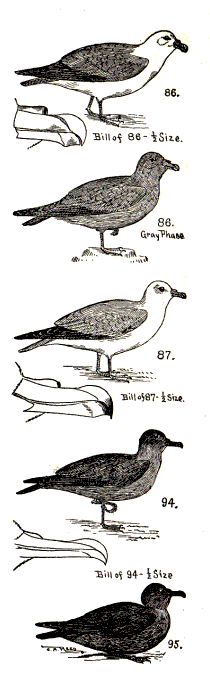
Shearwaters
88. Cory Shearwater (Puffinus borealis). L. 21. Ads. Above grayish brown; below, including under wing coverts and under tail coverts, white. Range.—North Atlantic; recorded only off the coast from Massachusetts to Long Island. 89. Greater Shearwater (Puffinus gravis). L. 20. Ads. Above grayish brown or blackish; tips of longer upper tail coverts white; below white; middle of belly and under tail coverts ashy gray. Range.—"Atlantic Ocean, from Cape Horn and Cape of Good Hope north to Arctic Circle." (A. O. U.) 91. Pink-footed Shearwater (Puffinus creatopus). L. 19.5. Ads. Above dusky gray or brown; below white; sides and lower belly with grayish; longer under tail coverts dusky brown; feet, flesh-color; bill yellowish. Range.—Pacific Ocean north on the American coast in summer and fall to middle California. 92. Audubon Shearwater (Puffinus lherminieri). L. 12. Ads. Above black or brownish black; below white; under tail coverts sooty. Range.—Middle Atlantic; breeds in West Indies and Bahamas; wanders north to Long Island. 93. Black-vented Shearwater (Puffinus opisthomelas). L. 15. Ads. Above dusky black; below white; sides of breast grayish; under tail coverts dusky brown; bill black. Range.—"Pacific Ocean, chiefly southward; coast of Lower California north to Santa Cruz, Cal." (A. O. U.) 93.1. Townsend Shearwater (Puffinus auricularis). Similar to No. 93, but bill and feet smaller, B. 1.2; above darker, nearly black; black of head extending below eye. (Townsend.) Range.—Pacific Ocean (Clarion Island, Lower California). 96. Slender-billed Shearwater (Puffinus tenuirostris). L. 13., bill slender 1.2 Ads. "Above dark sooty slate; beneath deep sooty gray, paler on throat where sometimes inclining to whitish." (Ridgw.) Range.—North Pacific, from Japan and Kotzebue Sound south on the American coast to middle California.
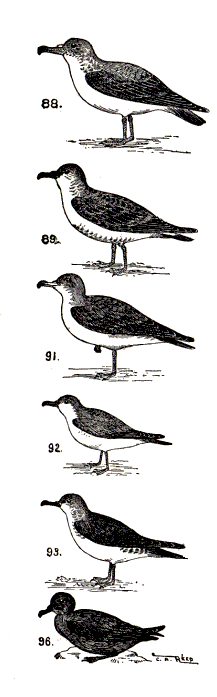
Petrels
98. Black-capped Petrel (Æstrelata hasitata). L. 15. Ads. Above sooty brown; back of neck and upper tail coverts white; base of tail white. Range.—Tropical Atlantic; irregular in United States (Florida, Virginia, New York, Kentucky, Vermont, and Ontario.) 103. Least Petrel (Halocyptena microsoma). L. 5.7. Ads. Sooty blackish brown, lighter below. Range.—"Coast of Lower California south to Panama." (A. O. U.) 105. Forked-tailed Petrel (Oceanodroma furcata). L. 8. 7. Ads. Tail forked; bluish gray, wings darker; a blackish space about eye. Range.—North Pacific; breeds in Aleutian Islands; recorded north to Bering Strait; winters south to California. 105.1. Kaeding Petrel (Oceanodroma kaedingi). W. 6. Ads. Similar to O. leucorrhoa, but much smaller with much less deeply forked tail. (Anthony.) Range.—Pacific Ocean; (Socorro Islands, Lower California.) 108. Ashy Petrel (Oceanodroma homochroa). L. 8.5. Ads. No white on rump; tail forked; sooty black above, browner below; wing coverts grayish. Range.—"Coast of California; breeds on the Santa Barbara and Farallone Islands." (A. O. U.)
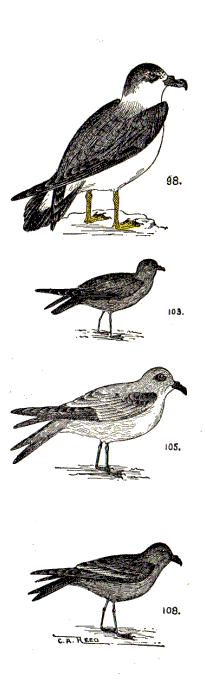
104. Stormy Petrel; Mother Carey's Chicken (Procellaria pelagica). L. 5.5. Ads. Sooty black, browner below; upper tail coverts white, tipped with black. Range.—North Atlantic; winters south to western Africa and New Brunswick. 106. Leach Petrel; Stormy Petrel (Oceanodroma leucorhoa). L. 8., W. 6.2. Ads. Tail forked; above sooty brownish black; below browner; lesser wing coverts grayish brown; longer upper tail coverts not tipped with black. Notes. An elfin-like crow of eight notes. Range.—North Atlantic and North Pacific; breeds from Maine to Greenland and from Farallone to Aleutian Islands; winters south to Virginia and California. 106.1. Guadalupe Petrel (Oceanodroma macrodactyla). L. 8.4; W. 6.4; T. 3.9, fork 1 in. deep. Ads. Similar to O. leucorhoa, but with much longer and more deeply forked tail, larger feet, shorter bill, and very broad dusky tips to the upper tail coverts. (Ridgw. in Cat. B. M.) Range.—Pacific Ocean; (Guadalupe Island, Lower California.) 107. Black Petrel (Oceanodroma melania.) L. 9. Ads. Sooty black, paler below; wing-coverts grayish, tail forked. Range.—South Pacific, north to Santa Barbara Islands; breeds on Coronados Islands, southern California. 108.1 Socorro Petrel (Oceanodroma socorroensis). W. 5.5. Ads. Similar to No. 108, but wings longer; tail shorter and less deeply forked; sides of rump whitish; no white on under surface of wing. (Towns.) Range.—Pacific Ocean; (Socorro Island, southern California.) 109. Wilson Petrel; Stormy Petrel (Oceanites oceanicus). L. 7. Ads. Webs of feet with yellow patch: tail not forked; longer upper tail coverts not tipped with black. Notes. A weak weet, weet, and a hoarse chattering patret-tu-cuk-cuk-tu-tu. (Wilson.) Range.—Atlantic Ocean; breeds in Southern seas, (Kerguelen Island in February), and migrates north to Newfoundland, spending summer off coast of eastern United States.
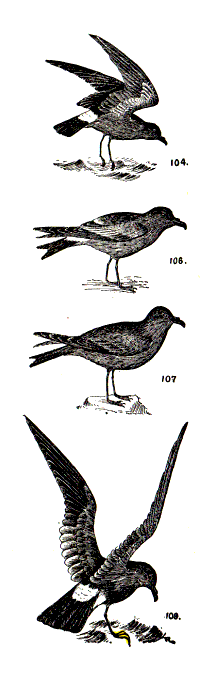
Order IV. TOTIPALMATE SWIMMERS.
STEGANOPODES.
Family 1. TROPIC BIRDS. Phaëthontidæ. 2 species.
Family 2. GANNETS. Sulidæ. 6 species.
Family 3. DARTERS. Anhingidæ. 1 species.
Family 4. CORMORANTS. Phalacrocoracidæ. 6 species, 5 subspecies.
Family 5. PELICANS. Pelecanidæ. 3 species.
Family 6. MAN-O'-WAR-BIRDS. Fregatidæ. 1 Species.
The members of this Order agree in having all four toes connected by webs, but in other respects they differ widely in structure and, consequently, in habit. The young of all the Steganopodes are born naked, unlike the young of most of the other water birds, which, as a rule, are hatched covered with feathers and can swim or run about soon after birth. The nests of the Steganopodes are, of necessity, therefore, more complex structures than those of birds whose nests are merely incubators and not cradles as well.
Tropic Birds resemble the larger Terns, when in the air, but their wing strokes are more rapid. They usually nest in holes in the face of cliffs, and lay one whitish egg, marked with chocolate.
Gannets are true sea birds, but, as a rule, do not live very far from the land. When breeding, Gannets are usually associated in great numbers. Their nests, as a rule, are placed on the ground or on cliffs, and one or two chalky white eggs are laid. At this season the birds are exceedingly tame and in localities where they have not been much molested, one may walk about among the sitting birds without their taking flight. Gannets are powerful birds on the wing. Their vigorous wing strokes are interrupted at intervals by short sails. They feed on fish which they capture by diving from the air.
The Darters or Anhingas number four species, distributed throughout the tropical parts of the globe, only one species inhabiting America. This is generally called the Snakebird or Water Turkey in Florida, where it is a common species on the more isolated rivers and lakes. The name Snakebird is derived from the bird's habit of swimming with the body submerged, when the long, sinuous neck, appearing above the water, readily suggests a snake. At other times Snakebirds mount high in the air and sail about, like Hawks, in wide circles. They build a large, well-made nest in a bush or tree, generally over the water, and lay four bluish white, chalky eggs.
Cormorants nest in large colonies, generally on isolated islets, but sometimes in remote swamps. The nests are placed closely together on the ground, in bushes, and less frequently in trees, according to the nature of the bird's haunts.
Cormorants feed on fish which they catch by pursuing them under the water. They dive from the surface of the water like Ducks, or from a low perch, but not from the air, as do the Gannets.
Pelicans nest in colonies, generally on some small island, building their nests on the ground or in bushes, and laying two or three large, white, chalky eggs.
Brown Pelicans secure their food by plunging on it from the air, generally from about twenty feet above the water. The sides of the bill are then bowed outward, the opening widened, forming, with the pouch, an effective net in which fish, twelve and fourteen inches long, are captured.
White Pelicans, on the contrary, feed from the water, scooping up fishes as they swim. At times a flock of these birds may surround a school of small fish in shallow water and drive them shoreward, at the same time actively filling their pouches.
Young Pelicans are fed on fish which they take from the pouch of the parent bird by thrusting their bills and heads well into it and prodding actively about for the food to be found there. Young Cormorants secure their food in a similar manner.
Frigate Birds, of which only two species are known, have a greater expanse of wing in proportion to the weight of their body than any other bird. Their power of flight is consequently unexcelled and they may spend days in the air without tiring. Their feet are as weak as their wings are strong, and are of use only in perching.
The food of Frigate Birds consists chiefly of fish, which they catch from near the surface of the water, or rob from Gulls and Terns by pursuing them, forcing them to disgorge their prey, and catching it ere it reaches the water.
Tropic Birds and Gannet
112. Yellow-billed Tropic Bird (Phaëthon americanus). L. 30; T. 19. Ads. Bill yellow; no bars above; middle tail feathers lengthened. Yng. Above barred with black; middle tail feathers not lengthened. Range.—Tropical coasts; breeds in West Indies, Bahamas and Bermudas; casual in Florida; accidental in western New York and Nova Scotia. 113. Red-billed Tropic Bird (Phaëthon æthereus). L. 30; T. 20. Ads. Bill red; above barred with black; long middle tail feathers pure white. Range.—"Coasts of tropical America, north on the Pacific coast to Cape Colnett, Lower California; accidental on the Newfoundland Banks. Breeds on San Pedro Martir and other Islands in the Gulf of California." (A. O. U.) 117. Gannet (Sula bassana). L. 35. Ads. White; head and neck tinged with straw; primaries blackish. Yng. Grayish brown with white spots. Notes. A harsh gor-r-r-rok. Range.—North Atlantic; breeds, in America, only on Bird Rock and Bonaventure Islands, Gulf of St. Lawrence; winters off the coast, south to Florida.