Front matter (continued 6)
Reading edition
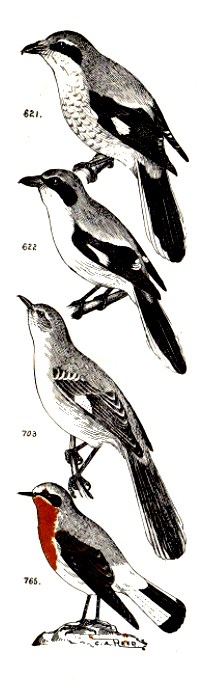
621. Northern Shrike (Lanius borealis). L. 10.2. Lores grayish. Ads. Above bluish gray; tail black, outer feathers tipped with white; below white, usually with wavy bars. Yng. Above washed with brown; below more distinctly and more heavily barred Notes. Song, not unlike that of the Brown Thrasher but more disconnected, less loud. Range.—North America; breeds from Labrador to Alaska; winters south, irregularly, to Virginia, Kansas, Arizona, and California. 622. Loggerhead Shrike (Lanius ludovicianus). 9. Lores black. Ads. Underparts white without bars; above bluish gray; rump and upper tail-coverts little if any paler; tail black, outer feathers tipped with white. Yng. Underparts, head, and rump more or less narrowly barred. Notes. Call, harsh and discordant; song, a series of guttural gurgles, squeaky whistles. Range.—Eastern United States; breeds from Florida to Virginia; In Mississippi Valley, northeast to western Pennsylvania, central and northern New York, Massachusetts, western New Hampshire, Maine, and British Columbia; migrates down Atlantic States, as well as Mississippi Valley, and winters in southern States. 622a. White-rumped Shrike (L. l. excubitorides). Similar to No. 622, but paler above, rump and upper tail-coverts whiter; bill less deep. Range.—"Western North America, from eastern border of the Plains to the Pacific, except coast of California, and from Manitoba and the Plains of the Saskatchewan south over tablelands of Mexico." 622b. California Shrike (L. l. gambeli). Similar to No. 622, but rump paler, breast usually with indistinct wavy bars and tinged with brownish. Range.—Pacific coast, from Lower California to British Columbia. 622c. Island Shrike (L. l. anthonyi). Similar to No. 622b, but darker and smaller, W. 3.7. Range.—Santa Barbara Islands, California. 703. Mockingbird (Mimus polyglottos). L. 10.5. Ads. Above ashy gray; below soiled whitish; outer tail-feathers with white; wing-coverts narrowly tipped with white; primaries white basally. Notes. Call, a harsh, kissing note; song indescribable. Range.—Southeastern United States and Bahamas, west to northeastern Texas; breeds north to southern New Jersey (rarely Massachusetts), and southern Illinois; winters from Virginia and lower Mississippi Valley southward. 703a. Western Mockingbird (M. p. leucopterus). Similar to No. 703, but with a very slight brownish tinge below and white areas in wing averaging larger. Range.—Southwestern United States and northern Mexico from Indian Territory and eastern Texas west to California. 765. Wheatear (Saxicola œnanthe). L. 6; W. 3.7. Ad. ♂. Back gray, upper tail-coverts and base of tail white; below white more or less washed with buff. Ad. ♀. Browner above and below, no black through eye. Ads. in winter and Yng. Similar to ♀, but cinnamon brown above, cinnamon below. Range.—Asia; migrating in summer to Alaska. 765a. Greenland Wheatear (S. œ. leucorhoa). Similar to No. 765, but larger, W. 4. Range.—Western Europe; breeds in Greenland and on adjoining mainland; rarely south to St. Lawrence; casually to Louisiana.
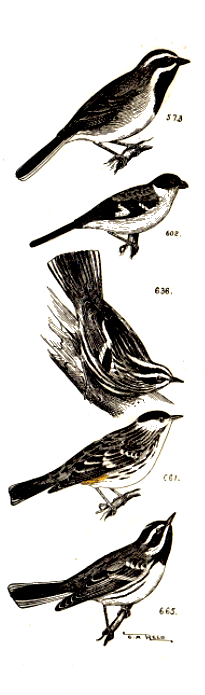
573. Black-throated Sparrow (Amphispiza bilineata). L. 5.3. Ads. Throat, upper breast, and front of face black; a white stripe over eye and another at the side of the throat; above grayish brown unstreaked; outer web of outer tail-feather white, except at tip; at least half an inch of tip of inner web white. Notes. Song, simple but sweet, three ascending and three descending notes. Range.—Middle and eastern Texas (except along coast?), north to Oklahoma and western Kansas; winters from central Texas south into northeastern Mexico. 573a. Desert Sparrow (A. b. deserticola). Similar to No. 573, but above grayer, the white tip to outer tail-feather less than half an inch long. Range.—Western United States and northern Mexico, from western Texas to southeastern California; breeds north to southern Colorado, and western Nevada; winters south into Mexico. 602. Morellet Seed-eater (Sporophila morelleti). L. 4.6. Ad. ♂. Entire upperparts, cheeks, tail, wings and breast-band black; bases of wing-feathers, tips to coverts and underparts, except breast-band, whitish. Ad. ♀. Above grayish brown, below uniform buffy. Yng. ♂. Variously intermediate between Ad. ♂ and Ad. ♀. At least two years evidently required to reach mature plumage. Range.—Eastern Mexico, north to southeastern Texas. 636. Black and White Warbler (Mniotilta varia). L. 5.3. Ad. ♂. Above streaked black and white; throat black or white; belly white; sides streaked black and white. Ad. ♀. Less black; whiter below; throat always white. Notes. Song, a thin, wiry, see-see-see-see. Range.—Eastern North America; breeds from Virginia, Louisiana, and northern Texas, north to Hudson Bay region; winters from Gulf States south to northern South America; accidental in California. 661. Black-poll Warbler (Dendroica striata). L. 5.6. Ad. ♂. Crown black, cheeks white; back streaked, gray and black; below white streaked with black; wing-bars and tail-spots white. Ad. ♀. No black cap; above olive-green streaked with black. Yng. and Ad. in winter. Above olive-green lightly streaked with black; below yellowish white; breast obscurely streaked. Notes. Song, a slender, wiry tree-tree-tree-tree-tree-tree-tree-tree, rapidly uttered. (Langille.) Range.—Eastern North America, west to the Rockies; breeds from northern New England, northern New York, northern Michigan, and Colorado, north to Labrador and Alaska; winters in West Indies and northern South America. 665. Black-throated Gray Warbler (Dendroica nigrescens). L. 5. Ad. ♂. Crown, cheeks and throat black, a white stripe at sides of throat, a yellow line before eye; back gray streaked with black; wing-bars and tail-patches white. Ad. ♀. Similar, but crown not always wholly black. Yng. Above washed with brownish, black areas tipped with white. Notes. Song, zee-ee-zee-ee, ze, ze, ze, with the quality of the song of Dendroica virens or D. cærulescens. Range.—Western United States; breeds in mountains from Arizona and northern Lower California, north to Colorado and Vancouver Island; winters in Mexico.
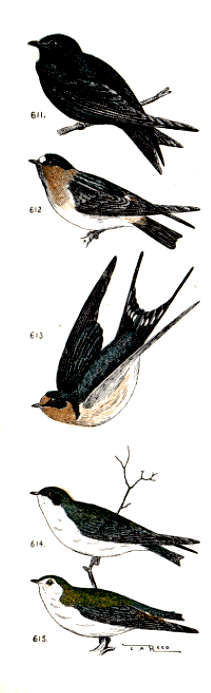
611. Purple Martin (Progne subis). L. 7.8. Ad. ♂. Shining blue-black, all feathers with dusky bases. Ad. ♀. Above dull blue-black; breast grayish edged with white; belly whitish. Yng. ♂. Variously intermediate between ♀ and Ad. ♂. Range.—North America, except Pacific coast; breeds north to Newfoundland and the Saskatchewan; winters in tropics. 611a. Western Martin (P. s. hesperia). ♂ similar to ♂ of No. 611; ♀ belly whiter; forehead grayish. Range.—Pacific coast from northern Lower California to Washington (and British Columbia?); winters in tropics. 611.1. Cuban Martin (Progne cryptoleuca). W. 5.50. Ad. ♂. With feathers of ventral region basally marked with white. Ad. ♀ and Yng. ♂. With breast and flanks sooty grayish brown, belly pure white. Range.—Cuba, north in spring to southern Florida. 612. Cliff Swallow (Petrochelidon lunifrons). L. 5.5. Ads. Throat chestnut, forehead and rump cinnamon-buff; nape gray; crown and back glossy blue-black, the back streaked with white. Yng. Throat dusky, often mixed with chestnut; back blackish brown; rump cinnamon-buff, forehead usually with same. Range.—"North America, north to the limit of trees, breeding south to the valleys of the Potomac and Ohio, southern Texas, southern Arizona, and California; Central and South America in winter; not recorded from Florida or West Indies." (A. O. U.) 612.2. Mexican Cliff Swallow (Petrochelidon melanogastra). Similar to No. 612, but smaller, W. 4.1, forehead deeper, usually chestnut, like throat, rump darker, more rusty. Range.—Mexico, north to southern Arizona. 613. Barn Swallow (Hirundo erythrogastra). L. ♂, 7.5; ♀, 6.5. Tail deeply forked. Ad. ♂. Above glossy blue-black, forehead chestnut; throat and upper breast chestnut, belly paler. Ad. ♀. Forehead, and underparts paler; tail less deeply forked. Notes. Song, a sweet, twittering, warbling song. (The notes of all our Swallows, while simple, are diagnostic but difficult of description.) Range.—North America, north to Greenland and Alaska; breeds through most of range; winters south to southern Brazil. 614. Tree Swallow (Iridoprocne bicolor). L. 6. Ads. Above steel-blue or steel-green; below white. Yng. Sooty gray above; white below. Range.—North America; breeds locally from Lat. 41° on Atlantic coast and Lat. 38° on Pacific coast north to Labrador and Alaska; winters from South Carolina and southern California to the tropics. 615. Northern Violet-Green Swallow (Tachycineta thalassina lepida). L. 5.2; W. 4.5. Ad. ♂. Above bronze-green; upper tail-coverts greener; an indistinct nape-ring; mark above eye, cheeks and underparts white; flank-patches white, often showing from above. Ad. ♀. Much duller, the head browner, Yng. Above brownish sooty with a greenish tinge; a whitish mark above and behind eye; below white. Range.—Western United States, from eastern base of Rockies to Pacific; breeds from Mexico north to British Columbia; winters in Mexico and Central America.
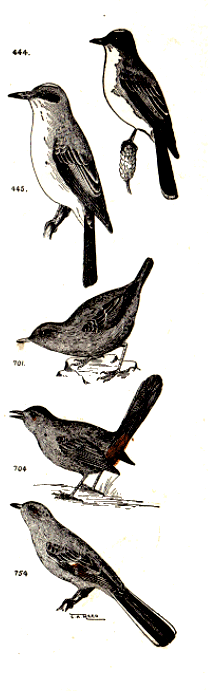
615a. St. Lucas Swallow (T. t. brachyptera). Similar to No. 615, but wing shorter, ♂, 4.1, ♀, 4. (Brewster.) Range.—Lower California. 458. Black Phœbe (Sayornis nigricans). L. 7.2. Ads. Breast and head black, back grayer; outer web of outer tail-feather white; belly black, under tail-coverts white streaked with dusky. Notes. A liquid hip, a rising kee-ree, and a falling kee-wray. (Bailey.) Range.—Mexico, except Yucatan and Pacific coast from Colima northward, north into Texas, New Mexico, and southeastern Arizona. 458a. Western Black Phœbe (S. n. semiatra). Similar to No. 458, but under tail-coverts white without dusky streaks. Range—Pacific coast of Mexico and United States, from Colima to Oregon, including most of Arizona. (Nelson.) 494. Bobolink; Reed bird (Dolichonyx oryzivorus). Ad. ♂, summer. Black; nape buffy, lower back, scapulars and upper tail-coverts white. Ad. ♀. Above yellowish brown streaked with buff, and black. below yellowish white, sides streaked with black. Winter plumage, Ads and Yng. Like ♀ but yellower. Notes. Song, an irrepressible bubbling outburst of "mad music" often given on the wing; calls, a blackbird-like chuck and a metallic, far carrying, chink. Range.—Eastern North America, west to Utah; breeds from northern New Jersey, Illinois and Kansas, north to Nova Scotia, Manitoba, and Montana; migrates south through Florida and West Indies, and winters south of Amazon. 534. Snowflake (Passerina nivalis). L. 6.9. Hind toe-nail twice as long as shortest toe-nail. Ad. ♂, summer. Head, rump, secondaries, outer tail-feathers and below white; rest of plumage largely black. Ad. ♀, summer. Similar, but crown blackish, back edged with rusty or grayish. Winter. Above rusty and black, below white, breast tinged with rusty. Notes. Calls, a clearly piped whistle, and a peculiar chirr, often uttered when taking wing; song, short, simple, but rather sweet. (Minot.) Range.—Breeds in northern parts of northern hemisphere; in winter south to northern states; irregularly to Georgia, southern Indiana, Kansas, Colorado, and eastern Oregon. 534a. Pribilof Snowflake (P. n. townsendi). Similar to No. 534, but larger, with relatively longer bill; ♂, W. 4.7; B. .5. (Ridgw.). Range.—Aleutian and Commander Islands, Pribilof Islands, Shumagin Islands. (Ridgw.). 535. McKay Snowflake (Passerina hyperborea). L. 7.5; W. 4.6; B .4. Similar to No. 534, but with more white. Ad. ♂, summer. Back and scapulars entirely white. Ad. ♀, summer. Crown and hindneck white. Yng. Not certainly distinguishable from Yng. of No. 534. (Ridgw.) Range.—Breeds on Hall and St. Mathews Islands, Bering Sea; in winter west coast of Alaska.
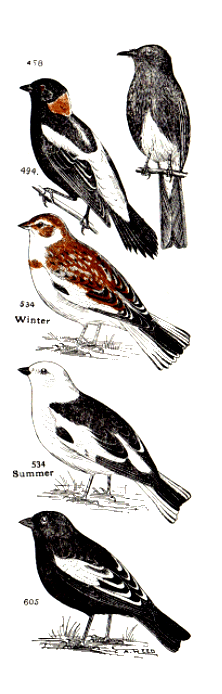
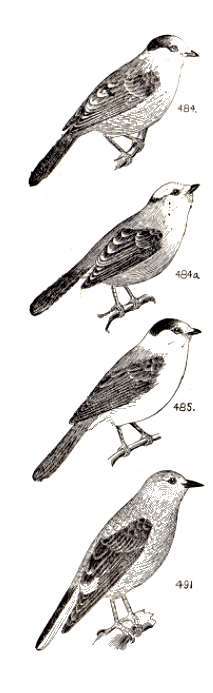
605. Lark Bunting (Calamospiza melanocorys). L. 7.2. Ad. ♂. Black, patch in wing white, outer tail-feathers tipped, tertials margined with white. Ad. ♀. Above grayish brown streaked with blackish; below white conspicuously streaked with black; all but central tail-feathers with white tips; broad wing-bars buff. Yng. ♂. Variously intermediate between Ad. ♂ and ♀. (See page 251). Range.—Western United States, chiefly east of Rockies; breeds from western Kansas and eastern Colorado, north to western Minnesota and Assiniboia; winters in Mexico; irregular west in migrations to Idaho and southern California. 484. Canada Jay; Whiskey Jack (Perisoreus canadensis). L. 11.5. Ads. Black of hindhead reaching to back of eye; back, wings, and tail gray, belly lighter, throat white; forehead buffy white. Notes. ca-ca-ca and a number of peculiar sounds impossible to reproduce on paper. (Bendire.) Range.—Eastern North America; Nova Scotia, New Brunswick, northern New England, northern New York, northern Michigan; northern Minnesota, north to Newfoundland and Hudson Bay region, west to the Rockies in Alberta. 484a. Rocky Mountain Jay (P. c. capitalis). Similar to No. 484, but head white, black of hindhead grayer and not reaching to eye. Range.—Rocky Mountain region from New Mexico and Arizona north to Montana and Idaho. 484b. Alaskan Jay (P. c. fumifrons). Very near to No. 484, but forehead averaging more yellowish. Range.—Alaska; interior and west to Cook Inlet, north of southern coast region. 484c. Labrador Jay (P. c. nigricapillus). Similar to No. 484, but black of hindhead deeper and reaching forward as a well defined ring around the eye; below browner. Range.—Labrador. 485. Oregon Jay (Perisoreus obscurus). Similar to No. 484, but back feathers with light shaft streaks, forehead less white, underparts nearly uniform white. Range.—Pacific coast from northern California to southern British Columbia. 485a. Gray Jay (P. o. griseus). Similar to No. 485, but larger and grayer; back, etc., deep mouse gray, instead of brown; below grayish white instead of brownish white. (Ridgw.) Range.—British Columbia, Washington, Oregon, and northern California, east of Coast and Cascade Ranges. (Ridgw.) 491. Clarke Nutcracker (Nucifraga columbiana). L. 12. Ads. Gray; wings and middle tail-feathers black, tips of secondaries and outer tail-feathers white. Notes. A loud, harsh, car-r-car-r. Range.—Mountains of western North America, from northern Lower California, Arizona and New Mexico, north to northern Alaska: casually east to Mississippi Valley.
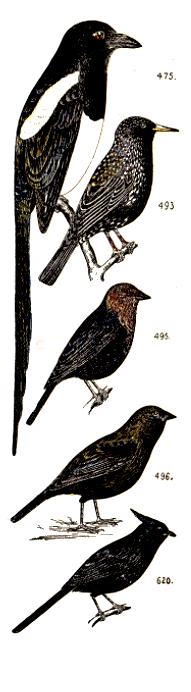
475. American Magpie (Pica pica hudsonia). L. 20. Ads. Bill black; scapulars, belly and most of inner margins of primaries white; wings glossy blue black, tail externally greenish; back and breast velvety black. Notes. Cack, cack, also garrulous gabble intermixed with whistling notes. (Bendire.) Range.—Western North America, east to the Plains, west to Cascade and Sierra Ranges; breeds from northern New Mexico and northern Arizona north to Alaska strays farther east in winter. 476. Yellow-billed Magpie (Pica nuttalli). Similar to No. 475, but bill and eye-space yellow; smaller, L. 18. Notes. A harsh, rasping, cac-cac-cac; and a low, rich whistle, audible only at a short distance. Range.—California, west of Sierra Nevada, "north to Red Bluff and south to Santa Paula." (Grinnell.) 493. Starling (Sturnus vulgaris). L. 8.5; T. 2.5. Ad. summer, Metallic green and purple spotted above with buffy; bill yellow. Ad. winter. Similar, but above heavily spotted with brownish buff; below heavily spotted with white; bill blackish. Notes. A long-drawn, two-noted whistle, the second lower; and a chattering, metallic call when in flocks. Range.—Europe and northern Asia; accidental in Greenland; introduced into New York City in 1890; now common, extending east to New Haven, Connecticut, north to Ossining, New York, south to Staten Island and Plainfield, New Jersey. 495. Cowbird (Molothrus ater). L. 7.9; W. 4.2. Ad. ♂. Head and neck coffee-brown, body greenish black. Ad. ♀. Brownish gray, throat lighter. Yng. Like ♀. Notes. A metallic twitter, and by the male, a long-drawn, glassy kluck-tse-e-e; and watery gurgling notes uttered with spread wings and tail. Range.—United States: rare west of Rockies; breeds from Florida and Texas north to New Brunswick and Little Slave Lake; west to eastern Oregon, Nevada, and southeastern California; winters from southern New Jersey, southern Illinois, Indian Territory, northern Texas, and southeastern California, southward. 495a. Dwarf Cowbird (M. a. obscurus). Similar to No. 495, but smaller, L. 7.5; W. 4. Range.—Southwestern United States; from Gulf Coast of Texas west along Mexican boundary to Arizona and Lower California; winters south of United States. 496. Red-eyed Cowbird (Callothrus robustus). L. 9. Ad. ♂. Velvety bronze-black; wings and tail shining blue-black. Ad. ♀. Dull black, wings and tail with slight greenish reflections. Range.—Southern and eastern Mexico north, in spring, to Lower Rio Grande, Texas. 620. Phainopepla (Phainopepla nitens). L. 7.5. Crested. Ad. ♂. Shining black; inner vanes of primaries largely white, showing in flight. Ad. ♀. Dark gray, tail blacker, wing-coverts and quills narrowly margined with whitish. Yng. Like ♀. Notes. Calls, commonest, like call of young Robin; male has also a scold, a Meadowlark-like note and a harsh ca-rack or ca-racack; song, a jumble of flute-like tones and weak, squeaky notes. (Bailey.) Range.—Mexico north to western Texas, southern Utah and southern California; winters from Mexican border southward.
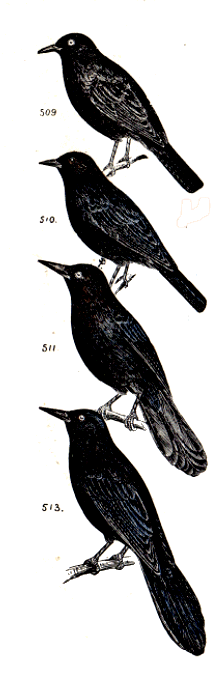
509. Rusty Blackbird (Scolecophagus carolinus). L. 9.5. Ad. ♂. Nearly uniform greenish black, sometimes with rusty edgings. Ad. ♀. Slaty gray, generally with some rusty edgings. Winter plumage of both sexes similar to summer but widely tipped with rusty above and yellowish rusty below. Notes. More musical than those of other Blackbirds; calls, tcback or turalee repeated several times. (Bendire.) Range.—Eastern North America west to the Plains; breeds from New Brunswick, northern New England, northern New York, and Manitoba, north to Labrador and Alaska; winters from Virginia, southern Illinois, and Kansas, southward. 510. Brewer Blackbird (Scolecophagus cyanocephalus). L. 10. Ad. ♂. Whole head violet-purple, rest of plumage bright greenish black. Ad. ♀. Grayish brown, throat paler, wings and tail greenish black, no rusty. Winter plumage with light grayish brown edgings to the feathers of the anterior part of the body. Notes. Chack and a loud, shrill whistle. (Bailey.) Range.—Western North America from the Plains to the Pacific; breeds from Texas and northern Lower California north to the Saskatchewan and British Columbia; winters in the southern parts of its range; casually east to Mississippi River states. 511. Purple Grackle (Quiscalus quiscula). L. ♂, 12. Ad. ♂. Head, purple, steel-green or steel-blue; back purple, brassy green or greenish; the feathers always with iridescent bars. Notes. Tchak and a short unmusical call uttered with spread wings and tail. Range.—Eastern United States; breeds in lower Mississippi Valley and east of Alleghanies, from Georgia to Massachusetts; winters from Virginia southward through its breeding range. 511a. Florida Grackle (Q. q. aglæus). Similar to 511, but slightly smaller, head always violet purple; back always bottle-green, with iridescent bars. Range.—Florida, north on the Atlantic coast to Virginia, west on the Gulf Coast to Texas. 511b. Bronzed Grackle (Q. q. æneus). Head as in No. 511, back and belly bronze, the feathers wholly without iridescent bars. Range.—Eastern United States west to the Rockies; breeds from southern Texas to Great Slave Lake, east to Alleghanies, and, in New York, east and northeast to Connecticut, Massachusetts, and Labrador; winters chiefly in lower Mississippi valley; migrates in part east of the Alleghanies. 513. Boat-tailed Grackle (Megaquiscalus major). L. ♂, 16; W. 7.5; T. 7. Ad. ♂. Head and neck glossy purple; back and belly glossy greenish blue. Ad. ♀. Much smaller, T. 5.2; above blackish brown; below soiled rusty buff. Notes. Tchack, a variety of hoarse, rather forced whistles and a gurgling roll as of a Coot pattering over the water. Range.—Florida, north along the coast to Virginia; west along coast to Texas. 513a. Great-tailed Grackle (M. m. macrourus). Similar to No. 513, but larger, ♂, L. 18; T. 9. Foreback and breast, as well as head and neck, purple, only rump and lower belly greenish blue; ♀ blacker both above and below than ♂ of 513. Notes. Tchack, and a greater variety of squeaky calls and hoarse whistles than are uttered by No. 513. Range.—Eastern Texas and south into Mexico.
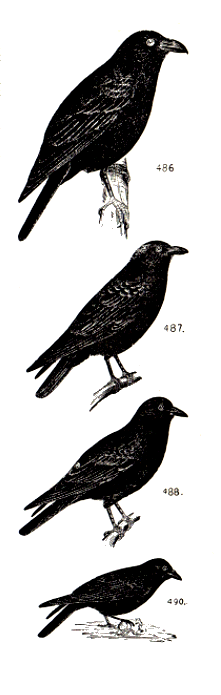
486. American Raven (Corvus corax sinuatus). L. 24; W. 16; B. 2.7. Ads. Resembling No. 488, in color but glossier below and with the feathers of throat narrow and lengthened; nape feathers gray at base. Notes. A hoarse, croaking, craack-craack, sometimes a deep, grunting koeer-koeer; a clucking, and a metallic klunk. (Bendire.) Range.—Western North America, from Guatemala north to British Columbia; east to the Rockies, west to Pacific. 486a. Northern Raven (C. c. principalis). Similar to No. 486, but larger, L. 25; W. 17; B. 3. Range.—Eastern North America, from mountains of northern Georgia and coast of Maine, north to Greenland; west to the Rocky Mountains. 487. White-necked Raven (Corvus cryptoleucus). L. 18.5. Ads. Blue-black; feathers of throat narrow and lengthened and with feathers of neck all around, white at the base. Notes. Kwank-kwank, less loud and penetrating than those of No. 486. (Bendire.) Range.—Northern Mexico, north to western Kansas, eastern Colorado (rarely), and southern California; east to western Texas. 488. American Crow (Corvus americanus). L. 19.3; W. 12.1; B. 2.00. Black with steel-blue or deep, purplish reflections; below duller, neck feathers not lengthened. Notes. Caw, caw, with many variations; song, car-r-r-uck, oo-oo-oo-oo-ah. Range.—North America, north to Arctic Circle; winters from northern United States southward; local in west. 488a. Florida Crow (C. a. pascuus). Similar to No. 488, but wings and tail somewhat shorter, bill and feet slightly larger, W. 12; T. 7.3; B. 2.1. Range.—Florida. 489. Northwest Crow (Corvus caurinus). Similar to No. 488 in color but smaller; L. 16; W. 11; B. 1.7. Range.—Northwest coast, from Oregon to Kadiak Island, Alaska. 490. Fish Crow (Corvus ossifragus). L. 16; W. 11; B. 1.5. Ads. Resemble No. 488, in color, but back feathers are uniform blue-black without dull margins; underparts are nearly as bright as upperparts. Notes. A hoarse, nasal, reedy car resembling the call of the young of No. 488. Range.—Atlantic coast north to Connecticut, (casually Massachusetts), west along Gulf coast to Louisiana; resident, except at northern limit of range.
SYSTEMATIC TABLE
Of the Birds of America north of Mexico, arranged according
to the American Ornithologists' Union's 'Check-List
of North American Birds', Third Edition
1910, and Supplement [B], July, 1912.
(The presence of brackets, [ ], indicates that the species is an accidental visitant).
Order PYGOPODES. Diving Birds
Family COLYMBIDÆ. Grebes.
A.O.U. No. COMMON NAME SCIENTIFIC NAME Page
1 Western Grebe Æchmophorus occidentalis 44
2 Holbœll's Grebe Colymbus holbœlli 43
3 Horned Grebe " auritus 43
4 Eared Grebe " nigricollis californicus 43
5 Mexican Grebe " dominicus brachypterus 43
6 Pied-bill Grebe Podilymbus podiceps 43
Family GAVIIDÆ. Loons.
A.O.U. No. COMMON NAME SCIENTIFIC NAME Page
7 Loon Gavia immer 44
8 Yellow-billed Loon " adamsi 44
9 Black-throated Loon " arctica 44
10 Pacific Loon " pacifica 44
11 Red-throated Loon " stellata 44
Family ALCIDÆ. Auks, Murres, and Puffins.
A.O.U. No. COMMON NAME SCIENTIFIC NAME Page
12 Tufted Puffin Lunda cirrhata 45
13 Puffin Fratercula arctica arctica [C] 45
13a Large-billed Puffin " " naumanni 45
14 Horned Puffin " corniculata 45
15 Rhinoceros Auklet Cerorhinca monocerata 45
16 Cassin's Auklet[D] Ptychoramphus aleuticus 46
17 Paroquet Auklet Phaleris psittacula 47
18 Crested Auklet Æthia cristatella 47
19 Whiskered Auklet " pygmæa 47
20 Least Auklet " pusilla 47
21 Ancient Murrelet Synthliboramphus antiquus 47
23 Marbled Murrelet Brachyramphus marmoratus 46
24 Kittlitz's Murrelet " brevirostris 46
25 Xantus's Murrelet " hypoleucus 46
26 Craveri's Murrelet " craverii 46
27 Black Guillemot Cepphus grylle 48
28 Mandt's Guillemot " mandti 48
29 Pigeon Guillemot " columba 48
30 Murre Uria troile troile 48
30a California Murre " " californica 48
31 Brunnich's Murre " lomvia lomvia 48
31a Pallas's Murre " " arra 48
32 Razor-billed Auk Alca torda 48
33 Great Auk Plautus impennis 48
34 Dovekie Alle alle 46
Order LONGIPENNES. Long Winged Swimmers
Family STERCORARIIDÆ. Skuas and Jaegers
A.O.U. No. COMMON NAME SCIENTIFIC NAME Page
35 Skua Megalestris skua 51
36 Pomarine Jaeger Stercorarius pomarinus 51
37 Parasitic Jaeger " parasiticus 51
38 Long-tailed Jaeger " longicaudus 51
Family LARIDÆ. Gulls and Terns
A.O.U. No. COMMON NAME SCIENTIFIC NAME Page
39 Ivory Gull Pagophila alba 52
40 Kittiwake Rissa tridactyla tridactyla 52
40a Pacific Kittiwake " " pollicaris 52
41 Red-legged Kittiwake Rissa brevirostris 52
42 Glaucous Gull Larus hyperboreus 53
43 Iceland Gull " leucopterus 53
44 Glaucous-winged Gull " glaucescens 53
45 Kumlien's Gull " kumlieni 53
46 Nelson's Gull " nelsoni 53
47 Great Black-backed Gull " marinus 54
48 Slaty-backed Gull " schistisagus 54
49 Western Gull " occidentalis 54
[50] Siberian Gull " affinis A.V.
51 Herring Gull " argentatus 55
[52] Vega Gull " vegæ A.V.
53 California Gull " californicus 55
54 Ring-billed Gull " delawarensis 52
55 Short-billed Gull " brachyrhynchus 52
[56] Mew Gull " canus A.V.
57 Heermann's Gull " heermanni 54
58 Laughing Gull " atricilla 56
59 Franklin's Gull " franklini 56
60 Bonaparte's Gull " philadelphia 56
[60.1] Little Gull " minutus A.V.
61 Ross's Gull Rhodostethia rosea 56
62 Sabine's Gull Xema sabini 56
63 Gull-billed Tern Gelochelidon nilotica 58
64 Caspian Tern Sterna caspia 57
65 Royal Tern " maxima 57
66 Elegant Tern " elegans 57
67 Cabot's Tern " sandvicensis acuflavida 57
[68] Trudeau's Tern " trudeaui A.V.
69 Forster's Tern " forsteri 59
70 Common Tern " hirundo 59
71 Arctic Tern " paradisæa 59
72 Roseate Tern " dougalli 59
73 Aleutian Tern " aleutica 58
74 Least Tern " antillarum 58
75 Sooty Tern " fuscata 60
[76] Bridled Tern " anætheta 58
77 Black Tern Hydrochelidon nigra surinamensis 60
[78] White-winged Black Tern " leucoptera A.V.
79 Noddy Anoüs stolidus 60
Family RYNCHOPIDÆ. Skimmers.
A.O.U. No. COMMON NAME SCIENTIFIC NAME Page
80 Black Skimmer Rynchops nigra 60
Order TUBINARES. Tube-nosed Swimmers
Family DIOMEDEIDÆ. Albatrosses.
A.O.U. No. COMMON NAME SCIENTIFIC NAME Page
81 Black-footed Albatross Diomedea nigripes 62
82 Short-tailed Albatross " albatrus 62
82.1 Laysan Albatross " immutabilis 62
[83] Yellow-nosed Albatross Thalassogeron culminatus 62
[84] Sooty Albatross Phœbetria palpebrata 62
Family PROCELLARIIDÆ. Fulmars, Shearwaters, and Petrels.
A.O.U. No. COMMON NAME SCIENTIFIC NAME Page
[85] Giant Fulmar Macronectes giganteus A.V.
86 Fulmar Fulmarus glacialis glacialis 63
86b Pacific Fulmar " " glupischa 63
86.1 Rodger's Fulmar " rodgersi 63
87 Slender-billed Fulmar Priocella glacialoides 63
[102] Pintado Petrel Daption capense A.V.
88 Cory's Shearwater Puffinus borealis 64
89 Greater Shearwater " gravis 64
[90] Manx Shearwater " puffinus A.V.
91 Pink-footed Shearwater " creatopus 64
92 Audubon's Shearwater Puffinus lherminieri 64
[92.1] Allied Shearwater " assimilis A.V.
93 Black-vented Shearwater " opisthomelas 64
93.1 Townsend's Shearwater " auricularis 64
95 Sooty Shearwater " griseus 63
96 Slender-billed Shearwater " tenuirostris 64
96.1 Wedge-tailed Shearwater " cuneatus 63
[96.2] New Zealand Shearwater " bulleri A.V.
[97] Black-tailed Shearwater Priofinus cinereus A.V.
[98] Black-capped Petrel Æstrelata hasitata 65
[99] Scaled Petrel " scalaris A.V.
100 Fisher's Petrel " fisheri A.V.
[101] Bulwer's Petrel Bulweria bulweri A.V.
103 Least Petrel Halocyptena microsoma 65
104 Stormy Petrel Thalassidroma pelagica 66
105 Forked-tailed Petrel Oceanodroma furcata 65
105.2 Kaeding's Petrel Oceanodroma kaedingi 65
106 Leach's Petrel " leucorhoa 66
106.1 Guadalupe Petrel " macrodactyla 66
[106.2] Hawaiian Petrel " castro A.V.
107 Black Petrel " melania 66
108 Ashy Petrel " homochroa 65
108.1 Socorro Petrel " socorroensis 66
109 Wilson's Petrel Oceanites oceanicus 66
[110] White-bellied Petrel Fregetta grallaria A.V.
[111] White-faced Petrel Pelagodroma marina A.V.
Order STEGANOPODES. Totipalmate Swimmers
Family PHAËTHONTIDÆ. Tropic Birds.
A.O.U. No. COMMON NAME SCIENTIFIC NAME Page
112 Yellow-billed Tropic-bird Phaëthon americanus 69
113 Red-billed Tropic-bird " æthereus 69
[113.1] Red-tailed Tropic-bird " rubricaudus A.V.
Family SULIDÆ. Gannets.
A.O.U. No. COMMON NAME SCIENTIFIC NAME Page
[114] Blue-faced Booby Sula cyanops 70
114.1 Blue-footed Booby " nebouxi 70
115 Booby " leucogastra 70
115.1 Brewster's Booby " brewsteri 70
[116] Red-footed Booby " piscator 70
117 Gannet " bassana 69
Family ANHINGIDÆ. Darters.
A.O.U. No. COMMON NAME SCIENTIFIC NAME Page
118 Water-Turkey Anhinga anhinga 73
Family PHALACROCORACIDÆ. Cormorants.
A.O.U. No. COMMON NAME SCIENTIFIC NAME Page
119 Cormorant Phalacrocorax carbo 70
120 Double-crested Cormorant " auritus auritus 71
120a Florida Cormorant " " floridanus 71
120b White-crested Cormorant " " cincinatus 71
120c Farallon Cormorant " " albociliatus 71
121 Mexican Cormorant " vigua mexicanus 71
122 Brandt's Cormorant " penicillatus 72
123 Pelagic Cormorant " pelagicus pelagicus 72
123a Violet-green Cormorant " " robustus 72
123b Baird's Cormorant " " resplendens 72
124 Red-faced Cormorant " urile 72
Family PELECANIDÆ. Pelicans.
A.O.U. No. COMMON NAME SCIENTIFIC NAME Page
125 White Pelican Pelecanus erythrorhynchos 73
126 Brown Pelican " occidentalis 73
127 California Brown Pelican " californicus 73
Family FREGATIDÆ. Man-o'-War Birds.
A.O.U. No. COMMON NAME SCIENTIFIC NAME Page
128 Man-o'-war-bird Fregata aquila 73
Order ANSERES. Lamellirostral Swimmers
Family ANATIDÆ. Ducks, Geese, and Swans.
A.O.U. No. COMMON NAME SCIENTIFIC NAME Page
129 American Merganser Mergus americanus 76
130 Red-breasted Merganser " serrator 76
131 Hooded Merganser Lophodytes cucullatus 76
[131.1] Smew Mergellus albellus A.V.
132 Mallard Anas platyrhynchos 76
133 Black Duck " rubripes 77
134 Florida Duck " fulvigula fulvigula 77
134a Mottled Duck " " maculosa 77
135 Gadwall Chaulelasmus streperus 77
136 European Widgeon Mareca penelope 77
137 Baldpate " americana 77
[138] European Teal Nettion crecca A.V.
139 Green-winged Teal " carolinense 78
140 Blue-winged Teal Querquedula discors 78
141 Cinnamon Teal " cyanoptera 78
[141.1] Ruddy Sheldrake Casarca ferruginea A.V.
142 Shoveller Spatula clypeata 78
143 Pintail Dafila acuta 76
144 Wood Duck Aix sponsa 78
[145] Rufous-crested Duck Netta rufina A.V.
146 Redhead Marila americana 79
147 Canvas-back " valisineria 79
148 American Scaup Duck " marila 79
149 Lesser Scaup Duck " affinis 79
150 Ring-necked Duck " collaris 79
151 American Golden-eye Clangula clangula americana 80
152 Barrow's Golden-eye " islandica 80
153 Buffle-head Charitonetta albeola 80
154 Old-squaw Harelda hyemalis 81
155 Harlequin Duck Histrionicus histrionicus 81
156 Labrador Duck Camptorhynchus labradorius 81
157 Steller's Eider Polysticta stelleri 81
158 Spectacled Eider Arctonetta fischeri 82
159 Northern Eider Somateria mollissima borealis 82
160 American Eider " dresseri 82
161 Pacific Eider " v-nigra 82
162 King Eider " spectabilis 82
163 American Scoter Oidemia americana 83
[164] Velvet Scoter " fusca A.V.
165 White-winged Scoter " deglandi 83
166 Surf Scoter " perspicillata 83
167 Ruddy Duck Erismatura jamaicensis 80
[168] Masked Duck Nomonyx dominicus 80
169 Lesser Snow Goose Chen hyperboreus hyperboreus 84
169a Greater Snow Goose " " nivalis 84
169.1 Blue Goose " cærulescens 85
170 Ross's Goose " rossi 84
[171] European White-fronted Goose Anser albifrons albifrons A.V.
171a White-fronted Goose " " gambeli 85
[171.1] Bean Goose " fabalis A.V.
[171.2] Pink-footed Goose " brachyrhynchus A.V.
172 Canada Goose Branta canadensis canadensis 86
172a Hutchins's Goose " " hutchinsi 86
172b White-cheeked Goose " " occidentalis 86
172c Cackling Goose " " minima 86
173a Brant " bernicla glaucogastra 86
174 Black Brant " nigricans 86
[175] Barnacle Goose " leucopsis A.V.
176 Emperor Goose Philacte canagica 85
177 Black-bellied Tree-duck Dendrocygna autumnalis 83
178 Fulvous Tree-duck " bicolor 83
[179] Whooper Swan Olor cygnus A.V.
180 Whistling Swan " columbianus 84
181 Trumpeter Swan " buccinator 84
Order ODONTOGLOSSÆ. Lamellirostral Grallatores
Family PHŒNICOPTERIDÆ. Flamingoes.
A.O.U. No. COMMON NAME SCIENTIFIC NAME Page
182 Flamingo Phœnicopterus ruber 89
Order HERODIONES. Herons, Storks, Ibises, etc.
Family PLATALEIDÆ. Spoonbills.
A.O.U. No. COMMON NAME SCIENTIFIC NAME Page
183 Roseate Spoonbill Ajaia ajaja 89
Family IBIDIDÆ. Ibises.
A.O.U. No. COMMON NAME SCIENTIFIC NAME Page
184 White Ibis Guara alba 90
[185] Scarlet Ibis " rubra 89
186 Glossy Ibis Plegadis autumnalis 90
187 White-faced Glossy Ibis " guarauna 90
Family CICONDIIDÆ. Storks and Wood Ibises.
A.O.U. No. COMMON NAME SCIENTIFIC NAME Page
188 Wood Ibis Mycteria americana 90
[189] Jabiru Jabiru mycteria A.V.
Family ARDEIDÆ. Herons, Bitterns, etc.
A.O.U. No. COMMON NAME SCIENTIFIC NAME Page
190 American Bittern Botaurus lentiginosus 91
191 Least Bittern Ixobrychus exilis 91
191.1 Cory's Least Bittern " neoxenus 91
192 Great White Heron Ardea occidentalis 92
194 Great Blue Heron " herodias herodias 93
194a Northwestern Coast Heron " " fannini 93
194b Ward's Heron " " wardi 93
[195] European Heron " cinerea A.V.
196 American Egret Herodias egretta 92
197 Snowy Egret Egretta candidissima candidissima 92
197a Brewster's Egret " " brewsteri class="text_rt">94
198 Reddish Egret Dichromanassa rufescens 94
199 Louisiana Heron Hydranassa tricolor ruficollis 94
200 Little Blue Heron Florida cærulea 94
201 Green Heron Butorides virescens virescens 94
201a Frazar's Green Heron " " frazari 94
201b Anthony's Green Heron " " anthonyi 94
202 Black-crowned Night Heron Nycticorax nycticorax nævius 93
203 Yellow-crowned Night Heron Nyctanassa violacea 93
Order PALUDICOLÆ. Cranes, Rails, etc.
Family GRUIDÆ. Cranes.
A.O.U. No. COMMON NAME SCIENTIFIC NAME Page
204 Whooping Crane Grus americana 96
205 Little Brown Crane " canadensis 96
206 Sandhill Crane " mexicana 96
Family ARAMIDÆ. Courlans.
A.O.U. No. COMMON NAME SCIENTIFIC NAME Page
207 Limpkin Aramus vociferus 96
Family RALLIDÆ. Rails, Gallinules, and Coots.
A.O.U. No. COMMON NAME SCIENTIFIC NAME Page
208 King Rail Rallus elegans 97
209 Belding's Rail " beldingi 97
210 California Clapper Rail " obsoletus 97
210.1 Light-footed Rail " levipes 294
211 Clapper Rail " crepitans crepitans 98
211a Louisiana Clapper Rail " " saturatus 98
211b Florida Clapper Rail " " scotti 98
211c Wayne's Clapper Rail " " waynei 98
211.2 Caribbean Clapper Rail " longirostris caribæus 98
212 Virginia Rail " virginianus 97
[213] Spotted Crake Porzana porzana A.V.
214 Sora " carolina 98
215 Yellow Rail Coturnicops noveboracensis 97
216 Black Rail Creciscus jamaicensis 98
216.1 Farallon Rail " coturniculus 294
[217] Corn Crake Crex crex A.V.
218 Purple Gallinule Ionornis martinicus 99
219 Florida Gallinule Gallinula galeata 99
[220] European Coot Fulica atra A.V.
221 Coot " americana 99
Order LIMICOLÆ. Shore Birds.
Family PHALAROPODIDÆ. Phalaropes.
A.O.U. No. COMMON NAME SCIENTIFIC NAME Page
222 Red Phalarope Phalaropus fulicarius 102
223 Northern Phalarope Lobipes lobatus 102
224 Wilson's Phalarope Steganopus tricolor 102
Family RECURVIROSTRIDÆ. Avocets and Stilts.
A.O.U. No. COMMON NAME SCIENTIFIC NAME Page
225 Avocet Recurvirostra americana 103
226 Black-necked Stilt Himantopus mexicanus 105
Family SCOLOPACIDÆ. Snipes, Sandpipers, etc.
A.O.U. No. COMMON NAME SCIENTIFIC NAME Page
[227] European Woodcock Scolopax rusticola A.V.
228 Woodcock Philohela minor 105
[229] European Snipe Gallinago gallinago A.V.
230 Wilson's Snipe " delicata 105
[230.1] Great Snipe " media A.V.
231 Dowitcher Macrorhamphus griseus griseus 106
232 Long-billed Dowitcher " " scolopaceus 106
233 Stilt Sandpiper Micropalama himantopus 106
234 Knot Tringa canutus 106
235 Purple Sandpiper Arquatella maritima maritima 107
235a Aleutian Sandpiper " " couesi 107
235b Pribilof Sandpiper " " ptilocnemis 108
238 Sharp-tailed Sandpiper Pisobia aurita 109
239 Pectoral Sandpiper " maculata 109
240 White-rumped Sandpiper " fuscicollis 109
241 Baird's Sandpiper " bairdi 109
242 Least Sandpiper " minutilla 109
[242.1] Long-toed Stint " damacensis A.V.
[243] Dunlin Pelidna alpina alpina A.V.
243a Red-backed Sandpiper " " sakhalina 108
244 Curlew Sandpiper Erolia ferruginea 106
[245] Spoonbill Sandpiper Eurynorhynchus pygmæus A.V.
246 Semipalmated Sandpiper Ereunetes pusillus 108
247 Western Sandpiper " mauri 108
248 Sanderling Calidris leucophæa 108
249 Marbled Godwit Limosa fedoa 110
250 Pacific Godwit " lapponica baueri 110
251 Hudsonian Godwit " hæmastica 110
[252] Black-tailed Godwit " limosa A.V.
[253] Green-shank Glottis nebularia A.V.
[253.1] Red-shank Totanus totanus A.V.
254 Greater Yellow-legs " melanoleucus 111
255 Yellow-legs " flavipes 111
256 Solitary Sandpiper Helodromas solitarius solitarius 107
256a Western Solitary Sandpiper " " cinnamomeus 107
[257] Green Sandpiper " ocrophus A.V.
258 Willet Catoptrophorus semipalmatus semipalmatus 111
258a Western Willet Catoptrophorus semipalmatus inornatus 111
259 Wandering Tattler Heteractitis incanus 111
[260] Ruff Machetes pugnax A.V.
261 Upland Plover Bartramia longicauda 105
262 Buff-breasted Sandpiper Tryngites subruficollis 105
263 Spotted Sandpiper Actitis macularia 107
264 Long-billed Curlew Numenius americanus 103
265 Hudsonian Curlew Numenius hudsonicus 103
266 Eskimo Curlew " borealis 103
[267] Whimbrel " phæopus A.V.
268 Bristle-thighed Curlew " tahitiensis 295
Family CHARADRIIDÆ. Plovers.
A.O.U. No. COMMON NAME SCIENTIFIC NAME Page
[269] Lapwing Vanellus vanellus A.V.
[269.1] Dotterel Eudromias morinellus A.V.
270 Black-bellied Plover Squatarola squatarola 110
[271] European Golden Plover Charadrius apricarius A.V.
272 Golden Plover " dominicus dominicus 110
272a Pacific Golden Plover " " fulvus 110
273 Killdeer Oxyechus vociferus 112
274 Semipalmated Plover Ægialitis semipalmata 112
275 Ringed Plover " hiaticula 112
[276] Little Ringed Plover " dubia A.V.
277 Piping Plover " meloda 112
278 Snowy Plover " nivosa 112
[279] Mongolian Plover " mongola A.V.
280 Wilson's Plover Ochthodromus wilsonius 112
281 Mountain Plover Podasocys montanus 105
Family APHRIZIDÆ. Surf Birds and Turnstones.
A.O.U. No. COMMON NAME SCIENTIFIC NAME Page
282 Surf-bird Aphriza virgata 111
283 Turnstone Arenaria interpres interpres 102
283a Ruddy Turnstone " " morinella 102
284 Black Turnstone " melanocephala 107
Family HÆMATOPODIDÆ. Oyster-Catchers.
A.O.U. No. COMMON NAME SCIENTIFIC NAME Page
[285] European Oyster-catcher Hæmatopus ostralegus A.V.
286 Oyster-catcher " palliatus 104
286.1 Frazar's Oyster-catcher " frazari 104
287 Black Oyster-catcher " bachmani 104
Family JACANIDÆ. Jacanas.
A.O.U. No. COMMON NAME SCIENTIFIC NAME Page
[288] Mexican Jacana Jacana spinosa 102
Order GALLINÆ. Gallinaceous Birds
Family ODONTOPHORIDÆ. Bob-whites, Quails, etc.
A.O.U. No. COMMON NAME SCIENTIFIC NAME Page
289 Bob-white Colinus virginianus virginianus 115
289a Florida Bob-white " " floridanus 115
289b Texas Bob-white " " texanus 115
291 Masked Bob-white " ridgwayi 115
292 Mountain Quail Oreortyx picta picta 116
292a Plumed Quail " " plumifera 116
292b San Pedro Quail " " confinis 116
293 Scaled Quail Callipepla squamata squamata 116
293a Chestnut-bellied Scaled Quail " " castanogastris 116
294 California Quail Lophortyx californica californica 116
294a Valley Quail " " vallicola 116
295 Gambel's Quail " gambeli 116
296 Mearns's Quail Cyrtonyx montezumæ mearnsi 115
Family TETRAONIDÆ. Grouse, Partridges, etc.
A.O.U. No. COMMON NAME SCIENTIFIC NAME Page
297 Dusky Grouse Dendragapus obscurus obscurus 117
297a Sooty Grouse " " fuliginosus 117
297b Richardson's Grouse " " richardsoni 117
297c Sierra Grouse " " sierræ 295
298 Hudsonian Spruce Partridge Canachites canadensis canadensis 117
298b Alaska Spruce Partridge " " osgoodi 117
298c Canada Spruce Partridge " " canace 117
299 Franklin's Grouse " franklini 117
300 Ruffed Grouse Bonasa umbellus umbellus 118
300a Canada Ruffed Grouse " " togata 118
300b Gray Ruffed Grouse " " umbelloides 118
300c Oregon Ruffed Grouse " " sabini 118
301 Willow Ptarmigan Lagopus lagopus lagopus 119
301a Allen's Ptarmigan " " alleni 119
301b Alexander's Ptarmigan " " alexandræ 295
301c Ungava Ptarmigan " " ungavus 295
302 Rock Ptarmigan " rupestris rupestris 119
302a Reinhardt's Ptarmigan " " reinhardi 119
302b Nelson's Ptarmigan " " nelsoni 119
302c Turner's Ptarmigan " " atkhensis 120
302d Townsend's Ptarmigan " " townsendi 120
302e Adak Ptarmigan " " chamberlaini 296
302f Dixon's Ptarmigan " " dixoni 296
302.1 Evermann's Ptarmigan " evermanni 120
303 Welch's Ptarmigan " welchi 120
304 White-tailed Ptarmigan Lagopus leucurus leucurus 118
304a Kenai White-tailed Ptarmigan " " peninsularis 118
305 Prairie Chicken Tympanuchus americanus americanus 121
305a Attwater's Prairie Chicken " " attwateri 121
306 Heath Hen " cupido 121
307 Lesser Prairie Chicken " pallidicinctus 121
308 Sharp-tailed Grouse Pediœcetes phasianellus phasianellus 121
308a Columbian Sharp-tailed Grouse Pediœcetes phasianellus columbianus 121
308b Prairie Sharp-tailed Grouse " " campestris 121
309 Sage Hen Centrocercus urophasianus 122
Family MELEAGRIDÆ. Turkeys.
A.O.U. No. COMMON NAME SCIENTIFIC NAME Page
310 Merriam's Turkey Meleagris gallopavo merriami 122
310a Wild Turkey " " silvestris 122
310b Florida Turkey " " osceola 122
310c Rio Grande Turkey " " intermedia 122
Family CRACIDÆ. Curassows and Guans.
A.O.U. No. COMMON NAME SCIENTIFIC NAME Page
311 Chachalaca Ortalis vetula mccalli 122
Order COLUMBÆ. Pigeons
Family COLUMBIDÆ. Pigeons.
A.O.U. No. COMMON NAME SCIENTIFIC NAME Page
312 Band-tailed Pigeon Columba fasciata fasciata 124
312a Viosca's Pigeon " " vioscæ 124
313 Red-billed Pigeon " flavirostris 124
314 White-crowned Pigeon " leucocephala 124
[314.1] Scaled Pigeon " squamosa A.V.
315 Passenger Pigeon Ectopistes migratorius 125
316 Mourning Dove Zenaidura macroura carolinensis 125
316i Western Mourning Dove " " marginella 296
317 Zenaida Dove Zenaida zenaida 125
318 White-fronted Dove Leptotila fulviventris brachyptera 125
319 West Indian White-winged Dove Melopelia asiatica asiatica 126
319a White-winged Dove " " trudeaui 296
320 Ground Dove Chæmepelia passerina terrestris 126
320a Mexican Ground Dove " " pallescens 126
320b Bermuda Ground Dove " " bermudiana 126
321 Inca Dove Scardafella inca 126
[322] Key West Quail-dove Geotrygon chrysia 126
[322.1] Ruddy Quail-dove " montana 126
[323] Blue-headed Quail-dove Starnœnas cyanocephala 126
Order RAPTORES. Birds of Prey.
Family CATHARTIDÆ. American Vultures.
A.O.U. No. COMMON NAME SCIENTIFIC NAME Page
324 California Vulture Gymnogyps californianus 129
325 Turkey Vulture Cathartes aura septentrionalis 129
326 Black Vulture Catharista urubu 129
Family BUTEONIDÆ. Hawks, Eagles, Kites, etc.
A.O.U. No. COMMON NAME SCIENTIFIC NAME Page
327 Swallow-tailed Kite Elanoides forficatus 130
328 White-tailed Kite Elanus leucurus 130
329 Mississippi Kite Ictinia mississippiensis 130
330 Everglade Kite Rostrhamus sociabilis 130
331 Marsh Hawk Circus hudsonius 130
332 Sharp-shinned Hawk Accipiter velox 131
333 Cooper's Hawk " cooperi 131
334 Goshawk " atricapillus atricapillus 131
334a Western Goshawk " " striatulus 131
335 Harris's Hawk Parabuteo unicinctus harrisi 132
337 Red-tailed Hawk Buteo borealis borealis 132
337a Krider's Hawk " " krideri 132
337b Western Red-tail " " calurus 132
337d Harlan's Hawk " " harlani 132
337e Alaska Red-tail " " alascensis 296
339 Red-shouldered Hawk " lineatus lineatus 133
339a Florida Red-shouldered Hawk " " alleni 133
339b Red-bellied Hawk " " elegans 133
340 Zone-tailed Hawk " abbreviatus 134
341 Sennett's White-tailed Hawk " albicaudatus sennetti 135
342 Swainson's Hawk " swainsoni 133
343 Broad-winged Hawk " platypterus 133
344 Short-tailed Hawk " brachyurus 135
345 Mexican Black Hawk Urubitinga anthracina 134
346 Mexican Goshawk Asturina plagiata 131
347a Rough-legged Hawk Archibuteo lagopus sancti-johannis 135
348 Ferruginous Rough-leg " ferrugineus 135
349 Golden Eagle Aquila chrysaëtos 136
[351] Gray Sea Eagle Haliæetus albicilla A.V.
352 Bald Eagle " leucocephalus leucocephalus 136
352a Northern Bald Eagle " " alascanus 136
Family FALCONDIDÆ. Falcons, Caracaras, etc.
A.O.U. No. COMMON NAME SCIENTIFIC NAME Page
353 White Gyrfalcon Falco islandus 136
354 Gray Gyrfalcon " rusticolus rusticolus 136
354a Gyrfalcon " " gyrfalco 136
354b Black Gyrfalcon " " obsoletus 137
355 Prairie Falcon " mexicanus 135
[356] Peregrine Falcon Falco peregrinus peregrinus A.V.
356a Duck Hawk " " anatum 137
356b Peale's Falcon " " pealei 137
357 Pigeon Hawk Falco columbarius columbarius 137
357a Black Pigeon Hawk " " suckleyi 137
358 Richardson's Pigeon Hawk " " richardsoni 137
[358.1] Merlin " æsalon A.V.
359 Aplomado Falcon " fusco-cærulescens 137
[359.1] Kestrel " tinnunculus A.V.
360 Sparrow Hawk " sparverius sparverius 137
360a Desert Sparrow Hawk " " phalæna 138
360b San Lucas Sparrow Hawk " " peninsularis 138
360c Little Sparrow Hawk " " paulus 296
[361] Cuban Sparrow Hawk " sparveroides A.V.
362 Audubon's Caracara Polyborus cheriway 134
363 Guadalupe Caracara " lutosus 134
Family PANDIONIDÆ. Ospreys.
A.O.U. No. COMMON NAME SCIENTIFIC NAME Page
364 Osprey Pandion haliaëtus carolinensis 129
Family ALUCONDIDÆ. Barn Owls.
A.O.U. No. COMMON NAME SCIENTIFIC NAME Page
365 Barn Owl Aluco pratincola 138
Family STRIGIDÆ. Horned Owls, etc.
A.O.U. No. COMMON NAME SCIENTIFIC NAME Page
366 Long-eared Owl Asio wilsonianus 138
367 Short-eared Owl " flammeus 138
368 Barred Owl Strix varia varia 139
368a Florida Barred Owl " " alleni 139
368b Texas Barred Owl " " albogilva 139
369 Spotted Owl Strix occidentalis occidentalis 139
369a Northern Spotted Owl " " caurina 139
370 Great Gray Owl Scotiaptex nebulosa nebulosa 139
[370a] Lapp Owl " " lapponica A.V.
371 Richardson's Owl Cryptoglaux funerea richardsoni 139
372 Saw-whet Owl " " acadica acadica 140
372a Northwestern Saw-whet Owl " " scotæa 140
373 Screech Owl Otus asio asio 141
373a Florida Screech Owl " " floridanus 141
373b Texas Screech Owl " " mccalli 141
373c California Screech Owl " " bendirei 141
373d Kennicott's Screech Owl " " kennicotti 141
373e Rocky Mountain Screech Owl " " maxwelliæ 141
373f Mexican Screech Owl " " cineraceus 142
373g Aiken's Screech Owl " " aikeni 142
373h MacFarlane's Screech Owl " " macfarlanei 142
373i Sahuaro Screech Owl " " gilmani 297
373.1 Spotted Screech Owl " " trichopsis 142
373.2 Xantus's Screech Owl " xantusi 142
374 Flammulated Screech Owl " flammeolus flammeolus 142
374a Dwarf Screech Owl " " idahoensis 142
375 Great Horned Owl Bubo virginianus virginianus 143
375a Western Horned Owl " " pallescens 143
375b Arctic Horned Owl " " subarcticus 143
375c Dusky Horned Owl " " saturatus 143
375d Pacific Horned Owl " " pacificus 143
375e Dwarf Horned Owl " " elachistus 143
375f Labrador Horned Owl " " heterocnemis 297
375g Saint Michael Horned Owl " " algistus 297
376 Snowy Owl Nyctea nyctea 143
[377] European Hawk Owl Surnia ulula ulula A.V.
377a Hawk Owl " " caparoch 143
378 Burrowing Owl Speotyto cunicularia hypogæa 138
378a Florida Burrowing Owl " " floridana 138
379 Rocky Mountain Pygmy Owl Glaucidium gnoma pinicola 140
379a California Pygmy Owl " " californicum 140
379.1 Hoskins's Pygmy Owl " hoskinsi 140
380 Ferruginous Pygmy Owl " phalænoides 140
381 Elf Owl Micropallas whitneyi 140
Order PSITTACI. Parrots, Macaws, Paroquets, etc.
Family PSITTACIDÆ. Parrots and Paroquets.
A.O.U. No. COMMON NAME SCIENTIFIC NAME Page
382 Carolina Paroquet Conuropsis carolinensis 145
382.1 Thick-billed Parrot Rhynchopsitta pachyrhyncha 145
Order COCCYGES. Cuckoos, etc.
Family CUCULIDÆ. Cuckoos, Anis, etc.
A.O.U. No. COMMON NAME SCIENTIFIC NAME Page
[383] Ani Crotophaga ani 146
384 Groove-billed Ani " sulcirostris 146
385 Road-runner Geococcyx californianus 146
386 Mangrove Cuckoo Coccyzus minor minor 146
[386a] Maynard's Cuckoo " " maynardi 146
387 Yellow-billed Cuckoo " americanus americanus 146
387a California Cuckoo " " occidentalis 146
388 Black-billed Cuckoo " erythrophthalmus 146
[388.1] Kamchatka Cuckoo Cuculus canorus telephonus A.V.
Family TROGONIDÆ. Trogons.
A.O.U. No. COMMON NAME SCIENTIFIC NAME Page
389 Coppery-tailed Trogon Trogon ambiguus 147
Family ALCEDINIDÆ. Kingfishers.
A.O.U. No. COMMON NAME SCIENTIFIC NAME Page
390 Belted Kingfisher Ceryle alcyon alcyon 147
390a Northwestern Belted Kingfisher " " caurina 297
[390.1] Ringed Kingfisher " torquata A.V.
391 Texas Kingfisher " americana septentrionalis 147
Order PICI. Woodpeckers, Wrynecks, etc.
Family PICIDÆ. Woodpeckers.
A.O.U. No. COMMON NAME SCIENTIFIC NAME Page
392 Ivory-billed Woodpecker Campephilus principalis 149
393 Hairy Woodpecker Dryobates villosus villosus 150
393a Northern Hairy Woodpecker " " leucomelas 150
393b Southern Hairy Woodpecker " " auduboni 150
393c Harris's Woodpecker " " harrisi 150
393d Cabanis's Woodpecker " " hyloscopus 150
393e Rocky Mt. Hairy Woodpecker " " monticola 150
393f Queen Charlotte Woodpecker " " picoideus 150
393g Newfoundland Woodpecker " " terrænovæ 297
393h White-breasted Woodpecker Dryobates villosus leucothorectis 297
394 Southern Downy Woodpecker " pubescens pubescens 150
394a Gairdner's Woodpecker " " gairdneri 150
394b Batchelder's Woodpecker " " homorus 150
394c Downy Woodpecker " " medianus 150
394d Nelson's Downy Woodpecker " " nelsoni 150
394e Willow Woodpecker " " turati 151
395 Red-cockaded Woodpecker " borealis 151
396 Cactus Woodpecker " scalaris cactophilus 151
396a San Lucas Woodpecker " " lucasanus 151
396b San Fernando Woodpecker " " eremicus 297
397 Nuttall's Woodpecker " nuttalli 151
398 Arizona Woodpecker " arizonæ 141
399 White-headed Woodpecker Xenopicus albolarvatus 151
400 Arctic Three-toed Woodpecker Picoides arcticus 149
401 Amer. Three-toed Woodpecker " americanus americanus 149
401a Alaska Three-toed Woodpecker " " fasciatus 149
401b Alpine Three-toed Woodpecker " " dorsalis 149
402 Yellow-bellied Sapsucker Sphyrapicus varius varius 152
402a Red-naped Sapsucker " " nuchalis 152
403 Red-breasted Sapsucker " ruber ruber 152
403a Northern Red-breasted Sapsucker " " notkensis 152
404 Williamson's Sapsucker " thyroideus 152
405 Pileated Woodpecker Ceophlœus pileatus pileatus 149
405a Northern Pileated Woodpecker " " abieticola 149
406 Red-headed Woodpecker Melanerpes erythrocephalus 153
407 Ant-eating Woodpecker " formicivorus formicivorus 153
407a Californian Woodpecker " " bairdi 153
407b Narrow-fronted Woodpecker " " angustifrons 153
408 Lewis's Woodpecker Asyndesmus lewisi 152
409 Red-bellied Woodpecker Centurus carolinus 153
410 Golden-fronted Woodpecker " aurifrons 153
411 Gila Woodpecker " uropygialis 153
412 Southern Flicker Colaptes auratus auratus 154
412a Northern Flicker " " luteus 154
413 Red-shafted Flicker " cafer collaris 154
413a Northwestern Flicker " " saturatior 154
414 Gilded Flicker " chrysoides chrysoides 154
414a San Fernando Flicker " " brunnescens 154
414b Mearns's Gilded Flicker " " mearnsi 298
415 Guadalupe Flicker " rufipileus 154
Order MACROCHIRES. Goatsuckers, Swifts, etc.
Family CAPRIMULGIDÆ. Goatsuckers, etc.
A.O.U. No. COMMON NAME SCIENTIFIC NAME Page
416 Chuck-will's-widow Antrostomus carolinensis 156
417 Whip-poor-will " vociferus vociferus 156
417a Stephen's Whip-poor-will " " macromystax 156
418 Poor-will Phalænoptilus nuttalli nuttalli 156
418a Frosted Poor-will " " nitidus 156
418b Dusky Poor-will " " californicus 156
419 Merrill's Parauque Nyctidromus albicollis merrilli 157
420 Nighthawk Chordeiles virginianus virginianus 157
420a Western Nighthawk " " henryi 157
420b Florida Nighthawk " " chapmani 157
420c Sennett's Nighthawk " " sennetti 157
421 Texas Nighthawk " acutipennis texensis 157
Family MICROPODIDÆ. Swifts.
A.O.U. No. COMMON NAME SCIENTIFIC NAME Page
422 Black Swift Cypseloides niger borealis 158
423 Chimney Swift Chætura pelagica 158
424 Vaux's Swift " vauxi 158
425 White-throated Swift Aëronautes melanoleucus 158
Family TROCHILIDÆ. Hummingbirds.
A.O.U. No. COMMON NAME SCIENTIFIC NAME Page
426 Rivoli's Hummingbird Eugenes fulgens 159
427 Blue-throated Hummingbird Cyanolæmus clemenciæ 160
428 Ruby-throated Hummingbird Archilochus colubris 160
429 Black-chinned Hummingbird " alexandri 159
430 Costa's Hummingbird Calypte costæ 159
431 Anna's Hummingbird " anna 161
432 Broad-tailed Hummingbird Selasphorus platycercus 161
433 Rufous Hummingbird " rufus 161
434 Allen's Hummingbird Selasphorus alleni 161
435 Morcom's Hummingbird Atthis morcomi 161
436 Calliope Hummingbird Stellula calliope 161
437 Lucifer Hummingbird Calothorax lucifer 159
438 Rieffer's Hummingbird Amizilis tzacatl 169
439 Buff-bellied Hummingbird " cerviniventris chalconota 160
439.1 Salvin's Hummingbird Uranomitra salvini 298
440 Xantus's Hummingbird Basilinna xantusi 159
440.1 White-eared Hummingbird " leucotis 160
441 Broad-billed Hummingbird Cynanthus latirostris 160
Order PASSERES. Perching Birds
Family COTINGIDÆ. Cotingas.
A.O.U. No. COMMON NAME SCIENTIFIC NAME Page
[441.1] Xantus's Becard Platypsaris aglaiæ albiventris A.V.
Family TYRANNIDÆ. Tyrant Flycatchers.
A.O.U. No. COMMON NAME SCIENTIFIC NAME Page
[442] Fork-tailed Flycatcher Muscivora tyrannus A.V.
443 Scissor-tailed Flycatcher " forficata 177
444 Kingbird Tyrannus tyrannus 247
445 Gray Kingbird " dominicensis 247
446 Couch's Kingbird " melancholicus couchi 202
447 Arkansas Kingbird " verticalis 202
448 Cassin's Kingbird " vociferans 202
449 Derby Flycatcher Pitangus sulphuratus derbianus 202
451 Sulphur-bellied Flycatcher Myiodynastes luteiventris 203
452 Crested Flycatcher Myiarchus crinitus 203
453 Arizona Crested Flycatcher " magister magister 203
453a Mexican Crested Flycatcher " " nelsoni 203
454 Ash-throated Flycatcher " cinerascens cinerascens 203
454b Lower California Flycatcher " " pertinax 203
455a Olivaceous Flycatcher " lawrencei olivascens 203
456 Phœbe Sayornis phœbe 208
457 Say's Phœbe " sayus 205
458 Black Phœbe " nigricans 251
459 Olive-sided Flycatcher Nuttallornis borealis 208
460 Coues's Flycatcher Myiochanes pertinax pallidiventris 208
461 Wood Pewee " virens 208
462 Western Wood Pewee " richardsoni richardsoni 208
462a Large-billed Wood Pewee " richardsoni peninsulæ 208
463 Yellow-bellied Flycatcher Empidonax flaviventris 211
464 Western Flycatcher " difficilis difficilis 210
464.1 San Lucas Flycatcher " " cineritius 210
465 Acadian Flycatcher " virescens 210
466 Traill's Flycatcher " trailli trailli 209
466a Alder Flycatcher " " alnorum 209
467 Least Flycatcher " minimus 209
468 Hammond's Flycatcher " hammondi 209
469 Wright's Flycatcher " wrighti 209
469.1 Gray Flycatcher " griseus 209
470a Buff-breasted Flycatcher " fulvifrons pygmæus 215
471 Vermilion Flycatcher Pyrocephalus rubinus mexicanus 177
472 Beardless Flycatcher Camptostoma imberbe 211
Family ALAUDIDÆ. Larks.
A.O.U. No. COMMON NAME SCIENTIFIC NAME Page
[473] Skylark Alauda arvensis A.V.
474 Horned Lark Octocoris alpestris alpestris 200
474a Pallid Horned Lark " " articola 200
474b Prairie Horned Lark " " praticola 200
474c Desert Horned Lark " " leucolæma 201
474d Texas Horned Lark " " giraudi 200
474e California Horned Lark " " actia 201
474f Ruddy Horned Lark " " rubea 201
474g Streaked Horned Lark " " strigata 201
474h Scorched Horned Lark " " adusta 201
474i Dusky Horned Lark " " merrilli 201
474j Sonora Horned Lark " " pallida 201
474k Hoyt's Horned Lark " " hoyti 200
474l Montezuma Horned Lark " " occidentalis 201
474m Island Horned Lark " " insularis 201
Family CORVIDÆ. Crows, Jays, Magpies, etc.
A.O.U. No. COMMON NAME SCIENTIFIC NAME Page
475 Magpie Pica pica hudsonia 253
476 Yellow-billed Magpie " nuttalli 253
477 Blue Jay Cyanocitta cristata cristata 183
477a Florida Blue Jay " " florincola 183
478 Steller's Jay " stelleri stelleri 185
478a Blue-fronted Jay " " frontalis 185
478b Long-crested Jay " " diademata 185
478c Black-headed Jay " " annectens 185
478d Queen Charlotte Jay " " carlottæ 185
478e Coast Jay " " carbonacea 298
479 Florida Jay Aphelocoma cyanea 184
480 Woodhouse's Jay " woodhousei 184
480.1 Blue-eared Jay " cyanotis 184
480.2 Texas Jay " texana 184
481 California Jay " californica californica 184
481a Xantus's Jay " " hypoleuca 184
481b Belding's Jay " " obscura 184
481.1 Santa Cruz Jay " insularis 184
482 Arizona Jay " sieberi arizonæ 183
482a Couch's Jay " " couchi 183
483 Green Jay Xanthoura luxuosa glaucescens 185
484 Canada Jay Perisoreus canadensis canadensis 252
484a Rocky Mountain Jay " " capitalis 252
484b Alaska Jay " " fumifrons 252
484c Labrador Jay " " nigricapillus 252
485 Oregon Jay " " obscurus obscurus 252
485a Gray Jay " " griseus 252
486 American Raven Corvus corax sinuatus 255
486a Northern Raven " " principalis 255
487 White-necked Raven " cryptoleucus 255
488 American Crow " brachyrhynchos brachyrhynchos 255
488a Florida Crow " brachyrhnchos pascuus 255
488b Western Crow " " hesperis 304
489 Northwestern Crow " caurinus 255
490 Fish Crow " ossifragus 255
[490.1] Rook " frugilegus A.V.
[490.2] Hooded Crow " cornix A.V.
491 Clarke's Crow Nucifraga columbiana 252
492 Piñon Jay Cyanocephalus cyanocephalus 183
Family STURNIDÆ. Starlings.
A.O.U. No. COMMON NAME SCIENTIFIC NAME Page
[493] Starling Sturnus vulgaris 253
Family ICTERIDÆ. Blackbirds, Orioles, etc.
A.O.U. No. COMMON NAME SCIENTIFIC NAME Page
494 Bobolink Dolichonyx oryzivorus 251
495 Cowbird Molothrus ater ater 253
495a Dwarf Cowbird " " obscurus 253
496 Red-eyed Cowbird Tangavius æneus involucratus 253
496a Bronzed Cowbird " " æneus 304
497 Yellow-headed Blackbird Xanthocephalus xanthocephalus 199
498 Red-winged Blackbird Agelaius phœniceus phœniceus 178
498a Sonora Red-wing " " sonoriensis 178
498b Bahama Red-wing " " bryanti 178
498c Florida Red-wing " " floridanus 178
498d Thick-billed Red-wing " " fortis 178
498e San Diego Red-wing " " neutralis 178
498f Northwestern Red-wing " " caurinus 178
498g Vera Cruz Red-wing " " richmondi 298
499 Bicolored Blackbird " gubernator californicus 179
500 Tricolored Blackbird " tricolor 179
501 Meadowlark Sturnella magna magna 199
501a Rio Grande Meadowlark " " hoopesi 199
501c Southern Meadowlark " " argutula 199
501.1 Western Meadowlark " neglecta 199
503 Audubon's Oriole Icterus melanocephalus auduboni 180
504 Scott's Oriole " parisorum 186
505 Sennett's Oriole " cucullatus sennetti 186
505a Arizona Hooded Oriole " " nelsoni 186
506 Orchard Oriole " spurius 206
507 Baltimore Oriole " galbula 186
508 Bullock's Oriole " bullocki 186
509 Rusty Blackbird Euphagus carolinus 254
510 Brewer's Blackbird " cyanocephalus 254
511 Purple Grackle Quiscalus quiscula quiscula 254
511a Florida Grackle " " aglæus 254
511b Bronzed Grackle " " æneus 254
513 Boat-tailed Grackle Megaquiscalus major major 254
513a Great-tailed Grackle " " macrourus 254
Family FRINGILLIDÆ. Finches, Sparrows, etc.
A.O.U. No. COMMON NAME SCIENTIFIC NAME Page
514 Evening Grosbeak Hesperiphona vespertina vespertina 199
514a Western Evening Grosbeak " " montana 199
515 Pine Grosbeak Pinicola enucleator leucura 171
515a Rocky Mt. Pine Grosbeak " " montana 171
515b California Pine Grosbeak " " californica 171
515c Alaska Pine Grosbeak " " alascensis 171
515d Kadiak Pine Grosbeak " " flammula 171
[516] Cassin's Bullfinch Pyrrhula cassini A.V.
517 Purple Finch Carpodacus purpureus purpureus 171
517a California Purple Finch " " californicus 171
518 Cassin's Purple Finch " cassini 175
519 House Finch " mexicanus frontalis 175
519b San Lucas House Finch " " ruberrimus 175
519c San Clemente House Finch " " clementis 175
520 Guadalupe House Finch " amplus 175
520.1 McGregor's House Finch " mcgregori 175
521 American Crossbill Loxia curvirostra minor 173
521a Mexican Crossbill " " stricklandi 173
522 White-winged Crossbill " leucoptera 171
523 Aleutian Rosy Finch Leucosticte griseonucha 179
524 Gray-crowned Rosy Finch " tephrocotis tephrocotis 179
524a Hepburn's Rosy Finch " " littoralis 179
525 Black Rosy Finch " atrata 179
526 Brown-capped Rosy Finch " australis 179
527 Greenland Redpoll Acanthis hornemanni hornemanni 176
527a Hoary Redpoll " " exilipes 176
528 Redpoll " linaria linaria 176
528a Holbœll's Redpoll " " holbœlli 176
528b Greater Redpoll " " rostrata 176
529 Goldfinch Astragalinus tristis tristis 192
529a Pale Goldfinch " " pallidus 192
529b Willow Goldfinch " " salicamans 192
530 Arkansas Goldfinch " psaltria psaltria 192
530a Green-backed Goldfinch " " hesperophilus 299
531 Lawrence's Goldfinch " lawrencei 189
[532] Black-headed Goldfinch Spinus notatus A.V.
533 Pine Siskin " pinus pinus 225
534 Snow Bunting Plectrophenax nivalis nivalis 211
534a Pribilof Snow Bunting " " townsendi 211
535 McKay's Snow Bunting " hyperboreus 211
536 Lapland Longspur Calcarius lapponicus lapponicus 219
536a Alaska Longspur " " alascensis 219
537 Smith's Longspur " pictus 220
538 Chestnut-collared Longspur " ornatus 218
539 McCown's Longspur Rhynchophanes mccowni 218
540 Vesper Sparrow Poœcetes gramineus gramineus 221
540a Western Vesper Sparrow " " confinis 221
540b Oregon Vesper Sparrow " " affinis 221
541 Ipswich Sparrow Passerculus princeps 225
542 Aleutian Savannah Sparrow " sandwichensis sandwichensis 223
542a Savannah Sparrow " sandwichensis savanna 223
542b Western Savannah Sparrow " " alaudinus 223
542c Bryant's Sparrow " " bryanti 223
542d Nevada Savannah Sparrow " " nevadensis 300
543 Belding's Sparrow " beldingi 223
544 Large-billed Sparrow " rostratus rostratus 223
544a San Lucas Sparrow " " guttatus 223
544c San Benito Sparrow " " sanctorum 224
545 Baird's Sparrow Ammodramus bairdi 224
546 Grasshopper Sparrow " savannarum australis 224
546a Western Grasshopper Sparrow Ammodramus savannarum bimaculatus 224
546b Florida Grasshopper Sparrow " " floridanus 224
547 Henslow's Sparrow Passerherbulus henslowi henslowi 224
547a Western Henslow's Sparrow " " occidentalis 224
548 Leconte's Sparrow " lecontei 225
549 Sharp-tailed Sparrow " caudacutus 225
549.1 Nelson's Sparrow " nelsoni nelsoni 225
549.1a Acadian Sharp-tailed Sparrow " " subvirgatus 225
550 Seaside Sparrow " maritimus maritimus 226
550a Scott's Seaside Sparrow " " peninsulæ 226
550b Texas Seaside Sparrow " " sennetti 226
550c Fisher's Seaside Sparrow " " fisheri 226
550d Macgillivray's Seaside Sparrow " " macgillivraii 226
551 Dusky Seaside Sparrow " nigrescens 226
552 Lark Sparrow Chondestes grammacus grammacus 228
552a Western Lark Sparrow " " strigatus 228
553 Harris's Sparrow Zonotrichia querula 229
554 White-crowned Sparrow " leucophrys leucophrys 227
554a Gambel's Sparrow " " gambeli 227
554b Nuttall's Sparrow " " nuttalli 227
557 Golden-crowned Sparrow " coronata 227
558 White-throated Sparrow " albicollis 227
559 Tree Sparrow Spizella monticola monticola 222
559a Western Tree Sparrow " " ochracea 222
560 Chipping Sparrow " passerina passerina 222
560a Western Chipping Sparrow " " arizonæ 222
561 Clay-colored Sparrow " pallida 228
562 Brewer's Sparrow " breweri 228
563 Field Sparrow " pusilla pusilla 222
563a Western Field Sparrow " " arenacea 222
564 Worthen's Sparrow " wortheni 228
565 Black-chinned Sparrow " atrogularis 219
566 White-winged Junco Junco aikeni 240
567 Slate-Colored Junco " hyemalis hyemalis 240
567a Oregon Junco " " oreganus 241
567b Shufeldt's Junco " " connectens 241
567c Thurber's Junco " " thurberi 241
567d Point Pinos Junco " " pinosus 241
567e Carolina Junco " " carolinensis 240
567f Montana Junco " " montanus 240
567g Pink-sided Junco Junco hyemalis mearnsi 240
567h Ridgway's Junco " " annectens 303
567i Townsend's Junco " " townsendi 240
570 Arizona Junco " phæonotus palliatus 241
570a Red-backed Junco " " dorsalis 241
570b Gray-headed Junco " " caniceps 241
571 Baird's Junco " bairdi 240
572 Guadalupe Junco " insularis 240
573 Black-throated Sparrow Amphispiza bilineata bilineata 249
573a Desert Black-throated Sparrow " " deserticola 249
574 Bell's Sparrow " belli 228
574.1 Sage Sparrow " nevadensis nevadensis 228
574.1a Gray Sage Sparrow " " cinerea 228
574.1b California Sage Sparrow " " canescens 300
575 Pine-woods Sparrow Peucæa æstivalis 221
575a Bachman's Sparrow " " bachmani 221
576 Botteri's Sparrow " botterii 221
578 Cassin's Sparrow " cassini 221
579 Rufous-winged Sparrow Aimophila carpalis 220
580 Rufous-crowned Sparrow " ruficeps ruficeps 220
580a Scott's Sparrow " " scotti 220
580b Rock Sparrow " " eremœca 220
580c Laguna Sparrow " " sororia 220
581 Song Sparrow Melospiza melodia melodia 229
581a Desert Song Sparrow " " fallax 229
581b Mountain Song Sparrow " " montana 229
581c Heermann's Song Sparrow " " heermanni 229
581d Samuel's Song Sparrow " " samuelis 230
581e Rusty Song Sparrow " " morphna 230
581f Sooty Song Sparrow " " rufina 230
581g Brown's Song Sparrow " " rivularis 229
581h Santa Barbara Song Sparrow " " graminea 230
581i San Clemente Song Sparrow " " clementæ 230
581j Dakota Song Sparrow " " juddi 229
581k Merrill's Song Sparrow " " merrilli 229
581l Alameda Song Sparrow " " pusillula 230
581m San Diego Song Sparrow " " cooperi 230
581n Yakutat Song Sparrow " " caurina 230
581o Kenai Song Sparrow " " kenaiensis 230
581p Mendocino Song Sparrow " " cleonensis 301
581q Kadiak Song Sparrow " " insignis 230
581r Aleutian Song Sparrow Melospiza melodia sanaka 230
581s Suisun Song Sparrow " " maxillaris 300
583 Lincoln's Sparrow " lincolni lincolni 226
583a Forbush's Sparrow " " striata 226
584 Swamp Sparrow " georgiana 222
585 Fox Sparrow Passerella iliaca iliaca 231
585a Shumagin Sparrow " " unalaschcensis 231
585b Thick-billed Sparrow " " megarhyncha 231
585c Slate-colored Sparrow " " schistacea 231
585d Stephen's Sparrow " " stephensi 231
585e Sooty Fox Sparrow " " fuliginosa 301
585f Kadiak Fox Sparrow " " insularis 301
586 Texas Sparrow Arremonops rufivirgatus 215
587 Towhee Pipilo erythrophthalmus erythrophthalmus 204
587a White-eyed Towhee " erythrophthalmus alleni 204
588 Arctic Towhee " maculatus arcticus 204
588a Spurred Towhee " " montanus 204
588b Oregon Towhee " " oregonus 204
588c San Clemente Towhee " " clementæ 204
588d San Diego Towhee " " megalonyx 204
588e Large-billed Towhee " " magnirostris 204
589 Guadalupe Towhee " consobrinus 204
591 Cañon Towhee " fuscus mesoleucus 205
591a San Lucas Towhee " " albigula 205
591.1 California Towhee " crissalis crissalis 205
591.1a Anthony's Towhee " " senicula 205
592 Abert's Towhee " aberti 205
592.1 Green-tailed Towhee Oreospiza chlorura 206
593 Cardinal Cardinalis cardinalis cardinalis 177
593a Arizona Cardinal " " superbus 172
593b San Lucas Cardinal " " igneus 172
593c Gray-tailed Cardinal " " canicaudus 172
593d Florida Cardinal " " floridanus 172
594 Arizona Pyrrhuloxia Pyrrhuloxia sinuata sinuata 172
594a Texas Pyrrhuloxia " " texana 172
594b San Lucas Pyrrhuloxia " " peninsulæ 172
595 Rose-breasted Grosbeak Zamelodia ludoviciana 174
596 Black-headed Grosbeak " melanocephala 207
597 Blue Grosbeak Guiraca cærulea cærulea 181
597a Western Blue Grosbeak Guiraca cærulea lazula 181
598 Indigo Bunting Passerina cyanea 181
599 Lazuli Bunting " amœna 180
600 Varied Bunting " versicolor versicolor 180
600a Beautiful Bunting " " pulchra 180
601 Painted Bunting " ciris 180
602 Sharpe's Seed-eater Sporophila morelleti sharpei 249
[603] Grassquit Tiaris bicolor A.V.
[603.1] Melodious Grassquit " canora A.V.
604 Dickcissel Spiza americana 198
605 Lark Bunting Calamospiza melanocorys 252
Family TANGARIDÆ. Tanagers.
A.O.U. No. COMMON NAME SCIENTIFIC NAME Page
607 Western Tanager Piranga ludoviciana 171
608 Scarlet Tanager " erythromelas 171
609 Hepatic Tanager " hepatica 171
610 Summer Tanager " rubra rubra 171
610a Cooper's Tanager " " cooperi 171
Family HIRUNDINIDÆ. Swallows.
A.O.U. No. COMMON NAME SCIENTIFIC NAME Page
611 Purple Martin Progne subis subis 250
611a Western Martin " " hesperia 250
611.1 Cuban Martin " cryptoleuca 250
611.2 Gray-breasted Martin " chalybea 304
612 Cliff Swallow Petrochelidon lunifrons lunifrons 250
612a Lesser Cliff Swallow " " tachina 304
612b Mexican Cliff Swallow " " melanogastra 250
[612.1] Cuban Cliff Swallow " fulva A.V.
613 Barn Swallow Hirundo erythrogastra 250
[613.1] European Swallow " rustica A.V.
614 Tree Swallow Iridoprocne bicolor 250
615 Northern Violet-green Swallow Tachycineta thalassina lepida 250
615a San Lucas Swallow " " brachyptera 250
[615.1] Bahama Swallow Callichelidon cyanoviridis A.V.
[615.2] European Martin Chelidonaria urbica A.V.
616 Bank Swallow Riparia riparia A.V.
617 Rough-winged Swallow Stelgidopteryx serripennis 211
Family BOMBYCILLIDÆ. Waxwings.
A.O.U. No. COMMON NAME SCIENTIFIC NAME Page
618 Bohemian Waxwing Bombycilla garrula 198
619 Cedar Waxwing " cedrorum 198
Family PTILOGONATIDÆ. Silky Flycatchers.
A.O.U. No. COMMON NAME SCIENTIFIC NAME Page
620 Phainopepla Phainopepla nitens 253
Family LANIIDÆ. Shrikes.
A.O.U. No. COMMON NAME SCIENTIFIC NAME Page
621 Northern Shrike Lanius borealis 248
622 Loggerhead Shrike " ludovicianus ludovicianus 248
622a White-rumped Shrike " " excubitorides 248
622b California Shrike " " gambeli 248
622c Island Shrike " " anthonyi 248
622e Migrant Shrike " " migrans 304
Family VIREONIDÆ. Vireos.
A.O.U. No. COMMON NAME SCIENTIFIC NAME Page
623 Black-whiskered Vireo Vireosylva calidris barbatula 212
624 Red-eyed Vireo " olivacea 212
[625] Yellow-green Vireo " viridis 233
626 Philadelphia Vireo " philadelphica 213
627 Warbling Vireo " gilva gilva 213
627a Western Warbling Vireo " " swainsoni 213
628 Yellow-throated Vireo Lanivireo flavifrons 198
629 Blue-headed Vireo " solitarius solitarius 213
629a Cassin's Vireo " " cassini 213
629b Plumbeous Vireo " " plumbeus 213
629c Mountain Solitary Vireo " " alticola 213
629d San Lucas Solitary Vireo " " lucasanus 213
630 Black-capped Vireo Vireo atricapillus 245
631 White-eyed Vireo " griseus griseus 213
631a Key West Vireo " " griseus maynardi 213
631b Bermuda Vireo " " bermudianus 213
631c Small White-eyed Vireo " " micrus 213
632 Hutton's Vireo " huttoni huttoni 212
632a Stephens's Vireo " " stephensi 212
632c Anthony's Vireo " " obscurus 212
632d Frazar's Vireo " " cognatus 299
633 Bell's Vireo " " belli belli 214
633a Least Vireo " " pusillus 214
633b Texas Vireo " " medius 299
634 Gray Vireo " vicinior 214
Family CŒREBIDÆ. Honey Creepers.
A.O.U. No. COMMON NAME SCIENTIFIC NAME Page
[635] Bahama Honey Creeper Cœreba bahamensis A.V.
Family MNIOTILTIDÆ. Wood Warblers.
A.O.U. No. COMMON NAME SCIENTIFIC NAME Page
636 Black and White Warbler Mniotilta varia 249
637 Prothonotary Warbler Protonotaria citrea 187
638 Swainson's Warbler Helinaia swainsoni 215
639 Worm-eating Warbler Helmitheros vermivorus 215
640 Bachman's Warbler Vermivora bachmani 191
641 Blue-winged Warbler " pinus 191
642 Golden-winged Warbler " chrysoptera 189
643 Lucy's Warbler " luciæ 206
644 Virginia's Warbler " virginiæ 197
645 Nashville Warbler " rubricapilla rubricapilla 195
645a Calaveras Warbler " " gutturalis 195
646 Orange-crowned Warbler " celata celata 219
646a Lutescent Warbler " " lutescens 210
646b Dusky Warbler " " sordida 212
647 Tennessee Warbler " peregrina 212
648 Parula Warbler Compsothlypis americana americana 195
648a Northern Parula Warbler " americana usneæ 195
649 Sennett's Warbler " pitiayumi nigrilora 195
651 Olive Warbler Peucedramus olivaceus 187
650 Cape May Warbler Dendroica tigrina 196
652 Yellow Warbler " æstiva æstiva 196
652a Sonora Yellow Warbler Dendroica æstiva sonorana 196
652b Alaska Yellow Warbler " " rubiginosa 196
652c California Yellow Warbler " " brewsteri 299
653 Mangrove Warbler " bryanti castaneiceps 196
654 Black-throated Blue Warbler " cærulescens cærulescens 180
654a Cairns's Warbler " " cairnsi 180
655 Myrtle Warbler " coronata 197
656 Audubon's Warbler " auduboni auduboni 190
656a Black-fronted Warbler " " nigrifrons 190
657 Magnolia Warbler " magnolia 190
658 Cerulean Warbler " cerulea 181
659 Chestnut-sided Warbler " pensylvania 198
660 Bay-breasted Warbler " castanea 206
661 Black-poll Warbler " striata 249
662 Blackburnian Warbler " fusca 187
663 Yellow-throated Warbler " dominica dominica 190
663a Sycamore Warbler " " albilora 190
664 Grace's Warbler Dendroica graciæ 190
665 Black-throated Gray Warbler " nigrescens 249
666 Golden-cheeked Warbler " chrysoparia 188
667 Black-throated Green Warbler " virens 188
668 Townsend's Warbler " townsendi 188
669 Hermit Warbler " occidentalis 188
670 Kirtland's Warbler " kirtlandi 191
671 Pine Warbler " vigorsi vigorsi 191
672 Palm Warbler " palmarum palmarum 196
672a Yellow Palm Warbler " " hypochrysea 197
673 Prairie Warbler " discolor 197
674 Oven-bird Seiurus aurocapillus 232
675 Water-Thrush " noveboracensis noveboracensis 232
675a Grinnell's Water-Thrush " noveboracensis notabilis 232
676 Louisiana Water-Thrush " motacilla 232
677 Kentucky Warbler Oporornis formosus 193
678 Connecticut Warbler " agilis 189
679 Mourning Warbler " philadelphia 189
680 Macgillivray's Warbler " tolmiei 189
681 Maryland Yellow-throat Geothlypis trichas trichas 193
681a Western Yellow-throat " " occidentalis 193
681b Florida Yellow-throat " " ignota 194
681c Pacific Yellow-throat " " arizela 194
681e Salt Marsh Yellow-throat " " sinuosa 194
682 Belding's Yellow-throat " beldingi 194
682.1 Rio Grande Yellow-throat Chamæthlypis poliocephala 194
683 Yellow-breasted Chat Icteria virens virens 198
683a Long-tailed Chat " " longicauda 198
684 Hooded Warbler Wilsonia citrina 188
685 Wilson's Warbler " pusilla pusilla 193
685a Pileolated Warbler " " pileolata 193
685b Golden Pileolated Warbler " " chryseola 193
686 Canadian Warbler " canadensis 191
687 American Redstart Setophaga ruticilla 187
688 Painted Redstart " picta 177
690 Red-faced Warbler Cardellina rubrifrons 177
Family MOTACILLIDÆ. Wagtails and Pipits.
A.O.U. No. COMMON NAME SCIENTIFIC NAME Page
[694] White Wagtail Motacilla alba A.V.
[695] Swinhoe Wagtail " ocularis A.V.
696 Alaska Yellow Wagtail Budytes flavus alascensis 192
697 Pipit Anthus rubescens 232
[698] Meadow Pipit " pratensis A.V.
[699] Red-throated Pipit " cervinus A.V.
700 Sprague's Pipit " spraguei 232
Family CINCLIDÆ. Dippers.
A.O.U. No. COMMON NAME SCIENTIFIC NAME Page
701 Dipper Cinclus mexicanus unicolor 247
Family MIMIDÆ. Thrashers, Mockingbirds, etc.
A.O.U. No. COMMON NAME SCIENTIFIC NAME Page
702 Sage Thrasher Oreoscoptes montanus 233
703 Mockingbird Mimus polyglottos polyglottos 248
703a Western Mockingbird " " leucopterus 248
704 Catbird Dumtella carolinensis 247
705 Brown Thrasher Toxostoma rufum 233
706 Sennett's Thrasher " longirostre sennetti 233
707 Curve-billed Thrasher " curvirostre curvirostre 216
707a Palmer's Thrasher " " palmeri 216
708 Bendire's Thrasher " bendirei 216
709 San Lucas Thrasher " cinereum cinereum 216
709a Mearns's Thrasher " " mearnsi 216
710 California Thrasher " " redivivum redivivum 217
711 Leconte's Thrasher " lecontei lecontei 217
711a Desert Thrasher " " arenicola 217
712 Crissal Thrasher " crissale 217
Family TROGLODYTIDÆ. Wrens.
A.O.U. No. COMMON NAME SCIENTIFIC NAME Page
713 Cactus Wren Heleodytes brunneicapillus couesi 233
713a Bryant's Cactus Wren " " bryanti 233
713b San Lucas Cactus Wren " " affinis 233
715 Rock Wren Salpinctes obsoletus obsoletus 234
715a San Nicolas Rock Wren " " pulverius 301
716 Guadalupe Rock Wren " " guadeloupensis 234
717 White-throated Wren Catherpes mexicanus albifrons 234
717a Cañon Wren " " conspersus 234
717b Dotted Cañon Wren " " punctulatus 234
718 Carolina Wren Thryothorus ludovicianus ludovicianus 234
718a Florida Wren " " miamensis 234
718b Lomita Wren " " lomitensis 234
719 Bewick's Wren Thryomanes bewicki bewicki 235
719a Vigor's Wren " spilurus 235
719b Baird's Wren " " bairdi 235
719c Texas Bewick's Wren " " cryptus 235
719d San Diego Bewick's Wren " " charienturus 235
719e Seattle Bewick's Wren " calophonus 235
719.1 San Clemente Wren " leucophrys 235
720 Guadalupe Wren " brevicauda 235
721 House Wren Troglodytes aëdon aëdon 236
721a Western House Wren " " parkmani 236
722 Winter Wren Nannus hiemalis hiemalis 236
722a Western Winter Wren " pacificus 236
722b Kadiak Winter Wren " " helleri 236
723 Alaska Wren " alascensis 236
723.1 Aleutian Wren " meliger 236
724 Short-billed Marsh Wren Cistothorus stellaris 236
725 Long-billed Marsh Wren Telmatodytes palustris palustris 237
725 Tulé Wren " paludicola 237
725b Worthington's Marsh Wren " " griseus 237
725c Western Tule Wren " plesius 237
725d Prairie Marsh Wren " iliacus 301
725e Marian's Marsh Wren " " mariannæ 237
Family CERTHIIDÆ. Creepers.
A.O.U. No. COMMON NAME SCIENTIFIC NAME Page
726 Brown Creeper Certhia familiaris americana 237
726a Mexican Creeper " " albescens 237
726b Rocky Mountain Creeper " " montana 237
726c California Creeper " " occidentalis 237
726d Sierra Creeper " " zelotes 237
Family SITTIDÆ. Nuthatches.
A.O.U. No. COMMON NAME SCIENTIFIC NAME Page
727 White-breasted Nuthatch Sitta carolinensis carolinensis 246
727a Slender-billed Nuthatch " " aculeata 246
727b Florida White-breasted Nuthatch " " atkinsi 246
727c Rocky Mountain Nuthatch " " nelsoni 246
727d San Lucas Nuthatch " " lagunæ 246
728 Red-breasted Nuthatch Sitta canadensis 246
729 Brown-headed Nuthatch " pusilla 246
730 Pygmy Nuthatch " pygmæa pygmæa 246
730a White-naped Nuthatch " " leuconucha 247
Family PARIDÆ. Titmice.
A.O.U. No. COMMON NAME SCIENTIFIC NAME Page
731 Tufted Titmouse Bæolophus bicolor 243
732 Black-crested Titmouse " atricristatus atricristatus 242
732a Sennett's Titmouse " " sennetti 303
733 Plain Titmouse Bæolophus inornatus inornatus 242
733a Gray Titmouse " " griseus 242
733b Ashy Titmouse " " cineraceus 242
734 Bridled Titmouse " wollweberi 244
735 Chickadee Penthestes atricapillus atricapillus 245
735a Long-tailed Chickadee " " septentrionalis 245
735b Oregon Chickadee " " occidentalis 245
735c Yukon Chickadee " " turneri 303
736 Carolina Chickadee " carolinensis carolinensis 245
736a Plumbeous Chickadee " " agilis 245
736b Florida Chickadee " " impiger 303
737 Mexican Chickadee " sclateri 245
738 Mountain Chickadee " gambeli gambeli 244
738a Bailey's Mountain Chickadee " " baileyæ 303
739 Alaska Chickadee " cinctus alascensis 244
740 Hudsonian Chickadee " hudsonicus hudsonicus 244
740a Acadian Chickadee " " littoralis 244
741 Chestnut-backed Chickadee " rufescens rufescens 244
741a California Chickadee " " neglectus 244
741b Barlow's Chickadee " " barlowi 244
741c Valdez Chestnut-sided Chickadee " " vivax 303
743 Bush-Tit Psaltriparus minimus minimus 242
743a California Bush-Tit " " californicus 242
743b Grinda's Bush-Tit " " grindæ 242
744 Lead-colored Bush-Tit " plumbeus 242
745 Lloyd's Bush-Tit " melanotis lloydi 242
746 Verdin Auriparus flaviceps flaviceps 195
746a Cape Verdin " " lamprocephalus 195
Family CHAMÆIDÆ. Wren-Tits.
A.O.U. No. COMMON NAME SCIENTIFIC NAME Page
742 Wren-Tit Chamæa fasciata fasciata 215
742a Pallid Wren-Tit " " henshawi 215
742b Coast Wren-Tit " " phæa 300
742c Ruddy Wren-Tit " " rufula 300
Family SYLVIIDÆ. Warblers, Kinglets, Gnatcatchers.
A.O.U. No. COMMON NAME SCIENTIFIC NAME Page
747 Kennicott's Willow Warbler Acanthopneuste borealis 212
748 Golden-crowned Kinglet Regulus satrapa satrapa 187
748a Western Golden-crowned Kinglet " " olivaceus 187
749 Ruby-crowned Kinglet " calendula calendula 176
749a Sitkan Kinglet " " grinnelli 176
750 Dusky Kinglet " " obscurus 177
751 Blue-gray Gnatcatcher Polioptila cærulea cærulea 243
751a Western Gnatcatcher " " obscura 243
752 Plumbeous Gnatcatcher " plumbea 243
753 Black-tailed Gnatcatcher " californica 243
Family TURDIDÆ. Thrushes, Solitaires, Stonechats, Bluebirds, etc.
A.O.U. No. COMMON NAME SCIENTIFIC NAME Page
754 Townsend's Solitaire Myadestes townsendi 247
755 Wood Thrush Hylocichla mustelina 233
756 Veery " fuscescens fuscescens 238
756a Willow Thrush " " salicicola 238
757 Gray-cheeked Thrush " aliciæ aliciæ 239
757a Bicknell's Thrush " " bicknelli 239
758 Russet-backed Thrush " ustulata ustulata 239
758a Olive-backed Thrush " " swainsoni 239
759 Alaska Hermit Thrush " guttata guttata 238
759a Audubon's Hermit Thrush " " auduboni 238
759b Hermit Thrush " " pallasi 238
759c Dwarf Hermit Thrush " " nana 238
759d Monterey Hermit Thrush " " slevini 302
759e Sierra Hermit Thrush " " sequoiensis 302
[760] Red-winged Thrush Turdus musicus A.V.
761 Robin Planesticus migratorius migratorius 207
761a Western Robin " " propinquus 207
761b Southern Robin " " achrusterus 207
762 San Lucas Robin " confinis 207
763 Varied Thrush Ixoreus nævius nævius 207
763a Northern Varied Thrush " " meruloides 207
[764] Siberian Red-spotted Bluethroat Cyanosylvia suecica robusta A.V.
[764.1] Greater Kamchatkan Nightingale Calliope calliope camtschatkensis A.V.
765 Wheatear Saxicola œnanthe œnanthe 248
765a Greenland Wheatear " " leucorhoa 248
766 Bluebird Sialia sialis sialis 182
766a Azure Bluebird " " fulva 182
767 Western Bluebird " mexicana occidentalis 182
767a Chestnut-backed Bluebird " " bairdi 182
767b San Pedro Bluebird " " annabelæ 182
768 Mountain Bluebird " currucoides 182
APPENDIX I
ADDITIONS, SUBTRACTIONS, AND EMENDATIONS.
Since the publication of the first edition of the 'Color Key' in 1903, the American Ornithologists' Union has issued the Third Edition (1910) of its 'Check-List of North American Birds.' This includes all approved additions to and changes in the preceding edition made since 1903 as well as rulings on a number of cases which were in abeyance at the time the first edition of the 'Color Key' appeared.
Mere changes in nomenclature not affecting the status of a species are given without comment in the preceding Systematic Table, which has been fully revised and brought up to date. To ascertain the correct, current name of any species or subspecies of North American bird the student, after determining its identity in the 'Color Key,' has only to refer to its number in the Systematic Table to learn whether any change has been made in nomenclature. In addition to actual changes in nomenclature due to the detection of errors in earlier names, it should be noted that a third name or trinomial is now employed for each race of a species, and also that an apostrophe is used in connection with the names of birds named for individuals. Throughout the 'Color Key,' therefore, alterations should be made when required by these two changes in method.
All other changes than these simple ones of names are included, with explanations, in this appendix, and the student is urged to make manuscript cross-references on the pages where such changes occur to avoid their being overlooked.
As far as possible the language of the original describer of the new subspecies of birds is here quoted, while the Ranges are mainly from the A. O. U. Check-List.
References to original sources of publication are given only with cases included in the first supplement to the Third Edition (1910) of the Check List. In all other instances reference to the original place of description, etc., is contained in the 'Check-List.'
Pages 29, 127. The North American Kites, Hawks, Falcons, Eagles, etc., are now placed in three families instead of one, as follows: BUTEONIDÆ, containing the Kites, Hawks and Eagles (Nos. 327-352a); FALCONIDÆ containing the Falcons and Caracaras (Nos. 353-363), and PANDIONIDÆ, containing the Osprey (No. 364).
Pages 39, 162, 168. The subfamilies Troglodytinæ and Miminæ are now elevated to full family rank. The Mockingbirds and Thrashers (Nos. 702-712) are therefore the North American members of the Family MIMIDÆ; and the Wrens (Nos. 713-725e) the North American members of the Family TROGLODYTIDÆ.
Pages 39, 162, 168. The subfamilies Sittinæ and Parinæ are now elevated to full family rank. The Nuthatches (Nos. 727 to 730a) are therefore the North American members of the Family SITTIDÆ; and the Titmice (Nos. 732 to 746a, except Nos. 742 to 742c now placed in the Family CHAMÆIDÆ, see beyond) the North American members of the Family PARIDÆ.
Page 63. Cancel No. 94, Puffinus fuliginosus, which proves to be the same as No. 95, Puffinus griseus. The common name, however, is retained and the species stands 95, Sooty Shearwater (Puffinus griseus). Characters as given.
Range—Oceans of Southern Hemisphere; occurs in summer on the Pacific coast from southern Alaska to Lower California, and on the Atlantic coast from Gulf of St. Lawrence to South Carolina.
Page 77. But one form of the Black Duck is recognized by the A. O. U. It stands as No. 133. Black Duck (Anas rubripes), which name, therefore, includes both Nos. 133 and 133a.
Page 92. After No. 197 add: 197a. Brewster's Egret (Egretta candidissima brewsteri). Similar to No. 197 "but larger, bill longer, tarsus longer, and whole leg very much heavier or thicker." ♂. Tar. 4.36; B. 3.60. ♀. Tar. 4.00; B. 3.42. (Thayer and Bangs).
Range—"Southern Lower California." (A. O. U.).
Page 97. After No. 210 add: 210.1. Light-footed rail. (Rallus levipes) "Much smaller than either R. obsoletus or R. beldingi, bill much more slender, tarsus and foot smaller than in either; superciliary white instead of rusty…." W. 5.70; T. 2.24; Tar. 1.81; B. 2.24. (Bangs).
Range—"Marshes of southern California, from Santa Barbara south to San Quintin Bay, Lower California; accidental in Arizona." (A. O. U.)
Page 98. After No. 216 add: 216.1. Farallon Rail (Creciscus coturniculus). "Smaller [than No. 216] with much slenderer bill; the plumbeous of the under parts deeper, the chestnut-brown of the upper parts brighter and more extended, forming a broader patch on the nape and tinging more or less strongly and generally much of the top of the head where there is often no pure unmixed plumbeous or slaty save on the forehead." (Brewster).
Range—"Pacific coast of United States. Breeds in coast marshes of California; casual in Washington, Oregon and Lower California." (A. O. U.)
Page 103. After 266 add: 268. Bristle-thighed Curlew (Numenius tahitiensis). Somewhat like N. hudsonicus, but thighs with long bristle-like feathers; tail pale rusty, barred with black; markings of back and wings pale rusty.
Range—"Alaska and Pacific Islands. Breeding range unknown; has been taken in summer in western Alaska from Kowak River to Kenai Peninsula; also on Laysan and Phoenix Islands; winters in islands of the South Pacific from Hawaii to New Caledonia" (A. O. U.). Classed with Accidental Visitants in first edition of 'Color Key.'
Page 112. Cancel No. 277a, Belted Piping Plover, which proves to be the same as No. 277, Piping Plover.
Page 117. After No. 297b add: 297c. Sierra Grouse (D. o. sierræ). Male resembles male of No. 297, but back less black and more heavily vermiculated with brown and gray; terminal tail-band narrower and more speckled with blackish; medium tail-feathers more heavily marked with gray or brownish; white neck-tufts practically absent; feathers of sides, flanks and under tail-coverts with less white. Much paler and more heavily vermiculated above than No. 297b.
Range—Ft. Klamath, Oregon south through the Sierras to Mount Pinos in South California.
Page 117. The ranges of the races of this bird (now known as Spruce Partridge, rather than Spruce Grouse) are given in the A. O. U. 'Check-List' as follows:
298. Hudsonian Spruce Partridge (Canachites canadensis canadensis).
Range—"Boreal forest region from the eastern base of the Rocky Mountains west of Edmonton, Alberta, east to Labrador Peninsula; also a disconnected area in Alaska from Bristol Bay to Cook Inlet and Prince William Sound."
298b. Alaska Spruce Partridge (C. c. osgoodi).
Range—"Mt. McKinley and the Yukon region east to Great Slave and Athabasca lakes."
298c. Canada Spruce Partridge (C. c. canace).
Range—"Manitoba, southern Ontario, and New Brunswick south to northern parts of Minnesota, Wisconsin, Michigan, New York, and New England."
Page 119. After No. 301a add: 301b. Alexander's Ptarmigan (L. l. alexandræ). Similar to L. l. lagopus in corresponding plumage, "but coloration darker throughout, especially dorsally; bill smaller and relatively much narrower." (Grinnell).
Range—Baranof and adjacent islands west to Shumagin Islands (A. O. U.).
Page 119. After No. 301b. add; 301c. Ungava Ptarmigan (L. l. ungavus). Like No. 301 but with a heavier bill. Culmen, .82; depth of bill at base, .57 (Riley, Proc. Biol. Soc. Wash., XXIV, 1911, p. 233).
Range—Ungava and probably the eastern shore of Hudson Bay.
Page 120. Remove the interrogation points from before Nos. 304 and 304a, the distinctions between which there presented having been accepted by the A. O. U., and amend Range of No. 304a. to read: "Alpine summits from central Alaska, northern Yukon, and northwestern Mackenzie south to Cook Inlet region, Kenai Peninsula and southern Yukon." (A. O. U.).
Page 120. After No. 302e. add: 302f. Dixon's Ptarmigan (L. r. dixoni). Resembling L. r. nelsoni in corresponding plumage, "but much darker; in extreme blackness of coloration nearly like Lagopus evermanni, but feathers of chest and back more or less finely vermiculated with hazel." (Grinnell).
Range—Islands near Sitka.
Page 120. After No. 302d. add: 302e. Adak Ptarmigan (L. r. chamberlaini). Nearest L. r. towsendi but with finer vermiculations above, and with black bars on neck and upper back reduced to very narrow bars or vermiculations. Grayest of the Aleutian Ptarmigan. (Clark).
Range—Island of Adak, Aleutian Chain.
Page 122. A change here in enumeration makes Merriam's Turkey No. 310, while the Wild Turkey (M. g. silvestris) becomes 310a.
Page 125. After No. 316 add: 316a. Western Mourning Dove (Z. m. marginella). Similar to Z. m. carolinensis but paler. (Mearns, Auk, 1911, p. 490).
Range—"Pacific Coast and San Clemente Island east to Mississippi Valley" (A. O. U.). The range of No. 316 should be correspondingly restricted.
Page 126. After No. 319 add: 319a. White-winged Dove (M. a. trudeaui). Similar to M. a. asiatica but "slightly larger, with a much longer bill and much paler coloration" (Mearns, Auk. 1911, p. 489).
Range—"Lower California, southern Arizona, southwestern New Mexico and southern Texas, south to Costa Rica. Casual in southeastern California and Colorado; accidental in Washington" (A. O. U.).
Page 126. No. 319 becomes West Indian White-winged Dove (Melopelia asiatica asiatica). Its Range includes Cuba and Jamaica, and it is of casual occurrence in the Bahamas and Florida.
Page 132. After No. 337d. add 337e. Alaska Red-tail (B. b. alascensis). Resembling B. b. calurus "but smaller throughout, and, keeping in consideration the stage of plumage, dark areas blacker and more extended." ♂ W. 13.5; T. 7.67; ♀ W. 14.44; T. 8.69 (Grinnell).
Range—"Southeastern Alaska from Yakutat Bay to Admiralty Island and the Sitka Islands" (A. O. U.).
Page 138. After No. 360b. add: 360c. Little Sparrow Hawk (F. S. paulus). Similar to No. 360 but smaller. ♂ W. 6.80; T. 4.12 ♀ W. 6.96; T. 4.00 (Howe).
Range—Southern half of Florida.
Page 140. No. 379 proves to be separable into southern and northern races. The former retains the name Glaucidium gnoma gnoma, while the race of northern Mexico and Western United States, heretofore known by that name, becomes G. g. pinicola, the Rocky Mountain Pygmy Owl. (Nelson, Proc. Biol. Soc. Wash., XXIII, 1910, p. 103).
Page 142. After No. 373h. add: 373i. Sahauro Screech Owl (O. a. gilmani). Nearest No. 373f but smaller and paler and with black markings more restricted (Swarth, Univ. Cal. Pub. Zool., VII, 1910, p. 1).
Range—"Lower Sonoran Life zone of southeastern California, Arizona, and probably New Mexico; and northwestern Mexico" (A. O. U.).
Page 143. After No. 375f. add: 375g. Saint Michael Horned Owl (B. v. algistus). Similar to No. 375d. but larger; face less ochraceous, upper surface paler ochraceous. W. 14.60 (Oberholser).
Range—"Coast Region of northern Alaska from Bristol Bay and the Yukon northward" (A. O. U.).
Page 143. After No. 275e. add: 375f. Labrador Horned Owl (B. v. heterocnemis). Similar to No. 375c. "but bill larger; posterior lower parts paler; feet lighter colored and less heavily spotted; upper parts with usually less ochraceous." (Oberholser).
Range—"Northern Ungava and Labrador" (A. O. U.).
Page 147. After No. 390 add: 390a. Northwestern Belted Kingfisher (C. a. caurina). Similar to No. 370 "but size greater, especially measurements of flight-feathers." W. 6.54 (Grinnell, Univ. Calif. Pub. Zool., V. 1910, p. 388).
Range—Northwestern America, south along the Pacific coast in winter. Status of California breeding birds still undetermined. (Grinnell, Univ. Cal. Pub. Zool., V, 1910, p. 289).
Page 150. After No. 393f. add: 393g. Newfoundland Woodpecker (D. v. terrænoræ). Similar to D. V. villosus, "but slightly larger, the black areas of the upperparts increased, the white areas reduced both in number and in size, especially in the remiges and wing-coverts," (Batchelder).
Range—Newfoundland.
Page 150. After No. 393e. add: 393h. White-breasted Woodpecker (D. v. leucothorectis). "Much like No. 393e. but decidedly smaller; wing-coverts practically always without white spots." W. 4.83; T. 3.07; B. 1.10 (Oberholser, Proc. U. S. N. M. 40, 1908, p. 608).
Range—"Canadian and Transition Zones, from southern Utah, northwestern and central New Mexico and extreme southwestern Texas, south to the mountains of western Zacatecas, Mexico." (A. O. U.).
Page 151. After No. 396a. add: 396b. San Fernando Woodpecker (D. s. eremicus). Similar to No. 396a, but larger; lower surface darker; upperparts darker, the white bars on back averaging narrower and less regular, the neck bars wider; black bars on posterior lower parts averaging somewhat wider." ♂ W. 4.16; T. 2.67; B. 1.02. (Oberholser, Proc. U. S. N. M. 41, 1911, P. 151).
Range—Lower California, north of Ukai and Plaia Maria Bay, except extreme northeastern portion" (A. O. U.). The Range of No. 396a is thus restricted to the southern half of Lower California.
Page 151. Dryobates scalaris bairdi proves to be restricted to Mexico; No. 396, its representative in the southwestern United States, has been named Cactus Woodpecker (D. s. cactophilus). (Oberholser, Proc. U. S. N. M., 41, 1911, p. 152).
Page 154. After No. 414a. add: 414b. Mearns's Gilded Flicker (C. c. mearnsi). Similar to C. c. chrysoides but decidedly larger and paler, with pileum more strongly cinnamomeus, black bars on back, etc., narrower, spots on outer web of primaries more conspicuous primary coverts also sometimes spotted, gray of throat, etc. lighter, and spots on underparts usually smaller. W. 5.74; T. 3.77; B. 1.39 (Ridgway).
Range.—"Extreme southwestern California, northern Lower California, and southern Arizona south to southern Sonora" (A. O. U.). The Range of No. 414 is now restricted to "southern Lower California," that of No. 414 to "middle Lower California."
Page 160. After No. 439 add: 391.1 Salvin's Hummingbird (Uranomitra salvini). Ad. ♂. Head glittering blue; back dark shining green; tail dark glossy green, outer pair of feathers broadly tipped with drab; below soiled white; throat tinged with clayey white, sides of throat spotted with blue; sides of breast greenish blue; sides of body brilliant green. W. 2.07; T. 1.27; B. 1.02 (Brewster). Yng ♀. Similar but duller, rump edged with rusty; sides of body brownish gray (Bishop).
Range.—"Huachuca Mountains, southern Arizona, and eastern Sonora (only two specimens known)" (A. O. U.).
Pages 162 and 166. The Waxwings alone now compose the Family BOMBYCILLIDÆ (formerly AMPELIDÆ) while the Phainopepla is placed in the Family PTILOGONATIDÆ.
Pages 162 and 169. The subfamily Chamæinæ is now elevated to full family rank and stands as Family CHAMÆIDÆ, Wren-Tits. It contains solely the Wren-Tits, (Nos. 742 to 742c) the only family of birds restricted to North America.
Page 178. After No. 498f. add: 498g. Vera Cruz Red-wing (A. p. richmondi). Similar to A. p. floridanus but slightly smaller; adult female much lighter colored (resembling female of A. p. sonoriensis), about intermediate in color between females of A. p. floridanus and A. p. bryanti. ♂ W. 4.40; T. 3.22; B. 90; depth of B. at base, .44. ♀. W. 3.61; T. 2.67; B. .77; depth of B. at base, 39.
Range.—"Southern coast and Lower Rio Grande Valley of Texas south through eastern Mexico to Yucatan and eastern Guatemala; winters south to eastern Nicaragua and Costa Rica." (A. O. U.).
Page 185. After No. 478d. add: 478e. Coast Jay (C. s. carbonacea). "Intermediate in size and coloration between C. s. stelleri and C. stelleri frontalis. Dorsal surface sooty black as in stelleri, but with blue on forehead nearly as extended as in frontalis. Tint of blue of posterior lower parts paler than in stelleri, and extending further forward into pectoral region as in frontalis" (Grinnell).
Range.—"Breeds in the humid Pacific coast strip from southern Oregon to the Santa Lucia mountains, California and east to the mountains on the west side of Napa Valley; in winter east to the Gabilan and Mt. Diablo ranges" (A. O. U).
Page 192. Cancel No. 530b, United States specimens of which prove to be merely adults of No. 530. Further west, however, black-backed birds are not found, and this western bird has been described as new. (Consequently after No. 530, add: 530a). Green-backed Goldfinch (A. p. hesperophilus). Similar to A. p. psaltria "but ear-coverts, sides of neck with back, nape, and rump, in fully adult plumage, olive-green instead of black" (Oberholser). Fig. 530 represents this area.
Range.—"Southwestern United States. Breeds from southern Oregon and Utah to southern Lower California, Sonora and extreme southwestern New Mexico; winters from central California to Cape San Lucas" (A. O. U.).
The Range of A. g. psaltria is therefore restricted to "northern Colorado to central northern Texas and south throughout Mexico, except in northwestern and extreme southern portions; casual in Wyoming." (A. O. U.).
Page 194. Cancel No. 618d, Northern Yellow-throat, which proves to be the same as No. 681, Maryland Yellow-throat.
Page 196. After No. 652b. add: 652c. California Yellow Warbler (D. æ. brewsteri). Differs from D. æ. æstiva in smaller size, paler (or less brightly yellow) coloration and, in the male, narrower streaking on under surface." Differs from D. æ. rubiginosa "in much smaller size and yellower coloration," and "from D. æ. sonorana in smaller size and darker coloration." ♂ W. 2.45; T. 1.96. ♀. W. 2.33; T. 1.93 (Grinnell).
Range.—Pacific Coast, west of the Cascades, and the Sierra Nevada from Washington to southern California. (The range of D. æ. æstiva is correspondingly restricted).
Page 210. Cancel No. 464.2, Santa Barbara Flycatcher, which proves to be the same as No. 464, Western Flycatcher.
Page 211. Cancel No. 472a, Ridgway's Flycatcher, which proves to be the same as No. 472, Beardless Flycatcher.
Page 212. After No. 632c. add: 632a. Fraser's Vireo (V. h. cognatus). Similar to V. h. stephensi, but wing averaging decidedly shorter, tarsus longer, and coloration paler. Wing, 2.48; Tar. .74 (Ridgway).
Range.—"Cape San Lucas district of Lower California (Sierra de la Laguna; Victoria Mountains); resident" (Ridgway).
Page 214. After No. 633a. add: 633b. Texas Vireo (V. b. medius). "Similar to V. b. belli, but coloration paler and tail averaging longer; pileum and hindneck brownish gray instead of grayish brown; olive of back, etc. grayer; underparts whiter with olive-yellow of sides and flanks much paler; under tail-coverts and axillars white, yellowish white, or very pale sulphur yellow" (Ridgway).
Range.—"Southwestern Texas (Presidio, Brewster and Kinney Counties) south to Coahuila and Guanajuato, central Mexico" (A. O. U.).
Pages 215, 216. The Wren-Tits have been revised and their ranges more correctly defined, and to the two forms given two more have been added. The four races now recognized stand as follows: 742. Wren-Tit (Chamæa fasciata fasciata). Characters as described and figured.
Range.—"Upper Sonoran zone on the eastern and southern shores of San Francisco Bay and adjacent Santa Clara Valley" (A. O. U.).
742a. Pallid Wren-Tit (C. f. henshawi). Similar to C. f. fasciata, "but decidedly paler, the back, scapulars, rump, etc. grayish brown (deep hair-brown), the pileum and hindneck brownish gray (nearly mouse-gray or deep smoke-gray), and general color of underparts varying from very pale grayish buff to buffy ecru-drab, or pale, vinaceous-buff, fading to nearly white on lower abdomen" (Ridgway).
Range.—"Upper Sonoran Zone of foothills and valleys of interior and southern California from Shasta County south to northern Lower California, and along the coast from Monterey Bay southward" (A. O. U.).
742b. Coast Wren-Tit (C. f. phæa). Characters as stated on page 216.
Range.—"Humid Transition Zone of Pacific Coast of Oregon and northern California (from Columbia River to Humboldt Bay)" (A. O. U.).
742c. Ruddy Wren-Tit (C. f. rufula). Intermediate in color between No. 742 and No. 742b. More richly colored than the former, but not so dark as the latter.
Range.—"Humid Transition coast strip of California from southern Humboldt County to Santa Cruz" (A. O. U.).
Page 217. Cancel No. 710a. Pasadena Thrasher, which proves to be the same as No. 710 California Thrasher.
Page 223. After No. 542b, add: 542d. Nevada Savannah Sparrow (P. s. nevadensis). Resembles P. s. alaudinus "but much paler throughout in all plumages; white replacing buff, black streaks thus more conspicuously contrasted, there being a minimum amount of hazel marginings; size slightly less." Differs from P. s. savanna "as above, but in greater degree" (Grinnell, Univ. Calif. Pub. Zool. V, 1910, p. 312).
Range.—"Humboldt and Washoe Counties, Nevada, and probably throughout Great Basin, south in winter to the Colorado Desert and Los Angeles Co., California" (A. O. U.).
Page 228, after No. 574b (which, as shown in the Systematic Table, now becomes 574.1a) add: 574.1b. California Sage Sparrow (Amphispiza nevadensis canescens). Similar to Amphispiza belli but size somewhat greater, and coloration throughout very much paler; resembles Amphispiza nevadensis nevadensis, but size very much less, and coloration slightly darker. ♂ W. 2.79; T. 3.03. ♀ W. 2.63; T. 2.87 (Grinnell).
Range.—"Upper Sonoran Zone in Owens Valley and adjacent areas in eastern California and extreme western Nevada" (A. O. U.).
Page 229. After No. 581c. add 581s. Suisun Song Sparrow (M. m. maxillaris). Size of M. m. heermanni; but black streakings everywhere broader, and the general tone of coloration darker; larger than M. m. samuelis and with brown more extended and deeper in tone (bay rather than hazel); unique in having the base of the maxilla inflated or swollen with "lateral bulbosities" (Grinnell).
Range.—Marshes bordering Suisun Bay, Solano Co., California.
Page 230. After No. 581d. add: 581p. Mendocino Song Sparrow (M. m. cleonsis). Size of M. m. samuelis but lighter and more rusty; black markings of back more restricted; spots of breast broadly edged with rusty; black on side of head and neck almost entirely replaced by rusty or reddish brown" (McGregor).
Range.—"Coast strip of southern Oregon and northern California from Yaquina Bay, Oregon, to Tomales Bay, California" (A. O. U.).
Page 231. After No. 585d. add: 585e. Sooty Fox Sparrow (P. i. fuliginosa). "Similar to P. i. townsendi but darker and less rufescent, the upperparts, sides of head and neck and lateral underparts sepia or sooty brown, the upper tail-coverts and tail slightly more castaneous; spots on underparts dark sooty brown, larger and more confluent than in other forms" (Ridgway).