Front matter (continued 3)
Reading edition
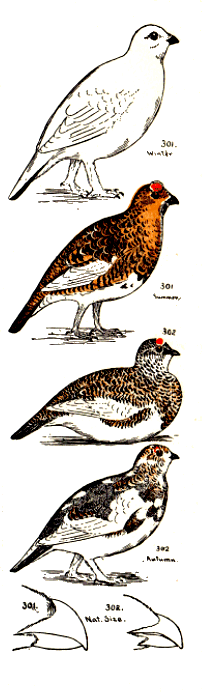
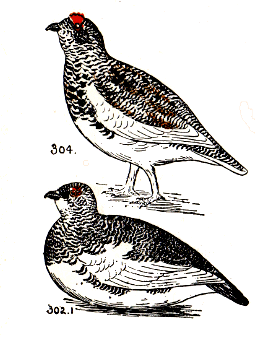
302c. Turner Ptarmigan (L. r. atkhensis). Lighter in general hue than 302d and without black blotches on upperparts. (Elliot.) Ad. ♂, Summer. "Ground color of upperparts pale raw-umber brown, mixed with pale grayish; chest and neck barred with pale brownish ochre and black." Ad. ♀, Summer. Ground color of upperparts rusty, mixed with pale grayish buff, narrowly and irregularly barred with black; chest and neck coarsely barred with rusty and black. (Ridgw.) Range.—Atka, Aleutian Islands. 302d. Townsend Ptarmigan (L. r. townsendi). Ad. ♂, Summer. Above, breast and flanks raw umber finely vermiculated with black on back; with black blotches on head, neck and upperpart of back and wings. Ad. ♀, Summer. Above ochraceous, blotched and barred with black; lighter below. (Elliot.) Range.—Kyska and Adak, Aleutian Islands. 302.1. Evermann Ptarmigan (Lagopus evermanni). L. 13.9. Ad. ♂, Summer. Above and breast black slightly marked with rusty. Ad. ♀, Summer. Entire body plumage, ochraceous, blotched and barred with black and above tipped with white or ochraceous: below black bars wider and no white tips. (Elliot.) Range.—Attu, Aleutian Islands. 303. Welch Ptarmigan (Lagopus welchi). L. about 14. Bill and tail as in No. 302; plumage grayer than in No. 302. Ad. ♂, Summer. Above black finely and irregularly marked with wavy lines of buff and white. Ad. ♀, Summer. Above black finely and irregularly barred with buffy, grayish and white. Range.—Newfoundland. 304.? White-tailed Ptarmigan (Lagopus leucurus). L. 13. Tail white. Ad. ♂, Summer. Breast barred, black and white. Ad. ♀, Summer. Above black barred with rich buff; below rich buff barred with black. Ads., Fall. Above and breast rich buff finely vermiculated with black. Ads., Winter. Entirely white. Notes. When about to fly and at the beginning of flight a sharp cackle like that of a frightened hen. (Grinnell.) Range.—"Alpine summits of Rocky Mountains; south to New Mexico; north into British America (as far as Fort Halkett, Liard River); west to higher ranges of Oregon, Washington, and British Columbia." (Bendire.) 304a.? Kenai White-tailed Ptarmigan (L. l. peninsularis). Similar to No. 304, but in summer buff markings much paler; in fall, colors much grayer. Range.—Kenai Peninsula, Alaska.
Prairie Hens
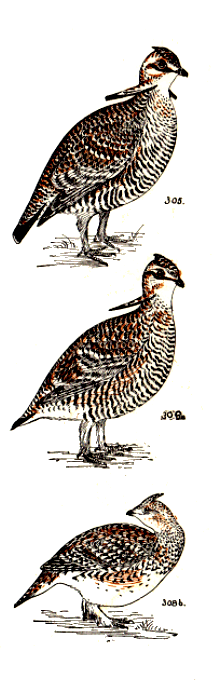
305. Prairie Hen (Tympanuchus americanus). L. 18. Underparts with distinct brown and white bars of about equal width. Ad. ♂. A neck-tuft of ten or more rounded feathers. Ad. ♀. Neck-tufts much smaller; whole tail barred. Notes. Song, a loud "booming." Range.—"Prairies of Mississippi Valley; south to Louisiana and Texas; east to Kentucky, Indiana, Ohio, Michigan and Ontario; west through eastern portions of North Dakota, South Dakota, Nebraska, Kansas and Indian Territory; north to Manitoba; general tendency to extension of range westward and contraction eastward; migration north and south in Minnesota, Iowa and Missouri." (A. O. U.) 305a. Attwater Prairie Hen (T. a. attwateri). Similar to No. 305>, but smaller and darker; neck-tufts proportionately wide; tarsus not fully feathered. Range.—Southwestern Louisiana and eastern Texas. 306. Heath Hen (Tympanuchus cupido). Similar to No. 305, but smaller; scapulars more broadly tipped with buff; neck-tuft of less than ten feathers; obtusely pointed; axillars barred with dusky. Range.—Martha's Vineyard, Massachusetts. 307. Lesser Prairie Hen (Tympanuchus pallidicinctus). Similar to No. 305>, but smaller, more buffy above; brown bars below narrower than whitish spaces between them. Notes. Doubtless the same as those of No. 305. Range.—Southwestern parts of Kansas and western Indian Territory, western (and southern?) Texas. (Bendire.) 308. Sharp-tailed Grouse (Pediœcetes phasianellus). L. 17. Breast feathers with internal V shaped loops; no neck-tufts. Ads. Prevailing color above black; narrowly barred with rusty and margined with paler. Range—Interior of British America, east to Rocky Mountains, about James Bay (Moose Factory) and the west shore of Hudson Bay, northern Manitoba, north at least to Fort Simpson, Mackenzie River, northwest territory. (Bendire.) 308a. Columbian Sharp-tailed Grouse (P. p. columbianus). Similar to No. 308, but prevailing color above buffy. Range.—"Northwest United States; south to northeastern California, northern Nevada and Utah; east to Montana and Wyoming, west to Oregon and Washington; north, chiefly west of Rocky Mountains, through British Columbia to central Alaska (Fort Yukon)" (Bendire.) 308b. Prairie Sharp-tailed Grouse (P. p. campestris). Similar to No. 308a, but more rusty. Notes. Song, a bubbling crow, a rattling of tail-feathers, and stamping of feet. Calls, when disturbed, cack, cack, cack; a soft clear whistle and a grunt of alarm. (Seton.) Call of mother to young and of young in reply a guttural, raucous croak. (Grinnell.) Range—"Plains and prairies of United States, north to Manitoba; east to Wisconsin and northern Illinois; west to eastern Colorado; south to eastern New Mexico." (Bendire.)
Grouse, Turkeys and Chachalaca
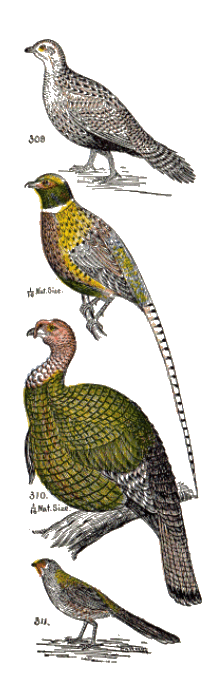
309. Sage Grouse (Centrocercus urophasianus). Ad. ♂, L. 29; Ad. ♀, L. 22. Similar to ♂, but smaller, throat whiter; breast barred black and whitish. Notes. When courting, low, grunting, guttural sounds; when alarmed, a sort of cackle, käk, käk. (Bendire.) Range.—"Sage regions of the Rocky Mountain Plateau, and west chiefly within the United States, but north to Assiniboia and the dry interior of British Columbia; east to North Dakota, South Dakota, Nebraska and Colorado; south to northern New Mexico, Utah and Nevada; west in California, Oregon and Washington, to the Sierra Nevada and Cascade Range." (A. O. U.) Pheasant (Phasianus torquatus × P. colchicus). An introduced species, see remarks on page 114. 310. Wild Turkey (Meleagris gallopavo silvestris). ♂ Ad. L. about 48; upper tail-coverts and tail tipped with rusty chestnut: white bars in primaries entire, crossing the webs of the feathers. Notes. Similar to those of the domesticated Turkey. Range.—Eastern United States from Pennsylvania south to central Florida; west to Nebraska and northeastern Texas. 310a. Merriam Turkey (M. g. merriami). Similar to No. 310, but tail and upper tail-coverts tipped with whitish. Range.—"Mountains of southern Colorado, New Mexico, Arizona and western Texas; and northern Chihuahua and Sonora, Mexico." (Bailey.) 310b. Florida Wild Turkey (M. g. osceola). Similar to No. 310, but smaller; primaries with narrow broken bars not reaching across feather. Range.—Southern Florida. 310c. Rio Grande Turkey (M. g. intermedia). Tips of upper tail-coverts and of tail rusty buff intermediate in color between those of Nos. 310 and 310a. Range.—"Lowlands of southern Texas and northeastern Mexico." (A. O. U.) 311. Chachalaca (Ortalis vetula maccalli). L. 21. Ads. Above olive-brown; tail blacker, all but middle-feathers bordered with whitish; belly brownish. Notes. A loud, trumpeting cha-cha-laca, repeated a number of times. Range.—Tropical portions of eastern Mexico, from Vera Cruz north to Lower Rio Grande Valley.
Order XI. PIGEONS AND DOVES.
COLUMBÆ.
Family 1. PIGEONS and DOVES. Columbidæ. 13 species, 3 subspecies.
Pigeons are distributed throughout the greater part of the globe, but their center of abundance appears to be in the Malay Archipelago, where about one hundred and twenty of the some three hundred known species are found. One hundred or more species have been described from the New World but only twelve of these inhabit North America.
The various races of domestic Pigeons, 'Pouters,' 'Fantails,' etc. are descendants of the Rock Dove of Europe, modified in form and habit through the selection by the breeder or 'fancier.'
Pigeons build a flimsy, platform nest of twigs and lay two white eggs. Both sexes incubate, one relieving the other at certain hours each day. The young are born naked and are fed by regurgitation, on 'Pigeons' milk,' the parent thrusting its bill into the mouth of its young and discharging therein food which has been softened in its own crop.
Some species of Pigeons nest in isolated pairs, others in large colonies, but it is the habit of many species to gather in large flocks after the nesting season.
The Wild or Passenger Pigeon, once so abundant in this county, was found in flocks throughout the year. Alexander Wilson, the 'father of American Ornithology' writing about 1808, estimated that a flock of Wild Pigeons seen by him near Frankfort, Kentucky, contained at least 2,230,272,000 individuals. Audubon writes that in 1805 he saw schooners at the wharves in New York city loaded in bulk with Wild Pigeons caught up the Hudson River, which were sold at one cent each.
As late as 1876 or 1877 there was a colony of nesting Wild Pigeons in Michigan, which was twenty-eight miles long and averaged three or four miles in width, and in 1881 the birds were still so abundant in parts of the Mississippi Valley that the writer saw thousands of birds, trapped in that region, used in a Pigeon match near New York City.
Today, however, as a result of constant persecution, the Wild Pigeon is so rare that the observation of a single individual is noteworthy.
Pigeons and Doves
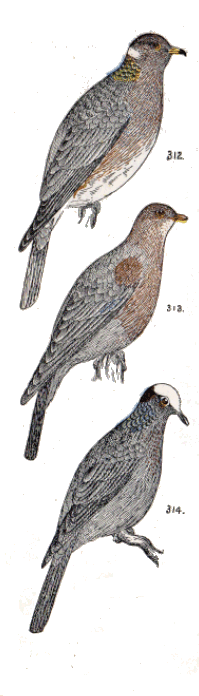
312. Band-tailed Pigeon (Columba fasciata). L. 15. Ad. ♂. Tail-band ashy above, whiter below; a white nape-band; tail square. Ad. ♀. Similar, or in some specimens, nape band absent; pinkish of crown and breast dingy. Notes. An owl-like hooting, sometimes a calm whoó-hoo-hoo, whoó-koo-hoo, at others a spirited hoóp-ah-whóo, and again wh'oo-ugh. (Bailey.) Range.—"Western United States from Rocky Mountains to the Pacific: north to Washington and British Columbia; south to Mexico and the highlands of Guatemala; distribution irregular, chiefly in wooded mountain regions." (A. O. U.) 312a. Viosca Pigeon (C. f. vioscæ). Similar to no. 312, but paler, more clearly bluish slate above; pink of crown and breast with a grayish bloom. Range.—Cape Region of Lower California. 313. Red-billed Pigeon (Columba flavirostris). L. 15. Ads. No tail-band; wings, tail, and belly slate; head and neck purplish pink; no iridescent markings. Notes. A fine, loud, coo-whoo-er-whoo. Range.—Costa Rica migrating north to southern Texas, New Mexico and Arizona. 314. White-crowned Pigeon (Columba leucocephala). L. 13.5 Ad. ♂. Crown white; body slate; lower hindneck iridescent; nape maroon. Ad. ♀. Much paler; crown ashy. Range.—Greater Antilles and Islands about Anegada Channel, coast of Honduras, Bahamas and certain Florida Keys.
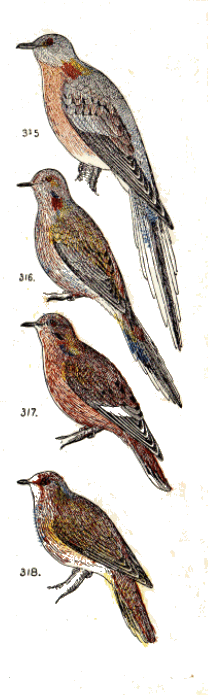
315. Passenger Pigeon, Wild Pigeon (Ectopistes migratorius). L. 16. Outer tail-feathers chestnut at base of inner web. Ad. ♂. Chin, whole head., and lower back bluish slate. Ad. ♀. Browner above, breast brownish ashy; neck feathers less iridescent. Notes. An explosive, squeaky, squawk. Range.—Formerly eastern North America north to Hudson Bay; now exceedingly rare, less so in the upper Mississippi valley than elsewhere. 316. Mourning Dove, Carolina Dove (Zenaidura macroura). L. 11.8. Outer tail-feathers slate color at base of inner web. Ad. ♂. Chin whitish; sides of head buffy; a black ear mark. Ad. ♀. Similar but paler, breast more ashy brown, neck-feathers less iridescent. Notes. Coo-o-o-ah, coo-o-o-coo-o-o-coo-o-o. Range.—North America, breeding from West Indies and Mexico north to southern Maine, Quebec, Ontario, Manitoba and British Columbia; winters from southern New York, southern Illinois, Kansas and southern California southward. 317. Zenaida Dove (Zenaida zenaida). L. 10. Ad. ♂. Tail short, without white markings; all but central pair of feathers tipped with ashy blue; secondaries tipped with white. Ad. ♀. Similar but pinkish of crown and underparts brownish; neck feathers less iridescent. Notes. Resemble those of No. 316, but are louder and deeper. Range.—Greater Antilles, coast of Yucatan and Bahamas, north in April to Florida Keys. 318. White-fronted Dove (Leptotila fulviventris brachyptera). L. 12. No black ear-mark; under wing-coverts rusty chestnut. Ad. ♂. Forehead whitish; all but central pair of tail-feathers tipped with white. Ad. ♀. Forehead dingier; breast brownish ashy; neck feathers less iridescent. Notes. A short, soft coo. Range.—Central America and Mexico, north in February to valley of Lower Rio Grande.
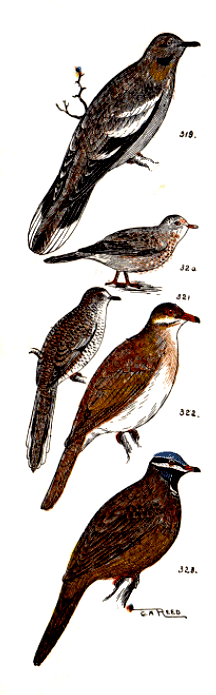
319. White-winged Dove (Melopelia leucoptera). L. 12. Wing-coverts, externally, widely margined with white; large black ear marks. Ads. All but central pair of tail-feathers bluish slate with a black band and whitish tip. Notes. A loud, crowing cookeree-cookeree-coo-ree-coo, crow-co-er-coo, crow-co-er-coo. Range.—Southern border of United States from Texas to Arizona south to Lower California and Central America, Cuba and Jamaica, casual at Key West, Florida. 320. Ground Dove; Mourning Dove (Columbigallina passerina terrestris). L. 6.7. Smallest of our Doves. Ad. ♂. Forehead and underparts deep vinaceous pink; hindhead and nape ashy blue margined with dusky; base of bill coral, tip black. Ad. ♀. Forehead and breast brownish gray; breast feathers with dusky centers and margins. Notes. A soft, crooning coo. Range.—Atlantic and Gulf States north to northern North Carolina, west to eastern Texas; more common near coast. 320a. Mexican Ground Dove (C. p. pallescens). Similar to No. 320, but forehead and underparts much paler; back grayer. Range.—Texas to southern California and south to Central America. 320b. Bermuda Ground Dove (C. p. bermudiana). Similar to 320a, but smaller and paler; bill wholly black. (Bangs and Bradlee.) Range.—Bermuda. 321. Inca Dove (Scardafella inca). L. 8. Ads. Tail long, outer feathers tipped with white; plumage above and below margined with dusky, giving a scaled appearance. Range.—Southern Texas (San Antonio), southern Mexico and southern Arizona south to Lower California and Central America. 322. Key West Quail-Dove (Geotrygon chrysia). L. 12. Ads. A white line below eye; belly white; back rich rusty with beautiful, metallic, purplish, green and blue reflections; tail rusty with no white. Range.—Cuba, Hayti, Bahamas and, rarely, Florida Keys. 322.1. Ruddy Quail-Dove (Geotrygon montana). L. 11. Ad. ♂. No white line below eye; breast dull pinkish; belly deep buff; back rich rusty with purplish reflections, tail rusty without white. Ad. ♀. Above olive-brown with greenish reflections; below rusty buff. Range.—Mexico south to Brazil; West Indies; casual at Key West Florida. 323. Blue-headed Quail Dove (Starnœnas cyanocephala). L. 12. Ads. Crown and sides of throat dull blue; middle of upper breast black with white bars and pinkish tips; belly rusty brown, lower back as in No. 316. Notes. A hollow sounding hu-up, the first syllable long, the second short. (Gundlach.) Range.—Cuba, and rarely Florida Keys.
Order XII. VULTURES, HAWKS, AND OWLS.
RAPTORES.
Family 1. AMERICAN VULTURES. Cathartidæ. 3 species.
Family 2. FALCONS, HAWKS, EAGLES, etc. Falconidæ. 33 species, 13 subspecies.
Family 3. BARN OWLS. Strigidæ. 1 species.
Family 4. HORNED OWLS. Bubonidæ. 19 species, 20 subspecies.
In the Raptores we have a group of birds of great value to man but whose services for the most part, are so little appreciated that, far from protecting these birds, we have actually persecuted them.
The Vultures, it is true, are given credit for their good work as scavengers and they are protected both by law and by public sentiment. Every one knows that a living Vulture is infinitely more useful than a dead one. As a result throughout countries inhabited by these birds they are usually both abundant and tame, entering the cities to feed in the streets with an assurance born of years of immunity from harm.
But how differently their kin of the family Falconidæ act in their relations to man! 'Wild as a Hawk' has become an adage. These birds are universally condemned. To kill one is a commendable act. Every ones hand is raised against them. In some localities a price has actually been set upon their heads.
A fondness for chickens, it is alleged, is the chief crime of Hawks, and in popular parlance all Hawks are 'Chicken Hawks' and as such are to be killed on sight.
Naturalists have long been aware that only one of our common Hawks habitually preys upon poultry while most of our species, by feeding largely on meadow mice, are actually beneficial. It was not, however, until this matter received the attention of the Biological Survey of the United States Department of Agriculture, that the economic status of Hawks, as well as of Owls, was placed on a sound scientific basis. In Dr. A. K. Fisher's report on the food of Hawks and Owls, issued by the Biologic Survey in 1893, the results of the examination of the contents of several thousands stomachs of these birds is tabulated. It is stated, for example, that only three out of two hundred and twenty stomachs of the so-called 'Chicken' or Red-shouldered Hawk contained the remains of poultry, while mice were found in no less than one hundred and two, and insects in ninety-two.
That the Sparrow Hawk is also wrongly named is clear from a study of its food, only fifty-four out of three hundred and twenty stomachs examined containing remains of birds, while insects were found in two hundred and fifteen.
As a matter of fact, among our commoner Hawks, the Cooper and Sharp-shinned are the only ones feeding largely on birds and poultry, and if the farmer will take the pains to ascertain what kind of Hawk it is that pays unwelcome visits to his barn-yard, he will be spared the injustice of condemning all Hawks for the sins of one or two.
Feeding after sunset, when the small mammals are most active, Owls are even more beneficial than Hawks. The Great Horned Owl, it is true, has an undue fondness for poultry, but the bird is generally so rare near thickly populated regions that on the whole it does comparatively little harm.
Fortunately, it is those Owls which are most common in settled regions which are of most value to man. Thus, our little Screech Owl feeds chiefly on mice and insects. Only one of the two hundred and fifty-five stomachs examined by Dr. Fisher contained the remains of poultry while mice were found in ninety-one and insects in one hundred. Of the Short-eared or Marsh Owl, seventy-seven out of one hundred and one stomachs contained mice remains, and the same injurious little rodents were found in eighty-four out of one hundred and seven stomachs of the Long-eared Owl.
The bones and hair of the small mammals eaten by Owls are rolled into oblong pellets in the stomach and are ejected at the mouth. These pellets may often be found in large numbers beneath the roosts in which Owls pass the day. In 200 such castings of the Barn Owl Dr. Fisher found the remains of 454 small mammals of which no less than 225 were meadow mice.
Hawks build large-bulky nests of sticks placing them usually well up in large trees, and lay, as a rule, four eggs which are generally whitish, blotched with brown. The Marsh Hawk is an exception. Its nest built largely of grasses, is placed on the ground in marshes and the eggs, often numbering six and rarely eight, are bluish white unmarked.
The Owls nest in holes in trees or banks, or, in some instances, an old Hawk or Crow nest may be occupied. The eggs usually number three to five and are always pure white.
Vultures and Osprey
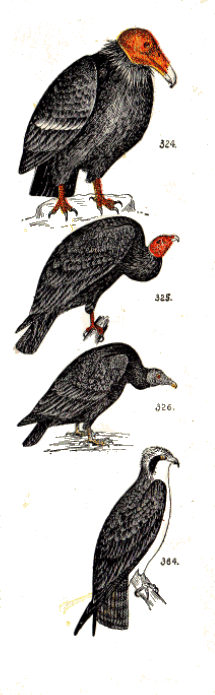
324. California Vulture (Gymnogyps californianus). L. 44-55; Ex. 8 1-2 to nearly 11 feet. (Ridgw.) Ads. Head and neck orange, blue, and red, unfeathered; feathers around neck and on underparts narrow and stiffened; greater wing-coverts tipped with white; under wing-coverts white. Range.—"Coast ranges of southern California from Monterey Bay, south to Lower California and east to Arizona" (Bailey). Recorded from Burrard Inlet, British Columbia (Fannin). 325. Turkey Vulture; Turkey Buzzard (Cathartes aura). L. 30; T. 11. Ads. Head and neck red unfeathered; brownish black; no white in plumage; bill whitish. Notes. A low hissing sound when disturbed. Range—Western Hemisphere from central and northeast New Jersey, central Illinois, northern Minnesota, the Saskatchewan region and British Columbia, south to Patagonia; winters from southern New Jersey, southern Illinois and southern California southward. 326. Black Vulture; Carrion Crow (Catharista urubu). L. 24. T. 8. Ads. Head and neck unfeathered, black, plumage black; under surface of wings silvery. Notes. A low grunting sound when disturbed. Range.—Tropical America, north, as a resident to North Carolina, southern Illinois and southern Kansas; west to the Plains, south to northern South America, strays as far north as Maine and South Dakota. 364. American Osprey; Fish Hawk (Pandion haliaëtus carolinensis). L. 23. Nape white; feet large; no bars on primaries. Ad. ♂. Below white with few or no spots on breast. Ad. ♀. Similar, but breast with numerous grayish brown spots and streaks. Notes. Loud, plaintive, whistles. Range.—America; breeds from Florida, Texas and Lower California, north to Labrador, Great Slave Lake and northern Alaska; winters from South Carolina and Lower Mississippi Valley to northern South America.
Kites and Marsh Hawks
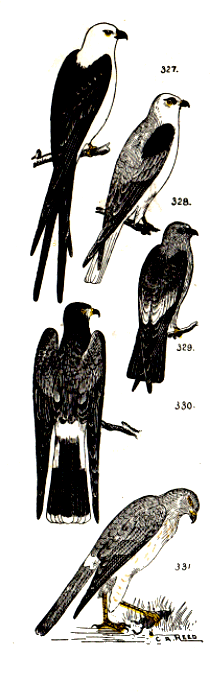
327. Swallow-tailed Kite (Elanoides forficatus). L. 24. Ads. Back purplish black, wings and tail blue-black. Notes. A shrill, keen, e-e-e or we-we-we. (Bendire.) Range.—Middle America; summers north to Virginia, central Illinois, northern Minnesota, Manitoba and Dakota; west to central Kansas, rarely to Colorado; winters in Central and South America. 328. White-tailed Kite (Elanus leucurus). L. 15.5. Ads. Shoulders black; back and middle tail-feathers ashy gray; rest of tail-feathers, forehead and underparts white. Yng. Upperparts with rusty. Notes. A plaintive, musical whistle. (Barlow.) Range.—Middle America north to South Carolina, southern Illinois, Indian Territory, western Texas, Arizona and central California; south to Argentine Republic; rare east of the the Mississippi. 329. Mississippi Kite (Ictinia mississippiensis). L. 14. Ads. Head, ends of secondaries, and underparts bluish gray; back bluish slate; tail black without bars. Yng. Head streaked black and white; back blackish, tipped with rusty; tail with three or four broken white bars; underparts buffy, streaked with rusty and blackish. Range.—Middle America; breeds north to South Carolina, southern Illinois and Kansas; winters in tropics. 330. Everglade Kite; Snail Hawk (Rostrhamus sociabilis). L. 18. Longer upper tail-coverts and base of tail white. Ads. Slaty black; end of tail with brownish and whitish bands. Yng. Above blackish brown tipped with rusty; below mottled rusty, blackish and buff. Range.—Tropical America north to southern Florida and eastern Mexico; south to Argentine Republic. 331. Marsh Hawk; Harrier (Circus hudsonius). L. ♂, 19; ♀, 22. Upper tail-coverts and base of tail white. Ad. ♂. Above gray or ashy; underparts with rusty spots. Ad. ♀, and Yng. Above brownish black with more or less rusty, particularly on the nape; below brownish rusty with black streaks on breast. Notes. A peevish scream and peculiar clucking or cackling. (Preston.) Range.—North America; breeds locally north to about latitude 60°; winters from southern New York, northern Illinois, northern Kansas, Colorado and British Columbia south to Central America.
Hawks
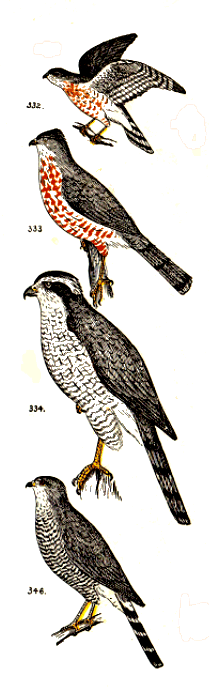
332. Sharp-shinned Hawk (Accipiter velox). L. ♂, 11.2; ♀, 13.5; T. ♂, 5.5; ♀, 7. Tail square at end. Ads. Above slaty gray; crown darker; below barred white and rusty brown. Yng. Above blackish brown lightly margined with rusty; below white streaked with brown. Note the relatively long tail in this and the two following species. Notes. Cac-cac-cac. (Ralph.) Range.—North America; breeds throughout its range but chiefly northward; winters from Massachusetts and Vancouver Island southward. 333. Cooper Hawk (Accipiter cooperii). L. ♂, 15.5; ♀, 19; T. ♂, 7.7; ♀, 9. Similar in color to No. 332, but tail rounded; adult with crown blacker. Notes. A cackling or chattering. (Bendire.) Range.—North America; breeds from southern Mexico north to British America; winters from Massachusetts, Lower Mississippi Valley and Oregon southward. 334. American Goshawk (Accipiter atricapillus). L. ♂, 22; ♀, 24; T. ♂, 10; ♀, 11.5. Ads. Above bluish slate; crown darker; a whitish line over the eye to the nape; below finely marked with gray and white. Yng. Above blackish brown, rusty and buff; below buffy white streaked with blackish. Range.—North America; breeds chiefly north of United States; winters south to New Jersey, rarely Virginia, Illinois, Missouri and Kansas; west to Oregon. 334a. Western Goshawk (A. a. striatulus). Similar to No. 334, but Ad. dark plumbeous above, markings on lower parts heavier and darker. Stripes on lower parts of Yng. broader and blacker. (Ridgw.) Notes. A shrill scream and a frequently repeated keeah or kreeah. (Bendire.) Range.—"Western North America; north to Sitka, Alaska; south to California; east to Idaho. Breeds in the Sierra Nevada south to latitude 38°." (A. O. U.) 346. Mexican Goshawk (Asturina plagiata). L. 17. Ads. Above slaty gray; below barred slaty-gray and white. Yng. Above blackish brown with rusty markings, particularly on wing-coverts; longer upper tail-coverts white with black spots or bars; tail brownish with numerous black bars; below whitish with large elongate spots. Notes. A peculiar piping note uttered while hovering in the air. (Bendire.) Range.—Middle America, from Panama north, in March, to Mexican border of United States.
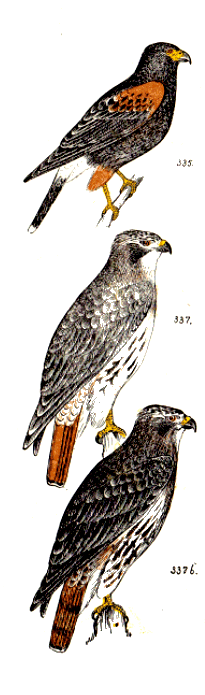
335. Harris Hawk (Parabuteo unicinctus harrisi). L. ♂, 19; ♀, 22. Longer upper tail-coverts, base and tip of tail white. Ads. Shoulders, thighs and under wing-coverts, reddish brown; under tail-coverts white. Yng. Similar but streaked below with rusty, buff and black; legs barred with white. Notes. A long, harsh, Buteo-like scream. (V. Bailey.) Range.—Middle America from Panama north to southern Texas, rarely Mississippi and southern California. 337 Red-tailed Hawk (Buteo borealis). L. ♂, 20; ♀, 23. Four outer primaries notched. Ads. Tail rusty brown with a black band, sometimes broken, near its tip; below buffy white, a band of spots across the belly; legs usually without bars. Yng. Tail grayish brown with a rusty tinge and numerous blackish bars; upper tail-coverts barred black and white; below less buffy than in adult; legs more often barred. Notes. A shrill whistle, suggesting the sound of escaping steam. Range.—Eastern North America, west to the Great Plains, north to about latitude 60°; breeds throughout its range; winters from Massachusetts, Illinois and South Dakota southward. 337a. Krider Hawk (B. b. kriderii). Similar to No. 337, but nearly or wholly white below. Ads. Usually without black tail band. Range.—"Great Plains of United States from Minnesota to Texas;, east irregularly or casually to Iowa and northern Illinois." (Bendire). 337b. Western Red-tail (B. b. calurus). Very variable in color. Ads. Sometimes sooty brown above and below with more or less rusty; in light phase resembles No. 337, but tail averages paler and sometimes has more than one bar; the underparts are deeper and legs are usually barred with rusty. Yng. Similar to Yng. of No. 337, but markings below heavier; flanks more barred. Range.—Western North America from Rocky Mountains to Pacific; north to British Columbia, south to central America; generally resident. 337d. Harlan Hawk (B. b. harlani). Ads. Above sooty brown; tail closely mottled with blackish, rusty and whitish; below varying from white, more or less-spotted on belly to sooty brown. Yng. Similar, but tail barred with blackish, gray, rusty or whitish. Range.—"Gulf States and Lower Mississippi Valley, north (casually) to Kansas, Iowa, Illinois and Pennsylvania; east to Georgia, and Florida." (Bendire).
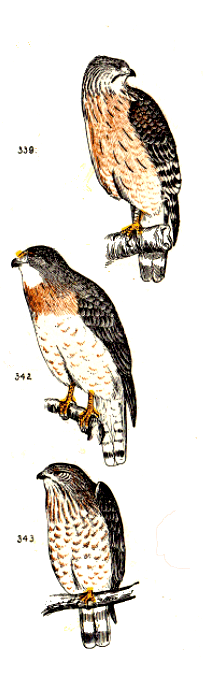
339. Red-shouldered Hawk (Buteo lineatus). L. ♂, 18.3; ♀, 20.3. Four outer primaries notched. Ads. Lesser wing-coverts bright reddish brown. Yng. Below whitish streaked with brownish; lesser wing-coverts less reddish; primaries with rusty buff. Notes. A loud screaming keé-yer, keé-yer. Range.—Eastern United States to Oklahoma, eastern Kansas, eastern Nebraska and Minnesota, north to Maine, south to northern Florida; generally resident. 339a. Florida Red-shouldered Hawk (B. l. alleni). Smaller than No. 339. (W. ♂, 11.) Ad. Much grayer above, no rusty on head, much paler below. Range.—Florida north along coast to South Carolina; west along coast to eastern Texas. 339b. Red-bellied Hawk (B. l. elegans). Similar to No. 339, but rusty of breast usually unbroken. Young with lower parts deep brownish or dusky prevailing; less buff on primaries. (Ridgw.) Range.—Pacific coast from Lower California north to British Columbia; east rarely to Colorado and western Texas. 342. Swainson Hawk (Buteo swainsoni). L. ♂, 20. Three outer primaries notched. Ad. ♂. Breast patch rusty brown. Ad. ♀. Breast-patch grayish brown. Dark phase. Brownish black more or less varied with rusty; tail obscurely barred. Yng. Below rich rusty buff with elongate black spots. Notes. Pi-tick, pi-tick, frequently repeated. (Bendire.) Range.—"Western North America from Wisconsin, Illinois, Arkansas and Texas to the Pacific coast; north to Arctic regions and south to Argentine Republic, casual east to Maine and Massachusetts. Breeds nearly throughout its North American range." (A. O. U.) 343. Broad-winged Hawk (Buteo platypterus). L. ♂, 15.8; ♀, 16.7. Three outer primaries notched. Ads. Tail with two whitish bands and a brownish tip; below barred with rusty brown. Yng. No buff in primaries; tail brownish with several black bars; below whitish, streaked with blackish. Notes. A high, sharp, keen, penetrating whistle. Range.—Eastern North America, breeds west to Plains, north to New Brunswick and Saskatchewan; winters from southern New Jersey south to northern South America.
Hawks and Caracara
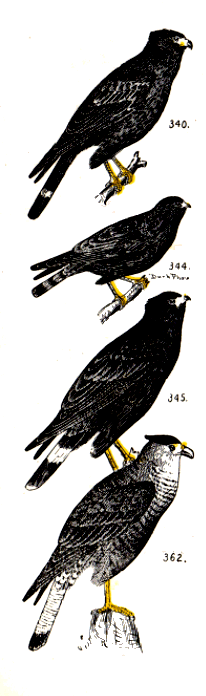
340. Zone-tailed Hawk (Buteo abbreviatus). L. ♂, 19; ♀, 21. Ads. Tail with little if any white tip; inner webs of all but middle feathers with black and white bars. Yng. Browner; tail grayish brown; white on inner webs, with numerous blackish bars. Notes. Not unlike those of Buteo borealis. (Belding.) Range.—Tropical America north to southern Texas, southern Arizona and southern California. 344. Short-tailed Hawk (Buteo brachyurus). L. 17; T. 7. Ads. Above slaty gray, tail barred with black and tipped with white; sides of breast rusty; rest of underparts white. Dark phase. Blackish, forehead whitish; tail lighter than back, barred with black. Yng. Above blackish brown, below cream buff, without black markings. Notes. Somewhat resembling the scream of the Red-shouldered Hawk, but more prolonged. (Pennock.) Range.—Tropical America, north to eastern Mexico; rare in Florida. 345. Mexican Black Hawk (Urubitinga anthracina). L. ♂, 19; ♀, 21. Ads. Tail with a white tip and broad white band across all the feathers. Yng. Above brownish black, buff and rusty; below buffy striped with blackish; tail with several black and whitish bars. Notes. Piping cries like the spring whistle of Numenius longirostris. (Bendire.) Range.—"Tropical America in general, north to central Arizona, and the Lower Rio Grande Valley in Texas." (Bendire). 362. Audubon Caracara (Polyborus cheriway). L. 22. Tail white with a black end and numerous black bars. Ads. Breast and hindneck barred; belly black. Yng. Crown, back, and belly dark brown; hindneck, breast and belly streaked with buffy. Notes. Generally silent, but sometimes utters a prolonged cackling note. (B. F. Goss.) Range.—Northern South America, north to southern Texas, southern Arizona and Lower California; interior of southern Florida; resident. 363. Guadalupe Caracara (Polyborus lutosus). Resembles No. 362, but has rump and upper tail-coverts dull brownish buff broadly barred with dull brown; tail brownish buff with broad bars of grayish brown bordered by narrower zigzag bars or lines of dusky; terminal band less than 2.00 wide. (Ridgway.) Range.—Guadalupe Island, west of Lower California.
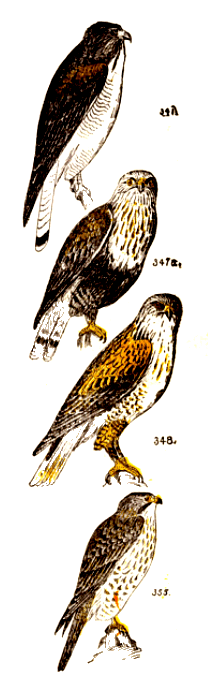
341. Sennett White-tailed Hawk (Buteo albicaudatus sennetti). L. ♂, 21; ♀, 23. Three outer primaries cut. Ads. Grayish slate above. Yng. Above brownish black; breast usually white, throat blackish, belly heavily marked with rusty and blackish; sometimes wholly black below; tail generally silvery gray., white on inner webs with numerous indistinct blackish bars. Notes. A cry much like the bleating of a goat (Merrill.) Range.—"From southern Texas and Arizona south to Mexico." (Bailey.) 347a. American Rough-legged Hawk (Archibuteo lagopus sancti-johannis). B. .7 deep, smaller than in No. 348. L. ♂, 21; ♀, 23. Legs feathered to the toes. Ads. Basal half of tail white, end half barred with black; belly with more or less black. Yng. No black bars on end half of tail; buffier below, more black on belly. Black phase. Black more or less varied with brown and rusty as it approaches light plumage of ad. or yng; but to be known by feathered legs. Range.—North America; breeds north of United States; winters south to Virginia, Missouri and central California. 348. Ferruginous Rough-Leg (Archibuteo ferrugineus). B. 1. deep, larger than in No. 347a; L. ♂, 22; ♀, 24. Legs feathered to toes. Ads. Above rich rusty streaked with black; legs rusty barred with black; tail grayish sometimes washed with rusty. Yng. Above blackish brown margined with rusty; below white; breast with a few streaks; legs spotted; tail with inner webs and base white; outer webs grayish. Dark phase. Sooty brown more or less varied with rusty; tail as in ad. Range.—"Western North America from the Plains (east North Dakota to Texas), west to the Pacific and from the Saskatchewan region south into Mexico; casually east to Illinois. Breeds from Utah, Colorado and Kansas north to the Saskatchewan Plains." (A. O. U.) 355. Prairie Falcon (Falco mexicanus). L. ♂, 17; ♀, 20. A blackish patch on the sides. Ad. ♂. Above including middle tail feathers, grayish brown; back with more or less concealed buffy bars. Ad. ♀. No buffy bars on back. Yng. Above margined with rusty and whitish; head much as in ad. Notes. Kee, kée, kee and a sort of cackle. (Bendire.) Range.—"United States from the eastern border of the Plains to the Pacific and from the Dakotas south into Mexico; casual east to Illinois. Breeds throughout its United States range." (A. O. U.)
Eagles and Gyrfalcon
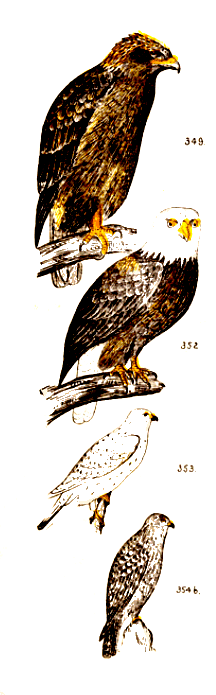
349. Golden Eagle (Aquila chrysaëtos). L. ♂, 30-35; ♀, 35-40; Ex. ♂, 78-84; ♀, 84-90. (Ridgw.) Legs feathered to toes. Ads. Back of head and nape paler than body; basal two-thirds of tail white. Yng. Base of tail with broken grayish bars. Notes. A shrill, kee-kee-kee, and, when alarmed, kiah-kiah repeated a number of times. (Bendire.) Range—Northern parts of northern hemisphere; in America south into Mexico; rare east of Mississippi, more common in Rocky Mountains and mountains of Pacific coast. 352. Bald Eagle (Haliæetus leucocephalus). L. ♂, 33; ♀ 35; Ex. ♂, 84; ♀, 89. Legs not feathered to toes. Ads. Head, neck and tail white. Yng. Head and body blackish, more or less varied with white; tail blackish mottled with white. Notes. Of the male, a loud, clear cac cac-cac; of the female harsh and broken. (Ralph.) Range.—North America breeding locally throughout its range, more frequently near the Atlantic coast; resident in United States. 352a. Alaska Bald Eagle (H. l. alascanus). Similar to No. 352, but larger. W. ♂, 23.8; ♀, 24.6; T. ♂, 11.5; ♀, 12; Tar. ♂, 4.1; ♀, 3.7. (Townsend.) Range.—Alaska. 353. White Gyrfalcon (Falco islandus). L. ♂, 22; ♀, 24. Tarsus feathered in front nearly to toes; only outer primary notched. Under tail coverts pure white. Ads. Below white with few or no black markings. Yng. Dark areas above larger, below with elongate blackish spots. Range.—Arctic regions, in America south in winter casually to Maine. 354. Gray Gyrfalcon (Falco rusticolus). L. ♂, 22; ♀, 24. Tarsus feathered in front nearly to toes; only outer primary notched. Under tail coverts with dusky margins. Ads. Crown usually more white than dusky; above barred with blackish and grayish; below white, breast streaked; sides and legs barred with dusky. Yng. Above dark brown with broken buffy bars and margins: tail with white and brown bars of nearly equal width, below white everywhere streaked with blackish. Range.—Arctic regions; south in winter to the northern border of the United States; casually as far as Kansas and Maine. 354a. Gyrfalcon (F. r. gyrfalco). Similar to No. 354, but head usually with more dusky than white; back in ad. indistinctly barred with grayish. Yng. With dark stripes of lower parts usually about equal in width to white interspaces. Range.—"Northern Europe and Arctic America, from northern Labrador and coasts of Hudson Bay to Alaska" (Ridgw.); south in winter casually, to northern border of United States as far as Long Island. 354b. Black Gyrfalcon (F. r. obsoletus). Similar to No. 354, but much darker; above plain dusky with few or no buffy markings; below dusky margined with buffy, the former prevailing. Notes. A chattering ke-a, ke-a, ke-a, blending into a rattling scream. (Turner.) Range.—Labrador: south in winter to northern New England; casually to Long Island.
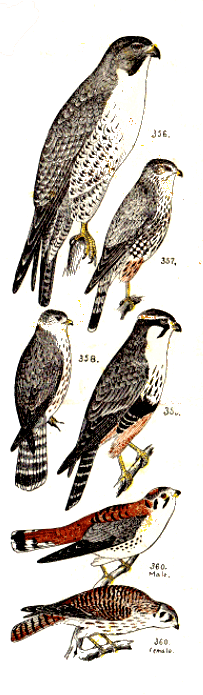
356. Duck Hawk (Falco peregrinus anatum). L. ♂, 16; ♀, 19. Sides of throat black. Ads. Above bluish slate; below buffy. Yng. Above blackish margined with rusty; tail with broken rusty bars and whitish tip; below deep rusty buff streaked with blackish; under surface of wing uniformly barred. Notes. Loud screams and noisy cacklings. (Bendire.) Range.—Western Hemisphere; breeds locally from Southern States to Arctic regions; winters from Northern States southward; more common west of Rocky Mountains. 356a. Peale Falcon (F. p. pealei). Ads. Crown uniform with back; chest heavily spotted with blackish; bars of remaining underparts very broad. (Ridgw.) Range.—"Pacific coast region of North America from Oregon to the Aleutian and Commander Islands, breeding throughout its range." (A. O. U.) 357. Pigeon Hawk (Falco columbarius). L. ♂, 10.5; ♀, 13. Two outer primaries notched. Ad. ♂. Above slaty blue; middle tail feather with not more than four black bands. Ad. ♀ and Yng. Above dark blackish brown; bars in middle tail feather five or less; below more heavily barred than in ♂. Range.—North America; breeds chiefly north of United States from Rocky Mountains and westward; breeds from Colorado and California north to Alaska; winters from Gulf States, Colorado and California, south to northern South America. 357a. Black Merlin (F. c. suckleyi). Similar to No. 357, but much darker above and more heavily, marked below; bars on tail and under side of wing nearly obsolete. Range.—Pacific coast from northern California to Sitka; east to eastern Oregon and Washington. 358. Richardson Merlin (Falco richardsonii). Resembles No. 357, but is paler and has the central tail feather crossed by six light bars, counting the terminal one. Range.—Interior of North America from eastern border of Great Plains west; rare west of Rockies; north to, at least, latitude 53°; south to Mexico. 359. Aplomado Falcon (Falco fusco-cærulescens). L. ♂, 16; ♀, 17.5. Middle of belly black. Ads. Above slaty gray; breast buff, lower belly rusty. Yng. Similar but grayish brown above, belly paler. Range.—South and Central America north to southern border of the United States. 360. Sparrow Hawk (Falco sparverius). L. 10; ♀, 11. Ad. ♂. Tail with one black bar; below spotted. Ad. ♀. Whole back barred; tail with numerous black bars; below streaked. Notes. A rapidly repeated killy-killy-killy, usually uttered while on the wing. Range.—Eastern North America west to Rocky Mountains; breeds from Gulf States to Hudson Bay; winters from southern Illinois and New Jersey southward.
Hawks and Owls
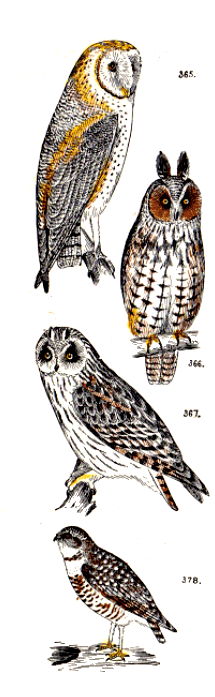
360a. Desert Sparrow Hawk (F. s. phalæna). Similar to No. 360, but slightly larger and appreciably paler; ♀ with black bars above narrower; streakings of underparts finer and more rusty. ♂, L. 10.6; W. 7.5; T. 5.3; ♀, L. 10.8; W. 7.7; T. 5.3. (Mearns.) Range.—"Western United States, north to western British Columbia and western Montana south, to Mazatlan in northwestern Mexico." (A. O. U.) 360b. St. Lucas Sparrow Hawk (F. s. peninsularis). Similar to No. 360a, but paler; smaller than No. 360. ♂, W. 6.4; T. 4.5; ♀, W. 7; T. 4.7. (Mearns.) Range—Lower California (Cape Region only?) 365. Barn Owl; Monkey-faced Owl (Strix pratincola). L. 18. No ear-tufts; eyes black. Ads. Above gray and yellowish buff; below white more or less washed with buff and spotted with black. Yng. More buffy below. Notes. A sudden, harsh scream and a screaming cr-r-r-r-e-e, repeated several times generally when flying. Range.—United States north to Long Island, (rarely Massachusetts), southern Ontario, Minnesota and Oregon; migrates slightly south and winters south to Mexico. 366. American Long-eared Owl (Asio wilsonianus). L. 14.8. Ear-tufts long; eyes yellow. Ads. Above varied with gray; belly barred. Notes. Usually silent except during the breeding season when they utter a soft toned, slow wu-hunk, wu-hunk and a low, twittering, whistling dicky, dicky, dicky. (Bendire.) Range.—North America; breeds from Nova Scotia, Manitoba, and British Columbia south into Mexico. 367. Short-eared Owl (Asio accipitrinus). L. 15.5. Ear tufts short; eyes yellow. Ads. No gray above; belly streaked. Notes. A shrill barking call like the ki-yi of a small dog. (Lawrence.) Range.—"Nearly cosmopolitan;" in America breeds locally from Virginia, northern Mississippi Valley, and Dakotas northward; winters from northern United States southward. 378. Burrowing Owl (Speotyto cunicularia hypogæa). L. 10. Tarsi bare behind. Ads. Spotted above with buffy; belly barred; chin and breast-patch white. Yng. Less distinctly spotted above; belly without bars. Notes. A mellow, sonorous coo-c-o-o; a chattering note uttered when flying, and a short, shrill alarm-note, tzip-tzip. (Bendire.) Range.—Western North America from humid coast region east to prairies of Mississippi Valley (western Nebraska, central Kansas, western Minnesota); north to about line of Canadian Pacific R. R.; south to Central America. 378a. Florida Burrowing Owl (S. c. floridana). Similar to No. 378, but slightly smaller and whiter throughout; spots above white with little if any buff; tarsi nearly bare. Range.—Interior of southern Florida.
Owls
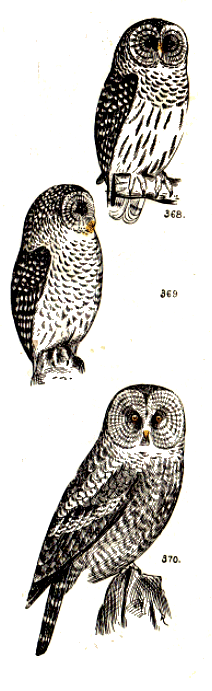
368. Barred Owl (Syrnium varium). L. 80. No ear-tufts; eyes black. Ads. Head, back and breast barred; toes feathered nearly if not quite to the nails. Notes. A loud, sonorous whoo-whoo-whoo-too-whoo, to-whoo-ah; a long-drawn, whoo-ah; rarely a wild scream; and when two individuals meet, a remarkable medley of hoots and ha-has. Range.—Eastern North America except Gulf Coast; north to Nova Scotia and Manitoba; west to Colorado; resident, except at northern limit of range. 368a. Florida Barred Owl (S. v. alleni). Similar to No. 368, but smaller, darker; black bars especially on breast, wider; toes nearly if not quite bare. Range.—Florida; north along coast to South Carolina; west along coast to Texas. 368b. Texas Barred Owl (S. v. helveolum). Similar to No. 368 in color, but with the toes bare as in No. 368a. Range.—Southern Texas. 369. Spotted Owl (Syrnium occidentale). Resembles No. 368, but has the head and neck spotted with white; primaries with broad, whitish tips. Notes. Probably similar to those of No. 368. (Bendire.) Range.—Western United States from southern Colorado and New Mexico, west to California, south to Lower California and Guanajuato, Mexico. 369a. Northern Spotted Owl (S. o. caurinum). Similar to No. 369, but darker; white markings smaller; white spots on head and neck reduced to minimum; white tips to primaries nearly obsolete. (Merriam.) Range.—Western Washington and British Columbia. 370. Great Gray Owl (Scotiaptex nebulosa). L. 27. No ear-tufts; eyes yellow. Ads. Above black finely and irregularly marked with white; breast streaked; feet feathered to toe-nails. Notes. Said to be a tremulous, vibrating sound. (Fisher.) Range.—North America; breeds north of Lat. 55°; winters south to northern border of United States casually as far as New Jersey, Illinois, Minnesota, Idaho, and northern California. 371. Richardson Owl (Nyctala tengmalmi richardsoni). L. 10. Ads. Above grayish brown with numerous white spots, particularly on head; feet feathered to toes and usually with indistinct, dusky bars. Notes. A musical, soft whistle. (Wheelright.) A peculiar grating cry. (Nelson.) (See next page.) Range.—Northern North America; breeds from Gulf of St. Lawrence and Manitoba northward; winters south to northern border of United States, casually to Massachusetts, Iowa, and Colorado; no Pacific coast record (?).
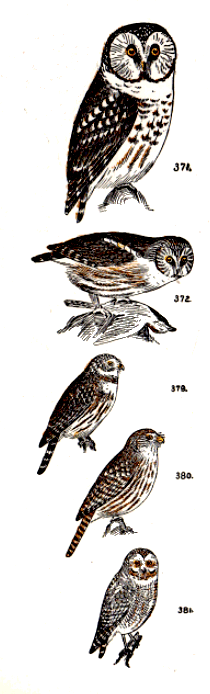
372. Saw-whet Owl; Acadian Owl (Nyctala acadica). L. 8. Ads. Above cinnamon brown; forehead with many, hindhead with few streaks; back with white spots; feet and legs less heavily feathered than in No. 371 and without dusky bars. Yng. Breast and back cinnamon brown with few white markings; belly rusty buff, unstreaked. Notes. A frequently repeated whistle; sometimes high, sometimes low; generally begins slow and ends rapidly; resembles noise of saw-filing. (Ralph.) Range.—North America; breeds from mountains of Pennsylvania, Massachusetts (rarely), northern New York, northern Illinois; and, in Rocky Mountains, from Mexico northward; winters south to Virginia, Kansas and central California. 372a. Northwest Saw-whet Owl (N. a. scotæa). Similar to No. 372, but darker both above and below, dark markings everywhere heavier; flanks, legs and feet more rufescent. (Osgood.) Range.—Queen Charlotte Islands, British Columbia. 379. Pygmy Owl (Glaucidium gnoma). L. 7. Top of head spotted. Ads. Above grayish brown; spots whitish. Yng. No spots on head. Notes. A soft cooing coohuh, coohuh, repeated a number of times. (Bendire.) Range.—"Timbered regions of western North America, from southern Rocky Mountains in Colorado, New Mexico, and Arizona," west to California, Oregon, and Washington, except coast belt, south into Mexico. 379a. California Pygmy Owl (G. g. californicum). Similar to No. 379, but darker; spots above buff or rusty. Range.—Humid coast region from Monterey, California, north to British Columbia. 379.1. Hoskin Pygmy Owl (Glaucidium hoskinsii). Similar to No. 379a, but smaller and grayer, the forehead and facial disc with more white, the upperparts less distinctly spotted. (Brewst.) Range.—Southern Lower California. 380. Ferruginous Pygmy Owl (Glaucidium phalænoides). L. 7. Top of head streaked. Ads. Above varying from grayish brown marked with whitish to plain reddish brown without marks; below white streaked with grayish brown or reddish brown. Yng. No streaks on head. Notes. A softly whistled coo repeated many times at intervals of about one second. Range.—Tropical America; from Brazil north to Mexican border of United States. 381. Elf Owl (Micropallas whitneyi). L. 6. Smallest of our Owls. Ads. Above grayish brown, head spotted; back barred with rusty; below mixed rusty, white and grayish. Notes. A tremulous cha-cha, cha-cha, in different keys, sometimes low, sometimes distinct. (Bendire.) Range.—Tableland of Mexico from Puebla north to Mexican border of United States; Lower California, and (rarely) California.
373. Screech Owl (Megascops asio). L. 9.4; W. 6.4; T. 3. Two color phases; with ear-tufts; eyes yellow. Ad. Gray phase. Above buffy gray irregularly marked with black; below gray, white, rusty and black. Ad. Red phase. Above bright rusty brown with a few black streaks; below white streaked with black and barred with rusty brown. Yng. Above gray or rusty barred with black and white; below white thickly barred with blackish. Notes. A frequently repeated tremulous, wailing whistle; often followed by a slower refrain-like call; a castanet-like snapping of the mandibles. Range.—Eastern North America from Florida north to New Brunswick, Ontario and Minnesota, west to the Great Plains; resident. 373a. Florida Screech Owl (M. a. floridanus). Smaller than No. 373, W. 6.0; T. 2.8. Two color phases. Similar to those of No. 373, but averaging darker and more heavily marked below; especially in red phase. Range.—Florida, north along coast to South Carolina; west along coast to Louisiana. 373b. Texas Screech Owl (M. a. mccalli). Similar to No. 373, but smaller, W. 6.1; underparts, especially sides of belly, with more black bars; toes barer. I have seen only a gray phase. Range.—"From western and southern Texas across east border of tablelands of Mexico." (Bailey.) 373c. California Screech Owl (M. a. bendirei). W. 6.6. A gray color phase only. Resembling No. 373, but somewhat darker above; less buff about the nape; black streakings more regularly distributed; underparts much as in No. 373b. Range.—California and southern Oregon. 373d. Kennicott Screech Owl (M. a. kennicottii). L. 10; W. 7.25. Ads. Sooty brown prevailing above; blackish markings below nearly if not fully as wide as white ones; darkest of our Screech Owls. Range.—Pacific coast from Oregon to Sitka. 373e. Rocky Mountain Screech Owl (M. a. maxwelliæ). W. 7. Similar to No. 373f above but paler; pale grayish buff predominating; black markings throughout much narrower and less numerous than in No. 373g; palest of our Screech Owls. Range.—"Foothills and adjacent plains of the east Rocky Mountains from Colorado north to Montana" (Bendire).
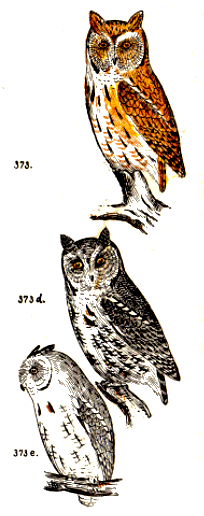
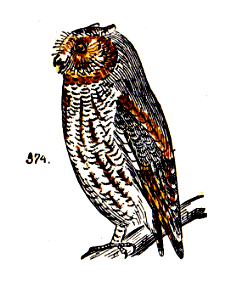
373f. Mexican Screech Owl (M. a. cineraceus). A gray color phase only. Similar to No. 373b. but much grayer above; buff markings of No. 373b almost wholly absent; below black bars more numerous and narrower than in No. 373b. Range.—"New Mexico, Arizona, Lower California, and western Mexico." (A. O. U.) 373g. Aiken Screech Owl (M. a. aikeni). A gray color phase only. W. 6.5. Similar to 373f, but still grayer; almost no buff above; black markings wider on head, back, and underparts. Range.—"Plains, El Paso County, Colorado, south probably to central New Mexico and northeastern Arizona." (A. O. U.) 373h. MacFarlane Screech Owl (M. a. macfarlanei). A gray color phase only. Ads. Of the size of kennicottii, but with color and markings of bendirei. W. 7.2; T. 3.8. (Brewst.) Range.—"Eastern Washington and Oregon to western Montana and probably intermediate regions, and north to the interior of British Columbia." (Bailey.) 373.1. Spotted Screech Owl (Megascops trichopsis). L. 7.7. Ads. Above mixed black, grayish brown and buff; black prevailing on head; feathers of foreback with buffy white spots on either side near the end; below much as in No. 373f. Range.—Southern Arizona and southward into northern Mexico. 373.2. Xantus Screech Owl (Megascops xantusi). W. 5.3. Ad. ♂. Above drab, back tinged with pinkish rusty and faintly vermiculated with reddish brown; breast paler ashy faintly suffused with pinkish or rusty; belly whitish; underparts finely barred with reddish brown and streaked with clove-brown. (Brewst.) Range.—Cape Region of Lower California. 374. Flammulated Screech Owl (Megascops flammeola). L. 7. Ads. Ear-tufts small; eye surrounded by rusty, then by gray; crown, nape and tips of scapulars largely rusty; neck band rusty. Range.—Mountains of Guatemala north to Colorado (11 specimens, 7 from Boulder County, Cook), west rarely to California (2 specimens). 374a. Dwarf Screech Owl (M. f. idahoensis). Similar to No. 374, but slightly smaller and paler, especially on underparts where ground color is white and black markings are restricted. Range.—Idaho, eastern Oregon and California (San Bernardino Mountains, 3 specimens, Grinnell).
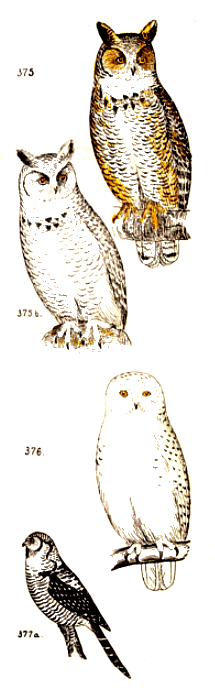
375. Great Horned Owl (Bubo virginianus). ♂, L. 22; W. 15. Ads. Ears conspicuous; the feathers nearly throughout the body rusty basally; facial disc rich rusty. Notes. A loud, low, deep-toned whoo, hoo-hoo-hoo, whooo-whooo, variable, but usually on the same note; rarely a hair-raising scream. Range.—Eastern North America; north to Labrador, south to Central America; resident. 375a. Western Horned Owl (B. v. pallescens). Smaller and paler than No. 375, W. 13.7; facial disc washed with rusty. Range.—Western United States, except Pacific coast region, east to Great Plains; casually Wisconsin and Illinois north to Manitoba and British Columbia; south to Mexico. 375b. Arctic Horned Owl (B. v. arcticus). Black and white prevailing above; bases of feathers light yellowish buff; below black and white with little or no buffy; facial disc gray. Range.—Interior of Arctic America, from Rocky Mountains east to Hudson Bay; breeds north of Lat. 51°; in winter straggles southward to adjacent border of United States; rarely to Wyoming and Nebraska. 375c. Dusky Horned Owl (B. v. saturatus). Size of No. 375b, but much darker; black bars below equalling white ones in width; darkest bird of group. Range.—"Pacific coast region from Monterey Bay, California, north to Alaska; east to Hudson Bay and Labrador." (A. O. U.) 375d. Pacific Horned Owl (B. v. pacificus). Somewhat smaller than No. 375b, W. 13.5; more like No. 375 in color but less rusty. Range.—California, except humid coast region; east to Arizona. 375e. Dwarf Horned Owl (B. v. elachistus). Similar to No. 375c, but very much smaller. W. ♂, 12.8; ♀, 13.4. (Brewster.) Range.—Lower California. 376. Snowy Owl (Nyctea nyctea). L. 25. Ad. ♂. White more or less barred with blackish. Ad. ♀. Similar, but more heavily barred. Range.—Northern parts of northern hemisphere; in America breeds from Lat. 50° northward; winters south to northern United States; straggles as far as Texas and California. 377a. American Hawk Owl (Surnia ulula caparoch). L. 15; T. 7.2 long and rounded. Ads. Above brownish black, crown thickly spotted, scapulars conspicuously margined with white; chin blackish; belly barred. Notes. A shrill cry generally uttered while flying. (Fisher.) Range.—Northern North America: breeds from Newfoundland and northern Montana northward; winters south to northern United States, rarely to New Jersey, Pennsylvania, and Illinois; rare on Pacific coast.
Order XIII. PAROQUETS AND PARROTS.
PSITTACI.
Family 1. PARROTS and PAROQUETS. Psittacidæ. 2 species.
Parrots are found throughout the warmer parts of the earth. About one hundred and fifty of the some five hundred known species inhabit America. The Carolina Paroquet, practically the only member of this family found in the United States, since the Thick-billed Parrot barely reaches our border in Arizona, was once an abundant bird in the Southern States, but it is now restricted to a few localities in Florida and possibly Indian Territory.
Order XIV. CUCKOOS, TROGONS, KINGFISHERS, Etc.
COCCYGES.
Family 1. CUCKOOS, ANIS, etc. Cuculidæ. 5 species 2 subspecies.
Family 2. TROGONS. Trogonidæ. 1 species.
Family 3. KINGFISHERS. Alcedinidæ. 2 species.
The Cuckoos are a group of world-wide distribution, but are more numerous in the eastern than in the western hemisphere where only thirty-five of the some one hundred and seventy-five species are found. The habit of the European Cuckoo in placing its eggs in the nest of other birds is well known. The American species, however, build nests of their own though it is true they are far from well made structures. With the Anis one nest serves for several females who may deposit as many as thirty eggs, incubation and the care of the young being subsequently shared by the members of this singular family.
Trogons are found in the tropics of both the Old and New Worlds. They are quiet, sedentary birds inhabiting forests and feeding largely on fruit. So far as is known they nest in hollow trees.
Only eight of the one hundred and eighty or more known Kingfishers are found in America, the remaining species being confined to the Old World where they are most numerous in the Malay Archipelago.
Parrots and Paroquets
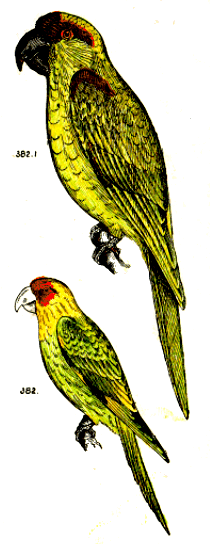
382.1. Thick-billed Parrot (Rhynchopsitta pachyrhyncha). L. 16.5. Ads. Forehead, loral region, stripe over eye, bend of wing and thighs red; greater under wing-coverts yellow; rest of plumage green. Range—Central Mexico north rarely to southern Arizona. 382. Carolina Paroquet (Conurus carolinensis). L. 12.5 Ads. Forehead and cheeks deep orange, rest of head yellow. Yng. Forehead and loral region orange; rest of head green like back; no yellow on bend of wing. Notes. A sharp, rolling kr-r-r-r-r-r. Range.—Formerly eastern United States, north to Maryland, Great Lakes, and Iowa; west to Colorado, Oklahoma and eastern Texas; now restricted to southern Florida and parts of Indian Territory.
Cuckoos
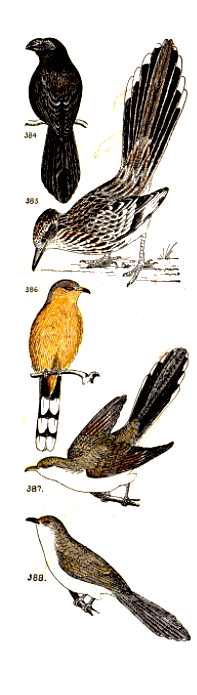
383. Ani (Crotophaga ani). Resembling No. 384 but upper mandible without grooves. Notes. A complaining whistled oo-eeek, oo-eeek. Range eastern South America; north to West Indies and Bahamas, rarely to southern Florida; accidental in Louisiana and Pennsylvania. 384. Groove-billed Ani (Crotophaga sulcirostris). L. 12.5 B. .7 high; the upper mandible with ridges and furrows. Ads. Blue-black, many of the feathers with iridescent margins. Range.—Northwestern South America, north through Mexico to Lower California and southeastern Texas; casually Arizona, Louisiana and Florida. 385. Road-runner (Geococcyx californianus). L. 23. Toes two in front, two behind. Ads. Above glossy olive-brown with whitish and rusty margins, tail much rounded, outer tail-feathers tipped with white. Notes. A soft cooing and a low chittering note produced by striking the mandibles together. Bendire mentions a note like that of a hen calling her brood. Range central Mexico north, rarely to southwestern Kansas, southern Colorado, and Sacramento Valley, California, rarely to southern Oregon. 386. Mangrove Cuckoo (Coccyzus minor). L. 13. Ads. Underparts uniformly rich buff; above grayish brown, crown grayer; ear-coverts black; tail black, outer feathers broadly tipped with white. Range.—Northern South America, north through Central America, Mexico and Greater Antilles (except Porto Rico?) to Florida and Louisiana, migrating south in fall. 386a. Maynard Cuckoo (C. m. maynardi). Similar to No. 386, but underparts paler, the throat and forebreast more or less ashy white. Range.—Bahamas and (eastern?) Florida Keys. 387. Yellow-billed Cuckoo (Coccyzus americanus). L. 12.2. Ads. Below white; lower mandible largely yellow, tail black, outer feathers widely tipped with white. Notes. Tut-tut, tut-tut, tut-tut, tut-tut, cl-uck, cl-uck, cl-uck, cl-uck, cl-uck, cl-uck, cow, cow, cow, cow, cow, cow, usually given in part. Range.—Eastern North America; breeds from Florida to New Brunswick and Minnesota; winters in Central and South America. 387a. California Cuckoo (C. a. occidentalis). Similar to No. 387 but somewhat grayer and larger; the bill slightly longer, 1.05. Range.—Western North America; north to southern British Columbia; east to Western Texas; winters south into Mexico. 388. Black-billed Cuckoo (Coccyzus erythrophthalmus). L. 11.8. Ads. White below; bill black; tail, seen from below, grayish narrowly tipped with white; above, especially on crown, browner than No. 387. Notes. Similar to those of No. 387, but softer, the cow notes connected. Range.—Eastern North America; west to Rocky Mountains; breeds north to Labrador and Manitoba; winters south of United States to Brazil.
Trogon and Kingfishers
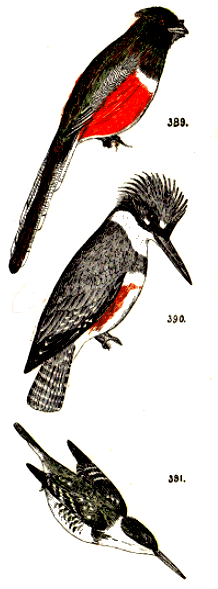
389. Coppery-tailed Trogon (Trogon ambiguus). L. 12. Ad. ♂. Wing-coverts finely vermiculated; tail coppery tipped with black; outer web and end of outer feathers white, mottled with black. Ad. ♀. Ear-coverts gray; back grayish brown; middle tail-feathers rusty brown tipped with black; breast brownish; upper belly grayish; ventral region pink. Notes. Resemble those of a hen Turkey. (Fisher.) Range.—Southern Mexico north to Lower Rio Grande and Arizona. 390. Belted Kingfisher (Ceryle alcyon). L. 13. Ad. ♂. Breast-band and sides like back. Ad. ♀. Breast-band and sides rusty. Notes. A loud, harsh rattle. Range.—North America; breeds from Florida, Texas, and California north to Arctic regions; winters from Virginia, Kansas, and southern California south to northern South America. 391. Texas Kingfisher (Ceryle americana septentrionalis). L. 8.7. Ad. ♂. Breast rusty brown; back greenish; a white collar. Ad. ♀. Throat and breast white, sometimes tinged with buffy; a breast and belly band of greenish spots. Notes. When flying, a sharp, rattling twitter; when perching, a rapid, excited ticking. Range.—Tropical America, from Panama north to southern Texas.
Order XV. WOODPECKERS.
PICI.
Family 1. WOODPECKERS. Picidæ. 24 species, 22 subspecies.
The some three hundred and fifty known species of Woodpeckers are distributed throughout the wooded parts of the world, except in Australia and Madagascar, nearly one half of this number being found in the New World. Feeding largely upon the eggs and larvæ of insects, which they can obtain at all seasons, most of the North American species are not highly migratory but are represented in the more northern parts of their range at all times of the year.
Woodpeckers nest in holes in trees generally excavated by themselves. The eggs, four to eight or nine in number, like those of most birds that lay in covered situations, are pure white. The young are born naked and are reared in the nest.
In few birds is the close relation between structure and habit more strikingly illustrated than in the Woodpeckers. Their lengthened toes placed two before and two behind (except in one genus) and armed with strong nails enable them readily to grasp the bark of trees up which they climb. Their stiffened, pointed tail-feathers are also of assistance to them in retaining their position on tree trunks, serving as a prop on which they may rest while chiseling out their homes or laying bare the tunnels of the grubs of wood boring beetles. For this purpose they use their bill, a marvellously effective tool with which some of the large Woodpeckers perform astonishing feats. I have seen an opening made by a Pileated Woodpecker in a white pine tree, twelve inches long, four inches wide, and eight inches deep, through perfectly sound wood to reach the larvæ at work in the heart of the tree. The bill is also used as a musical instrument, the 'song' of Woodpeckers being a rolling tattoo produced by rapid tappings on some resonant limb.
As might be supposed the Woodpeckers are great of economic value. Professor Beal states that at least two-thirds to three-fourths of the food of our common Downy and Hairy Woodpeckers consists chiefly of noxious insects.
Woodpeckers
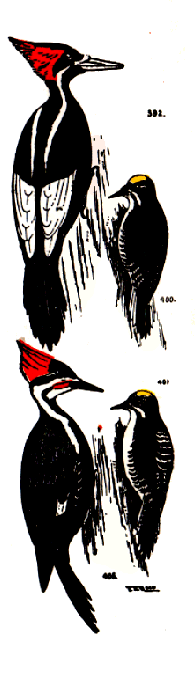
392. Ivory-billed Woodpecker (Campephilus principalis). L. 20; B. 2.7, ivory white. Ad. ♂. Crest scarlet. Ad. ♀. Similar to the ♂, but crest black. Notes. A sharp, penny trumpet-like yap-yap. Range.—Florida west to eastern Texas; north to southern Missouri and Oklahoma; formerly north to North Carolina, Illinois, and Indiana. 400. Arctic Three-toed Woodpecker (Picoides arcticus). L. 9.5. Back shining black without white; toes two in front, one behind Ad. ♂. Crown yellow. Ad. ♀. Crown black. Notes. A sharp, shrill, chirk, chirk. (Hardy.) Range.—"Northern North America, from the Arctic regions south to northern United States, (New England, New York, Michigan, Minnesota and Idaho), and in the Sierra Nevadas to Lake Tahoe." (A. O. U.) 401. American Three-toed Woodpecker (Picoides americanus). L. 8.7. Back with white: toes two in front, one behind. Ad. ♂. Crown yellow; white bars on back broken, detached not confluent. Notes. A prolonged squealing, rarely uttered. (Turner.) Range.—Northern North America; west to Rocky Mountains; breeds from Maine, mountains of New Hampshire, northern New York, and northern Minnesota northward; south in winter, rarely to Massachusetts, central New York, and northern Illinois. 401a. Alaskan Three-toed Woodpecker (P. a. fasciatus). Similar to No. 401, but white bars on back confluent forming a more or less continuous white patch. Range.—"Alaska Territory; casually? south through western British Columbia to northwestern Washington (vicinity of Mt. Baker); east irregularly to Great Bear Lake and the Mackenzie River Valley, Northwest Territory." (Bendire.) 401 b. Alpine Three-toed Woodpecker (P. a. dorsalis). Similar to No. 401a, but larger. W. 5; bill narrower. Notes. A harsh, nasal cry; a sudden, sharp whip, whip, whip, (Mearns.) Range.—"Rocky Mountain region from British Columbia and Idaho south into New Mexico." (A. O. U.) 405. Pileated Woodpecker (Ceophlœus pileatus). L. 17. W. 8.9. Ad. ♂. Crown, crest, and streaks on sides of throat red; sides of neck and patch on wing white. Ad. ♀. Forehead brownish, no red on sides of throat. Notes. A sonorous cow-cow-cow, repeated slowly many times and a wichew call when two birds meet; both suggesting calls of the Flicker. Range.—Southern United States, north to South Carolina. 405a. Northern Pileated Woodpecker (C. p. abieticola). Similar to No. 405, but slightly larger, W. 9; T. 6.2. Range.—Locally distributed throughout more heavily wooded regions of North America, except in southern United States, north to Lat. 63°.
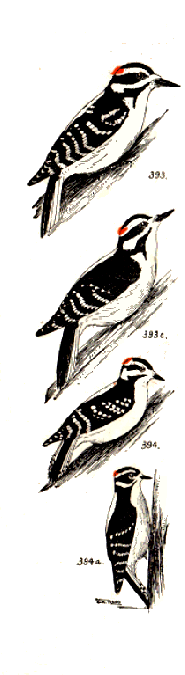
393. Hairy Woodpecker (Dryobates villosus). L. 9; W. 4.7 Outer tail-feathers white without terminal black marks. Ad. ♂. Wing-coverts spotted, underparts white; nape with a red band. Ad. ♀. Similar but nape band white. Notes. A sharp peek and a Kingfisher-like rattle. Range.—Eastern United States from North Carolina to Canada. 393a. Northern Hairy Woodpecker (D. v. leucomelas). Similar to No. 393, but larger; L. 10; W. 5.2. Range.—British America north to Alaska. 393b. Southern Hairy Woodpecker (D. v. audubonii). Similar to No. 393, but smaller; L. 8; W. 4.2. Range.—South Atlantic and Gulf States, north to South Carolina. 393c. Harris Woodpecker (D. v. harrisi). Similar to No. 393, but wing-coverts usually without white spots; underparts dirty, dusky, brownish. Range.—Pacific coast from northern California to British Columbia. 393d. Cabanis Woodpecker (D. v. hyloscopus). Similar to No. 393c, but whiter below. Range.—California, east to Arizona. 393e. Rocky Mountain Hairy Woodpecker (D. v. monticola). Similar to No. 393c, but pure white below; larger, size of No. 393a. Range.—Rocky Mountain region from northern New Mexico north to British Columbia. 393f. Queen Charlotte Woodpecker (D. v. picoideus) Similar to No. 393c, but middle of back barred and spotted with black; flanks streaked with black. (Osgood.) Range.—Queen Charlotte Islands, British Columbia. 394. Southern Downy Woodpecker (Dryobates pubescens). L. 6; W. 3.5. Outer tail-feathers white with terminal black marks. Ad. ♂. Nape-band red; smallest of group, underparts dingier than in No. 394c; white of less extent; wing-coverts spotted. Ad. ♀. Similar but nape-band white. Notes. A sharp peek and a rattle similar to that of No. 393, but not so loud. Range.—South Carolina, Georgia, and Gulf States to Texas. 394a. Gairdner Woodpecker (D. p. gairdnerii). Similar to No. 394b, but underparts sooty gray; the darkest below of any form in the group. Range.—Pacific coast from northern California north to British Columbia. 394b. Batchelder Woodpecker (D. p. homorus). Similar to No. 394c, but wing-coverts with few or no white spots, under tail-coverts without dusky streaks. Range.—"Rocky Mountain region of the United States." (A. O. U.) 394c. Northern Downy Woodpecker (D. p. medianus). L. 6.5; W. 3.7. Similar to No. 394, but larger; whiter below; white markings of greater extent. Range.—Eastern North America south to South Carolina. 394d. Alaskan Downy Woodpecker (D. p. nelsoni). W. 4. Similar to No. 394c, but still larger and whiter; largest of the group. Range.—Alaska.
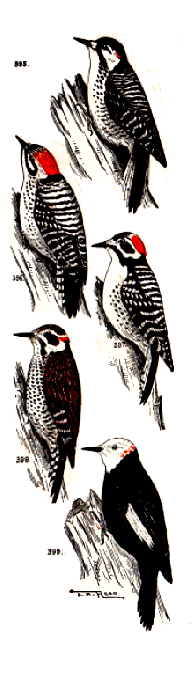
394e. Willow Woodpecker (D. p. turati). Similar to No. 394a, but smaller, W. 3.8. superciliary patch and underparts whiter; tertials always more or less spotted with white. (W. K. Fisher.) Range.—"California, except: desert ranges and eastern slope of Sierra Nevada, coast region north of Marin Co., and region north of upper end of Sacramento Valley." (W. K. Fisher.) 395. Red-cockaded Woodpecker (Dryobates borealis). L. 8.4. Sides of head and neck white bordered by black below. Ad. ♂. A nearly concealed red tuft on either side of the hindhead. Ad. ♀. Similar, but no red on head. Notes. A loud, hoarse, yank, yank. Range.—Southern United States; west to eastern Texas; north to Virginia and Arkansas. 396. Texan Woodpecker (Dryobates scalaris bairdi). L. 7.5. Outer tail-feathers barred to their base; nasal tufts brownish. Ad. ♂. All crown feathers tipped with red; back barred: below brownish white, spotted and streaked with black. Ad. ♀. Similar but top of head wholly black. Range.—Northern Mexico, north to Texas boundary, New Mexico, southern Colorado, southern Nevada, southwestern Utah, and southeastern California. 396a. Saint Lucas Woodpecker (D. s. lucasanus). Similar to No. 396, but outer tail-feather barred with black only on terminal half or less, except sometimes on inner web. (Ridgw.) Range.—Lower California, north, rarely to Colorado Desert, California. 397. Nuttall Woodpecker (Dryobates nuttallii). L. 7.5. Below white only slightly soiled; outer tail-feather barred only on end half. Ad. ♂. Crown black streaked with white; nape red. Ad. ♀. Similar but top of head entirely black, usually, with a few white spots. Yng. Top of head dull red. Notes. A sharp quee-quee-quee-queep; a diminutive chittah. Bailey. Loud rattling notes. (Henshaw.) Range.—Northern Lower California, north locally, to southern Oregon. 398. Arizona Woodpecker (Dryobates arizonæ). L. 8.2. Above brown, below spotted. Ad. ♂. A red nape band. Ad. ♀. Similar but no red on nape, brown of crown continuous with that of back. Yng. Whole crown red. Range.—Northwestern Mexico north to southern Arizona and southwestern New Mexico. 399. White-headed Woodpecker (Xenopicus albolarvatus). L. 9. Whole head and part of wings white. Ad. ♂. Nape red. Ad. ♀. Nape white. Notes. A sharp, clear witt-witt; a rather silent bird. (Bendire.) Range.—Mountains of western United States from southern California north to southern British Columbia; east to western Idaho and western Nevada.
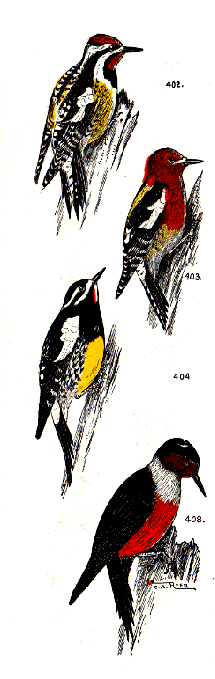
402. Yellow-bellied Sapsucker (Sphyrapicus varius). L. 8.5; W. 4.8. Ad. ♂. Crown and throat red; a whitish band from eye to eye across nape; belly washed with yellow; breast patch black Ad. ♀. Similar, but throat white; crown rarely black. Yng. Breast grayish with internal dark rings or bars; crown dirty yellowish margined with dusky; red feathers soon appear on throat and crown. Notes. A clear ringing cleur repeated; a low snarling cry resembling mew of Catbird. (Brewster.) Range.—Eastern North America; breeds from Massachusetts and northern Illinois north to about Lat. 63° 30'; south in Alleghanies to northwest Georgia; winters from southern Illinois and southern Virginia to Central America. 402a. Red-naped Sapsucker (S. v. nuchalis). Similar to No. 402, but slightly larger. W. 5; the nape band red; red of throat encroaching on black bordering streaks; female the same but chin white. Range.—Rocky Mountain region; breeds from Colorado and northeastern California (?), north to British Columbia; winters from southern California south to northwestern Mexico. 403. Red-breasted Sapsucker (Sphyrapicus ruber). L. 9. Ads. Crown, whole throat and breast dull red; in other respects resembling No. 402. Notes. Jay or chaē, peeye, pinck, and peurr: (Bendire.) Range.—Breeds in mountains from northern Lower California north to southern Oregon. 403a. Northern Red-breasted Sapsucker (S. r. notkensis). Similar to No. 403, but colors deeper, red brighter; belly yellower. Range.—Pacific coast region from Santa Cruz Mountains, California, north to southern Alaska. 404. Williamson Sapsucker (Sphyrapicus thyroideus). L. 9. Belly bright yellow; rump white. Ad. ♂. Above black;, a red stripe on throat; lesser wing-coverts white. Ad. ♀. Crown and throat brownish; back and lesser wing-coverts barred black and whitish. Yng. Similar to ♀, but breast barred like sides. Notes. A shrill huit-huit uttered when flying. (Bendire.) The roll of this Woodpecker is not continuous, but is broken or interrupted. Range.—Higher mountain ranges of western United States; breeds from northern New Mexico, Arizona, and southeastern California north to Wyoming and southern British Columbia; winters from southern California and western Texas into Mexico. 408. Lewis Woodpecker (Asyndesmus torquatus). L. 11. Ads. Breast and a collar around the neck gray; region about base of bill dark red; belly pinkish red; above shining green black. Yng. No gray collar; crown suffused with red. Notes. A weak, peeping twitter. (Lawrence). Generally a silent bird. Range.—Western United States; breeds from New Mexico, Arizona, and southern California north to southern Alberta and British Columbia; winters from southern Oregon and Colorado south to western Texas and southern California.
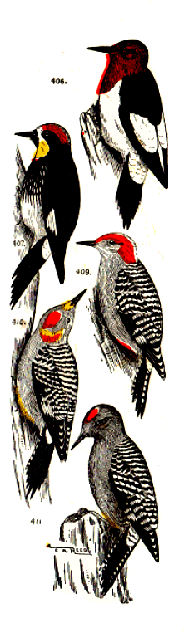
406. Red-headed Woodpecker (Melanerpes erythrocephalus). L. 9.7. Ads. Whole head and breast red; end half of secondaries white. Yng. Whole head and breast grayish streaked with blackish; back black margined with grayish; end half of secondaries white with black bars. Notes. A tree-toad-like ker-r-ruck, ker-r-ruck. Range.—Eastern United States west to Rocky Mountains: breeds from Florida and Texas north to New York and Manitoba; local and irregular in northern parts of range; winters from Virginia, and occasionally from New York, southward. 407. Striped-breasted Woodpecker (Melanerpes formicivorus). L. 9.5. Breast band streaked with white; rump white. Ad. ♂. Forehead, white, crown, nape, and breast-spot red. Ad. ♀. Center of crown with a black band of same width as white band on forehead. Notes. A loud tchurr, tchurr. Range.—Mexico north to southwest Texas and Arizona. 407a. Californian Woodpecker (M. f. bairdi). Similar to No. 407, but black breast-band with white only on its posterior margin. Range.—Pacific coast region from northern California to southern Oregon. 407b. Narrow-fronted Woodpecker (M. f. angustifrons). Ad. ♂. Similar to No. 407, but smaller, W. 5.2; the throat brighter yellow. Ad. ♀. With black crown-band wider than white forehead band. Range.—Cape Region of Lower California. 409. Red-bellied Woodpecker (Centurus carolinus). L. 9.5. Center of belly reddish. Ad. ♂. Top of head and nape entirely red. Ad. ♀. Nape red, crown grayish, forehead tinged with red. Notes. A hoarse, chûh-chûh. Range.—Eastern United States, west to the Plains; breeds from Florida and Texas to Maryland, Ontario, and South Dakota; winters from Virginia and southern Ohio southward; casually north as far as Massachusetts. 410. Golden-fronted Woodpecker (Centurus aurifrons). L. 10.5; center of belly yellow. Ad. ♂. Forehead yellow, crown-patch red, nape orange. Ad. ♀. Forehead and nape yellow, crown entirely gray. Notes. Loud and penetrating. (Bailey.) Range.—Mexico, north to central Texas. 411. Gila Woodpecker (Centurus uropygialis). L. 10. Center of belly yellow. Ad. ♂. Top of head and nape sooty gray; a red-crown patch. Ad. ♀. Top of head and nape entirely sooty gray. Notes. Dchūrr, dchūrr; when flying, a shrill huit like call-note of Phainopepla. (Bendire.) Range.—Northwestern Mexico, north to southwestern New Mexico, and Lower California.
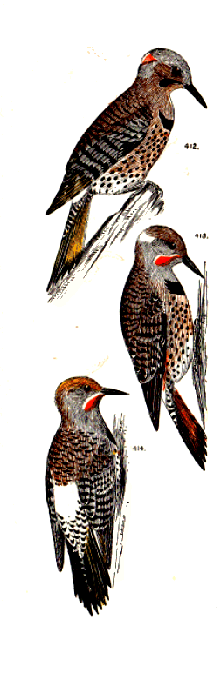
412. Southern Flicker (Colaptes auratus). Smaller than No. 412a, W. 5.6. Range.—Southeastern United States north to South Carolina. 412a. Northern Flicker (C. a. luteus). L. 13; W. 6.4. Crown bluish gray; throat pinkish brown; a scarlet nape-band; lining of wings and tail yellow. Ad. ♂. With black patches on the sides of the throat. Ad. ♀. Without black throat patches. Notes. A loud, emphatic keé-yer; a low chuckle when taking flight; a weéchew repeated and used only when two or more birds are together; and a mellow cûh-cûh-cûh-cûh, repeated, doubtless a song. Range.—Eastern North America west to the Rocky Mountains and Alaska; rare on the Pacific coast; apparently hybridizing with No. 413 at the western border of its range. 413. Red-shafted Flicker (Colaptes cafer collaris). L. 13. No red nape band; crown brownish; throat bluish gray; lining of wings and tail reddish. Ad. ♂. Patches at side of throat red. Ad. ♀. No red throat patches. Notes. Resemble those of No. 412. Range.—Western United States, except northwest coast region; east to the Rocky Mountain region; apparently hybridizing with No. 412 at the eastern border of its range. 413a. Northwestern Flicker (C. c. saturatior). Similar to No. 413, but much darker throughout, back vinous-brown. Range.—Pacific coast region; breeds from Oregon north to southern Alaska; winters south to northwest California. 414. Gilded Flicker (Colaptes chrysoides). L. 12; W. 5.7. Crown cinnamon; under surface of wings and tail yellow. Ad. ♂. No red band on nape; throat bluish gray, its sides with a red patch. Ad. ♀. No red on sides of throat. Notes. Resemble those of No. 412. (Bendire.) Range.—"Central and southern Arizona from Lat. 34° to southern Sonora, and Lower California south of Lat. 30°." (A. O. U.) 414a. Brown Flicker (C. c. brunnescens). Similar to No. 414, but slightly smaller; upperparts darker. (Anthony). Range.—Lower California north of Lat. 30°. 415. Guadalupe Flicker (Colaptes rufipileus). Similar to No. 413, but bill 1.6 or more; more slender, wing averaging less than 6.2; crown cinnamon-brown; rump vinaceous-white. (Ridgw.) Range.—Guadalupe Island, Lower California.
Order XVI. GOATSUCKERS, SWIFTS, AND HUMMINGBIRDS.
MACROCHIRES.
Family 1. GOATSUCKERS. Caprimulgidæ. 6 species, 6 subspecies.
Family 2. SWIFTS. Micropodidæ. 4 species.
Family 3. HUMMINGBIRDS. Trochilidæ. 17 species.
The Goatsuckers are birds of the dusk and early morning. They live chiefly on insects which they capture on the wing, their enormous mouths being especially well adapted to this kind of hunting. Our species build no nest but lay their two mottled eggs on the bare ground or leaves. The young are hatched covered with down and can follow their parents about long before they acquire the power of flight. Goatsuckers are noted for their singular calls, most of the species uttering loud, characteristic notes which, heard at night, are especially effective.
Swifts are birds of world-wide distribution; about half the seventy-five known species being found in America. They are pre-eminently birds of the air with wings so well developed that few birds can surpass them in power of flight, but with feet so weak and small that many species cannot perch as do most birds, but, when resting, cling to a vertical surface and use their tail to aid their feet in supporting themselves. Their nests are often marvels of architectural skill and constructive ability. The eggs, four to six in number, are white.
Hummingbirds are found only in America where they range from Patagonia to Alaska, but the larger part of the some five hundred known species are found in the Andean region of Columbia and Ecuador. Only one species is found east of the Mississippi, and nine of our sixteen western species advance but little beyond our Mexican border.
Hummingbirds nests are the most exquisite of birds' homes. Their eggs, so far as is known, number two, and are pure white. The young are born naked and, in the case of our Ruby-throat, at least, spend about three weeks in the nest.
The notes of some tropical Hummingbirds are sufficiently varied to be classed as songs but our species utter only sharp squeaks and excited chipperings.
Goatsuckers
416. Chuck-will's-widow (Antrostomus carolinensis). L. 12. Mouth bristles with fine, hair-like branches near their base. Ad. ♂. End half of outer tail-feathers white, rusty, and black on outer webs; chin chiefly rusty; throat-patch buffy. Ad. ♀. No white in tail. Notes. A loudly whistled chuck-will's-widow, repeated many times. Range.—South Atlantic and Gulf States; breeds north to Virginia and Illinois; west to Kansas and central Texas; winters from southern Florida southward. 417. Whip-poor-will (Antrostomus vociferus). L. 9.7. Mouth bristles without branches. Ad. ♂. Three outer tail-feathers broadly tipped with white; white on inner vane of outer feather 1.4 or more wide; throat patch white; chin chiefly black. Ad. ♀. Three outer tail-feathers narrowly tipped with rusty buff; throat patch rusty buff. Notes. A rapid, vigorous, whistled whip-poor-will, repeated many times. Range.—Eastern North America, west to the Plains; breeds from Gulf States north to New Brunswick and Manitoba; winters from Gulf States southward. 417a. Stephens Whip-poor-will (A. v. macromystax). Similar to No. 417, but slightly larger, W. 6.5; mouth bristles much longer; male with throat-patch rusty; white on inner web of outer feather less than 1.3 wide. Range.—"Arizona, New Mexico, and southwestern Texas, south over mountains bordering tablelands of Mexico to Guatemala." (Bailey.) 418. Poor-will (Phalænoptilus nuttallii). L. 7.7. Primaries rusty barred with black. Ad. ♂. Three outer tail-feathers evenly tipped with white; a large white throat patch; plumage above suggesting in color the wings of certain moths. Ad. ♀. Similar, but tail-tips buffy. Notes. Variously rendered poor-will, cow-day, pearl-rob-it, puir-whee-er. Range.—Western United States; breeds from Kansas, Nebraska, and Dakota west to eastern slope of Sierra Nevadas: north to Montana and British Columbia; winters from Mexican border southward. 418a. Frosted Poor-will (P. n. nitidus). Similar to No. 418, but paler, the upperparts especially whiter, more frosty. Range.—"Texas to Arizona and from western Kansas south to northern Mexico." (Bailey.) Lower California. 418b. California Poor-will (P. n. californicus). Similar to No. 418, but darker. Range.—Breeds on coast of California, north to Butte County; winters from southern California southward.
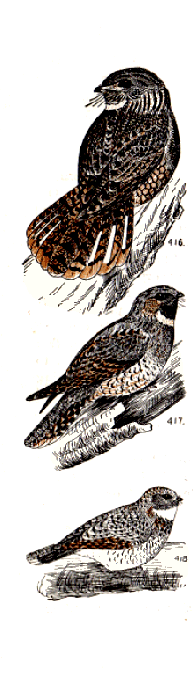
419. Merrill Parauque (Nyctidromus albicollis merrilli). L. 12; T. 6.2. Outer tail-feather without white. Two color phases, one gray, one rusty. Ad. ♂. Outer tail-feather black with sometimes a little rusty, next feather white on inner web, third feather white except at base. Ad. ♀. Outer tail-feathers brownish with broken rusty bars; next two with white at tip. Notes. A vigorous ker-whee-you repeated and sometimes running into a whit-whit-whit, ker-whee-you. Range.—Mexico north to southern Texas; winters chiefly south of Rio Grande. 420. Nighthawk (Chordeiles virginianus). L. 10; W. 7.8. Primaries blackish with a white bar and no rusty spots; darkest of our Nighthawks. Ad. ♂. Above black with white and buff markings; throat and band near end of tail white. Ad. ♀. Throat rusty, no white band in tail. Notes. A nasal peent; and in the breeding season, a booming sound produced by diving from a height earthward. Range.—Eastern United States, chiefly, breeds from Florida to Labrador, west and northwest to northern California, British Columbia, and Alaska; winters south of United States. 420a. Western Nighthawk (C. v. henryi). Similar to No. 420, but markings above rusty and more numerous; belly washed with rusty. Range.—Western United States, east to the Plains, wintering south of United States; exact distribution unknown. 420b. Florida Nighthawk (C. v. chapmani). Similar to No. 420, but smaller (L. 8.6; W. 7.1;) and paler; white and buff markings above larger and more numerous. Range.—Florida, west along Gulf Coast to eastern Texas; south in winter to South America. 420c. Sennett Nighthawk (C. v. sennetti). Similar to No. 420b, but still paler, white and buff prevailing on back and scapulars; palest of our Nighthawks. Range.—Great Plains north to Saskatchewan; winters south of the United States. 421. Texan Nighthawk (Chordeiles acutipennis texensis). Wing quills with rusty spots; outer primary shorter than one next to it; belly conspicuously washed with rusty buff. Ad. ♂. Throat-patch and band near end of tail white. Ad. ♀. No white band in tail. Notes. A mewing call and a tapping accompanied by a humming sound. (Merrill.) Range.—Central America; breeding north to southern Texas, southern New Mexico, southern Utah, southern Nevada, and Lat. 38° in California; winters south of United States.
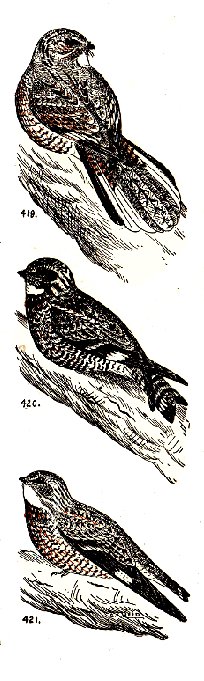
Swifts
422. Black Swift (Cypseloides niger borealis). L. 7; W. 6.5. Tail without spines, slightly forked. Ads. Sooty black, paler below; a black spot before the eye; forehead whitish. Notes. Generally silent. (Bendire.) Range.—Breeds from Central America north, in mountains of western United States, to British Columbia; east to Colorado; winters south of United States; more common in Pacific coast states. 423. Chimney Swift (Chætura pelagica). L. 5.4; W. 4.9. Tail with protruding spines. Ads. Above sooty, rump and underparts paler; throat whitish. Notes. A rolling twitter. Range.—Eastern North America, west to the Plains; breeds from Florida to Labrador and Manitoba; winters south of United States, to Central America. 424. Vaux Swift (Chætura vauxii). L. 4.5; W. 4.4. Ads. Similar to No. 423, but smaller and somewhat browner. Notes. Resemble those of No. 423, but are less frequently uttered. (Bendire.) Range.—Western United States; breeds on Pacific coast, locally, north to British Columbia; east casually to Montana and Arizona; winters south of United States to Central America. 425. White-throated Swift (Aëronautes melanoleucus). L. 6.5. Tail forked, without spines. Ads. Above sooty brownish black; breast, middle of belly and flank patches white. Notes. A sharp, metallic twitter. Range.—Western United States; east to western Nebraska and Black Hills; breeds in Rocky Mountains north to Montana; on Pacific coast north to Lat. 38°; winters south of United States to Central America.
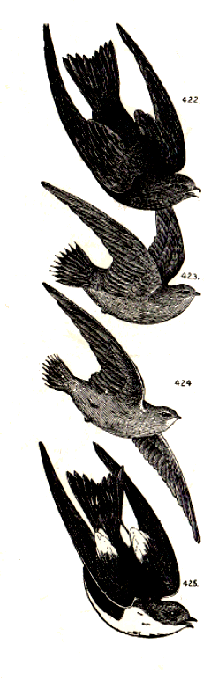
Hummingbirds
426. Rivoli Hummingbird (Eugenes fulgens). L. 5.1. A small white spot behind eye. Ad. ♂. Crown purple, throat bright green, back bronzy green; tail somewhat more bronzy. Ad. ♀. Above bronzy green, all but central tail-feathers with blackish ends and narrow grayish tips; below grayish, all but throat feathers green centrally. Yng. ♂. Throat with more or less green, belly and above more bronzy than in ♀. Range.—Nicaragua, north in mountains to mountains of southeastern Arizona, and southwest New Mexico; winters south of United States. 429. Black-chinned Hummingbird (Trochilus alexandri). L. 3.5; W. 1.7. Ad. ♂. Chin and upper throat black, lower throat amethyst; tail forked, feathers pointed. Ad. ♀. Throat grayish white; chin buffy; tail feathers more rounded, three outer ones tipped with white. Yng. ♂. Similar ♀, but throat with dusky spots. Range.—Western United States; breeds from San Antonio, Texas, New Mexico, Arizona, and California north to Montana and British Columbia; rare on Pacific coast north of southern California; winters south of United States. 430. Costa Hummingbird (Calypte costæ). L. 3.1. No rusty in plumage. Ad. ♂. Crown, throat and lengthened neck-feathers amethyst, back dull green. Ad. ♀. Below grayish white; above grayish green; outer tail-feathers gray at base, then black and at tip white. Yng. ♂. Similar to ♀, but throat usually with some amethyst spots; tip of outer tail-feather grayish. Range.—Northwestern Mexico; breeds north throughout Lower California, to southern California, northern Nevada, southwestern Utah, and southwestern New Mexico; winters from Mexican border southward. 437. Lucifer Hummingbird (Calothorax lucifer). L. 3.6; B. .8. Ad. ♂. Throat purplish pink, feathers at its side much lengthened; tail feathers very narrow, the outer ones less than .05 in. wide on end half. Ad. ♀. Below nearly uniform rusty buff, above bronzy green; tail-feathers white-tipped. Range.—"From western Texas and southern Arizona south to the city of Mexico and Puebla." (Bailey.) 440. Xantus Hummingbird (Basilinna xantusi). L. 3.6. A white streak behind eye. Ad. ♂. Chin, forehead and cheeks black; throat green; tail rusty brown. Ad. ♀. Below uniform rusty, above green; outer tail-feathers rusty brown. Range.—Lower California, north to Lat. 29°; most common in Cape Region.
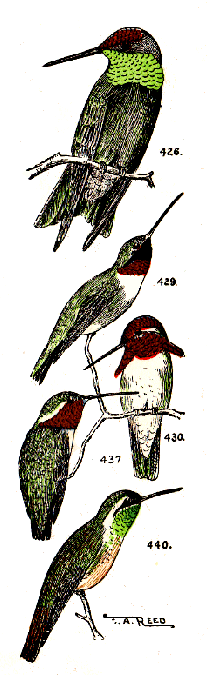
427. Blue-throated Hummingbird (Cœligena clemenciæ). L. 5.2. A white stripe behind, and a smaller one before eye. Ad. ♂. Throat blue; belly grayish; back green; tail blue-black, outer feathers broadly white tipped. Ad. ♀. Similar but throat dusky gray. Range.—Southern Mexico north. In mountains to mountains of southwestern New Mexico and southern Arizona; winters south of United States. 438. Reiffer Hummingbird (Amazilis tzacatl). L. 4.1. Ads. Above, throat and breast shining green; belly grayish; tail square, rusty brown, narrowly margined with coppery. Yng. Similar but more rusty above. Range.—Northern South America; north, rarely, to Lower Rio Grande Valley, Texas. 439. Buff-bellied Hummingbird (Amazilis cerviniventris chalconota). Similar to No. 438, but belly rusty gray, tail forked and broadly margined with coppery green. Range.—Central America, north, in spring, to Lower Rio Grande Valley, Texas. 440.1. White-eared Hummingbird (Basilinna leucotis). L. 3.7. A white line behind eye. Ad. ♂. Chin, forehead and cheeks blue, throat and breast green, tail blackish bronzy green. Ad. ♀. Crown rusty, back bronzy green, below gray spotted with green; outer tail-feathers tipped with gray. Yng. ♂. Similar. Range.—Nicaragua north, in spring, through mountains to southern Arizona. 441. Broad-billed Hummingbird (Iache latirostris). L. 4. Ad. ♂. Above green; below darker; throat purplish blue; tail darker. Ad. ♀. Below gray; outer tail-feathers green at base, then bluish black tipped with gray. Yng. ♂. Similar to Ad. ♀, but tail blue black with faint gray tips; throat with metallic green feathers. Range.—Southern Mexico; breeds north through mountains to southern Arizona and southwestern New Mexico. 428. Ruby-throated Hummingbird (Trochilus colubris). L. 3.5; W. 1.5. Ad. ♂. Throat ruby, chin blackish; tail forked, the feathers pointed. Ad. ♀. Throat grayish, tail-feathers rounded, three outer ones tipped with white. Yng. ♂. Like ♀ but throat with dusky spots. (See next page) Range.—Eastern North America, west to about Long. 100°; breeds from Florida and eastern Mexico, north to Labrador and Hudson Bay region; winters from southern Florida to Central America.
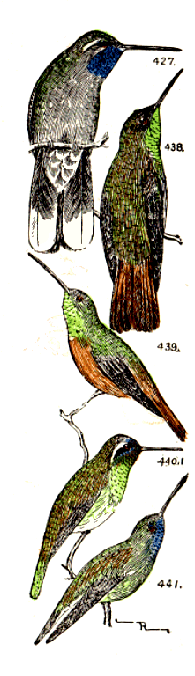
431. Anna Hummingbird (Calypte annæ). L. 3.6. Ad. ♂. Crown and throat glittering purplish pink; feathers at sides of throat much lengthened. Ad. ♀. Above green; below grayish washed with green; throat usually with pink feathers; tail with a narrow white tip. Yng. Similar but browner above. Range.—Western United States, from northern Lower California north to northern California; east to southern Arizona; south in winter to Mexico; recorded from Guadalupe Island. 432. Broad-tailed Hummingbird (Selasphorus platycercus). L. 4. Ad. ♂. Outer primary very narrow, end sharp; crown green, throat pink; tail green above, purplish below without white tips. Ad. ♀. Outer tail-feathers rusty at base, then black with a broad white tip; middle feathers entirely green; above bronzy green; throat feathers with dusky centers; sides rusty. Range.—Rocky Mountains: west, rarely to eastern California; north to southern Wyoming and Idaho; winters south of United States. 433. Rufous Hummingbird (Selasphorus rufus), L. 3.6. Ad. ♂. Next to middle pair of tail-feathers notched near tip of inner web; back reddish brown sometimes washed with green. Ad. ♀. Sides rusty, back green, throat spotted with green and sometimes ruby, outer tail-feathers rusty at base, then black and a white tip, the feather more than .12 wide; middle tail-feathers green at base, end black. Yng. ♂. Similar to ♀ but all tail-feathers rusty at base. Range.—Western United States; breeds from the higher mountains of southern California and Arizona, north to Lat. 61° in Alaska; during migrations east to Montana, Wyoming, Colorado, New Mexico, and western Texas; winters in southern Mexico. 434. Allen Hummingbird (Selasphorus alleni). L. 3.6. Ad. ♂. Crown and back green, and tail rusty tipped with dusky, no notch in tail-feathers; in other respects like No. 433. Ad. ♀ and Yng. ♂. Like the same of No. 433, but outer tail-feather less than .12 in. wide. Range.—Pacific coast, from Monterey, California, north to British Columbia; migrates south through Arizona, and southern California to Mexico. 435. Morcom Hummingbird (Atthis morcomi). L. 2.9. Ad. ♀. Above bronzy green; middle tail-feathers bronzy green tinged with rusty on basal half; rest of tail-feathers rusty brown, then green, then black and tipped with white; below white, sides rusty, throat spotted with bronze-green. (Ridgw.) Male unknown. Range.—Huachuca Mountains, southern Arizona, (known from one specimen.) 436. Calliope Hummingbird (Stellula calliope). L. 3. Ad. ♂. Throat purplish pink, white at base showing through; above green. Ad. ♀. Sides rusty, throat with green spots, above green, outer tail-feathers gray at base, then black, then white in nearly equal amounts. Yng. ♂. Similar to ♀. Range.—Mountains of western United States; breeds north to Montana, Idaho, and British Columbia; west to eastern Oregon and eastern California; winters, south of United States; rare on Pacific coast of United States.
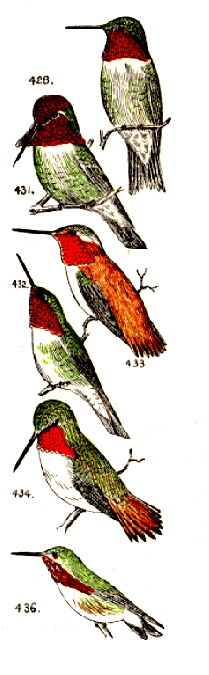
Order XVII. PERCHING BIRDS.
PASSERES.
Family 1. FLYCATCHERS. Tyrannidæ. 32 species, 7 subspecies.
Family 2. LARKS. Alaudidæ. 1 species, 13 subspecies.
Family 3. CROWS AND JAYS. Corvidæ. 21 species, 14 subspecies.
Family 4. BLACKBIRDS, ORIOLES, ETC. Icteridæ. 18 species, 14 subspecies.
Family 5. FINCHES, SPARROWS, ETC. Fringillidæ. 87 species, 92 subspecies.
Family 6. TANAGERS. Tanagridæ. 4 species, 1 subspecies.
Family 7. SWALLOWS. Hirundinidæ. 9 species, 2 subspecies.
Family 8. WAXWINGS. Ampelidæ. 3 species.
Family 9. SHRIKES. Laniidæ. 2 species, 3 subspecies.
Family 10. VIREOS. Vireonidæ. 13 species, 10 subspecies.
Family 11. WARBLERS. Mniotiltidæ. 55 species, 18 subspecies.
Family 12. WAGTAILS. Motacillidæ. 3 species.
Family 13. DIPPERS. Cinclidæ. 1 species.
Family 14. WRENS, THRASHERS, ETC. Troglodytidæ. 26 species, 24 subspecies.
Family 15. CREEPERS. Certhiidæ. 1 species, 4 subspecies.
Family 16. NUTHATCHES AND TITS. Paridæ. 21 species, 20 subspecies.
Family 17. KINGLETS, GNATCATCHERS, ETC. Sylviidæ. 7 species, 3 subspecies.
Family 18. THRUSHES, BLUEBIRDS, ETC. Turdidæ. 13 species, 14 subspecies.
The North American members of the Order PASSERES are placed in two Suborders, the Clamatores, or so-called Songless Perching Birds, which includes all the Flycatchers, and the Suborder Oscines, or Singing Perching Birds, which includes all our remaining Perching Birds. While the Flycatchers are therefore technically classed as songless birds, it does not follow that they have no songs. Sing they do, but because of the less developed condition of their voice-producing organ, they cannot give utterance to the longer and more musical songs of the Oscines, which are supplied with a better musical instrument.
The Flycatchers, (Family Tyrannidæ) number somewhat over three hundred and fifty species, and are found only in America, where they are most abundant in the tropics. Feeding almost exclusively on insects, those species which visit the United States are of necessity migratory, not more than half a dozen of the thirty species which nest with us, remaining in the United States during the winter, and these are found only on our southern borders.
Flycatchers as a rule, capture their prey on the wing. When perching, their pose is usually erect and hawk-like. They often raise their crown feathers, which in many species are somewhat lengthened, a habit giving them a certain big-headed appearance.
Flycatchers are most useful birds. The food of the Kingbird, for example, a species which is erroneously believed to destroy honey bees, has been found to consist of 90 per cent. insects, mostly injurious species, while only fourteen out of two hundred and eighty-one stomachs contained the remains of honey bees; forty of the fifty bees found being drones.
The true Larks, (Family Alaudidæ) are chiefly Old World birds, the Skylark being the best known member of the Family. In America we have only the Horned or Shore Larks, one species of which shows so much climatic variation in color throughout its wide range, that no less than thirteen subspecies or geographical races of it are recognized in the United States.
The Horned Lark is a bird of the plains and prairies and is less common in the Atlantic States than westward. Like the Skylark it sings in the air, but its vocal powers are limited and not to be compared with those of its famous relative.
The Crows and Jays, (Family Corvidæ) number about two hundred species of which some twenty-five inhabit the western hemisphere. To this family belong the Raven, Rook, Magpie and Jackdaw, all birds of marked intelligence; and our Crows and Jays are fully worthy of being classed with these widely known and distinguished members of their family.
The Crows and Jays, by varying their food with the season, are rarely at loss for supplies of one kind or another and most species are represented throughout their ranges at all times of the year. In the more northern parts of their homes, however, some of these birds are migratory, and Crows, as is well known, gather in great flocks during the winter, returning each night to a roost frequented, in some instances, by two or three hundred thousand Crows.
While the Crows and Jays are technically 'Song Birds' their voices are far from musical. Nevertheless they possess much range of expression and several species learn to enunciate words with more or less ease.
The Starlings, (Family Sturnidæ) are Old World birds represented in America only by the European Starling which was introduced into Central Park, New York City, in 1890 and is now common in the surrounding country.
The Blackbirds, Orioles, and Meadowlarks, (Family Icteridæ) number about one hundred and fifty species and are found only in the New World. The Blackbirds are most numerous in North America, where, migrating in vast armies and often living in large colonies, they become among the most characteristic and conspicuous of our birds.
The Orioles are most numerous in the tropics, where some thirty species are known. Apparently all of them are remarkable as nest builders, the large Cassiques, nearly related, great yellow and black birds, weaving pouches three and four feet long, several dozen of which, all occupied, may be seen swinging from the branches of a single tree.
The Finches, Sparrows, Grosbeaks, etc., (Family Fringillidæ) number nearly six hundred species, a greater number than is contained in any other family of birds. They are distributed throughout the world, except in the Australian region, some ninety odd species inhabiting North America.
Varying widely in color, the Fringillidæ all agree in possessing stout, conical bills, which are of service to them in crushing the seeds on which they feed so largely.
The streaked, brownish Sparrows, often so difficult of identification, are usually inhabitants of plains, fields, or marshes, where they are rendered inconspicuous by their dull colors. The more gayly attired Grosbeaks, Buntings, Cardinals etc., frequent trees or bushy growths, where their plumage either harmonizes with their surroundings or where they have the protection afforded by the vegetation.
Most of the members of this family are good singers, some of them indeed being noted for their powers of song. They are less migratory than insect-eating birds and some species are with us at all seasons. Their abundance, musical gifts, and constant presence render them, from the field student's point of view, highly important members of the great class Aves.
From an economic standpoint the Fringillidæ are no less deserving of our esteem. Some species are of incalculable value as destroyers of the seeds of noxious weeds. Fifteen hundred seeds have been found in the stomach of one Snowflake or Snowbunting, and it has been estimated by Professor Beal, of the Biological Survey of the United States Department of Agriculture, that during the winter season, in the single State of Iowa, where his studies were made, Tree Sparrows devour no less than 875 tons of weed seeds, chiefly of the ragweed.
The Tanagers, (Family Tanagridæ) are found only in the New World, where they are most numerously represented in the tropics. As a family they are remarkable for the brilliancy of their colors; the common, but mistaken idea that most tropical birds are brightly clad being in no small part due to the abundance of Tanagers and beauty of their plumage.
Only five of the some three hundred and fifty known species reach the United States and these are migratory, coming to us in the spring and returning to the tropics in the fall. Tanagers, as a rule, are not possessed of much vocal ability, our species ranking high in their family as songsters, the notes of many species being far less musical.
Like most gaily costumed birds the plumages of many Tanagers undergo striking changes in color with age and season. The male of our Scarlet Tanager, for example, is olive-green with black wing-coverts during his first winter, the scarlet plumage not being acquired until the following spring. It is worn, however, only during the nesting season after which the less conspicuous olive-green dress is again acquired, the wings and tail, however, remaining black.
Swallows, (Family Hirundinidæ) are of world-wide distribution, and as might be expected in birds possessing such remarkable powers of flight, many of the species have unusually extended ranges. Our Barn Swallow, for example, is found throughout North America in summer, and in the winter it migrates as far south as southern Brazil.
Birds of the air, the aërial habits of Swallows are reflected in their long wings and small, weak feet; while their small bills and broad, widely opening mouths indicate their manner of feeding.
In spite of their poor equipment of tools, Swallows take high rank as nest builders, and it is interesting to observe that although the birds are structurally much alike, their nests often differ widely in character. Compare for instance, the mud-made dwellings of the Barn and Cliff Swallows with the tunneled hole of the Bank Swallow and one realizes how little the character of a bird's home may depend on the structure of it's builder.
The food of Swallows, remarks Professor Beal, "consists of many small species of beetles which are much on the wing, many species of diptera (mosquitoes and their allies), with large quantities of flying ants and a few insects of similar kinds. Most of them are either injurious or annoying, and the numbers destroyed by Swallows are not only beyond calculation, but almost beyond imagination."
The true Waxwings, (Family Ampelidæ) number only three species with representatives in the northern parts of both hemispheres. Their notes, as a rule are limited to a few unmusical calls, which, with our Cedar Waxwing, are usually uttered when the bird is about to fly.