Front matter (continued 4)
Reading edition
Waxwings are found in small flocks during the greater part of the year and roam about the country as though they were quite as much at home in one place as in another, provided food be plenty. Small fruits, chiefly wild ones, constitute their usual fare, but they also feed on insects, the injurious elm beetle being among their victims.
The Shrikes, (Family Laniidæ) are represented in America by only two species, the remaining two hundred or more members of this family being found in the Old World. Shrikes are noted for their singular habit of impaling their prey on thorns or similarly sharp-pointed growths, or occasionally they may hang it in the crotch of a limb. This proceeding enables them to tear it to pieces more readily, for it will be observed that while Shrikes have a hawk-like bill, their feet are comparatively weak and sparrow-like and evidently of no assistance to them in dissecting their food.
Our Northern Shrike, or Butcherbird, feeds chiefly on small birds and mice, while the southern species, or Loggerhead, is a great destroyer of grasshoppers and he also eats lizards and small snakes.
The Vireos, (Family Vireonidæ) number fifty species, all American. They search the foliage carefully for leaf-eating insects and their eggs, and examine the crevices in the bark for eggs of the injurious wood-boring insects. They are therefore unusually beneficial birds.
Bearing a general resemblance in size and color to many of the Warblers, Vireos are sometimes confused with members of that family. They are, however, as a rule, more deliberate in their motions and not such active flutterers as are many of the Warblers. They are also more musical, all the Vireos having characteristic songs, which if not always highly musical, are generally noticeable, pronounced and unmistakable.
The nests of all our Vireos are pendant, deeply cup-shaped structures usually hung between the forks of a crotch, to the arms of which they are most skilfully woven.
The Warblers, (Family Mniotiltidæ) like the Vireos are distinctly American birds, indeed they may be called characteristic North American birds since most of the one hundred odd species are found north of Mexico. Between thirty and forty species of these active, beautiful little creatures may be found in the course of a year at a single locality in the Eastern States and they therefore constitute an exceedingly important element in our bird-life. Most of them come in May at the height of the spring migration; when the woods often swarm with them as they flit from limb to limb in pursuit of their insect food. The larger number of them pass onward to their northern homes and in September they return to us in increased numbers.
The beauty of their plumage, the briefness but regularity of their visits, the rarity of certain species, combine to make the Warblers especially attractive to the field student and their charms are heightened by the difficulty with which many of them are identified. Study them as we may there are still species which have escaped us.
By far the larger number of Warblers may be described as flutterers that feed agilely about the terminal branches, (genera Dendroica and Helminthophila); others are true flycatchers, so far as feeding habit is concerned, (genera Setophaga and Wilsonia,) while others still feed in the undergrowth or on the ground, (genera Geothlypis and Seiurus). Insects constitute almost their entire fare and they are among our most beneficial birds.
Most of the Wagtails (Family Motacillidæ), are inhabitants of the Old World, only three of the sixty odd species being found in this country. Our Pipit or Titlark is our best known, most widely distributed species.
Like other members of its family it has the habit of wagging or tipping its tail both when walking (for it should be noted that these birds are ground-inhabiting and walkers) and at rest.
The Dippers (Family Cinclidæ) though numbering only twelve species are distributed throughout the larger part of the world from the Andes of South America to the mountains of Alaska, Europe, Asia and Africa.
Everywhere they are haunters of streams, usually dashing mountain torrents, over and under which they seem equally at home. Darting into the rushing waters they fly beneath the surface or feed on the bottom with perfect ease, their thick, dense plumage evidently forming a water-proof covering. Their nests are great balls of moss often placed so near some boiling cascade as to receive frequent showers of spray. The opening, however, is at the side, and the eggs and young are well protected by an effective roof.
The Wrens, Thrashers, and Mockingbirds, (Family Troglodytidæ) form two well defined subfamilies. The Wrens, (Subfamily Troglodytinæ) number about one hundred and fifty species all but a dozen of which are confined to America. The Thrashers and Mockingbirds, (Subfamily Miminæ) number some fifty species, all of which are confined to America.
As their dull, neutral colors would lead us to suppose, both Wrens and Thrashers are inhabitants of the lower growth rather than of the tree-tops, and while they may seek an elevated perch whence to deliver their song, their food is secured and their time consequently largely passed near or on the ground.
Few families of birds contain so many noted musicians, nearly every member of this family being a singer of more than usual ability.
The Creepers, (Family Certhiidæ) number twelve species, only one of which is found in America. This, however has a wide range and, presenting more or less climatic variation in color, is recognized under several subspecific names. Its habits, nevertheless, are much the same everywhere. It climbs the trees of the mountains of Mexico or of California with the same ceaseless energy it shows in Maine.
The sharply-pointed, stiffened tail-feathers of the Creeper are of evident use to it as it ascends trees and pauses here and there to pick out an insect's egg from the bark. The same type of tail feather is shown by Woodpeckers, an excellent illustration of similar structure accompanying similar habits in birds not at all closely related.
The Nuthatches and Titmice, (Family Paridæ), like the Wrens and Thrashers, belong in two well marked Subfamilies; The Nuthatches, (Subfamily Sittinæ) number about twenty species, only four of which inhabit America; the Titmice, (Subfamily Parinæ) number some seventy-five species, of which thirteen are American.
Nuthatches are tree-creepers, but climbing up or down with equal ease, their tail is not employed as a prop, and consequently shows no special development of pointed or stiffened feathers. Their toes, however, are long, and their nails large and strong, evidently giving them a firm grip on the bark of trees.
The Chickadees are generally resident birds and, as a rule, whatever species we find in a given locality are apt to be there throughout the year. We therefore become better acquainted with some of these lairds than with others which are with us only a short season. This is especially true of our eastern Black-capped Chickadee, which comes familiarly about our homes in winter to partake of the feast of nuts and suet which we spread for him at that season.
Feeding largely on the eggs or larvæ of insects particularly injurious to trees, the Nuthatches and Titmice are of great value to man.
The Kinglets, Gnatcatchers, and Old World Warblers, (Family Sylviidæ) number about one hundred and twenty-five species, which are divided among the following well-defined subfamilies: The Kinglets, (Subfamily Regulinæ) seven species, three of which are American; the Gnatcatchers, (Subfamily Polioptilinæ) some fifteen species, all American; the Old World Warblers, (Subfamily Sylviinæ) about one hundred species, all Old World except one which inhabits the Bering Sea coast of Alaska.
The Kinglets are small, olive green birds which may be mistaken for Warblers but, aside from structural differences not evident in the field, they may be known by their smaller size, greater tameness, and habit of nervously flitting their wings at frequent intervals. One of our species, the Ruby-crown, possesses a remarkably loud, clear, and musical song, a surprising performance for so tiny a songster. Kinglets build large nests of moss and feathers and lay as many as ten eggs.
The Gnatcatchers are small, slender, grayish birds which once well seen will not be confused with other species. The Gnatcatchers, like the Kinglets, are architects of more than usual ability, building a nest beautifully covered with lichens.
The Thrushes, (Family Turdidæ) are variously classified by different ornithologists, but under the ruling of the American Ornithologists' Union they are grouped in the same family with the Bluebird, Solitaires, and Stonechats. This family numbers about three hundred species, of which about one-half are true Thrushes (Subfamily Turdinæ). The members of this subfamily are, as a rule, fine singers, many of them being among the best known song birds, and from a musical point of view the group, as a whole, is usually given the first place among birds. If, however, all the fifteen known species of Solitaires sing as well as the four species it has been my privilege to hear, I am assured that no one would dispute their claim to the highest rank which can be awarded singing birds.
In the succeeding pages, the five hundred and fifty odd species and subspecies included in the preceding families of the Order Passeres are grouped according to some obvious color character in order to facilitate their identification in life. A satisfactory arrangement of this kind is out of the question. Lines sharply separating the groups proposed do not exist and some species appear to fit in one section as well as in another. Nevertheless, it is hoped that in most instances, the system will be found to serve the purpose intended. Under its ruling our Perching Birds are grouped as follows:
With red markings.
With blue markings.
With orange or yellow markings.
With reddish brown or chestnut markings, chiefly in the form of patches or uniformly colored areas.
Brownish, generally streaked birds.
Dull, inconspicuously colored birds, without prominent markings.
Gray, black, or black and white birds.
While the first object of the bird student is to learn to name birds I would again urge him to acquaint himself with at least the arrangement of the Orders and Families of our birds and their leading structural characters. (see page 2.)
Having identified a bird, its family may always be determined by referring to its number in the systematic list of birds at the end of the book; and the more important characters of its Order and Family will be found in the synopsis of Orders and Families beginning on page 9.
Perching Birds Marked With Red
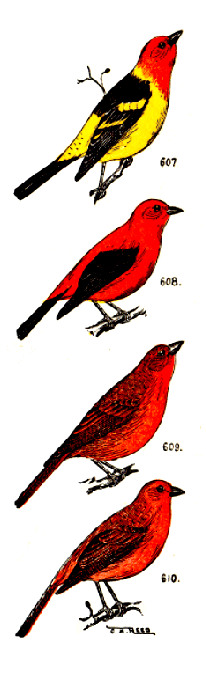
607. Louisiana Tanager (Piranga ludoviciana). L. 7.5. Ad. ♂. Yellow; back, wings, and tail black, head more or less red. Ad. ♀. Above olive-green, head rarely red-tinged; below dusky greenish yellow; wings and tail brownish edged with greenish, two yellowish white wing-bars. Yng. ♂. Like ♀, but head and rump greener, underparts yellower. Notes. Call, clit-tuck; song, resembles that of No. 608. Range.—Western United States from the Plains to the Pacific; breeds from Arizona to British Columbia; winters in Mexico and Central America. 608. Scarlet Tanager (Piranga erythromelas). L. 7.4. Ad. ♂. Scarlet; wings and tail black. Ad. ♀. Olive-green, yellower below, wings and tail blackish brown, no wing-bars. Yng. ♂. Like ♀, but brighter, wing-coverts black. Ad. ♂, Winter. Like Yng. ♀, but wings and tail black. Notes. Call, chip-churr; song, a rather forced whistle, suggesting a Robin's song, but less musical, Look-up, way-up, look-at-me, tree-top; repeated with pauses. Range.—Eastern United States, west to the Plains: breeds from Virginia and southern Illinois north to New Brunswick and Manitoba; winters in Central and South America. 609. Hepatic Tanager (Piranga hepatica). L. 7.8. Bill large. Ad. ♂. Vermilion, back grayish; tail dull red. Ad. ♀. No wing-bars; above grayish olive; crown and tail greener; below dusky yellow. Yng. ♂. Like ♀. and variously intermediate between it and ad. ♂. Notes. Call, clut-tuck; song, like that of No. 608, but somewhat more robin-like. Range.—From Guatemala north in spring to New Mexico and Arizona; winters in Mexico and Central America. 610. Summer Tanager (Piranga rubra). L. 7.5; W. 3.8. Ad. ♂. Rosy red. Ad. ♀. 9. Olive-yellow above, dusky saffron below. Yng. ♂. Variously intermediate between Ad. ♂ and ♀. Notes. Call, chicky-tucky-tuck; song, resembles in form that of No. 608 but is more musical and less forced. Range.—Eastern United States, west to the Plains; breeds from Florida and western Texas north to southern New Jersey, southern Illinois, and Kansas; winters in Central and South America. 610a. Cooper Tanager (P. r. cooperi). Similar to No. 610, but larger; W. 4; bill more swollen, colors paler. Range.—"Breeds from southwestern Texas to the Colorado Valley, California, and from Arizona and New Mexico to northwestern Mexico; south in winter to western Mexico; casually to Colorado."
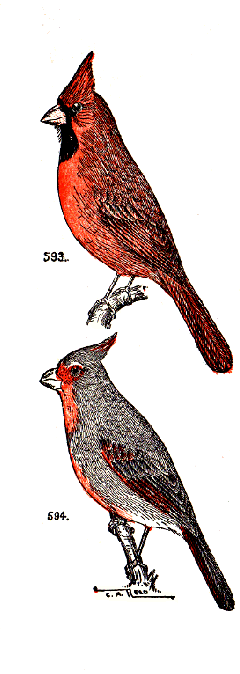
593. Cardinal (Cardinalis cardinalis). L. 9; W. 3.7; T. 4.1. Ad. ♂. Forehead with a well-defined black band; feathers of back (except in worn plumage) tipped with olive-brown or olive-gray. Ad. ♀. Above olive-brown; crest, wings and tail dull red edged with olive-brown; throat and region at base of bill gray; breast buffy, sometimes tinged with red; belly whiter. Notes. Call, a sharp, insignificant tsip; song, a rich, sympathetic whistle, whe-e-e-you, whe-e-e, hurry-hurry-hurry, quick-quick-quick, and other notes. Range.—Eastern United States; resident from northern Florida and eastern Texas north to southern New York and Iowa. 593a. Arizona Cardinal (C. c. superbus). Largest of our Cardinals, L. 9.5; W. 4; T. 4.9. Ad. ♂. Paler, more rosy, than No. 593; margins to back feathers usually gray; black on forehead usually separated by base of culmen. Ad. ♀. Gray above like No. 593c, but breast richer, much as in No. 593d; gray of throat more restricted and often confined to the chin. Range.—Southern Arizona and northern Sonora, Mexico. 593b. Saint Lucas Cardinal (C. c. igneus). Similar to No. 593a, but smaller; W. 3.6; T. 4; ♂ with even less, sometimes almost no black on forehead; ♀ paler; gray on chin and about base of bill less defined. Range.—Southern Lower California. 593c. Gray-tailed Cardinal (C. c. canicaudus). W. 3.7. Ad. ♂. Red bright as in No. 593d, but black on forehead narrower, usually separated by base of culmen. Ad. ♀. Grayer than ♀ of No. 593, the edgings of wings and tail usually gray without an olive tinge. Range.—Texas, except western and northeastern parts, and northeastern Mexico. 593d. Florida Cardinal (C. c. floridanus). Smaller than No. 593, W. 3.4; ♂ averaging deeper red; ♀ darker and richer in color, particularly on breast. Range.—Southern half of Florida. 594. Arizona Pyrrhuloxia (Pyrrhuloxia sinuata). L. 9; W. 3.6; T. 4.1. Ad. ♂. Gray; in fresh plumage washed with brownish; crest, wings and tail externally dull red; under wing-coverts, center of breast and of belly, throat, and region about base of bill, rosy red. Ad. ♀. Usually little or no red about bill or on underparts. Notes. Call, several flat, thin notes; song, a clear, straight whistle. (Bailey.) Range.—Northwestern Mexico, north to western Texas, southwestern New Mexico, and Arizona. 594a. Texas Pyrrhuloxia (P. s. texana). Similar to No. 594, but bill larger; underparts averaging slightly grayer; red before eyes averaging duskier. 594b. Saint Lucas Pyrrhuloxia (P. s. peninsulæ). Similar in color to No. 594, but decidedly smaller, with the bill larger; W. 3.4; T. 3.7. (Ridgw.) Range.—Cape Region of Lower California.
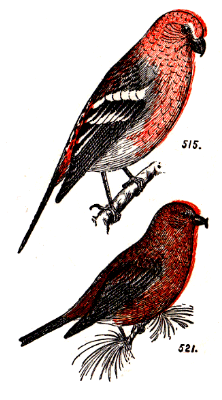
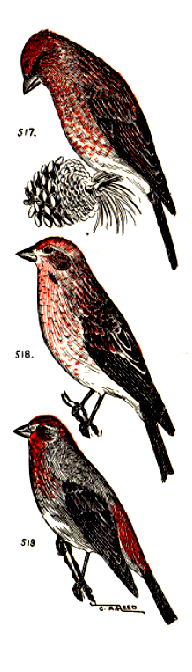
515. Pine Grosbeak (Pinicola enucleator leucura). L. 8.5; W. 4.6. Ad. ♂. Rosy red in varying amounts; belly gray; wings, tail and center of back feathers blackish brown; two white wing-bars. Ad. ♀. Gray, head and rump greenish; breast tinged with greenish. Yng. ♂. Like ♀, but with head and rump reddish. Notes. Song, sweet; in winter strong and cheery; in spring tender and plaintive. (Chamberlain.) Range.—Northeastern North America; breeds from New Brunswick and northern New England northward; winters south, irregularly, to southern New England, Ohio, and Manitoba, and casually to District of Columbia and Kansas. 515a. Rocky Mountain Pine Grosbeak (P. e. montana). Similar to No. 515b, but decidedly larger, W. 4.8, and coloration slightly darker; the adult male with the red of a darker, more carmine hue. (Ridgw.) Range.—"Rocky Mountains of United States, from Montana and Idaho to New Mexico." (Ridgway.) 515b. California Pine Grosbeak (P. e. californica). Similar to No. 515, but ♂ with red much brighter; feathers of back plain ashy gray without darker centers; ♀ with little if any greenish on rump. Range.—Higher parts of "Central Sierra Nevada, north to Placer County and south to Fresno County, California." (Grinnell.) 515c. Alaskan Pine Grosbeak (P. e. alascensis). Similar to No. 515, but decidedly larger with smaller or shorter bill and paler coloration, both sexes having the gray parts of the plumage distinctly lighter, more ashy. (Ridgw.) Range.—"Northwestern North America except Pacific coast, breeding in interior of Alaska; south, in winter, to eastern British Columbia, Montana (Bitterroot Valley), etc." (Ridgway.) 515d. Kadiak Pine Grosbeak (P. e. flammula). Similar to No. 515, but with much larger, relatively longer and more strongly hooked bill; wings and tail grayish brown instead of dull blackish. Range.—"Kadiak Island and south on the coast to Sitka, Alaska." (Ridgway.) 521. American Crossbill (Loxia curvirostra minor). L. 6.1; W. 3.4; B. .66. Tips of mandibles crossed. Ad. ♂. Red, more or less suffused with greenish or yellow. Ad. ♀. Olive-green, rump and underparts yellower. Yng. Resemble Ad. ♀. Notes. Calls, when feeding, a conversational twittering; louder and more pronounced when flying; song, sweet, varied and musical, but of small volume. Range.—Northern North America, chiefly eastward; breeds from northern New England (in Alleghanies from Georgia) north and west to Alaska; winters south irregularly to Virginia and Nevada; casually to South Carolina and Louisiana. 521a. Mexican Crossbill (L. c. stricklandi). Similar to No. 521, but larger; W. 4; B. .78. Range.—"Mountains of Wyoming and Colorado, west to the Sierra Nevada, and south through New Mexico, Arizona and the tablelands of Mexico to Guatemala." (A. O. U.)
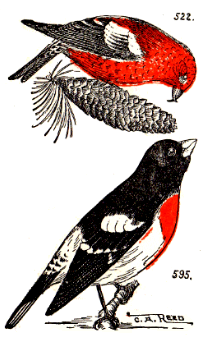
522. White-winged Crossbill (Loxia leucoptera). L. 6. Tips of mandibles crossed. Ad. ♂. Rose-pink; middle of back black; wings with two white bars. Ad. ♀. Olive-green and dusky; rump and underparts yellower; wings with two white bars. Yng. Like Ad. ♀. Notes. Resemble those of No. 521. Range.—Northern North America; breeds from northern New England, northern New York and northern Michigan northward; winters south irregularly to Virginia, Illinois, British Columbia, and Nevada. 595. Rose-breasted Grosbeak (Zamelodia ludoviciana). L. 8. Ad. ♂. Black; rump, belly, tips of inner vanes of outer tail-feathers and patch in wing white; under wing-coverts and breast rose. Ad. ♀. Under wing-coverts saffron; above streaked brown and black; below whitish streaked with blackish; a white line over eye; two white wing-bars. Yng. ♂. Resembles ♀, but under wing-coverts rose; breast more or less rose-tinged. Notes. Call, a sharp, steely peek; song, a rich, fluent, joyous carol. Range.—Eastern United States, west to the Plains; breeds from northern New Jersey, northern Ohio, and northern Indiana (and south in Alleghanies to North Carolina), north to Nova Scotia and Manitoba; winters in Central and South America. 517. Purple Finch (Carpodacus purpureus). L. 6.2; W. 3.2. Bill swollen and rounded; nostrils large, partially covered by projecting, grayish, bristly feathers; tail slightly forked. Ad. ♂. Dull rose, head and rump brightest; back brownish; lower belly white. Ad. ♀. Above grayish brown, slightly edged with whitish and brownish ashy; below white streaked with dark brownish; a more or less distinct whitish stripe over the eye. Yng. Resemble Ad. ♀. Notes. Call, creak, creak, and a querulous whistle; song, a sweet, rapidly flowing warble. (See page 175.) Range.—Eastern North America, west to the Plains; breeds from northern New Jersey, the mountains of Pennsylvania, and northern Illinois northward; winters from the northern States to the Gulf of Mexico. 517a. California Purple Finch (C. p. californicus). Similar to No. 517, but ♂ duller and darker; ♀ decidedly olive greenish above. (See page 175.) Range.—Pacific coast region; breeds in the mountains of California; west of the Sierra north to British Columbia; winters from central Oregon to southern Arizona.
518. Cassin Purple Finch (Carpodacus cassini). L. 6.5. Ad. ♂. Similar to Ad. ♂ of No. 517 and No. 517a, but back much blacker, streaks more sharply defined; crown as bright but appearing like a cap; below much paler. Ad. ♀. Similar to Ad. ♀ of No. 517a, but larger and more sharply streaked with black, both above and below. Notes. Resemble those of No. 517. Range.—Western United States, east to the eastern base of the Rockies, west to the Pacific; breeds in the mountains from New Mexico north to British Columbia. 519. House Finch (Carpodacus mexicanus frontalis). L. 6.1; W. 3.1. Ad. ♂. Throat, breast, forehead, line over eye, and rump, bright rose-red; back grayish brown tinged with red; belly white, streaked with brownish. Ad. ♀. Above brownish gray obscurely streaked with brownish, no olive tint; below white streaked with brownish. Ad. ♂ in Winter. Red areas dull purplish pink tipped with grayish. Yng. Resemble Ad. ♀. Notes. Call, nasal, in chorus, chattering; song, a musical cheery, varied warble, reminding one of that of No. 517, but recognizably different. Range.—Western United States, east to the Plains, west to the Pacific, and from northern Mexico north to southern Wyoming and Oregon. 519b. St. Lucas House Finch (C. m. ruberrimus). Similar to No. 519, but smaller, W. 2.8; red more extended, always showing in males on under tail-coverts. Range.—Southern Lower California. 519c. San Clemente House Finch (C. m. clementis). Similar to No. 519, but wing and tail averaging shorter, the bill decidedly, and feet slightly larger; coloration somewhat darker. W. 3; B. .48. (Ridgw.) Range.—Santa Barbara Island, California; Todos Santos Island, Lower California. 520. Guadalupe House Finch (Carpodacus amplus). Similar to No. 519, but red deeper; back dark brown without red suffusion. Range.—Guadalupe Island, Lower California. 520.1 San Benito House Finch (Carpodacus mcgregori). Similar to No. 519, but much larger with relatively shorter wings and tail; above much grayer and more distinctly streaked; red areas paler, more flesh-colored, often dull yellow; W. 3.2; T. 2.5; B. .5. (Ridgw.) Range.—San Benito Island, Lower California.
527. Greenland Redpoll (Acanthis hornemannii). L. 6.1; W. 3.3. A red crown-patch. Ad. ♂. Rump, lower breast, sides and belly white, generally unstreaked; breast and rump sometimes faintly tinged with pink. In winter. Throat, breast, and above washed with buff. Ad. ♀. Similar to ♂, but no pink on breast or rump, sides sometimes lightly streaked. Range.—Breeds in Greenland; winters south to Labrador. 527a. Hoary Redpoll (A. h. exilipes). Similar to No. 527 but smaller and darker; rump still white, but with sides more apt to be streaked; L. 5; W. 3; T. 2.3; B. .3. Range.—Breeds in Arctic regions; in America, winters south irregularly to Massachusetts, Ontario, northern Illinois, and Michigan. 528. Redpoll (Acanthis linaria). L. 5.3; W. 2.8; T. 2.3. B. .36. Crown-cap red. Ad. ♂. Above blackish brown edged with yellowish brown and some whitish; rump heavily streaked with blackish edged with whitish and tinged with rose; breast rose; sides heavily streaked. Ad. ♀. Similar, but no pink on rump or breast. Yng. ♂. Like female. Notes. Call like that of Goldfinch or Siskin and chit; song like that of American Goldfinch but distinct. (Minot.) Range.—Breeds in northern parts of northern hemisphere; in America, winters south to northern United States, irregularly to Virginia, Alabama, Kansas, Colorado, and northern California. 528a. Holbœll Redpoll (A. l. holbœllii). Similar to No. 528, but larger, the bill longer; W. 3.2; T. 2.3; B. .38. Range.—Breeds in northern parts of northern hemisphere; in America, winters south, casually to northern United States, (Quebec, Ontario, and Massachusetts.) 528b. Greater Redpoll (A. l. rostrata). Similar to No. 528, but larger, above darker; L. 5.5; W. 3.2; T. 2.5; B. .35; depth at base, .28. Range.—"Southern Greenland in summer, migrating south in winter, through Labrador to (sparingly) the northern border of the United States, (New England, lower Hudson Valley, northern Illinois, etc.), and west to Manitoba." (Ridgway.) 749. Ruby-crowned Kinglet (Regulus calendula). L. 4.4. A conspicuous whitish eye-ring. Ad. ♂. A more or less concealed vermilion crown-patch; back olive-green; underparts soiled whitish more or less tinged with buffy; two white wing-bars. Ad. ♀ and Yng. Similar, but no crown-patch. Notes. Call, a wren-like cack; song, a surprisingly loud, rich, musical, varied, flute-like whistle. Range.—North America; breeds from the northern border of the United States northward and south in the Rocky Mountains to Arizona and on the Sierra Nevada of California; winters from South Carolina and Oregon southward to Central America. 749a. Sitkan Kinglet (R. c. grinnelli). Similar to No. 749, but more olive-green above, more buffy below. Range.—Pacific coast; breeds In southern Alaska; winters southward to California.
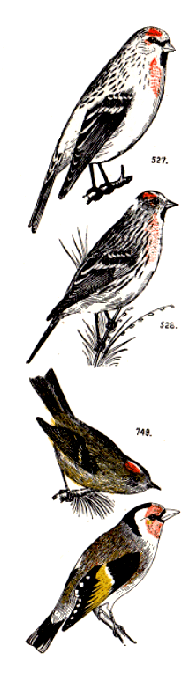
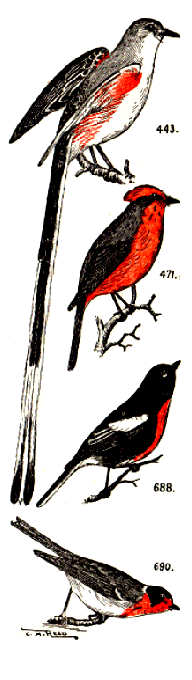
750. Dusky Kinglet (Regulus obscurus). Similar to No. 749, but above sooty olive. Ad. ♂. With crown-patch pinkish or purplish vermilion-red. (Ridgw.) (See page 176.) Range.—Guadalupe Island, Lower California. —European Goldfinch (Carduelis carduelis). L. 5.50. Feathers at base of bill red; crown and neck-stripe black; back brownish; wings with a yellow band; inner webs of tail-feathers tipped with white; below white tinged with brownish. Notes. Call, twit; song, "sweet and varied." (See page 176.) Range.—Introduced in this country near Hoboken, N. J., in 1878; now not uncommon near New York City. 443. Scissor-tailed Flycatcher (Muscivora forficata). L. 14.5. Ad. ♂. Above gray, back washed with red or yellow; crown-patch red. Ad. ♀. Similar, but tail shorter, red less bright, back grayer. Notes. Loud, harsh, chattering notes uttered on the wing. Range.—Central America and Mexico; breeds through Texas north to southern Kansas and western Louisiana, and winters south to Central America: accidental in Florida and as far north as Connecticut and Hudson Bay. 471. Vermilion Flycatcher (Pyrocephalus rubineus mexicanus). L. 6. Ad. ♂. Crown and underparts red; back grayish brown. Ad. ♀. Above brownish, below white, breast streaked with dusky, belly red or yellow. Yng. ♂. Similar to ♀ but spotted with red below and on crown. Notes. A shrill zi-bréé, zi-bréé, uttered while the bird hovers twenty or thirty feet up in the air. (Bendire.) Range.—Central America and Mexico, breeding north to southern Texas, New Mexico, Arizona, southwestern Utah (rarely); "winter visitant to southern California." (Grinnell.) 688. Painted Redstart (Setophaga picta). L. 5.4. Ads. Black; center of breast and belly deep red, patch in wings and outer tail-feathers white. Range—Mexican Plateau north to southwest New Mexico and Arizona. 690. Red-faced Warbler (Cardellina rubrifrons). L. 5.2. Ads. Forehead, face, throat and sides of neck red, crown and ear-coverts black, nape band and rump whitish; back gray; no white in wings or tail. Notes. A prolonged, very clear, whistled song. (Scott.) Range.—From Guatemala north over the Mexican Plateau to southern Arizona and western New Mexico.
498. Red-winged Blackbird (Agelaius phœniceus). L. ♂, 9.5; W. 4.7; B. .88; depth at base, .5. Ad. ♂. Black, in winter more or less tipped with rusty; lesser wing-coverts scarlet; median wing-coverts buff, tips in summer whitish. Ad. ♀. Above brownish black, widely margined with buffy and rusty; below whitish heavily streaked with black; throat tinged with orange or yellow; lesser wing-coverts tinged with red. Yng. ♂. Similar to Ad. ♂, but heavily margined with rusty above and less so below; lesser wing-coverts duller and narrowly edged with black. Notes. Call, chût, chûck, a reedy cack; song, a chorus song, a liquid kong-quĕr-rēē; alarm note a shrill chee-e-e-e-e. The notes of this species are subject to much variation with locality, but I find it impossible to express on paper differences perfectly apparent when heard. Range.—Eastern North America; breeds from Gulf of Mexico north to New Brunswick and Manitoba; winters from Virginia and southern Illinois southward. 498a. Sonoran Red-wing (A. p. sonoriensis). Similar to No. 498, but larger, bill more slender; ♀ paler, streaking below browner. W. ♀, 4.8; B. .95; depth at base .5. Range.—Lower Colorado Valley in California and Arizona, southern Arizona and south over coast plain of Sonora; Cape St. Lucas. 498b. Bahaman Red-wing (A. p. bryanti). Similar to No. 498, but bill slightly longer, the female streaked below with brownish instead of black. Range.—Bahamas and southern Florida. 498c. Florida Red-wing (A. p. floridanus). Similar to No. 498, but smaller, the bill longer and more slender; ♂, W. 4.2; B. .9; depth at base .4. Range.—Florida, except extreme southern portion; west along Gulf coast to Texas. 498d. Thick-billed Red-wing (A. p. fortis). Similar to No. 498, but larger, bill shorter and proportionately thicker. W. 5; B. .8; depth at base .5. Range.—Breeds on Mackenzie River, Athabasca, and other interior districts of British America; during migrations Great Plains, from Rockies to Minnesota, Iowa, western Illinois, northern Kentucky, and southwest to western Texas and Arizona. (Ridgway.) 498e. San Diego Red-wing (A. p. neutralis). Similar to No. 498a, but slightly smaller, the ♀ with streaks below wider. W. 4.7; B. .95; depth at base .5. Range.—Great Basin region from southern British Columbia south to Mexico, western Texas, to southern California and northern Lower California; in winter as far east as Brownsville, Texas. (Ridgway.) 498f. Northwestern Red-wing (A. p. caurinum). Similar to No. 498, but slightly larger, bill somewhat longer and more slender, the ♂ with median wing-coverts deeper buff, the ♀ much darker, streaks below wider, darkest ♀ of group. W. 4.8; B. .9; depth at base .45. Range.—Pacific coast from northern California to British Columbia; south in winter to southern California.
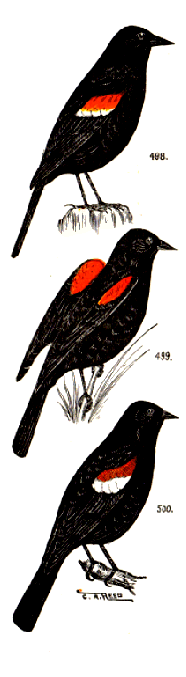
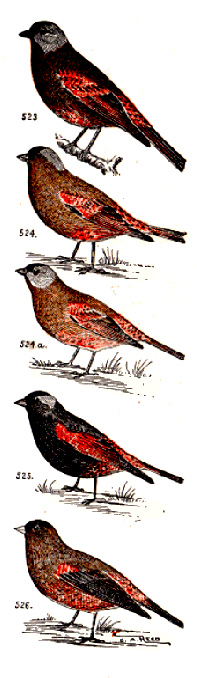
499. Bicolored Blackbird (Agelaius gubernator californicus). Ad. ♂. Similar to No. 498, but median wing-coverts darker and broadly tipped with black, concealing as a rule, their brownish bases. Ad. ♀. Very different from ♀ of No. 498; above and below blackish slightly edged with rusty. Notes. Similar in character to those of No. 498, but with easily recognizable differences. (See page 178.) Range.—Pacific coast; breeds from northern Lower California northward, west of Sierra Nevada and Cascade ranges, to Washington; migratory at north part of range. 500. Tricolored Blackbird (Agelaius tricolor). Ad. ♂. Similar to No. 498, but glossier, lesser wing-coverts darker, median wing-coverts white; in winter black more or less edged with grayish brown; median wing-coverts dingy. Ad. ♀. No rusty; above blackish edged with grayish; below black bordered with whitish. Notes. "Said to be quite different" from those of No. 498. (Bendire.) (See page 178.) Range.—Northern Lower California north to southern Oregon; local in valleys of interior. 523. Aleutian Leucosticte (Leucosticte griseonucha). Like No. 524a, but much darker, breast chestnut-chocolate; larger, W. 4.4. Range.—Islands of Bering Sea (resident); in winter, Shumagin Islands, lower portion of Alaska Peninsula and Kadiak Island. 524. Gray-crowned Leucosticte (Leucosticte tephrocotis). L. 6.7; W. 4.1. Ad. ♂. Reddish brown more or less tipped with grayish; rump, upper tail-coverts, lesser wing-coverts, outer edges of primaries, and lower belly tipped with pink; forecrown black; hindhead gray; cheeks down to blackish throat brown. Ad. ♀. Similar but duller. Yng. Nearly uniform brownish; margins of primaries showing some pink. Notes. A quick alarm note, qui, qui. (Silloway.) Range.—Western United States; breeds in higher parts of Sierra Nevada of California, from Mt. Shasta south to Mt. Whitney, and on White Mountains (Grinnell); north in Rocky Mountains to British Columbia; in winter east to Manitoba, Colorado, and Nebraska. 524a. Hepburn Leucosticte (L. t. littoralis). Similar to No. 524, but cheeks gray like hindhead; throat often grayish. Range.—Higher mountains of Washington and British Columbia; north to Alaska; winters south to Colorado and, on Pacific Coast, as far north as Kadiak Island. 525. Black Leucosticte (Leucosticte atrata). Similar to No. 524, but brown replaced by brownish black in Ad. ♂, or dusky slate brownish in Ad. ♀ and Yng. Range.—Breeds on higher mountains of Idaho and Wyoming; winters south to Colorado and Utah. 526. Brown-capped Leucosticte (Leucosticte australis). Resembles No. 524, but little or no gray on hindhead, the black of forehead passing gradually into brown of nape and back. Range.—Breeds in mountains of Colorado at about 12000 feet altitude, winters at lower altitudes and south to New Mexico.
Perching Birds Marked With Blue
599. Lazuli Bunting (Cyanospiza amœna). L. 5.5. Ad. ♂. Two white wing-bars; breast cinnamon, throat and upperparts light blue; back blacker. In winter more or less tipped with rusty. Ad. ♀. Middle wing-coverts tipped with whitish; above grayish brown with generally a blue tinge, strongest on rump and lesser wing-coverts; below whitish, breast buff. Yng. Like ♀, but browner, no blue. Notes. Suggest those of the Indigo Bunting. Range.—Western United States, east to western Kansas; breeds north to Montana and British Columbia; winters in Mexico. 600. Varied Bunting (Cyanospiza versicolor). L. 5.5. Ad. ♂. Reddish purple, crown and rump blue, nape red. Ad. ♀. Above brownish gray; below whitish washed with buff; a slight tinge of blue on rump, wings and tail. Much like ♀ of No. 598, but less brown above and no streaks below. Yng. Resemble ♀. Range.—Mexico; breeding north to southern Texas and southern Arizona; winters south of United States. 600a. Beautiful Bunting (C. v. pulchra). Similar to No. 600, but slightly smaller, rump more purple, throat with less red. Range.—Southern Lower California. 601. Painted Bunting; Nonpareil (Cyanospiza ciris). L. 5.4. Ad. ♂. Below red, rump duller, back green, head dark blue. Ad. ♀. Bright, shining olive-green above; greenish yellow below. Yng. ♂. Like ♀; second year variously intermediate between Ad. ♂ and ♀. Notes. Resemble those of the Indigo Bunting but possess less volume. Range.—Southern United States; breeds north to North Carolina, southern Illinois, and Kansas, and west to southern Arizona; winters in Mexico and Central America. 654. Black-throated Blue Warbler (Dendroica cærulescens). L. 5.2. A white patch or spot at base of primaries. Ad. ♂. Throat and sides black; belly white; above dark grayish blue; outer tail-feathers with white. Ad. ♀. Grayish olive-green; below yellowish white; a narrow white line over eye; white wing-patch small, sometimes barely showing above coverts; tail with a bluish tinge. Yng. ♂. Like Ad. ♀, but greenish above; black areas smaller and tipped with whitish. Notes. Call, a sharp, characteristic chip; song, usually, zwee-zwee-zwee in an ascending scale. Range.—Eastern North America; breeds from northern Connecticut, mountains of Pennsylvania, southern Michigan, and northern Minnesota, north to Labrador and Hudson Bay region; winters in Central and South America. 654a. Cairns Warbler (D. c. cairnsi). Similar to No. 654, but ♂ darker, the back with more or less black; ♀ darker and duller. Range.—Breeds in higher portions of southern Alleghanies; winters south of United States.
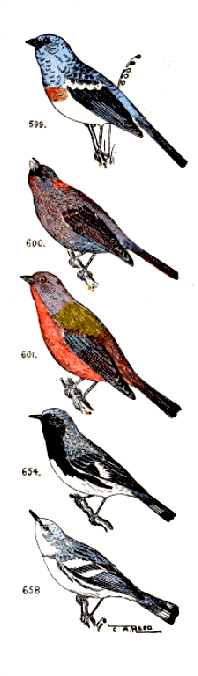
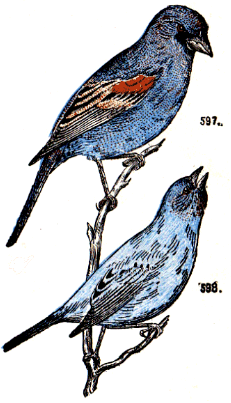
658. Cerulean Warbler (Dendroica cerulea). L. 5. Ad. ♂. A gray-blue breast band; above bright gray-blue streaked with black; wing-bars and spots in tail white. Ad. ♀ and Yng. ♂. Above blue-gray washed with greenish, below yellowish white; a whitish line over eye. Notes. Call, a warbler lisp and tchip of the Myrtle Warbler; song resembling that of Parula Warbler. (Brewster.) (See page 180.) Range.—Mississippi Valley, breeding north to Minnesota and east to Cayuga County, New York, Maryland, and West Virginia; generally rare east of Alleghanies; migrates south through Texas and winters in Central and South America. 597. Blue Grosbeak (Guiraca cærulea). L. 7; W. 3.4. Ad. ♂. Deep, dark blue, back blacker and sometimes with brownish edgings; lesser wing-coverts broadly, greater wing-coverts narrowly tipped with chestnut. In winter more or less tipped with brownish above and below. Ad. ♀. Above grayish brown, deepest on head; below grayish white washed with buffy; wing-bars buff. Some specimens show more or less blue, particularly about head. Yng. ♂. Like ♀, but browner. Notes. Call, a strong, harsh, ptchick; song, a beautiful but feeble warble, somewhat like that of Purple Finch and with a slight resemblance to that of Rose-breasted Grosbeak. (Ridgw.) Range.—Eastern United States; breeds from the Gulf north to Maryland and southern Illinois; winters south of United States into Mexico and Central America; casually north as far as Maine and Quebec. 597a. Western Blue Grosbeak (G. c. lazula). Similar to No. 597, but larger, W. 3.6; male brighter blue; back blacker; tips of wing-coverts paler, those of greater coverts usually decidedly paler than those of lesser coverts and averaging wider than those of No. 597. Female averaging paler, less brown. Range.—Western United States; breeds from Mexico north to Kansas, southern Nebraska, Colorado, and northern California; winters in Mexico and Central America. 598. Indigo Bunting (Cyanospiza cyanea). L. 5.4. No white wing-bars. Ad. ♂. Deep blue, darkest on head. In winter brown, paler below, more or less mixed with blue. Ad. ♀. Above brown; below whitish washed with brown with a suggestion of streaks; lesser wing-coverts and margins of tail-feathers usually tinged with blue. Yng. Similar to ♀ but below more streaked; browner, and generally without blue tinge. Notes. Call, a sharp pit; song, a tinkling, unsympathetic, rapid warble, July, July, summer-summer's here; morning, noontide, evening, list to me. Range.—Eastern United States, west to the Plains, casually to Colorado; breeds north to Nova Scotia and Manitoba; winters in Central America.
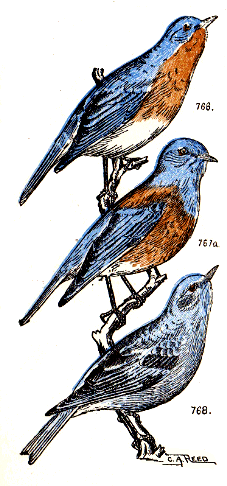
766. Bluebird (Sialia sialis). L. 7. Ad. ♂. Above, including wings and tail, bright blue; throat and breast rusty brown, belly whitish. Ad. ♀. Above grayer, below paler. In winter specimens of both sexes have upperparts tipped with rusty. Notes. Call, tur-wee, tur-wee; song, a rich and sweet but short warble. Range.—Eastern United States; breeds from the Gulf States to Nova Scotia and Manitoba; winters from southern New England and southern Illinois southward. 766a. Azure Bluebird (S. s. azurea). Similar to No. 766, but breast paler, upperparts less deep, more cerulean. Range.—Mountains of eastern Mexico north to southern Arizona. 767. Western Bluebird (Sialia mexicana occidentalis). L. 7. Ad. ♂. Above bright blue, foreback with more or less rust-brown, but rarely wholly chestnut; throat blue, breast rust-brown, belly bluish gray. Ad. ♀. Above grayish blue; rust on foreback faintly indicated; throat bluish gray, breast paler than in ♂. Notes. Call, suggests that of No. 766, but is louder and wilder. Range.—Pacific coast region from northern Lower California north to British Columbia, east to western Nevada and casually, during migrations, to New Mexico. (Ridgway.) 767a. Chestnut-backed Bluebird (S. m. bairdi). Similar to No. 767, but foreback wholly rust-brown. Range.—Rocky Mountain region from Wyoming south into Mexico. 767b. San Pedro Bluebird (S. m. anabelæ). Rust-brown of back and breast greatly reduced in extent, usually wholly wanting or barely indicated on back, and divided into two patches on breast by backward extension of blue of throat; W. 4.2. (Ridgw.) Range.—San Pedro Martir Mountains, Lower California. 768. Mountain Bluebird (Sialia arctica). L. 7.5. Ad. ♂. Above beautiful cerulean blue, throat and breast paler, belly whitish. Winter specimens are more or less tipped with brownish. Ad. ♀. Above brownish gray, rump blue, throat and breast grayish buff; belly whitish. Notes. Call, suggests that of No. 766, but in fall is merely a feeble chirp. (Ridgw.) Range.—Western United States, except Pacific coast; breeds from the Sierra Nevada east to the Plains and from New Mexico north to the Great Slave Lake region; winters from the Mexico boundary states south into Mexico.
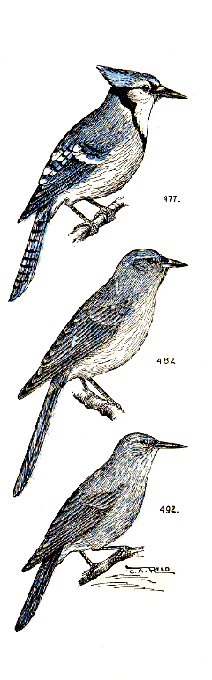
477. Blue Jay (Cyanocitta cristata). L. 11.7. Ads. Above gray-blue, breast and sides washed with grayish; white tip to outer tail-feather rarely less than one inch long. Notes. Varied; commonly a loud harsh jay jay; often whistling calls and imitations of the notes of other birds, particularly of common Hawks. Range.—Eastern North America, west to the Plains; breeds from Georgia and northern Texas north to Labrador and Hudson Bay region; resident, except at northern part of range. 477a. Florida Blue Jay (C. c. florincola). Similar to No. 477, but smaller, L. 10; blue above with a purplish tinge; greater wing-coverts more narrowly barred with black and tipped with white. Range.—Florida and Gulf Coast to southeastern Texas. 482. Arizona Jay (Aphelocoma sieberii arizonæ). L. 13; W. 6.3; T. 5.8. Ads. Above grayish blue, head, wings and tail brighter than back; below unstreaked, gray breast tinged with bluish; belly whiter. Notes. Noisy, harsh, and far-reaching. (Bendire.) Range.—Northern Mexico, north to southern New Mexico and Arizona. 482a. Couch Jay (A. s. couchi). Similar to No. 482, but smaller; W. 5.8; T. 5.3; bluer above, throat whiter. Range.—"Eastern Mexico, extending to western Texas in the Chisos Mountains." (Bailey.) 492. Pinon Jay (Cyanocephalus cyanocephalus). L. 11; T. 4.8. Ads. Above nearly uniform grayish blue, head slightly darker; below slightly paler, throat streaked with white. Notes. Variable, some as harsh as those of No. 491, others like gabble of Magpie; others like Jays' common call a shrill, querulous, peeh, peeh; when on ground maintain a constant chatter. (Bendire.) Range.—Western North America, from New Mexico and Lower California north to southern British Columbia; east to Rockies, west to Sierra Nevada and Cascade Ranges.
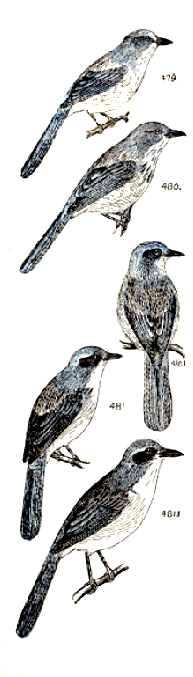
479. Florida Jay (Aphelocoma cyanea). L. 11.5. Ads. foreback clay-color or pale brownish gray; head, nape, wings, tail, sides of throat and faint breast-streaks blue; a grayish line over eye; throat gray; belly dingier; forehead usually hoary. Notes. Harsh and unmusical calls. Range.—Florida; confined mostly to coast of the middle portions of the peninsula. 480. Woodhouse Jay (Aphelocoma woodhousei). L. 12; W. 5. Ads. Back grayish or brownish blue, usually not sharply defined from nape; crown, nape, wings and tail blue; throat gray; belly dingier; breast streaked with blue; under tail-coverts blue; a narrow white line over eye. Resembles No. 479, but is larger, back bluer, forehead not hoary; line over eye sharper. Range.—Western United States (chiefly Great Basin region), from northern Mexico north to southeastern Oregon and southern Wyoming; east to western Texas and Colorado; west to California, east of the Sierras. 480.1. Blue-eared Jay (Aphelocoma cyanotis). Resembling No. 480, but larger; W. 5. 5; under tail-coverts white; back slaty-gray tinged with blue; white line over eye less evident. Range.—"Mexican tableland north casually to Sutton County, Texas." (Bailey.) 480.2. Texan Jay (Aphelocoma texana). Similar to No. 480.1, but white line over eye more distinct, below paler and browner gray, lower throat and chest with obsolete grayish streaks instead of blue streaks. Differs from No. 480 in having pure white under tail coverts and in other respects. (Ridgw.) Range.—"Southeastern Texas, from Concho and Kerr Counties west to the Davis Mountains." (Bailey.) 481. California Jay (Aphelocoma californica). Similar to No. 480, but back brown; usually sharply defined from nape; blue areas brighter, throat and belly whiter; breast less streaked with blue. Notes. Varied, usual call a harsh, metallic squawking. Range.—Pacific coast from northern Lower California, north to southern Washington, east, in California, to the Sierra Nevada. 481a. Xantus Jay (A. c. hypoleuca). Similar to No. 481, but blue areas somewhat lighter, underparts decidedly whiter. Range.—Lower California, north to Lat. 28°. 481b. Belding Jay (A. c. obscura). Similar to No. 481, but darker and with smaller feet; W. 4.7. (Anthony.) Range.—San Pedro Martir Mountains, Lower California. 481.1. Santa Cruz Jay (Aphelocoma insularis). Similar to No. 481, but larger; W. 5.6; blue areas much deeper, back much darker, grayish sooty tinged with blue. Range.—Santa Cruz Island, California.
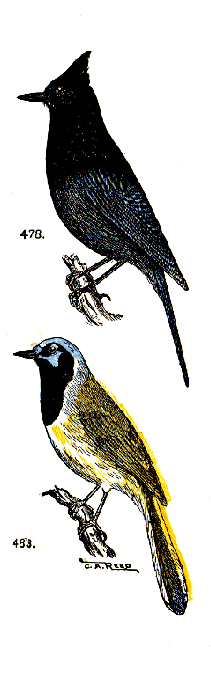
478. Steller Jay (Cyanocitta stelleri). L. 13. Ads. Crest, back and upper breast sooty brown; rump and belly dark, (Antwerp) blue; forehead more or less streaked with blue. Notes. Varied, usual call a loud, harsh squawking; the bird is a mimic and also a whistler. Range.—Pacific coast from Monterey, California, north to near Cook Inlet, Alaska, including Vancouver Island. 478a. Blue-fronted Jay (C. s. frontalis). Similar to No. 478, but back paler, grayer, rump and belly turquoise, forehead with more blue which sometimes extends to the crest. Range.—"Southern coast ranges and Sierra Nevada of California and western Nevada, from Fort Crook south to northern Lower California." (A. O. U.) 478b. Long-crested Jay (C. s. diademata). Similar to No. 478, but paler, grayer above, blue turquoise, as in No. 478a; crest longer, the forehead with pale, bluish white streaks; a white spot over the eye. Range.—"Southern Rocky Mountains; north to southern Wyoming; west to Uintah Mountains, in eastern Utah, and the higher ranges of northwestern Arizona; south to New Mexico." (Bendire.) 478c. Black-headed Jay (C. s. annectens). Between No. 478 and No. 478b. Forehead streaks, and spot over eye much as in latter; color of body dark as in former. Range.—Northern Rocky Mountain region from northern Utah and southern Wyoming north to Alberta and British Columbia. 478d. Queen Charlotte Jay (C. s. carlottæ). Similar to No. 478, but darker, sooty slate above, blue deeper. Range.—Queen Charlotte Islands, British Columbia. 483. Green Jay (Xanthoura luxuosa glaucescens). L. 11. Ads. Crown and patches at side of throat blue; back, wings, and central tail-feathers green; outer tail-feathers yellow; throat black, breast and belly greenish yellow. Notes. Noisy and harsh often suggesting certain of the Blue Jay's calls. Range.—Lower Rio Grande Valley, Texas, and south into northeastern Mexico.
Perching Birds with Yellow or Orange
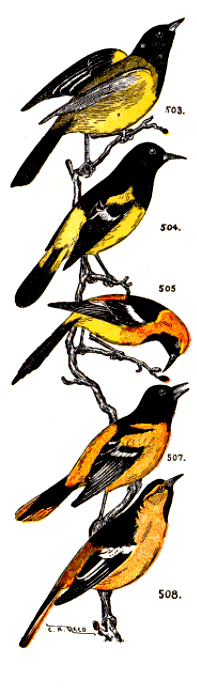
503. Audubon Oriole (Icterus audubonii). L. 9.5. Ads. Head, breast, wings and tail black; belly yellow; back greenish yellow. Yng. Greenish yellow below; olive-green above. Notes. See No. 507. Range.—Mexico north to the Lower Rio Grande; casually as far as San Antonio, Texas; resident. 504. Scott Oriole (Icterus parisorum). L. 8; B. .95; Ad. ♂. Lesser wing-coverts, base of tail, rump and belly yellow; rest of plumage black. Ad. ♀. Yellowish below, olive-green above, two white wing-bars. Yng. ♂. Like female, but throat black. Notes. See No. 507. Range.—Mexican tableland, migrating north to western Texas, northern New Mexico, southern Nevada and southeastern California; winters in Mexico. 505. Hooded Oriole (Icterus cucullatus sennetti). L. 8; B. .75. Ad. ♂. Orange; forehead, face, throat, foreback, wings and tail black; lesser wing-coverts and tips to greater ones white. Ad. ♀. Yellowish below, brownish olive-green above, two white wing-bars. Yng. ♂. Like ♀, but throat black. Notes. See No. 507. Range.—Mexico; migrating north to the Lower Rio Grande; winters in Mexico. 505a. Arizona Hooded Oriole (I. c. nelsoni). Similar to No. 505, but head, rump, etc. yellow instead of orange. Range.—Northwestern Mexico and Lower California, migrating north to southwestern New Mexico, Arizona, and southern California, west of Sierra Nevada; winters in Mexico. 507. Baltimore Oriole (Icterus galbula). L. 7.5. Ad. ♂. Throat, whole head, foreback, wings and middle tail-feathers black; breast, belly, rump, lesser wing-coverts and ends of outer tail-feathers orange; wing-coverts and tertials margined with white. Ad. ♀. Head and foreback olive-yellow spotted with black; rump and tail brownish yellow; below dull yellow, throat generally blackish. Notes. The notes of all the orange and black Orioles known to me are mellow, musical, querulous whistles generally given in detached fragments, all much alike in character but distinguishable when one becomes familiar with them. Range.—Eastern North America west to the Rocky Mountains; breeds from Florida and eastern Texas north to New Brunswick and the Saskatchewan; winters in Central and South America. 508. Bullock Oriole (Icterus bullocki). L. 7.5. Ad. ♂. Cheeks, most of underparts, forehead and line over eye orange; rump and outer tail-feathers yellower; center of throat, crown, foreback and middle tail-feathers black; a large white wing-patch. Ad. ♀. Above olive grayish brown; below yellowish, belly whiter; tail olive-yellow; wings blackish, median coverts tipped, greater coverts externally margined with white; chin sometimes blackish. Yng. ♂. Like ♀, but center of throat and lores black. Notes. See No. 507. Range.—Western North America, from Mexico north to Assiniboia and British Columbia; east to western Texas; west to the Pacific; winters in Mexico.
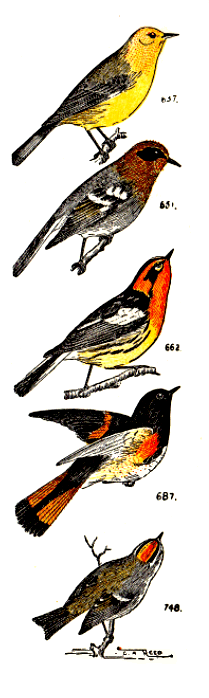
637. Prothonotary Warbler (Protonotaria citrea). L. 5.5. Tail-feathers with large white areas. Ad. ♂. Whole head and underparts orange-yellow; back greenish yellow; rump gray. Ad. ♀. Crown greenish like back; yellow paler; belly whitish; less white in tail. Notes. Call, a sharp, metallic chink; song, a "high pitched, penetrating and startling" "peet, tsweet, tsweet, tsweet, tsweet, tsweet." (Jones.) Range.—Eastern North America; breeds from the Gulf States north to Virginia, Ohio, and southern Minnesota; winters in the tropics. 651. Olive Warbler (Dendroica olivacea). L. 5.2. Ad. ♂. Head and breast orange brown, a black band through the eye; back olive-gray; belly grayish; wing-bars white; outer tail-feathers largely white. Ad. ♀. Above olive-gray, head yellower; eye-band dusky; breast yellow; belly white. Notes. Song, a liquid quirt quirt, quirt, in a descending scale. (Price.) Range.—Highlands of Guatemala and Mexico north to mountains of Arizona and New Mexico. 662. Blackburnian Warbler (Dendroica blackburniæ). L. 5.2. Ad. ♂. Throat, line over eye, center of crown, and sides of neck bright orange; back black with a few whitish streaks; wing-bars broadly white; tail-spots white. Ad. ♀. Yellow areas paler; above grayish streaked with blackish. Yng. and Ad. in Winter. Similar to Ad. ♂, but throat paler, back browner; wing with two distinct bars. Notes. Song, wee-see-wee-see, tsee-tsee, tsee, tsee-tsee, tsee, tsee, in an ascending scale, the last shrill and fine. Range.—Eastern North America; breeds from northern New England (and in Berkshire and Worcester counties, Massachusetts), and northern Minnesota, north to Labrador and Hudson Bay region, (and south in Alleghanies to South Carolina); winters in tropics. 687. Redstart (Setophaga ruticilla). L. 5.4. Ad. ♂. Black; sides of breast, band in wings and in tail rich salmon. Ad. ♀. Sides of breast, band in wings and in tail dull yellow; back olive-brown, crown gray; below whitish. Yng. ♂. Intermediate between adults. Notes. Song, ching, ching, chee; ser-wee, swee, swe-e-e. Range.—North America; rare on the Pacific coast; breeds from North Carolina, and Kansas north to Labrador and Alaska; winters in the West Indies, Central and South America. 748. Golden-crowned Kinglet (Regulus satrapa). L. 4.1. Ad. ♂. Crown orange and yellow bordered by black; a whitish line over eye; back grayish olive-green; below soiled whitish. A blackish band in wing bordered basally by yellowish white. Ad. ♀. No orange in crown, its whole center yellow. Notes. Call, a fine, high ti-ti; song, five or six fine, shrill high-pitched notes ending in a short, rapid, rather explosive warble, "tzee, tzee, tzee, tzee, ti, ti, ter, ti-ti-ti." Range.—North America; breeds from northern United States northward, and southward along the Rockies into Mexico and in the Alleghanies to North Carolina; winters from about its southern breeding limit to the Gulf States and Mexico. 748a. Western Golden-crowned Kinglet (R. s. olivaceus). Similar to No. 748, but upperparts brighter olive-green; underparts with a brownish tinge. Range.—Pacific coast region; breeds from the higher Sierra Nevada of California north to southern Alaska.
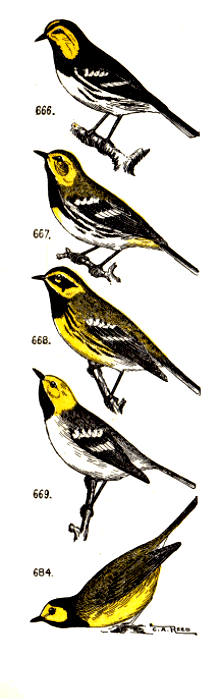
666. Golden-cheeked Warbler (Dendroica chrysoparia). L. 5. Ad. ♂. Throat, crown and back black; cheeks and spot in forehead yellow; a narrow black line through eye; wing-bars and tail-patches white. Ad. ♀. Above olive green with black streaks; cheeks duller than in ♂, eye-streak dusky; throat yellow, breast blackish; belly white. Notes. Song, tser, weasy-weasy, twea, resembling song of No. 667. (Nehrling.) Range.—Western central and southern Texas and south through eastern Mexico to highlands of Guatemala. (Ridgway.) 667. Black-throated Green Warbler (Dendroica virens). L. 5. Ad. ♂. Throat and breast black; cheeks greenish yellow; back olive-green; wing-bars and tail patches white. Ad. ♀ and Yng. ♂. Similar, but throat yellowish; black breast tipped with yellowish; belly tinged with yellow; back without black streaks. Yng. ♀. Throat and breast yellowish white, little or no black. Notes. Song, a droning zēē, zēē, zĕ-ēē', zēē. Range.—Eastern North America; breeds from Connecticut and northern Illinois north to Nova Scotia and Hudson Bay, and south in Alleghanies to South Carolina; winters in Central America. 668. Townsend Warbler (Dendroica townsendi). L. 5.1. Ad. ♂. A black eye-patch bordered by yellow stripes; crown and throat black; back olive-green spotted with black; wing-bars and tail-patches white. Ad. ♀. Eye-patch olive; throat yellow, indistinctly blackish; crown and back olive-green, with few black streaks. Yng. Similar, but yellower. Notes. Song, de-de, de-de, de, like that of No. 667. (Merrill.) Range.—Western North America; breeds from mountains of southern California north to Alaska, east to western Colorado; in migrations to western Texas; winters in Mexico. 669. Hermit Warbler (Dendroica occidentalis). L. 5.1. Underparts without streaks. Ad. ♂. Crown and cheeks yellow; throat black; back gray spotted with black; wing-bars and tail-patches white. Ad. ♀. Crown less yellow; throat yellowish; back olive-gray, usually without spots. Yng. ♀. Similar, but yellower. Yng. ♂. Throat dusky; forehead and cheeks yellow; back olive-green with concealed black spots. Much like Yng of No. 667, but forehead yellower, no streaks below. Notes. Song, zeegle-zeegle-zeegle-zeek. (Barlow.) Range.—Western United States; breeds in high mountains from British Columbia to California, and from Pacific Coast district of United States to Rocky Mountains; migrates to Lower California, Mexico, and Guatemala. (Bailey.) 684. Hooded Warbler (Wilsonia mitrata). L. 5.7. Outer tail-feather with white patches. Ad. ♂. Forehead and cheeks yellow; hindhead extending to breast and throat black; belly yellow; back olive-green. Ad. ♀. Throat yellow, hindhead olive-green usually with black. Notes. Call, a sharp cheep; song, a gracefully whistled you must come to the woods, or you wont see me. Range.—Eastern United States; breeds north to southern Connecticut, central western New York, and southern Michigan; winters in Central America.
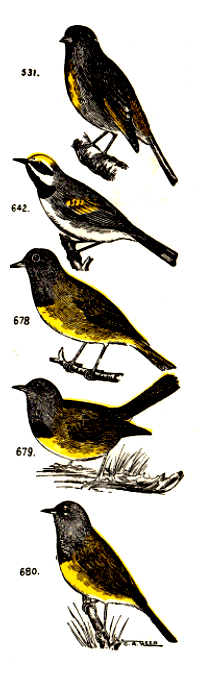
531. Lawrence Goldfinch (Astragalinus lawrencei). L. 4.7. Ad. ♂. Crown, throat and front of cheeks black; body gray, breast, rump, wings and, to a less degree, back with yellow; outer tail feathers with large white spots near the end. Ad. ♀. Similar, but no black, back browner and without yellow. Notes. Suggesting those of the Goldfinch, but weaker. Range—California, west of the Sierra; breeds from northern Lower California north to Chico, California; winters to Arizona and New Mexico. 642. Golden-winged Warbler (Helminthophila chrysoptera). L. 5. Ad. ♂. Crown yellow, wing-bars broadly yellow; above bluish gray; below grayish white; throat-patch and eye-stripe black. Ad. ♀. Crown duller; throat-patch and eye-stripe gray. Notes. Song, a lazy zee-zee-zee-zee all on same note. Range.—Eastern United States; breeds from northern New Jersey and northern Indiana north to Vermont, southern Ontario, and Michigan, and south along Alleghanies to South Carolina; winters in Central America. 678. Connecticut Warbler (Geothlypis agilis). L. 5.5. Eye-ring white; no white in wings or tail. Ad. ♂. Crown and cheeks bluish slate; throat and breast paler, the latter with no black; above olive-green; below yellow, sides greenish. Ad. ♀ and Yng. Throat and breast olive brown; belly yellow; back brownish olive-green; crown browner. Notes. Call, a sharp peek; song, suggesting that of Maryland Yellow-throat and also that of Oven-bird, free-chapple, free-chapple, free-chapple, whoit. (Seton.) Range.—Eastern North America, north to Maine and Manitoba; known to breed only in Manitoba; winters in northern South America. 679. Mourning Warbler (Geothlypis philadelphia). L. 5.4. No white in wings or tail. Ad. ♂. No white eye-ring; crown and cheeks bluish slate; throat blackish; breast black more or less veiled by slaty; belly yellow; back olive-green. Ad. ♀. Head slaty; throat and breast grayish; an inconspicuous white eye-ring. Yng. Similar, but browner above; throat more yellow. Notes. Song, clear and whistled, tee te-o te-o te-o we-se, the last couplet accented and much higher pitched. (Jones.) Range.—Eastern North America; breeds from northern New England, northern New York and eastern Nebraska north to Nova Scotia and Manitoba, and south along the Alleghanies to West Virginia; winters in Central and South America. 680. Macgillivray Warbler (Geothlypis tolmiei), L. 5.4. Ads. Similar to No. 679, but with an incomplete white eye-ring showing above and below eye. Range.—Western North America from the Rocky Mountains to the Pacific; breeds from western Texas and mountains of southern California north to British Columbia; in migrations ranges east to Nebraska and middle Texas; winters in Mexico and Central America.
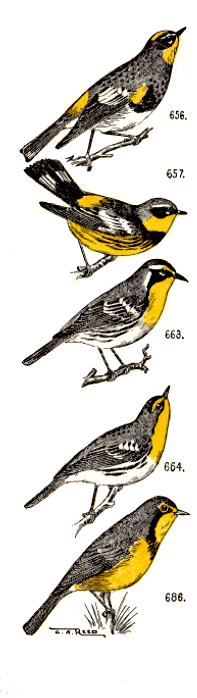
656. Audubon Warbler (Dendroica auduboni). L. 5.6. Crown, sides of breast, rump, and throat usually with yellow. Ad. ♂. Throat bright yellow; breast black; back blue-gray streaked with black; wing-bars broadly white; outer tail-feathers with white. Ad. ♀. Similar to male, but breast grayish; yellow less bright; less white in wings. ♂, Winter. Like same plumage of No. 655, but throat, yellowish; more white in tail. ♀, Winter. Similar, but less yellow, throat sometimes without yellow, when like No. 655, but white on four or five outer tail-feathers instead of on two or three. Range.—Western United States; breeding in higher mountains from southern California and New Mexico north to British Columbia; winters south into Mexico. 656a. Black-fronted Warbler (D. a. nigrifrons). Similar to No. 656, but Ad. ♂. with forehead, sides of crown, and ears black; back black, narrowly margined with bluish gray. In winter. Bluish gray, not brownish above. Ad. ♀ darker, more heavily streaked with black above. (Ridgw.) Range.—Mountains of northern Mexico north to southern Arizona. 657. Magnolia Warbler (Dendroica maculosa). L. 5.1. Rump yellow; seen from below a white band across middle of tail. Ad. ♂. Crown ashy, back black; wing-coverts broadly white; below yellow streaked with black. Ad. ♀. Duller; fewer black stripes below; wing-bars separated, narrow. Yng. and Ad in winter. Crown and sides of head brownish ashy, back olive-green; below yellow, sides occasionally streaked. Notes. Song, a loud, clear whistle, chee-to, chee-to, chee-tee-ee, uttered rapidly and with a falling inflection, (Langille.) Range.—Eastern North America, west in migrations, to the Rockies; breeds from northern New England, northern Michigan (and south along the Alleghanies to Pennsylvania), north to Quebec and Hudson Bay region; winters in Central America. 663. Yellow-throated Warbler (Dendroica dominica). L. 5.2. Ads. Throat and line from bill to eye yellow; cheeks and forehead black; back bluish gray; two broad white wing-bars; tail-patches white. Notes. Song, loud, ringing and ventriloquial; suggesting that of Indigo Bunting but shorter. Range.—Southeastern United States; breeds from Florida north to Virginia and winters from Florida south into West Indies. 663a. Sycamore Warbler (D. d. albilora). Similar to No. 663, but bill smaller, line from eye to bill white or with but traces of yellow. Range.—Mississippi Valley; breeds from Texas north to Kansas, southern Indiana, southern Illinois, and West Virginia; winters in Mexico and Central America. 664. Grace Warbler (Dendroica graciæ). L. 5. Ad. ♂. Throat and line over eye yellow; cheeks gray; above gray, crown and back with black streaks; wing-bars and tail-patches white. Ad. ♀. Similar, but duller, back sometimes brownish. Range.—Northwestern Mexico, north to New Mexico, southwestern Colorado, and Arizona.
686. Canadian Warbler (Wilsonia canadensis). L. 5.6. No white in wings or tail. Ad. ♂. A necklace of black spots on breast; back gray; belly yellow; forehead black. Ad. ♀ and Yng. ♂. Black areas smaller. Yng. ♀. Slightly yellowish above; necklace slightly indicated by dusky spots. Notes. Song, tu-tu, tswe, tu, tu, longer or shorter and suggesting in style of utterance both the Yellow Warbler and Goldfinch. (Jones.) (See page 190.) Range.—Eastern North America; breeds from Massachusetts, central New York, and northern Michigan north to Labrador and Manitoba, and south along the Alleghanies to North Carolina; winters in Central and South America. 640. Bachman Warbler (Helminthophila bachmanii). L. 4.2. Outer tail-feathers usually with a white patch more or less distinct. Ad. ♂. Breast-patch and crown-band black; forehead, chin and belly yellow; back olive-green, hindhead grayish. Ad. ♀. Above grayish olive-green, head grayer; below dingy grayish with a yellow tinge. Notes. Song, when migrating, resembles that of Parula Warbler, (Brewster); when breeding, that of Worm-eating Warbler, Junco or Chippy. (Widmann). Range.—Southeastern United States, west to Louisiana, north to Virginia and southern Indiana; rare on Atlantic coast; known to breed only in Missouri; winters south of United States. 641. Blue-winged Warbler (Helminthophila pinus). L. 4.8. Ad. ♂. Crown and underparts yellow; back olive-green; a black stripe through eye; two whitish wing-bars; outer tail-feathers with white patches. Ad. ♀. Similar, less yellow on head, duller below. Notes. Song, a wheezy, swee-chee, the first inhaled, the second exhaled; also, later, wēē, chi-chi-chi-chi, chūr, chēē-chūr. Range.—Eastern United States; breeds north to southern Connecticut and Minnesota, occasionally wanders to Massachusetts; winters south of United States. 670. Kirtland Warbler (Dendroica kirtlandi). L. 5.7. Ad. ♂. Above bluish gray streaked with black; below pale yellow, sides streaked with black; wing-bars grayish; tail-patches white. Ad. ♀. Similar, but browner. Notes. Song, said to resemble that of Maryland Yellow-throat and also that of Yellow-throated Warbler. Range.—Eastern United States; has been found from April to October in United States as follows: in Florida, South Carolina, Virginia, Missouri, Illinois, Indiana, Ohio, Minnesota, Michigan, and Ontario, in all some twenty odd specimens; found breeding in summer of 1903 in Oscoda County, Michigan; winters in Bahamas where some fifty specimens have been taken. 671. Pine Warbler (Dendroica vigorsii). L. 5.5. Ad. ♂. Throat and breast greenish yellow; above bright yellowish green; wing-bars and tail-patches white. Ad. ♀. Similar, but breast duller, back browner. Yng. ♂. Similar to Ad. ♂, but browner. Yng. ♀. Below buffy white, breast slightly or not all yellowish; back olive-brown. Notes. Song, suggesting a Chipping Sparrow's but more musical. Range.—Eastern North America; breeds from Gulf States north to New Brunswick, Minnesota, and Manitoba; winters from Virginia and southern Illinois to Gulf States.
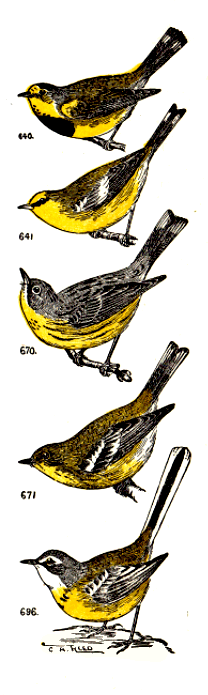
696. Siberian Yellow Wagtail (Budytes flavus leucostriatus). L. 6.5. Ad. ♂. Crown bluish slate, a white line over eye; back olive-green; below yellow; wing-bars yellowish; outer tail-feathers largely white. Ad. ♀. Similar, but duller, head and wing-bars browner. Notes. Call, a sharp, plé-plé-ple; song, a low, clear, medley of jingling notes uttered on the wing. (Nelson.) (See page 191.) Range.—China, Eastern Siberia, and Bering Sea portion of eastern Alaska. 529. American Goldfinch (Astragalinus tristis). L. 5.1; W. 2.8. Ad. ♂. Yellow, cap, wings and tail black; wing-coverts, secondaries and inner margins of tail-feathers tipped with white. Ad. ♀, Above grayish olive-brown; below buffy whitish; throat yellowish; wings and tail duller than in male; white tips to tail not distinct. Yng. ♂ and Ad. ♂ in winter. Similar to ♀ but wings and tail black; white markings grayer than in summer. Notes. Calls, when perching, hear me, hear me, dearie, soft and sweet, when flying, per-chic'-o-ree; per-chic'-o-ree; song, sweet, rapid, varied and canary-like. Range.—Eastern North America west to the Rockies; breeds from Virginia and Missouri north to Labrador and Manitoba; winters from northern United States to the Gulf States. 529a. Western Goldfinch (A. t. pallidus). Similar to No. 529, but larger, W. 3.05. Ad. ♂, in summer, similar in color to No. 529. ♀ and ♂, in winter. Much paler, the white areas greater in extent. Range.—Rocky Mountain region from northern Mexico north to British Columbia. 529b. California Goldfinch (A. t. salicamans). Similar to No. 529, but wings and tail shorter and color darker. Ad. ♂ in summer. With back always (?) tinged with pale olive-green; in winter darker than No. 529, but with white areas as large as in 529a. (Ridgw.) Range.—California, west of the Sierra, south to Lower California, north to Washington. 530. Arkansas Goldfinch (Astragalinus psaltria). L. 4.1. Ad. ♂. Cap, wings, and tail black, most of primaries and tail white basally; back and cheeks olive-green, often marked with black; below yellow Ad. ♀. No black cap; above olive-green; below dull yellowish; wings and tail brownish black, former with white much reduced, latter with little or no white. Yng. Resemble female. Notes. Call, se-e-e-ep; song, sweet, varied and musical. Range.—Western United States, from the Plains to the Pacific; breeds from northern Lower California and western Texas, north to Colorado, southern Idaho, and Oregon; winters from the southern part of its breeding range southward. 530b. Mexican Goldfinch (A. p. mexicanus). Resembles No. 530, but cheeks and entire upperparts black; ♀ as in No. 530. Range.—Mexico, north to southern Texas.
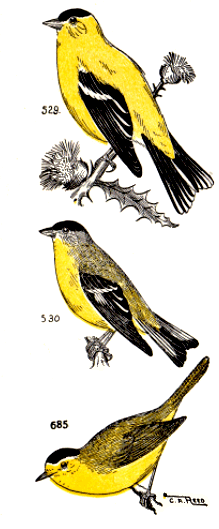
685. Wilson Warbler (Wilsonia pusilla). L. 5. No white in plumage. Ad. ♂. Crown shining black; forehead, cheeks and underparts yellow; back olive-green. Ad. ♀. Similar, but crown-patch often smaller, sometimes absent. Yng. ♀. Crown-patch absent. Notes. Song, 'tsh-'tsk-'tsh-'tshea. (Nuttall.) Suggests that of Redstart or Yellow Warbler. (Minot.) Range.—Eastern North America; breeds from Nova Scotia, northeastern Maine, and Ontario north to Labrador and Hudson Bay region; winters in Mexico and Central America; "occasional during migration in Colorado … and other parts of the Rocky Mountain district" (Ridgw.) (See page 192.) 685a. Pileolated Warbler (W. p. pileolata). Similar to No. 685, but yellow deeper, olive brighter. Range.—Western North America; breeding throughout the Rocky Mountain district from western Texas in higher mountains, northward to Alaska, coast and interior; westward to eastern Oregon and Queen Charlotte Islands; in migrations over all of western North America and east to Minnesota; in winter south to Central America. (Ridgw.) (See page 192.) 685b. Golden Pileolated Warbler (W. p. chryseola). Similar to No. 685a, but still brighter, richer yellow; forehead nearly orange; back brighter green. Range.—Pacific coast; breeds from southern California north to British Columbia; in migration east to eastern Oregon; south to Chihuahua and Lower California. (Ridgw.) (See page 192.) 677. Kentucky Warbler (Geothlypis formosa). L. 5.6. No white in plumage. Ad. ♂. Cheeks and crown black the latter tipped with ashy; back olive-green; a yellow line over eye; below bright yellow. Ad. ♀. Similar, but less black in crown and on cheeks; yellow duller. Notes. Song, a loud musical whistle, turdle, turdle, turdle, suggesting notes of Carolina Wren. Range.—Eastern United States; breeds from Gulf States north to lower Hudson Valley, southern Michigan and eastern Nebraska; winters in Central and northern South America. 681. Maryland Yellow-throat (Geothlypis trichas). L. 5.2; W. 2.1. Ad. ♂. Forehead and cheeks black, bordered behind by ashy; back olive-green; throat and breast yellow, belly whitish washed with yellow, sides brownish. Ad. ♀. No black mask; above dull olive-green, forehead brownish; throat and breast more or less washed with yellow, belly whitish, sides brownish. Yng. ♂. Similar to Ad. ♂, but browner; breast yellow; cheeks and forehead with more or less half-concealed black. Notes. Calls, pit, chit, or chack; song, variable, often wichity, wichity, wichity. Range.—"Atlantic Coast district of United States; breeding in Virginia, District of Columbia, Maryland and southern Pennsylvania (Carlisle), probably also in Delaware and southern New Jersey and in upland portions of Carolinas and Georgia; … south in winter to Bahamas …" (Ridgw.) 681a. Western Yellow-throat (G. t. occidentalis). Similar to No. 681d, but yellow below richer, border of mask whiter and broader. Range.—Arid western United States; east to western portions of Great Plains, north to Montana and eastern Washington (?); west to southern California: breeding southward to northern Chihuahua and northern Lower California; southward in winter to western Mexico and Cape St. Lucas. (Ridgw.)
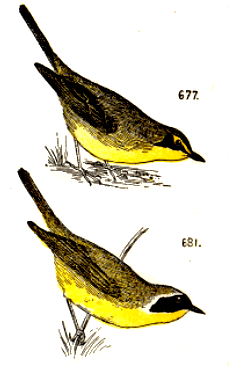
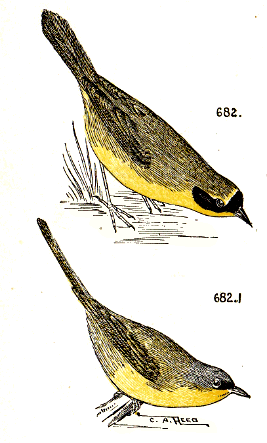
681b. Florida Yellow-throat (G. t. ignota). Similar to No. 681d, but yellow below more extended and deeper, sides browner; black mask wider; upperparts, especially hindhead, browner. Range.—South Atlantic and Gulf Coast districts of United States from southeastern Virginia to Florida and westward along Gulf lowlands to eastern Texas; winters from at least coast of South Carolina southward; also in Cuba. (Ridgw.) 681c. Pacific Yellow-throat (G. t. arizela). Similar to No. 681a, but bill smaller, wings and tail shorter, color duller, whitish margin of mask narrower, yellow usually less orange; W. 2.2; T. 2.1. (Ridgw.) Range.—"Pacific Coast district, from British Columbia southward; breeding southward to Los Angeles County, California, and eastward to Fort Klamath, Oregon; during migration to Cape St. Lucas." (Ridgw.) 681d. Northern Yellow-throat (G. t. brachidactyla). Similar to No. 681, but averaging larger; W. 2.2. Ad. ♂. More yellow below, more olive-green above. Ad. ♀. Usually with yellow below brighter and more extended. (Ridgw.) Range.—Northeastern United States from northern New Jersey to Newfoundland; west to northern Ontario and eastern Dakota, and south through Mississippi Valley to upland districts of the Gulf States and east central Texas; in winter Bahamas, Mexico, and Central America. (Ridgw.) 681e. Salt Marsh Yellow-throat (G. t. sinuosa). Similar to No. 681c, but much smaller and slightly darker, especially on sides and flanks; W. 2.1. (Ridgw.) Range.—Salt Marshes of San Francisco Bay, California. 682. Belding Yellow-throat (Geothlypis beldingi). L. 5.7. Ad. ♂. Black mask crossing head diagonally bordered behind by yellow; rest of plumage much as in No. 681a. Ad. ♀. Similar to ♂ of No. 681, but larger. Range.—Lower California. 682.1. Rio Grande Yellow-throat (Geothlypis poliocephala). L. 5.7. Ads. Lores and forehead black, crown gray, back olive-green; underparts yellow. Range.—Lower Rio Grande Valley in Texas and southward into Mexico.
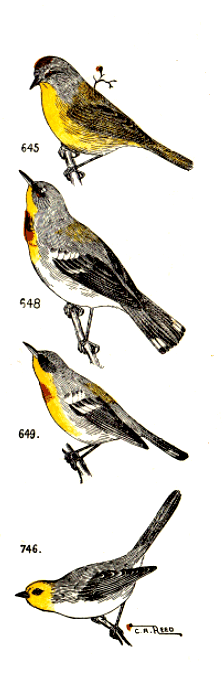
645. Nashville Warbler (Helminthophila rubricapilla). L. 4.8. No wing-bars; no white in tail. Ad. ♂. A chocolate crown-patch; rest of head and cheeks bluish gray; a white eye-ring; back olive-green; below bright yellow. Ad. ♀. Similar, but little or no chocolate in crown; yellow duller. Yng. Head brownish; underparts washed with brownish, particularly on throat and flanks. Notes. Song, ke-tsee-ke-tsee-ke-tsee-chip-ee, chip-ee-chip-ee-chip, first half like Black and White Warbler's, second half like Chipping Sparrow's. (Langille.) Range.—Eastern North America; breeds from southern New York, Connecticut, and northern Illinois, north to Labrador and Hudson Bay region; winters south of United States. 645a. Calaveras Warbler (H. r. gutturalis). Similar to No. 645, but rump brighter; underparts richer yellow. Range.—Western United States; breeds on high mountains, from the Sierra Nevada to British Columbia, east to eastern Oregon, northern Idaho; south in migration to Lower California and Mexico; southeast to Texas. (Ridgw.) 648. Parula Warbler (Compsothlypis americana). L. 4.5; W. 2.3. Ad. ♂. Above grayish blue, a yellowish patch in the back; breast yellow washed with chestnut and with an indistinct blackish band; belly, wing-bars, spot near tip of outer tail-feathers white. Ad. ♀. Paler, breast without black, sometimes no chestnut. Notes. A short, little, guttural, lisping trill. Range.—Breeds in south Atlantic and Gulf states east of Texas north near the Atlantic coast to the District of Columbia and Mount Carmel, Illinois (Brewst.); winters from Gulf States southward. 648a. Northern Parula Warbler (C. a. usneæ). Similar to No. 648, but bill averaging slightly smaller, the wing longer, 2.4; black breast-band averaging wider; the chestnut wash stronger. Range.—Breeds in New England, New York and west along the northern tier of states, north into Maritime Provinces and Canada; winters from Gulf states southward. 649. Sennett Warbler (Compsothlypis nigrilora). L. 4.5. Similar to No. 648, but yellow below reaching to belly; breast without black and with only a slight brownish wash; lores and ear-coverts black. Notes. Song probably resembles that of No. 648. Range.—Lower Rio Grande Valley south into eastern Mexico. 746. Verdin (Auriparus flaviceps). L. 4.2; W. 2.2; T. 1.9. Ad. ♂. Head and throat yellow; forehead usually with some concealed orange-brown; lesser wing-coverts reddish chestnut; back brownish gray; belly whitish. Ad. ♂. Similar, but less yellow. Range.—Southern border of the United States and northern Mexico from southern Texas to southern California; north to southwestern Utah and southern Nevada. 746a. Baird Verdin (A. f. lamprocephalus). Similar to No. 746, but tail shorter; wing somewhat shorter; yellow of head brighter; W. 2.0; T. 1.6. (Oberholser.) Range.—Lower California.
650. Cape May Warbler (Dendroica tigrina). L. 5.1. Ad. ♂. Ear-coverts and wash on throat chestnut; crown blackish; back olive-green with black spots; below yellow streaked with black; wing-coverts broadly white; outer tail-feathers with white. Ad. ♀ and Yng. ♂. Duller; crown like back; no chestnut. Yng. ♀. Above olive-gray; below whitish faintly tinged with yellow; wing-bars, narrow. Notes. Song, a wiry "a-wit, a wit, a-wit, a-wit", repeated. (Butler.) Range.—Eastern North America; breeds from northern New England, rarely, and Manitoba north to Hudson Bay region; winters south of United States. 652. Yellow Warbler (Dendroica æstiva). L. 5.1. Inner vanes of tail-feathers yellow. Ad. ♂. Crown yellow, back bright yellowish green; below yellow thickly streaked with reddish brown. Ad. ♀. and Yng. ♂. Duller above, crown like back; below much paler, few or no streaks. Yng. ♀. Similar to last but still duller. Notes. Song, a rather loud wee-chee, chee, chee, cher-wee, variable in form but recognizable in tone. Range.—North America, except Alaska, Pacific coast from Vancouver north, and southwestern United States (western Texas to Arizona). (Ridgw.); breeds throughout most of its range, and winters in Central and South America. 652a. Sonora Yellow Warbler (D. æ. sonorana). Similar to No. 652, but ♂ much yellower, less green above, the crown and rump bright yellow; below brighter yellow, reddish brown streaks narrower, fewer sometimes almost wanting. Ad. ♀. Similar to Ad. ♂ of No. 652, but grayer above and whiter below. Range—Northern Mexico; breeding north to western Texas and southern Arizona; winters south of United States. 652b. Alaskan Yellow Warbler (D. æ. rubiginosa). Similar to No. 652, but ♂ darker above, the crown of about the same color as back; ♀ duller. Range.—Breeds on Pacific coast from Vancouver northward and in Alaska; winters south of United States. 653. Mangrove Warbler (Dendroica bryanti castaneiceps). L. 5. Inner vanes of tail-feathers yellow. Ad. ♂. Whole head reddish chestnut; back olive-green; below yellow lightly streaked with reddish brown. Ad. ♀. Olive-green above; yellow below. Range.—Cape Region of Lower California and Pacific coast of Central America and Mexico. 672. Palm Warbler (Dendroica palmarum). L. 5.2. No white wing-bars; tail patches white. Ads. Crown dark chestnut; line over eye, throat, and breast yellow; breast and sides with reddish brown streaks; belly much paler, often grayish washed with yellow; back olive-brown; rump brighter. Ad. in Winter and Yng. No crown-patch; above grayish olive-brown indistinctly streaked; rump yellowish; below grayish white washed with yellow and streaked with brownish; under tail coverts bright yellow. Notes. Call, a recognizable chip; song, a short, simple trill. Range—Eastern North America; breeds in interior of British America west of Hudson Bay; migrates south through Mississippi Valley and rarely north Atlantic States; winters in Florida and West Indies.
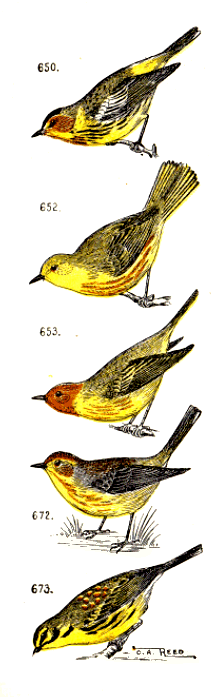
672a. Yellow Palm Warbler (D. p. hypochrysea). Similar to No. 672, but underparts entirely bright yellow; upperparts yellower. Winter specimens are whiter below but are still conspicuously yellow. Range.—Eastern United States; breeds from Nova Scotia northward, east of Hudson Bay; migrates through Atlantic States and winters in Florida and west to Louisiana. 673. * Prairie Warbler (Dendroica discolor). L. 4.7. Wing-bars yellowish; tail-patches white. Ad. ♂. Above bright olive-green with reddish chestnut spots in the back; below yellow, sides with black streaks. Ad. ♀. Similar, but usually duller; chestnut spots smaller, sometimes absent. Yng. Similar to ♀ Ad., but browner. Notes. Song, a high, thin zee, zee, zee, zee, zee-e, zee, the next to last highest. (See page 196.) Range.—Eastern United States; breeds from Florida to Massachusetts, southern Ontario, and southern Michigan; winters from southern Florida into the West Indies. Lawrence Warbler (Helminthophila lawrencei). Resembles No. 641, but has a black breast patch and a broad black stripe through the eye as in No. 642. It is believed to be a hybrid between the two. Some 15 specimens are known. Its notes are said to resemble those of both No. 642 and No. 641. 641. Brewster Warbler (Helminthophila leucobronchialis). Resembles No. 642 above, but is white usually tinged with yellow below, this type being connected with No. 641, by specimens showing more green above and yellow below. Hybridism and dichromatism are believed to account for these birds of which somewhat over a hundred specimens are known, chiefly from the lower Hudson and Connecticut Valleys. Some songs resemble those of No. 642, others those of 641. 644. Virginia Warbler (Helminthophila virginiæ). L. 4.5. No white in wings or tail. Ad. ♂. Above gray, crown-patch chocolate; upper tail-coverts yellowish; below whitish, breast-patch and under tail-coverts yellow. Ad. ♀. Similar, but less (sometimes no) chocolate in crown and yellow on tail-coverts; duller below. Yng. No crown patch; below washed with buff, little or no yellow on breast. Notes. Very musical, with a song of remarkable fullness for so small a bird. (Aitken.) Range.—Rocky Mountain region from Nevada and Colorado (rarely Wyoming) south into Mexico. 655. Myrtle Warbler (Dendroica coronata). L. 5.6. Crown, sides of breast and rump yellow. Ad. ♂. Above blue-gray streaked with black; throat white, breast largely black; two white wing-bars; outer tail-feathers with white. Ad. ♀. Browner above, less black on breast. ♂ in winter. Above brown, back indistinctly streaked with black; below whitish, breast and sides streaked with black. Yng. ♀. Similar, but less yellow on crown and sides. Notes. Call, a characteristic tchip; song, a trill. Range.—Eastern North America, west in migrations, to the Rockies; breeds from northern New England and northern Minnesota north to Labrador and Alaska; winters from Massachusetts and Kansas south into West Indies and Central America.
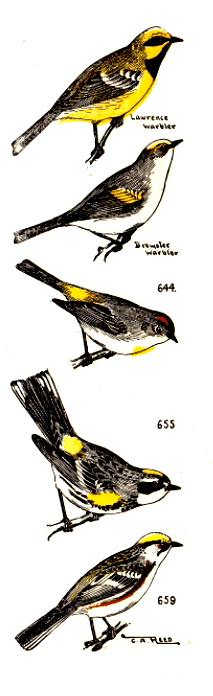
659. Chestnut-sided Warbler (Dendroica pensylvanica). L. 5. Ad. ♂. Sides chestnut, crown yellow; back streaked black and greenish yellow; cheek-patch and sides of throat black. Ad. ♀. Crown duller; chestnut and black reduced. Yng. Above bright yellow-green, back with or without black spots; below grayish white, sides sometimes with traces of chestnut; wing-bars yellowish white. Notes. Song, resembles that of Yellow Warbler. (See page 197.) Range.—Eastern North America; breeds from northern New Jersey and Central Illinois north to Newfoundland and Manitoba (and south in the Alleghanies to South Carolina); winters in Central America. 604. Dickcissel (Spiza americana). L. 6.2. Ad. ♂. Breast, bend of wing, line over eye and at side of throat yellow; throat-patch black; lesser wing-coverts reddish chestnut; no white in tail. Ad. ♀. Less yellow and chestnut, no black on throat. Notes. Song, an earnest, but unmusical dick, dick, che-che-che, che. Range.—Middle United States east of the Rockies, west of Alleghanies, breeds from Alabama and Texas to Minnesota; casual in Atlantic States; winters in Central and northern South America. 618. Bohemian Waxwing (Ampelis garrulus). L. 8. Crested. Ads. Brownish gray; under tail-coverts, forecrown and sides of throat chestnut-rufous; throat and eye-stripe black; wing-quills and primary coverts tipped with white or yellow; secondaries usually with red tips; tail tipped with yellow. Range.—Northern parts of northern hemisphere; breeds in far north; winters south irregularly to northern United States, casually to Pennsylvania, Illinois, Kansas, and northern California. 619. Cedar Waxwing (Ampelis cedrorum). L. 7. Crested. Ads. Grayish brown; belly yellowish; under tail-coverts white; no white tips on wing-quills; secondaries with red tips; tail tipped with yellow and rarely with red tips. Notes. A fine, lisping note; a string of notes usually uttered when taking flight. Range.—North America: breeds from Virginia and the highlands of South Carolina, Kansas, and Oregon, north to Labrador and southern Alaska (?); winters from northern United States to Central America. 628. Yellow-throated Vireo (Vireo flavifrons). L. 5.5. Ads. Throat and breast bright yellow, belly white; above bright olive-green, rump gray; two white wing-bars. Notes. Call, a scolding cack; song like Red-eye's but richer, more deliberate, see me; I'm here; where are you? in varying forms; also a mellow trill. Range.—Eastern United States; breeds from Florida and Texas to Newfoundland and Manitoba; winters in tropics. 683. Yellow-breasted Chat (Icteria virens). L. 7.5; T. 3.07. Ads. Throat and breast bright yellow; lower belly white; above olive-green; line over eye and at side of throat white. Notes. Call, a gasping, mewing keè-yuck and chut, chut; song, of whistles, caws and chucks, sometimes uttered in flight. Range.—Eastern United States; breeds from northeastern Mexico (but not in Florida?) north to South Dakota, southern Minnesota, and Massachusetts (locally); winters in Mexico and Central America. 683a. Long-tailed Chat (I. v. longicauda). Similar to No. 683, but grayer above; tail slightly longer. Range.—Western United States, east to Plains; breeds from Mexico north to North Dakota and British Columbia; winters in Mexico.
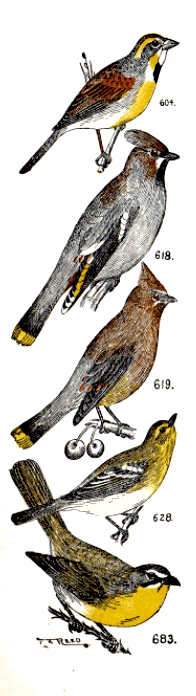
497. Yellow-headed Blackbird (Xanthocephalus xanthocephalus). L. 10. Ad. ♂. Black; head and breast orange yellow; outer wing-coverts white, black tipped. Ad. ♀. Brownish, line over eye, throat and breast dull yellow, lower breast streaked with white; ear-coverts rusty. Notes. Call, a hoarse chuck; song, a variety of hoarse grunting, guttural whistles; usually uttered with apparent great effort and bodily contortion. The young utter a rolling, whistling call. Range.—Western North America, east to Kansas, northern Illinois, and northwestern Indiana; west to the Pacific coast ranges; breeds locally from Texas (?), New Mexico, Arizona, and Southern California north to the Hudson Bay region, and southern British Columbia; winters from southwestern Louisiana, and California southward. 501. Meadowlark (Sturnella magna). L. 10.7; W. 4.8. Ads. Above black varied with chestnut and buff; below yellow, a black breast-crescent; bars on middle tail-feathers fused along shaft, yellow of throat not spreading on to its sides. Notes. Calls, a nasal note and a rolling twitter; song, a high fife like whistle of rarely more than eight or ten notes; without gurgles or grace notes. Range.—Eastern North America west to about Long. 100°, north to New Brunswick and Minnesota; winters from Massachusetts and Illinois southward. 501a. Texas Meadowlark (S. m. hoopesi). Similar to No. 501b, but yellow not spreading on to sides of the throat. Notes. Resemble in character those of No. 501. Range.—Not well determined; known from Corpus Christi, Texas, west along Mexican boundary to southern Arizona and northern Sonora, Mexico. 501b. Western Meadowlark (S. m. neglecta). Similar to No. 501, but bars on middle tail-feathers usually distinct, not confluent along shaft; yellow of throat spreading on to its sides; general color paler. Notes. Calls, a liquid chûck and a wooden, rolling b-r-r-r-r-r-r-r; song, rich, musical, flute-like with intricate gurgles and grace notes; wholly unlike that of No. 501. 501c. Florida Meadowlark (S. m. argutula). Similar to No. 501, but smaller and darker; W. 4.4. Range.—Florida and Gulf coast to Louisiana. 514. Evening Grosbeak (Hesperiphona vespertina). L. 8. Ad. ♂. Brownish yellow; wings, tail, and crown black; exposed part of tertials white. Ad. ♀. Dingy brownish gray, more or less tinged with yellowish; throat and belly whitish; tail-coverts and tail-feathers, on inner web, tipped with white. Notes. Call, loud; song, short, but melodious, resembling that of Robin or Black-headed Grosbeak. (Cooper.) Range.—Rocky Mountain region of British America, south, in winter, to the upper Mississippi Valley, rarely to Ohio and casually through New York to New England. 514a. Western Evening Grosbeak (H. v. montana). ♂ not distinguishable from ♀ of No. 514; ♀ more buffy, especially below. Range.—Mountains of western United States from New Mexico north to British Columbia.
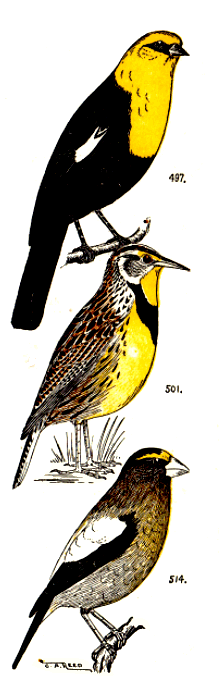
EASTERN HORNED LARKS.
474 [A]. Horned Lark (Otocoris alpestris). L. 7.7, W. ♂, 4.3; ♀, 4.1. Hind toe-nail much the longest. Ad. ♂, winter. Throat and line over eye distinctly yellow; black feathers over eye lengthened, forming when raised little tufts; breast-patch, sides of throat, line over eye and forecrown black, more or less tipped, especially on head, with yellowish or brownish; back brownish indistinctly streaked with blackish; nape, wing and tail-coverts pinkish brown; belly white, lower breast dusky, sides pinkish brown; tail mostly black, outer margin of outer feathers white. ♂, summer. Yellow areas whiter; black areas more distinct; back pinker. Ad. ♀, winter. Similar to ♂, but throat and line over eye less yellow; black areas smaller; back more distinctly streaked. ♀, summer. More distinctly streaked above. Notes. Call, a tseep, tseep; song, an unmusical, twittering warble sung during soaring flight.
Range.—Eastern North America; breeds in Labrador and region east of Hudson Bay; winters south to South Carolina (chiefly on coast) and in the Mississippi Valley to Illinois.
474b. Prairie Horned Lark (O. a. praticola). W. ♂ 4; ♀, 3.8. Line over eye white. Similar to No. 474, but smaller, line over eye and forehead generally white, the throat often white and never so yellow as in winter specimens of No. 474.
Range.—Breeds in the Mississippi Valley, south to southern Illinois and Missouri west to eastern Nebraska and Assiniboia; east through northwestern Pennsylvania and central New York to western and northern New England; north to Quebec and Ontario; winters south to South Carolina, Kentucky, and Texas.
474d. Texan Horned Lark (O. a. giraudi). W. ♂ 3.9; ♀, 3.6. Similar to No. 474b, but somewhat smaller and paler; throat, forehead and line over eye yellow; breast, in males, generally tinged with yellow.
Range.—Coast of Texas from Galveston to the Rio Grande.
NORTHERN HORNED LARKS.
474a. Pallid Horned Lark (O. a. arcticola). W. ♂, 4.4; ♀, 4.2. Largest of our Horned Larks; no yellow in plumage; throat, forehead and line over eye white; back brown with grayish edgings.
Range.—"In summer, Alaska (chiefly in the interior) with the Valley of the Upper Yukon River; in winter south to Oregon, Utah, and Montana." (Oberholser.)
474k. Hoyt Horned Lark (O. a. hoyti). W. ♂, 4.4; ♀, 4.2. Throat tinged with yellow; line over eye white; back darker, pink areas richer than in 474a. An intermediate form between Nos. 474 and 474a.
Range.—"In summer, British America from the west shore of Hudson Bay to the Valley of the Mackenzie River, north to the Arctic Coast, south to Lake Athabasca; in winter, southward to Nevada, Utah, Kansas, and Michigan, casually to Ohio and New York (Long Island)." (Oberholser.)
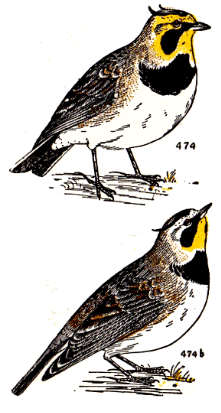
WESTERN HORNED LARKS. 474c. Desert Horned Lark (O. a. leucolæma). W. ♂, 4.1; ♀, 3.8. Forehead and line over eye very slightly, often not at all, tinged with yellow; throat yellow; back brown edged with pinkish gray; resembles No. 474b, but is paler and less distinctly streaked above. Range.—"In summer, western United States from central Dakota, western Kansas and western Nebraska to Idaho and Nevada, north on the eastern side of the Rocky Mountains to Alberta; in winter, south to Texas, Chihuahua, Sonora, and southeastern California." (Oberholser.) 474e. California Horned Lark (O. a. actia). W. ♂, 3.9; ♀, 3.6. ♂, summer. Back of head and nape, spreading on to sides of breast, pinkish cinnamon; back distinctly streaked with brownish black; throat always, forehead and line over eye usually tinged with yellow. ♂, winter. Less distinctly streaked above; cinnamon areas paler and with grayish tips; black areas more or less tipped with yellowish. ♀, summer. Crown and back uniformly streaked with blackish margined with pinkish gray. ♀, winter. Less distinctly streaked; black areas tipped with whitish. Range.—Northern Lower California north, west of the Sierra, to Marin and San Joaquin Counties, California. 474f. Ruddy Horned Lark (O. a. rubea). Similar to No. 474e, but nape region, sides of breast, etc., much deeper in color, deeper than in any other of our Horned Larks; back less distinctly streaked with blackish and more ruddy in tone, not sharply defined from nape; yellow areas richer in color. Range.—Sacramento County, California. 474g. Streaked Horned Lark (O. a. strigata). Cinnamon areas less extensive but nearly as deeply colored as in No. 474f; back distinctly and widely streaked with blackish; forehead, line over eye, throat and breast washed with yellow. Range—"In summer, the states of Oregon and Washington west of the Cascade Mountains; in winter, to eastern Oregon and Washington, south to northern California." (Oberholser.) 474h. Scorched Horned Lark (O. a. adusta). W. ♂, 4; ♀, 3.8. Nearest to No. 474l, but the male differs in being nearly uniform pinkish brown above, back with only a few indistinct brownish streaks; color deeper, browner, more ruddy. Range.—"In summer, the central part of extreme southern Arizona; in winter, northern Sonora and Chihuahua, Mexico." (Oberholser.) 474i. Dusky Horned Lark (O. a. merrilli). W. ♂, 4; ♀, 3.8. Similar to No. 474b, but somewhat darker above, the line over the eye usually tinged with yellow. Range.—"In summer, northwestern United States, and southern British Columbia, from northeastern California and northwestern Nevada, northward through Oregon and Washington east of the Cascade Mountains to British Columbia and extreme northern Idaho; in winter, south to central California." (Oberholser.)
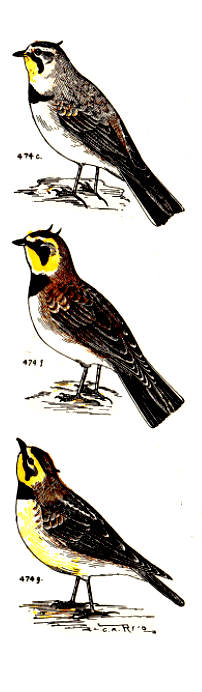
474j. Sonoran Horned Lark (O. a. pallida). W. ♂, 3.8; ♀, 3.6. Nape very pale pinkish; back pale grayish brown edged with grayish; forehead, line over eye, and throat tinged with yellowish. Resembles No. 474l, but is still paler. Range,—"Region immediately adjacent to the head of the Gulf of California, Mexico." (Oberholser.) 474l. Montezuma Horned Lark (O. a. occidentalis). W. ♂, 4; ♀, 3.8. No distinct blackish streaks above; back pale brownish edged with pinkish gray; throat yellow, forehead and line over eye tinged with yellow. Similar to No. 474h, but paler, less ruddy above; differs from No. 474c in being browner and less streaked above. Range.—In summer, central New Mexico, west to central Arizona; in winter, south to northern Sonora and Chihuahua, Mexico and southeast Texas." (Oberholser.) 474m. Island Horned Lark (O. a. insularis). Similar to No. 474g, but slightly darker above, breast usually without a yellow tinge. Range.—Santa Barbara Islands, California. 446. Couch Kingbird (Tyrannus melancholicus couchii). L. 9.5. Ads. Throat white, breast and belly yellow, tail dark brown; crown gray with an orange patch, back grayish green; Yng. Similar, but no crown-patch. Range.—Guatemala, north in spring as far as Lower Rio Grande, Texas. 447. Arkansas Kingbird (Tyrannus verticalis). L. 9. Ads. Throat light gray spreading over breast to yellow belly; tail black, outer margin of outer feather wholly white; above resembling No. 446. Yng. With no crown-patch. Notes. Squeaky, rattling, rolling notes; a noisy bird. Range.—Western United States; breeds east to about Long. 100°, north to Assiniboia, southern Alberta, southern British Columbia, west to the Pacific; winters south of United States; to Central America. 448. Cassin Kingbird (Tyrannus vociferans). L. 9. Ads. Throat and breast dark gray, belly yellow; tail black, outer web of outer feather not wholly white; above as in No. 447. Yng. With no crown-patch. Notes. Less noisy than No. 447. (Bendire.) Range.—Western United States, northwestern Mexico and north through Rockies, from western Texas, New Mexico and Arizona, to southern Wyoming; in California north to San Benito County; winters south of United States to Central America. 449. Derby Flycatcher (Pitangus derbianus). L. 11. Ads. Back brown, wings and tail externally rusty; a yellow crown-patch; forehead, line over eye and across nape white; throat white, below yellow. Notes. Kiskadee, repeated. (Richmond.) Range.—Northern South America; breeds north as far as Lower Rio Grande, Texas.
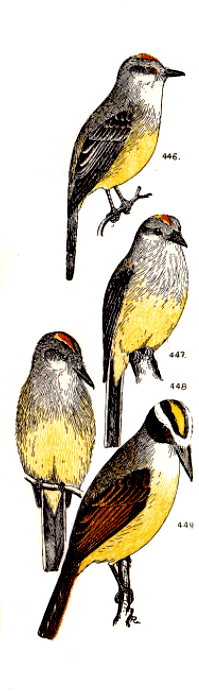
451. Sulphur-bellied Flycatcher (Myiodynastes luteiventris). L. 8. Below sulphur streaked with black; tail largely rusty brown; a yellow crown-patch; inner wing feathers widely margined with whitish; back grayish brown streaked with dusky. Yng. With no crown-patch. Notes. A screech, like squeaking of a wagon wheel, and a single note. (Poling.) Range.—Central America; breeds north as far as southern Arizona. 452. Crested Flycatcher (Myiarchus crinitus). L. 9. Inner webs of all but middle tail-feathers rust-brown. Ads. Throat and breast gray, belly bright sulphur; back grayish olive-green; greenest above and yellowest below of our larger Myiarchi. Notes. Loud, chuckling, grating whistles. Range.—Eastern North America; west to the Plains; breeds from Florida and Texas north to New Brunswick and Manitoba; winters from southern Florida south to northern South America. 453. Mexican Crested Flycatcher (Myiarchus mexicanus). L. 9.2; W. 4. Inner webs of all but middle tail-feathers rust brown. Ads. Throat and breast gray, belly sulphur, both paler than No. 452; back grayish brown, with little or no green tinge. Notes. Resemble those of No. 452. (Merrill.) Range.—Central America; breeds north as far as Lower Rio Grande, Texas. 453a. Arizona Crested Flycatcher (M. m. magister). Similar to No. 453, but larger, L. 9.4, W. 4.2, and averaging slightly paler. Range.—"Western Mexico; north to southern Arizona and southwest New Mexico; south in winter to Tehuantepec, Mexico." 454. Ash-throated Flycatcher (Myiarchus cinerascens). L. 8.; W. 4. Inner webs of all but middle tail-feathers rust-brown, outer pair dusky at tip of inner web. Ads. Throat and breast pale grayish white, belly white tinged with yellow, above grayish brown, outer web of outer tail-feather whitish. Palest below of our Myiarchi. Notes. A rather resonant but wooden chūck-pr-r-r-r. Range.—Western United States: breeds from western Texas and Lower California north to Colorado and Oregon; winters in southern Mexico and Central America. 454a. Nutting Flycatcher (M. c. nuttingi). Similar to No. 454, but smaller, W. 3.6, outer margin of outer tail-feather not whitish, tip of its inner web rusty, not dusky. Range.—Breeds in southern Arizona and western Mexico; winters in Central America. 454b. Lower California Flycatcher (M. c. pertinax). Similar to No. 454a, but bill larger and stouter; above grayer; below less yellow. (Brewster.) Range.—Lower California. 455a. Olivaceous Flycatcher (Myiarchus lawrencei olivascens). L. 7. Ads. Inner webs of tail-feathers like outer webs; tail-feathers margined with rusty; breast and belly as in No. 452; crown brownish, back grayish olive-green. Notes. A short mournful peeur. Range.—Breeds from western Mexico north to southern Arizona; winters south to southern Mexico; casual in Colorado.
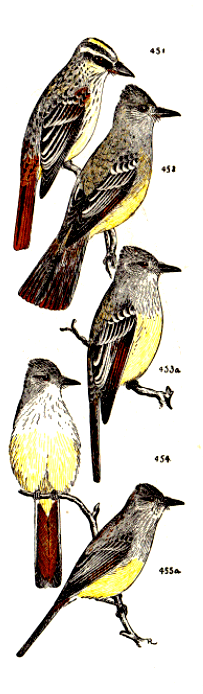
Perching Birds Marked With Chestnut or Reddish Brown
587. Towhee; Chewink (Pipilo erythrophthalmus). L. 8. Three outer tail-feathers with white; iris red. Ad. ♂. Above and breast black; sides reddish chestnut; belly white. Ad. ♀. Above and breast brown. Call, chewink or towheé; song, a loud, not over musical sweet bird sin-n-ng, and a tremulous refrain I'll try. Range.—Eastern North America, west to the Plains; breeds from Georgia and Louisiana north to Maine, Ontario, and Manitoba; winters from Virginia and southern Illinois to Florida and eastern Texas. 587a. White-eyed Towhee (P. e. alleni). Similar to No. 587, but iris whitish; only two outer tail-feathers with white tips, or if on third, a mere spot. Notes. Call, towhee, much sharper than that of No. 587. Range.—Florida, north along coast to South Carolina. 588. Arctic Towhee (Pipilo maculatus arcticus). L. 8.7. Ad. ♂. White tip of outer tail-feather more than 1.3 long; scapulars and back marked with white; back black more or less tipped with brownish. Ad. ♀. Breast and back grayish brown; fewer white markings than in ♂. Notes. Call, a Catbird-like mew; song, suggesting that of No. 587, but shorter, more wooden, less musical. Range.—Great Plains; breeding from southern Montana and western North Dakota, north to Saskatchewan; winters south and west to Colorado, Utah, New Mexico, and Texas; east to eastern Kansas. 588a. Spurred Towhee (P. m. megalonyx). Similar to No. 588, but blacker above, no brownish edgings on front of back; white markings on back less numerous; white tip to outer tail-feather less than 1.3 long. Range.—Rocky Mountain region and west to the Pacific; breeds from Mexico to British Columbia; migratory in the northern part of range. 588b. Oregon Towhee (P. m. oregonus). Similar to No. 588a, but darker; practically no brownish edgings on back of male; sides much deeper; white markings much reduced, the white tip to outer tail-feather less than 1. long; sides much deeper. Range.—Pacific coast from San Francisco to British Columbia; winters south to southern California. 588c. San Clemente Towhee (P. m. clementæ). Similar to No. 588a, but adult male with black duller or grayer; female lighter brown. (Ridgw.) Range.—"San Clemente, Santa Cruz, Santa Rosa, and Santa Catalina Islands," southern California. (Grinnell.) 588d. San Diego Towhee (P. m. atratus). Similar to No. 588a, but decidedly darker, with white markings of wings, tail, etc., more restricted; rump deep black. Range.—The southern coast district of southern California, south into Lower California. (Ridgw.) 588e. Mountain Towhee (P. m. magnirostris). Similar to No. 588, but bill much larger, rufous below paler, above browner and tinged with olive. (Brewster.) Range.—Cape Region of Lower California. 589. Guadalupe Towhee (Pipilo consobrinus). Similar to No. 588b in restriction of white markings, but wings and tail much shorter, W. 3.1; T. 3.2, hind claw much larger; Ad. ♂ sooty rather than black. (Ridgw.) Range.—Guadalupe Island, Lower California.
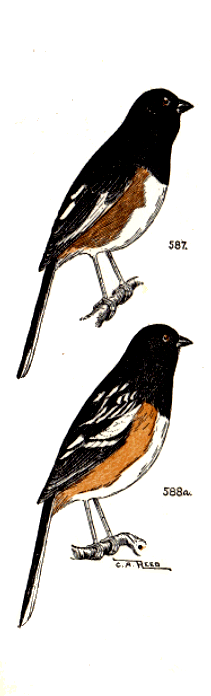
457. Say Phoebe (Sayornis saya). L. 7.5. Ads. Breast rusty gray changing to rusty on belly; above gray with a brown tinge; tail black. Notes. A plaintive phee-eur; a short, plaintive, twittering warble. (Bendire.) Range.—Western North America, east to about Long. 100°: breeds from southwestern Texas, southern California, north to the Yukon, Alaska; winters in Mexico; accidental in Wisconsin, Illinois, and Massachusetts. 591. Canon Towhee (Pipilo fuscus mesoleucus). L. 9.; W. 3.7. Ads. Crown cinnamon-brown; back brownish gray; throat buffy bordered by blackish spots; lower belly and under tail-coverts cinnamon. Notes. Calls, a loud, metallic chip repeated four times; in flight a robin-like screep-eep-eep. Range.—Northern Mexico north to western Texas, Arkansas Valley, Colorado, and Arizona; resident. 591a. St. Lucas Towhee (P. f. albigula). W. 3.3. Similar to No. 591, but smaller; abdomen whiter, without cinnamon. Range.—Southern Lower California. 591b. California Towhee (P. f. crissalis) W. 3.9. Similar to No. 591, but much browner above; throat and under tail-coverts rusty brown; breast brownish gray; scarcely lighter on the belly. Range.—California, west of the Sierra. 591c. Anthony Towhee (P. f. senicula). W. 3.7. Similar to No. 591b, but smaller and grayer, the abdomen whiter. Range.—Northern Lower California north to southern California. 592. Abert Towhee (Pipilo aberti). L. 9. Ads. No crown-cap; lores and chin blackish; below pinkish cinnamon; above grayish brown. Notes. Call, a loud, clear, sharp chirp. Song, resembling that of the Spurred Towhee group. (B. B. and R.) Range.—Southern California, Arizona, and northwestern New Mexico, north to southern Nevada and southwestern Utah.
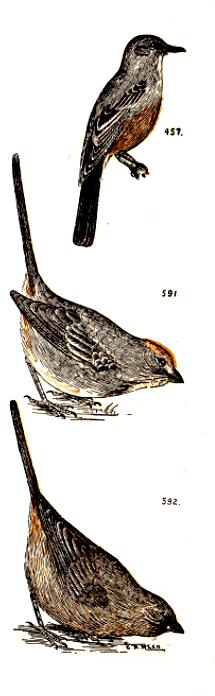
506. Orchard Oriole (Icterus spurius) L. 7.3. Ad. ♂. Black: breast, belly, rump, and lesser wing-coverts chestnut. Ad. ♀. Above olive-green, below greenish-yellow; two white wing-bars. Yng. Male. First fall like ♀; first spring like ♂, but throat black. Notes. Song much richer and more finished than that of the orange and black Orioles; the difference is indescribable but easily recognizable. Range.—Eastern North America, west to the Plains; breeds from Florida and Texas north to Massachusetts, Ontario, Michigan, and North Dakota; winters in Central America and northern South America. 592.1. Green-tailed Townee (Oreospiza chlorura). L. 7. Ads. Center and sides of breast grayish, middle of throat and abdomen white; above olive-green more or less washed with grayish; crown reddish chestnut. Notes. Call, a high, thin kitten-like mew; song, musical, suggesting that of the Thick-billed Sparrow. Range.—Mountains of western United States, from more eastern Rockies to Coast Range in California; north to central Montana, Idaho, and eastern Washington; south, at least in winter, into Mexico. (Ridgw.) 643. Lucy Warbler (Helminthophila luciæ). L. 4.2. Ad. ♂. Above gray; crown-patch and upper tail-coverts chocolate; below whitish. Ad. ♀. Chocolate areas smaller. Yng. No chocolate in crown; upper tail-coverts cinnamon. Range.—Northwestern Mexico; breeding north to Arizona and southwestern Utah. 660. Bay-breasted Warbler (Dendroica castanea). L. 5.6. Ad. ♂. Throat, sides and crown rich chestnut; cheeks black; sides of neck buff; back black and gray; wing-bars and tail-spots white. Ad. ♀. Less chestnut; cheeks grayish. Yng. and Ad. in Winter. Above olive-green streaked with black; below buffy white, the flanks usually with a trace of chestnut. Notes. Song, a very soft warble, tse-chee, repeated five times, too liquid to admit of exact spelling. (Langille.) Range.—Eastern North America; breeds from northern New England and northern Michigan north to Labrador and Hudson Bay region; winters in Central and northern South America.