Front matter (continued 5)
Reading edition
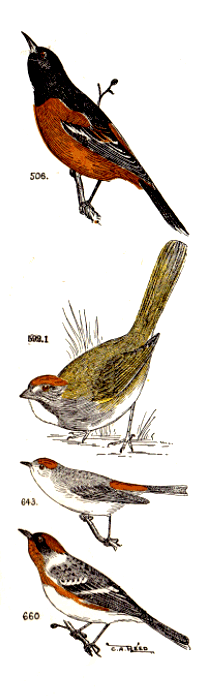
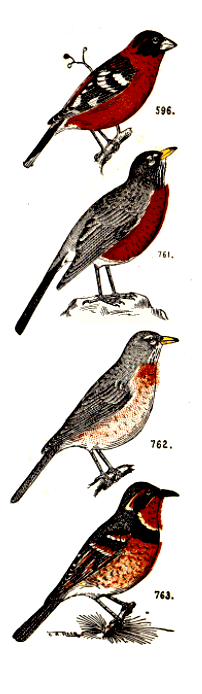
596. Black-headed Grosbeak (Zamelodia melanocephala). L. 8.1. Ad. ♂. Black; neck-ring, rump, back-streaks and underparts bright cinnamon; center of belly and under wing-coverts yellow; patch in wing, wing-bars and tips of inner vanes of outer tail-feathers white. In winter tipped with brown above and on breast below with black spots. Ad. ♀. Under wing-coverts yellow as in ♂; above as in No. 595; below less streaked, breast buff. Yng. ♂. Like ♀ but breast deeper buff; few streaks below; sides of crown blacker. Notes. Call and song like those of the Rose-breasted Grosbeak, but the latter more fluent. Range.—Western United States, east to the Plains; breeds from Mexico north to Dakota and British Columbia; winters south of United States into Mexico. 761. American Robin (Merula migratoria). L. 10; W. 4.9; T. 3.8. Outer tail-feathers with white tips. Ad. ♂. Breast and belly rich rust-brown; above dark slaty, head and spots in back black. Ad. ♀. Similar but paler below, little or no black above. Winter. Underparts margined with whitish; black above more or less concealed by ashy. Notes. Calls, varied and characteristic; song, a loud, hearty, cheer-up cheerily, cheerily, cheerily, repeated and varied. Range.—Eastern North America, west to the Rockies, northwest to Alaska; breeding south to Virginia and, in the mountains, Georgia; winters from northern States southward. 761a. Western Robin (M. m. propinqua). Similar to No. 761, but no white tips to tail-feathers. Ad. ♂. Without black spots in back. Range.—Western United States, from the eastern base of the Rocky Mountains west to the Pacific; breeds from the southern end of the Mexican tableland north to British Columbia; winters from Oregon and southern Colorado southward. 761b. Southern Robin (M. m. achrustera). Similar to No. 761, but smaller and in general much lighter and duller; W. 4.7; T. 3.5. (Batchelder.) Range.—Carolinas and Georgia, except mountainous districts, lowlands of Virginia. 762. St. Lucas Robin (Merula confinis). Resembling No. 761 in plan of coloration but everywhere much paler; breast and belly buff; no black in head. Range.—Cape Region of Lower California. 763. Varied Thrush (Ixoreus nævius). L. 10; W. 4.7. Ad. ♂. Below rust-brown, belly whiter, a broad black breast-band; above slaty, line behind eye and bars in wing rusty; outer tail-feathers with white tips. In winter washed with brownish above; breast band with rusty. Ad. ♀. Paler below, breast-band faintly indicated; above washed with brownish. Notes. Song, a weird vibrant, long-drawn whistle repeated on different notes. Range.—Pacific coast from higher mountains of northern California north to Alaska; south in winter along the coast. 763a. Pale Varied Thrush (I. n. meruloides). Similar to No. 763, but wing longer, 5.1; ♀ paler and grayer. (Grinnell.) Range.—- Interior of British Columbia north to north Alaska; south in winter, through interior, to southern California.
Perching Birds Chiefly Dull Colored
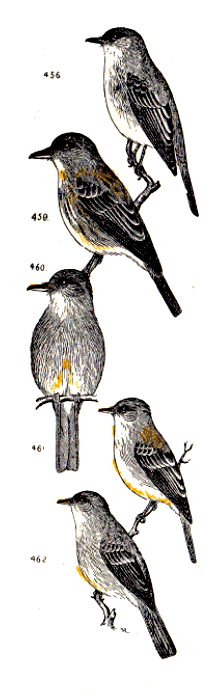
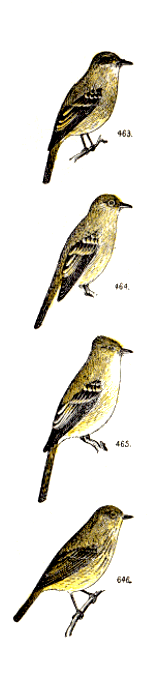
456. Phœbe (Sayornis phœbe). L. 7. Ads. Above grayish olive, crown blackish; outer web of outer tail-feather whitish; below white tinged with yellow, sides of breast grayish; bill black. Yng. Greener above, yellower below. Notes. Pewit-phœbe, pewit-phœbe; call, pee, pee, rarely a flight song. Range.—Eastern North America, west to the Rockies; breeds from South Carolina and western Texas north to Newfoundland and Manitoba; winters from North Carolina and northern Texas south to Cuba and Mexico. 459. Olive-sided Flycatcher (Nuttalornis borealis). L. 7.4. Ads. Throat and middle of belly white with a yellow tinge; sides and most of breast grayish; above brownish gray with an olive-tinge, crown darker, the feathers lengthened. Notes. Hip-hip or quilp-quilp, less often a loud, emphatic whip-péw-hip. (Head.) Range.—North America; breeds from Massachusetts (rarely), northern New York, and Minnesota, northward to Alaska, south through the Rockies and Coast Range to Mexico; winters in Central and South America. 460. Coues Flycatcher (Contopus pertinax pallidiventris). L. 7.7. Ads. Below nearly uniform gray, belly paler; above gray, crown slightly darker, the feathers lengthened. Notes. A plaintive musical four or five noted whistle with regular intervals and a singularly human-like quality. Range.—Western Mexico, north to central Arizona; winters south of United States. 461. Wood Pewee (Contopus virens). L. 6.5; W. 3.3. Ads. Above dark olive, crown blacker; below dusky grayish, throat whitish, belly yellowish; lower mandible yellowish. Yng. Greener above, yellower below. Notes. Pee-a-wee, peer and pee; all plaintive and musical. Range.—Eastern North America, west to about Long. 100°; breeds from Florida and Texas north to New Brunswick and Manitoba; winters in Central America. 462. Western Wood Pewee (Contopus richardsonii). Similar to No. 461, but above with usually no greenish tinge; below less yellow; under mandible brownish. Notes. A nasal, rather emphatic pēē-a. Range.—Western United States, east to about Long. 100°; breeds from western Texas and Lower California north to Manitoba, Alberta, and British Columbia; winters in Mexico and Central America. 462a. Large-billed Wood Pewee (C. r. peninsulæ). Similar to No. 462, but smaller, W. 3.3; the bill larger, length from nostril .42, width at nostril, .31; upperparts grayer. (Brewster.) Range.—Cape Region of Lower California.
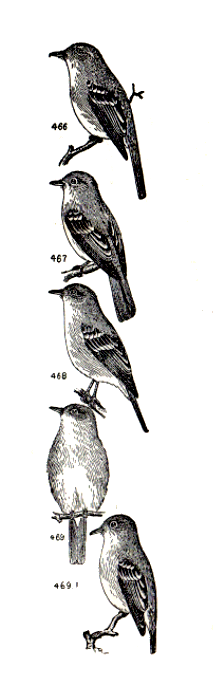
466. Traill Flycatcher (Empidonax traillii). Similar to No. 466a, but upperparts browner with little if any real greenish tinge; bill averaging narrower. Range.—Western United States; breeds from western Texas and southern California north to Alaska and Great Slave Lake, east to Kansas, Missouri and Illinois; winters in the tropics. 466a. Alder Flycatcher (E. t. alnorum). L. 6.1; W. 2.8. Ads. Lower mandible horn color; below white, breast grayish; breast and sides faintly washed with yellow; above brownish olive-green; wing-bars usually buffy. Like No. 467, but larger. Notes. Pĕp of alarm, and an explosive ēē-zēē-e-ûp with stress on the rasping zēē. (Dwight.) Range.—Eastern United States, west to Michigan; breeds from northern New Jersey (locally) north to New Brunswick; winters in the tropics. 467. Least Flycatcher (Empidonax minimus). 5.4; W. 2.5. Ads. Similar in color to No. 466a, but smaller, tail slightly forked. Yng. Wing-bars more buffy. Notes. a vigorous chebec, chebec; rarely a flight song, "chebec, tooral-ooral." Range.—Eastern North America, west to western Texas and eastern Colorado; breeds from Pennsylvania (North Carolina, in the Alleghanies) north to New Brunswick and Great Slave Lake; winters in Central America. 468. Hammond Flycatcher (Empidonax hammondi). L. 5.5. Ads. Bill smallest of our Empidonaces, lower mandible brown; throat and breast grayish, breast and belly slightly washed with sulphur; above grayish with a slight olive tint. Like No. 467, but bill smaller, lower mandible browner, throat grayer. Range.—Western North America; breeds from the mountains of New Mexico, Arizona, and southern Athabasca, east to Colorado, winters in Mexico. 469. Wright Flycatcher (Empidonax wrightii). Similar to No. 468, but underparts whiter; bill much longer, longest and narrowest of our Empidonaces; lower mandible whitish at base, brownish at tip; outer web of outer tail-feather white. Range.—Western United States, east to eastern slope of Rockies; breeds from mountains of New Mexico, Arizona, and southern California north to Montana and southern Oregon; winters in Mexico. 469.1. Gray Flycatcher (Empidonax griseus). L. 6. Ads. Above gray with a slight brownish tinge; below grayish white with little or no yellow. Grayest of our Empidonaces. Range.—Western Mexico and Lower California north to southern California and Arizona, (Fort Verde.)
463. Yellow-bellied Flycatcher (Empidonax flaviventris). L. 5.6. Ads. Below distinctly greenish yellow, belly brighter; above bright olive-green. Yng. Brighter, wing-bars buffy. Notes. Psĕ-ĕk' in one harsh explosive syllable; a plaintive chū-ē-é-p. (Dwight.) Range.—Eastern North America, west to the Plains; breeds from northern New England (south in Alleghanies to Pennsylvania), northern New York, and Minnesota, north to Labrador and Northwest Territories; winters in Central America. 464. Western Flycatcher (Empidonax difficilis). Similar to No. 463, but brighter yellow below, breast washed with brownish instead of greenish; above yellower. Notes. A soft low note, and a wailing pee-eu. (C. A. Allen.) Range.—Western North America; east to about Long. 100°; breeds from Mexican border north to southern Alaska; winters in Mexico and Central America. 464.1. St. Lucas Flycatcher (Empidonax cineritius). Most like No. 464, but much duller; scarcely a tinge of green above; no decided yellow below except on throat and abdomen. (Brewster.) Range.—Lower California, from Cape Region north, rarely, to southern California. 464.2. Santa Barbara Flycatcher (Empidonax insulicola). Similar to No. 464, but above darker and browner; below paler. (Oberholser.) Range.—Santa Barbara Islands, California. 465. Green-crested Flycatcher (Empidonax virescens). L. 5.7. Ads. Throat and belly white, breast grayish; sides, breast and sometimes belly, washed with sulphur; back olive-green, a tint lighter than in No. 463; lower mandible whitish; wing-bars buffy. Notes. Spee or peet and pee-e-yuk'. Range.—Eastern United States, west to the Plains; breeds from the Gulf States to southern Connecticut and Manitoba; winters in Central America. 646. Orange-crowned Warbler (Helminthophila celata). L. 5. No white in wings or tail. Ad. ♂. Above olive-green more or less washed with grayish; a concealed, reddish orange crown-patch; below dusky yellowish green. Ad. ♀. Similar, but grayer, crown-patch smaller or wanting. Yng. Like ♀, but no crown-patch. Notes. Song full and strong, not very high pitched and ending abruptly on a rising scale, chee, chee, chee, chw', chw'. (Jones.) Range.—Interior of North America, breeding from Manitoba and mountains of New Mexico to Alaska; winters in Gulf States and southward; rare in Atlantic states north of South Carolina. 646a. Lutescent Warbler (H. c. lutescens). Similar to No. 646, but greener above, yellower below; underparts distinctly yellow with a dusky wash. Range.—Pacific coast; breeding in mountains from southern California to Kenai Peninsula, Alaska; winters from California south into Mexico; east to Colorado in migrations. 646b. Dusky Warbler (H. c. sordida). Similar to No. 646a, but decidedly darker, bill and feet larger, wing shorter and tail longer. (Ridgw.) Range.—Breeds in Santa Barbara Islands, California; later occurs on adjoining mainland.
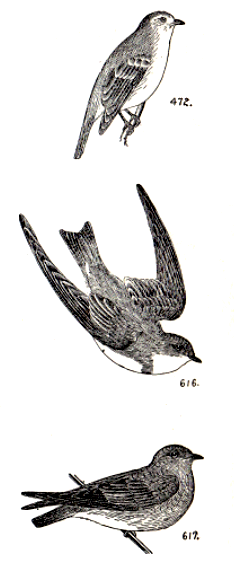
472. Beardless Flycatcher (Ornithion imberbe). L. 4.5; W. 2.10. Ads. Bill small, narrow, upper mandible decidedly curved; above gray tinged with olive, below grayish white with a yellow tinge. Range.—Central America; north in spring to Lower Rio Grande Texas. 472a. Ridgway Flycatcher (O. i. ridgwayi). Similar to No. 472, but larger, W. 2.2; grayer, little if any sulphur tinge on underparts. (Ridgw.) Notes. Call, a shrill piér repeated; song, from the tree-tops, yoop, yoop, yoopeédeedledee. (Stephens.) Range.—Southern border of Mexican tableland north in spring to southern Arizona. 616. Bank Swallow (Riparia riparia). L. 5.2. Ads. Below white, a broad grayish brown band across the breast; above grayish brown. Yng. Similar, but brown areas more or less tipped with rusty. Range.—Northern hemisphere: in America, breeds from northern New Jersey, Kansas, and southern California, north to Labrador, and Alaska; winters south to Brazil. 617. Rough-winged Swallow (Stelgidopteryx serripennis). L. 5.5. Ads. Above grayish brown; below grayish white, whiter on belly; barbs on outer vane of outer primary recurved. Yng. Plumage more or less tipped with rusty. Range.—United States; breeds from Mexico north to Massachusetts, Manitoba, and British Columbia; winters in Central America.
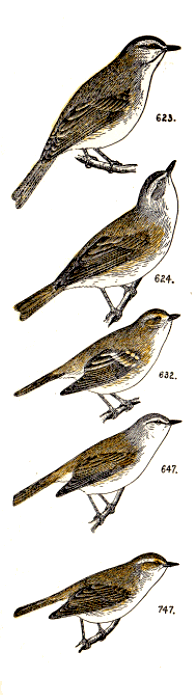
623. Black-whiskered Vireo (Vireo calidris barbatulus). L. 6. Ads. A dusky streak on either side of the throat, crown slate without a black border; back olive-green; below white, lower belly, under tail-and under wing-coverts yellowish; no wing-bars. Notes. Resemble those of No. 624 but song more emphatic and hesitating. Range.—Breeds in Cuba, Bahamas and southern Florida; winters in Central America. 624. Red-eyed Vireo (Vireo olivaceus). L. 6.2. Ads. Crown slate, on either side a narrow black border; a white line over eye; above olive-green; below white; under wing-coverts sulphur; no wing-bars; no dusky streaks on throat. Notes. Call, a petulant, complaining whang; song, a broken, rambling recitative "you see it—you know it—do you hear me?—do you believe it?" Range.—Eastern United States, west to the Rockies and British Columbia, east of Cascades; breeds from the Gulf States to Labrador, Manitoba, and British Columbia; winters in Central and South America. 632. Hutton Vireo (Vireo huttoni). L. 4.6. Ads. Underparts dusky grayish white with a faint yellow tinge; above dusky olive-green; lores and eye-ring grayish, not conspicuous; two white wing-bars. Notes. A piping whistle like the call of a young bird, peé-yer, peé-yer; and a hoarse whistle oh-my', oh-my', oh-my'. Range.—California, west of Sierra; resident. 632a. Stephen Vireo (V. h. stephensi). Similar to No. 622, but grayer above, whiter below, wing-bars broader. Range.—Mexican boundary from western Texas to southeastern California. 632c. Anthony Vireo (V. h. obscurus). Similar to No. 632, but darker, and averaging slightly smaller. Range.—"Pacific coast, from Oregon to southern British Columbia; south in winter to California." (A. O. U.) 647. Tennessee Warbler (Helminthophila peregrina). L. 5. No wing-bars; little or no white in tail. Ad. ♂. Head bluish gray; a whitish line over eye; back olive-green; below grayish white. Ad. ♀. Gray of head with more or less olive-green; stripe over eye and underparts yellower. Yng. Similar to ♀, but entirely bright olive-green above; yellower below. Notes. Song scarcely distinguishable from that of the Chipping Sparrow, but first two syllables twip instead of chip. (Jones.) Range:—Eastern North America, west in migrations to the Rocky Mountains; breeds from New Brunswick, northern New England, northern New York, and Minnesota, north to Quebec and Alaska; winters in Central and northern South America. 747. Kennicott Willow Warbler (Phyllopseustes borealis). L. 5. Ads. Above olive-green; below white tinged with yellowish, sides greenish; a whitish line over eye; a narrow whitish wing-bar; no white in tail. Notes. Call, a monotonous dzit; song, resembles trill of Redpoll. (Seebohm.) Range.—Asia, east to western Alaska.
625. Yellow-green Vireo (Vireo flavoviridis). L. 6.4. Resembling No. 624, but greener above, the sides heavily washed with greenish yellow. Range.—Northern South America, north to the Lower Rio Grande. 626. Philadelphia Vireo (Vireo philadelphicus). L. 4.8. Ads. No distinct crown-cap; above olive-green; below yellowish; a whitish line over eye; no wing-bars. Notes. Resemble those of the Red-eyed Vireo but generally higher pitched; also a very abrupt, double-syllabled utterance with a rising inflection which comes in with the song at irregular intervals. (Brewster.) Range.—Eastern North America; breeds from Maine, New Hampshire and Manitoba northward; winters in the tropics. 627. Warbling Vireo (Vireo gilvus). L. 5.4; W. 2.8. Ads. Above grayish olive-green, crown slightly grayer but without distinct cap as in No. 624; a whitish line over eye but no black line above it; below white, the sides washed with yellowish; no wing-bars. Notes. Call, resembles that of the Red-eyed Vireo; song; a rich, firm, unbroken warble with an alto undertone. Range.—Eastern United States, west to the Plains; breeds from Gulf States north to Hudson Bay region; winters in Mexico. 627a. Western Warbling Vireo (V. g. swainsoni). Similar to No. 627, but averaging smaller, W. 2.6, the bill more slender; upperparts, particularly crown, grayer. Range.—Western United States, east to the Rockies; breeds from Mexico to British Columbia; winters in Mexico. 631. White-eyed Vireo (Vireo noveboracensis). L. 5; W. 2.4.; B. .4. Ads. Eye-ring and lores yellow; iris white; above olive-green more or less washed with grayish; Below white, sides yellowish; two whitish wing-bars. Notes. Calls, varied, often harsh and scolding; song, an emphatic whistle who are you, eh? or what's that you say?, and a low medley often including imitations of the notes of other birds. Range.—Eastern United States; breeds from Florida and Texas north to New Hampshire and Minnesota; winters from Florida to Central America. 631a. Key West Vireo (V. n. maynardi). Similar to No. 631, but bill heavier, sides averaging less yellow. Range.—Southern Florida; resident. 621b. Bermuda White-eyed Vireo (V. n. bermudianus). Similar to No. 631, but wing shorter, 2.30; no yellow on sides. (Bangs and Bradlee.) Range.—Resident in Bermudas. 631c. Small White-eyed Vireo (V. n. micrus). Smaller than No. 631, W. 2.2; averaging grayer above; sides with less yellow. Range.—Northeastern Mexico, north to southeastern Texas.
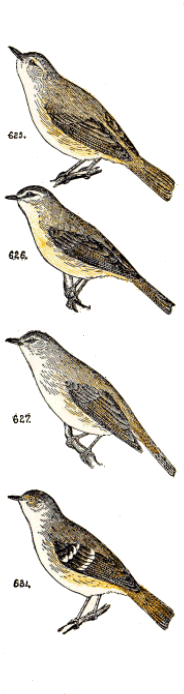
629. Blue-headed Vireo (Vireo solitarius). L. 5.5; W. 2.9; B. .4. Ads. Lores and eye-ring white; crown and cheeks bluish slate-color; back olive-green; below white, sides washed with greenish yellow; two whitish wing-bars. Notes. Resembling in form those of Red-eyed or Yellow-throated Vireos but more varied, sometimes a continuous warble; a musical chatter, like that of the Yellow-throated and a trilled whistle. (Torrey.) Range.—Eastern North America; breeds from Connecticut (and south along Alleghanies) north to New Brunswick and Manitoba; winters from Florida to Central America. 629a. Cassin Vireo (V. s. cassini). Like No. 629, but back washed with the color of the head; white on breast and throat less pure. Range.—"Breeds from British Columbia and Idaho south along Pacific coast region and Nevada to Lower California; migrates to Arizona, New Mexico; and northern Mexico." (Bailey.) 629b. Plumbeous Vireo (V. s. plumbeus). Above wholly plumbeous-gray with scarcely, if any, olive tinge, below white, the sides gray faintly tinged with greenish yellow; size of No. 629c. Range.—Rocky Mountain region; breeds from northern Mexico north to southwestern Dakota and Wyoming; winters south to southern Mexico. 629c. Mountain Solitary Vireo (V. s. alticola). Larger than No. 629, W. 3.15, B. .46; head darker, its color extending over most of the back. Range.—Breeds in Alleghanies from North Carolina to Georgia; winters in Florida. 629d. St. Lucas Solitary Vireo (V. s. lucasanus). Smaller than No. 629a, but bill longer and stouter, sides and flanks much yellower; young without brownish below, and resembling young of No. 629. Range.—Cape Region of Lower California. 633. Bell Vireo (Vireo bellii). L. 5. Above olive-green, crown grayer; lores and eye-ring white; two inconspicuous whitish wing-bars; below white, sides tinged with yellowish. Most like No. 627, but back greener, no white line back of eye. Notes. Resemble those of the White-eyed Vireo, but less harsh, song less emphatic. (Goss.) Range.—Interior states from Illinois west to Plains; breeds from Texas to Minnesota; winters in Mexico. 633.1. Least Vireo (Vireo pusillus). L. 4.8. Ads. Above gray, slightly tinged with greenish toward rump; below white, sides with little if any greenish tinge; one inconspicuous whitish wing-bar; lores and eye-ring inconspicuously grayish. Range.—Northwestern Mexico and northern Lower California; breeds north to Arizona and middle California. 634. Gray Vireo (Vireo vicinior). L. 5.5. Above slaty gray; below white tinged with grayish; one inconspicuous wing-bar; lores and eye-ring gray; bill short. Notes. Song may be compared with the finest efforts of the Blue-headed Vireo with the added charm and mellowness of the song of the Yellow-throated Vireo. (Henshaw.) Range.—Northern Mexico, north to western Texas, southeastern California, and southern Nevada; winters in Mexico.
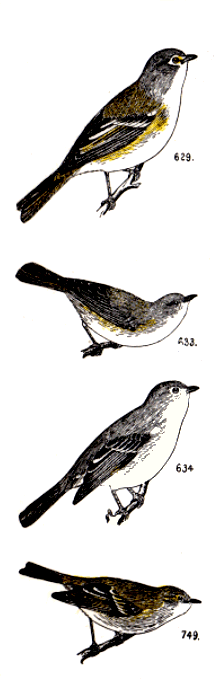
749. Ruby-crowned Kinglet (Regulus calendula). L. 4.4. A conspicuous whitish eye-ring. Ad. ♂. A more or less concealed crown-patch; back olive-green; underparts soiled whitish more or less tinged with buffy; two white wing-bars. Ad. ♀ and Yng. (Here figured.) Similar, but no crown-patch. Range.—North America; breeds from the northern border of the United States northward, and south in the Rocky Mountains to Arizona, and in the Sierra Nevada of California; winters from south Carolina and Oregon southward to Central America. 749a. Sitkan Kinglet (R. c. grinnelli). Similar to No. 749, but more olive-green above; more buffy below. Range.—Pacific coast; breeds in southern Alaska; winters southward to California. 470a. Buff-breasted Flycatcher (Empidonax fulvifrons pygmæus). L. 4.7. Ads. Below rusty buff; above grayish brown. Range.—Western Mexico; north in spring to southwestern New Mexico and Arizona. 586. Texas Sparrow (Arremonops rufivirgata). L. 6.5. Ads. Above olive-green, sides of crown brownish, its center grayish; below whitish; bend of wing yellow. Notes. Song resembles that of the Chipping Sparrow but with somewhat of the sweetness and modulation of that of the Yellow Warbler. Range.—Eastern Mexico, north to southeastern Texas; casually to Louisiana. 638. Swainson Warbler (Helinaia swainsonii). L. 5. Bill large; no white in wings or tail. Ads. Crown brown, back, wings and tail olive-brown; a whitish line over eye; below whitish tinged with yellow. Notes. Song, "a series of clear, ringing whistles, the first four uttered rather slowly and in the same key, the remaining five or six given more rapidly and in an evenly descending scale." (Brewster.) Range.—Southeastern United States; breeds from Gulf States north to southeastern Virginia, southern Indiana and southern Missouri. 639. Worm-eating Warbler (Helmitheros vermivorus). L. 5.5. Bill large; no white in wings or tail Ads. Crown black with three buff stripes; back, wings and tail olive-green; below buffy white deeper on breast. Yng. Buff everywhere richer. Notes. Call, a sharp chip; song, resembles that of Chipping Sparrow but is somewhat weaker. Range.—Eastern United States; breeds north to southern Connecticut, southern Illinois and southern Wisconsin; winters south of United States. 742. Pallid Wren-tit (Chamæa fasciata). L. 6.7; T. 5.4. Outer tail-feathers shortest. Ads. Above brownish gray; below buffy obscurely streaked with gray. Notes. Song wooden and unmusical, beginning deliberately and ending in a roll, chick: chick; chick, chick-chick-chick-chick-chick-chick. Range.—"Interior of California, including the western slope of the Sierra Nevada, from the head of the Sacramento Valley south to northern Lower California." (A. O. U.)
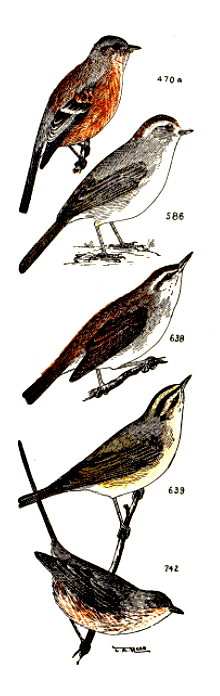
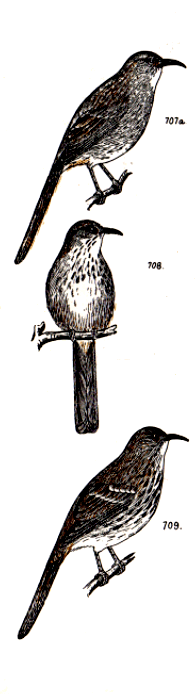
742a. Coast Wren-tit (C. f. phæa). Similar to No. 742, but much browner above and deeper more pink below; sides as dark as back. Range.—Pacific Coast from Monterey County, California, north to southern Oregon. 707. Curve-billed Thrasher (Toxostoma curvirostre). L. 11.2. Ads. Above brownish gray; below mottled with brownish gray; lower belly buffy; four outer pairs of tail-feathers tipped with white; two narrow white wing-bars. Notes. Call, a sharp, whit-whit; one of the most silent of song Thrushes. (Merrill.) Song, remarkably melodious and attractive. (Couch.) Range.—Mexican boundary region of Texas and New Mexico south over the Mexico tableland to Oaxaca. 707a. Palmer Thrasher (T. c. palmeri). Similar to No. 707, but wing-bars less evident; outer tail-feathers without white tips. Range.—"Southern Arizona, from about fifty miles northwest of Phoenix, south to Guaymas, Sonora." (A. O. U.) 708. Bendire Thrasher (Toxostoma bendirei). L. 10.2. Ads. Above brownish ashy; below soiled whitish washed with buffy and lightly spotted with dusky, chiefly on breast; outer tail-feathers narrowly tipped with whitish. Notes. Call, tirup, tirup, tirup. (Brown.) Range.—Desert regions of southern Arizona south into Sonora, Mexico; west rarely to southeastern California; resident except at extreme northern limit of its range. 709. St. Lucas Thrasher (Toxostoma cinereum). L. 10. Ads. Above grayish brown; below white with numerous wedge-shaped spots; outer tail-feathers tipped with white. Range.—Southern Lower California. 709a. Mearns Thrasher (T. c. mearnsi). Differs from No. 709 in much darker upperparts, more rusty flanks and crissum, much larger and more intensely black spots on lower parts and less curved bill. (Anthony.) Range.—Northern Lower California, south to about Lat. 30° 30'.
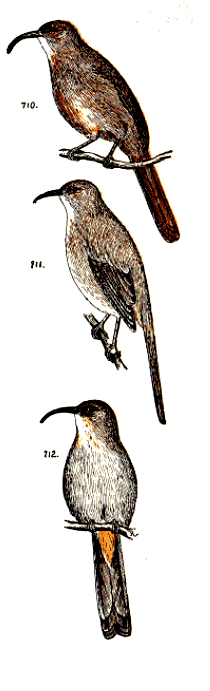
710. Californian Thrasher (Toxostoma redivivum). L. 12. Ads. Above grayish brown; belly distinctly buff; breast grayish, throat whitish, washed with buff; no white in wings or tail. Notes. Song suggesting both that of the Brown Thrasher and the Mockingbird. Range.—California west of the Sierra Nevada, north of about Lat. 35°; south into Lower California. 710a. Pasadena Thrasher (T. r. pasadenense). Similar to No. 710, but grayer above; belly paler, throat whiter. Range.—Southern California. 711. Leconte Thrasher (Toxostoma lecontei). L. 10.5. Ads. Above brownish ashy, below creamy white, under tail-coverts buff. Notes. Call, a sharply reiterated whit or quit; song, remarkable for its loud rich tone; can be heard distinctly for more than a mile. (Mearns.) Call, low and musical, hueé-e, whistled through the teeth. (Stephens.) Range.—"Desert region of southern California, Nevada, and extreme southwestern Utah, from Benton, Cal. (Lat. 38°), southeastward through Arizona to Sonora (Lat. 30°). Local in San Joaquin Valley." (A. O. U.) 711a. Desert Thrasher (T. l. arenicola). Differing from No. 711 in having upperparts darker and grayer, tail blacker, and breast gray. (Anthony.) Range.—Northern Lower California. (Rosalia Bay.) 712. Crissal Thrasher (Toxostoma crissalis). L. 12. Ads. Under tail-coverts reddish chestnut; upperparts brownish gray; underparts ashy, chin white. Notes. No loud call note; song of remarkable scope and sweetness. (Mearns.) Range.—"Southwestern United States, from western Texas to the Colorado Desert, California, and northern Lower California; north to Charleston Mountains, Nevada, and St. George, Utah." (A. O. U.)
Perching Birds Chiefly Brown or Streaked
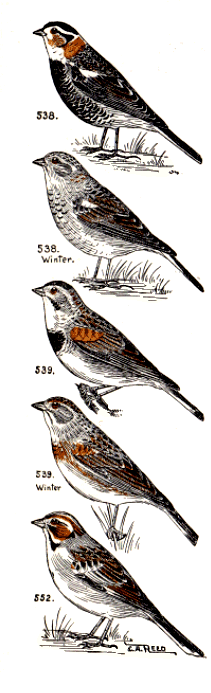
538. Chestnut-collared Longspur (Calcarius ornatus). L. 6.2. Hind toe-nail as long as toe; all but middle pair of tail-feathers (and sometimes these) with white, two outer pairs white to the tip. Ad. ♂. Throat and cheeks buff; breast and belly black; crown black, nape chestnut; lesser wing-coverts black tipped with white. Ad. ♀. Above grayish brown streaked with black; below pale buff. ♂ in winter. Like summer ♂ but black and chestnut areas more or less tipped with grayish brown. Notes. Song, short, shrill, but very sweet, often uttered on the wing. (Allen.) Range.—Great Plains: breeds from central Kansas and eastern Colorado north to the Saskatchewan; winters from eastern Colorado and Nebraska south into Mexico. 539. McCown Longspur (Rhynchophanes mccownii). L. 6. Hind toe-nail as long as toe; all but middle pair of tail-feathers with white, the outer one white to the tip, the others tipped with black; lesser wing-coverts chestnut. Ad. ♂. Throat and belly white, breast and crown black; back grayish brown streaked with black. Ad. ♀. Below white washed with brownish; above grayish brown streaked with black. ♂ in winter. Like ♀ but a partly concealed black breast patch; tail with more white. Notes. Call, a chip at each stroke of the wing; song, of soft, twittering, pleasing notes. (Goss.) "A twittering, hurried chant, suggestive of the Horned Lark's performance, but terminating in decreasing power." (Silloway.) Range.—Great Plains; breeds from northwestern Kansas to Montana and the Saskatchewan; winters from eastern Colorado and Kansas south into Mexico. 552. Lark Sparrow (Chondestes grammacus). L. 6.2; Ads. Sides of the crown and ear-coverts chestnut; all but middle tail-feathers tipped with white; back broadly streaked with black; sides of throat and spot on breast black. Notes. Song, loud and musical suggesting both a Song Sparrow's and a Canary's. Range.—Interior of North America from the Plains east to Illinois; casually east of the Alleghanies; breeds from Texas to Manitoba; winters south into Mexico. 552a. Western Lark Sparrow (C. g. strigatus). Similar to No. 552, but streaks on upperparts generally narrower. Range.—Western United States from the Plains to Pacific; breeds from Mexico to Manitoba and British Columbia; winters south to Central America.
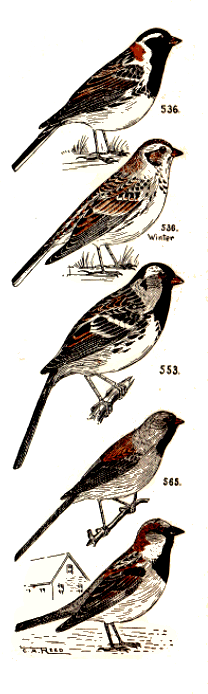
536. Lapland Longspur (Calcarius lapponicus). L. 6.2 Hind toe-nail as long as or longer than toe; two outer tail-feathers with white at the end. Ad. ♂, summer. Nape chestnut; crown, cheeks, throat and upper-breast black; back black margined with rusty brown. Ad. ♀, summer. Crown and back black margined with rusty; nape brighter; below whitish; breast feathers dusky at base; sides streaked with blackish. Winter, ♂. Black areas and nape veiled with whitish or buffy tips; ♀, like ♀ in summer. Range.—Breeds in northern Europe and northeast North America south to northern Labrador; in America, winters south, irregularly, to South Carolina, Kentucky, Kansas, Texas; west to Manitoba. (Ridgw.) 536a. Alaskan Longspur (C. l. alascensis). Similar to No. 536, but margins to back feathers much paler, brownish gray or buffy; nape in winter more buffy. Notes. Song, uttered on wing as bird with up-stretched wings floats downward, sweet, liquid, tinkling, of same general character as that of Bobolink, but shorter, less powerful. (Nelson.) Range.—Breeds in Alaska, Aleutian and Pribilof Islands east to Fort Simpson; winters south to eastern Oregon, Colorado, and western Kansas. (Ridgw.) 553. Harris Sparrow (Zonotrichia querula). L. 7.5. Ads. summer. Throat and crown black; nape chestnut, cheeks brownish; two white wing-bars. Ads. winter. Throat mottled with white, crown tipped with grayish. Notes. A queer, chuckling note; song of pleasing, plaintive whistling notes in musical tone like those of No. 558, but delivered in a different song. (Cooke.) Range.—Interior of North America; from Illinois west to the Dakotas; in summer, the region west of Hudson Bay (exact breeding range unknown); south in winter to Texas (and Mexico?); accidental in British Columbia, Oregon and California. 565. Black-chinned Sparrow (Spizella atrogularis). L. 5.7. Below slaty gray. Ad. ♂. Throat and front of face black; rest of head and underparts slaty gray, the belly whitish; back reddish brown narrowly streaked with black. Ad. ♀, Throat with little or no black; crown washed with brownish. Yng. Similar to Ad. ♀, but never with black on throat; crown more heavily washed with brownish. Notes. Song said to resemble that of No. 563. (Bailey.) Range.—Mexico and southwestern United States; breeds from southern New Mexico and southern California southward; winters south into Mexico and southern Lower California. —English Sparrow (Passer domesticus). L. 6.3. Ad. ♂. Throat and upper breast black; crown slate; band behind eye and on nape chestnut. Ad. ♀. Below dirty white; crown and rump dingy grayish brown; back streaked with black and rusty brown; a buffy stripe behind eye. Yng. ♂. Similar to Ad. but throat and head tipped with brownish gray. Notes. Harsh and discordant. Range.—Introduced into America from Europe in 1851 and later dates; now distributed throughout the greater part of the United States.
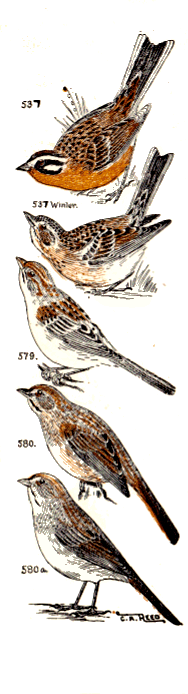
537. Smith Longspur (Calcarius pictus). L. 6.6. Hind toe-nail as long as toe; two outer tail-feathers mostly white. Ad. ♂. Throat, breast and belly buff; nape buff; crown and cheeks black; ear-coverts and line over eye white; lesser wing-coverts black margined with white. Ad. ♀. Above brownish black margined with buff and rusty brown; below pale buff, sides of breast and flanks streaked with brown. ♂ in winter. Like ♀ but lesser wing-coverts black and white. Notes. Call constantly chirrup as they fly. (Goss.) Range.—Middle western United States; breeds in northern British. America; winters south over the plains and prairies to Texas; east to Illinois. 579. Rufous-winged Sparrow (Aimophila carpalis). L. 5.7. Outer tail-feathers shortest. Ads. Lesser wing-coverts bright reddish brown; crown reddish brown or chestnut margined with gray; back streaked with black and margined with grayish brown; below whitish; two black streaks from either side of the base of the lower mandible. Notes. Call, zib, zib, zib. (Bendire.) Range.—Southern Arizona, north to Tucson and Camp Lowell and south through Sonora to northern Sinaloa. (Ridgw.) 580. Rufous-crowned Sparrow (Aimophila ruficeps). L. 4; T. 2.6. No yellow at bend of wing; outer tail-feathers shortest. Ads. Above reddish brown margined with buffy gray (no black streaks); below, including middle of belly, brownish; sides of throat with black lines. Notes. Song, very sweet, resembling that of Lazuli Bunting, but distinguishable. (C. A. Allen.) Range.—Northern Lower California north to Marin County and Sacramento Valley, California; local. 580a. Scott Sparrow (A. r. scottii). Similar to No. 580, but above brighter reddish brown, the margins to the feathers grayer, the underparts much paler, the breast grayish, the throat and middle of the belly whitish. Range.—Northwestern portion of Mexican plateau and adjacent portions of Arizona, New Mexico and western Texas (El Paso Co.) (Ridgw.) 580b. Rook Sparrow (A. r. eremœca). L. 6. Ads. Crown reddish chestnut, back olive-brown margined with gray. Similar to No. 580a, but back of a different color from crown, the grayish margins wider. Range.—Limestone Hill districts of middle Texas, from Kinney and Maverick counties on the Rio Grande, northeastward to Cook County and westward at least to Tom Green County; south in winter to Mexico. (Ridgw.) 580c. Laguna Sparrow (A. r. sororia). Similar to No. 580a, but bill somewhat stouter, reddish brown above averaging brighter and wider. Range.—Southern Lower California.
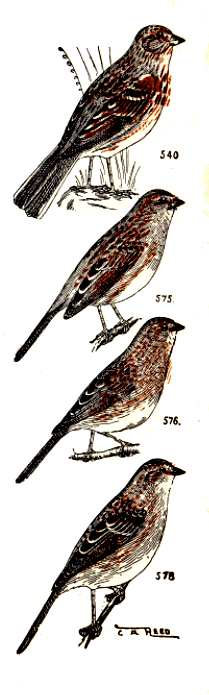
540. Vesper Sparrow (Poœcetes gramineus). L. 6.1. Outer tail-feather mostly white; hind toe-nail not longer than toe; lesser wing-coverts reddish brown. Ads. Above grayish brown streaked with black and chestnut; below whitish, breast and sides streaked with black and chestnut. Notes. Call, chip. Song, loud and musical Look-look, see-see, me-me-me-me-me-me-sing, followed by a confusion of notes. Range.—Eastern North America; breeds from Virginia, Illinois and Missouri north to New Brunswick and Manitoba; winters from Virginia and southern Illinois to the Gulf of Mexico. 540a. Western Vesper Sparrow (P. g. confinis). Similar to No. 540, but paler, less black above; bill somewhat more slender. Range.—Western United States from the Plains to the Sierra; breeds from Arizona and New Mexico north to the Saskatchewan and British Columbia; winters south into Mexico. 540b. Oregon Vesper Sparrow (P. g. affinis). Similar to No. 540a, but smaller, W. 3; bill still more slender; plumage browner, more buffy; browner even than No. 540, the underparts, including belly, suffused with buff. Range.—Pacific coast; breeds in western Oregon (and north?); winters southwest of the Sierra to San Diego, California. 575. Pine-woods Sparrow (Peucæa æstivalis). L. 5.8; T. 2.5. Bend of the wing yellow; outer tail-feathers much shorter than the middle pair. Ads. Above reddish chestnut, head and back streaked with black and margined with gray; below whitish, breast faintly tinged with buff. Notes. Song, exceedingly sweet and plaintive. Range.—Florida and southern Georgia; winters in southern Florida. 575a. Bachman Sparrow (T. æ. bachmanii). Similar to No. 575, but above brighter reddish chestnut, black speaks fewer and usually confined to back; breast and sides deeper buff. Range.—Lower Mississippi Valley, west to southern Indiana and southern Illinois, east to Georgia, South Carolina, North Carolina, and Virginia (rarely); west to Concho County, Texas; winters south in Atlantic States, to southern Florida. 576. Botteri Sparrow (Peucæa botteri). L. 6; T. 2.8. Bend of wing yellow; outer tail-feathers shortest. Ads. Above bright rusty brown (about the color of a Field Sparrow), head and back streaked with black and margined with gray; below buffy, the center of the belly whitish. Notes. Song, begins with a faint trill followed by a succession of disjointed syllables, cha, cheewee, wee, wee, wee, wir. (Henshaw.) Range.—Entire plateau of Mexico north to Lower Rio Grande Valley in Texas and southern Arizona. (Ridgw.) 578. Cassin Sparrow (Peucæa cassini). L. 6; T. 2.8. Bend of wing yellow, outer tail-feathers shortest, their ends with distinct grayish patches. Ads. Above gray streaked with dull reddish brown and spotted or barred with black; below grayish white. Notes. Song, lengthened and pleasing, usually sung on wing. Range.—Texas and southern Kansas west to southern Nevada and Arizona south into Mexico.
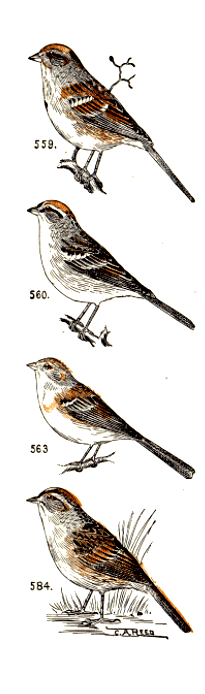
559. Tree Sparrow (Spizella monticola). L. 6.3. A black spot in the center of the breast. Ads. Cap reddish brown, no black on head; two white wing-bars, back streaked black, reddish brown and buff; below whitish; upper mandible black, lower yellowish. Notes. Call, a musical, tinkling, too-lay-it, song, "a loud, clear and powerful chant." Range.—Eastern North America, west to the Plains; breeds in Labrador and region west of Hudson Bay; winters south to South Carolina, Tennessee and Indian Territory. 559a. Western Tree Sparrow (S. m. ochracea). Similar to No. 559, but back with much less reddish brown, largely brownish buff streaked with black. Range.—Western North America east to the Plains; breeds in Alaska; winters south to Mexican border. 560. Chipping Sparrow (Spizella socialis). L. 5.3. Ads. Crown reddish chestnut, forehead blackish; a black line from eye to nape; back streaked with black, reddish brown and grayish brown; wing-bars not conspicuous; below grayish white; bill largely black. Yng. Crown like back; cheeks brownish. Notes. Call, chip; song, an unmusical chippy, chippy, chippy, repeated. Range.—Eastern North America, west to the Plains; breeds from Gulf States to Newfoundland and Great Slave Lake; winters in the Gulf States and Mexico. 560a. Western Chipping Sparrow (S. s. arizonæ). Similar to No. 560, but much grayer above; back with little or no reddish brown. Range.—Western North America; breeds from Mexican border states to Alaska; winters from California and Mexican border states to southern Mexico. 563. Field Sparrow (Spizella pusilla). L. 5.6; T. 2.5. Bill entirely pinkish brown. Ads. Crown reddish brown, a gray line over the eye, a reddish brown stripe from behind it to nape; back reddish brown streaked with black; below whitish, no streaks, breast washed with buffy; two white wing-bars. Notes. Call, chip; song, a musical whistle, cher-weé, cher-weé-cher-weé, cheé-o, dee-e-e-e-e; with many variations but usually ending in a trill. Range.—Eastern North America; breeds from South Carolina, Alabama and central Texas north to Quebec and Manitoba; winters from Virginia and Illinois to Gulf States. 563a. Western Field Sparrow (S. p. arenacea). Similar to No. 563, but much paler above; crown largely grayish; back with but little reddish brown, breast with little or no buff; tail longer, 2.7. Range.—Great Plains of interior; breeds from Nebraska and South Dakota to eastern Montana; winters south to northeastern Mexico; casually to Louisiana. (Ridgw.) 584. Swamp Sparrow (Melospiza georgiana). L. 5.8. Ads. Forehead black with a gray median line; crown bright chestnut; below grayish white; sides brownish, nape gray; back grayish, black, and buff. Yng. Crown streaked chestnut and black; gray line over the eye sometimes tinged with yellow; other parts deeper in color. Notes. Call, a sharp cheep; song, a simple tweet-tweet-tweet, etc., all on one note. Range.—Eastern North America, west to the Plains; breeds from New Jersey, Pennsylvania, and northern Illinois, north to Labrador and Manitoba; winters from Kansas, southern Illinois, and Massachusetts to Gulf States.
542. Sandwich Sparrow (Passerculus sandwichensis). L. 5.7; W. 2.9 A yellow line from the bill passing over the eye; bend of wing usually tinged with yellow. Ads. Above streaked with black, chestnut and brownish gray; below white, (buffy in fall and winter), breast and sides streaked with black, the streaks narrowly margined with chestnut. Notes. Doubtless resemble those of No. 542a. Range.—Northwest coast; breeds in western Alaska; winters south to northern California. 542a. Savannah Sparrow (P. s. savanna). Similar to No. 542, but smaller, W. 2.7; yellow line over eye shorter and less pronounced; bill smaller. Notes. Call a sharp tsip, frequently uttered; song, a weak, musical little trill following a grasshopperlike introduction, tsip, tsip, tsip, sē-e-e-s'r-r-r. (Dwight.) Range.—Eastern North America, west to the Plains; breeds from northern New Jersey (rarely), eastern Long Island, and Missouri north to Labrador and western Hudson Bay; winters from Virginia and southern Illinois to Cuba and Mexico. 542b. Western Savannah Sparrow (P. s. alaudinus). Similar to No. 542a, but bill more slender, color averaging paler, the yellow line not passing over the eye, less evident before it and often wholly wanting. Range.—Western North America from the Plains west to the Sierra; breeds from Mexico City north to Alaska; winters from southern California southward. 542c. Bryant Marsh Sparrow (P. s. bryanti). Similar to No. 542b, but smaller, W. 2.6; colors much darker, streaks below heavier; yellow over eye more pronounced. A darker bird even than No. 542a, but with the bill slender as in No. 542b. Range.—Resident in salt marshes about San Francisco and Monterey Bay; winters south to San Pedro (Grinnell); casually to Mexico City. (Ridgw.) 543. Belding Sparrow (Passerculus beldingi). L. 5; W. 2.5. Ads. Similar to No. 542c, but somewhat smaller, above darker and with a slight olive caste; underparts more heavily streaked. Range.—Pacific Coast; salt marshes from Todos Santos Island, Lower California, north to Santa Barbara. 544. Large-billed Sparrow (Passerculus rostratus). L. 5.5; W. 2.6. Bill stout, upper mandible curved; no yellow before eye or on bend of wing. Ads. Above grayish brown marked with brown and blackish but without well-defined streaks; below white, breast and sides streaked with grayish brown, the streaked feathers centrally blackish. Range.—Coast of southern California north to Santa Barbara; winters south to Cape St. Lucas and northwestern Mexico. 544a. St. Lucas Sparrow (P. r. guttatus). Similar to No. 544, but smaller, W. 2.5; bill more slender; upperparts brownish gray with an olive tint and streaked with darker; similar to No. 544c, but smaller, upperparts more olive and more widely, but less sharply streaked. Range.—Cape Region of Lower California in winter; breeding range unknown.
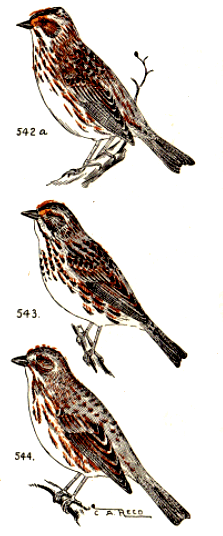
544b. Lagoon Sparrow (P. r. halophilus). Similar to No. 544a, but larger, W. 2.7, and darker; streaks on chest with little if any brown edging; differing from No. 543, in more uniform coloration of upperparts, in less narrow and decidedly blackish streaks on chest, etc. Range.—Salt marshes, Abreojos Point, Lower California. 544c. San Benito Sparrow (P. r. sanctorum). Similar to No. 544, but bill more slender; above grayer (brownish gray) distinctly streaked with blackish, the streaks margined with brown; below streaked with black, the streaks narrowly margined with brownish. Range.—Breeds on San Benito Island, Lower California; in winter to Cape Region of Lower California. 545. Baird Sparrow (Coturniculus bairdii). L. 5.7. Tail-feathers pointed, middle ones shortest. Ads. Crown yellowish brown, streaked with black; back black margined with chestnut and grayish; below whitish, breast and sides streaked with black. In fall and winter, colors richer. Notes. Song, "trick-e-trik-eeeee-chiky-le-roit, with a peculiar tinkling utterance." Range.—Great Plains; breeds from western Minnesota, North Dakota, eastern Montana, north to Manitoba and Assiniboia; winters south to Texas, Arizona and New Mexico. (Ridgw.) 546. Grasshopper Sparrow (Coturniculus savannarum passerinus). L. 5.3. Line before eye orange; bend of wing yellow; tail-feathers pointed. Ads. Crown black with a buffy central stripe; nape chestnut and gray; back black, chestnut buff and gray; below buffy, unstreaked, belly whiter. Notes. Call, a sharp chip; song, a weak, insect-like pit-tuck, zee-e-e-e-e-e-e. Range.—Eastern North America, west to the Plains; breeds from the Gulf States to Massachusetts, Vermont, and Minnesota; winters from North Carolina to Cuba and Mexico. 546a. Western Grasshopper Sparrow (C. s. bimaculatus). Similar to No. 546, but paler below and with less black and more chestnut above. Range.—Western United States from the Plains to the Pacific; breeds from Mexican border states north to Montana and British Columbia; winters south into Mexico. 546b. Florida Grasshopper Sparrow (C. s. floridanus). Similar to No. 546, but smaller, W. 3; darker above, paler below; sides of crown almost solid black; chestnut above largely replaced by black. Range.—Kissimmee Prairies, Florida. 547. Henslow Sparrow (Ammodramus henslowii). L. 5. Bend of wing yellow; tail-feathers pointed, the outer ones much the shortest. Ads. Crown and nape pale olive-green streaked with blackish; back bright reddish brown streaked with black and gray; below white; breast and sides washed with buff and streaked with black. Notes. Call, tee-wick; song, sis-r-r-rit-srit-srit. (Jouy.) Range.—Eastern North America; breeds locally, from Virginia and Missouri, north to New Hampshire, southern Ontario and Minnesota; winters from Virginia and Missouri south to the Gulf of Mexico. 547a. Western Henslow Sparrow (A. h. occidentalis). Similar to No. 547, but paler, in summer little or no buff below. Range.—Central western states; breeding, so far as known, in South Dakota; in winter south to Texas.
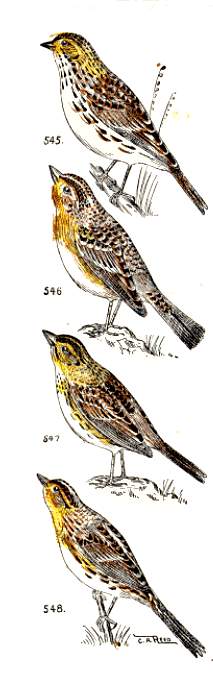
548. Leconte Sparrow (Ammodramus lecontei), L. 5. No yellow on wing; tail-feathers pointed, outer ones much the shortest. Ads. Broad line over eye, throat, breast and sides rich buff; nape chestnut and gray; back black narrowly margined with chestnut and, at the sides, broadly with buff; sides streaked; breast rarely with a few streaks. Notes. Call, a thin, sharp, tweet, and a long-drawn bizz; song, a tiny, husky, reese, reese. (Seton.) Range.—"Great Plains and more western prairies; breeding from Dakota, Minnesota, etc., to Manitoba, migrating south and east, in winter, through Illinois, Iowa, Kansas, etc., to South Carolina and Gulf States from Florida to Texas." (Ridgw.) 533. Pine Finch (Spinus pinus). L. 5. Bill sharply pointed; a tuft of bristly feathers over the nostril; tail slightly forked. Ads. Base of tail, of inner wing-feathers and outer edges of primaries yellow; above brownish; below whitish streaked with black. Notes. Call, a metallic note; song, tinkling and musical often sung on the wing as with No. 529, the song of which it resembles. Range.—North America; breeds from northern boundary states to Alaska; in the Alleghanies south to North Carolina; and in the Rockies and Sierra south to Mexico; winters from the northern states to Gulf states and Lower California. 541. Ipswich Sparrow (Passerculus princeps). L. 6.2. Ads. Above pale brownish gray streaked with brown; below white, breast and sides streaked with brownish; spot above eye and bend of wing often pale sulphur yellow. Notes. Resemble those of No. 542a. Range.—Breeds on Sable Island, Nova Scotia, winters south along coast, regularly to Virginia, rarely to Georgia. 549. Sharp-tailed Sparrow (Ammodramus caudacutus). L. 5.8. Tail-feathers sharply pointed, outer ones shortest. Ads. Below white, breast and sides washed with buff and distinctly streaked with black; nape olive-green; cheeks orange-buff; ear-coverts gray; crown olive-chocolate with a blue-gray central line; back olive, buff, black and gray. Notes. Call, chip; song, an unmusical, short, "husky," "gasping" effort, uttered from a perch or on fluttering wings above the reeds. Range.—Atlantic coast; breeds from South Carolina to New Hampshire; winters from North Carolina to Florida. 549.1. Nelson Sparrow (Ammodramus nelsoni). L. 5.5. Tail-feathers pointed, outer ones shortest. Ads. Similar to No. 549, but breast and sides much deeper buff, the former with few or no streaks; upperparts more richly colored. Notes. Resemble those of No. 549. Range.—Breeds in interior from northern Illinois to Manitoba and South Dakota; migrates east to New York and winters south to South Carolina and Texas; accidental in California. 549.1a. Acadian Sharp-tailed Sparrow (A. n. subvirgatus). Similar to No. 549.1, but breast and sides paler, the former lightly but distinctly streaked with grayish; upperparts less richly colored. Range.—Atlantic coast; breeds in marshes of eastern Maine, southern New Brunswick, and Prince Edward Island; winters south to South Carolina.
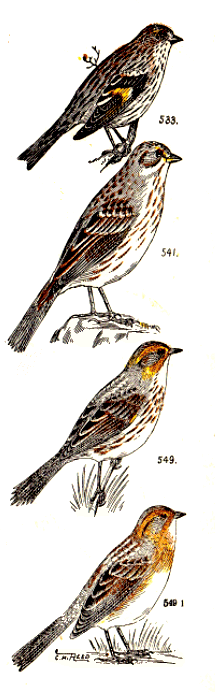
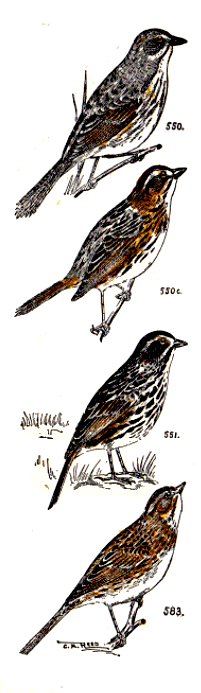
550. Seaside Sparrow (Ammodramus maritimus). L. 6: W. 2.5. Tail-feathers pointed, the outer ones shortest; spot before eye and bend of wing yellow. Ads. Above olive-green and gray (no black); below white, breast and sides grayish and, in first plumage, streaked with buff. Notes. Similar in character to those of No. 549. Range.—Atlantic coast; breeds in salt marshes from North Carolina to southern Massachusetts; winters from Virginia to Georgia. 550a. Scott Seaside Sparrow (A. m. peninsulæ). Similar to No. 550, but smaller, W. 2.3; above black margined by olive-brown and olive-green; below whitish, breast and sides heavily streaked with blackish. Range.—Atlantic coast from northeastern Florida to South Carolina; Gulf Coast of Florida. 550b. Texas Seaside Sparrow (A. m. sennetti). Similar to No. 550, but greener above; the feathers of head and back usually, those of nape always, with black centres. Range.—Coast of Texas. 550c. Fisher Seaside Sparrow (A. m. fisheri). Similar to No. 550a, but darker above, the breast and sides heavily washed with rusty buff and streaked with black. Range.—Coast of Louisiana, south in winter, at least as far as Corpus Christi, Texas; casual on Gulf coast of Florida. 550d. Macgillivray Seaside Sparrow (A. m. macgillivraii). Similar to No. 550c, but above grayer, less black, breast and flanks but faintly washed with buff and streaked with dusky grayish. Grayer above than No. 550a, and less heavily streaked below. Range.—Local on coast of South Carolina. 551. Dusky Seaside Sparrow (Ammodramus nigrescens). L. 5.9. Above black lightly margined with gray; below white heavily streaked with black; spot before eye and bend of wing yellow. Notes. Similar in character to those of No. 550. Range.—Marshes at head of Indian River, Florida, from Banana River to Haulover Canal. 583. Lincoln Sparrow (Melospiza lincolnii). L. 5.7. Ads. A broad buff band across the breast; center of crown with a gray stripe, its sides striped chestnut and black; back grayish brown streaked with black and chestnut, below streaked with black except on middle of white belly. Notes. Call, a sharp chirp; song, suggests bubbling, guttural notes of House Wren combined with rippling music of the Purple Finch. (Dwight.) (See, also, Brewster, Bird-Lore II, P. 111.) Range.—North America; breeds from northern New York, northern Illinois and higher parts of Rockies and Sierra north to Alaska; winters from southern Illinois and southern California into Mexico; rare east of Alleghanies. 583a. Forbush Sparrow (M. l. striata). Similar to No. 583, but browner above, crown-stripe and line over eye more brown than gray. Range.—Pacific coast from British Columbia to California; breeding range unknown.
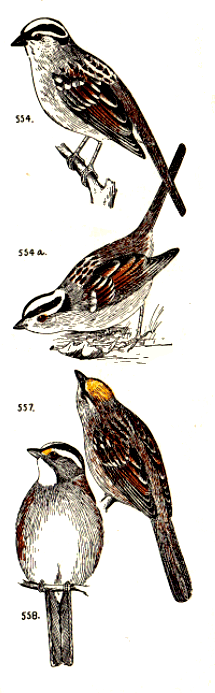
554. White-crowned Sparrow (Zonotrichia leucophrys). L. 6.9. No yellow before eye. Ads. White stripe over eye not reaching to bill; lores black; breast gray, throat but little paler; back gray streaked with brown, rump browner, Yng. Black crown-stripes replaced by chestnut, the white ones by buff; back much browner, no gray. Notes. Call, a sharp chip; song, a plaintive, musical whistle usually of five or six notes, the first two longest. Range.—North America; breeds from northern New England and (in the higher Rockies and Sierra) New Mexico, Arizona, and California north to Labrador and Hudson Bay region; winters from southern United States into Mexico. 554a. Intermediate Sparrow (Z. l. gambeli). Similar to No. 544, but the lores wholly gray or whitish, the white line over the eye reaching the bill. Range.—Western North America; breeds from Montana and eastern Oregon northeast of Coast Mountains, to lower Mackenzie and northern Alaska: winters from southern United States into Mexico; casual in migrations east to Mississippi River States. 554b. Nuttall Sparrow (Z. l. nuttalli). Similar to No. 554a, but smaller, L. 6.5, margins to feathers of back browner, underparts browner, bend of wing yellow. Range.—"Pacific coast district, breeding from Monterey, California, to Mt. Simpson, British Columbia, south in winter to San Pedro Martir Mountains, Lower California." (Ridgw.) 557. Golden-crowned Sparrow (Zonotrichia coronata). L. 7.2. Ad. ♂. Center of crown yellow, its sides black; below grayish white, sides brownish; back brown streaked with black; two white wing-bars; bend of wing yellow. Ad. ♀. Crown like back; its front tinged with yellow; breast washed with brownish. Range.—Pacific coast; breeds in Alaska; winters from Oregon south to northern Lower California. 558. White-throated Sparrow (Zonotrichia albicollis). L. 6.7. A yellow mark before the eye and on bend of wing. Ads. Crown black, a narrow white stripe through its center and bounded by white behind the eye; throat white sharply defined from gray breast; back reddish brown streaked with black. Yng. Less yellow before eye, crown browner, its stripe gray; throat grayer, sometimes like breast. Notes. Call, a low tseep, and sharp chink; song, a musical, clearly whistled sow-wheat peverly, peverly, peverly; or peabody, peabody, peabody. Range.—Eastern North America, west to the Plains, casually to the Pacific; breeds from Massachusetts (locally); northern New York, northern Michigan, and eastern Montana, north to Labrador and West Hudson Bay region; winters from Massachusetts (rarely) and Illinois south to the Gulf.
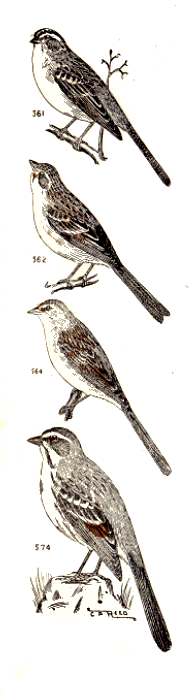
561. Clay-colored Sparrow (Spizella pallida). L. 5.4. No reddish brown. Ads. Above grayish brown streaked with black; sides of crown largely-black, a grayish line through its center; sides of head brownish; below white. Notes. Song, three notes, and a slight trill. (Coues.) Range.—Interior of North America, from Illinois to the Rockies; breeds from eastern Colorado, and northwestern Illinois north to Saskatchewan; winters from southern Texas into Mexico. 562. Brewer Sparrow (Spizella breweri). L. 5.4. No reddish brown. Ads. Back and crown brownish gray, uniformly and narrowly streaked with black; sides of head grayish; below white. Grayer than No. 561, the sides of the crown not largely black. Notes. Call, chip; song, a reedy warble resembling in tone that of a Long-billed Marsh Wren. Range.—Western United States, from the Rockies to central California; breeds from Mexican border States north to British Columbia; winters from southern California south into Mexico. 574. Bell Sparrow (Amphispiza belli). L. 6.1; W. 2.7. Ads. Sides of throat with black streaks; center of breast with black spots; above grayish brown, usually without distinct streaks, no white in tail. Range.—Pacific coast, from northern Lower California northwest of Sierras, to Warren county, California; resident. 574a. Sage Sparrow (A. b. nevadensis). Similar to No. 574, but larger, W. 3.1; back brownish gray, usually finely but distinctly streaked with black; less black at sides of throat, usually a white stripe over the eye. Notes. Call, a chipping twitter; song, feeble, but sweet and sad. (B. B. & R.) Range.—Great Basin region; breeds from New Mexico, Arizona, and southeastern California north to Idaho and eastern Oregon; winters south to western Texas and southern California. 574b. Gray Sage Sparrow (A. b. cinerea). Similar to No. 574, but paler above, throat-stripes narrower, more interrupted, breast-spot smaller, both stripes and spot dull grayish instead of blackish. (Ridgw.) Range.—Lower California. 564. Worthen Sparrow (Spizella wortheni). Resembles No. 563a, but sides of head plain gray, no brownish streak behind eye; tail shorter, 2.5. Range.—Southern New Mexico (Silver City), southward over eastern border of Mexican plateau to southern Puebla; breeding from Tamaulipas northward. (Ridgw.)
EASTERN SONG SPARROW GROUP. 581. Song Sparrow (Melospiza cinerea melodia). L. 6.2. Ads. Above reddish brown and gray with black streaks; tail with a decided rufous tinge; black streaks below conspicuously margined with reddish brown, those of center of breast forming a patch. Notes. Call, a characteristic chimp or trink; song, too variable in form to admit of brief description but unmistakable in tone throughout the whole group. Range.—Eastern North America west to the Plains; breeds from Virginia and northern Illinois north to Quebec and Manitoba; winters from southern Illinois and Massachusetts to Gulf States. 581b. Mountain Song Sparrow (M. c. montana). Similar to No. 581, but grayer; reddish brown not so bright; bill smaller. Range.—Rocky Mountain district of United States west to, and including Sierra Nevada in California; north to eastern Oregon, southern Idaho, and southern Montana; south in winter to western Texas and northern Mexico. (Ridgw.) 581k. Merrill Song Sparrow (M. c. merrilli). Similar to No. 581b, but slightly darker and more uniform above, with grayish edgings to interscapulars and scapulars less strongly contrasted with the darker mesial streaks, the latter usually with more brown than black. (Ridgw.) Range.—Breeds from northern California (Shasta County) in mountains and through Oregon and Washington east of Cascade Mountains, to northwestern Idaho; winters south into Mexico. (Ridgw.) 581j. Dakota Song Sparrow (M. c. juddi). Similar to No. 581, but above paler, especially line over eye and sides of neck; white below clearer; interscapulars with black center broader, reddish brown portions narrower; dark markings on breast restricted and more sharply defined. (Bishop.) Range.—"Turtle Mountains and vicinity, North Dakota." (A. O. U.) DESERT SONG SPARROWS. 581a. Desert Song Sparrow (Melospiza cinerea fallax). W. 2.5. Above reddish brown and gray; below white with reddish brown streaks; usually no black in plumage. Range.—Lower Sonoran district of southwest Arizona, southern Nevada, southeast California and northwest Lower California and Sonora. (Ridgw.) 581g. Brown Song Sparrow (M. c. rivularis). Similar to No. 581a, but larger, W. 2.7, with longer, more slender and more compressed bill; still less strongly contrasted markings, and duller, less rufescent colors. (Ridgw.) Range.—Mountain districts of southern Lower California. (Ridgw.) CALIFORNIA SONG SPARROWS. 581c. Heermann Song Sparrow (Melospiza cinerea heermanni). L. 6.5; W. 2.5. Ads. Above chestnut olive-gray with usually distinct black streaks; tail without a decided rufous tinge; black streaks below not conspicuously bordered by rufous. Range.—Central valleys of California including lower levels of Sacramento and San Joaquin basins. (Ridgw.)
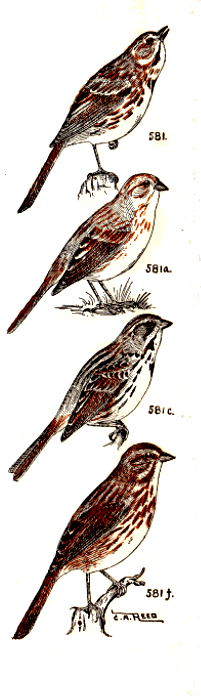
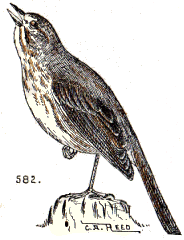
CALIFORNIA SONG SPARROWS. 581m. San Diego Sparrow (M. c. cooperi). Similar to No. 581c, but slightly smaller, W. 2.4, much lighter and grayer. Range.—Southern coast district of California north to Monterey Bay, east to Ft. Tejon, San Bernardino, etc., and north Pacific coast district of Lower California south to San Quentin Bay. (Ridgw.) 581d. Samuels Song Sparrow (M. c. samuelis). Similar to No. 581c, but smaller, W. 2.4, bill more slender. Range.—Coast slope of central California (except salt marshes of San Francisco Bay), from Santa Cruz County to Humboldt County, north, at least in winter, to Humboldt Bay. (Ridgw.) 581l. Alameda Song Sparrow (M. c. pusillula). Similar to No. 581a, but smaller, W. 2.3, less rusty, underparts more heavily streaked, usually more or less suffused with yellowish. Range.—Salt marshes of San Francisco Bay, California. (Ridgw.) 581i. San Clemente Song Sparrow (M. c. clementæ). Similar to No. 581m, but larger and grayer. Range.—San Clemente, San Miguel, and Santa Rosa Islands, Santa Barbara Group, California; Coronados Islands, Lower California. (Ridgw.) 581h. Santa Barbara Song Sparrow (M. c. graminea). Similar to No. 581i, but much smaller, W. 2.4. Range.—Santa Barbara Islands, California mainland in winter. NORTHWEST COAST SONG SPARROWS. 581e. Rusty Song Sparrow (M. c. morphna). W. 2.7. Ads. Above without clear gray and not distinctly streaked; prevailing color dark reddish brown; below heavily streaked with same. Range.—Northwest coast region, Oregon to British Columbia; south in winter to southern California. 581f. Sooty Song Sparrow (M. c. rufina). Similar to No. 581e, but larger, W. 2.9, more sooty above and below, underparts more heavily streaked. Range.—Pacific coast region from British Columbia north to southern Alaska. 581n. Yukutat Song Sparrow (M. c. caurina). Similar to No. 581f, bill longer and more slender, color grayer. Range.—Coast of Mt. St. Elias district of Alaska, from Yakutat Bay to Lituya Bay. 581o. Kenai Song Sparrow (M. c. kenaiensis). Similar to No. 582, but smaller, W. 3, plumage darker, more sooty, less rufous. Range.—Coast of Kenai Peninsula, Alaska, from east side of Cook Inlet to Prince William Sound. (Ridgw.) 581.1. Kadiak Island Song Sparrow (M. c. insignis). Similar to No. 581o, but larger, W. 3.2, bill longer, color grayer. Range.—Kadiak Island and opposite coast of Alaska. (Ridgw.) 582. Aleutian Song Sparrow (Melospiza cinerea). Similar to No. 581.1, but larger and grayer; largest and grayest bird of group; L. 8; W. 3.4. Range.—"Western portion of Alaska Peninsula (Stepovak Bay, opposite Shumagin Islands), Shumagin Islands, and Aleutian Islands, from Unalaska to Atka, Adak, and Attu." (Ridgw.)
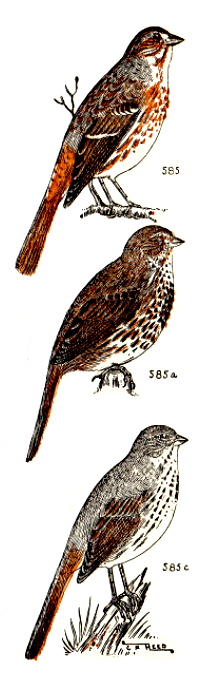
585. Fox Sparrow (Passerella iliaca). L. 7.2. Back streaked, gray and reddish brown; tail and spots below bright reddish brown. Notes. Call, a weak tseep; song, loud, sweet, varied, ringing and joyous. Range.—Eastern North America; breeds from Magdalen Islands and Manitoba, northwest to Alaska; winters from Virginia to the Gulf States. 585a. Shumagin Fox Sparrow (P. i. unalaschensis). Back not distinctly streaked, much paler than No. 585; spots below grayish brown; palest of present group. Range.—Alaska, Shumagin Islands, and Alaskan Peninsula to Cook Inlet. —Kadiak Fox Sparrow (P. i. insularis). Similar to No. 585a, but browner above and below; tail nearly same as back; breast spots larger. Range.—"Kadiak Island, Alaska, in summer; in winter south along the coast slope to southern California." (Ridgw.) —Sooty Fox Sparrow (P. i. fuliginosa). Ads. Above, including wings and tail, uniform brownish umber, unstreaked; below heavily spotted with same. Range.—Coast of British Columbia and northwest Washington; south in winter to San Francisco, California. (Ridgw.) —Townsend Fox Sparrow (P. i. townsendi). Similar to fuliginosa but more rufous. Range.—Southern Alaska north to Cross Sound; south in winter to northern California. (Ridgw.) —Yakutat Fox Sparrow (P. i. annectens). Similar to townsendi but less rufous; very near fuliginosa, but not quite so deeply colored. Range.—Coast of Alaska, from Cross Sound to Prince William Sound (to Cook Inlet?); in winter, south to California. (Ridgw.) 585b. Thick-billed Sparrow (P. i. megarhyncha). L. 7.3; W. 3.3; depth of B. at base, .4. Ads. Above and spots below gray; wings and tail light brown; bill large. Notes. Song, resembles that of No. 585, but is recognizably different. Range.—Breeding in the Sierra Nevada (both slopes) from Mt. Shasta southward; in winter beyond Sierras as far as Los Angeles County, California. (Ridgw.) 585c. Slate-colored Sparrow (P. i. schistacea). Similar to No. 585b, but smaller, bill smaller; W. 3.2; depth of B. at base, .35. Range.—Rocky Mountain district of United States and British Columbia; breeds from more eastern ranges of Colorado west to White Mountains in southeastern Colorado, mountains of northeastern California and eastern Oregon; north to interior of British Columbia; in migrations, New Mexico, Arizona, western slopes of Sierra Nevada, western Kansas. (Ridgw.) 585d. Stephens Sparrow (P. i. stephensi). Similar in coloration to No. 585b, but larger, the bill conspicuously so; W. 3.4; depth of B. at base .6. (Ridgw.) Range.—Breeding on San Bernardino and San Jacinto Mountains; southern California. (Ridgw.)
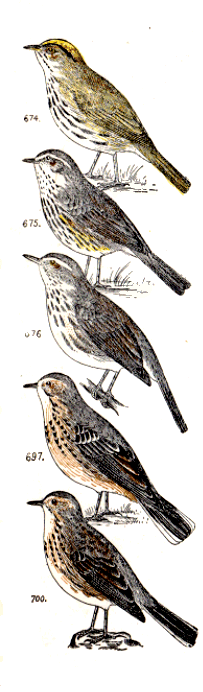
674. Oven-bird (Seiurus aurocapillus). L. 6.1. Ads. No wing-bars; no white in tail; above brownish olive-green; crown orange-brown bordered by black; below white streaked with black. Notes. Call, a weak cheep; song, a crescendo teacher repeated about five times; also a wild, ecstatic flight song. Range.—Eastern North America, west to the Rockies; breeds from Virginia and Kansas north to Labrador and northwest to Alaska; winters from Florida south to West Indies and Central America. (Said to breed in Bahamas.) 675. Water-Thrush (Seiurus noveboracensis). L. 6; W. 3. A whitish line over eye; above olive; below pale sulphur yellow heavily streaked with blackish; throat spotted; no wing-bars or tail-patches. Notes. Call, a sharp chink; song, a high-pitched, liquid whistle, sweet, sweet, sweet, chu-chu-wee chu. (Jones.) Also a flight song. Range.—Eastern North America; breeds from northern New England and northern Illinois, north to Newfoundland and Hudson Bay, and south along the Alleghanies to West Virginia; winters from Florida to northern South America. 675a. Grinnell Water-Thrush (S. n. notabilis). Similar to No. 675, but larger, W. 3.1; upperparts darker, less olive; underparts less yellow. Range.—Western North America; breeds from Minnesota, western Nebraska, and probably more northern Rocky Mountain district of United States, north to Alaska; winters from southern United States southward; in migration east to Mississippi valley, rarely to Atlantic States from New Jersey southward. 676. Louisiana Water-Thrush (Seiurus motacilla). L. 6.2. Ads. A white line over eye; above grayish olive; below buffy white; breast and sides streaked; no spots on throat; no wing-bars or tail-patches. Notes. Call, a sharp, metallic chink; song, a sudden outburst of loud wild, ringing notes; also a flight song. Range.—Eastern United States; breeds from Gulf States to Connecticut, lower Hudson Valley, and Minnesota; winters in tropics. 697. American Pipit: Titlark (Anthus pensilvanicus). L. 6.4. Hind toe-nail much the longest. Ads. Outer tail-feather largely white; next one only tipped with white; upperparts grayish brown indistinctly streaked; underparts rich buff, breast and sides streaked with blackish. Yng. and Ads. in Winter. Less gray above, paler below. Notes. Call, a soft dee-dee usually uttered in flight; a flight song. Range.—North America breeding in Arctic regions and in the higher parts of the Rockies from Colorado northward (also on Mt. Shasta?); winters from southern California, Nevada and Gulf States south through Mexico to Central America. 700. Sprague Pipit (Anthus spraguei). L. 6.2. Hind toe-nail much lengthened; two outer tail-feathers largely white. Ads. Above streaked with buff and blackish brown; below white tinged with buff; breast streaked. In winter, similar, but less brown above, less buff below. Notes. Song, uttered on the wing when several hundred feet above the earth, sweet and far reaching, resembling at beginning song of Skylark. Range.—"Interior plains of North America, breeding from plains of the Yellowstone northward to Saskatchewan district and from the Red River westward (probably to the Rocky Mountains); south in winter on the tablelands of Mexico to Puebla; accidental in South Carolina."
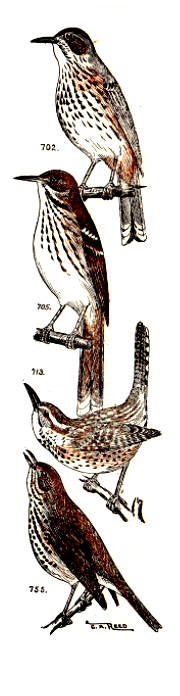
702. Sage Thrasher (Oroscoptes montanus). L. 8.7. Ads. Above brownish gray; below whitish heavily streaked with blackish; outer tail-feathers tipped with white. Notes. Call, a low chuck; song, deficient in power but possessing sweetness, vivacity and variety; resembling song of Ruby-crowned Kinglet. (Ridgway.) Range.—"Western United States from western South Dakota, western Nebraska and eastern Colorado, north to Montana, west to the Cascades and Sierra Nevada, south into northern Mexico and Lower California." (A. O. U.) 705. Brown Thrasher (Toxostoma rufum). L. 11.5; W. 4.1; B. .95. Ads. Above, wings and tail rufous or rusty brown; below white heavily streaked with blackish; two white wing-bars. Notes. Calls, a sharp kissing note and a clearly whistled wheéu; song, loud, musical, varied, finished and rich in tone. Range.—Eastern North America; breeds from the Gulf States north to Maine and Manitoba; winters from Virginia and the lower Mississippi Valley southward. 706. Sennett Thrasher (Toxostoma longirostre sennetti). L. 11.5; W. 4; B. 1.1. Ads. Similar to No. 705, but wing shorter, bill longer, upperparts less bright, streaks below blacker. Notes. Resemble those of No. 705, but song even finer. Range.—Southeastern Texas from Corpus Christi south into northeastern Mexico. 713? Texan Cactus Wren (Heleodytes brunneicapillus couesi). L. 8.5. Largest of our Wrens. Ads. Above brown, head darker, back streaked with white; below, including chin, heavily marked with black. Notes. A loud, harsh cack-cack-cack-cack. Range.—"Rio Grande region of Texas and adjoining Mexican states, west to the eastern Desert Tract, south over the Mexican tableland." (Mearns.) 713a. Bryant Cactus Wren (H. b. bryanti). Differs from No. 713b, in heavier spotting below, and in perfectly barred tail and slight wash of rufous on belly and flanks. (Anthony.) Range.—"Northern Lower California and southern California, west of the Coast Range." (Mearns.) 713b. St. Lucas Cactus Wren (H. b. affinis). Resembling No. 713c, but all the tail-feathers, except middle pair, barred with white for their whole length; flanks white or very pale buff, with large rounded or tear-shaped spots. (Ridgw.) Range.—Southern Lower California. 713c? Desert Cactus Wren (H. b. anthonyi). Similar to No. 713, but paler above; chin without spots. Range.—Interior deserts of the southwestern United States, south into Mexico and northeastern Lower California. (Mearns.) 755. Wood Thrush (Hylocichla mustelina). L. 8.2. Ads. Above bright cinnamon, brightest on head; below white with large, rounded black spots. Notes. Calls, a sharp pit-pit, a liquid quirt, and a soft tut-tut-tut; song, both flute-like and bell-like; sung with frequent pauses and low notes. Range.—Eastern United States; breeds from Virginia and Kansas to Vermont, Quebec, and Minnesota; winters in Central America.
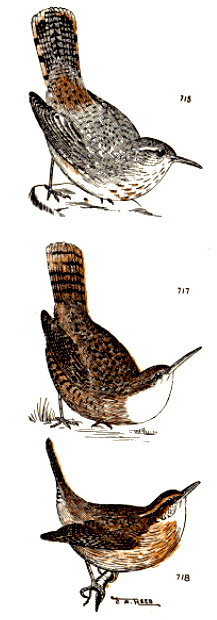
715. Rock Wren (Salpinctes obsoletus). L. 5.7. Ads. Rump rusty; tail tipped and outer feathers barred with pale rusty; above grayish brown lightly speckled with blackish; below, including belly, whitish; breast obscurely streaked with brownish. Notes. Calls, Wren-like; song, sweet, varied and Mockingbird-like. Range.—"Western United States, from the western border of the Plains to the Pacific, north to Dakota, Montana, and British Columbia; south on the tablelands of Mexico and Guatemala to Salvador; breeds throughout its range, and is resident from about the southern, border of the United States southward." (A. O. U.) 716. Guadalupe Rock Wren (Salpinctes guadeloupensis). Resembling No. 715, but darker and browner, with chest, etc., more distinctly speckled; wings and tail shorter; bill and tarsi longer; W. 2.6; T. 2.2. (Ridgw.) Range.—Guadalupe Island, Lower California. 717. White-throated Wren (Catherpes mexicanus albifrons). L. 6; W. 2.7. Ads. Belly, rump, and all tail-feathers rusty; tail barred with black; throat white; back rusty brown. Range.—Lower Rio Grande Valley in Texas and southward into northeastern Mexico. 717a. Canon Wren (C. m. conspersus). Similar to No. 717, but smaller, W. 2.3; tail-bars narrower. Notes. Call, a "ringing dink;" song, a series of about seven, loud, ringing whistles uttered in a regularly descending scale. Range.—"Great Basin and Rocky Mountain region, from the Sierra Nevada and Cascades eastward to southern Idaho, Wyoming, Colorado and western Texas: south on the tableland of Mexico to Aguas Calientes; breeds nearly throughout its range; resident in southern parts of its United States distribution." (A. O. U.) 717b. Dotted Canon Wren (C. m. punctulatus). Similar to No. 717a, but darker; more nearly resembling No. 717 in colors, but smaller in size. Range.—Pacific coast from Lower California north to Oregon; resident. 718. Carolina Wren (Thryothorus ludovicianus). L. 5.5; W. 2.3; B. .6. Ads. Above bright rust-brown; below washed with same, throat and line over eye white. Notes. Calls, Wren-like; song, a great variety of loud, musical whistles, whee-udel, whee-udel, whee-udel or tea-kettle, tea-kettle, tea-kettle, etc. Range—Eastern United States; breeds from the Gulf States north to the lower Hudson Valley (and casually Massachusetts), northern Illinois, and southern Iowa; resident. 718a. Florida Wren (T. l. miamensis). Similar to No. 718, but darker above, more deeply colored below; larger, W. 2.4; B. .7. Range.—Florida, from Pasco and Brevard counties southward. 718b. Lomita Wren (T. l. lomitensis). Similar to No. 718, but browner, less rufous above, rump with more white spots; below paler, the flanks usually barred. Range.—Southeastern Texas.
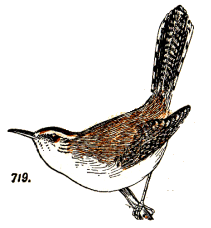
719. Bewick Wren (Thryomanes bewickii). L. 5; W. 2.2; T. 2.1. Ads. Above rich, dark cinnamon-brown, tail grayer; below grayish white; all but middle pair of tail-feathers black, outer ones barred, others tipped with grayish. Notes. Call, "a soft, low, plit;" song, strongly suggesting that of Song Sparrow. Range.—Mississippi Valley west to the Plains, north to Lat. 40°, east to Alleghanies and locally to Atlantic States from southern New Jersey to Georgia. 719a. Vigors Wren (T. b. spilurus). Similar to No. 719, but smaller, W. 2; upperparts less cinnamon or reddish. Range.—California, west of Sierra Nevada and south to Santa Cruz Island. (Bailey.) 719b. Baird Wren (T. b. leucogaster). Similar to No. 719c, but upperparts grayer. Range.—"Western Texas to southeastern California, and from southern Nevada Utah, and Colorado south over tablelands of Mexico to Zacatecas." (Bailey.) 719c. Texas Bewick Wren (T. b. cryptus). Similar to No. 719, but grayer, brown of upperparts not so rich; slightly larger, W. 2.3. Range.—"Texas, except the extreme western corner, states of Nuevo Leon and Tamaulipas, in Mexico, with probably Kansas, Indian Territory and Oklahoma; migratory north of Texas." (Oberholser.) 719d. Southwest Bewick Wren (T. b. charienturus). Similar to No. 719b but flanks and upper surface darker, eye-stripe rather broader, under tail-coverts more heavily barred, wing shorter, 2. (Oberholser.) Range.—Coast region of southern California, north to about Pasadena, south to Lat. 28°, Lower California, Santa Catalina Island; resident. (Oberholser.) 729e. Northwest Bewick Wren (T. b. calophonus). Similar to No. 719a, but bill larger, upper surface usually rather deeper and richer brown, flanks somewhat more rufescent; W. 2.1; B. .6. (Oberholser.) Range.—Pacific slope from Oregon north to southern Vancouver Island, valley of the Fraser River, and slightly farther along the mainland coast; probably resident. (Oberholser.) 719.1. San Clemente Wren (Thryomanes leucophrys) Similar to No. 719d, but flanks and upperparts rather grayer and paler, bill longer, under tail-coverts less heavily barred. (Oberholser.) Range.—San Clemente Island, California. 720. Guadalupe Wren (Thryomanes brevicauda). L. 4.5; W. 1.9. Ads. Resembling No. 719a, but rump with few or no concealed white spots; tail dull grayish brown, narrowly and indistinctly barred with dusky, two or three outer feathers with brownish gray tips. (Ridgw.) Range.—Guadalupe Island, Lower California.
721. House Wren (Troglodytes aëdon). L. 4.7; T. 1.7. Ads. Above cinnamon brown, sometimes obscurely barred; tail the same, all the feathers barred; below grayish with a brownish wash, lower belly and flanks usually more or less barred. Notes. Call, a scolding krrring; song, a bubbling, rippling, irrepressible little melody. Range.—Eastern North America; breeds north to Maine, Montreal, and Manitoba; winters from South Carolina and the Lower Mississippi Valley southward into Mexico. 721a. Parkman Wren (T. a. parkmanii). Similar to No. 721, but less cinnamon above; intermediate in color between No. 721 and No. 721b. Range.—Pacific coast; breeds from southern California north to British Columbia; winters from southern California southward. 721b. Western House Wren (T. a. aztecus). Similar to No. 721, but much grayer above and paler below; back more frequently barred. Range.—Western United States from the Sierra Nevada east to the Mississippi Valley; winters south into Lower California and Mexico. 722. Winter Wren (Olbiorchilus hiemalis). L. 4; T. 1.2. Ads. Above cinnamon, much brighter than in No. 721; below pale cinnamon, sides and belly heavily barred with blackish. Notes. Call, chimp-chimp, resembling call of Song Sparrow; song, tinkling, rippling, full of trills, runs and grace notes. (Bailey.) Range.—Eastern North America; breeds from northern New England and northern New York northward, and southward along the Alleghanies to North Carolina; winters from Massachusetts and Illinois to Florida. 722a. Western Winter Wren (O. h. pacificus). Similar to No. 722, but much deeper colored both above and below, and more heavily barred. Range.—Breeds on the Pacific coast from southern California north to Alaska; east to Idaho; winters south into Mexico. 722b. Kadiak Winter Wren (O. h. helleri). Slightly larger and paler than No. 722a. (Osgood.) Range.—Kadiak Island, Alaska. 723. Alaskan Wren (Olbiorchilus alascensis). Resembling No. 722a, but paler and larger, W. 2.1, B. .6. Range—Breeds on Kadiak Island, Alaska; winter range unknown. 723.1. Aleutian Wren (Olbiorchilus meligerus). Similar to No. 723, but darker, less reddish; rump and upper tail-coverts more evidently barred; bars on belly heavier. (Oberholser.) Range.—"Westernmost part of the Aleutian group, Alaska." (Oberholser.) 724. Short-billed Marsh Wren (Cistothorus stellaris). L. 4; T. 1.4; B. .4. Ads. Crown and back streaked with whitish; breast-band, sides and under tail-coverts rusty; wing-coverts tipped with whitish. Notes. Call, like sound produced by striking two pebbles together; song, chap—chap—chap-chap, chap-chap-chap p-p-rrr. (Seton.) (See next page.) Range.—Eastern North America, ranging west to Utah; breeds from the Gulf States north to Massachusetts and Manitoba; winters from the Gulf States southward.
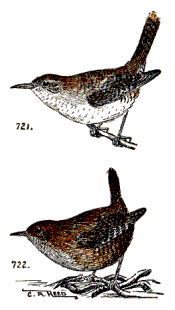
725. Long-billed Marsh Wren (Telmatodytes palustris). L. 5.2; T. 1.6; B. .5. Ads. Crown and foreback largely black, the latter with white streaks; a white stripe over eye; rump cinnamon; below white, sides washed with cinnamon; outer tail-feathers black, broadly barred with pale cinnamon. Notes. Call, scolding, a characteristic Wren-like cacking; song, a reedy, guttural, bubbling trill often sung in flight. Range.—Eastern North America west to the Rocky Mountains; breeds from the Gulf States north to Massachusetts and Manitoba; winters locally from Massachusetts, south into Mexico. 725a. Tule Wren (T. p. paludicola). Similar to No. 725, but upper tail-coverts barred, middle tail-feathers more distinctly and broadly barred; underparts usually browner. Range.—Pacific coast; breeds from southern California to British Columbia: winters from Washington to Guatemala. 725b. Worthington Marsh Wren (T. p. griseus). Similar to No. 725, but with less black above; upperparts, sides and flanks pale grayish; dark markings of under tail-coverts, flanks, sides and breast, faint, confused and inconspicuous, sometimes practically wanting. (Brewster.) Range.—Coast of South Carolina and Georgia. 725c. Interior Tule Wren (T. p. plesius). Similar to No. 725a, but paler. Range.—"Western United States, except the Pacific coast; north to British Columbia and Alberta, east to the Rocky Mountains and Texas, south into Mexico." (Oberholser.) 725.1. Marian Marsh Wren (Telmatodytes marianæ). Similar to No. 725, but upperparts darker; sides and flanks of about same color as rump; under tail-coverts and sometimes breast barred or spotted with black. Range.—Gulf coast of Florida. 726. Brown Creeper (Certhia familiaris americana). L. 5.6; B. .63. Tail-feathers stiffened and pointed. Ads. Rump rusty; a buffy white band in the wing; back and crown streaked with whitish, black and rusty; below white. Notes. Call, a faint, high, thin tseep; song, "an exquisitely pure, tender song of four notes." (Brewster.) Range.—Eastern North America: breeds from Maine and Minnesota (casually Missouri) northward; winters from about the southern breeding limits to the Gulf States. 726a. Mexican Creeper (C. f. albescens). Similar to No. 726, but rump rich rusty brown, back black, crown black streaked with white, band in wing white. Range.—Mexican plateau region north to southern Arizona. 726b. Rocky Mountain Creeper (C. f. montana). Similar to No. 726, but bill longer, .7; band in wing averaging whiter. Range.—Rocky Mountains from New Mexico and Arizona northward to Alaska. 726c. Californian Creeper (C. f. occidentalis). Similar to No. 726, but much rustier; prevailing color of upperparts yellowish rusty. Range.—Pacific coast; breeds from Santa Cruz Mountains, California, northward to Alaska.
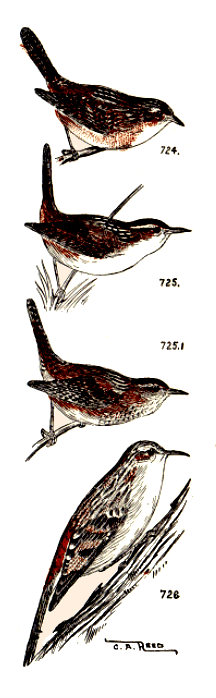
726d. Sierra Creeper (C. f. zelotes). Similar to No. 726c, but colors more dusky and less rufescent; similar to No. 726b, but much darker; light centers of feathers on head and back much reduced. (Osgood.) Range.—"Southern Cascade Mountains of Oregon and Sierra Nevada of California." (Osgood.) 756. Wilson Thrush; Veery (Hylocichla fuscescens). L. 7.5. Ads. Above, wings and tail, uniform cinnamon brown; below white, sides grayish, breast and throat buff rather faintly marked with triangular spots the color of the back. Notes. Call, a clearly whistled wheé-you and a softer too-whee; song, a weird, spiral of blended alto and soprano tones largely on one note. Range.—Eastern North America; breeds from northern New Jersey, the mountains of Pennsylvania, and northern Illinois north to Newfoundland and Manitoba; winters in Central America. 756a. Willow Thrush (H. f. salicicola). Similar to No. 756, but more olive above. Range.—Rocky Mountains north to British Columbia, east to Dakota; in migration, casually to Illinois and South Carolina; winters as far south as southern Brazil. 759. Alaskan Hermit Thrush (Hylocichla guttata), L. 6.5. W. 3.5; tail rufous, much brighter than back. Ads. Eye-ring whitish, not deep buff; back olive-brown; breast tinged with buff and heavily spotted with large, wedge-shaped marks. Range.—Breeds in northwest coast region from British Columbia to Alaska; in winter south to Mexico. 759a. Audubon Hermit Thrush (H. g. auduboni). Similar to No. 759, but larger, W. 4; back grayer, tail paler, flanks less heavily washed with gray. Range.—Rocky Mountain region of United States south to Guatemala. 759b. Hermit Thrush (H. g. pallasii). Similar to No. 759, but back and sides browner. Notes. Call, a low chuck; song, highly musical and probably exceeding in spiritual quality that of any of our birds. Range.—Eastern North America; breeds from Michigan, Alleghanies in Pennsylvania, Catskills, higher mountains of Massachusetts (rarely at sea level), north to Labrador; winters from New Jersey to Gulf States. 759c. Dwarf Hermit Thrush (H. g. nana). Similar to No. 759, but smaller, W. 3.2, back slightly browner. Range.—Pacific coast; breeds from Washington south through Sierra Nevadas; east, in migrations, to Nevada and Arizona; south to Lower California and western Mexico. (A. O. U.)
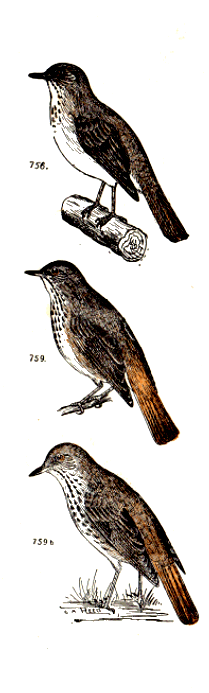
757. Gray-cheeked Thrush (Hylocichla aliciæ). L. 7.5; W. 4. Ads. Tail and back the same color, olive without brownish tinge; eye-ring and lores whitish, cheeks and breast only slightly tinged with buff, breast with wedge-shaped spots. Notes. Doubtless like those of No. 757a. Range.—Breeds in Labrador and west to Alaska: migrates through eastern North America and winters in Central America. 757a. Bicknell Thrush (H. a. bicknelli). Similar to No. 757, but smaller, L. 7; W. 3.5. Notes. Calls, pheu like that of Veery; a low cluck like that of Hermit Thrush, and rarely, a pip or peenk like that of Olive-backed Thrush; song, like that of Veery but more interrupted. (Brewster.) Range.—Breeds in the high parts of the Catskills and north to White Mountains and Nova Scotia; winters in tropics. 758. Russet-backed Thrush (Hylocichla ustulata). L. 7.2; W. 4. Tail not decidedly more rufous than back. Ads. Eye-ring, cheeks, sides of neck and breast distinctly buffy; breast with wedge-shaped spots; back and flanks olive-brown; tail slightly browner. The most deeply colored bird of the ustulata group. Range.—Pacific coast; breeds from Oregon to Alaska; winters south to Guatemala. 758a. Olive-backed Thrush (H. u. swainsonii). Similar to No. 758, but back, tail, and flanks without brownish or rufescent tinge. Notes. Call, a liquid puit; song, suggesting both that of Hermit Thrush and the Veery. Range.—Eastern North America; breeds in Alleghanies from Pennsylvania and the Catskills, north to New Brunswick and Manitoba; winters in Central and South America. 758b. California Olive-backed Thrush (H. u. œdica). Differs from 758 and 758a, in more rufescent coloration on the flanks; sides and upper surface usually paler than No. 758. (Oberholser.) Range.—California, except north coast; north in interior to southern Oregon; south, in winter to Arizona and southern Mexico. (Oberholser.) 758c. Alma Thrush (H. u. almæ). Similar to No. 758a, but back and flanks grayer. The palest bird of the ustulata group. Range.—Alaska, except Yukon Basin, south in Rocky Mountain region, and west to Utah and eastern Nevada. (A. O. U.)
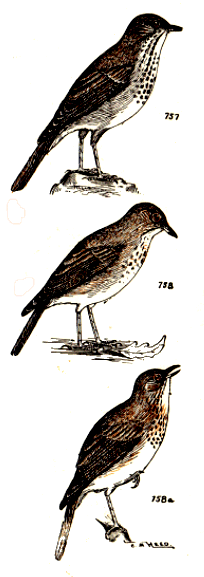
Perching Birds Chiefly Gray, Black, or Black and White
GRAY-HEADED JUNCOS. 566. White-winged Junco (Junco aikeni). L. 6.5; W. 3.30. Ads. Resembling No. 567, but larger, paler, wings generally with two white bars; three outer tail-feathers mostly or entirely white; fourth partly white. Range.—Breeds in Wyoming and western North Dakota; winters in Colorado, western Kansas, casually to Indiana and Wisconsin. (Ridgw.) 567. Slate-colored Junco (Junco hyemalis). L. 6.2. W. 3. Ad. ♂, summer. Head and back gray, the crown sometimes slightly darker, the feathers usually more or less tipped with brownish; breast and sides gray; belly white; third outer tail-feather with white. Ad. ♀, summer. Similar, but brown wash stronger. Ads., winter. Brown tips to feathers longer, sides sometimes brownish. Notes. Calls, a sharp, kissing note and a rapid chew-chew-chew, song, a simple, twittering trill. Range.—Eastern North America, breeds from northern New England, northern New York, and northern Minnesota north to Labrador and northwest to Alaska; and southward along the Alleghanies to Pennsylvania; winters south to the Gulf States. 567e. Carolina Junco (J. h. carolinensis). Similar to No. 567, but slightly larger, W. 3.2, the upperparts and breast uniform slate-gray without a brownish wash the bill horn color. Range.—Alleghanies from Virginia to Georgia. 568. Pink-sided Junco (Junco mearnsi). L. 6.2. Ad. ♂, summer. Sides broadly brownish pink, center of belly white; breast pale slate-gray, crown darker, back washed with brownish. Ad. ♀ in summer. Similar to the ♂, but with less pink on sides, the crown washed with gray. Ads. winter. Similar to summer Ads., but with more brownish. Range.—Breeds in southern Idaho and south-central Montana; winters south through Wyoming and Colorado to northern Mexico. 567.1 Montana Junco (Junco montanus). Similar to No. 568, but with less pink on the sides, the throat and breast darker slate. Range.—Breeding from northwestern Montana and northern Idaho north to northwest Territory and Alberta; in winter south to Mexico, east more or less irregularly to the Mississippi, Massachusetts, and Maryland. (Ridgw.) 571. Baird Junco (Junco bairdi). Back and sides rusty cinnamon, head gray, throat and breast grayish white, belly white. Range.—Cape Region of Lower California. 572. Guadalupe Junco (Junco insularis). Similar to mearnsi but smaller, W. 2.7, bill longer, head and breast darker. Range.—Guadalupe Island, Lower California. 571.1. Townsend Junco (Junco townsendi). Similar to No. 567.1, but with the back grayer, the brownish wash much reduced. Range.—San Pedro Martir Mountains, northern Lower California.
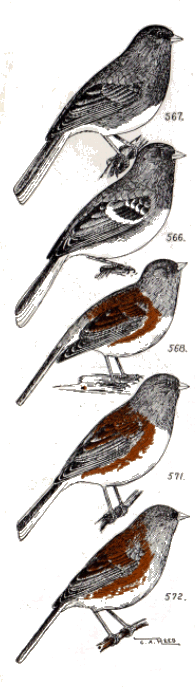
GRAY-HEADED, BROWN-BACKED JUNCOS. 569. Gray-headed Junco (Junco caniceps). L. 6.5; W. 3.2; T. 2.9. Ads. Head, breast and sides gray; back reddish brown; no reddish brown on wings; three outer tail-feathers with white; upper and lower mandibles pinkish. Range.—Breeds in mountains of southern Wyoming, Colorado, Utah, Nevada, and northern New Mexico. (Ridgw.) 570. Arizona Junco (Junco phæonotus palliatus). L. 6.5; W. 3.2; T. 2.9. Ads. Head gray; underparts grayish white; back, and to a greater or less extent, wing-coverts and tertials, reddish brown; three outer tail-feathers with white; iris yellow; upper mandible blackish, lower yellowish. Notes. Calls, resemble those of No. 567; song suggests that of Song Sparrow. Range.—Breeds in mountains of southern Arizona and southward. 570a. Red-backed Junco (Junco dorsalis) L. 6.7; W. 3.3; T. 3. Ads. Head gray; underparts grayish white; back reddish brown; no reddish brown on wings; three outer tail-feathers with white; upper mandible blackish, lower flesh-color; iris "brown." Range.—Breeds on high mountains of New Mexico and central Arizona; winters south to northern Mexico and western Texas. BLACK-HEADED JUNCOS. 567a. Oregon Junco (Junco oreganus). L. 6.2; W. 3. Ad. ♂, summer. Head, neck, throat and breast black sharply defined from the mahogany brown back, third outer tail-feather with little or no white; sides washed with pinkish brown. Ad. ♀, summer. Head and breast grayer, back paler. Ads. winter. Back deeper, the head and neck more or less tipped with brown, the breast with gray, these areas less sharply defined from the back and belly. Range.—Pacific coast; breeds from northern British Columbia to Alaska; winters south to California. —Shufeldt Junco (J. o. shufeldti). Similar to No. 567a, but larger, W. 3.1, brown of back less intense. Range.—Pacific coast; breeds from Oregon north to British Columbia (and eastward in humid regions to Montana?); winters south to northern Mexico. 567b. Coues Junco (J. o. connectens). Similar to shufeldti, but back paler, brownish gray, breast grayer, sides with less pinkish brown, head and breast still sharply defined from adjacent areas. Range.—Breeds in the interior of British Columbia and probably in arid districts southward (breeding areas not definitely known); winters southward doubtless to Mexican boundary. 567c. Thurber Junco (J. o. thurberi). Similar to No. 567, but back much paler, a bright pinkish brown; head and breast black as in No. 567. Range.—Breeds in mountains from southern Oregon south to southern California; east to western Nevada. 567d. Point Pinos Junco (J. o. pinosus). Similar to No. 567c, but throat and breast slate-color. Range.—Santa Cruz district of California; breeds from King Mountain, south at least to Point Sur, County; wanders eastward in winter into Santa Clara and San Benito Valleys. (Grinnell.)
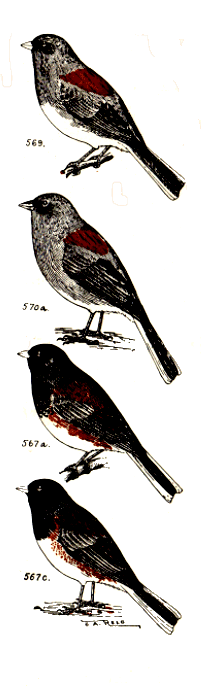
733. Plain Titmouse (Bæolophus inornatus). L. 5.5. Ads. Head crested; above grayish brown; below grayish white, belly white, sides often buffy. Notes. Similar to those of the Tufted Titmouse, but weaker and less varied. (Ridgw.) Range.—California, west of the Sierra; north to Oregon. 733a. Gray Titmouse (B. i. griseus). Similar to No. 733, but above gray, below whitish gray, no buff on sides. Range.—Southwestern United States: from southeastern California and Nevada to Colorado and New Mexico. 733b. Ashy Titmouse (B. i. cineraceus). Similar to No. 733a, but underparts grayish white, not whitish gray. Range.—Cape Region of Lower California. 743. Bush-Tit (Psaltriparus minimus). L, 4.2; T. 2.1. Ads. Crown sooty brown; back grayish brown; below brownish white, sides darker. Range.—Pacific coast from northern California to Washington. 743a. California Bush-Tit (P. m. californicus). Similar to No. 743, but crown much lighter, brighter brown, quite different from the brownish gray back; underparts paler. Notes. When feeding, a faint tsit, tsit, tsit, tsit, when moving about, tsit, tsit, tsit, sre-e-e-e; tsit, sre-e-e-e; when a bird is separated from its companions, same as last but uttered more hurriedly; alarm note, a greatly intensified tsit´´; tsit´´; tsit´´; tsit´: in presence of Hawk or Owl a shrill, quavering trill, sre-e-e-e-e-e. (Grinnell.) Range.—California, except the north coast region. 743b. Grinda Bush-Tit (P. m. grindæ). Similar to No. 743, but back bluish ash-gray. (Ridgw.) Range.—Cape Region of Lower California. 744. Lead-colored Bush-Tit (Psaltriparus plumbeus). L. 4.5. Ads. Crown and back bluish gray, sides of head brownish; below dingy white with a buffy tint on belly. Range.—Western United States from eastern Oregon and eastern California east to Wyoming, Colorado, and western Texas. 744.1. Santa Rita Bush-Tit (Psaltriparus santaritæ). Similar to No. 744, but smaller, sides of head paler, male with a more or less distinct blackish line along sides of head as in female of No. 745. (Ridgw.) (Now considered the same as 745.) Range.—Santa Rita Mountains, southern Arizona. 745. Lloyd Bush-Tit (Psaltriparus lloydi). L. 4.2. Ad. ♂. Sides of head shining black, crown blue-gray, back browner; chin blackish, underparts whitish, the belly and sides buffy. Ad. ♀. Sides of head brownish, ear-coverts bordered above by a narrow black line; no black on chin. Yng. Similar to ♀, but no black in head. Range.—"Mountains of western Texas, between the Pecos and Rio Grande Rivers" (Sennett), south into Mexico.
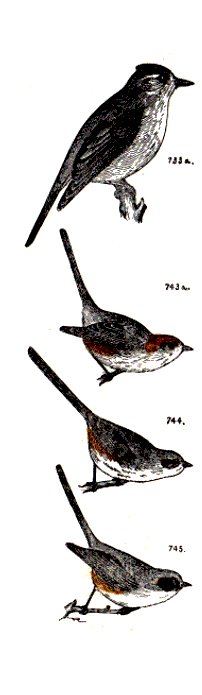
731. Tufted Titmouse (Bæolophus bicolor). L. 6. Ads. Head crested; forehead black; above gray; below whitish, sides rusty. Notes. A clearly whistled péto, péto, and a hoarse de-de-de. Range.—Eastern United States; resident from the Gulf States north to northern New Jersey and southern Iowa; straying somewhat further north in summer after breeding. 731a. Texan Tufted Titmouse (B. b. texensis). Similar to No. 731, but forehead rusty, upperparts paler. Range.—Southeastern Texas. 732. Black-crested Titmouse (Bæolophus atricristatus). L. 6.1. Ads. Head with a black crest; forehead white or tinged with rusty; back gray; below whitish, sides rusty. Notes. An abbreviation of the call of No. 731, pete-pete-pete-pete. (Bailey.) Range.—"From southeastern Texas west to El Paso, south to eastern Mexico." (Bailey.) 751. Blue-gray Gnatcatcher (Polioptila cærulea). L. 4.5; T. 2. Outer tail-feathers with white, white tip of next to outer one at least 1.00 long. Ad. ♂. Above bluish gray, forehead narrowly black; below grayish white. Ad. ♀. Similar, but lighter gray; no black on forehead. Notes. Call, a twanging ting; song, sweet and varied but of small volume. Range.—Eastern United States, west to Colorado; breeds from the Gulf States north to southern New Jersey, and Ontario; wanders casually as far north as Maine and Minnesota; winters from the Gulf States southward. 751a. Western Gnatcatcher (P. c. obscura). Similar to No.. 751, but slightly grayer above; white tip to next to outer tail-feather less than 1.00 long. Range.—Western United States from western Texas west to California and Lower California. 752. Plumbeous Gnatcatcher (Polioptila plumbea). L. 4.4. Outer web of outer tail-feather wholly white, inner web black except at tip. Ad. ♂. Crown shining black, back blue-gray; underparts grayish white. Ad. ♀ and Yng. ♂. Similar, but no black on head. Yng. ♀. Back and sides with a brownish wash. Notes. Call, a faint mew; song, "a harsh ditty of five notes, something like a Wren's song with notes like those of a Swallow." (Cooper.) Range.—Mexican boundary region, from western Texas to southeastern California and Lower California. 753. Black-tailed Gnatcatcher (Polioptila californica). L. 4.5; T. 2.1. Similar to No. 752, but outer vane of outer tail-feather black margined with white; back darker, underparts much grayer, flanks brownish. Range.—Pacific coast region of southern California and northern Lower California.
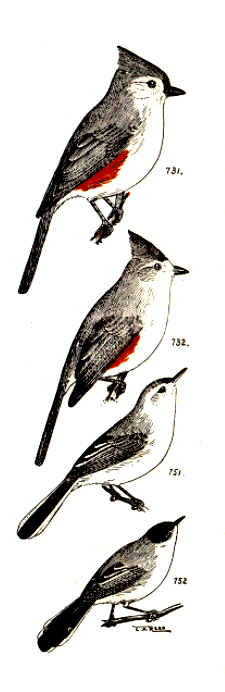
734. Bridled Titmouse (Bæolophus wollweberi). L. 5.2. Ads. Head crested, black and gray; throat black; hind neck with a white band bounded by black; back olive-gray; below whitish. Notes. Chickadee-like but fainter. (Henshaw.) Range.—Tableland of Mexico north to western Texas and southern Arizona. 738. Mountain Chickadee (Parus gambeli). L. 5.5. Ads. A white line over the eye and a black through it; back gray; belly whitish. Notes. A hoarse, dee-dee-dee, a two or three-noted phe-be whistle exactly like that of the Chickadee and an exceedingly sweet three-noted whistle of regular intervals, d, c, a. Range.—"Mountainous portions of the western United States from the eastern base of the Rocky Mountains to the Sierra Nevada, north to British Columbia, Idaho, etc., and south to northern Lower California." (A. O. U.) 740. Hudsonian Chickadee (Parus hudsonicus). L. 5.2; W. 2.6. Ads. Crown hair-brown, back a more yellow brown; sides of head and neck grayish white; throat black, belly white, sides rusty. Notes. Tscha-dee-dee-dee-dee; the dee-dee notes repeated with almost incessant volubility. (Brewer.) Range.—British America, from the west side of Hudson Bay northwestward to the Lower Yukon. 740a. Kowak Chickadee (P. h. stoneyi). Similar to No. 740, but larger, W. 2.7. above grayer, crown much paler. Range.—Kowak River region, Alaska. 740b. Columbian Chickadee (P. h. columbianus). Similar to No. 740, but grayer above, crown slaty-drab. Range.—Rocky Mountains from Montana northward; Kenai Peninsula, Alaska. —Canadian Chickadee (P. h. littoralis). Similar to No. 740, but smaller, W. 2.5, crown duller brown. Range.—British America east and south of Hudson Bay; northern New York, northern New England, New Brunswick, Nova Scotia. 739. Alaskan Chickadee (Parus cinctus alascensis). L. 5.2. Ads. Crown brown, back brighter; sides of head and neck pure white; throat blackish; belly whitish, sides buffy. Range.—"Northern Alaska and eastern Siberia." (A. O. U.) 741. Chestnut-backed Chickadee (Parus rufescens). L. 4.6. Ads. Back and sides rusty chestnut, crown sooty brown, throat black. Notes. A lisping the-the-the-te-te. (Kobbe.) Range.—Pacific coast from Oregon to southern Alaska. 741a. California Chickadee (P. r. neglectus). Similar to No. 741, but with only a tinge of rusty on flanks. Range.—"Coast of California from Monterey County northward." (A. O. U.) 741b. Barlow Chickadee (P. r. barlowi). Similar to No. 741a, but with no rusty on flanks. Range.—Vicinity of Monterey, California.
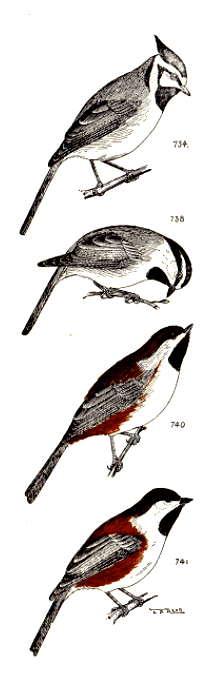
735. Black-capped Chickadee (Parus atricapillus). L. 5.2; T. 2.5. Ads. Cap and throat black; back gray with a brownish tinge; outer margins of wing-coverts grayish white; flanks, cream buff. Notes. Chickadee-dee, liquid gurgles and chuckling notes and a sweet, clearly whistled, phe-be or phe-be-e. Range.—Eastern North America; breeds from southern Illinois and Pennsylvania north to Labrador, and south along Alleghanies to North Carolina; migrates a short distance below its southern breeding limits. 735a. Long-tailed Chickadee (P. a. septentrionalis). Similar to No. 735, but tail longer, 2.7, flanks paler, white edgings broader. Range.—Rocky Mountain region north to British Columbia; east to Manitoba and the Plains. 735b. Oregon Chickadee (P. a. occidentalis). Similar to No. 735, but much darker; flanks grayish. Range.—Pacific coast from northern California to Sitka. 736. Carolina Chickadee (Parus carolinensis). Similar to No. 735, but smaller, L. 4.6; T. 2., the greater wing-coverts not margined with whitish. Notes. Whistle "tswee-dee, twsee-dee." Range.—Southeastern United States north to middle New Jersey, and southern Illinois; resident from southern New Jersey southward. 736a. Plumbeous Chickadee (P. c. agilis). Similar to No. 736, but paler above, whiter below. Range.—"Eastern and central Texas (Bee, Victoria, Cook, and Concho Counties, etc.") (A. O. U.) 737. Mexican Chickadee (Parus sclateri). Similar to No. 735, but sides broadly gray like back, black more extended. Notes. A rapid, vigorous double-noted whistle repeated three times, wholly unlike that of the Chickadee. Range.—Mountainous portions of the Mexican tableland north to southern Arizona. 630. Black-capped Vireo (Vireo atricapillus). L. 4.5. Ad. ♂. Crown and cheeks shining black; lores and eye-ring white; back olive-green; below white, sides tinged with greenish yellow; two whitish wing-bars. Ad. ♀. Similar, but black of head duller. Yng. "Top and sides of head dull grayish brown; lores, orbital ring and lower parts dull buffy white or pale buffy." (Ridgw.) Notes. "Of the general character of the White-eye or bellii type." (Bailey.) Range.—Breeds in central and western Texas; north to southern Kansas; winters in southern Mexico.
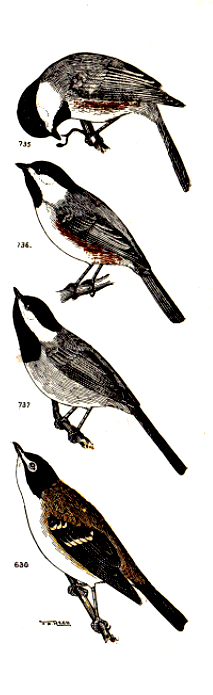
727. White-breasted Nuthatch (Sitta carolinensis). L. 6. Ad. ♂. Crown and foreback bluish black; sides of head and neck grayish white; tertials with distinct black marks rounded at end. Ad. ♀. Similar but black of head and shoulders washed with gray. Notes. Call, a nasal yank-yank and conversational notes; song, a tenor, ha-ha-ha-ha-ha-ha, all on the same note. Range.—Eastern North America west to the Rocky Mountains, breeds from the Gulf States to Minnesota and New Brunswick; resident. 727a. Slender-billed Nuthatch (S. c. aculeata). Similar to No. 727, but head usually greenish black; black of tertials less deep and one next to inner one usually pointed at end. Range.—Western North America west of the Rockies: breeds from Lower California north to British Columbia; resident. 727b. Florida White-breasted Nuthatch (S. c. atkinsi). Similar to No. 727, but somewhat smaller, wing-coverts and tertials not tipped with grayish; ♀ with head black as in ♂. Range.—Florida and north along the coast to South Carolina. 727c. Rocky Mountain Nuthatch (S. c. nelsoni). Similar to No. 727a, but larger, W. 3.7, with somewhat more white in tail and more rusty on flanks and lower belly. Range.—Wooded mountains of northern Chihuahua and Sonora, Arizona, New Mexico, Colorado, and northward. (Mearns.) 727d. St. Lucas Nuthatch (S. c. lagunæ). Similar to No. 727a, but with the wings and tail shorter, the black tips of the outer tail-feathers more restricted; W. 3.2; T. 1.7. (Brewster.) Range.—Higher mountains south of La Paz, Lower California. (Brewster.) 728. Red-breasted Nuthatch (Sitta canadensis). L. 4.6. Ad. ♂. A stripe through the eye and crown, black; line over eye white; underparts rusty. Ad. ♀. Similar, but crown gray like back, line through the eye blackish, paler below. Notes. A fine, thin, nasal, penny-trumpet like, drawled yna-yna. Range.—North America, breeding from the northern portions of the northern tier of States northward, and southward in the Alleghanies to Virginia, in the Rocky Mountains to Colorado, and in the Sierra Nevada in California; winters irregularly southward to the Gulf States and Arizona. 729. Brown-headed Nuthatch (Sitta pusilla). L. 4.3. Ads. Crown brown; a white patch on nape; back bluish gray; below grayish white, sometimes tinged with buff. Yng. Crown whitish. Notes. A conversational, twittering tnee-tnee. Range.—South Atlantic and Gulf States north to Delaware, accidentally to New York and casually to Missouri. 730. Pygmy Nuthatch (Sitta pygmæa). L. 4.3. Ads. Crown grayish olive; a whitish patch on nape; a dark brown line through eye; below white tinged with buff. Yng. Crown gray like back. Notes. A metallic, clinking clittick, clittick., Range.—Western North America, east to the Rocky Mountains; breeds from Mexico to British Columbia.
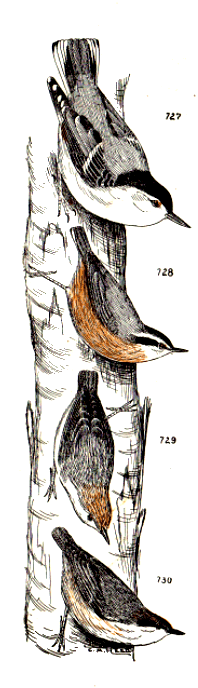
730a. White-naped Nuthatch (S. p. leuconucha). Similar to No. 730, but bill larger, crown grayer, back less bluish gray, nape patch more conspicuous, underparts white with scarcely more than a trace of buffy. (Ridgw.) Range.—Lower California. 444. Kingbird (Tyrannus tyrannus). L. 8.5. Tail tipped with white. Ads. Above slaty, crown blacker with an orange patch. Yng. Similar, but no crown-patch. Notes. An unmusical, steely chatter. "A soft and very pleasing song," heard only in the early morning. (O. T. Miller.) Range.—North America, breeds from Florida north to New Brunswick and Manitoba, and from eastern Texas northwest to Utah, Nevada, northeast California and western British Columbia; winters south of United States, to Central and South America. 445. Gray Kingbird (Tyrannus dominicensis). L. 9. Ads. No-white tip on tail; an orange crown-patch; under wing-coverts sulphur; ear-coverts black; above gray; below white. Notes. A loud, chattering, pitírri, pitírri. Range.—West Indies, breeding north through Florida along the coast to South Carolina; winters in Lesser Antilles, Mexico, and Central America. 701. American Dipper; Water Ouzel (Cinclus mexicanus). L. 8. Ads. Slaty gray, head and neck browner. In winter more or less tipped with whitish. Notes. Song, remarkably sweet and lively, in modulation resembling somewhat that of Brown Thrasher, but less powerful though sweeter in effect. (Ridgway.) Call, a sharp, pebbly cack-cack-cack. Range.—"The mountainous parts of central and western North America, from the Yukon Valley and Unalaska to Guatemala; east in the United States, to the eastern base of the Rocky mountains. Apparently resident throughout its range." (A. O. U.) 704. Catbird (Galeoscoptes carolinensis). L. 8.9. Ads. Slaty gray, cap and tail black, under tail-coverts reddish chestnut. Notes. Call, a whining, nasal tchay; song, rich, musical, and varied. Range.—North America; west to British Columbia and rarely Pacific coast states; breeds from the Gulf States north to New Brunswick and the Saskatchewan; winters from Gulf States southward. 754. Townsend Solitaire (Myadestes townsendii). L. 8.5. Ads. Brownish gray; eye-ring, tips of outer tail-feathers, a narrow wing-bar white; wing with a buff band showing in flight. Notes. Song, a rich, flowing, Grosbeak-like warbling, sung with great vigor and freedom and often for comparatively long periods. Range.—"Western United States, from the Plains westward to the Pacific coast, north to British Columbia and south in winter to the southern border of Arizona and northern Lower California; breeds from the mountains of New Mexico, southern Arizona, and central California northward."