Front matter (continued 2)
Reading edition
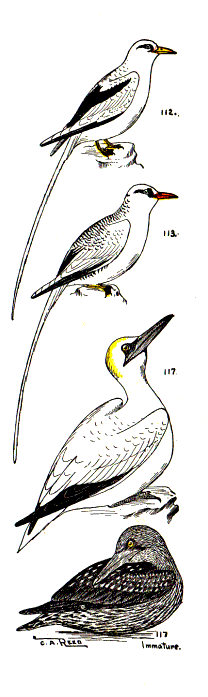
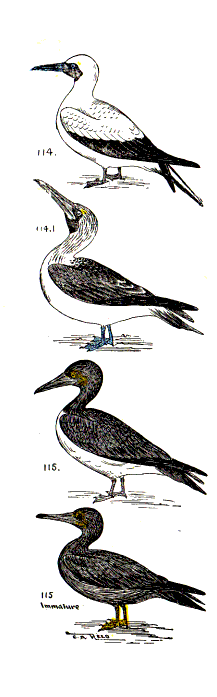
Boobies
114. Blue-faced Booby (Sula cyanops). L. 28. Ads. Body and lesser wing coverts white; central tail feathers whitish, others dark brown. Yng. Above plain dark grayish brown with some grayish streaks; below white; flanks streaked with grayish. Range.—Tropical seas; north in America to Lower California and Bahamas; casual in southern Florida. 114.1. Blue-footed Booby (Sula nebouxii). L. 33. Ads. Head, neck, and underparts white, the first two streaked with grayish; back dusky brownish, tipped with whitish; legs and feet bright blue. (Goss.) Range:—Pacific coast of America, from Gulf of California to Galapagos and Chili. (Cat. B. M.) 115. Booby (Sula sula). L. 30. Ads. Breast and belly white; bill and feet yellow. Yng. Entirely brownish, lighter below; bill blackish; feet yellow. Notes. A harsh, guttural bork, hork. (Audubon). Range.—"Atlantic coasts of tropical and subtropical America, north to Georgia. Also, West Pacific and Indian Oceans." (A. O. U.) Accidental on Long Island. No United States breeding record. 115.1. Brewster Booby (Sula brewsteri). L. 30. Ads. Similar to No. 115, but head and neck paler, bill blue, feet greenish. Range,—"Coasts and Islands of the eastern south Pacific Ocean, north to Lower California; breeding as far north as Georges Island at the head of the Gulf of California." (A. O. U.) 116. Red-footed Booby (Sula piscator). L. 28. Feet reddish. Ads. White; head and nape straw color; primaries hoary grayish brown; tail white. Yng. Above sooty brown; head, neck, and lower parts light smoky gray. (Ridgw.) Range.—Tropical seas, except Pacific coast of America (Cat. B. M.); north in Atlantic to Bahamas and, rarely, southern Florida.
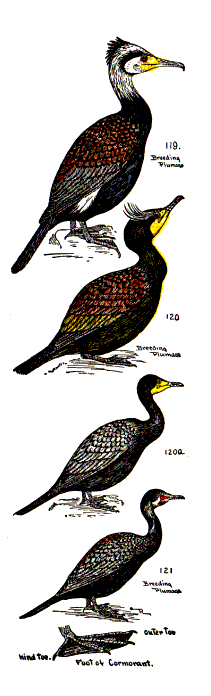
Cormorants
119. Cormorant (Phalacrocorax carbo). L. 36; T. 7.5, of 14 feathers. Ads. Chin and sides of throat whitish; back glossy brownish, distinctly margined with black; below uniform shining black. Breeding plumage. Head and throat with white plumes; a white patch on flanks. Yng. Belly white; above olive grayish brown, margined with black; throat whitish; neck brownish. Range.—North Atlantic; breeds from Nova Scotia to Greenland; winters south to Carolinas. 120. Double-crested Cormorant (Phalacrocorax dilophus). L. 30; W. 12.5; T. 6.2, of 12 feathers. Ads. Back brownish with distinct black margins; below shining black. Breeding plumage. With tufts on either side of head black, sometimes mixed with white; throat pouch orange. Yng. Back browner; head, neck, and lower belly brown; breast whitish. Range.—Eastern North America; breeds locally from Bay of Fundy, Minnesota, North Dakota, northward; west to Assiniboia; winters from southern Illinois and Virginia southward. 120a. Florida Cormorant (P. d. floridanus). Similar to No. 120, but blacker and smaller. L. 25. Range.—South Atlantic and Gulf States; breeds north to North Carolina and southern Illinois. 120b. White-crested Cormorant (P. d. cincinatus). Similar to No. 120, but larger, L. 36; nuptial crests white. Range.—Pacific coasts; breeds in Alaska; winters south to California. 120c. Farallone Cormorant (P. d. albociliatus). Similar to 120b., but smaller, L. 28. Range.—Breeds on California coast and in interior, south to Socorro Island. (Ridgw.) 121. Mexican Cormorant (Phalacrocorax mexicanus). L. 25. W. 10. Ads. Narrow border at base of pouch white. Breeding plumage. Neck with white plumes. Yng. Head and hindneck brownish; back grayish, margined with black; throat, foreneck and breast brownish white; belly black. Range.—Breeds In West Indies and Central America to west Gulf States; north in summer rarely to Kansas and southern Illinois.
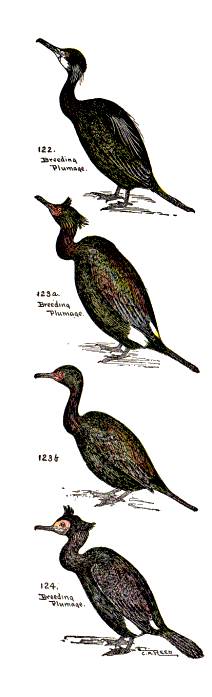
122. Brandt Cormorant (Phalacrocorax penicillatus). L. 35; T. 6. Chin and sides of throat buffy white or brownish. Ads. Above blue black, faintly margined with black; below green black. Breeding plumage. With white, hair-like plumes from back and neck; no white on flanks; throat pouch blue. Yng. Above dark brown; throat and belly whitish; breast and sides brown. Range.—Pacific coast from Cape St. Lucas to Washington; resident. 123. Pelagic Cormorant (Phalacrocorax pelagicus). L. 28; W. 10; T. 6.2. Forehead feathered; back feathers not margined. Ads. Above glossy green and purplish black; below bottle green. Breeding plumage. With white plumes on neck and rump and white patches on flanks; nape and forehead, crested. Yng. Above greenish dusky brown, less green below. Range.—"Aleutian and Kuril Islands, and Kamchatka, south to Japan." (A. O. U.) 123a. Violet-green Cormorant (P. p. robustus). Similar to No. 123, but larger; bill stouter, W. 10.8. Range.—"Coast of Alaska, from Norton Sound south to Washington." (A. O. U.) 123b. Baird Cormorant (P. p. resplendens). Similar to No. 123, but smaller; bill slenderer; W. 9.5. Notes. A croaking, guttural note. Range.—Pacific coast from Washington south to Mazatlan, Mexico. 124. Red-faced Cormorant (Phalacrocorax urile). L. 34. Forehead as well as lores bare. Ads. Above green and purple; head and neck blue black; belly green. Breeding plumage. With forehead and nape crests and white patches on flanks. Notes. "A low, droning croak." (Nelson.) Range.—"Pribilof, Aleutian, and Kuril Islands, and coast of Kamchatka. South in winter to northern Japan." (A. O. U.)
Anhinga, Pelicans, and Man-o'-War bird
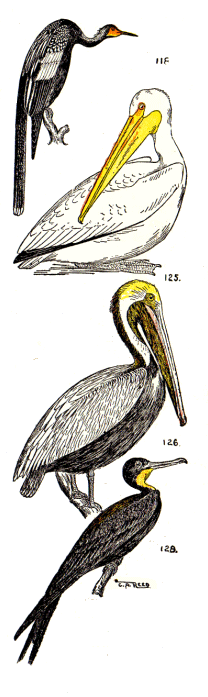
118. Anhinga; Snakebird; Water Turkey (Anhinga anhinga). L. 36. Ad. ♂. Black; grayish head and neck plumes which, in winter, are absent. Ad. ♀. Resembles male but whole head, neck, and breast brownish. Yng. Similar to ♀ but black parts duller. Notes. A rasping, clattering croak, uttered when fighting or in coming to the nest. Range.—Tropical and subtropical America; breeds north to southern Illinois and South Carolina; winters from Gulf States southward. 125. American White Pelican (Pelecanus erythrorhynchos). L. 60. Ads. White; primaries black; bill in breeding season with a knob. Yng. With crown brownish. Range:—North America; breeds in interior from eastern California, Utah, Yellowstone Park, Minnesota (?) northward to Lat. 61°; winters from Gulf States and southern California, south to Central America. 126. Brown Pelican (Pelecanus occidentalis). L. 50; W. 19.5. Ads. Pouch greenish; head white, rarely yellowish; neck brown. In fall, no brown on neck. Yng. Brownish gray, white below. Notes. Adults as a rule silent; young before flying, very noisy. Range:—Atlantic and Gulf coast of tropical and subtropical America; breeds from northern South America to South Carolina; has strayed to Illinois and Nova Scotia; winters from Gulf States southward. 127. California Brown Pelican (Pelecanus californicus). Similar to No. 126, but larger. L. 54; W. 21; pouch in breeding season, red. Range.—Pacific coast from Galapagos north to British Columbia; breeds north only to Los Coronados Islands. 128. Man-o'-War Bird; Frigate Bird (Fregata aquila). L. 40. Ad. ♂. Black, glossy above; pouch "scarlet or orange." Ad. ♀. Browner; breast and belly white. Yng. Similar to ♀, but head and neck white. Notes. Usually silent; rarely a croaking note. Range:—Tropical and subtropical coasts; in America north to Florida, Texas, and southern California; casually to Kansas, Ohio and Nova Scotia; winters from southern Florida and Lower California southward.
Order V. DUCKS, GEESE, AND SWANS.
ANSERES.
Family 1. DUCKS, GEESE, and SWANS. Anatidæ. 49 species, 6 subspecies.
The Anatidæ of North America are placed in five well-marked subfamilies, the Mergansers (Merginæ), River Ducks (Anatinæ), Sea Ducks (Fuligulinæ), Geese (Anserinæ), and Swans (Cygninæ).
The Mergansers, Saw-bills, or Shelldrakes are fish-eating Ducks and their rounded bills, set with tooth-like projections along the sides, are of evident use to them in holding their prey.
The River Ducks include such well-known species as the Mallard, Black Duck, and Widgeon. They differ from the Bay or Sea Ducks in not having a well-developed web or flap on the hind-toe. As a rule they feed in shallow water by tipping, standing on their heads, as it were, while reaching the bottom for food.
The Bay or Sea Ducks have the hind-toe webbed. They feed, as a rule, in deeper water than the River Ducks, sometimes descending to the bottom in water over one hundred feet deep. During the winter they gather in flocks often of several thousand individuals, and frequent the larger bodies of water.
With both the River and Bay Ducks the sides of the broad, flat bill are set with gutters which serve as strainers, retaining the mollusks, seeds and roots of aquatic plants on which these Ducks feed, while the mud or water taken in with the food is forced out the sides of the bill as it closes.
Geese are more terrestrial than Ducks and often visit the land to nip the grass. This is particularly true in the west where large flocks of, Geese, especially Snow Geese, may be seen feeding on the prairies. On the water they feed over shallows by tipping and probing the bottoms.
Swans also feed from the surface of the water either by simply immersing the head and neck or by half submerging the body, when, with the tail pointed to the zenith, the length of their reach is greatly increased.
In spite of their comparatively short wings the large muscles attached to them give to the Anatidæ great power of flight. Not only do they make extended journeys, when migrating, without a rest, but they attain a speed which is surpassed by but few birds. Some of the smaller species, when alarmed, doubtless flying at the rate of one hundred miles an hour.
In common with other diving water birds the Ducks, when molting, lose most of their wing feathers all at once, and for a time are therefore unable to fly. During this comparatively helpless period the brightly colored males assume in part the plumage of the females and are thereby rendered less conspicuous. With the return of the power of flight, however, they regain their distinctive, male plumage, which is usually brighter than that of the female. With our Geese and Swans there is no sexual difference in color.
Most of our Ducks and Geese breed in the north, some within the Arctic Circle, and winter from the southern limit of frozen water southward. The American Merganser, Hooded Merganser, Wood Duck, Buffle-head, Golden-Eyes, Tree Ducks, and possibly Harlequin Duck nest in hollow trees, at times some distance from the water. The young of the American Golden-eye and of the Wood Duck have been seen to reach the water by jumping from the nest-hole and fluttering down in response to the calls of the parent below. It is said that they are also brought down in the bill of the old bird, but this statement apparently lacks confirmation.
The remaining species of our Ducks, Geese, and Swans, nest as a rule, on the ground generally near water. From five to fifteen and, in the case of the Fulvous Tree Duck, possibly as many as thirty eggs are laid. In color they vary from white to buffy and pale olive and are always uniformly colored. Incubation is performed by the female alone. The males at this period among most Ducks deserting their mate to undergo the partial molt before mentioned. While incubating the females surround their nest with soft down plucked from their bodies and when leaving the nest to feed, this down is drawn over the eggs with the double object, doubtless, of concealing them and of keeping them warm.
With Eider Ducks this down constitutes the larger part of, if not the entire nest. Saunders states that in Iceland the down in each nest weighs about one-sixth of a pound. This is gathered by the natives, who, however, are careful to afford the sitting bird an opportunity to raise her brood without further molestation.
The collection of Eider down thus furnishes an admirable illustration of proper economic relations between man and birds. The down is an important source of income to the natives of the comparatively barren, northern countries in which the Eiders nest. So long as man can remember it has been gathered annually. Still the Ducks continue to return in numbers year after year to the same region, perhaps the exact spot in which they nested the year before.
Less intelligent methods would perhaps rob the bird of its second, as well as of its first nest and, unable to reproduce its kind, the species would become extinct within a comparatively short period.
The evils which would follow such a course are, however, thoroughly understood. The Ducks, in the first place, are encouraged in every way. It is said that should one walk into a peasant's cabin and preempt his cot as a nesting-site, the peasant would gladly give up his bed to so valuable a visitor.
Ducks
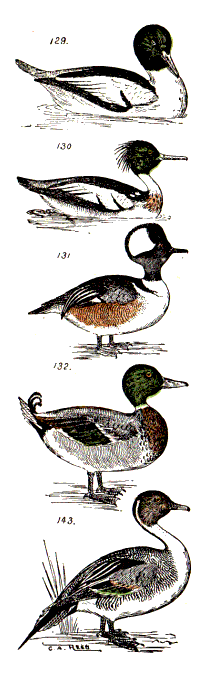
129. American Merganser (Merganser americanus). L. 25; B. from nostril, 1.5; nostril midway between eye and tip of bill. Ad. ♂. No band of streaks on breast; no crest. Ad. ♀. and Yng. Chin white; crown and throat reddish brown; rest of underparts and speculum white; above and tail ashy. Range.—North America; breeds from New Brunswick, rarely mountains of Pennsylvania, Minnesota, and mountains of Colorado and California northward; winters from Maine and British Columbia south to South Carolina and southern California. 130. Red-breasted Merganser (Merganser serrator). L. 22; B. from nostril, 1.8; nostril nearer to eye than to tip of bill. Ad. ♂. Breast with a broad cinnamon band streaked with black; head feathers lengthened. Ad. ♀ and Yng. Crown grayish brown, washed with rusty. Chin and throat paler; rest of underparts and speculum white: back and tail ashy. Notes. When alarmed, several low, guttural croaks. (Elliot.) Range.—Northern hemisphere; breeds, in America, from New Brunswick and northern Illinois north to Greenland and Alaska; winters from southern breeding limits, south to Cuba and Lower California. 131. Hooded Merganser (Lophodytes cucullatus). L. 17.5. Ad. ♂. A large, circular black and white crest. Ad. ♀ Yng. A small cinnamon crest, head, neck and breast grayish brown; back, blackish; belly white. Notes. "A hoarse croak, like a small edition of that of the Red-breasted Merganser." (Elliot.) Range.—North America from Cuba and Lower California north to Labrador and Alaska; breeds locally throughout its range, chiefly in interior of British America; winters from British Columbia, Illinois, and Massachusetts southward. 132. Mallard (Anas boschas). L. 23. Speculum (patch in wing) purple bordered by black and white; under surface of wing pure white. Ad. ♂. Head green; breast chestnut, a white neck-ring. Ad. ♀. Above blackish and buffy, below rusty buff mottled with dusky grayish brown. Notes. The familiar quack of the barn-yard Duck. Range.—Northern hemisphere; breeds, in America, from Labrador, Indiana, Iowa, and California north to Greenland and Alaska; winters from British Columbia, Kansas, and New Jersey to Central America and West Indies. 143. Pintail (Dafila acuta). L. ♂, 28; ♀, 22. Ad. ♂. Central tail feathers black, 7.5 long, pointed. Ad. ♀. Tail 3.5,; feathers sharply pointed; brownish black, with buff bars; under wing-coverts dusky and buff; back blackish with internal buff loops. Notes. A loud quack, less sonorous than that of the Mallard; a low mellow whistle, and a harsh rolling note. (Nelson.) Range.—Northern hemisphere; breeds, in America, from New Brunswick, Iowa, Illinois, and British Columbia northward; winters from British Columbia, Illinois, and Virginia, south to Central America and West Indies.
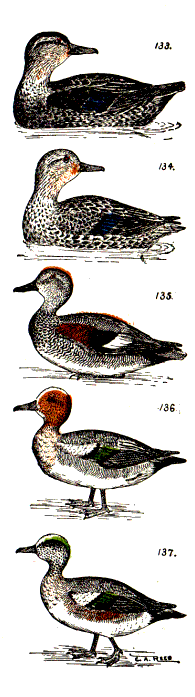
133. Black Duck (Anas obscura). L. 22. Ads. Speculum bluish purple tipped with black; no white in wing; lining of wing white and dusky; crown without paler margins; throat, usually, without markings; legs "olivaceous brown," bill "greenish black, dusky olive, or olive-green." Notes. A quack resembling that of the Mallard. Range.—Eastern North America; chiefly east of Mississippi; breeds locally from New Jersey and Illinois north to Labrador and Hudson Bay; winters from Maine to West Indies. 133a. Red-legged Black Duck (A. o. rubripes). Similar to No. 133 but larger; crown edged with buff or gray; throat spotted; legs red; bill yellow. Range.—Summer range not definitely known, but breeding specimens have been taken in northern Labrador, James Bay, and west shore of Hudson Bay; in winter south to Virginia and Arkansas. 134. Florida Duck (Anas fulvigula). L. 20. Ads. Throat and front of neck plain buff, usually unmarked; speculum sometimes tipped with white; belly rusty buff; broadly streaked with black. Notes. A quack similar to that of No. 133. Range.—Florida to coast of Louisiana; resident. 134a. Mottled Duck (A. f. maculosa). Similar to No. 134, but underparts mottled with black, the markings being rounder. Range.—Eastern Texas; breeds (at least) from Corpus Christi north to Kansas; winters on west Gulf Coast. 135. Gadwall (Chaulelasmus streperus), L. 19.5. Under wing coverts and axillars pure white. Ad. ♂. Wing-coverts chestnut; breast ringed with white. Ad. ♀. Head and throat as in ♂, back fuscous and buffy; breast and sides ochraceous thickly spotted with blackish; speculum ashy gray and white. Notes. A quack like that of the Mallard but shriller and more often repeated. Range.—Northern hemisphere; in America, breeds in the interior from Kansas and California north to Manitoba and Assiniboia; winters from Maryland to Florida, rare in northeastern Atlantic States. 136. Widgeon (Mareca penelope). L. 18.5. Ad. ♂. Head and neck reddish brown; crown buff; sides with wavy black and white lines. Ad. ♀. Head and throat rusty, finely streaked and barred with black; breast and sides rusty; speculum blackish. Notes. Of male, a shrill, whistling whee-you; of female, a low, purring growl. (Saunders.) Range.—Northern hemisphere; breeds in America, only in the Aleutian Islands; casual in migrations and in winter in California and on Atlantic coast from North Carolina to Greenland. 137. Baldpate (Mareca americana). L. 19. No rusty on head. Ad. ♂. Under tail-coverts black; streak from eye to nape glossy green. Ad. ♀. Head and throat whitish finely marked with black; breast and sides rusty washed with grayish. Notes. "A low, soft whistle." (Elliot.) Range.—North America; breeds in the interior from Minnesota and British Columbia north to Alaska; winters from British Columbia and Virginia south to South America; only a migrant on northeast Atlantic coast to Labrador.
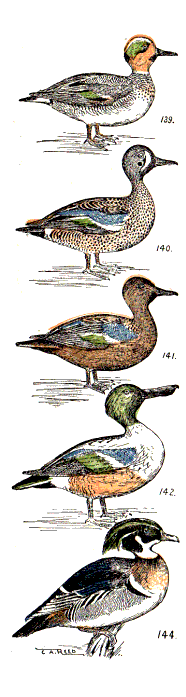
139. Green-winged Teal (Nettion carolinensis). L. 14.5. Wing-coverts gray, tipped with buff or white. Ad. ♂. A white crescent in front of wing; speculum (wing-patch) green bordered by black tipped with white. Ad. ♀. Wings as in ♂; throat and sides of neck white, finely spotted with black; breast and sides washed with rusty, marked with black. Notes. A "peculiar chirping almost a twittering" as they fly. (Seton.) Range.—North America; breeds from New Brunswick, Minnesota, and British Columbia north to Greenland and Alaska; winters from Virginia, Kansas, and British Columbia south to Central America and West Indies. 140. Blue-winged Teal (Querquedula discors). Wing-coverts blue. Ad. ♂. Cheek patch white. Ad. ♀. Resembles ♀ of No. 139, but wing-coverts blue; speculum greenish brown not distinctly tipped with white. L. 16. Range.—North America; chiefly east of Rockies; breeds from New Brunswick, Kansas, southern Illinois and northern Ohio, north to Alaska, mainly in interior; winters from Virginia and Lower Mississippi Valley to northern South America, California, and Lower California. 141. Cinnamon Teal (Querquedula cyanoptera). Ad. ♂. Head and neck, breast and sides reddish brown. Ad. ♀. Resembles ♀ of No. 140, but the underparts, including throat, are usually suffused with rusty; the throat often being blackish or speckled with dusky. Notes. A rather thin, nasal quack. L. 16. Range.—Western North America from British Columbia south to South America, east to Rockies and south Texas; rarely to Florida. 142. Shoveller (Spatula clypeata). L. 20. Bill much broader at tip than at base. Ad. ♂. Belly chestnut; breast around to back white. Ad. ♀. Wing-coverts blue; back conspicuously margined with buff. Notes. "Occasionally a few feeble quacks." (Elliot.) Range.—Northern hemisphere; in America chiefly in interior; breeds locally from Texas, and regularly from Minnesota and British Columbia north to Alaska and Barren Grounds; winters from British Columbia, Illinois, and Maryland south to northern South America. 144. Wood Duck (Aix sponsa). L. 18.5. Ad. ♂. Head crested; green, blue, and purple with white stripes. Ad. ♀. A white streak through and behind eye; crown glossy purplish brown; back olive-brown glossed with greenish. Notes. A frightened, plaintive, oo-eek. Range.—North America; breeds locally from Florida to Labrador and British Columbia, winters from British Columbia, southern Illinois, and southern New Jersey, south to southern California and Cuba.
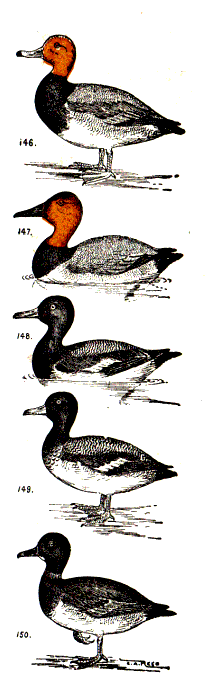
146. Redhead (Aythya americana). L. 19. Ad. ♂. Head and upper neck entirely bright reddish brown. Ad. ♀. Throat white; back grayish brown without fine bars; speculum gray. Notes. "A hoarse guttural rolling sound." (Elliot.) Range.—North America; breeds chiefly in interior from Maine, Minnesota, and California north to Labrador and British Columbia; winters from British Columbia and Maryland south to Lower California and West Indies. 147. Canvas-back (Aythya vallisneria). L. 21. Ad. ♂. Head and whole neck dull reddish brown. Ad. ♀. Head and neck rusty grayish brown; back grayish brown, finely barred with black and white. Notes. "A harsh guttural croak." (Elliot.) Range.—North America; breeds only in interior from Minnesota and Oregon north to Alaska and the Barren Grounds; winters from British Columbia and Maryland south to southern California, Mexico and West Indies. 148. American Scaup Duck (Aythya marila). L. ♂, 18.5; ♀, 17.5. Ad. ♂. Head glossed with greenish; sides without distinct black bars. Ad. ♀. Feathers about base of bill white; breast and back rusty grayish brown; speculum white. Notes. "Similar to the guttural sound made by the Canvas-back, Redhead and other diving Ducks." (Elliot.) Range.—Northern parts of northern hemisphere; in America, breeds in the interior rarely from Minnesota, and regularly from North Dakota northward; winters from Long Island to northern South America. 149. Lesser Scaup Duck (Aythya affinis). L. ♂ 17; ♀, 16.5. Ad. ♂. Head glossed with purplish; sides with distinct black bars. Ad. ♀. Similar to ♀ of No. 148, but smaller. Range.—North America; breeds only in interior from Iowa rarely, North Dakota commonly, and British Columbia, north to Barren Grounds; winters from British Columbia and Virginia south to Guatemala and West Indies. 150. Ring-necked Duck (Aythya collaris). L. 16.5. Ad. ♂. A chestnut neck-ring; chin white; back black; speculum gray. Ad. ♀. Feathers about sides of base of bill and throat white, back and breast rusty grayish brown; speculum gray. Resembles ♀ of No. 146, but is smaller and rustier. Range.—North America: breeding only in the interior from Minnesota northward; winters from Maryland and British Columbia south to Guatemala and West Indies; rare on Atlantic coast north of Maryland.
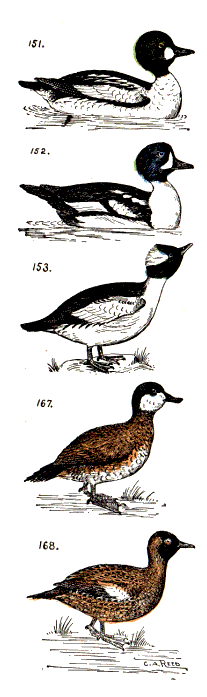
151. American Golden-eye (Clangula clangula americana). L. 20. Ad. ♂. Head greenish; white patch at base of bill circular. Ad. ♀. Head and throat brown; breast and back gray, a white throat-ring; belly and speculum white. Notes. Rarely a low croak; a high whistling sound produced by wings in flight. Range.—North America; breeds from Maine, northern Minnesota, and Alberta, north to Arctic Regions; winters from southern Alaska, the Great Lakes and Maine, south to Mexico and Cuba. 152. Barrow Golden-eye (Clangula islandica). L. 20. Ad. ♂. Head purplish blue; white patch at base of bill twice as high as wide. Ad. ♀. Resembles ♀ of No. 151. Notes. A high whistling made by wings in flight, probably also a low croaking as in No. 151. Range.—Northern North America; breeds from Gulf of St. Lawrence, and mountains of Colorado north to southern Greenland; winters south to Virginia, Illinois, and California. 153. Buffle-head (Charitonetta albeola). L. 14.7. Ad. ♂. Head blue, purple, and green; a white band from eye to eye across nape. Ad. ♀. A whitish patch on either side of head; throat and upper parts grayish brown; belly and speculum white. Notes. A single guttural note like a small edition of the Canvas-back's roll. (Elliot.) Range.—North America; breeds from Maine, Iowa, and British Columbia northward; winters from southern limit of breeding range to West Indies and Mexico. 167. Ruddy Duck (Erismatura jamaicensis). L. 15. Tail-feathers narrow and stiff; bill short (1.5) and broad. Ad. ♂. Cheeks white, cap black, back reddish brown. Ad. ♀. A whitish streak through dusky cheeks; back grayish brown with fine buffy bars; belly silvery whitish. Yng. ♂. Similar, but cheeks all white or whitish. Range.—Western hemisphere from northern South America to Hudson Bay; breeds locally throughout its range, but chiefly northward; winters from New Jersey, southern Illinois and California southward. 168. Masked Duck (Nomonyx dominicus). L. 14. Tail-feathers long, (4.5) narrow, stiff and pointed. Ad. ♂. Front of head black; behind it reddish brown all around; white in wing. Ad. ♀. A brownish streak through eye: buffy streaks above and below it; back blackish regularly barred with buff; below washed with rusty. Range—Tropical America north to Lower Rio Grande; accidental in Wisconsin, Lake Champlain, and Massachusetts.
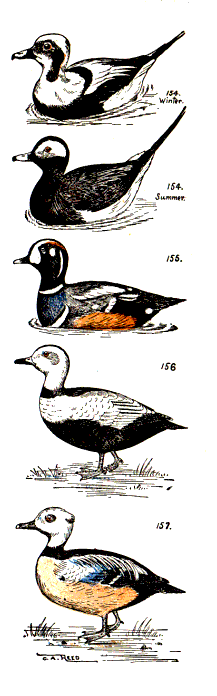
154. Old-squaw (Harelda hyemalis). L. ♂, 21; ♀, 16; T. ♂, 8; ♀, 2.5. No colored speculum. Ad. ♂. Central tail-feathers much lengthened; in winter, crown, nape, throat, and neck all around white. In summer, black, with rusty markings on back. Ad. ♀. winter. Cheeks, neck all around, and underparts white; breast and sides of neck dusky. In summer, crown, cheeks and nape blackish, throat and breast dusky; a whitish patch back of eye. Notes. In spring, a rich, musical a-leedle-a, frequently repeated in deep, reed-like tones. (Nelson.) Also "o-onc-o-onc-ough-egh-ough-egh." (Mackay.) Range.—Northern hemisphere; breeds from northern Labrador and Aleutian Islands north to Arctic Ocean; winters south to Virginia, Upper Mississippi Valley, and California, "rarely to Florida and Texas." 155. Harlequin Duck (Histrionicus histrionicus). L. 17. Ad. ♂. Back and breast slaty blue; head darker. Ad. ♀. Front half of cheeks and spot over ears whitish, above blackish brown; below dusky and whitish. Notes. "A confusion of low gabbling and chattering notes." (Nelson.) Range.—"Northern North America, breeding from Newfoundland, the northern Rocky Mountains, and the Sierra Nevadas (latitude 38°), northward; south in winter to the Middle States and California; eastern Asia, Iceland." (A. O. U.) 156. Labrador Duck (Camptolaimus labradorius). L. 20. Ad. ♂. Primaries blackish; rest of wing white. Ad. ♀. Ashy gray: speculum white. Yng. ♂. Like ♀ but throat and ends of greater wing-coverts white. Range.—Formerly North Atlantic coast; bred from Labrador northward; wintered south to New Jersey; believed to be extinct; last records, Grand Menan, New Brunswick, 1871; Long Island, 1875. 157. Steller Eider (Eniconetta stelleri). L. 18. Ad. ♂. Throat and neck black nearly divided by a white ring; top and sides of head white, forehead and nape greenish; breast chestnut. Ad. ♀. Above and below black and rusty, speculum purple bordered with white; tail feathers pointed. Range.—"Arctic and subarctic coasts of the northern hemisphere, Aleutian Islands, east to Unalaska and Kadiak; Kenai Peninsula." (A. O. U.)
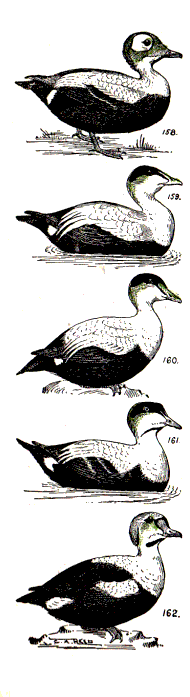
158. Spectacled Eider (Arctonetta fischeri). L. 21. Ad. ♂. Front of head plush-like; cushiony pads around eyes; above largely white; breast slaty black; belly black. Range.—"Alaskan coast of Bering Sea and north to Point Barrow." (A. O. U.) 159. Greenland Eider (Somateria mollissima borealis). L. 23. Feathers on sides of bill reaching to nostrils, bare spaces on either side of feathers on culmen pointed at base (posteriorly.) Ad. ♂. Crown black with a white wedge. Ad. ♀. Brownish black above margined with rusty and buff; below dusky finely margined with buff. Yng. ♂. Similar to ♀ but more buffy. Notes. "A sort of cooing sound" in the breeding season. (Elliot.) A raucous, moaning, 'ha ho, 'ha ho; female's like that of Mallard. (Brunnich.) Range.—Northeastern North America; breeds from Labrador to Greenland; winters south to Massachusetts. 160. American Eider (Somateria dresseri). L. 23. Similar in color to No. 159, but bare spaces on either side of feathers of culmen rounded at the base (posteriorly). Range.—Northeastern North America; breeds from Isle au Haut, Maine, to Labrador; winters south to New Jersey and Great Lakes. 161. Pacific Eider (Somateria v-nigra). Similar to No. 159, but Ad. ♂ with a black V on throat; sides of bill more broadly feathered, distance from end of feathers to base of bare space on culmen less than distance from same place to end of bill. Notes. "A low guttural note." (Nelson.) Range.—North Pacific from Aleutian Islands north to Arctic Ocean east to Great Slave Lake. 162. King Eider (Somateria spectabilis). L. 23. Feathers at side of bill not reaching nostril. Ad. ♂. White patch on either side of rump, crown ashy blue. Ad. ♀ in 1 Yng. Resembling same plumages of No. 159 and No. 160. Range.—Northern hemisphere; breeds from Labrador and St. Michaels, Alaska north to Greenland and Arctic Ocean; winters south to New Jersey (rarely Ga.), and Great Lakes; one California record.
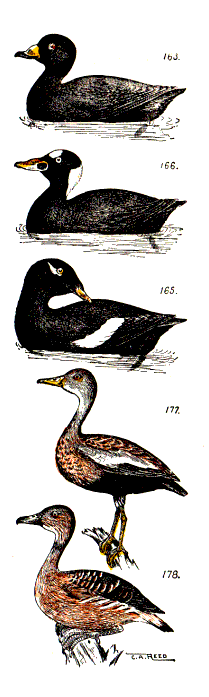
163. American Scoter (Oidemia americana). L. 19. Feathers at base of bill not extending forward on sides or top. Ad. ♂. Wholly black; bill black, yellow at base. Ad. ♀. Brownish above, lighter below; no white on wing or on sides of head. Notes. A long musical whistle. (Elliot.) Range.—Northern North America; breeds from Labrador and Alaskan shores of Bering Sea northward; winters south to Virginia, Great Lakes, Colorado, and California. 166. Surf Scoter (Oidemia perspicillata). L. 20. Feathers extending forward on top of bill. Ad. ♂. Black, nape and crown white; bill orange, yellow, and white, a round black patch on its sides. Ad. ♀. Above black, throat and breast paler; belly whitish; a whitish patch at base of bill. Yng. Similar but with white patches on ears. Range.—Northern North America; breeds from Newfoundland northward; winters south to Virginia, Florida, Illinois, and Lower California. 165. White-winged Scoter (Oidemia deglandi). L. 22. A white patch on wing; feathers extending forward along sides and top of bill nearly to nostrils. Ad. ♂. Black, a white spot about eye; bill orange, black at base. Ad. ♀. Dusky brown above; lighter below. Yng. ♂. Similar but sides and front of head whitish. Range.—Northern North America; breeds from Labrador and North Dakota northward; winters south to Virginia, southern Illinois, and Lower California. 177. Black-bellied Tree Duck (Dendrocygna autumnalis). L. 22. Ads. belly and tail coverts black: foreback and breast gray; greater wing-coverts whitish. Notes. A shrill whistle. (Elliot.) Range.—Tropical America north to southern Texas. 178. Fulvous Tree Duck (Dendrocygna fulva). L. 22. Ads. Belly uniform rusty brown; upper tail coverts white; a black streak on hindneck; no white in wing. Notes. A squealing whistle. Range.—Tropical America, north in summer to Texas, Louisiana, Nevada and central California. "Casual in North Carolina and Missouri." (A. O. U.)
Geese and Swans
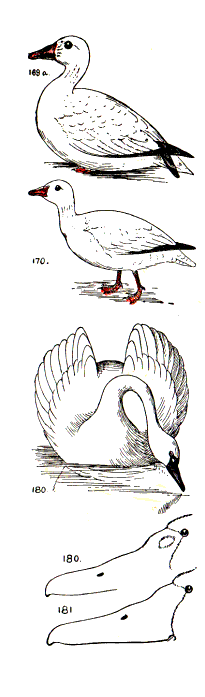
169. Lesser Snow Goose (Chen hyperborea). L. 23-28, Ads. White, head sometimes rusty; primaries black. Yng. Head, neck, and above grayish. Range.—"Pacific coast to the Mississippi Valley, breeding in Alaska; south in winter to southern Illinois and southern California; casually to New England." (A. O. U.) 169a. Greater Snow Goose (C. h. nivalis). Similar to No. 169, but larger, L. 30-38. Range.—Eastern North America; breeds in Arctic regions; winters from Chesapeake, New Jersey (rarely) south to Cuba; rare on Atlantic coast north of Maryland. 170. Ross Snow Goose (Chen rossii). L. 21; B. 1.6. Similar in color to No. 169, but much smaller; bill particularly smaller. Range.—Arctic America in summer; Pacific coast to southern California and east to Montana in winter. 180. Whistling Swan (Olor columbianus). L. 55. Nostril nearer to tip of bill than to eye. Ads. White, bill and feet black; a small yellow spot before the eye. Yng. Head and neck brownish, rest of plumage washed with grayish. Notes. 'whoogh, 'whoogh, very loud and shrill. (Nuttall.) Range.—North America; breeds within Arctic Circle; winters from British Columbia (?) Lower Mississippi Valley, Chesapeake Bay, south to Gulf of Mexico; rare on Atlantic Coast north of Virginia. 181. Trumpeter Swan (Clor buccinator). L. 65. Nostril about in middle of bill. Ads. White, bill and feet black; no yellow on lores. Yng. Head and neck brownish; rest of plumage washed with grayish. Notes. Loud and sonorous in tone like those of a French horn. (Elliot.) Range.—"Chiefly the Interior of North America, from the Gulf Coast to the Fur Countries, breeding from Iowa and the Dakotas northward; west to the Pacific Coast; rare or casual on the Atlantic." (A. O. U.)
Geese
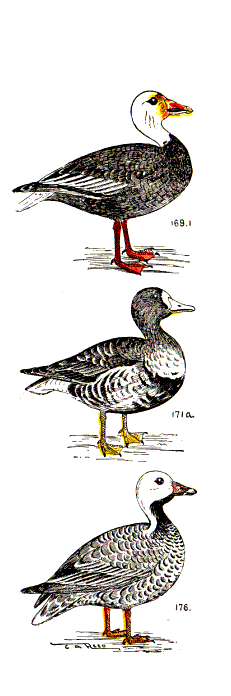
169.1. Blue Goose (Chen cærulescens). L. 28. Ads. Head and neck white; below brownish gray; foreback like breast; rump gray. Yng. Similar but head and neck grayish brown. Range.—North America; breeds in Hudson Bay region; winters on west coast of the Gulf of Mexico; two California records; said to have occurred in New Jersey. 171a. American White-fronted Goose (Anser albifrons gambeli). L. 28. Ads. Forehead and rump white; below spotted with black. Yng. Similar but no white on head no black below. Range.—North America; breeds in Arctic region; winters on Gulf Coast, California and Mexico; rare on Atlantic coast. 176. Emperor Goose (Philacte canagica). L. 26. Ads. Foreneck blackish; rest of head and neck white sometimes tinged with rusty; tail mostly white. Yng. Body less distinctly scaled; head and hindneck spotted with grayish. Notes. When flying, a deep, hoarse, strident clâ-hâ, clâ-hâ, clâ-hâ; when alarmed and about to fly, a ringing û-lûgh,-ûlûgh. (Nelson.) Range.—"Coast and islands of Alaska north of the Peninsula; chiefly about Norton Sound and Valley of the Lower Yukon; Commander Islands, Kamchatka; casually south to Humboldt Bay, California." (A. O. U.)
Geese and Brant
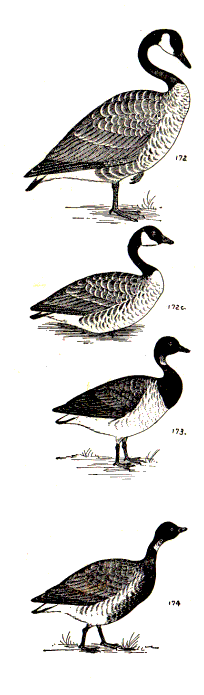
Geese 172. Canada Goose (Branta canadensis). L. 38. Ads. A white patch on cheeks and throat; rest of head and neck black; no whitish ring at base of black neck. Yng. Similar but with blackish on white of throat. Notes. A sonorous honk. Range.—North America; breeds from Labrador, Minnesota and British Columbia, north chiefly in the interior, to Alaska; winters from Long Island, Illinois and British Columbia south to Mexico and southern California. 172a. Hutchins Goose (B. c. hutchinsii). Similar to No. 172, but smaller; L. 30; tail feathers, 14-16. Range.—Western North America; breeds in Arctic regions; winters from British Columbia and Kansas south to Lower California and Mexico. 172b. White-cheeked Goose (B. c. occidentalis). Size of No. 172, but throat blackish, lower neck with white collar. Range.—"Pacific coast region, from Sitka, south in winter to California." (A. O. U.) 172c. Cackling Goose (B. c. minima). Similar to No. 172b, but smaller, L. 24; tail feathers 14-16. Range.—Western North America; breeds in Alaska; winters from British Columbia southward; east rarely to Wisconsin. 173. Brant (Branta bernicla glaucogastra). L. 26. Ads. Sides of neck with white markings; belly whitish. Notes. A guttural car-r-rup, or r-r-r-rouk. (Elliot.) Range.—Northern hemisphere; breeds in Arctic regions; winters in America, from Mississippi Valley east, and from Illinois and Massachusetts southward; rare in interior. 174. Black Brant (Branta nigricans). L. 26. Ads. Sides and front of neck with white markings; belly nearly as dark as back. Notes. A low guttural gr-r-r-r-r; on alarm repeated often with emphasis. (Nelson.) Range.—Western North America; breeds in northern Alaska and eastward; winters from British Columbia to Lower California; occasional on Atlantic Coast.
Order VI. FLAMINGOES.
ODONTOGLOSSÆ.
Family 1. FLAMINGOES. Phœnicopteridæ. 1 species.
Flamingoes might be called long-legged Ducks. Their feet are webbed, and their bill is set with ridges, which serve as sieves or strainers, as do the 'gutters' on a Duck's bill. They are, however, wading birds and their webbed feet are of use in supporting them on the soft mud of shallow lagoons or bays where they search for the favorite food of small mollusks. In feeding the flat top of the bill is pressed into the mud when its tip points upward toward the bird's body. Flamingoes fly with the neck and legs stretched to the utmost presenting on the wing a picturesque, but by no means so graceful an appearance as do the Herons. Their voice is a vibrant honking like that of a Goose.
Order VII. HERONS, STORKS, IBISES, ETC.
HERODIONES.
Family 1. SPOONBILLS. Plataleidæ 1 species.
Family 2. IBISES. Ibididæ. 3 species.
Family 3. STORKS and WOOD IBISES. Ciconiidæ. 1 species.
Family 4. BITTERNS, HERONS, ETC. Ardhidæ. 14 species, 3 subspecies.
The Roseate Spoonbill was formerly a common bird in Florida and along the Gulf coast, but so many have been killed for their plumage that in the United States the species is now exceedingly rare except in the most remote parts of southern Florida.
Spoonbills build a rude nest of sticks in mangrove bushes or small trees and lay three to five whitish eggs speckled with shades of brown.
Ibises are usually found in flocks along the shore of lagoons, lakes, etc., or in marshy places. They fly with the neck outstretched and are generally silent. Their nests of reeds, weed stalks, etc., are sometimes placed in low bushes, at others in grassy marshes. The eggs number from three to five. They are plain blue in the Glossy Ibis, greenish white with chocolate markings, in the White Ibis.
The Storks are largely Old World birds, only three of the some twenty known species inhabiting the Western Hemisphere. But one of these is found regularly north of the Rio Grande, the so-called Wood Ibis which is abundant in southern Florida. It lives in flocks and builds a nest of sticks usually in cypress trees, often forty feet from the ground, laying two or three white eggs. When flying the neck is extended. It progresses by alternate flapping and sailing and occasionally soars high overhead in circles, like a Vulture.
The Bitterns and Herons unlike our other long-legged wading birds, fly with a fold in the neck. They belong in two subfamilies, the Botaurinæ and Ardeinæ, respectively. The Bitterns are usually solitary birds inhabiting grassy or reedy marshes where their colors harmonize with their surroundings and render them difficult to see. The American Bittern nests on the ground and lays three to five pale brownish eggs. The Least Bittern usually weaves a platform nest of reeds among rushes growing in the water and lays four or five bluish white eggs.
Herons feed along the shore and are consequently more often seen than Bitterns. With the exception of the Green Heron and the Yellow-crowned Night Heron, which usually nest in isolated pairs, our species gather in colonies to nest. Several hundred pairs occupying a limited area in some wooded or bushy swamp to which, when undisturbed, they return year after year.
Herons build a rude platform nest of sticks, sometimes placing it in bushes, sometimes in the tallest trees, and at others on the ground or beds of reeds in marshes. The eggs are greenish blue in color and usually four in number. It is among those Herons, which in nesting time are adorned with delicate plumes or aigrettes, that the greatest ravages of the millinery hunter have been made. Attacking these birds when they have gathered on the nesting ground, they are not permitted to rear their young and the species is thus exterminated branch and root.
The voice of Herons is a harsh squawk varying in depth of tone with the size of the bird.
Flamingo, Spoonbill and Ibis
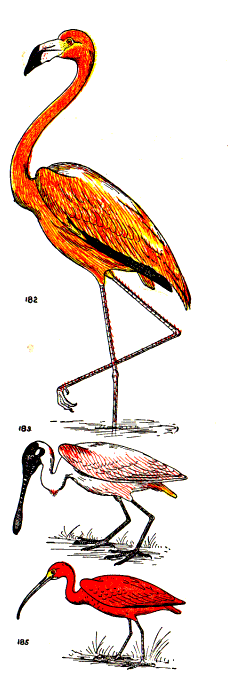
182. Flamingo (Phœnicopterus ruber). L. 45; from toe to bill, 60. Ads. Rosy red, lighter on back; primaries and secondaries black. Yng. Smaller, grayish brown; lighter below. Notes. A honk resembling that of a Canada Goose. Range.—Atlantic coasts of tropical and subtropical America; resident (breeding?) in southwestern Florida (Monroe county); casual west to Texas, north to South Carolina. 183. Roseate Spoonbill (Ajaia ajaja). L. 32. Ads. Head and throat bare; sides of breast and end of tail rusty buff; lesser wing-coverts, upper and under tail-coverts carmine. Yng. Head feathered, buff and carmine replaced by pink. Range.—Tropical and subtropical America; north to Gulf States. 185. Scarlet Ibis (Guara rubra). L. 24. Ads. Scarlet: tips of primaries black. Yng. Grayish brown, lower back, rump, and upper tail-coverts white; underparts dull white. Range.—"Florida, Louisiana and Texas, southward to the West Indies and northern South America. No record of its recent occurrence in the United States." (A. O. U.)
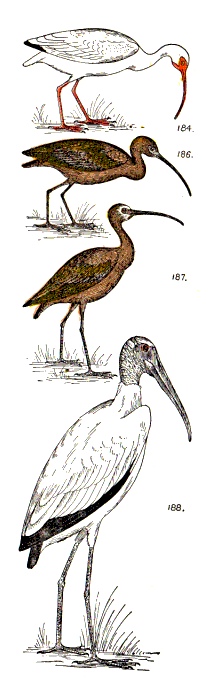
Ibises
184. White Ibis (Guara alba). L. 25. Ads. White, tips of outer primaries black, face orange red. Yng. Grayish brown, rump, breast and belly white. Notes. When near nest, crook, croc, croo; when disturbed, a loud, hoarse, bunk, bunk, hunk. (Audubon). Range.—Tropical America; breeds north to Lower California, southern Indiana, southern Illinois and South Carolina; winters from Gulf southward; accidental in South Dakota, Connecticut and Long Island; 186. Glossy Ibis (Plegadis autumnalis). L. 24. Ads. Front of head black with greenish reflections. Yng. Head and neck fuscous brown margined with white, rest of underparts fuscous brown; back with greenish reflections. Range.—Tropical and subtropical regions in America; rare or local in southeastern United States; casual north to Massachusetts and Illinois. 187. White-faced Glossy Ibis (Plegadis guarauna). L. 24. Ads. Front of head white. Yng. Resembles young of No. 186. Range.—Tropical and subtropical America; north to California, (rarely British Columbia), Texas, Kansas, east rarely to Florida; winters south of United States. 188. Wood Ibis (Tantalus loculator). L. 40. Ads. Head and neck bare; white, primaries, secondaries and tail blackish. Yng. Resembles ad. but head and neck feathered, grayish brown. Note. When alarmed, a rough, guttural croak. (Audubon.) Range.—Tropical and subtropical America; breeds In Gulf States, (Lower California?), and later may stray as far north as New York, Wisconsin, and California.
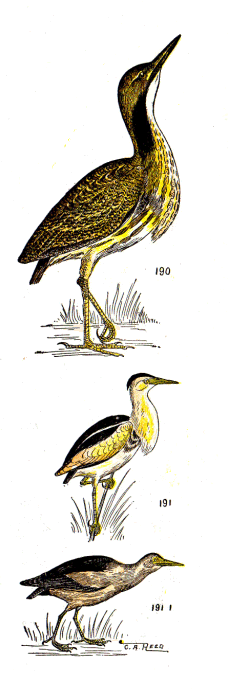
Bitterns
190. American Bittern (Botaurus lentiginosus). L. 28. Ads. A glossy black streak on either side of the neck. Yng. Similar to ad. but colors much deeper, more rusty. Notes. Call, quawk; song, pump-er-lunk. Range.—North America north to Labrador and British Columbia, breeding chiefly north of latitude 35°; winters from about latitude 35° southward. 191. Least Bittern (Ardetta exilis). L. 13. Ad. ♂. Hindneck rufous, foreneck, underparts, and under tail-coverts white and buff. Ad. ♀. Similar, but crown and back brown, below streaked with brownish. Notes. Call, an explosive quab; song, a soft coo repeated four or five times. Range.—North America; breeds from Gulf States to New Brunswick and Manitoba; winters from Gulf States southward. "Less common west of Rocky Mountains; on the Pacific coast north to northern California." (A. O. U.) 191.1. Cory Bittern (Ardetta neoxena). L. 13. Ad. ♂. Hindneck black, foreneck chestnut, belly mixed black and chestnut, under tail-coverts black. Ad. ♀. Similar, but crown and back duller. Range.—Eastern North America; recorded from Florida, Ontario, (breeding), Massachusetts, and Michigan; about 20 specimens known.
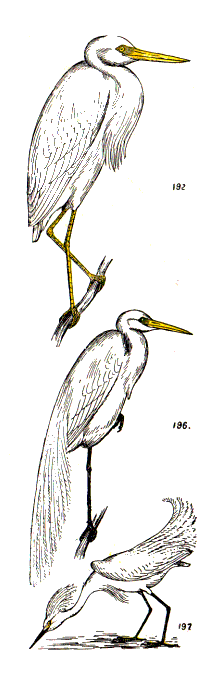
Herons
192. Great White Heron (Ardea occidentalis). Ads. White, no "aigrette" plumes. A white Heron about the size of a Great Blue Heron. What is supposed to be a gray-blue phase of this bird has been called Ardea wuerdmanni, a bird which resembles No. 194, but has the head and neck whitish. Range.—Southern Florida, Cuba and Jamaica. 196. American Egret (Herodias egretta). L. 41. Ads. White, about 50 straight "aigrette" plumes grow from the back between the wings; legs and feet black. Ads. when not breeding and Yng., the same, but no plumes. Range.—Tropical and temperate America; breeds north to Virginia, southern Illinois, and California; later strays to New Brunswick, Minnesota, and Oregon; winters from southern California and Gulf States southward. 197. Snowy Heron (Egretta candidissima). L. 24. Ads. White, about 50 recurved "aigrette" plumes grow from back between the wings; legs black, feet yellow. Ads. when not breeding and Yng. The same, but no plumes. Range.—Tropical and temperate America; bred formerly north to Long Island, southern Illinois and California; now very rare in eastern North America; winters from Gulf States and southern California southward.
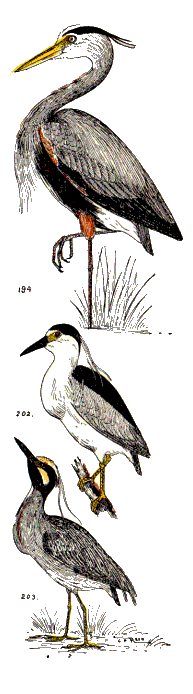
194. Great Blue Heron (Ardea herodias). L. 45; W. 18.5; B. 5.5; Tar. 7. Ads. Center of crown white, head crested; legs blackish. Yng. Similar, but no crest, crown wholly black, plumage more streaked. Range—Northern South America north to Arctic regions; breeds locally throughout most of North America range; winters from about latitude 42° southward. 194a. Northwest Coast Heron (A. h. fannini). Similar to No. 194 but much darker; upperparts bluish slate black; tarsus shorter, 5.3. Range.—Pacific coast from Vancouver to Sitka. 194b. Ward Heron (A. h. wardi). Similar to No. 194 but whiter below, neck darker; legs olive; larger, L. 52; W. 20; B. 6.5; Tar. 8. Range.—Florida; coast of Texas. 202. Black-crowned Night Heron (Nycticorax nycticorax nævius). L. 24. Ads. Crown and back greenish black lower back, wings and tail ashy; head with two or three rounded white plumes, except just after breeding season. Yng. Grayish brown streaked with white; below white streaked with blackish; outer webs of primaries, pale rufous. Notes. An explosive qûawk. Range.—Western hemisphere; breeds in North America north to New Brunswick, Quebec, Manitoba, and Oregon; winters from California and Gulf States southward. 203. Yellow-crowned Night Heron (Nyctanassa violaceus). L. 23. Ads. Blue-gray; crown and ear-coverts whitish, rest of head black; scapulars streaked with black; head with two or three rounded, white plumes, except just after nesting season. Yng. Crown black, streaked with whitish; primaries bluish slate, no rufous; back brownish streaked with white; below whitish streaked with blackish. Range.—Tropical and subtropical America; breeds north to South Carolina, southern Illinois, and Lower California; strays to Massachusetts and Colorado; winters from Gulf States southward.
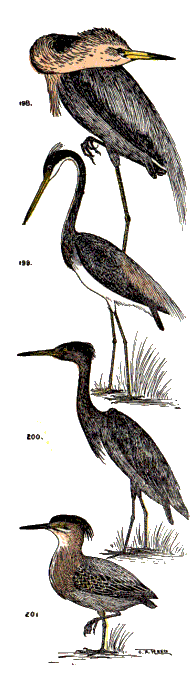
198. Reddish Egret (Dichromanassa rufescens). L. 29. Two color phases independent of age. Ads. Dark phase, Head and neck rufous; back slate; about 30 "aigrette" plumes. White phase. White, including plumes; tips of primaries sometimes speckled with gray. Yng. Rufous and gray, or white, without plumes. Range.—West Indies and Central America north to coasts of Gulf States, Illinois (rarely), and Lower California. 199. Louisiana Heron (Hydranassa tricolor ruficollis). L. 26. Ads. "Aigrette" plumes, short, dirty gray; rump and belly white; legs blackish. Yng. Head and neck brownish; throat and line down foreneck white; above slaty washed with brownish, rump, and belly white. Range.—West Indies and Central America north to Gulf States, casually to Long Island and Indiana. 200. Little Blue Heron (Florida cœrulea). L. 22. Ads. Head and neck maroon; rest of plumage slaty blue. Yng. White, tips of primaries bluish, legs greenish yellow. Range.—Tropical America and eastern United States; breeds north to Virginia and Illinois, later may stray north as far as Nova Scotia; winters from South Atlantic and Gulf States southward. 201. Little Green Heron (Butorides virescens). L. 17. Smallest of our Herons. Ads. Crown, glossy green-black; throat and line down foreneck buffy; rest of head and neck purplish chestnut; back green washed with bluish gray. Yng. Neck and below streaked with blackish; back-feathers not lengthened; duller. Notes. A rattling oc-oc-oc-oc-oc, a startling scow, and, more rarely, a deep, hollow groan. (Brewster.) Range.—Tropical and temperate North America; breeds from Gulf States north to Nova Scotia and Manitoba; winters from Gulf States southward to northern South America. 201a. Frazar Green Heron (B. v. frazari). Similar to No. 201, but rather larger and darker, neck more purplish, light stripings on throat and foreneck more restricted. (Brewster.) Range.—Lower Califorinia. 201b. Anthony Green Heron (B. v. anthonyi). Similar to No. 201, but slightly larger, and paler, light markings of wings, neck, and throat less restricted and whiter. (Mearns.) Range.—Arid portions of southwestern United States, south into Mexico.
Order VIII. CRANES, RAILS, ETC.
PALUDICOLÆ.
Family 1. CRANES. Gruidæ. 3 species.
Family 2. COURLANS. Aramidæ. 1 species.
Family 3. RAILS, GALLINULES, and COOTS. Rallidæ. 12 species, 3 subspecies.
Cranes bear a general resemblance to Herons in that they are long-legged, long-necked birds, but when on the wing, they carry the neck fully extended, a habit which will readily distinguish them from the curved neck Herons. Cranes are less aquatic than Herons and are often found feeding on the prairies or pine-barrens where worms, grasshoppers, lizards, roots, etc., form their fare. They nest on the ground laying two buffy eggs thickly marked with brown. The young, unlike the nearly naked, helpless young of Herons, are born covered with down and can soon follow their parents. The Cranes have loud sonorous voices; the Herons raucous croaks.
The Limpkin is a singular inhabitant of the more retired Florida swamps. It feeds upon the ground largely upon a kind of land shell, but also perches in trees. Its nest of twigs is placed in a small tree or bush, and it lays from four to seven pale buffy eggs stained and speckled with cinnamon brown.
The Rails (Subfamily Rallinæ) are inhabitants of grassy marshes where, trusting to their long legs, they more often escape observation by running than by flying. One may hear their characteristic notes coming from the dense growth only a few yards distant and still be unable to catch a glimpse of their maker.
Rails nest on the ground laying six to twelve or fifteen buffy eggs spotted with reddish brown. The young of all our species are born covered with a shining black down.
The Gallinules (Subfamily Gallinulinæ) are more aquatic than the Rails and are consequently less difficult to observe.
The Coots (Subfamily Fulicinæ) are still more aquatic than the Gallinules, as might be supposed from their lobed toes, in fact are as much at home in the water as though they were Ducks. Both Gallinules and Coots lay eight to sixteen buffy, thickly speckled eggs in a nest of reeds often built on a pile of rushes in the reeds.
Cranes and Limpkin
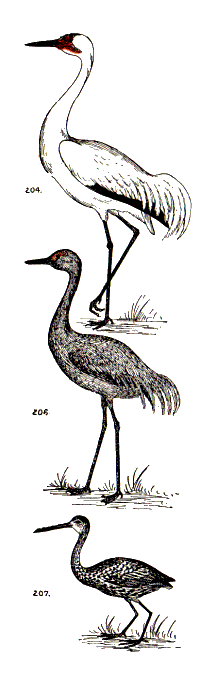
204. Whooping Crane (Grus americana). L. 50. Ads. White; skin of top of head dull red; primaries black. Yng. Head feathered, plumage more or less washed with rusty. Range.—Interior of North America: breeds from northern Mississippi Valley north to Arctic regions; winters from Gulf States southward. 205. Little Brown Crane (Grus canadensis). L. 35. W. 18; B. 4. Ads. Skin of top of head dull red; plumage brownish gray. Yng. Head feathered, plumage with more or less rusty. Range.—"Northern North America from Hudson Bay to Alaska, migrating south through western United States east of Rocky Mountains to Mexico." (Ridgway.) 206. Sandhill Crane (Grus mexicana). Similar to No. 205, but larger. L. 44: W. 20; B. 5. Notes. A loud, sonorous, grating, krrrow, repeated five or more times. Range.—North America; breeds locally from Texas, Cuba, Florida north through Mississippi Valley to Manitoba, British Columbia, and Oregon; winters from northern California and Gulf States southward. 207. Limpkin (Aramus giganteus). L. 28. Ads. Glossy olive-brown, striped with white; wings and tail more bronzy. Notes. A loud wah-ree-ow, repeated and the last note prolonged into a wail. Range.—Central America and West Indies north to southern Texas and Florida.
Rails
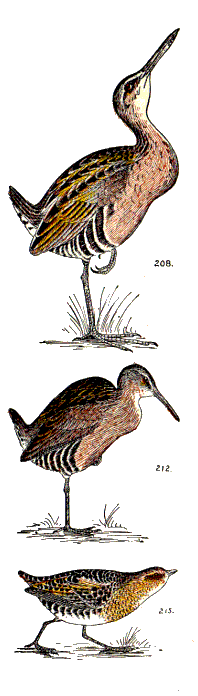
208. King Rail (Rallus elegans). L. 15. Ads. Above olive-brown, black, and olive-gray; wing-coverts reddish brown; neck and breast cinnamon; belly and sides blackish, sharply and broadly barred with white. Notes. A loud bup, bup, bup, repeated and ending in a roll. Range.—Eastern United States; breeds from Florida north to Connecticut and South Dakota; strays to Maine; winters from Virginia and Lower Mississippi Valley south to Gulf States. 209. Belding Rail (Rallus beldingi). Similar to No. 208, but paler; flank-bars narrower. Range.—Lower California. 210. California Clapper Rail (Rallus obsoletus). L. 17. Above grayish olive-brown streaked with blackish brown; breast cinnamon; flanks dusky brown narrowly banded with white. Margins to back feathers much broader than in forms of crepitans. Range.—Salt Marshes of Pacific coast north to Washington. 212. Virginia Rail (Rallus virginianus). L. 9.5; B. 1.5. Ads. Above blackish and grayish brown; wing-coverts reddish brown; below cinnamon, flanks black and white. Resembling a King Rail in color, but much smaller. Notes. Calls, kep or kik; song, a grunting sound and cut, cûtta-cûtta-cûtta. (Brewster.) Range.—North America; breeds from Pennsylvania, Long Island, northern Illinois, and middle California north to Labrador, Manitoba, and British Columbia; winters from about its southern breeding limits south to Cuba and Guatemala. 215. Yellow Rail. (Porzana noveboracensis). L. 7; B. .5. Ads. Above black and buffy barred with white; breast buffy; sides brownish barred with white. Notes. An abrupt cackling, 'krék, 'krek, 'krek, 'krek, kûk, 'k'k'k. (Nuttall.) Range.—Eastern North America north to New Brunswick, Quebec, and Hudson Bay, west to Manitoba and rarely California; probably breeds chiefly north; winters in southern States.
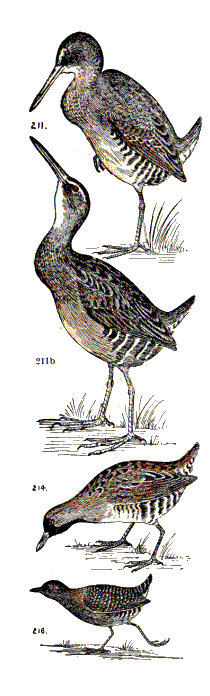
211. Clapper Rail, Marsh Hen (Rallus crepitans). L. 14.5; W. 5; B. 2.5. Ads. Above pale olive bordered by gray; wing-coverts pale grayish brown; breast pale cinnamon; flanks barred gray and white. Notes. Gkak, gkak, gkak, at first loud and rapid, ending lower and slower. Range.—Salt marshes of the Atlantic coast; breeds from North Carolina to Connecticut; winters from Long Island (rarely) southward, north casually to Massachusetts; south casually to Louisiana. 211a. Louisiana Clapper Rail (R. c. saturatus). Similar to No. 211, but above rich brown edged with olive; breast darker cinnamon; bill more slender, 2.3. Range.—Coast of Louisiana. 211b. Scott Clapper Rail (R. c. scotti). Similar to No. 211, but much darker; sooty brown or black above edged with olive-brown or olive-gray; breast and neck cinnamon, washed with brownish; flanks brown and white. Darkest bird of group. Range.—Gulf coast of Florida. 211c. Wayne Clapper Rail (R. c. waynei). Similar to No. 211, but darker, back rich olive-brown edged with gray; breast more ashy. Range.—Atlantic coast, North Carolina to eastern Florida. 211.2. Caribbean Clapper Rail (Rallus longirostris caribæus). L. 14; W. 5.7; B. 2.4. Ads. Above olive-brown edged with olive-ashy, breast cinnamon; flanks brown and white. Range.—West Indies; coast of southeastern Texas (and northeastern Mexico?). 214. Carolina Rail (Porzana carolina). L. 8.5; B. 8. Ads. Region about base of bill black. Yng. Similar, but no black about base of bill; breast more cinnamon. Notes. Calls, kuk or peep, song, ker-wee; and a high, rolling whinny. Range.—North America; breeds from Long Island, Illinois, Kansas, and southern California, north to Newfoundland, Hudson Bay region, and British Columbia; winters from South Carolina, southern Illinois, and northern California south to South America. 216. Little Black Rail (Porzana jamaicensis): L. 5; B. 6. Ads. Head, breast, and belly slate; back blackish brown barred with white; nape reddish brown. Notes. Probably, kik-kik-kik, quee'ah, or kik-ki-ki-ki, ki, quee'ah, or variants. (Brewster.) Range.—"Temperate North America north to Massachusetts, northern Illinois, and Oregon: south to West Indies and Guatemala." (A. O. U.) Probably breeds throughout its North American range (Connecticut, Illinois, Kansas).
Gallinules and Coot
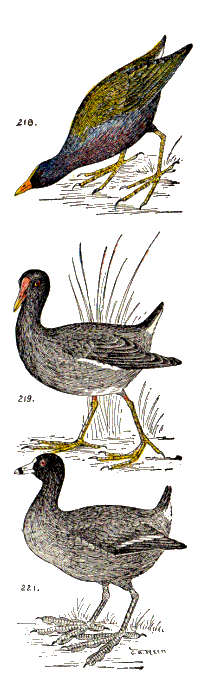
218. Purple Gallinule (Ionornis martinica). L. 13. Ads. Crown-plate bluish, bill carmine tipped with greenish; back shining green; below purplish blue; under tail-coverts white. Yng. Above browner; below with white; no red on bill. Range.—Tropical and subtropical America; breeds only in eastern North America north to southern Illinois and South Carolina, strays to Maine and Wisconsin; winters from southern Florida south to South America. 219. Florida Gallinule (Gallinula galeata). L. 13.5. Ad. Crown-plate red, bill red tipped with greenish; legs green with a red ring; back olive-brown; flanks slate streaked with white. Yng. Crown-plate smaller with bill brownish; no red on legs; below grayish. Notes. An explosive chuck and many loud and varied calls suggesting a disturbed brooding hen, the squawking of a struggling hen, etc. Range.—Temperate and tropical America; breeds locally north to Maine, Montreal, Minnesota, and northern California; winters from Gulf States and California southward. 221. American Coot (Fulica americana). L. 15. Toes with scallops. Ads. Bill whitish; crown-plate and two spots on bill brownish; head and neck black; rest of plumage slate. Yng. Whiter below, browner above, crown-plate smaller. Notes. An explosive cuck and noisy cackling notes. Range.—North America; breeds in the interior (chiefly northward) north to the Mackenzie and on Pacific coast to British Columbia; winters from British Columbia and Gulf States south to Central America and West Indies.
Order IX. SHORE BIRDS.
LIMICOLÆ.
Family 1. PHALAROPES. Phalaropodidæ. 3 species.
Family 2. AVOCETS AND STILTS. Recurvirostridæ 2 species.
Family 3. SNIPES, SANDPIPERS, ETC. Scolopacidæ 33 species, 2 subspecies.
Family 4. PLOVERS. Charadriidæ. 9 species, 2 subspecies.
Family 5. SURF BIRDS AND TURNSTONES. Aphrizidæ. 4 species.
Family 6. OYSTER-CATCHERS. Hæmatopodidæ. 3 species.
Family 7. JACANAS. Jacanidæ. 1 species.
The Phalaropes are swimming Snipes. The Northern and Red Phalaropes, both of which have well-developed lobes or scalloped webs on their toes, except when nesting, live at sea a hundred miles or more off shore, where they find an abundance of food in small forms of marine life. The Wilson Phalarope is a bird of the interior and consequently, is far less aquatic than the remaining species of the family; nevertheless it readily takes to water, swimming buoyantly and gracefully.
Contrary to the general rule, the female Phalarope is larger and more brightly colored than the male and this difference in size and plumage is accompanied by similarly unusual habits; the female taking the place of the male in the Phalarope household. The female of necessity lays the eggs, but they are hatched by the male alone, who it is said, cares for the young, also without the assistance of his mate.
The Avocets and Stilts are wading Snipes. The Stilts secure their food by quick thrusts of the bill, but the Avocets use their singular, upturned member in a more interesting manner. When in water two or three inches deep, the bill is dropped below the surface, until the curved lower mandible evidently touches the bottom; then walking rapidly, or even running, the bill is swung from side to side and the bird thus explores the mud in its search for food, which, when it is felt, is picked up in the usual way.
Many of the members of the family Scolopacidæ are probing Snipe. The Woodcock, Wilson Snipe, and Dowitcher are good examples. Their bill is long and sensitive and they can curve or move its tip without opening it at the base. When the bill is thrust into the mud the tip may therefore grasp a worm and it thus becomes a finger as well as a probe.
Though not ranked as song birds, many of the Snipes and Plovers have pleasing calls and whistles and in the breeding season they become highly musical or indulge in singular vocal performances.
The song of the Bartramian Sandpiper would attract the attention of the least observant and the singular aërial evolutions of the Snipe and Woodcock lend an unusual interest to the study of these birds in the spring. The Pectoral Sandpiper was observed by Nelson in Alaska, in May, to fill its œsophagus with air dilating the skin of the neck and breast and forming a sack as large as the body. Then in the air or on the ground the bird produced a series of hollow booming notes, constituting its love song.
The Plovers have shorter, harder bills than the true Snipe and several of our species frequent the uplands rather than muddy shore or tidal flats.
The Turnstones are true shore birds. Their home with us is on the seacoast where they feed along the beach turning over shells and pebbles in their search for food.
The Oyster-catchers are also strictly maritime. They frequent bars left bare by the tide and, it is said, use their stout bills to force open mussels; oysters, or other bivalves left exposed by the water. This belief, however, does not appear to rest on careful, definite observation.
The Jacana belongs to a small family of birds with representatives throughout the tropics. All its members are remarkable for the length of their toes, the wide extent of which enable these birds to walk over aquatic vegetation. So, for instance, I have seen them running over small lily leaves which, sinking slightly beneath the surface, made the birds appear to be walking on the water.
The Limicolæ, as a rule, nest on the ground. The Phalaropes, Snipes, and Plovers lay four eggs, the Oyster-catcher three, the Jacanas, it is said, four in some species to ten in others. The eggs of all are proportionately large and pointed or pear-shaped and are usually thickly marked with dark spots. The young are born covered with down and leave the nest just after hatching.
Shore Birds
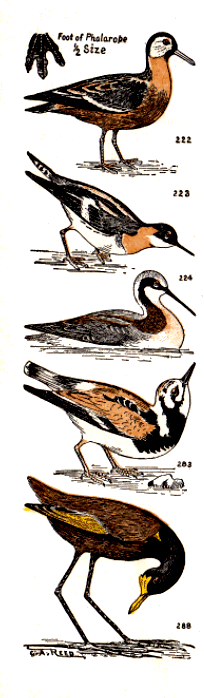
222. Red Phalarope (Crymophilus fulicarius). L. 8.10; B. 9. Bill heavy, wider than deep. Ad. ♀. Below entirely reddish brown; cap black, back black and buff. Ad. ♂. Similar, but smaller; crown and back streaked with brown, black, and buff. Yng. Resemble ♂, but upper tail-coverts plumbeous, underparts white. Winter. Crown and underparts white, hindneck black, back gray. Notes. A musical clink, clink. (Nelson.) Range.—"Northern parts of northern hemisphere, breeding in the Arctic regions and migrating south in winter; in the United States south to the Middle States. Ohio Valley, and Cape St. Lucas; chiefly maritime." (A. O. U.) 223. Northern Phalarope (Phalaropus lobatus). L. 7.7; B. .8. Bill short, slender, sharply pointed. Ad. ♀. Breast rufous; above slaty gray mixed with ochraceous on back. Ad. ♂. Smaller, less rufous; on throat; above blackish streaked with rusty. Yng. Underparts and forehead white; crown sooty; back blackish streaked with straw-color. Winter. Upperparts gray mixed with white; underparts white. Notes. A low chippering, clicking note. Range.—Northern hemisphere; breeds from Labrador and northern British America north to Greenland and Alaska; winters apparently south of United States where it is known as a migrant chiefly off the coasts. 224. Wilson Phalarope (Steganopus tricolor). L. 9.5; B. 1.3. Bill long. Ad. ♀. Sides of neck black and chestnut; crown and back gray. Ad. ♂. Smaller; chestnut and black much less and duller; crown and back blackish, latter sometimes with rufous. Yng. Below white; crown and back black margined with ochraceous; nape brownish gray. Winter. Above gray, upper tail-coverts white; below white. Notes. A soft, trumpet yna, yna. Range.—North America, chiefly in the interior; breeds from northern Illinois (rarely), Minnesota and Central California, north to latitude 55°; winters south of United States to southern South America. 283. Turnstone (Arenaria interpres). Similar to 283.1 but larger, W. 6., and upperparts in ad. with black prevailing. Yng. Blacker than young of 283.1. Range.—Eastern hemisphere, in America, only in Greenland and Alaska. 283.1. Ruddy Turnstone (Arenaria morinella). L. 9.5; W. 5.7. Ads. Reddish brown prevailing in upper surface. Yng. Above and breast grayish brown margined with buffy, throat, abdomen, rump and long upper tail-coverts white as in ad.; shorter upper tail-coverts black. Notes. When flying, a loud twittering note. (Nuttall.) Range.—Nearly cosmopolitan; breeds in Arctic regions; winters in America south of United States to Patagonia. 288. Mexican Jacana (Jacana spinosa). L. 8. Toes over 1.5. Ads. Chestnut and black; wings mostly greenish. Yng. Forehead, line over eye, and below white. Above grayish brown, sometimes with rump chestnut, nape black. Notes. A harsh, rapidly repeated eep, eep, eep. Range.—Central America and Mexico north to Lower Rio Grande Valley, Cuba and Haiti.
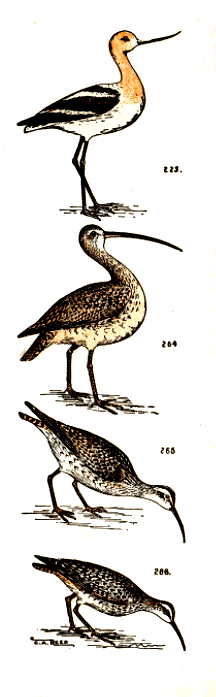
225. American Avocet (Recurvirostra americana). L. 16.5; B. 3.7. Ads. Head and neck rufous; belly white; wings black and white. Yng. and Ads. in winter. Similar, but head and neck grayish or whitish. Notes. A rather musical, loud plēē-ēēk hurriedly repeated. Range.—North America west of Mississippi; breeds from northern States, central California and rarely Texas, north in the interior to latitude 54°: winters from southern California and western Gulf States to Central America and West Indies; casual on Atlantic coast. 264. Long-billed Curlew (Numenius longirostris). L. 24; B. 6., longest among our Snipe. Ads. Above black and buffy; tail barred buffy and black; below buffy, neck and breast finely streaked with dusky. Yng. Similar, but buff deeper. Range.—North America; breeds on Atlantic coast from Florida to North Carolina; in interior north to Manitoba and British Columbia; later strays casually to Newfoundland and Ontario; winters from Gulf States and southern California southward. 265. Hudsonian Curlew (Numenius hudsonicus). L. 17; B. 3.7. Ads. Less buff than No. 264; above dark grayish brown and brownish gray; tail barred with same; below white, breast streaked; sides barred with blackish. Range.—North America; breeds in Arctic region; winters south of United States to South America. 266. Eskimo Curlew (Numenius borealis). L. 13.5; B. 2. Ads. Tail barred with grayish brown and black; above blackish and buffy; below buffy, the breast thickly streaked; sides barred with blackish. Range.—Eastern North America; breeds In Arctic regions; winters south of United States to South America; migrates chiefly through interior.
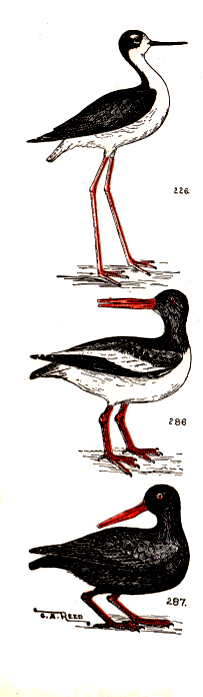
226. Black-necked Stilt (Himantopus mexicanus). L. 15; Tar 4.10. Ad. ♂. Forehead, lower back, and underparts white; crown, hindneck, upper back, and wings black. Ad. ♀. Similar, but upper back and scapulars grayish brown. Yng. Similar to ♀, but brown and black feathers lightly margined with buffy. Notes. A sharp, rapidly uttered ip-ip-ip when flying; a hoarse k-r-r-r-r-ing note when on the ground. Range.—Temperate and tropical America; breeds north to Gulf States, (locally and rarely in Mississippi Valley to Minnesota) and California; winters from southern California and West Indies to northern South America; rare east of Mississippi except in Gulf States. 286. American Oyster-catcher (Hæmatopus palliatus). L. 19. Ads. Base of tail and longer upper tail-coverts white, shorter coverts and all back blackish brown; white in wings conspicuous in flight. Yng. Similar but feathers above with buffy margins. Notes. A sharp eep, eep. Range.—Temperate and tropical America; breeds on sea coasts only, north to Virginia and western Mexico; winters south of United States to South America; casual north to Nova Scotia. 286.1. Frazar Oyster-catcher (Hæmatopus frazari). Similar to No. 286, but darker above, black breast passing into white belly through a mottled black and white band; upper tail coverts with brown markings. Range.—"Lower California (both coasts), north to Los Coronados Islands." (A. O. U.) 287. Black Oyster-catcher (Hæmatopus bachmani). L. 17. Ads. Black. Yng. Somewhat browner. Notes. A musical, piping whistle. Range.—"Pacific coast of North America from Aleutian Islands to La Paz, Lower California."
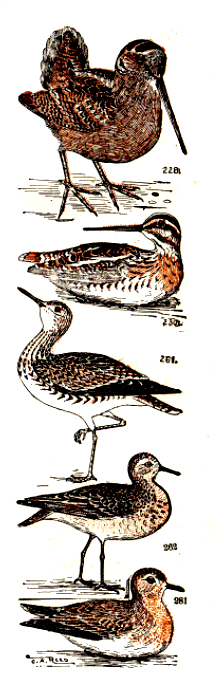
228. American Woodcock (Philohela minor). L. 11. Ads. Below ochraceous-rufous; no bars; forehead slaty crown black with rusty bars; back mixed black, rusty and slaty. Notes. A nasal peent or paip; a whistling of wings and a twittering whistle. Range.—Eastern North America; breeds locally from Florida to Labrador and Manitoba, but chiefly northward; winters from southern New Jersey and southern Illinois to Gulf States. 230. Wilson Snipe (Gallinago delicata). L. 11.2. Ads. Throat and belly white or whitish; breast rusty buff indistinctly streaked; sides barred; above streaked black and cream-buff; tail black and rusty; outer feathers barred black and white. Notes. When taking flight several sudden, hoarse scaipes; a tremulous, penetrating bleating, thought to be produced by air rushing through the birds wings; a kûk-kûk-kûk. (Brewster.) Range.—North America; breeds from northern New England (rarely Connecticut), northern Illinois and northern California north to Labrador, Hudson Bay, and Alaska; winters from California, southern Illinois, and South Carolina to northern South America. 261. Bartramian Sandpiper (Bartramia longicauda). L. 11.5. Outer primary barred black and white. Ads. Above black, ochraceous, and brownish gray; breast and sides with dusky arrowheads; throat and belly whitish. Yng. Similar, but more buffy. Notes. Call, a soft, bubbling whistle; song, a prolonged, mournful, mellow whistle, "chr-r-r-r-r-ee-e-e-e-e-e-oo-oo-o-oo." Range.—North America chiefly interior; breeds locally from Kansas and Virginia to Alaska and Nova Scotia; winters south of United States to South America. 262. Buff-breasted Sandpiper (Tryngites subruficollis). L. 8.5. Inner border of inner web of primaries beautifully speckled with black and white. Ads. Above black widely margined with grayish brown; below ochraceous-buff; a few black spots. Yng. Above blackish brown, finely and evenly margined with whitish; below much as in adult. Range.-"North America especially in the interior; breeds in the Yukon district and the interior of British America north to the Arctic coast; south in winter as far as Uruguay and Peru." (A. O. U.) 281. Mountain Plover (Podasocys montana). L. 9. No black on breast. Ads. Lores and crown-band black; above grayish brown washed with pale rusty. Yng. Similar, but no black, rusty wash deeper. Winter. Same as last but rusty paler. Range.—Western United States; breeds from Kansas to North Dakota; winters westward to California, south to Lower California and Mexico; accidental in Florida.
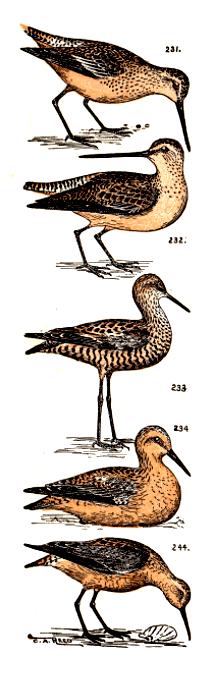
231. Dowitcher (Macrorhamphus griseus) L. 10.5; B. 2.1, pitted at tip. Ads. Rump, tail, under wing-coverts, and axillars barred black and white; above black margined with rusty; rump, white; below reddish brown, spotted and barred with black. Yng. Similar, but breast gray tinged with rusty; belly white. Winter. Above gray, breast gray mixed with dusky, belly white. Range.—Eastern North America; breeds chiefly north and northwest of Hudson Bay; winters from Florida to northern South America. 232. Long-billed Dowitcher (Macrorhamphus scolopaceus). B. 2.1 to 2.9. Similar to preceding but larger, bill longer; in adult spring plumage more barred below. Notes. A lisping, energetic musical, peet-peet; pĕe-ter-wĕe-too; wĕe-too repeated. (Nelson.) Range.—"Western North America, breeding in Alaska to the Arctic coast, migrating south in winter through western United States (including Mississippi Valley) to Mexico, and less commonly along Atlantic coast." (A. O. U.) 233. Stilt Sandpiper (Micropalama himantopus). L. 8.2; tarsus long, 1.6. Ads. Entire underparts and upper tail-coverts white barred with black; tail not barred. Yng. Resembles ad. but below white, breast lightly streaked: rump white no bars. Winter. Similar to yng. but back gray. Range.—Eastern North America; breeds within Arctic Circle; winters from Florida to South America. 234. Knot (Tringa canutus). L. 10.5; B. 1.3. Upper tail-coverts with black bars and loops; tail feathers without bars narrowly margined with white. Ads. Mixed black, gray and reddish brown above, reddish brown below. Yng. Above gray, margined with cream-white and black; below white; breast lightly streaked. Winter. Similar, but above gray. Range.—Northern hemisphere; breeds within Arctic circle; winters from Florida to South America: migrates chiefly along the coasts, rare on Pacific coast of United States. 244. Curlew Sandpiper (Erolia ferruginea). L. 8; B. 1.5, slightly curved. Ads. Below chestnut-rufous, above rusty and black. Yng. Above brownish gray margined with whitish; back blacker; below white. Winter. Above plain brownish gray; below white. Range.—"Old World in general; occasional in Eastern North America and Alaska." (A. O. U.)
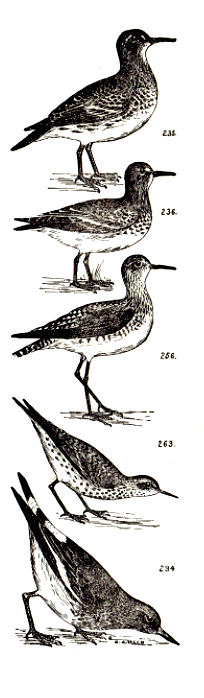
235. Purple Sandpiper (Arquatella maritima). L. 9. Ads. Above black, margined with rusty and cream-buff; below white, breast and sides heavily marked with black. Winter. Head, neck, and breast, slaty; back blacker, margined with slaty; central secondaries largely white. Range.—"Northern portions of the northern hemisphere; in North America chiefly the northeastern portions, breeding in the high north, migrating in winter to the Eastern and Middle States (casually to Florida), the Great Lakes and Upper Mississippi Valley." (A. O. U.) 236. Aleutian Sandpiper (Arquatella couesi). L. 8.5. Similar to No. 235, but ad. and yng. with more ochraceous; in winter grayish margins to back lighter and wider. Notes. When flying, a low, clear, musical tweo-tweo-tweo; when feeding, clū-clū-clū. (Nelson.) Range.—"Aleutian Islands and coast of Alaska, north to Kowak River, west to Commander Islands, Kamchatka." (A. O. U.) 256. Solitary Sandpiper (Helodromas solitarius). L. 8.4. Under wing-coverts, axillars, and all but middle tail-feathers barred black and white. Ads. Above fuscous with a faint greenish tinge; head and neck streaked, back spotted with whitish; below white; throat and breast distinctly streaked with dusky. Yng. Fewer spots and streaks above; breast markings fused. Winter. Practically no white markings above. Range.—Eastern North America; breeds from Northern States (rarely and sporadically) northward; little known of breeding habits; winters south of United States to South America. 256a. Western Solitary Sandpiper (H. s. cinnamomeus). Similar to No. 256, but spots above buffy, especially in fall; inner margin of outer primary speckled black and white. Range.—Western North America; breeds in British Columbia (exact breeding range unknown); winters south of United States. 263. Spotted Sandpiper (Actitis macularia). L. 7.5. Ads. Below white thickly spotted with black; above brownish gray with a faint greenish lustre, lightly marked with black. Yng. Similar above but faintly margined with dusky and buff; below white, breast grayer; no black marks. Winter. Same but no margins above. Notes. Peet-weet, repeated. Range.—North America, north to Hudson Bay; breeds throughout its North American range; winters from southern California and West Indies to South America. 284. Black Turnstone (Arenaria melanocephala). L. 9. No rusty; lower back, longer upper tail-coverts and base of tail white; shorter upper tail-coverts black. Ads. Above and breast brownish black; belly white. Yng. Browner margined with whitish. Winter. Same as Yng, but no margins. Notes. A sharp, weet, weet, too-weet. (Nelson.) Range.—"Pacific coast of North America from Point Barrow, Alaska to Santa Margarita Island, Lower California; breeding from Alaska to British Columbia." (A. O. U.)
237. Pribilof Sandpiper (Arquatella ptilocnemis). L. 10. Ads. Similar to No. 236 above but crown much lighter; breast with a black patch. Yng. Resemble adult above but breast grayish indistinctly streaked and with a pale buff band; belly white. Winter. Similar to yng. but slaty gray above. Range.—"Breeding in the Pribilof Islands, Alaska, and migrating to coast of adjacent mainland south of Norton Sound." (A. O. U.) 243a. Red-backed Sandpiper (Pelidna alpina pacifica). L. 8; B. 1.5; slightly curved. Ads. Belly black; back chiefly rusty. Yng. Breast buffy, lightly streaked with dusky; belly white spotted with black; back black, rusty, and buff. Winter. Above brownish gray; below white; breast grayish, indistinctly streaked. Range.—North America; breeds in Arctic regions and winters from Gulf States and California to South America. 246. Semipalmated Sandpiper (Ereunetes pusillus). L. 6.3; B. .6 to .8. Toes webbed at base. Ads. Above brownish gray and black; little or no rusty; below white, breast indistinctly streaked. Yng. Above with rusty and whitish margins; below white, breast grayish no streaks. Winter. Above brownish gray with black shaft streaks; below white. Notes. weet-weet. Range.—Eastern North America; breeds in Arctic regions; winters from Gulf States to South America. 247. Western Sandpiper (Ereunetes occidentalis). Similar to preceding but bill longer .8 to 1.2; ads. more rusty above, breast streaks more distinct, and more numerous. Notes. Call, a soft weet-weet; song, uttered on the wing, "a rapid, uniform series of rather musical trills." (Nelson.) Range.—North America, chiefly west of Mississippi Valley; breeds in Arctic regions; winters from Gulf States to South America. 248. Sanderling (Calidris arenaria). L. 8. Three toes, tarsus scaled. Ads. Above rusty, black and grayish; below white, breast spotted with black and washed with rusty. Yng. Nape grayish, back black, feathers with two white or yellowish white terminal spots; below silky white. Winter. Above brownish gray with dusky shaft streaks; below silky white. Range.—"Nearly cosmopolitan, breeding in Arctic and Sub-Arctic regions, migrating, in America, south to Chili and Patagonia." (A. O. U.)
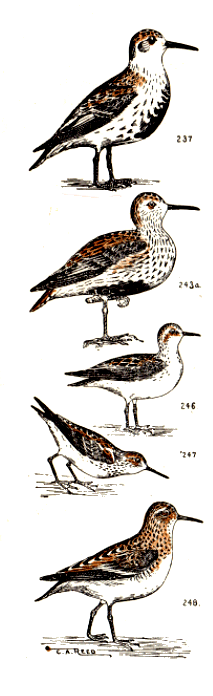
238. Sharp-tailed Sandpiper (Actodromas acuminata). L. 8.7. Tail feathers pointed. Ads. A white line over eye; breast buff streaked with blackish. Yng. Crown as in ad., back black and rusty; below white, breast buffy, no streaks. Winter. Back grayish brown streaked with blackish; below as in yng., but breast grayer and with indistinct streaks. Notes. A soft metallic pleep-pleep. (Nelson.) Range.—"Eastern Asia, and coast of Alaska, migrating south to Java and Australia." (A. O. U.) 239. Pectoral Sandpiper (Actodromas maculata). L. 9. Ads. Middle tail-feathers longest, pointed, blackish margined with rusty; above black and rusty; below white, breast thickly streaked; upper tail-coverts black. Yng. and in winter much the same. Notes. Call, a grating whistle; song, a hollow, resonant, musical tōō-ū, repeated eight times, made after filling æsophagus with air until it is puffed out to size of the body. (Nelson.) Range.—North America; breeds in Arctic regions; winters south of United States to South America; rare on Pacific coast. 240. White-rumped Sandpiper (Actodromas fuscicollis). L. 7.5. Longer upper tail-coverts white. Ads. Breast white, distinctly spotted or streaked. Yng. More rufous above; breast less distinctly streaked. Winter. Brownish gray above; similar to yng. below. Range.—Eastern North America; breeds in the interior north of Hudson Bay; winters south of United States to southern South America; rare on Pacific coast. 241. Baird Sandpiper (Actodromas bairdii). L. 7.5. No rusty in plumage. Ads. Longest upper tail-coverts blackish; breast buffy, faintly streaked. Yng. Similar, but back conspicuously margined with whitish. Winter. Above "buffy grayish brown," no white margins. Range.—Interior of North America; breeds in the Arctic regions and winters south of United States to southern South America. 242. Least Sandpiper (Actodromas minutilla). L. 6. Smartest of our Sandpipers. Ads. Above black, buff and rufous; below white breast lightly streaked. Yng. Similar, but breast less distinctly streaked. Winter. Above brownish gray, often streaked with black, below white. Notes. Peep-peep. Range.—North America; breeds from Sable Island and Magdalens northward; winters from Gulf States and California south to South America.
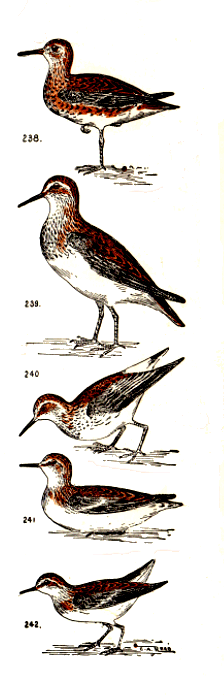
249. Marbled Godwit (Limosa fedoa). L. 18; B. 4; slightly recurved. Tail barred, cinnamon and black; under wing-coverts cinnamon with more or less fine black markings. Ads. Above black and ochraceous; below buffy white finely and uniformly barred with black. Yng. Similar, but with no or with but few bars below. Range.—North America; breeds in the interior from western Minnesota, rarely Iowa and Nebraska northward; winters south of United States to Central America and West Indies. 250. Pacific Godwit (Limosa lapponica baueri). L. 16. B. 3.7, slightly recurved, tail barred black and white; under wing-coverts black and white. Ads. "Head, neck and lower parts, plain cinnamon color." (Ridgw.) Winter. Above black, grayish and rusty, former prevailing; below white; throat streaked, elsewhere with irregular, black bars. Notes. "A loud ringing kû-we'w, repeated." Range.—"Shores and Islands of the Pacific Ocean, from New Zealand and Australia to Kamchatka and Alaska. On the American coast recorded south of Alaska only from La Paz, Lower California." (A. O. U.) 251. Hudsonian Godwit (Limosa hæmastica). L. 15; B. 3.2, slightly recurved. Under wing-coverts dusky; upper tail-coverts black and white; tail black at end, white at base. Ads. Above black, rusty and grayish, below chestnut-red barred with blackish and faintly tipped with white. Yng. Similar, but below buffy whitish, breast grayer. Winter. Similar below but above brownish gray. Range.—Eastern North America chiefly interior; breeds in Arctic Regions; winters south of United States to South America. 270. Black-bellied Plover (Squatarola squatarola). L. 11. Hind-toe present, small. Ads. Above black and white, no yellowish; below black. Yng. Above grayish brown spotted with white and some yellowish; below white. Winter. Similar to preceding but nearly uniform brownish above. Range.—Northern Hemisphere; breeds in Arctic Regions, winters in America from Florida to Brazil. 272. American Golden Plover (Charadrius dominicus). L. 10.5; W. 7. No hind-toe; axillars dusky. Ads. Above conspicuously spotted with yellow; below black, sides of breast white. Yng. Duller above, below grayish white with dusky marks and yellowish wash. Winter. Similar but no yellow below. Notes. Call, a plaintive too-lee-e; song, a marvelously harmonious succession of notes. (Nelson.) Range.—Western Hemisphere; breeds in Arctic Regions; winters from Florida to Patagonia, rare on Pacific coast. 272a. Pacific Golden Plover (C. d. fulvus). Similar to No. 272 but wing shorter, 6.5; yellow richer. Range.—"Breeding from northern Asia to the Pribilof Islands and coast of Alaska, south in winter through China and India to Australia and Polynesia." (A. O. U.)
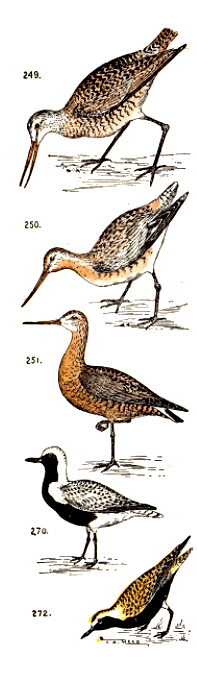
254. Greater Yellow-legs (Totanus melanoleucus). L. 14; B. 2.2. No rusty; upper tail-coverts mostly white; tail barred with black and white or gray. Ads. Above black margined with whitish; below white and black. Yng. Above grayish margined with whitish; below white, breast lightly streaked. Winter. Similar but white margins less conspicuous. Notes. A whistled wheu, wheu-wheu-wheu-wheu-wheu-wheu, wheu-wheu. Range.—North America; breeds from Minnesota, rarely northern Illinois, and Anticosti northward; winters from Gulf States and California to southern South America. 255. Yellow-legs (Totanus flavipes). L. 10.7; B. 1.4. Similar in color to preceding but smaller in size. Range.—North America; breeds rarely in upper Mississippi Valley but chiefly north of latitude 55°; winters from Gulf States to southern South America; rare on Pacific coast. 258. Willet (Symphemia semipalmata). L. 15; W. 8; B. 2.1. Primaries black with a broad white band; upper tail-coverts mostly white. Ads. Above brownish gray, black, and a little buff; below white heavily marked with black and slightly washed with buff. Yng. Above brownish gray margined with buffy; below white, breast lightly streaked with dusky. Winter. Similar, but above plain brownish gray. Notes. Song, pilly-will-willet, repeated. Range.—Eastern North America; breeds from Florida to southern New Jersey, later strays casually to Maine; winters from Gulf States to South America. 258a. Western Willet (S. s. inornata). Similar to No. 258 but slightly larger. W. 8.5; B. 2.4. In summer above paler, less heavily marked with black both above and below. Yng. and Winter. Indistinguishable in color from No. 258. Range.—Western United States; breeds from Texas to Manitoba; winters from southern California and Gulf States southward. A rare migrant on Atlantic coast from South Carolina to Florida. 259. Wandering Tattler (Heteractitis incanus). L. 11. Tail-coverts plain slaty gray. Ads. Above plain slaty gray; below white barred with slaty gray. Yng. Above slaty gray more or less margined with whitish; breast and sides slaty gray; throat and belly white. Winter. Similar, but no white margins above. Range.—Pacific coast; breeds from British Columbia northward; winters south to Hawaiian Islands and Galapagos. 282. Surf Bird (Aphriza virgata). L. 10; B. 1. Upper tail-coverts and base of tail-feathers white. Ads. Above black, slaty, and rusty. Yng. Above slaty margined with whitish; breast barred slaty and whitish; belly white spotted with slaty. Winter. The same, but no whitish margins. Range.—"Pacific coast of America, from Alaska to Chili." (A. O. U.)
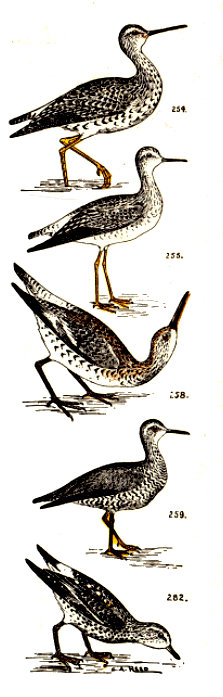
273. Killdeer (Oxyechus vociferus). L. 10.5. Rump and upper tail-coverts rusty. Ads. Above grayish brown and rusty; below white with two black rings. Notes. A noisy kildeē, kildeē. Range.—North America, north to Newfoundland, Manitoba and British Columbia; (rare on North Atlantic coast); breeds locally throughout its range; winters from Virginia, Lower Mississippi Valley and California south to South America. 274. Semipalmated Plover (Ægialitis semipalmata). L. 6.7. Web between bases of inner and middle toes. Ads. One black ring around neck; a white ring in front of it. Yng. Similar, but black parts brownish; back margined with whitish. Winter. Same as last but no whitish margins. Range.—Breeds from Labrador northward; winters from Gulf States to Brazil. 275. Ring Plover (Ægialitis hiaticula). L. 7.5. No webs between toes. Similar to 274 but larger, bill yellow at base, black or brown bands wider. Range.—"Northern parts of Old World and portions of Arctic America, breeding on the west shore of Cumberland Gulf." (A. O. U.) 277. Piping Plover (Ægialitis meloda). L. 7; B. short, .5. Very pale above. Ads. Above ashy, crown and sides of breast black; no rusty. Yng. Similar, but black replaced by ashy gray. Notes. A short plaintive, piping whistle, repeated. Range.—Eastern North America; breeds from Virginia to Newfoundland; winters from Florida southward. 277a. Belted Piping Plover (Æ. m. circumcincta). Similar to No. 277 but black on sides of breast meeting to form a breast band. Range.—Mississippi Valley; breeds from northern Illinois and Nebraska north to Lake Winnipeg, east to Magdalen and Sable Islands; winters from Gulf southward; casual migrant on Atlantic coast. 278. Snowy Plover (Ægialitis nivosa). L. 6.5. No complete ring. Ads. Black on crown; ear-coverts and sides of breast black. Yng. The same, but no black; above margined with whitish. Winter. Same as last but no whitish margins. Range.—Western United States east to Texas and Kansas; breeds from Indian Territory and southern California northward; winters from Texas and southern California southward. 280. Wilson Plover (Ochthodromus wilsonius). L. 7.5; B. .8. No black on hindneck. Ad. ♂. One black breast-and crown-band; some rusty about head. Ad. ♀. Similar but black areas brownish gray. Yng. Same as last, but above margined with whitish. Winter. No whitish margins. Range.—Tropical and temperate America; breeds north to Virginia, Gulf States, and Lower California; winters southward to Brazil; casual north to Nova Scotia.
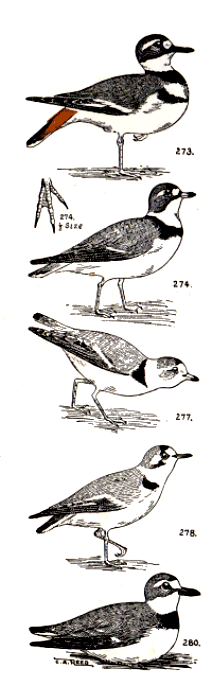
Order X. GROUSE, PARTRIDGES, BOB-WHITES, ETC.
GALLINAE.
Family 1. GROUSE, PARTRIDGES, etc. Tetraonidæ. 21 species, 22 subspecies.
Family 2. TURKEYS, PHEASANTS, etc. Phasianidæ. 1 species. 3 subspecies.
Family 3. CURASSOWS and GUANS. Cracidæ. 1 species.
The members of the family Tetraonidæ are usually placed in three subfamilies as follows: (1.) Perdicinæ, containing the true Quails and Partridges of the Old World and with no species in America. (2.) Odontophorinæ, including the Bob-whites and so-called 'Quails' and 'Partridges' of the New World, and with no species in the eastern hemisphere. (3.) Tetraoninæ, the Grouse, with representatives in the northern parts of both hemispheres. All the members of the first two families have the legs bare, while the Grouse have the legs, and often even the toes, more or less feathered.
The application of different names to the members of this family, in various parts of the country, often make it uncertain just what species is referred to under a given title. Our Bob-white, for example, is a 'Quail' at the north and a 'Partridge' at the south. As a matter of fact it is, strictly speaking, neither a true Quail nor Partridge but a member of a family restricted to America.
Again, the Ruffed Grouse is a 'Partridge' at the north and a 'Pheasant' at the south, whereas in truth it is neither one nor the other. So far as the application of these local names goes, it is to be noted that where the Bob-white is called 'Quail' the Grouse is called 'Partridge' and that where it is called 'Partridge' the Grouse is known as 'Pheasant'.
All the Tetraonidæ are ground-inhabiting birds, and their plumage of blended browns, buffs and grays brings them into such close harmony with their surroundings that, as a rule, we are unaware of the presence of one of these birds until, with a whirring of short, stiff, rounded wings it springs from the ground at our feet. It is this habit of 'lying close,' as sportsmen term it, in connection with their excellent flesh, which makes the members of this family the favorites of the hunter and epicure and only the most stringent protective measures will prevent their extinction as their haunts become settled.
With the Ptarmigan this harmony in color is carried to a remarkable extreme, the birds being white in winter and brown, buff and black in summer; while during the early fall they assume a grayish, neutral tinted plumage to bridge over the period from the end of the nesting season, in July, to the coming of the snow in September.
The Tetraonidæ all nest on the ground, laying usually from ten to twenty eggs. The young, like those of their relative, the domestic fowl, are born covered with downy feathers and can run about shortly after birth.
The Turkey is the only wild member of the Phasianidæ in this country, but the family is well-represented in the domesticated Chickens, Peacocks, and Pheasants, all of which have descended from Old World ancestors. Our domesticated Turkey is derived from the Wild Turkey of Mexico, which was introduced into Europe shortly after the Conquest and was thence brought to eastern North America. It differs from the Wild Turkey of the eastern United States chiefly in the color of the tips of the upper tail-coverts. These are whitish in the domesticated Turkey, as they are in the Mexican race from which, it has descended, and rusty brown in the Eastern Wild Turkey.
Besides the five races of Wild Turkey described beyond, another species of Turkey is found in America. This is the Honduras or Yucatan Turkey, now largely confined to the peninsula of Yucatan. It is not so large as our bird, but is even more beautifully colored, its plumage being a harmonious combination of blue, gray and copper.
Ring-necked and 'English' Pheasants have been introduced into various parts of the United States, and in Oregon and Washington and in the east, on various private game preserves, they have become naturalized. The true English Pheasant (Phasianus colchicus) is believed to have been introduced into England from Asia Minor probably by the Romans. Unlike the Ring-necked Pheasant (Phasianus torquatus) it has no white collar. The last named species, however, has also been introduced into England where it freely interbreeds with the earlier established English Pheasant and individuals without at least a trace of white on the neck are now comparatively rare.
The Curassows and Guans are tropical American birds, only one species reaching the southern border of the United States. They are arboreal in habit and form an interesting link between the Partridges, etc. and the Pigeons.
Bob-White and Partridge
289. Bob-white; 'Quail;' 'Partridge' (Colinus virginianus). L. 10. Ad. ♂. Throat, forehead and line over eye white. Ad. ♀. Throat, forehead and line over eye buff. Notes. Song, a ringing, whistled Bob-white or buck-wheat-ripe; calls, a conversational quit-quit and a whistled where-are-you and I'm here, repeatedly uttered when the individuals of a flock are separated. Range.—Eastern North America, resident from southern Dakota, southern Minnesota, southern Ontario, southern Vermont, New Hampshire and Maine, south to Georgia and western Florida; west to South Dakota, Nebraska, Kansas, Oklahoma, and eastern Texas. "Introduced at various points in Colorado, New Mexico, Utah, Idaho, California and Washington." (A. O. U.) 289a. Florida Bob-white (C. v. floridanus). Similar to No. 289, but smaller, L. 8.5, and much darker; black bars below more numerous. Range.—Florida; typical only in southern half of peninsula, grading into No. 289 in northern and western parts of the state. 289b. Texan Bob-white (C. v. texanus). Similar to No. 289, but brown and buff areas paler; black bars below wider. Range.—Texas, except western part, rarely to western Kansas, south to Nuevo Leon and Tamaulipas, Mexico. 291. Masked Bob-white (Colinus ridgwayi). L. 9. Ad. ♂. Throat black; breast and belly reddish brown. Ad. ♀. Resembles ♀ of No. 289b. Notes. Song, Bob-white; call, when the birds are scattered, hoo-we. (H. Brown.) Range.—Northern Sonora, Mexico, north to Pima County, Arizona. 296. Mearns Partridge (Cyrtonyx montezumæ mearnsi). L. 9. Ad. ♂. Sides with numerous, large, crowded white spots. Ad. ♀. Pinkish brown, above streaked with buffy and marked with chestnut and black, below with a few broken black bars. Notes. A low, murmuring whine; a clear dsiup-chiur, when alarmed, chuk-chuk-chuk. (Bendire.) Range.—Northern Mexico, western Texas, southern New Mexico and southern Arizona.
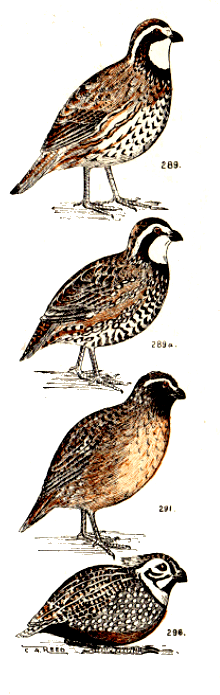
Partridges
292. Mountain Partridge (Oreortyx pictus). L. 11. Ads. Hindhead and nape same color as back; inner margins of tertials buff. Notes. Song, an explosive whistle ending in a throaty tone; call, a rapidly repeated cuh-cuh-cuh-cuh, and a sharp pit-pit. Range.—Pacific coast from Santa Barbara, California, north to southern Washington. 292a. Plumed Partridge (O. p. plumiferus). Hindhead, nape, and foreback same color as breast; inner margins of tertials white. Range.—Sierra Nevada (both slopes), east to Panamint Mountains; and to Mount Magruder, Nevada; south in the coast ranges from San Francisco Bay to Lower California (Campos). (A. O. U.) 292b. San Pedro Partridge (O. p. confinis). Similar to No. 292a, but upperparts much grayer, the back, rump, and upper tail-coverts being gray very slightly tinged with olive; bill stouter. (Ridgway.) Range.—San Pedro Martir Mountains, Lower California. 293. Scaled Partridge (Callipepla squamata). L. 10. Ads. Belly without chestnut patch; breast and foreback grayish blue edged with black; back brownish gray. Notes. A nasal pe-cos' pe-cos' (Bailey.) Range.—"Tableland of Mexico, from the Valley of Mexico, north to central and western Texas, Santa Fe, New Mexico and southern Arizona." (A. O. U.) 293a. Chestnut-bellied Scaled Partridge (C. s. castanogastris). Similar to No. 293, but ♂ with chestnut patch on belly; ♀ with belly much rustier than in ♀ of No. 293. Range.—Lower Rio Grande Valley, northwest to Eagle Pass, Texas; south into northeastern Mexico. 294. California Partridge (Lophortyx californica). L. 10. Ad. ♂. Above olive-brown; belly patch chestnut. Ad. ♀. Plumes shorter; throat whitish streaked with dusky; no distinct chestnut patch on belly. Notes. Song, a pheasant like crow and a crowing, emphatic sit-right-down', sit-right-down'; calls, a sharp pit-pit pit, and a note like that of a young Robin. Range.—"Coast region of California south to Monterey, introduced in Oregon, Washington, and British Columbia." (A. O. U.) 294a. Valley Partridge (L. c. vallicola). Similar to No. 294, but much grayer above; sometimes plain bluish gray without brown tinge. Range.—"From western and southern Oregon, except near the coast, south through western Nevada and the interior of California to Cape St. Lucas." (Bendire.) 295. Gambel Partridge (Lophortyx gambelii). L. 10. Ad. ♂. Throat, forehead and belly patch black; hindhead chestnut. Ad. ♀. Similar, but throat grayish buff; forehead gray; no black on belly; hind head brownish; crest smaller. Notes. Song, yuk-käe-ja. Range.—"Western Texas, New Mexico, Arizona, southern Utah, southern Nevada, southern California in the Colorado Valley and south into northwestern Mexico." (A. O. U.)
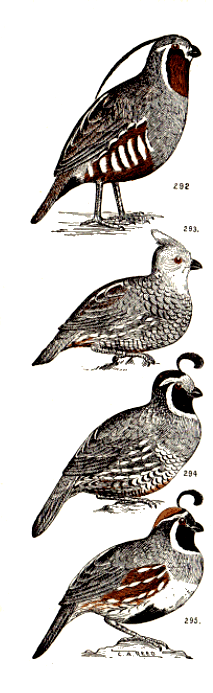
Grouse
297. Dusky Grouse (Dendragapus obscurus). L. ♂, 20. ♀, 18. Ad. ♂. Gray tail-band over one inch wide on middle feather; below grayish slate; above blackish with fine rusty and grayish markings. Ad. ♀. With more white below; foreback regularly barred with buffy; middle tail-feathers irregularly barred with buff or grayish; terminal gray band finely marked with black. Notes. A loud, ventriloquial, hooting or booming. Range.—"Rocky Mountains, from central Montana and southeastern Idaho to New Mexico and Arizona; east to the Black Hills, South Dakota and west to East Humboldt Mountains, Nevada." (A. O. U.) 297a. Sooty Grouse (D. o. fuliginosus). Similar to No. 297, but slightly darker, gray band on central tail feather less than one inch wide. Range.—"Northwest Coast Mountains, from California to Sitka, east to Nevada, western Idaho and portions of British Columbia." (A.O.U.) 297b. Richardson Grouse (D. o. richardsonii). Similar to No. 297a, but no tail band, or, if showing indistinctly from above, not visible from below. Range.—"Rocky Mountains, especially on the eastern slopes, from central Montana, northern Wyoming and southeastern Idaho, into British America to Liard River." (A. O. U.) 298. Hudsonian Spruce Grouse (Canachites canadensis). L. 15. Ad. ♂. Tail-feathers tipped with brown; foreback margined with bluish gray. Ad. ♀. Above, bases of feathers more or less barred with rusty especially on foreback; throat and breast barred with rusty and black; belly as in male. Notes. A drumming sound produced by the beating of the wings. (Bendire.) Range.—Labrador and Hudson Bay region. 298b. Alaska Spruce Grouse (C. c. osgoodi). Ad. ♂. Similar to Ad. ♂. of No. 298c, but margins to feathers of foreback brownish ashy. Ad. ♀. Similar to Ad. ♀ of No. 298c, but paler, barred with buff instead of rusty. Range.—Alaska. 298c. Canada Grouse (C. c. canace). Ad. ♂. Similar to Ad. ♂. of No. 298. Ad. ♀. Similar to Ad. ♀ of No. 298, but above more rusty, rusty bars deeper and more conspicuous, showing throughout upper surface and on flanks. Range.—Northern New England, northern New York, New Brunswick, Nova Scotia and Quebec west to northern Minnesota. 299. Franklin Grouse (Canachites franklinii). Resembles No. 298, but tail without brown tips, sometimes tipped with white. Range.—"Northern Rocky Mountains, from northwestern Montana to the coast ranges of Oregon and Washington, and northward in British America, reaching the Pacific coast of southern Alaska (latitude 60°)." (A. O. U.)
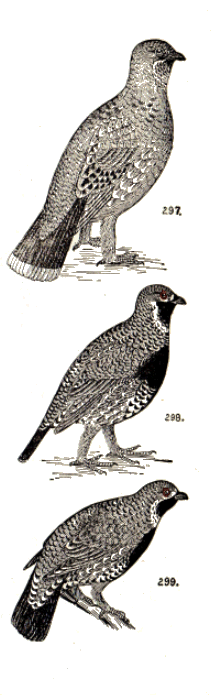
300. Ruffed Grouse; 'Partridge;' 'Pheasant' (Bonasa umbellus). L. 17. Ad. ♂. Prevailing color above rusty brown; tail rusty or gray. Ad. ♀. Similar but neck-tufts smaller. Notes. The male produces a drumming sound by rapidly beating its wings; the female utters a cluck and when defending her brood, a singular low whining sound. Range.—Eastern United States from Minnesota, southern Ontario, southern New Hampshire and southern Vermont, south to Virginia and along the Alleghanies to Georgia; west to northwestern Arkansas. 300a. Canadian Ruffed Grouse (B. u. togata). Similar to No. 300, but slightly grayer above; tail generally gray; bars on breast and belly darker and better defined. Range.—Spruce forests of New Brunswick, Nova Scotia, Maine northern New Hampshire, northern Vermont and south to higher mountains of Massachusetts and northern New York; west to eastern slope of coast ranges of Oregon, Washington and British Columbia; north to James Bay. 300b. Gray Ruffed Grouse (B. u. umbelloides). Similar to No. 300a, but grayer; prevailing color of upperparts, including crown, gray; tail always gray. Range.—Rocky Mountains, from Colorado north to latitude 65° in Alaska, east to Mackenzie and poplar woods of western Manitoba. 300c. Oregon Ruffed Grouse (B. u. sabini). Similar to No. 300, but much darker, prevailing color of upper parts rusty brown; tail always rusty brown. Range.—Pacific coast ranges from Cape Mendocino, California, north to British Columbia.
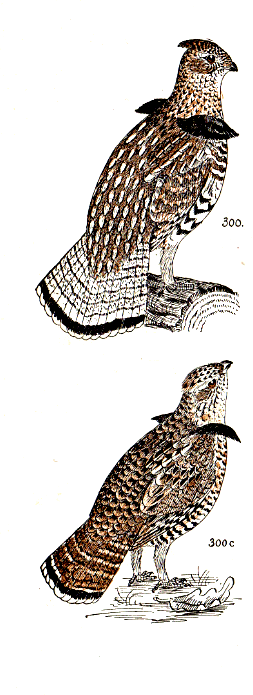
Ptarmigan
301. Willow Ptarmigan (Lagopus lagopus). L. 15. Bill large, more than .4 deep at base; tail black, narrowly tipped with white. Ad. ♂ Summer. Throat and upper breast rusty brown. Ad. ♂ Fall. Rustier and more finely marked above. Ad. ♀. Summer. Above black barred with buff and tipped with white; below buff barred with black; middle of belly whitish. Ad. ♀. Fall. Much like fall male. Ads., Winter. White, tail black tipped with white; no black before eye. Notes. Song, kû-kû-kû-kû while ascending five or ten yards in the air; a hard rolling kr-r-r-r when descending. (Nelson.) Range.—Arctic Regions; in America breeding south to Lat. 55° in winter migrating south to Lat. 50°; recorded once from Penobscot Co., Maine, and once from Manchester, Mass. 301a. Allen Ptarmigan (L. l. alleni). Similar to No. 301, but ♀ more finely marked; shafts of primaries, at all seasons, strongly black spreading to the web of the feather. Range.—Newfoundland. 302. Rock Ptarmigan (Lagopus rupestris). L. 14. Bill less than .4 deep at base; tail black. Always to be known from No. 301 by its smaller bill. Ad. ♂ Summer. Above irregularly barred and mottled with gray and rusty buff; below barred black and white and rusty buff. Ad. ♂ Fall. Above minutely speckled black, gray and buff, the prevailing color being grayish brown. Ad. ♂ Winter. White, lores and tail black. Ad. ♀ Summer. Above black barred with rusty and margined with whitish; below rusty barred with black and tipped with whitish. Ad. ♀ Fall. Like fall ♂. Ad. ♀ Winter. Like winter ♂ but no black before eye. Range.—North America from Gulf of St. Lawrence and higher mountains of British Columbia north to Arctic Regions (except northern Labrador) west through Alaska to Aleutian Islands. 302a. Reinhardt Ptarmigan (L. r. reinhardti). Ad. ♂ Summer. Similar to No. 302, but "less regularly and coarsely barred above" (Ridgw.) Ad. ♀ Summer. Resembles ♀ of No. 302. Ads. Fall. Much grayer than No. 302 in fall. Ads. Winter. Like No. 302 in winter. Notes. When courting the male utters a growling kurr-kurr. (Turner.) Range.—Northern Labrador north to Greenland. 302b. Nelson Ptarmigan (L. r. nelsoni). Ad. ♂, Summer. Ground color of upperparts deep umber-brown, very finely and densely vermiculated; chest barred with bright tawny brown and black. Ad. ♀, Summer. Similar to ♂ of No. 302. (Ridgw.) Range.—Unalaska, Aleutian Islands.