Book the Second (continued 2)
Reading edition
The fortune of the Lord Alexander P.P. VI appeared to be in serious danger. The French unhindered were advancing, and sedition was sown in Rome. One more overture the Supreme Pontiff made, sending Cardinal Raymond Perrauld, a creature of His Own, to treat with the Christian King, who with no difficulty persuaded the 128French Cardinal to turn traitor to the Pope. A Brief, appealing to the Elect-Emperor Maximilian for help proved ineffectual. The forces of Colonna beleaguered the Eternal city. Within the walls, three disaffected cardinals, the Lords Ascanio Maria Sforza-Visconti, Friderico Sanseverini, and Bernardino de’ Lunati, were interned with the Pope in the Mola for the sake of safety. When the pontifical citadel of Civita Vecchia fell, the loyalists became yet more disheartened. Orsini turned its coats and joined the French. Cesarini alone of all the patricians of Rome continued to be staunch and true. Resistance was useless, things being as they were; and the Lord Alexander P.P. VI gave leave to the Christian King to enter Rome. He came. He humanly was master of the City and of the situation, face to face with the Holiness of the Pope, practically having His person in his power. The Majesty of France demanded the calling of a General Council; and God’s Vicegerent opposed him with a blunt and unconditional Non Possumus. Whenever the World has driven the Church against the wall, She has become inexorably invincible.
The year 1495 opened with Rome in panic and disorder, in the clutch of a foreign army bringing desolation and a new disease. The Christian King, who had come to accomplish the conquest of the Regno by means of the deposition of the Pope, found the way completely blocked. He had strutted on his twelve-toed feet to Rome, prepared to crow so very gallically. The decree of deposition actually was prepared, and only required confirmation by a competent authority. Inflated with gigantic megalomaniacal illusions, he had believed that an evil conscience would have made the Lord Alexander P.P. VI obedient to him. He thought by the threat of a General Council (which he intended to convoke at Ferrara,) to blackmail the Pope into conceding the investiture of Naples. He ineffectually had battered the defences of the Pope with cannon. And now his Frenchmen would fight no longer, as some say; but others, like Briçonnet and de Commines, assert that it was the king who blenched. At last, with his shallow mind congested with half-thought thoughts and uncompleted facts like these, he became aware that a General Council was not a General 129council unless it had the Pope’s authority, which last he was not likely to obtain; and that, without some means of bending the pontifical will, he could not hope to win the crown of Naples. Evidently, he could not depose the Pope. He might, however, conquer Naples by force of arms; and, perhaps, the question of investiture by the Ruler of the World, the Father of princes and of kings, the Earthly Vicar of Jesus Christ our Saviour, which he realized to be imperative, would wear a different aspect when he should ask for it as a conqueror with the Regno in his hand.
While the Christian King was stumbling to these conclusions, the invincible Lord Alexander P.P. VI remained with His little court in the Mola of Hadrian where He had His hostages secure, viz., the Sultán Djim, earnestly desired by France as a weapon against the Great Turk, and the renegade cardinals, friends of Colonna and the French. Here, He was practically impregnable. The Papal States might go to wrack and ruin: Rome Herself might be crushed by an alien heel, but from the Mola of Hadrian a Pope, surrounded by His faithful few, could, and often did, defy blockade as long as provisions held out; could, and often did, launch the lightnings of the Church, censures, excommunications, interdicts; and force acknowledgment, and reluctant obedience, from rebellious sovereigns who, after all, believed and admitted Him to be Ruler of the World, Father of princes and of kings, Earthly Vicar of Jesus Christ our Saviour, titles, in defence of which (so very glorious are they) Pontiffs of these clear ages did not hesitate to court the death, admitting of no compromise of no rebate. Our potency, said they, if worth having, is worth fighting for, is worth dying for. And, as invariably is the case, when a man shews that he wishes nothing better than to lose his life for a cause, he saves both cause, and life.
From the Mola of Hadrian then, the Lord Alexander P.P. VI deigned to make these terms with the Christian King:—The French army was to be withdrawn from Rome. The Pope’s Holiness would not interfere; and would lend to France as hostages for six months, the 130Sultán Djim with whom to menace the Great Turk Bajazet, and Cardinal Cesare (detto Borgia). The question of the investiture of Naples was not even named. Having secured Himself by this agreement, in which He had conceded neither of the two French claims, the Supreme Pontiff received in formal audience the Christian King, who shortly after marched his troops southward along the Appian Way by Albano, Ariccia, and Genzano, toward the Neapolitan frontier.
At the Third Consistory of the sixteenth of January 1495, the Lord Alexander P.P. VI named one cardinal, who was the Lord Guillaume Briçonnet, Overseer of the Treasury to the Christian King Charles VIII, editor of a book of prayers dedicated to the said king (Encheiridion precum); Cardinal-Presbyter of the Title of Santa Pudentiana.
At Velletri there lived a certain Don Pietro Gregario Borgia, son of that Don Niccolo Borgia of the Junior Branch, Regent of Velletri and Familiar of King Don Alonso V, by his marriage with the Noble Giovanna Lamberti. In 1495 this Don Pietrogorio was about the age of twenty-one years (the age in fact of Cardinal Cesare;) and, when the French king halted for the night at Velletri, he found means to exchange habits with the said Cardinal Cesare (detto Borgia) and to help him to disappear, remaining as hostage in his place. It was a daring act, and soon discovered: but the cardinal was safe in Rome concerting new schemes with the Pope. The Majesty of France grave instant orders for the hanging of Don Pietrogorio and for the firing of the city; and hurried on to Naples. But the king’s first secretary, who had been commissioned to execute his master’s vengeance, out of sheer admiration for the courage of Velletri’s Regent’s son, gave him a swift horse and leave to reclaim his own clothes 131from Cardinal Cesare (detto Borgia) in Rome; nor did he give Velletri to the flames.
Immediately on hearing of the French approach, King Don Alonso II abdicated in favour of his son Don Ferrandino de Aragona. Envoys from the Catholick King Don Hernando of Spain embarrassed the Christian King Charles VIII of France with remonstrances on his invasion of the territories of the House of Aragon: but the latter was not to be rebuffed. The fortress of Monte San Giovanni capitulated to him. His march through the Regno was a series of victories; and, in the capital, he announced his intention altogether to relinquish the Crusade, and to add Naples as a fief to France.
But three causes prevented this from becoming more than a French boast:—the action of the Pope, the action of the Powers, the action of Providence. Directly after the French had quitted Rome, the Lord Alexander P.P. VI retired to the pontifical castle of Viterbo, a mighty fortress in a cool air, and pleasant as a summer residence; where He was joined by Cardinal Cesare (detto Borgia) with Don Pietro Gregorio Borgia (now the last Most Worshipful Lord’s lieutenant and standard-bearer); and whence He commenced vigorous diplomatic negotiations directed against the French.
The Powers of Italy had taken alarm. It had never been contemplated that France would meet submission all along the line, and actually become arbiter of the whole country. Milan, Florence the Papal States, and now the Regno, had fallen: with the French in France in the north, and the French in Naples in the south, these intermediate duchies, states and republics found themselves in the position of an uncracked nut in a monkey’s jaw: wherefore Italy gave way to fear. Also, Spain was the enemy of France, so was the Holy Roman Empire; and the Elect-Emperor Maximilian and the Catholic King realized the arrival of a unique opportunity for invading France by south and east, seeing that the French army was in Naples, cut off from its base by the Italian states. All these circumstances and considerations, skilfully perceived and engineered by the Pope’s Holiness from His eyrie at 132Viterbo, quite naturally resulted in the conclusion of a Holy League, consisting of the Papacy, the Empire, Spain, and the Italian Powers, against France.
His position having become untenable, the Christian King resolved upon retreat. Half his army he left in Naples; and marched northward with the rest. His coming had been a triumphal procession. His going was a flight through hostile territory. A second time he entered Rome with the hope of retrieving his lost prestige: but the Pope again retired, this time to Orvieto, and refused to meet him. Enraged by the slight, the polite chivalry of France to pain the Pope avenged itself on women, pillaging the house of Madonna Giovanna de’ Catanei, and making Madonna Giulia Orsini (nata Farnese) a prisoner. Onward, northward, went the Christian King, conferring with the mattoid Fra Girolamo Savonarola at Poggibonzi; fighting a desperate battle at Fornuovo, where he lost his army stores; reaching France with his forces disgraced and in disorder; and he himself disabled by the sentence of the Greater Excommunication which the thoroughly angry and triumphant Pontiff fulminated after him.
In Florence, Fra Girolamo ceased not to labour on behalf of the Christian King, sowing seeds of political discord, and preparing the germs of certain calumnies which, in later years were used by Florentine friends of France. His sermons were French manifestoes, and denunciations of Medici. He had stepped from the pulpit of the pastor to the platform of the politician. His power was admirable and admired, his sincerity unquestionable; and earnest efforts were made to reclaim him from the doubtful practices in which he was embarked. The Lord Alexander P.P. VI summoned him by a kindly and paternal Brief to Rome; saying that He wished to hear him personally, and to confer with him as to the methods which he advocated. How revoltingly inconsistent are the writers who rail against the Pope for His treatment of this degenerate friar! Leaving out of the question matters of dogma, articles of Faith, in reference to which the Founder of Christianity definitely promised to permit no error, it must be admitted that, 133regarding ordinary affairs of government and discipline, a Pope-well-advised is superior to a Pope-ill-advised. Well, here is the Pope having heard many hard things of Savonarola, definitely and gently offering to hear that madman’s own defence, definitely trying every means, every most intimate and stringent means, to render Himself well-advised before proceeding to judgment. If the subsequent actions of the Lord Alexander P.P. VI deserve to be called ill advised, it is not He Who should be blamed, but Fra Girolamo Savonarola, who with inconsequent evasion, excused himself and continued his traitorous machinations against the peace of his country, in defiance of the law, and in contempt of the powers that be. Order issued from Rome, inhibiting him from public preaching, and placing his Convent of San Marco again under the rule of the Lombard Congregation. Then, Fra Girolamo professed ready obedience to the Pope; but begged for the independence of his convent, a prayer which he supported with such arguments as to obtain a favouring response, though the inhibition was repeated. Before the formal Brief arrived Don Piero de Medici attempted to return to Florence from Venetian exile; being foiled solely by a violent diatribe in which Fra Girolamo denounced him. As time passed, the friar intrigued with Ferrara, gained over and cultivated many influential Florentines; and then the Signoria took up his cause and formally appealed to Rome for the removal of his inhibition.
The passage of the French through the Papal States, like a blight of caterpillars, brought famine into the country districts. In the Fifteenth Century, armies were not encumbered by a commissariat. They robbed right and left, living on the produce of the land in which they were, paying for nothing, and invariably leaving utter desolation and destitution in their rear. Distress and discontent ravaged Rome. Winter storms brought Tiber down in flood and the City was under water. So the year 1495 ended.
At the beginning of the new year, Don Virginio Orsini joined the French in Naples, against the King Don 134Ferrandino II, the Pope and Venice. At Atella the French were defeated, and the Holy League grew powerful. England joined it. The Lord Alexander P.P. VI, who, with His magnificent ability for doing many things, had been superintending the decoration of the quire of Santa Maria del Populo by the Flaminian Gate which opens on the great north road, (the nearest gate to England), went, with a solemn cavalcade, to hold a papal chapel for publishing the Bull of Alliance with King Henry VII Tudor. France had no friend save Florence, where the Signoria had taken upon itself to remove the inhibition from Fra Girolamo Savonarola. That incontinent friar preached a course of Lenten sermons defending himself, violently denouncing Rome, particularizing certain vices which everywhere were general. His incorrigible attitude appears like “the rage of a man who knows that he has chosen the lower when he might have chosen the higher.” He was in open revolt, not against the Catholic Faith, but against the laws of the land, and the Rule of the Religion of St Dominic to which, voluntarily, under no compulsion whatever, he had chosen to swear allegiance on the Sacrament of the Lord’s Body. To make things easy for him, the Pope’s Holiness proposed to erect a new Dominican Congregation which he might be willing to obey, under Cardinal Carafa who already had given evidence of his sympathy with the friar. But Fra Girolamo intractably refused to hear: and it must be said that the minacity and violence, with which he attacked his superiors, form a bitter contrast to the patience and moderation which the Lord Alexander P.P. VI extended to him, in this—and let this be noted—the third year of his disgraceful extravagance and disloyalty.
At the Fourth Consistory of the twenty-first of January 1496, the Lord Alexander P.P. VI named one cardinal, who was
The Lord Philippe de Luxembourg; Cardinal-Presbyter of the Title of San Marcellino e San Pietro.
The condition of the country improved as the year 1496 expanded. An ill-advised attempt of the Elect-Emperor 135Maximilian to revive the waning Imperial power by a progress through the Italian realms, was averted by the opposition of Venice and the remonstrances of the Sovereign Pontiff. The Elect-Emperor having withdrawn into the Tyrol, the Lord Alexander P.P. VI was free to deal with the Pontifical States. The Regno flourished under the young King Don Ferrandino II, and the French occupation was becoming a thing of the past. Only the rebellious vassals of the Holy See remained; and, of these, Colonna and Savelli appear to have made their submission; but the Orsini were still in arms, and Malatesta, Riario, Manfredi, and Sforza, were fortified at Cesena, Imola and Forli, Faenza and Pesaro.
At the Fifth Consistory of the nineteenth of February 1496, the Lord Alexander P.P. VI named four Spanish cardinals, who were
(α)
The Lord Don Bartolomeo Martino, Bishop of Segovia; Cardinal-Presbyter of the Title of Sant’ Agata in Suburra:
(β)
The Lord Don Juan de Castro, Prefect of Santangelo, Bishop of Girgenti, (Άκραγαντῖνος) in Sicily; Cardinal-Presbyter of the Title of Santa Prisca:
(γ)
The Lord Don Juan Lopez, Canon of the Vatican Basilica, Apostolic Datary; Cardinal-Presbyter of the Title of Santa Maria in Trastevere, tit. Callisto:
(δ)
The Lord Giovanni Borgia (detto Giuniore), a Pontifical Nephew, Bishop of Melfi; Cardinal-Presbyter of the Title of Santa Maria in Via Lata.
Appointing His bastard, Don Juan Francisco de Lançol y Borja, as Captain-General of the pontifical army, and assisted by the Majesty of Naples, the Lord Alexander P.P. VI proceeded to reduce Orsini. At the opening of the campaign, Don Virginio Orsini was captured by the Neapolitans; but when Orsini’s stronghold of Bracciano was relieved by Don Vitellozzo Vitelli of Città di Castello, the papal condottieri were forced to raise the siege. And before the end of the year the Pope lost His ally King Don Ferrandino II, who died at the age of twenty-eight “worn 136out with fatigue and with the pleasures of his marriage to his aunt Joanna whom he loved too passionately.” (Symonds, Renascence, I. 513.) The year 1497 began with the defeat of the papal troops by Orsini at the battle of Soviano, a reverse which was counterbalanced by the success of Don Gonsalvo de Cordova. This captain was at the head of a band of mercenaries sent by Spain in aid of the Papacy; he took the fortress of Ostia from Cardinal Giuliano della Rovere, whose five years of treachery and recalcitrancy were now punished by the Holiness of the Pope, with deprivation of his benefices (which took from him the “sinews of war”) and the deposition of his brother, Don Giovanni della Rovere, from the Prefecture of Rome. As for the French Orators who made protest at this unaccountably long-delayed act of precautionary justice,—unaccountably-long-delayed, except on the hypothesis of this Pope’s singular patience, long-suffering, and dislike of proceeding to extremities,—the Supreme Pontiff contemptuously remarked that they were come from an Excommunicated King; and that it was well for them that Cardinal Cesare (detto Borgia) did not hear them. This, by the bye, is the first instance of the amazing influence which that young Porporato was beginning to attain, an influence which within the next few years increased by leaps and bounds until the name of Cesare (detto Borgia) stood among the most important names in Europe.
Further to emphasize the slight to France by shewing His appreciation of Spain’s support, the Lord Alexander P.P. VI decorated His bastard, Don Juan Francisco de Lançol y Borja Duke of Gandia and Prince of Teano and Tricarico, as representing the Spanish branch of His House, with the titles of Count of Chiaramonte, Lauria, and Cerignuola, Tyrant of Benevento and Tarracina, and Grand Constable of Naples.
In honour of her son’s good fortune, Madonna Giovanna de’ Catanei gave a supper at her villa by San Pietro ad Vincula, where were present the young Duke of Gandia of the age of twenty-two years, and Cardinal Cesare (detto Borgia) his senior by a year. Their sister Madonna 137Lucrezia, who had had much unpleasantness with her husband, Don Giovanni Sforza the Tyrant of Pesaro, had left him; and was living in the Convent of San Sisto in Rome, as noble ladies do who wish to guard their reputations in delicate circumstances.
When supper was over, and the night advancing, the Cardinal advised Don Juan that it was time to return to the Vatican where they lodged. In view of the popular delusions concerning this occurrence, it may be advisable to refer to the fact that sunset was taken to end a twenty-four hours day; that “one hour of the night,” i.e., one hour after sunset, was the fashionable supper-time, which at this time of the year (the fourteenth of June) would be about 9 P.M. Before midnight then, at a generous computation, the Cardinal and the Duke of Gandia mounted their horses and rode through Rome together as far as the palace of the Vicechancellor attended by a small escort. It is worth noting that the palace of the Vicechancellor was not the Cancelleria, the palace of the Chancery at San Lorenzo in Damaso, perhaps the most beautiful palace in the world, which Messer Bramante Lazzari built for the white-faced Cardinal Rafaele Galeotto Sanzoni-Riario: but the new palace built by Cardinal Rodrigo de Lançol y Borja, and given by him after His election to the Supreme Pontificate, to the Vicechancellor-Cardinal Ascanio Maria Sforza-Visconti; (now Palazzo Sforza-Cesarini on Banchi Vecchi).
There, the ardent Duke (he already was married to a princess of Spain, and the father of two children,) said to the Cardinal that, before going home, he wanted to amuse himself somewhere; and, taking leave of the said Most Worshipful Lord, and dismissing his suite with the exception of a certain bully whom he kept, he took on his crupper an unknown man in a mask who waited there, and who daily during a month had come to see him at the Vatican, as well as on this very night during the supper in the garden of his mother. Then he turned his horse in the direction of the Jews’ Quarter, (there was no Ghetto till 1556), and disappeared in the twilight of a midsummer night. He never again was seen alive.
When the City awoke in the morning, (Romans always 138were early risers,) the Duke of Gandia’s bully was found on Piazza Giudei, wounded by the steel of an assassin; and all efforts to obtain information from him proved futile. He died without having spoken.
The news trickled into the Vatican, and was mentioned to the Pope; who thought that perhaps Don Juan was staying with some courtesan, wishing out of consideration for his Father to avoid the scandal of being seen to issue from such a house in open day. But when night came again, and the Duke did not appear, the Pope’s Holiness took alarm; and ordered an inquisition and the usual dragging of Tiber. The wags of Rome instantly said that, notwithstanding all that Cardinal Giuliano della Rovere had alleged concerning the election of the Lord Alexander P.P. VI as being simoniacal, it was now certain that He was a true Successor of St. Peter as a Fisher of men.
Among other bearers of news, there came to the inquisitors a certain Giorgio, of the Schiavoni, a waterman, asserting that, while guarding his boat on Tiber during the night, he had seen two men, who came to the shore to look whether any one was there; behind them came two others making the same inspection. He, the speaker, being in the shadow of his beached boat escaped all notice. When these four had assured themselves that the place was empty, there came one on a white horse, conveying behind him a dead man, whose feet and arms hung down, held by two foot-men. Having come to the water’s edge, they turned the crupper of the horse to the river; and, lifting the corpse, swung it into the stream. The rider looked on: but seeing a dark object which floated,—it was the dead man’s cloak,—he ordered the others to throw stones at it until it sank.
After hearing this tale, the Pope groaned, and reproached the waterman in that he did not give immediate notice to the bargelli (police) of the crime which he had witnessed. The man impudently answered that he had seen such sights a thousand times: but never had he known of any one who cared to hear about them.
The Vicechancellor-Cardinal Ascanio Maria Sforza-Visconti wrote to his brother the Duke of Milan, relating 139the deposition of Giorgio the waterman, and the disquietude of the Pope.
Later, the corpse was found in Tiber, completely clothed in the sumptuous garments of the Duke of Gandia, the dagger in its sheath, the pouch intact adorned with jewels of great value. Eleven—some say fourteen—wounds, of which an enormous one was in the throat, were the cause of death. The unfortunate young Duke was buried at Santa Maria del Popolo. (Maricont.) That, actually, is all that is known of the murder of the Duke of Gandia.
The only person, except the murderer or murderers, who could give any salient information, was the bully; and he expired without uttering a word. The mystery of the unknown man in a mask has never been solved (nor the archives of a Roman patrician House published); and, for a time, the matter rested there.
The effect upon the Lord Alexander P.P. VI was terrible. He had loved Don Juan Francisco with a very great love. Notwithstanding the fact that Cardinal Cesare (detto Borgia) was a year older than the Duke of Gandia, the Pope had always treated the latter as His heir[30]; and had foreseen in his vigorous manlihood the foundation of a dynasty of Grandees of Spain who would render more illustrious the House of Borja. The founding of a family has always been an object very near to the hearts of great men.
And now the irruption of hideous and ruthless Death turned the Pope’s Holiness, for a moment, from a spiritual and temporal sovereign and despot into a very human man. At such a moment, when man most poignantly is reminded of the Inevitable Universal waiting in the background, he feels his utter helplessness, his entire unworthiness, and would appease, make satisfaction. Broken-hearted, the Lord Alexander P.P. VI spoke of abdication, and a change of life; as other famous men have done, whom trouble, or fear, have driven to La Trappe. He made good resolutions. 140He gave munificent gifts to churches; for His revived piety manifested itself in practical form. He appointed a Commission of six cardinals, including Cardinals Carafa and Costa, to reform ecclesiastical abuses. He named Cardinal Cesare (detto Borgia) as Apostolic Legate for the pacification of Umbria. By way of restoring unity to Italy, He endeavoured to persuade Florence to annul her alliance with excommunicate France: in which admirable intent He was thwarted solely by the indescribable efforts of Fra Girolamo Savonarola, who, during the Lent of this year, had preached in favour of unswerving subservience to the Christian King. The Powers of Europe, especially England, the Holy Roman Empire, Venice, Naples, and Spain, who formed the Holy League with the Papacy, on receiving official intimation of the Pope’s bereavement and His bitter sorrow, sent Orators with suitable expressions of condolence.
During summer and autumn, which should have been occupied in drafting the Bull of Reform (a task subsequently performed by the Council of Trent,) the Reform Commission had to study, and deal with, and advise the Pontiff in, the more urgent case of the friar of Florence. Riots and affrays between the partisans and opponents of Fra Girolamo Savonarola disgraced the Lily-City of Tuscany: and, at last, after more than four years forbearance, all gentler measures having failed, he was placed under sentence of excommunication.
Meanwhile, Cardinal Cesare (detto Borgia) proceeded to Naples as Apostolic Ablegate for the coronation of King Don Federigo de Aragona. (The Sword of State which was borne before His Worship on this occasion is in possession of Caïetani Duke of Sermoneta: but the scabbard of embossed leather is in the Victoria and Albert Museum.)
In September 1497 the Lord Alexander P.P. VI published the creation of one cardinal, whose name, for political reasons, He had reserved in petto since the Second Consistory of September 1493, who was
The Lord Don Luis de Aragona, son of King Don Ferrando I; Cardinal-Presbyter of the Title of 141Santa Maria in Cosmediv. (He was commonly called “The Cardinal of Aragon.”)
At the incoming of winter arrived an opportunity for the enemies of the Lord Alexander P.P. VI to blaspheme.
Madonna Lucrezia Borgia was living in the Convent of San Sisto, separated from her husband, Don Giovanni Sforza the Tyrant of Pesaro; and seeking a decree of nullity of marriage, alleging a canonical impediment. This young man was cousin to the Duke of Milan, very handsome in person, and intelligent. He already had been married to Madonna Maddalena Gonzaga, who in 1490 had died di cattivo parto (Gregorovius). In 1493, being then in his twenty-sixth year, he had married Madonna Lucrezia, from whose Father he held his Tyranny of Pesaro by way of fief, consolidating the alliance of Sforza and Borgia. He had most of the advantages of life, illustrious birth, rank, youth, health, a splendid position, intimate relationship with his feudal lord, and a wife acknowledged by all contemporaries as the most beautiful woman of her time: and now, after little more than three years, he was to be held up to the derision of all by the annulment of his marriage on the score of αδῆνᾶμία.
Nothing, at any time is more certain to enrage a man than this; and, in the Fifteenth Century, the Century of the Discovery of Man, when ἀvδpeίa was prized and worshipped, a charge which made him look ridiculous in the estimation of his species, which struck at the very root of his manlihood, was sure to be furiously resented. When his wife left him to enter her petition, Don Giovanni Sforza sped to Milan invoking the support of his kin, the Vicechancellor-Cardinal Ascanio Maria Sforza-Visconti and the Duke Ludovico Maria (detto Il Moro). On news reaching them to the effect that evidence had been given before the legal tribunal in Rome, which proved the marriage to lack consummation and Madonna Lucrezia to be παρθένος ἀδμήτη, he violently protested, and with unrestrained rancour. Don Beltrando Costabili, the Orator of Ferrara, writing from Milan to his government, asserted that Don Giovanni said to Duke Ludovico Maria, “Anzi haverla conosciuta infinite 142volte, ma chel Papa non gliela tolta per altro se non per usare con lei.” It is most improbable that a reigning sovereign would admit a foreign ambassador to a discussion of his family affairs; and unless Costabili actually heard those words, they can only be accepted as a piece of gossip reported, not as legal evidence. Duke Ludovico Maria ingenuously proposed to Don Giovanni an ordeal which, in that naive age, was usual in similar cases, of submitting formally and publicly to the judgment of a jury of men of bonafides and the papal legate: and, on his refusal, his own relations, the Duke and the thin-faced clear-witted Vicechancellor-Cardinal, obtained from him a written confession that Madonna Lucrezia was justified in her petition, and advised him to let the law take its course. The case of a man temporarily άδύνατος at the age of Don Giovanni physiologically is no uncommon one. Much has been made of the circumstances under which his first wife died, and of the fact that his third, Madonna Ginevra de’ Tiepoli, bore him a son, Don Costanzo Sforza, eight years later (1505). As for the infernal calumny against the Pope’s Holiness, Don Giovanni Sforza was its inventor, says the Orator of Ferrara, and the mortifying humiliation of a libidinous laughing-stock its proximate occasion. On the twentieth of December 1497, the decree of nullity of the marriage was published in Rome, the Tyrant of Pesaro refunded the lady’s dowry of thirty thousand ducats; and Madonna Lucrezia Borgia was free.
The cause of the visit to Milan of the Vicechancellor-Cardinal Ascanio Maria Sforza-Visconti, at this time, was that he had come under most undeserved suspicion of having been connected with the murder of the Duke of Gandia. Bitter as it must have been to the Pope’s Holiness to suspect his oldest friend, at least the latter’s recent treachery with Colonna made estrangement unavoidable. The Vicechancellor retired to Gennazano by Praeneste, (Palestrina), a fief of Colonna, ostensibly to worship Madonna of Good Counsel. An investigation of his Roman palace during his absence was without fruit; and, angered at the suspicion, he had retired to Milan, where his unprejudiced and straightforward 143action in the matter of the nullity, at a time when he naturally went in disgust of Borgia, should go a long way in favour, not only of his own bonafides, but also of that of the Lord Alexander P. P. VI.
Savonarola’s attitude toward the sentence of excommunication that had been launched against him, was incorrigible. His influence caused the Signoria of Florence unsuccessfully to appeal to the Pope’s Holiness for the withdrawal of the Brief; and the friar accompanied this appeal with an open defiance. On Christmas Day he sang the three high masses at San Marco, and announced the resumption of his frenzied discourses. The physiognomy of this mattoid is the key to the secret of his misbehaviour. He was cast in the mould of the animal-man. He had the long head with immense hinder development, the great thick nose, the enormous lower lip, coarse mouth, and heavy jowl, of a ram. Above all, in him the little lateral muscles of the nose-root were of opulent growth, a sign which is unmistakable. But, contrariwise, the narrow temples with their overhanging brows pointed in the middle, struck the note of ideality, and conquered the animalism of the man. It was this cataclysmal violence of difference, this trenchant contrast, that made him what he was. In him there were two inimical characters, the character of the saint, the character of the ram. That of the saint vanquished that of the ram: but the poignant struggle overthrew the mental balance of the saint. His proper place was not the Convent of San Marco in Florence: but the Hospital of Santo Spirito in Rome.[31]
So in sorrow, in anger, in horrid uncertainty, the year 1497 ended.
After the coronation of Don Federigo de Aragona as King of Naples, Cardinal Cesare (detto Borgia) announced a determination which he had nourished since the murder of the Duke of Gandia. Whether he was the Pope’s bastard or another’s, it was his pose to aggrandise the House of Borgia; moreover he was young, only twenty-four years of age, and of an ardent and forceful habit of 144mind and body. Don Gioffredo Borgia was occupied with his wife Madonna Sancia de Aragona and his principality of Squillace; and his age of seventeen years did not render him a capable representative of his illustrious House. Cardinal Cesare felt that his scarlet hat debarred him from the pursuits for which Nature had devised him. The foes of Borgia were active on all sides: the territories of the Holy See were a hot-bed of revolt. Sforza sulked in Milan; Orsini, never forgetful of injury, entrenched themselves in their strongholds; their fierce brigands ravaged the country far and wide: and there was no Borgia to hold them in check. Wherefore Cardinal Cesare requested leave to renounce his cardinalate, to receive secular rank, to marry a royal princess, that he might be free to adopt a military career, and to perpetuate the Borgia dynasty. It was an extraordinary plan: but, though it presented advantages of high political value, it was opposed and shelved by the Lord Alexander P.P. VI, whose behaviour to Cardinal Cesare was never that of a father, but of a patron and benefactor who patronized, and benefited, him for the sake of another than himself. Yet, though the attitude of the Pope to the Cardinal was one of life-long distinct antipathy, He set immense value on his advancement, and incurred peril and made sacrifices to promote it. What was the motive of conduct which presents such contradictory features? Is it possible that Cardinal Cesare was the son of Madonna Giovanna de’ Catanei, not by Cardinal Rodrigo de Lançol y Borja, but by the eternal rival of the last, Cardinal Giuliano della Rovere? It is extremely possible and extremely probable. Cardinal Rodrigo undoubtedly had loved Madonna Giovanna very greatly since 1474. She undoubtedly was the mother of Cardinal Cesare, who was born in 1474. She had had relations with Cardinal Giuliano before that. And Cardinal Rodrigo never acknowledged the paternity of Cardinal Cesare, although he never denied it. The theory, which lacks not some proof (to be given in a proper place), would explain the unconquerable malice of Cardinal Giuliano della Rovere towards the Lord Alexander P.P. VI, Who had deprived him of his mistress as well as of the triregno, the 145object of his ultimate ambition; and the loathing of the Pope’s Holiness for His enemy’s bastard, whom He, at the same time held as a hostage to be used against Cardinal Giuliano in an extremity, feared for his incorrigible and antipathetic disposition, and advanced and enriched for the love which He had borne to his mother. That is the only rational explanation of certain mysteries which, otherwise, remain inexplicable.
The proposal of Cardinal Cesare (detto Borgia) had many recommendations. The lax and feeble government of the late Pope, the Lord Innocent P.P. VIII, had played havoc with order in the vast domain of Umbria, of the Mark of Ancona, of the Romagna, that splendid realm in north-eastern Italy verging on the Adriatic Sea. A few strong men, tyrants of petty fiefs, threw off allegiance to the Pope as their Over-Lord. Don Oliverotto da Fermo, a brigand of the worst kind, made himself Tyrant of Fermo by the simple process of assassinating his uncle, Don Giovanni Fogliani, and all the chief citizens, at a banquet. Don Vitellozzo Vitelli garrisoned Citta di Castello, Don Paolo Orsini was fortified at Sinigaglia, Madonna Caterina Sforza-Riario at Imola and Forli, the Oddi and Baglioni at Perugia, the Manfredi at Faenza, the Varani at Camerino, the Bentivogli at Bologna. Safe in their strongholds these Tyrants paid no dues, no feudal tribute to their Lord Paramount. From time to time they sallied forth with armed condottieri to replenish their stores from the pillage of towns and villages. The province was ravaged from end to end by their excesses. In the Library of San Marco at Venice may be read letters (Lat. Cl. x. 176) which report on the condition of Umbria when the Lord Alexander P.P. VI began His reign; a condition of horror unspeakable, which He was determined to abolish.
To this end, He had sent Cardinal Cesare (detto Borgia) as Apostolic Legate into Umbria, in the summer of 1497, just a month after the murder of the Duke of Gandia. The Legate went unarmed save by his sacred office, and with too small an escort for offence. The idea was to test the moral authority of the Suzerain of Umbria, the Roman Pontiff, in a place where the civil power practically was 146helpless, and where a man’s life depended only on the fear which he inspired.
On the day of his arrival at Narni, the sixteenth of July 1497, Cardinal Cesare already had formed an opinion which he communicated to the Pope’s Holiness in these words: “It is very necessary to provide me with an army against these kakodaimones; for they go not out by holy water.”[32]
The brigand Don Bartolomeo d’Alviano seized a town belonging to the Pope in despite of the Legate, and sacked it before his face. Cardinal Cesare summoned him to keep the peace: he refused; and matters went from bad to worse.
“They offend as they did at first, and will not hearken unto my commandments”;[33] he wrote to the Pope eleven days later.
The inhabitants of Todi fled from their town to save their lives. Brigandage was in its hey-day. “Your Holiness can well understand that the only remedy for these evils lies in the coming of men of arms, whose delay has caused Todi to be desolated and the city, from my departure till now, totally derelict and left empty.”[34] At Perugia, the Legate took the bull by the horns in a singularly daring manner and with singular success; putting the more uproarious of the ringleaders under the ban of expulsion, “which thing was done with such obedience and calm that nothing better could be desired.”[35]
But he did better than that. He caught a murderer in flagrante delicto. “I captured two robbers and murderers; and with no tumult, but to the delight of the people, they were put in gaol—a thing long unknown in this city—and this morning I hanged one.”[36]
147’Twas immense. There was no tumult, and the people were pleased. That a murderer should pay a penalty for his crime was a charming and fantastic novelty to Perugia. The strong arm of the law struck the city with consternation, and deeds of violence ceased as though by magic. In this manner Cardinal Cesare (detto Borgia) gave a taste of his quality; and came before the world, for the first time, in the rôle which Nature intended him to fill, with his splendid personality, and swift unerring pitiless masterfulness of action.
The prosecution of this work was prevented by the condition of affairs in Rome. It was impossible for the Holiness of the Pope to gather an army while the marriage of Madonna Lucrezia was before the courts, and the frenzy of Fra Girolamo Savonarola before the Reform Commission. Cardinal Cesare, also, was required for other service.
But now, at the beginning of 1498, after the coronation of King Don Federigo, at the close of his legation to Naples, Cardinal Cesare reverted to the work begun the year before; and preferred his petition for leave to doff the scarlet of an ecclesiastic, and to embark on a secular career. The news was bruited about Rome on the eighth of February. Four days later, on the twelfth, the Ferrarese Orator at Venice heard it said that Cardinal Cesare was the murderer of the Duke of Gandia, and that His Worship and Madonna Lucrezia Borgia were seeking matrimonial alliances with the Royal House of Naples. Four days would be exceedingly quick travelling for a piece of gossip from Rome to Venice, when news was carried by mounted couriers, or a-foot, and would have to pass through the Romagna hell: and it is also most important to note that this suspicion was not published till eight months after the murder; and, then, in Venice. No evidence was offered to support it. It emanated from the numerous Orsini whom Venice sheltered, and who said that Cardinal Cesare had killed the Duke in order that he might take his place as the Pope’s soldier-son. Once started, the accusation was repeated by Cappello the twenty-eighth of September 1500; 148and by Don Silvio Savelli in November 1501; three and four years after the event: nor does it lack repetition by cheap and showy panderers to a guileless public fond of having its flesh made to creep at the present day. All that is known of the murder already has been set down here. But one vital consideration remains to be stated, one new point of view to be described; and it is due to the rumour of Orsini invention mentioned above.
According to Monsignor Hans Burchard the Caerimonarius, Cardinal Cesare and the Duke of Gandia parted, on the night of the fourteenth of June 1497, by the Vicechancellor’s palace (Palazzo Sforza-Cesarini) on Banchi Vecchi; whence the latter, saying that he was going to amuse himself, etc., went in the direction of the Jews’ Quarter with his two attendants, the bully, and the unknown mask who undeniably had come by appointment.
Rome of 1497 was divided for purposes of government into fourteen Regions (Rioni) ruled by captains (caporioni) under a prior. The Vicechancellor’s palace on Banchi Vecchi is in the Region called Ponte, which extends from the church of San Giovanni de’ Fiorentini to the Region called Santangelo after the church of that dedication in the Fishmarket (Pescheria). Now this Region of Ponte was inhabited chiefly by the Orsini faction; as the region of Trevi and the Region of Ripa were inhabited by the Colonna and Savelli factions respectively. In this Region of Ponte lived also Jews: it was the quarter of the bankers and the money-changers, as well as of the prisons, public and private torture-chambers, (no evidence was taken from commoners except under torture,) all under the official protection of the House of Orsini. Here is Cord Lane (Vicolo della Corda), where the ordinary Question or Torture of the Cord[37] was applied. Here is Old Pillory 149Square, (Piazza della Berlèna Vecchia.) Here is Executioner Lane, (Vicolo dello Mastro.) And here were four Orsini fortresses, Monte Giordano, Tor Millina, Tor Sanguigna, and Torre di Nona. The Region of Santangelo, also, almost exclusively was inhabited by Jews under the protection of Orsini who held yet another palace-fortress here in the Theatre of Marcellus, (formerly the stronghold of the great mediæval Jewish House of Pierleoni,) near by the site on which the Ghetto was built in 1556 under the Lord Paul P.P. IV, and abolished in 1890 under the Lord Leo P.P. XIII.
These topographical facts appear to point in one direction. A conclusion may be reached by the following degrees.
(α)
The Duke of Gandia took eleven (or fourteen) wounds.
(β)
His pouch with its precious jewels was intact.
(γ)
He had parted from Cardinal Cesare before witnesses in Banchi Vecchi.
(δ)
He said that he was going to amuse himself.
(ε)
He went towards the Jews’ Quarter.
(ζ)
Cardinal Cesare returned to the Vatican.
(η)
Banchi Vecchi is in Ponte, the Region of Jews and of Orsini.
(θ)
The Jews’ Quarter stricte dicte was in Santangelo, a Region also dominated by Orsini.
(ι)
The Orsini were in mortal strife with the Lord Alexander P.P. VI, Who had visited them with appalling disaster, Who was likely to cause them infinite loss of life and spoil in the near future, 150Whose favourite son, heir, and military right hand, was the Duke of Gandia.
(κ)
It was Orsini who started the rumour, eight months later, that Cardinal Cesare (of whom Orsini went in horrid fear by reason of his exploits in the Romagna) had murdered the Duke of Gandia.
The human and natural conclusion would seem to be that Don Juan Francisco de Lançol y Borja, Duke of Gandia, Prince of Teano and of Tricarico, Count of Chiaramonte of Lauria of Cerignuola, Tyrant of Benevento of Tarracina, Grand Constable of Naples, and Captain-General of the pontifical army against Orsini, living apart from his wife Doña Maria de Aragona who was with his two children at his duchy in Spain, being a handsome pleasure-loving youth of twenty-two years, went to keep an assignation on that night of the fourteenth of June 1497; and fell by the furious dagger of one of Orsini’s Jews, a rival? a father? an outraged husband?—or by the vengeful poignards of his own and his Father’s deadly foes, the Orsini.
The great number of his wounds, the safety of his valuables, may be thus accounted for. The unknown mask would be the decoy, disguised as pandar. The murder of the bully speaks of more assassins than one.
Then, did not Orsini strike at the heart of the Pope in the slaughter of His eldest son?
At all events, no formal accusation of the guilt of this most foul and treacherous crime has ever been laid against Cardinal Cesare (detto Borgia.) There is absolutely no evidence against him—only suspicion, rumour and conjecture. And the three spring from a tainted source—the lair of the Bear—Orsini.
Plans for the settlement of the Romagna had to be set aside. The affair of Fra Girolamo Savonarola monopolized the attention of the moment.
That friar began the year 1498 by preaching a fierce defence of his disobedience to the inhibition and to the sentence of excommunication; and by a frenetic onslaught on the Roman as distinguished from the Tuscan clergy. 151The Lord Alexander P.P. VI, the acknowledged Head of the Christian Church, (indeed He was the only representative of Christianity in Authority at that time) found Himself in the position of a commander-in-chief dealing with a mutinous mad sergeant whom captains, colonels, and generals have failed to reduce to order. The Pope’s moderation and long-suffering, prior to his allowing the law to take its course, are perfectly marvellous. Fra Girolamo had been in a state of mutiny for more than four years. Preaching the duty of obedience, he would not practise it. He was totally insensible to the many graces with which he had been indulged; and he met all overtures for peace with evasion or with insolence. After all, he was “a man under authority,” under authority to which voluntarily he had vowed, and refused, submission while admitting the right of that authority to claim it:—an anomalous position, illogical, scandalous,—the position of a mad man. To the Signoria of Florence, then, the Lord Alexander P.P. VI issued a Brief commanding the withdrawal of support from the excommunicated friar; threatening Florence with an Interdict (a hideous lash that invariably brought curs to heel) if His commandment were disobeyed: but, at the same time, offering to absolve the rebellious son of St. Dominic, upon submission. The Signoria replied, defending Savonarola; and the Pope’s Holiness replied that, either he must be imprisoned, or be sent to Rome: a decision which was explained at greater length to the Signoria by the Florentine Orator in Rome, who also described the Pope’s natural feelings of embitterment at finding His reasonable demands so spurned and set aside. Half measures only were taken. The Lord Alexander P.P. VI justly was dissatisfied when the Signoria simply forbade the friar to preach. His Holiness commanded, then, the entire vindication of His supreme authority.
Here, Fra Girolamo Savonarola committed his final sin. He joined in the stale howl appealing to the Powers of Europe for the convocation of a General Council; and he redoubled his treacherous intrigues with the Christian King Charles VIII: completing the exasperation of the Lord Alexander P.P. VI.
152Events moved swiftly then. Defying the commands of his acknowledged superior, the Pope, as well as the injunctions of the Signoria, he fell on disrepute. His influence in Florence waned and withered; his prophecies fell thick and fast on no believers: and then the Signoria insisted on his submission to the Pope.
He replied by demanding the Ordeal Of Fire; offering to walk through a blazing furnace with one of the many who opposed him, the person who should take no hurt from that Ordeal to be adjudged innocent and under the special protection of God.
Fra Francesco of Apulia a Friar Minor (a Religion always bitterly antipathetic to the Religion of St. Dominic) accepted the challenge thus thrown down. He said that he knew that both parties to the Ordeal would be burned to death: but it would be better so, than that one heresiarch should be left free to carry on his treasons to Christ’s Church and State.
Again Fra Girolamo Savonarola put forth an evasion. He refused, after challenging—he refused the Ordeal in his proper person: but he offered one of his friars of San Marco, one Fra Domenico, as his representative.
From Rome the practical common sense of the Pope’s Holiness fulminated disapproval: but the Ordeal went on. Faggots were piled in the great square of Florence, and set in flame. The skin of the faces of the crowd grew hot and scarlet and crackled in the glare. The Friar Minor came forward in readiness to die for the good of the people. Fra Girolamo made delays—delays—he said that Fra Domenico must bear our Lord-in-the-Sacrament, the Sacred Host, Gesù Sagramentato, in an ostensorium through the raging flames. The pious simple souls of the Signoria knew this for irreverence, for sacrilege; retired to discuss the point; returned; refused permission. Fra Girolamo persisted while the fire burned lower. The long slow day was passing. Already his dictatorship, the day when he ruled Florence with a word, had passed. The fire was dying: and then, finally, except upon his own mad terms, Fra Girolamo refused the Ordeal which he had challenged, evaded, delayed, denied.
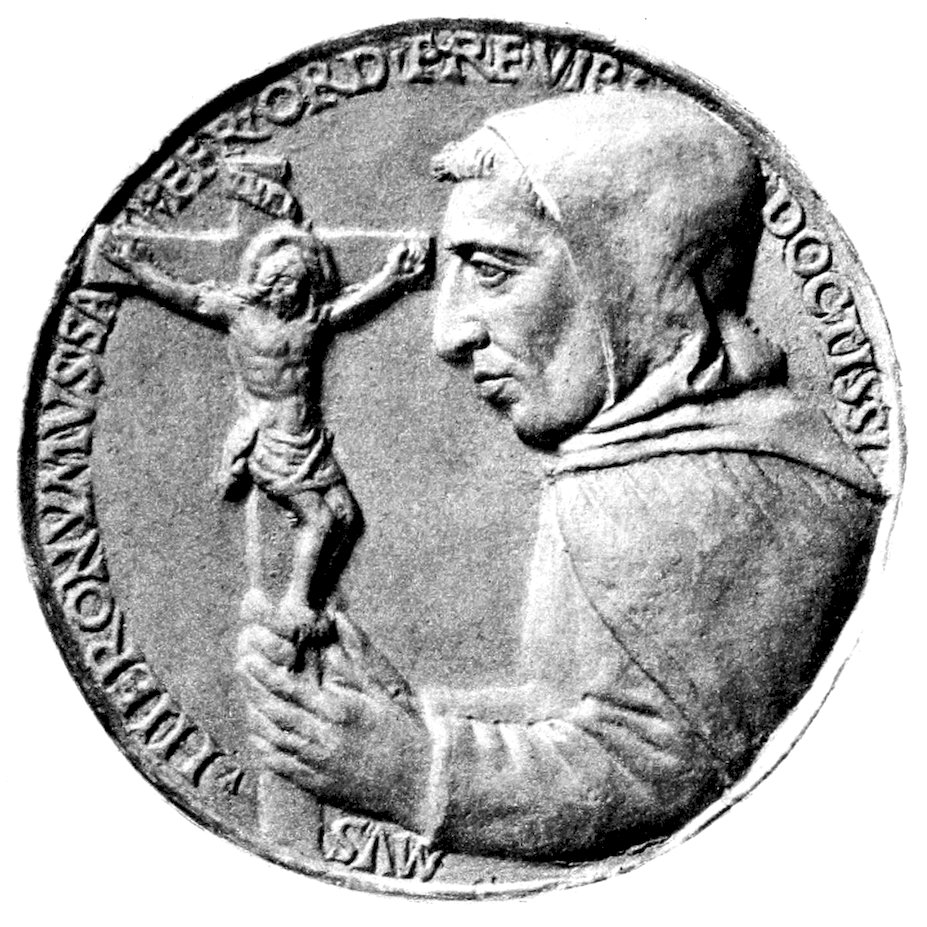
Fra Girolamo Savonarola
153All faith in him was gone. Objurgated by a thousand raucous throats, torn at by a thousand furious hands, the people’s broken idol sought refuge in his Convent of San Marco. Florence rose in riot, blood was shed, the blood of Francesco Valori in cold murder. The Convent of San Marco suffered storm; and the friars with their mattoid Prior were cast in prison.
In the interests of justice and of mercy, the Pope’s Holiness strove to have their trial held in Rome: but events had roused the Signoria to vindicate the honour of Florence “to satisfy the people who so long had been duped and trained in sacrilege and rebellion.” Wherefore, from Rome came Commissioners for the trial of Fra Girolamo Savonarola and his accomplices. Put to the legal torture, he confessed himself charlatan and criminal. He and his lieutenants, Frati Domenico and Silvestro, were found guilty as heretics, schismatics, and rebels against the Holy See, of political fanaticism amounting to high treason and mutiny against his lawful rulers. Handed to the secular judges for sentence, he was condemned, with the two friars, to death by hanging and the burning of their bodies after death. Handed back to the ecclesiastical power the three were degraded from their priesthood, to enable them to undergo the death penalty, avoiding the sacrilege of violence to the persons of those tonsured and anointed. At the very last, by the express commandment of the Lord Alexander P.P. VI there was offered to the condemned a Plenary Indulgence-in-the-article-of-death, with release from all Canonical Censures and Excommunications. Gratefully, thankfully, it was accepted; and the prisoners paid the legal retribution of their crimes.
Had he been an Englishman of the Twentieth Century, instead of a Florentine of the Fifteenth, Fra Girolamo Savonarola would not have been hanged or burned: but censured; suspended, from the exercise of sacerdotal functions, by ecclesiastical authority; and, at last, by medical authority, interned at Broadmoor during the Pleasure of the King’s Majesty, as a criminal lunatic.
This year 1498, was born Don Giovanni Borgia, called 154“Infans Romanus”; who was said to be a bastard of Cardinal Cesare (detto Borgia) by “a Roman spinster.”
This year also, died the twelve-toed chin-tufted excommunicated little Christian King Charles VIII of France; and was succeeded by his cousin Louis XII, a thin man with a fat neck and lip, and an Ethiopic nose, and exquisite attire, who immediately made two startling claims—for the nullification of his marriage with Madame Jeanne de Valois, and for the confirmation of his claim to the Duchy of Milan. The Lord Alexander P.P. VI always preferred friends to enemies; and, now that Charles VIII was gone to his own place, He gladly welcomed an opportunity of winning the allegiance of France. A commission of jurists went from Rome, who, on the legal facts, declared the marriage between the King and Madame Jeanne to be null and void. A papal dispensation legalized the marriage of the Christian King Louis XII and Queen Anne, his predecessor’s widow, whereby her duchy of Bretagne was retained to the crown of France. The claim to the Duchy of Milan was a matter which required consideration.
At the Sixth Consistory of the twelfth of September 1498, the Lord Alexander P.P. VI named one cardinal, who was
the Lord Georges d’Amboise, Gentleman of the Bedchamber to the Christian Kings Charles VIII and Louis XII; Cardinal-Presbyter of the Title of San Sisto.
At last, the Pope’s Holiness consented to allow Cardinal Cesare (detto Borgia) to renounce the scarlet cardinalitial hat and the sapphire cardinalitial ring, for a secular duchy, a royal wife, and a military career; saying that his presence among the clergy was sufficient to prevent reformation.[38] A marriage was proposed for him with Doña Carlotta de Aragona Princess of Naples; but rejected by King Don 155Federigo, who at the same time favoured the marriage which took place between Madonna Lucrezia Borgia and Don Alonso de Aragona Prince of Bisceglia. The plan of Cardinal Cesare was aided by fresh outbreaks at the pontifical baronage, especially by a new league of Colonna and Orsini on behalf of Cardinal Giuliano della Rovere. Now, no more time was lost. Don Cesare (detto Borgia) renounced his cardinalate in full consistory; and journeyed into France to cultivate the friendship of the Christian King on behalf of the Papacy. New alliances were in the air. King Louis XII saw no reason why he should remain in the ridiculous and paralysing isolation which the braggadocio of his predecessor had won. The Pope’s Holiness was by no means secure with Naples whose King Don Federigo, though owing all to Him, was inclined to be obstreperous and to show contempt, and to whose dominions the Catholic King and Queen were reaching. An alliance with the Papacy would suit the plans of France. An alliance with France would be of eminent service to the Papacy, at this moment when Colonna and Orsini were on the war-path, and the Muslim Infidel stirring the East. So, the mission of Don Cesare (detto Borgia) met with great success; a working understanding was arranged by his diplomacy; and the Christian King conferred on him the French Duchy of Valentinois.
It became evident that Milan must cede to France, the new ally of the Lord Alexander P.P. VI; and this signified the final rupture of the alliance of Borgia and Sforza. First, firm friends; next, strong supporters of the House of Borgia; then, indifferent neutrals; later, declared traitors; last, negligeable quantities; the conduct of the House of Sforza was influenced by one idea—loyalty to their name. It was the head of the House who was responsible, Duke Ludovico Maria Sforza-Visconti, a coward, a scoundrel, a traitor, a murderer in intention, the wretch who brought invading Frenchmen into Italy to aid his usurpation of the throne of Milan—to him be all the blame. The Vicechancellor-Cardinal Ascanio Maria Sforza-Visconti and all the Sforza of Pesaro, Santafiora, Chotignuola, Imola and Forli, followed the head of their House; and, as he led 156them astray, so he must be decried. Sforza has produced cardinals a many; but never a Pope. Sforza was never nearer to the pontificate than in this reign. Ascanio was more than likely to succeed the Lord Alexander—far more likely than the diabolical plebeian who did succeed. But Sforza followed the head of its House; committing political suicide. Loyalty in any age is rare: under all circumstances it is heroic, admirable.
From the Catholic King and Queen of Spain, Don Hernando and Doña Isabella, came the sometime pontifical captain Don Gonsalvo de Cordoba, charged to scold the Holiness of the Pope because of His new alliance with France. A very old weapon again was refurbished, and Catholic Spain, in fear or envy, menaced a Spanish Pontiff, Who had given her the New World, with Cardinal Giuliano della Rovere’s stupid General Council. So, in the shuffling of the cards, misery made strange bed-fellows acquainted.
Then the Orient blazed with sudden war, and the Muslim Infidel began hostilities with Venice. Christendom had lost Lepanto[39]; the Turks were intoxicated with success; and in Rome the Lord Alexander was deep in the scheme of a new Crusade when the year 1498 died.
Naples looked with sallow eyes on the amicable relations of the Papacy and France. The Christian King Louis XII married Duke Cesare de Valentinois to Madame Charlotte, daughter of Sieur Alain d’Albret and sister of King Jean of Navarre; and then entered into a treaty with the Venetian Senate for the partition of the duchy of Milan. These acts were discomfiting to the Regno, which could only regard the triumph of its enemy and the ruin of its friend as auguries of evil fortune. For Duke Cesare de Valentinois undoubtedly was the enemy of Naples now after the rejection of his suit to Doña Carlotta de Aragona, and in despite of the fact that his mother’s daughter, Madonna Lucrezia Borgia, was allied by marriage to the Neapolitan Prince Don Alonso of Bisceglia. The fruit of this last union was a son, born in November 1499, baptized in the Xystine 157Chapel by the name Roderico after the August Father of Madonna Lucrezia.
Troubles were brewing for the Sforza. The Vicechancellor-Cardinal left Rome, and the French invaded his brother’s duchy of Milan, driving Duke Ludovico Maria Sforza-Visconti (detto Il Moro) to ignominious flight. Ever ready to take advantage of the weakness of another Power, also ever ready to be jealous of another Power’s success, Europe eyed the triumph of France with apprehension and disgust. And when the Lord Alexander P.P. VI shewed pleasure at the fall of Milan, Spain and Portugal in their chagrin sent Orators to annoy His Holiness with invectives against His morals,[40] (as Satan sometimes denounces Sin,) and the validity of His election,[41] demanding impossible reforms, and a General Council at the Lateran. These petty incidents met the fate which they deserved. The Lord Alexander P.P. VI magnificently and magnanimously received the envoys in a public consistory, and made no efforts to prevent them from reciting their lessons. His Holiness invariably treated personalities with good-humoured scorn; and bore the vented spleen of kings as a mere essential inconvenience of His rank, to be brushed away and forgotten with the little muscarial nuisances of a Roman summer.
The year 1499, being the penultimate year of the Fifteenth Century, was occupied as far as the City was concerned with preparations for the Jubilee; that curious ceremony wherewith the Church affords an opportunity to the faithful to cleanse their souls from stain of sin by penitence and pious works. Penitence is an affair entirely personal, to be entreated of between a sinner and his Judge: but the Church, who (according to the Thirty Nine 158Articles) “hath power to ordain its rites and ceremonies,” prescribes the ceremonial works to be performed. In brief, these works consist in certain visits to certain basilicas of Rome, which must be entered by certain doors, and where certain prayers must be prayed. The Church, being a system, is systematic. In return for these works always supposing them to be accompanied by the appropriate penitence, She promises, from the infinite treasury of the Merits of our Divine Redeemer remission of the canonical punishment incurred, during his past life, by the sinner now penitent and purposing amendment. This Complaisance on the part of the Church technically is called an Indulgence; and the Jubilee Indulgence is in high esteem and eager acceptation. It is not in any sense a licence to sin; as, by a singularly silly misconception of its name,[42] it has been supposed to be: but, absolutely, a formal wiping of the slate, a ceremonial enabling of the soul to start anew. The Jubilee begins on Christmas Day with the opening, by the Supreme Pontiff, of a certain door in the Vatican Basilica, which remains an ingress until the Christmas Day of the century-end; and vast pilgrimages are used to flock into the City at such times. The year 1499 saw erected accommodation for visitors in the Borgo Nuovo, and numerous improvements on the Vatican side of Tiber. Churches were restored and furbished, the Mola of Hadrian strengthened; and the new wing of the Apostolic Palace of the Vatican called the Borgia Tower, which the Lord Alexander P.P. VI had built, was decorated in fresco by the brush of Messer Bernardino Betti (detto Il Pinturicchio).
In his book on the lives of artists which Giovanni Vasari wrote half a century later it is said that Il Pinturicchio painted on a wall of the Borgia Tower a picture of the Blessed Virgin Mary before whom the Borgia Pontiff kneels in adoration. Vasari also says that the painter used, as his model for Deipara, Madonna Giulia Orsini (nate Farnese) who was the Pope’s mistress: and this statement is repeated 159by many, to this day, including the German historian Herr Gregorovius (who pretends to have been guided by documents and by documents alone), as an example of the flagitious profligacy and profanity of the Lord Alexander P.P. VI.
Painters of the Fifteenth Century, in the manner of painters of the Twentieth, took their models as they found them. If the perpetuation of the world’s loveliness be no sin,—and on that point there are diversities of human opinion, and one Law,—then the person who is graced with natural beauty incurs, not disgrace, but honour in allowing it to be preserved by painting or by sculpture. Perfect beauty does not seek concealment, but simply admits the world to share its joy, without emotion of vanity or shame, without regard to rank or dignity. Pauline Buonaparte Princess Borghese was the model for Canova’s Venus. Bernini modelled his David (in Villa Borghese) from his own yυμνότης, while Cardinal Barberini (afterwards the Lord Urban PP. VIII) held the mirror. That amiable rake Messer Rafael Sanzio da Urbino painted his baker’s daughter as Madonna. Messer Jacopo Sansovino sculptured his Dionusos from a lad called Lippo Fabri, who, from long posing bare, took cold and died of fever; and, in his last delirium, continually leaped from his bed to pose as the god to whom his life was sacrificed. Messer Michelangelo Buonarroti, lost in admiration of his model the son of Messer Francesco Raibolini of Bologna (detto Il Francia), with his naif and customary depreciation of his brother-painters, told the boy that his father made better men by night than by day. Messer Andrea Verrocchio did his slim lean David from one of his alert apprentices. Messer Luca Signorelli painted his own dead son. Messer Rafaele Sanzio himself, times without number, sat for his master Il Pinturicchio. The beautiful Simoneta of Florence was the Venus of Messer Alessandro Filipepi (detto Botticelli); and the sons of Lorenzo and Giuliano de’ Medici (two of whom in after years wore the Triregno) did not disdain to sit as models for this master. All the works of art of the Borgian Era, representing saints and sinners, gods and demigods, eudaimones and kakadaimones, all obviously were portraits; the very imperfections, which the century of the Discovery 160of Man was too eager and too unsophisticated to plane away to fit arbitrary conventions, shew this: and volumes might be written of the models of great masters, who let their youth or beauty be set down for all time, and then achieved fame as Rafaele did, or Messer Simone Fiorentini’s (detto Donatello) nitid David or superb Saint George, or Messer Andrea del Sarto’s wistful Young Saint John.
Wherefore, not only may it be admitted, but defended, that Madonna Giulia Orsini (nata Farnese), who had come to share with Madonna Lucrezia Borgia the distinction of being the fairest young mother in Rome, sat as model to Il Pinturicchio for the Θεοτόκος of the Borgia Tower.
But, in proof of the ghastly ignorance or devilish malice which has sought to introduce an element of lubricity into this affair, it is necessary that three important facts should not go unconsidered. They are
(α)
that the Borgia Tower contained three or four large halls:
(β)
that the portrait of Madonna Giulia Orsini (nata Farnese), detta La Bella, in the character of the Blessed Virgin Mary with her Child, is a round picture over the door of the third hall; She is encircled by angels, and there are no other figures in the composition:
(γ)
that the portrait of the Lord Alexander P.P. VI is a square picture in the second hall; and the Holiness of the Pope is presented in His pontifical habits but bare-headed and without the triregno, devoutly kneeling before the Apparition of our Divine Redeemer Who rises from the tomb.
That is the little matter of the calumny, in support of which the German historian with others of like mind have solved the problem of the squaring of the circle![43]
Now that the French alliance was secure, with the help of the Christian King Louis XII, the Lord Alexander P.P. VI proceeded with the conquest of the Romagna and the reduction of the rebellious vassals of the Holy See. Duke Cesare de Valentinois was named Generalissimo of 161the pontifical army; and a Papal Bull declared the fiefs of Rimini, Pesaro, Imola, Forli, Camerino, Faenza, etc., to have forfeited their rights until they should have made satisfaction, paying the arrears of annual tribute into the chancery of their paramount lord. The fact was fully realised that it was useless to attempt to pacify “these kakodaimones” with “holy water”; as, as a last resort, after seven years forbearance, force was to be used against Sforza of Pesaro, Sforza-Riario of Imola and Forli, Manfredi of Faenza and the rest. The glowing splendour of the personality of Duke Cesare de Valentinois, without emotion and without remorse, fitted him for his task. He was a perfect egoist, splendidly indifferent to all the world. During his life, his enormous talents, his swift success, his summary acts gained him the reputation of being superhuman, inevitable as Fate. On the eleventh of November 1499, he left Rome with four thousand condottieri and three hundred lancers. His lieutenant and standard-bearer was the same noble and vigorous knight, Don Pietro Gregorio Borgia, of the Veliternian Branch, who had changed clothes with him in 1495, enabling him to cheat the Christian King. On the seventeenth of December, he stormed and captured Imola, whence Madonna Caterina Sforza, widow of Count Girolamo Riario, had fled, refusing obedience or tribute to her suzerain, and anew entrenching herself at Forli, her other fief. She left at Imola such an odious memory of her rule, that in after years the citizens would blush for shame of it, while blessing Duke Cesare de Valentinois, who, as the minister of Divine Justice, made an end.
The encounter between Madonna Caterina and Duke Cesare caused extraordinary exhibitions of vigour and agility on both sides. When a desperate unscrupulous woman struggles with a strong and ruthless man, she will do much damage: but, in the end, she must succumb. Directly after the fall of Imola, Duke Cesare received letters from Rome announcing that the Pope’s Holiness narrowly had escaped violent death: for Madonna Caterina, to save herself and her fiefs, believing that Duke Cesare would be compelled to relinquish his expedition if the Pope were dead, had tried to slay the Holy Father by 162means of venom. To this end, she had sent two Orators charged with proposed conditions of peace; and also she sent a letter (enclosed in a hollow stick, say some) which would cause the Supreme Pontiff to fall dead as soon as He should open it. When the plot was discovered, Tommaso da Forli, a papal chamberlain who had brought the missive, admitted his guilt; (under the Question guilt was commonly admitted); and said that he hoped, by the death of the Pope, to raise the siege of Imola and Forli. This extraordinary story is recorded by several chroniclers, including Monsignor Hans Burchard the Caerimonarius, the dull and stupid defamer of the Lord Alexander P.P. VI. The name of the chamberlain gives rise to curious speculations. Tommaso da Forli presumably might be a bastard of the city of Forli of insufficient birth to warrant the adoption of the appellation of his unknown father or mother; and who might very well have taken the name of his native city with the preposition “da” (not “de’,” be it noted) as a surname. Papal chamberlains are nothing more than pontifical flunkeys, and “Thomas from Forli,” being a lackey with access to the Pontifical Person, might have been employed by Madonna Caterina to stab the Pope. That is not unlikely: but the story of the envenomed letter obviously is false; and interesting only as shewing the trend of men’s minds in 1499; and as a proof, perhaps, that if, as has been alleged in the purest ignorance, the envenoming of its foes was a custom of the House of Borgia, at least one other Italian court indulged in the same horrible habit upon occasion.
Madonna Caterina’s second recorded act of treachery took place after she had surrendered the city of Forli to Duke Cesare. She retained possession of the castle, and refused to give it up. As soon as the pontifical artillery began to bombard her fortress on Christmas Day, she flew, from one of the fortalices, a banner bearing the Lion of St. Mark, to make believe that she was leagued with Venice, a republic then at peace with the Holy See. It was a Venetian attached to the staff of Duke Cesare who exposed the ruse, with the affirmation that his Senate had no alliance with Madonna Caterina. The day following, she gave signs of 163weakening; and requested a parley with her beleaguerer. When Duke Cesare approached, and just was about to put his foot on the drawbridge over the moat by which the castle was surrounded, suddenly and without warning the machine swung up and in. Madonna Caterina indignantly disclaimed any perfidious intent, and threw all blame on the castellan, Don Giovanni Casale: but all beholders were aware of a deliberate attempt to capture and hideously to kill the Generalissimo, which only had failed through too eager precipitancy. No parley took place; the siege continued; and, in time, this audacious war-wife was compelled to capitulate. Duke Cesare sent her to Rome as a prisoner-of-state, with every chivalrous consideration for her sex as well as for her illustrious birth as daughter of the great Duke Francesco Sforza-Visconti of Milan: and on her arrival in the City she was lodged in the Belvedere Apartment of the Vatican, whence, after a futile attempt at escape, she was transferred to honourable captivity in the Mola of Hadrian.
During the siege of Forli an event occurred, of secondary importance, except as evidence of the mystery surrounding the paternity of Duke Cesare. The Most Worshipful Lord Giovanni Borgia (detto Giuniore) Cardinal-Presbyter of the Title of Santa Maria in Via Lata died at Urbino. He was one of the bastards of that beautiful splendid sneak and coward Don Pedro Luis de Lançol y Borgia, (Duke of Spoleto, younger brother of the Lord Alexander P.P. VI, who had been named Prefect of Rome and Castellan of Santangelo by his Uncle, the Lord Calixtus P.P. III, and who died in his flight from Rome in 1458). The said Most Worshipful Lord Cardinal Giovanni Giuniore had been Bishop of Melfi since 1492. In 1496, he was elevated to the Sacred College, and given command of the condottieri which the Lord Alexander P.P. VI was preparing against France; and, when Duke Cesare renounced his scarlet early in 1499, he had ceded to this cardinal his Metropolitan Archbishopric of Valencia. The Lord Giovanni Giuniore had held Legations to Umbria, Bologna, Ravenna and France, and was acting as Legate to Umbria when he died at Urbino. Duke Cesare himself announced this death to 164the Pope in a letter written from Forli, and dated the sixteenth of January 1500, in these words: “I have news of the death of Cardinal Borgia, my brother, who died at Urbino.” Duke Cesare wrote a kind of Latin neither Golden nor Silvern but particular to himself, as also was his Italian and there is no known instance of his using “frater” or “fratello” in the tertiary sense of “cousin.” If the dead Cardinal and the Duke were uterine brothers, then Don Pedro Luis was their father; and Duke Cesare was not the son, but the nephew, of the Lord Alexander P.P. VI. The death of the Cardinal, however, has been alleged by some chroniclers to have been caused by venom administered by Duke Cesare. The charge is essentially absurd. There was no motive; for Cardinal and Duke were comrades, brothers-in-arms, equally engaged in the reduction of the rebellious Romagna; there could have been no jealousy, for they occupied separate and independent ranks, (of which Duke Cesare had chosen his,) the Cardinal Giovanni Giuniore as Legate, being the older man (41), and Duke Cesare the younger (26) as Generalissimo: nor was the Cardinal rich enough to make his death desirable. But, at all events, it was impossible that Duke Cesare should envenom him for the simple reasons that the two were many miles apart during seventeen days before the death, and that no venom of slow action was known to the Fifteenth Century any more than it is to the Twentieth.
At the Seventh Consistory of the sixteenth (or twentieth) of March 1500, the Lord Alexander P.P. VI named three cardinals, who were
(α)
the Lord Don Didaco Hurtado de Mendoza, a Spaniard; Cardinal-Presbyter of the Title of Santa Sabina: (he was afterwards called “The Cardinal of Spain:”)
(β)
the Lord Amaneus (Amanateus) d’Albret, of Navarre; Cardinal-Deacon of San Niccolo in Carcere Tulliano:
(γ)
the Lord Don Pedro Luis de Borja, a Pontifical Nephew, brother of the Cardinal of Monreale (Giovanni Seniore); succeeded his deceased cousin 165Cardinal Giovanni Giuniore as Cardinal-Deacon of Santa Maria in Via Lata.
The Christian King Louis XII, now calling himself the “Second Caesar,” was not idle during this year 1500. Duke Ludovico Maria Sforza-Visconti certainly recovered his duchy of Milan; but, after the Triumph given to Duke Cesare de Valentinois in Rome on his return from the Romagna with Madonna Caterina Sforza-Riario as his prisoner-of-war, the prestige of the Papacy was so increased that the French took heart and gained a notable victory at Novara, capturing Duke Ludovico Maria and his brother the Vicechancellor, who then were incarcerated safely in France.
In July, Don Alonso de Aragona, Prince of Bisceglia, Quadrata, and Salerno, and husband of Madonna Lucrezia Borgia was murdered; and the opinion carefully and carelessly has been cultivated that this was one of the crimes of Duke Cesare de Valentinois and the Lord Alexander P.P. VI.
According to the account of Don Paolo Cappello the Orator of Venice, as given by Herr Gregorovius, Prince Don Alonso, going to the Vatican at eleven o’clock at night on the fifteenth of July, was assaulted on the steps of St. Peter’s by masked men armed with poignards, and wounded in the head and arms and thighs. Weak from loss of blood, he dragged himself into the Apostolic Palace, where his wife Madonna Lucrezia swooned at the sight of him. He was carried into one of the rooms; and a cardinal, believing him to be in the article of death, imparted the usual absolution. But his youthful vigour enabled him to progress on the road to recovery, under the nursing of his wife and of his sister-in-law Madonna Sancia, who, with their own hands, prepared his food (they were royal princesses), while the Pope’s Holiness provided a body-guard of men-at-arms. No one knew who had wounded the prince: but gossip said that it was the same hand that had slain the Duke of Gaudia. Duke Cesare de Valentinois had issued an edict forbidding any one 166bearing arms to pass between the Mola of Hadrian and the Vatican. Don Paolo Cappello further records that Duke Cesare had said, “I did not wound the prince: but, if I had “done so, he had well deserved it.” Duke Cesare was not ashamed to visit the invalid; and, in coming away, he had said, “That, which is not done at noon, can be done at sunset.” More than a month later, at nine o’clock on the night of the eighteenth of August, Duke Cesare again visited Prince Don Alonso; and, having driven Madonna Sancia and Madonna Lucrezia from the room, he introduced his captain Don Michelotto who strangled the wounded man. After this, Duke Cesare publicly declared that he had killed the Prince of Bisceglia, because the latter had tried to murder him by setting an archer to shoot him silently in the Vatican gardens:—so far Don Paolo Cappello.
Monsignor Hans Burchard the Caerimonarius says, that, at eleven o’clock on the night of the fifteenth of July, Prince Don Alonso the husband of Madonna Lucrezia Borgia was found on the steps of St. Peter’s, wounded by assassins in the head, the knee, and the right arm. After the assault, the assassins were escorted by forty knights beyond the City-gate called Porta Pertusa. Prince Don Alonso lived near the Vatican in the palace of the Cardinal of Santa Maria in Portico; but, owing to the serious nature of his wounds, he was carried into the pontifical palace, and lodged in a room of the Borgia Tower. When King Don Federigo heard of the attempt upon his nephew, he sent Messer Galieno his own leech to cure him. Later the prince was strangled; and the leeches with a certain hunchback servant were put to the Question in the Mola of Hadrian, and afterwards released as innocent.
A chronicle of Pavia of much later date says that Duke Cesare killed Prince Don Alonso at a time when he was in bed with his own wife Madonna Lucrezia.
Before examining the divergences of this evidence, it may as well be said that the original despatches of Don Paolo Cappello the Orator of Venice are not attainable. Many years later, a learned patrician of Venice, Don Marino Sanuto, wrote the History of the Venetian Republic from 1496 to 1533 in fifty-six folio volumes. He cited the 167state-archives, despatches of orators, etc., and his work is marvellously well done: but when all is said, the fact remains that the despatches of Don Paolo Cappello, with those of many others, have been edited by a stranger to the writers, and to the circumstances under which they wrote. Monsignor Burchard held an important office at the Vatican. He was German, and inimical to Borgia. On matters connected with his office of Caerimonarius, i.e., the superintendence of public functions, he might speak with some authority: but beyond that he is an inveterate gossip and scandalmonger. In his case, also, it is impossible to know what he really wrote, because the original holograph of his Diarium (with the Diarium of Infessura and other similar works) even now awaits discovery by students of ancient archives.
What charges lie against Duke Cesare de Valentinois? It is Cappello who states that he drove away the women, and caused Prince Don Alonso to be strangled by Don Michelotto. Burchard appears ignorant of these details. It is Cappello who states that Duke Cesare admitted and defended the murder. Of this Burchard says nothing: he relates that the prince was strangled; and, from his mention of the interrogation of the leeches and of the hunchback, it would appear that others beside Duke Cesare were suspected. Cappello says that the prince was poignarded in head, arms, and thighs; Burchard, in head, right arm, and knee. Cappello speaks of a guard appointed by the Pope to watch the wounded man. Burchard does not record this. There are discrepancies between the two accounts; some, of reasonable importance: e.g., Burchard’s account of the forty knights who escorted the assassins from the City; and of the sending of the royal leech without mentioning any suspicions on the part of King Don Federigo. But nowhere can be found a proved accusation against Duke Cesare de Valentinois, or against the Holiness of the Pope.
From a study of the various statements, (derisable though to some extent they be,) and of known facts, a reasonable enough history of the affair may be compiled, and one which happens to be exculpatory of Borgia.
168Don Alonso de Aragona Prince of Bisceglia, Salerno, etc., was a nephew of King Don Federigo of Naples. At the age of nineteen, he married Madonna Lucrezia Borgia, on political grounds to consolidate friendly relations then existing between Papacy and Regno. All accounts agree that this was a genuine love-match as well; and the chronicler Talini says of the prince, “he was the most beautiful youth that I have ever seen in Rome.”
A year after the marriage Madonna Lucrezia bore him an heir, Don Roderico; who immediately was provided-for with the duchy of Sermoneta. The young Prince and Princess of Bisceglia lived in the palace of the Cardinal of Sante Maria in Portico by the Vatican, in order to be near to the Pope.
In the year 1500, the relations of Papacy and Regno had undergone a change. The Lord Alexander P.P. VI was now allied with France, the old and still-distrusted enemy of Naples; and King Don Federigo had joined the unmitigable handful of men who were blackmailing the Pope’s Holiness with threats of a General Council. The Prince of Bisceglia as a Neapolitan, therefore, would not be persona gratissima to the supporters of Borgia.
When it was desired to reward and exalt a subject, the sovereigns of the Borgian Era had the naïve habit of dispossessing one of their enemies, and conferring the vacated fief on their new protégé. In order to enrich Prince Don Alonso with the principality of Salerno, the Majesty of Naples had deprived the noble Neapolitan House of Sanseverini. In order to enrich His grandson the baby Don Roderico with the duchy of Sermoneta, the Holiness of the Pope had despoiled the noble Roman House of Caïetani. And it readily will be understood that Caïetani and Sanseverini were extremely likely to view these losses with anything but resignation.
Regarding the edict of Duke Cesare de Valentinois, that none should go armed between the Mola and the Vatican, it must be admitted that this was only a very ordinary precautionary measure. The district named is the immediate precincts of the pontifical palaces of peace and war, which were connected by the fortified gallery-passage, 169through the Region of Borgo, called Lo Andare; and the baring of arms within the presence of royalty was, at all times, and in all courts, a capital crime. Duke Cesare as Generalissimo was responsible for the maintenance of order; and he was no laggard in any official capacity. If then, the truth of the stabbing on the steps of St. Peter’s and the strangulation in the Borgia Tower be granted, they might be defended as an execution of the death penalty prescribed for a breach of the law, such as the fiery Neapolitan prince is extremely likely to have committed. Royal or patrician criminals were frequently done to death in private, by quasi-assassination, to avoid the degradation of the touch of the public carnifex.
Again, granting the said stabbing and strangling, and regarding them as an act of private vengeance on the part of Duke Cesare against the prince; it should be remembered that people had the custom of defending their lives by slaughtering an enemy who set archers to shoot at them in the garden.
But, during the pontificate of the Lord Julius P.P. II (Giuliano della Rovere) the eternal enemy of the House of Borgia, (whose not mean portrait by Messer Rafaele Sanzio da Urbino may be seen at the National Gallery,) the captain Don Michelotto, who is supposed to have strangled the Prince of Bisceglia by order of Duke Cesare, was seized and put to the Question in the usual manner. It was attempted to find out, by means of this rigour, the truth about the various crimes which he was said to have committed for his master; and particularly the murder of Prince Don Alonso. But although he was in the hands of a ruthless despot, who, legally could have broiled him alive like a forger or could have broken with iron bars every bone of every limb of his body on the Wheel, with none to hinder, Don Michelotto soon was set at liberty as having given no evidence of guilt, either on his own part or of that of Duke Cesare. It will appear from this fairly convincing test that there is a strong reason for regarding the story of strangulation as a piece of fiction. As a last contribution to the theory, it is suggested that contortions caused by tetanus, which might have set in by reason of the poignard wounds, 170may have simulated, to the ignorant and casual observer, the appearance of strangulation. The bacillus of tetanus is of earth origin, and every one knows the vulgar method of wiping a dagger. Otherwise the strangulation theory may be dismissed.
Of the stabbing on the steps of St. Peter’s there is no such room for doubt. The discrepancy between Cappello (edited by Sanuto, understood,) and Burchard, (a copy of him by an unknown hand, also understood,) as to the position of the wounds has no material significance. Head, arms, and thighs, says Cappello; head, right arm, and knee, says Burchard. It is quite clear that the unfortunate youth (he was just of the age of twenty-one years) wore beneath his doublet one of the fashionable mail-shirts of the day, strong enough to turn a tempered blade at closest quarters and yet so fine that it could be hidden in two hands; and which caused him to be wounded anywhere except in his handsome trunk.
The number of wounds and their wide distribution speak of more than one occasion. The frightful loss of blood (the wound in the thigh), the delusions of Fifteenth Century chirurgeons, the elementary condition of the pharmacopœia, the time of year—Sol in Leone—when Rome fizzles in fevers and insanitary stenches, preclude possibility of recovery: and it is only reasonable to conceive that Prince Don Alonso died, after a month’s lingering weakness and fever, of the poignard wounds and the attentions of the leeches, unassisted by a problematic noose, or the compression of his windpipe by strong thumbs.
Then who were the masked men with poignards, and who is responsible for them?
In this connection, Duke Cesare de Valentinois has not been named. The Pope’s Holiness did not alter His behaviour to him. He found him antipathetic as always: some said He was afraid of him.[44] But He did not cease to use him, to allow him access to His person, to decorate him with titles; and the Lord Alexander P.P. VI was far too 171magnificently invincible and too conscious of His power, not to have resented the murder of the beloved husband of His charming and favourite daughter. A Pontiff Who could, and did, crush reigning sovereigns at His will, was not likely to fear a mere duke. The clergy treated Duke Cesare, as always, with profound respect. And—Madonna Lucrezia Borgia, until the very end of his life, maintained friendly relations with him; and it was to her that the death of the Prince of Bisceglia brought most grievous trouble. Evidently the people most intimately concerned with Duke Cesare did not look upon him as an assassin: at any rate, the legend of his guilt subsequently emanated, not from them but, from his foes.
There was a total absence of motive on the part of Duke Cesare, unless the theory of legal but private execution, or the theory of justifiable homicide, be maintained. And for want of proof of strangulation, these can be dismissed with deserved contempt.
But—there was a very strong motive for the stabbing present in the Neapolitan House of Sanseverini, and in the Roman House of Caïetani, who had suffered loss of the principality of Salerno, and of the duchy of Sermoneta, in order to the enrichment of Prince Don Alonso of Bisceglia and Salerno and his infant son Duke Roderico of Sermoneta. Is it probable that great barons of the Fifteenth Century, or of any other century, calmly would submit to deprivation of their choicest fiefs, without at least an attempt to gain satisfaction of one or another kind? It may be concluded, then, that in all human probability Prince Don Alonso was the victim of a vendetta. His assassination was a private affair. The assassins were professionals in the pay of Sanseverini, or Caïetani, or both together; who, when the deed apparently was done, (here Burchard recording probability is valuable,) were surrounded by forty knights (Sanseverini or Caïetani of course) and escorted out of the City by the nearest gate, Porta Pertusa behind St. Peter’s, (the nearest gate to avoid attracting the attention of the bargelli in Borgo or Trastevere), whence, by a short circuit to the south, they would attain the Via Portuense, sixteen miles of which would bring them to Porto on the right bank 172of Tiber, opposite to the fortress at Ostia on the left bank belonging to Cardinal Giuliano della Rovere.
At the Eighth Consistory of the twenty-eighth of September 1500, the Lord Alexander P.P. VI named ten cardinals, who were,
(α)
the Lord Don Jaime Serra, a Catalan, Vicegerent of Rome; Cardinal-Presbyter of the Title of San Vitale:
(β)
the Lord ... Bacocz, an Hungarian, Chancellor of Hungary; Cardinal-Presbyter of the Title of San Martino ai Monti:
(γ)
the Lord Don Pedro Isualles, a Sicilian; Cardinal-Presbyter of the Title of San Ciriaco alle Terme Diocleziane:
(δ)
the Lord Don Francisco de Borja, bastard of the Lord Calixtus P.P. III; who had lived obscurely from his birth in 1441 until now; Cardinal-Presbyter of the Title of Santa Lucia in Silice alias in Orfea:
(ε)
the Lord Don Juan Vera, a Spaniard, Archbishop of Saliterno; Cardinal-Presbyter of the Title of Santa Balbina:
(ζ)
the Lord Alois Podachatarios, a noble of Cyprus, the Pontifical Greek Secretary; Cardinal-Presbyter of the Title of Sant’ Agata in Suburra:
(η)
the Lord Giovantonio Trivulzio, a noble of Milan, elevated to oblige the Christian King Louis XII; Cardinal-Presbyter of the Title of Santa Anastasia:
(θ)
the Lord Giambattista Ferrari, Bishop of Modena; Cardinal-Presbyter of the Title of San Crisogono:
(κ)
the Lord Gianstefano Ferreri, Abbot of San Stefano di Vercello; Cardinal-Presbyter of the Title of San Sergio e San Bacco:
(ι)
the Lord Marco Cornaro, brother of Madonna Caterina Cornaro, Queen of Cyprus; Cardinal-Deacon of Santa Maria in Portico.
In view of the danger looming in the near East, the 173Lord Alexander P.P. VI issued a Bull proclaiming a new Crusade; and addressed a Brief in the same sense to the Christian King Louis XII. Venice being in serious and immediate peril received His help in the shape of money and troops. Nevertheless though Modon fell to the Muslim Infidel, even this disaster, giving point to the Pope’s exordium, failed to arouse the Christian Princes of Europe from their disgraceful apathy. The Lord Alexander P.P. VI now imposed a graduated crusade tax on the revenues of the Sacred College, each cardinal being mulcted on the value of his benefices. This, though a righteous and elevating ensample, was looked upon with extreme disgust; for, like other men, cardinals are very sensitive in the pouch. Cardinal Raymond Perauld, forgiven for his treachery with Charles VIII, was named Apostolic Ablegate to Germany charged with authority to reform the abuses, which avarice and ambition on the part of German prelates were causing, to the shame of all right-minded men. But the Elect-Emperor Maximilian—(who, in a picture by Albrecht Durer in the British Museum, modestly is styled Imperator Caesar Divus Maximilianus Pius Felix Augustus;[45] and, in another, on vellum in the same collection, bears, after the imperial titles, the styles of all sovereigns of Europe, including Rex Angliæ, in despite of King Henry VII Tudor then happily reigning,)—the Elect-Emperor Maximilian remembered that in 1496 his ill-advised advance into Venetia had been opposed and not received with obsequious adulation; and he now refused to 174allow the Papal Ablegate to enter his Empire. In such pettiness did the Holy Roman Emperor of the Habsburg House of Austria have continual joy.
This year in Rome was the Holy Year, the last of the Fifteenth Century, the year of Jubilee. The Holy Father extended the privilege to Christendom; and huge pilgrimages of persons of rank and distinction from all Christian countries save Germany and Switzerland flocked to the Eternal City throughout the year. The pilgrims’ alms considerably added to the papal treasury; and, by order of the Lord Alexander P.P. VI, these exclusively were set aside for the pacification of the States of the Church in the Romagna; a magnificent example of the political foresight which secured the temporal possessions of the Holy See during three hundred and seventy years, till 1870. Before the end of the year 1500 the splendour of Duke Cesare de Valentinois was increased by the title of Gonfaloniere of the Holy Roman Church: and, with the ample funds of the Jubilee, he had enlarged his army by the acquisition of several squadrons of French mercenaries, for a new expedition into the rebellious provinces.