Book the Second (continued 4)
Reading edition
To turn from the historian to the novelist will afford a little recreation in this quest of the Venom of the Borgia; and, also, the diversion will not be unprofitable: for the novelist is an exceedingly important person by reason that he commands an infinitely wider audience than the historian, and influences, forms, or moulds, an infinitely larger section of opinion. M. Alexandre Dumas in his Crimes Célèbres has much to say about the Borgia. Knowing, as a practised 220hand, that the best fiction is that which has a substratum of fact and an air of truth, M. Dumas quotes the precious Messer Paolo Giovio and his Cantarella which already has been mentioned here. Further, with a wealth of “corroborative detail calculated to give verisimilitude to an otherwise bald and unconvincing narrative,” he describes the preparation of a liquid venom which, he says, the Borgia used. A bear was caught and made to swallow a strong dose of arsenic. When this began to take effect, the bear was suspended by his hind-legs head-downward; and incontinent he would fall into convulsions, while from his throat there poured a copious deadly stream of foam, which was collected on a silver plate, bottled in vials hermetically sealed; and this was the liquid Venom of the Borgia.
There were plenty of bears in the Apennines, perhaps, even in the Alban Hills within twenty miles of Rome; so the bear is probable enough. Having caught his bear, Duke Cesare would convey him to the Vatican—a large palace truly, but rather too full of people to be desirable as a private venom-factory. On a dark night in a lonely courtyard, the Pope’s Holiness and the Duke’s Excellency would administer the arsenic to the bear. The method of administration is not described, nor the slinging up of the beast prior to his convulsions, nor the picture of the aged Pontiff skipping round with the silver plate in His solicitude that no drop of the fluid should be lost, nor the solemn bottling of the vials, nor their hermetic sealing with what seal? The Ring of the Fisherman? And M. Dumas carefully omits to say that the nasty mess so secretly and arduously obtained would have been far less venomous than the original dose of arsenic; which, administered neat, without the intervention of an ill-used bear, certainly would have slain: but which would be deprived of most, if not of all, of its venomous potency, by its submission to the digestive processes of M. Dumas’ improbable and impossible bear.
Undoubtedly, there were the same venomous substances in and on this earth in the Fifteenth and Sixteenth Centuries, as there are now: some few were known; but 221many more, and these the most sure and deadly, were not even dreamed of, e.g., strychnine, prussic acid, or the hideous bacilli, accessible as dust to any Twentieth Century medico who, on the sole condition that he is not instigated by criminal motives, with perfect security to himself can envenom and slay a street, a district, or a city. In the year 1164, Abd-el-Mumin-ben-Ali the Moorish King of Spain chased from his dominions all Jews and Christians who refused the faith of Islam. Among these, to Egypt went the celebrated Moses ben-Maimon. All that was known, he knew; and he knew sixteen venoms; litharge, verdigris, opium, arsenic, spurge or milk-wort, cashew-nut, hemlock, henbane, stramonium or thorn-apple, hemp, mandrake, venomous fungi, plantain, black-nightshade or felon-wort, belladonna, and cantharides. To these, were added in the Borgian Era four centuries later, the tri-sulphite of arsenic, orpiment, antimony, corrosive sublimate, aconite or wolfsbane or monkshood, and perhaps white hellebore, and black or Christmas-Rose; making two and twenty substances known to be venomous.
Undoubtedly, much damage might be done with this arsenal of venoms: but only in the event of the existence of the will to use them, and of the knowledge of the method of their exhibition.
Undoubtedly, there was the will. The fact that Madonna Caterina Sforza-Riario (author of a wonderful collection of recipes, domestic and medicinal, a good housewife as well as witch and warrior,) was said to have attempted the envenoming of the Pope’s Holiness, as described in Book II, speaks for the fact that venom was feared, and therefore likely to be used. Governments experimented with venoms: for what purpose, who can tell? M. Lamanshy published an interesting document dated 1432 which he found in the Venetian Secret Archives.[71] “Trial has been made, on three porcine animals, of certain venoms, found in the chancery, sent very long ago from Vicenza, which have been proved not to be good.”
222Undoubtedly, there was the will. Undoubtedly, also, there was not the ability.
Strange and paradoxical though it may seem to be, alchymical knowledge, alchymical art, was in a lower condition during the years succeeding the Renascence of Learning, than it had been in the Middle Ages, the so-called Dark Ages, which had gone before. The Dark Ages were the ages of Simples. The Age of the Renascence was the age of Compounds. And, in those compounds, virtue was changed, or lost, by sublimation, by distillation, or annulled by heterogeneous admixture. The following will make this plain.
In the Dark Ages, medicaments were made from single herbs exhibited in the form of draughts, poultices, lotions, or unguents. The old herbaries of Dioskorides, or of Appulejus, were used as text-books; and a few extracts from these will be curious, perhaps valuable, certainly a help to understanding.
(α)
The herb Betony or Bishopwort (Betonica officinalis) must be gathered in August without the help of iron, the mould shaken from the roots, and dried in the shade. When triturated, two drachms of it, mixed with hot beer or wine or honey, is an antidote to venom, a digestive, a cure for hydrophobia, constipation, toothache, and prevents monstrous nocturnal visitors, or frightful sights and dreams. A lotion, made from the herb seethed in fresh water till two-thirds are evaporated, cures broken-head, epistaxis, fatigue, and rupture; or the leaves may be used as a poultice. (As a matter of fact, Betony is intoxicating, emetic, and purgative.)
(β)
The herb Vervain or Ashthroat (Verbena officinalis) must be pounded as a poultice for wounds and carbuncles. It is an antidote to all venoms, and dogs may not bark at him who bears it.
(γ)
The herb Clovewort (Ranunculus acris), wreathed with red thread on the neck during the waning of the April or October moon, cures lunacy.
(δ)
The herb Mugwort (Artemisia dracunculus), pounded 223to an unguent with well-boiled olive-oil, will make strained sinews supple. (This is excellent.)
(ε)
The herb Ravensleek (Orchis, Σατύριον) will cure sore eyes when they are smeared with its juice.
(ζ)
The herb Watercress (Nasturtium officinale) will with its juice stop hair from falling.
(η)
The herb Madder (Rubia tinctoria) as a poultice cures sciatica.
(θ)
The herb Clover (Trifolium pratense) prevents him who carries it from suffering sore jaws.
(ι)
The herb Rosemary (Rosmarinus officinalis) is good for the teeth.
(κ)
The herb Rue (Ruta graveolens), eaten green is an antifat; a twig stops nose-bleeding; macerated in vinegar and soused on the brow induces forgetfulness. Recommended for priests who wish to observe their vow of continence.
(λ)
The herb Dwarfdwostle or Pennyroyal (Mentha pulegium), as unguent, cures sea-sickness; as a salve, or burned as incense, cures fever and bellyache.
(μ)
The herb Sage (Salvia), as a lotion, cures itch.
(ν)
The herb Marjoram (Origanum vulgare), steeped in vinegar, cures headache, or may be chewed for a cough.
(ξ)
The herb Foxglove (Digitalis purpurea), as a poultice, cures sores and pimples, ἕρπης. (Its venomous principle appears to be unknown.)
(ο)
The herb Wildthyme or Shepherdspurse (Thymus campestris) will remove all inward foulness by the drinking of its ooze.
(π)
The herb Violet (Viola odorata), made into an unguent with lard or honey, cures wounds.
(ρ)
The herb Wildgourd (Cucumis colocynthus, κολοκύνθος ἀγρía), its inward neshness pounded in lithe beer without the churnels, will stir the inward.
Those are Simples, i.e., medicaments derived from single herbs, easily come-by, within the reach of all; suited to a simple, but by no means silly, race of men content with simple things, gifted with faith and sense, 224and unconcerned to dive below the surface and explore, or experiment with, nature’s sacrosanct arcana.
The Renascence of Learning, when the works of ancient writers were rediscovered, devoured, put in practice, filled men’s minds with new ideas, and completely changed their point of view.
The Most Salubrious Precepts of Medicine written by Quintus Serenus Sermonicus in the Third Century; the Thirty Seven Books of Natural History by C. Plinius Secundus (Pliny Senior) which first saw light in A.D. 77; the eighty-three Treatises of Claudius Galenus, (A.D. 130–200); the thirty-four chapters of the Animal Medicaments which Sextus Placitus wrote in the Fourth Century after the Incarnation; the eight books of Alexandros of Tralles in Lydia, On Medicine, first given to the world in the Sixth Century;—these were the keys that opened the door of speculation to the alert and eager men of the Fifteenth Century, already intoxicated by the glorious Discovery of Man.
Weird and wonderful effects were produced by this flood of knowledge. Weird and wonderful were the new significances given to natural things, the combinations of natural objects projected, the doctrines evolved from observation of natural phenomena. The study of nature became a sacred thing, reserved for the reverent and wise. Its followers were called magi, or magicians; their pursuit was magic. The magical art was either white or black, for the good or ill of men. Great and holy personages practised white magic: the black was damned by the Church, and the bare suspicion of its practice sufficed to burn. The Lord Alexander P.P. VI distinguished Himself by His severity to the black magi. White magic included the art of healing; divination by cheiromancy, amniomancy, lithomancy, astrology, and also experimented to find out the hidden properties and virtues of all things strange, as well as common. It was a vast field for research; and the men who walked therein were just like boys, eager, sensible, ardent, inexperienced, ready to assume and take for granted.
225A most eminent mage was Messer Eurico Cornelio Agrippa. During the pontificate of the Lord Alexander P.P. VI he wrote his learning in a book which he called The Book of Occult Philosophy. In the year 1510 he shewed his work to a friend, the celebrated Abbot Trithemius, who was charmed with it, added to it, and advised Messer Eurico to impart it to the elect alone. The advice apparently was taken; for the book was not published till 1531. The mage largely dealt with kabbalistic writing, giving various mysterious alphabets for use in magical recipes. He set forth the sigils planets and planet-signs of certain archangels, patrons of the days of the week, Michael, Gabriel, Samael, Raphael, Sachael, Anael, Cassiel, with their proper perfumes, red wheat, aloes, pepper, mastic, saffron, pepperwort, sulphur. He placed great importance on charms and periapts or amulets.
“St. Thomas Aquinas,” he wrote, “that holy Doctor, in his Book De Fato saith that even Garments, Buildings, and other artificial Works whatsoever, do receive a certain Qualification from the Stars: and Magicians affirm that, not only by the Mixture and Application of natural Things, but also in Images, Seals, Rings, Glasses, and some other Instruments, being opportunely framed under a certain Constellation, some celestial illustration may be taken, and some wonderful thing may be received.”
This being his idea, it is not surprising to find him prescribing for the reduction of an intermittent fever, the following charm of Quintus Serenus Sermonicus to be written on parchment and worn round the neck:
a b r a c a d a b r a
a b r a c a d a b r
a b r a c a d a b
a b r a c a d a
a b r a c a d
a b r a c a
a b r a c
a b r a
a b r
a b
a
226or, as a protection against evil spirits and dangers of journey, water, enemy, or arms, the beginning and end of the first five verses of Genesis:
בוווו––צמרכד
written on virgin parchment, or on most pure gold, back and front, with an ink made of the smoke, of incense, or of consecrated wax tapers, mixed with holy water. This charm also must be worn round the neck, and its efficacy is conditional upon the belief of the wearer in God the Creator of All.
Men of the Borgian Era knew that the tail of an ibex, dried with its flesh and skin and worn about the person, would ward off magic unless the wearer should consent thereto. This they learned from St. Hildegard’s treatise De Animalibus. They knew that the herb Heliotrope or Turnsole (Heliotropion Europaeum), placed under the pillow of a man who has been robbed, will bring him a vision of the thief and his spoil; and that, when it was set up in a church, unfaithful wives would be unable to go away until it was removed. Their faith in the virtue of gems was very precious; and chiefly derived from the physician Alexandros of Tralles. A cockatrice engraved on green jasper preserved from the Evil Eye. A metal cross tied on the left arm cured epilepsy. A live spider tied in a rag on the same arm cured ague. A metal ring, engraved with the sacred tau Τ (the “Mark on the Forehead”), also freed from epilepsy. A ring, set with ass-hoof, cured ἀδυναμία. A ring, carved with a council of ravens for Apollo, conferred conjugal joy and the gift of clear-seeing. A brownish-yellow jacinth gave sleep. An agate, carved with St. John the Divine, protected from venom. Oriental jasper or heliotrope (blood-stone), engraved with a youth wearing a necklace of herbs, when anointed with marigold juice, conferred invisibility. A copper ring, figured with a lion, a crescent, and a star, and worn on the fourth finger, cured calculus. Amethyst kept the wearer sober, and a papal bull ordained it for episcopal rings. Coral delivered from incubi and succubi. Herakles strangling the lion of Nemea, carved on a honey-coloured sard, cured colic. 227Carnelian carved with a Hermes Psuchopompos gave cheerfulness and courage. A man might live as long as he liked if he looked at a presentment of St. Christopher (the Christian Herakles) every day.[72] The toad-stone or bufonite (the fossil palatal tooth of the ray-fish Pycnodus) when set in a ring was a most potent periapt against black magic. In the University Galleries at Oxford, No. 691, there is a splendid specimen of a double-toad-stone ring; i.e., the stones are set outward on opposite sides of the ring so that the one always touches the closed hand, while the other is free to dismay a magical enemy.
Cheiromancy was expounded by Messer Andrea Corvo da Carpi, whose deeply religious little treatise adorned with diagrams was published at Venice in 1500.
But the chief of the men of science of the Borgian Era was Messer Giambattista della Porta of Naples. Born in 1445, dying in 1515, he was an exact contemporary of Borgia. What he did not know of natural science, no other man of his epoch knew. His house in Naples was a resort of literary and scientific men of every nation. He established public and private academies of science in all directions, the chief of which were Gli Ozioni of Naples and one called Il Secreti which met in his own house, and to which no mage was admitted unless he had made some new and notable discovery of natural phenomena. This was the academy whose name and air of mystery excited intense ecclesiastical suspicion at Rome, which by hinting at black magic procured the order to close the meetings of the mages.
Messer Giambattista della Porta was a copious writer. He gave to the world a treatise On Physiognomy, in which he judges men’s characters by comparing their faces to those of certain beasts; and a diffuse and learned work on cyphers, De Occultis Literium Notis. His great work, however, was The Book of Natural Magic. He says that he began it in 1460, when he barely was of the age of fifteen years;—these were the precocious times when Messer Giovanni de Medici was a Lord Cardinal at thirteen and 228Prince Gioffredo Borgia of Squillace a married man and captain of condottieri at fourteen;—and thirty-five years later in 1495, by the help of that lusty young Maecenas the Lord Cardinal Prince Ippolito d’Este, he published the matured work from which the following recipes are taken.
Very few English people realize the doctrine of Sympathy and Antipathy; or admit that Attraction and Repulsion are Primary Forces. “I do not love thee, Doctor Fell, the reason why I cannot tell,” says the Englishman, and worries to find that reason instead of recognising the Law. “She is simpatica and he is antipaticissimo,” says an Italian, stating and admitting a natural law. Messer Giambattista della Porta is very clear on the point of Antipathy, which he illustrates by saying that Vine and Colewort are natural enemies, because Colewort cures drunkenness; that Rue and Hemlock are natural enemies, because Hemlock heals blisters raised by Rue: as well as on the point of Sympathy which he illustrates by saying that a wild bull, tethered to a fig-tree, will become tame and gentle; and a dog, laid to a diseased part of a man’s body, will absorb the disease.
He says that beasts have knowledge all their own: that ravens use ivy, eagles use maidenhair, herons use carrots, on their nests as natural preservatives against enchantments: that cats eat grass, and pigeons pellitory, for their ailments: that lions with quartan agues eat apes, that dim-eyed hawks eat sow-thistle, that serpents rejuvenate on fennel, and that partridges eat leeks to clear their voices.
To prove that he has not gone about the world with eyes closed, he remarks that mice are generated of putrefaction, frogs of rotten dust and rain, red toads of dirt and καταμήνια, and serpents of the hair of horses’ manes or of a dead man’s back-marrow.
He advises the creation of new animals by crossbreeding; a hunting dog, of a mastiff and a lioness or tigress; a trick dog, of a bitch and an ape; and birds with delicious flesh for gourmets, of a cock and a peahen, or of a cock pheasant and a plain hen. His method of making a bird sociable and friendly is quaint and unique. He says that, before the creature has got its feathers, you must 229break off its lower beak even to the jaw. Then, having not the wherewithal to peck up food, it must come to its master to be fed.
He advocates the creation of new fruits which sound most daintily, by grafting a mulberry on a chestnut tree, a peach on a nut, a quince on a pear, a citron on an apple, and a cherry on a bay. He advises the making of bread with dates and walnuts; and of wine with quinces.
He will make precious stones—a jacinth by putting lead into an earthen pot, and setting it in a glass-maker’s furnace until the lead is vitrified: or an emerald by dissolving silver in aqua-fortis, casting in plates of copper to which the composition will adhere, drying the plates in the sun, setting them in an earthen pot for some days in a glass-maker’s furnace.
He says that green and merry dreams may be procured by eating balm, or bugloss, or bows of poplar; and black and melancholy dreams by eating beans, lentils, onions, garlic, leeks.
He will cure toothache with roots of pellitory or of herbane, bruised. For the care of the teeth he recommends a wash made of leaves of mastic, rosemary, sage, and bramble, macerated in Greek wine, (i.e., a strong rich wine grown in dry volcanic soil:) or a tooth-powder made of barley bread-crumbs browned with salt. But his recipe for white and pearly teeth is a master-piece.
“Take three handfuls each of flowers and leaves of sage, nettle, rosemary, mallow, olive, plantain, and rind of walnut roots; two handfuls each of rock-rose (κίστος), horehound, bramble-tops; a pound of flower and half a pound of seed of myrtle; two handfuls of rose buds; two drachms each of sandal-wood, coriander, and citron-pips; three drachms of cinnamon; ten drachms of cypress nuts; five green pine-cones; two drachms each of mastic and Armenian bole or clay. Reduce all these to powder. Infuse them in sharp black wine. Macerate them for three days. Slightly press out the wine. Put them in an alembic and distil them on a gentle fire. Boil the distillation till two ounces of alum is dissolved in it. Keep in a close-stopped vial: and, for use, fill the mouth with the lotion, and rub the teeth with a finger wrapped in fine linen.”
An excellent specimen this, of a Compound as distinguished from a Simple; of the sophistication, and of the 230meticulous personal cleanliness, of people of the Borgian Era.
To cure a man of Envy, says this mage, keep him in the fresh air, hang carbuncles and jacinths and sapphires on his neck, let him wear a ring made of ass-hoof and smell to hyssop and sweet lilies.
Messer Giambattista Porta’s ninth Book teaches how to make women beautiful. There was a fashion which continued the forehead to the middle of the skull; and a depilatory is recommended made of quicklime four ounces, and orpiment two ounces, boiled until a hen’s feather dipped into it is bared. This frightful compound must not long remain on the skin; and the burns should be dressed with the gum of aspen-bark (Populus Tremula) and oil of roses or of violets. Or, hair may be removed by fomentation with hot water, plucking out with nippers one by one, and anointing the holes with a saturated solution of saltpetre, or with oil of brimstone or vitriol, the process being repeated once a year. Where hair is only thin and downy, the roots of wild hyacinth rubbed on will keep it back.
To dye the hair yellow, (in imitation of Madonna Lucrezia Borgia, whose beautiful yellow hair was much admired,) add enough honey to soften the lees of white wine and keep the hair wet with this all night. Then bruise roots of celandine and greater-clivers-madder, mix them with oil of cummin seed, box-shavings, and saffron; and keep this on the head for four and twenty hours, when it should be washed off with a lye of cabbage-stalks and ashes of rye-straw.
To make the hair grow it should be washed in the liquid that first distils from honey by the fire: or it should be anointed with an unguent made of marsh-mallow bruised in hog’s grease, boiled long in wine, added to bruised cummin seed, mastic, yolk of egg, boiled again, and strained through linen.
To make hair thick and curly, boil maidenhair with smallage seed in wine and oil; or roots of daffydillies, or dwarf-elder, boiled with wine and oil.
Water, in which the bulbous tops of lilies have been 231boiled, makes the skin fair: and corrosive sublimate and cerusa (white lead) makes the face white and shining.
For sunburn, white of egg and sugar-candy on the face at night, washed off in barley-water in the morning, is prescribed: and a clear skin is to be had by rubbing with the rind or bruised seeds of melons. It will be obvious that there were “plain” as well as “coloured” women in the Borgian Era; i.e., those who went about their duty (of cultivating their charms) in a wholesome way, and those who used violent and nasty methods.
Messer Giambattista della Porta appears to have used his science and magical art to invent “Some Sports against Women”; which will show what the Borgian Era regarded as permissible practical jokes. He says that, if you wish to discover paint on a face, you must chew saffron before breathing on her, and incontinently she yellows: or you may burn brimstone near her, which will blacken mercury sublimate and cerusa (white lead): or you may chew cummin or garlic and breathe on her, and her cerusa or quicksilver will decay. But if that you yearn to dye a woman green, you must decoct a chameleon in her bath.
His tenth book deals with interminable and elaborate processes of distillation and sublimation; proving that what was said on a previous page concerning Letters and Art, (viz., that the habit of the time was to think all of the workmanship, and nothing of the material used,) was perfectly true of Fifteenth Century pharmacy also. These mages sat and boiled their alembics and crucibles; and distilled, and distilled, and sublimed, and sublimed, till the nature of their stuff was lost, or utterly changed, instead of being refined and concentrated as they vainly hoped. They were just like boys, eager, sensible, ardent, inexperienced. They made the inevitable blunders of adventurers. They committed the extravagances of human nature in unwonted circumstances; and the wisdom of the Twentieth Century is the fruit of the fooling of the Fifteenth.
Messer Giambattista della Porta devotes his eleventh book to Perfumes; his twelfth to the making of Greek Fire (from camphor, pitch, spirits and brimstone) of gunpowder, 232and of rockets shells and mines; his thirteenth to the tempering of steel.
His fourteenth book contains monstrous and characteristic recipes connected with meats and drinks. If you want to make your guests drunken, mix with their wine the filth of a dog’s ear. If you prefer to make them mad-drunk, give them a camel’s froth in water. If you want to avoid being overcome of wine, eat leeks and saffron, wear garlands of roses, violets and ivy-berries, and carry an amethyst on your person. To keep your boy sober, before he has tasted wine give him the boiled eggs of an owl, to temper his natural heat. If you want delicately to drive unwelcome guests from your table, you may disgust them with the viands in five ways: first, a needle which has sewed dead men’s shrouds when stuck under the table will cause all to loathe to eat: secondly, meat secretly peppered with powdered root of wake-robin (Arum maculatum) will fetch the skin off their mouths: thirdly, food sprinkled before serving with powdered leaves of cuckoo-pine (—gen. Arum) will produce copious salivation: fourthly, knives and napkins rubbed with wildgourd juice (Cucunis colocynthus, κολοκύνθις ἀγρία) will give to all they touch a horrible smack : lastly, harp-strings, cut small and strewed on hot meat, will writhe like worms; and so you may rid your table of unwelcome guests.
If you would bone a pigeon, draw, and soak in vinegar for four and twenty hours; then pull out the bones, wash well, fill with herbs and spices and roast or boil it. To make tender a tough capon, boil it before roasting. But, if you desire to give your friends much joy, entertain them to a goose cooked alive. In the courtyard, pluck your goose except her head and neck, and cover her with lard and suet. Build a ring of faggots round her; not too narrow, lest she evade the roasting, nor too wide lest the smoke choke her, or the fire burn her. Inside the ring of faggots, on the ground occupied by your plucked and larded goose, place several pots of water mixed with salt and bearwort. Light the faggots slowly. When the goose begins to roast she will walk about; but she cannot escape; and you have her wings. When she grows 233weary and very hot, she quenches her thirst with the medicated water, and cools her heart and her inward parts. You continually must moisten her head and her heart with a sponge at the end of a cane. At last, you will see her run incontinently up and down; and presently stumble. Then she is empty, and there is no more moisture in her heart. Wherefore you may take her away, and set her on the table to your guests: she will cry when you pull off her pieces; and you almost may eat her before she has died.
The fifteenth and last book of Natural Magic treats of various modes of conducting secret correspondence by invisible inks, writing on eggs or naked backs of drugged couriers, counterfeit seals and writing, messages by pigeon or by arrows.
Those are the things of which a sober learned and most eminent physician of the Fifteenth Century seriously has written, and called Natural Magic. He shews the innocent ingenuous mind of a child rampant among new toys.
Having shewn something of this mage’s knowledge, it may be said, now, that, scattered about his Book of Natural Magic, carelessly and incidentally, there are allusions to certain venoms. He says:
I.
that ἐζάμβλωσις may be procured by exhibiting the wine that Pliny calls Phthorium (Φθόριος) (Plin. 4, 16, 19, § 110), made from the grapes of a vine on which hellebore, wildgourd, and scamony have been grafted:
II.
that Mandrakes (Μανδραγόρας), Mandragora (Atropa Officinalis) growing by a vine, will make its grapes hypnotic:
III.
that one drachm of belladonna (—gen. Atropa) or stramonium (thorn-apple, Datura stramonium) in water, (which they will infect without taste or smell,) “will make men mad without any hurt, so that it is a most pleasant spectacle to behold such mad whimsies and visions. It is very pleasant to behold. Pray make trial,” he lightly says. But 234he adds that one ounce of these drugs will make a man sleep four days.
IV.
that one drachm of Nightshade rind (Solanum nigrum) in wine will give sleep; a little more, madness; a large dose, death:
V.
that Hemlock (Conium maculatum) in wine will cause death:
VI.
that the drachm dose of belladonna, bruised in wine, is good for driving away unwelcome guests.
It will be noticed that three of these six prescriptions contemplate death.
Messer Giambattista della Porta emphatically states that no single venom will kill all living creatures; “for what is venomous to one may serve for the preservation of another, which comes not by reason of the quality but of the distinct nature.” He gives a lengthy list of substances with the animals to which they are fatal, e.g., wolfebane kills wolves; henbane, hens; daffydillies, mice; black hellebore, oxen; white hellebore, pigeons; ivy, bats; comfrey, eagles; pondweed, urchins; mustard-seed, larks; vine-juice, cranes; willow, tom-tits; pomegranate-churnels, falcons, vultures, sea-gulls, blackbirds; and nux vomica, dogs. In regard to the last, it should be understood that the Fifteenth Century called foxglove (Digitalis purpurea) nux vomica ; and had not succeeded in extracting the vegetable alkaloid Strychnine, in its modern isolated form, from the Javanese Στρύχνος nux vomica, of which it is the active principle.
To complete the exposition of this typical Fifteenth Century man of science, his chief Antidote to Venom is appended here.
“Take three pounds of old oil and two handfuls of St. John’s Wort, (Balm of the Warrior’s Wound, hypericum.) Macerate for two months in the sun. Strain off the old flowers, and add two ounces of fresh. Boil in Balneo Mariae (a bain-marie) for six hours. Put in a close-stopped bottle and keep in the sun for fifteen days. During July, add three ounces of St. John’s Wort seed which gently has been stamped and steeped in two glasses of white wine for three days. Add also two drachms each of gentian, tormentil, dittany, zedoary, and carline, (all of which must have been gathered in August,) sandal-wood and long-aristolochie. Gently boil 235for six hours in Balneo Mariae. Strain in a press. Add to the expression one ounce each of saffron, myrrh, aloes, spikenard, and rhubarb, all bruised. Boil for a day in Balneo Mariae. Add two ounces each of treacle and mithridate. Boil for six hours in Balneo Mariae. And set it in the sun for forty days.
“In plague, or suspicion of venom, anoint the stomach, wrists, and heart; and drink three drops in wine. It will work wonders,” says Messer Giambattista della Porta.
The pharmacy of the Renascence, to quote the confession of the charlatan Cagliostro, consisted in herbs and words, “in verbis et in herbis.”
The practice of medicine during the Borgian Era appears to have been entirely empirical. Physicians experimented on the vile body of their patient, trusting to luck, or chance, or faith, to work a cure. In contracts it was expressly stated that physicians must have the reputation of being fortunate (felix). Chirugeons were totally unaware of the circulation of the blood. So much stress here is laid upon the art and craft and mystery of medicine and its exponents, because from these, and from these alone, the knowledge and use of venoms could be obtained; and, if the blind can lead the blind without both falling into the same ditch, then there might be some foundation in fact for the legend of the Borgia Venom. But while physicians and chirugeons and apothecaries solemnly bought three little boys for a ducat each, drew off their blood and sublimed it into a potion to save the life of a senile pontiff; or did such monkey-tricks as Messer Juan de Vigo did to the Lord Julius P.P. II a few years later, all with quite convincing evidence of gravity and good faith, one must conclude that these mages acted according to the very best of their knowledge and belief; but that, in quantity as well as quality, their belief was vastly superior to their knowledge. Nardaeus says[73]
“The famous chirugeon Juan de Vigo, perceiving that an ulcer of the Lord Julius P.P. II became every day more stubborn, and that the Pope persisted in refusing all manner of remedies, hit upon a new method of cure: for he boiled together, in a brass kettle, for three hours, old rags 236cut in pieces, crumbs of fine bread, plantain, and a fomentation of arsenic sublimed in rosewater; after which, drying them, and applying them by way of powder to the wound (to which he had sworn that he would apply no more plaisters,) he cured the Pope in a very short time, to the admiration of all concerned.”
Infantile as was the condition of medical science in regard to life, it was not one jot more robust in its observations of death. The cases of the suspicious demises of two cardinals, not during the reign of the Lord Alexander P.P. VI, but a few years later, will illustrate this.
In 1508, during the reign of the eternal enemy of Borgia the Lord Julius P.P. II, a nephew of His Holiness died, the Lord Galeotto Franciotto della Rovere, Cardinal-Presbyter of the Title of San Pietro ad Vincula. And, says Mgr. Paris de Grassis (Burchard’s inimical successor as Caerimonarius,[74] “I saw on his face and on his body such spots as seemed to be the effect of a dose of venom; and all the others formed the same opinion.”
After autopsy, the chirugeons found no venom, but “certain bloody spots: wherefore they judged him to have died of a superfluity of blood; and, if he had been phlebotomized, he would have had no harm.”
The second case is that of the Lord Christopher Bainbridge, Cardinal-Presbyter of the Title of Santa Prassede, and Orator of King Henry VII Tudor at the Court of the Lord Leo P.P. X. He died in Rome, in 1514; and, says Mgr. Paris de Grassis the Caerimonarius, “when his death was ascribed to venom” (—this surely ought to prove that the suspicion was habitual, and no more appropriate to the Borgia than to any other family of this period,—) “by command of the Pope he was eviscerated, and it was found that his heart was diseased on the right side.”
Now this Cardinal Bainbridge, whose death obviously was due to organic disease, has come down to posterity as a victim of venom; while Cardinal Dellarovere, whose salma presented far more suspicious, in fact distinctly suspicious, symptoms, is reputed to have died a natural death!
Of all the wonderful and subtile recipes for venoms 237which are believed to have been possessed by European potentates about this time, only one now is accessible: but it is dated 1540, exactly thirty-seven years after the Lord Alexander P.P. VI died of his double-tertian fever. It is a Venetian recipe, and comes from the Secret Archives of the Council of Ten.[75] Arsenic, antimony, orpiment, and aconite, are to be subjected to a long long process of preparation, similar to those wondrous stews in which Messer Giambattista della Porta, in company with every other respectable mage, had his continual joy; and, when all is done, the ignorant inventor of this horrible venom says that he cannot guarantee its success. Why? The dose of any single one of those four venomous ingredients alone would have been fatal. Why should their combination bring uncertainty? For the simple reason that the boiling and the sun-baking, the sublimation and the distillation, which so prolongedly was practised, set up chemical change, reaction, decomposition, destroyed the virtue or the nature, and effectually altered or annulled the venomous properties originally possessed by the subject of so much empiricism. As simples, they certainly would have been veneficous. As compounds, they might have caused grave inconvenience. But, heterogeneously compounded with alien matter, boiled to disintegration for weeks and months together, their effect surely could not be predicted. They might have been dangerous; or they might not: there is no knowing.
There is no defined charge against the House of Borgia of having compassed their enemies’ deaths by means of venomous rings. The vulgar conception of a venomous ring is not unconnected with a needle-point, (or point,) projecting from the bezel, along which a minute drop of deadly venom can be made to flow; and which pierces the hand that grasps it, inducing syncope and death. Or, another kind conceals a small box in the bezel, containing a tiny capsule of glass wherein venom innocuously lurks, until the glass is broken on the lips.
At the Victoria and Albert Museum of South Kensington, and at the University Galleries of Oxford, there are 238very splendid collections of rings. Neither collection contains a ring having the legendary needle-point, (or point:) but each collection has a ring which may have been a proximate occasion of the vulgar belief.
Nº 916 at South Kensington is a massive ring of brass, 1⁷⁄₁₆ inches in diameter; and has an octagonal bezel externally armed with a quincunx of spikes. It belongs to the Eighteenth Century, and is of the kind worn by Bavarian peasant-lads on the right middle finger at the present day.
Nº 385 at Oxford is an Italian ring of the Fourteenth Century, of gold niello, very beautiful. The bezel projects, and ends in the revolving rowel of a Fiery spur.
Both of these rings are weapons, intended hideously to scratch and tear an adversary’s face. There is no hollow in them that might harbour venom; and they are in no sense venomous rings according to the popular specification: but they are rings,—means of violence of another species—; and, (men being what they are,) these rings may have formed the germ of the tradition.
However, at Oxford and South Kensington, there were rings labelled Poison Rings, at the close of the Nineteenth Century.
Nº 479 in the Fortnum Collection at Oxford, is an Italian ring of the Sixteenth Century, of gold, and having a tiny χερούβ carved in cameo projecting from the high gold bezel. This bezel is hollow, pierced by two pinholes. Its capacity is under an eighth of a cubic inch. The hollow bezel may have been used to contain perfume, introduced through the pinholes: but it is more reasonable to conjecture that the hollow is due to a desire to economise the precious metal.
Nº 533 in the same collection, is a German ring of the Seventeenth Century, of gold, and having a large rough pearl set in, not on, its bezel. Minute examination with microscope and probe proves that there is absolutely no room in this ring for any venom whatever; and that neither this, nor the foregoing, deserves the designation “Poison Ring,” which, however, discreetly is queried on the actual official labels. Apparently, the said labels purely are a concession to the unreasoning vulgar, who expect as a right 239to find at least a specimen of venomous rings in every respectable museum.
At South Kensington there is a massive ring of iron, plated and damascened with gold. It is Italian, of the Seventeenth Century, ¹¹⁄₁₂ of an inch in diameter. Its octagonal bezel is a tiny box having a hinged lid. This might have held a relic. There is no ground for supposing that it ever concealed venom.
Of these three so-called Poison Rings, the South Kensington specimen, and Nº 533 at Oxford, belong to a period at least a hundred years after the demise of the Lord Alexander P.P. VI and Duke Cesare (detto Borgia). Only Nº 479 in the Fortnum Collection, by any exercise of imagination, can be planted in the Borgian Era. It is labelled “Sixteenth Century”; and the Lord Alexander P.P. VI reigned in Rome, as God’s Vicegerent, during the first two years, seven months, seventeen days, of that century. There is no earthly cause to connect His Holiness with that ring: but, for the purpose of the argument, let it be granted that Nº 479 with its cameo χερούβ belonged to the Borgia Pontiff, that the hollow bezel was used as a receptacle for venom, and not for perfume. What then?
If the venom were a powder, the Pope’s Holiness would have to poke it in with a pin, and close the two tiny holes with wax. Then, when the time came for envenoming the usual cardinal, He assiduously would pick out the wax, and, by violent jerks and shaking, induce the venom to present itself for application. If the venom were a liquid, (M. Dumas’ bear-juice for example,) the same process of waxing up and pin-picking would be necessary.
But there was no venom known to the Borgia, or to any other man or woman of that era, which would kill, with as small a dose as would go in that ring. The venoms of the Fifteenth Century were administered (when they were administered) by the drachm, or by the ounce—not by the grain. The recipes have been displayed here. To harbour a fatal dose of the known venoms, such as Messer Giambattista della Porta describes, a monstrous and vast ring would be needed, more gigantic than those bronze-gilt anuli 240used as credentials by the pontifical couriers of the Lord Pius P.P. II (1458–1464), Nos 665 and 666 in the South Kensington Collection, two and three-eighths, and two inches, respectively, in diameter. The processes of brewing and stewing, so dear to the mages, without any doubt were a direct disposition of Providence for the security of human life; for they effectually withdrew the sting from venomous substances, and made it perfectly impossible for would-be murderers (and they were more than many) to kill, except accidentally, or with enormous doses and the disadvantages coincident thereto.
No doubt the Twentieth Century still has a little to learn. No doubt that wisdom would wait upon research among the mountains of documents stored in the archives of the Italian patriciate and baronage, Colonna, (not Orsini, whose papers were destroyed by fire in 1702), Savelli, Poplicola di Santacroce, Sforza-Cesarini, Carafa, Caïetani, Piccolhuomini, Borgia of Milan and Velletri, etc. No doubt in the Vatican Secret Archives (the Lord Alexander P.P. VI left one hundred and thirteen volumes in large folio of His acts,) infinite fields of information are white for harvest. There is nothing to prevent the reaping, but the lack of reapers. No doors are shut. No secrets are reserved. “The Popes have need of nothing except the truth.”
Meanwhile, this only can be said.
The empirical methods of the Borgian Era preclude the possibility of anything approaching artistic venenation.
Not one of the definite accusations against the Borgia have been proved. On the contrary they are shewn to lack valid foundation.
There is no authentic evidence regarding the Venom that the Borgia are said to have employed.
In fact, there was no Venom of the Borgia.
241
Pontifex Maximus Alexander VI et Princeps
In reviewing the Pontificate of the Lord Alexander P.P. VI notice must be taken of the fashion which represents Him as having been in continual fear of deposition on account of the simony by which He is alleged to have bought the papal power. It already has been shewn that no law existed, which made simony an annulment of election to ecclesiastical benefices, until the reign of the Lord Julius P.P. II. It remains to be considered whether the distribution of offices, with which the Lord Alexander P.P. VI signalized his election, in any case would give colour to the charge of simony.
The Conclave for the election of a Pope begins with the Mass of the Holy Spirit chaunted in the Chapel of St. Gregory. Afterwards, the cardinals go in procession, singing Veni Creator Spiritus, to take possession of the cells which they will have to occupy. These cells are erected in a hall of the Vatican, communicating with the Xystine Chapel. They are mere frameworks of wood hung with fringed curtains of baize, green in the cases of cardinals who are creatures of previous pontiffs; violet in the cases of cardinals who are creatures of the pontiffs just deceased. On the front of each cell is a curtained doorway over which the armorials of the occupant are shewn, surmounted by a little swinging window. Each cardinal has a bed, a table, and a chair. His attendants support life in discomfort as best they may. Three hours after avemmaria, all doors and windows communicating with the outer world are walled up. Guards on the outside watch every avenue of access, under command of the Hereditary Marshal of the Church, now Prince Chigi, then Prince Savelli. To 242every cardinal are allowed two conclavists for his attendants, a chaplain and an esquire. A cardinal-prince, or one aged and infirm, may add a third. In addition to the cardinals and the conclavists, there are enclosed a sacristan with his subsacristans, a secretary with his undersecretaries, five masters of ceremonies, a confessor, two physicians, a chirugeon, two barbers, an apothecary, with their respective boys, a mason, a carpenter, and servants for menial work. Great care is taken that none of these lay-persons should be agents of the orators of the secular powers; and they are made to swear a stringent oath of secrecy. As a matter of fact, they are not allowed to know anything of the proceedings in the Xystine Chapel. Meals are served at stated hours, through a revolving cupboard (ruota) in the outer wall, supervised by cardinals-inspectors. Flagons are of bare glass, lumps of bread or meat are cut open, that no messages from the outer world may pass in by these means. Nor may any single thing pass out. Urgent private letters written in the Conclave are subject to cardinals-censors. Cardinals, who have need, may speak to visitors, but in presence of witnesses; and all communication must be open, and in a language that all can understand. These interviews take place at a window, the cardinal being on the inside, his visitor on the outside: but the conclavists and others are forbidden to approach the window on any pretext whatever.
In the Xystine Chapel, at the moment of the election, the cardinals alone are ocular and auricular witnesses of what takes place. Certainly all proceedings are recorded in the Acts of the Conclave. But the original acts of the Conclave that elected the Lord Alexander P.P. VI are not forthcoming: they very likely were lost in the Sack of Rome in 1527, when the Catholic Catalans and Lutheran Goths of the Elect-Emperor Don Carlos V gambled in the gutters for nuns and for the wives and daughters of Roman citizens. This then is the situation. All accounts of the Conclave of 1492, including the dispatches of Orators to their respective governments, are based on hearsay, or popular rumour. Historians have no other material; for there is none.
243The cry of simony always is raised at every election of a Pope. It is only an exemplification of the law that Attraction and Repulsion are Primary Forces. That the Lord Alexander P.P. VI on His election did strip Himself of His new palace, and of His multitudinous benefices, cannot be denied. Why need it be denied? It always is done; for a cardinal who is elected Pope has no more need of these things: he leaves them with his scarlet and ermine cappamagna when He is endued with the plain white frock of Christ’s Vicar. The giving away of His cast-off goods and offices cannot be twisted into an act of simony, unless there is a distinct stipulation that they are given and taken as the price of a vote. And no such distinct stipulation is extant. It is difficult to see why cardinals should be considered likely to be guilty of such degeneration. As a class of men they stand high: they generally are possessed of illustrious birth; they generally are possessed of such enormous wealth as to place them beyond the range of pecuniary temptation; and invariably they are men of merit, the fine flower of their profession. As far as mundane honours go, they have tasted all the glory that the world can offer, except one glory. No layman may kneel on the same bench with a cardinal, unless he be a reigning sovereign. No layman may make a fourth in a carriage containing three cardinals, not even a reigning sovereign. Their rank places them far above peers or princes. They are not eligible for the Athenæum Club, but nothing that the world can offer will improve their position except the Papacy; yet they are suspected, as a class, of intrigues and cabals of the basest kind, mere financial operations; and rarely, very rarely, is there any ground for the suspicion, the prize for which they are said to struggle generally being beneath their notice, the petty advantage which they are thought to desire being unworthy even of their contempt; for cardinals are tired men, tired of splendour, tired of the earthly things; and they are not invariably vile.
When, therefore, the absurd people who wish to prove simoniacal the election of the Lord Alexander P.P. VI, or the stupid craven Catholics who fatuously think to conciliate by joining rabidly in the hue and cry against a Pope, 244can show a definite declaration from one or more of the cardinals-assistant of the Conclave of 1492, couched in some such terms as these, “I acknowledge and confess that, seduced by the dignities and the money that he offered me, (or, intimidated by the menaces of Cardinal Rodrigo de Lançol y Borja,) I allowed myself to be corrupted; and, against my will and better knowledge, I sold my vote to this unworthy cardinal: or, I declare that I have resisted all his promises, threats, and flatteries, and firmly have refused to sell my vote to Cardinal Rodrigo de Lançol y Borja : then, and only then, can this silly or malicious calumny be said to have any foundation in fact.[76]
One thing is perfectly certain. The Lord Alexander P.P. VI, Who really was the last man in the world à S’ encanailler, never behaved as though He had gained the Triregno by illegitimate means. Not when all Europe yelped around His footstool did He blench or quail or shew a sign of fear. The heathen raged; and the people imagined a vain thing. The kings of the earth set themselves; and the rulers took counsel together. The Monarchs of Naples nagged; the Catholic King and Queen denounced; the Christian Kings minced, grimaced, and gibbered; Caesar Semper Augustus protested; Cardinal Giuliano della Rovere raved and nursed sedition; the barons of Rome revolted; the dukes and tyrants and republics of Italy took up arms; the dominions of the Pope’s Holiness were invaded; the Eternal City suffered violence; the sacrosanctity of the pontifical person was in imminent danger: but the invincible Lord Alexander P.P. VI magnificently retired into the Mola of Hadrian, the only spot in all Christendom where His rule remained; and held His Own, inflexibly, implacably, with an enormous dignity impossible in one who was a mere usurper, a venal simoniac. So much is sure. The demeanour of the Lord Alexander P.P. VI in direst straits, was the demeanour of a man who had no doubt regarding his own integrity.
The so-called scandals of His private life are shewn to have been based upon the malice or the idle gossip of His 245enemies. He sat in “the fierce light that beats upon a throne.” He was the father of a family. He was not the first or the last Pope Who has been the father of a family. His immediate predecessor, the Lord Innocent P.P. VIII, admitted the paternity of seven children. A successor, the Lord Paul P.P. III, also used Himself in a similar manner: nor are these all. If this be vicious, it was only vicious in the Lord Alexander P.P. VI because He was the Lord Alexander P.P. VI; for in other men the same thing was, and is, tolerated, accepted, applauded. A patrician or a plebeian may steal a horse: but a Pope may not look over the wall. Ille crucem sceleris pretium tulit, hic diadema.[77] However, as a father, He exhibited an illustrious example of paternal virtue. He was kind, loving, affectionate to his children; solicitous and self sacrificing for their welfare and advancement. That He employed His spiritual power, to build up the temporalities of His family, was a temptation, to avoid which He would need to have been more than human. It was the custom of the time. It was an imperious necessity of the situation.
The murders and venenations of which He has been accused, in company with Duke Cesare, fail of proof; and indeed His guiltlessness as instigator, principal, or accomplice, appears in every case to be beyond question.
The murder of Don Juan Francisco de Lançol y Borja, Duke of Gandia, remains a mystery: but what evidence there is distinctly points to a vendetta of Orsini directed against the Pope through His Captain-General.
The murder of the Prince of Bisceglia is referable rather to a vendetta of Sanseverini and Caïetani, than to the Pope or Duke Cesare (detto Borgia).
The deaths of Don Astorgio and Don Gianevangelista Manfredi are susceptible of the Venetian Orator’s explanation, puto mal san; there positively is nothing to connect the Pope or the Duke with them.
The death of the Sultán Djim was due to natural causes, while he was in the hands of the Christian King; 246and the Pope’s Holiness was a pecuniary loser (to the extent of about £80,000 a year) by his death.
The death of Cardinal Orsini was due to natural causes, according to the sworn testimony of physicians provided by the House of Orsini.
Fra Girolamo Savonarola Ο.P. was executed on a capital charge by due process of law; and the Pope was an unwilling agent for the administration of that law.
(The crime of Fra Girolamo really was that of intriguing with a foreign power with which his country was at war. General Booth committing treachery with Mr. Kruger, or Mr. Ira D. Sankey with the Son of Heaven Kwang Su, would be Twentieth Century parallels of Savonarola and Charles VIII.)
Cardinal Giovanni Borgia (detto Giuniore) died a natural death.
Messer Ramiro d’ Orco, Don Vitellozzo Vitelli, and Don Oliverotto da Fermo had a legal trial by court-martial, and paid the legal penalty of crime.
Don Paolo and Duke Francesco Orsini of Gravina suffered merited death, due to the exigencies of civil war in which they and their House were the aggressors.
There remain two other violent deaths to be accounted for, which were not of sufficient importance to treat of in the history of this pontificate, the case of Calderon Perotto, and that of Messer Francesco Trocces.
It is said by Don Paolo Capello, the Orator of Venice, in his Diarium, (or rather in that edition of the said Diarium which was prepared forty years later by Don Marino Sanuto,) that Calderon Perotto was a Spanish lad of eighteen years, one of the Pontifical pages; and that he was stabbed by Duke Cesare (detto Borgia) at the Pope’s feet. The fact is related without comment or explanation. It would not be safe to attach much importance to the statement, because Don Paolo Capello’s original document is not forthcoming and Don Marino Sanuto’s version of what he wrote is the only version accessible. But the alleged murder of the page Perotto is not, like other calumnies, a posthumous invention; for it is mentioned in the atrocious Letter to Silvio Savelli described on an earlier page. The Pope is not, and was not blamed. The murder, 247if it were a murder at all, is attributed to Duke Cesare (detto Borgia); and it was not an unusual thing for a lord to slay a servant in the Borgian Era. That was common enough; but to do it in the presence of the Holiness of the Pope certainly was sacrilege; and this last circumstance makes it probable that the whole story is a pure invention; for the guilt of sacrilege lightly was not incurred even by the most bloody and abandoned villains: and Duke Cesare was not of that species.
The other death, that of Messer Francesco Trocces is more probable, and mentioned in several dispatches of Orators. He was a papal chamberlain (confidential flunkey of the cloak and sword,—minor situation dear to petits maîtres of the English and Keltic bourgeoisie now;) and was employed as governmental courier. The Republic of Venice was playing fast and loose with the Lord Alexander P.P. VI, disliking to see Duke Cesare’s amazing success in the Romagna; and its Orator, Don Antonio Giustiniani carried on relations of a doubtful kind with Messer Francesco Trocces, in the usual manner of ambassadors who find that they can buy state-secrets from a “crapule.” Suddenly, Messer Francesco fled from Rome to Civita Vecchia. He had been complaining to the Venetians about Duke Cesare; and all his treachery had come to light. The Duke’s steel claws were far-reaching. The traitor was captured there and brought to Rome, strangled, and his body hanged on Tor Savelli as an example to others of his kind. Legally speaking he was executed for the crime of high treason; and the formal exposure of his corpse gives the lie to the idea of clandestine assassination. The practice of secret trials and summary executions is odious to the Twentieth Century: but, in the Fifteenth and Sixteenth, not only all civilized governments, but even barons who had power of life and death over their retainers, used these means as a matter of course; and that alone should be sufficient to exonerate the Borgia from blame.
It has been said of the Lord Alexander P.P. VI that He habitually envenomed his cardinals, that He might have their goods. The following story is given, not in this connection, by Mr. F. Marion Crawford, and is here 248inserted on account of its frequent significance. At the corner of the Via Lata in the Corso of Rome, is the Palazzo Doria Pamphili, a typical Roman palace of the Borgian Era, two-thirds the size of the Vatican Basilica, and able to accommodate a thousand inhabitants. It was built by Cardinal Santorio (?), who bought the site from the Chapter of Santa Maria Maggiore, and expended thousands of gold ducats in the erection of a House Beautiful. All through the reigns of the Lord Alexander P.P. VI and of the Lord Pius P.P. III, he remained in unmolested possession: but during the pontificate of the Lord Julius P.P. II (Giuliano della Rovere) the Pope’s Holiness said to him that his palace was “more suitable for a secular duke than for a prince of the Church”; and forced him to make Him a free gift of it for His Own nephew Don Francesco della Rovere, whom He had created Duke of Urbino. The unfortunate Cardinal Santorio died soon after of a broken heart. It was not Borgia who caused his death, in order to have his palace: but Borgia’s eternal enemy.
As a secular sovereign, no contemporary of His even deserves to be named in comparison with the Lord Alexander P.P. VI. His reign broke the back of the turbulent ambitious selfish baronage which had ravaged the papal states for centuries. He was an independent Pope; willing to enter into alliances, it is true, so long as they served His purpose: but just as willing to throw over His allies and stand alone upon occasion. If His interests leaned more in one direction than another, it may be taken that He was a Sforza + Cesarini Pope, rather than a creature of Colonna or Orsini as the custom was. His political policy entirely was directed to the substitution of peace and order with security of life and property, instead of the anarchy and desolation which He saw on His accession. He fully lived up to His official title of Ruler of the World; and the sovereigns of Europe at all times found Him sternly rigorously just, amenable neither to fear nor flattery. He was an admirable Father of Princes and of Kings. Notwithstanding all that weakly has been said to the contrary, the Holy Roman Church and Christendom owe 249a vast debt of gratitude to Him. He found feebleness and war and tumult at His coming: at His going He left behind Him differences removed, rebellions quelled, and a tradition of consolidated strength. He was the Fosterer of Justice and of Peace. He was a great and wise Princeps.
As Pontifex Maximus, Earthly Vicar of Jesus Christ our Saviour, He merits reverent admiration. His habits and tastes were of the simplest kind, in an age of singular luxury. He was temperate in His diet; and the Orators of the Powers commented with disgust upon the fact that He never had more than one dish upon His table. He slept but little. His amusements occupied a mere fraction of His time: but, during recreation, He unbent His awful dignity, and enjoyed Himself with the frank abandon of a school boy. He was a patron of painters: but men of letters incontinently drove their pens against Him; for the Lord Alexander P.P. VI was confronted by the problem of dealing with a new enemy to Christ’s flock and to civilization—He had to regulate the printing-press in the interest of morals; and, as a duty of His office, He ordained the censorship of printed books, He inaugurated the “Imprimatur,” He “muzzled the printer’s devil.”
Yet He was a gentle and kindly-affectioned Shepherd. In 1492, the Jews were expelled from Spain. He entertained them in security in Rome. In 1494, He was horrified by news of the diabolical atrocities of the Grand Inquisitor of Spain; and, though He Himself was a Spaniard, He appointed four assessors with equal power, to restrain the excesses of Torquemada. The Spanish Inquisition never had the countenance of Rome, but Her bitterest opposition. The wanton ingenious cruelty of that infamous Tribunal was due to the fiendish strain of African black blood which tinges and defiles the bluest blood of Spain; and was committed in explicit defiance of the commands of God’s Vicegerent. It is true that He gave America to Spain, and Africa to Portugal.[78] The Bulls of Donation shew that He 250considered it to be the Pope’s duty to teach the Gospel to all nations, and to compel the observance of natural laws. He believed that, before the heathen could hear the Gospel, or observe those laws, it was necessary to make them subjects of a Christian Power. He knew that conquest makes more converts in one day, than preaching in three hundred years. He took as abruptly practical and business-like a view of things as though He had been fortunate enough to have been born an Englishman. And He acted upon the extremely scriptural principle that civil rights and civil authorities lawfully cannot obstruct the propagation of the Faith. None knew better than He that the Treasure was in an earthen vessel[79]: but, as the chief bishop of the Church far above all principality and power and might and dominion,[80] He spoke, exhorted, and rebuked, with an authority. Let no man despise Him.[81] There was no other representative of Christianity; there was no other, in all the world, who even claimed to be the representative of Christianity, at that time. The Lord Alexander P.P. VI, magnificent and invincible, was the only one. Let no man despise Him.
As Pastor, He was merciful; as Judge, severe and just. His laws against witchcraft and Black Magic were of the most stringent kind. He used the means which every other sovereign of Europe also used. “East of Suez, some hold, the direct control of Providence ceases; Man being there handed over to the power of the Gods and Devils of Asia—” the most observant of modern English writers says. Men who have lived in the Far East, where Christian influence is very feeble, will recognize the singular correctness of Mr. Rudyard Kipling’s theory. Men, also, who at first hand have studied modern recrudescences of devil-worship, modern flirtations with kakodaimoniacal agencies, the Luciferianism of modern France, will not mutter with patronizing superiority of superstitions and old wives’ fables; but perfectly well will know that hideous abnormity with which the Pope’s Holiness had to deal. Only the wilfully ignorant deny the actuality of diabolic manifestations, called witchcraft and Black Magic in the vulgar tongue. The 251ostrich who buries her head in sand is like to these. By the side of high civilization there always runs the impulse to savagery, the weird and radical decadence which wanders on dark paths. Hellas and Rome pried into the mysteries of Isis; Christendom entertains Turlupins, Rosicrucians, Indian gumnosophists, and Mahatmas; the Borgian Era played with the Roaring Lion; the Victorian Era with Sathanas and his sorrows. “Perhaps”, “after all”, “audi alteram partem”,—hesitation, compromise, want of defined principle, lack of courageous singleness of mind,—amounting to Emasculation—is the mental note of the Twentieth Century. The Fifteenth had not a tithe of the knowledge now possessed: but it was awfully convinced, strong, and decisive, within its limitations. Then, there was no place for the palterer—except against the wall.
Other malefactors felt the flail which, like Osiris, He wielded equally with the crook. Notaries of the Pontifical Briefs debauched by the undisciplined rule of previous Popes, had become corrupt. In the absence of restraint they habitually forged briefs nominating to benefices, not only in Italy, but in all Christian countries. The ambition of German clergy created the demand. The flagitious notaries managed the supply. They sold their forged briefs privately to whoso would pay the price, and they pocketed the proceeds of this nefarious traffic. In 1497, the Lord Alexander P.P. VI found them out. Some promptly were broiled on Campo di Fiori, the nineteenth of October; one, the Lord Archbishop of Cosenza, and three secretaries, deprived of their benefices and degraded from their clerical estate, solemnly were immured alive in the Mola of Hadrian. These miserable criminals lived some years in their solitary cells, as the custom was, literally feeding on the bread of tears and the water of affliction until they died. (Burchard, Diarium.) One has heard fables of nuns immured. Here is a fairly genuine case of an immured archbishop. Immuration is the same punishment which the Twentieth Century metes out in countries where capital punishment has been abolished:—solitary confinement;—nothing more. The archbishopric of Cosenza was conferred on Cardinal Francisco de Borja, bastard of the Lord Calixtus P. P. III.
252The assiduous attention to the duties of His office which the Lord Alexander P.P. VI exhibited is perfectly astounding; and pregnant with indubitable signification.
He reformed the monasteries of Austria, and the secular clergy of Portugal. He confirmed the Rule of the Religion of Friars Minim, founded by San Francesco da Paola. He approved the Rule of the Third Order of Friars Minor, founded by San Francesco d’Assisi. He permitted Madame Jean de Valois to found her Religion. In 1499, He confirmed the Rule of the Jesnats of San Girolamo, a congregation of laymen leading a religious communal life under the Rule of St. Aurelius Augustine, nursing the sick, and distilling aquavitæ, (as Carthusians distil Chartreuse, yellow and green, now.) He founded and confirmed in Rome the Order of Military Knights of St. George, for the defence of Christendom against the Muslim Infidel. He granted privileges to the College at Windsor: (Chapter of St. George, or King Henry VI Plantagenet’s Foundation at Eton?) He approved the Order of Praying Knights of St. Michael in France. He reformed the Order of Military Knights of Christ in Portugal. He canonized no saints. His personal piety was simple, diligent, and real. He greatly revered the Deipara, the Blessed Virgin Mary. In her honour, He ordained the bell which rings at sunset, sunrise, and noon, for the Angelus Domini in memory of The Incarnation. On His death-bed, He said, “We always have had, and have, a singular affection for the Most Holy Virgin.”
In the Secret Archives of the Vatican, (merely a technical term, for they are open to all the world,) His original acts are preserved; the veritable Briefs and Bulls which He laboured to utter during His reign. They are bound in one hundred and thirteen large-folio volumes, each tome containing about ten thousand separate documents.[82] To understand what kind of thing is a Papal Bull or Brief, the Epistles of St. Peter, which are easily accessible, may be mentioned as the best examples extant;—earnest disquisitions, simple or scholarly, dealing authoritatively with subjects the most vital. The Lord Alexander 253P.P. VI is responsible for more than a million of these; and He only reigned eleven years.
The days and nights appreciably were not longer then than now. Where, then, did the Lord Alexander P.P. VI find the time to accomplish the multifarious turpitudes with which He has been charged?
He was the father of bastards. He was not the first or last,—plebeian, patrician, potentate, or pontiff.
He was inflexible to foes. Was ever peace assured except by a stern martinet?
The Lord Alexander P.P. VI was a very great Prince, a very faithful Pastor, a very human Man.
By members of that Church, at least, which He so ably ruled, He should be regarded as above and beyond criticism (so-called), amenable to no judge, ecclesiastical, or secular.[83] For the rest—the dwellers in glass houses....
254
Sparks that Die
“A fire, that is kindled, begins with smoke and hissing, while it lays hold on the faggots; bursts into a roaring blaze, with raging tongues of flame, devouring all in reach, spangled with sparks that die.”
On the death of the Lord Alexander P.P. VI, Duke Cesare de Valentinois della Romagna was the most potent personage in Italy. Several of his veteran legions under Don Michelotto held the Eternal City. Usually, during the Novendiati after a Pope’s demise, armed bands of Colonna and Orsini pervaded the streets, to intimidate the Conclave with their war-cries Column—Column—, Bear—Bear—. In August and September 1503, the baronial partizans were dumb; and all Rome shouted Duca—Duca—Duca—for Duke Cesare. He might have done anything that he pleased.
Now, if Duke Cesare were the ambitious ruthless impious despot and villain which a fashion has painted him, he must also have been a fool; in that he did not force the Sacred College to raise another Borgia to Peter’s Throne. There were three Borgia cardinals ready to his hand, all quiet and malleable and inoffensive, and two of them aged men; viz.,
(α)
the Lord Luis Juan de Mila y Borja, Cardinal-Prior-Presbyter of the Title of Santi Quattro Coronati and Bishop of Lerida; first cousin and contemporary of the Lord Alexander P.P. VI:
(β)
the Lord Francisco de Borja, Cardinal-Presbyter of the Title of San Nereo e Sant’ Achilleo, Archbishop 255of Cosenza; bastard of the Lord Calixtus P.P. III:
(γ)
the Lord Pedro Luis de Borja y Lançol, Cardinal-Deacon of Santa Maria in Via Lata; son of the late Pope’s sister Doña Juana de Borja by her marriage with her cousin Don Guillelmo de Lançol.
The last was a young man, a contemporary of Duke Cesare himself, and appears to have been of a modest and retiring disposition. Whether his youth would have taken fire at being crowned with the Triregno, is an open question. He was not elected, and is numbered with the sparks that die. The Cardinal de Mila had resided nearly half a century at his bishopric in Spain; and was completely out of touch with his Italian relatives, as well as with the Sacred College.
But Cardinal Francisco de Borja seems to have been an ideal nominee for the purpose of Duke Cesare. He owed his rank to the Lord Alexander P.P. VI. He was of the age of sixty-two years, a gentle old gentleman of placid nature, of sweet and lovable habits, easily plastic. If he had been elected Pope by the influence of Duke Cesare, the consolidation of the Borgia Dynasty would have been an accomplished fact. Theoretically, it matters not a jot who may be the Pope, Caius or Balbus, Peter or Paul. If there be any basis for the claims of the Holy Roman Church, Her mission goes on till the world’s end, as well and as inevitably when Borgia, as when Pecci, reigns; as well and as inevitably under Boys of the age of twelve and eighteen years, like the Lord Benedict P.P. IX and the Lord John P.P. XII, as under Saints, like the Lord St. Sylvester P.P. and the Lord St. Fabian P.P. ; as well and as inevitably under a Jew, like the Lord St. Peter P.P. as under an Englishman like the Lord Hadrian P.P. IV. The personality of God’s Vicegerent is of no consequence whatever to the purity of the Faith, or to the triumph of the Holy Roman Church. These things being so, it is hard to understand why Duke Cesare did not menace with his unconquerable army the Sacred College, or assassinate 256samples of the cardinals who should decline to vote at his direction; until, by ultimate intimidation, he should have secured the election of his candidate. If he had been the godless wretch that his enemies designated, he would have achieved some such colpo-di-stato as this.
But, in the rôle of an unconscionable villain, Duke Cesare was a failure—an accented failure. Contrariwise, he comported himself as exemplarily as any good and pious Catholic. Most likely his fever, or the murderous remedies of his physicians, was responsible for this. There is no doubt but that the scheme for a Borgia Dynasty had been adumbrated; and that this was the psychological moment for giving it concrete expression: but the death of the Lord Alexander P.P. VI, and Duke Cesare’s own illness came with sobering effect to him; and his course of action may be translated thus—that he resolved not to usurp the prerogative of the Supreme Disposer of events. For a villain, the resolve was weak: but it was what was to be expected of a splendid man of sense.
Duke Cesare knew that he held his riches, his supremacy, his titles of Duke of Romagna, Gonfalonier of the Holy Roman Church, and Castellan of Santangelo, solely at the pleasure of the Pope; yet he made no effort to secure the election of a Pope who would confirm his possession of them. There is still in existence a ring of his, (they call it a “Poison Ring”—but of that much has been said—) which bears the splendid motto
Fays ceque doys avien que pourra
Do thy duty, come what may.
That principle informed his action now. Duke Cesare did his duty.
He renewed his feudal oath of allegiance in the presence of the Sacred College. He formally recognized the supremacy, during the interregnum, of the Cardinal-Dean and the Cardinal-Chamberlain. He divested himself of the semblance and reality of power, by relinquishing the Mola of Hadrian (which impregnable fortress he held as Castellan of Santangelo, and whence he could have overawed both the Vatican and Rome). Further, finding that the mere presence of his army in the City was considered disrespectful 257to the Conclave, he retired it to his province of the Romagna; and he himself withdrew to France to his duchy of Valentinois.
So, the Conclave of 1503 met in absolute freedom; and elected, as Successor of St. Peter, Ruler of the World, Father of Princes and of Kings, and Earthly Vicar of Jesus Christ our Saviour, the Lord Francesco de’ Piccolhuomini, Cardinal-Archdeacon of Sant’ Eustachio, Archbishop of Siena, who deigned to be called the Lord Pius P. P. III, in memory of His august uncle, the Lord Pius P. P. II[84] Who had reigned from 1458 to 1464.
Then momentous events came thick and fast. The new Pope, on His coronation in St. Peter’s, graciously permitted Duke Cesare to return to Rome. Such a mighty and splendid vassal as he was naturally inspired fear and distrust among the clergy. Such a trenchant weapon as he possessed in his unconquerable veteran army was described as a danger to the papacy. It is always very hard to make the clergy understand that a laic can be as sentimental and conscientious and self sacrificing as a clerk. The word was put about that, seeing the Romagna to have been reduced to order, the necessity for Duke Cesare’s army had ceased to be. Naturally, the clergy could not be expected to understand the necessity for an “army of occupation.” The first rumour speedily grew into the statement that Duke Cesare’s army was to be disbanded.
Colonna and Orsini heard, in their ugly exile, in their battered fortresses. Like the chained wolves on the Capitol who know when rust makes thin their fetters, they lifted up their horrid heads and waited till the ultimate link should part. If Duke Cesare’s army were disbanded, thousands of condottieri would be at large, brigands ready to take service under a new chief, under any banner. Why not under the banners of the Column and the Bear? Colonna and Orsini in alliance, reinforced by those same unconquerable mercenaries might recover their old position, and once more become the strong right and left hands of a feeble Pope of their own; and then the days of the hated Borgia would be numbered. Colonna and Orsini, like their 258antipodes righteousness and peace, forgot their ancient feud and each kissed other. Duke Cesare indeed was in evil case.
And then, suddenly, after a pontificate of six and twenty days, the Lord Pius P.P. III died.
This moment was the opportunity of the psychic epileptic, the Lord Cardinal-Bishop Giuliano della Rovere, eternal enemy of the House of Borgia. He had emerged from the exile, which his innumerable treasons and malfeasances had merited, in time for the election of the Lord Pius P.P. III during Whose short reign he had employed himself to his own advantage. He had no friends. He gained the loathing of all with whom he had to do. The Sacred College to a man was inimical to him. He was not wealthy. He was thoroughly plebeian, he had no learning, no diplomatic skill, no charm. And there, on the other hand, was the splendid Duke Cesare, feared; yes: but admired also; and his unconquerable army was within call. A second time the election appeared likely to depend on him.
Cardinal Giuliano della Rovere was a desperate man. The only advantage that he possessed was, that at this time when all the other cardinals were in a state of nervous perturbation at the unusual occurrence of the deaths of two Popes in three months, he alone preserved his equanimity. He alone knew what he wanted. His colleagues in the Conclave were mentally collapsed: they shewed signs of a liability to come under the influence of, to take advice, to take even direction from any one who would tell them what they wanted; and chiefly from him who was the one strong man of Italy, the man with the veteran army, Duke Cesare de Valentinois della Romagna (detto Borgia). The strongest laic is no match for an unscrupulous clerk when it comes to wits. Cardinal Giuliano della Rovere saw that he could gain the Sacred College, by gaining Duke Cesare. He concentrated all his crude rough desperate will on the one point.
The historian Varillas, who writes as a violent upholder of the Papacy, relates an extraordinary story; which, if true, is a veritable solution of mysteries; which, in short, is 259so strange, that it very likely is not fiction, historical or otherwise, but the blind and naked Truth emerging from her well unabashed, luciferous, and, naturally, unwelcome.
He says that Duke Cesare proposed to the Second Conclave of 1503 to elect a cardinal whom he should name: that Cardinal Giuliano della Rovere, becoming aware of this, endeavoured to attract Duke Cesare’s influence to himself: that to this end the said Cardinal privately announced to the said Duke that he was his father after the manner of men, further alleging this to have been the cause of his (the said cardinal’s) enmity against the Lord Alexander P.P. VI deceased: that the said Cardinal asked the said Duke to assist him, his father, to gain the papal throne, promising, in return for such assistance, after his coronation with the Triregno, publicly to acknowledge the said Duke as his son, to confirm him in possession of his duchies and his conquests, and to retain him in all the offices which he then held: that the said Duke believed the said Cardinal, and by withdrawing from opposition, and by exerting full influence in a filial manner, he had compassed the election of the said Cardinal Giuliano della Rovere: that after his election the said Cardinal had belied all his promises, deprived the said Duke, of Umbria, and the Romagna, and all the fiefs which he had won, and of all the situations which he enjoyed, and finally had harassed, despoiled, and exiguously persecuted, all who bore the name of, or were connected with, The Borgia.
This is an extremely probable tale. Certainly a part of it is true, and perhaps the whole.
The identity of the father of Duke Cesare (detto Borgia) is involved in mystery.
The Brief of the Lord Xystus P.P. IV[85] dated the first of October 1480, which dispenses Messer Cesare from the necessity of proving his legitimacy, calls him “son of a cardinal bishop and a married woman,” de episcopo cardinali genitus et coniugata.
The Brief of the Same, dated the sixteenth of August 1482, which makes Cardinal Rodrigo de Lançol y Borja 260administrator of Messer Cesare’s estate, calls the boy “son of a cardinal bishop and a married woman,” de episcopo cardinali genitus et coniugata.
The name of this “cardinal bishop” is not given in either Brief.
Most of the scribblers, diarists, chroniclers, orators, speak of Don Cesare, Cardinal Cesare, and Duke Cesare, as the son of Cardinal Rodrigo de Lançol y Borja (the Lord Alexander P.P. VI). Some, like Peter Martyr and Fioramondo Brugnolo call him “nephew of a brother of our Lord the Pope.” In his autograph letter to the Pope, dated the sixteenth of January 1500, he himself speaks of Cardinal Giovanni Borgia (detto Giuniore), (who was the son of Don Pedro Luis de Lançol y Borja, own brother of the Lord Alexander P.P. VI) as “my brother.”
In no official document is he named as the son of Cardinal Rodrigo de Lançol y Borja (the Lord Alexander P.P. VI): but the Venetian Senate, in conferring on him the patriciate of that Republic in 1500, styled him “nephew of Pope Alexander.”
The Lord Alexander P.P. VI never called him “son”: but, in an autograph Brief of recommendation addressed to the Christian King Louis XII, He introduced Duke Cesare as His “heart.”
Duke Cesare’s subscription of a letter, which he wrote to the Pope on the twenty-eighth of January 1503, at the time of the Orsini revolt, is very curious. He signed himself “The most humble servant and most faithful handiwork of Your Holiness.” Vestrae Sanctitatis humillimus servus et devotissima factura. As cardinal he might, and did, call himself the Pope’s “creature,” creatura: that is the form. A son, however, is not “handiwork” in any sense of the word: but a duke, who is made by his sovereign’s signature of his patent, precisely is.
The authorities, who call Duke Cesare “nephew,” may be dismissed. Popes, like other human beings, generally have nephews stricte dicte vel late.
His own appellation of Cardinal Giovanni Giuniore is susceptible of the meaning “comrade.”
261And “factura” will bear reference to his duchy, gonfalonierate, castellanship, etc.
Who then was the father of Duke Cesare?
Madonna Giovanna de’ Catanei (wife of Don Giorgio della Croce, and, after his death, of Don Carlo Canale,) was certainly his mother. Two official inscriptions bear witness to this. The first, which was published by Signor Gnoli in the Nuova Antologia of the first of February 1881, refers to a house on Campo di Fiori which she left as an endowment for anniversary masses for the repose of the souls of herself and her two husbands named. The deed is the work of Messer Andrea Caroso, Notary Public, and is dated the fifteenth of January 1517. In it she is called “Vanoza Catanea madre del Duca Borge.” The second is her epitaph on her tomb in Santa Maria del Popolo (Forcella. Iscrizioni delle chiese di Roma I. 335) shewing her natural pride at finding herself the mother of two dukes, a prince duke, and a sovereign duchess.
“Faustiae Cathanae, Caesare Valentiae, Joannae Candiae,
Jufredo Scylatii, et Lucretia Ferrariae ducib. filiis nobili
Probitate insigni religioni eximia pari et aetate et
Prudentiae optime de xenodochio Lateranen. Meritae
Hieronimus Picus fidei commis. procur. ex test(amento) pos(uit).
Vix(it) ann. LXXVI m. IV d. XIII. Objit anno M.D.XVIII. XXVI Nov.”
In the absence of anything more authoritative than the foregoing, the story of Varillas remains the most probable solution of the mystery. The Lord Alexander P.P. VI never named, never treated, Duke Cesare as His son; never shewed for him the paternal love and affection which He shewed for his bastards, Don Pedro Luis, Madonna Girolama, Duke Juan Francisco, Duchess Lucrezia, Prince Gioffredo, Madonna Laura, Duke Giovanni. Yet Duke Cesare was splendid and superb; his abilities were immense, and pre-eminently useful to the Pope. And the Pope used him on all occasions as His most serviceable subject, rewarding him with lavish generosity for the service which he rendered. Between the Duke and his Sovereign Patron, there was a certain privileged and familiar confidence: but never intimate relationship, or filial or paternal love.
262The status of Cardinal Giuliano della Rovere; his furious, blind, instinctive, and eternal hatred of the Lord Alexander P.P. VI and of every one connected with Him, is susceptible of an extremely human explanation. It bears the strongest possible resemblance to that very singular and very distinguishable passion of revengeful jealous rage which consumes the vulgar man in regard to a superior (in rank, breeding, or physique,) who shall have supplanted him in the favours of a lady.
Cardinal Rodrigo and Cardinal Giuliano both were cardinals and bishops at the time of the birth of Duke Cesare. Cardinal Rodrigo had wealth, illustrious ancestry, incomparable charm of manner, a sumptuous aspect. He was magnificent and invincible. Cardinal Giuliano as a boy had peddled onions in a boat between Arbisola and Genoa, he had no money except the revenues of a few benefices, he was of a saturnine habit of mind, repulsive to his fellow creatures. His portraits, as cardinal on his medal by Sperandio, as Pope by Il Caradosso (Ambrogio Foppa), shew him as a hatefully ugly man with satyr-brows, sunken and bleared eyes, fierce but haggard mien, and the animal appetites hugely predominant in the lips, the back of the head, and the curious little muscles which obliquely tend downward right and left in the region of the root of the nose. In the age of the Discovery of Man, Cardinal Giuliano della Rovere’s physique did not qualify him to gain, or retain, the fidelity of any woman whom, inevitably, he would hunger to possess.
Nothing is known against the character of Madonna Giovanna de’ Catanei except that she was the mistress, first of Cardinal Giuliano della Rovere, second of Cardinal Rodrigo de Lançol y Borja. A woman who indulges in systematic adultery and sacrilege is liable to be as false to her lovers, as she is to her husband and her God, at least until she has repented of her crimes and sins, giving proof of her repentance by surceasing from those same to lead a godly righteous and sober life, as Madonna Giovanna did during the whole reign of the Lord Alexander P.P. VI, and especially in, and after, 1508, when she was converted, together with Madonna Fiametta, a leman of Duke Cesare’s, 263by hearing Frat’ Egidio da Viterbo preach the Lent in Rome. But history and rumour agree in this, that with the exception of these two separate intrigues lasting from 1473 to 1481 Madonna Giovanna de’ Catanei was “alioquin proba mulier” as even the rascally Paulo Giovio says, (Vita Gonsalvi 212)—otherwise, an honest woman.
It is humanly probable that Duke Cesare was the son of Cardinal Giuliano della Rovere by Madonna Giovanna de’ Catanei. He was born in 1474, “son of a cardinal bishop and a married woman.” The following year, 1475, the lady bore to Cardinal Rodrigo de Lançol y Borja, Don Juan Francisco; in 1478, Madonna Lucrezia; in 1481, Don Gioffredo. It is as humanly natural that, after the birth of Duke Cesare, Cardinal Rodrigo should win the mother from Cardinal Giuliano; as that in 1492 he should win the Triregno from him in full conclave. The two prelates were antipathetic from heel to crown. There was bound to be rivalry between them. The loss of the papal throne in 1492 would have embittered Cardinal Giuliano della Rovere: but, by itself, hardly could have imparted that virulent vicious smack to his revenge that made him agonize, during twenty years, to dispossess and grind to powder the House of Borgia. The introduction of the feminine element provides a key to the enigma of that pettiness.
The narration of Varillas, therefore, deserves consideration as a contribution to the solving of the mysteries of the unquenchable hatred of Dellarovere for Borgia, and of Duke Cesare’s relations with the Lord Alexander P.P. VI.
Whatever the truth may be, it is circumstantially evident that to Duke Cesare de Valentinois della Romagna, his advocacy or neutrality, his influence exercised or his abstention from opposition, Cardinal Giuliano della Rovere owed his election in the Conclave of November 1503. He chose to be called the Lord Julius P.P. II.; and He instantly set about the ruin of the House of Borgia.
The three Borgia cardinals naturally did not vote for Cardinal Giuliano della Rovere. Cardinal Luis Juan de Mila y Borja did not deign to attend the Conclave: but remained at his bishopric of Lerida in Spain. Cardinal 264Pedro Luis de Lançol y Borja, immediately after the election, passed into voluntary exile in the Regno without speaking to the Pope. Cardinal Francisco de Borja followed the custom of his House in regard to the voting: but he remained in Rome; and no doubt hoped with his charming innocent good nature that the Lord Julius P.P. would be satisfied, would be appeased, now that the world had nothing more to give Him. The Cardinal was bitterly disappointed.
From Madonna Lucrezia’s little boy, Duke Roderico, His Holiness seized the duchy of Sermoneta; and restored it to the Caïetani from whom it originally had been taken, and who hold it still, A.D. 1901. (The present Duke of Sermoneta also has the superb sword of state which Maestro Ercole, the master-sword-smith of his age, had made to carry before Duke Cesare (detto Borgia) when he officiated as Cardinal Ablegate at the coronation of King Don Federigo of Naples in 1497. It is a miracle of damascening and design, a lesson to Twentieth Century makers of decorative swords who heap glories on hilt and scabbard, and leave the blade to be hidden. Of this sword of Duke Cesare’s the blade is the soul. The sheath of plain embossed leather is in the Victoria and Albert Museum.)
Then, the Lord Julius P.P. II demanded of Duke Cesare the renunciation of his duchy of the Romagna. That province was a fief of the Holy See; and it was competent for the Holiness of the Pope to deal with it at His pleasure: but, seeing that to Duke Cesare’s splendid services, the Papacy practically owed the peace, the possession, the heftiness of the Romagna, heretofore a hell of turbulent bandits, brigands and assassins who defied their Over-lord to collect His revenues,—the demand of the Lord Julius P.P. II at least was discouraging.
Duke Cesare, while willing to take the oath of allegiance of a feudal vassal to the Prince, refused to relinquish the fortresses of the Romagna which by conquest he had won, and garrisoned with his veteran army, now disbanded by the Judas wiles of Cardinal Giuliano della Rovere, and re-enlisted under alien banners.
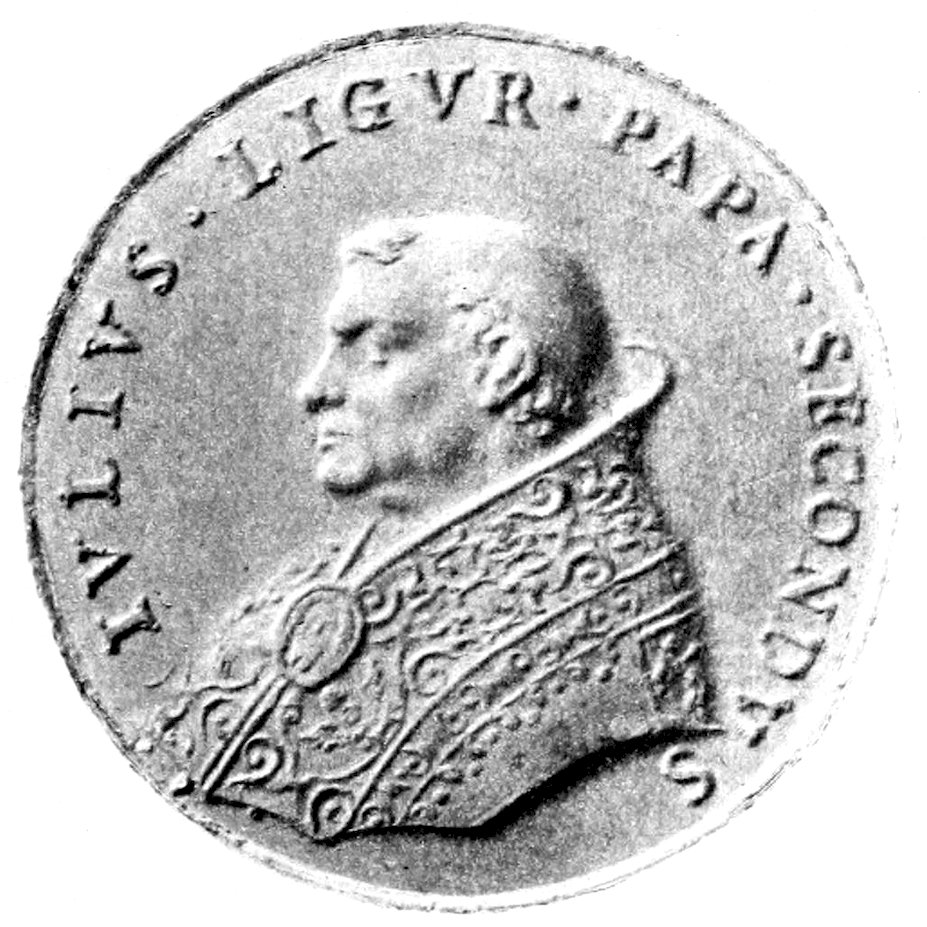
Julius P.P. II.
Whether the Lord Julius P.P. II had made, or had not 265made, promises before His election, He was now de iure and de facto Ruler of the World, and absolutely despotic. He arrested Duke Cesare in Rome; and imprisoned him as a rebel in the Borgia Tower. The utter and vacuous helplessness of the Duke is in striking contrast to the masterful energy of all his previous life. Some enormous mental shock might produce such degeneration; the hideous treachery of Cardinal Giuliano della Rovere as related by Varillas, for example. Duke Cesare behaved, in his misfortune, like a son staggered, struck breathless and speechless by a revelation of a father’s iniquity. A Bull of Deprivation despoiled him of all fiefs and dignities held from the Holy See, and confiscated all his personal property. He literally was stripped naked. In 1504, he escaped from Rome to Ostia in disguise, and thence to Naples. Here he might have found a pied à terre; and, with the splendour of his past achievements, have won an opportunity of recovering his lost estates by war: but the Lord Julius P.P. II, conscious of the danger to His peace that such an aggrieved and notable personality would be, had intrigued with the Catholic King; and, on Duke Cesare’s arrival in the Regno, he was re-arrested, and shipped to a new prison in the castle of Medina del Campo in Spain.
The marriage of Madonna Lucrezia Borgia with Don Alfonso d’Este was a most happy one. The sweet young bride had made herself beloved by all Ferrara, from her husband’s father Duke Ercole to the meanest of his subjects, by her beauty, her goodness, and her wonderfully able versatility, three indispensable qualities in the wife of the heir to the throne. Attired in “a mulberry satin gown embroidered with gold fish-bones each two fingers broad,” with the lace-flounce worth thirty thousand ducats (say £60,000) which, according to Giovanni Lucido, was in her wedding-chest, she would amuse herself in the ducal palace by witnessing performances of the Casina or the Miles Gloriosus, comedies of Plautus. Sometimes, (as Sanuto, the Venetian Orator at Ferrara, informed his government,) she would remain all day in her apartments, writing letters, and having her head washed: or she would sit for hours 266and listen to the violin-music of her adept young husband. On the Maundy Thursday of the first year of her marriage, she publicly washed the feet of one hundred and sixty poor men. Her observance of religious duties was as notable as the spirit of genuine piety which pervades her many letters still extant.