Book the First
Reading edition
The Kindling of the Fire
“A fire, that is kindled, begins with smoke and hissing, while it lays hold on the faggots”
In the year 1455 of Restored Salvation, Christendom was in a parlous way. The Muslim Infidel swarmed from the dark Orient, sworn to plant the Crescent on the ruin of the Cross. In resisting encroachment, King Wladislaw of Hungary and the Apostolic Legate, the Most Illustrious[1] Lord Giuliano Cesarini, Cardinal-Bishop of Tusculum, a Roman of Rome, and scion of a most splendid family,[2] had laid down life at the Battle of Varna. After three and fifty days of siege, Constantinople fell to the Great Turk, the Sultàn Muhammed II. Ioannes Palaiologos, “King and Autocrat of the Romans,” was dead; and his successor Konstantinos Dragases XIII, the last Christian Emperor of the East, was slain in defence of his capital. By the fall of the great Byzantine Empire, the bulwarks of Christendom were broken down; the Infidel was raiding on her borders. Alone, with no ally, Jan Hunniades desperately defended Hungary’s frontier. The Powers of Europe occupied themselves with less important matters.
4At this time, Rome was the eye, and the brain, of the world; and Rome had seen and realised all that was portended.
During many years, since the first signs of Muslim activity, fugitives from Byzantium descended upon Italian shores. The glory of Greece had gone to Imperial Rome. The grandeur of Imperial Rome had returned to Byzantium. And now the glory and grandeur of Byzantium was going to Christian Rome. When danger menaced, when the day of stress began to dawn, scholars and cunning artificers, experts skilful in all knowledge, fled westward to the open arms of Italy with their treasures of work. Italy welcomed all who could enlarge, illuminate, her transcendent genius; learning and culture and skill found with her not exile but a home, and a market for wares. Scholarship became the fashion. “Literary taste was the regulative principle.” It was the Age of Acquisition. “Tuscan is hardly known to all Italians, but Latin is spread far and wide throughout the world”; said Filelfo. But to know Greek was the real test of a gentleman of that day; and Greek scholars were Italy’s most honoured guests. Not content with the codices and classics of antiquity that these brought with them, Italian princes and patricians sent embassies to falling Byzantium, to search for manuscripts, inscriptions, or carven gems, and bronze, and marble. Greek intaglii and camei graced the finger-rings, the ouches, collars, caps, of Venetian senators, of the lords of Florence, of the sovereigns of the Regno,[3] of the barons and cardinals and popes of Rome. “They had made the discovery that the body of a man is a miracle of beauty, each limb a divine wonder, each muscle a joy as great as sight of stars or flowers.” Messer Filippo Brunelleschi, who truly said that his figure of Christ was a crucified contadino, erected the marvellous dome of Florence. For the Lord Eugenius P.P. IV, Messer Antonio Filarete carved the Rapes of Leda and Ganumedes on the great bronze gates of St. Peter’s. Messer Lorenzo Ghiberti modelled the marvellous doors of the Baptistery. Messer Simone Fiorentino (detto Donatello) placed, on the north wall of Orsanmichele, his superb St. George in marble; and 5cast in bronze for Duke Cosmo the nitid David of the Bargello. Tommaso di Ser Giovanni degli Scheggia, called Masaccio (great hulking Tom), painted St. Peter and St. Paul raising the dead, with the skill which he learned from Tommaso di Cristoforo Fini, called Masolino (pretty little Tom). Paolo Doni, nicknamed Uccello (Bird), put birds into his pictures according to his wont. The Blessed Giovangelico da Fiesole filled triptychs with his visions of the angelic hierarchy. Fra Filippo Lippi painted the St. Gabriel Archangel with the argus-eyed wings in an admirable Annunciation. Petrarch and Boccaccio hunted convents, abbeys, and museums, of Byzantium for codices. Messer Poggio Bracciolini discovered manuscripts of Lucretius Carus, of Vitruvius, of Quinctillian, and Cicero’s Oration For Caecina. “No severity of winter cold, no snow, no length of journey, no roughness of road, prevented him from bringing the monuments of antiquity to light,” says Francesco Barbaro. Nor did he hesitate to steal, when theft seemed necessary to secure a precious codex. Three pupils of Manuel Chrysoloras won renown beyond all competitors in the distinguished race: Giovanni Aurispa collected no fewer than two hundred and thirty eight valuable manuscripts of antiquity; Guarino da Verona and Francesco Filelfo came back laden from Byzantium.
Drunk with the joy of the new learning, Italy failed to perceive the true inwardness of her acquisitions. She was blind to the peril which they most surely portended.
But Rome saw. And, during many years, Rome had lifted up her voice and cried aloud that Italy enjoyed these accessions to her treasure only because Byzantium was no longer a safe repository for them. During many decades, Rome proclaimed the danger implied by the advance of the Muslim Infidel. But Christendom lent deaf ears, and compared Rome to Kassandra. Then Immortal Rome was lulled into a kind of apathy: her voice was heard less frequently, speaking in feebler, in less insistent tone. And, gradually, the potent spell of the Renascence mastered Rome; and, in the reign of the Lord Nicholas P.P. V.[4] she fell a victim to the fashionable delirium. Churches and 6palaces were planned, and builded, and decorated. Manuscripts were collected, collated, copied. Libraries and colleges were formed. Culture, at last, and for once, was supreme; and the phenomenon of needy genius was unknown. It was an age when the demand for learning, and for the fine arts, exceeded the supply.
Then, Rome knew that the beautiful may be purchased at too dear a price; that its essential evanescence needs the safeguard of virtue and of heroism, of honour and of arms; precisely as woman needs the protection of man. Rome perceived that the irruption of the Muslim Infidel was a menace to civilisation, and she cried on Christendom to resist the flood of barbarism now outpoured.
Hungary, alone of all the Occidental Powers, responded; but then Hungary was actually in the Muslim clutch.
England, lately torn by Jack Cade’s rebellion, was entering upon a conflict bloodier than any American Civil War or Boer Revolt. The reign of King Henry VI. Plantagenet, gentlest saint that ever wore an earthly diadem, drew near its close: from those pale prayer-raised hands—holy hands that had lifted to Christ’s Vicar a petition for the canonisation of England’s Hero, King Ælfred the Great[5]—the sceptre was about to fall. Trumpets were sounding from Northumberland to Kent. The clean air of Yorkshire wolds sang with the hissing of cloth-yard shafts, with the clang of steel of lance on shield. England was an armed camp; and the War of the Roses was begun.
Germany and Austria, under the rule of the Holy Roman Emperor, “Caesar Semper Augustus” Friedrich IV (The Pacific), seethed with politico-religious discontent. Under the guise of a desire for reform, political and personal ambitions strove. Caesar Friedrich IV held the reins of government but loosely. Excellent as a figure-head, ornamental as an emperor, he had not his empire in the grip of a mailed fist. The symbol A.E.I.O.U. (Austriae Est Imperator Orbis Universi—Alle Erde Ist Oesterreichs Unterthan), which he had invented for his motto, represented 7his desire, but not his potentiality. Personal aggrandisement employed the feudal sovereigns of the empire: their suzerain’s influence was no check upon them.
Italy, then, deserved the designation given to it in modern times by Metternich; it was not a nation, but a geographical expression. In the north were the Republics of Venice, Genoa, Florence, and their smaller imitators; with the royal duchies of Savoja, Milan, and Ferrara. Across the country, from Rome and the Mediterranean, to the Mark of Ancona and the Adriatic, in a north-easterly direction, stretched the Papal States. The east and south, with Sicily, Sardinia, and the Islands, were called The Regno; and were ruled from Naples by kings of the House of Aragon. And dotted all over the land were small semi-independent cities and territories, held as feudal fiefs by local noble houses, whose barons bore the harmless title of Tyrant, and exercised absolute lordship within their little states, e.g., the Manfredi, Tyrants of Faenza; the Malatesta, Tyrants of Rimini; the Sforza, Tyrants of Pesaro, Chotignuola, Santafiora, Imola and Forli; etc.
France, having burned her greatest glory, The Maid of Orleans, was recovering from victories by which, from 1434 to 1450, she had deprived England of all French territory save Calais. Her feeble dastard King Charles VII. was dead; and Louis XI., a gentleman of pleasure and piety, occupied her throne.
Spain, united, after centuries of strife among her divers kingdoms and antagonistic races, by the marriage of King Don Hernando of Aragon to Queen Doña Isabella of Castile, was preparing for an era of colonial expansion.
Portugal was consolidating African discoveries and acquisitions.
Norway and Sweden, after brief separation, once more were united under the sceptre of Denmark; and were learning the lessons of peace.
And then, in Rome, in 1455, on the 24th of March, being Monday in Passion-week, the Lord Nicholas P.P. V was dead: and, with His death, the tide of the Italian Renascence stayed.
8The College of Cardinals assumed the government of Rome and of the Universal Church, while the Conclave for the election of the Successor of St. Peter was assembling. During nine days the Novendialia, the quaint ceremonies connected with the obsequies of a Pope, were celebrated. On Good Friday, the 4th of April, after the Adoration of the Cross, the Mass of the Presanctified, and the Exposition of the Vernicle (or True Image of our Divine Redeemer, vulgarly known as The Veronica), had been performed in the Vatican Basilica, the cardinals were immured; the doors and windows of the Vatican were bricked up; Pandolfo, Prince Savelli, Hereditary Marshal of the Holy Roman Church, entered upon the guardianship of the Conclave; and the election was begun.
The College of Cardinals consisted then of twenty members. Of these, only fifteen assisted at the Conclave of 1455. In the fifteenth century, a journey across Europe, from some distant see, occupied a longer time than the eleven days which should elapse between a Pope’s death and the enclosure of the Conclave. Of these fifteen cardinals present, seven were Italians, four Spaniards, two Frenchmen, two Byzantines. As usual they were divided into factions; but, strange to say, the division was not one of nationality. The ancient and interminable feud between the great Roman baronial houses of Colonna and Orsini, penetrated even here. Not temporal policy of the Holy See, not differences of pious opinions, but simply rivalry of clan, governed this election.
The Most Illustrious Lord Prospero Colonna, Cardinal-Archdeacon of San Giorgio in Velum Aureum, creature (creatura) of the Lord Martin P.P. III, undoubtedly would have been elected had the Lord Nicholas P.P. V died at the beginning instead of at the end of a long illness: for, according to the dispatch of Nicholas of Pontremoli, Orator of Duke Francesco Sforza-Visconti of Milan, dated the first of April, 1455, he was then the favourite. Herr Ludwig Pastor, whose valuable history of the Popes is also the latest, most unaccountably urges that the great age of Cardinal Colonna prevented his election. But the accurate Ciacconi raises him to the purple with Cardinal Capranica 9at the Lord Martin P.P. III’s fourth creation in 1426, he being then still a youth (“adhuc iuvenis”); the publication of his elevation being delayed till the fifth consistory of the 8th of November 1430. Supposing him to have been of the age of twenty-one years in 1426—a very liberal assumption in an age when boys became cardinals at thirteen, benedicks at puberty, and fathers at fifteen—he only would have reached the age of fifty in 1455. The disability of senility may therefore be dismissed. In default of Cardinal Prospero, the Most Illustrious Lord Domenico Capranica, Cardinal-Presbyter of the Title of Santa Croce in Gerusalemme, Cardinal-Penitentiary, Bishop of Fermo, and himself a Roman noble of the Ghibelline party, was put forward by the House of Colonna as their second candidate.
On the other side, the wealthy business-like Roman Guelf, the Lord Latino Orsini di Bari, Cardinal-Presbyter of the Title of San Giovanni e San Paolo in Monte Celio, represented the interests of the House of Orsini: who offered, as an alternative for the suffrages of the Sacred College, the Venetian Lord Pietro Barbo, Cardinal-Presbyter of the Title of San Marco, and Bishop of Vicenza.
The first three scrutinies produced no result; and the cardinals conferred regarding the merits of the candidates, and of the causes that they represented. Much was said on behalf of Cardinal Capranica. He was “Romano di Roma,” his character stood above reproach, his breeding was polite and high. But Cardinal Orsini and his faction, though unable to bring in their own nominee the Cardinal of Venice, were strong enough to out-manœuver the candidate of Colonna: and the electors found themselves at a deadlock.
In this emergency, the College, sought, and found, a neutral; a partizan neither of Colonna nor of Orsini. There were two Byzantine cardinals; the one, the Lord Ioannes Bessarione, Cardinal-Bishop of Tusculum, Monk of the Religion[6] of St. Basil, Archbishop of Trebizond; the other, the Lord Isidoro of Thessalonika, Cardinal-Bishop of Sabina, Monk of the Religion of St. Basil, Archbishop of Ruthenia. Of these two, Cardinal Bessarione had many recommendations. 10He was a convert from the Greek Schism; he had been a pupil of Gemisthos Plethon at Constantinople; no one was of higher repute in Christian piety, more admirable in doctrine, more ornate in generous manners. (Ciacconi II. 906.) He had no enemy in the Conclave. At a juncture, like the present, the election of a Byzantine Pontiff, who naturally sympathised with the hapless Byzantines, would have secured for Christendom a champion against the triumphant Muslim Infidel. When night closed the Conclave’s deliberations, it appeared certain that Cardinal Bessarione would ascend the Throne of St. Peter on the morrow; indeed his brother-cardinals asked favours of him, as though he were already in possession of the Keys. Had he condescended to canvass the other fourteen electors, or to make the slightest exertion on his own behalf, his election would have been secure.
But, in the morning of that Easter Monday, the French Archbishop of Avignon, the Lord Alain Coëtivy Britto, Cardinal-Presbyter of the Title of Santa Prassede, created a diversion against Cardinal Bessarione. “Shall we Latins,” he protested, “shall we Latins go to Greece for the Head of the Latin Church? My Lord of Trebizond has not been among us long enough to shave off his beard[7]; he is a mere neophyte, a newcomer to Italy and to the Holy Roman Church, and shall we set him over us?” All day long the cardinals debated; but no election was achieved. Night came, bringing no solution of the difficulty.
On the 8th of April a compromise was suggested. It was resolved to postpone the contest, by electing an old man 11whose life was almost at an end. Therefore a cardinal was chosen, whose age, in the course of nature, would cause a new election in the near future; whose colourless character neither would alter nor interfere with the traditional policy of the papacy; who during a long life had eschewed pomp and vain glory; whose profound learning, wisdom, and moderation had won for him his high place; whose reputation was blameless; whose political capacity was high; who was the intimate of the friend and neighbour of Holy Church, Don Alonso de Aragona, King of Naples; lastly, one who, being of the Spanish race, was the hereditary foe of Islam, and pre-eminently qualified to defend Christendom from the Muslim Infidel. The aforesaid Cardinal of Avignon, and the Lord Ludovico Scarampi dell’ Arena Mezzaruota, Cardinal-Presbyter of the Title of San Lorenzo in Damaso, exerted all their influence to this end; and, after a new scrutiny, the Cardinal-Dean, the Lord Giorgio Flisco de Savignana, Cardinal-Bishop of Ostia and Velletri, made proclamation of election,
“I announce to you great joy. We have for a Pope the Lord Alonso de Borja, Bishop of Valencia, Cardinal-Presbyter of the Title of Santi Quattro Coronati, Who wills to be called Calixtus the Third.”[8]
The Spanish House of Borja claims to originate in King Don Ramiro Sanchez de Aragona, A.D. 1035.
Until the time of Don Pedro, Count of Aybar and Lord of Borja, who died in 1152, the family was confined to Spain. Then, according to valid authorities, the Junior Branch, in the person of Don Ricardo de Borja, migrated to the kingdom of Naples and the Two Sicilies, and took service there. This Don Ricardo is named in a document of donation in the reign of the Lord Lucius P.P. III, 1181–1185 12(Ricchi); which should go to prove that the Junior Branch was naturalised in Italy. Its lineal descendants undoubtedly are living there at the beginning of the twentieth century; the latest recorded being Don Alessandro Borgia, who was born at Milan in 1897. For purposes of clear arrangement, the history of this Junior Branch may be relegated to later pages; the main interest lies in descendants of Don Ximenes Garcia de Borja, the eldest son of the aforesaid Don Pedro, and founder of the Senior Branch; which, though transplanted to Italy in the middle of the fifteenth century, and flourishing there for some generations, must always be regarded as Spanish and not Italian.
There is record of a son of Don Ximenes Garcia de Borja in 1244, called Gonzales Gil: his son, Don Raymon de Borja, was the father of Don Juan Domingo de Borja, Lord of La Torre de Canals in the city of Xativa in Valencia. By his wife, Doña Francisca, this Don Juan Domingo had at least two daughters and a son—Juana, Caterina, and Alonso.
Doña Juana married Don Jofre de Lançol; Doña Caterina married Don Juan de Mila, Baron of Mazalanes; a third daughter, whose name is missing, also married; and the offspring of these three became later of extreme importance.
The son, Alonso, was born on St. Sylvester’s Eve, 1378, the year of the opening of the Great Schism, at Xativa, and baptized in the church of St. Mary in that city. He himself has told us this, in two Bulls dated 1457.[9] His youth was spent at the University of Lerida, where he specialised in jurisprudence for the degree of Doctor in Civil and Canon Law, and obtained a professorship and Holy Order. While he was a young priest (1398–1408) he chanced to assist at a sermon preached by the great Dominican Vincent Ferrer in a mission at Valencia. At 13the close of his discourse, the friar singled out from the crowd Don Alonso de Borja, to whom he addressed this remarkable prediction: “My son, you one day will be called to be the ornament of your house and of your country. You will be invested with the highest dignity that can fall to the lot of man. After my death, I shall be the object of your special honour. Endeavour to persevere in a life of virtue.” Don Alonso was impressed by this saying, for he repeated it to St. John Capistran in 1449, and he tenaciously waited for the fulfilment. After His election to the papacy, He performed the solemn canonisation of St. Vincent Ferrer on the twenty-ninth of June, 1455.
Don Alonso proceeded from his University professorship to a canonry in the cathedral of Lerida, which was conferred upon him by his countryman Don Pedro de Luna, the Pseudopontiff Benedict XIII. Later, he entered the arena of politics as secretary to King Don Alonso I (The Magnanimous) of Naples and the Two Sicilies; and, here, his diplomatic skill and legal training raised him to the unofficial but important post of confidential counsellor to the Majesty of the Regno. Now that he was domiciled in Italy his fortunes moved swiftly. In 1429 he won the gratitude of the Lord Martin P.P. III (or V) by winning for His Holiness the support of Spain, and by negotiating the renunciation of the Spanish Pseudopontiff, Don Gil Muñoz, who called himself Clement VIII.
These days of the Great Schism, when the Roman Pontiffs had much ado to hold Their Own against irregularly elected pseudopontiffs, must have been utterly horrible. A reigning sovereign is uneasy when pretenders to, or usurpers of, his crown appear. Republican France farcically banishes men whose nobler forefathers represented other forms of government. England sometimes wakes prodigally to spend blood and treasure in support of her suzerainty. If secular powers, then, strive, struggle for their life; and, in the struggle, cause distress, how many times more distressing must have been the rivalry of the Great Schism, when the prize at stake was the Headship of Christendom. This consideration will make it easy to understand how great an obligation the Lord Martin P.P. III lay under to the skilful 14canon, who actually persuaded His rival peaceably to renounce his claim to the triple crown, terminating the thirty-eighth schism of the Holy Roman Church. As a reward, Canon Alonso de Borja received the bishopric of Valencia, his native diocese; and, after his consecration, he continued to be useful to King Don Alonso de Aragona, by re-organising the government of the Regno, and by supervising the education of the King’s Bastard and subsequent successor, Don Ferrando.
The fifteenth and sixteenth centuries were not more filled with improbable situations than the twentieth. The situations were different, that is all. The situation of bastards was quite curious, and must be realised by any one who desires intelligently to understand the time. To this intelligent understanding Ludovico Romano’s theories will lend aid. He argues that it is false to say that bastards are infamous and incapable of honours. To the infamous is denied the dignity of Decurion (command of ten men). But bastards may become Decuriones. Therefore bastards are neither infamous nor incapable of honour. Giampietro de Crescenzi Romani, in Il Nobile Romano, states the case thus: Plebeians are not eligible to the Decurionate. Bastards are eligible to the Decurionate. Therefore, bastards are not plebeians, but nobles if born of noble stock. Bastards are capable of nobility, of secular and civil dignity; for Ishmael was not hunted from his father’s house on account of his bastardy, but on account of his insolence. It is not necessary to quote Crescenzi’s argument as to the bastards of King David, from whom descends the Son of David, Son of Abraham, according to the Scripture, and Whom the Fathers of the Church acclaim as One of royal generation; nor to give more of his catalogue of noble bastards than Theodoric, King of the Goths of Italy and of Spain, the Emperor Charlemagne, Roberto and Pandolfo Malatesta, Tyrants of Rimini, Giovanni Sforza, Tyrant of Pesaro, William (called The Conqueror), Duke of Normandy and King of England. He continues to say that nature does not distinguish between bastards and legitimates; that the former are called natural children because they are 15true children of nature. Neither does grace distinguish; and, as bastards are capable of temporal nobility, so also they are capable of spiritual, as witness St. Bridget of Ireland, and other natural children of signal grace and distinguished virtue. Further, he holds that the sons, of bastards who lose nobility by rebellion, are not infamous; and recover nobility on their father’s death; that infamy of any kind is washed-out by baptism: and that the Pope can free from subsequently contracted infamy by His dispensation. He distinguishes between bastards only legitimated by princes or the emperor, who are ineligible to ecclesiastical benefices; and bastards legitimated only by the Pope, who cannot succeed to the fiefs of other princes. He concludes that bastardy purges itself at the latest in the fourth generation.
In the twentieth century, an inheritance devolves from the holder to “the heirs male of his body lawfully begotten”; in the fifteenth, the proviso “lawfully begotten” did not invariably obtain. A bastard, legitimated and recognised by his father, was as valid and capable as the son of a lawful marriage. The sin of the father and mother was a sin personal to them, and none the less a Sin: but it was not allowed to affect their innocent children. The Lord Pius P.P. II, on his way to the Congress of Mantua in 1459, was met on the frontier of Ferrara by eight bastards of the royal House of Este, including the delicious Borso, reigning duke, and two bastards of his highness’s bastard brother and predecessor Duke Leonello. These matters should be understood; for a large proportion of the personages in this history were of illegitimate birth, and under no disability of any kind thereby.
King Don Alonso I de Aragona did not feel safe with the crown of the Regno which he wore. The House of Anjou claimed it. Madame Marguerite d’Anjou, daughter of the poet-king Réné, had ceded or sold her rights to the Christian King Louis XI of France, whose claim was supported by the Lord Martin P.P. III. The Magnanimous King Don Alonso I threatened to espouse the cause and benefit by the aid of the Pseudopontiff (called 16Clement VIII); and so the materials for a devastating conflagration were brought together. But the diplomacy of Bishop Alonso de Borja was repeated here. Once again, by negotiating the peaceful disappearance of a pseudopontiff, he earned the gratitude of the Pope; and the Lord Martin P.P. III, Who owed so much to Bishop Alonso, was easily persuaded to look favourably also upon Bishop Alonso’s royal master. Unfortunately the Pope died, and His Successor, the Lord Eugenius P.P. IV had a prejudice for the French claim, which resulted in a renewal of the quarrel in 1439. But a third time the difficulties of the Roman Pontiff were turned to account by Bishop Alonso. When the schismatic Synod of Basilea, to gain some private ends, futilely pronounced a sentence of excommunication and deposition upon the Lord Eugenius P.P. IV, and elected the ambitious Duke Amadeo of Savoja as Pseudopontiff with the name Felix V, all Christendom expected that King Don Alonso, who was a very crafty potentate, would be only too happy to make common cause with the rival of that Pope who would not confirm his crown to him. But all Christendom was disappointed. King Don Alonso’s secretary ably manœuvred in his accustomed manner. First, Bishop Alonso de Borja in his proper person refused to attend that schismatic Synod of Basilea; and, by this act, became persona gratissima at the Vatican. Second, the King of Naples instructed his Orators (ambassadors) to play with Pontiff and pseudopontiff, to find out which would meet him with a satisfactory concession. Third, Don Francesco Sforza-Visconti, Duke of Milan, began to harass the Lord Eugenius P.P. IV. And, then, the Pope agreed to receive an embassage from the King of Naples, and to hear his cause pleaded by Bishop Alonso de Borja.
This was the cause of King Don Alonso. A bastard of the House of Aragon, he had been adopted by Queen Doña Juana of Naples, who lacked a lineal heir, in 1420. He was acknowledged by the people as sovereign of the Regno, and was actually in possession of the crown.
The Christian King Louis XI. also claimed to have been adopted by Queen Doña Juana: but he never had been acknowledged, nor ever had possessed the crown.
17Then there was the matter of King Don Alonso’s bastard, Don Ferrando. The childless Queen believed him to be the son of Doña Margarita de Hijar, one of her ladies; and, in jealous rage, she smothered her. Whereupon the King banished his wife to Aragon, and legitimated Don Ferrando as his heir.
Let it be recognised that, in the fifteenth century, Popes acted, and were expected to act, in the letter, as well as in the spirit, of the momentous words which are said by the cardinal-archdeacon to all of Them at Their coronation, Receive this tiara adorned with three crowns, and know Thyself to be the Ruler of the World, the Father of princes and of kings, and the Earthly Vicar of Jesus Christ our Saviour. The twentieth century is apt to conceive of the Pope as an uninteresting, far-away, semi-diplomatic species of clergyman, nourishing pretensions of utter insignificance. It will be well to remember that once upon a time the Pope was a Power, Who saw nothing figurative, metaphorical, or extravagant in the exordium just quoted, Who was not by any means a négligeable quantity in the world’s affairs, and Who literally had the unquestioned right of making or unmaking princes and kings or even emperors.
Here was a case in point. King Don Alonso was a crowned king; but he perfectly was aware that he was powerless to keep his crown, much less to secure the succession for the offspring of his illicit love, unless he could gain the confirmation, the licence, of the Roman Pontiff—in technical phrase, a sovereign found it to be indispensable that he should be able to add to his style of King By The Grace Of God, And By The Favour Of The Apostolic See.
Hence the embassage to the Lord Eugenius P.P. IV, headed by Bishop Alonso de Borja, to whose incessant labour and exquisite mastery of affairs was due the treaty, ratified in 1444, by which the Pope’s Holiness of the one part confirmed the crown of Naples, the Two Sicilies, and Jerusalem, to King Don Alonso I. de Aragona, and licensed the legitimation of Don Ferrando; while the King’s Majesty of the other part agreed to defend the Lord Eugenius P.P. IV against His enemies, and especially against Duke Francesco Sforza-Visconti of Milan.
18As a reward for his skill in the rôle of peacemaker, Bishop Alonso de Borja was raised to the purple on the second of May 1444, as Cardinal-Presbyter of the Title of Santi Quattro Coronati with curial rank; and so King Don Alonso, the Magnanimous, lost his most trusted counsellor. The Bishop’s bastard, Don Francisco de Borja, who will appear later in this history, had been born at Savina, in Valencia, in 1441.
The Cardinal of Valencia at the Court of Rome gained the reputation of being inaccessible to flattery, incapable of party-feeling, impregnable in integrity, inconspicuous in morals, inexhaustible in capacity for business and in knowledge of canon-law. In 1446, the Lord Eugenius P.P. IV restored the Hospital of the Confraternity of Santo Spirito, in the Region of Borgc, to something of its pristine glory; and He undertook to contribute a yearly sum whereby its usefulness among the poor and needy might be maintained. The pontifical example of practical Christian charity set a fashion for the cardinals of the curia. The quaint Bull containing the subscribers’ names is signed by
I, Eugenius, The Bishop of the Catholic Church,
and by nine cardinals, of whom the last is
I, the Cardinal of Valencia, Presbyter of the Title of Santi Quattro Coronati.
Cardinal de Borja assisted at the election of the succeeding Pontiff, the Lord Nicholas P.P. V; at Whose death, in 1455, the prediction of St. Vincent Ferrer was fulfilled.
At the time of His elevation to the Supreme Pontificate, the Lord Calixtus P.P. III was a feeble old man of the age of seventy-seven years. His duties, as Governor of the Bastard of Naples, as Bishop of Valencia, as Orator of King to Pope, as Plenipotentiary between Pope and King, as Counsellor of King, as Cardinal-Counsellor of Pope, and his ceaseless studies in jurisprudence and canon-law, had worn away the bodily strength of him—the perishable thin scabbard that hid steel indomitable and keen.
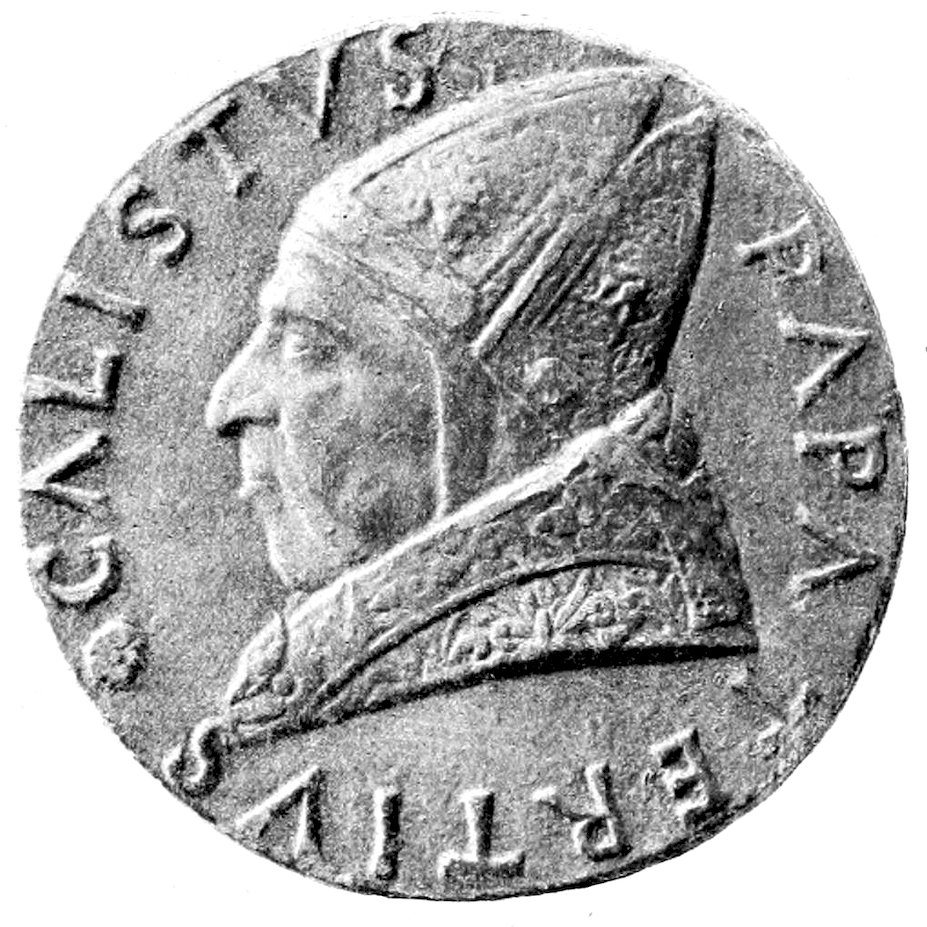
Calixtus P.P. III.
19Outside the Vatican very diverse opinions were entertained of Him. His long connection with King Don Alonso I. caused anxiety, suspicion, and jealousy, among the Powers of Italy. They were always disgusted, those Powers, to find the Pope on easy terms with a temporal sovereign, with one of themselves; and the Magnanimous King Don Alonso was the next-door neighbour, so to speak, of the Lord Calixtus P.P. III. Such a combination inevitably inspired distrust. The fear was expressed that Naples, through his former secretary, would rule the Holy See—and Christendom. The official despatches of the Orators of Florence, Genoa, and Venice, hypocritically displayed the greatest satisfaction: but their private letters were in a diametrically opposing strain. A great grievance was made of the fact that the new Pope was a Spaniard and a foreigner. Some thought that a handful of discontented cardinals should leave Rome, set up a pseudopontiff in another city, and inaugurate a Fortieth Schism. Oh, people knew one another to be properly cantankerous in the fifteenth century! But Rome considered the Lord Calixtus P.P. III a just and right-minded man. The Procurator-General of the Order of Teutonic Knights wrote to the Grand Master on the third of May 1455: “The new Pope is an old man, of honourable and virtuous life, and of excellent repute.” Messer Bartolomeo Michele, a Sienese, wrote to his native city, exhorting the Sienesi to send the most splendid possible embassage to congratulate the Pope, selecting for the same only eminent and worthy men, inasmuch as that the Lord Calixtus P.P. III was excessively learned and clear-sighted: “He is a man of great sanctity and learning, a friend and adherent of King Don Alonso. He has always shown Himself well-disposed to our city, and by nature He is peaceable and kindly.” But the best appreciation of all is given by St. Antonino, that gentle, brave Archbishop of Florence, whose quality all the world admires and loves. He wrote to Messer Giovanni of Orvieto, the 24th of April 1455.
“The election of the Lord Calixtus P.P. III at first gave little satisfaction to the Italians. Inprimis, he was Valencian or Catalan; and 20they feared lest He should transfer the Papal Court to another country. Also, they feared lest He should entrust to Catalans the fortresses of Holy Church, which, only after many difficulties, could be recovered. But now they are reassured by more mature reflection, and by the reputation that He bears for goodness, penetration, and impartiality. And, also, I have seen His solemn promise that He will devote all His powers against the Turks and for the conquest of Constantinople. It is not to be believed or said that He is attached to one nation more than another, but rather that, as a just and prudent man, He will give to every one his due. Meanwhile, let us always think well of the Holy Father, and judge His actions more favourably than those of any other human being. And let us not be frightened by every little shock. Christ guides the Barque of Peter, which, therefore, can never sink.”
That letter contains a concise summary of the situation, written with the benevolent simplicity of a dignified fine gentleman, and with the unerring sapience of a saint.
The Pope is the Bishop of Rome. The insignia of His office are the Fisherman’s Ring, the Triple Crown, the Triple Cross, and the Keys. At His election by the Conclave, He receives the Ring. Afterwards the insignia are conferred, with the Pallium that He wears at all times in sign of universal jurisdiction, at His coronation by the Cardinal-Archdeacon in the Collegiate-Basilica of St. Peter-by-the-Vatican. But yet another ceremony awaits performance. As Bishop of Rome, He must take formal possession of, and be enthroned in, the cathedral of His diocese, either in person or by proxy. That cathedral is not St. Peter’s: but St. John’s in Laterano, which, consequently, bears on its façade the magniloquent title
MOTHER AND MISTRESS OF ALL CHURCHES IN THE CITY AND IN THE WORLD
It is the most important church in Christendom.
The Lord Calixtus P.P. III was elected on the eighth of April 1455. On the twentieth He was crowned as “Ruler of the World, Father of princes and of kings, and Earthly Vicar of Jesus Christ our Saviour”; and the same day He made a triumphal progress through the city to take possession of the Lateran. In the porch of that cathedral there is a low marble throne, called Sedes Stercoraria, on 21which the Pope sits to receive the homage of the Lateran Chapter while cantors chant the anthem
“He raiseth-up the poor out of the dust:
“and lifteth the needy out of the dung-hill.
“That He may set him with princes:
“even with the princes of His people.
(Ps. cxiii. 7, 8).
“Suscitans a terra inopem:
“et de stercore erigens pauperem.
“Ut collocet eum cum principibus:
“cum principibus populi Sui.
(Vulgate, Ps. cxii. 6, 7).
It has been seen that the Lord Calixtus P.P. III was not unnaturally popular. It will be readily admitted that the Roman baronial houses of Colonna and Orsini would have been more than human had they not felt some mortification at the failure of their conclavial manœuvres to secure the Papacy for one of themselves. Still, the thing was done. A Catalan—the Romans of the fifteenth century called all Spaniards Catalans—a Catalan indubitably had been elected; but He was old, He was feeble, He might be influenced, He might be amenable to intimidation, to a show of force. It is so easy for the twentieth century, with its jaded physique and sophisticated brain, and the magnificent perspective of half a thousand years, to read the motives which actuated the physically strong and intellectually simple fifteenth, when the world—the dust which makes man’s flesh—was five centuries younger and fresher; when colour was vivid; light, a blaze; virtue and vice, extreme; passion, primitive and ardent; life, violent; youth, intense, supreme; and sententious pettifogging respectable mediocrity, senile and debile, of no importance whatever.
So, while the Lord Calixtus P.P. III was at the Lateran, the barons of Rome took action. A slight quarrel arising in the crowd between one of the Orsini and a retainer of Anguillara (hereditary foes of Orsini) provided a pretext. Instantly shouts ascended, and men of arms 22coursed through the city roaring Orso, Orso (Bear, Bear—war-cry of Orsini, alluding to their badge). From every dark and narrow alley of the Regions of Campo Marzo and Ponte, from the Albergo dell Orso (Bear Inn) by the Torre di Nona, from the castellated fortress which Orsini had made of Pompey’s Theatre, came the clang of arms, with the rush of hurrying feet of desperate brigands, adherents and mercenaries of Orsini; and Don Napoleone Orsini was at the head of three thousand men. Outside the cathedral, the hum of a maddened mob swelled into a raucous roar as of bears hungry for hot blood, when Count Averso of Anguillara fled into the Lateran Basilica, seeking sanctuary in the very presence of Christ’s Vicar; and, above the roar, the voice of Orsini pierced the holy portals of the Prince of Peace, penetrated to the ears of Pope Calixtus throned as Bishop of Rome among His canons in the centre of the apse, launching a hideous threat to storm and sack the Lateran unless the body of Anguillara were given to him as meat for his three thousand bears. There was a movement in the ermine and scarlet college that stood near the papal throne, and Cardinal Latino Orsini di Bari hurried down the nave to confer with his turbulent brother, Don Napoleone. Though disappointed that he had failed to win the Triregno[10] for himself, this cardinal appears to have had some feeling of decency as to what was due to Holy Church. As a churchman he felt bound to stand by his order; although as an Orsini he would have preferred a different state of affairs. Still, the object of the riot had been attained, the Lord Calixtus P.P III had received an object-lesson poignant and pregnant to an ultimate degree, concerning the kind of kakodaimons that He would have to quell, the species of subject that He was called to rule. No doubt these were the arguments used to his brother by the cardinal. It was not the writhing mangled body of the Eel (Anguillara) that the Bear (Orsini) craved. That was the merest subterfuge. But to humiliate the Holiness of 23the Pope at the very moment of His exaltation from Sedes Stercoraria to Lateran Throne, to terrify Him into malleability, into subjugation to Orsini’s will—that—that had been done, and well done. Surely an aged man, so near His grave as was the Lord Calixtus P.P. III, would wish to purchase peace with any sacrifice, now that once it had been shown to Him what kind of devildom environed His very throne-steps. Don Napoleone Orsini allowed himself to take this view. He withdrew his myrmidons. The riot was over. Presently the Pope was riding on His crimson-caparisoned palfrey towards the Vatican, through a peaceful city kneeling at the roadside for Apostolic Benediction.
The fashion which foreigners affect in writing of Italy makes one laugh—and weep.
They drawl of a dreamland of subtle sweetness and softest light, of delicate fantasy, of neutral hue; peopled by shades from faded frescoes æsthetically tinctured, academic, conventional, conformant to the canons of that unspeakably abominable dilution which the twentieth century calls Art; and mitigated only by a leavening of organ-grinders and fortune-telling paroquets.
They must be blind, these foreigners—blind, physically and mentally—blind, as those who will not see.
Italy is, and always has been, a land of raw reality, of glittering light, of pure primary colour, of nature naked and not ashamed, of perfectly transparent souls, of rapidest versatility, clearest mystery, ultimate simplicity, steel, and brains, and blood.
Else she had made no mark, no singular distinguished mark, in history.
Has she made no mark?
Ah—what a mark she has made!
The greatest historian of this period, perhaps the most alert and agile writer of any period, Enea Silvio Bartolomeo de’ Piccolhuomini (who afterwards became Pope with the title of the Lord Pius P.P. II), says of the Lord Calixtus P.P. III, that His attention to the duties of His office was amazing; that His patience at audiences was astounding; 24that He Himself dictated the Apostolic Briefs and Bulls written to kings and princes, nor trusted them to the official scribes; that jurisprudence was His recreation; that He was as familiar with canon-law as though He were still professor at the University of Lerida.
Two problems confronted Him at the beginning of His reign: the Renascence of Learning, and the Infidel in Christendom. His predecessor had been a man of words. The Lord Calixtus P.P. III was a man of strenuous deeds. His attitude to Letters and Art was in strong contrast to that of the Lord Nicholas P.P. V. This “withered canonist,” as a wit styled Him, was not in sympathy with Culture. Wholly occupied in matters ecclesiastical and political, He had nor time nor means nor inclination to patronise the fashionable scholarship of His day. His vogue was strictly practical.
One of the secrets of the success of the Holy Catholic Apostolic and Roman Church is her catholicity. All sorts and conditions of men can, and do, live within her boundaries. The Lord Nicholas P.P. V had been a Maecenas of Letters and the Arts. In His reign scholars, scribes, and artificers had found their golden age. The Lord Calixtus P.P. III entirely employed Himself in the defence of Christendom, and the clients of His predecessor were conscious of the change. Literature and the fine arts have one very sorry effect upon their professors. Intellectual culture avidly pursued makes its devotees show pitifully by the side of the manly men who deal with realities and verities, with life and death, the sailors, soldiers, adventurers, and empire-builders. Letters and the Arts cultivate the baser parts of man—meanness, jealousy, conceit. The touchy nature of the writers and artists of 1455 led to violent denunciations of the Spanish Pope. Messer Francesco Filelfo’s letter (102) to the Cardinal of Trebizond shows how men of letters hated Him. Another writer charged Him with destroying the Vatican library. Bishop Vespasiano da Bisticci, of Vicenza, says:
“When Pope Calixtus began His reign, and saw so many excellent books, five hundred of them resplendent in bindings of crimson velvet with clasps of silver, He wondered greatly (it should be remembered that printing was not invented), for the old canonist only was used to books 25written on linen (?) and stitched together. Instead of commending the wisdom of His predecessor, He cried, on entering the library, See now where the treasure of God’s Church has gone. Soon He began to disperse the Greek books. He gave several hundred to the Cardinal of Ruthenia. As this latter was in his dotage, the volumes fell into his servants’ hands. Things which had been bought for golden florins[11] were sold for a few pence. Many Latin books came to Barcelona: some through the Bishop of Vich, powerful Datary of the Pope; some as gifts to Catalan nobles.
Calumny (which, by the bye, ranks as mortal sin in modern catechisms,) appears to be habitual to the faithful. In this particular the fifteenth century meets the twentieth on common ground. To speak truth in a paradox, the proximate occasion of the sin of calumny is hatred of sin. Roman Catholics, like Bishop Vespasiano, are, from their conception, imbued and saturated with the idea of the hideousness of sin, not of its stupidity and unprofitableness. It is their bogey, their forbidden fruit, the covert strictly preserved and labelled Trespassers will be prosecuted with the utmost rigour of the Law. Consequently, Roman Catholic human nature is violently fascinated by the bogey; has singularly well informed itself of the nature, colour, shape, condition, and location, of the forbidden fruit; has minutely investigated every inch of ground and every blade of grass, and every bird and bush in the strictly preserved covert, simply and solely in order that it may avoid poaching, sampling the forbidden fruit, or becoming a prey for the bogey. When one has the duty of avoiding a thing, it is well to know what the thing is which one must avoid; but it is quite easy to know more than enough. All this intimate realisation of the hideousness of sin, this systematic cataloguing of its divisions and sub-divisions, with elaborate excursions along its divers ramifications, certainly inspires a loathing of the intensest kind. It also has another effect. It induces an exaggerated consciousness of virtue. When human nature knows, and is able to describe, with a wealth of detail ordinarily inaccessible, the horrible things which it does not do, it becomes “puffed up,” in the words of St. Paul. This condition of “unctuous rectitude,” inspired entirely by 26a horror of sin, is a proximate occasion of the sin of calumny. Roman Catholic human nature, not unconscious of its own integrity, when confronted by an antipathetic personality, instantly conceives of the latter as a sinner. I am right—you disagree with me—therefore you are wrong—is the absurd syllogism or logical process which it uses. And, drawing upon its copious catalogues of sins, on the principle that he who offends in the least is guilty of all, Roman Catholic human nature will proceed to shew how exceedingly sinful it is possible for an enemy to be. The said enemy, or perhaps a mere opponent, incontinently finds himself accused of breaking the Ten Commandments of God, the various Precepts of the Church; of committing the Seven Deadly Sins—Pride, Covetousness, Lust, Anger, Gluttony, Envy, Sloth; the Six Sins against the Holy Ghost—Presumption of God’s Mercy, Despair, Impugning the Known Truth, Envy at another’s Spiritual Good, Obstinacy in Sin, Final Impenitence; the Four Sins Crying to Heaven for Vengeance—Wilful Murder, Sin of the Cities of the Plain, Oppression of the Poor, Defrauding Labourers of their Wages; or, if he has not achieved the guilt of these in his proper person, at least he has been an accomplice of some other sinner, in the Nine Ways by which a Man may be Accessory to Another’s Sin—i.e., by counsel, command, consent, provocation, by praise or flattery, by concealment, by partaking, by silence, by defence of the ill which is done. That is, (in the twentieth century when Catholics are ruled by a Press ostentatiously Fenian and Anglophobe, and was, in the fifteenth century when Catholics were also human, but not vulgar or sophisticated), the predicament of anybody, Pope or peasant, who incurs, or incurred, the disesteem of, or who makes, or made, himself unpleasant to a brother in the Faith. By hints, inferences, insinuations, ill-motives assigned, and a hundred ingenious methods, rarely by defined accusations, the sin of calumny is, and was, committed, absolutely and utterly because the calumniator so hates sin as to have no difficulty in persuading himself that the man who flouts him must be a sinner. For be it noted, that all the calumnies that bespatter the House of Borgia, all the “liability to disesteem,” which through five centuries has been their portion, and has 27made their very name a synonym of Turpitude, all these have a Roman Catholic origin. Roman Catholics are the primal calumniators who have muddied, and do muddy, God’s Vicegerents, the Lord Calixtus P.P. III, and His nephew the Lord Alexander P.P. VI, with every species of ordure, with ascriptions of every crime known to casuistry (the science of cases of conscience), including those which are unspeakable except in an appendix veiled in a learned language quo minus erubescamus. Bishop Vespasiano da Bisticci of Vicenza was a Roman Catholic; Messer Stefano Infessura, Monsignor Hans Burchard, Messer Francesco Guicciardini, Bishop Paolo Giovio of Nocera, Messer Giangiovio Pontano, Sannazar “The Christian Vergil,” Messer Benedetto Varchi—they were all Roman Catholics who inaugurated the campaign of calumny against the Supreme Pontiffs of the House of Borgia. In dealing with calumny, the difficulty is to obtain definite evidence of a definite charge which is intrinsically false and, at the same time, derogatory to the person against whom it is laid. This difficulty is one that continually confronts the investigator. Prelates, priests, princes, penmen, sometimes because they had a grievance, sometimes confessedly wilfully, sometimes by way of wanton babble, habitually launched against their enemies or superiors accusations of depravity the most loathsome, of crime the most odious. What they said by word of mouth cannot surely be known Until The Books Are Opened. What they wrote in pasquinades, in diaries, in official despatches, in official chronicles, or for the mere æsthetic pleasure of recording a salacious gibe in curial Tuscan or in golden Latin—these remain. A few of the more important icily will be discussed here. The student of history knows no more refreshing recreation than that of nailing liars, like vermin, to the wall.
The statement of Bishop Vespasiano da Bisticci of Vicenza, quoted above, is a fair example of the less fœtid species of calumny: it only amounts to an accusation of “philistinism.” However, it at once may be described as being both stupid and improbable. With regard to the naif surprize, said to have been shown by the Lord Calixtus P.P. III, on seeing “so many excellent books,” is it likely 28that, as Bishop Alonso de Borja, Ambassador Plenipotentiary and Confidential Counsellor of the Majesty of Naples, he never had seen fine things before? Is it likely that Cardinal Alonso de Borja, eleven years cardinal of the curia residing in the Court of Rome, had never seen splendid books before? Of what kind then were the missals and pontificals which, as bishop, he would have used in his daily mass? Is it likely that Cardinal Alonso de Borja—one of the actual electors of the Lord Nicholas P.P. V, constantly at His side from beginning to end of His reign, if not assistant to, at least cognizant of, His every action—had never seen, had never touched, handled, tasted, those identical five hundred books, bound in crimson velvet with clasps of silver, with which that august Pontiff enriched the Vatican library. The assumption is ridiculous, absurd.
The calumny that the Lord Calixtus P.P. III gave books to the Bishop of Vich in the manner of a Vandal arose in this way. The Lord Cosimo de Monserrato, Bishop of Vich from 1460 to 1471, was ordered by His Holiness to compile a catalogue of the books in the Vatican library, on the sixteenth of April 1455, four days before His coronation. A copy of this catalogue was brought to Vich by this same Lord Cosimo on his appointment to the bishopric five years later. It was most likely made by one of the Vatican scribes,[12] and it contains numerous marginal notes in the bishop’s handwriting. From these notes, a precise list of the number of books actually given away by the Lord Calixtus P.P. III may be obtained. They were five—not “several hundred”—of no great value, and—duplicates. Two of these, a copy of the Epistles of St. Augustine, annotated by Nicholas of Lira, and a Book on the Truth of the Catholic Faith, were presented to the Pope’s late patron, King Don Alonso de Aragona of Naples, the Two Sicilies, and Jerusalem. The note against them in the catalogue is S.D.N. dedit hunc domino regi Arag. (“Our Holy Lord gave this to the lord king of Aragon.”) Now, if He only gave two books to His old friend and former employer who (as may be judged from the fact that he employed 29the renowned Messeri Lorenzo Valla and Giangiovio Pontano as his secretaries) had a very pretty taste for letters, who was a reigning sovereign, and an extremely serviceable and powerful ally of the Holy See, is He likely to have given “several hundred” to the Cardinal of Ruthenia and Catalan nobles? Finally, the heathen Cardinal Platina, who wrote his History of the Popes in the reign of the Lord Xystus[13] P.P. IV (the third in succession from the Lord Calixtus P.P. III,) expressly mentions the magnificence of the library of the Lord Nicholas P.P. V, which, certainly, he could not have known if it had been destroyed in the manner described by the lying Bishop Vespasiano da Bisticci of Vicenza.
One “philistine” act may be admitted on behalf of the Lord Calixtus P.P. III. He sold the silver from the bindings of those books. He sacrificed them for the crusade in defence of Christendom. He also sold all the Vatican plate. He insisted that the salt-cellar of His Own table should be of earthenware, not gold; and, indeed, He even offered His tiara in pledge for the same admirable object. He was blamed.
The Lord Calixtus P.P. III was by no means the enemy of letters. He made havoc among the decadents, the affected literary poseurs who infested the Borgian as well as the Victorian Era; but He cherished genius, and to scholars of distinction He was a generous patron. The diverting case of Messer Lorenzo Valla will serve for an example. This notable, being one of the secretaries of King Don Alonso I, was well-known to the Holiness of the Pope. He was erudite beyond most of his contemporaries, of a daring temperament, and impatient of bad scholarship, falsehood, and superstition. In 1440 he indited a merciless exposure of the monstrous fiction now known as the Forged Decretals and Donation of Constantine, upon 30which, in perfect good faith, the temporal dominions of the Papacy then were held. Also, he attacked the leaden Latin of the Vulgate, and lauded the Golden Latin of Vergil and Cicero, or the Silver Latin of Tacitus. The twentieth century—which knows the Latin of the Roman Mass to be the low Latin of Roman plebeians of the first five centuries, from the age of the Lord St. Peter P.P. to that of His successor the Lord St. Gelasius P.P., Whose “Prayer for Peace” is the latest known addition to the canon—will not find Messer Lorenzo Valla to have been guilty of any very shocking crime herein. But the clergy of Naples considered him in the light of a menace to the Christian Palladium, and mentioned him to the Inquisition. When he was brought before them, the Inquisitors invited him formally to assent to a profession of faith, which was neither the Apostles’ nor the Nicene Creed, nor the Creed of St. Athanasius, but one which they had drawn up to suit the fancied needs of his case. The situation was the historical parallel of one which sullied the dying years of the last century. Messer Lorenzo knew too much; took an impish delight in saying what he knew; he was a nuisance, a disturbing influence. To the proposition of the Inquisition he opposed a firm refusal; he would not sign their specimen of a creed. The circumstances now were becoming strained. But the Inquisitors of the fifteenth century had more serpentine wisdom than those of the nineteenth. They did not proceed at once to an abrupt and tactless excommunication, exacerbating to all parties. They tried another line. Would Messer Lorenzo Valla have the courtesy, then, to propound his own creed, that his judges might examine whether it were heretical or no? The reply of Messer Lorenzo was delicious. “I believe,” he said, “I believe what Holy Mother Church believes. She knows nothing. But—I believe what she believes.” Just at this stage the king sent a mandate to the Inquisitors of Naples, bidding them to leave his Majesty’s secretary alone; and the process ended here. But when the news of the case travelled to Rome, the Lord Nicholas P.P. V, admiring the wit and learning of Messer Lorenzo Valla, being amused, perhaps, at the way in which he had taken the wind out of the sail of 31the wily Inquisitors, invited the distinguished scholar to His Court, where He named him Apostolic scribe, with magnificent appointments. On the death of that Pontiff, Messer Lorenzo’s sometime colleague, the Lord Calixtus P.P. III made him Pontifical Secretary, and dignified him with several canonries including one at St. John in Laterano, the cathedral-church of Rome. So fifteenth century tact and mental limberness made a friend, where nineteenth century arrogant stupidity made a host of scornful foes.
The first year of the pontificate of the Lord Calixtus P.P. III was occupied by audiences granted to Orators offering the homage of the Powers, and by preparations for the Crusade.
Germany deserved and enjoyed high consideration, because the ruler of Germany held the title of Romanorum Imperator Caesar Semper Augustus Mundi Totius Dominus Universis Principibus et Populis Semper Venerandus; and an understanding between Pope and Emperor, a friendship between Peter and Caesar, was desirable for the peace and prosperity of Christendom. This friendship, however, was subject to frequent breaches. Both Papacy and Empire were exceedingly tenacious of their dignity, willing to consider themselves aggrieved, or their rights in danger of encroachment. Each, in fact, was a power of dimensions so gigantic that intermittent paroxysms of megalomania were the order of the day. The violence of these attacks was allayed, from time to time, by cooling lotions in the shape of concessions. There had been a serious relapse not many years before, which temporarily had been retrieved by a treaty, known as the Concordat of the Lord Eugenius P.P. IV.
At the beginning of His reign, while waiting for the formal homage of The Pacific Caesar Friedrich IV, the Lord Calixtus P.P. III observed the terms of this Concordat. When the news of His election in April reached Germany, a Diet of the Empire was held at Neustadt to appoint Orators,[14] and to consider the chances of squeezing 32fresh concessions. “Now is the time to vindicate our liberty, for hitherto we have only been the handmaid of Holy Church,” said Jacob of Trier; and Caesar Friedrich IV privately grieved that the Papacy gave him little support in his difficulties with turbulent sub-sovereigns and subjects. The celebrated Lord Enea Silvio Bartolomeo de’ Piccolhuomini, Bishop of Siena, poured oil upon the troubled waters of the Diet. He had lived many years in Germany, as poet-laureate, orator to Utter Britain[15] (Scotland), novelist, historian, and confidential secretary to Caesar; and he knew his Germany. He deservedly was trusted both by Church and State. He soothed Caesar, saying that the mob was always inconstant, dangerous, and that a ruler did a vain thing when he tried to please. He soothed the Diet, saying that the interests of Papacy and Empire were identical, and that from a new Pope new favours might be gained. The Diet named Bishop Enea Silvio, with the jurist Hans Hagenbach, as orators who were to offer to the Lord Calixtus P.P. III the obedience of the Holy Roman Empire, and to lay before Him the grievances of Caesar.
The Lord Calixtus P.P. III was more independent of Germany than His two predecessors had been; and in a position to command, not compromise. The Lord Eugenius P. P. IV, being in need of temporal support, had purchased Germany’s obedience by secret concessions and promises of money. The Lord Nicholas P.P. V was privy to these arrangements, and, feeling bound by them, had paid His share; but there was a matter of twenty-five thousand ducats yet unpaid. The Lord Calixtus P.P. III had taken no part in these negotiations. During His cardinalate, He had had ample opportunities of reckoning up Caesar Friedrich IV as a feeble, feckless old simpleton, devoid of moral backbone, whom no concessions ever could stiffen into any semblance of imperial capacity. The Pope’s Holiness felt that He could do quite well without the Emperor’s Augustitude.
Therefore, when Caesar’s Orators arrived in Rome, on the tenth of August 1455, and prayed for a private audience, (at which, as the custom was, they would try to squeeze the 33Holy Father, making the proffer of their sovereign’s homage dependent upon the Pope’s willingness to oblige), the Lord Calixtus P.P. III refused to entertain requests until after the obedience of Germany should have been received.
The Orators were confounded, so they said, by this demand; but, as loyal sons of Holy Mother Church, (Bishop Enea Silvio was the spokesman), and that scandal might be avoided, they would give way. Before a public consistory of cardinals, they presented to the Pope the homage of Caesar, in an elaborate oration containing no mention of unpleasant topics, such as the imperial demands and the Concordat of the Lord Eugenius P.P. IV, but mainly consisting of a string of formal compliments to the Supreme Pontiff, and declamations against the Muslim Infidel. (Pii II. Orationes I, 336.)
After this the Orators could not insist upon the Rights of Caesar. On his behalf, they might only approach the strenuous Pope as suppliants appealing to His clemency, as children begging a father’s favour. They had cut the ground from under their own feet; and, as Bishop Enea Silvio knew quite well, that was precisely what had been intended. The Lord Calixtus P.P. III disclaimed any obligation of paying His predecessor’s debts, having other uses for five and twenty thousand ducats; and the question of Caesar’s rights to nominate to bishoprics, and to have a share of the tithe about to be raised for the Crusade, should be considered in due season, said the Pope to the Orators.
Meanwhile the Eternal City was engaged in making ready for war. Immediately after His coronation, the Lord Calixtus P.P. III privately proclaimed the Crusade. In August, He made the same proclamation in public consistory, and read the following vow: “We, Calixtus the Pontiff, swear to God Almighty, the Holy and Undivided Trinity, that We relentlessly will follow the Turks, the enemies of the Name of Christ, with war, with maledictions, with interdicts, with execrations, and indeed with every means in Our power.” (Ciacconi II., 981.) This oath in holograph, was constantly before the Pope’s eyes during His 34pontificate, and was found hanging on the wall by His bedside as an ornament of His chamber when at length He died.
The infirmities of age chained the Pontiff to His room: recreation was to Him a thing unknown, for the business of the Crusade consumed His energies. His firm and unrelenting will, set upon this single aim, would brook no control, no influence. He knew Himself to be the “Ruler of the World,” and He shut His mouth down fast against all opposition. To the quarrelsome sovereigns of Christendom He envoyed ablegates charged to reconcile all differences, to urge the setting aside of private squabbles, of petty ambitions, in favour of the greater necessity, resistance to and annihilation of the Muslim Infidel. Through every Christian country He sent Apostolic Missionaries, curial bishops and prelates, friars and monks renowned for eloquence, to preach the sacred duty of fighting against the enemies of the Christian Faith. On every Christian country He imposed tax of a tithe to meet the cost of the Crusade. Archbishop St. Antonino of Florence nobly seconded His efforts, raising the standard of St. George’s rose-red cross, and preaching like a new St. Bernard. The buildings, with which the preceding Pontiff had begun to adorn the city, were stopped, and the swarms of workmen dismissed. The revenues of the Papal States were applied to the construction of a fleet of swift galleys for the harrying of the Turk. Daily the Holy Father descended to St. Peter’s with His Own hands to fix the cross on the breasts of recruits enlisting. The papal jewels were pawned, and their price added to the war-chest. The Pope’s Holiness trusted much in Duke Philip of Burgundy: He tried to persuade the Magnanimous King Don Alonso de Aragona to take the cross.
In the east of Europe, the black cloud of the Muslim Infidel advanced continually. Skanderbeg, a chieftain of romantic past, renowned for military deeds, opposed them. The fame of his achievements is the one brightness in the holy war. His army, composed of divers races naturally antagonistic, only was welded together by the magic of success or of his personal influence. Such a bond is but a 35weak one. A cause, that rests upon a single man, will stand no strain. Presently his Albanians revolted, at a moment when the Infidel pressed him hard. Defeated, he withdrew to mountain fastnesses; and sent couriers to Rome with an appeal for reinforcement. The Lord Calixtus P.P. III replied with money, wherewith Skanderbeg bought the allegiance of his disaffected troops and retrieved his position. But on the heels of triumph came fresh disaster. To avenge some slight, his own nephew made cause against him, persuaded the Albanians to fresh revolt, and deserted with them to the Infidel.
In the nature of human things, every man, in every rank of life, must submit to some affliction of mind or body. Has any one ever troubled to inquire what may be the special affliction proper to the Pope? It is loneliness—utter loneliness—loneliness in a crowd. The Pope cannot have a friend; for friendship postulates equality: and who is the equal of the Pope? The cardinals who surround Him are of the faction that opposed His election, or of the faction that claims favour in return for support. He, Who sits upon the Throne of Peter, looks down from that pinnacle upon the peoples, the nations, and the tongues, in His heart knowing them to be enemies or suitors. What wonder then that, though His spirit indeed be willing, His humanity shall crave human sympathy!
This consideration is offered to explain the nepotism of the Popes of the Renascence. They surrounded Themselves with men of Their own families; men bound to Them by ties of blood and kinship. Being generally of mature age themselves, They chose Their young relations; and upon these They conferred the rank which qualified them to enter the inner circle of the curia. This action appears to have been dictated by the natural desire of human man for offspring. Certainly a Pope can always create cardinals, who are to Him as spiritual sons; but to create cardinals of those who already are of one’s own family is a thing nearer, a more intimate relation. So the human heart of the Pope would become rejuvenate, would renew its strength, would gratify its natural longing for an entourage of 36creatures in which it might place confidence and trust. For the cardinal-nephews, loathed by all other cardinals, owing everything to the Pope, would be bound to Him and to His interest as by chains of iron. The system is proved to be liable to abuse. That is the corollary of all human systems. It is indefensible; but it is explicable; and the foregoing is an attempt only in the direction of explanation.
On the twentieth of February 1456, at the beginning of the second year of His reign, the Lord Calixtus P.P. III proclaimed to a stormy consistory the creation of three cardinals, two being His Own nephews, and one the son of the heir to the crown of Portugal. Let it be remarked that He did nothing for His son, Don Francisco de Borja, now a charming and eligible young man of fifteen years.
The Sacred College murmured and objected: but, in this matter the will of the Pope is law. The new creatures were:—
(α) Don Luis Juan de Mila y Borja, of the age of twenty years, celebrated for vigorous physical beauty. He was son of Doña Caterina de Borja (sister of the Pope’s Holiness) by her husband Don Juan de Mila, Baron of Mazalanes. To him the Pontiff gave the scarlet hat, which He had relinquished on His election to the papacy, that of Cardinal-Presbyter of the Title of Santi Quattro Coronati.
(β) Don Rodrigo de Lançol y Borja, of the age of twenty-five years, distinguished by that marvellous Spanish courtliness and magnificence of person which was the theme of admiration until he died. He was son of Doña Juana de Borja, (sister of the Pope’s Holiness,) by her husband Don Jofre de Lançol. To him the Pontiff gave the scarlet hat of Cardinal-Deacon of San Niccolo in Carcere Tulliano.
(γ) Don Jayme de Portugal, Archbishop of Lisbon and son of the Infante Don Pedro de Portugal. To him the Pontiff gave the scarlet hat of Cardinal-Deacon of Sant’ Eustachio. There appear to have been reasons of state for the elevation of this young man; and it was usual for the reigning Houses of Europe to have one of their junior 37scions in the Sacred College. The Cardinal of Portugal lived a retired and saint-like life, distinguished for his modesty and maiden purity. He died in 1459 at the age of five and twenty years; and his tomb, by Messer Antonio Rossellino, in Samminiato al Monte at Florence, one of the most exquisite monuments of the Renascence, bears the touching epitaph:
“Regia stirps Jacobus nomen Lusitana propago,
“Insignis forma, summa pudicitia,
“Cardineus titulus, morum nitor, optima vita,
“Iste fuere mihi: mors iuuenem rapuit;
“Ne se pollueret, maluit iste mori.
Bishop Enea Silvio Bartolomeo de’ Piccolhuomini says of these creatures in his commentaries, “All are young, but of an excellent nature.” The only concession that the Pope would make to the objecting cardinals, was the postponement of the ceremonial conferring of insignia until the ensuing September; when many of the malcontents vented vain spleen by quitting Rome.
This was a year of strife. The peace of central Italy was disturbed by the bandit Niccolo Piccinino, a bastard of Visconti; who, believing the country to be about to be denuded of armed men, saw an opportunity for self aggrandisement. He collected mercenaries, and marched against Siena, a small republic, very loyal to the Holy See, which, in this age of culture, had destroyed the lovely Aphrodite of Lusippos in its dread of paganism, and consecrated itself to Madonna under the title “Sena Ciuitas Virginis.” Meeting the Papal and Milanese forces which were concentrating for the Crusade, but quite ready for a little incidental fighting on the way, Piccinino withdrew to the mountains. King Don Alonso of the Regno, as usual, was playing a double part. It did not suit him to show conspicuous friendship for the Pope’s allies, lest the Lord Calixtus P.P. III should become independent. Stipulations were made favourable to Piccinino; and, their appeal to Naples having failed, the Sienesi were forced into a disgraceful peace with the brigand.
38Sultàn Muhammed extended his conquests to Servia, and prepared to devour Hungary, launching one hundred and fifty thousand infidels against Belgrade. Fra Jan Capistran’s eloquence and pious zeal roused the Magyars to consciousness of the imminent peril; Cardinal Bernardino Caravajal, the ablegate, inspired their patriotism with his wisdom and devotion; and Jan Hunniades, the Vaivod of Hungary, resolved to resist invasion. Confidence in princes was, as always, vain. The terror-stricken King Wladislaw fled with his court and his guardian, Count de Cilly, from Buda to Venice; and along the valley of the Danube poured the locust-swarms of Infidels to invest Belgrade. The Vaivod Jan Hunniades raised an army at his own expense; whence came the means, the men, is still unknown, for most important documents connected with the siege of Belgrade yet attend discovery: but there was a Magyar army, commanded by Jan Hunniades, ministered to by Fra Jan Capistran, which advanced to relieve Belgrade; and the ablegate, Fra Bernardino Caravajal, remained behind at Buda, by the Vaivod’s request, to collect and forward reinforcements. On the fourteenth day of siege the Magyars collided with the Infidels. Already the walls of Belgrade sorely were shaken: but the arrival of the Vaivod, breaking the Muslim line and winning a complete victory, put courage into the hearts of the beleaguered. In three months time, once more the Muslim concentrated, and on the twenty-first of July the city suffered a second storm. Jan Hunniades and Fra Jan Capistran, from one of the towers, directed the defence. At a crisis in the fray, the heroic friar rushed, like a second Joshua, through the Christian host, waving the crucifix and a banner with the sacred monogram invented by San Bernardino of Siena. Behind him came the Vaivod with aid. Through breaches in the walls many times the Infidels streamed in, and always the stream was dammed and driven back. Fra Jan Capistran himself led a squadron of Magyar huszars[16] who put to flight the fierce janissaries of Islam. And, at last, the day was won; and the air resounded with the Most Holy Name shouted by 39victorious Crusaders, while Sultàn Muhammed, wounded, was retreating in confusion with the remnant of his conquered army. Belgrade was relieved.
When the news reached Rome, the Holiness of the Pope was lying sick, heart-worn, heart-sore, gazing from His window at the galleys building in shipwrights’ yards on Ripa Grande. The relief of a beleaguered city, even as late as the last century when decorous indifference was the fashionable pose, used to cause deliriously human demonstrations. Men were quite as human in the fifteenth as in the nineteenth century, less compound, and much more simple. Belgrade was relieved, and there was joy in Christendom.
In May the Lord Ludovico Scarampi dell’ Arena Mezzarota, Archbishop of Florence, Patriarch of Aquileia, Ablegate to the Regno, Cardinal-Presbyter of the Title of San Lorenzo in Damaso, was appointed Admiral of the Pontifical Fleet. Under the Lord Eugenius P.P. IV, as Commander-in-Chief of the Pontifical Army, he had used Rome at his will. Dismissed from office by the Lord Nicholas P.P. V, he had devoted himself to luxurious living, and gained the nickname of the Lord Lucullus. His haggard but voluptuous profile makes it probable that he deserved the name. Seeing the Lord Calixtus P.P. III to be an old and feeble man, who conceivably might afford him new preferment and a fresh field for his insatiable ambition, he had come to Rome to offer his service to the Holy Father. But the stalwart cardinal-nephews, the Lord Luis Juan de Mila y Borja, Cardinal-Presbyter of the Title of Santi Quattro Coronati, and the Lord Rodrigo de Lançol y Borja, Cardinal-Deacon of San Niccolo in Carcere Tulliano, distrusted the professions of Cardinal Scarampi. Suspecting his bonafides, they mentioned their suspicions to their August Uncle, with the result that he was forbidden to approach the Vatican. Not to be beaten, Cardinal Scarampi discovered a fervent zeal for the Crusade. There could be no surer way into the Pope’s favour. His Holiness considered that this prelate might devote his enormous fortune to the war-fund; and He lost no time in receiving 40him in audience, and naming him Pontifical Admiral. The Cardinal-Nephews urged the advisability of flying him with a string; and therefore his authority was restricted. A man of his fashion and quality could have put in a fine dignified time ashore. But that would not have suited the Cardinal-Nephews; and the Lord Calixtus P.P. III perceived no signs of the unbuckling of the Cardinal-Admiral’s pouches. So they gave him banquets, and his sailing-orders. A fleet of transports left the Tiber with five thousand troops aboard: but the Cardinal-Admiral stayed in Rome to assure the Pope’s Holiness that these were insufficient for any practical purposes; and that a fleet of thirty galleys was absolutely necessary.
Then the strenuous Pontiff remembered that King Don Alonso had promised to provide Him with such a fleet; and it gently and firmly was intimated to the Cardinal-Admiral that he might go to Naples and collect the same: if he failed to go, he had the alternative of facing a judicial inquiry into his doings as generalissimo under the Lord Eugenius P.P. IV. Thereon the Cardinal-Admiral scoured away hot-foot for Naples; where he found that King Don Alonso the Magnanimous had belied his promises, having sent the ships to settle a little private dispute in which his Majesty was engaged with the Republic of Genoa. This was bad news for the Pope: but it did not alter His determination by the breadth of a single hair. He was quite well-used to the vagaries and magnanimities of the King of Naples, whom He had known for more than forty years. He was equally well-resolved to use the services which the Cardinal-Admiral had volunteered. Men had thought Him to be a feeble old man who could be influenced with ease. They found out their mistake. We are accustomed to think of youth as fiery and headstrong: but what can bend the will of fiery headstrong age? His Holiness sent imperative commands to the Cardinal-Admiral that he must make the best of the ships in hand, and sail for the Ægean Sea, where at least he could help the Crusade by creating a diversion among the islands that the Infidels owned there.
41
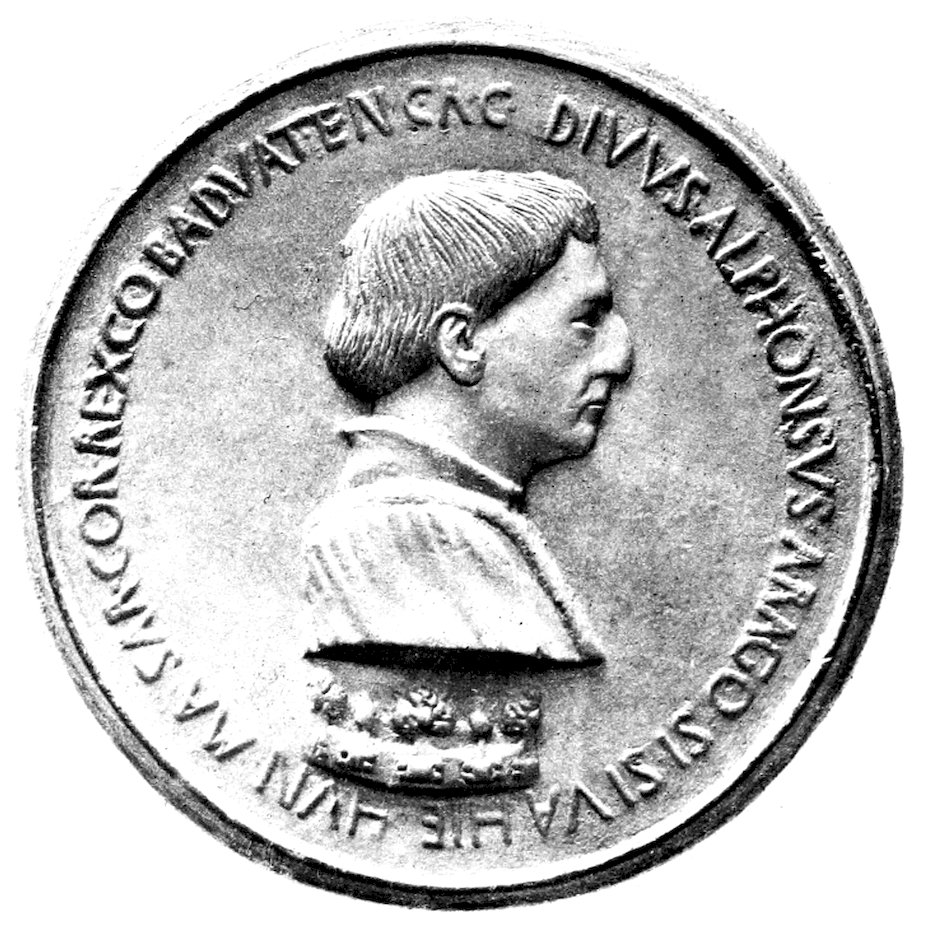
Alfonso of Aragon
Fresh troubles were at hand in Hungary. Round Belgrade, the putrefying carcases of the Muslim thousands envenomed the air. The rudiments of antiseptic sanitation were unknown. Those who have had to do with Boers, or Cubans, or Filipinos will know the unspeakable horror that this implies. Pest decimated the Christian army. Plague swept away the Magyar host, that Infidels in vain had tried to overcome. When they told him that his end was near, that Viaticum was approaching to be his strength on that dark road which man must tread alone, the noble Vaivod Jan Hunniades, said: “It is not fitting that our Lord should visit his servant”; and, rising from his death-bed, he dragged himself to the nearest altar, where, after confession and communion, in the priest’s hands he fell and yielded up his great and splendid soul, the eleventh of August 1456. On the twenty-third of October Fra Jan Capistrano also died.
From Rome came the voice of the Pope strenuously appealing to the Powers. His ablegates preached in every country. The common people heard Him gladly, and responded to His call: but the nobles lent deaf ears. Upper Germany and Nürnberg equipped battalions of crusaders, which were increased by contingents from England and France.
In November the faineant young King Wladislaw returned to Hungary, and visited the field of Belgrade. Since the death of Jan Hunniades the Count de Cilly had made himself of supreme authority over his royal ward. Belgrade still was mourning the mighty Vaivod; and the nobles under Wladislaw Corvinus, Hunniades’s son, resenting the insolent assumptions and cowardice of De Cilly, slew him there. The young king concealed his wrath, and persuaded the sons of Jan Hunniades to follow him to Buda. All unsuspicious of that treachery of which cowards are capable they obeyed, and, on arrival in the capital, the Majesty of Hungary had them seized, and Wladislaw Corvinus Hunniades publicly beheaded as a traitor. Hungary was now in woeful plight. Deprived by axe and pest of those strong leaders who had merited her trust, her king a venomous child, her throne with no legitimate heir, she waited, in fear and trembling, to hear again the Infidel thundering at her gate. All discipline was at an end; the 42Magyar huszars were disbanded, and returned to their homes.
In Germany, the question of the Magyar Succession was regarded as confusion worse confounded; and the Electors of the Empire considered the time a suitable one for reapplying the screw to feeble needy Caesar Friedrich IV, their suzerain.
They invited him to preside at a Diet at Nürnberg, on St. Andrew’s Day, 1456; and, indeed, their conduct throughout was thoroughly Caledonian. Their ostensible object was the projection of a new crusade; and they announced an intention of acting independently if Caesar should refuse to come. In reality they meant to pit Pope against Emperor, and Emperor against Pope; so that, in the confusion, they might gratify their private ambitions by snatching concessions from one or other of those Powers. By pretending to desire a new crusade they would gain pontifical favour. By taking independent action they would arouse imperial ire. The Pope might be trusted to grant them what they called Ecclesiastical Reform in return for their alliance to His plans against the Infidel. Caesar might be trusted to concede extension of their political power, in return for their allegiance to him as suzerain. In either case they stood to win something.
Caesar promptly forbade the assembling of the Diet at Nürnberg. His command was slighted; the Diet sat, and was attended by a Papal Ablegate. Purely political discussions ensued; and the Diet adjourned before reaching any conclusion. Then the Elector Albrecht of Brandenberg found it worth his while to form a strong Caesarian party; and the Electors of the papal faction were left in a minority. The cry for Church Reform was raised. The Papacy was threatened with what it was supposed to dread more than a General Council—viz., a Pragmatic Sanction,[17] 43i.e., a definite assertion of Imperial Supremacy. The Electors kept their proceedings secret, and little news was allowed to reach Rome, where the curia was determined to resist in any case.
The cry for Church Reform is a popular one. The expression of desire for the cultivation and consummation of the Christian Ideal invariably wins sympathy. It is, perhaps, a little unfortunate that the soi-disant reformers of the fifteenth century attached to the word Reform a baser meaning than that which it bears in the twentieth.
Rome had her champion ready in the Lord Enea Silvio Bartolomeo de Piccolhuomini, Bishop of Siena, to whom she entrusted the task of her defence; and that he might be well-armed with all authority, the Pope’s Holiness created him Cardinal-Presbyter of the Title of Santa Sabina. “No cardinal ever entered the college with greater difficulty than I; rust had so spread over the hinges (cardines, specimen of fifteenth century pun) that the door could not turn and open. Calixtus used battering rams and every kind of instrument to force it,” said the new Cardinal of Siena to the Lord Giovanni Castelleone, Bishop and Cardinal of Pavia. (Pii II. Ep. 195) The Sacred College had not forgiven the Lord Calixtus P.P. III for the creation of the Cardinal-Nephews; and its policy was to oppose God’s Vicegerent and all His works. This new creature, too, was credited with liberal proclivities; and the conservatism of the Italian cardinals was up in arms. The Cardinal of Siena had been so long a resident in Germany that he was looked upon as more a German than Italian, more of a friend to Caesar than to Peter. Above all, his transcendent talents and versatility were excessively distasteful to mere mediocrity.
The adjourned Diet of Nürnberg resumed its session at Frankfort-on-the-Main. Here it became definitely hostile to Caesar; and, by announcing its intention to resist the collection of tithe, to the Pope also. It committed the strategical error of uniting its two enemies by the bond of a single interest. The Lord Calixtus P.P. III instantly appealed to Caesar Friedrich IV on behalf of the Crusade; and so ended the year of grace 1456.
44Let it be conceded that Germany was aggrieved; that there were engagements unfulfilled by Rome. What then? Rome, and all the world, knew Germany’s habit of clamouring for Reform, whenever she saw a chance of being paid for silence. Rome, and all the world, knew that these clamours only originated with insincere and venal prelates and Electors, who would become obsequiously dumb on a sop being thrown to their personal interests.
The leader of the Electors was the Lord Hans of Baden, Prince-Archbishop of Mainz. His chancellor, Martin Mayr, in writing congratulations to the Cardinal of Siena on his elevation, took occasion to be very bellicose about Papal treatment of Germany. “His Holiness observes neither the decrees of the Council of Constance, nor of Basilea, nor the agreements of His predecessors, but sets the German nation at naught,” he said. “Our elections of bishops arbitrarily are annulled. Reservations are made in favour of cardinals and papal secretaries. You yourself have a general reservation of benefices in the provinces of Mainz, Trier, and Köln, to the value of two thousand ducats per annum—an unprecedented and unheard of grant. Annates rigorously are exacted, grants of expectancies habitually are given, and his Holiness is not content with His due. Bishoprics are not given to the most worthy, but to the highest bidder. Fresh tithes are imposed without the consent of our bishops, and are paid to the Pope. In every way Germany, once so glorious, is used as a handmaid. For years she has groaned in slavery. Now her nobles think that the time has come to make her free.”
This letter reads like a genuine cry of distress. The Cardinal of Siena was an adept at dealing with such dishonesty as this, which would deceive one less expert. He could read between the lines; and he knew this Chancellor Mayr. He began by asserting Papal Supremacy, and rejecting the decrees of the schismatic Council of Basilea. He agreed that the Concordat of the Lord Eugenius P.P. IV should be observed. He said that the Lord Calixtus P.P. III was willing to redress grievances, if the Electors would send envoys to lay them before Him in proper form. So far, nothing could be more satisfactory; 45and then the Cardinal of Siena got to work. Papal interference with elections, he said, was purely judicial intervention, due to the ambition and greed of claimants, not to papal rapacity. If any payments had been made by would-be bishops to bribe officials of the curia, the said would-be bishops justly could not blame His Holiness, but their own ambition, which would do anything for its own aggrandisement. Men were not more angelic in Rome than in Germany: when money was offered they naturally took it. But the Holy Father must not be blamed for that. He wished to stop the extortions of his officials. He Himself received nothing but His due. Every one thinks it a grievance to part with money, and will think so always. Bohemia made the same complaint against Germany as Germany made against Rome, that money was drained from the land: yet Germany, owing to her connection with the papacy, steadily had grown in wealth and importance, and was richer now than at any previous time, despite of her complaints. To descend to personal matters, the Cardinal of Siena thought it very hard that Chancellor Mayr should object to the provisions which had been made in his favour. As poet-laureate of the Empire and orator of Caesar he had lived and laboured in Germany so long, that he now found it hard to be classed as a stranger. In conclusion, he thanked the Chancellor for his personal offer of help to realise the said provisions; and would be glad to know of any eligible benefices which should fall vacant.
The sting was in the tail of this letter. It is evident that, while Martin Mayr was writing for publication his precious list of grievances, he also was sending to the cardinal in private a second letter offering his own services as rent-collector. In theory, he pretended to treat his connection with the Lord Enea Silvio as having no existence. In practice, he was very anxious to be employed as agent on commission. To such a venal Janus only one reply was possible; and the Cardinal of Siena exposed the worthless insincerity of Germany’s spokesman by answering his private and his public letters together on the same sheet.
This device, as was intended, provoked a proposition from Chancellor Mayr’s superior, the Prince-Archbishop of 46Mainz; who sent his secretary to Rome on the tenth of September, 1456, with plenary powers to negotiate with the Cardinal of Siena towards an alliance with the Pope against the Electors. This renegade prelate’s terms were, that he was prepared to desert the German party of reform, if he were conceded the right of confirming episcopal elections throughout Germany as the price of his treachery; a right which would enable him to tax candidates for bishoprics at his will.
The Cardinal of Siena lashed the Prince-Archbishop with courteous but stinging pen. He rejoiced to hear that his High Mightiness no longer cared to be allied with those malignants who attacked the Holy Father; but regretted that he should ask for that which was a right inherent in the Papacy, and which none of his predecessors had enjoyed. No bribe, no secret understanding, was necessary between God’s Vicegerent and His subjects. All were bound to obey. He was sure that the modesty of the Archbishop had been misrepresented by this improper request, which he, for his part, could not dare to lay before a Pope so blameless and so upright as was the Lord Calixtus. (Pii II. Ep. 338)
Now that the venal nature of the cry for reform had been made clear to all the world, the Cardinal of Siena wrote eloquently and reasonably to Caesar Friedrich IV, to the King of Hungary, to the Princes and Prelates of Germany, pointing out the futility of quarrelling with the Pope, from Whom they derived so many benefits. (Pii II. Ep. 320, 344, 349.) He also expanded his letter to the discomfited Chancellor Martin Mayr into a pamphlet called De ritu, situ, conditione, et moribus Germaniae, in which he shewed that Germany had received from Rome far more than she ever had given. His wise and irrefragable reasoning, with the diplomatic skill of the papal envoy Lorenzo Rovarella, made Germany pause. To pause was to weaken. Then came the death of King Wladislaw of Hungary on the eve of his marriage with Madame Marguerite de France. His dominions in Austria, Hungary, Bohemia, were claimed by several pretenders. The German Powers became intensely interested. Their attention was diverted from their attempts 47to blackmail Christ’s Vicar. And so the end of the Lord Calixtus P.P. III was attained; the crisis was averted without issue of a Pragmatic Sanction.
Meanwhile the Cardinal-Admiral was in the Ægean. Being neither hero nor enthusiast he merely cruised from place to place, making a show of activity, capturing a few unimportant islands from the Muslim Infidel, relieving the necessities of the Knights of Rhodes. His sole object was to avoid that judicial inquiry with which the Cardinal-Nephews had threatened him; and hence he showed himself as but a perfunctory crusader. In fact, his influence was bad; for by giving the Ægean islanders the notion that Rome was their defender, he lulled them into false security and destroyed their self-reliance.
The plight of Eastern Christendom became more hopeless. Only the Holiness of the Pope, of all the Western powers, took any practical measures. France promised, but failed to keep her word, and would not pay the tithe. The Duke of Burgundy collected the tithe, and kept it. Norway, Denmark, and Portugal sat still. The Duke of Milan and the Republic of Venice disregarded the Pope’s entreaties. The Signoria of Florence refused to help Him. A few of the Italian barons, tyrants of petty fiefs, provided him with money and men. The Republic of Genoa was loyal; and, in return, the strenuous Lord Calixtus P.P. III protected Genoese colonies on the Black Sea littoral, and conferred honours on her nobles. The dark outlook momentarily was lightened by a victory over the Muslim fleet, in which five and twenty galleys became a Christian spoil. It must be recorded that it was solely the determination, foresight, and energy, with which the aged Pontiff in Rome personally directed naval movements, which inspired His sailors to achieve this triumph. Had the Cardinal-Admiral Scarampi been endowed with the plenary authority which he had desired, very much less enterprising and successful would have been the policy of the papal fleet.
There can be no doubt but that German captiousness prevented the accomplishment of the Pope’s designs for the protection of the Oriental Christians. Skanderbeg had 48but a handful of huszars wherewith to oppose the Muslim Infidel. And there was no encouragement for him; for the apathy of Caesar and the Powers prevented him from following up his victories. The King of Naples was as a thorn in the Pope’s eye. He had hoped for better things of His old patron who had brought Him to Italy; and He was bitterly enraged by King Don Alonso’s treachery in sending the fleet, which, though constructed in the port of Naples, had been paid for with papal gold, to carry on a private quarrel with a Christian Power, the Republic of Genoa, at the very moment when Christendom was in the direst peril from the Infidel.
The forbearance of the Lord Calixtus P.P. III ended there, as far as Naples was concerned. Henceforward He relentlessly opposed the policy of King Don Alonso, especially his scheme for an alliance with Milan by which he hoped to make doubly sure the succession of the Bastard Ferrando, whose legitimation had been recognised by two preceding Pontiffs.
At the beginning of 1458, György Podiebrad renounced the Hussite heresy on his election to the throne of Bohemia. King György made no difficulty about swearing allegiance to the Holy See; and he also promised to take the cross of the Crusade. Considering that his dominions immediately were menaced by the Infidel, his policy would appear to have been dictated by reasons of state rather than by religious zeal.
The Holiness of the Pope was consoled by this accession to the thinned ranks of His allies. He hoped that the example of King György would be of good effect to the Bohemian heretics; for spiritual matters are not uninteresting to a Roman Pontiff. It seemed that the occasion might be used to bring the powers into line; and He summoned a congress to meet in Rome, whose object was the Unity of Christendom. Pious men have pursued that object ever since—the religious unity. In the days of the Lord Calixtus P.P. III, political unity was the aim desired, and striven-for again, in vain.
After the Crusade, the work nearest to the Pope’s heart 49was the promotion of His nephews’ interests. Why He should never have done anything for His own most charming son remains a historical mystery. The elevation to the cardinalate of Don Luis Juan de Mila y Borja, and of Don Rodrigo de Lançol y Borja, already has been recorded. There was a younger brother of Cardinal Rodrigo, younger by a year and a half, Don Pedro Luis de Lançol y Borja, a gorgeously beautiful sneak and coward, to whom the Pope extended the envious admiration that feeble age must feel for youth and strength; and for whom nothing had been done. The Lord Calixtus P.P. III, though quite independent of the good opinion of the Sacred College, did not cause a second storm by raising this young man, also, to the purple. He himself preferred a secular career; and it was thought that the hot blood of Borja suited him to cut a military figure. On that account, his Uncle, in the capacity of an Italian despot, named him Duke of Spoleto, Gonfaloniere of the Holy Roman Church, Castellan of all pontifical fortresses, and Governor of the cities of Terni, Narni, Todi, Rieti, Orvieto, Spoleto, Foligno, Nocera, Assisi, Amelia, Civita Castellana, Nepi, and of the Patrimony of St. Peter in Tuscany,—an extravagance of generosity which is justifiable solely on the score of goodwill towards His family, which, after long years, an octogenarian was able to put into effect. Of course there arose the usual uproar of protest from the Sacred College, led by the Lord Domenico Capranica, Cardinal-Presbyter of the Title of Santa Croce in Gerusalemme; and something akin to a riot among the citizens of Rome, who always hated foreigners, and especially Catalans. For the idea had got abroad in Spain that in Rome preferment awaited Spaniards, and thither they flocked to receive the good gifts which, they imagined, a Spanish Pope would have in store. Rome was furious at this immigration; but Borja made overtures of friendship to Colonna, and treated the Romans to a display of Spanish arrogance. As for the strenuous Lord Calixtus P.P. III, He announced His defiance of public opinion by installing Don Pedro Luis de Lançol y Borja in the Prefecture of the City, an act which involved the surrender into Borja hands of the Mola of 50Hadrian, or Castle of Santangelo, the impregnable fortress on Tiber which dominates Rome. Don Pedro Luis was looked upon by Orsini as a mortal foe, on account of his displacing Don Giovantonio Orsini in this Prefecture. Thus the inimical relations of Borja with Orsini very naturally qualified them for an alliance with Colonna, in a simple age when a man’s friends were his friend’s friends, and his enemies his friend’s enemies; and Colonna was the most powerful house in Rome. A nursery ditty of the period will show in what esteem Colonna was held: