Book the Second (continued 3)
Reading edition
During the first year of the Sixteenth Century, A.D. 1501, the Apostolic Ablegate Cardinal Raymond Perauld came to an agreement with the Diet at Nürnberg: and the project of a Crusade was improved by the formation of a new league of the Papacy with Venice and Hungary, (the two countries which lay at the mercy of the Muslim Infidel;) and by some naval successes with the conquest of Santa Maura by Bishop Giacopo da Pesaro.
In the spring, Duke Cesare marched his reinforced army to beleaguer Faenza. There, the citizens had constructed a bastion during the winter at the convent of the Friars Minor-of-the-Observance outside the walls. On the twelfth of April, this defence was taken by Duke Cesare, who installed a park of artillery to breach the citadel. The brave Faenzesi made sorties from their city for grain and cattle: but the effect of famine soon began to tell. (This account of the siege is Canon Sebastiano di Zaccaria’s.) The rich shared their bread and wine with 175the poor. When money for paying the soldiers failed, the priests and monks gave the sacred vessels. Women took part in the defence, throwing stones from the walls, or strengthening the gabions with earthworks; while the most daring fought, with casque and pike and harquebus, when their men slept. Matrons prayed in the churches. Barefooted boys and girls ran about the streets praying for Divine Assistance for their fathers on the ramparts. On the eighteenth of April, the sixth day of siege, the assault was made. Duke Cesare had advised the neighbouring princes; and Don Alfonso d’Este, heir of Ferrara, with his heraklean brother the athletic young Cardinal Ippolito were come post-haste to see the sight. (It is worth noting that advantage was taken of this visit to plan a marriage between the young widow Madonna Lucrezia Borgia and Don Alfonso d’Este.) The assault lasted from one o’clock in the afternoon till four. The assailants severely suffered from harquebuses, and flaming darts, and showers of stones, with which the beleaguered greeted them, intrepidly fighting on the smoking débris of their walls. Nothing was seen to equal Faenza’s valour: but Duke Cesare’s condottieri also gave signal proof of bravery. Don Taddeo della Volpe of Imola, on being struck in the eye by an arrow, tore it out and went on fighting, saying that he was fortunate enough to see but half the danger now. Duke Cesare conceived so great an admiration for the courage of his enemies, as to say that, with an army of Faenzesi, he cheerfully would undertake the conquest of all Italy. During seven hours on the twenty-first of April, artillery bombarded the citadel, which now was little more than a heap of ruins. Every night, some of the beleaguered slid over the walls, and escaped into the camp of Duke Cesare, worn by famine and the fatigue of the siege. On the night of the twenty-second, one Bartolomeo Grammante, a dyer, fled from a fortalice where he was on guard and came to the Duke, saying that there was mutiny in Faenza, that ammunition was exhausted, and offering to point out a moment favourable for assault. Incontinently Duke Cesare hanged this traitorous felon near the city-wall, out of respect for the brave Faenzesi and their admirable resistance. Three 176days later, the end came. The conqueror offered most honourable terms: complete liberty for the Tyrant Don Astorgio Manfredi, and his relations, to go and come at will; the integrity of his property and payment of his debts; confirmation of all rights and privileges for the citizens.
On the twenty-sixth of April, the municipal officers came to the convent of the Observantines where Duke Cesare lodged; and swore between his hands the feudal oath of fidelity to the over-lord, the Holiness of the Pope. At three o’clock in the afternoon, came also Don Astorgio Manfredi with his kin. This unfortunate youth was only of the age of sixteen years, the servant of his own subjects, and an orphan whose father, Don Galeotto Manfredi, had been murdered by his mother, Madonna Francesca Bentivogli. A Venetian chronicler says of him that he was “a sickly lad (puto mal san) but beautiful fair and rosy,” obviously rotten with struma; and as such he appears in his portrait in the Palazzo Zauli-Naldi of Faenza, wearing an expression of profound melancholy. The young Tyrant and his bastard brother, Don Gianevangelista Manfredi, (who was of the age of fourteen years, and had had a command during the siege,) received so courteous a reception from Duke Cesare that they decided to remain with him. So far, the behaviour of the Generalissimo appears to have been inspired by noble magnanimity.
And here, there is a lacuna. The history of Don Astorgio becomes blank. Research so far has failed to discover any trace of him for months.
Some time after his capitulation, Don Astorgio and his brother were found incarcerated in the Mola of Hadrian, in the royal apartment which Madonna Caterina Sforza-Riario had vacated on going into exile in France: and of this, also, there has been no explanation yet discovered.
It is permissible to suppose that after Duke Cesare generously had granted their unconditional liberty, some imperious political necessity intervened; such as that Don Astorgio and Don Gianevangelista, held as hostages, 177would guarantee the tranquillity of Faenza, preventing further rebellion. Duke Cesare’s apparent breach of faith is not without its parallels in ancient, modern, and contemporary history; a political crime, perhaps necessary, but for which there is neither extenuation nor excuse.
But later still, the story ends in tragedy. The two boys are said to have been killed, and their bodies cast in Tiber. The only two chronicles which have the slightest value are those of Don Antonio Giustiniani the Orator of Venice, who was in Rome; and of Monsignor Hans Burchard the Papal Caerimonarius, who might have been there: though the originals of these chronicles, be it remembered, are yet to seek.
The former wrote to his government,
“They say that this night those two young lords of Faenza with their steward have been slain and thrown in Tiber.”
The latter records in his journal,
“There were found in Tiber, suffocated and dead, the lord of Faenza, a youth of about the age of eighteen years, beautiful and well-shaped, with a stone at his neck; and two youths bound together by the arms, the one of fifteen and the other of twenty-five years; and near them a certain woman, and several others.”
It is said also that the victims were floating in Tiber in the sight of all.
The affair is the occasion of another of the calumnies which have been cast upon the House of Borgia. Not one word is said by contemporaries implicating Borgia in this crime: yet the modern fiction-monger or quoad-historian who without hesitation did not place it to Borgia’s debit would consider himself guilty of dereliction of duty.
The statements of the Venetian and the German, quoted above, will not bear examination in the light of common sense. A rational and unprejudiced observer will have noticed that Giustiniani does not speak of having seen with his own eyes. He is not imparting official information: he reports a mere on dit. But Burchard’s account is a miracle of Teutonic completeness at all costs, and lack of sense of 178the ridiculous. He does not say that he has seen the show. He gives no authority for his statements. But he adds, to Don Astorgio and Don Gianevangelista, a youth of twenty-five, a certain woman, and several others! Is any reliance to be placed on Burchard, uncorroborated and unashamed? He says that the corpse of Don Astorgio had a stone at his neck, yet he was floating on Tiber in the sight of all! How can a cadaver float when weighted with a stone? The density of Tiber is not like that of the Dead Sea or Droitwich Brine Baths. Also, Tiber notoriously is a swift current, far too turbid to permit a crowd of corpses placidly to float in the sight of all. Also, Tiber exclusively was used for drinking and household purposes, and constantly by all Romans, high and low, for swimming: the heraklean Lord Cardinal Prince Ippolito d’Este swam there. Also, the Borgia were pre-eminently clever—cunning, their calumniators say. Then, is it probable that men of any common sense would offer a hecatomb of assassinations to Tiber, and to the sight of all, weighted only by Burchard’s single stone? Finally, how is it that in the history of Faenza, and of the relations of these young lords, there is not a single allusion to the manner of their death? The learned Padre Leonetti justly contends that the story of the murder is a mere fabrication; that the scribes, with Burchard and Giustiniani, have seen no floating bodies; but that they have contented themselves, according to their custom, with fresh vilifications of the Lord Alexander P.P. VI and of Duke Cesare de Valentinois.
Let it be remembered that Don Astorgio Manfredi was “un puto mal san,” a sickly or strumous lad. Let it be remembered how extremely easy it is to kill strong boys off, between their fourteenth and their eighteenth year, simply by depriving them of hope and joy. Let the most pathetic history of Don Astorgio Manfredi, of which the barest briefest extract has been given, let his situation, and that of his young brother Don Gianevangelista, be realized with care; and the humanly natural supposition will arise, that these two died natural deaths due to constitutional defects aggravated by hopeless imprisonment in the Mola of Hadrian.
179It would be hard, however, if the enemies of Borgia could find nothing worse to say; and the abominable Messer Francesco Guicciardini of Florence, pandar of France, minion of Ghibelline Colonna, does not fail to make use of that curiously common and invariably inconsequent calumny which mediocrity, in all ages, hurls at genius. He writes, “Astorgio was not deprived of life before having first been used, they say, to satiate the passions of a certain person.” Under the pen of historians who followed Guicciardini, this “certain person” quite naturally has become the Lord Alexander P.P. VI. It is on the authority of this Guicciardini that writers, far from the scene, and long after the deed, have allowed them to assail an old man, a priest, the Head of the Church, with a shameful and execrable accusation. Did Guicciardini make the very difficult examinations of this problematic corpse which medical-law ordains? He was inspired, and very badly, by his hatred. He has not proved the crimes of the Pope. He has only exhibited the fertility of a monstrously unclean and salacious imagination, the dévergondage of a mind stuffed with reminiscences of Tiberius, of Nero, of Elagabalus! (Réné, Comte de Maricourt.)
The Lord Alexander P.P. VI had now reached the summit of His magnificent pontificate. With the States of the Church slowly but surely being brought under domination by the splendid gains of Duke Cesare de Valentinois, with the interested support of the Christian King of France and the Catholic King of Spain, (for the latter had the sense to cease from annoying a powerful pontiff), and with His neighbour the Regno under its weak King Don Federigo of no importance, there was nothing that He might not do for the enrichment of the Papacy or the aggrandisement of the House of Borgia. His policy was beginning to take shape. The enormous and magnificent project, which appears to have dictated all His actions, was assuming a concrete form. Difficulties of every kind had beset Him from the beginning; and difficulties, He doubtless knew, would be His constant portion: but by patience, 180agility of mind, diplomatic skill, singleness of purpose, and His invincible indomitable will, He had beaten down His opponents one by one, or had turned their opposition into support which now enabled Him to act independently and upon His own initiative.
He made short work with the rebellious barons of Rome. He blasted Don Pierfrancesco Colonna with excommunication. He confiscated the fiefs of the Houses of Colonna and Savelli, both of the Ghibelline faction, who had defied Him by secession to Charles VIII and the unmitigable Cardinal Giuliano della Rovere in 1494. He distributed the titles and estates so acquired among members of the House of Borgia.
On the first of September 1501, He issued a Brief legitimating that bastard of Duke Cesare de Valentinois and a Roman spinster, who had been born in 1498, and was known as Infans Romanus; to whom He gave the name Giovanni, after His favourite son the murdered Duke of Gandia, as well as the duchy of Nepi. But, by a second Brief of the same date (in the Archives of Modena) He declares this Don Giovanni Borgia to be the son not of the aforesaid Duke (Cesare) but of US and the said spinster.[46]
There exists no explanation of the contradiction in these two Briefs. It is, however, certain that no human temptation could induce a Pope to publish such a statement as that of the second, unless the thing were true; and, in the case of a Pope as powerful as the Lord Alexander P.P. VI, there was no superior power which could force Him against His will. As to one of the Briefs being truth and the other falsehood, it may be remembered that there is a general law, a Necessary Proposition, “The lesser is contained in the greater.” The thing was true. The Lord Alexander P.P. VI, at the age of sixty-seven years, was the father of Don Giovanni Borgia, whom He created Duke of Nepi in 1501.
The Lord Alexander P.P. VI was a very great man; guilty of hiding none of his human weakness: and on this account a Terror to hypocrites of all ensuing ages. Nothing 181in the world is so unpleasant, so disconcerting, so utterly abhorred, as the plain and naked truth.
After the spoliation of the Houses of Colonna and Savelli—an act which reduced them from that of premier barons of the Holy See to a position of such insignificance that they no more appear in the history of this pontificate,—the Pope’s Holiness married Madonna Lucrezia Borgia to Don Alfonso d’Este, the heir of Duke Ercole of Ferrara. This was after her year of widowhood. She was now the wife of royalty, with a near prospect of a throne, worshipped by the poor for her boundless and sympathetic charity, by the learned for her intelligence, by her kin for her loving loyalty, by her husband for her perfect wifehood and motherhood, by all for her transcendent beauty and her spotless name. Why it has pleased modern writers and painters to depict this pearl among women as a “poison-bearing maenad” a “veneficous bacchante” stained with revolting and unnatural turpitude, is one of those riddles to which there is no key. If physiognomy be an index to character, the most superficial inspection of the effigy of Madonna Lucrezia Borgia must put her calumniators to endless shame. In that simple profile, of features clean-cut, delicate, refined; in those chaste contours so gently rounded, so sweetly fresh and feminine; in the carriage of that flavian head well-poised and nobly frank, there can lurk no taint of decadent degeneracy. In the Ambrosian Library at Milan, is a long tress of her beautiful yellow hair, shining and pale; with her scholarly letters to a learned poet and cardinal the Lord Pietro Bembo, who had dedicated to her a genial Dialogue on platonics in Italian; an Elegy in Latin, in praise of her singing and recitation,
“quicquid agis, quicquid loqueris, delectat: et omnes
“praecedunt Charites, subsequiturque decor;
with an Epigram on a gold serpent bracelet that she wore,
Armilla Aurea Lucretiae Borgiae Ferrariae Ducis In Serpentis Effigiem Formata
182“Dypsas eram: sum facta, Tago dum perluor, aurum
“tortile nympharum manibus decus; at memor dim
“Eridani, auditaque tua Lucretia forma,
“Eliadum ne te caperent electra tuarum,
“gestandum carae fluvius transmisit alumnae.”
Another poet of even greater fame, the limpid Ariosto, praised Madonna Lucrezia as “a second Lucrece, brighter for her virtues than the star of regal Rome.” And even a modern writer of the eminence of John Addington Symonds, (who, in his “Renascence” habitually credits calumnies against Borgia in his text, half-heartedly refuting the same in footnotes,)—even he says, “Were they (the calumnies) true, or were they a malevolent lie? Physiological speculation will help but little. Lucrezia shewed all signs of a clear conscience.” Precisely. Then it is right and reasonable to presume that this much-maligned lady had a clear conscience; and to surcease from shouting any longer in the ordure which has been cast upon, and falls from, her fair memory. Let the fact that Herr Gregorovius, brilliant writer, painstaking scholar, German Protestant, fierce and unscrupulous foe of the papacy and of the House of Borgia, has destroyed all accusations against Madonna Lucrezia, silence all suspicion. In his huge work,[47] devoted entirely to her history he has shewn her to be the victim of inventions due to the paid pens of her Father’s enemies.
It would be contrary to human nature, had Colonna and Savelli meekly submitted to the confiscation of their fiefs. Armed resistance was out of the question. The heads of those Houses only saved their lives by flight into exile in discontented Germany: but they were not left without one weapon, the last refuge of the unscrupulous. The anonymous libellous pamphlet or epigram lay to their hands.
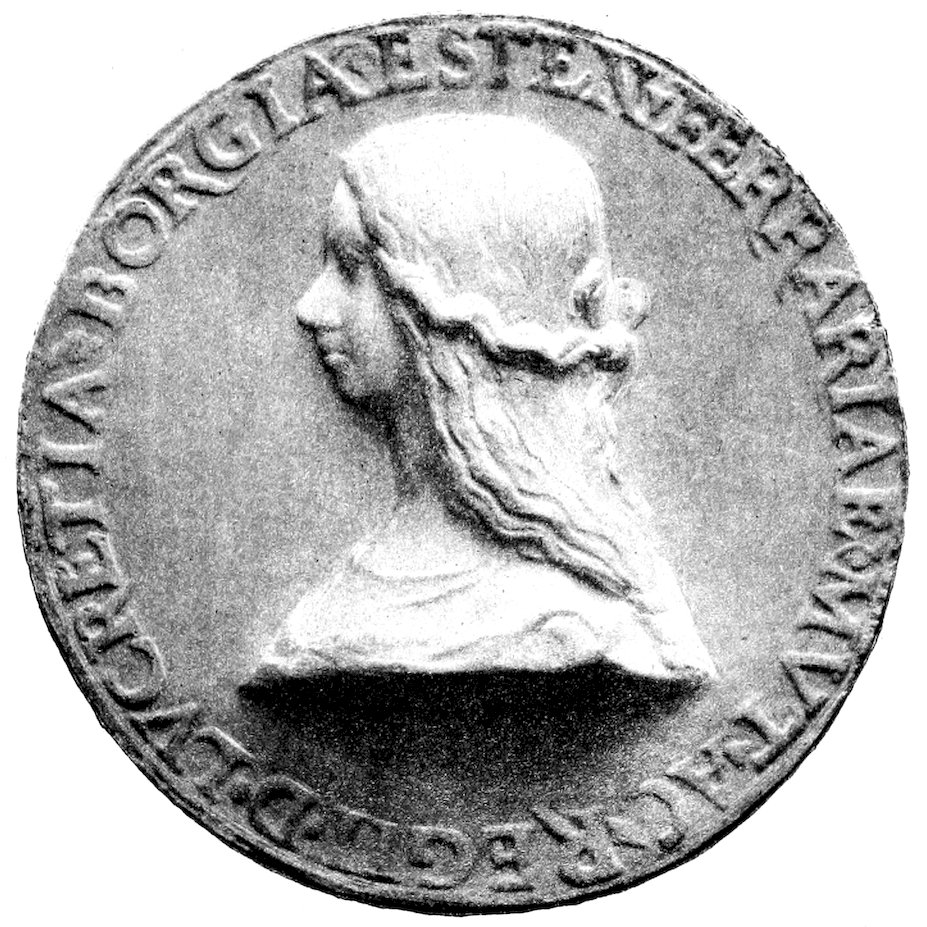
Lucrezia Borgia Duchess of Ferrara
In the Region of Monti, (the largest district of Rome, including three of the seven hills, Quirinal, Esquiline, Caelian,) which was inhabited by the faction of Colonna, there stood an antique statue of some river-god whom the 183Romans called Marforio. In the Region of Parione by Piazza Navona, which was the heart of the mediæval City, near Palazzo Braschi, there stood another antique statue whom the Romans called Pasquino and said that under him the Book of Wisdom for all time was buried. And it was the fashion to pretend that these two statues conversed on current topics, emitting epigrams in the darkness of the night, which were found in writing on their pedestals in the morning. All persons who had an axe to grind at an enemy’s expense made use of this convention: and a folio volume would not contain the witty caustic cynical pasquinades (ecce nomen,) which from the Fifteenth to the Twentieth Century have been found at Pasquino and Marforio. This method of spleen-splitting was not neglected by Colonna and Savelli. Pasquino became loquacious, bitter, oh and smart—but, smart! One epigram may be quoted as a specimen of the railing accusations brought against the Holiness of the Pope by way of reflection on His alleged simoniacal election, at times when He levied taxes or forced loans for the Crusade, or gave no remission of the chancery fees on promotion to fiefs and benefices.
“Alexander sells the Keys, the Altars, Christ.
“He bought them; and He has the Right to Sell.
But the most virulent of all anonymous attacks, was a pamphlet called A Letter to Silvio Savelli which pretended to have come from the Spanish camp at Taranto. It proclaimed to the Elect-Emperor Maximilian and the sovereigns of Europe the crimes which were said to have been committed by the Lord Alexander P.P. VI, Duke Cesare de Valentinois and Madonna Lucrezia Borgia d’Este: perfidy, carnage, rapine, adultery, incest, the heresy of Bulgaria, simony, assassination. Men who have noticed the rabid inconsequence, the grotesque impossibility and filthiness, which characterises certain foreign abuse of England at the present time, will understand the extent to which envious rage will go. Men of the Twenty-fifth Century, who read that degenerate literature, may attach to it an importance as undeserved as that which the Twentieth Century attaches to the Letter to Silvio Savelli of the Fifteenth. Humanity, 184with slight external differences, is identical in all ages. The Borgia were only men and women, boys and girls, when all is said; and the charges made against them are infinitely too monstrously inhuman to be true. Nature terribly would have avenged Herself on such infringements of Her law.
The Lord Alexander P.P. VI read the Letter to Silvio Savelli. It is recorded that His Holiness deigned heartily to laugh with His courtiers over the exaggerated absurdity of the satire. As for its coarseness—the Romans always value simplicitas and urbanitas of speech, i.e., hideous grossness and brutal jest. As for taking offence—well, Consul Caius Julius Caesar laughed at the crabbed little couplet of Caius Valerius Catullus, and invited him to supper; and the Lord Alexander P.P. VI had lived too many years in Italy not to have taken the correct measure of Milanese, Florentines, Venetians, Neapolitans; and He was well able to apportion its just value to extravagance of praise or to extravagance of blame. With His magnificent dignity of temper, He said that in Rome there was liberty of speech: and that He cared nothing for libels against Himself. (Costabili to Duke of Ferrara, 1 Feb. 1502). They amused Him, if they were witty; they pleased Him, if their language shewed distinction: and that was all.
Duke Cesare de Valentinois was not of so gracious a humour. Towards the end of November after the publication of the Letter to Silvio Savelli, a certain Messer Girolamo Manciani, a Neapolitan, was taken in the Region of Borgo on a charge of publishing calumnious epigrams against the Duke which proved him to be the author of the famous Letter. His right hand and tongue were promptly cut off and out. Two other defamers employed by the Aragonese Dynasty (as Pontano had been, and Sannazar “the Christian Vergil” was) to flout the Borgia underwent a similar mutilation; and when the Orator of Ferrara spoke of them to the Pope, it is said that He answered, “What can We do? The Duke means well; but he does not know how to bear insults. We often have advised him to follow Our ensample, and to let the mob say what it will: but he answered Us with choler that he intended to give those scribblers a lesson 185in good manners.” The good heart of the Pope spoke there. The Duke was only carrying out the law by this severity; laws, which it would ill-become the Lawgiver to set aside. Still, the offence being against the person of that Lawgiver, it was open to Him privately to recommend leniency: and that He did. No man could do more.
Florence, having cast off the despotic rule of the House of Medici, and settled herself as a true republic, was at peace with the Holy See. After the capitulation of Faenza Duke Cesare de Valentinois was created Duke of the Romagna. King Don Federigo of Naples, apprehensive of danger from the alliance of the Papacy and France set abroad the rumour that the Duke intended to conquer Florence and add it to the pontifical state; and, to curry favour with the Holiness of the Pope, he suggested that Tuscany should be erected into a kingdom, with Duke Cesare de Valentinois della Romagna as its crowned king. This attempt to deflect the wave of conquest into North Italy, and away from his own dominions, met with no success. If Duke Cesare ever had entertained the notion of proceeding against Tuscany, he made no efforts whatever in that direction. On the contrary, it was the Regno that was the object of attention. Chance after chance had been given, alliances diplomatic and matrimonial had been made with it: but it continued to be as a thorn in the eye of the papacy, its sovereigns vicious, treacherous, its people dangerous, degenerate. It was cankered to the core; and its time was come. The Lord Alexander P.P. VI signed a treaty with the Christian and Catholic Kings of France and Spain for the division of Naples. The three signatories each had a claim of sorts: the Pope’s Holiness as suzerain of certain fiefs and tyrannies, such as Benevento and Tarracina; the Christian King Louis XII as representative of the Angevin dynasty; the Catholic King Don Hernando as legitimate head of the House of Aragon. And incontinently King Don Federigo de Aragona fled into exile, while his kingdom was divided and given to France and Spain.
In 1502 the plans of the Lord Alexander P.P. VI for the defence of Christendom met with success and rebuff. 186The Elect-Emperor Maximilian sulkily withdrew his prohibition; and Cardinal Raymond Perauld, as Papal Legate, passed through the Empire preaching the Crusade. But Hungary played traitor to the League which she had formed with Venice and the Papacy a year before; and the Majesty of England, King Henry VII Tudor, refused to help. The last perhaps may be explained by the uneasy condition which the realm owed to rebellions fomented by Burgundy for the affliction of the House of Tudor—those of Lambert Simnel in 1487 and Duke Richard Plantagenet of York (vulgarly called Perkyn Werbecke) in 1494–1499.
The movement in the direction of ecclesiastical reform slowly progressed. Germany was still reiterating the cry which, as long ago as the reign of the Lord Calixtus P.P. III, she had raised anent the extortions of the Papal Chancery; and not by any means without some reason. But then, as now, the cry for reform arose from tainted sources. It was not genuine, or sincere; but only a species of blackmail. However the Lord Alexander P.P. VI was willing enough and he gave the idea due consideration, by the advice of Cardinal Francesco de’ Piccolhuomini. But, remembering that this Most Illustrious Lord was a nephew of the Lord Pius P.P. II (who, in His earlier years, had assisted at the Council of Basilea); and had the reputation of being a “concilionista,” i.e., one whose remedy for ecclesiastical ills is not a Pope, but a Council; the Supreme Pontiff resolved to delay, until that He should see His way more clearly. In a sense the Pope’s Holiness deceived Himself; for Cardinal Francesco de’ Piccolhuomini (who succeeded Him as the Lord Pius P.P. III) was, as Caesar’s wife was not, “above suspicion.” In ordinary matters, when suitable advice is not forthcoming, a Pope is liable to hesitate. Of course, in matters of teaching, His position is secure; but, as has been said, in worldly affairs the Pope-well-advised is superior to the Pope-ill-advised. Seeing no present method of securing permanent reform, the Lord Alexander P.P. VI waited. The fruit was not ripe. The psychological moment had not come. It was well to wait; and to let the movement shape itself: for, later, when the hour of reform sounded there arose the majestic Council of Trent. To 187the Borgia the world greatly owes the Tridentine Decrees—decrees that govern the Church at this day.
In this year 1502, Duke Cesare de Valentinois della Romagna escorted the Lord Alexander P.P. VI to Piombino when he made a state-progress through the conquered states; shewing Him that from that city He could threaten the Republics of Venice, Siena, and Florence, with the tyrannies of Bologna and Ravenna, the last with its interminable feud of the Sforza and the Pasolini dell’ Onda.[48] The chief independent states paid tribute to him. By hideous treachery, he captured the duchies of Urbino and Camerino, drove the Duke into exile, proclaimed an amnesty, and observed it against his worst enemies: but he hanged all those who betrayed to him, loving the treachery, hating the traitors.[49] The duchy of Camerino was conferred upon the four-year-old Duke Giovanni Borgia of Nepi and Camerino.
The Christian King Louis XII had a spasm of envy this year, in consequence of Duke Cesare’s phenomenal triumphs; and shewed some signs of interrupting the policy of the Lord Alexander P.P. VI with cries for a General Council. A model of his, bearing his effigy with the lilies of France and the legend Perdam Babylonis Nomen, made a great sensation in Rome.[50] But French motives never are disinterested. The moment another Power wins a success by expenditure of blood and treasure, that is the time for pretentious incompetent France, cane che abbaia non morde, to clamour for a share of what she never won, never could hope to win,—for what, with inconsequent impertinence, she calls “compensation”! The Holy Roman Church was not worse off, under the rule of the Lord Alexander P.P. VI, but better off than it had been before: but the election of His Holiness was always useful as a means of blackmail. 188However, Duke Cesare was Generalissimo of an enormous army. In addition to the four thousand condottieri and three hundred lancers with which he had begun the campaign, he had enlisted the many thousand mercenaries of the Tyrants whom he had dispossessed, and also recruited far and wide throughout Italy, where all the temperamental fighters gladly took service under the most successful general. And to these he added a foreign battalion of three thousand five hundred fantassini (infantry), pikemen and arbalisters, all Frenchmen, of whose quality the Christian King was well aware; and, therefore, sensible enough to refrain himself before a worse thing happened to him. Indeed, such was his anxiety to give evidence of his desire for peace that he actually offered,—he, the Christian King of France, the representative of the Angevin dynasty, offered to resign his claim to the kingdom of Naples in favour of Duke Cesare de Valentinois della Romagna. He was painfully anxious not to purchase a General Council at the cost of the conquest of France; and preferred that a Borgia sovereign, (if such a personage were to be,) should reign in Naples rather than in Paris.
The Romagna immensely was benefited by a strong and decent government where law—martial law, certainly; but law—at last was observed. Duke Cesare’s army was the only great Italian army. He, representing the Pope, was absolute in Central Italy, where no Pope had had direct authority for centuries. He was hated; hated by the great baronial Houses which he had ruined, whose heirs he had slain: but he was not even disliked by the people whom he ruled.[51] It was not extraordinary; for the mob always adores the strong bowelless man, the rigid fearless despot, the conquering autocrat who brings peace with security. He took no different measures against rebellious vassals than those taken by his contemporaries, Louis XII of France, Hernando of Spain, Henry VII Tudor of England. He was more precise, more systematic: that is all. All the sovereigns who were his contemporaries congratulated 189him. The Duke was cruel; almost as cruel as his splendid parallel of the Nineteenth Century; and as fervently disliked and decried: but he was just, with a justice as far above the mawkish humanitarian system of compromise, (which, nowadays it is the mode to applaud,) as the sun is above the stars. Through the length and breadth of his dominions he continually went, to oversee the restoration of order, to consolidate his victories. The slightest spark of opposition he relentlessly crushed out. It was a hundred-headed hydra with which he had to deal. As he passed from city to city of his provinces, he left governours in charge of each, bloody men, ruthless giants, equal to the work in hand; for the work was dangerous; and men, whose hearts were triply-cased in hardened bronze, were needed, where each man’s life was in his own hands until it was in his enemy’s. Messer Lionardo da Vinci, that “scientific sceptic,” was his engineer in chief and designer of fortifications: and Messer Niccolo Machiavelli said that, of all Princes, he could discover no ensample more blooming and more vigorous than Duke Cesare. The headquarters of the Duke were at Cesena; and that same Messer Niccolo Machiavelli—the only man who ever knew the real Cesare (detto Borgia) naked face to naked face, naked soul to naked soul,—advised the Signoria of Florence that an Orator kept at Cesena would profit the republic more than an Orator at Rome.[52] In his absences from headquarters, Duke Cesare left Messer Ramiro d’Orco there as governor. Cesena was a nest of would-be brigands. Messer Ramiro d’Orco was a governor who made these quail with the steel of his garrison and his own iron will.
It was the winter of 1502. Snow lay deeply round Cesena. In the Citadel the governor was at supper by the hearth, where huge logs blazed and crackled. Halberdiers were standing in attendance; and, on the walls wax torches flamed in their sockets, for the sun was set and the first hour of the night was come. Messer Ramiro d’Orco called 190for wine; and a page brought a fresh flagon from the buffet. He stumbled among the rushes on the floor in coming, tripped over the feet of a guard; and the falling flagon spilled the wine on the ankle of Messer Ramiro d’Orco. That monster made no more ado. He took the lad by the belt, and slung him into the fire, seizing the nearest halberd and pinning the twitching body to the flaming logs. The hair, in a flash, was gone. The slim legs violently writhed outward, and fell still. Hose and leathern jerkin peeled, and the white flesh hissed and blackened. Then, naught but small ash showed where a boy had died; and the smell of roasted human flesh mingled with the smell of the meats. Again, Messer Ramiro d’Orco called for wine, unmoved, only inconvenienced. He was the governor of Cesena: he had but punished a clumsy serving-boy.
That is the kind of man who could rule in the Romagna: and it easily will be understood that acting in this way, armed with plenipotentiary authority, Messer Ramiro d’Orco froze his district into a state of comparative tranquillity—a state which gave him the opportunity of looking further afield, and, so it happened, fatally for himself. A very little cruelty of this callosity goes far. Even truculent Cesena grew faint with horror of this fiend.
Duke Cesare acted upon the principle that it is better to be feared than loved—if one must choose: but he knew that there is a point beyond which no wise ruler goes: he knew the supreme art of making an end. Murmured rumours of atrocities reached his ears. Sooner or later he would have to bear the odium of the ill-deeds of his deputy. He never shirked responsibility. To shine in the reflected glare of Messer Ramiro d’Orco’s evil fame would not suit his purpose. And there were other things.
On the twenty-second of December, when the setting sun cast long blood-red lights across the snow, without warning Duke Cesare gallopped into Cesena with an armed escort of lancers. The cowed Cesenesi, turning out of doors to do him reverence, caught bare glimpses of flashing mail and the bull-bannerols of Borgia passing over the drawbridge of the citadel. Presently, from that citadel came Messer Cipriano di Numai, the Duke’s secretary, to 191the house of Messer Domenico d’Ugolini, the treasurer; seeking the governor in the city. Messer Ramiro d’Orco was arrested, and conducted to the presence of his chief.
Surmise that night was rife as to the import of these acts. New vengeance? New taxes? New horror? None could say.
The next morning, letters-patent went to all cities of the Romagna proclaiming that Duke Cesare had arrested his governor Messer Ramiro d’Orco, on the charge of numberless frauds, illegal cruelties, and other crimes. The plaints of the oppressed had grieved the Duke, natural enemy of exaction, avarice, and cruelty, who, having freed the citizens from the ancient terror, wished to impose no new charges on them. The letters-patent concluded, “for the doing of justice to Ourself and to all persons who have been injured, and for a salutary example to all Our servants present and future, Messer Ramiro d’Orco will stand his trial on depositions against him collected.”
The trial was not a long one. Legally put to the Torture of the Question, that frightful ruffian admitted the truth of the said depositions; and, chiefly he accused himself of having sold the store of corn belonging to the province, applying the price to his own purposes, to such an extent that Duke Cesare only averted a famine by importing a fresh supply from foreign countries. Lastly, Messer Ramiro d’Orco confessed that he was conspiring with the Orsini to betray to them the city of Cesena; and with Don Vitellozzo Vitelli, Tyrant of Citta di Castello, and Don Oliverotto da Fermo, to pose an arbalister[53] to assassinate Duke Cesare with a bolt from his arbalist.[54] Citizens of Cesena who passed the little square before the citadel, going to the dawn-mass of Christmas Day, saw a joyful sight—the Justice of the Duke. They saw a glittering axe, fixed in a block upon the snow. They saw on the one side a headless body in rich garments, exposed on a blood-stained mat upon the snow. They saw on the other side the bodiless head of Messer Ramiro d’Orco on a pike.
All chroniclers of the period congratulate Duke Cesare 192on having delivered his subjects from a tyrannous subaltern as cruel as he was rapacious; and Machiavelli records that His Excellency was pleased to shew that he had the power to make men—and to mar them. Duke Cesare in teaching made use of the sense of sight. He made the peoples of the Romagna see his power, see his justice, see his ever-present indefatigable energy. What wonder then that he was looked upon as superhuman. In the citadel of Cesena a milder governor reigned.
Leaving Cesena on the Festival of St. Stephen, Duke Cesare reached Pesaro on the twenty-eighth of December, where he learned that the conspirators whom Messer Ramiro d’Orco had betrayed, (except the Baglioni of Perugia, and Don Giulio and Don Giovanni Orsini who were in Rome with Cardinal Giambattista Orsini and other prelates of their faction) were at Sinigaglia, which place they were supposed to be besieging on the Duke’s behalf; and they sent to him to announce that they had captured the city, but that the governor refused to surrender the citadel save to the Generalissimo in person. Duke Cesare sent avant couriers heralding his arrival with artillery.
At dawn on the Festival of St. Sylvester, the thirty-first of December, he appeared before Sinigaglia. His trusty confidant and captain Don Michelotto led the van with two hundred lancers. Behind these Duke Cesare rode, accompanied by three and a half thousand Italian condottieri and as many foreigners. At the city-gate, Don Michelotto halted his cavalry on the bridge, and the infantry defiled between their ranks, entering the city where the forces of Don Oliverotto da Fermo were paraded. Don Paolo and Don Francesco Orsini, Duke of Gravina, also were present, with Don Vitellozzo Vitelli who wore an ermine mantle and rode a mule like any cardinal. Duke Cesare appeared to be pleased at seeing them and allowed them to kiss his hand in the French style. The atrocious character of these brigands already has been described.
Duke Cesare engaged them in conversation, siding with Don Francesco Orsini and Don Vitellozzo Vitelli. When they reached the palace which he was to occupy, the four prepared to take their leave; but he begged them to stay 193and dine, and to assist him in certain deliberations. As soon as they had crossed the threshold, the Duke’s gentlemen made them prisoners.
Messer Niccolo Machiavelli, the official representative of the Signoria of Florence on the staff of Duke Cesare, (a capacity equivalent to that of foreign attaché with an army in the field,) reached Sinigaglia later in the day; and found the city filled with the Ducal mercenaries, who were engaged in stripping the troops of the conspirators and in doing a little pillage of some Venetian merchants. He was going to the palace to get the news, when Duke Cesare, rode out, armed cap-à-pie, and said to him, “I have had a chance, and I have taken it; and I have done a service that should cause your Signoria to rejoice.” Then he rode away and reduced his turbulent troops to order.
During the night the fate of the conspirators was decided. In deference to their rank, the two Orsini were to be sent to Rome and judged there according to law: meanwhile they were detained at the palace of Sinigaglia under guard. The trial of the others began at once. Put to the Torture of the Question in the usual manner, they soon shewed of what poor stuff they were made. The lily-livered assassin Don Oliverotto da Fermo wept and groaned and reproached Don Vitellozzo Vitelli with having led him—innocent lamb as he was—into mischief by inducing him to intrigue against Duke Cesare. On the first day of the new year 1503, at four o’clock in the morning, they were ceremonially strangled in the courtyard of the palace. While Don Vitellozzo was struggling with the carnefex, dying by slow degrees, with blackening face and bulging eyes, he screamed continually to Duke Cesare begging hard that he would implore the Lord Alexander P.P. VI to grant him absolution after death and a plenary indulgence, until the red cord (which was his baronial privilege) cut into his gullet, and stilled his swollen tongue.
An ensample of this kind can leave no doubt in the mind but that, in spite of all to the contrary, the Pontifex Maximus of Rome, simoniacally elected or not, implicitly and explicitly was regarded then as God’s Vicegerent, as Earthly Vicar 194of Christ, by the most flagitious of men. Then what can be thought of the good and clean-living majority?
The bodies were buried in the chapel of the hospice of the Misericordia, the Brotherhood of Pity, one of whose obligations is the care of criminals condemned on the capital charge.
This account of the colpo-di-stato of Sinigaglia differs from that to which the world is accustomed. It is said that, when Messer Niccolo Machiavelli returned to Florence, he was induced to make a different statement to the one which he previously had made from personal observation in his first dispatches. According to this second version, there was no conspiracy; and the brigands Vitelli and da Fermo were simply massacred by order of Duke Cesare. It is the execrable Messer Francesco Guicciardini who has prostituted his golden pen to record this so-called version of Machiavelli, which has come to be regarded as veracious history.
“Duke Cesare de Valentinois, acknowledged sovereign of the Romagna, judged his subjects who were guilty of high treason: as chief of the State, he condemned the assassins who sought his life: as generalissimo, he punished treacherous and rebellious subalterns. It is known from other sources, that these two barons were only brigands stained with murders, and that their death was a deliverance for Italy. Without insisting on this point, and if it be said that the procedure of Duke Cesare was odious,—the capture by a ruse and the summary execution,—it may be pointed out that everywhere and in all ages criminals are taken by whatever method may be possible, and that military tribunals have never wasted time in long formalities. There was accusation, trial, and execution, all in regular though rapid form. We well may call the action of Duke Cesare a coup-d’-Etat. He is not more blameworthy than the Emperor Napoleon III who in 1852 was loudly applauded. Neither is it necessary for his justification to urge the barbarous customs of his age; for we should be forced to remember that, in the Nineteenth Century, our (French) national hero, in a time of peace, caused to be seized on foreign territory, to be carried to Vincennes, and, after the mockery of a trial, to be shot like a dog in the castle-ditch, an innocent man who was a prince of the blood-royal of France. [Duc d’Enghien?] Yet no man has ever dared to liken the Emperor Napoleon I to a Borgia! (Réné, Comte de Maricourt.)
The news reached Rome on the night of the second of January. The blow had been struck with such rapidity as to 195put complicity of the Lord Alexander beyond the dimensions of time and space.
In the Eternal City, the year had opened with the ceremony called L’Ubbedienza, in which the cardinals renew their vow of fidelity to the Pope, as, formerly, Roman Senators vowed fidelity to the Princeps on each New Year’s Day. A cardinal, who would omit this duty except for a valid reason, would cause precisely such a scandal as P. Thrasea Paetus caused to Tacitus by neglecting to swear to Nero. Notwithstanding this renewal of allegiance on the first of January, only three days later the Pope’s Holiness found reason to arrest Cardinal Giambattista Orsini, with Archbishop Alviano of Florence, and Don Giacomo Poplicola di Santacroce, Orsini’s partisans, being determined once for all to crush that House of incorrigible rebels. This Don Giacomo Poplicola di Santacroce had only himself to blame. His House, the most illustrious of all the sixty conscript families of Rome, had been outlawed in 1482 by the Lord Xystus P.P. IV by reason of the furious feud between Santacroce and Dellavalle which had turned the Eternal City for months together into shambles. He should have known better than to put his head in the lion’s mouth. Giustiniani, the Orator of Venice, received an account of what had happened from the Pope’s Own mobile lips; and embodied the same in a dispatch to his government dated the fourth of January 1503. It appears to be perfectly logical on the part of the Pope’s Holiness, that, in view of the coming trial of the two Orsini whom Duke Cesare was bringing to Rome, evidence should be sought among the members of their faction.
The behaviour of Orsini was impolitic and suspicious to the last degree. They were under the shadow. Two of their alleged accomplices had been executed at Sinigaglia. The cardinal was detained in the Mola of Hadrian. Don Paolo Orsini and Duke Francesco Orsini of Gravina were prisoners of Duke Cesare. Their circumstances required a patient policy of inaction pending coming trial, the result of which they needed not to fear supposing them to be innocent of conspiracy. On the contrary, they gave clear 196evidence of guilt, desperately maintaining an armed rebellion in pontifical territory, ravaging the Viterbo country, and continuing to make leagues with other rebels whether these were Roman barons or chiefs of independent banditti.
The Orator of Venice wrote to his government on the seventeenth of January: “The Pontiff is much disturbed, and more than ever on his guard. They say that Colonna and Savelli and all the discontented barons have joined Orsini. This night there was a panic at the Vatican: no one knows the cause. The captain of the guard called out his troops and watched all night under arms.”
Prince Gioffredo Borgia of Squillace, now in his twenty-second year and father of four children, raised a squadron of condottieri and attacked his August Father’s enemies: but on the night of the twentieth of January, the Orsini cavalry captured the Bridge of Nomentano where a fortress was; and all the Borgo rose in tumult. Messer Francesco Remolino Bishop of Sorrento, and the Orator of Siena, left the City for the camp of Duke Cesare carrying orders that he should leave everything and advance on Rome, which was in imminent peril. But before the envoys reached him, on the night of the seventeenth of January, at Citta di Pieve he suddenly had beheaded Don Paolo Orsini and Duke Francesco Orsini of Gravina, the two prisoners to whom he had promised a legal trial in Rome. The attitude of Orsini perfectly justified Duke Cesare in exercising his rights as sovereign justiciary and breaking his promise. His camp was surrounded by Orsini castles, the two barons undoubtedly were caught in the article of conspiracy; and their summary decapitation became a sudden necessity to intimidate the Orsini conspirators in and about Rome. It was not the custom of the Sixteenth Century to mince matters, from any silly humanitarian motives, by sacrificing thousands of proletariat lives when the fierce slaughter of a brace of notabilities would serve the purpose. The modern accusation, that the Lord Alexander P.P. VI was privy to the execution of these two Orsini, falls to the ground when the dates of His 197dispatches to Duke Cesare, and of their deaths, are compared.
Cardinal Giambattista Orsini remained a state-prisoner in the Mola of Hadrian, within whose walls he had full liberty. By his own request, his food was sent in daily from his own House; and also he received visits from his relations. There he lived, attended by his own physicians, until the twenty-second of February when he died, and was buried in the church of San Salvatore in Lauro. Soon it was said that the Pope’s Holiness had envenomed him; and this is a charge which it is utterly difficult to prove.
Giustiniani, the Orator of Venice, who was a friend of the House of Orsini, and always inimical to the Borgia, said without explanation or remark in a dispatch to his government dated the fifteenth of February: “The Lord Cardinal Orsini in prison shews signs of frenzy.”
In the dispatch dated the twenty-second of February, he said: “The Lord Cardinal Orsini is reduced to the last extremity, and his physicians say that there is no hope of saving his life.”
In the dispatch dated the twenty-third of February, he said: “I give notice that, yesterday, after the departure of my courier, the Lord Cardinal Orsini died; and this evening, with an honourable escort, he was taken to the church of San Salvatore, and there interred.”
Brancatalini, in his Diarium, wrote: “This day XXII February 1503, Cardinal Orsini left the Castle of Santangelo dead, at a half-hour of the night; (5.30–6 P.M.) and Mariano di Stefano with many other Romans accompanied him; and he was borne to San Salvatore in Lauro.”
Soderini, Orator of the Signoria of Florence, in a dispatch dated the twenty-third of February 1503 wrote to his government:
“Cardinal Orsini died yesterday: and was buried at the twenty-fourth hour (5–5.30 P.M.) at San Salvatore the church of the House of Orsini; and, by order of the Pope, the body was escorted by his relations, and by the cardinals of the Curia, uncovered and resting on a bier draped with cloth-of-gold, vested in a red chasuble brocaded with golden flowers, on 198the head was a white mitre, and at the feet were two hats in token of his cardinalitial rank. The monks performed the funeral service; and there were about sixty or seventy lighted torches. May he rest in peace.”
Obviously, the Orators of the Powers had no suspicion of venom. Giustiniani gladly would have reported such a rumour had he found himself in a position to do so which would have been consistent with his dignity and duty to the Venetian Senate. When He heard what His enemies were saying, the Lord Alexander P.P. VI took prompt action. On the day after the obsequies He convoked the physicians who had attended the dead Cardinal during his illness and agony; and required them to certify that death was owed to natural causes without any violence due to venom or other means; He made them swear on the Sacrament to the truth of their depositions, which were recorded with the facts of the case in the usual form.
It was customary to consider certain signs as indicating venom; e.g., the spots, the colour, the odour of the corpse. There is no mention made of these. The Pope’s Holiness ordered a public funeral, the body was uncovered; and carried openly through Rome. Every one might see it; and, had the Orsini faction discovered any signs which pointed to an unnatural death, they surely would have proclaimed their suspicions. The interment on the day after death was, and is, the wholesome Roman custom. The hour, after sunset, was, and is, the hour of burial.
It has been said by modern idealists that the Lord Alexander P.P. VI envenomed Cardinal Orsini in order to inherit his riches. The idea is absurd and ridiculous; for the Orsini would have been the heirs of their dead kinsman. In fact they were. The imputation discredits itself by reason of the gross ignorance on which it is based. It is alleged that the Pope is the heir-at-law of cardinals. He is. But He was not, in the reign of the Lord Alexander P.P. VI. It was the Lord Julius P.P. II (1503–1513) who cupidinously issued the Bull which names the Roman Pontiff heir-at-law of all cardinals, and of all clergy dying in Rome; and this Pope (as Cardinal Giuliano della Rovere) was no friend to Borgia. And this fact ought to dispose of 199all allegations of cupidinal motive in this, as in other cases.
The Lord Alexander P.P. VI had the Orsini at His mercy. Duke Cesare had executed two chiefs of that House. The Cardinal was secure in the impregnable Mola of Hadrian. If the Pope’s Holiness had wished to rid Himself of this one He was quite strong enough to do so, without resort to venom, by a regular execution in public, or in private if preferred, and so defy the odium which inevitably attends the exhibition of venom. But that He had no intention of visiting His prisoners with death, or with anything more than incarceration to keep them out of mischief, may be seen from the fact that a few months later (August 1503) Archbishop Alviano of Florence was released alive and well from the Mola of Hadrian.
As there appears to have been no motive and no necessity for the alleged crime, so also there appears to have been no possibility of its commission. Cardinal Giambattista Orsini was visited daily by his people, and his food was brought to him by them. His physicians also made deposition on oath that his death was not caused by venom.
It is only reasonable to conjecture, then, that being a very old man, conscius criminis sui (conspiracy), alarmed by the execution of his accomplices, terrified at his own peril, he succumbed to an entirely natural collapse. The dysentery, which carried him off, goes to support this theory,
The French in the Regno were not prospering; and the favour of the papacy appeared to be leaning towards Spain. The Crusade languished, not for lack of funds (for the Pope’s Holiness envoyed a grant of money to Hungary); but because of the want of martial spirit on the part of, and the customary disgraceful dissensions among the Christian Powers. Venice and Hungary threw up the sponge, and came to terms with the Muslim Infidel. The conquest of Eastern Europe and the settlement of the Turks therein was an accomplished fact.
200Duke Cesare de Valentinois della Romagna occupied Pesaro. This was the fief of that young Tyrant, Don Giovanni Sforza, whose marriage with Madonna Lucrezia Borgia had been annulled by a canonical impediment. The spoliation of his appanage was a ground of fresh offence. The rupture between the Houses of Borgia and Sforza was irremediable. People spoke of Duke Cesare, now, as the Caesar Augustus of a new Roman Empire, independent, and ruled by the sceptre of a Princeps of the House of Borgia. After the execution of the conspirators at Sinigaglia, the Venetian chronicler Priuli, who loathed the very name of Borgia, wrote on the eleventh of January 1503: “Some wish to make and crown him King of Italy; others wish to make him Emperor: for he prospers so that no one dare forbid him anything.”[55]
The establishment of a Borgia Dynasty would have been no treason against the rights of the Papacy. The rebellious tyrants whom Duke Cesare had overthrown were unprofitable and even menacing. In their place was the Duke who brought law, order, and prosperity. Of course Duke Cesare derived benefit from his victories. The labourer is worthy of his hire, and even successful English generals are not begrudged their peerages. Duke Cesare’s duchy of Romagna, his commanding position, his power to enrich himself by the taxation of his subjects, were a fair reward for the immense services which he had rendered. The Papacy had now, instead of a lost territory infested by the scum of European ruffianry refusing to acknowledge authority or natural law, a vast province inhabited by law-abiding prosperous contented vassals ready and glad to pay the traditional tribute to their over-lord, in return for the unwonted safety of their lives and property. Duke Cesare was in the position of a viceroy. He held office at the pleasure of the Roman Pontiff. He was persona ingrata to the rulers of the other Italian states, who were envious of his splendid beauty, of his imperious character, of his extraordinary success, and of his tremendous potentiality. 201And they feared this tawny prince who had the tiger-strength to crush them one and all. Backed by the spiritual and temporal influence and wealth of the Pontiff, he could keep his irresistible army of veterans always on a war-footing, and himself its generalissimo; and so the Papacy itself acquired, through him, and in him, and for the first time, a material basis of independence: while, in opposition to the Pope, he could not exist.
There was the policy of the Lord Alexander P.P. VI.
He planned it with deliberation. He spared no pains to put it into effect. He did not want to ruin the Church, because She was the foundation upon which He would build His dynasty. Something of the kind was of absolute and imperious necessity. The Forged Decretals and Donation of Constantine, (which foist had been put forth in a Brief of the Lord Hadrian P.P. I to the Emperor Charlemagne,) “the magic pillars of the spiritual and temporal monarchy of the Popes,” severely had been criticized as early as the Twelfth Century. It was left, however, to Messer Lorenzo della Valla mercilessly to denounce them as forgeries in 1440, as already has been shewn here. When the Lord Alexander P.P. VI ascended the pontifical throne fifty-two years later, both Decretals and Donation had been thrown overboard from the Barque of Peter, to lighten the ship: and the Pope had no title-deeds to shew, forged or otherwise, for Peter’s Patrimony. Any diplomatist would see that a right, of some kind more inexpugnable than Prescription, was desirable. The Lord Alexander P.P. VI chose Conquest, and the Founding of a Borgia Dynasty. The office of the Church He magnified, that She the better might help the state. He intended that His descendants, members of the House of Borgia, though nominally the vassals should be the suzerains of His Successors: that Borgia should wear the double-crown of Princeps, as well as, and by means of the triple crown of Pontifex Maximus,—that a dynasty of Borgia should occupy both pontifical and imperial thrones.
There was ruin in the scheme: but not that ruin which vulgarly might be supposed.
202It was an intelligent enough policy—of a worldly sort. Only—it was not inspired by religion, nor restrained by morality. When it fell to pieces, the Lord Julius P.P. II was able of its fragments alone to build the Papal States which lasted more than three centuries and a half until 1870.
The power of the House of Borgia was so well founded that the mere death of the Lord Alexander P.P. VI would not have affected it. There was a strong party of Spanish cardinals in the Sacred College, and three of these were of the House of Borgia. The Vicegerent of Rome, the Lord Jaime Serra, Cardinal-Priest of the Title of San Vitale, was a Spaniard also. The Roman barons, Colonna, Orsini, Savelli, Dellavalle were broken; Poplicola di Santacroce outlawed; Sforza-Visconti of Milan, Sforza of Santafiora, Sforza of Chotignuola, Sforza of Pesaro, Sforza-Riario of Imola and Forli, all were exiled. The Roman Cesarini were loyal to Borgia, and had their Cardinal (Giuliano) in the Curia. Spain was friendly, and occupied in the New World. France was friendly, and feeble. Germany was feeble and internally distracted. England was only a fifth-rate power. And the invincible army of Duke Cesare de Valentinois della Romagna was ready to carry into effect its leader’s will. But chance, molecules, Providence,—the reader will choose,—disabled Duke Cesare, made him unable to act, or unwilling to act,—the reader again will choose,—at the very moment when his action was imperatively necessary. If, on the death of the Lord Alexander P.P. VI he had had his health, he easily might have done anything, said Machiavelli.[56]
“The Worldly Hope Men set their Hearts upon
Turns Ashes—or it prospers; and, anon,
Like Snow upon the Desert’s dusty Face,
Lighting a little Hour or two—is gone.[57]
At the Ninth Consistory of the thirtieth (or thirty-first) of May (or June) 1503, the Lord Alexander P.P. VI named 203nine cardinals; five of whom were Spaniards, three Italians, and one German. They were:
(α)
the Lord Don Juan de Castellar, Bishop of Oleron; Cardinal-Presbyter of the Title of Santa Maria in Trastevere tit. Calixtus:
(β)
the Lord Don Francisco Remolino, Bishop of Sorrento, a friend of Duke Cesare; Cardinal-Presbyter of the Title of San Giovanni e San Paolo:
(γ)
the Lord Don Francisco de Sprata, Bishop of Leon; Cardinal-Presbyter of the Title of San Sergio e San Bacco:
(δ)
the Lord Francesco Soderini da Volterra, Canon of the Vatican Basilica; Cardinal-Presbyter of the Title of Santa Susanna inter Duas Domos:
(ε)
the Lord Niccolo da Flisco, Bishop of Forli, Orator of the Republic of Genoa to the Christian King; Cardinal-Presbyter of the Title of Santa Prisca:
(ζ)
the Lord Adriano Castellense di Corneto, Orator of the Lord Innocent P.P. VIII to Britannia Barbara (Scotland); Cardinal-Presbyter of the Title of San Crisogono:
(η)
the Lord Melchior Copis, Bishop of Brixen; Cardinal-Presbyter of the Title of San Niccolo inter Imagines:
(θ)
the Lord Don Jaime Casanova, Apostolic Prothonotary; Cardinal-Presbyter of the Title of San Stefano in Monte Celio:
(ι)
the Lord Don Francisco Iloris, Apostolic Treasurer, Cardinal-Deacon of Santa Maria Nuova.
Why a learned Catholic historian[58] should go out of his way to call this a simoniacal creation, and his English editor to repeat the calumny, is hard to say. It is bad policy to cry stinking fish, at all times; it is especially silly to do so when the fish are fresh. The Bull De Simoniaca Electione directed against Simony was not issued until 1505, 204in the reign of the Lord Julius P.P. II; and it was not retrospective. In 1503, the Lord Alexander P.P. VI was actually a temporal sovereign, “an Italian Despot with certain sacerdotal additions.” The cardinals were the highest degree of His peerage. No doubt they paid for their promotion in the usual way; fees to officials, the crusade tax on the revenues of their Titles, perhaps even a handsome contribution to the Treasury: but why call this Simony, when it was not Simony stricte dicte till two years later? A Red Hat no more can be bought than Strawberry Leaves. A man may use his gold to recommend himself for these head-gears. A man may present £25,000 to the best of all princesses’ Hospital Fund, or land worth a quarter of a million to the proletariat; he may “bang a saxpence” in fees to officials for his knighthood, he even may pay pounds sterling in fees to officials for his barony: but he righteously would be enraged if people said that he had bought his knighthood or his barony. The word Simony must be taken as belonging to the Genus Blessed, (e.g., Mesopotamia;) or as the bark of a dog who dare not bite. Either it is a mere incantation; or a war-whoop “full of sound and fury signifying nothing.” In sober logical earnest, it is inapplicable here.
As the heat of summer increased, the Lord Alexander P.P. VI, now of the age of seventy-two years, used to sit and take the air in the shady gardens of the Vatican, and amuse Himself by watching two little boys at play. They were His bastard and his grandson; Duke Giovanni Borgia of Nepi and Camerino, of the age of five years; and Duke Roderico of Sermoneta, Madonna Lucrezia’s son, of the age of four years.
When the sun entered the constellation of Leo—Sol in Leone, the dog-days—the heat became abnormal; and plague and fevers appeared in Rome.[59] The Orators of the 205Powers promptly made arrangements to quit the City, for a cool and wholesome villegiatura.
Don Antonio Giustiniani, the Orator of Venice, sent to his Senate a dispatch dated the eleventh of July 1503, in which he wrote: “I went to the palace; and, on entering His apartment, I found our Lord the Pope in His habits reclining on a couch. He received me with good humour, saying that for three days He had been inconvenienced by a slight dysentery, but that He hoped it would be unimportant.”
On the next day Giustiniani wrote: “The Pope’s Holiness reviewed His troops from a balcony.”
On the fourteenth of July, he wrote again: “I went to the palace; and, on entering, I found His Holiness on His throne in the Hall of Pontiffs. He was a little depressed: but looked well.”
Messer Francesco Fortucci, the Orator of Florence, sent to his Signoria a dispatch dated the twentieth of July, in which he wrote: “There are many people sick of fevers, and many have died.”
On the twenty-second of July, he wrote: “I thank the Signoria for leave of absence, because I myself am uneasy, and almost out of my mind with fright; for so many people are dying of fever, and there is also something like the Pest.”
On the evening of the fifth of August, the Lord Alexander P.P. VI rode with Duke Cesare and several prelates to a supper al fresco at the villa of the Cardinal of San Crisogono outside the walls. Rome and the surrounding country are particularly unwholesome, though cool, during the hour after sunset. It is said that the Holiness of the Pope was much heated by the exertion of riding there; and that, while He was in this condition, He drank a cup of wine for the sake of coolness. No more hazardous action can be imagined; except on the part of one desiring to court a malarial fever.
206Two days later, on the seventh of August, the Orator Giustiniani wrote to his government: “I found the Pope less cheerful and more dull than usual. He said to me Sir Orator, all these sick people in Rome, all these daily deaths, make Us fearful, and persuade Us to take more care of Our person.”
Monsignor Hans Burchard, the Caerimonarius, wrote in his Diarium: “On the twelfth of August, after vespers, between the twenty-first and twenty-second hour, (5–6 P.M.) He (the Pope’s Holiness) shewed signs of a fever which does not abate.”
It should be noted that this is seven days after the garden-supper.
On the thirteenth of August, Giustiniani wrote to his sovereign the Doge of Venice, that the Pope had vomited after eating, and had been feverish all night; that Duke Cesare also was sick: and that no one was admitted to the Vatican. He tells about the supper in the garden of the Cardinal of San Crisogono; and adds: “To-morrow morning I will try to have precise information to send to Your Sublimity.”
These dispatches give an excellent idea of some of the duties of a Sixteenth Century ambassador, to hang about doors of palaces, to chronicle performances of natural functions, to bribe royal flunkeys and report their gossip in state-dispatches.
On the fourteenth of August, the same Orator wrote that the Pope had been phlebotomized,—“some speak of fourteen, some of sixteen ounces: perhaps it will be true to say ten; and that is an enormous quantity for a man of seventy-three years, which is the age of His Blessedness.”
(The Lord Alexander P.P. VI was born in 1431; and was of the age of seventy-two years in 1503.)
“Still the fever does not abate. The Pope has it yet; though less violently than yesterday. To-day the Duke is worse.”
The same day, the fourteenth of August, Don Beltrando Costabili, the Orator of Duke Ercole of Ferrara wrote at some length, no doubt because Madonna Lucrezia Borgia, 207the consort of Ferrara’s heir, would expect detailed information when the health of her august and affectionate Father was concerned. He said:
“Yesterday morning, I was informed on good authority that His Holiness has commanded the attendance of the Bishop of Venosa who was sick at home, and of another physician of the City; and that these are not allowed to leave him. I was informed that the Pope had vomitings and fever yesterday: and that they have relieved him of nine ounces of blood. During the day, His Holiness caused some cardinals to play at cards before Him while He rested. I was informed also that last night He slept fairly well. But to-day between the eighteenth and nineteenth hour, (2–3 P.M.) there was a crisis like that of Saturday, of a kind which makes His courtiers uneasy; and every one is unwilling to speak of His condition. I have sought by all means to obtain information: but the more I seek, the less I learn; for the physicians, the chirurgeons, and the apothecaries are not allowed to quit the Presence: from which I conclude that the malady is grave. The Duke of the Romagna also, is very sick with fever, vomitings, and disorder of the stomach. It is not astonishing that His Holiness, and His Excellency should be ill; for all the courtiers, especially those who are in the palace, are in the same state, by reason of the unwholesome conditions of the air, which, there, they breathe.”
The last sentence, in italics, is of exceedingly great importance. The operation of venesection did not effect a lysis, as appears from the dispatches of Giustiniani which continue the tale. On the fifteenth of August, he wrote to the Venetian Senate that it was difficult to get positive information: but that the affair was serious; and, that there was likely to be disorder in the City if the Pope died.
On the sixteenth of August, he wrote that the Pope and the Duke continued to be tormented with fevers, and that the Duke’s was the more violent. He added that the condition of the Pope must be aggravated by His anxieties and cares, and by the sickness of the Duke.
On the seventeenth of August, Giustiniani wrote again:
“Yesterday I wrote to Your Sublimity by Girolamo Passamonte the courier, who arrived here. To-day I inform you that our Lord the Pope has taken medicine. The fever continually torments Him, not without danger. I am informed by a sure authority that the Bishop of Venosa, chief-physician of His Blessedness and a familiar of the Cardinal Giovantonio di Sangiorgio, (or, perhaps, the Cardinal of San Giorgio in Velum 208Aureum, Rafaele Galeotto Sansoni-Riario,) has told his steward that the sickness of the Pope is very dangerous, and that he ought to make the said cardinal hasten hither; which thing has been done.”
He adds that the partisans of Duke Cesare, expecting a riot on the death of the Pope, have made secure their property and have taken precautions to prevent ill news from being bruited abroad. This was ordinary political prudence.
On the eighteenth of August, the same Orator wrote,
“Early this morning, our Lord the Pope, knowing of the danger of His sickness, has received His rites; and some cardinals have been admitted into the presence of His Blessedness. The Viaticum was given in secret; for His familiars try to conceal His condition as much as possible. They say, that the Bishop of Venosa, early this morning before the Communion, came from the Pope’s Chamber, weeping, and saying to one of his people that the danger was very grave, and complaining with chagrin of the inefficacy of some potions which, yesterday, he had administered.... The Duke also is very sick. It has been said to my secretary, Sir Secretary, this is no time for ceremonies or fine words. Tell the Orator to hasten to inform the Senate of Venice that the Pope GRAVITER LABORAT. Also, the same informant said that the Pope cannot live much longer without a miracle.”
On the eighteenth of August, Giustiniani also wrote a second dispatch to the Doge of Venice, in which he said:
“To-day I sent the latest news to Your Sublimity by Lorenzo da Camerino. After he was gone, Messer Scipione, a physician from the palace, came to tell me that yesterday at the sixteenth hour (noon), the Pope, wishing to rise for a certain need, was taken with a fit of choking, and is in evil plight, going from bad to worse; and that in his opinion His Holiness will die to-night:—and, from what he says, I judge the malady to be an apoplexy. Such also is the opinion of this physician so excellent is his art.”
The Orator adds that, now, Duke Cesare is neglected; and is preparing secretly to take refuge in the Mola of Hadrian.
Monsignor Burchard makes the following entry in his Diarium, a work of which the original is undiscovered, and copies only accessible to the student. He was perfectly qualified to speak on this subject from personal knowledge; the demise of the Pope being a ceremonial function which he would have to arrange and superintend. He says:
209“On Wednesday the eighteenth of August between the twelfth and thirteenth hour (8–9 A.M.) He (the Lord Alexander P.P. VI) confessed Himself to the Lord Bishop Pietro of Culen who said mass in His presence; and, after his Communion, administered the Sacrament of the Eucharist to the Pope, who was seated on His bed; and then finished the mass. Five cardinals were present, d’Oristano, di Cosenza, di Monreale,[60] Casanueva, and di Constantinople, to whom the Pope said that He felt ill. At the hour of vespers the said Bishop of Culen administered the Sacrament of Extreme Unction to Him; and He died in the presence of the datary and the bishop.”
This event took place in the third room of the Borgia Tower occupied by the Library counting from the Library side.
On the nineteenth of August, Giustiniani announced the news to the Senate, and added, “to-day He was carried de moro,[61] and shewn to the people; but His corpse was more hideous and monstrous than words can tell, and without human form. For decency, it was kept for some time covered; and before sunset they buried it in the presence of two of the cardinal-deacons attached to the palace.”
In reading this dispatch, it must be remembered that Giustiniani hated the Borgia; and that the Lord Alexander P.P. VI was an old man of an obese habit of body, Who had died of a fever in the height of summer, in a most unwholesome quarter of the City, and at a time when antiseptic treatment was unknown.
The Notary of Orvieto, on his return from Rome four days later, publicly described to his municipality all that he had seen of the novendiali; and added that he had kissed the feet of His Holiness in St. Peter’s[62]: but said nothing of any hideous or monstrous appearance of the corpse.
210Soon after death, a rumour was heard to the effect that the Lord Alexander P.P. VI and Duke Cesare de Valentinois della Romagna had died envenomed.
For three months it was only a rumour. A new Pope was elected—Cardinal Francesco de’ Piccolhuomini of Siena, who took the name of the Lord Pius P.P. III out of respect to His Uncle, the Lord Pius P.P. II,[63]—and was dead after a two months’ reign.
Then Cardinal Giuliano della Rovere, irreconcileable enemy of Borgia, attained the object of his ambition; and was elected Pope by the name of the Lord Julius P.P. II. And then the rumour took a concrete form.
On the tenth of November it definitely was said that, at the garden-supper of the fifth of August venom had been put into some wine by order of the Lord Alexander P.P. VI; that by a butler’s blunder that envenomed wine had been served to the Pope’s Holiness and to Duke Cesare: that the former being old had died therefrom; that the latter being young had endured heroic treatment for a cure. Some said that he had been plunged into the ripped-up belly of a live mule or bull amid the steaming palpitating entrails profusely to sweat the venom out of him: others, that he had been dipped in iced-water, and so cured.
Writing several years later, Messer Francesco Guicciardini and Messer Paolo Giovio added new details. Guicciardini definitely settled the falsehood in the form in which it generally appears. He gave a list of cardinals, also, and prelates who were to have been envenomed by the Lord Alexander P.P. VI that He might inherit their wealth. Giovio named and described the venom which, he said, the Borgia commonly used. He called it Cantarella[64]; and said it was a sugared powder, or a powder under the guise of sugar, which was of a wonderful whiteness, and of a rather pleasant taste. It did not overwhelm the vital forces in the manner of the active venoms by sudden and energetic action: but, by penetrating insensibly the veins, it slowly worked with mortal effect. (Paolo Giovio, Hist. II. 47. 211VIII. 205.) Is there any toxicological chymist who from this description can give the formula of this extraordinary venom?
The testimony of these two men is tainted. Messer Francesco Guicciardini, who wrote long after the event and solely from hearsay, was a Florentine. Whatever is, and was, of Florence, is cultured, pedantic, artificial, in the highest degree: whatever is, and was, of Rome, is nakedly natural, original, free, and absolute, in the highest degree. It was, and is, a habit of mind in the Florentine to decry Rome and all things Roman. Politically, Messer Francesco Guicciardini was an adherent of the House of Medici; and Medici were naturally the mortal foes of Borgia, seeing that Borgia had acquiesced in and profited by their expulsion from Florence. And he was in the pay of the Roman Colonna, who were Ghibelline by inherited tradition, i.e., upholders of the imperial against the papal prerogative. He was born in 1482; and was of the age of twenty-one years at the death of the Lord Alexander P.P. VI. In 1530, having exhorted the Lord Clement P.P. VII to punish Florence for insults which he (Guicciardini) had received in 1527, he turned traitor against the Medici, writing invectives against them till his death in 1540. He divinely wrote at all times a sonorous and courtly Tuscan, which makes his reader believe that one who could write so exquisitely must needs write truly. Yet he did not hesitate to boast that he had a pen of gold for his friends, and a pen of iron for his foes. Regretfully then it must be said that Messer Francesco Guicciardini does not deserve belief unless his statements can be corroborated.
Touching the matter of the Borgia venom, and especially of the envenoming of the Lord Alexander P.P. VI and Duke Cesare, he is corroborated by Messer Paolo Giovio.
Messer Paolo Giovio was born in 1483, and was of the age of twenty years at the death of the Lord Alexander P.P. VI. He issued no books till twenty-one years later. His first was a quoad-scientific treatise on Roman Fishes (De Piscibus Romanis), published in 1524. He was a dilettante of a kind. He practised amniomancy, or the art of divination by inspection of the membrane, Amnios, in 212which the unborn child is wrapped—fantastic effort of a seeker after Truth. He was one of those double-faced historians, who wrote one set of memoirs for the highest bidder; (Popes whom they despised, Dukes whom they privately reviled,) and a second set of memoirs for the enemies of the patrons of the first. His Life of the Lord Leo P.P. X (Giovanni de’ Medici) is a specimen. Even during his life, he was considered to be a flagrant liar. He used to say, with a dog-like knowledge of his masters the “people” who “desire to be deceived,” that the centuries would give his written lies the force of truth. He used an affected and flamboyant rather than a pure style; and was the inferior of Guicciardini. The Lord Clement P.P. VII (Giulio de’ Medici), to be rid of his incessant importunity, gave him the bishopric of Nocera; and he died in 1552.
Who, therefore, wishes to believe Messer Francesco Guicciardini uncorroborated, or corroborated by Messer Paolo Giovio, will do so on his own responsibility.
Let it be noted that both Giovio and Guicciardini were Roman Catholics. Their calumnies against the Lord Alexander P.P. VI are their own; and were not invented by dissenters from their creed. The said calumnies very naturally have been adopted by these last as articles of faith; and repeated usque ad nauseam; or resented, with the most unconvincing and inane half-heartedness, by a majority of modern and soi-disant enlightened Roman Catholics, who fear (positively they shew every sign of fear) to credit their own learned clergy of the present day, Leonetti, Velron, Cerri, and Ollivier, to say nothing of the laity, e.g., Comte Réné de Maricourt, who have laboured for justice to the maligned Borgia. Will these astonishingly inconsistent persons prefer to believe the opinion of an atheist, who was incidentally a man of common sense? It is Voltaire who, in speaking of Guicciardini’s statement, (that the Lord Alexander P.P. VI was the victim of venom which He had set for his cardinals, that, having killed them, He might take their treasure,) says,
“All the enemies of the Holy See have welcomed this horrible anecdote. I myself do not believe it at all; and my chief reason lies in its extreme improbability. It is evident that the envenoming of a dozen 213cardinals at supper would have caused the Father and the son[65] to become so execrable, that nothing could have saved them from the fury of the Roman people, and of the whole of Italy. Such a crime never could have been concealed. Even supposing that it had not been avenged by all Italy leagued together, it was directly contrary to the interests of Cesare (detto) Borgia. The Pope was on the verge of the grave. The Borgia faction was powerful enough to elect one of its own creatures: was it likely that the votes of cardinals would be gained by envenoming a dozen of them? I make bold to say to Guicciardini, ‘Europe has been deceived by you, and you have been deceived by your feelings. You were the enemy of the Pope; you have followed the advice of your hatred. It is true that He had used vengeance cruel and perfidious, against foes perfidious and cruel as Himself. Hence you conclude that a Pope of the age of seventy-two years could not die a natural death. You maintain, on vague rumour, that an aged sovereign, whose coffers at that time contained more than a million of gold ducats,[66] desired to envenom several cardinals that He might seize their treasures. But were these treasures so important? The treasures of cardinals nearly always were removed by their gentlemen before the Popes could seize them. Why do you think that so prudent a Pope cared to risk the doing of so very infamous a deed for so very small a gain; a deed that could not be done without accomplices; and that sooner or later must have been discovered? May I not trust the official accounts of the Pope’s sickness, more than the mere rumours of the mob? That official account declares the Pope to have died of a double-tertian fever. There is not the slightest vestige of proof in favour of the accusation which you have brought against His memory. His son Borgia[67] happened to fall sick at the time when his Father died. That is the sole foundation for the story of the venom.’”
It will appear that the death of the Lord Alexander P.P. VI, from venom, is improbable. It may also be said that it was impossible, for reasons here forthcoming.
214
The Legend of the Borgia Venom
One of the stock phrases used by biographers and historians of the Fifteenth and Sixteenth Centuries was “he (or she)—died in the odour of sanctity.” Another was “he (or she)—died not without suspicion of venom.” Both phrases are the merest expression of private opinion, the importance of which depends upon the integrity and knowledge of the user: but in no case do they amount to a dogmatic, final, infallible, or authoritative, decision.
When a person is said to have departed this life in the odour of sanctity, (a purely technical phrase, insusceptible of literal translation,) sooner or later the process of ecclesiastical law is begun for obtaining for the deceased the successive titles, Venerable Servant of God, the Blessed ——, and Saint ——. These titles, only being conferred after stringent examination of quality lasting many years and sometimes many centuries,[68] are taken to prove the pious opinion “died in the odour of sanctity” to have been founded on a verity.
But when a person is said to have died “not without suspicion of venom,” it is very rarely that steps are taken, juridically to examine that suspicion with a view to proving it to be founded on fact or falsehood. The world deliberately prefers to believe the worst of man, deliberately prefers suspicion. The expression in the Fifteenth and Sixteenth Centuries was as randomly and as inconsequently 215used as the cry for a General Council, by every one who found occasion to go “against the government”; and it certainly does not command respect by reason of its absurdly frequent repetition. It was the fashion for their enemies to accuse the Borgia of compassing the death of some by venom. It was also the fashion for the Borgia to retort upon their enemies in the same formula. There can be no human doubt that the Borgia and their enemies would have envenomed each the other, had they known how to do so with security and certainty. It was a habit of the Latin Races to see no distinction between venom and steel when the idea was to get rid of a foe. Cold northern nations, the English in particular, always have had a horror of venom, preferring boots, fists, bullet, or blade; indeed one of the most hideous penances ordained by English and Post-Reformation law was awarded to criminals who had envenomed the lieges. They were boiled alive. “This year, the XVII March, was boyled in Smithfield one Margaret Davis, a maiden which had poisoned three households that she dwelled in.” (Wriothesley’s Chronicle, 1542.)
Perhaps to this habit, of regarding the use of venom as so horrible a crime, is due the fascination which those, who are supposed to have attained high eminence in its practice, have for Englishmen. Undoubtedly, Lord Alexander P.P. VI and Duke Cesare de Valentinois della Romagna are regarded as having been artists in venom, possessing knowledge far surpassing that of modern alchymists. They are believed to have envenomed their foes, named and unnamed, by the score; and, at last, to have fallen into the pit that they have digged for others.
Of the cases named, Cardinal Giovanni Borgia (detto Giuniore), the Sultan Djim, and Cardinal Orsini, are the most important. The improbability in the case of the first already has been shewn: Duke Cesare and he were friendly; their interests were asymptotic; and they were apart during the seventeen days before the cardinal died. The improbability in the case of the Sultan Djim lies in the fact that the Pope lost 40,000 ducats annually, and the only means of keeping the Turks from Christendom, by 216his death which was due to natural causes, and took place when he was in the hands of the Christian King Charles VIII at Naples, some weeks after he had left Rome. The improbability in the case of Cardinal Orsini is proved by the tainted source from which the charge emanated; by the publicity of all proceedings before and after his death; and by the sworn testimony of his leeches. Cases of this kind must be considered together; and rejected or accepted together; for rumours do not gain credibility from vociferous repetition: nor does it avail to plead that because advantages accrue from the death of such a one, therefore, the person benefited by the death is likely to have envenomed the deceased. Death is always advantageous to some one living: but in no case named did the Lord Alexander P.P. VI and Duke Cesare reap any gain whatever, but contrariwise loss. As for the statement, that the venom of the Borgia was a slow venom, slow in action, dirigible in absence, it safely may be said that no such venom existed then any more than it does now.
This slow venom is an invention of purveyors of a certain class of fiction, doing vast credit to their imaginative powers, but possessing no tangible existence. These writers of fiction are merchants who must supply their customers with goods upon demand. The Legend of the Borgia Venom is a department of their trade. The public has read it and cried for more according to the sample. The public is pleased to amuse itself. At other times the public has the humour to inform itself; and takes spiritual pastors, and masters, cunning in all learning, in all verities of past and present. From these, the truth is required for mental profit; from the others invention and imagination for mental recreation. The public pays and has the right to choose what it will buy. A grocer, who would venture to supply pickles instead of pepper ordered, would encounter his patron’s discontent. A teacher, who would venture to purvey fiction instead of fact required, would meet with similar disaster, one would think. But in sober earnest, the Legend of the Borgia Venom so very industriously has been propagated, that modern serious writers have adopted it as one of the items which safely may be included in their 217serious writings: and the public finding it there, in places where truth is expected to be, looks upon the false as true because it comes with the imprimatur of authority.
Herr Eugene Burckhardt’s very learned modern work, The Civilization of the Renaissance in Italy, of which an English Translation is accessible, is a case in point. It purports to be gravely written, and is a mine of accurate information. Yet, among continuous ropes of pearls of wisdom, occasionally one is startled by the discovery of a bead so base, that one wonders how it has escaped detection and damnation. Here is an example,
“Strictly speaking, as we are now discussing phases of Italian civilization, this pontificate (1492–1503) might be passed over, since the Borgia are no more Italian than the House of Naples. Alexander spoke Spanish in public with Caesar; Lucrezia at her entry into Ferrara, where she wore a Spanish costume, was sung to by Spanish Buffoons: their confidential servants consisted of Spaniards, as did most of the ill-famed company of the troops of Caesar in the war of 1500; and even his Hangman Don Michelotto, and his Poisoner Sebastian Pinzon, seem to have been of the same nation.”
That is a specimen of the slipshod way in which serious writers are false to their trust, of the half-truths which they make to serve for the truth about the Borgia. It is exceedingly necessary to lay great stress upon the Spanish origin of the Borgia, lest odium undeserved should light on their adopted country Italy. They were very fine examples of their race: but never let it be forgotten that their vices, (for, being men, they had their vices) were Spanish and not Italian vices. Herr Burckhardt does well to emphasize this fact, and to enrich and illuminate it with a wealth of illustration: but when he comes to speak of Don Michelotto as Duke Cesare’s Hangman, and of Sebastian Pinzon as his Poisoner, with the light and easy freedom which one uses in speaking of “the unquestioned things that are”; then one is compelled to conjure up the horrible and fantastic picture of the Generalissimo of the Pontifical Army stalking about the continent of Europe with an official Hangman and an official Poisoner in his entourage. Don Michelotto was a captain of Duke Cesare’s condottieri, a valued confidential servant, perhaps, on sudden occasion, as at Sinigaglia, 218his executeur des hautes œuvres: but never a professional Hangman. And Sebastian Pinzon? Is it to be believed that Duke Cesare—for this really is what Herr Burckhardt’s amazing statement implies—did so much venenation in the way of business, that it was as necessary to have a Lord High Poisoner attached to his staff as a Groom of the Stola or a Clerk of the Hanaper?[69] The thing is absurd; worthy of comic opera, not of serious history. But the origin of Herr Burckhardt’s error shall be traced.
Giustiniani the Orator of Venice, to whom the Borgia were intensely antipathetic, and who neglected no opportunity of relating rumours detrimental to them, sent to his government a dispatch dated the twentieth of July 1502, stating, that the Most Illustrious Lord Giambattista Ferrari, Cardinal-Presbyter of the Title of San Crisogono, vulgarly called the Cardinal of Modena, had died; that, in accordance with his testament, his goods and benefices had been distributed; that his archbishopric of Capua had been given to the young and lusty Lord Cardinal Prince Ippolito d’Este (now of the age of twenty-four years and a person of fashion;) that his bishopric of Modena had been given to his brother; that the greater part of his goods had been given to his secretary Messer Sebastiano Pinzoni; that this last bequest was called “the price of blood” for the secretary had envenomed his master, to have his goods; that the Pope had endowed the said secretary with a canonry in Padua, the prefecture of Sant’ Agata in Cremona, a benefice in Rome, another in Mantua valued at five hundred ducats, and had received him inter familiares.
Now there is no word in that dispatch which implicates Duke Cesare. We learn that Messer Sebastiano Pinzoni, secretary to the Cardinal of Modena, was said, by rumour, to have envenomed his master in order to profit thereby; and also that the said secretary had been patronised by the Lord Alexander P.P. VI. That is all. It would be unpleasant to think of the Pope’s Holiness as the patron of a murderer: yet that would be the obvious conclusion, if the 219matter ended here. But it does not. There is further record of Messer Sebastiano Pinzoni, which makes it clear that his crime at first was unknown to the Pope; and that on its discovery he was forced to take refuge in flight. It is Monsignor Burchard who records in his Diarum under date Wednesday the twentieth of November 1504, that the Ruota (the supreme secular tribunal of the Holy Roman Church) delivered sentence against Sebastiano Pinzoni, Apostolic Scribe, who was contumacious and absent, depriving him of all benefices and offices, for that he had slain with venom the Lord Cardinal of Modena his patron who had raised him from the dung-hill.[70] Ciacconi says that the Cardinal of Modena was envenomed by Sebastiano Pinzoni, his gentleman-of-the-bedchamber; who, being imprisoned on another charge in the reign of the Lord Leo P.P. X, when put to the Question, confessed this crime, which he before had denied.
Let it be admitted that Sebastiano Pinzoni envenomed his master, then. But Herr Burckhardt brings no evidence to prove that he was connected with Duke Cesare; nor is it established that he was employed by His Excellency in any capacity, private, or official. But every crime of every criminal in the Borgian Era is attributed to Borgia as a matter of course; and Herr Burckhardt, writing serious history, introduces fiction, and passes off Sebastiano Pinzoni as Duke Cesare’s Poisoner!